Collection management in accounts receivable sits at the point where revenue recognition, working capital, customer relationships and financial controls meet. For enterprise finance teams, collections is not only the act of asking customers to pay. It is a governed operating model that monitors delinquency, prioritizes accounts, prepares collector worklists, manages customer commitments, coordinates disputes, applies credit policy, escalates risk, supports cash forecasting and proves that every action follows policy.
But the operating reality is often fragmented. Collections teams work across aging reports, ERP records, customer emails, disputes, payment commitments, credit holds, collector notes and cash application data, while still needing to protect customer relationships and follow internal approval rules. When these signals remain disconnected, teams spend more time assembling context than acting on the right accounts, and collection decisions become inconsistent across portfolios, regions and customer segments.
This is where AI becomes relevant. Collection teams do not just need faster reminders or automated follow-ups; they need help interpreting fragmented account signals, identifying which balances need action first, preparing evidence-backed collector context, and routing exceptions to the right owners. AI can support this by connecting aging data, payment behavior, disputes, customer communication, credit exposure and promise-to-pay history into more actionable collection workflows, while keeping final decisions with finance, credit and collections teams.
The opportunity for AI is growing because AR has become more digital, more data-rich and more cross-functional. The global accounts receivable automation market was estimated at $4.8 billion in 2025 and projected to reach $12.9 billion by 2033, according to Grand View Research [1]. At the same time, the U.S. Census Bureau’s Quarterly Financial Report [2] continues to publish aggregate financial statistics for U.S. corporations, including balance sheet and operating measures that show why receivables remain central to corporate liquidity analysis.
As this opportunity expands, the central design question is not whether AI can support collections, but where it should operate inside the collections workflow. Collection management does not move in a straight line from overdue invoice to customer reminder; it passes through delinquency monitoring, account prioritization, collector worklists, dispute checks, promise-to-pay tracking, credit exposure review, escalation rules, recoveries and compliance controls. Each step has different source records, business rules, reviewers and downstream consequences. That is why AI use cases need to be mapped to the AR operating model, so each capability supports a specific sub-process with the right context, control and review boundary.
This article uses the accounts receivable collection management operating model to break work into functions, processes and sub-processes, then maps AI-enabled opportunities to the specific artifacts, systems and human review points that make each use case buildable.
- How AI is transforming collection management operations
- Why AI use cases for collection management must be mapped at the sub-process level
- Collection management operating model and AI opportunity mapping across AR processes
- High-value AI use cases in collection management
- How agentic AI works in collection management workflows
- How to prioritize AI use cases in collection management
- Governance, risk and responsible AI in collection management
- How ZBrain operationalizes AI use cases in collection management
- Future of AI in collection management
How AI is transforming collection management operations
AI is changing collections by helping AR teams convert fragmented signals into structured, reviewable work packets. Modern collections draws data from ERP, AR subledger, billing, CRM, disputes, cash application, customer correspondence, credit files and policy documents. AI can classify, summarize, score and draft across these sources so collectors and managers work with a fuller context.
A practical example is a delinquent strategic account with 47 open invoices, three unresolved deductions, two broken promises, one pending credit memo and an approaching credit-hold threshold. A traditional queue may show only aging and balance. An AI-enabled workflow can assemble a customer-level risk brief from the aging schedule, invoice history, collector notes, payment behavior, dispute codes, remittance data and approved contact policy. It can then suggest the next work packet, such as dispute follow-up, payment reminder, supervisor escalation or credit review. The collector still owns the customer conversation, and the manager still owns the decision.
AI’s role in collection management usually falls into five work types:
- Document-heavy work: AI checks invoices, statements, remittance advice, deduction backup, proof-of-delivery files, agency placement files and bankruptcy notices for missing context and inconsistencies before a reviewer opens them.
- Narrative-heavy work: AI drafts collection emails, call briefs, dispute summaries, customer account narratives, supervisor review notes and agency escalation packets from approved source material while showing where evidence is thin.
- Exception-heavy work: AI classifies delinquency exceptions, short pays, skipped invoices, broken promises, disputed balances, high-risk accounts, and blocked orders, so specialists can handle the highest-impact cases first.
- Knowledge-heavy work: AI retrieves credit policy, customer terms, collection playbooks, approved scripts, dispute rules, agency placement criteria and regulatory guidance, then flags conflicts against proposed actions.
- Workflow-heavy work: AI forecasts bottlenecks, assembles worklists, recommends next-best actions, routes exceptions and prepares handoffs between collections, credit, billing, cash application, dispute management and legal recovery teams.
The practical design rule is simple: AI in collection management should not be designed around “what can a model answer?” It should be designed around “which AR sub-process has a source artifact, a repeatable decision, a measurable output and a named reviewer?”
Why AI use cases for collection management must be mapped at the sub-process level
A generic collections chatbot may answer, “Which customers are overdue?” A function-deep AI workflow asks a more operational question: “Which high-value accounts in the 31-60 aging bucket have unresolved deductions, broken promises, declining payment propensity and no compliant contact attempt in the last seven days?” That difference matters because collections work is not one workflow. It is a system of tightly connected sub-processes.
A better approach is to map AI use cases to the collection management operating model:
- Function: A governed operational domain, such as collections strategy, customer contact, promise-to-pay management, dispute coordination, agency placement, recoveries or compliance QA.
- Process: A workflow area inside a function, such as delinquency monitoring, dunning campaign management, collector queue management or payment arrangement review.
- Sub-process: The atomic work activity where AI can produce a concrete output, such as aging-bucket assignment, broken-promise detection, call-note summarization, deduction-code classification or agency recall processing.
- AI-enabled opportunity: A specific AI capability applied to a defined artifact, such as predictive analytics on payment history, document intelligence on remittance advice, classification on dispute codes, retrieval-grounded answering on credit policy or natural-language generation on approved collection templates.
This level of mapping prevents vague automation. It identifies where data comes from, what rule governs the work, who reviews the output and which artifact the workflow produces. It also makes governance possible because every score, draft, recommendation or routed exception can be tied back to a source record.
For example, “AI for collections prioritization” is too broad. A buildable sub-process is “payment propensity scoring for open invoices using AR aging, payment history, dispute status, customer segment and prior promise-to-pay outcomes.” Another is “credit-hold exception triage using customer exposure, open order value, aging bucket, dispute status and approved credit policy.” These are very different workflows with different reviewers, controls and risk levels.
Turn AR collections into intelligent, AI-driven workflows with ZBrain Builder
Design, build and govern AI workflows across AR collections, from account prioritization and collector worklists to disputes, promise-to-pay tracking, recoveries and compliance review.
Collection management operating model and AI opportunity mapping across AR processes
The operating model below maps collection management across the AR lifecycle, from policy and segmentation through delinquency monitoring, customer contact, promise-to-pay, disputes, credit coordination, agency placement, recoveries, analytics, compliance and data governance.
Function 1: Collections strategy and segmentation
Defines how accounts are grouped, treated and escalated based on value, risk, behavior, terms and customer context.
Collections strategy uses customer, invoice, exposure and behavioral data to determine how each account should be prioritized, contacted, escalated or reviewed. It sits upstream of daily collector work and feeds queue design, contact cadence, escalation policy and cash forecasting.
Teams involved: Collections leadership, credit management, treasury, FP&A, revenue operations, sales operations and finance transformation teams run this function.
What AI helps with: Predictive analytics scores customer payment propensity, delinquency risk and roll-rate movement using aging history, payment behavior, dispute patterns and exposure. Clustering and segmentation identify customer groups with similar payment behaviors, while simulation tests how changes in dunning cadence, collector coverage or credit-hold thresholds may affect workload and cash timing.
What humans continue to own: Collection leaders own strategy design, policy approval, customer-treatment rules and exception thresholds. Credit and finance leaders decide how aggressive or relationship-sensitive each treatment strategy should be. AI scores, clusters and simulates but does not decide, approve or attest.
| Process | Sub-process | Key AI-enabled opportunities |
|---|---|---|
| Strategy design | Customer segmentation | Predictive analytics groups customers by payment behavior, dispute frequency, credit exposure and payment-channel usage to improve treatment design. |
| Risk-tier assignment | Classification maps account for low, medium and high-risk tiers using aging, credit limit utilization, payment history and dispute status. | |
| Treatment strategy mapping | AI-based optimization compares risk tier, customer value and collector capacity to recommend dunning, call, escalation or relationship-managed treatment paths. | |
| Policy planning | Contact cadence design | Simulation tests how reminder timing, channel mix and collector availability may change queue volumes and follow-up load. |
| Escalation threshold setting | Anomaly detection highlights accounts that breach exposure, aging or broken-promise thresholds earlier than expected. | |
| Performance review | Strategy effectiveness review | Multi-source aggregation compares DSO, CEI, roll rate, cure rate, recovery rate and collector productivity by strategy cohort. |
Highest-value opportunities: Risk-tier assignment has the widest downstream effect because it shapes every queue and customer interaction. Treatment strategy mapping links policy to daily collector execution, while strategy effectiveness review closes the loop between policy, operations and cash outcomes.
Example agentic workflow:
- Start with the customer segmentation sub-process and the monthly AR aging file.
- Retrieve payment history, dispute codes, credit exposure, collector outcomes and customer terms from approved systems.
- Score payment propensity and assign a draft risk tier.
- Prepare a proposed treatment strategy with supporting evidence.
- Route the strategy packet to the collections manager for review.
- After approval, hand off the approved strategy to the queue configuration under existing AR governance.
Function 2: Customer master, account setup and collections eligibility
Maintains the customer attributes that determine whether an account can be worked, contacted, escalated or excluded.
Customer master and eligibility controls turn account records into collection-ready account lists. This function prevents collectors from working accounts with missing terms, incorrect contacts, protected status, disputed balances or blocked communication preferences.
Teams involved: AR operations, customer master data teams, credit operations, billing, sales operations, legal and compliance teams run this function.
What AI helps with: Entity resolution compares customer records across ERP, CRM, billing and collections systems to identify duplicates, parent-child relationships and missing contact data. Classification flags accounts that are not eligible for standard collections due to dispute, bankruptcy, legal hold, deceased status, strategic account handling or communication restrictions.
What humans continue to own: AR and credit managers own account eligibility rules, protected-treatment decisions and customer master corrections. Legal and compliance teams confirm restricted-status handling. AI detects, compares and prepares but does not decide, approve or attest.
| Process | Sub-process | Key AI-enabled opportunities |
|---|---|---|
| Account readiness | Customer master validation | Entity resolution compares ERP, CRM and billing records to identify duplicate customers, missing contacts and inconsistent legal entity names. |
| Parent-child hierarchy mapping | Graph analytics links subsidiaries, bill-to, ship-to and payer relationships to improve exposure and treatment visibility. | |
| Terms and payment method validation | Rule-based validation compares customer terms, payment method, invoice language and master data to flag mismatches before collection. | |
| Eligibility control | Collections exclusion review | Classification identifies accounts excluded because of bankruptcy, legal hold, deceased status, dispute, strategic handling or active settlement. |
| Contact preference verification | Document intelligence extracts preferred contacts, channel restrictions and language preferences from CRM notes and customer agreements. | |
| Protected-account routing | Workflow classification routes sensitive accounts to legal, specialist or supervisor queues. |
Highest-value opportunities: Customer master validation matters because bad master data can lead to wrong-party contact, misapplied payments and unnecessary escalation. Collections exclusion review protects sensitive accounts from inappropriate follow-up, reducing compliance and reputational risk. Parent-child hierarchy mapping gives teams a clearer view of enterprise exposure, especially when receivables sit across related accounts.
Example agentic workflow:
- Start with contact preference verification and the customer master record.
- Retrieve CRM contacts, customer agreements, recent correspondence and communication preferences.
- Detect missing or conflicting contact attributes.
- Prepare a correction packet with source evidence.
- Send the packet to AR operations for confirmation.
- After confirmation, hand off corrected customer data to the collections worklist system.
Function 3: Delinquency monitoring and aging control
Detects overdue balances, aging movement and risk pattern changes across the open AR population.
Delinquency monitoring turns open invoices into aging signals, delinquency buckets and risk alerts. It feeds prioritization, dunning, collector queues, credit holds and cash forecasting.
Teams involved: AR analysts, collections operations, credit analysts, treasury, FP&A and controllership teams run this function.
What AI helps with: Predictive analytics detects roll-rate movement across aging buckets, while anomaly detection identifies unexpected overdue balances, skipped invoices, unusual short-pay patterns and sudden deterioration in payment behavior. Multi-source aggregation brings together AR aging, invoice status, payment applications, disputes and customer notes.
What humans continue to own: AR managers own aging policy, delinquency definitions and treatment decisions. Controllers own reporting accuracy and period-end AR controls. AI detects, scores and prepares but does not decide, approve or attest.
| Process | Sub-process | Key AI-enabled opportunities |
|---|---|---|
| Aging monitoring | Aging bucket assignment | Classification validates current, 1-30, 31-60, 61-90, 91-120 and 120-plus bucket assignment against invoice due dates and payment terms. |
| Days beyond terms calculation | Rule-based AI checks invoice due date, terms code, grace period and payment status to identify DBT exceptions. | |
| Roll-rate tracking | Predictive analytics detects movement from early delinquency to later aging buckets by customer segment and portfolio. | |
| Delinquency detection | New delinquency identification | Anomaly detection identifies newly overdue invoices with high customer value, high exposure or strategic-account status. |
| Severe delinquency flagging | Classification flags accounts that cross the 60-, 90-, or 120-day thresholds for escalation review. | |
| Skipped-invoice detection | Pattern detection identifies when newer invoices are paid while older invoices remain open. |
Highest-value opportunities: Roll-rate tracking helps teams detect accelerating delinquency before a cash shortfall appears. Skipped-invoice detection often points to an underlying dispute, deduction or cash application issue. Severe delinquency flagging supports timely escalation, reserve analysis and potential write-off review.
Example agentic workflow:
- Start with roll-rate tracking and the weekly aging schedule.
- Retrieve invoice due dates, payment terms, applied cash, disputes and customer payment history.
- Detect accounts with worsening aging movement and rising exposure.
- Draft a risk-ranked delinquency report.
- Route the report to the collections supervisor for review.
- After approval, hand off accounts to the appropriate collection queues.
Function 4: Collections prioritization and worklist management
Converts the delinquent account population into ranked, actionable collector queues.
Prioritization turns aging data, exposure, risk signals and operational capacity into daily worklists. It is where strategy becomes execution for collectors and supervisors.
Teams involved: Collections supervisors, collector teams, AR analysts, credit operations and finance operations teams run this function.
What AI helps with: AI-based optimization ranks accounts by expected cash impact, risk, payment propensity, collector skill fit and urgency. Natural-language generation prepares account briefs, while summarization converts prior notes, correspondence and dispute status into worklist context.
What humans continue to own: Collections supervisors own queue rules, workload balancing, escalation priorities and collector assignments. Collectors own customer interactions and judgment during negotiation. AI ranks, summarizes and recommends but does not decide, approve or attest.
| Process | Sub-process | Key AI-enabled opportunities |
|---|---|---|
| Collections queue management | Worklist creation | AI- based optimization converts aging, exposure, risk tier, customer value and collector capacity into ranked daily worklists. |
| Collector assignment | Classification matches accounts to collectors based on language, industry, account complexity, geography and relationship history. | |
| High-value account ranking | Predictive analytics ranks accounts by expected recovery, payment propensity and cash forecast impact. | |
| Collector work management | Next-best-action recommendation | Contextual recommendation compares customer history, terms, dispute status and policy to recommend a call, email, dispute follow-up or escalation. |
| Account brief generation | Natural-language generation drafts collector briefs from aging, invoices, notes, promises, disputes and recent correspondence. | |
| Worklist exception routing | Classification routes blocked accounts, protected accounts, disputes and credit issues to specialist queues. |
Highest-value opportunities: Worklist creation directly affects daily productivity across the collections team by determining which accounts collectors act on first. Account brief generation reduces preparation effort before each customer interaction. Next-best-action recommendations connect policy, customer history and operational urgency, helping collectors choose the right follow-up path.
Example agentic workflow:
- Start with worklist creation and the daily open AR file.
- Retrieve aging, risk tier, payment history, dispute status, collector capacity and strategic-account flags.
- Rank accounts and draft account briefs.
- Send the worklist to the collections supervisor for approval.
- After approval, publish queues to collectors.
- Hand off exceptions to dispute, credit or legal queues under existing policy.
Function 5: Customer contact, dunning and communication management
Manages compliant, consistent and context-aware customer outreach across channels.
Customer communication executes the collection strategy through targeted emails, calls, letters, portal messages, and follow-ups. For consumer collections and third-party debt collection, communications must consider legal constraints, including the FDCPA and Regulation F.
Teams involved: Collectors, AR customer service, collections supervisors, legal, compliance and customer success teams run this function.
What AI helps with: Natural-language generation drafts collection emails, and call scripts using approved templates, account context and required disclosures. AI-enabled message review checks proposed messages against policy, customer terms and communication restrictions. Speech and text analytics summarize calls and extract commitments or disputes.
What humans continue to own: Collectors retain ownership of customer interactions, including tone, negotiation approach, and communication decisions. Legal and compliance teams own approved scripts, disclosures and restricted-contact policy. AI drafts, checks and summarizes but does not decide, approve or attest.
| Process | Sub-process | Key AI-enabled opportunities |
|---|---|---|
| Dunning management | Reminder template selection | Classification selects approved reminder templates based on aging bucket, customer segment, region, language and risk tier. |
| Email draft generation | Natural-language generation drafts customer-specific collection emails using invoices, aging, terms and prior correspondence. | |
| Statement follow-up | Document intelligence compares statements, invoices and open items to prepare customer-ready balance explanations. | |
| Call preparation | Call brief creation | Summarization converts aging data, notes, promises, disputes and customer history into a call brief. |
| Call execution support | Call note summarization | Speech or text summarization converts collector notes and call transcripts into structured summaries and key action items. |
| Communication control | Disclosure and restriction check | AI-enabled outreach compares draft outreach against approved scripts, customer preferences and regulatory restrictions. |
Highest-value opportunities: Email draft generation matters because collection teams handle large volumes of repetitive but context-sensitive outreach. Disclosure and restriction checks reduce legal and customer-risk exposure by catching communication issues before messages are sent. Call-note summarization strengthens downstream work because notes feed future queues, disputes, promises and escalations.
Example agentic workflow:
- Start with email draft generation and the approved dunning template.
- Retrieve open invoices, aging, payment terms, customer history and communication preferences.
- Draft a customer-specific email with invoice references and approved wording.
- Check the draft against contact restrictions and template rules.
- Route the draft to the collector for review and send for approval.
- After collector confirmation, hand off the sent-message record to the collections system for further approval
Function 6: Promise-to-pay management
Captures, validates, monitors and escalates customer payment commitments.
Promise-to-pay management turns customer commitments into tracked obligations. It is central to short-term cash forecasting, collector accountability and broken-promise escalation.
Teams involved: Collectors, collections supervisors, cash application, treasury and AR analysts run this function.
What AI helps with: Information extraction identifies promised amount, date, payment method and condition from calls, emails and portal messages. Predictive analytics scores promise reliability using customer behavior, prior broken promises, dispute status and account risk. Workflow classification routes broken promises for escalation.
What humans continue to own: Collectors own whether a promise is acceptable, supervisors own escalation rules, and treasury owns cash forecast assumptions. AI extracts, scores and prepares but does not decide, approve or attest.
| Process | Sub-process | Key AI-enabled opportunities |
|---|---|---|
| Promise capture | PTP extraction | Information extraction identifies the promised amount, date, payment channel and condition from notes, emails and transcripts. |
| PTP validation | Rule-based AI compares promised amount, invoice balance, due date, payment terms and customer authority to flag inconsistencies. | |
| Promise monitoring | Reminder scheduling | Workflow automation prepares reminder tasks based on promised date, channel preference and account risk. |
| Promise fulfillment tracking | Multi-source aggregation compares PTP records with lockbox, payment portal and cash application data. | |
| Broken promise control | Broken PTP detection | Anomaly detection identifies missed commitments and repeated partial payments. |
| Escalation recommendation | Predictive analytics ranks broken promises by exposure, customer value, risk tier and prior behavior. |
Highest-value opportunities: PTP extraction is valuable because promise data is often buried in unstructured notes, emails and call summaries. Promise fulfillment tracking connects collector commitments to actual cash receipts. Broken PTP detection helps teams identify elevated risk early, especially when customers repeatedly miss promised payment dates.
Example agentic workflow:
- Start with PTP extraction and the collector call note.
- Extract promised date, amount, payment method and invoices covered.
- Compare the promise against the open balance and customer history.
- Draft a PTP record and risk flag.
- Route the record to the collector for confirmation.
- After confirmation, hand off the promise to reminder and fulfillment tracking.
Function 7: Payment arrangement, settlement and hardship handling
Manages negotiated payment plans, settlement proposals and exception-based payment treatment.
This function handles accounts where standard dunning is insufficient. It evaluates customer constraints, outstanding balances, and policy rules to determine appropriate payment arrangements, settlement options, or hardship review cases.
Teams involved: Senior collectors, credit managers, legal, finance leadership, customer relationship owners and compliance teams run this function.
What AI helps with: AI-enabled policy review compares proposed arrangements against payment policy, settlement thresholds and customer terms. Simulation estimates cash timing under different installment plans. Document intelligence assembles approval packets from invoices, correspondence, credit notes and payment history.
What humans continue to own: Credit managers, finance leaders and legal teams own settlement approvals, write-down decisions, hardship treatment and customer negotiations. AI prepares, compares and simulates but does not decide, approve or attest.
| Process | Sub-process | Key AI-enabled opportunities |
|---|---|---|
| Arrangement intake | Payment-plan request classification | Classification identifies requests for extension, installment plan, partial payment, settlement or hardship handling. |
| Customer affordability signal review | Predictive analytics compares payment history, missed promises and exposure to estimate arrangement risk. | |
| Plan design | Installment schedule simulation | Simulation compares proposed installment dates and amounts against cash forecast and policy thresholds. |
| Settlement packet preparation | Document intelligence assembles invoices, aging, dispute status, prior payments and correspondence into an approval packet. | |
| Approval control | Approval threshold check | AI-enabled approval review compares the requested discount, term extension or settlement to the delegation-of-authority policy. |
| Monitoring | Arrangement compliance tracking | Multi-source aggregation compares scheduled installments against payment receipts and open AR. |
Highest-value opportunities: Settlement packet preparation reduces manual evidence assembly for risk-bearing approvals. Approval threshold checks help prevent unauthorized concessions by comparing requested terms with approval limits. Arrangement compliance tracking supports timely escalation when customers miss agreed-upon installment dates.
Example agentic workflow:
- Start with the settlement packet preparation and the customer settlement request.
- Retrieve invoices, aging, payment history, disputes, customer terms and delegation-of-authority policy.
- Prepare a settlement summary with policy threshold comparison.
- Route the packet to the credit manager and legal reviewer.
- After approval, hand off the approved arrangement to AR monitoring.
- Record reviewer disposition for audit and future treatment strategy.
Function 8: Dispute, deduction and short-pay coordination
Coordinates collection activity when nonpayment is caused by a dispute, deduction or invoice exception.
Dispute coordination prevents collectors from pursuing balances that require resolution across billing, logistics, sales, pricing, tax or cash application. It classifies customer claims, compiles supporting evidence, and determines when collections should resume.
Teams involved: Collections, deductions, disputes, billing, cash application, sales operations, customer service, tax and logistics teams run this function.
What AI helps with: Classification assigns dispute and deduction reason codes. Document intelligence extracts remittance advice, proof of delivery, credit memo references, pricing agreements and customer claim details. AI-enabled claim review compares customer claims against invoices, contracts and approved deduction policies.
What humans continue to own: Dispute owners, deduction analysts and stakeholders own validity decisions, credit memo approval and collection restart. AI classifies, retrieves and prepares but does not decide, approve or attest.
| Process | Sub-process | Key AI-enabled opportunities |
|---|---|---|
| Dispute intake | Short-pay classification | Classification assigns short-pay and deduction reason codes from remittance advice, emails and customer portal notes. |
| Claim evidence extraction | Document intelligence extracts invoice number, amount, reason, proof documents and customer reference details. | |
| Dispute investigation | Invoice and contract comparison | AI-enabled claim review compares the customer claim against the invoice, purchase order, contract terms and pricing file. |
| Proof-of-delivery retrieval | Document intelligence retrieves POD, shipment status and delivery exceptions to support claim review. | |
| Resolution coordination | Credit memo routing | Classification routes valid credit requests to billing, pricing, tax or sales approval. |
| Collection restart | Resolved-dispute release | Rule-based AI validation identifies resolved disputes ready to re-enter standard collections. |
Highest-value opportunities: Short-pay classification matters because deduction coding drives routing and resolution speed. Invoice and contract comparison turns unstructured claims into evidence-backed reviews for analysts. Resolved-dispute release helps return collectible balances to the collections workflow once the blocking issue is closed.
Example agentic workflow:
- Start with short-pay classification and the remittance advice.
- Extract invoice, payment amount, deduction amount and reason text.
- Retrieve contract terms, invoice details, pricing file and proof-of-delivery documents.
- Draft a dispute packet with the likely reason code and evidence gaps.
- Route the packet to the deductions analyst for a decision.
- After the decision, hand off valid credits to billing or collectible balances back to collections.
Function 9: Credit hold, order release and exposure coordination
Links collections status to credit exposure, order blocking and commercial risk decisions.
Credit coordination turns collection signals into credit review cases. It prevents AR risk from remaining disconnected from open orders, credit limits and customer exposure.
Teams involved: Credit managers, collections supervisors, order management, sales operations, customer success and finance teams run this function.
What AI helps with: Predictive analytics scores exposure risk using open AR, aging data, open orders, payment behavior and dispute status. AI-enabled credit policy review compares proposed holds or releases against credit policy, customer terms and approval thresholds. Natural-language generation prepares credit review summaries.
What humans continue to own: Credit managers own credit holds, order releases, credit-limit changes and risk acceptance. Sales and finance leaders own exception approvals where policy requires escalation. AI scores, summarizes and prepares but does not decide, approve or attest.
| Process | Sub-process | Key AI-enabled opportunities |
|---|---|---|
| Exposure monitoring | Credit exposure aggregation | Multi-source aggregation combines open AR, unapplied cash, disputes, open orders and credit limit utilization. |
| Credit-limit breach detection | Anomaly detection flags accounts approaching or exceeding credit limits. | |
| Hold review | Credit-hold recommendation | Predictive analytics ranks accounts for hold review based on aging data, exposure, order value and payment behavior. |
| Order the release packet preparation | Natural-language generation prepares order-release review packets from AR, order and customer history. | |
| Exception handling | Strategic account exception routing | Classification routes high-value or relationship-sensitive accounts to senior credit or finance review. |
| Policy control | Delegation-of-authority check | AI-enabled credit policy review compares the proposed change to the release, hold or limit against the credit policy. |
Highest-value opportunities: Credit exposure aggregation is high-value because AR, orders and disputes often sit in separate systems. Order release packet preparation is high-value because decisions must be fast and evidence-backed. Delegation-of-authority checks are high-value because credit actions carry direct revenue and risk impact.
Example agentic workflow:
- Start with the order release packet preparation and the blocked order record.
- Retrieve open AR, aging, payment history, dispute status, credit limit, open order value and credit policy.
- Draft a release recommendation packet with risk indicators.
- Route the packet to the credit manager for approval.
- After approval, hand off the release or hold decision to order management.
- Record the decision and source evidence for audit.
Accelerate AI Solutions Development
Build fully functional solutions from your high-value use cases, based on specific operational needs and enterprise context.
Function 10: Collector productivity, supervision and performance management
Monitors collector activity, workload, outcomes and coaching needs.
This function analyzes collector activity to generate productivity insights, coaching recommendations, and management controls—while keeping decision-making firmly with collectors.
Teams involved: Collections supervisors, AR operations, workforce management, finance operations and L&D teams run this function.
What AI helps with: Summarization extracts outcomes from collector notes and calls. Analytics compares touches, PTPs, broken promises, dispute routing, cash collected and account movement. Anomaly detection identifies unusual activity patterns, workload imbalance or unresolved follow-ups.
What humans continue to own: Supervisors own coaching, performance review, workload decisions and exception handling. HR and finance leaders own formal performance actions. AI summarizes, compares and highlights but does not decide, approve or attest.
| Process | Sub-process | Key AI-enabled opportunities |
|---|---|---|
| Activity monitoring | Touch tracking | Multi-source aggregation compares calls, emails, notes and portal messages against assigned worklists. |
| Follow-up completion review | Workflow monitoring identifies overdue follow-ups and accounts with no recent collection activity. | |
| Outcome tracking | Collector notes structuring | Natural-language processing converts free-text notes into outcome codes, next steps and PTP signals. |
| Cash impact analysis | Predictive analytics compares collector actions with subsequent payments, disputes and aging movement. | |
| Supervision | Coaching insight generation | Summarization identifies missed documentation, inconsistent follow-up or high broken-promise patterns for generating insights |
| Workload balancing | AI-optimization recommends redistribution based on queue size, complexity, risk and collector capacity. |
Highest-value opportunities: Collector notes structuring matters because note quality affects promises, disputes, escalations and future worklists. Follow-up completion review helps protect cash timing by flagging missed or overdue actions. Workload balancing reduces operational bottlenecks by identifying uneven queues before they slow collector execution.
Example agentic workflow:
- Start with the follow-up completion review and the collector worklist.
- Retrieve assigned accounts, contact history, notes, PTP records and due follow-up dates.
- Identify overdue follow-ups and missing documentation.
- Draft a supervisor review summary.
- Route the summary to the collections supervisor.
- After supervisor review, hand off approved queue changes to the worklist system.
Function 11: Agency, legal and third-party collections management
Manages external placement, agency performance, legal escalation and recall of accounts.
Agency and legal collections turn severely delinquent or high-risk accounts into controlled external work. This area is especially sensitive because third-party debt collection can trigger specific regulatory obligations.
Teams involved: Collections managers, agency management, legal, compliance, finance leadership and external collection agencies run this function.
What AI helps with: Classification identifies placement eligibility, while document intelligence assembles placement files with invoices, statements, correspondence, disputes, PTP history and prior notices. Analytics compares agency liquidation rate, recovery rate, complaint rate, recall rate and commission accuracy.
What humans continue to own: Collections leadership and legal teams own agency placement, litigation referral, settlement authority, recall decisions and complaint response. AI prepares, classifies and scores but does not decide, approve or attest.
| Process | Sub-process | Key AI-enabled opportunities |
|---|---|---|
| Placement management | Placement eligibility review | Classification checks age, balance, dispute status, bankruptcy status, customer type and prior collection actions. |
| Agency placement file assembly | Document intelligence assembles invoices, statements, notes, correspondence, disputes and customer identifiers. | |
| Placement approval routing | Classification routes placement packets to collections, legal or finance approval. | |
| Agency oversight | Agency performance scorecarding evaluation | Analytics compares recovery rate, liquidation rate, complaint rate, recall rate and commission accuracy. |
| Commission validation | Anomaly detection compares and finds discrepancies in agency remittances, commission invoices and recovered cash. | |
| Recall and legal | Recall recommendation | Predictive analytics flags accounts for recall based on inactivity, dispute status, complaint risk or legal threshold. |
Highest-value opportunities: Agency placement file assembly matters because incomplete files can delay recovery and increase the risk of disputes. Agency performance scorecarding evaluation connects external collection activity to recovery outcomes, complaint trends and recall decisions. Commission validation helps ensure agency fees reconcile correctly to recovered cash.
Example agentic workflow:
- Start with placement eligibility review and the severe delinquency queue.
- Retrieve aging data, balance data, dispute status, bankruptcy flags, contact history and prior notices.
- Prepare a placement packet and eligibility rationale.
- Route the packet to collections leadership and legal for approval.
- After approval, hand off the account to the approved agency through controlled placement.
- Track placement outcome and agency activity under existing governance.
Function 12: Insolvency and special account handling
Protects accounts requiring restricted, legally sensitive or specialist treatment.
Special handling ensures that collections activity stops, changes or routes to specialists when an account has bankruptcy, insolvency, deceased-party, legal hold or other protected status.
Teams involved: Legal, compliance, bankruptcy specialists, collections supervisors, AR operations and customer master teams run this function.
What AI helps with: Document intelligence extracts court notices, bankruptcy case numbers, filing dates, debtor details and claim deadlines. Classification routes accounts to special handling and flag unauthorized contact risk. AI-enabled policy review checks proposed account actions against internal policy and legal instructions.
What humans continue to own: Legal and compliance teams own bankruptcy treatment, legal holds, claim filing, deceased handling and any restart of collections. AI extracts, flags and prepares but does not decide, approve or attest.
| Process | Sub-process | Key AI-enabled opportunities |
|---|---|---|
| Status intake | Bankruptcy notice extraction | Document intelligence extracts case number, filing date, debtor entity, court, chapter and claim deadline. |
| Deceased or insolvency flagging | Classification identifies special handling from notices, correspondence and customer records. | |
| Collection restriction | Collection hold enforcement | Rule-based AI controls flags accounts requiring a collection hold or specialist routing. |
| Legal workflow | Proof-of-claim packet preparation | Document intelligence assembles invoices, statements, contracts and account history for legal review. |
| Legal instruction validation | AI-enabled legal instruction review checks proposed account actions against legal instructions and active hold status. | |
| Restart control | Special-hold release review | Workflow classification prepares release packets when legal or compliance confirms restart eligibility. |
Highest-value opportunities: Bankruptcy notice extraction matters because filing deadlines, debtor matching and case details must be captured accurately. Account suppression reduces legal exposure by preventing inappropriate collection activity on restricted accounts. Proof-of-claim packet preparation reduces manual evidence assembly for legal teams and supports timely review.
Example agentic workflow:
- Start with bankruptcy notice extraction and the uploaded court notice.
- Extract debtor name, case number, filing date, chapter and claim deadline.
- Match the notice to the customer master and open AR.
- Prepare a special-handling packet.
- Route the packet to legal for confirmation.
- After legal approval, apply the appropriate hold or claim workflow under existing governance.
Function 13: Recoveries, write-off coordination and post-write-off tracking
Manages late-stage recoveries after standard collections no longer support normal treatment.
Recoveries turns write-off candidates, charged-off balances and post-write-off activity into controlled recovery workflows. It links collections, controllership, tax, legal and agency management.
Teams involved: Collections leadership, controllership, finance operations, tax, legal, agency management and internal audit teams run this function.
What AI helps with: Predictive analytics estimates the likelihood of recovery using age data, balance, customer behavior, prior agency outcomes and dispute history. Document intelligence prepares write-off and recovery packets. Anomaly detection compares recoveries, write-backs and agency remittances.
What humans continue to own: Controllers and finance leaders own write-off approval, reserve policy, write-back recognition and tax treatment. Legal and collections leaders’ own recovery strategy. AI estimates, prepares and reconciles but does not decide, approve or attest.
| Process | Sub-process | Key AI-enabled opportunities |
|---|---|---|
| Write-off review | Write-off candidate scoring and prioritization | Predictive analytics ranks aged balances by low recovery probability, dispute status and policy threshold. |
| Write-off packet preparation | Document intelligence assembles aging data, invoices, collection history, disputes, agency activity and approval evidence. | |
| Recovery strategy | Post-write-off recovery scoring | Predictive analytics scores charged-off balances for internal recovery, agency placement or legal review. |
| Recovery channel assignment | Decision intelligence recommends internal, agency, legal or inactive treatment based on expected recovery and cost. | |
| Accounting coordination | Recovery write-back matching | Multi-source aggregation compares recovered cash, write-off records and agency remittances. |
| Reserve support evidence | Analytics summarizes recovery trends, liquidation rates and aging patterns for allowance support. |
Highest-value opportunities: Write-off packet preparation matters because write-offs require clear evidence, documented collection history and proper approvals. Post-write-off recovery scoring helps teams focus late-stage effort on balances with realistic recovery potential. Recovery write-back matching supports accounting accuracy by linking recovered cash to the original write-off record.
Example agentic workflow:
- Start by preparing the write-off packet and the 120-plus aging report.
- Retrieve invoices, collection notes, PTP history, dispute status, agency activity and recovery indicators.
- Prepare a write-off recommendation packet with evidence.
- Route the packet to the controller and the collections leader.
- After approval, hand off the approved action to accounting.
- Track recoveries and write-backs under period-end controls.
Function 14: Cash forecasting, collections analytics and performance reporting
Translates collections activity into expected cash, performance measures and management insight.
Analytics connects operational activity to cash outcomes. It helps treasury, FP&A and finance leadership understand where cash is expected, where risk is rising and which strategies are working.
Teams involved: Treasury, FP&A, collections analytics, AR leadership, controllership and finance transformation teams run this function.
What AI helps with: Predictive analytics forecasts payment timing from invoices, aging, payment history, PTPs, disputes and seasonality. Multi-source aggregation prepares DSO, CEI, roll rate, cure rate, collector productivity, liquidation rate and bad-debt trend views.
What humans continue to own: Treasury and FP&A own cash forecast assumptions. AR leaders own operational performance interpretation, and controllers own reporting integrity. AI forecasts, aggregates and explains but does not decide, approve or attest.
| Process | Sub-process | Key AI-enabled opportunities |
|---|---|---|
| Cash forecasting | Expected payment date prediction | Predictive analytics estimates payment timing using terms, payment history, PTPs, disputes and customer behavior. |
| Forecast variance explanation | Natural-language generation explains the variance between expected and actual cash using source transactions. | |
| Performance reporting | DSO and CEI analysis | Analytics compares DSO, CEI, aging mix, roll rate and current receivables by segment. |
| Collector productivity reporting | Multi-source aggregation links touches, promises, disputes, payments and aging movement by the collector. | |
| Risk analytics | Delinquency trend analysis | Anomaly detection highlights rising risk by customer segment, industry, region or collector portfolio. |
| Executive reporting | AR narrative generation | Natural-language generation drafts CFO-ready commentary from approved KPIs, trends and exception notes. |
Highest-value opportunities: Expected payment date prediction connects collections activity to liquidity planning by showing when cash is likely to arrive. Forecast variance explanation helps leaders understand the reasons behind cash movement, not just the numbers. AR narrative generation turns operational data into management-ready commentary for finance, treasury and executive reporting.
Example agentic workflow:
- Start with the expected payment date prediction and the open invoice file.
- Retrieve aging, payment history, PTPs, disputes, customer terms and cash application status.
- Forecast likely payment dates and confidence levels.
- Draft a cash forecast variance summary.
- Route the summary to treasury and FP&A for review.
- After approval, hand off the forecast narrative to the management reporting workflow.
Function 15: Compliance, QA and audit readiness
Ensures collection actions follow policy, approvals, documentation standards and applicable regulations.
Compliance and QA turn collections activity into reviewable evidence. This is essential for regulated debt collection, third-party collection oversight, customer communications, write-offs and credit actions.
Teams involved: Compliance, legal, internal audit, collections supervisors, risk management, AR leadership and controllership teams run this function.
What AI helps with: AI-enabled compliance review checks collector actions against policy, approved scripts, delegation-of-authority and regulatory requirements. Anomaly detection flags risky communication patterns, missing approvals or unsupported write-offs. Document intelligence prepares audit packets.
What humans continue to own: Compliance, legal, audit and finance leaders own control design, policy interpretation, audit findings and remediation approval. AI checks, flags and prepares but does not decide, approve or attest.
| Process | Sub-process | Key AI-enabled opportunities |
|---|---|---|
| QA review | Collector communication QA | AI-enabled communication QA checks emails, call notes and scripts against approved language and contact restrictions. |
| Documentation completeness check | Document intelligence checks whether required invoices, approvals, notes and evidence are present. | |
| Control testing | Delegation-of-authority testing | AI-enabled approval control checks settlements, write-offs, holds and releases against approval thresholds. |
| Exception sampling | Anomaly detection identifies unusual account actions, missing reviews or high-risk overrides. | |
| Audit readiness | Audit packet assembly | Document intelligence assembles source artifacts, reviewer decisions, approvals and system updates. |
| Remediation | Corrective action tracking | AI-assisted case monitoring tracks policy breaches, assigned owners, remediation evidence, and closure status. |
Highest-value opportunities: Collector communication QA matters because outreach is both high-volume and risk-sensitive. Delegation-of-authority testing protects financial controls by flagging unauthorized concessions, write-offs, holds or releases. Audit packet assembly reduces audit friction by keeping evidence, approvals and reviewer decisions ready for inspection.
Example agentic workflow:
- Start with collector communication, QA and a sample of the collection emails sent.
- Retrieve approved templates, customer preferences, contact restrictions and collector notes.
- Compare outreach against policy and flag exceptions.
- Prepare a QA review packet with source evidence.
- Route the packet to the compliance reviewer.
- After review, hand off approved remediation tasks to collections leadership.
Function 16: Collections data governance and platform administration
Controls the data, roles, integrations and workflow settings that make collections AI reliable and auditable.
Data governance turns AR data assets into trusted inputs for AI workflows. It covers data quality, access control, workflow configuration, model monitoring and system integration.
Teams involved: Finance, data governance, AR operations, IT, security, compliance and finance transformation teams run this function.
What AI helps with: Data-quality analytics detect missing fields, duplicate accounts, stale contacts, inconsistent reason codes and broken integrations. Access analytics checks whether users, roles and workflows align with collection responsibilities. Monitoring detects drift in AI scores, workflow exceptions and review outcomes.
What humans continue to own: Data owners, finance leaders, compliance and security teams own access rights, data definitions, workflow configuration and approval of production changes. AI monitors, detects and prepares but does not decide, approve or attest.
| Process | Sub-process | Key AI-enabled opportunities |
|---|---|---|
| Collections data quality management | Aging data validation | Anomaly detection flags missing due dates, invalid terms, negative balances and bucket inconsistencies. |
| Reason-code governance | Classification identifies inconsistent dispute, deduction, promise and outcome codes. | |
| Duplicate account detection | Entity resolution detects duplicate customer records and inconsistent parent-child hierarchies. | |
| Access control | Role-based access review | Analytics compares user roles, collector portfolios and system permissions for mismatches. |
| Workflow administration | Queue routing and workload monitoring | Anomaly detection flags unusual queue volumes, routing failures and unassigned work items. |
| AI workflow monitoring | Score and output drift review | Monitoring compares model scores, reviewer overrides, outcome changes and data shifts over time. |
Highest-value opportunities: Aging data validation matters because reliable open AR data supports every downstream collections process. Reason-code governance improves routing and analytics by reducing inconsistent dispute, deduction, promise and outcome codes. Score and output drift review keep AI workflows under continuous oversight after deployment.
Example agentic workflow:
- Start with validating aging data and the scheduled accounts receivable data feed.
- Check due dates, terms, balances, bucket assignments and customer identifiers.
- Flag anomalies and likely root causes.
- Prepare a data-quality issue packet.
- Route the packet to the finance systems owner.
- After confirmation, hand off approved corrections to the data governance workflow.
Function 17: Cross-functional customer resolution and relationship escalation
Coordinates collections activity with sales, customer success, service, billing and executive relationship owners.
Collections often touch strategic customers, open service issues, disputed pricing, delivery delays and commercial negotiations. This function ensures collection actions are coordinated with customer relationship owners when escalation could affect revenue or retention.
Teams involved: Collections, sales, customer success, billing, service operations, finance leadership and executive sponsors run this function.
What AI helps with: Multi-source aggregation combines AR, CRM, service tickets, disputes, open orders and customer communications. Natural-language generation prepares cross-functional briefing notes. Classification routes cases to relationship-managed, service-blocked, dispute-led or finance-led treatment.
What humans continue to own: Finance and commercial leaders own relationship-sensitive escalations, customer negotiations, service remediation and exception approvals. AI aggregates, classifies, and drafts but does not decide, approve or attest.
| Process | Sub-process | Key AI-enabled opportunities |
|---|---|---|
| Cross-functional collections intake | Strategic account flagging | Classification identifies strategic, high-revenue, or executive-sponsored accounts that need coordinated treatment. |
| Service related payment blockage analysis | Multi-source aggregation links open AR to service tickets, delivery issues and unresolved complaints. | |
| Briefing preparation | Customer resolution brief | Natural-language generation drafts briefing notes from AR, CRM, disputes, service cases and prior commitments. |
| Escalation coordination | Escalation and ownership management | Classification routes the case to collections, sales, service, billing, credit or executive sponsor. |
| Resolution tracking | Action-plan monitoring | Multi-source aggregation tracks promised actions, payment commitments, credits, service resolutions and follow-ups. |
| Collections restart review | Collections restart approval | AI-enabled restart review checks whether collections can resume based on the approved action plan and owner sign-off. |
Highest-value opportunities: Service-blocked collection review helps teams identify when unresolved service issues are driving nonpayment. Customer resolution briefs give leaders one evidence-backed view before escalation. Relationship-approved restart prevents accounts from remaining stalled after the issue is resolved and the responsible owner signs off.
Example agentic workflow:
- Start with the customer resolution brief and the strategic-account delinquency record.
- Retrieve AR aging, CRM notes, disputes, service tickets, open orders and prior commitments.
- Classify the account as service-blocked, dispute-led or finance-led.
- Draft a cross-functional briefing note.
- Route the note to collections, sales and customer success leaders for review.
- After alignment, hand off the approved next steps to the responsible owner.
Accelerate AI Solutions Development
Build fully functional solutions from your high-value use cases, based on specific operational needs and enterprise context.
High-value AI use cases in collection management
High-value collection AI use cases are not defined by novelty. They are defined by volume, cash impact, evidence availability, control clarity and downstream effect. The strongest opportunities usually sit where the same work repeats daily, uses structured and unstructured artifacts, and has a named reviewer before any risk-bearing action.
| Use case | Function | How AI creates high-value impact |
|---|---|---|
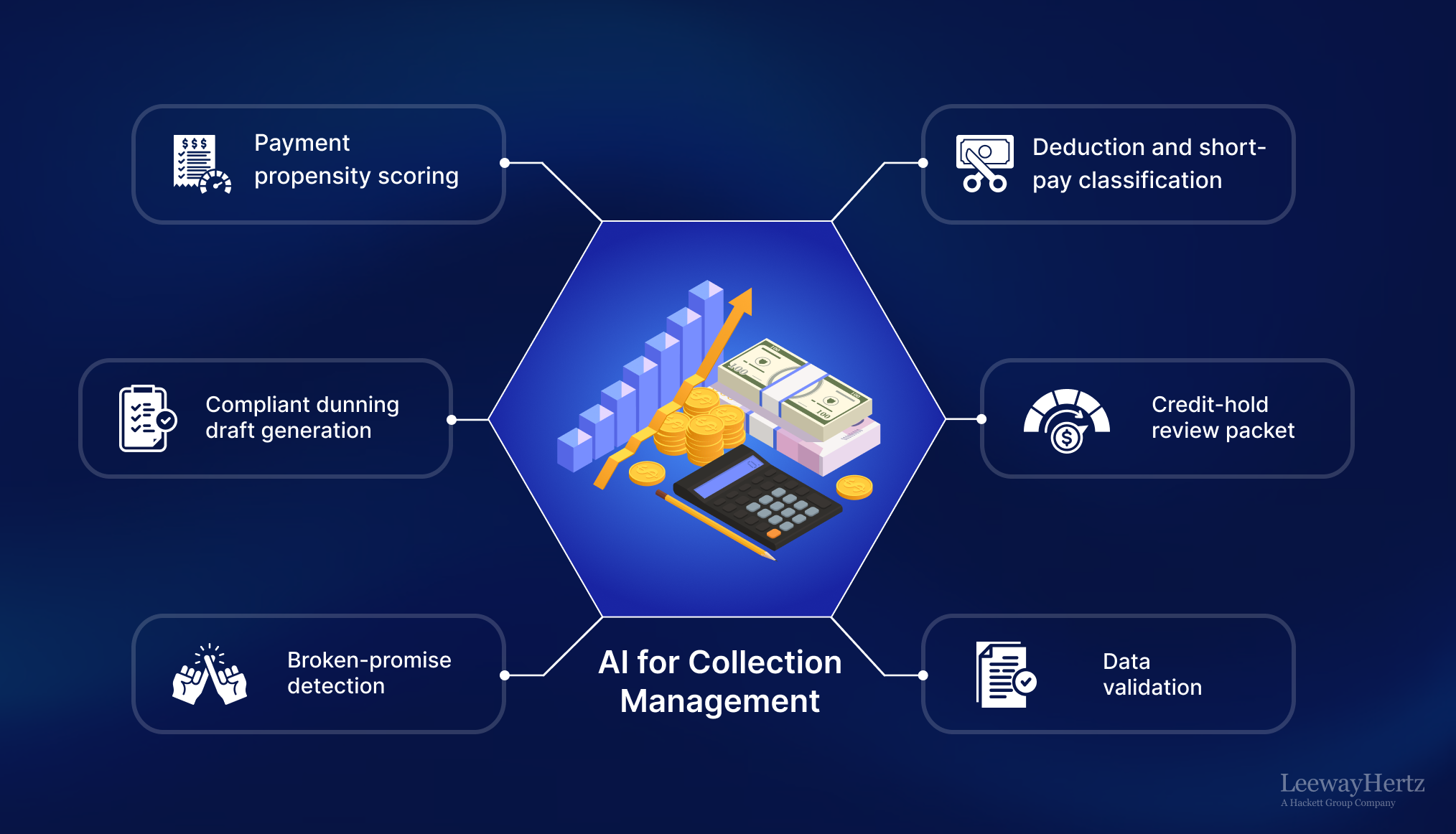
| Payment propensity scoring | Collections strategy and segmentation | Predictive analytics scores customers and invoices using aging, payment history, disputes and promises to improve treatment strategy and queue prioritization. |
| Risk-ranked collector worklists | Collections prioritization | AI-driven prioritization ranks accounts by expected cash impact, exposure, risk, urgency, and collector capacity to improve daily collection execution. |
| Collector account brief generation | Worklist management | Natural-language generation turns invoices, aging, notes, disputes and PTPs into reviewable call briefs. |
| Compliant dunning draft generation | Customer communication | Natural-language generation drafts customer-specific outreach from approved templates, account context and communication restrictions. |
| Broken-promise detection | Promise-to-pay management | Anomaly detection compares PTP records with cash receipts and flags missed commitments for escalation. |
| Deduction and short-pay classification | Dispute coordination | Classification assigns reason codes from remittance advice, customer emails and claim details to accelerate routing. |
| Credit-hold review packet | Credit coordination | Multi-source aggregation combines AR, open orders, credit limits, disputes and customer history for credit manager review. |
| Agency placement packet | Agency collections | Document intelligence assembles placement-ready evidence and flags missing artifacts before approval. |
| Write-off support packet | Recoveries and write-off coordination | Document intelligence prepares aging, collection history, disputes, approvals and recovery evidence for controller review. |
| Cash forecast variance explanation | Cash forecasting and analytics | Natural-language generation explains differences between expected and actual cash using invoice, payment, dispute and PTP data. |
| Collector communication QA | Compliance and QA | Retrieval-grounded answering compares collection messages and notes against approved scripts, policy and restrictions. |
| Aging data validation | Data governance | Anomaly detection flags invalid terms, bucket errors, duplicate accounts and missing due dates before they distort queues. |
| Strategic account resolution brief | Cross-functional resolution | Multi-source aggregation links AR, CRM, service issues, disputes and open orders to guide coordinated escalation. |
A use case earns “high-value” status when it improves a repeated decision without removing the accountable reviewer. In collections, the reviewer boundary is not a blocker. It is the design feature that allows AI to operate safely in a function where customer relationships, financial controls and legal exposure are tightly connected.
How agentic AI works in collection management workflows
Agentic AI in collections is best understood as the disposition of a governed sequence.
Promise-to-pay monitoring
- Agent role: Track promised payments and prepare exceptions when commitments are missed.
- Retrieve PTP records, promised dates, promised amounts, lockbox data, payment portal activity and cash application status.
- Detect fulfilled, partially fulfilled and broken promises.
- Draft a broken-promise summary with account history and recommended follow-up category.
- Route the summary to the assigned collector or supervisor.
- Record the reviewed outcome and update the next follow-up task.
Deduction resolution support
- Agent role: Prepare evidence packets for short-paid invoices and disputed deductions.
- Retrieve remittance advice, invoice copies, purchase orders, contracts, POD files, pricing data and customer correspondence.
- Classify the deduction reason and identify missing evidence.
- Draft a dispute-resolution packet with the likely routing owner.
- Route the packet to the deductions analyst for review.
- After review, route valid credits to billing or release collectible balances back to collections.
Agency placement review
- Agent role: Prepare placement-ready accounts for manager and legal approval.
- Retrieve severe delinquency accounts, open balances, dispute status, bankruptcy flags, correspondence, prior notices and collection history.
- Check placement eligibility criteria and identify missing artifacts.
- Draft a placement packet with supporting evidence and risk flags.
- Route the packet to collections leadership and legal for approval.
- After approval, transmit the account through the controlled agency placement workflow and retain audit evidence.
The review boundary is the safety property. AI agents can assemble and recommend the next step, but a named person confirms before any customer-facing, legal, credit, settlement, agency or accounting action proceeds.
How to prioritize AI use cases in collection management
Collections teams should prioritize AI where the operating model already has repeatable work, accessible artifacts and a clear reviewer. The first projects should not be the most autonomous. They should be the most reviewable.
| Criterion | What to ask |
|---|---|
| Volume and frequency | Does this sub-process recur often enough for AI support to reduce manual effort at scale? |
| Artifact availability | Are the needed source artifacts available in usable systems with sufficient quality for AI analysis? |
| Review boundary | Can a defined role confirm the AI output before it affects a regulated or risk-bearing decision? |
| Blast radius | If the output is wrong, is the impact limited to a draft or triage queue rather than a live risk-bearing action? |
| Economic story | Can the function tie the use case to a credible outcome such as higher yield, lower effort or reduced compliance risk? |
The classic failure patterns are predictable: misaligned scope, missing data, bypassed governance and premature quantified savings. Misaligned scope means building a general collections chatbot instead of a specific workflow, such as PTP extraction or short-pay classification. Missing data means trying to forecast cash without reliable PTP, dispute and cash application feeds. Bypassed governance means allowing AI to contact customers, approve settlements or release orders without a named reviewer. Premature quantified savings means promising lower DSO or higher recovery before the workflow has been tested in production. The strongest first projects are high-volume, artifact-rich and cleanly reviewed sub-processes such as account brief generation, PTP monitoring, deduction classification, worklist ranking, credit review packet creation and QA sampling.
Governance, risk and responsible AI in collection management
AI in collection management needs governance because it can affect customer communication, credit treatment, settlement, escalation, write-off, agency placement and financial reporting. In consumer debt collection or third-party collection contexts, the control environment may also need to account for FDCPA, Regulation F, TCPA, FCRA and state-level rules. The exact regulatory frame depends on product, geography, customer type and whether the collector is first-party or third-party.
Human-in-the-loop (HITL) oversight: AI may draft collector briefs, emails, dispute packets, worklists, PTP summaries, settlement packets, agency placement files and QA findings. Collectors, supervisors, credit managers, controllers, legal reviewers and compliance teams confirm before any customer-facing, credit-bearing, legal, write-off or settlement action proceeds.
Regulatory and standards alignment: AI in collection management should be mapped to the organization’s AR policy, credit policy, delegation-of-authority matrix, audit controls, communication policy and applicable regulation. For AI risk management, organizations can align controls to the NIST AI Risk Management Framework and then map the workflow back to collections-specific laws, policies and standards.
Bias mitigation and evidence retention: Bias can enter through customer segmentation, contactability scoring, payment propensity models, agency placement and settlement recommendations. Each recommendation should retain named source artifacts, such as aging files, invoices, notes, PTP history, disputes, correspondence, policy references and reviewer decisions, so outputs remain inspectable and testable.
Key governance requirements: The AI inventory should separate low-risk summarization from higher-risk scoring, recommendation or workflow routing. A call-note summary carries a different risk from a settlement recommendation. Each use case should have risk tiering, approval gates, fallback procedures, escalation paths and defined owner accountability.
Design principles: AI in collection management should be grounded in approved source systems, use least-privilege access and restrict tools by role and workflow. An agent that drafts an email should not automatically send it. An agent that prepares a write-off packet should not post the write-off. An agent that scores agency placement should not transmit the placement without approval.
Traceability and data security: Each workflow should retain prompts, source records, model version, retrieved evidence, generated output, reviewer disposition, approval status and system updates. Sensitive customer, payment, legal and financial data should be protected through recognized security controls, role-based access, encryption, logging and retention policies.
How ZBrain operationalizes AI use cases in collection management
Identifying use cases is only the first step. Accounts receivable collection teams need a controlled way to design, build, validate, deploy, govern, and scale AI workflows across customer account segmentation, collections prioritization, contact strategy, payment status follow-up, promise-to-pay tracking, dispute and deduction routing, invoice and statement retrieval, credit hold review, escalation management, write-off review, cash application support, collections reporting, and enterprise controls.
This is where ZBrain helps.
ZBrain is an end-to-end AI enablement platform that supports this lifecycle through four connected stages: ZBrain Analyzer, ZBrain Design, ZBrain Solution Builder, and ZBrain Governance. The platform provides a governed path from use-case analysis to deployed agentic workflows while maintaining policies, permissions, approval points, monitoring, and runtime evidence.
ZBrain Analyzer
ZBrain Analyzer helps teams examine selected accounts receivable collection processes, identify AI opportunities, and document the business context, systems, data, artifacts, roles, controls, and review requirements needed to evaluate each use case.
ZBrain Design
ZBrain Design creates a build-ready technical design for the selected use case. It generates the business requirements document, functional requirements, user journeys, architecture, workflow logic, data specifications, integration context, and governance considerations needed before development begins.
ZBrain Solution Builder
ZBrain Solution Builder enables teams to create, configure, and validate governed AI workflows for accounts receivable collection processes based on the technical design developed in ZBrain Design. It supports testing across routine, exception, customer, financial, dispute, escalation, and control scenarios before deployment.
ZBrain Governance
ZBrain Governance applies policies, access controls, human approval requirements, monitoring, and traceability throughout workflow execution. It provides guardrails, approval gates, escalation controls, kill switches, and audit trails to help organizations maintain oversight of AI outputs, reviewer actions, exceptions, and authorized system updates.
Future of AI in collection management
The future of AI in collection management is likely to be less about isolated tools and more about federated platforms with shared orchestration, governance and observability. Collections touches ERP, CRM, billing, disputes, cash application, credit, legal and customer success. The handoff problem is not only technical. It is operational. AI becomes more useful when it can preserve context across those handoffs and show exactly which source record, rule and reviewer shaped the next action.
Long-horizon agentic workflows will become more common, but they will need clear review boundaries. A collection workflow may monitor delinquency, detect a broken promise, prepare a revised account brief, draft a customer follow-up, identify an unresolved deduction, route the issue to a deductions analyst and update the cash forecast. The agent can hold the multi-step goal, but each risk-bearing judgment still needs a person to confirm.
The advantage will shift from choosing one frontier model to designing the workflow around the decision. In collections, the most important design questions are practical: which artifact starts the work, which system is authoritative, which policy applies, which reviewer confirms, which downstream system is updated and which evidence is retained.
The future depends on workflow design, not only better models. Better models can improve classification, summarization, extraction and reasoning, but collection performance will depend on whether enterprises connect those capabilities to the real AR operating model.
Endnote
AI for collection management is most valuable when it strengthens the discipline already required in AR: accurate data, clear accountability, consistent follow-up, governed communication and evidence-backed decisions. AI in collection management is too important to be reduced to a generic assistant that answers questions about overdue balances.
A function-deep approach shows where AI can create value without removing human ownership. It can help collectors prepare faster, supervisors prioritize better, credit managers review risk with richer evidence, deductions teams resolve blocked balances sooner, treasury team forecast cash with more context and compliance teams test activity more consistently.
The operating model also makes clear that collection management is not separate from the rest of finance. It connects to billing accuracy, customer master quality, payment application, credit policy, dispute resolution, revenue retention, cash forecasting, reserve analysis and financial controls.
The strongest AI programs will begin with sub-processes that have repeatable work, reliable artifacts, clear systems of record and a named reviewer. They will avoid premature autonomy and build trust through traceability, review and measurable operating outcomes.
To explore how ZBrain can help operationalize governed AI workflows across collection management and accounts receivable, contact the ZBrain team today.
Author’s Bio


Akash's ability to build enterprise-grade technology solutions has garnered the trust of over 30 Fortune 500 companies, including Siemens, 3M, P&G, and Hershey's. Akash is an early adopter of new technology, a passionate technology enthusiast, and an investor in AI and IoT startups.
Related Products

AI Agent
Discover the right AI agent for your use case! Explore our extensive range of AI agents tailored to tackle specific challenges.
Start a conversation by filling the form
Once you let us know your requirement, our technical expert will schedule a call and discuss your idea in detail post sign of an NDA.
All information will be kept confidential.
FAQs
What is AI for collection management in accounts receivable?
AI for collection management in accounts receivable refers to the use of AI capabilities to support how finance teams monitor, prioritize and manage overdue customer balances. It helps AR teams analyze aging data, payment behavior, disputes, promise-to-pay history, customer communication and credit exposure to determine which accounts need attention and what context collectors need before acting.
In practice, AI can support workflows such as account prioritization, collector brief preparation, promise-to-pay tracking, dispute classification, credit review support, cash forecast commentary and compliance evidence preparation. It does not replace collectors, credit managers or finance reviewers; it helps them work with better context, clearer prioritization and more reviewable outputs.
Which AI use cases are most vital in collection management?
The most vital use cases are those that connect directly to cash timing, risk control and daily collector execution.
-
Collections strategy and prioritization: Payment propensity scoring, risk-tier assignment, treatment strategy mapping and worklist optimization.
-
Customer communication: Approved dunning draft generation, call brief creation, call-note summarization and disclosure checks.
-
Promise-to-pay management: PTP extraction, fulfillment tracking, broken-promise detection and escalation routing.
-
Disputes and deductions: Short-pay classification, evidence extraction, invoice comparison and resolved-dispute release.
-
Credit and exposure coordination: Credit exposure aggregation, hold review packets, order release support and delegation-of-authority checks.
-
Recoveries and compliance: Agency placement packets, write-off support packets, communication QA, audit packet assembly and recovery tracking.
How does AI improve collector productivity?
AI improves collector productivity by reducing preparation and documentation effort. It can summarize customer history, open invoices, prior notes, disputes, promises and payment behavior into a collector-ready account brief. It can also structure notes after outreach, identify next steps and flag missing follow-ups for supervisor review.
Can AI make collection decisions automatically?
AI should not make risk-bearing collection decisions automatically. It can score, draft, classify, summarize and prepare recommendations, but humans should confirm before customer-facing outreach, settlement approval, credit hold, order release, agency placement, legal escalation, write-off or accounting action.
How does AI support promise-to-pay management?
AI can extract promise details from emails, call notes or transcripts, including promised amount, date, payment method and invoice coverage. It can compare those promises with actual receipts from payment portals, lockbox files and cash application systems to identify fulfilled, partially fulfilled and broken promises.
How does AI help with disputes and deductions in collections?
AI can classify deduction reason codes, extract claim details from remittance advice, retrieve invoices and proof documents, compare customer claims against contracts or purchase orders and prepare dispute packets for analyst review. It also helps release resolved disputes back into standard collections, so collectible balances do not remain blocked.
What governance controls are needed for collection management AI?
AI in collection management needs role-based access, approved retrieval sources, human review checkpoints, audit trails, reviewer dispositions, model and prompt logging, exception handling and policy-based tool restrictions. For regulated or third-party debt collection contexts, workflows should also be mapped to applicable laws, rules and communication requirements.
How can ZBrain help operationalize AI use cases in collection management?
ZBrain provides an end-to-end AI enablement platform for accounts receivable collection teams to identify, design, validate, deploy, govern, and scale AI workflows across customer account segmentation, collections prioritization, contact strategy, payment status follow-up, promise-to-pay tracking, dispute and deduction routing, invoice and statement retrieval, credit hold review, escalation management, write-off review, cash application support, collections reporting, and enterprise controls.
- ZBrain Analyzer: Helps teams examine selected accounts receivable collection processes, identify AI opportunities, and document the business context, systems, data, artifacts, roles, controls, KPIs, and review requirements needed to evaluate each use case.
- ZBrain Design: Converts selected use cases into build-ready technical designs, including business requirements, functional requirements, user journeys, architecture, workflow logic, data specifications, integration context, approval points, and governance considerations.
- ZBrain Solution Builder: Enables teams to create, configure, and validate governed AI workflows based on the design developed in ZBrain Design. It supports testing across routine, exception, customer, financial, dispute, escalation, and control scenarios before deployment.
- ZBrain Governance: Applies policies, access controls, human approval requirements, monitoring, traceability, escalation controls, kill switches, and audit trails throughout workflow execution.
ZBrain’s role is enablement rather than autonomous decision-making. It helps define where AI assists, augments, or acts within accounts receivable collection workflows, while final approvals and risk-bearing decisions remain with accountable roles across collections, credit, customer service, disputes, cash application, finance, legal, and enterprise controls.
Insights

AI in financial modeling: Applications, benefits, architecture, implementation, and future trends
The integration of AI into financial modeling represents a transformative leap forward in the domain of finance.

AI in Education: Transforming Workflows for Smarter Operations
AI can monitor online exams to prevent cheating and ensure that exams are conducted fairly to reduce the workload on teachers while providing a more secure testing environment for students.
AI in accounting and auditing: Blazing new trails in financial management
AI has made significant inroads into the fields of accounting and auditing, redefining how financial data is processed, analyzed, and audited.