


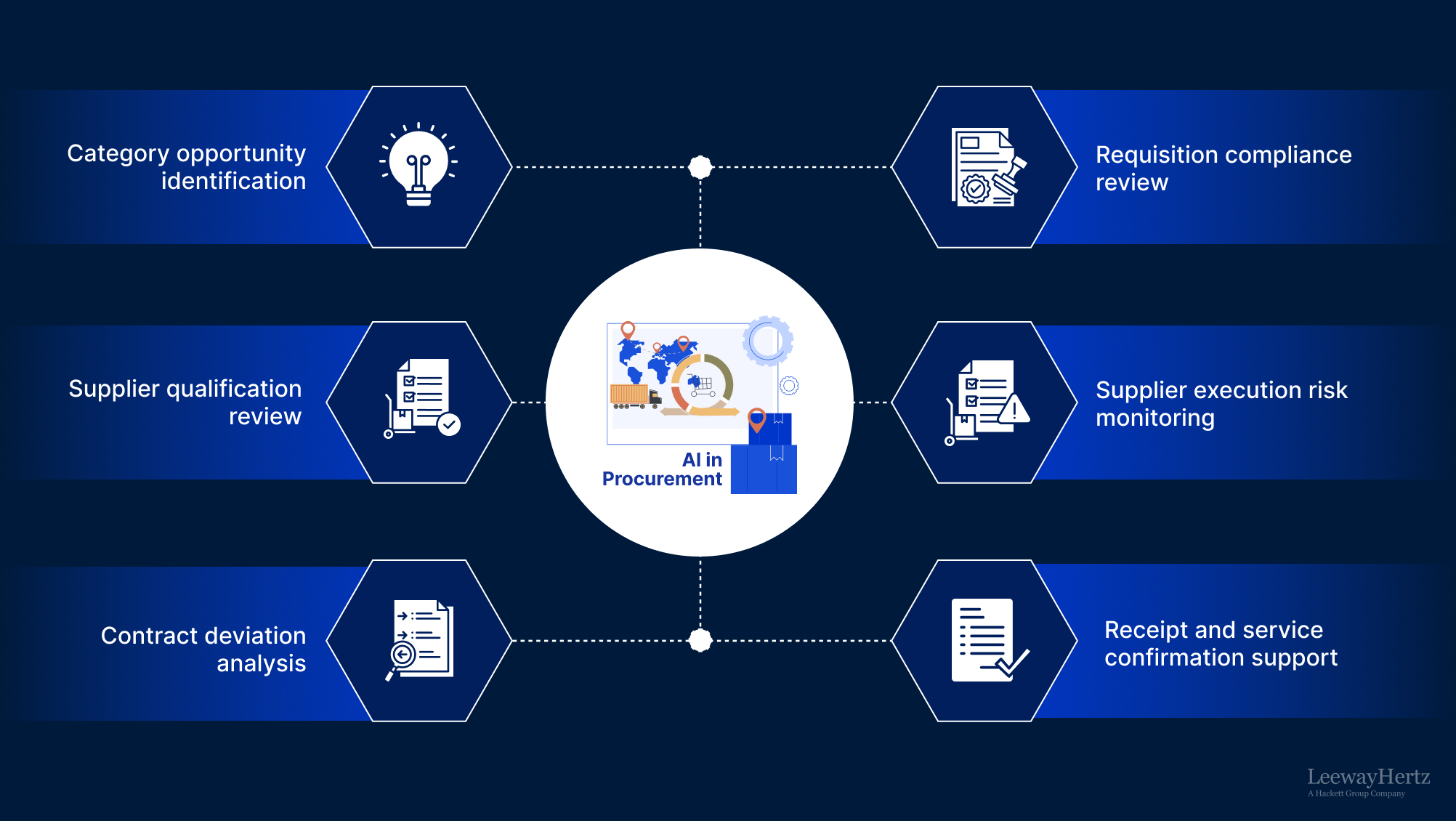
Procurement is not a standalone industry. It is a horizontal enterprise function that spans manufacturing, retail, healthcare, life sciences, banking, insurance, energy, utilities, telecom, technology, public sector, logistics, construction and professional services. Across these industries, procurement connects business demand, supplier capability, contractual control, financial discipline, regulatory obligations and operational continuity.
That breadth makes procurement a strong candidate for AI, but it also makes generic AI adoption risky. Procurement work extends far beyond purchase orders and invoice processing. It spans the full source-to-pay lifecycle, from category strategy, market intelligence and supplier discovery to sourcing, contracting, requisition control, order execution, receiving, invoice coordination and payment support. It also includes cross-cutting responsibilities such as supplier performance management, third-party risk, ESG, spend analytics, master data governance and continuous improvement.
The scale of procurement makes the operating model important. Public procurement continues to represent a significant share of economic activity, consistently accounting for around 12–15% of GDP in OECD countries in recent years. Government procurement spending in 2024 ranged roughly around 13% of GDP for the OECD as a whole, with several advanced economies exceeding that share, highlighting why procurement is a major economic control point rather than just a back-office function.
Given this scope, AI has become important for procurement because the function now depends on faster interpretation of fragmented supplier, contract, spend, risk and operational data. Procurement teams need to identify risks earlier, compare supplier options more consistently, reduce manual review effort, improve compliance visibility and prepare decisions with stronger evidence. AI can support that shift when it is embedded into procurement workflows as a decision-support capability rather than applied as a generic automation layer.
AI in procurement should not be treated as a generic chatbot that answers supplier questions or drafts purchase emails. A category manager needs market intelligence tied to spend, supplier performance and demand forecasts. A sourcing lead needs bid comparisons that explain commercial, technical and risk differences across suppliers. A procurement compliance owner needs policy exceptions, conflict-of-interest indicators and approval evidence surfaced before a contract or payment action proceeds.
The better design approach is to map AI use cases to the procurement operating model at the function, process and sub-process level. This article uses the procurement operating model to break work into functions, processes and sub-processes, then maps AI-enabled opportunities to the artifacts, systems and human review points that make each use case buildable and governable.
Table of contents
- How AI is transforming procurement operations
- Why AI use cases in procurement must be mapped at the sub-process level
- Procurement operating model and AI opportunity mapping across procurement processes
- High-value AI use cases in procurement
- How agentic AI works in procurement workflows
- How to prioritize AI use cases in procurement
- Governance, risk and responsible AI in procurement
- How ZBrain operationalizes AI use cases in procurement
- Future of AI in procurement
How AI is transforming procurement operations
AI is changing procurement by helping teams interpret large volumes of supplier, spend, contract, bid, risk, invoice and performance data that traditionally sit across different systems and teams. The shift is not only automation of repetitive steps. It is the movement from isolated procurement tasks toward evidence-backed workflows where AI classifies records, retrieves policy and contract context, detects exceptions, drafts reviewable outputs and prepares the next work packet for an assigned human reviewer.
A practical example is supplier qualification. A procurement team may need to review supplier registration records, tax forms, insurance documents, cybersecurity questionnaires, ESG disclosures, sanction screening results, financial data and prior performance evidence before a supplier is approved. AI can extract missing fields from supplier documents, compare submitted evidence against qualification rules, classify risk indicators, retrieve policy requirements and prepare a supplier qualification brief for the sourcing manager or procurement risk owner. This type of work reflects the digital procurement direction described by the OECD, where procurement transformation depends on lifecycle integration, emerging technologies and robust data capabilities rather than isolated digitization of one step.
In procurement, the highest-value AI opportunities usually fall into the following types:
- Document-heavy work: Supplier forms, RFPs, bids, contracts, purchase requisitions, purchase orders, delivery records, invoices and compliance documents can be checked for missing fields, inconsistent terms, expired certificates and mismatched references before a reviewer opens them.
- Narrative-heavy work: Category strategies, sourcing summaries, bid evaluation memos, supplier performance reviews, risk assessments, negotiation briefs and executive procurement reports can be drafted from approved source material while showing where evidence is incomplete.
- Exception-heavy work: Non-compliant requisitions, missing supplier documents, contract deviations, PO changes, blocked invoices, late deliveries, supplier risk alerts and policy exceptions can be classified and prioritized so specialists focus on the highest-impact cases first.
- Knowledge-heavy work: Policy interpretation, contract clause lookup, preferred supplier checks, regulatory requirements, ESG standards and precedent decisions improve when AI retrieves the relevant rule, compares it with the current transaction and flags conflicts.
- Workflow-heavy work: Source-to-pay workflows benefit when AI forecasts bottlenecks, prepares the next review packet, identifies missing approvals and reduces rework between sourcing, legal, finance, risk, operations and supplier management.
The practical design rule is simple: AI in procurement should be mapped to the workflow artifact and the human decision it supports. AI can score, compare, retrieve, classify, draft and prepare, but procurement leaders, category owners, legal reviewers, finance approvers, risk teams and business stakeholders continue to make the decisions that affect supplier selection, contract acceptance, spending authority, payment, risk treatment and compliance attestation.
Why AI use cases in procurement must be mapped at the sub-process level
A broad use case, such as “AI for sourcing,” is too vague to govern or implement. Sourcing includes supplier discovery, RFI preparation, RFP drafting, bidder Q&A, bid normalization, technical scoring, commercial comparison, negotiation preparation, award recommendation and supplier notification. Each step has different source artifacts, systems, risks and reviewers. AI support for bid normalization is very different from AI support for supplier award recommendation.
A better approach is to map AI use cases to the procurement operating model:
- Function: A governed procurement domain with its own accountability, such as category management, strategic sourcing, contract lifecycle management, procure-to-pay coordination or supplier risk governance.
- Process: A workflow area inside a function, such as market intelligence, RFP management, purchase requisition review, invoice matching or supplier performance review.
- Sub-process: The atomic work activity where AI creates a concrete opportunity, such as extracting supplier certifications from an onboarding packet, comparing a bid against an RFP scoring matrix, identifying a PO price variance or drafting a supplier corrective action summary.
- AI-enabled opportunity: A specific AI capability applied to a specific procurement artifact to change how the work is prepared, reviewed or controlled, such as document intelligence applied to supplier onboarding files to flag missing tax, insurance and compliance evidence before supplier approval.
This mapping matters because procurement crosses several control boundaries. A sourcing analyst can prepare a bid comparison, but a category owner may recommend an award, a legal reviewer may approve contract deviations, finance may confirm budget availability, risk may approve supplier exposure and a business owner may confirm operational fit. AI must support those handoffs without collapsing accountability into the model.
For example, AI can compare a supplier’s bid against an RFP scoring matrix, prior pricing, delivery requirements and risk records. It can highlight outlier pricing, incomplete responses and conflicts with mandatory terms. But it should not award the business to a supplier. The sourcing lead, category manager and evaluation committee must confirm the recommendation under the organization’s procurement policy.
The sub-process lens also prevents over-automation. AI can extract, classify, compare, retrieve, summarize, draft, score and prepare. People decide whether to approve a supplier, issue an RFP, accept a contract clause, release a purchase order, approve a payment, waive a policy exception, accept a risk, or escalate a supplier performance issue.
Build procurement AI workflows with governed execution
Enable procurement teams to streamline operations, improve spend visibility, strengthen controls, and support faster, evidence-backed decisions while keeping human accountability at the core.
Procurement operating model and AI opportunity mapping across procurement processes
The following operating model maps procurement as an enterprise function, not as an industry-specific department. Industry requirements vary, but the core source-to-pay lifecycle and cross-cutting governance domains remain broadly consistent across sectors.
Function 1: Procurement strategy and category management
Turns enterprise demand, spend, supplier markets and business priorities into governed category strategies and sourcing priorities.
Procurement strategy and category management sit at the front of the procurement operating model. This function connects business demand, spend baselines, supplier markets, internal policies, savings targets, risk appetite and sustainability objectives into category strategies that guide sourcing and supplier decisions. It feeds supplier discovery, sourcing events, contract planning, budget alignment and executive procurement reporting.
Teams involved: Category managers, procurement strategy teams, business stakeholders, finance planning teams, supply chain leaders, sustainability teams, risk teams and executive procurement leadership run this function.
What AI helps with: Predictive analytics can analyze demand plans, spend history and market signals to forecast category exposure and sourcing opportunities. Classification can normalize supplier, commodity and spend records so category managers see where spend is fragmented. Retrieval-grounded answering can compare category plans against procurement policy, supplier strategy, sustainability requirements and prior sourcing outcomes. Natural-language generation can draft category strategy briefs, market summaries and executive decision memos from approved procurement evidence.
What humans continue to own: Category owners decide the category strategy, supplier segmentation, sourcing priority, savings commitment, risk posture and stakeholder alignment. Finance and business leaders confirm budget assumptions, demand changes and savings treatment. Sustainability and risk teams approve ESG and third-party risk positions where required. AI analyzes, summarizes and drafts but does not decide, approve, or attest.
| Process | Sub-process | Key AI-enabled opportunities |
|---|---|---|
| Spend analysis | Spend data intake | Classification organizes ERP, purchase order, invoice and card spend records into usable categories, supplier and business-unit groupings. Multi-source aggregation compares spend records across ERP, procurement platforms and finance extracts to flag duplicate suppliers, missing cost centers and inconsistent commodity codes. |
| Spend normalization | Entity resolution links supplier name variants, parent-child relationships and duplicate vendor records to produce a cleaner category baseline. Anomaly detection flags unusual price movements, fragmented buying and off-contract spend patterns for category review. | |
| Baseline creation | Predictive analytics evaluates historical spend, seasonality and demand signals to prepare category baselines for strategy planning. Natural-language generation drafts baseline commentary that explains major spend movements and data gaps for category managers. | |
| Category segmentation | Category taxonomy mapping | Classification maps spend lines to category taxonomies, UNSPSC-style codes or internal commodity structures to improve strategy visibility. Retrieval-grounded answering checks category assignments against procurement policy and prior sourcing records. |
| Criticality assessment | Predictive analytics combines spend, supply risk, business dependency and supplier concentration data to rank category criticality. Simulation tests demand, price and supplier disruption scenarios to show where category exposure may increase. | |
| Market intelligence | Supplier market scan | Source-based intelligence synthesis assembles supplier market information, commodity trends, capacity indicators and geopolitical risk signals into a market intelligence brief. Classification separates suppliers by region, capability, size, diversity status and risk indicators for category planning. |
| Price and cost trend analysis | Predictive analytics analyzes commodity indexes, historical pricing, contract rates and invoice prices to identify category cost trends. Anomaly detection flags supplier price movements that deviate from market or contract expectations. | |
| Category strategy | Strategy option development | Scenario analysis compares sourcing levers, supplier consolidation, dual-sourcing, contract renewal and demand management options against savings, risk and continuity goals. Natural-language generation drafts category strategy options with assumptions, constraints and required stakeholder decisions. |
| Stakeholder alignment briefing | Multi-source aggregation combines demand forecasts, spend baselines, supplier performance, contract coverage and risk inputs into a stakeholder review packet. Policy-aware recommendation review checks strategy recommendations against procurement policy, approved supplier rules and sustainability commitments. | |
| Savings opportunity identification | Opportunity scanning | Anomaly detection identifies maverick spend, tail spend, price variance, duplicate suppliers and expiring contracts that may create sourcing opportunities. Predictive analytics estimates savings ranges based on spend concentration, supplier competition and contract leakage indicators. |
| Savings pipeline preparation | Natural-language generation drafts savings opportunity narratives tied to category baselines, business owners and sourcing timelines. Classification assigns opportunities to category owners, sourcing waves and required approval paths. | |
| Demand planning support | Demand signal intake | Multi-source aggregation combines forecasts, production plans, project plans, historical usage and budget records into category demand views. Predictive analytics identifies demand volatility and potential supply constraints before sourcing begins. |
| Demand consolidation | Optimization groups similar demand across business units, plants, regions or functions to support bundled sourcing decisions. Anomaly detection flags one-off or poorly specified demand that may require business clarification. | |
| Category governance | Category review preparation | Evidence-based review preparation assembles category policies, prior approvals, savings commitments, supplier concentration limits and risk thresholds into review materials. Natural-language generation prepares category governance summaries for procurement leadership. |
| Strategy refresh tracking | Classification identifies category plans requiring refresh based on contract expiry, spend growth, supplier performance or market disruption. Predictive analytics prioritizes refresh cycles by exposure, opportunity size and stakeholder impact. |
Highest-value opportunities: Spend normalization creates the data foundation for sourcing, savings measurement and supplier visibility by reducing fragmentation across supplier and category records. Category criticality assessment helps procurement focus on areas with the greatest operational, financial and risk exposure. Savings opportunity scanning turns spend leakage, price variance and off-contract buying into a governed sourcing pipeline. Strategy refresh tracking prevents category plans from becoming outdated, reducing reactive sourcing, supplier concentration and missed contract leverage.
Example agentic workflow: Spend normalization and category opportunity identification
- The agent starts from the spend normalization sub-process using ERP spend extracts, PO records, invoice lines, supplier master data and procurement taxonomy files.
- It groups supplier records, detects supplier duplicates, maps spend to category structures and flags low-confidence classifications for review.
- It compares the normalized baseline with contract coverage, supplier concentration, price variance and off-contract spend indicators.
- It prepares a category opportunity packet that includes baseline spend, supplier fragmentation, sourcing opportunities, risk indicators and data-quality exceptions.
- A category manager reviews the packet, confirms or corrects classifications, approves the category baseline and decides which opportunities enter the sourcing pipeline.
- On confirmation, the workflow records the approved baseline, updates the category planning workspace and hands off sourcing opportunities under existing procurement governance.
Function 2: Supplier discovery, sourcing and qualification
Turns business requirements and supplier market options into qualified supplier pools that can participate in sourcing and procurement workflows.
Supplier discovery and qualification determine which suppliers can be considered before commercial competition begins. This function is important in every industry, but the rules differ by sector. A life sciences buyer may require GxP, quality and regulatory evidence. A bank may emphasize third-party risk, data security and resilience. A manufacturer may focus on production capacity, certifications, quality history and supply continuity. A public-sector buyer may need transparency, eligibility and conflict-of-interest controls. ISO 20400 also frames sustainable procurement as a practice that integrates sustainability considerations into procurement decisions and processes, which makes supplier qualification a natural control point for ESG and due diligence evidence.
Teams involved: Supplier onboarding teams, sourcing specialists, category managers, procurement operations, third-party risk teams, legal, compliance, finance, sustainability teams, information security and business stakeholders run this function.
What AI helps with: Document intelligence can extract supplier registration data, tax records, certificates, insurance documents, diversity evidence and compliance attestations from onboarding packets. Classification can assign supplier type, category fit, region, risk tier and onboarding path. Retrieval-grounded answering can compare supplier evidence against qualification policy, industry requirements and sourcing event criteria. Anomaly detection can flag inconsistent ownership, expired certificates, duplicate supplier records and unusual risk indicators.
What humans continue to own: Procurement and risk owners approve supplier onboarding, qualification status, supplier eligibility, due diligence outcomes and participation in sourcing events. Legal, compliance, information security and sustainability teams confirm specialized requirements where applicable. Finance owns payment-related vendor setup controls. AI extracts, checks, scores and prepares but does not decide, approve, or attest.
| Process | Sub-process | Key AI-enabled opportunities |
|---|---|---|
| Supplier identification creation | Supplier longlist creation | Supplier intelligence synthesis assembles potential suppliers from internal records, prior sourcing events, supplier databases, market research and stakeholder inputs. Classification groups suppliers by capability, category, geography, diversity status and potential sourcing fit. |
| Internal supplier reuse check | Entity resolution matches proposed suppliers against the existing supplier master, contract repository and prior performance records. Approved supplier fit check determines whether an existing approved supplier can meet the new requirement before a new supplier is onboarded. | |
| Supplier research preparation | Capability profile | Multi-source aggregation combines supplier websites, capability statements, past performance records, certification data and internal supplier notes into a qualification profile. Natural-language generation drafts supplier profile summaries that highlight capabilities, gaps and evidence quality. |
| Market reputation review | Supplier reputation analysis brings together adverse media, prior incidents, stakeholder feedback and internal performance signals to support supplier review. Classification separates reputation signals by severity, recency and relevance to the sourcing category. | |
| Supplier prequalification | Prequalification questionnaire review | Document intelligence extracts answers, attachments, certifications and policy acknowledgments from supplier questionnaires. Anomaly detection flags missing responses, inconsistent answers and evidence that does not support the supplier’s claims. |
| Minimum requirement validation | Supplier qualification review checks submitted supplier evidence against sourcing criteria, category requirements, regulatory requirements and internal procurement policy. Classification assigns pass, review-needed or not-qualified status for human confirmation. | |
| Supplier registration | Supplier registration data capture | Document intelligence extracts legal entity name, address, tax identifiers, banking details, ownership information and contact records from supplier registration files. Entity resolution detects duplicates, parent-child relationships and name variants across supplier master data. |
| Data completeness check | Anomaly detection flags missing mandatory fields, suspicious changes and mismatches between submitted forms and supporting documents. Vendor master validation checks registration completeness against vendor master policy and onboarding requirements. | |
| Supplier onboarding | Onboarding path assignment | Classification assigns suppliers to onboarding routes based on category, risk tier, geography, data access, spend expectation and service criticality. Optimization prioritizes onboarding tasks based on business urgency, missing evidence and reviewer availability. |
| Onboarding packet preparation | Multi-source aggregation assembles supplier forms, due diligence evidence, compliance documents, financial records and internal approvals into one review packet. Natural-language generation drafts an onboarding summary for procurement, finance and risk reviewers. | |
| Diversity and sustainability verification | Diversity evidence review | Document intelligence extracts certification details, expiration dates, certifying bodies and ownership data from supplier diversity documents. Supplier diversity verification compares supplier diversity evidence against program requirements and the rules of approved certifying bodies. |
| Sustainability evidence review | Document intelligence extracts sustainability statements, ESG disclosures, environmental certifications and responsible sourcing attestations from supplier records. Sustainability evidence review checks supplier claims against sustainable procurement criteria, policy requirements and category-specific ESG obligations. | |
| Risk screening | Sanctions and restricted-party screening | Entity resolution matches supplier names, owners and affiliates against restricted-party, sanctions and watchlist outputs. Anomaly detection flags partial matches, ownership conflicts and unresolved screening records for compliance review. |
| Financial and operational risk screening | Predictive analytics evaluates financial indicators, dependency risk, business continuity evidence and supplier concentration exposure. Classification assigns supplier risk tiers based on finance, continuity, geography, cyber, regulatory and operational signals. | |
| Capability assessment | Technical capability assessment | Supplier capability review compares supplier evidence against technical specifications, quality requirements, capacity needs and past performance records. Natural-language generation drafts capability assessment notes for sourcing and business reviewers. |
| Supplier fit recommendation | Supplier pool optimization ranks qualified suppliers by capability, risk tier, category fit, location, capacity and compliance status to prepare a recommended supplier pool. Classification separates qualified, conditionally qualified and disqualified suppliers for human approval. |
Highest-value opportunities: Supplier registration data capture protects downstream payment, tax, compliance and fraud controls by improving the accuracy of vendor master records. Minimum requirement validation prevents unqualified suppliers from entering sourcing events when evidence is incomplete or inconsistently reviewed. Risk screening is critical because supplier exposure often begins before contract award. Supplier fit recommendation helps sourcing teams build qualified supplier pools while preserving procurement, risk and compliance review boundaries.
Example agentic workflow: Supplier prequalification
- The agent starts from the supplier prequalification sub-process using a supplier questionnaire, registration form, tax document, certification attachments, risk screening output and category qualification criteria.
- It extracts supplier data, identifies missing documents, checks certificate dates, compares responses against minimum requirements and assigns a preliminary qualification status.
- It retrieves relevant procurement policy, category requirements, ESG criteria, risk screening rules and prior supplier records.
- It prepares a supplier qualification packet with evidence links, missing items, risk flags, duplicate supplier indicators and a recommended review path.
- A sourcing lead, supplier onboarding owner and risk reviewer confirm qualification status, request additional evidence, approve conditional qualification, or reject the supplier.
- On confirmation, the workflow updates the supplier onboarding record, records the reviewer decision, stores the evidence packet and hands off the qualified supplier list to the sourcing event under existing procurement governance.
Function 3: Strategic sourcing and competitive bidding
Turns approved sourcing requirements and qualified supplier pools into structured competition, comparable offers and governed award recommendations.
Strategic sourcing and competitive bidding sit between category strategy and contract execution. This function converts business requirements, category strategy, supplier pools, evaluation criteria and commercial constraints into sourcing events such as RFIs, RFPs, RFQs, tenders and auctions. The operating model varies by sector, but the need for transparent evaluation, competition, documentation and review is consistent.
Teams involved: Sourcing leads, category managers, business requesters, technical evaluators, finance partners, legal, compliance, procurement operations, supplier management and evaluation committees run this function.
What AI helps with: Document intelligence can extract requirements, supplier responses, pricing tables, exceptions and attachments from sourcing event documents. Classification can organize supplier responses by requirement, compliance status, pricing structure, risk theme and evaluation criterion. Retrieval-grounded answering can compare RFP terms, supplier responses, policy rules, prior events and evaluation matrices. Anomaly detection can flag missing bid sections, unusually low pricing, inconsistent delivery assumptions and commercial exceptions. Natural-language generation can draft sourcing summaries, clarification logs and award recommendation memos from approved event records.
What humans continue to own: Sourcing teams define the event strategy, approve the supplier invite list, set evaluation criteria, run negotiations and recommend awards. Business evaluators confirm technical fit. Finance confirms commercial assumptions. Legal and compliance confirm exceptions, conflicts and procurement-policy compliance. Evaluation committees and procurement leaders approve award decisions. AI compares, flags, drafts and prepares but does not decide, approve, or attest.
| Process | Sub-process | Key AI-enabled opportunities |
|---|---|---|
| RFI management | RFI requirement drafting | RFI content review compares draft RFI questions against category strategy, prior events, policy requirements and stakeholder inputs to flag missing information. Natural-language generation drafts supplier information requests tied to capability, experience, risk, ESG and delivery evidence. |
| RFI response normalization | Document intelligence extracts supplier capabilities, geographies, certifications, references and operating constraints from RFI responses. Classification organizes responses by capability fit, completeness, risk signals and follow-up needs. | |
| RFP management | RFP package preparation | Multi-source aggregation assembles business requirements, category strategy, contract templates, pricing schedules, technical specifications and evaluation criteria into an RFP package. RFP package review checks whether the sourcing package includes required policy references, mandatory clauses and approval steps before it is issued to suppliers. |
| RFP compliance check | Document intelligence identifies missing schedules, inconsistent requirement references, undefined terms and incomplete evaluation instructions. Anomaly detection flags unclear scoring rules, conflicting deadlines and omitted mandatory supplier instructions. | |
| RFQ management | RFQ line-item structuring | Document intelligence extracts item descriptions, quantities, delivery locations, service levels, price fields and contract references from RFQ templates. Classification maps line items to category taxonomy, units of measure and comparable pricing structures. |
| RFQ response validation | Anomaly detection flags missing price fields, non-standard units, alternate assumptions and incomplete supplier responses. RFQ response review compares RFQ responses against specifications, contract terms and sourcing instructions. | |
| Bid management | Bid intake and completeness review | Document intelligence extracts supplier responses, attachments, pricing sheets, assumptions, exceptions and certifications from bid submissions. Classification separates compliant, incomplete, late, alternate and exception-heavy bid sections for sourcing review. |
| Supplier clarification tracking | Natural-language generation drafts clarification questions tied to specific bid gaps, ambiguous assumptions and missing evidence. Multi-source aggregation maintains clarification logs, supplier responses and revised bid positions for evaluation review. | |
| Bid comparison | Commercial comparison | Classification standardizes price structures, rebates, payment terms, freight assumptions, taxes and total cost components across bids. Anomaly detection identifies outlier pricing, hidden charges, unusually low bids and mismatches against historical or market pricing. |
| Technical comparison | Technical response review compares supplier technical responses against specifications, service levels, quality requirements and mandatory criteria. Natural-language generation drafts technical comparison summaries with evidence links for evaluator review. | |
| Commercial evaluation | Total cost assessment | Total cost analysis compares bid price, lifecycle cost, implementation effort, switching cost, logistics assumptions and payment terms to show the full commercial impact of each supplier offer. Simulation tests cost outcomes under demand, volume, freight, currency or commodity-price changes. |
| Negotiation target preparation | Predictive analytics compares supplier pricing, prior rates, market trends and category baselines to prepare negotiation ranges. Natural-language generation drafts negotiation briefs with leverage points, concessions and approval constraints. | |
| Technical evaluation | Scoring matrix support | Evaluation evidence mapping links supplier responses to evaluation criteria and highlights where evidence supports, partially supports or fails a requirement. Classification prepares evaluator work queues by requirement area, supplier and missing evidence. |
| Evaluation variance review | Anomaly detection flags unusual evaluator score differences, unsupported high scores, missing comments and scoring patterns that require committee review. Multi-source aggregation assembles scoring sheets, evaluator comments and supplier evidence into an evaluation audit file. | |
| Supplier recommendation | Award scenario development | Supplier award analysis evaluates shortlisted suppliers across score, total cost, risk, capacity, delivery, ESG factors, contract exceptions and stakeholder priorities to prepare comparable award options for sourcing review. Simulation tests single-award, multi-award, split-award and incumbent-retention scenarios against business constraints. |
| Award recommendation memo generation | Natural-language generation drafts an award recommendation memo with supplier ranking, rationale, exceptions, risks, evaluation evidence and required approvals. Award recommendation compliance review checks the recommendation against sourcing policy, conflict rules, evaluation criteria and approval thresholds. | |
| Award preparation | Award approval packet assembly | Multi-source aggregation assembles RFP records, bid evaluations, clarifications, scoring matrix, negotiation notes, risk reviews and approval forms into one packet. Classification identifies missing approvals, unresolved exceptions and required legal or finance reviews. |
| Supplier notification support | Natural-language generation drafts award, regret and next-step communications from approved event decisions and templates. Supplier communication review checks supplier communications against event terms, confidentiality rules and procurement policy. |
Highest-value opportunities: Bid response normalization makes supplier submissions easier to compare by turning inconsistent formats into structured commercial, technical and risk views. Commercial comparison brings price, freight, payment terms and hidden assumptions into one reviewable frame, reducing evaluation ambiguity. Evaluation variance review helps detect unsupported scoring patterns that could create fairness, audit or award-risk concerns. Award recommendation memo drafting gives leadership a clear evidence trail connecting the proposed award to evaluation results, sourcing policy and required approvals.
Example agentic workflow: Bid comparison and award recommendation
- The agent starts from the bid comparison sub-process using supplier bids, pricing templates, RFP requirements, evaluation criteria, clarification logs, historical pricing and supplier risk records.
- It extracts bid fields, normalizes pricing, identifies missing sections, maps responses to requirements and flags assumptions or exceptions.
- It compares commercial and technical responses against the scoring matrix, category strategy, approved sourcing rules and supplier qualification records.
- It prepares a bid comparison workbook and draft award recommendation memo with evidence links, unresolved exceptions and evaluation gaps.
- The sourcing lead, technical evaluators, finance reviewer and evaluation committee confirm scores, review exceptions, adjust assumptions and approve the final award recommendation.
- On confirmation, the workflow stores the sourcing file, records reviewer disposition, updates the sourcing event and hands off the approved award packet to contract lifecycle management under existing procurement governance.
Function 4: Contract lifecycle management
Turns award decisions, templates, negotiated terms and approval evidence into executed contracts, managed obligations and controlled renewals.
Contract lifecycle management is where sourcing intent becomes an enforceable commercial commitment. In procurement, the contract controls scope, pricing, service levels, delivery terms, liability, indemnity, confidentiality, data protection, intellectual property, audit rights, termination, renewal, payment terms, dispute handling and supplier obligations. Contracting quality matters because fragmented and poorly managed contracts can create value leakage.
Teams involved: Procurement contracting teams, sourcing leads, category managers, legal, finance, risk, information security, compliance, business owners, supplier relationship managers and contract administrators run this function.
What AI helps with: Document intelligence can extract clauses, obligations, deviations, pricing, dates, renewal terms and signature status from contract drafts and executed agreements. Retrieval-grounded answering can compare proposed terms against templates, playbooks, fallback positions, sourcing records and policy requirements. Classification can categorize clause deviations by risk, ownership and approval path. Natural-language generation can draft contract summaries, negotiation notes, obligation registers, renewal briefs and amendment memos.
What humans continue to own: Legal reviewers approve legal positions, non-standard clauses and risk-bearing contract terms. Procurement and business owners confirm commercial fit, supplier commitments and operational feasibility. Finance confirms pricing and payment terms. Risk, information security and compliance approve specialized obligations. Authorized signatories execute contracts. AI extracts, compares, drafts and prepares but does not decide, approve, or attest.
| Process | Sub-process | Key AI-enabled opportunities |
|---|---|---|
| Contract authoring | Template selection | Contract template selection review compares sourcing event type, supplier category, region, spend value, data access and risk tier against approved contract templates. Classification assigns the draft to the correct contract family, fallback playbook and approval path. |
| Draft preparation | Natural-language generation drafts first-pass contract documents, statements of work, schedules and order forms from approved templates and sourcing records. Document intelligence inserts approved supplier, pricing, scope, term and service-level data while flagging missing source fields. | |
| Clause selection | Clause library lookup | Clause library review identifies approved clauses, fallback language and jurisdiction-specific provisions from the clause library and playbook. Classification maps clauses to ownership areas such as legal, privacy, security, finance, procurement and business operations. |
| Clause fit review | Clause fit review compares selected clauses against category risks, supplier obligations, data-processing needs and sourcing commitments. Anomaly detection flags missing clauses, conflicting obligations and terms that do not match the supplier risk tier. | |
| Contract redline management | Supplier redline extraction | Document intelligence extracts supplier changes, deleted text, inserted clauses, comments and unresolved issues from redlined drafts. Classification categorizes redlines by risk type, playbook position, approval owner and negotiation priority. |
| Deviation analysis | Contract redline analysis checks supplier edits against approved playbook positions, fallback clauses, prior approvals and mandatory terms to identify deviations requiring legal or business review. Natural-language generation drafts deviation summaries with clause references, business implications and reviewer questions. | |
| Negotiation preparation | Negotiation brief | Multi-source aggregation assembles redlines, sourcing commitments, supplier performance, pricing, risk reviews and playbook positions into a negotiation brief. Natural-language generation drafts negotiation positions, concession options and escalation notes for legal and procurement review. |
| Counterproposal drafting | Fallback clause selection identifies approved fallback language and precedent positions for disputed clauses. Natural-language generation drafts counterproposals and supplier response notes for reviewer approval. | |
| Legal review | Legal issue spotting | Classification assigns contract issues to liability, indemnity, confidentiality, data protection, audit, termination, governing law, IP, compliance or dispute-resolution categories. Retrieval-grounded answering compares each issue against legal playbooks and prior approved positions. |
| Approval recommendation packet | Multi-source aggregation links contract deviations, business rationale, supplier position, risk assessment and fallback language into a legal review packet. Natural-language generation drafts legal review notes while identifying decisions that require counsel confirmation. | |
| Approval routing | Approval path determination | Classification assigns approval paths based on spend, risk tier, clause deviations, data access, supplier category and policy thresholds. Approval completeness review checks whether required finance, legal, information security, privacy, risk or executive approvals are present. |
| Approval evidence tracking | Multi-source aggregation assembles approval comments, delegated authority records, risk acceptances and final reviewer disposition into an approval evidence file. Anomaly detection flags missing approvals, expired approvals and approvals inconsistent with threshold rules. | |
| Signature management | Signature package preparation | Document intelligence checks final contract documents, attachments, schedules, supplier details and signature blocks for completeness before signature. Final contract validation checks that the signature package matches the approved contract version and includes all required approval evidence before execution. |
| Execution status tracking | Classification tracks contract status as ready for signature, supplier signature pending, internal signature pending, executed or blocked. Anomaly detection flags unsigned schedules, mismatched versions and delayed execution. | |
| Contract repository | Contract ingestion | Document intelligence extracts executed contract metadata, supplier name, term, effective date, expiry, pricing, renewal, governing law, confidentiality and key obligations. Entity resolution links the contract to the supplier master, sourcing event, purchase orders, business owner and category. |
| Metadata quality review | Anomaly detection flags missing metadata, inconsistent dates, conflicting supplier identifiers and contracts not linked to a supplier or category. Retrieval-grounded answering checks metadata against contract text and repository policy. | |
| Obligation extraction | Obligation identification | Document intelligence identifies service levels, reporting duties, insurance requirements, audit rights, notice periods, rebates, compliance obligations and termination rights. Classification assigns obligations to procurement, supplier, business, finance, risk, legal or compliance owners. |
| Obligation register creation | Multi-source aggregation links obligations to due dates, evidence requirements, owners, systems and review schedules. Natural-language generation drafts obligation summaries that explain operational impact and required monitoring. | |
| Renewal management | Renewal trigger detection | Anomaly detection identifies contracts approaching renewal, auto-renewal, notice deadlines, price escalation or termination windows. Renewal decision analysis checks renewal terms against current business demand, supplier performance, contract compliance and sourcing strategy to support renewal, renegotiation or termination review. |
| Renewal decision brief generation | Multi-source aggregation assembles supplier performance, spend, pricing, obligations, disputes, service records and market alternatives into a renewal packet. Natural-language generation drafts renewal, renegotiation or termination briefs for procurement and business review. | |
| Amendment management | Amendment intake review | Document intelligence extracts requested scope, price, term, service-level, legal or supplier changes from amendment requests. Classification assigns amendment requests to commercial, legal, operational, risk or compliance review paths. |
| Amendment impact analysis | Amendment impact review compares the requested amendment against the executed contract, sourcing record, budget, approval thresholds and risk terms. Natural-language generation drafts amendment impact memos with affected clauses, obligations and approval needs. | |
| Contract termination | Termination right review | Termination clause review locates termination, notice, cure, breach, convenience, transition and dispute clauses in the executed contract. Classification separates termination paths by cause, convenience, non-renewal, supplier default, business change or regulatory requirement. |
| Exit packet preparation | Multi-source aggregation assembles notices, obligations, open purchase orders, transition duties, service records, invoices, dispute history and supplier communications into an exit packet. Natural-language generation drafts termination or non-renewal notices for legal and business review. |
Highest-value opportunities: Deviation analysis helps surface non-standard clauses that may create legal, financial or operational exposure during long redline cycles. Approval evidence tracking ensures contract authority, exception approvals and risk acceptances remain provable after execution. Obligation register creation translates contractual duties into owner, date and evidence records, reducing the risk of missed commitments. Renewal trigger detection helps prevent missed notice windows that can lead to unwanted auto-renewals, pricing exposure or service continuity issues.
Example agentic workflow: Supplier redline and deviation analysis
- The agent starts from the supplier redline extraction sub-process using a redlined contract draft, approved template, clause playbook, sourcing record, bid award memo, risk review and approval matrix.
- It extracts supplier changes, categorizes deviations, links each change to the relevant playbook position and identifies clauses requiring legal, finance, privacy, security or business review.
- It compares the redline against sourcing commitments, approved fallback clauses, mandatory terms, contract value and delegated authority rules.
- It prepares a deviation analysis packet with clause references, supplier positions, fallback language, unresolved risks and required reviewer decisions.
- Legal counsel, procurement, finance, risk and business owners confirm the negotiation position, approve or reject deviations and decide escalation or concession paths.
- On confirmation, the workflow records reviewer decisions, updates the contract workspace, prepares the revised draft and hands off the approved version for signature under existing contract governance.
Function 5: Requisition and demand management
Turns business buying requests into policy-compliant, budget-aware and supplier-aligned procurement demand before purchase orders are created.
Requisition and demand management is the control point where business demand enters procurement execution. It determines whether a purchase request has a valid business need, budget, specification, supplier route, contract coverage, preferred supplier alignment and approval path. This function matters because procurement policy failures often begin before the purchase order exists. When requirements are vague, budgets are missing, suppliers are bypassed, or approvals are incomplete, downstream PO, receiving, invoice and payment work becomes exception-heavy.
Teams involved: Business requesters, procurement operations, category managers, finance approvers, budget owners, purchasing teams, contract owners, IT or technical approvers, compliance and delegated-authority reviewers run this function.
What AI helps with: Document intelligence can extract specifications, quotes, attachments, contract references and budget codes from requisition packets. Classification can route requisitions by category, supplier, risk, spend level, approval requirement and buying channel. Retrieval-grounded answering can compare requisitions against procurement policy, preferred supplier rules, catalog terms, contract coverage and budget controls. Anomaly detection can flag split purchases, duplicate requests, non-compliant suppliers, missing specifications and unusual demand.
What humans continue to own: Business owners confirm the need, specification and operational justification. Finance approvers confirm budget availability and spend authority. The procurement team confirms the sourcing route, supplier alignment and policy exceptions. Technical, compliance or risk reviewers confirm specialized requirements. AI validates, routes, flags and drafts but does not decide, approve, or attest.
| Process | Sub-process | Key AI-enabled opportunities |
|---|---|---|
| Purchase requisition | Requisition intake | Document intelligence extracts item descriptions, service descriptions, quantities, supplier names, requested dates, cost centers, attachments and justification text from requisition records. Classification assigns requisitions to categories, buying channels, spend thresholds and review queues. |
| Requisition completeness check | Anomaly detection flags missing business justification, unclear specifications, absent attachments, invalid cost centers and incomplete supplier details. Requisition compliance review compares requisition fields against procurement policy and required documentation rules. | |
| Budget validation | Budget code verification | Budget code validation checks cost center, project code, GL account and budget-owner rules against finance policy and ERP records. Anomaly detection flags unusual budget usage, invalid codes, and spend that exceeds remaining budget thresholds. |
| Spend authority check | Classification maps requisition value, category, entity and requester role to delegated authority rules. Multi-source aggregation assembles budget status, approval hierarchy and supporting justification for finance review. | |
| Approval workflow | Approval path assignment | Classification determines required approvals based on spend value, category, supplier, contract status, risk, business unit and exception type. Optimization routes approvals to the right sequence of business, finance, procurement, technical and risk reviewers. |
| Approval delay monitoring | Predictive analytics identifies requisitions likely to miss target approval timelines based on queue, approver history and missing evidence. Natural-language generation drafts approval reminders and escalation summaries tied to the pending requisition. | |
| Specification validation | Requirement clarity review | Natural-language processing identifies vague specifications, missing acceptance criteria, inconsistent units and unclear service outcomes in requisition text. Specification alignment review compares requisition specifications against prior purchases, catalog items, contract descriptions and sourcing templates. |
| Standardization opportunity check | Similarity matching compares the requested item or service against approved catalog items, prior purchases and standard specifications. Classification flags opportunities to use standardized SKUs, approved service descriptions or preferred buying channels. | |
| Demand consolidation | Duplicate demand detection | Entity resolution and similarity matching identify duplicate or overlapping requisitions across business units, projects, plants or cost centers. Anomaly detection flags split purchases that may bypass approval thresholds or sourcing rules. |
| Consolidation recommendation | Optimization groups similar demand by category, location, supplier, timing and specification to prepare bundled buying recommendations. Natural-language generation drafts consolidation rationales for procurement and business stakeholders. | |
| Catalog selection | Catalog match review | Similarity matching compares free-text requisition descriptions with catalog items, punchout catalogs and contracted item lists. Catalog applicability review checks whether catalog pricing, supplier terms and item restrictions apply to the requested purchase. |
| Catalog exception handling | Classification separates valid non-catalog requests from requests that should use existing catalogs or contracts. Natural-language generation drafts requester feedback explaining required changes, catalog alternatives or missing justification. | |
| Preferred supplier validation | Preferred supplier check | Preferred supplier validation compares the requested supplier against preferred supplier lists, contract coverage, category strategy and supplier qualification records. Anomaly detection flags non-preferred, unapproved, inactive or restricted suppliers. |
| Supplier substitution recommendation | Optimization compares qualified suppliers, catalog availability, pricing, performance and contract terms to suggest preferred supplier alternatives for review. Natural-language generation prepares supplier substitution notes for the requester and procurement review. | |
| Exception handling | Policy exception classification | Classification categorizes exceptions by non-preferred supplier, missing budget, urgent purchase, sole-source request, non-standard specification or contract gap. Exception policy mapping links each exception to the relevant policy, approval threshold and required evidence. |
| Exception justification and approval review | Multi-source aggregation assembles requisition details, justification, supplier evidence, budget status, policy rule, category position and prior exceptions into one review packet. Natural-language generation drafts exception summaries for procurement, finance and business approval. |
Highest-value opportunities: Requisition completeness checks reduce downstream rework by ensuring demand is clear before it reaches purchasing, sourcing, receiving or invoice matching. Approval path assignment prevents delays and control gaps by routing requests to the right business, finance, procurement and risk owners. Duplicate demand detection helps preserve sourcing leverage and reduces the risk of fragmented requests being used to bypass approval thresholds. Preferred supplier validation limits off-contract buying, pricing leakage, inconsistent terms and supplier governance gaps.
Example agentic workflow: Requisition completeness and review
- The agent starts from the requisition completeness check sub-process using a purchase requisition, supporting quote, cost center, requester profile, supplier record, budget status, catalog data and procurement policy.
- It extracts requisition fields, checks missing attachments, compares the requested item against catalog and contract records and identifies budget or supplier exceptions.
- It assigns the requisition to the appropriate buying channel, approval path and exception category.
- It prepares a requisition review packet with missing fields, catalog alternatives, preferred supplier options, budget status and required approvals.
- The requester, business approver, finance reviewer and procurement owner confirm the purchase need, budget, supplier route and any exception approval.
- On confirmation, the workflow updates the requisition record, stores the review evidence and hands off the approved demand to purchase order management under existing procurement governance.
Function 6: Purchase order management
Turns approved procurement demand into controlled purchase orders that define supplier, quantity, price, delivery, accounting and contractual references.
Purchase order management is the operational bridge between approved demand and supplier execution. Once a requisition is approved, the purchase order becomes the commercial instruction that tells the supplier what to deliver, at what price, under which terms, against which contract, to which location and under which accounting structure. In standard procure-to-pay models, the process begins with a purchase request and continues through order, receipt, invoice verification and payment, which makes PO quality a key upstream control for every downstream step.
A weak PO creates downstream exceptions. If item descriptions, prices, tax codes, delivery addresses, payment terms, contract references or accounting fields are wrong, the receiving team, accounts payable team, supplier and business requester may all inherit the issue. AI support in this function should therefore focus on validation, exception detection, policy retrieval, contract comparison and review packet preparation rather than unsupervised PO release.
Teams involved: Procurement operations, purchasing teams, category managers, business requesters, finance approvers, warehouse or receiving teams, contract owners, accounts payable and supplier contacts run this function.
What AI helps with: Document intelligence can extract approved requisition details, quotes, contract references, delivery instructions and accounting fields into PO drafts. PO compliance review can compare PO fields against approved requisitions, supplier contracts, catalog terms, procurement policy and delegated authority rules. Anomaly detection can flag duplicate POs, price mismatches, unusual quantities, invalid tax codes and delivery-date conflicts. Classification can route PO changes, blocked orders and cancellation requests to the correct reviewer.
What humans continue to own: Procurement owners approve PO release, PO corrections, supplier exceptions and change orders. Finance confirms budget and accounting treatment where required. Business requesters confirm quantity, delivery and specification changes. Contract owners confirm deviations from contract terms. AI validates, compares and prepares but does not decide, approve, or attest.
| Process | Sub-process | Key AI-enabled opportunities |
|---|---|---|
| PO creation | PO draft generation | Document intelligence extracts approved requisition fields, supplier details, item descriptions, pricing, delivery dates, contract references and accounting codes into a PO draft. PO draft validation checks the PO draft against approved requisition data, catalog terms and contract records before release. |
| PO source linkage | Entity resolution links the PO to the requisition, sourcing event, contract, supplier master record, budget record and delivery location. Anomaly detection flags POs not linked to valid approvals, contracts or supplier records. | |
| PO validation | Price and terms validation | Document intelligence validates PO terms and checks whether PO pricing, payment terms, freight terms, tax fields, rebates and discounts align with the applicable contract, catalog and quote records. Anomaly detection flags price variance, unauthorized freight charges, unusual tax treatment and mismatched payment terms. |
| Quantity and unit validation | Classification maps units of measure, item categories and service descriptions to approved requisition and catalog structures. Anomaly detection flags unusual quantities, unit mismatches, split orders and duplicate line items. | |
| PO approval | Approval threshold check | Classification maps PO value, category, supplier, entity, cost center and risk level to approval thresholds and delegated authority rules. PO approval review verifies that all required procurement, finance, business and risk approvals are captured before the PO is released. |
| Approval evidence preparation | Multi-source aggregation assembles requisition approval, budget confirmation, supplier record, contract coverage, exception approval and PO draft into one approval packet. Natural-language generation drafts PO approval notes that explain exceptions, missing evidence, and required reviewer decisions. | |
| PO dispatch | Supplier dispatch readiness checking | Document intelligence checks that the PO contains valid supplier contacts, ship-to address, bill-to address, delivery terms, line-item details and attachments before dispatch. Anomaly detection flags incomplete supplier contacts, blocked suppliers and conflicting delivery instructions. |
| Dispatch communication preparation | Natural-language generation drafts supplier PO dispatch messages using approved templates, PO details and delivery instructions. Supplier communication review verifies that dispatch messages and supplier-facing instructions align with contract terms, confidentiality requirements and approved communication policy. | |
| Order acknowledgement | Acknowledgement intake | Document intelligence extracts supplier acknowledgment details, accepted quantities, confirmed dates, price confirmations and exception notes from supplier responses. Classification separates clean acknowledgments, partial acknowledgments, rejections, date changes and price exceptions. |
| Acknowledgment variance review | Anomaly detection flags supplier-confirmed prices, quantities, delivery dates or terms that differ from the PO. Supplier acknowledgment review checks supplier-confirmed changes or exceptions against contract terms, approved requisition details and category guidance before procurement accepts them. | |
| Change order management | Change request intake | Document intelligence extracts requested changes to quantity, price, delivery date, scope, ship-to location, tax treatment or terms from supplier or requester change requests. Classification assigns change requests to commercial, delivery, accounting, contract or risk review queues. |
| Change impact analysis | PO change analysis checks requested changes to price, quantity, delivery date, scope or terms against the approved requisition, contract, budget position, delivery commitments and approval thresholds before the PO is revised. Natural-language generation drafts change impact summaries for procurement, finance and business review. | |
| PO revision | Revised PO preparation | Document intelligence updates revised PO drafts with approved changes, version references, comments and supplier instructions. Anomaly detection flags inconsistent versions, open receiving records, invoice conflicts and revisions that lack required approval. |
| Revision audit trail | Multi-source aggregation links the original PO, revised PO, approval comments, supplier acknowledgment, receiving status and invoice status into an audit record. Natural-language generation prepares revision history summaries for procurement and finance reviewers. | |
| PO cancellation | Cancellation eligibility check | PO cancellation review verifies whether a PO can be canceled by checking open receipts, supplier acknowledgments, contract commitments, cancellation terms, invoice status and delivery obligations. Classification separates cancellable POs, partially received POs, invoiced POs and contract-bound POs. |
| Cancellation packet preparation | Multi-source aggregation assembles cancellation request, business reason, supplier communications, open commitments, receipts, invoices and contract terms into a review packet. Natural-language generation drafts cancellation notices and internal summaries for human approval. |
Highest-value opportunities: Price and terms validation prevents PO errors from turning into invoice blocks, payment disputes or supplier friction. Approval threshold checks ensure spend authority is applied before the organization makes a supplier commitment. Acknowledgment variance review catches supplier-confirmed changes that may alter price, delivery or service commitments before receiving begins. Change impact analysis helps procurement assess how PO revisions may affect budget, contract compliance, delivery schedules and invoice matching.
Example agentic workflow: PO price and terms validation
- The agent starts from the price and terms validation sub-process using an approved requisition, PO draft, supplier contract, catalog record, quote, supplier master record and delegated authority matrix.
- It extracts line items, prices, terms, tax codes, freight terms, delivery dates and contract references.
- It compares PO values against contract pricing, catalog terms, approved requisition fields, budget records and approval thresholds.
- It prepares a PO validation packet with price variances, missing contract links, supplier status flags, approval gaps and recommended correction paths.
- The procurement owner, finance approver and business requester confirm corrections, approve exceptions or return the PO for revision.
- On confirmation, the workflow updates the PO record, stores the review evidence and hands off the approved PO for supplier dispatch under existing procurement governance.
Function 7: Supplier collaboration and order execution
Turns released purchase orders into coordinated supplier activity, shipment visibility, issue resolution and delivery readiness.
Supplier collaboration and order execution cover the live period between PO release and receipt or service completion. This function is where procurement, suppliers, operations and business teams coordinate acknowledgments, production updates, shipping details, service schedules, delays, shortages, substitutions and exceptions. It is especially important in manufacturing, retail, healthcare, energy, construction, logistics and any industry where supplier execution affects inventory, customer commitments, production continuity or service delivery.
This function also carries governance implications. OECD guidance frames public procurement as an activity that must support efficiency and public policy objectives across all stages of the procurement cycle, not only at award. That principle is relevant in enterprise procurement as well: execution evidence, supplier communications and exception handling must remain traceable after the sourcing decision is made.
Teams involved: Supplier collaboration teams, procurement operations, suppliers, category managers, expeditors, supply chain planners, warehouse teams, logistics teams, business requesters, quality teams and supplier relationship managers run this function.
What AI helps with: Multi-source aggregation can assemble PO status, supplier acknowledgments, shipment notices, production updates, logistics records, delivery schedules and communication history into one execution view. Predictive analytics can identify orders at risk of late delivery based on supplier history, lead times, acknowledgment changes and logistics signals. Classification can separate supplier issues by shortage, delay, quality concern, documentation gap, substitution request or commercial dispute. Natural-language generation can draft supplier follow-ups, escalation notes and internal status summaries from approved records.
What humans continue to own: Procurement and operations teams decide supplier escalations, substitutions, delivery changes, expedite requests and business impact actions. Quality teams confirm quality concerns. Logistics and warehouse teams confirm receiving feasibility. Business stakeholders decide whether operational plans must change. AI monitors, classifies and prepares but does not decide, approve, or attest.
| Process | Sub-process | Key AI-enabled opportunities |
|---|---|---|
| Supplier communication | Supplier query intake | Classification categorizes supplier messages by acknowledgment, delivery delay, price query, specification question, document request, substitution, shortage or dispute. Supplier query analysis connects supplier questions with the relevant PO terms, contract clauses, delivery instructions and prior communications so procurement can prepare an accurate response. |
| Response preparation | Natural-language generation drafts supplier responses using approved PO details, contract terms, delivery requirements and procurement communication templates. Supplier communication validation verifies that the drafted response aligns with the relevant contract terms, PO details and procurement policy before it is approved. | |
| Delivery scheduling | Delivery date confirmation | Document intelligence extracts proposed delivery dates, shipment windows, service dates and constraints from supplier acknowledgments and messages. Anomaly detection flags dates that conflict with requested delivery dates, warehouse calendars, production schedules or service windows. |
| Schedule coordination | Optimization compares supplier availability, receiving capacity, production demand, project milestones and transportation constraints to prepare scheduling options. Natural-language generation drafts schedule confirmation messages for the supplier and internal review. | |
| Shipment coordination | Shipment status aggregation | Multi-source aggregation combines supplier updates, carrier records, shipment references, PO status, expected receipt dates and logistics notes into a shipment status record. Predictive analytics estimates late-shipment risk based on lead time, route, supplier history and status changes. |
| Freight and routing exception review | Anomaly detection flags carrier changes, route deviations, freight cost spikes, missing tracking references and shipments inconsistent with contract or PO terms. Freight and routing review checks carrier changes, route deviations, freight costs and delivery exceptions against Incoterms, agreed delivery terms, routing guides and supplier agreements. | |
| ASN management | ASN intake and parsing | Document intelligence extracts advance shipment notice details, package counts, quantities, item identifiers, delivery dates, carrier data and tracking numbers. Entity resolution matches ASN lines to PO lines, supplier records and expected receiving locations. |
| ASN discrepancy detection | Anomaly detection flags ASN quantity variances, missing PO references, incorrect delivery locations, mismatched item identifiers and shipment timing conflicts. Classification assigns discrepancies to supplier correction, receiving review, logistics review or procurement follow-up. | |
| Production status monitoring | Supplier production update review | Document intelligence extracts production milestones, capacity notes, delay reasons and readiness dates from supplier updates. Predictive analytics identifies orders likely to miss delivery commitments based on milestone slippage, supplier history and material constraints. |
| Supply risk escalation | Classification categorizes execution risk by supplier capacity, material shortage, labor issue, quality hold, logistics delay or documentation gap. Natural-language generation drafts escalation summaries with affected POs, demand impact and recommended reviewer actions. | |
| Delivery confirmation check | Pre-receipt readiness | Multi-source aggregation compares PO, acknowledgment, ASN, expected delivery, warehouse capacity, inspection requirements and receiving calendar. Anomaly detection flags deliveries likely to arrive without required documentation, inspection resources or receiving capacity. |
| Supplier delivery confirmation | Document intelligence extracts delivery confirmation details from supplier emails, portal updates or logistics notices. Delivery detail validation checks supplier-confirmed delivery dates, quantities and shipment details against PO terms, ASN records and receiving requirements before the delivery is accepted into the workflow. | |
| Supplier issue management | Issue intake and classification | Classification categorizes supplier execution issues by delay, shortage, quality concern, documentation issue, substitution, commercial dispute or force majeure indicator. Supplier issue analysis connects the issue with relevant PO terms, contract clauses, service commitments and prior issue history so procurement can assess the right resolution path. |
| Issue resolution and escalation review | Multi-source aggregation assembles PO, contract terms, supplier communications, ASN, shipment status, demand impact, prior issues and escalation history into a resolution packet. Natural-language generation drafts internal escalation notes, supplier action requests and issue summaries for procurement review. |
Highest-value opportunities: Shipment status aggregation brings together supplier emails, carrier updates, procurement portal data and planning records so delivery risk is visible earlier. ASN discrepancy detection helps prevent receiving delays, inventory errors and invoice exceptions by catching mismatched shipment information before receipt. Supply risk escalation surfaces late supplier execution that could affect production, service delivery or customer commitments. Issue resolution and escalation review gives procurement the PO, contract, logistics and communication evidence needed before a supplier issue is escalated.
Example agentic workflow: ASN discrepancy detection
- The agent starts from the ASN discrepancy detection sub-process using an advance shipment notice, purchase order, supplier acknowledgment, carrier record, receiving calendar and warehouse location master.
- It extracts quantities, item identifiers, shipment references, delivery dates and package details from the ASN.
- It compares ASN data against PO lines, supplier acknowledgment, requested delivery dates, receiving location and inspection requirements.
- It prepares a discrepancy packet that identifies quantity mismatches, missing references, delivery conflicts, likely receiving impact and suggested follow-up questions.
- The procurement operations owner, receiving team and supplier contact confirm whether the ASN should be corrected, accepted with exception, rescheduled or escalated.
- On confirmation, the workflow updates the collaboration record, stores the discrepancy evidence and hands off receiving instructions under existing procurement governance.
Accelerate AI Solutions Development
Build fully functional solutions from your high-value use cases, based on specific operational needs and enterprise context.
Function 8: Goods receipt and service confirmation
Turns supplier delivery or service completion into verified receipt evidence that supports acceptance, inventory, invoice matching and payment control.
Goods receipt and service confirmation establish whether the supplier delivered what was ordered. For goods, this may include delivery check-in, quantity verification, inspection, quality review, inventory receipt and return processing. For services, it may include milestone confirmation, service entry sheets, timesheets, acceptance certificates or business-owner confirmation.
This function is critical because receipt evidence connects procurement, operations, inventory, quality and accounts payable. Three-way matching typically compares the purchase order, goods receipt and invoice before payment, making accurate receiving evidence a central control against payment errors and fraud.
Teams involved: Receiving teams, warehouse operations, site operations, business requesters, service owners, quality teams, procurement operations, accounts payable, inventory control and supplier contacts run this function.
What AI helps with: Document intelligence can extract delivery notes, packing slips, service entry sheets, quality certificates, inspection records and acceptance documents. Entity resolution can match receipt records to PO lines, ASN records, supplier records and invoice references. Anomaly detection can flag quantity variances, damaged goods, missing certificates, service mismatches and receiving delays. Retrieval-grounded answering can compare receipt evidence against PO terms, inspection rules, contract service levels and acceptance criteria.
What humans continue to own: Receiving teams confirm physical or service receipt. Quality teams decide inspection acceptance, rejection, or hold status. Business owners confirm service completion and milestone acceptance. Procurement and accounts payable resolve commercial exceptions. AI extracts, compares and prepares but does not decide, approve, or attest.
| Process | Sub-process | Key AI-enabled opportunities |
|---|---|---|
| Goods receipt capture | Delivery document capture | Document intelligence extracts delivery note, packing slip, bill of lading, ASN reference, PO number, item identifiers, quantities and delivery timestamp. Entity resolution matches delivery records to PO lines, supplier records, ASN records and receiving locations. |
| Receipt posting support | Goods receipt validation verifies that delivered items, quantities and shipment references match the PO, ASN and receiving policy before the receipt is posted. Anomaly detection flags over-receipts, under-receipts, duplicate receipts, wrong locations and missing PO references. | |
| Service entry evidence intake | Service completion intake | Document intelligence extracts service dates, milestone descriptions, timesheets, completion certificates, work orders and supporting attachments from service entry records. Classification maps service evidence to PO lines, statement of work milestones and business-owner review queues. |
| Service acceptance support | Service completion validation checks whether service evidence aligns with the SOW requirements, PO terms, milestone criteria and acceptance conditions before the service is accepted. Natural-language generation drafts service acceptance summaries with incomplete evidence, exceptions and reviewer questions. | |
| Goods and service inspection | Inspection requirement identification | Inspection requirement mapping identifies the required inspection steps by checking PO terms, quality plans, contract clauses, category rules and applicable regulatory or safety requirements. Classification assigns receipts to standard receiving, quality inspection, technical inspection, quarantine or special handling paths. |
| Inspection record review | Document intelligence extracts inspection results, defect codes, measurements, photos descriptions, lab references and inspector comments from inspection records. Anomaly detection flags out-of-spec measurements, incomplete inspection fields and repeated defect patterns. | |
| Quality verification | Certificate and compliance document review | Document intelligence extracts certificates of analysis, certificates of conformity, safety data sheets, warranty records and compliance certificates. Quality certificate validation checks whether submitted certificates align with PO requirements, quality specifications and contract obligations before acceptance. |
| Quality hold recommendation packet | Multi-source aggregation assembles receipt details, inspection records, certificates, prior defects, supplier performance and PO requirements into a quality review packet. Natural-language generation drafts quality hold summaries for quality and procurement reviewers. | |
| Quantity reconciliation | PO-receipt variance detection | Anomaly detection identifies quantity variances between PO, ASN, delivery note and receipt record. Classification routes variances to supplier correction, receiving review, procurement review, accounts payable hold or inventory adjustment. |
| Partial receipt tracking | Multi-source aggregation links partial receipts, backorders, open PO quantities, supplier acknowledgments and expected follow-up deliveries. Predictive analytics identifies POs that are likely to remain open or to create invoice-matching exceptions. | |
| Goods and service acceptance | Acceptance evidence review | Multi-source aggregation assembles PO, SOW, receipt record, inspection result, service evidence, delivery note, contract terms and business-owner comments. Natural-language generation drafts acceptance summaries, exception notes and reviewer decision prompts. |
| Acceptance status update | Classification assigns receipt status as accepted, partially accepted, rejected, on hold, pending business confirmation or pending quality review. Anomaly detection flags receipts where acceptance status conflicts with invoice status, quality status or inventory posting. | |
| Return authorization | Return request preparation | Document intelligence extracts return reason, defect details, quantities, supplier references, photos descriptions, inspection notes and PO details. Return authorization review verifies whether the return is allowed by checking contract terms, PO conditions, warranty clauses, rejection rights and notice requirements. |
| Supplier return coordination | Natural-language generation drafts supplier return requests, debit memo support notes and replacement requests from approved return decisions. Multi-source aggregation links return records, inspection evidence, supplier communications, shipping records and credit expectations. | |
| Supplier performance feedback | Receipt performance capture | Multi-source aggregation combines on-time delivery, quantity accuracy, quality results, documentation completeness and receiving exceptions into supplier performance records. Predictive analytics identifies suppliers with repeated delivery, quality or documentation issues. |
| Feedback summary preparation | Natural-language generation drafts supplier performance feedback summaries for supplier relationship managers and category owners. Performance issue analysis connects supplier performance issues with the relevant PO terms, contract obligations and prior corrective actions so procurement can assess the right follow-up or escalation path. |
Highest-value opportunities: Receipt posting support protects inventory, invoice matching and payment control by improving the accuracy of receipt records. Service acceptance support helps reviewers verify narrative and fragmented service evidence against SOW milestones. Certificate and compliance document review ensures quality and compliance evidence is complete before acceptance, especially in regulated industries. PO-receipt variance detection catches quantity discrepancies that can lead to invoice blocks, supplier disputes and inventory errors.
Example agentic workflow: PO-receipt variance review
- The agent starts from the PO-receipt variance detection sub-process using a goods receipt record, purchase order, ASN, packing slip, delivery note, inspection requirement and supplier acknowledgment.
- It extracts delivered quantities, item identifiers, PO line references, receiving location and delivery timestamp.
- It compares receipt data against PO quantities, ASN details, delivery documents and receiving tolerances.
- It prepares a variance packet that identifies over-receipts, under-receipts, duplicate receipt risk, missing documents and likely invoice-matching impact.
- The receiving lead, procurement operations owner and quality reviewer confirm whether to post the receipt, hold the receipt, correct the supplier record, reject goods or initiate return processing.
- On confirmation, the workflow updates the receipt record, stores variance evidence and hands off confirmed receipt status to invoice processing under existing procure-to-pay governance.
Function 9: Invoice processing and procure-to-pay coordination
Turns supplier invoices, purchase orders, receipt evidence and approval records into verified invoice decisions that support accurate ERP posting and payment readiness.
Invoice processing is the point where procurement, receiving, accounts payable and supplier records converge. The supplier invoice must be checked against what was ordered, what was received or accepted and what the contract or PO allows.
AI in this function should not be reduced to invoice OCR. The higher-value opportunity is coordinated invoice decision support: extracting invoice data, matching it to PO and receipt records, identifying exceptions, retrieving contract terms, preparing reviewer packets and preserving evidence for audit and supplier communication.
Teams involved: Accounts payable, procurement operations, receiving teams, business requesters, finance controllers, tax teams, supplier helpdesk, category managers and ERP support teams run this function.
What AI helps with: Document intelligence can extract header, line, tax, freight, discount, payment term and supplier data from invoices and attachments. Entity resolution can match invoices to POs, receipts, supplier master records, contracts and service entry records. Anomaly detection can flag duplicate invoices, price variance, quantity variance, tax mismatch, invalid supplier details and suspicious payment instructions. Retrieval-grounded answering can compare exceptions against PO terms, contract terms, tolerance rules, tax rules and approval policy. Natural-language generation can draft exception summaries, supplier queries and reviewer notes.
What humans continue to own: Accounts payable and procurement teams decide invoice holds, exception clearance, supplier corrections and posting readiness. Finance and tax teams confirm accounting and tax treatment. Business owners confirm service acceptance and non-PO invoice legitimacy. Procurement confirms PO or contract-related exceptions. AI extracts, matches, flags and prepares but does not decide, approve, or attest.
| Process | Sub-process | Key AI-enabled opportunities |
|---|---|---|
| Invoice receipt | Invoice intake | Document intelligence extracts supplier name, invoice number, invoice date, PO reference, tax data, freight charges, payment terms, line items and attachments from supplier invoices. Classification separates PO invoices, non-PO invoices, credit memos, debit memos, recurring invoices and statements for the correct workflow. |
| Supplier and invoice identity check | Entity resolution matches supplier names, tax identifiers, bank references and remittance details against supplier master data. Anomaly detection flags duplicate invoice numbers, suspicious payment details, inactive suppliers and mismatched legal entity information. | |
| Invoice extraction | Header and line extraction | Document intelligence extracts invoice header fields, line descriptions, quantities, units, prices, taxes, freight and discount fields into structured invoice records. Similarity matching links free-text invoice line descriptions to PO line descriptions, catalog items and service entries. |
| Invoice data quality review | Anomaly detection flags low-confidence fields, conflicting totals, unreadable attachments, missing tax values and inconsistent line totals. Natural-language generation prepares extraction exception notes for AP review. | |
| Invoice validation | Mandatory field validation | Invoice validation review checks whether invoice fields align with AP policy, supplier setup rules, tax requirements, PO controls and required document standards before matching or posting. Classification assigns invoices to clean, missing-data, supplier-correction, business-review or tax-review queues. |
| Duplicate and fraud indicator review | Anomaly detection flags duplicate invoices, near-duplicate amounts, repeated invoice numbers, changed remittance details and unusual submission patterns. Multi-source aggregation compares invoice data with supplier master changes, payment history, PO records and prior exception logs. | |
| Two-way matching | PO-invoice match | Similarity matching aligns invoice lines with PO lines using item descriptions, quantity, unit of measure, supplier item codes and pricing. Anomaly detection flags price differences, missing PO lines, unauthorized charges and invoice quantities above ordered quantities. |
| Tolerance review | Invoice tolerance review verifies whether price, quantity, freight, tax and service variances fall within the allowed PO, contract and category-specific tolerance rules before the invoice is cleared. Classification assigns exceptions to auto-clear candidate, AP review, procurement review, requester review or supplier correction. | |
| Three-way matching | PO-receipt-invoice match | Entity resolution links invoice lines to PO lines, goods receipt records, service entry sheets and delivery evidence. Anomaly detection flags invoices for goods not received, overbilling, partial receipt conflicts, wrong locations and duplicate receipt references. |
| Three-way match exception review | Multi-source aggregation assembles PO, invoice, receipt, ASN, service entry, delivery note, contract and tolerance records into one exception packet. Natural-language generation drafts match exception summaries for AP, procurement, receiving and business review. | |
| Tax validation | Tax code and jurisdiction check | Tax treatment review checks whether invoice tax codes, supplier tax status, ship-to location, bill-to entity and product or service category align with applicable tax rules and ERP configuration. Anomaly detection flags inconsistent tax rates, missing exemption evidence and unusual tax treatment. |
| Tax evidence preparation | Document intelligence extracts tax certificates, exemption records, tax registration details and supporting attachments. Multi-source aggregation links tax evidence to supplier master data, invoice lines, PO records and entity-level tax controls. | |
| Exception handling | Exception classification | Classification categorizes invoice exceptions by price variance, quantity variance, missing receipt, missing PO, tax issue, duplicate invoice, supplier mismatch, freight variance or contract mismatch. Predictive analytics prioritizes exceptions by aging, discount impact, supplier criticality, payment risk and operational urgency. |
| Exception resolution support | Exception resolution analysis checks the invoice exception against PO terms, contract clauses, receipt records, approval history and AP policy to identify the right resolution path. Natural-language generation drafts supplier correction requests, requester clarification notes and internal resolution summaries. | |
| Approval routing | Invoice approval path assignment | Classification maps invoice type, value, supplier, business unit, PO status, exception type and budget owner to approval routing rules. Optimization sequences approvals across AP, requester, procurement, tax, finance and receiving teams based on exception type and urgency. |
| Approval evidence tracking | Multi-source aggregation links approver comments, exception resolution, receipt confirmation, tax review, supplier correction and final posting decision into an approval evidence file. Anomaly detection flags missing approvals, conflicting comments and approvals outside delegated authority. | |
| ERP posting | Posting readiness check | Posting readiness validation verifies that supplier master data, PO or receipt matching, tax fields, account coding, approval evidence and tolerance clearance are complete before the invoice is posted. Anomaly detection flags invoices that should remain blocked because required evidence or reviewer decisions are missing. |
| Posting record reconciliation | Multi-source aggregation compares posted invoice records against source invoice, PO, receipt, tax, approval and supplier records. Anomaly detection flags posting duplicates, incorrect coding, mismatched totals and invoice records posted against the wrong supplier or PO. |
Highest-value opportunities: PO-receipt-invoice matching protects payment accuracy and supplier trust by ensuring invoices align with what was ordered and received. Duplicate and fraud indicator review helps detect payment risk in changed remittance details, duplicate invoices and near-duplicate submissions. Exception classification helps AP, procurement and business reviewers focus on the blockers that require action first. Posting readiness checks ensure ERP posting happens only after matching, tax, coding and approval evidence are complete.
Example agentic workflow: Three-way invoice matching and exception review
- The agent starts from the PO-receipt-invoice match sub-process using a supplier invoice, purchase order, goods receipt, service entry sheet, contract record, supplier master data and AP tolerance rules.
- It extracts invoice fields, matches invoice lines to PO and receipt lines, checks supplier identity and identifies price, quantity, tax or receiving exceptions.
- It retrieves PO terms, contract terms, tax evidence, approval policy and prior exception history.
- It prepares an invoice exception packet with matched fields, mismatches, likely root cause, evidence links and required reviewer actions.
- Accounts payable, procurement, receiving, tax or the business owner confirms whether the invoice should be posted, corrected, held, rejected, or returned to the supplier.
- On confirmation, the workflow records the reviewer’s decision, updates the invoice status, stores the exception evidence and hands off the invoice for ERP posting or supplier correction under existing procure-to-pay governance.
Function 10: Supplier payment coordination
Turns verified invoices, payment terms, supplier records and cash priorities into controlled payment scheduling, confirmation and inquiry handling.
Supplier payment coordination sits at the finance-facing end of procure-to-pay. After an invoice is verified and approved, payment is authorized according to agreed terms and the funds transfer is completed. In practice, this function requires coordination across procurement, accounts payable, treasury, finance controls, banking portals, ERP records and supplier communications.
AI support in payment coordination should be especially controlled because payment actions carry a direct financial impact. The appropriate role for AI is to prepare payment schedules, identify discount opportunities, flag payment-risk indicators, match payment confirmations and draft inquiry responses. Humans and approved financial systems continue to authorize, release and reconcile payments.
Teams involved: Accounts payable, treasury, procurement operations, finance controllers, supplier helpdesk, cash management teams, ERP administrators, banking operations and vendor master governance teams run this function.
What AI helps with: Predictive analytics can identify invoices at risk of missing due dates, early-payment discounts or supplier-critical payment windows. Optimization can rank payment schedules using due dates, discount terms, cash priorities, supplier criticality and policy constraints. Anomaly detection can flag changed bank details, duplicate payment candidates, unusual payment amounts and mismatched remittance data. Retrieval-grounded answering can compare payment questions against invoice status, PO records, payment terms and supplier communications. Natural-language generation can draft payment status responses and remittance explanations.
What humans continue to own: Accounts payable and treasury approve payment runs, payment holds, release decisions and cash timing. Finance controllers own payment controls and exception approvals. Procurement and supplier managers confirm supplier-critical payment issues and commercial implications. AI schedules, flags and prepares but does not decide, approve, or attest.
| Process | Sub-process | Key AI-enabled opportunities |
|---|---|---|
| Payment scheduling | Due-date calculation | Due-date validation checks invoice date, receipt date, payment terms, contract terms, discount terms and supplier-specific rules to confirm the correct payment due date. Anomaly detection flags due dates inconsistent with contract, PO or ERP payment terms. |
| Payment run prioritization | Optimization ranks payment candidates by due date, discount availability, supplier criticality, cash constraints, hold status and business impact. Predictive analytics identifies invoices likely to become late, disputed or supplier-escalated if not addressed. | |
| Payment approval | Payment hold review | Classification categorizes payment holds by unresolved match exception, supplier master issue, tax issue, dispute, compliance block, cash hold or missing approval. Payment hold analysis connects each hold to the relevant invoice evidence, PO terms, supplier records and control rules so AP and treasury can determine the right resolution path. |
| Payment run approval review | Multi-source aggregation assembles approved invoices, payment terms, hold status, supplier risk indicators, discount opportunities and cash-priority notes into a payment approval packet. Natural-language generation drafts payment run summaries for AP and treasury review. | |
| Payment execution | Payment file readiness check | Anomaly detection flags duplicate payment candidates, missing remittance fields, invalid supplier bank references, blocked suppliers and mismatched currency records. Payment file validation verifies that the payment file aligns with AP policy, treasury controls and supplier master rules before release review. |
| Release exception support | Classification assigns release exceptions to AP, treasury, supplier master, tax, compliance or procurement review. Natural-language generation drafts release exception summaries with affected suppliers, amounts, due dates and required reviewer actions. | |
| Payment confirmation | Bank and ERP confirmation matching | Entity resolution matches bank confirmations, ERP payment status, remittance records, invoice records and supplier references. Anomaly detection flags paid-but-open invoices, unmatched bank confirmations, reversed payments and mismatched remittance references. |
| Supplier remittance support | Natural-language generation drafts remittance explanations using payment reference, invoice list, dates, amounts and deduction details. Remittance note review checks supplier-facing remittance notes against approved payment records. | |
| Early payment discount evaluation | Discount eligibility check | Early payment discount validation checks the invoice approval date, due date, discount terms, contract terms, hold status and cash policy to identify invoices eligible for early payment discount review. Predictive analytics estimates discount capture risk based on approval delays and payment run timing. |
| Discount opportunity prioritization | Discount opportunity prioritization ranks eligible invoices by discount value, deadline, supplier importance, cash constraints and processing readiness. Natural-language generation drafts discount capture summaries for AP, treasury and procurement review. | |
| Dynamic discounting | Dynamic discount scenario analysis | Simulation compares supplier discount offers, payment timing, cash availability and working-capital objectives to prepare payment-timing scenarios. Early payment candidate review identifies invoices where early payment could support discount capture, supplier relationship priorities and treasury constraints. |
| Supplier discount offer review | Multi-source aggregation links supplier discount offers, invoice readiness, payment terms, relationship status and cash constraints into a review packet. Natural-language generation drafts supplier discount evaluation notes for treasury and procurement approval. | |
| Payment inquiry handling | Supplier inquiry classification | Classification categorizes supplier inquiries by invoice status, payment date, remittance detail, short payment, missing payment, deduction, hold reason or supplier master issue. Supplier payment inquiry analysis connects each supplier inquiry with the relevant invoice, PO, receipt, payment and remittance records so AP can prepare an accurate response. |
| Inquiry response preparation | Natural-language generation drafts supplier responses explaining invoice status, payment status, hold reason, expected next step or required supplier action. Multi-source aggregation assembles supporting records so the AP or supplier helpdesk can respond with evidence. |
Highest-value opportunities: Payment file readiness checks reduce cash, fraud and supplier relationship risk by catching payment errors before release. Payment run prioritization helps AP and treasury balance discount capture, late-payment exposure, supplier trust and cash-management needs. Bank and ERP confirmation matching prevents payment status gaps from turning into duplicate-payment, inquiry or reconciliation issues. Supplier inquiry response preparation reduces AP effort by bringing invoice, PO, receipt, payment and remittance evidence into one response-ready view.
Example agentic workflow: Payment file readiness and approval review
- The agent starts from the payment file readiness check sub-process using approved invoice records, supplier master data, payment file, bank reference data, ERP payment status, hold records and treasury control rules.
- It checks supplier bank references, duplicate payment candidates, blocked suppliers, currency consistency, due dates, holds and remittance completeness.
- It retrieves AP policy, treasury controls, supplier master rules and invoice approval evidence.
- It prepares a payment readiness packet with blocked items, duplicate risks, bank-detail exceptions, discount opportunities and reviewer actions.
- Accounts payable, treasury and finance control reviewers confirm payment candidates, approve holds, remove blocked items and authorize the final payment run through approved financial systems.
- On confirmation, the workflow records the reviewer disposition, updates payment status evidence and hands off approved payment records for confirmation and reconciliation under existing finance governance.
Function 11: Supplier relationship and performance management
Turns supplier execution, quality, commercial, risk and collaboration evidence into scorecards, reviews, corrective actions and supplier development decisions.
Supplier relationship and performance management covers the period after sourcing and contract award. It determines whether suppliers continue to meet operational, financial, quality, contractual, innovation, risk and sustainability expectations. Supplier scorecards commonly evaluate suppliers over time using metrics such as pricing, delivery performance, quality, service and compliance, which makes performance management an evidence-heavy procurement function rather than an informal relationship activity.
The function is especially important for strategic, critical and high-risk suppliers. In manufacturing, delivery and quality performance can affect production. In healthcare and life sciences, documentation, quality and compliance may affect regulated operations. In financial services and technology, supplier resilience, cybersecurity and service levels may be central. In public sector procurement, transparency and documented performance evidence are important for future sourcing and accountability.
Teams involved: Supplier relationship managers, category managers, procurement leadership, business owners, operations teams, quality teams, legal, finance, risk teams, sustainability teams and supplier account teams run this function.
What AI helps with: Multi-source aggregation can combine PO performance, delivery data, receipt records, quality results, invoice exceptions, service tickets, contract obligations and stakeholder feedback into supplier performance records. Predictive analytics can identify suppliers at risk of service degradation, late delivery, quality failure or relationship escalation. Classification can group issues by quality, delivery, cost, service, compliance, innovation or risk theme. Natural-language generation can draft scorecard commentary, supplier review packs and corrective action summaries from approved evidence.
What humans continue to own: Supplier relationship managers and category owners decide supplier development plans, escalation paths, preferred status changes, business review positions and commercial consequences. Quality, risk, legal and business owners confirm their domain-specific performance findings. Procurement leadership approves major supplier actions such as probation, exit, strategic expansion or corrective action escalation. AI aggregates, scores, drafts and prepares but does not decide, approve, or attest.
| Process | Sub-process | Key AI-enabled opportunities |
|---|---|---|
| KPI monitoring | KPI data aggregation | Multi-source aggregation combines delivery, quality, service, invoice, contract, issue and stakeholder data into supplier KPI records. Entity resolution links performance data to supplier hierarchy, category, contract, site, business unit and region. |
| KPI trend detection | Predictive analytics identifies deteriorating performance trends, recurring delivery misses, quality drift, service-level weakness and exception growth. Anomaly detection flags sudden changes in supplier performance, unusual defect patterns and unexpected invoice exception increases. | |
| SLA monitoring | SLA obligation mapping | Document intelligence extracts service levels, response times, uptime commitments, reporting duties, penalty terms and escalation paths from contracts and SOWs. Classification assigns SLA obligations to business, IT, operations, procurement or supplier relationship owners. |
| SLA breach review | SLA compliance review checks whether supplier service records, incident logs, delivery records and reports align with the SLA obligations defined in the contract. Natural-language generation drafts SLA breach summaries with clause references, evidence and required reviewer actions. | |
| Supplier scorecards | Scorecard preparation | Multi-source aggregation assembles KPI data, SLA performance, quality results, cost performance, delivery records, compliance status and stakeholder feedback into scorecard files. Natural-language generation drafts scorecard commentary that explains trends, exceptions and missing evidence. |
| Scorecard exception review | Anomaly detection flags unsupported scores, inconsistent data, missing performance periods and score changes that conflict with underlying evidence. Supplier scorecard validation verifies that scorecard ratings are supported by performance evidence, contract obligations and prior review decisions before they are used in supplier reviews. | |
| Supplier business reviews | Review packet preparation | Multi-source aggregation combines scorecards, contract obligations, issue logs, savings records, innovation ideas, risk alerts, corrective actions and stakeholder feedback into supplier review packs. Natural-language generation drafts QBR or business review narratives, agenda items and decision prompts. |
| Action item tracking | Classification maps supplier review action items to owners, due dates, issue categories, contract obligations and escalation paths. Anomaly detection flags overdue actions, repeated unresolved issues and actions without accountable owners. | |
| Supplier development | Development opportunity identification | Predictive analytics identifies suppliers where performance improvement may reduce risk, cost, delivery issues or quality defects. Classification separates development opportunities by capability, quality, delivery, compliance, resilience, innovation or sustainability theme. |
| Development plan drafting | Natural-language generation drafts supplier development plans using performance gaps, root-cause evidence, contract obligations and stakeholder objectives. Development plan validation verifies that the supplier development plan aligns with procurement policy, supplier relationship strategy and contractual commitments before it is shared or approved. | |
| Corrective action management | Corrective action request preparation | Multi-source aggregation assembles defects, late deliveries, SLA breaches, audit findings, issue logs and contract references into corrective action request files. Natural-language generation drafts corrective action requests with evidence, required response dates and review criteria. |
| Corrective action effectiveness review | Corrective action effectiveness review checks whether supplier remediation evidence aligns with the corrective action plan, contract obligations and updated performance data before the issue is closed. Anomaly detection flags recurring issues after closure, incomplete evidence and missed remediation milestones. | |
| Innovation collaboration | Innovation opportunity capture | Classification groups supplier ideas, technology proposals, process improvements and value-engineering suggestions by category, business benefit, feasibility and risk. Multi-source aggregation links supplier proposals to category strategy, contract scope, demand plans and stakeholder priorities. |
| Innovation review brief generation | Natural-language generation drafts innovation review briefs with supplier proposal, potential business value, implementation constraints, risk considerations and reviewer questions. Supplier innovation proposal review verifies that the proposed collaboration aligns with contract terms, IP rights, confidentiality requirements and procurement policy before it moves forward. | |
| Supplier recognition | Recognition candidate identification | Predictive analytics identifies suppliers with sustained high performance, improved quality, consistent delivery, innovation contribution or risk reduction. Classification groups recognition candidates by category, region, business impact and performance evidence. |
| Recognition evidence review | Multi-source aggregation assembles scorecards, performance records, stakeholder feedback, innovation outcomes and issue-resolution history into recognition evidence. Natural-language generation drafts supplier recognition summaries for procurement leadership review. |
Highest-value opportunities: KPI trend detection helps identify supplier deterioration before it becomes a formal breach or operational disruption. SLA breach review connects service failures to contract obligations, evidence and escalation requirements. Corrective action effectiveness review reduces repeat issues that can create operational and commercial risk. Review packet preparation gives procurement one evidence-backed view across performance, risk, contract and relationship records for strategic supplier governance.
Example agentic workflow: SLA breach review and escalation
- The agent starts from the SLA breach review sub-process using the executed contract, SOW, service records, incident logs, supplier reports, performance scorecard and prior issue history.
- It extracts SLA obligations, service thresholds, reporting duties, escalation clauses and evidence requirements.
- It compares operational records against SLA obligations and flags potential breaches, missing evidence, recurring issues and contractual remedies.
- It prepares an SLA breach review packet with clause references, performance evidence, supplier history, impact summary and recommended reviewer questions.
- The supplier relationship manager, business owner, legal reviewer and procurement lead confirm whether a breach occurred, whether notice is required and what corrective or commercial action should proceed.
- On confirmation, the workflow records the disposition, updates supplier performance records, stores the evidence package and hands off corrective action or escalation under existing supplier governance.
Function 12: Procurement risk, compliance, ESG and third-party governance
Turns supplier, contract, sourcing, operational, regulatory and sustainability evidence into controlled risk decisions, compliance records and third-party governance actions.
Procurement risk, compliance, ESG and third-party governance sit across the full procurement lifecycle. The function begins before supplier onboarding and continues through sourcing, contracting, execution, payment, performance management, renewal and exit. It is especially important because suppliers can create financial, operational, legal, cybersecurity, data privacy, sanctions, labor, environmental, resilience and reputational exposure for the enterprise.
The external standard landscape reinforces this cross-functional view. ISO 20400 provides guidance for integrating sustainability into procurement decisions and processes, while NIST describes cybersecurity supply chain risk management as identifying, assessing and mitigating risks across the ICT and operational technology supply chain throughout the system lifecycle.
Teams involved: Procurement compliance, third-party risk management, legal, information security, privacy, finance, ESG and sustainability teams, category managers, supplier onboarding teams, internal audit, business owners and procurement leadership run this function.
What AI helps with: Document intelligence can extract policy attestations, cybersecurity questionnaires, ESG disclosures, insurance documents, audit reports, sanctions screening results and due diligence evidence. Classification can assign risk tiers, compliance themes, control gaps and reviewer paths. Retrieval-grounded answering can compare supplier evidence against procurement policy, regulatory obligations, contract clauses, ESG requirements and third-party risk standards. Anomaly detection can flag ownership conflicts, restricted-party matches, expired certificates, inconsistent attestations and repeated compliance exceptions. Predictive analytics can prioritize supplier monitoring based on risk tier, criticality, spend, data access, geography and performance history.
What humans continue to own: Risk, compliance, legal, privacy, information security, sustainability and procurement leaders decide supplier risk acceptance, policy exceptions, remediation requirements, sanctions escalation, ESG treatment, audit findings and third-party approval. Business owners confirm operational necessity and risk tolerance. AI screens, classifies, compares and prepares but does not decide, approve, or attest.
| Process | Sub-process | Key AI-enabled opportunities |
|---|---|---|
| Third-party risk assessment | Supplier risk intake | Document intelligence extracts supplier questionnaires, risk forms, service descriptions, data access details, geography, ownership records and criticality inputs from onboarding and sourcing records. Classification assigns a preliminary risk tier based on supplier category, business criticality, data access, spend, geography and service dependency. |
| Risk tier validation | Supplier risk tier review checks whether supplier risk attributes align with third-party risk policy, category rules, regulatory requirements and contract obligations before the risk tier is confirmed. Anomaly detection flags inconsistent risk tier assignments, missing criticality evidence and suppliers routed through the wrong review path. | |
| Financial risk monitoring | Supplier financial signal review | Multi-source aggregation combines financial statements, credit data, payment history, adverse news, dispute records and supplier concentration exposure into a financial risk record. Predictive analytics identifies suppliers with deteriorating financial signals, dependency risk or potential continuity concerns. |
| Financial risk escalation review | Natural-language generation drafts supplier financial risk summaries with spend exposure, open POs, critical contracts, payment status and business impact. Supplier continuity risk review connects financial risk indicators with contract remedies, continuity plans and category strategy so procurement can assess the right escalation or mitigation path. | |
| Cybersecurity assessment | Cyber questionnaire review | Document intelligence extracts controls, attestations, certifications, data handling statements, incident response details and security exceptions from supplier cybersecurity questionnaires. Classification maps supplier responses to security domains such as access control, encryption, vulnerability management, incident response, data protection and business continuity. |
| Cyber risk evidence comparison | Supplier cyber risk review checks whether supplier cybersecurity evidence aligns with information security policy, contract requirements, data classification and third-party risk standards. Anomaly detection flags missing evidence, conflicting security attestations, expired certifications and high-risk data access without adequate controls. | |
| Regulatory compliance | Regulatory applicability mapping | Classification maps suppliers to applicable regulatory categories based on industry, geography, data type, service type, product category and business process. Supplier regulatory applicability review checks whether the supplier’s scope, service type, geography and data access align with applicable policy, regulatory and contract compliance requirements. |
| Compliance evidence review | Document intelligence extracts licenses, permits, certifications, attestations, audit reports and regulatory filings from supplier records. Anomaly detection flags expired licenses, missing attestations, incomplete audit evidence and inconsistent compliance claims. | |
| ESG assessment | ESG disclosure intake | Document intelligence extracts environmental, labor, human rights, diversity, emissions, responsible sourcing and governance information from supplier ESG documents. Classification maps ESG evidence to procurement policy themes, sustainability requirements, reporting categories and supplier development needs. |
| ESG claim substantiation | Supplier ESG evidence review checks whether supplier ESG claims are supported by submitted evidence and aligned with sourcing requirements, contract obligations and sustainable procurement criteria. Anomaly detection flags unsupported claims, inconsistent reporting periods, expired certifications and missing supplier evidence. | |
| Sanctions screening | Restricted-party match review | Entity resolution matches supplier legal names, affiliates, owners, addresses and bank references against sanctions and restricted-party screening outputs. Classification separates false positives, partial matches, unresolved matches and high-risk matches for compliance review. |
| Screening disposition packet | Multi-source aggregation assembles screening results, supplier identifiers, ownership records, prior dispositions, business justification and reviewer comments into a compliance packet. Natural-language generation drafts screening disposition summaries for compliance approval. | |
| Conflict minerals and responsible sourcing | Source-of-origin evidence capture | Document intelligence extracts source-of-origin records, supplier declarations, smelter or refiner data, product categories and certification evidence. Classification maps materials, suppliers and products to responsible sourcing review requirements. |
| Responsible sourcing review | Responsible sourcing evidence review checks supplier declarations against responsible sourcing policy, product requirements, contract obligations and prior supplier responses to identify incomplete or inconsistent evidence. Anomaly detection flags incomplete declarations, inconsistent origin information and repeated missing evidence. | |
| Supplier due diligence | Due diligence packet assembly | Multi-source aggregation assembles supplier profile, ownership data, financial records, adverse media, screening results, ESG documents, cyber assessment and compliance attestations. Natural-language generation drafts due diligence summaries with open questions, evidence gaps and required reviewer decisions. |
| Due diligence refresh | Predictive analytics prioritizes suppliers for due diligence refresh based on risk tier, contract renewal, spend growth, incident history, geography and data access. Classification assigns refresh actions to procurement, risk, legal, information security, privacy or sustainability reviewers. | |
| Continuous monitoring | Risk signal monitoring | Multi-source aggregation combines supplier performance, payment issues, adverse media, sanctions updates, cyber alerts, ESG changes, audit results and issue logs into monitoring records. Anomaly detection flags new or worsening risk signals after supplier approval. |
| Monitoring escalation support | Classification categorizes monitoring alerts by financial, cyber, legal, ESG, operational, sanctions, compliance or reputational risk. Natural-language generation drafts escalation briefs with supplier exposure, contract references, evidence and recommended reviewer questions. | |
| Audit preparation | Procurement compliance evidence assembly | Multi-source aggregation links sourcing files, bid evaluations, approvals, contracts, supplier qualification evidence, risk reviews, policy exceptions and payment records into audit files. Procurement audit readiness review verifies that audit files include the required sourcing records, approvals, supplier evidence, contract documents, control references and retention evidence before audit submission. |
| Control exception summary | Anomaly detection flags missing approvals, incomplete supplier evidence, unusual sourcing exceptions, contract deviations and mismatched procurement records. Natural-language generation drafts control exception summaries for procurement compliance and internal audit review. |
Highest-value opportunities: Risk tier validation keeps high-risk suppliers from moving through insufficient review paths. Cyber risk evidence comparison is critical when suppliers may access enterprise systems, sensitive data or operational technology. Restricted-party match review supports sanctions compliance by requiring precise entity matching and documented reviewer disposition. Procurement compliance evidence assembly gives audit teams a complete record across sourcing, onboarding, contracting, approvals and payment activity.
Example agentic workflow: Supplier due diligence review
- The agent starts from the due diligence packet assembly sub-process using supplier onboarding files, ownership records, financial data, cybersecurity questionnaire, ESG disclosures, sanctions screening output, adverse media summary, contract scope and third-party risk policy.
- It extracts supplier identifiers, ownership details, data-access indicators, service criticality, ESG evidence, compliance attestations and cyber-control responses.
- It compares supplier evidence against risk-tier rules, procurement policy, information security requirements, ESG criteria, sanctions screening outputs and contract obligations.
- It prepares a due diligence packet with risk tier, missing evidence, unresolved screening items, cyber gaps, ESG concerns, reviewer routing and recommended follow-up questions.
- Procurement, third-party risk, legal, information security, privacy, sustainability and business owners confirm risk disposition, remediation requirements, conditional approval, rejection, or escalation.
- On confirmation, the workflow records the risk decision, stores the evidence packet, updates supplier status and schedules monitoring or due diligence refresh under existing third-party governance.
Function 13: Procurement analytics and spend intelligence
Turns procurement, supplier, contract, sourcing, invoice, payment and performance records into decision-grade insight for savings, compliance, risk and executive reporting.
Procurement analytics and spend intelligence convert operational procurement data into management insight. This function does not own every source record, but it depends on many of them: ERP spend, purchase orders, invoices, contracts, supplier master data, sourcing events, savings records, risk assessments, delivery data, quality data, payment history and performance scorecards. Without strong analytics, procurement teams struggle to identify savings opportunities, monitor compliance, detect leakage, explain performance and prioritize transformation.
This function must be treated as a governed operating domain because procurement analytics can influence sourcing strategy, supplier negotiations, savings claims, policy enforcement and executive decisions.
Teams involved: Procurement analytics teams, category managers, sourcing leaders, finance partners, procurement operations, supplier management, risk teams, data stewards, ERP owners and procurement leadership run this function.
What AI helps with: Classification can normalize spend, supplier, category, region, business unit and commodity data. Entity resolution can connect supplier name variants, parent-child relationships, contract records and invoice records. Predictive analytics can forecast spend, savings, supplier risk, demand changes and payment trends. Anomaly detection can flag maverick spend, duplicate suppliers, unusual pricing, contract leakage and approval exceptions. Natural-language generation can draft executive procurement narratives, savings commentary and compliance summaries from approved data.
What humans continue to own: Procurement leaders, category managers and finance partners confirm savings definitions, reporting assumptions, forecast interpretation, compliance findings and executive narratives. Data owners confirm data-quality rules and remediation priorities. Risk and compliance owners confirm control findings. AI classifies, detects, forecasts and drafts but does not decide, approve, or attest.
| Process | Sub-process | Key AI-enabled opportunities |
|---|---|---|
| Spend classification mapping | Spend taxonomy mapping | Classification maps invoice, PO and card transaction lines to procurement categories, commodity codes, supplier groups and business units. Category mapping validation verifies that spend classifications align with taxonomy guidance, category definitions and prior approved mappings before they are used in analytics or reporting. |
| Supplier hierarchy resolution | Entity resolution links supplier name variants, subsidiaries, parent companies, merged entities and duplicate vendor records into supplier hierarchies. Anomaly detection flags supplier records with conflicting tax identifiers, bank details, addresses or ownership information. | |
| Savings measurement | Savings baseline validation | Multi-source aggregation compares historical spend, contract pricing, sourcing event outcomes, demand volumes and finance-approved baselines. Anomaly detection flags baselines with incomplete data, unusual volume shifts or unsupported price assumptions. |
| Savings realization tracking | Predictive analytics compares negotiated savings, PO pricing, invoice pricing, volume changes and demand behavior to estimate realization risk. Natural-language generation drafts savings commentary with source evidence, leakage indicators and finance review questions. | |
| Contract compliance analysis | Contract coverage | Entity resolution links spend records, suppliers, POs and invoices to executed contracts and catalogs. Anomaly detection flags spend without contract coverage, expired contract use, wrong contract references and purchases outside approved terms. |
| Price compliance review | Contract price validation checks whether invoice and PO prices align with contracted pricing, rebates, discounts, freight terms and escalation clauses. Anomaly detection flags overcharges, missed discounts, unauthorized price changes and pricing inconsistent with contract terms. | |
| Maverick spend detection | Off-contract spend detection | Classification identifies purchases made outside approved suppliers, contracts, catalogs or procurement channels. Anomaly detection flags repeated non-compliant purchases by supplier, requester, cost center, category or region. |
| Policy leakage analysis | Multi-source aggregation links off-contract spend to requisition records, approvals, supplier status, contract coverage and exception history. Natural-language generation drafts leakage summaries for category owners and procurement compliance reviewers. | |
| Forecasting | Spend forecast preparation | Predictive analytics uses historical spend, demand plans, contract rates, sourcing pipeline, project forecasts and commodity signals to prepare spend forecasts. Simulation tests spend outcomes under demand, price, supplier and contract-renewal scenarios. |
| Supplier exposure forecast | Predictive analytics estimates future supplier exposure by category, region, business unit, contract expiry, supplier concentration and demand plan. Anomaly detection flags suppliers or categories likely to exceed exposure thresholds. | |
| Opportunity analysis | Sourcing opportunity identification | Anomaly detection identifies fragmented spend, expiring contracts, pricing variance, supplier concentration, duplicate suppliers and non-standard buying patterns. Sourcing opportunity analysis prioritizes opportunities based on spend size, savings potential, risk, contract timing, stakeholder readiness and data completeness. |
| Tail spend opportunity mapping | Classification groups low-value, high-volume purchases into supplier, category, requester and buying-channel patterns. Optimization identifies candidates for catalogs, preferred suppliers, buying-channel changes or demand consolidation. | |
| Executive reporting | Procurement performance reporting | Natural-language generation drafts procurement performance commentary using spend, savings, compliance, risk, supplier performance, payment and sourcing data. Report claim validation verifies that each procurement performance claim is supported by the relevant report, system record or approved metric definition before it is shared with leadership. |
| Procurement exception and risk reporting | Multi-source aggregation combines maverick spend, policy exceptions, supplier risk alerts, contract leakage, payment issues and audit findings into leadership reporting records. Classification separates exceptions by severity, owner, business unit, category and required action. | |
| Benchmarking | Internal benchmark comparison | Predictive analytics compares category performance, supplier concentration, savings rates, cycle times, exception rates and contract coverage across business units or regions. Anomaly detection flags outlier teams, categories or regions that require review. |
| External benchmark interpretation | Benchmark comparison review checks internal procurement metrics against approved benchmark definitions, analyst references or licensed peer data sources before the comparison is used in reporting. Natural-language generation drafts benchmark interpretation notes with caveats, data limitations and reviewer questions. |
Highest-value opportunities: Supplier hierarchy resolution improves spend visibility, risk assessment and negotiation leverage by reducing fragmentation across supplier identities. Contract coverage analysis helps identify off-contract spend that can weaken compliance, pricing discipline and supplier governance. Sourcing opportunity identification turns procurement analytics into a practical pipeline for category and sourcing teams. Procurement performance reporting gives executives evidence-linked commentary that explains what changed, why it matters and where action is needed.
Example agentic workflow: Contract coverage analysis
- The agent starts from the contract coverage analysis sub-process using ERP spend records, PO lines, invoice data, supplier master records, executed contracts, catalog records and category taxonomy.
- It resolves supplier identities, maps spend to categories and links transactions to contracts or catalogs.
- It flags spend without valid contract coverage, expired contract use, mismatched contract references and purchases outside approved suppliers.
- It prepares a contract compliance analysis packet with affected suppliers, categories, business units, contract records, leakage value, data-quality gaps and owner routing.
- Category managers, procurement compliance, finance and data owners confirm contract linkage corrections, compliance findings and remediation actions.
- On confirmation, the workflow updates the analytics workspace, records reviewer disposition and hands off remediation actions to category, sourcing or procurement operations governance.
Function 14: Procurement data, platform governance, controls and continuous improvement
Turns procurement systems, master data, policies, access rules, workflow evidence and process performance into a reliable operating foundation for procurement execution and governance.
Procurement data, platform governance, controls and continuous improvement form the operating backbone for the entire procurement model. This function does not create sourcing strategies or approve suppliers, but it determines whether procurement data, systems, policies, workflows, roles, integrations, access controls and evidence records can be trusted. Without this foundation, AI use cases become difficult to implement because source artifacts are fragmented, approval rules are unclear and system updates cannot be traced.
This function is also where procurement teams connect operating controls to technology governance.
Teams involved: Procurement operations, procurement technology teams, ERP owners, data governance teams, vendor master teams, internal controls, finance, information security, compliance, internal audit, category managers, sourcing leaders and continuous improvement teams run this function.
What AI helps with: Anomaly detection can identify supplier master inconsistencies, workflow bypasses, approval gaps, duplicate records, policy exceptions and integration failures. Classification can map procurement records to data domains, policy areas, access roles and control owners. Retrieval-grounded answering can compare process evidence against procurement policies, control matrices, system rules and audit requirements. Process mining and predictive analytics can identify bottlenecks, cycle-time drivers, rework loops and exception-heavy workflows. Natural-language generation can draft control summaries, process improvement narratives and policy update notes.
What humans continue to own: Data stewards approve master data changes, taxonomy changes and data-quality remediation. Procurement, finance, compliance and internal audit owners approve controls, policy updates, access rules and remediation plans. Technology owners approve platform changes and integrations. AI detects, maps, drafts and prepares but does not decide, approve, or attest.
| Process | Sub-process | Key AI-enabled opportunities |
|---|---|---|
| Vendor master governance | Vendor master duplicate detection | Entity resolution identifies duplicate supplier records, name variants, parent-child relationships, merged suppliers and inactive supplier records. Anomaly detection flags conflicting tax identifiers, bank records, addresses, ownership data and payment instructions. |
| Vendor master change review | Classification categorizes supplier master changes by banking, tax, address, ownership, contact, status, risk tier or legal entity update. Supplier master data change validation checks whether requested supplier master changes align with vendor master policy, approval rules and supporting evidence before the record is updated. | |
| Catalog governance | Catalog data quality review | Anomaly detection flags expired catalog items, missing pricing, inconsistent units of measure, duplicate items, invalid supplier references and contract mismatches. Classification maps catalog items to category taxonomy, supplier, contract, region and approval status. |
| Catalog update preparation | Document intelligence extracts updated item descriptions, prices, service terms, contract references and supplier instructions from catalog update files. Catalog update review checks whether catalog changes align with contract terms, sourcing records and approved pricing before the catalog is updated. | |
| Procurement data quality management | Data-quality monitoring | Anomaly detection flags missing fields, invalid category codes, unmatched suppliers, inconsistent cost centers, wrong PO references and incomplete receipt or invoice records. Classification assigns data issues to the supplier master, category taxonomy, PO, contract, invoice, receipt or payment data owners. |
| Data remediation review | Multi-source aggregation assembles affected records, root-cause indicators, system source, business impact and prior issue history into remediation packets. Natural-language generation drafts data-quality summaries for data stewards and procurement operations review. | |
| ERP integration | Integration exception detection | Anomaly detection flags failed syncs, duplicate updates, missing acknowledgments, field mismatches and delayed transactions between procurement platforms, ERP, AP, supplier portals and contract systems. Classification assigns integration issues to procurement technology, ERP, AP, supplier portal or master data teams. |
| Integration issue resolution packet | Multi-source aggregation assembles transaction logs, affected records, source-system fields, error messages and business impact into an issue packet. Natural-language generation drafts integration issue summaries for technology and procurement operations review. | |
| Workflow governance | Workflow rule review | Procurement workflow control review checks whether workflow rules align with procurement policy, approval thresholds, risk-tier rules, category exceptions and delegated authority matrices. Anomaly detection flags workflow paths that allow missing approvals, incorrect routing or policy bypass. |
| Workflow performance monitoring | Process mining identifies bottlenecks, rework loops, approval delays, exception queues and cycle-time drivers across sourcing, requisition, PO, invoice and supplier onboarding workflows. Predictive analytics identifies transactions likely to breach cycle-time targets or require escalation. | |
| Policy management | Policy document review | Document intelligence extracts policy rules, thresholds, exceptions, roles, approval requirements and evidence requirements from procurement policies. Procurement policy validation checks whether policy language aligns with current workflow rules, procurement templates and control matrices before the policy is finalized or updated. |
| Policy update impact analysis | Multi-source aggregation links proposed policy changes to affected workflows, templates, forms, approval paths, systems and training materials. Natural-language generation drafts policy change summaries and stakeholder review notes. | |
| Access control review | Role and permission review | Classification maps users, roles, access rights, delegated authority, system permissions and workflow responsibilities to procurement access groups. Anomaly detection flags segregation-of-duties conflicts, inactive users, excessive permissions and access inconsistent with role. |
| Access review evidence preparation | Multi-source aggregation assembles user lists, roles, approval history, access changes, exceptions and reviewer dispositions into access review files. Natural-language generation drafts access review summaries for system owners and control reviewers. | |
| Internal controls | Control evidence assembly | Multi-source aggregation links procurement transactions, approvals, policy references, system logs, exception records and reviewer comments into control evidence files. Control evidence validation verifies that the required approvals, transaction records, policy references, system logs and reviewer dispositions are complete against control matrices and audit requirements. |
| Control exception detection | Anomaly detection flags missing approvals, threshold bypasses, split purchases, supplier setup exceptions, contract deviations, PO changes without approval and invoice posting without required evidence. Classification assigns exceptions to control owners, process owners and remediation queues. | |
| Process mining | Process discovery | Process mining reconstructs sourcing, onboarding, requisition, PO, receiving, invoice and payment workflows from system event logs. Classification separates standard paths, exception paths, rework loops, bypasses and manual interventions. |
| Improvement opportunity identification | Predictive analytics identifies cycle-time drivers, rework predictors, approval bottlenecks and exception-heavy categories or suppliers. Improvement opportunity analysis prioritizes process improvement candidates based on transaction volume, risk exposure, cycle-time impact, cost and implementation feasibility. | |
| Continuous improvement | Improvement backlog preparation | Multi-source aggregation assembles process-mining insights, user feedback, exception data, control findings, system issues and stakeholder priorities into an improvement backlog. Natural-language generation drafts improvement opportunity descriptions with evidence, owners and expected control impact. |
| Change adoption monitoring | Predictive analytics monitors whether policy, workflow, catalog or system changes reduce exceptions, cycle time, rework and manual effort. Anomaly detection flags improvement initiatives where performance does not change as expected. | |
| Knowledge management | Procurement knowledge base curation | Document intelligence extracts policy answers, sourcing playbooks, contract guidance, supplier onboarding instructions and process FAQs into structured knowledge records. Knowledge base validation checks procurement guidance for outdated content, conflicting instructions and missing links to approved source documents before it is used by reviewers or employees. |
| Reviewer guidance preparation | Natural-language generation drafts reviewer guidance notes for common requisition, supplier, sourcing, contract, invoice and compliance exceptions. Guidance note review verifies that reviewer guidance aligns with approved procurement policies, templates and control rules before it is published or used in workflows. |
Highest-value opportunities: Vendor master duplicate detection reduces supplier identity errors that can affect sourcing, contracting, payments, risk and analytics. Workflow rule review helps prevent incorrect routing from bypassing approval authority or creating unnecessary delays. Control exception detection ensures procurement controls remain provable across sourcing, supplier setup, PO, invoice and payment workflows. Process discovery gives procurement leaders a view of how workflows actually run, not just how they are documented.
Example agentic workflow: Procurement control exception review
- The agent starts from the control exception detection sub-process using procurement system logs, requisition approvals, PO records, supplier master changes, invoice postings, contract links, approval matrices and control requirements.
- It identifies missing approvals, threshold bypasses, split purchases, supplier setup exceptions, contract deviations and invoice postings without required evidence.
- It retrieves procurement policy, delegated authority rules, workflow rules, control matrices and prior exception dispositions.
- It prepares a control exception packet with affected records, exception type, policy reference, reviewer owner, risk severity and remediation options.
- Procurement controls, finance, internal audit, data stewards and process owners confirm whether the exception is valid, remediated, accepted, escalated or closed as false positive.
- On confirmation, the workflow records the disposition, updates remediation tracking, stores control evidence and hands off improvement items under existing procurement governance.
Accelerate AI Solutions Development
Build fully functional solutions from your high-value use cases, based on specific operational needs and enterprise context.
High-value AI use cases in procurement
High-value procurement AI use cases are not the ones that sound the most advanced. They are the ones tied to high-volume work, strong source artifacts, clear reviewer ownership and measurable risk or value impact. The strongest candidates usually sit where supplier data, spend records, contracts, POs, receipts, invoices, approvals and risk evidence intersect.
| Use case | Function | How AI creates high-value impact |
|---|---|---|
| Category opportunity identification | Procurement strategy and category management | Classification and anomaly detection compare spend, supplier fragmentation, contract coverage and price variance to prepare sourcing opportunities for category managers. |
| Supplier qualification review | Supplier discovery, sourcing and qualification | Document intelligence and retrieval-grounded answering compare supplier onboarding files, certifications, tax records, risk screens and policy requirements before supplier approval. |
| Bid normalization and comparison | Strategic sourcing and competitive bidding | Document intelligence, classification and anomaly detection convert supplier bids into comparable commercial, technical and risk views for sourcing and evaluation teams. |
| Contract deviation analysis | Contract lifecycle management | Contract redline analysis compares supplier redlines against clause playbooks, fallback language, approval thresholds and prior positions before legal review. |
| Requisition compliance review | Requisition and demand management | Classification and retrieval-grounded answering compare requisitions against catalog, contract, budget, preferred supplier and approval rules before PO creation. |
| PO price and terms validation | Purchase order management | PO validation compares purchase order fields against contracts, quotes, catalog prices, requisition approvals and payment terms before supplier dispatch. |
| Supplier execution risk monitoring | Supplier collaboration and order execution | Predictive analytics and multi-source aggregation compare PO status, supplier acknowledgements, shipment records and prior performance to flag at-risk orders. |
| Receipt and service confirmation support | Goods receipt and service confirmation | Document intelligence and anomaly detection compare receipt records, ASNs, service entries, inspection records and PO lines before acceptance and invoice matching. |
| Invoice exception triage | Invoice processing and procure-to-pay coordination | Entity resolution and anomaly detection compare invoices, POs, receipts, tax records and supplier data to prepare exception packets for AP and procurement. |
| Payment readiness review | Supplier payment coordination | Anomaly detection and retrieval-grounded answering check payment files, invoice approvals, supplier master records, holds and treasury controls before payment release. |
| Supplier performance review | Supplier relationship and performance management | Multi-source aggregation and predictive analytics combine delivery, quality, SLA, invoice, issue and contract records into scorecards and business review packets. |
| Third-party risk due diligence | Procurement risk, compliance, ESG and third-party governance | Document intelligence and classification compare due diligence packets, cyber questionnaires, ESG evidence, sanctions screens and risk policies for reviewer disposition. |
| Contract leakage and maverick spend detection | Procurement analytics and spend intelligence | Entity resolution and anomaly detection link spend to contracts, suppliers, catalogs and policies to identify off-contract buying and price leakage. |
| Procurement control exception detection | Procurement data, platform governance, controls and continuous improvement | Process mining and anomaly detection compare transactions, approvals, workflow logs, master data changes and control requirements to identify governance exceptions. |
A use case earns the “high-value” label when it improves a governed decision point, not just when it reduces manual effort. In procurement, the most valuable AI work is often not final action automation. It is the preparation of better evidence before supplier approval, sourcing award, contract acceptance, PO release, invoice posting, payment scheduling, risk acceptance or control attestation.
How agentic AI works in procurement workflows
Agentic AI in procurement should be designed as a governed workflow, where each step is tied to approved data, defined system actions and human review checkpoints. The agent starts from a defined sub-process and artifact, retrieves the approved source records, compares them against policy and workflow rules, prepares a structured work packet and pauses for human confirmation before any risk-bearing action proceeds. This is important because procurement actions can affect supplier selection, contractual exposure, payment, compliance, data access, service continuity and financial controls.
Here are some examples:
Supplier qualification agentic workflow
- Agent role: Prepare supplier qualification packets from supplier onboarding forms, tax records, certificates, risk screening results, ESG disclosures and procurement policy.
- The agent extracts supplier identity, category, geography, ownership, banking, certification and risk information from onboarding artifacts.
- It compares the supplier onboarding and qualification records against qualification criteria, supplier master records, restricted-party screening outputs, ESG requirements and risk-tier rules.
- It flags missing documents, duplicate supplier records, expired certificates, unresolved screening matches and evidence gaps.
- A supplier onboarding owner, sourcing lead and risk reviewer confirm whether the supplier is approved, conditionally approved, rejected or sent back for more evidence.
- After confirmation, the agent updates the supplier onboarding record and stores the evidence packet under existing supplier governance.
Bid comparison and award-preparation agentic workflow
- Agent role: Prepare bid comparison workbooks and award recommendation drafts from RFPs, supplier submissions, pricing schedules, clarification logs, risk records and evaluation criteria.
- The agent extracts supplier responses, pricing, exceptions, delivery commitments, assumptions and attachments.
- It normalizes pricing structures, maps responses to evaluation criteria and identifies missing sections, outlier prices and technical exceptions.
- It retrieves procurement policy, evaluation rules, conflict checks, supplier qualification records and prior event context.
- Sourcing, finance, technical evaluators and the evaluation committee confirm scores, assumptions, exceptions and award rationale.
- After confirmation, the agent stores the approved sourcing file and hands the award packet to contract lifecycle management.
Contract deviation and obligation agentic workflow
- Agent role: Prepare contract deviation and obligation packets from supplier redlines, templates, clause playbooks, sourcing records and executed contract drafts.
- The agent extracts redlines, deleted clauses, added terms, comments, obligations, notice periods, renewal terms and approval triggers.
- It compares deviations against fallback language, mandatory clauses, prior approvals, contract value and risk thresholds.
- It prepares a legal review packet that links each issue to clause text, playbook position, business impact and required owner.
- Legal, procurement, finance, risk and business owners confirm negotiation position, approval requirements and accepted terms.
- After confirmation, the agent updates the contract workspace, records reviewer disposition and prepares obligation records for monitoring.
Invoice exception and payment-readiness agentic workflow
- Agent role: Prepare invoice exception and payment-readiness packets from invoices, POs, goods receipts, service entries, supplier master records, tax records and payment controls.
- The agent extracts invoice data, matches invoice lines to PO and receipt evidence, checks supplier identity and flags tax, price, quantity, duplicate or payment-detail issues.
- It retrieves tolerance rules, payment terms, contract clauses, AP policy, treasury controls and approval evidence.
- It prepares an exception packet that explains the blocker, affected amount, likely root cause, evidence links and reviewer path.
- AP, procurement, receiving, tax, treasury or the business owner confirms whether the invoice is posted, held, corrected, rejected, paid or escalated.
- After confirmation, the agent records the decision and updates the invoice, payment or supplier inquiry workflow under existing procure-to-pay governance.
Human review is the critical control that keeps risk-bearing decisions with the accountable role. Agentic workflows can move across systems and assemble evidence, but the risk-bearing judgment remains with the accountable human role.
How to prioritize AI use cases in procurement
Procurement leaders should prioritize AI use cases at the sub-process level rather than starting with broad functional labels. A use case such as “AI for sourcing” is too broad to define, govern, or implement. In contrast, “Bid normalization for RFP responses with sourcing-lead review” identifies a specific activity, decision point, and accountable role. Similarly, “AI for supplier risk” lacks the context required for execution, while “Cyber questionnaire evidence comparison for high-risk suppliers with information security review” defines a focused process, review boundary, and governance model.
| Criterion | What to ask |
|---|---|
| Volume and frequency | Does this sub-process recur often enough for AI support to reduce manual effort at scale? |
| Artifact availability | Are the needed source artifacts available in usable systems with sufficient quality for AI analysis? |
| Review boundary | Can a defined role confirm the AI output before it affects a regulated or risk-bearing decision? |
| Blast radius | If the output is wrong, is the impact limited to a draft or triage queue rather than a live risk-bearing action? |
| Business impact | Can the function tie the use case to a credible outcome such as higher yield, lower effort, reduced compliance risk, faster cycle time, fewer exceptions, better spend visibility, or stronger contract compliance? |
The classic failure patterns are predictable: misaligned scope, missing data, bypassed governance and premature quantified savings. Misaligned scope appears when teams build a broad procurement chatbot instead of a reviewable workflow such as PO price validation or supplier qualification review. Missing data appears when contracts, supplier records and receipts are incomplete. Bypassed governance appears when an AI output changes supplier, contract, payment or risk status without the correct owner confirming it. Premature quantified savings appears when teams claim leakage reduction or cycle-time improvement before the workflow has been tested in production. The strongest first projects are high-volume, artifact-rich, cleanly reviewed sub-processes such as invoice exception triage, supplier onboarding evidence review, bid normalization, contract deviation analysis, requisition compliance review and contract leakage detection.
Governance, risk and responsible AI in procurement
AI governance in procurement must reflect the sensitivity of the function. Procurement workflows handle supplier financial data, commercial pricing, contracts, banking details, risk assessments, cybersecurity questionnaires, ESG evidence, personal information, competitive bid data and approval records. They also influence decisions that can affect market fairness, third-party exposure, payment accuracy, contract risk and audit outcomes.
Human-in-the-loop (HITL) oversight: AI may draft sourcing summaries, supplier qualification packets, contract deviation notes, invoice exception packets, risk briefs and control reports. Named roles must confirm outputs before a procurement action proceeds. Sourcing leads confirm bid comparisons and award recommendations. Legal confirms contract positions. Finance confirms budget, tax and payment decisions. Risk, information security, privacy and sustainability confirm third-party risk dispositions. AP confirms invoice and payment actions. AI prepares the evidence, but people own the decision.
Regulatory and standards alignment: Procurement AI governance should use a recognized AI risk framework and map it to procurement-specific obligations. The NIST AI Risk Management Framework is intended to help organizations that design, develop, deploy or use AI systems manage AI risks and promote trustworthy and responsible AI; it is voluntary, use-case agnostic and applicable across sectors. Procurement teams should connect that AI-risk structure to their own procurement policies, delegated authority rules, sourcing rules, contract controls, supplier due diligence requirements, ESG requirements and third-party risk standards.
Bias mitigation and evidence retention: Bias can enter supplier discovery, bid evaluation, supplier scoring, risk classification, ESG assessment and performance review. Procurement teams need source-linked recommendations, explainable criteria and reviewer override records. Supplier recommendations should be traceable to approved artifacts such as RFP responses, scoring matrices, supplier records, contracts, performance data, risk evidence and policy rules. Evidence retention is critical because procurement decisions may later be reviewed by internal audit, regulators, legal teams, suppliers or procurement leadership.
Key governance requirements: Procurement AI requires a use-case inventory that separates low-risk summarization from higher-risk scoring or recommendation. A contract summary for internal review has a different risk profile than a supplier award recommendation. A supplier inquiry draft has a different risk profile than a payment-release recommendation. Each use case should have risk tiering, allowed data sources, allowed actions, reviewer role, approval gate, escalation path, monitoring requirement and evidence-retention rule.
Design principles: Procurement AI should be grounded in approved sources, use least-privilege access and respect role-based permissions. An agent that prepares a supplier qualification packet should not be able to alter bank data. An agent that drafts a contract deviation memo should not be able to approve clause acceptance. An agent that identifies maverick spend should not create supplier sanctions without a reviewer. Scoped tool access, human confirmation and workflow-specific permissions keep procurement AI aligned with the control model.
Traceability and data security: Procurement AI workflows should retain audit trails of prompts, retrieved sources, model version, data inputs, reviewer disposition, approvals and downstream system updates. Data security controls must protect supplier banking data, bid data, contract terms, personal information, cybersecurity questionnaires and commercial pricing.
Accelerate AI Solutions Development
Build fully functional solutions from your high-value use cases, based on specific operational needs and enterprise context.
How ZBrain operationalizes AI use cases in procurement
Identifying procurement AI use cases is only the first step. Organizations need a way to design, build, validate, deploy, govern and scale AI workflows across sourcing, supplier onboarding, contracts, requisitions, POs, receiving, invoices, payments, risk, analytics and controls. This is where ZBrain helps procurement teams move from use-case ideas to governed workflow execution.
ZBrain is an enterprise AI enablement and orchestration platform that supports strategy and execution across the AI lifecycle. ZBrain Builder is an enterprise agentic AI orchestration platform that helps teams translate solution designs, requirements and enterprise context into AI agents and applications that can be tested, governed, monitored and improved over time. ZBrain AI XPLR is described as an AI readiness and opportunity assessment framework for identifying high-value opportunities and creating roadmaps across business functions.
Preparation
In procurement, preparation means establishing the operating model before building workflows. Teams define the procurement functions, source systems, artifacts, policies, reviewer roles, control requirements and data dependencies. For example, supplier qualification requires supplier onboarding records, tax forms, certifications, risk screens, supplier master data and reviewer ownership. Invoice exception triage requires invoice, PO, receipt, contract, tax and supplier records. Preparation turns a broad AI ambition into a grounded procurement foundation.
Ideation and prioritization
Procurement teams can use the operating model to identify and rank sub-process opportunities. Candidate workflows may include bid normalization, supplier risk packet preparation, contract deviation analysis, PO price validation, invoice exception triage, payment-readiness review, supplier scorecard commentary and control exception detection. Prioritization should consider volume, artifact availability, review boundary, blast radius and economic story.
Solution design
Solution design defines what the AI workflow will do, which systems it will read, which artifacts it will produce and which reviewer will confirm the output. A supplier qualification workflow may read onboarding documents, supplier master records, screening outputs and procurement policy, then prepare a qualification packet for supplier onboarding and risk reviewers. A contract deviation workflow may read redlines, clause playbooks and sourcing records, then prepare a legal review packet. This stage prevents the use case from becoming a generic assistant.
Technical design
Technical design converts the solution into build-ready details: data mappings, integration points, retrieval sources, workflow steps, tool access, human approval checkpoints, exception logic, audit fields and system-update rules. For procurement, this is where teams define whether a workflow can only draft a summary, create a review packet, route an approval, update a status, or send a supplier communication after approval. The design must preserve the boundary between AI preparation and human decision-making.
Proof of concept
The proof of concept tests the workflow against real procurement artifacts and reviewer expectations. Procurement teams can test whether the AI correctly extracts contract deviations, normalizes bids, flags invoice exceptions, links spend to contracts or prepares supplier risk summaries. Reviewers compare outputs against source evidence, correct classification errors, identify missing data and refine prompts, retrieval scope, tool permissions and approval steps.
Scaled product
At scale, procurement AI workflows need monitoring, governance and continuous improvement. A scaled supplier onboarding workflow should track evidence completeness, reviewer dispositions, false positives, routing accuracy and exception outcomes. A scaled invoice exception workflow should track match accuracy, reviewer changes, hold reasons and payment impact. A scaled sourcing workflow should retain bid evidence, scoring history, award rationale and reviewer decisions.
Future of AI in procurement
The future of AI in procurement will be shaped by federated platforms that connect sourcing, contracts, supplier management, ERP, AP, risk, ESG, analytics and audit workflows through shared orchestration, governance and observability. Procurement teams have long struggled with handoffs between systems and functions. AI can reduce that handoff problem when workflows are designed around source artifacts, approvals and traceability rather than isolated chat interfaces.
Agentic workflows will also become more useful as they handle longer procurement goals while preserving human review at risk-bearing points. A procurement agent may monitor contract renewals, compare supplier performance, retrieve market alternatives, prepare a sourcing recommendation, draft an RFP package, assemble bid comparisons and prepare a contract handoff. But the category manager, sourcing committee, legal reviewer, finance approver and business owner still confirm each decision that affects supplier selection, contract position, budget, risk or payment.
The advantage will shift from picking one frontier model to designing the workflow around the procurement decision. The same enterprise may use different models or retrieval methods for contract analysis, invoice extraction, spend classification, supplier risk summarization and executive reporting. What matters is whether the workflow has the right source artifacts, policy grounding, reviewer checkpoint, tool permissions, monitoring and audit record.
Procurement’s importance will continue to rise because third-party ecosystems are central to enterprise operations.
Endnote
AI in procurement is most valuable when it is mapped to the actual work of procurement. The function spans strategy, sourcing, suppliers, contracts, requisitions, purchase orders, receiving, invoices, payments, performance, risk, analytics and controls. Each area has its own artifacts, systems, review roles and governance requirements.
That is why procurement AI should not begin with a broad tool selection exercise. It should begin with an operating-model map. Procurement leaders need to know which sub-process is being supported, which artifact the AI reads, which output it prepares, which system it updates, which reviewer confirms the result and which control record proves the decision later.
The strongest use cases are often practical and specific: supplier onboarding evidence review, bid normalization, contract deviation analysis, requisition compliance checking, PO price validation, shipment exception monitoring, receipt variance detection, invoice exception triage, payment-readiness review, supplier scorecard preparation, third-party risk packet creation and control exception detection.
Agentic AI can extend this value by moving across multiple procurement systems and assembling the next work packet. But procurement cannot give up accountability. AI can prepare, compare, retrieve, classify, forecast, draft and route. People decide supplier eligibility, award recommendations, contract acceptance, policy exceptions, payment actions, risk dispositions and control attestations.
Procurement teams that succeed with AI will be the ones that combine sub-process design, clean artifacts, grounded retrieval, defined human ownership, system-level governance and continuous monitoring. That is how AI becomes part of the procurement operating model rather than another disconnected automation layer.
Author’s Bio


Akash's ability to build enterprise-grade technology solutions has garnered the trust of over 30 Fortune 500 companies, including Siemens, 3M, P&G, and Hershey's. Akash is an early adopter of new technology, a passionate technology enthusiast, and an investor in AI and IoT startups.
Related Products

AI Agent
Discover the right AI agent for your use case! Explore our extensive range of AI agents tailored to tackle specific challenges.
Start a conversation by filling the form
Once you let us know your requirement, our technical expert will schedule a call and discuss your idea in detail post sign of an NDA.
All information will be kept confidential.
FAQs
What is AI in procurement?
AI in procurement refers to the use of AI capabilities such as document intelligence, classification, retrieval-grounded answering, anomaly detection, predictive analytics, optimization, simulation and natural-language generation across procurement workflows. It helps teams prepare supplier reviews, sourcing comparisons, contract analyses, requisition checks, PO validations, invoice exception packets, supplier scorecards, risk briefs and procurement reports. It should support human decision-making rather than replace accountable procurement, finance, legal, risk or business owners.
Why is procurement a strong area for AI adoption?
Procurement is a strong candidate for AI because it combines large volumes of structured and unstructured data with complex, multi-step workflows that require continuous analysis and coordination. Procurement teams work across supplier records, sourcing documents, contracts, purchase requisitions, purchase orders, receipts, invoices, payment records, risk assessments, ESG disclosures and supplier performance data, often distributed across multiple enterprise systems.
AI can help procurement teams extract information from documents, identify patterns across supplier and spend data, surface exceptions, compare options, prepare review materials and improve visibility across the source-to-pay lifecycle. For example, AI can support a sourcing manager by preparing supplier comparisons, help procurement teams identify contract leakage, assist compliance teams in reviewing supplier evidence and help accounts payable teams resolve invoice exceptions faster.
However, procurement decisions directly affect supplier relationships, financial commitments, compliance obligations and operational continuity. Therefore, AI adoption must be built around governed workflows, approved data sources and clearly defined human review points, ensuring AI supports procurement decisions without replacing accountable owners.
Which AI use cases are most vital in procurement?
The most vital use cases are the ones that combine high volume, strong artifacts and clear human review:
- Strategic and category procurement: Spend classification, category opportunity identification, demand consolidation and sourcing pipeline preparation.
- Supplier and sourcing operations: Supplier qualification review, bid normalization, technical comparison, commercial evaluation and award recommendation drafting.
- Contract and requisition control: Contract deviation analysis, obligation extraction, renewal trigger detection, requisition compliance review and preferred supplier validation.
- Procure-to-pay: PO price validation, supplier acknowledgment variance review, receipt variance detection, invoice exception triage and payment-readiness review.
- Risk, analytics and governance: Third-party due diligence, ESG evidence review, cyber questionnaire comparison, maverick spend detection, contract leakage analysis, control exception detection and procurement audit evidence assembly.
How does agentic AI apply to procurement?
Agentic AI applies to procurement by coordinating multi-step workflows across systems and artifacts. For example, an agent can start from a supplier onboarding packet, extract documents, compare evidence against policy, check screening records, prepare a risk review packet and pause for human approval. It can also normalize bids, prepare contract deviation packets, triage invoice exceptions or assemble supplier performance reviews. The agent handles software steps, while accountable humans confirm risk-bearing decisions.
What procurement decisions should remain human-owned?
Supplier approval, sourcing award, contract acceptance, policy exceptions, risk acceptance, payment release, supplier termination, legal position, budget approval and audit attestation should remain human-owned. AI can support these decisions by preparing evidence, highlighting inconsistencies and drafting summaries. It should not independently approve a supplier, award business, accept a clause, release a payment, waive a policy, or attest to a control.
What data is needed for AI in procurement?
Procurement AI typically needs access to approved artifacts such as supplier master data, supplier onboarding files, tax documents, certifications, screening outputs, sourcing events, RFPs, bids, contracts, clause playbooks, requisitions, POs, receipts, ASNs, invoices, payment records, risk assessments, ESG disclosures, scorecards, policies and approval logs. The exact data depends on the sub-process. A contract deviation workflow needs different artifacts than an invoice exception workflow or supplier risk workflow.
How does ZBrain operationalize AI use cases in procurement?
ZBrain helps procurement teams turn AI use-case ideas into governed, evidence-backed workflows across the full source-to-pay lifecycle, including sourcing, supplier onboarding, contracts, requisitions, POs, receiving, invoices, payments, risk, analytics and controls. The platform provides end-to-end support across the AI lifecycle:
- Preparation: Establishes the procurement operating model, defining functions, source systems, artifacts, policies, reviewer roles, control requirements and data dependencies.
- Ideation and Prioritization: Identifies and ranks high-value AI opportunities in sub-processes such as bid normalization, supplier risk packet preparation, contract deviation analysis, PO validation, invoice exception triage, payment readiness review, supplier scorecards and control exception detection.
- Solution Design: Defines what the AI workflow will do, which systems it reads, which artifacts it produces and which reviewers confirm outputs.
- Technical Design: Converts the solution into build-ready specifications, including data mappings, workflow steps, integration points, tool access, approval checkpoints, exception logic and audit fields while maintaining human decision boundaries.
- Proof of Concept: Tests AI workflows against real procurement artifacts and reviewer expectations, ensuring accuracy in extraction, classification, exception detection and evidence preparation.
- Scaled Deployment: Monitors, governs and continuously improves AI workflows, tracking evidence completeness, reviewer decisions, exceptions, routing accuracy, invoice matching, award rationale and supplier performance data.
By combining these capabilities, ZBrain ensures AI in procurement is workflow-driven, governed, and scalable, supporting human decision-making while improving efficiency, compliance, risk management and insight generation.
How should procurement teams start with AI?
Procurement teams should start with sub-processes that are high-volume, artifact-rich and clearly reviewable. Good first candidates include supplier onboarding evidence review, bid normalization, contract deviation analysis, requisition compliance review, PO price validation, invoice exception triage and contract leakage detection. Each workflow should define source artifacts, system access, reviewer ownership, allowed AI actions, approval checkpoints, audit records and success measures before deployment.
Insights

AI for financial planning: Use cases, benefits and development
The integration of AI in financial planning is not just about automation but also about the sophisticated interplay of advanced technologies and data.

AI for content creation: A shift from manual effort to algorithmic ingenuity
In the ever-evolving landscape of content creation, AI has emerged as a formidable ally, reshaping the way we generate, curate, and deliver content.

How to build an enterprise AI solution for a healthcare organization?
Developing an enterprise AI solution for streamlining healthcare operations involves leveraging AI technologies to optimize patient scheduling, resource allocation, and operational efficiency, ultimately improving the quality of care and patient experiences.




