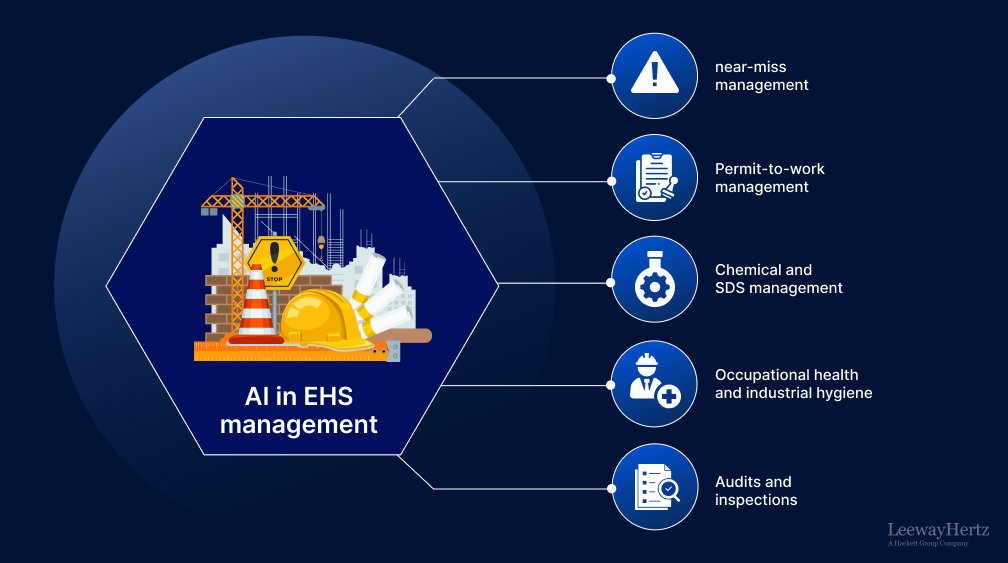
Environment, health and safety, or EHS, spans incident management, hazard assessment, permit to work, chemical and safety data sheet (SDS) management, industrial hygiene, contractor safety, environmental compliance, training, emergency response, and EHS governance. These activities are closely connected, and one event or operational change can affect several controls at once.
EHS teams manage this work across specialized platforms, maintenance and asset systems, HR and training systems, contractor tools, occupational health systems, environmental applications, and regulatory records. The scale of workplace risk remains significant: the US Bureau of Labor Statistics reported 2.5 million nonfatal workplace injuries and illnesses in private industry [1] and 5,070 fatal work injuries in 2024. [2]
AI is well suited to EHS work that involves evidence gathering, record comparison, regulatory and procedure retrieval, exception classification, deadline monitoring, and review preparation. It can support incident investigations, permit readiness reviews, exposure assessments, chemical records, inspection findings, and environmental reporting. The opportunity is not autonomous safety or compliance decision-making. AI can extract, compare, calculate through controlled services, detect patterns, and prepare recommendations, while permit authorization, regulatory determinations, exposure interpretation, medical decisions, corrective action approval, and external reporting remain with accountable professionals.
For this reason, AI opportunities are most useful when mapped at the sub-process level. The useful unit is not “AI for safety” or “AI for environmental compliance.” It is a bounded activity such as Occupational Safety and Health Administration (OSHA) recordability review from an incident file with safety officer confirmation, permit conflict detection from active work and isolation records with area supervisor authorization, or Tier II reporting preparation from the approved chemical inventory with environmental compliance specialist review.
- How AI is transforming EHS management operations
- Why AI use cases in EHS management must be mapped at the sub-process level
- EHS operating model and AI opportunity mapping across environment, health and safety processes
- High-value AI use cases in EHS management
- How agentic AI works in EHS workflows
- How to prioritize AI use cases in EHS management
- Governance, risk, and responsible AI in EHS management
- How ZBrain operationalizes AI use cases in EHS management
- Future of AI in EHS management
How AI is transforming EHS management operations
AI changes EHS work by evaluating safety records, permits, procedures, exposure data, images, inspection findings, environmental records, training histories, and compliance obligations before an EHS professional begins the review. The strongest opportunities occur where evidence is fragmented or repetitive, but the final decision still requires accountable professional judgment.
Consider a laceration during a production changeover. The incident record may say that first aid was administered. The applicable task Job Safety Analysis (JSA) may not include a changeover step. The training system may show that the employee completed machine safety training six months earlier. The maintenance system may show repeated guard interlock work. Two similar incidents may have occurred at other plants. AI can assemble these records, construct a timeline, identify potential contributing factors, retrieve the OSHA recordability criteria, compare the case with the definition of first aid, and prepare an investigation packet. It should not conclude that the case is non-recordable merely because “first aid” appears in the initial report. OSHA recordability depends on the complete facts, including whether the case involved medical treatment beyond first aid, restricted work, days away, loss of consciousness, or another recording criterion.
EHS work can be understood through six recurring work types:
- Document and evidence-heavy work: Incident reports, OSHA forms, JSAs, permits, SDSs, inspection records, exposure reports, contractor packets, waste manifests, environmental permits, drill records, and corrective action files can be checked for missing, inconsistent, outdated, or unsupported information.
- Exception-heavy work: near-misses, overdue corrective actions, conflicting permits, missing isolations, expired training, exposure excursions, missing SDSs, failed inspections, overdue permit obligations, manifest discrepancies, and reportable event candidates can be classified by severity, deadline, regulatory significance, and required reviewer.
- Knowledge- and rule-heavy work: OSHA requirements, state plan rules, EHS procedures, permit conditions, emergency protocols, SDS information, approved exposure limits, environmental reporting criteria, and ISO management system requirements can be retrieved according to jurisdiction and effective version.
- Data- and calculation-heavy work: Total recordable incident rate (TRIR), days away, restricted, or transferred (DART) rate, exposure summaries, noise dose, emissions inventories, waste quantities, inspection rates, action aging, training compliance, and environmental metrics require controlled calculations from defined source data.
- Image- and observation-heavy work: Site inspection photographs, equipment condition images, PPE observations, labeling evidence, spill images, permit area photographs, and ergonomic video can support evidence classification and retrieval when linked to the correct location, task, asset, person, and timestamp.
- Workflow-heavy work: Incident to investigation, finding to corrective action, JSA to task, permit to closeout, chemical request to approval, sample to exposure assessment, contractor to site access, obligation to filing, training to qualification, and emergency to notification workflows require information to move between systems and accountable roles.
The practical design principle is to connect a specific AI capability to a defined EHS artifact, expected output, and human decision point. “AI for incident management” is too broad to build or govern. “OSHA recordability analysis from the incident report, treatment record, work status information, and applicable 29 CFR Part 1904 criteria with safety officer confirmation” defines the data, AI task, output, reviewer, and control boundary.
Operationalize governed AI across environment, health and safety operations
Connect safety, environmental, occupational health, and compliance workflows with governed AI that prepares evidence, exceptions, and recommendations while preserving human authority for safety-critical and regulatory decisions.
Why AI use cases in EHS management must be mapped at the sub-process level
EHS management is not one workflow. “AI for safety” could refer to near-miss classification, recordability analysis, JSA drafting, permit conflict detection, inspection finding categorization, corrective action prioritization, ergonomic assessment, exposure analysis, or training assignment. Each requires different data, error tolerances, regulations, system access, and professional review.
A practical implementation model decomposes EHS work into four levels:
- Function: A major area of EHS accountability, such as incident management, industrial hygiene, environmental compliance, or contractor safety. A function contains multiple workflows and is too broad to implement as one AI solution.
- Process: A recurring workflow area within a function, such as incident investigation, exposure monitoring, permit issuance, chemical approval, or waste manifest management.
- Sub-process: A specific activity with a defined trigger, artifact, regulatory or policy context, system state, output, exception set, reviewer, and retained evidence.
- AI-enabled opportunity: A particular AI or analytical capability applied to the sub-process to change how preparation, analysis, exception handling, or decision support is performed while preserving accountable approval.
Sub-process mapping exposes implementation dependencies. OSHA recordability review may require the incident description, work relatedness, treatment information, restricted work or job transfer status, days away, diagnosis, prior case status, and current 29 CFR Part 1904 criteria. Permit conflict analysis may require the job location, asset, active permits, energy isolation points, line opening status, atmospheric readings, adjacent work, contractor roster, shift times, and permit authority. Industrial hygiene analysis may require the sampling method, employee or similar exposure group, task duration, laboratory result, detection limit, PPE, control status, approved exposure limit, and sampling strategy.
It also prevents AI from collapsing fundamentally different authorities into one recommendation. A model may identify that an employee received wound treatment described as first aid, but the safety officer must confirm whether all OSHA recording criteria are absent. AI may identify a permit conflict, but the area supervisor or designated permit authority determines whether work may proceed. AI may calculate an eight-hour exposure value, but the industrial hygienist determines the adequacy of the sampling strategy and control response. AI may identify that a chemical quantity exceeds a configured Tier II threshold, but the environmental compliance specialist validates applicability and the authorized organization submits the report.
This distinction matters because EHS errors propagate. A missed hazard in a JSA can affect permit conditions. An incomplete permit can expose workers during maintenance. An incident may reveal a defective control that affects multiple tasks and sites. An inaccurate chemical inventory can affect hazard communication, emergency planning, Tier II reporting, exposure assessment, and waste characterization. A missed environmental obligation can become a permit deviation or late filing.
The sub-process is therefore the most practical unit for identifying, designing, validating, measuring, and governing AI in EHS management.
EHS operating model and AI opportunity mapping across environment, health and safety processes
The EHS operating model covers connected functions:
- Incident and near-miss management
- Hazard identification and risk assessment
- Permit to work management
- Chemical and SDS management
- Audits and inspections
- Occupational health and industrial hygiene
- Contractor safety management
- Environmental compliance and reporting
- Training and qualification management
- Emergency preparedness and response
- EHS governance and analytics
The core role map includes the EHS manager, safety officer, industrial hygienist, environmental compliance specialist, plant safety coordinator, occupational health nurse, process safety engineer, contractor safety administrator, area supervisor or permit authority, EHS director, site leader, and general counsel delegate for escalated reportability or legal review questions. Plant engineering, maintenance, HR, operations, emergency response, and sustainability teams participate where the individual workflow requires their authority or expertise.
The principal artifact inventory includes the incident report, near-miss report, OSHA Forms 300/300A/301, job safety analysis or job hazard analysis, permit to work, lockout/tagout (LOTO) documentation, confined space entry permit, SDS, chemical inventory, risk register, inspection checklist, finding record, and corrective action record. It also includes exposure monitoring records, medical surveillance status, contractor prequalification packets, environmental permits, Tier II reports, air emissions inventories, hazardous waste manifests, stormwater records, and spill prevention, Control, and Countermeasure (SPCC) plan evidence. Additional artifacts include the training matrix, qualification record, emergency plan, drill record, and EHS KPI pack.
The regulatory and standards stack can include OSHA 29 CFR Parts 1904, 1910, and 1926; OSHA Process Safety Management (PSM) under 1910.119 where applicable; Hazard Communication under 1910.1200; applicable EPA requirements under RCRA, the Clean Air Act, Clean Water Act, EPCRA, CERCLA, and SPCC; DOT hazardous material requirements; OSHA approved State Plans; ISO 45001; ISO 14001; and applicable sustainability reporting requirements. State plans may maintain requirements that differ from or are more stringent than federal OSHA in permitted areas, so jurisdiction must remain explicit in any AI-supported workflow.
Function 1: Incident and near-miss management
Converting an adverse event, injury, illness, near-miss, property damage event, or environmental release into a classified, investigated, and documented case with corrective actions and regulatory determinations retained.
Incident management begins when an event is reported and continues through triage, recordability assessment, investigation, root cause analysis, corrective action management, regulatory recordkeeping, and lessons learned. The quality of the initial record matters because later decisions may depend on treatment details, work relatedness, event classification, affected equipment, environmental quantity, or witness evidence.
Teams involved: EHS manager, safety officer, plant safety coordinator, area supervisor, occupational health nurse, site leader, operations, maintenance, HR or employee relations where required, environmental compliance specialist for environmental events, and legal counsel for escalated reportability questions.
What AI helps with: Document intelligence can structure incident narratives, treatment records, witness statements, photographs, and equipment information. Classification can separate injury, illness, near-miss, property damage, process safety, vehicle, and environmental events. Rules-grounded analysis can prepare OSHA recordability or notification assessments. Multi-source analysis can reconstruct timelines and identify recurring contributing factors. Natural language generation can prepare investigation drafts, safety alerts, and corrective action summaries from approved evidence.
What humans continue to own: Supervisors and EHS personnel establish event facts. The safety officer or designated recordkeeping owner confirms OSHA recordability. Medical professionals determine clinical treatment and work capability. The EHS manager approves investigation conclusions and corrective actions. Environmental and legal specialists confirm external reporting obligations. AI prepares evidence and recommendations but does not make a final injury classification, legal liability, medical, or regulatory reporting decision.
| Process | Sub-process | Key AI-enabled opportunities |
|---|---|---|
| Incident intake and triage | Incident and near-miss capture |
|
| Event classification |
|
|
| Recordability and reportability assessment | OSHA recordability preparation |
|
| Severe event notification readiness |
|
|
| Investigation | Timeline reconstruction | Multi-source aggregation combines incident entries, shift records, training, JSA revisions, maintenance history, permits, observations, and witness evidence into a chronological event view. |
| Contributing factor and root cause analysis |
|
|
| Corrective action planning | Action definition and assignment |
|
| Effectiveness and recurrence review |
|
|
| Recordkeeping and learning | OSHA 300/300A/301 administration |
|
| Lessons learned and safety alert preparation | Similarity analysis identifies relevant events across-sites and prepares a source-linked alert draft with confirmed facts, control gaps, and approved preventive actions. |
Key artifacts
- Incident report
- near-miss report
- Witness statements
- Photographs and video
- Treatment and work status information
- JSA/JHA
- Training records
- Maintenance history
- Corrective action record
- OSHA Forms 300, 300A, and 301
- Regulatory notification record
- Investigation report
- Safety alert
Systems involved
- EHS management platform
- Occupational health or clinic system
- HRIS
- Learning management system
- CMMS or EAM
- Permit to work system
- Document repository
- Regulatory reporting portals
- Analytics platform
Regulatory and control considerations: Covered employers record qualifying work related injuries and illnesses using OSHA Forms 300, 300A, and 301 or equivalent records. A case is recordable when it meets the applicable criteria, including death, days away, restricted work or transfer, medical treatment beyond first aid, loss of consciousness, or certain significant diagnoses. A work related fatality must generally be reported to OSHA within eight hours, while an in patient hospitalization, amputation, or loss of an eye must generally be reported within 24 hours, subject to the rule’s conditions and jurisdiction specific requirements.
Accountable roles and decision rights
- Safety officer confirms OSHA recordability and recordkeeping classification.
- EHS manager approves investigation conclusions and corrective actions.
- Occupational health nurse or treating professional confirms medical facts within the appropriate privacy boundary.
- Area supervisor confirms operational facts and immediate controls.
- Environmental compliance specialist determines environmental reporting escalation.
- Site leader owns site-level response and material action.
- General counsel delegate advises on escalated legal or reportability issues where required.
Highest value opportunities
- Incident intake completeness: High leverage because incomplete initial facts weaken every downstream investigation and reporting decision.
- Recordability review preparation: High-value because Part 1904 criteria are structured but depend on precise case facts.
- cross-system investigation packet preparation: High leverage because event causes often sit across JSA, training, maintenance, permit, and observation records.
- Corrective action effectiveness review: High-value because closure status alone does not show whether a control actually changed.
Example agentic workflow: Incident intake to corrective action
- Trigger and starting artifact: A supervisor logs an incident report describing a laceration during a production changeover. Initial information indicates first aid was administered.
- Systems and records aggregated: The workflow retrieves the task JSA and revision date, applicable procedure, employee training record, similar site and enterprise incidents, equipment maintenance and guard history, active permit information where relevant, and recent safety observations for the area.
- Policies and criteria retrieved: It retrieves the current OSHA recordability criteria, incident investigation procedure, risk ranking method, and corrective action standard.
- Analysis and work packet prepared: The workflow identifies whether the available facts are consistent with first aid as defined by OSHA, checks for evidence of restricted work, days away, medical treatment beyond first aid, or another recording criterion, constructs the event timeline, identifies candidate contributing factors, and drafts corrective action options. If the evidence indicates first aid only and no other recording criterion, it presents a non-recordable recommendation subject to safety officer confirmation, not a final determination.
- Human checkpoint: The safety officer confirms recordability after reviewing treatment and work status evidence. The EHS manager validates investigation conclusions and approves corrective actions. Engineering evaluates any proposed guard interlock change, with the process safety engineer engaged if the equipment or change falls within a covered process.
- Approved handoff and retained evidence: Approved actions are assigned with due dates, OSHA records are updated only after the authorized determination, an approved safety alert may be distributed, and the event evidence, reasoning, approvals, and subsequent action verification are retained.
Function 2: Hazard identification and risk assessment
Converting work, equipment, materials, and operational change into documented hazards, controlled risks, and current task level safety requirements.
Hazard identification and risk assessment establish the risk basis for operational controls. The function includes JSA/JHA development, task hazard review, risk register maintenance, management of change (MOC) safety review, ergonomic assessment, and periodic refresh when equipment, materials, procedures, or operating conditions change.
Teams involved: EHS manager, safety officer, plant safety coordinator, area supervisor, process safety engineer, industrial hygienist, industrial engineer or ergonomics specialist, operations, maintenance, and site leader.
What AI helps with: AI can extract task steps from procedures and maintenance instructions, retrieve similar JSAs, identify known hazard categories, compare controls across-sites, detect stale assessments after process changes, and prepare risk review packets. Computer vision or motion analysis tools may assist ergonomic screening where approved, but professional evaluation remains necessary.
What humans continue to own: Supervisors and workers validate how tasks are actually performed. EHS professionals determine hazard significance and control adequacy. Engineers determine design and equipment controls. Industrial hygienists determine exposure implications. Process safety engineers own PSM specific MOC safety requirements. AI can surface hazards and inconsistencies but does not declare a task safe.
| Process | Sub-process | Key AI-enabled opportunities |
|---|---|---|
| JSA/JHA management | Task decomposition | Document intelligence extracts task steps, tools, materials, energy sources, access conditions, and worker interactions from approved procedures and work instructions. |
| Hazard identification | Retrieval and similarity analysis compares each task step with prior incidents, near-misses, observations, hazard libraries, SDS information, and similar JSAs. | |
| Control mapping | Knowledge retrieval, semantic matching, and gap detection map candidate hazards to existing controls across the hierarchy of controls, including elimination, substitution, engineering controls, administrative controls, and PPE, while also identifying applicable isolation and emergency controls and unsupported or missing control statements. | |
| Risk register management | Area and task risk register maintenance |
|
| Risk priority preparation |
|
|
| Management of change | Change safety impact screening |
|
| PSM MOC support | For covered processes, the workflow prepares the safety and health impact, affected process safety information, operating procedures, and training dependencies for process safety engineer review. | |
| Ergonomic risk assessment and control | Ergonomic screening |
|
| Intervention comparison | Scenario analysis compares candidate workstation, tool, lift assist, task rotation, or work method changes without replacing engineering or ergonomics approval. | |
| Review and JSA refresh | Trigger based JSA refresh | Change detection identifies new equipment, chemical, procedure, incident, permit condition, or maintenance method that may invalidate the current JSA. |
Key artifacts
- JSA/JHA
- Task procedure
- Risk register
- Hazard register
- Management of change request
- Process safety information where applicable
- Ergonomic assessment
- Safety observation
- Incident history
- Control verification record
Systems involved
- EHS management platform
- CMMS/EAM
- Document management system
- MOC system
- HRIS and LMS
- Chemical management system
- Engineering document system
- Operations systems
Regulatory and control considerations: Hazard assessments must align with the actual task and applicable standards rather than relying on generic AI generated controls. For PSM covered processes, 1910.119 requires written procedures to manage changes other than replacements in kind to process chemicals, technology, equipment, procedures, and facilities affecting the covered process. ISO 45001 also treats hazard identification, risk assessment, operational control, incident learning, and continual improvement as central elements of an OH&S management system.
Accountable roles and decision rights
- Area supervisor confirms actual task execution.
- Safety officer approves task safety controls.
- EHS manager owns the site risk assessment framework.
- Process safety engineer approves PSM related MOC safety requirements.
- Industrial hygienist approves exposure related hazard conclusions.
- Industrial engineer or ergonomics specialist confirms ergonomic control recommendations.
- Site leader approves material operating risk acceptance where policy requires.
Highest value opportunities
- JSA refresh after change: High leverage because stale task assessments often remain valid looking documents after the work has changed.
- Incident to JSA gap detection: High-value because actual event evidence can reveal missing steps or controls.
- Risk register normalization: Valuable because inconsistent naming and scoring can obscure recurring enterprise risks.
- MOC EHS impact preparation: High leverage because one equipment or chemical change can affect several control programs.
Example agentic workflow: JSA refresh after equipment change
- A change request introduces a new changeover fixture on a packaging line.
- The workflow retrieves the current JSA, operating procedure, equipment drawings, energy control procedure, prior incidents, training requirements, and chemical information.
- It identifies changed task steps and new pinch, stored energy, reach, access, and maintenance conditions.
- It prepares a revised JSA draft, maps existing controls, and flags conditions requiring engineering, LOTO, ergonomic, or industrial hygiene review.
- The area supervisor, safety officer, affected workers, and engineering validate the task and controls.
- Only the approved revision becomes active; affected training, procedures, permits, and prior versions are linked and retained.
Function 3: Permit to work management
Converting hazardous work into an authorized, time bounded activity with verified prerequisites, compatible simultaneous operations (SIMOPS), controlled isolations, and documented closeout.
Permit to work programs coordinate hazardous activities before and during execution. Organizations may use one EHS permit environment for hot work, confined space entry, hazardous energy isolation, line breaking, excavation, electrical work, or work at height, but each activity remains governed by its applicable regulatory and site control basis.
Teams involved: Area supervisor or permit authority, safety officer, plant safety coordinator, maintenance, operations, authorized employees, contractors, attendants and entry supervisors for confined space, process safety engineer where PSM applies, and site leader for escalated conflicts.
What AI helps with: AI can assemble job scope, location, equipment, JSA, active permits, energy sources, isolation plans, atmospheric test records, contractor qualifications, and conflicting work. Constraint checking can identify missing prerequisites and overlapping hazards. AI can monitor permit time windows and evidence, but field verification and authorization remain human.
What humans continue to own: Authorized personnel perform and verify isolations. Entry supervisors authorize confined space entry. Permit authorities confirm that field conditions match the permit. Workers stop work when conditions change. AI does not sign a permit, verify zero energy physically, accept an atmosphere as safe, or authorize work at height.
| Process | Sub-process | Key AI-enabled opportunities |
|---|---|---|
| Permit request and classification | Work scope intake | Document intelligence structures task, location, equipment, contractor, duration, tools, energy sources, chemicals, and simultaneous operations from the request. |
| Permit type determination | Classification identifies which site control processes may apply, such as hot work, confined space, hazardous energy, line opening, or work at height, and routes ambiguous cases for review. | |
| Prerequisite verification | JSA and qualification readiness | Rules based validation and evidence reconciliation checks for an approved JSA, task-specific training, contractor authorization, required rescue capability, and current procedures. |
| Isolation plan preparation | Graph and asset analysis maps candidate energy sources and affected equipment using approved isolation documentation. | |
| Atmospheric testing readiness | The workflow checks required gas test parameters, instrument status, test timing, and designated tester before permit review. | |
| Conflict management | SIMOPS and permit conflict detection | Spatial and temporal analysis identifies overlapping hot work, confined space entry, line breaking, energized work, lifting, chemical transfer, or other configured conflicts. |
| Permit authorization | Permit review packet | AI assembles prerequisites, tests, isolations, hazard controls, rescue arrangements, and outstanding exceptions for the permit authority. |
| Execution monitoring | Condition and permit window monitoring | Event monitoring flags expired time windows, changed scope, lost prerequisite, altered isolation status, conflicting new work, or atmospheric readings outside permitted conditions. |
| Closeout | Permit termination and return to service readiness | AI checks that work is complete, personnel and tools are accounted for, temporary controls are addressed, isolations follow the approved restoration process, and required closeout evidence is present. |
| Permit audit | Trend analysis identifies repeated extensions, cancellations, conflict types, missing fields, and permits reopened after closure. |
Key artifacts
- Permit request
- JSA/JHA
- Hot work permit
- Confined space entry permit
- Hazardous energy control documentation
- Isolation list
- Atmospheric test record
- Contractor qualification record
- Rescue plan
- Permit closeout
- Permit audit record
Systems involved
- Permit to work or control of work platform
- EHS platform
- CMMS/EAM
- Contractor management platform
- LMS
- Gas monitoring or instrument system
- Operations/asset hierarchy
- Document repository
Regulatory and control considerations: Under 1910.146, employers that enter permit required confined spaces must implement a written permit space program, prepare entry permits, verify pre entry conditions, designate roles, and cancel permits when work concludes or prohibited conditions arise. Canceled confined space entry permits generally must be retained for at least one year for program review. Under PSM, hot work on or near a covered process requires a permit documenting specified fire prevention and protection requirements. LOTO under 1910.147 and fall protection requirements operate through their own control structures rather than a universal OSHA permit.
Accountable roles and decision rights
- Area supervisor or designated permit authority authorizes site work.
- Authorized employees execute and verify energy control.
- Entry supervisor authorizes permit required confined space entry.
- Attendant performs the monitoring duties required by the confined space program.
- Safety officer reviews safety-critical exceptions.
- Process safety engineer reviews PSM related permit conditions where applicable.
- Workers retain stop work authority under the organization’s program.
Highest value opportunities
- Permit conflict detection: High leverage because individually valid permits can create unsafe simultaneous operations.
- Prerequisite completeness checking: High-value because missing isolation, testing, rescue, or training evidence should surface before authorization.
- Permit to asset reconciliation: Valuable because work scope and physical asset identity must remain aligned.
- Closeout evidence validation: High-value because premature closeout can create uncontrolled return to service risk.
Example agentic workflow: Confined space permit readiness
- A contractor requests entry into a process vessel for inspection.
- The workflow retrieves the asset, prior permits, JSA, contractor training, rescue arrangement, energy control plan, line isolation requirements, active adjacent work, and required atmospheric tests.
- It checks the permit packet against the site’s confined space program and current 1910.146 requirements.
- It identifies an overlapping line opening permit on connected equipment and an incomplete rescue service verification.
- The entry supervisor and area supervisor resolve the conflicts and physically verify required conditions before entry.
- The permit is authorized only through the existing permit process; subsequent test results, changes, cancellation, and closeout evidence are retained.
Function 4: Chemical and SDS management
Converting chemical introduction, storage, use, and inventory changes into current hazard information, controlled approval, worker communication, and regulatory ready chemical records.
Chemical management begins before a material arrives on site. It includes chemical request review, inventory and location control, SDS management, hazard communication, GHS aligned labeling, exposure screening, substitution analysis, emergency information, and regulatory inventory support.
Teams involved: EHS manager, industrial hygienist, safety officer, environmental compliance specialist, chemical coordinator or site EHS administrator, occupational health nurse where health surveillance is relevant, procurement, operations, laboratory or engineering personnel, and emergency response.
What AI helps with: Document intelligence can parse SDSs, extract identity and hazard fields, compare revisions, reconcile chemical names and CAS Registry Numbers (CAS RNs), identify missing inventory records, prepare secondary label information, and screen ingredients against approved regulatory lists. AI can support exposure banding and substitution review as a prioritization activity but should not replace Industrial Hygienist or product stewardship judgment.
What humans continue to own: EHS personnel and Industrial Hygienists approve chemical use conditions. Environmental specialists confirm environmental reporting applicability. Workers and supervisors comply with labeling and handling procedures. Qualified personnel determine exposure controls and substitution feasibility. AI does not declare a chemical safe or authorize use solely from an SDS summary.
| Process | Sub-process | Key AI-enabled opportunities |
|---|---|---|
| Chemical introduction | Chemical request intake | Document intelligence extracts product identity, supplier, use, quantity, location, SDS revision, hazard classifications, and proposed controls. |
| EHS approval preparation | Knowledge retrieval, entity matching, and rules based screening compare the requested chemical with current site inventory, prohibited/restricted lists, known hazards, storage compatibility, emergency requirements, and existing substitutes. | |
| Inventory management | Container and location reconciliation |
|
| SDS management | SDS completeness and currency | Document comparison detects revision changes, missing sections, changed classifications, new exposure control information, and products with no current accessible SDS. |
| SDS to inventory matching | Entity resolution identifies inventory records linked to obsolete, duplicate, or mismatched SDS documents. | |
| Hazard communication and labeling | Workplace label validation |
|
| Exposure screening | Initial exposure banding | Structured analysis combines hazard information, task, quantity, frequency, duration, controls, and route of exposure to prioritize industrial hygienist review. |
| Substitution and reduction | Safer alternative review preparation | Multi criteria comparison and recommendation generation compares hazard classifications, use requirements, exposure pathways, process compatibility, waste implications, and candidate alternatives without selecting the final substitute. |
| Regulatory inventory support | Threshold and list screening | Deterministic screening compares approved inventory data with configured EPCRA and other applicable reporting thresholds and lists for environmental compliance specialist review. |
Key artifacts
- Chemical request
- SDS
- Chemical inventory record
- CAS registry number
- Hazard communication program
- Workplace label
- Storage compatibility record
- Exposure assessment
- Substitution review
- Tier II supporting inventory
- Emergency chemical list
Systems involved
- Chemical management platform
- EHS platform
- Procurement system
- ERP
- Inventory or laboratory system
- SDS repository
- Industrial hygiene system
- Environmental reporting system
- Emergency response system
Regulatory and control considerations: OSHA’s Hazard Communication Standard requires covered employers to maintain a written hazard communication program and communicate hazardous chemical information through labels, SDSs, and employee training. During the current transition to the updated HCS requirements, applicable employer updates are due by November 20, 2026, for substances and May 19, 2028, for mixtures. EPA EPCRA Sections 311 and 312 separately require covered facilities to report hazardous chemical information, with annual inventory reporting generally due by March 1. Revised EPCRA hazard categories aligned with the updated HCS apply beginning with the 2027 reporting period.
Accountable roles and decision rights
- EHS manager owns the site chemical control program.
- Industrial hygienist confirms exposure control requirements.
- Environmental compliance specialist owns applicable environmental reporting.
- Safety officer owns hazard communication implementation at the site.
- Operations confirms actual use and storage conditions.
- Procurement prevents unapproved introduction where the control process requires.
Highest value opportunities
- SDS to inventory reconciliation: High leverage because a current SDS library is only useful if it matches what is actually present.
- Chemical approval packet preparation: Valuable because one new material can affect safety, health, environmental, storage, emergency, and waste obligations.
- Label and inventory discrepancy detection: High-value because field conditions can diverge from the chemical database.
- Regulatory threshold screening: High leverage when it prepares reviewable candidates without replacing environmental applicability analysis.
Example agentic workflow: New chemical introduction review
- Procurement submits a request for a solvent not currently approved at the site.
- The workflow retrieves the SDS, proposed volume, use location, process, existing chemicals, storage conditions, exposure assessments, emergency plan, and waste profile.
- It extracts hazard classifications, compares storage compatibility, checks for related approved products, and identifies potential hazard communication, industrial hygiene, environmental, and emergency implications.
- It prepares a cross functional review packet showing unresolved exposure, ventilation, substitution, waste, and reporting questions.
- The industrial hygienist, environmental compliance specialist, safety officer, and operations owner confirm conditions of use.
- Only an approved chemical enters procurement and inventory workflows; the SDS, inventory, labels, training, and related compliance records are updated through controlled systems.
Accelerate AI Solutions Development
Build fully functional solutions from your high-value use cases, based on specific operational needs and enterprise context.
Function 5: Audits and inspections
Converting planned and event-driven observations into classified findings, assigned corrective actions, verified closure, and evidence of compliance readiness.
Audits and inspections cover routine site walkthroughs, equipment and area checks, targeted program inspections, self assessments, management system audits, and regulatory readiness reviews. They are not simply checklist completion exercises. Their value depends on consistent applicability, evidence quality, finding classification, corrective action ownership, and verification.
Teams involved: EHS manager, safety officer, environmental compliance specialist, plant safety coordinator, area supervisors, process safety engineer, internal auditors, equipment owners, site leader, and program specialists.
What AI helps with: AI can schedule inspections, tailor checklists to site profile and applicable program, compare findings with procedures and prior history, classify observations, organize photographs, prepare corrective action recommendations, and detect recurring findings across-sites.
What humans continue to own: Inspectors establish field facts. Program owners determine compliance and risk significance. Managers approve corrective actions and extensions. Auditors retain independence where required. AI cannot close a material finding solely because documentation was uploaded.
| Process | Sub-process | Key AI-enabled opportunities |
|---|---|---|
| Inspection planning | Program schedule generation | Rules based scheduling maps required frequencies, locations, assets, program owners, prior findings, and seasonal conditions to a controlled inspection calendar. |
| Inspection checklist applicability assessment | Rules based applicability assessment and contextual matching selects candidate checklist modules based on site operations, equipment, chemicals, permits, and jurisdiction for program owner confirmation. | |
| Inspection execution | Field evidence capture | Document and image intelligence structures observations, photographs, asset IDs, location, inspector, timestamp, and immediate actions. |
| Checklist completeness | Validation identifies skipped required items, contradictory answers, unsupported “compliant” responses, and missing evidence. | |
| Finding management | Finding classification | Classification groups findings by safety, environmental, process, program, documentation, housekeeping, training, or equipment category and prepares severity candidates. |
| Repeat finding detection | Similarity analysis identifies recurring findings across assets, departments, sites, or prior audits. | |
| Corrective action planning | Action assignment and due date control |
|
| Closure verification | AI checks whether closure evidence addresses the original finding and identifies actions closed with incomplete proof. | |
| Audit readiness | Self assessment and evidence assembly | Multi-source retrieval assembles policies, permits, inspection records, training, corrective actions, monitoring, and prior audit evidence against the defined audit scope. |
| Regulatory readiness gap analysis | AI highlights missing evidence and unresolved findings but leaves compliance conclusions to the responsible EHS professional or auditor. |
Key artifacts
- Inspection schedule
- Inspection checklist
- Observation record
- Photographs
- Finding record
- Corrective action record
- Closure evidence
- Audit protocol
- Self assessment
- Regulatory readiness packet
- Management system audit report
Systems involved
- EHS platform
- Mobile inspection application
- CMMS/EAM
- Document repository
- Compliance obligation system
- Training system
- Environmental platform
- Analytics platform
Regulatory and control considerations: Inspection content should be mapped to the actual site, jurisdiction, equipment, permits, and applicable regulatory or management system requirements. ISO 45001 and ISO 14001 both use monitoring, evaluation, audit, corrective action, and continual improvement concepts within their management system frameworks. The current ISO 14001 edition is ISO 14001:2026.
Accountable roles and decision rights
- Inspector confirms observed field conditions.
- Safety officer owns safety program finding disposition.
- Environmental compliance specialist owns environmental finding disposition.
- EHS manager approves significant corrective actions and escalations.
- Area supervisor owns operational correction.
- Internal auditor retains independent audit conclusions where applicable.
- Site leader accepts escalated site-level residual risk under established authority.
Highest value opportunities
- Inspection evidence completeness: High leverage because “pass” responses without evidence can create false confidence.
- Repeat finding detection: Valuable because recurrence often indicates a systemic control weakness rather than an isolated issue.
- Corrective action closure validation: High-value because administrative closure does not establish effective correction.
- Regulatory readiness evidence assembly: High leverage because EHS evidence often spans several systems.
Example agentic workflow: Regulatory readiness inspection
- A site schedules a hazardous material and emergency preparedness self assessment.
- The workflow retrieves the site profile, chemical inventory, SDS records, prior findings, training, emergency contacts, inspections, and corrective actions.
- It maps the approved audit protocol to applicable site records.
- Missing evidence and inconsistent records are grouped into review packets with source links.
- EHS specialists conduct the physical inspection and determine actual compliance status.
- Approved findings and corrective actions enter the site action system with evidence retained for audit.
Function 6: Occupational health and industrial hygiene
Converting workplace exposure and health surveillance information into controlled exposure assessments, surveillance schedules, work related case coordination, and protected occupational health records.
Occupational health and industrial hygiene connect workplace hazards with exposure measurement and worker health programs. The function includes exposure assessment, noise and air sampling, similar exposure group (SEG) management, laboratory result review, medical surveillance scheduling, occupational health case coordination, return to work interfaces, and exposure record retention.
Teams involved: Industrial hygienist, occupational health nurse, EHS manager, safety officer, occupational physician or external provider, HR where employment actions are required, area supervisor, employees, and legal/privacy specialists where necessary.
What AI helps with: AI can prepare sampling plans from approved program criteria, reconcile sample records with employees and tasks, calculate exposure values through controlled services, identify missed surveillance events, compare results with configured occupational exposure limits, and prepare exposure review packets. It can also classify administrative case status without generating clinical diagnoses.
What humans continue to own: Industrial hygienists determine sampling strategy, exposure interpretation, controls, and follow-up. Medical professionals make clinical decisions. HR and management own employment decisions. AI does not diagnose occupational disease, determine fitness for duty, or independently conclude that an exposure is acceptable.
| Process | Sub-process | Key AI-enabled opportunities |
|---|---|---|
| Exposure program design | Similar exposure group (SEG) maintenance | Entity and task analysis groups employees by process, agent, task, duration, location, and control profile for Industrial Hygienist review. |
| Sampling priority preparation | Risk ranking combines hazard, prior results, task frequency, change history, complaints, incidents, and control status to prepare sampling priorities. | |
| Exposure monitoring | Sampling plan preparation | Rules based requirement mapping and plan generation prepare sample type, task, employee, duration, method, equipment, and documentation requirements from the approved program. |
| Sample chain of custody and metadata validation | Validation identifies missing employee/task links, calibration records, laboratory identifiers, sample times, detection limits, or chain of custody information. | |
| Exposure assessment | Result calculation and comparison | Deterministic calculations produce TWA, dose, or other approved metrics where applicable. AI compares results with configured regulatory or organizational occupational exposure limits (OELs) and presents the context for Industrial Hygienist interpretation. |
| Trend and control analysis | Trend analysis identifies repeated elevated results, changing exposure patterns, control deterioration, or similar tasks requiring reassessment. | |
| Medical surveillance | Surveillance eligibility and scheduling | Rules based logic maps exposure groups and applicable program criteria to required examination, audiometry, or other surveillance schedules. |
| Missed surveillance monitoring | Workflow monitoring identifies due, overdue, incomplete, or unresolved surveillance events without exposing unnecessary medical detail to supervisors. | |
| Occupational health case management | Injury case coordination | AI assembles approved case administration information, restrictions, appointments, and EHS follow-up while keeping clinical content within permitted access boundaries. |
| Return to work coordination | Workflow coordination routes approved functional restrictions and required work accommodations without generating the underlying medical decision. | |
| Records and privacy | Exposure and medical record retention | Record classification identifies applicable retention category and prevents routine deletion where long term OSHA retention applies. |
| Access boundary validation | Permission checks separate occupational health, EHS, supervisor, HR, and analytics access according to role and purpose. |
Key artifacts
- Exposure assessment
- Sampling plan
- Air sampling result
- Noise monitoring record
- Laboratory report
- Similar exposure group (SEG) register
- Exposure control recommendation
- Audiogram status
- Medical surveillance schedule
- Occupational health case record
- Work restriction
- Return to work record
- Exposure record retention log
Systems involved
- Industrial hygiene platform
- Occupational health system
- EHS platform
- Laboratory interfaces
- HRIS
- LMS
- CMMS/EAM
- Document repository
- Identity and access system
Regulatory and control considerations: OSHA 1910.1020 applies to covered employee exposure and medical records involving toxic substances or harmful physical agents and generally requires employee exposure records to be retained for at least 30 years and covered medical records for the duration of employment plus 30 years, subject to specified exceptions. OSHA’s hearing conservation program under 1910.95 is triggered at an eight hour TWA of 85 dBA for covered general industry employees and includes monitoring, audiometric testing, hearing protection, and training requirements.
Health data governance should not be reduced to “HIPAA compliance.” HHS states that HIPAA generally does not protect an employer’s employment records merely because they contain health information. HIPAA may govern disclosures by covered health care providers or health plans, while employer-held occupational health information can be subject to OSHA, ADA, state law, workers’ compensation, ethical, and organizational confidentiality requirements.
Accountable roles and decision rights
- Industrial hygienist owns exposure strategy, interpretation, and control recommendations.
- Occupational health nurse coordinates occupational health workflows within clinical authority.
- Licensed medical professionals determine diagnosis, surveillance conclusions, and fitness for duty opinions where applicable.
- EHS manager owns program governance.
- Area supervisor implements approved controls and work restrictions without accessing unnecessary medical detail.
- HR owns employment actions and accommodation processes within applicable law.
Highest value opportunities
- Sampling record completeness: High leverage because incomplete metadata can invalidate interpretation.
- Exposure trend analysis: High-value because recurring patterns can be difficult to see across campaigns and sites.
- Medical surveillance scheduling: Valuable because eligibility and due dates are rule heavy but the medical decision remains clinical.
- Exposure record retention and access: High leverage because records can remain relevant for decades.
Example agentic workflow: Noise exposure review
- An annual exposure campaign produces personal noise dosimetry results for a machining group.
- The workflow retrieves the sampling plan, employee/task data, calibration evidence, prior results, hearing conservation status, and relevant control history.
- Controlled calculations produce the required exposure metrics and compare them with the configured OSHA action level and internal criteria.
- The workflow prepares a result packet showing elevated exposures, trends, affected tasks, current controls, and missing evidence.
- The industrial hygienist determines the exposure conclusion and required engineering, administrative, PPE, monitoring, or program actions.
- Approved actions, employee notifications, surveillance scheduling, and long term exposure records are updated through their authorized systems.
Function 7: Contractor safety management
Converting contractor safety information, competencies, site hazards, and performance into controlled qualification, orientation, work authorization, and incident accountability.
Contractor safety management focuses on whether an external company and its assigned personnel can perform defined work within the site’s safety requirements. It includes safety prequalification, orientation, competency verification, permit authority, contractor performance, incident coordination, and periodic requalification.
Teams involved: Contractor safety administrator, EHS manager, safety officer, area supervisor, procurement or supplier management interface, maintenance/project management, contractor employer, site leader, and legal/risk specialists where required.
What AI helps with: Document intelligence can structure contractor safety packets, insurance and program documents, experience modification rate (EMR), TRIR/DART data, OSHA citations, training evidence, and site specific plans. Classification can identify missing or expired qualifications. AI can connect contractor incidents and permit performance to requalification review but should not make unsupported debarment or employment decisions.
What humans continue to own: Contractor employers remain responsible for their workers. Host employer and controlling employer responsibilities depend on the work and applicable law. EHS teams determine site access and safety expectations. Permit authorities authorize hazardous work. Procurement or management owns commercial supplier decisions.
| Process | Sub-process | Key AI-enabled opportunities |
|---|---|---|
| Prequalification | Safety packet intake | Document intelligence extracts EMR, TRIR, DART, serious incidents, OSHA citation history, program documents, insurance evidence, competencies, and site specific information from submitted packets. |
| Safety profile review | Controlled calculations validate submitted rates where source data are available. AI identifies missing periods, inconsistent denominators, expired documents, or unusual changes for Contractor Safety Administrator review. | |
| Site onboarding | Orientation assignment | Rules based matching assigns site, task, hazard, equipment, and permit specific orientation requirements. |
| Worker qualification verification | Entity matching reconciles worker identity with required training, licenses, medical clearance where appropriate, and task authorization. | |
| Work authorization | Contractor permit readiness | AI verifies orientation, JSA, permit prerequisites, designated roles, and task-specific qualifications before permit authority review. |
| Performance monitoring | Contractor safety observation and finding analysis | Trend analysis identifies recurring permit violations, housekeeping findings, unsafe observations, training gaps, and corrective action delays. |
| Incident accountability | Contractor incident coordination | Multi-source aggregation connects the incident with contractor employer, permit, JSA, orientation, work scope, supervision, and host site controls for joint investigation. |
| Requalification | Periodic safety performance review | Multi-source aggregation, trend analysis, and summarization prepare a longitudinal contractor safety packet combining current qualifications, incident performance, findings, actions, and permit history for human review. |
Key artifacts
- Contractor prequalification packet
- EMR evidence
- TRIR/DART history
- OSHA citation information
- Safety program documents
- Insurance or risk documents
- Training and competency records
- Orientation record
- Contractor JSA
- Permit records
- Contractor incident file
- Performance review
Systems involved
- Contractor management platform
- EHS platform
- Procurement or supplier system
- LMS
- Permit to work platform
- HR/identity/access system
- Document repository
- Project management or CMMS system
Regulatory and control considerations: Contractor assessment should distinguish organizational safety performance indicators from the qualifications of a particular worker. EMR is a workers’ compensation experience measure, while OSHA recordable and DART rates are different safety metrics. OSHA requirements for multi employer work vary by standard and context. For example, 1910.146 establishes specific host employer and contractor information sharing and coordination duties for permit required confined space entry.
Accountable roles and decision rights
- Contractor safety administrator owns EHS prequalification and site safety status.
- EHS manager owns contractor safety policy and escalation.
- Area supervisor or permit authority approves site work under applicable controls.
- Contractor employer owns its employees, supervision, and employer specific duties.
- Procurement owns commercial qualification and sourcing decisions.
- Site leader decides escalated site access restrictions under policy.
Highest value opportunities
- Prequalification packet completeness: High leverage because contractor documentation is repetitive, variable, and frequently time bound.
- Qualification to task matching: High-value because general site orientation does not establish task competence.
- Contractor incident packet preparation: Valuable because accountability can depend on both host and contractor controls.
- Performance based requalification preparation: High leverage because current safety performance matters more than a static onboarding snapshot.
Example agentic workflow: Contractor prequalification and hazardous work readiness
- A mechanical contractor is selected for a shutdown project.
- The workflow retrieves the contractor’s EHS packet, safety performance, required program documents, assigned worker qualifications, project scope, and site requirements.
- It identifies missing confined space rescue evidence and two workers whose required site orientation has expired.
- A readiness packet separates company level qualification, individual worker gaps, and permit specific prerequisites.
- The contractor safety administrator resolves prequalification; the area supervisor confirms work specific readiness before permits are issued.
- Approved contractor and worker status is recorded, while unresolved gaps continue to block the applicable site access or permit step.
Function 8: Environmental compliance and reporting
Converting facility operations, permits, material inventories, emissions, discharges, and waste movements into controlled obligation tracking, calculations, reports, and regulatory evidence.
Environmental compliance spans air, water, waste, hazardous material reporting, spill prevention, and facility permits. Unlike a single annual reporting workflow, it operates continuously because permit conditions, monitoring, waste shipments, chemical quantities, inspections, and deviations accumulate throughout the year.
Teams involved: Environmental compliance specialist, EHS manager, environmental engineer, operations, maintenance, laboratory personnel, waste coordinator, process engineering, site leader, sustainability reporting team, and legal counsel for escalated reportability questions.
What AI helps with: AI can extract permit conditions, build obligation calendars, reconcile monitoring and operational data, identify missing records, prepare emissions or waste review packets, classify manifest discrepancies, compare chemical inventory with Tier II records, and draft report narratives from approved calculations.
What humans continue to own: Environmental specialists determine applicability, approve calculation methods, interpret permit conditions, investigate deviations, and authorize regulatory submissions. AI should not independently certify an emissions inventory, determine waste classification, sign a manifest, or decide whether a release is reportable.
| Process | Sub-process | Key AI-enabled opportunities |
|---|---|---|
| Permit obligation management | Permit condition extraction | Document intelligence structures monitoring, inspection, sampling, recordkeeping, reporting, operating, and notification obligations from approved permits. |
| Compliance calendar maintenance |
|
|
| Air emissions compliance management | Emissions inventory preparation |
|
| Permit limit and deviation review | AI compares approved calculations and operating data with permit limits and monitoring conditions and prepares potential deviation packets. | |
| EPCRA reporting | Tier II inventory preparation | Entity resolution reconciles the approved chemical inventory, SDS identity, location, maximum and average quantities, and threshold screening inputs. |
| Waste compliance | Waste profile and manifest matching |
|
| e Manifest exception monitoring | Workflow monitoring identifies manifests awaiting action, corrections, or unresolved discrepancies in the organization’s approved RCRA workflow. | |
| Water and stormwater | Monitoring and sampling readiness | Rules based compliance validation and multi-source data reconciliation checks required sample locations, parameters, frequencies, laboratory records, weather/event conditions, inspections, and permit deadlines. |
| Stormwater control plan evidence | Evidence aggregation links inspection findings, corrective actions, exposed materials, best management practice (BMP) status, sampling, and stormwater pollution prevention plan (SWPPP) requirements or equivalent permit required controls. | |
| SPCC and spill prevention | SPCC inspection and plan evidence | Entity resolution, document comparison, and evidence reconciliation reconcile covered containers, inspection history, secondary containment evidence, plan revisions, and site changes for specialist review. |
| Release reporting | Environmental release notification preparation |
|
| Submission and audit support | Report package validation | Validation checks source period, facility, units, calculation version, supporting evidence, reviewer, and approval before external submission. |
Key artifacts
- Environmental permit
- Obligation register
- Air emissions inventory list
- Monitoring records
- Tier II report
- Chemical inventory
- RCRA waste manifest
- Waste profile
- e Manifest status
- Stormwater inspection
- SWPPP or applicable stormwater plan
- SPCC plan
- Spill record
- Laboratory report
- Regulatory submission record
Systems involved
- Environmental management system
- EHS platform
- ERP and material usage systems
- Laboratory systems
- Historian or meter data
- RCRAInfo/e Manifest
- State environmental portals
- Permit and obligation system
- Waste vendor systems
- Document repository
Regulatory and control considerations: EPCRA Section 312 requires covered facilities to submit annual hazardous chemical inventory information generally by March 1 to the relevant state or tribal emergency response commission, local or tribal emergency planning committee, and local fire department. EPA’s RCRA manifest system tracks hazardous waste from the generator to the receiving facility, with e Manifest supporting electronic and paper manifest workflows. EPCRA Section 312 uses a Tier I/Tier II framework; Tier II is generally required by states, and state or tribal submission requirements should be verified for the facility.
Accountable roles and decision rights
- Environmental compliance specialist owns applicability, calculations, permit interpretation, and filing preparation.
- EHS manager owns integrated EHS governance and escalation.
- Environmental engineer validates technical calculations and control status where assigned.
- Waste coordinator manages waste records and authorized manifest processes.
- Operations owns source operational data.
- Site leader certifies or approves reports where organizational or regulatory requirements assign that authority.
- Legal counsel advises on escalated release or enforcement matters.
Highest value opportunities
- Permit obligation extraction and calendaring: High leverage because environmental obligations are distributed across permits and amendments.
- Emissions inventory evidence assembly: Valuable because calculations depend on multiple operational and technical sources.
- Tier II inventory reconciliation: High-value because chemical inventory and environmental reporting datasets frequently diverge.
- Manifest discrepancy monitoring: High leverage because unresolved waste shipment records can create compliance risk.
- Release notification readiness: High-value because notification deadlines can be extremely short.
Example agentic workflow: EPCRA Tier II preparation
- The annual reporting cycle opens for a covered facility.
- The workflow retrieves the approved chemical inventory, SDS data, storage locations, maximum and average quantities, prior year report, site changes, and configured reporting thresholds.
- Entity resolution consolidates duplicate product names and maps chemicals to the current inventory.
- Deterministic threshold screening prepares candidate reportable chemicals and identifies quantity or location inconsistencies.
- The environmental compliance specialist validates chemical identity, thresholds, inventory facts, and jurisdiction specific requirements.
- Only the reviewed report proceeds through the organization’s authorized submission process, with the source inventory, calculations, approvals, and filed record retained.
Function 9: Training and qualification management
Converting role, task, hazard, equipment, and regulatory requirements into assigned training, verified competency, current qualifications, and traceable work authorization.
Training management in EHS is not limited to course completion. Different tasks require different combinations of knowledge, practical evaluation, refresher training, certification, medical qualification, rescue capability, or site authorization. The system must distinguish a completed course from demonstrated competence or active authorization.
Teams involved: EHS manager, safety officer, plant safety coordinator, training administrator, area supervisor, contractor safety administrator, industrial hygienist where exposure programs require training, HR/L&D, and qualified evaluators.
What AI helps with: AI can map training requirements to roles and tasks, identify gaps after job or process changes, prepare refresher assignments, detect expired or missing qualifications, and compare training completion with incidents, observations, and permit readiness.
What humans continue to own: Qualified trainers and evaluators determine competency. Supervisors authorize work. EHS establishes required training. AI does not certify an operator merely because a course record exists.
| Process | Sub-process | Key AI-enabled opportunities |
|---|---|---|
| Training matrix management | Role to training mapping | Rules based matching connects role, location, task, equipment, hazard, permit authority, chemical exposure, and emergency assignment to required learning and qualification. |
| Change driven requirement update | Change detection identifies new equipment, chemical, procedure, role, incident, regulatory requirement, or MOC that affects the training matrix. | |
| Assignment and completion | Training assignment | Workflow coordination assigns approved training with due dates and escalation according to role and start date. |
| Completion validation | Classification, anomaly detection, and evidence validation identify incomplete modules, failed assessments, invalid evidence, duplicate completions, or completion after the worker began restricted work. | |
| Competency and evaluation | Practical evaluation tracking | Entity matching confirms that the evaluator, employee, equipment/task, evaluation date, and result are present before qualification status changes. |
| Qualification currency | Re evaluation and expiry monitoring | Rules based monitoring identifies due refresher training, periodic evaluation, license renewal, fit testing, rescue practice, or other program specific currency requirements. |
| Toolbox talks and meetings | Topic preparation | AI uses current incidents, observations, seasonal hazards, work plans, and approved EHS content to prepare site specific toolbox talk drafts for supervisor review. |
| Attendance and follow-up | Workflow monitoring identifies required workers not reached and links resulting actions to the applicable crew or task. |
Key artifacts
- Training matrix
- Course assignment
- Completion record
- Practical evaluation
- Qualification record
- License or certification
- Refresher training record
- Toolbox talk
- Attendance record
- Permit authorization role record
Systems involved
- LMS
- HRIS
- EHS platform
- Contractor management system
- Permit to work platform
- CMMS/EAM
- Document repository
- Identity/access system
Regulatory and control considerations: Training and evaluation requirements vary by standard and should not be reduced to a generic “certificate expiry.” For example, OSHA’s powered industrial truck standard requires operator training and evaluation, with operator performance evaluated at least once every three years and refresher training under specified conditions. Confined space programs impose role and rescue specific training requirements. Hazard Communication requires employee information and training when employees are initially assigned and when a new chemical hazard is introduced.
Accountable roles and decision rights
- EHS manager defines EHS training governance.
- Safety officer owns safety program content requirements.
- Area supervisor confirms task authorization.
- Qualified evaluator confirms practical competence.
- Training administrator maintains assignments and records.
- Contractor safety administrator verifies contractor qualifications.
- Worker remains responsible for following trained procedures and stop work requirements.
Highest value opportunities
- Role to training reconciliation: High leverage because job and hazard requirements change faster than static matrices.
- Qualification to permit validation: Valuable because training gaps should surface before hazardous work starts.
- Change triggered refresher analysis: High-value because new equipment or procedures can invalidate prior competence assumptions.
- Toolbox talk preparation from actual risk signals: Valuable when source content is approved and supervisor reviewed.
Example agentic workflow: Qualification readiness for maintenance shutdown
- A shutdown roster is uploaded for a planned maintenance event.
- The workflow retrieves worker and contractor roles, planned tasks, equipment, permit types, confined space duties, LOTO responsibilities, and current training records.
- It maps each person to the approved qualification requirements.
- Missing, expired, or incomplete requirements are separated from valid qualifications.
- The training administrator and area supervisors resolve gaps; qualified evaluators perform any required practical evaluations.
- Permit and site access systems use only the approved qualification status, with evidence retained.
Function 10: Emergency preparedness and response
Converting credible emergency scenarios, response roles, plans, drills, and event facts into current preparedness, coordinated response, timely notification, and documented lessons learned.
Emergency preparedness includes emergency action plan maintenance, scenario planning, response team readiness, drills, alarms and communications, regulatory notification protocols, after action review, and corrective action follow-up.
Teams involved: EHS manager, safety officer, site leader, emergency coordinator, response team leads, environmental compliance specialist, occupational health nurse, security, operations, facilities, communications, and general counsel delegate for escalated notification questions.
What AI helps with: AI can compare plans with current site hazards and contacts, schedule drills, assemble response information, classify after action findings, retrieve notification protocols, calculate deadline candidates, and prepare regulatory notification packets from verified facts.
What humans continue to own: Incident commanders direct emergency response. EHS and environmental specialists determine reporting obligations. Medical professionals direct medical response. Site leaders authorize external communications according to policy. AI cannot delay escalation while attempting to resolve uncertainty.
| Process | Sub-process | Key AI-enabled opportunities |
|---|---|---|
| Emergency plan management | Plan completeness and currency | Change detection compares the emergency plan with current site layout, hazards, chemicals, contacts, response roles, assembly areas, and equipment. |
| Scenario to resource mapping | AI links fire, release, severe weather, medical, confined space rescue, power loss, and other approved scenarios to required roles, equipment, and procedures. | |
| Drill management | Drill scheduling | Rules based scheduling balances required frequencies, shifts, scenarios, high risk areas, and prior deficiencies. |
| Drill evidence and performance | AI structures timestamps, communications, accountability, response sequence, equipment use, and observer comments into an after action packet. | |
| After action review | Gap classification | Classification separates plan, training, communication, equipment, command, access, accountability, and external coordination findings. |
| Notification readiness | OSHA severe event notification | Deadline logic identifies events that may meet OSHA’s 8 hour or 24 hour reporting requirements and immediately routes them to authorized EHS review. |
| EPCRA/CERCLA release notification | Deterministic threshold screening compares substance and quantity information with configured reportable quantities and immediately escalates potential reportable releases. | |
| Response evidence | Regulatory and internal response packet | Multi-source aggregation assembles event facts, timeline, contacts, quantities, photographs, response actions, notifications, and follow-up requirements. |
Key artifacts
- Emergency action plan
- Emergency response plan
- Contact roster
- Scenario matrix
- Drill schedule
- Drill record
- After action review
- Emergency notification protocol
- OSHA severe event report
- EPCRA/CERCLA release record
- Response timeline
- Corrective actions
Systems involved
- EHS platform
- Emergency notification system
- Site security/access system
- Chemical management platform
- Environmental system
- HRIS
- Occupational health system
- Operations systems
- Document repository
Regulatory and control considerations: OSHA requires work related fatalities to be reported within eight hours and specified severe injuries within 24 hours under 1904.39. EPCRA and CERCLA can require immediate notification when releases reach applicable reportable quantities, with recipients varying by statute and substance. EPA states that EPCRA Section 304 generally requires immediate notice to the relevant state or tribal emergency response commission and local or tribal emergency planning committee for applicable releases, with CERCLA hazardous substance releases also potentially requiring National Response Center notification.
Accountable roles and decision rights
- Incident commander or designated emergency lead directs response.
- EHS manager owns emergency program governance.
- Environmental compliance specialist confirms environmental notification.
- Safety officer confirms OSHA reporting escalation.
- Site leader owns site-level executive response.
- Occupational health or medical personnel own clinical response.
- General counsel delegate advises on escalated legal reportability matters.
- Communications personnel own authorized public communication where assigned.
Highest value opportunities
- Emergency plan change detection: High leverage because plans become stale when hazards, contacts, equipment, and site layouts change.
- Notification deadline escalation: High-value because short regulatory deadlines make delayed routing unacceptable.
- After action evidence synthesis: Valuable because drill and event evidence is often fragmented.
- Corrective action recurrence analysis: High leverage because repeated drill findings indicate preparedness weakness.
Example agentic workflow: Reportable release notification preparation
- A site reports an unplanned chemical release.
- The workflow retrieves substance identity, SDS, estimated quantity, start and stop time, affected area, monitoring information, response actions, and current regulatory threshold tables.
- Deterministic screening checks configured EPCRA/CERCLA reportable quantities and applicable permit or state notification rules.
- Any possible threshold exceedance is escalated immediately with a notification packet rather than waiting for AI certainty.
- The environmental compliance specialist and authorized site/legal reviewers confirm applicability and execute required notifications.
- Notification time, recipient, facts reported, calculations, follow-up report, and corrective actions are retained.
Function 11: EHS governance and analytics
Converting site-level EHS activity into controlled indicators, enterprise risk views, management review, safety observation intelligence, external reporting support, and accountable program governance.
EHS governance connects the operational functions into one management view. It includes leading and lagging indicators, safety observations, corrective action aging, cross-site risk analysis, program performance, management review, external sustainability reporting support, regulatory change awareness, and governance of EHS data and AI-supported workflows.
Teams involved: EHS director, EHS manager, VP EHS, site leader, COO, environmental compliance specialist, safety officer, industrial hygienist, sustainability teams or the chief sustainability officer’s organization, data/analytics teams, internal audit, and legal/compliance specialists.
What AI helps with: AI can reconcile KPI inputs, identify inconsistent definitions, detect trends, connect recurring events across sites, prepare management commentary, organize board-level evidence, and support sustainability reporting data preparation. It can also monitor EHS AI workflows for unsupported outputs, reviewer overrides, stale policies, and attempted actions outside approved boundaries.
What humans continue to own: EHS leadership defines metrics, risk appetite, targets, and management actions. Site leaders remain accountable for site performance. Sustainability and legal teams determine applicable external disclosure. AI does not alter recordability to improve a metric, make disciplinary conclusions from observation data, or certify external disclosures.
| Process | Sub-process | Key AI-enabled opportunities |
|---|---|---|
| KPI management | TRIR and DART preparation | Deterministic calculations use approved OSHA recordable case counts and hours worked data. Validation checks denominator periods, workforce scope, and case classification consistency. |
| Leading indicator preparation | AI reconciles near-misses, observations, audits, inspections, training, permit findings, exposure actions, and corrective action status using approved definitions. | |
| Safety observation analytics | Observation normalization | NLP classifies observation narratives by hazard, task, area, control, potential severity, and action while preserving source evidence. |
| Pattern detection | Trend analysis identifies recurring conditions across shifts, assets, sites, and contractor groups without inferring individual employee misconduct. | |
| Enterprise risk analytics | cross-site event linkage | Similarity and graph analysis connect incidents, near-misses, findings, chemicals, equipment, permits, and corrective actions to identify systemic control themes. |
| Management review | EHS performance packet | AI assembles KPI trends, serious events, overdue actions, exposure issues, permit deviations, environmental obligations, and emerging risks for leadership review. |
| Sustainability and board support | Health and safety disclosure preparation | AI reconciles source EHS metrics and prepares traceable disclosure support from approved reporting definitions. |
| Environmental disclosure support | AI connects environmental operating metrics with approved sustainability reporting requirements while separating statutory permit reporting from corporate disclosure. | |
| AI governance | EHS AI use case register | Each AI workflow is registered with purpose, owner, approved sources, permitted actions, human review requirements, risk tier, and monitoring criteria. |
| AI performance and exception review | Monitoring evaluates false classifications, unsupported statements, stale source use, reviewer overrides, policy violations, and attempted actions outside authority. |
Key artifacts
- EHS KPI pack
- OSHA recordkeeping dataset
- TRIR and DART calculations
- Safety observation dataset
- Corrective action aging report
- Enterprise risk register
- Management review pack
- Board EHS report
- Sustainability disclosure support
- AI use case register
- AI evaluation and monitoring record
Systems involved
- EHS management platform
- BI and analytics platform
- HRIS
- Environmental system
- Industrial hygiene system
- Occupational health system
- Contractor platform
- Sustainability reporting system
- Governance and audit system
Regulatory and control considerations: OSHA recordability and reporting data should remain the authoritative source for OSHA-derived indicators rather than allowing AI to reinterpret cases to fit performance goals. For EU-exposed enterprises, sustainability reporting requirements are evolving. Health and safety metrics appear within ESRS’s’s own workforce reporting, but CSRD scope, timing, and ESRS requirements have been affected by recent EU simplification measures. The European Commission adopted revised ESRS in July 2026, and organizations should validate the version and scope actually in force for their reporting period before using an AI-supported disclosure workflow.
Accountable roles and decision rights
- EHS director owns enterprise EHS performance governance.
- VP EHS or equivalent executive owns material EHS program decisions.
- Site leader remains accountable for site performance.
- EHS manager owns source operational data quality.
- Sustainability or CSO organization owns sustainability reporting process.
- Legal and reporting teams determine external disclosure applicability.
- Internal audit independently evaluates controls where assigned.
Highest value opportunities
- KPI source reconciliation: High leverage because metric credibility depends on consistent case and denominator definitions.
- Cross-site risk pattern detection: High-value because serious risk can appear first as several weak signals across different facilities.
- Observation to control analysis: Valuable when used to improve systems rather than rank workers.
- Board and sustainability evidence preparation: High leverage when every reported metric remains linked to its source and definition.
- EHS AI monitoring: High-value because safety-sensitive AI needs stronger oversight as workflow authority expands.
Example agentic workflow: Enterprise serious risk signal detection
- The enterprise EHS review cycle begins.
- The workflow retrieves incidents, near-misses, observations, audit findings, permit exceptions, exposure actions, contractor events, and overdue corrective actions across-sites.
- It normalizes hazard, task, equipment, location, and control categories while preserving site-level source records.
- Pattern analysis identifies repeated machine guard bypass observations across four plants, including one first aid event and two near-misses.
- EHS leadership validates whether the pattern represents a common control weakness and decides the enterprise action.
- Approved actions, affected sites, responsible owners, due dates, and subsequent effectiveness evidence are tracked without using the model to make worker discipline decisions.
Accelerate AI Solutions Development
Build fully functional solutions from your high-value use cases, based on specific operational needs and enterprise context.
High-value AI use cases in EHS management
The highest value EHS use cases are usually not the ones with the greatest autonomy. They are the activities where large amounts of evidence must be reviewed before a professional makes a safety, environmental, health, or compliance decision.
| High-value AI use case | AI contribution | Human review boundary |
|---|---|---|
| OSHA recordability review preparation | Structures treatment and work status evidence, applies current criteria, and cites the basis for the recommendation | Safety officer confirms recordability |
| Cross-system event reconstruction | Connects JSA, training, maintenance, permit, observation, and incident evidence | EHS Manager approves causal conclusions |
| JSA refresh after operational change | Identifies changed task steps, hazards, stale controls, and related incidents | Supervisor, workers, and EHS approve the JSA |
| Permit conflict detection | Identifies overlapping work, energy, atmospheric, space, and timing conflicts | Permit authority decides whether work proceeds |
| SDS to inventory reconciliation | Matches product and chemical identities, versions, quantities, and locations | EHS validates the controlled inventory |
| Cross-program chemical impact review | Prepares exposure, environmental, storage, emergency, waste, and training implications | Relevant EHS specialists approve conditions of use |
| Repeat finding and closure analysis | Finds recurring conditions and weak closure evidence | Program owner confirms finding disposition |
| Exposure packet preparation | Reconciles sample metadata, calculations, limits, controls, and prior results | Industrial Hygienist interprets exposure |
| Medical surveillance scheduling | Maps program eligibility to due dates and current status | Occupational health professionals own medical decisions |
| Prequalification packet review | Structures EMR, TRIR/DART history, incident history, programs, training, and missing evidence | Contractor Safety Administrator decides EHS qualification |
| Permit obligation calendaring | Extracts obligation, frequency, data, owner, and deadline from approved permits | Environmental Compliance Specialist confirms applicability |
| Tier II preparation | Reconciles chemical inventory and threshold screening data | Environmental Compliance Specialist validates and submits |
| Manifest discrepancy monitoring | Tracks manifest lifecycle and inconsistent waste/shipment data | Waste/EHS owner resolves the discrepancy |
| Qualification to task readiness | Maps worker role and planned work to training and practical evaluation status | Supervisor or qualified evaluator authorizes work |
| Reportable event packet preparation | Applies configured thresholds and deadlines and immediately escalates candidates | Authorized EHS/environmental/legal roles make the reporting decision |
| Cross-site serious risk pattern detection | Links weak signals across incidents, observations, findings, and actions | EHS leadership determines enterprise response |
The common pattern is AI prepares the decision environment; accountable EHS professionals retain the decision.
How agentic AI works in EHS workflows
Traditional EHS automation usually follows predefined forms, notifications, calculations, and routing rules. Agentic AI can coordinate a longer sequence of permitted software steps while maintaining context across systems, evidence, and decision points. An agentic EHS workflow can:
- Detect or receive a defined trigger.
- Retrieve authorized records from relevant EHS and enterprise systems.
- Retrieve the applicable procedure, regulatory criteria, permit condition, or approved decision rule.
- Reconcile structured and unstructured evidence.
- Perform permitted deterministic calculations.
- Identify missing, conflicting, or low-confidence evidence.
- Prepare a review packet or recommendation.
- Pause at the defined human checkpoint.
- After approval, initiate only the system actions the workflow is authorized to perform.
- Retain source records, rules, AI outputs, human decisions, and resulting updates.
Agentic AI can operate with a degree of autonomy, but that does not mean it should have unrestricted freedom to act. In EHS, the workflow may coordinate more of the preparation and handoffs while the most consequential decisions remain deliberately unavailable to the model.
Example agentic workflow: Incident intake to corrective action
A supervisor reports a laceration during a production changeover. The workflow first retrieves the event narrative, photographs, initial treatment record, work status information, employee training, current JSA, operating procedure, equipment maintenance, guard history, safety observations, and similar incidents.
It then retrieves the current recordability criteria and company incident investigation standard. OSHA’s recordkeeping rule states that a work-related case can become recordable through criteria such as medical treatment beyond first aid, restricted work, days away, loss of consciousness, or specified significant diagnoses. The workflow therefore does not treat the phrase “first aid” in the intake report as a final determination. The agent prepares:
- A recordability recommendation with cited criteria and unresolved facts
- A reconstructed timeline
- Candidate contributing factors
- JSA and procedure gaps
- Similar events from other sites
- Proposed corrective action categories
- An engineering review request if the evidence points to a guarding or interlock weakness
- A draft enterprise safety alert if the pattern is relevant beyond the site
After those approvals, the workflow can create approved corrective action tasks, update internal case status, prepare the authorized OSHA recordkeeping update, route the engineering action, and distribute an approved safety alert. It retains the source evidence, regulatory criteria, model output, reviewer decisions, and resulting actions.
This is the central value of agentic AI in EHS: it connects evidence, rules, dependencies, exceptions, and handoffs around professional judgment without turning the AI system into the safety authority, permit issuer, Industrial Hygienist, medical professional, environmental certifier, or incident commander.
Accelerate AI Solutions Development
Build fully functional solutions from your high-value use cases, based on specific operational needs and enterprise context.
How to prioritize AI use cases in EHS management
EHS AI use cases should be prioritized at the sub-process level. “AI for safety,” “AI for permits,” or “AI for environmental compliance” is too broad to assess. A defined use case should identify the artifact, regulatory context, AI action, output, source systems, human reviewer, prohibited actions, and measurable baseline.
Criteria for prioritizing EHS AI use cases
| Prioritization criterion | Questions to evaluate | Why it matters |
|---|---|---|
| Safety and environmental impact | Could the sub-process influence worker exposure, hazardous work, environmental release, regulatory reporting, or emergency response? | High impact use cases may create substantial value but require stricter controls and validation. |
| Volume and frequency | How often does the activity occur across sites, shifts, incidents, permits, samples, inspections, or reports? | Repeated activities provide enough volume to justify integration and measurement. |
| Manual evidence effort | How much time do EHS specialists spend collecting records, comparing versions, searching procedures, or assembling review packets? | Evidence-intensive preparation is a strong fit because AI can reduce work without transferring authority. |
| Exception volume | Are incomplete permits, overdue actions, missing SDSs, sampling gaps, training exceptions, or reporting discrepancies frequent? | Repeatable exceptions support classification and routing. |
| Artifact and system readiness | Are the required incident records, permits, JSAs, SDSs, exposure results, environmental data, and training records accessible and reliable? | AI cannot compensate for an untrustworthy system state. |
| Rule clarity | Are the applicable regulatory criteria, procedures, thresholds, calculations, and escalation paths defined? | Clear authoritative rules make outputs easier to validate and govern. |
| Human review boundary | Is there a named Safety Officer, Industrial Hygienist, Environmental Compliance Specialist, permit authority, or other role that can confirm the result? | A defined reviewer prevents the AI from becoming the decision authority. |
| Action surface | Does the AI only prepare a draft or recommendation, or could it change a permit, inventory status, regulatory record, training authorization, or external report? | Larger action surfaces require stronger permissioning, state checks, and approval controls. |
| Measurement potential | Can the use case be measured through cycle time, exception rate, closure quality, false positive rate, review effort, or control performance? | A measurable baseline is necessary to establish whether the workflow creates value. |
Start with preparation and validation use cases
Strong first wave candidates include:
- Incident intake completeness
- OSHA recordability packet preparation
- JSA comparison and refresh
- Permit prerequisite validation
- SDS to inventory reconciliation
- Inspection evidence completeness
- Corrective action closure evidence review
- Industrial hygiene sampling metadata validation
- Contractor packet completeness
- Environmental obligation extraction
- Training matrix reconciliation
These activities have identifiable source artifacts, repeatable checks, and clear reviewers.
Add cross-system exception intelligence after reliable foundations exist
The next tier can include:
- Incident root cause evidence assembly
- Permit conflict detection
- Cross-site serious risk pattern analysis
- Exposure trend analysis
- Chemical change impact review
- Contractor performance analysis
- Tier II inventory reconciliation
- Manifest discrepancy coordination
- Emergency notification packet preparation
These use cases require stronger integration and more reliable entity, asset, chemical, worker, site, and version mapping.
Apply the strictest controls to safety-critical and regulatory actions
AI may prepare or recommend:
- OSHA recordability
- Permit readiness
- Energy isolation exceptions
- Exposure control actions
- Medical surveillance scheduling
- Environmental reportability
- Corrective action acceptance
- Emergency notifications
- External sustainability metrics
AI should not independently:
- Establish that a hazardous task is safe to begin.
- Sign or authorize a permit.
- Verify zero energy or isolation in the field.
- Release a permit required for confined space entry.
- Determine final OSHA recordability without the authorized review process.
- Diagnose an occupational illness.
- Determine fitness for duty.
- Approve an inventory, chemical, or environmental regulatory record solely from model output.
- Certify an emissions inventory or environmental filing.
- Decide that an emergency release is not reportable when required evidence is incomplete.
- Close a material safety or environmental finding without verification.
- Make disciplinary or employment decisions from safety observations or incident patterns.
Sequence the portfolio by value and readiness
| Priority tier | Characteristics | Representative EHS use cases |
|---|---|---|
| Tier 1: Preparation and validation | Defined artifacts, repeatable checks, accessible data, limited action surface, clear reviewers | Incident intake, recordability packet, SDS reconciliation, inspection completeness, training matrix, permit prerequisite checks |
| Tier 2: Exception intelligence and coordination | Multiple systems, recurring exception patterns, cross-process dependencies, role-based routing | Permit conflicts, incident investigation packets, industrial hygiene trend analysis, contractor risk packets, manifest discrepancies, corrective action recurrence |
| Tier 3: Decision support with higher EHS impact | Material effect on hazardous work, worker exposure, environmental compliance, emergency response, or external reporting | Dynamic permit risk, exposure control recommendations, reportability support, emergency notifications, enterprise serious risk analysis |
Measure value at the sub-process level
Depending on the use case, measures may include:
- Incident report completeness
- Time from incident intake to triage
- Recordability review cycle time
- Investigation preparation effort
- Corrective action closure time
- Repeat incident rate
- JSA refresh time
- Percentage of stale JSAs detected
- Permit exception rate
- Permit conflict rate
- Permit preparation cycle time
- SDS to inventory match rate
- Chemical approval cycle time
- Inspection completion and finding rates
- Repeat finding rate
- Corrective action effectiveness verification rate
- Exposure sampling completion
- Exposure review cycle time
- Surveillance scheduling compliance
- Contractor qualification exception rate
- Environmental obligation completion rate
- Manifest discrepancy aging
- Tier II preparation effort
- Training qualification compliance
- Emergency drill action closure
- TRIR and DART data reconciliation effort
- False positive and reviewer override rates for AI recommendations
The goal is not to select the greatest number of AI use cases. It is to create a sequenced portfolio of EHS workflows that reduce evidence gathering effort, reveal risk earlier, improve control reliability, and give accountable professionals stronger information before they act.
Governance, risk, and responsible AI in EHS management
EHS AI can influence decisions involving worker safety, occupational exposure, regulatory reporting, hazardous work, medical information, environmental releases, and emergency response. Governance must therefore cover not only model behavior but also the operational state and professional authority surrounding the model.
Human in the loop oversight
Each material use case should identify the person who owns the final determination. Safety officers own recordability and safety program decisions within organizational authority. Industrial hygienists own exposure interpretation. Occupational health professionals own clinical decisions. Area supervisors and designated permit roles authorize hazardous work. Environmental compliance specialists own environmental applicability and reporting preparation. Site leaders and executives retain organizational accountability.
Human review should not be represented as a generic “approval” step. The workflow must identify which role is authorized to make which decision.
Separate authoritative rules from probabilistic analysis
AI may extract an OSHA criterion, SDS field, permit condition, environmental threshold, or occupational exposure limit, but regulated calculations and hard constraints should be enforced through controlled logic. Examples include:
- OSHA recordability criteria
- TRIR and DART calculations
- Permit expiration and prerequisite rules
- LOTO and isolation requirements
- Gas test acceptance criteria defined by the permit program
- Exposure calculations
- Chemical reporting thresholds
- Permit emission or discharge limits
- RCRA manifest fields and status
- Training frequencies and evaluation requirements
- Emergency notification deadlines
AI can explain and prepare. Controlled services should calculate and enforce exact requirements.
Maintain physical and digital state alignment
An EHS system can show a permit approved while field conditions have changed. A chemical database can show a product removed while containers remain on site. A corrective action can show “closed” while the physical guard has not been installed. A training record can show course completion without practical qualification. AI-supported EHS workflows should therefore distinguish:
- Recorded state
- Observed physical state
- Verified state
- Approved state
Consequential actions should not proceed when these states conflict.
Prevent unsupported safety conclusions
Generative models can produce plausible causal explanations, hazard controls, or regulatory interpretations that are not supported by the actual evidence. The workflow should distinguish:
- Confirmed facts
- Retrieved rules or procedures
- Deterministic calculations
- Model-generated hypotheses
- Missing evidence
- Reviewer conclusions
Root cause hypotheses are particularly sensitive because a convincing narrative can create premature closure around one explanation.
Protect occupational health and worker information
Access should follow purpose and role. Supervisors may need functional restrictions but not diagnoses. EHS analysts may need aggregated exposure status but not unrestricted medical records. Occupational health staff may need records that should remain unavailable to general EHS users.
HIPAA should not be used as a blanket description for employer-held worker health information.
Appropriate governance should account for the actual legal and organizational basis, including OSHA exposure record rules, ADA confidentiality requirements where applicable, state laws, provider/health plan HIPAA obligations, and internal medical confidentiality.
Control bias and workforce impacts
Near-miss, observation, contractor, and incident data may reflect reporting behavior as much as underlying risk. A department with more reported observations may have a stronger reporting culture rather than worse safety performance. A contractor with few reported incidents may have underreporting.
AI should not turn these datasets directly into disciplinary, employment, promotion, or contractor removal decisions without a separate authorized process and supporting evidence.
Version regulations, permits, procedures, and thresholds
EHS decisions are date- and jurisdiction-sensitive. Workflows should identify:
- Jurisdiction
- Applicable OSHA or State Plan
- Regulation or permit version
- Effective date
- Site procedure revision
- SDS revision
- JSA revision
- Exposure limit source and version
- Environmental calculation method
- Reporting threshold source
- Reviewer authority
State plans may differ from federal OSHA, and environmental obligations can differ by permit and jurisdiction.
Treat emergency uncertainty conservatively
When an event could trigger a short notification deadline, the workflow should escalate uncertainty rather than waiting for a high-confidence AI answer. OSHA fatality and severe event deadlines and EPCRA/CERCLA release notifications illustrate why latency itself can create compliance risk.
Preserve traceability
For consequential EHS workflows, retain:
- Triggering event
- Source artifacts
- Source system state
- Regulatory or procedural version
- Deterministic calculation
- Model and workflow version
- Generated output
- Confidence or uncertainty indicators
- Missing or conflicting evidence
- Human reviewer
- Approval or rejection
- Resulting system update
- Subsequent correction or reopening
- Final retained evidence
Traceability should make it possible to reconstruct why an action was recommended, who approved it, and what changed afterward.
How ZBrain operationalizes AI use cases in EHS management
Identifying an AI opportunity in EHS management is only the first step. Organizations need a controlled way to analyze the current workflow, define requirements, design integrations and review boundaries, build and validate the solution, deploy it, and govern it in operation.
ZBrain supports this lifecycle through four connected stages: ZBrain Analyzer, ZBrain Design, ZBrain Solution Builder, and ZBrain Governance. The platform provides a governed path from use-case analysis to deployed agentic workflows while maintaining policies, permissions, approval points, monitoring, and runtime evidence.
ZBrain Analyzer
ZBrain Analyzer helps teams examine selected EHS management processes, identify AI opportunities, and document the business context, systems, data, roles, controls, and review requirements needed to evaluate each use case.
ZBrain Design
ZBrain Design translates the analyzed use case into structured build-ready blueprints. It provides build-ready solution blueprints like architecture diagrams, BRDs, etc. It defines the workflow, integrations, data flows, decision logic, approval points, permissions, exception paths, validation criteria, and monitoring needs.
ZBrain Solution Builder
ZBrain Solution Builder enables teams to create, configure, and validate governed AI workflows for EHS management on the technical design provided by the ZBrain Design module. It supports testing across normal, exception, and control scenarios before deployment.
ZBrain Governance
ZBrain Governance applies policies, access controls, human approval requirements, monitoring, and traceability throughout workflow execution. It provides guardrails, approval gates, escalation controls, kill switches, and audit trails to help organizations maintain oversight of AI outputs, user actions, exceptions, and authorized system updates. Make any specific use case-related changes if required
Future of AI in EHS management
The next stage of EHS AI will move beyond isolated incident, inspection, chemical, and analytics features toward connected operating environments that share identity, asset, worker role, chemical, task, permit, risk, regulatory, and evidence context.
From isolated events to connected control intelligence
Today, a near-miss, stale JSA, permit exception, overdue corrective action, and later injury may appear in separate workflows. Future EHS systems will be better able to identify that these records point to the same underlying control weakness.
A machine guard issue, for example, may first appear as a safety observation, later as a maintenance work order, then as a JSA gap, a near-miss, and finally an injury investigation. AI can assemble this lineage for review instead of presenting five unrelated records.
More event-driven risk assessment
Risk registers and JSAs will become less dependent on periodic manual refresh. Approved events such as an equipment modification, chemical introduction, serious near-miss, new contractor scope, changed procedure, or repeated permit exception can trigger review of affected hazards and controls.
The improvement will not come from allowing AI to rewrite risk assessments automatically. It will come from identifying which assessments are likely stale and presenting the affected evidence to the responsible EHS team.
More connected permit and control of work intelligence
Permit systems will increasingly use current asset, isolation, contractor, task, atmospheric, and simultaneous work context rather than treating each permit as an isolated form.
AI can help identify conflicts and missing prerequisites earlier. Physical verification and permit authority remain essential because digital context cannot establish field conditions by itself.
Continuous industrial hygiene intelligence
Exposure management can become more continuous as sampling, connected instruments, operational data, task history, and control status are combined. AI can identify where new sampling may be warranted or where an exposure pattern changed, but the Industrial Hygienist continues to own strategy and interpretation.
Richer visual and sensor evidence
Computer vision, wearables, connected gas instruments, noise monitors, ergonomics tools, and environmental sensors can create richer EHS evidence. The value will depend on linking each observation to the correct task, asset, location, worker role, control, timestamp, and system event rather than treating sensor alerts as isolated signals.
More integrated environmental reporting
Environmental workflows will increasingly connect operational data with permit and regulatory context. Emissions, discharge, chemical, and waste records can be reconciled earlier rather than being assembled only before a filing deadline.
The regulatory submission itself should remain controlled, reproducible, and approved.
Stronger governance as agent scope expands
A workflow that drafts an inspection summary has a small action surface. A workflow that can access worker records, permits, exposure data, environmental systems, corrective actions, and external reporting processes has a much larger failure surface.
EHS AI maturity should therefore not be measured by how many decisions an agent can make. It should be measured by whether the organization can:
- Identify authoritative records
- Keep physical and digital state aligned
- Apply the correct jurisdiction and rule version
- Separate deterministic controls from model judgment
- Restrict access and actions
- Escalate uncertainty
- Preserve professional decision rights
- Test failure modes
- Monitor false outputs and reviewer overrides
- Reconstruct every consequential decision
The future of AI in EHS management depends as much on operating model design, evidence quality, professional accountability, and enforceable governance as it does on better language, vision, prediction, or reasoning models.
Endnote
EHS management is not a collection of isolated incident forms, inspections, permits, and environmental reports. It is a connected operating model spanning hazard identification, incident learning, hazardous work control, chemical management, occupational exposure, contractor safety, environmental compliance, training, emergency response, corrective action, and enterprise governance.
AI can support this operating model where work requires repeated evidence collection, document review, classification, pattern detection, regulatory retrieval, exact calculation, exception analysis, and cross-system coordination.
The implementation challenge is precision. Broad ambitions such as “AI for safety” do not identify the incident, task, hazard, permit, chemical, exposure, regulatory requirement, system state, output, reviewer, or prohibited action required for implementation.
The strongest operating model keeps responsibility with the role that already owns the decision. Safety officers own recordability and safety program determinations. Industrial hygienists own professional exposure interpretation. Occupational health professionals own clinical decisions. Permit authorities own hazardous work authorization. Environmental compliance specialists own regulatory applicability and filing preparation. Site leaders own site accountability. EHS leadership owns enterprise risk and program governance.
Organizations should begin with bounded sub-processes, establish measurable baselines, validate expected and exception cases, verify source system reliability, test professional review effort, and expand only after accuracy, access control, security, regulatory alignment, and governance have been demonstrated.
To explore how ZBrain can help analyze, design, build, and govern AI workflows across EHS management, contact the ZBrain team today.
Author’s Bio


Akash's ability to build enterprise-grade technology solutions has garnered the trust of over 30 Fortune 500 companies, including Siemens, 3M, P&G, and Hershey's. Akash is an early adopter of new technology, a passionate technology enthusiast, and an investor in AI and IoT startups.
Related Products

AI Agent
Discover the right AI agent for your use case! Explore our extensive range of AI agents tailored to tackle specific challenges.
Start a conversation by filling the form
Once you let us know your requirement, our technical expert will schedule a call and discuss your idea in detail post sign of an NDA.
All information will be kept confidential.
FAQs
What is AI in EHS management?
AI in EHS management is the application of capabilities such as document intelligence, classification, anomaly detection, computer vision, predictive analysis, policy and regulatory retrieval, natural language generation, and workflow coordination to defined environment, health, and safety sub-processes. It can support incident review, JSA preparation, permit readiness, chemical management, inspections, industrial hygiene, contractor safety, environmental reporting, training, emergency response, and EHS analytics while accountable EHS professionals retain authority for consequential decisions.
Which EHS activities are best suited for AI?
Strong EHS candidates are repetitive, evidence-intensive activities with defined artifacts and clear reviewers. Examples include incident intake validation, recordability packet preparation, JSA refresh analysis, permit conflict detection, SDS reconciliation, inspection finding classification, corrective action evidence review, exposure data preparation, contractor qualification review, environmental obligation extraction, Tier II preparation, training matrix reconciliation, and enterprise risk pattern analysis.
What role should AI play in safety-critical and regulatory EHS decisions?
AI should support preparation, analysis, and decision-making rather than replace the professionals accountable for safety, health, environmental, or regulatory outcomes. It can gather evidence, retrieve applicable requirements, identify gaps and exceptions, perform permitted calculations, and prepare recommendations. Final decisions involving hazardous-work authorization, OSHA recordability, exposure interpretation, medical conclusions, environmental applicability, regulatory reporting, corrective-action approval, and emergency response should remain with the designated EHS, operational, medical, or legal roles.
How can AI help connect EHS data and workflows across different systems?
AI can bring together information from EHS platforms, maintenance and asset systems, occupational-health systems, HR and training applications, contractor-management tools, permit systems, environmental platforms, document repositories, and regulatory records. It can reconcile related evidence, identify inconsistencies, track dependencies, surface exceptions, and prepare review packets across workflows such as incident investigation, permit readiness, exposure assessment, chemical management, corrective action, environmental reporting, and training qualification. The underlying systems should remain authoritative for their respective records and approved updates.
What data and systems are needed for AI-enabled EHS workflows?
Requirements depend on the sub-process. Common sources include:
- Incident and near-miss records
- OSHA 300/300A/301 data
- JSAs/JHAs
- Permit and isolation records
- CMMS/EAM data
- SDS and chemical inventory
- Inspection and audit records
- Corrective actions
- Exposure monitoring results
- Occupational health status information
- Contractor qualification data
- Environmental permits and monitoring
- Tier II data
- RCRA manifests
- Stormwater and SPCC evidence
- Training and qualification records
- Emergency plans and drill records
- HRIS and organizational roles
Access should remain limited to the information required for the approved workflow.
How is agentic AI different from traditional EHS automation?
Traditional automation generally follows predefined forms, rules, reminders, and routing. Agentic AI can coordinate multiple permitted steps across systems, retrieve task-specific context, analyze changing conditions, assemble evidence, call approved tools, monitor deadlines, and route exceptions. It should still pause before safety-critical, medical, regulatory, permit, environmental, or employment decisions that require accountable human authority.
What governance controls are most important for AI in EHS?
Important governance controls include authoritative source identification, jurisdiction and regulatory versioning, deterministic rule enforcement, role-based access, restricted system actions, explicit human checkpoints, physical state verification, data quality checks, medical information boundaries, confidence and escalation rules, source-linked outputs, audit trails, and runtime monitoring.
Where should an organization begin with AI in EHS management?
Begin with a bounded EHS sub-process that has reliable artifacts, meaningful manual preparation effort, a measurable baseline, a named reviewer, and a limited action surface. Incident intake, recordability packet preparation, SDS reconciliation, inspection evidence review, corrective action validation, training matrix reconciliation, permit prerequisite checking, and environmental obligation extraction are practical starting points.
How does ZBrain operationalize AI use cases in EHS management?
ZBrain supports the progression from use case analysis to technical design, solution development, and governed runtime execution. ZBrain Analyzer captures inputs from functional team members about the EHS process, systems, data, dependencies, performance measures, ownership, approvals, and risk context. ZBrain Design translates that context into a build-ready technical design covering requirements, architecture, workflows, data, integrations, access, approvals, monitoring, and governance. ZBrain Solution Builder enables teams to create workflows, configure agents, connect systems, add guardrails and approval points, validate outputs, and prepare the solution for deployment. ZBrain Governance applies runtime policies, access boundaries, policy gates, approvals, monitoring, kill switch controls, and audit trails while the organization’s EHS and operational systems remain authoritative systems of record.