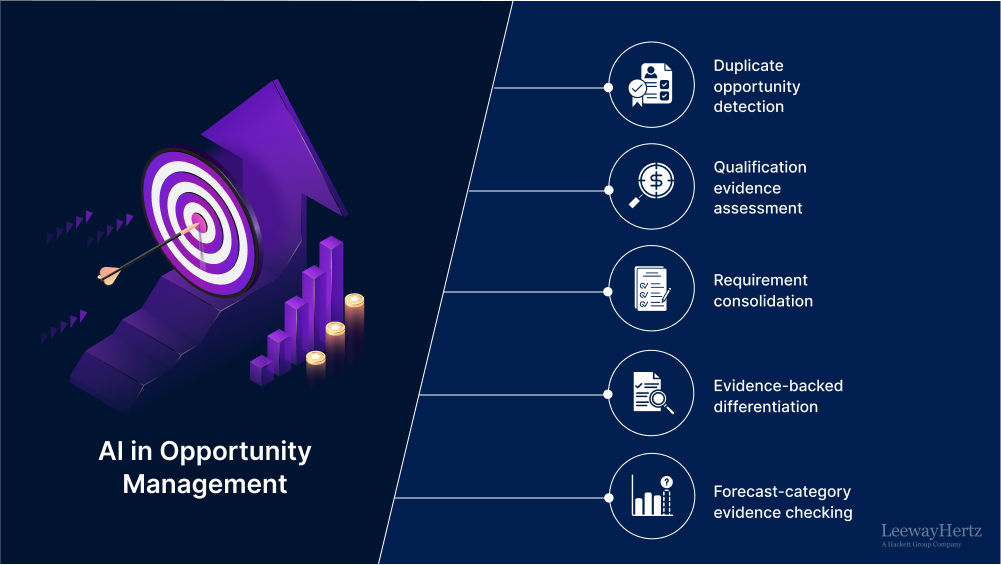
Opportunity management coordinates the work required to evaluate, develop, and progress a potential sale. It begins when a qualified selling motion is recorded as an opportunity and continues through customer needs discovery, stakeholder engagement, solution development, pricing, proposal creation, approvals, negotiation, and final disposition. At each stage, sales teams must determine whether the opportunity remains relevant, commercially viable and supported by sufficient evidence to advance.
Managing this lifecycle requires more than maintaining a CRM record. Account executives, sales engineers, solution consultants, revenue operations teams, pricing analysts, finance reviewers, legal counsel, security teams, product specialists, partner managers and sales leaders contribute different information, assessments and approvals. Although the opportunity record serves as the central coordination point, the evidence needed to progress the deal is often distributed across CRM notes, meeting transcripts, emails, proposal repositories, configure-price-quote systems, contract platforms and financial planning tools.
This fragmentation makes opportunity management difficult to execute consistently. Sellers must continuously assemble information, identify missing evidence, reconcile conflicting records, coordinate specialists and prepare opportunities for review. Sales leaders must assess whether qualification is complete, whether the buying process is understood, whether commercial assumptions remain valid and whether forecast expectations reflect the actual state of the opportunity. As opportunities become more complex, these activities create significant administrative effort and increase the risk of delayed decisions, incomplete handoffs and unsupported pipeline judgments.
AI can help address this complexity by improving how opportunity information is captured, connected, analyzed and prepared for action. Predictive analytics can surface signals of progression and slippage, document intelligence can extract requirements and commitments from sales artifacts, retrieval-grounded generation can prepare opportunity briefs from approved sources, and agentic workflows can coordinate multi-step activities across CRM, pricing, proposal and approval systems. These capabilities support the sales team by making the underlying evidence easier to review, while keeping qualification, commercial decisions, approvals and customer commitments with accountable people.
AI in opportunity management is, therefore, not a generic chatbot placed alongside the CRM. Its value comes from being embedded within defined sales processes, such as qualification review, stakeholder analysis, solution validation, pricing assessment, proposal preparation, deal inspection and forecast review. Each opportunity should be mapped to a specific sub-process, source artifact, system of record, accountable reviewer and expected output.
This article uses the B2B opportunity-management operating model to examine how AI can support the functions, processes and sub-processes that govern an opportunity from creation through final disposition and downstream handoff.
- How AI is transforming opportunity management operations
- Why AI use cases in opportunity management must be mapped at the sub-process level
- Opportunity management operating model and AI opportunity mapping across sales processes
- High-value AI use cases in opportunity management
- How agentic AI works in opportunity management workflows
- How to prioritize AI use cases in opportunity management
- Governance, risk and responsible AI in opportunity management
- How ZBrain operationalizes AI use cases in opportunity management
- Future of AI in opportunity management
How AI is transforming opportunity management operations
AI changes opportunity management by improving how organizations assemble evidence, interpret signals, identify exceptions and coordinate work across systems. Its strongest applications support defined selling and governance tasks rather than replacing the judgment of the seller, commercial reviewer or sales leader.
Consider an enterprise opportunity that includes CRM history, discovery notes, product requirements, stakeholder records, prior proposals, competitor information, pricing scenarios, security questionnaires and legal exceptions. AI can retrieve and organize these materials, identify missing evidence, classify risk conditions and prepare the next review packet. The account executive and designated reviewers still determine whether the opportunity advances, what is offered and which commitments the organization accepts.
Opportunity-management work generally falls into five AI-relevant categories:
-
Document-heavy work: Discovery notes, account plans, mutual action plans, solution briefs, quotes, proposals, approval forms, security questionnaires and contract records can be checked for missing fields, conflicting statements and unsupported claims before a reviewer opens them.
-
Narrative-heavy work: Opportunity summaries, value hypotheses, executive briefs, forecast commentary, proposal sections and win-loss reports can be drafted from approved records while showing where supporting evidence is incomplete.
-
Exception-heavy work: Pricing deviations, stalled stages, missing approvers, procurement blockers, unsupported close dates and contractual exceptions can be classified and prioritized so the responsible specialists address the highest-risk cases first.
-
Knowledge-heavy work: Product-fit checks, pricing-policy interpretation, precedent retrieval, competitor comparisons and approval-path determination improve when AI retrieves relevant policies, product documentation and prior decisions.
-
Workflow-heavy work: Qualification, solution development, proposal production, approval routing, negotiation preparation and close planning benefit when AI identifies the next required artifact and assembles a review-ready work packet.
The practical design rule is to place AI at the point where evidence must be collected, compared, classified, summarized or routed. The accountable seller or reviewer continues to own the commercial judgment.
Operationalize governed AI across opportunity management
Apply governed AI across opportunity-management functions, processes, and workflows while preserving accountable human review.
Why AI use cases in opportunity management must be mapped at the sub-process level
Opportunity management spans a connected set of activities, but each activity solves a different operational problem. Qualification determines whether the opportunity is credible, discovery clarifies customer needs, stakeholder management identifies decision-making participants, solution development assesses fit, pricing establishes commercial viability, and forecasting evaluates expected timing and value. Because these activities rely on different records, systems, controls and accountable roles, they cannot be addressed effectively through one broad AI use case.
A statement such as “improve opportunity management with AI” may describe a business intent, but it does not define what the AI should analyze, what output it should produce, which system it should use, or who should review the result. To make an AI opportunity buildable and governable, it must be mapped to the specific sub-process where information is collected, assessed, reconciled, drafted or routed.
A better approach is to map AI use cases to the opportunity-management operating model:
-
Function: A governed sales or commercial domain with defined accountability, such as opportunity qualification, pricing management or deal approval.
-
Process: A recurring workflow area within a function, such as qualification assessment, price construction or approval routing.
-
Sub-process: A specific unit of work that begins with identifiable source artifacts and produces a reviewable output, such as validating MEDDICC evidence or comparing a proposed discount with approval thresholds.
-
AI-enabled opportunity: A defined application of an AI capability to a specific artifact, framed by the change it makes to the work and bounded by named human review.
The sub-process level exposes the information required to design a reliable workflow. It identifies whether the AI must retrieve CRM fields, classify call notes, compare a quote with a pricing matrix, generate proposal language or detect inconsistency across forecast submissions. It also identifies the system of record and the person who confirms the result.
For example, “AI for qualification” is a broad term. “Classify discovery notes and CRM fields against approved qualification criteria, show missing evidence and prepare a qualification review for the account executive” is specific. Likewise, “AI for pricing” becomes concrete when defined as “compare the CPQ quote with floor-price rules and prior approved exceptions, then prepare a variance packet for deal desk review.”
This level of mapping prevents sales AI programs from combining low-risk administrative support with high-risk commercial recommendations under one vague use case.
Opportunity management operating model and AI opportunity mapping across sales processes
The operating model below covers the opportunity lifecycle from creation and qualification, mapping these functions into their underlying processes and sub-processes, showing where AI can support specific artifacts, decisions and workflows while preserving accountable human review.
Function 1: Opportunity strategy, process design and portfolio governance
Defines how opportunities should be created, evaluated, advanced, reviewed and measured.
This function translates the go-to-market strategy into opportunity stages, qualification rules, review cadences, ownership boundaries and control requirements. It establishes the operating framework used by every downstream opportunity-management function.
Teams involved: Chief sales officers, revenue operations leaders, sales operations managers, finance leaders, regional sales leaders, CRM product owners, sales enablement teams and compliance reviewers.
What AI helps with: Retrieval-grounded answering can compare proposed sales process changes with existing policies, CRM configurations and approval matrices. Natural-language generation can prepare draft process documentation and governance change summaries.
What humans continue to own: Sales and revenue leaders approve the selling methodology, opportunity stages, qualification requirements, inspection cadence and commercial authority model. CRM owners authorize configuration changes, while finance, legal and compliance teams attest to controls within their remit.
| Process | Sub-process | Key AI-enabled opportunities |
|---|---|---|
| Opportunity methodology design | Design the opportunity lifecycle and stage framework |
|
| Define a qualification framework |
|
|
| Governance design | Define stage-entry and exit criteria |
|
| Define inspection and review cadence |
|
|
| Authority governance | Define commercial approval matrix |
|
| Change governance | Maintain opportunity-management policies |
|
Highest-value opportunities
-
Stage governance analysis, because unclear advancement rules affect reporting, forecasting and resource allocation across the entire pipeline.
-
Qualification framework design, because weak evidence standards propagate into solution, pricing and forecast decisions.
-
Approval-matrix maintenance, because outdated authority rules can delay deals or expose the company to unauthorized commitments.
-
Process-mining-based control review, because it uses actual stage history rather than the stated process alone.
Example agentic workflow
- The workflow begins with the stage-governance review sub-process and CRM stage-history extracts, current process documentation and stage-control configurations.
- A process analysis agent identifies reversals, skipped stages and opportunities advanced without required records.
- A policy retrieval agent compares observed behavior with approved stage definitions and governance rules.
- A drafting agent prepares a change proposal showing affected stages, evidence gaps and proposed control updates.
- Human-in-the-loop checkpoint: Revenue operations, sales leadership and the CRM product owner review and approve or reject each proposed change.
- Approved changes are handed to the existing CRM change management process under established configuration and release controls.
Function 2: Opportunity creation, conversion and ownership assignment
Creates the governed opportunity record and establishes responsibility for its progression.
Opportunity creation converts an accepted lead, account initiative, renewal event, partner referral or seller-identified need into a controlled CRM opportunity. The function ensures that the record is not duplicated, the correct account and contacts are linked, and ownership follows territory and coverage rules.
Teams involved: Sales development representatives, account executives, channel teams, account managers, territory operations teams, revenue operations and CRM administrators.
What AI helps with: Entity resolution can compare a proposed opportunity with existing account and opportunity records. Classification can determine the likely opportunity type, source and route. Document intelligence can extract opportunity details from referral forms, meeting notes and inbound requests.
What humans continue to own: Sellers confirm whether a genuine selling motion exists, select the appropriate opportunity structure and accept responsibility for the record. Territory or channel leaders resolve contested ownership. AI classifies or prepares but does not decide, approve or attest.
| Process | Sub-process | Key AI-enabled opportunities |
|---|---|---|
| Opportunity intake | Convert accepted lead to opportunity |
|
| Create seller-originated opportunity |
|
|
| Duplicate control | Detect duplicate opportunities |
|
| Account association | Match the opportunity to the account hierarchy |
|
| Ownership assignment | Apply territory and coverage rules |
|
| Collaboration setup | Add opportunity team and supporting roles |
|
Highest-value opportunities
-
Duplicate detection, because parallel records distort pipeline reporting and create conflicting customer activity.
-
Account-hierarchy association, because errors affect ownership, account planning, pricing and revenue attribution.
-
Territory-rule validation, because disputed ownership delays engagement and creates compensation risk.
-
Opportunity-field preparation, because consistent intake improves every downstream review.
Example agentic workflow
- The workflow begins with opportunity conversion and the accepted lead record, qualification notes and account information.
- An extraction agent prepares draft opportunity fields.
- An entity-resolution agent checks for existing opportunities and validates the account hierarchy.
- A routing agent compares the proposed owner with the territory and coverage rules.
- Human-in-the-loop checkpoint: The account executive and sales operations reviewer confirm the opportunity, account association and ownership.
- The approved record is written to CRM under existing opportunity-creation controls, and supporting role requests are routed through the established assignment process.
Function 3: Opportunity data quality, enrichment and record maintenance
Maintains the completeness, consistency and usability of the opportunity record.
Opportunity decisions depend on current and correctly structured data. This function maintains core fields, contact links, product associations, source evidence, activity history and change records throughout the lifecycle.
Teams involved: Account executives, sales operations, revenue operations, CRM administrators, data stewards, sales managers and account teams.
What AI helps with: Data-quality classification can identify missing, stale or contradictory fields. Entity extraction can convert meeting notes into structured CRM updates. Anomaly detection can identify improbable values, unsupported stage changes and inconsistent close dates.
What humans continue to own: Sellers confirm customer facts, opportunity status and commercial assumptions. Data stewards approve master data corrections, and managers resolve material contradictions. AI extracts or flags but does not decide, approve or attest.
| Process | Sub-process | Key AI-enabled opportunities |
|---|---|---|
| Field completeness | Validate required opportunity fields |
|
| Record enrichment | Extract structured data from sales activities |
|
| Record freshness | Detect stale opportunity information |
|
| Consistency control | Reconcile conflicting opportunity records |
|
| Contact data validation | Validate stakeholder links |
|
| Change control | Maintain opportunity audit history |
|
Highest-value opportunities
-
Cross-system reconciliation, because amount, product and term conflicts can affect pricing, proposals and forecasts.
-
Stage-specific completeness checks prevent unsupported progression.
-
Activity-to-CRM extraction, because it reduces the gap between customer interactions and the formal record.
-
Material-change summaries, because reviewers need to understand what changed, not only the current values.
Example agentic workflow
- The workflow begins with opportunity-record reconciliation and the CRM record, the latest meeting transcript, quote and proposal.
- An extraction agent identifies structured facts from the approved transcript.
- A reconciliation agent compares amounts, products, stakeholders, dates and next steps across artifacts.
- An anomaly agent creates a discrepancy packet with source references.
- Human-in-the-loop checkpoint: The opportunity owner confirms each proposed field update, while material financial discrepancies are reviewed by sales operations.
- Approved updates are written to CRM with source references and retained change history.
Function 4: Opportunity qualification and disqualification
Determines whether an opportunity has sufficient evidence, value and organizational fit to remain active.
Qualification evaluates customer need, business impact, decision process, access, competition, timing, funding and organizational fit. It is a continuing discipline rather than a single early-stage event.
Teams involved: Account executives, sales development representatives, sales managers, solution consultants, sales engineers and revenue operations reviewers.
What AI helps with: Classification can map evidence against BANT, MEDDICC, SPICED or custom criteria. Retrieval-grounded answering can show which source records support each criterion. Predictive analytics can estimate progression likelihood as decision support, provided the model is governed and does not become the sole basis for customer treatment or seller evaluation.
What humans continue to own: Sellers and managers decide whether evidence is credible, whether strategic considerations justify continued investment and whether the opportunity should advance, remain open or be disqualified. AI scores or prepares but does not decide, approve or attest.
| Process | Sub-process | Key AI-enabled opportunities |
|---|---|---|
| Qualification assessment | Assess business need and pain points |
|
| Validate quantified impact |
|
|
| Assess authority and decision process |
|
|
| Assess funding and commercial readiness |
|
|
| Assess urgency and timing |
|
|
| Fit assessment | Evaluate product, customer and strategic fit |
|
| Qualification control | Requalify at stage transitions |
|
| Opportunity disposition | Disqualify or nurture opportunity |
|
Highest-value opportunities
-
Decision-process mapping, because unknown approval structures frequently surface late.
-
Timing-feasibility checks, because close dates must reflect procurement, legal and implementation dependencies.
-
Evidence-backed requalification, because opportunity conditions change during long sales cycles.
-
Disqualification-reason classification, because consistent dispositions improve capacity allocation and learning.
Example agentic workflow
- The workflow begins with stage-transition requalification and the CRM qualification fields, discovery notes and stakeholder map.
- A qualification agent maps available evidence to approved criteria.
- A retrieval agent attaches the source passage supporting each criterion.
- A gap agent identifies missing economic buyer, decision-process, funding or timing evidence.
- Human-in-the-loop checkpoint: The account executive and sales manager confirm the qualification status and decide whether the opportunity advances, remains in stage or is disqualified.
- The confirmed decision and evidence references are stored in CRM under the existing stage-governance process.
Function 5: Discovery, requirements and customer-outcome definition
Converts customer discussions and supplied materials into validated business, functional and technical requirements.
Discovery establishes what the customer is trying to change, why the change matters, who is affected, which constraints apply and how success will be evaluated.
Teams involved: Account executives, solution consultants, sales engineers, product specialists, value engineers, customer-success representatives and customer stakeholders.
What AI helps with: Natural-language processing can extract needs, constraints, questions, actions and unresolved assumptions from discovery records. Retrieval-grounded answering can connect requirements with product documentation. Contradiction detection can expose inconsistent statements across stakeholder interviews.
What humans continue to own: Sellers and specialists determine which questions to ask, validate the meaning and priority of customer statements, and agree on the problem definition with customer stakeholders. Product and solution owners confirm feasibility. AI extracts or drafts but does not decide, approve or attest.
| Process | Sub-process | Key AI-enabled opportunities |
|---|---|---|
| Discovery planning | Prepare discovery agenda |
|
| Discovery capture | Extract needs and constraints |
|
| Requirement management | Build requirement inventory |
|
| Resolve conflicting requirements |
|
|
| Outcome definition | Define success measures |
|
| Action management | Maintain discovery actions and questions |
|
Highest-value opportunities
-
Requirement consolidation, because fragmented requirements create rework across solution, pricing and proposals.
-
Conflict detection, because differences between business, technical and procurement stakeholders often remain hidden.
-
Evidence-backed outcome definition, because value cases require agreed baselines and measures.
-
Unresolved-question monitoring, because unanswered questions become late-stage blockers.
Example agentic workflow
- The workflow begins with requirement-inventory preparation and approved discovery transcripts, customer documents and RFP materials.
- An extraction agent identifies business, functional, technical, security and commercial requirements.
- A consolidation agent removes duplicates while preserving sources.
- A contradiction agent prepares a list of conflicting or ambiguous requirements.
- Human-in-the-loop checkpoint: The account executive and solution lead validate the inventory and select items requiring customer clarification.
- The approved requirement inventory and question register are handed to the existing solution-design workflow.
Function 6: Stakeholder, buying committee and engagement management
Maps the people and organizational groups that influence, approve, use, fund or block the purchase.
Sales opportunities involve formal decision makers, technical evaluators, procurement teams, legal reviewers, executive sponsors, users and informal influencers. This function maintains the stakeholder model and engagement strategy.
Teams involved: Account executives, account managers, sales development teams, executive sponsors, partner managers, solution consultants and sales leaders.
What AI helps with: Entity resolution can build a current stakeholder list from CRM and approved communications. Role classification can propose buying roles. Relationship analysis can show engagement concentration, missing functions and reliance on one contact.
What humans continue to own: Sellers determine relationship quality, stakeholder intent, political context and engagement strategy. Leaders approve executive outreach, and customer contacts control their own participation. AI classifies or prepares but does not decide, approve or attest.
| Process | Sub-process | Key AI-enabled opportunities |
|---|---|---|
| Stakeholder identification | Build a buying committee map |
|
| Stakeholder validation | Verify role and influence evidence |
|
| Stakeholder relationship analysis | Assess engagement coverage |
|
| Stakeholder engagement planning | Prepare stakeholder-specific engagement plans |
|
| Executive alignment | Coordinate executive sponsorship |
|
| Contact governance | Maintain consent and communication controls |
|
Highest-value opportunities
-
Buying-committee gap analysis, because missing approvers or evaluators can invalidate the apparent sales path.
-
Relationship-concentration detection, because single-threaded opportunities are vulnerable to personnel or priority changes.
-
Executive briefing preparation, because senior engagement requires a concise, evidence-backed context.
-
Communication-control checks, because automated outreach must respect applicable channel and consent rules.
Example agentic workflow
- The workflow begins with a buying committee review and the CRM contact list, activity history and discovery notes.
- An entity-resolution agent consolidates contact records.
- A role-classification agent proposes stakeholder roles with evidence links and confidence levels.
- A relationship-analysis agent identifies missing functions and engagement concentration.
- Human-in-the-loop checkpoint: The account executive validates the stakeholder map and approves internal engagement actions.
- Approved actions are recorded in the opportunity plan, while any customer communication follows existing consent, outreach and managerial controls.
Accelerate AI Solutions Development
Build fully functional solutions from your high-value use cases, based on specific operational needs and enterprise context.
Function 7: Solution fit, architecture and value-case development
Translates validated customer requirements into a feasible solution and an evidence-backed business case.
This function determines how the organization’s products, services, implementation capabilities and partner components address the customer’s needs. It also defines the expected business value and the assumptions behind it.
Teams involved: Solution consultants, sales engineers, product specialists, professional-services teams, value engineers, account executives, finance analysts and partner specialists.
What AI helps with: Capability mapping compares customer requirements with approved product capabilities, limitations and implementation constraints. Document intelligence can assemble a requirements traceability matrix. Simulation and calculation support can prepare value scenarios using reviewer-approved assumptions.
What humans continue to own: Product and solution specialists confirm feasibility, architecture, integrations and limitations. Finance or value-engineering reviewers validate economic assumptions. Sellers decide how to position the solution. AI maps or drafts but does not decide, approve or attest.
| Process | Sub-process | Key AI-enabled opportunities |
|---|---|---|
| Capability fit assessment | Map requirements to capabilities |
|
| Gap management | Identify solution gaps and dependencies |
|
| Solution architecture development | Prepare solution architecture |
|
| Scope definition | Define solution and service scope |
|
| Value engineering | Develop a value hypothesis |
|
| Proof planning | Define a demonstration or proof-of-concept plan |
|
Highest-value opportunities
-
Requirement-to-capability traceability, because it creates a common evidence base for solution, proposal and delivery teams.
-
Gap and dependency identification, because unrecognized limitations become late-stage exceptions.
-
Assumption-controlled value modeling, because commercial claims must remain inspectable and supportable.
-
Scope consistency checking, because discrepancies across solution, quote and proposal artifacts create delivery and contractual risk.
Example agentic workflow
- The workflow begins with capability mapping and the approved requirement inventory, product documentation and solution patterns.
- A retrieval agent maps each requirement to approved capability evidence.
- A classification agent labels supported, configurable, partner-dependent and unsupported items.
- A gap agent prepares dependencies, open questions and proposed validation activities.
- Human-in-the-loop checkpoint: The solution lead, product specialist and account executive confirm the fit assessment and approve customer-facing representations.
- The approved traceability matrix is handed to proposal, pricing and delivery-scoping workflows under existing review controls.
Function 8: Competitive strategy, partner positioning and deal strategy
Defines how the opportunity should be pursued within its competitive, partner and strategic context.
This function assesses alternatives, incumbent positions, partner dependencies, procurement dynamics, differentiation and the organization’s preferred path to win.
Teams involved: Account executives, sales managers, competitive-intelligence teams, partner managers, product marketing, solution consultants and executive sponsors.
What AI helps with: Competitive and partner analysis consolidates relevant evidence from approved internal and external sources to support opportunity strategy. Classification can distinguish confirmed competitor presence from speculation. Scenario analysis can compare pursuit options and dependencies.
What humans continue to own: Sellers and sales leaders interpret political context, select positioning, approve pursuit strategy and determine what competitive information may be used. Legal and compliance teams govern information handling. AI compares or drafts but does not decide, approve or attest.
| Process | Sub-process | Key AI-enabled opportunities |
|---|---|---|
| Competitive assessment | Identify competitive alternatives |
|
| Differentiation planning | Map differentiation to customer criteria |
|
| Partner role and dependency assessment | Evaluate partner role and dependency |
|
| Opportunity pursuit planning | Develop win strategy |
|
| Pursuit resource planning | Prioritize pursuit investment |
|
| Information governance | Control competitive information use |
|
Highest-value opportunities
-
Evidence-backed differentiation mapping, because generic claims weaken proposals and increase the risk of misrepresentation.
-
Partner-dependency analysis, because partner assumptions affect architecture, pricing and delivery.
-
Deal-strategy synthesis, because pursuit decisions require a combined view of many functions.
-
Competitive information governance, because source provenance and permitted use matter.
Example agentic workflow
- The workflow begins with deal-strategy preparation and the qualification record, stakeholder map, competitor evidence and solution plan.
- A synthesis agent assembles the confirmed facts and unresolved assumptions.
- A retrieval agent connects customer decision criteria with approved differentiators.
- A scenario agent prepares pursuit options, resource implications and material dependencies.
- Human-in-the-loop checkpoint: The account executive, sales manager and relevant specialists select and approve the pursuit strategy.
- The confirmed strategy is stored in the opportunity plan and used through the existing sales review and content approval processes.
Function 9: Product configuration, pricing, discounting and quote management
Converts the proposed solution into an authorized commercial configuration and customer quote.
This function determines eligible products and services, quantities, terms, list prices, discounts, margins, currencies, taxes and approval requirements.
Teams involved: Account executives, deal desk, pricing teams, finance, sales operations, product specialists, tax reviewers and CPQ administrators.
What AI helps with: Configuration validation can compare solution requirements with approved product rules. Anomaly detection can identify pricing deviations, margin risk and inconsistent terms. Optimization can prepare pricing scenarios within predefined constraints.
What humans continue to own: Product specialists approve nonstandard configurations, deal desk and finance approve pricing exceptions, and tax or legal specialists review terms within their authority. Sellers do not receive autonomous permission to issue unapproved commercial commitments. AI recommends or prepares but does not decide, approve or attest.
| Process | Sub-process | Key AI-enabled opportunities |
|---|---|---|
| Product configuration | Build product and service configuration |
|
| Pricing and commercial term application | Apply price books and commercial terms |
|
| Discount management | Evaluate the discount request |
|
| Margin review | Assess profitability and cost assumptions |
|
| Quote preparation | Generate customer quote |
|
| Quote governance | Approve and release the quote |
|
Highest-value opportunities
-
Configuration-rule validation, because invalid combinations create downstream delivery and billing problems.
-
Discount-authority checking, because it protects pricing discipline and shortens preventable review cycles.
-
Margin-assumption validation, because small scope or cost errors can materially change deal economics.
-
Quote-to-scope reconciliation, because the commercial artifact must match the solution being represented.
Example agentic workflow
- The workflow begins with discount review and the CPQ quote, current price book, discount policy, cost assumptions and approved scope.
- A validation agent checks configuration and price-book consistency.
- A margin agent recalculates commercial measures and tests sensitivity scenarios.
- A policy agent determines the required approval path and prepares the deviation rationale.
- Human-in-the-loop checkpoint: Deal desk, finance and any required commercial authority approve, reject or revise the request.
- The approved quote is released through the existing CPQ process with its approval and version record intact.
Function 10: Proposal, RFP and customer-response management
Produces controlled customer-facing materials that reflect the approved solution, value case and commercial position.
This function coordinates response planning, content retrieval, drafting, subject-matter review, compliance checks and final release.
Teams involved: Account executives, proposal managers, bid teams, solution consultants, product specialists, legal counsel, security teams, finance and executive reviewers.
What AI helps with: Document intelligence can decompose RFPs into requirements and response obligations. Retrieval-grounded generation can draft responses from approved content. Contradiction detection can compare proposal statements with solution, pricing and policy records.
What humans continue to own: Subject-matter experts validate accuracy, legal and security teams approve representations in their domains, and authorized sales leaders approve release. AI drafts or checks but does not decide, approve or attest.
| Process | Sub-process | Key AI-enabled opportunities |
|---|---|---|
| Response intake | Parse RFP or proposal request |
|
| Response planning | Build a compliance and response matrix |
|
| Content development | Retrieve approved response content |
|
| Draft proposal and RFP responses |
|
|
| Cross-functional review | Validate technical, legal, security and commercial claims |
|
| Submission governance | Approve and release the final response |
|
Highest-value opportunities
-
RFP decomposition, because large response packages contain many obligations and dependencies.
-
Approved content retrieval, because outdated or unsupported content creates commercial and legal exposure.
-
Cross-artifact consistency checking, because proposal, quote and solution records must tell the same story.
-
Submission completeness control, because procedural omissions can invalidate an otherwise strong response.
Example agentic workflow
- The workflow begins with RFP intake and the customer RFP package, approved content library and opportunity record.
- A document-intelligence agent extracts questions, instructions and deadlines.
- A routing agent assigns draft sections to functional owners.
- A retrieval-grounded drafting agent prepares responses and flags unsupported items.
- Human-in-the-loop checkpoint: Proposal management, subject-matter experts, legal, security and commercial approvers validate their assigned sections and approve the final release.
- The approved response is submitted through the existing bid process, and the final version and evidence package are retained.
Function 11: Pipeline progression, close planning and mutual action management
Coordinates the activities, dependencies and customer commitments required to move the opportunity toward a decision.
This function turns the sales plan into a sequenced set of actions covering evaluation, approvals, procurement, contracting, implementation readiness and decision milestones.
Teams involved: Account executives, sales managers, solution teams, deal desk, legal, security, implementation teams, customer-success teams and customer stakeholders.
What AI helps with: Temporal extraction can build action registers from meeting records. Dependency analysis can detect sequencing conflicts. Predictive analytics can identify likely bottlenecks and slippage risk.
What humans continue to own: Sellers agree plans with customers, confirm dates and determine whether commitments are credible. Functional teams accept their own deliverables. AI predicts or prepares but does not decide, approve or attest.
| Process | Sub-process | Key AI-enabled opportunities |
|---|---|---|
| Opportunity planning | Build an opportunity action plan |
|
| Mutual action planning | Prepare a customer-facing mutual action plan |
|
| Milestone management | Track evaluation and decision milestones |
|
| Dependency management | Identify cross-functional blockers |
|
| Next-step control | Validate opportunity next steps |
|
| Close planning | Prepare a close-readiness plan |
|
Highest-value opportunities
-
Dependency-based close planning, because opportunity timing depends on work outside the sales team.
-
Mutual-plan consistency checks, because internal and customer plans often diverge.
-
Next-step validation, because vague next steps hide inactivity.
-
Bottleneck prediction, because early visibility allows owners to intervene before the close date becomes implausible.
Example agentic workflow
- The workflow begins with a close-readiness assessment and the mutual action plan, CRM activity history, approval status and legal and security trackers.
- A temporal agent compares planned milestones with completed activities.
- A dependency agent identifies unresolved steps on the critical path.
- A drafting agent prepares a blocker packet with owners, evidence and timing implications.
- Human-in-the-loop checkpoint: The account executive and sales manager validate the plan and approve any internal escalation.
- Approved actions are handed to existing functional workflows, and CRM timing changes remain subject to seller and manager confirmation.
Function 12: Forecasting, pipeline inspection and opportunity-risk management
Converts opportunity evidence into a governed view of expected timing, value and execution risk.
Forecasting combines seller judgment, opportunity evidence, stage, amount, timing, customer behavior and portfolio context. Pipeline inspection tests the assumptions behind the forecast rather than accepting CRM fields at face value.
Teams involved: Account executives, frontline sales managers, regional vice presidents, revenue operations, finance, executive leadership and data-science teams.
What AI helps with: Predictive analytics can estimate progression, slippage or conversion patterns. Anomaly detection can identify unsupported amounts, close dates and forecast-category changes. Natural-language generation can prepare evidence-backed forecast commentary.
What humans continue to own: Sellers submit forecasts, managers inspect them, and sales and finance leaders approve the official forecast. Model outputs remain decision support and must not silently overwrite accountable submissions. AI scores or drafts but does not decide, approve or attest.
| Process | Sub-process | Key AI-enabled opportunities |
|---|---|---|
| Forecast preparation | Prepare seller forecast submission |
|
| Forecast classification | Assess forecast category |
|
| Timing assessment | Evaluate close-date feasibility |
|
| Amount assessment | Validate opportunity amount |
|
| Pipeline inspection | Prepare deal-inspection packet |
|
| Forecast consolidation | Aggregate team and regional forecast |
|
| Change analysis | Explain forecast movement |
|
Highest-value opportunities
-
Close-date feasibility analysis, because timing errors affect resource planning and executive expectations.
-
Forecast-category evidence checks, because category labels require consistent interpretation.
-
Quote-to-forecast amount reconciliation, because commercial records are stronger evidence than unverified CRM values.
-
Forecast-movement explanation, because leaders need the drivers behind changes, not only revised totals.
Example agentic workflow
- The workflow begins with forecast submission and the opportunity record, quote, mutual action plan, activity history and open approval records.
- A reconciliation agent validates the amount and product scope.
- A timing agent assesses remaining milestones and dependencies.
- A classification agent prepares category and slippage indicators with supporting evidence.
- Human-in-the-loop checkpoint: The account executive submits the forecast, the sales manager reviews it, and the authorized sales or finance leader confirms the official rollup.
- The confirmed forecast is transferred to the existing forecasting system with model outputs, overrides and reviewer dispositions retained.
Function 13: Deal desk, cross-functional approval and exception management
Coordinates commercial, financial, legal, security and operational review before the organization accepts nonstandard commitments.
Opportunity approvals may include discount, margin, payment, liability, data protection, security, delivery, product, partner and executive exceptions.
Teams involved: Deal desk, finance, legal counsel, security, privacy, product, professional services, tax, sales operations, executive approvers and account teams.
What AI helps with: Document intelligence can extract exceptions from quotes, proposals and contract redlines. Classification can route each exception to the correct authority. Retrieval-grounded answering can surface the governing policy and relevant approved precedent.
What humans continue to own: Authorized reviewers approve, reject or condition every exception. Legal counsel determines legal acceptability, security and privacy owners assess control commitments, and finance approves economic deviations. AI classifies or prepares but does not decide, approve or attest.
| Process | Sub-process | Key AI-enabled opportunities |
|---|---|---|
| Approval intake | Assemble the deal review packet |
|
| Approval determination | Identify the required approval path |
|
| Exception analysis | Analyze commercial exceptions |
|
| Analyze legal and contractual exceptions |
|
|
| Analyze security and privacy commitments |
|
|
| Approval tracking | Monitor review status and conditions |
|
| Approval decision documentation | Record approval rationale and conditions |
|
Highest-value opportunities
-
Approval-path determination, because misrouting causes delay and control failures.
-
Exception extraction, because material deviations may be hidden across multiple documents.
-
Policy and precedent retrieval, because reviewers need context without treating precedent as automatic approval.
-
Condition-to-document reconciliation, because approved conditions must appear in the final commercial artifacts.
Example agentic workflow
- The workflow begins with deal-review intake and the quote, proposal, contract redlines, security requirements and commercial policy records.
- An extraction agent builds an exception inventory.
- A routing agent determines the required functional reviewers and approval sequence.
- A retrieval agent assembles policy passages, approved standards and relevant precedents.
- Human-in-the-loop checkpoint: Each authorized reviewer approves, rejects or conditions the items within their authority, and the final commercial authority confirms release.
- Approved decisions and conditions are handed to CPQ, proposal and contract systems under existing deal-governance controls.
Function 14: Negotiation, commitment and commercial close management
Coordinates the controlled resolution of commercial issues and records the final customer and company commitments.
Negotiation covers pricing, scope, terms, implementation expectations, legal provisions and procurement conditions. Close management verifies that required approvals and customer commitments are present before disposition.
Teams involved: Account executives, sales leaders, deal desk, finance, legal counsel, procurement-facing teams, solution leaders and implementation representatives.
What AI helps with: Version comparison can summarize changes across quotes, proposals and contracts. Retrieval-grounded answering can surface approved negotiation positions. Contradiction detection can identify differences between negotiated terms and internal approvals.
What humans continue to own: Authorized sellers negotiate within their authority, legal counsel determines acceptable legal positions, finance and executives approve economic changes, and designated signatories accept commitments. AI summarizes or prepares but does not decide, approve or attest.
| Process | Sub-process | Key AI-enabled opportunities |
|---|---|---|
| Negotiation preparation | Prepare negotiation brief |
|
| Change management | Compare commercial revisions |
|
| Commitment control | Validate statements and commitments |
|
| Procurement coordination | Track buyer procurement requirements |
|
| Signature readiness | Verify execution prerequisites |
|
| Close disposition | Confirm closed-won or closed-lost status |
|
Highest-value opportunities
-
Final version reconciliation, because last-minute document changes can bypass earlier approvals.
-
Commitment validation, because unsupported delivery, security or product statements create downstream exposure.
-
Negotiation changes materiality because not every edit requires the same review.
-
Close-disposition reconciliation, because the CRM outcome should reflect the final commercial record.
Example agentic workflow
- The workflow begins with signature-readiness review and the approved quote, final proposal, contract version and approval history.
- A comparison agent identifies changes since the last approved versions.
- A control agent determines whether any changes require renewed legal, finance, security or executive review.
- A completeness agent prepares the execution-readiness packet.
- Human-in-the-loop checkpoint: Authorized functional reviewers confirm outstanding changes, and the designated company signatory determines whether execution may proceed.
- The executed outcome is recorded through existing contract, CRM and financial handoff controls.
Function 15: Closed-won handoff, closed-lost analysis and opportunity learning
Transfers approved opportunity knowledge downstream and converts outcomes into controlled organizational learning.
Closed-won handoff provides implementation, customer success, billing and revenue teams with the approved scope, obligations, assumptions and stakeholder context. Closed-lost review records why the pursuit ended and what should change.
Teams involved: Account executives, implementation teams, customer success, professional services, finance, billing, revenue accounting, product teams, marketing, sales enablement and revenue operations.
What AI helps with: Multi-source aggregation can prepare handoff packets. Document intelligence can extract obligations and assumptions from final artifacts. Classification can standardize loss reasons, while thematic analysis identifies recurring issues across completed opportunities.
What humans continue to own: Delivery and customer-success leaders accept handoffs, finance and revenue teams determine accounting and billing treatment, and sales leaders validate loss conclusions. AI summarizes or classifies but does not decide, approve or attest.
| Process | Sub-process | Key AI-enabled opportunities |
|---|---|---|
| Closed-won handoff | Prepare delivery and customer-success handoff |
|
| Validate commercial-to-delivery consistency |
|
|
| Financial handoff | Provide billing and revenue-support records |
|
| Closed-lost review | Capture the loss reason and evidence |
|
| Learning analysis | Identify recurring win and loss patterns |
|
| Feedback routing | Route insights to product and enablement owners |
|
Highest-value opportunities
-
Obligation-aware handoff, because delivery teams need final commitments rather than informal seller summaries.
-
Final-artifact consistency checking, because quote, proposal and contract differences create implementation and billing risk.
-
Evidence-based loss classification, because seller-selected reason codes are often inconsistent.
-
Aggregated learning analysis, because recurring patterns should inform product, enablement and sales-process decisions.
Example agentic workflow
- The workflow begins with a closed-won handoff and the executed contract, approved quote, proposal, requirement matrix and stakeholder map.
- An obligation-extraction agent identifies scope, responsibilities, milestones and acceptance conditions.
- A reconciliation agent identifies differences across the final artifacts.
- A drafting agent prepares functional handoff packets with source references.
- Human-in-the-loop checkpoint: Sales, delivery, customer success and finance reviewers validate the information within their authority and accept or return the handoff.
- Approved records are transferred to implementation, customer success and financial systems under existing operational and accounting controls.
Function 16: Opportunity analytics, control monitoring and platform governance
Maintains the data, models, controls and performance evidence supporting the opportunity-management operating model.
This cross-cutting function monitors process health, CRM adoption, stage integrity, forecast behavior, model performance, access controls and workflow outcomes.
Teams involved: Revenue operations, sales operations, finance, CRM product teams, data engineering, analytics, information security, privacy, internal audit and AI governance teams.
What AI helps with: Process mining can identify control deviations and bottlenecks. Anomaly detection can flag suspicious or inconsistent opportunity updates. Model monitoring can identify drift, unstable performance and segment-level differences.
What humans continue to own: Process owners define metrics and controls, data stewards approve quality rules, governance teams authorize AI use, and internal audit or compliance teams determine whether evidence is sufficient. AI monitors or prepares but does not decide, approve or attest.
| Process | Sub-process | Key AI-enabled opportunities |
|---|---|---|
| Performance analytics | Measure opportunity conversion and velocity |
|
| Process monitoring | Detect stage and control exceptions |
|
| Data governance | Monitor opportunity-data quality |
|
| Access governance | Review CRM and commercial data access |
|
| AI governance | Maintain opportunity-AI use-case inventory |
|
| Model monitoring | Monitor predictive and classification models |
|
| Evidence retention | Preserve workflow and review evidence |
|
Highest-value opportunities
-
Stage-control monitoring, because it protects the integrity of the pipeline and forecast reporting.
-
AI-use-case inventory and risk tiering, because opportunity-management applications carry different decision risks.
-
Model-drift monitoring, because predictive outputs can deteriorate as products, markets and sales behavior change.
-
End-to-end evidence retention, because accountable review must remain reconstructable.
Example agentic workflow
- The workflow begins with monthly stage-control monitoring and CRM history, stage criteria, approval records and model logs.
- A process-mining agent identifies skipped controls and unusual changes.
- A risk-classification agent prioritizes findings by reporting, commercial and governance significance.
- An evidence agent assembles the relevant records and prior reviewer actions.
- Human-in-the-loop checkpoint: Revenue operations, CRM governance and designated risk owners validate findings and approve remediation actions.
- Approved actions are handed to existing data, process, access or model-governance workflows with closure evidence retained.
Accelerate AI Solutions Development
Build fully functional solutions from your high-value use cases, based on specific operational needs and enterprise context.
High-value AI use cases in opportunity management
High-value opportunity-management use cases improve the quality or timeliness of decisions that affect multiple downstream functions. They are supported by available artifacts, have clear review boundaries and reduce identifiable commercial, reporting or execution risk.
| Use case | Function | How AI creates high-value impact |
|---|---|---|
| Stage governance exception monitoring | Opportunity strategy and governance | Process mining identifies unsupported stage advancement, reversals and missing evidence before these issues distort pipeline reviews. |
| Duplicate opportunity detection | Opportunity creation | Entity resolution prevents parallel records from fragmenting activity, ownership and forecast value. |
| CRM-to-commercial record reconciliation | Data quality management | Contradiction detection identifies differences in amount, product, term and date across CRM, CPQ and proposal records. |
| Qualification evidence assessment | Qualification criteria assessment | Classification maps source artifacts to approved qualification criteria and shows material evidence gaps. |
| Requirement consolidation | Requirements management | Document intelligence creates a traceable requirement inventory from meetings, RFPs and customer documents. |
| Buying-committee gap analysis | Stakeholder management | Relationship analysis identifies unverified buying committee roles and flags opportunities that rely too heavily on a single customer contact. |
| Requirement-to-capability traceability | Solution development | Retrieval-grounded answering links customer requirements with approved capabilities, constraints and dependencies. |
| Evidence-backed differentiation | Competitive strategy formulation and development | Semantic matching connects customer criteria with approved differentiators while flagging unsupported claims. |
| Discount and margin exception review | Pricing and quoting | Rule comparison and calculation validation prepare review-ready deviation packets for the deal desk and finance teams. |
| RFP decomposition and response control | Proposal management | Document intelligence extracts RFP requirements, mandatory response items, deadlines, and supporting-document requests, then assigns each section to the appropriate reviewer. |
| Critical path close assessment | Pipeline progression | Dependency analysis identifies unresolved legal, security, procurement and approval tasks affecting the target close date. |
| Forecast-category evidence checking | Opportunity forecasting | Classification compares opportunity evidence with approved forecast definitions and prepares exceptions for manager review. |
| Cross-functional approval routing | Deal review and exception management | Policy retrieval and rule mapping identify the correct commercial, legal, finance and security reviewers. |
| Final version change detection | Negotiation and close | Version comparison identifies material changes introduced after earlier approvals. |
| Obligation-aware handoff | Closed-won handoff | Document intelligence extracts final commitments and prepares source-linked handoff records for delivery, customer success, and finance teams. |
| Opportunity-control monitoring | Analytics and platform governance | Anomaly detection surfaces skipped controls, unusual edits and model-governance exceptions. |
What earns the high-value label is not novelty. High-value opportunities improve a decision, control or artifact with consequences beyond one administrative task. They often reduce uncertainty at handoff points, where qualification affects solution design, solution scope affects price, price affects approval, and approval status affects forecast confidence.
How agentic AI works in opportunity management workflows
Agentic AI in opportunity management should operate as a governed sequence of software actions. The workflow can retrieve records, classify evidence, compare artifacts, prepare drafts and route review packets, but accountable people retain commercial and risk-bearing decisions.
Here are some examples:
Qualification and stage-advancement workflow
-
Agent role: Assemble and assess the evidence required for a proposed opportunity-stage transition.
-
Retrieve the opportunity record, qualification fields, stakeholder map, discovery notes and mutual action plan.
-
Classify available evidence against approved stage-exit and qualification criteria.
-
Attach source references and flag unsupported criteria.
-
Prepare a stage-review brief showing evidence, contradictions and open questions.
-
Human-in-the-loop checkpoint: The account executive and sales manager approve, defer or reject the stage transition.
-
Record the confirmed decision in CRM under existing stage-governance controls.
Pricing-exception workflow
-
Agent role: Prepare a complete commercial-exception packet for deal desk and finance.
-
Retrieve the CPQ quote, price book, cost assumptions, discount policy and approval matrix.
-
Validate configuration, pricing calculations, margin assumptions and commercial terms.
-
Identify deviations and determine the required approval path.
-
Prepare pricing scenarios and the seller’s documented rationale.
-
Human-in-the-loop checkpoint: Deal desk, finance and other authorized reviewers approve, revise or reject the exception.
-
Release only the approved quote through the existing CPQ process.
Forecast-inspection workflow
-
Agent role: Assemble evidence explaining the amount, timing, category and principal risks of an opportunity.
-
Retrieve CRM history, current quote, mutual action plan, customer activities and approval status.
-
Reconcile the forecast amount with approved commercial records.
-
Assess whether unresolved milestones are consistent with the close date and forecast category.
-
Prepare an inspection packet with source-linked exceptions.
-
Human-in-the-loop checkpoint: The seller submits the forecast, the manager reviews it, and the authorized sales or finance leader confirms the rollup.
-
Store the confirmed forecast and reviewer overrides in the forecasting system.
Closed-won handoff workflow
-
Agent role: Prepare controlled handoff packets from final opportunity and contract artifacts.
-
Retrieve the executed agreement, approved quote, proposal, requirement matrix, value measures and stakeholder map.
-
Extract scope, commitments, milestones, assumptions and acceptance conditions.
-
Reconcile inconsistencies and route them to the responsible sales, legal, finance or solution owner.
-
Prepare role-specific packets for implementation, customer success, billing and revenue teams.
-
Human-in-the-loop checkpoint: Each receiving function validates and accepts the information within its authority.
-
Transfer the approved records through existing downstream onboarding and financial-control processes.
The review boundary is the central safety property. AI may prepare the next decision, but the designated person must confirm it before a commercial, contractual, financial or customer-facing action proceeds.
Accelerate AI Solutions Development
Build fully functional solutions from your high-value use cases, based on specific operational needs and enterprise context.
How to prioritize AI use cases in opportunity management
Organizations should prioritize sub-processes where the required evidence is available, the expected operational change is clear, and a named role can review the result before it affects a customer or commercial decision.
| Criterion | What to ask |
|---|---|
| Volume and frequency | Does this sub-process recur often enough for AI support to reduce manual effort at scale? |
| Artifact availability | Are the required CRM fields, transcripts, quotes, proposals, policies and approval records available in usable systems with sufficient quality? |
| Review boundary | Can a named seller, manager, specialist or commercial authority confirm the output before it affects a risk-bearing decision? |
| Blast radius | If the output is wrong, is the immediate impact limited to a draft, evidence packet or review queue rather than a customer commitment or live commercial update? |
| Business impact | Can the function connect the use case with a credible result, such as better seller capacity allocation, reduced approval rework, improved forecast evidence or lower commercial-control risk? |
The classic failure patterns are misaligned scope, missing data, bypassed governance and premature quantified savings. The strongest first projects are high-volume, artifact-rich and cleanly reviewed sub-processes such as opportunity brief preparation, qualification gap analysis, CRM completeness checks, RFP decomposition, quote reconciliation, approval packet preparation, and forecast commentary generation.
Governance, risk and responsible AI in opportunity management
AI in opportunity management operates close to customer communications, pricing decisions, commercial commitments, employee performance data and forecast reporting. Governance must therefore address both the model and the workflow in which the model participates.
Human-in-the-loop oversight: AI may draft opportunity records, classify qualification evidence, identify price deviations, prepare forecast indicators and summarize contract changes. Account executives confirm customer and opportunity facts, sales managers approve stage and forecast judgments, deal desk and finance teams approve economic exceptions, legal counsel approves contractual positions, and authorized signatories accept commitments.
Regulatory and standards alignment: Organizations can use the NIST AI Risk Management Framework to structure governance across the design, deployment and use of opportunity-management AI. NIST describes the AI RMF as a voluntary, use-case-agnostic framework for managing risks associated with AI systems. These controls should be mapped to applicable commercial email, telecommunication, privacy, anti-bribery, contracting, records and financial control requirements. The FTC’s CAN-SPAM guidance and FCC consent rules are particularly relevant when AI workflows support outbound email, calls or texts.
Bias mitigation and evidence retention: Bias can enter through historical win labels, seller activity patterns, account coverage, segment definitions, incomplete CRM records and manager overrides. Organizations should test whether scoring or prioritization outputs behave differently across relevant customer, market and seller segments. The CRM record, quote, meeting evidence, approval history and model output supporting each recommendation should remain inspectable.
Key governance requirements: The AI inventory should distinguish low-risk summarization and retrieval from higher-risk qualification scoring, opportunity prioritization, price recommendation, forecast prediction and automated routing. Each use case needs risk tiering, approved data sources, output constraints, reviewer roles, escalation paths, model-monitoring requirements and suspension criteria.
Design principles: Workflows should be grounded in approved CRM data, product, policy, pricing and contract sources. Access should follow least-privilege and role-based principles. Tool permissions should be scoped so the workflow cannot autonomously send customer communications, change an opportunity stage, issue a quote, approve a discount, alter the official forecast or accept contractual terms.
Traceability and data security: The audit record should capture the input artifacts, retrieved sources, prompt or workflow version, model version, generated output, reviewer changes, disposition, approval and downstream system update. Sensitive customer, pricing, employee and contractual information should remain protected through access control, encryption, retention rules and approved data-handling boundaries.
How ZBrain operationalizes AI use cases in opportunity management
Identifying use cases is only the first step. Opportunity management teams need a controlled way to design, build, validate, deploy, govern, and scale AI workflows across opportunity creation, qualification, account and stakeholder research, needs analysis, solution fit assessment, next-best-action support, proposal and quote coordination, pricing review, sales stage progression, forecast input review, risk and blocker tracking, handoff management, win-loss analysis, and enterprise reporting.
This is where ZBrain helps.
ZBrain is an end-to-end AI enablement platform that supports this lifecycle through four connected stages: ZBrain Analyzer, ZBrain Design, ZBrain Solution Builder, and ZBrain Governance. The platform provides a governed path from use-case analysis to deployed agentic workflows while maintaining policies, permissions, approval points, monitoring, and runtime evidence.
ZBrain Analyzer
ZBrain Analyzer helps teams examine selected opportunity management processes, identify AI opportunities, and document the business context, systems, data, artifacts, roles, controls, and review requirements needed to evaluate each use case.
ZBrain Design
ZBrain Design creates a build-ready technical design for the selected use case. It generates the business requirements document, functional requirements, user journeys, architecture, workflow logic, data specifications, integration context, and governance considerations needed before development begins.
ZBrain Solution Builder
ZBrain Solution Builder enables teams to create, configure, and validate governed AI workflows for opportunity management processes based on the technical design developed in ZBrain Design. It supports testing across routine, exception, customer, commercial, forecast, handoff, and control scenarios before deployment.
ZBrain Governance
ZBrain Governance applies policies, access controls, human approval requirements, monitoring, and traceability throughout workflow execution. It provides guardrails, approval gates, escalation controls, kill switches, and audit trails to help organizations maintain oversight of AI outputs, reviewer actions, exceptions, and authorized system updates.
Future of AI in opportunity management
The future of opportunity management is likely to move away from isolated assistants embedded in separate sales tools. Organizations will need federated AI platforms that connect CRM, communications, product knowledge, pricing, contracts and finance through shared orchestration, governance and observability. This addresses one of the principal weaknesses of current sales operations: each function sees only part of the opportunity and must repeatedly reconstruct context during handoffs.
Long-horizon agentic workflows will be able to maintain a multi-step objective across qualification, discovery, solution development, approvals and close planning. The workflow may track unresolved evidence, detect when assumptions change and prepare the next functional review. It should not independently decide that the opportunity is qualified, approve commercial terms or make a customer commitment. The responsible seller or specialist will continue to confirm each risk-bearing judgment.
Competitive advantage will therefore shift from selecting one frontier model to designing a better decision workflow. Organizations that define authoritative sources, review boundaries, exception paths and evidence retention will be better positioned to use different models as capabilities evolve. The future of AI in opportunity management depends on workflow design, not only on better models.
Endnote
Opportunity management is not one sales activity. It is an operating system connecting qualification, discovery, solution development, commercial management, forecasting, negotiation, and downstream delivery.
AI creates value when it improves the evidence available at the boundaries between these functions. A well-designed workflow can show whether qualification claims are supported, whether requirements map to approved capabilities, whether pricing matches policy, whether forecast timing reflects unresolved dependencies and whether final commitments are present in the downstream handoff. This requires a more disciplined approach than adding text generation to CRM. Each use case should identify the artifact being analyzed, the capability being applied, the system of record, the expected output and the person who confirms it.
Organizations should begin with sub-processes that already produce reviewable records. Qualification assessments, opportunity briefs, requirement matrices, quote reconciliations, proposal-compliance matrices, approval packets and forecast-inspection summaries provide practical starting points because AI can prepare the work while accountable roles retain the decision. As these workflows mature, organizations can connect them through shared governance and orchestration. The objective is not autonomous selling. It is a controlled opportunity-management model in which AI prepares, people decide, and systems preserve the evidence.
Ready to design, validate and operationalize governed AI workflows across opportunity management? Contact the ZBrain team today.
Author’s Bio


Akash's ability to build enterprise-grade technology solutions has garnered the trust of over 30 Fortune 500 companies, including Siemens, 3M, P&G, and Hershey's. Akash is an early adopter of new technology, a passionate technology enthusiast, and an investor in AI and IoT startups.
Related Products

AI Agent
Discover the right AI agent for your use case! Explore our extensive range of AI agents tailored to tackle specific challenges.
Start a conversation by filling the form
Once you let us know your requirement, our technical expert will schedule a call and discuss your idea in detail post sign of an NDA.
All information will be kept confidential.
FAQs
What is AI in opportunity management?
AI in opportunity management is the application of predictive analytics, natural-language processing, document intelligence, retrieval-grounded generation, classification, anomaly detection and workflow orchestration to the processes used to evaluate and progress sales opportunities.
It can support tasks such as mapping discovery evidence to qualification criteria, extracting requirements, maintaining stakeholder maps, validating quotes, preparing proposals, identifying close-plan blockers and assembling forecast-review packets. Sellers and authorized reviewers continue to own commercial decisions.
Which AI use cases are most vital in opportunity management?
The most important use cases vary by operating-model area:
-
Opportunity qualification: Evidence mapping, qualification-gap detection, requalification and standardized disqualification analysis.
-
Discovery and solution development: Requirement extraction, conflict detection, requirement-to-capability mapping and scope validation.
-
Stakeholder management: Buying-committee mapping, role validation, relationship-concentration analysis and executive briefing preparation.
-
Pricing and commercial management: Configuration checking, discount analysis, margin validation and quote reconciliation.
-
Proposal and approval management: RFP decomposition, approved-content retrieval, exception extraction and approval routing.
-
Pipeline and forecasting: Close-date feasibility, forecast-category checking, opportunity-risk synthesis and forecast-movement explanation.
-
Close and handoff: Final-version comparison, commitment validation, obligation extraction and closed-lost learning.
How can AI improve sales opportunity qualification?
AI can classify CRM fields, discovery notes and approved communications against the organization’s qualification framework. It can show which evidence supports business need, impact, authority, funding, decision process, timing and fit, while flagging criteria supported only by seller inference.
The account executive and sales manager still determine whether the evidence is credible and whether the opportunity should progress.
Can AI predict whether an opportunity will close?
Predictive models can estimate patterns associated with progression, slippage or conversion, but the result should be treated as decision support. Historical CRM data may contain inconsistent stage practices, missing activities, seller bias and changes in products or markets.
A governed workflow should show the factors behind the result, monitor model performance and allow accountable sellers and managers to confirm or override the output.
How does agentic AI support opportunity-management workflows?
Agentic AI can coordinate a sequence of software actions across systems. For example, it can retrieve CRM records, compare the quote with pricing policy, identify a discount exception, assemble supporting evidence and route the packet to the deal desk and finance.
The workflow becomes agentic because it maintains the task state and coordinates multiple steps. It remains governed because an authorized reviewer confirms the output before the quote is released or another risk-bearing action occurs.
What data is needed for AI-driven opportunity management?
Common sources include CRM opportunity and account records, contact and activity history, approved meeting notes or transcripts, qualification fields, account plans, product documentation, requirement records, CPQ quotes, price books, cost assumptions, proposals, RFPs, approval histories, contract records and implementation handoff documents.
The necessary sources depend on the sub-process. A qualification workflow does not require the same artifacts as a pricing or contract-exception workflow.
How does ZBrain support AI workflows in opportunity management?
ZBrain provides an end-to-end AI enablement platform for opportunity management teams to identify, design, validate, deploy, govern, and scale AI workflows across opportunity creation, qualification, account and stakeholder research, needs analysis, solution fit assessment, next-best-action support, proposal and quote coordination, pricing review, sales stage progression, forecast input review, risk and blocker tracking, handoff management, win-loss analysis, and enterprise reporting.
- ZBrain Analyzer: Helps teams examine selected opportunity management processes, identify AI opportunities, and document the business context, systems, data, artifacts, roles, controls, KPIs, and review requirements needed to evaluate each use case.
- ZBrain Design: Converts selected use cases into build-ready technical designs, including business requirements, functional requirements, user journeys, architecture, workflow logic, data specifications, integration context, approval points, and governance considerations.
- ZBrain Solution Builder: Enables teams to create, configure, and validate governed AI workflows based on the design developed in ZBrain Design. It supports testing across routine, exception, customer, commercial, forecast, handoff, and control scenarios before deployment.
- ZBrain Governance: Applies policies, access controls, human approval requirements, monitoring, traceability, escalation controls, kill switches, and audit trails throughout workflow execution.
ZBrain’s role is enablement rather than autonomous decision-making. It helps define where AI assists, augments, or acts within opportunity management workflows, while final approvals and risk-bearing decisions remain with accountable roles across sales, sales operations, revenue operations, pricing, solution teams, finance, legal, customer success, and enterprise controls.
How should organizations prioritize opportunity management AI initiatives?
Organizations should start with high-volume, artifact-rich workflows where authoritative data is available and review boundaries are clear.
Strong initial candidates include opportunity-record completeness checks, qualification brief preparation, requirement consolidation, buying-committee mapping, RFP decomposition, quote-to-CRM reconciliation, approval-packet preparation and forecast commentary generation. These workflows involve recurring operational effort, produce inspectable outputs and retain named human decision points.
Insights

GenAI in marketing: Unleashing unprecedented creativity and precision
From enhancing content creation and SEO optimization to driving customer engagement and reshaping market research, generative AI empowers marketers to leverage data-driven insights and automation for more effective and personalized campaigns.

Generative AI for compliance: An intelligent approach to business governance
Generative AI plays a pivotal role in compliance by automating tasks, improving accuracy, and enhancing overall efficiency.

AI for Product Management: Key Roles, Use Cases, Applications, and Advantages
Unlike traditional methods relying on historical data, AI product management uses real-time analytics, predictive modeling, and user behavior analysis for enhanced decision-making and automation.