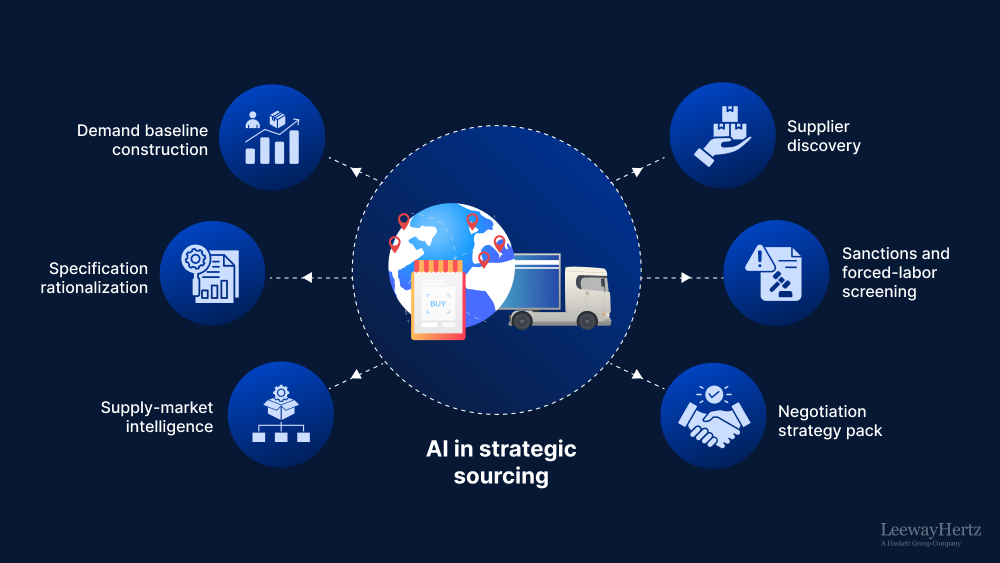
Strategic sourcing is the controlled, event-level discipline that converts demand and supply-market information into a supplier award and implementation handoff. Within the source-to-pay and procurement cluster, it is the source-to-award layer. It connects opportunity intake, requirements definition, supplier discovery, requests for information, proposals, and quotations, bid evaluation, negotiation, award, and savings review.
The function matters because external spend affects cost, margin, continuity, innovation, and working capital. Sourcing decisions also shape supplier risk, environmental, social, and governance objectives, supplier diversity, contract coverage, and resilience. The operating narrative must remain disciplined. Identified opportunity, negotiated savings, implemented savings, realized savings, and cost avoidance are different measures.
The scale of procurement makes disciplined sourcing important. A 2026 OECD report estimates that public procurement represents approximately 13% of GDP across OECD countries [1]. Deloittes 2025 Global Chief Procurement Officer Survey, based on responses from more than 250 CPOs across 40 countries, also shows digital transformation and AI as central procurement priorities.[2]These figures do not establish an automatic AI savings rate. Each sourcing use case still needs a defined baseline, process owner, control boundary, and measurable outcome.
The relevant solution is not a generic chatbot. A strategic sourcing manager needs contract-expiry, spend, demand, and savings-opportunity evidence assembled for wave prioritization. A technical evaluator needs an evidence-linked scorecard pre-read, not an AI-assigned final score. A CPO needs a traceable award recommendation that shows total cost of ownership, risk, savings assumptions, and delegation-of-authority routing.
These needs can only be addressed by mapping AI to the strategic sourcing operating model at the function, process, and sub-process levels. Functions establish accountability, processes show how work moves, and sub-processes define the specific artifacts, systems, controls, exceptions, and human review points required for implementation. This article therefore examines the event-level strategic sourcing lifecycle from pipeline intake and wave planning through requirements definition, market analysis, supplier discovery, RFx execution, bid evaluation, negotiation, award, contract handoff, and savings realization. It excludes multi-year category strategy, contract drafting and obligation management, ongoing supplier lifecycle activities, and downstream purchase-to-pay processing.
- How AI is transforming strategic sourcing operations
- Why AI use cases in strategic sourcing must be mapped at the sub-process level
- Strategic sourcing operating model and AI opportunity mapping across source-to-award processes
- High-value AI use cases in strategic sourcing
- How agentic AI works in strategic sourcing workflows
- How to prioritize AI use cases in strategic sourcing
- Governance, risk, and responsible AI in strategic sourcing
- How ZBrain operationalizes AI use cases in strategic sourcing
- Future of AI in strategic sourcing
How AI is transforming strategic sourcing operations
AI changes strategic sourcing by analyzing artifacts in advance, connecting evidence across systems, and preparing a clear, decision-ready brief for specialist review. The strongest opportunities sit where the work is repetitive, evidence-intensive, or computationally complex, but still requires judgment and accountability.
Consider bid evaluation. Pricing may sit in supplier workbooks, demand in a spend cube, incumbent history in ERP, cost assumptions in a should-cost model, risk data in D&B or another platform, technical evidence in proposal documents, and approvals in the sourcing suite. AI can assemble and normalize that evidence. It cannot replace the technical evaluator, sourcing lead, finance reviewer, or award authority.
Strategic sourcing work can be organized into five practical types:
-
Document-heavy work: SOWs, technical specifications, RFIs, RFPs, RFQs, pricing workbooks, mutual NDAs, supplier submissions, certificates, scorecards, award memos, and term sheets can be extracted, compared, and checked before review.
-
Narrative-heavy work: Market assessments, sourcing strategies, bidder Q&A responses, negotiation packs, BAFO letters, award recommendations, supplier debriefs, and lessons learned can be drafted from approved source material.
-
Exception-heavy work: Incomplete bids, noncompliant submissions, missing certifications, sanctions matches, price outliers, unapproved terms, late responses, scoring conflicts, and DOA exceptions can be classified and prioritized.
-
Knowledge-heavy work: Category playbooks, sourcing policy, evaluation criteria, Incoterms, sanctions rules, ESG requirements, antitrust controls, negotiation precedents, and supplier qualification standards can be retrieved with source links.
-
Workflow-heavy work: Multi-stage events can coordinate intake, requirements, supplier engagement, bidder questions, evaluation, negotiation, approval, contract handoff, implementation, and savings tracking.
AI also supports should-cost modeling, TCO analysis, scenario optimization, and auction design. The practical design rule is simple: apply a specific capability to a named artifact, define the human decision owner, and prevent the workflow from taking a risk-bearing action without approval.
Advance AI in strategic sourcing from isolated experiments to governed execution
Analyze, design, build, and govern agentic workflows at the function, process, and sub-process levels across the source-to-award lifecycle, while keeping key sourcing decisions with accountable procurement leaders.
Why AI use cases in strategic sourcing must be mapped at the sub-process level
Effective AI implementation in strategic sourcing starts with mapping use cases to the specific work, decisions, data, and controls within the operating model.
A broad use case such as AI for sourcing or AI for bid evaluation does not define what should be built. It leaves the source data, system integrations, calculation rules, exception paths, confidentiality controls, and review roles unspecified. A bid-normalization workflow is different from a technical-scorecard pre-read, an eAuction monitor, or an award-scenario optimizer.
A better approach is to map AI use cases to the strategic sourcing operating model:
-
Function: A governed stage of the source-to-award lifecycle with a recognizable owner and output. Bid evaluation and total cost of ownership analysis are one function.
-
Process: A recurring workflow area inside the function. Commercial bid analysis is a process.
-
Sub-process: An atomic activity with a defined input, output, system context, exception path, and reviewer. Currency normalization and incoterms adjustment are separate sub-processes.
-
AI-enabled opportunity: A specific AI capability applied to one or more sourcing artifacts to change how the sub-process is prepared, reviewed, prioritized, or evidenced.
The AI-enabled opportunity serves as the primary unit for assessing value, managing risk, and applying governance. For example, document intelligence can extract line-item prices, currencies, Incoterms, minimum-order quantities, and lead times from supplier pricing workbooks. Rules-based calculation can then normalize those fields under the published evaluation method. A procurement analyst reviews the output before it enters the bid tabulation.
This level of detail also exposes dependencies. Bid normalization may require the event baseline, supplier workbooks, currency rates, Incoterms, freight assumptions, payment-term logic, tax and duty rules, and the should-cost model. The workflow must also preserve sealed-bid access, scorer independence, and a complete audit trail.
Sub-process mapping therefore makes AI opportunities buildable and governable. It also prevents one use case from expanding into category strategy, contract drafting, supplier lifecycle management, or P2P operations.
Strategic sourcing operating model and AI opportunity mapping across source-to-award processes
The operating model below maps strategic sourcing as a bounded source-to-award discipline. Each function is decomposed into processes and atomic sub-processes. Every AI-enabled opportunity names the exact capability and the artifact it changes.
The operating model groups the 10 strategic sourcing functions into four macro-phases. Sourcing portfolio and strategy preparation includes pipeline and wave planning, requirements definition, and market analysis. Supplier engagement and event execution covers supplier discovery, prequalification, and RFx execution. Evaluation, negotiation, and award includes bid evaluation, TCO analysis, eAuctions, negotiation, and award approval. Implementation and value realization covers contract handoff, implementation, savings tracking, and the event retrospective.
A. Sourcing portfolio and strategy preparation
Function 1: Sourcing pipeline and wave planning
Converting category-plan inputs, contract-expiry signals, and spend evidence into a governed sourcing wave and project launch plan.
This function turns sourcing opportunities into a prioritized pipeline. It receives category-plan actions, contract expiry dates, spend data, and business requests. It produces a wave plan, sourcing project charter, RACI, timeline, and approval path. These outputs feed requirements definition and event strategy.
Teams involved: Strategic sourcing managers, category managers, procurement analysts, budget owners, business stakeholders, finance business partners, and the CPO participate according to the event threshold.
What AI helps with: Multi-source aggregation connects category plans, contract repositories, spend cubes, and intake records. Classification assigns opportunities to event types and category owners. Predictive scoring estimates timing risk and addressable value. Constraint-based optimization produces alternative sourcing waves within resource and contract-cliff limits.
What humans continue to own: Category managers confirm strategic fit. Budget owners confirm business sponsorship. Strategic sourcing managers approve the event charter, scope, and staffing. The CPO or sourcing council approves projects above the applicable delegation of authority, or DOA, threshold. AI ranks, drafts, and schedules, but does not approve a sourcing project or change category strategy.
| Process | Sub-process | Key AI-enabled opportunities |
| Opportunity intake | Category-plan opportunity intake |
|
| Contract expiry and renewal trigger |
|
|
| Wave planning | Spend analysis and addressable spend determination |
|
| Opportunity scoring and sequencing |
|
|
| Project launch | Sourcing project charter preparation |
|
| RACI (Responsibility-Assignment Framework), milestone, and governance setup |
|
Key artifacts:
-
Sourcing project charter and wave plan (decision artifacts)
-
Category plan and contract-expiry register (trigger artifacts)
-
Spend opportunity record and baseline (working artifacts)
-
RACI and sourcing calendar (evidence and audit artifacts)
Systems involved:
-
Spend analytics platform
-
Category workspace
-
Contract repository or CLM
-
Strategic sourcing intake portal
-
ERP and supplier master
-
Project portfolio or workflow tool
Controls, regulations, and standards:
-
SOX-sensitive savings and commitment controls require defined approval, evidence, and segregation where sourcing outputs affect financial reporting.
-
COSO [3] principles support control ownership, reliable information, documented approvals, and monitoring across the sourcing pipeline.
-
Internal sourcing policy, budget ownership, and DOA determine which projects require CPO or sourcing council approval.
Accountable roles:
-
Strategic sourcing manager
-
Category manager
-
Procurement analyst
-
Budget owner
-
Business stakeholder
-
Finance business partner
-
CPO or sourcing council
Highest-value opportunities:
-
Contract-cliff detection, because late visibility can remove competitive options and force unmanaged extensions.
-
Wave optimization, because constrained sourcing capacity should be directed to material and time-sensitive opportunities.
-
Charter and RACI preparation, because unclear ownership creates delays and weakens auditability.
Example agentic workflow: Sourcing wave prioritization and project launch
- The workflow starts when a category-plan action, contract-expiry trigger, or approved business request creates a sourcing opportunity.
- Multi-source aggregation retrieves spend, supplier, contract, demand, and prior-event records.
- Predictive scoring evaluates spend coverage, savings potential, contract-cliff timing, risk, and stakeholder readiness.
- Constraint-based optimization prepares alternative wave plans and flags resource conflicts.
- A category manager confirms strategic fit. A strategic sourcing manager approves the event scope, priority, charter, and RACI.
- After approval, workflow orchestration opens the sourcing project and hands the approved charter to requirements definition under the existing DOA and audit controls.
Function 2: Requirements definition and specification development
Converting stakeholder needs, historical demand, and technical evidence into an approved SOW, specification package, and demand baseline.
Requirements definition clarifies what the organization plans to source and establishes the criteria for evaluating suppliers. It combines business outcomes, technical requirements, service levels, demand history, and constraints. It produces a statement of work, or SOW, technical specification package, requirements matrix, and volume baseline. These artifacts feed market analysis, supplier discovery, and RFx design.
Teams involved: Strategic sourcing managers, category managers, procurement analysts, business stakeholders, budget owners, technical evaluators, legal counsel, quality specialists, and finance business partners contribute to the requirement package.
What AI helps with: Document intelligence extracts requirements from prior SOWs, specifications, bills of material, service descriptions, stakeholder notes, and incumbent contracts. Semantic comparison identifies conflicting, duplicate, brand-restrictive, or untestable requirements. Entity resolution creates a demand baseline from purchase orders, invoices, item masters, and forecasts. Optimization evaluates SKU consolidation, tolerance changes, and volume aggregation options.
What humans continue to own: Business stakeholders define the required outcome. Technical evaluators confirm safety, performance, quality, architecture, and service requirements. Legal counsel reviews legal or intellectual-property dependencies. Budget owners approve demand assumptions and funding. AI extracts, compares, proposes, and drafts, but does not define final requirements or approve a specification change.
| Process | Sub-process | Key AI-enabled opportunities |
| Requirements discovery | Stakeholder requirement intake |
|
| Requirement conflict and gap review |
|
|
| SOW and specification development | SOW and technical specification drafting |
|
| Requirements matrix construction |
|
|
| Demand aggregation | Historical spend and volume baseline development |
|
| Demand forecasting and scenario modeling |
|
|
| Specification rationalization | Brand-to-generic and equivalency review |
|
| Tolerance and SKU consolidation analysis |
|
Key artifacts:
-
SOW or technical specification package (decision artifacts)
-
Requirements matrix and scorer ownership map (working artifacts)
-
Demand aggregation and volume baseline (working artifacts)
-
Stakeholder requirement records and approvals (evidence and audit artifacts)
Systems involved:
-
Document repository
-
Spend analytics and data warehouse
-
ERP purchase-order and invoice history
-
Product lifecycle management or engineering repository
-
IT service catalog or architecture repository
-
Collaboration and requirements-management tools
Controls, regulations, and standards:
-
GDPR applies where stakeholder files or bidder-contact records contain personal data, requiring a lawful basis, purpose limitation, and controlled access.
-
Specification changes require assigned technical evaluator and business stakeholder approval before the RFx is released.
-
Brand-neutral or equivalency language should be used where business and technical requirements allow, while protected safety or interoperability requirements remain explicit.
Accountable roles:
-
Strategic sourcing manager
-
Category manager
-
Procurement analyst
-
Business stakeholder
-
Technical evaluator
-
Budget owner
-
Legal counsel
-
Finance business partner
Highest-value opportunities:
-
Requirement conflict detection, because unclear requirements propagate into supplier questions, scoring disputes, and change orders.
-
Demand-baseline construction, because bid comparability and savings calculations depend on a defensible volume baseline.
-
Specification rationalization, because brand restrictions, narrow tolerances, and excessive SKU variation can reduce competition.
Example agentic workflow: Requirements baseline and SOW readiness assessment
- The workflow starts with the approved sourcing charter, stakeholder requirement records, prior specifications, spend data, and forecast inputs.
- Document intelligence extracts outcomes, deliverables, specifications, service levels, acceptance criteria, and dependencies.
- Entity resolution creates the historical demand baseline. Semantic comparison flags requirement conflicts, brand restrictions, and missing acceptance tests.
- Optimization prepares controlled SKU-consolidation and tolerance scenarios with demand and supplier-coverage effects.
- Business stakeholders and technical evaluators confirm the requirement set. The budget owner confirms the baseline. Legal counsel reviews relevant legal dependencies.
- Natural-language generation produces the approved SOW, technical specification package, requirements matrix, and demand baseline for sourcing strategy development.
Function 3: Market analysis and sourcing strategy
Converting requirements, demand, supplier-market evidence, and cost drivers into a defensible sourcing strategy and negotiation baseline.
This function determines how the event should approach the supply market. It assesses market structure, supply concentration, entry barriers, substitutes, switching constraints, cost drivers, and competitive tension. It uses tools such as Porter’s Five Forces, Kraljic positioning, make-buy analysis, should-cost models, and clean-sheet models. The output is an approved sourcing strategy, event lever, supplier engagement plan and cost target.
Teams involved: Category managers, strategic sourcing managers, procurement analysts, finance business partners, technical evaluators, business stakeholders, supplier risk specialists, and legal counsel contribute to the strategy.
What AI helps with: Retrieval-grounded analysis assembles evidence from supplier databases, industry reports, commodity indexes, trade data, and internal category records. Entity resolution consolidates supplier parents, facilities, capabilities, and market relationships. Classification supports Kraljic positioning. Cost-modeling algorithms and simulation prepare should-cost ranges, sensitivity cases, and negotiation targets.
What humans continue to own: Category managers interpret the market and recommend the sourcing lever. Technical evaluators validate cost drivers and make-buy assumptions. Finance business partners confirm the financial logic. Strategic sourcing managers approve the event strategy and negotiation baseline. AI retrieves, models, and simulates, but does not choose the final sourcing strategy or set an unapproved negotiation target.
| Process | Sub-process | Key AI-enabled opportunities |
| Supply-market analysis | Supplier landscape and market structure assessment |
|
| Supplier concentration and competitive tension assessment |
|
|
| Portfolio positioning | Kraljic segmentation |
|
| Strategy selection | Sourcing lever and event-form selection |
|
| Should-cost modeling | Cost-driver and bill-of-material extraction |
|
| Clean-sheet cost model construction |
|
|
| Sensitivity analysis and target setting |
|
Key artifacts:
-
Supply-market assessment and sourcing strategy (decision artifacts)
-
Should-cost or clean-sheet model (working and decision artifacts)
-
Kraljic matrix and lever comparison (working artifacts)
-
Market evidence pack and model assumptions (evidence and audit artifacts)
Systems involved:
-
Supplier intelligence databases
-
Spend analytics and category workspace
-
Commodity and market-data services
-
Engineering cost-modeling tools
-
D&B, Tealbook, ThomasNet, and existing AVL
-
Document repositories and analytics notebooks
Controls, regulations, and standards:
-
Competitive strategy must preserve independent bidding and avoid information sharing that could facilitate bid rigging, price fixing, or market allocation.
-
Should-cost assumptions require source dates, calculation logic, ownership, and finance or technical validation.
-
Make-buy and sourcing-lever decisions remain subject to internal strategy, risk, investment, legal, and DOA controls.
Accountable roles:
-
Category manager
-
Strategic sourcing manager
-
Procurement analyst
-
Finance business partner
-
Technical evaluator
-
Business stakeholder
-
Supplier risk and compliance specialist
-
Legal counsel
Highest-value opportunities:
-
Supply-market evidence aggregation, because fragmented external and internal information can delay strategy formation.
-
Should-cost model preparation, because traceable cost drivers improve bid challenge and negotiation readiness.
-
Scenario-based lever selection, because the right event format depends on competition, switching constraints, risk, and demand structure.
Example agentic workflow: Market strategy and should-cost preparation
- The workflow starts with the approved SOW, demand baseline, prior supplier history, market data subscriptions and category playbook.
- Retrieval-grounded analysis prepares the supply-market structure and supplier-concentration evidence.
- Classification creates an initial Kraljic position. Simulation compares competitive RFx, eAuction, incumbent negotiation, source split, and make-buy options.
- Document intelligence and cost-modeling algorithms build the clean-sheet model. Sensitivity analysis prepares cost and risk ranges.
- The category manager confirms market interpretation. Technical evaluators and finance validate cost drivers and assumptions. The strategic sourcing manager approves the event lever and negotiation baseline.
- The approved sourcing strategy, should-cost model, supplier-engagement approach, and decision trail pass to supplier discovery and RFx development.
B. Supplier engagement and event execution
Function 4: Supplier discovery and prequalification through an RFI
Converting event requirements and supplier-market data into a qualified, evidence-backed bidder list for the sourcing event.
Supplier discovery is event-scoped long-listing and prequalification. It does not replace ongoing supplier lifecycle management. The function builds a long list from external databases, the approved vendor list, or AVL, and incumbent records. It issues a request for information, or RFI, and applies approved gates for capability, financial viability, certifications, diversity status, capacity, sanctions, and forced-labor risk.
Teams involved: Strategic sourcing managers, procurement analysts, category managers, supplier diversity managers, supplier risk and compliance specialists, technical evaluators, legal counsel, and business stakeholders support long-listing and prequalification.
What AI helps with: Semantic search identifies suppliers against functional requirements, products, services, geographies, certifications, and capacity indicators. Entity resolution consolidates supplier identities across D&B, Tealbook, ThomasNet, the AVL, and internal records. Document intelligence extracts evidence from RFI responses and certificates. Risk classification and entity matching surface financial, sanctions, forced-labor, and compliance exceptions for review.
What humans continue to own: Strategic sourcing managers approve the invited bidder list. Technical evaluators confirm capability evidence. Supplier risk and compliance specialists decide screening outcomes. Supplier diversity managers verify diversity status under the organization’s policy. Legal counsel resolves NDA and sensitive-information issues. AI discovers, extracts, matches, and flags, but does not invite, exclude, qualify, or disqualify a supplier.
| Process | Sub-process | Key AI-enabled opportunities |
| Supplier discovery | External supplier long-list search |
|
| AVL, incumbent, and historical bidder comparison |
|
|
| RFI execution | RFI questionnaire and capability matrix preparation |
|
| RFI response extraction and screening |
|
|
| Prequalification | Financial viability review |
|
| Supplier certification, diversity, and capacity eligibility assessment |
|
|
| Sanctions and forced-labor screening |
|
Key artifacts:
-
RFI and capability matrix (working and decision artifacts)
-
Mutual NDA (handoff and control artifact)
-
Supplier long list and prequalification record (working artifacts)
-
Financial, certification, diversity, capacity, sanctions, and forced-labor evidence (audit artifacts)
Systems involved:
-
D&B
-
Tealbook
-
ThomasNet
-
Existing AVL and supplier master
-
Supplier risk and sanctions platforms
-
Supplier diversity database
-
Sourcing suite RFI module
-
Document repository
Controls, regulations, and standards:
-
Supplier-contact and ownership data must be processed under applicable privacy requirements, including GDPR where relevant.
-
FCPA and UK Bribery Act [4][5] controls apply to supplier interactions, gifts, hospitality, intermediaries, and potential improper payments.
-
UFLPA creates a rebuttable presumption for covered goods linked to Xinjiang or listed entities. Compliance specialists should review screening evidence.
-
OFAC and EU sanctions regimes require current, risk-based screening against applicable restrictions and identifying data.
-
ISO 20400 provides guidance for integrating sustainability into procurement decisions and processes.
Accountable roles:
-
Strategic sourcing manager
-
Procurement analyst
-
Category manager
-
Supplier diversity manager
-
Supplier risk and compliance specialist
-
Technical evaluator
-
Legal counsel
-
Business stakeholder
Highest-value opportunities:
-
Supplier entity resolution, because duplicate names and parent relationships can distort competition and screening.
-
RFI evidence extraction, because capability responses are often lengthy, inconsistent, and difficult to compare.
-
Prequalification exception routing, because financial, certification, sanctions, and forced-labor decisions require accountable specialist review.
Example agentic workflow: Supplier discovery and RFI prequalification assessment
- The workflow starts with the approved SOW, sourcing strategy, search criteria, AVL, supplier databases, and prequalification policy.
- Semantic search and entity resolution build a deduplicated long list from D&B, Tealbook, ThomasNet, the AVL, and internal records.
- Natural-language generation prepares the RFI. Document intelligence converts returned responses and certificates into the capability matrix.
- Entity matching and risk classification prepare financial, certification, diversity, capacity, sanctions, and UFLPA exception packets.
- Technical evaluators confirm capability evidence. Supplier risk and compliance specialists decide screening exceptions. The strategic sourcing manager approves the bidder list.
- After approval, the sourcing suite records the qualified bidder list, NDA status, RFI evidence, and audit trail for RFx development.
Accelerate AI Solutions Development
Build fully functional solutions from your high-value use cases, based on specific operational needs and enterprise context.
Function 5: RFx development and event execution
Converting the approved strategy, bidder list, requirements, and commercial structure into a controlled RFx event and completing supplier submissions.
RFx is the collective term for requests for information, proposal, and quotation. An RFP, or request for proposal, seeks a solution and commercial response. An RFQ, or request for quotation, focuses on defined goods or services and prices. This function assembles the event package, configures the sourcing suite, controls bidder questions and amendments, receives sealed responses, and retains the event audit trail.
Teams involved: Strategic sourcing managers, procurement analysts, category managers, technical evaluators, legal counsel, business stakeholders, supplier risk and compliance specialists, and sourcing suite administrators execute the event.
What AI helps with: Document assembly creates the RFP or RFQ from approved requirements, pricing structures, response matrices, draft terms, and event instructions. Structured generation builds the line-item bid sheet. Validation checks formulas, mandatory fields, lot logic, and response dependencies. Classification routes bidder questions. Retrieval-grounded analysis prepares consistent draft answers. Workflow orchestration controls approvals, amendments, deadlines, and sealed-bid access.
What humans continue to own: Strategic sourcing managers approve the event package, invited bidder list, calendar, question responses, and amendments. Technical evaluators approve technical clarifications. Legal counsel approves legal responses and NDA or term exceptions. Suppliers remain responsible for their bids. AI assembles, validates, routes, and drafts, but does not release the event, change published criteria, or communicate externally without approval.
| Process | Sub-process | Key AI-enabled opportunities |
| RFx package development | RFP or RFQ document assembly |
|
| Pricing workbook and line-item bid sheet development |
|
|
| NDA and draft-terms package creation |
|
|
| Event configuration | Sourcing-suite event setup |
|
| Event execution | Supplier invitation and submission monitoring |
|
| Bidder Q&A | Question intake, classification, and routing |
|
| Approved answer and amendment control |
|
Key artifacts:
-
RFP or RFQ document and pricing workbook (decision and working artifacts)
-
Sourcing event record and audit trail (evidence artifact)
-
Mutual NDA and draft terms (control artifacts)
-
Bidder Q&A log and amendment register (evidence and audit artifacts)
Systems involved:
-
SAP Ariba Sourcing
-
Coupa Sourcing
-
Jaggaer
-
Zycus
-
Document repository
-
CLM or clause library
-
Email and supplier portal
-
Identity and access management
Controls, regulations, and standards:
-
Published evaluation criteria, response rules, and deadlines require controlled approval and versioning. Changes must be distributed consistently to the affected bidder population.
-
Sealed bids require least-privilege access, separation between event administration and evaluation where policy requires, and a complete access log.
-
GDPR and internal privacy controls apply to bidder contacts and other personal data used in invitations and communications.
-
Antitrust controls prohibit sharing competitor-specific pricing, capacity, strategy, or confidential information through Q&A or amendments.
Accountable roles:
-
Strategic sourcing manager
-
Procurement analyst
-
Category manager
-
Technical evaluator
-
Legal counsel
-
Business stakeholder
-
Supplier risk and compliance specialist
Highest-value opportunities:
-
RFx package assembly, because inconsistent documents and workbooks create avoidable bidder questions and normalization effort.
-
Pricing-workbook validation, because unit, formula, and lot errors can compromise bid comparability.
-
Q&A classification and amendment control, because equal information and complete version history support fairness and defensibility.
Example agentic workflow: RFx package and controlled event execution
- The workflow starts with the approved sourcing strategy, qualified bidder list, SOW, requirements matrix, pricing structure, evaluation method, and draft terms.
- Document assembly creates the RFP or RFQ package. Structured generation builds the pricing workbook. Validation checks requirements, fields, formulas, dates, and attachments.
- Workflow orchestration configures the sourcing-suite event, sealed-bid permissions, question window, amendment process, and submission deadline.
- Classification routes bidder questions. Retrieval-grounded analysis prepares answer drafts. Version control prepares amendments after approval.
- The strategic sourcing manager approves the event release and each external answer. Technical evaluators and legal counsel approve content in their areas.
- The sourcing suite releases the controlled event, receives sealed bids, and retains invitations, Q&A, amendments, submissions, access logs, and timestamps for evaluation.
C. Evaluation, negotiation, and award
Function 6: Bid evaluation and total cost of ownership analysis
Converting sealed supplier submissions, published criteria, cost assumptions, and risk evidence into comparable scorecards and award scenarios.
Bid evaluation begins after the response deadline and controlled bid opening. It converts supplier pricing and proposals into an apples-to-apples commercial view. It also prepares evidence for technical, environmental, social, and governance, or ESG, and risk scoring. Total cost of ownership, or TCO, extends price analysis to landed cost, payment terms, switching cost, implementation cost, lifecycle cost, and risk-adjusted scenarios. The output supports negotiation and award recommendation.
Teams involved: Strategic sourcing managers, procurement analysts, category managers, technical evaluators, finance business partners, supplier risk and compliance specialists, supplier diversity managers, business stakeholders, and legal counsel participate within defined access boundaries.
What AI helps with: Document intelligence extracts commercial and technical fields from pricing workbooks and proposal documents. Entity and item matching align supplier lines with the event baseline. Rules-based calculations normalize currencies, units, payment terms, freight, duties, and Incoterms. Retrieval-grounded analysis prepares evaluator pre-reads. Anomaly detection flags missing values and should-cost outliers. Constraint-based optimization calculates award scenarios using approved demand, capacity, risk, and allocation constraints.
What humans continue to own: Technical evaluators assign final technical scores. Finance validates savings and TCO assumptions. Supplier risk and compliance specialists decide risk exceptions. Strategic sourcing managers approve normalization rules, negotiation priorities, and the evaluation record. AI normalizes, flags, simulates, and drafts, but does not assign final technical scores, commit negotiation positions, select a supplier, or approve an award.
| Process | Sub-process | Key AI-enabled opportunities |
| Bid intake | Bid workbook ingestion and completeness review |
|
| Bid normalization | Line-item and lot mapping |
|
| Currency, unit, and quantity normalization |
|
|
| Incoterms, freight, duty, and payment-term adjustment |
|
|
| Bid analysis | Should-cost and line-item outlier review |
|
| Weighted evaluation | Technical scorecard pre-read preparation |
|
| Commercial, ESG, risk, and diversity evidence aggregation |
|
|
| TCO analysis | Landed, switching, and lifecycle cost modeling |
|
| Scenario optimization | Supplier award scenario modeling and allocation analysis |
|
Key artifacts:
-
Bid tabulation and normalization worksheet (working and evidence artifact)
-
Weighted evaluation scorecard with scorer worksheets (decision and audit artifact)
-
Should-cost or clean-sheet model (working artifact)
-
TCO model and award-scenario optimizer output (working and decision artifacts)
-
Sealed supplier bids and sourcing event record (trigger and audit artifacts)
Systems involved:
-
Sourcing-suite evaluation module
-
Spend cube and historical price repository
-
Currency and trade-data sources
-
Should-cost and TCO modeling tools
-
Supplier risk and ESG platforms
-
Technical document repository
-
Analytics and optimization environment
Controls, regulations, and standards:
-
Incoterms 2020 [6] define the allocation of costs, risks, and obligations between buyer and seller. The published evaluation method should state how differing terms are normalized.
-
Published evaluation weights and normalization rules must be locked or changed only through controlled approval and bidder notification where applicable.
-
Technical scoring requires evaluator independence, conflict-of-interest controls, source-linked evidence, and retained scorer worksheets.
-
SOX and COSO considerations apply where savings, commitments, or financial estimates feed management reporting or controls.
Accountable roles:
-
Strategic sourcing manager
-
Procurement analyst
-
Category manager
-
Technical evaluator
-
Finance business partner
-
Supplier risk and compliance specialist
-
Supplier diversity manager
-
Business stakeholder
-
Legal counsel
Highest-value opportunities:
-
Bid normalization, because currency, unit, incoterms, freight, and payment-term differences can hide the true commercial comparison.
-
Evidence-linked technical pre-reads, because evaluators need relevant supplier evidence without surrendering final scoring judgment.
-
TCO and constrained award optimization, because the lowest unit price may not produce the lowest landed or lifecycle cost.
Example agentic workflow: Bid normalization and award scenario preparation
- The workflow starts when the RFx submission deadline passes and sealed bids are released through authorized sourcing-suite controls.
- Document intelligence extracts commercial and proposal data. Item matching aligns responses with the baseline. Validation identifies incomplete or changed submissions.
- Rules-based calculation normalizes currency, units, Incoterms, freight, duties, and payment terms. Anomaly detection compares line items with the should-cost model.
- Retrieval-grounded analysis prepares scorecard pre-reads. TCO calculation and constraint-based optimization produce single-source, 70/30, regional, and other approved scenarios.
- Technical evaluators confirm or adjust their scores. Finance validates savings and TCO assumptions. The strategic sourcing manager approves the evaluation record and negotiation priorities.
- The reviewed bid tabulation, scorecards, TCO model, scenario output, exceptions, and approvals pass to negotiation under the event audit trail.
Function 7: eAuction and negotiation
Converting the evaluated bidder set, cost targets, and risk positions into controlled competitive bidding, negotiation rounds, and final offers.
This function uses competitive tension after initial evaluation. An electronic auction, or eAuction, may use reverse English, Japanese, Dutch, or another approved format. Negotiation planning defines the best alternative to a negotiated agreement, or BATNA, targets, walk-away positions, issue priorities, and a concession ledger. Best and final offer, or BAFO, rounds produce controlled final proposals for award analysis.
Teams involved: Strategic sourcing managers, category managers, procurement analysts, finance business partners, technical evaluators, legal counsel, business stakeholders, and the CPO or sourcing council participate according to authority and issue type.
What AI helps with: Simulation tests auction formats and bidder behavior under approved assumptions. Optimization proposes lot structures, starting positions, decrements, and timing options. Streaming anomaly detection monitors bid patterns without declaring misconduct. Retrieval-grounded analysis assembles negotiation facts and open issues. Simulation tracks concession packages and their TCO effect. Structured comparison evaluates BAFO changes across commercial, technical, risk, and implementation dimensions.
What humans continue to own: Strategic sourcing managers select the auction format, approve targets, lead supplier interactions, and accept or reject concessions within their authority. Legal counsel approves legal positions. Technical evaluators confirm technical changes. Finance validates the financial effect. The CPO or sourcing council approves exceptions above the delegation of authority threshold. AI models, monitors, compares, and drafts, but does not negotiate autonomously, commit a position, accept a concession, or share one bidder’s confidential information with another.
| Process | Sub-process | Key AI-enabled opportunities |
| eAuction strategy | Auction suitability and format selection |
|
| eAuction design | Lot, starting-price, decrement, and timing design |
|
| eAuction execution | Live bid and event monitoring |
|
| eAuction analysis | Auction-result and baseline comparison |
|
| Negotiation planning | BATNA (Best Alternative to a Negotiated Agreement), target, and walk-away preparation |
|
| Negotiation planning | Negotiation concession planning and tracking |
|
| BAFO (Best and Final Offer) management | BAFO request and response comparison |
|
| Parallel negotiation | Cross-supplier issue and authority management |
|
Key artifacts:
-
eAuction event report with bid history and baseline comparison (evidence and decision artifact)
-
Negotiation strategy pack and concession ledger (working and audit artifacts)
-
BAFO request letter and final proposals (decision artifacts)
-
TCO, should-cost, and approved authority records (working and control artifacts)
Systems involved:
-
eAuction module in the sourcing suite
-
Negotiation workspace
-
TCO and should-cost model
-
Approval and DOA workflow
-
Document repository
-
Secure supplier communication channel
-
Audit-log and access-control services
Controls, regulations, and standards:
-
Competitive interactions must not facilitate bid rigging, price fixing, customer allocation, or improper exchange of competitively sensitive information.
-
Supplier-specific information must remain isolated. Only approved common information may be shared across the bidder population.
-
Negotiation authority, targets, walk-away positions, and concessions must be documented and approved before commitment.
-
FCPA and UK Bribery Act controls apply to supplier meetings, intermediaries, gifts, hospitality, and other benefits.
Accountable roles:
-
Strategic sourcing manager
-
Category manager
-
Procurement analyst
-
Finance business partner
-
Technical evaluator
-
Legal counsel
-
Business stakeholder
-
CPO or sourcing council
Highest-value opportunities:
-
Auction-design simulation, because the wrong format or lot structure can reduce participation or produce misleading price signals.
-
Negotiation-pack preparation, because fact-based targets depend on synchronized cost, TCO, risk, and alternative-source evidence.
-
BAFO comparison, because final proposals often contain changes across price, terms, implementation, and technical commitments.
Example agentic workflow: eAuction and BAFO negotiation control
- The workflow starts with approved bidders, normalized bids, scorecards, should-cost evidence, TCO scenarios, and negotiation authority.
- Simulation tests auction suitability and formats. Optimization prepares lot, starting position, decrement, and timing options.
- After strategic sourcing manager approval, the sourcing suite runs the eAuction. Streaming anomaly detection sends issues to the event manager.
- Retrieval-grounded analysis updates negotiation packs. Simulation shows the TCO effect of concession packages. Natural-language generation prepares BAFO request drafts.
- The strategic sourcing manager approves each supplier position and external message. Finance, technical evaluators, legal counsel, and the CPO or council approve issues within their authority.
- Structured comparison produces the final-offer record, concession ledger, eAuction report, and approved negotiation outcomes for award recommendation.
Function 8: Award recommendation and approval
Converting final bids, scorecards, TCO scenarios, savings logic, and risk evidence into an approved supplier award decision and controlled communications.
Award recommendation translates the completed evaluation and negotiation record into a decision packet. The recommendation distinguishes the preferred scenario from the authority that approves it. It quantifies negotiated savings, identifies implementation and risk assumptions, records dissent or challenged assumptions, routes the decision under DOA, and prepares communications for successful and unsuccessful bidders.
Teams involved: Strategic sourcing managers, category managers, procurement analysts, technical evaluators, finance business partners, supplier risk and compliance specialists, supplier diversity managers, legal counsel, budget owners, business stakeholders, the CPO, and the sourcing council participate as required.
What AI helps with: Natural-language generation drafts the award recommendation memo and sourcing council deck from approved evaluation evidence. Calculation applies the organization’s negotiated-savings methodology. Risk aggregation summarizes open issues and mitigations. Workflow orchestration routes the packet under DOA. Evidence linking connects every recommendation statement to scorecards, bids, models, and approvals. Confidentiality filtering prepares bidder debrief drafts without exposing competitor information.
What humans continue to own: The strategic sourcing manager owns the recommendation. Technical evaluators own final scores. Finance validates savings. Risk, diversity, legal, and business reviewers own their judgments. The CPO or sourcing council approves, denies, conditions, or escalates the award according to DOA. AI drafts, calculates, links, and routes, but does not select a supplier, approve an award, or issue external communications without approval.
| Process | Sub-process | Key AI-enabled opportunities |
| Award recommendation | Award memo and sourcing council deck preparation |
|
| Negotiated-savings quantification |
|
|
| Risk and implementation note |
|
|
| Approval routing | DOA and sourcing-council workflow |
|
| Approval routing | Challenge and revision management |
|
| Award communication | Award letter and term-sheet preparation |
|
| Unsuccessful bidder debrief preparation |
|
Key artifacts:
-
Award recommendation memo and sourcing council deck (decision artifact)
-
Term sheet or award letter (handoff artifact)
-
Weighted scorecards, TCO scenarios, BAFOs, and risk notes (evidence artifacts)
-
Unsuccessful bidder debriefs and approval record (audit artifacts)
-
Savings tracking register entry (handoff artifact)
Systems involved:
-
Sourcing-suite award module
-
DOA and approval workflow
-
Document repository
-
TCO and savings model
-
Supplier risk and ESG platform
-
CLM handoff workspace
-
Secure supplier communication channel
Controls, regulations, and standards:
-
The award recommendation and award approval must remain distinct. The recommendation owner cannot substitute for the authority defined in DOA.
-
SOX and COSO controls support reliable savings calculations, authorization, segregation, and retained evidence where awards affect financial commitments or reporting.
-
Debriefs must use approved findings and protect competitor confidential information.
-
Public-sector variants may add FAR, DFARS, protest, transparency, and EU public-procurement requirements. They are outside this commercial operating model.
Accountable roles:
-
Strategic sourcing manager
-
Category manager
-
Procurement analyst
-
Technical evaluator
-
Finance business partner
-
Supplier risk and compliance specialist
-
Supplier diversity manager
-
Legal counsel
-
Budget owner
-
Business stakeholder
-
CPO
-
Sourcing council
Highest-value opportunities:
-
Evidence-linked award recommendation drafting, because approval quality depends on traceable facts rather than a narrative assembled from memory.
-
Savings-method validation, because negotiated savings must not be confused with implemented or realized savings.
-
DOA routing and version control, because challenged assumptions and conditional approvals must remain visible in the final record.
Example agentic workflow: Award recommendation and approval routing
- The workflow starts with final bids, completed scorecards, the normalization worksheet, TCO scenarios, negotiation record, risk evidence, and implementation assumptions.
- Natural-language generation drafts the award memo and council deck. Rules-based calculation quantifies negotiated savings under the approved method.
- Risk aggregation and scenario comparison show the preferred option and alternatives. Evidence linking connects each conclusion to the source record.
- Workflow orchestration routes the recommendation under DOA and records questions, revisions, conditions, and reviewer dispositions.
- Technical, finance, risk, diversity, legal, and business reviewers confirm their sections. The CPO or sourcing council approves, denies, conditions, or escalates the award.
- After approval, the system prepares reviewed award and debrief communications, creates the term-sheet handoff, posts negotiated savings to the tracking register, and retains the full decision trail.
D. Implementation and value realization
Function 9: Contract handoff and implementation
Converting the approved award into a complete contract handoff, supplier transition plan, validated price file, and enabled purchasing channel.
This function begins after award approval. It stops at the controlled handoff to contract management and implementation. Contract management owns drafting, redlining, clause negotiation, execution, and obligations. Strategic sourcing supplies the approved term sheet, award conditions, commercial schedules, scorecard commitments, risk mitigations, and implementation plan. It also coordinates supplier transition and validates catalog or price-file setup.
Teams involved: Strategic sourcing managers, contract managers, procurement analysts, category managers, legal counsel, business stakeholders, technical evaluators, finance business partners, supplier risk specialists, implementation teams, and P2P or procurement operations teams participate at the handoff.
What AI helps with: Structured extraction converts the approved award and BAFO into a term-sheet data set. Comparison checks the handoff against the recommendation and supplier proposal. Workflow planning creates transition tasks, owners, dependencies, and milestones. Constraint-based scheduling models dual-source overlap, tooling transfer, testing, or regional rollout. Structured validation checks catalog and price files against awarded terms. Workflow orchestration routes approved configuration to procurement operations.
What humans continue to own: The strategic sourcing manager confirms the commercial handoff. The contract manager and legal counsel own drafting and redlining. Technical evaluators approve qualification, testing, or acceptance steps. Business stakeholders own operational readiness. Procurement operations approves catalog, price file, and PO channel changes. AI extracts, compares, schedules, and validates, but does not execute a contract, approve a transition, or change a production purchasing channel without authorization.
| Process | Sub-process | Key AI-enabled opportunities |
| Contract handoff | Term-sheet and award-data extraction |
|
| Open-item and deviation handoff |
|
|
| Supplier transition | Transition and ramp-plan preparation |
|
| Tooling, qualification, and dual-source risk review |
|
|
| Purchasing enablement | Catalog and price-file validation |
|
| PO channel and configuration handoff |
|
Key artifacts:
-
Term sheet or award letter (handoff artifact)
-
Award recommendation, BAFO, scorecards, and risk mitigations (evidence artifacts)
-
Supplier transition and ramp plan (working and handoff artifact)
-
Catalog and price file (working artifact)
-
PO channel enablement request and approval record (handoff and audit artifact)
Systems involved:
-
CLM or contract workspace
-
Sourcing-suite award record
-
Project and implementation tool
-
Supplier onboarding handoff portal
-
ERP and procurement platform
-
Catalog-management system
-
Document repository
Controls, regulations, and standards:
-
Strategic sourcing must stop at the approved term sheet and implementation handoff. Contract management owns drafting, redlining, execution, and obligations.
-
Awarded commercial terms and risk conditions must remain traceable through contract and implementation handoff.
-
Catalog, price-file, supplier-master, and PO-channel changes require authorized procurement-operations approval and segregation of duties.
-
Supplier-access and contact data remain subject to privacy, security, and least-privilege controls.
Accountable roles:
-
Strategic sourcing manager
-
Contract manager
-
Procurement analyst
-
Category manager
-
Legal counsel
-
Business stakeholder
-
Technical evaluator
-
Finance business partner
-
Supplier risk and compliance specialist
-
Procurement operations
Highest-value opportunities:
-
Term-sheet extraction and comparison, because omissions between award and contract drafting can erode negotiated value or risk controls.
-
Transition dependency planning, because tooling, validation, data, and dual-source overlap can determine whether the award is implementable.
-
Catalog and price-file validation, because incorrect configuration creates leakage immediately after launch.
Example agentic workflow: Award-to-contract and implementation handoff
- The workflow starts with the approved award, term-sheet draft, BAFO, scorecards, risk mitigations, price schedules, and implementation assumptions.
- Structured extraction creates the contract handoff record. Comparison identifies gaps, deviations, and open items.
- Workflow planning creates the transition and ramp plan. Constraint-based scheduling prepares tooling, qualification, data, cutover, and dual-source milestones.
- Structured validation checks catalog and price files against awarded pricing, units, tiers, effective dates, and locations.
- The strategic sourcing manager confirms the commercial handoff. Contract management, legal, technical evaluators, business stakeholders, and procurement operations approve their respective actions.
- The approved term sheet enters contract management. The transition plan and reviewed configuration enter implementation and P2P setup under existing governance.
Function 10: Savings realization and event retrospective
Converting the approved award, implementation status, purchasing data, and lessons learned into validated savings, price compliance, and an improved category playbook.
Savings realization distinguishes identified opportunity, negotiated savings, implemented savings, realized savings, and cost avoidance. Negotiated savings are based on the approved award. Implemented savings require the new commercial arrangement to be active. Realized savings require actual purchasing and financial evidence. This function also monitors awarded-price compliance and captures lessons for future sourcing events. It does not become a full P2P compliance or category-management operating model.
Teams involved: Strategic sourcing managers, category managers, procurement analysts, finance business partners, budget owners, business stakeholders, procurement operations, accounts payable or analytics teams, and the CPO reviews value realization.
What AI helps with: Rules-based calculation applies approved savings definitions and baselines. Workflow orchestration tracks implementation milestones and evidence. Data reconciliation connects awarded price files, purchase orders, receipts, invoices, credits, and actual volumes. Variance decomposition separates price, mix, volume, currency, timing, scope, and compliance effects. Anomaly detection flags price leakage. Process mining and knowledge extraction prepare the event retrospective and playbook updates.
What humans continue to own: Finance validates the savings methodology and realized value. Budget Owners confirm budget effects where required. Business stakeholders confirm implementation and demand changes. Strategic sourcing managers explain sourcing assumptions. Procurement operations resolve purchasing-channel issues. AI reconciles, calculates, attributes, and drafts, but does not declare negotiated savings as realized or approve a financial adjustment.
| Process | Sub-process | Key AI-enabled opportunities |
| Savings tracking | Negotiated-savings baseline entry |
|
| Implementation-status monitoring |
|
|
| Realized-savings reconciliation |
|
|
| Price compliance | Awarded-price and commercial-term monitoring |
|
| Savings leakage root-cause analysis and corrective action prioritization |
|
|
| Event retrospective | Cycle-time, participation, and outcome analysis |
|
| Lessons-learned and playbook update |
|
Key artifacts:
-
Savings tracking register entry (decision and audit artifact)
-
Awarded price file, purchase orders, invoices, and actual-volume data (working artifacts)
-
Price-compliance exception log (working and evidence artifact)
-
Event retrospective and approved category-playbook update (handoff artifact)
-
Implementation evidence and finance validation (audit artifacts)
Systems involved:
-
Savings tracking platform
-
ERP and procure-to-pay analytics
-
Catalog and price-file repository
-
Invoice and accounts-payable data
-
Contract and award repository
-
Process-mining platform
-
Category knowledge base
Controls, regulations, and standards:
-
Savings definitions, baselines, volume assumptions, currency treatment, ownership, and finance validation must be documented.
-
Negotiated savings must not be reported as realized savings until implementation and actual purchasing evidence support the result.
-
SOX and COSO controls support reconciliation, review, evidence retention, and segregation where savings data enters financial or management reporting.
-
Category-playbook updates require category manager approval and must not silently change published criteria for an active event.
Accountable roles:
-
Strategic sourcing manager
-
Category manager
-
Procurement analyst
-
Finance business partner
-
Budget owner
-
Business stakeholder
-
Procurement operations
-
CPO
Highest-value opportunities:
-
Realized-savings reconciliation, because implementation, volume, mix, currency, and compliance can materially change negotiated value.
-
Awarded-price compliance monitoring, because catalog, unit, surcharge, and off-contract errors create recurring leakage.
-
Event process mining and lessons learned, because sourcing performance should improve from evidence rather than anecdote.
Example agentic workflow: Savings realization and sourcing retrospective
- The workflow starts with the approved award, savings-register entry, implementation milestones, price file, purchase orders, receipts, invoices, credits, and actual volumes.
- Workflow orchestration confirms whether the commercial arrangement is active and which savings lines are implemented.
- Data reconciliation compares actual transactions with the awarded price, scope, unit, currency, supplier, and effective date.
- Variance decomposition attributes the difference to price, mix, volume, currency, timing, scope, or compliance. Anomaly detection creates a prioritized leakage queue.
- Finance team validates realized savings. Budget owners and business stakeholders confirm relevant implementation or demand changes. Procurement operations resolve channel and configuration exceptions.
- Process mining and natural-language generation prepare the event retrospective. The category manager approves lessons before they enter the category playbook.
Accelerate AI Solutions Development
Build fully functional solutions from your high-value use cases, based on specific operational needs and enterprise context.
High-value AI use cases in strategic sourcing
High-value use cases apply a specific AI capability to a specific sourcing artifact. They also have a measurable economic or risk outcome, accessible data, a named reviewer, and a limited blast radius. The following use cases cover all ten functions.
| Use case | Function | How AI creates high-value impact |
| Sourcing wave prioritization | Sourcing pipeline and wave planning | Predictive scoring prioritizes opportunities with the greatest savings potential and urgency, while constraint-based optimization creates feasible wave plans that improve resource allocation, accelerate sourcing execution, and reduce missed contract deadlines. |
| Contract-cliff detection | Sourcing pipeline and wave planning | Date extraction reads notice and renewal clauses from contract records. Predictive analytics identifies events that need early action. |
| SOW and specification drafting | Requirements definition | Document intelligence extracts requirements from stakeholder files. Natural-language generation prepares a controlled SOW for review. |
| Demand baseline construction | Requirements definition | Entity resolution consolidates purchase orders, invoices, items, sites, and suppliers. Time-series analysis prepares a defensible volume baseline. |
| Specification rationalization | Requirements definition | Semantic matching identifies brand-to-generic equivalents. Optimization tests SKU consolidation and tolerance scenarios within approved technical limits. |
| Supply-market intelligence | Market analysis and sourcing strategy | Retrieval-grounded analysis prepares a cited market brief. Entity resolution consolidates supplier parents, sites, and capabilities. |
| Should-cost model preparation | Market analysis and sourcing strategy | Document intelligence extracts cost drivers. Cost-modeling algorithms calculate clean-sheet ranges and sensitivity cases. |
| Supplier discovery | Supplier discovery and prequalification | Semantic search finds suppliers by capability, geography, scale, and certification. Entity resolution creates a deduplicated long list. |
| RFI response analysis | Supplier discovery and prequalification | Document intelligence extracts capability evidence. Semantic comparison maps responses to the prequalification matrix. |
| Sanctions and forced-labor screening | Supplier discovery and prequalification | Entity matching compares suppliers and owners with current sanctions lists. Rules-based screening prepares UFLPA exception evidence. |
| RFx package assembly | RFx development and event execution | Document assembly combines the SOW, matrix, instructions, draft terms, and evaluation method. Validation identifies missing or inconsistent content. |
| Pricing-workbook validation | RFx development and event execution | Structured generation builds the line-item bid sheet. Formula validation checks units, calculations, conditional fields, and protected cells. |
| Bidder Q&A management | RFx development and event execution | Classification routes questions by subject. Retrieval-grounded analysis drafts consistent answers from approved requirements and policy. |
| Bid completeness and normalization | Bid evaluation and TCO analysis | Document intelligence extracts supplier fields. Rules-based calculation normalizes currency, units, Incoterms, freight, duties, and payment terms. |
| Technical scorecard pre-read | Bid evaluation and TCO analysis | Retrieval-grounded analysis maps proposal evidence to published criteria. Classification marks missing or contradictory evidence without assigning scores. |
| TCO and award-scenario optimization | Bid evaluation and TCO analysis | TCO calculation combines landed, switching, implementation, and lifecycle cost. Constraint-based optimization produces single-source and split-award scenarios. |
| eAuction design | eAuction and negotiation | Simulation tests auction formats. Optimization proposes lots, starting positions, decrements, and extension rules. |
| Negotiation strategy pack | eAuction and negotiation | Retrieval-grounded analysis assembles bid, should-cost, TCO, risk, and alternative-source evidence. Simulation evaluates concession packages. |
| BAFO comparison | eAuction and negotiation | Natural-language generation drafts the BAFO request. Structured comparison identifies every final-offer change. |
| Award recommendation drafting | Award recommendation and approval | Natural-language generation creates the memo and council deck. Evidence linking connects every material claim to source records. |
| DOA approval routing | Award recommendation and approval | Workflow orchestration routes the decision by spend, risk, exception, and authority thresholds. Version control retains all changes and conditions. |
| Contract handoff packet | Contract handoff and implementation | Structured extraction converts the approved award into a term-sheet data set. Comparison identifies missing terms and open items. |
| Catalog and price-file validation | Contract handoff and implementation | Structured validation compares item, unit, currency, price, tier, effective date, and location with the awarded schedule. |
| Realized-savings reconciliation | Savings realization and event retrospective | Data reconciliation compares awarded pricing with purchase orders and invoices. Variance decomposition separates price, volume, mix, currency, timing, and compliance effects. |
| Awarded-price compliance | Savings realization and event retrospective | Anomaly detection flags price, unit, tier, freight, supplier, and effective-date deviations from the award. |
A use case earns the high-value label when it covers material spend or repeated events, reduces difficult evidence aggregation, improves decision preparation, supports savings or risk outcomes, and leaves the final judgment with a named role. The strongest first projects also have stable artifacts and a limited blast radius.
How agentic AI works in strategic sourcing workflows
Agentic AI coordinates a governed sequence of software actions around a sourcing goal. It can retrieve records, apply approved rules, call models, prepare documents, monitor deadlines, and route exceptions. The workflow must pause before supplier qualification, external communication, negotiation commitment, final scoring, supplier selection, award approval, contract execution, or financial attestation.
Here are some examples:
Example 1: Requirements and SOW preparation workflow
-
Agent role: Prepare an approved requirements baseline and SOW package for a sourcing event.
-
Starting artifacts: Sourcing charter, stakeholder inputs, prior SOWs, technical specifications, purchase-order and invoice history, demand forecasts, and category playbook.
-
Workflow: Extract requirements, classify them, build the demand baseline, identify conflicts, test SKU or tolerance scenarios, and draft the SOW and requirements matrix.
-
Exception handling: Route ambiguous requirements, missing acceptance criteria, unsupported brand restrictions, conflicting volume sources, and unapproved specification changes.
-
Human checkpoint: Business stakeholders and technical evaluators approve requirements. The budget owner confirms the baseline. Legal counsel reviews relevant legal dependencies.
-
Output: Approved SOW, technical specification package, requirements matrix, demand baseline, exception record, and source-linked approval trail.
Example 2: Supplier discovery and RFI prequalification workflow
-
Agent role: Prepare a qualified bidder-list recommendation for the event.
-
Starting artifacts: Approved SOW, sourcing strategy, supplier databases, AVL, incumbent records, RFI, financial data, certificates, diversity evidence, capacity records, and screening sources.
-
Workflow: Run semantic supplier search, resolve entities, issue the RFI through the sourcing suite, extract responses, map capability evidence, and prepare financial, certification, capacity, sanctions, and UFLPA checks.
-
Exception handling: Route duplicate entities, conflicting ownership, missing certificates, weak financial indicators, sanctions matches, forced-labor indicators, unsupported diversity claims, and insufficient capacity.
-
Human checkpoint: Technical evaluators confirm capabilities. Supplier risk and compliance specialists decide screening issues. The supplier diversity manager verifies relevant status. The strategic sourcing manager approves the bidder list.
-
Output: Approved bidder list, RFI capability matrix, NDA status, prequalification decisions, exception evidence, and event-scoped audit trail.
Example 3: RFP evaluation and award recommendation workflow
-
Agent role: Prepare a reviewable RFP evaluation, negotiation target list, and award recommendation packet.
-
Starting artifacts: Six sealed supplier bids, pricing workbooks, technical responses, incumbent pricing and volume history, D&B and risk-platform records, should-cost model, published evaluation weights, normalization rules, and DOA threshold.
-
Workflow: After the deadline, aggregate the authorized bid records. Normalize currency, units, Incoterms, freight, and payment terms. Flag should-cost outliers. Prepare evidence-linked scorecard pre-reads. Run single-source, 70/30 split, and regional award scenarios. Draft the recommendation memo and negotiation targets.
-
Exception handling: Route incomplete workbooks, formula changes, ambiguous item matches, outlier prices, missing evidence, scorer conflicts, failed risk checks, challenged assumptions, and scenarios that violate capacity or allocation constraints.
-
Human checkpoint: Technical evaluators confirm or adjust scores. Finance validates TCO and savings assumptions. The strategic sourcing manager approves the negotiation plan. The CPO approves, denies, or escalates the final recommendation to the sourcing council under DOA.
-
Output: Reviewed normalization worksheet, completed scorecards, TCO scenarios, approved negotiation targets, award memo, council deck, term-sheet handoff, savings-register entry, and full evaluation trail.
Example 4: Negotiation, BAFO, and award handoff workflow
-
Agent role: Prepare and control parallel negotiation, BAFO, and award-handoff activities.
-
Starting artifacts: Normalized bids, should-cost model, TCO scenarios, BATNA, target and walk-away positions, issue list, authority matrix, concession ledger, draft BAFO request, and supplier-specific communication history.
-
Workflow: Assemble negotiation packs, model concession packages, track approvals, draft supplier-specific BAFO requests, compare final offers, update TCO scenarios, and prepare the final award record and handoff packet.
-
Exception handling: Route unapproved commitments, legal deviations, technical changes, conflicts with walk-away positions, cross-supplier information risks, missed deadlines, and final offers that do not satisfy mandatory requirements.
-
Human checkpoint: The strategic sourcing manager approves every supplier position and message. Legal, technical evaluators, finance, business stakeholders, and the CPO or council approve issues within their authority.
-
Output: Approved BAFOs, updated concession ledger, final-offer comparison, award recommendation, approved term sheet, supplier communications, and controlled contract-management handoff.
The review boundary defines the safety property. The agentic workflow can prepare and coordinate the work, but the role that already owns the sourcing decision must confirm each risk-bearing step.
How to prioritize AI use cases in strategic sourcing
Prioritization should begin at the sub-process level. A high-value opportunity still fails when artifacts are inaccessible, decision ownership is unclear, or the solution can change a live system without review. The five criteria below provide a practical screen.
| Criterion | What to ask |
| Volume and frequency | Does the sub-process recur across enough sourcing events, suppliers, lines, or documents to create material value? |
| Artifact availability | Are the SOWs, bids, scorecards, event records, supplier data, cost models, and transaction data available with sufficient quality? |
| Review boundary | Can a assigned sourcing, technical, finance, legal, risk, or approval role confirm the output before it affects a supplier or financial decision? |
| Blast radius | If the output is wrong, is the impact limited to a draft, pre-read, scenario, or review queue rather than a live invitation, score, negotiation commitment, or award? |
| Business impact | Can the use case connect to spend coverage, cycle time, evaluator effort, bid comparability, supplier risk, savings realization, or price compliance without inventing a benefit? |
Material spend coverage, repeated event volume, evidence-aggregation effort, savings or risk relevance can be used as additional scoring dimensions. Early priorities often include bid normalization, RFx package assembly, should-cost preparation, RFI evidence extraction, and awarded-price compliance. These have defined artifacts and clear human reviewers.
Four failure patterns recur. The first is misaligned scope, such as treating the full sourcing function as one workflow. The second is missing or inconsistent data. The third is bypassed governance, especially for external communications, final scores, supplier decisions, and system updates. The fourth is premature savings claims before baselines, implementation, actual volumes, and finance validation are established.
Governance, risk, and responsible AI in strategic sourcing
Strategic sourcing AI operates across confidential bids, pricing, technical responses, supplier ownership, personal data, sanctions records, evaluation scores, negotiations, awards, and financial estimates. Governance must be designed into the workflow and enforced at runtime.
Human-in-the-loop oversight: Define what AI may extract, classify, calculate, simulate, or draft. Define the role that confirms requirements, prequalification, technical scores, normalization, negotiation positions, award recommendations, external communications, implementation status, and savings validation. AI must not qualify a supplier, set a final score, commit a negotiation position, select a supplier, approve an award, or declare realized savings.
Regulatory, policy, and standards alignment: Map each use case to internal sourcing policy and DOA, SOX and COSO controls, GDPR, FCPA and the UK Bribery Act, antitrust and bid-rigging controls, UFLPA, OFAC and EU sanctions, ISO 20400, and Incoterms 2020. Public-sector events may also require FAR, DFARS, or EU Directive 2014/24/EU controls, but those variants are outside this commercial operating model.
Fair competition, supplier equity, and evidence retention: Test for incumbent bias, brand or specification bias, geographic bias, small-supplier disadvantage, inconsistent evaluator behavior, and proxy variables in risk screening. Retain the supplier response, published criterion, extracted evidence, score change, reviewer rationale, and approval. Supplier diversity status should be verified by the accountable program owner, not inferred from unrelated data.
Key governance requirements: Protect sealed bids, lock published evaluation weights and normalization rules, and control all amendments. Preserve scorer independence and conflict-of-interest declarations. Separate event administration, evaluation, negotiation, and approval where policy requires. Route decisions under DOA. Control supplier communications and escalate challenged assumptions.
Design principles: Ground outputs in approved sourcing records. Separate read and write permissions. Use role-based and supplier-level access boundaries. Restrict tools and external communication. Require approval before event release, supplier invitation, answer publication, bid opening, score finalization, negotiation commitment, award, term-sheet handoff, catalog activation, or savings attestation.
Traceability and data security: Record input artifacts, retrieved policies, model and workflow versions, prompts, normalization calculations, scenario assumptions, score changes, reviewer comments, approvals, supplier communications, exceptions, and resulting system updates. NISTs AI Risk Management Framework provides a voluntary structure for managing AI risk and trustworthiness across design, deployment, use, and evaluation.
How ZBrain operationalizes AI use cases in strategic sourcing
Identifying use cases is only the first step. Strategic sourcing teams need a controlled way to design, build, validate, deploy, govern, and scale AI workflows across spend analysis, demand consolidation, supply market analysis, sourcing strategy, supplier discovery, competitive events, bid evaluation, negotiation, contracting, and value tracking.
This is where ZBrain helps.
ZBrain is an end-to-end AI enablement platform that supports this lifecycle through four connected stages: ZBrain Analyzer, ZBrain Design, ZBrain Solution Builder, and ZBrain Governance. The platform provides a governed path from use-case analysis to deployed agentic workflows while maintaining policies, permissions, approval points, monitoring, and runtime evidence.
ZBrain Analyzer
ZBrain Analyzer helps teams examine selected strategic sourcing processes, identify AI opportunities, and document the business context, systems, data, roles, controls, and review requirements needed to evaluate each use case.
ZBrain Design
ZBrain Design creates a build-ready technical design for the selected use case. It generates the BRD, functional requirements, user journeys, architecture, workflow logic, data details, integration context and governance considerations needed before development begins.
ZBrain Solution Builder
ZBrain Solution Builder enables teams to create, configure, and validate governed AI workflows for strategic sourcing processes based on the technical design provided by the ZBrain Design module. It supports testing across normal, exception, and control scenarios before deployment.
ZBrain Governance
ZBrain Governance applies policies, access controls, human approval requirements, monitoring, and traceability throughout workflow execution. It provides guardrails, approval gates, escalation controls, kill switches, and audit trails to help organizations maintain oversight of AI outputs, user actions, exceptions, and authorized system updates.
Accelerate AI Solutions Development
Build fully functional solutions from your high-value use cases, based on specific operational needs and enterprise context.
Future of AI in strategic sourcing
Strategic sourcing will move from disconnected task tools toward federated orchestration across spend analytics, category workspaces, sourcing suites, supplier intelligence, risk platforms, contract management, ERP, catalogs, and savings tracking. Shared identity, governance, evidence, and observability will reduce the handoff gaps that separate opportunity identification from award and realized value.
Longer-horizon agentic workflows will maintain context from opportunity intake through implementation. A workflow may watch a contract cliff, assemble demand, prepare requirements, discover suppliers, manage an RFx, normalize bids, calculate TCO scenarios, and prepare a decision packet. It must still pause for requirement approval, supplier prequalification, technical scoring, negotiation authorization, award approval, contract handoff, and savings validation.
The advantage will not come only from selecting a more capable model. It will come from choosing authoritative artifacts, defining normalization logic, separating published criteria from supporting context, setting permissions, assigning reviewers, testing failure paths, and retaining evidence for every consequential step.
The future of AI in strategic sourcing depends on connected enterprise context, defensible decision design, and enforceable governance, not only on more capable models.
Endnote
Strategic sourcing is not one automation. It is a connected source-to-award operating model that begins with opportunity intake and continues through requirements, market analysis, supplier discovery, RFx, evaluation, negotiation, award, handoff, implementation, and savings review.
AI can support this model through document intelligence, semantic search, entity resolution, classification, retrieval-grounded analysis, anomaly detection, predictive analytics, rules-based calculation, optimization, simulation, natural-language generation, process mining, and workflow orchestration. Each capability should be tied to a sourcing artifact and a defined review point.
The implementation challenge is precision. AI for sourcing does not define the event type, source records, supplier-access boundary, normalization rules, score ownership, negotiation authority, approval threshold, or system update. Sub-process mapping does.
The strongest operating model keeps responsibility with the role that already owns the decision. Technical evaluators own final scores. Risk and compliance specialists own screening decisions. Strategic sourcing managers own event and negotiation decisions. Finance validates savings. The CPO or sourcing council approves awards according to DOA.
Organizations should begin with a bounded, artifact-rich sub-process. They should establish a baseline, test real exceptions, measure reviewer effort, and expand only after accuracy, access, governance, and operating ownership have been demonstrated.
To explore how ZBrain can help analyze, design, build, and govern AI workflows across strategic sourcing, contact the ZBrain team today.
Author’s Bio


Akash's ability to build enterprise-grade technology solutions has garnered the trust of over 30 Fortune 500 companies, including Siemens, 3M, P&G, and Hershey's. Akash is an early adopter of new technology, a passionate technology enthusiast, and an investor in AI and IoT startups.
Related Products

AI Agent
Discover the right AI agent for your use case! Explore our extensive range of AI agents tailored to tackle specific challenges.
Start a conversation by filling the form
Once you let us know your requirement, our technical expert will schedule a call and discuss your idea in detail post sign of an NDA.
All information will be kept confidential.
FAQs
What is AI in strategic sourcing?
AI in strategic sourcing is the application of AI capabilities such as document intelligence, semantic search, entity resolution, retrieval-grounded analysis, anomaly detection, predictive analytics, optimization, simulation, natural-language generation, and workflow orchestration to source-to-award artifacts. Examples include SOWs, RFIs, pricing workbooks, bid tabulations, scorecards, TCO models, negotiation packs, award memos, term sheets, and savings records. Accountable procurement roles retain final decisions.
Which AI use cases are most vital in strategic sourcing?
The most vital AI use cases strengthen evidence, analysis, and decision support across each phase of the strategic sourcing lifecycle while keeping consequential decisions with accountable procurement leaders.
- Portfolio and strategy preparation: Contract-cliff detection, opportunity intake, wave prioritization, demand baseline construction, requirement conflict detection, specification rationalization, supply-market intelligence, and should-cost modeling.
- Supplier engagement and event execution: Supplier discovery, entity resolution, RFI evidence extraction, prequalification screening, RFx package assembly, pricing-workbook validation, Q&A classification, and amendment control.
- Evaluation, negotiation, and award: Bid normalization, evidence-linked scorecard pre-reads, TCO calculation, award-scenario optimization, eAuction design, negotiation-pack preparation, BAFO comparison, award memo drafting, and DOA routing.
- Implementation and value realization: Term-sheet handoff, transition planning, catalog and price-file validation, implementation tracking, realized-savings reconciliation, price-compliance monitoring, process mining, and lessons learned.
The best starting point depends on event volume, spend coverage, artifact quality, reviewer capacity, system access, exception behavior, and the organization’s risk tolerance.
How does agentic AI extend conventional eSourcing automation?
Conventional eSourcing automation executes predefined workflows, such as form completion, approval routing, field mapping, and event-rule enforcement. Agentic AI extends these capabilities by coordinating multiple steps toward a defined sourcing objective. It can retrieve relevant context, use approved tools, apply policies, prepare analyses and documents, track deadlines, and escalate exceptions while operating within established permissions and human approval checkpoints.
Can AI autonomously evaluate bids, negotiate with suppliers, or approve awards?
AI can extract bid data, normalize commercial terms, identify evidence, calculate TCO, simulate allocations, prepare negotiation targets, draft BAFO letters, and assemble an award packet. It should not assign final technical scores, qualify or exclude a supplier, commit a negotiation position, accept a concession, select a supplier, approve an award, sign a term sheet, or communicate externally without the required approval.
What data, artifacts, and systems are needed for strategic sourcing AI?
Requirements depend on the sub-process. Common artifacts include category-plan actions, contracts, spend data, forecasts, SOWs, specifications, supplier records, RFIs, proposals, pricing workbooks, scorecards, risk records, should-cost models, TCO models, BAFOs, award memos, term sheets, price files, purchase orders, invoices, and savings entries. Systems may include SAP Ariba Sourcing, Coupa Sourcing, Jaggaer, Zycus, D&B, Tealbook, ThomasNet, CLM, ERP, catalogs, risk platforms, document repositories, and savings trackers.
Where should procurement organizations begin with AI in strategic sourcing?
Begin with a high-volume sub-process that has stable artifacts, a measurable baseline, a named reviewer, and a limited blast radius. Bid-workbook validation, currency and unit normalization, RFx assembly, RFI evidence extraction, should-cost preparation, contract-cliff detection, and price-file compliance often fit this profile. Test missing data, conflicting data, stale rules, access failures, and attempted actions outside authority before deployment.
How does ZBrain support AI in strategic sourcing?
ZBrain supports a governed path from use-case analysis to deployed agentic workflows through four connected stages. ZBrain Analyzer documents the sourcing process, artifacts, systems, data, roles, controls, exceptions, and review requirements. ZBrain Design translates this context into build-ready requirements, including workflow logic, integrations, permissions, approval points, exception paths, validation criteria, and monitoring needs. ZBrain Solution Builder enables teams to configure and test the workflow across normal, exception, and control scenarios. ZBrain Governance applies policies, access controls, human approvals, monitoring, and traceability during execution. This helps procurement teams operationalize AI while retaining oversight of outputs, exceptions, supplier communications, and authorized system updates.
Insights
AI in healthcare: Use cases, applications, benefits, solution, AI agents and implementation
AI-powered predictive analytics identifies high-risk patients and prevents disease before it becomes severe. It can transform drug development processes for timely delivery and care.

AI for fashion brands: Use cases, benefits and future trends in the fashion landscape
AI is reshaping every aspect of the fashion industry, from design to delivery, altering how retailers conceptualize, create, promote, and distribute products.

No-code AI: Importance, benefits, use cases and development
No-code AI empowers users to develop AI-based applications swiftly and efficiently without the need for coding expertise.