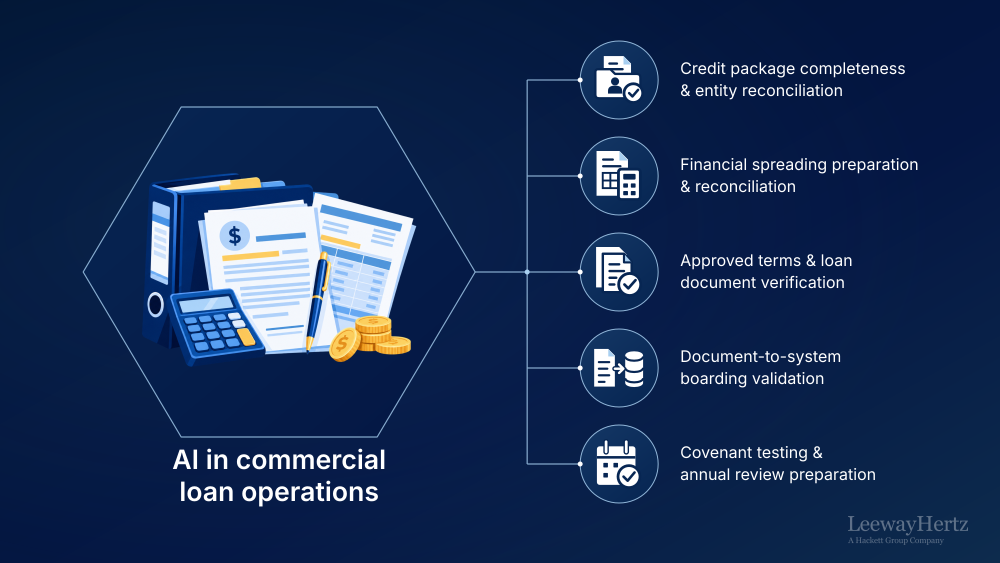
Commercial loan operations span the full lifecycle of a credit relationship, from application intake and financial analysis through approval, documentation, closing, servicing, covenant monitoring, renewals, modifications, and portfolio reporting. A single relationship can generate a long chain of borrower submissions, financial analysis, approval conditions, collateral evidence, legal documents, servicing records, covenants, annual reviews, amendments, and reporting requirements. For a credit administration director, the challenge is to keep those records and obligations consistent from origination through repayment or restructuring. That work may span loan origination systems, spreading platforms, document repositories, collateral systems, core servicing platforms, workflow tools, and risk reporting environments.
The scale of the underlying portfolios makes that operational discipline consequential. Federal Reserve H.8 data for the week ending September 2, 2026, showed $2.9653 trillion in commercial and industrial loans and $3.1319 trillion in commercial real estate loans at U.S. commercial banks [1]. The OCC’s June 2026 Lending and Loan Portfolio Risk Management booklet similarly addresses risk management practices across all phases of a loan’s life cycle, reflecting how lending risk continues well beyond initial underwriting and approval [2].
For commercial lending teams, the operational problem is not only the volume of documents. It is maintaining continuity between what the borrower requested, what the underwriter analyzed, what credit approved, what the closing documents contain, what was boarded into servicing, and what is later monitored. A covenant may first appear in the credit memorandum, become an approval condition, appear in the executed loan agreement, become a servicing tickler, and later determine the calculation performed during a quarterly compliance review. A mismatch at any handoff can affect downstream monitoring, annual review, modification, or portfolio reporting.
AI becomes useful when it operates inside that chain of work rather than as a generic chatbot beside the lending platform. A credit analyst may need financial statements, tax returns, debt schedules, and prior spreads reconciled before beginning repayment analysis. A loan closer may need executed documents compared against approved amounts, maturity, rate structure, guarantors, collateral, covenants, and closing conditions. A portfolio manager may need a compliance certificate tested against the precise covenant definition in the executed agreement before deciding whether an apparent shortfall requires escalation. In each case, AI can prepare and compare evidence, but the banking professional retains the decision.
AI use cases in commercial lending cannot be evaluated only by the task being automated because each activity sits within a broader sequence of inputs, handoffs, decisions, controls, and downstream consequences. The operating model shows how a proposed use case connects to preceding and subsequent work, which systems and artifacts it depends on, where exceptions are handled, and which roles must review or approve the outcome. Without that context, an apparently useful automation can introduce gaps between credit analysis, documentation, servicing, monitoring, and control processes.
This article focuses on commercial lending operations and credit administration. The value of AI becomes clearer when work is decomposed below broad labels such as underwriting, closing, servicing, or monitoring into the individual activities where a specific artifact is received, checked, calculated, compared, drafted, routed, or recorded. That level recognizes the system of record, facility dependency, exception path, regulatory consideration, accountable reviewer, and human authority boundary associated with each opportunity.
This insight uses the commercial lending operating model to break work into functions, processes, sub-processes, artifacts, systems, regulations and control considerations, accountable roles, AI-enabled opportunities, agentic workflow patterns, governance requirements, and practical prioritization guidance.
- How AI is transforming commercial loan operations
- Why AI use cases in commercial lending must be mapped at the sub-process level
- Why commercial lending AI use cases must be mapped at the sub-process level
- Commercial lending operating model and AI opportunity mapping across commercial loan operations
- High-value AI use cases in commercial loan operations
- How agentic AI works in commercial lending workflows
- How to prioritize AI use cases in commercial loan operations
- Governance, risk, and responsible AI in commercial lending
- How ZBrain operationalizes AI use cases in commercial loan operations
- Future of AI in commercial loan operations
How AI is transforming commercial loan operations
AI is transforming commercial loan operations by turning fragmented borrower, credit, collateral, servicing, and portfolio information into structured work products for review, correction, escalation, funding, and reporting through established banking controls. The objective is not to replace commercial credit judgment. It is to reduce the reconciliation and preparation work required to keep the credit relationship consistent from application intake through ongoing monitoring.
Consider a financial covenant that originates during underwriting. The commercial underwriter may define the required coverage threshold and analysis in the credit memorandum within the loan origination system. After approval, the loan documentation specialist must ensure that the corresponding covenant in the loan agreement reflects the approved terms. During boarding, loan operations must translate the executed requirement into a covenant or tickler record in the servicing system. When the borrower later submits financial statements and a compliance certificate, the portfolio manager needs the calculation tested using the contractual definition that was actually executed. AI can compare each stage and surface differences between underwritten terms, approved terms, documented terms, boarded terms, and monitored terms, rather than forcing each downstream team to reconstruct the history manually.
Commercial loan operations are particularly suitable for governed AI because much of the work is artifact-rich, repeatable, exception-driven, and subject to review. The work generally falls into five categories:
- Document-heavy work: Credit packages, financial statements and tax returns, loan agreements, guarantees, security agreements, appraisals, environmental reports, title and lien search results, insurance evidence, closing checklists, compliance certificates, and borrowing base certificates can be checked for missing items, outdated dates, inconsistent values, and conflicting terms before a reviewer works the file.
- Narrative-heavy work: Credit memoranda, borrower and facility summaries, repayment analysis, risks and mitigants, financial variance explanations, risk rating rationales, policy exception justifications, annual review narratives, and credit committee minutes can be drafted by AI from approved source material with evidence references and unresolved questions identified for review.
- Exception-heavy work: Missing application items, spreading anomalies, policy exceptions, unmet closing conditions, approval-to-document differences, boarding discrepancies, payment application exceptions, rate reset mismatches, apparent covenant shortfalls, delinquent borrower reporting, and expired insurance can be classified and prioritized by AI so lending specialists work the items with the greatest credit or operational significance first.
- Knowledge-heavy work: Credit policy, delegated lending authority, covenant definitions, cure and waiver provisions, collateral requirements, approval conditions, appraisal requirements, and servicing instructions can be retrieved from the governing documents and compared with the transaction evidence using AI. The value comes from applying the correct source to the specific facility rather than relying on a generic answer.
- Workflow-heavy work: Application intake to underwriting, underwriting to approval, approval to closing, closing to boarding, servicing to annual review, and deterioration to modification or workout all require context to survive handoffs. AI can maintain the supporting evidence, identify unresolved conditions, and prepare the next review packet without allowing the system to become the credit or funding authority.
The practical design rule is straightforward: AI can extract, calculate, compare, draft, recommend, monitor, and route. Specific lending, credit, legal, compliance, accounting, and operations roles retain authority for decisions and controlled transactions. A system may calculate covenant results for review, prepare a risk rating recommendation, identify a potential documentation exception, or assemble a draw packet. It should not independently approve or decline credit, establish a final risk rating, confirm a contractual breach, grant a waiver, determine legal perfection strategy, authorize funding, release collateral, determine accounting treatment, or submit a regulatory report.
Why AI use cases in commercial lending must be mapped at the sub-process level
Commercial lending programs often start with broad use-case labels such as AI for underwriting, AI for loan documentation, AI for servicing, or AI for portfolio monitoring. Those labels are useful for discussing strategy, but they are too broad for solution design. For example, financial spreading alone can include statement classification, line-item mapping, tax return spreading, fiscal-period alignment, one-time item identification, debt reconciliation, ratio calculation, guarantor global cash flow, and trend analysis. These activities rely on different artifacts, calculation rules, systems, exception thresholds, and reviewers.
A better approach is to map AI use cases to the commercial lending operating model:
- Function: A governed operational area in the commercial lending lifecycle, such as financial spreading and credit analysis, documentation and closing, loan boarding, covenant monitoring, or portfolio reporting.
- Process: A defined workflow within a function, such as financial statement spreading, credit approval routing, closing checklist management, rate administration, covenant testing, or annual review preparation.
- Sub-process: The atomic work activity where a specific commercial lending artifact is received, reviewed, calculated, compared, produced, or routed, such as identifying non-recurring expenses in a spread, reconciling a loan agreement against approved terms, testing a fixed-charge coverage ratio, or validating a boarded interest-rate spread.
- AI-enabled opportunity: A specific AI capability applied to a specific lending artifact or dataset to change how work is prepared, reviewed, compared, routed, or evidenced while a designated banking role retains the underlying credit, legal, compliance, accounting, or funding authority.
This level of decomposition matters because commercial lending activities that sit under the same function often have very different risk boundaries. Checking whether a credit package contains the required tax returns is very different from recommending a risk rating. Extracting maturity and index information from an executed promissory note does not mean changing those fields in the servicing platform. Recalculating a borrowing base can support review without authorizing an overadvance. Likewise, preparing a covenant shortfall packet can inform the next credit action without determining whether the bank will waive the requirement, amend the facility, or reserve its rights.
Loan structure and terms also change what a use case requires. In an asset-based lending facility, document intelligence may extract receivables and inventory data from a borrowing base certificate while rule-based validation applies eligibility exclusions, concentration limits, advance rates, and reserves to prepare an availability calculation for collateral analyst review. In a construction facility, the same broad label of “loan administration” may instead involve reconciling a draw request with the construction budget, inspection report, invoices, lien waivers, retainage, change orders, and remaining contingency before an authorized role considers disbursement. For a commercial real estate transaction, collateral administration may revolve around appraisal evidence, environmental review, flood determination, title, insurance, and lien documentation.
The same principle applies across the full commercial credit lifecycle. AI can check incoming packages for missing documents, normalize financial information for spreading, prepare credit memoranda, and identify potential policy exceptions. It can also assemble approval packets, compare loan documents with approved terms, prepare boarding fields, reconcile rate resets, calculate covenant results, support annual reviews and modifications, and identify portfolio-level concentration or risk migration patterns.
Each becomes a buildable use case only when the trigger artifact, source system, facility type, governing rule, exception condition, accountable reviewer, output artifact, and human authority boundary are known.
Build governed AI workflows for commercial loan operations
Streamline commercial loan operations while keeping credit decisions and controlled transactions under human authority.
Commercial lending operating model and AI opportunity mapping across commercial loan operations
To identify where AI can create meaningful value in commercial loan operations, it is useful to map opportunities against the full lending lifecycle. This provides a structured view of how borrower information, credit analysis, approvals, documentation, servicing records, monitoring requirements, and portfolio data move across teams and systems, and where AI can support specific activities without crossing established decision boundaries.
For this article, the commercial lending operating model is organized into four connected lifecycle stages:
- Origination and credit preparation
- Approval, diligence and closing
- Booking and ongoing administration
- Credit monitoring and portfolio management
This commercial lending operating model focuses on lending operations and credit administration. KYC and BSA/AML activities are included only where lending teams coordinate required information, evidence, and handoffs, while specialist compliance functions retain responsibility for those processes and related determinations.
A. Origination and credit preparation
Function 1: Application intake and pre-screening
Application intake and pre-screening turns an incoming borrowing request and supporting credit package into a structured, review-ready deal record for origination and credit preparation.
This function sits at the beginning of the commercial credit lifecycle. It receives borrower-provided documents, relationship information, proposed facility details, and entity records, then organizes them for financial analysis, underwriting, diligence, and approval. Strong intake controls matter because incorrect entity relationships, missing documents, or incomplete exposure information can carry into every downstream stage.
Teams involved: Relationship management teams, commercial lending teams, credit administration teams, credit analysis teams, loan operations teams, commercial underwriting teams, and lending compliance teams.
Key artifacts: Credit package and application, borrower entity and organizational documents, financial statements and tax returns, debt schedule, personal financial statement, and preliminary facility request.
Systems involved: Loan origination system, CRM, document repository, imaging platform, workflow system, customer information system, and internal exposure or relationship reporting platform.
Regulatory and control considerations: ECOA and Regulation B apply to commercial credit and govern application evaluation and action-taken requirements [3]. Current Regulation B also contains the small business lending data requirements under Section 1071, with the CFPB’s May 2026 rule extending the general compliance date to January 1, 2028 [4]. Internal credit policy, delegated lending standards, customer identification procedures, and data-quality controls also shape intake and preliminary screening.
Accountable roles: Relationship manager, credit analyst, commercial underwriter, credit officer, credit administration director, and designated lending compliance roles.
What AI helps with: Document intelligence can identify and classify documents within a credit package, extract borrower and guarantor information, and compare received items with the applicable package checklist. Entity resolution can reconcile borrower names, affiliates, guarantors, ownership records, tax identifiers, and relationship records across submitted documents and internal systems. Rule-based validation can apply preliminary policy and facility eligibility criteria and route unresolved or conflicting information for review.
What humans continue to own: The relationship manager and credit analyst determine whether additional borrower information is needed, while the commercial underwriter and credit officer evaluate whether the request should move into underwriting under the institution’s policies. Lending compliance retains responsibility for applicable regulatory requirements. AI classifies, extracts, compares, and flags but does not approve eligibility, decline credit, or make a credit decision.
| Process | Sub-process | Key AI-enabled opportunities |
|---|---|---|
| Credit package intake and classification | Document recognition and indexing |
|
| Completeness checking |
|
|
| Missing-item request preparation |
|
|
| Borrower and entity structuring review | Entity and ownership extraction |
|
| Affiliate and related-party mapping |
|
|
| Name and identifier reconciliation |
|
|
| Guarantor identification |
|
|
| Preliminary eligibility and policy screening | Facility and policy eligibility screening |
|
| Relationship exposure aggregation |
|
|
| Geography and industry screening |
|
|
| Conflicting-information detection |
|
|
| Pipeline management | Deal staging and prioritization |
|
| Aging and stalled-deal detection |
|
Highest-value opportunities: Credit package completeness checking is high value because missing information creates downstream rework across spreading, underwriting, and closing. Entity and relationship reconciliation is also important because incorrect borrower or guarantor structures can affect exposure aggregation, diligence, documentation, and portfolio reporting. Preliminary policy screening is high leverage when it surfaces potential exceptions early without converting the screen into a credit decision.
Example agentic workflow: Credit package intake and completeness review
- Trigger: a commercial borrower application and supporting credit package arrive through the loan origination system or document intake channel.
- The agent classifies the documents, identifies the borrower and related entities, extracts reporting periods and identifiers, and compares the package with the applicable intake checklist.
- The agent aggregates current relationship exposure and retrieves applicable preliminary credit policy requirements.
- It prepares an intake packet showing received artifacts, missing documents, entity inconsistencies, potential policy exceptions, related exposures, and a draft borrower follow-up request.
- Human checkpoint: the credit analyst validates the package status and entity structure, and the relationship manager confirms what information should be requested from the borrower. The commercial underwriter or credit officer determines whether identified policy issues affect progression into underwriting.
- Confirmed intake status and missing-item records are written to the loan origination or workflow system, while the source documents, reconciliation results, reviewer changes, and policy references are retained with the credit file.
Function 2: Financial spreading and credit analysis
Financial spreading and credit analysis turns borrower financial information into normalized financial, cash-flow, ratio, and trend evidence for underwriting.
This function receives financial statements, tax returns, debt schedules, personal financial statements, prior spreads, and projections from intake. It converts those records into comparable financial information used to assess repayment capacity, leverage, liquidity, guarantor support, and changes in borrower performance.
Teams involved: Credit analysts, commercial underwriters, portfolio managers, relationship managers, credit officers, and credit administration.
Key artifacts: Financial statements and tax returns with spreading output, debt schedule, personal financial statement, global cash flow worksheet, projection model, and prior-period spreading output.
Systems involved: Financial spreading platform, loan origination system, document repository, tax-return analysis tools, internal exposure system, and industry benchmarking or financial-data platforms.
Regulatory and control considerations: Financial analysis should follow approved credit policy, spreading conventions, risk-rating methodology, and internal calculation standards. OCC supervisory material emphasizes lending risk management across all phases of the loan lifecycle, including sound credit analysis and ongoing monitoring [5]. AI-based analytical tools that meet the institution’s model definition may also fall within the current interagency model risk management framework, revised in April 2026 [6].
Accountable roles: Credit analyst, commercial underwriter, portfolio manager, credit officer, and credit administration director.
What AI helps with: Document intelligence can map financial statement and tax-return data into the approved spreading taxonomy. Rule-based validation can recalculate ratios and cash-flow measures using the institution’s defined formulas, while anomaly detection can identify unusual changes, missing schedules, or inconsistent debt balances. Source-grounded retrieval can present approved adjustment and analysis methodology alongside proposed treatments.
What humans continue to own: Credit analysts and commercial underwriters determine the appropriate treatment of non-recurring items, projections, owner compensation, related-party transactions, and other judgmental adjustments. Credit officers determine how financial performance affects the credit decision. AI extracts, calculates, compares, and proposes adjustments but does not determine repayment capacity or approve the credit.
| Process | Sub-process | AI-enabled opportunities |
|---|---|---|
| Statement and return spreading | Financial statement mapping |
|
| Tax return and K-1 spreading |
|
|
| Period alignment |
|
|
| Statement quality capture |
|
|
| Normalization and adjustment | Non-recurring item identification |
|
| Related-party and intercompany review |
|
|
| EBITDA and cash-flow derivation |
|
|
| Ratio and repayment capacity analysis | Coverage ratio calculation |
|
| Debt schedule reconciliation |
|
|
| Projection reasonableness review |
|
|
| Global cash flow analysis | Guarantor financial extraction |
|
| Combined global coverage preparation |
|
|
| Industry benchmarking and financial trend analysis | Industry benchmark comparison |
|
| Trend and deterioration flagging |
|
Highest-value opportunities: Spreading preparation is high value because the normalized financial record feeds underwriting, risk rating, annual review, and covenant work. Debt reconciliation and global cash flow are particularly important where multiple facilities, guarantors, and related entities create double-counting or omission risk. Calculation lineage is also high value because analysts and reviewers need to understand how each ratio was derived.
Example agentic workflow: Financial spreading and repayment analysis preparation
- Trigger: updated borrower financial statements, business tax returns, and guarantor information are received for a new request or renewal.
- The agent extracts statement and tax data, maps it to the spreading taxonomy, aligns reporting periods, and reconciles borrower-reported debt with internal exposure records.
- It retrieves approved spreading conventions and ratio-calculation methodology.
- The agent prepares spreading output, ratio calculations, candidate normalization items, debt reconciliation differences, global cash-flow inputs, trend analysis, and questions requiring analyst judgment.
- Human checkpoint: the credit analyst confirms mappings and adjustments, and the commercial underwriter reviews the repayment analysis and determines which adjustments or assumptions are appropriate.
- Confirmed spreading output and supporting analysis are stored in the credit or spreading system with source-document references, adjustment history, reviewer changes, and calculation lineage.
Function 3: Underwriting and credit memo preparation
Underwriting and credit memo preparation turns validated borrower, financial, collateral, and relationship evidence into a structured credit case for authorized decision-makers.
This function is where requested terms become underwritten terms. It combines the borrower’s request with financial analysis, repayment sources, collateral, guarantor support, policy requirements, risk factors, and proposed facility structure. The resulting credit memorandum becomes a critical reference for approval, documentation, boarding, and later monitoring.
Teams involved: Commercial underwriting, credit analysis, relationship management, portfolio management, credit administration, and credit risk teams.
Key artifacts: Credit memorandum, spreading output, global cash flow worksheet, risk rating scorecard, policy exception record, projection model, and collateral summary.
Systems involved: Loan origination system, spreading platform, credit policy repository, document management system, risk-rating tool, CRM, and collateral systems.
Regulatory and control considerations: ECOA and Regulation B remain relevant to business-credit evaluation and action taken [7]. Underwriting also operates within the institution’s approved credit policy, risk-rating methodology, delegated authority structure, and current model risk framework where analytical or scoring models fall within scope [8].
Accountable roles: Commercial underwriter, credit analyst, credit officer, chief credit officer, portfolio manager, and credit administration director.
What AI helps with: Multi-source aggregation can assemble borrower history, facility structure, repayment analysis, collateral, guarantor support, financial trends, and prior credit decisions. Natural-language generation can draft sections of the credit memorandum from approved evidence. Rule-based validation can calculate scorecard inputs and identify potential policy exceptions, while contradiction detection can surface differences between proposed terms, financial analysis, and supporting documents.
What humans continue to own: The commercial underwriter determines the credit analysis and recommendation, while the credit officer or other authorized approver determines whether the proposed structure, risk rating, exceptions, and repayment case are acceptable. AI assembles, calculates, compares, and drafts but does not assign the final risk rating, approve an exception, or approve or decline credit.
| Process | Sub-process | Key AI-enabled opportunities |
|---|---|---|
| Credit case assembly | Borrower and relationship history aggregation |
|
| Facility structure and use-of-proceeds summary generation |
|
|
| Repayment source analysis |
|
|
| Risk factor analysis | Risks and mitigants preparation |
|
| Sensitivity and stress commentary |
|
|
| Risk rating preparation | Scorecard input calculation |
|
| Rating definition comparison |
|
|
| Rating rationale drafting |
|
|
| Policy exception handling | Exception identification |
|
| Exception justification preparation |
|
|
| Credit memorandum preparation | Credit memorandum drafting |
|
| Prior approval condition reconciliation |
|
Highest-value opportunities: Credit memorandum preparation is high leverage because the memo carries underwriting logic into approval and later stages. Risk-rating evidence preparation is valuable because it can make scorecard inputs and narrative rationale more internally consistent without transferring rating authority to AI. Policy exception identification is also valuable because unresolved exceptions directly affect approval routing.
Example agentic workflow: Underwriting packet preparation
- Trigger: confirmed spreading and intake records are available for a commercial credit request.
- The agent aggregates requested terms, financial analysis, global cash flow, existing exposure, collateral information, prior approvals, and applicable policy.
- It calculates approved scorecard inputs, identifies candidate policy exceptions, and compares the requested structure with underwriter-developed terms.
- The agent prepares a draft credit memorandum with repayment analysis, risks and mitigants, sensitivity results, rating evidence, exceptions, and source references.
- Human checkpoint: the commercial underwriter validates and revises the credit case, proposes the risk rating and structure, and the credit officer or authorized approving body makes the credit, rating, and exception decisions.
- The approved underwriting version is recorded in the loan origination system, creating the underwritten terms baseline that can later be compared with approved, documented, boarded, and monitored terms.
B. Approval, diligence and closing
Function 4: Credit approval workflow
Credit approval workflow turns the underwritten credit case into an authorized credit decision with documented conditions and clear decision rights.
This function sits at the beginning of the approval, diligence and closing stage. It receives the credit memorandum, proposed risk rating, relationship exposure, policy exceptions, and supporting evidence, then routes the request according to delegated authority. It creates the approved terms that documentation and closing must follow.
Teams involved: Credit administration, credit officers, chief credit officer, commercial underwriting, relationship management, credit committee administration, and loan operations.
Key artifacts: Credit memorandum, risk rating scorecard, policy exception record, credit approval, committee packet and minutes, and conditions register.
Systems involved: Loan origination system, credit approval workflow, committee or board portal, document repository, delegated authority matrix, and workflow tools.
Regulatory and control considerations: Approval routing should follow the institution’s approved lending authority, credit policy, segregation-of-duties requirements, and safety and soundness controls. The OCC’s current lending and loan portfolio risk management handbook addresses risk management across the loan lifecycle [9].
Accountable roles: Credit officer, chief credit officer, designated credit committee members, credit administration director, and other authorized approvers under the institution’s authority matrix.
What AI helps with: Rule-based validation can compare exposure, risk rating, policy exceptions, facility structure, and relationship exposure with the delegated authority matrix. Multi-source aggregation can assemble committee review packets and source evidence. Document intelligence can extract approval decisions and conditions from committee records and place them into a controlled conditions register.
What humans continue to own: Authorized credit officers and committees decide whether to approve, decline, modify, or condition the request and whether to approve any policy exceptions. Credit administration confirms that approval evidence and conditions are captured correctly. AI routes, compares, assembles, and drafts but does not exercise lending authority or approve credit.
| Process | Sub-process | Key AI-enabled opportunities |
|---|---|---|
| Approval routing | Authority determination |
|
| Quorum and signature checking |
|
|
| Committee administration | Credit committee package preparation |
|
| Agenda preparation |
|
|
| Minutes drafting |
|
|
| Conditions management | Condition extraction |
|
| Owner and due-date assignment |
|
|
| Condition tracking |
|
|
| Approval traceability | Underwritten-to-approved comparison |
|
| Credit condition change detection |
|
Highest-value opportunities: Approval condition extraction is high value because conditions often drive documentation, funding, post-closing, and monitoring work. Authority validation is important because the risk of an incorrect approval route is greater than ordinary clerical error. Underwritten-to-approved comparison establishes the next link in the continuity chain.
Example agentic workflow: Approval routing and conditions capture
- Trigger: the commercial underwriter submits a completed credit memorandum for approval.
- The agent aggregates relationship exposure, proposed risk rating, exceptions, requested authority, and the delegated authority matrix.
- It validates the proposed route, assembles the approval packet, and identifies required approvers or committee requirements.
- After the meeting or approval action, the agent prepares draft minutes and extracts every approved term and condition into a conditions register.
- Human checkpoint: authorized credit officers or committee members make and document the decision, and credit administration validates the captured approval and condition set.
- The loan origination system records the approved terms, conditions, approvers, and decision evidence, creating the baseline against which closing documents are later checked.
Function 5: Collateral evaluation
Collateral evaluation turns property, asset, lien, insurance, and borrowing-base evidence into a structured collateral view for underwriting, closing, and ongoing administration.
The function varies materially by facility. Commercial real estate (CRE) may depend on appraisal, environmental, title, flood determination and insurance evidence, while asset-based lending depends on receivable and inventory eligibility, advance rates, reserves, and borrowing-base availability.
Teams involved: Collateral analysts, commercial underwriters, appraisal review teams, credit administration, loan closers, portfolio managers, relationship managers, and legal counsel where needed.
Key artifacts: Appraisal report and review, Phase I environmental report, borrowing base certificate, field exam report, UCC search results, collateral schedule, and insurance evidence.
Systems involved: Collateral management system, appraisal platform, loan origination system, document repository, borrowing-base or ABL platform, lien search services, and insurance tracking system.
Regulatory and control considerations: Real estate collateral processes are governed by applicable appraisal regulations and interagency appraisal and evaluation guidance, which establish expectations for prudent appraisal and evaluation programs. The guidance also makes clear that an analytical method or technological tool cannot replace an appraisal when an appraisal is required.[10] Flood requirements apply to designated loans where applicable.[11]
Accountable roles: Collateral analyst, appraisal reviewer, commercial underwriter, credit officer, loan closer, legal counsel, and credit administration director.
What AI helps with: Document intelligence can extract appraisal values, environmental findings, borrowing-base data, lien-search results, and insurance terms. Rule-based validation can recalculate borrowing-base availability, LTV ratios, advance rates, reserves, and concentration limits. Contradiction detection can surface differences between collateral descriptions, approvals, legal documents, and supporting evidence.
What humans continue to own: Qualified appraisal reviewers assess appraisal acceptability, credit professionals determine how collateral affects the credit decision, and legal counsel or other authorized professionals determine lien and perfection strategy where legal judgment is required. AI extracts, recalculates, compares, and flags but does not approve an appraisal, determine legal sufficiency, authorize an overadvance, or establish perfection strategy.
| Process | Sub-process | Key AI-enabled opportunities |
|---|---|---|
| Appraisal and valuation administration | Appraisal ordering support |
|
| Appraisal completeness review |
|
|
| Value and approach reconciliation |
|
|
| LTV calculation |
|
|
| Environmental review | Phase I review |
|
| Borrowing base and ABL administration | Borrowing base recalculation |
|
| Ineligible asset identification |
|
|
| Overadvance detection |
|
|
| Lien and perfection support | UCC and lien search review |
|
| Filing calendar preparation |
|
|
| Collateral description and insurance management | Collateral schedule reconciliation |
|
| Insurance evidence checking |
|
Highest-value opportunities: Borrowing-base recalculation is high value for ABL because availability may change frequently and errors can directly affect exposure. Appraisal completeness and review preparation are important for CRE because collateral valuation is subject to defined supervisory expectations. Collateral description reconciliation has broad downstream impact across documentation, boarding, monitoring, and eventual release.
Example agentic workflow: ABL borrowing-base exception review
- Trigger: a borrower submits a new borrowing base certificate and supporting receivables and inventory schedules.
- The agent extracts reported collateral, aging, concentrations, reserves, and requested availability.
- It retrieves the approved borrowing-base formula, eligibility rules, concentration limits, advance rates, and reserves.
- The agent recalculates availability and prepares an exception packet showing ineligible assets, concentration effects, dilution, reserve changes, and any apparent overadvance.
- Human checkpoint: the collateral analyst validates the calculation, and the portfolio manager or credit officer determines any credit action or exception under existing authority.
- Confirmed borrowing-base data and reviewer disposition are recorded in the collateral or servicing system, with the certificate, calculation logic, source schedules, and review evidence retained.
Function 6: Due diligence and KYC coordination
Due diligence and KYC coordination turns entity, ownership, insurance, flood determination, and screening requirements into a complete handoff package for the lending and specialist compliance teams.
Lending teams collect and organize required records, track responses, and ensure unresolved items reach the appropriate specialist function before closing.
Teams involved: Loan closers, credit administration, relationship management, loan documentation, lending compliance, BSA/AML or financial crime compliance, insurance specialists, and legal counsel where applicable.
Key artifacts: Organizational documents, resolutions, beneficial ownership information, flood determination certificate, insurance evidence, site or inspection evidence, and diligence checklist.
Systems involved: Loan origination system, document repository, customer information system, KYC or financial crime platform, flood determination service, insurance tracking system, and workflow tools.
Regulatory and control considerations: BSA/AML, customer due diligence, and beneficial ownership requirements apply where relevant. FinCEN’s February 2026 exceptive relief means covered institutions are no longer required to identify and verify beneficial owners every time an existing legal-entity customer opens a new account, subject to the relief’s conditions and the institution’s risk-based procedures. [12] Flood determination and mandatory purchase requirements apply where the collateral and transaction fall within the applicable rules.[13]
Accountable roles: Loan closer, lending compliance officer, designated BSA/AML or financial crime compliance role, credit administration director, and legal counsel where legal sufficiency is involved.
What AI helps with: Document intelligence can check formation records, resolutions, signer authority, ownership information, flood determinations, and insurance evidence for completeness. Entity resolution can compare names and ownership information across lending and compliance records. Workflow monitoring can track unresolved specialist reviews without making the compliance decision itself.
What humans continue to own: BSA/AML and financial crime specialists retain their compliance determinations, legal counsel retains legal judgments, and lending roles determine whether closing requirements have been satisfied under approved procedures. AI collects, compares, tracks, and drafts but does not clear a customer, determine legal sufficiency, or approve a compliance exception.
| Process | Sub-process | Key AI-enabled opportunities |
|---|---|---|
| Entity documentation collection | Formation document checking |
|
| Authority document review |
|
|
| Stale-document detection |
|
|
| Beneficial ownership and CDD coordination | Information completeness preparation |
|
| Refresh trigger identification |
|
|
| Screening coordination | BSA/AML and sanctions handoff |
|
| Flood and insurance determination support | Flood evidence checking |
|
| Insurance evidence review |
|
|
| Third-party and diligence tracking | Inspection and site-visit evidence review |
|
Highest-value opportunities: Entity-document reconciliation is high value because errors can affect documentation, KYC coordination, and enforceability. Flood and insurance evidence checking is important because these requirements may directly affect closing. Specialist handoff tracking is valuable because it improves visibility without collapsing compliance responsibilities into loan operations.
Example agentic workflow: Due diligence handoff preparation
- Trigger: a credit request moves from approval into pre-closing diligence.
- The agent aggregates formation documents, resolutions, ownership records, flood determination, insurance evidence, and approved conditions.
- It checks completeness, compares entity and signer information, and identifies the specialist reviews required.
- The agent prepares separate lending, financial crime, flood, insurance, and legal review packets with unresolved items clearly marked.
- Human checkpoint: the appropriate compliance, legal, lending, and credit administration roles confirm their respective requirements and dispositions.
- Confirmed diligence status is recorded in the loan origination or closing workflow, while specialist decisions remain in their appropriate systems and the supporting evidence is retained in the credit file.
Accelerate AI Solutions Development
Build fully functional solutions from your high-value use cases, based on specific operational needs and enterprise context.
Function 7: Documentation and closing
Documentation and closing turns approved terms and conditions into executed loan documents and a controlled funding-ready closing file.
The function receives the credit approval and conditions register and translates those requirements into document instructions, loan documents, closing evidence, and funding controls.
Teams involved: Loan closers, loan documentation specialists, credit administration, relationship managers, commercial underwriters, legal counsel, loan operations, and authorized funding personnel.
Key artifacts: Credit approval, conditions register, loan agreement, promissory note, guaranty, security agreement, collateral schedule, closing checklist, and funding authorization record.
Systems involved: Loan origination system, document generation platform, document repository, closing workflow, e-signature platform where permitted, wire or disbursement system, and core servicing system.
Regulatory and control considerations: Documentation must reflect approved credit terms, applicable lending requirements, internal legal templates, closing conditions, funding controls, and segregation of duties.
Accountable roles: Loan closer, loan documentation specialist, credit administration director, credit officer, legal counsel, and authorized funding or operations personnel.
What AI helps with: Document intelligence can extract approved terms and compare them with draft or executed loan documents. Contradiction detection can identify differences in principal amount, maturity, rate structure, guarantors, collateral, covenants, reporting obligations, and conditions. Workflow monitoring can manage closing checklist evidence and unresolved conditions.
What humans continue to own: Loan documentation specialists and counsel determine the appropriate documents and legal language within their authority. Credit roles approve any material change from approved terms. Authorized personnel alone approve funding and disbursement. AI compares, extracts, drafts, and tracks but does not determine legal sufficiency, execute documents, waive conditions, or authorize funding.
| Process | Sub-process | Key AI-enabled opportunities |
|---|---|---|
| Document preparation support | Template and clause support |
|
| Counsel instruction preparation |
|
|
| Document-to-approval verification | Core term comparison |
|
| Covenant and reporting comparison |
|
|
| Guarantor and collateral comparison |
|
|
| Closing checklist management | Checklist construction |
|
| Evidence collection |
|
|
| Pre-funding control | Funding condition packet verification |
|
| Disbursement instruction validation |
|
|
| Post-closing tracking | Missing original or follow-up evidence |
|
Highest-value opportunities: Approved-term-to-document verification is among the highest-value opportunities because documentation errors can alter the contractual position of the institution. Closing-condition tracking is also high leverage because unresolved conditions can otherwise become hidden post-closing exceptions. Funding-packet preparation is valuable only when the final authorization remains with named personnel.
Example agentic workflow: Approved terms to loan document verification
- Trigger: draft loan documents are returned by the documentation team or counsel before closing.
- The agent retrieves the final approved terms, conditions register, borrower and guarantor records, and collateral requirements.
- It extracts corresponding provisions from the note, loan agreement, guaranty, security agreement, and collateral schedules.
- The agent prepares a comparison packet showing matching terms, missing provisions, conflicting amounts or dates, covenant differences, guarantor discrepancies, collateral differences, and unresolved conditions.
- Human checkpoint: the loan documentation specialist and loan closer validate the comparison, counsel resolves legal questions, and the credit officer approves any material departure from the credit approval.
- Once documents are authorized and executed through existing procedures, the closing system records the documented terms and retains the comparison, reviewer disposition, approved changes, and supporting evidence.
C.Booking and ongoing administration
Function 8: Loan boarding and onboarding to servicing
Loan boarding turns executed contractual terms into controlled servicing-system records and monitoring requirements.
This function receives executed loan documents and closing records, then translates their terms into servicing fields, covenant records, ticklers, fee schedules, rate settings, and participation or syndication records.
Teams involved: Loan operations teams, loan servicing teams, loan boarding teams, credit administration team, loan documentation team, portfolio management team, and participation or syndication operations teams.
Key artifacts: Executed loan agreement and promissory note, loan boarding sheet, covenant and tickler record, collateral schedule, participation agreement, and closing file.
Systems involved: Core servicing system, loan origination system, document repository, covenant or tickler system, collateral system, participation or syndication accounting platform, and workflow tools.
Regulatory and control considerations: Boarding controls should preserve the terms of executed legal documents and maintain appropriate maker-checker or quality-control procedures. Safety and soundness expectations extend through all phases of the loan lifecycle. [14]
Accountable roles: Loan operations manager, loan servicing specialist, loan documentation specialist, credit administration director, and designated boarding quality-control reviewer.
What AI helps with: Document intelligence can extract boardable terms from executed documents and map them to servicing-system fields. Contradiction detection can compare the executed agreement with the boarding sheet and booked system values. Classification can convert reporting requirements and covenants into structured tickler records.
What humans continue to own: Authorized servicing and loan operations personnel approve system entries and corrections. Documentation or credit roles resolve ambiguous contractual terms before changes are made. AI extracts, maps, and compares but does not independently book a loan, change contractual terms, or override controlled servicing fields.
| Process | Sub-process | Key AI-enabled opportunities |
|---|---|---|
| Boarding data preparation | Core term extraction |
|
| Boarding sheet preparation |
|
|
| Document-to-system validation | Executed-to-boarded comparison |
|
| Post-boarding quality review |
|
|
| Monitoring setup | Covenant configuration |
|
| Tickler configuration |
|
|
| Participation and syndication setup | Participation term extraction |
|
| Sub-account validation |
|
Highest-value opportunities: Document-to-system validation is high value because booking errors can affect billing, accruals, rate resets, covenant monitoring, and reporting for the remainder of the loan’s life. Covenant and tickler setup is also high leverage because missing obligations may not become visible until a reporting deadline is missed.
Example agentic workflow: Document-to-system boarding validation
- Trigger: a closed commercial loan has been boarded into the core servicing system.
- The agent retrieves the executed note, loan agreement, boarding sheet, approval record, and current servicing fields.
- It extracts the contractual terms and compares them with the boarded values.
- The agent prepares a discrepancy packet covering amount, maturity, index, spread, floor, payment frequency, amortization, fees, covenants, reporting obligations, and collateral references.
- Human checkpoint: the loan operations reviewer validates each discrepancy and authorizes any system correction through the institution’s controlled process.
- Confirmed values become the boarded terms, with correction evidence, source-document references, reviewer approval, and quality-control history retained.
Function 9: Payment processing and loan administration
Payment processing and loan administration maintains contractual billing, rate, reserve, draw, and servicing activity after boarding.
This function manages recurring administrative events across the life of the loan. Some activities are routine, while others, such as construction draws, payment exceptions, or contractual rate resets, require evidence from several systems before an authorized action can occur.
Teams involved: Loan servicing teams, loan operations teams, construction loan administration teams, portfolio management teams, collateral administration teams, treasury or payment operations teams where relevant, and credit administration team.
Key artifacts: Billing statement, payment record, rate change notice, loan agreement, construction draw request, construction budget, inspection report, lien waiver, and escrow or reserve record.
Systems involved: Core servicing platform, payment processing system, document repository, construction loan administration platform, collateral system, rate or benchmark data service, and workflow tools.
Regulatory and control considerations: Servicing activity should follow the executed contract, institution policy, payment controls, segregation-of-duties requirements, and applicable accounting and reporting procedures. For construction or real-estate-secured facilities, flood and collateral requirements may remain relevant depending on the transaction. [15]
Accountable roles: Loan servicing specialist, loan operations manager, construction loan administrator, portfolio manager, credit officer where an exception requires credit authority, and authorized disbursement personnel.
What AI helps with: Rule-based validation can reconcile billing, payment application, contractual rate resets, reserve balances, and draw calculations. Document intelligence can assemble construction draw evidence and extract invoices, inspection findings, lien waivers, retainage, and change orders. Anomaly detection can prioritize servicing exceptions for specialist review.
What humans continue to own: Servicing personnel approve corrections, credit officers approve credit exceptions within their authority, and authorized personnel approve construction draws and disbursements. AI calculates, compares, assembles, and flags but does not authorize a payment reallocation, draw, extension, lien release, or disbursement.
| Process | Sub-process | Key AI-enabled opportunities |
|---|---|---|
| Billing and payment application | Billing statement validation |
|
| Payment exception review |
|
|
| Suspense aging |
|
|
| Rate and index administration | Contractual rate reset reconciliation |
|
| Rate and index administration | Rate change notice preparation |
|
| Escrow and reserve administration | Escrow review |
|
| Interest reserve monitoring |
|
|
| Construction draw management | Draw packet assembly |
|
| Budget and completion reconciliation |
|
|
| Contingency and retainage calculation |
|
|
| Loan-level maintenance | Maturity and extension calendar monitoring |
|
| Loan-level maintenance | Payoff and release packet preparation |
|
Highest-value opportunities: Contractual rate reconciliation is high value because rate errors can affect borrower billing and income recognition. Construction draw preparation is also high leverage because a single disbursement depends on multiple evidence sources and must preserve a clear authorization boundary. Payment exception triage is valuable because it directs specialists to anomalies without altering the account automatically.
Example agentic workflow: Construction draw packet preparation
- Trigger: a borrower submits a draw request for a construction facility.
- The agent aggregates the request, construction budget, prior draws, invoices, inspection report, lien waivers, approved change orders, retainage, and remaining contingency.
- It retrieves the approved facility and draw-control requirements and recalculates budget availability and requested amounts.
- The agent prepares a draw packet showing complete evidence, missing items, budget variances, inspection inconsistencies, remaining contingency, retainage, and any exception requiring credit review.
- Human checkpoint: the construction loan administrator validates the packet, the portfolio manager or credit officer resolves credit exceptions, and authorized personnel approve or decline the disbursement.
- Approved draw data and evidence are recorded in the construction and servicing systems, with calculation details and reviewer authorization retained.
D. Credit monitoring and portfolio management
Function 10: Covenant monitoring and annual reviews
Covenant monitoring and annual reviews turn recurring borrower reporting into tested contractual evidence and an updated view of credit quality.
This function receives compliance certificates, financial statements, borrowing base certificates, and other contractual reporting, compares them with the executed agreement and prior credit analysis, and prepares evidence for portfolio manager and credit officer decisions.
Teams involved: Portfolio management, credit analysis, commercial underwriting, credit administration, relationship management, credit officers, and loan review as an independent assurance consumer.
Key artifacts: Compliance certificate, financial statements and spreading output, borrowing base certificate, executed loan agreement, covenant and tickler record, annual review package, and risk rating scorecard.
Systems involved: Covenant monitoring or tickler platform, loan origination system, spreading tool, core servicing system, document repository, risk-rating system, and portfolio reporting platform.
Regulatory and control considerations: Covenant monitoring and periodic credit review operate under the executed agreement, credit policy, risk-rating methodology, watch-list or criticized-asset procedures, and supervisory expectations for ongoing credit risk management.[16] Any analytical model used in risk-rating or early-warning work should also be assessed under the institution’s applicable model risk framework.[17]
Accountable roles: Portfolio manager, credit analyst, credit officer, chief credit officer, credit administration director, and designated loan review roles as independent reviewers.
What AI helps with: Document intelligence can extract borrower-reported covenant values and financial information. Rule-based validation can calculate covenant results using the contractual definition in the executed agreement and compare the calculated result with the applicable threshold. Trend analysis can identify deterioration across periods, while natural-language generation can prepare annual review and escalation packets.
What humans continue to own: The portfolio manager confirms covenant calculations and borrower context. Credit officers determine whether a calculated shortfall constitutes a confirmed breach under the applicable agreement and decide whether a waiver, amendment, reservation of rights, rating change, or other credit action is appropriate. AI calculates, compares, monitors, and drafts but does not confirm a breach, grant a waiver, set the final risk rating, or move an exposure onto or off a watch list.
| Process | Sub-process | Key AI-enabled opportunities |
|---|---|---|
| Reporting obligation tracking | Reporting calendar maintenance |
|
| Receipt and completeness checking |
|
|
| Covenant testing | Contractual calculation |
|
| Threshold comparison |
|
|
| Cure and waiver provision retrieval |
|
|
| Waiver or reservation-of-rights draft |
|
|
| Annual and periodic credit review | Review scheduling |
|
| Updated financial analysis |
|
|
| Risk rating review preparation |
|
|
| Policy exception refresh |
|
|
| Early warning and criticized asset identification | Deterioration signal aggregation |
|
| Watch-list candidate preparation |
|
Highest-value opportunities: Covenant calculation and evidence preparation are high value because they combine contractual interpretation, borrower data, calculation logic, and credit judgment. Annual review preparation is also high leverage because stale reviews weaken ongoing credit oversight. Early-warning aggregation is valuable when it surfaces deterioration before individual signals are considered in isolation.
Example agentic workflow: Covenant monitoring and annual review preparation
- Trigger: A borrower’s compliance certificate and financial statements arrive before the covenant test date.
- The agent aggregates the executed loan agreement’s covenant definitions and thresholds, submitted financial information, prior spreads, current exposure, prior covenant results, existing risk rating, and relevant benchmark information.
- It retrieves the approved covenant calculation methodology and applicable credit policy for covenant exceptions, waivers, and escalation.
- The agent prepares a monitoring packet with updated spread information, the covenant calculation against the contractual threshold, any apparent shortfall with supporting inputs, recent financial trend analysis, a draft reservation-of-rights communication, and evidence relevant to risk-rating review.
- Human checkpoint: The portfolio manager validates the calculation and borrower context. The credit officer, with legal review where required, determines whether a waiver, amendment, reservation of rights, risk-rating review, or other credit action is appropriate. Any watch-list or criticized-asset decision follows its separate approval process.
- Confirmed covenant status and approved credit actions are recorded in the appropriate systems. Any separately approved risk-rating, watch-list, or accounting changes follow their own controlled processes, while the calculation, source evidence, reviewer disposition, and decision trail are retained for loan review and examiners.
Function 11: Renewals, modifications and workouts
Renewals, modifications and workouts turn expiring or changing credit relationships into reviewed structures, amended documents, and controlled servicing updates.
The function may begin with a routine maturity or with deterioration requiring modification, forbearance, restructuring, or transfer to special assets. It extends the continuity chain by comparing existing documented and boarded terms with the proposed new structure and ensuring approved changes flow correctly into amendments and servicing records.
Teams involved: Portfolio management, commercial underwriting, special assets, credit administration, relationship management, credit officers, loan documentation, legal counsel, loan operations, and finance or accounting where classification or ACL data is involved.
Key artifacts: Annual review package, updated financial statements, credit memorandum, modification or amendment agreement, watch-list or criticized-asset review, collateral update, and ACL or CECL input file.
Systems involved: Loan origination system, core servicing system, special-assets or workout platform, document repository, risk-rating system, collateral systems, accounting or ACL platform, and workflow tools.
Regulatory and control considerations: Renewals and modifications remain subject to credit policy, approval authority, lending safety and soundness expectations, accounting policy, and applicable collateral requirements.
Accountable roles: Portfolio manager, special assets officer, commercial underwriter, credit officer, chief credit officer, legal counsel, credit administration director, and finance or accounting roles for accounting classification.
What AI helps with: Multi-source aggregation can prepare updated credit, collateral, exposure, and payment evidence for renewal or workout analysis. Contradiction detection can compare proposed changes with existing documents and servicing records. Natural-language generation can prepare amendment instructions, strategy packets, and evidence for accounting review without making the underlying credit or accounting determination.
What humans continue to own: Credit officers approve renewals, modifications, restructurings, and workout strategies. Special assets roles determine case strategy within delegated authority, legal counsel determines legal implications, and finance or accounting determines final classification and ACL treatment. AI assembles, compares, models, and drafts but does not approve a modification, determine accounting treatment, establish a final risk rating, or move an exposure onto or off a watch list.
| Process | Sub-process | Key AI-enabled opportunities |
|---|---|---|
| Renewal administration | Renewal calendar management |
|
| Financial and collateral refresh |
|
|
| Renewal credit case preparation |
|
|
| Modification and amendment processing | Modification request intake |
|
| Term-change impact analysis |
|
|
| Amendment instruction preparation |
|
|
| Post-amendment loan boarding |
|
|
| Watch list and workout transfer | Transfer evidence assembly |
|
| Strategy option analysis |
|
|
| Collateral position refresh |
|
|
| Accounting and risk data preparation | Financial deterioration monitoring |
|
| ACL and CECL input preparation |
|
Highest-value opportunities: Modification impact analysis is high leverage because approved changes can affect documents, servicing, covenants, reporting, and accounting simultaneously. Renewal preparation is valuable because it reuses evidence from ongoing monitoring rather than rebuilding the credit record. Workout evidence assembly helps special assets teams see deterioration and collateral information in one controlled packet.
Example agentic workflow: Modification impact and execution preparation
- Trigger: a borrower requests a maturity extension and payment modification.
- The agent aggregates current loan documents, boarded terms, payment history, latest financial analysis, collateral information, covenant status, risk rating, and prior approvals.
- It prepares a comparison of current and proposed terms and identifies every document, servicing field, covenant record, and downstream data element potentially affected.
- The agent prepares updated financial analysis, draft modification rationale, amendment instructions, and accounting-review data.
- Human checkpoint: the portfolio manager and commercial underwriter review the credit analysis, the credit officer approves or declines the modification, counsel reviews legal documentation, and finance determines any required accounting classification.
- After authorized execution, approved changes are separately updated in documentation and servicing systems with reviewer controls. The amendment, system changes, accounting disposition, and supporting evidence are retained as distinct decisions rather than one automatic downstream chain.
Function 12: Portfolio monitoring and reporting
Portfolio monitoring and reporting turns loan-level exposure, performance, credit quality, and exception data into management, supervisory, and portfolio-risk views.
This function moves from individual credit relationships to the commercial portfolio. It helps credit leadership understand concentrations, exposure growth, rating migration, criticized or classified asset trends, covenant issues, delinquencies, utilization, data quality, and portfolio-level reporting.
Teams involved: Credit administration team, portfolio management team, credit risk team, chief credit officer organization team, finance team, regulatory reporting team, data and analytics teams, loan review team, and commercial lending leadership team.
Key artifacts: Portfolio and concentration report, watch-list and criticized-asset review report, risk rating data, covenant exception records, call report schedule data, ACL and CECL input file, and credit file completeness records.
Systems involved: Enterprise data warehouse, loan origination and servicing systems, risk-rating platform, BI reporting tools, regulatory reporting platform, ACL or CECL system, covenant monitoring system, and document repository.
Regulatory and control considerations: Portfolio reporting operates under safety and soundness expectations, internal concentration limits, credit risk policy, and current regulatory reporting instructions.
Accountable roles: Chief credit officer, credit administration director, portfolio manager, credit risk leadership, finance and accounting roles, regulatory reporting roles, and loan review as an independent assurance function.
What AI helps with: Multi-source aggregation can combine exposure, facility, collateral, risk-rating, covenant, delinquency, and utilization data across the commercial portfolio. Anomaly detection can identify unusual concentration growth, risk-rating migration, stale borrower information, or persistent exception patterns. Data lineage mapping can link management and regulatory outputs back to source loan and accounting records.
What humans continue to own: Credit leadership determines portfolio limits, classifications, watch-list decisions, and management responses. Finance determines ACL outcomes, and authorized reporting functions submit regulatory reports. AI aggregates, reconciles, identifies patterns, and drafts but does not establish portfolio risk appetite, classify assets, determine ACL, or submit regulatory reporting.
| Process | Sub-process | Key AI-enabled opportunities |
|---|---|---|
| Exposure and concentration analytics | Industry concentration reporting |
|
| Geography and collateral concentration |
|
|
| Relationship exposure aggregation |
|
|
| Portfolio credit quality analytics | Risk rating migration |
|
| Delinquency and nonaccrual trend |
|
|
| Criticized and classified trend analysis |
|
|
| Covenant exception analysis |
|
|
| Utilization analysis |
|
|
| Regulatory and management reporting support | Call report data preparation |
|
| Examiner and loan review packets preparation |
|
|
| Credit committee and board reporting |
|
|
| ACL and CECL data support | Segmentation and pool data preparation |
|
| Input reconciliation |
|
|
| Portfolio data quality and governance | Credit file completeness monitoring |
|
| Exception aging |
|
Highest-value opportunities: Relationship and concentration aggregation are high value because portfolio risk can remain hidden when facilities are viewed individually. Risk-rating migration and deterioration analytics help credit leadership identify where risk is changing across the book. Credit-file completeness and data lineage are also high leverage because management, loan review, examiners, regulatory reporting, and ACL processes all depend on reliable underlying records.
Example agentic workflow: Commercial portfolio monitoring and review preparation
- Trigger: the monthly or quarterly commercial portfolio review cycle opens.
- The agent aggregates outstanding and committed exposure, relationship structures, risk ratings, delinquency, nonaccrual status, authorized criticized and classified designations, covenant results, utilization, collateral information, and outstanding credit-file exceptions.
- It retrieves internal concentration limits, portfolio reporting definitions, approved risk taxonomy, and applicable reporting mappings.
- The agent prepares a portfolio packet showing concentration movement, risk-rating migration, deterioration signals, covenant trends, utilization changes, stale credit evidence, data-quality exceptions, and management-reporting commentary.
- Human checkpoint: portfolio and credit administration leaders validate the data, the chief credit officer determines portfolio actions or escalation, finance reviews ACL-related data separately, and regulatory reporting teams validate reportable information.
- Confirmed portfolio outputs are published through approved management or reporting systems. Regulatory submissions, ACL outcomes, classification decisions, and credit actions remain separately authorized, with the supporting data lineage and reviewer evidence retained.
Accelerate AI Solutions Development
Build fully functional solutions from your high-value use cases, based on specific operational needs and enterprise context.
High-value AI use cases in commercial loan operations
High-value AI use cases in commercial lending are not simply the activities with the most manual effort. They are the ones where recurring work, stable source artifacts, clear calculation or comparison logic, identifiable exceptions, and a named reviewer come together. The strongest opportunities improve the continuity of the credit record, surface material discrepancies earlier, or prepare complete evidence for a controlled decision without allowing AI to become the credit, legal, accounting, or funding authority.
| Use case | Function | How AI creates high-value impact |
|---|---|---|
| Credit package completeness and entity reconciliation | Application intake and pre-screening | Document intelligence and entity resolution identify missing artifacts and inconsistent borrower or ownership data, reducing downstream rework in spreading, underwriting, and diligence. |
| Financial spreading preparation and reconciliation | Financial spreading and credit analysis | Document intelligence and rule-based validation prepare normalized spreads and surface input exceptions, giving analysts a more complete and review-ready financial record. |
| Credit memorandum and risk rating evidence preparation | Underwriting and credit memo preparation | Multi-source aggregation brings credit evidence into one review packet, reducing manual assembly while improving consistency between analysis, scorecard inputs, and rating rationale. |
| Approval routing and condition capture | Credit approval workflow | Rule-based validation checks approval authority and captures conditions in a structured register, reducing the risk of missed approval requirements during closing. |
| Borrowing-base recalculation and collateral exception review | Collateral evaluation | Document intelligence and rule-based validation surface eligibility, concentration, reserve, and availability exceptions earlier, supporting more timely collateral review. |
| Due diligence completeness and specialist handoff preparation | Due diligence and KYC coordination | Document intelligence identifies missing diligence evidence and unresolved specialist items, helping prevent incomplete files from progressing toward closing. |
| Approved-terms to loan document verification | Documentation and closing | Contradiction detection surfaces differences between approved terms and loan documents before execution, reducing documentation defects and downstream servicing corrections. |
| Document-to-system boarding validation | Loan boarding and onboarding to servicing | Document intelligence compares executed terms with boarding and servicing records, reducing the risk of billing, rate, covenant, and monitoring errors. |
| Construction draw packet assembly and validation | Payment processing and loan administration | Document intelligence and rule-based validation reconcile draw evidence with budgets and prior disbursements, giving reviewers a more complete basis for draw decisions. |
| Covenant testing and annual review preparation | Covenant monitoring and annual reviews | Rule-based validation calculates covenant results from executed definitions and highlights apparent shortfalls, helping portfolio teams identify exceptions and deterioration earlier. |
| Modification impact analysis and workout evidence assembly | Renewals, modifications and workouts | Multi-source aggregation identifies affected documents, servicing fields, covenants, and collateral records, reducing the risk of inconsistent changes across systems. |
| Portfolio concentration, credit quality, and data-quality monitoring | Portfolio monitoring and reporting | Multi-source aggregation and anomaly detection surface concentration shifts, rating migration, stale files, and recurring exceptions, improving portfolio visibility and review readiness. |
The highest-value opportunities usually have several characteristics in common. The work repeats across a meaningful population of loans, the source artifacts are available and sufficiently reliable, the output can be reviewed before it affects a controlled transaction, and the cost of an undetected mismatch is material.
Use cases such as document-to-approval verification, boarding validation, covenant testing preparation, and credit-file completeness monitoring are particularly strong because they also reinforce the continuity chain from underwritten terms to approved terms to documented terms to boarded terms to monitored terms. For loan operations and credit administration teams, that can mean fewer unresolved discrepancies and stronger evidence trails. For credit leadership, it can mean better visibility into deterioration and exceptions without weakening accountability for credit decisions.
How agentic AI works in commercial lending workflows
Agentic AI becomes useful in commercial lending when it can maintain context across a governed sequence of workflows rather than perform one isolated extraction or generation task. A workflow can start from a borrower document, retrieve the relevant executed agreement and credit policy, collect records from the loan origination and servicing systems, perform approved calculations or comparisons, prepare an exception-focused packet, and route it to the appropriate reviewer. The agent maintains continuity across those steps, but the named banking role still determines what the evidence means and whether any credit, legal, accounting, communication, or funding action should proceed.
Here are some examples:
Covenant testing and credit action review
- Agent role: Prepare the covenant calculation, supporting evidence, trend analysis, and review packet without determining whether a contractual breach exists or what credit action should be taken.
- Trigger: A borrower’s quarterly compliance certificate and financial statements are received ahead of a covenant test date.
- Context assembled: The agent retrieves the executed loan agreement, applicable amendments, covenant and tickler record, current and prior financial statements, spreading output, prior covenant calculations, current exposure, existing risk rating, and relevant credit policy. It uses the covenant definition in the executed agreement rather than relying only on the compliance certificate’s reported result.
- Analysis performed: Rule-based validation recalculates the covenant using the contractual definition and retains every adjustment and source input. The agent compares the result with the contractual threshold and prior periods, identifies relevant financial trends, and retrieves applicable cure, waiver, notice, and escalation provisions.
- Decision packet: The agent prepares a packet containing the calculation and data lineage, an apparent-shortfall summary, financial trend analysis, prior covenant history, relevant agreement language, evidence that may support risk-rating review, and draft borrower correspondence such as a waiver or reservation-of-rights document where requested.
- Human checkpoint: The portfolio manager validates the inputs and calculation and confirms the operating context. The credit officer determines whether the contractual result requires a waiver, amendment, reservation of rights, risk-rating review, or another credit action. Legal review is included where contractual rights or borrower communications require it. Any watch-list, criticized-asset, or accounting decision proceeds through its own methodology and approval process.
- Controlled handoff: Confirmed covenant status and approved credit actions are written to the appropriate monitoring or credit systems. Rating changes, watch-list decisions, accounting updates, and borrower communications occur only after their respective approvals. The source documents, calculation logic, reviewer changes, decision rationale, and system updates are retained for loan review and examiners.
Document-to-system boarding validation
- Agent role: Compare executed contractual terms with proposed or completed servicing-system records and prepare discrepancies for loan operations review.
- Trigger: A newly closed commercial loan has been boarded into the core servicing platform.
- Context assembled: The agent retrieves the executed promissory note, loan agreement, applicable fee or rate schedules, collateral and guaranty records, final approval, loan boarding sheet, and current servicing-system fields.
- Analysis performed: Document intelligence extracts principal amount, maturity, amortization, payment frequency, benchmark, spread, floor, accrual basis, fees, reporting requirements, and other boardable terms. Contradiction detection compares those values with the boarding sheet and servicing record and distinguishes material term differences from formatting or non-substantive differences.
- Validation packet: The agent prepares a field-by-field reconciliation showing the executed term, boarded value, source provision, suspected mismatch, and proposed correction for review. Covenant and reporting obligations are separately compared with the tickler or monitoring setup so missing requirements do not disappear during boarding.
- Human checkpoint: The loan operations reviewer validates each identified discrepancy. Ambiguous contractual language routes back to the loan documentation specialist or legal counsel as appropriate. Only an authorized servicing or operations role approves a correction to the core system.
- Controlled handoff: Approved corrections are entered through the institution’s existing servicing controls. The final boarded values, source-document locations, reviewer disposition, correction history, and quality-control evidence are retained, establishing the boarded-term baseline for future servicing and monitoring.
Approved-terms to loan document verification at closing
- Agent role: Compare draft or final loan documents with approved credit terms and conditions so documentation differences reach the responsible reviewer before execution or funding.
- Trigger: Draft loan documents are returned by the loan documentation team or counsel for pre-closing review.
- Context assembled: The agent retrieves the final credit approval, conditions register, approved facility structure, borrower and guarantor records, collateral requirements, term sheet where applicable, and the draft note, loan agreement, guaranties, security agreements, and collateral schedules.
- Analysis performed: Contradiction detection compares principal amount, maturity, amortization, interest benchmark, spread, floor, payment structure, guarantors, collateral descriptions, financial reporting requirements, and covenants with the approved terms. Document intelligence also checks whether each relevant condition precedent is represented in the closing checklist.
- Closing packet: The agent prepares a comparison showing matched terms, missing provisions, conflicting values, unresolved approval conditions, collateral or guarantor differences, and questions requiring documentation, legal, or credit review. Each exception points back to both the approval source and the relevant document provision.
- Human checkpoint: The loan documentation specialist and loan closer validate the comparison. Legal counsel resolves legal drafting or enforceability questions. Any material departure from the approved credit structure returns to the credit officer or other authorized approver rather than being silently accepted during documentation.
- Controlled handoff: Once authorized documents are executed and closing requirements are satisfied, the documented terms become the source for boarding. Funding occurs only through the institution’s established authorization process. The final comparison, approved deviations, closing evidence, reviewer disposition, and executed documents remain part of the credit and closing record.
Construction draw packet assembly for a construction facility
- Agent role: Assemble and reconcile the evidence supporting a construction draw request while leaving draw approval and disbursement with authorized personnel.
- Trigger: A borrower submits a new construction draw request with invoices and supporting documentation.
- Context assembled: The agent retrieves the approved construction budget, loan agreement, prior draw history, current draw request, invoices, inspection report, lien waivers, approved change orders, retainage requirements, remaining contingency, outstanding commitments, and relevant closing or collateral requirements.
- Analysis performed: Document intelligence maps invoices to budget categories and extracts amounts from inspection reports and lien waivers. Rule-based validation compares the requested draw with prior disbursements, budget availability, percentage complete, retainage, approved change orders, and remaining contingency. Contradiction detection identifies cases where invoiced work, inspection progress, and requested funding do not align.
- Draw packet: The agent prepares a line-item reconciliation showing requested amounts, eligible supported amounts, prior draws, remaining budget, change-order effects, retainage, contingency, missing lien waivers, inspection differences, and any credit or documentation exceptions.
- Human checkpoint: The construction loan administrator validates the evidence and calculations. The portfolio manager or credit officer reviews any credit exception, budget overrun, or material deviation. Authorized operations personnel make the final draw and disbursement decision under the institution’s existing controls.
- Controlled handoff: An approved draw is recorded in the construction administration and servicing systems through authorized processes. The draw request, inspection evidence, invoices, lien waivers, calculation details, exceptions, reviewer disposition, and authorization record are retained with the facility history.
Across these workflows, the review boundary preserves human accountability. Agentic AI can carry context, retrieve governing information, perform approved calculations, compare records, prepare packets, and route exceptions across systems. It should not become the commercial credit authority, legal decision-maker, accounting authority, or funding approver.
How to prioritize AI use cases in commercial loan operations
A strong starting point for commercial lending AI is a bounded sub-process where source artifacts are available, the work recurs often enough to matter, the expected output can be reviewed by a named role, and an error cannot directly trigger a credit, legal, accounting, or funding action. Starting with these characteristics helps teams identify opportunities that are practical to design, validate, and govern in production, rather than selecting use cases based only on technical possibility.
| Criterion | What to ask |
|---|---|
| Volume and recurrence | Does the sub-process occur frequently enough across the application pipeline, closing activity, servicing population, covenant cycle, renewals, or annual reviews to justify AI support? |
| Artifact availability | Are the required documents, system records, and data available in accessible and reliable sources? |
| Review boundary | Can a named role review and confirm the output before it affects a credit, legal, accounting, borrower communication, or funding action? |
| Blast radius | If the output is incomplete or incorrect, is the impact limited to a draft, calculation, exception queue, comparison packet, or proposed correction rather than an executed or booked action? |
| Operational and control impact | Can the use case produce a credible outcome such as fewer boarding discrepancies, more complete closing files, earlier exception detection, fewer stale reviews, or stronger auditability? |
Prioritization also requires recognizing common failure patterns. A use case can be well designed technically and still fail if its scope is misaligned with the actual lending process, source data is incomplete, governance controls are bypassed, or projected savings are quantified before the workflow has been tested against real exceptions.
For many institutions, stronger first projects are narrower activities such as credit package completeness checking, spreading preparation and reconciliation, and closing checklist review. Other strong starting points include document-to-system boarding validation, covenant reporting and testing preparation, and portfolio-level credit file completeness monitoring. Each has identifiable artifacts, measurable exceptions, and a reviewer who can confirm the output before it changes the credit record.
Governance, risk, and responsible AI in commercial loan operations
AI in commercial lending operates inside a regulated credit environment where a generated narrative, calculation, classification, or recommendation can influence decisions about borrowers and exposures. Governance therefore has to extend beyond model selection or output quality. Institutions need to define what the AI system may access, which calculations and recommendations it may prepare, when a person must intervene, what evidence must be retained, and which actions remain unavailable to the AI workflow altogether.
Human-in-the-loop oversight: Human review should be matched to the significance of the activity rather than added as a generic final step. A credit analyst may confirm financial-statement mappings and spreading adjustments; a commercial underwriter reviews the repayment analysis and credit recommendation; a portfolio manager validates covenant calculations and borrower context; a loan documentation specialist reviews document discrepancies; and a credit officer or authorized committee makes credit decisions. Legal counsel, compliance, finance, accounting, and authorized operations personnel retain their respective decision rights when a workflow reaches legal interpretation, regulatory disposition, accounting classification, borrower communication, funding, or collateral release. An AI system can prepare the evidence for those decisions, but it should not approve or decline credit, establish the final risk rating, grant a covenant waiver, authorize a draw, release collateral, determine accounting treatment, or submit a regulatory report.
Regulatory and standards alignment: AI governance should sit alongside the institution’s existing commercial lending, compliance, information security, model risk, and change-management frameworks rather than operate separately from them. The NIST AI Risk Management Framework provides a voluntary structure for managing AI risks across its govern, map, measure, and manage functions. [18] Institutions should also determine whether a specific AI use case meets the definition of a model under their applicable model risk framework. In April 2026, the Federal Reserve, OCC, and FDIC issued revised interagency model risk management guidance that replaced the earlier supervisory guidance, making current model classification, validation, governance, and change-control practices important when an AI capability falls within scope. [19]
Bias mitigation and evidence retention: Commercial lending remains subject to ECOA and Regulation B, which apply to business credit as well as consumer credit and include requirements around evaluation, notifications, and adverse action. [20] Bias can enter an AI-supported workflow through historical credit decisions, risk-rating patterns, industry or geography classifications, adjustment conventions, exception histories, or incomplete borrower data. Institutions should therefore test whether AI classifications or recommendations produce unexplained differences across relevant populations and ensure that reviewers can inspect the evidence behind an output. When AI helps prepare an adverse-action rationale or other borrower communication, the responsible credit and compliance roles must verify that the stated reasons accurately reflect the institution’s actual decision and satisfy applicable requirements.
Key governance requirements: Institutions should maintain an inventory of AI use cases and distinguish lower-risk extraction, classification, summarization, and document comparison from higher-risk calculations, scoring inputs, predictions, recommendations, and system actions. Each use case should have a defined owner, permitted data sources, approved models and tools, reviewer roles, escalation path, testing requirements, and change-control process. Calculation logic deserves particular attention. Changes to financial spreading rules, covenant formulas, borrowing-base eligibility criteria, risk-rating inputs, or rate-reset logic should be versioned, tested, approved, and traceable before they affect production workflows. The institution should also define what happens when source documents conflict, confidence is low, required evidence is missing, or the system cannot apply a rule reliably.
Design principles: AI should be grounded in authoritative sources for the task. Covenant calculations should use the executed agreement and applicable amendments, documentation review should use the final credit approval and conditions register, boarding validation should compare the executed documents with the core servicing record, and credit-policy questions should retrieve the current approved policy. Access should follow least-privilege and role-based principles so that a workflow receives only the borrower, guarantor, beneficial ownership, financial, collateral, or servicing information needed for its purpose. Preparation and approval roles should remain separated, and tool permissions should prevent an AI workflow from independently changing booked terms, sending final borrower communications, authorizing disbursements, filing lien releases, or otherwise turning analytical output into an uncontrolled transaction.
Traceability and data security: Every material AI-supported workflow should leave enough evidence to reconstruct what happened. That can include the source artifacts and versions used, retrieved policy or contractual provisions, model or system version, calculation logic, generated output, exceptions identified, reviewer changes, approval or disposition, and any authorized system update that followed. This is particularly important when the same credit information moves from underwriting to approval, documentation, boarding, monitoring, modification, and portfolio reporting. Borrower financial data, guarantor information, beneficial ownership records, tax returns, account information, and other sensitive lending data should remain protected under the institution’s established access, retention, encryption, logging, and security controls. The objective is not only to explain an AI output, but to show loan review, internal audit, examiners, and other authorized reviewers which evidence supported it and which person retained responsibility for the resulting decision.
Accelerate AI Solutions Development
Build fully functional solutions from your high-value use cases, based on specific operational needs and enterprise context.
How ZBrain operationalizes AI use cases in commercial loan operations
Identifying an AI opportunity in commercial loan operations is only the first step. Organizations need a controlled way to analyze the current workflow, define requirements, design integrations and review boundaries, build and validate the solution, deploy it, and govern it in operation.
ZBrain supports this lifecycle through four connected stages: ZBrain Analyzer, ZBrain Design, ZBrain Solution Builder, and ZBrain Governance. The platform provides a governed path from use-case analysis to deployed agentic workflows while maintaining policies, permissions, approval points, monitoring, and runtime evidence.
ZBrain Analyzer
ZBrain Analyzer helps teams examine selected commercial loan operations processes, identify AI opportunities, and document the business context, systems, data, artifacts, roles, controls, regulatory considerations, and review requirements needed to evaluate each use case.
ZBrain Design
ZBrain Design translates the analyzed use case into a build-ready technical design. It generates the business requirements document, functional requirements, user journeys, architecture, workflow logic, data specifications, integration context, approval points, and governance considerations needed before development begins. For commercial loan operations, the design can define how borrower, credit, collateral, documentation, servicing, and monitoring information is reconciled, which outputs require human review, and what evidence must be retained.
ZBrain Solution Builder
ZBrain Solution Builder enables teams to create, configure, and validate governed AI workflows for commercial loan operations based on the technical design developed in ZBrain Design. It supports testing across intake, financial spreading, underwriting support, approval administration, collateral, documentation, boarding, servicing, covenant monitoring, exception, and portfolio reporting scenarios before deployment.
ZBrain Governance
ZBrain Governance applies policies, access controls, human approval requirements, monitoring, and traceability throughout workflow execution. It provides guardrails, approval gates, escalation controls, kill switches, and audit trails to help organizations maintain oversight of AI outputs, credit and servicing evidence, exceptions, reviewer actions, and authorized system updates.
Future of AI in commercial loan operations
The future of AI in commercial lending is likely to be less about adding isolated AI features to individual lending systems and more about creating a connected operating layer across the commercial credit lifecycle. Loan origination systems, financial spreading platforms, document repositories, collateral systems, core servicing platforms, covenant monitoring tools, and portfolio reporting environments each hold part of the credit record. Greater value will come from AI workflows that can work across those systems while preserving the authority of each system of record, carrying evidence forward, and making discrepancies visible at the point where information moves from one stage to another.
Agentic workflows are also likely to maintain context over longer periods. A covenant defined during underwriting can become an approval condition, appear in the executed agreement, be configured as a servicing tickler, and later be tested against borrower reporting. An AI-supported workflow can maintain that lineage across months or years, retrieve the relevant evidence when a monitoring event occurs, and prepare the next review packet. The same principle can apply to collateral requirements, policy exceptions, guarantor support, reporting obligations, modifications, and other terms that continue beyond closing. The value is not autonomous lending. It is continuity across a credit relationship while a named reviewer remains responsible for every risk-bearing judgment.
As these workflows mature, the differentiator will increasingly shift from selecting a particular AI model to designing the commercial lending workflow around authoritative evidence, calculation logic, system boundaries, exception handling, and human decision rights. A capable model cannot compensate for an outdated covenant definition, an incomplete credit file, an incorrect boarding field, weak relationship mapping, or unclear approval authority. Institutions will therefore need stronger data lineage, evaluation, access controls, workflow testing, and governance alongside improvements in model capability.
The future of AI in commercial loan operations ultimately depends on workflow design, not only better models. Institutions that can preserve the chain from requested terms to underwritten terms to approved terms to documented terms to boarded terms to monitored terms will be better positioned to use AI across the credit lifecycle while maintaining the controls, evidence, and human accountability expected in commercial lending.
Endnote
AI can materially improve commercial loan operations when it is applied to specific work within the credit lifecycle rather than treated as a broad automation layer. Application intake, financial spreading, underwriting support, approval administration, collateral review, documentation, boarding, servicing, covenant monitoring, renewals, workouts, and portfolio reporting each contain sub-processes where AI can extract information, reconcile records, perform defined calculations, identify exceptions, and prepare evidence for review.
The strongest use cases are grounded in real commercial lending artifacts and controls. They check whether a credit package is complete, reconcile financial spreading inputs, compare approved terms with loan documents, validate executed terms against boarded fields, test covenant calculations using contractual definitions, assemble construction draw evidence, and surface portfolio-level exceptions. Their value comes from improving the quality and continuity of the work presented to authorized banking professionals, not from allowing AI to make the underlying credit decision.
For a loan operations director or credit administration manager, this can mean stronger document control, fewer unresolved boarding discrepancies, better covenant and tickler administration, and more complete evidence for loan review and examinations. For a chief credit officer or chief lending officer, the opportunity is broader: greater consistency across the credit file, earlier visibility into deterioration and exceptions, and clearer evidence supporting credit decisions and portfolio oversight. For a bank or credit union COO, transformation lead, or LOS owner, the priority is maintaining continuity across work that spans origination, document, servicing, collateral, spreading, workflow, and reporting systems.
That continuity is the central design requirement. Information established at one stage should remain traceable as the relationship moves from requested terms to underwritten terms to approved terms to documented terms to boarded terms to monitored terms. AI can help maintain that chain, identify where it breaks, and assemble the evidence needed to resolve an exception. Credit officers still approve credit. Portfolio managers and other designated roles confirm monitoring outcomes. Legal counsel retains legal judgment. Finance and accounting retain accounting determinations. Authorized operations personnel retain funding and disbursement authority.
Commercial lenders therefore do not need to automate the entire credit lifecycle at once. A bounded sub-process with reliable source artifacts, defined rules, a clear reviewer, and a controlled output is usually the stronger starting point. Once those workflows are validated against routine cases, exceptions, and edge conditions, the same operating model can support broader adoption without weakening the control structure that commercial lending depends on.
Design governed AI workflows that maintain continuity across commercial loan operations while keeping credit, legal, accounting, compliance, and funding decisions with accountable banking roles. Contact the ZBrain team today.
Author’s Bio


Akash's ability to build enterprise-grade technology solutions has garnered the trust of over 30 Fortune 500 companies, including Siemens, 3M, P&G, and Hershey's. Akash is an early adopter of new technology, a passionate technology enthusiast, and an investor in AI and IoT startups.
Related Products

AI Agent
Discover the right AI agent for your use case! Explore our extensive range of AI agents tailored to tackle specific challenges.
Start a conversation by filling the form
Once you let us know your requirement, our technical expert will schedule a call and discuss your idea in detail post sign of an NDA.
All information will be kept confidential.
FAQs
What is AI in commercial loan operations?
AI in commercial loan operations is the use of AI capabilities such as document intelligence, entity resolution, anomaly detection, rule-based validation, natural-language generation, predictive analytics, and multi-source aggregation to support work across the commercial credit lifecycle. It can help teams classify application documents, prepare financial spreading, assemble underwriting evidence, compare approved terms with loan documents, validate boarded terms, calculate covenant results, prepare renewal and modification packets, and monitor portfolio-level exceptions.
Its role is to prepare and reconcile information for review. Credit, legal, compliance, accounting, classification, and funding decisions remain with the appropriate banking roles.
Which AI use cases are most vital in commercial loan operations?
The most valuable use cases are generally those where recurring work depends on identifiable artifacts, defined rules or comparison logic, and a clear human reviewer.
- Origination and credit preparation: Credit package completeness checking, borrower and related-entity reconciliation, financial statement and tax return spreading, debt reconciliation, global cash flow preparation, credit memorandum drafting, policy exception identification, and risk rating evidence preparation.
- Approval, diligence and closing: Approval routing, conditions-register preparation, collateral and borrowing-base analysis, appraisal review preparation, due diligence completeness checking, approved-terms to loan document comparison, and closing checklist management.
- Booking and ongoing administration: Document-to-system boarding validation, covenant and tickler setup, contractual rate reset reconciliation, payment exception review, construction draw packet assembly, and participation or syndication record validation.
- Credit monitoring and portfolio management: Covenant testing preparation, annual review assembly, deterioration signal aggregation, renewal and modification impact analysis, workout evidence preparation, concentration monitoring, risk rating migration analysis, credit-file completeness monitoring, and portfolio reporting support.
The strongest starting points are usually bounded sub-processes where AI prepares a calculation, comparison, or evidence packet before a named role reviews the result.
How is AI different from conventional automation in commercial lending?
Conventional automation generally follows predefined rules for a specific task, such as routing an application, generating a tickler, updating a workflow status, or sending a reminder. AI can work with less structured information and maintain context across documents, systems, and stages of the credit lifecycle.
For example, a conventional workflow may alert a portfolio manager that a compliance certificate is due. An AI-supported workflow can also retrieve the certificate when received, locate the applicable covenant definition in the executed agreement, combine the required financial inputs, calculate the covenant result, compare it with prior periods, identify an apparent shortfall, and prepare the supporting evidence for portfolio manager review. The AI still does not determine the final credit response.
Can AI make commercial credit decisions or assign risk ratings?
AI should not independently approve or decline commercial credit or establish the final risk rating. It can calculate quantitative inputs, compare borrower information with approved rating definitions, identify inconsistencies, prepare a candidate rating recommendation, and draft the supporting rationale.
The commercial underwriter, credit officer, chief credit officer, credit committee, or other authorized role remains responsible for the final credit and risk-rating decisions according to the institution’s policies and delegated authority. The same principle applies to policy exceptions, covenant waivers, modifications, restructurings, watch-list decisions, and criticized or classified asset designations.
What systems and data are needed for AI-supported commercial loan operations?
The foundation typically includes the loan origination system, financial spreading platform, document repository, core servicing system, collateral and covenant systems, CRM, risk-rating system, and reporting platforms. Relevant data may include borrower and guarantor records, financial statements, spreads, facility terms, approvals, collateral, executed loan documents, servicing fields, covenant results, risk ratings, exceptions, and portfolio classifications.
More important than centralizing everything in one system is having reliable identifiers, accessible source records, clear systems of record, current policy and calculation logic, and sufficient data lineage to trace AI outputs back to supporting evidence.
Where should a bank begin with AI in commercial loan operations?
Organizations should begin with a bounded sub-process where the source artifacts are available, the work occurs frequently, the output can be checked objectively, and a specific role reviews it before any controlled action occurs. Strong examples include credit package completeness checking, financial spreading preparation, closing checklist review, approved-terms to document comparison, document-to-system boarding validation, covenant calculation preparation, and credit-file completeness monitoring.
The workflow should be tested against routine cases, exceptions, incomplete files, conflicting documents, and edge conditions before it is extended to additional products or processes. A successful first use case should demonstrate that AI can improve the preparation and continuity of commercial credit work while preserving the institution’s existing credit, legal, accounting, compliance, and funding authority.
How can ZBrain support AI use cases in commercial loan operations?
ZBrain supports commercial loan operations through four connected stages:
- ZBrain Analyzer helps teams identify suitable use cases and document the relevant processes, systems, data, roles, controls, and review requirements.
- ZBrain Design converts the selected use case into a build-ready technical design with workflow logic, integrations, approval points, permissions, and governance requirements.
- ZBrain Solution Builder enables teams to create, configure, test, and validate governed AI workflows for lending activities such as intake, credit analysis, documentation, boarding, servicing, and covenant monitoring.
- ZBrain Governance applies runtime policies, access controls, approval requirements, monitoring, traceability, and audit trails to deployed workflows.
Together, these modules help institutions introduce AI across commercial loan operations while keeping credit, legal, compliance, accounting, and funding decisions with the responsible human roles.
Insights

AI in predictive maintenance: Use cases, technologies, benefits, solution and implementation
AI offers numerous applications in predictive maintenance across a variety of industries, leveraging its capabilities in data analysis, machine learning, and predictive analytics to improve equipment reliability and operational efficiency.

AI-based fraud detection: The future of safeguarding digital transactions
The importance of anomaly detection in fortifying fraud prevention lies in its multifaceted approach to early identification, adaptability, precision, real-time monitoring, and compliance.

AI for fashion brands: Use cases, benefits and future trends in the fashion landscape
AI is reshaping every aspect of the fashion industry, from design to delivery, altering how retailers conceptualize, create, promote, and distribute products.