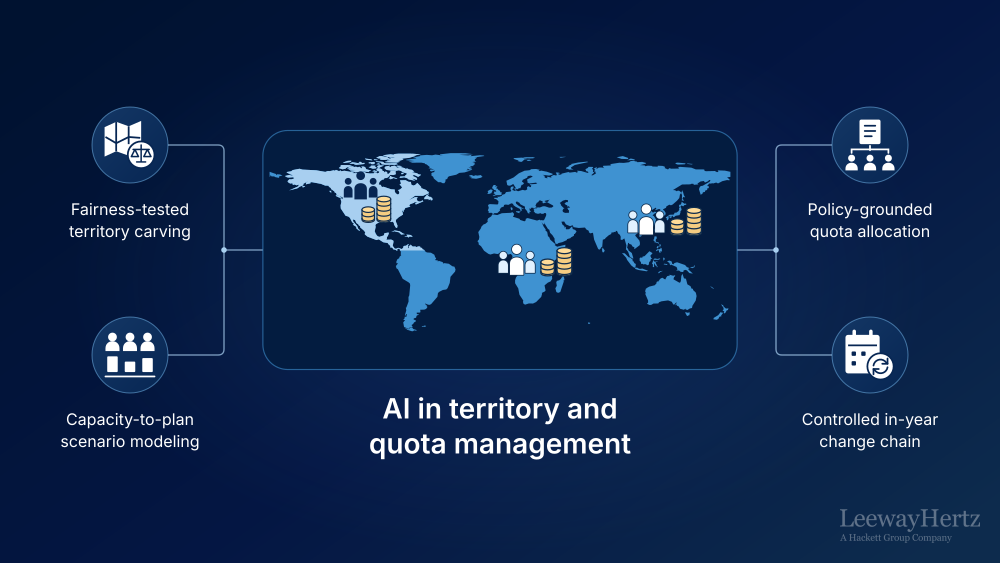
Territory and quota management is the planning discipline that determines where a commercial organization focuses its selling capacity, how accounts are distributed, how much capacity is required, and how revenue expectations are translated into individual targets. Territory design establishes the unit of coverage. Quota planning translates the annual operating plan into measurable seller commitments. Capacity planning tests whether the organization has enough productive coverage to carry the plan. Crediting and compensation administration then determine how results are attributed and paid.
That operating lifecycle becomes difficult to manage as market conditions, account data, coverage, and organizational capacity change. Market potential varies by segment, geography, industry, install base, and product fit. Account data arrives from multiple systems and often contains duplicates or stale attributes. New hires ramp at different rates, attrition changes coverage, acquisitions redraw account ownership, and partner motions create overlay and channel-credit questions. A territory can look attractive in historical attainment data because it was historically well covered, while another can look weak because it inherited poor coverage. Treating either result as a clean measure of underlying potential can create a self-reinforcing allocation error.
The commercial cost of that complexity is visible in current sales research. Salesforce reported in its 2024 State of Sales [1] that 67% of sales representatives did not expect to meet quota, after 84% had missed quota the prior year, while representatives reported spending 70% of their time on non-selling tasks. The same research found only 35% of sales professionals completely trusted the accuracy of their organization’s data. These figures do not prove that territory or quota design caused missed targets, but they illustrate why commercial planning cannot rely on fragmented data and manual reconciliation alone.
The technology landscape is also moving from isolated analytics toward planning workflows that span territory design, quota planning, capacity scenarios, workflow, dispute resolution, and performance analytics. WorldatWork’s Sales Performance Management research [2], based on 457 participating organizations, identifies quota planning, territory optimization, compensation administration, analytics, and workflow as connected disciplines; 45% of participating firms reported using SPM-specific technology. Gartner’s 2026 Critical Capabilities research [3] similarly treats territory design and optimization, quota planning and management, scenario and capacity planning, workflow and dispute resolution, and pay-performance analytics as distinct capabilities within sales performance management.
That is why the operating model matters. Territory and quota planning is not one automation problem. It spans several interconnected activities. It is a linked sequence of market assessment, account scoring, territory carving, coverage rules, capacity modeling, quota allocation, crediting, compensation handoff, change management, and retrospective analytics. AI has a meaningful role where the work is evidence-heavy and judgment-intensive: it can aggregate records, resolve duplicates, score opportunities, compare scenarios, detect allocation outliers, reconcile top-down and bottom-up plans, retrieve policy, draft governance packets, and route exceptions. AI in territory and quota management helps planning teams connect fragmented data, reconcile planning assumptions, compare scenarios, and prepare review-ready decisions across the territory and quota lifecycle while preserving human accountability. Designated human roles must still approve territory boundaries, quotas, crediting decisions, compensation interpretation, and material changes.
This article therefore maps territory and quota management from function to process to sub-process and identifies where specific AI capabilities can change the work without displacing accountable decision owners. The scope is deliberately bounded to the territory and quota planning lifecycle: annual and mid-year planning, sizing, carving, capacity, quota, crediting, plan handoff, and performance analytics. In-quarter forecast management, account-level engagement strategy, day-to-day CRM hierarchy administration beyond territory objects, and the broader sales operations charter remain adjacent disciplines rather than part of this operating model.
- How AI is transforming territory and quota management operations
- Why AI use cases in territory and quota management must be mapped at the sub-process level
- Territory and quota management operating model and AI opportunity mapping across functions
- High-value AI use cases in territory and quota management
- How agentic AI works in territory and quota management workflows
- How to prioritize AI use cases in territory and quota management
- Governance, risk, and responsible AI in territory and quota management
- How ZBrain operationalizes AI use cases in territory and quota management
- Future of AI in territory and quota management
How AI is transforming territory and quota management operations
Territory and quota planning becomes difficult when the planning team is asked to reconcile market opportunity, account identity, seller capacity, revenue targets, compensation policy, and organizational change on a compressed calendar. Each input may be valid in isolation but still produce a poor plan when the assumptions do not line up. The operating challenge is therefore less about generating another forecast and more about maintaining a coherent planning chain.
The work also has a distinctive mix of data-heavy and judgment-heavy steps. Account records need enrichment and identity resolution. Territory models need balancing and scenario comparison. Capacity plans need ramp and attrition assumptions. Quota allocation needs a bridge between executive targets and bottom-up potential. Crediting rulesrequire policy interpretation. Mid-year changes demand a before-and-after record. AI is useful when it can do the comparative work around those decisions without becoming the decision owner.
This work typically falls into several recognizable categories where AI can support preparation, analysis, and workflow execution without taking over the underlying decision:
- Data-heavy work: TAM/SAM/SOM models, account scoring outputs, named account lists, territory definitions, attainment records, capacity models, headcount plans, and quota worksheets can be enriched, reconciled, and checked for duplicates, stale attributes, missing values, and inconsistent assumptions.
- Scenario-heavy work: Territory carving models, territory balancing workbooks, capacity scenarios, quota allocation models, and mid-year rebalancing proposals can be compared against potential, workload, coverage, capacity, and approved planning constraints.
- Exception-heavy work: Territory outliers, quota-to-potential dispersion, coverage gaps, unusual attainment patterns, disputed account transfers, quota appeals, crediting conflicts, and proposed territory changes can be detected, classified, and prioritized for human review.
- Knowledge-heavy work: ICP definitions, territory and quota policies, rules of engagement, ramp assumptions, quota relief policies, crediting rules, and compensation requirements can be retrieved and applied to the relevant planning step while surfacing conflicting assumptions or missing policy inputs.
- Workflow-heavy work: Annual planning, quota allocation, quota acceptance, territory transfers, crediting changes, approval workflows, and mid-year rebalancing can benefit when AI maintains context across steps and assembles the relevant review, exception, and approval packet.
In practice, AI should support the analytical work by preparing information, identifying patterns, comparing scenarios, reconciling assumptions, retrieving approved policy, and drafting review-ready outputs. Decisions, approvals, allocation judgments, compensation decisions, exceptions, and controlled changes to the planning state remain with the appropriate accountable roles.
In 2026, this direction is no longer theoretical. Gartner [4] describes sales operations as needing to adapt to AI-driven technology and decision-driven analytics, while its 2026 sales performance management research identifies territory design and optimization, quota planning, scenario and capacity planning, workflow and dispute resolution, and pay-performance analytics as distinct capabilities. Salesforce reports [5] that nine in ten sales teams use AI agents or expect to within two years, with agents being deployed across the sales process from planning to quoting.
This signals a broader shift toward AI-supported sales operations, including planning workflows where teams must coordinate data, scenarios, approvals, and execution. For territory and quota management, this does not mean every planning task needs an agent. It points instead to an opportunity to apply AI selectively across data-intensive, exception-heavy planning workflows while preserving human accountability for allocation and compensation decisions.
Why AI use cases in territory and quota management must be mapped at the sub-process level
Territory and quota programs often start with broad labels such as territory planning, quota planning, capacity planning, quota allocation, or territory optimization. These labels are useful for defining an AI strategy, but they are too broad for reliable workflow design. For example, territory planning can mean selecting a territory model, balancing potential and workload, testing allocation fairness, assigning house accounts, or resolving an ownership dispute. Quota planning can mean decomposing the annual operating plan, applying ramp relief, reconciling territory potential, approving an exception, or issuing a quota sheet. Each activity has different inputs, outputs, artifacts, systems, reviewers, and consequences.
A better approach is to map AI use cases to the territory and quota operating model:
- Function: A governed operational domain in the territory and quota lifecycle, such as market assessment, territory design and carving, capacity planning, or quota setting and allocation.
- Process: A workflow area within a function, such as territory balancing, top-down quota decomposition, quota relief, or territory change management.
- Sub-process: The atomic work activity where a specific artifact or dataset is prepared, compared, scored, reconciled, routed, or reviewed, such as duplicate account reconciliation, territory potential comparison, quota-to-potential variance review, or quota appeal preparation.
- AI-enabled opportunity: A specific AI capability applied to a specific territory or quota artifact or dataset to change how the work is prepared, analyzed, compared, routed, or evidenced while a designated role retains the decision.
This level of mapping matters because territory and quota decisions are not interchangeable. An account identity exception has a different review boundary from a territory carve. A quota-to-potential outlier has a different escalation path from a quota appeal. A crediting-rule interpretation requires different evidence from a capacity-model assumption review. The artifacts, systems, controls, and accountable roles change with the sub-process.
For example, AI in territory design is not the same as AI in quota allocation. In territory design, scenario comparison can evaluate alternative carving models against potential, workload, coverage, and approved constraints, while anomaly detection can flag patches that breach an approved dispersion threshold. In quota allocation, AI can reconcile top-down AOP targets with bottom-up territory potential, retrieve approved quota policies, and prepare an exception packet for review. The underlying capabilities, artifacts, and reviewers differ.
The same principle applies across the wider lifecycle. AI can enrich and reconcile account records, compare territory scenarios, identify capacity gaps, reconcile quota assumptions, retrieve applicable crediting policies, detect allocation outliers, prepare quota acceptance packets, and assemble evidence for governed mid-year changes. The use case becomes buildable only when the trigger, artifact, system, AI capability, output, reviewer, and decision boundary are known. This keeps the technology useful by separating recommendation, preparation, and analysis from authority.
Build governed AI workflows for territory and quota planning
Align market sizing, territory design, capacity planning, quota allocation, approvals, and in-year changes while preserving human accountability for allocation and compensation decisions.
Territory and quota management operating model and AI opportunity mapping across functions
The operating model below maps territory and quota management across the planning lifecycle, from market sizing and account assessment through territory design, coverage and capacity planning, quota allocation, crediting, compensation handoff, in-year change management, and performance analytics. Each function is broken into processes and sub-processes to show where specific AI capabilities can support preparing, analyzing, comparing, routing, and reviewing planning work.
The model treats these activities as an annual and mid-year planning discipline within the broader revenue operations charter, while keeping decision rights with the roles accountable for allocation, compensation, approvals, and controlled plan changes.This structure helps organizations evaluate each AI opportunity in the context of the artifacts, systems, reviewers, and decision boundaries involved, rather than approaching territory or quota planning as a single automation problem.
Function 1: Market assessment and sizing
Market assessment establishes the addressable commercial opportunity before account lists or territories exist. It defines the market universe, refreshes the ideal customer profile, sets segmentation logic, and tests how competitive density and install-base patterns change the shape of the opportunity.
Teams involved: VP of revenue operations, sales planning, sales strategy, GTM strategy, FP&A, marketing strategy, segment sales leadership, data/analytics teams.
Key artifacts: TAM/SAM/SOM model workbook, ICP definition document, segmentation taxonomy, market-sizing assumptions, competitive density analysis, prior-cycle market assessment.
Systems involved: CRM and account master, data warehouse/lakehouse, external firmographic and technographic data providers, BI/planning workspace, product and install-base data repositories.
Regulatory and control considerations: GDPR/CCPA where account or contact enrichment includes personal information, SOC 2 controls for hosted planning data and access, documented assumptions for material market-sizing inputs.
Accountable roles: VP of revenue operations owns the operating frame, sales planning manager owns planning methodology, sales strategy analyst prepares analyses, segment VPs review and challenge the underlying assumptions, FP&A provides financial alignment.
What AI helps with: Multi-source aggregation, entity resolution, classification, scoring, scenario modeling, and natural-language generation can bring market data together, identify changes to the ICP, compare segmentation assumptions, and prepare planning-ready market narratives.
What humans continue to own: Leaders own the definition of the market, ICP policy, segmentation choices, commercial assumptions, and final decision on where the organization intends to compete.
| Process | Sub-process | AI-enabled opportunities |
|---|---|---|
| Market sizing | TAM/SAM/SOM construction |
|
| ICP definition and refresh | ICP profile refresh |
|
| Market segmentation | Segmentation design |
|
| Competitive and opportunity mapping | Competitive density analysis |
|
Highest-value AI opportunities: ICP refresh, market-cell scenario modeling, and competitive-density analysis are the strongest early AI opportunities because errors at these stages propagate into every downstream account, territory, and quota decision.
Example agentic workflow: Market sizing and ICP refresh
- Trigger artifact: The annual planning cycle opens and the prior TAM/SAM/SOM workbook is released as the comparison baseline.
- Agent role: The workflow aggregates approved internal and external market inputs, compares the current ICP definition with the prior version, and highlights material shifts.
- Human checkpoint: The sales planning manager reviews the proposed assumptions and segment changes; segment leaders challenge the commercial interpretation.
- Handoff and evidence: Approved market assumptions become controlled inputs to account-universe construction, with the prior and new versions retained.
Function 2: Account universe construction and scoring
Account-universe construction turns market definitions into an operational population that can be assigned, scored, and governed. The discipline depends on identity quality because a single duplicate or stale account record can distort potential, ownership, and quota assumptions downstream.
Teams involved: Revenue operations, sales strategy, sales planning, data engineering, marketing operations, sales development, account management, segment sales leadership.
Key artifacts: Account scoring model output file, named account list, account master, enrichment specifications, deduplication rules, whitespace and install-base opportunity maps.
Systems involved: CRM; customer master/MDM, data warehouse, firmographic and technographic enrichment sources, product/install-base systems, BI and scoring environments.
Regulatory and control considerations: GDPR/CCPA for personal data used in enrichment and profiling, SOC 2 for data access and workflow security, data-retention and correction controls for inaccurate account records.
Accountable roles: Sales strategy analyst owns scoring analysis, VP of revenue operations owns account-universe policy, sales planning manager owns planning use of the output, segment leaders validate named-account priorities.
What AI helps with: Entity resolution can deduplicate records, classification can normalize attributes, predictive scoring can rank propensity and whitespace, and summarization can produce exception narratives around uncertain accounts.
What humans continue to own: Teams own the approved account definition, eligibility rules, scoring factors, specific-account decisions, and material exceptions. AI does not decide strategic account ownership on its own.
| Process | Sub-process | AI-enabled opportunities |
|---|---|---|
| Account data enrichment | Firmographic enrichment |
|
| Deduplication and identity resolution | Account matching |
|
| Propensity and opportunity scoring | Propensity-to-buy scoring |
|
| Whitespace and install-base mapping | Opportunity mapping |
|
Highest-value AI opportunities: Entity resolution and propensity/whitespace scoring create the strongest leverage because territory design depends on having an accurate and well-assessed account base.
Example agentic workflow: Account universe construction and scoring
- Trigger artifact: The approved market assessment and ICP refresh release the account universe build for the planning cycle.
- Agent role: The workflow enriches records, resolves duplicates, scores accounts, and assembles a proposed named-account list with exception flags.
- Human checkpoint: The sales strategy analyst reviews uncertain matches and scores, segment leaders approve strategic assigned accounts.
- Handoff and evidence: The approved account universe becomes the controlled input to territory design, with the scoring model version and exceptions retained.
Function 3: Territory design and carving
Territory design converts account potential and workload into a set of patches that can be covered by the available commercial organization. The design must balance economic opportunity with realistic workload and must distinguish equity from simple equality.
Teams involved: Sales planning, revenue operations, segment sales leaders, sales strategy, finance/FP&A, first-line sales managers, data/analytics teams.
Key artifacts: Territory definition file, territory balancing workbook, potential and workload indices, territory carve scenarios, fairness analysis, holdout and house-account designations.
Systems involved: CRM territory management/enterprise territory management records, planning workspace, BI, account scoring model, geographic reference data, capacity model.
Regulatory and control considerations: EEOC-adjacent fairness expectations when AI influences earning opportunity, SOC 2, documented allocation factors, approved territory policies, audit trail for material carve decisions.
Accountable roles: Sales planning manager owns territory methodology, VP of revenue operations governs the operating model, segment VPs approve patches, CRO resolves material disputes.
What AI helps with: Scenario modeling and optimization can compare candidate carves against potential, workload, geographic continuity, and coverage constraints. Anomaly detection can flag outlier patches and explain dispersion.
What humans continue to own: Humans decide territory philosophy, model selection, boundary acceptance, house accounts, holdouts, fairness tolerance, and disputed patches. AI can recommend and test allocation options, while the final allocation decision remains with the accountable business owner.
| Process | Sub-process | AI-enabled opportunities |
|---|---|---|
| Territory model selection | Geographic, vertical, and named-account model comparison |
|
| Territory balancing | Potential and workload balancing |
|
| Fairness testing | Gini and dispersion analysis |
|
| House accounts and holdout management | Exception identification and classification |
|
Highest-value AI opportunities: Territory scenario modeling and fairness-tested balancing are the strongest first projects because they expose trade-offs that are difficult to see in a single spreadsheet view but remain straightforward for planners to review.
Example agentic workflow: Fairness-tested territory design
- Trigger artifact: The approved account universe and capacity assumptions are released to the territory-planning workspace.
- Agent role: The workflow compares alternative carving models, proposes balanced patches, runs deterministic dispersion calculations, and identifies outliers.
- Human checkpoint: The sales planning manager reviews the scenario set, segment VPs approve or contest individual patches, and material disputes escalate to the CRO.
- Handoff and evidence: Approved territory definitions update the territory-management record, while scenario versions, fairness statistics, and decisions are retained.
Function 4: Coverage model and rules of engagement
Coverage design defines which roles are responsible for each account and how responsibilities are assigned when multiple roles share coverage. It must make roles, overlays, channel participation, partner boundaries, and dispute resolution explicit before quota and crediting are finalized.
Teams involved: Revenue operations, sales planning, sales management, sales development, overlay teams, channel/partner operations, account management, legal/compliance where disputes affect agreements.
Key artifacts: Rules of engagement document, coverage model, role map, partner territory alignment, ownership dispute log, escalation records.
Systems involved: CRM ownership and role objects, partner management systems, workflow/approval system, territory records; customer/account master.
Regulatory and control considerations: Internal ROE policy, commission plan governance, applicable employment/commission agreement requirements where ownership affects earnings, Robinson-Patman adjacency where channel territory pricing conflicts arise.
Accountable roles: VP of revenue operations owns the coverage architecture, first-line sales managers provide feedback, channel/partner operations manager owns partner alignment, CRO adjudicates material cross-segment conflicts.
What AI helps with: Document intelligence can compare ROE versions, classification can apply ownership rules to cases, recommendation engines can propose routing for ambiguous accounts, and retrieval-grounded answering can ground dispute handling in approved policy.
What humans continue to own: Designated sales and partner leaders own the final ownership rule, dispute disposition, exceptions, and any interpretation that changes earning opportunity or contractual position.
| Process | Sub-process | AI-enabled opportunities |
|---|---|---|
| Role coverage mapping | AE, SDR, overlay, and channel coverage |
|
| Rules of engagement administration | ROE interpretation |
|
| Partner territory alignment | Channel and partner alignment |
|
| Ownership dispute resolution | Dispute triage |
|
Highest-value AI opportunities: ROE retrieval and dispute triage create high value because they reduce the effort required to interpret recurring policy patterns while preserving the human authority to resolve exceptions.
Example agentic workflow: Rules of engagement and ownership dispute resolution
- Trigger artifact: An account ownership dispute enters the planning or CRM workflow.
- Agent role: The workflow retrieves the relevant ROE, gathers account history and current territory assignments, classifies the dispute, and prepares the evidence packet.
- Human checkpoint: The first-line sales manager reviews the proposed disposition; unresolved or material earning-impact disputes escalate to revenue operations or the CRO.
- Handoff and evidence: The approved disposition updates the ownership workflow and retains the rule reference, facts considered, decision, and effective date.
Function 5: Capacity planning
Capacity planning tests whether the commercial organization has enough productive coverage to support the revenue plan. The analysis must account for ramp, productivity, attrition, backfill timing, role mix, and open requisitions rather than equating headcount with productive capacity.
Teams involved: Sales planning, revenue operations, FP&A, HR business partner, sales leadership, recruiting/workforce planning, finance business partners.
Key artifacts: Capacity model workbook, ramp curves, attrition assumptions, productivity-per-rep baselines, headcount plan, open requisitions, hiring calendar.
Systems involved: HRIS; workforce planning/recruiting systems, CRM attainment history, planning workspace, BI, compensation records where ramp assumptions affect incentives.
Regulatory and control considerations: HR governance over workforce decisions, SOC 2 for workforce and planning data, employment-law considerations where AI influences workforce opportunity; documented assumptions and approval controls for material headcount plans.
Accountable roles: Sales planning manager owns the capacity model, FP&A validates financial implications, HR business partner governs headcount process, segment VPs approve role requirements, CRO owns strategic capacity choices.
What AI helps with: Predictive analytics can model ramp and attrition scenarios, scenario modeling can compare headcount plans, anomaly detection can flag unrealistic productivity assumptions, and reconciliation can bridge capacity supply to revenue demand.
What humans continue to own: Leaders decide hiring levels, role mix, timing, productivity assumptions, ramp policy, and acceptable capacity risk. AI provides scenarios and flags; it does not authorize hiring or termination.
| Process | Sub-process | AI-enabled opportunities |
|---|---|---|
| Headcount and role modeling | Headcount plan construction |
|
| Ramp and productivity modeling | Ramp capacity modeling |
|
| Capacity scenario planning | Attrition impact modeling |
|
| Productivity baseline development | Baseline calibration |
|
Highest-value AI opportunities: Ramp and capacity scenario modeling is the strongest first project because it prevents the common planning error of treating a seat as immediately productive capacity.
Example agentic workflow: Capacity scenario planning
- Trigger artifact: FP&A and HR release the approved revenue targets, headcount requisitions, ramp assumptions, and attrition policy.
- Agent role: The workflow builds alternative capacity scenarios, compares productive capacity with target coverage, and flags material gaps.
- Human checkpoint: Sales planning and FP&A review the scenarios, HR validates hiring assumptions, and segment leaders select the operating plan.
- Handoff and evidence: The approved capacity scenario becomes a controlled input to quota allocation, with assumptions and approvals retained.
Accelerate AI Solutions Development
Build fully functional solutions from your high-value use cases, based on specific operational needs and enterprise context.
Function 6: Quota setting and allocation
Quota setting converts the annual operating plan into measurable commitments while reconciling executive targets with bottom-up territory potential. It is the central governance point in the operating model because allocation choices affect revenue guidance, seller expectations, compensation, and perceptions of fairness.
Teams involved: Sales planning, revenue operations, sales compensation, CRO, VP of sales/segment leaders, FP&A, HR business partner, sales strategy analyst, first-line managers.
Key artifacts: Annual operating plan revenue targets, quota allocation worksheet, individual quota sheet with acceptance signature record, quota policy, territory balancing workbook, capacity model, seasonality plan, contest log.
Systems involved: FP&A/planning workspace, CRM territory records, account scoring outputs, BI, HRIS, compensation planning and administration systems, approval/workflow repository.
Regulatory and control considerations: SOX where quota and plan governance feeds revenue guidance, California Labor Code §2751 and applicable state commission-agreement requirements, New York Labor Law §191-c and applicable commission payment requirements, state wage-and-hour rules concerning earned commissions and clawbacks, WorldatWork sales compensation practice standards, EEOC-adjacent fairness expectations.
Accountable roles: Sales planning manager prepares allocation, segment VPs approve or contest patches, CRO adjudicates material disputes, FP&A validates top-down alignment, sales compensation manager validates downstream plan alignment, HRBP and legal support governance.
What AI helps with: Multi-source aggregation, policy-grounded retrieval, scenario modeling, optimization, reconciliation/variance analysis, anomaly detection, and natural-language generation can assemble a quota packet, compare candidate allocations, flag outliers, and draft rationale while preserving approval checkpoints.
What humans continue to own: The sales planning manager owns the recommended allocation, segment VPs and the CRO own approval or challenge, sales compensation and HR/legal own plan and agreement interpretation. AI does not approve quotas, change commission terms, or waive policy.
| Process | Sub-process | AI-enabled opportunities |
|---|---|---|
| Top-down plan decomposition | AOP target-to-quota allocation |
|
| Bottom-up potential reconciliation | Quota-to-potential alignment |
|
| Policy application | Quota policy application |
|
| Fairness and approval | Dispersion and outlier review |
|
| Individual quota issuance | Quota sheet preparation and acceptance |
|
Highest-value AI opportunities: Policy-grounded quota allocation is the flagship use case. It brings together the AOP target, territory potential, capacity assumptions, quota policy, fairness statistics, approval workflow, sales representative acceptance, and retained evidence in one governed packet.
Example agentic workflow: Quota allocation and approval
- Trigger artifact: FP&A publishes the approved annual operating plan revenue targets to the planning workspace.
- Agent role: The workflow aggregates territory definition files, account scoring outputs, three years of attainment history by patch, capacity-model ramp assumptions, and open HR requisitions.
- Policy retrieval: Retrieval-grounded answering brings in the approved over-assignment percentage, new-hire ramp relief schedule, and seasonality phasing rules.
- Recommendation packet: The workflow prepares proposed per-territory quotas, potential-based rationale, deterministic fairness statistics, outlier flags, and the top-down-versus-bottom-up bridge.
- Human checkpoint: The sales planning manager reviews, segment VPs approve or contest patches, and contested patches escalate to the CRO with the fairness analysis attached.
- Handoff and evidence: Approved quotas generate individual quota sheets routed for sales representative acceptance, and the quota packet, contest log, approvals, and acceptance records are archived as plan-governance evidence.
Function 7: Crediting and hierarchy administration
Crediting determines how revenue is attributed when multiple roles, overlays, channels, or teams participate. Territory hierarchy administration ensures the approved account-to-territory model is represented correctly in the system of record without turning deterministic CRM maintenance into an AI problem.
Teams involved: Sales compensation, revenue operations, CRM/territory administration, channel/partner operations, sales planning, sales leadership.
Key artifacts: Crediting rules matrix, territory definition file, account-to-territory assignment run, role hierarchy, split/overlay/channel-credit rules, exception log.
Systems involved: CRM territory management/enterprise territory management, compensation administration, data warehouse, workflow/approval repository.
Regulatory and control considerations: Commission agreement terms, state rules on earned commissions and payout timing, SOX controls where crediting affects reported revenue or plan governance, SOC 2 for access to compensation and territory records.
Accountable roles: Sales compensation manager owns crediting policy, VP revenue operations owns territory hierarchy, channel/partner operations manages channel rules, CRM administrators execute approved updates.
What AI helps with: Retrieval-grounded answering can apply the approved crediting matrix to cases, classification can route exceptions, validation can compare hierarchy states, and anomaly detection can identify conflicting assignments.
What humans continue to own: Humans own crediting policy, split interpretation, exception approval, and system-of-record changes that materially affect pay or ownership.
| Process | Sub-process | AI-enabled opportunities |
|---|---|---|
| Crediting rule definition | Split credit assignment |
|
| Overlay and channel crediting | Overlay crediting |
|
| Hierarchy maintenance | Territory and role hierarchy administration |
|
| Account assignment runs | Account-to-territory assignment |
|
Highest-value AI opportunities: Hierarchy validation and crediting-exception triage are the most valuable opportunities because both can be controlled tightly and can prevent downstream compensation disputes without allowing AI to change the underlying rules.
Example agentic workflow: Territory hierarchy update and validation
- Trigger artifact: An approved territory definition or crediting-rule change creates a controlled assignment run.
- Agent role: The workflow validates identifiers, compares the proposed hierarchy with the approved state, and prepares an exception list.
- Human checkpoint: Sales compensation or revenue operations team reviews exceptions and authorizes the update.
- Handoff and evidence: The approved hierarchy state is written to the system of record, with before-and-after snapshots and approval evidence retained.
Function 8: Compensation plan handoff
Compensation handoff turns the approved quota and crediting architecture into a seller-facing plan. The objective is not simply to generate documents, but to ensure that the quota sheet, payout mechanics, role eligibility, accelerators, SPIF interaction, and written agreement are internally consistent.
Teams involved: Sales compensation, revenue operations, HR business partner, general counsel delegate, sales planning, sales leadership, payroll/commission administration.
Key artifacts: Individual quota sheet; acceptance signature record; comp plan document, pay-mix and accelerator schedules, SPIF documentation, commission agreement, issuance tracker.
Systems involved: Compensation administration platform, HRIS, payroll, document/e-signature repository, planning workspace, CRM territory records.
Regulatory and control considerations: California Labor Code §2751 written commission agreements, New York Labor Law §191-c and related commission-payment provisions where applicable, state wage-and-hour rules, SOX controls where compensation governance affects financial reporting, internal approval policy.
Accountable roles: Sales compensation manager owns the plan handoff, HRBP governs employee-process alignment, general counsel delegate reviews agreement compliance, sales planning validates quota source data.
What AI helps with: Document intelligence can compare plan artifacts, validation can detect mismatches between quota and compensation inputs, natural language generation can prepare personalized explanations, and workflow automation can route acceptance records.
What humans continue to own: Sales compensation owns plan terms and interpretation, legal owns agreement review, HR owns employment-process governance, managers and representatives own acceptance and acknowledgment actions.
| Process | Sub-process | AI-enabled opportunities |
|---|---|---|
| Quota sheet issuance | Personalized quota sheet generation |
|
| Compensation plan alignment | Pay mix and accelerator alignment |
|
| Acceptance tracking | Sales representative review and acceptance |
|
| Agreement compliance | Written commission agreement review |
|
Highest-value AI opportunities: Plan-document consistency and acceptance tracking are the clearest first projects because they connect approved quota data to the seller-facing plan while preserving a clean evidence chain.
Example agentic workflow: Compensation plan handoff and acceptance
- Trigger artifact: A quota patch reaches approved status and the plan-handoff queue opens.
- Agent role: The workflow validates quota and crediting inputs, checks the applicable compensation plan, prepares the individualized quota sheet, and routes it for acceptance.
- Human checkpoint: Sales compensation reviews exceptions, the general counsel delegate handles legal exceptions, and managers address seller-specific issues.
- Handoff and evidence: Accepted documents are stored with the plan version and effective date, while rejected or contested versions remain linked to the approval record.
Function 9: In-year territory and quota change management
In-year change management governs the exceptions that occur after the planning cycle is live. Sales representative departure, acquisition, segmentation changes, territory moves, pipeline transfers, and quota relief can all alter the economic position of a territory and must be managed as controlled changes rather than informal CRM edits.
Teams involved: Revenue operations, sales planning, sales compensation, segment sales leaders, first-line sales managers, channel/partner operations, HR business partner, FP&A where financial impact is material, legal where agreement terms are affected.
Key artifacts: Account transfer request form, change request, before-and-after territory definition, pipeline migration record, quota adjustment worksheet, approval record, rep communication, exception log.
Systems involved: CRM, territory management, pipeline/opportunity systems, HRIS, compensation administration, planning workspace, workflow/approval repository.
Regulatory and control considerations: Commission agreement requirements, state wage-and-hour and earned-commission rules, SOX governance where revenue guidance or control evidence is affected, EU works council consultation requirements where applicable, internal change policy.
Accountable roles: Sales planning manager governs rebalancing, sales compensation manager governs quota adjustment, first-line managers provide facts, segment VPs approve changes, CRO resolves material disputes, HRBP and legal support employee-process requirements.
What AI helps with: Trigger monitoring can detect change events, entity resolution can identify affected accounts, pipeline analytics can map open opportunities, scenario modeling can test quota impacts, and workflow automation can assemble the approval packet.
What humans continue to own: Humans decide whether a change is material, whether a territory should move, how quota relief applies, how pipeline is transferred, and when an exception is final.
| Process | Sub-process | AI-enabled opportunities |
|---|---|---|
| Change-trigger detection | Sales representative departure and acquisition impact assessment |
|
| Account and pipeline transfer | Pipeline transfer management |
|
| Quota adjustment | Quota relief and adjustment |
|
| Appeal and communication | Exception approval and seller communication |
|
Highest-value AI opportunities: Controlled change-chain automation is high value because it replaces a fragile set of handoffs with a single evidence packet while leaving material decisions with sales planning, sales compensation, sales leadership, and legal/HR as appropriate.
Example agentic workflow: In-year territory and quota change management
- Trigger artifact: A sales representative departure, acquisition, segmentation change, or other approved event is recorded.
- Agent role: The workflow identifies affected accounts and pipeline, retrieves the applicable change policy, models the quota impact, and prepares the before-and-after state.
- Human checkpoint: The sales planning manager and relevant segment VP review the change, sales compensation approves any quota adjustment, and material disputes escalate to the CRO.
- Handoff and evidence: Approved changes update the territory and quota records, communications are issued, and the full before-and-after state, rationale, approvers, and effective date are retained.
Function 10: Territory performance analytics
Performance analytics closes the planning loop by testing whether territories, quotas, and coverage behaved as intended. The objective is not merely to rank sales representatives, but to assess performance in the context of territory potential, quota, capacity, and other relevant operating factors. It is to determine whether the allocation model produced healthy coverage, reasonable dispersion, and useful lessons for the next cycle.
Teams involved: Sales planning, revenue operations, sales strategy, FP&A, sales compensation, segment VPs, first-line sales managers, data/analytics.
Key artifacts: Attainment distribution analysis, territory health score, fairness and dispersion report, quota-to-potential analysis, coverage-to-potential report, next-cycle retrospective.
Systems involved: CRM, BI/data warehouse, planning workspace, quota and compensation administration, territory management, account scoring outputs.
Regulatory and control considerations: SOX governance for plan-performance evidence where relevant, fairness and discrimination-risk review, SOC 2, documented metric definitions and versioned analytical logic.
Accountable roles: Sales planning manager owns the retrospective, sales strategy analyst produces analysis; segment VPs interpret commercial implications, FP&A challenges revenue alignment, sales compensation reviews payout implications.
What AI helps with: Distribution analysis, anomaly detection, pattern detection, scenario modeling, and natural-language generation can surface unusual attainment patterns, compare plan outcomes, and draft the next-cycle design narrative.
What humans continue to own: Leaders determine whether performance reflects territory potential, seller execution, capacity constraints, market change, or prior allocation effects, and decide which design changes carry into the next cycle.
| Process | Sub-process | AI-enabled opportunities |
|---|---|---|
| Attainment distribution analysis | Quota attainment dispersion |
|
| Territory health scoring | Coverage-to-potential utilization |
|
| Fairness and dispersion reporting | Quota-to-potential and coverage distribution |
|
| Next-cycle performance review | Planning improvement assessment |
|
Highest-value AI opportunities: Territory-health scoring and dispersion analysis turn the planning cycle into a feedback loop. They are particularly valuable when historical attainment needs to be separated from underlying potential before the next carve.
Example agentic workflow: Planning performance retrospective
- Trigger artifact: The quarter or annual cycle closes and the approved territory, quota, and attainment datasets are frozen for retrospective analysis.
- Agent role: The workflow calculates approved metrics, flags dispersion and coverage anomalies, compares outcomes with planning assumptions, and drafts the retrospective.
- Human checkpoint: Sales planning and segment leaders review the findings and decide which design changes are justified.
- Handoff and evidence: Approved lessons enter the next planning cycle as versioned design inputs, with the prior metrics and decisions retained.
Accelerate AI Solutions Development
Build fully functional solutions from your high-value use cases, based on specific operational needs and enterprise context.
High-value AI use cases in territory and quota management
High-value AI use cases in territory and quota management are not defined by model sophistication alone. They are the use cases where AI can address a recurring planning activity, work from reliable and reusable artifacts, produce an output that fits within a clearly defined human review boundary, and create measurable operational or economic value without introducing disproportionate risk. In this domain, the strongest opportunities typically sit where planning teams must reconcile multiple inputs, identify exceptions or inconsistencies, compare alternatives, and prepare decision-ready outputs.
A practical first project should therefore be evaluated across several dimensions: the frequency and volume of the work, the availability and quality of planning artifacts, the clarity of the accountable reviewer, the potential impact of an incorrect recommendation, and the strength of the business case. Governance readiness also matters. An AI use case becomes more suitable for production when its inputs are controlled, its recommendations can be challenged, and the resulting decision and evidence can be retained as part of the planning record.
This means that the most valuable use cases are not necessarily those that attempt to automate territory or quota decisions end to end. They are often narrower capabilities such as reconciling account and territory data, comparing capacity scenarios, identifying territory imbalance, retrieving approved quota policy, flagging allocation outliers, or preparing a review packet for human approval. This is consistent with the operating-model principle that AI prepares, compares, classifies, retrieves, reconciles, and drafts, while accountable planning and sales leaders retain ownership of allocation, approval, exceptions, and compensation decisions.
The use cases below therefore focus on opportunities that combine business impact with reviewability and governance, rather than simply demonstrating advanced AI capability.
| Use case | Function | How AI creates high-value impact |
|---|---|---|
| Policy-grounded quota allocation | Quota setting and allocation | AI brings the AOP target, territory potential, capacity assumptions, and approved quota policy into a single recommendation packet. It reduces reconciliation work and exposes outliers before human approval without allowing the model to approve the quota. |
| Fairness-tested territory carving | Territory design and carving | Scenario modeling makes trade-offs visible across potential, workload, geographic continuity, and dispersion. The value comes from evaluating multiple feasible carves consistently and giving planners an evidence-backed exception queue. |
| Account identity and scoring | Account universe construction and scoring | Entity resolution and predictive scoring improve the population on which every subsequent territory decision depends. Better identity and scoring reduce the chance that duplicate, stale, or misclassified accounts distort potential. |
| Capacity-to-plan scenario modeling | Capacity planning | Predictive analytics and scenario modeling make ramp, attrition, hiring timing, and productivity assumptions explicit. That gives FP&A and sales planning a common view of whether headcount is actually productive capacity. |
| ROE dispute triage | Coverage model and rules of engagement | Retrieval-grounded answering turns a recurring policy lookup into a structured evidence packet. Reviewers can spend time on interpretation and exceptions rather than searching policy documents and account history. |
| Controlled in-year change chain | In-year territory and quota change management | Trigger monitoring, entity resolution, pipeline analysis, and workflow automation keep the before-and-after state together. The value is not speed alone; it is preserving a reliable decision chain when ownership and quota move after the plan is live. |
| Plan-document consistency | Compensation plan handoff | Document intelligence and validation compare quota sheets with the controlled compensation plan and territory data. This reduces the risk of a seller receiving a document that does not match the approved plan state. |
| Crediting exception analysis | Crediting and hierarchy administration | Classification and anomaly detection focus compensation reviewers on the cases most likely to conflict with the approved crediting matrix, while deterministic hierarchy updates remain controlled system operations. |
| Territory health and dispersion retrospective | Territory performance analytics | AI identifies recurring patterns across attainment, coverage, potential, and plan changes. The high-value outcome is a better next-cycle design conversation that distinguishes structural territory effects from seller-performance effects. |
| Market and ICP refresh | Market assessment and sizing | Multi-source aggregation and pattern detection surface shifts in the target market and ICP before those assumptions propagate into account scoring, territory design, and quota planning. |
How agentic AI works in territory and quota management workflows
Agentic AI is most effective in territory and quota management when it operates within a defined, governed planning workflow rather than acting as an autonomous decision-maker. These workflows involve multiple artifacts, policies, analytical steps, and stakeholders, so the value of an agent comes from carrying the relevant context across those steps and preparing a consistent, traceable decision packet for review.
A typical workflow begins with a controlled planning event, such as an approved target change, territory update, or quota cycle. The agent gathers authoritative source records, retrieves the applicable planning policies, reconciles inputs, performs analysis or scenario comparison, identifies exceptions, and prepares the relevant planning artifact. A designated human then reviews, challenges, edits, approves, or rejects the recommendation before any change is made to the planning state.
The final step is equally important. Once approved, the output is written to the appropriate system of record, while the inputs, assumptions, exceptions, approvals, and before-and-after states are retained as evidence. This creates a repeatable pattern in which AI carries workflow context and analytical workload, while decision rights remain with accountable planning, sales, finance, compensation, and leadership roles. This trigger-to-handoff pattern is the intended agentic workflow structure for the domain.
Here are some example workflows:
Example agentic workflow: Territory carve and fairness review
- Trigger artifact: Approved account universe and capacity assumptions are released to the territory-planning workspace.
- Agent role: Candidate geographic, vertical, named-account, or hybrid carves are compared against potential and workload constraints, deterministic dispersion measures are calculated, and outliers are flagged.
- Human checkpoint: Sales planning reviews the scenario set, and segment VPs approve or contest individual patches.
- Handoff and evidence: Approved territory definitions update the territory-management record, while scenario versions, fairness results, exceptions, and approvals are retained.
Example agentic workflow: Quota allocation packet
- Trigger artifact: FP&A publishes the approved annual operating plan revenue targets.
- Agent role: The workflow aggregates and reconciles territory definitions, account scoring outputs, attainment history, capacity assumptions, requisitions, and applicable quota policy.
- Human checkpoint: The sales planning manager reviews the allocation; segment VPs approve or contest patches, and material disputes escalate to the CRO.
- Handoff and evidence: Approved quotas generate individual quota sheets and sales representative acceptance records, while the allocation packet and contest log are archived.
Example agentic workflow: Controlled in-year territory and quota changes
- Trigger artifact: A sales representative departure, acquisition, segmentation change, or policy-defined event is recorded.
- Agent role: The workflow identifies affected accounts, pipeline, territory state, and quota state, retrieves the applicable relief or rebalancing policy, and prepares a before-and-after proposal.
- Human checkpoint: Sales planning, sales compensation, and the relevant segment leader review the proposal, while material cases follow the defined escalation path.
- Handoff and evidence: Approved changes are applied to the system of record, communications are issued, and the effective state is retained.
Example agentic workflow: Territory performance retrospective
- Trigger artifact: The planning period closes, and approved territory, quota, attainment, and account-potential data are frozen.
- Agent role: The workflow calculates approved metrics, identifies dispersion and coverage anomalies, and explains material gaps between planning assumptions and actual outcomes.
- Human checkpoint: Sales planning and segment leaders determine which patterns indicate territory or quota design issues versus execution or market effects.
- Handoff and evidence: Approved lessons become versioned inputs to the next planning cycle, with the underlying metrics, analysis, and decisions retained.
The review boundary is the safety property. The workflow can gather, compare, score, reconcile, draft, and route, but allocation, crediting, compensation interpretation, and material plan changes remain decisions made by accountable commercial leaders and control functions.
How to prioritize AI use cases in territory and quota management
A planning team should start with a focused use case rather than the largest one. It should start with a sub-process where the artifact, reviewer, and evidence trail are already clear and where the AI can remove a meaningful amount of reconciliation or exception-handling work without making the underlying decision opaque.
| Criterion | What to ask |
|---|---|
| Volume and frequency | Does the sub-process recur often enough for AI support to remove meaningful manual reconciliation at scale? |
| Artifact availability | Are the relevant territory, account, quota, capacity, policy, and approval records available in usable systems with enough history and quality? |
| Review boundary | Can a named sales planning, sales compensation, sales leadership, finance, HR, or legal role verify the output before it changes a planning or earning outcome? |
| Blast radius | If the recommendation is wrong, does the error remain limited to a draft, scenario, exception queue, or reviewer packet rather than silently changing a live quota or crediting state? |
| Business impact | Can the use case be tied to better potential alignment, lower planning rework, stronger capacity utilization, fewer exceptions, clearer quota dispersion, or better plan governance? |
| Governance readiness | Are policy versions, approvals, change logs, and exception routes clear enough to keep the workflow auditable? |
The strongest first projects in this domain are usually the ones with a bounded artifact and a visible exception path: quota allocation packets, territory balancing, account identity resolution, ROE dispute triage, plan-document validation, and controlled in-year changes. Large end-to-end ambitions should follow after the evidence trail and review pattern are proven.
Governance, risk, and responsible AI in territory and quota management
AI in territory and quota management requires stronger governance because its recommendations can directly influence territory potential, seller workload, quota attainment expectations, compensation outcomes, and earning opportunity. The key risk is not simply model accuracy, but allowing an AI-generated recommendation to become an unreviewed planning decision.
A governed approach therefore establishes clear human decision boundaries, controlled planning inputs, fairness and dispersion checks, traceable approvals, and documented exception and appeal paths. Historical allocation bias and sensitive attributes also need to be considered where they could influence planning outcomes.
The objective is to make AI-supported planning reviewable, explainable, and auditable, while keeping allocation, quota, compensation, and material change decisions with the accountable business roles.
Human-in-the-loop oversight. AI may prepare market assessments, account scores, territory scenarios, quota recommendations, exception packets, and compensation-document checks. The accountable planning or control role must approve anything that changes territory, quota, crediting, compensation interpretation, or earning opportunity.
Regulatory and standards alignment. Account enrichment may involve personal data, making GDPR/CCPA relevant where applicable. California Labor Code §2751 requires a written commission contract for covered commission arrangements in California and requires a signed copy and receipt. New York Labor Law §191-c addresses payment of sales commissions for covered sales representatives.
Bias mitigation and evidence retention. Historical attainment is not the same thing as territory potential. A territory can outperform because it was well covered, or underperform because it inherited limited opportunity. Any AI scoring or allocation workflow using historical performance should separate those concepts and check for feedback loops. Where AI affects earning opportunity, organizations should document the factors used, run appropriate dispersion and adverse-impact reviews, and preserve the evidence that supports the final disposition. EEOC guidance and initiatives emphasize that AI-enabled employment practices remain subject to federal anti-discrimination laws.
Key governance requirements. Planning teams should maintain versioned territory definitions, quota policies, scoring logic, capacity assumptions, approval records, change histories, and exception routes. For high-impact workflows, the runtime record should show the source snapshot, policy version, model or workflow version, recommendation, reviewer changes, final decision, and system update.
Design principles. Use least-privilege access to account, employee, pipeline, and compensation data. Keep deterministic calculations deterministic. Do not train an allocation model on historical outcomes without testing whether historical allocation decisions already created the pattern being learned. Separate recommendation from approval, and separate planning analysis from the final compensation administration step.
Traceability and data security. NIST’s AI RMF Generative AI Profile provides a cross-sector risk-management reference for trustworthy AI. In a territory and quota workflow, the practical application is straightforward: govern the data, define the intended use, test output quality, document human oversight, and retain enough evidence to reconstruct material decisions.
Accelerate AI Solutions Development
Build fully functional solutions from your high-value use cases, based on specific operational needs and enterprise context.
How ZBrain operationalizes AI use cases in territory and quota management
Identifying high-value use cases is only the first step in territory and quota management. Territory and quota teams need a controlled way to analyze, design, build, validate, deploy, govern, and scale AI workflows across market sizing, account scoring, territory design, coverage and capacity planning, quota allocation, crediting, compensation plan handoff, in-year territory and quota changes, and performance analytics. The challenge is to connect these workflows without weakening the approval boundaries and evidence requirements that govern allocation and compensation decisions.
This is where ZBrain helps.
ZBrain is an end-to-end AI enablement platform that supports this lifecycle through four connected stages: ZBrain Analyzer, ZBrain Design, ZBrain Solution Builder, and ZBrain Governance. The platform provides a governed path from use-case analysis to deployed agentic workflows while maintaining policies, permissions, approval points, monitoring, and runtime evidence.
ZBrain Analyzer
ZBrain Analyzer helps territory and quota teams examine selected planning processes, identify AI opportunities, and document the business context, systems, data, artifacts, roles, planning policies, control requirements, decision boundaries, and review requirements needed to evaluate each use case.
ZBrain Design
ZBrain Design creates a build-ready technical design for the selected use case. It generates the business requirements document, functional requirements, user journeys, architecture, workflow logic, data specifications, integration context, approval points, and governance considerations needed before development begins. For territory and quota workflows, this design can define how planning inputs are reconciled, where policy retrieval occurs, which outputs require human review, and what evidence must be retained.
ZBrain Solution Builder
ZBrain Solution Builder enables teams to create, configure, and validate governed AI workflows for territory and quota management based on the technical design developed in ZBrain Design. It supports testing across planning, allocation, scenario comparison, exception, crediting, compensation handoff, in-year change, and performance-analysis scenarios before deployment.
ZBrain Governance
ZBrain Governance applies policies, access controls, human approval requirements, monitoring, and traceability throughout workflow execution. It provides guardrails, approval gates, escalation controls, kill switches, and audit trails to help organizations maintain oversight of AI-generated recommendations, planning assumptions, exceptions, quota and territory changes, reviewer actions, and authorized updates to the system of record.
Future of AI in territory and quota management
The next phase of AI in territory and quota management will move beyond spreadsheet assistance toward an orchestrated planning layer that connects the artifacts, assumptions, policies, and decisions that shape the planning cycle. Instead of rebuilding plans independently each cycle,, teams will increasingly work from linked account, market, territory, capacity, quota, and policy records, with AI helping reconcile differences, surface gaps, and prepare decision-ready planning outputs.
Over time, agentic workflows will connect decisions across the lifecycle rather than treating each planning activity as an isolated task. A material market change could initiate an ICP refresh, account-score recalculation, territory scenario comparison, capacity assessment, and quota-impact review. A sales representative departure could initiate an account and pipeline impact assessment, territory rebalancing proposal, quota-relief analysis, and controlled approval workflow. The value lies in preserving context as the change moves across functions, while keeping material allocation, compensation, and plan-change decisions with accountable human owners.
This evolution will also make planning traceability increasingly important. Each recommendation will need to be grounded in authoritative artifacts and approved policy, linked to the relevant planning state, and accompanied by the assumptions, exceptions, reviewer decisions, and effective changes that resulted from the workflow. That creates a stronger foundation for recurring planning cycles and for explaining why a territory or quota changed.
The long-term advantage, therefore, will come less from selecting a single sophisticated model and more from designing a disciplined operating workflow around AI. Organizations that define their artifacts, identifiers, planning policies, decision boundaries, exception paths, approval points, and evidence requirements will be better positioned to adopt more capable agentic systems while preserving control over territory, quota, and compensation decisions.
Endnote
Territory and quota management is not a single automation problem. It is a governed operating model spanning market assessment, account scoring, territory design, coverage, capacity planning, quota allocation, crediting, compensation handoff, in-year change management, and performance analytics. The practical unit of value is the sub-process where a specific AI capability can reduce reconciliation, analysis, exception-handling, or review effort while keeping the underlying decision with an accountable owner.
For planning teams, the strongest starting point is therefore a bounded, repeatable workflow supported by reliable artifacts, defined decision rights, and a visible review boundary. Quota allocation is a strong example because one governed workflow can connect the approved annual operating plan, territory potential, capacity assumptions, quota policy, fairness and dispersion analysis, approvals, individual quota sheets, and acceptance evidence. The same pattern can then extend to territory carving, account scoring, in-year territory and quota changes, and performance retrospectives.
The objective is not to remove judgment from territory and quota decisions. It is to give planning teams better context, faster analysis, stronger consistency, and a clearer evidence trail while preserving human ownership of material allocation, compensation, exception, and plan-change decisions. Fairness and dispersion controls, approval records, appeal paths, and versioned policy assumptions should remain part of that operating design.
Design governed AI workflows that connect market assessment, territory design, capacity planning, quota allocation, crediting, compensation handoff, and controlled in-year changes. Contact the ZBrain team!
Author’s Bio


Akash's ability to build enterprise-grade technology solutions has garnered the trust of over 30 Fortune 500 companies, including Siemens, 3M, P&G, and Hershey's. Akash is an early adopter of new technology, a passionate technology enthusiast, and an investor in AI and IoT startups.
Related Products

AI Agent
Discover the right AI agent for your use case! Explore our extensive range of AI agents tailored to tackle specific challenges.
Start a conversation by filling the form
Once you let us know your requirement, our technical expert will schedule a call and discuss your idea in detail post sign of an NDA.
All information will be kept confidential.
FAQs
What is AI in territory and quota management?
AI in territory and quota management uses AI capabilities such as entity resolution, scenario modeling, anomaly detection, retrieval, validation, and workflow automation to support planning activities. It helps teams prepare, compare, reconcile, and route planning work while keeping territory, quota, and compensation decisions with accountable human roles.
How does AI support territory design?
AI can compare geographic, vertical, named-account, and hybrid carving models, propose candidate balances, and flag outlier patches using potential, workload, coverage, and dispersion measures. Humans still decide the territory philosophy, boundaries, holdouts, house accounts, and disputed patches.
How can AI make quota allocation more defensible?
AI can make quota allocation more defensible by bringing the relevant planning evidence into a structured, reviewable allocation packet. A governed workflow can reconcile approved AOP targets with territory potential, capacity assumptions, attainment history, quota policy, and fairness analysis, while flagging outliers for review.
The key benefit is traceability: reviewers can see the evidence and assumptions behind each recommendation, while approvals, challenges, and final decisions are retained as part of the planning record.
Can AI make territory and quota planning decisions automatically?
AI can support territory and quota planning by analyzing market and account data, assessing capacity, generating territory and quota scenarios, identifying imbalances and exceptions, and preparing recommendations for review. However, decisions that affect territory ownership, quota allocation, crediting, compensation, or material in-year changes should remain subject to defined human review and approval. Sales Planning, sales leadership, finance, sales compensation, HR, and other designated roles retain accountability for the final decisions based on their responsibilities.
How should organizations evaluate fairness in AI-assisted territory and quota planning?
Organizations should assess fairness across the data, assumptions, allocation logic, and resulting territory and quota decisions. This can include reviewing account and market-potential data for bias or gaps, comparing territory potential and workload, testing quota-to-potential and coverage-to-potential ratios, and using measures such as variance, coefficient of variation, or Gini coefficient where appropriate. Teams should also examine whether factors such as historical attainment, account mix, territory maturity, or rep tenure are unintentionally influencing outcomes. Material outliers and exceptions should be reviewed by designated business leaders, with the assumptions, thresholds, rationale, and final human decisions retained for audit and future planning cycles.
What data is needed for AI-driven territory and quota planning?
A strong foundation includes account master data, firmographic and technographic attributes, territory definitions, territory potential, workload assumptions, historical attainment, capacity and ramp assumptions, HRIS requisitions, quota policy, crediting rules, compensation plan data, and approval records. Common identifiers across these artifacts matter as much as the individual datasets.
Where should a planning team start with AI?
The team should start with one bounded sub-process where the trigger, source artifacts, reviewer, output, and evidence trail are clearly defined. Good starting points include quota allocation packet preparation, territory balancing, account identity resolution, plan-document validation, and controlled in-year change workflows because these activities are recurring, artifact-rich, and suited to structured human review.
Why is human oversight especially important in quota and territory AI?
Human oversight is critical because territory and quota decisions can affect account ownership, seller workload, earning opportunity, and compensation. AI can analyze inputs, identify patterns, and prepare recommendations, but accountable human roles must review material exceptions and approve the final allocation or change.
This ensures that AI supports the planning process without becoming the decision maker.
How does ZBrain support AI in territory and quota management?
ZBrain provides an end-to-end AI enablement platform for territory and quota management teams to identify, design, validate, deploy, govern, and scale AI workflows across market assessment, account scoring, territory design, coverage and capacity planning, quota allocation, crediting, compensation plan handoff, in-year changes, and performance analytics.
- ZBrain Analyzer: Helps teams examine selected territory and quota processes, identify AI opportunities, and document the business context, systems, data, artifacts, roles, planning policies, decision boundaries, and review requirements needed to evaluate each use case.
- ZBrain Design: Converts selected use cases into build-ready technical designs, including business requirements, functional requirements, user journeys, architecture, workflow logic, data specifications, integration context, approval points, and governance considerations.
- ZBrain Solution Builder: Enables teams to create, configure, and validate governed AI workflows based on the design developed in ZBrain Design. It supports testing across territory planning, quota allocation, scenario comparison, exception handling, crediting, compensation handoff, in-year changes, and performance analysis before deployment.
- ZBrain Governance: Applies policies, access controls, human approval requirements, monitoring, traceability, escalation controls, kill switches, and audit trails throughout workflow execution.
ZBrain’s role is enablement rather than autonomous decision-making. It helps define where AI assists, augments, or acts within territory and quota workflows, while final allocation, quota, compensation, exception, and material plan-change decisions remain with the accountable business roles.
Insights

AI in financial modeling: Applications, benefits, architecture, implementation, and future trends
The integration of AI into financial modeling represents a transformative leap forward in the domain of finance.

From legacy systems to AI-powered future: Building enterprise AI solution for insurance
Building enterprise AI solutions for insurance offers numerous benefits, transforming various aspects of operations and enhancing overall efficiency, effectiveness, and customer experience.

How to build an enterprise AI solution for a healthcare organization?
Developing an enterprise AI solution for streamlining healthcare operations involves leveraging AI technologies to optimize patient scheduling, resource allocation, and operational efficiency, ultimately improving the quality of care and patient experiences.