Third-party risk management (TPRM) has become one of the hardest control disciplines to run consistently because the third-party estate rarely sits in one place. A single SaaS provider may appear in an AP vendor master, a contract repository, an identity and access management system, a procurement intake workflow, a security assessment portal, a privacy review, a business continuity plan, and a board risk report. Each record may use a different name, owner, product label, service description, risk tier, contract status, or renewal date. The program is expected to know which relationships exist, which ones are critical, what data they touch, which controls have been validated, which issues remain open, and what happens if the provider fails.
The pain is not only scale. It is fragmentation, evidence fatigue, delayed reviews, inconsistent tiering, duplicated questionnaires, stale ownership, missed reassessments, weak linkage between contract clauses and assessed risk, and monitoring alerts that arrive faster than analysts can triage them. Program managers also face rising expectations from regulators and boards. A recent study reinforces that TPRM is a lifecycle discipline, not a one-time onboarding control [1]. FINRA’s 2025 Annual Regulatory Oversight Report [2] frames third-party risk practices across onboarding, ongoing monitoring and offboarding, while New York DFS’s 2025 guidance [3] emphasizes stronger due diligence, contractual provisions, monitoring, oversight and senior-governance verification for third-party service providers.
This is why AI is becoming relevant in TPRM, not as a generic chatbot beside a GRC platform, but as a governed analytical layer over the risk lifecycle. A TPRM analyst needs SOC 2 exceptions mapped to internal control ownership before a reassessment meeting. A vendor risk manager needs risk-tier changes explained with supporting evidence, not a bare score. A CISO delegate needs cyber rating deterioration connected to the provider’s services, access, incidents, and open findings. A privacy officer needs DPA and transfer assessment gaps surfaced before approval. The value comes from preparing evidence, classifying risk, identifying inconsistencies, drafting review packets, and routing exceptions to the roles that already own the decision.
AI is especially useful where the work is artifact-rich, repeatable, and reviewable. The global third-party risk management market was valued at USD 7.4 billion in 2023 and is projected by Grand View Research to reach USD 20.6 billion by 2030, reflecting the growing investment in managing complex third-party ecosystems [4]. That investment will produce better outcomes only when use cases are mapped to real sub-processes, evidence records, control points, and accountable roles.
This article examines TPRM through an operating-model lens, breaking the lifecycle into its core functions, processes and sub-processes. It maps the artifacts, systems, regulatory and control considerations, accountable roles, AI-enabled opportunities, agentic workflow patterns, governance requirements and implementation priorities needed to move from broad AI ambition to governed, review-ready workflows.
- How AI is transforming TPRM operations
- Why TPRM AI use cases must be mapped at the sub-process level
- TPRM operating model and AI opportunity mapping across TPRM processes
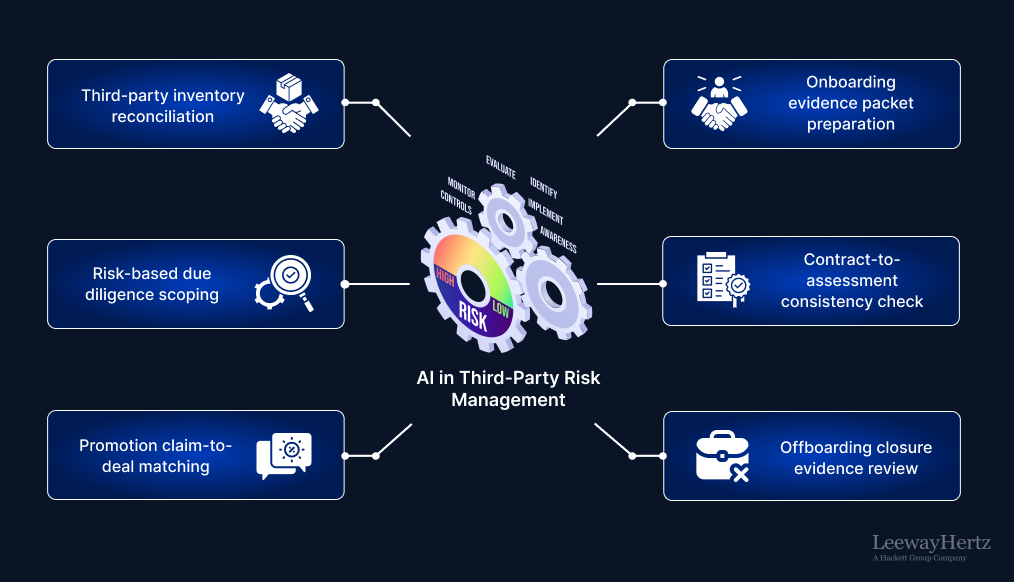
- High-value AI use cases in TPRM
- How agentic AI works in TPRM workflows
- How to prioritize AI use cases in TPRM
- Governance, risk, and responsible AI in TPRM
- How ZBrain operationalizes AI use cases in TPRM
- Future of AI in TPRM
How AI is transforming TPRM operations
AI is changing TPRM by helping teams convert scattered vendor records, questionnaires, evidence reports, monitoring feeds, contract clauses, and remediation updates into structured risk work products. The best use cases do not remove the GRC platform, procurement system, contract repository, cyber rating tool, privacy workflow, or identity system. They sit across those systems, reconcile their records, retrieve the relevant policy or standard, prepare the packet, and route the result to the person who owns the judgment.
A tier-1 SaaS reassessment shows where this becomes practical. By the time the annual review opens, the provider may have uploaded a new SOC 2 Type II report, its cyber rating may have shifted, prior findings may still be open, and the contract may carry specific security, breach-notification and audit-rights obligations. The provider may also support systems that contain confidential customer or business data, which raises the stakes of any missed control gap.
In a manual review, the analyst has to move across evidence portals, GRC records, contract repositories and monitoring tools to validate the report scope, coverage period, exceptions, auditor comments, complementary user entity controls, open findings and cyber rating changes. AI can bring those records into one reassessment packet, extract the control issues that need attention, flag unowned CUECs, summarize trend changes and draft remediation asks against the approved review methodology. The TPRM analyst and vendor risk manager still decide whether the residual risk score, remediation plan and escalation path are acceptable.
The pattern is consistent across the TPRM lifecycle: the work is not difficult because one record is complex, but because many evidence records must be connected, checked and routed through the right control point. That makes TPRM especially suitable for governed AI because the work is dense with records, checkpoints and recurring reviews:
- Document-heavy work: SIG/SIG-Lite responses, CAIQ responses, SOC 1/SOC 2 reports, ISO certificates, penetration test summaries, certificates of insurance, financial viability reports, DPAs, transfer assessments, exit plans, and DORA register extracts can be checked for missing context, expired coverage, inconsistent scope, and unsupported claims before a reviewer opens them.
- Narrative-heavy work: due diligence summaries, residual risk rationales, remediation asks, risk acceptance memos, reassessment packets, board updates, and regulator-ready explanations can be drafted from approved source material while showing where evidence is incomplete.
- Exception-heavy work: SOC report exceptions, unowned CUECs, expired certificates, cyber rating deterioration, unresolved findings, overdue POA&M items, risk acceptance expiries, subcontractor disclosure gaps, and incomplete offboarding evidence can be classified and prioritized so analysts take the highest-impact cases first.
- Knowledge-heavy work: clause matrices, due diligence methodology, risk-tier rules, privacy transfer requirements, C-SCRM practices, business continuity standards, and prior decisions improve when AI retrieves the relevant rule and flags conflicts across records.
- Workflow-heavy work: onboarding due diligence, reassessment calendars, remediation aging, fourth-party mapping, DORA register maintenance, and offboarding certification benefit when AI maintains context across steps and assembles the next review packet.
The practical design rule is simple: AI prepares, compares, classifies, scores, retrieves, and drafts. Designated TPRM, security, privacy, compliance, business, procurement, and risk owners decide, approve, attest, accept, or escalate.
Build governed AI workflows for third-party risk management
Apply AI across due diligence, contract risk, evidence review, monitoring, remediation, reassessment, offboarding, and reporting while preserving human accountability.
Why TPRM AI use cases must be mapped at the sub-process level
TPRM programs often start with broad use cases such as vendor due diligence automation, contract risk review, continuous monitoring, or regulatory reporting. Those labels are useful for strategy, but they are too broad for implementation. Vendor due diligence can mean inherent risk scoring, SIG collection, CAIQ review, SOC report validation, privacy assessment, financial viability review, sanctions screening, adverse media review, or security assessor sign-off. Each sub-process uses different artifacts, systems, controls, and reviewers.
A better approach is to map AI use cases to the TPRM operating model:
- Function: A governed operational domain in the TPRM lifecycle, such as onboarding due diligence, continuous monitoring, or termination and offboarding.
- Process: A workflow area inside a function, such as security assessment, financial viability review, cyber rating monitoring, or access revocation validation.
- Sub-process: The atomic work activity where a specific artifact is reviewed or produced, such as SOC 2 exception extraction, cross-border transfer gap identification, cyber rating alert triage, or data destruction certificate validation.
- AI-enabled opportunity: A specific capability applied to a relevant artifact or dataset to change how the work is prepared, reviewed, routed, or evidenced, while a named role retains the decision.
This level of mapping matters because TPRM decisions are not interchangeable. A sanctions screening hit has a different review boundary from a weak financial viability score. A missing DPA creates a different obligation from an expired ISO certificate. A cyber rating drop does not carry the same meaning for a low-risk office supplier as it does for a critical cloud provider supporting regulated customer data. The AI design must know the artifact, risk tier, control owner, system of record, regulatory context, and reviewer.
For example, AI in contract risk alignment is not the same as AI in contract drafting. Contract management owns drafting and negotiation. TPRM can define risk-driven clause requirements, compare the final agreement to the due diligence scorecard, and flag missing audit rights, breach notification windows, subcontracting consent, or insurance minimums. The human boundary is clear: AI compares assessment evidence to clause requirements, but legal, procurement, business, and risk owners approve the contractual position.
The same principle applies across the lifecycle. AI can reconcile third-party inventory records across AP, contracts, identity, and GRC data. It can classify inherent risk from data access, criticality, geography, and service type. It can extract SOC 2 exceptions and CUECs. It can triage cyber rating alerts. It can draft remediation asks from validated findings. It can prepare offboarding evidence. But every one of those opportunities becomes buildable only when it is tied to a sub-process and a designated reviewer.
TPRM operating model and AI opportunity mapping across TPRM processes
The operating model below focuses on the TPRM risk lifecycle, with procurement buying, supplier performance management, contract drafting, enterprise compliance governance, and ERM aggregation handled through their respective functions. Procurement, supplier management, contract management, compliance, and ERM remain connected counterpart domains, but this article keeps the TPRM control lifecycle as the center.
Function 1: Third-party inventory and tiering
Third-party inventory and tiering create the controlled population that every downstream TPRM activity depends on.
This function turns fragmented relationship records into a usable third-party inventory and initial risk tier. It sits at the front of the TPRM lifecycle because due diligence, monitoring, reassessment, and offboarding cannot be complete if the organization does not know which third parties exist, who owns them, which services they provide, what systems or data they touch, and how critical they are. The function feeds inherent risk assessment, onboarding due diligence, continuous monitoring, DORA register maintenance, and board reporting.
Teams involved: TPRM, procurement operations, vendor master data, contract management, IAM, finance/AP, business relationship owners, IT asset management, and GRC platform administration.
Key artifacts: Third-party inventory record, AP vendor master extract, contract repository export, IAM access list, application owner register, relationship owner assignment record, inherent risk tiering inputs, DORA register of information extract.
Systems involved: ERP/AP systems, contract lifecycle management systems, GRC/TPRM platforms, IAM tools, CMDB or application inventory, procurement intake tools, vendor master data platforms, and BI dashboards.
Regulatory and control considerations: Interagency TPRM lifecycle expectations, DORA ICT third-party register requirements where applicable, NIST SP 800-161 supplier visibility principles, data ownership controls, access governance, and auditability of third-party population completeness.
Accountable roles: TPRM program manager, TPRM analyst, vendor risk manager, procurement category manager, business relationship owner, and chief risk officer for program-level reporting.
What AI helps with: Entity resolution can reconcile third-party names across AP, contract, IAM, GRC, and application records. Classification can assign preliminary risk tiers using service criticality, data access, spend, geography, and operational dependency. Anomaly detection can flag vendors with system access but no TPRM record, contracts with no relationship owner, or high-spend vendors missing due diligence status. Retrieval-grounded answering can explain why a relationship was tiered by citing the tiering methodology and source records.
What humans continue to own: TPRM and business owners confirm the relationship population, ownership assignment, and final risk tier. Procurement and vendor master teams confirm vendor identity and commercial status. The chief risk officer owns the program-level view of third-party exposure. AI reconciles, classifies, and prepares but does not decide, approve, or attest.
| Process | Sub-process | AI-enabled opportunities |
| Third-party population discovery | AP, contract, and access record matching |
|
| Shadow third-party identification |
|
|
| Inventory normalization | Legal entity and service normalization |
|
| Relationship owner assignment |
|
|
| Risk tiering | Criticality and substitutability scoring |
|
| Data access and spend-based tier adjustment |
|
|
| Register maintenance | DORA-relevant ICT service identification |
|
Highest-value opportunities: The strongest opportunities in this function sit at the foundation of the program. When the third-party population is incomplete, due diligence, monitoring, reassessment and reporting all inherit the gap. Risk-tier classification matters because it determines how deeply a vendor is reviewed, how often it is reassessed, how closely it is monitored and when issues should escalate. Relationship owner assignment is equally important because every finding, evidence request, reassessment and offboarding action needs a named business owner to move forward.
Example agentic workflow: Third-party inventory reconciliation and tiering
- The starting sub-process is AP, contract, and access record matching, triggered by a monthly inventory refresh file from AP, CLM, IAM, and the GRC platform.
- The agent aggregates AP vendor master records, active contracts, IAM access lists, application owner data, existing third-party inventory records, spend by vendor, data classification, and service descriptions.
- The agent retrieves the TPRM registration policy, risk-tier methodology, DORA ICT service criteria, and relationship owner assignment rules.
- The agent prepares a reconciliation packet with matched entities, unmatched candidates, duplicate records, owner conflicts, preliminary risk tiers, and DORA-relevant service flags.
- The TPRM analyst confirms candidate matches, the business relationship owner confirms ownership, and the vendor risk manager approves final tier changes for higher-risk relationships.
- The approved inventory updates the GRC platform, unresolved candidates route to procurement or IAM for clarification, and the reconciliation packet is retained for audit review.
Function 2: Inherent risk assessment
Inherent risk assessment defines the risk profile before deep due diligence begins.
This function converts an intended or existing relationship into a risk-based assessment scope. It determines what the third party does, what data it accesses, how critical the service is, whether the organization can substitute the provider, and which due diligence domains are required. Without a disciplined inherent risk assessment, programs over-assess low-risk vendors, under-assess critical providers, and fail to explain why a particular due diligence path was chosen.
Teams involved: TPRM, business relationship owners, procurement, security, privacy, compliance, business continuity, finance, and risk methodology owners.
Key artifacts: Inherent risk questionnaire, service description, data-flow characterization, preliminary system access record, business impact inputs, concentration and substitutability analysis, risk-based due diligence scope, risk assessment scorecard.
Systems involved: Procurement intake tools, GRC/TPRM platforms, data classification tools, application inventory, BCM tools, ERP/AP data, CLM systems, and enterprise architecture repositories.
Regulatory and control considerations: Interagency risk-based lifecycle expectations, DORA ICT service criticality considerations where applicable, NIST SP 800-161 risk assessment practices, privacy-by-design obligations, business continuity requirements, and internal TPRM methodology controls.
Accountable roles: TPRM analyst, vendor risk manager, business relationship owner, CISO delegate, privacy officer, business continuity manager, and compliance officer.
What AI helps with: Classification can translate questionnaire responses, service descriptions, data categories, and operational dependency into due diligence scope. Document intelligence can extract data processing, hosting, geographic, and subcontracting details from intake forms and statements of work. Graph analysis can connect a provider to systems, data classes, business processes, and similar vendors to assess concentration and substitutability. Retrieval-grounded answering can cite the risk methodology behind each due diligence requirement.
What humans continue to own: The business relationship owner confirms service criticality and business dependency. Security, privacy, compliance, and BCM roles confirm domain-specific assessment requirements. The vendor risk manager approves the final inherent risk rating and due diligence scope. AI classifies, maps, and explains but does not decide, approve, or attest.
| Process | Sub-process | AI-enabled opportunities |
| Pre-engagement risk intake | Inherent risk questionnaire completion review |
|
| Service description interpretation |
|
|
| Service and data-flow characterization | Data class and processing identification |
|
| System access and integration characterization |
|
|
| Criticality and concentration analysis | Critical service determination |
|
| Substitutability and concentration review |
|
|
| Due diligence scoping | Risk-based domain scoping |
|
Highest-value opportunities: The strongest opportunities in this function are the ones that shape the entire review path. Data-flow characterization matters because it determines which privacy, security and contractual obligations apply to the relationship. Criticality classification influences how closely the provider is monitored, how often it is reassessed and whether an exit plan is needed. Due diligence scoping brings those inputs together so low-risk vendors are not overburdened, while critical providers receive the depth of review their risk profile requires.
Example agentic workflow: inherent risk scoping
- The starting sub-process is risk-based domain scoping, triggered when a new third-party request reaches the TPRM intake queue.
- The agent aggregates the inherent risk questionnaire, service description, statement of work, data classification inputs, application inventory, prior provider records, spend estimate, and business impact fields.
- The agent retrieves the inherent risk methodology, due diligence domain matrix, privacy assessment triggers, security assessment thresholds, and BCM criticality rules.
- The agent prepares a scoping packet with the proposed inherent risk tier, required due diligence domains, evidence requirements, missing information, and a rationale linked to source fields.
- The business relationship owner confirms service criticality, the CISO delegate and privacy officer confirm domain requirements, and the vendor risk manager approves the due diligence scope.
- The approved scope creates due diligence tasks in the GRC platform, unresolved gaps return to the requester, and the packet is retained with the risk assessment scorecard.
Function 3: Onboarding due diligence
Onboarding due diligence validates whether a third party can meet the organization’s risk expectations before the relationship becomes active.
This function turns risk-based scope into domain-specific assessment evidence. Security, privacy, financial viability, compliance, ESG, reputation, and business continuity inputs are collected, reviewed, and synthesized into an onboarding risk decision. The challenge is that evidence arrives in different formats, from SIG/SIG-Lite and CAIQ questionnaires to SOC reports, DPAs, insurance certificates, financial reports, sanctions screens, and adverse media results. AI adds value by making this evidence comparable, traceable, and easier to review without replacing domain experts.
Teams involved: TPRM, security assessment, privacy, compliance, procurement, finance, business continuity, ESG or sustainability teams where relevant, and business relationship owners.
Key artifacts: SIG/SIG-Lite questionnaire, CAIQ, financial viability report, sanctions screening result, anti-bribery screening result, adverse media result, DPA and cross-border transfer assessment, ESG or reputational review record, certificate of insurance, onboarding risk assessment scorecard.
Systems involved: GRC/TPRM platforms, security questionnaire portals, shared assessments tooling, cloud security questionnaires, sanctions and watchlist screening tools, adverse media tools, privacy management platforms, CLM systems, ERP/AP systems, ESG data providers, and document repositories.
Regulatory and control considerations: Interagency due diligence expectations, GDPR Article 28 processor requirements and SCCs, HIPAA business associate rules where applicable, sanctions and anti-bribery policies, SOC 2 Trust Services Criteria, ISO 27036, NIST SP 800-161, and internal risk acceptance policy.
Accountable roles: TPRM analyst, vendor risk manager, CISO delegate/security assessor, privacy officer, compliance officer, business continuity manager, procurement category manager, and business relationship owner.
What AI helps with: Document intelligence can extract responses from SIG/SIG-Lite, CAIQ, DPAs, insurance certificates, and financial viability reports. Classification can identify control gaps, due diligence domains requiring escalation, and evidence that does not satisfy the approved methodology. Retrieval-grounded answering can compare vendor responses to internal security, privacy, compliance, and BCM requirements. Natural-language generation can draft due diligence summaries and remediation requests from validated findings.
What humans continue to own: Security assessors confirm control sufficiency. Privacy officers approve processor terms, transfer requirements, and DPA gaps. Compliance officers review sanctions, anti-bribery, and adverse media dispositions. Vendor risk managers approve the onboarding risk decision and any risk acceptance path. AI extracts, compares, and drafts but does not decide, approve, or attest.
| Process | Sub-process | AI-enabled opportunities |
| Security due diligence | SIG/SIG-Lite intake and completeness check |
|
| CAIQ control response review |
|
|
| Security evidence consistency check |
|
|
| Financial due diligence | Financial viability review |
|
| Compliance screening | Sanctions and anti-bribery screening |
|
| Adverse media review |
|
|
| Privacy due diligence | DPA requirement assessment |
|
| Cross-border transfer assessment |
|
|
| ESG and reputational review | ESG and reputational evidence review |
|
| Insurance and resilience review | Certificate of insurance validation |
|
Highest-value opportunities:The strongest opportunities in onboarding due diligence are the ones that remove friction without weakening the review. Questionnaire completeness checks help prevent stalled assessments by identifying missing or inconsistent responses before domain reviewers begin. Privacy and transfer assessment extraction is important because gaps in processor terms, SCCs, subprocessors or hosting locations can create regulatory exposure. Sanctions and adverse media triage also has high value because analysts need to separate false positives from issues that require immediate compliance escalation.
Example agentic workflow: Vendor onboarding due diligence review
- The starting sub-process is security evidence consistency check, triggered when a high-risk vendor submits onboarding due diligence evidence.
- The agent aggregates the SIG/SIG-Lite questionnaire, CAIQ, SOC 2 report, ISO certificate, penetration test summary, DPA, financial viability report, sanctions results, adverse media results, insurance certificate, and inherent risk scorecard.
- The agent retrieves the due diligence methodology, security control baseline, privacy review checklist, sanctions escalation rules, insurance matrix, and risk acceptance policy.
- The agent prepares an onboarding evidence packet with completeness gaps, security control exceptions, privacy clause gaps, screening results, insurance mismatches, residual risk rationale, and proposed remediation asks.
- The TPRM analyst confirms evidence extraction, the CISO delegate validates security findings, the privacy officer validates DPA and transfer findings, the compliance officer reviews screening results, and the vendor risk manager approves the onboarding risk disposition.
- Approved findings are logged in the GRC platform, remediation items route to the provider, and any risk acceptance memo follows the approved governance path.
Function 4: Evidence review and validation
Evidence review and validation determine whether submitted assurance artifacts are current, in scope, reliable, and mapped to the organization’s control expectations.
This function is the inspection layer for assurance evidence. It covers SOC 1 and SOC 2 reports, ISO 27001 certificates, penetration test summaries, bridging letters, exception logs, complementary user entity controls, certificates of insurance, and other proof points used to support a risk decision. The work is detailed and often repetitive, but it cannot be treated as clerical because evidence gaps can change residual risk, remediation requirements, internal control ownership, and board or regulator reporting.
Teams involved: TPRM, security assessment, internal controls, compliance, privacy, business relationship owners, business continuity, and internal audit liaison.
Key artifacts: SOC 1/SOC 2 report with exception log, CUEC mapping record, ISO 27001 certificate, penetration test summary, bridging letter, evidence coverage tracker, control-mapping baseline, risk assessment scorecard, remediation/POA&M tracker, risk acceptance memo.
Systems involved: Evidence portals, GRC/TPRM platforms, document repositories, CLM systems, cyber rating platforms, internal control repositories, IAM and application inventory, issue management tools, and audit evidence repositories.
Regulatory and control considerations: SOC 2 trust services criteria, internal control ownership, Interagency monitoring and due diligence expectations, DORA ICT risk documentation where applicable, NIST SP 800-161, ISO 27036, evidence retention policies, and audit trail requirements.
Accountable roles: TPRM analyst, vendor risk manager, CISO delegate/security assessor, business relationship owner, internal audit liaison, and chief risk officer for escalated residual risk.
What AI helps with: Document intelligence can extract report scope, period, opinion, exceptions, auditor comments, tested controls, CUECs, and bridge letter coverage. Classification can assign exception severity and map findings to risk domains. Retrieval-grounded answering can compare evidence against the control-mapping baseline and review methodology. Anomaly detection can flag expired coverage, missing bridges, repeated findings, or CUECs without internal owners.
What humans continue to own: TPRM and security reviewers confirm evidence interpretation. Vendor risk managers approve residual risk and remediation plans. Business relationship owners and CISO delegates accept internal control assignments for CUECs. Internal audit may inspect retained evidence. AI extracts, maps, and prepares but does not decide, approve, or attest.
| Process | Sub-process | AI-enabled opportunities |
| SOC report review | SOC 1/SOC 2 scope and period validation |
|
| Exception and auditor comment analysis |
|
|
| CUEC mapping and ownership review |
|
|
| ISO evidence review | ISO 27001 certificate validation |
|
| Penetration test evidence review | Penetration test summary review |
|
| Coverage gap management | Bridging letter management |
|
| Evidence consistency review | Cross-artifact control consistency check |
|
Highest-value opportunities: The strongest opportunities in evidence review are the ones that make assurance artifacts easier to trust and act on. SOC exception extraction helps reviewers move quickly from lengthy reports to the specific control issues that need attention. CUEC ownership mapping is especially important because an unassigned internal control can leave a real gap even when the provider’s report looks complete. Bridging letter management also adds value by surfacing coverage gaps before they delay reassessment closure or weaken the evidence trail.
Example agentic workflow: SOC 2 reassessment evidence review
- The starting sub-process is SOC 1/SOC 2 scope and period validation, triggered when a tier-1 SaaS provider’s annual reassessment date arrives and its new SOC 2 Type II report lands in the evidence portal.
- The agent aggregates the prior assessment and open findings, the current contract’s security clauses, cyber rating trend data, incident intelligence for the provider, and the internal systems and data classes the provider touches.
- The agent retrieves the evidence review methodology, the tier-1 control-mapping baseline, and risk acceptance rules.
- The agent prepares a reassessment packet with SOC 2 scope and period validation, exception analysis covering two noted change management exceptions with auditor comments, CUEC mapping against internal controls, one unowned user-entity control, a cyber rating trend summary, a proposed residual risk score, and draft remediation asks for the provider.
- The TPRM analyst confirms the analysis, the vendor risk manager approves the residual score and remediation plan, and the unowned CUEC escalates to the CISO delegate and business relationship owner for control assignment.
- The reassessment record closes with findings tracked, the DORA register updates for the in-scope entity, remediation items route to the provider with deadlines, and the packet is retained for regulator and internal audit review.
Accelerate AI Solutions Development
Build fully functional solutions from your high-value use cases, based on specific operational needs and enterprise context.
Function 5: Contract risk alignment
Contract risk alignment connects the assessed risk profile to the contractual protections required for the relationship.
This function is not contract drafting or negotiation. Those remain with contract management, legal, procurement, and business owners. TPRM’s role is to define risk-driven clause requirements, compare the contract position against the assessment, and flag inconsistencies that could weaken oversight, incident response, auditability, insurance coverage, subcontractor control, exit rights, or data protection. The function ensures that due diligence findings are not isolated from the commercial and legal terms that govern the relationship.
Teams involved: TPRM, legal, contract management, procurement, information security, privacy, compliance, insurance/risk, business relationship owners, and vendor management.
Key artifacts: Contract clause matrix, current contract, statement of work, security addendum, DPA, cross-border transfer assessment, certificate of insurance, risk assessment scorecard, risk acceptance memo, subcontractor disclosure schedule, exit plan obligations.
Systems involved: CLM systems, GRC/TPRM platforms, document repositories, procurement systems, privacy management platforms, insurance tracking tools, and legal matter or contract request systems.
Regulatory and control considerations: Interagency contract and monitoring expectations, GDPR Article 28 processor terms and SCCs, HIPAA business associate agreement requirements where applicable, DORA ICT contract expectations where applicable, insurance policy requirements, audit rights, breach notification controls, and subcontractor consent rules.
Accountable roles: Vendor risk manager, TPRM analyst, privacy officer, compliance officer, CISO delegate, procurement category manager, business relationship owner, and legal or contract management as drafting owner.
What AI helps with: Retrieval-grounded answering can compare risk-tier-based clause requirements to the current contract and supporting addenda. Document intelligence can extract audit rights, breach notification windows, insurance limits, subcontracting consent, data processing terms, termination rights, and exit assistance language. Contradiction detection can identify mismatches between due diligence findings and contract protections. Natural language generation can draft a risk alignment memo for legal and procurement review.
What humans continue to own: Legal and contract management own drafting and negotiation. TPRM owns the risk requirement and alignment check. Privacy, security, compliance, procurement, and business owners approve their respective risk positions. AI extracts, compares, and drafts but does not decide, approve, negotiate, or attest.
| Process | Sub-process | AI-enabled opportunities |
| Risk-based clause requirements mapping | Risk-driven clause matrix application |
|
| Insurance requirement alignment |
|
|
| Contract and assessment alignment | Security clause consistency check |
|
| Privacy and transfer clause consistency check |
|
|
| Subcontracting consent and fourth-party alignment |
|
|
| Contract risk exception handling | Clause gap risk memo preparation |
|
| Renewal and change alignment | Renewal clause refresh check |
|
Highest-value opportunities: The strongest opportunities in contract risk alignment are the ones that connect assessed risk to the protections written into the agreement. Clause matrix application helps ensure that audit rights, breach notification windows, insurance minimums, subcontracting consent, data protection terms and exit support reflect the vendor’s actual risk profile. Privacy and transfer clause checks are especially important when the provider processes personal data or uses cross-border delivery models. Subcontracting alignment also adds value because fourth-party exposure often becomes visible only when contract terms, SOC report disclosures and DPA subprocessor records are reviewed together.
Example agentic workflow: Contract risk alignment review
- The starting sub-process is a security clause consistency check, triggered when a high-risk vendor contract reaches legal review after due diligence.
- The agent aggregates the risk assessment scorecard, SIG/SIG-Lite results, CAIQ, SOC 2 exceptions, DPA, cross-border transfer assessment, certificate of insurance, proposed contract, security addendum, and statement of work.
- The agent retrieves the risk-driven clause matrix, privacy clause requirements, insurance minimums, subcontracting consent rules, and risk acceptance policy.
- The agent prepares a contract risk alignment packet with required clauses, present clauses, missing or weak terms, assessment-to-contract inconsistencies, and a clause gap risk memo.
- The vendor risk manager confirms the risk requirement, the privacy officer and CISO delegate validate domain gaps, and legal or contract management decides how the language is drafted or negotiated.
- The approved alignment position is attached to the contract record, open gaps are tracked in the GRC platform, and any residual gap requiring acceptance routes through risk acceptance governance.
Function 6: Continuous monitoring
Continuous monitoring keeps the third-party risk view current between onboarding and reassessment cycles.
TPRM programs cannot rely only on annual questionnaires and periodic evidence refreshes. Provider risk changes through cyber posture deterioration, incidents, control failures, financial stress, adverse media, ownership changes, geography changes, SLA failures, and shifts in how the organization uses the service. Continuous monitoring converts external and internal signals into risk-relevant alerts that analysts can triage, investigate, escalate, or close with evidence.
Teams involved: TPRM, security operations, cyber risk, compliance, procurement, business relationship owners, finance, business continuity, vendor management, and service management.
Key artifacts: Cyber rating alert, cyber rating trend summary, breach or incident intelligence, adverse media result, financial health alert, SLA monitoring input, performance exception record, open findings list, risk assessment scorecard, remediation/POA&M tracker.
Systems involved: BitSight, SecurityScorecard, threat intelligence platforms, adverse media tools, financial monitoring providers, service management platforms, GRC/TPRM platforms, SIEM/SOAR where integrated, vendor performance dashboards, and incident management systems.
Regulatory and control considerations: Interagency ongoing monitoring expectations, DORA ICT third-party monitoring expectations where applicable, NIS2 supply-chain security expectations where relevant, NIST SP 800-161 monitoring practices, internal incident response policy, and board risk appetite thresholds.
Accountable roles: TPRM analyst, vendor risk manager, CISO delegate, compliance officer, business relationship owner, business continuity manager, and chief risk officer for material escalation.
What AI helps with: Anomaly detection can identify cyber rating deterioration, financial stress, negative media spikes, SLA misses, or incident signals that differ from baseline. Classification can prioritize alerts by risk tier, service criticality, data access, and open findings. Multi-source aggregation can connect an alert to contracts, systems, data classes, prior assessments, and remediation history. Natural-language generation can prepare monitoring summaries and escalation notes.
What humans continue to own: TPRM and security teams confirm alert relevance and disposition. Business relationship owners confirm operational impact. Compliance reviews adverse media and regulatory signals. Vendor risk managers approve risk score changes, remediation actions, or risk acceptance paths. AI detects, classifies, and prepares but does not decide, approve, or attest.
| Process | Sub-process | AI-enabled opportunities |
| Cyber monitoring | Cyber rating feed ingestion |
|
| Cyber alert triage and evidence packet preparation |
|
|
| Financial monitoring | Financial health alert triage |
|
| Compliance and reputation monitoring | Adverse media and sanctions change triage |
|
| Incident intelligence | Breach and incident intelligence review |
|
| Operational monitoring | SLA and performance signal intake |
|
| Monitoring governance | Monitoring threshold recalibration |
|
Highest-value opportunities: The strongest opportunities in continuous monitoring are the ones that help teams separate noise from risk-relevant change. Cyber alert triage adds value by connecting high-volume rating signals to the provider’s risk tier, systems touched, data access, open findings and contractual obligations before escalation. Breach intelligence review is especially important when notification windows, affected data classes and incident response obligations need timely review. Financial health monitoring matters most for critical or hard-to-replace providers, where signs of distress can quickly become an operational resilience concern.
Example agentic workflow: Continuous monitoring cyber alert triage
- The starting sub-process is cyber alert triage and evidence packet preparation, triggered by a material cyber rating deterioration for a tier-1 provider.
- The agent aggregates cyber rating trend data, affected domains, prior SOC 2 exceptions, open remediation items, contract security clauses, incident intelligence, internal systems touched, data classes, and relationship owner details.
- The agent retrieves the cyber monitoring methodology, escalation thresholds, incident response policy, contract notification requirements, and risk acceptance rules.
- The agent prepares a monitoring packet with alert cause, service relevance, affected risk domains, prior evidence context, recommended disposition, and provider remediation questions.
- The TPRM analyst confirms alert relevance, the CISO delegate validates cyber impact, the business relationship owner confirms operational exposure, and the vendor risk manager approves risk score change or remediation escalation.
- The GRC record updates with disposition and evidence, provider questions route through the approved channel, and material risks escalate to the chief risk officer if thresholds are met.
Function 7: Issue and remediation management
Issue and remediation management turns identified gaps into owned, aged, escalated, and eventually closed risk actions.
Findings are where TPRM programs often lose control. A gap may originate in a SOC report, SIG response, penetration test summary, privacy review, contract clause check, cyber alert, financial viability review, or reassessment. Without disciplined issue management, findings remain open past due dates, remediation evidence is not validated, risk acceptances stay active beyond expiry, and program reporting understates residual risk. AI helps by connecting findings to owners, evidence, deadlines, severity, and policy rules.
Teams involved: TPRM, security, privacy, compliance, business relationship owners, vendor management, procurement, legal or contract management, internal audit, and risk governance forums.
Key artifacts: Remediation/POA&M tracker, finding record, gap assessment, provider remediation plan, evidence of remediation, risk acceptance memo, expiry calendar, escalation record, risk assessment scorecard.
Systems involved: GRC/TPRM platforms, issue management tools, ticketing systems, evidence portals, document repositories, contract repositories, provider portals, and board reporting dashboards.
Regulatory and control considerations: Interagency issue escalation and monitoring expectations, DORA ICT risk tracking where applicable, audit evidence retention, internal risk acceptance policy, remediation aging thresholds, and governance forum approvals.
Accountable roles: TPRM analyst, vendor risk manager, TPRM program manager, CISO delegate, privacy officer, compliance officer, business relationship owner, internal audit liaison, and chief risk officer for material acceptance.
What AI helps with: Classification can group findings by severity, risk domain, source artifact, affected service, and required owner. Anomaly detection can flag aging patterns, missed deadlines, repeated extensions, expired risk acceptances, and inconsistent closure evidence. Retrieval-grounded answering can compare remediation evidence to the original finding and closure criteria. Natural language generation can draft remediation asks, escalation summaries, and risk acceptance memos from approved evidence.
What humans continue to own: Domain owners confirm whether remediation evidence closes a finding. Vendor risk managers approve remediation plans and residual risk. Risk governance forums approve material risk acceptance. Internal audit may review evidence sufficiency. AI tracks, compares, and drafts but does not decide, approve, or attest.
| Process | Sub-process | AI-enabled opportunities |
| Finding intake | Finding source normalization |
|
| Duplicate and related finding detection |
|
|
| Remediation planning | Remediation plan quality review |
|
| Remediation tracking | POA&M-style aging and escalation |
|
| Closure validation | Remediation evidence validation |
|
| Risk acceptance governance | Risk acceptance memo preparation |
|
| Expiry and renewal control |
|
Highest-value opportunities: The strongest opportunities in issue and remediation management are the ones that keep known gaps from becoming unmanaged exposure. POA&M aging and escalation helps teams see which remediation items are overdue, repeatedly extended or approaching governance thresholds. Closure evidence validation is critical because a finding should not be closed on the basis of incomplete or weak proof. Risk acceptance expiry control also matters because accepted risks need time-bound ownership, review and renewal rather than becoming open-ended exceptions.
Example agentic workflow: Remediation aging and risk acceptance
- The starting sub-process is POA&M-style aging and escalation, triggered by the weekly remediation tracker refresh.
- The agent aggregates open findings, source evidence, provider remediation plans, due dates, prior extensions, risk tier, affected systems, data classes, risk acceptance memos, and reviewer dispositions.
- The agent retrieves the remediation policy, aging thresholds, risk acceptance approval matrix, closure evidence criteria, and escalation rules.
- The agent prepares an aging packet with overdue items, high-risk items near breach, repeated extensions, incomplete remediation plans, expired acceptances, and recommended escalation paths.
- The TPRM analyst validates data quality, domain owners confirm whether evidence is sufficient, and the vendor risk manager approves escalations or closure recommendations.
- Escalations update the GRC platform, provider actions route with deadlines, risk acceptance renewals move to governance review, and the packet is retained for internal audit.
Function 8: Fourth-party and concentration risk
Fourth-party and concentration risk management identifies dependencies that sit beyond the direct vendor relationship but can still affect resilience, privacy, security, compliance, and operational continuity.
Third-party risk does not stop at the contracted provider. Critical services often depend on cloud platforms, payment processors, data centers, outsourced support providers, subcontracted developers, affiliates, and regional delivery centers. The organization may not have a direct contract with those fourth parties, but it still needs visibility into dependency patterns, concentration exposure, and subcontractor control. AI helps by connecting disclosures across contracts, DPAs, SOC reports, questionnaires, and external intelligence.
Teams involved: TPRM, security, privacy, procurement, legal/contract management, business continuity, enterprise architecture, business relationship owners, and risk reporting teams.
Key artifacts: Subcontractor disclosure, fourth-party map, DPA subprocessor list, SOC report subservice organization section, contract subcontracting clause, concentration dashboard, critical service inventory, DORA register of information extract.
Systems involved: GRC/TPRM platforms, CLM systems, privacy management platforms, evidence portals, CMDB/application inventory, business continuity tools, third-party intelligence platforms, and BI dashboards.
Regulatory and control considerations: DORA ICT third-party and concentration risk expectations where applicable, interagency third-party monitoring and subcontractor expectations, GDPR processor and subprocessor obligations, NIST SP 800-161 supply-chain visibility practices, and internal concentration risk thresholds.
Accountable roles: Vendor risk manager, TPRM program manager, privacy officer, CISO delegate, business continuity manager, business relationship owner, procurement category manager, and chief risk officer for material concentration reporting.
What AI helps with: Entity resolution can normalize subcontractor names across contracts, DPAs, SOC reports, and questionnaires. Graph analytics can map critical fourth parties, shared platforms, geographies, services, and concentration clusters. Classification can identify which subcontractors support critical services or process sensitive data. Anomaly detection can flag undisclosed fourth parties, concentration thresholds, and discrepancies between DPA subprocessor lists and SOC subservice organizations.
What humans continue to own: TPRM, privacy, security, business continuity, and business owners confirm materiality and required action. Legal and contract management own subcontracting rights and contractual notices. Chief risk officer or risk committees review material concentration exposure. AI maps, detects, and prepares but does not decide, approve, or attest.
| Process | Sub-process | AI-enabled opportunities |
| Subcontractor disclosure tracking | Subcontractor list extraction |
|
| Disclosure consistency review |
|
|
| Critical fourth-party mapping | Critical dependency identification |
|
| DORA ICT dependency mapping |
|
|
| Third-party concentration risk analysis | Provider and service concentration review |
|
| Geographic and geopolitical concentration review |
|
|
| Third-party concentration governance | Concentration risk narrative preparation |
|
Highest-value opportunities: The strongest opportunities in fourth-party and concentration risk are the ones that make hidden dependencies visible. Disclosure consistency review helps compare contracts, DPAs, SOC reports and questionnaire responses so undisclosed or inconsistent subcontractor information does not sit unnoticed across separate records. Critical dependency mapping shows where important services, systems or data flows depend on the same fourth party, platform, geography or provider. Concentration reporting adds value because CROs and CISOs need portfolio-level exposure views, not only individual vendor scorecards.
Example agentic workflow: Third-party and fourth-party concentration mapping
- The starting sub-process is critical dependency identification, triggered by the quarterly concentration dashboard refresh.
- The agent aggregates contracts, DPAs, SOC report subservice sections, SIG/SIG-Lite responses, third-party inventory records, DORA register extracts, application inventory, and business continuity criticality records.
- The agent retrieves the subcontractor disclosure policy, concentration thresholds, DORA ICT mapping guidance, and business continuity criticality methodology.
- The agent prepares a fourth-party map with normalized subcontractors, critical dependencies, shared providers, geographic clusters, DPA and SOC disclosure mismatches, and concentration threshold breaches.
- The TPRM program manager reviews the concentration view, the privacy officer and CISO delegate validate sensitive data or security implications, and the business continuity manager confirms resilience exposure.
- Approved concentration findings update the dashboard, material issues route to the chief risk officer, and provider disclosure gaps become remediation items.
Function 9: Periodic reassessment
Periodic reassessment confirms whether the third-party risk profile remains acceptable as evidence, services, ownership, controls, and regulations change.
Onboarding due diligence is only a point-in-time view. Third-party relationships change through new services, new data flows, changed ownership, new fourth parties, expired evidence, contract amendments, open findings, incidents, and regulatory updates. Periodic reassessment applies a risk-tier-driven calendar and delta review logic so higher-risk relationships receive deeper and more frequent review. AI supports the cycle by preparing the packet, comparing new evidence to prior assessments, and highlighting changes that require human judgment.
Teams involved: TPRM, security, privacy, compliance, business relationship owners, procurement, contract management, business continuity, internal audit liaison, and GRC platform owners.
Key artifacts: Reassessment calendar, prior assessment record, updated inherent risk questionnaire, SOC 1/SOC 2 report, ISO certificate, penetration test summary, cyber rating trend summary, DPA and transfer assessment, open findings list, risk assessment scorecard, DORA register of information extract.
Systems involved: GRC/TPRM platforms, evidence portals, CLM systems, cyber rating platforms, privacy management systems, issue trackers, procurement systems, IAM/application inventory, and reporting dashboards.
Regulatory and control considerations: Interagency ongoing monitoring expectations, DORA register maintenance where applicable, NIST SP 800-161 lifecycle risk practices, privacy and security control refresh requirements, internal reassessment calendar controls, and audit evidence retention.
Accountable roles: TPRM analyst, vendor risk manager, CISO delegate, privacy officer, compliance officer, business relationship owner, business continuity manager, and internal audit liaison.
What AI helps with: Predictive analytics can forecast reassessment bottlenecks based on evidence due dates, reviewer capacity, and vendor response patterns. Document intelligence can compare new evidence to prior submissions. Anomaly detection can flag service changes, ownership changes, expired evidence, and risk tier mismatches. Retrieval-grounded answering can explain which reassessment steps are required by tier and regulation.
What humans continue to own: TPRM and domain owners confirm the reassessment scope, residual risk, findings, and remediation plan. Business owners confirm whether the service, dependency, or data use changed. Vendor risk managers approve reassessment closure and risk acceptance. AI schedules, compares, and prepares but does not decide, approve, or attest.
| Process | Sub-process | AI-enabled opportunities |
| Third-party reassessment planning | Risk-tier-driven calendar generation |
|
| Evidence request preparation |
|
|
| Delta assessment | Service or ownership change detection |
|
| Prior-to-current evidence comparison |
|
|
| Regulatory-driven reassessment | DORA register maintenance refresh |
|
| Third-party reassessment disposition | Residual risk score refresh |
|
| Third-party reassessment closure | Reassessment packet generation |
|
Highest-value opportunities: The strongest opportunities in periodic reassessment are the ones that keep the risk view current after onboarding. Calendar generation helps prevent high-risk providers from slipping past their review cycle, which can weaken governance and audit readiness. Delta assessment is important because a provider’s risk profile can change through new services, ownership changes, data-flow changes, incidents or open findings even when the annual evidence looks familiar. DORA register refresh adds value for in-scope financial entities because ICT third-party records need to stay aligned with current contracts, services, providers and criticality information.
Example agentic workflow: Third-party reassessment review
- The starting sub-process is reassessment packet generation, triggered when a high-risk provider reaches its reassessment window.
- The agent aggregates the prior assessment, current inventory record, latest questionnaire, SOC 2 report, ISO certificate, penetration test summary, cyber rating trend, contract amendments, open findings, risk acceptances, and DORA register extract.
- The agent retrieves the reassessment methodology, tier-based evidence requirements, DORA register rules, control-mapping baseline, and risk acceptance policy.
- The agent prepares a reassessment packet with evidence completeness, prior-to-current changes, open findings, residual risk recommendation, DORA register updates, and unresolved reviewer questions.
- The TPRM analyst validates the packet, domain reviewers confirm security, privacy, compliance, and BCM sections, and the vendor risk manager approves the reassessment disposition.
- The reassessment record closes in the GRC platform, new findings route to remediation management, and retained evidence remains available for internal audit or regulator review.
Function 10: Termination and offboarding
Termination and offboarding reduce residual risk when a third-party relationship ends or a critical service transitions.
A third-party relationship does not become risk-free when a contract ends. Access may remain active, data may remain in provider systems, subcontractors may retain records, transition obligations may be incomplete, outstanding invoices may mask continued service use, and post-termination obligations may survive. For critical services, offboarding also requires exit plan validation, transition readiness, resilience review, and evidence that data return or destruction has been completed. AI supports offboarding by coordinating evidence across systems and flagging incomplete closure conditions.
Teams involved: TPRM, business relationship owners, procurement, legal/contract management, IAM, IT operations, privacy, security, business continuity, finance/AP, records management, and internal audit liaison.
Key artifacts: Exit plan, termination notice, access revocation record, data return or destruction certificate, DPA post-termination obligations, contract termination clauses, open findings list, final invoice or AP record, service transition plan, post-termination obligation tracker.
Systems involved: GRC/TPRM platforms, CLM systems, IAM tools, ITSM systems, privacy management platforms, records management systems, ERP/AP systems, document repositories, and business continuity tools.
Regulatory and control considerations: Interagency termination lifecycle expectations, DORA exit and resilience considerations where applicable, GDPR processor return or deletion obligations, HIPAA business associate termination provisions where applicable, access governance controls, records retention policies, and audit evidence requirements.
Accountable roles: Business relationship owner, vendor risk manager, TPRM analyst, privacy officer, CISO delegate, business continuity manager, procurement category manager, compliance officer, and internal audit liaison.
What AI helps with: Multi-source aggregation can connect termination notices, contract clauses, IAM records, data processing obligations, open findings, invoices, and transition plans. Classification can identify critical-service offboarding requirements by risk tier and dependency. Document intelligence can extract exit plan obligations and data destruction commitments. Anomaly detection can flag active access, missing destruction certificates, open invoices, or surviving obligations after termination.
What humans continue to own: Business owners confirm service transition and operational readiness. Security confirms access revocation. Privacy confirms data return or destruction evidence. Legal and contract management confirm post-termination obligations. Vendor risk managers approve risk closure. AI coordinates, checks, and prepares but does not decide, approve, or attest.
| Process | Sub-process | AI-enabled opportunities |
| Exit planning | Critical service exit plan validation |
|
| Transition dependency mapping |
|
|
| Access revocation and data disposition | Access revocation validation |
|
| Data return or destruction certification |
|
|
| Obligation tracking | Post-termination obligation extraction |
|
| Final invoice and service-use reconciliation |
|
|
| Offboarding closure review | Offboarding closure packet preparation |
|
Highest-value opportunities: The strongest opportunities in termination and offboarding are the ones that prevent risk from lingering after the relationship ends. Access revocation validation helps confirm that vendor user accounts, service accounts, API keys and integrations are actually removed rather than left active in downstream systems. Data destruction certification is equally important because privacy, confidentiality and contractual obligations can continue after termination. Critical service exit validation adds value where the provider supports an important business process, since a weak transition plan can turn offboarding into an operational disruption.
Example agentic workflow: Critical third-party offboarding review
- The starting sub-process is offboarding closure packet preparation, triggered when a critical provider reaches its termination date.
- The agent aggregates the exit plan, contract termination clauses, DPA post-termination obligations, IAM records, API access records, service transition plan, open findings, final invoice activity, and data destruction certificate.
- The agent retrieves the offboarding checklist, access governance policy, privacy deletion requirements, contract obligation matrix, and business continuity exit criteria.
- The agent prepares an offboarding packet with transition readiness, active access exceptions, data return or destruction evidence, surviving obligations, final invoice anomalies, and unresolved closure items.
- The business relationship owner confirms transition completion, the CISO delegate confirms access revocation, the privacy officer confirms data disposition, and the vendor risk manager approves risk closure.
- The third-party record moves to terminated status, surviving obligations remain tracked, open exceptions route to responsible owners, and the packet is retained for audit review.
Function 11: TPRM governance and reporting
TPRM governance and reporting maintain the program methodology, evidence standards, risk appetite alignment, executive visibility, and audit readiness that make the lifecycle defensible.
This function sits across the entire operating model. It defines the policy, risk-tier methodology, due diligence standards, review cadences, issue escalation rules, risk acceptance governance, reporting taxonomy, board metrics, regulator response support, and internal audit liaison process. Without governance, individual assessments may appear complete while the program as a whole lacks consistency, traceability, and accountability.
Teams involved: TPRM program management, enterprise risk, compliance, information security, privacy, procurement, legal, internal audit, business continuity, GRC platform owners, and executive risk committees.
Key artifacts: TPRM policy, methodology document, due diligence standard, risk-tier matrix, board report, regulator response packet, DORA register of information extract, issue aging dashboard, risk acceptance register, audit evidence repository, program metrics report.
Systems involved: GRC/TPRM platforms, BI and reporting tools, policy management platforms, document repositories, audit management systems, DORA register tooling, issue trackers, contract repositories, and evidence portals.
Regulatory and control considerations: Interagency governance expectations, DORA registers of information and ICT third-party oversight where applicable, NIS2 supply-chain governance where relevant, NIST SP 800-161, ISO 27036, SOC 2 evidence practices, UK PRA SS2/21 for outsourcing and third-party risk in scope, internal audit requirements, and board risk governance.
Accountable roles: TPRM program manager, chief risk officer, vendor risk manager, CISO delegate, privacy officer, compliance officer, internal audit liaison, procurement category manager, and GRC platform owner.
What AI helps with: Retrieval-grounded answering can compare program activity to methodology, policy, and regulatory expectations. Classification can segment use cases, third parties, findings, and risk acceptances by risk tier, domain, business line, geography, and owner. Anomaly detection can identify reporting gaps, metric inconsistencies, stale policies, overdue attestations, and missing evidence. Natural-language generation can draft board and regulator reporting narratives from approved metrics and retained evidence.
What humans continue to own: The chief risk officer and governance committees own risk appetite, material risk acceptance, board reporting, and regulator engagement. TPRM program managers own methodology and program operations. Internal audit owns independent audit conclusions. AI retrieves, checks, and drafts but does not decide, approve, or attest.
| Process | Sub-process | AI-enabled opportunities |
| Policy and methodology maintenance | Policy-to-practice consistency review |
|
| Risk-tier methodology calibration |
|
|
| TPRM program reporting | Board report metric preparation |
|
| Regulator response evidence packet preparation |
|
|
| DORA and regulatory reporting | DORA register quality review |
|
| Internal audit support | Internal audit request response support |
|
| Program controls | AI use-case inventory and governance |
|
Highest-value opportunities: The strongest opportunities in TPRM governance and reporting are the ones that make program oversight easier to defend. Board reporting preparation helps leadership see third-party exposure across risk tiers, critical providers, open findings, remediation aging, concentration risk and accepted risks. Regulator response packet assembly is valuable because supervisory questions usually require a clear trail from policy to assessment evidence, reviewer decisions and system updates. DORA register quality review is especially important for in-scope financial entities because register accuracy depends on consistent contract, service, provider entity and criticality data.
Example agentic workflow: TPRM board and regulator reporting
- The starting sub-process is a regulator response evidence packet, triggered by a request for evidence on critical third-party oversight.
- The agent aggregates TPRM policy, methodology, third-party inventory records, tiering history, due diligence records, reassessment packets, monitoring alerts, remediation tracker, risk acceptance register, DORA register extract, and prior audit evidence.
- The agent retrieves the reporting taxonomy, regulator request scope, evidence retention policy, board metric definitions, and applicable TPRM regulatory guidance.
- The agent prepares a response packet with requested evidence, missing record exceptions, metric reconciliation notes, source links, and a draft executive narrative.
- The TPRM program manager validates completeness, the chief risk officer approves the narrative, the compliance officer confirms regulatory alignment, and the internal audit liaison reviews evidence traceability where required.
- The approved packet is retained in the audit evidence repository, reporting metrics update the dashboard, and missing records become program remediation items.
Accelerate AI Solutions Development
Build fully functional solutions from your high-value use cases, based on specific operational needs and enterprise context.
High-value AI use cases in TPRM
High-value TPRM use cases are not simply the ones that save analyst time. They are the ones that improve the quality, completeness, speed, and defensibility of risk decisions while keeping the reviewer boundary intact. The strongest candidates usually combine high volume, recurring evidence, measurable rework, clear ownership, and a limited blast radius if the AI output needs correction.
| Use case | Function | How AI creates high-value impact |
| Third-party inventory reconciliation | Third-party inventory and tiering | Entity resolution reconciles AP, contract, IAM, and GRC records into a cleaner third-party inventory record, reducing hidden relationships and duplicate records before risk tiering begins. |
| Risk-based due diligence scoping | Inherent risk assessment | Classification maps service criticality, data access, geography, substitutability, and spend to due diligence scope, reducing inconsistent review depth across similar relationships. |
| Onboarding evidence packet preparation | Onboarding due diligence | Document intelligence extracts SIG/SIG-Lite, CAIQ, DPA, insurance, financial viability, sanctions, and adverse media evidence into a structured review packet for domain reviewers. |
| SOC 2 exception and CUEC review | Evidence review and validation | Document intelligence and structured extraction identify SOC 2 exceptions, auditor comments, bridge gaps, and CUECs, then map unowned controls to accountable internal roles. |
| Contract-to-assessment consistency check | Contract risk alignment | Retrieval-grounded answering compares contract clauses to the risk assessment scorecard and clause matrix, surfacing missing audit rights, breach windows, insurance minimums, subcontracting consent, and privacy terms. |
| Cyber alert triage | Continuous monitoring | Anomaly detection and classification prioritize cyber rating alerts by risk tier, data access, service criticality, open findings, and contract obligations. |
| POA&M aging and escalation | Issue and remediation management | Anomaly detection flags overdue findings, repeated extensions, expired risk acceptances, and incomplete remediation evidence before governance reporting. |
| Fourth-party concentration mapping | Fourth-party and concentration risk | Graph analytics maps subcontractors, subservice organizations, providers, geographies, systems, and services to identify critical fourth-party and concentration exposure. |
| Reassessment packet generation | Periodic reassessment | Document intelligence compares current and prior evidence, identifies changed controls or expired artifacts, and drafts a reassessment summary for reviewer confirmation. |
| Offboarding closure evidence review | Termination and offboarding | Multi-source aggregation checks exit plan completion, access revocation, data destruction certification, final invoice activity, and surviving obligations before risk closure. |
| Board and regulator reporting evidence assembly | TPRM governance and reporting | Multi-source aggregation and natural-language generation prepare board narratives and regulator response packets from retained evidence, metric definitions, and approved reporting taxonomy. |
A use case earns high-value status when it touches a recurring control point, uses accessible evidence, has a designated reviewer, and produces a work product that can be inspected. In TPRM, that usually means packets, scorecards, exception logs, remediation trackers, register updates, risk memos, and governance reports rather than autonomous decisions.
How agentic AI works in TPRM workflows
Agentic AI in TPRM should be designed as a governed sequence of software actions. The agent monitors a trigger, retrieves approved records, applies deterministic checks where needed, prepares a packet, routes exceptions, and records evidence. Its value lies in maintaining context across steps and handoffs while keeping risk decisions with the responsible teams.
Here are some examples:
Example 1: Vendor onboarding due diligence review workflow
- Agent role: Prepare a complete onboarding due diligence packet for a high-risk vendor, using approved evidence sources and risk methodology.
- Trigger: A new vendor request is approved for risk-based due diligence after inherent risk assessment.
- Records aggregated: Inherent risk questionnaire, SIG/SIG-Lite, CAIQ, SOC 2 report, ISO certificate, penetration test summary, DPA, cross-border transfer assessment, financial viability report, sanctions screening, adverse media results, certificate of insurance, and contract draft.
- Analysis prepared: Completeness gaps, high-risk security responses, privacy transfer gaps, screening results, financial viability concerns, insurance mismatches, residual risk rationale, and remediation asks.
- Human checkpoint: The TPRM analyst confirms evidence extraction, the CISO delegate validates security findings, the privacy officer validates DPA and transfer findings, the compliance officer reviews screening results, and the vendor risk manager approves the onboarding risk disposition.
- Handoff: Approved findings update the GRC platform, provider remediation items receive deadlines, and risk acceptance routes through governance where required.
Example 2: SOC 2 reassessment evidence review workflow
- Agent role: Prepare a reassessment packet for a tier-1 SaaS provider using the new SOC 2 Type II report and related risk evidence.
- Trigger: The annual reassessment date arrives and the new SOC 2 Type II report lands in the evidence portal.
- Records aggregated: Prior assessment, open findings, current contract security clauses, cyber rating trend data, incident intelligence, internal systems touched, data classes, SOC 2 report, control-mapping baseline, and risk acceptance rules.
- Analysis prepared: SOC 2 scope and period validation, two change management exceptions with auditor comments, CUEC mapping, one unowned user-entity control, cyber rating trend summary, proposed residual risk score, and draft remediation asks.
- Human checkpoint: The TPRM analyst confirms the analysis, the vendor risk manager approves the residual score and remediation plan, and the unowned CUEC escalates to the CISO delegate and business relationship owner.
- Handoff: The reassessment record closes with findings tracked, the DORA register updates for the in-scope entity, remediation items route to the provider, and the packet is retained for regulator and internal audit review.
Example 3: Continuous monitoring cyber alert triage workflow
- Agent role: Convert a cyber rating alert into a risk-contextualized monitoring packet for analyst and security review.
- Trigger: A cyber rating provider reports a material score drop for a critical third party.
- Records aggregated: Cyber rating trend, affected domains, prior SOC exceptions, penetration test summary, open findings, contract notification clauses, incident intelligence, internal systems touched, data classes, and relationship owner details.
- Analysis prepared: Alert cause, service relevance, data exposure, prior evidence context, open remediation linkage, recommended disposition, and provider remediation questions.
- Human checkpoint: The TPRM analyst confirms relevance, the CISO delegate validates cyber impact, the business relationship owner confirms operational exposure, and the vendor risk manager approves risk score change or remediation escalation.
- Handoff: The GRC record updates with disposition and evidence, provider questions route through the approved channel, and material escalation goes to the chief risk officer if thresholds are met.
Example 4: Critical vendor offboarding evidence workflow
- Agent role: Prepare closure evidence for a critical third-party termination, confirming that access, data, transition, and surviving obligations have been addressed.
- Trigger: A critical provider reaches its planned termination date.
- Records aggregated: Exit plan, termination notice, contract clauses, DPA post-termination obligations, IAM records, API keys, service accounts, transition plan, open findings, final invoice activity, and data destruction certificate.
- Analysis prepared: Active access exceptions, data return or destruction evidence, surviving obligations, transition readiness, final invoice anomalies, and unresolved closure items.
- Human checkpoint: The business relationship owner confirms transition completion, the CISO delegate confirms access revocation, the privacy officer confirms data disposition, and the vendor risk manager approves risk closure.
- Handoff: The third-party record moves to terminated status, surviving obligations remain tracked, open exceptions route to responsible owners, and evidence is retained for audit review.
The review boundary is the safety property. The agent can prepare a stronger packet than a person working across disconnected systems, but the decision remains with the person who owns the risk, control, contract, privacy, security, business, or governance outcome.
How to prioritize AI use cases in TPRM
TPRM teams should not begin with the broadest or most visible use case. They should begin with a bounded sub-process where the trigger, source artifacts, reviewer, output, and governance path are clear. The best first projects are high-volume, evidence-rich, reviewable, and limited to preparation or triage rather than autonomous risk decisions.
| Criterion | What to ask |
| Volume and frequency | Does this sub-process recur often enough for AI support to reduce manual effort at scale? |
| Artifact availability | Are the needed source artifacts available in usable systems with sufficient quality for AI analysis? |
| Review boundary | Can a defined role confirm the AI output before it affects a regulated or risk-bearing decision? |
| Blast radius | If the output is wrong, is the impact limited to a draft, packet, queue, or score recommendation rather than a live risk-bearing action? |
| Business impact | Can the function tie the use case to lower risk exposure, faster reassessment cycles, reduced remediation effort, better evidence quality, or fewer delayed onboardings? |
Strong starting points include third-party inventory reconciliation, inherent risk questionnaire completeness checks, SIG/SIG-Lite and CAIQ review, SOC 2 exception extraction, CUEC ownership mapping, cyber alert triage, POA&M aging, DORA register field validation, and offboarding evidence checks. These use cases have clear artifacts and reviewer boundaries.
The classic failure patterns are misaligned scope, missing data, bypassed governance, and premature quantified savings. TPRM teams avoid those failures by choosing sub-processes where the role of AI is preparation, comparison, classification, extraction, or drafting, and where the TPRM analyst, vendor risk manager, CISO delegate, privacy officer, compliance officer, business relationship owner, or chief risk officer remains accountable for the final decision.
Accelerate AI Solutions Development
Build fully functional solutions from your high-value use cases, based on specific operational needs and enterprise context.
Governance, risk, and responsible AI in TPRM
AI in TPRM must be governed as part of the risk program, not treated as a productivity layer outside the control environment. The same discipline that applies to vendors should also apply to AI-enabled workflows: clear scope, defined data access, policy alignment, evidence retention, reviewer accountability, monitoring, and auditability. This matters because TPRM outputs can affect onboarding approvals, contract protections, residual risk scores, remediation escalation, risk acceptance, board reporting, and regulator-facing evidence.
Human-in-the-loop (HITL) oversight: AI may draft a due diligence summary, propose a residual risk score, classify an alert, extract SOC exceptions, or prepare a risk acceptance memo. The TPRM analyst, vendor risk manager, CISO delegate, privacy officer, compliance officer, business relationship owner, business continuity manager, chief risk officer, or internal audit liaison confirms the relevant output before a risk-bearing action proceeds. HITL design should be visible in the workflow, not assumed after the fact.
Regulatory and standards alignment:AI workflows should be mapped to recognized AI risk management practices and to the TPRM standards that govern the organization. Depending on jurisdiction and sector, the relevant stack may include the 2023 U.S. interagency guidance on third-party relationships, DORA, NIS2, GDPR Article 28 and SCCs, HIPAA business associate rules, NIST SP 800-161, ISO 27036, SOC 2 Trust Services Criteria, UK PRA SS2/21, and Shared Assessments SIG standards. NIST SP 800-161 Rev. 1, for example, provides guidance for identifying, assessing, and mitigating cybersecurity risks throughout the supply chain.
Bias mitigation and evidence retention: Bias can enter through historic tiering patterns, inconsistent reviewer decisions, incomplete monitoring feeds, over-weighted vendor size, or poorly represented geographies and sectors. TPRM programs should retain the source artifacts behind AI outputs: questionnaires, SOC reports, ISO certificates, penetration test summaries, DPAs, financial viability reports, screening results, remediation records, and risk acceptance memos. Evidence retention keeps recommendations inspectable and testable.
Key governance requirements: The program needs a use-case inventory that separates low-risk summarization from higher-risk scoring, prioritization, recommendation, and routing. Each use case should have a risk tier, data access scope, approved source list, reviewer role, output schema, validation approach, escalation path, logging requirement, and monitoring cadence. Higher-impact workflows, such as residual risk scoring or risk acceptance memo preparation, need stronger review gates than basic evidence summarization.
Design principles: Outputs should be grounded in approved sources and restricted to least-privilege access. An agent that reviews SOC 2 reports does not need unrestricted access to all procurement, HR, or finance records. Tool access should be scoped to the workflow. The agent should not approve a vendor, accept a risk, update a contract, close a finding, or terminate a relationship without named human confirmation.
Traceability and data security: Every workflow should retain an audit trail of prompts, sources, model version, reviewer disposition, approvals, exceptions, and system updates. Sensitive vendor data, security evidence, contracts, personal data, financial records, and incident information should be protected under role-based access, encryption, retention, and logging controls. The control objective is not only better AI output, but a defensible chain from source evidence to reviewed decision.
How ZBrain operationalizes AI use cases in TPRM
Identifying use cases is only the first step. TPRM teams need a controlled way to design, build, validate, deploy, govern, and scale AI workflows across third-party intake, inherent risk assessment, due diligence, vendor onboarding, contract and control review, risk scoring, issue and remediation tracking, continuous monitoring, periodic reassessment, critical vendor oversight, offboarding, regulatory reporting, audit support, and program governance.
This is where ZBrain helps.
ZBrain is an end-to-end AI enablement platform that supports this lifecycle through four connected stages: ZBrain Analyzer, ZBrain Design, ZBrain Solution Builder, and ZBrain Governance. The platform provides a governed path from use-case analysis to deployed agentic workflows while maintaining policies, permissions, approval points, monitoring, and runtime evidence.
ZBrain Analyzer
ZBrain Analyzer helps teams examine selected TPRM processes, identify AI opportunities, and document the business context, systems, data, artifacts, roles, controls, third-party risk domains, KPIs, and review requirements needed to evaluate each use case.
ZBrain Design
ZBrain Design creates a build-ready technical design for the selected use case. It generates the business requirements document, functional requirements, user journeys, architecture, workflow logic, data specifications, integration context, approval points, and governance considerations needed before development begins.
ZBrain Solution Builder
ZBrain Solution Builder enables teams to create, configure, and validate governed AI workflows for TPRM processes based on the technical design developed in ZBrain Design. It supports testing across routine, exception, vendor, contract, security, privacy, financial, operational resilience, compliance, and control scenarios before deployment.
ZBrain Governance
ZBrain Governance applies policies, access controls, human approval requirements, monitoring, and traceability throughout workflow execution. It provides guardrails, approval gates, escalation controls, kill switches, and audit trails to help organizations maintain oversight of AI outputs, reviewer actions, risk ratings, remediation evidence, exceptions, and authorized system updates.
Future of AI in TPRM
The future of AI in TPRM will depend less on a single model and more on federated workflow design. Third-party risk data will continue to live across GRC platforms, procurement systems, contract repositories, IAM tools, privacy systems, cyber rating feeds, service management tools, and audit repositories. The advantage will come from orchestration, common identity, evidence traceability, and observability across those systems.
Long-horizon agentic workflows will become more useful as TPRM programs move from annual review cycles to continuous oversight. An agent may hold a multi-step goal such as preparing a reassessment packet, tracking remediation, monitoring cyber signals, refreshing a DORA register field, and escalating unowned controls, while reviewers confirm each risk-bearing judgment. This will make workflow state and reviewer accountability more important, not less important.
The model-agnostic design point will also become more important. Organizations will use different models for extraction, classification, retrieval, summarization, and reasoning depending on data sensitivity, latency, cost, accuracy, and governance requirements. The enduring design question will be whether the workflow produces inspectable evidence for a named decision owner.
TPRM is moving toward a more connected operating layer: one where inventory, due diligence, evidence review, contract risk, monitoring, remediation, fourth-party exposure, reassessment, offboarding, and governance reporting reinforce each other. The future depends on workflow design, not only better models.
Endnote
Third-party risk management is difficult because the work is distributed by design. The vendor touches one business unit, the contract sits with legal or procurement, the evidence sits in a portal, the data flow sits with privacy, the controls sit with security, the access sits with IAM, the incidents sit with operations, and the exposure sits with the business. TPRM has to connect all of it into a defensible risk view.
AI can help when it respects that operating reality. It can reconcile records, classify risk, retrieve methodology, extract evidence, detect exceptions, prepare packets, and draft summaries. It can reduce the manual burden of moving between systems and improve the consistency of the evidence trail. But it should not become the decision authority for onboarding, residual risk, contract terms, remediation closure, risk acceptance, or offboarding.
The most successful programs will start with sub-processes where the trigger, artifact, system, reviewer, and output are known. They will design AI around review packets, scorecards, trackers, memos, register fields, and audit evidence. They will measure reviewer corrections, track override patterns, and improve the workflow before expanding to higher-risk decisions.
TPRM also needs careful scoping. Procurement, supplier management, contract management, compliance management, cybersecurity, privacy, business continuity, internal audit, and ERM all connect to third-party risk. The article’s operating model keeps TPRM centered as the risk lifecycle discipline while acknowledging those handoffs.
Design governed AI workflows across third-party inventory, due diligence, monitoring, remediation, offboarding, and TPRM governance. Contact the ZBrain team today.
Author’s Bio


Akash's ability to build enterprise-grade technology solutions has garnered the trust of over 30 Fortune 500 companies, including Siemens, 3M, P&G, and Hershey's. Akash is an early adopter of new technology, a passionate technology enthusiast, and an investor in AI and IoT startups.

Transform Enterprise Processes with AI
Whether you have a defined use case or a process you want to improve, we design and build AI solutions that address operational gaps, enhance existing capabilities, and integrate with your enterprise data, systems, and workflows.
Start a conversation by filling the form
Once you let us know your requirement, our technical expert will schedule a call and discuss your idea in detail post sign of an NDA.
All information will be kept confidential.
FAQs
What is AI in third-party risk management?
AI in third-party risk management is the use of AI capabilities such as document intelligence, classification, entity resolution, anomaly detection, graph analytics, retrieval-grounded answering, predictive analytics, and natural-language generation to support the third-party risk lifecycle. It helps teams reconcile vendor records, review due diligence evidence, classify risk, triage monitoring alerts, prepare reassessment packets, track remediation, map fourth-party dependencies, validate offboarding evidence, and assemble governance reports.
AI does not replace the TPRM function or the roles that own risk decisions. A TPRM analyst, vendor risk manager, CISO delegate, privacy officer, compliance officer, business relationship owner, business continuity manager, chief risk officer, or internal audit liaison still confirms the output before the organization approves a vendor, accepts a risk, closes a finding, updates a board report, or completes offboarding.
Which AI use cases are most vital in TPRM?
The most vital use cases are the ones that sit on recurring control points and produce review-ready evidence for named decision owners.
Some of them are as follows:
- Inventory and tiering: Entity resolution reconciles third-party inventory records across AP, contract, IAM, and GRC systems, while classification proposes risk tiers based on data access, criticality, spend, geography, and substitutability.
- Due diligence and evidence review: Document intelligence extracts SIG/SIG-Lite, CAIQ, SOC 2, ISO, penetration test, DPA, insurance, and financial viability evidence. Classification maps gaps to security, privacy, compliance, BCM, and financial risk domains.
- Contract risk and monitoring: Retrieval-grounded answering compares contract clauses to the risk assessment scorecard, while anomaly detection and classification prioritize cyber rating alerts, adverse media, incident intelligence, financial health changes, and SLA signals.
- Remediation, reassessment, and offboarding: Anomaly detection flags overdue remediation, expired risk acceptances, stale evidence, and active access after termination. Natural-language generation drafts reassessment summaries, remediation asks, risk acceptance memos, and offboarding closure packets from approved evidence.
How is agentic AI different from conventional TPRM automation?
Conventional TPRM automation generally executes predefined rules and workflows, such as sending questionnaires, triggering reminders, updating records, or routing tasks based on configured conditions. Agentic AI can work across a broader sequence of steps, maintaining context as it retrieves records, evaluates evidence, identifies exceptions, prepares review materials, and routes issues based on the information available.
This is particularly relevant in TPRM because evidence is often distributed across multiple systems and documents. A SOC 2 reassessment, for example, may require the current report, prior findings, CUECs, relevant contract terms, security-rating trends, incident information, internal system and data mappings, and applicable risk-acceptance criteria. Agentic AI can bring this information together and prepare it for review, while TPRM analysts, vendor risk managers, and domain reviewers retain responsibility for the final disposition.
Can AI autonomously approve third-party risk decisions?
No. AI should not autonomously approve vendors, accept residual risk, close remediation findings, approve contract exceptions, certify offboarding, or attest to board or regulator reporting. Those are risk-bearing decisions that require defined human ownership.
A governed TPRM workflow can allow AI to propose a risk score, summarize evidence, classify an alert, draft a memo, or recommend an escalation path. The decision remains with the accountable role. This boundary is especially important where the output affects regulated data, critical services, outsourcing obligations, customer impact, operational resilience, or supervisory evidence.
What systems and data are needed for AI applications in TPRM?
A useful foundation includes GRC or TPRM platform records, third-party inventory records, AP and vendor master data, contract repositories, and procurement intake data. It should also include IAM access records, application inventory, data classification records, SIG/SIG-Lite and CAIQ questionnaires, SOC 1/SOC 2 reports, ISO certificates, penetration test summaries, DPAs, and transfer assessments. Additional sources include sanctions and adverse media results, financial viability reports, cyber rating feeds, issue trackers, remediation trackers, risk acceptance registers, DORA register extracts, and audit evidence repositories.
The goal is not to place every record in one database. The more important requirement is a stable identity model and common identifiers for third party, legal entity, contract, service, system, data class, risk tier, owner, finding, remediation item, and evidence artifact. Without those links, AI will prepare incomplete or misleading packets.
Where should an organization begin with AI in TPRM?
An organization should begin with a bounded sub-process where the workflow is recurring, the artifacts are available, the output is reviewable, and the decision owner is clear. Good starting points include third-party inventory reconciliation, inherent risk questionnaire completeness review, SIG/SIG-Lite and CAIQ extraction, SOC 2 exception and CUEC mapping, cyber alert triage, POA&M aging, risk acceptance expiry tracking, DORA register field validation, and offboarding evidence checks.
The first project should produce a packet, queue, score recommendation, exception summary, or draft memo rather than an autonomous decision. Teams should test routine cases, exception cases, and edge cases, then measure reviewer corrections before expanding the workflow.
How does ZBrain support AI in TPRM?
ZBrain provides an end-to-end AI enablement platform for TPRM teams to identify, design, validate, deploy, govern, and scale AI workflows across third-party intake, inherent risk assessment, due diligence, vendor onboarding, contract and control review, risk scoring, issue and remediation tracking, continuous monitoring, periodic reassessment, critical vendor oversight, offboarding, regulatory reporting, audit support, and program governance.
- ZBrain Analyzer: Helps teams examine selected TPRM processes, identify AI opportunities, and document the business context, systems, data, artifacts, roles, controls, third-party risk domains, KPIs, and review requirements needed to evaluate each use case.
- ZBrain Design: Converts selected use cases into build-ready technical designs, including business requirements, functional requirements, user journeys, architecture, workflow logic, data specifications, integration context, approval points, and governance considerations.
- ZBrain Solution Builder: Enables teams to create, configure, and validate governed AI workflows based on the design developed in ZBrain Design. It supports testing across routine, exception, vendor, contract, security, privacy, financial, operational resilience, compliance, and control scenarios before deployment.
- ZBrain Governance: Applies policies, access controls, human approval requirements, monitoring, traceability, escalation controls, kill switches, and audit trails throughout workflow execution.
ZBrain’s role is enablement rather than autonomous decision-making. It helps define where AI assists, augments, or acts within TPRM workflows, while final approvals and risk-bearing decisions remain with accountable roles across procurement, vendor management, information security, privacy, legal, compliance, risk, business owners, audit, and enterprise governance.