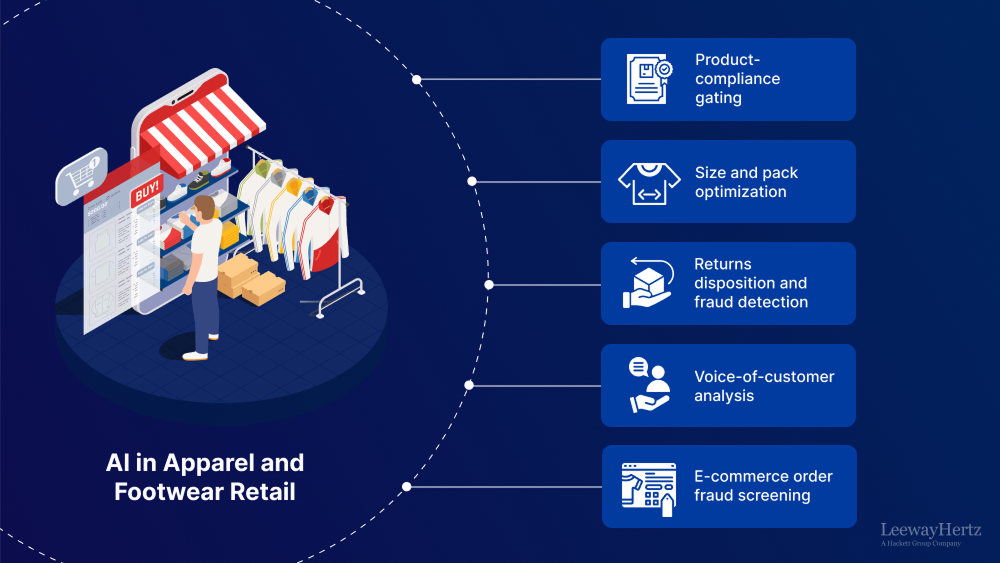
Apparel and footwear retail runs on long lead times, short selling windows, and thin margins. The product is designed close to a year before it reaches the floor, manufactured through extended global supply chains, and given only a brief window at full price before markdowns begin. Performance depends on a continuous sequence of judgment-intensive, document-heavy decisions, interpreting demand, specifying product, negotiating cost, clearing customs, allocating inventory by size and door, timing markdowns, and meeting the compliance requirements of every sales channel. That density and repeatability make the industry an unusually strong candidate for AI.
The economic stakes are substantial. According to the American Apparel and Footwear Association, the US industry generates more than $523 billion in annual retail sales and supports 3.6 million workers [1], with footwear sales alone exceeding $121 billion in 2025 [2]. That activity rests on a cost structure heavily exposed to trade policy: approximately 99 percent of the footwear sold in the United States is imported, and the sector paid $6.2 billion in US import duties in 2025 [3]. For most businesses in the category, sourcing economics and tariff management are central determinants of profitability, not peripheral concerns.
Against that backdrop, AI is not a peripheral efficiency play; it is a direct lever on the decisions that determine whether demand converts into full-price sell-through or erodes into markdown, chargebacks, and duty leakage. Every function in this chain runs on judgment calls made against incomplete, fast-changing information, which is precisely the condition under which AI-assisted forecasting, drafting, and workflow coordination compound into a measurable margin. Adoption is accelerating, though the impact remains uneven across AI types.
More than 35 percent of fashion executives report already using generative AI specifically in functions such as customer service, image creation, and product discovery, building on a longer track record with predictive AI in demand forecasting and pricing [4]. McKinsey estimates generative AI alone could add between $150 billion and $275 billion to operating profits across the apparel, fashion, and luxury sectors over three to five years [5]. Realizing that value has proven difficult, as many initiatives struggle to move beyond pilot projects when the underlying data, workflows, and governance are not ready to support scaled deployment. The lesson is consistent across the sector: durable value comes not from general-purpose tools applied broadly, but from the right type of AI embedded in specific, well-defined workflows.
This article maps AI opportunities across the core functions of the apparel and footwear operating model, from merchandising and design through sourcing, compliance, trade, pricing, wholesale, digital commerce, stores, service, and the enterprise control functions that enable AI to scale safely. It identifies the highest-value use cases, describes how agentic workflows coordinate multi-step work while preserving human accountability, and sets out a practical framework for prioritization and governance.
- Types of AI reshaping apparel and footwear retail operations
- How AI is transforming apparel and footwear retail operations
- Why apparel and footwear retail AI use cases must be mapped at the sub-process level
- Apparel and footwear retail operating model and AI opportunity mapping
- High-value AI use cases in apparel and footwear retail operations
- How agentic AI works in apparel and footwear retail workflows
- How to prioritize AI use cases in apparel and retail operations
- Governance, risk, and responsible AI in apparel and footwear retail operations
- How ZBrain operationalizes generative AI use cases in apparel and footwear retail operations
- Future of AI in apparel and footwear retail operations
Types of AI reshaping apparel and footwear retail operations
Artificial intelligence encompasses distinct capabilities, each suited to different problems, value opportunities, and implementation requirements. Apparel and footwear businesses have used predictive AI for forecasting and scoring for years, and prescriptive and optimization engines for markdown, allocation, and network decisions nearly as long. Computer vision, natural language processing, and recommendation systems now run at scale on product imagery, customer text, and behavioral data.
Generative AI is the newest widely adopted layer, producing drafts and narratives in natural language and images. Agentic AI coordinates the other types into governed, multi-step workflows. The highest-value use cases are rarely powered by one AI type alone; they typically combine complementary capabilities in a governed workflow. For example, a returns-disposition workflow may use computer vision to grade condition, predictive AI to score fraud risk, generative AI to draft the authorization, and agentic AI to route the case.
| AI type | What it does | Representative apparel and footwear uses |
|---|---|---|
| Predictive AI | Statistical and machine-learning models that forecast, score, or classify from historical and real-time structured data. | Demand forecasting, price elasticity, churn prediction, fraud and risk scoring, replenishment quantities and size-curve modeling. |
| Prescriptive and optimization AI | Mathematical optimization and simulation engines that recommend the best action under stated constraints and objectives, rather than only predicting an outcome. | Markdown depth and cadence, inventory allocation and transfer scoring, network and node design, labor scheduling, freight and carrier routing. |
| Computer vision AI | Models that interpret images and video, converting visual information into structured, actionable data. | Defect classification, planogram-compliance checks, receiving verification, garment and sample inspection, imagery quality checks and cycle-count prioritization. |
| Natural language processing and conversational AI | Models that parse, classify, and route unstructured text and speech, and power interactive, multi-turn dialogue. | Contact-intent classification, chatbot and voice assistant support, review and survey theme extraction, and email and ticket triage. |
| Recommendation and personalization AI | Models that rank and surface the next-best product, content, or offer for an individual shopper or account based on behavioral and transactional signals. | On-site product recommendations, complete the look and size-substitution suggestions, next-best action marketing, and account-level reorder suggestions. |
| Generative AI | Large language and multimodal models that read, summarize, draft, translate, and explain in natural language, image, or structured formats. | Tech pack drafting, variance commentary, product page copy, campaign content, policy-grounded customer responses, and lease abstraction. |
| Agentic AI | Systems that plan and execute multi-step workflows across tools, data sources, and approvals, coordinating the other AI types into a single accountable process. | Critical-path monitoring, item-setup-to-live, returns disposition, outbound compliance checking and markdown proposal routing. |
This distinction matters for planning and governance as much as for technology selection. Predictive, prescriptive, computer vision, and recommendation models typically require structured historical data and validated training sets; NLP and generative AI require grounding in approved documents and policies to avoid fabricated or off-brand content; and agentic AI requires explicit approval gates, since it acts across systems rather than only producing a draft or a score. A single workflow, such as product-compliance gating or returns disposition, may need several of these types to work together under a single governance model, with different controls and review points for each.
Transform apparel and footwear operations with AI
Create governed AI workflows for merchandise planning, design and sourcing, trade and compliance, allocation, pricing, wholesale, and omnichannel operations. Assemble evidence faster, route exceptions clearly, and keep decisions audit-ready.
How AI is transforming apparel and footwear retail operations
The industry has used analytics, rules engines, workflow automation, and predictive and prescriptive machine learning for years, and these remain important. Computer vision, natural language processing, and recommendation engines are now mature enough to run at scale, and generative and agentic AI add new capabilities on top of that foundation rather than replacing it.
Traditional automation follows predefined rules. Predictive AI forecasts, scores, and classifies from historical patterns, which is why demand forecasting, price elasticity, and fraud detection already work well. Computer vision reads images, inspection photos, planogram compliance, and garment defects, and receives documentation, turning it into structured, actionable data. Generative AI reads, summarizes, drafts, compares, and explains, producing outputs in natural language that were previously written by hand.
Agentic AI goes a step further: it plans and executes a sequence of steps, retrieves information, classifies a case, drafts an output, routes an exception, and updates a system after approval, coordinating the other types of AI described above into a single accountable workflow.
In apparel and footwear, this changes how teams handle work that is:
-
Document-heavy: tech packs, bills of materials, cost sheets, purchase orders, customs entries, audit reports, and lab-test certificates.
-
Narrative-heavy: open-to-buy variance commentary, markdown read-outs, product page copy, chargeback disputes, and sustainability claims.
-
Exception-heavy: late deliveries, broken-size positions, routing-guide breaches, EDI errors, payment and freight exceptions, and return abuse.
-
Knowledge-heavy: style guide and construction standards, restricted-substance rules, routing-guide requirements, size charts, and service procedures.
-
Workflow-heavy: concept to sample, item setup to live page, sell-in to compliant ship, and return to disposition.
The best use cases keep humans in the decision loop while automating repetitive, low-judgment tasks. AI gathers relevant order, shipment, or return data, drafts an initial recommendation or report, flags unusual or high-risk items, and routes the package to the authorized approver. For example, a merchandiser reviewing a markdown retains the final call, and AI delivers a ready recommendation instead of making them build it from scratch.
Why apparel and footwear retail AI use cases must be mapped at the sub-process level
“AI in apparel and footwear” is too broad a phrase to be useful, and so is “AI in merchandising,” “AI in sourcing,” or “AI in e-commerce.” These categories are too high-level to define data requirements, controls, approval paths, and success metrics.
A more useful approach maps use cases directly to the operating model:
-
Function: the major business area, such as merchandising and planning, sourcing, wholesale, or digital commerce.
-
Process: the workflow area within that function, such as merchandise financial planning, the time-and-action calendar, or item setup.
-
Sub-process: the specific activity, such as open-to-buy management, tech pack authoring, or routing-guide compliance.
-
AI-enabled opportunity: the specific way AI supports that sub-process, such as extracting data, drafting a narrative, classifying an exception, or assembling evidence.
This granularity matters because apparel and footwear workflows are tied to specific calendars, documents, systems, and decision rights. A tech pack workflow is different from a markdown workflow; a routing-guide compliance check is different from a returns-disposition decision. Mapping at the sub-process level turns broad innovation ideas into executable workflows with clear value, data requirements, governance, and implementation paths.
Apparel and footwear retail operating model and AI opportunity mapping
The sections that follow map AI opportunities across the operating model of a modern apparel and footwear business that designs, sources, and sells through its own stores and e-commerce, as well as wholesale and marketplace channels. The model spans core functions, moving from the commercial value chain, planning, design, sourcing, quality, responsible sourcing, trade, allocation, pricing, wholesale, logistics, digital commerce, marketing, stores, and service, into the enterprise and control functions that let the business run and scale AI safely.
Each function includes a short overview, a process and sub-process table, the highest-value opportunities, and an example agentic workflow. A pure multi-brand retailer would lean harder on planning, buying, allocation, and selling and lighter on design and sourcing, while a wholesale-led brand would weight design, sourcing, and the wholesale function most heavily. The framework is intended to be adapted to the specific mix of channels and capabilities a given business operates.
Function 1. Merchandising, planning, and buying
Merchandising, planning, and buying are the commercial engine of an apparel and footwear business. It determines what to buy, at what depth, at what price, and for which channels and doors, all within an open-to-buy budget and the seasonal go-to-market calendar. The work blends financial planning, assortment architecture, and buying judgment, and it sets the constraints that every downstream function inherits.
This function draws on three layers of AI. Predictive AI recomputes open-to-buy positions and forecasts sell-through from historical and in-season data; generative AI drafts the variance, reforecast, and hindsight commentary that consumes much of a planner’s week; and agentic AI chains the two together, reconciling top-down targets with bottom-up plans, framing assortments by cluster and price tier, and surfacing key items for buyer sign-off.
| Process | Sub-process | Key AI-enabled opportunity |
|---|---|---|
| Merchandise financial planning (MFP) | Pre-season top-down planning | Aggregate prior-season sell-through, weeks of supply, and GMROI history, and draft the pre-season sales, margin, receipt, and markdown plan for planner review. |
| Bottom-up category and class planning | Build bottom-up sales, margin, and inventory plans by category and class from item-level history, and reconcile them to top-down targets. | |
| In-season open-to-buy (OTB) management | Recompute OTB and identify variances | Recompute open-to-buy by class from sell-through and receipt flow, surface over-bought and under-bought positions, and draft OTB variance commentary. |
| Reconciliation and reforecasting | Reconcile bottom-up class plans to top-down targets, flag gaps, and draft an in-season reforecast narrative. | |
| Hindsight and post-season review | Summarize prior-season performance by category, vendor, and door into a hindsight pack that informs the next plan. | |
| Assortment and line planning | Line plan and option framing | Translate financial targets into an option plan by category, price band, and door cluster, and flag redundant options and white space gaps. |
| Range tiering and assortment planning | Map the assortment to good-better-best tiers and key-item carryover versus newness, and draft the range rationale for merchant review. | |
| Key-item and never-out planning | Identify key items and never-out core styles, and recommend depth and replenishment posture to protect core availability. | |
| Store clustering and localization | Cluster doors by sell-through, climate, and demographic attributes, and recommend cluster-level option adds and drops. | |
| Choice count and SKU rationalization | Detect low-productivity options and recommend SKU rationalization to reduce tail complexity. | |
| Buying and order management | Buy quantity and depth setting | Recommend buying depth and size curves by cluster from demand history, and flag broken-size risk. |
| Vendor negotiation support | Summarize vendor performance, terms, and margin history to prepare buyer positions on cost, terms, and markdown support. | |
| Brand buy reconciliation | Compare brand line sheets to the open-to-buy plan, draft the buy sheet, and flag budget and delivery conflicts for multi-brand buyers. |
Highest-value opportunities
The highest-value opportunities in merchandising and planning are open-to-buy variance commentary, line-plan framing, key-item planning, store clustering, and hindsight reporting. These workflows are repetitive, data-heavy, and reconciliation-intensive, making them strong candidates for human-in-the-loop AI that drafts and detects while the buyer decides.
Example agentic workflow
Open-to-buy management: An AI agent pulls current sell-through and receipt flow, recomputes open-to-buy by class, surfaces over-bought and under-bought positions against weeks-of-supply and margin guardrails, drafts reallocation options and variance commentary, and routes the proposal to the buyer for approval.
Function 2. Design and product development
Design and product development translates trend direction and the merchant brief into a makeable, costed, and fit-approved product. The work runs on a tight critical path from concept through color, material, and finish (CMF) and material development into tech packs, grading, colorways, and the sample sequence of prototype, salesman, pre-production, and top-of-production samples.
Predictive and generative AI work side by side in design. Generative AI accelerates trend synthesis, concept visualization, material selection, and specification drafting, producing sketch variations, tech pack language, and CMF narratives grounded in the brand’s own archive. Predictive AI scores comparable performance to inform target costing and line adoption, while designers and technical teams retain ownership of aesthetic and construction judgment.
| Process | Sub-process | Key AI-enabled opportunity |
|---|---|---|
| Trend research and concept design | Trend synthesis and seasonal concept development | Aggregate runway, social, search, and sell-through signals into a trend brief, and draft the seasonal concept and color-story write-up for line review. |
| CMF direction and palette development | Summarize material and color direction from the trend brief and prior-season performance, and draft the CMF board narrative. | |
| Concept ideation and visualization | Generate print, color, and silhouette variations on a base sketch grounded in brand archive imagery for designer down-selection. | |
| Competitive and white-space analysis | Analyze competitor assortments and the brand’s specific gaps, and brief design on white-space opportunities. | |
| Material and trim development | Material and trim sourcing | Search the material library and supplier options for fabrics and trims matching the design brief, and flag lead-time and minimum order risk. |
| Sustainable materials selection | Compare material options on cost, performance, and sustainability attributes, and draft the preferred-materials recommendation. | |
| Product specification and sampling | Tech pack and bill of materials authoring | Draft tech pack construction notes and the bill of materials from the approved sketch and comparable styles, and validate against grade rules for tech-designer review. |
| Grading and size-spec development | Draft graded measurement specifications from the base size and flag deviations from the brand’s size-spec library. | |
| Colorway and print management | Generate and document colorways and print placements per style, and prepare the artwork hand-off for the factory. | |
| Sample milestone tracking | Track prototype, salesman, pre-production, and top-of-production sample milestones against the critical path, and summarize slippage. | |
| Specification and sampling | Fit and wear-test review | Compare sample photos to tech pack callouts, consolidate fit session and wear-test comments across rounds, and draft factory fit-correction comments. |
| Costing and line finalization | Target costing and cost engineering | Compare quoted cost breakdowns to the should-cost model, propose cost-engineering options, and draft the costing summary. |
| Line review and adoption | Assemble the line review pack with sell-through, margin, and cost context, and draft the adopt, hold, or drop rationale per style. |
Highest-value opportunities
Design and development offers the greatest AI value in structured hand-off work rather than in creative decision-making. The strongest opportunities include tech pack and bill-of-materials drafting, material selection support, grading assistance, colorway management, fit-comment consolidation, and line review assembly. These are repeatable documentation workflows where AI can accelerate preparation, improve consistency, and keep designers and technical teams focused on the final creative and construction calls.
Example agentic workflow
Tech pack creation: The agent reads the approved sketch and comparable styles, drafts construction notes and the bill of materials, validates measurements against grade rules and the size-spec library, documents colorways, flags missing callouts, and routes the draft tech pack to the technical designer for review before factory hand-off.
Function 3. Sourcing, production, and supplier management
Sourcing, production, and supplier management place and track production, manage the supplier base and the time-and-action (T&A) calendar, and protect on-time, in-full delivery and cost. It balances country and supplier allocation, capacity booking, raw material commitments, costing negotiations, and the day-to-day critical path that moves a style from purchase order to shipment.
Sourcing teams rely primarily on predictive and agentic AI: predictive models flag at-risk purchase orders and capacity imbalances before they lead to late deliveries, and agentic workflows compare suppliers, prepare negotiation positions, validate purchase orders, and track T&A milestones end-to-end. Generative AI drafts the scorecards, negotiation briefs, and status summaries that keep sourcing managers focused on judgment calls rather than data assembly.
| Process | Sub-process | Key AI-enabled opportunity |
|---|---|---|
| Sourcing strategy and supplier management | Country and supplier allocation | Summarize cost, capacity, lead-time, duty, and risk factors by country and supplier, and draft a sourcing-allocation recommendation. |
| Capacity booking and commitments | Reconcile booked capacity to the buy plan and flag over-booked and under-booked positions by supplier. | |
| Raw material and trim commitment | Track greige, fabric, and trim commitments against minimum order quantities and flag liability and shortfall risk. | |
| Supplier scorecard and risk management | Score suppliers on cost, quality, on-time delivery, compliance, and capacity, and draft a balanced-scorecard review. | |
| Costing and negotiation | Cost breakdown analysis | Extract and compare FOB cost breakdowns across suppliers and seasons and flag variance for negotiation. |
| Negotiation preparation | Summarize cost drivers, volume leverage, and benchmark prices to prepare the sourcing negotiation position. | |
| Production and critical path | Purchase order placement and validation | Validate purchase order terms — quantity, size run, delivery window, incoterms — against the buy plan and flag mismatches. |
| Time-and-action (T&A) calendar management | Track production milestones against the T&A critical path, flag at-risk styles, and draft expedite or rebooking recommendations. | |
| Pre-production and sealed sample approval | Track pre-production and sealed-sample approvals and flag approvals holding bulk start. | |
| Wash, finish, and bulk approval | Summarize lab-dip, wash, and strike-off approval status and flag styles holding the critical path. | |
| Production status and ASN tracking | Aggregate factory status, advanced shipping notice (ASN), and booking data into a single order-status view, and flag delivery exceptions. | |
| Inbound logistics coordination | Booking and consolidation | Summarize ready-to-ship status and recommend freight booking and consolidation to meet delivery windows. |
Highest-value opportunities
The strongest sourcing use cases include sourcing-allocation summaries, supplier scorecards, costing analysis, purchase order validation, T&A critical-path tracking, and production-status aggregation. These document- and exception-heavy workflows are well-suited to AI because they involve significant manual follow-up, comparison, and reconciliation.
Example agentic workflow
Critical-path monitoring: The agent aggregates factory status, ASN, and approval milestones, compares them against the T&A calendar, identifies styles at risk of late delivery, drafts expedite or rebooking options with cost and on-time delivery impact, and routes the exception list to the production team.
Function 4. Quality assurance and product compliance
Quality assurance and product compliance keeps product safe, legal, and on-spec through inspection and laboratory testing. The work runs against AQL sampling standards and consumer-product regulations, including flammability, lead and phthalate limits, CPSIA requirements for children’s products, restricted substances lists (RSLs), and labeling and warning rules, and extends to supplier quality management and inbound verification.
Quality and compliance combine computer vision, predictive, and generative AI. Computer vision supports inspection-photo and label review by identifying visible defects and inconsistencies. Predictive models help prioritize suppliers, styles, and production lots at higher risk of AQL or regulatory test issues. Generative AI prepares inspection summaries, corrective-action documentation, and compliance evidence packs, while qualified reviewers retain authority over pass, fail, remediation, and release decisions.
| Process | Sub-process | Key AI-enabled opportunity |
|---|---|---|
| Inspection and quality assurance | Inspection planning and AQL sampling | Recommend inspection scope and AQL sample sizes by risk and supplier history, and draft the inspection booking. |
| Inline and final inspection review | Classify inspection defects against the defect taxonomy, score pass or fail against the AQL plan, and draft the inspection report. | |
| Defect trend and corrective action | Detect recurring defect patterns by supplier and draft corrective action-request (CAR) summaries. | |
| Inbound DC quality verification | Summarize receiving quality-check results at the distribution center and flag lots for hold or return. | |
| Product compliance and testing | Regulated product testing management | Track lab-test status for flammability, lead, phthalates, and CPSIA requirements, and flag styles missing a passing certificate. |
| Restricted substances (RSL) review | Compare material and chemical disclosures to the restricted substances list and flag non-conforming components. | |
| Labeling and safety-warning review | Validate fiber content, country-of-origin, care, and California Proposition 65 labeling against requirements, and draft correction notes. | |
| Destination-market compliance mapping | Map product requirements to destination-market regulations and flag gaps for compliance review. | |
| Supplier quality management | Supplier quality performance evaluation | Aggregate defect, inspection, and CAR history into a supplier quality scorecard. |
| Corrective-action verification | Track corrective-action closure and verify supporting evidence before re-approval. |
Highest-value opportunities
The highest-value QA and compliance use cases are AQL inspection reporting, defect-trend and corrective-action summaries, regulated-test tracking, RSL screening, labeling validation, and supplier quality scorecards. These rule-bound, evidence-heavy workflows suit controlled AI assistance with mandatory human sign-off.
Example agentic workflow
Product-compliance gating: The agent checks each style’s flammability, chemical, and CPSIA test status, compares material disclosures to the restricted substances list, validates labeling and Proposition 65 warnings, assembles the evidence, and flags any style not clear to ship to the compliance reviewer.
Function 5. Responsible sourcing, sustainability, and circularity
Responsible sourcing, sustainability, and circularity govern how and where the product is made, the brand’s environmental and social claims, and the growing resale and take-back operation. It covers factory social audits, code-of-conduct due diligence, forced-labor traceability, tier-2 mapping, materials and footprint data, claims substantiation, ESG disclosure, and recommerce.
Responsible sourcing and sustainability teams use generative AI to summarize audit findings, assemble due diligence evidence, substantiate marketing claims, and draft ESG disclosures, while predictive and computer vision models classify trade-in condition, forecast resale value, and flag traceability gaps across tier-2 and subcontractor networks. Compliance and sustainability owners keep accountability for every claim and supplier decision.
| Process | Sub-process | Key AI-enabled opportunity |
|---|---|---|
| Responsible sourcing and social compliance | Factory social audit management | Summarize SMETA, WRAP, and SLCP audit findings, classify non-conformances by severity, and track remediation status. |
| Code of Conduct and onboarding due diligence | Assemble supplier code-of-conduct, ownership, and risk evidence into an onboarding due diligence pack. | |
| Forced labor and traceability evidence | Retrieve supply-chain traceability records against forced-labor due diligence requirements and surface evidence gaps for compliance review. | |
| Subcontractor and tier-2 mapping | Map tier-2 and subcontractor relationships from disclosures and documents, and flag unauthorized or unmapped facilities. | |
| Sustainability and ESG | Materials and footprint data management | Aggregate material, mill, and footprint data and draft product-level sustainability attribute summaries. |
| Sustainability claims substantiation | Check recycled-content and environmental marketing claims against supporting evidence and FTC guidance before publication. | |
| ESG and disclosure reporting | Draft ESG and supply-chain disclosure sections from program data and prior filings for review. | |
| Circularity and resale | Resale, take-back, and recommerce | Classify trade-in items by condition and resale value, and draft disposition and recommerce-listing routing. |
| Repair and refurbishment routing | Classify items by repairability and route to repair, refurbishment, or recycling with disposition notes. |
Highest-value opportunities
The strongest opportunities here are social-audit summarization, onboarding due diligence, forced-labor traceability review, tier-2 mapping, sustainability-claims substantiation, and resale triage — evidence-gathering and documentation workflows where AI accelerates assembly and review.
Example agentic workflow
Supplier social-compliance review: The agent pulls the latest SMETA, WRAP, or SLCP audit, classifies non-conformances by severity, retrieves traceability and ownership evidence, compares it to the code of conduct and forced-labor due diligence requirements, and assembles a remediation and evidence pack for the responsible sourcing reviewer.
Function 6. Trade, customs, and merchandise finance
Trade, customs, and merchandise finance move goods across borders under US trade rules and own the margin math. With roughly 99 percent of US footwear imported [6], classification, country of origin, duty programs, tariff engineering, and landed cost are core to the business, alongside financial planning, variance reporting, reserves, and tax determination.
Trade and finance combine predictive and generative AI under strict human sign-off. Predictive and rules-based AI classify styles to HTS codes and model tariff and duty-program scenarios; generative AI drafts entry-validation notes, drawback claims, landed-cost roll-ups, and variance and reserve commentary. Licensed customs brokers and finance owners retain final classification and reporting sign-off.
| Process | Sub-process | Key AI-enabled opportunity |
|---|---|---|
| Trade compliance and customs management | Tariff classification (HTS) | Classify styles to Harmonized Tariff Schedule (HTS) codes from the bill of materials and construction, with a customs-broker review step. |
| Country-of-origin and entry documentation | Validate country-of-origin and commercial-invoice data against the customs entry and flag mismatches. | |
| Free-trade and duty programs | Compare style sourcing and content to free-trade-agreement and duty-program eligibility and draft qualification notes. | |
| Tariff engineering and scenario analysis | Model duty impact of sourcing, classification, and design choices and draft tariff-engineering options for review. | |
| Duty drawback and recovery | Draft duty-drawback claim narratives from export and entry records for trade-team review. | |
| Merchandise finance and margin | Landed-cost and margin modeling | Build the landed-cost roll-up (FOB, freight, duty, fees) and draft initial-markup (IMU) and gross-margin impact commentary. |
| Sales, margin, and inventory variance management | Draft period-over-period variance commentary on sales, gross margin, markdowns, and inventory for finance review. | |
| Markdown reserve and gross margin analysis | Draft markdown-reserve and gross-margin commentary from inventory aging and sell-through for finance review. | |
| Chargeback and deduction reconciliation | Reconcile retail-customer deductions and chargebacks to backup documentation and draft dispute narratives. | |
| Tax and statutory | Sales and use tax determination | Validate taxability and jurisdiction on transactions and flag exceptions for tax review. |
| Indirect tax and VAT support | Validate VAT and indirect-tax treatment on cross-border transactions and flag exceptions. |
Highest-value opportunities
The highest-value trade and finance use cases are HTS classification support, entry-document validation, tariff scenario modeling, duty-drawback drafting, landed-cost modeling, and variance and reserve commentary.
These are rules-driven, document-heavy, quantified workflows where AI reduces manual search and reconciliation while a broker or controller signs off.
Example agentic workflow
Import-entry preparation: The agent classifies each style to its HTS code from the bill of materials, validates country-of-origin and commercial-invoice data against the entry, checks duty-program eligibility, flags mismatches and savings opportunities, and routes the entry package to the customs broker for review and filing.
Function 7. Inventory management, allocation, and replenishment
Inventory management, allocation, and replenishment get the right units to the right doors, channels, and fulfillment nodes in the right sizes, then keep stock balanced through the season. The work depends on demand and supply planning, size and pack optimization, door grading, channel splits, and the constant rebalancing that protects sell-through and size integrity.
Allocation and replenishment are led by predictive AI. Demand forecasting, size-curve modeling, and inventory projection models generate the base recommendations, while agentic AI coordinates door-grade allocation, channel splits, and store-to-store transfers. Generative AI then drafts exception narratives that explain deviations from the standing plan to allocators and planners.
| Process | Sub-process | Key AI-enabled opportunity |
|---|---|---|
| Demand and supply planning | Demand forecasting | Generate base-level demand forecasts by style, size, and location for planner review. |
| Supply and inventory projection | Project inventory position and weeks of supply forward, and flag stock-out and overstock risk. | |
| Initial allocation | Size and pack optimization | Recommend pack and prepack configurations from store-cluster size curves and flag chronic broken-size positions. |
| Door grading and initial allocation | Score allocation scenarios against weeks-of-supply targets and recommend the initial allocation by door grade. | |
| New-door and launch seeding | Assign new doors to the nearest demand-analog cluster and recommend an opening assortment and launch-day depth. | |
| Channel inventory split | Recommend inventory split across retail, e-commerce, and wholesale channels based on demand and margin. | |
| Replenishment and rebalancing | Replenishment planning | Forecast demand at the SKU-door-week level and recommend replenishment quantities within open-to-buy. |
| Inventory rebalancing and transfers | Recommend store-to-store and node transfers from sell-through and shipping cost, and flag stranded and aged inventory. | |
| Size integrity and consolidation | Detect broken-size and low-unit positions and recommend consolidation to protect sell-through. | |
| Aged inventory identification | Flag aged and slow-moving inventory and recommend markdown or transfer action. |
Highest-value opportunities
The strongest allocation use cases are demand forecasting, size and pack optimization, door-grade allocation, channel splits, SKU-level replenishment, and transfer recommendations, high-volume, forecast-driven workflows where AI improves precision and frees allocators for exceptions.
Example agentic workflow
In-season replenishment: The agent forecasts demand at the SKU-door-week level and recommends replenishment quantities within open-to-buy. It flags sudden sell-through shifts to accelerate or suppress replenishment, drafts the exception narrative where the recommendation deviates from the standing plan, and routes it to the planner.
Accelerate AI Solutions Development
Build fully functional solutions from your high-value use cases, based on specific operational needs and enterprise context.
Function 8. Pricing, promotions, and markdown management
Pricing, promotions, and markdown management set entry prices and the markup structure, run promotions across channels, and time markdowns to clear seasonal inventory while protecting the maintained margin. The work runs on initial-markup (IMU) and maintained-markup (MMU) math, competitive and channel positioning, promotion planning, price elasticity, and the markdown cadence that defines end-of-season economics.
Pricing and markdown management is a predictive AI-intensive function: elasticity models, markdown-optimization engines, and competitive price aggregation generate quantitative recommendations, while generative AI drafts the promotional readouts and markdown variance commentary that category managers use to make and defend final pricing decisions.
| Process | Sub-process | Key AI-enabled opportunity |
|---|---|---|
| Pricing and promotion | Initial price and markup setting | Recommend the entry price band and initial markup (IMU) from attribute-comparable history and target maintained markup (MMU). |
| Competitive price positioning | Aggregate competitor shelf prices from the brand’s own collected price data and position the price ladder. | |
| Price-elasticity analysis | Estimate price elasticity by category from historical price and demand data to inform pricing and markdown decisions. | |
| Promotion planning and evaluation | Forecast promotion lift and cannibalization, recommend offer depth and timing, and draft the post-event read-out. | |
| Promotional calendar management | Draft and reconcile the promotional event calendar against margin and inventory targets. | |
| Markdown and clearance | Markdown optimization | Score markdown depth and cadence against weeks of supply and residual-value curves and recommend the clearance price ladder by region. |
| Markdown variance and exception review | Flag styles running ahead of or behind the markdown plan and draft the variance commentary. | |
| Clearance and liquidation routing | Classify residual inventory into clearance, outlet, and liquidation channels by aging and value. | |
| Channel and regional pricing | Channel and marketplace pricing | Recommend consistent channel and marketplace pricing and flag conflicts and minimum-advertised-price (MAP) breaches. |
| Regional and currency pricing | Recommend market-specific price points from local cost, tax, and competitive context. |
Highest-value opportunities
The highest-value pricing use cases are markup setting, elasticity analysis, promotion evaluation, markdown optimization, channel pricing, and clearance routing — margin-sensitive, data-rich workflows where AI sharpens timing and depth decisions that a human still approves.
Example agentic workflow
Markdown optimization: The agent scores markdown depth and cadence against weeks of supply and residual-value curves, recommends the clearance price ladder by region, flags styles needing an earlier first markdown, drafts variance commentary, and routes the markdown proposal to the planner for approval.
Function 9. Wholesale and B2B channel management
Wholesale and B2B channel management sells through wholesale accounts, marketplaces, and drop-ship. For most apparel and footwear brands, this is where the majority of revenue flows, and it inverts the compliance relationship: the brand must meet each retail customer’s routing guide, EDI, and chargeback rules, and must read account sell-through, not just sell-in.
Wholesale and B2B teams combine agentic and generative AI. Agentic workflows aggregate order books, check shipments against routing guides and EDI rules, and read point-of-sale sell-through to recommend reorders; generative AI drafts line sheets, market-appointment briefs, account forecasts, and chargeback dispute narratives, keeping account teams ahead of compliance exposure rather than reacting to it.
| Process | Sub-process | Key AI-enabled opportunity |
|---|---|---|
| Sell-in and account management | Market and line-release preparation | Assemble line sheets, pricing, and assortment recommendations by account, and draft the market appointment brief. |
| Order book management | Aggregate account orders against capacity and the buy plan, and flag over-sold and at-risk delivery positions. | |
| Key-account assortment planning | Recommend account-specific assortments and depth from the account’s door profile and prior sell-through. | |
| Account forecasting and joint business planning | Draft account-level forecasts and joint-business-plan inputs from prior sell-through and account targets. | |
| Account compliance and fulfillment | Retailer routing-guide compliance | Check shipments against each retail customer’s routing guide and flag carton, label, and ASN breaches before shipping to avoid chargebacks. |
| EDI transaction management | Validate inbound and outbound EDI documents (850 purchase order, 856 ASN, 810 invoice), and flag errors for resolution. | |
| Drop-ship and marketplace operations | Validate marketplace and drop-ship item data, pricing, and order routing, and flag content and inventory exceptions. | |
| Vendor-managed inventory support | Recommend replenishment for vendor-managed-inventory accounts from point-of-sale and stock feeds. | |
| Sell-through and trade management | Sell-through and reorder recommendation | Read account point-of-sale sell-through and recommend reorders, swaps, and markdown support by account. |
| Trade-spend and co-op reconciliation | Reconcile co-op, markdown allowance, and trade-spend claims to agreements, and draft exception notes. | |
| Wholesale returns and RA management | Summarize wholesale return authorizations and disputed claims, and draft resolution notes. |
Highest-value opportunities
The strongest wholesale use cases are market preparation, order-book management, account forecasting, routing guide compliance, EDI validation, and account sell-through recommendations. Compliance and EDI, in particular, are high-volume, rules-driven workflows where AI directly reduces chargeback exposure.
Example agentic workflow
Outbound compliance checking: The agent reads each wholesale shipment against the retail customer’s routing guide, validates carton labeling, packing, and the 856 ASN, flags breaches that would trigger a chargeback, drafts the correction, and routes exceptions to the fulfillment team before the order ships.
Function 10. Distribution, logistics, and fulfillment
Distribution, logistics, and fulfillment run the physical flow from the port and distribution center to the door and doorstep. The work covers inbound receiving, value-added services and floor-ready preparation, pick-pack and cartonization, labor planning, import and freight coordination, omnichannel node management, and reverse-logistics processing.
Distribution and logistics lean on predictive AI for labor and throughput forecasting and inventory-node balancing, computer vision for receiving verification and cartonization checks, and generative AI for the receiving-exception notes, carrier-claim summaries, and returns-grading documentation that keep exception volumes manageable for operations teams.
| Process | Sub-process | Key AI-enabled opportunity |
|---|---|---|
| Distribution-center operations | Inbound receiving and put-away | Reconcile receipts to ASNs and purchase orders, and draft receiving exception notes. |
| Value-added services and floor-ready preparation | Summarize ticketing, hangtag, and floor-ready requirements by account and flag value-added-service exceptions. | |
| Pick-pack and cartonization | Recommend cartonization and pack plans from order profiles and flag pick exceptions. | |
| Labor and throughput planning | Forecast distribution-center volume and recommend labor and throughput plans by shift. | |
| Transportation and omnichannel network | Import and drayage coordination | Track container, customs-clearance, and drayage status and flag delivery-window risk. |
| Freight and carrier management | Classify freight exceptions, summarize carrier performance, and draft claim and escalation notes. | |
| Omnichannel node and inventory balancing | Recommend inventory positioning across distribution centers and store nodes based on demand and fulfillment cost. | |
| Last-mile and delivery exception | Track delivery exceptions and draft customer and carrier communications. | |
| Reverse logistics operations | Returns processing and grading | Summarize returns intake, grade condition, and route units to disposition. |
| Restock and liquidation routing | Recommend restock, refurbish, or liquidation routing for returned units. |
Highest-value opportunities
The highest-value logistics use cases are receiving reconciliation, value-added-service planning, labor forecasting, import and freight tracking, node balancing, and returns processing — exception-heavy operational workflows where AI reduces manual tracking and documentation.
Example agentic workflow
Import shipment tracking: The agent monitors container, customs-clearance, and drayage status against required delivery windows, identifies shipments at risk, retrieves the affected orders and accounts, drafts escalation and re-plan options, and routes the exception list to the logistics team.
Function 11. Digital commerce and merchandising
Digital commerce and merchandising run the online storefront: product data, on-site search and navigation, product detail pages, conversion, and the digital path to purchase across owned and marketplace channels. The work depends on clean item setup and product information management (PIM), accurate attribution, compelling product pages, search and recommendations that convert, and disciplined experimentation.
Digital commerce combines generative AI for product-page content, SEO metadata, and marketplace listings with predictive AI for search ranking, recommendations, and experiment analysis. Computer vision validates product imagery against merchandising standards, while merchants retain control of site experience, brand voice, and what ultimately publishes.
| Process | Sub-process | Key AI-enabled opportunity |
|---|---|---|
| Product data and content management | Item setup and product information management (PIM) | Extract and validate item attributes (UPC and GTIN, color, material, size) against the PIM schema and clear setup blockers. |
| Site taxonomy and attribution | Classify products into the site taxonomy and attribute facets from the tech pack and item data. | |
| Product detail page (PDP) content drafting | Draft PDP titles, descriptions, and size-and-fit copy in brand voice, and run image quality checks against the merchandising standard. | |
| Enriched attributes and structured data | Generate enriched attributes and structured data for SEO and marketplace syndication. | |
| On-site experience | Search and navigation | Enrich product synonyms and search attributes, surface zero results and low-conversion gaps, and route query intent to the right results. |
| Recommendations and digital merchandising | Score cross-sell, complete-the-look, and size-substitution recommendations and draft edited-collection copy. | |
| Category and landing-page merchandising | Draft category and landing-page layouts and sort rules from performance and inventory. | |
| Online fit and size guidance | Assemble size-chart and fit-review content and draft size-and-fit guidance for the product detail page. | |
| Conversion and digital operations | Experiment and A/B test analysis | Summarize experiment results and recommend winning variants with a rationale. |
| Cart and checkout analysis | Detect drop-off and error patterns in the funnel and prioritize fixes. | |
| Marketplace and channel listing | Validate and syndicate listings to marketplaces and flag content and compliance gaps. |
Highest-value opportunities
The strongest digital commerce use cases are item setup and PIM validation, PDP content drafting, search enrichment, recommendations, experiment analysis, and marketplace syndication — high-volume content and data workflows where AI shortens time to live and improves discoverability and conversion.
Example agentic workflow
Item setup to live: The agent validates item attributes against the PIM schema, classifies the product into the site taxonomy, drafts the PDP title, description, and size-and-fit copy in brand voice, runs image quality checks, flags blockers, and routes the listing for merchant approval before publishing.
Function 12. Marketing, CRM, and loyalty
Marketing, CRM, and loyalty acquire, engage, and retain shoppers across channels using first-party data, content, and the loyalty program. The work spans campaign content production, paid media, audience segmentation, personalization, loyalty analytics, and the voice-of-customer analysis that feeds product and service teams.
Marketing and loyalty draw heavily on generative AI for campaign, ad, and lifecycle content production in brand voice, paired with predictive AI for RFM segmentation, churn scoring, and next-best-action personalization. Voice-of-customer analysis uses generative AI to mine reviews, surveys, and call transcripts into theme-level insight, all grounded in first-party data and brand guidelines.
| Process | Sub-process | Key AI-enabled opportunity |
|---|---|---|
| Campaign and content | Campaign content production | Draft email, push, and on-site campaign copy in brand voice and assemble on-model and flat-lay imagery variants from the brand’s own asset library. |
| Brand and claims review | Check campaign assets and copy against brand and advertising claims guidelines before publishing. | |
| Audience segmentation | Score customers on recency, frequency, and monetary (RFM) value and build campaign segments from first-party data. | |
| Influencer and user-generated content | Summarize influencer and user-generated content performance and draft briefs and usage approvals. | |
| Performance marketing | Paid media copy and creative | Draft paid-search and social ad variants and check them against brand and claims guidelines. |
| Campaign performance analysis | Summarize channel performance and recommend budget reallocation. | |
| Loyalty and retention | Personalization and next-best action | Recommend next-best product and channel from first-party browse and purchase history. |
| Churn and lifecycle management | Score churn and lapse risk and trigger lifecycle journeys for retention outreach. | |
| Loyalty program analytics | Analyze loyalty enrollment, redemption, and tier movement and draft program insights. | |
| Voice-of-customer analysis | Summarize reviews, survey verbatims, and call transcripts into theme-level reports and route product issues (fit, quality, sizing) to design and quality teams. |
Highest-value opportunities
The highest-value marketing use cases are campaign and ad content production, segmentation, next-best-action personalization, loyalty analytics, and voice-of-customer analysis — workflows that benefit from AI because they require scale, personalization, and grounding in first-party data.
Example agentic workflow
Lifecycle campaign assembly: The agent builds the target segment from first-party RFM and lifecycle signals, drafts channel-specific copy in brand voice, assembles approved imagery, checks brand and claims guidelines, and routes the campaign to the marketer for approval.
Function 13. Store operations and omnichannel selling
Store operations and omnichannel selling run the physical fleet and the omnichannel orders that flow through it: space, labor, selling, store-based fulfillment, and in-store customer experience. The work covers planogram and visual merchandising, labor planning, selling performance, task and communication management, ship-from-store, buy-online-pickup-in-store, inventory accuracy, and clienteling.
Store operations use computer vision to compare shelf and floor photography against planograms, predictive AI to forecast traffic and recommend labor schedules and fulfillment-node routing, and generative AI to draft field communications, coaching summaries, and clienteling briefs, while store leaders make operational and personnel decisions.
| Process | Sub-process | Key AI-enabled opportunity |
|---|---|---|
| Space and labor | Planogram and visual merchandising | Compare store shelf and floor photos to the planogram, flag deviations, and draft reset instructions. |
| Labor planning and scheduling | Forecast store traffic and transaction volume and recommend labor schedules within budget. | |
| Selling-performance review | Flag conversion and units-per-transaction (UPT) gaps by daypart and summarize coaching priorities. | |
| Store communication and task management | Summarize and prioritize store task lists and draft field communications from corporate directives. | |
| Store fulfillment and accuracy | Order routing and ship-from-store | Score fulfillment-node options (ship-from-store, buy-online-pickup-in-store, distribution center) against inventory, distance, and markdown exposure. |
| Buy-online-pickup-in-store (BOPIS) operations | Summarize pickup-order status and exceptions and draft customer notifications. | |
| Store inventory accuracy management | Prioritize cycle-count locations from perpetual inventory versus sales discrepancies and draft adjustment notes. | |
| In-store customer experience | Clienteling support | Assemble customer profile, purchase history, and recommendations for associate clienteling. |
| Endless aisle and assisted selling | Retrieve product, size, and availability information to support assisted selling. |
Highest-value opportunities
The strongest store operations use cases are planogram-compliance checks, labor forecasting, task management, ship-from-store routing, BOPIS operations, inventory-accuracy prioritization, and clienteling — high-volume workflows where AI improves consistency across a large fleet.
Example agentic workflow
Omnichannel order routing: The agent scores fulfillment-node options against inventory, distance, and markdown exposure, routes each order to the optimal node to protect store sell-through, flags stores with cancel or short-ship risk from inventory-accuracy problems, and surfaces those for review.
Function 14. Customer service, returns, and reverse logistics
Customer service, returns, and reverse logistics handle post-purchase support and the high-volume returns that define apparel and footwear economics, where fit and sizing drive return rates well above most retail categories. The work covers contact handling, self-service fit guidance, order inquiries, returns authorization and disposition, exchanges, fraud detection, service quality, and the product feedback returns generate.
Customer service and returns combine generative AI, which drafts policy-grounded agent responses, fit guidance, and case summaries, with predictive AI, which scores return disposition, fraud and abuse risk, and service-quality outcomes. Agentic workflows route classified returns and flagged cases automatically, while agents and reviewers keep decision authority throughout.
| Process | Sub-process | Key AI-enabled opportunity |
|---|---|---|
| Customer service | Contact handling and agent assist | Draft agent responses grounded in policy, order, and product data and route contacts by intent (order status, returns, fit, complaint). |
| Self-service and fit guidance | Answer size-and-fit questions from size charts and fit reviews, and draft personalized fit recommendations from purchase and return history. | |
| Order and shipping inquiry resolution | Retrieve order, payment, and tracking data and draft status responses. | |
| Case summarization | Summarize long contact histories into a case synopsis for the next agent. | |
| Returns and reverse logistics | Returns authorization and disposition | Classify return reasons into a taxonomy, score disposition (restock, refurbish, outlet, liquidate) by condition and value, and draft RMA routing. |
| Exchange and store-credit handling | Recommend exchange and store-credit options and draft customer communications. | |
| Returns fraud and abuse detection | Detect wardrobing, serial-return, and empty-box patterns from first-party order and return history and flag for review without auto-denying legitimate returns. | |
| Returns-driven product feedback | Aggregate return reasons by style, feed fit and quality signals back to design and quality teams. | |
| Service quality and insight | Quality assurance and coaching | Score service interactions for policy, tone, and resolution and summarize coaching priorities. |
| Complaint and escalation analysis | Classify complaints and escalations and surface emerging themes for product and operations. |
Highest-value opportunities
The highest-value service and returns use cases are agent assist, pre-purchase fit guidance, inquiry resolution, returns disposition, fraud detection, quality scoring, and returns-driven product feedback. Returns represent a significant portion of apparel and footwear economics, making precise, governed AI especially valuable for improving recovery, disposition, and operational decisions.
Example agentic workflow
Returns disposition: The agent classifies the return reason from shopper input, scores the best disposition by condition and residual value, drafts the return-merchandise-authorization and routing, checks the order and return history for abuse patterns, and routes flagged cases for review while clearing legitimate returns.
Function 15. Loss prevention, asset protection, and fraud
Loss prevention, asset protection, and fraud protect margin from shrink, organized retail crime, and digital fraud across stores and e-commerce. The work covers register and exception analysis, organized retail crime case support, e-commerce order and payment fraud, account abuse, chargebacks, and refund and gift-card fraud.
Loss prevention and fraud is led by predictive AI. Anomaly-detection and risk-scoring models flag register exceptions, order fraud, account takeover, and refund abuse. Generative AI supports this work by assembling case packs and drafting chargeback representment documentation for investigator and analyst review.
| Process | Sub-process | Key AI-enabled opportunity |
|---|---|---|
| Store loss prevention | Shrink and register exception analysis | Detect anomalous void, refund, discount, and no-sale patterns at the register and draft case summaries. |
| Organized retail crime (ORC) case support | Aggregate incident, transaction, and external data into an ORC case pack for investigators. | |
| Incident reporting and trend review | Summarize incident reports and surface loss patterns by store and region. | |
| E-commerce fraud and payment risk management | Order fraud screening | Score orders for fraud risk from order, payment, and account signals and route high-risk orders for review. |
| Account takeover and abuse detection | Detect account takeover and promotion abuse patterns and flag accounts for review. | |
| Chargeback representment | Assemble evidence and draft chargeback representment packages. | |
| Refund and credit fraud | Refund and gift-card fraud detection | Detect refund, store-credit, and gift-card abuse patterns across channels and flag for review. |
Highest-value opportunities
The strongest loss-prevention use cases are register exception analysis, ORC case assembly, e-commerce order fraud screening, account-takeover detection, and chargeback representment. These are pattern-heavy, evidence-heavy workflows where AI accelerates detection and documentation while a human decides.
Example agentic workflow
Order fraud screening: The agent scores each order for fraud risk from payment, account, and order signals, retrieves account and order history, drafts the rationale, and routes high-risk orders to the fraud team for review while clearing low-risk orders for fulfillment.
Function 16. Real estate, store development, and facilities
Real estate, store development, and facilities manage the physical fleet lifecycle: site selection, leases, construction, and ongoing facilities. The work covers trade-area and site analysis, lease abstraction, construction project tracking, change-order review, and work-order and maintenance management.
Real estate and facilities use generative AI to extract and structure lease terms, summarize site analysis, and draft work order follow-ups, paired with predictive AI that tracks construction-milestone and maintenance-cost risk, while real estate and development owners retain investment and contract decisions.
| Process | Sub-process | Key AI-enabled opportunity |
|---|---|---|
| Real estate and site selection | Market and site analysis | Summarize trade-area demographics, traffic, and cannibalization analysis to support site decisions. |
| Lease abstraction and management | Extract lease terms, options, critical dates, and obligations into a lease abstract for review. | |
| Store development and construction | Project and milestone tracking | Track construction milestones, permits, and vendor status and flag delays. |
| Construction cost and change-order review | Compare change orders and invoices to the budget and contract and flag variance. | |
| Facilities management | Work-order management | Classify facility work orders, summarize history, and draft vendor follow-ups. |
| Maintenance and utility analysis | Summarize maintenance and utility records and surface cost-saving opportunities. |
Highest-value opportunities
The highest-value real-estate use cases are site-analysis summarization, lease abstraction, construction milestone tracking, change-order review, and work-order management — document-heavy workflows where AI reduces manual extraction and tracking.
Example agentic workflow
Lease abstraction: The agent extracts terms, renewal options, critical dates, co-tenancy clauses, and obligations from a lease, structures them into a standard abstract, flags unusual or high-risk clauses, and routes the abstract to the real-estate team for review.
Function 17. Technology, data, and AI governance
Technology, data, and AI governance maintain the platforms, data, and AI controls that let the business run and scale AI safely. The work covers IT and platform operations, release and change management, product and customer data quality, data lineage, and the AI governance that keeps deployed workflows accountable.
Technology, data, and AI governance itself depend on AI: predictive models triage incidents and detect data-quality defects, and generative AI drafts change-impact summaries, lineage documentation, and AI use-case intake records. This function also owns the monitoring and policy review that keep every other function’s AI deployments accountable.
| Process | Sub-process | Key AI-enabled opportunity |
|---|---|---|
| IT and platform operations | Incident triage and resolution | Classify incidents, summarize impact, and recommend resolver groups from prior cases. |
| Release and change management | Summarize the proposed release or change by identifying the affected applications, integrations, data flows, user groups, and business processes. | |
| Data management | Product and customer data quality | Detect duplicate, missing, and conflicting product and customer records and draft remediation. |
| Data lineage and cataloging | Draft data lineage and catalog entries across source systems and reports. | |
| AI governance | AI use-case inventory and intake | Document AI use cases, owners, data sources, models, and approval status. |
| Model and agent monitoring | Summarize output quality, drift, overrides, and exception rates for review. | |
| AI policy and risk review | Check AI workflows against internal AI, privacy, and security policies. |
Highest-value opportunities
The strongest technology and governance use cases are incident triage, change-impact summarization, data-quality remediation, lineage documentation, and AI use-case inventory and monitoring — essential capabilities for scaling AI safely across the business.
Example agentic workflow
AI governance intake: The agent collects use-case details, identifies data sources and models, classifies risk level, maps required approvals, drafts the documentation, and routes the use case through privacy, security, and data-governance reviews.
Accelerate AI Solutions Development
Build fully functional solutions from your high-value use cases, based on specific operational needs and enterprise context.
High-value AI use cases in apparel and footwear retail operations
The use-case map above is broad, but not every workflow should be automated first. The most lucrative early opportunities are high-volume, document-heavy, exception-heavy, or narrative-heavy workflows where AI can produce a draft or recommendation for human review.
| High-value use case | Why it matters |
|---|---|
| Open-to-buy variance commentary | Reduces the manual reconciliation that consumes planner time each week and keeps the budget current. |
| Tech pack and bill-of-materials drafting | Accelerates specification work across construction notes, materials, and measurements before factory hand-off. |
| Critical-path (T&A) monitoring | Surfaces late-delivery risk early, so sourcing can expedite or rebook before the calendar slips. |
| HTS classification and entry support | Reduces manual classification and reconciliation on imports where duty exposure is material. |
| Product-compliance gating | Tracks flammability, chemical, CPSIA, and labeling status, so no style ships without a passing certificate. |
| Size and pack optimization | Improves allocation precision and reduces chronic broken-size positions that erode sell-through. |
| Markdown optimization | Sharpens markdown depth and timing to clear inventory while protecting the maintained margin. |
| Routing guide and EDI compliance | Cuts wholesale chargeback exposure by catching carton, label, ASN, and EDI breaches before ship. |
| Item setup to live content | Speeds time to live with validated item data and drafted product page copy and imagery checks. |
| Next-best-action personalization | Lifts engagement and retention using first-party browse and purchase history. |
| Planogram-compliance checks | Brings consistency to a large store fleet by comparing floor photos to the planogram. |
| Returns disposition and fraud detection | Speeds legitimate returns and flags abuse in the category’s highest-volume post-purchase workflow. |
| Social-audit and traceability review | Accelerates responsible-sourcing evidence assembly and forced-labor due diligence review. |
| Sales and margin variance commentary | Helps finance explain period-over-period movements in sales, margin, markdowns, and inventory. |
| Voice-of-customer analysis | Turns reviews, surveys, and call transcripts into fit and quality signals for product teams. |
| E-commerce order fraud screening | Scores orders by risk to reduce fraud loss while clearing legitimate orders for fulfillment. |
| Lease abstraction | Extracts terms, options, and critical dates from leases to speed real-estate review and reduce missed obligations. |
| Store labor scheduling | Aligns schedules to forecast traffic within budget and labor rules across a large store fleet. |
These use cases work because they support human review rather than bypass it, and because they create measurable value through cycle-time reduction, productivity gains, better documentation, fewer chargebacks, and stronger sell-through.
How agentic AI works in apparel and footwear retail workflows
Predictive and generative AI can forecast, draft, summarize, classify, and retrieve. Agentic AI coordinates all of that into an entire workflow. This distinction matters because many valuable apparel and footwear use cases require multiple steps across systems, teams, and approvals.
Bringing a new style to a live product page, for example, is not one task; it spans item-attribute validation, taxonomy classification, copy drafting, image checks, and merchant approval. An agentic workflow can coordinate those steps while the merchant remains accountable for what is published.
Representative agentic AI workflows in apparel and footwear include:
-
A tech pack agent that drafts construction notes and the bill of materials, validates measurements against grade rules, flags gaps, and routes to the technical designer.
-
A critical-path agent that tracks production milestones against the T&A calendar, identifies at-risk styles, and drafts expedite or rebooking options.
-
A trade-entry agent that classifies styles to HTS codes, validates origin and invoice data, checks duty-program eligibility, and routes the entry to a broker.
-
A compliance agent that checks each wholesale shipment against the retail customer’s routing guide and ASN rules and flags chargeback risk before ship.
-
A markdown agent that scores depth and cadence against weeks of supply and residual value and drafts the clearance ladder and variance commentary.
-
An item setup agent that validates attributes, classifies taxonomy, drafts product page copy, checks imagery, and routes the listing for approval.
-
A returns agent that classifies the reason, scores disposition, drafts the authorization, and flags abuse patterns for review.
Agentic workflows should be designed with explicit approval gates. The AI can prepare, recommend, route, and update, but the business must define where human review is mandatory, what evidence is retained, and how exceptions escalate.
Accelerate AI Solutions Development
Build fully functional solutions from your high-value use cases, based on specific operational needs and enterprise context.
How to prioritize AI use cases in apparel and retail operations
A business should not select AI use cases only because they sound innovative. The best use cases combine business value, workflow fit, data readiness, control readiness, and scalability.
| Prioritization criterion | What to evaluate |
|---|---|
| Business value | Productivity, cost reduction, margin and sell-through impact, chargeback reduction, and cycle-time improvement. |
| Workflow fit | Whether the work is document-heavy, knowledge-heavy, exception-heavy, narrative-heavy, or repeatable. |
| Data readiness | Whether the required data (sell-through, item, supplier, customer) is available, accurate, permissioned, and connected. |
| Human review model | Whether a qualified owner can review, approve, reject, or correct the AI output. |
| Control impact | Whether the workflow improves documentation, auditability, policy adherence, and exception tracking. |
| Regulatory sensitivity | Whether the workflow touches pricing, advertising claims, product safety, trade, forced labor, or consumer privacy. |
| Integration complexity | How many systems, data sources, and approval paths are involved? |
| Scalability | Whether the pattern reuses across categories, channels, regions, or brands. |
A practical first wave focuses on workflows with clear boundaries and strong human review — open-to-buy commentary, tech pack drafting, HTS classification support, routing-guide compliance, markdown optimization, item setup, and returns disposition. More sensitive use cases, such as final pricing and markdown decisions, product safety releases, forced-labor determinations, and public sustainability claims, require stronger governance and should retain final accountability with designated owners.
Governance, risk, and responsible AI in apparel and footwear retail operations
AI in apparel and footwear must operate inside the business’s existing governance, risk, and control environment. The most important principle is clear accountability: AI can assist, but the responsible human owner remains accountable for consequential decisions and regulated outputs.
The NIST AI Risk Management Framework offers a common structure, while the Federal Trade Commission oversees unfair and deceptive practices related to pricing, personalization, and advertising claims.
Key governance requirements include:
-
Human review for pricing and markdown decisions, product-safety release, forced-labor determinations, sustainability claims, customer remediation, and material supplier decisions.
-
Source-grounded outputs that cite or link back to approved documents, systems, policies, and evidence.
-
Audit trails capture inputs, outputs, prompts, model versions, reviewer actions, approvals, rejections, and downstream system updates.
-
Role-based access control so AI only retrieves information that the user and workflow are authorized to access.
-
Data protection controls for customer data, employee data, supplier terms, and confidential commercial information.
-
Model and agent monitoring for accuracy, completeness, drift, hallucination, bias, latency, adoption, and exception rates.
-
Escalation procedures for low-confidence outputs, conflicting policy guidance, unusual customer impact, or regulatory sensitivity.
-
Third-party and vendor risk review for AI platforms, models, infrastructure, and integrations.
-
Alignment with consumer-product safety (CPSIA, flammability, Proposition 65), trade and forced-labor rules (UFLPA), advertising claims and Green Guides, privacy law, and records retention.
Governance should not be treated as a blocker; it is what makes AI usable at scale. A well-governed AI workflow provides the business with greater transparency, better documentation, stronger consistency, and clearer accountability than unmanaged manual work.
How ZBrain operationalizes generative AI use cases in apparel and footwear retail operations
Identifying use cases is only the first step. Apparel and footwear retailers need a controlled way to design, build, validate, deploy, govern, and scale AI workflows across trend sensing, assortment planning, product development, merchandising, inventory planning, allocation, pricing, promotions, store operations, e-commerce, returns, supplier management, customer service, and enterprise reporting.
This is where ZBrain helps.
ZBrain is an end-to-end AI enablement platform that supports this lifecycle through four connected stages: ZBrain Analyzer, ZBrain Design, ZBrain Solution Builder, and ZBrain Governance. The platform provides a governed path from use-case analysis to deployed agentic workflows while maintaining policies, permissions, approval points, monitoring, and runtime evidence.
ZBrain Analyzer
ZBrain Analyzer helps teams examine selected apparel and footwear retail processes, identify AI opportunities, and document the business context, systems, data, artifacts, roles, controls, and review requirements needed to evaluate each use case.
ZBrain Design
ZBrain Design creates a build-ready technical design for the selected use case. It generates the business requirements document, functional requirements, user journeys, architecture, workflow logic, data specifications, integration context, and governance considerations needed before development begins.
ZBrain Solution Builder
ZBrain Solution Builder enables teams to create, configure, and validate governed AI workflows for apparel and footwear retail processes based on the technical design developed in ZBrain Design. It supports testing across routine, exception, seasonal, commercial, and control scenarios before deployment.
ZBrain Governance
ZBrain Governance applies policies, access controls, human approval requirements, monitoring, and traceability throughout workflow execution. It provides guardrails, approval gates, escalation controls, kill switches, and audit trails to help organizations maintain oversight of AI outputs, reviewer actions, exceptions, and authorized system updates.
Future of AI in apparel and footwear retail operations
AI in apparel and footwear retail operations will evolve from copilots to workflow agents. The first wave helps teams draft, summarize, search, and classify. That creates value, but it still leaves people to choose the right tool, apply it to each task, and carry the work forward manually. The next wave coordinates entire workflows across systems and teams on its own, with a person stepping in only at the points that matter most: approving a decision, resolving an exception, or signing off on something regulated. Several shifts are likely to define this next stage:
-
From generic assistants to specialized agents. Rather than a single general-purpose tool applied everywhere, businesses will deploy agents purpose-built for specific workflows, including a tech pack agent, an allocation agent, or a compliance agent, each trained on the workflow’s documents, rules, and edge cases.
-
From one-off pilots to reusable components. Instead of rebuilding an AI solution for every category, channel, or brand, businesses will reuse the same underlying components across the portfolio, cutting the cost and time of each new rollout.
-
From reviewing every step to approving at key checkpoints. Rather than a person checking AI’s work at every stage, the review will concentrate on a few defined control points, the moments where a wrong call actually matters, while AI handles the rest independently.
-
From scattered experiments to governed, shared adoption. AI use will spread from isolated pilots run by individual teams to broader adoption across functions, coordinated under a shared governance model rather than each team building and managing its own.
-
From answering questions to running workflows. AI will shift from a search tool that surfaces relevant policies or documents on request to a system that actively carries a workflow forward by retrieving what’s needed, taking the next step, and flagging when a human should get involved.
-
From assisting operations to shaping discovery. As shoppers, and increasingly, autonomous shopping agents acting on their behalf, rely on AI assistants to find and evaluate products, having accurate, richly structured product data optimized for AI discovery becomes a commercial necessity, not just an SEO consideration.
Businesses that succeed will not be the ones with the longest list of AI ideas. They will be the ones that connect AI to how the business actually operates, at the function, process, and sub-process level. Across all of it, the durable advantage is workflow design, not model selection.
Endnote
AI has the potential to fundamentally reshape apparel and footwear retail businesses, but only for those willing to move beyond abstraction. “AI in retail” is not a strategy; it is a placeholder. Real value is created when AI is mapped precisely to the workflows that drive outcomes: open-to-buy variance commentary, tech pack drafting, critical path monitoring, HTS classification, routing guide compliance, markdown optimization, item setup, and returns disposition.
The operating model required to unlock this value is inherently cross-functional. Merchandising and planning, design and development, sourcing, quality and compliance, responsible sourcing and circularity, trade and finance, allocation, pricing, wholesale, logistics, digital commerce, marketing, stores, and customer service all rely on document-heavy, judgment-intensive work. Across these domains, the core AI capabilities remain consistent, extracting information, synthesizing evidence, drafting outputs, classifying exceptions, and retrieving policy guidance. What differentiates impact is how tightly these capabilities are embedded into the decisions each function owns.
Agentic AI is the enabler that makes this integration durable. It connects workflows end-to-end across systems and teams, orchestrating tasks while maintaining clear human accountability at every critical decision point. This is what transforms isolated tools into operational infrastructure.
Execution, however, is the true differentiator. Success requires a granular, sub-process-level opportunity map; disciplined prioritization of workflows with measurable value and strong review mechanisms; AI systems grounded in approved data and policy; shadow testing before deployment; governance embedded from the outset; and a focus on reusable agents that scale across the enterprise rather than one-off solutions that fragment it.
Organizations that get this right will not just adopt AI faster; they will operate differently. While others wait for proven use cases, these businesses will build and scale them, compounding their advantage through superior execution.
Operationalize your AI use cases in apparel and footwear retail with ZBrain. Identify where manual evidence gathering slows teams down, prove value under review, and scale across merchandising, sourcing, compliance, pricing, and service. Contact the ZBrain team today!
Author’s Bio


Akash's ability to build enterprise-grade technology solutions has garnered the trust of over 30 Fortune 500 companies, including Siemens, 3M, P&G, and Hershey's. Akash is an early adopter of new technology, a passionate technology enthusiast, and an investor in AI and IoT startups.

Transform Enterprise Processes with AI
Whether you have a defined use case or a process you want to improve, we design and build AI solutions that address operational gaps, enhance existing capabilities, and integrate with your enterprise data, systems, and workflows.
Start a conversation by filling the form
Once you let us know your requirement, our technical expert will schedule a call and discuss your idea in detail post sign of an NDA.
All information will be kept confidential.
FAQs
What are the best AI use cases in apparel and footwear retail?
High-value use cases are typically document-heavy, narrative-heavy, exception-prone, or repetitive, where AI drafts or summarizes for human review. Examples include open-to-buy variance commentary, tech pack and bill-of-materials drafting, critical-path monitoring, HTS classification support, product-compliance gating, size and pack optimization, markdown optimization, routing-guide and EDI compliance, item-setup-to-live content, and returns disposition. Each supports a reviewer rather than replacing one.
What is the difference between predictive, generative, and agentic AI in apparel and footwear retail?
Predictive AI forecasts, scores, classifies, or detects patterns from historical data, which is why demand forecasting, price elasticity, and fraud scoring already work well. Generative AI reads, summarizes, drafts, compares, explains, and retrieves, producing outputs closer to human reasoning, such as tech pack language or variance commentary. Agentic AI extends this further by coordinating multi-step workflows across systems, documents, and approvals so outputs are actionable, not just generated. Most high-value apparel and footwear retail use cases combine two or more of these types.
What is agentic AI in apparel and footwear retail?
Agentic AI refers to systems that plan and execute a sequence of steps under defined controls. For example, an item setup agent can validate attributes against the PIM schema, classify the product into the site taxonomy, draft the product page copy, check imagery, flag blockers, and route the listing for merchant approval, maintaining workflow continuity and human accountability while removing manual effort.
Which apparel and footwear retail functions benefit most from AI?
Value spans the whole operating model, with the strongest early returns in merchandise planning, design and product development, sourcing and the critical path, quality and product compliance, trade and merchandise finance, allocation and replenishment, pricing and markdowns, wholesale compliance, digital commerce, and customer service and returns. Enterprise and control functions also benefit, including loss prevention and fraud, real estate and store development, technology and AI governance, and human capital. The common thread is high-volume documents, complex workflows, and regulatory oversight.
Can AI be used in regulated apparel and footwear retail workflows, such as product compliance, trade, and claims?
Yes, with appropriate controls. AI should be grounded in approved and validated data, monitored for quality and compliance, integrated with audit trails and human review, and used as a support tool with final decisions retained by qualified personnel. Product-safety release, HTS classification, forced-labor determinations, and public sustainability claims in particular keep a mandatory human checkpoint.
Should AI make pricing, markdown, or returns decisions?
AI can support these by scoring options, drafting recommendations, and surfacing exceptions, but final decisions on pricing, markdown depth and timing, and contested returns should remain with qualified owners. The model proposes, and the human disposes, which keeps accountability clear and protects against unfair or deceptive-practice risk in regulated areas.
How should retailers and brands prioritize AI use cases?
Evaluate business value, workflow fit, data readiness, human review model, control impact, regulatory sensitivity, integration complexity, and scalability. Start with well-bounded workflows that have clear review points, such as open-to-buy commentary, tech pack drafting, routing-guide compliance, markdown optimization, and returns disposition. Test them in shadow mode first, measure value, and then expand to adjacent workflows once the controls are proven.
How can small or independent brands and retailers use AI?
Smaller businesses can focus on bounded, high-impact workflows that need little infrastructure: product page content drafting, customer service and returns support, size-and-fit guidance, basic item setup, vendor and routing-guide compliance checks, and policy and procedure search. These deliver measurable efficiency without a full-scale AI transformation.
What governance is required for AI agents in apparel and footwear retail operations?
Effective governance includes role-based access control, audit trails capturing inputs, outputs, prompts, model versions, and reviewer actions, human review for critical decisions, output monitoring for accuracy and bias, data protection for customer and commercial information, model and agent documentation, and escalation procedures. It should align with consumer-product safety, trade, forced labor, advertising claims and privacy requirements.
How does ZBrain support AI use cases in apparel and footwear retail operations?
ZBrain provides an end-to-end AI enablement platform for apparel and footwear retailers to identify, design, validate, deploy, govern, and scale AI workflows across trend sensing, assortment planning, product development, merchandising, inventory planning, allocation, pricing, promotions, store operations, e-commerce, returns, supplier management, customer service, and enterprise reporting.
- ZBrain Analyzer: Helps teams examine selected apparel and footwear retail processes, identify AI opportunities, and document the business context, systems, data, artifacts, roles, controls, KPIs, and review requirements needed to evaluate each use case.
- ZBrain Design: Converts selected use cases into build-ready technical designs, including business requirements, functional requirements, user journeys, architecture, workflow logic, data specifications, integration context, approval points, and governance considerations.
- ZBrain Solution Builder: Enables teams to create, configure, and validate governed AI workflows based on the design developed in ZBrain Design. It supports testing across routine, exception, seasonal, commercial, and control scenarios before deployment.
- ZBrain Governance: Applies policies, access controls, human approval requirements, monitoring, traceability, escalation controls, kill switches, and audit trails throughout workflow execution.
ZBrain’s role is enablement rather than autonomous decision-making. It helps define where AI assists, augments, or acts within apparel and footwear retail workflows, while final approvals and risk-bearing decisions remain with accountable roles across merchandising, planning, product development, pricing, inventory, store operations, e-commerce, supplier management, customer service, and enterprise operations.
Insights

Generative AI in business: Transforming industry dynamics
Generative AI, powered by advanced machine learning techniques, has emerged as a transformative technology with profound implications for businesses across various industries.

AI use cases and applications in private equity & principal investment
Investors use AI to analyze vast amounts of financial and non-financial data, identify patterns, and generate predictive models to help them make better investment decisions.
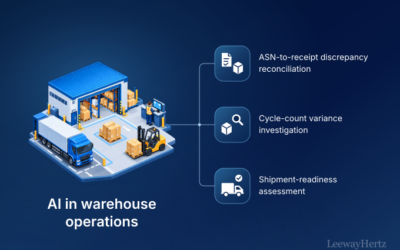
AI in Warehouse Operations: Use Cases Across the Warehouse Operating Model
AI changes warehouse operations by evaluating inventory records, tasks, documents, images, system events, labor capacity, and exceptions before a warehouse specialist begins the review.