


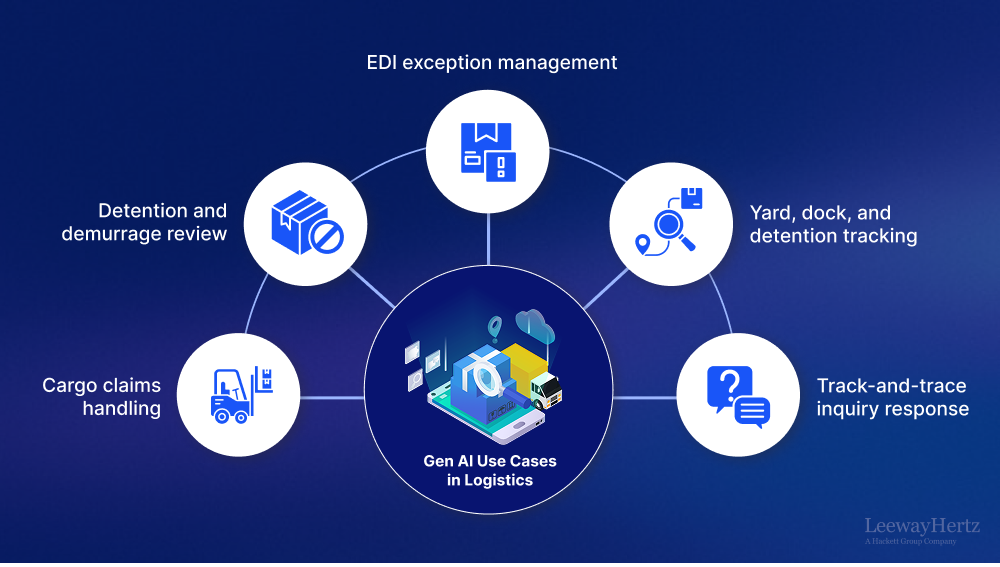
Logistics is one of the strongest industries for generative and agentic AI because logistics work sits at the intersection of documents, data, regulation, exceptions, and operational execution. A logistics operation does not only move freight. It classifies goods, files customs entries, audits invoices, investigates exceptions, drafts claims, answers status inquiries, screens partners, and documents every handoff across a network that spans carriers, brokers, warehouses, and last-mile providers.
These activities create an ideal environment for generative AI and agentic AI. Traditional analytics already help logistics teams forecast demand, optimize routing, and detect anomalies. Generative AI extends this by reading and extracting data from freight documents, drafting exception narratives, retrieving policy and tariff guidance, and summarizing regulatory requirements. Agentic AI goes further by orchestrating multi-step workflows across TMS (Transportation Management System), WMS (Warehouse Management System), EDI (Electronic Data Interchange), and visibility systems while keeping a human accountable at each control point.
The market reflects this momentum. According to GMInsights [1], the global generative AI in logistics market was valued at around USD 1.3 billion in 2024 and is projected to grow at a CAGR of roughly 33.7 percent through 2034. Gartner predicts that 25 percent of logistics KPI reporting will be supported by generative AI by 2028 [2]. Further, spending on agentic AI‑enabled supply‑chain software is expected to grow from under $2 billion in 2025 to $53 billion by 2030, with adoption rising from 5 percent to over 60 percent of enterprises [3].
The value of generative AI in logistics does not come from isolated pilots or generic automation. It comes from embedding AI into real operational workflows. A transportation planner reconciling freight invoices, a customs broker preparing HS-classification rationales, a warehouse manager investigating OS&D discrepancies, a returns coordinator processing RMAs, or a control-tower analyst triaging network exceptions all need AI that understands the workflow, the relevant data, the policy context, and the output required for human review.
That is why AI use cases in logistics should be mapped at the operating-model level. Instead of asking, “Where can AI be applied?”, leaders should ask, “Which function, process, and sub-process can AI improve, and what governed workflow should support it?” Mapping AI this way identifies high-value opportunities across logistics operations and ensures that AI delivers practical, workflow-specific value while maintaining human accountability.
This article demonstrates how generative and agentic AI can be applied at the operating-model level in logistics. It breaks down logistics and supply chain operations into major functions, core processes, and sub-processes, and shows where AI can add practical, workflow-specific value. The focus is on helping organizations identify high-impact AI opportunities, integrate them into existing workflows, and maintain human accountability, rather than replacing employees.
- How generative AI is transforming logistics operations
- Why logistics AI use cases must be mapped at the sub-process level
- Logistics operating model and generative AI opportunity mapping across logistics processes
- High-value generative AI use cases in logistics
- How agentic AI works in logistics workflows
- How to prioritize generative AI use cases in logistics
- Governance, risk, and responsible AI in logistics
- How ZBrain operationalizes generative AI use cases in logistics
- Future of generative AI in logistics
How generative AI is transforming logistics operations
Logistics teams have long relied on analytics, rules engines, EDI, and robotic process automation to improve efficiency and reduce errors. These technologies remain important, but generative and agentic AI introduce a new class of capability.
Traditional automation follows predefined rules, while machine learning predicts, scores, and detects patterns from historical data. Generative AI can read, extract, summarize, draft, compare, and explain unstructured content across documents and communications. Agentic AI goes further by planning and executing sequences of steps, such as retrieving a rate agreement, matching it against an invoice, drafting a dispute, and routing it for approval.
In practice, this transforms how teams handle five prominent types of logistics work:
-
Document-heavy: Bills of lading, ASNs, commercial invoices, packing lists, customs declarations, and proof-of-delivery records.
-
Narrative-heavy: OS&D exception notes, cargo-claim determinations, demurrage disputes, carrier scorecard commentary, and customs-classification rationales.
-
Exception-heavy: Failed deliveries, EDI transaction failures, freight-bill discrepancies, detention claims, and control-tower disruptions.
-
Knowledge-heavy: Tariff interpretation, routing-guide rules, carrier contract terms, and standard operating procedures.
-
Workflow-heavy: Order-to-delivery orchestration, returns processing, customs clearance, and carrier onboarding.
Logistics use cases usually do not remove the human from the process. Instead, they prepare the case, extract data, draft outputs, flag risks, and route work to the right reviewer.
Why logistics AI use cases must be mapped at the sub-process level
Generative AI can unlock significant efficiency and accuracy gains in logistics, but only when applied to specific, well-defined workflows. “AI in logistics” is too broad to be actionable. So are categories like “AI in warehousing” or “AI in customs.” These high-level labels cannot define data requirements, controls, approval paths, success metrics, or implementation scope.
A more practical approach maps AI opportunities to the logistics operating model:
-
Function: The major business or control area, such as transportation management, customs brokerage, warehouse operations, or freight billing.
-
Process: The workflow within that function, such as entry filing, freight bill audit, or inbound reconciliation.
-
Sub-process: The specific activity, such as HS classification, invoice-to-contract matching, or OS&D exception note drafting.
-
AI-enabled opportunity: The way AI can support the sub-process, such as extracting document data, drafting a narrative, classifying exceptions, or summarizing operational variances.
This level of detail is essential because logistics workflows are tied to specific documents, systems, rules, and decision rights. Drafting a customs classification rationale is very different from auditing dimensional weight charges. Responding to a track-and-trace inquiry is different from determining liability in a cargo claim.
Mapping AI to the sub-process level moves logistics providers from broad innovation ideas to executable workflows with clear operational value, data needs, and governance. The sections that follow decompose the logistics operating model into eleven core functions and highlight where generative and agentic AI can save time while keeping human judgment central to each workflow.
Transform Logistics Operations With Generative AI
Leverage GenAI to optimize freight planning, warehouse management, order fulfillment, returns, and control tower workflows, boosting operational efficiency, accuracy, and customer service.
Logistics operating model and generative AI opportunity mapping across logistics processes
The following sections map generative AI opportunities across the operating model of a modern logistics organization. Each function includes a short overview, a process and sub-process table, and a summary of the high-value AI opportunities within that function.
Function 1. Transportation management and freight procurement
Transportation management sources carrier capacity, builds routing guides, tenders loads, and manages freight contracts across truckload, LTL, intermodal, ocean, and air. The function is highly document- and rate-driven, with frequent exceptions requiring review and coordination.
Generative AI can extract, normalize, and summarize bid responses, contracts, and rate agreements, and draft first-pass narratives. Agentic AI can orchestrate multi-step workflows such as rate evaluation, tendering, in-transit follow-up, and carrier onboarding, while keeping human oversight for approvals and exceptions.
| Process | Sub-process | Key AI-enabled opportunities |
|---|---|---|
| Carrier sourcing and procurement | RFP and bid management | Extract lane, volume, and accessorial data from carrier bids, aggregate incumbent rates and spot-market benchmarks, draft award recommendations, summarize rationale for procurement review, and flag anomalies. |
| Carrier qualification and onboarding | Validate carrier packets (operating authority, MC/DOT, COI, W-9), check FMCSA safety ratings, classify carriers by mode, equipment type, lane coverage, and summarize exceptions for compliance review. | |
| Routing guide construction | Guide generation | Aggregate awarded rates, transit commitments, and service scores, detect deviations, flag anomalies, and summarize guidance updates for operations teams. |
| Rate and contract management | Rate agreement digitization | Extract base rates, fuel surcharge tables, accessorial schedules, validate loaded rates against agreements, and flag discrepancies for review. |
| Contract clause review | Extract liability limits, detention, and termination clauses, summarize deviations from standard contracts, and flag risk exposures for legal review. | |
| Fuel surcharge and accessorial governance | Fuel surcharge and accessorial validation | Validate applied fuel surcharges against contracted indices and effective dates, detect anomalies in accessorial-charge frequency by carrier and lane, and draft exception notes. |
| Transportation planning | Mode and carrier selection | Compare contracted rates, transit commitments, capacity, service sensitivity, accessorial risk, recommend best mode and carrier for planner review, and summarize cost-service trade-offs. |
| Load consolidation | Analyze orders, cube, weight, delivery windows, equipment type, lane constraints, recommend load-build options, flag consolidation exceptions, and summarize efficiency impact. | |
| Load tendering and execution | Tender generation | Generate EDI 204 load tenders, classify acceptances, rejections, and timeouts, draft escalation notes, and summarize tender performance metrics. |
| Tender rejection recovery | Detect tender rejection risk, identify backup carriers, compare spot and contracted options, draft recovery recommendations, and summarize exposure impact. | |
| Freight exception management | Expedited freight approval | Summarize service risk, customer impact, cost premium, available alternatives, draft expedite approval recommendations, and flag high-priority exceptions. |
| In-transit status and tender follow-up | Status monitoring | Summarize EDI 214 status events, flag loads missing milestones, draft carrier follow-up messages, and prioritize high-risk shipments. |
| Appointment scheduling | Delivery coordination | Draft appointment requests and confirmations, classify conflicts, propose reschedules, and summarize operational impact. |
High-value opportunities in logistics include spot-quote handling, load-tender automation, rate agreement digitization, fuel surcharge and accessorial governance, and in-transit follow-up dominate document- and communication-heavy work at freight desks. These processes are repetitive, error-prone, and involve high volumes of structured and semi-structured data, making them ideal for AI augmentation.
An example agentic workflow is spot-quote handling. The agent reads inbound rate requests, aggregates lane history and routing-guide rates, drafts a quote response, validates fuel surcharge application, monitors in-transit milestone exceptions, and routes it for operator approval. By automating repetitive document handling and narrative drafting, procurement teams can focus on strategic lane decisions and exception management.
Function 2. Freight forwarding and multimodal coordination
Freight forwarding coordinates international shipments across ocean, air, and intermodal legs. It is among the most document-intensive areas in logistics, involving booking confirmations, bills of lading, and house and master documentation.
Generative AI can extract booking and shipment details, validate documents, and draft first-pass documentation. Agentic AI orchestrates multi-step workflows, such as booking verification, consolidation planning, and forwarding settlement, while maintaining human approval.
| Process | Sub-process | Key AI-enabled opportunities |
|---|---|---|
| Ocean freight execution | Ocean booking and documentation | Extract booking, container, and sailing details, validate ocean bill of lading and shipping instructions against the booking and commercial invoice, flag discrepancies, and generate first-pass documentation. |
| Sailing schedule and booking comparison | Compare carrier schedules, cut-off dates, transit times, blank sailings, and allocation constraints, and recommend optimal booking options. | |
| Container milestone monitoring | Track container gate-in, loaded-on-vessel, transshipment, discharge, customs hold, and availability milestones, and draft exception summaries. | |
| Air freight execution | Air waybill handling | Extract AWB and consolidation data, validate AWB charges and routing against booking and rate sheets, flag mismatches, and generate first-pass documentation. |
| Intermodal and drayage coordination | Intermodal and drayage coordination | Classify drayage and rail-ramp exceptions, draft resolution notes, and detect anomalies in dwell and per-diem accruals against free-time terms. |
| Trade documentation | Incoterms validation | Interpret Incoterms against shipment documents, identify responsibility gaps, and flag cost or customs-clearance ownership issues. |
| Letter of credit document review | Compare commercial invoices, packing lists, bills of lading, certificates of origin, and letter-of-credit terms, and flag discrepancies before presentation. | |
| Consolidation and documentation | Shipment consolidation planning | Aggregate bookings, draft consolidation options, summarize consolidation exceptions, and generate first-pass recommendations. |
| House and master document preparation | Generate HBL drafts from booking and shipper instructions, validate HBL and MBL data consistency, and flag discrepancies. | |
| Cargo and arrival notice handling | Arrival notices and delivery-order instructions | Draft arrival notices and delivery-order instructions, classify arrival exceptions, and route exceptions for human review. |
| Forwarding settlement | Profit-share and cost reconciliation | Extract buy and sell rates, assemble shipment P&L, detect margin erosion against expected profit by trade lane, and flag exceptions. |
High-value AI opportunities include spot-quote handling, consolidation planning, document preparation, and forwarding settlement, which dominate the document-heavy, complex processes where AI can reduce manual reconciliation, improve accuracy, and speed up international shipment handling.
An example agentic workflow is ocean freight booking validation. The agent extracts booking and container details from the carrier confirmation, validates the bill of lading and shipping instructions against the commercial invoice, flags discrepancies, and routes the shipment file to the forwarder for confirmation. This workflow reduces documentation errors, supports trade compliance, and improves shipment throughput.
Function 3. Warehouse and fulfillment operations
Warehouse operations receive, store, pick, pack, and ship inventory across distribution and fulfillment nodes. AI opportunities are software-only, focusing on document, exception, and workflow-heavy tasks rather than physical material handling.
Generative AI can extract and normalize data from ASNs, vendor documentation, and inventory records, draft exception notes, and summarize patterns. Agentic AI orchestrates high-volume tasks such as ASN reconciliation, OS&D resolution, and shipping document generation while maintaining human oversight.
| Process | Sub-process | Key AI-enabled opportunities |
|---|---|---|
| Inbound and receiving | ASN and receipt reconciliation | Extract SKUs, quantities, and weights from ASNs, compare against receiving records, flag OS&D discrepancies, draft exception notes, and summarize recurring issues. |
| Inbound and receiving | Supplier compliance check | Validate shipments against vendor routing and labeling requirements, summarize recurring vendor failures, draft vendor performance exceptions, and score adherence patterns. |
| Putaway | Putaway location recommendation | Recommend storage locations based on SKU velocity, storage rules, temperature requirements, lot controls, weight constraints, downstream demand, and zone optimization while flagging location exceptions. |
| Inventory control | Cycle counting and inventory anomaly detection | Detect inventory variance anomalies, prioritize recounts, reconcile perpetual inventory adjustments, flag shrinkage or mis-picks, and draft variance commentary. |
| Inventory control | Slotting and replenishment review | Recommend slotting changes, summarize replenishment exceptions, flag replenishment delays, and suggest prioritization rules for critical SKUs. |
| Inventory control | Lot, expiry, and FEFO enforcement | Detect lot-expiry and FEFO sequencing exceptions, draft quarantine or hold justifications, notify planners of perishable inventory risks, and suggest reallocation of near-expiry stock. |
| Value-added services | Kitting and light assembly support | Extract kit BOM and work-order requirements, classify component shortages, draft replenishment requests, and summarize assembly exception reports. |
| Value-added services | Labeling and compliance marking | Validate customer and compliance labels, classify exceptions against routing guides, flag missing or misprinted labels, and summarize recurring labeling issues. |
| Order picking and packing | Pick-path and wave planning | Score order batches, recommend wave composition, optimize pick paths, balance zone workloads, suggest appropriate picking methods, and flag constrained SKUs. |
| Outbound and shipping | Pick-pack exception handling | Classify short-pick and substitution exceptions, draft resolution notes, generate customer backorder notifications, and highlight SLA breaches. |
| Outbound and shipping | Pack validation and cartonization | Recommend carton sizes, validate labels and compliance requirements, optimize dimensional weight, classify packing exceptions, and summarize packaging discrepancies. |
| Outbound and shipping | Shipping document generation | Generate bills of lading, packing lists, and labels; validate documentation against order and carrier requirements; and flag shipment data mismatches. |
| Outbound and shipping | Load and trailer planning support | Summarize outbound order cube and weight data into load-build plans, classify load-planning exceptions, and recommend sequencing and trailer optimization strategies. |
| Returns and reverse logistics | RMA validation and intake | Validate return requests, classify return reasons, draft intake exception notes, and route cases for inspection. |
| Returns and reverse logistics | Inspection and disposition | Grade returned goods, recommend restocking, refurbishment, or disposal actions, draft disposition notes, and identify recurring return drivers. |
| Labor and productivity | Shift performance commentary | Summarize labor productivity metrics, picks per hour, dock-to-stock time, backlog levels, and exception drivers, then draft supervisor review commentary. |
Key GenAI opportunities include ASN and OS&D reconciliation, supplier compliance checks and the generation of shipping documents, which dominate software-only workflows. GenAI reduces manual reconciliation, improves accuracy, and frees staff to handle exceptions.
An example agentic workflow is inbound reconciliation. The agent extracts ASN quantities, compares against the receipt, flags OS&D discrepancies, drafts exception notes citing PO and ASN evidence, and routes to the receiving supervisor. This workflow improves accuracy and allows supervisors to focus on exception resolution.
Function 4. Yard, dock, and cross-dock operations
Yard, dock, and cross-dock operations schedule dock doors, reconcile yard inventory, and coordinate cross-dock flows. AI is applied to document-heavy, scheduling, and exception-management tasks.
Generative AI can draft appointment confirmations, validate gate paperwork, and summarize yard and detention exceptions. Agentic AI orchestrates dock and yard workflows, ensuring human supervisors approve high-impact decisions.
| Process | Sub-process | Key AI-enabled opportunities |
|---|---|---|
| Appointment and dock scheduling | Dock-door appointment management | Generate appointment requests and confirmations, classify scheduling conflicts, propose alternative time slots, and draft exception notifications for delayed or early arrivals. |
| Appointment and dock scheduling | Schedule adherence review | Detect late or early dock arrivals, summarize dock-utilization gaps, flag potential congestion or bottlenecks, and draft planning commentary for operational review. |
| Yard management | Yard inventory reconciliation | Detect missing or mislocated trailers against YMS records, draft yard-check exception summaries, and track trailer allocation and utilization patterns. |
| Yard management | Detention and dwell tracking | Classify trailer dwell against free-time terms, draft detention-risk summaries, identify repeat offenders, and recommend mitigation actions. |
| Cross-dock coordination | Cross-dock and flow-through planning | Classify inbound freight as cross-dock or putaway, summarize timing exceptions, draft exception alerts, and optimize flow sequencing across facilities. |
| Cross-dock coordination | Gate document validation | Validate gate paperwork against appointment and shipment records, classify exceptions, draft exception reports, and summarize compliance gaps. |
| Yard execution | Yard move prioritization | Prioritize trailer moves based on appointment schedules, load status, detention risk, door availability, and shipment priority, while recommending optimal move sequences. |
| Dock operations | Dock utilization review | Summarize dock occupancy, unload times, late arrivals, no-shows, and congestion drivers, and provide shift-planning recommendations. |
| Trailer management | Trailer pool monitoring | Detect trailer shortages, excessive dwell, missing empty trailers, and imbalances across facilities, and recommend rebalancing actions. |
| Gate operations | Seal and trailer condition review | Validate seal, trailer, and load-condition records, classify exceptions, draft investigation notes, and flag potential compliance or damage risks. |
High-value GenAI opportunities cover dock appointment management, yard reconciliation, and detention/dwell tracking, which dominate software-heavy tasks. GenAI reduces manual tracking and improves scheduling accuracy.
An example agentic workflow is dock-appointment management. The agent drafts appointment confirmations from the dock calendar, classifies scheduling conflicts, proposes reschedules, and flags trailers approaching detention limits for review. This workflow streamlines dock operations while maintaining human oversight.
Function 5. Last-mile and final-delivery operations
Last-mile operations manage the final leg to the customer: route planning, delivery exceptions, POD verification, dispatch communication, and settlement. The function is document- and exception-heavy with high customer impact.
Generative AI can draft delivery notifications, summarize routes, and process POD images. Agentic AI orchestrates multi-step exception and notification workflows, leaving humans responsible for decisions.
| Process | Sub-process | Key AI-enabled opportunities |
|---|---|---|
| Delivery planning support | Delivery window communication | Generate delivery notifications, classify customer responses, draft updated delivery instructions, track response status, and summarize exceptions for planner review. |
| Delivery planning support | Planned vs. actual analysis | Summarize stop sequences and dwell times, identify route anomalies, generate exception summaries, and provide insights to improve route efficiency. |
| Delivery planning support | Route-capacity summary | Analyze stop-count versus route-capacity gaps, generate coverage requests, flag underutilized or overloaded routes, and recommend load-balancing actions. |
| Delivery exception management | Failed delivery handling | Classify failed deliveries, draft re-delivery notifications, identify repeat-failure addresses, and summarize recurring exception patterns. |
| Delivery exception management | POD verification | Extract proof-of-delivery signatures and images, flag missing or illegible PODs, summarize disputes, and draft exception notes for review. |
| Delivery exception management | Loss and damage classification | Classify loss and damage incidents, assemble claim-evidence summaries, draft consignee communications, and recommend claim follow-up actions. |
| Final-mile settlement | Contractor and courier settlement | Extract completed-stop data, summarize discrepancies for review, flag payment or SLA exceptions, and generate settlement summary reports. |
| Address quality | Address correction and deliverability review | Validate delivery addresses, identify missing apartment or access details, flag high-risk locations, recommend correction workflows, and suggest address standardization actions. |
| Customer delivery experience | Delivery instruction handling | Extract customer preferences, access notes, time-window constraints, and special instructions, update delivery records, and summarize conflicts for planners. |
| Delivery alternatives | Pickup point and locker routing | Recommend pickup-point, locker, or redelivery options based on customer preferences, carrier coverage, and failed-attempt history while optimizing route efficiency. |
| Returns pickup | Return pickup scheduling | Draft pickup instructions, validate return eligibility, classify scheduling conflicts, route exceptions to dispatch teams, and summarize recurring return patterns. |
High-value AI opportunities in final-mile operations include handling failed deliveries, POD verification, and proactive communication, where AI improves SLA compliance and customer satisfaction.
An example agentic workflow is delivery-exception handling. The agent classifies a failed-delivery reason code, links the stop record and prior attempts, drafts the consignee re-delivery communication, and routes to dispatch and customer service. This workflow accelerates resolution while retaining human oversight.
Function 6. Customs brokerage and global trade compliance
This function classifies goods, files entries, screens parties, and clears shipments across borders. It is highly document- and regulation-heavy, making it an ideal fit for generative AI to process and summarize compliance and filing tasks.
Generative AI can extract commercial invoice and packing list data, draft a classification rationale, and prepare entry documentation. Agentic AI can orchestrate multi-step workflows such as HS classification, ISF assembly, and compliance review, while licensed brokers retain final approval.
| Process | Sub-process | Key AI-enabled opportunities |
|---|---|---|
| Entry preparation and filing | HS classification support | Retrieve candidate HS codes from product descriptions and prior rulings, draft classification rationales for broker review, flag anomalies, and suggest alternative classifications for evaluation. |
| Entry preparation and filing | PGA/OGA admissibility review | Identify partner government agency requirements, validate certificates and permits, flag missing admissibility documentation, and draft reviewer notes. |
| Entry preparation and filing | Commercial document review | Extract values, quantities, countries of origin, and party details from invoices and packing lists, validate against purchase orders and bills of lading, flag mismatches, and summarize exceptions. |
| Entry preparation and filing | ISF and entry data assembly | Aggregate importer, consignee, and shipment data, validate ACE entry fields, assemble submission-ready entries, and flag missing or inconsistent information. |
| Entry preparation and filing | Valuation and origin determination | Determine customs valuation methods, draft country-of-origin and marking determinations, and flag high-risk discrepancies for compliance review. |
| Trade compliance screening | Denied-party screening | Summarize screening hits, classify them by risk level, draft first-pass disposition notes, and escalate complex or high-risk matches for review. |
| Trade compliance screening | Restricted-party escalation | Summarize screening results, ownership links, country risks, and transaction context, and draft escalation recommendations for compliance teams. |
| Duty and trade-program review | FTA/duty eligibility | Determine free-trade agreement eligibility, draft supporting claim narratives, flag exceptions, and summarize potential duty savings or compliance risks. |
| Duty and trade-program review | AD/CVD exposure review | Compare product, origin, supplier, and tariff data against AD/CVD scope indicators, draft reviewer notes, and identify potential exposure cases. |
| Export controls and licensing | Export controls and licensing | Classify products against ECCN requirements, draft license-determination summaries, and flag items requiring special approvals or regulatory review. |
| Classification governance | Classification change review | Detect product, specification, or supplier changes that may impact HS classifications, draft review summaries, and recommend reclassification or escalation where necessary. |
| Special programs and facilities | Foreign Trade Zone administration | Extract admission and withdrawal records, reconcile FTZ inventory, identify anomalies, and draft summary reports for compliance review. |
| Special programs and facilities | Bonded warehouse and in-bond movement | Classify in-bond movement exceptions, draft reconciliation summaries, and monitor compliance issues throughout the movement lifecycle. |
| Post-entry and audit | Post-summary correction support | Detect anomalies in customs filings, draft correction recommendations, and summarize updates to support auditability and compliance. |
| Post-entry and audit | Recordkeeping and audit response | Aggregate entry records, invoices, and proof-of-export documentation, identify retention gaps, and flag missing records for follow-up. |
High-value AI opportunities include HS classification support, commercial document review and ISF assembly. These document-heavy workflows require precise data extraction, regulatory context, and human review, making them strong candidates for reducing manual effort and improving entry accuracy.
An example agentic workflow is entry preparation. The agent classifies products to candidate HS codes, extracts invoice and packing-list data, assembles the ISF and ACE entry set, flags edit risks, and routes to a licensed broker for confirmation. This workflow ensures accurate and efficient customs processing while maintaining human oversight.
Function 7. Network design and capacity planning
Network design and capacity planning determine facility placement, transportation flows, capacity commitments, and contingency strategies across the logistics network. The function combines forecasting, scenario analysis, operational constraints, and long-range planning to balance cost, service levels, and resilience.
Generative AI can summarize demand forecasts, scenario outputs, and network trade-offs, while agentic AI can coordinate workflows such as capacity planning, disruption modeling, and contingency analysis across planning systems and operational data sources. Human planners remain responsible for strategic decisions, scenario approval, and final network recommendations.
| Process | Sub-process | Key AI-enabled opportunities |
|---|---|---|
| Demand and volume planning | Demand-forecast commentary | Draft narratives explaining forecast shifts by lane, region, and customer, detect anomalies, summarize variance patterns, and flag unusual demand signals for planner review. |
| Demand and volume planning | Natural-language scenario narratives | Summarize peak-surge, port-diversion, and mode-shift assumptions, highlight potential bottlenecks, and draft scenario commentary for planning and decision-making meetings. |
| Network optimization support | Multi-modal trade-off analysis | Compare cost, transit time, and emissions trade-offs across transportation modes, draft mode-shift recommendations, identify risks, and evaluate alternative routing options. |
| Network optimization support | Node-consolidation impact | Aggregate lane-volume, cost, and service data, draft impact commentary, recommend optimal node-consolidation scenarios, and flag potential service-level risks. |
| Capacity commitment | Capacity-plan documentation | Aggregate committed capacity and projected volumes, generate peak-season readiness summaries, identify under- or over-committed lanes, and highlight planning risks. |
| Contingency and disruption planning | Contingency plan narratives | Generate disruption scenarios involving ports, carriers, and weather events, summarize lane-level exposure, draft mitigation options, and recommend alternative routing strategies. |
| Network model maintenance | Baseline network refresh | Validate lane volumes, rates, transit times, node capacities, and service assumptions, update network baselines, and flag discrepancies before scenario modeling. |
| Network optimization | Service-cost trade-off analysis | Evaluate cost, service, working-capital, and customer-impact trade-offs across network design alternatives, provide decision-support commentary, and flag high-risk scenarios. |
| Mode strategy | Mode-mix optimization | Compare truckload, LTL, intermodal, ocean, air, and parcel options across cost, service, emissions, and risk factors, and recommend an optimal transportation-mode mix. |
| Capacity planning | Capacity constraint diagnosis | Identify capacity gaps by lane, node, carrier, or planning period, draft mitigation options, summarize critical bottlenecks, and recommend reallocation or surge-capacity strategies. |
Demand-forecast commentary, scenario assumption support, and capacity-readiness documentation are high-value AI-driven tasks that free planners to focus on strategic decision-making.
An example agentic workflow is capacity-readiness reporting. The agent aggregates forecast data and committed capacity, drafts peak-season readiness narratives that cite committed lanes and contingency options, and routes them to the planning team. This workflow reduces manual data compilation and improves scenario-driven planning.
Function 8. Order management and customer service
This function coordinates order intake, shipment visibility, exception resolution, and customer communication across the logistics lifecycle. The function combines operational coordination, shipment tracking, policy interpretation, and high-volume customer interaction, making it heavily knowledge- and exception-driven.
Generative AI can extract order details, summarize shipment milestones, retrieve SOP and routing guidance, and draft customer communications. Agentic AI can coordinate workflows such as order validation, disruption management, track-and-trace response, and complaint handling across operational systems while keeping human review in place for customer-impacting decisions and escalations.
| Process | Sub-process | Key AI-enabled opportunities |
|---|---|---|
| Order capture and validation | Order entry and enrichment | Extract order details from emails, PDFs, and EDI messages into structured order lines, populate OMS records, validate against customer master, pricing, and credit terms, and flag incomplete or inconsistent orders for review. |
| Order promising | Available-to-promise (ATP) and capable-to-promise (CTP) support | Aggregate on-hand, in-transit, and planned inventory, evaluate inbound schedules, capacity, and transit times, recommend realistic promise dates, and balance service, cost, and SLA requirements. |
| Order allocation | Customer and order-line allocation | Recommend allocation strategies based on customer priority, service commitments, margins, inventory availability, and backorder risk, while sequencing orders for fulfillment. |
| Fulfillment execution | Split shipment review | Evaluate the cost, service, inventory, and customer impact of split shipments, generate approval notes, and flag exceptions requiring planner review. |
| Fulfillment orchestration | Order allocation and release | Score allocation scenarios across fulfillment nodes during constrained supply conditions, recommend fulfillment, partial shipment, or backorder actions, and prioritize releases based on SLA requirements. |
| Exception detection and resolution | Order exception handling | Classify credit, inventory, and address-related holds, detect delayed or stalled orders, identify at-risk shipments, and draft resolution recommendations for approval. |
| EDI order management | EDI order exception handling | Identify failed or incomplete EDI transactions, detect missing or invalid fields, generate correction requests, and summarize recurring errors for process-improvement initiatives. |
| Shipment visibility and status | Track-and-trace inquiry response | Retrieve shipment milestones and carrier updates, generate real-time status information, draft personalized customer communications, and flag potential service disruptions. |
| Shipment visibility and status | Proactive disruption alerts | Detect shipment milestone deviations, identify impacted orders, generate revised estimated arrival times, and draft internal and customer-facing disruption notifications. |
| Service support | Agent assist & knowledge retrieval | Surface relevant SOPs, tariff guidance, policies, and customer context, generate after-call summaries, and provide context-aware recommendations for service representatives. |
| Service support | Complaint classification and response | Classify customer complaints by type and severity, route cases to the appropriate team, draft responses, and identify recurring issues for quality and service improvement initiatives. |
| Customer onboarding and SOP setup | SOP extraction & validation | Extract routing guides and customer-specific operating procedures, validate order-handling requirements, identify compliance gaps, and summarize policy exceptions for review. |
Order-entry validation, track-and-trace responses, and agent-assist knowledge retrieval are the most valuable AI opportunities, improving responsiveness and reducing manual work.
An example agentic workflow is proactive disruption handling. The agent detects milestone delays, identifies affected orders, drafts customer notifications with revised ETAs, and routes high-impact cases to the service desk. This workflow accelerates response times while retaining human oversight.
Function 9. Reverse logistics and returns
Reverse logistics and returns manage return authorization, product disposition, recovery, warranty handling, and customer communication after the forward shipment cycle. The function is document- and exception-heavy, with multiple decision points involving policy eligibility, inspection evidence, refund timing, supplier recovery, and customer experience.
Generative AI can classify return requests, extract return merchandise authorization (RMA) and inspection data, summarize defect evidence, and draft customer or supplier communications. Agentic AI can coordinate multi-step return workflows, such as eligibility review, disposition recommendation, warranty claim preparation and settlement notification, while keeping humans accountable for final approvals and exception decisions.
| Process | Sub-process | Key AI-enabled opportunities |
|---|---|---|
| Returns authorization | Return eligibility assessment | Classify requests against returns policy and warranty, route complex cases, generate RMA instructions and labels, flag exceptions, and summarize policy deviations for reviewer assessment. |
| Return fraud screening | Identify repeat-return and refund-abuse patterns, draft investigative summaries, flag high-risk accounts, and suggest additional checks for suspected fraud. | |
| Refund and credit validation | Validate refund amounts, restocking fees, shipping fees, item condition, and payment method; draft credit memos, route exceptions for approval, and summarize anomalies for audit review. | |
| Return intake | Inspection record review | Extract inspection notes, images, serial numbers, and reason codes; prepare disposition-ready cases, flag discrepancies, and draft inspector summaries. |
| Disposition and recovery | Defect adjudication | Analyze returned-item images, recommend restock, refurbish, or scrap actions; classify defect reasons, flag high-value or critical items, and draft reviewer notes. |
| Returns communication | Draft return-status and settlement notifications | Generate return-status updates, summarize stalled credits or refunds, flag pending actions, and draft customer communications for approval. |
| Recovery and resale routing | Resale/liquidation/donation classification | Classify recoverable returns, summarize recovery-value exceptions, recommend disposition channels (resale, liquidation, donation), and draft operational summaries. |
| Warranty and supplier recovery | Warranty claim support | Extract claim data, match coverage terms, assemble claim packs, draft supplier recovery correspondence, flag exceptions, and summarize recovery eligibility. |
| Supplier recovery | Return-to-vendor support | Match returned goods to supplier agreements, warranty terms, defect evidence, and recovery eligibility; draft vendor communications and flag exception cases. |
| Carrier claims | Damage and shortage claim assembly | Assemble PODs, photos, bills of lading, inspection notes, value details, and shipment history; draft claim packets and flag discrepancies for review. |
| Recall and quarantine | Affected return identification | Identify returned products linked to recalls, quarantines, lot issues, or serial-number concerns; route cases for compliance review, summarize risk exposure, and flag urgent cases. |
Return-eligibility assessment, defect adjudication, and returns communication are high-value AI opportunities that reduce manual effort and improve processing speed.
An example agentic workflow can be returns processing. The agent checks eligibility, generates RMA and labels, adjudicates item condition, drafts settlement notifications, and routes for human review. This workflow accelerates return cycles while maintaining oversight.
Function 10. Freight billing, audit, and settlement
Freight billing, audit, and settlement manage the rating, validation, dispute, and payment of freight invoices across carriers, lanes, modes, and customer accounts. The function is calculation-heavy but exception-rich, with recurring issues around accessorials, dimensional weight, duplicate invoices, detention, demurrage, accruals, and cost allocation.
Generative AI can extract invoice charges and accessorials, compare billing details against contracts and shipment records, summarize discrepancies, and draft dispute narratives. Agentic AI can coordinate invoice matching, dimensional-weight verification, dispute preparation, and settlement workflows while keeping finance, audit, and operations teams accountable for final payment and dispute decisions.
Here is the updated Freight Audit and Payment AI table with missing sub-processes added, multi-step, comma-separated AI-enabled opportunities, and enterprise-standard formatting:
| Process | Sub-process | Key AI-enabled opportunities |
|---|---|---|
| Freight bill audit | Invoice-to-contract matching | Extract charges and accessorials, match against BOL and rate agreements, flag overbillings, reconcile line-item discrepancies, and suggest adjustments for review. |
| Three-way match | Match shipment, invoice, and rate agreement, flag mismatches, draft exception summaries, and recommend approval or dispute routing. | |
| Accessorial charge validation | Validate accessorial charges such as detention, reweigh, and fuel, flag anomalies, summarize recurring issues, and draft resolution notes. | |
| Fuel surcharge validation | Verify calculated fuel surcharges against contracted terms, flag discrepancies, draft correction recommendations, and summarize trends for auditing. | |
| Dimensional-weight verification | Validate billed DIM weight, flag discrepancies, draft explanations, and recommend corrections for invoice adjustments. | |
| Duplicate and pre-payment audit | Detect duplicate invoice numbers, classify pre-payment exceptions, flag high-risk cases, and draft exception reports for approval. | |
| Dispute and settlement | Dispute preparation | Aggregate invoice, contract, and shipment evidence, draft correspondence, classify dispute reasons, and summarize resolution impact. |
| Detention and demurrage review | Classify claims, draft accept-or-dispute recommendations, flag recurring issues, and summarize potential financial impact. | |
| Customer freight billing | Customer invoice validation | Validate customer invoices, compare against agreed rates and service-level agreements, draft responses to billing queries, and flag anomalies. |
| Cost allocation and accrual | Freight accrual support | Summarize unbilled freight positions, detect cost drift, draft accrual entries, and flag discrepancies for review. |
| Accrual reversal and invoice timing | Detect month-end reversal issues, reconcile invoice timing, summarize adjustments, and draft commentary for finance approval. | |
| Cost-to-serve allocation | Aggregate freight, handling, and accessorial costs by customer, draft variance commentary, flag unusual cost drivers, and recommend adjustments. | |
| Payment approval | Payment approval routing | Route invoices and freight payments through the appropriate approval workflow, flag high-value or high-risk invoices, summarize pending approvals, and ensure segregation of duties. |
Invoice-to-contract matching, DIM verification, and detention/dispute preparation are high-value AI opportunities that improve accuracy and reduce manual workload.
An example agentic workflow is a freight bill audit. The agent extracts invoice charges and accessorials, matches against agreements, flags discrepancies, drafts dispute correspondence, and routes to the settlement team. This workflow accelerates review while retaining human approval.
Function 11. Carrier and vendor management
This function manages the carrier and supplier base after onboarding, including performance monitoring, scorecards, claims, contracts, and relationship governance. It is document- and exception-heavy, with recurring reporting and validation tasks.
Generative AI can summarize carrier performance metrics, extract claims data, and draft vendor scorecards. Agentic AI orchestrates workflows such as claims handling, SLA tracking, and contract renewals, while humans maintain final approval for strategic decisions.
| Process | Sub-process | Key AI-enabled opportunities |
|---|---|---|
| Performance management | Scorecard generation | Aggregate OTIF, tender-acceptance, and claims data, draft carrier performance summaries, detect service degradation against SLAs, summarize trends, and flag high-risk carriers. |
| Business-review preparation | Summarize volume, performance, and cost trends, draft review packs, highlight open issues and action items, detect recurring gaps, and recommend discussion points. | |
| SLA and penalty tracking | Classify SLA breaches against contract terms, draft penalty and service-credit summaries, detect recurring SLA misses by lane and carrier, and flag non-compliance patterns. | |
| Corrective action tracking | Summarize open corrective actions, service failures, owner commitments, and overdue recovery items, draft follow-up notifications, and recommend escalation for unresolved issues. | |
| Carrier portfolio management | Carrier segmentation | Classify carriers by lane coverage, performance, cost, strategic value, risk, and capacity reliability, draft portfolio summaries, and highlight underperforming carriers. |
| Claims and issues | Cargo claims handling | Extract claim forms, BOLs, photos, and invoices, assemble claims packs, draft claim determinations, and flag high-value or recurring claims. |
| Dispute and chargeback management | Classify vendor chargebacks, draft dispute or acceptance summaries, summarize recurring root causes, and flag high-risk vendors or lanes for review. | |
| Onboarding and contracts | Vendor onboarding and KYC | Extract registration, insurance, and ownership details, assemble onboarding packs, validate credentials, and flag missing or expiring documents. |
| Contract and rate renewal | Summarize expiring contracts, compare renewal proposals, draft deviation summaries, and highlight renegotiation opportunities. | |
| Vendor risk | Insurance and certificate expiry monitoring | Track COIs, safety ratings, certifications, and authority status, draft renewal or suspension alerts, and summarize compliance gaps. |
| Carrier financial health monitoring | Aggregate financial, news, service, and disruption signals, flag carrier risk for procurement review, and draft risk summaries. | |
| Sustainability management | Carrier emissions scorecard | Summarize emissions performance by carrier, lane, and mode, highlight improvement actions, flag underperforming carriers, and recommend corrective initiatives. |
Scorecard generation, cargo-claims handling, and vendor onboarding are the most valuable AI opportunities, improving reporting accuracy, reducing manual workload, and standardizing carrier and vendor management processes.
An example agentic workflow is the generation of the carrier scorecard. The agent aggregates OTIF, tender acceptance and claim data, drafts a scorecard narrative, highlights SLA breaches against contract terms and routes the pack to the vendor manager for review. This workflow streamlines performance monitoring while maintaining human accountability.
Function 12. Safety, regulatory, and sustainability compliance
Safety, regulatory, and sustainability compliance keep logistics operations aligned with transport-safety rules, driver-hours requirements, customs-security programs, fuel-tax obligations, and emissions-reporting commitments. The function is highly document- and regulation-intensive, requiring accurate records, timely filings, corrective-action tracking, and clear ownership of compliance decisions.
Generative AI can summarize hours-of-service (HOS) logs, inspection records, regulatory updates, International Fuel Tax Agreement (IFTA) data, trade-security documentation, and emissions reports. Agentic AI can coordinate workflows such as safety-audit preparation, fuel-tax filing support, trade-security compliance review, and environmental, social, and governance (ESG) reporting while keeping humans responsible for final approval and regulatory accountability.
| Process | Sub-process | Key AI-enabled opportunities |
|---|---|---|
| Transport safety and driver compliance | Hours-of-service log review | Detect potential HOS violations, analyze driver logs against regulatory requirements, identify recurring compliance risks, and draft follow-up documentation for safety review. |
| Safety audit preparation | Aggregate inspection, incident, maintenance, and training records, identify documentation gaps, summarize compliance status, and draft corrective-action narratives for audit readiness. | |
| Incident and CSA score review | Analyze roadside inspection findings, incident records, and CSA score trends, identify risk patterns, and draft corrective-action plans for safety and compliance teams. | |
| Regulatory and tax filing | IFTA and fuel-tax support | Extract mileage and fuel-consumption data, assemble filing worksheets, validate calculations against source records, identify discrepancies, and prepare reviewer-ready tax summaries. |
| Regulatory change monitoring | Monitor transportation, customs, trade, and safety regulations, summarize relevant updates, identify affected lanes and operations, and draft SOP and compliance guidance updates. | |
| Trade-security program compliance | C-TPAT and AEO documentation | Aggregate supply-chain security documentation, evaluate compliance against program requirements, identify control gaps, and prepare readiness summaries for compliance review. |
| Sustainability reporting | Emissions reporting support | Aggregate shipment, mode, distance, fuel, and load-utilization data, calculate emissions metrics, identify reporting anomalies, and draft GLEC-aligned sustainability commentary. |
| Customer ESG reporting | Generate customer-specific sustainability reports, summarize emissions-reduction initiatives and performance trends, highlight progress against targets, and draft ESG reporting narratives. |
Hours-of-service review, IFTA/fuel-tax support, and emissions reporting dominate the high-volume compliance tasks, reducing manual effort while improving accuracy and regulatory adherence.
An example agentic workflow is an hours-of-service review. The agent screens ELD records for potential violations, drafts follow-up documentation citing the log evidence, and routes it to the safety team for determination. This workflow ensures compliance while minimizing manual review.
Function 13. Logistics technology, data, and control tower
This function manages the core systems and information flows that keep logistics networks connected, including transportation management systems (TMS), warehouse management systems (WMS), electronic data interchange (EDI), visibility platforms, and control-tower workflows. This function coordinates network exceptions, monitors key performance indicators (KPIs), supports integration quality, and provides the operational oversight needed to scale AI across logistics.
Generative AI can detect data anomalies, summarize EDI failures, explain exception patterns, and produce performance narratives for operations teams. Agentic AI can coordinate workflows such as exception triage, disruption-impact reporting, trading-partner onboarding, master-data remediation, and AI governance while keeping humans accountable for high-impact operational decisions.
| Process | Sub-process | Key AI-enabled opportunities |
|---|---|---|
| Integration and data operations | EDI exception management | Classify EDI transaction failures, draft resolution notes, and detect out-of-sequence milestones. |
| Master data quality | Detect inconsistent location, SCAC, customer, and item references, and draft remediation summaries. | |
| Integration and onboarding support | Summarize trading-partner onboarding status and classify integration-test failures. | |
| Control-tower orchestration | Exception triage and routing | Classify network exceptions by type and severity, assemble context packs, and route them to the appropriate resolver. |
| Disruption-impact reporting | Draft impact briefings for weather, congestion, or carrier failures and summarize performance against KPIs. | |
| Performance and KPI reporting | Aggregate service, cost, and exception data into KPI narratives and detect drift against targets. | |
| AI governance | AI use-case inventory and monitoring | Aggregate deployed AI workflows, owners, data sources, and controls, while summarizing agent output quality and exception patterns. |
| Model and policy compliance review | Classify AI workflows against internal data, privacy, and model-risk policies and draft compliance summaries. |
EDI exception management, master-data quality, and control-tower triage are the highest-value AI opportunities, forming the foundation for scaling AI across logistics operations.
An example agentic workflow is control-tower triage. The agent classifies a network exception by type and severity, aggregates shipment, carrier, and order context into a case pack, drafts an impact briefing, and routes mitigation options to the analyst. This workflow centralizes exception management while maintaining human oversight.
Accelerate AI Solutions Development
Build fully functional solutions from your high-value use cases, based on specific operational needs and enterprise context.
High-value generative AI use cases in logistics

The logistics use-case landscape is broad, but not every workflow should be automated first. The strongest early opportunities are usually high-volume, document-heavy, exception-heavy, or narrative-heavy workflows where AI can produce a draft, a recommendation, an exception summary, or a case pack for human review.
| High-value use case | Why it matters |
|---|---|
| Commercial-invoice and HS-classification support | Reduces manual customs data entry, supports candidate HS code identification, and accelerates entry preparation while maintaining final classification with a licensed broker. |
| Freight bill audit and DIM-weight verification | Helps identify duplicate, inflated, or out-of-contract charges by comparing invoices against rate agreements, bills of lading, shipment records, and carrier dimensional-weight (DIM) rules. |
| ASN (Advance Ship Notice) and OS&D (Overage, Shortage, and Damage) reconciliation | Flags over, short, and damaged receipts early, drafts exception notes, and reduces downstream inventory, billing, and supplier-compliance issues. |
| Track-and-trace inquiry response | Answers high-volume shipment-status inquiries using EDI milestones, carrier updates, and shipment records, reducing manual effort for customer service and control-tower teams. |
| Returns eligibility and defect adjudication | Applies return policy and warranty rules consistently, classifies return reasons, recommends disposition, and drafts customer settlement communications for review. |
| Cargo claims handling | Assembles claim packs from bills of lading (BOLs), invoices, photos, delivery records, and claim forms, then drafts liability summaries for adjuster review. |
| Detention and demurrage review | Tests claims against free-time terms, terminal records, gate timestamps, and contract rules, then drafts accept-or-dispute recommendations. |
| Control-tower exception triage | Classifies network exceptions by type and severity, assembles shipment and carrier context, and routes cases to the appropriate resolver queue. |
| Carrier scorecard and business-review preparation | Aggregates on-time in-full (OTIF), on-time delivery (OTD), tender-acceptance, claims, service-level agreement (SLA), and cost data into review-ready narratives for carrier and vendor managers. |
| EDI exception management | Classifies failures across transactions, drafts resolution notes, and helps protect downstream visibility and billing accuracy. |
| Yard, dock, and detention tracking | Supports dock appointment management, yard inventory reconciliation, trailer dwell tracking, and detention-risk summaries from YMS and appointment records. |
| Forwarding documentation and HBL/MBL validation | Reduces manual review across ocean bookings, air waybills, shipping instructions, house bills, master bills, arrival notices, and consolidation documents. |
| Safety, fuel-tax, and emissions reporting support | Helps prepare hours-of-service (HOS) review notes, International Fuel Tax Agreement (IFTA) filing worksheets, safety audit packs, and freight-emissions reporting commentary from approved operational records. |
| Customer complaint and disruption communication | Drafts customer-ready messages for delays, failed deliveries, proof-of-delivery (POD) disputes, order changes, and service exceptions while preserving human review for sensitive cases. |
| Master-data quality and integration support | Identifies inconsistent location, Standard Carrier Alpha Code (SCAC), customer, item, carrier, or trading-partner data and drafts remediation summaries for data and integration teams. |
These use cases work well because they support human review rather than bypassing it. They also create measurable value through reduced cycle time, fewer errors, stronger documentation, better exception handling, improved customer communication, and more consistent operational controls.
Accelerate AI Solutions Development
Build fully functional solutions from your high-value use cases, based on specific operational needs and enterprise context.
How agentic AI works in logistics workflows
Generative AI can draft, summarize, classify, and retrieve. Agentic AI can coordinate a workflow. In logistics, this distinction matters because many valuable use cases require multiple steps across systems, documents, partners, policies, and approvals.
For example, a freight bill audit workflow is not just an invoice-reading task. It may require extracting invoice charges, retrieving the rate agreement, checking the bill of lading, validating fuel surcharge and accessorial terms, identifying duplicate or out-of-contract charges, drafting dispute correspondence, and routing the case to the settlement team for approval. An agentic AI workflow can coordinate these steps, while the freight audit owner remains accountable for the dispute decision.
This shift is becoming more relevant as enterprise software moves from embedded copilots to task-specific agents. Gartner predicts that 40 percent of enterprise applications will include task-specific AI agents by the end of 2026, up from less than 5 percent in 2025 [4].
Examples of agentic AI workflows in logistics include:
-
A freight-audit agent that extracts invoice charges, matches them to the rate agreement and BOL, validates accessorials, flags overbillings, drafts dispute correspondence, and routes the case to the settlement team.
-
A customs-entry agent that classifies products to candidate HS codes, extracts commercial-invoice and packing-list data, assembles the Importer Security Filing (ISF) and Automated Commercial Environment (ACE) entry set, flags edit-rejection risks, and routes the entry to a licensed broker for confirmation.
-
A track-and-trace agent that ingests EDI 214 milestones and carrier updates, detects delays against expected transit, drafts customer notifications with revised ETAs, and escalates high-impact shipments to the service desk.
-
A returns agent that checks eligibility against policy and warranty terms, generates the return merchandise authorization (RMA), evaluates the returned item’s condition from inspection records or images, recommends disposition, and drafts the settlement notification for review.
-
A dock-appointment agent that reads appointment requests, checks dock-calendar availability, proposes reschedules, flags dwell or detention exposure, and routes conflicts to the dock scheduler.
-
A forwarding-documentation agent that extracts booking and container details, validates the house bill and master bill data, checks shipping instructions against commercial documents, flags discrepancies, and routes the file to the forwarder.
Agentic workflows should be designed with approval gates. The agent can prepare, recommend, route, and update, but the logistics operation should define where human review is mandatory, what evidence must be retained, which systems can be updated after approval, and how exceptions escalate when the workflow touches customs filings, claims, settlements, customer commitments, or safety documentation.
How to prioritize generative AI use cases in logistics
A logistics provider should not prioritize AI use cases only because they sound innovative. The strongest candidates combine business value, workflow fit, data readiness, control readiness, and scalability. Many organizations are still early in operational AI adoption, making a structured prioritization framework a competitive advantage.
| Prioritization criterion | What logistics providers should evaluate |
|---|---|
| Business value | Cost reduction, productivity improvement, revenue protection, SLA performance, risk reduction, customer experience, and cycle-time improvement. |
| Workflow fit | Whether the workflow is document-heavy, knowledge-heavy, exception-heavy, narrative-heavy, repetitive, or dependent on manual coordination. |
| Data readiness | Whether the required data, such as rates, BOLs, ASNs, EDI milestones, contracts, PODs, shipment records, and customer SOPs, is available, accurate, permissioned, and connected. |
| Human review model | Whether a qualified operator, broker, auditor, planner, or supervisor can review, approve, reject, or correct AI-generated output. |
| Control and compliance impact | Whether the workflow affects customs filings, safety records, claims, settlements, emissions reporting, trade compliance, or customer commitments that require governance. |
| Integration complexity | How many systems, trading partners, APIs, EDI feeds, approval paths, and downstream actions the workflow spans across TMS, WMS, OMS, ERP, visibility, and customs systems. |
| Exception frequency | Whether the workflow experiences recurring delays, disputes, missing data, manual escalations, or operational bottlenecks where AI can help standardize processes. |
| Scalability | Whether the workflow pattern can be reused across carriers, lanes, warehouses, modes, regions, customers, or business units. |
A practical first wave should focus on bounded workflows with strong human review and clear operational evidence. Examples include freight bill audit, customs-document review, ASN and OS&D reconciliation, track-and-trace inquiry response, carrier scorecard preparation, and returns eligibility assessment. These use cases typically have structured inputs, measurable cycle times, and clear approval owners.
More sensitive use cases, such as final customs classifications, claim settlements, denied-party escalation decisions, safety-violation determinations, detention liability decisions, and customer compensation approvals, require stronger governance and should retain final accountability with designated logistics, compliance, finance, or customs personnel.
Accelerate AI Solutions Development
Build fully functional solutions from your high-value use cases, based on specific operational needs and enterprise context.
Governance, risk, and responsible AI in logistics
Generative AI in logistics must operate within the organization’s existing governance, operational control, compliance, and risk management framework. The most important principle is clear accountability. AI can assist with drafting, summarization, classification, routing, and workflow coordination, but the responsible person must remain accountable for operational decisions, regulatory filings, financial settlements, and customer commitments.
Key governance requirements include:
-
Human review for customs classifications, denied-party escalations, claim settlements, detention and demurrage disputes, safety-violation determinations, customer compensation decisions, and regulatory filings.
-
Source-grounded outputs that reference approved shipment records, bills of lading, contracts, tariffs, SOPs, carrier updates, customs documentation, and operational systems.
-
Audit trails that capture prompts, inputs, outputs, workflow actions, reviewer decisions, approvals, rejections, escalations, and downstream system updates across TMS, WMS, ERP, and customs systems.
-
Role-based access control so agents can retrieve only shipment, customer, pricing, customs, or financial data that the user and the workflow are authorized to access.
-
Data-protection controls for customer shipment data, pricing agreements, customs records, vendor contracts, employee information, financial data, and trade-sensitive documentation.
-
Model and agent monitoring for accuracy, completeness, hallucination risk, exception rates, latency, workflow drift, adoption patterns, and operational impact.
-
Escalation procedures for low-confidence outputs, conflicting shipment instructions, customs-classification ambiguity, high-value cargo exposure, SLA breaches, or safety-sensitive exceptions.
-
Third-party and vendor risk review for AI models, cloud infrastructure, integration partners, APIs, and workflow orchestration platforms connected to operational systems.
-
Alignment with customs-compliance requirements, trade-security programs, records-retention policies, transportation-safety rules, cybersecurity standards, operational-resilience frameworks, privacy obligations, and internal audit requirements.
Governance should not be treated as a blocker to logistics AI adoption. It is what makes AI operationally reliable and scalable. A well-governed AI workflow provides stronger documentation, clearer exception tracking, more consistent operational execution, better auditability, and improved accountability than unmanaged manual processes.
How ZBrain operationalizes generative AI use cases in logistics
Identifying AI use cases is only the first step. Logistics organizations also need a way to design, build, validate, deploy, govern, and scale AI workflows across functions. This is where ZBrain helps.
ZBrain is an end-to-end AI enablement platform that provides enterprises with a structured pathway from identifying where AI can deliver value to deploying it as a governed, scalable capability. The platform operates across two core dimensions: strategy and execution. In the strategy phase, ZBrain helps logistics teams identify, evaluate, and design AI solutions by leveraging operational processes, systems of record (ERP, WMS, TMS), and historical workflow data. The execution phase ensures these opportunities are systematically developed into scalable solutions. Covering the full AI lifecycle in connected stages, ZBrain enables initiatives to progress from strategic insight to enterprise deployment, eliminating fragmented pilots and manual experimentation.
Preparation (Foundation)
Establishes a comprehensive understanding of the organization’s current logistics environment, including operational processes, system integration points, workforce metrics, and KPIs. This provides insight into where AI can deliver meaningful value, particularly in document-heavy, narrative-heavy, and exception-heavy sub-processes.
Ideation and prioritization (Discovery)
Leverages operational and historical data to identify AI opportunities and prioritize them based on feasibility, cost, expected benefits, and ROI. Priority is given to sub-processes that can be embedded within existing workflows, such as ASN extraction, freight bill audit, or order status answering.
Solution design (Validation)
Translates prioritized opportunities into ROI-validated, KPI-mapped solution blueprints. Defines where AI can assist, augment, or act autonomously within workflows, including inbound logistics, warehouse operations, customs clearance, order management, and returns disposition.
Technical design (Build-ready)
Transforms solution requirements into structured, build-ready technical artifacts, including architecture diagrams, agentic workflow definitions, user stories, epics, and business requirement documents. This provides the development team with a complete foundation for implementation.
Proof of Concept (PoC) (Validation)
Tests selected AI solutions in controlled environments to validate feasibility, business value, and operational readiness before scaling.
Scaled product
Scale validated proof-of-concept, supported by performance metrics and observability data, are deployed as governed, production-grade AI solutions across enterprise environments, with continuous improvement loops to sustain impact.
Future of generative AI in logistics
Generative AI in logistics will evolve from copilots to workflow agents. The first wave helps operators draft, summarize, search, classify, and retrieve information across freight, warehouse, forwarding, customs, and customer-service workflows. The next wave will coordinate larger operational sequences across systems, partners, and functions, with humans entering at key review and decision points.
Several shifts are likely to define the next stage of logistics AI:
-
From generic assistants to specialized agents built for specific logistics workflows such as freight audit, customs-entry preparation, RFQ handling, dock scheduling, control-tower triage, and returns processing.
-
From isolated pilots to reusable AI workflows deployed across transportation, warehousing, forwarding, customs, customer service, and finance operations.
-
From manual review of every operational step to human approval at defined control points for settlements, customs filings, safety exceptions, and customer-impacting decisions.
-
From centralized AI experimentation to federated adoption across functions under enterprise governance, operational controls, and compliance oversight.
-
From static knowledge search to active workflow orchestration.
-
From productivity-only measurement to broader measurement of service reliability, exception reduction, SLA performance, operational resilience, compliance quality, and customer experience.
-
From short, task-level automations to longer-horizon agentic workflows that coordinate freight procurement, transportation execution, exception management, and recovery processes across multiple operational systems.
This shift is already influencing supply-chain technology priorities. Gartner [5] predicts that 70 percent of large organizations will adopt AI-enabled supply-chain forecasting capabilities by 2030, while supply-chain leaders increasingly expect agentic AI to reshape operational and entry-level work [6]. The long-term pattern is not full automation without oversight. It is a workflow redesign in which AI coordinates repetitive operational tasks, while humans focus on exceptions, decision-making, relationship management, and control functions.
Logistics providers that succeed will not necessarily be the ones with the most AI pilots or the largest number of models. They will be the organizations that connect AI to how logistics operations actually run, at the function, process, and sub-process levels, while building governance, integration, and operational accountability into every workflow.
Endnote
Generative AI has the potential to reshape logistics operations, but only if it is applied at the right level of detail. Broad statements such as “AI in logistics” or “AI in supply chain operations” are not enough. Real value comes from mapping AI to specific workflows, such as freight RFQ handling, customs entry preparation, commercial invoice review, freight bill audit, ASN and OS&D reconciliation, track-and-trace response, returns adjudication, detention and demurrage review, carrier scorecard preparation, and control tower exception triage.
The logistics operating model is complex, spanning transportation management, freight forwarding, warehousing, yard and dock operations, last-mile delivery, customs brokerage, network planning, order management, reverse logistics, freight billing, carrier management, compliance, and the underlying technology and control-tower infrastructure. Across all these functions, generative AI can extract shipment and contract data, summarize operational evidence, draft communications and narratives, classify exceptions, retrieve SOP and tariff guidance, and coordinate multi-step workflows. Agentic AI extends this value by connecting tasks across TMS, WMS, ERP, EDI, visibility, and customs systems while maintaining human review.
For logistics providers, freight forwarders, customs brokers, carriers, and enterprise supply chain organizations, the path forward is clear and practical. Build a sub-process-level opportunity map. Prioritize workflows with strong operational value and clear review ownership. Connect AI to approved shipment, contract, and operational data sources. Run controlled workflow pilots. Deploy with governance and auditability. Scale through reusable agents, orchestration patterns, and shared operational controls.
The future of logistics AI will not be defined by generic chatbots or isolated copilots. It will be defined by governed, workflow-specific agents that help logistics organizations move freight more efficiently, improve customer responsiveness, strengthen operational controls, reduce exception-handling effort, and give operations teams more time to focus on decisions, coordination, and problem-solving where human judgment matters most.
Accelerate AI solutions development to streamline your logistics workflows and drive operational efficiency—start mapping your AI opportunities today with LeewayHertz and ZBrain!
Author’s Bio


Akash's ability to build enterprise-grade technology solutions has garnered the trust of over 30 Fortune 500 companies, including Siemens, 3M, P&G, and Hershey's. Akash is an early adopter of new technology, a passionate technology enthusiast, and an investor in AI and IoT startups.
Related Products

AI Agent
Discover the right AI agent for your use case! Explore our extensive range of AI agents tailored to tackle specific challenges.
Start a conversation by filling the form
Once you let us know your requirement, our technical expert will schedule a call and discuss your idea in detail post sign of an NDA.
All information will be kept confidential.
FAQs
What are the best generative AI use cases in logistics?
High-value generative AI use cases are typically document-heavy, narrative-heavy, exception-prone, or repetitive, in which AI can draft or summarize information for human review. Examples include:
-
Freight RFQ handling – Extracts lane, volume, mode, and accessorial requirements and prepares pricing-response inputs.
-
Commercial invoice and HS classification support – Reduces manual customs data extraction and supports broker review.
-
Freight bill audit – Helps identify duplicate, inflated, or out-of-contract charges.
-
ASN and OS&D reconciliation – Flags receiving discrepancies and drafts exception notes.
-
Track-and-trace inquiry response – Drafts shipment-status updates using milestone and carrier data.
-
Returns eligibility review – Checks policy and warranty terms and prepares return instructions.
-
Cargo claims handling – Assembles evidence packs and drafts liability summaries.
-
Detention and demurrage review – Tests claims against free-time terms and timestamps.
-
Control tower exception triage – Classifies disruptions and routes cases to the right resolver.
How is generative AI different from traditional AI in logistics?
Traditional AI typically predicts, scores, classifies, or detects patterns based on historical data. Generative AI, in contrast, can read, summarize, draft, compare, explain, and retrieve information from logistics documents and systems. Agentic AI extends this by coordinating multi-step workflows across transportation management systems, warehouse management systems, electronic data interchange, customs systems, visibility platforms, and approval paths.
What is agentic AI in logistics?
Agentic AI refers to AI systems that plan and execute sequences of workflow steps under defined controls. For example, an agent can:
-
Assemble a freight-audit case
-
Extract invoice charges and validate them against contracts and bills of lading
-
Draft dispute correspondence
-
Route the case for review and approval
-
Update workflow systems after settlement decisions
This ensures workflow continuity, accelerates repetitive operational tasks, and maintains human accountability.
Which logistics functions benefit most from generative AI?
Generative AI can add value across most logistics functions, particularly those involving high-volume documents, complex workflows, and operational oversight. Key areas include:
-
Transportation management and freight procurement
-
Freight forwarding and customs brokerage
-
Warehouse and fulfillment operations
-
Order management and customer service
-
Reverse logistics and returns
-
Freight billing and settlement
-
Carrier management and compliance
-
Control tower and operational oversight
Can generative AI be used in customs and trade-compliance workflows?
Yes, when implemented with appropriate controls and governance. AI should be:
-
Grounded in approved shipment, tariff, and trade-compliance data
-
Monitored for quality, consistency, and filing accuracy
-
Integrated with audit trails and human review checkpoints
-
Used as a support tool, with final decisions retained by licensed brokers or compliance personnel
Should AI make customs, settlement, or customer-impacting decisions?
AI can support these workflows by assembling evidence, drafting narratives, and highlighting exceptions. However, final decisions related to customs classification, denied-party escalation, cargo claim settlement, detention liability, customer compensation, and freight payment approval should remain with qualified human owners to ensure accountability and operational control.
How should logistics providers prioritize AI use cases?
Logistics providers should evaluate AI opportunities based on:
-
Business value: Productivity, cost reduction, revenue protection, risk reduction, customer experience, and cycle-time improvement
-
Workflow fit: Document-heavy, knowledge-intensive, exception-prone, narrative-heavy, or repeatable tasks
-
Data readiness: Availability, accuracy, permissions, and integration of shipment, contract, and milestone data
-
Human review model: Qualified owners can review, approve, reject, or correct AI outputs
-
Control and compliance impact: Improvements in auditability, policy adherence, customs compliance, and operational oversight
-
Integration complexity: Number of systems, partners, data sources, and approval paths involved
-
Scalability: Reusability across lanes, modes, warehouses, regions, and business units
High-value early use cases are typically well-bounded workflows with clear review points, such as freight bill audit, customs document review, returns eligibility, track-and-trace response, and freight RFQ handling.
How can mid-sized logistics providers use generative AI?
Mid-sized logistics providers can start with bounded, high-impact workflows that require limited operational disruption. Examples include:
-
Freight RFQ response preparation
-
Shipment-status inquiry handling
-
Freight audit and invoice dispute support
-
Forwarding document validation
-
Dock scheduling and appointment coordination
-
Carrier scorecard preparation
-
Returns adjudication
-
Customer SOP and routing-guide support
These workflows can deliver measurable operational and customer-service benefits without requiring a full-scale AI transformation program.
What governance is required for AI agents in logistics?
Effective AI governance ensures reliability, compliance, and accountability. Key requirements include:
-
Role-based access to shipment, customer, pricing, and customs data
-
Audit trails capturing inputs, outputs, prompts, model versions, and reviewer actions
-
Human review for critical operational decisions
-
Output monitoring for accuracy, hallucinations, and anomalies
-
Data protection for customer, carrier, pricing, customs, and financial information
-
Model and agent documentation for validation and compliance
-
Escalation procedures for exceptions, low-confidence outputs, or regulatory sensitivity
-
Alignment with customs, transport safety, trade security, cybersecurity, operational resilience, and internal audit frameworks
How can logistics providers measure ROI from generative AI?
Logistics providers should measure generative AI initiatives using both operational and business metrics rather than focusing only on automation volume. Common evaluation areas include:
-
Cycle-time reduction – Faster freight audit resolution, customs-entry preparation, returns adjudication, and shipment-exception handling.
-
Productivity improvement – Reduced manual effort in document review, customer communication, invoice validation, and operational reporting.
-
Error reduction – Fewer billing discrepancies, shipment-data mismatches, filing corrections, and exception-handling errors.
-
Customer experience improvement – Faster response times, more proactive shipment communication, and improved SLA performance.
-
Operational resilience – Better exception visibility, disruption response, and workflow consistency across carriers, warehouses, and regions.
-
Control and compliance effectiveness – Improved auditability, documentation quality, escalation tracking, and adherence to customs, safety, and operational policies.
The strongest AI programs typically begin with bounded workflows where baseline metrics already exist, such as freight bill audit, track-and-trace response, customs-document review, or detention and demurrage management. This allows organizations to compare cycle times, exception rates, and operational effort before and after deployment.
How does ZBrain support generative AI use cases in logistics?
ZBrain is an enterprise AI enablement platform that helps logistics organizations identify, build, deploy, govern, and scale AI workflows. It operates across two dimensions: strategy, which identifies, evaluates, and designs AI solutions using operational processes, systems, historical workflow data, and execution, which develops these opportunities into scalable, production-ready solutions.
ZBrain covers the full AI lifecycle, including:
-
Preparation (Foundation): Understand current operations, systems, workforce metrics, and KPIs to identify high-value AI opportunities.
-
Ideation and prioritization (Discovery): Prioritize sub-processes for GenAI implementation.
-
Solution design (Validation): Create KPI-mapped blueprints showing where AI can assist, augment, or act autonomously in inbound logistics, warehouse operations, customs, order management, and returns.
-
Technical design (Build-ready): Produce architecture diagrams, agentic workflows, user stories, and business requirements for development.
-
Proof of Concept (PoC): Test AI workflows in controlled environments for feasibility, value, and operational readiness.
-
Scaled product: Deploy validated PoCs as governed, production-grade AI solutions, ensuring quality, human review, and reusable workflows across logistics functions.
Insights

AI for insurance: Transforming insurance operations with data-driven insights
AI empowers insurers to foster growth, mitigate risks, combat fraud, and automate various processes, thereby reducing costs and improving efficiency.

AI for startups: Its use cases and role in steering success for early-stage businesses
AI empowers startups to overcome resource constraints, outperform competitors, enhance customer experiences, and make data-driven decisions.

Machine learning for customer segmentation: Unlocking new dimensions in marketing
Customer segmentation is a powerful technique that helps businesses understand their customer base better and tailor their marketing strategies accordingly.




