


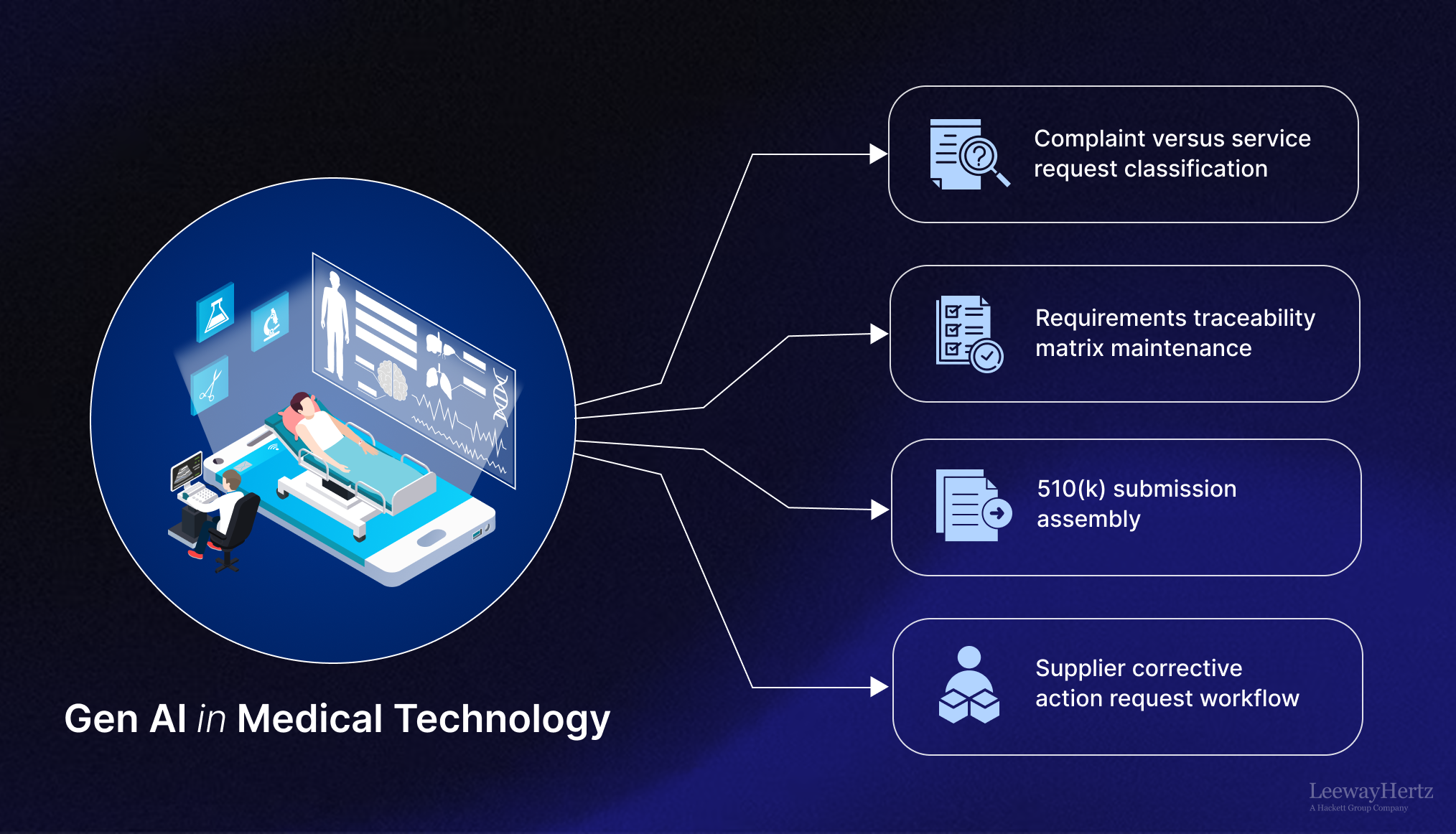
Medical technology is becoming a natural proving ground for generative and agentic AI, where data-rich workflows, regulated documentation, and repeatable decisions create clear opportunities for measurable impact. Product teams maintain design records, quality teams review complaints, regulatory teams prepare submission content, and service teams document field issues, so a large share of operational effort sits in reading, interpreting, drafting, and checking evidence. That matters as the sector continues to grow, with medtech revenue expected to stabilize at 100 to 150 basis points above prepandemic rates [1], while broader life sciences outlooks estimate that AI implementation could support cost savings of up to 12% of total revenue within the next two to three years [2]. The opportunity is not only to move faster, but to reduce manual effort in work that already requires traceability and review.
That value does not come from placing a generic chatbot beside regulated work. It comes from embedding gen AI into the steps where people already make decisions, prepare records, and resolve exceptions. A regulatory affairs specialist, for example, can use gen AI to assemble a first draft of a submission response from approved source material, while the regulatory affairs reviewer confirms the wording before it enters the submission package. A quality engineer can receive a summarized complaint file with likely issue categories, which helps reduce triage time before the quality reviewer confirms the classification. In service operations, a field service coordinator can use AI to draft a case summary from prior notes, giving the service manager a clearer basis for follow-up.
For these examples to become buildable opportunities, medical technology organizations need to map gen AI at the function, process, and sub-process level before selecting tools or model features. That is where the work connects to specific systems, artifacts, owners, and controls. A complaint intake step may sit in a post-market surveillance system, depend on a complaint file, and require review by a quality reviewer, while a design change step may depend on a change control record and review by an engineering change board. When AI is mapped at this level, teams can see where it can safely reduce cycle time, where human review is mandatory, and where data readiness or system integration must be improved first.
This process-centric view also makes prioritization more practical. Instead of treating generative AI as a broad productivity layer, functions can compare opportunities by effort, risk, review burden, and measurable value. Drafting a design review summary may be a lower-risk starting point than supporting a production change, because the required evidence, reviewer, and release control are clearer. As a result, the AI roadmap becomes easier to govern, prioritize, and connect to operating outcomes.
This article uses a medical technology operating model to break work into functions. Each function is then divided into processes and sub-processes. For each area, it shows where AI can draft content and summarize records. A named human reviewer confirms production changes before release, and approves customer-facing messages or risk-bearing actions before they occur.
- How generative AI is transforming medical technology operations
- Why Gen AI use cases for medical technology must be mapped at the sub-process level
- Medical technology operating model and generative AI opportunity mapping across medical technology processes
- High-value generative AI use cases in medical technology
- How agentic AI works in medical technology workflows
- How to prioritize generative AI use cases in medical technology
- Governance, risk, and responsible AI in medical technology
- How ZBrain operationalizes generative AI use cases in medical technology
- Future of generative AI in medical technology
How generative AI is transforming medical technology operations
In medical technology operations, complaint handling often depends on evidence spread across service systems, customer emails, attachments, device history records, and prior quality events. Rule-based automation can support routing when required fields are available, and predictive models can identify similarity to past cases. However, these methods are less effective when critical evidence is embedded in narrative text, PDFs, or fragmented records.
Generative AI can summarize scattered complaint evidence into a traceable case narrative, while agentic workflows can retrieve relevant device history, service records, and prior event information for reviewer assessment. This helps complaint handling teams shorten triage, reduce manual evidence gathering, and improve the consistency of regulated review steps without replacing human accountability.
The same pattern extends beyond complaint intake. Across medical technology operations, many high-value workflows depend on fragmented evidence, regulated documentation, recurring reviews, and cross-functional handoffs. This is where generative and agentic AI can create practical value by helping teams assemble context, draft review-ready outputs, and route work through governed checkpoints.
- In document-heavy work, such as design history files, device master records, clinical evaluation reports, and supplier quality agreements, AI can help summarize evidence, reduce manual review effort, and make audit preparation more consistent.
- In narrative-heavy work, including complaint narratives, field service notes, adverse event summaries, and regulatory response drafts, AI-generated case language can give reviewers a clearer starting point and shorten response cycle times.
- In exception-heavy work, such as nonconformance investigations, corrective and preventive action escalations, supplier corrective action responses, and device history record discrepancies, AI can classify issues and package supporting evidence so quality teams spend less time searching for context and more time assessing risk.
- In knowledge-heavy work, including quality procedures, labeling rules, regulatory guidance, and risk management files, retrieval grounded in approved sources can reduce ambiguity and help teams interpret requirements more consistently.
- In workflow-heavy work, such as change control, post-market surveillance case assembly, regulatory submission readiness checks, and training impact assessments, agentic workflows can support governed routing, keep handoffs visible, and reduce delays between functions.
The design rule is practical: AI prepares the case by gathering relevant records, retrieves the evidence behind each suggested conclusion, and drafts the output so the right reviewer receives a complete work package rather than a blank task. Before any production change, customer-facing message, or risk-bearing action moves forward, a complaint handling reviewer, quality engineer, regulatory affairs reviewer, or change control board confirms the record and owns the decision. This operating model allows AI to create value in regulated medical technology operations by reducing manual effort, strengthening compliance, and keeping review accountability visible at every workflow step.
Why Gen AI use cases for medical technology must be mapped at the sub-process level
Medical technology workflows depend on specific records, artifacts, reviewers, and control points, so the value of gen AI becomes clear only when medical technology work is mapped at a lower level than the function level. Broad categories such as “AI for quality,” “AI for regulatory,” or “AI for product development” are useful for strategy, but they are too high-level to define source data, approval paths, risk controls, success metrics, or implementation scope.
A better approach is to map AI opportunities to the medical technology operating model:
Function: the major business, quality, regulatory, or product area, such as product development, quality assurance, regulatory affairs, post-market surveillance, clinical affairs, manufacturing, or supplier quality.
Process: the workflow area within that function, such as design control, complaint handling, change control, regulatory submission preparation, nonconformance management, CAPA, clinical evaluation, or supplier qualification.
Sub-process: the specific work activity, such as design and development plan update, requirements traceability matrix maintenance, usability engineering file readiness review, complaint narrative drafting, CAPA evidence assembly, or design history file completeness check.
AI-enabled opportunity: the specific way AI can support that sub-process, such as drafting controlled-document updates, summarizing evidence, classifying requirement links, identifying completeness gaps, retrieving approved records, or packaging review evidence.
This level of detail matters because medical technology workflows are tied to specific artifacts, systems, quality procedures, regulatory expectations, and accountable reviewers. A workflow for design and development plan authoring is different from one for requirements traceability maintenance. A usability engineering file readiness check is different from a device history record discrepancy review. A complaint narrative drafting workflow is different from a CAPA evidence assembly workflow.
For example, in design and development plan authoring and approval, AI can draft a proposed plan update based on approved inputs, while the product development manager confirms the controlled version. This shortens review preparation because stakeholders begin with a structured draft rather than reconciling comments across multiple working files.
In requirements traceability matrix maintenance, AI can classify proposed requirement links and flag gaps for a systems engineering reviewer to accept or reject. This reduces manual review effort and makes traceability issues visible before verification evidence is assembled.
In usability engineering file and human factors validation report readiness, AI can summarize completeness gaps across the usability engineering file and human factors validation report, while the human factors reviewer confirms readiness for formal review. This improves review accountability because open items are tied to the exact artifact that must be corrected.
By mapping AI opportunities at the sub-process level, medical technology organizations can move from broad AI concepts to executable workflows with defined inputs, review points, accountable owners, validation needs, and measurable outcomes. This structure also makes it clear where generative and agentic AI can assist, and where human confirmation must remain the control point.
Transform medical technology workflows
Apply generative AI across product development, quality, regulatory, clinical, manufacturing, and commercial operations to improve efficiency, compliance, evidence quality, and decision speed.
Medical technology operating model and generative AI opportunity mapping across medical technology processes
The medical technology operating model below is organized into core industry-native functions that practitioners recognize. Each function is decomposed into its major processes and their sub-processes, and each sub-process carries the AI-enabled opportunity that applies to it. These opportunities are limited to software-based support, such as drafting, extraction, comparison, classification, summarization, and exception flagging, while accountable human reviewers remain responsible for approval, release, and any risk-bearing decision.
Function 1. Product development and design controls
Medical technology teams often lose time reconciling user needs, technical requirements, risk controls, verification evidence, and release records across long product lifecycles. This function owns concept translation through design transfer, including intended use, design inputs, design outputs, validation evidence, and the design history file.
Typical ownership sits with product management and systems engineering, with design quality and configuration management controlling release evidence. Generative and agentic AI help by retrieving, comparing, drafting, and routing governed review packs across product lifecycle management (PLM), electronic quality management system (eQMS), and clinical evidence platforms.
| Process | Sub-process | Key AI-enabled opportunities |
| Design control planning and design history file (DHF) management | Design and development plan authoring and approval | Draft design and development plan sections from product concept inputs and prior design review minutes, compare required gates with 21 CFR 820.30 and ISO 13485, and flag missing approvers to shorten approval cycles for design quality lead review. |
| Design control planning and DHF management | Intended use and indications for use alignment | Compare intended use language across the user needs specification and device labeling, classify indication statements against the 510(k) strategy, and flag inconsistencies that could create rework for regulatory affairs review. |
| DHF indexing and completeness review | Retrieve DHF records from PLM and eQMS repositories, classify protocols and reports against 21 CFR 820.30 and ISO 13485, and flag missing evidence to reduce audit preparation effort for design quality lead review. | |
| Medical device file compilation | Aggregate medical device file content from the DHF and risk management file, summarize conformity evidence under ISO 13485, and flag stale records to lower audit preparation cost for quality management representative review. | |
| Requirements and traceability management | User needs specification capture | Extract needs statements from customer research and complaint themes, classify them into the user needs specification using stage-gate criteria, and flag ambiguous needs to reduce requirement churn for product management review. |
| Design input requirements decomposition | Map approved user needs to atomic design input requirements, compare wording against 21 CFR 820.30 and ISO 13485, and flag non-testable inputs to improve verification readiness for systems engineering lead review. | |
| Design output specification mapping | Compare design output specification drafts and engineering drawings with approved design input requirements, map coverage under the medical device software V-model, and flag orphaned outputs to reduce transfer rework for design engineering lead review. | |
| Requirements traceability matrix maintenance | Aggregate requirement, risk, verification, and validation links into the requirements traceability matrix, detect broken relationships, and summarize open gaps to shorten design review cycles for systems engineering lead review. | |
| Verification, validation, and usability | Design verification protocol and traceability review | Draft design verification protocol sections from design input requirements and approved test methods, compare report results with traceability expectations, and flag untested requirements to shorten closure cycles for verification lead review. |
| Design validation protocol and evidence review | Draft design validation protocol and report narratives from approved user needs and clinical evidence, compare acceptance evidence with design control expectations, and flag unmet validation objectives for validation lead review. | |
| Usability engineering file and human factors validation report readiness | Retrieve use-related risk scenarios from the usability engineering file and hazard analysis, compare validation evidence with IEC 62366 expectations, and flag unvalidated critical tasks for human factors engineering lead review. | |
| Risk management and design transfer | ISO 14971 risk management file maintenance | Aggregate hazard and residual-risk evidence into the risk management file, classify updates against ISO 14971, and flag unresolved benefit-risk questions to strengthen compliance for risk management lead review. |
| Hazard analysis and risk control linkage | Map hazard analysis rows to design input requirements and verification evidence, detect missing links under ISO 14971, and flag unverified controls to reduce manual reconciliation for risk management lead review. | |
| Design failure mode and effects analysis worksheet update | Compare field feedback and change control records with the design failure mode and effects analysis worksheet, propose rating rationale, and flag rating changes to improve risk prioritization for design engineering lead review. | |
| Device master record design transfer package | Aggregate approved design outputs and manufacturing specifications into the device master record, compare release readiness with ISO 13485 expectations, and flag unresolved engineering change orders to reduce transfer delays for configuration management lead review. |
The highest-value opportunities for this function are requirements traceability and design-transfer evidence, because they require repeated reconciliation across PLM, eQMS, and controlled document repositories. Applying AI to retrieve, compare, draft exception summaries, and route gaps helps reduce manual effort, shorten design review cycles, and give the systems engineering lead a structured basis for release decisions.
Example agentic workflow: An example agentic workflow is the DHF completeness review. The workflow plans the completeness check, retrieves design and quality records from PLM and eQMS, drafts a gap register against 21 Code of Federal Regulations (CFR) 820.30 and ISO 13485, and routes exceptions to the design quality lead for disposition confirmation.
Function 2. Regulatory affairs and submissions
Regulatory affairs teams often face delayed submissions because evidence, labeling, change records, and registration data sit in separate systems. This function owns regulatory strategy, premarket pathway selection, submission content, regulator correspondence, and lifecycle change assessments for devices, in vitro diagnostic devices (IVDs), and software as a medical device (SaMD).
Submission managers and regulatory operations teams work across regulatory information management (RIM), PLM, eQMS, and enterprise resource planning (ERP) platforms. Generative and agentic AI help assemble dossiers, compare pathway evidence, extract source content, and route exceptions while final submission decisions stay with regulatory reviewers.
| Process | Sub-process | Key AI-enabled opportunities |
| Regulatory strategy and premarket pathway planning | Product classification and intended use assessment | Classify intended use statements in the user needs specification and device labeling, map them to design control expectations, and flag ambiguous claims to reduce pathway rework for regulatory affairs lead review. |
| 510(k) substantial equivalence strategy | Compare predicate indications and performance evidence with the requirements traceability matrix, draft a substantial equivalence rationale, and flag predicate gaps to shorten strategy cycles for regulatory affairs lead review. | |
| De Novo classification request strategy | Aggregate risk controls from the risk management file and benefit-risk analysis, classify evidence gaps for the De Novo request, and propose special controls language for regulatory affairs lead review. | |
| Premarket approval module planning | Map premarket approval (PMA) module requirements to clinical and design validation evidence, retrieve missing source content, and flag readiness gaps to reduce assembly delays for submission manager review. | |
| Premarket submission authoring and assembly | 510(k) submission assembly | Draft 510(k) submission sections from the requirements traceability matrix and design verification report, validate cross-references against the strategy, and flag unresolved evidence gaps for submission manager review. |
| De Novo request dossier preparation | Aggregate evidence from the risk management file and human factors validation report, draft De Novo narratives, and flag unsupported risk-control claims to improve decision quality for regulatory affairs lead review. | |
| PMA module content management | Retrieve approved source documents for each PMA module, summarize changes in clinical and validation evidence, and flag outdated content to shorten module refresh cycles for submission manager review. | |
| Device labeling and instructions for use evidence alignment | Compare device labeling and instructions for use claims with traceability and risk evidence, validate alignment with IEC 62366, and flag unsupported warnings for labeling lead review. | |
| Regulatory operations and registration data management | RIM metadata stewardship | Extract product status and authorization attributes from the medical device file and device labeling, validate RIM metadata under Part 11 controls, and flag stale records for regulatory operations review. |
| Establishment registration and device listing maintenance | Compare device master record commercial status with listing records, validate changes under Part 11 controls, and flag missing listings to improve compliance accountability for registration data steward review. | |
| Unique device identifier record and GUDID submission management | Extract identifier and packaging fields from the device master record, validate the unique device identifier (UDI) record against Global Unique Device Identification Database (GUDID) rules, and flag submission discrepancies for UDI data steward review. | |
| Regulatory change assessment and lifecycle management | Change control record regulatory impact assessment | Screen the change control record against traceability and labeling evidence, classify regulatory impact using design control criteria, and flag submission-triggering changes for regulatory affairs lead review. |
| Engineering change order and engineering change notice regulatory review | Compare engineering change order and engineering change notice details with the design output specification, map impacted requirements, and flag authorization implications for regulatory operations review. | |
| PCCP documentation package maintenance for AI-enabled device software | Retrieve model-update evidence from software requirements and cybersecurity risk records, compare it with the predetermined change control plan (PCCP), and flag out-of-scope changes for regulatory affairs lead review. |
The highest-value opportunities for this function are submission assembly, labeling evidence alignment, and regulatory impact assessment. These are strong use cases because they are artifact-rich workflows with clear source systems. AI support helps reduce manual assembly effort, shorten the change-assessment cycle time, and keep final decisions with the submission manager, labeling lead, or regulatory affairs lead.
Example agentic workflow: An example agentic workflow is a 510(k) submission assembly workflow. The agent plans required 510(k) sections in the RIM platform, retrieve traceability and labeling evidence from PLM and eQMS repositories, draft cross-referenced text, and present readiness exceptions for the submission manager to confirm.
Function 3. Quality management, CAPA, and audit readiness
Quality teams often spend significant effort classifying quality events, chasing evidence, and preparing inspection files from disconnected systems. This function owns the quality management system, controlled procedures, corrective and preventive action (CAPA), nonconformance, deviations, inspection response, and quality management review.
Quality assurance, quality systems, document control, training, internal audit, and site quality roles work primarily across eQMS, governance, risk, and compliance (GRC), manufacturing execution system (MES), electronic device history record (eDHR), and PLM platforms. The quality management system regulation (QMSR) became effective on February 2, 20263, increasing the need for traceable evidence and controlled review.
| Process | Sub-process | Key AI-enabled opportunities |
| EQMS document and record controls | Controlled procedure and work instruction document control | Compare revised procedure sections with the device master record and change control record, classify impacted clauses under ISO 13485, and flag missing approvals for document control manager review. |
| 21 CFR Part 11 validation and e-signature control | Validate e-signature audit trails for CAPA and change records, retrieve configuration evidence under Part 11 controls, and flag signature-sequence gaps for quality systems manager review. | |
| ALCOA+ data integrity review | Screen device history record entries for attributable and contemporaneous evidence, compare timestamps with validation controls, and flag backdated records for site quality lead review. | |
| Training record linkage to effective procedures | Map effective procedure revisions to role-based training assignments, compare completion evidence with the change control record, and flag launch-blocking gaps for training coordinator review. | |
| CAPA workflow and root cause investigation | CAPA record intake and prioritization | Classify complaint and nonconformance signals into CAPA intake categories, summarize severity and recurrence, and flag high-risk issues to reduce triage backlog for CAPA owner review. |
| 8D problem-solving documentation | Draft 8D sections in the CAPA record from containment evidence and supplier responses, retrieve comparable prior actions, and flag incomplete cause-verification evidence for quality assurance manager review. | |
| Five whys root cause analysis | Map CAPA problem statements to causal hypotheses, compare each branch with process controls, and flag unsupported causal leaps to improve decision quality for CAPA review board review. | |
| Corrective and preventive action effectiveness check | Aggregate post-implementation complaint and device history evidence linked to the CAPA record, compare recurrence trends with effectiveness criteria, and flag weak verification evidence for site quality lead review. | |
| Nonconformance, deviation, and material review board workflow | Nonconformance report initiation | Extract lot and defect context from the device history record, draft a nonconformance report, and flag missing containment evidence to reduce initiation rework for production quality engineer review. |
| Deviation record assessment | Compare deviation narratives with device master record requirements and risk controls, classify product-impact levels, and flag escalation triggers for site quality lead review. | |
| Material review board disposition | Retrieve nonconformance evidence and device history genealogy, summarize disposition options, and flag risk-control conflicts to reduce meeting preparation for material review board (MRB) review. | |
| Audit and inspection readiness | Medical device single audit program audit preparation | Retrieve CAPA, complaint, and device history evidence, map each item to audit clauses, and draft an exception list to reduce binder assembly effort for lead internal auditor review. |
| QMSR and ISO 13485 gap assessment | Compare QMSR and ISO 13485 requirements with device master record and CAPA evidence, classify gaps, and flag remediation owners for quality systems manager review. | |
| Internal audit finding response evidence binder | Aggregate audit finding references and CAPA closure evidence, compare proof against the corrective action workflow, and draft binder indexes for lead auditor review. |
Highest-value opportunities for this function are CAPA intake, effectiveness checks, and audit preparation, because they combine high event volume with clear quality ownership. Gen AI support reduces manual triage and binder assembly, sharpens risk-based closure decisions, and improves inspection readiness without moving approval authority away from quality reviewers.
Example agentic workflow: An example agentic workflow is CAPA triage and evidence routing. The workflow plans risk-based triage, retrieves complaint and nonconformance evidence from quality systems, drafts an 8D investigation summary, and routes the package for CAPA owner priority confirmation.
Function 4. Clinical evidence and biostatistics
Clinical evidence teams often struggle to keep claims, study results, literature findings, and post-market evidence synchronized as products and standards change. This function owns evidence strategy, clinical investigation design, biostatistics, literature evidence, the clinical evaluation plan, and the clinical evaluation report (CER).
Clinical affairs, biostatistics, medical writing, data management, and clinical quality teams work across clinical evidence, RIM, eQMS, and analytics platforms. Generative and agentic AI help extract evidence, reconcile claims, summarize safety and performance data, and refresh post-market clinical follow-up (PMCF), post-market surveillance (PMS), and periodic safety update report (PSUR) content.
| Process | Sub-process | Key AI-enabled opportunities |
| Clinical evidence strategy and biostatistics planning | Clinical evaluation plan development | Draft clinical evaluation plan sections from device labeling and risk evidence, compare gaps against CER methodology, and flag unsupported objectives for clinical affairs review. |
| Clinical claims and evidence mapping | Map labeling claims to safety and performance evidence in the CER, classify support levels, and flag claim-evidence gaps that sharpen indication decisions for clinical affairs review. | |
| Clinical investigation design under medical device clinical investigation standards | Propose eligibility criteria and safety follow-up for the validation protocol, compare them with residual risks, and flag feasibility gaps for medical monitor review. | |
| Statistical analysis plan and endpoint definition | Draft endpoint definitions and statistical analysis plan shells from the clinical evaluation plan, classify endpoints by evidence intent, and flag estimand-to-claim misalignment for lead biostatistician review. | |
| Clinical study operations and data management | Clinical data capture, build and edit check design | Draft case report form specifications from the clinical evaluation plan, classify fields by endpoint and visit, and propose edit checks under GxP validation controls for clinical data management review. |
| Clinical eBinder and essential document management | Classify essential documents against the trial master file index, extract signature and version metadata, and flag Part 11 control gaps for clinical operations review. | |
| Clinical data cleaning and query resolution | Detect missing visits and discrepant values against the clinical evaluation plan, summarize source-data context, and draft query text to shorten cleaning cycles for clinical data management review. | |
| Protocol deviation review | Classify deviation narratives against protocol requirements, summarize subject safety and endpoint impacts, and flag deviations needing CAPA for medical monitor review. | |
| Clinical evaluation and literature evidence | Clinical evaluation report methodology execution | Extract clinical safety and performance evidence from study tables and complaint summaries, draft CER findings, and flag unsupported conclusions for clinical evaluator review. |
| Literature search strategy and screening | Screen biomedical literature database abstracts against eligibility criteria, classify inclusion rationale, and summarize evidence tables to reduce manual screening for medical writer review. | |
| State-of-the-art and predicate device evidence assessment | Compare predicate labeling and submission summaries with state-of-the-art literature, map safety and performance differences, and flag claims needing stronger evidence for regulatory affairs review. | |
| PMCF and PMS evidence integration | Post-market clinical follow-up plan development | Draft PMCF plan activities from CER gaps and PSUR signals, map objectives to PMCF methodology, and flag missing data sources for clinical affairs review. |
| Post-market clinical follow-up evaluation report preparation | Aggregate registry and survey outputs into the PMCF evaluation report, compare results with plan objectives, and flag residual uncertainties for clinical evaluator review. | |
| PSUR and PMS evidence contribution | Extract adverse event trends and complaint narratives, summarize PMCF and CER updates for the PSUR, and flag benefit-risk signals for PMS lead review. |
The highest-value opportunities for this function are literature screening, CER execution, and PMCF evaluation report preparation, because they are evidence-rich workflows with repeatable review gates. Gen AI support reduces manual abstraction, shortens evidence refresh cycles, and gives the clinical evaluator clearer accountability for confirming conclusions before regulatory use.
Example agentic workflow: An example agentic workflow is the CER and PMCF refresh workflow. The workflow plans the refresh from changed claims, retrieves study and surveillance evidence from controlled repositories, drafts updated CER and PMCF sections, and routes unsupported claims for clinical affairs reviewer confirmation.
Function 5. Post-Market surveillance and vigilance
Post-market teams often face high volumes of complaints, service notes, adverse event records, and literature signals that must be triaged consistently. This function owns the PMS system, complaint trends, vigilance reporting, corrections and removals, field safety notices, recall strategy, and escalation into CAPA, labeling, clinical, and regulatory workflows.
PMS leads, vigilance specialists, complaint investigators, medical safety, regulatory reporting, service quality, and field action teams work across complaint management, eQMS, customer relationship management (CRM), field service, and RIM platforms. Generative and agentic AI help convert unstructured inputs into consistent triage, investigation summaries, trend signals, and regulator-ready narratives while preserving human accountability for medical device reporting (MDR) decisions.
| Process | Sub-process | Key AI-enabled opportunities |
| PMS planning and signal management | Post-market surveillance plan development | Retrieve prior PMS report findings and the risk management file, compare device risks with surveillance planning requirements, and flag evidence gaps for PMS lead review. |
| Complaint, service, adverse event, and literature data source mapping | Extract metadata from complaint records and adverse event entries, classify each source against PMS plan coverage criteria, and flag missing ownership or refresh cadence for PMS data owner review. | |
| PMS trend threshold and signal detection review | Detect anomaly clusters across complaint codes and service narratives, compare emerging terms with hazard analysis, and flag threshold exceptions for medical safety review. | |
| Post-market surveillance report preparation | Aggregate complaint trends and field service feedback, summarize deviations from the PMS plan, and draft report narratives with unresolved signals flagged for PMS lead review. | |
| Complaint handling and MDR triage | Complaint file intake and coding | Extract device identifiers and event descriptions from service communications, classify the complaint file using triage rules, and flag missing facts for complaint investigator review. |
| Adverse event classification | Classify adverse event allegations by severity and malfunction indicators, compare case evidence with triage criteria, and summarize borderline facts for vigilance specialist review. | |
| MDR reportability triage | Retrieve complaint facts and risk evidence, compare them with reporting criteria, draft a reportability recommendation, and flag ambiguous causality for regulatory reporting manager review. | |
| EMDR submission preparation | Extract coded event and device fields from the complaint record, validate narrative consistency, and draft the electronic MDR submission text for regulatory reporting specialist review. | |
| Vigilance, corrections, and removals | Field safety corrective action assessment | Retrieve affected complaint clusters and CAPA links, compare risk escalation with benefit-risk evidence, and propose corrective action options for field action board review. |
| Field safety notice drafting and review | Draft field safety notice sections covering affected product and user action, compare product identifiers with UDI records, and flag inconsistencies for regulatory affairs reviewer confirmation. | |
| Recall strategy document preparation | Aggregate affected lot and complaint evidence, compare scope with CAPA escalation criteria, and draft recall strategy sections for recall committee review. | |
| Benefit-risk and lifecycle feedback | Benefit-risk analysis update from PMS signals | Map validated PMS signals to hazard analysis lines, summarize recurrence and severity evidence under ISO 14971, and propose benefit-risk updates for medical safety review. |
| Device labeling and instructions for use update trigger | Detect recurring use-error themes in complaints and service notes, compare them with instructions for use warnings, and propose labeling update triggers for labeling governance board review. | |
| PMCF feedback request initiation | Screen PMS signals for clinical evidence gaps, retrieve CER and PMCF plan context, and draft a feedback request for clinical affairs review. |
The highest-value opportunities for this function are complaint intake, MDR triage, and PMS report preparation, because they are high-volume workflows with structured source records and recurring narratives. Gen AI support reduces manual triage and report assembly effort, shortens regulatory decision cycles, and preserves accountability with the complaint investigator, vigilance specialist, or PMS lead.
Example agentic workflow: An example agentic workflow is MDR triage and eMDR drafting. The workflow plans the triage checklist, retrieves complaint and service evidence from controlled systems, drafts the reportability assessment, and prompts the regulatory reporting manager to confirm the final disposition.
Function 6. Manufacturing quality and electronic DHR review
Manufacturing quality teams often lose release time when lot records, deviations, nonconformances, and device master record revisions must be reconciled manually. This function owns production quality controls, electronic device history record review, lot release, shop floor deviations, process nonconformance, rework records, lot genealogy, and escalation into CAPA or engineering change.
Manufacturing quality engineers, production supervisors, quality inspectors, release reviewers, process engineers, MRB members, and site quality leads work across MES, eDHR, ERP, eQMS, and PLM platforms. Generative and agentic AI help summarize device history record (DHR) exceptions, reconcile lot history, compare production evidence with the device master record, and route release decisions to qualified reviewers.
| Process | Sub-process | Key AI-enabled opportunities |
| Device history record review and lot release | Electronic DHR review | Compare DHR entries with the device master record, retrieve Part 11 control evidence, and summarize missing production steps to reduce batch review time for release reviewer confirmation. |
| Lot genealogy reconciliation | Aggregate lot and work order links from the DHR, map them to the UDI record, and flag traceability breaks for manufacturing quality engineer review. | |
| DHR exception and missing evidence triage | Classify DHR exceptions by signature or attachment gap, retrieve governing device master record instructions, and propose closure tasks for release reviewer review. | |
| Finished device release authorization | Summarize open DHR exceptions, compare release evidence with device master record requirements, and flag unresolved compliance blockers for site quality lead authorization. | |
| Process controls and production quality verification | Device master record work instruction verification | Compare shop floor work instruction text with the approved device master record, retrieve linked design output controls, and flag procedural drift for manufacturing quality engineer review. |
| Process failure mode and effects analysis worksheet maintenance | Extract recurring defects from nonconformance and deviation narratives, classify failure modes, and propose rating updates for process engineer review. | |
| Acceptance criteria verification | Retrieve inspection limits from the device master record, compare DHR measurements with acceptance criteria, and flag undocumented results for quality inspector confirmation. | |
| Gemba walk and daily management review | Summarize Gemba observations and daily huddle notes, map recurring issues to process risk controls, and draft escalation actions for production supervisor review. | |
| Shop floor quality event management | Nonconformance report initiation | Draft nonconformance problem statements from shop floor observations and DHR entries, classify defect type, and retrieve affected lot evidence for manufacturing quality engineer review. |
| Deviation record documentation | Draft deviation descriptions from operator notes and equipment event logs, compare the event with approved device master record steps, and flag product impact for manufacturing quality engineer review. | |
| Material review board disposition | Summarize nonconformance facts and related quality evidence, propose disposition options with residual risk rationale, and flag conflicts for material review board review. | |
| Manufacturing change and continuous improvement | Engineering change order implementation | Map engineering change order effectivity dates to device master record revisions and open lots, retrieve implementation tasks, and flag mismatched execution for process engineer review. |
| Engineering change notice training impact review | Compare the engineering change notice scope with work instructions and training content, classify role impacts, and draft readiness summaries for production supervisor review. | |
| Lean Six Sigma DMAIC and Kaizen event follow-through | Aggregate action items from CAPA records and Kaizen notes, summarize measures and improve evidence, and flag overdue controls for site quality lead review. |
The highest-value opportunities for this function are Electronic DHR review, exception triage, and MRB disposition, which stand out because they are high-volume workflows with clean review boundaries. Applying retrieval, classification, comparison, and drafting helps reduce record chasing, shorten lot-release cycles, and keep final decisions with the release reviewer or material review board.
Example agentic workflow: An example agentic workflow is the DHR exception-to-release workflow. The workflow plans the lot-release evidence check, retrieves DHR exceptions and device master record revisions, drafts a genealogy summary, and routes unresolved gaps for release reviewer approval or hold confirmation.
Function 7. Supplier quality, procurement, and supply chain controls
Supplier quality and procurement teams often need to evaluate supplier changes, quality events, and purchased material risks faster than manual comparison allows. This function owns supplier selection controls, supplier qualification, supplier audits, incoming inspection, component changes, procurement controls, supply risk, and distribution hold or release decisions.
Supplier quality engineers, category managers, incoming quality, supply planners, materials management, distribution quality, and supplier auditors work across ERP, eQMS, PLM, and eDHR platforms. Generative and agentic AI help compare supplier notifications, supplier corrective action request (SCAR) evidence, audit records, and component changes against specifications and risk criteria.
| Process | Sub-process | Key AI-enabled opportunities |
| Supplier qualification and audit management | Supplier risk categorization | Classify supplier scope and component criticality into the risk management file, map risk drivers to ISO 14971, and flag missing justification for supplier quality engineer review. |
| Approved supplier list maintenance | Compare the approved supplier list with qualification files and purchasing blocks, retrieve expired certification evidence, and flag discrepancies for supplier quality manager review. | |
| Supplier quality agreement review | Compare supplier quality agreement clauses with purchasing specifications, classify deviations against ISO 13485 purchasing controls, and draft issue-specific redlines for supplier quality manager review. | |
| Medical device single audit program supplier evidence review | Retrieve supplier certificates and audit reports into the evidence package, summarize coverage gaps, and flag expired evidence for supplier auditor review. | |
| Supplier quality events and SCAR workflow | Supplier notification and component change assessment | Classify supplier notification content against the device master record and risk management file, compare proposed component changes with ISO 14971 criteria, and flag design or regulatory impacts for change control board review. |
| Supplier corrective action request workflow | Draft SCAR problem statements from nonconformance evidence, classify defect scope, and retrieve linked lots to reduce back-and-forth for supplier quality engineer review. | |
| Supplier 8D response review | Compare the supplier 8D response with the SCAR, classify containment and corrective action evidence, and flag unsupported conclusions for supplier quality engineer review. | |
| SCAR effectiveness verification | Aggregate post-action nonconformance and complaint evidence linked to the SCAR, summarize recurrence signals, and flag unresolved failure modes for quality manager review. | |
| Incoming quality and purchased product controls | Incoming inspection plan execution | Extract inspection results from the incoming inspection record, compare defects with device master record criteria, and flag suspect sampling notes for incoming quality inspector review. |
| Purchased component lot genealogy linkage | Map ERP lot records to eDHR entries, retrieve component specifications, and flag missing genealogy links for materials manager review. | |
| Nonconforming purchased material MRB disposition | Summarize supplier lot defects from the nonconformance report, retrieve risk evidence, and propose disposition options for MRB chair review. | |
| Procurement and supply chain change controls | Alternate supplier qualification and approval | Compare the alternate supplier package with device master record specifications and prior audit evidence, classify gaps against ISO 14971, and draft qualification conditions for category manager review. |
| ERP item master maintenance | Extract proposed item attributes from the engineering change order, compare them with the device master record and ERP item master, and flag inconsistent revision levels for ERP data steward review. | |
| Distribution hold and release control | Retrieve affected DHR lots and distribution hold rationale, summarize release prerequisites, and flag unresolved quality or regulatory constraints for distribution quality manager review. |
The highest-value opportunities for this function are supplier component change assessment, supplier 8D review, and distribution hold control, which offer a strong AI lift because they span supplier notifications, change records, SCARs, and lot evidence. These workflows reduce manual comparison effort, shorten release cycle time, and preserve accountability with the supplier quality manager, change control board, or distribution quality manager.
Example agentic workflow: An example agentic workflow is supplier component change assessment. The workflow plans the impact checklist, retrieves supplier notification and lot exposure evidence from controlled systems, drafts an impact summary, and records disposition only after change control board confirmation.
Accelerate AI Solutions Development
Build fully functional solutions from your high-value use cases, based on specific operational needs and enterprise context.
Function 8. Software engineering and SaMD lifecycle management
Software engineering teams often move faster than design control evidence can be reconciled, which creates release risk and audit exposure. This function owns software planning, SaMD and software in a medical device (SiMD) scope, IEC 62304 lifecycle evidence, software requirements, architecture, design, verification, validation, software release, software change control, and traceability to device design controls. Software engineering, systems engineering, software quality, product ownership, verification, release management, and design assurance teams work across PLM, eQMS, analytics, AI platform, and GRC platforms. Generative and agentic AI help keep agile delivery synchronized with V-model evidence, requirements traceability, software defects, test evidence, cybersecurity dependencies, and release packages
| Process | Sub-process | Key AI-enabled opportunities |
| Software planning and safety classification | SaMD and SiMD software scope definition | Map intended-use statements and device interaction descriptions, compare them with the software architecture document, and flag SaMD versus SiMD scope gaps for design assurance lead review. |
| IEC 62304 software safety classification | Classify software items against harms in the hazard analysis, retrieve supporting controls from the risk management file, and flag unsupported safety-class rationale for the software quality lead review. | |
| Software requirements specification management | Compare design input requirements with the software requirements specification, retrieve affected hazards, and propose missing requirements for product owner review. | |
| Software architecture document maintenance | Compare approved software requirements changes with the software architecture document, retrieve affected component evidence, and flag undocumented interfaces for software architect review. | |
| V-model and agile design control execution | Agile scrum backlog with design control traceability | Map backlog user stories to design input and software requirements, retrieve traceability status, and flag orphan stories for product owner review. |
| Software design description maintenance | Draft software design description updates from approved architecture changes, compare them with software requirements, and flag unreviewed modules for software design lead review. | |
| Requirements traceability matrix software linkage | Map software requirements to design outputs and verification test cases, compare linkage completeness, and flag missing upstream or downstream links for design assurance lead review. | |
| Software design review minutes reconciliation | Extract decisions and action items from design review minutes, compare them with software design revisions, and flag unresolved design-output changes for design review chair confirmation. | |
| Software verification, validation, and release | Software verification protocol and report package | Draft verification protocol sections and report evidence summaries from software acceptance criteria, compare coverage in the traceability matrix, and flag untested requirements for verification lead review. |
| Defect triage and regression evidence review | Classify verification defects by affected software requirement and risk control, retrieve regression evidence, and flag unresolved high-risk defects for verification lead review. | |
| Software release package for the device master record | Aggregate approved software requirements and verification evidence, validate completeness against design controls, and flag missing release artifacts for release manager review. | |
| AI-enabled device software and PCCP lifecycle | AI-enabled device software function definition | Map AI model outputs and clinical decision points to software requirements and risk evidence, compare them with the PCCP, and flag unclear function boundaries for regulatory affairs lead review. |
| PCCP documentation package preparation | Draft PCCP sections covering planned modifications and impact assessment, compare them with risk and verification evidence, and flag unsupported claims for regulatory affairs lead review. | |
| Model update boundary traceability | Map proposed model-update boundaries to software requirements and risk controls, compare them with traceability links, and flag changes outside approved boundaries for regulatory affairs lead review. |
The highest-value opportunities for this function are software traceability, defect triage, and release package readiness, which are strong candidates because they recur in every sprint or release. AI support reduces evidence assembly time, improves release risk decisions, lowers rework cost, and strengthens compliance under the medical device software V-model.
Example agentic workflow: An example agentic workflow is the release evidence readiness workflow. The workflow plans the device master record release checklist, retrieves software and cybersecurity evidence from controlled repositories, drafts a gap-ranked release summary, and asks the release manager to confirm readiness.
Function 9. Device cybersecurity, privacy, and product security
Product security teams often need to connect threat models, vulnerability intelligence, privacy controls, and release evidence across fragmented repositories. This function owns product security strategy, cybersecurity risk assessment, threat modeling, software bill of materials (SBOM) governance, vulnerability monitoring, secure development evidence, privacy controls, and security commitments for connected device software. Product security, cybersecurity engineering, privacy, software quality, regulatory cybersecurity, security operations, and GRC teams work across security, PLM, eQMS, analytics, AI platform, and RIM systems. Generative and agentic AI help review threat models, summarize vulnerability intelligence, compare SBOM and software of unknown provenance (SOUP) records, and maintain auditable privacy and security evidence.
| Process | Sub-process | Key AI-enabled opportunities |
| Product cybersecurity risk management | Threat model development | Map attack surfaces from the software architecture document and threat model, compare misuse cases with device software threat modeling practices, and flag missing mitigations for product security lead review. |
| Cybersecurity risk assessment maintenance | Extract new vulnerability and control evidence into the cybersecurity risk assessment, classify impact under ISO 14971, and flag outdated risk ratings for cybersecurity risk manager review. | |
| Cybersecurity risk control and residual risk review | Compare proposed cybersecurity controls with residual risk entries in the risk management file, summarize unresolved gaps, and flag acceptability exceptions for risk management board review. | |
| Benefit-risk analysis cybersecurity input | Draft cybersecurity input for the benefit-risk analysis from the cybersecurity risk assessment and PMS report, compare residual risk rationales, and flag unresolved benefit claims for medical director review. | |
| SBOM and vulnerability management | Software bill of materials governance | Compare component names and versions in the SBOM with the device master record, classify discrepancies, and flag incomplete component lineage for software quality lead review. |
| Software of unknown provenance for inventory maintenance | Extract third-party library references from software design documents and repository manifests, compare them with the SOUP inventory, and flag missing safety-class links for software quality lead review. | |
| Vulnerability intake and triage | Retrieve vulnerability advisories for SBOM components, classify exploitability and patient-safety impact, and summarize affected configurations for product security lead review. | |
| Cybersecurity remediation change control record | Draft remediation rationale and verification tasks in the change control record, map evidence needs to design controls, and flag release blockers for change control board review. | |
| Secure development and security testing | Secure software architecture review | Compare security-relevant interfaces in the software architecture document with the threat model, map gaps against V-model evidence, and flag missing trust boundaries for security architecture board review. |
| Security verification evidence review | Validate security test evidence against the verification protocol and traceability matrix, classify missing objective evidence, and flag unresolved cybersecurity requirements for software quality lead review. | |
| Cybersecurity labeling content review | Compare cybersecurity instructions in device labeling with mitigations in the cybersecurity risk assessment, summarize user-facing residual risks, and flag inconsistent claims for regulatory cybersecurity lead review. | |
| Privacy and GRC controls for device software | Protected health information data flow mapping | Map protected health information (PHI) flows from software architecture and interface specifications, classify collection and transmission points, and flag undocumented transfers for privacy officer review. |
| Privacy impact assessment | Draft privacy impact assessment sections from PHI data flow maps and risk evidence, compare stated safeguards with cybersecurity framework controls, and flag minimization gaps for privacy officer review. | |
| Cybersecurity framework and ISO security controls mapping | Map controls in cybersecurity risk and SBOM records to cybersecurity and information security standards, compare coverage gaps, and flag unsupported control claims for GRC manager review. |
The highest-value opportunities for this function are vulnerability triage, SBOM governance, and cybersecurity labeling review, because they are high-volume, artifact-rich workflows with clear review boundaries. AI support reduces manual comparison effort across SBOMs, vulnerability advisories, risk records, and labeling content while final decisions remain with product security and regulatory cybersecurity reviewers.
Example agentic workflow: An example agentic workflow is vulnerability triage and remediation routing. The workflow plans triage steps, retrieves SBOM and vulnerability records from controlled security systems, drafts a remediation change record, and records confirmation by the product security lead.
Function 10. Medical affairs and professional education
Medical affairs teams often need to respond quickly to clinical questions while ensuring every statement remains aligned to approved evidence and instructions for use. This function supports scientific exchange, medical strategy, professional education, clinical claims support, medical information, field medical enablement, training content, and evidence communication. Medical affairs, professional education, clinical specialists, field medical teams, medical information, medical writing, and scientific review committees work across clinical evidence, CRM, eQMS, and RIM platforms. Generative and agentic AI help summarize approved evidence, draft reviewed response materials, align education content to instructions for use, and capture field insights for escalation.
| Process | Sub-process | Key AI-enabled opportunities |
| Medical strategy and scientific communications | Medical strategy plan development | Aggregate approved findings from the CER and PMS report, summarize evidence gaps, and draft priority themes to reduce strategy collation for medical director review. |
| Claims evidence mapping to the clinical evaluation report | Map proposed labeling claims to CER evidence tables, compare cited endpoints against methodology, and flag unsupported claims for medical affairs reviewer confirmation. | |
| Publication and congress content review | Compare abstracts and slide decks with the CER and device labeling, classify safety statements against approved evidence, and flag off-label language for scientific review committee review. | |
| Scientific response document management | Retrieve current evidence from the CER and instructions for use, classify response documents against approved methodology, and flag expired citations for medical information manager review. | |
| Professional education and training management | IFU-aligned training content development | Map training modules to instructions for use steps, compare risk warnings with usability evidence, and draft revision notes for professional education lead review. |
| Healthcare professional curriculum development | Aggregate procedure steps and clinical evidence, summarize curriculum gaps against human factors findings, and draft role-based learning objectives for professional education director review. | |
| Human factors training coverage review | Extract use errors and training mitigations from the usability engineering file, classify critical tasks under IEC 62366, and flag missing coverage for human factors lead review. | |
| Proctoring and certification record management | Validate proctoring completion logs against competency criteria, extract missing attestations, and flag certification gaps for training compliance manager review. | |
| Medical information and field medical support | Medical inquiry intake | Classify clinician inquiries by product and evidence need, extract complaint cues, and flag potential reportable events for complaint handling reviewer confirmation. |
| Approved response management | Retrieve approved passages from the CER and device labeling, summarize evidence limits, and draft response text with deviation flags for medical information manager review. | |
| Off-label question triage | Screen clinician questions against device labeling and instructions for use, classify off-label indicators, and route higher-risk requests for medical affairs review. | |
| Clinical evidence dissemination and review | Clinical evaluation report evidence extract | Extract endpoint and safety findings into the CER evidence table, classify study quality, and flag evidence gaps for clinical evaluation lead review. |
| PMCF findings summarization and review | Aggregate findings from the PMCF evaluation report and PMS report, compare endpoints with PMCF plan objectives, and flag trends for PMCF lead review. | |
| Conference abstract medical review | Compare conference abstracts with the CER and device labeling, summarize evidence support, and flag overstated safety or indication language for scientific review committee review. |
The highest-value opportunities for this function are approved response management, claims mapping, and instructions for use aligned training content, because they reuse controlled evidence across medical information and education workflows. AI support reduces evidence lookup, shortens response and training-content cycle time, and gives reviewers structured packages for confirmation.
Example agentic workflow: An example agentic workflow is the approved medical response workflow. The workflow plans the response path for a clinician inquiry, retrieves labeling and clinical evidence from controlled repositories, drafts a referenced response with escalation flags, and records confirmation by the medical information manager.
Function 11. Market access and health economics
Market access teams often need to convert clinical evidence into payer, tender, and hospital value materials without drifting from approved labeling. This function owns value strategy, reimbursement evidence, health economics, payer evidence, tender support, value analysis committee support, and the translation of product claims into economic arguments. Market access, health economics and outcomes research (HEOR), reimbursement, pricing, clinical evidence, commercial strategy, and tender teams work across clinical evidence, analytics, CRM, RIM, and ERP platforms. Generative and agentic AI help extract evidence, assemble payer materials, check claims against intended use, and keep reimbursement content consistent.
| Process | Sub-process | Key AI-enabled opportunities |
| Value strategy and access evidence planning | Value proposition alignment to intended use | Map product value claims to device labeling and the CER, compare language against intended use, and flag unsupported access messages for market access lead review. |
| HEOR evidence planning | Extract endpoint gaps from clinical evidence plans and PMCF plans, classify them against outcomes research good practice, and draft prioritized evidence updates for HEOR director review. | |
| Payer evidence dossier preparation | Retrieve efficacy and economic evidence from CER and PMCF outputs, summarize it in the payer evidence dossier, and flag citation gaps for market access director review. | |
| Clinical claims and economic endpoint mapping | Map approved clinical claims to economic endpoints in the traceability matrix, validate trace links, and flag endpoints lacking approved evidence for the regulatory affairs lead and the HEOR lead review. | |
| Reimbursement and coding support | Coding landscape assessment | Retrieve Current Procedural Terminology (CPT), Healthcare Common Procedure Coding System (HCPCS), and International Classification of Diseases, 10th Revision (ICD-10) references, compare candidate codes with device indication evidence, and draft a coding matrix for reimbursement lead review. |
| Coverage policy evidence review | Screen payer coverage policies and the CER, classify evidence requirements using a systematic review method, and draft a coverage gap table for reimbursement manager review. | |
| Reimbursement pathway assessment | Aggregate indication and coding options from labeling and submission evidence, compare reimbursement scenarios, and draft the pathway brief for market access director review. | |
| Prior authorization support packet preparation | Extract medical necessity criteria and required clinical attachments from payer policies, classify requirements against utilization management standards, and draft a support packet for reimbursement operations lead review. | |
| Health economic modeling and outcomes evidence management | Budget impact model maintenance | Extract unit cost and utilization assumptions from the budget impact model, compare sources with budget impact good practice, and flag stale assumptions for HEOR model owner review. |
| Cost-effectiveness model maintenance | Validate citation links for model assumptions against CER and PMCF evidence, compare reporting gaps with modeling good practice, and draft an update log for HEOR lead review. | |
| PMCF outcomes evidence integration | Extract patient outcomes and utilization fields from the PMCF evaluation report, map them to model endpoints, and flag endpoint definitions that diverge from assumptions for HEOR scientist review. | |
| Tender and value analysis support | Value analysis committee dossier preparation | Draft value analysis committee dossier sections using clinical and benefit-risk evidence, classify support against value analysis criteria, and flag unsupported savings claims for value strategy lead review. |
| Tender evidence pack preparation | Retrieve tender questions and approved proof points, compare response language with proposal management controls, and flag nonstandard commitments for tender manager review. | |
| Device labeling and instructions for use claim consistency review | Compare clinical and economic claims in tender materials against labeling and CER evidence, validate intended-use alignment, and flag off-label claims for regulatory affairs lead review. |
The highest-value opportunities for this function are payer evidence dossiers, tender evidence packs, and claim consistency review, which are strong candidates because the same approved evidence is reused across access workflows. AI support reduces evidence collation, shortens response cycle time, and gives reviewers clearer traceability from economic arguments to labeling and clinical evidence.
Example agentic workflow: An example agentic workflow is payer evidence dossier assembly. The workflow plans the dossier checklist from the payer request, retrieves labeling and clinical evidence from controlled systems, drafts cited sections, and records market access director confirmation before release.
Function 12. Commercial marketing, sales enablement, and field operations
Commercial teams often need to produce field materials quickly while staying inside approved claims, labeling, and complaint referral rules. This function owns launch readiness, approved messaging, claims control, sales enablement, field training, account planning, commercial feedback, and coordination with medical, regulatory, quality, and service teams. Commercial marketing, product marketing, sales enablement, field sales, clinical sales specialists, commercial operations, and review committees work across CRM, RIM, eQMS, and analytics platforms. Generative and agentic AI help draft field materials, compare claims against labeling, summarize account feedback, and route promotional review packages.
| Process | Sub-process | Key AI-enabled opportunities |
| Commercial launch readiness and messaging | Commercial launch plan preparation | Aggregate launch milestones and evidence dependencies from development plans and risk evidence, map them to stage-gate checkpoints, and draft readiness gaps for commercial launch lead review. |
| Indications for use claim matrix development | Extract indications and contraindications from device labeling and submission evidence, classify proposed claim language against the 510(k) strategy, and flag unsupported wording for regulatory affairs review. | |
| Device labeling and IFU consistency checking | Compare device labeling and instructions for use language, map differences to design controls, and flag inconsistent warnings for regulatory labeling lead review. | |
| Sales playbook development | Draft sales playbook sections from clinical evidence and device labeling, map talking points to approved support, and flag unsupported differentiators for product marketing review. | |
| Promotional material review and claims control | Promotional claims substantiation review | Retrieve approved labeling and clinical findings, map each promotional claim to support, and draft substantiation tables for promotional review committee review. |
| Medical, legal, and regulatory review workflow | Classify promotional submissions by claim type and product version, retrieve labeling and change evidence, and propose Part 11-aligned routing for promotional review committee review. | |
| Version-controlled promotional approval record | Extract approval decisions and expiry dates from promotional approval records, compare version links under Part 11 controls, and flag missing audit evidence for regulatory operations review. | |
| Field safety communication checking | Compare proposed field messages with field safety and recall records, classify risk language under ISO 14971, and flag promotional overreach for quality and regulatory affairs review. | |
| Sales training and enablement | Sales representative onboarding curriculum development | Draft onboarding modules from device labeling and human factors evidence, map learning objectives to usability engineering evidence and critical-use steps, and flag high-risk use steps for sales enablement manager review. |
| Objection-handling guide preparation | Summarize common objections from CRM notes, retrieve CER and benefit-risk evidence, and draft response options with unsupported claims flagged for medical affairs review. | |
| Product demonstration script development | Draft demonstration scripts from instructions for use and usability evidence, validate each step against IEC 62366, and flag unsafe cues for clinical sales specialist review. | |
| Field operations and account feedback | CRM call note governance | Classify CRM call notes under PMS planning, extract product issues and off-label cues, and flag complaint-like language for commercial operations review. |
| Field feedback capture | Aggregate field feedback from CRM records, summarize recurring usability and evidence requests, and propose priority themes for product marketing review. | |
| Complaint referral trigger | Detect complaint indicators in CRM notes and service emails, compare event details with labeling and complaint triage criteria, and flag reportability cues for complaint handling unit review. |
The highest-value opportunities for this function are claims substantiation, promotional review routing, and CRM call note governance, which offer a strong AI lift because they combine high volume with artifact-rich evidence. AI support reduces manual assembly effort, shortens promotional approval cycle time, improves claim review quality, and strengthens compliance with final approval held by accountable reviewers.
Example agentic workflow: An example agentic workflow is a promotional claims review package. The workflow plans the review checklist, retrieves labeling and clinical evidence from controlled systems, drafts the substantiation package with unsupported wording flagged, and asks the promotional review committee chair to confirm disposition.
Function 13. Customer service and technical support
Customer service and technical support teams often need to distinguish routine service issues from complaints and adverse event signals under time pressure. This function owns issue intake, technical troubleshooting, field service coordination, service case documentation, complaint escalation, product returns, repair or replacement authorization, service trend review, and knowledge management. Customer service agents, technical support specialists, field service engineers, complaint coordinators, service quality, product support engineering, and returns teams work across CRM, field service, complaint management, ERP, and eQMS platforms. Generative and agentic AI help classify service notes, identify complaint signals, guide troubleshooting with approved content, summarize field service reports, and escalate quality-related cases consistently.
| Process | Sub-process | Key AI-enabled opportunities |
| Service request intake and triage | Service case intake | Extract customer and device details from call notes and portal submissions, classify them against complaint triage criteria, and draft a complaint precheck for customer service supervisor review. |
| Device UDI capture | Extract UDI text from service documents and packaging images, validate it against the UDI record, and flag mismatches for UDI data steward review. | |
| Complaint versus service request classification | Classify service narratives and return reasons against complaint triage criteria, compare signals with risk evidence, and flag borderline cases for complaint coordinator review. | |
| Technical support escalation | Retrieve approved troubleshooting paths from instructions for use and device labeling, summarize unresolved symptoms against risk controls, and propose escalation priority for technical support manager review. | |
| Technical troubleshooting and field service | Remote troubleshooting script execution | Retrieve approved troubleshooting steps, compare customer responses with known failure modes, and flag safety-sensitive deviations for technical support specialist review. |
| Field service work order dispatch | Classify service case symptoms and site constraints, retrieve servicing prerequisites from the device master record, and propose dispatch priority for field service coordinator review. | |
| Field service report documentation | Summarize technician notes and diagnostic logs, compare observed failures with DHR and device master record evidence, and draft the field service report for service quality manager review. | |
| Replacement and return authorization | Classify replacement requests and return reasons, compare device history with complaint evidence, and draft return authorization rationale for the returns manager review. | |
| Complaint escalation and adverse event handoff | Potential adverse event recognition | Detect injury and malfunction terms in service notes, map them to hazard analysis harms, and flag possible reportable events for complaint coordinator review. |
| Complaint file creation | Extract chronology and device identifiers from service records, retrieve risk evidence, and draft complaint file sections for complaint coordinator review. | |
| MDR triage handoff | Summarize complaint facts, compare alleged malfunction and harm with reporting criteria, and draft MDR handoff notes for MDR specialist review. | |
| Service quality analytics and knowledge management | Service trend review | Aggregate service cases and complaint outcomes, classify recurring signals against PMS thresholds, and flag worsening trends for service quality manager review. |
| Failure code normalization | Classify free-text failure descriptions, map synonyms to controlled failure codes linked to risk evidence, and flag ambiguous mappings for product support engineering review. | |
| CAPA escalation trigger | Detect recurring failure patterns and severity increases, compare evidence with CAPA thresholds, and draft CAPA initiation rationale for CAPA board review. |
The highest-value opportunities are complaint classification, adverse event recognition, and field service report documentation. These are strong use cases because they combine high case volume with clear escalation boundaries. AI support reduces manual triage and documentation effort, shortens escalation cycle time, improves reportability decisions, and maintains confirmation with complaint and service quality reviewers.
Example agentic workflow: An example agentic workflow is complaint triage and MDR handoff. The workflow plans triage steps for a new service case, retrieves complaint and device history evidence from controlled systems, drafts the complaint summary, and records confirmation after the MDR specialist confirms reportability disposition.
Function 14. Technology, data, AI platform, and governance
Technology and data teams often need to support regulated AI use while maintaining validation, auditability, privacy, and system integration discipline. This function owns enterprise systems, data architecture, integrations, master data, analytics, GxP computer system validation, electronic records, e-signatures, cybersecurity controls, AI platform enablement, model governance, privacy controls, and AI risk governance. Enterprise architecture, data engineering, integration, analytics, platform engineering, validation, cybersecurity, privacy, GRC, and AI governance roles work across analytics, eQMS, PLM, RIM, MES, eDHR, ERP, CRM, clinical evidence, and security platforms. Generative and agentic AI help enable governed retrieval, drafting, extraction, classification, comparison, summarization, and workflow orchestration across fragmented medtech systems.
| Process | Sub-process | Key AI-enabled opportunities |
| Medtech enterprise systems and integration architecture | EQMS, PLM, and RIM integration | Map DHF, engineering change, and submission identifiers across eQMS, PLM, and RIM, compare link completeness with design control expectations, and flag orphaned records for enterprise architect review. |
| MES, eDHR, and ERP integration mapping | Extract lot and disposition fields from DHR and ERP transactions, compare them with device master record requirements, and flag data breaks for manufacturing quality manager review. | |
| CRM and complaint management integration | Classify CRM cases against complaint criteria, retrieve linked MDR and CAPA status, and flag missing handoffs for complaint handling manager review. | |
| Clinical data and evidence management ingestion | Extract endpoint and adverse event metadata from clinical data exports and CER appendices, classify records under CER methodology, and flag ingestion gaps for clinical evidence manager review. | |
| Data governance, master data, and analytics operations | UDI and GUDID master data stewardship | Validate UDI record attributes against GUDID submission fields, compare package and version data, and flag inconsistent entries for regulatory operations manager review. |
| Product master and item master governance | Compare item master attributes with device master record and labeling values, classify discrepancies by change-control impact, and flag stewardship exceptions for master data owner review. | |
| ALCOA+ data quality controls | Detect missing attribution and timestamp evidence in DHR entries, summarize data integrity exceptions, and flag high-risk gaps for quality systems manager review. | |
| Data lineage and catalog management | Map data lineage from UDI records through analytics tables to PMS outputs, compare catalog definitions with GxP validation controls, and flag undocumented transformations for data governance lead review. | |
| GxP computer system validation and Part 11 controls | Computer system validation under GxP risk assessment | Classify GxP system functions by patient safety, product quality, and data integrity impact, summarize risk rationale, and flag risk-tier changes for validation lead review. |
| Validation protocol and requirements evidence management | Retrieve test evidence for software requirements from validation protocol attachments, compare coverage with the traceability matrix, and flag missing objective evidence for validation quality assurance manager review. | |
| 21 CFR Part 11 validation and e-signature control | Validate e-signature meaning and record-lock evidence in change and CAPA workflows, summarize exceptions that could weaken audit readiness, and flag them for quality systems owner review. | |
| Part 11 audit trail periodic review | Detect unusual create, modify, void, and approval events in DHR and change audit trails, summarize exception clusters, and flag high-risk records for quality systems manager review. | |
| AI platform enablement and model governance | AI use case risk classification | Classify AI intake records against risk management evidence and PCCP documentation, compare intended use with AI risk obligations, and flag high-risk uses for AI governance committee review. |
| Prompt and model output auditability | Retrieve prompt, context, and model output logs tied to requirements drafting, compare retention with GxP validation expectations, and summarize missing audit evidence for AI platform owner review. | |
| PHI exposure control | Screen complaint narratives and CER source excerpts for PHI exposure, classify fields by minimum-necessary use, and flag overexposed records for privacy officer review. | |
| AI risk management framework and EU AI Act control mapping | Map risk management, cybersecurity, and PCCP controls to AI risk management framework functions and EU AI Act obligations, compare evidence coverage, and flag unmapped controls for AI governance lead review. |
The highest-value opportunities are UDI and GUDID stewardship, validation evidence management, and AI risk control mapping, because they rely on standardized fields and clear evidence expectations. AI-enabled extraction, comparison, and summarization reduce reconciliation effort, shorten validation closure cycles, and strengthen compliance accountability.
Example agentic workflow: An example agentic workflow is Part 11 audit trail review. The workflow plans the monthly audit trail scope, retrieves DHR and change control logs from validated systems, drafts an exception summary with linked evidence, and captures final disposition confirmation from the quality systems manager.
Accelerate AI Solutions Development
Build fully functional solutions from your high-value use cases, based on specific operational needs and enterprise context.
High-value generative AI use cases in medical technology
In medical technology, the strongest generative and agentic AI candidates follow a repeatable pattern: high-volume entry points, existing artifacts, and fast confirmation by an accountable reviewer. This concentrates value where teams lose time to classification, evidence comparison, and document assembly, while keeping compliance judgment with the right function
| Use case | Function | Why it is high-value |
| Complaint versus service request classification | Customer service and technical support | High service-case volume makes draft classification valuable, and a complaint handling reviewer can confirm the boundary before any complaint file is opened. |
| Medical device reporting (MDR) reportability triage | Post-market surveillance and vigilance | Recurring adverse event narratives create heavy review demand, and a vigilance reviewer can confirm reportability before any regulatory submission is prepared. |
| Corrective and preventive action (CAPA) record intake and prioritization | Quality management, CAPA, and audit readiness | Frequent quality events require consistent intake, and a quality systems reviewer can approve the proposed priority before investigation routing changes. |
| Electronic device history record (DHR) exception and missing evidence triage | Manufacturing quality and electronic DHR review | Large release queues contain repeated evidence gaps, and a device release reviewer can confirm exceptions before the finished device release authorization. |
| Requirements traceability matrix maintenance | Product development and design controls | Dense design artifacts generate many linkage checks, and a design controls reviewer can confirm proposed traceability before the matrix is updated. |
| 510(k) submission assembly | Regulatory affairs and submissions | Submission packages contain repeated evidence-matching tasks, and a regulatory affairs reviewer can confirm assembled content before filing readiness review. |
| Literature search strategy and screening | Clinical evidence and biostatistics | High publication volumes slow evidence reviews, and a clinical evaluation reviewer can confirm inclusion decisions before evidence tables are finalized. |
| Supplier corrective action request workflow | Supplier quality, procurement, and supply chain controls | Supplier response traffic often arrives in inconsistent formats, and a supplier quality reviewer can confirm proposed dispositions before follow-up actions are issued. |
| Software bill of materials governance | Device cybersecurity, privacy, and product security | Component inventory changes create frequent review points, and a product security reviewer can confirm proposed risk flags before remediation planning starts. |
| Medical, legal, and regulatory review workflow | Commercial marketing, sales enablement, and field operations | Promotional content versions create recurring claim checks, and a medical, legal, and regulatory reviewer can confirm recommendations before any customer-facing material is approved. |
A use case earns ‘high-value’ when its business impact is clear, and its review boundary is clean. The strongest candidates reduce manual review effort or shorten cycle time in a defined workflow, while preserving a clear human checkpoint before any production change, external communication, or risk-bearing decision.
How agentic AI works in medical technology workflows
Agentic AI is useful in medical technology when a workflow requires more than a single generated output. Many controlled processes involve multiple steps: identifying the required artifact, retrieving evidence from approved systems, checking gaps, preparing a draft package, routing exceptions, and waiting for an accountable reviewer to confirm the next action.
This is where agentic workflows differ from generative AI. Generative AI can draft a summary or response. Agentic AI can coordinate the surrounding workflow by using approved tools, following predefined rules, retrieving the right records, preparing review materials, and handing work to the correct role at the right control point.
In medical technology, this coordination must remain governed. The agent should not replace the quality, regulatory, clinical, or product owner. Its role is to reduce manual evidence assembly, improve consistency, and keep work moving through controlled procedures while preserving human approval for regulated decisions.
Here are some examples:
Design history file completeness review
Agent role: Plan and execute a design history file completeness check using the approved design and development plan.
- Retrieves requirements, risk evidence, verification records, and design review outputs from approved PLM or quality records.
- Compares available evidence against design control requirements and expected DHF sections.
- Drafts a gap register and reviewer pack for design quality review.
- Routes exceptions to the design quality lead, who confirms the disposition.
510(k) submission assembly workflow
Agent role: Support submission assembly by coordinating required evidence, draft sections, and readiness checks.
- Retrieves the requirements traceability matrix, design verification report, labeling evidence, and device description inputs from approved systems.
- Drafts cross-referenced section text using controlled source material.
- Flags missing labeling support, unresolved traceability gaps, or unsupported claims.
- Routes the package to regulatory operations, where the submission manager confirms readiness.
Corrective and preventive action triage and evidence routing
Agent role: Prepare CAPA triage materials from the intake record and related quality evidence.
- Retrieves complaint files, nonconformance records, device history records, and prior related events from approved quality systems.
- Classifies likely priority based on defined triage criteria.
- Drafts an investigation summary and supporting evidence pack for the CAPA queue.
- Routes the case to the CAPA owner, who confirms priority, scope, and next action.
Clinical evaluation and post-market follow-up refresh
Agent role: Support CER and PMCF refresh activities when claims, device performance evidence, or post-market signals change.
- Retrieves clinical evidence, PMCF findings, complaint trends, adverse event summaries, and benefit-risk inputs from approved sources.
- Compares new evidence against existing CER conclusions and supported claims.
- Drafts PMCF report sections and flags unsupported or outdated claim language.
- Routes evidence conclusions to the clinical affairs reviewer, who confirms final wording.
The control point is the review boundary. Agentic AI can plan work, retrieve evidence, draft materials, classify gaps, and route exceptions, but the accountable owner must confirm the decision before any controlled record, submission package, quality disposition, or production-related change moves forward.
How to prioritize generative AI use cases in medical technology
Generative AI prioritization in medical technology should focus on controlled sub-processes where evidence, documents, decisions, and review steps are clearly defined. Rather than building an inventory of broad ideas, teams should identify specific workflows where AI can reduce manual effort, improve consistency, and preserve reviewer accountability.
Start with bounded activities such as complaint narrative summarization, regulatory response drafting, DHF completeness review, or CAPA evidence assembly. Then score each candidate on business value, feasibility, data readiness, risk level, validation needs, and approval ownership before a quality assurance, regulatory affairs, clinical, or product reviewer approves the use case for implementation.
| Criterion | What to ask |
| Volume and frequency | Does the sub-process repeat often enough across complaint handling, design change review, or regulatory correspondence to shorten cycle time if AI drafts or summarizes for a qualified reviewer? |
| Artifact availability | Are the required source materials, such as device master records or risk management files, available and structured for AI to retrieve and compare evidence with lower manual search effort? |
| Review boundary | Is there an accountable reviewer who can confirm the AI output before any production change, submission content, or customer-facing message moves forward? |
| Blast radius | If the AI output is incomplete or misclassified, can the issue be contained within an internal review step before it affects patient safety, product release, or regulatory commitments? |
| Business impact | Can the function explain how the use case improves working time, review throughput, compliance quality, or rework cost without relying on premature savings assumptions? |
Avoid the four common stall patterns that slow GenAI adoption in medical technology: defining use cases at the incorrect level of workflow detail, selecting workflows without accessible source data, bypassing required governance and reviewer controls, and assigning quantified savings before the workflow has been validated. The strongest first projects are high-volume, artifact-rich sub-processes with clear source records, repeatable review steps, accountable owners, and measurable outcomes, such as complaint narrative summarization, DHF completeness review, CAPA evidence assembly, regulatory response drafting, or submission readiness checks.
Accelerate AI Solutions Development
Build fully functional solutions from your high-value use cases, based on specific operational needs and enterprise context.
Governance, risk, and responsible AI in medical technology
Governance is what makes AI usable in medical technology. Generative and agentic AI can support evidence review, documentation, classification, and workflow routing, but these capabilities must operate within defined quality, regulatory, clinical, and information security controls. In a regulated environment, the key question is not only what AI can produce, but which approved sources it can access, what it is allowed to draft or recommend, who reviews the output, and how the final decision is documented.
Responsible AI adoption, therefore, requires clear boundaries around data use, model behavior, reviewer accountability, validation, auditability, and change control. This ensures that AI improves speed and consistency without weakening design controls, quality system requirements, regulatory submission integrity, patient safety, or human decision ownership.
Human-in-the-loop (HITL) oversight: AI drafts, summarizes, or classifies; a designated reviewer role confirms the output before any production change, customer-facing message, or risk-bearing action at the industry’s key decision points. In design control planning, AI can prepare a design history file (DHF) completeness summary, but a design assurance reviewer confirms the disposition before the file is accepted. For intended use alignment or product classification, a regulatory affairs reviewer confirms the rationale before it shapes a premarket pathway, while a quality system owner approves any change that affects a design transfer package, customer-facing communication, or corrective and preventive action (CAPA) closure.
Regulatory and standards alignment: Regulatory and standards alignment: Lead with the medical technology regulatory and quality system anchors first, including FDA QMSR/21 CFR Part 820, ISO 13485, design controls, risk management, post-market surveillance, complaint handling, UDI/GUDID, 21 CFR Part 11 for electronic records and electronic signatures, and applicable FDA premarket pathways such as 510(k), De Novo, or PMA where relevant. For EU-market products, include the Medical Device Regulation, the In Vitro Diagnostic Medical Devices Regulation, and applicable post-market surveillance, vigilance, technical documentation, and quality management expectations. Use NIST AI RMF 1.0 and NIST AI 600-1 as cross-sector AI governance references for trustworthy AI, generative AI risk management, evaluation, monitoring, and control design. Treat the EU AI Act as an adjacent but increasingly relevant framework where AI-enabled medical devices, device software, or supporting AI systems fall into high-risk health or regulated product contexts.
Bias mitigation and evidence retention: In medical technology workflows, bias often appears as over-reliance on prior submissions, historical complaint language, familiar use scenarios, or previously accepted risk rationales. That can weaken intended-use assessment, hazard analysis, human factors review, or post-market signal interpretation if AI-assisted outputs are accepted because they sound consistent with past records rather than because they are supported by current evidence.
To control this risk, AI-assisted conclusions should remain traceable to named source artifacts. A regulatory affairs reviewer or risk management reviewer should confirm that the workflow retains the user needs specification, design input requirements, ISO 14971 risk management file, human factors validation report, complaint records, service records, clinical or performance evidence, and applicable labeling or IFU sources where relevant. This ensures each AI-assisted recommendation can be checked against approved evidence, documented rationale, and accountable reviewer judgment rather than model confidence alone.
Key governance requirements: Use-case inventory, risk tiering, approval gates, and monitoring, applied to this industry’s higher-risk sub-processes. The use-case inventory should record the workflow purpose, source systems, data sensitivity, reviewer role, and permitted output for each AI use in requirements traceability, verification package review, and CAPA root cause investigation. Risk tiering should place premarket submission authoring, risk control linkage, and design failure mode and effects analysis worksheet updates in higher-review categories because errors can affect regulatory strategy and patient safety. Approval gates and monitoring then give quality assurance a practical way to track low-confidence outputs, source conflicts, reviewer overrides, and recurring exceptions.
Design principles: AI workflows in medical technology should be grounded in approved sources, constrained by access controls, and designed around human confirmation before any regulated or customer-facing action proceeds. Retrieval should come from controlled medical technology sources such as the electronic quality management system (EQMS), product lifecycle management (PLM) records, regulatory information management data, and controlled design files, rather than open-ended memory. Least privilege and role-based access control should limit retrieval to records the user is authorized to access, while scoped tool access should allow an agent to draft a change assessment without releasing the change. Human confirmation remains the final control before any record update, content submission, or customer-facing response moves forward.
Traceability and data security: AI-assisted workflows in medical technology should preserve a complete, reviewable record of how each output was produced and protect the regulated data used to produce it. The audit trail should capture prompts, source artifacts, retrieved excerpts, model version, reviewer disposition, approvals, and any resulting system action so auditors can reconstruct how a DHF index update, requirements traceability matrix change, CAPA summary, or post-market review output was generated.
Those records should be reviewable under applicable controls for electronic records and electronic signatures, the Quality Management System Regulation, ISO 13485, NIST CSF 2.0, ISO/IEC 27001, and SOC 2 Type II, where relevant. Data protection should cover design intellectual property, clinical and performance evidence, complaint records, service records, supplier quality information, and other regulated product data. This traceability and security foundation allows teams to shorten review cycles while preserving evidence quality, access control, and compliance accountability.
How ZBrain operationalizes generative AI use cases in medical technology
Identifying use cases is only the first step. Medical technology organizations also need a way to design, build, validate, deploy, govern, and scale AI workflows across functions. This is where ZBrain helps.
ZBrain is an end-to-end AI enablement platform that provides enterprises with a structured pathway from identifying where artificial intelligence can deliver value to deploying it as a governed, scalable capability. The platform operates across two core dimensions: strategy and execution. In the strategy phase, ZBrain helps organizations identify, evaluate, and design AI solutions by leveraging their own business processes, technology landscape, and operational data. The execution phase ensures these AI opportunities are systematically developed into scalable solutions. By covering the full AI lifecycle in six connected stages, ZBrain enables each initiative to progress from strategic insight to enterprise deployment, eliminating fragmented efforts.
Preparation (foundation)
Establishes a comprehensive understanding of the organization’s current enterprise environment, including processes, technology systems, workforce metrics, and KPIs, providing the insight needed to identify where AI can deliver meaningful value.
Ideation & prioritization (discovery)
Leverages enterprise data to identify AI opportunities and then prioritizes them based on feasibility, cost, benefits, and potential ROI, with priority given to those that can be embedded within existing processes.
Solution design (validation)
Translates prioritized opportunities into ROI-validated and KPI-mapped solution design blueprints, defining where AI can assist, augment, or act autonomously within workflows.
Technical design (Build-Ready)
Transforms solution requirements into structured, build-ready technical design artifacts, including architecture diagrams, schemas, agentic workflows, user stories, epics, and business requirement documents. This provides the build team with a complete technical design to serve as a foundation for development.
Proof of concept / PoC (validation)
Tests selected AI solutions in controlled environments to validate feasibility, business value, and implementation readiness before scaling.
Scaled product
Scale validated proof-of-concept, supported by performance metrics and observability data, are deployed as governed, production-grade AI solutions across enterprise environments, with continuous improvement loops to sustain impact.
Future of generative AI in medical technology
Medical technology work is still slowed by evidence scattered across design files, quality records, clinical documentation, and regulatory correspondence, so the first trajectory is a shift to federated platforms with shared orchestration, governance, observability, and integration. Instead of placing separate copilots inside each function, medtech organizations can give regulatory affairs, quality, and clinical teams a common control layer while keeping approved data access tied to each function’s responsibilities. In practice, a system might draft a regulatory impact summary from controlled source material and show which records supported each conclusion, which reduces manual reconciliation and gives a regulatory affairs reviewer a clear basis to confirm any submission-related change before it moves forward. That platform foundation matters because it turns scattered AI assistance into governed work coordination, and it sets up the next phase of more durable agentic workflows.
Once the shared control layer is in place, the next trajectory is the rise of long-horizon agentic workflows that stay active across multi-step goals rather than answering one prompt at a time. A postmarket surveillance workflow, for example, may need to connect a complaint narrative with prior investigations and a draft trend assessment, so an agent can maintain context across the review packet while a complaint handling manager confirms classifications and a medical safety reviewer confirms any risk-bearing conclusion. The value is not that AI acts on its own. It is that the workflow keeps the case moving, highlights missing evidence, and prepares reviewable drafts so that specialists spend less time assembling files and more time applying judgment. As these workflows become more persistent, the harder question shifts from whether a model can draft a useful passage to whether the process itself has been designed well enough to govern the draft.
That shift defines the third trajectory: workflow design becomes more important than model selection as frontier models such as Claude 4.6, Gemini 3.1, and GPT-5.5 converge on core drafting, summarization, and reasoning capabilities. Medtech functions will still evaluate model performance, but lasting value will come from clearer review gates, better source controls, and tighter integration with the electronic quality management system (eQMS). A regulatory information management (RIM) platform also becomes more useful when AI outputs are routed through defined ownership, because a regulatory operations reviewer can verify the proposed update before any external filing or customer-facing communication is changed. In the next few years, the strongest medical technology AI programs are likely to look less like collections of generic assistants and more like governed workflow systems, built around the documents, decisions, and accountability structures that already determine product quality and regulatory confidence.
Endnote
Medical technology work is constrained by evidence, approvals, and regulatory expectations, so broad claims about AI are not enough. This article uses the operating model as the anchor, moving from function to process to sub-process, and positioning generative and agentic AI only where the work is specific enough to validate and review. The distinction matters because value emerges when AI reduces manual document effort, improves evidence comparison, or strengthens a defined review point, not when it is treated as a generic layer across the business.
The clearest opportunities sit in artifacts and systems that medical technology teams already govern. A model can draft a design and development plan, which reduces blank-page effort while a design quality reviewer remains responsible for approval. It can summarize the reasoning inside a verification report package or extract trace links from product lifecycle management records, so the verification lead reviews a shorter, better-organized record. In adjacent checks, it can classify evidence gaps in the design history file and compare intended use wording with indications for use, with a regulatory affairs reviewer confirming any output before a production change, customer-facing message, or risk-bearing action.
That is also the right way to choose early projects. The better candidates are high-volume, artifact-rich sub-processes with clean handoffs and a known reviewer, then scored for business value and delivery feasibility. Requirements traceability matrix maintenance fits that pattern because proposed link updates can be generated from existing evidence, and a systems engineering reviewer can confirm them before the controlled matrix changes. This keeps the first wave tied to faster cycle time, lower manual effort, and clearer review accountability.
Governance needs to be designed into that pattern from the start. Within the US regulatory and assurance frame, the National Institute of Standards and Technology AI Risk Management Framework (NIST AI RMF) gives teams a shared language for AI risk oversight, while medical technology standards reinforce traceability from user needs through risk controls. Each model output should leave an audit trail that shows the source evidence and reviewer role, while also recording the final disposition.
As agentic workflows mature, the model extends from a single drafted artifact to a governed sequence that gathers source records and prepares the next proposed step. The boundary does not move. The risk management owner or design quality reviewer still confirms the result before it affects controlled work. The durable advantage goes to medical technology teams that map AI to named sub-processes, keep human accountability visible, and scale only the workflows that prove value under control.
Turn medical technology AI opportunities into scalable solutions with ZBrain. Identify high-value workflows, map sub-processes, validate fit, and scale AI across key functions. Contact the ZBrain team today!
Author’s Bio


Akash's ability to build enterprise-grade technology solutions has garnered the trust of over 30 Fortune 500 companies, including Siemens, 3M, P&G, and Hershey's. Akash is an early adopter of new technology, a passionate technology enthusiast, and an investor in AI and IoT startups.
Related Products

AI Agent
Discover the right AI agent for your use case! Explore our extensive range of AI agents tailored to tackle specific challenges.
Start a conversation by filling the form
Once you let us know your requirement, our technical expert will schedule a call and discuss your idea in detail post sign of an NDA.
All information will be kept confidential.
FAQs
What is the difference between generative AI and agentic AI in medical technology?
In medical technology, generative AI creates or summarizes content from approved sources, such as evidence summaries, draft narratives, review notes, or controlled-document updates. It is most useful when teams need help interpreting information, reducing manual drafting effort, or preparing reviewer-ready text.
Agentic AI goes further by coordinating steps across a governed workflow. It can retrieve approved inputs, check for missing information, prepare a draft package, route work to the right role, and wait for human confirmation before the process moves forward.
The difference matters because generative AI improves the efficiency of content and evidence preparation, while agentic AI improves the flow of work across systems, reviewers, and control points without removing human accountability.
Why should medical technology teams evaluate AI at the sub-process level?
Medical technology teams should evaluate AI at the sub-process level because broad workflow labels do not show the specific records, controls, reviewers, and decision points involved. A high-level category may include several activities that use different source systems, evidence requirements, risk levels, and approval paths. Sub-process scoping helps teams define what AI can access, what it can draft or recommend, how output quality will be assessed, and who must approve the result. This makes implementation more practical and governable, while reducing manual rework, review ambiguity, and the risk of applying one generic automation pattern to a regulated workflow.
Which medical technology functions benefit most from generative and agentic AI?
In medical technology, early adoption is strongest in functions that review regulated text and evidence packages under repeatable criteria. Quality assurance, including design quality, can reduce queue time in complaint triage and CAPA drafting when a quality assurance reviewer approves the final record. Regulatory affairs can improve submission readiness through content gap checks and labeling comparisons that a regulatory affairs reviewer confirms. Clinical affairs and post-market surveillance benefit when AI links literature findings or new events to prior investigations for a clinical affairs reviewer or post-market surveillance reviewer.
How does human oversight work for AI in medical technology safety workflows?
In medical technology, safety control focuses on AI drafts that could alter a complaint record or regulatory submission, because these points affect patient risk and compliance. A quality assurance reviewer signs off before a CAPA record is closed. A regulatory affairs reviewer approves submission language, and a design quality engineer confirms AI-assisted risk analysis before design control records change. For complaint handling, AI may classify narratives or draft a reportability rationale, but the complaint handling unit or medical safety officer decides whether a Medical Device Reporting (MDR) assessment is complete.
How should medical technology organizations prioritize AI use cases?
Medical technology organizations should prioritize AI where delayed review creates queue time, but the final decision already belongs to a defined role. Early candidates include complaint narrative classification and regulatory submission gap checks, because the inputs are document-heavy and review criteria can be written down. Use case scoring should first assess data readiness and workflow integration, then estimate cycle time or labor savings only after the workflow has been validated. It should also confirm that a quality assurance reviewer or regulatory affairs reviewer can reject, correct, and approve the output before any record changes.
What does ZBrain provide for medical technology AI workflows?
ZBrain provides medical technology organizations with a structured way to move from AI use case identification to governed workflow deployment. Instead of treating AI as isolated pilots, ZBrain helps teams evaluate where generative and agentic AI can create value across quality, regulatory, product development, clinical, manufacturing, supplier, and commercial workflows.
In the strategy phase, ZBrain helps organizations assess their current processes, technology systems, operational data, workforce metrics, and KPIs to identify AI opportunities that are feasible, valuable, and aligned with existing workflows. These opportunities are then prioritized based on business value, feasibility, cost, benefits, and potential ROI.
ZBrain then translates prioritized opportunities into solution design blueprints that define where AI should assist, augment, or coordinate work across a controlled process. For medical technology workflows, this can include mapping source records, reviewer roles, approval points, and expected outputs so each use case has clear governance from the start.
In the execution phase, ZBrain converts approved solution designs into build-ready technical artifacts, including architecture diagrams, schemas, agentic workflows, user stories, epics, and business requirement documents. Selected workflows can then be validated through proof of concept before being scaled into production-grade AI solutions with monitoring, performance metrics, observability, and continuous improvement loops.
This gives medical technology teams a practical path to operationalize AI across regulated workflows while preserving traceability, reviewer accountability, and controlled deployment discipline.
How can medical technology teams start without over-investing?
Medical technology companies can start with a single bounded regulated workflow, not a rebuild of the quality or regulatory architecture. Use an approved data set and a narrow output, with a quality assurance reviewer accountable for complaint triage. The pilot should measure manual review time and rework, then test whether exception escalation quality improves before integration expands. If data ownership is unclear, fix the source record and approval path first, because unmanaged AI adds validation burden rather than reducing cost.
How can an investment firm start with AI without over-investing?
An investment firm can begin with a bounded workflow, such as research brief assembly or trade break triage, rather than funding a broad platform rollout first. Use approved internal data and keep prompts and outputs in an audit trail. Have an investment analyst or operations manager approve every result before it affects a portfolio decision or settlement workflow. Once quality is stable, add agentic steps that prepare handoffs but still stop at the same approval gates.
Insights

How attention mechanism’s selective focus fuels breakthroughs in AI
The attention mechanism significantly enhances the model’s capability to understand, process, and predict from sequence data, especially when dealing with long, complex sequences.

AI-based credit scoring: Elevating precision in financial risk assessment
AI-driven credit scoring offers a comprehensive assessment of credit risk, providing lenders with a precise and multifaceted understanding of a borrower’s financial behavior.

AI for content creation: A shift from manual effort to algorithmic ingenuity
In the ever-evolving landscape of content creation, AI has emerged as a formidable ally, reshaping the way we generate, curate, and deliver content.




