Agentic AI in customer service: Integration approaches, implementation frameworks and measurable business impact


Customer service faces a fundamental tension: demand for personalized, instant support continues to rise while operational costs pressure organizations to optimize efficiency. Traditional automation addresses routine tasks but fails to handle nuanced customer interactions requiring contextual understanding and adaptive responses. This gap between customer expectations and operational capabilities creates a critical challenge for service organizations across industries.
The emergence of agentic AI represents a shift from reactive customer support to autonomous, action-taking systems that can complete end-to-end customer journeys. Unlike conventional chatbots that follow predetermined scripts, agentic AI systems powered by frontier models like Claude 4.6, GPT-5.4, and Gemini 3.1 analyze context, make decisions, and execute multi-step processes without human intervention. This technological evolution fundamentally changes how organizations approach customer service operations.
However, measurable business impact from AI implementations remains limited. According to recent research, only 25% of organizations achieve meaningful business outcomes from their AI customer service initiatives. The challenge is not adoption, it is the absence of structured frameworks for translating agentic AI capabilities into measurable performance improvements and sustainable operational transformation.
The market dynamics reflect this tension between rapid adoption and implementation challenges. The AI for customer service market reached USD 12.06 billion in 2024 and projects growth to USD 47.82 billion by 2030, representing a compound annual growth rate of 25.8% (MarketsandMarkets 2024). This growth acceleration coincides with widespread planned adoption: 85% of customer service leaders will explore or pilot customer-facing conversational AI in 2025 (Gartner 2024). Yet only 3% of organizations have successfully scaled generative AI in operations (McKinsey 2024).
The shift is from technology-first implementations to performance-driven adoption frameworks. Organizations must prioritize process-level transformation initiatives that are directly tied to measurable performance outcomes. This requires understanding agentic AI not as a replacement for human agents, but as an orchestration layer that enhances human capabilities while autonomously managing routine interactions.
Agentic AI in customer service operates through autonomous software agents that understand context, reason about customer needs, and take action across multiple systems. These systems differ from traditional chatbots in their ability to complete complex workflows, access multiple data sources, and adapt responses based on conversation history and customer profiles. The technology enables what industry analysts describe as autonomous resolution of customer issues, handling entire service interactions from initial contact through final resolution.
- Current landscape analysis: From conversational AI to autonomous service operations
- Integration framework: Strategic approaches to agentic AI implementation
- Use cases of agentic AI in customer service across industries
- Agentic AI implementation across customer service functions
- Measuring return on investment in agentic AI for customer service
- LeewayHertz’s ZBrain Builder: Agentic AI orchestration for customer service transformation
- Exploring ZBrain AI agents in customer service
- Implementation challenges and strategic solutions for agentic AI
- Implementation best practices for sustainable AI adoption
- Future evolution: Agentic AI innovation trajectories 2026-2029
Current landscape analysis: From conversational AI to autonomous service operations
The customer service sector has evolved from manual ticket management to AI-driven autonomous operations. This transformation redefines not just how businesses respond to customer inquiries, but how they anticipate, prevent, and resolve service issues before they escalate. The current landscape reflects a fundamental shift in customer service architecture, from reactive support models to proactive service orchestration.
Technology infrastructure evolution
Agentic AI transforms customer service operations through sophisticated multi-agent systems that coordinate across functional boundaries. Leading implementations leverage frontier language models. Claude 4.6 achieves 93.5% accuracy on customer service agent tasks and 60.7% on finance agent benchmarks, while Gemini 3.1 leads web research tasks at 85.9% on BrowseComp assessments (Attainment Labs 2026). These performance metrics demonstrate the technical capability to handle complex service workflows that previously required human expertise.
Customer engagement has evolved beyond simple query-response patterns to dynamic conversation management. Agentic AI systems analyze conversation context, customer history, and business rules to generate responses that advance resolution rather than simply providing information. This capability enables autonomous handling of multi-step processes like account modifications, payment disputes, and technical troubleshooting without human handoffs.
Support resolution mechanisms now operate through intelligent workflow orchestration. AI agents coordinate across knowledge bases, customer databases, and external systems to gather context, validate information, and execute solutions in real-time. This orchestration capability enables what researchers term “autonomous service completion”, handling entire customer journeys from initial contact through verification and follow-up communication.
Customer analytics operate through continuous behavioral analysis rather than periodic reporting. AI systems process interaction data, sentiment patterns, and resolution outcomes to identify service optimization opportunities. This analytical capability enables proactive service adjustments before customer satisfaction metrics decline.
Market dynamics and adoption patterns
The customer service AI market demonstrates accelerated growth driven by measurable operational improvements rather than technology novelty. With the market reaching USD 12.06 billion in 2024 and projecting growth to USD 47.82 billion by 2030 at a 25.8% CAGR (MarketsandMarkets 2024), adoption patterns reflect organizations prioritizing proven use cases over experimental implementations.
Cloud-based agentic AI solutions dominate enterprise adoption due to deployment flexibility and integration capabilities. Organizations avoid infrastructure investments while accessing frontier model capabilities through orchestration platforms that coordinate multiple AI agents for complex service workflows.
Healthcare organizations represent early adopters, utilizing agentic AI for patient communication, appointment management, and insurance verification processes. Financial services firms leverage AI agents for account inquiries, transaction disputes, and regulatory compliance documentation. Retail operations deploy agents for order management, return processing, and inventory inquiries.
Chatbot technology specifically shows the highest growth trajectory, with organizations moving beyond simple FAQ automation to conversational agents capable of complex problem-solving. Industry research indicates 57% of companies actively use or plan to implement AI agents in customer service within six months (PwC 2025), demonstrating shortened adoption timelines as organizations recognize operational benefits.
Operational impact drivers
Personalization capabilities drive customer satisfaction improvements through individualized interaction management. Agentic AI systems analyze customer communication preferences, purchase history, and previous service interactions to tailor response style, content detail, and resolution approaches. This personalization extends beyond scripted responses to adaptive conversation management that adjusts based on customer reactions and feedback.
Operational efficiency gains result from the autonomous handling of routine interactions that traditionally required human agent time. AI-powered interactions cost USD 0.25-$0.50 compared to USD 3.00-$6.00 for human agent interactions (GetNextPhone 2024), creating substantial cost optimization opportunities for organizations with high service volumes.
Decision support systems enable service managers to optimize resource allocation and service quality through real-time performance analytics. AI systems provide granular insights into resolution patterns, agent performance, and customer satisfaction trends, enabling data-driven service improvements and capacity planning.
The integration of agentic AI represents a fundamental shift toward autonomous service operations where AI systems handle increasingly complex customer interactions while human agents focus on relationship management, complex problem-solving, and service strategy development.
Integration framework: Strategic approaches to agentic AI implementation
Organizations implementing agentic AI in customer service face three primary integration pathways, each offering distinct advantages in capability development, operational control, and scalability. The selection of an integration approach significantly impacts implementation timeline, resource requirements, and long-term operational flexibility. Understanding these pathways enables organizations to align AI implementation with business objectives and technical capabilities.
Custom development approach
Building proprietary agentic AI systems provides maximum customization for organizations with specific service workflows and stringent security requirements. This approach involves developing custom agent architectures using foundation models like Claude 4.6 or GPT-5.4, training specialized models on organizational data, and creating customized orchestration systems for multi-agent coordination.
Customization advantages include precise alignment with existing service processes, integration with proprietary knowledge systems, and optimization for industry-specific regulatory requirements. Organizations can develop agents that understand internal terminology, follow specific escalation procedures, and maintain consistency with established brand communication standards.
Security benefits result from complete control over data processing, model training, and system architecture. Financial services firms and healthcare organizations often pursue custom development to ensure compliance with data protection regulations and to maintain control over the processing of sensitive customer information.
Implementation complexity requires significant technical expertise in AI model development, training data curation, and system integration. Organizations must invest in specialized talent, development infrastructure, and ongoing model maintenance capabilities. Development timelines can vary, typically ranging from 8 to 12 months for initial deployment, with additional time required for optimization and scaling.
Cost considerations include substantial upfront investment in development resources, infrastructure, and specialized personnel. However, long-term operational costs may decrease as organizations avoid licensing fees for third-party platforms and can optimize systems for specific performance requirements.
Point solution integration
Point solutions provide focused capabilities for specific customer service functions through standalone AI applications or enhanced features within existing service platforms. This approach enables rapid deployment of AI capabilities for targeted use cases like automated email responses, chat support, or call summarization without comprehensive system overhauls.
Task optimization benefits include immediate performance improvements for specific functions. Organizations can deploy AI-powered ticket classification, sentiment analysis, or response suggestion tools that integrate with existing helpdesk systems and provide measurable efficiency gains within weeks of implementation.
Deployment simplicity allows organizations to begin AI adoption without extensive technical preparation or infrastructure changes. Point solutions typically offer pre-configured integrations with popular customer service platforms and require minimal customization for basic functionality.
Rapid implementation timelines enable organizations to demonstrate AI value and build internal capabilities before pursuing more comprehensive implementations. Many point solutions can be deployed and generate results within 30-60 days, creating momentum for broader AI adoption initiatives.
Scalability limitations become apparent as organizations seek to expand AI capabilities across multiple functions or channels. Point solutions may create operational silos and require significant integration work to coordinate activities across different AI tools and platforms.
Comprehensive platform adoption
Agentic AI orchestration platforms like LeewayHertz’s ZBrain Builder provide integrated environments for developing, deploying, and managing multiple AI agents across customer service operations. This approach combines the customization benefits of custom development with the deployment speed of point solutions, leveraging unified platforms that support various AI models and offer integration capabilities.
End-to-end capabilities include tools for data preparation, agent development, workflow orchestration, performance monitoring, and system integration within a single platform. Organizations can develop multiple specialized agents for different service channels, customer types, or interaction complexities while maintaining centralized management and coordination.
Accelerated implementation results from pre-built agent templates, established integration patterns, and streamlined deployment workflows. Organizations can adapt existing templates for common service scenarios while developing custom agents for specialized requirements, reducing development time from months to weeks.
Customization flexibility enables organizations to tailor agent behavior, conversation flows, and escalation procedures to match specific business requirements. ZBrain Builder supports integration with frontier models, including Claude 4.6, Gemini 3.1, and GPT-5.4, allowing organizations to optimize agent performance for different interaction types.
Scalability architecture supports growth from pilot implementations to enterprise-wide deployment through a cloud-based infrastructure that automatically adjusts to demand fluctuations. Organizations can expand agent capabilities, add new service channels, and integrate additional data sources without fundamental platform changes.
Security and compliance features address enterprise requirements through robust access controls, data encryption, and audit capabilities. Platforms like ZBrain Builder implement enterprise-grade security measures and compliance frameworks to support regulated industries and sensitive data processing.
Data integration capabilities simplify connection to existing customer databases, knowledge management systems, and external APIs. This integration enables agents to access a comprehensive customer context and execute actions across multiple systems during service interactions.
Cost optimization results from consolidated tooling, reduced development overhead, and operational efficiency gains. Organizations avoid investing in multiple specialized tools while benefiting from platform economies of scale and ongoing feature development.
Transform Your Customer Service With Agentic AI Solutions
Automate end-to-end resolutions with AI agents that understand context, execute across systems, and deliver personalized support at scale.
Use cases of agentic AI in customer service across industries
Agentic AI systems go beyond static responses. They retrieve context from CRM records, emails, call transcripts, and internal knowledge bases, then take actions such as resolving tickets, updating systems, or triggering workflows. This supports customer service teams while also feeding insights into sales, marketing, and operations.
Retail and e-commerce
Context-aware FAQ resolution and ticket handling
Agents retrieve order history, policies, and past interactions to resolve queries and execute actions such as returns or replacements. This reduces repetitive workload for customer service teams and improves resolution speed.
Personalized recommendations during support interactions
Agents analyze purchase history and browsing behavior to suggest relevant products in real time. This supports sales teams by enabling upsell and cross-sell within customer conversations.
Order, inventory, and delivery query handling
Agents connect to order and inventory systems to check stock, track shipments, and suggest alternatives. This reduces dependency on operations teams for manual lookups.
Email triage and response generation
Agents classify incoming emails by intent, draft responses, and escalate exceptions. This helps customer service teams manage high-volume inboxes efficiently.
Hospitality and travel
Reservation and itinerary management
Agents handle bookings, cancellations, and changes by retrieving real-time availability and pricing. They complete updates within the same interaction, reducing manual coordination for operations teams.
Guest requests and service coordination
Agents process service requests such as room preferences or special arrangements using guest history. This improves coordination between customer service and on-ground operations.
Disruption handling for travel changes
In cases of delays or cancellations, agents suggest alternative options, rebook itineraries, and communicate updates. This reduces pressure on support teams during peak disruptions.
Feedback analysis and service improvement insights
Agents analyze reviews and feedback forms, identify recurring issues, and generate summaries for marketing and operations teams to improve service quality.
Banking, finance, and insurance
Account and policy query resolution
Agents retrieve transaction logs or policy details to explain charges, coverage, or account activity. This reduces repetitive queries handled by customer service teams.
Claims and request workflow assistance
Agents guide users through claims submission or service requests by collecting required details and generating structured responses. This supports operations and compliance teams.
Complex query explanation using internal knowledge
Agents retrieve regulatory documents and product guidelines to generate clear explanations for customers. This improves accuracy and reduces dependency on senior staff.
Fraud and security support workflows
Agents guide customers through reporting suspicious activity, generating incident summaries, and escalating cases. This supports risk and compliance functions.
Telecommunications and utilities
Billing and usage explanation
Agents retrieve billing records and usage data to explain charges and resolve disputes. This reduces call volumes for customer service teams.
Service outage communication and resolution
Agents notify customers about disruptions, provide updates, and suggest next steps. They also generate summaries for operations teams to track impact.
Plan and service recommendations
Agents analyze usage patterns to suggest optimized plans. This supports sales teams while improving customer satisfaction.
Multi-channel support orchestration
Agents maintain context across chat, email, and messaging platforms, ensuring consistent responses and reducing duplication of effort.
Healthcare and life sciences
Medication and treatment guidance
Agents provide instructions, reminders, and explanations based on patient records. This supports care teams by reducing routine inquiries.
Insurance and eligibility support
Agents explain coverage, guide claim submissions, and verify eligibility using internal data. This improves coordination between customer service and administrative teams.
Post-discharge follow-up and monitoring
Agents check in with patients, provide recovery guidance, and escalate risks based on reported symptoms. This supports care continuity.
Health information and education
Agents generate personalized guidance using patient history and medical knowledge bases, supporting preventive care initiatives.
Education and edtech
Student query resolution and onboarding
Agents answer questions about courses, schedules, and enrollment by retrieving institutional data. This reduces workload for support teams.
Course and program recommendations
Agents analyze student preferences and past interactions to suggest relevant programs. This supports admissions and marketing teams.
Assignment and deadline support
Agents send reminders, clarify instructions, and guide students through processes, improving engagement and completion rates.
Agentic AI implementation across customer service functions
Agentic AI transforms customer service by enabling autonomous agents to handle specific operational functions and coordinate to deliver seamless customer experiences. These implementations demonstrate how AI moves beyond traditional chatbots to become active participants in service delivery, capable of reasoning about customer needs and executing complex workflows across multiple systems and departments.
Inquiry management and routing
Customer inquiry processing utilizes natural language understanding to categorize incoming requests, assess urgency, and route interactions to appropriate resources. AI agents analyze inquiry content, customer history, and current service capacity to make routing decisions that optimize both response time and resolution quality.
Automated customer interactions begin with context-aware engagement that leverages previous interaction history, account status, and current service environment. AI agents provide personalized greetings, anticipate likely customer needs, and proactively offer relevant information based on interaction patterns and customer profiles.
Customer intent analysis extends beyond keyword matching to understand underlying customer objectives and potential escalation paths. Agents identify whether customers seek information, require action, or need complex problem-solving, enabling appropriate resource allocation and service path selection.
Intelligent ticket routing coordinates across service teams based on agent expertise, current workload, and historical resolution success rates. This optimization ensures complex technical issues reach specialists while routine inquiries are handled efficiently by generalist agents or automated systems.
Ticket lifecycle management
Ticket generation transforms unstructured customer communications into structured service requests with complete context and priority assessment. AI agents extract relevant details from initial customer contact, populate service tickets with customer information and issue classification, and establish initial urgency levels based on content analysis and customer tier status.
Categorization automation uses advanced natural language processing to assign accurate issue categories and subcategories based on inquiry content and customer intent. This classification drives appropriate escalation procedures, resource allocation, and response time commitments while maintaining consistency across service channels.
Urgency assessment combines multiple factors including customer tier status, service level agreement requirements, issue complexity, and emotional sentiment analysis. AI agents evaluate these parameters to establish appropriate priority levels and escalation timelines, ensuring critical issues receive prompt attention while maintaining efficient workflow for routine requests.
Confirmation communication provides customers with personalized acknowledgments that include ticket numbers, expected resolution timelines, and relevant self-service resources.
Resolution workflow automation
Ticket review processes leverage comprehensive customer context, including service history, previous interactions, and account status, to inform resolution strategies. AI agents analyze patterns in similar issues, successful resolution approaches, and customer preferences to recommend optimal handling procedures for service representatives.
Solution recommendation systems combine knowledge base searches, similar case analysis, and customer-specific factors to suggest appropriate resolution approaches. These systems consider customer technical expertise, previous interaction preferences, and service history to tailor recommendations for both automated resolution and human agent guidance.
Response generation creates clear, professional customer communications that address specific concerns while providing relevant information and next steps.
Resolution tracking monitors progress through multi-step service processes, updating customers on status changes and coordinating across service teams when issues require collaborative resolution. This tracking ensures transparent communication while enabling proactive intervention when resolution timelines are at risk.
Post-resolution engagement
Customer satisfaction measurement occurs through automated survey deployment that adapts survey length and question types based on interaction complexity and customer preferences.
Feedback collection extends beyond satisfaction scores to capture specific insights about resolution effectiveness, agent performance, and service process improvements. AI agents analyze feedback content to identify trends, escalation triggers, and opportunities for operational enhancement.
Testimonial cultivation identifies satisfied customers who may provide positive reviews or case studies.
Follow-up automation ensures customers receive appropriate post-resolution communication including satisfaction checks, additional resource recommendations, and proactive support for related issues. This engagement extends customer relationships beyond individual service interactions while identifying opportunities for additional value delivery.
Service quality assurance
Call monitoring utilizes speech recognition and sentiment analysis to evaluate service interactions for compliance, quality, and training opportunities. AI systems transcribe calls in real-time while analyzing agent performance indicators including resolution effectiveness, customer satisfaction signals, and adherence to service protocols.
Performance analysis combines quantitative metrics including resolution time, first-contact resolution rates, and customer satisfaction scores with qualitative assessments of communication effectiveness and problem-solving approaches. This comprehensive analysis enables targeted coaching and service optimization initiatives.
Service optimization uses performance data and customer feedback to identify process improvements, training needs, and resource allocation adjustments. AI agents continuously analyze service patterns to recommend operational changes that enhance efficiency while maintaining or improving customer satisfaction levels.
Accelerate AI Solutions Development
Build fully functional solutions from your high-value use cases, based on specific operational needs and enterprise context.
Measuring return on investment in agentic AI for customer service
Quantifying the financial impact of agentic AI in customer service requires comprehensive measurement frameworks that capture both direct cost savings and indirect value creation. Organizations must track operational improvements, customer satisfaction enhancements, and strategic advantages to build accurate ROI assessments that justify continued AI investment and guide optimization efforts.
The challenge lies not in identifying benefits, but in establishing measurement systems that accurately attribute improvements to AI implementations while accounting for external factors that influence customer service performance. Effective ROI measurement combines quantitative metrics with qualitative assessments to provide a complete picture of AI impact across service operations.
Operational cost reduction metrics
Automated response handling generates measurable cost savings through reduced human agent requirements for routine interactions. AI-powered interactions cost USD 0.25-$0.50, compared to USD 3.00-$6.00 for human-agent interactions (GetNextPhone 2024), creating immediate cost-optimization opportunities for organizations processing high volumes of standard inquiries.
AI agents in customer service reduce operational effort by automating FAQ responses, routing tickets, and handling initial customer interactions. By retrieving information from knowledge bases and customer records, these agents provide immediate, context-aware responses to routine inquiries. This shortens resolution cycles, reduces manual workload for support teams, and allows human agents to focus on more complex customer needs.
Staffing optimization occurs as AI agents handle increasing percentages of total customer interactions, allowing organizations to reallocate human agents to complex problem-solving and relationship management activities. This reallocation often results in improved job satisfaction for human agents while reducing overall staffing requirements for routine service tasks.
Processing efficiency improvements include reduced manual data entry, automated ticket classification, and streamlined escalation procedures. Organizations report a reduction in administrative tasks as AI systems handle documentation, follow-up communication, and routine account updates without human intervention.
Customer satisfaction enhancement
Personalized interaction capabilities drive customer satisfaction improvements through tailored communication styles, relevant solution recommendations, and proactive service delivery. Organizations utilizing platforms like ZBrain Builder for personalized customer engagement report increased customer satisfaction scores as AI systems adapt to individual customer preferences and service histories.
Response time acceleration provides immediate customer satisfaction benefits as AI agents deliver instant responses to routine inquiries while human agents handle complex issues. Industry research shows that businesses adopting AI are seeing measurable improvements in revenue and operational performance. A Salesforce survey of over 3,000 small and medium businesses found that a majority reported revenue gains after implementing AI, highlighting its role in improving customer engagement and service efficiency. Rather than relying on projected ROI timelines, organizations are focusing on how AI agents streamline customer service workflows, handle higher volumes of inquiries, and support consistent, high-quality interactions across channels
Resolution effectiveness improves through AI-powered knowledge access and solution recommendation systems that provide consistent, accurate responses across service channels. Organizations observe increased first-contact resolution rates as AI agents access comprehensive information and guide customers through structured problem-solving processes.
Proactive service delivery utilizes predictive analytics to identify and address potential customer issues before they escalate. This capability enhances customer experience while reducing service volumes and associated costs through prevention rather than reactive response.
Operational efficiency gains
Decision-making acceleration results from real-time data analysis and automated insights that enable service managers to quickly identify trends, adjust resources, and implement process improvements. AI agents’ analytical capabilities enable faster response to changing service demands and customer behavior patterns.
Resource allocation optimization uses AI-driven workload analysis to balance staffing across service channels, peak demand periods, and skill requirements. Organizations achieve improved service-level consistency while reducing overtime costs and human support-agent burnout through intelligent scheduling and task distribution.
Knowledge management enhancement occurs as AI systems continuously update and organize service information based on successful resolution patterns and customer feedback. This dynamic knowledge management reduces training time for new agents while improving consistency in service delivery across teams.
Workforce productivity improvements result from AI assistance that provides human agents with suggested responses, relevant case history, and solution recommendations during customer interactions. Research demonstrates 15% average productivity increases from AI assistance in customer service, with greater benefits for less experienced workers (Brynjolfsson et al. 2024).
Strategic value measurement
Customer lifetime value optimization occurs through improved service experiences that enhance customer retention and expand revenue opportunities. Organizations tracking customer lifetime value observe increases resulting from reduced churn rates and enhanced satisfaction that drives repeat business and referrals. Studies indicate that over 70% of customers say positive service experiences increase their likelihood of repeat purchases (Salesforce research)
Brand reputation enhancement results from consistent, high-quality service delivery that generates positive customer reviews and reduces negative feedback. AI systems help maintain service quality standards while scaling operations to meet demand fluctuations. Research shows that 88% of customers say the experience a company provides is as important as its products or services (Salesforce)
Market responsiveness capabilities enable organizations to quickly adapt service offerings, communication strategies, and resolution procedures based on real-time customer feedback and market changes. This agility provides competitive advantages in dynamic business environments. Around 80% of customers expect faster responses as technology advances, highlighting the need for real-time service adaptability (Salesforce).
Innovation acceleration occurs as organizations develop new service capabilities and business models enabled by AI automation. The freed capacity from automated routine tasks allows organizations to invest in service innovation and customer experience enhancement initiatives. Service professionals report saving up to 2 hours per day using AI tools, enabling greater focus on innovation and complex problem-solving (Salesforce)
Implementation cost considerations
Platform investment costs include licensing fees, implementation services, and integration development for agentic AI systems. Organizations must balance these upfront costs against projected operational savings and service improvement benefits over multi-year periods. Research shows that organizations cite cost as a primary factor when evaluating AI adoption, highlighting the need for careful investment planning (IBM Global AI Adoption Index)
Training and change management costs encompass staff education, process redesign, and organizational adaptation to AI-enhanced service delivery. These investments are essential for successful adoption but must be factored into ROI calculations to provide accurate financial assessments. Studies indicate that AI initiatives require significant workforce reskilling efforts, emphasizing the importance of training and change management (McKinsey)
Ongoing operational costs include system maintenance, model updates, and performance optimization activities required to maintain AI effectiveness over time. These recurring costs must be balanced against sustained operational benefits and continued efficiency gains. Around 70% of organizations report that maintaining and scaling AI systems is an ongoing operational priority after initial deployment (Deloitte)
Risk mitigation investments address security, compliance, and quality assurance requirements for AI systems handling customer data and service interactions. These necessary investments protect organizations while ensuring sustainable AI adoption that maintains customer trust and regulatory compliance. Nearly 78% of organizations identify data security and compliance as top concerns when deploying AI in customer-facing applications (PwC)
LeewayHertz’s ZBrain Builder: Agentic AI orchestration for customer service transformation
ZBrain Builder is a comprehensive agentic AI orchestration platform that transforms customer service operations through integrated capabilities for agent development, deployment, and management. Rather than replacing human agents, ZBrain Builder enhances service delivery by coordinating multiple specialized AI agents to handle routine tasks, enabling human agents to focus on complex relationship management and strategic service development.

The platform addresses the fundamental challenge facing customer service organizations: scaling personalized service delivery while maintaining operational efficiency and cost effectiveness. ZBrain Builder accomplishes this through sophisticated agent orchestration that combines current frontier language models, including Claude 4.6, Gemini 3.1, and GPT-5.4, with comprehensive integration capabilities and industry-specific service templates.
Platform architecture and capabilities
ZBrain Builder operates as an agentic AI orchestration platform that enables teams to compose, deploy, and manage multiple specialized agents using any current frontier language model. The platform ships with an extensive library of agent templates organized by department and industry, accelerating new use case development while ensuring best practices in agent design and deployment.
Agent coordination capabilities enable multiple AI agents to work together on complex service scenarios requiring cross-functional expertise. For example, a customer billing dispute automatically triggers coordination between agents specializing in account analysis, payment processing, dispute resolution, and customer communication, ensuring comprehensive issue resolution without human coordination overhead.
Data integration architecture simplifies connection to existing customer service systems including CRM platforms, helpdesk software, knowledge management systems, and business applications. This integration enables agents to access a comprehensive customer context while executing actions across multiple systems during service interactions.
Model flexibility allows organizations to optimize agent performance by selecting appropriate language models for different interaction types and complexity levels. ZBrain supports model switching and optimization that ensures cost-effective operation while maintaining service quality across diverse customer interactions.
Service transformation capabilities
Inquiry management automation utilizes ZBrain Builder’s routing agents that analyze customer communications across multiple channels to determine optimal handling procedures. These agents categorize inquiries, assess urgency levels, and direct interactions to appropriate resources while maintaining comprehensive interaction records for future reference.
Ticket lifecycle orchestration coordinates specialized agents for ticket creation, categorization, solution recommendation, and resolution tracking. ZBrain’s ticket management agents automatically populate service requests with relevant customer information while establishing appropriate priority levels and escalation procedures based on content analysis and service level agreements.
Response generation leverages contextual understanding to craft personalized customer communications that address specific concerns while maintaining consistent brand voice. ZBrain’s response agents access customer history, service policies, and resolution procedures to generate accurate, helpful responses that advance issue resolution.
Resolution monitoring provides real-time tracking of service progress while automatically updating customers on status changes and expected resolution timelines. This monitoring ensures transparent communication while enabling proactive intervention when resolution processes encounter delays or complications.
Operational efficiency enhancement
Workflow automation eliminates manual tasks, including data entry, ticket routing, and status updates, while maintaining accuracy and consistency in service delivery. ZBrain AI agents handle these routine activities automatically while providing human agents with comprehensive context for resolving complex issues.
Resource optimization utilizes demand analysis and capacity planning to ensure appropriate staffing levels across service channels and interaction types. ZBrain Builder’s analytics capabilities enable managers to optimize resource allocation based on historical patterns and predicted service demands.
Knowledge management integration maintains dynamic, up-to-date information repositories that serve both AI agents and human staff. ZBrain agents can update knowledge bases based on successful resolution patterns while ensuring information accuracy and relevance for future service interactions.
Performance monitoring provides comprehensive analytics on service delivery, including resolution times, customer satisfaction scores, and agent effectiveness metrics. These insights enable continuous optimization of both AI agent performance and overall service operations.
Strategic business impact
Cost reduction occurs through automated handling of routine interactions that traditionally required human agent time and attention. ZBrain Builder implementations reduce average handle time for standard inquiries while maintaining or improving customer satisfaction levels.
Service quality enhancement results from consistent, accurate response delivery and access to comprehensive knowledge resources. ZBrain agents maintain service standards across all interactions while providing human agents with tools and information that improve complex issue resolution.
Scalability support enables organizations to handle increasing service volumes without proportional increases in staffing costs. ZBrain’s cloud-based architecture automatically adjusts to demand fluctuations while maintaining response quality and system performance.
Innovation acceleration occurs as organizations develop new service capabilities enabled by AI automation. The operational efficiency gained through routine task automation allows organizations to invest in service innovation, customer experience enhancement, and strategic service development initiatives.
Customer experience transformation delivers personalized, responsive service that adapts to individual customer preferences and service histories. ZBrain enables organizations to provide consistent, high-quality service across all channels while maintaining the human touch where it matters most for customer relationships and complex problem-solving.
Accelerate AI Solutions Development
Build fully functional solutions from your high-value use cases, based on specific operational needs and enterprise context.
Exploring ZBrain AI agents in customer service
This section highlights how agentic AI enhances customer support efficiency, resolution speed, and experience quality—and how ZBrain’s agents operationalize these capabilities across customer service workflows.

Customer query handling and resolution
| Agentic AI use cases | Description | How ZBrain helps |
|---|---|---|
| Query understanding and response generation | Interpreting customer queries across channels and generating accurate, context-aware responses using enterprise knowledge bases and historical interactions. | ZBrain’s Dynamic Query Resolution Agent can resolve customer queries by retrieving relevant information from knowledge bases and integrated systems, ensuring accurate and timely responses. |
| Assisted response creation | Suggesting context-aware, pre-approved responses to improve agent productivity and ensure consistency in communication. | ZBrain’s Response Suggestion Agent can recommend responses using pre-approved templates, improving efficiency and maintaining consistent service quality. |
| Email-based support automation | Monitoring and responding to customer emails while escalating unresolved issues. | ZBrain’s Customer Support Email Responder Agent can monitor inboxes, retrieve answers, send responses, and create tickets for unresolved queries. |
Ticket management and support operations
| Agentic AI use cases | Description | How ZBrain helps |
|---|---|---|
| Intelligent ticket routing | Automatically assigning tickets based on priority, issue type, and workload distribution. | ZBrain’s Ticket Assignment Agent can automatically assign tickets to the right support agents, improving response times and workload balance. |
| SLA and response monitoring | Tracking response times and ensuring compliance with service-level agreements. | ZBrain’s Response Time Alert Agent can monitor SLA adherence and alert teams when response thresholds are at risk. |
| Escalation and resolution tracking | Ensuring timely escalation and tracking resolution progress for customer issues. | ZBrain’s Ticket Escalation Alert Agent and Resolution Status Agent can track issue progress, trigger escalations, and keep customers informed with timely updates. |
Customer communication and engagement
| Agentic AI use cases | Description | How ZBrain helps |
|---|---|---|
| Omnichannel communication automation | Managing and responding to customer interactions across email, chat, and messaging platforms. | ZBrain’s Service Inquiry Resolution Agent can streamline service requests across channels like email and WhatsApp, delivering intelligent, personalized responses. |
| Proactive follow-ups and notifications | Automating reminders and follow-ups to improve engagement and reduce resolution delays. | ZBrain’s Follow-Up Reminder Agent can send automated reminders, ensuring timely follow-ups and improved response efficiency. |
| Order and service updates | Keeping customers informed about order status and service progress in real time. | ZBrain’s Order Status Update Agent and Order Status Update Email Agent can automate notifications via email/SMS, improving transparency and satisfaction. |
Knowledge management and self-service optimization
| Agentic AI use cases | Description | How ZBrain helps |
|---|---|---|
| Automated FAQ generation | Creating FAQs from historical tickets and resolutions to enable self-service. | ZBrain’s FAQ Generation Agent can generate FAQs from support data, improving accessibility of answers for recurring issues. |
| Knowledge gap identification | Identifying missing or outdated information in knowledge bases. | ZBrain’s Knowledge Gap Analysis Agent can identify recurring support issues missing from the knowledge base, highlighting areas for documentation updates. |
| Knowledge base maintenance | Ensuring FAQs and support content remain accurate and up to date. | ZBrain’s FAQ Update Alert Agent can monitor and flag outdated content, maintaining knowledge accuracy. |
Feedback analysis and service quality improvement
| Agentic AI use cases | Description | How ZBrain helps |
|---|---|---|
| Customer feedback collection | Automating surveys and feedback requests post-interaction. | ZBrain’s Customer Satisfaction Survey Agent and Feedback Request Notification Agent can collect structured feedback to improve service quality. |
| Sentiment analysis and insights | Analyzing customer interactions to detect sentiment and identify improvement areas. | ZBrain’s Customer Support Sentiment Analysis Agent can transform interactions into actionable insights to reduce churn and improve experience. |
| Quality assurance and performance monitoring | Evaluating support interactions for accuracy, tone, and effectiveness. | ZBrain’s Resolution Quality Rating Agent can evaluate closed support tickets for accuracy, tone, empathy, and resolution speed to suggest quality improvements. |
Customer lifecycle and account management
| Agentic AI use cases | Description | How ZBrain helps |
|---|---|---|
| Account updates and verification | Automating customer account updates and verification processes. | ZBrain’s Account Verification Agent and Account Information Update Agent can streamline account management while reducing manual effort. |
| Proactive retention and renewal management | Monitoring account activity and triggering renewal or engagement actions. | ZBrain’s Subscription Renewal Alert Agent and Account Inactivity Alert Agent can drive timely engagement and improve retention. |
| Personalized service optimization | Recommending service plans and improvements based on customer behavior. | ZBrain’s Service Plan Optimizing Agent can suggest tailored service adjustments based on usage patterns and customer needs. |
Implementation challenges and strategic solutions for agentic AI
Deploying agentic AI in customer service environments presents complex challenges that require systematic approaches addressing technical, organizational, and customer acceptance factors. Organizations must navigate these challenges while maintaining service quality and customer trust throughout implementation periods. Understanding common implementation obstacles and proven solutions enables more successful AI adoption with minimized disruption to existing operations.
Data privacy and security challenges
Sensitive information exposure represents a primary concern as AI systems process customer communications containing personal data, payment information, and confidential business details. Organizations must implement robust data handling protocols that prevent unauthorized access while enabling AI systems to provide personalized service experiences.
Agentic AI platforms like ZBrain Builder address privacy challenges through enterprise-grade security measures, including data encryption, access controls, and audit trails that meet regulatory requirements. The platform supports data residency requirements and implements privacy-by-design principles that protect customer information while enabling AI functionality.
Regulatory compliance complexity increases as organizations operate across jurisdictions with different privacy regulations including GDPR, CCPA, and industry-specific requirements. AI systems must process data in compliance with applicable regulations while maintaining service effectiveness and operational efficiency.
Intellectual property protection ensures that proprietary customer service processes, knowledge bases, and training data remain secure from unauthorized access or exposure through AI system vulnerabilities. Organizations require comprehensive security frameworks that protect competitive advantages while enabling AI capabilities.
Solution frameworks include implementing zero-trust security architectures, conducting regular security assessments, and establishing data governance policies that clearly define AI system access rights and data usage parameters. Organizations must also provide staff training on security protocols and establish incident response procedures for potential security events.
AI limitation management
Emotional intelligence gaps present challenges in handling sensitive customer interactions requiring empathy, cultural awareness, and emotional support. While AI systems can recognize sentiment patterns, they lack the genuine emotional understanding necessary for complex relationship management and crisis support situations.
Hybrid model implementation addresses this limitation by establishing clear escalation procedures that transfer emotionally complex interactions to human agents while AI systems handle factual inquiries and routine transactions. This approach leverages AI efficiency while preserving human connection where needed.
Complex query handling challenges arise when customer issues require multi-step reasoning, creative problem-solving, or interpretation of ambiguous requirements. AI systems may struggle with context retention across extended conversations or situations requiring judgment calls beyond established procedures.
Platforms like ZBrain Builder enhance complex query management through multi-agent coordination, breaking complex issues into manageable components while maintaining context across interaction steps. The system provides human agents with comprehensive background information and suggested approaches for issues requiring human intervention.
AI hallucination risks occur when systems generate convincing but inaccurate information, potentially damaging customer relationships and organizational credibility. Organizations must implement validation procedures that verify AI responses before customer communication while maintaining response speed benefits.
Mitigation strategies include implementing confidence scoring for AI responses, establishing review procedures for high-stakes communications, and maintaining knowledge base accuracy through regular updates and validation processes.
Customer acceptance obstacles
Trust establishment challenges occur as customers may prefer human interaction for complex issues or sensitive topics. Organizations must balance AI efficiency with customer preferences while gradually building confidence in AI capabilities through consistent, accurate service delivery.
Transparency approaches include clearly communicating when customers interact with AI systems while emphasizing the benefits including faster response times and 24/7 availability. Organizations should provide easy access to human agents when customers prefer traditional service interaction.
Service quality consistency ensures that AI interactions maintain the same professionalism, accuracy, and helpfulness as human-provided service. Inconsistent AI performance can damage customer relationships and reduce acceptance of automated service options.
Change management strategies focus on gradual AI introduction that demonstrates value through improved service speed and accuracy while maintaining familiar interaction patterns. Organizations should monitor customer feedback and adjust AI behavior based on user preferences and satisfaction patterns.
Integration complexity
System compatibility challenges arise when integrating AI platforms with existing customer service infrastructure, including CRM systems, helpdesk platforms, and knowledge management tools. Organizations must ensure seamless data flow and consistent functionality across integrated systems.
This can be simplified through pre-built connectors for popular customer service platforms and APIs, enabling custom integrations with proprietary systems. This flexibility reduces implementation complexity while ensuring comprehensive functionality.
Scalability requirements demand AI systems that handle increasing interaction volumes without performance degradation. Organizations must plan for growth while ensuring consistent response quality and system reliability under varying load conditions.
Workflow disruption risks occur when AI implementations require significant changes to established service procedures. Organizations must balance AI capabilities with operational continuity to avoid service interruptions during implementation phases.
Solution approaches include phased implementation strategies that introduce AI capabilities gradually while monitoring performance and user acceptance. Organizations should establish rollback procedures and maintain alternative service options during implementation periods.
Quality assurance frameworks
Performance monitoring systems track AI accuracy, response quality, and customer satisfaction metrics to ensure consistent service delivery. Organizations need comprehensive monitoring capabilities that identify performance issues before they impact customer experiences.
Continuous improvement processes use performance data and customer feedback to refine AI behavior, update knowledge bases, and optimize interaction flows. This iterative approach ensures AI systems evolve to meet changing customer needs and service requirements.
Human oversight mechanisms provide quality assurance through spot checks, escalation reviews, and systematic evaluation of AI-generated responses. These oversight processes maintain service quality while identifying training opportunities for both AI systems and human agents.
Compliance verification ensures AI systems operate within regulatory requirements and organizational policies. Regular audits and compliance checks protect organizations while maintaining customer trust and regulatory approval for AI-enhanced service delivery.
Accelerate AI Solutions Development
Build fully functional solutions from your high-value use cases, based on specific operational needs and enterprise context.
Implementation best practices for sustainable AI adoption
Successful agentic AI implementation in customer service requires systematic approaches that balance technological capabilities with organizational readiness and customer needs. Organizations achieving sustainable AI adoption follow structured methodologies that ensure gradual capability building, risk mitigation, and measurable value delivery throughout implementation phases.
Knowledge foundation development
Comprehensive knowledge architecture forms the foundation for effective AI service delivery. Organizations must establish accurate, current information repositories that serve as authoritative sources for AI responses while enabling human agents to access the same information for consistent service delivery.
This can be performed through centralized information systems that integrate documentation, policies, procedures, and case resolution histories. This integration ensures AI agents provide accurate responses while human agents access comprehensive context for complex issue resolution.
Content structure optimization requires organizing information in clear, non-overlapping categories that enable efficient retrieval and accurate response generation. Organizations should develop descriptive titles, complete article content, and logical categorization systems that support both AI processing and human reference.
Knowledge validation processes ensure information accuracy through regular reviews, expert consultation, and performance monitoring. Organizations must establish ownership for knowledge maintenance and implement update procedures that keep information current with changing policies and procedures.
Institutional knowledge transfer captures expertise from experienced service representatives and subject matter experts to inform AI training and knowledge base development. This transfer process preserves organizational knowledge while enabling AI systems to benefit from human experience and judgment.
System integration strategy
Seamless platform connectivity enables AI agents to access essential customer data, including account information, service history, and transaction records. Organizations must prioritize integrations that provide AI systems with comprehensive context for personalized service delivery and informed decision-making.
API prioritization focuses on high-impact integrations that maximize ROI and interaction quality. Organizations should implement connections to CRM systems, billing platforms, and inventory management systems that enable AI agents to handle common customer requests without human assistance.
Data accessibility ensures AI systems can retrieve relevant information quickly while maintaining security and privacy protections. Organizations must balance comprehensive data access with appropriate access controls and audit capabilities that ensure customer information security.
Personalization capabilities result from integration with customer preference systems, interaction histories, and behavior analytics. This integration enables AI agents to tailor communication styles, solution recommendations, and service approaches based on individual customer characteristics and preferences.
Analytics and optimization frameworks
Performance measurement systems track key indicators, including response accuracy, resolution effectiveness, and customer satisfaction, to enable continuous improvement. Organizations need comprehensive analytics that identify trends, issues, and optimization opportunities across AI-enhanced service operations.
Cross-functional collaboration removes information silos and enables AI systems to benefit from expertise across departments, including technical support, billing, and product management. This collaboration ensures AI responses reflect comprehensive organizational knowledge and capabilities.
Iterative improvement processes use performance data, customer feedback, and agent observations to refine AI behavior and optimize service delivery. Organizations should establish regular review cycles that identify enhancement opportunities and implement system improvements.
Innovation enablement positions AI managers and service leaders as innovation drivers who identify new opportunities for AI application and process optimization. This approach encourages creative problem-solving while ensuring AI implementations support strategic organizational objectives.
Risk management and value optimization
Risk assessment frameworks evaluate potential issues including security vulnerabilities, compliance risks, and operational disruptions. Organizations should implement systematic risk evaluation that identifies potential problems and establishes mitigation strategies before they impact service delivery.
Value-based implementation prioritizes use cases based on business impact potential and implementation complexity. Organizations achieve better results by focusing initially on high-value, low-risk scenarios that demonstrate AI benefits while building organizational confidence and expertise.
Targeted automation strategies begin with routine inquiries and standard procedures before expanding to complex interactions. This graduated approach enables organizations to build AI capabilities while maintaining service quality and customer satisfaction.
Human oversight integration ensures appropriate supervision for sensitive situations while enabling AI autonomy for routine interactions. Organizations must establish clear escalation procedures and oversight mechanisms that maintain service quality while maximizing AI efficiency benefits.
Continuous learning and adaptation
Iterative model improvement uses interaction data, resolution outcomes, and customer feedback to enhance AI performance over time. Organizations should implement learning systems that enable AI agents to improve accuracy and effectiveness through experience while maintaining consistency with organizational standards.
The feedback loop captures input from customers, service agents, and managers to identify opportunities for improvement and address performance issues. These feedback mechanisms enable rapid response to changing requirements and continuous optimization of AI capabilities.
Regular system audits evaluate AI performance against established standards and identify areas requiring adjustment or enhancement. Organizations should conduct systematic reviews that assess accuracy, compliance, and customer satisfaction to ensure sustained AI effectiveness.
Adaptive capability development enables organizations to expand AI applications as experience and confidence grow. This expansion approach supports organizational learning while ensuring sustainable adoption that delivers continued value and operational improvements.
Future evolution: Agentic AI innovation trajectories 2026-2029
The customer service landscape approaches a fundamental transformation as agentic AI evolves from conversational support tools to autonomous service orchestration systems. This evolution reflects broader technological advancement combined with organizational maturity in AI adoption and customer acceptance of AI-mediated service interactions. Understanding these trajectories enables organizations to prepare for technological capabilities while positioning for competitive advantages in service delivery.
Autonomous service completion
End-to-end interaction management represents the next evolution in customer service AI, where systems handle complete customer journeys from initial contact through final resolution and follow-up communication. Gartner research predicts that agentic AI will autonomously resolve 80% of common customer service issues by 2029, leading to 30% reduction in operational costs (Gartner 2025).
These autonomous systems will coordinate multiple specialized agents to handle complex service scenarios requiring cross-functional coordination. For example, a billing dispute will trigger agents that access account information, analyze transaction history, communicate with payment processors, and generate resolution documentation while maintaining customer communication throughout the process.
Multi-agent architecture anticipates this evolution by enabling coordination across specialized agents that handle different aspects of customer service workflows. Organizations can prepare for autonomous service delivery by implementing orchestration frameworks that support agent coordination while maintaining human oversight for complex decision-making.
Resolution quality assurance will become increasingly important as autonomous systems handle more complex interactions. Organizations must develop validation mechanisms that ensure accurate problem-solving while maintaining customer trust in AI-generated solutions.
Predictive service delivery
Proactive issue identification utilizes advanced analytics and behavioral pattern recognition to identify and address potential customer problems before they generate service requests. These systems analyze customer usage patterns, account activities, and external factors to predict service needs and initiate preventive actions.
Customer behavior analysis enables AI systems to recognize signals indicating potential issues such as increased account activity, unusual usage patterns, or communication changes that suggest emerging problems. This analysis enables organizations to provide proactive support that prevents service escalations while enhancing customer experiences.
Preventive communication strategies will automatically notify customers about potential issues, provide solutions before problems occur, and offer relevant resources based on predicted needs. This approach transforms customer service from reactive problem-solving to proactive relationship management.
Resource optimization through predictive analytics enables organizations to allocate service capacity based on anticipated demand patterns, seasonal variations, and emerging trends. This optimization improves service availability while reducing operational costs through efficient resource allocation.
Multi-modal interaction capabilities
Integrated communication channels will enable customers to interact through text, voice, image, and video within single service conversations. Cisco research indicates that 68% of customer interactions will be handled by agentic AI within the next three years, with multi-modal capabilities driving much of this adoption (Cisco 2024).
Visual problem-solving capabilities will allow customers to share images or videos of issues while AI systems analyze visual information to provide targeted solutions. This capability is particularly valuable for technical support, product troubleshooting, and service verification scenarios.
Voice interaction enhancement through advanced speech recognition and natural language generation will enable more natural customer conversations while maintaining the efficiency benefits of AI automation. These systems will adapt to customer communication preferences, accents, and speaking patterns for improved interaction quality.
Contextual media understanding enables AI systems to process and respond to multi-modal customer communications while maintaining conversation context across different media types. This capability supports more natural customer interaction patterns while enabling comprehensive problem resolution.
Industry-specific AI specialization
Healthcare service applications will expand beyond appointment scheduling to include patient education, insurance verification, and care coordination support. AI agents will handle HIPAA-compliant communications while providing personalized health information and coordinating care across multiple providers.
Financial services implementations will incorporate fraud detection, regulatory compliance monitoring, and personalized financial advice delivery. These specialized agents will handle complex financial transactions while ensuring security and regulatory compliance throughout customer interactions.
Retail and e-commerce applications will integrate inventory management, personalized shopping assistance, and logistics coordination. AI agents will provide real-time product information, coordinate delivery options, and handle returns processing while maintaining personalized shopping experiences.
Manufacturing and B2B service applications will focus on technical support, supply chain coordination, and contract management. These specialized agents will handle complex technical inquiries while coordinating across multiple business systems and stakeholder groups.
Ethical AI and regulatory compliance
Transparency requirements will mandate clear disclosure of AI involvement in customer interactions while providing customers with options for human agent engagement. Organizations must implement systems that communicate AI capabilities honestly while maintaining customer trust and satisfaction.
Bias detection and mitigation frameworks will become essential for ensuring fair service delivery across diverse customer populations. Organizations must implement monitoring systems that identify and address potential bias in AI decision-making while ensuring equitable service access.
Regulatory compliance automation will help organizations maintain adherence to evolving AI regulations while documenting compliance activities and generating required reporting. These systems will adapt to changing regulatory requirements while ensuring continued service delivery.
Privacy protection enhancement will require advanced data management systems that protect customer information while enabling AI personalization capabilities. Organizations must balance privacy protection with service quality to maintain customer trust while delivering competitive service experiences.
Endnote
Agentic AI represents a fundamental shift in customer service delivery, moving beyond traditional automation to create autonomous systems capable of reasoning, decision-making, and complex workflow execution. Organizations achieving measurable success implement systematic approaches that balance technological capabilities with human expertise, customer preferences, and operational requirements.
The evidence demonstrates significant potential for operational transformation. With 85% of customer service leaders planning to explore conversational AI in 2025 (Gartner 2024) and the customer service AI market growing from USD 12.06 billion in 2024 to a projected USD 47.82 billion by 2030 (MarketsandMarkets 2024), organizations face both opportunity and competitive pressure to adopt effective AI strategies.
Successful implementations require structured frameworks that prioritize value delivery over technology adoption. Organizations must focus on specific business processes where agentic AI can deliver measurable improvements in efficiency, customer satisfaction, and operational costs. The most effective approaches begin with routine interactions before expanding to complex service scenarios, enabling gradual capability building and organizational learning.
Agentic AI platforms like ZBrain Builder demonstrate how comprehensive orchestration platforms can accelerate AI adoption while ensuring integration with existing service operations. By providing pre-built agent templates, frontier model access, and comprehensive integration capabilities, platforms like ZBrain Builder enable organizations to implement agentic AI without extensive custom development while maintaining flexibility for industry-specific requirements.
The future trajectory toward autonomous service delivery requires organizations to prepare for increasing AI capabilities while maintaining human oversight for complex relationship management and strategic decision-making. Gartner’s prediction that agentic AI will autonomously resolve 80% of common customer service issues by 2029 (Gartner 2025) represents both opportunity and imperative for organizations to develop AI competencies that support sustainable competitive advantages.
Organizations pursuing agentic AI in customer service must establish measurement frameworks that accurately assess ROI across operational efficiency, customer satisfaction, and strategic value creation. Only 25% of organizations currently achieve measurable business impact from AI implementations (Chat-Data 2025), emphasizing the importance of systematic approaches that ensure value delivery throughout implementation phases.
The transformation of customer service through agentic AI requires organizations to balance automation capabilities with human relationship management, ensuring that technology enhances rather than replaces the human elements that drive customer loyalty and business success. Organizations achieving this balance position themselves to deliver exceptional customer experiences while optimizing operational efficiency and building sustainable competitive advantages in increasingly dynamic market environments.
Unlock the full potential of your customer service with agentic AI—transform interactions, increase satisfaction, and drive growth today! Reach out to our AI experts for tailor-made solutions.
Author’s Bio


Akash's ability to build enterprise-grade technology solutions has garnered the trust of over 30 Fortune 500 companies, including Siemens, 3M, P&G, and Hershey's. Akash is an early adopter of new technology, a passionate technology enthusiast, and an investor in AI and IoT startups.

Transform Enterprise Processes with AI
Whether you have a defined use case or a process you want to improve, we design and build AI solutions that address operational gaps, enhance existing capabilities, and integrate with your enterprise data, systems, and workflows.
Start a conversation by filling the form
Once you let us know your requirement, our technical expert will schedule a call and discuss your idea in detail post sign of an NDA.
All information will be kept confidential.
FAQs
What is driving the adoption of generative AI in customer service?
Generative AI is gaining rapid adoption because it helps organizations meet rising expectations for speed, personalization, and always-on support. Unlike traditional systems, it can understand context and generate human-like responses, making interactions more natural and effective.
Key drivers behind this momentum include:
-
Increasing customer demand for instant, 24/7 support
-
Need to handle growing volumes of service interactions
-
Advancements in large language models (LLMs) and conversational AI
-
Pressure to improve service quality while optimizing costs
What should organizations consider before adopting agentic AI in customer service?
Successful adoption of agentic AI requires a strategic approach that balances technology, data, and governance. Organizations need to ensure that AI aligns with business goals and customer experience priorities.
Key considerations include:
-
Data readiness: Availability of clean, structured, and relevant data
-
Use case selection: Starting with high-impact, low-risk applications
-
System integration: Seamless connection with CRM and support tools
-
Governance and compliance: Ensuring accuracy, security, and responsible AI use
-
Human-AI collaboration: Defining when to automate vs. escalate to agents
A phased implementation approach helps organizations scale effectively while minimizing risks.
What types of customer queries are best suited for agentic AI?
Generative AI is most effective for handling high-volume, repetitive, and context-driven queries where speed and consistency are critical. It excels in scenarios that require quick information retrieval and structured responses.
These typically include:
-
FAQs (returns, policies, pricing, product details)
-
Order status and account-related inquiries
-
Troubleshooting common issues
-
Appointment scheduling or modifications
In these cases, generative AI can quickly understand intent, retrieve relevant information, and generate accurate, conversational responses—reducing wait times and operational workload.
More complex or sensitive queries, such as complaints or escalations, are typically routed to human agents, ensuring the right balance between automation and human judgment.
What are the key benefits of using agentic AI in customer service?
Agentic AI delivers significant value by improving both operational efficiency and customer experience across service workflows. It enables organizations to automate routine interactions while enhancing the quality and consistency of support.
Key benefits include:
-
Faster response and resolution times: Instant, context-aware responses reduce customer wait times
-
Improved efficiency and cost optimization: Automation reduces manual workload and operational overhead
-
Enhanced customer experience: Personalized and consistent interactions across channels
-
24/7 support availability: Always-on assistance without dependency on human agents
-
Scalability: Ability to handle high volumes of queries without compromising service quality
Together, these benefits help organizations deliver more responsive, reliable, and scalable customer service operations.
What metrics should be used to measure the success of agentic AI in customer service?
The success of agentic AI in customer service should be measured using a combination of financial, operational, customer experience, and strategic metrics. Since agentic AI affects both cost efficiency and service quality, organizations need a measurement framework that captures direct savings, workforce productivity, customer satisfaction, and longer-term business impact.
Key metrics include:
-
Cost per interaction compared with human-assisted service
-
Average response time and average resolution time
-
First-contact resolution rate
-
Ticket deflection and automated resolution volume
-
Human agent productivity and reduction in administrative workload
-
Customer satisfaction (CSAT) and Net Promoter Score (NPS)
-
Service-level consistency across channels and peak periods
-
Customer retention, repeat business, and customer lifetime value
-
Overtime reduction and workload balance for human support agents
-
Ongoing implementation, maintenance, and compliance costs
Tracking these metrics helps organizations measure the return on investment of agentic AI more accurately, identify where value is being created, and refine service workflows over time. It also ensures that performance evaluation goes beyond automation volume alone and reflects customer outcomes, operational gains, and strategic business impact.
How does ZBrain Builder ensure the security and privacy of sensitive data in customer service processes?
ZBrain Builder is designed with a strong emphasis on data privacy and security, ensuring that sensitive customer service information is protected throughout all processes. Here’s how ZBrain Builder safeguards sensitive data in customer service operations:
Private cloud deployments:
ZBrain AI agents can be deployed within a private cloud environment, ensuring that critical customer service data, such as personal information, communication logs, and service histories, is securely stored within the organization’s infrastructure.
Robust security features:
The platform incorporates multiple layers of security to protect sensitive data, including:
-
Access controls: Granular role-based access controls ensure only authorized personnel can view or manage sensitive customer-related data, such as personal details, service inquiries, and support interactions.
-
End-to-end encryption: Uses AES-256 for data at rest and TLS encryption for data in transit across all workflows and model interactions.
-
Granular access controls: Enforces role-based, least-privilege access, ensuring only authorized users can view or manage sensitive support data.
-
Data Loss Prevention (DLP): Provides automated backups, encrypted storage, and IAM-based restrictions to prevent data leaks or unauthorized access.
-
Continuous vulnerability management: Performs regular scans, audits, and patching to maintain a hardened security posture.
-
Certified compliance: Aligns with SOC 2 Type II, ISO/IEC 27001:2022, GDPR, and HIPAA, ensuring safe and compliant handling of customer data.
This comprehensive security approach ensures that sensitive customer service data remains protected throughout its lifecycle—from initial inquiry and support interactions to issue resolution and follow-up communications.
Can ZBrain AI agents be integrated with existing customer service systems?
Yes, ZBrain AI agents are designed to integrate seamlessly with existing customer service systems. The platform supports various data formats and standards, ensuring smooth interoperability with CRM systems, support ticketing platforms, and other customer management tools.
This integration allows organizations to:
-
Leverage existing infrastructure: Enhance current customer service processes without the need for a complete overhaul of legacy systems.
-
Enrich data and workflows: Connect ZBrain AI agents with existing tools to automate support management, ticket handling, and customer interactions, improving data accessibility and efficiency.
-
Drive AI-driven insights: Utilize AI capabilities to personalize customer interactions, monitor service performance, and enhance decision-making while maintaining compatibility with existing technologies.
By enabling seamless integration, ZBrain™ ensures that organizations can modernize their customer service processes without disrupting existing systems, thereby improving overall operational efficiency.
What kind of customer service agents can be built on ZBrain Builder?
ZBrain Builder enables the development of AI agents tailored to various customer service use cases. These agents support tasks such as order verification, response suggestion, follow-up reminders, feedback collection, service request follow-ups, and customer satisfaction scoring. ZBrain’s advanced gen AI capabilities help organizations optimize data integration, automate manual tasks, and provide AI-driven insights to enhance decision-making. ZBrain helps businesses deliver a more efficient and responsive customer service system by streamlining workflows and improving customer service processes.
What deployment environments does ZBrain Builder support?
ZBrain Builder supports cloud, private cloud, hybrid, and on-premises deployments, giving enterprises the flexibility to align GenAI adoption with their security, compliance, and data-residency requirements. It runs seamlessly on major public clouds like AWS, Azure, and GCP, supports isolated VPC-based private cloud setups for sensitive environments, enables hybrid deployments that combine cloud-based model execution with on-prem data storage, and offers fully isolated on-prem installations for highly regulated industries. This ensures ZBrain Builder can operate within any existing infrastructure without requiring architectural changes.
How can I get started with LeewayHertz for my customer service processes?
To implement agentic AI in customer service operations, you can contact LeewayHertz for customized solutions. Their team will help you integrate AI technology into your workflows to enhance productivity and efficiency. For more details or inquiries, contact them at info@leewayhertz.com, and they will guide you through the implementation process.
Related Insights
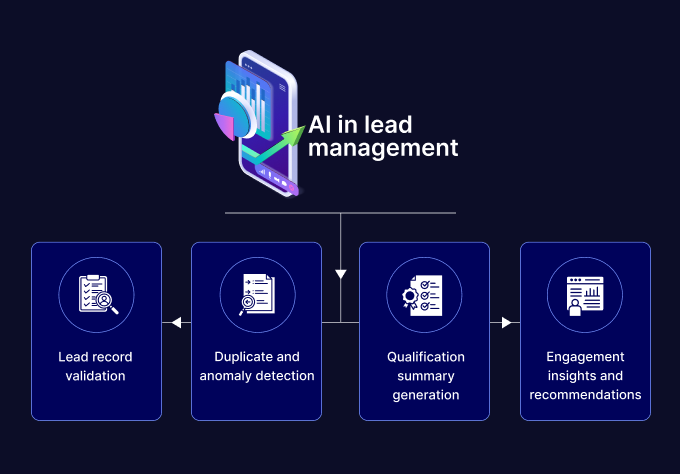
AI in Lead Management: Optimizing Capture, Scoring, Routing, Engagement & Conversion
AI has moved beyond being a supporting tool in lead management; it is now the strategic engine that transforms fragmented, manual workflows into coordinated, data-driven, and revenue-focused operations.
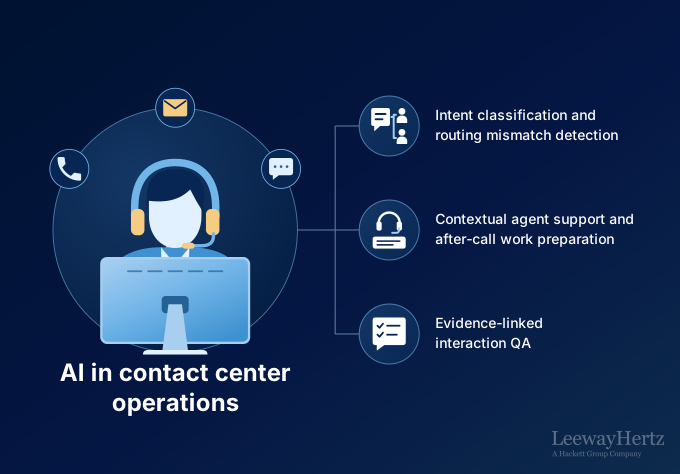
AI in Contact Center Operations: Use Cases & Agentic Workflows
Explore how AI supports contact center operations across routing, workforce management, quality assurance, coaching, compliance, escalation, and performance governance.
AI in S&OP: Processes and Use Cases Across the Operating Model
AI is changing S&OP by helping teams turn fragmented demand, supply, inventory, product, and financial inputs into evidence-rich review packets for each planning gate.
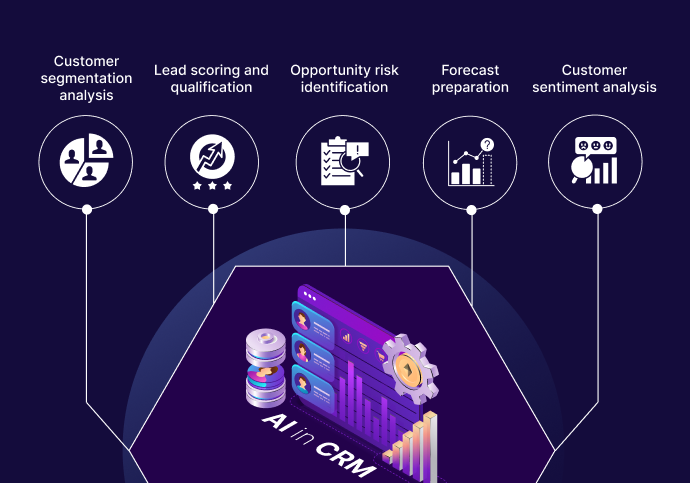
AI in Customer Relationship Management: Processes, Use Cases, and Enterprise Operating Model
AI opportunities in CRM become clearer when the operating model is decomposed across functions, processes, and sub-processes.
AI in Opportunity Management: Use Cases, Operating Model and Agentic Workflows
AI changes opportunity management by improving how organizations assemble evidence, interpret signals, identify exceptions and coordinate work across systems
AI for Sales Operations: High-Value Use Cases Mapped to the Revenue Operating Model
Investment and brokerage is a prime domain for generative and agentic AI because workflows intersect client records, research documents, portfolio data, regulatory requirements, exceptions, and operational handoffs.

Generative AI for sales: Applications, benefits, implementation and development
Generative AI in sales can streamline routine tasks, customize interactions with potential clients, sift through large datasets for valuable insights, and deliver practical recommendations to sales teams.

Customer service automation: Enhancing efficiency and customer satisfaction
Customer service automation transforms how businesses handle customer interactions by leveraging advanced technologies such as AI-driven chatbots, machine learning, and integrated software systems.

GenAI in marketing: Unleashing unprecedented creativity and precision
From enhancing content creation and SEO optimization to driving customer engagement and reshaping market research, generative AI empowers marketers to leverage data-driven insights and automation for more effective and personalized campaigns.
- Current landscape analysis: From conversational AI to autonomous service operations
- Integration framework: Strategic approaches to agentic AI implementation
- Use cases of agentic AI in customer service across industries
- Agentic AI implementation across customer service functions
- Measuring return on investment in agentic AI for customer service
- LeewayHertz’s ZBrain Builder: Agentic AI orchestration for customer service transformation
- Exploring ZBrain AI agents in customer service
- Implementation challenges and strategic solutions for agentic AI
- Implementation best practices for sustainable AI adoption
- Future evolution: Agentic AI innovation trajectories 2026-2029
- Contact us