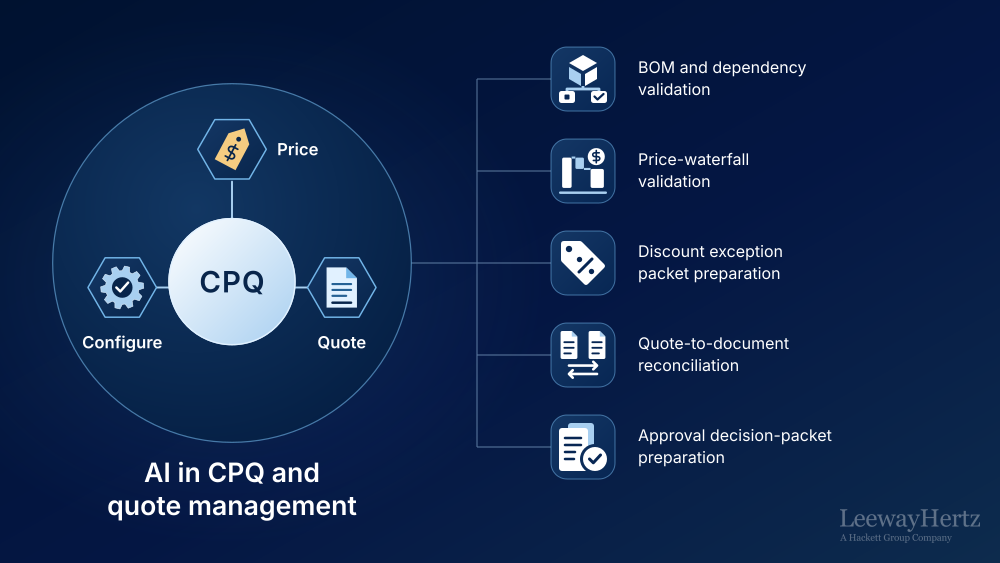
Configure, price, quote (CPQ) and quote management cover how organizations configure products or solutions, apply pricing and discounts, generate quotes, and route them through approvals. As product, pricing, and approval complexity grows, AI can help teams analyze the relevant data, detect exceptions, and prepare the next step while keeping key commercial decisions with the appropriate roles.
A sales representative may see one quote, but behind that quote sit product catalogs, configuration rules, price books, rate cards, ERP cost data, discount policies, delegation of authority rules, revenue accounting requirements, legal terms, customer history, and several approval paths.
The market reflects the growing importance of this operating layer. A September 2026 market estimate valued the global configure, price and quote application suite market at USD 5.11 billion in 2026 and projected it to reach USD 14.32 billion by 2032 [1]. Market estimates vary depending on how vendors and adjacent revenue applications are categorized, but the broader direction is clear: CPQ is increasingly being treated as core commercial infrastructure rather than only a tool for producing quote PDFs.
That shift also makes fragmented CPQ operations harder to manage. Product rules can fall behind catalog changes, pricing teams may work across multiple regional lists and rate structures, and deal desk analysts often have to piece together margin and approval context from CPQ, CRM, ERP, and spreadsheets. Revenue accounting may only be pulled in after a bundled discount raises standalone selling price concerns, while quote revisions can introduce commercial changes that are difficult to spot before approval.
AI can bring together product, pricing, customer, policy, and approval context that would otherwise be checked across multiple systems and teams, and flag conflicts or exceptions earlier in the quote process. It can also prepare the evidence reviewers need to assess those exceptions without having to reconstruct the deal manually.
AI becomes useful when it operates as a governed analytical layer over these workflows, not as a generic sales chatbot. A CPQ administrator must be able to catch configuration-rule conflicts before they lead to invalid quotes. Pricing managers need clear explanations for unusual price-waterfall movements against approved pricing logic. Deal desk teams need the discount, margin, payment-term, and approval evidence brought together before they decide whether to approve, counter, or escalate. Revenue recognition teams also need bundled pricing exceptions flagged before a quote reaches final approval.
The practical value is strongest where CPQ work is artifact-rich, repetitive, exception-driven, and reviewable. AI can classify requirements, compare product dependencies, detect pricing anomalies, assemble approval evidence, reconcile quote documents, prepare amendment scenarios, and analyze approval bottlenecks. It should not become the authority that approves a discount, changes pricing policy, determines accounting treatment, accepts non-standard contractual terms, or executes a binding transaction.
This makes process design critical. CPQ value is not created at the level of broad labels such as “AI for pricing” or “AI for quoting.” It is created inside specific sub-processes where the trigger, source artifact, system, rule, reviewer, output, and downstream boundary are known. That is why the operating model matters.
This article uses the CPQ and quote management operating model to break work into functions, processes, sub-processes, artifacts, systems, controls, and accountable roles. It also maps AI-enabled opportunities, agentic workflow patterns, governance requirements, and practical prioritization guidance across the operating model.
- How AI is transforming CPQ and quote management operations
- Why AI use cases in CPQ must be mapped at the sub-process level
- CPQ and quote management operating model and AI opportunity mapping across CPQ and quote management
- High-value AI use cases in CPQ and quote management
- How agentic AI works in CPQ and quote management workflows
- How to prioritize AI use cases in CPQ and quote management
- Governance, risk, and responsible AI in CPQ and quote management
- How ZBrain operationalizes AI use cases in CPQ and quote management
- Future of AI in CPQ and quote management
How AI is transforming CPQ and quote management operations
AI is transforming CPQ by helping commercial teams convert product, pricing, customer, cost, policy, and contract information into review-ready work products. The objective is not to change the commercial authority model. It is to improve the preparation, comparison, exception detection, and evidence assembly that occurs before accountable roles make decisions.
Replacing one product can affect the BOM, trigger compatibility and dependency rules, alter the applicable pricing treatment, change the sequence of discounts and adjustments in the price waterfall, and push the resulting discount into a higher approval tier. AI can identify affected product rules, check the revised configuration, compare pricing results, detect the approval threshold breach, retrieve the applicable DOA policy, and prepare the exception packet. The sales engineer, pricing manager, deal desk manager, and other designated reviewers still determine whether the quote proceeds.
CPQ work is particularly suitable for governed AI because it contains recurring records, rules, calculations, documents, and checkpoints:
- Document-heavy work: SKU masters, configuration rules, BOMs, price books, rate cards, quote records, quote PDFs, order forms, approval policies, and pricing exhibits can be checked for missing fields, mismatches, stale versions, and inconsistencies.
- Narrative-heavy work: proposal content, pricing explanations, exception summaries, approval rationales, counter-structure recommendations, and handoff notes can be drafted from approved source information.
- Exception-heavy work: configuration conflicts, price-floor breaches, discount exceptions, non-standard payment terms, SSP concerns, missing approvals, and incomplete handoff packages can be classified and prioritized.
- Knowledge-heavy work: product policies, pricing guidance, configuration logic, DOA requirements, accounting policies, export restrictions, and prior exception decisions can be retrieved and compared with the current quote.
- Workflow-heavy work: guided selling, configuration, pricing, discount review, quote generation, approval, amendment quoting, and downstream handoff require coordination across multiple systems and accountable teams.
In practice, AI should prepare information, identify patterns, compare evidence, draft outputs, and maintain context across the quote lifecycle. Product-policy changes, pricing decisions, discount approvals, accounting judgments, contractual commitments, and final commercial authority remain with designated human roles.
Why AI use cases in CPQ must be mapped at the sub-process level
CPQ is not a single workflow. “AI for pricing” can refer to several distinct activities, including price-book validation, regional price synchronization, price-waterfall analysis, usage-rate validation, multi-year ramp checking, discount benchmarking, and margin assessment. Each activity depends on different source artifacts, systems, business rules, approval thresholds, and reviewers.
The same problem appears elsewhere. “AI for product configuration” could mean requirements interpretation, recommendation ranking, successor-SKU matching, dependency checking, BOM validation, or entitlement compatibility. “AI for approvals” could mean threshold detection, DOA routing, decision-packet preparation, parallel finance and legal review, or approval-evidence reconciliation.
A better approach is to map AI use cases to the CPQ and quote management operating model:
- Function: A major area of CPQ accountability, such as product configuration, pricing management, discounting and deal economics, quote generation, or approval workflow orchestration.
- Process: A recurring workflow area within a function, such as configuration-rule management, price-book administration, discount review, quote-document generation, or approval routing.
- Sub-process: The atomic activity where a defined artifact is reviewed, calculated, changed, or produced, such as successor-SKU mapping, price-floor checking, SSP exception screening, or approval-threshold determination.
- AI-enabled opportunity: A specific AI capability applied to a specific CPQ artifact or dataset to change how that sub-process is prepared, checked, analyzed, or routed while a designated role retains the decision.
This level of mapping clarifies implementation requirements. A discount exception workflow needs the current quote, price waterfall, discount matrix, applicable DOA rules, relevant cost or margin information, customer and deal context, and a named approval path. A configuration validation workflow needs the selected SKUs, current rule version, product hierarchy, dependency logic, BOM, exception criteria, and accountable technical reviewer.
For example, anomaly detection applied to a price waterfall can identify an unexplained adjustment before pricing review. Relationship analysis applied to configuration rules and a quote BOM can identify a missing dependency before the quote reaches pricing. Multi-source aggregation can assemble a discount review packet from CPQ, CRM, ERP, and policy records before deal desk decides whether an exception is acceptable.
Sub-process mapping also defines and protects scope. CPQ owns configure-price-quote mechanics and quote governance. It interfaces with CLM, ERP, e-signature, and downstream order or provisioning systems, but it does not absorb contract lifecycle management, post-signature order booking, provisioning, negotiation strategy, or the broader lead-to-cash lifecycle.
Build governed AI workflows for CPQ and quote management
Connect product configuration, pricing, discount review, quote generation, approvals, renewals, and downstream handoffs while preserving human accountability for commercial, accounting, and contractual decisions.
CPQ and quote management operating model and AI opportunity mapping across CPQ and quote management
The operating model below covers core CPQ and quote management functions. Each function is decomposed into operational sub-processes and connected to the artifacts, systems, controls, accountable roles, and AI opportunities involved in the work.
Function 1: Product catalog and configuration model management
Maintaining the controlled product structures and configuration logic that define what can be sold and how products can be combined.
Product catalog and configuration model management establishes the product foundation used throughout CPQ. It covers SKU and hierarchy maintenance, bundle definitions, option structures, compatibility and dependency logic, and end-of-life and successor treatment.
A catalog change can have downstream effects on guided selling, configuration validity, pricing, quoting, and order readiness. The operational requirement is therefore broader than keeping product descriptions current. Product data and configuration rules need controlled ownership, effective dates, version history, testing, and synchronization across relevant systems.
Teams involved: Product management, CPQ administration, sales engineering or solutions consulting, pricing, and RevOps.
Key artifacts: SKU master, product hierarchy, configuration rules repository, bundle definitions, BOM structures, successor-SKU mappings, and associated price-book references.
Systems involved: Product catalog or product information system, CPQ, CRM, ERP, and product lifecycle systems where applicable.
Regulatory and control considerations: Catalog and configuration changes should follow controlled change management and access requirements. Where products are subject to export controls, product classification, destination, end-user, and end-use restrictions may need to be considered before a configuration can proceed. The Export Administration Regulations (EAR), for example, applies based on whether items and activities fall within its scope and may require evaluation against ECCNs, destinations, end users, end uses, and licensing rules [2].
Accountable roles: Product manager, CPQ administrator, and sales engineer or solutions consultant.
What AI helps with: Entity matching can reconcile product records across systems. Relationship analysis can identify conflicting or incomplete configuration rules. Change-impact analysis can identify bundles, rules, quotes, and pricing references affected by a product lifecycle change. Classification can prepare successor-SKU candidates using approved product attributes.
What humans continue to own: Product managers approve product lifecycle and catalog policy. CPQ administrators approve configuration logic and controlled production changes. Sales engineers confirm technical dependencies where domain expertise is required. AI identifies, compares, and prepares changes but does not approve catalog or configuration-policy decisions.
| Process | Sub-process | AI-enabled opportunities |
|---|---|---|
| Product master management | SKU and hierarchy maintenance |
|
| Bundle management | Bundle and kit definition | Relationship analysis checks required, optional, dependent, and mutually exclusive components for incomplete or contradictory structures. |
| Configuration-rule management | Compatibility rule authoring review | Rule analysis checks include, exclude, require, recommendation, validation, quantity, and replacement logic for overlaps and conflicts. |
| Rule impact assessment | AI-powered dependency mapping identifies products, bundles, attributes, and quote scenarios affected by a proposed rule change. | |
| Product lifecycle management | End-of-life and successor mapping | Entity matching identifies open configurations and rules that reference retiring SKUs and prepares candidate successor mappings for review. |
| Change validation | Regression scenario preparation | AI generates representative configuration scenarios covering standard, exception, and boundary cases before new or updated CPQ rules are promoted to production. |
Highest-value opportunities: Configuration-rule conflict detection is high leverage because one defective rule can affect many quotes. Successor-SKU impact analysis is valuable because end-of-life changes can affect product selection, pricing, open quotes, and amendments. Cross-system catalog reconciliation also helps prevent master-data differences from propagating into later CPQ stages.
Example agentic workflow: Product configuration change review
- Trigger: an approved product-change request introduces, modifies, or retires a SKU or bundle.
- The agent aggregates the SKU master, hierarchy, bundle definitions, current rules, price-book references, open quote dependencies, and successor information.
- It retrieves approved configuration-policy and change-control requirements.
- It prepares an impact packet identifying affected rules, bundles, price references, open configurations, conflicts, and proposed regression scenarios.
- The product manager confirms product relationships, the sales engineer validates technical dependencies, and the CPQ administrator approves configuration changes.
- Approved changes enter the controlled deployment process, with source versions, test evidence, reviewer changes, and approvals retained.
Function 2: Guided selling and needs analysis
Turning customer requirements into a relevant and reviewable set of product or solution options.
Guided selling narrows a large product catalog by asking structured questions and matching requirements to valid products, bundles, options, or services. In complex offerings, requirements may also arrive through opportunity notes, RFP content, technical specifications, or seller-entered descriptions.
AI can make this process more flexible by structuring less-formal requirements and comparing them with the approved product model. The output should remain a recommendation for seller or technical review, not an uncontrolled product commitment.
Teams involved: Sales engineers or solutions consultants, product managers, CPQ administrators, sales representatives, and RevOps.
Key artifacts: Requirements questionnaire, CRM opportunity context, SKU master, product hierarchy, configuration rules, and draft quote record.
Systems involved: CRM, CPQ, product catalog, and approved knowledge sources.
Regulatory and control considerations: Customer information used for recommendations should remain within approved privacy and access boundaries. Eligibility, geographic availability, product restrictions, and export-sensitive combinations should be enforced through approved rules or compliance checks rather than inferred solely by a model.
Accountable roles: Sales engineer or solutions consultant, product manager, and CPQ administrator.
What AI helps with: Entity extraction can structure technical and commercial requirements from text. Semantic matching can rank products against requirements. Classification can identify incomplete or contradictory requirements. Recommendation analysis can identify compatible attach products while checking approved rules.
What humans continue to own: Solutions consultants determine whether the proposed solution appropriately addresses customer requirements. Product and CPQ owners control product-eligibility and recommendation logic. AI narrows, ranks, explains, and flags gaps but does not make the final solution commitment.
| Process | Sub-process | AI-enabled opportunities |
|---|---|---|
| Needs capture | Questionnaire interpretation | Entity extraction structures feature, capacity, deployment, geography, service, and commercial requirements from guided-selling inputs. |
| Requirement completeness checking | Classification identifies missing or contradictory information and prepares targeted follow-up questions. | |
| Product discovery | Requirement-to-product matching | Semantic matching ranks approved SKUs and bundles against normalized requirements. |
| Recommendation explanation | Natural language generation prepares an evidence-linked explanation of how candidate products satisfy stated requirements. | |
| Attach selling | Cross-sell and attach suggestion | Recommendation analysis identifies relevant add-ons while applying approved compatibility and eligibility constraints. |
| Exception handling | Low-confidence recommendation review | Classification with confidence scoring flags ambiguous product matches, unsupported combinations, and incomplete requirements for solutions consultant review. |
Highest-value opportunities: Requirement-to-product matching is valuable in large catalogs where finding the correct configuration requires many attributes. Requirement completeness checking reduces downstream rework. Attach recommendations are useful when they remain constrained by product and compatibility rules.
Example agentic workflow: Requirements to candidate configuration
- Trigger: a new opportunity enters guided selling with a questionnaire and supporting CRM notes.
- The agent aggregates the requirements, account context, SKU master, product hierarchy, and approved configuration rules.
- It structures requirements, identifies missing inputs, and ranks compatible products and bundles.
- It prepares candidate configurations with evidence explaining which requirements each option satisfies.
- The sales engineer or solutions consultant reviews the candidates, resolves open requirements, and selects the configuration to advance.
- The approved candidate moves to configuration validation, with requirement inputs and reviewer changes retained.
Function 3: Configuration validation
Confirming that a proposed product configuration is complete, technically feasible, and consistent with approved dependency rules.
Configuration validation checks whether the selected products, options, quantities, attributes, and dependencies form a valid sellable solution. In manufacturing, this may include BOM and configure-to-order logic. In SaaS, it can include license, entitlement, edition, feature, and provisioning compatibility.
Deterministic rule engines remain important because many configuration constraints are explicit. AI is most useful around those rules, where it can identify gaps, interpret exception context, reconcile dependencies, and prepare technical review.
Teams involved: Sales engineering, product management, CPQ administration, and downstream order management at the handoff boundary.
Key artifacts: Quote record, configuration rules repository, SKU master, product hierarchy, BOM, and entitlement definitions where applicable.
Systems involved: CPQ, product catalog, ERP, product lifecycle system, and approved entitlement or provisioning reference data.
Regulatory and control considerations: Configuration validation should preserve approved rule versions, trace overrides, and prevent users from silently bypassing required-product or incompatibility constraints. Export-sensitive products may also require an export compliance checkpoint before a quote proceeds.
Accountable roles: Sales engineer or solutions consultant, product manager, and CPQ administrator.
What AI helps with: Constraint analysis compares the proposed configuration with approved rules. Relationship analysis identifies missing dependencies. Anomaly detection identifies unusual overrides. Classification separates technical conflicts from source-data or rule-quality issues.
What humans continue to own: Sales engineers confirm technical feasibility and exceptions. Product managers approve product-policy deviations. CPQ administrators control configuration rules. AI detects and explains exceptions but does not waive a product constraint or certify technical feasibility.
| Process | Sub-process | AI-enabled opportunities |
|---|---|---|
| BOM validation | BOM generation and completeness analysis | Relationship analysis compares configured lines with required components and identifies missing or inconsistent items. |
| Dependency validation | Compatibility checking | Constraint analysis identifies the exact product, option, quantity, or attribute combination causing a rule conflict. |
| ATO/CTO validation | Assemble-to-order and configure-to-order rule checking | Rule comparison checks the proposed configuration against approved manufacturing configuration constraints. |
| SaaS configuration | Entitlement compatibility checking | Entity and rule matching compare quoted products, editions, features, quantities, and service entitlements with approved compatibility definitions. |
| Override management | Manual override review | Anomaly detection identifies unusual overrides while the AI workflow prepares the affected rules, line items, and prior exception context for review. |
| Exception routing | Technical exception classification | Classification routes product-policy, configuration-data, and technical-feasibility issues to the correct owner. |
Highest-value opportunities: Dependency and compatibility checking has wide downstream impact because configuration errors can affect price, quote accuracy, fulfillment, and customer commitments. BOM completeness and override assessment are also strong use cases because the inputs and review boundaries are clear.
Example agentic workflow: Configuration exception review
- Trigger: a configured quote is submitted for technical validation.
- The agent aggregates quote lines, generated BOM, SKU data, active configuration rules, and relevant entitlement definitions.
- It evaluates dependencies, checks completeness, and identifies conflicting or missing conditions.
- It prepares an exception packet showing affected lines, rule references, likely source of conflict, and possible valid configurations.
- The sales engineer resolves technical issues, while product or CPQ owners review policy or rule changes.
- The validated configuration becomes the controlled input to pricing, with rule versions, exceptions, and reviewer decisions retained.
Function 4: Pricing management
Maintaining the price structures and calculation logic used to convert a valid configuration into a governed commercial price.
Pricing management includes price books, regional lists, rate cards, pricing procedures, adjustments, multi-year ramps, escalators, and usage or consumption models.
The main AI opportunity is not autonomous price setting. It is improving the testing, reconciliation, monitoring, and analysis around pricing structures that can involve large numbers of products, currencies, regions, customer segments, and effective dates.
Teams involved: Pricing management, pricing strategy, CPQ administration, product management, finance, and RevOps.
Key artifacts: Price book, regional rate card, pricing procedure or rule configuration, price waterfall, SKU master, and quote records.
Systems involved: CPQ, pricing platform, CRM, ERP, product catalog, and finance data sources.
Regulatory and control considerations: Official pricing should have defined ownership, effective dates, access controls, change approvals, and traceable deployment. Accounting implications arise where quoted pricing affects bundled arrangements and relative standalone selling price analysis. IFRS 15, for example, requires transaction price to be allocated to performance obligations based on relative stand-alone selling prices, with estimation required where observable stand-alone selling prices are unavailable.
Accountable roles: Pricing manager or pricing strategy lead, CPQ administrator, and revenue recognition accountant for accounting-sensitive matters.
What AI helps with: Anomaly detection identifies missing, inconsistent, or unusual price records and flags unexpected movements in price-waterfall data. Data reconciliation compares regional price lists, currencies, and effective dates, while simulation tests pricing rules across representative quote scenarios to identify potential conflicts or unintended pricing outcomes.
What humans continue to own: Pricing leaders approve official prices, pricing policies, price floors, multi-year pricing structures, rate models, and pricing exceptions. Revenue accounting remains responsible for accounting judgments. AI can compare pricing data, identify exceptions, and test pricing scenarios, but it does not set or approve official pricing.
| Process | Sub-process | AI-enabled opportunities |
|---|---|---|
| Price-book administration | Price-book maintenance | Anomaly detection identifies missing, duplicate, expired, or inconsistent price entries. |
| Regional pricing | Regional price synchronization | Reconciliation compares product coverage, currencies, effective dates, and regional pricing differences. |
| Price architecture | Price-waterfall construction | Simulation tests list price, adjustments, discounts, surcharges, and net-price calculation across representative scenarios. |
| Multi-year pricing | Ramp and escalator validation | Scenario analysis checks periods, dates, quantity changes, escalators, and price transitions for gaps or overlaps. |
| Usage pricing | Consumption rate validation | Rule analysis checks tiers, units of measure, rates, and volume thresholds for inconsistent or incomplete logic. |
| Change governance | Pricing change impact assessment | Dependency analysis identifies affected products, customer segments, open quotes, and downstream calculations before a pricing change is released. |
Highest-value opportunities: Price-book anomaly detection prevents upstream pricing defects from reaching many quotes. Price-waterfall validation is valuable because interacting adjustments can create unexpected net prices. Ramp and usage-price simulation is useful where multiple periods or tiers are difficult to test manually.
Example agentic workflow: Price-book change validation
- Trigger: Pricing proposes a new regional price-book version.
- The agent aggregates existing and proposed price books, product data, regional rate cards, pricing procedures, and approved ERP cost references where relevant.
- It identifies missing records, inconsistent changes, date conflicts, and unexpected pricing movement.
- It runs representative quote scenarios through the proposed pricing logic and prepares a change-impact packet.
- The pricing manager approves the commercial structure, revenue accounting reviews accounting-sensitive items where required, and the CPQ administrator confirms technical readiness.
- Approved pricing changes enter the controlled release process, with test results, source versions, and approvals retained.
Function 5: Discounting and deal economics
Evaluating proposed concessions against pricing policy, approval thresholds, peer economics, margin requirements, and accounting constraints.
Discounting is where sales flexibility meets commercial governance. A proposed concession may need to be assessed against a discount matrix, price floor, price corridor, cost and margin data, prior transactions, customer terms, DOA requirements, and accounting policy.
AI can bring those inputs together before deal desk, pricing, finance, revenue accounting, or sales leadership decides whether to approve, counter, or escalate.
Teams involved: Deal desk, pricing, revenue accounting, finance, sales leadership, and RevOps.
Key artifacts: Quote record, discount approval matrix, DOA policy, price waterfall, margin or cost data, SSP analysis workbook, and deal desk review ticket.
Systems involved: CPQ, CRM, ERP, pricing systems, finance systems, and approval workflow.
Regulatory and control considerations: Pricing and discount controls may form part of internal control over financial reporting where they affect revenue or financial statement assertions [3]. ASC 606 and IFRS 15 may require revenue accounting review when discounts affect bundled arrangements, standalone selling price assessments, or transaction price allocation. Pricing differences involving qualifying commodity sales may also require review under the Robinson-Patman Act [4], while unusual rebates, concessions, or third-party payment structures may trigger anti-bribery compliance review under the FCPA [5].
Accountable roles: Deal desk manager, pricing manager, revenue recognition accountant, VP of sales, CFO delegate, and compliance or legal where applicable.
What AI helps with: Rule evaluation identifies threshold breaches. Benchmarking compares relevant historical transactions. Multi-source analysis combines quote, cost, margin, and account information. Simulation prepares alternative commercial structures. Exception analysis flags accounting-sensitive or compliance-sensitive deal features.
What humans continue to own: Deal desk owns commercial disposition, pricing owns pricing policy, finance reviews material economics, revenue accounting owns SSP and accounting treatment, and authorized leaders exercise DOA authority. AI prepares, compares, and recommends but does not approve discounts or accounting exceptions.
| Process | Sub-process | AI-enabled opportunities |
|---|---|---|
| Discount policy management | Approval matrix maintenance | Rule comparison identifies overlapping, inconsistent, or outdated thresholds across product, region, customer class, and approval tier. |
| Deal validation | Price-floor and corridor checking | Anomaly detection identifies quote lines below approved floors or outside internally defined pricing ranges. |
| Deal benchmarking | Peer-deal comparison | Benchmarking compares discount, product mix, segment, region, term, and outcome with relevant historical deals. |
| Deal economics assessment | Margin analysis | Multi-source analysis combines quote economics with approved cost inputs and prepares margin scenarios for review. |
| Accounting review | SSP exception screening | Variance analysis compares bundled quote pricing with approved SSP evidence and flags items requiring revenue accounting review. |
| Compliance review | Unusual concession detection | Pattern analysis identifies unusual rebates, credits, or channel concessions that meet internal compliance-review criteria. |
Highest-value opportunities: Discount exception assessment is high value because it brings policy and economics into one packet. Margin analysis provides more context than discount percentage alone. SSP exception screening is important because accounting-sensitive issues should be identified before final quote approval.
Example agentic workflow: Discount exception review
- Trigger: a submitted quote breaches one or more discount or payment-term thresholds.
- The agent aggregates quote lines, price waterfall, discount matrix, DOA policy, ERP cost inputs, relevant account history, and approved SSP evidence where applicable.
- It evaluates price-floor and threshold breaches, compares peer economics, calculates margin effects, and identifies accounting or compliance review triggers.
- It prepares a deal-review packet with the evidence, unresolved exceptions, and alternative structures for consideration.
- Deal desk reviews the commercial case, revenue accounting resolves accounting matters, Finance reviews material margin implications, and the designated DOA approver decides whether the exception proceeds.
- Approved parameters return to the quote workflow with reviewer identities, timestamps, and final disposition retained.
Accelerate AI Solutions Development
Build fully functional solutions from your high-value use cases, based on specific operational needs and enterprise context.
Function 6: Quote generation
Turning an approved configuration and pricing structure into a controlled customer-facing quote or proposal.
Quote generation assembles products, quantities, prices, dates, terms, and approved narrative content into a customer-facing artifact. It also needs disciplined version management because pricing, configuration, commercial terms, and approval status may change repeatedly before a quote is presented.
Teams involved: Deal desk, CPQ administration, sales, sales engineering, commercial legal, and RevOps.
Key artifacts: CPQ quote record, quote PDF, pricing exhibit, approved template, MSA or SOW references, and e-signature package.
Systems involved: CRM, CPQ, document generation, CLM as a boundary system, and e-signature.
Regulatory and control considerations: Generated documents should match the approved system-of-record quote, use approved templates, preserve version history, and route non-standard contractual terms to authorized legal review. For transactions involving goods, UCC Article 2 may be relevant to commercial terms, but whether a particular quote constitutes an offer depends on the transaction and governing law.
Accountable roles: Deal desk manager, CPQ administrator, commercial counsel or contracts manager, and sales engineer for technical representations.
What AI helps with: Document intelligence reconciles the quote record with generated documents. Natural-language generation prepares controlled proposal content. Version comparison identifies commercial changes between quote revisions. Completeness checks identify missing exhibits, dates, signatory information, or required terms.
What humans continue to own: Deal desk confirms commercial readiness. Commercial counsel owns non-standard legal terms. Technical owners confirm product or service representations. AI assembles, checks, and drafts but does not release an unapproved commercial commitment or execute an agreement.
| Process | Sub-process | AI-enabled opportunities |
|---|---|---|
| Quote assembly | Header and line completeness validation | Data validation checks products, quantities, dates, customer details, pricing, and required quote metadata. |
| Document generation | Proposal assembly | Natural language generation and template automation prepare proposal content from controlled quote information. |
| Pricing exhibit management | Quote-to-exhibit reconciliation | Reconciliation compares quote economics with customer-facing tables and pricing exhibits. |
| Revision control | Quote version comparison | Version analysis identifies product, price, quantity, discount, term, and expiration changes. |
| Approval readiness assessment | Post-change approval check | Rule evaluation identifies whether a quote revision invalidates or requires new approvals. |
| Signature readiness assessment | E-signature package preparation | AI-enabled completeness analysis checks approved documents, attachments, signatory fields, and execution prerequisites. |
Highest-value opportunities: Quote-to-document reconciliation prevents customer-facing artifacts from diverging from the approved quote. Version comparison is valuable for identifying late commercial changes. Signature-package completeness reduces avoidable rework at the final stage.
Example agentic workflow: Approved quote to proposal package preparation
- Trigger: A quote completes internal approval and becomes ready for document generation.
- The agent aggregates approved quote lines, pricing exhibits, approved templates, relevant commercial terms, and approval status.
- It generates the proposal package and reconciles totals, products, dates, and commercial terms against the quote record.
- It compares the latest version with the previously reviewed version and identifies any approval-impacting changes.
- Deal desk reviews the final commercial package, and commercial counsel reviews non-standard contractual language where required.
- The approved package becomes ready for presentation or e-signature under the organization’s existing execution process.
Function 7: Approval workflow orchestration
Routing commercial exceptions to the appropriate finance, accounting, legal, pricing, and sales authorities with the evidence required for a decision.
Approval orchestration becomes complex when several conditions apply to one quote. A high discount can trigger sales leadership review, a margin exception can involve finance, bundled pricing can require revenue accounting, and a non-standard liability or payment term can require legal.
CPQ and approval platforms already support approval-required conditions, line and header criteria, multi-stage routing, and approval-history tracking. AI can improve the preparation and coordination around those rules without changing who has authority.
Teams involved: Deal desk, pricing, revenue accounting, finance, commercial legal, sales leadership, CPQ administration, and RevOps.
Key artifacts: Quote record, discount approval matrix, DOA policy, price waterfall, SSP analysis, deal desk ticket, non-standard term summary, and approval history.
Systems involved: CPQ, CRM, ERP, pricing systems, approval workflow, finance applications, and CLM as a boundary system.
Regulatory and control considerations: Approval evidence should preserve the relevant rule, reviewer, decision, timestamp, quote version, and final values where the process is relied on as a commercial or financial reporting control.
Accountable roles: Deal desk manager, pricing manager, revenue recognition accountant, commercial counsel, VP of sales, and CFO delegate.
What AI helps with: Rule evaluation identifies triggered approvals. Multi-source aggregation prepares decision context. Document intelligence summarizes non-standard terms. Workflow analysis identifies missing or conflicting approvers. Natural language generation drafts reviewer-specific decision summaries.
What humans continue to own: The designated approvers determine whether the quote, discount, accounting exception, payment term, or contractual deviation is acceptable. AI determines what evidence is needed and prepares it, but it does not exercise delegated authority.
| Process | Sub-process | AI-enabled opportunities |
|---|---|---|
| Approval determination | Threshold breach identification | Rule evaluation checks discount, margin, payment, pricing, accounting, and contractual conditions against approval criteria. |
| DOA routing | Approver determination | AI-driven policy mapping identifies required approvers, tiers, delegation status, and escalation paths. |
| Deal desk review management | Review-queue prioritization | Classification prioritizes pending reviews based on deal timing, exception severity, and unresolved dependencies. |
| Approval decision support | Approval packet preparation | Multi-source aggregation combines quote economics, price waterfall, account history, margin context, and policy evidence. |
| Cross-functional exception review | Finance, accounting, and legal routing | Classification separates commercial, accounting, and contractual exceptions and assembles reviewer-specific evidence. |
| Approval evidence management | Approval-history reconciliation | Reconciliation confirms approver identities, dispositions, timestamps, quote versions, and final commercial values. |
Highest-value opportunities: Multi-threshold approval determination prevents incomplete routing. Decision packet preparation reduces the time reviewers spend reconstructing deal context. Approval history reconciliation improves traceability and control evidence.
Example agentic workflow: Multi-threshold quote approval
- Trigger: a representative submits a quote that exceeds multiple internal approval thresholds, such as discount and payment-term limits.
- The agent aggregates CPQ quote lines, customer quote history, price-waterfall benchmarks, ERP cost information, and CRM deal context.
- It retrieves the discount approval matrix, DOA policy, and the organization’s approved SSP policy or range for relevant bundled items.
- It prepares a review packet containing peer-deal context, margin impact, any applicable SSP exception warning, a summary of non-standard commercial terms, and potential alternative deal structures.
- The deal desk manager reviews the commercial recommendation, the revenue recognition accountant resolves the SSP matter, and the authorized sales approver decides on the residual discount tier.
- The quote moves to order-form and contract handoff only after all required approvals are complete, with the approval packet, reviewer identities, decisions, and timestamps retained.
Function 8: Contract and order handoff
Preparing the approved quote and its supporting evidence for controlled transfer into contract and order processes.
This function defines the boundary between CPQ and downstream execution. CPQ owns the completeness and consistency of the approved commercial package being transferred. It does not own contract negotiation, final contract administration, order booking, fulfillment, invoicing, or provisioning.
The central requirement is reconciliation. The products, prices, dates, customer details, approvals, and other information passed downstream should agree with the final approved quote.
Teams involved: Deal desk, order management, commercial legal, revenue accounting, CPQ administration, and RevOps.
Key artifacts: Approved quote record, quote PDF, order form, approval packet, relevant MSA or SOW references, e-signature record, and accounting evidence where applicable.
Systems involved: CPQ, CRM, CLM as a boundary system, ERP or order management as a boundary system.
Regulatory and control considerations: Export-sensitive transactions may require evidence that product classification, destination, end-user, end-use, and license requirements have been reviewed before order release. E-invoicing requirements arise downstream rather than making CPQ the invoicing system, but CPQ and order handoff may need to preserve country-specific fields required by invoicing processes.
Accountable roles: Order management specialist, deal desk manager, commercial counsel, revenue recognition accountant, and CPQ administrator.
What AI helps with: Multi-document reconciliation checks consistency between the quote, order form, approval evidence, and handoff data. Completeness analysis identifies missing downstream fields. Classification routes unresolved legal, accounting, commercial, or product exceptions back to the appropriate owner.
What humans continue to own: Order management confirms downstream intake readiness, while legal resolves contractual exceptions and revenue accounting addresses accounting-related issues. AI validates and prepares the handoff but does not book the order, execute a contract, issue an invoice, or trigger provisioning without authorized downstream controls.
| Process | Sub-process | AI-enabled opportunities |
|---|---|---|
| Order-form preparation | Order-form generation | Document intelligence populates approved commercial fields from the final quote. |
| Reconciliation | Quote-to-order-form comparison | Reconciliation checks products, quantities, prices, dates, terms, and customer information. |
| Contract handoff management | CLM handoff preparation | Classification packages the approved commercial context and identified non-standard terms for downstream contract handling. |
| Order handoff validation | Handoff-package completeness assessment | Completeness analysis checks required quote, approval, product, customer, tax, and commercial fields. |
| Quote-to-order conversion management | Version validation | Reconciliation confirms that the version being transferred is the final approved quote. |
| Provisioning handoff preparation | Entitlement data readiness assessment | Rule checking verifies that required product and entitlement information is available for an authorized downstream process. |
Highest-value opportunities: Quote-to-order reconciliation reduces downstream fallout. Handoff-package completeness assessment prevents missing evidence from delaying order intake. CLM handoff preparation is useful when it transfers approved commercial context without absorbing contract management into CPQ.
Example agentic workflow: Approved quote to downstream handoff
- Trigger: a quote completes all required approvals.
- The agent aggregates the approved quote, approval history, order-form template, relevant contract references, signature state, and required downstream fields.
- It prepares the order form and handoff package, reconciling commercial values and identifying missing or conflicting information.
- Unresolved legal, accounting, export, product, or approval exceptions block handoff readiness.
- Order management confirms the intake package, while the appropriate specialist resolves outstanding exceptions.
- The validated package moves to the authorized downstream process. Subsequent contract execution, booking, billing, and provisioning remain outside CPQ scope.
Function 9: Renewal and amendment quoting
Repricing and restructuring existing customer commitments when subscriptions renew, expand, contract, co-term, true up, or change mid-term.
Renewals and amendments differ from net-new quoting because the starting point is an existing commercial state. Current products, quantities, effective dates, prior pricing, remaining term, assets or entitlements, and contractual commitments influence the new quote.
CPQ platforms commonly support subscription lifecycle actions such as renewals, upgrades, downgrades, swaps, termination, and asset-based changes. AI can help reconcile the current state and prepare amendment scenarios without determining the final commercial treatment.
Teams involved: Deal desk, pricing, CPQ administration, revenue accounting, commercial legal, and RevOps.
Key artifacts: Existing contract or subscription record, installed-product or asset record, prior quote, amendment quote, renewal quote, price book, rate card, and applicable approval evidence.
Systems involved: CRM, CPQ, subscription or asset records system, ERP, and CLM as a boundary system.
Regulatory and control considerations: Amendment and renewal pricing should preserve approved dates, entitlement logic, pricing rules, and approval authority. Revenue accounting review may be required when a contract modification changes rights, obligations, bundled economics, or accounting treatment.
Accountable roles: Deal desk manager, pricing manager, revenue recognition accountant, commercial counsel, and CPQ administrator.
What AI helps with: Record reconciliation compares current customer state with proposed changes. Deterministic calculation prepares proration and co-term scenarios. Simulation evaluates alternative renewal or amendment structures. Anomaly detection identifies unexpected credits, dates, quantities, or price changes.
What humans continue to own: Deal desk and pricing approve commercial treatment. Revenue accounting owns contract-modification accounting judgments. Legal owns contractual interpretation. AI calculates and compares scenarios but does not approve renewals, credits, cancellations, or amendments.
| Process | Sub-process | AI-enabled opportunities |
|---|---|---|
| Amendment management | Mid-term change calculation | Reconciliation identifies additions, removals, quantity changes, and date impacts against the existing commercial state. |
| Co-term management | Co-term calculation | Deterministic calculation prepares aligned end dates and proration amounts and flags inconsistent assumptions. |
| Renewal management | Renewal uplift calculation | Rule comparison applies approved renewal or uplift policies and identifies deviations. |
| True-up management | Usage and entitlement reconciliation | Multi-source reconciliation compares contracted commitments with approved consumption or entitlement data. |
| Cancellation | Termination scenario preparation | Scenario analysis calculates remaining-term, credit, and affected-line impacts without authorizing cancellation. |
| Credit adjustment management | Credit memo support preparation | Reconciliation prepares the commercial basis and source evidence required for downstream credit processing. |
Highest-value opportunities: Mid-term amendment calculation is high value because it combines prior commercial state with new requirements. Co-term validation reduces date and proration errors. Renewal uplift and true-up checking help keep policy and current customer state synchronized.
Example agentic workflow: Mid-term amendment quoting
- Trigger: a customer requests a quantity increase and co-term alignment on an existing subscription.
- The agent aggregates the current subscription, prior quote, applicable price book, amendment request, dates, and approval policies.
- It identifies affected lines, calculates the commercial delta and proration, and prepares alternative co-term scenarios.
- It flags non-standard pricing, unusual credits, conflicting dates, and accounting-sensitive changes.
- Deal desk and pricing review the commercial scenario, with revenue accounting or legal reviewing issues within their respective authority.
- The approved scenario becomes the amendment quote, while downstream contract and order execution remain outside CPQ.
Function 10: CPQ analytics and governance
Measuring quote performance, pricing discipline, approval behavior, and configuration health while governing the data and rules on which CPQ depends.
CPQ analytics and governance close the operating loop. They show where quotes stall, where pricing erodes, which rules generate repeated exceptions, how often sellers require manual overrides, and whether the product and pricing model is becoming difficult to maintain.
AI can help surface recurring issues across quote histories and configuration activity, such as repeated approval delays, frequent overrides, or unusual pricing patterns. RevOps, pricing, product, deal desk, and CPQ owners can then review those findings and decide whether any process, rule, or policy changes are needed.
Teams involved: RevOps, CPQ administration, deal desk, pricing, product management, finance, and data teams.
Key artifacts: Quote records, price waterfall reports, deal desk tickets, approval history, configuration rules, discount matrix, catalog-change records, and CPQ performance reports.
Systems involved: CRM, CPQ, ERP, product catalog, approval platform, data warehouse, and BI tools.
Regulatory and control considerations: Governance should preserve access control, change history, approval evidence, data lineage, and traceability of production rule changes. Pricing and customer data should be protected under applicable privacy, security, and enterprise access requirements.
Accountable roles: RevOps manager, CPQ administrator, deal desk manager, pricing manager, product manager, and finance stakeholders.
What AI helps with: Process analytics identifies cycle-time bottlenecks. Anomaly detection identifies unusual discount leakage or price-waterfall erosion. Pattern analysis examines quote-to-close outcomes. Dependency analysis identifies configuration-rule complexity, repeated overrides, and obsolete logic.
What humans continue to own: RevOps owns operating-model changes, pricing owns pricing policy, product owns catalog policy, and CPQ administration owns controlled platform configuration. AI identifies patterns and prepares recommendations but does not autonomously change production rules, approval thresholds, or pricing policy.
| Process | Sub-process | AI-enabled opportunities |
|---|---|---|
| Cycle-time analytics | Quote-cycle decomposition | Process analysis separates time spent in configuration, pricing, approval, document generation, and handoff. |
| Approval analytics | Approval bottleneck analysis | Pattern detection identifies exception types, routing conditions, and reviewer groups associated with delay or rework. |
| Pricing analytics | Discount leakage analysis | Anomaly detection compares discount and net-price movement across products, segments, regions, and approval outcomes. |
| Price realization | Price-waterfall erosion analysis | Trend analysis identifies where adjustments and concessions progressively reduce realized price. |
| Conversion analytics | Quote-to-close analysis | Statistical analysis compares outcomes with product mix, discount range, quote revisions, approval complexity, and cycle time. |
| Catalog governance | Configuration-rule debt audit | Dependency analysis identifies inactive, duplicate, conflicting, frequently overridden, or unusually broad rules. |
| Control governance | Approval and change-control review | Reconciliation checks that policy changes, production releases, approval actions, and exceptions contain expected evidence. |
Highest-value opportunities: Approval bottleneck analysis helps teams identify where quote time is actually being consumed. Discount leakage analysis provides visibility into pricing discipline. Configuration-rule debt analysis is useful because accumulated complexity can create recurring exceptions and administrator effort.
Example agentic workflow: Monthly CPQ governance review
- Trigger: A scheduled monthly or quarterly CPQ governance review cycle starts.
- The agent aggregates quote records, approval histories, price waterfalls, deal desk tickets, configuration rules, catalog changes, and discount-policy data.
- It decomposes cycle time, identifies approval bottlenecks, analyzes discount leakage, and detects rules with repeated overrides or conflicts.
- It prepares a governance pack showing evidence, trend movement, material exceptions, and proposed improvement areas.
- RevOps reviews workflow issues, pricing reviews commercial patterns, and product and CPQ administration review catalog and rule findings.
- Approved remediation items enter the appropriate controlled backlog or configuration-change process.
Accelerate AI Solutions Development
Build fully functional solutions from your high-value use cases, based on specific operational needs and enterprise context.
High-value AI use cases in CPQ and quote management
The most valuable CPQ use cases go beyond saving time for sellers. They help teams catch configuration issues earlier, apply pricing more consistently, understand margin impact, prepare quotes for approval, reduce quote errors, manage renewals more reliably, and improve the quality of information passed to downstream teams, while keeping key decisions with the appropriate reviewers.
| Use case | Function | How AI creates high-value impact |
|---|---|---|
| Configuration-rule conflict detection | Product catalog and configuration model management | Relationship analysis identifies overlapping or contradictory configuration rules before they affect quotes, reducing recurring configuration errors and downstream rework. |
| Successor-SKU impact analysis | Product catalog and configuration model management | Entity matching identifies bundles, rules, pricing references, and open configurations affected by a retiring product, helping teams update dependent records before obsolete SKUs continue into quotes. |
| Requirement-to-product matching | Guided selling and needs analysis | Semantic matching compares customer requirements with approved products and bundles, helping sellers and solutions consultants narrow large catalogs to technically relevant options faster. |
| Requirement completeness review | Guided selling and needs analysis | Classification identifies missing or contradictory requirements early, reducing configuration changes and quote rework later in the process. |
| BOM and dependency validation | Configuration validation | Constraint analysis identifies missing components and incompatible product combinations before pricing, preventing invalid configurations from moving further through the quote process. |
| Configuration override assessment | Configuration validation | Anomaly detection highlights unusual manual overrides and assembles supporting rule and configuration evidence, helping technical reviewers focus on exceptions with the greatest downstream risk. |
| Price-book anomaly detection | Pricing management | Anomaly detection identifies missing, expired, duplicate, or inconsistent pricing records before they reach active quotes, reducing the risk of incorrect base pricing being applied at scale. |
| Price-waterfall validation | Pricing management | Simulation identifies unintended interactions among list price, adjustments, discounts, and net price, helping Pricing teams detect pricing logic that could lead to unexpected price realization or margin erosion. |
| Discount exception packet preparation | Discounting and deal economics | Multi-source aggregation brings pricing rules, peer context, margin information, and DOA evidence into one review packet, reducing the effort required to assess complex discount exceptions. |
| SSP exception screening | Discounting and deal economics | Variance analysis flags bundled pricing that may require revenue accounting review, helping surface accounting-sensitive issues before final quote approval. |
| Quote-to-document reconciliation | Quote generation | Document intelligence compares customer-facing documents with the approved CPQ record, reducing the risk that incorrect products, prices, quantities, or terms are presented to the customer. |
| Quote revision analysis | Quote generation | Version comparison identifies material changes between quote versions, helping teams determine whether pricing, finance, legal, or other approvals need to be repeated. |
| Multi-threshold approval determination | Approval workflow orchestration | Rule evaluation identifies all required approvals when multiple commercial conditions are breached, reducing missed approvals and avoidable routing delays. |
| Approval decision-packet preparation | Approval workflow orchestration | Multi-source aggregation assembles reviewer-specific evidence from CPQ, CRM, ERP, pricing, and policy sources, allowing approvers to evaluate exceptions without reconstructing the deal across systems. |
| Quote-to-order reconciliation | Contract and order handoff | Multi-document reconciliation identifies differences between the approved quote and downstream handoff data before processing begins, reducing order-entry errors and downstream rework. |
| Amendment and co-term calculation | Renewal and amendment quoting | Record reconciliation and calculation combine the existing commercial state with proposed changes, reducing manual effort and calculation errors in complex amendment and co-term scenarios. |
| Renewal uplift validation | Renewal and amendment quoting | Rule comparison checks proposed renewals against approved uplift and pricing policies, helping prevent inconsistent renewal pricing and unapproved exceptions. |
| Approval bottleneck analysis | CPQ analytics and governance | Process analytics shows where quotes repeatedly wait, return for rework, or require additional review, helping RevOps target the approval steps that contribute most to cycle time. |
| Discount leakage analysis | CPQ analytics and governance | Trend and anomaly analysis identifies where discounts, adjustments, or concessions are reducing realized price, giving pricing and deal desk teams evidence to review recurring leakage patterns. |
| Configuration-rule debt audit | CPQ analytics and governance | Dependency analysis identifies obsolete, conflicting, and frequently overridden rules, helping CPQ teams prioritize rule cleanup that can reduce recurring configuration exceptions and administrative effort. |
The common pattern is evidence before authority. AI is strongest when it compares, detects, calculates, assembles, and drafts the next review artifact. Product, pricing, deal desk, revenue accounting, legal, finance, sales leadership, and order management retain the decisions assigned to them.
How agentic AI works in CPQ and quote management workflows
Agentic AI in CPQ and quote management should operate as a governed sequence. An agent starts from a trigger event and retrieves the relevant artifact, reads approved systems and policies, prepares an analysis or decision packet, routes unresolved issues to a named reviewer, and records the resulting disposition. Its value comes from maintaining context across multiple workflow steps, not from bypassing commercial authority.
Here are some example workflows:
Example 1: Configuration change to validated quote
- Agent role: Prepare a review-ready configuration impact packet from approved product, CPQ, and pricing data.
- Trigger: A product manager retires a SKU used in several active bundles and open quotes.
- The agent identifies affected bundles, rules, successor options, pricing references, and open configurations.
- It checks successor candidates against compatibility and dependency logic and prepares regression-test scenarios.
- The product manager confirms the successor relationship, the sales engineer validates technical compatibility, and the CPQ administrator approves configuration-rule changes.
- Approved updates proceed through controlled deployment, and affected open quotes are routed for revalidation.
Example 2: Discount exception to approval packet preparation
- Agent role: Assemble a reviewer-specific commercial decision packet for a quote that exceeds approved thresholds.
- Trigger: A quote includes a discount and non-standard payment terms that require additional review.
- The agent aggregates quote lines, price waterfall, account history, ERP cost inputs, DOA rules, peer-deal context, and relevant accounting policy.
- It prepares the margin impact, policy exceptions, peer comparison, accounting-review flags, and possible alternative commercial structures.
- Deal desk reviews the commercial recommendation, revenue accounting resolves accounting-sensitive items, and the designated sales or finance authority approves, rejects, or escalates the exception.
- The resulting approvals, reviewer decisions, and final quote values are retained with the approved quote version.
Example 3: Quote revision to document readiness assessment
- Agent role: Verify that a revised customer-facing proposal still reflects the approved configuration, price, terms, and approval state.
- Trigger: A seller revises an approved quote before sending the proposal.
- The agent compares the previous and current quote versions, identifies changed lines, pricing, discounts, dates, and terms, and checks whether any change triggers renewed approval.
- It reconciles the generated proposal and pricing exhibits with the current quote.
- Deal desk reviews material commercial changes, and legal reviews changed non-standard terms.
- Only an approved version is released into the organization’s presentation or e-signature process.
Example 4: Renewal amendment to controlled handoff
- Agent role: Prepare a mid-term amendment scenario and downstream handoff package from approved subscription and pricing records.
- Trigger: A customer requests additional licenses and co-term alignment.
- The agent retrieves the installed or subscription state, original quote, current pricing, dates, and amendment policy.
- It calculates the quantity delta and proration, compares pricing with approved renewal rules, and identifies unusual credits or accounting-sensitive changes.
- Deal desk and pricing teams review the commercial scenario, with revenue accounting or legal teams reviewing issues within their authority.
- After approval, the amendment quote and supporting package proceed to the downstream contract or order process.
The human review boundary defines where AI support ends and accountable decision-making begins. AI can prepare the evidence, flag exceptions, and suggest options, but discounts, accounting treatment, legal terms, and contract execution must be reviewed and approved by the appropriate authorized roles before the workflow proceeds.
How to prioritize AI use cases in CPQ and quote management
CPQ teams should begin with bounded sub-processes where source artifacts are available, the reviewer is known, and an incorrect AI output remains contained to a draft, proposed calculation, exception queue, or review packet.
| Criterion | What to ask |
|---|---|
| Volume and frequency | Does this activity recur across enough quotes, configurations, renewals, or approval requests for AI support to create meaningful operational leverage? |
| Artifact availability | Are the needed price books, BOMs, configuration rules, quote records, DOA policies, waterfalls, and approval histories available in usable systems? |
| Review boundary | Can a named role confirm the output before it affects pricing, discount authority, accounting treatment, contract terms, or downstream execution? |
| Blast radius | If the output is wrong, does the error remain inside a proposed configuration, review queue, draft packet, or recommendation instead of becoming a binding action? |
| Business impact | Can the organization connect the use case to quote cycle time, pricing leakage, rework, approval turnaround, configuration quality, or another measurable business outcome? |
The classic failure patterns are misaligned scope, fragmented product or pricing data, bypassed approval governance, and premature savings claims. Strong first projects are usually high-volume, artifact-rich, and cleanly reviewed, such as configuration-rule conflict detection, quote-to-document reconciliation, discount exception triage, approval decision-packet preparation, or quote-to-order completeness checking.
Governance, risk, and responsible AI in CPQ and quote management
AI in CPQ and quote management requires strong governance because its outputs can influence customer pricing, margin, revenue-accounting review, contractual commitments, and controlled approvals.
Human-in-the-loop oversight: AI may recommend products, flag configuration conflicts, score pricing exceptions, calculate scenarios, prepare discount packets, summarize terms, or draft quote documents. Product managers, sales engineers, pricing managers, deal desk, revenue accounting, finance, legal, and authorized sales leaders retain decisions within their designated authority.
Regulatory and standards alignment: Applicable controls should be mapped at the sub-process level. ASC 606 or IFRS 15 may affect bundled pricing and contract modifications. SOX-related controls may apply where CPQ processes affect financial reporting. Robinson-Patman considerations apply only in qualifying commodity-sale circumstances. EAR or ITAR controls may be relevant to restricted products and transactions. Anti-bribery review may apply to unusual third-party concessions. Country-specific e-invoicing requirements sit primarily at the downstream order-to-invoice boundary.
Bias mitigation and evidence retention: Historical deal data can contain patterns that reflect past seller behavior, regional differences, account mix, negotiation practices, or inconsistent approvals. Peer-deal benchmarking should therefore show the comparison set and supporting attributes rather than turning historical discounts into automatic entitlement. Source quote records, pricing rules, benchmarks, reviewer changes, and final dispositions should remain traceable.
Key governance requirements: Organizations should maintain an inventory separating lower-risk extraction, summarization, and completeness checking from higher-risk recommendation, pricing analysis, margin scoring, or exception routing. Higher-risk use cases need approved data sources, role boundaries, escalation rules, confidence handling, testing, and periodic review.
Design principles: Ground outputs in approved catalogs, price books, pricing policy, configuration rules, DOA policies, and accounting guidance. Apply least-privilege access to sensitive customer, margin, cost, and pricing data. Scope agent tool permissions so that software cannot finalize a discount, change a production pricing rule, execute a contract, or initiate downstream provisioning without the required confirmation.
Traceability and data security: Retain source versions, rule versions, quote versions, model outputs, reviewer dispositions, approvals, timestamps, and authorized system changes. Customer, pricing, margin, contract, and product data should be protected under applicable security, privacy, retention, and access-control requirements.
Accelerate AI Solutions Development
Build fully functional solutions from your high-value use cases, based on specific operational needs and enterprise context.
How ZBrain operationalizes AI use cases in CPQ and quote management
Identifying an AI opportunity in CPQ and quote management is only the first step. Organizations need a controlled way to analyze the current workflow, define requirements, design integrations and review boundaries, build and validate the solution, deploy it, and govern it in operation.
ZBrain supports this lifecycle through four connected stages: ZBrain Analyzer, ZBrain Design, ZBrain Solution Builder, and ZBrain Governance. The platform provides a governed path from use-case analysis to deployed agentic workflows while maintaining policies, permissions, approval points, monitoring, and runtime evidence.
ZBrain Analyzer
ZBrain Analyzer helps teams examine selected CPQ and quote management processes, identify AI opportunities, and document the business context, systems, data, roles, controls, and review requirements needed to evaluate each use case.
ZBrain Design
ZBrain Design translates the analyzed use case into technical design for the selected use case. It generates the business requirements document, functional requirements, user journeys, architecture, workflow logic, data specifications, integration context, approval points, and governance considerations needed before development begins.
ZBrain Solution Builder
ZBrain Solution Builder enables teams to create, configure, and validate governed AI workflows for CPQ and quote management based on the technical design provided by ZBrain Design. It supports testing across normal, exception, and control scenarios before deployment.
ZBrain Governance
ZBrain Governance applies policies, access controls, human approval requirements, monitoring, and traceability throughout workflow execution. It provides guardrails, approval gates, escalation controls, kill switches, and audit trails to help organizations maintain oversight of AI outputs, user actions, exceptions, and authorized system updates.
Future of AI in CPQ and quote management
CPQ is moving toward a more connected commercial operating layer where product configuration, pricing, margin, approvals, subscriptions, documents, and downstream commercial systems share context more consistently. The opportunity is not simply to add generative AI to an existing quote screen. It is to reduce the handoff loss that occurs when product, pricing, deal desk, finance, legal, and order teams work from different records or reconstruct the same deal independently.
Agentic workflows will become more useful as they retain context across longer sequences. A product change could trigger dependency analysis, open-quote revalidation, price-impact assessment, approval checking, proposal revision, and downstream handoff review. The workflow may maintain the operational thread, while specific reviewers continue to confirm each technical, pricing, accounting, and contractual judgment.
Pricing and deal analytics are also likely to become more contextual. Instead of presenting one generic “recommended discount,” systems can compare the current quote with product mix, segment, term, margin, approval history, price realization, and similar transactions, then present the evidence and uncertainty behind possible commercial structures. This makes the model’s contribution more inspectable and reduces the risk of turning historical sales behavior into unchallenged pricing policy.
The advantage will increasingly come from workflow design rather than selecting one model. Organizations that define authoritative data, approval boundaries, exception handling, audit evidence, and controlled handoffs can use different AI models as capabilities evolve without rebuilding the commercial authority structure around each model.
Endnote
AI is transforming CPQ and quote management by helping commercial teams turn product, pricing, deal, and policy data into configuration checks, pricing analysis, approval packets, quote documents, and governed handoffs.
AI is most useful in CPQ and quote management when it is applied to clearly defined parts of the workflow rather than treated as one broad automation layer. The work spans product configuration, pricing, discounting, quote preparation, approvals, amendments, and downstream handoffs, with each area relying on different data, rules, systems, and reviewers.
The strongest opportunities are concrete and evidence-rich. They identify configuration conflicts, reconcile price books, analyze waterfalls, prepare discount-review packets, screen bundled pricing for accounting review, compare quote revisions, reconcile proposal documents, calculate amendment scenarios, and identify approval bottlenecks.
For CROs, pricing leaders, deal desk teams, RevOps, and CIOs, the design question is where AI can improve quote quality and commercial responsiveness without weakening pricing discipline or authority. A bounded workflow with clear artifacts, known systems, assigned reviewers, and retained evidence is a stronger starting point than a broad “AI for CPQ” initiative.
The operating model also protects scope. CPQ should exchange data with CRM, ERP, CLM, e-signature, order management, provisioning, and invoicing processes where required. It should not absorb those adjacent domains simply because data crosses the boundary.
The most mature model is therefore not autonomous quoting. It is governed commercial preparation: AI identifies, compares, calculates, reconciles, and drafts, while accountable roles determine what the organization is prepared to sell, at what price, under which terms, and with which approvals.
Design governed AI workflows that connect configuration, pricing, discounting, quoting, approval, renewal, and commercial handoff. Contact the ZBrain team today.
Author’s Bio


Akash's ability to build enterprise-grade technology solutions has garnered the trust of over 30 Fortune 500 companies, including Siemens, 3M, P&G, and Hershey's. Akash is an early adopter of new technology, a passionate technology enthusiast, and an investor in AI and IoT startups.
Related Products

AI Agent
Discover the right AI agent for your use case! Explore our extensive range of AI agents tailored to tackle specific challenges.
Start a conversation by filling the form
Once you let us know your requirement, our technical expert will schedule a call and discuss your idea in detail post sign of an NDA.
All information will be kept confidential.
FAQs
What is AI in CPQ and quote management?
AI in CPQ and quote management is the use of capabilities such as document intelligence, classification, anomaly detection, semantic matching, predictive analytics, simulation, natural-language generation, and agentic workflow coordination to support configure-price-quote activities. It can analyze product rules, validate configurations, compare pricing, detect exceptions, prepare approval evidence, reconcile documents, calculate amendment scenarios, and analyze CPQ performance while designated roles retain commercial authority.
Which AI use cases are most vital in CPQ and quote management?
The most valuable use cases are usually those with high transaction volume, stable source artifacts, meaningful downstream impact, and a clear reviewer boundary.
- Product catalog and configuration model management: configuration-rule conflict detection, catalog reconciliation, successor-SKU impact analysis.
- Guided selling and needs analysis: requirement extraction, completeness checking, requirement-to-product matching.
- Configuration validation: BOM completeness, dependency checking, configuration override review.
- Pricing management: price-book anomaly detection, regional price reconciliation, price-waterfall validation.
- Discounting and deal economics: discount exception analysis, margin assessment, SSP exception screening.
- Quote generation: quote-to-document reconciliation, version comparison, proposal completeness checking.
- Approval workflow orchestration: multi-threshold approval identification, DOA routing, decision-packet preparation.
- Contract and order handoff: order-form reconciliation, handoff completeness, approved-version checking.
- Renewal and amendment quoting: co-term calculation, proration validation, uplift checking, amendment scenario preparation.
- CPQ analytics and governance: approval bottleneck analysis, discount leakage monitoring, configuration-rule debt review.
How does agentic AI work in CPQ workflows?
Agentic AI can maintain context across a sequence of workflow steps. It starts from a trigger such as a configuration change, quote submission, discount exception, amendment request, or approval event. The agent reads authorized systems and policies, prepares the required analysis or decision packet, routes unresolved items to designated reviewers, and records the resulting disposition. The benefit is continuity across steps, not autonomous commercial authority.
What decisions should remain with human roles in AI-supported CPQ?
The final decisions should remain with the people who are accountable for the commercial, accounting, legal, and technical implications of the quote. Product managers continue to own product policy and catalog decisions, sales engineers review technical exceptions and solution feasibility, pricing leaders set and approve pricing policy, and deal desk together with the appropriate sales or finance approvers decides how commercial exceptions should be handled. Revenue accounting remains responsible for revenue-recognition judgments, legal reviews and approves contractual terms, and authorized downstream teams retain control over actions such as contract execution, order booking, and provisioning.
What systems and data are needed for AI-powered CPQ?
A useful foundation typically includes CRM and CPQ quote records, SKU and product hierarchy data, configuration rules, BOMs, price books, regional rate cards, pricing procedures, price waterfalls, discount approval matrices, DOA policies, cost and margin inputs where authorized, quote and order documents, subscription or asset records, approval histories, and relevant policy repositories. Integrations with ERP, CLM, e-signature, product systems, analytics platforms, and downstream order systems may also be required depending on the use case.
Where should an organization begin with AI in CPQ?
Organizations should start with a bounded sub-process where the inputs and reviewer are clear. Configuration-rule conflict detection, price-book quality checks, quote-to-document reconciliation, discount exception triage, approval decision-packet preparation, and handoff completeness checking are strong candidates because the AI output can remain a proposed finding or review packet until a designated role confirms it.
How does ZBrain support AI in CPQ and quote management?
ZBrain supports CPQ use cases across analysis, technical design, solution development, validation, and runtime governance. ZBrain Analyzer helps document the process, systems, data, roles, controls, and AI opportunity. ZBrain Design turns the selected use case into a build-ready technical design. ZBrain Solution Builder enables teams to configure and validate the agentic workflow. ZBrain Governance applies runtime policies, approval requirements, access boundaries, monitoring, and traceability.
ZBrain’s role is to help organizations operationalize governed AI workflows without shifting discount authority, accounting judgment, contractual approval, or other commercial decisions away from accountable roles.
Insights

AI for master data management: Use cases and benefits
In the intricate world of data management, the alliance between AI and MDM has surfaced as a vital driver for transforming data into actionable insights and informed decision-making.
AI in Order Management: Processes, Use Cases, and Operating Model
The most valuable AI opportunities emerge when order management is mapped beyond broad process labels and into the specific activities that make up the work.

AI in production planning: Pioneering innovation in the heart of industry 4.0
The adoption of AI in production planning and scheduling brings numerous benefits to manufacturing companies, helping them enhance efficiency, reduce costs, and improve overall operational performance.