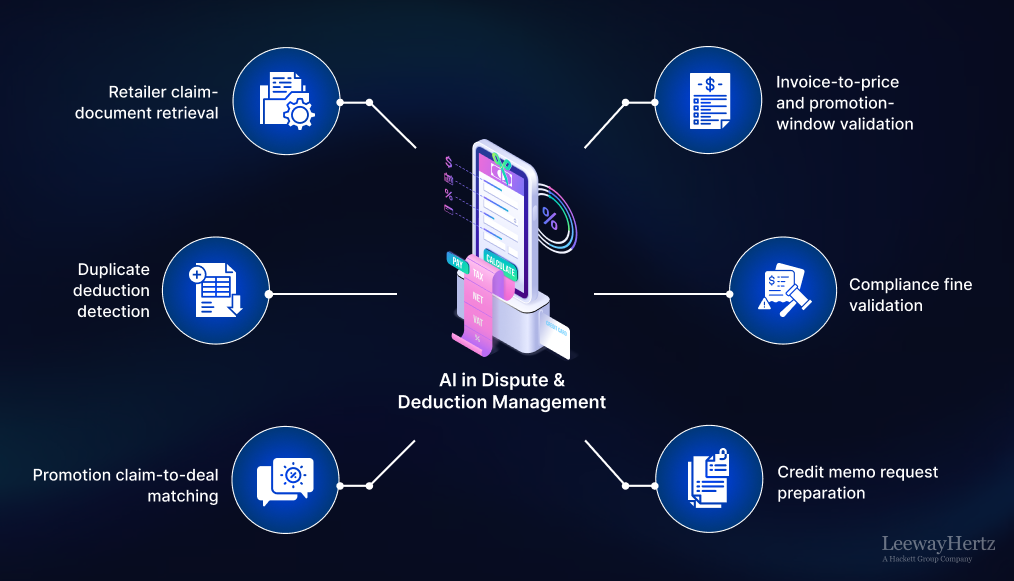
Dispute and deduction management is the order-to-cash discipline responsible for investigating and resolving amounts that retailers and distributors subtract from supplier payments. It begins when a short payment, debit memo, retailer claim, or post-audit demand is identified and continues through classification, evidence validation, dispute filing, repayment, settlement, credit memo issuance, write-off, financial reporting, and root cause prevention.
For CPG, food and beverage, and consumer electronics suppliers, deduction management connects finance with trade promotion, sales, logistics, warehouse operations, pricing, master data, and customer relationships. A single claim may require an EDI 820 remittance record, the original invoice, a promotion agreement, an EDI 856 advance ship notice, a signed proof of delivery, warehouse confirmation, retailer receiving data, a routing-guide requirement, and the history of prior disputes. The required evidence may sit across ERP, EDI, trade promotion management, warehouse management, transportation, retailer portal, document repository, and deduction-management platforms.
The commercial environment in which this work occurs is substantial. The US Census Bureau estimated US retail and food services sales of $768.6 billion for June 2026, an increase of 6.7% from June 2025 [1]. The volume of transactions flowing between suppliers, distributors, carriers, and retailers creates a correspondingly large population of remittances, invoices, shipment records, allowances, and exceptions that must be reconciled.
Available deduction benchmarks also show why the process deserves focused attention. APQC currently reports a median process cost of $19.24 for each adjustment or deduction across a sample of 1,835 organizations [2]. Its benchmarking data indicates that personnel represents a median 63% of the cost of managing adjustments and deductions, reinforcing how dependent the process remains on investigation and manual review. APQC also reports a median of $380,000 in customer adjustments [3] and deductions handled per process FTE across a sample of 1,072 organizations.[4]
Industry-specific findings point to the financial importance of claim validity and recovery. A deduction-management forum survey reported by UpClear found that open deductions commonly represented 3% to 5% of open accounts receivable among participants, while respondents estimated that 5% to 10% of deduction dollars were invalid. [5] The same survey found that approximately half of disputed deductions were repaid and that promotion-related deductions represented 62% of total deduction volume in the surveyed population.[5] These findings should be treated as directional industry benchmarks rather than universal performance standards, but they illustrate the value of faster evidence retrieval, consistent classification, and timely dispute preparation.
Deduction management is suited to AI because much of the work is document-heavy, transaction-heavy, exception-driven, and time-sensitive. However, the relevant solution is not a generic chatbot. A deduction analyst needs a retailer reason code translated into the internal taxonomy. A trade spend analyst needs a claim compared with the approved promotion event and remaining accrual. A customer supply chain analyst needs the ASN, receiving record, POD, and carrier status assembled for a shortage review. A controller needs evidence supporting a proposed write-off or accrual true-up without allowing the system to make the accounting judgment.
For finance and order-to-cash leaders, the opportunity is not to replace the ERP, deduction-management platform, trade promotion system, WMS, TMS, or retailer portal. It is to extend the value of those systems by applying AI to the evidence gathering, normalization, comparison, case preparation, deadline monitoring, and exception routing activities that consume specialist capacity and delay recovery.
The operating boundary is central to this approach. AI can extract claim details, normalize reason codes, retrieve supporting records, reconcile quantities and prices, calculate differences, prepare validity recommendations, draft dispute narratives, and monitor case deadlines. Deduction professionals, sales finance teams, logistics owners, authorized managers, and controllers continue to accept or reject claims, approve disputes, negotiate settlements, issue credit memos, authorize write-offs, and make accounting judgments.
This article focuses specifically on retailer and distributor deductions. Cash application owns remittance-to-invoice matching and identifies the short payment that triggers the deduction process. Collections owns the pursuit of unpaid invoices where the customer has not provided a deduction reason. Generic accounts receivable dispute management covers a wider range of invoice disputes. Logistics teams own operational corrections, while deduction management provides the claim evidence and recurring-cause analysis that informs those actions.
The most practical starting point for AI implementation is a clearly defined sub-process, not a broad concept such as “AI for deductions.” The operating model should first be decomposed from the function level into its constituent processes and sub-processes. Each candidate sub-process can then be assessed based on its trigger artifacts, supporting evidence, source systems, customer-specific requirements, deadlines, financial implications, accountable reviewers, expected outputs, and human-review boundaries.
- How AI is transforming dispute and deduction management
- Why AI use cases in dispute and deduction management must be mapped at the sub-process level
- Dispute and deduction management operating model and AI opportunity mapping across processes
- High-value AI use cases in dispute and deduction management
- How agentic AI works in dispute and deduction management workflows
- How to prioritize AI use cases in dispute and deduction management
- Governance, risk, and responsible AI in dispute and deduction management
- How ZBrain operationalizes AI use cases in dispute and deduction management
- Future of AI in dispute and deduction management
How AI is transforming dispute and deduction management
AI changes deduction-management operations by analyzing the case evidence before a specialist opens it, connecting records stored across operational and financial systems, and preparing a reviewable recommendation for the next action. The strongest opportunities occur where specialists repeatedly gather the same categories of evidence but must still apply commercial, operational, or financial judgment.
Consider a retailer shortage claim. The deduction may first appear as an adjustment in an EDI 820 remittance record. Evaluating it can require the corresponding EDI 810 invoice, EDI 856 advance ship notice, retailer receiving record, warehouse pick-and-pack confirmation, signed POD, BOL, and carrier shipment history. X12 defines the 820 transaction as a payment or remittance record that can carry the detail required for accounts receivable cash application. The 856 transaction communicates shipment contents and configuration, while the 214 transaction communicates shipment status information such as dates, times, routes, locations, and identifying numbers. [6]
AI can bring these records together, compare shipped, delivered, and claimed quantities, identify missing evidence, and prepare a claim-validity recommendation. The deduction analyst still determines whether the evidence supports acceptance, dispute, escalation, or further investigation.
The AI opportunity can be understood across five types of work:
Document-heavy work: Retailer debit memos, promotion agreements, post-audit letters, PODs, BOLs, compliance manuals, routing-guide excerpts, price files, dispute forms, and write-off requests can be checked for missing fields, conflicting dates, unsupported amounts, and absent evidence before specialist review.
Narrative-heavy work: Dispute narratives, denial responses, buyer escalations, settlement recommendations, post-audit defenses, write-off rationales, and reserve-review summaries can be drafted from approved source material while linking each statement to the evidence used.
Exception-heavy work: Shortages, pricing differences, duplicate deductions, promotion mismatches, compliance fines, expired dispute windows, missing claim documentation, and unresolved repayments can be classified and prioritized according to value, aging, deadline, evidence availability, and required expertise.
Knowledge-heavy work: Retailer reason codes, internal deduction taxonomies, promotion terms, pricing conditions, routing-guide rules, write-off policies, delegated authority thresholds, accounting policies, and prior case outcomes can be retrieved and applied to the case under review.
Workflow-heavy work: Multi-step cases can be coordinated across deduction teams, sales finance, trade promotion, logistics, warehouse operations, pricing, customer master data, cash application, controllership, and retailer-facing teams by preparing the next work packet and routing unresolved exceptions to the accountable reviewer.
AI supports deduction-management work through capabilities such as document intelligence, classification, entity resolution, multi-source comparison, anomaly detection, predictive ranking, approved-source policy retrieval, and natural-language generation. The value comes from applying one or more of these capabilities to a specific artifact and a clearly bounded deduction-management task.
The practical design rule is simple: AI should prepare the evidence and the next reviewable action, not become the commercial, financial, or accounting authority. A workflow may recommend that a claim appears unsupported, but the deduction analyst determines its validity. It may prepare a credit memo request, but an authorized finance role approves issuance. It may calculate the potential reserve effect, but the Controller determines the accounting treatment.
Build governed AI workflows across dispute and deduction management
Apply AI across dispute and deduction management to improve case resolution, strengthen recovery, support financial control, and reduce recurring issues while preserving human accountability for consequential decisions.
Why AI use cases in dispute and deduction management must be mapped at the sub-process level
Dispute and deduction management is not a single concise workflow. It is a connected operating model containing intake activities, deduction-specific validation paths, dispute processes, recovery actions, financial controls, and prevention mechanisms.
This complexity creates a challenge for AI adoption. High-level AI use-case labels such as “AI for deductions,” “AI for shortage claims,” or “AI for trade promotions” identify a broad area of work but do not define the specific sub-process to be addressed, what the solution must analyze, which systems it must access, what evidence it requires, which retailer-specific rules it must apply, or who must review and approve the outcome.
For example, “AI for deduction validation” could refer to several materially different activities:
-
Comparing a promotion deduction with an approved deal sheet and available accrual
-
Reconciling a shortage claim with an ASN, POD, BOL, and retailer receipt
-
Comparing an invoice price with a price file and promotion window
-
Testing a compliance fine against an OTIF or labeling requirement
-
Checking a post-audit demand against historical agreements and prior settlements
Each activity uses different evidence, systems, rules, reviewers, deadlines, and financial treatments. Treating them as one use case creates unclear requirements and weak governance.
A practical implementation approach begins by decomposing deduction-management work into four levels:
-
Function: A major area of deduction-management accountability, such as trade promotion deduction matching, shortage claim validation, dispute filing, or write-off governance. A function contains multiple processes and is too broad to implement as a single AI workflow.
-
Process: A recurring workflow area within a function, such as remittance intake, promotion agreement validation, evidence reconciliation, dispute submission, repayment tracking, or write-off approval.
-
Sub-process: A specific work activity with a defined trigger, supporting evidence, source system, exception condition, output, and accountable reviewer. Examples include translating a retailer reason code, matching an EDI 856 ASN with receiving data, or preparing a write-off recommendation under a delegated authority policy.
-
AI-enabled opportunity: A specific AI capability applied to a defined deduction artifact to change how the sub-process is performed. For example, classification can translate retailer adjustment codes into the internal deduction taxonomy, while multi-source comparison can reconcile an invoice, price file, promotion period, and customer terms to prepare a pricing-difference assessment.
Sub-process mapping makes the opportunity buildable. “AI for shortage deductions” does not define the shipment identifier, claim number, receiving location, carton quantity, carrier record, clean or exception POD status, customer-specific rule, or analyst approval process. In contrast, “carton-level comparison of an EDI 856 ASN, retailer receipt, warehouse confirmation, and signed POD for analyst review” defines the evidence and decision boundary required for implementation.
It also exposes dependencies. A promotion deduction workflow may require a valid customer-product mapping, promotion event identifier, deal sheet, approved rate, shipment or scan data, accrual balance, and sales finance review. A compliance chargeback workflow may require the retailer’s routing guide version, ASN transmission history, appointment record, delivery timestamp, label data, DC information, and logistics reviewer.
Mapping these dependencies before development helps organizations determine whether the artifacts are available, whether the customer-specific rules can be maintained, whether the output can be validated, and whether the workflow has a reliable human review boundary.
Dispute and deduction management operating model and AI opportunity mapping across processes
Dispute and deduction management spans interconnected activities across case intake and preparation, claim-specific validation, resolution and recovery, financial governance, and root cause prevention. Each function relies on specific transaction records, supporting evidence, enterprise systems, customer requirements, deadlines, and accountable reviewers.
The functions are grouped into five key areas:
-
Intake and case preparation
-
Claim-specific validation
-
Resolution execution
-
Financial governance
-
Cross-cutting improvement
The following operating model maps these activities at the process and sub-process levels to show where AI can retrieve and compare evidence, classify cases, prepare recommendations, monitor exceptions, and support handoffs across finance, sales, trade promotion, logistics, and customer-facing teams. Human professionals continue to determine claim validity and retain authority over disputes, settlements, credit memos, write-offs, and accounting judgments.
Intake and case preparation
Function 1: Deduction identification and case intake
Turning identified short payments, debit memos, and retailer claims into complete, traceable deduction cases.
Deduction identification and case intake establish the record that subsequent validation, dispute, settlement, and accounting activities rely on. The function begins when cash application or another upstream process identifies a short payment, debit memo, portal claim, or post-audit demand. It converts the trigger into a structured case linked to the customer, invoice, claim, reason code, amount, date, and source evidence.
Teams involved: Cash application specialists, deduction analysts, deductions managers, EDI or integration owners, accounts receivable teams, and retailer portal support teams.
What AI helps with: Structured parsing and document intelligence can extract invoice references, claim numbers, adjustment codes, dates, customer identifiers, and deducted amounts from EDI records, lockbox files, debit memos, and portal documents. Entity resolution can connect incomplete or inconsistent references with ERP invoices and customer records. Intelligent retrieval can collect supporting claim documents from approved repositories and retailer portals.
What humans continue to own: Cash application personnel confirm that the remittance has been matched correctly. Deduction professionals resolve ambiguous references, determine whether a new case should be opened, and confirm case ownership and priority. AI extracts, matches, and prepares but does not determine the final classification, disposition, or financial treatment of the deduction.
| Process | Sub-process | AI-enabled opportunities |
|---|---|---|
| Remittance intake | Remittance parsing and short-pay detection |
|
| Deduction case creation | Automatic deduction-case preparation |
|
| Evidence acquisition | Retailer claim-document retrieval |
|
Key artifacts: EDI 820 remittance advice, EDI 812 credit or debit adjustment, lockbox file, debit memo, retailer claim record, invoice, customer account record, deduction case.
Systems involved: Bank lockbox platform, cash application system, EDI translator and archive, ERP and AR subledger, retailer portals, deduction-management platform, and document repository.
Regulatory and control considerations: Access to customer financial records and retailer portals should be role-based. Case creation must retain the original remittance, matching history, timestamps, source identifiers, and any manual override. The workflow should not automatically write off or issue a credit based solely on a reason code or threshold.
Accountable roles: Cash application specialist, deduction analyst, deductions manager, EDI or integration owner, AR manager.
Highest-value opportunities
-
Remittance parsing and short-pay detection: High value because it operates on high-volume, structured records and establishes the accuracy of every downstream case.
-
Automated case preparation: High leverage because incomplete or incorrectly linked cases create rework across validation, dispute, recovery, and reporting.
-
Portal claim retrieval: Valuable because analysts frequently spend significant time locating backup before substantive claim review begins.
Example agentic workflow: Short-payment intake and case-readiness workflow assessment
- The workflow begins when an EDI 820 remittance advice contains a payment below the referenced invoice amount.
- Structured parsing extracts the payment, invoice, customer, deduction amount, claim reference, and adjustment code.
- Entity resolution compares the references with ERP invoices, customer records, existing deduction cases, and EDI history.
- The workflow retrieves the related debit memo or retailer claim detail and identifies missing backup.
- A deduction analyst reviews the source match, confirms that the item is a deduction case, and assigns the appropriate category and owner.
- After confirmation, the deduction-management platform records the case and routes it to the applicable validation function under existing access and audit controls.
Function 2: Coding, categorization, and reason-code normalization
Turning retailer-specific deduction language into a consistent internal taxonomy and controlled processing path.
Retailers and distributors use their own adjustment codes, claim terminology, portal categories, and debit memo formats. This function translates those external signals into the supplier’s internal deduction taxonomy so cases can be routed, measured, and governed consistently.
The output is not merely a label. The normalized category determines which evidence must be retrieved, which reviewer owns the case, which deadline applies, and whether the likely financial pathway is recovery, trade-spend consumption, compliance expense, credit memo, or write-off.
Teams involved: Deduction analysts, deductions managers, sales finance and trade spend owners, customer data stewards, internal controls teams, and system administrators.
What AI helps with: Classification can map customer-specific reason codes and free-text descriptions to an approved internal taxonomy. Similarity analysis can identify duplicate cases submitted under different claim numbers. Policy lookup can surface small-balance thresholds and route cases that qualify for controlled write-off consideration.
What humans continue to own: Deduction professionals approve mappings for ambiguous or new codes. Finance owners define the taxonomy and authorized processing thresholds. Deductions managers approve exceptions and determine whether a case should proceed to validation, dispute, settlement, or write-off review. AI categorizes and recommends but does not accept a claim, authorize a write-off, or determine accounting treatment.
| Process | Sub-process | AI-enabled opportunities |
|---|---|---|
| Deduction taxonomy management | Retailer reason-code translation |
|
| Threshold assessment | Small-balance write-off threshold application |
|
| Duplicate control | Duplicate deduction detection |
|
Key artifacts: Retailer reason-code table, internal deduction taxonomy, debit memo, claim description, write-off policy, delegation-of-authority matrix, existing case history.
Systems involved: Deduction-management platform, ERP, EDI archive, customer master, policy repository, analytics platform, and retailer portals.
Regulatory and control considerations: Threshold logic should use the approved legal entity, currency, account, and delegated authority. Reason-code mappings and taxonomy changes require version control and named ownership. Duplicate detection must preserve explainable matching evidence before cases are merged or closed.
Accountable roles: Deduction analyst, deductions manager, customer data steward, controller or assistant controller, internal controls or SOX control owner.
Highest-value opportunities
-
Reason-code normalization: High value because it establishes consistent routing and analytics across customers using incompatible taxonomies.
-
Duplicate deduction detection: High leverage because the same commercial or shipment event may be deducted more than once under different references.
-
Threshold assessment: Valuable because it reduces manual policy lookup while preserving approval controls for write-offs.
Example agentic workflow: Deduction classification and routing
- The workflow begins with a newly created deduction case containing a retailer reason code, debit memo text, amount, and invoice reference.
- Classification compares the external code and text with the approved internal taxonomy and prior reviewed mappings.
- Duplicate analysis checks existing cases using claim, invoice, amount, date, shipment, and promotion references.
- Policy retrieval identifies the applicable small-balance threshold and delegated approval requirement.
- A deduction analyst confirms the category, duplicate status, and required validation path.
- The confirmed case is routed to trade, shortage, pricing, compliance, dispute, or write-off review, with the mapping evidence and reviewer decision retained.
Claim-specific validation
Function 3: Trade promotion deduction matching
Turning promotion claims into evidence-backed matches against approved agreements, performance records, and trade-spend accruals.
Trade promotion deductions arise when retailers collect amounts associated with temporary price reductions, bill-backs, scan programs, displays, advertising, off-invoice allowances, or other agreed commercial activities. Validation requires matching the claim with the correct promotion event, approved terms, eligible products, performance period, customer, rate, and remaining accrual.
Teams involved: Deduction analysts, trade spend analysts, trade marketing managers, sales finance, key account managers, broker account executives, and controllers.
What AI helps with: Document intelligence can extract products, dates, rates, conditions, and retailer commitments from deal sheets and promotion agreements. Entity resolution can link a claim with the correct TPM event despite inconsistent customer, product, or event references. Multi-source comparison can reconcile the claim with performance evidence, accrual balances, broker records, and prior deductions.
What humans continue to own: Sales finance and trade spend owners confirm that the promotion was authorized, performed, and financially supported. Account teams resolve commercial ambiguity. Controllers determine the accounting treatment and approve material accrual changes. AI matches, calculates, and prepares but does not approve a trade claim, consume an accrual, or make a variable-consideration judgment independently.
| Process | Sub-process | AI-enabled opportunities |
|---|---|---|
| Promotion agreement validation | Deal sheet and promotion contract lookup |
|
| Accrual reconciliation | Accrual matching and open-liability netting |
|
| Allowance reconciliation | Broker commission and off-invoice allowance reconciliation |
|
Key artifacts: Promotion deal sheet, TPM event record, promotion contract, performance record, scan data, broker statement, invoice, debit memo, accrual ledger, prior deduction history.
Systems involved: TPM platform, deduction-management platform, ERP, sales and customer data platform, broker portal, document repository, and general ledger.
Regulatory and control considerations: Promotion claims should be assessed against approved terms, retailer eligibility, documented performance, and prior settlement activity to support consistent validation and defensible resolution.
Accountable roles: Trade spend analyst, sales finance manager, trade marketing manager, key account manager, broker account executive, controller.
Highest-value opportunities
-
Promotion-to-claim matching: High value because inconsistent event, product, and customer references often prevent straightforward matching.
-
Accrual reconciliation: High leverage because it connects case resolution with trade-spend liability and financial reporting.
-
Duplicate and overclaim detection: Valuable because repeated or overlapping submissions can otherwise consume the same promotion funding more than once.
Example agentic workflow: Trade promotion deduction matching
- The workflow begins with a retailer debit memo or EDI 820 adjustment identified as a promotion deduction.
- Entity resolution searches the TPM platform for candidate events using the customer, product, dates, rate, amount, and claim description.
- Document intelligence extracts the approved event terms and retrieves available performance evidence.
- Multi-source comparison calculates the relationship among the approved amount, accrued liability, prior deductions, and current claim.
- A trade spend analyst and, where required, the sales finance owner review the match, performance evidence, and proposed treatment.
- After approval, the case is routed for accrual consumption, dispute preparation, further customer clarification, or credit memo processing under existing financial controls.
Function 4: Shortage and OS&D claim validation
Turning shipment, delivery, receiving, and warehouse records into a reviewable assessment of shortage, overage, and damage claims.
Shortage and OS&D claims require the supplier to determine whether the quantities ordered, shipped, transported, delivered, and received support the retailer’s claim. The evidence can include the purchase order, invoice, ASN, warehouse confirmation, pallet or carton identifiers, BOL, POD, carrier history, retailer receiving data, and damage documentation.
Teams involved: Deduction analysts, customer supply chain analysts, logistics managers, warehouse teams, transportation teams, retailer compliance analysts, and key account managers.
What AI helps with: Multi-source comparison can reconcile invoice, ASN, warehouse, carrier, POD, and retailer receipt quantities. Document intelligence can extract signatures, exception notations, timestamps, seal numbers, pallet IDs, and damage references. Anomaly detection can identify quantity breaks, duplicate shortage claims, receiving inconsistencies, and carton-level patterns.
What humans continue to own: Supply chain and deduction professionals determine whether the shipment evidence supports the claimed shortage or damage. They resolve conflicting receiving records and decide whether to accept, dispute, or escalate the claim. AI compares evidence and prepares a recommendation but does not make the final claim-validity decision.
| Process | Sub-process | AI-enabled opportunities |
|---|---|---|
| Delivery evidence acquisition | POD and BOL retrieval |
|
| Shipment reconciliation | ASN-to-receipt reconciliation |
|
| Carton-level analysis | Concealed shortage and cube analysis |
|
Key artifacts: EDI 856 ASN, EDI 214 carrier status, invoice, purchase order, POD, BOL, warehouse pick-and-pack record, retailer receipt, OS&D report, carton and pallet identifiers.
Systems involved: EDI archive, WMS, TMS, carrier portal, retailer portal, ERP, deduction-management platform, and document repository.
Regulatory and control considerations: Shipment evidence should preserve original timestamps, source identifiers, document versions, and any receiving exceptions. Clean delivery documentation should not automatically close a case because concealed shortages and later receiving adjustments may require additional review.
Accountable roles: Deduction analyst, customer supply chain analyst, logistics manager, warehouse operations representative, retailer compliance analyst, deductions manager.
Highest-value opportunities
-
ASN-to-receipt reconciliation: High value because it identifies the point at which shipped and received quantities diverge.
-
POD and BOL extraction: Valuable because these documents are central to claim defense but often require time-consuming retrieval and review.
-
Carton-level pattern analysis: High leverage because recurring differences may expose receiving, labeling, warehouse, carrier, or master-data issues beyond the individual claim.
Example agentic workflow: Shortage claim validation and dispute preparation
- The workflow begins with an EDI 820 short payment referencing a shortage claim.
- It retrieves the retailer claim, invoice, EDI 856 ASN, warehouse confirmation, POD, BOL, and available carrier status records.
- Multi-source comparison reconciles ordered, shipped, transported, delivered, and received quantities at the item, carton, pallet, and shipment levels.
- The workflow retrieves the customer-specific evidence requirements and dispute submission conditions.
- It prepares a claim-validity recommendation, identifies missing or conflicting evidence, and drafts an indexed dispute packet where the evidence supports the challenge.
- A Deduction analyst and customer supply chain analyst review the evidence and approve, reject, or return the recommendation.
- Only after approval is the dispute packet released through the authorized channel, with the submission confirmation and evidence history retained.
Accelerate AI Solutions Development
Build fully functional solutions from your high-value use cases, based on specific operational needs and enterprise context.
Function 5: Pricing and terms deduction validation
Turning invoices, price records, promotion periods, and customer terms into evidence-backed assessments of pricing differences.
Pricing deductions arise when the retailer’s expected price, allowance, freight treatment, bracket, discount, or item setup differs from the supplier’s invoice. Determining the cause requires identifying the authoritative commercial version and validating the dates, quantities, product identifiers, customer hierarchy, ship-to location, and applicable terms.
Teams involved: Deduction analysts, pricing analysts, sales finance, key account managers, customer data stewards, order-to-cash teams, and controllers.
What AI helps with: Multi-source comparison can reconcile invoice prices with approved price lists, contracts, promotion windows, bracket rules, freight allowances, and cash discount terms. Entity resolution can identify product and customer mapping errors. Anomaly detection can distinguish an isolated claim from a systemic pricing or master-data issue.
What humans continue to own: Pricing, sales finance, and account teams determine which commercial agreement governs the transaction and approve corrections or customer responses. Controllers approve the financial treatment of material differences. AI compares terms and prepares a recommendation but does not determine the binding commercial price or authorize a credit.
| Process | Sub-process | AI-enabled opportunities |
|---|---|---|
| Price validation | Invoice-to-price-list and promotion-window verification |
|
| Terms validation | Bracket pricing, freight allowance, and cash discount checks |
|
| Master-data analysis | Item setup and UPC or GTIN mismatch root-causing |
|
Key artifacts: EDI 810 invoice, price list, customer contract, promotion record, freight terms, cash discount terms, customer item record, UPC or GTIN mapping, customer master data.
Systems involved: ERP, pricing platform, CPQ or contract repository, TPM platform, customer master, product master, EDI archive, and deduction-management platform.
Regulatory and control considerations: Commercial terms should be retrieved from approved, effective versions. Product and customer mapping changes should follow master-data approval procedures. Promotional allowances should remain consistent with applicable commercial and legal requirements.
Accountable roles: Pricing analyst, sales finance manager, key account manager, customer data steward, deduction analyst, controller.
Highest-value opportunities
-
Invoice-to-price validation: High value because a single incorrect price condition can create repeated deductions across many invoices and items.
-
Product-identifier resolution: High leverage because UPC, GTIN, pack, and unit-of-measure mismatches can propagate into ordering, invoicing, receiving, and claims.
-
Terms comparison: Valuable because bracket, freight, and cash discount disputes require consistent interpretation of multiple commercial records.
Example agentic workflow: Pricing deduction validation
- The workflow begins with a retailer pricing debit memo linked to an invoice and item.
- It retrieves the invoice, approved price record, relevant contract or promotion, customer and product master records, and applicable freight or payment terms.
- Multi-source comparison calculates the expected and invoiced amounts and identifies the record causing the difference.
- Entity resolution checks customer item, internal SKU, UPC, GTIN, pack, and unit-of-measure mappings.
- A pricing analyst or sales finance owner confirms the governing price and determines whether a correction, dispute, or customer clarification is appropriate.
- The approved action is routed to the deduction platform, pricing team, master-data team, or credit memo process, with the source version and reviewer decision retained.
Function 6: Compliance chargeback management
Turning retailer fines into evidence-backed assessments against routing, labeling, appointment, ASN, and delivery requirements.
Retailer compliance chargebacks can relate to OTIF performance, MABD windows, appointment adherence, ASN accuracy, labeling, pallet configuration, routing, packaging, or other customer-specific requirements. Validation requires the version of the applicable retailer rule and the operational evidence showing what occurred.
Teams involved: Retailer compliance analysts, customer supply chain teams, logistics managers, EDI owners, warehouse teams, key account managers, and deduction analysts.
What AI helps with: Document intelligence can extract requirements from retailer routing guides and compliance manuals. Multi-source comparison can test the charge against shipment, appointment, ASN, carrier, label, and receiving evidence. Trend analysis can identify recurring fines by retailer DC, carrier, warehouse, lane, item, and violation type.
What humans continue to own: Compliance and logistics professionals interpret customer rules, resolve operational ambiguity, engage retailer contacts, and approve disputes or corrective-action referrals. AI retrieves rules, compares evidence, and prepares recommendations but does not determine contractual liability or commit to a corrective action.
| Process | Sub-process | AI-enabled opportunities |
|---|---|---|
| Fine validation | Routing-guide and compliance-manual validation |
|
| Trend analysis | Chargeback analysis by DC, carrier, and item |
|
| Prevention handoff | Supply chain corrective-action preparation |
|
Key artifacts: Retailer compliance manual, routing guide, OTIF scorecard, ASN history, appointment record, EDI acknowledgment, carrier status, label record, POD, deduction claim, corrective-action record.
Systems involved: Retailer portals, EDI archive, WMS, TMS, carrier portals, ERP, compliance platform, deduction-management platform, and analytics environment.
Regulatory and control considerations: Retailer thresholds and dispute windows are dynamic contractual requirements and should be retrieved from the applicable source version. Exact customer deadlines or thresholds should not be embedded as permanent workflow facts without maintenance and validation.
Accountable roles: Retailer compliance analyst, customer supply chain manager, logistics manager, EDI or integration owner, deduction analyst, key account manager.
Highest-value opportunities
-
Rule-to-evidence validation: High value because compliance fines cannot be assessed reliably without both the applicable rule version and operational evidence.
-
Chargeback trend analysis: High leverage because recurring fines often expose systematic logistics, ASN, labeling, or master-data issues.
-
Corrective-action preparation: Valuable because it converts case-level findings into structured prevention work without transferring ownership from operations.
Example agentic workflow: Compliance chargeback validation
- The workflow begins with a retailer portal claim or debit memo identifying a compliance violation.
- It retrieves the routing guide or compliance-manual version applicable to the shipment date.
- It gathers the ASN, acknowledgment, appointment, WMS, TMS, carrier, label, POD, and receiving records.
- Multi-source comparison prepares an assessment of the charge against the stated requirement.
- A retailer compliance analyst and logistics manager review the evidence and determine whether to accept, dispute, or escalate the claim.
- The approved action is filed or recorded, while recurring operational causes are routed into the supply chain corrective-action process.
Resolution execution
Function 7: Dispute filing and denial management
Turning deductions determined to be invalid or unsupported into complete, timely, and traceable dispute submissions.
Dispute filing begins after the evidence review indicates that a claim may be unsupported, duplicated, miscalculated, or inconsistent with the governing agreement or operational record. The function prepares the submission, tracks customer responses, manages denials, and supports escalation or post-audit defense.
Teams involved: Deduction analysts, deductions managers, key account managers, sales finance, customer supply chain, commercial or legal counsel, and retailer-facing teams.
What AI helps with: Evidence aggregation can assemble indexed dispute packets. Natural-language generation can draft claim-specific narratives using approved language and cited evidence. Deadline monitoring can track submission, acknowledgment, denial, second-level dispute, and escalation windows. Similarity retrieval can identify prior cases and resolutions involving comparable claims.
What humans continue to own: Deduction professionals determine whether to dispute, what position to take, and when to escalate. Account teams manage the retailer relationship, while legal or finance reviewers address material contractual issues. AI assembles and drafts but does not submit a consequential dispute or make a binding commercial representation without approval.
| Process | Sub-process | AI-enabled opportunities |
|---|---|---|
| Dispute preparation | Dispute packet assembly and submission readiness assessment |
|
| Denial management | Denial triage and second-level dispute preparation |
|
| Post-audit claim review and defense | Historical claim and agreement reconstruction |
|
Key artifacts: Dispute packet, retailer claim, invoice, evidence bundle, portal form, submission confirmation, denial response, prior correspondence, post-audit letter, historical agreement.
Systems involved: Deduction-management platform, retailer portals, ERP, TPM, EDI archive, WMS, TMS, document repository, email, and case-management tools.
Regulatory and control considerations: External communications should use authorized templates and approved submission channels. The workflow must preserve the submitted version, portal confirmation, evidence used, reviewer approval, and customer response. Historical claims should be evaluated against the agreement and policies effective at the original transaction date.
Accountable roles: Deduction analyst, deductions manager, key account manager, sales finance owner, commercial or legal counsel, customer supply chain representative.
Highest-value opportunities
-
Evidence packet assembly: High value because dispute preparation requires records from multiple systems and is vulnerable to missed deadlines.
-
Denial triage: Valuable because different denial types require different owners, evidence, and escalation paths.
-
Post-audit defense: High leverage because historical claims can span large populations and require reconstruction of older commercial and operational records.
Example agentic workflow: Dispute filing and denial-follow-up
- The workflow begins with an analyst-approved recommendation to dispute a deduction.
- It retrieves the validated case evidence and the customer’s current submission requirements.
- Evidence aggregation creates an indexed dispute packet, and natural-language generation prepares the dispute narrative.
- The workflow checks required fields, attachment completeness, amount, claim reference, and submission deadline.
- A deduction analyst or deductions manager reviews and approves the submission.
- Only after approval is the dispute filed through the authorized portal or communication channel.
- The workflow records confirmation, monitors response deadlines, and prepares any denial or second-level escalation for further human review.
Function 8: Resolution, recovery, and settlement
Turning approved case outcomes into repayment, settlement, credit memo, and financial handoff activities.
Resolution occurs when the case reaches an accepted outcome. An invalid deduction may be repaid, offset, or settled. A valid claim may require a credit memo or approved financial entry. A disputed amount may be settled commercially where the cost, age, evidence, or customer relationship does not support continued pursuit.
Teams involved: Deduction analysts, deductions managers, cash application specialists, sales finance, key account managers, AR managers, controllers, and authorized settlement approvers.
What AI helps with: Status monitoring can identify repayments and link them with open cases. Multi-source comparison can reconcile approved settlement terms, customer payments, credits, and remaining balances. Natural-language generation can prepare settlement summaries and credit memo requests with supporting GL and case references.
What humans continue to own: Authorized managers negotiate and approve settlements. Cash application confirms repayment posting. Finance personnel approve credit memos and GL coding. Controllers determine accounting treatment. AI tracks, reconciles, and prepares but does not negotiate a settlement, issue a credit memo, or approve a financial entry independently.
| Process | Sub-process | AI-enabled opportunities |
|---|---|---|
| Recovery tracking | Repayment monitoring and cash application handoff |
|
| Settlement management | Aged invalid deduction settlement preparation |
|
| Valid-claim resolution | Credit memo request and GL coding preparation |
|
Key artifacts: Repayment remittance, bank record, settlement agreement, deduction case, credit memo request, approval record, GL coding record, case closure record.
Systems involved: ERP and AR subledger, cash application platform, deduction-management platform, banking interface, general ledger, TPM platform, and approval system.
Regulatory and control considerations: Settlement and credit authority should follow delegated limits. Repayments must be reconciled with the open case and original receivable. Credit memos require evidence, approval, duplicate checks, and appropriate accounting treatment.
Accountable roles: Deductions manager, cash application specialist, AR manager, sales finance manager, key account manager, controller or assistant controller.
Highest-value opportunities
-
Repayment matching: High value because recovered cash can remain unapplied or disconnected from the deduction case.
-
Credit memo preparation: Valuable because valid claims still require complete documentation, correct coding, and controlled approval.
-
Settlement packet preparation: High leverage for aged portfolios where managers need a consistent view of evidence, value, authority, and recovery history.
Example agentic workflow: Deduction repayment and case-closure
- The workflow begins with a customer repayment, credit notification, or approved settlement.
- Entity matching links the transaction with the open deduction case using customer, amount, invoice, claim, and remittance references.
- Multi-source comparison calculates the recovered, settled, credited, and remaining amounts.
- The workflow prepares the required cash application, credit memo, or settlement record and checks approval requirements.
- A cash application specialist and authorized finance reviewer confirm the posting and financial treatment.
- The approved transaction is recorded, the deduction case is reconciled and closed or partially closed, and the resulting evidence is retained for reporting and audit.
Financial governance
Function 9: Write-off governance
Turning unresolved or valid deduction balances into controlled approval, accounting-support, and reserve-review work.
Write-off governance applies when a deduction will not be recovered or credited through another approved pathway. It ensures that small-balance thresholds, delegated authority, evidence requirements, account coding, accrual treatment, and reserve implications are applied consistently.
Accounting standards treat discounts, rebates, refunds, credits, price concessions, incentives, penalties, and similar amounts as potential forms of variable consideration. AI may support calculations and evidence preparation, but the accounting conclusion remains a controllership responsibility.
Teams involved: Deductions managers, AR managers, sales finance, controllers, assistant controllers, internal controls or SOX control owners, and internal audit where applicable.
What AI helps with: Policy retrieval can identify the applicable write-off authority and documentation requirements. Evidence aggregation can prepare a complete write-off packet. Multi-source analysis can compare open balances, historical recovery, claim validity, accrual positions, and reserve assumptions. Anomaly detection can identify unusual write-offs or repeated use of thresholds.
What humans continue to own: Authorized finance leaders approve write-offs. Controllers determine variable-consideration treatment, accrual true-ups, reserve adequacy, and financial statement effects. Internal control owners determine control compliance. AI prepares calculations and recommendations but does not approve write-offs, determine accounting treatment, or attest to reserve adequacy.
| Process | Sub-process | AI-enabled opportunities |
|---|---|---|
| Write-off approval | Delegated-authority routing |
|
| Accounting support | Variable-consideration and trade-accrual true-up preparation |
|
| Reserve reporting | Open-deduction reserve adequacy analysis |
|
Key artifacts: Write-off approval form, delegation-of-authority matrix, deduction aging, recovery history, trade accrual reconciliation, credit memo record, reserve analysis, controller review record.
Systems involved: ERP, deduction-management platform, general ledger, consolidation system, TPM platform, approval workflow, analytics platform, and document repository.
Regulatory and control considerations: SOX-relevant controls may apply to write-offs, credit memos, reserves, journal entries, and financial reporting evidence. Approval thresholds, preparer-reviewer separation, source retention, and system access should be explicit. Accounting standards should not be treated as automated business rules without Controller interpretation.
Accountable roles: Deductions manager, AR manager, sales finance manager, controller, assistant controller, internal controls or SOX control owner, internal audit.
Highest-value opportunities
-
Write-off packet preparation: High value because approvals require complete evidence and consistent application of authority thresholds.
-
Accrual true-up support: High leverage because deduction resolution can affect trade-spend liabilities and reported revenue.
-
Reserve analysis: Valuable because open deduction portfolios contain different validity, recovery, aging, and evidence profiles that should not be treated uniformly.
Example agentic workflow: Write-off and reserve-review
- The workflow begins with an aged deduction proposed for write-off or reserve review.
- It retrieves the case record, claim evidence, dispute history, settlement activity, prior approvals, accrual information, and delegated authority policy.
- The workflow prepares the unresolved balance, recovery history, proposed reason, financial coding, and approval route.
- Where relevant, it calculates the relationship between the deduction, promotion accrual, credit activity, and current reserve assumptions.
- A deductions manager reviews the operational case, and the authorized Controller or finance approver determines the write-off and accounting treatment.
- Only after approval is the financial entry processed, with the evidence, reviewer decisions, and resulting system updates retained.
Cross-cutting improvement
Function 10: Root cause analytics and prevention
Turning resolved deduction history into evidence for pricing, promotion, logistics, compliance, and master-data improvement.
Root cause analytics extends deduction management beyond case closure. It identifies which customers, reason codes, products, DCs, carriers, warehouses, promotions, pricing records, and internal processes generate repeated claims.
The function creates an evidence-backed, prioritized prevention record that enables logistics, pricing, trade promotion, and master-data teams to evaluate recurring causes and implement the appropriate corrective actions.
Teams involved: Deductions managers, order-to-cash process owners, sales finance, customer supply chain, logistics, trade marketing, pricing, customer data stewards, key account managers, and analytics teams.
What AI helps with: Classification can normalize resolved causes across customers. Pattern and Pareto analysis can quantify recurring sources of deduction value and volume. Natural-language generation can prepare customer scorecards and prevention summaries. Predictive analytics can identify conditions associated with elevated deduction risk.
What humans continue to own: Functional owners determine whether a process or master-data change is justified, approve corrective actions, and manage customer discussions. AI identifies patterns and prepares recommendations but does not change pricing, promotion, logistics, item master, or customer commitments independently.
| Process | Sub-process | AI-enabled opportunities |
|---|---|---|
| Portfolio analysis | Deduction trend and root cause prioritization |
|
| Prevention management | Prevention initiative identification |
|
| Customer collaboration | Customer scorecards and joint deduction-reduction reviews |
|
Key artifacts: Deduction aging report, root cause record, dispute outcome, recovery history, customer scorecard, promotion history, logistics performance data, pricing exceptions, master-data issue log, corrective-action record.
Systems involved: Deduction-management platform, ERP, TPM, WMS, TMS, customer master, product master, retailer portals, BI and analytics platforms, and control-management systems.
Regulatory and control considerations: Analytics should distinguish confirmed root causes from inferred associations. Customer scorecards should use traceable case and operational evidence. System or master-data changes require approval from the function that owns the affected process.
For produce suppliers, deduction and recovery processes may also interact with PACA trust requirements [7]. USDA explains that the trust provisions give eligible sellers of fresh and frozen fruits and vegetables priority status when buyers become insolvent or enter bankruptcy and require applicable notice and payment terms to preserve trust rights. These legal considerations require specialist review and should not be inferred automatically from a deduction category.
Accountable roles: Deductions manager, order-to-cash process owner, sales finance manager, customer supply chain manager, logistics manager, trade marketing manager, customer data steward, key account manager.
Highest-value opportunities
-
Deduction Pareto analysis: High value because it focuses prevention efforts on the customers, causes, items, and processes responsible for the largest recurring exposure.
-
Operational root cause linkage: High leverage because case-resolution data becomes more valuable when connected with pricing, promotion, shipment, receiving, and master-data events.
-
Customer scorecards: Valuable because they create a shared evidence base for joint reduction initiatives and retailer relationship discussions.
Example agentic workflow: Deduction root cause and prevention
- The workflow begins with a defined period of closed, open, repaid, credited, settled, and written-off deduction cases.
- It normalizes customer reason codes, internal categories, case outcomes, and confirmed root causes.
- It links the case population with promotion, pricing, item master, ASN, warehouse, carrier, DC, and customer performance data.
- Pattern analysis identifies the highest-value and most recurrent causes and prepares supporting case evidence.
- The deductions manager and relevant functional owner review the findings and determine which prevention initiative should proceed.
- Approved actions are routed to pricing, trade promotion, logistics, EDI, master-data, or customer-facing teams, while ownership, due dates, and subsequent deduction performance are tracked under existing governance.
Accelerate AI Solutions Development
Build fully functional solutions from your high-value use cases, based on specific operational needs and enterprise context.
High-value AI use cases in dispute and deduction management
Dispute and deduction management offers many opportunities for AI, but their value depends on the specific sub-process being addressed. Activities such as shortage claim validation and trade promotion matching involve different evidence, financial implications, customer requirements, and review responsibilities. Mapping these differences is essential to identifying where AI can deliver meaningful operational impact.
The strongest opportunities occur where teams repeatedly retrieve, compare, classify, or prepare similar evidence across a large case population. High-value use cases should also affect more than one case. A reason-code normalization workflow can improve routing and reporting across the portfolio. A recurring item-mapping issue can produce pricing, shortage, and compliance deductions across multiple customers. An accurate root cause can therefore improve current resolution while reducing future deductions.
| AI use case | Function | How AI creates high-value impact |
|---|---|---|
| Remittance parsing and deduction-case preparation | Deduction identification and case intake | Structured parsing extracts payment, invoice, adjustment, claim, and amount information from EDI 820 records and lockbox files. Entity resolution connects the short payment with the appropriate invoice and customer record, reducing intake effort while preserving the source transaction for review. |
| Retailer claim-document retrieval | Deduction identification and case intake | Intelligent retrieval collects debit memos, portal claim details, attachments, and submission records before analyst review. It reduces time spent locating evidence and helps prevent cases from aging while required documents remain undiscovered. |
| Retailer reason-code normalization | Coding, categorization, and reason-code normalization | Classification maps customer-specific codes and claim descriptions to an approved internal taxonomy. Consistent categorization improves case routing, ownership, reporting, and the selection of the appropriate validation workflow. |
| Duplicate deduction detection | Coding, categorization, and reason-code normalization | Similarity analysis compares invoice, claim, amount, date, shipment, item, and promotion references across current and historical cases. It identifies repeated claims that may otherwise be processed or credited more than once. |
| Promotion claim-to-deal matching | Trade promotion deduction matching | Entity resolution links a retailer claim with the appropriate promotion event despite inconsistent event, product, customer, or date references. Document intelligence then extracts the approved rate, period, products, conditions, and funding limit for review. |
| Trade accrual matching and liability netting | Trade promotion deduction matching | Multi-source comparison reconciles the claimed amount with the promotion agreement, performance evidence, prior claims, settlements, credits, and remaining accrual. It provides sales finance and controllership with an evidence-backed view of the proposed treatment. |
| ASN, delivery, and receipt reconciliation | Shortage and OS&D claim validation | Multi-source comparison connects the EDI 856 ASN, warehouse confirmation, EDI 214 carrier history, POD, BOL, invoice, and retailer receipt. It identifies where quantity differences emerge without independently deciding claim validity. |
| Carton and pallet-level shortage analysis | Shortage and OS&D claim validation | Entity resolution links GTINs, SSCCs, carton identifiers, pallet records, and shipment references. Pattern analysis highlights physically inconsistent claims and recurring differences by retailer DC, carrier, lane, warehouse, or item. |
| Invoice-to-price and promotion-window validation | Pricing and terms deduction validation | Comparison checks the invoiced amount against approved price records, effective dates, contracts, promotion windows, brackets, freight allowances, and payment terms. It prepares a pricing-difference assessment for commercial and finance review. |
| Customer-item and GTIN mismatch analysis | Pricing and terms deduction validation | Entity resolution maps retailer item numbers, UPCs, GTINs, pack sizes, units of measure, and internal SKUs. It identifies master-data inconsistencies that may create repeated pricing and receiving deductions. |
| Compliance fine validation | Compliance chargeback management | Document intelligence retrieves the applicable routing-guide or compliance-manual requirement. Comparison then tests the fine against ASN, appointment, label, carrier, delivery, and receiving evidence, preparing a recommendation for logistics and compliance review. |
| Compliance chargeback trend analysis | Compliance chargeback management | Pattern analysis aggregates chargebacks by retailer, DC, carrier, warehouse, lane, item, and violation. It helps teams distinguish isolated cases from systematic ASN, labeling, routing, or delivery-performance issues. |
| Dispute packet assembly | Dispute filing and denial management | Evidence aggregation creates an indexed packet containing the claim, invoice, agreement, shipment or promotion evidence, calculations, and applicable policy. Natural-language generation prepares a source-linked dispute narrative for analyst approval. |
| Denial triage and escalation preparation | Dispute filing and denial management | Classification separates missing-evidence, procedural, quantity, pricing, promotion, and contractual denials. Policy retrieval identifies the next review level, submission requirement, and escalation path. |
| Repayment tracking and cash application handoff | Resolution, recovery, and settlement | Entity matching links incoming repayments and remittance references with open deduction cases. It identifies partial, unmatched, duplicate, or delayed recoveries and prepares the posting handoff for cash application review. |
| Credit memo request preparation | Resolution, recovery, and settlement | Structured generation prepares a credit memo request using the approved amount, invoice, reason, customer, proposed account coding, and case evidence. Validation checks for duplicate credits, missing approval, and inconsistent financial treatment. |
| Write-off packet and approval routing | Write-off governance | Policy retrieval identifies the relevant delegated authority and documentation requirements. Evidence aggregation creates a complete write-off recommendation while retaining approval authority with the designated finance role. |
| Reserve and accrual true-up support | Write-off governance | Multi-source analysis combines deduction aging, validity assessments, recovery history, trade accruals, settlements, credit activity, and write-offs. It prepares calculations and portfolio evidence for Controller review without making the accounting judgment. |
| Deduction Pareto and root cause analysis | Root cause analytics and prevention | Classification normalizes resolved causes across customer taxonomies. Pareto analysis ranks the customers, reasons, products, DCs, carriers, and source processes responsible for the largest recurring exposure. |
| Customer deduction-reduction scorecards | Root cause analytics and prevention | Multi-source analysis combines claim volume, value, validity, recovery, response time, recurring causes, and relevant operational measures. It prepares an evidence-backed scorecard for account teams and joint customer reviews. |
The strongest first opportunities are typically high-volume, artifact-rich activities with an assigned reviewer and a limited blast radius. Remittance parsing, reason-code normalization, duplicate detection, evidence retrieval, claim comparison, and dispute packet preparation meet this standard because AI can prepare or route the work without making the commercial or accounting decision.
The value does not come from placing an agent over the entire deduction lifecycle. It comes from improving a specific handoff, comparison, deadline, or exception decision that affects recovery and downstream financial treatment.
How agentic AI works in dispute and deduction management workflows
Agentic AI can coordinate multiple software activities around a defined deduction-management goal. A workflow may retrieve records from approved systems, compare quantities and terms, apply maintained policies, prepare documents, monitor deadlines, and route unresolved cases.
This differs from allowing AI to control the complete process. Each workflow should pause before a dispute is filed, a claim is accepted, a settlement is communicated, a credit memo is issued, a write-off is approved, or an accounting entry is recorded.
Here are four examples.
Example 1: Shortage and OS&D claim validation and dispute
-
Agent role: Prepare a shortage claim for deduction analyst and customer supply chain review.
-
Initial artifacts: EDI 820 remittance advice, retailer debit memo or claim record, EDI 810 invoice, EDI 856 ASN, warehouse pick-and-pack confirmation, POD, BOL, EDI 214 carrier history, and retailer receiving data.
-
Workflow: Extract the claim amount, item, invoice, shipment, quantities, retailer DC, and reason code. Retrieve the corresponding shipment and delivery records. Reconcile ordered, shipped, transported, delivered, and received quantities at the item, carton, pallet, and shipment levels. Retrieve the customer’s current evidence and submission requirements.
-
Exception handling: Separate cases with missing PODs, unsigned delivery records, conflicting carton counts, inconsistent shipment identifiers, partial receipts, visible damage, concealed shortage indicators, and expired submission windows.
-
Human checkpoint: A deduction analyst and customer supply chain analyst review the quantity comparison, source documents, customer rule, and proposed claim-validity recommendation. They determine whether the claim should be accepted, disputed, escalated, or returned for further evidence.
-
Output: An approved dispute packet or valid-claim resolution record. Only an approved dispute is filed through the authorized channel, with the evidence, reviewer decision, submission confirmation, and follow-up date retained.
X12 defines the 856 transaction as a means of communicating shipment contents and configuration, while the 214 communicates shipment status through dates, times, locations, routes, and identifying numbers. GS1 identifies logistics units through SSCCs, which can link physical units with the electronic messages that refer to them. These standards provide structured evidence for shipment-level and carton-level reconciliation.
Example 2: Trade promotion deduction matching
-
Agent role: Prepare a promotion deduction for Trade Spend and Sales Finance review.
-
Initial artifacts: Retailer debit memo, EDI 820 adjustment, invoice, trade promotion deal sheet, TPM event record, approved promotion rate, eligible-item list, performance evidence, accrual record, broker statement, and prior deduction history.
-
Workflow: Extract the customer, products, amount, promotion description, performance period, and claimed rate. Search the TPM platform for candidate events. Compare the claim with the approved agreement, eligible items, performance period, rate, prior claims, credit activity, and remaining accrual.
-
Exception handling: Route unmatched events, overlapping promotions, duplicate claims, unsupported rates, expired performance periods, missing performance evidence, insufficient accruals, and product-mapping conflicts for specialist investigation.
-
Human checkpoint: A trade spend analyst confirms the event match and available evidence. A sales finance owner reviews the proposed accrual treatment, while a Controller reviews material accounting implications where required.
-
Output: A reviewed recommendation to consume the applicable accrual, request additional evidence, dispute the claim, prepare a credit memo, or escalate the commercial issue.
Discounts, rebates, refunds, credits, price concessions, incentives, and similar items are identified as common forms of variable consideration under IFRS 15. The application of that guidance to a specific trade claim remains an accounting judgment rather than an automated system decision.
Example 3: Compliance chargeback validation
-
Agent role: Prepare a retailer compliance fine for logistics and retailer compliance review.
-
Initial artifacts: Retailer portal claim, debit memo, routing guide or compliance manual, EDI 856 ASN, EDI acknowledgments, appointment record, WMS confirmation, TMS record, carrier status, delivery timestamp, label record, POD, and retailer scorecard.
-
Workflow: Retrieve the rule version applicable on the shipment date. Extract the required ASN timing, appointment, MABD, labeling, packaging, routing, or delivery condition. Compare the requirement with the operational evidence and prior related claims.
-
Exception handling: Separate outdated rule versions, missing acknowledgments, integration failures, carrier delays, warehouse errors, retailer receiving inconsistencies, unverified labels, and claims submitted outside the customer’s stated process.
-
Human checkpoint: A retailer compliance analyst and logistics manager determine whether the evidence supports acceptance, dispute, escalation to the account team, or referral for operational investigation.
-
Output: An approved dispute or acceptance record, plus a source-linked corrective-action brief where recurring operational causes are identified.
The workflow should retrieve retailer-specific requirements from a controlled source rather than embedding permanent thresholds in the model. Customer routing rules, delivery windows, portal procedures, and chargeback policies can change independently of the AI workflow.
Example 4: Aged deduction settlement and write-off or reserve review
-
Agent role: Prepare an aged deduction portfolio for Deductions Manager and Controller review.
-
Initial artifacts: Open deduction case, claim evidence, validity recommendation, dispute history, customer correspondence, prior settlement offers, recovery activity, credit memo history, aging record, trade accrual data, write-off policy, delegation-of-authority matrix, and reserve assumptions.
-
Workflow: Assemble the full case history and classify the current stage. Calculate the open balance, age, attempted recovery, evidence completeness, likely validity, previous offers, customer concentration, and applicable approval threshold. Where relevant, reconcile the claim with trade accrual, credit, settlement, and reserve records.
-
Exception handling: Route cases involving disputed contract interpretation, missing historical evidence, material accounting impact, unresolved duplicate risk, authority exceptions, active legal issues, or PACA considerations to the appropriate specialist.
-
Human checkpoint: A deductions manager determines the operational resolution strategy. An authorized finance leader approves any settlement or write-off. The controller determines accrual, variable-consideration, reserve, and financial reporting treatment.
-
Output: An approved settlement instruction, continued recovery plan, credit memo request, write-off authorization, or reserve-review record. The resulting action, reviewer, source evidence, and system status are retained under existing financial controls.
For public-company environments subject to the Sarbanes-Oxley Act [8], management is responsible for establishing and maintaining adequate internal control over financial reporting and assessing its effectiveness. AI-supported write-off, reserve, and credit workflows should therefore operate within the organization’s established control framework rather than create an alternative approval path.
Across all four examples, the review checkpoint is the safety property. It allows the workflow to prepare the next action without making the model the deduction authority, commercial negotiator, credit approver, write-off approver, or accounting attester.
How to prioritize AI use cases in dispute and deduction management
Organizations should prioritize AI use cases in deduction management based on operational impact, evidence readiness, recovery potential, and governance requirements, not on the apparent sophistication of the underlying model.
The objective is not to select the broadest possible end-to-end workflow. It is to find a bounded sub-process where the organization can identify the input artifacts, source systems, customer rules, current performance, exception conditions, expected output, and accountable reviewer.
A strong investment case connects three perspectives:
-
The business or financial outcome that the organization wants to improve
-
The sub-process where AI can change the work
-
The controls required before the output affects a customer or financial record
For example, a dispute-packet workflow should not be evaluated only on whether it can generate a persuasive narrative. The organization should also assess whether the correct evidence is available, whether the applicable retailer rules are maintained, whether the dispute deadline can be calculated reliably, whether a deduction analyst can validate the packet, and whether the portal submission remains behind an approval control.
| Criterion | What to ask |
|---|---|
| Volume and frequency | Does the sub-process recur often enough for AI support to reduce preparation or review effort at scale? How many cases, documents, claim lines, or retailer interactions does it generate? |
| Artifact availability | Are the required remittances, invoices, claims, deal sheets, ASNs, PODs, price records, routing guides, approvals, and case histories available in usable systems? Are identifiers consistent enough to connect them? |
| Review boundary | Can a named deduction analyst, sales finance owner, logistics manager, deductions manager, or controller confirm the output before it affects a dispute, customer communication, credit, write-off, or accounting record? |
| Blast radius | If the output is incorrect, does it remain a draft, recommendation, comparison, or work-queue assignment? Could an error otherwise create an invalid customer submission, duplicate credit, missed deadline, incorrect write-off, or financial reporting issue? |
| Business impact | Can the organization connect the use case with improved recovery, lower write-offs, faster resolution, reduced manual preparation, better accrual accuracy, fewer recurring deductions, or stronger control evidence? |
Organizations should establish their own operational baseline before estimating value. Relevant measures include:
-
Number and value of deductions received
-
Open deductions as a proportion of accounts receivable
-
Case creation time
-
Evidence retrieval time
-
Percentage of cases with complete backup
-
Average age before first review
-
Percentage disputed within the permitted window
-
Invalid deduction rate
-
Dispute recovery rate
-
Repayment matching time
-
Credit memo and write-off rate
-
Open balance by age and validity status
-
Recurring deduction value by root cause
-
Total cost per deduction
The first implementation should generally avoid cases where the evidence is inaccessible, customer rules are maintained informally, ownership is unclear, or the proposed AI output would directly update a financial record. A use case with a large theoretical recovery opportunity may still be a poor starting point if the organization cannot validate the recommendation consistently.
Four common failure patterns should be avoided.
The first is misaligned scope, where “automate deductions” or an entire claim category is treated as one workflow. The second is missing or inconsistent evidence, particularly where claim, invoice, shipment, promotion, and customer records cannot be connected reliably. The third is bypassed governance, where AI can communicate externally or update a financial system without review. The fourth is premature value claims, where projected recovery or cost savings are stated before case volume, validity, evidence quality, reviewer effort, and actual recovery behavior have been measured.
The strongest initial projects are high-volume, artifact-rich, and cleanly reviewed sub-processes. Remittance parsing, case completeness review, reason-code normalization, duplicate detection, portal-document retrieval, shipment-evidence aggregation, and dispute-packet preparation fit this profile because AI can improve the work without independently completing the risk-bearing decision.
Accelerate AI Solutions Development
Build fully functional solutions from your high-value use cases, based on specific operational needs and enterprise context.
Governance, risk, and responsible AI in dispute and deduction management
AI in dispute and deduction management operates across customer financial records, retailer portals, commercial agreements, shipment evidence, pricing data, trade accruals, settlement records, write-offs, and financial reporting information. Governance must therefore be designed into the workflow from the start.
Human-in-the-loop oversight: Each use case should specify what AI may extract, match, classify, calculate, draft, rank, or monitor and which named role confirms the result. A deduction analyst determines claim validity. A sales finance owner confirms promotion treatment. A logistics manager evaluates operational responsibility. A deductions manager approves escalation or settlement within delegated authority. A controller determines write-off, accrual, reserve, and financial reporting treatment. AI prepares the evidence and recommendation but does not assume these authorities.
Regulatory and standards alignment: Organizations can use the NIST AI Risk Management Framework and its generative AI profile as voluntary resources for managing AI risks across design, development, deployment, operation, and evaluation. These controls should then be mapped to the requirements governing the selected deduction workflow, including financial reporting controls, accounting policies, commercial law, transaction standards, identification standards, customer contracts, and internal approval policies. NIST states that the AI RMF is intended to help organizations incorporate trustworthiness considerations throughout the AI lifecycle, while its generative AI profile addresses risks specific to generative AI.
The legal and standards hierarchy should remain explicit:
-
Financial reporting and internal control requirements, including applicable GAAP or IFRS policies and SOX controls
-
Commercial and sector-specific requirements, including the Robinson-Patman Act and PACA where applicable
-
Transaction standards such as X12 810, 812, 820, 856, 864, and 214
-
Identification and labeling standards such as GS1 GTIN, GLN, and SSCC
-
Customer-specific contractual requirements such as routing guides, portal procedures, OTIF policies, and MABD windows
-
Internal policies for dispute authority, settlements, credits, small-balance thresholds, and write-offs
These requirements differ in legal authority, contractual applicability, and operational purpose. Organizations should therefore determine which requirements apply to each deduction workflow and translate them into appropriate evidence, review, approval, retention, and escalation controls. Sector-specific considerations, such as PACA trust requirements for eligible produce suppliers, should be assessed by the relevant legal, finance, and operational specialists.
Bias mitigation and evidence retention: Deduction prioritization can become distorted if historical recovery behavior is treated as proof that a customer, claim category, or account is inherently valid or invalid. A model trained on past analyst decisions may reproduce inconsistent write-offs, under-review smaller claims, or over-prioritize customers that historically received greater attention. Organizations should test ranking and classification outcomes across customers, case values, deduction categories, business units, and reviewer groups. Each recommendation should retain the source artifacts that allow a reviewer to inspect why the case received its category or priority.
Key governance requirements: Maintain an inventory of deduction management AI use cases and classify them according to the consequence of an incorrect output. Document retrieval, case completeness checks, and summary preparation generally have a lower risk than claim-validity scoring, settlement recommendations, reserve analysis, or system-changing workflows. Each risk tier should define approved data, permitted tools, evaluation requirements, confidence thresholds, human approval points, exception paths, escalation rules, monitoring measures, and conditions for suspending the workflow.
Design principles: Ground outputs in approved source systems and version-controlled policies. Apply least-privilege access and separate read access from write access. An evidence-retrieval workflow may be permitted to read a retailer claim and retrieve an invoice without being allowed to submit a dispute or change an ERP record. External communications, portal submissions, credit creation, write-offs, and financial postings should remain unavailable until the assigned reviewer confirms the action. Customer rules should carry effective dates and version history so that the workflow applies the requirement governing the original transaction rather than the latest document by default.
Traceability and data security: Maintain an audit trail containing the trigger artifact, supporting evidence, customer rule or internal policy, workflow version, model version, generated recommendation, confidence or exception indicator, reviewer disposition, approval, external submission, and resulting system update. For SOX-relevant processes, the AI workflow should preserve the existing preparer, reviewer, approver, and segregation-of-duties structure. The SEC’s rules implementing Section 404 require covered companies to report management’s responsibility for internal control over financial reporting and assess its effectiveness.
Evidence retention should also extend to the relationships among physical and digital records. X12 transactions provide structured commercial and shipment messages, while GS1 identifiers can link trade items, locations, and logistics units. Maintaining those identifiers through the workflow strengthens traceability from the deduction claim back to the underlying invoice, shipment, carton, pallet, or delivery event.
How ZBrain operationalizes AI use cases in dispute and deduction management
Identifying an AI opportunity is only the first step. Organizations also need a controlled way to analyze the deduction workflow, define requirements, design integrations and review boundaries, build and validate the solution, deploy it, and govern it during operation.
ZBrain supports this lifecycle through four connected stages: ZBrain Analyzer, ZBrain Design, ZBrain Solution Builder, and ZBrain Governance. The platform provides a governed path from use-case analysis to deployed agentic workflows while maintaining policies, approval points, access controls, and runtime evidence.
ZBrain Analyzer
ZBrain Analyzer supports structured use-case analysis across dispute and deduction management. For a selected use case, it engages functional teams to capture and organize the current workflow, trigger artifacts, supporting evidence, systems and data sources, customer-specific dependencies, transaction volumes, cycle times, exceptions, deadlines, ownership, expected outputs, performance measures, financial considerations, governance requirements, and human-review boundaries. It surfaces missing or unclear context for further clarification, enables stakeholders to validate and refine the consolidated information, and passes the validated use-case context to ZBrain Design as the foundation for build-ready technical design.
ZBrain Design
ZBrain Design translates the analyzed use case into a build-ready technical design with governance considerations incorporated throughout. It generates the business requirements document, functional requirements, user journeys, solution architecture, workflow logic, data requirements, integration context, API specifications, security and access boundaries, roles and permissions, exception paths, validation criteria, monitoring requirements, and governance controls needed before development begins. Stakeholders can collaboratively review, refine, and validate the Technical Design before it moves into build.
ZBrain Solution Builder
ZBrain Solution Builder creates the governed agentic solution, workflow integrations, access boundaries, guardrails, review checkpoints, and validation packages. Teams can configure agents for document extraction, classification, entity resolution, multi-source comparison, evidence assembly, narrative preparation, and exception routing while keeping consequential financial and customer-facing actions behind approval controls.
Validation packages can cover expected cases, missing evidence, conflicting records, duplicate deductions, expired dispute windows, customer-specific requirements, incorrect transaction mappings, unsupported recommendations, and attempted actions outside the workflow’s authority.
ZBrain Governance
ZBrain Governance provides centralized policy enforcement, guardrails, monitoring, and auditability for AI agents across dispute and deduction management. It controls agent access to systems, data, and tools; enforces role-based permissions, confidence thresholds, and human approvals; and blocks or escalates actions that violate business, financial, or compliance policies.
Built-in guardrails protect sensitive commercial and financial data, validate policy compliance, detect unsafe inputs, and constrain agent outputs. Continuous monitoring tracks agent activity, tool usage, policy violations, latency, errors, and human interventions, with alerts for anomalous behavior. Evaluation measures groundedness, accuracy, evidence quality, classification performance, hallucinations, and policy compliance using automated benchmarks and human review.
End-to-end audit trails capture retrieved evidence, policy checks, model outputs, tool invocations, reviewer decisions, exception handling, and authorized system updates, ensuring operational accountability while keeping claim decisions, disputes, settlements, credit memos, write-offs, and accounting judgments under human oversight.
Future of AI in dispute and deduction management
The next stage of AI in dispute and deduction management will move beyond disconnected tools for claim extraction, matching, and dispute drafting toward shared platforms that maintain identity, evidence, policy, workflow state, and governance across the complete case lifecycle. A shortage deduction will no longer appear only as an isolated case in a work queue. It will remain connected with the remittance, invoice, shipment, logistics unit, delivery event, retailer receipt, dispute, repayment, financial treatment, and prevention action.
This evolution will depend on stronger connections between enterprise records and supply chain identifiers. X12 transactions already provide standardized structures for payment, invoicing, shipment, and carrier status information, while GS1 identifiers connect products, locations, and individual logistics units. Combining these records within governed workflows can make it easier to reconstruct the evidence behind a claim without replacing the systems that remain authoritative for each record.
Longer-horizon agentic workflows will be able to maintain a multi-step goal such as “prepare this deduction for valid resolution.” The workflow may classify the case, retrieve evidence, identify missing records, compare the claim with the applicable agreement or customer rule, prepare a recommendation, monitor the deadline, and route the case to the correct reviewer. After approval, it may prepare the next system handoff and continue monitoring repayment or denial status. The workflow can maintain context across these steps, but the accountable human role must confirm each commercial, operational, settlement, write-off, or accounting judgment.
The competitive advantage will not come only from selecting a more capable model. It will come from designing the workflow around the decision: identifying the authoritative artifacts, maintaining customer-rule versions, resolving entity relationships, limiting tool permissions, testing failure paths, defining approval boundaries, and retaining evidence for every consequential step. NIST’s AI RMF similarly treats AI risk management as an activity that extends across design, development, deployment, use, and evaluation rather than a control applied only after the model is introduced.
The future of AI in deduction management therefore depends on connected evidence, disciplined workflow design, and enforceable governance, not only on better models.
Endnote
Dispute and deduction management is not a single accounts receivable activity. It is a specialist operating model that connects customer remittances, commercial agreements, trade spend, invoices, pricing, product records, shipment evidence, retailer requirements, dispute channels, recoveries, credit memos, write-offs, reserves, and prevention.
AI can support this operating model where the work involves repeatable evidence gathering, document interpretation, entity resolution, transaction comparison, exception classification, policy retrieval, deadline monitoring, and communication preparation. These capabilities can reduce manual preparation and help specialists concentrate on cases that require commercial, operational, or financial judgment.
The implementation challenge is precision. Broad ambitions such as “automate deductions” or “use AI for chargebacks” do not define the trigger artifact, customer rule, source systems, evidence requirements, financial treatment, approval threshold, or accountable reviewer required for implementation.
The strongest operating model keeps responsibility with the role that already owns the decision. Deduction Analysts determine claim validity. Sales finance and trade spend owners confirm promotion treatment. Customer supply chain and logistics teams assess operational evidence. Authorized managers approve disputes and settlements. Finance teams approve credits and write-offs. Controllers determine accrual, reserve, and financial reporting treatment.
Organizations should begin with a bounded sub-process, establish a measurable baseline, validate the workflow against real expected and exception cases, and expand only after evidence quality, reviewer effort, access controls, accuracy, and governance have been demonstrated.
To explore how ZBrain can help analyze, design, build, and govern AI workflows across dispute and deduction management, contact the ZBrain team today.
Author’s Bio


Akash's ability to build enterprise-grade technology solutions has garnered the trust of over 30 Fortune 500 companies, including Siemens, 3M, P&G, and Hershey's. Akash is an early adopter of new technology, a passionate technology enthusiast, and an investor in AI and IoT startups.
Related Products

AI Agent
Discover the right AI agent for your use case! Explore our extensive range of AI agents tailored to tackle specific challenges.
Start a conversation by filling the form
Once you let us know your requirement, our technical expert will schedule a call and discuss your idea in detail post sign of an NDA.
All information will be kept confidential.
FAQs
What is AI in dispute and deduction management?
AI in dispute and deduction management is the application of AI capabilities such as document intelligence, classification, entity resolution, anomaly detection, multi-source comparison, predictive analysis, approved-source policy retrieval, and natural-language generation to retailer and distributor deduction workflows.
It can analyze EDI remittances, debit memos, invoices, promotion agreements, ASNs, PODs, BOLs, receiving records, price files, routing guides, dispute history, repayments, credit activity, aging records, and write-off evidence. Deduction, sales finance, logistics, and controllership professionals continue to approve commercial and financial outcomes.
Which AI use cases are most vital in dispute and deduction management?
The most valuable AI use cases address recurring, evidence-intensive activities that slow case preparation, validation, resolution, and recovery. They are strongest where the required artifacts, exception conditions, and human review responsibilities can be clearly defined.
Intake and case preparation: Remittance parsing, automatic case preparation, portal claim retrieval, reason-code normalization, duplicate deduction detection, and case completeness review.
Claim-specific validation: Promotion-to-deal matching, trade accrual reconciliation, ASN-to-receipt comparison, POD and BOL extraction, carton-level shortage analysis, price and terms validation, item-mapping analysis, and compliance fine validation.
Resolution execution: Dispute packet assembly, dispute narrative preparation, deadline monitoring, denial triage, post-audit evidence reconstruction, repayment matching, settlement preparation, and credit memo request preparation.
Financial governance: Delegated-authority routing, write-off packet preparation, trade accrual true-up support, open-deduction reserve analysis, and control-evidence preparation.
Cross-cutting improvement: Deduction Pareto analysis, recurring root cause identification, customer scorecards, and prevention briefs for pricing, promotion, logistics, EDI, warehouse, and master-data teams.
The most vital use case for an individual organization depends on case volume, deduction value, evidence quality, recovery potential, deadline sensitivity, current reviewer capacity, and the ability to define a reliable human review boundary.
How is agentic ai application in dispute and deductions management different from conventional deduction automation?
Conventional automation generally follows predefined rules, mappings, and field-based sequences. It may create a case when a reason code is detected or route a claim based on a fixed threshold.
Agentic AI can coordinate several approved software activities around a broader goal. It may retrieve records from different systems, resolve references, compare evidence, retrieve the applicable policy, prepare a case packet, monitor a deadline, and route an exception based on the evidence found.
The additional flexibility requires stronger controls. The agent should operate within defined data, tool, and action permissions and pause before any customer-facing or financial action.
Can AI autonomously accept claims, file disputes, issue credits, or approve write-offs?
AI can prepare a claim-validity recommendation, assemble dispute evidence, draft a narrative, calculate a proposed credit, retrieve approval thresholds, and route a write-off packet.
It should not independently accept or reject a material claim, file a consequential dispute, negotiate a settlement, issue a credit memo, approve a write-off, determine accounting treatment, or attest to reserve adequacy. Those decisions should remain with the named professional who holds the appropriate authority.
What data and systems are needed for AI-powered deduction workflows?
Requirements depend on the selected sub-process. Common data sources include EDI 810, 812, 820, 856, 864, and 214 records; invoices; debit memos; retailer portal claims; promotion agreements; trade accruals; PODs; BOLs; warehouse records; carrier histories; receiving records; price files; product and customer master data; routing guides; dispute confirmations; repayments; credit memos; write-off approvals; and deduction aging records.
Common systems include ERP and AR platforms, EDI archives, deduction-management platforms, bank and cash application systems, TPM platforms, WMS and TMS applications, carrier portals, retailer portals, pricing systems, customer and product master platforms, general ledger systems, document repositories, and analytics environments.
Access should be limited to the artifacts and actions required for the approved workflow.
How should organizations prioritize AI use cases in dispute and deduction management?
Organizations should prioritize use cases at the sub-process level rather than selecting a broad function such as deduction validation or dispute management. A suitable opportunity has a clear trigger, recurring evidence requirements, identifiable source systems, measurable case volume, defined exception conditions, and an accountable reviewer.
Priority should reflect the value and recoverability of affected deductions, the manual effort required to prepare and investigate cases, aging and dispute-window sensitivity, evidence availability, customer-specific complexity, and the feasibility of maintaining a reliable human review boundary.
Early use cases are often strongest where teams repeatedly retrieve, normalize, compare, or assemble similar records. Examples include remittance parsing, duplicate detection, promotion-to-deal matching, shipment-evidence comparison, dispute packet preparation, and deadline monitoring.
How can organizations measure the impact of AI in deduction management?
Organizations should measure impact against the specific sub-process where AI is applied. Relevant measures can include case-preparation time, investigation effort, evidence-completeness rates, classification accuracy, dispute-cycle time, recovery value, repayment-matching time, aging reduction, deadline adherence, duplicate-deduction detection, and the frequency of cases returned for missing information.
Financial and control measures may include avoided write-offs, recovery yield, reserve accuracy support, credit memo processing time, approval compliance, exception rates, and audit-evidence completeness.
The assessment should also track the quality of human review. Faster processing has limited value if recommendations are poorly supported, evidence cannot be traced to its source, or reviewers must repeatedly correct the prepared case.
How does ZBrain support the end-to-end AI lifecycle for dispute and deduction management?
ZBrain supports the lifecycle through ZBrain Analyzer, ZBrain Design, ZBrain Solution Builder, and ZBrain Governance.
ZBrain Analyzer captures the current process, artifacts, systems, customer dependencies, exceptions, ownership, financial treatment, and AI opportunity. ZBrain Design translates that context into a build-ready technical design covering workflow logic, integrations, data mappings, roles, review boundaries, exception paths, testing requirements, and controls.
ZBrain Solution Builder converts the approved technical design into a working agentic solution with agents, workflows, integrations, guardrails, approval points, and validation packages. ZBrain Governance applies runtime policies, access boundaries, human approval requirements, escalation rules, monitoring, accountability, and audit evidence.
Insights
Generative AI Use Cases in Medical Technology
Medical technology is becoming a natural proving ground for generative and agentic AI, where data-rich workflows, regulated documentation, and repeatable decisions create clear opportunities for measurable impact.

From legacy systems to AI-powered future: Building enterprise AI solution for insurance
Building enterprise AI solutions for insurance offers numerous benefits, transforming various aspects of operations and enhancing overall efficiency, effectiveness, and customer experience.

AI in predictive analytics: Transforming data into foresight
AI for predictive analytics refers to the integration of artificial intelligence technologies into the field of predictive analytics, a domain that traditionally relies on statistical models and data analysis techniques.