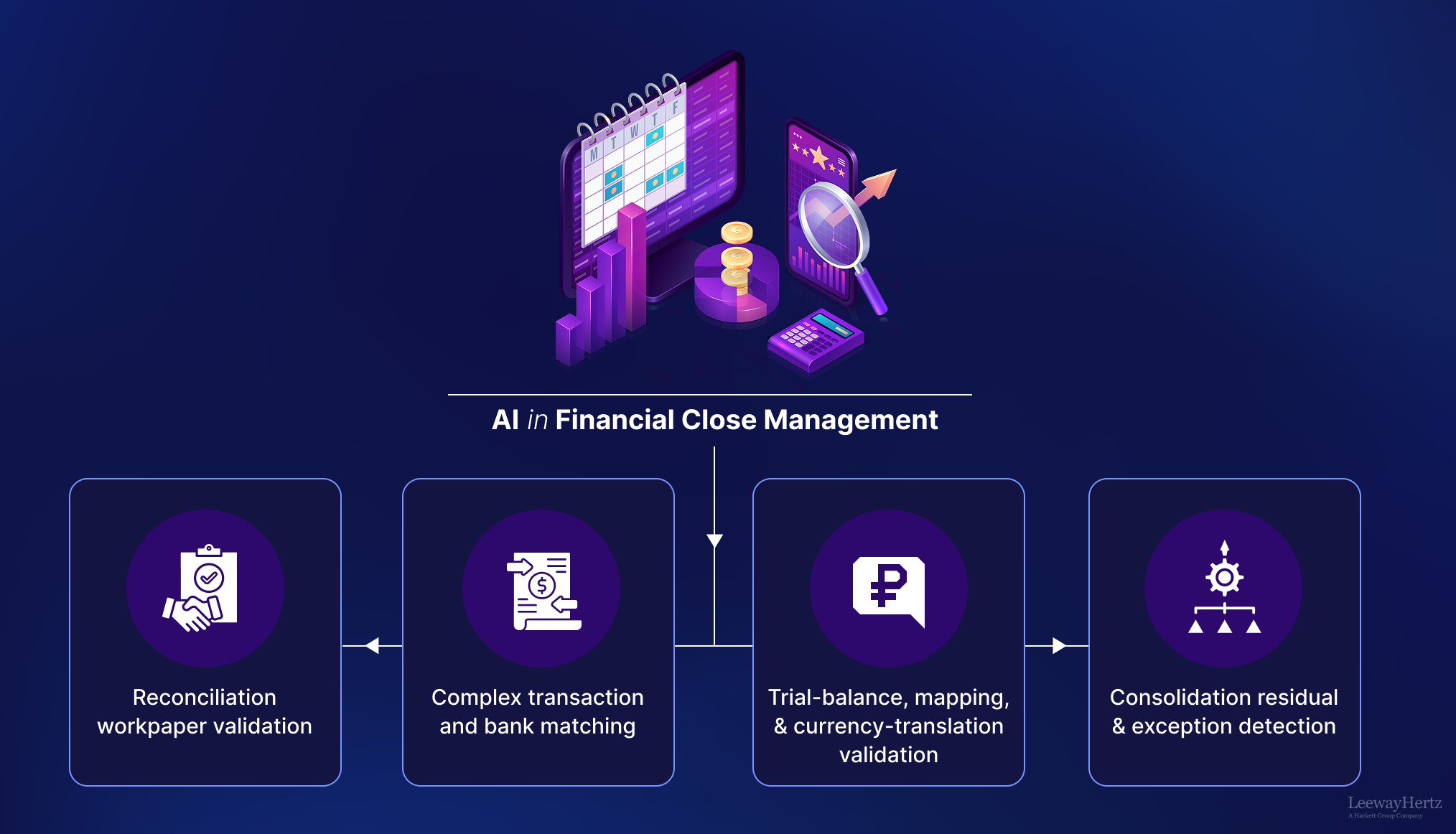
Financial close management brings together the accounting activities required to move from an open reporting period to reviewed, consolidated, and certified financial statements. Within the broader record-to-report lifecycle, it spans close calendar orchestration, journal entry processing, balance sheet reconciliation, transaction and bank matching, and intercompany accounting and elimination. It also includes flux and variance analysis, consolidation and currency translation, and close certification and disclosure handoff.
For controllers, chief accounting officers, and CFOs, the financial close is a compressed, control-intensive operating cycle, not a simple sequence of accounting tasks. Multiple legal entities, ERP environments, charts of accounts, currencies, close platforms, spreadsheets, and data repositories must be brought together to produce a single, supportable financial result within a limited reporting window. Because these activities are tightly connected, delays and errors propagate quickly. Unposted journals affect reconciliations, unresolved intercompany differences delay eliminations, and mapping or currency issues distort consolidated results.
The pressure to complete this work quickly is substantial. APQC reports a median of six calendar days from the initial monthly trial balance to completed monthly consolidated financial statements across more than 10,000 organizations[1]. Yet many close activities still rely on manual preparation, review, and coordination. EY reports that approximately one-third of closing activities remain non-automated, with common challenges including inconsistent data, limited standardization, manual intercompany reconciliation, unclear responsibilities, and fragmented communication[2].
These conditions make financial close management a strong candidate for AI. Much of the work involves reviewing accounting artifacts, comparing records across systems, identifying anomalies, classifying exceptions, retrieving supporting evidence, and preparing explanations. Close checklists must be evaluated against task dependencies. Journal Entry (JE) support packages must be checked for missing evidence and inconsistent coding. Reconciliation workpapers must be reviewed for aging and unexplained items. BAI2 and MT940 statements must be matched with ledger transactions. Trial balances must be checked for mapping, entity, and currency issues. Flux commentary must be supported by underlying financial movements.
The relevant solution, however, is not a generic accounting chatbot or unrestricted automation of the journals. Each role needs support within a clearly defined review boundary. A GL accountant needs incomplete journal entries identified before approval routing. An accounting manager needs reconciling items classified by cause, age, materiality, and required action. A consolidation accountant needs mapping, translation, and elimination exceptions traced to the affected entity and balance. An assistant controller needs incomplete controls and material open items assembled into a review package.
AI can support these activities through natural language processing, document intelligence, machine learning anomaly detection, and generative AI. It can read a reconciliation workpaper, identify unmatched balances, retrieve related evidence, and prepare an exception summary. It can read a JE support package, compare the requested entry with the account, entity, period, amount, and approval requirements, and flag inconsistencies before review. It can analyze a flux commentary pack, identify explanations that are not supported by ledger activity, and return them for revision.
Human accountability remains unchanged. Accountants and controllers determine accounting treatment, approve journal entries, resolve material exceptions, authorize consolidation adjustments, certify balances, and approve financial information for disclosure. AI analyzes, prepares, and recommends, but it does not become the accounting authority, control owner, or financial statement certifier. This accountability boundary makes broad categories such as “AI for reconciliation” or “AI for consolidation” too general for implementation. A practical use case must instead be defined at the sub-process level, with a named artifact, system context, exception condition, expected output, control requirement, and accountable reviewer. This article therefore breaks the financial close operating model into its core functions, processes, and sub-processes to identify where specific AI opportunities can be implemented and governed.
- How AI is transforming financial close management operations
- Why AI use cases in financial close management must be mapped at the sub-process level
- Financial close management operating model and AI opportunity mapping across processes
- High-value AI use cases in financial close management
- How agentic AI works in financial close management operations
- How to prioritize AI use cases in financial close management
- Governance, risk and responsible AI in financial close management
- How ZBrain operationalizes AI use cases in financial close management
- Future of AI in financial close management
How AI is transforming financial close management operations
AI is changing financial close work by analyzing accounting artifacts, connecting related records across ERP, close management, consolidation, and data systems, and assembling exceptions and source-linked evidence for accountable accounting teams to review. The opportunity is greatest where work is repetitive, data-intensive, and dependent on multiple sources, but still requires professional judgment, approval, or certification.
The transformation is visible across five types of close work:
Document-heavy work
- Artifacts: JE support packages, reconciliation workpapers, bank statements, close checklists, elimination schedules, trial balances, PBC lists, and accounting memos.
- AI’s role: Document intelligence can extract key fields, compare related records, identify missing support, detect inconsistent values, and flag incomplete approvals or unsupported conclusions before an accountant begins the review.
Narrative-heavy work
- Artifacts: Flux commentary packs, reconciliation explanations, close-status summaries, accounting memos, certification reports, and disclosure-support narratives.
- AI’s role: Generative AI can prepare draft explanations from approved ledger data and supporting evidence, link statements to their source records, and identify commentary that is incomplete, inconsistent, or unsupported by the underlying financial movement.
Exception-heavy work
- Artifacts: Rejected journal entries, aged reconciling items, unmatched bank transactions, intercompany differences, mapping exceptions, translation variances, and incomplete close tasks.
- AI’s role: Machine learning and classification models can group exceptions by type, identify likely root causes, and prioritize them by materiality, age, deadline, required expertise, and downstream impact. This helps close teams focus first on the issues most likely to delay reconciliation, consolidation, or certification.
Knowledge-heavy work
- Artifacts: Accounting policies, prior-period treatment records, chart-of-accounts guidance, entity hierarchies, close procedures, control documentation, and applicable US GAAP or IFRS guidance.
- AI’s role: Retrieval and natural language processing can locate the relevant policy, precedent, or control requirement and compare it with the transaction, balance, or workpaper under review. AI can present the applicable evidence and highlight conflicts, while the authorized accountant determines the correct accounting treatment.
Workflow-heavy work
- Artifacts: Close calendars, task dependencies, approval records, journal statuses, reconciliation queues, elimination schedules, consolidation packages, and certification checklists.
- AI’s role: AI can monitor dependencies across journal processing, reconciliation, intercompany elimination, variance analysis, consolidation, and certification. It can identify blocked tasks, detect exceptions that affect downstream activities, forecast likely delays, prepare the next review packet, and route unresolved items to the appropriate accounting role.
The value comes from applying each capability to a defined sub-process, a named accounting artifact, and a clear review boundary. AI prepares the analysis and evidence needed for action, while GL accountants, accounting managers, consolidation accountants, assistant controllers, and corporate controllers continue to make accounting judgments, approve entries and adjustments, resolve material exceptions, certify balances, and authorize financial reporting.
Why AI use cases in financial close management must be mapped at the sub-process level
Financial close management is not a single workflow. It is a connected operating model made up of functions, processes, and smaller accounting activities performed across close planning, journal processing, reconciliation, matching, intercompany accounting, variance analysis, consolidation, certification, and disclosure preparation.
This complexity creates a practical challenge for AI adoption. Broad statements such as “AI for reconciliation,” “AI for journal entries,” or “AI for consolidation” identify an area of interest, but they do not define what should actually be built. They do not specify which artifact the AI will analyze, which systems provide the data, what exception it must identify, what output it should produce, or which accounting role must review the result.
Without that level of definition, organizations risk selecting use cases that appear valuable but are difficult to design, integrate into existing workflows and systems, validate, govern, or measure. A reconciliation use case, for example, could refer to balance import, account substantiation, reconciling-item classification, aging analysis, evidence validation, reviewer sign-off, or exception escalation. Each activity requires different data, controls, AI capabilities, and human review boundaries.
A practical implementation approach therefore decomposes financial close work into four levels:
- Function: A major area of close accountability, such as journal entry processing, balance sheet reconciliation, or consolidation and currency translation. A function contains multiple workflows and is generally too broad to implement as one AI solution.
- Process: A recurring workflow area within a function, such as journal preparation, reconciliation exception management, intercompany difference resolution, or consolidation validation. A process explains how work moves through the close but can still include several decisions, artifacts, and approval points.
- Sub-process: A specific, observable accounting activity with a defined input, output, system context, exception condition, control requirement, and accountable reviewer. Examples include validating a JE support package, classifying an aged reconciling item, matching a BAI2 statement transaction to a general ledger entry, or checking a trial balance against group account mappings.
- AI-enabled opportunity: An AI-enabled opportunity applies a specific AI capability to a named financial close artifact to improve how the sub-process is performed. For example, document intelligence can read a JE support package and identify missing evidence, while machine learning anomaly detection can compare a proposed journal entry with historical posting patterns and flag unusual account, amount, entity, or timing combinations.
Mapping at the sub-process level turns a broad AI opportunity into a defined use case that can be implemented, validated, governed, and measured. Consider the broad statement “AI for journal entries.” It does not indicate whether the goal is to extract journal data, validate support, identify duplicate entries, evaluate coding, route approvals, monitor rejected entries, or prepare an audit trail. A more implementable use case would be: JE support-package completeness validation for nonrecurring manual journal entries, with GL Accountant review before approval routing. This definition identifies:
- The sub-process: support-package validation
- The artifact: JE support package
- The journal population: nonrecurring manual entries
- The AI action: identify missing or inconsistent support
- The review boundary: GL Accountant confirmation before routing
Sub-process mapping exposes the data and integration needs hidden by broad labels. Intercompany work may need balances from two ERPs, entity and trading-partner mappings, currency data, confirmations, and elimination schedules. Consolidation validation may need trial balances, ownership details, translation rules, journals, and period status. Defining these dependencies early lets teams judge if data is accessible, complete, timely, and consistent, and spot required entity-resolution, normalization, and mapping controls. It also aids governance by separating activities with different risks, summarizing close status, recommending a journal, classifying an exception, approving its resolution, or posting an elimination.
At the sub-process level, organizations can set clear human review boundaries. AI can flag missing journal support, suggest transaction matches, classify reconciling items, trace intercompany differences, or draft variance commentary. Authorized accountants and controllers still approve entries, set accounting treatment, resolve material exceptions, certify balances, and authorize disclosures. Measuring performance is also more credible at this level: a broad “AI-enabled financial close” is hard to evaluate because it spans activities with varying volumes, risks, and metrics.A defined use case can be assessed against specific outcomes, such as:
- Time required to review JE support packages
- Percentage of reconciliation exceptions correctly classified
- Number of unmatched transactions requiring manual investigation
- Time required to resolve intercompany differences
- Percentage of flux commentary linked to supporting evidence
- Number of trial-balance mapping exceptions identified before consolidation
- Completeness of evidence assembled for certification
This level of specificity allows controllers, CAOs, and CFOs to evaluate expected value without relying on unsupported enterprise-wide automation claims.
Sub-process mapping shows how exceptions ripple through the close: journal errors can affect reconciliations, variance analysis, consolidation, and certification; intercompany mismatches can delay elimination; and trial-balance mapping errors can distort reporting. Linking each exception to its sub-process, artifact, owner, and downstream dependencies helps AI surface its broader impact. The sub-process is therefore the most practical unit for identifying, designing, and governing AI in financial close management. The operating-model mapping that follows applies this approach across all core financial close functions.
Build governed AI workflows for financial close management
Map financial close processes, identify high-value AI opportunities, and build governed workflows that connect accounting systems, evidence, and accountable review.
Financial close management operating model and AI opportunity mapping across processes
Financial close management spans a connected set of accounting activities that begin with close planning and continue through journal processing, reconciliation, matching, intercompany accounting, variance analysis, consolidation, certification, and disclosure handoff. Each function depends on upstream information, downstream decisions, and multiple systems of record, making it difficult to identify practical AI opportunities without understanding the complete operating model.
The following operating model maps financial close management across core function clusters. Each function is decomposed into its underlying processes and sub-processes to show where AI can support specific activities using defined accounting artifacts, system context, exception categories, controls, and human review boundaries.
Function 1: Close calendar orchestration
Converting reporting deadlines, accounting dependencies, task ownership, and control requirements into a coordinated and reviewable close execution plan.
Close calendar orchestration turns period-end work into a governed schedule of tasks, owners, dependencies, evidence, and deadlines. In multi-entity, multi-ERP environments, it aligns local activities with group reporting while accounting for cutoffs, time zones, system availability, and local processes, supporting journals, reconciliations, intercompany elimination, consolidation, and certification.
Teams involved: GL accountants, accounting managers, assistant controllers, corporate controllers, consolidation accountants, entity controllers, shared-service accounting teams, financial reporting teams, and close-process administrators.
What AI helps with: Document intelligence can interpret close checklists, task instructions, prior-period calendars, and evidence requirements. Classification can identify incomplete tasks, missing assignments, control-sensitive activities, and recurring exception types. Predictive analysis can identify tasks likely to miss deadlines or block downstream work. Graph analysis can evaluate task dependencies, while generative AI can prepare status summaries, escalation packets, and close-readiness reports from approved source data.
What humans continue to own: Accounting managers and controllers define the close calendar, approve milestones, assign ownership, determine whether an exception is material, authorize deadline or responsibility changes, and decide whether the close is ready to proceed. AI analyzes, ranks, and prepares, but it does not approve the calendar, waive a control, declare a task complete, or certify the close.
| Process | Sub-process | AI-enabled opportunities |
|---|---|---|
| Close planning | Reporting calendar and milestone setup |
|
| Prior-period calendar rollover |
|
|
| Entity-specific calendar configuration |
|
|
| Task definition and configuration | Task and completion-criteria definition |
|
| Artifact and evidence requirement definition |
|
|
| Ownership and control assignment | Preparer and reviewer assignment |
|
| Segregation-of-duties validation |
|
|
| Dependency management | Predecessor and successor mapping |
|
| Critical-path and downstream-impact assessment |
|
|
| Close launch | Calendar approval and activation |
|
| Close execution | Task-status and evidence monitoring |
|
| Late and blocked task identification |
|
|
| Exception management | Escalation packet preparation |
|
| Deadline and ownership change control |
|
|
| Close completion | Close-readiness assessment |
|
| Open-item and exception carryforward |
|
|
| Calendar certification and lock |
|
|
| Continuous improvement | Close-duration and bottleneck analysis |
|
Key artifacts
- Close checklists
- Period-end reporting calendars
- Entity-level close calendars
- Role and responsibility matrices
- Task dependency maps
- Completion records
- Approval histories
- Exception logs
- Close-status reports
- Final calendar certification records
Systems involved
- Close management platforms
- ERP systems
- Consolidation platforms
- Identity and access management systems
- Workflow and ticketing platforms
- Enterprise data warehouses
Regulatory considerations
- SOX preventive controls cover calendar approvals, task ownership, segregation of duties, evidence needs, and controlled deadline or responsibility changes.
- Detective controls cover overdue-task monitoring, completion without evidence, unresolved dependencies, and review of open exceptions before close.
- COSO principles apply to responsibility assignment, control activities, information/communication, and ongoing monitoring during the close.
- PCAOB expectations require retaining evidence, source records, preparer/reviewer actions, identified exceptions, and conclusions.
Accountable roles
- GL accountant
- Accounting manager
- Assistant controller
- Corporate controller
Highest-value opportunities
- Critical-path and downstream-impact assessment: High leverage because it distinguishes routine late tasks from delays that can block reconciliation, consolidation, certification, or disclosure preparation.
- Evidence-completeness monitoring: Valuable because it reduces the gap between a task being marked complete and the underlying accounting work being ready for review.
- Preparer and reviewer validation: Important because missing ownership, inactive users, and segregation-of-duties conflicts create both operational and control risk.
Example agentic workflow: Close readiness and critical-path monitoring
- The workflow starts with document intelligence and multi-source retrieval collecting task statuses, dependencies, evidence, journal and reconciliation states, intercompany exceptions, and consolidation milestones after the approved close checklist begins, preserving period, entity, process, role, source, and version context.
- Classification and predictive analysis assess readiness, classify tasks as ready, at risk, blocked, overdue, or incomplete, and identify potential downstream delays.
- Dependency and impact analysis traces significant blockers to the owner, missing evidence, source-system status, affected reconciliations, consolidation activities, certifications, and relevant history.
- Generative AI prepares evidence-backed critical-path alerts and escalation packets with the blocker, root cause, downstream impact, proposed action, and decision required.
- Human checkpoint: The accounting manager or assistant controller validates the issue and approves or refines the response; the workflow records the decision, updates statuses, notifies owners, and retains the evidence and audit trail under applicable SOX, COSO, and audit policies.
Function 2: Journal entry processing
Translating accounting events, calculations, source-system data, and supporting evidence into validated, approved, and traceable general ledger entries.
The function starts when an accounting event or period-end need triggers a journal entry and includes preparation, validation, approval, posting, exception handling, and evidence retention. The output is an approved, documented journal entry with a traceable audit trail. Late or inaccurate entries disrupt reconciliations, flux analysis, intercompany balances, and consolidation. Unsupported or improperly approved entries increase control and audit risk.
Teams involved: GL accountants, accounting managers, assistant controllers, corporate controllers, consolidation accountants, entity accounting teams, shared-service accounting teams, financial reporting teams, and authorized journal approvers.
What AI helps with: Document intelligence extracts accounting details from JE request forms, spreadsheets, invoices, schedules, and reports. NLP interprets business purpose and compares it to proposed accounts and evidence. Rules-based checks validate required fields, debit-credit balance, period, entity, currency, cost center, and approvals. Anomaly detection flags unusual amounts, accounts, users, timing, descriptions, or posting patterns. Generative AI drafts exception summaries and review packets from approved source records.
What humans continue to own: GL accountants determine whether the proposed entry accurately reflects the underlying accounting event. Accounting managers and controllers approve accounting treatment, estimates, material adjustments, policy exceptions, and entries affecting sensitive accounts or financial reporting judgments. Authorized users approve and post entries according to delegated authority. AI extracts, validates, compares, and prepares, but it does not determine accounting treatment, approve a journal, override a control, or independently post an entry.
| Process | Sub-process | AI-enabled opportunities |
|---|---|---|
| Journal initiation | JE request intake and classification |
|
| Recurring journal schedule activation |
|
|
| Journal preparation | Source data extraction and enrichment |
|
| JE support-package assembly |
|
|
| Supporting-document completeness validation |
|
|
| Journal validation | Account, entity, and attribute validation |
|
| Period, currency, and exchange-rate validation |
|
|
| Calculation and debit-credit validation |
|
|
| Duplicate journal detection |
|
|
| Unusual and high-risk journal detection |
|
|
| Business-purpose and support consistency review |
|
|
| Reviewer packet preparation |
|
|
| Approval management | Approval routing and threshold determination |
|
| Segregation-of-duties validation |
|
|
| Posting | Approved journal posting preparation |
|
| General ledger posting and confirmation |
|
|
| Reversal scheduling and validation |
|
|
| Exception management | Rejected journal analysis and correction |
|
| Post-posting correction and reclassification |
|
|
| Control and reporting | Post-posting verification |
|
| Journal audit trail and evidence retention |
|
|
| Journal trend and control analysis |
|
Key artifacts
- JE request forms
- JE support packages
- Recurring journal schedules
- Accrual and allocation workbooks
- Accounting calculations and source-system reports
- Approval records and delegation-of-authority matrices
- ERP journal templates and posting confirmations
- Rejection, correction, and reversal logs
Systems involved
- ERP general ledger platforms
- Journal workflow and approval tools
- Document repositories
- Excel and controlled calculation workbooks
- Master-data management systems
Regulatory considerations
Journal Entry Processing is a significant component of internal control over financial reporting because manual and period-end entries can directly affect reported balances.
- Accounting standards: Journal entries must reflect approved US GAAP or IFRS treatment and be supported by the underlying transaction, estimate, allocation, correction, or consolidation requirement. Authorized professionals determine the treatment.
- SOX and COSO controls: Required fields, evidence, approvals, segregation of duties, access restrictions, period controls, and monitoring help prevent and detect unsupported or unauthorized entries.
- Audit evidence: Retain traceable journal populations, support, preparer and approver activity, corrections, exceptions, and review conclusions to meet PCAOB expectations.
Accountable roles
- GL accountant
- Accounting manager
- Assistant controller
- Corporate controller
- Authorized journal approver
Highest-value opportunities
- JE support-package completeness validation: High leverage because incomplete or inconsistent support creates repeated back-and-forth between preparers and reviewers and can delay journal approval during the most time-sensitive part of the close.
- Duplicate and unusual journal detection: High value because manual, late, top-side, and nonrecurring entries can carry elevated financial reporting risk and may not be identified through basic field-level validation.
- Account, entity, and attribute validation: Valuable because coding errors can affect reconciliations, intercompany balances, management reporting, consolidation, and financial statement presentation.
Example agentic workflow: Manual journal validation and approval readiness
- The workflow starts when a manual journal request is received, retrieving the authorized source, policy, account, entity, and prior-period data with full period, role, source, and version context.
- Document intelligence and rules-based validation extract and verify journal details, support, calculations, coding, period, currency, approval thresholds, and segregation of duties.
- Anomaly detection and comparison analysis evaluate historical journals to flag duplicates, unusual amounts, late postings, sensitive accounts, and other risks.
- Generative AI assembles the journal, evidence, validation results, exceptions, and policy references into an evidence-backed reviewer packet with the required decision clearly identified.
- Human checkpoint: The GL accountant and authorized approver review and decide; after approval, the journal is posted, verified, and retained with its complete audit trail.
Function 3: Balance sheet reconciliation
Converting general ledger balances, subledger records, supporting schedules, and external evidence into substantiated accounts with documented reconciling items and approved conclusions.
Balance sheet reconciliation ensures general ledger balances are accurate and supported by subledgers, schedules, statements, and other evidence. It identifies and ages exceptions, supports corrections, review, and certification, and records differences, actions, owners, and reviewer decisions. Unposted or incorrect journals and poor transaction matching create reconciling items that can skew variance analysis, consolidation, account certification, and reporting-control assessments.
Teams involved: GL accountants, accounting managers, assistant controllers, corporate controllers, entity accounting teams, shared-service accounting teams, consolidation accountants, subledger owners, and reconciliation process administrators.
What AI helps with: Document intelligence extracts balances, dates, explanations, and supporting details from reconciliation workpapers. Multi-source comparison checks ledgers against subledgers, schedules, statements, and prior-period records. Classification groups reconciling items by cause and required action. Anomaly detection flags unusual balances, stale items, unsupported explanations, duplicate adjustments, and accounts deviating from expected patterns. Generative AI produces evidence-backed reconciliation summaries and reviewer packets.
What humans continue to own: GL accountants determine whether the reconciliation appropriately substantiates the account and whether reconciling items are valid. Accounting managers and controllers assess materiality, approve adjustments, challenge unsupported explanations, accept or reject carry-forward items, and certify account balances. AI extracts, compares, classifies, and prepares, but it does not determine accounting treatment, approve an adjustment, clear a reconciling item, or certify an account.
| Process | Sub-process | AI-enabled opportunities |
|---|---|---|
| Reconciliation planning | Account scope and risk classification |
|
| Template, preparer, and reviewer setup |
|
|
| Balance and evidence intake | General ledger and supporting-balance ingestion |
|
| Supporting-evidence collection and completeness review |
|
|
| Account substantiation | Source-to-ledger balance comparison |
|
| Reconciliation workpaper validation |
|
|
| Exception management | Reconciling-item identification and classification |
|
| Aging, materiality, and risk prioritization |
|
|
| Root-cause analysis and ownership assignment |
|
|
| Resolution management | Adjustment and correction preparation |
|
| Open-item carry-forward and clearing verification |
|
|
| Review and certification | Reviewer packet preparation and account certification |
|
| Control and improvement | Reconciliation trend and control analysis |
|
Key artifacts
- Reconciliation workpapers
- Trial balance extracts
- General ledger and subledger reports
- Account statements and rollforwards
- Supporting schedules and journal-entry support
- Reconciling-item and exception logs
Systems involved
- ERP general ledger platforms
- Close and reconciliation platforms
- Subledger and consolidation systems
- Excel and controlled workbooks
- Enterprise data warehouses
- Workflow, approval, and compliance tools
Regulatory considerations
Balance sheet reconciliation supports the completeness, accuracy, existence, valuation, and classification of balances presented in the financial statements.
- US GAAP and IFRS: Support appropriate measurement, classification, and presentation; accountants determine treatment.
- SOX preventive controls: Define templates, owners, evidence, frequency, thresholds, and segregation of duties.
- SOX detective controls: Compare sources to the ledger, age open items, verify adjustments, and document approvals.
- COSO alignment: Maintain reliable information, clear accountability, documented review, monitoring, and timely remediation.
- PCAOB expectations: Retain traceable workpapers showing the balance tested, procedures, evidence, exceptions, adjustments, and conclusions.
Accountable roles
- GL accountant
- Accounting manager
- Assistant controller
- Corporate controller
- Consolidation accountant
- Entity controller
Highest-value opportunities
- Reconciliation workpaper validation: High leverage because it checks whether the workpaper, balance, formulas, explanations, and supporting evidence agree before reviewer time is consumed.
- Reconciling-item classification and prioritization: Valuable because it converts inconsistent free-text exceptions into structured categories and directs attention to the items with the greatest age, value, risk, or downstream impact.
- Aging and recurring-item detection: High value because repeated carry-forwards and incorrectly aged items can conceal unresolved accounting issues across multiple close periods.
Example agentic workflow: Reconciliation exception analysis and certification readiness
- The workflow starts when the period-end ledger balance and reconciliation workpaper are available, retrieving the related trial balance, supporting records, prior reconciliations, journals, mappings, and evidence with full period, entity, account, source, and version context.
- Document intelligence and multi-source retrieval extract reconciliation details and validate balances, calculations, cutoff dates, formulas, and supporting evidence against authorized records.
- Classification, anomaly detection, and aging and materiality analysis identify reconciling items, classify them by cause and risk, and prioritize them by age, amount, recurrence, required action, and downstream impact.
- Generative AI synthesizes the supporting records and prepares evidence-backed exception summaries or draft adjustment packets with the root cause, impact, proposed action, and unresolved questions.
- Human checkpoint: The GL accountant reviews the analysis and proposed actions; the accounting manager approves material items, adjustments, and unresolved exceptions. The workflow records the disposition and retains the workpaper, evidence, decisions, adjustments, and certification.
Function 4: Transaction and bank matching
Converting bank statements, general ledger transactions, and supporting references into confirmed matches, investigating exceptions, and substantiating cash-related balances.
Transaction and bank matching compares bank activity with general ledger entries to ensure cash movements are complete, accurate, and recorded in the correct period. It validates, normalizes, matches, and records exceptions to support reconciliation and period-end certification. Timing differences, missing or duplicate entries, incorrect amounts, or reference issues can delay substantiation, reconciliation, variance analysis, and certification.
Teams involved: GL accountants, accounting managers, assistant controllers, entity accounting teams, shared-service accounting teams, bank-reconciliation specialists, and reconciliation process administrators.
What AI helps with: Structured parsing validates BAI2, MT940, and other statement files, extracting dates, transaction codes, references, amounts, currencies, and balances. Normalization and entity resolution standardize payer/payee names, signs, identifiers, and bank terms for consistent comparison. Deterministic rules handle exact and tolerance matches. Classification and anomaly detection group unmatched items by timing, missing postings, duplicates, reference failures, unusual behavior, or approved causes. Generative AI produces source-linked match explanations and exception/correction packets for accountants.
What humans continue to own: GL accountants confirm proposed matches, investigate unresolved transactions, determine whether differences are valid timing items or accounting errors, and prepare supported corrections. Accounting managers approve material adjustments, clearing decisions, tolerance exceptions, and the final reconciliation conclusion. AI identifies candidates, scores confidence, and prepares evidence, but it does not approve a match, clear an exception, post a correction, or certify the account.
| Process | Sub-process | AI-enabled opportunities |
|---|---|---|
| Statement and transaction intake | Bank statement ingestion and format validation |
|
| General ledger transaction extraction |
|
|
| Data preparation | Bank transaction normalization |
|
| Ledger reference enrichment |
|
|
| Match execution | Exact one-to-one transaction matching |
|
| Tolerance-based and date-window matching |
|
|
| One-to-many and many-to-one matching |
|
|
| Split, netted, and partial transaction matching |
|
|
| Recurring transaction pattern matching |
|
|
| Exception management | Unmatched transaction identification and classification |
|
| Duplicate and conflicting transaction detection |
|
|
| Timing-difference and cutoff analysis |
|
|
| Aged and repeatedly unmatched item analysis |
|
|
| Root-cause and ownership determination |
|
|
| Resolution management | Correction and adjustment preparation |
|
| Match confirmation and clearing approval |
|
|
| Reconciliation completion | Bank-to-ledger balance validation |
|
| Evidence retention and audit-trail validation |
|
|
| Control and improvement | Match-rule and exception trend analysis |
|
Key artifacts
- BAI2, MT940, and other approved bank statements
- General ledger transaction extracts
- Transaction references and posting/value-date records
- Match rules and candidate records
- Unmatched transaction and exception reports
- Reconciliation workpapers and bank-to-ledger reports
Systems involved
- ERP general ledger platforms
- Close and reconciliation platforms
- Bank connectivity and statement-ingestion interfaces
- Transaction matching platforms
- Workflow and approval platforms
Regulatory considerations
Transaction and bank matching supports the completeness, accuracy, cutoff, existence, and classification of cash-related balances recorded in the financial statements.
- US GAAP and IFRS: Cash activity and adjustments must reflect underlying transactions and be recorded in the correct period. AI can flag exceptions, but authorized accountants decide treatment.
- SOX preventive controls: Approved bank-account mappings, controlled interfaces, authorized match rules, tolerance limits, restricted clearing access, and separation of preparation and review prevent unsupported matching and clearing.
- SOX detective controls: Bank-to-ledger comparisons, unmatched-item reviews, duplicate checks, cutoff analysis, aged-item monitoring, and post-correction verification detect misstatements and control failures.
- COSO alignment: Matching controls ensure reliable information via controlled interfaces, documented reviews, clear ownership, and monitoring of unresolved exceptions.
- PCAOB expectations: Reconciliation evidence must show records compared, matching steps, exceptions, adjustments, approvals, and conclusions.
Accountable roles
- GL accountant
- Accounting manager
- Assistant controller
- Corporate controller
- Entity controller
- Bank reconciliation specialist
- Reconciliation process owner
- Authorized journal approver
Highest-value opportunities
- One-to-many and many-to-one matching: High leverage because complex settlement patterns require significant manual comparison and are not addressed well by basic exact-match rules.
- Unmatched-item classification and prioritization: Valuable because it converts a mixed exception queue into cause-based work that can be assigned according to age, amount, risk, and required expertise.
- Aged-item and carry-forward detection: High value because repeatedly rolled-forward exceptions can conceal unresolved posting, interface, or control issues across multiple close periods.
Example agentic workflow: Bank statement matching and cash-exception resolution
- The workflow starts when approved bank statements and general ledger extracts are available, retrieving the relevant bank account, entity, period, currency, cutoff, transaction codes, and matching rules.
- Structured parsing and normalization extract and standardize statement and ledger fields, including dates, amounts, references, counterparties, document numbers, and signs, while validating file completeness and data quality.
- Deterministic rules and semantic matching evaluate exact, tolerance-based, one-to-many, many-to-one, split, netted, and recurring transaction candidates, then classify unmatched items by likely cause and risk.
- Generative AI assembles an evidence-backed exception or correction packet with proposed matches, confidence scores, source records, residual amounts, aging, root cause, and required action.
- Human checkpoint: The GL accountant confirms matches, investigates unresolved items, and prepares supported corrections; the accounting manager approves material clearing decisions and adjustments. Approved actions are recorded and retained with the reconciliation audit trail.
Function 5: Intercompany accounting and elimination
Converting reciprocal entity balances, intercompany transaction records, ownership structures, and exchange-rate data into aligned positions, supported elimination entries, and validated consolidated results.
Intercompany accounting and elimination aligns transactions and balances between group entities using counterparty mapping, reciprocal matching, discrepancy resolution, currency alignment, corrections, eliminations, and consolidated checks. The output is a supported record showing aligned positions, open differences, elimination amounts, and approvals. Differences across entities, ERPs, currencies, accounts, and periods determine whether an entity correction, consolidation adjustment, or ongoing monitoring is needed.
Teams involved: GL accountants, intercompany accountants, accounting managers, assistant controllers, corporate controllers, consolidation accountants, entity controllers, shared-service accounting teams, and financial reporting teams.
What AI helps with: Entity resolution can connect legal entities, trading partners, accounts, and transaction references across ERP environments. Multi-source comparison can evaluate due-to and due-from balances, intercompany revenue and expense, loans, charges, and other reciprocal positions. Classification can organize differences by timing, currency, mapping, missing entry, incorrect amount, or accounting-treatment cause. Machine learning can identify probable transaction matches and unusual recurring differences. Generative AI can prepare discrepancy summaries, confirmation packets, and elimination support from approved records.
What humans continue to own: Accountants verify that both entities recorded the same event correctly. Accounting managers and controllers resolve treatment differences, approve corrections and true-ups, authorize eliminations, assess materiality, and decide if items can stay open. Consolidation accountants confirm the impact of eliminations on group reports. AI compares, classifies, and prepares data but does not determine accounting treatment, approve adjustments, post eliminations, or certify consolidated results.
| Process | Sub-process | AI-enabled opportunities |
|---|---|---|
| Intercompany setup | Entity and trading-partner mapping validation |
|
| Account and transaction-type mapping |
|
|
| Data intake | Entity balance and transaction ingestion |
|
| Intercompany artifact completeness review |
|
|
| Balance confirmation | Reciprocal balance comparison |
|
| Bilateral balance confirmation preparation |
|
|
| Transaction matching | One-to-one intercompany transaction matching |
|
| One-to-many and many-to-one matching |
|
|
| Partial, netted, and recurring transaction matching |
|
|
| Discrepancy analysis | Intercompany discrepancy classification |
|
| Cutoff and posting-period analysis |
|
|
| Currency and exchange-rate analysis |
|
|
| Accounting-treatment consistency review |
|
|
| Aging and recurring-difference review |
|
|
| Exception resolution | Root-cause and ownership determination |
|
| Entity correction and true-up preparation |
|
|
| Intercompany confirmation and disposition |
|
|
| Intercompany balance and transaction elimination preparation | Elimination population and rule validation |
|
| Elimination-entry calculation and support |
|
|
| Unresolved-difference and threshold handling |
|
|
| Elimination posting | Elimination journal validation and approval |
|
| Consolidated-result validation | Post-elimination balance verification |
|
| Evidence and audit-trail validation |
|
|
| Control and improvement | Difference and elimination trend analysis |
|
Key artifacts
- Intercompany trial-balance extracts
- Due-to and due-from balance schedules
- Intercompany transaction listings
- Intercompany balance confirmations
- Account and trading-partner mapping files
- Elimination schedules
Systems involved
- ERP general ledger platforms
- Consolidation and financial reporting platforms
- Close-management platforms
- Intercompany accounting and reconciliation platforms
- Document repositories
- Enterprise data warehouses
Regulatory considerations
Intercompany accounting and elimination supports the accuracy, completeness, classification, and presentation of consolidated financial statements.
- US GAAP and IFRS: Eliminate intercompany balances, transactions, income, expenses, and applicable unrealized results as required. AI can analyze relationships and prepare support; authorized accountants decide the treatment.
- SOX preventive controls: Govern entity and partner mappings, elimination rules, confirmations, approvals, access, and segregation of duties.
- SOX detective controls: Compare reciprocal balances, age discrepancies, validate eliminations, review top-side entries, and monitor unresolved differences.
- COSO alignment: Support reliable information, clear accountability, controlled consolidation, exception monitoring, and timely remediation.
- PCAOB expectations: Retain workpapers showing balances compared, differences, corrections, methodology, approvals, and consolidated impact.
Accountable roles
- GL accountant
- Accounting manager
- Consolidation accountant
Highest-value opportunities
- Reciprocal balance and transaction matching: High leverage because intercompany differences frequently arise from fragmented ERP environments, inconsistent references, and different recording levels across entity pairs.
- Difference classification and root-cause analysis: Valuable because it separates timing, currency, mapping, missing-entry, and accounting-treatment issues and routes each exception to the appropriate owner.
- Aging and recurring-difference detection: High value because unresolved differences are often rolled forward across periods without a clear view of their originating date or repeated cause.
Example agentic workflow: Intercompany discrepancy resolution and elimination readiness
- The workflow starts after period close, retrieving approved intercompany balances, transaction listings, entity and trading-partner mappings, exchange-rate tables, confirmations, prior exceptions, and elimination rules with full entity, counterparty, account, period, currency, source, and version context.
- Entity and record resolution validates the comparison population, links reciprocal balances and transactions, and identifies missing, duplicate, or inconsistent data.
- Matching and variance analysis compares exact, tolerance-based, one-to-many, many-to-one, partial, netted, and recurring transactions, then traces differences to timing, currency, mapping, posting, or accounting-treatment causes.
- Generative AI prioritizes material, aged, recurring, and downstream-impacting differences and prepares evidence-backed correction, true-up, confirmation, or elimination-support packets.
- Human checkpoint: Entity accountants, accounting managers, and consolidation accountants review and approve resolutions, corrections, and elimination readiness; approved actions are posted, validated, and retained with the complete decision trail.
Accelerate AI Solutions Development
Build fully functional solutions from your high-value use cases, based on specific operational needs and enterprise context.
Function 6: Flux and variance analysis
Converting period-over-period financial movements, ledger activity, journal entries, entity contributions, and consolidation effects into supported explanations for management and financial reporting review.
Flux and variance analysis explains material changes in financial statement balances by comparing current results with reference periods and tracing shifts to accounts, entities, transactions, journals, currency effects, and consolidation adjustments. It produces a supported flux commentary pack linking material movements to accounting activity, evidence, accountable owners, and reviewer conclusions, using the latest approved close data.
Teams involved: GL accountants, accounting managers, assistant controllers, corporate controllers, consolidation accountants, entity controllers, financial reporting teams, and account owners responsible for explaining material financial movements.
What AI helps with: Multi-source comparison finds material movements across accounts, entities, periods, currencies, and reporting hierarchies. Anomaly detection detects unusual or recurring variance patterns. Contribution analysis traces consolidated movements to specific entities, journals, transactions, reclassifications, translation effects, or eliminations. Natural language processing checks if commentary matches the underlying data. Generative AI drafts evidence-backed explanations and reviewer packets from approved financial records.
What humans continue to own: Accountants judge if a movement is clear, appropriate for accounting, and if more investigation or adjustment is needed. Accounting managers and controllers set thresholds, question explanations, judge materiality, spot misstatements or control issues, and approve commentary for reporting. AI can identify, break down, and prepare items, but it cannot confirm balances, approve explanations, judge disclosure significance, or certify results.
| Process | Sub-process | AI-enabled opportunities |
|---|---|---|
| Variance analysis setup | Comparison scope and period definition |
|
| Materiality and investigation threshold assignment |
|
|
| Data preparation | Ledger and consolidation data ingestion |
|
| Data alignment and comparability validation |
|
|
| Variance identification | Account-level movement calculation |
|
| Balance sheet rollforward analysis |
|
|
| Income statement movement analysis |
|
|
| Financial movement decomposition | Journal-driven variance analysis |
|
| Transaction and source-driver analysis |
|
|
| Entity contribution analysis |
|
|
| Reclassification and mapping-effect analysis |
|
|
| Foreign currency and translation-effect analysis |
|
|
| Intercompany and elimination-effect analysis |
|
|
| Consolidation adjustment analysis |
|
|
| Evidence retrieval and explanation assembly |
|
|
| Explanation preparation | Flux commentary drafting |
|
| Commentary-to-evidence validation |
|
|
| Commentary consistency analysis |
|
|
| Variance review and challenge | Reviewer packet preparation |
|
| Reviewer question and response management |
|
|
| Late-change and commentary refresh monitoring |
|
|
| Approval and reporting | Flux commentary approval |
|
| Control and improvement | Recurring variance and explanation analysis |
|
Key artifacts
- Flux commentary packs
- Current-period and comparative-period trial balances
- Journal entries and JE support packages
- Reconciliation workpapers
- Consolidation workpapers
- Account and reporting-line mappings
- Exchange-rate tables
- Intercompany elimination schedules
Systems involved
- ERP general ledger platforms
- Close-management platforms
- Consolidation and financial reporting platforms
- Reconciliation systems
- Enterprise data warehouses
Regulatory considerations
Flux & variance analysis supports management’s review of financial statement balances and can operate as a detective control over the completeness, accuracy, classification, and presentation of reported results.
- US GAAP and IFRS: Keep variance explanations consistent with approved accounting treatment and financial statement presentation; professionals make the final judgment.
- SOX preventive controls: Use approved periods, data sources, thresholds, owners, and review requirements.
- SOX detective controls: Review material movements, validate commentary against evidence, monitor late changes, and challenge exceptions.
- COSO alignment: Support reliable information, clear accountability, documented review, monitoring, and timely investigation.
- PCAOB expectations: Retain traceable evidence of data, thresholds, analysis, investigation, explanations, and conclusions.
Accountable roles
- GL accountant
- Accounting manager
- Assistant controller
- Corporate controller
- Consolidation accountant
- Entity controller
- Financial reporting manager
- Account owner
Highest-value opportunities
- Movement decomposition: High leverage because it separates a material variance into entity activity, journals, transactions, currency effects, reclassifications, eliminations, and consolidation adjustments.
- Commentary-to-evidence validation: Valuable because it identifies explanations that are vague, incomplete, numerically inconsistent, or unsupported by the underlying accounting records.
- Late-change monitoring: High value because journals, reconciliations, mappings, and elimination adjustments can invalidate approved commentary late in the close.
Example agentic workflow: Material variance analysis and commentary preparation
- The workflow starts with approved current-period and comparative trial balances, retrieving authorized ledger activity, mappings, entities, journals, workpapers, FX data, eliminations, adjustments, prior commentary, and variance thresholds.
- AI validates reporting scope, versions, hierarchies, currencies, and thresholds, then calculates material account and statement-line movements.
- For each material movement, the workflow traces contributing entities, journals, transactions, reclassifications, FX, eliminations, and consolidation adjustments to supporting evidence.
- Generative AI drafts quantified, source-linked explanations while NLP flags unsupported claims, incorrect amounts, vague wording, and unexplained variance.
- Human checkpoint: Accountants confirm drivers and investigate differences; managers approve, reject, or return commentary. Late changes trigger refreshes before finalization and evidence retention.
Function 7: Consolidation and currency translation
Converting entity trial balances, ownership structures, account mappings, exchange rates, intercompany eliminations, and consolidation adjustments into validated group-level financial results.
Consolidation and currency translation combine entity financials through validated submissions, mappings, currencies, ownership, eliminations, and adjustments. The process produces a controlled group report with traceable evidence and flags late changes, intercompany issues, mapping or rate errors, and dependencies before approval.
Teams involved: Consolidation accountants, GL accountants, accounting managers, assistant controllers, corporate controllers, entity controllers, financial reporting teams, shared-service accounting teams, and consolidation-system administrators.
What AI helps with: Document intelligence can extract and validate trial balances, consolidation workpapers, ownership schedules, exchange-rate files, and adjustment support. Entity resolution links local entities, ledgers, accounts, currencies, and reporting units to the approved group structure. Anomaly detection flags unusual mapping changes, rate uses, ownership shifts, translation effects, consolidation journals, and residual balances. Generative AI prepares exception summaries and reviewer packets from approved source records.
What humans continue to own: Consolidation accountants and controllers determine the appropriate consolidation method, approve entity and account mappings, evaluate ownership changes, determine currency treatment, authorize consolidation journals, assess material exceptions, and approve consolidated results. AI validates, compares, calculates, and prepares, but it does not determine accounting treatment, approve a mapping change, post a consolidation adjustment, or certify the group financial statements.
| Process | Sub-process | AI-enabled opportunities |
|---|---|---|
| Consolidation setup | Legal-entity hierarchy validation |
|
| Ownership and consolidation-method validation |
|
|
| Group account and reporting-line mapping validation |
|
|
| Submission management | Entity trial balance ingestion |
|
| Trial balance completeness and control-total validation |
|
|
| Submission version and approval validation |
|
|
| Currency translation | Functional and reporting currency validation |
|
| Exchange-rate ingestion and rate-type validation |
|
|
| Balance translation calculation |
|
|
| Cumulative translation adjustment analysis |
|
|
| Consolidation processing | Account reclassification and mapping-effect analysis |
|
| Intercompany elimination integration |
|
|
| Consolidation adjustment preparation |
|
|
| Noncontrolling interest calculation support |
|
|
| Consolidation journal validation and posting readiness |
|
|
| Consolidated-result validation | Rollup and control-total verification |
|
| Residual balance and consolidation exception detection |
|
|
| Financial statement classification and consistency review |
|
|
| Consolidated rollforward validation |
|
|
| Change management | Late entity submission and journal monitoring |
|
| Consolidation rerun impact assessment |
|
|
| Review and approval | Consolidation reviewer packet preparation |
|
| Consolidation completion and version lock |
|
|
| Control and improvement | Consolidation exception and trend analysis |
|
Key artifacts
- Entity trial balances
- Consolidated trial balances
- Entity submission packages
- Legal-entity hierarchies and ownership schedules
- Local and group charts of accounts and mapping files
- Exchange-rate tables and currency translation workpapers
- Intercompany elimination schedules
- Consolidation adjustment packages
Systems involved
- Consolidation and financial reporting platforms
- ERP general ledger platforms
- Close-management platforms
- Intercompany accounting and reconciliation platforms
- Enterprise data warehouses
- Master-data management systems
- Currency and exchange-rate repositories
- Workflow and approval platforms
- Governance, risk, and compliance systems
Regulatory considerations
Consolidation & Currency Translation supports the completeness, accuracy, valuation, classification, and presentation of group financial statements.
- US GAAP and IFRS: Apply approved reporting scope, ownership, methods, currencies, eliminations, and presentation; professionals determine treatment.
- SOX preventive controls: Govern hierarchies, mappings, rates, rules, approvals, access, and versions.
- SOX detective controls: Validate trial balances and translation, review residuals and rollforwards, verify adjustments, and monitor late changes.
- COSO alignment: Ensure reliable information, clear ownership, documented review, communication, and exception monitoring.
- PCAOB expectations: Retain traceable data, calculations, eliminations, exceptions, approvals, and conclusions.
Accountable roles
- Consolidation accountant
- GL accountant
- Accounting manager
- Assistant controller
- Corporate controller
- Entity controller
- Financial reporting manager
- Consolidation process owner
Highest-value opportunities
- Entity trial balance validation: High leverage because incomplete, duplicated, outdated, or unbalanced entity submissions can affect every downstream consolidation calculation.
- Account and entity mapping validation: Valuable because incorrect mappings can distort financial statement classification and affect large populations of balances across multiple reporting periods.
- Exchange-rate and translation validation: High value because incorrect currency assignments, rate types, effective dates, or overrides can materially distort group results.
Example agentic workflow: Consolidation and currency translation readiness
- The workflow begins when approved entity trial balances and close submissions are available, retrieving the authorized hierarchy, ownership, scope, mappings, exchange rates, eliminations, journals, prior balances, and workpapers.
- AI validates submission versions, ledgers, periods, currencies, control totals, account populations, approvals, and post-approval changes, flagging missing, duplicate, or unbalanced data.
- Account mapping and currency analysis applies the approved group chart, reporting currencies, exchange rates, ownership, consolidation methods, eliminations, and adjustments.
- AI calculates translated balances and the cumulative translation adjustment, then identifies unusual rates, overrides, residual intercompany positions, plugs, duplicate adjustments, and unsupported classifications.
- Human checkpoint: Consolidation accountants, accounting managers, and controllers review exception packets and approve proposed changes and journals; the workflow reruns, validates, locks, and retains the final evidence and approvals.
Function 8: Close certification & disclosure
Converting completed close activities, certified account balances, approved consolidation results, control evidence, and disclosure support into a reviewable financial reporting and certification package.
Close certification and disclosure brings together the evidence required to conclude the financial close and hand approved financial information into reporting and disclosure. It confirms completed close tasks, reviewed material balances, resolved or documented exceptions, approved consolidation results, and available control evidence, producing a supported certification and disclosure-readiness record linked to approved evidence, reviewer decisions, control documents, and accountable owners.
Teams involved: GL accountants, accounting managers, assistant controllers, corporate controllers, consolidation accountants, entity controllers, financial reporting teams, disclosure management teams, internal control teams, internal audit, and authorized executive certifiers.
What AI helps with: Document intelligence extracts sign-off requirements, control evidence, disclosure values, and audit-request criteria from approved records. Risk classification prioritizes incomplete approvals, material open items, control exceptions, and reporting-impacting changes. Change-impact analysis traces late updates to affected certifications, disclosures, and PBC responses. Generative AI produces source-linked certification summaries, disclosure support packages, and targeted recertification requests for accountable review.
What humans continue to own: Accountants and controllers determine whether balances and close activities are sufficiently supported, whether open exceptions are acceptable, and whether financial reporting can proceed. Control owners perform and attest to controls. Financial reporting professionals determine disclosure requirements and presentation. Executives provide required certifications based on established review processes. AI assembles, validates, and prepares, but it does not certify financial statements, conclude on control effectiveness, determine disclosure obligations, provide legal advice, or authorize external reporting.
| Process | Sub-process | AI-enabled opportunities |
|---|---|---|
| Certification planning | Certification scope and requirement definition |
|
| Certifier and reviewer assignment |
|
|
| Account certification | Reconciliation and balance readiness validation |
|
| Open reconciling-item assessment |
|
|
| Account certification packet preparation |
|
|
| Entity certification | Entity close completeness assessment |
|
| Entity representation and sign-off preparation |
|
|
| Group close certification | Consolidation completion validation |
|
| Material exception and unresolved-item review |
|
|
| Close certification package preparation |
|
|
| Control certification | Control performance evidence review |
|
| SOX control attestation support |
|
|
| Deficiency and remediation tracking |
|
|
| Late-change management | Post-certification journal and data-change detection |
|
| Recertification impact assessment |
|
|
| Disclosure preparation | Disclosure checklist and requirement mapping |
|
| Financial statement and schedule tie-out |
|
|
| Note and disclosure support validation |
|
|
| Cross-document consistency review |
|
|
| Disclosure change and version analysis |
|
|
| Audit and PBC management | PBC list intake and request classification |
|
| PBC evidence retrieval and packet assembly |
|
|
| PBC completeness and consistency validation |
|
|
| PBC status and follow-up coordination |
|
|
| Final reporting handoff | Reporting package completeness validation |
|
| Certification and approval traceability |
|
|
| Close evidence archive and retention validation |
|
|
| Control and improvement | Certification and disclosure trend analysis |
|
Key artifacts
- Close checklists
- Account and entity certification records
- Reconciliation workpapers
- JE support packages
- Consolidated and entity trial balances
- Intercompany and elimination schedules
- Control workpapers and SOX attestations
- Disclosure checklists and financial statement tie-out schedules
- PBC response packages
- Final reporting handoff packages
Systems involved
- ERP platforms
- Close-management platforms
- Consolidation and financial reporting platforms
- Reconciliation platforms
- Governance, risk, and compliance systems
- Enterprise data warehouses
- Workflow and approval platforms
Regulatory considerations
Close Certification & Disclosure supports management’s responsibility for complete and accurate financial reporting and for maintaining effective internal control over financial reporting.
- US GAAP and IFRS: Use approved accounting treatment and reporting records; authorized professionals make final accounting and disclosure decisions.
- SOX Sections 302 and 404: Retain certification, control-evaluation, deficiency, remediation, and approval evidence; AI cannot certify or assess effectiveness.
- SOX preventive and detective controls: Enforce ownership, approvals, version control, access, tie-outs, late-change monitoring, and management review before reporting is finalized.
- COSO alignment: Support reliable information, accountability, control activities, communication, monitoring, and timely remediation.
- PCAOB expectations: Preserve traceable records of data, procedures, thresholds, exceptions, judgments, conclusions, approvals, and PBC responses.
Accountable roles
- Accounting manager
- Corporate controller
- Financial reporting manager
- Control owner
- Authorized executive certifier
Highest-value opportunities
- Close certification readiness assessment: High leverage because it compares administrative completion with the actual status of journals, reconciliations, consolidation, controls, and supporting evidence.
- Material exception aggregation: Valuable because it gives Controllers a consolidated view of unresolved items across the close instead of requiring separate review of multiple systems and work queues.
- Late-change and recertification impact analysis: High value because post-certification journals, mappings, rates, eliminations, and consolidation changes can invalidate prior sign-offs and disclosure support.
Example agentic workflow: Close certification and disclosure-readiness review
- The workflow begins when the approved close checklist, certifications, consolidated results, control evidence, disclosure schedules, or PBCs are available, pulling the reporting period, entities, balances, controls, owners, versions, and approval needs.
- Document intelligence and multi-source validation compare certifications and disclosures with journals, reconciliations, trial balances, consolidation results, controls, schedules, and versions to find missing approvals, incomplete evidence, tie-out breaks, and stale data.
- Classification and impact analysis group open items by materiality, control relevance, owner, reporting impact, and downstream effect; change detection flags late journals, mapping or consolidation updates, or other events that may void sign-offs or disclosure support.
- Generative AI builds an evidence-backed certification or disclosure-readiness packet listing affected balances, exceptions, source links, needed decisions, proposed follow-up, and recertification effects.
- Human checkpoint: Accountants and control owners validate evidence and conclusions; reporting teams review disclosure support; controllers or certifiers approve close, recertification, or handoff. Approved decisions are recorded with the audit trail.
Function 9: Audit support and PBC management
Converting audit requests, PBC lists, close evidence, control documentation, and reporting support into complete, traceable, and reviewer-approved response packages.
Audit support and PBC management coordinates the intake, classification, retrieval, validation, assembly, delivery, and follow-up of evidence requested by internal and external auditors, control teams, and financial reporting stakeholders. The function must preserve the requested period, entity, account, population, reporting version, source record, approval history, and accountable owner.
Teams involved: GL accountants, accounting managers, assistant controllers, corporate controllers, consolidation accountants, financial reporting teams, disclosure teams, control owners, internal control teams, internal audit, and external-audit liaison teams.
What AI helps with: Document intelligence extracts request requirements; semantic retrieval locates relevant workpapers and source records; classification groups requests and identifies owners; completeness and tie-out validation checks response packages; and generative AI prepares evidence indexes, status summaries, and follow-up drafts.
What humans continue to own: Accountants and control owners validate the evidence and conclusions. Financial reporting and control professionals determine what may be released. Controllers approve sensitive or judgmental responses, while authorized audit contacts deliver the final package. AI retrieves, compares, validates, and prepares, but it does not conclude on audit sufficiency, alter evidence, or release a response without approval.
| Process | Sub-process | AI-enabled opportunities |
|---|---|---|
| PBC intake and planning | PBC request intake and classification |
|
| Evidence retrieval | PBC evidence retrieval and packet assembly |
|
| Response validation | PBC completeness and consistency validation |
|
| Follow-up and reporting | PBC status and follow-up coordination |
|
| Control and improvement | Audit-request trend and evidence-quality analysis |
|
Key artifacts
- PBC lists and audit request logs
- PBC response packages and evidence indexes
- Reconciliation workpapers, JE support packages, and consolidation schedules
- Control workpapers, attestations, deficiency records, and remediation evidence
- Financial statement tie-outs, disclosure support, approvals, and follow-up records
Systems involved
- PBC and audit-request management platforms
- ERP general ledger platforms
- Close-management and reconciliation platforms
- Document repositories and records-management systems
Regulatory considerations
Audit support and PBC management must preserve the completeness, accuracy, confidentiality, and traceability of evidence provided for financial reporting and control evaluation.
- US GAAP and IFRS: Tie evidence to approved records and the applicable framework; professionals make the accounting conclusion.
- SOX Sections 302 and 404: Retain control evidence, exceptions, remediation, reviews, and approvals; AI cannot certify or assess effectiveness.
- SOX and COSO: Enforce ownership, segregation of duties, completeness, approvals, version control, access, and retention before release.
- PCAOB expectations: Trace every response to its request, source, period, entity, preparer, reviewer, approval, delivery, and follow-up.
- Confidentiality and retention: Share evidence only through authorized channels and retain it under applicable privacy, security, and records policies.
Accountable roles
- Accounting manager
- Corporate controller
- Financial reporting manager
- Control owner
- SOX or internal control manager
- Internal audit representative
- External-audit liaison
- Authorized response approver
Highest-value opportunities
- PBC evidence retrieval and packet preparation: Reduces manual searching across repositories while preserving source traceability.
- Response completeness and tie-out validation: Identifies missing, stale, or inconsistent evidence before release.
- Audit-delay prediction and follow-up coordination: Surfaces requests likely to miss deadlines and prepares targeted escalation.
Example agentic workflow: Audit request intake and PBC evidence response
- The workflow starts when an approved audit or PBC request arrives, capturing the artifact, period, entity, account, control, population, deadline, and delivery requirements.
- It retrieves authorized prior requests, checklists, certifications, reconciliations, journal support, consolidation schedules, control evidence, disclosure support, and approved reporting.
- Document intelligence and semantic retrieval assign requirements to approved owners, link evidence to the correct context, and validate completeness, relevance, versions, approvals, periods, and tie-outs.
- Classification and predictive analysis identify requests that are ready, incomplete, conflicting, stale, pending approval, or at risk, then assemble an indexed evidence packet and prioritize follow-up.
- Human checkpoint: Accountants, control owners, and authorized approvers confirm the response before release; the audit liaison sends it through the approved channel, logs delivery, and retains the complete audit trail.
Function 10: Close analytics and continuous improvement
Converting close performance data, exceptions, review outcomes, dependencies, and recurring bottlenecks into evidence-based insights for improving close speed, quality, control execution, and operating-model design.
Close analytics and continuous improvement evaluates how the close operates across periods, entities, accounts, systems, and roles. It combines task duration, late completion, reopen rates, journal rework, reconciliation aging, matching exceptions, intercompany differences, consolidation reruns, reviewer returns, certification delays, PBC performance, and evidence deficiencies to identify recurring causes rather than isolated symptoms.
Teams involved: Close-process owners, GL accountants, accounting managers, assistant controllers, corporate controllers, consolidation accountants, entity controllers, financial reporting teams, internal control teams, data and technology teams, and finance transformation leaders.
What AI helps with: Process mining rebuilds task paths, handoffs, dependencies, reopen events, and approval cycles from close-platform and ERP logs. Trend and cohort analysis compares duration, blocked time, review effort, exception aging, and completion quality across periods, entities, and functions. Root-cause classification groups recurring issues by process, data, system, master-data, role, or control. Dependency analysis traces downstream effects; anomaly detection finds unusual delays and control patterns. Generative AI produces evidence-backed improvement hypotheses, prioritized action plans, and management summaries for accounting leadership.
What humans continue to own: Accounting leadership determines whether a process or control should change, approves revised thresholds and responsibilities, assesses control implications, prioritizes investments, and validates improvement outcomes. AI identifies patterns and prepares recommendations, but it does not redesign controls, waive requirements, or conclude that a deficiency is remediated.
| Process | Sub-process | AI-enabled opportunities |
|---|---|---|
| Close performance analytics | Close-duration and bottleneck analysis |
|
| Exception and quality analytics | Recurring exception and root-cause analysis |
|
| Control and risk analytics | Control-performance and remediation analysis |
|
| Improvement prioritization | Opportunity sizing and intervention analysis |
|
| Improvement monitoring | Post-change effectiveness tracking |
|
Key artifacts
- Close calendars, task histories, dependency maps, and status reports
- Journal, reconciliation, bank-matching, intercompany, consolidation, and certification exception logs
- Reviewer returns, approval histories, control evidence, remediation records, and PBC metrics
- Close-performance dashboards, process maps, improvement plans, and effectiveness assessments
Systems involved
- Close-management platforms
- ERP general ledger platforms
- Consolidation, financial reporting, and disclosure-management platforms
- Reconciliation and transaction-matching platforms
- Workflow, ticketing, and approval platforms
- Document repositories and records-management systems
Regulatory considerations
Close analytics and continuous improvement must support reliable financial reporting and control monitoring without changing accounting records or control conclusions without authorized approval.
- US GAAP and IFRS: Use approved records; professionals determine accounting treatment.
- SOX Sections 302 and 404: Retain source data, calculations, reviews, deficiencies, remediation, and approvals; AI cannot certify or assess control effectiveness.
- SOX and COSO: Govern changes with impact assessment, segregation of duties, approval, controlled implementation, and monitoring.
- PCAOB and management review: Preserve populations, periods, thresholds, procedures, exceptions, explanations, conclusions, and supporting evidence.
- Data governance and retention: Control access, versions, reproducibility, retention, and protection from unauthorized changes.
Accountable roles
- Close process owner
- Accounting manager
- Assistant controller
- Corporate controller
- Entity controller
- GL accountant
- Consolidation accountant
- Control owner
Highest-value opportunities
- Close-duration and bottleneck analysis: Identifies structural delays across periods and entities.
- Recurring exception and root-cause analysis: Distinguishes process, data, system, and control causes from one-time events.
- Cross-process downstream-impact analysis: Shows how an upstream issue affects reconciliation, consolidation, certification, reporting, or PBC delivery.
Example agentic workflow: Close performance analysis and improvement prioritization
- The workflow starts after period close, retrieving approved performance data, task histories, exception logs, control evidence, and remediation records with full period, entity, process, role, source, and version context.
- Process mining reconstructs close flows and classifies recurring exceptions by likely process, data, system, master-data, role, or control cause.
- Trend, cohort, and dependency analysis pinpoints issues affecting close time, rework, reconciliation aging, consolidation reruns, certification, PBC turnaround, and evidence completeness.
- Generative AI ranks priority issues and prepares evidence-backed improvement packets with root cause, impact, proposed intervention, expected outcome, and success measures.
- Human checkpoint: The close owner, accounting manager, controller, and control owner approve or refine actions; post-change performance is monitored, and the full decision trail is retained.
Accelerate AI Solutions Development
Build fully functional solutions from your high-value use cases, based on specific operational needs and enterprise context.
High-value AI use cases in financial close management
Not every close activity is an equally strong candidate for AI. The highest-value opportunities combine substantial evidence-review effort, recurring exceptions, broad downstream impact, and a clearly defined human approval boundary. They address work where AI can read named accounting artifacts, identify a specific condition, and prepare the next action without assuming responsibility for accounting judgments, postings, certifications, or disclosures.
The following use cases represent the strongest opportunities across the core financial close management functions.
| High-value AI use case | How AI supports the work | Why it is high value | Human accountability |
|---|---|---|---|
| Close readiness and critical-path monitoring | AI reads close checklists, task statuses, evidence attachments, journal queues, reconciliation states, intercompany exceptions, and consolidation milestones.It identifies blocked dependencies, unsupported task completion, and activities likely to delay downstream close work, then prepares a prioritized exception view. | A delayed or incomplete upstream task can affect several later activities. Identifying the true critical path helps accounting leaders focus on issues that could delay reconciliation, consolidation, certification, or reporting. This prevents them from reviewing every overdue task equally. | Accounting managers and controllers determine whether tasks are complete, approve deadline or ownership changes, and decide whether unresolved matters prevent the close from progressing. |
| JE support-package completeness and unusual-journal review | AI reads JE support packages, proposed journal lines, calculation workbooks, accounting memos, approval requirements, and prior-period entries. It identifies missing evidence, inconsistent coding, duplicate candidates, unusual posting patterns, and entries that do not align with their stated business purpose. | Manual and nonrecurring entries can directly affect reported balances and often require substantial preparer-reviewer interaction. Reviewing support and risk indicators before approval helps reduce rework and directs reviewer attention to entries requiring greater scrutiny. | GL accountants determine whether the entry reflects the underlying accounting event. Authorized accounting managers and controllers approve the treatment and posting. |
| Reconciliation workpaper validation and exception prioritization | AI reads reconciliation workpapers, trial-balance extracts, subledger reports, supporting schedules, and prior-period exception logs. It identifies unsupported conclusions, broken calculations, aged items, recurring differences, and explanations that do not agree with the evidence, then ranks exceptions by materiality, age, risk, and downstream impact. | Reconciliations generate high volumes of workpapers and exceptions. Structured analysis helps reviewers focus on material and recurring issues rather than manually reconstructing every account’s history and supporting evidence. | GL accountants resolve differences and prepare adjustments. Accounting Managers challenge explanations, approve dispositions, and certify account balances. |
| Complex transaction and bank matching | AI reads BAI2 or MT940 statements and corresponding general ledger transactions.It identifies exact, tolerance-based, one-to-many, many-to-one, split, and recurring-pattern match candidates and prepares unmatched items for investigation with confidence scores and source evidence. | Complex settlement patterns are difficult to address through exact-match rules. Better match candidate preparation can reduce manual search effort while allowing accounting teams to concentrate on aged, material, and unusual exceptions. | GL accountants confirm matches, determine whether differences are valid timing items, and prepare corrections. Accounting managers approve material exceptions and clearing decisions. |
| Intercompany discrepancy analysis and resolution preparation | AI reads reciprocal entity balances, intercompany transaction listings, trading-partner mappings, exchange-rate records, confirmations, and elimination schedules. It identifies timing, currency, mapping, missing-entry, and accounting-treatment differences and assembles the two entities’ evidence into a common review packet. | Intercompany issues can delay elimination and consolidated reporting, particularly across multiple ERP systems, currencies, and recording conventions. A bilateral view of the difference helps entity and consolidation teams resolve issues without relying on fragmented email exchanges and spreadsheets. | Entity accountants confirm their records. Accounting managers determine correction requirements, and consolidation accountants approve elimination treatment. |
| Flux movement decomposition and commentary validation | AI reads flux commentary packs, trial balances, ledger activity, JE support packages, reconciliation workpapers, entity submissions, exchange-rate records, and consolidation adjustments.It identifies the quantified drivers of a material movement and flags commentary that is vague, numerically inconsistent, or unsupported by the underlying accounting activity. | Preparing and reviewing commentary requires accountants to collect evidence from several systems under close-period time pressure. Decomposing movements into entity activity, journals, transactions, currency effects, reclassifications, and eliminations produces more supportable explanations. | GL accountants confirm the identified drivers and prepare the explanation. Accounting managers and controllers challenge and approve the commentary. |
| Trial-balance, mapping, and currency-translation validation | AI reads entity trial balances, local-to-group account mappings, entity hierarchies, ownership schedules, and approved exchange-rate tables.It identifies incomplete submissions, unmapped accounts, inconsistent rate types, unsupported overrides, and balances that changed after entity approval. | Errors in trial-balance submissions, mappings, or translation can affect large populations of consolidated balances. Detecting them before consolidation reduces the risk of widespread reclassification, reruns, and late reporting changes. | Consolidation accountants review mapping, ownership, and currency exceptions. Controllers approve changes and determine the appropriate accounting treatment. |
| Consolidation residual and exception detection | AI reads entity submissions, translated balances, elimination journals, consolidation adjustments, ownership calculations, and the consolidated trial balance. It identifies residual intercompany balances, duplicate adjustments, unexplained plugs, missing entities, and balances without a traceable entity-level source. | Consolidation combines several upstream processes, so errors can be difficult to trace once they reach the group result. Linking each exception to the affected entity, account, journal, mapping, or rate shortens investigation and strengthens review evidence. | Consolidation accountants investigate and prepare supported corrections. Corporate controllers approve adjustments and the final consolidated result. |
| Late-change impact and recertification analysis | AI monitors journals, reconciliations, intercompany corrections, mappings, exchange rates, entity submissions, elimination entries, and consolidation adjustments after review begins.It identifies which balances, workpapers, flux explanations, certifications, and disclosure schedules are affected by each change and prepares them for renewed review. | Late changes are especially disruptive because they can invalidate work already completed across several close functions. Impact analysis helps prevent certifications and reporting schedules from remaining approved against outdated financial data. | The relevant preparers and reviewers reassess affected work. Controllers determine whether recertification or further close activity is required. |
| Close certification and material-exception aggregation | AI reads account certifications, entity sign-offs, control evidence, consolidated results, open-item logs, and final close checklists. It identifies incomplete approvals, missing evidence, unresolved material exceptions, and tasks marked complete while related accounting activity remains open. | Controllers need a complete view of reporting readiness, not separate status reports from each close function. Aggregating exceptions across journals, reconciliations, intercompany, consolidation, and controls supports a more informed certification decision. | Accountants certify assigned balances, control owners attest to control execution, and controllers determine whether the close and financial results are ready for reporting. |
| PBC and financial reporting evidence preparation | AI reads PBC lists, financial statement schedules, reconciliation workpapers, JE support packages, consolidation records, disclosure support, and control evidence. It identifies the required artifacts, retrieves the applicable approved versions, validates completeness and tie-outs, and prepares an indexed response packet. | Audit and reporting requests often require evidence from several repositories and process owners. Preparing traceable packets reduces evidence-gathering effort and helps prevent outdated, incomplete, or inconsistent records from being released. | Accountants, control owners, and financial reporting professionals review and approve every packet before it is provided to auditors or used in reporting. |
How organizations should prioritize these AI use cases
The most practical starting points are use cases that improve preparation, validation, and exception handling without changing the underlying accounting authority. JE support validation, reconciliation exception analysis, bank-match candidate preparation, and PBC evidence assembly typically have clear artifacts, repeatable decision rules, measurable review effort, and well-defined human checkpoints.
The next priority should be use cases with broader downstream impact. Close critical-path monitoring, intercompany discrepancy analysis, trial-balance validation, and late-change impact assessment connect information across multiple close functions and help prevent one unresolved issue from propagating into consolidation, certification, and reporting.
More judgment-intensive use cases, such as unusual-journal assessment, accounting-treatment consistency review, commentary approval, and close certification, should be implemented as decision-support workflows. AI can assemble evidence, identify inconsistencies, and frame the required decision, but the accountable accounting professional must evaluate the facts and approve the result.
The value of these use cases should be measured at the sub-process level through outcomes such as:
- Review time for JE support packages and reconciliation workpapers
- Percentage of exceptions classified with sufficient evidence
- Volume and age of unmatched or unresolved items
- Time required to resolve intercompany differences
- Number of mapping, currency, and consolidation exceptions identified before final review
- Percentage of flux commentary supported by quantified accounting drivers
- Number of certifications reopened because of late changes
- Completeness and preparation time of audit and reporting evidence packages
The strongest implementation portfolio will not pursue the greatest number of AI use cases. It will prioritize opportunities that remove repeated preparation work, surface financial reporting risk earlier, and give accountable professionals better evidence for judgment and approval. This prioritization approach is consistent with the article rulebook’s requirement to evaluate opportunities according to implementation value, control significance, and human accountability rather than treating broad financial close functions as single automation targets.
How agentic AI works in financial close management operations
Agentic AI supports financial close management by coordinating a sequence of analysis, evidence preparation, exception handling, and system interactions across the close. Unlike a standalone assistant that responds to one prompt, an agentic workflow can monitor a defined trigger, retrieve authorized information from multiple systems, apply specialized AI capabilities, prepare the next action, and pause when accounting judgment or approval is required.
The value does not come from allowing AI to close the books independently. It comes from connecting activities that are usually managed through separate work queues, spreadsheets, emails, and system reports while preserving clear review boundaries. The agentic workflow pattern remains consistent: AI retrieves and analyzes the relevant records, prepares exceptions and supporting evidence, an authorized professional reviews the result, and only approved actions are recorded in the appropriate system.
A governed agentic operating pattern
A typical agentic workflow in financial close management follows seven stages.
- A close event triggers the workflow
The workflow begins with a defined operational event, such as:
- Activation of the period-end close calendar
- Submission of a manual journal entry
- Availability of a period-end trial balance
- Receipt of a BAI2 or MT940 bank statement
- Creation of a reconciliation workpaper
- Detection of an intercompany difference
- Posting of a late consolidation adjustment
- Submission of a certification or PBC request
The trigger defines the scope of work. It does not give the agent unrestricted access to the entire finance environment.
- The workflow retrieves authorized context
The agent retrieves only the records permitted for the specific task. Depending on the use case, this may include:
- Close checklists and task dependencies
- JE support packages and proposed journal lines
- Reconciliation workpapers and ledger activity
- BAI2 or MT940 statements
- Intercompany transaction listings and confirmations
- Flux commentary packs
- Entity and consolidated trial balances
- Account and reporting mappings
- Exchange-rate tables
- Certification records and PBC lists
- Accounting policies and control documentation
Source identifiers, reporting periods, versions, entity information, and approval histories are preserved so the resulting analysis remains traceable.
- Specialized agents or capabilities analyze the work
A governed agentic design can use several specialized capabilities, each operating within a defined responsibility.
| Agentic role | Primary responsibility | Typical artifacts analyzed | Output prepared for review |
|---|---|---|---|
| Close coordination agent | Monitors task completion, dependencies, blockers, and downstream impact | Close checklists, task statuses, approval records | Critical-path alerts, blocker summaries, escalation packets |
| Journal review agent | Validates journal support, coding, calculations, approval requirements, and unusual patterns | JE support packages, journal lines, accounting memos | Completeness exceptions, anomaly alerts, reviewer packet |
| Reconciliation and matching agent | Compares balances and transactions and classifies unresolved differences | Reconciliation workpapers, ledger records, BAI2 and MT940 files | Match candidates, aged-item analysis, reconciliation exceptions |
| Intercompany agent | Compares reciprocal entity positions and traces differences | Intercompany balances, transaction listings, confirmations | Bilateral discrepancy analysis, correction support |
| Consolidation agent | Validates trial balances, mappings, ownership, translation, eliminations, and adjustments | Trial balances, mapping files, rate tables, elimination schedules | Consolidation exceptions, impact analysis, review package |
| Reporting and certification agent | Validates commentary, certifications, disclosure support, and audit evidence | Flux commentary packs, certification records, PBC lists | Commentary exceptions, certification-readiness report, evidence packet |
These roles do not need to be implemented as separate technical agents in every use case. A narrow use case may require only one agent. A cross-functional use case may use a coordinating agent that assigns specific analysis to several specialized agents.
- The workflow evaluates dependencies across close functions
Agentic AI can assess more than the immediate task. It can determine how an exception affects downstream work.
For example, a late journal may:
- Change the balance in a completed reconciliation
- Create a new reconciling item
- Invalidate an approved flux explanation
- Alter an entity trial balance
- Change an intercompany difference
- Require consolidation to be rerun
- Reopen an account or entity certification
- Affect a financial statement schedule or PBC response
The agent does not decide whether the downstream effect is acceptable. It identifies the affected artifacts, owners, and approval points so the issue can be reviewed in context.
- AI prepares an evidence-backed review packet
Rather than sending a generic alert, the workflow assembles the information required for a decision. A review packet may contain:
- The source transaction or balance
- The related workpaper or support package
- The detected exception
- The AI capability or rule that identified it
- The affected entities, accounts, and reporting periods
- Prior-period history
- Materiality and aging information
- Related accounting policy or control requirement
- Downstream close dependencies
- Suggested next actions
- Links to the original records
Generated summaries should remain tied to source evidence. Reviewers must be able to inspect the underlying journal, reconciliation, trial balance, statement, or workpaper rather than relying only on AI-generated text.
- The workflow pauses at the human review boundary
The human checkpoint is determined by the accounting and control risk of the action.
AI may:
- Identify missing journal support
- Recommend a transaction match
- Classify a reconciliation difference
- Trace an intercompany mismatch
- Calculate a candidate translation effect
- Draft flux commentary
- Prepare an elimination or adjustment package
- Assemble certification and PBC evidence
Authorized professionals continue to:
- Determine accounting treatment
- Approve journal entries and corrections
- Confirm transaction matches
- Resolve material reconciliation items
- Approve intercompany dispositions
- Authorize elimination and consolidation adjustments
- Approve financial commentary
- Certify balances and controls
- Determine disclosure requirements
- Authorize financial reporting
This review boundary prevents the model from becoming the accounting authority, control owner, financial statement certifier, or disclosure decision-maker. The rulebook similarly requires human accountability for control-sensitive decisions and governed handling of exceptions.
- Approved actions are recorded with a complete audit trail
After approval, an authorized integration can perform the permitted system action, such as:
- Updating a close task or escalation status
- Routing an approved journal for posting
- Recording a confirmed match
- Updating a reconciliation disposition
- Submitting an approved entity correction
- Recording an elimination journal
- Reopening affected commentary or certification
- Saving an approved PBC response package
The workflow retains the source records, analysis, exception, reviewer, decision, timestamp, system action, and resulting status. Rejected and returned recommendations should also remain visible so the organization can understand how the workflow behaved and how human reviewers responded.
Example agentic workflow: Late journal and downstream close-impact management
The workflow begins when a nonrecurring manual journal is submitted late in the close.
The journal review agent retrieves the JE support package, proposed journal lines, calculation workbook, accounting memo, applicable policy, approval requirements, and related prior-period entries.
Document intelligence checks whether the support is complete and connected to the correct entity, account, amount, period, and business purpose. Calculation logic validates the journal amount, while anomaly detection evaluates unusual accounts, users, timing, descriptions, and posting patterns.
The agent identifies that the proposed journal affects an account whose reconciliation has already been reviewed. It also determines that the affected balance contributes to an approved flux commentary and an entity trial balance already submitted for consolidation.
The close coordination agent retrieves the associated reconciliation, commentary, entity submission, consolidation version, and certification status. It maps the downstream impact and prepares one review packet containing:
- The proposed journal and supporting evidence
- Identified validation and anomaly results
- The affected reconciliation workpaper
- The expected change to the account balance
- The affected flux commentary
- The entity and consolidated reporting lines involved
- The certifications that may require reopening
- The close tasks and reviewers affected
Human checkpoint: The GL Accountant confirms the journal calculation and support. The Accounting Manager determines whether the accounting treatment is appropriate and approves, rejects, or returns the entry.
If the journal is approved, the authorized ERP process posts the approved version. The workflow then verifies the resulting document number, entity, accounts, period, currency, and amount.
The reconciliation agent compares the new balance with the existing reconciliation workpaper, identifies the resulting change, and prepares an updated reconciliation exception for GL Accountant review.
The flux-analysis agent recalculates the material movement and identifies which statements in the approved commentary are no longer supported. It prepares revised evidence-backed commentary for Accounting Manager review.
The consolidation agent determines whether the entity trial balance must be resubmitted and quantifies the effect on translation, eliminations, consolidated balances, and reporting lines.
The certification agent identifies the affected account, entity, and group certifications and reopens only the sign-offs invalidated by the late change.
Human checkpoint: The responsible accountants and reviewers approve the updated reconciliation, commentary, entity submission, consolidation result, and certifications.
The workflow records the original journal request, approval decision, ERP posting, downstream impact, revised artifacts, reviewer decisions, and final close status in a traceable audit record.
This illustrates the central value of agentic AI in financial close management. It does not replace the accountant’s judgment. It connects the evidence, exceptions, dependencies, and review steps surrounding that judgment so the close can progress with stronger visibility, consistency, and control.
How to prioritize AI use cases in financial close management
AI use cases in financial close management should be prioritized at the sub-process level rather than by broad function. “AI for reconciliation” or “AI for consolidation” is too broad to evaluate. A defined use case should identify the accounting artifact, exception condition, AI action, expected output, systems involved, and accountable reviewer.
For example: AI reads reconciliation workpapers and ledger records, identifies aged or unsupported reconciling items, and prepares a prioritized exception packet for the accounting manager’s review. This definition can be evaluated for value, feasibility, control risk, and implementation readiness, unlike the broader label “AI for reconciliation.”
Criteria for prioritizing financial close AI use cases
| Prioritization criterion | Questions to evaluate | Why it matters |
|---|---|---|
| Close-cycle impact | Does the sub-process affect a critical-path activity? Can a delay block reconciliation, consolidation, certification, or reporting? | Use cases with broad downstream impact can prevent one unresolved issue from delaying several later close activities. |
| Manual review effort | How much time do accountants spend collecting records, comparing values, validating support, or preparing review materials? | AI creates greater value where professionals repeatedly perform data-intensive preparation before applying accounting judgment. |
| Exception volume and complexity | How many exceptions occur? Are they difficult to classify, route, age, or investigate? | High-volume exception processes provide repeatable opportunities for classification, evidence retrieval, and prioritization. |
| Financial reporting and control risk | Could the issue affect a material balance, sensitive account, management-review control, certification, or disclosure? | Higher-risk use cases may create significant value, but they require stronger validation, logging, and human approval controls. |
| Artifact and data readiness | Are the required workpapers, statements, journals, trial balances, mappings, and approvals available in accessible formats? | A valuable use case cannot operate reliably when source records are incomplete, inconsistent, or inaccessible. |
| Decision repeatability | Can the activity be expressed through stable rules, patterns, exception categories, or evidence requirements? | Repeatable work is easier to validate and scale than activities that depend primarily on case-specific accounting judgment. |
| Human review clarity | Is it clear who reviews the output and who approves the resulting action? | A defined review boundary prevents AI from becoming the accounting authority, control owner, or certifier. |
| Measurable outcome | Can the organization measure review time, exception aging, match quality, rework, error detection, or evidence completeness? | Clear measures help Controllers and CAOs evaluate whether the use case produces operational or control value. |
| Integration complexity | How many ERP, close, consolidation, data, and document systems must be connected? | Use cases requiring fewer stable integrations may be suitable for early implementation, while cross-system opportunities may require staged delivery. |
| Reusability across the close | Can the capability, data connection, or control pattern support several use cases? | Reusable document extraction, entity resolution, exception classification, and approval patterns improve portfolio-level value. |
Start with high-value, bounded use cases
The strongest initial candidates generally involve defined artifacts, repeated review activities, and clear human checkpoints. These use cases allow AI to prepare the accounting work without independently changing the books.
Examples include:
JE support-package completeness validation: AI reads a JE support package, identifies missing calculations, inconsistent coding, unsupported assumptions, or incomplete approvals, and returns the package to the GL Accountant before approval routing.
Reconciliation workpaper validation: AI reads reconciliation workpapers and supporting balances, identifies broken calculations, unsupported conclusions, aged items, and missing evidence, and prepares exceptions for Accounting Manager review.
Bank-match candidate preparation: AI reads BAI2 or MT940 statements and ledger transactions, proposes one-to-one and complex match candidates, and places uncertain or residual items in a review queue.
PBC evidence assembly: AI reads a PBC list, retrieves the requested approved workpapers and support, checks period and entity alignment, and prepares an indexed packet for accountant approval.
These opportunities are practical starting points because the artifact, AI action, expected output, and reviewer are easy to define. They can also be evaluated through review time, return rates, exception volume, and evidence completeness.
Prioritize cross-process opportunities after establishing reliable foundations
The next priority should be use cases that connect several close functions and identify downstream effects. These opportunities may produce greater enterprise value but require stronger data integration and workflow coordination.
Examples include:
Close critical-path monitoring: AI reads close checklists, dependencies, journal queues, reconciliation status, and consolidation milestones to identify blockers that could delay the close.
Intercompany discrepancy analysis: AI compares reciprocal entity records, trading-partner mappings, currencies, confirmations, and elimination schedules to prepare a bilateral exception packet.
Late-change impact analysis: AI detects a late journal, mapping update, exchange-rate change, or consolidation adjustment and identifies the reconciliations, commentary, trial balances, certifications, and reporting schedules that require renewed review.
Certification-readiness assessment: AI compares checklist status with the underlying state of journals, reconciliations, intercompany items, consolidation activity, control evidence, and approvals.
These use cases should generally follow foundational work on source connectivity, artifact quality, master-data alignment, role mapping, and approval controls.
Apply stricter controls to judgment-intensive use cases
Use cases that influence accounting treatment, material adjustments, management-review controls, certification, or disclosure require more restrictive operating boundaries.
For example, AI can:
- Detect an unusual journal and assemble comparable entries
- Identify inconsistent accounting treatment across entity records
- Calculate a candidate currency translation effect
- Draft flux commentary from approved ledger activity
- Prepare a consolidation adjustment support package
- Aggregate material exceptions for certification review
AI should not:
- Select the final accounting treatment
- Approve or post an entry
- Clear a material reconciliation exception
- Accept an unresolved intercompany difference
- Approve a consolidation adjustment
- Conclude that a control operated effectively
- Certify a balance or financial statement
- Determine a disclosure obligation
These use cases may still be high value, but their implementation should emphasize evidence traceability, confidence limits, restricted system actions, mandatory review, and complete decision logging.
Sequence the portfolio by value and readiness
A practical portfolio can be organized into three implementation tiers.
| Priority tier | Characteristics | Representative use cases |
|---|---|---|
| Tier 1: Preparation and validation | Defined artifacts, accessible data, repeatable checks, low-autonomy outputs, and clear reviewers | JE support validation, reconciliation workpaper review, bank-match preparation, PBC evidence assembly |
| Tier 2: Exception intelligence and coordination | Multiple data sources, recurring exception patterns, downstream dependencies, and role-based routing | Intercompany discrepancy analysis, reconciliation prioritization, close critical-path monitoring, consolidation exception detection |
| Tier 3: Judgment and certification support | Material financial reporting impact, significant professional judgment, executive or control-owner accountability | Unusual-journal assessment, flux commentary review, consolidation adjustment analysis, close certification readiness |
This sequencing does not imply that all organizations must implement the same use cases first. A company with mature reconciliation data but fragmented intercompany operations may prioritize discrepancy analysis earlier. Another organization with extensive spreadsheet-based journal support may begin with document validation.
Build a balanced use-case portfolio
Prioritization should not focus only on labor reduction. A balanced financial close AI portfolio should include opportunities across four value categories:
- Cycle-time improvement: Reducing preparation, evidence gathering, matching, and exception-routing effort.
- Accuracy improvement: Identifying inconsistent coding, unsupported balances, incorrect mappings, duplicate activity, and calculation errors earlier.
- Risk reduction: Strengthening review of unusual journals, aged reconciling items, late changes, residual consolidations, and incomplete certifications.
- Decision support: Giving accountants and controllers clearer evidence, quantified drivers, exception histories, and downstream impact before they approve an action.
The highest-priority use cases are those that combine several of these outcomes without weakening the organization’s accounting and control boundaries.
Measure value at the sub-process level
Each implemented use case should have measures connected to the work it changes. Relevant measures may include:
- Time required to prepare and review JE support packages
- Percentage of incomplete journals identified before approval routing
- Reconciliation exception-classification accuracy
- Volume and age of unresolved reconciling items
- Percentage of bank transactions matched without manual search
- Time required to resolve intercompany differences
- Number of mapping and translation exceptions detected before consolidation
- Percentage of material flux explanations supported by quantified drivers
- Number of certifications reopened after late changes
- Time required to assemble complete PBC response packages
The goal is not to select the most AI opportunities but to create a sequenced portfolio of buildable use cases that reduces close effort, reveals financial reporting risks earlier, and provides accountable professionals stronger evidence for review and approval. This aligns with the prioritization model in the financial close article rulebook, emphasizing implementation value, control significance, and human accountability.
Governance, risk and responsible AI in financial close management
Financial close systems can influence journal entries, reconciliations, consolidated results, control conclusions, certifications and financial reporting. Governance must therefore address both AI behavior and the underlying accounting and control environment. Even an evidence-grounded output can create risk if it uses an outdated trial balance, the wrong entity or reporting period, an unapproved account mapping or exchange rate, or information the user is not authorized to access. The points below outline the controls needed to ensure AI-supported financial close operations remain accurate, permission-aware, traceable and accountable.
- Human-in-the-loop oversight: AI may validate JE support packages, recommend transaction matches, classify reconciliation exceptions, compare intercompany balances, decompose financial movements, prepare consolidation review packets and assemble certification evidence. GL Accountants determine accounting treatment and resolve exceptions, Accounting managers approve journals and account conclusions, consolidation accountants review eliminations and translation effects, controllers approve consolidated results, control owners attest to control performance, and financial reporting teams approve disclosure support. Workflows should block postings, exception clearing, elimination entries, certifications and reporting handoffs until the required human approval is recorded.
- Regulatory and standards alignment: Each use case should operate within the organization’s US GAAP or IFRS accounting policies, SOX Sections 302 and 404 requirements, COSO control framework and applicable audit expectations. AI can support management review, control execution and evidence preparation, but it should not determine accounting treatment, conclude on control effectiveness, provide an executive certification or decide whether a disclosure is required. AI governance can also be aligned with the NIST AI Risk Management Framework, while information security controls should reflect the organization’s established security, privacy and records-retention obligations.
- Model risk and evidence retention: Risk can arise from false transaction matches, unsupported journal recommendations, incomplete exception classification, inaccurate calculations, hallucinated commentary, outdated source records, model drift and automation bias. Generated explanations should distinguish supported facts, recommendations and unresolved questions. Organizations should retain the source artifacts, reporting period, entity, document version, model and configuration used, output, confidence signals, reviewer comments, approval decision and final disposition needed to inspect and test each material AI-supported action.
- Key governance requirements: The AI use-case inventory should separate lower-risk activities, such as summarizing an approved close-status report, from higher-risk activities, such as recommending a journal, proposing an intercompany correction, preparing a consolidation adjustment or supporting certification. Each use case should have a risk tier, accountable owner, approved source systems, permitted actions, confidence threshold, required review gate, escalation path and defined behavior when evidence is missing, conflicting or outdated.
- Design principles: AI outputs should be grounded in approved accounting artifacts, including close checklists, JE support packages, reconciliation workpapers, BAI2 or MT940 statements, intercompany schedules, flux commentary packs, trial balances, exchange-rate tables and PBC lists. Least-privilege access and scoped tool permissions should prevent agents from retrieving unauthorized records or posting, clearing, certifying or releasing information without approval. Deterministic calculations should be used where exact financial computation is required, while low-confidence results, material exceptions and conflicting evidence should trigger escalation rather than a plausible but unsupported conclusion.
- Traceability and data security: Each workflow should preserve the initiating event, source systems, artifacts and versions used, model version, prompt or instruction set, rules applied, tool activity, generated output, confidence indicators, reviewer disposition, approvals and resulting system update. It should also record rejected recommendations, reopened certifications and downstream changes caused by late journals, mapping updates, exchange-rate changes or consolidation adjustments. Sensitive financial information should remain protected through authenticated identities, role-based access, encryption, logging, retention controls and approved deployment boundaries.
Accelerate AI Solutions Development
Build fully functional solutions from your high-value use cases, based on specific operational needs and enterprise context.
How ZBrain operationalizes AI use cases in financial close management
Identifying high-value AI use cases is only the first step. Financial close teams also need a structured way to define the operating context, convert requirements into a build-ready technical design, create and validate the solution, and govern its behavior in production.
ZBrain supports this progression through a four-stage solution lifecycle: ZBrain Analyzer, ZBrain Design, ZBrain Solution Builder, and ZBrain Governance. Governance is established throughout the lifecycle rather than added only after deployment. The platform’s current framework moves a selected use case from analysis to Technical Design, solution build, and governed runtime execution.
ZBrain Analyzer
ZBrain Analyzer helps teams examine selected financial close management processes, identify AI opportunities, and document the business context, systems, data, roles, controls, and review requirements needed to evaluate each use case.
ZBrain Design
ZBrain Design creates a build-ready technical design for the selected use case. It generates the business requirements document, functional requirements, user journeys, architecture, workflow logic, data specifications, integration context, and governance considerations needed before development begins.
ZBrain Solution Builder
ZBrain Solution Builder enables teams to create, configure, and validate governed AI workflows for financial close management processes based on the technical design developed in ZBrain Design. It supports testing across routine, exception, and control scenarios before deployment.
ZBrain Governance
ZBrain Governance applies policies, access controls, human approval requirements, monitoring, and traceability throughout workflow execution. It provides guardrails, approval gates, escalation controls, kill switches, and audit trails to help organizations maintain oversight of AI outputs, user actions, exceptions, and authorized system updates.
Future of AI in financial close management
The future of AI in financial close management is unlikely to be a fully autonomous close in which software independently determines accounting treatment, posts adjustments, certifies controls, and approves financial results. The more practical direction is a governed close environment in which AI continuously evaluates evidence, identifies risk, coordinates dependencies, and prepares decisions for accountable accounting professionals. This evolution will move financial close AI beyond isolated task support toward decision intelligence across the complete close cycle.
From point solutions to connected close intelligence: Early AI use cases often focus on one activity, such as validating a JE support package, classifying reconciliation exceptions, or drafting flux commentary. Future solutions will connect these activities and evaluate how an event in one process affects the rest of the close.
A late journal, for example, will not be treated only as a journal-processing event. AI will identify the affected reconciliation workpaper, account certification, flux commentary, entity trial balance, intercompany position, consolidation result, disclosure schedule, and PBC response. It will then route each affected artifact to the appropriate owner for review.
This connected model will give controllers a more accurate view of close readiness than task completion percentages alone.
A shift from calendar-driven to event-driven close operations: Traditional close processes are organized around a fixed calendar in which teams wait for a period-end date before performing many review activities. As data availability, system integration, and AI monitoring improve, more close work will be initiated by operational events.
AI may begin validating supporting evidence when a journal is prepared, reviewing reconciliation movements when balances change, comparing reciprocal intercompany positions when both entities post activity, and identifying unusual account movements before the formal close window begins.
Period-end close activities will still be required, but more exceptions may be identified and resolved before the reporting deadline. This can reduce the concentration of investigation and review work within the final days of the close.
Continuous reconciliation and exception monitoring: Reconciliations will increasingly move from static month-end workpapers toward continuously refreshed control views. AI can compare ledger balances with supporting sources throughout the period, monitor unresolved items, detect repeated carry-forwards, and identify changes that invalidate prior conclusions.
The future state is not automatic account certification. It is earlier visibility into conditions that would prevent certification. Accountants will enter the formal close with a clearer view of aged items, unsupported balances, unusual activity, and required adjustments.
More adaptive transaction and intercompany matching: Matching capabilities will evolve beyond fixed amount-and-date rules. AI will increasingly use transaction relationships, reference patterns, historical behavior, entity mappings, currencies, posting sequences, and supporting documents to propose complex matches.
For intercompany accounting, AI will compare both sides of the relationship and distinguish timing, currency, mapping, missing-entry, and accounting-treatment differences. It will also identify when a local correction, bilateral resolution, or consolidation review is required.
Accounting professionals will continue to confirm material matches and approve corrections. The improvement will come from presenting better-supported candidates and reducing the time spent searching for related records.
Context-aware review of journals and adjustments: Future journal review will combine accounting policies, prior-period entries, account behavior, preparer history, supporting calculations, entity context, and close timing.
Rather than simply identifying a journal as unusual, AI will explain why it requires attention. It may show that the entry is nonrecurring, affects a sensitive account, was submitted after reconciliation approval, differs from prior-period treatment, or lacks evidence required by policy.
This will allow reviewers to direct more attention toward entries with greater financial reporting or control significance while preserving the existing approval authority.
Dynamic consolidation and impact analysis: Consolidation will become more responsive to changes in entity submissions, account mappings, ownership structures, exchange rates, intercompany eliminations, and top-side adjustments.
AI will increasingly quantify the effect of each change across the consolidated trial balance and identify which reporting lines, workpapers, commentary, certifications, and disclosure schedules require renewed review.
This capability will be especially valuable in multi-entity and multi-ERP environments, where a small upstream change can create several downstream effects that are difficult to trace manually.
Evidence-backed narrative generation: Generative AI will play a larger role in preparing flux commentary, close summaries, reviewer packets, accounting support narratives, certification summaries, and PBC responses. However, the value will depend on evidence grounding rather than language quality alone.
Future systems will be expected to connect each statement with the relevant journal, transaction population, workpaper, trial balance, mapping record, or approval. Unsupported statements, inconsistent amounts, and explanations based on outdated close versions will be identified before the narrative enters formal review.
The goal will be to reduce preparation effort while improving the reviewer’s ability to verify the explanation.
More precise close-risk prediction: As organizations retain structured histories of task delays, journal changes, reconciliation exceptions, intercompany differences, reviewer returns, and consolidation reruns, AI will be able to identify patterns associated with close risk.
It may identify that a specific entity frequently submits late trial balances, a particular account repeatedly generates aged reconciling items, or certain journal types often cause recertification. These insights can help Controllers intervene earlier and redesign the underlying process or control.
Risk prediction should remain explainable. Accounting leaders need to understand which evidence and historical patterns produced the alert rather than receiving an unsupported risk score.
Governance embedded across the lifecycle: Future financial close AI will be governed from use-case analysis through Technical Design, build, deployment, and production monitoring. Access rules, tool permissions, confidence thresholds, human review points, escalation paths, evidence requirements, and prohibited actions will be defined before the solution operates in production.
More capable agents will not eliminate the need for controls. They will increase the importance of authenticated identities, least-privilege access, segregation of duties, action-level approval gates, version traceability, and execution-stop mechanisms.
Organizations will also need to monitor model performance, false matches, unsupported generated statements, reviewer overrides, and attempted actions outside approved boundaries.
A changing role for accounting professionals: AI will reduce the time accountants spend collecting records, comparing files, preparing first drafts, and reconstructing exception histories. Their work will shift toward evaluating evidence, resolving complex exceptions, interpreting accounting policy, challenging recommendations, improving controls, and assessing financial reporting implications.
Controllers and Accounting Managers will also gain a more connected view of close risk and readiness. Instead of relying primarily on manually prepared status updates, they will be able to review evidence-linked exceptions, affected balances, unresolved decisions, and downstream dependencies.
This shift will require new skills in AI oversight, output validation, data quality, control design, and exception governance. It will not remove the need for accounting expertise. It will make that expertise more central to the decisions AI cannot and should not make.
The future state is a governed, exception-driven close: Over time, the close is likely to become less dependent on manual status collection and repetitive evidence preparation. AI will continuously monitor defined artifacts, identify conditions requiring attention, assemble the relevant context, and coordinate the next review step.
Routine and well-supported cases may move through the process with limited intervention. Material, unusual, conflicting, or low-confidence cases will receive greater human attention.
The defining measure of success will not be how much of the close is described as automated. It will be whether the organization identifies risks earlier, resolves exceptions faster, maintains stronger evidence, reduces unnecessary rework, and gives accountable professionals better information for approval and certification.
The financial close article framework similarly positions AI beyond basic workflow automation and toward controlled decision intelligence, with accounting roles retaining responsibility for material judgments, postings, controls, and financial reporting conclusions.
Endnote
AI has the potential to reshape financial close management, but its value will depend on how precisely use cases are defined and how carefully responsibility is preserved. The strongest opportunities are not broad ambitions such as “automate the close.” They are well-scoped workflows in which AI reads approved accounting artifacts, identifies specific conditions, prepares evidence, and routes the resulting work to the appropriate professional for review.
Implemented this way, AI can help finance teams identify risks earlier, reduce manual preparation, accelerate exception resolution, strengthen evidence quality, and improve visibility across journals, reconciliations, intercompany accounting, consolidation, certification, and reporting. At the same time, accountants, Controllers, control owners, and executive certifiers continue to determine accounting treatment, approve financial actions, assess controls, and take responsibility for reported results.
The future of financial close management is therefore not an autonomous close. It is a governed, evidence-driven, and increasingly connected operating model in which AI strengthens the work surrounding professional judgment. Organizations that begin with buildable sub-processes, establish clear review boundaries, and embed governance across the solution lifecycle will be better positioned to improve close performance without weakening accountability or financial control.
See how ZBrain helps financial close teams build governed AI workflows that connect close operations, evidence, exceptions, and human review. Book a demo today!
Author’s Bio


Akash's ability to build enterprise-grade technology solutions has garnered the trust of over 30 Fortune 500 companies, including Siemens, 3M, P&G, and Hershey's. Akash is an early adopter of new technology, a passionate technology enthusiast, and an investor in AI and IoT startups.

Transform Enterprise Processes with AI
Whether you have a defined use case or a process you want to improve, we design and build AI solutions that address operational gaps, enhance existing capabilities, and integrate with your enterprise data, systems, and workflows.
Start a conversation by filling the form
Once you let us know your requirement, our technical expert will schedule a call and discuss your idea in detail post sign of an NDA.
All information will be kept confidential.
FAQs
What is AI in financial close management?
AI in financial close management uses technologies such as document intelligence, machine learning, natural language processing, and generative AI to analyze accounting records, identify exceptions, retrieve evidence, prepare explanations, and coordinate review activities. It supports accountants across journals, reconciliations, transaction matching, intercompany accounting, variance analysis, consolidation, certification, and reporting without replacing their approval authority.
Which financial close activities are best suited for AI?
The strongest candidates are evidence-intensive and exception-heavy activities with repeatable review requirements. Examples include validating JE support packages, reviewing reconciliation workpapers, matching bank and ledger transactions, analyzing intercompany differences, decomposing financial movements, validating trial balances and exchange rates, assessing late-change impacts, and preparing PBC evidence packets.
Can AI complete the financial close without human involvement?
No. AI can prepare work, identify exceptions, recommend matches, draft explanations, and coordinate dependencies, but authorized professionals must determine accounting treatment, approve journals, resolve material differences, authorize consolidation adjustments, certify balances and controls, and approve reporting information. The appropriate future state is a governed, exception-driven close rather than a fully autonomous close.
How should organizations prioritize AI use cases in financial close management?
Organizations should prioritize use cases at the sub-process level based on close-cycle impact, manual review effort, exception volume, financial reporting risk, data readiness, decision repeatability, integration complexity, and clarity of human ownership. A use case such as “reconciliation workpaper validation for high-risk balance sheet accounts with accounting manager review” is more implementable than the broad category “AI for reconciliation.”
What data and artifacts does financial close AI require?
The required inputs depend on the use case but may include close checklists, JE support packages, reconciliation workpapers, general ledger extracts, BAI2 or MT940 bank statements, intercompany schedules, flux commentary packs, entity and consolidated trial balances, account mappings, exchange-rate tables, certification records, disclosure schedules, and PBC lists. The data must be complete, permission-controlled, versioned, and traceable to its source.
How does agentic AI support financial close operations?
Agentic AI can respond to a defined close event, retrieve authorized records from connected systems, assign specialized analysis to different agents, identify downstream dependencies, and prepare a review packet. The workflow then pauses at the required human checkpoint. After approval, an authorized integration can record the permitted action while retaining the evidence, reviewer decision, and resulting system update.
What risks must be governed when using AI in the financial close?
Key risks include unsupported accounting conclusions, false transaction matches, incorrect journal recommendations, outdated source data, mapping and translation errors, unauthorized system actions, sensitive-data exposure, model drift, and automation bias. Controls should include approved data sources, role-based access, confidence thresholds, source-linked outputs, mandatory review gates, segregation of duties, version monitoring, and complete audit trails.
How should the ROI of financial close AI be measured?
ROI should be measured against the specific sub-process being changed. Relevant measures include journal review time, percentage of incomplete support packages identified before routing, reconciliation exception aging, match acceptance rates, intercompany resolution time, consolidation exceptions detected before final review, commentary supported by quantified drivers, certifications reopened after late changes, and PBC preparation time.
How does ZBrain operationalize AI use cases in financial close management?
ZBrain supports a four-stage solution lifecycle. ZBrain Analyzer captures the business, process, system, data, performance, and governance context of the selected use case. ZBrain Design converts that validated context into a build-ready technical design. ZBrain Solution Builder creates, connects, tests, and refines the agentic solution with guardrails and approval points. ZBrain Governance applies runtime policies, access controls, human-review requirements, monitoring, and audit trails so the deployed solution operates within defined accounting and control boundaries.
Insights

ModelOps: An overview, use cases and benefits
ModelOps, short for Model Operations, is a set of practices and processes focusing on operationalizing and managing AI and ML models throughout their lifecycle.
AI in Expense Management: Use Cases, Agentic Workflows and Governance
AI changes expense management work by analyzing receipts, transactions, policies, and supporting records before a traveler, approver, auditor, accountant, tax analyst, or compliance officer reviews them.

AI agent for customer service: Key capabilities, use cases, benefits and implementation
AI agents enhance customer service by understanding inquiries, analyzing data, and generating accurate responses.