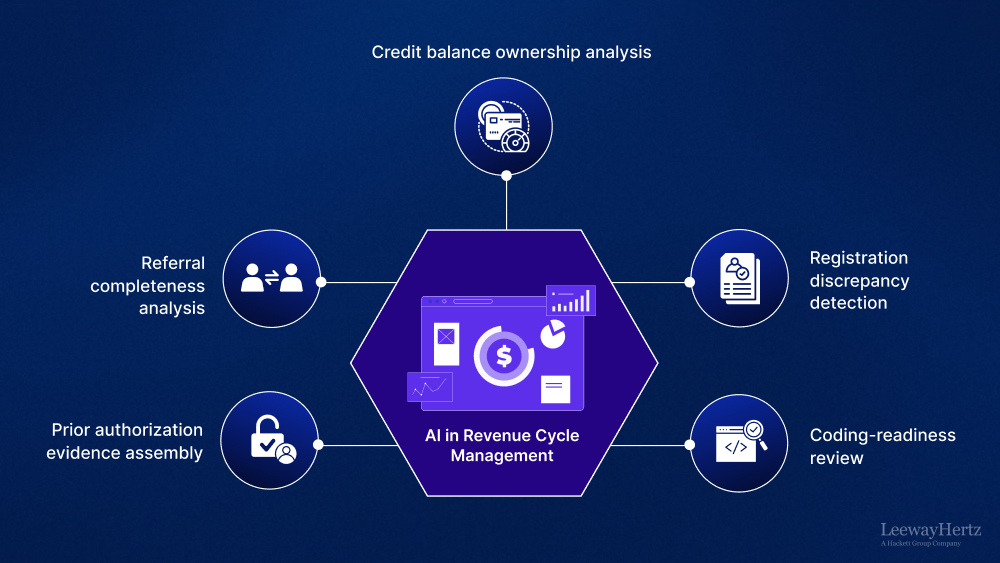
Healthcare revenue cycle management, or RCM, connects the administrative and financial activities required to move a patient encounter from scheduling through final payment resolution. It spans patient access, coverage verification, prior authorization, registration, charge capture, clinical documentation, coding, claim production, payment posting, denial resolution, patient billing, and credit balance management.
For healthcare systems, RCM performance directly affects financial stability, operational efficiency, and patient experience. Revenue cycle leaders are under increasing pressure to improve cash flow, reduce avoidable denials, strengthen compliance, and manage administrative complexity. At the same time, they must maximize existing investments in core platforms such as Epic Resolute and Oracle Health revenue cycle solutions, as well as systems such as Waystar that support claims, payments, denials, and other revenue cycle activities.
The scale of these operations is substantial. US healthcare spending reached $5.3 trillion in 2024, including approximately $1.63 trillion in hospital expenditures and $1.11 trillion in physician and clinical services expenditures[1].
RCM is well suited to AI because much of the work involves high transaction volumes, structured and unstructured records, payer-specific requirements, repetitive exception analysis, and evidence-intensive review. However, the relevant solution is not a generic chatbot. A patient access representative needs support interpreting a coverage response. A certified coder needs documentation and edit evidence assembled for review. A denials analyst needs the denial reason, claim history, payer policy, and appeal deadline brought together. A revenue integrity analyst needs possible charge discrepancies identified without allowing the system to change a bill independently.
For CFOs and revenue cycle executives, the opportunity is not replacing existing revenue cycle platforms or removing human expertise. It is extending the value of existing investments by applying AI to the manual preparation, exception analysis, and evidence gathering activities that limit throughput across the revenue cycle. The most effective AI initiatives improve how teams review information, prioritize work, resolve exceptions, and make decisions while preserving accountability for regulated financial and clinical actions.
The operating boundary is equally important. AI can classify records, retrieve approved guidance, identify anomalies, prepare work packets, draft communications, and recommend priorities. Revenue cycle staff, coders, clinicians, compliance personnel, and authorized financial reviewers continue to make regulated, contractual, clinical, and financial decisions.
For this reason, organizations should map AI opportunities against the complete provider-side RCM operating model. The useful unit is not a broad function such as “AI for denials” or “AI for patient access.” It is a defined sub-process with known source artifacts, systems, exception categories, outputs, accountable reviewers, and human approval boundaries. This process-level approach enables revenue cycle leaders to identify practical AI opportunities, evaluate implementation readiness, and scale solutions with appropriate governance.
- How AI is transforming healthcare revenue cycle operations
- Why AI use cases in healthcare revenue cycle must be mapped at the sub-process level
- Healthcare revenue cycle operating model and AI opportunity mapping across provider processes
- High-value AI use cases in healthcare revenue cycle management
- How agentic AI works in healthcare revenue cycle workflows
- How to prioritize AI use cases in healthcare revenue cycle management
- Governance, risk, and responsible AI in healthcare revenue cycle management
- How ZBrain operationalizes AI use cases in healthcare revenue cycle management
- Future of AI in healthcare revenue cycle management
How AI is transforming healthcare revenue cycle operations
AI changes revenue cycle work by analyzing artifacts before a specialist opens them, connecting information that resides in different systems, and preparing the evidence needed for review. The opportunity is strongest where the work is repetitive but still requires human judgment.
-
Document-heavy work: UB-04 records, CMS-1500 data, insurance cards, clinical notes, remittance records, explanations of benefits, and payer correspondence can be checked for missing fields, discrepancies, and unsupported values before review.
-
Narrative-heavy work: Clinical documentation queries, appeal letters, denial summaries, patient balance explanations, and payer correspondence can be drafted from approved source material while showing the evidence used.
-
Exception-heavy work: Eligibility failures, prior authorization gaps, claim edits, denials, payment variances, unapplied cash, and credit balances can be classified and prioritized according to value, deadline, and required expertise.
-
Knowledge-heavy work: Payer policies, coding guidance, coverage requirements, NCCI edits, contract terms, and internal revenue cycle policies can be retrieved and compared with the account or claim under review.
-
Workflow-heavy work: Multi-step processes can be coordinated across scheduling, registration, coding, billing, denials, and patient financial services by preparing the next work packet and routing unresolved exceptions to the appropriate reviewer.
AI therefore does more than produce text. It can perform document intelligence, classification, anomaly detection, predictive analysis, policy retrieval, evidence aggregation, natural-language generation, and workflow coordination. The value comes from applying these capabilities to a specific artifact and a clearly bounded task.
Build governed AI workflows across healthcare revenue cycle operations
Scale governed AI across healthcare revenue cycle operations while maintaining human accountability for coding, claims, appeals, payments, and financial decisions.
Why AI use cases in healthcare revenue cycle must be mapped at the sub-process level
Healthcare revenue cycle management is not a single workflow. It is a connected operating model made up of functions, processes, and hundreds of smaller activities performed across patient access, clinical documentation, coding, billing, payments, and account resolution.
This complexity creates a challenge for AI adoption. Broad statements such as “AI for medical coding,” “AI for denials,” or “AI for patient access” describe business areas, but they do not define what should actually be built, what data is required, which systems are involved, or where human accountability must remain. Without this level of detail, organizations risk selecting use cases that are difficult to integrate, difficult to govern, or disconnected from measurable operational outcomes.
A practical AI implementation approach starts by decomposing revenue cycle work into four levels:
-
Function: A major area of revenue cycle accountability, such as medical coding, prior authorization, or denial management. A function contains multiple processes and is typically too broad to implement as a single AI workflow.
-
Process: A recurring workflow area within a function, such as authorization request preparation, coding validation, or appeal management. Processes define how work moves through the organization but may still contain multiple decisions and review points.
-
Sub-process: A specific work activity with a defined input, output, system context, exception category, and accountable reviewer. Examples include interpreting an X12 271 eligibility response, checking a claim against NCCI edits, or drafting an appeal letter from a denial record and supporting documentation.
-
AI-enabled opportunity: A specific AI capability applied to a defined revenue cycle artifact to change how that sub-process is performed. For example, classification can map CARC and RARC combinations to denial categories, while document intelligence can compare insurance-card information with registration fields to identify mismatches.
Mapping at the sub-process level makes AI opportunities more buildable and governable. For example, “AI for medical coding” does not define which code set, encounter type, documentation source, payer rule, or certified coder review process is involved. In contrast, “code and documentation discrepancy detection for outpatient professional claims with certified coder review” defines the artifact, decision boundary, and accountable role required for implementation.
Sub-process mapping also reveals the operational dependencies required for successful deployment. An authorization workflow may require scheduling data, clinical orders, payer policies, portal access, and authorization specialist review. A denial workflow may require the original claim, X12 835 remittance data, CARC and RARC codes, clinical documentation, appeal deadlines, payer policies, and submission requirements.
By defining these dependencies upfront, healthcare organizations can evaluate AI feasibility, establish appropriate controls, measure expected impact, and deploy workflows that integrate with existing revenue cycle operations.
Healthcare revenue cycle operating model and AI opportunity mapping across provider processes
Healthcare revenue cycle management spans interconnected workflows that begin before a patient encounter and continue through final payment resolution. Each function depends on upstream information, downstream decisions, and multiple systems of record, making it difficult to identify AI opportunities without understanding the complete operating model.
The following operating model maps provider-side revenue cycle activities across front-cycle, mid-cycle, and business office operations. Each function is decomposed into its underlying processes and sub-processes to identify where AI can support specific activities using defined artifacts, systems, exception categories, and human review boundaries.
This mapping focuses on provider-side revenue cycle operations and covers 13 core functions.
For each function, the analysis identifies:
-
The teams responsible for the work
-
Where AI capabilities such as document intelligence, classification, anomaly detection, predictive analysis, and natural-language generation can support specific activities
-
Which decisions, approvals, and attestations remain with revenue cycle professionals
-
The artifacts, systems, regulations, and controls that shape implementation
The goal is not to automate revenue cycle functions end to end. It is to identify practical, governed AI opportunities that improve how teams analyze information, prepare work, resolve exceptions, and make decisions while maintaining accountability for regulated financial and clinical processes.
Front-cycle operations
Function 1: Patient access and scheduling
Converting patient demand, referrals, and service requirements into a scheduled encounter with the correct location, resource, and pre-service pathway.
Patient access and scheduling begin the provider revenue cycle. The function turns referral orders, appointment requests, patient preferences, service requirements, and scheduling capacity into a planned encounter. Its outputs feed eligibility verification, authorization, registration, estimates, and downstream clinical operations.
Teams involved: Central scheduling, referral management, patient access, contact center, service-line scheduling, financial clearance, clinic operations, and patient access leadership.
What AI helps with: Document intelligence can extract service, diagnosis, provider, and timing information from referral records. Classification and constraint-based matching can compare the request with scheduling templates, locations, resource requirements, and appointment rules. Predictive analysis can identify appointments with elevated cancellation or no-show risk and support targeted outreach.
What humans continue to own: Scheduling staff resolve ambiguous orders, confirm appointment suitability, handle patient-specific accommodations, and approve overrides to templates or capacity rules. Clinical staff determine clinical urgency and service appropriateness. AI extracts, ranks, and prepares but does not determine clinical priority or approve an appointment exception.
| Process | Sub-process | AI-enabled opportunities |
|---|---|---|
| Referral and request intake | Referral or order intake |
|
| Service and location matching |
|
|
| Appointment scheduling | Appointment and resource selection |
|
| Waitlist and cancellation backfill |
|
|
| Pre-service coordination | Pre-registration outreach |
|
| Schedule maintenance | Cancellation and no-show management |
|
Key artifacts
-
Referral orders
-
Appointment requests
-
Scheduling templates
-
Waitlists
-
Preparation instructions
-
Patient communication records
-
Service catalogs
-
Provider calendars
-
Location capability records
-
Resource schedules
Systems involved
-
EHR scheduling modules
-
Referral management systems
-
Contact-center platforms
-
Patient portals
-
Patient access work queues
Regulatory considerations
-
HIPAA privacy and security requirements apply when scheduling workflows access or communicate protected health information.
-
Access should be limited to the minimum information required for the scheduling purpose, with role-appropriate permissions and audit controls.
-
Patient communications must follow organizational consent, communication, language-access, and identity-verification policies.
Accountable roles
-
Patient access director
-
Scheduling supervisor
-
Referral coordinator
-
Clinic operations manager
-
Financial clearance manager
-
Clinical service-line representative
Highest-value opportunities
-
Referral completeness review: High leverage because incomplete orders can delay scheduling, authorization, and clinical preparation, increasing administrative rework and creating avoidable downstream revenue cycle exceptions.
-
Service and location matching: High leverage because it helps health systems manage complex service catalogs across multiple facilities, improve utilization of available capacity, and reduce scheduling errors that affect patient access.
-
Waitlist backfill: Valuable because it helps convert available appointment capacity into completed encounters while preserving clinical prioritization rules and human scheduling oversight.
-
Pre-registration outreach: Valuable because missing demographic, insurance, or financial information creates downstream eligibility, authorization, billing, and patient financial exceptions that increase manual resolution effort.
Example agentic workflow: Referral intake and scheduling readiness workflow
- The workflow begins with referral intake and an electronic or scanned referral order.
- Document intelligence extracts the requested service, diagnosis, ordering provider, urgency indicator, and attached records.
- The workflow compares the extracted data with the service catalog, scheduling requirements, and available locations.
- Missing or conflicting information is placed in a review queue with the supporting referral pages.
- A scheduling representative confirms the service, location, appointment type, and any patient accommodations.
- After human confirmation, the scheduling system records the appointment and hands the encounter to eligibility and pre-registration under existing access and audit controls.
Function 2: Eligibility and benefits verification
Turning insurance eligibility data and payer responses into a reviewable determination of active coverage, benefits, cost-sharing, and coordination requirements.
Eligibility and benefits verification establishes whether the patient’s reported coverage is active and what the plan indicates about benefits for the expected service. The function uses payer data, insurance records, and standardized eligibility transactions to support financial clearance and patient estimates.
HIPAA-adopted electronic transaction standards include X12 270 for eligibility inquiries and X12 271 for eligibility responses.
Teams involved: Eligibility specialists, patient access representatives, financial clearance staff, benefit verification teams, medicare secondary payer specialists, and patient financial counselors.
What AI helps with: Document intelligence can extract member, group, payer, and plan information from insurance cards. Structured parsing can interpret X12 271 responses and payer portal records. Classification can distinguish inactive coverage, demographic mismatch, benefit limitation, coordination-of-benefits issue, and unavailable-response exceptions.
What humans continue to own: Staff confirm the correct payer and member relationship, resolve contradictory payer information, communicate coverage limitations, and determine whether additional payer contact is required. The payer remains the source of coverage and benefit information. AI interprets and prepares but does not guarantee coverage or determine final patient liability.
| Process | Sub-process | AI-enabled opportunities |
|---|---|---|
| Coverage discovery | Insurance capture and payer identification |
|
| Electronic verification | X12 270 inquiry preparation |
|
| X12 271 response interpretation |
|
|
| Benefit review | Service-specific benefit and cost-sharing review |
|
| Coordination of benefits | COB and medicare secondary payer review |
|
| Exception resolution | Eligibility mismatch and re-verification |
|
Key artifacts
-
Insurance cards
-
X12 270 eligibility inquiries
-
X12 271 eligibility responses
-
Payer portal records
-
Explanation of Benefits (EOBs)
-
Coordination-of-benefits records
-
Medicare Secondary Payer questionnaires
-
Coverage history records
Systems involved
-
Patient accounting systems
-
EHR registration modules
-
Clearinghouses
-
Eligibility platforms
-
Payer portals
Regulatory considerations
-
X12 270/271 Version 5010 is the HIPAA-adopted standard for electronic eligibility and benefit verification.[4]
-
PHI used for verification must remain protected through access, authentication, transmission-security, and audit controls.[3]
-
Medicare coordination-of-benefits workflows may require investigation of other insurance or liability coverage before Medicare payment.[5]
Accountable roles
-
Eligibility verification supervisor
-
Patient access representative
-
Financial clearance specialist
-
Medicare secondary payer specialist
-
Patient financial counselor
-
Revenue cycle director
Highest-value opportunities
-
X12 271 interpretation: High leverage because eligibility responses are high-volume, standardized artifacts that can be structured for review, helping financial clearance teams identify coverage issues earlier while maintaining clear staff validation points.
-
Insurance-card-to-account validation: Valuable because it identifies demographic and coverage discrepancies before they propagate into authorization, claims, and patient billing workflows, reducing downstream correction effort.
-
Service-specific benefit extraction: Valuable because it reduces manual interpretation of complex payer responses and portal records, helping teams prepare more accurate patient responsibility assessments and financial clearance decisions.
-
Eligibility exception classification: High value because it routes coverage failures, payer mismatches, and unresolved benefit issues to the appropriate specialists, allowing teams to focus effort on exceptions requiring payer or patient intervention.
Example agentic workflow: Eligibility verification and benefit review workflow
- The workflow begins with electronic eligibility verification using the insurance record and an X12 270 inquiry.
- The clearinghouse or payer returns an X12 271 response.
- The workflow parses coverage status, service type, dates, cost-sharing, and plan indicators.
- It compares the response with the scheduled service and registration record.
- An eligibility specialist reviews the summarized response, supporting segments, and any mismatch.
- After confirmation, the verified status and evidence are recorded for financial clearance under existing governance.
Function 3: Prior authorization coordination
Converting payer requirements, clinical records, and scheduled-service information into a complete authorization request and controlled follow-up process.
Prior authorization links the planned service with payer-specific approval requirements. It includes requirement discovery, documentation assembly, request preparation, submission, follow-up, and exception handling. It does not include the payer’s adjudication decision. Prior authorization is covered here as a revenue cycle coordination function; detailed authorization workflows, payer-specific requirements, and submission processes are addressed separately in the dedicated prior authorization article.
X12 278 is the HIPAA-adopted transaction for prior authorization and referrals. CMS-0057-F also requires impacted payers to implement operational changes beginning in 2026 and prior authorization APIs beginning in 2027, with specified decision timeframes for covered medical items and services.
Teams involved: Authorization specialists, utilization management, patient access, financial clearance, ordering clinicians, nursing staff, service-line coordinators, and payer relations personnel.
What AI helps with: Policy retrieval can identify whether authorization is indicated and surface documentation requirements. Document intelligence can assemble orders, notes, test results, diagnosis information, and prior treatment evidence. Classification can distinguish pending, incomplete, denied, expired, and service-mismatch cases.
What humans continue to own: Clinicians determine medical necessity, confirm the accuracy of clinical representations, respond to peer-to-peer discussions, and approve clinical documentation. Authorization staff verify requirements and approve request submission. AI assembles and drafts but does not make clinical assertions or submit a risk-bearing request without confirmation.
| Process | Sub-process | AI-enabled opportunities |
|---|---|---|
| Requirement discovery | Authorization requirement identification |
|
| Documentation requirement extraction |
|
|
| Request preparation | Clinical and administrative packet assembly |
|
| Electronic or portal request preparation |
|
|
| Authorization validation | Auth-to-service matching before claim submission | • Classification compares approved authorization details, including procedure, diagnosis, provider, location, and service dates, against the scheduled encounter and claim data.• Anomaly detection identifies mismatches between authorized services and billed services before claim submission.• Automated authorization exception triage prioritizes unresolved authorization mismatches based on severity and likely root cause, recommending the appropriate action or routing to authorization or billing specialists before claim release. |
| Authorization tracking | Status and deadline monitoring |
|
| Exception handling | Additional-information response preparation |
|
| Denial, peer-to-peer, or reconsideration preparation |
|
-
Key artifacts
-
Referral orders
-
Clinical notes
-
Diagnostic results
-
Payer policies
-
Authorization forms
-
X12 278 records
-
FHIR prior authorization records
-
Payer correspondence
Systems involved
-
EHRs
-
Utilization management systems
-
Authorization work queues
-
Clearinghouses
-
Payer portals
-
Document repositories
-
Regulatory considerations
-
X12 278 remains a HIPAA-adopted transaction for prior authorization and referral certification.
-
CMS-0057-F requires certain impacted payers to provide specific denial reasons beginning in 2026 and to meet 72-hour expedited and seven-calendar-day standard decision timeframes for applicable requests.
-
Clinical records and payer communications containing PHI require minimum-necessary access and traceable use.
Accountable roles
-
Prior authorization manager
-
Authorization specialist
-
Utilization review nurse
-
Ordering clinician
-
Medical director
-
Financial clearance manager
Highest-value opportunities
-
Requirement discovery: High leverage because payer requirements vary by plan, service, and setting, and early identification of authorization needs can reduce avoidable delays, incomplete submissions, and downstream claim issues.
-
Clinical packet assembly: Valuable because required evidence is distributed across orders, notes, results, and prior records, and consolidating this information reduces preparation effort while improving authorization readiness.
-
Deadline and status monitoring: Valuable because missed follow-up windows can delay care delivery, authorization completion, and payment realization, making timely visibility into pending requests critical.
-
Additional-information response preparation: Valuable because it reduces manual evidence gathering across clinical and administrative records while preserving clinician and authorization-team review before submission.
Example agentic workflow: Prior authorization readiness and submission workflow
- The workflow begins with authorization requirement review using the scheduled-service record and payer information.
- It retrieves approved payer criteria and identifies the required administrative and clinical artifacts.
- It assembles the order, relevant notes, results, diagnosis information, and previous authorization activity.
- Missing evidence and contradictory values are shown to the authorization specialist.
- The specialist and appropriate clinician confirm the request content and clinical evidence.
- Only after confirmation is the request released through the approved payer channel, with status tracking maintained under existing governance.
Function 4. Registration and point-of-service collections
Turning patient identity, demographic, coverage, and financial responsibility information into a complete encounter record and pre-service payment workflow.
Registration and point-of-service collections establish the administrative and financial foundation for the patient encounter. The function converts demographic information, insurance details, coverage data, scheduled services, and pricing information into a validated patient record, an accurate financial estimate, and a pre-service collection pathway. It feeds eligibility verification, authorization, claims production, and patient financial services while reducing downstream billing and payment exceptions.
Teams involved
Patient access representatives, registration specialists, financial clearance specialists, patient financial counselors, scheduling teams, revenue cycle leadership, compliance teams, and patient financial services representatives manage registration accuracy, financial clearance, estimates, collections, and payment arrangements.
What AI helps with
Document intelligence can extract demographic, insurance, guarantor, and subscriber information from registration documents and insurance cards. Entity resolution can identify duplicate patient records and mismatched demographic information across systems. AI can combine eligibility responses, scheduled services, benefit information, contracted rates, and approved pricing data to prepare patient responsibility estimates and Good Faith Estimates. Classification can identify encounters requiring financial counseling, payment-plan discussion, financial assistance screening, or additional coverage review.
What humans continue to own
Registration staff verify patient identity, confirm demographic and insurance information, resolve exceptions, and ensure required acknowledgments are completed. Financial counselors review patient responsibility estimates, explain financial obligations, establish approved payment arrangements, and handle patient-specific exceptions. AI validates, prepares, and routes but does not determine final patient liability, approve financial assistance, or establish payment terms.
| Process | Sub-process | AI-enabled opportunities |
|---|---|---|
| Registration quality management | Demographic and identity validation |
|
| Insurance and subscriber information validation |
|
|
| Guarantor and financial responsibility capture |
|
|
| Point-of-service financial clearance | Patient responsibility estimate generation |
|
| Good Faith Estimate preparation |
|
|
| Price transparency validation |
|
|
| Collection readiness assessment |
|
|
| Payment plan setup support |
|
Key artifacts and systems
-
Patient registration records
-
Insurance cards
-
X12 270/271 eligibility transactions
-
Good Faith Estimates
-
Standard charge data and pricing information
-
Patient responsibility estimates
-
Guarantor records
-
Payment-plan agreements
-
Financial assistance applications
-
Encounter forms and superbills
Systems involved
-
EHR registration modules
-
Patient access and scheduling systems
-
Patient accounting systems
-
Eligibility verification platforms
-
Clearinghouses
-
Payer portals
-
Price transparency and charge estimation tools
-
Patient estimation platforms
-
Patient portals
-
Financial counseling systems
-
Payment processing platforms
-
Financial assistance management systems
-
Document management repositories
Regulatory considerations
-
HIPAA privacy and security requirements apply to registration, eligibility, and financial workflows involving protected health information.
-
The No Surprises Act requires Good Faith Estimates for applicable uninsured and self-pay patients and establishes related dispute processes.
-
Hospital price transparency requirements require hospitals to maintain and disclose standard charge information in specified formats.
-
Financial assistance workflows for nonprofit hospitals must align with applicable IRS Section 501(r) requirements.
Accountable roles
-
Patient access director
-
Registration supervisor
-
Financial clearance specialist
-
Patient financial services representative
-
Revenue cycle director
-
Compliance officer
-
VP revenue cycle
Highest-value opportunities
-
Insurance and demographic validation: High leverage because front-end data errors can propagate into eligibility checks, authorization workflows, claims, denials, and patient billing, increasing downstream correction effort and delaying revenue cycle progression.
-
Patient responsibility estimate preparation: Valuable because it connects coverage information, pricing data, and scheduled services before care delivery, supporting more accurate financial communication and earlier resolution of patient responsibility questions.
-
Good Faith Estimate validation: Important because it supports regulatory compliance requirements and helps ensure patient-facing financial information is accurate, consistent, and supported by approved source data.
-
Collection readiness assessment: Valuable because it helps route patients requiring financial counseling, assistance review, or payment discussions to the appropriate teams while avoiding unnecessary collection activity.
-
Payment-plan preparation: Valuable because it reduces manual calculation and documentation effort while ensuring payment arrangements remain within approved policies, thresholds, and human approval controls.
Example agentic workflow: Patient responsibility estimation and financial clearance workflow
- The workflow begins with a scheduled encounter, registration record, insurance information, and eligibility response.
- The agent validates demographic, subscriber, coverage, and encounter details across approved systems.
- It combines benefit information, scheduled services, approved pricing data, and payer information to prepare a patient responsibility estimate.
- The workflow identifies missing information, estimate inconsistencies, and encounters requiring financial counseling or payment-plan discussion.
- Human checkpoint: A financial clearance specialist or patient financial counselor validates the estimate, confirms patient-specific circumstances, explains financial responsibility, and approves any payment arrangement.
- The approved estimate, communication record, and payment-plan details are retained and handed off to downstream revenue cycle workflows under existing governance controls.
Accelerate AI Solutions Development
Build fully functional solutions from your high-value use cases, based on specific operational needs and enterprise context.
Mid-cycle operations
Function 5: Charge capture and revenue integrity
Converting documented services, supplies, medications, devices, and facility activity into complete and reviewable charge records.
Charge capture and revenue integrity connects documented care activity with the charge records required for billing. It draws from clinical, departmental, supply, pharmacy, and procedural systems. The objective is not to maximize charges, but to ensure that documented, billable activity is represented accurately and consistently.
Teams involved: Revenue integrity, charge capture teams, department managers, clinical operations, pharmacy revenue integrity, supply-chain analysts, health information management, coding, and patient financial services.
What AI helps with: Multi-source comparison can identify documented activity without a corresponding charge or a charge without supporting documentation. Anomaly detection can identify unusual units, timing, duplicate entries, or mismatched charge attributes. Policy retrieval can surface chargemaster, revenue-code, HCPCS, and departmental rules.
What humans continue to own: Revenue integrity staff determine whether a charge is supported, correct mappings, authorize charge changes, and manage departmental education. Clinicians confirm documentation when necessary. AI detects and prepares but does not add, remove, or modify a charge independently.
| Process | Sub-process | AI-enabled opportunities |
|---|---|---|
| Charge generation | Clinical activity and charge reconciliation |
|
| Missing and late charge detection |
|
|
| Supply, drug, and device charge review |
|
|
| Charge validation | Chargemaster (CDM) maintenance and code mapping validation | • Document intelligence extracts changes from chargemaster updates, payer rules, and code-set revisions to identify affected charge records.• Change detection identifies outdated, duplicate, or inconsistent charge descriptions, revenue codes, HCPCS mappings, and pricing attributes.• AI-assisted change validation validates proposed CDM changes for completeness, consistency, and policy compliance before submitting them to authorized revenue integrity reviewers for activation. |
| Unit and modifier review |
|
|
| Duplicate and conflicting charge review |
|
|
| Revenue integrity | Charge correction and charge-lag management |
|
Key artifacts
-
Chargemaster records
-
Departmental charge files
-
Medication administration records
-
Supply and implant logs
-
Procedure records
-
Superbills
-
Revenue codes
-
HCPCS codes
-
Modifiers
-
Charge correction records
-
Charge-lag reports
Systems involved
-
EHRs
-
Clinical departmental systems
-
Pharmacy systems
-
Supply management systems
-
Patient accounting platforms
-
Charge routers
Regulatory considerations
-
Charges and subsequent claims must be supported by documentation and comply with applicable CMS billing and coding requirements.
-
False or unsupported billing can create exposure under federal fraud and abuse laws, including the False Claims Act.
-
HIPAA security and audit controls apply to the systems and records used in charge review.
Accountable roles
-
Revenue integrity director
-
Revenue integrity analyst
-
Department manager
-
Pharmacy revenue integrity specialist
-
Certified coder
-
Compliance officer
Highest-value opportunities
-
Missing-charge detection: High leverage because missed charges can delay account completion, create revenue leakage, and require additional manual review to identify and correct before billing.
-
Charge-to-documentation reconciliation: Valuable because it creates an evidence-based review boundary between documented services and recorded charges, supporting revenue integrity, billing accuracy, and compliance oversight.
-
Duplicate-charge detection: Valuable because identifying duplicate or conflicting charges early reduces correction effort, prevents billing inaccuracies, and helps mitigate compliance risk.
-
Chargemaster mapping review: High leverage because charge-code, revenue-code, or HCPCS mapping inconsistencies can affect large volumes of accounts and create recurring billing, reimbursement, and compliance issues.
Example agentic workflow: Charge reconciliation and revenue integrity review process
- The workflow begins with clinical activity and charge reconciliation using procedure, administration, supply, and charge records.
- It matches source activity with posted charges and identifies unmatched items.
- For each exception, it assembles the relevant documentation, charge record, mapping rule, and historical context.
- High-risk or high-value exceptions are routed to the appropriate revenue integrity analyst.
- The analyst determines whether a correction is supported and approves any system update.
- The approved correction is processed through existing charge-control and audit procedures.
Function 6: Medical coding
Turning complete clinical documentation into standardized diagnosis, procedure, modifier, and classification data for billing and reporting.
Medical coding translates the health record into ICD-10-CM, ICD-10-PCS, CPT, HCPCS, modifiers, and related groupings. The function requires professional judgment, current coding guidance, clinical context, and documentation support. It feeds claims, reimbursement calculations, quality reporting, and compliance review.
HHS-adopted code sets include ICD-10-CM for diagnoses, ICD-10-PCS for inpatient procedures, CPT for outpatient procedures and physician services, and HCPCS for supplies and services not included in CPT.
Teams involved: Certified inpatient and outpatient coders, professional coders, coding auditors, health information management, clinical documentation integrity, revenue integrity, and compliance.
What AI helps with: Natural-language processing can identify documentation associated with possible code concepts. Policy retrieval can surface coding guidance, payer policies, and NCCI edits. Anomaly detection can compare codes with documentation, encounter type, units, modifiers, and historical patterns.
What humans continue to own: Certified coders assign and validate codes, interpret ambiguous documentation, determine sequencing, and approve final coding. Clinicians establish diagnoses and document services. AI suggests, compares, and prepares but does not make a final coding or clinical determination.
| Process | Sub-process | AI-enabled opportunities |
|---|---|---|
| Record preparation | Chart completeness and coding readiness |
|
| Code assignment support | Diagnosis code candidate identification |
|
| Procedure and service code candidate identification |
|
|
| Modifier and grouping review |
|
|
| Coding validation | NCCI, MUE, and code-combination review |
|
| Code-to-documentation discrepancy review |
|
|
| Inpatient DRG validation | • Classification compares coded diagnoses, procedures, present-on-admission indicators, and clinical documentation against the assigned DRG.• Anomaly detection identifies potential DRG inconsistencies, such as missing severity indicators, unsupported CC/MCC capture, or procedure-documentation mismatches.• Evidence aggregation assembles the clinical documentation, coding record, and grouper output for coder or auditor review. | |
| Coding quality | Audit selection and coding trend analysis |
|
Key artifacts
-
Clinical notes
-
Operative reports
-
Discharge summaries
-
Diagnostic reports
-
Superbills
-
Coding worksheets
-
Coded encounter records
-
ICD-10-CM code sets
-
ICD-10-PCS code sets
-
CPT code sets
-
HCPCS code sets
-
NCCI PTP edits
-
MUEs
-
Modifier guidance
-
MS-DRG/APR-DRG grouper output
-
DRG validation worksheets
-
Present-on-admission indicators
-
Inpatient coding audit records
Systems involved
-
EHRs
-
Encoders
-
Groupers
-
Computer-assisted coding systems
-
HIM platforms
-
Coding audit tools
Regulatory considerations
-
CMS NCCI PTP edits address code combinations, while MUEs address reported units of service. CMS updates relevant edit files and guidance periodically.
-
Medical record documentation must support the codes and services reported on claims.
-
Coding and billing controls should address fraud, abuse, unsupported claims, and identified overpayments.
Accountable roles
-
Certified coder
-
Coding manager
-
Coding auditor
-
HIM director
-
CDI specialist
-
Compliance officer
Highest-value opportunities
-
Coding-readiness review: High leverage because identifying missing reports, signatures, and required documentation before coding begins reduces coder preparation effort, improves account throughput, and helps prevent avoidable downstream coding delays.
-
Code-to-documentation discrepancy detection: Valuable because it creates an evidence-based validation layer between clinical documentation and coded data, supporting coding accuracy, claim quality, and compliance readiness.
-
NCCI and MUE review: High value because it applies regulatory coding controls before claim submission, helping reduce preventable edits, payment delays, and compliance exposure.
-
Risk-based audit selection: Valuable because it focuses limited audit resources on higher-risk encounters, recurring coding patterns, and cases with greater potential financial or compliance impact.
Example agentic workflow: Coding readiness and validation workflow
- The workflow begins with chart-completeness review using the encounter record and coding work queue.
- It checks for expected reports, signatures, procedure records, and discharge documentation.
- For complete records, it identifies possible code concepts and displays the supporting documentation.
- It runs proposed coder selections against applicable NCCI, unit, modifier, and encounter rules.
- A certified coder reviews the documentation, guidance, code candidates, and exceptions and assigns the final codes.
- The coder-approved record is handed to claim generation with a traceable coding audit record.
Function 7: Clinical documentation integrity
Turning documentation gaps and inconsistencies into compliant, reviewable clarification workflows that preserve clinician ownership.
Clinical documentation integrity, or CDI, helps ensure the health record accurately represents the patient’s documented condition, services, and clinical complexity. It supports coding, quality reporting, utilization review, and claim defensibility while preserving the clinician’s responsibility for the record.
Teams involved: CDI specialists, physicians, advanced practice providers, certified coders, HIM leadership, clinical validation specialists, quality teams, utilization management, and compliance.
What AI helps with: Clinical-language processing can identify missing specificity, conflicting statements, unsupported diagnoses, and documentation that may require clarification. Document intelligence can aggregate relevant evidence. Natural-language generation can prepare non-leading query drafts based on approved templates.
What humans continue to own: CDI specialists and physicians determine whether documentation clarification is appropriate, and coders determine final code assignment. AI identifies potential gaps, severity indicators, and risk-adjustment opportunities but does not diagnose conditions or determine CC/MCC or HCC assignment.
| Process | Sub-process | AI-enabled opportunities |
|---|---|---|
| Case review | CDI case prioritization |
|
| Documentation gap and conflict detection |
|
|
| Query management | Query opportunity validation |
|
| Compliant query drafting |
|
|
| Provider response tracking |
|
|
| Clinical validation | Clinical validation review support |
|
| CDI performance reporting | Documentation and query trend analysis |
|
| Concurrent CDI review | Documentation gap identification during stay |
|
| Severity capture | CC/MCC identification and validation |
|
| Risk adjustment | HCC capture and validation |
|
Key artifacts
-
Progress notes
-
History and physical records
-
Operative reports
-
Discharge summaries
-
Diagnostic results
-
Clinical documentation queries
-
Provider responses
-
Internal query policies
-
Clinical validation criteria
-
Coding guidance
Systems involved
-
EHRs
-
CDI worklists
-
Encoders
-
Query platforms
-
HIM systems
-
Analytics repositories
Regulatory considerations
-
Documentation must support reported diagnoses, procedures, services, and medical necessity.
-
Industry guidance emphasizes standardized, compliant, and non-leading provider query practices.
-
PHI access and generated query content require security, minimum-necessary access, and audit controls.
Accountable roles
-
CDI specialist
-
CDI manager
-
Treating clinician
-
Certified coder
-
Clinical validation specialist
-
HIM director
Highest-value opportunities
-
Documentation gap detection: High leverage because it identifies missing specificity, conflicting documentation, and potential clarification opportunities early, supporting coding accuracy, severity capture, and more complete clinical records.
-
Query drafting: Valuable because it reduces CDI preparation effort by assembling relevant evidence and preparing compliant query drafts while preserving CDI specialist review and physician ownership.
-
Clinical-evidence assembly: Valuable because it brings together relevant notes, results, treatments, and clinical indicators, helping CDI reviewers evaluate complex records more efficiently without allowing AI to determine diagnoses or documentation changes.
-
Trend analysis: High value because it identifies recurring documentation patterns by service line, provider group, or encounter type, enabling targeted education, process improvement, and upstream documentation quality initiatives.
Example agentic workflow: Documentation gap identification and CDI query preparation workflow
- The workflow begins with documentation-gap detection using the clinical record.
- It identifies a possible conflict or missing specificity and assembles the relevant clinical indicators.
- It compares the issue with approved query criteria and prepares a non-leading draft.
- A CDI specialist reviews the evidence, determines whether a query is appropriate, and edits the draft.
- The treating clinician receives the approved query and independently updates or confirms the record.
- The completed record is returned to coding under existing clinical, compliance, and audit controls.
Back-cycle and business office operations
Function 8: Claims production and submission
Turning patient, clinical, coding, coverage, authorization, and charge information into validated institutional or professional claims that meet payer, transaction, and regulatory requirements before submission.
Claims production and submission converts a completed encounter record into a claim-ready transaction. The function brings together registration data, eligibility information, authorization details, charge records, medical codes, provider information, supporting documentation, and payer requirements to produce UB-04/837I institutional claims and CMS-1500/837P professional claims. It includes pre-submission validation, payer-specific rule checks, attachment preparation, clearinghouse processing, and rejection resolution before the claim reaches the payer.
Teams involved
Billing managers, claim-edit specialists, certified coders, revenue integrity analysts, EDI specialists, patient accounting teams, HIM teams, payer relations teams, and revenue cycle leadership.
What AI helps with
AI can use multi-source aggregation to assemble claim data from patient accounting systems, EHRs, coding platforms, authorization systems, and charge systems. Document intelligence can identify required supporting documentation for claims and attachments. Classification can categorize claim edits, payer-specific exceptions, and clearinghouse rejections. Retrieval-grounded analysis can compare claim data against payer billing requirements, contractual rules, and approved coding guidance. Anomaly detection can identify inconsistencies across registration, authorization, coding, charges, and claim fields before submission.
What humans continue to own
Billing specialists review claim corrections, resolve complex edits, confirm supporting documentation, and authorize claim release. Certified coders approve coding-related corrections, and revenue cycle teams determine whether payer-specific exceptions require escalation. AI validates, prepares, and routes claim-related work but does not modify regulated billing records, submit claims, or make final billing decisions without authorized human approval.
| Process | Sub-process | AI-enabled opportunities |
|---|---|---|
| Claim assembly | UB-04 and 837I institutional claim preparation |
|
| CMS-1500 and 837P professional claim preparation |
|
|
| Claim validation | Claim scrubber edit resolution |
|
| Payer-specific rule application |
|
|
| Coding and billing consistency review |
|
|
| Attachment management | X12 275 attachment preparation and submission |
|
| Submission management | Clearinghouse submission and acknowledgment handling |
|
| Rejection management | Clearinghouse rejection resolution |
|
| Submission management | Claim status monitoring |
|
Key artifacts
-
UB-04 institutional claims
-
X12 837I transactions
-
CMS-1500 professional claims
-
X12 837P transactions
-
X12 275 claim attachments
-
X12 999 acknowledgment transactions
-
X12 277CA claim acceptance/rejection responses
-
X12 276/277 claim-status transactions
-
Claim scrubber edit records
-
Payer billing guides
-
Medical necessity documentation
-
Authorization records
-
Coding records
-
Charge records
-
Encounter forms and superbills
Systems involved:
-
Patient accounting systems
-
EHR platforms
-
Claims management platforms
-
Claim scrubbers
-
Clearinghouse platforms
-
Coding systems and encoders
-
HIM systems
-
Document repositories
-
Payer portals
Regulatory considerations
-
HIPAA-adopted X12 transaction standards govern electronic healthcare transactions, including claims (837), claim status (276/277), eligibility (270/271), attachments where applicable, and remittance transactions (835).
-
CMS billing requirements govern applicable Medicare claim submission rules, coding requirements, payment policies, and edit frameworks.
-
NCCI edits and other CMS coding controls apply to Medicare claims and require appropriate review before claim submission.
-
Medical records and supporting documentation submitted with claims must support billed services and remain consistent with the patient record.
-
False Claims Act exposure exists when claims are knowingly submitted with inaccurate, unsupported, or misleading information.
Accountable roles
-
Billing manager
-
Claim edit specialist
-
Certified coder (CPC/CCS)
-
Revenue integrity analyst
-
HIM director
-
EDI specialist
-
Payer relations manager
-
VP revenue cycle
Highest-value opportunities
-
Claim scrubber edit resolution: High value because it addresses high-volume preventable submission failures before they reach payers, reducing avoidable rework, claim delays, and manual correction effort.
-
Payer-specific rule validation: Valuable because payer requirements vary by contract, plan type, service category, and billing scenario, helping teams identify submission risks earlier and improve claim readiness.
-
X12 275 attachment preparation: High leverage because supporting documentation often requires retrieval from multiple systems, and automating evidence assembly helps reduce preparation effort while improving attachment completeness and submission accuracy.
-
Clearinghouse rejection classification: Valuable because it accelerates rejection routing, shortens resolution cycles, and identifies recurring upstream issues across registration, authorization, coding, and billing processes.
-
Claim consistency validation: High value because identifying mismatches across registration, authorization, coding, charge capture, and documentation before submission helps reduce downstream denials and improves claim quality.
Example agentic workflow: Claim validation and submission readiness workflow
- The workflow begins with a completed encounter record, approved codes, charge data, authorization details, and a generated claim transaction.
- The agent aggregates claim-related information from systems of record, including the EHR, patient accounting platform, coding system, authorization platform, and document repository.
- The agent validates the claim against payer-specific requirements, coding rules, transaction requirements, and required supporting documentation.
- The agent identifies exceptions such as missing fields, incompatible coding combinations, missing authorization information, required X12 275 attachments, or clearinghouse submission issues.
- Human checkpoint: The billing manager, certified coder, or appropriate revenue cycle specialist reviews the exceptions, validates corrections, confirms supporting documentation, and approves claim release.
- The approved claim is submitted through the clearinghouse. Submission acknowledgments, rejection responses, correction history, and reviewer decisions are retained as audit evidence. Recurring rejection patterns are routed back to upstream functions such as registration, authorization, coding, and charge capture for process improvement.
Function 9: Remittance and payment posting
Turning payer remittance, payment, and adjustment information into accurate account-level and line-level financial records.
Remittance and payment posting begin after the payer processes a claim. The function matches payments with remittance data, posts allowed and paid amounts, records adjustments, transfers supported patient responsibility, and routes denials or variances.
Medicare electronic remittance advice uses the X12 835 Version 5010 format. CARCs and RARCs communicate adjustment and remark information, while the trace number supports reassociation between the electronic payment and remittance.
Teams involved: Cash application, payment posting, patient accounting, treasury, reconciliation teams, denial management, underpayment recovery, and revenue cycle finance.
What AI helps with: Structured parsing can normalize X12 835 data. Entity matching can reassociate payments, remittances, claims, and bank deposits. Classification can route denials, recoupments, patient responsibility, contractual adjustments, and posting exceptions.
What humans continue to own: Payment-posting staff approve exception resolution, adjustment treatment, patient-responsibility transfers, and manual postings. Finance and revenue cycle leaders approve reconciliation decisions. AI matches and recommends but does not post unresolved payments or approve financial adjustments independently.
| Process | Sub-process | AI-enabled opportunities |
|---|---|---|
| Remittance intake | X12 835 and remittance normalization |
|
| Payment matching | EFT and ERA reassociation |
|
| Payment posting | Claim and line payment posting preparation |
|
| ERA (835) auto-posting and exception handling |
|
|
| Adjustment management | CARC/RARC reason-code mapping |
|
| Contractual adjustment validation |
|
|
| Adjustment posting | CARC, RARC, and group-code interpretation |
|
| Balance transfer | Patient-responsibility transfer |
|
| Cash reconciliation | Unapplied cash workoff |
|
| Exception management | Unmatched cash and unapplied payment review |
|
| Credit resolution | Credit balance identification and routing |
|
| Payment reconciliation | Deposit, remittance, and posting reconciliation |
|
Key artifacts
-
X12 835 files
-
Electronic Remittance Advices (ERAs)
-
Standard paper remittances
-
Explanation of Benefits (EOBs)
-
CARC codes
-
RARC codes
-
EFT records
-
Bank deposit records
-
Posting reports
-
Trace numbers
-
Adjustment records
-
Denial work queues
-
Unapplied-cash reports
Systems involved
-
Patient accounting systems
-
Cash application platforms
-
Treasury systems
-
Clearinghouses
-
Bank interfaces
-
Reconciliation tools
Regulatory considerations
-
X12 835 is the adopted ERA standard, and standardized CARCs and RARCs communicate claim adjustments.
-
EFT and ERA reassociation relies on the applicable trace-number standard and operating rules.
-
Posting access, approvals, and system updates should be traceable because they affect financial records and patient balances.
Accountable roles
-
Cash application manager
-
Payment posting specialist
-
Treasury analyst
-
Patient accounting manager
-
Denials analyst
-
Revenue cycle finance director
Highest-value opportunities
-
835 normalization and posting preparation: High value because ERA data is high-volume and transaction-based, enabling more consistent payment posting workflows, faster exception identification, and reduced manual interpretation effort.
-
EFT-to-ERA reassociation: Valuable because it reduces manual payment matching effort while maintaining reconciliation controls needed for accurate cash application and financial reporting.
-
Adjustment classification: High leverage because accurately categorizing CARC/RARC-based adjustments routes work to the appropriate teams, accelerating denial resolution, underpayment recovery, patient balance review, and account reconciliation.
-
Unapplied-cash matching: Valuable because unresolved cash can increase aging and reconciliation workload; intelligent matching helps identify likely accounts faster while preserving specialist review for exceptions.
Example agentic workflow: ERA processing and payment posting validation workflow
- The workflow begins with X12 835 ingestion and the associated EFT or deposit record.
- It parses claim, line, payment, trace, CARC, RARC, and adjustment data.
- It matches the remittance to the deposit and compares the proposed posting with the patient account.
- Unmatched, zero-pay, recoupment, and unusual-adjustment cases are separated into review queues.
- A payment-posting specialist approves the posting and adjustment treatment.
- The approved transaction is posted, reconciled, and routed to denials or underpayment recovery where required.
Function 10: Denial management and appeals
Turning denied or reduced claims into categorized, evidence-backed resolution and appeal work.
Denial management begins with the payer’s claim determination and continues through correction, reconsideration, appeal, write-off, or other authorized resolution. Effective denial operations connect CARC and RARC data with the original claim, payer policy, authorization record, coding, documentation, and filing deadlines.
Original medicare provides five successive levels of Part A and Part B claim appeal, beginning with MAC redetermination and potentially progressing through federal district court review.
Teams involved: Denials analysts, billers, coders, CDI specialists, utilization review, clinicians, payer relations, revenue integrity, compliance, legal, and patient accounting leadership.
What AI helps with: Classification can convert CARC, RARC, payer text, and claim history into consistent denial categories. Root-cause analysis can identify the originating sub-process. Policy retrieval and document intelligence can prepare correction or appeal evidence. Predictive ranking can prioritize by deadline, recoverable value, complexity, and likelihood of administrative resolution.
What humans continue to own: Denials staff determine the resolution strategy, coders approve coding changes, clinicians confirm clinical evidence, and authorized representatives approve appeals or write-offs. AI categorizes, assembles, and drafts but does not alter clinical documentation, decide an appeal, or file it without approval.
| Process | Sub-process | AI-enabled opportunities |
|---|---|---|
| Denial intake | Denial identification and classification |
|
| Preventability assessment | • Classification categorizes denials as preventable, potentially preventable, or non-preventable using denial reason codes, claim history, payer rules, and upstream workflow data.• Root-cause analysis identifies whether the originating issue occurred in registration, eligibility, authorization, coding, documentation, charge capture, or payer processing.• Trend analysis identifies recurring preventable denial patterns for upstream process improvement. | |
| Denial analysis | Root-cause attribution |
|
| Work prioritization | Deadline and value prioritization |
|
| Correctable denials | Correction and resubmission preparation |
|
| Appeal assessment | Appeal eligibility and timeliness review |
|
| Appeal preparation | Appeal evidence assembly |
|
| Appeal letter drafting |
|
|
| Resolution management | Appeal tracking and prevention feedback |
|
Key artifacts
-
X12 835 records
-
Explanation of Benefits (EOBs)
-
CARC codes
-
RARC codes
-
Denial letters
-
Original claims
-
Corrected claims
-
Authorization records
-
Clinical documentation
-
Appeal letters
-
Payer correspondence
-
Appeal-level records
-
Filing deadlines
-
Submission acknowledgments
-
Appeal outcome records
Systems involved
-
Denial management platforms
-
Patient accounting systems
-
Payer portals
-
Clearinghouses
-
EHRs
-
Document repositories
-
Appeal tracking systems
Regulatory considerations
-
Medicare appeal pathways, timeframes, and levels are governed by federal statute, regulation, and CMS guidance.
-
Appeal documentation must remain consistent with the original medical record and approved corrections.
-
Unsupported billing, concealed errors, or failure to address known overpayments can create compliance exposure.
Accountable roles
-
Denials manager
-
Denials analyst
-
Certified coder
-
CDI specialist
-
Utilization review nurse
-
Treating clinician
-
Revenue cycle director
Highest-value opportunities
-
Denial classification and routing: High value because denials are high-volume exceptions that require specialized handling; accurate classification and routing help reduce resolution time, improve team productivity, and focus staff effort on the highest-impact cases.
-
Root-cause attribution: High leverage because it connects denial patterns to upstream process issues across registration, eligibility, authorization, coding, documentation, and billing, supporting both recovery efforts and prevention strategies.
-
Appeal evidence assembly: Valuable because appeal preparation often requires retrieving information from multiple systems; consolidating claim, clinical, contractual, and payer evidence reduces manual preparation effort and supports more timely responses.
-
Deadline monitoring: High value because missed appeal windows can eliminate recovery opportunities; automated tracking improves visibility into filing requirements while preserving human ownership of appeal decisions.
Example agentic workflow: Denial analysis and appeal preparation workflow
- The workflow begins with denial classification using the X12 835, CARC and RARC data, payer notice, and original claim.
- It identifies the likely root cause and retrieves the relevant registration, authorization, coding, or clinical records.
- It determines the applicable payer policy, appeal level, filing deadline, and required evidence.
- It prepares an indexed evidence packet and draft appeal letter.
- A denials analyst, coder, CDI specialist, or clinician reviews the content according to the denial type and approves the response.
- The approved appeal is filed through the established channel, with status and deadlines monitored under existing governance.
Function 11: Underpayment recovery and payer contract management
Turning contract terms, expected reimbursement, remittance data, and claim history into evidence-backed payment variance work.
Underpayment recovery evaluates whether a payer’s payment aligns with the applicable contract, fee schedule, payment methodology, claim details, and remittance explanation. It is distinct from denial management because the claim may have been paid, but at an amount that requires review.
Teams involved: Contract management, managed care finance, reimbursement analysts, payment variance teams, revenue cycle finance, payer relations, patient accounting, and legal or compliance personnel.
What AI helps with: Document intelligence can extract reimbursement terms from contracts, amendments, and fee schedules. Calculation logic can estimate expected reimbursement using approved methodologies. Anomaly detection can identify differences between expected and actual payment, while classification can distinguish contract, coding, bundling, pricing, and payer-processing causes.
What humans continue to own: Revenue cycle finance and payer relations teams review payer performance trends, validate contract interpretations, determine escalation strategies, and manage payer discussions. AI identifies patterns and prepares reporting but does not determine contractual disputes or initiate recovery actions independently.
| Process | Sub-process | AI-enabled opportunities |
|---|---|---|
| Contract preparation | Contract and fee-schedule abstraction |
|
| Expected reimbursement | Expected-payment calculation |
|
| Variance detection | Actual-to-expected payment comparison |
|
| Variance analysis | Underpayment cause classification |
|
| Recovery preparation | Recovery evidence packet |
|
| Payer inquiry or dispute drafting |
|
|
| Performance management | Follow-up and payer trend analysis |
|
| Payer scorecard reporting | • Trend analysis aggregates underpayment patterns by payer, contract, service line, denial category, variance type, and recovery outcome.• Natural-language generation prepares payer performance summaries showing recurring payment issues, recovery opportunities, and unresolved variance trends.• Predictive analysis identifies payer behaviors associated with recurring underpayments or delayed resolution. |
Key artifacts
-
Payer contracts
-
Contract amendments
-
Fee schedules
-
Claims
-
X12 835 records
-
Explanation of Benefits (EOBs)
-
Payment calculations
-
Dispute correspondence
-
Expected reimbursement models
-
Variance worklists
-
Recovery records
-
Payer scorecards
-
Payment variance reports
-
Recovery performance dashboards
-
Contract performance reports
Systems involved
-
Contract management systems
-
Patient accounting platforms
-
Payment variance tools
-
Payer portals
-
Document repositories
-
Analytics platforms
Regulatory considerations
-
Contract interpretation and dispute rights depend on the executed agreement, payer program, and applicable law.
-
Payment variance workflows must distinguish contractual underpayments from coding, billing, authorization, and patient-responsibility issues.
-
Access to contracts, claims, and payment records should be role-based and auditable.
Accountable roles
-
Managed care contracting director
-
Reimbursement analyst
-
Payment variance analyst
-
Payer relations manager
-
Revenue cycle finance director
-
Legal or compliance reviewer
Highest-value opportunities
-
Contract abstraction: Valuable because reimbursement terms are often distributed across complex agreements, amendments, and fee schedules; extracting and structuring these terms improves visibility into expected payment rules and supports more consistent variance analysis.
-
Expected-payment calculation: High leverage because it establishes a reliable baseline for comparing actual reimbursement against contractual expectations and identifying potential underpayments at scale.
-
Variance classification: Valuable because it separates contract-related payment issues from coding, billing, authorization, and administrative causes, enabling more targeted resolution and recovery workflows.
-
Evidence packet preparation: High value because payer inquiries and recovery efforts require supporting contracts, claim details, remittance records, and calculations; assembling this evidence reduces manual preparation effort and helps accelerate payer discussions.
Example agentic workflow: Contract-based payment variance analysis and recovery workflow
- The workflow begins with an actual-to-expected payment comparison using the claim, X12 835, and approved contract model.
- It calculates the variance and identifies the contract provision or fee-schedule item used.
- It classifies the likely cause and assembles the contract, claim, remittance, and calculation evidence.
- Ambiguous terms or conflicting effective dates are flagged.
- A reimbursement analyst confirms the expected amount and approves the inquiry or dispute.
- The approved communication is issued through the payer channel and tracked under existing contract and revenue cycle controls.
Function 12. Patient financial services and self-pay management
Turning patient balances, financial assistance needs, payment arrangements, and self-pay accounts into controlled financial communication and resolution workflows.
Patient financial services manage the patient responsibility portion of the revenue cycle after claims processing and payer activity. The function converts account balances, remittance information, financial assistance requirements, payment history, and organizational policies into patient statements, payment options, assistance workflows, and self-pay resolution activities. It supports patient communication, regulatory compliance, and responsible account resolution while connecting with remittance, credit balance, and collections processes.
Teams involved
Patient financial services representatives, financial counselors, statement operations teams, self-pay specialists, collection managers, compliance teams, patient advocates, revenue cycle leadership, and finance teams manage patient billing communication, assistance programs, payment arrangements, and account resolution activities.
What AI helps with
Natural-language generation can prepare patient-friendly statements, balance explanations, and communication drafts using approved account information. Document intelligence can validate financial assistance applications, identify missing documentation, and organize supporting records. Classification can segment self-pay accounts, route patient inquiries, and identify accounts requiring financial counseling, payment-plan review, assistance screening, or collection follow-up. Workflow coordination can monitor payment commitments, assistance status, account aging, and placement-readiness requirements.
What humans continue to own
Patient financial services representatives review account information, explain patient responsibility, approve payment arrangements within delegated authority, and address patient-specific circumstances. Financial assistance reviewers determine eligibility based on approved policies, and authorized leaders approve collection escalation or bad debt placement. AI prepares, classifies, and supports decisions but does not determine patient liability, approve financial assistance, negotiate financial terms, or initiate collection actions independently.
| Process | Sub-process | AI-enabled opportunities |
|---|---|---|
| Patient statement management | Statement generation and quality review |
|
| Statement delivery and communication management |
|
|
| Balance inquiry preparation |
|
|
| Payment management | Payment-plan eligibility and setup support |
|
| Payment-plan monitoring |
|
|
| Financial assistance administration | Application completeness review |
|
| Assistance eligibility review support |
|
|
| 501(r) compliance workflow support |
|
|
| Self-pay management | Self-pay account segmentation and follow-up prioritization |
|
| Patient outreach preparation |
|
|
| Collections governance | Bad debt placement readiness review |
|
| Bad debt monitoring and reporting |
|
Key artifacts
-
Patient statements
-
EOBs
-
Patient responsibility records
-
Payment-plan agreements
-
Financial assistance applications
-
Financial assistance policy documents
-
Income verification documents
-
Account notes
-
Communication records
-
Collection placement records
-
Good Faith Estimates where applicable
-
Payment history and account ledgers
Systems involved:
-
Patient accounting systems
-
Patient financial services platforms
-
Patient portals
-
Payment processing systems
-
Financial assistance management systems
-
Customer service platforms
-
Collection management platforms
-
Document management repositories
Regulatory considerations
-
HIPAA privacy and security requirements apply to patient account information, financial assistance records, and communications containing protected health information.
-
Nonprofit hospitals must maintain financial assistance policies and related processes consistent with IRS Section 501(r) requirements, including eligibility criteria, application processes, and reasonable efforts before extraordinary collection actions.
-
The No Surprises Act and related requirements affect certain patient billing communications, estimates, and dispute processes.
-
Applicable state consumer protection, patient billing, and prompt-payment requirements may govern patient communication and collection practices.
-
Bad debt placement workflows should include controls to confirm required notices, assistance screening, dispute status, and organizational approval requirements before referral.
Accountable roles
-
Patient financial services representative
-
Financial counselor
-
Self-pay specialist
-
Collection manager
-
Revenue cycle director
-
Compliance officer
-
Finance manager
-
VP revenue cycle
Highest-value opportunities
-
Statement quality validation: High value because inaccurate, incomplete, or unclear patient statements can increase inquiry volumes, create billing disputes, delay payments, and increase patient service workload.
-
Financial assistance application review support: Valuable because financial assistance workflows require consistent review of forms, supporting documents, and policy criteria; AI can reduce administrative effort while preserving human eligibility decisions.
-
Self-pay account prioritization: High leverage because segmenting and prioritizing accounts helps patient financial services teams focus outreach, counseling, and resolution efforts on accounts requiring the most appropriate next action.
-
Payment-plan preparation and monitoring: Valuable because it reduces manual calculation and tracking effort while improving visibility into payment commitments, missed payments, and accounts requiring follow-up.
-
Bad debt placement governance: Important because it establishes a compliance and policy checkpoint before external collection activity, helping ensure required reviews, notices, financial assistance considerations, and approvals are completed.
Example agentic workflow: Self-pay account resolution and financial assistance review workflow
- The workflow begins with a self-pay account after payer processing is complete and patient responsibility has been established.
- The agent retrieves the account ledger, claim information, EOBs, payment history, financial assistance activity, communication history, and applicable organizational policies.
- The agent classifies the account based on balance status, assistance indicators, payment activity, dispute status, and collection-readiness criteria.
- The agent prepares the appropriate work packet, including a balance explanation, payment-plan options, financial assistance documentation requirements, or bad debt placement review checklist.
- Human checkpoint: A patient financial services representative, financial assistance reviewer, or authorized collection manager reviews the account information, confirms the appropriate action, and approves any payment arrangement, assistance decision, or escalation.
- The approved action is recorded in the patient accounting system. Communication history, reviewer decisions, supporting documents, and approval evidence are retained for audit and compliance purposes under existing governance controls.
Function 13. Credit balance resolution
Turning negative account balances and possible overpayments into validated ownership, refund, adjustment, reporting, and reconciliation work.
Credit balance resolution determines why an account has a negative balance, who owns the funds, whether related accounts must be considered, and what approved action is required. Causes may include duplicate payment, coordination-of-benefits changes, payer recoupments, reversed charges, incorrect adjustments, patient overpayment, or posting errors.
Federal rules require identified medicare overpayments to be reported and returned within the applicable statutory period, generally the later of 60 days after identification or the date a corresponding cost report is due.
Teams involved: Credit balance analysts, patient accounting, payment posting, refund teams, compliance, finance, payer relations, patient financial services, and legal or audit personnel.
What AI helps with: Anomaly detection can identify negative balances and unusual posting patterns. Classification can assign probable causes. Multi-source analysis can compare claims, remittances, payments, refunds, adjustments, and related accounts. Workflow coordination can track aging and required approvals.
What humans continue to own: Staff determine ownership, quantify the validated overpayment, approve refunds or adjustments, decide reporting treatment, and authorize system updates. Compliance personnel interpret regulatory obligations. AI identifies and prepares but does not issue a refund or determine legal compliance.
| Process | Sub-process | AI-enabled opportunities |
|---|---|---|
| Credit balance identification | Credit balance detection |
|
| Cause classification |
|
|
| Credit balance validation and resolution preparation | Payer or patient ownership determination |
|
| Overpayment quantification and related-account review |
|
|
| Credit balance resolution and closure | Refund or adjustment packet preparation |
|
| Notification and reporting support |
|
|
| Control and monitoring | Aging, deadline, reconciliation, and root-cause review |
|
Key artifacts
-
Account ledgers
-
X12 835 records
-
Explanation of Benefits (EOBs)
-
EFT records
-
Patient payment records
-
Adjustment records
-
Refund requests
-
CMS overpayment records
-
Correspondence
-
Credit balance worklists
-
Approval records
-
Root-cause reports
Systems involved
-
Patient accounting systems
-
Refund platforms
-
Treasury systems
-
Compliance case systems
-
Reconciliation tools
Regulatory considerations
-
Identified medicare overpayments are subject to reporting and return requirements, including the applicable 60-day rule.
-
CMS stopped requiring routine quarterly CMS-838 credit balance reports beginning December 1, 2024, but providers remain responsible for reporting self-identified overpayments and using the report when applicable credit balances occur.
-
Knowingly retaining an identified overpayment can create False Claims Act and other compliance exposure.
Accountable roles
-
Credit balance manager
-
Credit balance analyst
-
Patient accounting manager
-
Compliance officer
-
Refund approver
-
Revenue cycle finance director
Highest-value opportunities
-
Credit balance detection and classification: High value because credit balances are high-volume financial exceptions that require consistent identification and categorization to support timely resolution, reconciliation, and compliance oversight.
-
Ownership determination: Valuable because payer overpayments, patient payments, and account adjustments follow different resolution pathways; accurate ownership identification helps route work correctly and reduce unnecessary investigation effort.
-
Overpayment deadline monitoring: Critical because regulatory reporting and return requirements create defined compliance timelines; proactive monitoring helps prevent missed obligations and unresolved overpayment exposure.
-
Refund packet preparation: Valuable because refund decisions require transaction history, remittance records, payment details, and approval evidence; assembling this information reduces manual preparation effort while preserving authorized review and control.
Example agentic workflow: Credit balance analysis and resolution workflow
- The workflow begins with credit balance detection using the account ledger and payment history.
- It classifies the likely cause and retrieves related claims, remittances, patient payments, adjustments, and prior refunds.
- It calculates the candidate overpayment and identifies the likely payer or patient owner.
- The workflow checks aging, reporting requirements, and approval thresholds.
- A credit balance analyst and authorized approver confirm ownership, amount, and resolution.
- The approved refund, adjustment, or report is processed through existing financial and compliance controls, with the account reconciled afterward.
Accelerate AI Solutions Development
Build fully functional solutions from your high-value use cases, based on specific operational needs and enterprise context.
High-value AI use cases in healthcare revenue cycle management
The healthcare revenue cycle contains many opportunities for AI support, but the highest-value use cases are not defined by the function name alone. A broad area such as “AI for denials” or “AI for coding” can include dozens of workflows with different data requirements, risk levels, and human review needs.
The strongest AI opportunities typically occur where work is high volume, dependent on structured or document-based artifacts, requires repeated analysis, and has a clearly defined reviewer responsible for the final decision. These workflows allow AI to reduce manual preparation effort, improve exception identification, and help teams focus on higher-value review activities while maintaining accountability for regulated financial and clinical decisions.
The following use cases represent examples of high-value AI opportunities identified across the healthcare revenue cycle operating model. Each use case connects a specific revenue cycle activity with the AI capability that supports it and the operational outcome it can influence.
| AI use case | Operational scope | Why it is high value |
|---|---|---|
| Referral completeness analysis | Uses document intelligence on referral orders and supporting records to identify missing service, diagnosis, provider, and timing information. | Prevents incomplete front-cycle records from delaying scheduling and authorization. |
| X12 271 eligibility interpretation | Parses eligibility responses and converts coverage, dates, service types, and cost-sharing into a reviewable summary. | High-volume transaction with standardized source data and a clear specialist review boundary. |
| Prior authorization evidence assembly | Collects orders, notes, results, coverage data, and payer requirements into an indexed request packet. | Reduces manual preparation across multiple systems without replacing clinical approval. |
| Registration discrepancy detection | Compares patient identity, insurance card, guarantor, coverage, and encounter fields. | Prevents front-cycle data errors from reaching claims and patient billing. |
| Missing-charge detection | Compares documented services, supplies, medication administrations, and device records with charge transactions. | Identifies revenue and compliance exceptions before final billing. |
| Coding-readiness review | Checks the record for required reports, signatures, procedure notes, and discharge documentation. | Reduces coder search effort and supports timely account completion. |
| Code-to-documentation discrepancy analysis | Compares proposed codes with cited clinical documentation and current coding edits. | Supports coding quality while keeping final code assignment with certified coders. |
| CDI query preparation | Identifies documentation gaps and prepares non-leading query drafts from approved criteria. | Reduces preparation effort while preserving clinician and CDI ownership. |
| Pre-bill claim edit resolution | Compares X12 837 data with registration, coverage, authorization, charge, and coding records. | Directly supports clean-claim production and reduces preventable rework. |
| ERA and payment posting preparation | Parses X12 835 records, reassociates EFTs, and prepares posting transactions. | Structured, high-volume work with measurable reconciliation controls. |
| Denial classification and appeal evidence assembly | Maps CARC and RARC data to root causes and assembles claim, authorization, coding, and clinical evidence. | Supports faster resolution and prevention across the full revenue cycle. |
| Expected-payment variance detection | Compares contract-based expected reimbursement with actual X12 835 payments. | Identifies systematic underpayments that may be missed by manual sampling. |
| Patient estimate and GFE preparation | Combines scheduled services, approved charge data, and applicable coverage information into an itemized estimate. | Supports patient communication and defined federal estimate requirements. |
| Credit balance ownership analysis | Compares claims, remittances, adjustments, patient payments, and refunds to identify the likely owner. | Supports compliant, timely resolution of payer and patient overpayments. |
The strongest initial projects are typically high-volume, artifact-rich sub-processes with a clearly named reviewer and a limited blast radius. Eligibility-response interpretation, claim-edit classification, remittance parsing, denial categorization, coding-readiness review, and application-completeness checks fit this profile because AI can prepare or route work without independently completing the regulated decision.
How agentic AI works in healthcare revenue cycle workflows
Agentic AI can coordinate multiple workflow activities around a revenue cycle goal. It may retrieve records, call approved systems, evaluate rules, prepare documents, monitor deadlines, and route exceptions. The workflow should still pause before claim submission, appeal filing, payment posting, refund issuance, or another risk-bearing action.
Example 1: Eligibility and authorization preparation
-
Agent role: Prepare a financial clearance packet for a scheduled service.
-
Starting artifacts: Scheduled encounter, registration record, insurance card, X12 271 response, referral order, and payer policy.
-
Workflow: Extract coverage data, interpret the eligibility response, identify authorization requirements, retrieve documentation criteria, and assemble missing-information items.
-
Exception handling: Route inactive coverage, payer mismatch, unavailable benefit, and missing-clinical-record cases to different queues.
-
Human checkpoint: An eligibility or authorization specialist confirms coverage interpretation and request content.
-
Output: A reviewed eligibility record and authorization packet ready for the approved payer channel.
Example 2: Coding and CDI readiness
-
Agent role: Prepare an encounter for coder and CDI review.
-
Starting artifacts: Clinical record, procedure notes, diagnostic results, charge record, and coding work queue.
-
Workflow: Check chart completeness, identify documentation conflicts, retrieve relevant coding guidance, and surface possible NCCI or unit exceptions.
-
Exception handling: Separate missing-document, potential-query, code-conflict, and clinical-validation cases.
-
Human checkpoint: A CDI specialist decides whether to query; the clinician owns any documentation update, and a certified coder assigns the final codes.
-
Output: A complete, reviewed coded encounter with traceable documentation evidence.
Example 3: Claim edit and submission preparation
-
Agent role: Prepare an institutional or professional claim for authorized release.
-
Starting artifacts: UB-04 or CMS-1500 representation, X12 837 record, registration, eligibility, authorization, charges, and approved coding.
-
Workflow: Run demographic, coverage, authorization, coding, payer, and transaction-structure checks; assign each exception to the responsible function.
-
Exception handling: Monitor correction status and revalidate the claim after approved updates.
-
Human checkpoint: Billing staff confirm claim completeness and authorize submission.
-
Output: A validated claim released through the clearinghouse, with acknowledgment monitoring enabled.
Example 4: Denial appeal preparation
-
Agent role: Prepare an appeal work packet for a denied claim.
-
Starting artifacts: X12 835 data, CARC and RARC codes, denial notice, original claim, authorization record, clinical documentation, and payer appeal policy.
-
Workflow: Classify the denial, identify the likely root cause, retrieve evidence, determine the filing window, and draft an appeal letter.
-
Exception handling: Route coding, clinical, authorization, timely-filing, and contractual denials to their accountable reviewers.
-
Human checkpoint: A denials analyst and any required coder, CDI specialist, clinician, or legal reviewer approve the appeal.
-
Output: An approved appeal submitted through the established channel, with status and deadlines recorded.
Accelerate AI Solutions Development
Build fully functional solutions from your high-value use cases, based on specific operational needs and enterprise context.
How to prioritize AI use cases in healthcare revenue cycle management
Organizations should prioritize AI in RCM investments based on operational impact, implementation readiness, and governance requirements, not according to the apparent sophistication of the underlying model. For CFOs and revenue cycle executives, the objective is not to identify the largest number of possible AI opportunities. It is to identify workflows where AI can improve financial performance, reduce administrative burden, strengthen compliance, and scale existing revenue cycle capabilities without introducing uncontrolled risk.
A strong AI investment case connects three perspectives: the business outcome the organization wants to improve, the operational workflow where improvement is possible, and the governance controls required to deploy the capability safely. For example, a denial classification workflow should not be evaluated only by model accuracy. Revenue cycle leaders should also consider the downstream financial impact, existing denial-management capacity, availability of claim and payer data, integration requirements with current RCM platforms, and whether a denials analyst can validate the output before action is taken.
| Criterion | What to ask |
|---|---|
| Volume and frequency | Does this sub-process recur often enough for AI support to reduce manual preparation or review effort at scale? |
| Artifact availability | Are the required claims, remittances, EOBs, clinical documents, payer policies, contracts, or transaction records available in usable systems? |
| Review boundary | Can a named coder, CDI specialist, authorization specialist, denials analyst, or financial reviewer confirm the output before it affects a regulated action? |
| Blast radius | If the output is wrong, does it remain a draft, recommendation, or work-queue assignment rather than becoming a submitted claim or financial transaction? |
| Business impact | Can the organization connect the use case with measurable outcomes such as improved clean-claim performance, denial prevention, faster cash realization, reduced manual effort, lower cost-to-collect, improved patient experience, or reduced compliance risk? |
A useful prioritization process begins by selecting one sub-process, identifying its input and output artifacts, measuring current volume and exception rates, and defining the accountable reviewer. Revenue cycle executives should then evaluate the investment requirements, including data availability, system integration needs, workflow changes, operational ownership, validation effort, and the expected impact on financial and operational metrics.
Existing revenue cycle measurements should be used where possible. HFMA’s MAP Keys organize performance measures across patient access, pre-billing, claims, account resolution, and financial management and include measures such as pre-registration rate, insurance verification rate, clean-claim rate, and remittance denial rate.
Four common failure patterns should be avoided. The first is misaligned scope, where a function-wide ambition is treated as a single workflow. The second is missing or inconsistent data. The third is bypassed governance, especially when AI can update a system or communicate externally. The fourth is premature savings claims before baseline volume, accuracy, reviewer effort, and exception behavior have been measured.
The strongest first investments are typically high-volume, artifact-rich, and clearly governed sub-processes where the organization can establish measurable baselines and maintain human accountability. Examples include eligibility interpretation, claim-edit routing, coding-readiness checks, remittance parsing, denial classification, and other workflows where AI can reduce preparation effort while existing revenue cycle teams retain ownership of decisions.
Governance, risk, and responsible AI in healthcare revenue cycle management
AI in healthcare revenue cycle operates across PHI, regulated transactions, patient balances, clinical documentation, claims, contracts, and financial records. Governance must therefore be designed into the workflow rather than added after deployment.
Human-in-the-loop oversight: Each use case should specify what AI may extract, score, draft, or recommend and which role must confirm the result. A certified coder approves code assignment. A clinician owns clinical documentation. A billing specialist authorizes claim release. A denials analyst approves an appeal. A payment-posting specialist approves financial posting exceptions. A credit balance approver authorizes refunds.
Regulatory and standards alignment: Organizations can use the NIST AI Risk Management Framework as a voluntary structure for managing AI risks across design, deployment, use, and evaluation, then map the resulting controls to HIPAA, CMS billing requirements, NCCI, the No Surprises Act, payer contracts, financial assistance requirements, and internal compliance policies.
Bias mitigation and evidence retention: Eligibility and financial workflows can introduce unfair outcomes if ranking, outreach, assistance screening, or collection prioritization uses inappropriate variables or historical patterns. Organizations should test outputs across relevant populations, restrict sensitive variables, document the purpose of each score, and retain the source artifacts used for every recommendation.
Key governance requirements: Maintain an inventory of RCM AI use cases and classify them by risk. Low-risk summarization and document-completeness checks should not be governed identically to coding recommendations, patient financial assistance screening, denial prediction, or system-changing workflows. Each tier should define approval gates, evaluation requirements, monitoring thresholds, escalation paths, and permitted tools.
Design principles: Ground outputs in approved sources, apply least-privilege and role-based access, separate read permissions from write permissions, and restrict external communications and system updates. An AI workflow should not submit a claim, file an appeal, post a payment, modify a code, issue a refund, or refer an account for collection without an authorized human confirmation.
Traceability and data security: Maintain an audit trail containing the input artifacts, retrieved policies, prompt or workflow version, model version, generated output, reviewer disposition, approval, exception, and resulting system update. HIPAA security requirements include appropriate access controls, authentication, audit controls, integrity protection, and transmission security for systems containing ePHI.
How ZBrain operationalizes AI use cases in healthcare revenue cycle management
Identifying use cases is only the first step. Healthcare revenue cycle management teams need a controlled way to design, build, validate, deploy, govern, and scale AI workflows across patient access, eligibility verification, prior authorization support, charge capture, coding review, claim preparation, claim submission, denial management, payment posting, underpayment review, patient billing, collections support, appeal preparation, compliance monitoring, and revenue cycle reporting.
This is where ZBrain helps.
ZBrain is an end-to-end AI enablement platform that supports this lifecycle through four connected stages: ZBrain Analyzer, ZBrain Design, ZBrain Solution Builder, and ZBrain Governance. The platform provides a governed path from use-case analysis to deployed agentic workflows while maintaining policies, permissions, approval points, monitoring, and runtime evidence.
ZBrain Analyzer
ZBrain Analyzer helps teams examine selected healthcare revenue cycle management processes, identify AI opportunities, and document the business context, systems, data, artifacts, roles, controls, and review requirements needed to evaluate each use case.
ZBrain Design
ZBrain Design creates a build-ready technical design for the selected use case. It generates the business requirements document, functional requirements, user journeys, architecture, workflow logic, data specifications, integration context, and governance considerations needed before development begins.
ZBrain Solution Builder
ZBrain Solution Builder enables teams to create, configure, and validate governed AI workflows for healthcare revenue cycle management processes based on the technical design developed in ZBrain Design. It supports testing across routine, exception, payer, clinical, coding, compliance, financial, and control scenarios before deployment.
ZBrain Governance
ZBrain Governance applies policies, access controls, human approval requirements, monitoring, and traceability throughout workflow execution. It provides guardrails, approval gates, escalation controls, kill switches, and audit trails to help organizations maintain oversight of AI outputs, reviewer actions, exceptions, and authorized system updates.
Future of AI in healthcare revenue cycle management
The next stage of AI in RCM will move beyond disconnected task automations toward federated platforms that share orchestration, governance, identity, evidence, and observability across patient access, mid-cycle, and business office operations. This will help address a persistent operational problem: an error beginning in registration or authorization may not become visible until claim rejection, denial, patient billing, or credit balance review.
Longer-horizon agentic workflows will be able to maintain a revenue cycle goal across multiple stages. An agentic workflow may monitor whether a scheduled service has verified coverage, required authorization, complete registration, supported charges, complete documentation, approved coding, and a claim ready for release. The workflow can retain context and prepare the next action, but a qualified reviewer must confirm each clinical, coding, contractual, or financial judgment.
The competitive advantage will not come only from selecting a frontier model. It will come from designing the workflow around the decision: choosing the right artifacts, separating authoritative evidence from supporting context, defining permissions, establishing reviewer accountability, testing failure paths, and retaining a record of every consequential step.
The future of AI in revenue cycle management therefore depends on better workflow design, connected enterprise context, and enforceable governance, not only on better models.
Endnote
Healthcare revenue cycle management is not a single administrative process. It is a connected operating model spanning patient access, coverage, authorization, registration, charges, documentation, coding, claims, remittance, denials, underpayments, patient financial services, and credit balances.
AI can support this operating model where the work involves repeatable evidence gathering, transaction interpretation, document checking, exception classification, policy retrieval, and communication preparation. These capabilities can reduce manual preparation and help specialists focus on the cases that require judgment.
The implementation challenge is precision. Broad ambitions such as “automate RCM” or “use AI for denials” do not define the source records, system integrations, payer dependencies, exception categories, regulatory controls, or accountable reviewers needed for implementation.
The strongest operating model keeps responsibility with the role that already owns the decision. Clinicians own clinical documentation. Certified coders own final coding. Billing staff own claim release. Denials specialists own appeal strategy. Financial reviewers own posting, adjustment, refund, and collection approvals.
Organizations should begin with a bounded sub-process, establish a measurable baseline, validate the workflow against real exceptions, and expand only after accuracy, reviewer effort, security, and governance have been demonstrated.
To explore how ZBrain can help analyze, design, build, and govern AI workflows across healthcare revenue cycle management, contact the ZBrain team today.
Author’s Bio


Akash's ability to build enterprise-grade technology solutions has garnered the trust of over 30 Fortune 500 companies, including Siemens, 3M, P&G, and Hershey's. Akash is an early adopter of new technology, a passionate technology enthusiast, and an investor in AI and IoT startups.
Related Products

AI Agent
Discover the right AI agent for your use case! Explore our extensive range of AI agents tailored to tackle specific challenges.
Start a conversation by filling the form
Once you let us know your requirement, our technical expert will schedule a call and discuss your idea in detail post sign of an NDA.
All information will be kept confidential.
FAQs
What is AI in healthcare revenue cycle management?
AI in healthcare revenue cycle management is the application of AI capabilities such as document intelligence, classification, anomaly detection, predictive analysis, policy retrieval, natural-language generation, and workflow coordination to provider-side administrative and financial processes. It can analyze referral orders, eligibility responses, authorization records, clinical documentation, claims, remittances, denials, contracts, patient balances, and credit balance records. Qualified healthcare and revenue cycle personnel continue to approve regulated and risk-bearing outcomes.
Which AI use cases are most vital in healthcare revenue cycle management?
-
Patient access: Referral completeness analysis, appointment and service matching, X12 271 eligibility interpretation, authorization requirement discovery, registration validation, and patient estimate preparation.
-
Mid-cycle: Missing-charge detection, charge-to-documentation reconciliation, coding-readiness review, code-to-documentation discrepancy detection, NCCI review, and CDI query preparation.
-
Business office: Claim-edit resolution, ERA and payment posting preparation, denial classification, appeal evidence assembly, underpayment detection, patient inquiry support, and credit balance resolution.
The most vital use case for a particular organization depends on its transaction volume, current exception rates, artifact quality, financial effect, and ability to establish a reliable human review boundary.
How is agentic AI different from conventional RCM automation?
Conventional automation generally follows predetermined rules and field mappings. Agentic AI can coordinate multiple software steps, retrieve context from several systems, evaluate changing conditions, prepare evidence, call approved tools, monitor deadlines, and route exceptions. It should still operate within defined access boundaries and pause for human confirmation before consequential actions.
Can AI autonomously code encounters or submit claims?
AI can support chart-completeness review, code candidate identification, documentation comparison, edit checking, and claim validation. Final coding should remain with qualified coding professionals, and claim release should remain under authorized billing controls. The same principle applies to appeals, payment posting, refunds, and collection decisions.
What data and systems are needed for AI-powered RCM workflows?
Requirements depend on the selected sub-process. Common sources include EHRs, patient accounting platforms, scheduling and registration systems, clearinghouses, payer portals, authorization systems, encoders, CDI platforms, contract repositories, X12 270/271, 278, 837, 835, 276/277 and acknowledgment transactions, EOBs, payer policies, clinical documents, chargemaster records, and account ledgers. Access should be limited to the data required for the approved workflow.
Where should a healthcare organization begin?
Begin with a high-volume sub-process that has stable artifacts, a measurable baseline, a named reviewer, and a limited blast radius. Examples include eligibility-response interpretation, registration discrepancy detection, coding-readiness review, acknowledgment classification, remittance parsing, denial categorization, and financial assistance application completeness. Validate the workflow against expected, exception, and edge cases before expanding its authority or scope.
How does ZBrain enable the end-to-end AI lifecycle for revenue cycle management?
ZBrain provides an end-to-end AI enablement platform for healthcare revenue cycle management teams to identify, design, validate, deploy, govern, and scale AI workflows across patient access, eligibility verification, prior authorization support, charge capture, coding review, claim preparation, claim submission, denial management, payment posting, underpayment review, patient billing, collections support, appeal preparation, compliance monitoring, and revenue cycle reporting.
- ZBrain Analyzer: Helps teams examine selected healthcare revenue cycle management processes, identify AI opportunities, and document the business context, systems, data, artifacts, roles, controls, KPIs, and review requirements needed to evaluate each use case.
- ZBrain Design: Converts selected use cases into build-ready technical designs, including business requirements, functional requirements, user journeys, architecture, workflow logic, data specifications, integration context, approval points, and governance considerations.
- ZBrain Solution Builder: Enables teams to create, configure, and validate governed AI workflows based on the design developed in ZBrain Design. It supports testing across routine, exception, payer, clinical, coding, compliance, financial, and control scenarios before deployment.
- ZBrain Governance: Applies policies, access controls, human approval requirements, monitoring, traceability, escalation controls, kill switches, and audit trails throughout workflow execution.
ZBrain’s role is enablement rather than autonomous decision-making. It helps define where AI assists, augments, or acts within healthcare revenue cycle workflows, while final approvals and risk-bearing decisions remain with accountable roles across revenue cycle operations, patient access, coding, billing, payer relations, compliance, finance, clinical documentation, and enterprise controls.
Insights
AI in Opportunity Management: Use Cases, Operating Model and Agentic Workflows
AI changes opportunity management by improving how organizations assemble evidence, interpret signals, identify exceptions and coordinate work across systems

The role of AI in logistics and supply chain
By harnessing the capabilities of AI, companies can refine their operations and elevate their business performance, leading to enhanced profitability, operational efficiency, and increased customer satisfaction.

AI in investment analysis: Optimizing investment decisions with AI-driven analytics
AI in investment analysis transforms traditional approaches with its ability to process vast amounts of data, identify patterns, and make predictions.