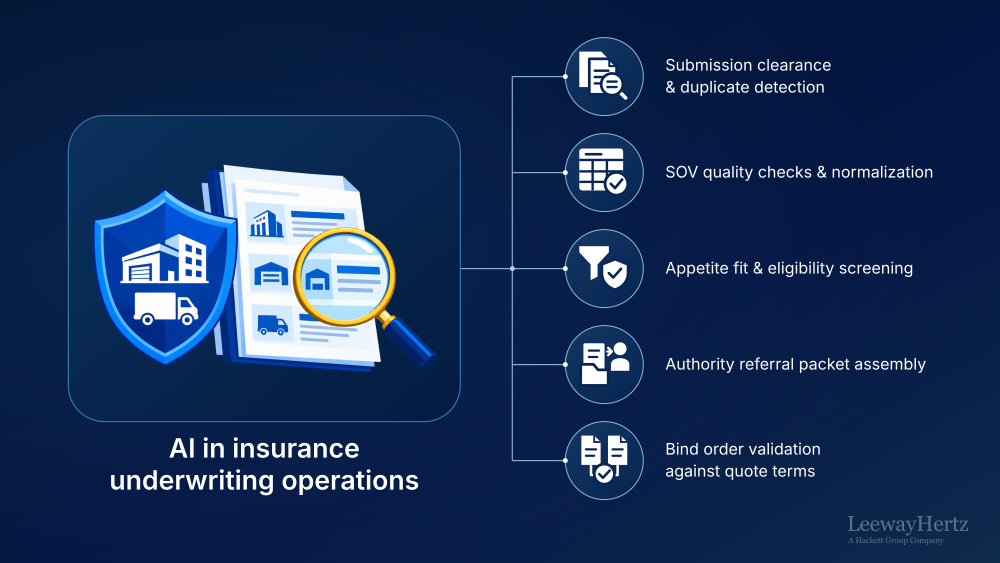
Insurance underwriting operations is the operating discipline that moves a submitted risk from broker intake to underwriting decision, quote, bind, issuance handoff, renewal and portfolio review. In commercial property and casualty (P&C) insurance, underwriting operations cover the full journey from submission intake to underwriting audit. This includes submission clearance, broker correspondence, risk data enrichment, appetite and eligibility screening, exposure analysis, rating input preparation, quote drafting, referral and authority management, binding support, renewal workups, and underwriting audit. It also intersects catastrophe (CAT) modeling, reinsurance referral, policy issuance and premium booking when those activities support an underwriting decision.
The scale and complexity of this operating environment make exclusively manual processes increasingly difficult to sustain. NAIC reported that the U.S. property and casualty industry reached about $1.1 trillion in direct premiums written in 2024, up 9.7 percent from the prior year [1]. The Insurance Information Institute and Milliman estimated that U.S. P&C net written premium increased 9.5 percent in 2024, while the industry net combined ratio improved to 99.5 [2]. These figures matter for underwriting operations because premium growth, catastrophe volatility, producer flow and tighter rate adequacy targets all increase the burden on underwriters and operations teams.
The existing workflow is fragmented. A broker may send ACORD forms by email, upload a SOV through a portal, share loss runs as PDFs and later provide inspection or MVR evidence through another channel. The underwriter then has to clear the account, check appetite, normalize the SOV, read loss history, obtain property appends, review CAT accumulation, prepare rating inputs, check authority, draft subjectivities and respond to the broker. Much of this work is evidence-intensive, but the evidence is distributed across workbench, document, rating, CAT, policy administration, producer management and portfolio systems.
AI is necessary because the underwriting operations problem is not only a document problem. It is a multi-system decision-preparation problem. AI in insurance underwriting applies advanced AI capabilities to streamline submission processing, enrich risk data, support underwriting decisions, and automate documentation across the underwriting lifecycle. It enables faster, more consistent underwriting while ensuring that risk selection, pricing, authority approvals, and policy issuance remain under the control of authorized underwriting professionals. Document intelligence can read ACORD forms, SOVs and loss runs. Anomaly detection can flag missing COPE data, unusual loss patterns and accumulation pressure. Retrieval-grounded answering can connect a risk attribute to an underwriting guideline or authority matrix. Predictive analytics can support rate adequacy and retention review. Natural-language generation can draft referral memos, quote subjectivities and renewal notes. None of this should replace underwriting judgment. An underwriting manager needs a referral packet, not an automated approval. A CUO needs portfolio evidence, not a black-box risk selection answer. An MGA program manager needs delegated authority evidence, not a system that silently changes appetite.
For this reason, AI implementation must start with the underwriting operating model. Broad labels such as AI for underwriting, AI for quoting or AI for renewals are too wide for design. A useful workflow names the starting artifact, the system of record, the underwriting rule or control, the AI capability, the accountable reviewer and the evidence retained after review. This article uses the insurance underwriting operating model to break work into functions, processes, sub-processes, artifacts, systems, regulatory and control considerations, accountable roles, AI-enabled opportunities and governed agentic workflows.
- How AI is transforming insurance underwriting operations
- Why AI use cases in insurance underwriting must be mapped at the sub-process level
- Insurance underwriting operating model and AI opportunity mapping across underwriting processes
- High-value AI use cases in insurance underwriting operations
- How agentic AI works in insurance underwriting workflows
- How to prioritize AI use cases in insurance underwriting operations
- Governance, risk, and responsible AI in insurance underwriting operations
- How ZBrain operationalizes AI use cases in insurance underwriting operations
- Future of AI in insurance underwriting operations
How AI is transforming insurance underwriting operations
Underwriting operations are shifting from sequential file handling to evidence-led decision preparation. Traditional underwriting still requires judgment, broker negotiation, pricing discipline and management review. The operational challenge is that the supporting evidence has become too large and too fragmented for manual intake teams and underwriters to assemble consistently at market speed. AI becomes useful when it is aimed at a defined underwriting question: what was submitted, what is missing, what rule applies, what risk evidence changed, who must decide and what proof remains in the file.
Consider a middle-market commercial property submission. A broker sends an email containing ACORD 125 and ACORD 140 applications, a statement of values (SOV) with hundreds of insured locations, and three years of loss runs in scanned PDF format. To evaluate the account, the underwriter must also gather property characteristics from third-party data providers, review CAT accumulation from the portfolio management system, compare the risk against current pricing targets, and confirm authority limits before deciding how to proceed. AI can extract and reconcile this information, identify gaps and exceptions, retrieve relevant guidelines, and assemble an underwriter-ready review packet. The underwriter still decides whether to pursue, decline, refer, or request additional information.
The strongest AI opportunities usually fall into five kinds of underwriting operations work:
- Document-heavy work: ACORD 125, 126, 130 and 140 applications, SOVs, loss runs, MVRs, inspection reports, CAT model outputs, quote letters, binders and endorsements that need classification, extraction and quality checks.
- Narrative-heavy work: large-loss narratives, risk summaries, referral memos, declination rationale, quote subjectivities and renewal strategy notes that AI can draft from approved source material while showing where evidence is thin.
- Exception-heavy work: blocked markets, duplicate submissions, missing information, appetite conflicts, restricted classes, authority breaches and subjectivity exceptions that need routing before senior reviewers engage.
- Knowledge-heavy work: underwriting guidelines, appetite guides, authority matrices, producer licensing rules, OFAC screening requirements, state DOI constraints and filed form and rate rules that require grounded retrieval rather than memory.
- Workflow-heavy work: submission intake, clearance, enrichment, appetite screening, risk appraisal, rating, referral, quoting, binding and renewal workup where AI can assemble the next work packet and reduce rework between teams.
The practical design rule is simple. Start with the underwriting sub-process, not with the AI tool. A useful workflow names the artifact, the system, the underwriting rule, the AI capability, the human checkpoint and the file evidence retained after review. This level of specificity turns an operational problem into an implementable and governable AI use case.
Why AI use cases in insurance underwriting must be mapped at the sub-process level
Broad underwriting categories may describe where work occurs, but they are too general for AI implementation. Submission intake can mean broker email ingestion, ACORD classification, duplicate clearance, blocked-market checks, completeness review or routing. Risk appraisal can mean COPE extraction, loss-run normalization, CAT accumulation review, large-loss narrative preparation or inspection review. Quoting can mean rating input preparation, technical pricing comparison, quote-letter drafting, subjectivity drafting or multi-option quote structuring. Each of these activities uses different source materials, systems, analytical methods, controls, and reviewers. Treating an entire function as a single AI use case obscures these differences and makes it difficult to define system requirements, establish review boundaries, or measure performance.
A better approach is to map AI use cases to the insurance underwriting operating model:
- Function: a governed operational domain such as submission intake and clearance, risk data enrichment, appetite screening, rating and quoting, renewal management or portfolio audit.
- Process: a workflow area inside the function, such as document setup, clearance, appetite matching, rating validation or file audit.
- Sub-process:a specific, bounded activity that can be designed, tested, measured, and governed, such as SOV quality validation, declination-rationale preparation, authority-limit checking, or bind-order validation.
- AI-enabled opportunity: a defined AI capability applied to particular artifacts and business rules to improve how the sub-process is performed, reviewed, explained, or controlled.
Sub-process mapping keeps AI implementation grounded in the way underwriting actually operates. It identifies the artifacts required at each step, the evidence each reviewer needs, the point at which authority changes hands, the data needed for specialized analyses such as CAT modeling, and the governance evidence required for portfolio oversight. It also limits risk. A workflow that drafts a missing-information request is not governed the same way as one that recommends a decline or prepares a bind-validation packet.
For example, submission intake is not one use case. It involves several distinct activities, including broker email ingestion, ACORD classification, SOV validation, duplicate submission clearance, and drafting requests for missing information. Each activity relies on different artifacts, systems, reviewers, and approval requirements. The same pattern applies to risk appraisal. Extracting COPE data, normalizing loss runs, assessing CAT accumulation, preparing large-loss narratives, and evaluating hazards all require different evidence, analytical methods, and review boundaries. Quoting follows a similar structure. Preparing rating inputs, comparing technical and street pricing, drafting quote letters and subjectivities, and structuring multiple quote options each represent separate sub-processes with their own controls and governance requirements.
This article focuses specifically on insurance underwriting operations and the processes, decisions, controls, and governance required to evaluate, price, document, and manage underwriting risk.
Build governed AI workflows for insurance underwriting operations
Connect submission intake, risk enrichment, quoting, binding, renewal and underwriting audit while preserving human accountability for underwriting decisions.
Insurance underwriting operating model and AI opportunity mapping across underwriting processes
The operating model below follows the commercial P&C underwriting lifecycle from intake to portfolio governance. Each function names the teams, artifacts, systems involved, regulatory and control considerations, accountable roles, AI-enabled opportunities, human ownership boundaries, sub-processs and one named agentic workflow.
Function 1. Submission intake and clearance
Turns broker submissions into cleared, complete and routed underwriting files.
Submission intake and clearance is the front door of underwriting operations. It converts broker emails, portal submissions, APIs and attachments into structured submission records. It also checks whether the account already exists, whether markets are blocked and whether the package has the evidence needed for review. This function feeds risk enrichment, appetite screening and underwriter assignment.
Teams involved: Underwriting assistants, submission intake teams, commercial lines underwriters, broker operations, distribution management, underwriting operations and IT intake-platform owners run this function together.
Key artifacts: Broker submission email and attachments, ACORD 125, ACORD 126, ACORD 130, ACORD 140, SOV, loss runs, MVRs, prior quote letters, declination letters and intake checklists.
Systems involved: Email intake system, broker portal, API gateway, underwriting workbench, submission registry, document management system, CRM, producer management platform and workflow orchestration tool.
Regulatory and control considerations: State unfair trade practices acts, producer licensing rules, internal market blocking rules, internal submission-clearance policy and data-retention controls.
Accountable roles: Underwriting assistant, commercial lines underwriter, underwriting operations director, underwriting manager and broker or producer.
What AI helps with: Document classification identifies ACORD forms, SOVs, loss runs, and other broker attachments, while document intelligence extracts and structures relevant information for the submission record. Entity resolution compares named insureds, locations, FEINs, broker codes and prior account records to detect duplicates and market conflicts. Classification triages submissions by line, class, geography, segment and team. Natural-language generation drafts missing-information requests from the intake checklist and the submitted artifacts.
What humans continue to own: Underwriting assistants confirm whether the file is ready for underwriting. Underwriters decide whether to pursue, decline or request more information. Underwriting managers approve handling for market conflicts and sensitive broker issues. AI classifies, matches, drafts and prepares but does not decide, approve, or attest.
| Process | Sub-process | Key AI-enabled opportunities |
|---|---|---|
| Submission ingestion | Broker submission ingestion from email, portal and API |
|
| Document setup | Document classification and indexing |
|
| Submission intake and clearance | Duplicate submission and clearance matching |
|
| Blocked-market and conflict checks |
|
|
| Submission completeness validation | Completeness check against required underwriting artifacts |
|
| Broker follow-up | Missing-information request drafting |
|
| Submission routing and assignment | Intake triage to underwriting team, region, segment or product |
|
Highest-value opportunities:
- Document classification and indexing: Creates a structured submission file, allowing downstream reviewers to locate and verify underwriting artifacts quickly.
- Duplicate submission and clearance matching: Identifies existing submissions and market conflicts before underwriting effort begins.
- Submission completeness validation: Detects missing ACORD forms, SOV details, loss runs, and other required artifacts early, reducing delays during risk appraisal and quoting.
Example agentic workflow: Submission clearance and file readiness review
- The workflow starts when a broker email arrives with an ACORD submission package, a Statement of Values (SOV), and supporting loss-run documentation for a middle-market commercial property risk.
- The agent extracts the attachment inventory, classifies the ACORD forms, normalizes the SOV tabs and checks the package against the intake checklist.
- It compares named insured, FEIN, locations and broker code with the submission registry and blocked-market list.
- It prepares a file-readiness packet with duplicate flags, missing items, routing recommendation and a draft broker request.
- Human checkpoint: the underwriting assistant confirms file readiness, and the commercial lines underwriter decides whether to pursue, decline or request more information.
- The decision logs to the submission record, and any missing-information request issues through the approved broker correspondence process.
Function 2. Broker and distribution management
Turns producer interactions into governed correspondence, licensing evidence and distribution quality insight.
Broker and distribution management spans the underwriting lifecycle, supporting broker communication, producer appointment and licensing verification, and submission-quality monitoring. It gives underwriting leaders insight into which producers consistently submit complete, actionable risks aligned with the carrier’s appetite, informing intake governance, broker strategy, and delegated authority oversight.
Teams involved: Distribution management, broker relations, underwriting operations, underwriting assistants, commercial lines underwriters, producer licensing teams and MGA program managers participate in this function.
Key artifacts: Broker correspondence, broker submission email, producer appointment records, licensing records, submission quality scorecards, missing information logs and distribution feedback reports.
Systems involved: CRM, producer management platform, licensing database, broker portal, email system, underwriting workbench, submission registry and BI dashboard.
Regulatory and control considerations: Producer licensing rules, state unfair trade practices acts, internal producer appointment policy, delegated authority standards and record-retention controls.
Accountable roles: Broker or producer, underwriting operations director, underwriting assistant, commercial lines underwriter, MGA program manager and underwriting manager.
What AI helps with: Natural-language generation drafts broker responses from approved file context and communication templates. Classification labels producer submissions by completeness, appetite fit, rework burden, and timeliness. Rules-based validation verifies the producer’s appointment and licensing status against authoritative records for the relevant jurisdiction and line of business before underwriting proceeds. Predictive analytics highlights producer quality patterns that affect intake capacity and quote conversion.
What humans continue to own: Distribution leaders decide producer strategy, appointment actions and escalation. Underwriters control account-level broker communication and underwriting posture. Licensing teams confirm producer eligibility. AI drafts, classifies and scores but does not decide, approve, or attest.
| Process | Sub-process | Key AI-enabled opportunities |
|---|---|---|
| Broker communication management | Broker correspondence handling |
|
| Producer performance management | Submission quality scorecarding by producer |
|
| Producer eligibility checking | Producer appointment verification |
|
| Producer licensing verification |
|
|
| Broker performance monitoring | Broker responsiveness and missing-information pattern review |
|
| Distribution feedback | Distribution performance feedback to underwriting leadership |
|
Highest-value opportunities:
- Producer licensing verification: Confirms that submissions originate from appropriately appointed and licensed producers before underwriting begins.
- Submission quality scorecarding: Highlights recurring documentation gaps and data quality issues, helping reduce avoidable intake rework.
- Broker response monitoring: Identifies communication delays that can slow quote turnaround and reduce underwriter capacity.
Example agentic workflow: Producer quality and licensing readiness review
- The workflow starts when a new broker submission enters the intake queue.
- The agent checks producer appointment status, license jurisdiction and line authority against the submitted risk.
- It compares the submission package with producer quality history, missing-information patterns and prior quote outcomes.
- It prepares a broker-readiness note for underwriting and distribution management.
- Human checkpoint: the underwriting operations director confirms whether any producer issue must be escalated, and the underwriter controls account-level communication.
- The verified licensing evidence and producer-quality indicators remain in the account file and distribution dashboard.
Function 3. Risk data enrichment
Turns raw submission evidence into normalized exposure, loss and third-party risk data.
Risk data enrichment prepares the evidence that underwriters use to understand the account. It normalizes loss runs, validates SOV fields, appends property characteristics, retrieves MVRs or financials where applicable and prepares CAT model inputs. It also supports inspection ordering and the review of inspection findings, providing a reliable data foundation for appetite screening, risk appraisal, pricing, and referral decisions.
Teams involved: Underwriting assistants, commercial lines underwriters, data enrichment teams, CAT modelers, inspection vendors, premium auditors, actuarial pricing counterparts, and underwriting operations teams run this function.
Key artifacts: SOV, loss runs, MVRs, inspection report, property data append, financial data append, CAT model input file, and underwriting data quality report.
Systems involved: Underwriting workbench, document management system, data enrichment services, MVR provider system, property data provider system, inspection platform, CAT modeling platform, data lake and workflow queue.
Regulatory and control considerations: State DOI requirements where rating variables are regulated, privacy and data-use controls, OFAC where applicable, internal data-quality standards and underwriting guidelines.
Accountable roles: Commercial lines underwriter, underwriting assistant, CAT modeler, premium auditor, actuary and underwriting operations director.
What AI helps with: Document intelligence extracts loss-run fields, SOV location data, driver data and inspection findings. Anomaly detection flags missing construction year, invalid occupancy, unusual loss development and inconsistent exposure values. Multi-source aggregation appends property characteristics, financials, MVRs and CAT inputs. Classification separates clean data, data gaps and high-risk enrichment conflicts for underwriter review.
What humans continue to own: Underwriters decide whether enriched data is sufficient for risk review. CAT modelers confirm model inputs and output interpretation. Premium auditors and inspection reviewers confirm evidence quality where their work is implicated. AI extracts, validates and prepares but does not decide, approve, or attest.
| Process | Sub-process | Key AI-enabled opportunities |
|---|---|---|
| Loss history analysis | Loss-run extraction and normalization |
|
| Exposure data analysis | SOV validation and quality checks |
|
| Third-party enrichment | Property characteristic data enrichment |
|
| MVR and driver data enrichment |
|
|
| Financial data enrichment |
|
|
| CAT preparation | CAT model input preparation |
|
| Inspection management | Inspection ordering and review |
|
Highest-value opportunities:
- SOV validation and quality checks: Ensures location-level exposure data is complete and reliable before risk appraisal and pricing begin.
- Loss-run extraction and normalization: Converts historical loss information into a consistent format for meaningful loss experience analysis.
- CAT model input preparation: Improves the quality of catastrophe modeling by validating the exposure data used for accumulation analysis.
Example agentic workflow: SOV and loss data enrichment review
- The workflow starts when a submission file includes a Statement of Values (SOV) and supporting loss-run documentation.
- The agent extracts SOV rows, normalizes location fields and flags missing construction year, occupancy and TIV issues.
- It extracts loss-run data, normalizes claim descriptions and identifies open and large losses.
- It appends property characteristics and prepares CAT model input fields for the top exposed locations.
- Human checkpoint: the underwriter reviews the enriched data, and the CAT modeler confirms model-ready inputs before any CAT output is relied on.
- The enrichment packet becomes part of the underwriting file and supports appetite screening, risk appraisal and audit review.
Function 4. Appetite and eligibility screening
Turns enriched submission evidence into appetite, eligibility and compliance-screening decisions for review.
Appetite and eligibility screening determines whether the carrier or MGA should consider the risk before deep underwriting effort continues. It compares class, geography, occupancy, loss history, limits, exposure values and sanctions indicators against underwriting guidelines and appetite guides. It also prepares documented rationale when the account falls outside appetite. This function feeds referral, declination, quoting and portfolio steering.
Teams involved: Commercial lines underwriters, underwriting assistants, underwriting managers, compliance teams, sanctions-screening teams, MGA program managers and underwriting operations teams participate in this function.
Key artifacts: Underwriting guidelines, appetite guide, ACORD forms, SOV, loss runs, sanctions screening record, declination letter and appetite exception memo.
Systems involved: Underwriting workbench, guideline repository, sanctions screening system, submission registry, document management system, portfolio analytics platform and workflow tool.
Regulatory and control considerations: State unfair trade practices acts, OFAC screening, state DOI rules, internal underwriting authority matrix, delegated authority standards and market conduct documentation rules.
Accountable roles: Commercial lines underwriter, senior underwriter, underwriting manager, MGA program manager, chief underwriting officer and broker or producer.
What AI helps with: Rules-based evaluation compares submission data with applicable underwriting guidelines, appetite criteria, and eligibility rules to identify conflicts or referral triggers. Classification labels risks as in appetite, out of appetite, referral required, restricted class or data insufficient. Anomaly detection flags inconsistent class, geography or occupancy values that may change eligibility. Natural-language generation drafts declination rationale or appetite exception summaries for human review.
What humans continue to own: Underwriters decide whether to pursue, decline or request more information. Underwriting managers approve appetite exceptions and referral handling. Compliance teams confirm sanctions and market-conduct documentation requirements. AI screens, scores, retrieves and drafts but does not decide, approve, or attest.
| Process | Sub-process | Key AI-enabled opportunities |
|---|---|---|
| Appetite assessment | Submission matching against underwriting appetite |
|
| Risk eligibility screening | Class-code and restricted-class screening |
|
| Eligibility checking | Geography and hazard eligibility review |
|
| Compliance screening | Sanctions and OFAC screening |
|
| Declination management | Declination rationale preparation |
|
| Exception management | Appetite exception routing |
|
Highest-value opportunities:
- Appetite matching: Quickly identifies risks that align with underwriting guidelines, allowing underwriters to focus on accounts that merit detailed evaluation.
- Sanctions and OFAC screening: Identifies prohibited entities and transactions before the submission progresses through underwriting.
- Declination rationale preparation: Produces consistent, well-supported documentation that strengthens market conduct compliance and audit readiness.
Example agentic workflow: Appetite fit and declination rationale review
- The workflow starts when enriched submission data is ready for appetite screening.
- The agent compares class, geography, limits, SOV hazards and loss history with the appetite guide and underwriting guidelines.
- It checks sanctions-screening output and identifies any restricted class or geography issue.
- It prepares an appetite fit summary, a referral memo for guideline tensions and a draft declination rationale if the risk appears out of appetite.
- Human checkpoint: the commercial lines underwriter decides whether to pursue, decline or request information, and the underwriting manager approves any appetite exception.
- The final rationale, referral decision or request for information logs to the underwriting file.
Function 5. Exposure analysis and risk appraisal
Turns exposure schedules, loss history and hazard data into underwriter-ready risk appraisal.
Exposure analysis and risk appraisal provide the analytical foundation for underwriting decisions. This function evaluates SOV schedules, COPE data, loss history, causes of significant losses, hazard indicators, exposure concentrations, and catastrophe-modeling results. It brings this evidence together to give underwriters a structured view of risk quality, volatility, concentration, and key areas requiring further review, without replacing underwriting judgment.
Teams involved: Commercial lines underwriters, senior underwriters, CAT modelers, actuarial pricing counterparts, loss-control or inspection reviewers, premium auditors and underwriting managers contribute to this function.
Key artifacts: SOV, schedule of locations data, COPE fields, loss runs, large-loss narrative, inspection report, CAT model output, hazard assessment results and risk summary.
Systems involved: Underwriting workbench, CAT modeling platform, geospatial analytics tools, loss-run repository, inspection platform, document management system, portfolio analytics system and rating engine.
Regulatory and control considerations: State DOI requirements where risk factors affect filed rating, internal underwriting guidelines, ASOPs at the pricing boundary, delegated authority rules and audit evidence standards.
Accountable roles: Commercial lines underwriter, senior underwriter, CAT modeler, actuary, premium auditor, underwriting manager and chief underwriting officer.
What AI helps with: Anomaly detection identifies unusual TIV concentration, loss severity, hazard patterns and schedule inconsistencies. Document intelligence extracts COPE, inspection and loss-run details into structured fields. Statistical analysis identifies loss trends, classification groups risks into defined segments, and actuarial models support rate adequacy review. Natural-language generation drafts risk summaries and large-loss narratives from approved source artifacts.
What humans continue to own: Underwriters own risk selection, risk quality interpretation and underwriting judgment. CAT modelers confirm CAT output use. Actuaries own pricing methods and future cost assumptions at the pricing boundary. AI analyzes, summarizes and prepares but does not decide, approve, or attest.
| Process | Sub-process | Key AI-enabled opportunities |
|---|---|---|
| Statement of Values (SOV) analysis | SOV and schedule analysis |
|
| Property risk assessment | COPE data review for property risks |
|
| Loss analysis | Loss history analysis |
|
| Loss experience assessment | Large-loss narrative preparation |
|
| Hazard and accumulation analysis | Catastrophe and concentration risk analysis |
|
| CAT coordination | CAT modeling coordination |
|
| Risk evaluation | Risk summary preparation for underwriter review |
|
Highest-value opportunities:
- SOV analysis and exposure assessment: Builds a reliable view of location-level exposures before risk appraisal and pricing begin.
- Large-loss assessment: Highlights the circumstances and impact of significant historical losses, giving underwriters the context needed for risk evaluation.
- Hazard and accumulation assessment: Identifies concentration risks that may influence appetite, referral requirements, or portfolio exposure.
Example agentic workflow: Underwriter-ready risk appraisal packet preparation
- The workflow starts when SOV, loss runs, property appends and inspection records are available for a property account.
- The agent analyzes SOV concentration, COPE fields, loss history and hazard indicators.
- It coordinates CAT model input preparation and summarizes model output with PML drivers and accumulation flags.
- It drafts a risk appraisal packet with large-loss narrative, data-quality flags, guideline tensions and recommended review questions.
- Human checkpoint: the underwriter evaluates risk quality and the CAT modeler confirms CAT output interpretation before pricing or referral proceeds.
- The reviewed risk appraisal packet supports quote preparation, referral and audit evidence.
Accelerate AI Solutions Development
Build fully functional solutions from your high-value use cases, based on specific operational needs and enterprise context.
Function 6. Rating, pricing and quoting
Turns risk appraisal into rating inputs, pricing evidence, quote options and subjectivities.
Rating, pricing and quoting connects underwriting judgment with executable market terms. It prepares rating-engine inputs, validates rating worksheets, compares technical price indications with market or street pricing and drafts quote letters and subjectivities. It also supports multi-option quote structures.
Teams involved: Commercial lines underwriters, senior underwriters, underwriting managers, pricing actuarial team, rating analysts, underwriting assistants and broker-facing teams work together in this function.
Key artifacts: Rating worksheet, underwriting guidelines, appetite guide, risk summary, CAT model output, quote letter with subjectivities, pricing benchmark, authority matrix and broker correspondence.
Systems involved: Rating engine, underwriting workbench, pricing model repository, document management system, policy administration system, broker portal and workflow tool.
Regulatory and control considerations: State DOI rate and form filing requirements, ASOPs at the pricing boundary, internal rating manuals, underwriting authority matrix, unfair trade practices acts and filed-form controls.
Accountable roles: Commercial lines underwriter, senior underwriter, underwriting manager, actuary, chief underwriting officer and broker or producer.
What AI helps with: Document intelligence prepares rating inputs from ACORD forms, SOVs, loss runs and risk summaries. Simulation checks rating scenarios, deductibles, limits, credits, debits and subjectivity options. Predictive analytics compares technical price, rate adequacy targets, loss experience and portfolio needs. Natural-language generation drafts quote letters and subjectivities from approved templates and underwriting evidence.
What humans continue to own: Underwriters own pricing judgment, quote release and market strategy. Actuaries own technical pricing assumptions and ASOP-bound methods. Underwriting managers approve authority exceptions and pricing deviations. AI prepares, compares and drafts but does not decide, approve, or attest.
| Process | Sub-process | Key AI-enabled opportunities |
|---|---|---|
| Rating data preparation | Rating engine input preparation |
|
| Rating validation | Rating worksheet validation |
|
| Pricing analysis | Technical versus street pricing comparison |
|
| Pricing governance | Rate adequacy and target benchmark review |
|
| Quote drafting | Quote-letter drafting |
|
| Subjectivity management | Subjectivity drafting |
|
| Quote structuring | Multi-option quote structuring |
|
Highest-value opportunities:
- Rating input preparation: Ensures exposure, coverage, and underwriting data are complete and accurate before they are submitted to the rating engine.
- Technical versus street pricing analysis: Gives underwriters a structured comparison between technical indications and market pricing to support informed pricing decisions.
- Subjectivity management: Produces clear, consistent underwriting conditions that can be tracked through binding and policy issuance.
Example agentic workflow: Quote and subjectivity preparation review
- The workflow starts when the underwriter marks a cleared, appetite-fit submission as ready for quote preparation.
- The agent prepares rating inputs from ACORD forms, SOV, loss runs, CAT output and risk summary.
- It compares technical price indication, rate adequacy target, expiring premium and market context.
- It drafts quote options, quote letter language and subjectivities from approved templates.
- Human checkpoint: the underwriter confirms pricing, terms, quote wording and subjectivities, and the underwriting manager approves any authority exception.
- The agent issues the approved quote package through the broker communication workflow and creates subjectivity-tracking tasks for follow-up and closure.
Function 7. Referral and authority management
Turns authority triggers into referral packets, peer review and documented approval evidence.
Referral and authority management ensures that underwriting decisions remain within established authority limits. It evaluates whether factors such as risk characteristics, pricing, coverage limits, class, geography, loss history, or proposed terms require escalation. When a referral is triggered, the function assembles the supporting evidence and routes the case to the appropriate underwriting manager, peer reviewer, or facultative reinsurance team. The resulting decision and approval record support quote release, binding, and audit.
Teams involved: Commercial lines underwriters, senior underwriters, underwriting managers, CUO staff, reinsurance analysts, peer reviewers, pricing actuarial team and MGA program managers run this function.
Key artifacts: Authority matrix, referral memo, risk summary, rating worksheet, CAT model output, quote letter, reinsurance referral packet and approval log.
Systems involved: Underwriting workbench, authority workflow tool, referral queue, reinsurance workflow platform, document management system, portfolio analytics platform and audit repository.
Regulatory and control considerations: Internal underwriting authority matrix, delegated authority and MGA oversight standards, treaty and facultative reinsurance terms, Lloyd’s delegated authority rules where applicable and audit-control requirements.
Accountable roles: Commercial lines underwriter, senior underwriter, underwriting manager, chief underwriting officer, reinsurance analyst, MGA program manager and actuary.
What AI helps with:Rules-based evaluation compares account details with underwriting authority limits and referral criteria to identify required escalations. Natural-language generation drafts referral memos from risk summaries, pricing analysis, guideline tensions and CAT results. Retrieval-grounded answering retrieves authority matrix provisions and reinsurance terms. Multi-source aggregation assembles peer-reviewed evidence and prior similar referrals.
What humans continue to own: Underwriting managers and CUO delegates approve referrals, exceptions and authority deviations. Reinsurance analysts coordinate facultative referral positions with authorized reviewers. Peer reviewers provide judgment and challenge. AI checks, assembles and drafts but does not decide, approve, or attest.
| Process | Sub-process | Key AI-enabled opportunities |
|---|---|---|
| Authority check | Authority-level check |
|
| Referral preparation | Referral packet assembly |
|
| Manager review | Referral routing |
|
| Facultative reinsurance referral management | Facultative reinsurance referral coordination |
|
| Peer review management | Peer reviewer assignment |
|
| Decision record | Referral decision logging |
|
Highest-value opportunities:
- Authority-level check: Confirms that the submission falls within the underwriter’s delegated authority before it advances to quoting or binding.
- Referral packet preparation: Brings together the underwriting evidence, guideline references, and supporting analysis needed for efficient managerial review.
- Referral decision logging: Creates a complete record of approvals, comments, and supporting evidence for audit, governance, and delegated authority oversight.
Example agentic workflow: Authority referral packet review
- The workflow starts when pricing, TIV, CAT exposure or guideline tension exceeds the underwriter authority.
- The agent retrieves the authority matrix, risk summary, rating worksheet, CAT output, quote proposal and similar prior referrals.
- It assembles a referral memo with decision requested, authority trigger, exposure evidence and pricing rationale.
- It routes the packet to the correct authority level and flags any facultative reinsurance consideration.
- Human checkpoint: the underwriting manager, CUO delegate or authorized referral reviewer approves, declines or requests changes.
- The referral decision logs to the submission file and becomes required evidence before quote release or bind.
Function 8. Binding and policy issuance
Turns accepted quote terms into validated bind order, binder, forms, endorsements and issuance handoff.
Binding and policy issuance is where underwriting operations moves from quote intent to coverage documentation. It validates the bind order against quoted terms, tracks subjectivities, prepares binder content and assembles policy forms and endorsements.
Teams involved: Underwriting assistants, commercial lines underwriters, policy issuance teams, underwriting operations, billing handoff teams, premium booking teams, document specialists and brokers support this function.
Key artifacts: Bind order, quote letter with subjectivities, binder, policy forms and endorsements, rating worksheet, premium booking handoff, billing handoff, issuance checklist and subjectivity tracker.
Systems involved: Underwriting workbench, policy administration system (PAS), document management system, rating engine, billing system, document generation system, workflow management platform.
Regulatory and control considerations: State DOI rate and form filing requirements, unfair trade practices acts, filed-form rules, OFAC screening where applicable, internal issuance policy and underwriting authority matrix.
Accountable roles: Underwriting assistant, commercial lines underwriter, senior underwriter, underwriting manager, broker or producer and underwriting operations director.
What AI helps with: Document intelligence extracts bind order terms, quote details, rating information, and subjectivity records from underwriting documents. Retrieval-grounded generation (RAG) retrieves the applicable filed forms, endorsements, and underwriting guidelines to verify that bind order terms align with approved underwriting requirements and identify potential inconsistencies. Classification categorizes subjectivities as pre-bind, post-bind, waived, expired, or unresolved, while natural language generation drafts binder documentation and policy issuance handoff notes from approved underwriting terms.
What humans continue to own: Underwriters authorize bind, subjectivity closure or waiver and final terms. Issuance teams prepare policy documents under approved instructions. Operations leaders monitor issuance quality. AI validates, checks and drafts but does not decide, approve, or attest.
| Process | Sub-process | Key AI-enabled opportunities |
|---|---|---|
| Bind validation | Bind order validation against quote terms |
|
| Subjectivity management | Subjectivity tracking to closure |
|
| Binder issuance | Binder preparation |
|
| Policy documentation management | Policy form and endorsement assembly |
|
| Premium handoff | Premium booking handoff |
|
| Premium booking and billing management | Billing handoff |
|
| Policy issuance quality review | Issuance quality check |
|
Highest-value opportunities:
- Bind order validation: Verifies that coverage, limits, pricing, and terms match the approved quote before the policy is bound.
- Subjectivity management: Tracks underwriting conditions through fulfillment and closure, ensuring the policy is issued with all required requirements addressed.
- Policy form and endorsement assembly: Selects and assembles the appropriate filed forms and endorsements to support accurate and compliant policy issuance.
Example agentic workflow: Bind order and issuance validation review
- The workflow starts when a broker sends a bind order referencing an accepted quote.
- The agent compares bind order terms with the quote letter, rating worksheet, subjectivities and approved referral decisions.
- It checks form and endorsement requirements against state, coverage and issued terms.
- It prepares a bind validation packet with mismatches, open subjectivities, binder draft and issuance handoff notes.
- Human checkpoint: the underwriter authorizes bind and confirms subjectivity treatment before any binder or policy issuance proceeds.
- The approved binder, forms package, premium booking handoff and billing handoff log to the policy file.
Function 9. Renewal management
Turns expiring account evidence into renewal workup, strategy, rate review and retention decisions.
Renewal management re-underwrites the account before expiration. It compares expiring policy terms, updated exposure, loss experience, rate adequacy, guideline changes and broker strategy. The goal is to decide whether to renew, remarket, adjust terms, change price or refer. This function feeds portfolio management and broker planning.
Teams involved: Commercial lines underwriters, senior underwriters, underwriting assistants, pricing acturial counterparts, broker relations, underwriting managers and portfolio management teams participate in renewals.
Key artifacts: Renewal comparison workup, expiring policy, updated SOV, loss runs, rating worksheet, renewal strategy note, quote letter, declination letter and broker correspondence.
Systems involved: Underwriting workbench, policy administration system, rating engine, document management system, portfolio analytics platform, CRM, broker portal and renewal diary.
Regulatory and control considerations: State DOI rate and form rules, unfair trade practices acts, ASOPs at the pricing boundary, internal underwriting guidelines, authority matrix and renewal notice requirements where applicable.
Accountable roles: Commercial lines underwriter, senior underwriter, underwriting manager, actuary, chief underwriting officer and broker or producer.
What AI helps with: Multi-source aggregation compares expiring policy, updated exposure, loss experience and guideline changes. Predictive analytics supports retention risk, rate adequacy and loss trend review. Document intelligence extracts renewal information, while multi-source aggregation prepares renewal workups and exposure-change summaries. Natural-language generation drafts pre-renewal strategy notes, broker questions and renewal quote commentary.
What humans continue to own: Underwriters own renewal strategy, retention posture and terms. Senior underwriters and managers approve significant changes, nonrenewal considerations and authority exceptions. Actuaries own pricing assumptions and target interpretation. AI compares, flags and drafts but does not decide, approve, or attest.
| Process | Sub-process | Key AI-enabled opportunities |
|---|---|---|
| Renewal preparation | Renewal workup preparation |
|
| Loss experience assessment | Loss-run analysis |
|
| Exposure change assessment | Exposure-change comparison |
|
| Rate review | Rate adequacy review |
|
| Renewal strategy development | Pre-renewal strategy preparation |
|
| Retention and remarketing evaluation | Retention decision support |
|
| Remarketing | Remarketing decision support |
|
Highest-value opportunities:
- Renewal preparation: Brings together loss experience, exposure changes, pricing history, and underwriting information to create a complete foundation for renewal evaluation.
- Rate adequacy assessment: Compares renewal pricing with profitability targets and portfolio objectives to support sustainable underwriting performance.
- Exposure change assessment: Identifies changes in property values, operations, occupancy, or other risk characteristics that may influence pricing, coverage, or underwriting appetite.
Example agentic workflow: Renewal workup and strategy review
- The workflow starts when an account enters the renewal diary.
- The agent gathers expiring policy terms, updated SOV, loss runs, endorsement history, rate target and guideline updates.
- It compares exposure and loss changes, identifies rate adequacy concerns and flags referral triggers.
- It drafts a renewal workup and pre-renewal strategy note with broker questions and subjectivity considerations.
- Human checkpoint: the underwriter or senior underwriter confirms renewal strategy, retention posture, pricing direction and any referral.
- The confirmed renewal workup logs to the account record and feeds quote preparation and portfolio monitoring.
Function 10. Portfolio monitoring and underwriting audit
Turns underwriting activity into portfolio insight, quality review, guideline updates and delegated authority oversight.
Portfolio monitoring and underwriting audit connect account-level underwriting decisions with portfolio-level oversight. This function evaluates portfolio mix, rate movement, exposure accumulation, file quality, adherence to underwriting guidelines, and delegated authority performance. It also supports MGA and specialty business oversight, giving the chief underwriting officer (CUO) and underwriting leaders the evidence needed to guide portfolio strategy, address control gaps, and maintain audit readiness.
Teams involved: CUO staff, underwriting operations, portfolio management, underwriting audit, senior underwriters, MGA program managers, delegated authority teams, pricing actuarial counterparts, CAT modelers and compliance teams run this function.
Key artifacts: Portfolio dashboards, rate monitoring report, accumulation report, underwriting audit checklist, guideline update memo, delegated authority review file, bordereau where relevant and quality review report.
Systems involved: Portfolio analytics platform, underwriting workbench, audit or GRC repository, CAT modeling platform, policy administration system, data warehouse, MGA bordereau system and document management system.
Regulatory and control considerations: State DOI rules where underwriting actions affect filed rates or forms, NAIC Model Bulletin on insurer AI use, delegated authority and MGA oversight standards, Lloyd’s or treaty terms where applicable, internal underwriting guidelines and audit policy.
Accountable roles: Chief underwriting officer, underwriting operations director, underwriting manager, MGA program manager, CAT modeler, actuary, premium auditor and senior underwriter.
What AI helps with: Portfolio analytics monitors changes in business mix, rate movement, and exposure accumulation, while anomaly detection flags material deviations and unusual file-quality patterns for review. Classification labels audit findings by guideline, authority, pricing, subjectivity, documentation or data-quality issue. Retrieval-grounded answering maps file evidence to underwriting guidelines and audit checklists. Natural-language generation drafts portfolio commentary, guideline update summaries and delegated authority review packets.
What humans continue to own: CUO staff and underwriting leaders own portfolio strategy, guideline changes and risk appetite. Audit leaders and managers own quality conclusions and remediation. MGA program managers own delegated authority oversight. AI monitors, classifies and drafts but does not decide, approve, or attest.
| Process | Sub-process | Key AI-enabled opportunities |
|---|---|---|
| Portfolio performance monitoring | Portfolio mix monitoring |
|
| Rate monitoring | Rate monitoring against plan |
|
| Hazard and accumulation assessment | Accumulation monitoring |
|
| File audit | Underwriting file audit |
|
| Underwriting quality review | Underwriting file quality assessment |
|
| Underwriting guideline management | Guideline update dissemination |
|
| Delegated authority oversight | MGA and delegated authority oversight |
|
Highest-value opportunities:
- Underwriting file audit: Reviews underwriting files to confirm that decisions are supported by complete documentation, appropriate approvals, and established underwriting guidelines.
- Rate monitoring against plan: Compares achieved rates with portfolio targets to identify emerging pricing trends and support portfolio performance.
- MGA and delegated authority oversight: Monitors delegated underwriting activities to verify compliance with authority limits, underwriting guidelines, and governance requirements.
Example agentic workflow: Underwriting portfolio and file quality review
- The workflow starts when monthly portfolio monitoring and underwriting audit samples are available.
- The agent aggregates written premium, class mix, rate change, SOV accumulation, referral logs, quote records and bind records.
- It checks sampled files against the underwriting audit checklist and authority matrix.
- It prepares portfolio commentary, file-quality findings, delegated authority exceptions and guideline update impact notes.
- Human checkpoint: CUO staff and underwriting audit leaders confirm findings, remediation and any guideline change.
- Approved findings log to the audit repository, and remediation tasks route through underwriting governance.
Accelerate AI Solutions Development
Build fully functional solutions from your high-value use cases, based on specific operational needs and enterprise context.
High-value AI use cases in insurance underwriting operations
High-value AI use cases in underwriting connect frequent work, material underwriting impact and clear human ownership. The best first candidates often sit where underwriting teams repeatedly assemble the same evidence, check the same rules, draft the same packets or review the same exceptions. Value comes from faster triage, better file quality, improved underwriter capacity, stronger rate adequacy evidence, fewer authority breaches and better portfolio steering.
| Use case | Function | How AI creates high-value impact |
|---|---|---|
| Submission clearance and duplicate detection | Submission intake and clearance | Entity resolution reduces duplicate underwriting effort and prevents market conflicts by matching insured names, FEINs, broker codes, and locations across submissions. |
| ACORD and attachment classification | Submission intake and clearance | Document intelligence accelerates submission readiness by automatically classifying and indexing ACORD forms, SOVs, loss runs, MVRs, and supporting documents. |
| Producer quality scorecarding | Broker and distribution management | Classification categorizes producer submissions by issue type, while descriptive analytics identifies producers with recurring documentation gaps, rework, and underwriting delays. |
| SOV quality check and normalization | Risk data enrichment | Document intelligence extracts and structures location-level exposure data from SOVs, and anomaly detection flags unusual or inconsistent values that may affect underwriting or CAT modeling. |
| Loss-run extraction and large-loss narrative preparation | Risk data enrichment | Document intelligence extracts and normalizes loss information from loss runs and supporting claims documents. Natural language generation drafts consistent summaries of significant historical losses for underwriter review. |
| Appetite fit and eligibility screening | Appetite and eligibility screening | Retrieval-grounded generation (RAG) speeds underwriting triage by evaluating submissions against underwriting guidelines and clearly highlighting appetite conflicts. |
| Restricted-class and sanctions screening | Appetite and eligibility screening | Classification identifies restricted classes and categorizes submissions requiring additional compliance review. Retrieval-grounded generation (RAG) retrieves applicable sanctions requirements, underwriting guidelines, and supporting evidence to explain potential matches and reviewer actions. |
| COPE and hazard data enrichment | Exposure analysis and risk appraisal | Document intelligence and multi-source aggregation create a more complete risk profile by consolidating COPE data, inspection findings, and third-party property information. |
| CAT accumulation review support | Exposure analysis and risk appraisal | Anomaly detection improves catastrophe risk visibility by identifying exposure concentrations and accumulation thresholds requiring additional review. |
| Rating input preparation | Rating, pricing and quoting | Document intelligence improves rating readiness by extracting and structuring submission data for the rating engine, while validation identifies missing, inconsistent, or invalid inputs before pricing. |
| Technical versus street pricing comparison | Rating, pricing and quoting | Comparative analytics evaluates technical price indications against market benchmarks, renewal history, and portfolio targets, highlighting material variances for underwriter review. |
| Quote letter and subjectivity drafting | Rating, pricing and quoting | Natural language generation reduces administrative effort by producing consistent quote documentation and underwriting subjectivities from approved sources. |
| Authority referral packet assembly | Referral and authority management | Multi-source aggregation assembles underwriting evidence from submissions, pricing analyses, CAT models, loss history, and underwriting guidelines into a complete referral package. Natural language generation drafts a standardized referral packet for managerial or authority review. |
| Facultative reinsurance referral support | Referral and authority management | Retrieval-grounded generation (RAG) improves referral quality by consolidating treaty terms, exposure information, CAT results, and supporting underwriting evidence. |
| Bind order validation against quote terms | Binding and policy issuance | Document intelligence reduces policy issuance errors by validating bind requests against approved quotes, pricing records, and underwriting conditions. |
| Renewal preparation and exposure-change assessment | Renewal management | Multi-source aggregation improves renewal readiness by identifying changes in exposures, loss experience, and policy terms before renewal strategy is developed. |
| Portfolio rate and mix monitoring | Portfolio monitoring and underwriting audit | Predictive analytics strengthens portfolio governance by monitoring pricing performance, portfolio composition, and emerging underwriting trends against plan. |
| Underwriting file audit readiness | Portfolio monitoring and underwriting audit | Document intelligence improves audit readiness by verifying that underwriting files contain complete documentation, approvals, and supporting evidence. |
| MGA delegated authority quality review | Portfolio monitoring and underwriting audit | Document intelligence extracts and organizes information from MGA underwriting files, bordereaux, and authority records. Anomaly detection identifies documentation gaps, authority exceptions, and potential governance issues requiring oversight. |
A use case earns the high-value label when it has an operational story and a defensible control path. The operational story may be faster quote readiness, better risk selection, cleaner SOV data, stronger renewal workups or reduced delegated authority risk. The workflow must also specify what AI can perform, which decisions require human approval, and which underwriting role remains accountable for the outcome.
How agentic AI works in insurance underwriting workflows
Agentic AI in underwriting operations should be designed as a governed sequence of evidence collection, analysis, packet preparation, review, approval and file retention. The agent does not replace the underwriter or underwriting manager. It holds a multi-step goal long enough to gather the right artifacts, apply the right analytical capability, prepare the next work packet and route the case to the accountable reviewer. Underwriters and underwriting managers retain authority over decisions affecting risk selection, pricing, coverage, broker communication, reinsurance, market conduct, and portfolio outcomes.
Here are some examples:
Example 1: Submission intake to underwriter-ready file
- Agent role: a broker email arrives with an ACORD 125 and 140 package, a 900-line SOV spreadsheet and three years of loss runs for a middle-market property risk.
- The agent aggregates clearance results from the submission registry, the broker submission quality history, appetite rules for the class and geography, property data appends for the top locations and CAT accumulation in the affected zones.
- The agent retrieves underwriting guidelines, the authority matrix and current rate adequacy targets for the segment.
- The agent prepares an underwriter-ready file with normalized SOV data, data-quality flags, a loss summary, a large-loss narrative, appetite fit score, guideline tensions, preliminary technical price indication and a draft missing-information request.
- Human checkpoint: the underwriter reviews the file and decides to pursue, decline or request information. Guideline tensions route a referral packet to the underwriting manager.
- Hand-off and audit evidence: the decision logs with the file, broker communication issues, quote preparation tasks open if pursuing and the enriched submission record supports portfolio accumulation tracking and audit review.
Example 2: Appetite exception and referral preparation
- Agent role: an incoming or in-review submission trips an appetite or eligibility conflict that the underwriter cannot clear alone.
- The agent gathers underwriting guideline excerpts, eligibility conflicts, exposure details, loss history, authority matrix and similar prior referrals.
- The agent assembles a referral packet naming the specific guideline tension, the exposure evidence and the requested authority level.
- Human checkpoint: the underwriter or underwriting manager approves whether to refer, decline, proceed or request more information.
- Hand-off: the referral decision logs against the submission record and feeds portfolio and audit review.
Example 3: Quote and subjectivity preparation
- Agent role: a cleared, appetite-fit submission is ready to move from risk appraisal to a quote.
- The agent prepares rating inputs, compares technical and street price indications and drafts quote options and subjectivities from underwriting guidelines and the rating worksheet.
- The agent structures multi-option quotes where the account supports them.
- Human checkpoint: the underwriter confirms pricing, quote language and subjectivities before release. Any authority exception goes to the underwriting manager.
- Hand-off: the released quote and subjectivities log against the submission file and open subjectivity-tracking tasks toward binding.
Example 4: Renewal workup and rate adequacy review
- Agent role: an account approaches its renewal date and needs a workup before the pre-renewal strategy meeting.
- The agent compares the expiring policy, renewal exposure, loss experience, rate change indications, guideline updates and portfolio rate-adequacy targets.
- The agent flags retention risk and remarketing considerations based on exposure change, loss trend and broker behavior.
- Human checkpoint: the underwriter or senior underwriter confirms renewal strategy, retention posture and any referral.
- Hand-off: the renewal workup and confirmed strategy log against the account record and feed quote preparation and portfolio monitoring.
The safety property is the review boundary: AI may assemble, reconcile, classify, score, draft and recommend, but a named human role confirms the decision before any risk-bearing action is executed.
How to prioritize AI use cases in insurance underwriting operations
Underwriting teams should prioritize AI use cases with the same discipline they apply to risk selection and authority design. High-value AI opportunities combine three characteristics: operational importance, reliable evidence, and clear decision ownership. High submission volume alone does not justify automation if the supporting artifacts are incomplete or inconsistent. Likewise, even well-structured data cannot support a governed workflow without a clearly accountable reviewer. If a workflow cannot explain the underwriting guideline, pricing rationale, or authority basis behind its recommendations, it is unlikely to satisfy audit, regulatory, or market conduct expectations. Effective prioritization therefore evaluates business impact, evidence quality, and governance together.
| Criterion | What to ask |
|---|---|
| Volume and frequency | Does this sub-process recur often enough for AI support to reduce manual effort at scale? |
| Artifact availability | Are the needed source artifacts available in usable systems with sufficient quality for AI analysis? |
| Review boundary | Can a defined role confirm the AI output before it affects a regulated or risk-bearing decision? |
| Blast radius | If the output is wrong, is the impact limited to a draft, triage queue or review packet rather than a live quote, bind, decline or authority action? |
| Business impact | Can the function tie the use case to faster triage, improved underwriter capacity, reduced quote leakage, better risk selection, stronger rate adequacy, improved broker experience, better portfolio steering or reduced delegated authority risk? |
The classic failure patterns are misaligned scope, missing data, bypassed governance and premature quantified savings. The strongest first projects are high-volume, artifact-rich and cleanly reviewed sub-processes such as submission clearance, ACORD classification, SOV quality checks, loss-run extraction, appetite screening, quote-letter drafting, authority referral packet assembly, bind order validation and renewal workup preparation.
Governance, risk, and responsible AI in insurance underwriting operations
Underwriting operates within a highly regulated decision environment, so AI governance must be embedded in the workflow from the outset. The governance model must define what the workflow can access, what it can prepare, which rules it can retrieve, which scores it can produce, which decisions stay with people and what evidence remains available for market conduct review, underwriting audit, delegated authority oversight and regulatory examination. The NAIC Model Bulletin on insurer use of AI reminds insurers that decisions supported by AI systems must comply with insurance laws and regulators may request documentation about AI use, governance and outcomes [3].
Human-in-the-loop HITL oversight: AI may classify submissions, enrich SOVs, draft referral packets, prepare quote language and summarize renewal changes. Named humans must confirm pursue-or-decline decisions, pricing decisions, referrals, quote release, bind authorization, subjectivity waivers and audit conclusions. The accountable role must be visible in the workflow, not implied after the fact.
Regulatory and standards alignment: Insurance underwriting AI should align with the NIST AI Risk Management Framework and map workflow controls to state DOI rate and form requirements, unfair trade practices acts, producer licensing rules, OFAC screening, ASOPs at the pricing boundary, delegated authority requirements and internal underwriting authority controls. Relevant actuarial standards of practice should also be considered where workflows support actuarial pricing activities. For specialty, excess and surplus (E&S), Lloyd’s, and delegated authority business, binding authority agreements, reinsurance terms, and market-specific requirements should determine the appropriate review, approval, and escalation boundaries.
Bias mitigation and evidence retention: Bias can enter through appetite scoring, eligibility screening, geography-based enrichment, broker triage, pricing support, referral routing and declination rationale. The workflow should retain ACORD forms, SOVs, loss runs, inspection reports, CAT outputs, underwriting guidelines, referral memos, quote letters and reviewer decisions. Retained evidence makes each recommendation inspectable and testable.
Key governance requirements: The AI use-case inventory should separate low-risk classification and summarization from higher-risk appetite scoring, pricing recommendations, decline recommendations and bind-readiness checks. Workflows that affect quote release, declination rationale, bind authorization, subjectivity waiver, delegated authority review or portfolio governance need risk tiering, approval gates, override logs, escalation paths and periodic validation.
Design principles: Workflows should ground outputs in approved underwriting guidelines, filed forms, rating manuals, authority matrices and portfolio plans. They should use least-privilege access, role-based controls and scoped tool permissions. An agent must not issue a quote, decline an account, bind coverage or waive a subjectivity without approval.
Traceability and data security: Each workflow should retain the task instruction, source artifacts, model or system version, extracted data, rules retrieved, score inputs, reviewer disposition, approvals and system updates. Broker, insured, driver, loss, financial and location-level exposure data require strong access, masking, retention and audit controls. OFAC guidance also states that insurance industry participants, including underwriters, brokers and agents, are responsible for sanctions compliance throughout the lifecycle of their involvement with an insurance policy or related service [5].
Accelerate AI Solutions Development
Build fully functional solutions from your high-value use cases, based on specific operational needs and enterprise context.
How ZBrain operationalizes AI use cases in insurance underwriting operations
Identifying high-value AI use cases is only the first step in insurance underwriting operations. Organizations need a controlled way to analyze, design, build, validate, deploy, govern, and scale AI workflows across the underwriting lifecycle. This includes submission intake, broker and distribution management, risk data enrichment, appetite and eligibility screening, exposure analysis, rating and pricing support, referral and authority management, binding and policy issuance, renewal management, and portfolio monitoring.
The challenge is to connect these workflows without weakening the approval boundaries, underwriting authority controls, regulatory obligations, and evidence requirements that govern risk selection, pricing decisions, policy issuance, delegated authority, renewal strategy, portfolio oversight, and audit readiness.
This is where ZBrain helps.
ZBrain is an end-to-end AI enablement platform that supports this lifecycle through four connected stages: ZBrain Analyzer, ZBrain Design, ZBrain Solution Builder, and ZBrain Governance. The platform provides a governed path from use-case analysis to deployed agentic workflows while maintaining policies, permissions, approval points, monitoring, and runtime evidence throughout the underwriting lifecycle.
ZBrain Analyzer
ZBrain Analyzer helps underwriting teams examine selected underwriting processes, identify AI opportunities, and document the business context, systems, data sources, artifacts, roles, underwriting guidelines, authority limits, regulatory requirements, decision boundaries, and review checkpoints needed to evaluate each use case.
ZBrain Design
ZBrain Design creates a build-ready technical design for the selected underwriting use case. It generates the business requirements document, functional requirements, user journeys, architecture, workflow logic, data specifications, integration context, approval points, and governance considerations needed before development begins.
For underwriting workflows, the technical design can define how broker submissions, ACORD applications, Statements of Values (SOVs), loss runs, inspection reports, third-party property data, underwriting guidelines, rating worksheets, quote letters, referral packages, bind orders, policy forms, and renewal workups are accessed and orchestrated; which recommendations require underwriter, underwriting manager, or Chief Underwriting Officer approval; and what evidence must be retained to support underwriting governance, regulatory review, and audit.
ZBrain Solution Builder
ZBrain Solution Builder enables teams to create, configure, and validate governed AI workflows for insurance underwriting based on the technical design developed in ZBrain Design. It supports testing across submission intake, document classification, broker communication, risk data enrichment, appetite screening, exposure analysis, rating input preparation, technical pricing support, quote generation, referral management, binding validation, policy issuance, renewal preparation, portfolio monitoring, and underwriting quality review before deployment.
ZBrain Governance
ZBrain Governance applies policies, access controls, human approval requirements, monitoring, and traceability throughout workflow execution. It provides guardrails, approval gates, escalation controls, kill switches, and audit trails to help organizations maintain oversight of AI-generated recommendations, underwriting referrals, pricing analyses, quote documentation, bind validations, renewal assessments, delegated authority decisions, portfolio monitoring activities, reviewer actions, and authorized updates to underwriting systems of record.
Future of AI in insurance underwriting operations
The future of underwriting operations will depend on federated platforms that connect broker intake, underwriting workbench, document management, rating, CAT modeling, reinsurance, policy administration, producer management and portfolio analytics systems without forcing every team into one monolithic application. The operational gain will come from shared orchestration, governance and observability across the underwriting chain. Underwriters will be able to see not only that a file is incomplete or a risk is near appetite limits, but which artifact proves it, which rule applies and which reviewer must decide next.
Long-horizon agentic workflows will become more useful as underwriting work becomes more event-driven. A workflow may monitor a new submission, clear duplicates, enrich the SOV, check appetite, identify CAT accumulation, draft a referral packet, prepare quote options and track subjectivities toward bind. The agent can hold the thread across steps, but human reviewers must continue to confirm every risk-bearing judgment.
The model choice will matter less than the workflow design. Underwriting teams will evaluate AI by whether it can access approved artifacts, explain its data extraction, retrieve the right guideline, handle missing or conflicting records, preserve evidence and respect approval boundaries. This design requirement becomes sharper as commercial P&C carriers and MGAs operate across admitted, E&S, specialty and delegated authority markets.
The future of AI in underwriting operations will therefore depend on operating-model clarity, not only stronger models. The organizations that benefit most will be the ones that define sub-processes clearly, govern data access, keep humans accountable and make every recommendation traceable to source evidence.
Endnote
Insurance underwriting operations are well suited to AI because the work already depends on evidence. ACORD forms, broker emails, SOVs, loss runs, MVRs, inspection reports, CAT outputs, underwriting guidelines, rating worksheets, quote letters, referral memos, binders, policy forms, renewal workups and audit checklists already exist. The challenge is that they are distributed across systems and owners.
The useful unit is a bounded sub-process. Submission clearance, SOV quality checks, loss-run extraction, appetite screening, authority referral packet assembly, quote-letter drafting, bind order validation, renewal workup preparation and underwriting file audit are specific enough to design, test and govern. Broad ideas such as AI for underwriting or AI for quoting do not define the artifacts, controls or human reviewers required for implementation.
Commercial P&C, specialty, E&S and MGA underwriting variants should be handled inside the workflow design. Specialty and E&S business may have more appetite flexibility, different authority paths and more referral complexity. MGA and delegated authority business adds oversight, bordereau and audit requirements. Those differences should shape the operating model, not create uncontrolled AI shortcuts.
The right governance model keeps AI valuable without making it risky. AI can classify submissions, enrich risk data, check appetite, prepare referral packets, draft quote subjectivities, validate bind orders, summarize renewals and organize audit evidence. People remain responsible for risk selection, pricing judgment, referrals, quote release, bind authorization, renewal strategy, delegated authority review and audit conclusions.
For CUOs, underwriting operations leaders, MGA program managers and underwriting workbench evaluators, the opportunity is to make underwriting more evidence-led, more consistent and more reviewable. That requires operating-model clarity first, workflow design second and technology selection third.
Transform insurance underwriting operations with governed AI workflows. Discover how ZBrain helps your team streamline submission intake, risk appraisal, pricing, binding, renewals, and portfolio governance while preserving human oversight.
Author’s Bio


Akash's ability to build enterprise-grade technology solutions has garnered the trust of over 30 Fortune 500 companies, including Siemens, 3M, P&G, and Hershey's. Akash is an early adopter of new technology, a passionate technology enthusiast, and an investor in AI and IoT startups.
Related Products

AI Agent
Discover the right AI agent for your use case! Explore our extensive range of AI agents tailored to tackle specific challenges.
Start a conversation by filling the form
Once you let us know your requirement, our technical expert will schedule a call and discuss your idea in detail post sign of an NDA.
All information will be kept confidential.
FAQs
What is AI in insurance underwriting operations?
AI in insurance underwriting operations is the governed use of analytical and generative AI capabilities across submission intake, risk enrichment, appetite screening, risk appraisal, rating, quoting, referral, binding, renewal and underwriting audit. It helps teams classify documents, normalize SOVs, extract loss runs, retrieve underwriting guidelines, prepare referral packets and draft quote or renewal materials. The purpose is better human decision-making, not automated underwriting authority.
How does AI improve submission intake and clearance?
AI improves submission intake and clearance by turning broker emails, portal submissions, APIs and attachments into structured underwriting files. Document intelligence can classify ACORD forms, SOVs, loss runs and MVRs. Entity resolution can compare named insureds, FEINs, broker codes and locations against the submission registry. Classification can route the submission by line, geography, segment and team. The underwriting assistant and underwriter still confirm readiness and decide whether to pursue, decline or request information.
How does AI support risk appraisal in commercial P&C underwriting?
AI supports risk appraisal by connecting exposure, loss and hazard evidence before the underwriter makes a decision. Document intelligence extracts COPE fields, loss-run details and inspection findings. Anomaly detection flags missing SOV fields, unusual loss patterns and concentration issues. Multi-source aggregation connects property appends, CAT outputs and portfolio accumulation. Natural-language generation drafts risk summaries and large-loss narratives from approved source records. The underwriter and CAT modeler still own interpretation and judgment.
Which AI use cases are most vital in underwriting operations?
The most vital use cases are the ones tied to frequent work, material underwriting impact and clear human ownership. Some of them are as follows:
- Submission intake: submission clearance, duplicate detection, ACORD classification, completeness checks and missing-information request drafting.
- Risk appraisal: SOV quality checks, loss-run extraction, COPE review, large-loss narrative preparation, CAT accumulation review and inspection summary preparation.
- Quoting and referral: rating input preparation, technical-versus-street-pricing comparison, subjectivity drafting, authority-level checks and referral packet assembly.
- Binding and renewal: bind order validation, subjectivity tracking, policy form and endorsement checks, renewal workup preparation and exposure-change comparison.
- Portfolio monitoring and audit: portfolio mix monitoring, rate monitoring, accumulation monitoring, underwriting file audit, quality review and MGA delegated authority oversight.
What artifacts and systems are needed for underwriting AI?
The required artifacts depend on the sub-process. Common inputs include ACORD 125, 126, 130 and 140 applications, broker submission emails, SOVs, loss runs, MVRs, inspection reports, CAT model outputs, underwriting guidelines, appetite guides, rating worksheets, quote letters, referral memos, binders, policy forms, renewal comparison workups and underwriting audit checklists.
Common systems include the underwriting workbench, broker portal, email intake system, document management system, rating engine, policy administration system, producer management system, sanctions screening tool, CAT modeling platform, portfolio analytics platform and audit or GRC repository.
What governance controls are required for AI in underwriting?
AI in underwriting needs role-based access, source grounding, data lineage, approval workflows, exception handling, reviewer disposition, override logging, evidence retention and periodic validation. Controls should align with state DOI rate and form requirements, the NAIC Model Bulletin on insurer AI use, state unfair trade practices acts, producer licensing rules, OFAC screening, ASOPs at the pricing boundary and delegated authority requirements where relevant. AI should never bind coverage, decline a risk, issue a quote, change pricing, waive a subjectivity or approve a delegated authority finding without human approval.
How does ZBrain support AI in insurance underwriting operations?
ZBrain provides an end-to-end AI enablement platform for insurance underwriting teams to identify, design, validate, deploy, govern, and scale AI workflows across the underwriting operating model. It supports AI adoption across submission intake, broker and distribution management, risk data enrichment, appetite and eligibility screening, exposure analysis and risk appraisal, rating and pricing, referral and authority management, binding and policy issuance, renewal management, portfolio monitoring, and underwriting audit.
- ZBrain Analyzer: Helps teams examine selected underwriting processes, identify AI opportunities, and document the business context, systems, data sources, artifacts, underwriting guidelines, authority limits, regulatory requirements, roles, decision boundaries, and review requirements needed to evaluate each use case.
- ZBrain Design: Converts selected use cases into build-ready technical designs, including business requirements, functional requirements, user journeys, architecture, workflow logic, data specifications, integration context, approval points, exception paths, and governance considerations.
- ZBrain Solution Builder: Enables teams to create, configure, and validate governed AI workflows based on the design developed in ZBrain Design. It supports testing across submission intake, risk appraisal, rating and pricing, referral management, policy issuance, renewal management, portfolio monitoring, and underwriting quality review before deployment.
- ZBrain Governance: Applies policies, access controls, human approval requirements, monitoring, traceability, escalation controls, kill switches, and audit trails throughout workflow execution.
ZBrain’s role is enablement rather than autonomous underwriting. It helps define where AI assists, augments, or acts within underwriting workflows, while risk selection, pricing decisions, underwriting referrals, bind authorization, policy issuance, renewal strategy, delegated authority approvals, and portfolio governance remain the responsibility of accountable underwriting professionals.
Insights
AI in CPQ and Quote Management: Use Cases Across Operating Model & Workflows
AI is transforming CPQ and quote management by helping commercial teams turn product, pricing, deal, and policy data into configuration checks, pricing analysis, approval packets, quote documents, and governed handoffs.

AI in demand forecasting: Use cases, benefits, architecture, solution and implementation
AI-enabled demand forecasting uses machine learning, deep learning, and generative AI to predict future demand for products, services, or capacity, drawing on historical data plus a much wider set of signals than traditional methods can absorb.

AI-assisted coding: Tools, mechanisms, benefits, and future trends
AI-assisted coding represents a groundbreaking approach to software development, utilizing advanced AI algorithms and machine learning techniques to augment the capabilities of developers in writing, testing, and debugging code.