Maintenance, repair and operations (MRO) covers the maintenance work, spare parts, reliability practices, and asset records that keep plant, facility, and production assets available, safe, compliant, and cost-effective to operate. This work depends on a connected chain of records, including maintenance notifications, work requests, work orders, job plans, schedules, PM task lists, condition reports, permits, RCA reports, maintenance BOMs, spare-parts records, turnaround work lists, calibration certificates, and KPI reports.
As organizations manage this chain across more assets, sites, teams, and systems, MRO is increasingly becoming a governed, asset-centered execution discipline. This shift is reflected in the enterprise asset management market, which one estimate projects to grow from USD 5.87 billion in 2025 to USD 9.02 billion by 2030 [1]. CMMS and EAM platforms are central to this shift because they help organizations control maintenance histories, asset records, and work execution across distributed operations [2].
The challenge is that these records are often incomplete, inconsistent, or spread across disconnected systems. A planner may not see parts shortages until a work order reaches the schedule. A scheduler may not know which jobs are missing permits or production windows. A reliability engineer may spend hours grouping repeat failures before any RCA work begins. A storeroom manager may carry excess stock while still missing critical spares for planned work. These gaps create rework, schedule breaks, delayed repairs, weak failure history, stockout risk, and poor visibility into asset reliability.
AI becomes useful in this environment when it assembles, analyzes, and presents the evidence people need to make maintenance decisions. A maintenance planner needs a job plan grounded in asset history, parts availability, permit needs, and production windows. A reliability engineer needs failure history grouped into reviewable bad-actor evidence. A storeroom/MRO manager needs shortages, substitutions, and critical-spares exposure ranked before releasing planned work. Across these activities, AI can retrieve information, validate records, identify exceptions, rank risks, draft outputs, and prepare review-ready work packets while accountable teams retain control of the resulting decisions.
These needs cannot be addressed well through a single, broad “AI for MRO” use case. They sit inside different sub-processes, each with its own artifacts, control points, accountable roles, and safety implications. The same CMMS or EAM may hold notifications, work orders, PM plans, spare-parts records, schedules, and asset hierarchies, but AI must be mapped to the specific sub-process where the decision, evidence, and reviewer are clear.
This article uses the MRO operating model to break work into functions, processes, sub-processes, artifacts, systems, standards and control considerations, accountable roles, AI-enabled opportunities, and governed agentic workflows.
- How AI is transforming MRO operations
- Why AI use cases in MRO must be mapped at the sub-process level
- MRO operating model and AI opportunity mapping across MRO processes
- High-value AI use cases in MRO
- How agentic AI works in MRO workflows
- How to prioritize AI use cases in MRO
- Governance, risk, and responsible AI in MRO
- How ZBrain operationalizes AI use cases in MRO
- Future of AI in MRO
How AI is transforming MRO operations
AI is changing MRO by helping teams turn fragmented maintenance data and records into review-ready evidence, recommendations, and work packages. Its practical value lies in assembling context, validating records, identifying exceptions, and coordinating workflows so maintenance teams can act on more complete information. AI should support safety-critical maintenance decisions with evidence, not make those decisions autonomously.
A leaking pump seal can touch several systems before work starts. The notification sits in the CMMS. The asset history and failure codes sit in the EAM. The seal and gasket records sit in the storeroom. The repair window depends on production. Permit needs depend on the asset area. AI can aggregate these records, check them against planning standards, draft a job plan, and flag repeat failure evidence for reliability review.
MRO work is especially suitable for governed AI support because it is rich in structured and semi-structured artifacts, and most outputs have a clear human review boundary. The useful pattern is not full automation. The goal is not end-to-end autonomy across risk-bearing maintenance decisions. AI can retrieve, validate, compare, rank, summarize, and draft work packets, while planners, supervisors, technicians, reliability engineers, storeroom owners, EHS interfaces, and asset leaders retain authority over actions that affect safety, reliability, compliance, schedule, or cost.
This makes AI relevant across five common types of MRO work:
- Document-heavy work: Work requests, work orders, job plans, PM task lists, permits, calibration certificates, kitting lists, and maintenance BOMs can be checked for missing context before a reviewer opens them.
- Narrative-heavy work: RCA reports, FMEA worksheets, failure summaries, turnaround lessons learned, and executive maintenance reviews can be drafted from approved asset history and reliability evidence.
- Exception-heavy work: Duplicate notifications, break-in work, overdue PMs, condition alerts, stock shortages, service-rate exceptions, and schedule variance can be classified and prioritized.
- Knowledge-heavy work: Job plan reuse, PM interval interpretation, permit requirement checks, criticality logic, and standards retrieval improve when AI retrieves the rule, the asset context, and prior decisions.
- Workflow-heavy work: Planning, scheduling, kitting, turnaround scoping, contractor validation, and calibration administration benefit when AI assembles the next packet and routes exceptions to named owners.
The practical design rule is simple. AI should prepare, compare, retrieve, rank, draft, and reconcile. People still decide, approve, execute, attest, and accept operational risk.
Why AI use cases in MRO must be mapped at the sub-process level
MRO workflows are too operationally varied to be governed as broad AI use cases. A category such as “AI for maintenance planning” can include task-step development, craft-hour estimation, permit requirement checks, parts validation, job plan reuse, and major-work estimating. Each activity depends on different records, systems, controls, and review roles. Mapping AI at the sub-process level makes the use case specific enough to evaluate, validate, and govern.
A better approach is to map AI use cases to the MRO operating model:
Function: A governed operational domain with its own accountability. For example, maintenance planning is a function because it converts approved work demand into executable work packages.
Process: A workflow area within a function. For example, job plan development is a process because it turns asset context, standards, parts, permits, and labor assumptions into a planned order.
Sub-process: A specific work activity with a defined input artifact, source system, standard or control, accountable reviewer, and output artifact. For example, parts availability checking is a sub-process because it has a clear input, source system, output, and reviewer.
AI-enabled opportunity:A specific AI capability applied to a specific artifact to change the work. Parts-risk detection using the maintenance BOM and MRO stock record is an opportunity because it can flag shortages before the schedule is released.
This level of detail matters because MRO controls differ. OSHA lockout/tagout requirements govern servicing and maintenance where unexpected energization or stored energy could injure workers [3]. OSHA PSM includes mechanical-integrity expectations for covered process equipment [4]. In regulated pharmaceutical environments, FDA cGMP requires equipment to be maintained at appropriate intervals to prevent malfunction or contamination [5].
The sub-process map also prevents overlap. Predictive maintenance algorithms sit outside this piece. Here, condition-based maintenance is handled at the workflow level: alert triage, evidence packaging, work-order conversion, and alert-quality review. Permit-to-work systems belong to EHS. Field service mirrors plant-asset MRO for customer assets. MRO procurement is referenced only when spare parts and service records affect maintenance execution.
A defined MRO use case can be evaluated for value, feasibility, risk, and readiness because its trigger, artifacts, systems, standards, output, and reviewer are known.
Build governed AI workflows for MRO
Orchestrate AI workflows across CMMS, EAM, production, reliability, storeroom, and EHS systems with governance and human oversight built into critical decisions.
MRO operating model and AI opportunity mapping across MRO processes
The operating model below treats MRO as a governed work system. It breaks each function into processes and sub-processes so AI opportunities can be tied to specific artifacts, systems, standards, controls, and accountable review roles. This structure helps teams evaluate where AI can prepare evidence, flag exceptions, draft outputs, or coordinate handoffs without blurring ownership of maintenance, safety, reliability, or asset-management decisions.
Function 1: Work request and notification management
Converts maintenance demand signals into valid, prioritized work orders.
This function receives operator requests, inspection findings, condition alerts, and other maintenance demand signals. It validates the request, links related work, assigns priority and criticality, and converts approved demand into a work order. It feeds maintenance planning and backlog governance.
Teams involved: Operations coordinators, maintenance supervisors, maintenance planners, reliability engineers, CMMS administrators, and maintenance managers run this function.
What AI helps with: Document intelligence can check notifications for missing asset, symptom, safety, and production-impact fields. Semantic entity matching and duplicate detection can compare a new request with open work orders. Classification and risk scoring can propose priority and criticality codes for planner review.
What humans continue to own: Operations and maintenance leaders still confirm work acceptance, urgency, safety risk, and conversion to a work order. A maintenance supervisor or planner decides whether the request belongs in the backlog, emergency work, or a reliability review. AI scores and prepares but does not decide, approve, or attest.
| Process | Sub-process | Key AI-enabled opportunities |
|---|---|---|
| Work request intake | Intake from operator reports |
|
| Intake from inspections |
|
|
| Intake from condition alerts |
|
|
| Duplicate and related-work detection | Duplicate detection against open orders |
|
| Related-work linking |
|
|
| Priority and criticality coding | Priority coding |
|
| Criticality coding |
|
|
| Approval to work order conversion | Approval routing |
|
| Conversion to work order |
|
Key artifacts: Work request/notification, inspection finding, condition alert, open work order list, priority code, criticality code, converted work order.
Systems involved: CMMS/EAM, operator portal, inspection system, condition monitoring platform, production system, mobile maintenance app.
Standards and control considerations: Request completeness, duplicate control, asset hierarchy accuracy, priority coding rules, safety-related escalation, OSHA LOTO trigger awareness.
Accountable roles: Maintenance supervisor, maintenance planner, operations coordinator, CMMS administrator.
Highest-value opportunities:
- Duplicate detection against open orders reduces rework and prevents fragmented asset history.
- Priority and criticality coding improves backlog triage because urgent work is separated from routine demand.
- Approval-to-work-order conversion protects CMMS data quality at the handoff into planning.
Example agentic workflow: Work notification triage and conversion packet preparation
- Starting sub-process and artifact: intake from operator reports using a work request/notification.
- The agent aggregates asset hierarchy, open work orders, recent failure history, criticality ranking, and production-impact notes.
- The agent prepares a triage packet with missing fields, duplicate candidates, proposed priority, proposed criticality, and a conversion checklist.
- Human checkpoint: the maintenance supervisor confirms priority and acceptance, and the maintenance planner confirms work order readiness.
- Handoff: the approved work order enters the planning backlog with the triage rationale retained in the CMMS history.
Function 2: Maintenance planning
Turns approved work demand into executable job plans.
Maintenance planning translates approved work orders into task steps, labor estimates, parts lists, permit needs, and execution assumptions. It connects CMMS/EAM records, job plan libraries, storeroom data, production windows, and applicable standards to support scheduling, kitting, permit staging, and work execution.
Teams involved: Maintenance planners, maintenance supervisors, storeroom/MRO managers, reliability engineers, plant engineers, operations coordinators, and CMMS administrators run this function.
What AI helps with: Retrieval-grounded generation can draft job plan steps from approved libraries and asset history. Multi-source aggregation can compare parts lists with maintenance BOMs and stock records. Constraint checking can flag permit, craft, lead-time, and estimate gaps before scheduling.
What humans continue to own: The maintenance planner owns the planned job package. The supervisor confirms crew feasibility, and the reliability engineer reviews repeat-failure or repair-versus-replace questions. AI drafts and prepares but does not decide, approve, or attest.
| Process | Sub-process | Key AI-enabled opportunities |
|---|---|---|
| Job plan development | Task-step drafting |
|
| Craft-hour estimation |
|
|
| Permit requirement identification |
|
|
| Parts-list validation |
|
|
| Parts availability and reservation | Parts availability check |
|
| Parts reservation |
|
|
| Job plan library maintenance | Library reuse matching |
|
| Library updates |
|
|
| Estimate development for major work | Scope estimation |
|
| Cost and duration estimation |
|
Key artifacts: Work order, job plan, task list, craft-hour estimate, parts list, maintenance BOM, permit requirement note, estimate packet.
Systems involved: CMMS/EAM, job plan library, storeroom system, ERP, document repository, EHS permit system.
Standards and control considerations: Planning standards, job plan version control, parts readiness, estimate approval rules, LOTO/hot work/confined-space dependency checks.
Accountable roles: Maintenance planner, maintenance supervisor, storeroom/MRO manager, reliability engineer.
Highest-value opportunities:
- Parts availability check protects schedule stability because missing parts can block planned work.
- Permit requirement identification reduces late EHS coordination and supports safer execution.
- Library reuse matching improves planning speed without losing human review.
Example agentic workflow: Work order planning packet preparation
- Starting sub-process and artifact: task-step drafting using an approved work order for a leaking pump seal.
- The agent aggregates asset history, failure codes, job plan library entries, parts availability, lead times, criticality ranking, and upcoming production windows.
- The agent retrieves planning standards, estimate norms, permit requirements, and the kitting procedure.
- The agent prepares a tailored job plan, craft-hour estimate, parts kit list, permit list, schedule-window recommendation, and repair-versus-replace note.
- Human checkpoint: the maintenance planner adjusts the plan, the supervisor confirms crew assignment, and the reliability engineer reviews repeat seal failures.
- Handoff: the planned order releases to scheduling, parts reserve and kit, permits pre-stage with EHS, and the rationale is retained in CMMS history.
Function 3: Maintenance scheduling
Balances planned work, craft capacity, production windows, and backlog priorities.
Maintenance scheduling converts planned work into a realistic weekly and daily schedule. It aligns craft capacity, production constraints, material and permit readiness, and break-in work to support execution, backlog review, and maintenance KPI reporting.
Teams involved: Maintenance schedulers, maintenance supervisors, maintenance planners, operations coordinators, storeroom/MRO managers, and maintenance managers run this function.
What AI helps with: Constraint-based optimization can sequence work against craft capacity, production windows, and job readiness. Classification can separate true break-in work from work that should stay in the backlog. Predictive analytics can flag schedule-compliance risk before the week starts.
What humans continue to own: The scheduler owns the proposed schedule, and the supervisor and operations coordinator confirm crew and production feasibility. The maintenance manager decides escalation for chronic break-in work or backlog risk. AI optimizes and prepares but does not decide, approve, or attest.
| Process | Sub-process | Key AI-enabled opportunities |
|---|---|---|
| Weekly schedule development | Craft capacity matching |
|
| Schedule sequencing |
|
|
| Schedule compliance and break-in management | Compliance tracking |
|
| Break-in work triage |
|
|
| Production coordination | Production window alignment |
|
| Backlog management | Backlog aging review |
|
| Priority reranking |
|
Key artifacts: Weekly schedule, backlog report, craft capacity plan, break-in work log, production window calendar, schedule compliance report.
Systems involved: CMMS/EAM, scheduling tool, production planning system, workforce management system, storeroom system, BI dashboard.
Standards and control considerations: Schedule freeze rules, break-in classification, backlog aging controls, craft-capacity validation, production-window approval.
Accountable roles: Maintenance scheduler, maintenance supervisor, operations coordinator, maintenance manager.
Highest-value opportunities:
- Craft capacity matching reduces unrealistic weekly schedules.
- Break-in work triage protects schedule discipline because urgent work is separated from poor planning.
- Backlog aging review gives managers a clearer view of risk accumulation.
Example agentic workflow: Weekly schedule readiness and break-in control
- Starting sub-process and artifact: craft capacity matching using the planned-work backlog and schedule compliance report.
- The agent aggregates planned orders, craft calendars, parts readiness, permit status, production windows, backlog age, and open break-in requests.
- The agent prepares a weekly schedule proposal, readiness exceptions, break-in triage queue, and backlog aging summary.
- Human checkpoint: the scheduler adjusts the schedule, operations teams confirm production windows, and the supervisor confirms crew assignment.
- Handoff: the approved schedule is released to supervisors, and schedule assumptions are retained for compliance review.
Function 4: Preventive maintenance program management
Maintains PM tasks, frequencies, routes, and compliance controls.
This function keeps preventive maintenance programs aligned with asset risk, failure history, manufacturer guidance, and regulatory requirements. It manages PM task lists, intervals, routes, and compliance reporting to support scheduling, execution, reliability analysis, and audit readiness.
Teams involved: Reliability engineers, maintenance planners, maintenance schedulers, maintenance managers, plant engineers, CMMS administrators, and compliance owners run this function.
What AI helps with: Failure-history analysis can compare PM frequency with corrective work patterns. Retrieval-grounded answering can surface manufacturer and regulatory requirements. Optimization can group PM routes by area, craft, and access constraints.
What humans continue to own: Reliability engineers own PM strategy, and maintenance planners own PM task list updates. Compliance owners approve any regulated PM change. AI analyzes and prepares but does not decide, approve, or attest.
| Process | Sub-process | Key AI-enabled opportunities |
|---|---|---|
| PM task list and frequency administration | Task list maintenance |
|
| Frequency setting |
|
|
| PM optimization | Interval analysis versus failure history |
|
| PM elimination or addition review |
|
|
| PM route building | Route sequencing |
|
| Route grouping by area |
|
|
| Regulatory PM compliance tracking | Compliance monitoring |
|
| Overdue PM escalation |
|
Key artifacts: PM task list, PM route, PM frequency record, PM compliance report, overdue PM list, regulated PM record.
Systems involved: CMMS/EAM, reliability system, document repository, regulatory compliance system, BI dashboard.
Standards and control considerations: ISO 55000/55001 asset management, PM compliance controls, regulated PM approval, PM interval change governance, FDA cGMP where applicable.
Accountable roles: Reliability engineer, maintenance planner, maintenance manager, CMMS administrator.
Highest-value opportunities:
- Interval analysis versus failure history can reduce ineffective PM work while preserving control.
- Regulatory PM compliance tracking protects audit readiness.
- Route grouping by area improves execution efficiency when access windows are constrained.
Example agentic workflow: PM optimization review packet preparation
- Starting sub-process and artifact: interval analysis versus failure history using a PM task list.
- The agent aggregates PM completion history, failure codes, downtime events, current frequencies, and prior optimization decisions.
- The agent retrieves RCM logic, manufacturer guidance, and the regulated PM list.
- The agent prepares interval-change candidates, PM retirement candidates, new PM candidates, and regulated-task flags.
- Human checkpoint: the reliability engineer reviews recommendations, the Planner confirms task-list changes, and compliance signs off on regulated PM changes.
- Handoff: approved changes update the PM task list and route library, with the rationale retained for audit.
Function 5: Predictive and condition-based maintenance
Converts condition signals into governed maintenance workflow actions.
This function handles condition-monitoring alerts at workflow level.It triages vibration, oil analysis, thermography, and IoT sensor evidence, then prepares alert-to-work-order decisions and alert-quality feedback.
Teams involved: Reliability engineers, maintenance planners, condition monitoring specialists, maintenance supervisors, plant engineers, and CMMS administrators run this function.
What AI helps with: Time-series anomaly detection identifies abnormal alert patterns, while retrieval-grounded summarization explains the asset history, recent alerts, and related work orders for reviewer action. Multimodal analysis can interpret thermography and inspection images. Evidence packaging can connect alert history, asset criticality, and work history before conversion to a work order.
What humans continue to own: Reliability engineers confirm whether a condition alert justifies work. Planners and supervisors confirm execution path and urgency. AI triages and prepares but does not decide, approve, or attest.
| Process | Sub-process | Key AI-enabled opportunities |
|---|---|---|
| Condition monitoring data triage | Vibration data triage |
|
| Oil analysis triage |
|
|
| Thermography triage |
|
|
| Alert-to-work-order conversion | Evidence packaging |
|
| Work order creation |
|
|
| Condition alert quality review | False-positive review |
|
| Alert feedback loop |
|
Key artifacts: Condition monitoring report, vibration report, oil analysis report, thermography image, alert evidence packet, converted work order.
Systems involved: Condition monitoring platform, CMMS/EAM, reliability analytics tool, inspection system.
Standards and control considerations: Alert-quality review, evidence retention, false-positive tracking, model feedback controls, workflow-level PdM boundary, human validation before work creation.
Accountable roles: Reliability engineer, maintenance planner, plant engineer, maintenance supervisor.
Highest-value opportunities:
- Evidence packaging makes alert-to-work-order decisions reviewable.
- False-positive review improves trust in condition alerts.
Example agentic workflow: Condition alert evidence and work order conversion packet preparation
- Starting sub-process and artifact: evidence packaging using a condition monitoring report.
- The agent aggregates alert trends, asset history, criticality ranking, prior similar alerts, and open work orders.
- The agent prepares a condition-evidence packet with severity score, likely failure mode, duplicate-work check, and recommended work order type.
- Human checkpoint: the reliability engineer confirms whether work should be created, and the Planner confirms work order readiness.
- Handoff: the approved work order enters planning, and alert outcome data is retained for model-quality review.
Function 6: Work execution and closeout
Captures execution evidence and turns completed work into usable maintenance history.
Work execution and closeout capture what was found, what was done, what changed, and what evidence proves the work was completed. This function consumes permits from EHS systems. It feeds asset history, reliability data, PM optimization, cost reporting, and audit records.
Teams involved: Maintenance technicians, maintenance supervisors, maintenance planners, reliability engineers, EHS interfaces, CMMS administrators, and maintenance managers run this function.
What AI helps with:Document intelligence can structure technician notes, measurements, and failure codes. Rule-based validation can check closeout completeness. Retrieval-grounded summarization can convert work execution evidence into usable history.
What humans continue to own: Technicians own execution facts, measurements, and as-found or as-left observations. Supervisors confirm work completion and safety expectations. AI checks and drafts but does not decide, approve, or attest.
| Process | Sub-process | Key AI-enabled opportunities |
|---|---|---|
| Work order execution documentation | As-found/as-left recording |
|
| Measurement capture |
|
|
| Failure coding |
|
|
| Permit-to-work coordination | LOTO coordination |
|
| Hot work coordination |
|
|
| Confined space coordination |
|
|
| Closeout quality review | Closeout completeness check |
|
| Maintenance history capture |
|
Key artifacts: Work order, as-found/as-left notes, measurements, failure codes, labor record, parts consumption record, permit to work, closeout record.
Systems involved: CMMS/EAM, mobile maintenance app, EHS permit system, storeroom system, calibration system, document repository.
Standards and control considerations: OSHA 1910.147 LOTO, OSHA PSM mechanical integrity where applicable, permit dependency control, failure-code quality, closeout completeness, audit trail.
Accountable roles: Maintenance technician, maintenance supervisor, maintenance planner, reliability engineer.
Highest-value opportunities:
- Failure coding improves reliability data quality because analysis depends on consistent codes.
- Closeout completeness check protects asset history and audit evidence.
- LOTO coordination reduces the risk that permit dependencies are missed before execution.
Example agentic workflow: Execution closeout quality and history capture
- Starting sub-process and artifact: closeout completeness check using a completed work order.
- The agent aggregates technician notes, labor, parts, measurements, failure codes, permit references, and attachments.
- The agent prepares closeout exceptions, proposed failure code, as-found/as-left summary, and reliability-history note.
- Human checkpoint: the technician confirms execution facts, and the supervisor approves closeout quality.
- Handoff: the work order closes in the CMMS, and structured history becomes available for reliability and PM analysis.
Accelerate AI Solutions Development
Build fully functional solutions from your high-value use cases, based on specific operational needs and enterprise context.
Function 7: Reliability engineering
Uses failure evidence to improve asset strategy and reduce repeat losses.
Reliability engineering converts maintenance history, failure patterns, criticality logic, and RCA evidence into maintenance strategy changes. It owns bad-actor analysis, RCA facilitation, FMEA/RCM studies, and criticality maintenance. ISO 14224 provides a recognized basis for reliability and maintenance data collection in process industries.[6]
Teams involved: Reliability engineers, plant engineers, maintenance managers, maintenance planners, operations coordinators, maintenance supervisors, and VP asset management stakeholders run this function.
What AI helps with: Failure clustering can identify repeat patterns across work orders and condition reports. Loss ranking can prioritize bad actors by downtime, cost, safety exposure, and production impact. Retrieval-grounded generation can prepare RCA and FMEA working drafts from approved source evidence.
What humans continue to own: Reliability engineers own root-cause conclusions, maintenance strategy changes, and criticality decisions. Plant and asset leaders approve risk-bearing strategy changes. AI analyzes and drafts but does not decide, approve, or attest.
| Process | Sub-process | Key AI-enabled opportunities |
|---|---|---|
| Bad-actor analysis | Failure history aggregation |
|
| Loss ranking |
|
|
| Repeat-failure clustering |
|
|
| RCA facilitation | RCA packet preparation |
|
| Root-cause facilitation for significant failures |
|
|
| FMEA/RCM studies | Failure-mode identification |
|
| Maintenance strategy updates |
|
|
| Asset criticality management | Criticality re-scoring |
|
| Ranking review |
|
Key artifacts: Bad-actor list, failure history, RCA report, FMEA/RCM worksheet, criticality ranking matrix, loss analysis, strategy update record.
Systems involved: CMMS/EAM, reliability analytics platform, condition monitoring system, document repository, BI dashboard.
Standards and control considerations: ISO 14224 reliability data, SMRP practices, RCA governance, FMEA/RCM review control, criticality scoring rules, evidence retention.
Accountable roles: Reliability engineer, plant engineer, maintenance manager, VP asset management.
Highest-value opportunities:
- Repeat-failure clustering helps reliability teams find hidden chronic issues.
- RCA packet preparation reduces evidence-gathering burden for significant failures.
- Criticality re-scoring keeps maintenance priorities aligned with current asset risk.
Example agentic workflow: Bad-actor and RCA packet creation
- Starting sub-process and artifact: repeat-failure clustering using work orders and an RCA report shell.
- The agent aggregates failure history, prior RCA reports, condition alerts, cost history, downtime, and criticality ranking.
- The agent retrieves the RCA method and FMEA for the asset or asset class.
- The agent prepares a bad-actor ranking, failure-mode cluster, candidate cause list, and draft RCA report shell.
- Human checkpoint: the reliability engineer facilitates the RCA and confirms root cause and corrective actions.
- Handoff: the completed RCA and approved strategy updates are retained in the reliability record and linked to the asset.
Function 8: MRO spare parts and storeroom management
Aligns maintenance demand with accurate parts records, stock policy, and kitting readiness.
MRO spare-parts management connects item masters, maintenance BOMs, stock records, reorder settings, planned work, and critical-spares logic. It supports maintenance planning, scheduling, reliability, and turnaround readiness. Procurement retains ownership of sourcing and purchasing; this function focuses on the inventory, availability, reservation, and parts-readiness activities that directly support maintenance execution.
Teams involved: Storeroom/MRO managers, maintenance planners, maintenance schedulers, reliability engineers, maintenance supervisors, CMMS administrators, and procurement interfaces run this function.
What AI helps with: Entity matching can normalize part numbers, aliases, and manufacturer references. Forecasting and optimization can support min/max review. Risk scoring can rank critical-spares exposure by asset criticality, lead time, and stockout history.
What humans continue to own: The storeroom/MRO manager owns item master corrections, reservations, substitutions, and reorder recommendations. Reliability engineers confirm critical-spares designation. AI compares and recommends but does not decide, approve, or attest.
| Process | Sub-process | Key AI-enabled opportunities |
|---|---|---|
| Item master and maintenance BOM accuracy | Item master validation |
|
| Maintenance BOM validation |
|
|
| Min/max and reorder optimization | Reorder point calculation |
|
| Min/max review |
|
|
| Obsolete and slow-mover review | Usage analysis |
|
| Disposition recommendation |
|
|
| Kitting for planned work | Kit list creation |
|
| Reservation validation |
|
|
| Shortage flagging |
|
|
| Substitution review |
|
|
| Critical spares risk assessment | Single-point-of-failure identification |
|
| Spares risk scoring |
|
Key artifacts: MRO stock record, item master, maintenance BOM, min/max record, reorder recommendation, kitting list, shortage report, critical spares list.
Systems involved: Storeroom/WMS, CMMS/EAM, ERP, procurement system, inventory optimization tool, barcode/RFID system.
Standards and control considerations: Item master governance, BOM accuracy, reservation controls, substitution approval, critical-spares review, obsolete/slow-mover disposition control.
Accountable roles: Storeroom/MRO manager, maintenance planner, reliability engineer, CMMS administrator.
Highest-value opportunities:
- Maintenance BOM validation improves planning accuracy and reduces emergency sourcing.
- Shortage flagging protects schedule readiness.
- Critical spares risk scoring helps asset leaders focus on the highest exposure items.
Example agentic workflow: Critical-spares and kitting risk review
- Starting sub-process and artifact: shortage flagging using a kitting list and MRO stock record.
- The agent aggregates maintenance BOMs, stock levels, lead times, critical-spares list, and planned work requiring kitting.
- The agent retrieves min/max policy and single-point-of-failure criteria.
- The agent prepares kit lists, shortage flags, substitution options, and ranked spares-risk exposure.
- Human checkpoint: the MRO manager reviews reorder and substitution recommendations, and the reliability engineer confirms critical-spares changes.
- Handoff: approved reorders and kit lists release to the storeroom, with rationale retained for planning and turnaround review.
Function 9: Shutdown, turnaround and outage management
Controls major work windows from scope challenge through post-event review.
Shutdowns, turnarounds, and outages concentrate maintenance, capital, inspection, contractor, procurement, and operations work into a constrained window. The function manages work list scoping, long-lead visibility, execution control, and lessons learned. It feeds asset strategy, spare-parts policy, contractor evaluation, and budget review.
Teams involved: Turnaround managers, maintenance planners, maintenance schedulers, maintenance managers, plant engineers, operations coordinators, storeroom/MRO managers, contractor managers, and VP asset management stakeholders run this function.
What AI helps with: Scope clustering can group turnaround work by asset, system, craft, and risk. Lead-time monitoring can flag procurement exposure. Progress and cost variance analytics can surface execution drift while managers still have time to respond.
What humans continue to own: Turnaround leaders own scope freeze, schedule commitments, cost decisions, and acceptance of execution risk. Operations and asset leaders approve outage windows and major tradeoffs. AI prepares and monitors but does not decide, approve, or attest.
| Process | Sub-process | Key AI-enabled opportunities |
|---|---|---|
| Work list scoping | Scope challenge sessions |
|
| Scope freeze |
|
|
| Long-lead procurement tracking | Lead-time monitoring |
|
| Expedite flagging |
|
|
| Schedule and cost control during execution | Progress tracking |
|
| Cost variance tracking |
|
|
| Post-turnaround review | Lessons-learned capture |
|
| Performance review |
|
Key artifacts: Turnaround work list, scope challenge packet, frozen scope list, long-lead item tracker, outage schedule, cost report, post-turnaround review.
Systems involved: CMMS/EAM, turnaround management tool, project controls system, ERP/procurement system, scheduling tool, BI dashboard.
Standards and control considerations: Scope freeze governance, long-lead procurement control, cost and schedule variance review, safety and permit coordination, post-event evidence capture.
Accountable roles: Turnaround manager, maintenance manager, operations coordinator, plant engineer.
Highest-value opportunities:
- Scope challenge sessions prevent uncontrolled work-list growth.
- Lead-time monitoring protects the outage window.
- Cost variance tracking gives leaders earlier visibility into execution risk.
Example agentic workflow: Turnaround scope challenge and long-lead readiness packet preparation
- Starting sub-process and artifact: scope challenge sessions using a turnaround work list.
- The agent aggregates candidate work orders, inspection findings, criticality ranking, parts lead times, service requirements, and prior turnaround lessons.
- The agent prepares a scope challenge packet, long-lead exposure list, duplicate-work flags, and approval-threshold summary.
- Human checkpoint: the turnaround manager confirms scope recommendations, operations confirms outage constraints, and maintenance leadership approves scope freeze.
- Handoff: the approved work list enters detailed scheduling, and scope decisions are retained for post-turnaround review.
Function 10: Contractor and service management
Controls contractor readiness, service-rate evidence, and maintenance performance.
Contractor and service management supports maintenance work performed by external providers. It validates qualification, onboarding records, service PO and rate evidence, and performance history.
Teams involved: Maintenance managers, maintenance supervisors, contractor coordinators, procurement interfaces, EHS interfaces, CMMS administrators, and VP operations or VP asset management stakeholders run this function.
What AI helps with: Document intelligence can extract insurance, certification, safety, and onboarding evidence. Contract and PO comparison can validate service rates and scope. Performance analytics can summarize contractor reliability, safety, quality, and schedule behavior.
What humans continue to own: Maintenance and procurement owners confirm contractor approval, commercial exceptions, safety readiness, and performance consequences. AI validates and summarizes but does not decide, approve, or attest.
| Process | Sub-process | Key AI-enabled opportunities |
|---|---|---|
| Contractor qualification and onboarding | Qualification checks |
|
| Onboarding documentation |
|
|
| Service PO and rate validation | Rate verification |
|
| PO matching |
|
|
| Contractor performance tracking | Performance scorecarding |
|
| Incident tracking |
|
Key artifacts: Contractor qualification record, onboarding documents, insurance/certification evidence, service PO, rate card, service-entry sheet, contractor scorecard.
Systems involved: Contractor management system, CMMS/EAM, ERP/procurement system, EHS system, document repository, BI dashboard.
Standards and control considerations: Qualification checks, site-access controls, EHS onboarding, service-rate validation, PO matching, contractor performance review.
Accountable roles: Maintenance manager, maintenance supervisor, procurement interface, contractor coordinator.
Highest-value opportunities:
- Qualification checks protect safety and site-access readiness.
- Rate verification reduces service-cost leakage.
- Performance scorecarding gives maintenance leaders a consistent basis for contractor review.
Example agentic workflow: Contractor readiness and service-rate validation packet preparation
- Starting sub-process and artifact: qualification checks using contractor onboarding documentation.
- The agent aggregates qualification records, service PO terms, work order scope, rate cards, incident history, and performance scorecards.
- The agent prepares missing-document exceptions, rate variances, PO match findings, and contractor performance summary.
- Human checkpoint: the maintenance manager confirms readiness and the procurement interface reviews rate exceptions.
- Handoff: approved contractors are cleared for scheduled work, and exceptions are retained for performance review.
Function 11: Asset data and maintenance governance
Keeps asset records, cost visibility, KPIs, and calibration controls fit for governed maintenance.
This cross-cutting function maintains the data and governance foundation for MRO. It covers asset hierarchy, master data, cost tracking, KPI reporting, and calibration administration. ISO 55001 frames asset-management systems around policies, objectives, processes, governance, and continual improvement.[7]
Teams involved: CMMS administrators, maintenance managers, reliability engineers, plant engineers, finance teams, calibration owners, maintenance supervisors, and VP asset management stakeholders run this function.
What AI helps with: Data-quality scoring can detect hierarchy, master-data, and cost-record defects. KPI analytics can reconcile schedule compliance, PM compliance, MTBF, wrench time, and budget variance. Evidence tracking can connect calibration certificates to regulated equipment records.
What humans continue to own: CMMS administrators own master-data changes, and maintenance leaders own KPI interpretation and budget decisions. Calibration owners confirm regulated evidence. AI checks and prepares but does not decide, approve, or attest.
| Process | Sub-process | Key AI-enabled opportunities |
|---|---|---|
| Asset hierarchy and master data integrity | Hierarchy validation |
|
| Master data cleansing |
|
|
| Maintenance budget and cost tracking | Cost tracking by asset |
|
| Budget variance review |
|
|
| KPI reporting | Schedule compliance reporting |
|
| PM compliance reporting |
|
|
| MTBF reporting |
|
|
| Wrench-time reporting |
|
|
| Calibration program administration | Calibration scheduling |
|
| Calibration certificate tracking |
|
Key artifacts: Asset hierarchy record, asset master record, maintenance budget report, cost-by-asset report, KPI dashboard, calibration certificate, compliance report.
Systems involved: CMMS/EAM, ERP/finance system, BI platform, calibration management system, document repository, data governance tool.
Standards and control considerations: ISO 55000/55001 asset management, master-data governance, KPI definition control, calibration evidence tracking, FDA cGMP where regulated, audit trail.
Accountable roles: CMMS administrator, maintenance manager, plant engineer, VP asset management.
Highest-value opportunities:
- Master data cleansing improves every downstream planning, reliability, and cost process.
- PM compliance reporting protects regulated and safety-critical maintenance controls.
- Calibration certificate tracking supports audit readiness in regulated environments.
Example agentic workflow: Asset data quality and calibration compliance packet preparation
- Starting sub-process and artifact: calibration certificate tracking using calibration certificates and asset records.
- The agent aggregates asset hierarchy, calibration schedules, certificates, PM records, work orders, and regulated-equipment lists.
- The agent prepares missing-certificate exceptions, overdue calibration list, asset-record defects, and KPI impact summary.
- Human checkpoint: the CMMS administrator reviews master-data corrections, and the calibration owner confirms evidence disposition.
- Handoff: approved updates enter the CMMS/EAM, and evidence is retained for audit and management reporting.
Accelerate AI Solutions Development
Build fully functional solutions from your high-value use cases, based on specific operational needs and enterprise context.
High-value AI use cases in MRO
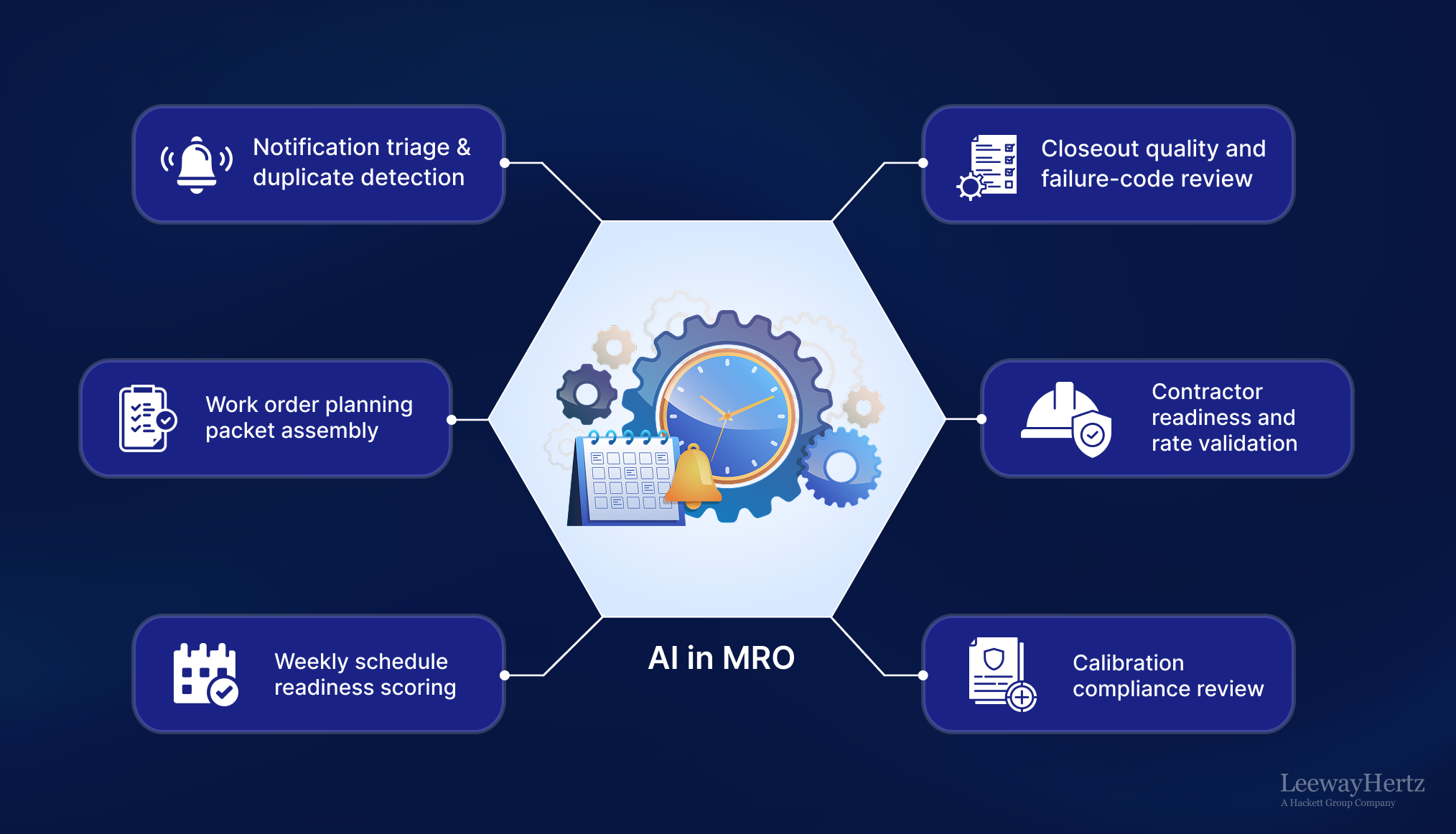
High-value AI use cases in MRO are the ones that improve recurring, evidence-heavy decisions across maintenance planning, scheduling, execution, reliability, spare-parts management, and asset governance. Visibility alone doesn’t define them. They are valuable when AI reduces manual evidence gathering, improves maintenance record quality, flags exceptions earlier, protects safety or compliance boundaries, and prepares clearer review packets for the roles accountable for the final decision.
| Use case | Function | How AI creates high-value impact |
|---|---|---|
| Notification triage and duplicate detection | Work request and notification management | AI compares each new notification with open work orders, asset history, and similar past requests. This helps teams catch duplicates, link related work, assign cleaner priorities, and avoid fragmented maintenance history. |
| Work order planning packet assembly | Maintenance planning | AI gathers asset history, job plan references, parts availability, permit needs, craft estimates, and production windows into one planning packet. This reduces manual lookup effort and gives the maintenance planner a more complete basis for job planning. |
| Weekly schedule readiness scoring | Maintenance scheduling | AI checks whether each planned order has the required labor, parts, permits, tools, and production access before schedule release. This helps schedulers catch readiness gaps early and reduce avoidable schedule disruption. |
| PM optimization review | Preventive maintenance program management | AI compares PM intervals, task lists, failure history, corrective work, and downtime patterns. This helps reliability teams identify PMs that may need to be added, revised, extended, shortened, or retired under human review. |
| Condition alert evidence packaging | Predictive and condition-based maintenance | AI links condition alerts with asset history, criticality, open work, and prior failures. This helps reliability engineers decide whether an alert should become a work order, stay under monitoring, or be escalated. |
| Closeout quality and failure-code review | Work execution and closeout | AI checks completed work orders for missing measurements, weak notes, incomplete failure codes, and missing permit or parts evidence. This strengthens maintenance history and gives reliability teams more dependable data for future failure analysis and maintenance decisions. |
| Bad-actor and RCA packet creation | Reliability engineering | AI groups repeat failures, ranks loss contribution, retrieves prior RCA evidence, and summarizes relevant asset history. This helps reliability engineers focus RCA effort on the assets and failure modes with the highest operational impact. |
| Critical-spares and kitting risk review | MRO spare parts and storeroom management | AI compares maintenance BOMs, stock records, reservations, lead times, planned work, and asset criticality. This helps storeroom and maintenance teams identify shortages, substitution needs, and critical spares exposure before work is scheduled. |
| Turnaround scope challenge packet | Shutdown, turnaround and outage management | AI groups proposed turnaround work by asset, system, priority, risk, dependency, and long-lead exposure. This helps turnaround teams challenge scope, remove duplicates, identify readiness gaps, and protect the frozen work list. |
| Contractor readiness and rate validation | Contractor and service management | AI checks contractor qualifications, onboarding records, safety evidence, service PO terms, rate cards, and work order scope. This helps maintenance and procurement teams identify readiness gaps, rate exceptions, and service documentation issues before work proceeds or invoices are approved. |
| Calibration compliance review | Asset data and maintenance governance | AI links calibration schedules, certificates, equipment records, and regulated asset lists. This helps teams identify overdue calibrations, missing certificates, and evidence gaps before audits or regulated work reviews. |
A use case earns high-value status when the output improves a recurring decision packet, strengthens a safety or compliance control, reduces rework between functions, or improves the quality of records used by future maintenance and reliability decisions.
How agentic AI works in MRO workflows
Agentic AI in MRO works best when it is designed around governed maintenance handoffs. A workflow starts from a defined trigger artifact, such as a work request, condition alert, PM review cycle, kitting list, or turnaround work list. The agent retrieves approved records from the CMMS, EAM, storeroom, reliability, production, contractor, or compliance systems, applies deterministic checks where rules are clear, and prepares a review-ready packet for the accountable role.
The value comes from continuity across steps. The agent can carry context from intake to planning, from planning to scheduling, from condition alert to work order, or from closeout to reliability analysis. It does not replace maintenance authority. It prepares evidence, highlights exceptions, drafts outputs, and routes unresolved items so planners, reliability engineers, supervisors, storeroom owners, and asset leaders can make the final decision.
Here are some examples:
Example 1: Work order planning packet
- Agent role: Prepare a planned work package from an approved work order.
- Trigger artifact: An approved work request for a leaking pump seal converts to a work order requiring planning.
- System aggregation: The agent retrieves asset work history, failure codes, job plan library entries, parts availability, lead times, criticality ranking, and production windows.
- Standards retrieval: The agent retrieves estimate norms, permit requirements for the asset area, and the kitting procedure.
- Prepared output: The packet includes task steps, craft-hour estimate, parts kit list, purchase-needed items, permit list, schedule-window recommendation, and repair-versus-replace note.
- Human checkpoint: The maintenance planner adjusts the plan, the maintenance supervisor confirms crew assignment, and the reliability engineer reviews the repeat-failure question.
- Governed handoff: The planned order releases to the weekly schedule, parts reserve and kit, permits pre-stage with EHS, and planning rationale is retained in CMMS history.
Example 2: PM optimization review
- Agent role: Prepare a PM interval and task list review packet.
- Trigger artifact: A scheduled quarterly PM optimization review for a production line’s PM task list.
- System aggregation: The agent retrieves PM completion history, failure codes, downtime events, current PM frequencies, prior optimization decisions, and regulated PM flags.
- Standards retrieval: The agent retrieves RCM logic, manufacturer recommendations, and regulatory PM requirements.
- Prepared output: The packet identifies candidate intervals to extend or shorten, PMs to retire, PMs to add, and regulated tasks that need compliance sign-off.
- Human checkpoint: The reliability engineer reviews the logic, the maintenance planner confirms the CMMS update, and the compliance owner approves regulated changes.
- Governed handoff: Approved changes update the PM task list and route library, with rationale retained for audit.
Example 3: Bad-actor and RCA packet creation
- Agent role: Assemble repeat-failure evidence for reliability review.
- Trigger artifact: A repeat-failure alert on an asset with multiple corrective work orders in the review window.
- System aggregation: The agent retrieves failure history, failure codes, prior RCA reports, related condition alerts, downtime, cost history, and criticality ranking.
- Standards retrieval: The agent retrieves the RCA method and FMEA for the asset or asset class.
- Prepared output: The packet includes bad-actor ranking, loss contribution, failure-mode clusters, candidate causes, and a draft RCA report shell.
- Human checkpoint: The reliability engineer facilitates the RCA session and confirms the final root cause and corrective actions.
- Governed handoff: The RCA report and any maintenance strategy or FMEA updates are retained in the reliability record.
Example 4: Critical-spares and kitting risk review
- Agent role: Prepare spare-parts readiness and stockout-risk evidence.
- Trigger artifact: An upcoming planned outage or periodic critical-spares review for a production area.
- System aggregation: The agent retrieves maintenance BOMs, stock levels, reservations, lead times, critical-spares list, and planned work requiring kitting.
- Standards retrieval: The agent retrieves min/max policy and single-point-of-failure criteria.
- Prepared output: The packet includes kit lists, shortages, substitution options, reorder candidates, and spares-risk ranking by asset criticality.
- Human checkpoint: The storeroom/MRO manager reviews reorder and substitution recommendations, and the reliability engineer confirms critical-spares changes.
- Governed handoff: Approved reorders and kit lists are released to the storeroom, and the risk packet is retained for the next turnaround or budget cycle.
The review boundary is the safety property. The agent may hold context across records and steps, but accountable people retain execution, PM interval changes, criticality changes, schedule release, and cost decisions.
How to prioritize AI use cases in MRO
Prioritization should start with the MRO operating model, then narrow to the specific sub-process where AI can create measurable support. The strongest candidates are recurring, artifact-rich, and governed by clear review boundaries. They should use accessible records such as work orders, job plans, PM task lists, failure codes, condition reports, maintenance BOMs, stock records, schedules, or calibration certificates.
A good first use case should prepare a review packet, flag an exception, validate a record, or recommend a next action for a named role. It should not release work, change PM intervals, approve substitutions, update criticality rankings, or trigger safety-sensitive actions without human confirmation. Strong starting points often include notification triage, work order planning packet preparation, schedule readiness scoring, PM compliance review, closeout completeness checks, kitting shortage detection, and calibration evidence review.
| Criterion | What to ask |
|---|---|
| Volume and frequency | Does this sub-process recur often enough for AI support to reduce manual effort at scale? |
| Artifact availability | Are the needed work orders, job plans, PM records, stock records, condition reports, or certificates available in usable systems? |
| Review boundary | Can a defined role confirm the output before it affects a safety, compliance, schedule, or cost decision? |
| Blast radius | If the output is wrong, is the impact limited to a draft, triage queue, or recommendation rather than live execution? |
| Business impact | Can the function tie the use case to credible outcomes such as lower planning effort, better schedule readiness, fewer stockout delays, or stronger compliance evidence? |
Common failure patterns include choosing a scope that is too broad, building on incomplete data, bypassing maintenance review boundaries, or claiming savings before the workflow has been validated. Strong first projects are usually high-volume, artifact-rich sub-processes with clear human ownership. Examples include notification triage, work order planning packet preparation, PM compliance review, closeout quality checks, kitting shortage detection, and calibration evidence review.
Governance, risk, and responsible AI in MRO
AI in MRO governance must respect the operating risk of physical assets. Maintenance records influence safety, uptime, regulatory evidence, production commitments, spare-parts investment, and contractor control. Governance should define what AI may prepare and what only people may approve.
Human-in-the-loop oversight: AI may draft job plans, rank backlog, package alerts, summarize RCA evidence, and flag kitting risk. Maintenance planners, supervisors, reliability engineers, MRO managers, EHS interfaces, and asset leaders confirm outputs before work execution, schedule release, PM interval changes, or critical-spares decisions.
Regulatory and standards alignment: Use a recognized AI risk framework such as NIST AI RMF and map controls to MRO standards and obligations. Relevant maintenance frameworks include OSHA LOTO, OSHA PSM mechanical integrity, ISO 55000/55001, ISO 14224, NFPA 70B, NFPA 70E, API standards, SMRP guidance, and FDA cGMP equipment maintenance where regulated.
Bias mitigation and evidence retention: Bias in MRO can appear through incomplete work histories, underreported failures, inconsistent technician notes, or asset hierarchies that overrepresent certain areas. Retain source artifacts so rankings, recommendations, and summaries remain inspectable.
Key governance requirements: Maintain a use-case inventory that separates low-risk summarization from higher-risk scoring or recommendations. PM interval changes, criticality scoring, shutdown scope recommendations, contractor qualification, and calibration compliance need risk tiering and approval gates.
Design principles: Ground outputs in approved CMMS/EAM, storeroom, production, reliability, contractor, and standards records. Use least privilege, role-based access, and scoped tool actions so an agent cannot release work, change PM frequencies, change criticality, or approve spend without confirmation.
Traceability and data security: Keep an audit trail of prompts, sources, model version, reviewer disposition, approvals, and system updates. Protect sensitive asset data, contractor records, safety records, regulated equipment evidence, and maintenance cost data under recognized security controls.
Accelerate AI Solutions Development
Build fully functional solutions from your high-value use cases, based on specific operational needs and enterprise context.
How ZBrain operationalizes AI use cases in MRO
Identifying use cases in MRP is only the first step. MRO teams need a controlled way to design, build, validate, deploy, govern, and scale AI workflows across work-request management, maintenance planning and scheduling, preventive and condition-based maintenance, work execution, reliability engineering, spare-parts management, turnarounds, contractor services, and asset governance.
This is where ZBrain helps.
ZBrain is an end-to-end AI enablement platform that supports this lifecycle through four connected stages: ZBrain Analyzer, ZBrain Design, ZBrain Solution Builder, and ZBrain Governance. The platform provides a governed path from use-case analysis to deployed agentic workflows while maintaining policies, permissions, approval points, monitoring, and runtime evidence.
ZBrain Analyzer
ZBrain Analyzer helps teams examine selected MRO processes, identify AI opportunities, and document the business context, systems, data, roles, controls, and review requirements needed to evaluate each use case.
ZBrain Design
ZBrain Design creates a build-ready technical design for the selected use case. It generates the business requirements document, functional requirements, user journeys, architecture, workflow logic, data specifications, integration context, and governance considerations needed before development begins.
ZBrain Solution Builder
ZBrain Solution Builder enables teams to create, configure, and validate governed AI workflows for MRO processes based on the technical design developed in ZBrain Design. It supports testing across routine, exception, and control scenarios before deployment.
ZBrain Governance
ZBrain Governance applies policies, access controls, human approval requirements, monitoring, and traceability throughout workflow execution. It provides guardrails, approval gates, escalation controls, kill switches, and audit trails to help organizations maintain oversight of AI outputs, user actions, exceptions, and authorized system updates.
Future of AI in MRO
The next phase of AI in MRO will move beyond isolated assistants and point solutions toward coordinated workflows that operate across CMMS/EAM, storeroom, production, reliability, EHS, contractor, and analytics systems. The opportunity is not simply to automate individual maintenance tasks, but to keep information, dependencies, and decisions aligned as work moves from notification and planning through scheduling, execution, closeout, and reliability review.
Agentic AI will play a larger role in maintaining this continuity across multi-step maintenance processes. An agent may carry forward asset context, parts readiness, permit requirements, production constraints, prior decisions, and unresolved exceptions as work progresses. However, greater continuity should not mean unrestricted autonomy. Safety-, compliance-, cost-, schedule-, and strategy-critical actions will still require defined approval gates, escalation paths, and accountable human ownership.
As these workflows mature, the differentiator will shift from model capability alone to how well AI is embedded into the maintenance operating model. A work-order planning workflow, for example, requires trusted data retrieval, deterministic readiness checks, structured outputs, human review, and traceability back to the CMMS/EAM. A PM optimization workflow requires failure-history analysis, standards and manufacturer guidance, regulated-task controls, explainable recommendations, and documented approval before any maintenance strategy changes.
This will also place greater emphasis on interoperability, persistent context, data quality, and runtime governance. Organizations will need AI workflows that can operate across existing maintenance systems without creating parallel records or weakening system-of-record controls. They will also need visibility into what information an agent used, what actions it proposed or performed, which exceptions were raised, and who approved consequential changes.
The organizations best positioned to scale AI in MRO will therefore be those that design around the workflow rather than the model. By defining sub-processes, source artifacts, decision boundaries, integration points, review roles, and evidence requirements upfront, they can expand AI across maintenance operations while preserving the safety, reliability, and accountability on which MRO depends.
Endnote
AI can materially improve MRO, but only when the work is mapped at the level where maintenance actually happens. Notifications, job plans, schedules, PM task lists, condition alerts, closeout notes, RCA reports, spare-parts records, turnaround lists, contractor records, and calibration certificates each need their own control logic.
The strongest MRO AI programs do not begin with broad automation promises. They begin with high-volume, artifact-rich sub-processes where AI can prepare evidence and a named person can confirm the result. That is why work-order planning packets, PM review packets, closeout quality checks, kitting risk reviews, and calibration evidence tracking are practical starting points.
MRO also requires clear governance boundaries because AI-supported outputs can directly influence operational risk. An incomplete work order, missed permit dependency, inaccurate failure code, or unsupported critical-spares recommendation can affect safety, uptime, compliance, and cost. AI should make these decisions easier to evaluate by surfacing the evidence, rationale, and exceptions behind each recommendation while keeping accountability with the responsible maintenance role.
For enterprise teams, the goal is not to replace the CMMS, EAM, reliability program, or storeroom process. The goal is to connect approved data sources, model outputs, deterministic checks, reviewer actions, and audit evidence into workflows that planners, supervisors, engineers, and asset leaders can trust.
ZBrain can help organizations design, validate, deploy, and govern these workflows across the MRO operating model while preserving human accountability for work execution, safety, reliability, compliance, and asset-management decisions.
Design governed AI workflows for MRO that connect maintenance planning, work execution, reliability, spare-parts management, and asset governance. Contact the ZBrain team today.
Author’s Bio


Akash's ability to build enterprise-grade technology solutions has garnered the trust of over 30 Fortune 500 companies, including Siemens, 3M, P&G, and Hershey's. Akash is an early adopter of new technology, a passionate technology enthusiast, and an investor in AI and IoT startups.

Transform Enterprise Processes with AI
Whether you have a defined use case or a process you want to improve, we design and build AI solutions that address operational gaps, enhance existing capabilities, and integrate with your enterprise data, systems, and workflows.
Start a conversation by filling the form
Once you let us know your requirement, our technical expert will schedule a call and discuss your idea in detail post sign of an NDA.
All information will be kept confidential.
FAQs
What is AI in MRO?
AI in MRO is the use of AI capabilities such as document intelligence, classification, retrieval-grounded generation, anomaly detection, predictive analytics, optimization, and risk scoring to support maintenance work management. It helps teams prepare notifications, work orders, job plans, schedules, PM reviews, condition-alert packets, closeout records, RCA evidence, spare-parts reviews, and governance reports. AI supports analysis, preparation, and workflow coordination, while maintenance professionals retain responsibility for decisions that affect safety, reliability, compliance, cost, and work execution.
Which AI use cases are most vital in MRO?
The most vital use cases are the ones that prepare evidence for recurring decisions and protect safety, reliability, cost, or compliance boundaries.
Some of them are as follows:
- Work management: notification triage, duplicate detection, priority coding, and work-order conversion.
- Planning and scheduling: work-order planning packets, parts availability checks, permit requirement identification, and schedule readiness scoring.
- PM and condition-based maintenance: PM optimization review, regulatory PM compliance tracking, condition alert evidence packaging, and false-positive review.
- Execution and reliability: closeout completeness checks, failure-code classification, bad-actor analysis, RCA packet preparation, and criticality re-scoring.
- Spare parts and turnarounds: kitting shortage detection, critical-spares risk scoring, turnaround scope challenge, lead-time monitoring, and post-turnaround review.
- Contractors and governance: contractor qualification checks, service-rate validation, asset master-data cleansing, KPI reporting, and calibration certificate tracking.
How is AI in MRO different from predictive maintenance?
Predictive maintenance focuses specifically on using condition and sensor data to identify signs of equipment degradation and anticipate potential failures. AI in MRO is broader: it supports the end-to-end maintenance operating model, from work identification and planning through scheduling, execution, closeout, reliability analysis, spare-parts coordination, turnarounds, contractor management, and asset governance. Predictive maintenance can therefore be one input into MRO workflows, while AI in MRO helps connect that insight with the records, controls, and decisions needed to act on it.
What data and systems are needed for MRO AI?
- Common data sources: CMMS/EAM records, asset hierarchies, work requests, work orders, job plans, preventive maintenance task lists, failure codes, maintenance BOMs, MRO inventory records, kitting lists, condition-monitoring reports, production schedules, permit references, contractor records, service purchase orders, RCA reports, FMEA/RCM worksheets, calibration certificates, and KPI reports.
- Systems involved: CMMS/EAM platforms such as Maximo, SAP PM, and Fiix; storeroom systems, data historians, EHS systems, ERP platforms, BI tools, and document repositories.
Where should an organization begin with AI in MRO?
Organizations should begin with a clearly bounded MRO sub-process characterized by recurring demand, stable artifacts, accessible data, defined review ownership, and limited operational risk. Suitable starting points include duplicate notification detection, work-order planning packet preparation, parts-availability checks, weekly schedule-readiness assessment, preventive maintenance compliance review, work-order closeout completeness checks, kitting shortage detection, and calibration certificate tracking.
The selected workflow should be validated against routine, exception, and edge cases before its scope or decision-making authority is expanded.
How does ZBrain support AI use cases in MRO?
AI should support change classification as a recommendation and evidence-preparation activity, not as an autonomous decision. The workflow should retrieve the organization’s approved classification policy, identify the relevant criteria, and extract evidence related to form, fit, function, interfaces, safety, qualification impact, customer obligations, interchangeability, and contractual configuration requirements.
Based on that evidence, AI can propose a Class I/Class II or major/minor classification with clause-level citations, comparable historical precedents, confidence level, and reason codes. It should also flag uncertainty and abstain when required evidence is missing, policies conflict, or the change appears to trigger customer, safety, regulatory, or qualification review.
The CCB Chair or designated engineering/configuration authority should retain ownership of the final classification. Classification terminology and thresholds vary by organization, program, customer, and product line, so a Class II or minor label should never be treated as universally low risk without policy-specific validation.
How does ZBrain support AI in engineering change management?
ZBrain supports AI in engineering change management by giving teams a governed way to analyze, design, build, validate, deploy, and monitor AI workflows across the ECM operating model. It helps connect PLM and related enterprise systems while maintaining policies, permissions, approval points, traceability, and runtime evidence.
Through ZBrain Analyzer, teams identify AI opportunities and document the relevant processes, data, systems, roles, controls, and review requirements. ZBrain Design converts those inputs into build-ready technical design with workflow logic, integrations, approval points, exception paths, validation criteria, and monitoring needs. ZBrain Solution Builder enables teams to create, configure, and test governed AI workflows based on the approved design. ZBrain Governance applies access controls, human approval requirements, guardrails, escalation controls, monitoring, kill switches, and audit trails throughout execution.
The organization’s PLM workflow, approval authority, security model, and applicable standards continue to govern the process, while ZBrain provides a structured environment for applying AI across engineering change management.
Insights

AI in production planning: Pioneering innovation in the heart of industry 4.0
The adoption of AI in production planning and scheduling brings numerous benefits to manufacturing companies, helping them enhance efficiency, reduce costs, and improve overall operational performance.

How to build credit risk models using machine learning?
As the financial industry continues to evolve, ML has emerged as a powerful tool for credit risk modeling, offering advanced analytical capabilities and predictive insights.
AI in Contract Management: Use Cases Mapped to the CLM Operating Model
AI in contract management is not a generic chatbot bolted onto a document store. The value shows up when a specific capability meets a specific artifact at a specific step of the lifecycle.