Pharmacovigilance (PV) is the science and set of activities used to detect, assess, understand and prevent adverse effects or any other medicine-related problem. The WHO Programme for International Drug Monitoring uses this definition and describes individual case safety reports as the adverse reaction reports that member countries submit to VigiBase, the WHO global database managed by Uppsala Monitoring Centre 1]. In pharmaceutical companies, this discipline is not a single task. It spans case intake, validity assessment, triage, coding, medical review, narrative preparation, expedited reporting, aggregate safety reporting, signal detection, benefit-risk evaluation, risk minimization, partner oversight, PV quality and inspection readiness.
The current operating challenge is scale, fragmentation and regulatory pressure. A case may arrive through a call center, an HCP email, a patient report, a market research program, a literature search result, a partner exchange or an E2B gateway. The evidence may include a discharge summary, laboratory results, medication history, reporter correspondence, product license information, the Reference Safety Information (RSI), MedDRA coding records, WHODrug entries, prior cases, SDEA obligations and local reporting rules. This complexity is compounded by the sheer volume of safety data that pharmacovigilance organizations must manage. The U.S. FDA’s Adverse Event Reporting System (FAERS) contains more than 32 million adverse event reports, with reporting volumes exceeding 2 million reports annually in recent years, making it one of the world’s largest repositories for post-marketing drug safety surveillance and signal detection [2]. This combination of high reporting volumes, diverse intake channels and distributed safety evidence makes manual processing alone difficult to scale without increasing the risk of late submissions, quality errors, rework and inspection findings.
AI is becoming increasingly valuable in pharmacovigilance because much of the work involves interpreting large volumes of structured and unstructured safety information, applying regulatory requirements consistently, and preparing evidence for medical and regulatory review. Every case requires information to be assembled from multiple sources, compared with controlled references such as the Reference Safety Information (RSI), MedDRA, WHODrug and applicable SOPs, and organized into a review-ready safety record.
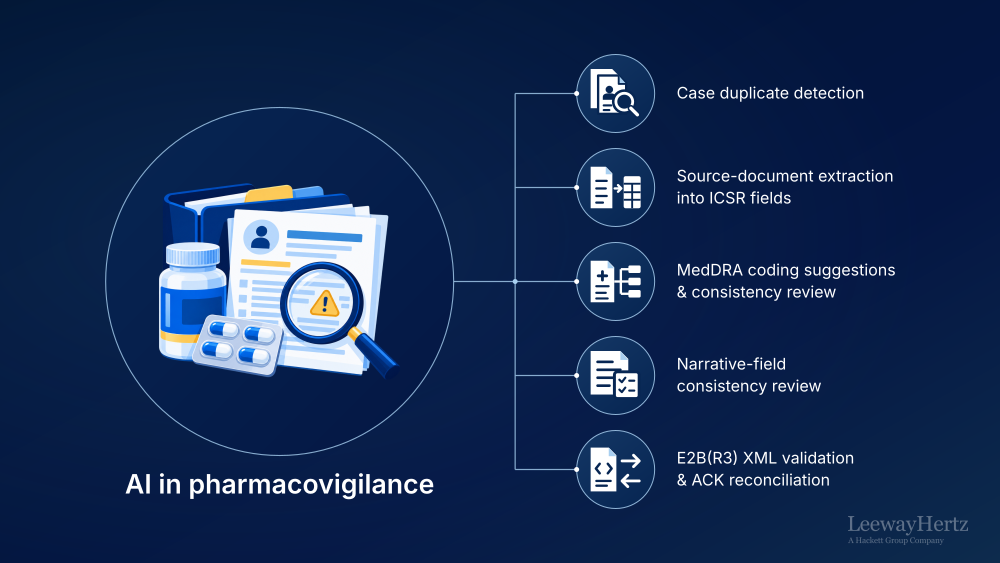
AI can pull key case details from source documents, including patient, reporter, product, event, laboratory and timeline information, while also helping identify duplicate submissions and follow-up cases. It can compare case details with regulatory and product-specific references, check the completeness of required case elements, and suggest MedDRA and WHODrug coding. AI can also draft CIOMS-style narratives and follow-up correspondence from approved source evidence. Across the workflow, it can monitor submission deadlines, coding inconsistencies, partner reconciliation issues and emerging safety patterns for reviewer attention.
Instead of replacing pharmacovigilance professionals, AI helps reduce the manual effort involved in gathering, organizing and validating evidence so reviewers can focus on medical and regulatory judgment. Drug safety associates continue to determine case validity and verify case processing, PV physicians remain responsible for confirming seriousness, expectedness and causality assessments, and safety scientists continue to evaluate potential safety signals using clinical, epidemiological and statistical evidence. AI prepares the evidence needed for these decisions, but the decisions themselves remain with authorized pharmacovigilance professionals.
AI in pharmacovigilance is the governed use of analytical, generative and workflow capabilities across its operating model to prepare, check, route, summarize and retain evidence for human review. It supports AI workflows across the pharmacovigilance lifecycle, from safety case intake, validation and medical coding to narrative preparation, regulatory reporting, aggregate safety reporting, signal management, partner oversight and quality monitoring.
For this reason, AI implementation must begin with the pharmacovigilance operating model. Broad ideas such as “AI for PV,” “AI for case processing” or “AI for signal detection” are too wide for design. A useful workflow defines the trigger artifact, the system of record, the regulatory rule, the controlled terminology, the AI capability, the accountable reviewer, the validated-system evidence and the human approval boundary.
This article uses the pharmacovigilance operating model to break work into functions, processes, sub-processes, artifacts, systems, regulatory and control considerations, accountable roles, AI-enabled opportunities and governed agentic workflows.
- How AI is transforming pharmacovigilance operations
- Why AI use cases in pharmacovigilance must be mapped at the sub-process level
- Pharmacovigilance operating model and AI opportunity mapping across PV processes
- High-value AI use cases in pharmacovigilance
- How agentic AI works in pharmacovigilance workflows
- How to prioritize AI use cases in pharmacovigilance
- Governance, risk, and responsible AI in pharmacovigilance
- How ZBrain operationalizes AI use cases in pharmacovigilance
- Future of AI in pharmacovigilance
How AI is transforming pharmacovigilance operations
Pharmacovigilance is shifting from sequential case handling to evidence-led safety workflow preparation. Traditional PV operations still require trained case processors, medical reviewers, safety scientists, local safety officers, aggregate report writers, regulatory liaisons and quality leaders. The operational issue is that the evidence required for their decisions is distributed across safety databases, intake mailboxes, E2B gateways, RIM systems, literature databases, partner portals, document management platforms, signal detection tools, quality systems and controlled reference repositories. AI becomes useful when it is aimed at a specific pharmacovigilance question: what was reported, whether case criteria are met, when the regulatory clock starts, which reporting rule applies, who must review, and what evidence remains available for inspection.
Consider a post-marketing case reported by a healthcare professional. The HCP email includes a discharge summary and mentions hepatic failure in a patient treated with the company product. The intake team first determines whether the report qualifies as a valid ICSR, identifies day zero and searches for potential duplicates. It then extracts structured case information into Argus Safety, Veeva Vault Safety or ArisGlobal LifeSphere, assesses seriousness, and compares expectedness against the current RSI. The workflow continues with proposed MedDRA and WHODrug coding, drafting a CIOMS narrative, preparing a market-specific reportability grid, submitting through the appropriate E2B gateway where required, and reconciling acknowledgments (ACKs).
AI can connect these records into one review-ready case packet. The drug safety associate still verifies data entry and coding. The PV physician still confirms seriousness, expectedness, causality and narrative accuracy. The QPPV remains visible for oversight and escalation where the case suggests a potential signal or risk-minimization concern.
The strongest opportunities usually fall into five kinds of pharmacovigilance work:
- Document-heavy work: source documents, discharge summaries, HCP emails, literature abstracts, lab reports, CIOMS forms, MedWatch forms, E2B XML files, ACKs, RSI documents, SDEAs and PSMF records that need extraction, classification, completeness checks and source anchoring.
- Narrative-heavy work: CIOMS narratives, company comments, medical review notes, signal assessment summaries, PSUR/PBRER sections, DSUR safety summaries and benefit-risk rationale that AI can draft from approved source material while showing where evidence is thin.
- Exception-heavy work: invalid cases, duplicates, missing minimum criteria, late cases, seriousness disputes, expectedness conflicts, coding disagreements, submission failures, partner reconciliation mismatches and quality deviations that need triage before regulated action.
- Knowledge-heavy work: ICH E2A, E2B, E2C and E2F, the Reference Safety Information (RSI), USPI, MedDRA, WHODrug Global, SDEA obligations, FDA post-marketing reporting requirements and local reporting rules that require controlled retrieval rather than model memory.
- Workflow-heavy work: intake-to-submission case processing, follow-up management, coding review, medical review, aggregate-report calendar management, signal tracking, partner exchange, CAPA and inspection readiness where AI can assemble the next work packet and reduce rework between teams.
The practical design rule is simple. Start with a well-defined pharmacovigilance sub-process rather than a broad pharmacovigilance objective. A useful workflow defines the artifact, system, regulatory standard, AI capability, human checkpoint and validated-system evidence retained after review. AI can extract, classify, match, draft, reconcile and prepare, but it must not decide seriousness, expectedness, causality, reportability, signal validity or benefit-risk action.
Build governed AI workflows for pharmacovigilance
Build governed AI workflows that streamline pharmacovigilance operations while preserving human accountability for regulated safety decisions.
Why AI use cases in pharmacovigilance must be mapped at the sub-process level
Pharmacovigilance is full of broad labels that sound actionable but are too vague for implementation. “Case intake” can mean intake mailbox monitoring, source classification, solicited versus spontaneous classification, local literature screening, partner case exchange, E2B inbound intake or duplicate detection. “Triage” can mean four-criteria validity assessment, day-zero determination, seriousness assessment, expectedness support or expedited-priority routing. “Signal detection” can mean disproportionality screening, qualitative case series review, signal validation support, PRAC procedure tracking or signal log governance. Each activity uses different artifacts, rules, systems and accountable reviewers.
A better approach is to map AI use cases to the pharmacovigilance operating model:
- Function: a governed operational domain such as case intake and collection, medical coding, expedited reporting, aggregate safety reporting, signal management or PV quality.
- Process: a workflow area inside the function, such as duplicate detection, coding review, narrative preparation, ACK reconciliation, line listing generation or PSMF maintenance.
- Sub-process: the atomic work activity where AI can be designed, tested and governed, such as four-criteria validity assessment, MedDRA LLT/PT suggestion, day-zero support, market-by-market reportability grid preparation or partner reconciliation mismatch classification.
- AI-enabled opportunity: a specific AI capability applied to a specific PV artifact to change how work is prepared, reviewed, explained, routed or controlled.
Sub-process mapping keeps implementation grounded. It defines which source documents the case processor reviews, where the PV physician applies medical judgment, what evidence the safety scientist uses for case series assessment, where PV operations management oversight is required, and what records PV quality must retain for inspection readiness. It also limits risk. A workflow that drafts a follow-up query letter is not governed the same way as one that supports expectedness assessment or signal prioritization.
This article focuses specifically on the pharmacovigilance operating model and the functions that support post-marketing drug safety. It does not revisit broader pharmaceutical AI topics such as drug discovery, clinical development, medical affairs or enterprise quality management, which are distinct operating domains. Within the post-marketing landscape, pharmacovigilance owns safety case processing, aggregate safety reporting, signal evidence, benefit-risk evaluation and the safety documentation that informs regulatory affairs activities. Regulatory affairs, in turn, owns submission publishing, regulatory procedures and label variation execution.
Pharmacovigilance operating model and AI opportunity mapping across PV processes
The operating model below follows the pharmacovigilance lifecycle from case intake through inspection readiness. Each function names the teams, artifacts, systems, regulatory and control considerations, accountable roles, AI capabilities, human-ownership boundaries, sub-process opportunities and one example agentic workflow.
Function 1. Case intake and collection
Turns incoming safety information into captured, classified and duplicate-checked intake records.
Case intake and collection is the front door of pharmacovigilance. It receives potential adverse event information from call centers, healthcare professionals, patients, market research programs, digital channels, literature screening, local affiliates, license partners and E2B gateways. The function determines the intake source, captures the source artifact, separates solicited from spontaneous information, identifies possible duplicates and routes the record into the safety database for validity assessment and triage.
Teams involved: Drug safety associates, PV operations managers, local safety officers, literature surveillance teams, PV agreements managers, partner case exchange coordinators and safety systems owners run this function.
Key artifacts: HCP emails, patient reports, call center transcripts, market research program outputs, digital channel reports, literature surveillance search strategy and screening log, partner case exchange files, SDEA obligations, inbound E2B(R3) XML files with ACKs and initial ICSR records.
Systems involved: PV intake mailbox, call center platform, CRM or medical information system, literature database, partner exchange portal, E2B gateway, safety database, document management system and workflow queue.
Regulatory and control considerations: ICH E2D guides post-approval safety data collection and management, while FDA postmarketing reporting requirements under 21 CFR 314.80, 21 CFR 314.98 and 21 CFR 600.80 govern adverse event reporting for drugs and biologics in the United States. The intake process also depends on SDEA obligations, local reporting requirements, data privacy controls and validated safety-system audit trails.
Accountable roles: Drug safety associate, PV operations manager, local safety officer or local QPPV, PV agreements manager and head of drug safety or pharmacovigilance.
What AI helps with: Document intelligence extracts patient, reporter, suspect product, event, date and attachment metadata from HCP emails, call center transcripts, literature abstracts and partner files. Classification separates spontaneous, solicited, literature, digital, partner and E2B inbound sources for correct workflow routing. Entity resolution compares patient, reporter, product, event, country and date fields with existing ICSRs to flag duplicates. Retrieval-grounded answering checks SDEA obligations and intake SOPs against the source record before routing.
What humans continue to own: Drug safety associates confirm whether the source information should be entered as a case, follow-up, duplicate candidate or non-case record. Local safety officers confirm local intake obligations and source handling where affiliate rules apply. PV agreements managers confirm partner routing obligations. AI extracts, classifies, matches or prepares but does not decide, approve, or attest.
| Process | Sub-process | Key AI-enabled opportunities |
|---|---|---|
| Case intake capture | ICSR intake from call centers, HCPs, patients and digital channels |
|
| Source classification | Solicited versus spontaneous source handling |
|
| Literature intake | Literature surveillance and local literature screening |
|
| Partner exchange | Partner case exchange under SDEAs |
|
| E2B inbound intake | E2B gateway inbound intake with acknowledgment |
|
| Duplicate control | Duplicate detection at intake |
|
Highest-value opportunities: The highest-value opportunities are those that improve the quality and consistency of downstream pharmacovigilance activities. Accurate duplicate detection preserves the integrity of case processing, regulatory reporting and signal detection. AI-assisted literature screening helps identify potentially reportable cases from large volumes of published content, while SDEA obligation extraction supports timely partner case routing and reduces the risk of compliance issues.
Example agentic workflow: Intake source classification and duplicate review
- The workflow starts when an HCP email with a discharge summary enters the PV intake mailbox.
- The agent extracts the patient, reporter, product, adverse event, report date and attachment inventory from the email and discharge summary.
- It classifies the source as spontaneous HCP reporting and checks whether any market research program, partner routing obligation or local affiliate rule applies.
- It performs duplicate search against the safety database using patient, reporter, product, event and date attributes.
- Human checkpoint: the drug safety associate confirms whether the record is a new case, follow-up or duplicate candidate, and the local safety officer confirms local handling if required.
- The intake classification, duplicate evidence and source anchors are retained in the validated safety system and routed to validity assessment.
Function 2. Case validity assessment and triage
Turns captured intake records into valid, prioritized and clock-aware safety cases for processing.
Case validity assessment and triage determines whether a report qualifies as a valid ICSR and how quickly it must move through the workflow. The function checks the four minimum criteria, determines day zero, assesses seriousness, supports expectedness review against the RSI and prioritizes cases for expedited processing. It feeds structured case processing, medical review, coding, narrative preparation and reporting.
Teams involved: Drug safety associates, PV physicians, PV operations managers, local safety officers and the head of drug safety or pharmacovigilance participate in this function.
Key artifacts: Initial ICSR record, source documents, follow-up correspondence, the Reference Safety Information (RSI), USPI, case processing SOP, triage checklist and seriousness assessment notes.
Systems involved: Safety database, document management system, RIM system, RSI repository, workflow queue, local affiliate tracking system and business intelligence (BI) platform.
Regulatory and control considerations: ICH E2A defines expedited reporting concepts and seriousness criteria, while FDA postmarketing reporting requirements under 21 CFR 314.80, 21 CFR 314.98 and 21 CFR 600.80 establish reporting timelines and submission requirements for drugs and biologics in the United States. Day-zero determination and expedited-priority routing must remain fully traceable because errors in regulatory clock management can lead to compliance issues and inspection findings.
Accountable roles: Drug safety associate, PV physician, PV operations manager and local safety officer.
What AI helps with: Document intelligence checks whether the source record contains an identifiable patient, identifiable reporter, suspect product and adverse event. Classification triages cases by seriousness indicators, special situation flags, missing information and likely expedited priority. Retrieval-grounded answering compares event terms and case facts with ICH E2A seriousness criteria and the current RSI. Natural-language generation drafts follow-up queries for missing minimum criteria or medically relevant details.
What humans continue to own: Drug safety associates confirm validity and day-zero interpretation. PV physicians confirm seriousness, expectedness support and medical relevance. Local safety officers confirm local clock and escalation requirements. AI checks, classifies, retrieves or drafts but does not decide, approve, or attest.
| Process | Sub-process | Key AI-enabled opportunities |
|---|---|---|
| ICSR validity assessment | Four minimum criteria assessment |
|
| Regulatory timeline management | Day-zero determination and regulatory clock start |
|
| Seriousness triage | Seriousness assessment against ICH E2A criteria |
|
| Expectedness assessment | Expectedness assessment against RSI |
|
| Expedited case prioritization | Prioritization for expedited processing |
|
| Follow-up initiation | Missing-information query preparation |
|
Highest-value opportunities: Accurate four-criteria assessment establishes a reliable foundation for every downstream pharmacovigilance activity, from case processing through regulatory reporting and signal detection. Correct day-zero determination helps ensure regulatory reporting timelines are calculated consistently and reduces the risk of late submissions. Early seriousness and expectedness assessment helps route cases to the appropriate review path, allowing medically significant cases to receive timely attention.
Example agentic workflow: Validity and expedited triage review
- The workflow starts when an intake record and source document are available for validity assessment.
- The agent extracts the four minimum criteria, receipt dates, event verbatim, product details and reporter information.
- It retrieves the case processing SOP, ICH E2A seriousness criteria and current RSI version from controlled repositories.
- It prepares a triage packet with validity evidence, day-zero options, seriousness indicators, expectedness support and missing-information questions.
- Human checkpoint: the drug safety associate confirms validity and day zero, and the PV physician confirms seriousness and expectedness support.
- The triage decision, source anchors, reviewer disposition and timestamps are retained in the validated safety system.
Function 3. Case processing and data entry
Turns valid safety cases and source documents into structured, version-controlled ICSR records.
Case processing and data entry converts valid reports into structured case records in the safety database. It extracts source data, enters patient and reporter details, records product and event information, maintains case versions, generates follow-up queries and advances the case through workflow states. This function creates the structured evidence base used for coding, medical review, narrative preparation, submission and signal detection.
Teams involved: Drug safety associates, PV operations managers, safety systems owners, local safety officers and quality reviewers participate in this function.
Key artifacts: ICSR in Argus Safety, Veeva Vault Safety or ArisGlobal LifeSphere, source documents, case version records, follow-up query letters, workflow state records and case processing quality checks.
Systems involved: Safety database, document management system, workflow management system, quality management system (QMS), business intelligence (BI) platform, and local affiliate tracking system.
Regulatory and control considerations: FDA postmarketing reporting requirements under 21 CFR 314.80 and 21 CFR 600.80, together with local case processing SOPs, govern case data entry, follow-up activities and submission readiness. FDA regulations also require written procedures for the surveillance, receipt, evaluation and reporting of adverse drug experiences.
Accountable roles: Drug safety associate, PV operations manager, PV quality and compliance manager, local safety officer or local QPPV and head of drug safety or pharmacovigilance.
What AI helps with: Document intelligence extracts structured fields from source documents into ICSR data-entry worklists. Classification identifies missing, inconsistent or clinically ambiguous fields before case lock. Natural-language generation drafts follow-up query letters tied to source gaps. Anomaly detection monitors case workflow states, version changes and aging cases for compliance risk.
What humans continue to own: Drug safety associates verify entered data and determine whether source evidence supports each field. PV operations managers oversee workflow state and case processing quality. PV quality and compliance managers review quality deviations and CAPA triggers. AI extracts, drafts, reconciles or prepares but does not decide, approve, or attest.
| Process | Sub-process | Key AI-enabled opportunities |
|---|---|---|
| ICSR data entry | Source-document extraction into ICSR fields |
|
| Case data quality analysis | Data completeness and consistency review |
|
| Follow-up management | Follow-up query generation for missing information |
|
| Case lifecycle management | Case versioning and workflow state management |
|
| Case reconciliation | Source-to-case field reconciliation |
|
| Quality control | Case processing QC preparation |
|
Highest-value opportunities: Accurate source-document extraction improves the quality and consistency of structured case records while preserving traceability to the original evidence. Automated follow-up query generation helps obtain missing clinical information sooner, reducing delays in downstream review and reporting. Workflow state monitoring identifies aging or stalled cases early, enabling timely intervention before they become compliance or inspection risks.
Example agentic workflow: Source-to-ICSR data entry review
- The workflow starts when a valid case enters the case processing queue with source documents attached.
- The agent extracts patient, reporter, product, event, date, outcome, lab and narrative-relevant details into an ICSR data-entry worklist.
- It compares extracted fields with safety database requirements and flags missing, inconsistent or source-conflicted data.
- It drafts follow-up questions for unresolved clinical and administrative gaps.
- Human checkpoint: the drug safety associate verifies data entry and approves follow-up wording, while the PV operations manager reviews workflow-state exceptions.
- The structured case, source anchors, data-entry disposition, follow-up letter and version record remain in the validated safety database.
Function 4. Medical coding
Turns verbatim events, indications, histories and product names into controlled terminology records.
Medical coding standardizes adverse events, indications, medical history and products so cases can be analyzed, reported and aggregated consistently. It applies MedDRA coding for events, indications and medical history, including LLT and PT selection and SOC placement. It also applies WHODrug Global coding for suspect and concomitant products. This function feeds medical review, expectedness assessment, aggregate reporting, signal detection and submission.
Teams involved: Drug safety associates, medical coding specialists, PV physicians, safety scientists, PV operations managers and safety systems owners contribute to this function.
Key artifacts: MedDRA coded terms, LLT/PT/HLT/SOC records, MedDRA version records, WHODrug Global dictionary entries, ICSR coding fields, coding review notes and dictionary upversioning impact records.
Systems involved: Safety database, MedDRA coding tool, WHODrug Global coding tool, document management system, coding workflow management system, and signal detection platform.
Regulatory and control considerations: MedDRA provides the standardized medical terminology used to code adverse events, indications and medical history in regulatory safety reporting, while WHODrug Global provides standardized medicinal product information for coding suspect and concomitant products. Coding also requires governance over dictionary versions, coding conventions, consistency reviews and validated-system change control.
Accountable roles: Drug safety associate, PV physician, safety scientist, PV operations manager and head of drug safety or pharmacovigilance.
What AI helps with: Classification suggests MedDRA LLT and PT options from verbatim event, indication and medical history text. Retrieval-grounded answering checks coding suggestions against coding conventions and prior similar cases. Entity resolution maps suspect and concomitant products to WHODrug Global entries. Anomaly detection identifies coding drift, version changes and inconsistent coding across similar cases.
What humans continue to own: Drug safety associates and coding reviewers confirm final MedDRA and WHODrug coding. PV physicians confirm medically significant coding questions where clinical interpretation is required. Safety scientists confirm coding groupings used for aggregate and signal analysis. AI suggests, compares, flags or prepares but does not decide, approve, or attest.
| Process | Sub-process | Key AI-enabled opportunities |
|---|---|---|
| Event coding | MedDRA LLT/PT selection for adverse events |
|
| Indication and history coding | MedDRA coding of indications and medical history |
|
| SOC placement review | SOC and hierarchy consistency review |
|
| Product coding | WHODrug coding of suspect and concomitant products |
|
| Coding review | Coding consistency review across cases |
|
| Dictionary governance | Dictionary upversioning impact management |
|
Highest-value opportunities: MedDRA coding suggestions help standardize event classification, improving the consistency of expectedness assessment, aggregate reporting and signal detection. WHODrug Global coding support helps normalize medicinal product information, enabling more reliable suspect product analysis and partner case exchange. Dictionary version management helps identify coding changes that could affect longitudinal analyses, aggregate reports and other regulatory safety outputs.
Example agentic workflow: MedDRA and WHODrug coding consistency review
- The workflow starts when an ICSR contains verbatim event terms, indication text, medical history and suspect product information.
- The agent suggests MedDRA LLT/PT terms for events, indications and medical history, and maps product names to WHODrug Global entries.
- It compares the suggestions with coding conventions, prior similar cases and the current dictionary versions.
- It prepares a coding review packet with candidate terms, source anchors, hierarchy context and consistency flags.
- Human checkpoint: the drug safety associate confirms coding, and the PV physician reviews medically ambiguous terms.
- The approved coding, dictionary version, reviewer disposition and coding rationale remain in the validated safety database.
Function 5. Medical review and causality assessment
Turns structured cases, coding and source evidence into medically reviewed safety records.
Medical review and causality assessment is where case-level clinical interpretation is performed. The function evaluates the case chronology, seriousness, listedness or labeledness, causality, alternative explanations, special situations and medically important context. It feeds narrative approval, expedited reporting, signal detection, aggregate reporting and benefit-risk evaluation.
Teams involved: PV physicians, drug safety associates, safety scientists, local safety officers, epidemiologists and the head of drug safety or pharmacovigilance participate in this function.
Key artifacts: ICSR, source documents, CIOMS narrative draft, medical review notes, the Reference Safety Information (RSI), U.S. Prescribing Information (USPI), MedDRA coding records, WHODrug Global coding records and special situation flags.
Systems involved: Safety database, document management system, RSI repository, RIM system, signal detection tool, medical review workflow and quality repository.
Regulatory and control considerations: ICH E2A provides the framework for seriousness assessment and expedited reporting, while ICH E2D and FDA postmarketing reporting requirements guide the evaluation and management of post-approval safety information. Local medical review SOPs further define how medical assessments are performed within the organization. Because case-level medical evaluations can influence reportability, signal assessment and patient safety actions, medical judgment must remain with accountable pharmacovigilance professionals.
Accountable roles: PV physician, drug safety associate, safety scientist, local safety officer and head of drug safety or pharmacovigilance.
What AI helps with: Multi-source aggregation brings together source documents, structured case fields, coded terms, RSI references, prior similar cases and special situation rules. Retrieval-grounded answering retrieves seriousness criteria, labeledness references and case processing SOP sections. Natural-language generation drafts medical review notes and company comments from approved evidence. Classification identifies pregnancy exposure, overdose, medication error, lack of efficacy, off-label use and other special situations.
What humans continue to own: PV physicians own medical evaluation, seriousness confirmation, causality assessment and labeledness/listedness confirmation. Safety scientists use reviewed cases as input to signal work but do not rely on AI as the signal validator. AI aggregates, retrieves, classifies or drafts but does not decide, approve, or attest.
| Process | Sub-process | Key AI-enabled opportunities |
|---|---|---|
| Medical evaluation | Case-level medical evaluation |
|
| Causality support | Company causality assessment preparation |
|
| Labeledness assessment | Labeledness or listedness confirmation |
|
| Special situation assessment | Special situation identification |
|
| Medical review | Medical review consistency check |
|
| Case escalation management | Potential signal or urgent risk escalation support |
|
Highest-value opportunities: Labeledness assessment is accelerated by retrieval-grounded answering, which compares coded events and verbatim case details with the current safety references to assemble evidence for reviewer assessment. Special situation assessment is supported by classification models that identify cases involving pregnancy exposure, overdose, medication error, off-label use or lack of efficacy and route them through the appropriate review workflow. Case consistency review uses validation checks to compare narratives, coded terms, structured case data and medical assessments, highlighting discrepancies for reviewer resolution before regulatory reporting.
Example agentic workflow: Medical case review and escalation
- The workflow starts when a coded ICSR and draft narrative are ready for medical review.
- The agent aggregates source documents, coded terms, product exposure, chronology, lab results, outcomes, RSI references and prior similar cases.
- It flags potential seriousness indicators, special situations, labeledness references, causality factors and unresolved medical questions.
- It prepares a medical review packet and draft company comment with source anchors.
- Human checkpoint: the PV physician confirms seriousness, expectedness, causality, special situation handling and company comment content, with PV operations manager escalation for urgent risk concerns.
- The medical review disposition, reviewer identity, source anchors and approved comments are retained in the validated safety system.
Accelerate AI Solutions Development
Build fully functional solutions from your high-value use cases, based on specific operational needs and enterprise context.
Function 6. Narrative preparation
Turns source evidence and structured case fields into coherent, source-anchored safety narratives.
Narrative preparation creates the case story that reviewers, regulators and downstream PV teams use to understand what happened. It builds a chronology from source documents, aligns the narrative with coded data fields, prepares CIOMS-style narrative text and drafts the company comment where applicable. This function feeds medical review, expedited reporting, aggregate reporting and inspection evidence.
Teams involved: Drug safety associates, PV physicians, aggregate report medical writers, PV operations managers and PV quality and compliance managers contribute to this function.
Key artifacts: CIOMS narrative, company comment, source documents, ICSR fields, MedDRA coded terms, WHODrug entries, medical review notes and narrative QC records.
Systems involved: Safety database, document management system, workflow management system, narrative authoring platform, quality management system (QMS), and aggregate reporting system.
Regulatory and control considerations: ICSR narrative quality is governed by case processing SOPs, FDA postmarketing reporting requirements and inspection-readiness controls. Narrative content must remain consistent with structured case data and should not include unsupported causality or expectedness conclusions.
Accountable roles: Drug safety associate, PV physician, aggregate report medical writer, PV operations manager and PV quality and compliance manager.
What AI helps with: Natural-language generation drafts CIOMS-style narratives from approved source documents and structured ICSR fields. Document intelligence extracts chronological events, dates, therapies, outcomes, labs and follow-up information. Anomaly detection compares the narrative with coded fields, seriousness, outcome and product exposure fields. Retrieval-grounded answering checks narrative wording against SOP templates and approved style requirements.
What humans continue to own: Drug safety associates verify narrative completeness and field alignment. PV physicians approve medically relevant narrative content and company comments. PV quality and compliance managers review narrative quality issues where they affect process compliance. AI drafts, compares, flags or prepares but does not decide, approve, or attest.
| Process | Sub-process | Key AI-enabled opportunities |
|---|---|---|
| Chronology construction | Chronology construction from source documents |
|
| Narrative drafting | CIOMS-style structured narrative drafting |
|
| Company comment preparation | Company comment authoring support |
|
| Narrative consistency review | Narrative consistency review |
|
| Follow-up integration | Follow-up narrative update preparation |
|
| Narrative quality review | Narrative QC preparation |
|
Highest-value opportunities: Chronology construction uses document intelligence to assemble events from multiple source documents into a coherent timeline, reducing manual reconstruction effort and improving narrative completeness. Narrative consistency review uses validation checks to compare the narrative with coded terms and structured case data, highlighting discrepancies before medical review and regulatory submission. Company comment authoring uses natural-language generation to prepare a structured draft from approved case evidence, allowing PV physicians to focus on reviewing and approving the medical assessment.
Example agentic workflow: CIOMS narrative consistency review
- The workflow starts when structured ICSR fields, source documents and coding records are available for narrative preparation.
- The agent extracts chronology elements from source documents and aligns them with product exposure, event onset, outcome and medical history fields.
- It drafts a CIOMS-style narrative and company comment using approved templates.
- It compares the draft with MedDRA coding, WHODrug entries, seriousness, causality and expectedness fields.
- Human checkpoint: the drug safety associate verifies source alignment, and the PV physician approves medical content and company comment.
- The approved narrative, source anchors, reviewer approvals and controlled-output version are retained in the validated safety system.
Function 7. Expedited reporting and submission
Turns medically reviewed cases into market-specific submissions with gateway evidence.
Expedited reporting and submission determines whether, where and how a case must be submitted to regulators or partners. It prepares market-by-market reportability grids, manages 15-day and 7-day clocks where applicable, generates E2B(R3) XML, produces CIOMS I or MedWatch FDA Form 3500A where required, submits through gateways and reconciles acknowledgments. This function sits at the regulated action boundary, so human release and validated-system evidence are essential.
Teams involved: Drug safety associates, PV operations managers, regulatory affairs liaisons, local safety officers, safety systems owners, PV physicians and PV operations manager oversight roles participate in this function.
Key artifacts: ICSR, reportability assessment, E2B(R3) XML file, acknowledgment (ACK) records, MedWatch FDA Form 3500A, follow-up submission record and submission failure log.
Systems involved: Safety database, E2B(R3) gateway, FDA electronic submissions gateway (ESG), regulatory authority submission portal(s), document management system, regulatory information management (RIM) system, and business intelligence (BI) platform.
Regulatory and control considerations: ICH E2B(R3) defines the standard for electronic transmission of Individual Case Safety Reports (ICSRs), while FDA postmarketing reporting requirements establish submission timelines for serious and unexpected adverse drug experiences. Submission failures, acknowledgment (ACK) reconciliation and follow-up reporting timelines must remain fully traceable within the validated safety system.
Accountable roles: Drug safety associate, PV operations manager, regulatory affairs liaison, local safety officer, PV physician and head of drug safety or pharmacovigilance.
What AI helps with: Retrieval-grounded answering compares case facts with market-specific reporting rules, RSI references and local requirements to prepare reportability grids. Document intelligence validates E2B(R3) XML fields against ICSR data and source evidence. Anomaly detection flags clock risks, XML validation failures, missing ACKs and rejected submissions. Natural-language generation drafts submission failure summaries and follow-up action notes.
What humans continue to own: PV physicians and drug safety associates confirm case content and medical review readiness. PV operations managers or authorized safety submission roles release submissions according to SOP. Local safety officers confirm local authority requirements. PV operations manager oversight applies for escalation and inspection visibility. AI validates, reconciles, drafts or prepares but does not decide, approve, or attest.
| Process | Sub-process | Key AI-enabled opportunities |
|---|---|---|
| Reportability assessment | Market-by-market reportability determination support |
|
| Clock control | 15-day and 7-day report clock management |
|
| E2B generation | E2B(R3) XML generation and validation |
|
| MedWatch 3500A preparation | MedWatch 3500A and CIOMS I form preparation |
|
| Gateway submission | Submission to FAERS, EudraVigilance and other gateways |
|
| ACK reconciliation | ACK1/ACK2/ACK3 reconciliation and failure handling |
|
Highest-value opportunities: Reportability assessment uses retrieval-grounded answering to compare case details with jurisdiction-specific reporting requirements and prepare a reportability matrix for reviewer confirmation. E2B(R3) validation checks XML structure, mandatory fields and business rules before submission, helping identify issues that could delay regulatory reporting. Submission acknowledgment management monitors acknowledgment (ACK) messages, reconciles submission status with the safety database and highlights failed or pending submissions for timely follow-up.
Example agentic workflow: Intake to expedited submission review
- The workflow starts when an email from a healthcare professional with an attached discharge summary reports hepatic failure in a patient on the company product.
- The agent aggregates duplicate search results from the safety database, product license and RSI version from RIM, prior cases for the same patient or reporter and SDEA obligations.
- It retrieves the case processing SOP, seriousness criteria and current CCDS or SmPC section 4.8 for expectedness support.
- It prepares the case packet with extracted structured data, source anchors, four-criteria validity evidence, proposed seriousness, proposed MedDRA PT Hepatic failure, WHODrug coding, expectedness support, draft CIOMS narrative, day-zero date and a market-by-market reportability grid.
- Human checkpoint: the drug safety associate verifies data entry and coding; the PV physician confirms seriousness, expectedness, causality and narrative content; QPPV escalation occurs if the case suggests a potential signal or DHPC-level risk.
- The approved case generates E2B(R3) XML, submits through the applicable gateways after human release, reconciles ACKs, queues a follow-up letter and retains source anchors, agent outputs, human approvals and timestamps in the validated safety system.
Function 8. Aggregate safety reporting
Turns case-level safety evidence into periodic and development safety reports.
Aggregate safety reporting creates periodic and development safety reports that synthesize case data, cumulative safety experience, benefit-risk evaluations, literature findings, signal assessments and regulatory commitments. It includes periodic safety report preparation, Development Safety Update Report (DSUR) authoring under ICH E2F, Periodic Adverse Drug Experience Report (PADER) preparation for U.S. post-marketing requirements, and the generation of line listings and summary tabulations. This function connects case processing with medical writing, signal management, benefit-risk evaluation and the regulatory affairs handoff.
Teams involved: Aggregate report medical writers, PV physicians, safety scientists, epidemiologists, PV operations managers, regulatory affairs liaisons and the head of drug safety or pharmacovigilance participate in this function.
Key artifacts: Periodic safety reports, DSUR, PADER, line listings, summary tabulations, signal status summaries, Reference Safety Information (RSI), literature screening logs and aggregate report review records.
Systems involved: Safety database, aggregate reporting tool, signal detection tool, literature database, document management system, RIM system, BI dashboards and regulatory submission planning tools.
Regulatory and control considerations: ICH E2C(R2) provides the framework for periodic benefit-risk evaluation reports, while ICH E2F defines the structure and content of Development Safety Update Reports (DSURs). U.S. postmarketing reporting requirements govern the preparation of applicable periodic safety reports. Aggregate reports must be supported by traceable source data, documented medical review and validated evidence.
Accountable roles: Aggregate report medical writer, PV physician, safety scientist, epidemiologist, regulatory affairs liaison, head of drug safety or pharmacovigilance, and PV operations manager.
What AI helps with: Multi-source aggregation assembles case listings, tabulations, literature hits, signal status, regulatory commitments and RSI changes. Natural-language generation drafts controlled report sections from approved datasets and prior report templates. Anomaly detection flags case count discrepancies, coding version mismatches, late data cuts and inconsistent signal status. Retrieval-grounded answering checks report sections against ICH E2C(R2), ICH E2F, regional templates and SOP requirements.
What humans continue to own: Aggregate report medical writers own report authoring quality and structure. PV physicians, safety scientists and epidemiologists own medical interpretation, signal context and benefit-risk language. Regulatory affairs liaisons own publishing and procedural submission handoff. PV operations manager oversight applies where required by product or region. AI aggregates, drafts, checks or prepares but does not decide, approve, or attest.
| Process | Sub-process | Key AI-enabled opportunities |
|---|---|---|
| Calendar management | Aggregate report schedule management |
|
| Line listing | Line listing and summary tabulation generation |
|
| Periodic safety report preparation | PSUR/PBRER authoring support under ICH E2C(R2) |
|
| DSUR preparation | DSUR preparation under ICH E2F |
|
| PADER preparation | PADER preparation for US post-marketing reporting |
|
Highest-value opportunities: Line listing and summary tabulation use reconciliation and validation to assemble complete, consistent case populations for aggregate safety reporting. Periodic benefit-risk reporting uses natural-language generation to prepare evidence-based report sections from approved case data, literature reviews and medical assessments for author review. Aggregate reporting schedule management monitors reporting milestones, due dates and review progress, helping teams identify potential delays before they affect regulatory commitments.
Example agentic workflow: Aggregate report data lock readiness review
- The workflow starts when a PSUR/PBRER data lock point approaches.
- The agent aggregates interval cases, serious cases, special situations, literature hits, signal status, RSI changes and prior report commitments.
- It compares case counts across the safety database, line listings and summary tabulations.
- It drafts report-readiness notes, missing-input lists and section outlines for the aggregate report writer.
- Human checkpoint: the aggregate report medical writer confirms report readiness, while the PV physician and safety scientist review medical and signal content.
- The reviewed data lock evidence, line listings, draft sections, reviewer dispositions and handoff notes remain in the controlled document repository and safety system.
Function 9. Signal detection and management
Turns case data, external databases and medical review evidence into governed signal assessment workflows.
Signal detection and management identifies, validates, prioritizes, assesses and tracks potential safety signals. It combines quantitative disproportionality screening with qualitative case series review, literature context, product knowledge and benefit-risk interpretation. It also supports PRAC signal procedure tracking and signal tracking log governance. This function feeds benefit-risk evaluation, risk minimization, aggregate reporting and regulatory affairs handoff for label-related actions.
Teams involved: Safety scientist, PV physician, epidemiologist, head of drug safety or pharmacovigilance, local safety officer, and regulatory affairs liaison participate in this function.
Key artifacts: Signal detection outputs, disproportionality metrics, qualitative case series, signal tracking log, signal assessment reports, ICSR line listings, literature screening logs, Reference Safety Information (RSI), periodic safety report inputs, and benefit-risk assessment records.
Systems involved: Safety database, signal detection tool, FAERS data access tools, EudraVigilance access, literature database, statistical analysis environment, document management system and RIM system.
Regulatory and control considerations: ICH E2E provides the framework for pharmacovigilance planning and safety signal evaluation, while FDA postmarketing safety surveillance relies on adverse event reporting, clinical review and epidemiological analyses to identify and assess potential safety signals. Signal management workflows must preserve case-level evidence, analytical methods, reviewer rationale and management oversight to support traceability and inspection readiness.
Accountable roles: Safety scientist, PV physician, epidemiologist and head of drug safety or pharmacovigilance and regulatory affairs liaison.
What AI helps with: Anomaly detection and statistical screening support review of disproportionality outputs such as PRR, ROR and EBGM/MGPS. Multi-source aggregation assembles internal cases, FAERS or EudraVigilance cases, literature, prior signals, RSI changes and aggregate report content. Natural-language generation drafts case series summaries and signal assessment packets from approved evidence. Retrieval-grounded answering links signal workflow steps to GVP Module IX, SOPs and PRAC procedure requirements.
What humans continue to own: Safety scientists and PV physicians validate and assess signals. Epidemiologists advise on confounding, exposure and population context. PV operations manager and head of drug safety maintain oversight of significant safety issues and recommendations. Regulatory affairs liaisons manage procedural submission and label-change execution where required. AI screens, aggregates, summarizes or prepares but does not decide, approve, or attest.
| Process | Sub-process | Key AI-enabled opportunities |
|---|---|---|
| Quantitative screening | Disproportionality screening using PRR, ROR and EBGM/MGPS |
|
| Case series review | Qualitative case series review |
|
| Signal validation | Signal validation support |
|
| Signal prioritization | Signal prioritization support |
|
| Signal assessment | Signal assessment report preparation |
|
Highest-value opportunities: Disproportionality analysis uses statistical methods to identify product-event combinations that warrant expert review based on reporting patterns. Case series review uses document intelligence and retrieval to assemble clinically relevant cases, timelines and supporting evidence for signal assessment. Signal action tracking uses workflow monitoring to maintain the status of signal evaluations, reviewer decisions, supporting evidence and follow-up actions in an inspection-ready record.
Example agentic workflow: Potential safety signal assessment
- The workflow starts when a disproportionality output flags a product-event combination for review.
- The agent aggregates internal ICSRs, relevant EudraVigilance or FAERS case data, literature hits, prior signal decisions, RSI references and aggregate report history.
- It extracts case series features such as chronology, seriousness, outcome, confounders, dechallenge, rechallenge and risk factors.
- It prepares a signal assessment packet with statistical context, qualitative case series summary, evidence gaps and proposed review questions.
- Human checkpoint: the safety scientist validates and assesses the signal with PV physician and epidemiologist input, and the QPPV reviews escalation where significant safety action may be needed.
- The signal tracking log, assessment report, reviewer rationale and follow-up actions remain in the controlled repository for audit and inspection.
Function 10. Benefit-risk and risk minimization
Turns safety evidence and signal outcomes into governed benefit-risk and risk-minimization inputs.
Benefit-risk and risk minimization connects pharmacovigilance evidence with actions that may affect product labeling, risk communications, educational materials and post-marketing safety commitments. It supports benefit-risk evaluations, Risk Evaluation and Mitigation Strategy (REMS) design and assessment, development of additional risk communication materials, safety evaluation reports, and safety recommendations that inform product labeling updates through regulatory affairs. This function works closely with regulatory affairs, but pharmacovigilance owns the safety evidence, benefit-risk rationale and supporting documentation that inform regulatory review and decision-making.
Teams involved: Safety scientists, PV physicians, epidemiologists and head of drug safety or pharmacovigilance, regulatory affairs liaisons, medical writers and local safety officers participate in this function.
Key artifacts: REMS documentation, benefit-risk evaluation report, signal assessment report, product labeling change recommendations, risk communication materials, educational materials, aggregate report sections, and safety communication records.
Systems involved: Safety database, signal detection tool, RIM system, document management system, regulatory planning tool, literature database, REMS tracking system and quality repository.
Regulatory and control considerations: ICH E2E provides the framework for pharmacovigilance planning, while FDAAA REMS provisions govern risk evaluation and mitigation requirements in the United States. Benefit-risk evaluations and risk-minimization activities must be supported by traceable safety evidence, documented medical rationale and appropriate management oversight because they can influence patient safety, product labeling and regulatory commitments.
Accountable roles: Safety scientist, PV physician, epidemiologist, head of drug safety or pharmacovigilance and regulatory affairs liaison.
What AI helps with: Multi-source aggregation connects signal assessments, aggregate reports, literature, epidemiology evidence, risk-minimization commitments and product information. Natural-language generation drafts benefit-risk summaries, RMP update sections, REMS assessment inputs and safety communication evidence packets. Retrieval-grounded answering compares proposed content with the current U.S. Prescribing Information (USPI), REMS documentation, applicable SOPs and regulatory commitments to assemble evidence for reviewer assessment. Anomaly detection tracks commitments, action due dates and evidence gaps.
What humans continue to own: PV physicians, safety scientists and epidemiologists own medical and scientific interpretation. PV operations manager and head of drug safety own oversight of significant benefit-risk and risk-minimization recommendations. Regulatory affairs liaisons own regulatory procedure management and label-variation execution. AI aggregates, drafts, checks or prepares but does not decide, approve, or attest.
| Process | Sub-process | Key AI-enabled opportunities |
|---|---|---|
| REMS documentation |
|
|
| REMS support | REMS design and assessment support |
|
| Additional risk minimization | DHPC and educational material evidence preparation |
|
| Benefit-risk reporting | Benefit-risk evaluation report preparation |
|
| Product labeling recommendation | Label change proposal into CCDS process |
|
| Commitment tracking | Risk-minimization action tracking |
|
Highest-value opportunities: Risk minimization documentation uses multi-source aggregation to bring together signal assessments, benefit-risk evaluations, safety commitments and approved product information into a structured evidence package for reviewer assessment. Benefit-risk evaluation uses natural-language generation to prepare draft reports from approved case data, literature reviews and epidemiological evidence, reducing manual authoring effort while preserving medical review. Labeling impact assessment uses document intelligence to compare emerging safety evidence with the current Reference Safety Information (RSI) and U.S. Prescribing Information (USPI), helping pharmacovigilance teams prepare evidence-based recommendations for regulatory affairs.
Example agentic workflow: Signal to benefit-risk evidence handoff
- The workflow starts when a validated signal assessment recommends evaluation of product information or risk minimization.
- The agent aggregates signal assessment findings, case series evidence, aggregate safety report content, literature reviews, epidemiological evidence, the current Reference Safety Information (RSI), U.S. Prescribing Information (USPI), and REMS documentation, where applicable.
- It prepares a benefit-risk evidence packet, potential RMP or REMS update sections and a safety rationale for CCDS consideration.
- It identifies DHPC or educational material dependencies and unresolved evidence gaps.
- Human checkpoint: the safety scientist, PV physician and epidemiologist review the evidence; the PV operations manager and head of drug safety confirm oversight and escalation; regulatory affairs team owns the formal procedure handoff.
- The approved PV evidence packet, reviewer decisions, PV operations manager oversight record and regulatory affairs handoff remain in controlled repositories.
Function 11. PV agreements and partner oversight
Turns license-partner obligations into controlled case exchange, reconciliation and compliance evidence.
PV agreements and partner oversight govern how safety information moves between marketing authorization holders, license partners, distributors, co-development partners and PV service providers. The function supports SDEA drafting, obligation extraction, case exchange reconciliation, compliance monitoring and partner performance review. It helps prevent missed cases, duplicate submissions, unclear clocks and partner compliance gaps.
Teams involved: PV agreements managers, PV operations managers, drug safety associates, local safety officers, PV quality and compliance managers, regulatory affairs liaisons and vendor or CRO oversight managers participate in this function.
Key artifacts: SDEA, reconciliation report, partner case exchange files, ICSR records, E2B(R3) XML files, ACK records, partner compliance dashboards, deviation records and CAPA records.
Systems involved: Contract lifecycle management system, SDEA repository, partner exchange portal, E2B gateway, safety database, workflow tool, quality management system and BI dashboard.
Regulatory and control considerations: SDEA obligations must align with ICH guidance, FDA postmarketing reporting requirements and applicable local reporting regulations. Partner oversight also depends on quality management practices, inspection readiness, data privacy requirements, audit trails and clearly defined contractual responsibilities.
Accountable roles: PV agreements manager, PV operations manager, local safety officer or local QPPV, PV quality and compliance manager, regulatory affairs liaison and head of drug safety or pharmacovigilance.
What AI helps with: Document intelligence extracts case exchange timelines, data fields, contact points, follow-up obligations and reconciliation commitments from SDEAs. Retrieval-grounded answering checks partner exchange actions against agreement clauses and SOPs. Anomaly detection identifies missing cases, late exchanges, duplicate partner cases and reconciliation mismatches. Natural-language generation drafts partner query notes, reconciliation summaries and compliance review packets.
What humans continue to own: PV agreements managers confirm agreement interpretation and obligation ownership. PV operations managers manage exchange performance and escalation. PV quality and compliance managers approve deviations and CAPA paths. AI extracts, compares, reconciles or drafts but does not decide, approve, or attest.
| Process | Sub-process | Key AI-enabled opportunities |
|---|---|---|
| Agreement setup | SDEA drafting support and obligation extraction |
|
| Case exchange | Partner case routing and exchange monitoring |
|
| Reconciliation | Partner reconciliation of case exchange |
|
| Compliance monitoring | License partner compliance monitoring |
|
| Partner issue management | Partner deviation and CAPA packet preparation |
|
| Oversight reporting | Partner oversight dashboard preparation |
|
Highest-value opportunities: SDEA obligation extraction is a strong AI opportunity because partner agreements contain detailed reporting timelines, routing rules and contractual responsibilities that must be interpreted consistently across products and partners. Partner case reconciliation helps identify missing, duplicate or mismatched exchanged cases before they affect regulatory reporting, aggregate safety analyses or signal detection activities. Partner compliance monitoring provides continuous visibility into reporting timeliness, reconciliation outcomes and recurring operational issues, enabling teams to address potential compliance risks early and strengthen inspection readiness.
Example agentic workflow: SDEA case exchange reconciliation review
- The workflow starts when a monthly partner reconciliation file is received.
- The agent extracts case identifiers, product, patient, reporter, event, dates and exchange status from the partner file.
- It compares partner records with internal ICSRs, E2B submissions, ACKs and SDEA obligations.
- It prepares a reconciliation report with matched, missing, duplicate and unresolved items.
- Human checkpoint: the PV agreements manager confirms obligation interpretation, and the PV operations manager approves partner follow-up or escalation.
- The reconciliation report, partner correspondence, reviewer disposition and any CAPA trigger are retained for inspection readiness.
Function 12. PV quality, compliance and inspection readiness
Turns PV operations evidence into controlled oversight, metrics, CAPA and inspection defense.
PV quality, compliance and inspection readiness closes the loop across the PV operating model. It maintains the PSMF, monitors compliance metrics, manages PV deviations and CAPA, supports audits and prepares evidence for health authority inspections. It makes PV operations management oversight visible, connects late reports and quality errors to corrective actions and proves that safety workflows operate under validated-system governance.
Teams involved: PV quality and compliance managers, head of drug safety or pharmacovigilance, PV operations managers, local safety officers, safety systems owners, PV agreements managers, and vendor oversight managers participate in this function.
Key artifacts: PSMF, compliance metrics, late expedited report logs, late follow-up submission records, quality error rate dashboards, CAPA records, deviation records, audit reports, inspection request lists, validated-system audit trails and partner compliance evidence.
Systems involved: Safety database, quality management system, document management system, PSMF repository, BI dashboard, E2B gateway, audit management tool, training system and vendor oversight platform.
Regulatory and control considerations: FDA postmarketing reporting requirements and inspection expectations, computerized system validation (CSV), change control practices and GAMP 5 guidance shape this function. Organizations must maintain documented pharmacovigilance procedures, validated safety systems, complete audit trails and inspection-ready evidence to demonstrate ongoing regulatory compliance.
Accountable roles: Head of drug safety or pharmacovigilance, PV quality and compliance manager, PV operations manager, local safety officer, and PV agreements manager.
What AI helps with: Multi-source aggregation connects case timeliness, submission status, ACKs, follow-up records, quality errors, partner reconciliation, CAPA actions and PSMF evidence. Anomaly detection identifies late-report patterns, recurring quality defects, unresolved deviations, missing inspection evidence and inconsistent audit trails. Natural-language generation drafts audit evidence packets, inspection response drafts and CAPA summaries from controlled records. Retrieval-grounded answering maps evidence to SOPs, GVP expectations, PSMF sections and inspection request categories.
What humans continue to own: QPPVs retain oversight of the PV system, delegated responsibilities and inspection readiness. PV quality and compliance managers approve deviations, CAPA, audit responses and quality conclusions. Heads of PV own governance response and resourcing decisions. AI can monitor signals, aggregate evidence, draft responses and prepare review materials, but it does not make final decisions, approve actions or attest to compliance.
| Process | Sub-process | Key AI-enabled opportunities |
|---|---|---|
| PSMF maintenance | Pharmacovigilance system master file maintenance |
|
| Compliance metrics monitoring | Late expedited report and late follow-up monitoring |
|
| Quality metrics monitoring | Quality error rate monitoring |
|
| PV deviation management | PV deviation classification and investigation support |
|
| CAPA management | CAPA packet preparation for PV deviations |
|
| Inspection readiness management | Audit and health authority inspection evidence preparation |
|
Highest-value opportunities: Maintaining pharmacovigilance system evidence is well suited to AI because inspection artifacts, quality records and governance documentation are distributed across multiple systems and must remain complete, current and traceable. Late-report monitoring provides continuous visibility into reporting timelines and processing bottlenecks, enabling teams to address potential compliance issues before regulatory deadlines are missed. Inspection evidence preparation brings together the records, approvals, audit trails and supporting documentation needed to respond quickly and consistently to health authority requests.
Example agentic workflow: QPPV inspection readiness evidence review
- The workflow starts when PV quality opens a quarterly inspection-readiness review.
- The agent aggregates PSMF sections, expedited reporting metrics, ACK records, follow-up submissions, quality error dashboards, CAPA status, SDEA reconciliation evidence and audit trails.
- It maps evidence to GVP expectations, SOP controls and inspection request categories.
- It prepares an inspection-readiness packet with missing evidence, stale PSMF sections, open CAPA risks and partner compliance issues.
- Human checkpoint: the PV quality and compliance manager confirms findings and CAPA actions, and the PV operations manager reviews PV system oversight implications.
- Approved evidence remains in the PSMF repository, quality system and validated safety-system audit trail.
Accelerate AI Solutions Development
Build fully functional solutions from your high-value use cases, based on specific operational needs and enterprise context.
High-value AI use cases in pharmacovigilance
High-value AI use cases in pharmacovigilance connect repeated safety work, regulated timelines, evidence quality and clear human ownership. They are not necessarily the most advanced use cases. The best first candidates often sit where PV teams repeatedly assemble the same evidence, check the same rules, draft the same packets, reconcile the same gateways or review the same exceptions. Value comes from faster case readiness, stronger source anchoring, fewer late reports, cleaner coding, more consistent narratives, better signal review preparation and stronger inspection evidence.
| Use case | Function | How AI creates high-value impact |
|---|---|---|
| Case duplicate detection | Case intake and collection | Entity resolution compares patient, reporter, product, event, country and date fields across the safety database so duplicate candidates are flagged before separate processing paths distort case counts or signal datasets. |
| Four-criteria validity assessment | Case validity assessment and triage | Document intelligence maps source content to identifiable patient and reporter, suspect product and adverse event fields so the case processor reviews a source-anchored validity packet. |
| Day-zero and clock-start support | Case validity assessment and triage | Retrieval-grounded answering compares receipt dates, partner dates and affiliate intake timestamps with SOP clock rules so reviewers see the evidence behind each clock-start option. |
| Seriousness and IME triage | Case validity assessment and triage | Classification identifies hospitalization, death, life-threatening events, disability, congenital anomaly and medically important event indicators so PV physicians receive prioritized seriousness evidence. |
| Expectedness support against the RSI | Medical review and causality assessment | Retrieval-grounded answering compares coded terms and verbatim descriptions with the current Reference Safety Information (RSI) and U.S. Prescribing Information (USPI), ensuring that expectedness assessments are based on the appropriate approved safety information. |
| Source-document extraction into ICSR fields | Case processing and data entry | Document intelligence extracts patient, reporter, product, event, therapy dates, outcomes, labs and medical history into structured ICSR fields with source anchors for case processor verification. |
| Follow-up query drafting | Case processing and data entry | Natural-language generation drafts follow-up questions from missing or ambiguous ICSR fields so the drug safety associate can issue clearer reporter correspondence after review. |
| MedDRA coding suggestion and consistency review | Medical coding | Classification suggests LLT/PT terms and anomaly detection compares them with prior similar cases so coding reviewers can resolve variation before aggregate reporting or signal analysis. |
| WHODrug product coding | Medical coding | Entity resolution maps brand names, ingredients, formulations and concomitant products to WHODrug Global entries so product identity is standardized for case review and analysis. |
| Narrative chronology drafting | Narrative preparation | Document intelligence extracts dated events from source documents and natural-language generation converts them into a CIOMS-style chronology for case processor and physician approval. |
| Narrative-field consistency review | Narrative preparation | Anomaly detection compares narrative text with seriousness, outcome, dates, MedDRA coding, WHODrug entries and action-taken fields so discrepancies are corrected before submission. |
| E2B(R3) XML validation and ACK reconciliation | Expedited reporting and submission | Document intelligence maps ICSR fields to E2B(R3) elements and anomaly detection tracks ACK1, ACK2 and ACK3 status so submission errors are found before they become compliance gaps. |
| Market-by-market reportability grid preparation | Expedited reporting and submission | Retrieval-grounded answering compares case facts with local rules, RSI status, product authorization and clock requirements so authorized PV roles can confirm where submission is required. |
| DSUR and PADER evidence assembly | Aggregate safety reporting | Multi-source aggregation connects post-marketing cases, clinical safety data, literature and prior submissions so medical writers start from a reconciled evidence set. |
| Signal disproportionality screening | Signal detection and management | Anomaly detection reviews PRR, ROR and EBGM/MGPS outputs across internal and external datasets so safety scientists can focus review on changing product-event patterns. |
| Qualitative case series review | Signal detection and management | Document intelligence extracts clinical features, chronology, dechallenge, rechallenge, confounders and outcomes from case narratives so signal assessment begins with structured case series evidence. |
| RMP and REMS evidence preparation | Benefit-risk and risk minimization | Multi-source aggregation connects signal outcomes, aggregate data, product information and commitments so PV teams can prepare RMP or REMS update evidence for human review. |
| SDEA obligation extraction | PV agreements and partner oversight | Document intelligence extracts partner timelines, territories, product scope, case exchange duties and reconciliation cadence so PV agreements managers can review obligations without manual clause hunting. |
| Partner reconciliation | PV agreements and partner oversight | Entity resolution compares partner listings with internal ICSRs and E2B records so missing, duplicate and unresolved case exchange items are separated for review. |
| Late-case compliance monitoring | PV quality, compliance and inspection readiness | Anomaly detection tracks day zero, due date, submission date, ACK status and follow-up receipt date so PV operations and PV operations management oversight can identify late-report patterns. |
| PSMF evidence maintenance | PV quality, compliance and inspection readiness | Multi-source aggregation connects organizational roles, system descriptions, vendors, metrics, SDEAs and audit evidence to PSMF sections so stale or missing evidence is flagged. |
| CAPA packet preparation | PV quality, compliance and inspection readiness | Natural-language generation drafts deviation summaries, root-cause evidence, proposed owners and effectiveness check plans from controlled quality records for PV Quality approval. |
A use case earns high-value status when it has a regulated work pattern and a defensible control path. The operational story may be faster case readiness, lower late-report risk, cleaner coding, stronger narrative consistency, better signal review preparation or improved inspection readiness. The control path must be equally clear. AI can prepare and explain the evidence, while designated PV roles approve regulated action.
How agentic AI works in pharmacovigilance workflows
Agentic AI in pharmacovigilance should be designed as a governed sequence of evidence collection, source anchoring, controlled reference retrieval, analysis, packet preparation, human review, system update and inspection evidence retention. The agent does not replace the drug safety associate, PV physician, safety scientist, QPPV or PV quality leader. It holds a multi-step goal long enough to gather the right artifacts, apply the right capability, prepare the next work packet and route the case to the accountable reviewer. This matters because PV actions can affect regulatory submissions, signal escalation, risk-minimization measures, partner obligations and inspection outcomes.
Here are some examples:
Example 1: Intake to expedited submission workflow
- Agent role: an email from a healthcare professional with an attached discharge summary reports hepatic failure in a patient on the company’s product and lands in the PV intake mailbox.
- The agent aggregates a duplicate search across the safety database, the product license and RSI version from RIM, prior cases for the same patient or reporter and the SDEA register to confirm whether partner routing is required.
- The agent retrieves the case processing SOP, seriousness criteria, and the current U.S. Prescribing Information (USPI) to support expectedness assessment.
- The agent prepares the case packet with extracted structured data and source anchors, four-criteria validity evidence, a proposed seriousness assessment, proposed MedDRA coding (PT Hepatic failure), WHODrug coding, evidence for expectedness assessment against the current Reference Safety Information (RSI), a draft CIOMS-style narrative with chronology, the day-zero date, and a reportability assessment indicating the applicable FDA reporting timeline.
- Human checkpoint: the drug safety associate verifies data entry and coding; the PV physician confirms seriousness, expectedness, causality and narrative content; the PV operations manager receives escalation if the case suggests a potential signal or DHPC-level risk.
- Hand-off and audit evidence: after human release, the approved case generates E2B(R3) XML, submits through the applicable gateways, reconciles ACKs, queues a follow-up query to the reporter, flags the case into the signal detection dataset and retains source anchors, agent outputs, human approvals and timestamps in the validated safety system.
Example 2: Literature screening to valid ICSR workflow
- Agent role: a local literature screening log identifies an abstract that mentions the company product and a serious adverse event.
- The agent retrieves the literature search strategy, abstract metadata, full-text availability status, product dictionary, prior case records and local literature screening SOP.
- The agent extracts patient, reporter, product, event, country, publication date and seriousness indicators from the literature record.
- The agent prepares a literature ICSR packet with four-criteria evidence, duplicate search results, missing-information flags, proposed MedDRA coding and a follow-up or full-text retrieval note.
- Human checkpoint: the drug safety associate confirms whether the literature record is a valid ICSR, and the PV physician reviews seriousness or medical ambiguity where needed.
- Hand-off and audit evidence: the valid case enters the safety database, the literature screening log updates with disposition, and source anchors, reviewer decisions and timestamps remain available for inspection.
Example 3: Signal detection to signal assessment packet workflow
- Agent role: a disproportionality screening output flags a product-event pair for review.
- The agent aggregates internal case data, FAERS or EudraVigilance context, MedDRA grouping, prior signal decisions, literature hits, aggregate report history, RSI references and current signal log status.
- The agent extracts qualitative case series features from narratives, including time to onset, dechallenge, rechallenge, confounders, outcomes, seriousness and reporter type.
- The agent prepares a signal assessment packet with statistical context, case series summary, evidence gaps, prior action history and questions for safety scientist review.
- Human checkpoint: the safety scientist validates and assesses the signal with PV physician and epidemiologist input, and the PV operations manager reviews escalation where significant safety action may be needed.
- Hand-off and audit evidence: the signal tracking log updates with reviewer disposition, supporting evidence, next actions and timestamps under controlled document governance.
Aggregate report readiness workflow
- Agent role: a PBRER, DSUR or PADER reporting milestone approaches, and the aggregate reporting team needs to confirm data lock readiness.
- The agent aggregates interval cases, serious cases, special situations, literature findings, signal assessment status, previous regulatory commitments, changes to the Reference Safety Information (RSI), and other evidence required to confirm data lock readiness for the reporting period.
- The agent compares case populations, line listings, summary tabulations, MedDRA version, data lock dates and prior report commitments.
- The agent prepares a report-readiness packet with missing inputs, reconciliation gaps, draft section outlines and reviewer questions.
- Human checkpoint: the aggregate report medical writer confirms report readiness, while the PV physician, safety scientist and epidemiologist approve medical, signal and benefit-risk content.
- Hand-off and audit evidence: approved line listings, tabulations, draft sections, reviewer dispositions and controlled-output versions remain in the document repository and safety system.
The safety property is the review boundary, source anchoring and inspection evidence. AI may assemble, extract, reconcile, classify, code-suggest, score, summarize and draft, but a named PV role confirms the decision before any regulated action proceeds.
Accelerate AI Solutions Development
Build fully functional solutions from your high-value use cases, based on specific operational needs and enterprise context.
How to prioritize AI use cases in pharmacovigilance
Organizations should prioritize AI use cases in pharmacovigilance with the same rigor they apply to regulatory reporting, quality management and inspection readiness. High processing volumes alone are not enough if source information is incomplete or inconsistent. Likewise, strong data quality is insufficient without clearly defined reviewer ownership and decision boundaries. The most effective AI initiatives combine measurable operational value with reliable evidence, well-defined human accountability and traceable decision support that can withstand regulatory review and inspection.
| Criterion | What to ask |
|---|---|
| Volume and frequency | Does this sub-process recur often enough for AI support to reduce manual case-processing effort at scale? |
| Artifact availability | Are the needed source artifacts, such as ICSRs, E2B files, narratives, coding records, RSI documents, SDEAs, signal logs or PSMF records, available in usable systems with sufficient quality for AI analysis? |
| Review boundary | Can a designated PV role confirm the AI output before it affects a regulated safety decision? |
| Blast radius | If the output is wrong, is the impact limited to a draft, triage queue or review packet rather than a submitted report or live risk-minimization action? |
| Business impact | Can the function tie the use case to faster case cycle time, lower late-report risk, cleaner coding, reduced rework or reduced inspection finding exposure? |
The classic PV failure patterns are treating AI as the decision-maker on seriousness, expectedness, causality or reportability; missing validated-system data lineage; bypassing QPPV governance; and presenting premature, unquantified case-processing savings. The strongest first projects are high-volume, artifact-rich and cleanly reviewed sub-processes such as duplicate detection, four-criteria validity assessment, source-document extraction, coding support, narrative-field consistency checks, reportability grid preparation, ACK reconciliation, partner reconciliation and late-case monitoring.
Governance, risk, and responsible AI in pharmacovigilance
Pharmacovigilance is a highly regulated patient safety function. AI governance cannot be added after the workflow is built. The governance model must define what the workflow can access, which controlled references it can retrieve, what it may draft or suggest, which decisions remain with specific PV roles, how PV operations manager oversight is preserved, how validated-system evidence is retained and how outputs remain inspection-ready. CIOMS published a report on artificial intelligence in pharmacovigilance in 2025, reflecting the need to address AI in PV as a cross-disciplinary field involving pharmacovigilance, regulation, medicine, law, computer science and related domains [3].
Human-in-the-loop (HITL) oversight: Across the pharmacovigilance lifecycle, AI helps teams prepare the evidence needed for faster, more consistent reviews. It can extract and organize information from source documents, support medical coding, draft case narratives and follow-up correspondence, assemble reportability assessments, summarize signal evidence, prepare aggregate reporting content, reconcile partner case exchanges and compile inspection-ready documentation from approved records. However, these outputs remain decision-support artifacts rather than regulatory decisions. Drug safety associates continue to verify case information and coding accuracy, PV physicians remain responsible for confirming seriousness, expectedness, causality and the medical assessment, and safety scientists evaluate and validate potential safety signals. The head of drug safety or pharmacovigilance and other authorized safety leaders retain oversight of the pharmacovigilance system and regulatory accountability. AI can prepare evidence and recommendations, but it does not approve safety cases, make reportability decisions, submit regulatory reports without human authorization, validate safety signals, approve REMS actions or certify inspection responses.
Regulatory and standards alignment: Pharmacovigilance AI should align with a recognized AI governance framework such as the NIST AI Risk Management Framework and map workflow controls to applicable pharmacovigilance requirements, including ICH E2A, E2B(R3), E2C(R2), E2D, E2E and E2F, FDA postmarketing reporting requirements, MedDRA, WHODrug Global, CIOMS guidance on AI in pharmacovigilance, SDEA obligations and validated computerized system expectations. The NIST AI Risk Management Framework provides guidance for organizations that design, develop, deploy or use AI systems to identify, assess and manage AI-related risks throughout the AI lifecycle.
Bias mitigation and evidence retention: Bias can enter PV workflows through underreporting, digital-channel skew, literature visibility, geography, language, reporter type, product exposure availability, historical coding practices and external database limitations. The workflow should retain source documents, ICSRs, MedDRA and WHODrug coding records, RSI versions, E2B files, ACKs, narratives, signal outputs, SDEAs, RMP or REMS evidence, CAPA records and reviewer dispositions. Retained evidence makes each suggestion inspectable, testable and correctable.
Key governance requirements: The AI use-case inventory should separate low-risk drafting from higher-risk safety-recommendation support. Narrative chronology drafting, attachment classification and follow-up letter preparation are not governed the same way as expectedness support, signal assessment preparation or benefit-risk evidence synthesis. Higher-risk workflows need risk tiering, approval gates, override logs, escalation paths, PV operations manager oversight visibility, delegated safety responsibility tracking, local safety officer coordination, PSMF consistency, CAPA linkage, late-report metrics, quality-error metrics and partner compliance monitoring.
Design principles: AI workflows should be grounded in approved sources such as the current Reference Safety Information (RSI), U.S. Prescribing Information (USPI), SOPs, controlled dictionaries, SDEAs, aggregate report templates and signal management procedures. They should operate with least-privilege access, role-based permissions, scoped tool access and validated computerized system controls. AI may prepare evidence and draft recommendations, but it must not submit an E2B(R3) report, release a MedWatch FDA Form 3500A, close a safety signal, approve a product labeling recommendation, authorize a REMS action or certify an inspection response without confirmation from the accountable role.
Traceability and data security: Each workflow should retain source anchors, prompt or task instruction, model or system version, reviewer identity, reviewer disposition, timestamp, data lineage, system state, controlled-output version and final system update. Patient and reporter data require strong access controls, masking where appropriate, retention controls, audit logging and secure handling across vendors and partners. Validated safety systems and computerized system validation practices should govern change control, testing, audit trail review and periodic performance monitoring.
How ZBrain operationalizes AI use cases in pharmacovigilance
Identifying high-value AI opportunities is only the first step in pharmacovigilance. Organizations need a controlled way to analyze, design, build, validate, deploy, govern and scale AI workflows across the pharmacovigilance operating model. This includes safety case intake, case validity assessment, case processing, medical coding, medical review, narrative preparation, expedited reporting, aggregate safety reporting, signal detection and management, benefit-risk evaluation, partner oversight, and PV quality and compliance. The challenge is to connect these workflows without weakening the medical review boundaries, regulatory controls, data protections and evidence requirements that govern safety case quality, reporting timeliness, signal evaluation, benefit-risk decisions, partner obligations and inspection readiness.
This is where ZBrain helps.
ZBrain is an end-to-end AI enablement platform that supports this lifecycle through four connected stages: ZBrain Analyzer, ZBrain Design, ZBrain Solution Builder and ZBrain Governance. The platform provides a governed path from use-case analysis to deployed agentic workflows while maintaining policies, permissions, approval boundaries, monitoring and runtime evidence.
ZBrain Analyzer
ZBrain Analyzer helps pharmacovigilance teams examine selected PV processes, identify AI opportunities and document the business context, systems, data sources, artifacts, roles, SOPs, regulatory requirements, decision boundaries, review requirements, quality controls and inspection considerations needed to evaluate each use case.
ZBrain Design
ZBrain Design creates a build-ready technical design for the selected pharmacovigilance use case. It generates the business requirements document, functional requirements, user journeys, architecture, workflow logic, data specifications, integration context, approval points and governance considerations needed before development begins. For pharmacovigilance workflows, this design can define how ICSRs, source documents, MedDRA and WHODrug dictionaries, Reference Safety Information (RSI), U.S. Prescribing Information (USPI), literature findings, aggregate safety reports, signal assessment records, REMS documentation and partner agreements are used, which outputs require human review, and what evidence must be retained to support regulatory compliance and inspection readiness.
ZBrain Solution Builder
ZBrain Solution Builder enables teams to create, configure and validate governed AI workflows for pharmacovigilance based on the technical design developed in ZBrain Design. It supports testing across safety case intake, validity assessment, case processing, medical coding, narrative preparation, expedited reporting, aggregate safety reporting, signal detection and assessment, benefit-risk evaluation, partner case reconciliation, inspection evidence preparation and other routine and exception scenarios before deployment.
ZBrain Governance
ZBrain Governance applies policies, access controls, human approval requirements, monitoring and traceability throughout workflow execution. It provides guardrails, approval gates, escalation controls,
Future of AI in pharmacovigilance
The future of AI in pharmacovigilance will depend on federated safety platforms that connect intake channels, validated safety databases, RIM systems, E2B gateways, literature databases, signal detection tools, document repositories, quality systems and partner exchange platforms without forcing every team into one monolithic application. The operational gain will come from shared orchestration, governance and observability across the PV chain. Safety teams will be able to see not only that a case is missing information or nearing a submission deadline, but which source artifact proves it, which rule applies and which reviewer must decide next.
Long-horizon agentic workflows will become more useful as PV work becomes more event-driven. A workflow may monitor an intake mailbox, classify the source of the report and detect potential duplicate cases. It can then support validity and day-zero assessment, prepare coding suggestions, draft a case narrative, assemble a reportability assessment, validate the E2B(R3) file, reconcile acknowledgments (ACKs), flag the case for signal review and preserve the supporting inspection evidence. The agent can hold the thread across steps, but human reviewers must continue to confirm every regulated safety judgment.
The model choice will matter less than workflow design. PV teams will evaluate AI by whether it can access approved artifacts, explain extraction, retrieve the correct RSI version, respect MedDRA and WHODrug governance, handle missing or conflicting records, preserve source anchors, protect patient and reporter data and respect approval boundaries. This design requirement becomes even more important as pharmacovigilance organizations operate across the FDA, PMDA, Health Canada, partner organizations, CROs and local affiliates.
The future of AI in pharmacovigilance will therefore depend on operating-model clarity, not only stronger models. The organizations that benefit most will be the ones that define sub-processes clearly, govern data access, keep PV roles accountable, maintain PV operations management visibility, and make every suggestion traceable to source evidence.
Endnote
Pharmacovigilance is well suited to AI because much of the work already revolves around structured evidence. ICSRs, source documents, E2B(R3) files, acknowledgment (ACK) records, MedDRA coding, WHODrug entries, CIOMS-style narratives, MedWatch FDA Form 3500A, PBRERs, DSURs, PADERs, signal assessment records, REMS documentation, SDEAs, inspection evidence and CAPA records already exist. The challenge is that this information is distributed across multiple systems, functional teams, partner organizations and data sources.
The most practical starting point is a well-defined sub-process with clear inputs, reviewer ownership and regulatory boundaries. Duplicate detection, four-criteria validity assessment, day-zero determination, coding support, narrative consistency review, reportability assessment, acknowledgment (ACK) reconciliation, case series review, partner case reconciliation and inspection evidence preparation are sufficiently bounded to design, validate and govern. Broad objectives such as AI for pharmacovigilance or AI for case processing do not provide the process definition, evidence requirements or human review boundaries needed for successful implementation.
Regulatory differences should be addressed within the workflow design rather than through separate AI solutions. FDA, PMDA, Health Canada, partner organizations and local affiliates may have different reporting requirements, data expectations and review pathways. Those differences should shape how workflows retrieve information, route cases, support reviewers and retain evidence without compromising governance or traceability.
The value of AI in pharmacovigilance comes from strengthening evidence preparation rather than replacing regulated decision-making. AI can extract information from source documents, suggest medical coding, draft case narratives, prepare reportability assessments, reconcile acknowledgment (ACK) records, summarize case series, assemble aggregate safety evidence, interpret SDEA obligations and compile inspection evidence. Human reviewers remain responsible for confirming case validity, day-zero determination, seriousness, expectedness, causality, reportability, signal evaluation, benefit-risk conclusions, REMS recommendations, CAPA approval and inspection responses.
For chief safety officers, heads of patient safety, PV operations leaders, safety systems owners and pharmacovigilance service providers, the opportunity is to build more evidence-driven, consistent, traceable and inspection-ready pharmacovigilance operations. Achieving that outcome begins with a clear operating model, followed by governed workflow design and, finally, the selection of technology that can execute those workflows under appropriate human oversight.
Strengthen pharmacovigilance with governed AI workflows. Explore how ZBrain can help your team transform safety case processing, signal management and regulatory reporting with confidence.
Author’s Bio


Akash's ability to build enterprise-grade technology solutions has garnered the trust of over 30 Fortune 500 companies, including Siemens, 3M, P&G, and Hershey's. Akash is an early adopter of new technology, a passionate technology enthusiast, and an investor in AI and IoT startups.
Related Products

AI Agent
Discover the right AI agent for your use case! Explore our extensive range of AI agents tailored to tackle specific challenges.
Start a conversation by filling the form
Once you let us know your requirement, our technical expert will schedule a call and discuss your idea in detail post sign of an NDA.
All information will be kept confidential.
FAQs
What is AI in pharmacovigilance?
AI in pharmacovigilance is the governed use of analytical, generative and workflow capabilities across drug safety operations. It helps teams classify intake sources, extract source data, check case completeness, suggest MedDRA and WHODrug coding, draft narratives, prepare reportability grids, reconcile E2B acknowledgments, assemble signal case series, support aggregate reporting and organize inspection evidence. The purpose is to prepare better evidence for trained PV roles, not to automate regulated safety decisions.
How does AI support safety case intake and triage?
AI supports case intake and triage by turning unstructured source information into review-ready intake and triage packets. Document intelligence can extract patient, reporter, product, event, date, outcome and attachment details from HCP emails, call center transcripts, literature abstracts or partner files. Entity resolution can compare those details with existing safety database records to flag duplicates. Classification can identify source type, special situations, seriousness indicators and missing minimum criteria. Retrieval-grounded answering can connect the case facts to intake SOPs, SDEA obligations, RSI references and local reporting rules. The drug safety associate and PV physician still confirm validity, day zero, seriousness, expectedness and follow-up needs.
What decisions should remain under human control in pharmacovigilance assessments?
Decisions involving medical judgment, regulatory interpretation and regulatory accountability should remain under human control. AI can prepare the evidence needed for these decisions, but accountable pharmacovigilance roles must review and approve the outcome. Seriousness assessment requires medical and regulatory interpretation. Expectedness assessment depends on the correct Reference Safety Information (RSI) and medical review. Causality assessment requires clinical judgment, chronology review, confounder evaluation and product knowledge. Reportability assessment depends on applicable reporting requirements, source type, seriousness, expectedness and product-specific considerations. AI can retrieve relevant criteria, compare evidence, identify inconsistencies and prepare a reportability assessment, but drug safety associates, PV physicians, local safety officers and other authorized pharmacovigilance reviewers remain responsible for making and approving regulated safety decisions in accordance with organizational SOPs.
Which AI use cases are most vital in pharmacovigilance?
The most vital use cases are the ones tied to frequent work, regulated timelines, strong artifact availability and clear human review.
Some of them are as follows:
- Case intake and triage: duplicate detection, source classification, four-criteria validity assessment, day-zero support, seriousness triage and follow-up query drafting.
- Case processing, coding and narrative: source-document extraction, data consistency checks, MedDRA coding suggestion, WHODrug product coding, narrative chronology drafting and narrative-field consistency review.
- Reporting and submissions: market-by-market reportability grid preparation, E2B(R3) XML validation, MedWatch 3500A and CIOMS I preparation, ACK reconciliation and submission failure packet preparation.
- Aggregate reporting and signals: aggregate report line listing preparation, DSUR and PADER evidence assembly, disproportionality screening, qualitative case series review, and signal assessment package preparation.
- Benefit-risk, partner oversight and quality: REMS evidence preparation, SDEA obligation extraction, partner case reconciliation, late-case compliance monitoring, inspection evidence preparation, and CAPA documentation.
What artifacts and systems are needed for AI in pharmacovigilance?
The required artifacts vary by sub-process. Safety case processing typically uses ICSRs, source documents, E2B(R3) XML files, acknowledgment (ACK) records, CIOMS I forms, MedWatch FDA Form 3500A, MedDRA coded terms, WHODrug Global entries, case narratives and company comments. Aggregate reporting and signal management rely on PBRERs, DSURs, PADERs, Reference Safety Information (RSI), U.S. Prescribing Information (USPI), signal tracking logs, signal assessment reports, REMS documentation, Safety Data Exchange Agreements (SDEAs), partner reconciliation reports and literature screening logs.
Common systems include Argus Safety, Veeva Vault Safety, ArisGlobal LifeSphere, E2B(R3) gateways, regulatory information management (RIM) systems, document management platforms, literature databases, MedDRA and WHODrug coding tools, signal detection platforms, business intelligence (BI) platforms, partner exchange portals and quality management systems.
What governance controls are required for AI in pharmacovigilance?
Pharmacovigilance AI requires role-based access, source-grounded retrieval, validated computerized system audit trails, documented reviewer decisions, model and system version tracking, controlled output versioning, exception handling, data lineage, defined escalation paths and periodic validation. Workflow controls should align with applicable ICH guidance, FDA postmarketing reporting requirements, MedDRA, WHODrug Global, CIOMS guidance on AI in pharmacovigilance, SDEA obligations and computerized system validation principles.
Oversight by accountable pharmacovigilance leaders should remain visible wherever AI workflows support safety case processing, signal management, benefit-risk evaluation, regulatory reporting or inspection readiness. AI may prepare evidence and recommendations, but it must not submit regulatory reports without human authorization, approve safety cases, determine reportability, validate safety signals, authorize REMS actions or certify inspection responses.
How does ZBrain support AI in pharmacovigilance?
ZBrain provides an end-to-end AI enablement platform for pharmacovigilance teams to identify, design, validate, deploy, govern and scale AI workflows across safety case intake, case validity assessment, case processing, medical coding, medical review, narrative preparation, expedited reporting, aggregate safety reporting, signal detection and management, benefit-risk evaluation, partner oversight, and PV quality, compliance and inspection readiness.
- ZBrain Analyzer: Helps teams examine selected pharmacovigilance processes, identify AI opportunities and document the business context, systems, data sources, artifacts, SOPs, regulatory requirements, roles, decision boundaries, quality controls and review requirements needed to evaluate each use case.
- ZBrain Design: Converts selected use cases into build-ready technical designs, including business requirements, functional requirements, user journeys, architecture, workflow logic, data specifications, integration context, approval points, exception paths and governance considerations.
- ZBrain Solution Builder: Enables teams to create, configure and validate governed AI workflows based on the design developed in ZBrain Design. It supports testing across safety case intake, duplicate detection, validity assessment, case processing, medical coding, narrative preparation, expedited reporting, aggregate safety reporting, signal detection and assessment, partner case reconciliation, inspection evidence preparation and other routine and exception scenarios before deployment.
- ZBrain Governance: Applies policies, access controls, human approval requirements, monitoring, traceability, escalation controls, kill switches and audit trails throughout workflow execution.
ZBrain’s role is enablement rather than autonomous decision-making. It helps define where AI assists, augments or acts within pharmacovigilance workflows, while case validity confirmation, seriousness and expectedness assessment, causality assessment, reportability determination, regulatory submissions, signal validation, benefit-risk conclusions, REMS recommendations and inspection responses remain the responsibility of accountable pharmacovigilance roles.
Insights

AI in investment analysis: Optimizing investment decisions with AI-driven analytics
AI in investment analysis transforms traditional approaches with its ability to process vast amounts of data, identify patterns, and make predictions.

AI in cloud computing: Applications, operational mechanics and benefits
AI in cloud computing represents a fusion of cloud computing capabilities with artificial intelligence systems, enabling intuitive, interconnected experiences.
AI Use Cases in MedTech: Opportunities Across Key Functions
By grounding AI opportunities in specific sub-processes, MedTech organizations can prioritize use cases more effectively, design appropriate governance, and build implementation roadmaps that align with regulated workflows.