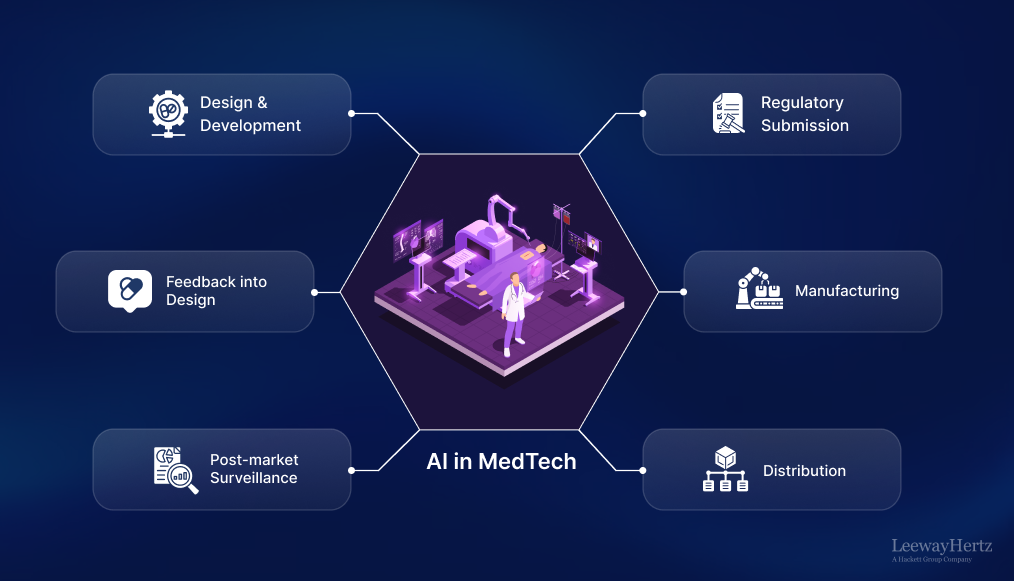
The conversation around AI in medical technology is expanding quickly, but much of it still focuses on the device itself: the algorithm that reads an image, detects a signal, supports a diagnosis, or flags a clinical risk. That product-level view matters, but it does not capture the full opportunity. Behind every medical device is a complex operating model: the functions that design, validate, clear, manufacture, secure, service, monitor, and commercialize the product across markets and device portfolios.
That operating model is becoming increasingly important as both AI adoption and regulatory expectations accelerate. The AI-enabled medical devices market was valued at about USD 13.67 billion in 2024 and is projected to reach roughly USD 255.76 billion by 2033, representing a compound annual growth rate of approximately 38.5 percent. North America accounted for about 53 percent of 2024 revenue[1]. Regulatory activity is also increasing. In 2025, the US Food and Drug Administration authorized a record number of AI/ML-enabled medical devices, bringing the cumulative total to more than 1,300 authorizations since 1995[2]. Approximately three-quarters of authorized AI/ML-enabled devices are concentrated in radiology, reflecting both the maturity of imaging use cases and the opportunity for AI adoption to expand across broader MedTech workflows [3].
At the same time, the quality and regulatory landscape is changing. On February 2, 2026, the FDA Quality Management System Regulation took effect, amending 21 CFR Part 820 to incorporate ISO 13485:2016 by reference and to replace the long-standing Quality System Inspection Technique with a new inspection program [4]. For AI-enabled devices, Predetermined Change Control Plans are also becoming more common. In 2025, about one in ten AI/ML clearances included an authorized PCCP, signaling a more structured approach to managing lifecycle changes for AI-enabled device software [5]. These developments are reshaping not only how AI-enabled devices are developed and authorized, but also how MedTech organizations run quality, regulatory, post-market, cybersecurity, and operational functions.
This article focuses on that second dimension: how AI can transform the MedTech operating model. It examines how generative and agentic AI can support work across product development, regulatory affairs, quality management, clinical evidence, manufacturing records, supply chain, product security, field service, post-market surveillance, medical affairs, market access, sales and marketing, legal and compliance, and data and AI governance. Across these functions, the greatest value lies in document-intensive, evidence-heavy, decision-driven, and workflow-heavy activities where AI can retrieve evidence, extract information, draft outputs, classify records, flag risks, and prepare work for human review.
What follows maps the MedTech operating model across core functions, moving from function to process to sub-process. It identifies where AI can create practical value at each layer and explains how those opportunities can be operationalized through ZBrain. The goal is to help MedTech leaders move beyond broad AI ambition and identify workflow-specific opportunities that reduce manual review effort, improve evidence quality, accelerate decision-making, strengthen compliance readiness, and maintain human accountability in areas where patient safety, product quality, regulatory expectations, and business outcomes are at stake.
- How AI is transforming MedTech operations
- Why AI use cases in MedTech must be mapped at the sub-process level
- MedTech operating model and AI opportunity mapping across MedTech processes
- High-value AI use cases in MedTech
- How agentic AI works in MedTech workflows
- How to prioritize AI use cases in MedTech
- Governance, risk, and responsible AI in MedTech
- How ZBrain operationalizes AI use cases in MedTech
- Future of AI in MedTech
How AI is transforming MedTech operations
MedTech organizations have long relied on analytics, rules engines, workflow automation, and machine learning to improve operational efficiency, quality, and compliance. These technologies continue to play an important role, but the emergence of generative AI and agentic AI is expanding what AI can do across regulated MedTech environments.
Traditional automation executes predefined rules. Machine learning identifies patterns, predicts outcomes, classifies data, and detects anomalies based on historical information. Generative AI adds a more advanced layer of capability by reading, summarizing, comparing, drafting, and explaining complex information. Agentic AI goes further by planning and executing multi-step workflows, such as retrieving supporting evidence, classifying a case, drafting an output, identifying potential risks, and routing the work for human review and approval.
In MedTech, AI is particularly valuable for work that is:
- Document-intensive work
Documents and records: Design history files, technical documentation, batch records, regulatory submissions, software bills of materials, device master records, standard operating procedures, validation documentation, and quality system records.
AI support: AI can help review, organize, compare, summarize, and draft document-heavy content while improving consistency, traceability, and readiness for review. - Narrative-intensive work
Documents and records: Clinical evaluation reports, CAPA records, MedWatch 3500A reports, periodic safety update reports, complaint narratives, adverse event descriptions, post-market surveillance reports, and cybersecurity advisories.
AI support: AI can summarize case histories, draft structured narratives, compare related records, identify missing information, and support clearer, more consistent documentation. - Exception-driven work
Documents and records: Complaints, nonconformances, audit findings, deviation reports, vulnerability disclosures, supplier quality issues, inventory discrepancies, and field-service anomalies.
AI support: AI can assist in identifying, classifying, prioritizing, and routing exceptions, while highlighting potential risks and recommending next steps for human review. - Knowledge-dependent work
Documents and records: Procedures, service manuals, work instructions, applicable standards, regulatory guidance, product specifications, labeling documents, training materials, and coverage policies.
AI support: AI can retrieve relevant knowledge, interpret procedural context, answer operational questions, and help teams apply the right information to the task at hand. - Workflow-heavy work
Documents and records: Submission packages, vigilance reports, supplier onboarding files, complaint handling records, field-action documentation, change control records, risk management files, and post-market surveillance workflows.
AI support: AI can coordinate multi-step workflows by gathering inputs, preparing drafts, checking completeness, flagging risks, and routing work to the appropriate reviewer or approver.
The strongest AI use cases in MedTech do not replace qualified professionals or remove human accountability from regulated decisions. Instead, AI serves as an intelligent operational layer that prepares cases, retrieves relevant evidence, drafts documentation, highlights risks, and routes work to the appropriate reviewer. This enables MedTech teams to improve speed, consistency, traceability, and decision readiness while keeping final judgment and accountability with human experts.
Why AI use cases in MedTech must be mapped at the sub-process level
Defining a strategy around “AI in MedTech” is too broad to be useful as a planning unit. The same applies to broad categories such as “AI in regulatory affairs,” “AI in quality,” or “AI in manufacturing.” While these categories help frame strategic priorities, they are not specific enough to determine the data required, the systems involved, the applicable controls, the approval pathway, or the metrics needed to measure success.
A more effective approach is to map each AI use case to the MedTech operating model. This helps organizations move from broad strategic goals to clearly defined, executable opportunities.
To make this mapping actionable, each AI opportunity should be described through a consistent hierarchy that connects strategic priorities to the specific work activities where value is created.
- Function: The major business, operational, or control area where the work takes place. Examples include regulatory affairs, quality management, post-market surveillance, clinical affairs, manufacturing, supply chain, and field service.
- Process: The workflow area within that function. Examples include US premarket submissions, CAPA management, complaint handling, adverse event reporting, supplier qualification, audit management, batch release, and field service management.
- Sub-process: The specific work activity or decision point within the process. Examples include predicate selection, substantial-equivalence table preparation, root-cause investigation, complaint triage, MDR reportability determination, nonconformance classification, supplier-risk assessment, or service-case summarization.
- AI-enabled opportunity: The precise way AI supports the sub-process. Examples include identifying relevant predicates, drafting a substantial-equivalence comparison, proposing likely root causes, classifying complaints against reportability criteria, summarizing service notes, extracting evidence from quality records, checking documentation completeness, or routing cases to the appropriate reviewer.
This level of detail is critical because MedTech workflows are closely tied to specific regulations, controlled documents, quality systems, data sources, risk owners, and decision rights. A clinical evaluation report drafting workflow is very different from an MDR reportability workflow. A predicate-search workflow requires different evidence, controls, and review steps than a complaint-triage workflow. Similarly, supplier risk assessment, batch record review, and field action execution each involve distinct data structures, compliance expectations, and approval responsibilities.
Mapping AI use cases at the sub-process level allows MedTech organizations to define the operational scope with precision. It clarifies what data the AI system needs, which documents and systems it must access, what level of human review is required, which risks must be controlled, and how success should be measured. It also helps teams distinguish between use cases where AI can assist with drafting, summarization, classification, evidence retrieval, or workflow routing, and those where human judgment must remain central.
By grounding AI opportunities in specific sub-processes, MedTech organizations can prioritize use cases more effectively, design appropriate governance, and build implementation roadmaps that align with regulated workflows. This approach turns broad strategic goals into practical, auditable, and value-driven workflows that can be deployed responsibly across the enterprise.
Transform MedTech workflows with AI
Streamline MedTech operations with AI to improve documentation quality, traceability, compliance readiness, and speed to decision.
MedTech operating model and AI opportunity mapping across MedTech processes
The operating model below outlines the core functions of a MedTech organization, detailing the processes and sub-processes within each function, along with AI enablement opportunities linked to each sub-process. The functions are presented in order: product and technical functions first; then quality and operations; followed by post-market, security, service, medical, commercial, and distribution functions; and finally sales and marketing, legal and compliance, and data and governance functions. Each opportunity specifies an AI capability and a related MedTech artifact or standard.
Function 1. Research and product development
Research and product development take the device from concept through design transfer. In regulated MedTech environments, this function typically applies design controls aligned with 21 CFR 820.30, ISO 13485, and other applicable market-specific requirements; manages product risk under ISO 14971; generates verification evidence showing that the design meets its inputs; and engineers software, hardware, and user interfaces. The work is document-intensive and traceability-driven: every requirement, test, and risk control must connect.
AI can support product development by drafting requirements, protocols, and risk worksheets from prior files and applicable standards, extracting acceptance criteria from IEC and ISO documents, and detecting traceability gaps before a design review. It accelerates the first draft and the cross-check while the engineers own the design decisions.
| Process | Sub-process | Key AI enablement opportunities |
|---|---|---|
| Design inputs and requirements definition | Design controls and design history file (DHF) management |
|
| Traceability matrix creation and gap analysis |
|
|
| Design verification and validation (V&V) | Protocol authoring |
|
| Design transfer and device master record (DMR) assembly |
|
|
| Design review and traceability management |
|
|
| Product risk management (ISO 14971) | Hazard analysis and risk assessment |
|
| Risk control and benefit-risk documentation |
|
|
| Production and post-production risk update |
|
|
| Verification testing and design evidence | Biocompatibility evaluation (ISO 10993) |
|
| Electrical safety and essential performance evaluation under IEC 60601 |
|
|
| Software lifecycle and usability engineering | IEC 62304 software lifecycle documentation |
|
| Human factors and usability engineering (IEC 62366) |
|
The highest-value opportunities in product development are design-input drafting, V&V protocol authoring, risk-file population, and traceability-gap detection.
An example agentic workflow is design-review preparation. An agent can pull the current risk file, V&V status, and open CAPAs, check the traceability matrix for orphaned inputs and outputs, draft the review package, and route it to the design-review team, while the reviewers retain responsibility for the gate decision.
Function 2. Regulatory affairs and submissions
Regulatory affairs and submissions secure and maintain market authorization across jurisdictions and keep the regulatory record current as the device and the regulatory landscape change. The function secures and maintains market authorization across the US (510(k), De Novo, PMA), the EU (MDR and IVDR), and international markets, manages change for AI-enabled and conventional devices, and keeps UDI and registration records current. It is the function that translates engineering and clinical evidence into the language each regulator expects.
AI can support regulatory affairs by researching predicates, drafting submission sections into the eSTAR template, mapping evidence to GSPR and performance requirements, drafting deficiency-letter responses, and flagging the right change pathway. The regulatory professional owns every filing decision and rationale.
| Process | Sub-process | Key AI enablement opportunities |
|---|---|---|
| US premarket submissions (510(k), De Novo, PMA) | Pre-Submission/Q-Submission planning and acceptance readiness |
|
| Predicate selection and substantial equivalence rationale |
|
|
| Submission authoring and eSTAR assembly |
|
|
| FDA additional information request response drafting |
|
|
| International registrations and audits | Country registration dossier assembly |
|
| MDSAP audit readiness |
|
|
| AI-enabled device software lifecycle and change management | Predetermined Change Control Plan (PCCP) authoring |
|
| Post-approval software change assessment |
|
|
| EU MDR and IVDR technical documentation | GSPR conformity and technical documentation |
|
| IVDR performance evaluation |
|
|
| UDI and registration management |
|
The highest-value opportunities in regulatory affairs and submissions are predicate selection and substantial-equivalence drafting, eSTAR assembly, deficiency-letter responses, GSPR mapping, and the post-approval change decision.
An example agentic workflow is a 510(k) submission assembly. An agent can shortlist predicates, draft the substantial-equivalence table, populate the eSTAR sections from the DHF and V&V reports, validate the package against the acceptance checklist, and assemble the index for regulatory review.
Function 3. Clinical affairs and evidence generation
Clinical affairs and evidence generation function generate and maintain the clinical evidence behind the device’s safety and performance claims. It runs clinical evaluation, designs and conducts investigations under 21 CFR 812 and ISO 14155, manages clinical data, and maintains post-market clinical follow-up and real-world evidence.
AI can support clinical affairs by screening literature, drafting clinical evaluation reports and study documents, coding adverse events for confirmation, and synthesizing real-world evidence. Clinical and regulatory owners retain accountability for the conclusions.
| Process | Sub-process | Key AI enablement opportunities |
|---|---|---|
| Clinical evaluation and literature management | Literature search and state-of-the-art appraisal |
|
| Clinical Evaluation Report (CER) drafting |
|
|
| Clinical investigations | IDE and study start-up |
|
| Clinical investigation document authoring |
|
|
| Clinical data management and safety reporting |
|
|
| Real-world evidence and PMCF | Post-market clinical follow-up (PMCF) |
|
| Real-world evidence synthesis |
|
The highest-value opportunities in clinical affairs are literature appraisal, CER drafting, study document authoring and PMCF reporting.
An example agentic workflow is CER drafting. An agent can run the literature search, appraise and classify studies, extract endpoints into an evidence matrix, draft the report to the MEDDEV 2.7/1 structure, and check that every labeling claim traces to a cited source for clinical review.
Function 4. Quality assurance and compliance
Quality assurance and compliance owns the quality management system under the QMSR and ISO 13485. It runs CAPA and nonconformance management, internal and supplier audits, document and training control, computer software assurance for production and QMS software, and management review. It is the function that keeps the organization inspection-ready.
AI can support quality by triaging complaints and nonconformances, proposing root causes based on prior records, drafting CAPAs and audit findings, retrieving the currently effective SOP, and reviewing audit trails. A quality engineer owns the investigation and the closure.
| Process | Sub-process | Key AI enablement opportunities |
|---|---|---|
| Complaint and nonconformance intake and triage | CAPA and nonconformance management |
|
| CAPA and nonconformance management | Root-cause investigation and CAPA authoring |
|
| Effectiveness check and CAPA closure |
|
|
| Audit, document, and computer system control | Internal and supplier audit management |
|
| Document control and training records |
|
|
| Computer software assurance and Part 11 records |
|
|
| Management review | Management review input preparation |
|
The highest-value opportunities in quality are complaint triage, CAPA drafting, audit finding summarization, and management-review preparation.
An example agentic workflow is CAPA investigation. An agent can classify the complaint, search prior CAPAs and the risk file for candidate root causes, draft the CAPA record, propose an effectiveness check that measures the stated root cause, and route it to the quality engineer for review.
Function 5. Manufacturing and operations
Manufacturing and operations convert released designs into compliant finished devices, maintaining production, qualification, and release records that evidence conformity. It maintains device history records and batch records, runs in-process inspection and the material review board, releases lots, and qualifies processes and equipment. The record is the proof of conformity.
AI can support manufacturing by reviewing production records by exception against the device master record, classifying deviations, drafting validation protocols, and checking label and sterilization records. The release decision stays with the releasing authority.
| Process | Sub-process | Key AI enablement opportunities |
|---|---|---|
| Production records, review, and release | Device History Record (DHR) and batch-record review |
|
| In-process inspection and material review board (MRB) |
|
|
| Lot release |
|
|
| Process validation, equipment qualification, and monitoring | Process validation (IQ/OQ/PQ) documentation |
|
| Equipment qualification and calibration records |
|
|
| Environmental monitoring record review |
|
|
| Labeling, packaging, and sterilization record review | Label and instructions-for-use (IFU) control |
|
| Sterilization and packaging record review |
|
The highest-value opportunities in manufacturing are DHR and batch-record review, MRB disposition, lot release, and validation documentation.
An example agentic workflow is lot-release readiness. An agent can check DHR completeness against the device master record, confirm test, sterilization, and label evidence, flag missing signatures or out-of-specification entries, and assemble a release-readiness summary for the releasing authority.
Function 6. Supply chain and supplier quality management
Supply chain and supplier quality management qualify and monitor the suppliers and components that feed production, maintaining purchasing controls and supplier records under the QMS.
It runs supplier qualification, incoming inspection, supplier corrective action, obsolescence management, and supply planning under purchasing controls. AI can support the supply chain by scoring supplier qualification dossiers, extracting incoming inspection data, drafting supplier corrective actions, detecting obsolescence risk, and forecasting component demand from historical records. Supplier-quality owners make the disposition.
| Process | Sub-process | Key AI enablement opportunities |
|---|---|---|
| Supplier qualification and monitoring | Supplier qualification and approved supplier list management |
|
| Incoming inspection and disposition |
|
|
| Supplier corrective action (SCAR) management |
|
|
| Component and supply planning | Component obsolescence and change control |
|
| Demand and supply planning |
|
The highest-value opportunities in the supply chain are supplier qualification, incoming inspection disposition, SCAR drafting, and obsolescence detection.
An example agentic workflow is supplier qualification. An agent can aggregate audit results, certifications, and performance history, score the supplier against the approved supplier criteria, flag gaps, and assemble the qualification dossier for supplier-quality review.
Accelerate AI Solutions Development
Build fully functional solutions from your high-value use cases, based on specific operational needs and enterprise context.
Function 7. Post-market surveillance and vigilance
Post-market surveillance and vigilance monitors field performance, makes reporting decisions under 21 CFR Part 803 and EU vigilance rules, detects safety signals, and drives recalls and field safety corrective actions. It closes the loop from the field back into risk and design.
AI can support vigilance by classifying complaints against reportability criteria, drafting MedWatch 3500A and PSUR content, detecting signals across complaint and return data, and drafting field safety notices. The reportability and recall decisions stay with qualified specialists.
| Process | Sub-process | Key AI enablement opportunities |
|---|---|---|
| Adverse-event reporting and vigilance | MDR reportability determination |
|
| EU vigilance and periodic reporting |
|
|
| Signal management and field actions | Signal detection and trend analysis |
|
| Recall and field safety corrective action (FSCA) |
|
|
| Complaint handling system oversight | Complaint trend and KPI reporting |
|
The highest-value opportunities in surveillance are reportability determination, PSUR drafting, signal detection, and field safety corrective action communications.
An example agentic workflow is periodic vigilance reporting. An agent can aggregate complaint, sales, and literature data, detect signals against the expected adverse-event rate, draft the PSUR and trend report, and route the benefit-risk conclusion for sign-off.
Function 8. Product security and cyber risk management
Product security and cybersecurity risk management secures connected medical devices and health software throughout the product lifecycle, from secure design and premarket submission to post-market vulnerability monitoring and updates.
It meets premarket obligations under the FD&C Act 524B, including threat modeling, security risk assessment, and software bill of materials, and postmarket obligations, including vulnerability management and coordinated disclosure, aligned to IEC 81001-5-1. AI can support product security by drafting threat models and security risk assessments, extracting and normalizing the SBOM, mapping components to known vulnerability data, and drafting customer advisories. Security decisions and the released submission stay with qualified owners.
| Process | Sub-process | Key AI enablement opportunities |
|---|---|---|
| Premarket cybersecurity risk management | Threat modeling and security risk assessment |
|
| Software bill of materials (SBOM) management |
|
|
| Postmarket cybersecurity vulnerability management | Vulnerability intake and triage |
|
| Security advisory and coordinated disclosure |
|
The highest-value opportunities in product security are SBOM management, threat modeling, vulnerability triage, and advisory drafting.
An example agentic workflow is vulnerability triage. An agent can map a disclosed vulnerability to the SBOM, score patient-safety impact, identify affected products in the installed base, and draft the customer security advisory for security review.
Function 9. Field service, technical support, and installed base management
Field service, technical support, and installed base management keep the installed base of devices and capital equipment serviceable, and capture field events that feed quality and surveillance.
It handles service requests, maintains service documentation, plans maintenance, and executes returns and field actions. Service records are also a primary feeder of complaints and surveillance. GenAI can support field service by triaging tickets, retrieving troubleshooting steps from manuals and prior cases, drafting service bulletins, extracting complaint-relevant content into the complaint system, and forecasting preventive maintenance from service-history records.
| Process | Sub-process | Key AI enablement opportunities |
|---|---|---|
| Service request and technical support | Service ticket intake and triage |
|
| Knowledge base and service documentation |
|
|
| Installed base and maintenance planning | Preventive maintenance planning |
|
| Returns and field-action execution |
|
The highest-value opportunities in field service are ticket triage, service documentation, complaint capture from service, and field-action scoping.
An example agentic workflow is service-ticket triage. An agent can classify the ticket by symptom and severity, retrieve troubleshooting steps for the field engineer, extract any complaint-relevant content and route it to complaint handling, and update the service record after resolution.
Function 10. Medical affairs and scientific communications
Medical affairs and scientific communications own scientific exchange, evidence communication, and field medical insight, distinct from clinical evidence generation.
It runs medical information, publications, MSL field insight capture, advisory boards, and medical education. AI can support medical affairs by drafting medical information responses from the approved library, drafting publication sections, summarizing field insights, and drafting advisory board briefing books. Reviewers confirm scientific accuracy and labeling alignment.
| Process | Sub-process | Key AI enablement opportunities |
|---|---|---|
| Medical information and scientific communications | Medical information response |
|
| Publications and scientific communications |
|
|
| Field medical and education | MSL field-insight capture |
|
| Advisory boards and medical education |
|
The highest-value opportunities in medical affairs are medical information responses, publication drafting, and MSL field insight capture.
An example agentic workflow is a medical information response. An agent can classify the inquiry, retrieve grounded content from the approved medical information library, draft a tailored response, route any product complaint content to vigilance, and send the draft for medical review.
Function 11. Commercial, market access, and reimbursement
Commercial, market access, and reimbursement build the economic, coverage, and value case for the device and govern compliant promotion to healthcare providers and payers.
It runs health economics, payer and HTA dossiers, coding and coverage analysis, promotional review, and tender and enablement content. AI can support market access by aggregating value evidence, drafting payer and HTA dossiers, mapping the device to codes and coverage policies, validating promotional claims against approved labeling, and drafting RFP responses. The promotional review owner clears every claim.
| Process | Sub-process | Key AI enablement opportunities |
|---|---|---|
| Health economics and market access | HEOR modeling and value evidence generation |
|
| Payer and HTA dossier development |
|
|
| Coding, coverage, and reimbursement pathway analysis |
|
|
| Promotional review and field enablement | Promotional material review (MLR) |
|
| Tender and RFP response management |
|
|
| Sales enablement content development |
|
The highest-value opportunities in commercial and market access are HEOR value evidence generation, payer-dossier drafting, coding and coverage analysis, and promotional material review.
An example agentic workflow is payer-dossier assembly. An agent can aggregate clinical, economic, and real-world evidence, draft the value dossier in the AMCP format, check that every claim traces to a cited source, and route it for market-access review.
Function 12. Distribution, field inventory, and order-to-cash operations
Distribution, field inventory, and order-to-cash operations move finished devices to the point of care and manage consignment and field inventory, a MedTech-native challenge for implants and procedure kits.
It runs field-inventory reconciliation, expiry and lot management, order processing, and demand forecasting. AI can support distribution by reconciling consignment and trunk-stock records, flagging inventory nearing expiry, extracting order data, and forecasting demand from historical case-volume records. Inventory and order owners act on the exceptions.
| Process | Sub-process | Key AI enablement opportunities |
|---|---|---|
| Field inventory management | Consignment and trunk-stock reconciliation |
|
| Lot control, expiry management, and traceability |
|
|
| Order management and order-to-cash | Order and returns processing |
|
| Demand forecasting |
|
The highest-value opportunities in distribution are consignment reconciliation, expiry management, order processing, and demand forecasting.
An example agentic workflow is consignment reconciliation. An agent can extract usage and replenishment data from case and scan records, flag discrepancies between recorded and used inventory, identify lots nearing expiry, and draft a replenishment and rotation plan for the inventory team.
Accelerate AI Solutions Development
Build fully functional solutions from your high-value use cases, based on specific operational needs and enterprise context.
Function 13. Sales and marketing operations
Sales and marketing operations run the selling engine and the brand for the device portfolio: field sales coverage, customer engagement, marketing content, medical congresses and trade shows, demonstration fleets, and the CRM and analytics that support them. In MedTech, it operates inside healthcare-compliance constraints on how providers are engaged and how products are promoted.
AI can support sales and marketing by assembling account intelligence, structuring CRM notes, drafting compliant marketing content for review, organizing congress materials, reconciling demonstration-fleet records, and forecasting demand. Promotional claims still pass medical-legal-regulatory review, and representatives own the customer relationship.
| Process | Sub-process | Key AI enablement opportunities |
|---|---|---|
| Sales force effectiveness and account management | Account and territory intelligence |
|
| Lead and opportunity management |
|
|
| Marketing and customer engagement | Marketing content development |
|
| Congress and event management |
|
|
| Commercial operations | Demonstration and evaluation of fleet coordination |
|
| Sales analytics and forecasting |
|
The highest-value opportunities in sales and marketing are account intelligence, CRM note structuring, compliant content drafting, and demand forecasting.
An example agentic workflow is call preparation. An agent can pull the account’s purchase and service history, summarize recent interactions and open opportunities, surface relevant approved talking points, and draft a pre-call brief for the representative, who owns the engagement.
Function 14. Legal, healthcare compliance, and ethics
Legal, healthcare compliance, and ethics manage legal risk and healthcare-specific compliance obligations governing how a MedTech company engages with providers and promotes products.
It runs anti-kickback and HCP-engagement compliance, transparency reporting such as US Open Payments, contracts and legal operations, and intellectual property. AI can support legal and compliance by classifying HCP engagements against policy, aggregating transparency-reporting data, extracting contract terms and drafting redlines, and supporting patent and freedom-to-operate research. Attorneys and compliance officers own every legal and compliance judgment.
| Process | Sub-process | Key AI enablement opportunities |
|---|---|---|
| Healthcare compliance and transparency | HCP engagement and anti-kickback monitoring |
|
| Transparency (Open Payments) reporting |
|
|
| Contracts and legal operations | Contract review and obligation tracking |
|
| Intellectual property management |
|
The highest-value opportunities in legal and compliance are transparency-report data aggregation, HCP-engagement monitoring, contract term extraction, and IP landscape research.
An example agentic workflow is transparency reporting. An agent can aggregate payments and transfers of value to covered recipients, validate the records against the reporting schema, flag inconsistencies, and assemble a submission-readiness dataset for compliance review.
Function 15. Data, IT, and AI governance
Data, IT, and AI governance oversee the data, systems, and AI that enable the rest of the operating model to adopt AI safely and at scale.
It manages data governance and master data, IT service and incidents, and the inventory, risk classification, and monitoring of AI use cases. In a regulated environment, this function keeps AI within the quality system. AI can support this function by reconciling master data, triaging IT incidents and drafting root-cause summaries, maintaining the AI use-case inventory and monitoring deployed models and agents for drift and exceptions. Governance owners decide what is approved, retired, or escalated.
| Process | Sub-process | Key AI enablement opportunities |
|---|---|---|
| Data and systems management | Data governance and master data management |
|
| IT service and incident support |
|
|
| AI governance | AI use-case inventory and risk classification |
|
| Model and agent monitoring |
|
The highest-value opportunities in data, IT, and AI governance are master data reconciliation, incident triage and documentation, AI use case inventory, and model and agent monitoring.
An example agentic workflow is AI governance intake. An agent can collect details of a proposed use case, identify its data sources, classify its risk and regulatory exposure, map the required controls and approvals, and assemble the documentation for the AI oversight forum, which owns the approval.
Accelerate AI Solutions Development
Build fully functional solutions from your high-value use cases, based on specific operational needs and enterprise context.
High-value AI use cases in MedTech
The MedTech AI use-case landscape is broad, but not every workflow should be prioritized for early automation. The strongest starting points are typically workflows that are high-volume, document-intensive, exception-driven, or narrative-heavy, where AI can prepare a draft, extract evidence, structure information, recommend next steps, or flag risks for human review.
These use cases are especially valuable because they sit at the intersection of operational complexity and regulatory accountability. They often involve large volumes of records, repetitive review activities, fragmented data sources, and time-sensitive decisions. Generative AI can reduce manual effort by summarizing inputs, drafting structured outputs, checking completeness, and surfacing relevant evidence, while agentic AI can coordinate multi-step workflows such as retrieval, classification, drafting, escalation, and routing.
| High-value use case | How AI supports the workflow |
|---|---|
| 510(k) submission assembly |
|
| Predicate selection and substantial equivalence drafting |
|
| Clinical Evaluation Report (CER) drafting |
|
| CAPA investigation and drafting |
|
| Complaint intake and triage |
|
| MDR reportability determination |
|
| Periodic vigilance reporting and PSUR drafting |
|
| DHR and batch-record review |
|
| Technical documentation and GSPR mapping |
|
| SBOM and vulnerability triage |
|
| Security advisory drafting |
|
| Service-ticket triage |
|
| Payer and HTA dossier drafting |
|
| Consignment and trunk-stock reconciliation |
|
These use cases deliver value because they do not bypass human review or regulated decision-making. Instead, AI acts as a support layer that strengthens decision readiness and accelerates workflow execution. It prepares evidence, organizes case information, drafts structured outputs, highlights exceptions, and routes work to the appropriate experts for review and approval.
The impact is seen in shorter cycle times, higher-quality documentation, reduced backlog pressure, stronger traceability, and more consistent execution across regulatory, quality, manufacturing, post-market, cybersecurity, field service, and commercial operations. When implemented with the right controls, these AI-enabled workflows can improve operational efficiency and compliance readiness while keeping accountability with qualified professionals.
How agentic AI works in MedTech workflows
Generative AI can draft, summarize, classify, compare, and retrieve information. Agentic AI extends these capabilities by coordinating multi-step workflows across systems, documents, teams, and approval pathways. In MedTech, this distinction is important because many high-value workflows are not isolated writing or search tasks. They involve regulated decisions, controlled records, cross-functional inputs, and evidence that must be reviewed, approved, and retained.
For example, clinical evaluation is not simply a drafting exercise. It may involve literature search, study screening, evidence appraisal, endpoint extraction, benefit-risk analysis, claim-to-evidence mapping, gap identification, report drafting, and review routing. An agentic AI workflow can coordinate these steps by retrieving relevant evidence, structuring the analysis, preparing draft sections, identifying missing information, and routing the output to clinical and regulatory owners. However, accountability for the clinical conclusions, regulatory position, and final approval remains with qualified human reviewers.
Examples of agentic AI workflows in MedTech include:
510(k) submission assembly agent: Coordinates predicate research, drafts substantial-equivalence comparisons, populates eSTAR sections from controlled source documents, checks submission completeness, and assembles the submission index for regulatory review.
CAPA agent: Reviews complaints, nonconformances, audit findings, and prior CAPA records; proposes possible root causes; drafts CAPA narratives; recommends corrective and preventive actions; and prepares effectiveness-check criteria for quality-engineer review.
Vigilance and PSUR agent: Aggregates complaint data, sales data, literature findings, adverse-event trends, and post-market surveillance inputs; drafts PSUR and trend-report sections; and flags potential safety signals against expected adverse-event rates for vigilance specialist review.
Cybersecurity agent: Maps a disclosed vulnerability to the software bill of materials, identifies affected products and versions, evaluates potential patient-safety impact, summarizes severity and remediation status, and drafts customer or regulatory advisory content for cybersecurity, regulatory, legal, and quality review.
Field-service agent: Triage service tickets, retrieve relevant troubleshooting steps, summarize technician notes, identify complaint-relevant information, and transfer structured content into the complaint-handling workflow when escalation is required.
Market-access agent: Aggregates clinical, economic, real-world, and comparator evidence; drafts payer or health technology assessment dossier sections; checks claims against source evidence; and flags unsupported or inconsistent value statements for market access review.
Agentic workflows in MedTech should be designed with clear governance and approval gates. The AI can prepare information, recommend actions, route work, update records, and surface risks, but the organization must define where human review is mandatory, which decisions cannot be automated, what evidence must be retained, how outputs are verified, and how exceptions are escalated. With the right controls, agentic AI can improve workflow speed, consistency, traceability, and decision readiness while maintaining human accountability across regulated MedTech operations.
How to prioritize AI use cases in MedTech
MedTech organizations should not prioritize AI use cases simply because they appear innovative or technically advanced. The strongest use cases are those that combine clear business value with strong workflow fit, reliable data availability, appropriate human oversight, control readiness, and the potential to scale across products, sites, or regions.
A structured prioritization approach helps organizations identify where AI can deliver measurable value while remaining aligned with regulatory, quality, and operational requirements.
| Prioritization criterion | What to evaluate |
|---|---|
| Business value | Assess the expected impact on cycle time, cost, documentation quality, backlog reduction, risk mitigation, and the amount of expert capacity freed for higher-value judgment work. |
| Workflow fit | Evaluate whether the workflow is document-intensive, knowledge-dependent, exception-driven, narrative-heavy, repetitive, or rules-supported. These characteristics often indicate strong potential for AI-assisted drafting, summarization, classification, evidence retrieval, or routing. |
| Data readiness | Determine whether the required data is available, accurate, complete, permissioned, well-structured, and connected to the workflow. AI performance depends heavily on access to trusted source documents, controlled records, and relevant system data. |
| Human review model | Confirm whether a qualified owner can review, approve, reject, or correct the AI output. In regulated workflows, AI should support decision readiness, while final accountability remains with designated personnel. |
| Control and regulatory impact | Evaluate whether the use case improves auditability, traceability, documentation consistency, and alignment with the quality management system, design controls, regulatory submission requirements, MDR obligations, or vigilance processes. |
| Integration complexity | Assess how many systems, data sources, documents, approval paths, and functional teams the workflow touches. Use cases with fewer integration dependencies may be better suited for early implementation. |
| Scalability | Determine whether the AI pattern can be reused across multiple products, business units, sites, markets, or regions. Scalable patterns create broader enterprise value beyond a single workflow. |
A practical first wave of AI implementation should focus on workflows that meet the following conditions:
- Clear workflow boundaries: The process should have a defined start point, end point, inputs, outputs, and ownership.
- Accessible data: The required documents, records, and system data should be available, accurate, permissioned, and usable by the AI system.
- Repeatable steps: The workflow should include recurring activities such as classification, evidence retrieval, summarization, drafting, routing, or completeness checks.
- Defined human review points: Qualified reviewers should be able to approve, reject, correct, or escalate AI-generated outputs before any regulated decision is finalized.
- Suitable early use cases: Good first-wave candidates include complaint intake and triage, CAPA drafting, predicate search, literature appraisal for clinical evaluation, service-ticket triage, and payer-dossier drafting.
- AI’s role in these workflows: AI can prepare information, retrieve evidence, classify inputs, draft structured outputs, identify gaps, and support reviewer readiness while keeping final decisions with qualified professionals.
More sensitive workflows should be approached with stronger governance and additional control mechanisms:
- High-impact decision areas: These include MDR reportability determinations, recall classification, released-record disposition, regulatory submission sign-off, and security-advisory release.
- Need for stronger controls: These workflows often involve higher regulatory, quality, patient-safety, cybersecurity, or business risk.
- AI’s role in sensitive workflows: AI can organize evidence, identify risks, prepare recommendations, and support decision readiness.
- Human accountability: Final approval must remain with designated regulatory, quality, clinical, cybersecurity, or executive decision-makers.
By applying a disciplined prioritization framework, MedTech organizations can direct early AI investments toward use cases that are valuable, feasible, controllable, and scalable. This reduces implementation risk, supports responsible adoption, and creates a practical path for expanding AI across regulated operations over time.
Governance, risk, and responsible AI in MedTech
AI in MedTech must operate within the organization’s quality management system, design control framework, data governance policies, and regulatory obligations. Because MedTech workflows often involve patient safety, product quality, clinical evidence, regulatory submissions, and post-market obligations, AI cannot be treated as a standalone productivity tool. It must be governed within the regulated operating environment.
The most important principle is clear accountability. AI can assist with evidence retrieval, summarization, drafting, classification, risk flagging, and workflow routing, but the responsible process owner remains accountable for consequential decisions and regulated outputs. This is especially important in workflows involving reportability decisions, recall classification, product release, clinical claims, labeling, regulatory submissions, and customer or authority communications.
Key governance requirements include:
- Human review and approval: Mandatory human review should be defined for reportability decisions, recall classification, released-record disposition, regulatory submission sign-off, security-advisory release, labeling approval, and claim approval. AI outputs should be reviewed, corrected, approved, or rejected by qualified personnel before they are used in regulated decisions.
- Source-grounded outputs: AI-generated outputs should be grounded in approved and controlled sources, such as design history files, device master records, clinical evidence, technical documentation, standards, procedures, risk files, and regulatory guidance. Where possible, outputs should cite, link to, or reference the source evidence used to support the recommendation or draft.
- Audit trails and traceability: AI workflows should capture the inputs used, outputs generated, prompts or task instructions, model or agent versions, source documents accessed, reviewer actions, approvals, corrections, and timestamps. This supports traceability, investigation, and inspection readiness and should be aligned with electronic record and electronic signature expectations, such as 21 CFR Part 11.
- Role-based access control: AI systems should retrieve and process only the data that the user and workflow are authorized to access. Access should be aligned with job role, process ownership, data classification, confidentiality requirements, and the principle of least privilege.
- Data protection and confidentiality: Patient data, clinical data, proprietary product information, supplier records, cybersecurity information, and commercially sensitive data must be protected throughout the AI workflow. Controls should address data minimization, secure storage, encryption, retention, masking or de-identification where appropriate, and restrictions on external model training or unauthorized data reuse.
- Model and agent monitoring: AI systems should be monitored for accuracy, completeness, hallucination, drift, bias, confidence levels, exception rates, escalation frequency, and reviewer override patterns. Monitoring should help identify when the model produces unreliable outputs, when source data quality affects performance, or when workflow conditions change.
- Validation and computer software assurance: AI tooling used in regulated workflows should be evaluated through a risk-based computer software assurance approach. Organizations should define intended use, assess risk, test critical functions, validate AI-assisted records where required, and maintain evidence that the system performs reliably within its approved use case.
- Escalation and exception handling: Clear escalation procedures should be in place for low-confidence outputs, incomplete evidence, conflicting guidance, potential safety signals, cybersecurity concerns, regulatory sensitivity, or cases where AI recommendations conflict with reviewer judgment.
- Change management: Updates to models, prompts, retrieval sources, workflow logic, integrations, or approval rules should be governed through change control. This helps ensure that improvements do not introduce unintended compliance, quality, or safety risks.
- Clear usage boundaries: Organizations should define what AI is allowed to do, what it is not allowed to do, and where human decision-making is mandatory. These boundaries should be reflected in procedures, training, system permissions, and workflow design.
Governance should not be treated as a barrier to AI adoption. In MedTech, governance is what makes AI usable, scalable, and defensible in a regulated environment. A well-governed AI workflow can give the organization greater transparency, stronger documentation, more consistent execution, clearer accountability, and better inspection readiness than unmanaged manual work.
How ZBrain operationalizes AI use cases in MedTech
Identifying use cases is only the first step. MedTech organizations need a controlled way to design, build, validate, deploy, govern, and scale AI workflows across product development, clinical affairs, regulatory affairs, quality management, manufacturing, supply chain, commercial operations, field service, post-market surveillance, complaint handling, and enterprise reporting.
This is where ZBrain helps.
ZBrain is an end-to-end AI enablement platform that supports this lifecycle through four connected stages: ZBrain Analyzer, ZBrain Design, ZBrain Solution Builder, and ZBrain Governance. The platform provides a governed path from use-case analysis to deployed agentic workflows while maintaining policies, permissions, approval points, monitoring, and runtime evidence.
ZBrain Analyzer
ZBrain Analyzer helps teams examine selected medtech processes, identify AI opportunities, and document the business context, systems, data, artifacts, roles, controls, and review requirements needed to evaluate each use case.
ZBrain Design
ZBrain Design creates a build-ready technical design for the selected use case. It generates the business requirements document, functional requirements, user journeys, architecture, workflow logic, data specifications, integration context, and governance considerations needed before development begins.
ZBrain Solution Builder
ZBrain Solution Builder enables teams to create, configure, and validate governed AI workflows for medtech processes based on the technical design developed in ZBrain Design. It supports testing across routine, exception, regulated, and control scenarios before deployment.
ZBrain Governance
ZBrain Governance applies policies, access controls, human approval requirements, monitoring, and traceability throughout workflow execution. It provides guardrails, approval gates, escalation controls, kill switches, and audit trails to help organizations maintain oversight of AI outputs, reviewer actions, exceptions, and authorized system updates.
Future of AI in MedTech
AI in MedTech is expected to evolve from task-level copilots to workflow-oriented agents. The first wave of adoption has focused on helping teams draft, summarize, search, classify, and retrieve information. The next wave will go further by coordinating larger workflows across documents, systems, functions, and approval pathways, with human experts entering at defined review, escalation, and decision points.
Several shifts are likely to shape the next stage of AI adoption in MedTech:
- From generic assistants to specialized workflow agents: MedTech organizations will move from broad-purpose AI tools to agents designed for specific regulated workflows, such as complaint triage, CAPA drafting, clinical evaluation, submission assembly, vigilance reporting, supplier quality, cybersecurity triage, and field-service support.
- From standalone pilots to reusable AI components: Early pilots will give way to reusable capabilities such as evidence retrieval, document comparison, risk classification, traceability mapping, draft generation, completeness checks, and workflow routing. These components can be applied across product lines, sites, regions, and functions.
- From manual review of every step to approval at defined control points: Instead of reviewing every AI action in isolation, organizations will define where human approval is mandatory, where automated checks are acceptable, and where exceptions must be escalated. This will make AI workflows more efficient while preserving accountability for regulated decisions.
- From centralized experimentation to federated adoption under central governance: AI adoption will expand across regulatory, quality, clinical, manufacturing, post-market, cybersecurity, field-service, and commercial teams. However, this expansion will need to operate under shared governance for data access, validation, monitoring, auditability, security, and responsible use.
- From static knowledge search to active workflow orchestration: AI will move beyond retrieving documents or answering questions. Agentic systems will be able to gather inputs, compare evidence, draft outputs, identify gaps, route work, update records, and trigger follow-up actions within approved workflow boundaries.
- From productivity-only measurement to quality and control measurement: Organizations will measure AI not only by time saved, but also by documentation quality, consistency, traceability, backlog reduction, risk detection, audit readiness, reviewer efficiency, and control effectiveness.
The organizations that succeed will not be those with the longest list of AI ideas. They will be the ones that connect AI to the way MedTech work is actually performed: by mapping use cases to specific processes, grounding outputs in controlled evidence, defining human accountability, and embedding governance into the workflow. In this future, AI becomes more than a productivity tool. It becomes an operational layer that helps MedTech organizations execute regulated work with greater speed, consistency, transparency, and confidence.
Endnote
For many MedTech organizations, the primary challenge with AI will not be slow adoption. It will be an overly broad adoption. Phrases such as “AI in MedTech,” “AI in regulatory,” or “AI in quality” may express strategic intent, but they do not define an executable plan. Without a clearly defined workflow, data context, control model, and ownership structure, even promising AI initiatives can remain limited to proof-of-concept activity.
Successful organizations will move from broad ambition to operating-model precision. They will identify the relevant function, map the process, and isolate the specific sub-process where AI can deliver measurable value. This is where AI becomes operationally useful: in document-intensive, narrative-intensive, exception-driven, knowledge-dependent, and workflow-heavy activities where teams spend significant time extracting data, retrieving evidence, comparing records, drafting outputs, flagging risks, and preparing work for review.
Across MedTech operations, the pattern is consistent. Whether the workflow involves a 510(k) submission, CAPA investigation, vulnerability advisory, service case, or payer dossier, AI should have a clearly defined role. It prepares the work, a qualified professional makes the decision, and the quality system governs the process. This is why disciplined execution matters more than enthusiasm. MedTech organizations that scale AI responsibly will not be defined by the number of pilots they launch, but by how well they select, validate, govern, and scale use cases. A practical path is to begin with one high-value workflow, test it against real outputs, validate it under appropriate controls, and then reuse the pattern across additional processes, product lines, sites, or regions. In a regulated environment, AI must be able to withstand scrutiny. That requirement is not a constraint on innovation; it is what turns AI from an experiment into a reliable operational capability.
As AI models continue to advance, access to powerful technology will become less of a differentiator. The durable advantage will come from knowing which sub-process to target, how to ground AI outputs in trusted evidence, where to place human review, and how to govern the workflow end-to-end. The model may become more widely available, but the workflow remains the strategy. MedTech organizations that map it, govern it, and apply AI where it reduces effort without removing judgment will be better positioned to scale AI responsibly across regulated operations.
Ready to operationalize AI across MedTech workflows? ZBrain helps MedTech organizations identify high-value AI opportunities, map them to specific functions and sub-processes, and build governed AI workflows that support evidence retrieval, drafting, classification, review routing, and human accountability.
Author’s Bio


Akash's ability to build enterprise-grade technology solutions has garnered the trust of over 30 Fortune 500 companies, including Siemens, 3M, P&G, and Hershey's. Akash is an early adopter of new technology, a passionate technology enthusiast, and an investor in AI and IoT startups.
Related Products

AI Agent
Discover the right AI agent for your use case! Explore our extensive range of AI agents tailored to tackle specific challenges.
Start a conversation by filling the form
Once you let us know your requirement, our technical expert will schedule a call and discuss your idea in detail post sign of an NDA.
All information will be kept confidential.
FAQs
What is the difference between generative AI and agentic AI in MedTech?
In MedTech, generative AI helps create controlled drafts or summaries, like clinical evaluation reports or deficiency-letter responses. Agentic AI manages defined workflow steps, such as checking a 510(k) package or design history file for missing items and routing gaps to regulatory or quality reviewers. Predictive AI differs by scoring and detecting, for example, flagging complaint signals or forecasting component demand, enhancing decisions before a qualified reviewer approves.
Why should MedTech evaluate AI at the sub-process level?
MedTech AI programs often stall when a broad goal is not tied to a specific review queue, system, or accountable function. Sub-process targeting turns a broad objective into a controlled workflow step, such as 510(k) predicate selection or complaint triage. It also makes the data requirement, the review owner, and the success measure explicit, which is what separates a workflow that ships from a pilot that stalls.
Which MedTech functions benefit most from AI first?
The strongest early benefits appear in functions with large regulated review queues and mature, structured records. Regulatory affairs and quality use AI to draft submissions and to triage complaints and CAPAs, shortening planning cycles and improving filing readiness. Post-market surveillance and clinical affairs use AI to classify complaints and determine reportability, and to draft clinical evaluation reports and periodic safety update reports, thereby reducing review effort while preserving ownership. Manufacturing and supply chain use AI to review batch records by exception and to qualify suppliers, reducing manual checking without changing release authority.
Which AI use cases are most vital in MedTech?
The most vital use cases support high-value technical, regulatory, quality, safety, and commercial decisions while preserving human accountability. They matter most where workflows depend on large evidence sets, regulated records, complex documentation, and time-sensitive review cycles.
-
Research and product development: drafting design inputs and V&V protocols, populating the risk file, and detecting traceability gaps. Vital because design-control decisions shape the whole submission and the device’s safety case.
-
Regulatory submission preparation: predicate selection, substantial-equivalence drafting, eSTAR assembly, GSPR mapping, and deficiency-letter responses. Vital because submission completeness and review readiness directly affect clearance timelines.
-
Clinical affairs and evidence: literature appraisal, clinical evaluation report drafting, and post-market clinical follow-up reporting. Vital because clinical evidence underpins every safety and performance claim.
-
Post-market surveillance and vigilance: complaint triage, MDR reportability classification, MedWatch 3500A and PSUR drafting, and signal detection. Vital because these workflows are high-volume, time-sensitive, and tied to patient safety.
-
Manufacturing and quality operations: device history record and batch-record review, CAPA drafting, and lot-release readiness. Vital because they reduce review effort and speed quality decisions without changing release authority.
-
Product security and cybersecurity: software bill of materials management, threat modeling, vulnerability triage, and advisory drafting. Vital because connected-device security is now a premarket and postmarket obligation.
-
Commercial and market access: payer and HTA dossier preparation, coding and coverage analysis, and promotional material review. Vital because they connect evidence, coverage, and access decisions.
-
Governance, compliance, and responsible AI: AI use-case inventory, model and agent monitoring, transparency reporting, and audit preparation. Vital because MedTech AI must operate under controls to ensure data integrity, patient safety, quality, and regulatory compliance.
How should MedTech keep AI safe with human review?
AI prepares the work; a qualified person makes the regulated decision. In vigilance, AI can classify a complaint against 21 CFR Part 803 and draft the MedWatch 3500A, but a vigilance specialist confirms the reportability determination before submission. In manufacturing quality, the releasing authority or quality unit signs off on lot release and CAPA closure before any disposition. In regulatory affairs, a regulatory lead approves the 510(k) before it is filed, and in product security, a security owner approves the advisory and the released submission. The AI step itself is validated and logged like any other element of the quality system.
How should MedTech teams prioritize AI use cases?
Prioritization should start with a named bottleneck in a regulated workflow, not with a model choice. Good first candidates have controlled source data and a clear review role, which reduces validation ambiguity and rework. Complaint triage and 510(k) predicate search are useful tests because their outputs support an existing decision rather than replace it. Use cases should move later if data lineage is weak or the workflow lacks an accountable reviewer, such as a vigilance specialist or a quality-unit approver.
What does ZBrain provide for MedTech AI programs?
ZBrain provides an end-to-end AI enablement platform for medtech organizations to identify, design, validate, deploy, govern, and scale AI workflows across product development, clinical affairs, regulatory affairs, quality management, manufacturing, supply chain, commercial operations, field service, post-market surveillance, complaint handling, and enterprise reporting.
- ZBrain Analyzer: Helps teams examine selected medtech processes, identify AI opportunities, and document the business context, systems, data, artifacts, roles, controls, KPIs, and review requirements needed to evaluate each use case.
- ZBrain Design: Converts selected use cases into build-ready technical designs, including business requirements, functional requirements, user journeys, architecture, workflow logic, data specifications, integration context, approval points, and governance considerations.
- ZBrain Solution Builder: Enables teams to create, configure, and validate governed AI workflows based on the design developed in ZBrain Design. It supports testing across routine, exception, regulated, and control scenarios before deployment.
- ZBrain Governance: Applies policies, access controls, human approval requirements, monitoring, traceability, escalation controls, kill switches, and audit trails throughout workflow execution.
ZBrain’s role is enablement rather than autonomous decision-making. It helps define where AI assists, augments, or acts within a workflow, while regulated decisions and final approvals remain with accountable roles such as regulatory affairs leads, clinical owners, quality units, vigilance specialists, cybersecurity owners, manufacturing release authorities, and other authorized approvers.
How can MedTech start with AI without unnecessary upfront investment?
MedTech teams can start efficiently by selecting one constrained workflow with a known backlog and an existing review owner. A practical pilot might classify complaint intake or summarize design history records using current systems and documented procedures. Teams should measure cycle time and review rework before expanding, and scale only after data lineage is documented and the validation evidence is accepted under the quality system and computer software assurance.
Related Services/Solutions
ChatGPT Developers
Our ChatGPT developers are proficient in building custom OpenAI model-powered solutions designed to improve conversational experiences, streamline data access, and boost customer engagement for enhanced business outcomes.

Enterprise AI Development
Maximize your business potential with our enterprise AI development services. We build custom solutions tailored to your unique needs for optimized operations and streamlined workflows.
Generative AI Development
Leverage our generative AI development services to streamline workflows, boost productivity and drive innovation, while ensuring seamless integration with your existing systems.
Related Insights
AI in Contact Center Operations: Use Cases & Agentic Workflows
Explore how AI supports contact center operations across routing, workforce management, quality assurance, coaching, compliance, escalation, and performance governance.
AI in Customer Relationship Management: Processes, Use Cases, and Enterprise Operating Model
AI opportunities in CRM become clearer when the operating model is decomposed across functions, processes, and sub-processes.

Agentic AI in customer service: Integration approaches, implementation frameworks and measurable business impact
Agentic AI transforms customer service by enabling autonomous agents to handle specific operational functions and coordinate to deliver seamless customer experiences

Customer service automation: Enhancing efficiency and customer satisfaction
Customer service automation transforms how businesses handle customer interactions by leveraging advanced technologies such as AI-driven chatbots, machine learning, and integrated software systems.

Adopting AI for customer success: Shaping a new era of user assistance
Customer success is a strategic approach where businesses proactively guide customers through a product journey to ensure they achieve their desired outcomes, thereby enhancing customer satisfaction, loyalty, and advocacy.

Generative AI in travel: Navigating the future of tailored tourism
Generative AI allows travel companies to provide real-time updates and personalized recommendations to travelers, guiding them through the complex world of travel information.

AI in fleet management: Use cases, benefits, architecture, technologies and solution
AI-driven fleet management systems use real-time data on traffic and road conditions to calculate the most efficient vehicle routes.

Conversational AI: Use cases, types and solution
Conversational AI is a subset of artificial intelligence that enables human-like interactions between computers and humans using natural language.

AI in LTV model: Applications and ML techniques
AI and ML have reshaped the way businesses estimate and leverage LTV, offering unprecedented accuracy, insights, and personalized strategies.