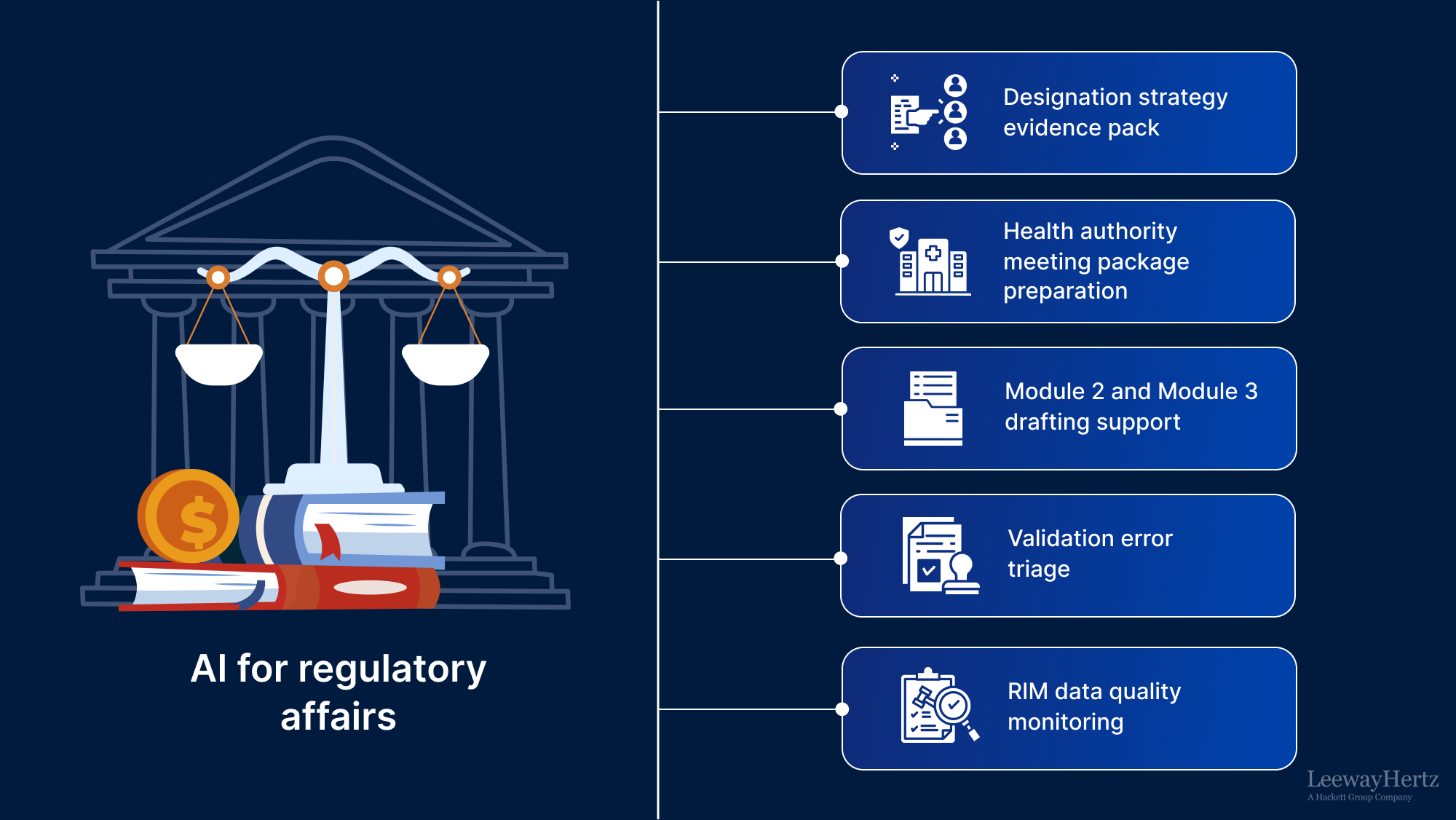
Regulatory affairs in life sciences is the governed interface between a product portfolio and health authorities. In pharma and medtech organizations, it connects regulatory intelligence, strategy, health authority interactions, submission planning, authoring, publishing, and query response. It also links license maintenance, labeling, commitments, and regulatory information management into one accountable chain of records.
External market estimates show why this operating layer receives sustained technology investment. Grand View Research estimated the global regulatory affairs market at USD 16.4 billion in 2024 and projected USD 27.2 billion by 2030 [1], while its RIM (Regulatory Information Management) systems estimate placed the global regulatory information management system market at USD 2.5 billion in 2025 with projected growth to USD 5.1 billion by 2033. [2]
Regulatory operations are also shaped by increasingly structured submission requirements. FDA identifies eCTD as the standard format for submitting applications, amendments, supplements and reports to CDER and CBER [3], ICH M8 defines the eCTD implementation framework [4], and EMA describes eCTD as the electronic submission format for CTD content from applicant to regulator. [5]
The challenge is that regulatory affairs teams must manage this structure across fragmented systems, strict submission formats, changing health authority expectations, and market-specific rules. A single regulatory event can affect dossier sections, RIM records, labeling, commitments, publishing sequences, and local maintenance actions. Manual review becomes difficult when teams must trace each decision back to approved sources, preserve submission timelines, and retain inspection-ready evidence.
This is where AI becomes relevant. Its value is not in replacing regulatory judgment, but in retrieving the right records, comparing them against current rules, identifying gaps or conflicts, and preparing review-ready packets for accountable RA roles. The opportunity is therefore best understood by decomposing the regulatory affairs operating model into functions, processes, and sub-processes. Each sub-process has its own starting artifact, source system, market rule, review boundary, output, and inspection evidence. Without that level of mapping, AI use cases remain too broad to govern or measure. For example, a model may prepare a Type IB versus Type II recommendation, but the GRL or CMC RA owner confirms the classification. It may draft a response to an RTQ, but the accountable reviewer owns the submitted position. It may identify a missing xEVMPD or UDI data field, but the RIM data steward confirms the record.
To define these opportunities precisely, this article maps regulatory affairs at the function, process, and sub-process levels. For each area, it identifies the relevant artifacts, systems, controls, accountable roles, human decision boundaries, and AI-enabled opportunities. This level of detail makes each use case more practical to design, govern, and measure.
- How AI is transforming regulatory affairs operations
- Why AI use cases in regulatory affairs must be mapped at the sub-process level
- Regulatory affairs operating model and AI opportunity mapping across regulatory affairs processes
- High-value AI use cases in regulatory affairs
- How agentic AI works in regulatory affairs workflows
- How to prioritize AI use cases in regulatory affairs
- Governance, risk, and responsible AI in regulatory affairs
- How ZBrain operationalizes AI use cases in regulatory affairs
- Future of AI in regulatory affairs
How AI is transforming regulatory affairs operations
AI in regulatory affairs should be treated as an evidence and orchestration layer around controlled regulatory work, not as a replacement for regulatory judgment or health authority accountability. Regulatory affairs operates across a highly interconnected set of systems, records, decisions, and health authority requirements. A single post-approval CMC change can touch the QMS change record, RIM registrations, Module 3 content, variation classification rules, submission calendars, publishing sequences, commitments and local affiliate actions.
AI adds value when it retrieves and reconciles those records without weakening the authority of RIM, DMS, QMS, publishing, labeling or health authority correspondence systems. For example, a revised nitrosamine guideline should trigger more than a standalone summary. It should become an impact memo, affected-product list, market variation plan, eCTD content plan and reviewer-routed decision packet.
The role of AI becomes clearer when regulatory affairs activities are grouped into five areas: document review, evidence-based drafting, exception triage, knowledge retrieval, and workflow coordination.
- Document-heavy work: eCTD sequences, Forms 356h and 1571, Module 2 summaries, Module 3 CMC sections, Q-Sub packages, EU MDR technical documentation, SPL XML files, and PMR or PMC dossiers can be checked for missing context and inconsistencies before review.
- Narrative-heavy work: briefing documents, scientific advice positions, RTQ responses, variation rationales, label deviation justifications, and annual commitment reports can be drafted from approved sources while showing where evidence is limited.
- Exception-heavy work: validation errors, missing ACKs, unresolved LOQ items, disputed variation classifications, late source documents, and inconsistent RIM records can be classified and prioritized for accountable review.
- Knowledge-heavy work: health authority guidance, ICH step updates, EPAR precedent, CRL themes, QRD wording, SPL requirements, and post-approval change rules can be retrieved with citations and compared against product context.
- Workflow-heavy work: submission calendars, dossier authoring tasks, query response workstreams, variation packages, label implementation, and commitment closure benefit when AI assembles the next packet and records the evidence trail.
The practical design rule is evidence before action. AI prepares, compares, classifies, drafts and monitors; named regulatory owners still confirm strategy, filings, commitments, label positions and submitted content.
Why AI use cases in regulatory affairs must be mapped at the sub-process level
Regulatory affairs work spans many connected but distinct responsibilities, from monitoring health authority updates to planning submissions, managing eCTD sequences, responding to agency questions, maintaining licenses, updating labels, and tracking commitments. Each area relies on different source records, systems, regulatory requirements, timelines, outputs, and accountable reviewers.
That variation makes broad functional framing too imprecise for AI design. “Automate regulatory affairs” is not a deployable use case because it does not define the trigger, source record, output, review boundary, or risk level. Regulatory intelligence triage starts with a health authority source and produces an impact memo. eCTD validation starts with a compiled sequence and produces an error queue. PMR closure starts with a commitment record and evidence package and produces a closure dossier. Each activity has a different risk profile, evidence requirement, and approval boundary, so each must be mapped separately before AI can be applied responsibly.
A better approach is to map AI use cases to the regulatory affairs operating model:
- Function: a governed regulatory domain such as submission planning, publishing, labeling or RIM.
- Process: a workflow area inside the function, such as eCTD validation, Type IA variation preparation or CCDS-to-local-label deviation tracking.
- Sub-process: the atomic work activity with a starting artifact, source system, governing rule, accountable role, output artifact, health authority dependency, sequence impact and inspection evidence.
- AI-enabled opportunity: a specific AI capability applied to that activity to produce a reviewable output, such as classifying eCTD validation errors or extracting commitments from an approval letter.
This level of mapping matters because regulatory work carries market-specific rules, authority clocks, system-of-record boundaries and inspection expectations. A model that helps with QRD template checks should not be evaluated like a model that proposes a CBE-30 classification or extracts a post-marketing commitment.
The same boundary discipline also prevents scope drift. Pharmacovigilance authors aggregate safety reports, while regulatory affairs submits them and manages the submission record. Labeling stays regulatory, covering CCDS, USPI, SPL, SmPC and PIL content.
For each use case, teams should define the trigger, source artifacts, systems involved, governing requirements, AI capability, expected output, accountable reviewer, exception path, downstream system impact, and evidence to be retained. This creates a sufficiently precise basis for solution design, risk assessment, validation, and performance measurement.
Build governed AI workflows across field service operations
Scale AI across work-order, dispatch, technician, parts, and billing workflows while maintaining human accountability for safety, coverage, customer commitments, and financial decisions.
Regulatory affairs operating model and AI opportunity mapping across regulatory affairs processes
The operating model below covers 11 core regulatory affairs functions from intelligence through RIM data governance. Each block anchors AI opportunity to artifacts, systems, standards, accountable RA roles, and a concrete human decision boundary.
Function 1: Regulatory intelligence and surveillance
This function turns health authority guidance, competitor decisions, and public precedent into a governed portfolio impact view. It sits before strategy and license maintenance because the same intelligence event can affect development assumptions, CMC commitments, labeling positions, and variation plans.
Teams involved: Regulatory intelligence analyst, global regulatory lead, CMC regulatory affairs manager, regulatory counsel, RIM data steward, and program or asset team leader run this function with escalation to the VP or head of regulatory affairs.
Key artifacts: FDA guidance docket alert, EMA or CHMP guideline revision, ICH step announcement, competitor approval package, EPAR, or CRL, regulatory intelligence impact assessment memo, product-by-market impact list, variation or strategy action register.
Systems involved: Regulatory intelligence platform, health authority websites, RIM system, document management system, submission archive, competitive intelligence repository, portfolio planning tool.
Regulatory and control considerations: FDA guidance process and CHMP guideline process, ICH guideline process, regulatory intelligence SOP, company variation classification playbook, 21 CFR 314.70.
Accountable roles: Regulatory intelligence analyst, global regulatory lead, CMC regulatory affairs manager, and head of regulatory affairs.
What AI helps with: Retrieval-grounded answering can compare a new guidance item with approved internal SOPs, prior impact memos, and affected dossier granules. Semantic similarity search, topic classification, and knowledge-graph traversal can map health authority language to products, markets, commitments, and open sequences.
What humans continue to own: The regulatory intelligence analyst confirms whether the source is applicable, the global regulatory lead accepts portfolio impact, and the head of regulatory affairs resolves disputed strategy or classification calls. AI scores, drafts, or prepares, but does not decide, approve, or attest.
| Process | Sub-process | AI-enabled opportunities |
|---|---|---|
| Health authority surveillance | FDA guidance and docket monitoring |
|
| EMA and CHMP guideline monitoring |
|
|
| ICH step announcement tracking |
|
|
| National agency circular monitoring |
|
|
| Competitive intelligence tracking | Competitor approval tracking |
|
| Complete response letter and deficiency tracking |
|
|
| Label and indication precedent monitoring |
|
|
| Public precedent analysis | Approval package and EPAR evidence review |
|
| Review question and authority concern pattern analysis |
|
|
| Conditional approval and post-marketing obligation precedent review |
|
|
| Portfolio impact triage | Product and market applicability screening |
|
| Dossier and submission impact assessment |
|
|
| Variation and supplement impact assessment |
|
|
| Commitment and obligation impact screening |
|
|
| Regulatory intelligence impact memo preparation |
|
|
| Governance and action tracking | Intelligence action register creation |
|
| Source citation and inspection evidence retention |
|
Highest-value opportunities:Intelligence-to-impact portfolio triage is the strongest entry point because one guidance change can affect many products, markets, dossier granules, and commitments.
Example agentic workflow: Guideline revision to variation planning workflow
- Trigger: An EMA guideline revision on nitrosamine impurity limits enters the regulatory intelligence queue.
- Records retrieved: The agent retrieves affected registrations from the RIM system, current Module 3.2.S and 3.2.P specifications from the document management system, open sequences from the publishing tool, and related PMC entries.
- Analysis prepared: The agent maps the guideline change to affected products, markets, dossier sections, impurity-related commitments, and planned submission sequences.
- Output prepared: The agent drafts an impact memo and product-by-market variation plan with recommended regulatory actions and evidence links.
- Human checkpoint: The regulatory intelligence analyst confirms applicability and evidence quality.
- Approval and handoff: The global regulatory lead approves the plan, after which RIM records and authoring tasks are updated under existing governance.
Function 2: Regulatory strategy development
Regulatory strategy converts product evidence, target claims, and market intent into a filing path and authority engagement plan. It feeds health authority interactions, submission planning, authoring priorities, and global registration sequencing.
Teams involved: Global regulatory lead, VP or head of regulatory affairs, regulatory counsel, program or asset team leader, CMC regulatory affairs manager, and regulatory affairs country managers own the strategy process.
Key artifacts: Target product profile, development plan, designation eligibility evidence, breakthrough therapy eligibility packet, global submission sequence, reference-country rationale, and regulatory risk register.
Systems involved: RIM, clinical document repository, regulatory strategy repository, portfolio planning system, agency precedent repository, and meeting management tool.
Regulatory and control considerations: FDA expedited programs guidance, orphan drug designation rules, and scientific advice procedures, ICH E6(R3), ICH Q8 to Q12, and local filing frameworks.
Accountable roles: Global regulatory lead, regulatory counsel, program or asset team leader, and head of regulatory affairs.
What AI helps with: Evidence retrieval, eligibility classification, and scenario simulation can connect product claims, endpoint evidence, CMC readiness, and market sequencing assumptions. Natural-language generation can draft strategy options while exposing missing evidence and authority dependencies.
What humans continue to own: The global regulatory lead owns filing strategy, designation choices, reference-country logic, and risk acceptance. Regulatory counsel and the head of regulatory affairs confirm legal or high-impact strategic positions. AI scores, drafts, or prepares, but does not decide, approve, or attest.
| Process | Sub-process | AI-enabled opportunities |
|---|---|---|
| Regulatory positioning | Target claim annotation |
|
| Endpoint and comparator evidence mapping |
|
|
| Label ambition and evidence alignment |
|
|
| Designation planning | Orphan drug designation assessment |
|
| Fast track and breakthrough therapy assessment |
|
|
| Sakigake opportunity assessment |
|
|
| Designation package readiness review |
|
|
| Global filing pathway planning | Reference country strategy development |
|
| Global submission sequencing |
|
|
| Market-specific filing pathway assessment |
|
|
| Reference label and local label sequencing |
|
|
| Regulatory risk management planning | Health authority feedback integration |
|
| Evidence gap and unsupported-claim detection |
|
|
| CMC regulatory risk assessment |
|
|
| Device regulatory pathway risk assessment |
|
|
| Regulatory risk register and mitigation planning |
|
Highest-value opportunities: Designation strategy assessment and global sequencing are high leverage because they influence development evidence, authority engagement, and market entry logic before authoring begins.
Example agentic workflow: Breakthrough therapy readiness workflow
- Trigger: A global regulatory lead requests a breakthrough therapy readiness screen for a product with early clinical evidence.
- Records retrieved: The agent retrieves the target product profile, study summaries, public designation precedents, prior health authority feedback, and approved internal designation criteria.
- Analysis prepared: The agent compares unmet need, seriousness of condition, available therapy, preliminary clinical evidence, and expected development implications against designation requirements.
- Output prepared: The agent drafts a comparative eligibility packet with evidence links, open questions, and recommended next steps.
- Human checkpoint: The global regulatory lead reviews and approves the strategic recommendation.
- Escalation: Any legal interpretation or disputed eligibility position is escalated to regulatory counsel.
Function 3: Health authority interaction management
Health authority interaction management converts strategic questions into controlled requests, briefing packages, meeting records, and commitments. It creates the evidence trail that connects FDA, EMA, national authority, or device feedback to the product plan.
Teams involved: Global regulatory lead, regulatory medical writer, regulatory operations manager, regulatory counsel, CMC regulatory affairs manager, and regulatory affairs country manager coordinate this function.
Key artifacts: Pre-IND or Type B/C/D meeting request, protocol assistance request, Q-Sub package, briefing document, agency agenda, meeting minutes, and commitment log.
Systems involved:Meeting management tool, document management system, RIM, submission archive, health authority correspondence mailbox, and publishing tool.
Regulatory and control considerations: FDA PDUFA formal meeting guidance, FDA Q-Submission guidance, internal meeting SOP, and commitment-capture SOP.
Accountable roles: Global regulatory lead, regulatory medical writer, regulatory operations/publishing manager, and regulatory counsel.
What AI helps with: Document intelligence can test briefing packages for completeness, question-answer alignment, and evidence citations. Retrieval-grounded summarization and contradiction detection can reconcile agency minutes, sponsor minutes, and internal action records.
What humans continue to own: The global regulatory lead owns the questions, positions, commitments, and final response to authority feedback. Regulatory counsel confirms high-risk interpretations, and regulatory operations controls submission routing. AI scores, drafts, or prepares, but does not decide, approve, or attest.
| Process | Sub-process | AI-enabled opportunities |
|---|---|---|
| FDA meeting management | Pre-IND meeting request preparation |
|
| Type B meeting package planning |
|
|
| Type C and Type D meeting request preparation |
|
|
| FDA background package outline creation |
|
|
| Device health authority interaction management | FDA Q-Submission package planning |
|
| Pre-sub feedback question refinement |
|
|
| Q-sub feedback tracker creation |
|
|
| Briefing document development | Briefing document authoring |
|
| Question-to-evidence alignment |
|
|
| Cross-functional input consolidation |
|
|
| Health authority correspondence management | Meeting agenda and logistics tracking |
|
| Agency response and preliminary comment analysis |
|
|
| Meeting outcome management | Meeting minutes reconciliation |
|
| Commitment and action capture |
|
|
| Health authority feedback review |
|
|
| Inspection-ready evidence retention |
|
Highest-value opportunities: Meeting minutes reconciliation and commitment capture is a strong first project because authority feedback must be translated accurately into accountable action without losing context.
Example agentic workflow: Health authority minutes-to-commitment workflow
- Trigger: FDA Type C meeting minutes arrive after a discussion on CMC comparability.
- Records retrieved: The agent retrieves agency minutes, sponsor notes, prior briefing materials, Module 3 sections, the submission calendar, and the existing commitment register.
- Analysis prepared: The agent compares agency minutes with sponsor notes, identifies differences, extracts commitments, and maps each commitment to affected CMC sections, owners, deadlines, and submission dependencies.
- Output prepared: The agent drafts a commitment log with source references, unresolved interpretation points, and recommended owner assignments.
- Human checkpoint: The global regulatory lead confirms each commitment and owner assignment.
- Escalation: Any disputed interpretation or high-risk commitment language is escalated to regulatory counsel.
Function 4: Submission planning and dossier management
Submission planning converts strategy into an executable dossier plan, document inventory, and critical path. It sits between authority strategy and authoring, and it determines whether teams know which granules, forms, and source documents are required for each market.
Teams involved: Regulatory operations/publishing manager, global regulatory lead, regulatory medical writer, CMC regulatory affairs manager, RIM data steward, and regulatory affairs country managers run this function.
Key artifacts: eCTD content plan, granule-level inventory, submission calendar, CTD gap report, source document readiness tracker, Form 356h, 1571, or 3674 checklist, and device submission inventory.
Systems involved: RIM, publishing tool, document management system, submission planning tool, source document repository, and project management system.
Regulatory and control considerations: ICH M4, FDA eCTD guidance, ICH M8, regional Module 1 requirements, FDA forms guidance, medical device submission guidance, and internal submission planning SOP.
Accountable roles: Regulatory operations/publishing manager, global regulatory lead, CMC regulatory affairs manager, and RIM data steward.
What AI helps with: Ontology mapping, schema validation, and critical-path analysis can connect CTD expectations to actual source documents, planned sequences, forms, and owner assignments. Predictive analytics can identify likely blockers from historical readiness patterns.
What humans continue to own: Regulatory operations team owns the submission plan and publishing readiness; the GRL confirms regulatory content scope; functional owners attest source-document readiness. AI scores, drafts, or prepares, but does not decide, approve, or attest.
| Process | Sub-process | AI-enabled opportunities |
|---|---|---|
| Submission scope definition | Submission type and application lifecycle mapping |
|
| Product, market, and procedure scope confirmation |
|
|
| eCTD planning | eCTD content plan creation |
|
| Document-to-granule mapping |
|
|
| Regional Module 1 requirement mapping |
|
|
| Cross-reference and dependency planning |
|
|
| Dossier inventory management | Dossier document owner assignment |
|
| Version and lifecycle state tracking |
|
|
| Submission calendar management | Submission calendar creation |
|
| Critical-path and bottleneck monitoring |
|
|
| Health authority milestone alignment |
|
|
| In-flight sequence conflict review |
|
|
| Dossier gap analysis | CTD expectation gap analysis |
|
| Market-specific dossier gap review |
|
|
| Form and administrative document readiness review |
|
|
| Cross-reference and citation integrity review |
|
|
| Source document readiness management | Source document readiness tracking |
|
| Functional source evidence completeness review |
|
|
| Review cycle and approval dependency monitoring |
|
|
| Publishing handoff readiness assessment |
|
Highest-value opportunities: Dossier gap analysis is high value because it detects missing CTD content before expensive publishing cycles or health authority validation failures.
Example agentic workflow: Dossier gap-to-authoring plan workflow
- Trigger: The global regulatory lead approves an MAA filing plan.
- Records retrieved: The agent retrieves the approved filing strategy, product and market scope, planned submission timeline, RIM records, document inventory, and applicable ICH M4.
- Analysis prepared: The agent maps the planned dossier against CTD structure, regional Module 1 expectations, required forms, source documents, and document-to-granule dependencies.
- Output prepared: The agent prepares a CTD gap report, document-to-granule map, owner assignments, and authoring-readiness exceptions.
- Human checkpoint: Regulatory operations teams review and confirm the dossier plan and gap report.
- Handoff: Functional authors accept assigned granules and update authoring timelines under the submission plan.
Function 5: Dossier authoring
Dossier authoring converts approved scientific, clinical, nonclinical, CMC, and device source evidence into regulated narrative sections. AI can support this work by producing evidence-linked drafts from controlled sources, while regulatory authors and subject-matter experts remain responsible for the accuracy, interpretation, and approval of the content.
Teams involved: Regulatory medical writer, CMC regulatory affairs manager, global regulatory lead, quality assurance liaison, regulatory counsel, and device regulatory specialists participate in this function.
Key artifacts: Quality overall summary Module 2.3, nonclinical overview Module 2.4, clinical overview Module 2.5, Module 3 CMC section, response document, and source evidence package.
Systems involved: Document management system, clinical, nonclinical, and CMC repositories, QMS, RIM, device technical documentation repository, and submission archive.
Regulatory and control considerations: ICH M4, ICH M4Q, ICH Q8 to Q12, ICH E6(R3),internal medical writing and document control SOPs.
Accountable roles: Regulatory medical writer, CMC regulatory affairs manager, global regulatory lead, and quality assurance liaison.
What AI helps with: Retrieval-grounded generation, document intelligence, contradiction detection, and citation verification can draft regulated narratives from approved evidence. Semantic consistency checking can compare claims across Module 2 summaries, Module 3 CMC content, labeling, and response documents.
What humans continue to own: Regulatory authors own the dossier narrative, interpretation, and section-level quality, while SMEs confirm the accuracy and completeness of scientific, clinical, nonclinical, CMC, and device evidence. AI can retrieve evidence, draft, and revise content, but it does not make regulatory judgments, approve content, or attest readiness.
| Process | Sub-process | AI-enabled opportunities |
|---|---|---|
| Module 2 summary authoring | Quality overall summary, Module 2.3 drafting |
|
| Nonclinical overview, Module 2.4 drafting |
|
|
| Clinical overview, Module 2.5 drafting |
|
|
| Cross-summary consistency review |
|
|
| Claim-to-source validation |
|
|
| Module 3 CMC authoring | Drug substance section drafting |
|
| Drug product section drafting |
|
|
| Control strategy and specification update |
|
|
| Manufacturing process lifecycle update |
|
|
| Stability and shelf-life narrative update |
|
|
| PACMP and post-approval change alignment |
|
|
| Risk management and clinical evaluation consistency review |
|
|
| Response document authoring | Health authority question interpretation |
|
| Evidence retrieval for response drafting |
|
|
| Draft response generation |
|
|
| Answer-evidence alignment review |
|
|
| Response package readiness check |
|
Highest-value opportunities: Module 3 lifecycle authoring and response document authoring are high value because they are evidence-heavy, deadline-driven, and tightly linked to post-approval change control.
Example agentic workflow: CMC change-to-Module 3 update workflow
- Trigger: A CMC change control record is approved for a specification update.
- Records retrieved: The agent retrieves the prior Module 3 section, approved specification, validation report, registered details, related stability evidence, and PACMP context.
- Analysis prepared: The agent compares the approved CMC change with existing Module 3 text, tables, registered information, and related commitments.
- Output prepared: The agent drafts the affected Module 3 updates, identifies impacted sections, links supporting evidence, and flags any commitment conflicts.
- Human checkpoint: The CMC regulatory affairs manager reviews and confirms the technical and regulatory accuracy of the proposed content.
- Handoff: The confirmed content moves to document control for approval and downstream submission planning.
Accelerate AI Solutions Development
Build fully functional solutions from your high-value use cases, based on specific operational needs and enterprise context.
Function 6: Publishing and submission operations
Publishing and submission operations turn approved content into technically valid, transmitted, and acknowledged regulatory sequences.
Teams involved: Regulatory operations/publishing manager, publishing specialists, RIM data steward, global regulatory lead, and regulatory affairs country managers run this function.
Key artifacts: eCTD sequence with index.xml backbone, regional Module 1, hyperlink and bookmark report, eCTD validation report, FDA ESG ACK1, ACK2, ACK3, or ACK4, CESP receipt, and sequence lifecycle record.
Systems involved: Publishing tool, eCTD validator, FDA ESG or ESG NextGen, EMA gateway, CESP, RIM, submission archive.
Regulatory and control considerations: FDA eCTD guidance, ICH M8, FDA eCTD v4.0 standards, FDA ESG acknowledgment process, and internal publishing SOP.
Accountable roles: Regulatory operations/publishing manager, RIM data steward, and global regulatory lead.
What AI helps with: Technical validation, classification, hyperlink anomaly detection, and lifecycle-sequence reconciliation can reduce rework before gateway submission. Process mining can compare ACK status, sequence metadata, and RIM records to identify blocked or misfiled submissions.
What humans continue to own: The regulatory operations team approves final sequence release and confirms the correct gateway, region, and application lifecycle action. The GRL confirms content readiness and filing intent. AI scores, drafts, or prepares, but does not decide, approve, or attest.
| Process | Sub-process | AI-enabled opportunities |
|---|---|---|
| eCTD compilation | Approved document intake for publishing |
|
| eCTD sequence assembly |
|
|
| Regional Module 1 assembly |
|
|
| Lifecycle operator assignment |
|
|
| File naming and metadata normalization |
|
|
| Hyperlinking and navigation | Bookmark and hyperlink verification |
|
| Cross-reference integrity review |
|
|
| PDF technical readiness review |
|
|
| Technical validation | eCTD validation error classification |
|
| Validation warning impact assessment |
|
|
| Repeat-error pattern detection |
|
|
| Validation remediation tracking |
|
|
| Submission transmission | Gateway and channel selection |
|
| Transmission metadata preparation |
|
|
| Release package preparation |
|
|
| Submission transmission record creation |
|
|
| ACK and receipt monitoring | FDA ACK1, ACK2, ACK3, and ACK4 interpretation |
|
| Sequence lifecycle status reconciliation |
|
|
| ACK exception routing and closure |
|
|
| Submission archive management | Submission archive evidence retention |
|
| Sequence lifecycle history review |
|
Highest-value opportunities: Validation error triage and ACK monitoring are strong entry points because they are technical, repeatable, and bounded by regulatory operations review.
Example agentic workflow: eCTD validation-to-ACK monitoring workflow
- Trigger: A validated NDA supplement sequence is ready for FDA ESG transmission.
- Records retrieved: The agent retrieves the compiled eCTD sequence, validation report, lifecycle operator history, regional Module 1 metadata, planned application action, RIM record, and submission calendar.
- Analysis prepared: The agent checks lifecycle operators, validation warnings, sequence metadata, regional requirements, and alignment with the planned application action.
- Output prepared: The agent prepares a submission release packet with validation status, open warnings, metadata checks, evidence links, and release readiness notes.
- Human checkpoint: Regulatory operations team reviews the release packet and confirms the sequence for transmission.
- Handoff: After regulatory operations teams release the sequence, the agent monitors ACK messages and prepares RIM reconciliation updates for review.
Function 7: Health authority query and response management
Health authority query and response management converts IRs, RTQs, lists of questions, and approval-letter conditions into coordinated response work. The function sits under strict clocks and depends on accurate routing, evidence retrieval, response drafting, and commitment capture.
Teams involved: Global regulatory lead, regulatory medical writer, CMC regulatory affairs manager, regulatory operations/publishing manager, regulatory counsel, QA liaison, and program or asset team leader.
Key artifacts: Information request, RTQ, response plan, response document, deadline tracker, approval letter, and commitment extraction log.
Systems involved: Query tracker, document management system, RIM, submission archive, publishing tool, commitment register, and collaboration system.
Regulatory and control considerations: Health authority procedure timelines, response management SOP, PDUFA procedure clocks, and commitment-capture SOP, ICH M4.
Accountable roles: Global regulatory lead, regulatory medical writer, CMC regulatory affairs manager, and regulatory operations/publishing manager.
What AI helps with: Question classification, owner routing, retrieval-grounded generation, deadline forecasting, and commitment extraction can make response work more controlled. Contradiction detection can compare draft answers with prior dossier content, health authority feedback, and labeling positions.
What humans continue to own: The GRL owns response strategy, functional owners confirm technical answers, regulatory operations controls the submitted response, and regulatory counsel confirms high-risk language. AI scores, drafts, or prepares, but does not decide, approve, or attest.
| Process | Sub-process | AI-enabled opportunities |
|---|---|---|
| Query intake and triage | IR and RTQ intake classification |
|
| Query metadata capture |
|
|
| Owner assignment and routing |
|
|
| Urgency and procedure-clock assessment |
|
|
| LOQ and multi-question coordination | LOQ response matrix creation |
|
| Cross-question consistency review |
|
|
| Evidence retrieval and answer preparation | Source evidence retrieval |
|
| Question-to-answer alignment |
|
|
| Response table and attachment mapping |
|
|
| Cross-functional response drafting | Clinical response drafting |
|
| CMC response drafting |
|
|
| Nonclinical response drafting |
|
|
| Labeling response drafting |
|
|
| Device response drafting |
|
|
| Response review and approval | Functional owner review coordination |
|
| GRL position review |
|
|
| Regulatory counsel escalation |
|
|
| Publishing and submission handoff | Response package readiness check |
|
| Response sequence planning |
|
|
| Response submission evidence retention |
|
|
| Approval letter and commitment capture | Approval letter obligation extraction |
|
| Commitment register update preparation |
|
|
| Approval condition impact assessment |
|
Highest-value opportunities: IR and RTQ intake with response drafting support is high value because it combines recurring volume, strict clocks, and clear GRL review boundaries.
Example agentic workflow: RTQ intake-to-response packet workflow
- Trigger: A CMC RTQ arrives for an in-review supplement.
- Records retrieved: The agent retrieves the RTQ, the prior Module 3 section, batch records, the validation report, the related change-control record, previous authority correspondence, and the submission timeline.
- Analysis prepared: The agent classifies the question by topic, urgency, evidence needs, owner, and response deadline, then compares the requested clarification against approved dossier content and source records.
- Output prepared: The agent prepares a response plan, evidence-linked draft answer, source list, owner assignments, and unresolved exception notes.
- Human checkpoint: The CMC regulatory affairs manager reviews the technical accuracy, and the global regulatory lead confirms the regulatory position.
- Handoff: Regulatory operations publishes the approved response and updates the query tracker and submission record.
Function 8: Registration and license maintenance
Registration and license maintenance keep approved product registrations current as CMC changes, renewals, sunset clauses, annual reports, and global variations occur. It is the operating bridge between approved product reality, change control, and the regulatory record.
Teams involved: CMC regulatory affairs manager, global regulatory lead, regulatory affairs country manager, RIM data steward, regulatory operations manager, QA liaison, and regulatory counsel participate.
Key artifacts: EU eAF variation, Type IA, IB, or II assessment, US PAS, CBE-0, CBE-30, or annual report classification, renewal tracker, sunset-clause tracker, global change impact assessment, and PACMP record.
Systems involved: RIM, QMS change control, document management system, publishing tool, eAF portal, submission archive, and renewal tracker.
Regulatory and control considerations: 21 CFR 314.70, 21 CFR 314.81, ICH Q12, Variations Regulation (EC) 1234/2008, regional renewal rules, and internal change-control SOP.
Accountable roles: CMC regulatory affairs manager, global regulatory lead, regulatory affairs country manager, and RIM data steward.
What AI helps with: Rule-based classification, knowledge-graph traversal, and scenario simulation can connect a manufacturing or labeling change to impacted markets, supplement categories, variation types, and submission calendars. Deadline forecasting can identify renewal, sunset, and annual-report risk.
What humans continue to own: CMC RA and the GRL own variation classification, supplement category, filing strategy, and market-specific action. Local affiliates confirm country obligations and regulatory counsel confirms disputed interpretations. AI scores, drafts, or prepares, but does not decide, approve, or attest.
| Process | Sub-process | AI-enabled opportunities |
|---|---|---|
| US post-approval change management | PAS classification |
|
| CBE-30 and CBE-0 classification |
|
|
| Annual report classification |
|
|
| 21 CFR 314.81 annual report readiness assessment |
|
|
| Global CMC change control impact | Product-by-market impact assessment |
|
| Registered detail comparison |
|
|
| PACMP and ICH Q12 alignment |
|
|
| Regional action plan generation |
|
|
| Renewal management | Renewal calendar monitoring |
|
| Renewal dossier readiness review |
|
|
| Market status and sales evidence review |
|
|
| Sunset clause monitoring | Sunset risk identification |
|
| Sunset mitigation planning |
|
|
| License maintenance governance | Registration record update after approval |
|
| Local affiliate action tracking |
|
|
| Inspection-ready maintenance evidence retention |
|
Highest-value opportunities: Global CMC change impact assessment is high value because it prevents local license drift and missed variation obligations across markets.
Example agentic workflow: CMC change-to-global action plan workflow
- Trigger: A global manufacturing-site change is approved in the QMS.
- Records retrieved: The agent retrieves registered site details from RIM, the approved change-control record, affected Module 3 granules, PACMP commitments, prior related variations, and local variation rules.
- Analysis prepared: The agent maps the manufacturing-site change to affected products, markets, registered details, dossier sections, variation categories, and submission timelines.
- Output prepared: The agent drafts a product-by-market filing plan with proposed regulatory actions, evidence links, owner assignments, and unresolved classification exceptions.
- Human checkpoint: The CMC regulatory affairs manager reviews and confirms the proposed classification and filing logic.
- Handoff: Local regulatory affairs country managers validate market-specific actions and update local execution plans under the approved global strategy.
Function 9: Labeling and artwork regulatory management
Labeling regulatory management maintains alignment among core data sheets, regional product information, and local labels while ensuring compliance with approved regulatory positions, market-specific templates, and submission requirements. Its scope includes regulatory review and approval of artwork content.
Teams involved: Labeling strategist, global regulatory lead, regulatory affairs country manager, regulatory medical writer, regulatory counsel, QA liaison, and regulatory operations manager participate.
Key artifacts: Company core data sheet, CCDS deviation log, USPI, SPL XML file, SmPC, package leaflet, QRD template checklist, artwork regulatory review record, and local label approval tracker.
Systems involved: Labeling system, document management system, RIM, SPL authoring tool, submission archive, artwork workflow system, and local affiliate system.
Regulatory and control considerations: FDA SPL guidance,regional labeling procedures, company labeling SOP, approved CCDS governance, and local label deviation process.
Accountable roles: Labeling strategist, global regulatory lead, regulatory affairs country manager, regulatory counsel.
What AI helps with: Semantic comparison, structured label parsing, terminology mapping, and XML validation can compare core and local label text, identify deviations, and validate SPL or QRD structure. Retrieval-grounded generation can draft label-update rationale while preserving regulatory review boundaries.
What humans continue to own: The labeling strategist owns CCDS decisions and deviation acceptance; local RA confirms country label actions, and regulatory counsel reviews high-risk language. AI scores, drafts, or prepares, but does not decide, approve, or attest.
| Process | Sub-process | AI-enabled opportunities |
|---|---|---|
| Core labeling management | CCDS creation |
|
| CCDS maintenance |
|
|
| CCDS claim-evidence review |
|
|
| Labeling governance and approval tracking |
|
|
| Local labeling management | CCDS-to-local-label impact assessment |
|
| Local-label deviation tracking |
|
|
| Country action list preparation |
|
|
| Local affiliate confirmation tracking |
|
|
| US labeling management | USPI preparation |
|
| SPL XML preparation |
|
|
| SPL validation error triage |
|
|
| US label submission readiness assessment |
|
|
| Labeling variation and implementation | Labeling variation impact assessment |
|
| Authority comment resolution |
|
|
| Label implementation evidence retention |
|
|
| Artwork regulatory review | Artwork text-to-label comparison |
|
| Artwork change regulatory disposition |
|
|
| Artwork approval evidence tracking |
|
Highest-value opportunities: CCDS-to-local-label deviation tracking is high value because it turns a global label change into governed local actions without treating artwork production as the regulatory workflow.
Example agentic workflow: CCDS update-to-local deviation workflow
- Trigger: A CCDS safety wording update is approved.
- Records retrieved: The agent retrieves the updated CCDS, current local labels, USPI, SPL, SmPC, PIL text, approved safety evidence, and country-specific labeling requirements.
- Analysis prepared: The agent compares the updated CCDS with current local labeling content, identifies impacted sections, classifies deviations, and maps required actions by market.
- Output prepared: The agent prepares a deviation tracker, country action list, evidence links, implementation deadlines, and unresolved labeling exceptions.
- Human checkpoint: The labeling strategist reviews and accepts the proposed deviation treatment.
- Handoff: Local regulatory affairs teams confirm market-specific submissions, approvals, and implementation evidence.
Function 10: Post-marketing commitment and obligation management
Post-marketing commitment management turns approval conditions, PMRs, PMCs, specific obligations, and evidence milestones into a controlled closure system. It is adjacent to pharmacovigilance only where aggregate safety reports or safety deliverables must be submitted by RA after being authored in PV.
Teams involved: Global regulatory lead, program or asset team leader, regulatory operations manager, regulatory medical writer, RIM data steward, QA liaison, and regulatory affairs country manager participate.
Key artifacts: PMR or PMC tracking record, specific obligation register, approval letter, milestone schedule, evidence linkage map, closure dossier, annual status report, conditional approval status record.
Systems involved: Commitment register, RIM, document management system, submission archive, project management system, publishing tool, and PV system for submitted aggregate safety report references only.
Regulatory and control considerations: FDA PMR/PMC guidance, accelerated approval requirements,21 CFR 314.81, and commitment management SOP.
Accountable roles: Global regulatory lead, program or asset team leader, RIM data steward, and regulatory operations/publishing manager.
What AI helps with: Obligation extraction, deadline forecasting, evidence-link analysis, and closure-readiness scoring can keep commitments connected to deliverables and submission plans. Retrieval-grounded summarization can prepare status narratives from approved milestone evidence.
What humans continue to own: The GRL owns commitment interpretation and closure strategy, the asset team owns evidence delivery, regulatory operations controls submitted status reports. AI scores, drafts, or prepares, but does not decide, approve, or attest.
| Process | Sub-process | AI-enabled opportunities |
|---|---|---|
| Commitment intake and registration | PMR and PMC identification from approval letters |
|
| PMR and PMC register maintenance |
|
|
| Commitment classification |
|
|
| Commitment owner assignment |
|
|
| Specific obligation management | Conditional approval obligation tracking |
|
| Specific obligation evidence plan review |
|
|
| Milestone and deliverable monitoring |
|
|
| Authority communication planning |
|
|
| Commitment evidence management | Commitment-to-evidence linkage |
|
| Evidence package completeness review |
|
|
| Closure dossier preparation |
|
|
| Closure readiness scoring |
|
|
| Annual status reporting | Annual PMR and PMC status report preparation |
|
| 21 CFR 314.81 annual report cross-reference |
|
|
| Commitment delay and escalation review |
|
|
| Submitted status evidence retention |
|
|
| Commitment governance | Commitment change and milestone update review |
|
| Duplicate and conflicting commitment detection |
|
|
| Commitment dashboard and portfolio risk view |
|
|
| Inspection-ready commitment trail |
|
Highest-value opportunities: Commitment-to-evidence linkage is high value because commitment closure depends on traceable evidence, authority correspondence, and retained rationale.
Example agentic workflow: PMR milestone-to-closure dossier workflow
- Trigger: A PMR milestone reaches its evidence due date.
- Records retrieved: The agent retrieves the PMR commitment record, approved study report, milestone schedule, correspondence history, prior annual status reports, submission history, and related RIM records.
- Analysis prepared: The agent maps the commitment wording to available evidence, milestone status, prior submissions, authority correspondence, and remaining closure requirements.
- Output prepared: The agent drafts a closure evidence map, status narrative, source list, and any unresolved evidence exceptions.
- Human checkpoint: The global regulatory lead reviews the evidence package and confirms closure readiness.
- Handoff: Regulatory operations submits the approved report or closure package and updates the commitment register and submission archive.
Function 11: Regulatory information management and data governance
RIM and data standards turn registrations, product identifiers, submissions, commitments, labels, and device data into the enterprise regulatory system of record. This function is cross-cutting because every filing, variation, label action, and authority commitment depends on trusted regulatory master data.
Teams involved: RIM data steward, regulatory operations manager, global regulatory lead, regulatory affairs country managers, labeling strategist, CMC regulatory affairs manager, and QA liaison.
Key artifacts: RIM registration record, IDMP and SPOR data fields, xEVMPD submission record, GUDID data record,data quality exception log, and registration data stewardship dashboard.
Systems involved: RIM, IDMP or SPOR data hub, xEVMPD tool, GUDID, UDI system, labeling system, submission archive, and ERP or product master system.
Regulatory and control considerations: SPOR standards, xEVMPD requirements, 21 CFR Part 830, GUDID, and RIM data governance SOP.
Accountable roles: RIM data steward, regulatory operations/publishing manager, regulatory affairs country manager, and global regulatory lead.
What AI helps with: Entity resolution, data quality scoring, anomaly detection, and cross-system reconciliation can detect inconsistent product, substance, package, market, and UDI records. Controlled vocabulary mapping can prepare IDMP, SPOR, xEVMPD, and GUDID for steward review.
What humans continue to own: RIM data stewards own master-data corrections, local RA confirms market registration facts, and regulatory operations controls submitted data packages. AI scores, drafts, or prepares, but does not decide, approve, or attest.
| Process | Sub-process | AI-enabled opportunities |
|---|---|---|
| RIM data governance | RIM registration record quality management |
|
| Product and application identity reconciliation |
|
|
| Lifecycle status consistency review |
|
|
| Registration date and milestone validation |
|
|
| RIM data-quality dashboarding |
|
|
| IDMP and SPOR readiness assessment | Medicinal product data readiness assessment |
|
| Substance and organization data alignment |
|
|
| Dose form, route, strength, and package term mapping |
|
|
| IDMP readiness report preparation |
|
|
| xEVMPD maintenance | Authorized medicinal product data monitoring |
|
| xEVMPD update package preparation |
|
|
| xEVMPD data consistency review |
|
|
| xEVMPD submission evidence retention |
|
|
| UDI data management | GUDID data preparation |
|
| Device identifier reconciliation |
|
|
| UDI submission status tracking |
|
|
| Enterprise regulatory master data | Registration master data governance |
|
| Product master and RIM alignment |
|
|
| Label, commitment, and registration linkage |
|
|
| Data stewardship workflow management |
|
|
| Inspection-ready regulatory data lineage |
|
Highest-value opportunities: RIM data quality monitoring is high value because weak registration data undermines every submission plan, variation assessment, label action, and commitment report.
Example agentic workflow: RIM data quality-to-stewardship workflow
- Trigger: A monthly RIM data-quality run identifies conflicting market status and UDI records for an EU device.
- Records retrieved: The agent retrieves the RIM registration record, EUDAMED device record, GUDID record, UDI system data, product master record, local affiliate market status, and related submission history.
- Analysis prepared: The agent reconciles device identifiers, market status, registration details, UDI data, and product master fields across systems.
- Output prepared: The agent prepares a data-quality exception log, suspected root cause, proposed corrections, evidence links, and steward action assignments.
- Human checkpoint: The RIM data steward reviews and confirms the proposed corrections.
- Handoff: Local regulatory affairs validates market facts, and approved corrections are updated under the RIM data governance workflow.
Accelerate AI Solutions Development
Build fully functional solutions from your high-value use cases, based on specific operational needs and enterprise context.
High-value AI use cases in regulatory affairs
High-value AI use cases in regulatory affairs are the ones that improve decision readiness without weakening regulatory accountability. They typically involve recurring work, reliable source artifacts, clear reviewer ownership, regulatory consequences, and a need to retain evidence for inspection or audit.
The goal is not to transfer authority to a model. It is to help regulatory teams prepare more complete review packets, surface gaps earlier, coordinate cross-functional inputs, and preserve a clearer decision trail for accountable RA roles.
| Use case | Function | How AI creates high-value impact |
|---|---|---|
| Guidance impact triage | Regulatory intelligence and surveillance | AI reduces the time between a health authority update and a portfolio action by identifying affected products, markets, dossier sections, commitments, and planned sequences. This gives the GRL a cited, consolidated impact view of affected products, markets, dossier sections, and commitments without having to reconcile information across RIM, DMS, publishing, and commitment records manually. |
| Designation strategy evidence pack | Regulatory strategy development | AI improves designation planning by comparing the product’s evidence against orphan, Fast Track, Breakthrough Therapy, or other expedited-program criteria. It helps the GRL see eligibility strengths, evidence gaps, precedent alignment, and open risks before deciding whether to pursue a designation. |
| Health authority meeting package preparation | Health authority interaction management | AI reduces package rework by checking whether questions, company positions, evidence, and attachments are complete and aligned before submission. It helps the GRL and regulatory medical writer focus on the strength of the regulatory argument rather than assembling and cross-checking the package manually. |
| eCTD gap analysis | Submission planning and dossier management | AI helps prevent late submission blockers by comparing the planned dossier against CTD structure, regional Module 1 requirements, forms, source documents, and granule ownership. Regulatory operations teams receive a prioritized gap report early to address missing content before it delays authoring or publishing. |
| Module 2 and Module 3 drafting support | Dossier authoring | AI accelerates controlled drafting by generating reviewable narrative sections from approved source reports and linking claims to evidence. It reduces unsupported statements, inconsistent terminology, and cross-section conflicts before regulatory writers and CMC RA owners review the content. |
| Validation error triage | Publishing and submission operations | AI shortens publishing correction cycles by grouping validation errors by root cause, affected file, metadata issue, lifecycle operator, hyperlink, or regional requirement. Regulatory operations teams can focus on the highest-risk fixes before sequence release. |
| RTQ and IR response coordination | Health authority query and response management | AI helps protect response timelines by classifying questions, assigning owners, extracting due dates, retrieving source evidence, and preparing draft response packets. This reduces coordination delays and gives the GRL a consolidated view of the supporting evidence, open issues, and exceptions that require review before the response is finalized. |
| Variation and supplement classification | Registration and license maintenance | AI reduces classification risk by comparing approved change controls with registered details, prior decisions, and US supplement categories. CMC RA receives a cited recommendation that exposes assumptions, affected markets, and disputed classification points before filing decisions are made. |
| CCDS-to-local-label deviation tracking | Labeling and artwork regulatory management | AI improves labeling control by identifying where local labels, USPI, SPL, SmPC, or PIL text diverges from an approved CCDS update. Labeling teams can prioritize markets requiring submission, justification, correction, or local affiliate confirmation. |
| PMR and PMC closure tracking | Post-marketing commitment and obligation management | AI reduces missed commitment risk by linking each PMR or PMC to due dates, evidence deliverables, source documents, prior status reports, and authority correspondence. The GRL receives a clearer closure-readiness view before annual reporting or commitment closure. |
| RIM data quality monitoring | Regulatory information management and data standards management | AI improves trust in regulatory master data by detecting inconsistent product, market, application, lifecycle, IDMP, xEVMPD, GUDID, or EUDAMED records. RIM stewards can correct high-impact data issues before they affect submissions, labeling, commitments, or enterprise reporting. |
A use case earns high-value status when it produces a bounded artifact, preserves a named review boundary, and creates evidence that downstream regulatory, publishing, labeling, local affiliate, or quality teams can use.
How agentic AI works in regulatory affairs workflows
An agentic workflow coordinates retrieval, deterministic checks, model-based interpretation, business rules, and human checkpoints across a longer regulatory task. It should write evidence and state back to the appropriate system of record, while filing, labeling, commitment, and strategy decisions remain with accountable RA roles.
Here are some examples:
Example 1: Guideline revision to variation plan
- Agent role: Turn a health authority guideline revision into a product-by-market variation plan ready for regulatory review.
- Starting artifacts: FDA publishes updated guidance on nitrosamine impurity limits with a defined implementation timeline.
- Workflow:
- The agent aggregates affected US registrations and dossier sections from RIM.
- It retrieves current Module 3.2.S and 3.2.P specifications from the document management system.
- It checks in-flight FDA submission sequences from the publishing tool.
- It identifies open postmarketing commitment or requirement entries related to impurity commitments.
- It retrieves the regulatory intelligence SOP and FDA change-category classification playbook.
- It maps the FDA guidance update to affected products, applications, and dossier granules.
- It prepares an impact memo, supplement or amendment strategy, draft eCTD content plans, and FDA submission calendar overlay.
Exception handling: Disputed applicability, missing registered details, or conflicting FDA reporting-category interpretations are flagged in the packet rather than resolved silently.
Human checkpoint: The regulatory intelligence analyst confirms applicability, then the US regulatory lead approves the supplement or amendment strategy or escalates disputed classifications to the head of regulatory affairs.
Output and audit evidence: Approved plans generate CMC authoring tasks, RIM planned-submission updates, postmarketing commitment or requirement annotations, and an intelligence-to-action evidence packet.
Example 2: RTQ response packet workflow
- Agent role: Prepare a deadline-controlled response package for a health authority query.
- Starting artifacts: An FDA RTQ arrives for an in-review CMC supplement and requests clarification on specification acceptance criteria.
- Workflow:
- The agent classifies the question by topic, urgency, market, procedure, and response owner.
- It extracts the response deadline and any procedure-clock implications.
- It retrieves the prior Module 3 section.
- It retrieves the validation report, batch data summary, approved specification, and prior correspondence.
- It compares the requested clarification against approved dossier content and source evidence.
- It drafts a response plan and evidence-linked answer for reviewer approval.
- Exception handling: Missing source data, conflicting specifications, or unsupported claims stop the draft at an exception state and route the issue to the CMC RA owner.
- Human checkpoint: The CMC regulatory affairs manager confirms technical content, the GRL approves the regulatory position, and regulatory operations controls final publishing.
- Output and audit evidence: The response package, source list, assumptions, reviewer actions and published sequence reference are retained in RIM and the submission archive.
Example 3: eCTD validation and ACK reconciliation workflow
- Agent role: Move a validated sequence from publishing readiness to acknowledged submission status.
- Starting artifacts: A compiled eCTD sequence for an NDA supplement has a validation report with warnings and a planned FDA ESG submission date.
- Workflow:
- The agent classifies validation warnings by severity, affected file, metadata issue, lifecycle operator, hyperlink, or regional requirement.
- It checks lifecycle operators against the prior sequence history.
- It verifies regional Module 1 metadata, bookmarks, hyperlinks, and application metadata.
- It prepares a submission release checklist with open warnings and evidence links.
- After human release, it monitors ACK messages from the submission gateway.
- It reconciles ACK status with RIM and the submission archive.
- Exception handling: Critical validation errors, unexpected ACK status, missing ACK messages, or mismatched application identifiers create a regulatory operations exception.
- Human checkpoint: The regulatory operations/publishing manager approves release and confirms final ACK disposition.
- Output and audit evidence: The validation report, release checklist, ACK log, sequence status and reviewer identity are written to the submission archive and RIM.
Example 4: PMR closure evidence workflow
- Agent role: Prepare a closure dossier for a post-marketing requirement or commitment.
- Starting artifacts: A PMR milestone reaches its evidence due date and the asset team marks the supporting study report as approved.
- Workflow:
- The agent retrieves the approval letter and PMR register entry.
- It retrieves the study report, prior annual status reports, authority correspondence, and submission history.
- It maps each commitment term to the available evidence and milestone status.
- It identifies missing evidence, unresolved authority questions, or closure risks.
- It builds an evidence map for the closure package.
- It drafts the closure status narrative for GRL review.
- Exception handling: Incomplete milestone evidence, ambiguous commitment wording, missing submission references, or conflicts with prior status reports are routed to the GRL.
- Human checkpoint: The global regulatory lead confirms closure readiness and regulatory operations teams submit the approved status or closure package.
- Output and audit evidence: The commitment register, RIM record, source evidence list, reviewer disposition, and submitted package reference are retained for inspection readiness.
How to prioritize AI use cases in regulatory affairs
Prioritization should begin with the regulatory sub-process, not the AI platform. The strongest first use cases are recurring, artifact-rich, and governed by a clear review boundary. They should produce a draft, exception list, evidence packet, or readiness report that a named RA role can review before any filing, label, commitment, or RIM record is affected.
Good starting points also have a credible risk-reduction story. They help reduce submission delays, query-response bottlenecks, commitment tracking gaps, publishing rework, labeling inconsistencies, or RIM data-quality issues.
| Criterion | What to ask |
|---|---|
| Volume and frequency | Does this sub-process recur often enough across submissions, variations, queries, labels, or RIM records for AI support to reduce manual evidence preparation at scale? |
| Artifact availability | Are the needed source artifacts available in usable systems with reliable product, application, market, document, sequence, commitment, and identifier data? |
| Review boundary | Can a defined RA role confirm the AI output before it affects a filing strategy, submission release, health authority commitment, label position, variation classification, or RIM master record? |
| Blast radius | If the output is wrong, is the impact limited to a draft, exception queue, gap report, or recommendation rather than a submitted sequence, incorrect label, missed commitment, or inaccurate registration record? |
| Business impact | Can the function tie the use case to credible outcomes such as fewer returned packages, lower publishing rework, faster query coordination, cleaner RIM data, reduced missed commitments, or improved inspection readiness? |
The classic failure patterns are misaligned scope, missing data, bypassed governance, and premature quantified savings. Strong starting points are guidance impact triage, dossier gap analysis, validation error triage, RTQ routing, CCDS deviation tracking, PMR register maintenance, and RIM data quality monitoring.
Governance, risk, and responsible AI in regulatory affairs
AI in regulatory affairs must be governed around the same principles that govern regulatory work itself: source control, reviewer accountability, traceability, data protection, and inspection readiness. Because AI outputs can influence filing strategy, submission content, health authority responses, labeling decisions, commitments, and RIM records, every use case needs clear limits on what the system may prepare and what only an accountable regulatory role may approve.
Human-in-the-loop (HITL) oversight
Every use case needs a named accountable reviewer and a stop condition. AI may draft meeting packages, variation recommendations, response text, label deviation lists, validation fix queues and commitment logs, but filing decisions, submission release, label acceptance and regulatory attestations remain human actions.
Regulatory and standards alignment
AI controls should be mapped to the regulatory stack that governs the work, including ICH M4 and M8 for CTD and eCTD structure, ICH Q12 for post-approval change management, FDA meeting and eCTD expectations, QRD templates, SPL guidance, IDMP, UDI, GUDID requirements. NIST AI RMF can support governance, measurement, monitoring and risk management for the AI layer.
Bias mitigation and evidence retention
Bias can enter through precedent selection, language-country imbalance, historical reviewer behavior, incomplete public data and over-weighting one authority position. Each recommendation should retain source artifacts, retrieval timestamp, model and prompt version, confidence, assumptions, exceptions and reviewer disposition.
Key governance requirements
The use-case inventory should separate low-risk summarization from higher-risk classification and recommendation. Variation classification, label deviation acceptance, commitment closure and submission release need risk tiering, approval gates, escalation paths and audit trails.
Design principles
Ground AI outputs in approved, authoritative sources and enforce role-based, least-privilege access. Use deterministic validation, schema checks, lifecycle rules, and controlled vocabularies where applicable. Configure agent permissions so consequential actions—including submission release, regulatory approval, attestation, and changes to authoritative RIM records—cannot proceed without explicit confirmation from an authorized reviewer.
Traceability and data security
The system should retain prompts, sources, model version, deterministic tool version, reviewer action, approval trail, and system updates. Regulatory records may include confidential product strategy, clinical data, CMC details, device technical documentation, personal data, and commercially sensitive launch plans, so retrieval indexes and logs must inherit access controls.
Accelerate AI Solutions Development
Build fully functional solutions from your high-value use cases, based on specific operational needs and enterprise context.
How ZBrain operationalizes AI use cases in regulatory affairs
Identifying use cases in regulatory affairs is only the first step.Regulatory affairs teamsneed a controlled way to design, build, validate, deploy, govern, and scale AI workflows across regulatory intelligence, strategy development, health authority interactions, submission planning, dossier authoring, publishing, query response, license maintenance, labeling, commitment management, and RIM data governance.
This is where ZBrain helps.
ZBrain is an end-to-end AI enablement platform that supports this lifecycle through four connected stages: ZBrain Analyzer, ZBrain Design, ZBrain Solution Builder, and ZBrain Governance. The platform provides a governed path from use-case analysis to deployed agentic workflows while maintaining policies, permissions, approval points, monitoring, and runtime evidence.
ZBrain Analyzer
ZBrain Analyzer helps teams examine selected regulatory affairs processes, identify AI opportunities, and document the business context, systems, data, artifacts, roles, controls, and review requirements needed to evaluate each use case.
ZBrain Design
ZBrain Design creates a build-ready technical design for the selected use case. It generates the business requirements document, functional requirements, user journeys, architecture, workflow logic, data specifications, integration context, and governance considerations needed before development begins.
ZBrain Solution Builder
ZBrain Solution Builder enables teams to create, configure, and validate governed AI workflows for regulatory affairs processes based on the technical design developed in ZBrain Design. It supports testing across routine, exception, deadline-driven, and control scenarios before deployment.
ZBrain Governance
ZBrain Governance applies policies, access controls, human approval requirements, monitoring, and traceability throughout workflow execution. It provides guardrails, approval gates, escalation controls, kill switches, and audit trails to help organizations maintain oversight of AI outputs, reviewer actions, exceptions, and authorized system updates.
Future of AI in regulatory affairs
The near-term future is a federated regulatory operations layer that can reason across RIM, DMS, publishing, labeling, QMS, commitment registers, UDI systems, health authority portals and submission archives while respecting the authority of each platform. Regulatory identity graphs will matter because filings, labels, commitments and registrations depend on relationships among products, applications, markets, indications, documents, sequences, identifiers and obligations.
Long-horizon agents will move beyond one-time drafting. They will monitor a guidance event through impact assessment, variation planning, authoring, publishing, ACK monitoring, local affiliate action, commitment annotation and evidence retention. Their value will come from maintaining context across weeks or months, with each risk-bearing transition gated by a named regulatory owner.
Model capability will improve, but the durable advantage will come from workflow design. Organizations that define clean regulatory master data, controlled source repositories, explicit review boundaries, submission lifecycle rules, variation playbooks and retained evidence will be able to adopt new models without rebuilding the operating system around them.
The future of AI in regulatory affairs depends on governed workflow design, not only better models. The winners will be teams that can turn health authority signals and portfolio data into review-ready action while preserving accountability for every filing, label, commitment and registration record.
Endnote
AI in regulatory affairs delivers the most value when it strengthens controlled regulatory work rather than attempting to replace regulatory judgment. Its role is to connect approved evidence, prepare review-ready outputs, coordinate workflows, surface exceptions, and preserve the traceability required for accountable decision-making.
Across regulatory intelligence, submissions, publishing, labeling, license maintenance, commitment management, and RIM, AI can help teams prepare impact assessments, evidence packs, dossier drafts, validation queues, response packets, variation plans, deviation trackers, closure dossiers, and data-quality exceptions. The underlying regulatory systems and records, including RIM, eCTD sequences, health authority correspondence, labeling records, source documents, commitments, and submission archives, must remain authoritative.
Organizations should therefore begin with bounded, evidence-rich sub-processes where AI produces drafts, recommendations, exception lists, or review packets for named regulatory owners. As source grounding, identity resolution, exception handling, approval controls, and auditability mature, the same governed approach can extend across broader regulatory workflows without weakening accountability.
ZBrain supports this progression from use-case identification and technical design through solution development, validation, deployment, and governance, helping regulatory teams operationalize AI while keeping consequential regulatory decisions under human control.
Design governed AI-powered regulatory workflows that connect regulatory intelligence, submission planning, dossier authoring, publishing, labeling, commitment management, and RIM data governance. Contact the ZBrain team today.
Author’s Bio


Akash's ability to build enterprise-grade technology solutions has garnered the trust of over 30 Fortune 500 companies, including Siemens, 3M, P&G, and Hershey's. Akash is an early adopter of new technology, a passionate technology enthusiast, and an investor in AI and IoT startups.
Related Products

AI Agent
Discover the right AI agent for your use case! Explore our extensive range of AI agents tailored to tackle specific challenges.
Start a conversation by filling the form
Once you let us know your requirement, our technical expert will schedule a call and discuss your idea in detail post sign of an NDA.
All information will be kept confidential.
FAQs
What is AI in regulatory affairs?
AI in regulatory affairs is the use of AI capabilities such as document intelligence, retrieval-grounded generation, classification, anomaly detection, graph analytics, and agentic workflow orchestration to support regulated RA work. It can help teams monitor health authority updates, prepare submission plans, draft evidence-linked dossier content, triage publishing issues, coordinate query responses, track license maintenance actions, manage labeling changes, monitor commitments, and improve RIM data quality.
Its role is to prepare evidence, drafts, exception lists, and review packets for accountable regulatory roles. It does not replace human authority for filing strategy, submission release, health authority commitments, label decisions, or regulatory attestations.
Which AI use cases are most vital in regulatory affairs?
The most vital AI use cases in regulatory affairs are those that reduce submission risk, improve evidence readiness, and strengthen traceability across regulated workflows. They are most valuable when they support recurring, artifact-heavy work while keeping final decisions with accountable RA roles.
- Regulatory intelligence and strategy: guidance impact triage, precedent analysis, designation evidence packs and global submission sequencing.
- Submissions and publishing: eCTD content planning, dossier gap analysis, source readiness tracking, validation error triage and ACK monitoring.
- Health authority interactions and queries: briefing package preparation, minutes reconciliation, IR or RTQ routing, response drafting and commitment extraction.
- Maintenance and labeling: variation classification, supplement category support, CCDS-to-local-label deviation tracking, SPL and QRD checks, and artwork regulatory review.
- Commitments and RIM: PMR or PMC register maintenance, closure dossier preparation, IDMP or SPOR readiness, xEVMPD maintenance, UDI data checks and RIM data-quality monitoring.
Can AI submit filings or approve regulatory positions autonomously?
It should not be assigned autonomous authority to submit, approve or attest. AI may prepare a release checklist, classify validation errors, draft a recommendation, route a packet and monitor acknowledgments. A named authorized regulatory owner should confirm filing intent, submission release, label position, commitment status and RIM updates.
What systems and data are needed for AI in regulatory affairs?
A strong AI foundation in regulatory affairs requires access to the systems where regulatory artifacts, lifecycle events, authority correspondence, and product-market records are created and maintained. The most important requirement is not having every record in one platform, but having reliable identifiers across systems.
Core systems and data typically include RIM records, document management systems, publishing tools, submission archives, health authority correspondence, labeling systems, commitment registers, QMS change records, UDI systems, GUDID data, xEVMPD records, IDMP/SPOR data, product master data, and local affiliate registration data. Common identifiers for product, application, market, submission sequence, document, label, commitment, variation, device, and registration status are essential for reliable retrieval, reconciliation, and auditability.
Where should regulatory affairs teams begin with AI?
Organizations should begin with one bounded sub-process and one named reviewer. Practical starting points include regulatory intelligence triage, eCTD gap analysis, validation error clustering, RTQ routing, meeting minutes reconciliation, CCDS deviation tracking, PMR register maintenance and RIM data-quality exception management. Run in read-only or draft mode first, then allow controlled writeback after reviewer correction patterns and audit logging are reliable.
How should AI handle eCTD validation or variation classification?
For eCTD work, AI should classify validator findings, identify root causes and prepare a fix queue, while the publishing manager confirms sequence release. For variation classification, AI should retrieve approved playbooks, registered details, change records and 21 CFR 314.70 categories, then propose a cited recommendation. The CMC RA owner or GRL confirms the classification.
How does ZBrain support AI in regulatory affairs?
ZBrain supports AI in regulatory affairs by helping teams move from use-case identification to governed workflow deployment. It provides a controlled path to analyze regulatory processes, design AI workflows, build and validate agentic solutions, and govern execution across regulatory intelligence, submission planning, dossier authoring, publishing, labeling, commitment management, health authority interactions, and RIM data governance.
This is performed through following connected modules-
- ZBrain Analyzerhelps assess regulatory affairs processes, identify AI opportunities, and document the artifacts, systems, roles, controls, and review requirements for each use case.
- ZBrain Design converts selected use cases into build-ready technical designs, including workflow logic, data requirements, integration context, user journeys, exception paths, and governance considerations.
- ZBrain Solution Builder enables teams to create, configure, and test governed AI workflows across routine, exception, deadline-driven, and control scenarios.
- ZBrain Governance applies policies, permissions, approval gates, monitoring, traceability, escalation controls, and audit trails so AI outputs remain reviewable and accountable.
Insights
AI in Engineering Change Management: Enterprise Use Cases Across Operating Model
In engineering change management, AI is most valuable when it works within the controlled environment of product and configuration records.

AI use cases and applications in private equity & principal investment
Investors use AI to analyze vast amounts of financial and non-financial data, identify patterns, and generate predictive models to help them make better investment decisions.

AI-powered dynamic pricing solutions: Use cases, architecture and future trends
Building an AI-powered dynamic pricing system involves a systematic approach that integrates advanced technologies to optimize pricing strategies and enhance competitiveness.