Engineering change management (ECM) is the controlled process for proposing, evaluating, approving, implementing, communicating, and closing changes to a product and its supporting definition. In manufacturing and product companies, the work is usually represented by an engineering change request (ECR), an engineering change order (ECO), and an engineering change notice (ECN), although terminology varies by company and PLM platform.
The surrounding digital market is substantial. Fortune Business Insights estimated the global product lifecycle management market at $27.88 billion in 2025 and projected $55.61 billion by 2034.[1] That scale matters because engineering change is not a peripheral document workflow inside PLM. It keeps product definition, manufacturing intent, supplier commitments, compliance evidence, and field configuration synchronized after release.
Engineering change management is increasingly difficult to manage with manual coordination alone because every change decision depends on records scattered across PLM, CAD/PDM, ERP, MES, supplier portals, service systems, and quality handoff points. A single ECR can affect released drawings, EBOMs, MBOMs, inventory, open purchase orders, production cut-in plans, supplier submissions, customer notifications, and configuration baselines. AI becomes necessary when teams need to reconcile these dependencies quickly, detect missing or conflicting evidence, and prepare review-ready change packets without weakening human approval authority.
In engineering change management, AI is most valuable when it works within the controlled environment of product and configuration records. Rather than acting as a generic chatbot beside a change form, AI can help teams connect part and revision data, trace where a proposed change appears across EBOMs, MBOMs, CAD structures, and requirements, compare released drawings with redlines, evaluate effectivity and stock-disposition scenarios, draft CCB packets and ECN communications from approved evidence, and detect configuration gaps across as-designed, as-built, and as-maintained records.
The opportunity is therefore best understood at the sub-process level. A model may prepare an affected-item list, but a configuration manager owns its integrity. It may propose a Class I/Class II route, but the CCB owns classification and disposition. It may detect a mixed-revision cut-in, but plant quality decides whether to hold, rework, or release product. This separation matters because ECM outputs can affect safety, contractual configuration, production continuity, export-controlled technical data, and customer commitments.
This article follows the full operating model from change trigger through baseline governance. It breaks engineering change management into functions, processes, and sub-processes so each AI opportunity ties to a specific work activity, source artifact, system of record, accountable role, control requirement, and human decision point. This level of decomposition helps distinguish where AI can extract, classify, compare, reconcile, simulate, draft, or monitor from where engineering, quality, configuration, and program teams must retain approval authority.
- How AI is transforming engineering change management
- Why engineering change management use cases must be mapped at the sub-process level
- The engineering change management operating model and AI opportunity mapping across ECM processes
- High-value AI use cases in engineering change management
- How agentic AI works in engineering change workflows
- How to prioritize AI use cases in engineering change management
- Governance, risk, and responsible AI in engineering change management
- How ZBrain operationalizes AI use cases in engineering change management
- The future of AI in engineering change management
How AI is transforming engineering change management
Engineering change work is difficult because evidence is distributed and decisions are coupled. The ECR may live in PLM, the released model in CAD/PDM, inventory and purchase orders in ERP, execution genealogy in MES, supplier submissions in a portal, field configuration in a service system, and trigger records in QMS. AI adds value when it can retrieve and reconcile those records without weakening each system of record’s authority.
This creates several recurring work patterns where AI can support the change process without taking over the decision. Across the engineering change lifecycle, the work typically falls into five categories: document-heavy, narrative-heavy, exception-heavy, knowledge-heavy, and workflow-heavy activities. Each category requires a distinct AI capability with a defined review boundary.
-
Document-heavy work: drawing sets, ECR/ECO/ECN records, BOMs, PPAP submissions, FAI forms, and revision histories can be checked for missing fields, inconsistent references, and unsupported assertions before review.
-
Narrative-heavy work: change rationales, impact assessments, CCB pre-reads, supplier notices, and closure summaries can be drafted from approved evidence with citations back to the source artifacts.
-
Exception-heavy work: stop-ship requests, line-down changes, disputed stock dispositions, late supplier acknowledgments, and mixed-revision events can be classified and escalated against controlled rules.
-
Knowledge-heavy work: where-used reports, prior ECRs, interface definitions, customer-specific requirements, and change precedent can be retrieved by part, revision, program, failure mode, and effectivity context.
-
Workflow-heavy work: approval ballots, ECO task networks, effectivity matrices, PPAP readiness, ECN distribution, and baseline reconciliation can be monitored for blocked dependencies and missing evidence.
The operational shift is from search and transcription toward evidence preparation and exception-directed review. Engineers spend less time assembling the case and more time testing whether the case is technically sound. That benefit depends on strong identity resolution, controlled retrieval, deterministic calculation where engineering math is involved, and enforced checkpoints before any release or disposition.
Build governed AI workflows for engineering change management
Design governed AI workflows that connect PLM, ERP, MES, QMS handoffs, CAD, supplier, and service data while preserving human approval authority.
Why engineering change management use cases must be mapped at the sub-process level
Engineering change management is not a single workflow that one AI capability can automate end-to-end. It is a governed operating model made up of distinct decisions, artifacts, systems, and accountable roles. That is why AI opportunities need to be mapped at the sub-process level.
A duplicate ECR check, an effectivity-planning exercise, and an FAI review may all sit within the same change lifecycle, but they use different inputs, produce different outputs, carry different risks, and require different human review boundaries. The same function starts with text and part identity and produces a candidate match. Effectivity planning starts with approved scope, inventory, production sequence, and supplier readiness and produces a site-specific matrix. FAI review starts with a released design record and inspection evidence and produces an exception list. These outputs cannot be governed by a single accuracy measure or approval model.
Sub-process mapping also prevents the model from crossing functional boundaries. A QMS record may trigger an ECR, but the engineering change workflow should link to that record rather than reproduce CAPA investigation. A customer contract may require notification, but ECM should retrieve the clause and route a draft to the program authority rather than become a contract-management system. This boundary discipline keeps system ownership and audit evidence intelligible.
The engineering change management operating model and AI opportunity mapping across ECM processes
The operating model below traces engineering change management from initial intake through baseline governance. It breaks the lifecycle into 12 core functions and shows how each area connects to the artifacts, systems, standards, accountable roles, and human decision points that shape governed AI adoption.
Function 1: Change request intake and ECR creation
This function converts an informal trigger into a controlled engineering change request (ECR). It is the point at which a complaint-like signal, supplier notice, nonconformance handoff, field failure, cost-reduction idea, obsolescence alert, or internal engineering proposal becomes a traceable PLM object with a defined problem, scope, and proposed response.
Teams involved: Requestors, change analysts, sustaining and design engineering, quality engineering, supplier quality, service engineering, document control, and the configuration manager.
Key artifacts: NCR, field failure report, supplier notification, cost-reduction proposal, or obsolescence alert; submitted ECR and open or historical change records; released drawing with annotated PDF, image, or CAD markup; draft ECR, affected item list, redlines, and supporting evidence; ECR with source links; duplicate score and related-change set; linked redline set and structured change intent; completeness report and return-for-information list.
Systems involved: PLM, QMS handoff, service system, supplier portal, PLM and enterprise search index, PLM, CAD/PDM, document repository, PLM.
Regulatory and control considerations: ISO 9001:2015 8.5.6; company ECM procedure; ISO 10007; SAE EIA-649C; ASME Y14.35; ASME Y14.100; ISO 9001 documented information controls.
Accountable roles: Change analyst, design engineer.
What AI helps with: AI can normalize unstructured submissions, link the request to governed part and revision records, compare it with open and historical ECRs, extract redline intent, and identify missing evidence before triage.
What humans continue to own: The originating engineer owns the factual problem statement; the change analyst accepts or returns the intake; configuration management confirms the controlled baseline. AI scores, drafts, and prepares, but does not decide, approve, or attest.
| Process | Sub-process | Key AI-enabled opportunities |
|---|---|---|
| Change trigger capture | Source-trigger normalization |
|
| ECR creation | ECR draft generation |
|
| Related-change review | Duplicate ECR screening |
|
| Redline capture | Drawing redline extraction |
|
| Intake quality review | ECR completeness validation |
|
Highest-value opportunities: ECR completeness screening and duplicate detection are strong entry points because the system prepares a bounded artifact, the evidence already exists in PLM, and a change analyst remains the acceptance authority.
Example agentic workflow: Supplier-triggered ECR intake and duplicate-screening
- A supplier notification arrives through the supplier portal and references a connector family without the internal part number.
- The agent extracts the supplier part, lot, failure mode, and source details.
- It resolves the internal part cross-reference and maps the supplier reference to the controlled item and revision in PLM.
- It identifies two open ECRs affecting the same assembly.
- It creates a draft ECR with source links and supporting context.
- It routes a duplicate-warning and missing-redline request to the change analyst for review.
Function 2: Change triage and classification
Change triage and classification establish the governance path for a proposed engineering change. This function evaluates the nature, urgency, and potential significance of the change to determine whether it affects form, fit, function, safety, compliance, customer commitments, production continuity, or interchangeability. The outcome guides major/minor or Class I/Class II classification, fast-track versus full-track routing, required evidence, approval authority, validation scope, and escalation needs.
Teams involved: Change analyst, CCB chair, design engineering, quality, manufacturing engineering, program management, compliance engineering, and configuration management.
Key artifacts: ECR, redlines, specifications, and interface control documents; form-fit-function assessment; customer and program criteria; class proposal with risk, affected sites, and required approvers; stop-ship notice, line-down event, shortage, field severity, and customer commitment; proposed class with evidence citations; proposed route and approval matrix; urgency score and escalation brief.
Systems involved: PLM, requirements system, CAD/PDM, contract metadata repository, PLM workflow engine, MES, ERP, service system, PLM.
Regulatory and control considerations: SAE EIA-649C; company classification policy; MIL-HDBK-61; contract-specific CM plan; ISO 9001:2015 8.5.6; internal delegation of authority; company escalation policy; product safety controls.
Accountable roles: Design or sustaining engineer; CCB chair; change analyst; program manager or operations leader.
What AI helps with: AI can retrieve policy clauses, compare the proposed change with classification precedents, identify form-fit-function implications, and calculate an explainable urgency score from operational conditions.
What humans continue to own: Engineering and the CCB determine technical significance and routing; program and quality leaders accept urgency tradeoffs. AI scores, drafts, and prepares, but does not decide, approve, or attest.
| Process | Sub-process | Key AI-enabled opportunities |
|---|---|---|
| Technical significance review | Form-fit-function assessment |
|
| Change classification | Major/minor or Class I/Class II recommendation | Policy-grounded classification applies approved decision rules and retrieves similar historical changes to propose a change class with evidence citations, confidence level, and reason codes for CCB review. |
| Governance routing | Fast-track or full-track route selection | Constraint-based workflow selection checks change class, safety impact, regulatory exposure, customer involvement, tooling impact, affected sites, and required approvers against the approved routing policy. |
| Operational escalation | Urgency and criticality assessment | Event correlation and rules-based scoring combine stop-ship status, line-down conditions, inventory availability, field severity, customer commitments, and production timing to prepare an escalation brief. |
Highest-value opportunities: Policy-grounded classification is valuable when the model shows the governing clause and precedent rather than returning an unexplained major/minor label.
Example agentic workflow: Line-down classification and routing
- An ECR tied to a line-down event is screened against the approved classification policy.
- The agent identifies no form or interface change but detects a material substitution with qualification impact.
- It proposes class II classification and full-track routing with evidence citations.
- It estimates a two-day stockout based on inventory availability and production demand.
- It asks the CCB chair to confirm the change class.
- It routes the escalation details to operations to confirm the urgency level.
Function 3: Technical impact assessment
Technical impact assessment establishes what the proposed change can touch across product structure, geometry, interfaces, requirements, verification logic, and interchangeable configurations. It is the analytical core of the ECR decision.
Teams involved: Design and sustaining engineering, systems engineering, manufacturing engineering, configuration management, CAD owners, quality engineering, and test engineering.
Key artifacts: Affected part, revision, and proposed change; interface control documents, specifications, mating-part geometry, and service rules; CAD assembly, dependent drawings, family tables, and derived formats; dimensions, tolerances, GD&T, requirements, and verification links; where-used report and affected assembly set; interface impact and interchangeability matrix; CAD/drawing dependency impact set; tolerance and traceability exception report.
Systems involved: PLM, ERP, MES, requirements system, CAD/PDM; CAD/PDM, CAD, requirements management.
Regulatory and control considerations: ISO 10007; SAE EIA-649C; program CM plan; ASME Y14.35; ASME Y14.100; ASME Y14 series; internal design standards.
Accountable roles: Configuration manager, systems or design engineer, CAD owner, design and systems engineering.
What AI helps with: AI can traverse product graphs, compare CAD and drawing structures, identify interface dependencies, connect requirements to verification evidence, and flag tolerance chains that require recalculation.
What humans continue to own: Engineers validate causal impact, engineering judgment, tolerance conclusions, and verification scope. AI scores, drafts, and prepares, but does not decide, approve, or attest.
| Process | Sub-process | Key AI-enabled opportunities |
|---|---|---|
| Product structure impact review | EBOM and MBOM where-used analysis |
|
| Interface impact review | Interface and interchangeability assessment |
|
| Design dependency review | CAD model and drawing-tree impact analysis |
|
| Engineering validation review | Tolerance stack-up and requirements traceability check |
|
Highest-value opportunities: Cross-domain where-used analysis often produces the clearest decision value because a single part revision can have different parents, routings, and effectivity rules across engineering and manufacturing structures.
Example agentic workflow: Connector where-used and interface impact assessment
- For a connector change, the agent runs an EBOM and site-specific MBOM explosion.
- It identifies three affected assemblies and two service kits.
- It traces an interface note to a mating harness.
- It compares the Revision C geometry with the proposed geometry.
- It creates a technical impact set for the change record.
- The design engineer validates the interface conclusion before the impact set enters the CCB packet.
Function 4: Business and supply chain impact assessment
Business and supply chain impact assessment evaluates how a proposed engineering change affects inventory, procurement commitments, customer demand, supplier readiness, cost, compliance, and implementation timing. This function translates the technical impact set into an enterprise exposure view so decision-makers can understand stock disposition, open PO and sales order risk, cost-of-change implications, supplier dependencies, and regulatory or contractual review needs before the change moves to approval.
Teams involved: Procurement, materials planning, supply chain, finance, program management, compliance engineering, service, sales operations, quality, and engineering.
Key artifacts: Affected items and revisions; inventory balances, WIP, in-transit stock, and supplier stock; open POs, schedules, ASNs, sales orders, allocations, and install base; new and old costed BOMs, labor standards, tooling quotes, test plans, and disposition quantities; material declarations, BOM composition, supplier certificates, destinations, and technical-data classification; inventory exposure and candidate disposition matrix; supply-demand exposure report; cost-of-change model and business-case range; compliance review checklist and evidence gaps.
Systems involved: ERP, MES, WMS, supplier portal, PLM; ERP, supplier network, order management, service system; ERP, costing system; PLM compliance module, supplier portal, ERP, export-control system.
Regulatory and control considerations: ISO 9001:2015 8.5.6; financial controls; contract terms; internal purchasing controls; finance policy; approved costing method; RoHS; REACH; conflict-minerals rules; ITAR/EAR.
Accountable roles: Materials manager; procurement manager; program manager or finance partner; compliance engineer.
What AI helps with: AI can reconcile inventory by revision and location, connect open demand and supply, estimate cost scenarios, and screen whether a material or destination change creates a compliance review obligation.
What humans continue to own: Materials, finance, compliance, and program leaders validate quantities, assumptions, disposition economics, and legal conclusions. AI scores, drafts, and prepares, but does not decide, approve, or attest.
| Process | Sub-process | Key AI-enabled opportunities |
|---|---|---|
| Inventory exposure review | Revision-controlled inventory disposition analysis |
|
| Demand and supply exposure review | Open PO and sales-order impact analysis |
|
| Cost impact review | Cost roll-up and cost-of-change estimation |
|
| Compliance exposure review | Product and trade compliance impact screening |
|
Highest-value opportunities: Inventory disposition analysis becomes actionable when it reconciles revision-controlled stock across plants and suppliers and states the assumptions behind each candidate disposition.
Example agentic workflow: Inventory exposure and compliance-screening
- The agent reconciles affected units across on-hand inventory, WIP, in-transit stock, and supplier-held stock.
- It identifies open POs tied to the affected revision.
- It finds customer allocations that may be impacted by the proposed change.
- It estimates rework and scrap ranges for the affected stock.
- It flags missing supplier material declarations or compliance evidence.
- Procurement and compliance teams validate the exposure before the recommendation goes to the board.
Accelerate AI Solutions Development
Build fully functional solutions from your high-value use cases, based on specific operational needs and enterprise context.
Function 5: Change board review and approval
The change control board or change review board converts distributed analysis into an accountable disposition. AI is most useful here as a packet assembler, evidence navigator, and workflow monitor, not as a substitute for approval authority.
Teams involved: Change control board, change analyst, design engineering, manufacturing engineering, quality, supply chain, program management, compliance, service engineering, and configuration management.
Key artifacts: ECRs awaiting board review; impact analyses, cost model, and risk and compliance screens; complete decision packet and open questions; draft ECO, affected items, implementation plan, and approval matrix; deviation or waiver request, risk assessment, quantity limit, and time limit; agenda, decision packet, and evidence index; approve, reject, defer, or request-more-data record; signed ECO ballot and immutable approval trail; time- and quantity-bounded authorization.
Systems involved: PLM, collaboration system, document repository; meeting system; PLM workflow engine, identity system; PLM or QMS deviation module, ERP, MES.
Regulatory and control considerations: ISO 10007; SAE EIA-649C; documented information controls; delegation of authority; CM plan; ISO 9001:2015 8.5.6; electronic approval policy; customer and product-specific requirements.
Accountable roles: CCB chair, change analyst, design engineer, quality engineer, program manager, compliance engineer, and configuration manager.
What AI helps with: AI can assemble a role-specific pre-read, identify unresolved evidence, summarize alternatives, track questions and actions, and route an ECO ballot according to authority rules.
What humans continue to own: The CCB approves, rejects, defers, or requests more information; designated signatories approve the ECO; authorized leaders adjudicate deviations and waivers. AI scores, drafts, and prepares, but does not decide, approve, or attest.
| Process | Sub-process | Key AI-enabled opportunities |
|---|---|---|
| Change board preparation | CCB agenda and pre-read packet preparation |
|
| Change board disposition | ECR disposition support |
|
| Approval routing | ECO ballot routing and role-based signoff |
|
| Interim authorization | Deviation and waiver adjudication |
|
Highest-value opportunities: CCB packet preparation is high value because it compresses collection and synthesis time while leaving disposition with named cross-functional authorities.
Example agentic workflow: CCB decision packet and board disposition
- Before the weekly change board, the agent assembles each ECR decision packet.
- It checks that the where-used, inventory, cost, compliance, and verification sections are consistent.
- It highlights unresolved assumptions or missing evidence for board review.
- During the meeting, it drafts minutes, action items, disposition rationale, and reason codes.
- The CCB Chair records the formal disposition in PLM.
Function 6: ECO planning and implementation orchestration
ECO planning and implementation orchestration translates an approved ECR into a controlled execution plan. This function defines the affected items, revision changes, effectivity rules, stock disposition actions, implementation tasks, dependencies, owners, due dates, and completion evidence required to release and implement the change across engineering, manufacturing, procurement, quality, suppliers, and downstream systems.
Teams involved: Change analyst, design engineering, configuration management, manufacturing engineering, procurement, materials, quality, program management, and document control.
Key artifacts: Approved ECR impact set; BOM and CAD dependencies; documents and tooling; affected item list, inventory, demand, production schedule, and supplier readiness; inventory exposure, rework plan, risk assessment, and effectivity proposal; approved ECO scope, functions, sites, suppliers, and deliverables; controlled affected item list; effectivity matrix by site, date, serial, or lot; stock disposition instruction; task network with owners, dependencies, and evidence requirements.
Systems involved: PLM, CAD/PDM, ERP, MES, supplier portal; WMS, PLM, PLM project workflow.
Regulatory and control considerations: SAE EIA-649C; ISO 10007; program effectivity policy; Quality disposition procedure; financial controls; internal ECM procedure.
Accountable roles: Configuration manager; quality engineer and materials manager; change analyst or program manager.
What AI helps with: AI can expand the affected-item list, simulate effectivity choices, propose disposition quantities, and decompose the ECO into evidence-bearing tasks with dependencies.
What humans continue to own: Configuration management owns revision and effectivity integrity; functional owners accept tasks and due dates; the CCB or delegated authority approves the ECO. AI scores, drafts, and prepares, but does not decide, approve, or attest.
| Process | Sub-process | Key AI-enabled opportunities |
|---|---|---|
| ECO scope planning | Affected item list finalization |
|
| Effectivity planning | Revision and effectivity planning |
|
| Stock disposition planning | Existing stock disposition coding |
|
| Implementation planning | Implementation task breakdown |
|
Highest-value opportunities: Effectivity planning is a priority when multiple sites, serial-controlled units, or revision-sensitive inventory make a single date cut-in unreliable.
Example agentic workflow: ECO effectivity and stock-disposition planning
- The agent expands the affected-item list using BOM, CAD, document, tooling, and service-part dependencies.
- It proposes serial-number effectivity by site.
- It simulates inventory outcomes for use-as-is, rework, scrap, or return-to-vendor options.
- It drafts implementation tasks for drawing release, routing updates, supplier acknowledgment, rework, FAI, and ECN distribution.
- The configuration manager approves the effectivity plan.
- Each functional owner reviews and accepts the assigned task plan.
Function 7: Design data and documentation update
Design data and documentation update manages the controlled revision of product definition and related operational documents after an ECO is approved. This function covers updates to CAD models, drawings, item masters, BOMs, routings, work instructions, control plans, PFMEAs, specifications, and test procedures so engineering, manufacturing, quality, procurement, service, and suppliers work from aligned and released information. The main objective is to prevent divergence between the approved change, the released design record, and the downstream documents used to build, inspect, test, and support the product.
Teams involved: Design engineering, CAD owners, manufacturing engineering, quality engineering, test engineering, document control, ERP master-data teams, and configuration management.
Key artifacts: Approved redline, CAD model, released drawing, and ECO affected-item list; ECO, revised BOM, process plan, and effectivity matrix; revised product or process definition, risk analysis, and inspection characteristics; approved requirements changes, qualification plan, existing specifications, and tests; checked-in model and released drawing revision; item-master, BOM, and routing change records; released work instruction, control plan, and PFMEA revisions; released specification and test-procedure revisions.
Systems involved: CAD/PDM, PLM; ERP, MES, QMS, document repository, requirements system, test management.
Regulatory and control considerations: ASME Y14.35; ASME Y14.100; ERP master-data policy; ISO 9001 controls; AIAG APQP/control plan/FMEA; IATF 16949 where applicable; internal verification standards; sector requirements.
Accountable roles: Design checker and document control; ERP data owner and manufacturing engineer; manufacturing and quality engineering; systems or test engineer.
What AI helps with: AI can compare proposed and released artifacts, detect inconsistent revision references, extract downstream master-data changes, and check that PFMEA, control plan, work instructions, specifications, and tests remain aligned.
What humans continue to own: Authorized authors make engineering edits; independent checkers verify technical content; document control releases revisions. AI scores, drafts, and prepares, but does not decide, approve, or attest.
| Process | Sub-process | Key AI-enabled opportunities |
|---|---|---|
| Design record update | CAD check-in and drawing revision release |
|
| Master data update | Item master and routing update |
|
| Manufacturing documentation update | Work instruction, control plan, and PFMEA update |
|
| Engineering specification update | Specification and test procedure revision |
|
Highest-value opportunities: Cross-artifact consistency checking prevents a released drawing from moving ahead while the routing, control plan, or test procedure still describes the old configuration.
Example agentic workflow: Drawing, routing, and control-plan update
- The engineer checks in the revised CAD model and drawing.
- The agent compares the revised model and drawing with the approved redline.
- It checks the drawing revision block for alignment with the ECO.
- It identifies work instructions and control-plan characteristics still tied to the old dimension.
- It drafts change tasks for the affected document owners.
- Each document owner reviews and releases the update through the relevant system of record.
Function 8: Supplier and manufacturing cut-in execution
Supplier and manufacturing cut-in execution manages the transition from approved engineering change to controlled production use. This function coordinates supplier notifications, PPAP resubmission scope, tooling and fixture readiness, line-side preparation, revision segregation, and first-build execution so the correct revision is introduced at the approved site, date, lot, or serial effectivity point. It prevents uncontrolled use of old and new revisions, incomplete supplier readiness, and production disruption during change implementation.
Teams involved: Supplier quality, procurement, suppliers, manufacturing engineering, quality, production control, materials, plant operations, and configuration management.
Key artifacts: Released ECO/ECN, supplier-item map, effectivity, and required response; change classification, customer-specific requirements, prior PPAP, and changed characteristics; ECO, tooling drawings, maintenance records, and capability evidence; effectivity matrix, production schedule, inventory, labels, WIP, and readiness approvals; supplier change notice and acknowledgment log; PPAP submission-level recommendation and approved PSW; released tooling or fixture revision and readiness evidence; cut-in record and old/new revision segregation evidence.
Systems involved: PLM supplier collaboration, procurement system, QMS, supplier portal, MES, tooling system, ERP, WMS.
Regulatory and control considerations: Supplier agreement; IATF 16949/customer-specific requirements; AIAG PPAP; IATF 16949; tool control procedure; customer requirements; ISO 9001:2015 8.5.6; traceability requirements.
Accountable roles: Procurement or supplier quality; supplier quality engineer; manufacturing engineer; plant quality and production manager.
What AI helps with: AI can tailor supplier notices, determine likely PPAP evidence scope from controlled rules, track acknowledgments, reconcile tooling tasks, and monitor revision segregation at the cut-in point.
What humans continue to own: Supplier quality approves PPAP scope and PSW disposition; manufacturing and quality authorize line readiness; procurement manages commercial commitments. AI scores, drafts, and prepares, but does not decide, approve, or attest.
| Process | Sub-process | Key AI-enabled opportunities |
|---|---|---|
| Supplier change communication | Supplier notification and acknowledgment tracking |
|
| Supplier production approval | PPAP resubmission scoping and PSW review |
|
| Production readiness preparation | Tooling and fixture change readiness assessment |
|
| Manufacturing cut-in control | Line cut-in and revision segregation verification |
|
Highest-value opportunities: Cut-in verification has direct operational value because it tests whether the approved effectivity exists in execution data, not only in the ECO plan.
Example agentic workflow: Supplier notification, PPAP readiness, and cut-in execution
- The agent issues supplier-specific change notices based on the released ECO/ECN.
- It proposes required PPAP elements based on changed characteristics and customer-specific requirements.
- It tracks supplier acknowledgments, exceptions, dates, and proposed deviations.
- It monitors MES and ERP events at the cut-in point.
- It flags an old-revision component issued to the first new-revision order.
- The plant quality team holds the order and decides the disposition.
Function 9: Verification and validation of the change
Verification and validation confirm that the approved engineering change has been implemented correctly and has achieved its intended outcome. Verification checks whether the released design, production records, inspection results, test evidence, and first production units conform to the approved ECO and effectivity plan. Validation evaluates whether the change resolves the original problem or business need in the relevant production, field, service, or customer context. The depth of evidence should align with the change classification, technical risk, regulatory requirements, customer commitments, and approved effectivity.
Teams involved: Quality, test engineering, design engineering, manufacturing engineering, supplier quality, systems engineering, service engineering, and configuration management.
Key artifacts: Released design record, ballooned drawing, BOM, process records, inspection results; changed requirements, risk assessment, prior test baseline, qualification plan; effectivity matrix, serial/lot genealogy, as-built BOM, process and inspection records; ECR problem statement, verification evidence, field and production observations; AS9102 FAI report or equivalent first-article record; test report and requirement coverage matrix; first-unit effectivity verification record; Problem-closure rationale.
Systems involved: QMS, PLM, inspection system; requirements, test management, lab systems, MES, ERP, QMS handoff, service system.
Regulatory and control considerations: AS9102C for aerospace; customer requirements; sector and product qualification standards; SAE EIA-649C; ISO 10007; ISO 9001:2015 8.5.6; internal closure criteria.
Accountable roles: Quality engineer or delegated FAI approver; test or systems engineering; configuration manager and plant quality; design and quality engineering.
What AI helps with: AI can assemble evidence requirements, extract characteristic results, compare test coverage with changed requirements, verify configuration identity, and connect observed outcomes to the original ECR problem.
What humans continue to own: Qualified inspectors, engineers, and authorized approvers perform or witness required work and accept results. AI scores, drafts, and prepares, but does not decide, approve, or attest.
| Process | Sub-process | Key AI-enabled opportunities |
|---|---|---|
| First-build inspection review | First article inspection support |
|
| Test evidence review | Regression and qualification testing support |
|
| Effectivity verification | First production unit configuration check |
|
| Closure validation | Original problem closure assessment |
|
Highest-value opportunities: Effectivity verification on the first production units closes the gap between a released ECO and the actual product genealogy.
Example agentic workflow: FAI, regression, and first-unit effectivity verification
- The agent assembles the FAI characteristic list from the released design record and inspection requirements.
- It checks the submitted FAI forms for completeness, consistency, and supporting evidence.
- It maps changed requirements to relevant regression or qualification tests.
- It reconciles the first as-built production units with the approved effectivity matrix.
- The quality assurance team reviews exceptions and signs the FAI.
- The engineering team reviews and accepts the closure rationale.
Function 10: ECN release and downstream notification
ECN release and downstream notification communicates the approved and released engineering change to the teams, suppliers, service groups, field operations, customers, and systems that must act on it. This function manages distribution, applicability, acknowledgments, service documentation updates, spare-parts changes, as-maintained configuration updates, and customer-contractual notifications. Its purpose is to make sure each downstream party receives the correct change information, understands where the change applies, and updates the relevant operational or configuration records.
Teams involved: Document control, configuration management, service engineering, field operations, customer support, procurement, quality, program management, and account teams.
Key artifacts: Released ECN, affected item and site list, role and customer applicability; ECN, service BOM, manuals, repair procedures, and supersession rules; ECN effectivity, install base, field modifications, and service events; contract metadata, customer change clauses, ECN, and effectivity; ECN distribution package and receipt log; revised service content and spare-parts catalog; updated as-maintained baseline; customer notification and approval or acknowledgment record.
Systems involved: PLM, document management, CRM, service lifecycle system, content management, asset management, contract repository.
Regulatory and control considerations: ISO 10007; SAE EIA-649C; distribution procedure; service documentation policy; product-specific requirements; contractual support requirements; customer contract and program change management plan.
Accountable roles: Document control specialist; service engineering lead; configuration manager or service lead; program manager.
What AI helps with: AI can derive recipient lists from affected products and organizational responsibilities, produce role-specific summaries grounded in the released ECN, track acknowledgment, and locate service or spare-parts content that must change.
What humans continue to own: Document control releases the ECN; service and customer-facing owners approve downstream content; authorized program or contract roles decide customer notification. AI scores, drafts, and prepares, but does not decide, approve, or attest.
| Process | Sub-process | Key AI-enabled opportunities |
|---|---|---|
| ECN communication control | ECN distribution and acknowledgment tracking |
|
| Service documentation update | Service manual and spare-parts catalog update |
|
| Field configuration update | As-maintained configuration update |
|
| Customer communication control | Customer-contractual change notification |
|
Highest-value opportunities: Recipient resolution and applicability-aware service updates reduce the risk that a valid ECN reaches the wrong audience or leaves the installed base on an obsolete configuration.
Example agentic workflow: ECN distribution and service-configuration workflow
- On ECN release, the agent derives the distribution list from product, site, supplier, and install-base relationships.
- It drafts separate ECN views for internal teams, suppliers, service teams, and customers.
- It identifies affected service manuals and spare-parts supersession requirements.
- It tracks acknowledgments, exceptions, and pending responses.
- The document control team authorizes the ECN distribution.
- The program manager approves any required customer-contractual notice.
Function 11: Change closure and effectiveness monitoring
Change closure and effectiveness monitoring confirms that the approved engineering change has been fully implemented, documented, and reviewed against its intended objective. This function verifies completion evidence, tracks cost or benefit realization, measures change-cycle performance, and monitors production, supplier, service, or field signals to determine whether the original problem has been resolved or has recurred after implementation.
Teams involved: Change analyst, program management, finance, design, quality, manufacturing, service, supply chain, configuration management, and continuous-improvement leaders.
Key artifacts: Approved business case, actual labor, scrap, purchase price, warranty, and service data; ECR/ECO event history, return loops, approvals, and task completion; original failure signature, NCR and field handoff data, warranty, supplier, and production events; benefits-realization report; change performance dashboard; recurrence alert and reopen recommendation.
Systems involved: ERP, PLM, finance analytics, service system, PLM workflow logs, analytics platform, QMS handoff, service, MES, supplier quality.
Regulatory and control considerations: Finance policy; internal benefits governance; internal ECM KPI definitions; ISO 9001 improvement and change controls.
Accountable roles: Program manager and finance partner; change process owner; quality and sustaining engineering.
What AI helps with: AI can reconcile task evidence, calculate cycle-time and first-pass metrics, compare realized cost with the business case, and detect recurrence patterns across production, supplier, and field data.
What humans continue to own: Functional owners attest task completion; finance validates realized value; engineering and quality decide whether evidence supports closure or reopening. AI scores, drafts, and prepares, but does not decide, approve, or attest.
| Process | Sub-process | Key AI-enabled opportunities |
|---|---|---|
| Benefits realization review | Cost realization tracking |
|
| Change performance review | Cycle-time and first-pass approval measurement |
|
| Effectiveness monitoring | Post-implementation recurrence monitoring |
|
Highest-value opportunities: Recurrence monitoring is valuable when the model links each alert to the original failure signature and affected configuration rather than reporting generic defect trends.
Example agentic workflow: Change closure and recurrence monitoring
- After closure, the agent compares actual rework and warranty costs with the approved ECR business case.
- It measures approval lead time, implementation lead time, return loops, and task completion patterns.
- It monitors production, supplier, service, and field events for recurrence of the original failure signature.
- It identifies statistically unusual recurrence patterns by part, revision, supplier, lot, serial range, or operating context.
- It routes the recurrence evidence to quality and sustaining engineering teams for a reopen decision.
Function 12: Configuration management and baseline governance
Configuration management and baseline governance maintain control over the approved product configuration across the lifecycle. This function reconciles as-designed, as-built, and as-maintained records; supports functional and physical configuration audits; manages baseline re-release after approved changes; and retains configuration management records. Its purpose is to preserve a traceable relationship between released engineering definition, manufacturing execution, fielded product configuration, and service history after changes are implemented.
Teams involved: Configuration management, design, manufacturing, quality, service, document control, program management, IT/PLM administration, and internal audit.
Key artifacts: Released EBOM, site MBOM, serial genealogy, service configuration; requirements baseline, verification evidence, product definition, as-built records; approved changes, completed implementation evidence, audit discrepancies; ECR/ECO/ECN records, approvals, evidence, distributions, audit records; configuration reconciliation report; FCA/PCA evidence package and discrepancy log; re-released functional, allocated, or product baseline; retention package and disposition schedule.
Systems involved: PLM, ERP, MES, service system, requirements management system, QMS, document repository, document management systems, records repository.
Regulatory and control considerations: ISO 10007; SAE EIA-649C; MIL-HDBK-61; program CM plan; Records policy; export-control and contractual requirements.
Accountable roles: Configuration manager; configuration audit lead; configuration manager and CCB authority; records owner and configuration manager.
What AI helps with: AI can reconcile configurations across lifecycle views, prepare functional and physical audit evidence, detect baseline divergence, and validate that re-release and retention actions are complete.
What humans continue to own: Configuration managers establish and re-release baselines; qualified teams conduct FCA/PCA activities; records owners define retention and access. AI scores, drafts, and prepares, but does not decide, approve, or attest.
| Process | Sub-process | Key AI-enabled opportunities |
|---|---|---|
| Configuration reconciliation | As-designed, as-built, and as-maintained reconciliation |
|
| Configuration audit support | Functional and physical configuration audit evidence assembly |
|
| Baseline control | Baseline re-release readiness review |
|
| Records governance | CM records retention and retrieval control |
|
Highest-value opportunities: Baseline reconciliation is the capstone use case because it detects divergence across PLM, ERP, MES, and service records after the change workflow itself appears complete.
Example agentic workflow: Baseline reconciliation and FCA/PCA evidence assembly
- At a program baseline review, the agent reconciles released EBOMs, plant MBOMs, serialized as-built records, and service configurations.
- It identifies unexplained substitutions or configuration mismatches.
- It assembles FCA/PCA evidence links from requirements, product definition, verification evidence, and as-built records.
- The configuration management team reviews and resolves each discrepancy.
- The authorized configuration authority approves the baseline re-release.
Accelerate AI Solutions Development
Build fully functional solutions from your high-value use cases, based on specific operational needs and enterprise context.
High-value AI use cases in engineering change management
The highest-value AI use cases in engineering change management combine repeated volume, reliable artifacts, clear review boundaries, and measurable impact on decision readiness, implementation accuracy, compliance evidence, cycle time, and configuration integrity. They create value by strengthening the evidence base for engineering change decisions and improving governance, rather than by enabling autonomous model-driven action.
A use case earns high-value status when it changes a bounded sub-process, preserves a named review boundary, and creates evidence that downstream engineering, manufacturing, quality, supply chain, service, or configuration-management teams can use.
| Use case | Function | How AI creates high-value impact |
| ECR completeness screening | Change request intake and ECR creation | AI reduces returned or delayed ECRs by checking whether required fields, affected parts, revisions, problem statements, proposed solutions, source links, and redline evidence are complete and consistent before triage. Schema validation, named-entity extraction, and retrieval-grounded consistency checking prepare a completeness report for change analyst review. |
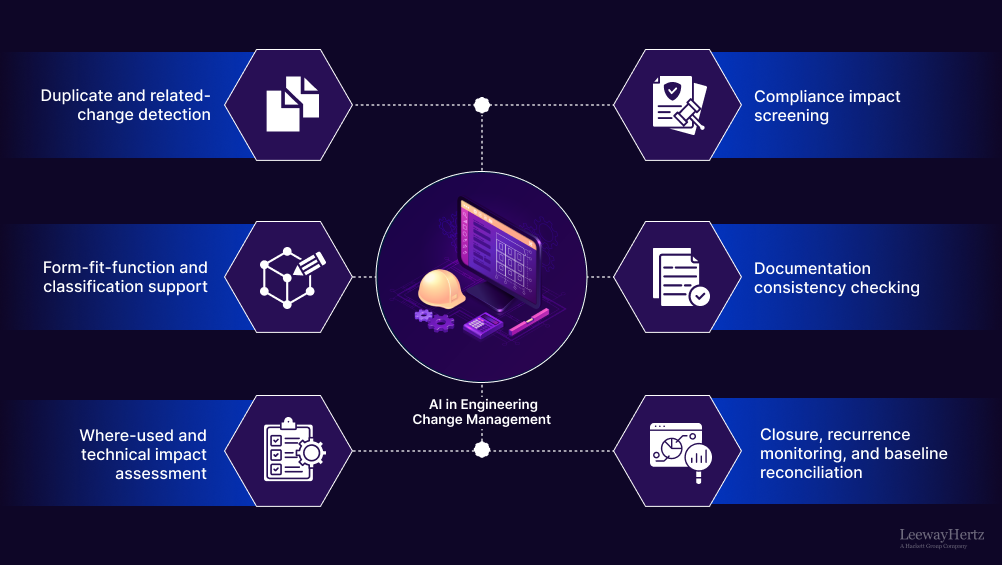
| Duplicate and related-change detection | Change request intake and ECR creation | AI reduces duplicate engineering effort and conflicting change activity by identifying related ECRs before new work proceeds. Embedding-based semantic similarity, part-revision entity matching, and change-graph search compare open and historical ECRs, released drawings, affected assemblies, and prior dispositions. |
| Form-fit-function and classification support | Change triage and classification | AI improves classification consistency by linking the proposed change to form, fit, function, interchangeability, customer, and policy evidence before CCB review. Requirements-aware retrieval, multimodal comparison, policy-grounded classification, and precedent retrieval prepare Class I/Class II or major/minor evidence. |
| Where-used and technical impact assessment | Technical impact assessment | AI reduces missed technical dependencies by tracing where the affected part, revision, drawing, CAD model, interface, or requirement appears across the product structure. Multi-level graph traversal, CAD dependency analysis, geometric feature comparison, and requirements traceability analysis produce an affected-item and interface-impact set for engineering validation. |
| Inventory disposition and cut-in scenario analysis | Business and supply chain impact assessment | AI improves implementation planning by showing how the change affects revision-controlled stock, WIP, supplier-held inventory, purchase commitments, customer demand, and cut-in timing. Cross-system record linkage and constraint-based scenario simulation prepare use-as-is, rework, scrap, and return-to-vendor options. |
| Compliance impact screening | Business and supply chain impact assessment | AI reduces compliance review gaps by identifying affected materials, supplier declarations, destinations, parties, and controlled technical-data triggers before approval. Substance entity matching, supplier-declaration extraction, and policy retrieval prepare RoHS, REACH, conflict-minerals, ITAR, and EAR exceptions for Compliance Engineering. |
| CCB packet preparation | Change board review and approval | AI shortens board preparation time and improves decision readiness by assembling complete, source-linked ECR packets and clearly identifying unresolved assumptions. Retrieval-grounded summarization, evidence indexing, contradiction detection, and role-aware packet assembly prepare impact matrices, cost models, stock disposition views, compliance screens, FAI/PPAP status, and open questions. |
| ECO effectivity planning | ECO planning and implementation orchestration | AI reduces cut-in risk by comparing effectivity options against inventory, production sequence, supplier readiness, customer configuration, and traceability constraints. Constraint-satisfaction modeling, scenario simulation, and dependency analysis draft date, serial, or lot effectivity matrices for configuration management review. |
| Documentation consistency checking | Design data and documentation update | AI reduces downstream execution errors by detecting when drawings, CAD records, item masters, routings, work instructions, control plans, PFMEAs, specifications, or test procedures no longer reflect the approved change. Multimodal change comparison, semantic difference analysis, traceability analysis, and contradiction detection surface misaligned documents before release. |
| Supplier PPAP and manufacturing cut-in readiness | Supplier and manufacturing cut-in execution | AI improves supplier and plant readiness by connecting supplier notifications, changed characteristics, PPAP scope, tooling records, work instructions, and first cut-in events into a single exception view. Policy retrieval, rule-based reasoning, document-difference analysis, acknowledgment classification, and MES/ERP event correlation prepare supplier-quality and plant-quality review queues. |
| FAI, qualification, and effectivity verification | Verification and validation of the change | AI strengthens verification readiness by checking whether inspection, test, and first-unit configuration evidence aligns with the released change and approved effectivity. Multimodal document understanding, OCR validation, requirements traceability analysis, semantic similarity matching, dependency graph analysis, and configuration reconciliation prepare exceptions for qualified approvers. |
| ECN distribution and downstream configuration update | ECN release and downstream notification | AI reduces missed downstream action by identifying the correct recipients, affected service content, spare-parts changes, installed assets, and customer notification requirements. Knowledge graph reasoning, entity resolution, applicability-aware grounded generation, semantic difference analysis, and clause retrieval prepare ECN distribution and configuration-update evidence. |
| Closure, recurrence monitoring, and baseline reconciliation | Change closure and configuration baseline governance | AI improves post-implementation control by measuring whether the change was completed, whether expected benefits are visible, whether the original problem recurs, and whether lifecycle configuration records remain aligned. Process mining, variance decomposition, time-series anomaly detection, semantic clustering, cross-system entity resolution, and graph-difference analysis surface recurrence and baseline discrepancies. |
How agentic AI works in engineering change workflows
An agentic workflow coordinates retrieval, deterministic services, model-based interpretation, business rules, and human checkpoints across a longer task. The agent should write its evidence and state back to the PLM change object, while approvals remain in controlled workflows and authoritative calculations remain in approved engineering or enterprise services.
Some of the examples are as follows:
Example 1: Impact assessment and CCB packet preparation
Agent role: Assemble a decision-ready ECR impact assessment and prepare the board packet.
Starting artifacts: A new Windchill ECR references NCR-2214 for a recurring connector failure on assembly PN 84-1102 Rev C.
Workflow:
- The agent performs EBOM and MBOM where-used traversal.
- It retrieves on-hand inventory, WIP, in-transit inventory, and open POs from SAP.
- It obtains open sales orders and field install-base records from connected service and order systems.
- It retrieves the latest FAI and PPAP status for the affected parts.
- It applies the controlled classification policy and effectivity playbook.
- It proposes Class II classification, full-track routing, and serial-number effectivity.
- It prepares the change impact matrix, cost range, stock disposition recommendation, affected-item list, and supplier notification list.
- It recommends rework for affected inventory and use-as-is treatment for already shipped units where supported by the service bulletin.
Exception handling: If part identity, inventory revision, compliance evidence, or customer-notification obligations conflict, the agent stops packet completion and records the unresolved issue.
Human checkpoint: The change analyst validates the affected-item list. The CCB chair records approve, reject, defer, or request-more-data, and escalates to the program manager when contract metadata indicates customer notification.
Output and audit evidence: On approval, the system instantiates the ECO task network and writes sources, assumptions, packet version, reviewer actions, and timestamps to the PLM change object.
Example 2: ECR intake completeness and duplicate detection
Agent role: Prepare a reviewable ECR from a supplier or field trigger.
Starting artifacts: A supplier notification and annotated drawing arrive with inconsistent part identifiers.
Workflow:
- The agent extracts supplier part, lot, failure mode, dimensions, and requested timing.
- It resolves internal part and revision identities in PLM.
- It compares the request with open and historical ECRs.
- It anchors drawing markups to the relevant sheet and zone.
- It creates a draft ECR with completeness exceptions for change analyst review.
Exception handling: Low-confidence part matches, unreadable redlines, or suspected duplicates are routed as exceptions; no new controlled ECR is silently merged.
Human checkpoint: The change analyst confirms identity, decides duplicate treatment, and accepts or returns the ECR.
Output and audit evidence: A linked ECR draft, duplicate report, redline index, and immutable source references.
Example 3: ECO effectivity and stock disposition planning
Agent role: Propose an implementable cut-in plan across sites.
Starting artifacts: An approved ECR, affected-item list, inventory snapshot, production schedule, and supplier-ready dates.
Workflow:
- The agent reconciles stock by revision, location, ownership, and status.
- It models date, serial, and lot effectivity options.
- It checks WIP and open order conflicts.
- It simulates use-as-is, rework, scrap, and return-to-vendor outcomes.
- It drafts site-level effectivity and stock-disposition matrices.
- It creates an ECO task graph with owners, dependencies, and required completion evidence.
Exception handling: The workflow blocks a recommendation when genealogy is incomplete, quality restrictions prohibit use-as-is, or site calendars and supplier dates conflict.
Human checkpoint: Configuration management approves effectivity; quality and materials approve disposition; functional owners accept implementation tasks.
Output and audit evidence: Approved matrices and tasks are stored with assumptions, scenario versions, and approver identities.
Example 4: Supplier cut-in and PPAP readiness assessment
Agent role: Coordinate supplier evidence and verify manufacturing cut-in.
Starting artifacts: Released ECO/ECN, supplier-item mapping, customer-specific PPAP rules, prior PPAP, and site effectivity.
Workflow:
- The agent generates supplier-specific change notices from the released ECO/ECN.
- It proposes PPAP resubmission elements based on changed characteristics and customer-specific requirements.
- It validates returned supplier packages for completeness and consistency.
- It tracks PSW status and supplier acknowledgments.
- It monitors first cut-in events across ERP and MES.
- It checks whether the correct material, work instruction, tooling, program, and inspection plan are used at cut-in.
Exception handling: Missing customer-specific rules, overdue acknowledgments, incomplete PPAP evidence, or mixed revisions create hold recommendations and routed alerts.
Human checkpoint: Supplier quality approves PPAP scope and PSW; plant quality decides hold or release at cut-in.
Output and audit evidence: Supplier acknowledgment log, PPAP readiness report, and first-unit cut-in evidence linked to the ECO.
How to prioritize AI use cases in engineering change management
Prioritization should start with the engineering change operating model and then narrow to the specific sub-process where AI can provide measurable support. The strongest candidates are recurring, artifact-rich, governed by clear policies or evidence requirements, and reviewed by a named role before they affect change classification, ECO approval, product definition, supplier action, manufacturing cut-in, customer communication, or configuration baseline control.
| Criterion | What to ask |
| Volume and frequency | Does this sub-process recur often enough for AI support to reduce manual evidence preparation, search, reconciliation, or review-cycle friction at scale? |
| Artifact availability | Are the needed source artifacts, such as ECRs, ECOs, ECNs, redlines, EBOMs, MBOMs, CAD dependencies, ERP inventory, POs, routings, PPAP packages, FAI forms, service records, and baseline records, available in usable systems with reliable part, revision, supplier, site, lot, serial, and effectivity identifiers? |
| Review boundary | Can a defined role confirm the AI output before it affects change classification, CCB disposition, ECO approval, drawing release, stock disposition, PPAP acceptance, FAI acceptance, ECN distribution, customer notification, or baseline re-release? |
| Blast radius | If the output is wrong, is the impact limited to a draft, work queue, impact packet, exception list, or recommendation rather than an uncontrolled change to released product definition, a mixed-revision build, an export-control exposure, or an incorrect field configuration? |
| Business impact | Can the function tie the use case to credible outcomes such as shorter ECR/ECO cycle time, higher first-pass approval, fewer returned packages, lower rework and scrap exposure, cleaner cut-ins, improved PPAP/FAI readiness, reduced recurrence, or less audit preparation effort? |
Strong starting points are duplicate ECR detection, completeness screening, where-used analysis, CCB packet assembly, stock disposition scenarios, supplier acknowledgment tracking, FAI/PPAP evidence readiness, and recurrence monitoring. Effectivity planning and baseline reconciliation can create larger value, but they require stronger cross-system identity, genealogy, and governance maturity.
Avoid beginning with autonomous change approval or automatic release. Those proposals combine high blast radius, ambiguous context, and statutory or delegated authority. A better maturity path moves from retrieval and checking, to recommendation with evidence, to workflow orchestration with approval checkpoints, and only then to narrowly bounded automatic actions such as creating draft tasks or sending an already approved internal notification.
Accelerate AI Solutions Development
Build fully functional solutions from your high-value use cases, based on specific operational needs and enterprise context.
Governance, risk, and responsible AI in engineering change management
AI in engineering change management must operate within the same control environment that governs product definition, approvals, implementation evidence, supplier communication, and configuration baselines. Because ECM decisions can affect safety, production continuity, customer commitments, compliance obligations, and released product records, AI workflows need clear authority boundaries, source traceability, access controls, validation methods, and human review points from the start.
Human-in-the-loop oversight
Each use case needs a designated accountable reviewer and a defined stop condition. Confidence thresholds should determine whether the model prepares a draft, requests more evidence, or abstains. Approval, attestation, baseline release, disposition, PPAP acceptance, FAI acceptance, and customer authorization remain human actions recorded in controlled systems.
Regulatory and standards alignment
ISO 9001:2015 clause 8.5.6 frames control of production and service provision changes, while ISO 10007 and SAE EIA-649C provide configuration-management guidance and principles. EIA-649C defines five CM functions [2]; MIL-HDBK-61 supplies lifecycle CM guidance for defense programs [3]. ASME Y14.100 addresses preparation and revision of engineering drawings [4], AS9102C establishes FAI performance and documentation requirements [5], and AIAG PPAP demonstrates that engineering design records and specification requirements are consistently met in production[6]. Company procedures, contracts, and customer-specific requirements remain controlling for the actual workflow.
Evidence retention and output quality
Every generated output should retain source identifiers, retrieval time, model and prompt version, deterministic service versions, confidence, assumptions, exception state, reviewer action, and final disposition. Evaluation sets should be stratified by product family, site, supplier, change class, language, drawing format, and data quality. False negatives in where-used, compliance, or effectivity checks deserve different tolerances from false positives in duplicate detection.
Key governance requirements
Control requirements include least-privilege access, separation between change author and approver, no silent writes to released product definition, immutable approval records, validated integration mappings, explicit system-of-record precedence, and rollback or correction procedures. NIST’s AI RMF supports defining human oversight, testing and validation, documentation, monitoring, incident response, and change-management responsibilities for deployed AI systems [7].
Design principles
Use deterministic graph queries, BOM explosions, tolerance calculations, cost roll-ups, and policy rules where deterministic methods exist. Use language and multimodal models for extraction, classification, comparison, summarization, and grounded drafting. Present evidence beside conclusions. Design for abstention, conflict escalation, and reviewer correction. Capture corrections as evaluation data without allowing uncontrolled self-learning in production.
Traceability, security, and controlled technical data
Engineering change packages may contain export-controlled drawings, models, manufacturing technology, source code, or defense program data. EAR license applications for technology can include blueprints and manuals and require a defined technical scope [8]. Access decisions must therefore consider user nationality, location, program authorization, destination, and data classification where applicable. Retrieval indexes, model endpoints, logs, and support tooling must inherit those restrictions. Supplier and customer sharing should use approved channels with recipient and purpose controls.
How ZBrain operationalizes AI use cases in engineering change management
Identifying use cases is only the first step. ECM teams need a controlled way to design, build, validate, deploy, govern, and scale AI workflows across departments and functions. This is where ZBrain helps.
ZBrain is an end-to-end AI enablement platform that supports this lifecycle through four connected stages: ZBrain Analyzer, ZBrain Design, ZBrain Solution Builder, and ZBrain Governance. The platform provides a governed path from use-case analysis to deployed agentic workflows while maintaining policies, permissions, approval points, monitoring, and runtime evidence.
ZBrain Analyzer
ZBrain Analyzer helps teams examine selected ECM processes, identify AI opportunities, and document the business context, systems, data, roles, controls, and review requirements needed to evaluate each use case.
ZBrain Design
ZBrain Design creates a build-ready technical design for the selected use case. It generates the BRD, functional requirements, user journeys, architecture, workflow logic, data details, integration context and governance considerations needed before development begins.
ZBrain Solution Builder
ZBrain Solution Builder enables teams to create, configure, and validate governed AI workflows for ECM processes based on the technical design provided by the ZBrain Design module. It supports testing across normal, exception, and control scenarios before deployment.
ZBrain Governance
ZBrain Governance applies policies, access controls, human approval requirements, monitoring, and traceability throughout workflow execution. It provides guardrails, approval gates, escalation controls, kill switches, and audit trails to help organizations maintain oversight of AI outputs, user actions, exceptions, and authorized system updates.
The future of AI in engineering change management
The near-term future of engineering change management is a federated engineering operations layer that can reason across PLM, ERP, MES, requirements, CAD, supplier, and service records while respecting each platform’s authority. Product identity and configuration graphs will become more important than a single content repository because change impact depends on relationships among parts, revisions, requirements, tools, suppliers, orders, sites, serials, and installed assets.
Long-horizon agents will move beyond one-time packet generation. They will monitor an approved ECO from affected-item finalization through supplier readiness, document release, cut-in, first-article evidence, ECN acknowledgment, cost realization, and recurrence signals. Their value will come from maintaining context and evidence across weeks or months, with each risk-bearing transition gated by a person or an approved deterministic control.
Multimodal engineering understanding will improve the ability to compare drawings, model annotations, inspection evidence, and work instructions. Even so, authoritative engineering services should compute or verify geometry, tolerance, simulation, and configuration conclusions. The model’s role is to connect intent, evidence, and exceptions, not to turn probabilistic text generation into an unreviewed engineering calculation.
The durable differentiator will be workflow design, not model choice. Organizations that define clean part and revision identities, explicit effectivity, reliable genealogy, governed classification policies, and auditable decision boundaries can adopt new models without rebuilding the operating system around them. Organizations that lack those foundations will obtain polished summaries but limited control of physical change.
Endnote
Treat AI in engineering change management as an evidence and orchestration layer around controlled product definition, not a replacement for PLM authority or engineering judgment. Its practical value comes from preparing complete ECRs, surfacing related changes, connecting technical and supply chain impact, assembling CCB packets, coordinating ECO implementation, verifying cut-in evidence, distributing ECNs with applicability, and monitoring whether the change achieved its intended effect.
The strongest programs will keep ECR, ECO, ECN, BOM, CAD, drawing, effectivity, PPAP, FAI, service, and configuration baseline records at the center of the operating model. AI should make those records easier to interpret and reconcile while preserving accountable human decisions for classification, approval, disposition, release, acceptance, and baseline governance.
To explore how ZBrain can help design, build, validate, and govern AI workflows for engineering change management, contact the ZBrain team today.
Author’s Bio


Akash's ability to build enterprise-grade technology solutions has garnered the trust of over 30 Fortune 500 companies, including Siemens, 3M, P&G, and Hershey's. Akash is an early adopter of new technology, a passionate technology enthusiast, and an investor in AI and IoT startups.

Transform Enterprise Processes with AI
Whether you have a defined use case or a process you want to improve, we design and build AI solutions that address operational gaps, enhance existing capabilities, and integrate with your enterprise data, systems, and workflows.
Start a conversation by filling the form
Once you let us know your requirement, our technical expert will schedule a call and discuss your idea in detail post sign of an NDA.
All information will be kept confidential.
FAQs
What is AI in engineering change management?
AI in engineering change management is the use of machine learning, language models, multimodal document understanding, graph analytics, anomaly detection, and agentic workflow orchestration to support the controlled lifecycle of an engineering change. Typical tasks include converting a trigger into a complete ECR, identifying related changes, traversing where-used relationships, comparing drawings and redlines, preparing impact assessments, simulating effectivity, validating evidence packages, distributing an ECN, and reconciling configuration baselines. The AI works around PLM and connected systems of record; it does not become the authority for released product definition or approval.
Which AI use cases are most vital in engineering change management?
The most vital AI use cases in engineering change management are those that improve decision readiness, reduce missed impact, and strengthen control across the ECR, ECO, and ECN lifecycle. They should support artifact-rich, repeatable sub-processes where AI can prepare evidence, detect exceptions, and route review without taking over engineering or configuration authority.
Some of the vital use cases are as follows:
-
Intake and triage: ECR completeness screening, duplicate detection, form-fit-function evidence retrieval, policy-grounded classification, and urgency scoring.
-
Impact assessment: EBOM/MBOM graph traversal, CAD and drawing dependency analysis, requirements traceability, inventory and order exposure, cost-of-change simulation, and compliance screening.
-
Approval: CCB packet assembly, contradiction detection, action capture, policy-based ECO ballot routing, and segregation-of-duties checks.
-
Implementation: Affected-item list completion, effectivity simulation, disposition scenarios, document consistency checks, supplier acknowledgment, PPAP scoping, and cut-in anomaly detection.
-
Verification and closure: FAI package validation, change-based test selection, first-unit configuration reconciliation, recurrence detection, benefits realization, and FCA/PCA evidence assembly.
The best first use case depends on artifact quality and risk. Completeness screening and packet preparation are often easier to govern; effectivity and baseline reconciliation can create greater operational value when identity and genealogy data are mature.
Can AI approve an ECO or release an ECN autonomously?
No, AI workflows should not be assigned autonomous approval authority. An ECO approval or ECN release is a controlled organizational act tied to role, competence, delegation, segregation of duties, and often customer or regulatory obligations. AI may verify that required evidence is present, resolve the approval matrix, draft a recommendation, route the ballot, and block release when rules fail. A named authorized person should record the approval or release in the system of record.
What systems and data are needed to support AI in engineering change management?
A strong AI foundation for engineering change management starts with connected, reliable records across the product lifecycle. Core data sources typically include:
-
PLM change objects and revision-controlled EBOMs
-
CAD/PDM models, drawings, dependencies, and redlines
-
Requirements and test traceability records
-
ERP item masters, costs, inventory, purchase orders, sales orders, and routings
-
MES work orders, genealogy, work instructions, programs, and inspection plans
-
Supplier notifications and PPAP evidence
-
Service BOMs, installed-base records, field events, and controlled handoff links from NCR or CAPA triggers
The most important requirement is not that all data resides in one system. It is that records can be linked through trusted identifiers such as part number, revision, supplier, site, lot, serial number, effectivity, customer configuration, and change object ID. These identifiers allow AI workflows to retrieve evidence, reconcile related records, detect inconsistencies, and prepare review-ready outputs without weakening the authority of PLM, ERP, MES, QMS, supplier, or service systems.
Where should an organization begin with AI in S&OP?
Organizations should begin with one bounded sub-process and one named reviewer. Establish a baseline using historical cases, define required inputs and output schema, document acceptable error types, and measure reviewer corrections. Practical candidates include duplicate ECR detection, completeness checks, where-used report preparation, CCB packet assembly, supplier acknowledgment tracking, and FAI/PPAP package readiness. Run in read-only or draft mode first, then permit controlled writeback to a sandbox PLM environment. Expand across functions only after identity resolution, source citations, exception handling, and audit logging perform reliably.
How should AI handle Class I/Class II and major/minor change classification?
AI should support change classification as a recommendation and evidence-preparation activity, not as an autonomous decision. The workflow should retrieve the organization’s approved classification policy, identify the relevant criteria, and extract evidence related to form, fit, function, interfaces, safety, qualification impact, customer obligations, interchangeability, and contractual configuration requirements.
Based on that evidence, AI can propose a Class I/Class II or major/minor classification with clause-level citations, comparable historical precedents, confidence level, and reason codes. It should also flag uncertainty and abstain when required evidence is missing, policies conflict, or the change appears to trigger customer, safety, regulatory, or qualification review.
The CCB Chair or designated engineering/configuration authority should retain ownership of the final classification. Classification terminology and thresholds vary by organization, program, customer, and product line, so a Class II or minor label should never be treated as universally low risk without policy-specific validation.
How does ZBrain support AI in engineering change management?
ZBrain supports AI in engineering change management by giving teams a governed way to analyze, design, build, validate, deploy, and monitor AI workflows across the ECM operating model. It helps connect PLM and related enterprise systems while maintaining policies, permissions, approval points, traceability, and runtime evidence.
Through ZBrain Analyzer, teams identify AI opportunities and document the relevant processes, data, systems, roles, controls, and review requirements. ZBrain Design converts those inputs into build-ready technical design with workflow logic, integrations, approval points, exception paths, validation criteria, and monitoring needs. ZBrain Solution Builder enables teams to create, configure, and test governed AI workflows based on the approved design. ZBrain Governance applies access controls, human approval requirements, guardrails, escalation controls, monitoring, kill switches, and audit trails throughout execution.
The organization’s PLM workflow, approval authority, security model, and applicable standards continue to govern the process, while ZBrain provides a structured environment for applying AI across engineering change management.
Insights

AI in knowledge management: Use cases, applications, benefits and development
AI has a transformative impact on knowledge management, offering various applications that enhance efficiency, decision-making, and collaboration within organizations.
AI in Regulatory Affairs: Use Cases Across Operating Model
AI in regulatory affairs should be treated as an evidence and orchestration layer around controlled regulatory work, not as a replacement for regulatory judgment or health authority accountability.
AI in financial planning and analysis: Mapping functions, processes and sub-processes across the operating model
AI changes FP&A work by analyzing structured and unstructured planning artifacts before a finance professional opens them, connecting information across systems, and preparing the evidence required for review.