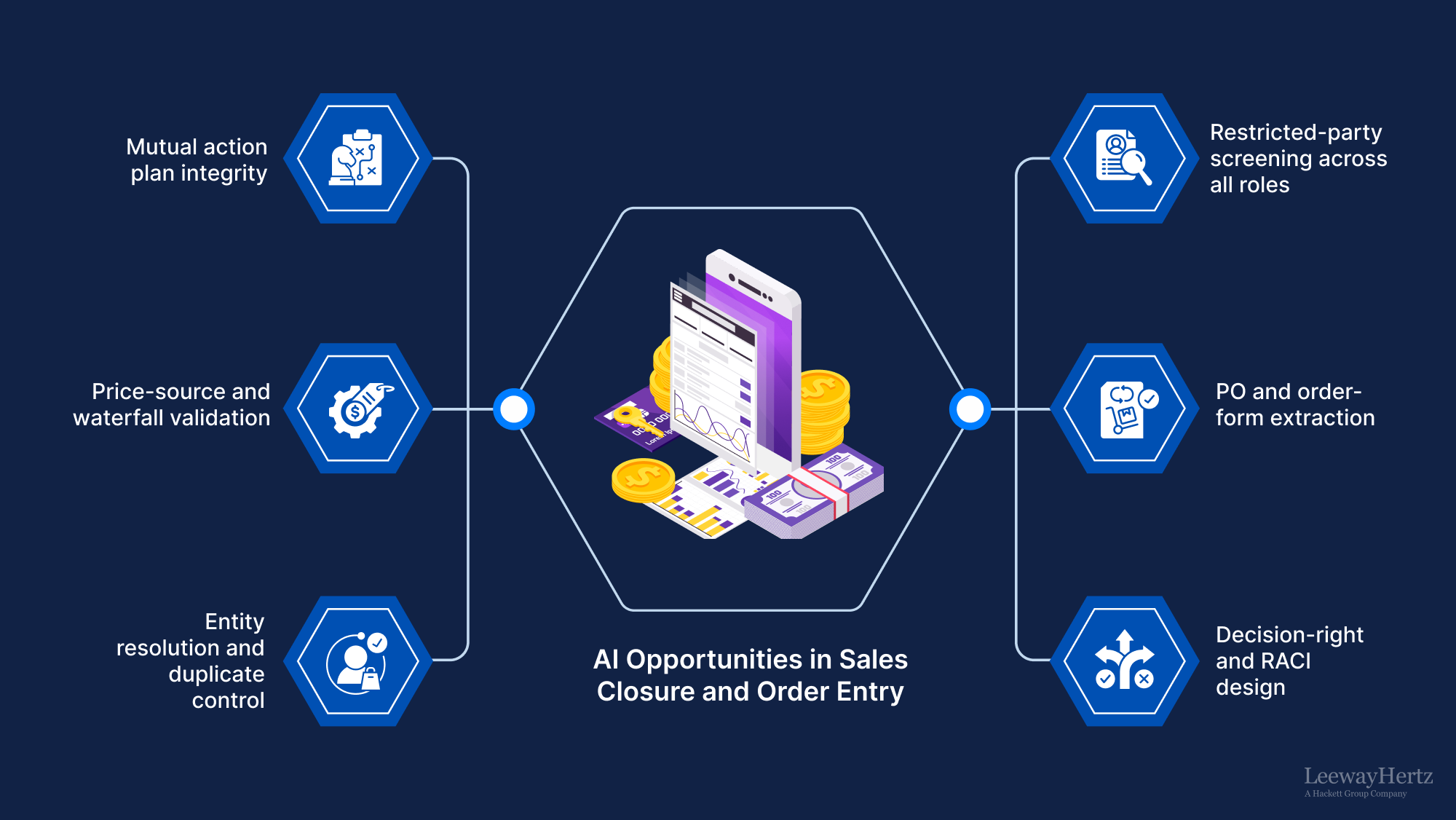
Sales closure and order entry are the controlled transition from commercial intent to an executable enterprise commitment. This process area begins when a qualified opportunity enters formal close and ends when a validated, booked order and its obligations have been handed to fulfillment, provisioning, or implementation. It includes direct, channel, renewal, expansion, product, service, subscription, usage, and project-based transactions. Upstream prospecting and downstream invoicing or collections appear only where their records, decisions, or controls determine whether the deal can close or the order can proceed.
The economic scale makes order quality consequential. The U.S. Census Bureau reported $656.5 billion in new orders for manufactured goods in May 2026 [1], while U.S. retail e-commerce sales were estimated at $326.7 billion for the first quarter of 2026 [2]. These figures cover different markets, but both illustrate the volume of commercial commitments that must be translated into correct customer, product, price, contract, tax, credit, delivery, billing, and accounting records.
The regulatory and control baseline varies by product, geography, and channel. For a U.S.-based enterprise, relevant frames can include the E-SIGN Act for electronic records and signatures [3], Uniform Commercial Code Article 2 for sales of goods [4], applicable revenue-recognition policy such as IFRS 15 or ASC 606 [5], sanctions and export-control obligations administered through OFAC and the Export Administration Regulations, PCI DSS where payment-card data is handled [6], and internal-control requirements relevant to financial reporting [7]. The article treats these as an applicability frame, not as legal or accounting advice.
AI in this domain operates within complex, control-intensive workflows rather than as a generic chatbot layered onto CRM. It can compare a customer purchase order with an approved CPQ quote and executed order form, extract nonstandard obligations from a contract redline for counsel, reconcile sold-to, bill-to, ship-to, payer, and end-customer roles before ERP creation, or classify an order hold for the correct credit, tax, trade, product, or supply specialist. Each example is embedded in a named role, source artifact, system context, and review boundary.
Broad labels such as “AI for sales close” or “AI for order management” are too coarse to design, govern, or measure. A useful map must reach the atomic work where a capability acts on a specific quote, purchase order, contract clause, configuration, credit record, order line, approval, or reconciliation exception. This article uses the sales closure and order entry operating model to break work into functions, processes, sub-processes, and AI-enabled opportunities across the full close-to-order lifecycle and its cross-cutting control domains.
- How AI is transforming sales closure and order entry operations
- Why AI use cases in sales closure and order entry must be mapped at the sub-process level
- Sales closure and order entry operating model and AI opportunity mapping across sales processes
- High-value AI use cases in sales closure and order entry
- How agentic AI works in sales closure and order entry workflows
- How to prioritize AI use cases in sales closure and order entry
- Governance, risk, and responsible AI in sales closure and order entry
- How ZBrain operationalizes AI use cases in sales closure and order entry
- Future of AI in sales closure and order entry
How AI is transforming sales closure and order entry operations
Sales closure and order entry combine judgment-intensive commercial work with high-volume document handling, cross-system validation, and governed system updates. AI changes the work most effectively when it prepares evidence, compares artifacts, classifies exceptions, predicts risk, and assembles the next review packet at the exact sub-process where a person already owns a decision.
Consider a global subscription and services order spanning multiple enterprise systems. The CRM captures the opportunity, account context, and forecast details. The configure, price, quote (CPQ) platform manages product configuration, pricing, and commercial terms.
The contract lifecycle management (CLM) platform stores the negotiated order form, master service agreement, and data processing agreement, while the e-signature platform provides evidence of execution.
The customer purchase order introduces payer details, billing instructions, and customer-specific requirements. The credit platform maintains exposure and risk information. Tax and trade systems manage regulatory clearance requirements, and the ERP system requires a structured order schema that downstream billing and revenue systems can process.
AI can reconcile those records and surface the three fields that conflict, but the account executive, counsel, credit manager, tax professional, order specialist, and revenue accountant still own the decisions in their domains.
Across the operating model, the work falls into five recurring types:
- Document-heavy work: quotes, proposals, RFPs, purchase orders, contracts, SOWs, certificates, credit files, and order forms can be checked for missing context and inconsistencies before a reviewer opens them.
- Narrative-heavy work: close briefs, proposal narratives, negotiation issue lists, approval rationales, customer clarification requests, control explanations, and management summaries can be drafted from approved sources while showing where evidence is thin.
- Exception-heavy work: nonstandard discounts, contract deviations, credit holds, tax or sanctions matches, configuration conflicts, order mismatches, failed interfaces, and cutoff issues can be classified and prioritized so specialists take the highest-impact cases first.
- Knowledge-heavy work: price precedence, clause fallbacks, product rules, delegation limits, tax treatment, export conditions, booking policy, and prior decisions improve when AI retrieves the relevant rule and flags conflicts.
- Workflow-heavy work: multi-step close plans, approval routes, signature packets, order validation, change orders, and reconciliation benefit when AI forecasts bottlenecks and assembles the next work packet, reducing rework between functions.
The practical design principle is straightforward: AI initiatives should be anchored to a specific business artifact, process step, and decision boundary. A use case such as “compare the customer purchase order with the approved quote and route material variances to order management” provides a clear input, defined analysis criteria, and an actionable outcome, making it suitable for implementation. In contrast, objectives such as “improve order efficiency” are too broad to translate into a governed, measurable AI capability.
Why AI use cases in sales closure and order entry must be mapped at the sub-process level
A request such as “automate deal closure” can refer to close-plan risk, configuration, discount approval, contract redlines, signature routing, PO validation, or booking reconciliation. These activities use different artifacts, systems, rules, reviewers, and risk tolerances. Treating them as one use case hides the point where AI acts and the person who must confirm the result.
A better approach is to map AI use cases to the sales closure and order entry operating model:
- Function: a governed operational domain with distinct accountability, such as pricing, contracting, credit, order capture, booking, or control assurance.
- Process: a coherent workflow area inside a function, such as price construction, internal approval orchestration, omnichannel order intake, or cross-system reconciliation.
- Sub-process: an atomic work activity with a specific input, output, rule, source system, and accountable reviewer, such as duplicate-order detection or final-form contract consistency review.
- AI-enabled opportunity: a specific capability applied to a specific artifact to change the work, such as document intelligence extracting PO lines, anomaly detection flagging discount leakage, or retrieval-grounded answering comparing a clause with the approved playbook.
The sub-process is also where governance becomes concrete. It identifies the source record, allowed tool actions, access boundary, confidence threshold, policy check, review role, output artifact, system update, and audit evidence. It also separates low-risk preparation, such as drafting an approval summary, from higher-risk recommendations, such as proposing a credit release or export classification.
For example, “pricing AI” decomposes into price-source determination, discount-stack validation, deal P&L analysis, usage and ramp simulation, payment-term review, and exception routing. “Order-entry AI” decomposes into channel intake, PO extraction, customer and SKU matching, duplicate detection, quote-contract-PO reconciliation, orderability checks, exception assignment, ERP mapping, and booking control. Each row is a different AI design.
This level of detail keeps the opportunity tied to the enterprise operating model. It lets leaders compare value, risk, artifact readiness, human ownership, and dependencies before choosing technology or estimating benefits.
Build governed AI workflows for sales closure and order entry
Translate approved close-to-order requirements into reviewable workflows with connected systems, defined controls, and human approval boundaries.
Sales closure and order entry operating model and AI opportunity mapping across sales processes
The operating model below covers key functions, processes, and sub-processes from formal close readiness through booked-order handoff, plus the governance, analytics, data, controls, and strategy domains required to run the lifecycle reliably. Every opportunity names a capability and the business artifact it changes.
Function 1: Deal closure planning and readiness
Converts a qualified late-stage opportunity into a controlled, executable close plan.
Deal closure planning consolidates opportunity evidence, buying-process requirements, stakeholder commitments, dependencies, and open risks before the seller asks the customer to commit. It sits between late-stage opportunity management and formal commercial execution, and it feeds configuration, pricing, contracting, approvals, and forecast governance.
Teams involved
Account executives, sales managers, opportunity strategists, sales operations, deal desk, solution consultants, partner managers, finance business partners, and executive sponsors.
What AI helps with
Predictive analytics can score close-plan risk from CRM stage history, stakeholder coverage, activity signals, and unresolved dependencies. Multi-source aggregation can assemble mutual action plan milestones, approval obligations, customer procurement steps, and legal tasks into a single review packet. Natural-language generation can draft an evidence-backed close brief and highlight unsupported assumptions.
What humans continue to own
Sales leadership owns stage progression, forecast category, executive intervention, and whether the opportunity is ready to enter formal close. Account executives own customer commitments and relationship judgments. Deal desk, legal, finance, and solution leaders own their functional approvals. AI scores, aggregates, and drafts but does not commit, forecast, approve, or attest.
| Process | Sub-process | Key AI-enabled opportunities |
|---|---|---|
| Close strategy and mutual action planning | Buying-process and decision-criteria confirmation |
|
| Mutual action plan and critical-path maintenance |
|
|
| Stakeholder and risk readiness assessment | Stakeholder coverage and influence assessment |
|
| Close risk, dependency, and blocker assessment |
|
|
| Forecast and governance readiness assessment | Forecast category and close-date evidence review |
|
| Closure governance packet preparation |
|
Highest-value opportunities
- Mutual action plan integrity: It has the widest downstream effect because missed customer, legal, or approval dependencies propagate into every later close activity.
- Close-risk and blocker assessment: It concentrates specialist attention on the issues most likely to move the signature or booking date.
- Forecast evidence review: It directly improves governance of commit decisions and exposes unsupported close dates before management relies on them.
Example agentic workflow: Mutual action plan reconciliation and close-risk management
- Starting sub-process: Mutual action plan maintenance begins when the workflow reads the CRM opportunity, customer action plan, meeting records, and open-task log.
- The workflow retrieves authorized records from the CRM, collaboration platform, CLM, and approval workflow and preserves the source identifiers and versions used.
- AI capabilities reconcile milestones, classify blockers, and prepare a source-linked close-risk packet and place unresolved conflicts, confidence limits, and policy exceptions into a review packet.
- Human-in-the-loop checkpoint: the account executive and sales manager review the packet, correct source or mapping errors, and approve, reject, or return the proposed disposition.
- Only after approval does the integration write approved dates, owners, and forecast disposition back to the CRM and route functional actions to their existing queues, with the action, reviewer, source evidence, and resulting system status retained under existing governance.
Function 2: Product, service and solution configuration
Transforms customer requirements into a valid, supportable, and orderable commercial configuration.
Configuration translates customer requirements, solution designs, and commercial commitments into the specific products, services, subscriptions, usage measures, implementation components, options, dependencies, and quantities required for delivery. It validates compatibility, availability, and commercial rules before feeding the quote, statement of work, pricing model, order lines, fulfillment requirements, and downstream entitlement setup.
Teams involved
Account executives, solution engineers, sales engineers, product specialists, services architects, CPQ administrators, product operations, supply planning, implementation leaders, and partner solution teams.
What AI helps with
Constraint reasoning and rules-based validation can test product compatibility, required options, quantity relationships, geography restrictions, lifecycle status, and service prerequisites against the product catalog. Retrieval-grounded answering can explain configuration rules using approved product, packaging, and support documentation. Simulation can compare feasible solution variants and expose delivery, capacity, or margin trade-offs.
What humans continue to own
Solution architects and product specialists own fitness for purpose and technical commitments. Product management owns catalog and lifecycle rules. Services and delivery leaders own implementation scope and capacity commitments. The customer selects the final commercial configuration. AI recommends and validates but does not certify architecture, promise capacity, or accept requirements.
| Process | Sub-process | Key AI-enabled opportunities |
|---|---|---|
| Requirements-to-configuration translation | Requirement, use-case, and constraint normalization |
|
| Catalog, bundle, and option selection |
|
|
| Technical and commercial configuration validation | Compatibility, dependency, and lifecycle validation |
|
| Capacity, availability, and lead-time assessment |
|
|
| Solution definition and configuration | Services, implementation, and integration scoping |
|
| Configuration versioning and baseline approval |
|
Highest-value opportunities
- Configuration constraint validation: It prevents invalid products, missing prerequisites, and unsupported combinations from entering pricing, contracting, and order entry.
- Capacity and lead-time assessment: It protects customer commitments by connecting sellable configuration to current supply and delivery evidence.
- Scope baseline generation: It reduces ambiguity between what was sold, what was contracted, and what delivery must implement.
Example agentic workflow: Product configuration validation and CPQ readiness
- Starting sub-process: Catalog and bundle selection begins when the workflow reads the approved requirements matrix, product catalog, configuration rules, and capacity data.
- The workflow retrieves authorized records from the CRM, CPQ, product information management, ERP, and professional-services automation and preserves the source identifiers and versions used.
- AI capabilities map requirements to SKUs and service codes, validate constraints, and assemble configuration exceptions and place unresolved conflicts, confidence limits, and policy exceptions into a review packet.
- Human-in-the-loop checkpoint: the solution architect and product or services owner reviews the packet, corrects source or mapping errors, and approves, rejects, or returns the proposed disposition.
- Only after approval does the integration baseline the approved configuration in CPQ and publish its versioned line and scope references to quoting and contracting, with the action, reviewer, source evidence, and resulting system status retained under existing governance.
Function 3: Commercial structuring and pricing
Determines the approved solution’s commercial structure by applying pricing rules, discount policies, and negotiated terms.
Pricing determines list price, contracted price, discount structure, rebates, incentives, fees, indexation, usage rates, payment terms, and nonstandard commercial conditions. It sits at the center of deal economics and feeds the quote, approval packet, contract, order value, bookings classification, billing schedule, and margin outlook.
Teams involved
Account executives, pricing analysts, deal desk, sales operations, finance, revenue operations, product finance, channel operations, tax, treasury, and sales leadership.
What AI helps with
Predictive analytics can estimate willingness-to-pay ranges, discount leakage, renewal risk, and margin sensitivity from comparable deals and account context. Anomaly detection can identify off-policy discounts, inconsistent price waterfalls, duplicate incentives, and conflicting payment terms. Simulation can show the effect of volume tiers, ramps, currencies, indexation, rebates, and concessions on TCV, ACV, ARR, gross margin, and cash timing.
What humans continue to own
Pricing authorities own price policy and exceptions. Finance owns margin, cash, and accounting judgments. Sales leadership owns commercial strategy within delegated authority. Tax and treasury own their respective terms. The customer and authorized signatories agree the final consideration. AI calculates, compares, and recommends but does not set price, grant concessions, or approve exceptions.
| Process | Sub-process | Key AI-enabled opportunities |
|---|---|---|
| Pricing and commercial terms determination | List, contract, channel, and customer-specific price determination |
|
| Discount, rebate, incentive, and fee calculation |
|
|
| Deal economics and commercial modeling | Margin, contribution, and cost-to-serve analysis |
|
| Ramp, usage, consumption, and indexation modeling |
|
|
| Commercial policy and exception approval | Payment, billing, cancellation, and renewal-term review |
|
| Pricing exception packet and approval routing |
|
Highest-value opportunities
- Price-source and waterfall validation: It prevents incorrect contract or price-book precedence from affecting every downstream commercial artifact.
- Deal P&L and margin analysis: It gives approvers a complete economic view rather than an isolated discount percentage.
- Exception routing: It is high leverage because complex deals often stall when approval authority and evidence are incomplete or misrouted.
Example agentic workflow: Price waterfall validation and commercial approval management
- Starting sub-process: Price waterfall construction begins when the workflow reads the approved configuration, price books, customer agreements, channel program, cost data, and requested terms.
- The workflow retrieves authorized records from the CPQ, ERP, contract repository, pricing platform, and approval workflow and preserves the source identifiers and versions used.
- AI capabilities calculate line prices and incentives, test policy, simulate economics, and prepare exceptions and place unresolved conflicts, confidence limits, and policy exceptions into a review packet.
- Human-in-the-loop checkpoint: the deal desk, pricing authority, and finance approver review the packet, correct source or mapping errors, and approve, reject, or return the proposed disposition.
- Only after approval does the integration lock the approved commercial version in CPQ and pass its price, terms, and authority references to the quote and contract, with the action, reviewer, source evidence, and resulting system status retained under existing governance.
Function 4: Proposal, quote and bid management
Packages configuration, economics, scope, and commitments into a controlled customer-facing offer.
Proposal and quote management creates the commercial artifacts the customer evaluates, including budgetary quotes, firm quotes, proposals, tender responses, pricing schedules, and statement-of-work attachments. It feeds negotiation, contract drafting, approval, customer acceptance, and the eventual order baseline.
Teams involved
Account executives, proposal managers, bid managers, deal desk, sales operations, solution consultants, pricing, legal, security, finance, marketing, and executive reviewers.
What AI helps with
Document intelligence can assemble approved content, pricing tables, scope, terms, evidence, and customer instructions from source systems. Natural-language generation can draft proposal narratives and executive summaries grounded in approved claims. Compliance checking can test bid instructions, mandatory forms, page limits, certifications, response matrices, and quote completeness before release.
What humans continue to own
Proposal and bid owners control response strategy, final wording, and submission. Solution, pricing, legal, security, and finance owners approve their content. Authorized executives approve binding commitments. AI assembles, drafts, and checks but does not make representations, submit a bid, or bind the enterprise.
| Process | Sub-process | Key AI-enabled opportunities |
|---|---|---|
| Quote and proposal generation | Quote-line, pricing-schedule, and commercial-summary generation |
|
| Proposal development and value articulation |
|
|
| Bid and tender response management | RFP instruction, requirement, and response-matrix management |
|
| Compliance, certification, and submission-readiness review |
|
|
| Quote governance and version control | Quote validity, expiry, and revalidation |
|
| Proposal and quote version comparison |
|
Highest-value opportunities
- Quote-to-CPQ reconciliation: It prevents a customer-facing offer from diverging from the internally approved configuration and economics.
- RFP response-matrix control: It coordinates high-volume requirements, owners, and evidence while preserving the accountable response boundary.
- Version and change comparison: It reduces the risk that late edits create unapproved commitments or inconsistent commercial artifacts.
Example agentic workflow: Controlled quote generation and proposal approval
- Starting sub-process: Firm quote generation begins when the workflow reads the approved CPQ version, pricing schedule, scope baseline, proposal template, and customer instructions.
- The workflow retrieves authorized records from the CPQ, CRM, proposal platform, document repository, CLM, and bid portal staging area and preserves the source identifiers and versions used.
- AI capabilities generate the controlled offer, reconcile it to source approvals, and identify compliance or version exceptions and place unresolved conflicts, confidence limits, and policy exceptions into a review packet.
- Human-in-the-loop checkpoint:The proposal owner, deal desk, and named functional approvers review the packet, correct source or mapping errors, and approve, reject, or return the proposed disposition.
- Only after approval does the integration release the approved quote or proposal version to the authorized sender and register the issued version in CRM and document control, with the action, reviewer, source evidence, and resulting system status retained under existing governance.
Function 5: Contracting and legal close
Converts negotiated business intent into enforceable, approved, and operationally representable obligations.
Contracting covers agreement selection, clause and schedule negotiation, obligation review, redline control, legal approval, and final contract assembly across master service agreements, order forms, statements of work, data processing addenda, SLAs, partner terms, and amendments. It feeds signature, order validation, revenue review, implementation, and ongoing obligation management.
Teams involved
Commercial counsel, contract managers, account executives, deal desk, privacy, security, finance, tax, product, services, procurement liaison, partner legal teams, and authorized signatories.
What AI helps with
Document intelligence can extract clauses, obligations, dates, notice periods, liabilities, service levels, data terms, and commercial dependencies from draft agreements. Classification can map deviations to the approved clause playbook and route them to the correct owner. Natural-language generation can prepare redline summaries, issue lists, fallback language, and obligation handoff records grounded in approved legal sources.
What humans continue to own
Licensed counsel owns legal interpretation, risk acceptance, and fallback decisions. Privacy, security, finance, tax, product, and services owners approve obligations in their domains. Authorized signatories bind the company. AI extracts, compares, and drafts but does not provide legal advice, accept risk, or execute an agreement.
| Process | Sub-process | Key AI-enabled opportunities |
|---|---|---|
| Agreement architecture and document control | Agreement type, hierarchy, and governing-document determination |
|
| Template, clause, exhibit, and schedule assembly |
|
|
| Negotiation and deviation management | Clause extraction, redline classification, and playbook comparison |
|
| Issue-list, fallback, and approval management |
|
|
| Finalization and obligation handoff | Final-form legal and commercial consistency review |
|
| Obligation, notice, and metadata extraction |
|
Highest-value opportunities
- Playbook-based redline classification: It accelerates issue triage while keeping legal interpretation and risk acceptance with counsel.
- Final-form consistency review: It protects the integrity of the approved commercial agreement by ensuring the signed contract does not diverge from the approved quote, statement of work (SOW), or internal authorization.
- Obligation extraction and handoff: It gives order, revenue, delivery, and compliance teams operational data rather than an opaque executed PDF.
Example agentic workflow: Contract redline analysis and approval management
- Starting sub-process: Redline classification begins when the workflow reads the customer contract redline, approved templates, clause playbook, quote, SOW, and approval record.
- The workflow retrieves authorized records from the CLM, document repository, CRM, CPQ, and approval workflow and preserves the source identifiers and versions used.
- AI capabilities extract edits, compare playbook positions, build an issue list, and test the final form against approved commercial artifacts and place unresolved conflicts, confidence limits, and policy exceptions into a review packet.
- Human-in-the-loop checkpoint: The commercial counsel and the named domain approvers review the packet, correct source or mapping errors, and approve, reject, or return the proposed disposition.
- Only after approval does the integration publish the approved final form for authorized signature and send structured obligations and contract metadata to downstream systems after execution, with the action, reviewer, source evidence, and resulting system status retained under existing governance.
Function 6: Customer and account master readiness
Creates the trusted customer, entity, address, contact, and relationship records needed to contract and book an order.
Customer-master readiness ensures the selling and buying parties are correctly identified across sold-to, bill-to, ship-to, payer, end-customer, reseller, distributor, partner, and affiliate relationships. It feeds contract entity selection, credit, tax, sanctions screening, order entry, billing, fulfillment, entitlement, and reporting.
Teams involved
Sales operations, customer master data teams, order management, finance, credit, tax, trade compliance, legal, partner operations, data stewards, and customer onboarding teams.
What AI helps with
Document intelligence can extract legal entity, registration, tax ID, address, banking, contact, and relationship data from onboarding forms, purchase orders, certificates, and contracts. Entity resolution can match records across CRM, ERP, MDM, billing, and partner systems while exposing duplicates and conflicts. Validation can test completeness, address quality, hierarchy, and role consistency before order creation.
What humans continue to own
Data stewards approve master creation, merge, hierarchy, and golden-record changes. Legal and tax owners determine contracting entity and tax treatment. Credit and compliance owners clear their domains. Customers attest to submitted information. AI extracts, matches, and proposes but does not create authoritative identity, merge records, or approve a counterparty.
| Process | Sub-process | Key AI-enabled opportunities |
|---|---|---|
| Party identity and master-data onboarding | Legal-entity, registration, tax-ID, and address capture |
|
| Duplicate detection, entity resolution, and golden-record matching |
|
|
| Account roles, hierarchy, and relationship setup | Sold-to, bill-to, ship-to, payer, end-customer, and partner-role mapping |
|
| Corporate hierarchy, affiliate, territory, and ownership mapping |
|
|
| Customer account and billing readiness | Authorized contact and notification-role maintenance |
|
| Billing profile, invoice-delivery, language, and portal setup |
|
Highest-value opportunities
- Entity resolution and duplicate control: It prevents fragmented customer identity from corrupting contracts, credit exposure, orders, billing, and reporting.
- Transaction-role mapping: It is essential for correct sold-to, bill-to, ship-to, payer, partner, and end-customer treatment.
- Billing-profile readiness: It prevents avoidable invoice rejection and cash delay by capturing customer submission requirements before the order is booked.
Example agentic workflow: Customer master data validation and legal-entity setup
- Starting sub-process: Legal-entity and transaction-role setup begins when the workflow reads the customer onboarding form, registration evidence, tax certificate, contract draft, purchase order, and existing master records.
- The workflow retrieves authorized records from the CRM, MDM, ERP, billing, partner platform, and customer portal and preserves the source identifiers and versions used.
- AI capabilities extract identity attributes, resolve duplicates, map transaction roles, and prepare master-data exceptions and place unresolved conflicts, confidence limits, and policy exceptions into a review packet.
- Human-in-the-loop checkpoint: The customer master data steward with tax, legal, credit, or partner review, where required, reviews the packet, corrects source or mapping errors, and approves, rejects, or returns the proposed disposition.
- Only after approval does the integration create or update the approved master record and publish governed customer and role identifiers to quoting, contracting, and order entry, with the action, reviewer, source evidence, and resulting system status retained under existing governance.
Function 7: Credit and risk management
Determines whether the proposed customer exposure and payment structure can be accepted under enterprise credit policy.
Credit and payment risk evaluates customer creditworthiness, exposure, payment behavior, collateral, deposits, guarantees, credit insurance, payment method, and credit-limit availability. It feeds commercial approvals, order holds, booking readiness, payment setup, and downstream accounts receivable controls.
Teams involved
Credit analysts, credit managers, treasury, finance, accounts receivable, sales, deal desk, risk management, legal, collections, and customer master teams.
What AI helps with
Predictive analytics can estimate default and late-payment risk from approved financial, bureau, exposure, and payment-history data. Multi-source aggregation can calculate enterprise exposure across open receivables, unbilled orders, guarantees, and pending transactions. Classification can route credit applications, limit increases, deposits, guarantees, and payment-method exceptions to the correct authority.
What humans continue to own
Credit authorities own credit decisions, limits, holds, releases, collateral requirements, and overrides. Treasury owns payment-method and banking controls. Legal owns guarantee enforceability. Sales may provide context but cannot self-approve exposure. AI scores, aggregates, and recommends but does not extend credit, release a hold, or accept payment risk.
| Process | Sub-process | Key AI-enabled opportunities |
|---|---|---|
| Credit assessment and limit management | Credit application and evidence assessment |
|
| Credit-limit, exposure, and utilization evaluation |
|
|
| Payment security and terms control | Deposit, prepayment, guarantee, letter-of-credit, and insurance review |
|
| Payment-method and fraud-risk validation |
|
|
| Credit decision and order-hold governance | Credit decision packet and authority routing |
|
| Credit hold, release, expiry, and recheck management |
|
Highest-value opportunities
- Enterprise exposure aggregation: It prevents fragmented receivable and order data from understating the true amount at risk.
- Credit decision packet:It gives the credit authority consistent evidence, mitigants, and requested exposure in one reviewable record.
- Hold and release governance: It protects the point where a commercial transaction can proceed despite identified payment risk.
Example agentic workflow: Credit exposure evaluation and approval management
- Starting sub-process: Credit-limit and exposure evaluation begins when the workflow reads the credit application, financial evidence, bureau data, receivables, open orders, and requested commercial terms.
- The workflow retrieves authorized records from the credit platform, ERP, CRM, accounts receivable, treasury, and approval workflow and preserves the source identifiers and versions used.
- AI capabilities calculate exposure, score risk, test mitigants, and prepare the credit-decision packet and place unresolved conflicts, confidence limits, and policy exceptions into a review packet.
- Human-in-the-loop checkpoint:The credit analyst and delegated credit authority review the packet, correct source or mapping errors, and approve, reject, or return the proposed disposition.
- Only after approval does the integration record the approved limit, terms, mitigants, hold, or release in the credit and order-control systems, with the action, reviewer, source evidence, and resulting system status retained under existing governance.
Function 8: Tax, trade and compliance clearance
Confirms that the proposed transaction, parties, products, locations, and terms can proceed under applicable tax and trade controls.
Tax, trade, and compliance clearance determines indirect tax treatment, exemption status, nexus and registration implications, withholding requirements, sanctions status, export classification, licensing, end-use restrictions, and destination controls. It feeds quote tax treatment, contracting, order blocks, shipping or provisioning eligibility, invoicing, and evidence retention.
Teams involved
Indirect tax, direct tax, trade compliance, export control, sanctions compliance, legal, finance, order management, logistics, product compliance, sales operations, and data stewards.
What AI helps with
Entity resolution can screen customer, payer, ship-to, end user, beneficial owner, and intermediary names against approved restricted-party data. Classification can map products and technology to export-control and tax categories for specialist review. Rules-based validation can test jurisdiction, exemption certificates, Incoterms, destination, end use, licensing, and transaction structure against current policy.
What humans continue to own
Tax professionals own tax treatment and exemption acceptance. Trade and sanctions officers own screening disposition, classification, license determination, and holds. Legal owns interpretive questions. Authorized officials decide whether to proceed. AI screens, extracts, and flags but does not clear a party, determine legal permissibility, or approve a license exception.
| Process | Sub-process | Key AI-enabled opportunities |
|---|---|---|
| Indirect tax and transaction-tax readiness assessment | Tax jurisdiction, nexus, registration, and tax-code determination |
|
| Tax exemption and documentation validation |
|
|
| Restricted-party and transaction screening | Customer, owner, end-user, intermediary, and address screening |
|
| End-use, end-user, diversion, and destination-risk review |
|
|
| Export classification, licensing, and order controls | Product, software, technology, and service classification |
|
| License, authorization, Incoterms, and release-condition management |
|
Highest-value opportunities
- Restricted-party screening across all roles: It addresses a hard compliance boundary and must cover more than the CRM account name.
- Tax evidence validation: It prevents unsupported exemption or reverse-charge treatment from propagating into the order and invoice.
- License and release-condition control: It links legal authorization to the exact product, destination, end user, quantity, and validity window.
Example agentic workflow: Transaction clearance and compliance approval
- Starting sub-process: Transaction-party and product clearance begins when the workflow reads the customer and owner records, end-use statement, product specifications, destination, tax certificates, and proposed order.
- The workflow retrieves authorized records from the trade compliance platform, tax engine, ERP, CRM, MDM, and document repository and preserves the source identifiers and versions used.
- AI capabilities screen parties, classify the transaction, validate tax evidence, and assemble clearance conditions and place unresolved conflicts, confidence limits, and policy exceptions into a review packet.
- Human-in-the-loop checkpoint:The tax professional and trade or sanctions compliance officer reviews the packet, corrects source or mapping errors, and approves, rejects, or returns the proposed disposition.
- Only after approval does the integration write the approved tax and trade status, evidence references, conditions, and blocks to the quote and order controls, with the action, reviewer, source evidence, and resulting system status retained under existing governance.
Function 9: Approval, signature and customer acceptance
Converts reviewed commercial and legal artifacts into authorized internal approval and valid customer commitment.
This function coordinates delegation-of-authority approvals, exception decisions, final-signature readiness, electronic or wet-signature execution, purchase-order acceptance, click-through or portal acceptance, and evidence of customer commitment. It feeds booking, order creation, contract effectiveness, audit evidence, and downstream execution.
Teams involved
Deal desk, sales management, finance, legal, tax, credit, security, product, services, revenue accounting, corporate secretariat, authorized signatories, order management, and customer procurement contacts.
What AI helps with
Workflow classification can route approvals by value, discount, margin, legal deviation, data risk, term, geography, product, and channel. Document intelligence can verify signature packets, signer authority evidence, dates, attachments, and acceptance artifacts. Anomaly detection can identify missing, stale, conflicting, or out-of-sequence approvals before an order is treated as committed.
What humans continue to own
Named approvers own each exception decision. Corporate and functional authorities own delegation rules. Authorized signatories bind the enterprise, and customer-authorized persons bind the customer. Order management and revenue accounting determine whether evidence is sufficient for their controls. AI routes and verifies but does not approve, sign, or declare acceptance.
| Process | Sub-process | Key AI-enabled opportunities |
|---|---|---|
| Internal approval orchestration | Approval-matrix determination and request assembly |
|
| Approval sequencing, quorum, expiry, and reapproval control |
|
|
| Signature execution and authority validation | Final signature-packet and signer-authority readiness checking |
|
| Electronic, wet, portal, and counter-signature tracking |
|
|
| Customer commitment validation | Purchase order, order form, award, and notice-to-proceed validation |
|
| Acceptance status, effective-date, and condition-precedent determination |
|
Highest-value opportunities
- Change-triggered reapproval: It prevents material late edits from bypassing the authority that approved the earlier version.
- Signature-packet integrity: It protects the point at which commercial terms become binding and must match the approved final form.
- Commitment-evidence validation: It determines whether the enterprise has sufficient, consistent evidence to create and book an order.
Example agentic workflow: Final approval and signature readiness
- Starting sub-process: Final approval and signature readiness begins when the workflow reads the approval record, final contract, quote or order form, signer records, customer PO, and conditions-precedent checklist.
- The workflow retrieves authorized records from the approval workflow, CLM, e-signature platform, CRM, procurement portal, and document repository and preserves the source identifiers and versions used.
- AI capabilities verify authority, sequence, final-form integrity, customer commitment, and outstanding conditions and place unresolved conflicts, confidence limits, and policy exceptions into a review packet.
- Human-in-the-loop checkpoint: The deal desk, authorized approvers, signatories, and order-control reviewer review the packet, correct source or mapping errors, and approve, reject, or return the proposed disposition.
- Only after approval does the integration register the executed or accepted artifacts and release an approved commitment-evidence package to order entry, with the action, reviewer, source evidence, and resulting system status retained under existing governance.
Accelerate AI Solutions Development
Build fully functional solutions from your high-value use cases, based on specific operational needs and enterprise context.
Function 10: Order capture and intake
Converts customer commitment into a structured, traceable order request without losing commercial intent.
Order capture receives and interprets orders from sales-assisted entry, customer portals, EDI, e-commerce, marketplaces, partner channels, APIs, email, PDFs, spreadsheets, and purchase orders. It creates the initial sales order or order request and preserves links to the governing quote, contract, customer, and acceptance evidence.
Teams involved
Order entry specialists, order management, sales operations, customer service, e-commerce operations, EDI teams, partner operations, marketplace operations, master data, finance, and IT integration teams.
What AI helps with
Document intelligence can extract header, party, line, quantity, price, date, location, tax, shipping, billing, and reference data from POs and order forms. Schema mapping can transform EDI 850, cXML, portal, API, and marketplace payloads into a canonical order model. Entity resolution can match customer, contract, SKU, location, and partner references to governed master records.
What humans continue to own
Order entry teams own interpretation of ambiguous customer instructions and final order creation. Data stewards own master-data changes. Sales and deal desk own commercial clarifications. Customers confirm corrections where needed. AI extracts and maps but does not invent missing terms, accept an ambiguous order, or create a binding record without review.
| Process | Sub-process | Key AI-enabled opportunities |
|---|---|---|
| Omnichannel order intake | Sales-assisted, portal, e-commerce, and marketplace intake |
|
| EDI, API, cXML, email, PDF, and spreadsheet intake |
|
|
| Order data extraction and reference matching | Header, party, address, date, term, and reference extraction |
|
| Line, SKU, quantity, UOM, configuration, and schedule extraction |
|
|
| Order request creation and intake control | Quote, contract, PO, and channel-reference linking |
|
| Duplicate, replay, completeness, and intake-queue control |
|
Highest-value opportunities
- PO and order-form extraction: It removes high-volume rekeying while preserving the original customer artifact for review.
- Canonical schema mapping: It lets multiple channels feed one controlled order model without hiding source-specific obligations.
- Duplicate and replay control: It prevents the same customer commitment from producing multiple orders or inconsistent records.
Example agentic workflow: Omnichannel order intake and exception management
- Starting sub-process: Omnichannel order intake begins when the workflow reads the customer PO, order form, EDI 850, cXML message, API payload, portal submission, or marketplace record.
- The workflow retrieves authorized records from the EDI gateway, e-commerce platform, partner portal, CRM, CPQ, CLM, MDM, and ERP staging and preserves the source identifiers and versions used.
- AI capabilities extract and map order data, resolve references, detect duplicates, and prepare intake exceptions and place unresolved conflicts, confidence limits, and policy exceptions into a review packet.
- Human-in-the-loop checkpoint:The order entry specialist and the appropriate sales or data owner review the packet for ambiguities, correct source or mapping errors, and approve, reject, or return the proposed disposition.
- Only after approval does the integration create the approved canonical order request in the order-entry staging queue with source links and exception status, with the action, reviewer, source evidence, and resulting system status retained under existing governance.
Function 11: Order validation, enrichment and exception management
Tests whether the captured order is complete, consistent, fulfillable, compliant, and representable in enterprise systems.
Order validation reconciles customer instructions with approved commercial artifacts and enriches the order with controlled master, product, tax, logistics, billing, and accounting attributes. It prevents incomplete or inconsistent orders from reaching booking or fulfillment and manages the exceptions that require human resolution.
Teams involved
Order management, order entry, sales operations, customer service, deal desk, product operations, supply planning, logistics, finance, tax, credit, trade compliance, billing, and data stewards.
What AI helps with
Cross-document validation can compare order lines, prices, parties, dates, terms, and references with the quote, contract, PO, and master data. Rules-based validation can test catalog, credit, tax, sanctions, export, ATP, billing, and ERP requirements. Classification can assign exceptions to the responsible team with evidence and recommended next action.
What humans continue to own
Order management owns order-quality disposition and release. Each functional owner resolves exceptions in its domain. Sales and customers confirm commercial ambiguities. Supply and delivery owners confirm dates. AI detects and prepares but does not waive a control, alter customer intent, substitute products, or release an exception.
| Process | Sub-process | Key AI-enabled opportunities |
|---|---|---|
| Commercial and contractual validation | Price, discount, quantity, term, and total reconciliation |
|
| Entity, agreement, PO, and entitlement validation |
|
|
| Operational and fulfillment validation | Product, configuration, lifecycle, and orderability validation |
|
| Availability, capacity, requested-date, and logistics validation |
|
|
| Exception resolution and enrichment | Functional exception classification, assignment, and SLA control |
|
| Controlled enrichment, correction, and customer clarification |
|
Highest-value opportunities
- Quote-contract-PO-order reconciliation: It is the central control preventing commercial divergence at the point of order creation.
- Orderability and availability validation: It ensures that the products, quantities, delivery dates, and capacity committed to the customer are supported by current product and availability data.
- Exception classification and SLA control: It prevents cross-functional defects from sitting in undifferentiated order queues.
Example agentic workflow: Commercial and operational order validation
- Starting sub-process: Commercial and operational order validation begins when the workflow reads the canonical order request, customer PO, approved quote, executed contract, customer master, product catalog, and availability data.
- The workflow retrieves authorized records from the ERP or OMS staging, CPQ, CLM, MDM, tax, credit, trade, inventory, and case management and preserves the source identifiers and versions used.
- AI capabilities reconcile terms and lines, test orderability and controls, enrich approved attributes, and classify exceptions and place unresolved conflicts, confidence limits, and policy exceptions into a review packet.
- Human-in-the-loop checkpoint: The order management specialist with named functional owners for each exception reviews the packet, corrects source or mapping errors, and approves, rejects, or returns the proposed disposition.
- After approval, the integration either releases the corrected order for booking or sends a source-linked clarification to sales or the customer. The action, reviewer, evidence, and system status are retained for governance.
Function 12: Order management and booking
Creates the governed booked-order record and establishes whether the transaction is ready for operational and accounting treatment.
Order booking converts a validated order into the enterprise system of record, assigns booking dates and measures, confirms contract and revenue data, and preserves the evidence supporting bookings, backlog, and downstream revenue processes. It feeds fulfillment, provisioning, billing, revenue accounting, commissions, planning, and management reporting.
Teams involved
Order management, sales operations, revenue operations, revenue accounting, controllership, finance, billing, commissions, deal desk, ERP operations, and internal audit.
What AI helps with
Rules-based validation can test booking criteria, period status, approval evidence, contract effectiveness, customer commitment, cancellation terms, and system completeness. Document intelligence can extract performance obligations, allocation inputs, billing schedules, and material rights for revenue-accounting review. Reconciliation can compare CRM closed-won, CPQ, CLM, ERP, subscription, and billing records.
What humans continue to own
Order management owns order creation and booking status. Revenue accounting owns accounting conclusions under applicable policy. Finance owns period and reporting controls. Sales operations owns sales-credit and bookings definitions. AI checks and prepares but does not recognize revenue, determine accounting treatment, book an unsupported order, or certify financial reporting.
| Process | Sub-process | Key AI-enabled opportunities |
|---|---|---|
| ERP or OMS order creation and booking control | Sales-order creation, numbering, date, and status assignment |
|
| Bookings, backlog, TCV, ACV, ARR, MRR, and sales-credit classification |
|
|
| Revenue and billing data readiness assessment | Performance-obligation and revenue-policy data preparation |
|
| Billing schedule, allocation input, and contract-liability readiness checking |
|
|
| Booking reconciliation and period control | Closed-won, executed-contract, order, and booking reconciliation |
|
| Cutoff, backdating, hold, and post-booking review |
|
Highest-value opportunities
- Bookings-definition calculation and reconciliation: It protects management reporting by applying consistent TCV, ACV, ARR, MRR, backlog, and sales-credit rules.
- Revenue-policy data preparation: It gives revenue accountants structured contract facts while preserving their accounting judgment.
- Closed-won-to-booked-order reconciliation: It exposes unsupported, duplicate, missing, or inconsistent transactions across core commercial systems.
Example agentic workflow: Validated order booking and revenue preparation
- Starting sub-process: Validated-order booking begins when the workflow reads the approved order request, executed agreement, customer commitment, booking policy, revenue policy, and system mapping.
- The workflow retrieves authorized records from the ERP or OMS, CRM, CPQ, CLM, subscription billing, revenue subledger, and compensation platform and preserves the source identifiers and versions used.
- AI capabilities create a traceable order payload, calculate booking measures, prepare revenue attributes, and reconcile source evidence and place unresolved conflicts, confidence limits, and policy exceptions into a review packet.
- Human-in-the-loop checkpoint: The order manager, sales operations, and revenue accountant, where accounting judgment is required, review the packet, correct source or mapping errors, and approve, reject, or return the proposed disposition.
- Only after approval does the integration post the approved sales order and governed booking measures, then release referenced data to fulfillment, billing, revenue, and compensation systems, with the action, reviewer, source evidence, and resulting system status retained under existing governance.
Function 13: Fulfillment, provisioning and implementation handoff
Translates the booked order into complete, sequenced work packets for the teams and systems that deliver the commitment.
The handoff function distributes approved order, contract, configuration, schedule, entitlement, billing, and obligation data to manufacturing, warehouse, logistics, provisioning, customer success, implementation, and service-delivery systems. It marks the boundary between commercial closure and execution while preserving what was promised and who approved it.
Teams involved
Order management, supply chain, warehouse and logistics planning, service delivery, implementation, provisioning operations, customer success, product operations, billing, revenue accounting, project management, and sales transition teams.
What AI helps with
Multi-source aggregation can create role-specific fulfillment and implementation packets from the booked order, contract, SOW, configuration, and customer dependencies. Classification can route physical, digital, subscription, service, project, and partner-delivered lines to the correct execution path. Workflow monitoring can identify missing prerequisites and handoff acknowledgments before delivery activity begins.
What humans continue to own
Fulfillment and delivery leaders own execution plans and promised-date confirmation. Implementation managers own scope, staffing, and customer-dependency decisions. Product and provisioning owners control entitlement creation. Sales owns relationship context but cannot override operational controls. AI prepares and routes but does not ship, provision, schedule people, or declare readiness without owner confirmation.
| Process | Sub-process | Key AI-enabled opportunities |
|---|---|---|
| Order decomposition and execution-path routing | Physical, digital, subscription, service, project, and partner-line decomposition |
|
| Fulfillment source determination |
|
|
| Handoff packet and responsibility transfer | Fulfillment and provisioning work-packet generation |
|
| Implementation and customer-success transition |
|
|
| Readiness, acknowledgment, and commitment control | Prerequisite, dependency, and ready-to-execute validation |
|
| Handoff acknowledgment and promise-date confirmation |
|
Highest-value opportunities
- Order-line execution-path decomposition: It prevents mixed product, subscription, service, and partner obligations from being routed as one undifferentiated order.
- Implementation transition package: It preserves scope, assumptions, acceptance criteria, and customer dependencies at the sales-to-delivery boundary.
- Handoff acknowledgment and date confirmation: It closes the control gap between a booked commercial promise and an executable downstream plan.
Example agentic workflow: Booked order decomposition and work packet preparation
- Starting sub-process: Booked-order decomposition begins when the workflow reads the ERP order, executed contract, SOW, approved configuration, obligations, requested dates, and customer dependency register.
- The workflow retrieves authorized records from the ERP or OMS, warehouse or planning systems, provisioning, PSA, project management, partner platform, and customer-success platform and preserves the source identifiers and versions used.
- AI capabilities classify execution paths, generate role-specific packets, validate prerequisites, and collect acknowledgments and place unresolved conflicts, confidence limits, and policy exceptions into a review packet.
- Human-in-the-loop checkpoint: The order manager and the receiving fulfillment, provisioning, or implementation owner review the packet, correct source or mapping errors, and approve, reject, or return the proposed disposition.
- Only after approval does the integration release approved work packets to downstream systems and write confirmed ownership and dates back to the order record, with the action, reviewer, source evidence, and resulting system status retained under existing governance.
Function 14. Order lifecycle management
Controls post-booking changes so customer intent, contractual authority, operational feasibility, and financial effects remain aligned.
Order-change management governs quantity, product, configuration, address, date, price, term, scope, subscription, transfer, suspension, return, cancellation, and termination changes after initial booking. It links each change to customer authorization, contract rights, approvals, downstream execution status, and accounting consequences.
Teams involved
Order management, sales, customer service, deal desk, legal, finance, revenue accounting, billing, supply chain, provisioning, implementation, credit, tax, trade compliance, and customer success.
What AI helps with
Document intelligence can extract requested changes from customer emails, revised POs, amendment forms, change orders, and contract amendments. Change detection can compare the request with the current booked, fulfilled, billed, and contracted state. Simulation can estimate effects on availability, delivery, billing, revenue, margin, commissions, entitlements, and implementation scope before approval.
What humans continue to own
Customers and authorized sales or contract parties own the requested change. Legal, finance, revenue, delivery, and other functional owners approve consequences in their domains. Order management executes only approved changes. AI extracts, compares, and models but does not alter an order, waive fees, accept termination, or reverse accounting treatment.
| Process | Sub-process | Key AI-enabled opportunities |
|---|---|---|
| Change request intake and classification | Quantity, product, configuration, date, address, and schedule change intake |
|
| Scope, subscription, transfer, suspension, and commercial-term change intake |
|
|
| Impact assessment and approval | Operational, financial, tax, compliance, and revenue impact analysis |
|
| Contract right, fee, authority, and approval determination |
|
|
| Change execution and reconciliation | Order amendment, cancellation, return, and downstream propagation |
|
| Pre-change and post-change state reconciliation |
|
Highest-value opportunities
- Cross-system change-impact analysis: It reveals consequences that are invisible when a request is viewed only as an ERP line edit.
- Contract-right and approval determination: It protects against unauthorized cancellations, concessions, transfers, and scope changes.
- Post-change reconciliation: It prevents residual billing, entitlement, revenue, or commission records after the commercial state changes.
Example agentic workflow: Customer change-request intake and impact review
- Starting sub-process: Customer change-request intake begins when the workflow reads the revised PO, change order, amendment, cancellation notice, portal request, current contract, order, fulfillment, and billing status.
- The workflow retrieves authorized records from the CRM, CLM, ERP or OMS, subscription billing, provisioning, project management, revenue, and case management and preserves the source identifiers and versions used.
- AI capabilities extract the requested delta, model cross-system impact, identify rights and approvals, and prepare executable change records and place unresolved conflicts, confidence limits, and policy exceptions into a review packet.
- Human-in-the-loop checkpoint: The order management and the named legal, finance, delivery, or sales authorities review the packet, correct source or mapping errors, and approve, reject, or return the proposed disposition.
- Only after approval does the integration apply the approved change through controlled system transactions and reconcile every affected downstream record, with the action, reviewer, source evidence, and resulting system status retained under existing governance.
Function 15. Reconciliation, controls and quality assurance
Proves that commercial intent, approvals, executed agreements, booked orders, and downstream records remain complete and consistent.
Reconciliation and quality assurance provide preventive and detective controls across CRM, CPQ, CLM, e-signature, customer PO, ERP, OMS, billing, subscription, revenue, fulfillment, and compensation systems. The function identifies missing, duplicate, unauthorized, inconsistent, or late transactions and produces evidence for management and audit.
Teams involved
Sales operations, order management, controllership, revenue accounting, internal controls, internal audit, deal desk, billing, commissions, master data, IT controls, and quality assurance.
What AI helps with
Reconciliation can match records across systems using governed identifiers and field-level comparisons. Anomaly detection can prioritize value, date, entity, line, status, approval, and metric differences. Natural-language generation can prepare exception narratives and control evidence from approved logs without replacing the control owner’s attestation.
What humans continue to own
Control owners define the population, frequency, thresholds, evidence, and disposition. Finance and internal audit own attestation and testing. Functional teams investigate and correct source records. AI matches and drafts but does not close an exception, certify a control, or conclude that financial reporting is accurate.
| Process | Sub-process | Key AI-enabled opportunities |
|---|---|---|
| Preventive order-quality and control checks | Pre-booking completeness, authority, and segregation-of-duties control |
|
| Master, price, contract, tax, credit, and product control validation |
|
|
| Cross-system reconciliation and exception investigation | CRM-CPQ-CLM-PO-ERP-bookings reconciliation |
|
| Order-billing-fulfillment-revenue-commission reconciliation |
|
|
| Control evidence, root cause, and remediation | Exception disposition, root-cause, and corrective-action tracking |
|
| Control execution evidence and audit-package preparation |
|
Highest-value opportunities
- End-to-end commercial reconciliation: It exposes breaks that no single CRM, CLM, ERP, billing, or revenue report can show alone.
- Segregation-of-duties and override monitoring: It protects a core internal-control boundary at approval and booking.
- Root-cause pattern analysis: It turns repeated exceptions into targeted data, process, integration, and policy improvements.
Example agentic workflow: Commercial reconciliation and control review
- Starting sub-process: Period or daily commercial reconciliation begins when the workflow reads the CRM opportunity, CPQ quote, approval, executed agreement, customer PO, ERP order, booking, fulfillment, billing, revenue, and commission records.
- The workflow retrieves authorized records from the data platform, CRM, CPQ, CLM, ERP, billing, revenue, compensation, and control-management systems and preserves the source identifiers and versions used.
- AI capabilities match governed records, calculate differences, rank exceptions, and assemble control evidence and place unresolved conflicts, confidence limits, and policy exceptions into a review packet.
- Human-in-the-loop checkpoint: The named control owner, functional investigator, and finance reviewer review the packet, correct source or mapping errors, and approve, reject, or return the proposed disposition.
- Only after approval does the integration record approved dispositions, route source-system corrections, and retain the signed control package under existing audit policy, with the action, reviewer, source evidence, and resulting system status retained under existing governance.
Function 16. Analytics, forecast-to-order feedback and performance management
Converts closure and order-entry events into reliable insight for forecasting, capacity, policy, and process improvement.
Analytics connects funnel, close, quote, contract, approval, order, change, booking, and exception data to explain conversion, cycle time, leakage, forecast accuracy, order quality, and customer experience. It feeds sales management, revenue operations, finance planning, product strategy, enablement, and operating-model governance.
Teams involved
Revenue operations, sales operations, sales leadership, finance planning and analysis, pricing, deal desk, order management, product operations, customer experience, data science, and business intelligence teams.
What AI helps with
Predictive analytics can estimate close, order, cancellation, delay, and exception risk. Process mining can reconstruct actual handoffs and rework across CRM, CPQ, CLM, approvals, and ERP. Root-cause analysis can connect cycle time and leakage to product, term, channel, data, policy, or integration patterns. Natural-language generation can produce source-linked management narratives.
What humans continue to own
Management owns targets, forecasts, interventions, and policy changes. Finance owns official reporting definitions. Functional owners validate causal interpretation. Data governance owns metric lineage. AI calculates and suggests but does not set targets, certify forecasts, attribute accountability, or change policy.
| Process | Sub-process | Key AI-enabled opportunities |
|---|---|---|
| Closure and conversion analytics | Stage-to-signature, quote-to-order, and win-conversion analysis |
|
| Close-date, forecast-category, and booking-variance analysis |
|
|
| Cycle time, exception, and quality analytics | Quote, contract, approval, order-entry, and booking cycle analysis |
|
| Order defect, fallout, cancellation, and leakage analysis |
|
|
| Performance insights and continuous improvement | Dashboard, metric-definition, and narrative reporting |
|
| Product and operational feedback management |
|
Highest-value opportunities
- Forecast-to-booking variance analysis: It replaces anecdotal explanations with source-linked causes across the actual closure and order journey.
- Order-defect and fallout analytics: It connects downstream corrections to the sub-process where the defect originated.
- Process-mined cycle analysis: It reveals queue time and rework that standard milestone reports conceal.
Example agentic workflow: Forecast-to-order performance and root-cause analysis
- Starting sub-process: Forecast-to-order performance analysis begins when the workflow reads the historical CRM snapshots, quotes, approvals, contracts, signatures, orders, bookings, changes, exceptions, and downstream outcomes.
- The workflow retrieves authorized records from the enterprise data platform, process-mining platform, CRM, CPQ, CLM, ERP, billing, and BI and preserves the source identifiers and versions used.
- AI capabilities reconstruct event paths, calculate governed metrics, identify root causes, and draft source-linked insight and place unresolved conflicts, confidence limits, and policy exceptions into a review packet.
- Human-in-the-loop checkpoint:The revenue operations, finance, and the accountable functional leaders review the packet, correct source or mapping errors, and approve, reject, or return the proposed disposition.
- Only after approval does the integration publish approved dashboards and route agreed policy, data, enablement, or capacity actions to their owners, with the action, reviewer, source evidence, and resulting system status retained under existing governance.
Function 17. Data, platform and integration governance
Provides the shared data models, controls, interfaces, access boundaries, and operational reliability that make close-to-order execution trustworthy.
Data, platform, and integration governance manage commercial master data, canonical order models, identifiers, schemas, APIs, EDI maps, workflow platforms, access, retention, observability, and change control. The function spans CRM, CPQ, CLM, e-signature, MDM, ERP, OMS, tax, credit, trade, billing, subscription, data, and analytics environments.
Teams involved
Data owners, data stewards, enterprise architects, application owners, integration engineers, security, identity and access management, privacy, records management, platform operations, IT risk, and business process owners.
What AI helps with
Anomaly detection can monitor data quality, interface failures, schema drift, reference mismatches, and unusual access patterns. Classification can route incidents by business impact and data domain. Retrieval-grounded answering can explain lineage, field definitions, interface contracts, and policy using approved technical and governance artifacts. Simulation can test mapping changes against representative orders before deployment.
What humans continue to own
Data owners approve definitions and quality rules. Application and integration owners approve changes and releases. Security and privacy own access and protection requirements. Business owners accept operational impact. AI monitors, explains, and proposes but does not change production mappings, grant access, merge master records, or waive controls.
| Process | Sub-process | Key AI-enabled opportunities |
|---|---|---|
| Commercial data model and lineage governance | Commercial master data governance |
|
| Identifier, reference, lineage, and retention management |
|
|
| Integration and interface management | API, EDI, event, batch, and file-interface mapping control |
|
| Integration monitoring, retry, reconciliation, and incident routing |
|
|
| Access, change, model, and platform control | Role, entitlement, least-privilege, and sensitive-data access governance |
|
| Configuration, rule, workflow, and model change governance |
|
Highest-value opportunities
- Governed identifiers and lineage: It enables end-to-end reconciliation, auditability, and explainable AI across otherwise disconnected platforms.
- Interface anomaly monitoring: It protects order integrity at the points where duplicate, delayed, or partial system updates arise.
- Rule and model change governance: It prevents untested commercial or AI logic from silently changing pricing, approvals, contracts, or orders.
Example agentic workflow: Commercial data and interface change impact validation
- Starting sub-process: Commercial data or interface change review begins when the workflow reads the data dictionary, schema map, interface contract, lineage record, access model, rule or model version, test pack, and change request.
- The workflow retrieves authorized records from the data catalog, integration platform, identity system, configuration repository, observability, and change-management system and preserves the source identifiers and versions used.
- AI capabilities compare baselines, assess impact, simulate representative transactions, and assemble release evidence and place unresolved conflicts, confidence limits, and policy exceptions into a review packet.
- Human-in-the-loop checkpoint: The data owner, application owner, security or privacy owner, and business process owner review the packet, correct source or mapping errors, and approve, reject, or return the proposed disposition.
- Only after approval does the integration deploy the approved change through controlled release and monitor lineage, access, interface, and order-quality signals, with the action, reviewer, source evidence, and resulting system status retained under existing governance.
Function 18. Strategy, policy, enablement and operating-model governance
Defines how the enterprise sells, approves, contracts, books, controls, and improves sales closure and order entry across products, regions, and channels.
This cross-cutting function owns operating-model design, role accountability, commercial and order policy, delegation of authority, standard artifacts, training, change adoption, service levels, control ownership, and improvement governance. It ensures that local execution remains aligned with enterprise strategy while allowing justified regulatory, product, and market variation.
Teams involved
Chief revenue officer, revenue operations, sales operations, commercial excellence, finance, legal, risk, compliance, product, pricing, order management, data governance, IT, learning and development, internal controls, and regional business leaders.
What AI helps with
Multi-source aggregation can compare policies, playbooks, process variants, control results, and performance evidence across business units. Process mining can show where actual work departs from the designed model. Natural-language generation can draft policy updates, training scenarios, and release notes grounded in approved decisions. Simulation can test proposed thresholds and staffing choices before implementation.
What humans continue to own
Executive and functional governance bodies own operating-model choices, risk appetite, policy, delegated authority, resourcing, and accountability. Policy owners approve language and effective dates. Managers own adoption and performance. AI analyzes, drafts, and simulates but does not set strategy, issue policy, assign accountability, or attest to compliance.
| Process | Sub-process | Key AI-enabled opportunities |
|---|---|---|
| Operating-model, role, and service design | Function, process, role, RACI, and decision-right design |
|
| Central, regional, channel, product, and shared-service model design |
|
|
| Policy, playbook, authority, and standard artifact governance | Commercial policy lifecycle management |
|
| Approval authority and control governance |
|
|
| Enablement, adoption, and continuous improvement | Role-based training, guidance, and knowledge maintenance |
|
| Change adoption, benefit tracking, and improvement backlog governance |
|
Highest-value opportunities
- Decision-right and RACI design: It prevents ambiguity at the human ownership boundary across sales, deal desk, legal, finance, and order teams.
- Policy-to-system-rule consistency: It protects against written policy, approval workflows, CPQ logic, and order controls expressing different requirements.
- Evidence-based improvement governance: It directs investment to high-volume, artifact-rich, governable sub-processes rather than broad automation themes.
Example agentic workflow: Operating-model and policy change impact assessment
- Starting sub-process: Operating-model or policy change proposal begins when the workflow reads the process map, policy, authority matrix, control results, performance data, user feedback, system rule, and improvement request.
- The workflow retrieves authorized records from the process repository, policy library, workflow configuration, learning platform, analytics, and portfolio-management system and preserves the source identifiers and versions used.
- AI capabilities compare current design with actual execution, identify gaps, simulate options, and prepare a governed change proposal and place unresolved conflicts, confidence limits, and policy exceptions into a review packet.
- Human-in-the-loop checkpoint: The cross-functional operating-model council and named policy owners review the packet, correct source or mapping errors, and approve, reject, or return the proposed disposition.
- Only after approval does the integration publish the approved policy or operating-model release, update controlled system rules and training, and track adoption and outcomes, with the action, reviewer, source evidence, and resulting system status retained under existing governance.
Accelerate AI Solutions Development
Build fully functional solutions from your high-value use cases, based on specific operational needs and enterprise context.
High-value AI use cases in sales closure and order entry
A high-value use case improves the quality, speed, or control of a consequential next decision. In sales closure and order entry, the strongest opportunities usually sit where transaction volume is high, the source artifacts already exist, the review role is clear, and a defect would otherwise propagate into contracts, orders, delivery, billing, revenue, or customer experience.
| Use case | Function | How AI creates high-value impact |
|---|---|---|
| Mutual action plan integrity | Deal closure planning and readiness | It has the widest downstream effect because missed customer, legal, or approval dependencies propagate into every later close activity. |
| Configuration constraint validation | Product, service and solution configuration | It prevents invalid products, missing prerequisites, and unsupported combinations from entering pricing, contracting, and order entry. |
| Price-source and waterfall validation | Pricing, discount and commercial terms | It prevents incorrect contract or price-book precedence from affecting every downstream commercial artifact. |
| Quote-to-CPQ reconciliation | Proposal, quote and bid management | It prevents a customer-facing offer from diverging from the internally approved configuration and economics. |
| Playbook-based redline classification | Contracting and legal close | It accelerates issue triage while keeping legal interpretation and risk acceptance with counsel. |
| Entity resolution and duplicate control | Customer and account master readiness | It prevents fragmented customer identity from corrupting contracts, credit exposure, orders, billing, and reporting. |
| Enterprise exposure aggregation | Credit and payment risk | It prevents fragmented receivable and order data from understating the true amount at risk. |
| Restricted-party screening across all roles | Tax, trade and compliance clearance | It addresses a hard compliance boundary and must cover more than the CRM account name. |
| Change-triggered reapproval | Approval, signature and customer acceptance | It prevents material late edits from bypassing the authority that approved the earlier version. |
| PO and order-form extraction | Order capture and intake | It removes high-volume rekeying while preserving the original customer artifact for review. |
| Quote-contract-PO-order reconciliation | Order validation, enrichment and exception management | It is the central control preventing commercial divergence at the point of order creation. |
| Bookings-definition calculation and reconciliation | Order booking and revenue readiness | It protects management reporting by applying consistent TCV, ACV, ARR, MRR, backlog, and sales-credit rules. |
| Order-line execution-path decomposition | Fulfillment, provisioning and implementation handoff | It prevents mixed product, subscription, service, and partner obligations from being routed as one undifferentiated order. |
| Cross-system change-impact analysis | Order changes, amendments and cancellations | It reveals consequences that are invisible when a request is viewed only as an ERP line edit. |
| End-to-end commercial reconciliation | Reconciliation, controls and quality assurance | It exposes breaks that no single CRM, CLM, ERP, billing, or revenue report can show alone. |
| Forecast-to-booking variance analysis | Analytics, forecast-to-order feedback and performance management | It replaces anecdotal explanations with source-linked causes across the actual closure and order journey. |
| Governed identifiers and lineage | Data, platform and integration governance | It enables end-to-end reconciliation, auditability, and explainable AI across otherwise disconnected platforms. |
| Decision-right and RACI design | Strategy, policy, enablement and operating-model governance | It prevents ambiguity at the human ownership boundary across sales, deal desk, legal, finance, and order teams. |
High-value status is determined by business impact, not by how visible the AI capability is. It is the quality of the next governed decision. A PO extraction use case is valuable when it prevents rekeying and exposes the exact fields an order specialist must confirm. A contract-analysis use case is valuable when it routes material deviations with source clauses to counsel. A reconciliation use case is valuable when it prevents unsupported, duplicated, or inconsistent bookings from reaching management reporting.
How agentic AI works in sales closure and order entry workflows
Agentic AI can coordinate a governed sequence across multiple sources and software tools, but the sequence must preserve role authority. The agent may retrieve, extract, compare, classify, simulate, draft, and prepare a system transaction. A named person confirms any commercial, legal, compliance, credit, accounting, or other risk-bearing judgment before execution.
Here are some examples:
Customer PO to validated order request
- Agent role: Order-intake agent that converts an incoming PO or EDI 850 into a source-linked order request.
- Artifacts required: Customer PO, approved CPQ quote, executed order form, customer master, SKU cross-reference, and channel record.
- Workflow steps:Extract header and line-item data, resolve customer and product identifiers, detect duplicates, compare price and quantity with the approved offer, and classify exceptions.
- Human review: An order entry specialist confirms ambiguous fields and routes material commercial differences to sales or deal desk.
- Controlled action: After approval, the workflow creates the ERP or OMS staging record and retains the original PO, mapping confidence, reviewer disposition, and system response.
Contract redline to approved negotiation issue list
- Agent role: Contract-analysis agent that compares a customer redline with approved templates and clause playbooks.
- Artifacts required: Customer redline, company template, clause playbook, quote, SOW, DPA, and prior approved positions for the account.
- Workflow steps: Extract changes, classify deviations, identify related clauses and schedules, draft fallback options, and assemble the issue list with sources.
- Human review: Commercial counsel decides legal position and obtains privacy, security, finance, tax, product, or services approval where required.
- Controlled action: After counsel approval, the workflow updates the CLM issue record and prepares the next redline, without sending or accepting it automatically.
Complex configuration and discount approval
- Agent role: Deal-review agent that tests configuration, price, margin, terms, and approval authority before a quote is released.
- Artifacts required: Requirements matrix, CPQ configuration, product rules, price books, cost data, customer agreement, requested discounts, and payment terms.
- Workflow steps: Validate bundle constraints, calculate the price waterfall, simulate commercial alternatives, identify policy exceptions, and prepare the approval packet.
- Human review: Solution, pricing, finance, and sales authorities confirm technical fitness, economics, and exception decisions within delegated authority.
- Controlled action: After all approvals, the workflow locks the approved CPQ version and releases it to proposal and contracting processes.
Closed-won to booked-order reconciliation
- Agent role: Commercial-control agent that reconciles the CRM opportunity, approved quote, executed agreement, customer commitment, ERP order, and booking measures.
- Artifacts required: CRM snapshot, CPQ version, approval log, signed contract, PO, ERP order, subscription record, and bookings calculation.
- Workflow steps: Match governed identifiers, compare values and dates, detect missing or duplicate records, calculate materiality, and draft exception narratives.
- Human review: The control owner and functional investigators validate the differences, approve corrections, and attest to the control result.
- Controlled action: After approval, source-system correction tasks are routed and the signed control evidence is retained under finance and audit policy.
The review boundary defines the safety property. It ensures that a coordinated workflow can prepare the next action without allowing the model to become the commercial authority, legal adviser, credit approver, compliance officer, revenue accountant, or control attester.
How to prioritize AI use cases in sales closure and order entry
Prioritization should begin with the atomic sub-process, not with a broad platform feature. The following criteria help distinguish a practical first implementation from a complex transformation that lacks usable data, a stable control boundary, or a credible outcome.
| Criterion | What to ask |
|---|---|
| Volume and frequency | Does this sub-process recur often enough for AI support to reduce manual preparation or review effort at scale? |
| Artifact availability | Are the needed quotes, POs, contracts, configurations, approvals, master records, order lines, and system events available with sufficient quality for analysis? |
| Review boundary | Can an assigned sales, legal, finance, credit, tax, compliance, order, or control role confirm the AI output before it affects a risk-bearing decision? |
| Blast radius | If the output is wrong, is the impact limited to a draft, comparison, recommendation, or triage queue rather than an executed contract, released order, credit decision, or financial posting? |
| Business impact | Can the function tie the use case to a credible outcome such as lower manual preparation, fewer order defects, shorter exception aging, reduced leakage, improved forecast evidence, or reduced control risk? |
The classic failure patterns are misaligned scope, missing data, bypassed governance, and premature quantified savings. The strongest first projects are the high-volume, artifact-rich, cleanly reviewed sub-processes identified in the operating model.
Examples include PO extraction with order-specialist review, quote-contract-PO reconciliation, playbook-based redline classification, approval-packet assembly, duplicate-order detection, and closed-won-to-booked-order reconciliation.
Governance, risk, and responsible AI in sales closure and order entry
Governance must reflect the fact that close-to-order work can create binding commitments, customer obligations, credit exposure, regulatory risk, revenue data, and financial-control evidence. The control design should be proportional to the sub-process and should distinguish preparation and triage from recommendations and executable system actions.
Human-in-the-loop (HITL) oversight: AI may extract PO fields, compare artifacts, draft summaries, score risk, propose mappings, or prepare transactions. Assigned roles must confirm pricing exceptions, legal positions, signer authority, credit releases, tax treatment, trade clearance, order changes, booking decisions, revenue conclusions, and control attestations before the workflow proceeds.
Regulatory and standards alignment: Organizations should map each use case to applicable commercial, electronic-signature, tax, trade, privacy, payment, accounting, records, and internal-control requirements. A recognized framework such as the NIST AI Risk Management Framework can structure AI governance [8] and connect those controls to the enterprise’s industry and jurisdiction-specific obligations.
Bias mitigation and evidence retention: Bias can enter through historical pricing, discount, credit, territory, channel, risk, and exception data. Recommendations should be tested across relevant customer and transaction segments, and the exact source quote, contract, PO, master record, policy, and model output should be retained so each result remains inspectable and challengeable.
Key governance requirements: The use-case inventory should separate low-risk extraction and summarization from higher-risk scoring, classification, recommendation, and tool use. Each use case needs risk tiering, specific ownership, allowed sources, confidence handling, approval gates, exception routes, change control, monitoring, and defined stop conditions.
Design principles: Ground outputs in approved sources, apply least privilege and role-based access, scope every connector and tool, preserve customer and commercial confidentiality, and prevent an agent from changing a price, contract, credit status, compliance hold, order, booking, or financial record without explicit authorized confirmation.
Traceability and data security: The audit trail should retain prompts or instructions, retrieved sources, model and rule versions, field mappings, confidence, exceptions, reviewer disposition, approvals, and resulting system updates. Sensitive customer, payment, contract, pricing, and employee data should remain protected under recognized security, privacy, retention, and access controls.
Accelerate AI Solutions Development
Build fully functional solutions from your high-value use cases, based on specific operational needs and enterprise context.
How ZBrain operationalizes AI use cases in sales closure and order entry
Identifying use cases is only the first step. Sales closure and order entry teams need a controlled way to design, build, validate, deploy, govern, and scale AI workflows across quote finalization, pricing and discount review, contract readiness, approval validation, customer purchase order review, order capture, order validation, product and configuration checks, tax and billing data review, credit and payment-term checks, fulfillment handoff, exception routing, order confirmation, and enterprise reporting.
This is where ZBrain helps.
ZBrain is an end-to-end AI enablement platform that supports this lifecycle through four connected stages: ZBrain Analyzer, ZBrain Design, ZBrain Solution Builder, and ZBrain Governance. The platform provides a governed path from use-case analysis to deployed agentic workflows while maintaining policies, permissions, approval points, monitoring, and runtime evidence.
ZBrain Analyzer
ZBrain Analyzer helps teams examine selected sales closure and order entry processes, identify AI opportunities, and document the business context, systems, data, artifacts, roles, controls, and review requirements needed to evaluate each use case.
ZBrain Design
ZBrain Design creates a build-ready technical design for the selected use case. It generates the business requirements document, functional requirements, user journeys, architecture, workflow logic, data specifications, integration context, and governance considerations needed before development begins.
ZBrain Solution Builder
ZBrain Solution Builder enables teams to create, configure, and validate governed AI workflows for sales closure and order entry processes based on the technical design developed in ZBrain Design. It supports testing across routine, exception, customer, commercial, financial, fulfillment, and control scenarios before deployment.
ZBrain Governance
ZBrain Governance applies policies, access controls, human approval requirements, monitoring, and traceability throughout workflow execution. It provides guardrails, approval gates, escalation controls, kill switches, and audit trails to help organizations maintain oversight of AI outputs, reviewer actions, exceptions, and authorized system updates.
Future of AI in sales closure and order entry
The future is likely to be federated rather than centered on one replacement application. CRM, CPQ, CLM, e-signature, MDM, credit, tax, trade, ERP, OMS, billing, revenue, provisioning, and analytics platforms will continue to own different records and controls. The differentiating layer will connect them through shared orchestration, identity, policy, lineage, and observability so the handoff from one function to the next no longer depends on untracked email, spreadsheets, and manual rekeying.
Long-horizon agentic workflows will be able to hold a multi-step goal such as “prepare this transaction for valid booking” while decomposing it into configuration, pricing, legal, customer-master, credit, tax, compliance, signature, intake, validation, and reconciliation tasks. The workflow can preserve state and evidence across days or weeks, but a reviewer should still confirm each risk-bearing judgment and every system action that can bind the enterprise or change a controlled record.
The advantage will shift from selecting one frontier model to designing the workflow around the decision. Enterprises will need clear artifact contracts, canonical identifiers, authoritative sources, exception taxonomies, confidence handling, role permissions, and testable human boundaries. Model choice will remain important, but it will sit inside a larger operating design that proves what the system read, what it inferred, who reviewed it, and what changed afterward.
As digital orders continue to expand and standardized electronic transaction formats remain central to supply-chain and commerce integration, the future of sales closure and order entry will depend on better workflow design, not only better models.
Endnote
Sales closure and order entry are often treated as the last administrative steps of selling. In practice, they are the enterprise control point where a forecast becomes a binding commitment, a customer document becomes structured order data, and commercial intent is translated into product, service, billing, fulfillment, revenue, and reporting records.
The operating model shows why broad automation themes are insufficient. A late-stage opportunity passes through deal readiness, configuration, pricing, proposal, contracting, master data, credit, tax and trade, approvals, signature, order capture, validation, booking, execution handoff, change control, reconciliation, analytics, platform governance, and operating-model governance. Each function carries different artifacts, standards, systems, and accountable reviewers.
The most practical AI opportunities are therefore specific. They extract and validate a customer PO, compare a redline with a clause playbook, reconcile a quote with a contract and order, calculate a reviewable price waterfall, identify duplicate transactions, classify a hold, prepare a booking packet, or explain a control exception with source evidence. The value comes from changing the next decision and reducing the defects that propagate downstream.
A mature implementation keeps human ownership visible. Sales leaders commit forecasts, pricing authorities approve concessions, counsel accepts legal risk, credit and compliance officers clear transactions, order teams resolve ambiguity, revenue accountants reach accounting conclusions, and control owners attest. AI prepares the evidence, analysis, and software transaction, while systems record the approved result and preserve traceability.
Organizations that start with the operating model can select use cases with clearer value, cleaner data dependencies, safer review boundaries, and stronger adoption. They can also scale consistently because each new workflow uses the same vocabulary for function, process, sub-process, artefact, source, reviewer, output, policy, and audit evidence.
Map your highest-value sales closure and order entry opportunities, define the human review boundary, and turn the selected workflow into a governed implementation. Contact the ZBrain team today.
Author’s Bio


Akash's ability to build enterprise-grade technology solutions has garnered the trust of over 30 Fortune 500 companies, including Siemens, 3M, P&G, and Hershey's. Akash is an early adopter of new technology, a passionate technology enthusiast, and an investor in AI and IoT startups.
Related Products

AI Agent
Discover the right AI agent for your use case! Explore our extensive range of AI agents tailored to tackle specific challenges.
Start a conversation by filling the form
Once you let us know your requirement, our technical expert will schedule a call and discuss your idea in detail post sign of an NDA.
All information will be kept confidential.
FAQs
What is AI in sales closure and order entry?
AI in sales closure and order entry is the application of predictive analytics, natural-language processing, document intelligence, classification, anomaly detection, retrieval-based analysis, and workflow automation to the processes used to validate, finalize, approve, capture, and book customer orders.
It can support activities such as validating deal readiness, extracting contract obligations, reconciling quotes with orders, identifying pricing exceptions, preparing approval packets, validating purchase orders, detecting order inconsistencies, and assembling booking documentation.
Sales, finance, legal, operations, and order-management teams continue to own commercial decisions, approvals, and customer commitments.
Which AI use cases are most vital in sales closure and order entry?
-
The most important use cases vary by operating-model area:
- Solution configuration and commercial readiness: Configuration validation, product-bundle checking, requirement-to-offering mapping, dependency identification, and orderability checks.
- Pricing and commercial management: Price validation, discount analysis, margin-impact assessment, price-waterfall analysis, and quote reconciliation.
- Proposal and contracting: Proposal content preparation, contract obligation extraction, clause comparison, redline classification, and contract-to-quote validation.
- Approval and exception management: Approval-packet assembly, exception classification, delegation-of-authority validation, and routing of non-standard commercial requests.
- Order capture and booking: Purchase-order extraction, order-field validation, quote-contract-PO reconciliation, duplicate-order detection, and ERP order-entry preparation.
- Customer and billing readiness: Customer master validation, billing-profile completeness checks, tax-document validation, and downstream readiness assessment.
- Handoff and revenue readiness: Closed-won package preparation, implementation handoff summaries, revenue-data validation, and booking-to-contract reconciliation.
How can AI improve sales closure readiness?
AI can analyze CRM records, CPQ configurations, proposals, contracts, approval histories, and customer communications to determine whether a deal contains the required information for closure.
It can identify missing commercial details, inconsistent terms, incomplete approvals, unresolved exceptions, and mismatches between the proposed solution and contracted commitments.
Sales operations, deal desk, legal, finance, and business reviewers continue to determine whether the deal is ready to close and whether required approvals have been obtained.
How can AI support CPQ and commercial validation?
AI can compare configured solutions, pricing records, discount policies, approval thresholds, and commercial terms to identify inconsistencies before a quote is finalized.
For example, it can validate whether selected products, services, quantities, pricing structures, and discount levels align with approved rules and highlight cases requiring review.
Pricing teams, sales leaders, and authorized approvers continue to decide whether commercial exceptions should be accepted.
How does agentic AI support sales closure and order-entry workflows?
Agentic AI can coordinate a sequence of software actions across CRM, CPQ, CLM, ERP, billing, and document systems.
For example, an agent can retrieve the approved quote, compare it with the executed contract and customer purchase order, identify mismatches, prepare an exception summary, and route the review package to sales operations, finance, or legal.
The workflow becomes agentic because it maintains task context and coordinates multiple steps across systems. It remains governed because authorized reviewers confirm outputs before orders are booked or commercial commitments are finalized.
What data is needed for sales closure and order-entry AI?
Common input sources include CRM opportunity records, account and contact data, CPQ configurations, price books, discount policies, proposals, statements of work, contracts, amendments, e-signature records, customer purchase orders, approval histories, ERP order records, billing profiles, tax documents, and fulfillment requirements.
The required data depends on the sub-process. A pricing-validation workflow requires different artifacts than a contract-review or order-booking workflow.
How does ZBrain support AI workflows in sales closure and order entry?
ZBrain provides an end-to-end AI enablement platform for sales closure and order entry teams to identify, design, validate, deploy, govern, and scale AI workflows across quote finalization, pricing and discount review, contract readiness, approval validation, customer purchase order review, order capture, order validation, product and configuration checks, tax and billing data review, credit and payment-term checks, fulfillment handoff, exception routing, order confirmation, and enterprise reporting.
- ZBrain Analyzer: Helps teams examine selected sales closure and order entry processes, identify AI opportunities, and document the business context, systems, data, artifacts, roles, controls, KPIs, and review requirements needed to evaluate each use case.
- ZBrain Design: Converts selected use cases into build-ready technical designs, including business requirements, functional requirements, user journeys, architecture, workflow logic, data specifications, integration context, approval points, and governance considerations.
- ZBrain Solution Builder: Enables teams to create, configure, and validate governed AI workflows based on the design developed in ZBrain Design. It supports testing across routine, exception, customer, commercial, financial, fulfillment, and control scenarios before deployment.
- ZBrain Governance: Applies policies, access controls, human approval requirements, monitoring, traceability, escalation controls, kill switches, and audit trails throughout workflow execution.
ZBrain’s role is enablement rather than autonomous decision-making. It helps define where AI assists, augments, or acts within sales closure and order entry workflows, while final approvals and risk-bearing decisions remain with accountable roles across sales, revenue operations, order management, pricing, finance, legal, tax, credit, fulfillment, and enterprise controls.
How should organizations prioritize sales closure and order-entry AI initiatives?
Organizations should start with high-volume, artifact-rich workflows where authoritative data exists and human review boundaries are clearly defined.
Strong initial candidates include purchase-order extraction, quote-contract-PO reconciliation, approval-packet preparation, contract obligation extraction, pricing validation, duplicate-order detection, customer-data completeness checks, and closed-won-to-booked-order reconciliation.
These workflows typically involve recurring manual effort, produce inspectable outputs, and maintain clear accountability for final commercial decisions.
Insights
AI in Opportunity Management: Use Cases, Operating Model and Agentic Workflows
AI changes opportunity management by improving how organizations assemble evidence, interpret signals, identify exceptions and coordinate work across systems

AI-powered dynamic pricing solutions: Use cases, architecture and future trends
Building an AI-powered dynamic pricing system involves a systematic approach that integrates advanced technologies to optimize pricing strategies and enhance competitiveness.

AI in medicine: Applications, benefits, architecture, and future trends
AI finds diverse applications in medicine, transforming various aspects of healthcare delivery and improving patient outcomes.