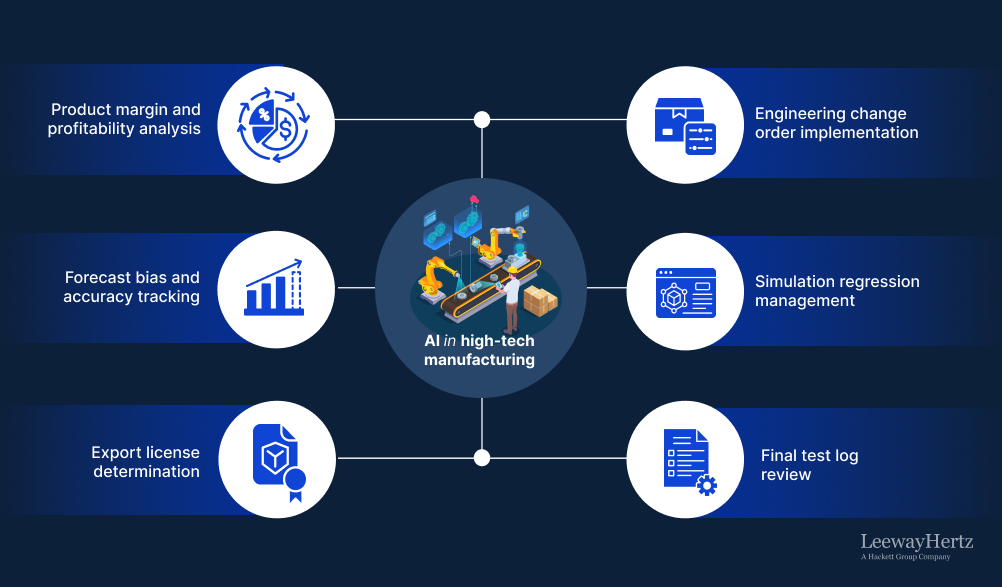
High-tech manufacturing is well-suited to AI because its core workflows already depend on structured production data, controlled engineering, quality documents, and repeatable decisions across design, fabrication, assembly, testing, and supply chain operations. A semiconductor lot or an electronics assembly is not tracked through manual notes or informal handoffs; it is tracked through a wafer lot traveler, a route sheet, and system records that show what changed and why. The scale makes those handoffs harder to manage manually, especially in semiconductors, where global annual semiconductor sales increased 25.6% to $791.7 billion in 2025 [1]. At the same time, talent pressure is tightening because by 2030, more than one million additional skilled workers will be needed to meet demand in the semiconductor industry [2], so reducing avoidable review work is becoming an operating necessity rather than an IT experiment.
That pressure explains why AI is already moving into practical manufacturing work, not just isolated pilots. Among surveyed manufacturers, 29% are using AI or machine learning at the facility or network level [3], which points to a broader shift from experimentation toward workflow adoption. A yield review can use anomaly detection to rank lots for engineering attention, while a planning team can use forecasting and optimization to compare build options before the supply planning manager approves the plan. Language models add a different kind of support by summarizing a failure analysis report, which reduces manual effort for the quality manager without replacing quality judgment.
The business value, however, does not come from placing a generic chatbot next to every system. It comes from embedding AI where work already happens. In a manufacturing execution system (MES) hold review, AI can connect a lot history record with a parametric test report so the process engineer spends less time reconstructing context, while the senior process engineer still approves any recipe change request before it moves forward. In quality operations, AI can classify entries in an automated optical inspection defect log and suggest a nonconformance summary, but the quality manager confirms the disposition. In supply planning, a forecasted shortage can be paired with a recommended allocation, and the supply planning manager reviews it before any customer commit date changes.
To make those opportunities buildable, AI should start with the work itself. Mapping AI at the function, process, and sub-process level helps teams identify the relevant systems of record, source documents, workflow owners, and control points needed to design practical, governed solutions. Product lifecycle management (PLM) data may support an engineering change order review, while a quality escalation may connect a nonconformance report to a corrective and preventive action record; those links determine what data the model can access and who must approve the result. This level of mapping also helps prioritize opportunities because teams can compare cycle time, manual effort, compliance exposure, and working capital impact against integration effort and review risk. That is why the article takes the following operating-model view.
This article uses a high-tech manufacturing operating model to break work down into functions, processes, and sub-processes. For each area, it shows where AI can retrieve evidence, compare records, classify issues, detect exceptions, summarize findings, generate controlled outputs, and support workflow decisions. A named human reviewer remains responsible for confirming production changes before release, customer-facing messages before they are sent, and any action that carries quality, safety, compliance, or commercial risk.
- How AI is transforming high-tech manufacturing operations
- Why high-tech manufacturing AI use cases must be mapped at the sub-process level
- High-tech manufacturing operating model and AI opportunity mapping across high-tech manufacturing processes
- High-value AI use cases in high-tech manufacturing
- How agentic AI works in high-tech manufacturing workflows
- How to prioritize AI use cases in high-tech manufacturing
- Governance, risk, and responsible AI in high-tech manufacturing
- How ZBrain operationalizes AI use cases in high-tech manufacturing
- Future of AI in high-tech manufacturing
How AI is transforming high-tech manufacturing operations
In high-tech manufacturing, process changes often depend on information spread across engineering notes, approval threads, manufacturing execution systems, lot history, quality records, and yield data. Rule-based automation remains useful when requests follow predefined approval paths, and forecasting models work well when demand, capacity, or yield patterns have clean historical data. However, these approaches are less effective when the reason for a change is embedded in unstructured notes or when the supporting risk evidence is distributed across multiple systems.
AI can help by identifying whether a yield shift resembles an abnormal pattern, retrieving relevant lot and process evidence, and generating a sourced impact summary for engineering review. This gives the process engineering lead a clearer basis for deciding whether a recipe change is ready for release into a higher-volume run. The practical value is shorter decision cycle time, reduced manual context gathering, and stronger review discipline before production changes are approved.
This pattern is not limited to process-change review. Across high-tech manufacturing, AI opportunities often appear where teams must reconcile fragmented records, interpret technical context, and move work through controlled handoffs. These opportunities are especially visible in five types of work:
-
Document-heavy work: engineering change orders, bill of materials revisions, supplier corrective action requests, and export classification records.
-
Narrative-heavy work: yield excursion summaries, nonconformance investigations, design verification reports, and customer failure analysis responses.
-
Exception-heavy work: wafer lot holds, printed circuit board test failures, constrained component allocations, and late engineering approvals.
-
Knowledge-heavy work: process specifications, quality procedures, export control guidance, and product configuration rules.
-
Workflow-heavy work: engineering change release, new product introduction gate reviews, supplier qualification, and production readiness checks.
That makes the design rule important: AI prepares the case by retrieving the evidence that matters, drafts the output in the format the workflow expects, and routes it to the accountable role instead of pushing a production decision on its own. Before any production change, customer-facing message, or risk-bearing action proceeds, the responsible process engineering lead or quality manager confirms the recommendation, which keeps accountability clear while reducing the manual assembly work around it.
Transform high-tech manufacturing workflows
Apply AI across engineering change review, production planning, quality management, supplier operations, and compliance workflows to improve efficiency, traceability, decision quality, and execution speed.
Why high-tech manufacturing AI use cases must be mapped at the sub-process level
AI use cases in high-tech manufacturing must be mapped at the sub-process level because broad labels such as “AI for high-tech manufacturing” are not specific enough to build, govern, or measure. Different activities within the same function often depend on different artifacts, systems, owners, and control points. For example, process node and package roadmap alignment depends on engineering assumptions, roadmap data, and package options, while end-of-life and last-time-buy planning depends on demand commitments, inventory exposure, buying windows, and customer communication risk.
These activities may sit within the same operating model, but they require different workflows, approval paths, and success metrics. Treating them as one AI opportunity makes it difficult to define the source data, assign accountability, manage risk, or measure outcomes such as release cycle time, rework reduction, working capital impact, or customer readiness.
At the sub-process level, the opportunity becomes practical. Teams can identify the specific artifact AI will support, the system of record it must reference, the reviewer who must approve the output, and the control point where human judgment remains necessary. This turns AI from a broad concept into a reviewable workflow aid that can improve decision quality, reduce manual effort, and support governed execution.
That mapping discipline matters because it forces each opportunity to state what AI is doing, which high-tech manufacturing artifact it touches, and which role confirms the decision before anything changes.
For example –
-
In bill of materials governance, AI can classify proposed relationships in the bill of materials and flag mismatches for review, giving the product data governance manager a focused queue to confirm before the product lifecycle management (PLM) record is updated.
-
In an engineering change order portfolio impact review, AI can summarize affected part numbers and score portfolio exposure from an engineering change order, which helps the engineering change control chair prioritize the review and confirm whether the change is ready for a stage-gate discussion.
-
In standard cost model maintenance, anomaly detection can highlight unusual cost movements in the standard cost model, so the manufacturing finance controller can confirm the adjustment before it affects margin reporting.
The goal is not to make the use case map more detailed simply for the sake of detail. The purpose is to connect each AI opportunity to the operating model behind it. This makes the next section more practical by showing where ownership, data access, controls, and review accountability sit within the actual flow of work.
High-tech manufacturing operating model and AI opportunity mapping across high-tech manufacturing processes
The high-tech manufacturing operating model below is organized into core industry-native functions that practitioners recognize. Each function is decomposed into its major processes and their sub-processes, and each sub-process carries the AI-enabled opportunity that applies to it. Use cases are scoped to AI-assisted workflows and decision support, with human review required before any production change, customer-facing communication, or risk-bearing action.
Function 1. Product strategy, portfolio, and manufacturing profitability planning
This function owns product and application strategy, portfolio roadmaps, product line profit and loss (P&L), standard cost direction, and profitability guardrails from concept through end of life. Product managers, product line owners, cost accountants, manufacturing finance analysts, and portfolio governance teams work across product lifecycle management (PLM), engineering change, enterprise resource planning (ERP), manufacturing finance, supply planning, sales and operations planning (S&OP), and analytics platforms.
AI helps most where portfolio choices require fast reconciliation across roadmaps, design starts, demand volatility, capacity assumptions, cost rollups, and profitability evidence. This matters because delayed reconciliation can slow funding decisions, obscure margin risk, and weaken capacity commitments.
| Process | Sub-process | Key AI-enabled opportunities |
| Portfolio and product roadmap governance | Product line strategy and application segmentation | Classify product families and application use cases from the bill of materials and parametric test report, then compare application fit against advanced product quality planning criteria to reduce portfolio sorting effort for product line owner review. |
| Process node and package roadmap alignment | Map process node dependencies and package qualification status from the route sheet and mask set record, then flag gaps against new product introduction gates to shorten roadmap alignment for portfolio governance review. | |
| Portfolio prioritization and stage-gate funding | Score product roadmap initiatives using cost, risk, manufacturability, and yield signals from DFMEA worksheets and yield Pareto analyses, improving capital allocation decisions for portfolio governance committee review. | |
| End-of-life and last-time-buy planning | Forecast last-time-buy exposure from demand history and bill of materials usage, then compare supply risk with cycle-time assumptions to protect working capital for product line owner review. | |
| Business case, cost, and profitability analysis | Standard cost model maintenance | Extract material, route, and yield drivers from the bill of materials and route sheet, then flag stale cost assumptions to reduce spreadsheet maintenance for manufacturing finance analyst review. |
| Die cost and package cost rollups | Model die and package cost sensitivity from wafer yield and bin split evidence, giving the cost accountant clearer margin visibility before standard cost updates. | |
| Cost of poor quality analysis | Detect recurring scrap and rework patterns across nonconformance and corrective action records, then classify drivers to prioritize cost recovery actions for quality finance manager review. | |
| Product margin and profitability analysis | Forecast product margin bands using standard cost and final test yield signals, sharpening pricing and mix decisions for product line owner review. | |
| Product master data and configuration governance | Part number and product hierarchy setup | Classify new part requests against hierarchy rules and detect duplicate part numbers, reducing master-data rework for product data steward review. |
| Bill of materials governance | Validate bill of materials revisions against engineering change evidence and the approved vendor list, strengthening configuration control for product data steward review. | |
| Approved package and test flow mapping | Map package options and test steps from the route sheet and final test log, then identify release gaps for test engineering lead review. | |
| Engineering change order portfolio impact review | Summarize affected products, costs, and qualification risks from the engineering change order and bill of materials, shortening review cycles for product change control board review. | |
| Capacity, supply, and revenue scenario planning | Fab and outsourced capacity assumption setting | Forecast capacity ranges from cycle-time and availability signals, improving supply commitments before the supply planning manager’s approval. |
| Demand upside and downside scenario modeling | Compare demand shifts with supply constraints and forecast revenue-at-risk, improving scenario decision quality for the S&OP chair review. | |
| Allocation policy and customer commitment review | Rank allocation exceptions using lot history and constrained supply evidence, clarifying accountability before commercial operations approval. | |
| Revenue, backlog, and product mix analysis | Forecast revenue conversion from backlog and bin-mix signals, improving product mix decisions and working-capital visibility for product finance manager review. |
The highest-value opportunities are standard cost model maintenance, engineering change order portfolio impact review, and demand scenario modeling, which offer the strongest AI lift because they are high-volume, artifact-rich workflows with repeatable inputs from ERP, PLM, manufacturing execution system (MES), and planning systems. Prioritizing these sub-processes helps reduce reconciliation effort, shorten funding cycles, improve margin decisions, and keep approvals with manufacturing finance analysts, the product change control board, and the S&OP chair.
Example agentic workflow: An example agentic workflow is ECO portfolio impact routing. AI retrieves the engineering change order, bill of materials, cost records, and demand scenarios from PLM, ERP, MES, and planning systems, drafts an impact summary, routes it to the change control board chair, and records approval after review.
Function 2. Semiconductor R&D and process technology development
This function owns process technology pathfinding, process node definition, device architecture, unit process development, integration experiments, and readiness for transfer into manufacturing. Process integration engineers, device engineers, module engineers, photolithography, etch, deposition, chemical mechanical planarization (CMP), ion implantation, and metrology teams work through PLM, MES, electronic design automation (EDA), verification, and analytics platforms.
AI helps most where engineering teams must interpret experiment history, wafer results, metrology, recipes, lot travelers, and qualification evidence across many design and process splits. It reduces manual history mining so that engineers can spend more time on experiment quality and process transfer decisions.
| Process | Sub-process | Key AI-enabled opportunities |
| Process technology roadmap and pathfinding | Process node definition | Aggregate parametric test report distributions and yield Pareto drivers, then flag feasibility gaps against design for manufacturability limits for the technology roadmap committee review. |
| Device architecture selection | Compare candidate architectures using parametric trends and wafer sort signatures, then classify dominant failure modes to improve device engineer review. | |
| Module integration planning | Map module dependencies across route sheets and control plans, then detect process failure mode and effects analysis (PFMEA) gaps to reduce integration rework for process integration lead review. | |
| Design rule and process window definition | Compare reticle dimensions and statistical process control (SPC) limits, then flag marginal windows to reduce manual margin analysis for lithography and integration engineer review. | |
| Unit process development | Photolithography recipe development | Retrieve reticle records and prior SPC patterns, then propose exposure-focus recipe splits that shorten wafer learning cycles for photolithography engineer review. |
| Etch recipe development | Detect endpoint and pressure anomalies in the fault detection and classification (FDC) trace, then propose etch recipe splits that reduce trial-lot effort for the etch module engineer review. | |
| Deposition process development | Detect film-thickness and uniformity patterns from FDC trace features, then propose deposition set-point candidates for deposition module engineer review. | |
| Chemical mechanical planarization and ion implantation condition setup | Compare the CMP removal-rate and implant dose signals, then propose bounded setup candidates that reduce qualification iterations for module engineer review. | |
| Experiment planning and split-lot execution | Design of experiments planning | Propose split factors and response measures from lot history and yield drivers, reducing experiment reruns for process integration engineer review. |
| Wafer lot traveler creation | Draft the wafer lot traveler from the approved route sheet and work order, then flag any missing metrology holds for the process integration engineer’s review. | |
| Route sheet setup | Map module steps, recipe identifiers, and metrology holds into the route sheet, reducing traveler release delays for manufacturing systems engineer review. | |
| Split-lot tracking and lot history record review | Compare lot history with planned splits, detect missed operations or hold aging, and shorten experiment cycle time for process integration engineer review. | |
| Process qualification and reliability readiness | JEDEC qualification test planning | Draft the qualification test plan from the control plan and device history evidence, then flag stress coverage gaps for the reliability engineer review. |
| Parametric test characterization | Detect distribution shifts in parametric test and wafer sort data, then summarize device-limit drivers for device engineer review. | |
| Reliability test lot selection | Screen candidate lots using lot genealogy and parametric distributions, then propose representative lots for reliability engineer review. | |
| Recipe change request review | Compare recipe change requests with SPC behavior and PFMEA controls, then flag qualification risks for change control board review. |
The highest-value opportunities are design of experiments planning, split-lot tracking, and recipe change request review, which should be prioritized because they are high-volume, artifact-rich workflows with clear review boundaries. AI can reduce manual history mining across lot history records, wafer lot travelers, parametric test reports, and recipe change requests, shortening experiment and change-control cycles for process integration engineers and change control boards.
Example agentic workflow: An example agentic workflow is the split-lot readiness workflow. AI plans the qualification review, retrieves wafer lot travelers, route sheets, hold tickets, and parametric test reports from manufacturing and engineering systems, drafts a readiness checklist, routes it through the quality workflow, and prompts the process integration engineer to confirm disposition.
Function 3. Electronic design automation and design engineering
This function owns product architecture, design specification, front-end design, verification, physical implementation, design signoff, design for manufacturability (DFM), design for test (DFT), and design release. System architects, register-transfer level (RTL) designers, verification engineers, physical design engineers, product engineers, and design release managers work in EDA, PLM, engineering change, and analytics platforms.
AI helps most where design teams must search specifications, verification results, timing reports, design rules, engineering changes, reticle records, and mask set evidence without losing traceability. It supports design review productivity while keeping sign-off decisions with accountable engineers.
| Process | Sub-process | Key AI-enabled opportunities |
| Product architecture and design specification | System requirements capture | Extract functional and reliability requirements from engineering change notices, then flag ambiguous requirements that could create late-stage rework for system architect review. |
| Design specification management | Compare design specification revisions with engineering change order line items, then summarize conflicting constraints for design release manager review. | |
| IP and block integration planning | Map intellectual property (IP) interface specifications to integration dependencies, then flag unresolved clock, reset, and protocol assumptions for lead RTL designer review. | |
| Power, performance, and area target setting | Predict feasible power, performance, and area target bands from timing and yield history, improving target decisions for system architect review. | |
| Front-end design and verification | RTL development | Draft RTL module stubs and assertion placeholders from the approved design specification, then flag incomplete reset or clock-domain assumptions for lead RTL designer review. |
| Functional verification plan | Map specification requirements and DFMEA risks to coverage goals, then propose constrained-random and directed test priorities for verification lead review. | |
| Simulation regression management | Cluster recurrent regression failures and assertion signatures, then summarize coverage gaps to reduce manual triage for verification manager review. | |
| Design review signoff | Aggregate RTL review checklists and verification coverage reports, then draft exception summaries for design review board approval. | |
| Physical implementation and signoff | Floorplanning and placement | Propose floorplan constraints from design exchange format (DEF) files and timing reports, then flag routability risks for physical design lead review. |
| Clock tree synthesis | Detect skew and latency outliers in clock tree synthesis reports, then propose constraint review candidates for clock implementation engineer review. | |
| Routing and timing closure | Classify negative-slack paths and routed congestion markers, then flag timing-risk trade-offs for timing signoff engineer review. | |
| Power integrity and signal integrity signoff | Detect voltage-drop, electromigration, and crosstalk outliers, then flag reliability-sensitive waiver requests for signoff engineer review. | |
| DFM, DFT, reticle, and mask release | Design for Manufacturability (DFM) review | Classify lithography and density findings in the DFM violation report, then prioritize yield-risk waivers for product engineering review. |
| Design for Test (DFT) insertion | Compare scan-chain and built-in self-test (BIST) coverage, then propose targeted insertion fixes for DFT lead review. | |
| Reticle record preparation | Extract layer, device, revision, and field metadata for the reticle record, then flag mismatches before mask ordering for design release manager review. | |
| Mask set record release | Validate mask set contents against reticle revisions and waiver files, then flag release blockers for mask release manager approval. | |
| Tapeout checklist approval | Aggregate timing, DFM, DFT, reticle, mask, and engineering change evidence, then flag unresolved signoff gaps for tapeout review board approval. |
The highest-value opportunities are simulation regression management, routing and timing closure, and tapeout checklist approval, which offer strong near-term AI lift because they are high-volume, artifact-rich workflows with structured logs, reports, and release evidence. Prioritizing these areas helps reduce triage effort, shorten closure cycle time, improve waiver decisions, and keep final signoff with verification managers, timing signoff engineers, and the tapeout review board.
Example agentic workflow: An example agentic workflow is the Tapeout Readiness Workflow. AI builds the release evidence checklist, retrieves timing, DFM, DFT, reticle, mask, and engineering change records from design and PLM systems, drafts a waiver summary, routes the package, and confirms approval with the tapeout review board.
Function 4. New product introduction and EVT/DVT/PVT gates
This function owns cross-functional launch execution from design release through engineering validation test (EVT), design validation test (DVT), production validation test (PVT), pilot builds, and production release. New product introduction (NPI) program managers, manufacturing engineers, test engineers, sourcing teams, supplier quality engineers, quality engineers, and readiness teams work across PLM, MES, quality management system (QMS), ERP, and planning platforms.
AI helps most where gate evidence, risks, work instructions, change impacts, and readiness checklists have to be assembled from design, process, sourcing, manufacturing, test, and quality records. It reduces manual evidence chasing so that launch reviews can focus on release risk and cutover readiness.
| Process | Sub-process | Key AI-enabled opportunities |
| NPI program and gate governance | EVT gate planning | Retrieve design release records and open DFMEA items, then map evidence to EVT deliverables to reduce manual collation for NPI program manager review. |
| DVT gate planning | Compare parametric test results and failure analysis findings with reliability requirements, then summarize unresolved design-validation risks for design assurance lead review. | |
| PVT gate planning | Compare pilot work orders, control plan checks, and yield trends, then flag readiness anomalies for operations readiness lead review. | |
| Cross-functional launch readiness review | Aggregate engineering change status and supplier coverage, then prioritize launch blockers under advanced product quality planning for the launch readiness board. | |
| APQP and manufacturing readiness | Advanced Product Quality Planning (APQP) checklist | Extract evidence from the bill of materials and control plan, then flag incomplete owners or dates for quality program manager review. |
| DFMEA worksheet handoff | Summarize design risks from the DFMEA worksheet and map high-risk characteristics to PFMEA inputs for manufacturing engineering review. | |
| PFMEA worksheet creation | Draft PFMEA entries from the route sheet and work instruction, then flag high-risk process steps for process engineering review. | |
| AIAG control plan development | Map critical characteristics from the PFMEA worksheet and measurement study, then flag unsupported controls for quality engineering review. | |
| Risk Priority Number (RPN) scoring | Detect outlier severity, occurrence, and detection ratings in the PFMEA worksheet, improving prioritization for quality engineering review. | |
| Prototype build and pilot-line execution | Prototype work order release | Validate work order material, routing, and revision fields against approved records, then flag release blockers for production control review. |
| Assembly traveler setup | Extract route steps and inspection checkpoints into the assembly traveler, reducing setup rework for manufacturing engineering review. | |
| Work instruction drafting | Draft work instruction steps from the assembly traveler and route sheet, then flag ambiguous operator actions for manufacturing engineering review. | |
| Pilot build issue log and golden unit validation | Cluster inspection and test defects, then summarize containment actions to speed issue triage for pilot build quality lead review. | |
| Production release and change implementation | Production Part Approval Process (PPAP) package | Retrieve control plan and measurement evidence, validate completeness, and flag missing submissions for supplier quality engineer review. |
| Engineering Change Notice (ECN) release | Classify engineering change notice impacts across work instructions and approved vendors, then flag unapproved dependencies for configuration manager review. | |
| Engineering Change Order (ECO)implementation | Map engineering change order effectivity to work orders and travelers, then detect lot-level mismatches for operations engineering review. | |
| Device history record setup | Extract genealogy fields from work orders and lot history, then flag traceability gaps for quality systems manager review. | |
| Certificate of conformance readiness | Compare certificate requirements with final test and approval evidence, then flag shipment-release exceptions for quality release manager review. |
The highest-value opportunities are production part approval process packages, engineering change order implementation, and work instruction drafting, which are strong near-term candidates because they draw structured evidence from PLM, MES, QMS, and ERP. Prioritizing these areas helps shorten gate cycle time, reduce manual evidence assembly, improve change-impact decisions, and maintain accountable signoff by supplier quality, operations engineering, and manufacturing engineering roles.
Example agentic workflow: An example agentic workflow is PVT gate evidence preparation. AI builds the PVT evidence checklist, retrieves engineering change, work order, control plan, functional test, yield, and hold records, drafts the gate summary, routes open risks to the operations readiness lead, and records confirmation after review.
Function 5. Supplier qualification, sourcing, and approved vendor list management
This function owns supplier strategy, sourcing, supplier qualification, approved vendor list governance, incoming supplier quality, supplier corrective action, and continuity of supply. Commodity managers, sourcing specialists, supplier quality engineers, procurement operations teams, incoming quality teams, and supply continuity planners work in ERP, PLM, QMS, planning, and governance platforms.
AI helps most where supplier files, qualification records, approved vendor list changes, corrective actions, capacity commitments, and shortage escalations must be compared quickly across commercial, quality, and engineering evidence. Human review remains central for supplier approval, corrective action closure, and sourcing commitments.
| Process | Sub-process | Key AI-enabled opportunities |
| Supplier sourcing and commodity strategy | Commodity strategy development | Map the bill of materials demand and the approved vendor list coverage, then rank single-source gaps to support the commodity manager review. |
| Should-cost and cost breakdown collection | Extract material and yield-loss assumptions from supplier cost templates, then flag unsupported deltas to reduce negotiation rework for sourcing specialist review. | |
| Supplier capacity review | Forecast constraint risk from supplier capacity commitments and work order backlog, reducing shortage escalation cycle time for supply continuity planner review. | |
| Sourcing event and bid analysis | Compare bid sheets with approved vendor status and qualification requirements, then summarize trade-offs for sourcing manager review. | |
| Supplier qualification and AVL management | Supplier audit planning | Score audit priority from nonconformance trends and supplier corrective action aging, reducing planning effort for supplier quality engineer review. |
| Approved vendor list onboarding | Validate qualification package completeness and approved part data, reducing onboarding rework for the procurement operations manager review. | |
| Material and component qualification | Compare qualification evidence with parametric limits and failure analysis conclusions, then flag release gate gaps for component engineer review. | |
| Supplier risk classification | Classify suppliers by approved vendor criticality and corrective action severity, improving mitigation prioritization for procurement risk manager review. | |
| Supplier quality and corrective action | Supplier corrective action request issuance | Draft supplier corrective action request problem statements from nonconformance evidence, shortening issuance cycle time for supplier quality engineer review. |
| Incoming inspection plan maintenance | Compare control plan characteristics with inspection defects, then propose frequency changes for incoming quality manager review. | |
| Nonconforming supplier material disposition | Summarize quality, delivery, and cost risk from hold tickets and nonconformance records, shortening material review board queues. | |
| 8D report review and CAPA linkage | Validate 8D report closure evidence against corrective and preventive action (CAPA) records, reducing repeat-defect risk for supplier quality manager review. | |
| Supplier performance and continuity management | On-time delivery scorecard | Forecast late-delivery recurrence from receipt dates and shortage impacts, then rank recovery priorities for supply continuity planner review. |
| Quality ppm and yield contribution review | Detect parts per million (ppm) contributors from yield and parametric data, sharpening containment prioritization for supplier quality engineer review. | |
| Capacity commit tracking | Forecast capacity commit slippage from work order demand and bottleneck data, improving continuity decisions for the supply continuity planner review. | |
| End-of-life and alternate source planning | Map end-of-life notices to bill of materials usage and alternates, then propose sourcing paths for component engineer review. |
Highest-value opportunities are approved vendor list onboarding, supplier corrective action request issuance, and end-of-life alternate source planning offer strong near-term value because they are high-volume, artifact-rich workflows with structured evidence in ERP, PLM, QMS, and planning systems. AI can reduce onboarding rework, shorten corrective action issuance, and surface alternate-source gaps while procurement operations managers, supplier quality engineers, and component engineers retain approval boundaries.
Example agentic workflow: An example agentic workflow is the approved vendor list onboarding exception workflow. AI identifies required qualification checks, retrieves supplier master, quality, risk, and approval evidence, drafts an onboarding exception summary, routes it to procurement operations, and records the approved update only after the procurement operations manager confirms it.
Function 6. Demand planning, sales and operations planning, and allocation management
This function owns demand forecasting, consensus planning, S&OP, supply-demand balancing, customer allocation, backlog governance, and inventory buffer policy. Demand planners, sales operations teams, product line managers, master planners, finance analysts, and allocation managers work in planning, ERP, manufacturing finance, and analytics platforms.
AI helps most where volatile customer forecasts, design wins, backlog, capacity scenarios, inventory buffers, and allocation rules must be converted into explainable plans. It is especially useful when segment demand shifts affect commitments at the same time.
| Process | Sub-process | Key AI-enabled opportunities |
| Demand forecasting and consensus planning | Customer forecast ingestion | Extract customer forecast lines, classify change drivers, and forecast short-term deltas to reduce cleansing effort for demand planner review. |
| Product family forecast rollup | Reconcile SKU-level forecasts into product family demand, reducing spreadsheet consolidation time for product line manager review. | |
| Design win and backlog review | Compare design win entries with backlog and engineering change status, then rank revenue-at-risk for product line manager review. | |
| Forecast bias and accuracy tracking | Detect persistent over-forecasting and override patterns, improving forecast quality for the demand planning manager review. | |
| S&OP and integrated business planning | Demand signal review | Aggregate bookings and customer forecast data into the S&OP demand review, then flag material mix changes for the demand review chair review. |
| Supply capacity bottleneck review | Retrieve work-in-progress and capacity data, then flag bottleneck gaps for master planner review. | |
| S&OP reconciliation | Compare demand, supply, revenue, and inventory trade-offs, then flag margin-service conflicts for S&OP sponsor review. | |
| Revenue and mix scenario review | Simulate margin sensitivity from revenue and mix scenarios, then flag capacity choices for finance analyst review. | |
| Capacity allocation and customer commit management | Constrained supply allocation | Optimize allocation scenarios from the customer allocation matrix and backlog, then flag exceptions for allocation manager review. |
| Available-to-promise and capable-to-promise checks | Compare promise dates with route and capacity constraints, shortening quote response time for order management review. | |
| Commit date negotiation | Draft customer commit options from backlog and available-to-promise data, then route exceptions for sales operations manager review. | |
| Backlog aging analysis | Detect aged and repeatedly rescheduled orders, then flag revenue-at-risk lines for allocation manager review. | |
| Inventory and supply buffer planning | Die bank and finished goods target setting | Optimize the die bank and finished goods targets using bin split and demand variability, improving working-capital decisions for the supply planning manager review. |
| Safety stock policy | Forecast stockout probability by SKU-location pair, then flag policy changes for inventory planning manager review. | |
| WIP and finished goods balance review | Detect imbalance between work in process and demand priorities, reducing manual rescheduling for master planner review. | |
| Excess and obsolete inventory review | Classify disposition paths for excess and obsolete inventory, strengthening reserve governance for the finance controller review. |
The highest-value opportunities for this function are constrained supply allocation, available-to-promise checks, and customer forecast ingestion, because they combine high transaction volume, structured planning artifacts, and clear approval points. AI helps reduce manual reconciliation, shorten commit-cycle time, sharpen allocation decisions, and preserve reviewer accountability where customer commitments and working-capital trade-offs matter most.
Example agentic workflow: An example agentic workflow is the constrained supply allocation workflow. AI retrieves backlog, allocation rules, work in process, and wafer lot data from planning, ERP, and MES platforms, drafts an allocation recommendation, routes exceptions to the allocation queue, and records the decision after the allocation manager confirms it.
Accelerate AI Solutions Development
Build fully functional solutions from your high-value use cases, based on specific operational needs and enterprise context.
Function 7. Production planning, fab scheduling, and dispatching
This function owns the master production schedule, wafer starts, fab loading, route control, dispatch rules, work in process (WIP) flow, cycle-time management, and schedule adherence. Master schedulers, fab planners, industrial engineers, dispatch control teams, production supervisors, and manufacturing planners work in MES, planning, ERP, and analytics platforms.
AI helps most where planners must balance bottleneck tools, hot lots, queue times, route changes, WIP aging, and customer commits with constantly changing constraints. It improves planning visibility, but dispatch decisions still require operations and engineering oversight.
| Process | Sub-process | Key AI-enabled opportunities |
| Master production scheduling and lot starts planning | Master production schedule creation | Propose schedule scenarios from work order status and material constraints, reducing replanning effort for master scheduler review. |
| Wafer start planning | Optimize wafer start quantities against work order backlog and WIP constraints, shortening planning cycles for manufacturing planner review. | |
| Product mix and route loading | Map product mix to route steps and demand, then flag bottleneck route combinations for fab planner review. | |
| Capacity constraint validation | Rank bottlenecks from WIP volumes and move rates, reducing schedule churn for industrial engineer review. | |
| Fab scheduling and dispatch control | Lot dispatching and cycle-time management | Predict cycle-time risk from traveler priority and queue exposure, shortening queue delays for production supervisor review. |
| Tool group queue prioritization | Score tool group priorities from queue aging and due dates, reducing dispatch arbitration time for dispatch control lead review. | |
| Hot lot and expedite handling | Screen expedite requests against customer impact and hold history, improving accountability for the fab operations manager’s review. | |
| Dispatch rule maintenance | Detect performance degradation from dispatch rule changes, then propose governed updates for dispatch control lead review. | |
| Route, traveler, and work order control | Route sheet maintenance | Validate route sheet edits against engineering change and bill of materials dependencies, strengthening route control for manufacturing engineer review. |
| Wafer lot traveler release | Validate traveler release fields against route and work order data, reducing downstream holds for production control lead review. | |
| Work order release | Classify material readiness and route status, then flag incomplete start conditions for manufacturing planner review. | |
| Manufacturing execution system (MES) holds ticket review | Summarize the hold ticket text and linked lot events, then route likely release or escalation paths for production supervisor review. | |
| WIP, cycle time, and schedule adherence tracking | Work in process report review | Classify WIP bottleneck patterns and summarize action queues, reducing manual review effort for the fab planner review. |
| Cycle time target tracking | Detect cycle-time drift from lot history timestamps, then flag route-step contributors for industrial engineer review. | |
| Lot aging and queue time monitoring | Rank aging lots by queue-time exposure, helping production supervisors prioritize interventions. | |
| Starts-to-completions variance review | Classify variance drivers between work order releases and completions, improving schedule accountability for master scheduler review. |
The highest-value opportunities are lot dispatching and cycle-time management, tool group queue prioritization, and MES hold ticket review, because they are high-volume workflows anchored in traveler, WIP, lot history, SPC, and FDC evidence. Prioritizing these areas helps shorten queue-related cycle time, reduce shift handoff triage, improve schedule adherence, and preserve accountability for every dispatch or release decision.
Example agentic workflow: An example agentic workflow is a hot lot dispatch exception workflow. AI retrieves the wafer lot traveler, WIP report, lot history, SPC chart, and FDC trace from manufacturing and planning systems, drafts a priority recommendation, routes it to dispatch control, and the production supervisor confirms the final action.
Function 8. Wafer fabrication operations
This function owns front-end manufacturing execution across cleanroom operations, photolithography, etch, deposition, CMP, ion implantation, metrology, recipe execution, reticle control, process control, and lot history. Fab operations managers, shift supervisors, process technicians, process engineers, metrology engineers, and manufacturing specialists work in MES, equipment integration, QMS, and analytics platforms.
AI helps most where fab teams need to interpret a lot of travelers, route sheets, recipe settings, SPC charts, FDC traces, metrology data, hold tickets, and shift passdowns quickly. It supports faster triage while keeping process changes, recipe releases, and lot disposition under engineer control.
| Process | Sub-process | Key AI-enabled opportunities |
| Cleanroom production execution | Lot move-in and move-out transactions | Validate traveler move events against route and WIP data, then flag mismatches that slow reconciliation for shift supervisor review. |
| Recipe selection and verification | Compare selected recipe parameters with route sheets and approved changes, then flag unauthorized revisions for process engineer review. | |
| Operator certification checking | Screen operator sign-on events against work instruction qualifications, strengthening compliance for shift supervisor review. | |
| Lot history record entry | Extract tool events and operator comments into the lot history record, reducing investigation rework for manufacturing specialist review. | |
| Cleanroom shift passdown | Summarize hold tickets and excursion signals, then draft prioritized passdown notes for shift supervisor review. | |
| Photolithography and reticle control | Reticle record verification | Compare reticle identifiers with traveler and route requirements, reducing exposure error risk for lithography engineer review. |
| Mask set record control | Classify mask set revisions against route eligibility, strengthening change control for manufacturing engineering review. | |
| Photo track and scanner recipe setup | Validate scanner recipe settings against route and approved recipe changes, reducing misprocessing risk for lithography process engineer review. | |
| Overlay and critical dimension checking | Detect overlay and critical dimension shifts in SPC charts, accelerating disposition for metrology engineer review. | |
| Reticle hold and release | Summarize reticle hold history and excursion evidence, speeding controlled release decisions for lithography engineering manager review. | |
| Etch, deposition, CMP, and implant operations | Etch chamber run execution | Detect abnormal endpoint and pressure patterns in FDC traces, shortening containment time for process engineer review. |
| Deposition tool run execution | Detect drift in temperature, pressure, and gas-flow signatures, reducing containment effort for process engineer review. | |
| Chemical mechanical planarization run control | Compare CMP measurements with route targets, then flag lots needing hold or remeasure for process engineer review. | |
| Ion implantation recipe execution | Validate dose, energy, tilt, and species values against approved recipe limits, lowering parametric escape risk for implant process engineer review. | |
| Post-process metrology sampling | Rank wafer lot risk factors against the control plan coverage, improving excursion detection for metrology engineer review. | |
| APC, SPC, FDC, and OCAP execution | Advanced Process Control model setup | Screen SPC, FDC, and parametric data quality, then draft validation notes for process control engineer review. |
| Run-to-run control adjustment | Propose bounded control adjustments from SPC trends, sharpening correction decisions for process engineer review. | |
| Statistical Process Control chart review | Detect SPC rule violations and summarize affected lots, improving containment speed for process engineer review. | |
| FDC trace review | Detect multivariate anomaly patterns in FDC traces, shortening excursion triage for equipment engineer review. | |
| Out of Control Action Plan record execution | Validate hold, remeasurement, and notification completion, strengthening accountability for process engineering manager review. |
The highest-value opportunities for this function are recipe selection and verification, FDC trace review, and out-of-control action plan execution, which are strong starting points because they sit in high-volume lot flow and rely on rich process evidence. Prioritizing these sub-processes helps shorten misprocessing response time, reduce manual evidence gathering, and strengthen compliance accountability without moving lot disposition away from engineering control.
Example agentic workflow: An example agentic workflow is the Out-of-Control Action Plan (OCAP) excursion triage workflow. AI retrieves wafer travelers, hold tickets, FDC traces, SPC charts, and quality records, drafts an out-of-control action plan summary, routes it to the process engineer, and records confirmation after the hold, remeasure, or release decision.
Function 9. Back-end manufacturing, test, advanced packaging, and PCBA assembly operations
This function owns back-end manufacturing from wafer sort through die preparation, assembly, advanced packaging, final test, product disposition, and printed circuit board assembly (PCBA). Assembly engineers, packaging engineers, test engineers, surface-mount technology (SMT) line supervisors, manufacturing engineers, quality inspectors, operators, and rework technicians work in MES, QMS, ERP, and analytics platforms.
AI helps most where teams must connect wafer sort maps, bin split reports, assembly travelers, inspection records, final test logs, device history records, and certificates of conformance. It improves evidence navigation across back-end and PCBA lines while preserving human signoff for disposition and release.
| Process | Sub-process | Key AI-enabled opportunities |
| Wafer sort and die preparation | Wafer sort setup | Validate wafer sort setup against the traveler and route sheet, then flag probe-card or reticle mismatches for test engineer review. |
| Parametric test report review | Detect threshold shifts in parametric test data, reducing manual triage for product engineer review. | |
| Wafer sort map generation | Map die-level outcomes into wafer sort maps and detect spatial signatures, shortening excursion localization for yield engineer review. | |
| Die binning and bin split report | Classify tested die into disposition categories and flag yield shifts, improving release decisions for product engineer review. | |
| Wafer saw and die attach readiness | Validate saw and die attach readiness against traveler and material status, reducing release delays for assembly engineer review. | |
| Assembly and advanced packaging execution | Assembly traveler release | Validate assembly traveler content against the bill of materials and engineering change status, reducing rework risk for manufacturing engineer review. |
| Package assembly work instruction preparation | Draft work instruction updates from traveler and PFMEA evidence, reducing line-start delays for packaging engineer review. | |
| Wire bond and flip-chip process setup | Compare setup parameters with work instructions and recipe changes, lowering scrap risk for process engineer review. | |
| Advanced packaging lot tracking | Map lot tracking events to bottlenecks, reducing manual expediting for production control manager review. | |
| Device history record update | Extract completed operation and nonconformance evidence, shortening the compliant release for the quality engineer review. | |
| Final test and product disposition | Final test program release | Validate test program release evidence against DFT criteria, shortening release cycles for the test engineering manager review. |
| Final test log review | Detect pass-rate drift and recurring failure codes, reducing analyst triage time for test engineer review. | |
| Binning disposition | Classify device bins and propose hold, rework, or release options for product engineer review. | |
| Lot acceptance and ship hold release | Validate hold and corrective action closure evidence, shortening ship-hold release for quality manager review. | |
| Certificate of conformance generation | Draft the certificate from device history and lot history evidence, reducing release rework for quality assurance manager review. | |
| PCBA, inspection, and functional test operations | Solder paste printing setup | Validate solder paste setup against work instructions and prior inspection trends, reducing first-article delays for SMT process engineer review. |
| Solder paste inspection defect log review | Detect aperture, volume, and alignment patterns, reducing manual review effort for SMT process engineer review. | |
| Automated optical inspection defect log review | Classify visual defect patterns and flag probable false calls, reducing inspection rework for quality inspector review. | |
| IPC-A-610 inspection record | Extract defect class, location, and severity into inspection records, strengthening audit readiness for quality inspector review. | |
| In-circuit test log and functional test log review | Compare failure signatures across in-circuit and functional test logs, shortening troubleshooting cycles for test engineer review. |
The highest-value opportunities for this function are final test log review, die binning and bin split reporting, and device history record update, because they run at high lot volume and join rich back-end artifacts. Prioritizing these areas helps reduce manual evidence reconciliation, shorten disposition cycle time, improve release decision quality, and preserve accountable human signoff.
Example agentic workflow: An example agentic workflow is the lot disposition evidence workflow. AI retrieves wafer sort, bin split, final test, hold, and device history records from manufacturing and quality systems, drafts a release or hold recommendation with evidence links, routes it through quality review, and the product engineer confirms disposition.
Function 10. Quality engineering, yield management, and excursion management
This function owns manufacturing quality engineering, yield management, excursion detection, containment, nonconformance, CAPA, measurement systems, FMEA, control plans, and continuous improvement. Quality engineers, yield engineers, process integration engineers, metrology engineers, failure analysis teams, and quality system owners work in QMS, MES, PLM, and analytics platforms.
AI helps most where quality teams must investigate SPC charts, FDC traces, lot history, tool history, parametric test reports, wafer maps, nonconformance reports, CAPA records, and 8D reports. It accelerates root cause evidence assembly while engineers retain accountability for containment and corrective action decisions.
| Process | Sub-process | Key AI-enabled opportunities |
| Yield management and loss analysis | Yield Pareto generation | Cluster recurring loss modes and rank top contributors by lot context, reducing manual loss review for yield engineer review. |
| Bin split report review | Classify bin movements and abnormal mix changes, shortening triage cycles for product engineer review. | |
| Wafer sort map correlation | Correlate spatial failure patterns with reticle and lot history attributes, reducing manual analysis for process integration engineer review. | |
| Final test yield trend review | Detect final test yield drift and forecast near-term fallout, prioritizing corrective action for yield engineer review. | |
| Parametric test report analysis | Screen parametric outliers and rank wafer lots by predicted yield risk for process integration engineer review. | |
| Excursion detection and containment | Yield management and excursion management triage | Retrieve SPC, FDC, and lot evidence, then summarize probable common factors for the quality engineering manager review. |
| SPC chart alarm review | Detect SPC rule violations and flag false-positive candidates, reducing alarm fatigue for process engineer review. | |
| FDC trace excursion review | Classify abnormal FDC signatures and likely tool contributors, improving containment prioritization for equipment engineer review. | |
| Manufacturing execution system holds ticket issuance | Draft hold ticket fields and validate lot, tool, and route scope, reducing issuance rework for manufacturing quality engineer review. | |
| Affected lot containment | Map common tool, recipe, and route exposure across lot records, protecting working capital for quality engineering manager review. | |
| Nonconformance, CAPA, and problem solving | Nonconformance report creation | Extract defect evidence and draft a nonconformance report, reducing manual case assembly for quality engineer review. |
| Corrective and Preventive Action record management | Summarize overdue CAPA actions and weak effectiveness checks, strengthening compliance for CAPA owner review. | |
| 8D problem solving | Retrieve lot, hold, and failure analysis evidence, then draft problem statements and corrective action options for the quality engineering manager review. | |
| Five Whys root cause analysis | Propose causal chains from defects and process changes, improving decision quality for quality engineer review. | |
| A3 problem solving | Summarize current-state evidence and map countermeasures to problem statements, improving accountability for process improvement lead review. | |
| FMEA, control plan, and measurement systems | PFMEA worksheet maintenance | Compare new nonconformance and yield patterns with the PFMEA worksheet, improving control prioritization for FMEA facilitator review. |
| DFMEA worksheet review | Compare field and test evidence with DFMEA risks, improving design review quality for the design quality engineer review. | |
| AIAG control plan updates | Draft control plan updates from engineering change and PFMEA evidence, reducing missed quality handoffs for quality system owner review. | |
| Measurement System Analysis (MSA) study | Detect operator, part, and equipment variation patterns, reducing rework before metrology engineer review. | |
| Gage R&R report approval | Validate gage repeatability and reproducibility (Gage R&R) coverage, strengthening measurement compliance for the metrology quality manager review. |
The highest-value opportunities are yield triage, SPC alarm review, and PFMEA worksheet maintenance, which stand out because they are high-volume, artifact-rich workflows with clear human review boundaries. AI can reduce manual evidence gathering across SPC charts, FDC traces, lot history, yield paretos, and PFMEA data, shortening excursion and risk review cycles for yield engineers, process engineers, and FMEA facilitators.
Example agentic workflow: An example agentic workflow is the excursion containment evidence workflow. AI retrieves SPC charts, FDC traces, wafer travelers, lot history, and WIP data, drafts the excursion summary and hold rationale, routes the package to the quality engineering manager, and records containment confirmation after review.
Function 11. Equipment engineering and maintenance planning
This function owns equipment installation, qualification, uptime, preventive maintenance, corrective maintenance, spares, calibration, tool performance, equipment integration, and recurring failure elimination. Equipment engineers, maintenance technicians, reliability engineers, process engineers, spares planners, and equipment performance analysts work in MES, equipment performance, QMS, ERP, and analytics platforms.
AI helps most where downtime, alarms, trace data, maintenance history, chamber matching, spares availability, and production priorities must be interpreted quickly. It reduces troubleshooting effort and focuses human review on exceptions that affect availability, throughput, and operating cost.
| Process | Sub-process | Key AI-enabled opportunities |
| Equipment installation and qualification | Tool acceptance testing | Compare tool output against acceptance criteria and measurement evidence, shortening qualification cycle time for equipment engineering manager review. |
| SECS/GEM integration practices | Map equipment event streams to wafer traveler events, reducing integration rework for automation engineer review. | |
| Equipment recipe qualification | Compare recipe parameters with qualified route limits and chamber drift, reducing manual checks for process engineer review. | |
| Baseline metrology and capability checking | Detect baseline metrology shifts and low-capability measurements, improving release decisions for metrology engineer review. | |
| Production release approval | Summarize open hold status and qualification evidence, shortening release meetings for the manufacturing engineering manager review. | |
| Preventive and corrective maintenance planning | Preventive maintenance scheduling | Propose risk-based preventive maintenance timing from utilization and failure risk, reducing unplanned downtime for maintenance planner review. |
| Corrective maintenance work order review | Classify alarm symptoms and technician notes, then draft repair scope recommendations for maintenance supervisor review. | |
| Chamber clean and kit change planning | Detect kit degradation from FDC trace patterns, reducing avoidable downtime for equipment engineering lead review. | |
| Maintenance passdown review | Summarize open work orders and production-blocking items, reducing shift handoff latency for shift maintenance supervisor review. | |
| Maintenance hold ticket closure | Validate hold ticket closure evidence against completed work order steps, strengthening compliance for quality engineer review. | |
| Equipment performance and OEE management | Overall Equipment Effectiveness tracking | Classify availability, performance, and quality losses, helping equipment performance analysts focus on throughput constraints. |
| SEMI E10 reliability, availability and maintainability measurement | Classify failure and repair intervals, then flag mean time between failures (MTBF) and mean time to repair (MTTR) outliers for reliability engineer review. | |
| SEMI E116 equipment performance tracking | Map equipment events to performance states and flag mismatched transitions, reducing reconciliation effort for equipment performance analyst review. | |
| Downtime reason code governance | Classify downtime narratives against the loss tree, improving reason-code quality for maintenance supervisor review. | |
| Availability and utilization reporting | Summarize utilization trends and constraint drivers, shortening daily performance review preparation for the operations manager review. | |
| Fault detection, spares, and maintenance engineering | Fault detection and classification rule review | Detect stale limits and nuisance alarms in FDC rules, reducing false holds for process control engineer review. |
| FDC trace investigation | Retrieve comparable FDC patterns and lot context, shortening root-cause triage for reliability engineer review. | |
| Critical spare parts planning | Forecast spare demand from work order consumption and substitutions, improving working-capital decisions for spares planner review. | |
| Calibration schedule management | Propose calibration timing from usage and drift history, strengthening compliance for calibration coordinator review. | |
| Recurring failure review | Aggregate repeat failures and FDC signatures, then draft corrective action options for reliability engineer review. |
The highest-value opportunities for this function are FDC trace investigation, preventive maintenance scheduling, and downtime reason code governance, because they are high-volume workflows with rich maintenance, hold, and performance evidence. Prioritizing these areas helps reduce manual triage, shorten downtime response cycles, improve reason-code quality, and focus human review on exceptions that materially affect availability and cost.
Example agentic workflow: An example agentic workflow is FDC Excursion Triage. AI retrieves FDC traces, hold tickets, work orders, and SPC charts, drafts an 8D evidence summary, routes it to the reliability engineer, and captures confirmation before any maintenance or release action proceeds.
Function 12. Logistics, trade compliance, and export controls
This function owns inbound logistics, warehouse operations, outbound fulfillment, customer shipping, customs documentation, controlled item classification, export screening, license determination, and trade audit readiness. Logistics planners, warehouse leads, shipping coordinators, trade compliance specialists, export control officers, and compliance analysts work in ERP, planning, governance, risk, compliance, and analytics platforms.
AI helps most where shipment records, item classifications, end-use details, controlled technology evidence, certificates, and audit files must be reviewed consistently. It supports screening and documentation workflows while licensed personnel retain final accountability for export and shipment release decisions.
| Process | Sub-process | Key AI-enabled opportunities |
| Inbound logistics and warehouse operations | Inbound shipment scheduling | Extract arrival dates and dock needs from advance ship notices, reducing manual coordination for logistics planner review. |
| Receiving and putaway | Validate barcode scans against purchase orders and inspection records, shortening receiving cycle time for warehouse lead review. | |
| Lot and serial traceability capture | Map lot and serial IDs to lot history genealogy, strengthening recall readiness for quality compliance analyst review. | |
| Inventory cycle count | Detect count variances from on-hand balances and cycle count sheets, reducing reconciliation effort for the inventory control manager review. | |
| Outbound fulfillment and shipping execution | Pick, pack, and ship release | Compare sales orders and pick list scans, then flag release exceptions for shipping coordinator review. |
| Customer ship hold review | Classify quality and trade blockers, shortening hold queues for trade compliance specialist review. | |
| Certificate of conformance attachment | Compare shipment lot and serial data with certificate requirements, reducing release rework for quality compliance analyst review. | |
| Carrier booking and shipment tracking | Compare carrier options against service commitments and cost rules, improving delivery reliability for logistics planner review. | |
| Customs, classification, and export control screening | Export Administration Regulations (EAR) classification | Extract technical attributes from product data and draft a classification rationale, improving consistency for export control officer review. |
| Controlled item and technology review | Classify controlled technology exposure from access logs and design records, strengthening access governance for export control officer review. | |
| End-use and end-user screening | Screen counterparty and end-use evidence, then flag ambiguous restricted-party hits for trade compliance specialist review. | |
| Export license determination | Compare classification, destination, end-use, and screening results, reducing escalation cycle time for export control officer review. | |
| Trade compliance records and audit readiness | Export documentation retention | Classify shipping documents against retention requirements, reducing audit reconstruction effort for trade compliance analyst review. |
| Import entry record review | Detect tariff, valuation, or country-of-origin anomalies, reducing duty leakage for customs compliance specialist review. | |
| Controlled data access evidence review | Map access logs to controlled technology access requests, strengthening compliance for export control officer review. | |
| Trade compliance audit file preparation | Aggregate classification and screening evidence, then draft remediation tasks for the trade compliance manager review. |
The highest-value opportunities are export administration regulations classification, end-use and end-user screening, and export license determination, which are strong candidates because they combine high shipment and item volume with artifact-rich records and clear review boundaries. AI can reduce manual evidence gathering and false-positive triage, shorten shipment hold cycle time, and improve compliance decision quality without automating final export release.
Example agentic workflow: An example agentic workflow is the export license determination workflow. AI retrieves bill of materials, classification worksheets, screening results, and end-use statements, drafts a license-needed recommendation, routes it to the export control officer, and records confirmation so shipment holds move faster with clear accountability.
Function 13. Customer quality, field returns, and warranty management
This function owns customer complaints, return material authorization (RMA), field failure intake, warranty review, failure analysis coordination, customer 8D responses, corrective action closure, and feedback into design and manufacturing. Customer quality engineers, failure analysis engineers, reliability engineers, applications engineers, customer support teams, and warranty analysts work in QMS, ERP, MES, PLM, and analytics platforms.
AI helps most where teams must connect customer evidence to lot history, wafer sort maps, final test logs, device history records, failure analysis reports, CAPA records, and engineering changes. It supports faster customer response preparation while quality and engineering reviewers approve the technical conclusion.
| Process | Sub-process | Key AI-enabled opportunities |
| Customer complaint and RMA intake | Customer complaint record setup | Extract device identifiers and symptom text from RMA records, reducing intake rework for customer quality engineer review. |
| Return material authorization record creation | Validate purchase order, part number, and return quantity against device history, shortening setup time for customer support supervisor review. | |
| Warranty eligibility checking | Compare the claim date and shipped configuration with the device history, reducing warranty leakage for warranty analyst review. | |
| Customer evidence and usage condition capture | Extract operating conditions and failure symptoms from customer evidence, improving investigation readiness for customer quality engineer review. | |
| Failure analysis and root cause investigation | Failure analysis report planning | Retrieve lot, test, and complaint context, then propose a prioritized test plan for failure analysis engineer review. |
| Electrical failure isolation | Detect anomalous pins or bins from parametric and final test data, improving debug focus for failure analysis engineer review. | |
| Physical failure analysis | Classify physical anomaly evidence from failure analysis imagery, strengthening consistency for failure analysis engineer review. | |
| Lot history record correlation | Correlate lot history, SPC, FDC, and hold evidence, then flag common-cause patterns for quality engineering manager review. | |
| Customer 8D and corrective action management | 8D report drafting and review | Draft problem statement, containment, root cause, and corrective action sections, shortening customer response cycles for customer quality manager review. |
| Containment action verification | Validate quarantine lots and shipment stops against WIP and hold records, strengthening compliance for quality operations manager review. | |
| Root cause and escape point confirmation | Map symptoms, process steps, and controls, improving root cause decisions for customer quality engineer review. | |
| Corrective and preventive action record linkage | Classify duplicate or dependent corrective actions, reducing closure delays for CAPA owner review. | |
| Warranty, returns, and field quality analytics | Return rate and defect trend tracking | Detect statistically significant return shifts, shortening escalation cycles for field quality manager review. |
| Cost of warranty analysis | Forecast warranty accrual variance by part and customer using ERP cost postings, improving working-capital decisions for warranty finance analyst review. | |
| Field failure Pareto | Classify field failure narratives and rank contributors, improving prioritization for reliability engineering manager review. | |
| Lot and date code exposure analysis | Map shipped date codes and affected units, accelerating containment decisions for the customer quality director review. |
The highest-value opportunities for this function are lot history correlation, 8D report drafting and review, and lot and date code exposure analysis, which offer strong value because they repeatedly connect RMA, MES, test, PLM, and QMS evidence. Applying AI here helps reduce manual reconciliation, shorten customer response cycle time, improve root-cause decision quality, and strengthen accountability before customer-facing conclusions are released.
Example agentic workflow: An example agentic workflow is the customer 8D response workflow. AI retrieves RMA records, lot history, hold data, engineering changes, and trend evidence, drafts the 8D report and response package, routes exceptions to the customer quality manager, and prompts confirmation of the final technical conclusion.
Function 14. Technology, data platform, cybersecurity, and AI governance
This function owns the digital backbone for manufacturing systems, engineering systems, data integration, analytics, AI enablement, cybersecurity, access controls, audit evidence, and AI governance. Enterprise architects, manufacturing IT teams, operational technology (OT) security teams, data engineers, platform engineers, cybersecurity analysts, AI governance leads, and compliance control owners manage MES, ERP, PLM, QMS, EDA, planning, analytics, and governance platforms.
AI helps most where disconnected MES, PLM, ERP, QMS, test, equipment, supplier, and compliance data must be governed and made usable for human-in-the-loop decisions. This function sets the platform, control, monitoring, and risk-management conditions under which AI can be built, evaluated, approved, and operated safely.
| Process | Sub-process | Key AI-enabled opportunities |
| Manufacturing systems and integration architecture | ISA-95 manufacturing operations model mapping | Map MES work center and material attributes to ISA-95 structures, reducing integration rework for enterprise architect review. |
| Manufacturing execution systems integration | Classify traveler and hold ticket transactions under ISA-95, shortening MES interface testing for manufacturing IT lead review. | |
| ERP and manufacturing finance integration | Validate cost-center, scrap, and WIP posting exceptions, reducing period-close effort for manufacturing finance controller review. | |
| Product lifecycle management integration | Extract affected-part and bill of materials terms from engineering changes, shortening release cycles for PLM owner review. | |
| Quality management systems integration | Map nonconformance and CAPA fields to control plan references, reducing manual case reconciliation for quality systems manager review. | |
| SECS/GEM equipment data integration | Validate equipment event streams and recipe parameters, reducing data-quality rework for OT integration engineer review. | |
| Data platform and analytics enablement | Data, analytics, and AI platform operations | Detect data freshness and compute anomalies, reducing analytics delivery risk for platform owner review. |
| Lot history record data pipeline management | Validate traveler timestamps and equipment lineage into lot history, shortening excursion investigations for manufacturing data steward review. | |
| SPC and FDC data pipeline management | Detect SPC rule violations and multivariate FDC anomalies, reducing false excursions for process control engineer review. | |
| Test data lakehouse curation | Classify parametric, wafer sort, and final test fields, reducing analyst wrangling for yield engineering review. | |
| Master data and lineage management | Match bill of materials, vendor, and route entities, strengthening data governance for master data owner review. | |
| Cybersecurity, access, and compliance controls | NIST Cybersecurity Framework control mapping | Map system and change-control evidence to the National Institute of Standards and Technology (NIST) Cybersecurity Framework, strengthening traceability for cybersecurity control owner review. |
| ISO/IEC 27001 evidence review | Summarize access-review and incident evidence against information security management system (ISMS) controls, reducing audit preparation for ISMS control owner review. | |
| SOC 2 Trust Services Criteria evidence preparation | Aggregate availability, change, and access logs, lowering audit-response effort for compliance manager review. | |
| Sarbanes-Oxley IT general control testing | Screen access and change evidence against Sarbanes-Oxley (SOX) control requirements, reducing testing effort for SOX IT control tester review. | |
| CMMC and controlled data access control review | Classify controlled technical information exposure and entitlement gaps, strengthening compliance for Cybersecurity Maturity Model Certification (CMMC) security lead review. | |
| AI platform, model governance, and audit readiness | AI use case intake and review | Score proposed AI use cases by decision impact and risk, sharpening prioritization for the AI governance lead review. |
| NIST AI Risk Management Framework alignment | Map model purpose, training data, and human controls to NIST AI Risk Management Framework outcomes, improving audit readiness for AI risk committee review. | |
| EU Artificial Intelligence Act applicability assessment | Classify AI deployment descriptions against EU Artificial Intelligence Act risk categories, reducing legal triage time for privacy and regulatory counsel review. | |
| Model registry and approval management | Validate model registry entries and evaluation metrics, improving release accountability for model governance owner review. | |
| Human-in-the-loop monitoring design | Propose escalation thresholds for AI-generated hold recommendations, strengthening review accountability for the process engineering manager review. | |
| Model performance and drift review | Detect feature, label, and outcome drift in test and yield datasets, shortening model review cycles for model risk manager review. |
The highest-value opportunities for this function are SPC and FDC data pipelines, lot history record data pipelines, and model performance and drift review, which offer strong near-term value because they are high-volume workflows with repeatable manufacturing and quality inputs. AI can reduce manual data wrangling, shorten excursion and model-review cycle time, and give process engineers, data stewards, and model risk managers clear review boundaries before production decisions or governance approvals.
Example agentic workflow: An example agentic workflow is SPC and FDC evidence routing. AI retrieves SPC and FDC feeds, model registry status, and control evidence from platform and governance systems, drafts an exception pack, routes it for audit review, and records confirmation by the process control engineer.
Accelerate AI Solutions Development
Build fully functional solutions from your high-value use cases, based on specific operational needs and enterprise context.
High-value AI use cases in high-tech manufacturing
High-tech manufacturers often lose time when expert review queues build around production records and planning files. A high-value AI use case usually follows one recurring pattern: a high-volume entry point runs over existing artifacts and ends in fast human confirmation by the role already accountable for the workflow.
| Use case | Function | Why it is high-value |
|---|---|---|
| Product margin and profitability analysis | Portfolio and profitability planning | High-volume part cost and revenue records make manual variance review slow, so AI can rank margin exceptions for the product finance manager to approve before portfolio changes, helping reduce margin leakage and improve profitability decisions. |
| Simulation regression management | Design engineering | Large regression queues create repeated failure review, so AI can prioritize likely root causes, with the verification lead approving any signoff change, helping reduce validation delays and accelerate design closure. |
| Engineering change order implementation | New product introduction | High-volume change packages touch travelers and work instructions, so AI can surface affected items, with release held until the change control board approves them, helping reduce rework and prevent incomplete change implementation. |
| Sourcing event and bid analysis | Sourcing and supplier qualification | Repeated bid events generate comparable line items, so AI can score cost and capacity tradeoffs, and the commodity manager signs off before supplier award, helping improve sourcing speed and supplier selection quality. |
| Forecast bias and accuracy tracking | Demand planning and allocation management | Every forecast cycle produces customer variance checks, so AI can flag bias and recommend adjustments that the demand planner accepts or rejects before the demand review, helping improve forecast accuracy and allocation decisions. |
| Lot dispatching and cycle-time management | Fabrication scheduling and dispatching | High-volume lot queues shift during the day, so AI can rank dispatch priorities, with the production planner approving the list before schedule release, helping improve cycle time and fab throughput. |
| Statistical Process Control (SPC) chart alarm review | Quality engineering and excursion management | Frequent chart alarms create triage backlogs, so AI can classify excursions, while the process engineer approves any hold or release action, helping speed quality review and reduce missed process deviations. |
| Final test log review | Back-end manufacturing and test operations | High-volume test logs and binning results slow disposition, so AI can detect abnormal patterns, with the test engineering manager approving before lot disposition, helping improve issue detection and reduce release delays. |
| Export license determination | Trade compliance and export controls | Recurring shipment files require consistent screening, so AI can classify control concerns, and the trade compliance manager approves before export release, helping reduce compliance risk and shipment delays. |
| Eight disciplines (8D) report drafting and review | Customer quality and field returns | High-volume return and excursion cases reuse similar evidence, so AI can draft issue narratives, with the quality engineering manager approving before customer response, helping improve response speed and consistency. |
A use case qualifies as high-value when the business value is clear and the review boundary is well defined. Strong starting points usually reduce a recurring work queue, improve a repeatable decision, or accelerate a controlled handoff. The responsible process owner still confirms the output before any action that affects schedules, quality status, shipment release, or lot disposition.
How agentic AI works in high-tech manufacturing workflows
In high-tech manufacturing, readiness and change decisions slow down when evidence sits across design, quality, planning, and production applications. A governed agentic workflow turns that handoff into a controlled sequence: plan, retrieve, draft, route, and confirm, with tool access limited to approved systems so that every package is reviewable before it affects the line.
Engineering change order (ECO) portfolio impact routing
-
Agent role: plans the ECO review so that product and capacity impacts reach one review package.
-
Retrieves: pulls the ECO, bill of materials, and control plan from approved lifecycle systems.
-
Classifies: checks cost records and demand scenarios to flag cost or qualification exposure.
-
Drafts/routes: prepares the impact summary through change control for the chair to confirm.
Split-lot readiness workflow
-
Agent role: plans the split-lot qualification review from the experiment objective.
-
Retrieves: gathers wafer lot travelers and route sheets from approved manufacturing systems.
-
Classifies: uses lot history and holds tickets to identify split exceptions.
-
Drafts/routes: prepares the split summary through quality workflow for the process integration engineer to confirm.
Tapeout readiness workflow
-
Agent role: plans the tapeout evidence review from the release gate.
-
Retrieves: pulls timing, reticle, and mask set evidence from approved design systems.
-
Classifies: checks manufacturability, testability, and ECO evidence for release gaps.
-
Drafts/routes: prepares the waiver summary through the lifecycle workflow for the tapeout review board to approve.
Production validation test (PVT) gate evidence preparation
-
Agent role: plans the PVT gate evidence review before the operations readiness review.
-
Retrieves: pulls the ECO and work order from approved production systems.
-
Classifies: checks the control plan, functional test log, and hold tickets for open risks.
-
Drafts/routes: prepares the PVT gate summary through risk workflow for the operations readiness lead to confirm.
The review boundary defines where AI assistance transitions into accountable human judgment. The agent can prepare evidence, summarize context, and draft review content, but the accountable owner must confirm the output before any production change is made.
How to prioritize AI use cases in high-tech manufacturing
High-tech manufacturers should approach AI prioritization as a staged sequence rather than a static inventory of use cases. Score each candidate on business value and feasibility, so the first wave reduces repeated engineering, planning, supplier quality, or service knowledge work while keeping a clear human review point before any production, supplier, or customer action.
| Criterion | What to ask |
| Volume and frequency | Which recurring high-tech manufacturing workflow creates enough repeated work for AI classification, forecasting, or drafting to shorten cycle time? |
| Artifact availability | Are the core inputs, such as bill of materials records or test failure reports, complete enough for AI to score, summarize, or recommend next steps with lower manual preparation effort? |
| Review boundary | Which role, such as the product engineer or quality manager, can confirm the AI output before an engineering change, supplier response, or customer notice moves forward? |
| Blast radius | If the AI recommendation is wrong, is the impact limited to a reversible work queue decision rather than a released design, production instruction, or external commitment? |
| Business impact | Can the team link the use case to a specific cost, working capital, compliance, or cycle-time lever, such as faster change order closure or fewer manual supplier quality escalations? |
Four common stall patterns indicate that an AI use case is not yet ready for execution: insufficient process specificity, incomplete data availability, weak governance controls, and premature benefit quantification. Overly broad use cases are difficult to assign ownership to, limited artifact trails reduce the reliability of model outputs, skipped review controls increase release and compliance risk, and unsupported savings claims can undermine stakeholder confidence. In practice, the strongest initial AI opportunities are high-volume, artifact-rich sub-processes with clear review boundaries and accountable owners, as identified in the operating model above.
Accelerate AI Solutions Development
Build fully functional solutions from your high-value use cases, based on specific operational needs and enterprise context.
Governance, risk, and responsible AI in high-tech manufacturing
AI becomes usable in high-tech manufacturing only when it is embedded within clear governance boundaries. The same workflows that make AI valuable, such as engineering change review, yield analysis, supplier quality management, export control screening, and production readiness checks, also carry quality, safety, compliance, intellectual property, and customer-impact risks. Governance ensures that AI supports these workflows without bypassing the systems, reviewers, controls, and evidence trails required for accountable execution.
Human-in-the-loop (HITL) oversight: High-tech manufacturing decisions often affect engineering feasibility, financial performance, supply continuity, and customer delivery commitments. AI should therefore support analysis, evidence preparation, and recommendations, while final decisions remain with accountable teams. AI may draft a stage-gate summary, classify an engineering change impact, or summarize a demand scenario, but the product engineering owner, finance controller, supply planning manager, or export compliance officer confirms before any production change, customer-facing message, or risk-bearing action.
Regulatory and standards alignment: AI governance should begin with a common risk language. Frameworks such as the NIST AI Risk Management Framework can help teams define expectations for model behavior, evidence quality, human oversight, and monitoring. From there, organizations should connect AI controls to the cybersecurity, data protection, financial control, and audit standards already used across the business.
In high-tech manufacturing, this alignment is especially important when AI touches production systems, supplier data, finance processes, export-controlled information, or customer-facing decisions. Teams may need to account for cybersecurity frameworks, controlled data requirements, SOX controls, SOC 2 criteria, export control rules, CHIPS-related obligations, and emerging AI regulations such as the EU AI Act. The practical goal is not to create a separate AI compliance program, but to ensure that AI use cases fit within existing governance, audit, and accountability structures.
Bias mitigation and evidence retention: Bias in this industry is less often about consumer demographics and more often about over-weighting past product winners, favored package options, or familiar suppliers, which can narrow portfolio prioritization and roadmap choices. When AI scores product line opportunities or recommends allocation scenarios, the portfolio manager or supply planning manager should retain the source artifacts that shaped the answer, such as the business case, cost rollup, and approved capacity assumptions.
Key governance requirements: Use-case inventory, risk tiering, approval gates, and monitoring should be applied first to higher-risk sub-processes where a poor recommendation can affect committed revenue, regulatory exposure, or product readiness. That includes process node and package roadmap alignment, Engineering Change Order (ECO) portfolio impact review, allocation policy review, and end-of-life planning, where the stage-gate committee or product line manager needs clear evidence before approving the next step.
Design principles: AI answers should be retrieval-grounded in approved high-tech manufacturing sources, so a recommendation on a bill of materials or test flow points back to controlled engineering and finance records instead of unsupported model memory. Least privilege and role-based access control should limit what the model can retrieve, while scoped tool access prevents an assistant from changing product master data, cost assumptions, or customer commitments without confirmation from the responsible data steward or business owner.
Traceability and data security: Each AI-assisted workflow should leave an audit trail from the prompt and cited sources through the model version, reviewer disposition, and approvals, so internal audit, quality, finance, and security teams can reconstruct why a recommendation was accepted or rejected. Data protection matters because roadmap files, design specifications, supplier terms, and export-controlled records can be sensitive, so encryption, retention controls, access logging, and segregation of restricted datasets should be built into the workflow rather than added after deployment.
How ZBrain operationalizes AI use cases in high-tech manufacturing
Identifying use cases is only the first step. High-tech manufacturing organizations need a controlled way to design, build, validate, deploy, govern, and scale AI workflows across product design, engineering change management, component sourcing, supplier quality, manufacturing, test and inspection, demand planning, supply chain, warranty and returns, field service, compliance management, commercial operations, and enterprise reporting.
This is where ZBrain helps.
ZBrain is an end-to-end AI enablement platform that supports this lifecycle through four connected stages: ZBrain Analyzer, ZBrain Design, ZBrain Solution Builder, and ZBrain Governance. The platform provides a governed path from use-case analysis to deployed agentic workflows while maintaining policies, permissions, approval points, monitoring, and runtime evidence.
ZBrain Analyzer
ZBrain Analyzer helps teams examine selected high-tech manufacturing processes, identify AI opportunities, and document the business context, systems, data, artifacts, roles, controls, and review requirements needed to evaluate each use case.
ZBrain Design
ZBrain Design creates a build-ready technical design for the selected use case. It generates the business requirements document, functional requirements, user journeys, architecture, workflow logic, data specifications, integration context, and governance considerations needed before development begins.
ZBrain Solution Builder
ZBrain Solution Builder enables teams to create, configure, and validate governed AI workflows for high-tech manufacturing processes based on the technical design developed in ZBrain Design. It supports testing across routine, exception, engineering, quality, and control scenarios before deployment.
ZBrain Governance
ZBrain Governance applies policies, access controls, human approval requirements, monitoring, and traceability throughout workflow execution. It provides guardrails, approval gates, escalation controls, kill switches, and audit trails to help organizations maintain oversight of AI outputs, reviewer actions, exceptions, and authorized system updates.
Future of AI in high-tech manufacturing
The future of AI in high-tech manufacturing will be shaped less by isolated pilots and more by governed platforms that connect orchestration, monitoring, integration, and control. Many manufacturers already have useful AI or analytics capabilities within engineering, supply planning, quality, and service workflows. The challenge is that these capabilities often operate separately, which limits visibility across related decisions. A forecast in one system may not align with a bill of materials risk review in another, and a quality signal may not reach the teams responsible for production planning or supplier action.
A federated AI platform can address this fragmentation by allowing each function to build process-specific workflows while using shared controls, approved data connections, and consistent monitoring. This helps teams reduce duplicate review effort without weakening accountability. For example, AI may score engineering change requests for supply risk and route higher-risk cases to the component engineer, while the engineer remains responsible for confirming the classification before any change moves into production planning.
The next shift is toward agentic workflows that support multi-step work rather than isolated tasks. In high-tech manufacturing, delays in new product introduction, production readiness, or supplier recovery rarely come from one missing document or one incomplete data point. They often involve design readiness, material availability, test coverage, quality risk, and launch priorities. AI can help maintain context across these steps, identify missing inputs, prepare review packages, and support handoffs between engineering, supply planning, quality, and operations teams.
These workflows can also combine predictive signals with document understanding. For example, AI may use demand and inventory signals to rank constrained build options while summarizing the rationale and evidence for supply planning review. The control model remains essential. Supply planning managers, quality reviewers, and engineering owners should confirm any recommendation that affects production release, customer commitments, allocation decisions, or risk-bearing exceptions.
As AI capabilities mature, workflow design will matter as much as model selection. The strongest results will come from defining where AI enters a process, which data sources it can use, what evidence it must show, which outputs require review, and who is accountable for the final decision. This design discipline connects AI to the operating rhythm of product engineering, procurement, quality, manufacturing, and service rather than leaving teams to interpret model outputs independently.
Over time, mature AI programs in high-tech manufacturing will likely be judged by their ability to shorten review cycles, improve decision quality, reduce manual coordination, protect compliance, and make human accountability clear. The value will come not from the number of models deployed, but from how well AI is embedded into governed workflows that support real manufacturing decisions.
Endnote
High-tech manufacturing work is too interconnected for AI to be useful as a generic layer. The article, therefore, mapped the operating model from function to process to sub-process, then placed AI where the work actually happens, such as bill of materials governance and engineering change order portfolio impact review. That framing matters because value appears when AI supports a specific decision, reduces a specific review burden, or shortens a defined cycle.
Within those sub-processes, AI adds practical value over the artifacts and systems the industry already uses. It can draft an engineering change summary, compare a proposed bill of materials update against the current product structure, or classify cost of poor quality issues so that review time is spent on exceptions rather than first-pass sorting. Before any production change, customer-facing message, or risk-bearing action, a configuration control manager, product manager, quality reviewer, or finance controller confirms the recommendation and owns the final decision.
The best first projects are the high-volume, artifact-rich workflows where inputs are available, review paths are clear, and outcomes can be scored on value and feasibility. A practical starting point is bill of materials governance, because the records are structured enough for comparison while still requiring expert judgment before release. That balance lets the function measure cycle time reduction and review quality without handing control to the model.
How AI is governed is equally important. AI should sit inside the US regulatory and assurance framework, including the National Institute of Standards and Technology (NIST) AI Risk Management Framework (AI RMF) and the industry’s own product, quality, and traceability standards. Every prompt, source record, recommendation, and approval needs enough traceability that an auditor can see what changed, why it changed, and which role confirmed it.
As agentic workflows mature, the model can move from single drafts to governed multi-step work, such as preparing an impact summary and routing it for review. The advantage will go to high-tech manufacturing teams that keep the map tied to real sub-processes, preserve human accountability, and scale only the use cases that prove value under control.
Transform complex manufacturing workflows with governed AI that supports engineering decisions, operational excellence and continuous improvement. Contact the ZBrain team today!
Author’s Bio


Akash's ability to build enterprise-grade technology solutions has garnered the trust of over 30 Fortune 500 companies, including Siemens, 3M, P&G, and Hershey's. Akash is an early adopter of new technology, a passionate technology enthusiast, and an investor in AI and IoT startups.

Transform Enterprise Processes with AI
Whether you have a defined use case or a process you want to improve, we design and build AI solutions that address operational gaps, enhance existing capabilities, and integrate with your enterprise data, systems, and workflows.
Start a conversation by filling the form
Once you let us know your requirement, our technical expert will schedule a call and discuss your idea in detail post sign of an NDA.
All information will be kept confidential.
FAQs
What is the difference between generative AI and agentic AI in high-tech manufacturing?
Generative AI creates or summarizes content from manufacturing data and documents. In high-tech manufacturing, it can summarize process travelers, compare engineering change records, draft yield excursion summaries, prepare supplier corrective action response drafts, or generate engineering change analysis packets for review. The output is usually a document, explanation, summary, or recommendation that a manufacturing, quality, supply chain, or engineering owner must validate.
Agentic AI goes further by coordinating a governed sequence of software-based workflow steps. For example, it can check a bill of materials against approved alternates, retrieve supplier risk signals, compare the change against quality requirements, prepare an exception packet, and route it to the right reviewer. It does not approve the change on its own; the responsible engineer, planner, or quality lead confirms any production, customer-facing, or risk-bearing action.
Why should high-tech manufacturers evaluate AI at the sub-process level?
High-tech manufacturers should evaluate AI at the sub-process level because this is where ownership, data sources, review points, and control requirements become specific enough to design a reliable workflow. Broad AI programs across design, manufacturing, supply chain, or quality can stall when teams cannot clearly define which system of record to use, which artifact AI should support, who owns the output, and where human approval is required.
Sub-process scoping narrows the opportunity to a specific activity, such as yield excursion triage, engineering change impact review, supplier corrective action response review, or lot hold disposition support. This makes it easier to define the required data, validation evidence, business rules, exception paths, and success metrics. It also creates a clear accountability point, so a yield engineer, manufacturing engineer, quality lead, or change control board can review the AI-assisted output before any production record, release decision, customer communication, or risk-bearing action is approved.
Which functions in high-tech manufacturing usually benefit from AI first?
In high tech manufacturing, yield engineering and quality usually see early value because they spend significant time reconciling lot histories and defect classifications. Computer vision and anomaly models can classify stored inspection images or flag abnormal lot patterns, which shortens triage when the yield engineer reviews the case. Supply chain planning and procurement benefit next because forecasting and supplier risk scoring improve allocation and buy timing after the planner or senior buyer approves the recommendation. Product engineering and test engineering also gain from AI-assisted engineering change impact analysis, which reduces rework before the change control board releases the update.
How does human-in-the-loop oversight work in high-tech manufacturing AI workflows?
In high-tech manufacturing, human oversight centers on lot disposition and engineering change release because those points can affect yield, quality evidence, and production status. AI may flag a yield excursion or recommend a supplier risk priority, but the yield engineer or senior buyer decides whether action is warranted. For production changes, the process engineer and quality engineer approve work instruction revisions or control plan updates before release. For product and test changes, the product engineer or test engineering manager signs off on engineering change orders and test program updates.
How should high-tech manufacturers prioritize AI opportunities?
High-tech manufacturers should prioritize AI where manual reconciliation delays a bounded workflow, not where the process owner is still unclear. Strong candidates include engineering change impact review or supplier nonconformance triage because both have defined records and accountable reviewers. Score business value and data readiness first, then check integration complexity and reviewer capacity. A use case should not move toward release until the process engineer, quality engineer, or planning manager can consistently verify the output.
What does ZBrain provide for high-tech manufacturing AI workflows?
ZBrain provides an end-to-end AI enablement platform for high-tech manufacturing organizations to identify, design, validate, deploy, govern, and scale AI workflows across product design, engineering change management, component sourcing, supplier quality, manufacturing, test and inspection, demand planning, supply chain, warranty and returns, field service, compliance management, commercial operations, and enterprise reporting.
- ZBrain Analyzer: Helps teams examine selected high-tech manufacturing processes, identify AI opportunities, and document the business context, systems, data, artifacts, roles, controls, KPIs, and review requirements needed to evaluate each use case.
- ZBrain Design: Converts selected use cases into build-ready technical designs, including business requirements, functional requirements, user journeys, architecture, workflow logic, data specifications, integration context, approval points, and governance considerations.
- ZBrain Solution Builder: Enables teams to create, configure, and validate governed AI workflows based on the design developed in ZBrain Design. It supports testing across routine, exception, engineering, quality, and control scenarios before deployment.
- ZBrain Governance: Applies policies, access controls, human approval requirements, monitoring, traceability, escalation controls, kill switches, and audit trails throughout workflow execution.
ZBrain’s role is enablement rather than autonomous decision-making. It helps define where AI assists, augments, or acts within high-tech manufacturing workflows, while final approvals and risk-bearing decisions remain with accountable roles across product engineering, quality, compliance, manufacturing, supply chain, sourcing, field service, warranty, commercial, and enterprise operations.
How can high-tech manufacturers start with AI without overinvesting?
High-tech manufacturers can start with a read-only AI assistant for engineering change impact summaries or supplier nonconformance triage. Use existing product lifecycle management and quality records rather than building a new data estate, so the team validates access before integration spend. Keep the pilot limited to draft summaries or risk scores until the process engineer or quality engineer confirms accuracy and usefulness. Only then add workflow integration and audit logging for release use.
Insights

AI for financial compliance: Applications, benefits, technologies and solution
AI applications are redefining financial regulatory compliance by offering unparalleled precision, efficiency, and adaptability.
AI in Information Technology: Transforming IT Operations and Enterprise Workflows
The value of AI in IT does not come from using a generic chatbot for operational questions. It comes from embedding AI into real IT workflows.
AI in Credit Management: B2B Use Cases and Agentic Workflows
AI changes credit work by examining artifacts before an analyst opens them, connecting records across systems, and preparing the evidence needed for review.