Manufacturing is a well-suited field for generative AI and agentic AI because its work depends on engineering documents, shop-floor records, quality evidence, supplier submissions, compliance requirements, and operational decisions. Manufacturers translate designs into producible routings, build control plans, balance lines, inspect parts against tolerances, investigate defects, qualify suppliers, manage material requirements planning (MRP) exceptions, and document the approvals that audits depend on.
Traditional analytics help manufacturers forecast, classify, and flag anomalies in structured records. Generative AI adds extraction, drafting, and retrieval across drawings, certificates, inspection reports, work instructions, shift handovers, variance commentary, and standard operating procedures (SOPs). Agentic AI extends this by coordinating controlled workflows across manufacturing execution systems (MES), enterprise resource planning (ERP), product lifecycle management (PLM), and supplier systems, with human review at defined control points.
The value does not come from broad automation claims or disconnected pilots. It comes from applying AI to real manufacturing workflows, such as drafting a process failure mode and effects analysis (PFMEA), preparing a material review board (MRB) disposition brief, reviewing a production part approval process (PPAP) package, triaging material requirements planning (MRP) exceptions, or explaining manufacturing variances.
That is why generative AI use cases in manufacturing should be mapped at the operating-model level. Instead of asking, “Where can manufacturers use AI?”, teams should ask, “Which function, process, and sub-process can AI improve, and what governed workflow should support it?” This article follows that approach. It breaks the manufacturing operating model into major functions, identifies the core processes and sub-processes within each function, and explains where generative AI and agentic AI can create practical value.
This article demonstrates how generative AI and agentic AI can be applied at the operating-model level in manufacturing. It breaks down the manufacturer’s operations into major functions, core processes, and sub-processes, and shows where AI can deliver practical, workflow-specific value. The focus is on helping organizations identify high-impact AI opportunities, integrate them into existing engineering, production, quality, supply chain, and maintenance workflows, and maintain human accountability, rather than replacing employees.
- How generative AI is transforming manufacturing operations
- Why manufacturing AI use cases must be mapped at the sub-process level
- Manufacturing operating model and generative AI opportunity mapping across manufacturing processes
- High-value generative AI use cases in manufacturing
- How agentic AI works in manufacturing workflows
- How to prioritize generative AI use cases in manufacturing
- Governance, risk, and responsible AI in manufacturing
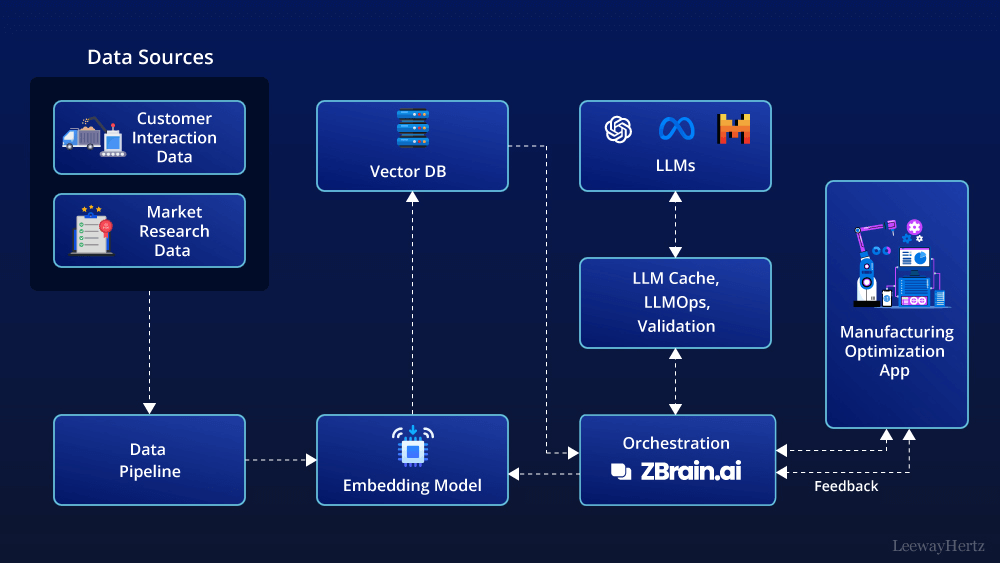
- How ZBrain operationalizes generative AI use cases in manufacturing
- Future of generative AI in manufacturing
How generative AI is transforming manufacturing operations
Manufacturers have long relied on analytics, rules engines, workflow automation, robotic process automation, and machine learning to improve efficiency, quality, and control. These technologies remain important, but generative AI introduces a distinct capability.
Traditional automation follows predefined rules. Machine learning predicts, scores, detects, or classifies based on historical patterns. Generative AI can read, extract, summarize, draft, compare, explain, and transform information across drawings, certificates, work instructions, inspection records, supplier submissions, and quality documents. Agentic AI can plan and execute a sequence of workflow steps, such as retrieving a process failure mode and effects analysis (PFMEA), drafting a control plan, validating a production part approval process (PPAP) package, routing an exception, and updating a system after approval.
In manufacturing, this changes how teams handle work that is:
- Document-heavy, such as drawings, bills of materials (BOMs), certificates of conformance, control plans, PPAP packages, work instructions, and inspection reports.
- Narrative-heavy, such as Eight Disciplines (8D) reports, corrective and preventive action (CAPA) summaries, A3 problem-solving documents, overall equipment effectiveness (OEE) commentary, variance analysis, and shift handovers.
- Exception-heavy, such as nonconformances, material review board (MRB) dispositions, material requirements planning (MRP) exception messages, line abnormalities, supplier corrective actions, and warranty claims.
- Knowledge-heavy, such as engineering standards, routing rules, quality-system procedures, standard operating procedures (SOPs), equipment manuals, and prior corrective actions.
- Workflow-heavy, such as new product introduction (NPI) gate progression, quality investigations, supplier qualification, PPAP review, maintenance planning, and month-end variance reporting.
The best manufacturing AI use cases usually do not remove the human from the process. Instead, they prepare the case, retrieve evidence, draft outputs, highlight risks, and route the work to the right engineer, planner, supervisor, quality owner, or finance reviewer.
Why manufacturing AI use cases must be mapped at the sub-process level
Generative AI can create value in manufacturing only when it is tied to specific workflows. “AI in manufacturing” is too broad to guide implementation. So are broad labels such as “AI in quality,” “AI in production,” or “AI in supply chain.” They do not define the data required, the artifact produced, the control point involved, the reviewer responsible, or the system that must be updated.
A more practical approach maps AI opportunities to the manufacturing operating model:
- Function: The major operating area, such as manufacturing engineering, quality management, production planning, or maintenance.
- Process: The workflow within that function, such as control planning, corrective action, material requirements planning (MRP) exception management, or maintenance work-order planning.
- Sub-process: The specific activity inside the workflow, such as drafting a control plan, preparing an Eight Disciplines (8D) report, validating a production part approval process (PPAP) package, triaging an MRP exception, or creating a computerized maintenance management system (CMMS) job plan.
- AI-enabled opportunity: The way AI supports that activity, such as extracting inspection data, classifying nonconformances, drafting a material review board (MRB) disposition brief, summarizing supplier evidence, or routing an exception for approval.
This level of detail matters because manufacturing work is governed by specific methods, documents, systems, and decision rights. Drafting an 8D report is different from validating a PPAP submission. Triaging an MRP exception is different from dispositioning a nonconformance through MRB. Preparing a control plan requires different evidence, review logic, and sign-off than drafting a shift-handover summary.
Sub-process mapping turns AI from a broad technology idea into an executable workflow. It clarifies what AI reads, what it drafts or validates, where human review is required, and which system of record is involved. The section that follows uses this operating-model lens to map manufacturing functions, processes, sub-processes, and AI enablement opportunities in a way that reflects how manufacturing teams actually work.
Accelerate Manufacturing Decisions With GenAI Solutions
Deploy GenAI solutions that extract insights from production, quality, supply chain, maintenance, and finance data, optimizing efficiency, quality, and overall operational performance.
Manufacturing operating model and generative AI opportunity mapping across manufacturing processes
The following sections map generative AI opportunities across the operating model of a modern manufacturer. Each function includes a short overview, a process and sub-process table, and a summary of the highest-value AI opportunities in that function.
Function 1. Manufacturing strategy and network design
Manufacturing strategy and network design define where products are made, how capacity is allocated, which capabilities remain in-house, and how the plant network supports cost, resilience, service, and growth objectives. The function connects enterprise strategy with plant-level execution through footprint planning, make-or-buy decisions, capacity strategy, and manufacturing excellence governance.
Generative AI can summarize plant capability data, compare make-or-buy scenarios, draft network strategy briefs, and synthesize capacity risks from planning, finance, supplier, and operational records. Agentic AI can coordinate scenario preparation, collect inputs from multiple functions, draft decision packs, and route them for review while manufacturing strategy teams retain accountability for final decisions.
| Process | Sub-processes | Key AI-enabled opportunities |
|---|---|---|
| Manufacturing strategy development | Manufacturing capability assessment | Aggregate plant capability, equipment, labor, quality, and cost data, compare with target requirements, flag gaps, and draft capability-gap summary; generate alternative plant or line configurations and explain trade-offs. |
| Manufacturing excellence roadmap | Summarize maturity assessments, lean audit findings, and improvement backlogs, cluster recurring gaps by plant or function, and draft a manufacturing excellence roadmap; simulate improvement scenarios to evaluate impact on KPIs. | |
| Manufacturing competitiveness assessment | Compare plant capabilities, cost structures, supply chain resilience, and quality performance against competitors; perform sensitivity analysis on labor costs, tariffs, and demand shifts to forecast operational impact. | |
| Strategic capability planning | Evaluate production, labor, quality, and supplier constraints; simulate strategic risks such as supply disruptions, capacity shortfalls, and regulatory changes; draft strategic recommendations for plant and network planning. | |
| Network and footprint planning | Plant footprint scenario analysis | Compare production volume, cost, capacity, labor, logistics, and risk inputs, flag trade-offs across footprint scenarios, and draft decision-ready scenario narratives. |
| Product allocation across plants | Analyze product requirements, plant qualifications, capacity, cost, and logistics data, flag allocation constraints, and draft product-allocation recommendations across plants. | |
| Network resilience assessment | Evaluate supply chain and plant network vulnerabilities, simulate disruptions, and draft resilience recommendations; assess operational and financial risk under potential disruption scenarios. | |
| Plant role definition | Define production, quality, and supply chain responsibilities across plants, assess capacity and capability alignment, and draft role assignments; perform scenario analysis for alternative role configurations. | |
| Localization /regionalization strategy | Assess regional demand, supplier proximity, cost, and regulatory constraints, and draft regionalization plans; perform sensitivity analysis on labor, tariffs, and transportation costs. | |
| Make-or-buy strategy | Cost and capability comparison | Aggregate should-cost, supplier capability, internal capacity, and quality history, compare make-or-buy options, flag risk areas, and draft decision packs for review. |
| Strategic sourcing boundary assessment | Analyze product, plant, supplier, and market data to define sourcing boundaries, simulate alternative sourcing scenarios, and draft recommendation briefs. | |
| Supplier dependency assessment | Identify critical suppliers, quantify dependency risk, simulate supply disruption scenarios, and draft mitigation or diversification recommendations. | |
| Strategic capacity planning | Long-range capacity planning | Summarize demand, installed capacity, bottlenecks, labor constraints, and investment needs, flag future capacity gaps, and draft a long-range capacity-risk brief. |
| Capacity expansion planning | Evaluate plant, line, and supplier capacity; generate expansion options and trade-offs; draft decision briefs with scenario impact analysis. | |
| Bottleneck strategy | Identify operational bottlenecks across lines or plants, simulate mitigation scenarios, and draft actionable improvement plans. | |
| Workforce capacity planning | Analyze labor skills, shift coverage, and certification availability; simulate workforce allocation under demand fluctuations, and draft staffing recommendations. |
High-value GenAI opportunities in this function include footprint scenario preparation, make-or-buy decision support, manufacturing capability assessment, and capacity-risk narration. These workflows involve multi-source evidence and narrative decision packs, making them suitable for AI-supported synthesis and drafting.
An example of an agentic workflow is a make-or-buy analysis. The workflow aggregates internal cost, capacity, quality, and supplier data, drafts a comparison of manufacturing options, flags risk and constraint areas, and routes the decision pack to reviewers in manufacturing strategy, sourcing, finance, and engineering.
Function 2. Product development, engineering, and new product introduction
Product development, engineering, and new product introduction (NPI) own the path from concept to launch. The function covers requirements, design, bill of materials, design reviews, prototype builds, verification, validation, engineering change, and NPI gates that move a product toward production readiness.
Generative AI can extract requirements from request for quote (RFQ) packages, summarize design trade-offs, draft design failure mode and effects analysis (DFMEA) worksheets, compare drawing revisions, and assemble NPI gate evidence. Agentic AI can coordinate NPI readiness workflows while engineers retain responsibility for design decisions and gate sign-off.
| Process | Sub-processes | Key AI-enabled opportunity |
|---|---|---|
| Requirements and concept design | Voice-of-customer and requirements capture | Extract and cluster requirements from request for quote (RFQ) packages, customer notes, warranty records, and field-service data, flag conflicting requirements, and draft a structured requirements register. |
| Concept trade studies | Summarize design alternatives against cost, weight, manufacturability, performance, and compliance targets, retrieve comparable design risks, and draft decision matrices for engineering review. | |
| Requirements traceability and validation | Trace requirements across specifications, designs, tests, and validation records, identify missing coverage, and draft traceability reviews. | |
| Design risk management | Design failure mode and effects analysis(DFMEA) | Retrieve prior design failure mode and effects analysis (DFMEA) records, Eight Disciplines (8D) history, warranty claims, and field failures, surface recurring failure modes, and draft DFMEA worksheet sections for review. |
| Design review management | Summarize design changes, review drawings and PFMEA inputs, identify gaps, and draft review-ready design packages; simulate alternative design scenarios and flag potential risks for engineering review. | |
| Detailed design and DfX | Computer-aided design (CAD) and drawing documentation | Extract dimensions, tolerances, and geometric dimensioning and tolerancing (GD&T) callouts from drawing sets, compare revisions, flag missing information, and summarize drawing changes for release review. |
| Design for manufacturability (DfM) and assembly review | Compare designs against design for manufacturability (DfM), design for assembly (DfA), and prior producibility issues, flag manufacturing risks, and draft manufacturability-review summaries. | |
| Design for serviceability (DfS) | Assess component accessibility and maintenance ease, flag design constraints, and draft serviceability recommendations; simulate maintenance scenarios for operational efficiency. | |
| Design for cost (DfC) | Analyze material, labor, and process cost implications, flag cost drivers, and draft cost-optimized design recommendations; perform sensitivity analysis on cost assumptions. | |
| Bill of materials management (BOM) | Engineering bill of materials creation | Extract component details from drawings, datasheets, and product lifecycle management (PLM) records, structure engineering bill of materials (BOM) data, flag missing or obsolete parts, and draft BOM review notes. |
| BOM governance and synchronization | Detect inconsistencies across engineering and manufacturing BOMs, routing, work centers, and suppliers; flag potential errors and draft synchronization summaries for review; simulate impact of changes on downstream production and inventory. | |
| Engineering change management | Engineering change request and change impact review | Summarize engineering change request details, trace impact across BOMs, routings, inventory, tooling, suppliers, and service records, flag downstream risks, and draft change-review summaries. |
| Engineering change order execution | Analyze engineering change requests, assess impact across BOMs, routings, and production lines, flag potential risks, and draft review-ready change execution summaries; simulate downstream effects on production, quality, and supply chain. | |
| NPI gate management | Engineering validation test (EVT), design validation test (DVT), and production validation test readiness (PVT) | Assemble test results, open issues, DFMEA actions, supplier readiness, and exit-criteria evidence, flag unresolved risks, and draft the gate-readiness pack. |
| Verification planning | Summarize product requirements and risk areas, draft verification test plans and protocols, and simulate alternative test scenarios for coverage and risk assessment. | |
| Design verification | Aggregate test data from multiple sources, compare results with specifications, flag deviations, and draft verification summaries; simulate potential failure scenarios. | |
| Validation management | Analyze validation results, identify gaps or nonconformance trends, draft validation reports, and simulate process or product modifications to assess impact on compliance and performance. |
High-value opportunities in product development and NPI include DFMEA drafting, requirements extraction, BOM review, engineering change impact analysis, design-for-manufacturability review, and NPI gate-readiness preparation. These workflows are document-heavy and judgment-intensive, making them suitable for human-in-the-loop AI.
An example agentic workflow is NPI gate preparation. The workflow assembles validation evidence, open issues, supplier readiness, DFMEA actions, and exit criteria, drafts the gate-readiness pack, highlights unresolved risks, and routes it to engineering, quality, sourcing, and manufacturing stakeholders for review.
Function 3. Manufacturing engineering and industrialization
Manufacturing engineering and industrialization translate product design into a controlled production process. The function covers process planning, routings, work instructions, process failure mode and effects analysis, control plans, line design, process validation, and launch readiness.
Generative AI can draft routings, work instructions, process failure mode and effects analysis (PFMEA) worksheets, control plans, and validation summaries from drawings, BOMs, prior routings, quality records, and process standards. Agentic AI can coordinate Advanced Product Quality Planning (APQP) deliverables and Production Part Approval Process (PPAP) packages while process engineers approve the final process.
| Process | Sub-process | Key AI-enabled opportunities |
|---|---|---|
| Process planning and routing | Routing and operation-sheet creation | Extract routing and BOM data, flag gaps, and draft operation sheets; simulate alternative routing scenarios for review. |
| MBOM alignment | Compare engineering and manufacturing BOMs, flag mismatches, and draft alignment summaries. | |
| Process sequence definition | Define operation sequences, flag inefficiencies, and draft optimized workflow sequences. | |
| Standard work development | Work instruction authoring | Summarize drawings, control plans, and prior instructions; draft standardized work instructions and highlight missing safety or quality checks. |
| Takt and standard-work alignment | Summarize cycle-time, takt-time, and work-content data; identify imbalances and draft alignment notes. | |
| Changeover standardization | Analyze setup times and changeover procedures; draft standardized changeover instructions. | |
| Process risk management | PFMEA | Aggregate prior PFMEA records, 8D reports, and nonconformance data; flag recurring risks and draft PFMEA sections. |
| Process control risk review | Identify process control gaps, evaluate potential failure scenarios, and draft mitigation recommendations. | |
| Quality planning | Control plan drafting | Map PFMEA outputs to control plans; flag missing controls and draft review-ready summaries. |
| APQP/PPAP evidence preparation | Validate APQP and PPAP deliverables, flag missing documentation, and draft submission summaries. | |
| Process capability planning | Align Cp/Cpk targets, critical-to-quality processes, and measurement plans; draft capability summaries and scenario analyses. | |
| Line design and validation | Line balancing and layout review | Summarize station loading, cycle times, and material flow; flag bottlenecks and draft layout-risk summaries. |
| Ergonomics review | Evaluate operator workstations, manual handling, and poka-yoke safety; flag risks and draft ergonomics improvement summaries. | |
| Process simulation | Simulate line flow, takt, and resource utilization; draft scenario-based optimization recommendations. | |
| Process validation and run-at-rate review | Aggregate validation and capability data, flag gaps, and draft run-at-rate summaries. | |
| Tooling and fixture engineering | Tooling design review | Analyze tooling designs, flag specification gaps, and draft validation-ready summaries. |
| Fixture validation | Validate fixture readiness against process requirements, flag issues, and draft review notes. | |
| Gauge readiness review | Check gauge calibration and measurement readiness, flag discrepancies, and draft summaries. | |
| Equipment and process specification | Equipment requirement definition | Aggregate equipment data, flag gaps, and draft requirement summaries. |
| Process capability requirement definition | Compare process capability targets with historical performance, identify gaps, and draft summaries. | |
| Machine/process selection | Evaluate machine/process suitability, flag risks, and draft selection summaries. | |
| Equipment acceptance criteria | Compare installed equipment vs. design specs, flag deviations, and draft acceptance summaries. | |
| Manufacturing process simulation | Process simulation | Model line flow, takt, and capacity; draft scenario-based improvement recommendations. |
| Ergonomic simulation | Simulate operator workstation and manual handling safety; draft ergonomic improvement suggestions. | |
| Digital manufacturing validation | Evaluate virtual plant simulations, identify bottlenecks or risks, and draft validation summaries. | |
| Launch readiness | Pilot build readiness | Summarize pilot build results, flag issues, and draft readiness packs. |
| Production ramp-up planning | Forecast ramp-up constraints, simulate scenarios, and draft ramp-up plans. | |
| Launch issue tracking | Track production issues, summarize root causes, and draft corrective-action recommendations. |
High-value GenAI opportunities in manufacturing engineering include PFMEA drafting, control plan creation, work instruction authoring, APQP tracking, PPAP validation, line balancing, and process-validation evidence assembly. These are structured, methodology-driven workflows where AI can reduce documentation effort while engineers retain sign-off.
An example agentic workflow is control plan and PPAP preparation. The workflow drafts the control plan from the PFMEA, validates PPAP element completeness, checks dimensional and material evidence, flags missing documentation, and routes the package to process engineering, quality, and supplier-quality reviewers.
Function 4. Production planning, scheduling, and capacity management
Production planning, scheduling, and capacity management convert demand into feasible production plans. The function covers demand planning, sales and operations planning, master production scheduling, material requirements planning, finite scheduling, inventory planning, capacity analysis, and promise-date support.
Generative AI can draft planning narratives, summarize forecast changes, classify material requirements planning (MRP) exceptions, and explain schedule feasibility. Agentic AI can coordinate planning exceptions, scenario comparison, and schedule-risk reporting while planners remain accountable for the released plan.
| Process | Sub-process | Key AI-enabled opportunities |
|---|---|---|
| Demand and S&OP planning | Demand plan reconciliation | Aggregate orders, forecasts, historical demand, and market signals; identify demand shifts and draft variance commentary. |
| S&OP review | Summarize demand, supply, inventory, capacity, and financial scenarios; flag trade-offs and draft S&OP review briefs. | |
| Demand-supply scenario planning | Simulate alternative demand-supply scenarios, assess impact on production and inventory, and draft scenario summaries. | |
| Production planning | Aggregate production planning | Summarize total production requirements, compare with plant capacity and constraints, and draft planning recommendations. |
| Master production scheduling | Compare schedule demand with material, capacity, labor, and inventory; flag violations and draft schedule-change rationale. | |
| Rough-cut capacity planning | Evaluate production feasibility against capacity, labor, and resource constraints; draft capacity-risk summaries. | |
| Material planning | MRP exception management | Classify exceptions (expedite, de-expedite, reschedule, cancellations), group related shortages, and draft recommended actions. |
| Material availability check | Aggregate material inventory and supply data, flag potential shortages, and draft availability summaries. | |
| Critical shortage review | Identify high-risk shortages, assess impact on production, and draft mitigation recommendations. | |
| Detailed scheduling | Finite scheduling and sequencing | Summarize priorities, constraints, and changeovers; identify sequencing conflicts and draft optimized schedules. |
| Constraint and bottleneck management | Detect production bottlenecks, evaluate alternative allocations, and draft mitigation summaries. | |
| Changeover-aware sequencing | Optimize sequences considering setup/changeover times, and draft scheduling adjustments. | |
| Capacity planning | Load-versus-capacity review | Aggregate work-center loads, available capacity, and offload options; flag constraint risks and draft recommendations. |
| Alternate routing/offload planning | Simulate alternative routing options, assess capacity relief, and draft planning summaries. | |
| Labor capacity review | Analyze workforce availability, skill mix, and shifts; flag constraints and draft workforce planning summaries. | |
| Inventory planning | Safety stock review | Evaluate safety stock levels, assess risk of stockouts, and draft recommendations. |
| Excess and obsolete inventory review | Identify excess or obsolete inventory, assess impact, and draft remediation actions. | |
| Component allocation review | Summarize allocation status, flag shortages or misallocations, and draft prioritization notes. | |
| Schedule control | Schedule adherence tracking | Compare plan vs. actual production, flag deviations, and draft adherence summaries. |
| Plan-versus-actual review | Summarize discrepancies across production, inventory, and labor; draft variance explanations. | |
| Recovery planning | Evaluate impact of delays, simulate recovery options, and draft action plans. | |
| Promise-date support | ATP/CTP review | Summarize available-to-promise/capable-to-promise status, flag constraints, and draft delivery commitments. |
| Allocation and priority-order review | Prioritize orders based on demand, inventory, and production capacity; draft allocation recommendations. | |
| Planning master data governance | Lead time, lot size, MOQ, routing, and planning parameter review | Detect inconsistencies in planning master data, flag risks, and draft remediation recommendations. |
High-value GenAI opportunities in production planning include MRP exception triage, schedule-feasibility narration, capacity-risk summaries, demand-variance commentary, and inventory-health review. These workflows are recurring, data-heavy, and exception-driven.
An example agentic workflow is MRP exception triage. The workflow classifies exception messages by impact, groups related shortages, retrieves purchase order and inventory context, drafts recommended planner actions, and routes high-risk items to planning, procurement, or production control.
Function 5. Production execution and shop-floor operations
Production execution and shop-floor operations run the daily conversion of materials into finished goods. The function covers work-order release, line start-up, material staging, work-in-process tracking, operator readiness, in-process checks, abnormality response, downtime capture, overall equipment effectiveness reporting, shift handover, and daily management.
Generative AI can draft shift-handover reports, classify downtime and abnormality events, summarize production attainment, and generate A3 problem-solving drafts from shop-floor records. Agentic AI can coordinate daily management preparation, action follow-up, and exception routing while supervisors and team leaders retain control over production decisions.
| Process | Sub-process | Key AI-enabled opportunities |
|---|---|---|
| Work-order execution | Release, dispatch, and operation confirmation | Aggregate work-order, material, labor, and tooling readiness; flag release or routing deviations; draft priority and exception summaries. |
| Labor and operator readiness | Assignment, skill validation, and shift coverage | Match certified operators to workstations; assess labor availability and skills; draft staffing recommendations. |
| Line readiness | Clearance, tooling/equipment checks, first-piece & in-process checks | Validate line setup, tooling, instructions, and operator readiness; summarize inspection results and flag gaps. |
| Material flow to line | Kitting, line-side replenishment, and shortage escalation | Compare kit and inventory data; flag shortages; draft replenishment and escalation summaries. |
| Production monitoring | Hourly tracking, plan-vs-actual, and output confirmation | Aggregate production data; flag deviations; draft performance and shortfall summaries. |
| WIP and hold management | Aging, hold review, and rework routing | Detect stalled or held WIP; flag rework needs; draft exception summaries. |
| Abnormality management | Andon/Jidoka, downtime triage, maintenance escalation, root-cause capture | Classify events; assess root causes; escalate issues; draft resolution summaries. |
| Quality execution support | Scrap/rework recording, defect containment, deviation handling | Summarize scrap, rework, and deviations; flag recurring defects; draft containment and corrective-action notes. |
| Performance management | OEE, yield, and productivity commentary | Aggregate downtime, speed, quality, and yield data; flag trends; draft performance summaries. |
| Shift and daily management | Shift handover, tier-meeting preparation, action follow-up | Summarize work-order, downtime, quality, and open actions; draft handover and tier-board notes. |
| Continuous improvement | A3 & Kaizen support, root-cause evidence assembly | Structure problem-solving evidence; draft A3 and Kaizen summaries; summarize root-cause insights. |
| Safety and workplace discipline | Safety observation review, 5S, near-miss, and unsafe condition escalation | Aggregate safety and 5S data; flag risks and incidents; draft follow-up and escalation notes. |
High-value generative AI opportunities in production execution include shift handover, OEE commentary, Andon event classification, WIP exception summaries, line-start readiness checks, and A3 drafting. These workflows are frequent, evidence-heavy, and closely tied to the daily production rhythm.
An example agentic workflow is shift handover and daily management. The workflow aggregates work-order status, downtime, quality issues, WIP holds, and open actions, drafts the shift-handover report and tier-board summary, classifies top losses, and routes the pack to the production supervisor for review.
Function 6. Quality management and product compliance
Quality management and product compliance ensure adherence to incoming, in-process, and final quality requirements. The function covers inspection, statistical process control, measurement system analysis, nonconformance handling, material review board disposition, corrective action, audits, calibration, customer quality, and product compliance.
Generative AI can extract inspection results, compare measurements against drawings, draft 8D and corrective and preventive action (CAPA) records, summarize statistical process control signals, and assemble audit evidence. Agentic AI can coordinate quality investigations while quality engineers retain accountability for disposition, containment, and closure.
| Process | Sub-process | Key AI-enabled opportunities |
|---|---|---|
| Inspection and release | Incoming inspection | Extract measured values from supplier reports and certificates; flag nonconforming results; draft inspection summaries. |
| First article inspection | Validate drawing dimensions and measurements; flag gaps and draft first-article inspection reports. | |
| Final inspection and product release | Aggregate final inspection, test, and conformance data; flag missing release evidence; draft release packs. | |
| Process quality monitoring | Statistical process control review | Analyze control charts and capability data; flag drift, shift, or out-of-control signals; draft SPC commentary. |
| Measurement system analysis | Summarize gauge repeatability/reproducibility; flag failed measurement systems; draft MSA conclusions. | |
| Nonconformance management | Nonconformance report classification | Classify defects by type, severity, product, line, and supplier; identify recurring patterns; draft triage summaries. |
| Material review board disposition | Aggregate defect evidence, cost, and production context; flag risk factors; draft MRB disposition briefs. | |
| Corrective action | 8D and CAPA drafting | Summarize defect evidence, containment actions, root causes, corrective actions, and effectiveness checks; draft structured 8D/CAPA records. |
| Audit and calibration | Internal, supplier, and layered process audits | Draft audit checklists, summarize findings, classify clauses, and prepare corrective-action summaries. |
| Gauge calibration tracking; overdue calibration review; out-of-tolerance impact assessment | Track calibration status, flag overdue or out-of-tolerance gauges, and draft impact assessment summaries. | |
| Customer and field quality | Complaint and quality-escape review | Classify customer complaints and field failures; link to production, inspection, and warranty records; draft investigation summaries. |
| Quality management system governance | Quality policy and procedure management; document control; quality records governance; SOP/change control review | Summarize and review policies, controlled documents, SOPs, and quality records; flag gaps; draft compliance notes. |
| Supplier quality containment | Supplier defect containment; incoming quality escalation; supplier deviation review | Aggregate supplier defect data, flag escalation risks, and draft containment recommendations. |
| Product compliance management | Regulatory requirement tracking; certificate and compliance review; product certification support; restricted substance/material compliance | Summarize regulatory requirements, compliance evidence, and certifications; flag gaps and draft review notes. |
| Quality planning linkage | Quality plan review; inspection plan approval; control plan effectiveness review | Summarize and review quality plans, inspection approvals, and control plan effectiveness; draft evaluation notes. |
| Deviation and concession management | Deviation request review; customer concession preparation; waiver approval support | Summarize deviation requests and concessions; flag risks and draft approval summaries. |
| Warranty and field quality analytics | Warranty claim analysis; field failure trend review; return material analysis support | Aggregate warranty and field data; identify recurring failures; draft analysis and trend summaries. |
| Cost of quality management | Cost of poor quality analysis; scrap/rework cost review; quality-loss commentary | Aggregate quality costs, flag inefficiencies, and draft loss commentary and improvement recommendations. |
High-value GenAI opportunities in quality include 8D and CAPA drafting, MRB disposition support, first article inspection reporting, statistical process control commentary, measurement system analysis review, audit preparation, and customer complaint investigation. These workflows require evidence assembly, methodology discipline, and expert review.
An example agentic workflow is quality investigation. The workflow assembles defect evidence, production history, inspection records, containment actions, and prior 8D records, drafts the 8D and CAPA, prepares the MRB brief, and routes the case to the quality engineer for review and closure.
Function 7. Traceability, genealogy, and manufacturing records
Traceability, genealogy, and manufacturing records connect materials, components, processes, equipment, operators, inspections, and finished goods into a defensible production history. The function is critical for regulated manufacturing, field investigations, recalls, customer audits, and quality escapes.
Generative AI can summarize lot and serial genealogy, validate record completeness, extract production evidence, and prepare recall-readiness packs. Agentic AI can coordinate suspect-lot analysis and product-record review while quality, regulatory, and operations teams retain accountability for release, recall, and reporting decisions.
| Process | Sub-process | Key AI-enabled opportunities |
|---|---|---|
| Traceability data governance | Lot/serial rule governance; traceability master data review; barcode/RFID capture validation | Validate traceability rules and master data, flag inconsistencies, and draft governance summaries. |
| Lot and serial traceability | Parent-child genealogy review; forward/backward trace analysis | Aggregate lot, serial, component, and finished-good relationships; perform forward/backward trace; draft genealogy summaries. |
| Supplier lot linkage | Connect supplier lot, certificate, receipt, and inspection data to finished goods; validate completeness; flag missing supplier-traceability records. | |
| As-built and production record management | EBR/DHR review | Validate electronic batch/device history record completeness; flag missing approvals, inspections, or process steps. |
| Traveler and route-history review; as-built configuration validation | Summarize traveler, routing, operator, inspection, rework, and hold history; identify deviations; draft production-history summaries. | |
| Hold, deviation, and release traceability | Quality hold review; deviation-to-lot impact review | Assemble hold reason, affected quantity, and inspection evidence; flag missing information; draft hold-review packs. |
| Product release evidence | Validate production, quality, certificate, and compliance records; flag release blockers; draft release summaries. | |
| Chain of custody and material movement | Material movement history review; storage/handling evidence review | Track material movement, handling, and storage; flag anomalies and draft chain-of-custody summaries. |
| Recall and field action support | Suspect-lot identification; customer exposure mapping; recall effectiveness evidence | Trace affected lots, shipments, and customers; assess exposure scope; draft recall or field-action summaries. |
| Record integrity and correction | Missing record investigation; data integrity exception review; record correction trail review | Identify missing or inconsistent records; flag integrity issues; draft correction and investigation summaries. |
| Record retention and audit support | Retention schedule review; audit evidence retrieval; archival governance | Validate retention schedules, retrieve and check records against audit requests, and draft archival governance summaries. |
High-value GenAI opportunities include genealogy summarization, product-record completeness review, suspect-lot identification, hold/release evidence assembly, and audit evidence retrieval. These workflows are record-heavy and time-sensitive, especially during investigations and audits.
An example agentic workflow is suspect-lot analysis. The workflow traces supplier lots through production orders, inspections, shipments, and customer records, drafts an affected-product summary, flags incomplete records, and routes the pack to quality, regulatory, and operations reviewers.
Accelerate AI Solutions Development
Build fully functional solutions from your high-value use cases, based on specific operational needs and enterprise context.
Function 8. Procurement, sourcing, and supplier quality
Procurement, sourcing, and supplier quality secure materials, manage supplier relationships, and ensure supplier processes can meet cost, quality, delivery, and compliance expectations. The function covers category strategy, sourcing, supplier qualification, supplier production readiness, purchase order management, supplier performance, and supplier corrective action.
Generative AI can normalize bid responses, extract contract terms, assemble supplier qualification packs, validate PPAP submissions, and draft supplier scorecards. Agentic AI can coordinate supplier onboarding, sourcing reviews, and supplier corrective action while buyers and supplier-quality engineers retain approval authority.
| Process | Sub-process | Key AI-enabled opportunities |
|---|---|---|
| Category and sourcing strategy | Spend & supplier segmentation; TCO & benchmarking | Aggregate spend, supplier, quality, delivery, and risk data; compare costs, lead times, and terms; flag patterns and draft strategy/benchmarking summaries. |
| Category and sourcing strategy | Long-term contract strategy; Make-or-buy linkage | Summarize contracts and obligations; assess internal vs. supplier capability; flag gaps and draft strategic recommendations. |
| Supplier qualification | Onboarding & document review; Capability evaluation; Supplier audits | Validate certifications, capability evidence, and financial health; assess supplier readiness; flag gaps and draft qualification and audit summaries. |
| Supplier quality planning | APQP & PPAP review; Supplier process monitoring; Joint improvement initiatives | Validate supplier deliverables; track process readiness; flag deviations and draft improvement and readiness summaries. |
| Supplier corrective action | 8D aggregation; Defect trend analysis; Corrective action follow-up | Summarize supplier defects and 8D records; flag recurring issues; draft corrective-action requests and follow-up notes. |
| Purchase order management | PO creation, approval, exception handling, tracking, closure | Track purchase orders, flag late acknowledgments, pricing or delivery issues, and draft resolution and closure notes. |
| Supplier performance & tiering | Scorecards; Tiering & criticality review; Trend & anomaly detection | Aggregate performance metrics; flag anomalies; draft scorecard and tiering summaries. |
| Supply risk management | Risk monitoring; Alternate sourcing planning; Mitigation & scenario planning | Track supplier risks, simulate sourcing alternatives, and draft mitigation and scenario summaries. |
| Contract management & compliance | Contract monitoring; Breach detection; Renewal & compliance alerts | Track contract obligations, flag breaches, and draft compliance and renewal alerts. |
| Material & master data governance | Part catalog validation; Supplier-part mapping; SKU consistency | Validate part catalog, supplier-part assignments, and SKU consistency; flag errors and draft remediation notes. |
High-value GenAI opportunities in procurement and supplier quality include RFQ analysis, supplier qualification, PPAP review, drafting supplier corrective action requests, handling purchase order exceptions, generating supplier scorecards, and monitoring supplier risk. These workflows are document-intensive and exception-rich.
An example agentic workflow is supplier qualification and PPAP review. The workflow assembles supplier evidence, validates required PPAP elements, drafts the supplier-risk summary, prepares corrective-action requests where needed, and routes the package to sourcing and supplier-quality reviewers.
Function 9. Inventory, warehouse, and line-side material flow
Inventory, warehouse, and line-side material flow manage the movement of raw materials, components, work-in-process, and finished goods inside the manufacturing network. The function covers receiving, putaway, inventory accuracy, cycle counting, kitting, line-side replenishment, work-in-process movement, and shortage management.
Generative AI can reconcile advance ship notices, draft receiving discrepancies, summarize cycle-count variances, and classify material shortages. Agentic AI can coordinate inbound reconciliation, line-feeding exceptions, and inventory accuracy workflows while warehouse, planning, and production teams resolve exceptions.
| Process | Sub-processes | Key AI-enabled opportunity |
|---|---|---|
| Inbound receiving | Advance ship notice and receipt reconciliation | Match advance ship notices, packing lists, purchase orders, receipts, and inspection records, flag short, over, damaged, or mismatched shipments, and draft discrepancy notes. |
| Receiving discrepancy handling | Assemble purchase order, receipt, supplier, inspection, and damage evidence, classify discrepancy type, and draft receiving resolution notes. | |
| Inventory control | Cycle-count variance review | Analyze cycle-count results, identify recurring variance patterns, prioritize recounts, and draft inventory-adjustment commentary. |
| Excess, obsolete, and slow-moving inventory review | Summarize usage, aging, demand, inventory value, and policy data, flag excess or obsolete positions, and draft inventory-risk narratives. | |
| Warehouse operations | Putaway and location exception review | Classify storage-location, labeling, handling, and lot-control exceptions, identify affected materials, and draft warehouse exception summaries. |
| Picking and staging support | Summarize pick shortages, staging gaps, open material issues, and shipment or production readiness risks, and draft resolution notes. | |
| Line-side material flow | Kitting and supermarket replenishment | Compare kit requirements, inventory, kanban signals, and production priorities, identify shortages, and draft line-side replenishment summaries. |
| Kanban exception management | Classify kanban card, pull-signal, replenishment, and supermarket exceptions, identify affected work centers, and draft production-control notes. | |
| Work-in-process movement | WIP transfer and aging review | Detect stalled work-in-process, delayed transfers, aging queues, and route deviations, group affected orders, and draft WIP exception summaries. |
| Material handling & internal logistics | Inter-warehouse transfer planning; dock scheduling; staging for production | Aggregate transfer, dock, and staging data; flag scheduling conflicts; draft operational readiness notes. |
| Shelf-life and expiration management | Track perishable and expiration-sensitive items; flag nearing-expiry materials; draft action recommendations. |
High-value opportunities include advance ship notice reconciliation, receiving discrepancy handling, cycle-count commentary, kitting exception review, kanban exception management, and WIP aging summaries. These workflows support production continuity without automating physical material handling.
An example agentic workflow is line-side shortage management. The workflow compares kit requirements, inventory records, purchase order status, and production priorities, drafts a shortage summary, identifies affected work orders, and routes the issue to production control, warehouse, and planning teams.
Function 10. Logistics, fulfillment, trade, and returns
Logistics, fulfillment, trade, and returns move finished goods to customers and manage shipment documentation, carrier coordination, export/import requirements, returns, and reverse flows. The function is highly document- and exception-driven, with direct customer and compliance impact.
Generative AI can draft shipping documents, validate trade data, summarize freight exceptions, and classify returns. Agentic AI can coordinate shipment documentation, export screening, return reconciliation, and customer communication, while logistics and trade-compliance teams retain final approval.
| Process | Sub-processes | Key AI-enabled opportunity |
|---|---|---|
| Order fulfillment | Shipment prioritization | Summarize open orders, inventory, allocation, customer priority, and carrier capacity, identify fulfillment risks, and draft shipment-priority recommendations. |
| Backorder and partial shipment review | Analyze backorders, partial shipments, inventory constraints, and customer commitments, flag service risks, and draft order-management summaries. | |
| Shipping execution | Pick-pack-ship documentation | Generate packing lists, bills of lading, shipment labels, and shipping instructions, validate them against order and carrier data, and flag documentation gaps. |
| Shipment exception handling | Classify missed pickups, shipment holds, damage, and documentation issues, assemble shipment context, and draft resolution notes. | |
| Freight and carrier management | Carrier performance review | Aggregate pickup, delivery, claims, service, and cost data, identify performance trends, and draft carrier performance commentary. |
| Freight-cost variance review | Detect freight-cost outliers by lane, carrier, customer, or shipment type, compare them with expected costs, and draft variance explanations. | |
| Trade compliance | Customs documentation | Extract harmonized system code, origin, value, party, and item data, validate completeness, and draft commercial invoices or export documentation. |
| Restricted-party and export-control screening | Summarize screening results, classify review items, flag potential export-control issues, and draft trade-compliance review notes. | |
| Returns and reverse logistics | Return material authorization handling | Classify return requests, compare them with policy and warranty terms, draft return material authorization instructions, and summarize eligibility. |
| Return disposition review | Assemble inspection, warranty, customer, and supplier evidence, classify disposition options, and draft restock, repair, refurbish, scrap, or supplier recovery summaries. |
High-value GenAI opportunities include shipping document generation, customs documentation, restricted-party screening summaries, freight variance commentary, return material authorization handling, and return disposition support. These workflows require accurate data extraction, documentation, and human approval.
An example agentic workflow is export shipment documentation. The workflow extracts order, item, origin, value, and carrier data, drafts commercial invoice and export documentation, summarizes screening results, flags missing information, and routes the pack to the trade-compliance reviewer.
Function 11. Maintenance, reliability, and asset management
Maintenance, reliability, and asset management keep production assets available, safe, and maintainable. The function covers asset master data, work-order intake, job planning, preventive maintenance, reliability analysis, spare-parts planning, shutdown planning, and maintenance handover.
Generative AI can classify computerized maintenance management system (CMMS) work orders, retrieve equipment manual content, draft job plans, summarize failure history, and generate reliability root-cause analysis. Agentic AI can coordinate work-order triage, job-plan preparation, and reliability review while maintenance planners and reliability engineers approve the plan.
| Process | Sub-process | Key AI-enabled opportunities |
|---|---|---|
| Asset lifecycle management | Acquisition, commissioning, obsolescence, replacement planning | Detect inconsistencies in asset hierarchy, BOM, and criticality; flag obsolescence risks; draft replacement and commissioning recommendations. |
| Maintenance strategy planning | RCM, CBM, PdM, preventive maintenance policy, criticality-based prioritization | Aggregate asset failure and usage data; recommend preventive or predictive maintenance strategies; draft maintenance policy summaries. |
| Work-order management | Intake, job planning, labor assignment, execution, completion tracking | Classify maintenance requests by asset, priority, safety, and production impact; retrieve similar cases; draft triage and work-order summaries. |
| Condition monitoring | Vibration, thermography, oil analysis, sensor integration, anomaly detection | Aggregate sensor and monitoring data; flag anomalies; draft condition reports and predictive maintenance alerts. |
| Shutdown and major overhauls | Planning, execution, post-shutdown evaluation | Assemble scope, safety, parts, labor, permits, and risk data; flag potential issues; draft shutdown work-package summaries. |
| Spare-part and inventory planning | Critical spares, lead-time risk, integration with procurement | Identify critical spares, flag part-number ambiguities or supply risks; draft inventory planning notes. |
| Reliability analysis | Failure trend analysis, root-cause analysis, MTBF/MTTR calculation | Aggregate work-order history and downtime; identify repeat failures; draft root-cause and reliability summaries. |
| Performance and KPI management | Equipment availability, maintenance efficiency, planned vs. reactive ratio | Summarize equipment KPIs; flag underperformance or imbalances; draft performance reports. |
| Safety and compliance | Lock-out/tag-out, regulatory inspections, safety-critical asset checks | Track safety and regulatory compliance; flag violations; draft safety and compliance summaries. |
High-value GenAI opportunities include work-order triage, job-plan drafting, spare-parts identification, preventive maintenance compliance review, failure-history analysis, and bad-actor asset reporting. These workflows are records-based and document-heavy, without requiring AI to control equipment.
An example agentic workflow is maintenance work-order triage. The workflow classifies the request, retrieves similar past work orders, drafts the job plan, identifies parts and permits, summarizes priority and production impact, and routes the plan to the maintenance planner.
Function 12. Tooling, fixtures, and equipment readiness
Tooling, fixtures, and equipment readiness ensure that jigs, fixtures, dies, molds, gauges, test fixtures, and production equipment are designed, validated, maintained, and ready for launch or production. The function is central to NPI, quality, uptime, and process capability.
Generative AI can extract tooling requirements, summarize tryout issues, draft validation reports, and identify tool-maintenance patterns from records. Agentic AI can coordinate tooling readiness reviews and equipment qualification evidence while tooling, manufacturing engineering, and quality teams approve release.
| Process | Sub-process | Key AI-enabled opportunities |
|---|---|---|
| Tooling design | Tooling requirement definition | Extract fixture, gauge, die, mold, and test-equipment requirements from drawings and process plans; flag missing specs; draft tooling requirement summaries. |
| Tooling design | Tool design review | Summarize tool design risks, drawing requirements, prior tooling issues, and process constraints; flag design gaps; draft review notes. |
| Tool build and tryout | Tool tryout issue tracking | Classify tryout issues by type, root cause, tool area, and corrective-action status; identify recurring problems; draft tryout issue summaries. |
| Tool build and tryout | Tool readiness review | Aggregate open issues, dimensional results, capability data, maintenance status, and approvals; flag readiness risks; draft readiness summaries. |
| Tool validation | Gauge and fixture validation | Compare measurement results and repeatability against control-plan requirements; flag validation gaps; draft validation summaries. |
| Tool validation | Run-at-rate support | Summarize run-at-rate evidence, quality results, production stability, and tool performance; flag launch risks; draft run-at-rate review notes. |
| Tool lifecycle management | Tool register and revision control | Detect missing or inconsistent tool ownership, revision, maintenance, and storage records; flag issues; draft lifecycle correction notes. |
| Tool lifecycle management | Tool maintenance and repair review | Summarize repair history, downtime, recurring failure modes, and maintenance needs; draft maintenance review summaries. |
| Equipment readiness | Installation and qualification evidence | Assemble installation, commissioning, safety, calibration, and qualification evidence; flag missing records; draft equipment-readiness packs. |
| Performance analytics | Tool/equipment usage, failure trends, lifecycle performance, predictive alerts | Aggregate usage, failure, and lifecycle data; flag trends; draft predictive maintenance and performance alerts. |
| Integration with production & quality | Tool allocation to work centers; link to production schedules and quality plan | Map tools to work centers and production schedules; align with quality plans; flag gaps and draft allocation summaries. |
High-value GenAI opportunities include tooling requirement extraction, tryout issue classification, tool-readiness summaries, gauge and fixture validation, run-at-rate evidence assembly, and tool-maintenance history review. These workflows often slow launches when evidence is scattered across engineering, quality, and production records.
An example agentic workflow is a tool readiness review. The workflow extracts tool requirements, summarizes tryout results, validates open issues against launch criteria, assembles dimensional and capability evidence, and routes the readiness pack to manufacturing engineering, tooling, and quality reviewers.
Function 13. Customer, order, warranty, and aftermarket service
Customer, order, warranty, and aftermarket service connect manufacturing operations with customer commitments and post-sale performance. The function covers configure-price-quote, order validation, delivery promising, order changes, warranty claims, returns, field service, technical support, and customer complaints.
Generative AI can extract order details, validate configurations, draft acknowledgments, classify warranty claims, retrieve service procedures, and summarize field failures. Agentic AI can coordinate order validation, warranty triage, and customer communication while commercial, service, and quality teams retain final decision authority.
| Process | Sub-processes | Key AI-enabled opportunity |
|---|---|---|
| Quote and order capture | Configure-price-quote review | Retrieve valid configurations, product rules, pricing data, and constraints, flag nonstandard options, and draft first-pass quote responses. |
| Technical tender response | Extract requirements from RFQs, retrieve product and engineering evidence, compare them with prior bids, and draft technical and commercial response sections. | |
| Order management | Order entry and validation | Extract order details from purchase orders and emails, validate them against terms, configuration rules, and customer master data, and flag exceptions. |
| Order acknowledgment | Classify incomplete, invalid, or constrained orders, summarize missing information, and draft order acknowledgments or exception notes. | |
| Delivery promising | Available-to-promise review | Summarize inventory, capacity, open orders, production schedule, and constraints, flag promise-date risks, and draft delivery-date rationale. |
| Expedite and change request handling | Classify expedite, cancellation, and order-change requests, assess impact on supply, capacity, and commitments, and draft customer or internal summaries. | |
| Warranty and returns | Warranty claim triage | Classify warranty claims by failure mode, coverage, product, customer, and severity, retrieve warranty terms, and draft disposition recommendations. |
| Return material authorization support | Validate return eligibility against policy and warranty terms, draft return material authorization instructions, and summarize exception cases. | |
| Field service and technical support | Service procedure retrieval | Retrieve service manuals, prior tickets, parts information, and troubleshooting records, and draft service guidance or resolution notes. |
| Customer quality | Customer complaint investigation | Classify complaints, link them to production, quality, warranty, and service records, identify recurring issues, and draft customer-response summaries. |
| Customer analytics | Warranty and failure trend analysis | Aggregate warranty claims and field data, identify recurring failure patterns, and flag high-risk products; draft trend and root-cause summaries for service and engineering review. |
| Service performance and satisfaction tracking | Summarize service KPIs, repair times, resolution rates, and customer feedback; flag performance gaps; draft service performance and satisfaction reports. |
High-value opportunities include configure-price-quote support, order-entry validation, available-to-promise rationale, warranty-claim triage, service procedure retrieval, and customer complaint investigation. These workflows combine product knowledge, policy, operational constraints, and customer communication.
An example agentic workflow is warranty-claim triage. The workflow classifies the claim, retrieves warranty terms, links failure mode to production and service history, drafts a disposition recommendation and customer communication, and routes the case to the warranty or quality reviewer.
Function 14. Environment, health, safety, and sustainability
Environment, health, safety, and sustainability protect workers, control environmental obligations, and support sustainability reporting. The function covers incident management, near-miss review, job safety analysis, lockout/tagout documentation, chemical management, environmental reporting, waste management, energy commentary, and sustainability disclosures.
Generative AI can extract incident details, draft safety reports, summarize safety observations, process safety data sheets, and draft environmental or sustainability narratives. Agentic AI can coordinate incident documentation, compliance-calendar updates, and reporting evidence while environment, health, and safety professionals retain accountability.
| Process | Sub-processes | Key AI-enabled opportunity |
|---|---|---|
| Safety incident management | Incident and near-miss reporting | Extract incident details, classify event type and severity, identify recurring hazard themes, and draft incident or near-miss reports. |
| OSHA Form 300 support | Classify recordability evidence, retrieve incident details, flag missing information, and draft Occupational Safety and Health Administration Form 300 entry summaries. | |
| Hazard and risk management | Job safety analysis and job hazard analysis | Draft job safety analysis or job hazard analysis worksheets from task descriptions, prior incidents, and safety procedures. |
| Safety observation review | Summarize safety observations, unsafe conditions, corrective actions, and recurring themes, and draft safety-meeting review notes. | |
| High-risk work control | Lockout/tagout and permit review | Retrieve lockout/tagout, hot work, or confined-space requirements, compare them with task details, flag missing controls, and draft permit-review checklists. |
| Chemical and environmental management | Safety data sheet extraction | Extract hazard, handling, storage, exposure, and personal protective equipment data from safety data sheets, and draft chemical-inventory summaries. |
| Environmental permit obligation tracking | Extract air, water, and waste permit obligations, identify due dates and evidence needs, and draft compliance-calendar summaries. | |
| Sustainability reporting | Energy and emissions commentary | Aggregate utility, production, and facility records, summarize Scope 1 and Scope 2 emissions drivers, and draft energy-use commentary. |
| Waste and resource management | Waste stream reporting | Summarize hazardous waste, scrap, recycling, and disposal documentation, flag missing records, and draft waste-report narratives. |
| Compliance and regulatory reporting | Multi-regulation tracking, audit preparation, compliance-calendar management | Track regulatory requirements across multiple standards, flag upcoming audits or deadlines, summarize compliance gaps, and draft review-ready compliance briefs. |
| Performance and analytics | Safety, environmental, and sustainability KPIs | Aggregate safety (TRIR, LTIFR), environmental, and sustainability data; detect anomalies and trends; draft KPI dashboards and predictive alerts for operational decision-making. |
High-value opportunities include incident reporting, OSHA recordability support, job safety analysis drafting, safety data sheet extraction, permit-obligation tracking, waste reporting, and emissions commentary. These workflows are document-heavy and require careful review by responsible environment, health, and safety teams.
An example agentic workflow is incident management. The workflow extracts incident details, classifies recordability evidence, drafts the incident report and OSHA Form 300 summary, links related near-misses, and routes the file to the environment, health, and safety reviewer.
Accelerate AI Solutions Development
Build fully functional solutions from your high-value use cases, based on specific operational needs and enterprise context.
Function 15. Manufacturing finance and cost management
Manufacturing finance and cost management connect plant performance with financial outcomes. The function covers standard costing, should-cost analysis, manufacturing variances, inventory valuation, cost of poor quality, plant profit-and-loss reporting, capital expenditure, productivity tracking, and cost-to-serve analysis.
Generative AI can draft cost build-ups, variance commentary, plant performance narratives, capital-request summaries, and cost-of-poor-quality reports. Agentic AI can coordinate month-end variance reporting and management-review pack preparation while finance teams retain accountability for financial numbers and approvals.
| Process | Sub-processes | Key AI-enabled opportunity |
|---|---|---|
| Product and standard costing | Standard-cost build-up | Aggregate material, labor, overhead, BOM, routing, and cost inputs, compare them with prior standards, and draft standard-cost commentary. |
| Should-cost analysis | Retrieve BOM, routing, process, supplier, and commodity data, structure cost assumptions, flag outliers, and draft should-cost estimates for review. | |
| Manufacturing variance | Purchase price variance commentary | Summarize supplier price changes, purchase orders, standard costs, and volume impacts, identify drivers, and draft purchase price variance narratives. |
| Material usage, labor, and overhead variance commentary | Aggregate production, scrap, rework, labor, and overhead records, identify variance drivers, and draft manufacturing variance explanations. | |
| Inventory & working capital management | Work-in-process and finished-goods review | Summarize inventory valuation, cycle-count impacts, reserves, and excess inventory, flag review items, and draft finance summaries. |
| Cash flow simulation, inventory-to-cash impact | Simulate cash flow scenarios, model inventory-to-cash conversion, flag liquidity risks, and draft actionable finance insights for decision-making. | |
| Cost of poor quality | Scrap, rework, warranty, and complaint cost review | Aggregate scrap, rework, warranty, return, and complaint costs, link them to products or processes, and draft cost-of-poor-quality commentary. |
| Plant performance reporting | Plant profit and loss commentary | Combine cost, output, yield, labor, service, and variance data, identify performance drivers, and draft plant profit and loss narratives. |
| Capital management | Capital expenditure justification | Aggregate cost, benefit, payback, risk, policy, and project data, validate assumptions, and draft capital appropriation request narratives. |
| Productivity tracking | Improvement savings review | Summarize productivity initiatives, Kaizen savings evidence, OEE-linked gains, and validation gaps, and draft savings-review commentary. |
| Cost-to-serve & supply chain finance | Freight, logistics, and customer fulfillment cost analysis | Aggregate shipping, logistics, and fulfillment data; calculate total delivered cost; flag cost anomalies; draft cost-to-serve summaries for finance and operations review. |
High-value opportunities include standard-cost commentary, manufacturing variance analysis, cost-of-poor-quality reporting, plant profit and loss narratives, capital-expenditure justification, and productivity tracking. These workflows are calculation-supported but narrative-heavy, especially during month-end and management review.
An example agentic workflow is month-end variance reporting. The workflow aggregates purchase price, material usage, labor, overhead, scrap, rework, and production records, drafts variance commentary, links drivers to operational causes, and routes the pack to the plant controller for review.
Function 16. Manufacturing technology, data, operational technology security, and AI governance
Manufacturing technology, data, operational technology security, and AI governance provide the digital backbone for AI-enabled manufacturing workflows. The function covers manufacturing execution systems, enterprise resource planning, product lifecycle management, quality systems, computerized maintenance systems, master data, integrations, operational technology security, and AI governance.
Generative AI can triage system tickets, summarize recurring incidents, detect master-data inconsistencies, draft operational technology security documentation, and prepare AI governance records. Agentic AI can coordinate data-quality remediation, system-support triage, and AI use-case intake while technology, security, data, and governance owners approve actions.
| Process | Sub-process | Key AI-enabled opportunities |
|---|---|---|
| Core manufacturing systems | MES support | Classify MES tickets, retrieve resolution history, flag recurring issues, and draft resolution notes. |
| Core manufacturing systems | ERP support | Classify ERP exceptions across planning, inventory, procurement, finance, and orders; identify affected processes; draft resolution summaries. |
| Core manufacturing systems | PLM support | Summarize product revisions, engineering changes, BOM impacts, and document-control exceptions; draft change-impact summaries. |
| Quality & maintenance systems | QMS support | Classify nonconformance, CAPA, audit, calibration, and complaint issues; retrieve related records; draft quality-system summaries. |
| Quality & maintenance systems | CMMS support | Classify CMMS data issues, work-order exceptions, and asset-master gaps; identify affected workflows; draft remediation notes. |
| Integration & data operations | Interface & EDI exception review | Classify integration failures, missing or duplicate transactions, out-of-sequence records; draft resolution notes for support teams. |
| Operational technology security | Asset inventory & segmentation | Aggregate approved asset, network, and control records; flag missing evidence; draft OT asset inventory documentation. |
| Operational technology security | Security incident timeline support | Assemble logs, tickets, vendor, and operational records; sequence events; flag gaps; draft incident timelines. |
| Data governance | Master data quality monitoring; stewardship; metadata management; anomaly detection | Monitor master data quality; detect anomalies and inconsistencies; draft data-governance alerts and recommendations. |
| OT security | Real-time monitoring; vulnerability management; access controls; incident response | Track OT assets and events; detect security vulnerabilities; flag access/control risks; draft incident response summaries. |
| AI governance | Model lifecycle management; training/validation monitoring; bias detection; regulatory compliance reporting | Monitor model training, validation, and deployment; detect bias or drift; draft AI compliance and governance summaries. |
| Performance & KPI monitoring | System availability; OT uptime; transaction/error rates; AI performance dashboards | Aggregate system and OT metrics; flag anomalies or performance drops; draft KPI summaries and dashboard insights. |
| Compliance & reporting | IT/OT audit documentation; data privacy compliance; AI regulatory reporting | Aggregate audit and compliance data; flag gaps; draft regulatory and privacy compliance summaries. |
High-value opportunities include master-data quality remediation, MES and ERP ticket triage, PLM change-impact summaries, integration exception handling, operational technology security documentation, and AI governance intake. These workflows help create the data and control foundation needed to scale AI safely across manufacturing.
An example agentic workflow is AI use-case intake. The workflow drafts the use-case record, identifies systems and data sources, classifies risk, documents human-review points, checks governance requirements, and routes the workflow through data, security, and operational approval.
Function 17. Manufacturing investment planning
Manufacturing investment planning translates strategic priorities into capital and capacity decisions across the manufacturing network. The function covers capital portfolio planning, capacity investment cases, make-versus-buy economics, automation business cases, capital appropriation, project prioritization, funding gating, and post-investment review.
Generative AI can draft investment narratives, structure business-case assumptions, summarize capacity scenarios, draft capital appropriation requests, and generate post-investment review commentary. Agentic AI can coordinate investment-case assembly, scenario comparison, and benefit tracking while finance, operations, and executive sponsors retain accountability for funding and approval decisions.
| Process | Sub-process | Key AI-enabled opportunities |
|---|---|---|
| Investment strategy and portfolio planning | Capital portfolio prioritization | Aggregate proposed projects, strategic fit, cost, benefit, risk, and funding constraints, identify prioritization trade-offs, and draft capital portfolio summaries. |
| Capacity investment scenario analysis | Summarize demand forecasts, capacity gaps, utilization, and expansion options, flag over- or under-capacity risks, and draft capacity investment scenario briefs. | |
| Investment case development | Business case and return-on-investment modeling | Structure cost, benefit, payback, sensitivity, and risk assumptions, compare them with planning standards, flag weak assumptions, and draft investment business-case narratives. |
| Make-versus-buy and automation case analysis | Aggregate internal cost, supplier cost, capacity, labor, and automation-benefit data, identify the lower-cost option, and draft make-versus-buy or automation case summaries. | |
| Capital appropriation | Capital appropriation request preparation | Retrieve project scope, cost estimates, benefits, risks, and policy requirements, validate completeness, and draft capital appropriation request packs. |
| Approval and gating support | Summarize stage-gate criteria, outstanding actions, approval conditions, and funding status, flag gating gaps, and draft approval-readiness notes. | |
| Investment monitoring | Capital spend and milestone monitoring | Aggregate budget, committed spend, milestone status, and forecast-at-completion data, flag overruns and delays, and draft capital-monitoring summaries. |
| Post-investment benefit review | Compare realized benefits with business-case commitments, identify benefit shortfalls, and draft post-investment review commentary. |
High-value GenAI opportunities in manufacturing investment planning include capital portfolio prioritization, capacity scenario analysis, business-case modeling support, capital appropriation drafting, and post-investment benefit review. These workflows are assumption-heavy, narrative-intensive, and concentrated around planning cycles and capital review boards.
An example agentic workflow is capital appropriation preparation. The workflow assembles project scope, cost and benefit estimates, risk and policy inputs, structures the business case, validates assumptions against planning standards, drafts the capital appropriation request, and routes the pack to finance and the capital review board for approval.
Function 18. Network resilience and risk assessment
Network resilience and risk assessment identify, evaluate, and mitigate threats to continuity of supply and production across the manufacturing network. The function covers network and dependency mapping, single-point-of-failure analysis, supplier and node risk, disruption scenario modeling, geopolitical and trade risk, natural-hazard and climate exposure, business continuity planning, and mitigation tracking.
Generative AI can map network dependencies, summarize risk exposure, draft disruption scenarios, classify risk events, and prepare business-continuity narratives. Agentic AI can coordinate risk assessment, scenario comparison, and mitigation tracking while risk, supply chain, and operations leaders retain accountability for risk acceptance and response decisions.
| Process | Sub-process | Key AI-enabled opportunities |
|---|---|---|
| Network risk identification | Network and dependency mapping | Aggregate plant, supplier, material, logistics, and node relationships, identify critical dependencies, and draft network dependency summaries. |
| Single-point-of-failure and concentration review | Analyze sourcing, capacity, geographic, and logistics concentration, flag single points of failure, and draft concentration-risk summaries. | |
| Risk assessment and scenario analysis | Disruption scenario modeling | Summarize disruption triggers, affected nodes, exposure, and recovery options, flag high-impact scenarios, and draft disruption scenario briefs. |
| Geopolitical and trade-risk review | Aggregate trade, tariff, sanction, and regional-risk signals, identify exposed flows, and draft geopolitical risk summaries. | |
| Business continuity planning | Continuity and recovery plan review | Validate continuity plans, recovery time objectives, backup sources, and readiness evidence, flag gaps, and draft continuity-plan review notes. |
| Critical-supplier and critical-node risk review | Aggregate financial, capacity, quality, and delivery-risk signals for critical suppliers and nodes, flag high-risk entities, and draft critical-node risk summaries. | |
| Resilience monitoring | Early-warning signal monitoring | Summarize disruption indicators, supplier alerts, and market signals, flag emerging risks, and draft early-warning briefs. |
| Mitigation and contingency tracking | Aggregate mitigation actions, owners, status, and residual risk, flag overdue or stalled actions, and draft mitigation-tracking summaries. |
High-value GenAI opportunities in network resilience include dependency mapping, single-point-of-failure analysis, disruption scenario drafting, critical-supplier risk review, and mitigation tracking. These workflows are data-heavy, scenario-driven, and central to protecting supply continuity.
An example agentic workflow is critical-node risk assessment. The workflow maps network dependencies, identifies single points of failure, aggregates supplier and node risk signals, drafts disruption scenarios and mitigation options, and routes the assessment to risk, supply chain, and operations reviewers.
Function 19. Manufacturing technology strategy
Manufacturing technology strategy sets the forward-looking direction for automation, digital, and advanced-manufacturing technologies across the production network. The function covers technology roadmaps, automation and digital strategy, smart-factory direction, technology scouting, proof-of-concept evaluation, vendor and solution assessment, technology standards and architecture, and scale-up planning.
Generative AI can summarize technology trends, structure roadmap options, draft technology evaluation notes, compare vendor solutions, and prepare scale-up business cases. Agentic AI can coordinate technology scouting, evaluation, and benefits review while technology, engineering, and operations leaders retain accountability for selection and investment decisions.
| Process | Sub-process | Key AI-enabled opportunities |
|---|---|---|
| Technology roadmap and strategy | Manufacturing technology roadmap development | Aggregate business priorities, capability gaps, technology trends, and investment constraints, identify roadmap options, and draft technology roadmap summaries. |
| Automation and digital strategy alignment | Summarize automation maturity, digital initiatives, and strategic objectives, flag misalignment, and draft automation and digital strategy briefs. | |
| Technology evaluation | Technology scouting and trend assessment | Retrieve emerging-technology, vendor, and benchmark information, summarize relevance and maturity, and draft technology scouting notes. |
| Proof-of-concept and pilot evaluation | Aggregate pilot objectives, results, cost, and scalability evidence, flag adoption risks, and draft proof-of-concept evaluation summaries. | |
| Technology selection and standards | Vendor and solution evaluation | Extract and normalize vendor capabilities, cost, integration, and support criteria, compare options, and draft solution-evaluation summaries. |
| Technology standards and architecture review | Validate proposed technologies against standards, architecture, and interoperability requirements, flag gaps, and draft standards-review notes. | |
| Deployment and scaling | Scale-up and rollout planning | Summarize pilot outcomes, deployment scope, readiness, and dependencies, flag scale-up risks, and draft rollout-plan summaries. |
| Technology benefits realization review | Compare realized benefits with adoption commitments, identify shortfalls, and draft benefits-realization commentary. |
High-value GenAI opportunities in manufacturing technology strategy include roadmap development support, technology scouting, proof-of-concept evaluation, vendor and solution comparison, and benefits realization review. These workflows are evidence-gathering, comparison-heavy, and tied to planning and investment cycles.
An example agentic workflow is technology evaluation and selection. The workflow gathers technology and vendor evidence, summarizes pilot results, compares solutions against standards and cost criteria, drafts the evaluation and scale-up recommendation, and routes the pack to technology, engineering, and operations reviewers.
Function 20. Product footprint strategy
Product footprint strategy determines where products are manufactured across the network and how production is allocated, localized, and balanced. The function covers footprint design, product-to-plant allocation, make-versus-buy positioning, localization and regionalization, footprint consolidation, new-site selection, and network capacity balancing.
Generative AI can summarize allocation options, structure footprint scenarios, draft localization analyses, compare site options, and prepare footprint recommendation narratives. Agentic AI can coordinate footprint scenario assembly, comparison, and impact review while operations, supply chain, and executive leaders retain accountability for footprint and site decisions.
| Process | Sub-process | Key AI-enabled opportunities |
|---|---|---|
| Footprint design and optimization | Product-to-plant allocation review | Aggregate product, volume, capability, cost, and capacity data by plant, identify allocation imbalances, and draft allocation-review summaries. |
| Footprint consolidation and rationalization analysis | Summarize utilization, cost, overlap, and demand data across sites, flag consolidation candidates, and draft rationalization summaries. | |
| Make-versus-buy strategy | Make-versus-buy positioning | Aggregate internal cost, supplier cost, capacity, capability, and strategic-control factors, identify positioning options, and draft make-versus-buy summaries. |
| Insourcing opportunity review | Summarize outsourced volumes, cost, capacity, and capability evidence, flag insourcing candidates, and draft insourcing-opportunity notes. | |
| Localization and regionalization | Regional supply and localization analysis | Aggregate regional demand, supply, logistics, cost, and lead-time data, identify localization opportunities, and draft regionalization summaries. |
| Trade, tariff, and incentive impact review | Extract tariff, trade-agreement, and incentive data, summarize footprint cost impacts, and draft trade-impact review notes. | |
| Site and capacity strategy | New-site selection support | Aggregate location, cost, labor, infrastructure, logistics, and risk criteria, compare candidate sites, and draft site-selection summaries. |
| Network capacity balancing review | Summarize plant load, capacity, demand, and constraint data, identify rebalancing options, and draft capacity-balancing summaries. |
High-value GenAI opportunities in product footprint strategy include product-to-plant allocation review, footprint rationalization, localization analysis, site-selection support, and network capacity balancing. These workflows are data-intensive, scenario-driven, and high-stakes for cost and service.
An example agentic workflow is footprint scenario analysis. The workflow aggregates product, volume, cost, capacity, and trade data, structures footprint and allocation scenarios, compares cost and service trade-offs, drafts the footprint recommendation, and routes the pack to operations, supply chain, and executive reviewers.
Function 21. Manufacturing competitiveness assessment
Manufacturing competitiveness assessment benchmarks cost, productivity, and operational performance against internal targets, industry standards, and competitors to identify improvement priorities. The function covers cost and productivity benchmarking, operational KPI benchmarking, manufacturing maturity assessment, capability gap analysis, should-cost and cost-position review, and improvement-opportunity identification.
Generative AI can normalize benchmarking data, summarize performance gaps, draft maturity assessments, structure should-cost comparisons, and prepare competitiveness narratives. Agentic AI can coordinate benchmarking data assembly, gap analysis, and opportunity identification while operations, finance, and strategy leaders retain accountability for targets and improvement decisions.
| Process | Sub-processes | Key AI-enabled opportunities |
|---|---|---|
| Competitive benchmarking | Cost and productivity benchmarking | Aggregate cost, labor, yield, and output data, normalize them against internal and external benchmarks, identify performance gaps, and draft benchmarking summaries. |
| Operational KPI and best-practice benchmarking | Compare safety, quality, delivery, and efficiency KPIs with best-practice references, flag underperformance, and draft KPI-benchmarking commentary. | |
| Maturity and capability assessment | Manufacturing maturity assessment | Summarize process, automation, digital, and management-system maturity against a maturity model, identify maturity gaps, and draft maturity-assessment summaries. |
| Capability gap analysis | Aggregate capability requirements, current-state evidence, and target-state goals, identify gaps, and draft capability-gap summaries. | |
| Cost competitiveness analysis | Should-cost and cost-position review | Retrieve BOM, routing, process, and commodity data, structure should-cost models, compare them with actual cost, and draft cost-position summaries. |
| Competitor and market cost comparison | Summarize competitor cost, market price, and cost-driver information, flag competitiveness gaps, and draft cost-comparison commentary. | |
| Improvement opportunity identification | Improvement-lever identification | Aggregate benchmarking, gap, and cost data, identify improvement levers and savings potential, and draft improvement-opportunity summaries. |
| Competitiveness roadmap support | Summarize prioritized opportunities, benefits, effort, and dependencies, and draft competitiveness-roadmap narratives. |
High-value GenAI opportunities in manufacturing competitiveness assessment include cost and productivity benchmarking, maturity assessment, capability gap analysis, should-cost review, and improvement-opportunity identification. These workflows are data-heavy and analysis-intensive, supporting strategy and target-setting.
An example agentic workflow is competitiveness benchmarking. The workflow aggregates cost, productivity, and KPI data, normalizes it against internal and external benchmarks, identifies performance and maturity gaps, drafts improvement opportunities and a competitiveness roadmap, and routes the pack to operations, finance, and strategy reviewers.
Accelerate AI Solutions Development
Build fully functional solutions from your high-value use cases, based on specific operational needs and enterprise context.
High-value generative AI use cases in manufacturing
The manufacturing use-case map is broad, but not every workflow should be automated first. The strongest early opportunities are usually high-volume, document-heavy, exception-heavy, or narrative-heavy workflows where AI can produce a draft, summary, recommendation, or evidence pack for human review.
| High-value use case | Why it matters |
|---|---|
| Control plan and PFMEA drafting | Speeds up drafting by extracting prior PFMEA data and surfacing key failure modes for engineer review. |
| Eight Disciplines (8D) and CAPA preparation | Accelerates investigation by summarizing defect evidence and structuring corrective actions consistently. |
| Production part approval process (PPAP) review | Reduces errors and review time by validating PPAP elements against specifications. |
| First article inspection (FAI) and inspection reporting | Streamlines inspection by comparing measured values to drawing requirements and drafting reports. |
| Statistical process control (SPC) and capability commentary | Speeds up quality monitoring by analyzing control-chart data and highlighting trends. |
| Material requirements planning (MRP) exception triage | Prioritizes planner actions by classifying and clustering exception messages automatically. |
| Overall equipment effectiveness (OEE) loss commentary | Provides fast insight into downtime, performance, and quality losses for review. |
| Shift handover and production reporting | Improves continuity by summarizing work-order, downtime, and quality records for the next shift. |
| NPI gate-review preparation | Reduces preparation effort by assembling test results, open issues, and exit-criteria evidence. |
| Supplier scorecard and corrective action | Enhances supplier management by summarizing performance and drafting corrective requests. |
| Warranty claim triage | Accelerates review by classifying claims and highlighting recurring failure patterns. |
| Maintenance work-order triage and job planning | Improves planning efficiency by analyzing CMMS records and drafting job plans. |
| Manufacturing variance commentary | Provides quick insights into costs and production performance by linking scrap, labor, and overhead to processes. |
| Advance ship notice (ASN) and receiving reconciliation | Reduces errors by matching ASNs, purchase orders, and packing lists while flagging discrepancies. |
| Master data quality remediation | Ensures consistent item, BOM, routing, and supplier data by detecting issues and drafting remediation notes. |
These use cases work well because they support human review rather than bypassing it. They also create operational value through shorter cycle times, fewer documentation gaps, stronger exception handling, better audit readiness, and more consistent controls across engineering, production, quality, supply chain, maintenance, finance, and data teams.
How agentic AI works in manufacturing workflows
Generative AI can draft, summarize, classify, and retrieve. Agentic AI can coordinate a workflow. In manufacturing, this distinction matters because many valuable use cases require multiple steps across systems, documents, methods, and approvals.
For example, a quality investigation is not just a writing task. It may require defect evidence, inspection records, production history, containment details, Five-Whys analysis, Eight Disciplines (8D) drafting, corrective and preventive action (CAPA) planning, material review board (MRB) preparation, and approval routing. An agentic AI workflow can coordinate these steps, while the quality engineer remains accountable for disposition and closure.
Examples of agentic AI workflows in manufacturing include:
- Quality investigation agent: Summarizes defect evidence, structures root causes, drafts 8D/CAPA records, and prepares MRB briefs for review.
- Control plan agent: Drafts PFMEA-based control plans, validates PPAP elements, and prepares packages for supplier-quality review.
- NPI gate agent: Aggregates test results, open issues, and DFMEA actions, and drafts readiness packs for EVT/DVT/PVT review.
- MRP exception agent: Classifies and clusters exception messages, and drafts recommended planner actions for high-priority items.
- Maintenance triage agent: Summarizes CMMS work orders, retrieves prior resolutions, and drafts job plans for maintenance review.
- Variance reporting agent: Aggregates cost and production records, drafts purchase price, material usage, labor, overhead, scrap, and rework variance commentary, and routes the pack to the plant controller.
- Warranty triage agent: Classifies the claim by failure mode and coverage, retrieves warranty terms and service history, drafts the disposition recommendation and customer communication, and routes the case to the warranty or quality reviewer.
Agentic workflows should be designed with approval gates. AI can prepare, recommend, route, and update, but the manufacturer should define where human review is mandatory, what evidence must be retained, which systems may be updated after approval, and how exceptions escalate when the workflow touches material dispositions, design changes, safety records, regulatory submissions, supplier approvals, or customer commitments.
How to prioritize generative AI use cases in manufacturing
Manufacturers should not prioritize AI use cases only because they sound innovative. The strongest candidates combine business value, workflow fit, data readiness, control readiness, and scalability.
| Prioritization criterion | What manufacturers should evaluate |
|---|---|
| Business value | Cost reduction, productivity improvement, quality improvement, cycle-time reduction, risk reduction, on-time delivery, and customer-impact reduction. |
| Workflow fit | Whether the workflow is document-heavy, knowledge-heavy, exception-heavy, narrative-heavy, repetitive, or dependent on manual coordination. |
| Data readiness | Whether required data, such as drawings, bills of materials (BOMs), control plans, inspection records, computerized maintenance management system (CMMS) history, supplier contracts, and enterprise resource planning (ERP) or manufacturing execution system (MES) transactions, is available, accurate, permissioned, and connected. |
| Human review model | Whether a qualified engineer, planner, quality professional, supervisor, maintenance planner, or finance reviewer can approve, reject, or correct AI output. |
| Control impact | Whether the workflow improves documentation, auditability, standard operating procedure (SOP) adherence, exception tracking, and evidence retention. |
| Regulatory and operational sensitivity | Whether the workflow touches material dispositions, design changes, safety records, regulatory submissions, supplier approvals, customer commitments, or financial statements. |
| Integration complexity | How many systems, data sources, approval paths, and downstream actions are involved across MES, ERP, product lifecycle management (PLM), quality management systems (QMS), CMMS, and supplier portals. |
| Exception frequency | Whether the workflow has recurring defects, shortages, disputes, missing data, manual escalations, or bottlenecks that AI can help standardize. |
| Scalability | Whether the pattern can be reused across products, lines, plants, suppliers, regions, or business units. |
A practical first wave should focus on bounded workflows with clear evidence, measurable cycle times, and strong human review. Examples include control plan and process failure mode and effects analysis (PFMEA) drafting, Eight Disciplines (8D) and corrective and preventive action (CAPA) preparation, production part approval process (PPAP) review, material requirements planning (MRP) exception triage, overall equipment effectiveness (OEE) commentary, shift handover, supplier scorecard preparation, and manufacturing variance commentary.
More sensitive workflows, such as final material dispositions, engineering change approvals, safety-violation determinations, regulatory filings, supplier approval decisions, customer compensation decisions, and financial statement impacts, require stronger governance and should keep final accountability with designated engineering, quality, safety, regulatory, supplier-management, finance, or customer-facing personnel.
Accelerate AI Solutions Development
Build fully functional solutions from your high-value use cases, based on specific operational needs and enterprise context.
Governance, risk, and responsible AI in manufacturing
Generative AI in manufacturing must operate within the organization’s existing quality, safety, engineering, compliance, and risk management framework. The most important principle is clear accountability. AI can assist with drafting, summarization, classification, routing, and workflow coordination, but the responsible person must remain accountable for material dispositions, design changes, safety findings, regulatory submissions, supplier approvals, financial outputs, and customer commitments.
Key governance requirements include:
- Human review for material review board (MRB) dispositions, engineering change approvals, supplier approvals, safety-violation determinations, regulatory filings, customer commitments, and financial adjustments.
- Source-grounded outputs that reference approved drawings, bills of materials (BOMs), control plans, work instructions, certificates of conformance, inspection records, quality-system procedures, supplier documents, and operational systems of record.
- Audit trails that capture prompts, inputs, outputs, workflow actions, reviewer decisions, approvals, rejections, escalations, and downstream system updates across manufacturing execution systems (MES), enterprise resource planning (ERP), product lifecycle management (PLM), quality management systems (QMS), and computerized maintenance management systems (CMMS).
- Role-based access control so AI retrieves only the engineering, quality, supplier, production, maintenance, financial, or customer data that the user and workflow are authorized to access.
- Data-protection controls for product designs, customer information, supplier contracts, pricing, employee data, quality records, export-controlled information, and trade-sensitive documentation.
- Model and agent monitoring for accuracy, completeness, hallucination risk, exception rates, latency, workflow drift, user adoption, reviewer overrides, and operational impact.
- Escalation procedures for low-confidence outputs, conflicting instructions, classification ambiguity, incomplete evidence, safety-sensitive exceptions, high-value exposure, or customer-impacting decisions.
- Third-party and vendor risk review for AI models, cloud infrastructure, integration partners, application programming interfaces (APIs), and orchestration platforms connected to operational systems.
- Alignment with quality, safety, and control frameworks such as the quality management system, International Organization for Standardization (ISO) 9001, International Automotive Task Force (IATF) 16949, Occupational Safety and Health Administration (OSHA) obligations, National Institute of Standards and Technology Artificial Intelligence Risk Management Framework (NIST AI RMF), records-retention policies, cybersecurity standards, and internal audit requirements.
Governance should not be treated as a blocker to manufacturing AI adoption. It is what makes AI operationally reliable and scalable. A well-governed AI workflow provides stronger documentation, clearer exception tracking, more consistent execution, better auditability, and improved accountability than unmanaged manual processes.
How ZBrain operationalizes generative AI use cases in manufacturing
Identifying generative AI opportunities in manufacturing is only the first step. Manufacturers need a controlled way to analyze existing workflows, define requirements, design integrations and review boundaries, build and validate solutions, deploy them across plants and enterprise functions, and govern them in operation. This is where ZBrain comes in.
ZBrain is an end-to-end AI enablement platform that provides enterprises with a structured pathway from identifying where artificial intelligence can deliver value to deploying it as a governed, scalable capability. ZBrain supports this lifecycle through four connected stages: ZBrain Analyzer, ZBrain Design, ZBrain Solution Builder, and ZBrain Governance. The platform provides a governed path from use case analysis to deployed agentic workflows while maintaining policies, permissions, approval points, monitoring, and runtime evidence.
ZBrain Analyzer
ZBrain Analyzer helps teams examine selected manufacturing processes, identify generative and agentic AI opportunities, and document the business context, systems, data, roles, controls, and review requirements needed to evaluate each use case. This can include workflows across engineering, production, quality, supply chain, maintenance, procurement, finance, and workforce operations, along with ERP, MES, PLM, QMS, CMMS, warehouse, and other plant and enterprise systems that support them.
ZBrain Design
ZBrain Design creates a build-ready technical design for the selected manufacturing use case. It generates the BRD, functional requirements, user journeys, architecture, workflow logic, data details, integration context, and governance considerations needed before development begins. The design can define grounding sources, system interactions, approval checkpoints, output artifacts, and escalation paths for workflows such as work-instruction generation, quality investigation, maintenance analysis, supplier assessment, production exception handling, engineering document review, and operational reporting.
ZBrain Solution Builder
ZBrain Solution Builder enables teams to create, configure, and validate governed AI workflows for manufacturing use cases, either from the technical design produced by ZBrain Design or through a conversational, guided building experience. It supports integration with plant and enterprise systems, orchestration of multi-step workflows, and testing across normal, exception, and control scenarios before deployment. Teams can validate outputs against operational data, engineering documentation, quality standards, business rules, and reviewer judgment to confirm accuracy, workflow fit, system behavior, and human-review boundaries before scaling.
ZBrain Governance
ZBrain Governance applies policies, access controls, human approval requirements, monitoring, and traceability throughout workflow execution. It provides guardrails, approval gates, escalation controls, kill switches, and audit trails to help manufacturers maintain oversight of AI outputs, user actions, exceptions, and authorized system updates as workflows scale across plants, production lines, engineering teams, supply chain operations, business units, and regions.
Future of generative AI in manufacturing
Generative AI in manufacturing will evolve from copilots to workflow agents. The first wave helps engineers, planners, supervisors, quality teams, and finance reviewers draft, summarize, search, classify, and retrieve information across design, production, quality, supply chain, maintenance, and finance workflows. The next wave will coordinate larger workflows across systems and functions, with humans entering at key review and decision points.
Several shifts are likely to define the next stage of manufacturing AI:
- From generic assistants to specialized agents built for specific workflows.
- From standalone pilots to reusable AI components across plants, functions, and business units.
- From manual review of every step to human approval at defined control points.
- From centralized AI experimentation to federated adoption across functions and plants under enterprise governance.
- From static knowledge search to active workflow orchestration across manufacturing execution systems (MES), enterprise resource planning (ERP), product lifecycle management (PLM), quality management systems (QMS), and computerized maintenance management systems (CMMS).
- From productivity-only measurement to broader measurement of quality, scrap and rework reduction, on-time delivery, audit readiness, exception reduction, and control effectiveness.
Manufacturers that succeed will not be the ones with the longest list of AI ideas or the largest number of models. They will be the ones that connect AI to the way the plant actually operates, at the function, process, and sub-process level, while building governance, integration, and accountability into every workflow.
Endnote
Generative AI can reshape manufacturing operations, but only when it is applied at the right level of detail. Broad statements such as “AI in manufacturing” or “AI in quality” are not enough. Real value comes from mapping AI to specific workflows, such as control-plan and process failure mode and effects analysis (PFMEA) drafting, Eight Disciplines (8D) and corrective and preventive action (CAPA) preparation, production part approval process (PPAP) review, material requirements planning (MRP) exception triage, and manufacturing variance commentary.
The manufacturing operating model is complex, spanning product development, manufacturing engineering, production, quality, supply chain, procurement, maintenance, logistics, environment, health, and safety (EHS), finance, and manufacturing technology. Across these functions, generative AI can extract data, summarize evidence, draft narratives, classify exceptions, retrieve approved guidance, and coordinate multi-step workflows. Agentic AI extends this value by connecting steps across systems while maintaining human review.
For manufacturers, the path forward is practical. Build a sub-process-level opportunity map. Prioritize workflows with clear value and strong review models. Connect AI to approved data, documents, methods, and systems. Run shadow tests. Deploy with governance. Scale through reusable agents and components.
The future of manufacturing AI will not be defined by generic chatbots. It will be defined by governed, workflow-specific agents that help plants operate faster, improve quality, strengthen controls, and give teams more time to apply judgment where it matters most.
Move GenAI from opportunity to execution across manufacturing. Partner with LeewayHertz® and ZBrain to design, build, and deploy AI solutions that improve production, quality, supply chain, maintenance, and operational workflows.
Author’s Bio


Akash's ability to build enterprise-grade technology solutions has garnered the trust of over 30 Fortune 500 companies, including Siemens, 3M, P&G, and Hershey's. Akash is an early adopter of new technology, a passionate technology enthusiast, and an investor in AI and IoT startups.

Transform Enterprise Processes with AI
Whether you have a defined use case or a process you want to improve, we design and build AI solutions that address operational gaps, enhance existing capabilities, and integrate with your enterprise data, systems, and workflows.
Start a conversation by filling the form
Once you let us know your requirement, our technical expert will schedule a call and discuss your idea in detail post sign of an NDA.
All information will be kept confidential.
FAQs
What are the best generative AI use cases in manufacturing?
High-value generative AI use cases are typically document- or narrative-heavy, exception-prone, or repetitive workflows in which AI can draft, summarize, validate, or prepare information for human review. Examples include:
- Control-plan and process failure mode and effects analysis (PFMEA) drafting – Helps process engineers prepare control plans using PFMEA inputs, special characteristics, prior failure modes, and reaction plans.
- Eight Disciplines (8D) and corrective and preventive action (CAPA) preparation – Structures problem statements, containment actions, Five-Whys analysis, corrective actions, and effectiveness evidence.
- Production part approval process (PPAP) review – Validates part submission warrant (PSW), dimensional results, material certificates, control plans, and measurement system analysis (MSA) records.
- First article inspection (FAI) reporting – Extracts measured values from inspection records and certificates, compares them with drawing requirements, and drafts inspection summaries.
- Material requirements planning (MRP) exception triage – Classifies expedite, de-expedite, reschedule, and cancellation messages by impact and drafts recommended planner actions.
- Overall equipment effectiveness (OEE) commentary – Summarizes availability, performance, and quality losses and flags recurring loss patterns.
- Supplier scorecard and corrective action – Aggregates quality, delivery, cost, and responsiveness data and drafts supplier corrective action requests.
- Warranty claim triage – Classifies claims by failure mode, coverage, product, customer, and severity.
- Maintenance work-order planning – Classifies computerized maintenance management system (CMMS) work orders and drafts job plans from manuals, parts records, and prior resolutions.
How is generative AI different from traditional AI in manufacturing?
Traditional AI typically predicts, scores, classifies, or detects patterns based on historical and structured data. Generative AI, in contrast, can read, extract, summarize, draft, compare, explain, and retrieve information from drawings, certificates, work instructions, inspection reports, supplier submissions, and quality records. Agentic AI extends this by coordinating multi-step workflows across systems, documents, methods, and approval paths, ensuring that outputs are usable within manufacturing operations.
What is agentic AI in manufacturing?
Agentic AI refers to AI systems that plan and execute sequences of workflow steps under defined controls. For example, an agent can:
- Assemble defect evidence
- Retrieve production and inspection history
- Structure a Five-Whys root cause analysis
- Draft Eight Disciplines (8D) and corrective and preventive action (CAPA) records
- Prepare a material review board (MRB) disposition brief
- Route the case for quality review
This helps maintain workflow continuity, reduces repetitive preparation effort, and keeps final accountability with qualified manufacturing personnel.
Which manufacturing functions benefit most from generative AI?
Generative AI can add value across most manufacturing functions, especially those involving high-volume documents, exceptions, review packs, and operational evidence. Key areas include:
- Product development and new product introduction (NPI)
- Manufacturing engineering and industrialization
- Production planning and scheduling
- Shop-floor operations
- Quality management and product compliance
- Traceability and manufacturing records
- Procurement and supplier quality
- Inventory, warehouse, and line-side material flow
- Maintenance and reliability
- Manufacturing finance and cost management
- Manufacturing technology, data, and governance
Can generative AI be used in regulated manufacturing workflows?
Yes, when implemented with appropriate controls and governance. AI should be:
- Grounded in approved drawings, control plans, work instructions, quality records, and system data
- Monitored for quality, completeness, consistency, and compliance
- Integrated with audit trails and human review checkpoints
- Used as a support tool, with final decisions retained by qualified personnel
This is especially important for material dispositions, engineering changes, supplier approvals, safety records, regulatory submissions, and customer commitments.
Should AI make material disposition, design change, or quality closure decisions?
AI can support these processes by assembling evidence, drafting narratives, classifying exceptions, and highlighting risks. However, final decisions regarding material review board (MRB) dispositions, engineering change approvals, corrective and preventive action (CAPA) closure, supplier approvals, safety determinations, regulatory submissions, and customer-impacting actions should remain with qualified human owners to ensure accountability and compliance.
How should manufacturers prioritize AI use cases?
Manufacturers should evaluate AI opportunities based on:
- Business value: Cost reduction, productivity improvement, quality improvement, risk reduction, on-time delivery, and cycle-time improvement
- Workflow fit: Document-heavy, knowledge-intensive, exception-prone, narrative-heavy, repetitive, or coordination-heavy tasks
- Data readiness: Availability, accuracy, permissions, and integration of required data
- Human review model: Qualified owners can review, approve, reject, or correct AI outputs
- Control and regulatory impact: Improvements in documentation, auditability, quality-system adherence, and exception tracking
- Integration complexity: Number of systems, data sources, approval paths, and downstream actions involved
- Scalability: Reusability across products, lines, plants, suppliers, and business units
High-value early use cases are typically bounded workflows with clear review points, such as control-plan drafting, 8D and CAPA preparation, PPAP review, material requirements planning (MRP) exception triage, and manufacturing variance commentary.
How can smaller manufacturers use generative AI without over-automating operations?
Smaller manufacturers can start with bounded, high-impact workflows that rely on existing documents and system records. Examples include:
- Work instruction drafting
- Control plan and PFMEA preparation
- Inspection report summarization
- 8D and CAPA drafting
- Supplier scorecard preparation
- Maintenance job-plan drafting
- Shift handover generation
These workflows can improve documentation, consistency, and response time without requiring a large transformation program or removing human judgment from operational decisions.
What governance is required for AI agents in manufacturing?
Effective AI governance ensures reliability, compliance, and accountability. Key requirements include:
- Role-based access to control data and workflow access
- Audit trails capturing inputs, outputs, prompts, model versions, workflow actions, and reviewer decisions
- Human review for critical decisions
- Output monitoring for accuracy, completeness, hallucination risk, and exception patterns
- Data protection for product designs, customer data, supplier contracts, employee information, financial records, and trade-sensitive documentation
- Model and agent documentation for validation and compliance
- Escalation procedures for low-confidence outputs, missing evidence, conflicting instructions, or safety-sensitive exceptions
- Alignment with quality management, safety, cybersecurity, records retention, regulatory, and internal audit requirements
How does ZBrain support generative AI use cases in manufacturing?
ZBrain is an enterprise AI enablement platform that helps manufacturing organizations identify, build, deploy, govern, and scale AI workflows. It operates across two dimensions: strategy, which identifies, evaluates, and designs AI solutions using operational workflows, systems, and historical production and quality data; and execution, which develops these opportunities into scalable, production-ready solutions.
ZBrain covers the full AI lifecycle, including:
-
Preparation (Foundation): Understand current manufacturing operations, systems (MES, ERP, PLM, QMS, CMMS), workforce metrics, and KPIs to identify high-value AI opportunities.
-
Ideation and prioritization (Discovery): Prioritize sub-processes for generative and agentic AI implementation, focusing on high-volume, document-heavy, exception-prone, or narrative-intensive workflows.
-
Solution design (Validation): Create KPI-mapped blueprints showing where AI can assist, augment, or act autonomously across engineering, production, quality, supply chain, maintenance, and finance workflows.
-
Technical design (Build-ready): Produce architecture diagrams, agentic workflows, user stories, epics, and business requirement documents to guide development.
-
Proof of Concept (PoC): Test AI workflows in controlled environments such as pilot plants, quality labs, or production lines to validate feasibility, business value, and operational readiness.
-
Scaled product: Deploy validated PoCs as governed, production-grade AI solutions, ensuring human review, operational compliance, and reusable workflows across manufacturing functions and plants.
Related Services/Solutions
ChatGPT Developers
Our ChatGPT developers are proficient in building custom OpenAI model-powered solutions designed to improve conversational experiences, streamline data access, and boost customer engagement for enhanced business outcomes.

Enterprise AI Development
Maximize your business potential with our enterprise AI development services. We build custom solutions tailored to your unique needs for optimized operations and streamlined workflows.
Generative AI Development
Leverage our generative AI development services to streamline workflows, boost productivity and drive innovation, while ensuring seamless integration with your existing systems.
Related Insights
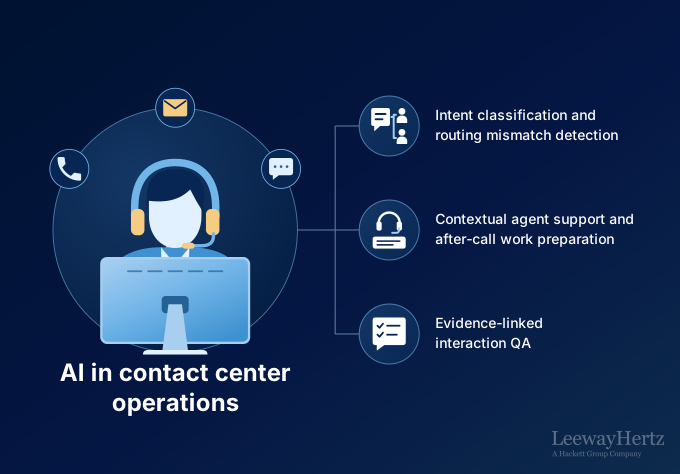
AI in Contact Center Operations: Use Cases & Agentic Workflows
Explore how AI supports contact center operations across routing, workforce management, quality assurance, coaching, compliance, escalation, and performance governance.
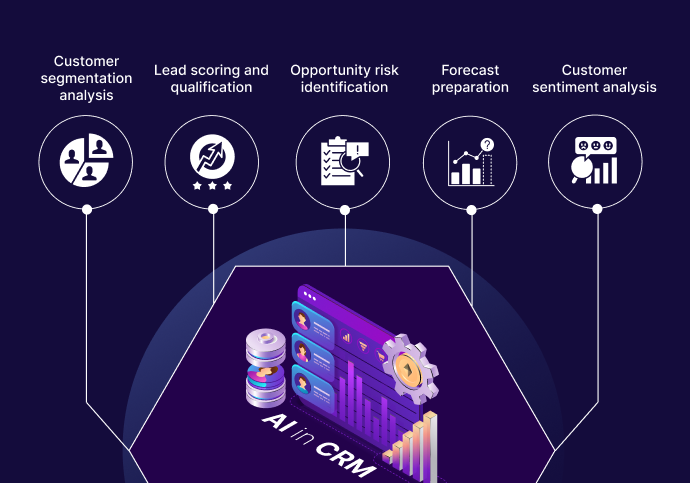
AI in Customer Relationship Management: Processes, Use Cases, and Enterprise Operating Model
AI opportunities in CRM become clearer when the operating model is decomposed across functions, processes, and sub-processes.

Agentic AI in customer service: Integration approaches, implementation frameworks and measurable business impact
Agentic AI transforms customer service by enabling autonomous agents to handle specific operational functions and coordinate to deliver seamless customer experiences

Customer service automation: Enhancing efficiency and customer satisfaction
Customer service automation transforms how businesses handle customer interactions by leveraging advanced technologies such as AI-driven chatbots, machine learning, and integrated software systems.

Adopting AI for customer success: Shaping a new era of user assistance
Customer success is a strategic approach where businesses proactively guide customers through a product journey to ensure they achieve their desired outcomes, thereby enhancing customer satisfaction, loyalty, and advocacy.

Generative AI in travel: Navigating the future of tailored tourism
Generative AI allows travel companies to provide real-time updates and personalized recommendations to travelers, guiding them through the complex world of travel information.

AI in fleet management: Use cases, benefits, architecture, technologies and solution
AI-driven fleet management systems use real-time data on traffic and road conditions to calculate the most efficient vehicle routes.

Conversational AI: Use cases, types and solution
Conversational AI is a subset of artificial intelligence that enables human-like interactions between computers and humans using natural language.

AI in LTV model: Applications and ML techniques
AI and ML have reshaped the way businesses estimate and leverage LTV, offering unprecedented accuracy, insights, and personalized strategies.