Hospitality is one of the industries best suited to generative and agentic AI because hospitality work sits at the intersection of guests, documents, data, service standards, exceptions, and around-the-clock operational execution. A hospitality organization—whether a hotel group, resort operator, mixed-use property, or restaurant group—does more than sell rooms, meals, and experiences. It forecasts demand, prices inventory, manages reservations, assigns rooms, and plans events. It also drafts proposals, audits revenue, schedules labor, coordinates housekeeping and engineering, and responds to guests across multiple languages and review channels. Behind the scenes, it investigates incidents, reconciles bills, tracks brand standards, and documents service touchpoints across physical properties and digital channels.
These activities create an ideal environment for generative AI and agentic AI. Traditional analytics already help hospitality teams forecast occupancy, optimize rates, and detect anomalies. Generative AI extends this by reading and extracting data from contracts, rooming lists, banquet event orders (BEOs), invoices, folios, intake forms, and guest conversations; drafting guest communications and exception narratives; retrieving policy and brand guidance; and summarizing operational variances. Agentic AI goes further by orchestrating multi-step workflows across the property management system (PMS), point-of-sale system (POS), central reservation system (CRS), revenue management system (RMS), customer relationship management system (CRM), channel manager, booking engine, and guest-messaging platforms, while keeping human review in place at defined approval and control points.
Research by Skift Research and McKinsey [1] also found that roughly 90 percent of travel and hospitality organizations are experimenting with generative AI. The shift toward autonomous, task-completing systems is also accelerating, with Gartner [2] expecting 40 percent of enterprise applications to integrate task-specific AI agents by the end of 2026, up from less than 5 percent in 2025.
The value of generative AI in hospitality does not come from isolated pilots or generic chatbots. It comes from embedding AI into real operational workflows. A reservations agent processing a group rooming list, a revenue manager evaluating a group displacement request, a guest-relations manager responding to a critical review, a housekeeping supervisor sequencing the morning board, an executive chef investigating a food-cost variance, or a night auditor reconciling daily revenue all need AI that understands the workflow, the relevant data, the policy and brand context, and the output required for human review.
That is why AI use cases in hospitality should be mapped at the operating-model level. Instead of asking, “Where can AI be applied?”, leaders should ask, “Which function, process, and sub-process can AI improve, and what governed workflow should support it?” Mapping AI this way identifies high-value opportunities across hospitality operations and ensures that AI delivers practical, workflow-specific value while preserving oversight, auditability, and operational accountability.
This article demonstrates how generative and agentic AI can be applied at the operating-model level in hospitality. It breaks down hospitality operations into major functions, core processes, and sub-processes, and shows where AI can add practical, workflow-specific value. The focus is on helping organizations identify high-impact AI opportunities, integrate them into existing workflows, and maintain human oversight rather than replacing employees.
- How generative AI is transforming hospitality operations
- Why hospitality AI use cases must be mapped at the sub-process level
- Hospitality operating model and generative AI opportunity mapping across hospitality processes
- High-value generative AI use cases in hospitality
- How agentic AI works in hospitality workflows
- How to prioritize generative AI use cases in hospitality
- Governance, risk, and responsible AI in hospitality
- How ZBrain operationalizes generative AI use cases in hospitality
- Future of generative AI in hospitality
How generative AI is transforming hospitality operations
Hospitality teams have long relied on analytics, rule engines, property management systems, revenue management platforms, channel managers, and workflow automation to improve efficiency and reduce errors. These technologies remain important, but generative and agentic AI introduce a new class of capability.
Traditional automation follows predefined rules, while machine learning predicts, scores, and detects patterns from historical data, such as forecasting occupancy or estimating cancellation probability. Generative AI can read, extract, summarize, draft, compare, and explain unstructured content across documents, conversations, and reviews. Agentic AI goes further by planning and executing sequences of steps, such as evaluating a group booking request against occupancy forecasts and pricing rules, drafting a proposal, reserving inventory, and routing the request for approval.
In practice, this transforms how teams handle hospitality work:
- Document-heavy: Group contracts, rooming lists, banquet event orders (BEOs), RFPs, vendor invoices, intake forms, and folios.
- Narrative-heavy: Review responses, guest communications, revenue and P&L commentary, incident reports, food-cost variance notes, and proposal copy.
- Exception-heavy: Overbookings, rate-parity breaks, posting discrepancies, no-shows, maintenance escalations, service-recovery cases, and billing disputes.
- Knowledge-heavy: Brand standards, SOPs, loyalty and rate-plan rules, local recommendations, and food-safety procedures.
- Workflow-heavy: Reservation-to-checkout orchestration, group booking-to-BEO execution, service-recovery management, and night-audit workflows.
The most valuable hospitality AI use cases do not remove the human from the process. Instead, they prepare the case, extract relevant data, draft outputs, highlight risks, and route work to the appropriate reviewer. Revenue managers, front-office teams, sales managers, finance teams, and property leaders remain responsible for decisions, approvals, and guest-facing outcomes.
Why hospitality AI use cases must be mapped at the sub-process level
Generative AI can create meaningful operational, service, and commercial value in hospitality, but only when applied to specific, well-defined workflows. “AI in hospitality” is too broad to be actionable. So are categories such as “AI in front office” or “AI in revenue management.” These high-level labels cannot define data requirements, controls, approval paths, success metrics, or implementation scope.
A more practical approach maps AI opportunities to the hospitality operating model:
- Function: The major business or control area, such as revenue management, front office, food and beverage, guest experience, procurement, or finance.
- Process: The workflow within that function, such as demand forecasting, arrival management, BEO creation, or night audit.
- Sub-process: The specific sub-process within the process, such as rate recommendation support, room assignment, guarantee management, or posting reconciliation.
- AI-enabled opportunity: The way AI can support the sub-process, such as extracting document data, drafting a narrative, classifying an exception, retrieving relevant knowledge, or summarizing operational variances.
This level of detail is essential because hospitality workflows are tied to specific documents, systems, brand standards, and decision rights. Drafting a review response is very different from reconciling a city-ledger account. Responding to a guest inquiry about a reservation, room status, or service request is very different from evaluating whether to accept a group block that displaces higher-rated transient demand.
Mapping AI to the sub-process level moves hospitality operators from broad innovation ideas to executable workflows with clear operational value, data requirements, and governance. The sections that follow decompose the hospitality operating model into core functions and highlight where generative and agentic AI can save time while keeping human judgment central to each workflow.
Transform Hospitality Operations With GenAI
Leverage generative AI to streamline workflows, enhance guest experiences, and optimize operations, improving efficiency, personalization, and guest satisfaction across the hospitality enterprise.
Hospitality operating model and generative AI opportunity mapping across hospitality processes
The following sections map generative AI opportunities across the operating model of a modern hospitality organization. Each function includes a short overview, a process and sub-process table, and a summary of the high-value AI opportunities within that function.
Function 1. Reservations and booking management
Reservations and booking management capture and maintain demand across voice, email, direct web, OTA, GDS, and group channels. The function is highly document- and communication-driven, with frequent exceptions involving availability, rate plans, group blocks, modifications, and overbooking.
Generative AI can extract reservation details, enrich guest profiles, and draft confirmations and exception notes. Agentic AI can orchestrate multi-step workflows such as group block setup, rooming-list processing, and overbooking management, while keeping human oversight for approvals and exceptions.
| Process | Sub-process | Key AI-enabled opportunities |
|---|---|---|
| Reservation intake | Voice and email reservation handling | Extract dates, room type, rate plan, occupancy, and guest details from calls and emails, populate the PMS/CRS, validate against availability and rate rules, and flag incomplete or conflicting bookings. |
| Booking enrichment and guest matching | Match reservations to existing guest and loyalty profiles, de-duplicate records, append preferences and stay history, and flag VIP, repeat, or special-needs guests. | |
| Group and block management | Group block setup | Extract room block, rate, dates, cutoff, and attrition terms from signed contracts, build the block in the PMS, and summarize pickup pace. |
| Rooming-list processing | Ingest rooming lists, validate names and nights against the block, flag overages against contracted rooms, and draft guest confirmations. | |
| Cutoff and attrition monitoring | Track pickup against the block, flag approaching cutoff dates, draft release or extension recommendations, and estimate attrition and wash exposure. | |
| Modifications and cancellations | Change and cancellation handling | Classify modification requests, apply rate and policy rules, calculate cancellation penalties, and draft confirmation messages. |
| No-show and deposit handling | Identify no-shows, apply deposit and guarantee rules, and draft charge justifications for review. | |
| Overbooking management | Oversell and walk management | Detect overbooking risk against the forecast, recommend walk candidates, draft relocation arrangements and walk letters, and summarize cost exposure. |
The highest-value GenAI opportunities in reservations and booking management are voice and email reservation handling, group block and rooming-list processing, modification and cancellation handling, and overbooking management. These workflows are repetitive, document-heavy, and well-suited to human-in-the-loop AI.
An example agentic workflow is group block setup. The agent reads the signed group contract, extracts the block, rate, cutoff, and attrition terms, sets up the block in the PMS, and ingests the rooming list. It also validates names against the block, flags overages, drafts confirmations, and routes the file to the reservations manager for review.
Function 2. Front office and guest services
Front office and guest services manage arrivals, departures, room assignment, concierge support, in-stay requests, and service recovery. The function is highly guest-facing and exception-driven, with a direct impact on guest satisfaction and review scores.
Generative AI can prepare arrivals, draft personalized recommendations and communications, and summarize folios and service issues. Agentic AI can coordinate request handling and service-recovery workflows while keeping humans accountable for guest-impacting decisions.
| Process | Sub-process | Key AI-enabled opportunities |
|---|---|---|
| Arrival management | Pre-arrival preparation and room assignment | Match arrivals to room inventory, honor preferences and requests, optimize assignment against housekeeping readiness, and flag VIP or special-needs guests. |
| Check-in support | Verify registration details, summarize folio and rate terms, surface eligible upsell and upgrade offers, and draft welcome notes. | |
| Guest recognition | VIP and special-occasion preparation | Identify VIPs, loyalty tiers, anniversaries, and special occasions, recommend amenities and recognition gestures, and coordinate departments for delivery. |
| Concierge and guest requests | Concierge recommendations | Retrieve local dining, activity, and transport options, and draft personalized itineraries grounded in approved partner and brand content. |
| Guest request handling | Classify requests by department, route to housekeeping, engineering, or F&B, draft acknowledgments with ETAs, and track service recovery. | |
| Departure management | Check-out and folio review | Summarize folio charges, explain disputed items, draft express-checkout summaries, and flag billing exceptions. |
| Account settlement and payment exception | Identify declined cards, deposit refunds, and authorization holds, draft resolution notes, and flag exceptions for the front-office manager. | |
| Guest issue resolution | Service recovery | Summarize the issue, recommend a recovery action within policy and authority limits, draft an apology or compensation note, and log the case for quality review. |
| Complaint logging and trend escalation | Categorize complaints by type and department, detect recurring patterns across stays, and draft escalation summaries for management. |
The strongest GenAI opportunities in the front office are pre-arrival room assignment, concierge recommendations, guest request handling, and service recovery. These workflows benefit from GenAI because they require personalization, policy grounding, and fast, consistent documentation.
An example agentic workflow is guest request handling. The agent classifies an inbound chat or text request, retrieves the room and profile context, and routes the task to the relevant department. It then drafts a guest acknowledgment with an ETA, tracks completion, and escalates SLA breaches to the duty manager.
Function 3. Housekeeping and rooms operations
Housekeeping and rooms operations manage room status, cleaning schedules, inspection, turndown, linen, lost and found, and coordination of out-of-order rooms. Generative AI opportunities are software-focused, addressing planning, reconciliation, and exception tasks, etc.
Generative AI can sequence cleaning priorities, reconcile room status, and draft exception and replenishment notes. Agentic AI can orchestrate board planning and maintenance coordination while keeping supervisors in control of assignments and re-cleans.
| Process | Sub-process | Key AI-enabled opportunities |
|---|---|---|
| Cleaning planning | Cleaning assignment and board planning | Sequence rooms by checkout, stayover, and arrival priority, balance attendant workloads, align to the arrival forecast, and flag constrained or priority rooms. |
| Room status reconciliation | Reconcile PMS and housekeeping statuses, flag clean, dirty, and inspected discrepancies, and draft exception notes. | |
| Inspection and quality | Room inspection support | Summarize inspection findings, classify defects, draft re-clean or maintenance requests, and track recurring issues by room and attendant. |
| Inventory and amenities management | Linen and amenity par management | Detect par-level shortfalls, draft replenishment requests, and summarize consumption trends. |
| Lost and found | Lost-and-found handling | Log found items, match them to guest stays and inquiries, draft guest communications, and track disposition. |
| Maintenance coordination | Out-of-order and out-of-service coordination | Classify out-of-order versus out-of-service rooms, draft work orders to engineering, estimate revenue impact, and track return to inventory. |
The high-value GenAI opportunities in housekeeping are cleaning assignments and board planning, room-status reconciliation, inspection support, and lost-and-found handling. These workflows are high-volume, repetitive, and well-suited to controlled AI support.
An example agentic AI workflow is housekeeping board planning. The agent reads the arrival, departure, and stayover forecast alongside staff availability. It then sequences cleaning priorities, assigns rooms, reconciles PMS status, flags out-of-order rooms, and drafts the daily board for the housekeeping supervisor.
Function 4. Revenue management and pricing
Revenue management and pricing forecast demand, set rates, manage stay restrictions, allocate channels, and benchmark performance against the competitive set. The function is data- and narrative-heavy, combining structured analytics with commentary for stakeholders.
Generative AI can draft forecasts and pricing commentary, summarize rate-shopping data, and explain index movements. Agentic AI can coordinate displacement analysis and rate-recommendation workflows while revenue managers retain decision authority.
| Process | Sub-process | Key AI-enabled opportunities |
|---|---|---|
| Demand forecasting | Demand forecast commentary | Draft narratives explaining occupancy, ADR, and RevPAR shifts by segment and date, detect anomalies, and summarize pickup and pace variance. |
| Event and demand-driver analysis | Summarize citywide events, holidays, weather, and competitive-set signals affecting demand, and flag high-impact dates. | |
| Pricing and yield | Rate recommendation support | Summarize the rationale for best-available-rate (BAR) changes, stay restrictions such as minimum length of stay, closed-to-arrival, and closed-to-departure, and overrides for revenue-manager review. |
| Competitive rate-shopping summary | Compare competitive-set rates, identify parity gaps and positioning, and draft pricing commentary. | |
| Channel and inventory management | Channel allocation review | Summarize channel mix, cost of acquisition, and OTA versus direct contribution, and recommend allocation or restriction changes. |
| Length-of-stay and overbooking strategy | Summarize length-of-stay patterns and no-show and cancellation trends, and recommend stay controls and overbooking levels for review. | |
| Group displacement analysis | Estimate displaced transient revenue against total group value, including rooms, F&B, and meeting space, and draft accept, decline, or counter recommendations. | |
| Budget and forecast planning | Budget and forecast support | Summarize segment and channel trends, draft annual budget and monthly forecast commentary, and flag variances against plan. |
| Performance reporting | RevPAR index and KPI commentary | Draft revenue-generation index, market penetration index, and average-rate index commentary against the competitive set, and explain movements for ownership review. |
| Forecast accuracy and pace reporting | Compare forecast against actuals and booking pace, summarize accuracy drivers, and draft corrective commentary. |
The primary GenAI opportunities in revenue management are demand forecast commentary, rate recommendation support, competitive rate-shopping summaries, and group displacement analysis. These workflows require human judgment but also involve substantial repeatable analysis and documentation that generative AI can accelerate.
An example agentic workflow is group displacement analysis. The agent pulls the forecast for the requested dates and values the group across rooms, F&B, and meeting space. It then estimates displaced transient revenue, drafts an accept, decline, or counter recommendation, and routes it to the revenue manager and sales team for review.
Function 5. Distribution and channel management
Distribution and channel management maintain rates, inventory, and content across OTAs, the GDS, metasearch, and direct channels through the channel manager. The function is exception-prone, with recurring issues around parity, mapping, and content accuracy.
Generative AI can monitor parity, draft channel content, and summarize channel performance. Agentic AI can coordinate parity correction and content synchronization while distribution managers approve changes.
| Process | Sub-process | Key AI-enabled opportunities |
|---|---|---|
| Channel operations | Rate and inventory parity monitoring | Detect parity violations across OTAs, metasearch, and direct channels, summarize discrepancies by channel and date, and draft correction tasks. |
| Channel mapping and content synchronization | Validate room-type and rate-plan mappings across channels, flag mapping errors, and summarize synchronization failures. | |
| Listing and content management | Listing content optimization | Draft channel-specific descriptions, amenity lists, and photo captions from approved brand content, and flag missing or incomplete fields. |
| Promotion and package loading | Draft and validate promotions, packages, and stay deals across channels, and flag misconfigured or expired offers. | |
| Channel performance review | OTA performance and commission review | Summarize production, conversion, and commission costs by channel, and flag underperforming channels. |
| Metasearch and direct-booking performance | Summarize metasearch bidding, click-to-book conversion, and direct-versus-OTA contribution, and draft optimization commentary. | |
| Connectivity and onboarding | Channel connection and onboarding support | Summarize new-channel onboarding status, classify connection and mapping test failures, and draft remediation notes. |
| Booking integrity | Reservation mapping exception handling | Classify failed or duplicate channel bookings, identify missing fields, and draft correction requests. |
The significant GenAI opportunities in distribution are parity monitoring, channel mapping and content synchronization, listing content optimization, and reservation mapping exceptions. These workflows are high-volume and rules-driven, making them strong candidates for controlled AI workflows.
An example agentic workflow is parity monitoring. The agent ingests the rate-shopping feed, detects parity breaks by channel and date, and identifies the likely cause, such as a mapping error, derived rate, or stale promotion. It then drafts correction tasks and routes them to the distribution manager.
Function 6. Sales, catering, and group business
Sales, catering, and group business pursue corporate, group, and event demand through lead handling, RFP responses, proposals, contracting, and account management. The function is document- and narrative-heavy, with high revenue impact.
Generative AI can extract RFP requirements, draft proposals and contracts, and summarize account context. Agentic AI can coordinate RFP-to-contract workflows while sales managers retain commercial authority.
| Process | Sub-process | Key AI-enabled opportunities |
|---|---|---|
| Lead and RFP management | RFP intake and qualification | Extract dates, room nights, meeting space, and budget from RFPs and RFP platforms, match against availability and displacement, and draft a qualification summary. |
| Proposal generation | Draft tailored proposals covering rates, space, packages, and concessions from approved templates and pricing rules. | |
| Contracting | Contract drafting and clause review | Generate contracts from negotiated terms, and extract and flag attrition, cancellation, cutoff, and force majeure clauses for review. |
| Account management | Account research and meeting preparation | Summarize account history, prior events, spend, opportunities, and recent news for sales calls. |
| Pipeline and forecast support | Extract opportunity details from CRM notes and emails, update pipeline records, and draft forecast commentary. | |
| Event handoff | Definite-to-BEO handoff | Convert confirmed bookings into draft banquet event orders and summarize requirements for operations. |
The highest-value opportunities in sales and catering are RFP intake and qualification, proposal generation, account meeting preparation, and contract clause review. These workflows combine repeatable documentation work with commercial judgment that remains with the seller.
An example agentic workflow is RFP handling. The agent extracts requirements from an incoming RFP, checks availability and displacement, and drafts a proposal from approved templates. It then prepares a clause-flagged contract draft and routes the package to the sales manager for review.
Function 7. Events and MICE operations
Events and MICE operations plan and execute meetings, incentives, conferences, exhibitions, and banquets. The function depends on accurate banquet event orders, space management, catering coordination, and post-event reconciliation.
Generative AI can draft BEOs and run-of-show documents, manage guarantee counts, and reconcile actuals against contracts. Agentic AI can coordinate event detailing and reconciliation while event managers approve specifications and final bills.
| Process | Sub-process | Key AI-enabled opportunities |
|---|---|---|
| Event planning | BEO creation and detailing | Draft banquet event orders from contracts and event briefs, including timing, room sets, menus, audiovisual needs, and staffing, flag conflicts, and summarize requirements. |
| Event diary and space-conflict review | Detect double-bookings and space conflicts, draft resolution options, and summarize space utilization. | |
| Group resume and distribution | Compile the group resume from the contract and BEOs, summarize departmental requirements, and distribute to operations teams. | |
| Catering coordination | Menu and guarantee management | Track guarantee counts against guest counts, draft adjustment requests, and flag F&B cost impact. |
| Dietary and allergen accommodation | Capture dietary restrictions and allergens, validate against menus, and draft special-meal and kitchen instructions. | |
| Event execution | Run-of-show and staffing support | Draft run-of-show timelines, recommend staffing levels, and summarize setup and teardown tasks. |
| On-site change and exception handling | Classify on-site change requests, summarize cost and operational impact, and draft revised instructions for review. | |
| Post-event financial reconciliation & guest follow-up | Post-event reconciliation and billing | Reconcile actuals against the BEO and contract, draft the final-bill explanation, summarize variances, and draft thank-you and follow-up notes. |
| Lead capture and rebooking | Summarize event outcomes and client feedback, identify rebooking opportunities, and draft follow-up for the sales team. |
The strongest GenAI opportunities in events are BEO creation and detailing, event diary conflict review, and post-event reconciliation and billing. These workflows are document-heavy and benefit from consistent, accurate detailing and variance documentation.
An example agentic workflow is BEO assembly. The agent converts a definite group contract into a detailed draft BEO and checks the event diary for space conflicts. It then flags audiovisual, menu, and staffing gaps, and distributes the BEO draft to operations leads for confirmation.
Function 8. Food and beverage operations
Food and beverage operations manage restaurants, bars, in-room dining, and banquet service. The function combines high-volume service with menu, cost, and quality management.
Generative AI can manage reservations and waitlists, analyze menu performance, and summarize service exceptions. Agentic AI can coordinate menu engineering and in-room dining workflows while F&B managers retain operational control.
| Process | Sub-process | Key AI-enabled opportunities |
|---|---|---|
| Restaurant operations | Reservation and waitlist management | Classify booking requests, optimize table assignments and turns, draft confirmations, and summarize no-show patterns. |
| Menu engineering support | Analyze item profitability and popularity, draft menu-mix commentary, recommend pricing and placement, and flag underperforming items. | |
| In-room dining | In-room dining order handling | Extract orders, validate against the menu and allergen data, route to the kitchen, and draft delivery-ETA messages. |
| Minibar and amenity replenishment | Reconcile minibar postings and consumption, draft replenishment lists, and flag discrepancies. | |
| Banquet and outlet service | Banquet service coordination | Summarize BEO service requirements, draft service timelines and station assignments, and flag staffing or equipment gaps. |
| Service quality review | Void, comp, and discount review | Classify voids, comps, and discounts, summarize patterns, and flag exceptions for manager review. |
| F&B guest feedback and recovery | Classify outlet feedback and complaints, summarize service-recovery actions, and flag recurring issues. | |
| Beverage and cost management | Pour-cost and beverage variance review | Summarize beverage cost variance, flag overpour and shrink, and draft commentary. |
The strongest GenAI opportunities in food and beverage are reservation and waitlist management, menu engineering support, void and comp review, and in-room dining handling. These workflows generate measurable revenue and cost impact and benefit from consistent analysis.
An example agentic workflow is menu engineering. The agent pulls POS item sales and recipe costs, computes contribution margin and popularity, and classifies items as stars, plow-horses, puzzles, or dogs. It then drafts menu-mix commentary and pricing recommendations for the F&B manager.
Function 9. Culinary and kitchen operations
Culinary and kitchen operations manage recipes, food cost, inventory, allergens, production planning, and waste. The function is cost- and compliance-sensitive, with significant margin and food-safety implications.
Generative AI can cost recipes, tag allergens, and summarize cost and waste variances. Agentic AI can coordinate food-cost and inventory workflows while the executive chef retains accountability for menus and food safety.
| Process | Sub-process | Key AI-enabled opportunities |
|---|---|---|
| Recipe and cost analysis | Recipe costing and food-cost analysis | Extract recipe ingredients and yields, compute plate cost, draft food-cost variance commentary, and flag margin erosion. |
| Allergen and dietary tagging | Extract ingredients, tag allergens and dietary attributes, draft allergen matrices, and flag compliance gaps. | |
| Inventory management | Inventory and par management | Detect par-level shortfalls, draft purchase requisitions, summarize usage and variance, and flag spoilage risk. |
| Stock-count reconciliation | Reconcile physical counts against theoretical usage, flag shrink and variance, and draft commentary. | |
| Production planning | Preparation and production planning | Forecast preparation quantities from covers and banquet counts, draft prep lists, and flag capacity constraints. |
| Waste management | Food-waste tracking | Classify waste reasons, summarize waste trends, and recommend reduction actions. |
The highest-value opportunities in culinary operations are recipe costing and food-cost analysis, allergen and dietary tagging, inventory and par management, and food-waste tracking. These workflows protect margin and food safety while reducing manual analysis.
An example agentic workflow is food-cost variance analysis. The agent ingests POS sales, recipe bills of materials, and purchase and inventory data. It then computes theoretical versus actual food cost, identifies variance drivers such as waste, overportioning, or price changes, and drafts variance commentary for the executive chef.
Function 10. Guest experience, loyalty, and CRM
Guest experience, loyalty, and CRM unify guest data, manage loyalty programs, personalize offers, and analyze feedback. The function depends on a clean guest profile and consistent, policy-grounded personalization.
Generative AI can unify profiles, draft personalized offers, and analyze feedback themes. Agentic AI can coordinate personalization and loyalty workflows while marketing and front-office teams approve guest-facing actions.
| Process | Sub-process | Key AI-enabled opportunities |
|---|---|---|
| Guest data management | Guest profile unification | Merge and de-duplicate profiles across PMS, POS, and CRM, build a golden record, append preferences and history, and flag conflicts. |
| Preference and consent management | Capture and structure guest preferences, marketing consent, and data-privacy choices, and flag conflicts or missing consent. | |
| Loyalty programs management | Loyalty enrollment and tier support | Draft enrollment and upgrade communications, summarize points and redemption queries, and flag exceptions. |
| Redemption and points reconciliation | Validate redemptions against balances, draft adjustment notes, and summarize anomalies. | |
| Personalization | Personalized offer generation | Draft segment and individual offers from stay history, preferences, and propensity, grounded in approved promotions. |
| Next-best-action and upsell targeting | Recommend next-best actions and upsell or cross-sell offers across the stay lifecycle, and route to the right channel for approval. | |
| Feedback management | Guest feedback analysis | Classify survey and feedback themes such as CSAT and NPS drivers, summarize them, flag service issues, and draft responses. |
| Closed-loop feedback follow-up | Draft personalized follow-up to detractors and service issues, track resolution, and summarize closed-loop outcomes. | |
| Guest lifecycle | Win-back and re-engagement | Identify lapsed and at-risk guests, draft re-engagement offers, and summarize campaign targeting for review. |
The highest-value generative AI opportunities in guest experience and loyalty are guest profile unification, personalized offer generation, loyalty support, and feedback analysis. These workflows benefit from generative AI because they require personalization, policy grounding, and careful documentation.
An example agentic workflow is guest experience personalization. The agent assembles the unified guest profile, identifies preferences and propensities, and drafts a personalized pre-arrival offer covering a room upgrade, dining, or spa services within approved promotions. It then routes the offer to marketing or the front office for approval.
Function 11. Marketing and brand consistency
Marketing and brand manage campaigns, content, social media, email, paid media, and search visibility while maintaining brand consistency. The function is content-heavy and increasingly shaped by AI-driven discovery.
Generative AI can draft and localize content, plan campaigns, and summarize performance. Agentic AI can coordinate content production workflows while marketing managers approve brand-facing output.
| Process | Sub-process | Key AI-enabled opportunities |
|---|---|---|
| Content creation | Content drafting and localization | Draft web, social, email, and blog copy from briefs and brand voice, localize for target markets, and flag brand-guideline deviations. |
| Email and CRM marketing content | Draft segmented email and lifecycle-campaign content from CRM data and approved offers, and draft subject-line and variant options. | |
| Campaigns planning | Campaign planning and copy | Draft campaign concepts, audience segments, and channel copy variants, and summarize performance hypotheses. |
| Performance reporting | Summarize campaign KPIs such as click-through, conversion, and return on ad spend, and draft optimization recommendations. | |
| Social and reputation management | Social media management | Draft posts and responses, classify mentions, and flag escalations. |
| Social listening and engagement | Aggregate brand and competitor mentions, classify sentiment and topics, and draft engagement or escalation summaries. | |
| Brand and creative governance | Brand-consistency and asset review | Check creative and copy against brand standards, flag deviations, and summarize required revisions. |
| Search and discovery | SEO and AI-search content optimization | Draft structured, machine-readable content and metadata to improve visibility across traditional search and generative search engines. |
The highest-value GenAI opportunities in marketing are content drafting and localization, campaign copy, performance reporting, and SEO and AI-search optimization. As guests increasingly discover hotels through generative-search tools, machine-readable content has become a measurable distribution lever.
An example agentic workflow is campaign content production. The agent takes a campaign brief, drafts segmented email and social copy in brand voice, and localizes the variants. It then checks brand guideline adherence and routes the set to the marketing manager for approval.
Accelerate AI Solutions Development
Build fully functional solutions from your high-value use cases, based on specific operational needs and enterprise context.
Function 12. Guest communications and contact center
Guest communications and the contact center handle pre-arrival, in-stay, and post-stay messaging across chat, messaging apps, SMS, email, and voice, alongside agent-assist support. The function is high-volume, multilingual, and knowledge-driven.
Generative AI can classify intent, draft and translate responses, and summarize contacts. Agentic AI can coordinate messaging workflows while human agents handle sensitive or complex interactions.
| Process | Sub-process | Key AI-enabled opportunities |
|---|---|---|
| Conversational service | Intent classification and routing | Classify the guest message’s intent, route it to the correct workflow or department, and draft a first response. |
| Multilingual guest messaging | Draft and translate responses across languages, maintain brand tone, and flag sensitive cases. | |
| Agent support | Agent assist and knowledge retrieval | Surface policies, SOPs, and property information, recommend next actions, and draft responses during live chats and calls. |
| After-contact services | Contact summarization and ticketing | Draft contact notes, categorize cases, create tickets, and summarize follow-up tasks. |
| Lifecycle messaging | Pre-arrival and post-stay messaging | Draft personalized pre-arrival, upsell, and post-stay communications, and classify replies. |
The highest-value GenAI opportunities in guest communications are intent classification and routing, agent assist, multilingual messaging, and after-contact summarization. These workflows reduce manual effort while improving consistency and responsiveness.
An example agentic workflow is guest messaging. The agent classifies an inbound message, retrieves the reservation and profile context, and drafts a grounded multilingual response. It then routes complex or sensitive cases to a human agent and logs the interaction.
Function 13. Reputation and review management
Reputation and review management monitor reviews across platforms, analyze sentiment, draft responses, and report trends. The function directly affects brand perception, rankings, and demand.
Generative AI can aggregate and classify reviews, draft on-brand responses, and analyze survey themes. Agentic AI can coordinate review-response workflows while guest-relations managers approve public replies.
| Process | Sub-process | Key AI-enabled opportunities |
|---|---|---|
| Review monitoring | Review aggregation and sentiment analysis | Aggregate reviews across platforms, classify sentiment and themes, and flag urgent issues. |
| Competitive reputation benchmarking | Compare review scores, volume, and themes against the competitive set, and draft positioning commentary. | |
| Response management | Review response drafting | Draft on-brand, personalized responses grounded in stay facts and policy, and flag responses needing approval. |
| Escalation and crisis-response support | Detect reputational, safety, or legal-sensitive reviews, draft escalation summaries, and recommend response handling. | |
| Survey analysis | Survey theme analysis | Classify guest-satisfaction and NPS verbatims, summarize drivers by department, and flag recurring issues. |
| Operational issue routing | Map feedback themes to responsible departments, draft action items, and track resolution. | |
| Reporting | Reputation trend reporting | Draft reputation and score-trend commentary by property, channel, and theme. |
| Reputation and ranking-impact analysis | Summarize the relationship between review performance, rankings, and demand, and draft impact commentary for management. |
The strongest GenAI opportunities in reputation management are review aggregation and sentiment analysis, review response drafting, and survey theme analysis. These workflows improve speed and consistency while preserving human approval for public-facing responses.
An example agentic workflow is a review response. The agent ingests a new review, classifies sentiment and topics, links the stay record, and drafts an on-brand response. It then flags compensation or legal-sensitive cases and routes the draft to the guest-relations manager.
Function 14. Spa, wellness, and recreation
Spa, wellness, and recreation manage spa treatments, fitness, golf, pools, kids’ clubs, and activities through booking, scheduling, and packaging. The function is scheduling and personalization-intensive.
Generative AI can classify booking requests, optimize resource scheduling, and draft packages. Agentic AI can coordinate scheduling workflows while staff retain control over treatment suitability and safety.
| Process | Sub-process | Key AI-enabled opportunities |
|---|---|---|
| Booking and scheduling | Treatment and activity booking | Classify requests, optimize therapist, room, and tee-time scheduling, draft confirmations, and flag conflicts. |
| Resource utilization review | Summarize utilization of treatment rooms, therapists, and tee times, flag idle capacity, and recommend optimization. | |
| Packages and programs scheduling | Package and upsell support | Draft personalized wellness and recreation packages and summarize pricing and availability. |
| Seasonal program and promotion design | Summarize demand and capacity, draft seasonal program and promotion concepts, and flag pricing and resource constraints. | |
| Membership and retail support | Membership and retail upsell support | Summarize member activity and preferences, draft renewal and retail upsell communications, and flag at-risk memberships. |
| Guest support | Intake and preference handling | Extract intake-form data, flag contraindications for staff review, and summarize guest preferences. |
| Post-treatment follow-up and rebooking | Draft personalized follow-up and rebooking prompts, summarize feedback, and flag service issues. |
The highest-value opportunities in spa and recreation are treatment and activity booking, resource utilization review, and package and upsell support. These workflows improve scheduling efficiency and personalization while keeping safety decisions with staff.
An example agentic workflow is spa scheduling. The agent reads a treatment request, checks therapist and room availability, and optimizes scheduling against existing bookings. It then drafts a confirmation and flags contraindications in the intake form for the therapist’s review.
Function 15. Maintenance, engineering, and facilities
Maintenance, engineering, and facilities manage work orders, preventive maintenance, energy, assets, and compliance inspections. The function is document and exception-heavy, with safety and asset-life implications.
Generative AI can classify work orders, analyze recurring issues, and summarize PM and energy data. Agentic AI can coordinate work-order triage while engineering teams own repairs and safety determinations.
| Process | Sub-process | Key AI-enabled opportunities |
|---|---|---|
| Work order management | Work order intake and classification | Classify maintenance requests by trade and priority, route to technicians, draft acknowledgments, and flag safety-critical issues. |
| Root-cause and recurring-issue analysis | Summarize repeat issues by asset and room, draft commentary, and recommend preventive action. | |
| Preventive maintenance | PM schedule support | Summarize preventive-maintenance schedules and compliance, flag overdue tasks, and draft technician work lists. |
| Energy and assets management | Energy and utility commentary | Summarize consumption anomalies and draft efficiency recommendations. |
| Asset and capex documentation | Summarize asset condition and history and draft replacement and capital-expenditure justifications. | |
| Compliance tracking | Inspection and compliance tracking | Summarize inspection findings across fire, life-safety, and elevator systems, and flag overdue items. |
The strongest opportunities in maintenance and engineering are work order intake and classification, root-cause and recurring-issue analysis, and PM schedule support. These workflows improve both operational efficiency and safety controls.
An example agentic workflow is work order triage. The agent classifies an inbound maintenance request by trade and priority, links the room and asset history, and routes the task to the technician queue. It then drafts the guest or department acknowledgment and escalates safety-critical items to the chief engineer.
Function 16. Procurement and supply chain
Procurement and supply chain manage purchasing, vendor relationships, sourcing, and receiving across F&B and operating supplies and equipment. The function is calculation-rich and exception-heavy, with recurring matching and compliance tasks.
Generative AI can validate requisitions, match invoices, and summarize vendor and receiving exceptions. Agentic AI can coordinate invoice-matching and vendor-onboarding workflows while purchasing and finance teams approve payments.
| Process | Sub-process | Key AI-enabled opportunities |
|---|---|---|
| Purchasing | Purchase requisition review | Validate requisitions against budget, par levels, and contracts, flag exceptions, and summarize approvals. |
| Invoice and PO matching | Match invoices to purchase orders and receiving records, flag price and quantity discrepancies, and draft exception notes. | |
| Vendor management | Vendor onboarding and compliance | Extract vendor documents such as insurance, certifications, and food-safety records, validate credentials, and flag missing or expiring documents. |
| Contract and price review | Summarize contract terms, price changes, and renewal dates, and flag deviations. | |
| Sourcing | Sourcing and RFQ support | Extract requirements, aggregate quotes, and draft award recommendations. |
| Receiving | Receiving discrepancy handling | Compare deliveries against purchase orders, flag shortages, substitutions, and quality issues, and draft exception notes. |
The highest-value generative AI opportunities in procurement are invoice and PO matching, purchase requisition review, vendor onboarding and compliance, and receiving discrepancy handling. These workflows are high-volume and documentation-heavy, making them strong candidates for controlled AI workflows.
An example agentic workflow is invoice matching. The agent extracts invoice line items, matches them against the purchase order and receiving records, and flags price and quantity discrepancies. It then drafts exception notes and routes the case to accounts payable and purchasing for approval.
Function 17. Finance, accounting, and revenue audit
Finance, accounting, and revenue audit manage night audit, daily revenue reporting, receivables and the city ledger, reconciliations, and P&L commentary. The function is reporting and control-intensive, often aligned to the Uniform System of Accounts for the Lodging Industry (USALI).
Generative AI can draft daily flash and variance commentary, summarize aging, and assemble dispute evidence. Agentic AI can coordinate night-audit and reconciliation workflows while controllers retain sign-off.
| Process | Sub-process | Key AI-enabled opportunities |
|---|---|---|
| Revenue audit | Night audit support | Summarize daily revenue and postings, flag posting discrepancies and rate overrides, and draft audit notes. |
| Daily flash and revenue reporting | Draft daily revenue, occupancy, ADR, and RevPAR flash commentary, and flag anomalies. | |
| Receivables management | City ledger and AR management | Summarize aging, draft collection and dunning communications, and flag disputes. |
| Group billing reconciliation | Reconcile master accounts against the BEO and contract, and draft final-bill explanations. | |
| Reporting | P&L and variance commentary | Draft USALI-aligned departmental P&L variance commentary and explain GOPPAR and flow-through movements. |
| Planning and tax | Budget and forecast variance support | Summarize actuals against budget and forecast, draft variance commentary, and flag drivers for finance review. |
| Occupancy tax and statutory reporting | Summarize occupancy, tourism, and sales-tax positions, draft reporting worksheets, and flag exceptions for review. | |
| Controls | Chargeback and dispute support | Assemble folio and POS evidence and draft chargeback rebuttals. |
The highest-value opportunities in finance are night audit support, daily flash commentary, city ledger and AR management, and P&L variance commentary. These workflows improve speed and documentation quality while preserving review and sign-off by finance owners.
An example agentic workflow is night audit. The agent reconciles PMS and POS postings, flags rate overrides and posting discrepancies, and drafts the daily flash with occupancy, ADR, and RevPAR commentary. It then routes exceptions to the night auditor and controller.
Function 18. Human resources and workforce management
Human resources and workforce management handle staffing, scheduling, recruiting, training, labor compliance, and gratuity reconciliation. The function is labor-cost-sensitive and compliance-bound.
Generative AI can help forecast labor, draft schedules and job content, and answer policy queries. Agentic AI can coordinate scheduling workflows while managers approve final schedules and labor decisions.
| Process | Sub-process | Key AI-enabled opportunities |
|---|---|---|
| Workforce planning | Labor forecasting and scheduling support | Forecast staffing from occupancy, covers, and event demand, draft schedules, and flag over or understaffing against the labor budget. |
| Time and attendance exception review | Classify clock exceptions, summarize overtime and break-compliance risks, and draft notes. | |
| Talent management | Recruiting and screening support | Draft job descriptions, summarize and screen applications, and draft interview guides. |
| Onboarding and training content | Draft onboarding materials, SOP summaries, and role-specific training guides. | |
| Employee support | HR query support | Answer policy, benefits, and scheduling questions grounded in approved HR content. |
| Compensation management | Tip and gratuity reconciliation | Summarize tip pools and distributions, flag discrepancies, and draft commentary. |
The highest-value generative AI opportunities in HR are labor forecasting and scheduling, recruiting and screening, HR query support, and onboarding and training content. These workflows reduce administrative effort while improving consistency and compliance.
An example agentic workflow is scheduling. The agent forecasts demand using occupancy, covers, and event data, and drafts department schedules aligned with the labor budget and skill mix. It then flags overtime and coverage gaps and routes the draft schedule to the department manager for approval.
Function 19. Safety, security, risk, and compliance
Safety, security, risk, and compliance keep operations aligned with food-safety, life-safety, data-privacy, and accessibility requirements, and manage incidents and licenses. The function is highly document- and regulation-intensive.
Generative AI can summarize logs and records, classify incidents, and draft corrective actions and remediation notes. Agentic AI can coordinate incident and compliance workflows while risk and security owners retain accountability for determinations.
| Process | Sub-process | Key AI-enabled opportunities |
|---|---|---|
| Health and food safety | Food-safety and HACCP documentation | Summarize temperature, cleaning, and inspection logs, flag HACCP deviations, and draft corrective actions. |
| Health inspection preparation | Aggregate logs and records, draft readiness summaries, and flag gaps. | |
| Security and incidents | Incident report support | Extract incident details, classify type and severity, draft incident reports, and flag insurance and legal escalations. |
| Loss prevention review | Summarize security and loss patterns and draft investigation notes. | |
| Compliance review | Data privacy and PCI compliance review | Check workflows and records against PCI DSS and privacy requirements, flag exposures, and draft remediation notes. |
| Accessibility compliance review | Summarize accessibility gaps against ADA and equivalent requirements and draft remediation summaries. | |
| Regulatory tracking | Regulatory and license tracking | Track permits and licenses such as liquor, occupancy, and fire certifications, flag expiries, and draft renewal reminders. |
The highest-value GenAI opportunities in safety and compliance are food-safety and HACCP documentation, incident report support, data privacy and PCI review, and regulatory and license tracking. These workflows depend on accurate records and clear documentation, making AI useful when paired with qualified human review.
An example agentic workflow is incident handling. The agent extracts details from an incident report, classifies the type and severity, and drafts the formal report citing logs and statements. It then flags insurance and legal escalation and routes the case to the risk and security manager.
Function 20. Brand, franchise, QA, and standards governance
Brand, franchise, QA, and standards governance ensure that hospitality organizations comply with brand requirements, franchise obligations, loyalty-program standards, and quality-assurance expectations. The function is standards-intensive and documentation-heavy, requiring ongoing monitoring, audit preparation, corrective-action tracking, and compliance reporting.
Generative AI can summarize audit findings, review brand-standard documentation, and draft corrective-action plans. Agentic AI can coordinate quality-assurance and compliance workflows while brand, operations, and franchise leaders retain approval authority.
| Process | Sub-process | Key AI-enabled opportunities |
|---|---|---|
| Brand standards review | Brand-standard compliance review | Compare property practices against brand requirements, identify gaps, and draft remediation recommendations. |
| SOP alignment and governance | Review SOPs against approved standards, summarize deviations, and recommend updates. | |
| Quality assurance | QA audit preparation | Aggregate audit evidence, training records, and historical findings, and draft readiness summaries. |
| QA finding management | Classify findings, assign ownership, track remediation progress, and draft status reports. | |
| Franchise management | Franchise obligation tracking | Extract reporting obligations, deadlines, and contractual commitments, and generate reminders. |
| Property improvement plan (PIP) tracking | Monitor PIP milestones, summarize status, and flag delays and budget variances. | |
| Loyalty and brand programs | Loyalty compliance monitoring | Track loyalty-benefit fulfillment, identify missed benefits, and summarize exceptions. |
The highest-value generative AI opportunities in brand governance are QA audit preparation, QA finding management, franchise obligation tracking, and PIP monitoring. These workflows depend heavily on documentation, standards, and recurring compliance reviews, making them strong candidates for governed AI workflows.
An example agentic workflow is QA audit preparation. The agent gathers supporting evidence, reviews prior findings, identifies unresolved items, drafts readiness summaries, and routes the package to property leadership and brand reviewers.
Function 21. Owner, asset management, and portfolio performance
Owner and asset-management functions oversee financial performance, capital planning, portfolio benchmarking, development activities, hotel openings, renovations, conversions, and management transitions. The function is highly analytical and decision-oriented, with significant reporting and governance requirements.
Generative AI can summarize performance trends, draft owner reports, and analyze capex and renovation initiatives. Agentic AI can coordinate reporting, development, and transition workflows while owners, asset managers, and operators retain decision authority.
| Process | Sub-process | Key AI-enabled opportunities |
|---|---|---|
| Owner reporting | Monthly owner reporting | Draft performance summaries covering revenue, profitability, labor, guest satisfaction, and capital projects. |
| Executive performance reporting | Generate executive dashboards and summarize key performance drivers. | |
| Asset management | Portfolio benchmarking | Compare properties against portfolio, market, and competitive benchmarks, and identify performance outliers. |
| Operator performance review | Summarize operating performance, identify risks, and draft scorecards. | |
| Capital planning | Capex and reserve tracking | Track capital projects, reserve spending, and project status, and flag variances. |
| Renovation and ROI analysis | Summarize renovation performance and estimate business impact. | |
| Development and transitions | Pre-opening readiness management | Track pre-opening milestones, identify blockers, and summarize readiness status. |
| Conversion and transition planning | Coordinate rebranding, system migrations, operational transitions, and opening activities. |
The strongest generative AI opportunities in owner and asset management are monthly owner reporting, portfolio benchmarking, operator performance reviews, and pre-opening readiness management. These workflows require extensive data aggregation, analysis, and narrative generation, making them well-suited for AI-assisted execution.
An example agentic workflow is monthly owner reporting. The agent collects financial and operational data, prepares performance commentary, and identifies exceptions. It then drafts the report package and routes it to asset-management and ownership teams for review.
Function 22. Enterprise, regional, and shared services operations
Enterprise, regional, and shared services operations support multi-property hospitality organizations through centralized services, regional oversight, shared operations, and portfolio-level governance. The function is coordination-intensive and relies on consistent reporting, process execution, and cross-property collaboration.
Generative AI can summarize performance, prepare management reviews, and consolidate information from multiple properties. Agentic AI can coordinate shared-service workflows while regional and corporate teams retain accountability for decisions.
| Process | Sub-process | Key AI-enabled opportunities |
|---|---|---|
| Regional operations management | Regional performance reviews | Aggregate operational and financial metrics across properties and draft management summaries. |
| Cross-property action tracking | Monitor initiatives, deadlines, and corrective actions, and generate follow-up reports. | |
| Shared services support | Shared finance support | Summarize finance exceptions, invoice backlogs, and reconciliation issues across properties. |
| Shared procurement support | Consolidate purchasing activity, identify sourcing opportunities, and summarize vendor performance. | |
| Centralized operations management | Central reservations support | Classify inquiries, retrieve property information, and draft responses. |
| Knowledge and SOP management | Maintain operational knowledge repositories and summarize policy updates. | |
| Performance management | Multi-property benchmarking | Compare operational performance across properties and identify best practices. |
| Enterprise exception management | Track escalations and recurring issues across functions and properties. |
The highest-value generative AI opportunities in enterprise operations are regional performance reviews, shared-service support, centralized reservations, and multi-property benchmarking. These workflows benefit from AI’s ability to consolidate information across many locations and produce consistent reporting at scale.
An example agentic workflow is a regional performance review. The agent gathers KPI data from multiple properties, identifies outliers and recurring issues, drafts executive commentary, and routes findings to regional leadership for review and action.
Function 23. Technology, data, and AI governance
Technology, data, and AI governance manage the core systems that connect hospitality operations, including the PMS, POS, CRS, RMS, CRM, and channel manager, along with integrations, data quality, cybersecurity, and AI oversight. This function is foundational because generative AI cannot scale without secure data access, integration quality, and model governance.
Generative AI can triage incidents, summarize integration failures, and draft data-quality and governance documentation. Agentic AI can coordinate exception and governance workflows while technology owners make high-impact operational decisions.
| Process | Sub-process | Key AI-enabled opportunities |
|---|---|---|
| IT operations management | IT incident triage | Classify incidents, summarize impact, recommend resolver groups, and draft status updates. |
| System integration support | Summarize integration and synchronization failures across PMS, POS, CRS, RMS, and channel manager, and draft remediation notes. | |
| Data quality management | Guest and rate data quality management | Detect inconsistent guest, rate, room-type, and reference data, and draft remediation summaries. |
| Cybersecurity | Security alert triage | Summarize alert context, affected systems, and recommended steps, and review reported phishing. |
| AI governance | AI use-case inventory and monitoring | Document AI workflows, owners, data sources, and controls, and summarize output quality, exceptions, and human overrides. |
| Model and policy compliance review | Check AI workflows against data, privacy, and brand and model-risk policies, and draft compliance summaries. |
The highest-value opportunities in technology and data are IT incident triage, system integration support, data quality management, and AI governance documentation. These workflows are essential for scaling AI safely across the property and portfolio.
An example agentic workflow is AI governance intake. The agent collects use-case details, identifies data sources and potential personal-data exposure, and classifies the risk level. It then maps required approvals across privacy, security, and brand, generates documentation, and routes the use case through governance review.
Accelerate AI Solutions Development
Build fully functional solutions from your high-value use cases, based on specific operational needs and enterprise context.
High-value generative AI use cases in hospitality
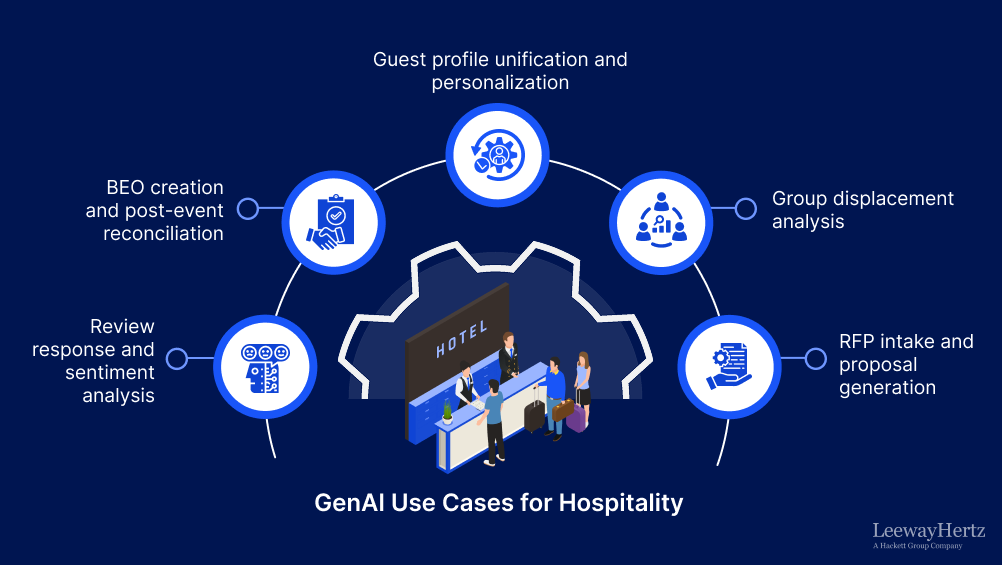
The hospitality use-case landscape is broad, but not every workflow should be automated first. The strongest early opportunities are usually high-volume, document-heavy, exception-heavy, or narrative-heavy workflows where AI can produce a draft, a recommendation, an exception summary, or a case pack for human review.
| High-value use case | Why it matters |
|---|---|
| Guest messaging and agent assist | Handles high-volume, multilingual guest inquiries and surfaces the right policy and next action during live interactions. |
| Review response and sentiment analysis | Improves speed and consistency of on-brand review responses while flagging sensitive cases for approval. |
| Demand forecast and rate recommendation commentary | Helps revenue teams explain occupancy, ADR, and RevPAR movements and justify rate and restriction changes. |
| Group displacement analysis | Quantifies group value against displaced transient revenue to support accept, decline, or counter decisions. |
| Rate and inventory parity monitoring | Detects parity breaks across channels and drafts correction tasks to protect direct-booking economics. |
| Night audit and daily flash commentary | Reduces manual reconciliation and accelerates daily revenue reporting for finance teams. |
| Housekeeping board planning and room-status reconciliation | Sequences cleaning priorities and reconciles status to speed room readiness and reduce friction at check-in. |
| RFP intake and proposal generation | Accelerates group response time and standardizes proposals and contract clause review. |
| BEO creation and post-event reconciliation | Improves event detailing accuracy and speeds final billing and variance explanation. |
| Menu engineering and food-cost variance | Protects F&B margin through consistent profitability analysis and variance commentary. |
| Guest profile unification and personalization | Builds a clean guest record and drafts grounded, personalized offers across the stay lifecycle. |
| Labor forecasting and scheduling | Aligns staffing to demand against the labor budget while flagging overtime and coverage gaps. |
| Work order triage and maintenance root-cause | Routes maintenance requests faster and surfaces recurring asset issues for preventive action. |
| Invoice and PO matching and receiving discrepancies | Reduces manual matching effort and strengthens cost and supplier controls. |
| Food-safety, HACCP, and incident documentation | Improves the quality and consistency of safety records and incident reporting. |
These use cases work well because they support human review rather than bypassing it. They also create measurable value through reduced cycle time, fewer errors, stronger documentation, better exception handling, improved guest communication, and more consistent operational controls.
How agentic AI works in hospitality workflows
Generative AI can draft, summarize, classify, and retrieve. Agentic AI can coordinate a workflow. In hospitality, this distinction matters because many valuable use cases require multiple steps across systems, documents, departments, policies, and approvals.
For example, a group booking workflow is not just a contract-reading task. It may require extracting the block, rate, cutoff, and attrition terms, setting up the block in the PMS, and ingesting and validating the rooming list. It may also involve monitoring pickup against cutoff, converting the definite booking into a draft BEO, and routing the work for review. An agentic AI workflow can coordinate these activities while reservations, sales, and event teams retain responsibility for commercial decisions, operational commitments, and guest outcomes. As hospitality organizations connect PMS, CRS, RMS, CRM, sales, event-management, and finance systems, these multi-step workflows become increasingly practical candidates for agentic AI orchestration.
Examples of agentic AI workflows in hospitality include:
- A reservations agent that reads a group contract, extracts block and rate terms, sets up the block, validates the rooming list against the block, flags overages, and routes confirmations for review.
- A guest-messaging agent that classifies an inbound message, retrieves reservation and profile context, drafts a grounded multilingual response, and escalates sensitive cases to a human agent.
- A revenue agent that evaluates a group request against the forecast, values the group across rooms, F&B, and meeting space, drafts a displacement-based recommendation, and routes it to the revenue manager.
- A night-audit agent that reconciles PMS and POS postings, flags rate overrides and discrepancies, drafts the daily flash, and routes exceptions to the controller.
- A review-response agent that ingests a new review, classifies sentiment and topics, links the stay record, drafts an on-brand response, and flags compensation-sensitive cases.
- A BEO agent that converts a definite contract into a detailed draft BEO, checks the event diary for conflicts, flags menu and audiovisual gaps, and distributes the draft to operations leads.
- A maintenance agent that classifies a work order by trade and priority, links asset history, routes to the technician queue, drafts the acknowledgment, and escalates safety-critical items.
Agentic workflows should be designed with approval gates. The agent can prepare, recommend, route, and update. However, the hospitality operation should define where human review is mandatory, what evidence must be retained, and which systems can be updated after approval. It should also define how exceptions escalate when the workflow touches guest compensation, pricing commitments, contracts, food safety, or incident determinations.
How to prioritize generative AI use cases in hospitality
A hospitality stakeholder should not prioritize AI use cases only because they sound innovative. The strongest candidates combine business value, workflow fit, data readiness, control readiness, and scalability.
| Prioritization criterion | What hospitality operators should evaluate |
|---|---|
| Business value | Productivity, cost reduction, revenue and upsell impact, guest experience, review scores, and cycle-time improvement. |
| Workflow fit | Whether the workflow is document-heavy, knowledge-heavy, exception-heavy, narrative-heavy, repetitive, or dependent on manual coordination. |
| Data readiness | Whether the required data, such as reservations, rates, profiles, contracts, BEOs, folios, and SOPs, is available, accurate, permissioned, and connected. |
| Human review model | Whether a qualified owner, such as a manager, revenue manager, controller, chef, or guest-relations lead, can review, approve, reject, or correct AI output. |
| Control and compliance impact | Whether the workflow affects PCI and data privacy, food safety, accessibility, guest compensation, or brand-facing communications that require governance. |
| Integration complexity | How many systems and data sources the workflow spans across PMS, POS, CRS, RMS, CRM, channel manager, and downstream actions. |
| Exception frequency | Whether the workflow experiences recurring overbookings, parity breaks, posting discrepancies, disputes, or escalations that AI can help standardize. |
| Scalability | Whether the pattern can be reused across properties, brands, outlets, regions, or business units. |
A practical first wave should focus on bounded workflows with strong human review and clear operational evidence. Examples include guest messaging and agent assist, review response drafting, night audit and daily flash commentary, housekeeping board planning, RFP and proposal support, and group displacement analysis. These use cases typically have structured inputs, measurable cycle times, and clear approval owners.
More sensitive use cases, such as final pricing commitments, guest compensation and goodwill decisions, incident and safety determinations, food-safety sign-off, and public review responses on legally sensitive matters, require stronger governance and should retain final accountability with designated hospitality, finance, risk, or compliance personnel.
Accelerate AI Solutions Development
Build fully functional solutions from your high-value use cases, based on specific operational needs and enterprise context.
Governance, risk, and responsible AI in hospitality
Generative AI in hospitality must operate within the organization’s existing governance, brand-standard, compliance, and risk-management framework. The most important principle is clear accountability. AI can assist with drafting, summarization, classification, routing, and workflow coordination, but the responsible person must remain accountable for guest-impacting decisions, financial postings, safety determinations, and brand-facing communications.
Key governance requirements include:
- Human review for guest compensation and goodwill decisions, pricing commitments, incident and safety determinations, food-safety sign-off, data-privacy decisions, and legally sensitive review responses.
- Source-grounded outputs that reference approved reservations, contracts, BEOs, folios, brand standards, SOPs, and operational systems.
- Audit trails that capture prompts, inputs, outputs, workflow actions, reviewer decisions, approvals, rejections, escalations, and downstream system updates across PMS, POS, CRS, and finance systems.
- Role-based access control so agents retrieve only the guest, payment, pricing, or operational data that the user and workflow are authorized to access.
- Data-protection controls for capturing guest data, payment-card data subject to PCI DSS, employee data, and confidential commercial information in alignment with applicable privacy regulations.
- Model and agent monitoring for accuracy, completeness, hallucination risk, exception rates, latency, workflow drift, adoption patterns, and operational impact.
- Escalation procedures for low-confidence outputs, conflicting instructions, sensitive guest situations, high-value or reputational exposure, and safety-sensitive exceptions.
- Third-party and vendor risk review for AI models, cloud infrastructure, integration partners, and workflow-orchestration platforms connected to operational systems.
- Alignment with PCI DSS, privacy obligations, food-safety and life-safety requirements, accessibility standards, brand standards, records-retention policies, cybersecurity standards, and internal audit requirements.
Governance should not be treated as a blocker to hospitality AI adoption. It is what makes AI operationally reliable and scalable. A well-governed AI workflow provides stronger documentation, clearer exception tracking, more consistent service execution, better auditability, and improved accountability than unmanaged manual processes.
How ZBrain operationalizes generative AI use cases in hospitality
Identifying AI use cases is only the first step. Hospitality organizations also need a way to design, build, validate, deploy, govern, and scale AI workflows across functions. This is where ZBrain helps.
ZBrain is an end-to-end AI enablement platform that provides enterprises with a structured pathway from identifying where AI can deliver value to deploying it as a governed, scalable capability. The platform operates across two core dimensions: strategy and execution. In the strategy phase, ZBrain helps hospitality teams identify, evaluate, and design AI solutions by leveraging operational processes, systems of record such as the PMS, POS, and CRS, and historical workflow data. The execution phase ensures these opportunities are systematically developed into scalable solutions. Covering the full AI lifecycle in connected stages, ZBrain enables initiatives to progress from strategic insight to enterprise deployment, eliminating fragmented pilots and manual experimentation.
Preparation (Foundation)
Establishes a comprehensive understanding of the organization’s current hospitality environment, including operational processes, system integration points, workforce metrics, and KPIs. This provides insight into where AI can deliver meaningful value, particularly in document-heavy, narrative-heavy, and exception-heavy sub-processes.
Ideation and prioritization (Discovery)
Leverages operational and historical data to identify AI opportunities and prioritize them based on feasibility, cost, expected benefits, and ROI. Priority is given to sub-processes that can be embedded within existing workflows, such as guest messaging, review response, night audit, or group displacement analysis.
Solution design (Validation)
Translates prioritized opportunities into ROI-validated, KPI-mapped solution blueprints. Defines where AI can assist, augment, or act autonomously within workflows, including reservations, front office, revenue management, events, F&B, and guest experience.
Technical design (Build-ready)
Transforms solution requirements into structured, build-ready technical artifacts, including architecture diagrams, agentic workflow definitions, user stories, epics, and business requirement documents. This provides the development team with a complete foundation for implementation.
Proof of Concept/PoC (Validation)
Tests selected AI solutions in controlled environments to validate feasibility, business value, and operational readiness before scaling.
Scaled product
Scaled, validated proof-of-concept solutions, supported by performance metrics and observability data, are deployed as governed, production-grade AI solutions across enterprise environments, with continuous improvement loops to sustain impact.
Future of generative AI in hospitality
Generative AI in hospitality will evolve from copilots to workflow agents. The first wave helps employees draft, summarize, search, classify, and retrieve information across reservations, front office, revenue, F&B, events, and guest-service workflows. The next wave will coordinate larger operational sequences across systems, departments, and channels, with humans entering at key review and decision points.
Several shifts are likely to define the next stage of hospitality AI:
-
From generic chatbots to specialized agents built for specific workflows such as group booking, displacement analysis, BEO assembly, night audit, review response, and work-order triage.
-
From isolated pilots to reusable AI workflows deployed across reservations, front office, revenue, F&B, events, finance, and guest experience.
-
From manual review of every operational step to human approval at defined control points for pricing, compensation, safety, and brand-facing decisions.
-
From centralized AI experimentation to federated adoption across functions under enterprise governance, brand standards, and compliance oversight.
-
From static knowledge search to active workflow orchestration across the PMS, POS, CRS, RMS, CRM, and channel manager.
-
From productivity-only measurement to broader measurement of guest experience, review performance, revenue impact, operational resilience, and control effectiveness.
-
Guest discovery is shifting from traditional search and OTAs toward generative search experiences and AI assistants that help travelers research, compare, and book properties.
These shifts are unfolding alongside persistent labor and cost pressures that are pushing operators toward automation, and they are already influencing where the industry invests. Gartner [5] predicts that by 2028, 60 percent of brands will use agentic AI to deliver streamlined one-to-one customer interactions, signaling a broader move toward AI agents that can coordinate customer engagement across marketing, sales, and service. At the same time, McKinsey [6] reports that travelers are increasingly using generative AI to discover destinations, compare lodging options, and plan trips, reshaping how guests research and book travel experiences.
The long-term trajectory is not fully autonomous hospitality operations. Instead, it is a redesign of workflows in which AI handles repetitive coordination, information gathering, and operational tasks, while employees focus on exceptions, decision-making, relationship management, and the human experiences that define hospitality.
Hospitality providers that succeed will not necessarily be the ones with the most AI pilots or the largest number of models. They will be the organizations that connect AI to how hospitality operations actually run, at the function, process, and sub-process levels, while building governance, integration, and operational accountability into every workflow.
Endnote
Generative AI has the potential to reshape hospitality operations, but only if it is applied at the right level of detail. Broad statements such as “AI in hospitality” or “AI in hotel operations” are not enough. Real value comes from mapping AI to specific workflows, such as group booking and reservation management, demand forecast and rate-recommendation commentary, group displacement analysis, guest messaging, review response, night audit, BEO assembly, menu engineering, work-order triage, and food-safety documentation.
Hospitality is fundamentally a coordination industry, bringing together people, processes, assets, and guest interactions across a highly interconnected operating model. As generative and agentic AI mature, the opportunity is no longer limited to automating individual tasks. It lies in creating intelligent workflows that connect information, accelerate decisions, and improve execution across functions. Organizations that approach AI as an operating model capability rather than a collection of isolated tools will be better positioned to enhance guest experiences, improve operational efficiency, and build more adaptive hospitality operations.
For hospitality organizations, the path forward is clear and practical. Build a sub-process-level opportunity map. Prioritize workflows with strong operational value and clear review ownership. Connect AI to approved reservations, guests, and operational data sources. Run controlled workflow pilots. Deploy with governance and auditability. Scale through reusable agents, orchestration patterns, and shared operational controls.
Generic chatbots or isolated copilots will not define the future of hospitality AI. It will be defined by governed, workflow-specific agents that help hospitality organizations serve guests better, personalize at scale, strengthen operational controls, reduce exception-handling effort, and give teams more time to focus on the moments where human hospitality matters most.
Turn hospitality AI opportunities into actionable solutions with ZBrain. From discovering high-impact workflows to deploying and scaling AI across the enterprise, ZBrain helps organizations operationalize AI with confidence. Contact the ZBrain team today.
Author’s Bio


Akash's ability to build enterprise-grade technology solutions has garnered the trust of over 30 Fortune 500 companies, including Siemens, 3M, P&G, and Hershey's. Akash is an early adopter of new technology, a passionate technology enthusiast, and an investor in AI and IoT startups.
Related Products

AI Agent
Discover the right AI agent for your use case! Explore our extensive range of AI agents tailored to tackle specific challenges.
Start a conversation by filling the form
Once you let us know your requirement, our technical expert will schedule a call and discuss your idea in detail post sign of an NDA.
All information will be kept confidential.
FAQs
What are the best generative AI use cases in hospitality?
High-value generative AI use cases are typically document-heavy, narrative-heavy, exception-prone, or repetitive, in which AI can draft or summarize information for human review. Examples include:
- Guest messaging and agent assist – Handles high-volume, multilingual inquiries and supports live interactions with policy and next-action guidance.
- Review response and sentiment analysis – Drafts on-brand responses and surfaces themes for guest-relations teams.
- Demand forecast and rate-recommendation commentary – Explains occupancy, ADR, and RevPAR movements and supports pricing decisions.
- Group displacement analysis – Quantifies group value against displaced transient revenue.
- Night audit and daily flash commentary – Reduces manual reconciliation and accelerates daily reporting.
- RFP and proposal support – Speeds group response time and standardizes proposals and contract review.
- BEO creation and post-event reconciliation – Improves event detailing and final-bill accuracy.
- Menu engineering and food-cost variance – Protects F&B margin through consistent analysis.
- Work-order triage – Routes maintenance faster and surfaces recurring issues.
How is generative AI different from traditional AI in hospitality?
Traditional AI typically predicts, scores, classifies, or detects patterns based on historical data, such as forecasting occupancy or cancellation probability. Generative AI, in contrast, can read, summarize, draft, compare, explain, and retrieve information from hospitality documents, conversations, and systems. Agentic AI extends this by coordinating multi-step workflows across the PMS, POS, CRS, RMS, CRM, channel manager, and approval paths.
What is agentic AI in hospitality?
Agentic AI refers to AI systems that plan and execute sequences of workflow steps under defined controls. For example, an agent can:
- Read a group contract and set up the block in the PMS.
- Validate the rooming list and flag overages.
- Convert the definite booking into a draft BEO.
- Route the work for review and approval.
- Update workflow systems after decisions.
This ensures workflow continuity, accelerates repetitive operational tasks, and maintains human accountability.
Which hospitality functions benefit most from generative AI?
Generative AI can add value across most hospitality functions, particularly those involving high-volume documents, guest interactions, complex workflows, and operational oversight. Key areas include:
- Reservations and revenue management
- Front office and guest services
- Guest communications and reputation management
- Food and beverage and culinary operations
- Events and group sales
- Housekeeping, maintenance, and finance operations
Can generative AI be used in regulated or sensitive hospitality workflows?
Yes, when implemented with appropriate controls and governance. AI should be:
- Grounded in approved guest, rate, and operational data.
- Monitored for quality, consistency, and accuracy.
- Integrated with audit trails and human review checkpoints.
- Used as a support tool, with final decisions retained by qualified personnel, especially for payment-card data subject to PCI DSS, food safety, and privacy requirements.
Can generative AI integrate with existing hospitality systems?
Yes. Modern AI platforms can integrate with core hospitality systems, including property management systems (PMS), central reservation systems (CRS), revenue management systems (RMS), customer relationship management (CRM) platforms, point-of-sale (POS) systems, channel managers, workforce-management platforms, and business intelligence tools. This allows AI to operate within existing workflows rather than creating additional operational silos.
How can generative AI improve guest experience in hospitality?
Generative AI can help hospitality organizations deliver faster, more personalized, and more consistent guest experiences. Common applications include guest messaging, itinerary recommendations, service recovery communications, multilingual support, loyalty engagement, and review-response management. By reducing response times and improving personalization, AI enables staff to focus on higher-value guest interactions.
How should hospitality operators prioritize AI use cases?
Hospitality operators should evaluate AI opportunities based on:
- Business value: Productivity, cost reduction, revenue and upsell impact, guest experience, and cycle-time improvement.
- Workflow fit: Document-heavy, knowledge-intensive, exception-prone, narrative-heavy, or repeatable tasks.
- Data readiness: Availability, accuracy, permissions, and integration of reservation, rate, profile, and operational data.
- Human review model: Qualified owners can review, approve, reject, or correct AI outputs.
- Control and compliance impact: Improvements in auditability, brand-standard adherence, PCI and privacy compliance, and food safety.
- Integration complexity: Number of systems, data sources, and approval paths involved.
- Scalability: Reusability across properties, brands, outlets, regions, and business units.
High-value early use cases are typically well-bounded workflows with clear review points, such as guest messaging, review response, night audit, housekeeping board planning, and RFP support.
What governance is required for AI agents in hospitality?
Effective AI governance ensures reliability, compliance, and accountability. Key requirements include:
- Role-based access to guest, payment, pricing, and operational data.
- Audit trails capturing inputs, outputs, prompts, model versions, and reviewer actions.
- Human review for critical guest-impacting and safety decisions.
- Output monitoring for accuracy, hallucinations, and anomalies.
- Data protection for guest, employee, payment, and commercial information.
- Model and agent documentation for validation and compliance.
- Escalation procedures for exceptions, low-confidence outputs, or sensitive situations.
- Alignment with PCI DSS, privacy, food-safety, accessibility, brand-standard, cybersecurity, and internal audit frameworks.
How can hospitality operators measure ROI from generative AI?
Operators should measure generative AI initiatives using both operational and guest-experience metrics rather than focusing only on automation volume. Common evaluation areas include:
- Cycle-time reduction – Faster guest responses, night audit, group response, and exception handling.
- Productivity improvement – Reduced manual effort in messaging, documentation, reconciliation, and reporting.
- Revenue impact – Improved upsell capture, conversion, rate optimization, and reduced OTA dependency.
- Guest-experience improvement – Faster responses, more personalization, and improved review and satisfaction scores.
- Operational resilience – Better exception visibility and consistency across properties and outlets.
- Control and compliance effectiveness – Improved auditability, documentation quality, and adherence to safety, privacy, and brand policies.
The strongest AI programs typically begin with bounded workflows where baseline metrics already exist, such as guest messaging, review response, night audit, or housekeeping planning, allowing operators to compare cycle times, exception rates, and effort before and after deployment.
How does ZBrain support generative AI use cases in hospitality?
ZBrain is an enterprise AI enablement platform that helps hospitality organizations identify, build, deploy, govern, and scale AI workflows. It operates across two dimensions: strategy, which identifies, evaluates, and designs AI solutions using operational processes, systems, and historical workflow data, and execution, which develops these opportunities into scalable, production-ready solutions. ZBrain covers the full AI lifecycle, including preparation, ideation and prioritization, solution design, technical design, proof of concept, and scaled deployment, ensuring quality, human review, and reusable workflows across hospitality functions.
Insights

AI in Retail: Use Cases, Governance, and Implementation Strategies
Generative AI is poised to reshape the retail and e‑commerce landscape over the next decade, transforming both customer experiences and core operations.

AI in banking and finance: Use cases, applications, AI agents, solutions and implementation
AI in banking and finance offers various opportunities for process optimization, risk management, and customer engagement. One of the key areas where AI demonstrates its potential is in data analysis.
AI in Contract Management: Use Cases Mapped to the CLM Operating Model
AI in contract management is not a generic chatbot bolted onto a document store. The value shows up when a specific capability meets a specific artifact at a specific step of the lifecycle.