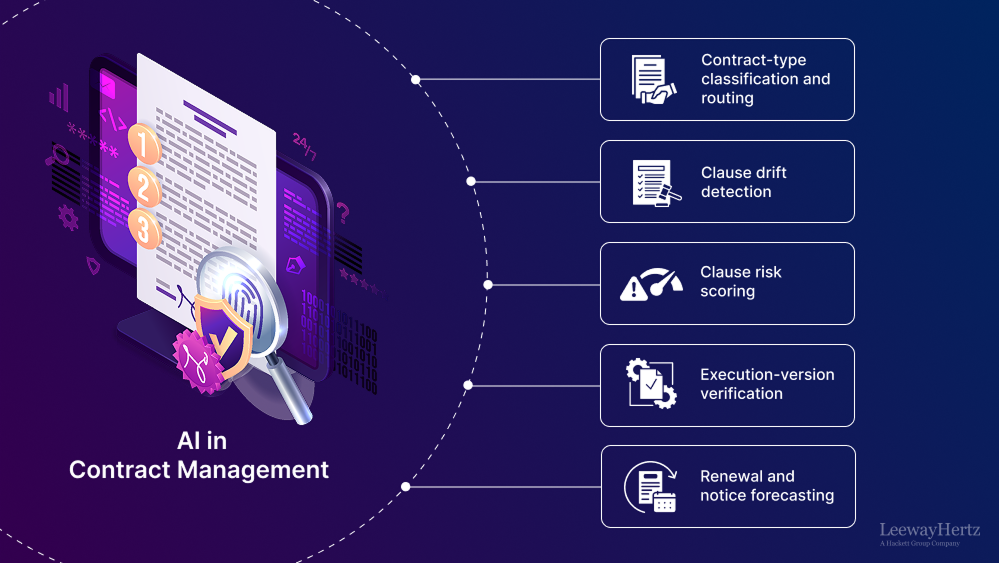
Contract management is the operational discipline that turns signed agreements into governed, enforceable, and revenue-protecting relationships. It spans the full lifecycle of a commercial agreement: intake, drafting, negotiation, risk review, approval, execution, storage, obligation tracking, renewal management, performance monitoring, and dispute support. Each stage creates a record, follows a rule, and requires an accountable owner for what the organization commits to.
The scale of this work, and the cost of doing it poorly, is why AI has moved to the center of the conversation. The global contract lifecycle management (CLM) software market was estimated at roughly USD 1.62 billion in 2024 and is projected to reach about USD 3.24 billion by 2030, growing at a compound annual rate of 12.7 percent [1]. Contracts hold the commercial truth of the enterprise, yet that truth is frequently trapped in static PDFs that finance, procurement, and sales cannot see or enforce.
AI in contract management is not a generic chatbot bolted onto a document store. The value shows up when a specific capability meets a specific artifact at a specific step of the lifecycle. A drafting assistant may assemble a first-draft master service agreement (MSA) using an approved template and clause library. A review model performs a different task by flagging a non-standard limitation-of-liability clause against the negotiation playbook. An obligation-extraction model serves another purpose: it reads an executed contract and records each deliverable, price escalation, and service-level commitment in the obligation register. The legal operations analyst, the contract manager, and the deal desk each get a different tool, grounded in a different record.
The reason for being precise is that contract work does not decompose into a single “review contracts” task. It decomposes into functions, each function into processes, and each process into sub-processes, and the sub-process is where a real, buildable, governable AI opportunity lives. A clause-fallback lookup during negotiation, a delegation-of-authority check during approval, a metadata-extraction pass during repository intake: these are the atomic units where AI either helps or does not, and where a named reviewer either can or cannot confirm the output before it affects a regulated or risk-bearing decision.
This article uses the contract management operating model to break work into functions, then into processes and sub-processes, and then maps a specific AI capability and a specific contract artifact to each one, with the human ownership boundary and an example agentic workflow kept explicit throughout.
- How AI is transforming contract management operations
- Why contract management AI use cases must be mapped at the sub-process level
- Contract management operating model and AI opportunity mapping across contract processes
- High-value AI use cases in contract management
- How agentic AI works in contract management workflows
- How to prioritize AI use cases in contract management
- Governance, risk, and responsible AI in contract management
- How ZBrain operationalizes AI use cases in contract management
- Future of AI in contract management
How AI is transforming contract management operations
AI is transforming contract management by applying machine reading, drafting, classification, and pattern detection to work that has always been document-heavy, deadline-driven, and risk-sensitive. The change is not that machines make contractual commitments on behalf of the business. The change is that much of the preparation, review, extraction, and monitoring work that once consumed a contract manager’s day can now be completed in advance. Instead of starting from a blank document or an unstructured contract file, the reviewer receives a work packet that is already assembled, scored, and annotated with the clauses, obligations, dates, deviations, and risks that need attention.
A concrete cross-system example shows the shift. When a renewal approaches, a contract manager historically had to find the executed agreement in a shared drive, re-read it for the auto-renewal and notice provisions, check the customer’s payment history in the enterprise resource planning (ERP) system, confirm the current pricing in the customer relationship management (CRM) system, and only then decide whether to renew, renegotiate, or serve notice. An AI-supported workflow reads the executed contract PDF from the repository, extracts the renewal and notice terms, aggregates the payment and usage data across ERP and CRM, and presents a renewal recommendation with the supporting clauses cited, so the contract manager spends the time deciding rather than assembling.
Across the function, the work AI touches falls into five recognizable types:
-
Document-heavy work: the regulated agreements, order forms, statements of work (SOWs), and data processing agreements (DPAs) that can be read for missing signatures, inconsistent defined terms, and non-standard clauses before a reviewer opens them.
-
Narrative-heavy work: the negotiation summaries, risk memos, contract abstracts, and status briefings that AI can draft from the approved source documents while showing where the supporting language is thin or absent.
-
Exception-heavy work: the redlines, off-playbook clause requests, blocked approvals, and disputed obligations that can be classified and prioritized so legal and commercial specialists take the highest-risk items first.
-
Knowledge-heavy work: the clause interpretation, precedent lookups, and policy checks that improve when AI retrieves the governing standard, the approved fallback clause, and prior negotiated positions, and flags conflicts.
-
Workflow-heavy work: the multi-step lifecycle handoffs between legal, procurement, sales, and finance that benefit when AI forecasts the bottleneck and assembles the next work packet, reducing rework between functions.
The practical design rule that follows is simple: AI should prepare, organize, and draft the material that a contract professional then judges, and it should never be positioned to commit the organization on its own. The strongest contract management AI shortens the path from raw contract data to a confident human decision, while keeping final judgment with the role accountable for the commitment, risk, or exception.
See how AI use cases become governed, production-ready contract workflows
Turn intake, drafting, review, obligations, and renewals into agentic workflows with a human reviewer at every risk-bearing step.
Why contract management AI use cases must be mapped at the sub-process level
A general instruction to “use AI for contracts” is not enough to produce a useful or governable system. It usually leads to a broad assistant that can summarize agreements or answer basic questions, but it is not tied to the way contract work is actually performed. It does not know which record it should use, which rule it should apply, or which role is responsible for confirming the output before the business accepts a term, approves an exception, or acts on an obligation.
That is why AI in contract management should be mapped to the operating model. The operating model breaks contract work into the levels where responsibility, workflow, and control are visible: the function, the process, the sub-process, and the AI-enabled opportunity.
-
Function: a governed operational domain with its own accountability, such as contract negotiation and redlining, or obligation and performance management.
-
Process: a workflow area within a function, such as first-pass redlining, or obligation extraction and tracking.
-
Sub-process: the atomic work activity, such as comparing an incoming third-party paper against the standard template, or writing each service-level commitment from an executed contract into the obligation register.
-
AI-enabled opportunity: a specific capability applied to a specific artifact at that sub-process, framed by what it changes, such as document intelligence that extracts non-standard clauses from third-party paper so the reviewer sees deviations before reading the full document.
Mapped this way, each opportunity comes with a practical implementation blueprint: the input artifact the work starts from, the source system where that artifact lives, the policy, playbook, or standard that governs it, the accountable reviewer who approves the output, and the output artifact the sub-process produces. That blueprint is what makes the opportunity buildable and governable. It shows what the model must be grounded in, where the human review boundary sits, and how the work can be evidenced later.
The detail matters because contract sub-processes carry very different risks. Summarizing an executed agreement for an internal reader is a controlled use case because an imperfect summary can be reviewed and corrected before it influences decisions. Recommending that a non-standard indemnification clause be accepted is high blast radius: if the recommendation is wrong and it is accepted without review, the organization has taken on liability it did not intend. The same word, “review,” covers both, which is exactly why the word is not specific enough to build on.
Consider the examples side by side. Extracting renewal dates and notice periods from a repository of executed contracts is a high-volume, artifact-rich, cleanly reviewable sub-process. Drafting a standard NDA from the approved template is another. Recommending a fallback position on a liability cap during a live negotiation is a legitimate AI opportunity too, but it demands a tighter review boundary, because the output feeds a risk-bearing commercial decision.
Mapping AI opportunities at the sub-process level is not an administrative exercise. It is what separates production-ready contract workflows from demonstrations that cannot be deployed. At this level of detail, each AI output can be traced to the source record it used, the policy or playbook it applied, the system it updated, and the accountable reviewer who approved the result before it affected a contractual commitment, commercial exception, or risk-bearing decision.
Contract management operating model and AI opportunity mapping across contract processes
The contract lifecycle below is rendered as a set of functions, each a self-contained block. Every function states what it turns into what, the teams that run it, what AI helps with, what humans continue to own, the sub-process opportunity map, the highest-value opportunities, and one example agentic workflow. The functions span the full lifecycle, from intake to closeout, plus the cross-cutting domains of clause governance, third-party risk, compliance, analytics, platform, and strategy.
Function 1: Contract intake, request triage, and routing
Where contracting demand enters the system and is converted into a structured, review-ready request.
Contract intake turns an unstructured business need, such as a request to buy, sell, partner, hire, license technology, or protect confidential information, into a structured contract request that the rest of the lifecycle can act on. It determines the contract type, required template, business owner, counterparty, risk profile, approval path, and service priority. Because every downstream step depends on the intake record, errors at this stage can create misrouted work, unnecessary legal review, duplicate agreements, missed approvals, or inconsistent obligations.
Teams involved
Legal operations, contract administrators, deal desk, sales operations, procurement, vendor management, human resources, finance, privacy, information security, and requesting business units.
What AI helps with
Classification assigns incoming requests to the right contract type, business unit, urgency level, value band, and complexity tier based on the intake form, free-text request, email thread, CRM opportunity, procurement request, HR request, or attached correspondence. Document intelligence analyzes attached term sheets, order forms, statements of work, vendor documents, and counterparty papers to extract key request details. Multi-source aggregation retrieves existing agreements, pending requests, related entities, vendor or customer master records, and CRM or procurement context to identify duplicates, conflicts, or existing contractual coverage. Retrieval-grounded answering helps requesters identify the applicable template, contracting policy, clause playbook, and approval path. Natural-language generation drafts clarifying questions when mandatory information is missing and prepare an intake summary for legal operations review.
What humans continue to own
Legal operations confirms contract classification, intake completeness, template selection, routing path, and service-level priority. The deal desk, commercial owner, procurement owner, or HR owner decides whether the request can proceed on standard paper or requires bespoke treatment. The requesting business owner attests to the business need, counterparty relationship, commercial context, urgency, and requested outcome. Privacy, information security, finance, compliance, or procurement reviewers own specialized approvals triggered by intake risk signals. AI classifies, validates, retrieves, drafts, and recommends; people confirm the request path and remain accountable for the contracting decision.
Process, sub-process, and key AI-enabled opportunities
| Process | Sub-process | Key AI-enabled opportunities |
|---|---|---|
| Request capture and validation | Intake form completion |
|
| Completeness and mandatory-field check |
|
|
| Counterparty and entity validation | Multi-source aggregation checks the counterparty against CRM, ERP, vendor master, customer master, procurement systems, HR systems, and the contract repository to confirm the legal entity, related affiliates, existing relationship, and active or pending agreements. | |
| Classification and risk screening | Contract-type classification | Document intelligence reads the request, attachments, term sheet, order form, statement of work, or email context to propose the contract type, such as NDA, MSA, SOW, DPA, order form, reseller agreement, vendor agreement, employment-related agreement, or amendment. |
| Risk and complexity pre-screening | Classification flags risk triggers such as counterparty paper, regulated data, personal data, cross-border terms, high contract value, unusual liability, non-standard payment terms, exclusivity, urgent turnaround, or missing approval context for legal operations review. | |
| Triage and routing | Duplicate and conflict check | Multi-source aggregation retrieves active, expired, and pending agreements for the same counterparty or related entity, flagging duplicate NDAs, conflicting MSAs, overlapping SOWs, inconsistent order forms, or expiring agreements before new drafting begins. |
| Template, playbook, and approval-path assignment | Policy and playbook matching maps the request to the governing contracting policy, standard template, clause playbook, fallback positions, approval matrix, and reviewer path so the requester and legal operations team see the correct route upfront. | |
| SLA and queue assignment | Recommendation assigns priority, complexity tier, reviewer queue, and target service level based on contract type, value, risk profile, business unit, urgency, and required specialist review. |
Highest-value opportunities:
-
Contract-type classification: Determines the correct template, workflow, approval matrix, and reviewer path at the start of the lifecycle, reducing downstream rework from misrouted requests.
-
Request completeness and risk pre-screening: Identifies missing business context, counterparty details, data-use terms, non-standard paper, value thresholds, jurisdictional issues, and specialist-review triggers before legal review begins.
-
Duplicate and conflict check: Surfaces existing NDAs, MSAs, SOWs, order forms, amendments, and expiring agreements for the same counterparty, helping prevent redundant contracts, conflicting obligations, and avoidable negotiation effort.
-
Template, playbook, and approval-path assignment: Maps the request to the governing policy, standard form, fallback positions, and required approvers, giving legal operations a review-ready intake package.
Example agentic workflow
- A new contract request arrives through the CLM intake form, email, CRM opportunity, procurement request, HR request, vendor onboarding workflow, or business service portal.
- The agent converts the business request into a structured intake record, extracting contract type, counterparty, business unit, value band, jurisdiction, urgency, requested effective date, contract purpose, and attached supporting materials.
- The agent retrieves existing counterparty agreements, pending requests, related entities, vendor or customer master records, and relevant CRM, procurement, HR, or finance context.
- The agent checks intake completeness, flags missing mandatory fields, identifies duplicate or conflicting agreements, and screens for risk triggers such as counterparty paper, regulated data, high value, cross-border terms, non-standard liability, exclusivity, or unusual payment terms.
- The agent proposes the contract type, template, clause playbook, approval matrix, reviewer queue, SLA priority, and any required specialist review.
- A legal operations reviewer confirms the classification, intake completeness, template, routing path, SLA priority, and specialist-review requirements before the request is released to drafting.
- Once confirmed, the workflow opens the drafting task, attaches the intake summary, links the source records, records the routing decision, and moves the request forward under existing CLM governance.
Function 2: Contract authoring and drafting
Where an approved request becomes a first-draft agreement built from governed language.
Contract authoring turns a classified and routed request into a first-draft agreement assembled from approved templates, clause libraries, playbooks, and deal-specific inputs. It sits after intake and before negotiation, giving legal and business reviewers a document that starts from standard language, reflects the approved request record, and clearly identifies any draft terms that need judgment. Done well, authoring reduces blank-page effort, limits off-standard language, and gives negotiation teams a cleaner starting point.
Teams involved
In-house legal counsel, contract drafters, legal operations, contract administrators, deal desk, sales operations, procurement, privacy, information security, finance, and guided self-service business users for standard low-risk agreements.
What AI helps with
Natural-language generation assembles a first-draft agreement from the approved template, intake record, clause library, and deal-specific inputs such as counterparty name, scope, pricing, term, renewal structure, jurisdiction, and service details. Document intelligence checks the draft for missing defined terms, broken cross-references, inconsistent party names, incomplete exhibits, conflicting dates, and obligation mismatches before counsel reviews it. Clause library and playbook matching propose approved clauses, fallback language, and conditional variants based on the deal facts, policy rules, risk level, and contract type. Multi-source aggregation reconciles draft terms against CRM, procurement, finance, HR, vendor, or customer records so commercial and operational terms match the source of truth. Classification flags non-standard language, approval triggers, and deviations from the approved template or playbook.
What humans continue to own
The assigned legal counsel confirms that the draft reflects the transaction’s commercial intent, legal position, required approvals, and risk posture. Contract drafters resolve flagged inconsistencies and attest that the draft is ready for review or negotiation. The deal desk, procurement, finance, privacy, information security, or business owner confirms any terms that fall within their authority, such as pricing, scope, data use, security obligations, tax, payment terms, or service commitments. Counsel owns bespoke language that departs from the approved library. AI assembles, checks, compares, and suggests; people select, approve, and attest.
Process, sub-process, and key AI-enabled opportunities
| Process | Sub-process | Key AI-enabled opportunities |
|---|---|---|
| First-draft assembly | Template and document package assembly | Natural-language generation assembles the first-draft agreement from the approved template and attaches required schedules, exhibits, addenda, order forms, SOWs, DPAs, or security attachments based on the intake record and contract type. |
| Template population | Natural-language generation populates party names, legal entities, scope, pricing, term, renewal structure, governing law, notice details, service description, and other deal-specific fields so the drafter starts from a complete draft rather than a blank template. | |
| Clause library and playbook matching | Clause matching proposes approved clauses, fallback positions, and conditional variants based on contract type, risk profile, jurisdiction, deal value, data use, customer segment, and counterparty paper status. | |
| Draft quality control | Internal consistency check | Document intelligence flags inconsistently defined terms, broken cross-references, mismatched party names, incomplete exhibits, conflicting dates, duplicate obligations, and inconsistent renewal or termination language before negotiation begins. |
| Data-point verification | Multi-source aggregation reconciles pricing, payment terms, scope, product or service details, customer or vendor entity, effective date, and term against the intake record, CRM opportunity, procurement request, ERP record, or HR request. | |
| Non-standard language and deviation flagging | Classification compares the draft against the approved template and clause playbook, then flags new language, deleted protections, modified fallback positions, or terms that require legal, finance, privacy, security, or executive approval. | |
| Draft readiness and release | Approval-trigger detection | Classification identifies terms that trigger specialist review, such as personal data processing, security obligations, uncapped liability, indemnity changes, exclusivity, unusual payment terms, audit rights, service credits, or cross-border commitments. |
| Source and version traceability | The workflow records the template version, clause version, intake source, deal data sources, reviewer inputs, and generated draft history so legal operations can audit how the first draft was prepared. |
Highest-value opportunities
-
Template and document package assembly: Reduces repetitive drafting effort by assembling the correct agreement package from approved templates, schedules, and exhibits before counsel begins review.
-
Clause library and playbook matching: Preserves legal and policy alignment at the source by proposing approved language and fallback options instead of relying on manual clause selection or memory.
-
Internal consistency and data verification: Detects drafting defects, mismatched deal data, broken references, incomplete exhibits, and inconsistent commercial terms before they enter negotiation.
-
Non-standard language and approval-trigger detection: Gives counsel and legal operations a clear view of deviations and required specialist reviews before the draft is released to the counterparty.
Example agentic workflow
- The agent starts from the approved intake record, selected template, contract type, business unit, counterparty record, and linked deal or procurement data.
- It assembles the first-draft agreement, including required schedules, exhibits, order forms, SOWs, DPAs, or addenda, and populates party names, pricing, term, scope, governing law, notice details, and other deal-specific fields.
- It matches the request against the clause library and contracting playbook, proposing approved clauses, fallback positions, and conditional variants where the deal facts require them.
- It checks the draft for missing defined terms, broken cross-references, inconsistent party names, conflicting dates, incomplete exhibits, non-standard language, approval triggers, and commercial-data mismatches.
- It produces a drafting summary that lists clause choices, source data, deviations, approval triggers, and open issues.
- Drafting counsel or an authorized contract reviewer confirms the clause selections, resolves flagged issues, approves any bespoke language, and attests that the draft is ready for negotiation or internal review.
- Once confirmed, the agent moves the draft into the negotiation workspace, preserves the template and clause-version history, and logs the drafting decision under existing CLM governance.
Function 3: Clause and template library governance
Where the organization’s approved contract language is curated, versioned, and kept current.
Clause and template library governance converts legal policy, regulatory requirements, negotiated precedent, and risk decisions into a maintained set of approved templates, clauses, fallback positions, and playbook guidance. It is a cross-cutting content governance function: its outputs are reused by intake, drafting, negotiation, review, approval, and self-service workflows. The quality and currency of this library determine whether contract teams can reuse language safely, negotiate within approved boundaries, and avoid inconsistent obligations across the contract portfolio.
Teams involved
Legal knowledge management, senior counsel, legal operations, contract policy owners, commercial counsel, procurement counsel, privacy, information security, compliance, finance, tax, and business stakeholders for function-specific templates.
What AI helps with
Clause extraction and clustering analyze executed agreements to identify where negotiated language consistently deviates from the standard clause. Classification tags clauses by risk theme, such as liability, indemnity, data protection, confidentiality, termination, audit rights, payment terms, warranties, governing law, intellectual property, and regulatory obligations. Pattern detection surfaces clause positions that are frequently negotiated, escalated, accepted, rejected, or associated with longer cycle times. Natural-language generation drafts candidate clause updates, fallback language, clause rationales, and playbook explanations from approved source positions. Validation checks template and clause records for missing owners, stale versions, inconsistent effective dates, incomplete metadata, and unapproved variants before publication.
What humans continue to own
Senior counsel approves every template, clause, fallback position, and playbook rule that enters the library. Legal policy owners define the acceptable risk range for each clause theme and decide when negotiated precedent should become a new standard or fallback. Privacy, security, finance, tax, compliance, or procurement reviewers approve specialized language in their respective domains. Knowledge management owns version control, effective dates, retirement rules, and publication governance. AI extracts, clusters, compares, drafts, and flags; people approve the legal position and attest to the published version.
Process, sub-process, and key AI-enabled opportunities
| Process | Sub-process | Key AI-enabled opportunities |
|---|---|---|
| Library curation and maintenance | Clause drift detection | Clause extraction and clustering compare executed agreements against the approved clause library to surface where signed language consistently deviates from the standard position, giving counsel evidence to decide whether a standard clause or fallback position should change. |
| Coverage-gap analysis | Classification maps existing clauses against required risk themes, contract types, jurisdictions, business units, and regulatory obligations, so missing, thin, duplicated, or inconsistent library coverage becomes visible. | |
| Clause usage and negotiation analytics | Pattern detection analyzes which clauses are frequently negotiated, escalated, accepted, rejected, or associated with longer review cycles, helping legal operations prioritize library updates where they will reduce friction. | |
| Template and version governance | Template version control | Validation checks each template for owner, effective date, approved version, retired version, linked playbook, required metadata, and required specialist approvals so only current templates remain available for drafting. |
| Jurisdiction and business-unit variant management | Classification maps template and clause variants to region, governing law, product, business unit, deal type, customer segment, procurement category, or regulatory context so drafters select the right governed language for the request. | |
| Playbook maintenance | Fallback position drafting | Natural-language generation drafts candidate fallback clauses and rationale from approved legal positions, giving counsel structured options to review rather than starting from a blank page. |
| Policy and playbook guidance generation | Natural-language generation drafts negotiator-facing guidance, escalation rules, plain-language explanations, and fallback rationale for each clause based on the approved policy position and fallback ladder. | |
| Publication and controls | Clause approval and publication workflow | Classification identifies which proposed clause or template updates require senior counsel, privacy, security, finance, tax, procurement, compliance, or business-owner approval before publication. |
| Stale language retirement | Validation flags outdated clauses, expired templates, superseded fallback positions, duplicate guidance, and unapproved variants for retirement, restricted use, or replacement. |
Highest-value opportunities
-
Clause drift detection: Uses the executed-contract population as evidence of how negotiated language is changing in practice, helping counsel decide whether standard clauses, fallback positions, or escalation rules need to be updated.
-
Fallback position drafting: Gives counsel review-ready fallback options and rationales, enabling faster negotiation within approved risk boundaries.
-
Template version control: Prevents outdated or unapproved templates from being reused, reducing drafting errors, inconsistent obligations, and policy leakage.
-
Clause usage and negotiation analytics: Shows which clauses create the most negotiation friction, escalation volume, or cycle-time delay, helping legal operations focus library improvements where they will create the most value.
Example agentic workflow
- The agent starts from the executed-contract repository, current clause library, approved templates, fallback playbooks, and clause metadata.
- It extracts and clusters deviations from standard clauses, such as liability, indemnity, data protection, confidentiality, termination, audit rights, payment terms, warranties, governing law, intellectual property, and regulatory obligations.
- It compares the clustered deviations against approved fallback positions, jurisdictional variants, template versions, contract-type rules, and business-unit rules to identify clause drift, missing coverage, stale language, duplicate guidance, or recurring negotiation friction.
- It drafts candidate clause updates, fallback language, playbook explanations, escalation rules, and rationale showing the source evidence behind each proposed change.
- It identifies required approvals from senior counsel, privacy, information security, finance, tax, compliance, procurement, or business owners based on the clause theme and template scope.
- Senior counsel and relevant specialist reviewers approve, edit, or reject each proposed clause, fallback position, template update, or playbook change.
- After approval, knowledge management publishes the versioned clause or template, records the effective date, retires superseded language, and logs the decision under existing library governance.
Function 4: Contract negotiation and redlining
Where parties converge on terms through governed edits, fallback positions, and documented deviations.
Contract negotiation turns a first draft, counterparty paper, or incoming redline into an agreed set of terms that can move to approval. It compares proposed edits against the organization’s standard template, clause playbook, fallback positions, and approval rules, then identifies which changes are acceptable, negotiable, unacceptable, or require escalation. It sits between drafting and approval, and it feeds approval a near-final document whose deviations from standard language are known, justified, and assigned to the right decision owner.
Teams involved
In-house counsel, contract managers, legal operations, deal desk, sales operations, procurement leads, commercial owners, privacy, information security, finance, tax, compliance, and executive approvers for high-risk exceptions.
What AI helps with
Document intelligence compares incoming redlines, counterparty paper, and revised drafts against the approved template and clause library, identifying additions, deletions, modified clauses, missing protections, and structural changes. Classification maps each deviation to a clause theme, such as liability, indemnity, confidentiality, data protection, termination, payment terms, audit rights, warranties, intellectual property, governing law, or service levels, and scores it against the playbook’s acceptable, negotiable, unacceptable, or escalation-required bands. Clause playbook and precedent matching surfaces approved fallback language, prior accepted positions, and similar negotiated outcomes for the same clause type. Natural-language generation drafts counter-proposals, redline comments, negotiation rationale, and internal escalation summaries. Multi-source aggregation reconciles negotiated commercial terms with CRM, procurement, finance, or order records so the negotiated document remains aligned with the business deal.
What humans continue to own
Negotiators decide which fallback position to offer, whether a deviation is acceptable in the context of the deal, and when to escalate. Counsel owns any acceptance of off-playbook language, non-standard risk allocation, or bespoke drafting. Commercial, procurement, finance, privacy, security, tax, or compliance owners approve terms that fall within their authority. Legal operations ensures that negotiation history, redline versions, comments, and approvals are recorded. AI compares, classifies, drafts, and recommends; people negotiate, approve positions, and attest to deviations.
Process, sub-process, and key AI-enabled opportunities
| Process | Sub-process | Key AI-enabled opportunities |
|---|---|---|
| Deviation analysis | Third-party paper review | Document intelligence extracts clauses from incoming third-party paper and maps them against the organization’s standard template, showing additions, omissions, edits, missing protections, and structural differences before the reviewer reads the full document. |
| Redline comparison and clause mapping | Document intelligence compares each redline against the approved draft and maps edits to clause themes such as liability, indemnity, confidentiality, data protection, payment terms, termination, audit rights, warranties, intellectual property, and governing law. | |
| Playbook band classification | Classification scores each deviation against the clause playbook’s acceptable, negotiable, unacceptable, and escalation-required bands so the negotiator can triage the clauses that carry the most risk. | |
| Counter-position drafting | Fallback and precedent matching | Clause playbook and precedent matching surfaces approved fallback clauses, prior accepted positions, and similar negotiated outcomes so the counter-position stays inside governed boundaries. |
| Redline response drafting | Natural-language generation drafts proposed counter-language, redline comments, and short negotiation rationales based on the approved position, giving the negotiator a review-ready response rather than a blank starting point. | |
| Negotiation governance | Risk and approval-trigger detection | Classification identifies terms that trigger legal, finance, privacy, security, tax, compliance, procurement, or executive approval, such as uncapped liability, broad indemnity, regulated data use, unusual payment terms, exclusivity, audit rights, or non-standard termination rights. |
| Commercial term alignment | Multi-source aggregation reconciles negotiated pricing, payment terms, scope, term length, renewal structure, service levels, and order details against CRM, procurement, finance, or order records. | |
| Negotiation history and position tracking | Summarization records what changed across negotiation turns, which positions were accepted or rejected, which issues remain open, and which deviations require approval before signature. | |
| Approval readiness | Deviation summary for approval | Natural-language generation prepares a clause-by-clause deviation summary with risk rationale, fallback history, approval triggers, and unresolved business decisions for the approval function. |
Highest-value opportunities
-
Third-party paper review: Reduces the highest-effort and highest-risk negotiation task by surfacing deviations, missing protections, and non-standard structures before counsel reviews the full document.
-
Playbook band classification: Directs legal attention to the clauses that carry real exposure by separating acceptable edits from negotiable, unacceptable, or escalation-required positions.
-
Fallback and precedent matching: Accelerates negotiation by giving counsel approved fallback language and evidence of similar prior outcomes while keeping the final position within governed boundaries.
-
Risk and approval-trigger detection: Prevents risky terms from moving toward signature without the right legal, commercial, privacy, security, finance, tax, or executive review.
-
Deviation summary for approval: Gives approvers a clear, evidence-backed view of what changed, why it matters, who reviewed it, and what risk remains before signature.
Example agentic workflow
- The agent starts from an incoming third-party paper, counterparty redline, or revised draft in the negotiation workspace.
- It compares the document against the approved template, clause library, fallback playbook, and prior draft version, then maps additions, deletions, and edits by clause theme.
- It classifies each deviation against the playbook bands and flags terms that are acceptable, negotiable, unacceptable, or escalation-required.
- It retrieves approved fallback language, similar to prior negotiated outcomes, and relevant commercial context from CRM, procurement, finance, or order records.
- It drafts counter-language, redline comments, negotiation rationale, and an internal escalation note for terms that require specialist or executive review.
- The negotiator reviews the deviation map and drafts counter-positions, decides which positions to send, and escalates off-playbook terms to counsel or specialist reviewers.
- Once the negotiation turn is confirmed, the agent records the version history, open issues, accepted positions, rejected positions, and unresolved deviations under existing negotiation governance.
- When the document is near final, the agent prepares a deviation summary for the approval function, showing remaining non-standard terms, rationale, required approvals, and decision owners.
Function 5: Legal and commercial risk review
Where a near-final contract is assessed for legal, commercial, operational, and regulatory risk before approval.
Legal and commercial risk review turns a negotiated draft into a documented risk assessment that tells approvers what they are being asked to accept. It evaluates material deviations from the template and playbook, identifies legal and commercial exposure, checks regulated clauses against policy requirements, and translates open issues into approval conditions. It sits after negotiation and before approval, giving the approval function a risk-scored contract with the material issues, source clauses, decision owners, and residual risks clearly documented.
Teams involved
In-house counsel, commercial counsel, contract managers, risk and compliance reviewers, finance, tax, privacy, information security, procurement, sales operations, deal desk, and subject-matter specialists for export controls, regulated-industry terms, data protection, security, intellectual property, and revenue-impacting terms.
What AI helps with
Risk scoring evaluates material clauses against a defined legal and commercial risk rubric, flagging high-exposure terms such as uncapped liability, broad indemnities, unusual warranties, unfavorable termination rights, non-standard governing law, weak confidentiality, broad audit rights, and unsupported service commitments. Policy and regulatory requirement matching compares privacy, security, export, anti-corruption, data-processing, tax, and regulated-industry clauses against approved standards and identifies gaps. Multi-source aggregation reconciles commercial terms with CRM, procurement, finance, order, pricing, and approval records, so the risk assessment reflects the actual deal. Classification identifies approval triggers and assigns issues to the correct reviewer. Natural-language generation drafts the risk assessment memo, residual-risk summary, approval conditions, and required change list, with each point linked to the relevant clause and source evidence.
What humans continue to own
Counsel decides whether a flagged legal risk is acceptable, whether fallback positions have been exhausted, and what conditions must apply before approval. Finance, tax, privacy, security, compliance, procurement, or commercial owners approve risks within their authority. The risk reviewer attests to the assessment, and the accountable approver accepts or rejects the residual risk. AI scores, compares, classifies, retrieves evidence, and drafts the memo; people decide, approve, condition, or attest.
Process, sub-process, and key AI-enabled opportunities
| Process | Sub-process | Key AI-enabled opportunities |
|---|---|---|
| Risk identification | Clause risk scoring | Risk scoring evaluates material clauses against the approved legal and commercial risk rubric, ranking exposure across liability, indemnity, warranties, confidentiality, termination, intellectual property, audit rights, governing law, dispute resolution, and service commitments. |
| Commercial exposure review | Multi-source aggregation compares pricing, payment terms, discounts, renewal language, termination rights, volume commitments, service credits, and scope obligations against CRM, order, finance, procurement, and approval records, so financial exposure is visible before approval. | |
| Obligation and operational impact analysis | Classification identifies post-signature obligations such as reporting duties, service commitments, audit support, data-handling duties, security requirements, notice obligations, or implementation responsibilities and routes them to the relevant business owner. | |
| Regulatory and policy review | Policy and regulatory requirement matching | Policy and regulatory comparison checks privacy, data processing, information security, export control, anti-corruption, tax, procurement, and regulated-industry clauses against approved standards and flags gaps with source references. |
| Approval-trigger detection | Classification identifies terms that require specialist or executive approval, such as uncapped liability, non-standard indemnity, regulated data use, cross-border transfer, unusual payment terms, audit rights, exclusivity, tax exposure, or off-policy security obligations. | |
| Assessment drafting | Risk assessment memo generation | Natural-language generation drafts a risk assessment memo from flagged clauses, deviations, commercial exposures, regulatory gaps, and approval triggers, with each issue linked to the relevant clause and source record. |
| Approval condition and mitigation drafting | Natural-language generation proposes required changes, approval conditions, mitigation steps, fallback positions, or business-owner acknowledgments for each accepted risk. | |
| Approval readiness | Residual-risk summary generation | Summarization prepares an approval-ready view of unresolved deviations, accepted risks, reviewer comments, conditions, and decision owners so approvers understand what remains before signature. |
Highest-value opportunities
-
Clause risk scoring: Ranks legal and commercial exposure across the contract so reviewers focus first on the clauses that can materially affect liability, revenue, obligations, or enforceability.
-
Policy and regulatory requirement matching: Surface privacy, security, export, anti-corruption, tax, and regulated-industry gaps before approval, reducing the chance that a hard compliance requirement is missed.
-
Commercial exposure review: Connects negotiated terms back to the deal record, pricing, payment, renewal, and service commitments so approvers see whether the contract matches the economics they intended to approve.
-
Approval-trigger detection: Ensures high-risk or off-policy terms route to the right specialist or executive owner before signature.
-
Residual-risk summary: Gives approvers a clear view of what has changed from standard, what risk remains, who reviewed it, and what conditions apply.
Example agentic workflow
- The agent starts from the negotiated near-final contract, deviation summary, clause playbook, approval matrix, and linked CRM, procurement, finance, privacy, security, and policy records.
- It scores material clauses against the legal and commercial risk rubric, identifying high-exposure provisions such as uncapped liability, broad indemnity, unfavorable termination rights, unusual payment terms, weak confidentiality, or non-standard data-processing obligations.
- It compares regulated and policy-sensitive clauses against approved privacy, security, export-control, anti-corruption, tax, procurement, and industry-specific standards.
- It reconciles commercial terms with source systems, including pricing, payment terms, scope, renewal language, service commitments, discount approvals, and order details.
- It drafts a risk assessment memo that links each issue to the relevant clause, source record, policy requirement, approval trigger, and proposed mitigation or condition.
- Counsel and specialist reviewers confirm the risk ratings, decide acceptability, set approval conditions, and identify any required changes before approval.
- Once confirmed, the agent attaches the approved risk memo, residual-risk summary, and approval conditions to the contract record, then routes the contract to approval under existing CLM governance.
Function 6: Approval and delegation of authority
Where the right authority signs off within policy before execution.
Approval and delegation of authority turns a reviewed contract into an authorized contract by routing it to the roles whose sign-off is required under the delegation-of-authority matrix, approval policy, and risk profile of the transaction. It sits between legal and commercial risk review and execution, ensuring that the contract is cleared for signature by the appropriate legal, finance, commercial, procurement, privacy, security, compliance, or executive authority. A strong approval function gives execution teams a contract that is not only final in language, but also properly authorized to bind the organization.
Teams involved
Legal operations, in-house counsel, deal desk, finance, procurement, sales operations, business leadership, compliance, privacy, information security, tax, revenue operations, and executive approvers where required.
What AI helps with
Classification reads the contract type, value, business unit, risk flags, non-standard terms, approval conditions, counterparty type, jurisdiction, and commercial commitments, then maps them to the delegation-of-authority matrix and approval policy. Anomaly detection flags approval paths that skip required reviewers, exceed an approver’s authority, use the wrong contract version, or route a material deviation without the required specialist approval. Natural-language generation drafts approver briefings that summarize deal context, material risks, unresolved deviations, financial exposure, required conditions, and the review memo. Predictive analytics identifies likely approval bottlenecks from cycle-time history and surfaces stalled approvals before they delay execution.
What humans continue to own
Each approver makes the approval decision within their assigned authority and attests to the domain they own. Legal team approves legal risk, finance team approves financial exposure, business owners approve commercial commitments, procurement approves supplier-related obligations, and privacy, security, tax, compliance, or executive reviewers approve specialized risks within their mandate. Governance owners set and maintain the delegation-of-authority policy; the model does not define authority. AI routes, checks, flags, summarizes, and tracks; people approve, reject, condition, or escalate.
Process, sub-process, and key AI-enabled opportunities
| Process | Sub-process | Key AI-enabled opportunities |
|---|---|---|
| Approval routing | Approver determination | Classification maps the contract’s value, type, business unit, risk profile, non-standard terms, and approval conditions to the delegation-of-authority matrix and proposes the required approver chain. |
| Authority-limit check | Anomaly detection flags approvals that exceed an approver’s authority, skip a required role, use an outdated approval path, or route a contract without required specialist review. | |
| Parallel and sequential approval orchestration | Recommendation identifies which approvals can run in parallel and which must occur sequentially based on policy, risk level, contract value, and unresolved conditions. | |
| Approver enablement | Approver briefing | Natural-language generation drafts a concise approval packet from the risk memo, deal record, deviation summary, and contract metadata so approvers can act from a structured decision package. |
| Approval condition tracking | Classification identifies approval conditions, required changes, unresolved deviations, and owner assignments, then tracks whether each condition is satisfied before execution. | |
| Approval controls | Re-approval trigger detection | Anomaly detection flags material changes after approval, such as altered liability, pricing, payment terms, scope, data-processing language, or termination rights, that may require re-approval. |
| Approval evidence and audit trail capture | Multi-source aggregation records approver identity, authority basis, contract version, decision timestamp, approval conditions, comments, and supporting risk memo for audit and governance review. | |
| Approval status and bottleneck tracking | Predictive analytics forecasts likely approval delays from historical cycle-time patterns and surfaces stalled approvals before they affect signature timing. |
Highest-value opportunities
-
Approver determination: Maps contract value, risk profile, non-standard terms, and business context to the delegation-of-authority matrix, reducing routing errors and ensuring the right authority reviews the contract before execution.
-
Authority-limit check: Detects approvals that exceed authority, skip required reviewers, or bypass specialist sign-off, protecting the organization from governance failures with audit and financial consequences.
-
Approver briefing: Converts the contract, risk memo, deviation summary, and deal record into a concise decision package, helping approvers focus on material terms rather than rereading the full agreement.
-
Re-approval trigger detection: Flags material post-approval changes that require the contract to return to legal, finance, privacy, security, compliance, business, or executive review before signature.
-
Approval evidence and audit trail capture: Preserves who approved what, under which authority, on which contract version, and with what conditions, creating a defensible approval record for legal operations, audit, and governance teams.
Example agentic workflow
- The agent starts from the risk-assessed near-final contract, approval matrix, contract metadata, deal record, deviation summary, and approved risk memo.
- It classifies the contract by type, value, business unit, jurisdiction, risk level, non-standard terms, specialist-review triggers, and approval conditions.
- It maps the contract to the delegation-of-authority matrix and proposes the required approver chain, including legal, finance, business, procurement, privacy, security, tax, compliance, or executive approvers where required.
- It checks for authority-limit issues, skipped reviewers, outdated approval paths, unresolved conditions, wrong-version routing, and material terms that require specialist or executive approval.
- It drafts an approver briefing for each reviewer, summarizing the deal context, material deviations, residual risk, financial exposure, required conditions, and decision requested.
- Each approver reviews the packet and approves, rejects, conditions, or escalates the contract within their authority.
- If material terms change after approval, the agent detects the re-approval trigger and routes the contract back to the required authority.
- Once all approvals are complete, the agent records the approval trail, attaches the evidence package, and releases the contract to execution under existing approval governance.
Accelerate AI Solutions Development
Build fully functional solutions from your high-value use cases, based on specific operational needs and enterprise context.
Function 7: Execution and e-signature
Where the approved contract is signed and becomes legally binding.
Execution and e-signature turn an approved contract into an executed, legally binding agreement by preparing the signature packet, routing it to authorized signatories, capturing the signed copy, and preserving the execution record. It sits between approval and repository intake, ensuring that the contract filed as final is the same version that was approved and signed by the correct parties. A strong execution function protects the integrity of the authoritative contract record before downstream obligations, renewals, reporting, and audits depend on it.
Teams involved
Legal operations, contract administrators, authorized signatories, business owners, corporate secretary or entity-management teams where applicable, e-signature platform owners, information security, and records management.
What AI helps with
Document intelligence verifies that the execution version matches the approved version and that required signature blocks, initials, schedules, exhibits, addenda, and attachments are present. Classification proposes the required signature packet, signatory roles, entity names, routing order, and witness or countersignature requirements based on contract type, jurisdiction, legal entity, and approval record. Anomaly detection flags version mismatches, missing attachments, incorrect signatory blocks, skipped signers, incomplete signatures, or changes between the approved and executed versions. Document intelligence extracts signatory names, titles, dates, legal entities, envelope IDs, completion status, and execution metadata from the signed agreement for repository filing.
What humans continue to own
Authorized signatories decide whether to sign and bind the organization within their authority. Legal operations confirms that the execution version matches the approved version, that the signing packet is complete, and that signature routing follows policy. Corporate secretary, entity-management, or legal reviewers confirm signatory authority where required. Signature validity under governing e-signature rules remains a legal determination, not a model output. AI verifies, compares, extracts, proposes, and flags while people sign, confirm, and attest.
Process, sub-process, and key AI-enabled opportunities
| Process | Sub-process | Key AI-enabled opportunities |
|---|---|---|
| Signature preparation | Execution-version verification | Document intelligence compares the execution version with the approved version and flags any language, exhibit, schedule, attachment, or metadata differences before the contract is sent for signature. |
| Signature packet completeness check | Validation confirms that all required exhibits, schedules, addenda, order forms, DPAs, security attachments, statements of work, and signature pages are included in the execution packet. | |
| Signatory authority and routing preparation | Classification proposes the correct signatory roles, legal entities, routing order, countersignature requirements, and witness or notarization needs based on the approval record, contract type, jurisdiction, and entity rules. | |
| E-signature workflow management | E-signature envelope setup and tracking | Multi-source aggregation prepares envelope metadata, signer details, routing sequence, and completion status, while anomaly detection flags stalled envelopes, skipped signers, or inconsistent recipient details. |
| Post-signature capture | Executed-copy validation | Anomaly detection compares the returned executed contract with the approved version and flags any mismatch, missing page, incomplete signature, altered attachment, or unexpected change before the contract is filed as final. |
| Signature metadata capture | Document intelligence extracts signatory names, titles, dates, legal entities, execution date, envelope ID, completion certificate, and signature status into structured metadata for repository intake. | |
| Execution evidence and audit trail capture | Multi-source aggregation preserves the signed document, completion certificate, approval record, envelope history, signer timestamps, and execution metadata so the final record is audit-ready. |
Highest-value opportunities
-
Execution-version verification: Prevents the wrong version from being sent for signature, reducing a high-impact and avoidable execution error before the organization is bound.
-
Signature packet completeness check: Ensures schedules, exhibits, addenda, order forms, DPAs, and signature pages are included before routing, reducing incomplete execution packages and rework.
-
Executed-copy validation: Confirms the signed document matches the approved version before repository filing, protecting the integrity of the authoritative contract record.
-
Signature metadata and audit-trail capture: Extracts execution details and preserves supporting evidence so downstream repository, obligation, renewal, and audit workflows start from a complete record.
Example agentic workflow
- The agent starts from the approved contract, approval record, signature authority rules, entity details, and required execution materials.
- It compares the execution version against the approved version and checks that all schedules, exhibits, addenda, order forms, DPAs, security attachments, and signature pages are included.
- It proposes the signatory roles, legal entities, routing order, countersignature requirements, and e-signature envelope metadata for legal operations review.
- Legal operations confirms the execution packet, signatory authority, routing order, and version match before the document is released for signature.
- After signing, the agent validates the executed copy against the approved version and flags missing signatures, altered terms, missing attachments, skipped signers, or incomplete envelope evidence.
- Legal operations confirms that the executed agreement matches the approved version and that the execution record is complete.
- On confirmation, the agent extracts execution metadata, attaches the completion certificate and audit trail, and files the executed contract to the repository under existing execution governance.
Function 8: Contract repository, metadata, and abstraction
Where executed contracts become searchable, structured records of the organization’s commitments.
The repository function turns executed contracts into a governed, searchable system of record with structured metadata, abstracts, clause tags, and source-linked contract intelligence. It sits after execution and underpins every downstream function that needs to find, read, manage, report on, or audit contracts. Obligations, renewals, amendments, disputes, analytics, compliance reporting, and audit readiness all depend on the quality of the repository record.
Teams involved
Contract administrators, legal operations, records management, CLM platform owners, legal knowledge management, business contract owners, information governance, compliance, privacy, information security, and data governance teams.
What AI helps with
Metadata extraction helps read executed contracts and populates structured fields such as parties, legal entities, effective date, expiration date, renewal terms, notice periods, contract value, governing law, jurisdiction, business unit, counterparty type, and key commercial terms. Document intelligence drafts contract abstracts that summarize key obligations, rights, restrictions, renewal terms, termination rights, payment terms, liability positions, data-protection terms, and other material provisions. Classification tags each contract by type, risk level, business unit, confidentiality level, clause theme, obligation type, renewal status, and retention category. Source-grounded semantic search enables authorized users to query the contract population in natural language and receive answers linked to the governing clause, source document, and metadata record. Anomaly detection flags missing metadata, conflicting dates, duplicate records, incomplete attachments, low-confidence extractions, and inconsistent contract family relationships.
What humans continue to own
Records management confirms the authoritative executed version, retention class, legal-hold status, and record disposition rules. Contract administrators attest to the accuracy of extracted key dates, values, parties, renewal terms, and notice periods that feed obligations, renewals, reporting, and analytics. Legal operations confirm repository filing standards, contract family relationships, and abstraction quality. Privacy, information security, and compliance teams own access, confidentiality, and data-handling rules where sensitive terms or regulated data are involved. AI extracts, abstracts, tags, searches, and flags contract information, while authorized reviewers confirm the authoritative record and validate the metadata used by downstream workflows.
Process, sub-process, and key AI-enabled opportunities
| Process | Sub-process | Key AI-enabled opportunities |
|---|---|---|
| Repository intake and record control | Authoritative record validation | Document intelligence verifies that the executed contract, completion certificate, exhibits, schedules, amendments, order forms, statements of work, and attachments are present and match the approved execution package before the record is accepted as final. |
| Contract family and relationship mapping | Classification links the executed contract to related MSAs, SOWs, order forms, DPAs, amendments, renewals, parent agreements, superseded agreements, and counterparty affiliates so users can understand the full contract relationship. | |
| Retention and record classification | Classification proposes the retention class, confidentiality level, legal-hold indicator, business owner, and record category based on contract type, jurisdiction, data sensitivity, and policy rules for records management review. | |
| Metadata capture and validation | Key-field extraction | Metadata extraction populates parties, legal entities, effective date, expiration date, renewal terms, notice periods, value, governing law, jurisdiction, payment terms, and business unit from the executed contract, reducing manual key entry. |
| Metadata quality review | Anomaly detection flags low-confidence fields, conflicting dates, missing values, duplicate records, inconsistent entity names, and mismatches between contract metadata and source systems for administrator review. | |
| Clause and obligation tagging | Classification tags material clauses, obligations, rights, restrictions, notice requirements, renewal windows, termination rights, service commitments, reporting duties, and compliance obligations so downstream workflows inherit structured data. | |
| Access and abstraction | Contract abstract generation | Document intelligence drafts a contract abstract covering parties, term, renewal, termination, payment, liability, indemnity, data protection, confidentiality, audit, governing law, obligations, and key commercial commitments for quick reference. |
| Source-grounded semantic search | Source-linked contract search lets authorized users query the contract population in natural language and returns answers tied to the governing clause, source document, metadata field, and contract record. | |
| Permission and access mapping | Classification maps contracts to access rules based on business unit, role, confidentiality level, data sensitivity, counterparty, and contract type, helping repository owners maintain controlled visibility. | |
| Repository quality and downstream handoff | Obligation and renewal handoff | Classification routes renewal dates, notice periods, obligations, milestones, service commitments, and owner assignments into obligation management, renewal management, reporting, or business-owner workflows. |
| Repository data-quality monitoring | Anomaly detection identifies stale abstracts, missing metadata, duplicate contracts, inconsistent relationship mapping, expired records, and contracts without assigned owners for periodic repository hygiene review. |
Highest-value opportunities
-
Key-field extraction: Creates the structured metadata foundation for obligations, renewals, reporting, analytics, and audit, reducing manual abstraction effort and downstream data-quality issues.
-
Authoritative record validation: Ensures the filed record includes the correct executed contract, signature evidence, exhibits, schedules, amendments, and attachments before the organization relies on it as final.
-
Clause and obligation tagging: Converts executed contracts into structured operational records by identifying obligations, notice periods, renewal rights, termination rights, and compliance commitments for downstream management.
-
Source-grounded semantic search: Turns the repository from a passive archive into a governed source of contract intelligence by allowing authorized users to ask questions and trace answers back to source clauses.
-
Metadata quality review: Protects downstream workflows by flagging low-confidence extractions, conflicting dates, duplicate records, missing fields, and inconsistent contract relationships before reporting or obligation workflows depend on them.
Example agentic workflow
- The agent starts from a newly executed contract, completion certificate, signature metadata, approval record, and related attachments filed after execution.
- It verifies that the executed contract, schedules, exhibits, order forms, amendments, DPAs, statements of work, and signature evidence are complete and aligned with the approved execution package.
- It extracts key metadata, including parties, legal entities, effective date, expiration date, renewal terms, notice periods, contract value, governing law, jurisdiction, business unit, and key commercial terms.
- It maps the contract to related agreements, including MSAs, SOWs, order forms, DPAs, amendments, parent agreements, superseded contracts, renewals, and counterparty affiliates.
- It tags material clauses, obligations, renewal windows, termination rights, notice requirements, reporting duties, service commitments, and compliance obligations.
- It drafts a contract abstract and flags any low-confidence extraction, conflicting date, missing field, duplicate record, incomplete attachment, or unclear contract relationship for review.
- A contract administrator confirms key metadata, renewal terms, notice dates, value, parties, and obligation tags, while records management confirms the authoritative version, retention class, and access requirements.
- Once confirmed, the agent commits the metadata record, abstract, clause tags, relationship mapping, and source-linked search index under existing repository governance.
Function 9: Obligation and performance management
Where signed commitments are tracked, monitored, and acted on during the contract term.
Obligation and performance management turn an executed contract into a structured set of obligations, milestones, service commitments, entitlements, and owner assignments that can be monitored throughout the contract term. It sits in the post-signature phase and is where contracted value is either realized through active management or lost through missed obligations, unclaimed entitlements, unenforced remedies, and weak follow-through. This function connects the contract record to operational performance, financial outcomes, vendor or customer management, and business accountability.
Teams involved
Contract managers, legal operations, vendor and supplier managers, category managers, customer success, account management, finance, revenue operations, procurement, service delivery, operations teams, and business owners are accountable for specific obligations.
What AI helps with
Obligation extraction identifies deliverables, service-level agreements, reporting duties, renewal notices, termination windows, price escalations, rebates, volume commitments, audit rights, service credits, payment milestones, and other entitlements from the executed contract. Classification converts extracted terms into structured obligation records and routes each one to the appropriate owner, function, due date, frequency, and evidence source. Predictive analytics forecasts upcoming deadlines, reporting milestones, renewal-linked actions, and likely performance risks. Anomaly detection compares ERP, CRM, procurement, finance, ticketing, service delivery, and operational data against contracted commitments, flagging shortfalls, missed milestones, unenforced price changes, unclaimed credits, and performance exceptions. Natural-language generation helps draft obligation summaries, owner reminders, exception notices, and follow-up recommendations for contract manager review.
What humans continue to own
Business owners remain accountable for performing assigned obligations and confirming completion evidence. Contract managers decide whether to enforce a remedy, claim an entitlement, escalate a shortfall, grant a concession, or document a waiver. Finance owns the revenue, cost, rebate, credit, and payment implications of obligation decisions. Legal or commercial counsel advises on disputed obligations, remedies, concessions, and enforcement positions where judgment is required. AI extracts, structures, forecasts, compares, and flags, whereas people decide, enforce, waive, approve, and attest.
Process, sub-process, and key AI-enabled opportunities
| Process | Sub-process | Key AI-enabled opportunities |
|---|---|---|
| Obligation capture and structuring | Obligation extraction | Obligation extraction identifies deliverables, service-level agreements, reporting duties, payment milestones, renewal notices, termination windows, audit rights, price escalations, rebates, volume commitments, service credits, and other entitlements from the executed contract. |
| Obligation normalization and register creation | Classification converts extracted clauses into structured obligation records with due dates, frequencies, triggers, evidence requirements, business owners, functions, contract references, and source clauses. | |
| Ownership assignment | Classification routes each obligation to the accountable owner, function, and reviewer based on clause type, business unit, supplier, customer, service line, or operational responsibility, so no commitment is left without a responsible role. | |
| Performance monitoring | Deadline and milestone tracking | Predictive analytics forecasts upcoming obligation deadlines, reporting milestones, renewal-linked actions, notice windows, and performance review dates so owners can act before a deadline is missed. |
| Performance evidence collection | Multi-source aggregation gathers supporting evidence from ERP, CRM, procurement, finance, ticketing, service delivery, and operational systems to show whether obligations were met. | |
| Entitlement and SLA monitoring | Anomaly detection compares operational performance and financial data against contracted service levels, price escalations, rebates, service credits, volume commitments, and delivery obligations, flagging shortfalls and unclaimed entitlements. | |
| Exception and enforcement management | Remedy and credit tracking | Classification identifies available remedies, service credits, rebates, escalation rights, audit rights, or termination options linked to a performance shortfall for contract manager review. |
| Waiver, concession, and escalation logging | Natural-language generation drafts exception summaries and records whether the business enforced, waived, escalated, or conceded a contractual right, preserving the decision record. | |
| Change and lifecycle alignment | Amendment and renewal obligation update | Classification detects amendments, renewals, SOW changes, pricing updates, or scope changes that modify existing obligations, then flags required register updates for contract administrator review. |
Highest-value opportunities
-
Obligation extraction and register creation: Converts signed contract language into structured, owner-assigned records, creating the foundation for tracking commitments, deadlines, entitlements, and performance obligations.
-
Entitlement and SLA monitoring: Compares contracted rights and service commitments against operational and financial data, helping teams identify unclaimed service credits, unenforced price escalations, missed SLAs, and performance shortfalls.
-
Deadline and milestone tracking: Forecasts upcoming reporting duties, renewal-linked actions, notice windows, and delivery milestones so owners can act before value is lost or compliance risk emerges.
-
Remedy, credit, and concession tracking: Gives contract managers a structured view of available remedies and records whether the organization enforced, waived, or escalated a contractual right.
Example agentic workflow
- The agent starts from a newly executed contract, confirmed metadata record, clause tags, and repository abstract.
- It extracts obligations, milestones, service levels, reporting duties, renewal notices, termination windows, price escalations, rebates, service credits, payment milestones, and other entitlements into the obligation register.
- It assigns each obligation to an accountable owner and links the obligation to source clauses, due dates, frequency, trigger events, evidence requirements, and monitoring systems.
- It monitors ERP, CRM, procurement, finance, ticketing, service delivery, and operational data for performance evidence, upcoming deadlines, and exception signals.
- It flags an unenforced price escalation, an approaching reporting deadline, and a possible SLA shortfall, then drafts a summary with the relevant source clauses, performance evidence, and available remedy options.
- The obligation owner and contract manager decide whether to claim the entitlement, enforce the remedy, escalate the issue, grant a concession, or document a waiver.
- On confirmation, the agent updates the obligation register, records the decision, schedules the follow-up action, and logs the evidence under existing obligation governance.
Function 10: Renewal, amendment, and contract change management
Where contracts are renewed, changed, ended, or closed out on time and on favorable terms.
Renewal, amendment, and contract change management turns approaching term events, renewal windows, auto-renewals, amendments, expirations, terminations, and closeout obligations into timely, informed decisions and governed change records. It sits across the post-signature lifecycle and ensures that changes to a contract’s term, scope, pricing, obligations, ownership, or risk profile are reviewed, approved, recorded, and reflected in downstream systems. This function feeds the repository, obligation register, analytics, finance, procurement, sales, and business owners with the current state of each agreement.
Teams involved
Contract managers, legal operations, in-house counsel, procurement and vendor managers, sales and account managers, customer success, finance, revenue operations, category managers, business owners, and specialist reviewers for material amendments involving privacy, security, tax, compliance, or regulated obligations.
What AI helps with
Predictive analytics forecasts renewal dates, auto-renewal events, notice deadlines, expiration dates, and termination windows from repository metadata and contract terms. Multi-source aggregation assembles renewal and amendment decision packets from contract terms, performance history, spend, revenue, service-level performance, open disputes, obligations, usage data, and stakeholder input. Natural-language generation drafts amendment documents, renewal notices, termination notices, extension letters, closeout summaries, and internal decision briefs from approved templates. Document intelligence compares amendments against the base contract to check consistency, identify changed terms, and flag conflicts with existing obligations. Classification identifies whether a change triggers legal, finance, procurement, privacy, security, tax, compliance, or executive re-approval.
What humans continue to own
The contract owner, business owner, vendor manager, account owner, or category manager decides whether to renew, renegotiate, amend, let expire, terminate, or close out the agreement. Legal team owns material amendments, termination notices, disputed exits, and changes to legal rights or obligations. The finance team owns financial exposure, revenue, cost, budget, and accounting implications. Specialist reviewers approve changes affecting privacy, security, tax, compliance, regulated data, service commitments, or operational obligations. AI forecasts, assembles, compares, drafts, and flags; people decide, approve, negotiate, serve notice, or attest.
Process, sub-process, and key AI-enabled opportunities
| Process | Sub-process | Key AI-enabled opportunities |
|---|---|---|
| Renewal management | Renewal and notice forecasting | Predictive analytics forecasts renewal dates, auto-renewal events, expiration dates, and notice deadlines from repository metadata and contract terms, then flags required actions before a renewal window is missed. |
| Auto-renewal and notice-window risk detection | Anomaly detection identifies contracts approaching auto-renewal without owner action, missing notice instructions, conflicting renewal metadata, or high-risk terms that require escalation before the notice period closes. | |
| Renewal decision preparation | Multi-source aggregation assembles contract terms, pricing, spend, revenue, performance history, SLA outcomes, open disputes, obligations, usage data, and stakeholder notes into a renewal decision packet. | |
| Renewal strategy and renegotiation support | Natural-language generation drafts renewal options, renegotiation talking points, commercial rationale, and proposed fallback positions based on performance, spend, revenue, and contract history. | |
| Amendment and change management | Amendment drafting and consistency review | Natural-language generation drafts amendments from approved templates, while document intelligence compares the amendment against the base contract to flag conflicts in terms, pricing, scope, renewal language, obligations, or definitions. |
| Amendment impact assessment | Classification identifies whether the amendment changes pricing, scope, term, service levels, data use, liability, payment terms, renewal rights, obligations, or approval requirements, then routes the impact summary for review. | |
| Re-approval trigger detection | Classification flags material changes that require legal, finance, procurement, privacy, security, tax, compliance, business, or executive re-approval before the amendment can proceed. | |
| Expiration, termination, and closeout | Termination notice preparation | Document intelligence extracts termination rights, notice periods, required delivery method, recipient details, cure periods, survival clauses, and closeout requirements, while natural-language generation drafts the notice for legal review. |
| Closeout obligation tracking | Classification identifies final payments, transition services, data return or destruction, IP return, confidentiality survival, audit rights, records retention, and post-termination obligations for owner follow-up. | |
| Repository and downstream update | Contract state and metadata update | Metadata extraction updates renewal date, expiration date, amendment status, contract term, changed obligations, new pricing, notice windows, and related contract records after approval. |
| Obligation register update | Classification updates obligations, milestones, service commitments, renewal-linked actions, and owner assignments affected by the renewal, amendment, termination, or closeout decision. |
Highest-value opportunities
-
Renewal and notice forecasting: Prevents missed renewal windows, unfavorable auto-renewals, and late termination decisions by surfacing required actions before contractual deadlines pass.
-
Renewal decision packet: Turns renewal from a reactive date-driven task into an evidence-based decision by bringing together contract terms, performance history, spend, revenue, obligations, disputes, and stakeholder input.
-
Amendment impact assessment: Shows how a proposed change affects pricing, scope, term, service levels, data use, obligations, approval requirements, and downstream systems before the amendment is approved.
-
Re-approval trigger detection: Ensures material contract changes return to the right legal, finance, privacy, security, procurement, compliance, business, or executive authority before they become binding.
-
Termination and closeout preparation: Supports a clean exit by extracting notice rights, survival clauses, transition duties, final payments, and post-termination obligations before the contract is closed.
Example agentic workflow
- The agent starts from repository metadata, contract terms, renewal rules, obligation records, and performance data, then forecasts an approaching auto-renewal with a notice deadline.
- It assembles a renewal decision packet from the contract, pricing, spend or revenue history, performance data, SLA outcomes, open disputes, obligations, usage, and stakeholder notes.
- It identifies renewal options, renegotiation opportunities, termination rights, notice requirements, and any approval or escalation triggers.
- If the owner chooses to amend or renegotiate, the agent drafts an amendment or renewal document from the approved template and checks it against the base contract for consistency.
- If the owner chooses to terminate, the agent drafts a termination notice and closeout checklist using the notice provisions, delivery requirements, survival clauses, and post-termination obligations.
- The contract owner, finance, legal, and any required specialist reviewers decide whether to renew, renegotiate, amend, terminate, or let the contract expire.
- On approval, the agent files the governed change, updates repository metadata, adjusts the obligation register, links the amendment or termination record to the contract family, and schedules follow-up actions under existing change governance.
Function 11: Third-party, supplier, and counterparty risk management
Where supplier and counterparty risk is assessed, monitored, and tied to specific agreements.
This function turns the contract population, obligation performance, supplier data, and external risk signals into an ongoing view of third-party and counterparty risk. It is a cross-cutting risk domain that draws on the repository, obligation register, procurement systems, vendor management records, and external intelligence sources. It feeds negotiation, legal review, renewal decisions, remediation planning, and exit strategy with a risk-aware picture of each supplier, vendor, partner, or critical counterparty.
Teams involved
Procurement, supplier risk management, third-party risk management, category managers, vendor managers, compliance, privacy, information security, finance, legal, business owners, and risk management teams.
What AI helps with
Risk scoring evaluates counterparties using contract terms, service criticality, obligation performance, spend, dependency level, data access, geographic exposure, audit rights, insurance requirements, and external risk signals. Multi-source aggregation joins contract records, obligation registers, procurement data, vendor master records, performance history, security assessments, certifications, and external risk data into a supplier or counterparty risk profile. Classification checks contracts for required clauses, such as data protection, audit rights, business continuity, cyber security, subcontracting, insurance, confidentiality, termination assistance, and regulatory cooperation. Anomaly detection flags concentration risk, missing protections, expiring certifications, adverse performance changes, financial distress signals, sanctions exposure, or deteriorating external risk indicators. Natural-language generation drafts supplier risk summaries, remediation requests, renewal-risk briefs, and escalation notes for reviewer approval.
What humans continue to own
Supplier risk managers, procurement owners, vendor managers, compliance reviewers, privacy, information security, and legal teams decide the risk rating, required mitigation, remediation path, escalation, renegotiation, renewal, or exit decision. Business owners remain accountable for accepting operational dependency and service-continuity risk. Compliance and legal own regulatory determinations and required contractual protections. AI scores, aggregates, compares, flags, and drafts, whereas people decide, approve, remediate, escalate, or attest.
Process, sub-process, and key AI-enabled opportunities
| Process | Sub-process | Key AI-enabled opportunities |
|---|---|---|
| Risk assessment | Third-party contract inventory and segmentation | Classification identifies supplier, vendor, partner, outsourcing, data-processing, critical-service, subcontracting, and high-dependency contracts across the repository so risk teams know which agreements require enhanced monitoring. |
| Counterparty risk scoring | Risk scoring rates each counterparty using contract terms, obligation performance, spend, service criticality, data access, geography, concentration, and external risk signals so high-risk relationships are prioritized for review. | |
| Criticality and inherent risk classification | Classification assigns inherent risk and criticality based on business dependency, regulated service scope, access to confidential or personal data, financial exposure, operational impact, and substitutability. | |
| Contractual control review | Required-clause coverage checking | Classification checks third-party contracts for required clauses such as data protection, audit rights, insurance, cyber security, confidentiality, business continuity, subcontracting controls, regulatory cooperation, termination assistance, and liability protections. |
| Certification and evidence tracking | Multi-source aggregation monitors required supplier evidence, such as SOC 2 reports, ISO certifications, insurance certificates, security assessments, business continuity evidence, and audit responses, and flags missing or expiring items. | |
| Ongoing monitoring | Concentration and dependency analysis | Multi-source aggregation surfaces spend, volume, service, geography, product, and single-source dependency across the supplier population, so concentration and continuity risks are visible. |
| Adverse-signal monitoring | Anomaly detection flags adverse changes in supplier performance, financial condition, cyber posture, sanctions exposure, service quality, dispute activity, or external risk signals before the relationship deteriorates. | |
| Risk response and lifecycle input | Remediation and mitigation tracking | Natural-language generation drafts remediation requests and risk summaries, while classification tracks open mitigations, owner assignments, due dates, and unresolved supplier-risk actions. |
| Renewal and exit-risk input | Summarization prepares renewal-risk and exit-readiness briefs that combine contract terms, performance issues, concentration risk, missing protections, and remediation status for renewal or termination decisions. |
Highest-value opportunities
-
Required-clause coverage check: Detects missing contractual protections such as data protection, audit rights, insurance, business continuity, cyber security, subcontracting, and termination assistance clauses across the supplier population, reducing risk exposure before renewal or remediation.
-
Counterparty risk scoring: Prioritizes third-party and supplier relationships by criticality, obligation performance, spend, data access, dependency, and external risk signals so limited risk-management attention is directed to the relationships that matter most.
-
Concentration and dependency analysis: Identifies single-source, high-spend, critical-service, geographic, or operational dependency risks that may not be visible from individual contracts alone.
-
Adverse-signal monitoring: Surfaces supplier performance deterioration, financial distress, cyber posture changes, sanctions indicators, or service-quality issues early enough for risk owners to intervene.
-
Renewal and exit-risk input: Gives procurement, legal, and business owners a risk-informed view before renewal, renegotiation, remediation, termination, or supplier transition decisions.
Example agentic workflow
- The agent starts from the third-party contract population, vendor master, obligation register, procurement data, supplier performance records, certification repository, and approved external risk sources.
- It classifies contracts by supplier type, service criticality, business dependency, data access, geography, spend, subcontracting exposure, and regulatory relevance.
- It scores each counterparty using contract terms, obligation performance, spend concentration, external risk indicators, missing controls, and open remediation items.
- It checks required contractual protections, including data protection, audit rights, insurance, business continuity, cyber security, subcontracting controls, confidentiality, regulatory cooperation, and termination assistance.
- It flags a critical supplier with rising adverse signals, missing audit-rights language, an expiring security certification, and high dependency concentration.
- The supplier risk manager, procurement owner, legal, compliance, privacy, or information security reviewer confirms the risk rating and decides whether to remediate, renegotiate, escalate, renew with conditions, or prepare an exit plan.
- On confirmation, the agent records the risk disposition, remediation actions, owner assignments, monitoring plan, and renewal or exit inputs under existing third-party risk governance.
Function 12: Dispute, claim, and remedy management
Where breaches, disputes, and claims are assessed and resolved against the contract.
Dispute, claim, and remedy management turns a suspected breach, missed obligation, service failure, payment dispute, supplier issue, customer claim, or contract disagreement into an evidenced position and governed resolution path. It sits in the post-signature performance phase and draws on the executed contract, obligation register, performance evidence, correspondence history, payment records, and prior dispute activity. The function gives legal, finance, contract managers, and relationship owners the facts, clauses, notices, remedies, and exposure analysis needed to claim, defend, cure, settle, or escalate.
Teams involved
In-house counsel, litigation and claims specialists, contract managers, supplier or vendor managers, customer success, account owners, procurement, finance, operations, service delivery teams, compliance, and outside counsel, where matters escalate.
What AI helps with
Source-linked clause retrieval locates the governing provisions in the executed contract, such as breach, cure, remedy, notice, limitation of liability, indemnity, warranty, service-level credit, payment dispute, audit, termination, escalation, and dispute-resolution clauses. Multi-source aggregation assembles performance records, obligation history, correspondence, invoices, service tickets, delivery evidence, acceptance records, change orders, prior notices, and payment history into a dispute file.
Classification categorizes the issue by claim type, severity, notice requirement, cure period, available remedy, escalation path, and financial exposure. Natural-language generation drafts notices, claim summaries, defense summaries, cure letters, internal position memos, settlement briefs, and relationship-owner updates from the assembled evidence and governing clauses. Predictive analytics estimates exposure ranges using contract liability limits, remedy language, amounts in dispute, service credits, payment history, and comparable prior outcomes.
What humans continue to own
The assigned legal counsel decides the legal position, claim or defense strategy, notice posture, escalation path, and settlement recommendation. The finance team owns financial exposure, reserve, credit, refund, payment, and recovery implications. Contract managers and relationship owners decide how to manage the commercial relationship, operational response, cure plan, or concession, subject to legal and finance approval where required. Any communication that binds, waives, concedes, settles, terminates, or commits the organization remains a human decision. AI locates, assembles, classifies, estimates, and drafts; people decide, approve, send, settle, enforce, or attest.
Process, sub-process, and key AI-enabled opportunities
| Process | Sub-process | Key AI-enabled opportunities |
|---|---|---|
| Dispute intake and assessment | Claim and dispute classification | Classification categorizes the issue as breach, service failure, payment dispute, delivery failure, warranty claim, indemnity claim, SLA dispute, termination dispute, scope disagreement, or other contract-related matter. |
| Source-linked clause retrieval | Clause retrieval locates breach, remedy, cure, notice, limitation of liability, indemnity, warranty, service credit, payment dispute, escalation, and dispute-resolution clauses in the executed contract and links each finding to its source. | |
| Notice and cure-period analysis | Classification identifies notice requirements, delivery method, recipient details, cure periods, escalation steps, timing constraints, and waiver risks so counsel can confirm the procedural path. | |
| Evidence and exposure preparation | Evidence assembly | Multi-source aggregation compiles obligation history, performance data, service records, invoices, payment records, correspondence, prior notices, acceptance evidence, change records, and operational logs into a structured dispute file. |
| Financial exposure estimation | Predictive analytics estimates exposure using amounts in dispute, liability caps, service credits, payment records, remedy terms, recovery rights, reserve history, and comparable prior outcomes. | |
| Position summary generation | Natural-language generation drafts an internal claim, defense, or position summary that links the issue, evidence, contract clauses, remedy options, financial exposure, and open questions. | |
| Resolution support | Notice, claim, and response drafting | Natural-language generation drafts notices, cure letters, claim letters, response letters, reservation-of-rights language, and internal escalation memos for counsel review. |
| Remedy and settlement option support | Classification identifies available remedies, credits, cure rights, termination rights, escalation rights, audit rights, indemnity rights, or settlement options for legal and finance review. | |
| Resolution governance | Decision and disposition tracking | Summarization records the legal position, decision owner, notice sent, claim status, settlement posture, waiver or concession decision, remedy pursued, and follow-up obligations. |
| Repository and obligation update | Metadata extraction updates the contract record, dispute status, obligation register, remedy history, notice history, settlement terms, and follow-up milestones after the matter is resolved. |
Highest-value opportunities
-
Source-linked clause retrieval: Grounds the dispute in the exact contract terms, helping counsel move quickly from issue identification to a defensible claim, response, cure, or escalation path.
-
Evidence assembly: Reduces the time and error involved in dispute preparation by compiling obligation history, performance evidence, correspondence, payment records, service data, and prior notices into a structured file.
-
Notice and cure-period analysis: Helps prevent procedural mistakes by surfacing required notice methods, recipients, timing constraints, cure periods, escalation steps, and waiver risks before action is taken.
-
Financial exposure estimation: Gives finance and legal an early view of potential loss, recovery, credit, refund, reserve, or settlement exposure based on the contract’s liability and remedy terms.
-
Position and notice drafting: Accelerates legal review by producing evidence-based drafts that counsel can edit, approve, or reject rather than starting from a blank page.
Example agentic workflow
- The agent starts from a flagged obligation breach, service failure, payment dispute, or contract disagreement and retrieves the executed contract, metadata record, obligation history, and performance evidence.
- It locates the governing breach, remedy, cure, notice, limitation of liability, indemnity, service credit, payment dispute, escalation, and dispute-resolution clauses, linking each finding to the source contract.
- It assembles correspondence, invoices, service records, delivery evidence, operational logs, prior notices, payment history, and obligation records into a structured dispute file.
- It identifies notice requirements, cure periods, available remedies, escalation steps, waiver risks, and potential financial exposure.
- It drafts a position summary, notice, claim letter, response, or internal escalation memo with each point tied to the governing clause and supporting evidence.
- Counsel confirms the legal position, decides the claim, defense, notice, cure, escalation, or settlement path, and coordinates with finance and the relationship owner on exposure and commercial implications.
- On confirmation, the agent records the dispute disposition, files the evidence package, updates the contract record and obligation register, and schedules follow-up actions under existing dispute governance.
Function 13: Compliance, audit, and records controls
Where contracting is proven to meet regulatory, financial, policy, and records obligations.
Compliance, audit, and records controls turn the contract population, approval history, repository records, metadata, obligations, amendments, and activity trail into evidence that contracting followed required policies and controls. It is a cross-cutting assurance function that supports auditors, regulators, compliance teams, finance controllers, records managers, and internal control owners with a defensible record of what was approved, signed, retained, changed, and monitored. This function does not create contract value directly; it proves that the contracting process operated within legal, financial, regulatory, and records-governance boundaries.
Teams involved
Compliance, internal audit, records management, finance controllers, legal operations, contract administrators, information governance, privacy, information security, tax, procurement controls, business control owners, and regulatory reporting teams where applicable.
What AI helps with
Classification identifies contracts in scope for a regulatory, financial-control, policy, or records requirement, such as material agreements, data-processing agreements, export-controlled contracts, regulated-industry contracts, supplier-risk contracts, revenue-impacting agreements, or contracts subject to retention rules. Document intelligence checks in-scope contracts for required clauses, disclosures, approvals, metadata, retention classes, legal-hold indicators, and supporting attachments. Multi-source aggregation assembles evidence packs that include executed contracts, approval trails, redline history, risk memos, signature evidence, amendments, obligation records, repository metadata, and activity logs. Anomaly detection flags missing approvals, incomplete records, wrong-version execution, missing required clauses, expired retention actions, unresolved exceptions, or inconsistent metadata. Natural-language generation drafts audit summaries, control-test narratives, exception descriptions, and remediation updates for reviewer approval.
What humans continue to own
Compliance and audit teams decide whether a control is satisfied, whether an exception is material, and whether remediation is adequate. Records management owns retention, legal hold, disposition, and preservation determinations. Finance controllers and business control owners attest to financial-control outcomes. Legal, privacy, security, tax, procurement, or compliance owners confirm specialized regulatory conclusions. A compliance conclusion, audit finding, or records disposition decision remains a human determination. AI identifies, checks, compares, assembles, and drafts; people decide, approve, remediate, dispose, preserve, or attest.
Process, sub-process, and key AI-enabled opportunities
| Process | Sub-process | Key AI-enabled opportunities |
|---|---|---|
| Compliance monitoring | In-scope population identification | Classification identifies contracts subject to a regulatory, financial-control, policy, or records requirement, defining the population for review, audit, reporting, or remediation. |
| Requirement conformance checking | Document intelligence checks in-scope contracts for required clauses, disclosures, approvals, metadata, retention class, legal-hold status, and supporting attachments, then flags gaps with source references. | |
| Policy adherence monitoring | Anomaly detection compares contracts and activity trails against template rules, clause playbooks, approval policies, delegation-of-authority requirements, execution controls, and repository standards. | |
| Audit support | Evidence pack assembly | Multi-source aggregation assembles executed contracts, approvals, risk memos, negotiation history, signature evidence, amendments, metadata, obligation records, and activity logs into an audit-ready evidence pack. |
| Approval and activity-trail testing | Anomaly detection checks whether required approvals were obtained, whether approvers acted within authority, whether the correct version was signed, and whether activity logs support the control record. | |
| Control testing and sample support | Classification and risk scoring support audit sampling by identifying high-value, high-risk, amended, non-standard, regulated, or exception-heavy contracts for control testing. | |
| Records controls | Retention and disposition tracking | Records-control monitoring flags contracts approaching retention, review, disposition, archive, or deletion dates so records obligations are handled on schedule. |
| Legal hold and preservation tracking | Classification identifies contracts subject to litigation hold, regulatory inquiry, dispute, investigation, or preservation requirements and prevents premature disposition. | |
| Record completeness and lineage review | Document intelligence checks whether the repository contains the executed agreement, attachments, amendments, completion certificate, approval evidence, metadata history, and related contract family records. | |
| Exception management | Exception and remediation tracking | Natural-language generation drafts exception summaries, while classification tracks control gaps, remediation owners, due dates, closure evidence, and unresolved findings. |
Highest-value opportunities
-
In-scope population identification: Defines the complete contract population for a regulatory, financial-control, audit, or records requirement, which is the prerequisite for any defensible compliance conclusion.
-
Evidence pack assembly: Reduces audit preparation effort by compiling contracts, approvals, risk memos, execution evidence, amendments, metadata, and activity logs into a structured review package.
-
Policy adherence monitoring: Surfaces contracts that bypassed required templates, approvals, authority limits, specialist reviews, execution controls, or repository standards before they become audit findings.
-
Retention, disposition, and legal-hold tracking: Helps records teams preserve contracts that must be retained, prevent premature disposition, and act on retention or deletion dates when permitted.
-
Exception and remediation tracking: Converts compliance gaps into governed remediation actions with owners, due dates, evidence, and closure records.
Example agentic workflow
- The agent starts from a control requirement, records policy, audit request, or regulatory review scope and retrieves the relevant contract population, metadata, approval records, and activity logs.
- It classifies the in-scope contracts by contract type, value, business unit, regulatory relevance, data sensitivity, retention class, amendment history, and control requirement.
- It checks each in-scope contract for required clauses, disclosures, approvals, signature evidence, metadata, retention class, legal-hold status, repository completeness, and related amendments.
- It assembles an evidence pack containing the executed contract, approval trail, redline history, risk memo, signature evidence, amendments, obligation records, metadata, and activity logs.
- It flags conformance gaps, missing records, authority issues, retention conflicts, legal-hold concerns, unresolved exceptions, or incomplete evidence.
- Compliance, audit, records management, finance controllers, or control owners review the evidence, confirm the population, decide whether the control is satisfied, and assign remediation where needed.
- On confirmation, the agent records the control result, exception disposition, remediation plan, evidence package, retention action, or legal-hold status under existing compliance and records governance.
Function 14: Contract analytics, reporting, and intelligence
Where the contract population becomes portfolio-level insight for the business.
Contract analytics, reporting, and intelligence turn the structured contract population into portfolio-level insight on risk, value, cycle time, obligations, renewals, negotiation outcomes, and term quality. It is a cross-cutting insight function that draws on repository metadata, clause tags, obligation records, approval history, negotiation data, renewal records, dispute activity, and compliance evidence. It gives legal operations, leadership, finance, procurement, sales operations, and business owners a data-grounded view of how contracting is performing and where risk, leakage, delay, or improvement opportunities are emerging.
Teams involved
Legal operations, contract analytics teams, legal leadership, procurement operations, sales operations, finance business partners, revenue operations, supplier management, compliance, risk management, and business leaders who rely on contract portfolio insight.
What AI helps with
Multi-source aggregation joins contract metadata, clause tags, obligations, approvals, cycle-time data, negotiation history, renewal records, dispute activity, supplier risk, and financial data into portfolio views. Source-grounded contract portfolio search allows authorized users to ask natural-language questions across the contract population and receive answers linked to the underlying clauses, metadata, and source records. Predictive analytics and anomaly detection surface trends such as lengthening cycle times, rising clause-deviation rates, increasing approval bottlenecks, concentrations of unfavorable terms, missed renewal windows, obligation leakage, and unusual risk clusters. Natural-language generation drafts reporting narratives, executive summaries, portfolio insights, and exception explanations from the underlying analysis. Validation checks reported metrics against source data, metric definitions, and repository records so reports remain reconciled to the governed record.
What humans continue to own
Leadership decides what to do with contract intelligence, including policy changes, resourcing decisions, renegotiation priorities, supplier actions, template updates, and business interventions. Legal operations owns metric definitions, reporting standards, data lineage, and interpretation rules. Analysts attest to data quality, report accuracy, and the meaning of reported trends. Finance, procurement, sales operations, compliance, and risk owners validate insights within their domains. AI aggregates, searches, detects, analyzes, validates, and drafts; people interpret, decide, approve, and attest.
Process, sub-process, and key AI-enabled opportunities
| Process | Sub-process | Key AI-enabled opportunities |
|---|---|---|
| Portfolio analysis | Source-grounded contract portfolio search | Source-grounded search answers natural-language questions across the contract population and links each answer to governing clauses, metadata fields, and source records, giving business users traceable insight without a manual data request. |
| Portfolio risk concentration analysis | Multi-source aggregation identifies risk concentration by counterparty, supplier, customer, business unit, geography, contract type, clause position, renewal date, liability exposure, data-processing scope, or dependency level. | |
| Clause deviation and fallback analytics | Pattern detection analyzes which clauses are most often negotiated, escalated, accepted, rejected, or moved to fallback positions, helping legal operations improve templates, playbooks, and negotiation guidance. | |
| Value leakage analytics | Anomaly detection connects obligation data, renewal records, missed service credits, unenforced price escalations, unclaimed rebates, unfavorable terms, and performance shortfalls to potential financial leakage. | |
| Performance and process intelligence | Cycle-time and bottleneck analysis | Predictive analytics identifies delays across intake, drafting, review, negotiation, approval, execution, renewal, and amendment workflows, surfacing bottlenecks by contract type, business unit, reviewer, clause theme, or risk level. |
| Trend and outlier detection | Predictive analytics surfaces rising deviation rates, increasing approval exceptions, repeated fallback use, unusual discount or payment terms, growing dispute activity, and emerging risk clusters across the portfolio. | |
| Renewal and obligation performance reporting | Multi-source aggregation reports on upcoming renewals, missed notice windows, open obligations, overdue milestones, owner responsiveness, and entitlement capture across the contract population. | |
| Reporting governance | KPI and metric definition governance | Classification maps each reported metric to its definition, source fields, calculation logic, reporting owner, and refresh cadence so legal operations can maintain consistent reporting standards. |
| Metric consistency checking | Anomaly detection flags inconsistencies between reported metrics and source data, such as mismatched cycle-time calculations, incomplete metadata, duplicate records, missing contract values, or conflicting renewal dates. | |
| Data-quality and metadata completeness monitoring | Validation identifies missing metadata, stale abstracts, incomplete clause tags, unassigned obligations, duplicate records, and low-confidence fields that could weaken analytics reliability. | |
| Reporting | Reporting narrative drafting | Natural-language generation drafts executive summaries, portfolio reports, risk narratives, trend explanations, and operational recommendations from the underlying data for analyst review. |
| Exception and insight briefing | Natural-language generation prepares concise briefs for leadership, legal operations, procurement, finance, sales, or compliance teams when the analysis surfaces material risk, leakage, delay, or policy issues. |
Highest-value opportunities
-
Source-grounded contract portfolio search: Makes the contract population directly answerable while keeping responses tied to clauses, metadata, and source records, turning the repository into a governed intelligence resource.
-
Clause deviation and fallback analytics: Shows where standard positions are breaking down, which clauses create friction, and where templates or playbooks should be updated.
-
Cycle-time and bottleneck analysis: Helps legal operations identify where contracting slows down by contract type, reviewer, business unit, clause theme, or approval path.
-
Value leakage analytics: Connects obligations, renewals, entitlements, service credits, rebates, price escalations, and unfavorable terms to financial leakage that can be recovered or prevented.
-
Metric consistency and data-quality monitoring: Protects reporting credibility by ensuring analytics are reconciled to the governed contract record and based on complete, reliable metadata.
Example agentic workflow
- The agent starts from the structured contract population, repository metadata, clause tags, obligation register, negotiation history, approval records, renewal data, dispute activity, and financial records.
- It runs the requested portfolio analysis, such as cycle time by contract type, clause deviation trends, missed renewal windows, supplier concentration, unfavorable term exposure, or value leakage from unclaimed entitlements.
- It detects a rising clause-deviation trend in a contract category and identifies the clause themes, business units, counterparties, fallback positions, and cycle-time effects associated with the trend.
- It checks the reported metrics against source data, metric definitions, metadata completeness, and repository records, then flags any data-quality issues for analyst review.
- It drafts a reporting narrative with key findings, trend explanations, source references, affected contract groups, and potential actions for legal operations or leadership.
- A legal operations analyst confirms the metric definitions, data quality, source records, and interpretation of the trend.
- Leadership, legal operations, finance, procurement, sales operations, or risk owners decide whether to update templates, adjust playbooks, change approval paths, renegotiate terms, remediate data quality, or prioritize operational improvements.
- On confirmation, the agent publishes the report, records the metric definitions and source lineage, and logs follow-up actions under existing analytics governance.
Function 15: Contract data, platform, and integration governance
Where the CLM system, its data quality, and its integrations are kept trustworthy.
Contract data, platform, and integration governance turns the CLM platform, contract metadata, source documents, taxonomies, permissions, and integrations into a trusted foundation for the contracting operating model. It is the cross-cutting platform domain that supports every other function, from intake and drafting to renewals, obligations, analytics, compliance, and AI-enabled search. When this function is weak, downstream workflows inherit incomplete records, conflicting fields, broken integrations, unreliable reporting, and low-confidence AI outputs. When it is strong, the contract population becomes a governed data asset that the business can act on.
Teams involved
CLM platform owners, legal operations, data governance, IT integration teams, enterprise architecture, information security, privacy, records management, procurement operations, sales operations, finance systems teams, CRM owners, ERP owners, and business data stewards.
What AI helps with
Anomaly detection identifies contract data-quality defects such as missing dates, conflicting renewal terms, inconsistent counterparty names, duplicate records, stale metadata, invalid values, missing owners, and incomplete contract-family links. Multi-source aggregation reconciles contract data against source systems such as ERP, CRM, procurement, billing, vendor master, customer master, finance, and identity systems, flagging divergence between contract terms and operational records. Document intelligence re-extracts fields from authoritative source documents to support metadata remediation. Classification proposes consistent contract-type, clause, obligation, risk, counterparty, business-unit, and retention taxonomies across the population. Validation checks whether integrations, permissions, data lineage, source mappings, and AI indexes remain aligned with approved governance standards.
What humans continue to own
Data governance owns data standards, taxonomy definitions, data-quality thresholds, stewardship rules, and source-of-truth decisions. Legal operations owns the CLM business process, platform configuration priorities, contract data requirements, and business rules for contract records. IT and enterprise architecture own integration design, system architecture, API controls, and technical reliability. Information security and privacy own access controls, permission models, and data-protection requirements with the relevant business data owners. Platform owners and data stewards attest to remediation outcomes. AI detects, reconciles, re-extracts, classifies, and flags; people define standards, approve corrections, govern access, and attest to platform trustworthiness.
Process, sub-process, and key AI-enabled opportunities
| Process | Sub-process | Key AI-enabled opportunities |
|---|---|---|
| Data quality governance | Metadata defect detection | Anomaly detection flags missing effective dates, expiration dates, renewal terms, notice periods, contract values, owner assignments, entity names, governing law, contract type, and duplicate records so defects are queued for remediation. |
| Field re-extraction from source documents | Document intelligence re-extracts key fields from the executed contract, amendment, SOW, order form, or DPA to support correction of low-confidence or conflicting metadata from the authoritative document. | |
| Duplicate and contract-family resolution | Classification identifies duplicate records, orphaned amendments, disconnected SOWs, missing parent agreements, inconsistent counterparty affiliations, and incomplete contract-family links for steward review. | |
| Taxonomy and data model governance | Contract taxonomy management | Classification proposes consistent contract-type, clause-theme, obligation-type, risk-category, business-unit, counterparty, and retention labels across the contract population. |
| Data standard and field validation | Validation checks whether required fields, controlled values, naming conventions, owner assignments, date formats, and metadata rules are applied consistently across the CLM platform. | |
| Integration integrity | Cross-system reconciliation | Multi-source aggregation reconciles contract terms against ERP, CRM, procurement, billing, vendor master, customer master, finance, and order records, flagging divergence between signed terms and operational data. |
| Integration, health and sync monitoring | Anomaly detection flags failed syncs, stale records, duplicate IDs, broken mappings, missing payloads, delayed updates, and inconsistent integration results between CLM and connected systems. | |
| Source-of-truth and data lineage mapping | Classification maps each contract data field to its source system, update path, owner, refresh cadence, and downstream use so data lineage is visible and governable. | |
| Access and platform controls | Permission and access governance | Classification maps contracts to access rules based on role, business unit, confidentiality level, counterparty, data sensitivity, jurisdiction, and contract type, helping platform owners identify overexposed or under-accessible records. |
| Privacy and sensitive-data tagging | Classification identifies contracts containing personal data, regulated data, security terms, confidential commercial terms, export-sensitive content, or restricted information for access and handling review. | |
| AI-readiness and retrieval governance | Search and retrieval quality monitoring | Validation checks whether contract documents are indexed, chunked, tagged, and linked to metadata correctly so search, abstraction, analytics, and agent workflows return source-linked results. |
| Low-confidence AI output monitoring | Anomaly detection surfaces extraction, tagging, search, or summarization outputs with low confidence, conflicting sources, missing citations, or incomplete context for human review. |
Highest-value opportunities
-
Cross-system reconciliation: Aligns signed contract terms with ERP, CRM, procurement, billing, vendor, customer, and finance records, reducing revenue leakage, billing errors, procurement mismatches, and operational disputes.
-
Metadata defect detection: Protects every downstream workflow by identifying missing, inconsistent, duplicate, stale, or low-confidence contract data before it affects renewals, obligations, analytics, compliance, or reporting.
-
Taxonomy consistency: Creates a common language for contract types, clauses, obligations, risks, and counterparties, improving search quality, reporting accuracy, analytics, and workflow routing.
-
Integration health monitoring: Detects sync failures, stale records, broken mappings, and inconsistent system updates before they create process delays or data divergence.
-
Search and retrieval quality monitoring: Ensures AI-enabled search, abstraction, analytics, and agent workflows are grounded in indexed, complete, permissioned, and source-linked contract records.
Example agentic workflow
- The agent starts from the CLM metadata population, executed contract documents, amendments, contract-family records, ERP records, CRM records, procurement data, billing records, vendor master, customer master, and integration logs.
- It detects metadata defects such as missing renewal dates, inconsistent counterparty names, duplicate contract records, incomplete owner assignments, conflicting contract values, and orphaned amendments.
- It reconciles signed contract terms against ERP, CRM, procurement, billing, vendor, customer, and finance records, then flags divergence in price, term, entity, renewal date, payment terms, product, or account data.
- It re-extracts disputed fields from the authoritative contract document, amendment, SOW, order form, or DPA and proposes corrected metadata with source references.
- It checks taxonomy consistency, access rules, contract-family links, integration status, data lineage, and search-index readiness across the contract population.
- A data governance owner, legal operations owner, IT integration owner, or security reviewer confirms the proposed corrections, access changes, integration dispositions, and taxonomy updates.
- On confirmation, the agent applies approved remediations, updates the metadata record, records the source lineage, logs the stewardship decision, and schedules follow-up monitoring under existing platform governance.
Function 16: Contracting strategy, policy, and playbook governance
Where contracting standards, policies, and negotiation strategy are set and maintained.
Contracting strategy, policy, and playbook governance turns organizational risk appetite, commercial priorities, regulatory requirements, and operating experience into the standards that govern the full contract lifecycle. It defines how the organization contracts, which risks are acceptable, which terms require escalation, which fallback positions are available, and how policy changes flow into templates, clause libraries, approval paths, and negotiation guidance. It is the strategy layer of the operating model: its outputs are the rules every other contracting function executes against.
Teams involved
General counsel, senior legal leadership, contract policy owners, commercial counsel, procurement leadership, sales leadership, finance, compliance, privacy, information security, tax, risk management, legal operations, and business leaders responsible for contracting strategy.
What AI helps with
Multi-source aggregation synthesizes negotiation outcomes, clause deviations, approval exceptions, cycle-time trends, dispute history, renewal outcomes, obligation failures, and audit findings into evidence for where policy or playbook changes may be needed. Policy-to-requirement comparison checks existing policies, playbooks, escalation rules, and clause standards against regulatory changes, market standards, internal risk decisions, and control requirements. Pattern detection identifies repeated exceptions, frequently negotiated terms, unresolved policy gaps, inconsistent fallback use, and clause positions that create delay or downstream disputes. Natural-language generation drafts candidate policy updates, playbook guidance, fallback explanations, escalation rules, and change summaries from approved strategic positions. Simulation models the likely effect of proposed policy changes on cycle time, escalation volume, approval workload, risk exposure, and negotiation outcomes.
What humans continue to own
Legal and commercial leadership set the organization’s contracting risk appetite, approve contracting policy, and decide which positions are standard, negotiable, unacceptable, or escalation-required. Contract policy owners approve playbook rules, fallback ladders, escalation thresholds, and exception-handling standards. Finance, procurement, privacy, security, tax, compliance, and business leaders approve policies within their domain. Legal operations manages policy publication, adoption tracking, version control, and workflow alignment. AI synthesizes, compares, detects, drafts, and simulates; people set strategy, approve policy, and attest to governance.
Process, sub-process, and key AI-enabled opportunities
| Process | Sub-process | Key AI-enabled opportunities |
|---|---|---|
| Strategy and policy development | Risk appetite and contracting standards definition | Multi-source aggregation synthesizes dispute outcomes, negotiation positions, approval exceptions, renewal results, financial exposure, and audit findings to support leadership decisions on acceptable, negotiable, prohibited, and escalation-required terms. |
| Evidence synthesis for policy change | Multi-source aggregation synthesizes negotiation, deviation, approval, dispute, renewal, and obligation data into evidence for policy updates, so the contracting strategy is informed by what actually happens across the contract lifecycle. | |
| Policy-to-requirement comparison | Policy comparison checks current contracting policies, clause standards, escalation rules, and playbooks against regulatory changes, internal control requirements, industry standards, and updated business-risk positions. | |
| Playbook governance | Playbook update drafting | Natural-language generation drafts policy updates, clause playbook guidance, fallback explanations, negotiation positions, and escalation rules from approved strategic positions for leadership review. |
| Fallback ladder and escalation-rule governance | Classification analyzes which fallback positions are used, rejected, escalated, or associated with cycle-time delay, helping policy owners refine the fallback ladder and escalation thresholds. | |
| Template and clause library alignment | Classification checks whether approved policy changes are reflected in templates, clause libraries, clause metadata, fallback positions, and self-service contracting rules. | |
| Exception and performance governance | Policy exception analysis | Pattern detection identifies recurring off-policy requests, business-unit-specific exceptions, high-friction clauses, and approval patterns that may indicate policy misalignment or training gaps. |
| Change-impact simulation | Simulation models the likely impact of a proposed policy or playbook change on cycle time, escalation volume, approval workload, risk exposure, negotiation success, and downstream disputes. | |
| Change management and adoption | Policy publication and version control | Validation checks the policy owner, effective date, retired version, impacted templates, impacted playbooks, approval records, and publication status before a policy change is released. |
| Adoption and compliance tracking | Anomaly detection flags continued use of retired playbook positions, outdated templates, inconsistent fallback use, or repeated deviations after a new policy is published. |
Highest-value opportunities
-
Evidence synthesis for policy change: Grounds contracting strategy in real negotiation, deviation, approval, renewal, dispute, and obligation data, helping leadership update policy based on operating evidence rather than anecdote.
-
Policy-to-requirement comparison: Helps keep contracting policies aligned with changing regulations, internal controls, market standards, and updated business-risk positions.
-
Fallback ladder and escalation-rule governance: Improves negotiation efficiency by showing which fallback positions work, which create delay, and which risks repeatedly require escalation.
-
Change-impact simulation: Gives leadership a forecast of how policy changes may affect cycle time, escalation volume, approval workload, risk exposure, and negotiation outcomes.
-
Template and clause library alignment: Ensures approved policy changes are reflected in the actual drafting, negotiation, review, and self-service assets used by contracting teams.
Example agentic workflow
- The agent starts from the current policy set, clause playbooks, approval rules, negotiation data, deviation history, dispute outcomes, renewal records, obligation failures, audit findings, and relevant regulatory or standards updates.
- It synthesizes evidence showing where current policy is creating repeated negotiation friction, approval exceptions, dispute exposure, missed obligations, or inconsistent fallback use.
- It compares current policy and playbook rules against updated regulatory requirements, internal control expectations, market standards, and leadership-approved risk positions.
- It drafts a candidate policy update, fallback ladder adjustment, escalation-rule change, and playbook explanation, with supporting evidence from negotiation, deviation, and dispute data.
- It simulates the likely impact of the proposed change on cycle time, escalation volume, approval workload, risk exposure, and negotiation outcomes.
- Legal, commercial, finance, procurement, privacy, security, tax, compliance, or business leadership review the evidence and decide whether to approve, edit, reject, or defer the policy change.
- On approval, legal operations publishes the versioned policy, updates playbooks and affected templates, records the effective date, retires superseded guidance, and monitors adoption under existing strategy governance.
Accelerate AI Solutions Development
Build fully functional solutions from your high-value use cases, based on specific operational needs and enterprise context.
High-value AI use cases in contract management
The strongest AI opportunities in contract management appear where the work is repeatable, evidence-rich, and tied to a clear decision owner. These use cases do not treat contracting as one broad workflow; they target specific functions where contracts, metadata, playbooks, approvals, obligations, and system records already exist but require significant manual review. The table below highlights one representative high-value use case per function and explains why each opportunity can improve cycle time, reduce risk, protect revenue, or strengthen governance.
| Use case | Function | How AI creates high-value impact |
| Contract-type classification and routing | Contract intake and request management | Classification reads the intake request and proposes the correct type, template, and approval path, so the accuracy that every downstream function depends on is set correctly at the source. |
| First-draft assembly from template and library | Contract authoring and drafting | Natural-language generation assembles a governed first draft from the approved template and clause library, so high-volume drafting starts from compliant language rather than a blank page. |
| Clause drift detection | Clause and template library governance | Clause extraction and clustering reveal where signed contracts deviate from the standard, so the library reflects real practice and every future draft improves. |
| Third-party paper review against the playbook | Contract negotiation and redlining | Document intelligence maps counterparty paper against the standard template and playbook bands, so the highest-effort, highest-risk negotiation task is triaged before a lawyer reads a line. |
| Clause risk scoring | Legal and commercial risk review | Risk scoring evaluates material clauses against defined criteria and prioritizes those with the highest potential exposure for reviewer attention. |
| Delegation-of-authority routing and limit checks | Approval and delegation of authority | Classification and anomaly detection route approvals to the right authority and catch limit breaches, so a core financial control is enforced automatically. |
| Execution-version verification | Execution and e-signature | Document intelligence confirms the signature version matches the approved version, so a costly, avoidable execution error is prevented at high frequency. |
| Metadata extraction and abstraction | Contract repository, metadata, and abstraction | Metadata extraction structures the executed contract, so the obligation, renewal, and analytics functions inherit clean, searchable data. |
| Obligation extraction and entitlement enforcement | Obligation and performance management | Obligation extraction and anomaly detection track commitments and flag unclaimed entitlements, directly attacking the value leakage that costs companies. |
| Renewal and notice forecasting | Renewals, amendments, expirations, and change management | Predictive analytics flags approaching renewals and notice dates, so favorable windows are captured and unfavorable auto-renewals are avoided. |
| Required-clause coverage check | Third-party and supplier contract risk management | Classification flags missing data-protection, audit, and insurance clauses across the population, so hard risk gaps are surfaced against specific agreements. |
| Governing-clause retrieval and evidence assembly | Dispute, claim, and remedy management | Retrieval-grounded answering and multi-source aggregation ground a dispute in the actual contract terms and evidence, so positions are defensible and fast to prepare. |
| Audit evidence-pack assembly | Compliance, audit, and records controls | Multi-source aggregation assembles contracts, approvals, and logs into an audit-ready pack, so audit prep cycle time and reviewer effort drop sharply. |
| Contract-portfolio querying | Contract analytics, reporting, and intelligence | Retrieval-grounded answering makes the whole population answerable in natural language, turning static contracts into everyday business intelligence. |
| Cross-system reconciliation | Contract data, platform, and integration governance | Multi-source aggregation keeps contract terms aligned with ERP and CRM, closing a direct source of revenue leakage. |
| Policy evidence synthesis | Contracting strategy, policy, and playbook governance | Multi-source aggregation grounds policy change in real negotiation and dispute data, so improvements cascade through every function. |
What earns “high-value” is consistent across these cases. Each one recurs often enough for AI support to matter, draws on artifacts that already exist in usable systems, has a named role who can confirm the output before it affects a regulated or risk-bearing decision, and ties to a credible outcome: recovered revenue, reduced compliance risk, or faster cycle time. Use cases that lack a clean artifact or a clean reviewer may still be worthwhile, but they are harder to build and to govern, and they rarely make the strongest first projects.
How agentic AI works in contract management workflows
Agentic AI in contract management is not a general-purpose model answering contract questions. It is a governed workflow in which an agent starts from a defined artifact, such as an intake request, draft agreement, redline, approval record, executed contract, or obligation register, then performs a controlled sequence of steps across the relevant systems. It may extract terms, compare clauses, assemble evidence, draft a response, flag an exception, or prepare a decision packet, but the workflow stops before any action with legal, commercial, financial, or compliance consequences is taken.
The operating pattern is consistent across the contract lifecycle: the agent prepares the work, the named reviewer makes the decision, and the system records the evidence, approval, exception, or disposition. That human review boundary is not an afterthought added for safety; it is what makes the workflow governable. It defines who owns the judgment, what the model is allowed to do, what evidence supports the output, and how the organization can prove later why a contract action was taken.
Here are some examples:
Renewal decision workflow
- Agent role: Prepare a renewal recommendation for an approaching contract-term event so the owner decides on complete evidence.
- Starts from the repository metadata record and forecasts an approaching auto-renewal with its notice deadline.
- Retrieves the renewal, notice, and pricing clauses from the executed contract and aggregates performance and spend history from ERP and CRM.
- Drafts a renewal recommendation with the supporting clauses and data cited.
- Pauses for the contract owner and finance to decide whether to renew, renegotiate, or serve notice, then files the governed outcome and updates the obligation register.
Third-party paper review workflow
- Agent role: Triage incoming counterparty paper so the negotiator sees the risky deviations first.
- Starts from the incoming third-party contract in the negotiation workspace.
- Maps every clause against the standard template and scores each deviation against the playbook’s acceptable, negotiable, and unacceptable bands.
- Drafts counter-positions with the approved fallback language for the unacceptable and negotiable edits.
- Pauses for the negotiator to decide which positions to send, then records the negotiated turn under existing governance.
Obligation extraction and enforcement workflow
- Agent role: Build and monitor the obligation register from an executed contract so no entitlement is left unclaimed.
- Starts from a newly executed contract and its metadata record.
- Extracts each deliverable, SLA, price escalation, and entitlement into the obligation register and monitors ERP and operational data against the terms.
- Flags an unenforced price escalation and an approaching SLA reporting deadline.
- Pauses for the obligation owner and contract manager to decide whether to claim the entitlement and how to act, then updates the register accordingly.
Audit evidence workflow
- Agent role: Assemble an audit-ready evidence pack for a control test so the reviewer starts from a complete set.
- Starts from a control requirement and the contract population.
- Identifies the in-scope contracts, checks each for the required clauses and retention class, and assembles the contracts, approvals, and activity logs into an evidence pack.
- Flags any conformance gap with its source.
- Pauses for the compliance reviewer to confirm the population and decide whether the control is satisfied, then records the result under existing governance.
In every case, the agent stops before the decision, not after it. The person who confirms the renewal, sends the counter-position, claims the entitlement, or signs off on the control is the safety property of the workflow: the agent can prepare an enormous amount of work quickly and correctly, and it still cannot commit the organization on its own.
Accelerate AI Solutions Development
Build fully functional solutions from your high-value use cases, based on specific operational needs and enterprise context.
How to prioritize AI use cases in contract management
Not every mapped opportunity should be built first. The strongest programs sequence use cases by a small set of criteria that predict whether a project will reach production and hold up under governance. The table below sets out the five questions to ask of any candidate.
| Criterion | What to ask |
| Volume and frequency | Does this sub-process recur often enough, across enough contracts, for AI support to reduce manual effort at scale? |
| Artifact availability | Are the needed source artifacts, the executed contracts, metadata, obligation register, and system data, available in usable systems at sufficient quality for AI analysis? |
| Review boundary | Can a defined role, a contract manager, counsel, or compliance reviewer, confirm the AI output before it affects a regulated or risk-bearing decision? |
| Blast radius | If the output is wrong, is the impact limited to a draft or a triage queue rather than a signed commitment, an accepted clause, or an executed action? |
| Business impact | Can the function tie the use case to a credible outcome such as recovered revenue, reduced compliance risk, faster cycle time, or lower effort? |
The most common failure patterns are predictable. Misaligned scope occurs when teams build a general contract chatbot instead of targeting a specific, reviewable sub-process. Missing data emerges when organizations launch workflows such as obligation tracking before executed contracts are extracted into reliable metadata. Governance gaps appear when a model is allowed to accept a clause or route an approval without a named confirmer. Premature value assumptions occur when teams promise quantified savings before a single workflow is deployed and measured in production.
The strongest first projects avoid all four by being the high-volume, artifact-rich, cleanly reviewed sub-processes the operating model already flags: metadata extraction and abstraction, first-draft assembly, renewal and notice forecasting, obligation extraction, and third-party paper triage. These build the clean data and the review muscle that every later, higher-stakes use case depends on.
Governance, risk, and responsible AI in contract management
Contract management is a domain where an ungoverned AI output can bind the organization, breach a regulation, or leak revenue, so governance is not an overlay on the AI program; it is part of the design of every workflow. The themes below define how responsible AI is built into contract management.
Human-in-the-loop (HITL) oversight: AI may draft contracts, score clause risk, extract obligations, and assemble evidence, but a responsible person confirms before any regulated or risk-bearing action proceeds. Counsel accepts or rejects clauses, approvers authorize within the delegation-of-authority matrix, signatories bind the organization, and obligation and compliance owners decide on enforcement and control conclusions. The confirmation is explicit and recorded, not assumed.
Regulatory and standards alignment: The program uses a recognized AI risk framework, such as the NIST AI Risk Management Framework, and maps its controls to the laws and standards that govern contracting, including electronic-signature rules such as the ESIGN Act and UETA, financial-reporting controls over material contracts, data-protection requirements in data processing agreements, export and anti-corruption obligations, and records-retention and e-discovery rules.
Bias mitigation and evidence retention: Bias can enter through skewed training data or unrepresentative clause libraries, so the program monitors where a model’s suggestions systematically favor one position or counterparty type and retains the named source artifacts, the executed contract, the clause library version and the retrieved precedent, behind every recommendation, so each output stays inspectable and testable rather than opaque.
Key governance requirements: A use-case inventory separates low-risk work, such as contract summarization and metadata extraction, from higher-risk work, such as clause-risk recommendation and approval routing, with each use case assigned a risk tier, an approval gate before deployment, and a defined escalation path when a model behaves outside expectation. The inventory is maintained, not written once.
Design principles: Every workflow grounds its outputs in approved sources, the clause library, the executed contract and the governing policy, rather than free generation. Access follows least privilege and role-based control, so a user sees only the contracts their role permits. Tool access is scoped so an agent cannot take a risk-bearing action, sending for signature, accepting a term or filing a notice, without a human confirmation step.
Traceability and data security: Every workflow keeps an audit trail of the prompt, the source artifacts, the model version, the reviewer’s disposition, the approvals, and any system update, so any output can be reconstructed and defended later. Contract data, which includes commercially sensitive pricing, personal data, and confidential terms, is protected under recognized security controls such as SOC 2, with encryption, access logging, and data-residency handling appropriate to the jurisdictions involved.
How ZBrain operationalizes AI use cases in contract management
Identifying AI opportunities across the contract lifecycle is only the first step. Organizations need a controlled way to analyze existing processes, define requirements, design integrations and review boundaries, build and validate solutions, deploy them into contract workflows, and govern them in operation. This is where ZBrain comes in.
ZBrain is an end-to-end AI enablement platform that provides enterprises with a structured pathway from identifying where artificial intelligence can deliver value to deploying it as a governed, scalable capability. ZBrain supports this lifecycle through four connected stages: ZBrain Analyzer, ZBrain Design, ZBrain Solution Builder, and ZBrain Governance. The platform provides a governed path from use case analysis to deployed agentic workflows while maintaining policies, permissions, approval points, monitoring, and runtime evidence.
ZBrain Analyzer
ZBrain Analyzer helps teams examine selected contract management processes, identify AI opportunities, and document the business context, systems, data, roles, controls, and review requirements needed to evaluate each use case. This can include workflows spanning contract intake, drafting, clause review, negotiation, obligation tracking, renewals, and compliance, along with the CLM repository, ERP, CRM, procurement systems, clause libraries, and approved playbooks that support them.
ZBrain Design
ZBrain Design creates a build-ready technical design for the selected contract management use case. It generates the BRD, functional requirements, user journeys, architecture, workflow logic, data details, integration context, and governance considerations needed before development begins. The design can define grounding sources, reviewer checkpoints, output artifacts, access boundaries, and escalation paths for workflows such as clause extraction, contract review, obligation identification, renewal forecasting, or third-party paper triage.
ZBrain Solution Builder
ZBrain Solution Builder enables teams to create, configure, and validate governed AI workflows for contract management based on the technical design provided by the ZBrain Design module. It supports retrieval from approved contract and clause sources, orchestration across connected systems, scoped tool access, and testing across normal, exception, and control scenarios before deployment. Teams can validate outputs against reviewer judgment and historical contract data to confirm accuracy and human-review boundaries before scaling.
ZBrain Governance
ZBrain Governance applies policies, access controls, human approval requirements, monitoring, and traceability throughout workflow execution. It provides guardrails, approval gates, escalation controls, kill switches, and audit trails to help organizations maintain oversight of AI-generated contract outputs, reviewer actions, exceptions, and authorized system updates as workflows scale across contract types, business units, and contract populations.
Future of AI in contract management
The near future of AI in contract management points toward federated platforms with shared orchestration, governance, and observability that finally close the handoff problem between legal, procurement, sales, and finance. The persistent cost of contracting is not any single task; it is the loss of value between functions, the obligation that never reaches finance, the renewal that never reaches the account owner, the negotiated term that never reaches billing. A shared orchestration layer that carries the contract’s structured meaning across systems, under common governance and with a common audit trail.
The workflows themselves will lengthen. Rather than a model answering one question, long-horizon agentic workflows will hold a multi-step goal, preparing a renewal, running an obligation review across a portfolio, assembling a dispute position, while a reviewer confirms each risk-bearing judgment along the way. The agent maintains the state and the evidence; the human makes the decisions. This is the version of automation that fits a domain where every meaningful step can bind or expose the organization.
As this matures, the competitive advantage shifts. It stops being about which frontier model an organization picks and becomes about how well the organization designs the workflow around the human decision: what the agent grounds in, where the reviewer confirms and how the output is proven. Two organizations using the same model will get very different results depending on whether their clause libraries are governed, their obligations are extracted cleanly, and their review boundaries are clear. The model is a component; the workflow is the system.
The through-line is that the future of AI in contract management depends on workflow design, not only on better models. The organizations that win will be the ones that treat their contracts as living sources of commercial truth, ground their AI in governed language and clean data, and keep an accountable person at every point where the organization commits, so that faster contracting and safer contracting become the same thing rather than a trade-off.
Endnote
Contract management has always been a discipline of documents, deadlines, and accountability, and that is exactly why it rewards a function-deep approach to AI. The value does not come from a single clever assistant. It comes from mapping the full lifecycle, intake, drafting, clause governance, negotiation, review, approval, execution, repository, obligations, renewals, third-party risk, disputes, compliance, analytics, platform, and strategy, and then attaching a specific capability to a specific artifact at each sub-process, with a named reviewer at every risk-bearing step.
Mapped this way, the opportunity is concrete rather than abstract. First-draft assembly compresses drafting from governed language. Third-party paper review triages counterparty risk before a lawyer reads a line. Renewal forecasting captures the windows and avoids the auto-renewals that erode margin. Each of these is buildable because it has a clear input, a clear grounding source, a clear reviewer, and a clear output.
The reason to keep the human boundary explicit is not caution for its own sake. It is what makes the automation deployable in a domain where an output can bind the organization or breach a regulation. AI that scores, drafts, extracts, and assembles, and then hands a well-prepared packet to the person who decides, is both faster and safer than the manual process it replaces, and it is auditable in a way that ad hoc contract work never was.
The organizations that get the most from AI in contract management will be the ones that invest first in the foundations, clean metadata, a governed clause library, well-defined review boundaries, and then scale the high-volume, artifact-rich, cleanly reviewed use cases before reaching for the higher-stakes ones. That sequence turns contract management from an administrative cost center into a governed, revenue-protecting capability that the whole enterprise can rely on.
The path from a mapped use case to a governed, production workflow is a design problem as much as a technology one, and it is one worth doing deliberately.
To explore how contract management use cases can become governed, production-ready AI workflows in your organization, contact the ZBrain team today!
Author’s Bio


Akash's ability to build enterprise-grade technology solutions has garnered the trust of over 30 Fortune 500 companies, including Siemens, 3M, P&G, and Hershey's. Akash is an early adopter of new technology, a passionate technology enthusiast, and an investor in AI and IoT startups.

Transform Enterprise Processes with AI
Whether you have a defined use case or a process you want to improve, we design and build AI solutions that address operational gaps, enhance existing capabilities, and integrate with your enterprise data, systems, and workflows.
Start a conversation by filling the form
Once you let us know your requirement, our technical expert will schedule a call and discuss your idea in detail post sign of an NDA.
All information will be kept confidential.
FAQs
What is AI in contract management?
AI in contract management is the use of capabilities such as document intelligence, classification, retrieval-grounded answering, natural-language generation, predictive analytics, and anomaly detection to read, draft, check, extract, and monitor contracts across their lifecycle. It supports specific sub-processes, drafting from an approved template, extracting obligations into a register, forecasting renewals, triaging third-party paper, rather than replacing the professional judgment that decides, approves, and attests. The consistent pattern is that AI prepares and organizes the work, and an accountable person confirms anything with legal or commercial consequences.
How is AI different from a general chatbot for contracts?
A general chatbot answers questions about contracts but is not tied to a specific record, rule, or reviewer, so it is hard to trust and hard to govern. AI mapped to the contract operating model is different: each use case starts from a defined artifact, such as the executed contract or the clause library, applies a specific capability, and ends with a named role who confirms the output before it affects a decision. That grounding is what makes the output auditable and safe to put into production.
Which AI use cases are most vital in contract management?
The most vital use cases are the high-volume, artifact-rich, cleanly reviewed sub-processes that also protect revenue and reduce risk. By function area:
- Intake and drafting: Contract-type classification and first-draft assembly from the approved template and clause library.
- Negotiation and review: Third-party paper review against the playbook and clause risk scoring.
- Repository and obligations: Metadata extraction and abstraction, and obligation extraction with entitlement and SLA enforcement.
- Renewals and change: Renewal and notice forecasting to capture favorable windows and avoid unfavorable auto-renewals.
- Risk and compliance: Required-clause coverage checks and audit evidence-pack assembly.
How does AI help reduce contract value leakage?
Value leakage happens mostly after signature, when obligations go untracked, renewals are missed, price escalations are not enforced, and contract terms are not reflected in billing. AI attacks each of these directly: obligation extraction builds a complete register from the executed contract, anomaly detection flags unclaimed entitlements and unenforced escalations against ERP data, renewal forecasting flags approaching windows and auto-renewals, and cross-system reconciliation keeps contract terms aligned with billing and account records. A person still decides how to act on each flag, which is what makes the recovered value defensible.
What governance does AI in contract management require?
It requires a human confirmation step before any regulated or risk-bearing action, alignment to a recognized AI risk framework mapped to contracting laws and standards, a maintained use-case inventory with risk tiers and approval gates, outputs grounded in approved sources, least-privilege and role-based access, tool access scoped to software-only actions, and a full audit trail of prompts, sources, model versions, reviewer dispositions, and approvals. Contract data is protected under recognized security controls given its commercial and personal-data sensitivity.
How does ZBrain help operationalize AI use cases in contract management?
ZBrain provides an end-to-end AI enablement platform for contract management teams to identify, design, validate, deploy, govern, and scale AI workflows across contract intake, request triage, template selection, clause selection and fallback review, drafting support, redline comparison, obligation extraction, approval routing, signature readiness, repository management, renewal tracking, risk review, compliance monitoring, and reporting.
- ZBrain Analyzer: Helps teams examine selected contract management processes, identify AI opportunities, and document the business context, systems, data, artifacts, roles, controls, KPIs, and review requirements needed to evaluate each use case.
- ZBrain Design: Converts selected use cases into build-ready technical designs, including business requirements, functional requirements, user journeys, architecture, workflow logic, data specifications, integration context, approval points, and governance considerations.
- ZBrain Solution Builder: Enables teams to create, configure, and validate governed AI workflows based on the design developed in ZBrain Design. It supports testing across routine, exception, legal, commercial, compliance, and control scenarios before deployment.
- ZBrain Governance: Applies policies, access controls, human approval requirements, monitoring, traceability, escalation controls, kill switches, and audit trails throughout workflow execution.
ZBrain’s role is enablement rather than autonomous decision-making. It helps define where AI assists, augments, or acts within contract management workflows, while final approvals and risk-bearing decisions remain with accountable roles across legal, procurement, sales, finance, compliance, business operations, and enterprise controls.
Where should an organization start with AI in contract management?
Start with the foundations and the safest high-value use cases. Get executed contracts extracted into clean metadata, establish a governed clause library, and define review boundaries, then build the high-volume, cleanly reviewed sub-processes first: metadata extraction and abstraction, first-draft assembly, renewal and notice forecasting, obligation extraction, and third-party paper triage. These deliver early value, build the clean data and review discipline the program depends on, and prepare the ground for higher-stakes use cases later.
Insights

AI in predictive maintenance: Use cases, technologies, benefits, solution and implementation
AI offers numerous applications in predictive maintenance across a variety of industries, leveraging its capabilities in data analysis, machine learning, and predictive analytics to improve equipment reliability and operational efficiency.

AI Agents for finance: Capabilities, applications and use cases, implementation, and benefits
Artificial intelligence is rapidly transforming the finance industry, automating routine tasks and enabling new data-driven capabilities.
AI in High-Tech Manufacturing: Use Cases & Agentic Workflows
High-tech manufacturing is well-suited to AI because its core workflows already depend on structured production data, controlled engineering and quality documents, and repeatable decisions across design, fabrication, assembly, testing, and supply chain operations.