


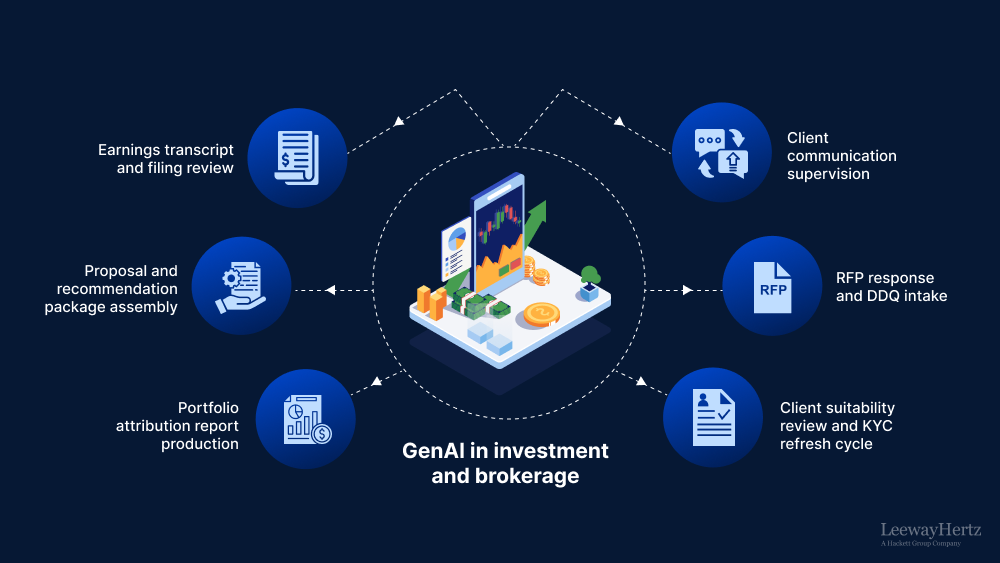
Investment and brokerage is a prime domain for generative and agentic AI because workflows intersect client records, research documents, portfolio data, regulatory requirements, exceptions, and operational handoffs.
Investment and brokerage firms are not constrained by a lack of data, but by how quickly they can turn it into informed decisions. Client records, market commentary, portfolio data, and compliance requirements often sit across disconnected systems, slowing the reviews that determine the next course of action. At the same time, scale continues to grow: global assets under management (AuM) reached a record $128 trillion in 2024, up 12% year over year [1], increasing the volume of material teams must interpret before they can act. This makes the industry a strong fit for generative and agentic AI, particularly where work involves structured data, documents, and repeatable decision processes that can be supported through draft generation, summarization, and controlled workflow handoffs.
However, value is only realized when generative AI is embedded directly into operational workflows rather than deployed as a standalone chatbot. Financial advisers currently spend around 70% of their time on operational and administrative work, leaving only 30% for client engagement [2]. In this context, an embedded assistant can prepare client meeting briefs from account notes and portfolio activity, reducing preparation time while keeping advisers fully accountable for final outputs. In portfolio management, GenAI can draft rationales for mandate exceptions based on the investment policy statement, enabling managers to focus on judgment rather than document assembly. Similarly, compliance teams can use GenAI to surface gaps between fund fact sheets and approved disclosure language, starting reviews with structured comparisons instead of blank documents.
Despite growing adoption, the gap between experimentation and integration remains significant, with 73% of advisory firms reporting some form of AI use, while only 6% have deployed agentic tools and just 5% have implemented cross-system AI integration as of 2026 [3]. This gap highlights an important distinction where a chatbot simply answers questions, whereas an embedded agentic workflow must understand system-of-record boundaries, approval ownership, and control points before taking any action. For this reason, generative AI opportunities need to be mapped at the function, process, and sub-process level, where work connects directly to systems, artifacts, owners, and controls.
This article applies an operating model across investment and brokerage to decompose work into functions, processes, and sub-processes, highlighting where generative AI can support drafting, summarization, and review preparation. Human reviewers remain accountable for validating outputs before release, whether for internal use, client communication, or risk-related actions.
- How generative AI is transforming investment and brokerage operations
- Why AI use cases in investment and brokerage must be mapped at the sub-process level
- Investment and brokerage operating model and generative AI opportunity mapping across investment and brokerage processes
- High-value generative AI use cases in investment and brokerage operations
- How agentic AI works in investment and brokerage workflows
- How to prioritize generative AI use cases in investment and brokerage operations
- Governance, risk, and responsible AI in investment and brokerage operations
- How ZBrain operationalizes generative AI use cases in investment and brokerage operations
- Future of generative AI in investment and brokerage operations
How generative AI is transforming investment and brokerage operations
Investment and brokerage operations have long relied on analytics, rules engines, workflow automation, robotic process automation, and machine learning to streamline processes, automate repetitive workflows and improve efficiency. These technologies remain foundational, but generative AI introduces a different class of capability.
Traditional automation follows predefined rules. Machine learning predicts, scores, detects, or classifies based on historical patterns. Generative AI can read, summarize, draft, compare, and explain information across structured and unstructured sources. Agentic AI extends this further by planning and executing sequences of workflow steps, such as retrieving client and market data, assembling case evidence, drafting review materials, routing exceptions, and updating systems after approval.
In investment and brokerage operations, this changes how teams handle these types of work:
-
Document-heavy: account opening packages, advisory agreements, fund prospectus supplements, CRS disclosures, regulatory filings, and KYC documentation.
-
Narrative-heavy: investment committee memos, client meeting summaries, market commentary, suitability rationales, and advisory notes.
-
Exception-heavy: portfolio rebalancing exceptions, trade breaks, settlement failures, account restriction reviews, and out-of-model allocation alerts.
-
Knowledge-heavy: product eligibility queries, supervisory procedures, fee schedule interpretation, investment policy guidance, and research governance rules.
-
Workflow-heavy: onboarding, portfolio reviews, client communication approvals, exception management, and compliance reporting.
A portfolio rebalancing exception typically involves fragmented inputs across systems, including CRM adviser notes, client emails on liquidity needs, model portfolio updates, and custodial tax-lot data. Rule-based automation can validate field completeness, and predictive models can identify patterns similar to historical exceptions; however, both approaches remain limited when the rationale is distributed across unstructured narrative and document sources.
Generative AI addresses this gap by consolidating these inputs into a structured review brief that outlines the proposed action and supporting evidence. Agentic workflows extend this capability by retrieving missing artifacts, such as investment policy statements or account guidelines, and routing the case for approval. This capability is increasingly relevant at scale, with 95% of wealth and asset management firms [4] reporting generative AI adoption across multiple use cases, indicating near-term value in reducing manual effort and improving review efficiency while preserving control.
Investment and brokerage use cases typically do not remove the human from the process. Instead, AI prepare the case, retrieve supporting evidence, draft outputs, highlight relevant considerations, and route work to the appropriate reviewer for validation and approval. Before any production change, customer-facing message, or risk-bearing action, a registered principal, portfolio manager, compliance officer, or client service supervisor confirms the outcome, ensuring accountability remains clear while enabling faster execution within the operating model.
Transform Investment & Brokerage Operations With GenAI
Leverage ZBrain Builder to design and deploy governed generative and agentic AI workflows across investment, advisory, and compliance operations, improving efficiency, traceability, and decision accuracy.
Why AI use cases in investment and brokerage must be mapped at the sub-process level
Investment and brokerage AI initiatives are often defined at a high level, such as “AI for investment and brokerage” or “AI for portfolio management,” but these constructs are insufficient to specify data requirements, control points, approval paths, implementation scope, or measurable outcomes.
A more effective approach is to map AI use cases to the investment and brokerage operating model:
-
Function: major business or control areas such as investment management, advisory services, trading and execution, and compliance and supervision.
-
Process: the workflow within a function such as portfolio construction, client review, suitability assessment, or regulatory reporting.
-
Sub-process: the specific activity where work is executed, such as rebalancing proposal generation, IPS clause drafting, or disclosure validation.
-
AI-enabled opportunity: the precise intervention where AI supports execution, such as drafting narratives, summarizing account activity, retrieving policy documents, classifying exceptions, or assembling review evidence.
This structure becomes necessary because investment and brokerage work only becomes executable when tied to specific workflows, artifacts, controls, and decision rights.
A portfolio manager may open a client review pack and observe positions outside tolerance bands, yet the initiative is still described only at a high level, such as “AI for investment and brokerage.” At this level, different workflows are conflated. A portfolio rebalancing recommendation depends on position data and portfolio accounting controls, while an investment policy statement (IPS) refresh depends on client objectives and constraints. Therefore, portfolio managers, wealth advisers, and compliance reviewers enter the workflow at different points. At this altitude, the initiative cannot be built, governed, or measured because it does not define the artifact produced, the control point for review, or the role accountable for decision-making. When mapped at the sub-process level, the same activity becomes a governed workflow with a clearly defined output, review step, and decision owner. This enables measurement of cycle time, manual effort, and review quality based on actual execution rather than conceptual intent.
Sub-process mapping makes this practical because each use case explicitly links capability, artifact, and ownership:
-
In the capital market assumptions review, retrieval-based summarization can generate a draft capital market assumptions memo from approved research notes, reducing analyst reconciliation effort and providing the head of investment strategy with a single version for validation before portfolio inputs are updated.
-
In IPS drafting, a language model can convert approved client information into a draft IPS section covering objectives and constraints, reducing the advisor’s drafting effort. The wealth adviser then confirms alignment with the client mandate, and compliance reviews the document before distribution.
This is the level of granularity required in the operating model. It ensures that GenAI use cases are tied to specific workflows, artifacts, controls, and decision rights, enabling generative and agentic AI to be implemented with measurable value and governed execution.
Investment and brokerage operating model and generative AI opportunity mapping across investment and brokerage processes
The investment and brokerage operating model below is organized into essential industry-native functions that practitioners recognize. Each function is decomposed into its major processes and their sub-processes, and each sub-process carries the AI-enabled opportunities that apply to it.
Function 1. Portfolio management and investment strategy
Portfolio management teams often lose time reconciling mandate language, portfolio exposures, and order context across disconnected systems. This function covers the mandate lifecycle, from investment objectives and asset allocation through rebalancing and oversight.
Generative and agentic AI is most useful when portfolio teams need structured explanations for drift, proposed rebalance actions, and cross-functional exception narratives. The value depends on reliable portfolio data, governed retrieval, and confirmation by portfolio, compliance before any order moves forward.
| Process | Sub-process | Key AI-enabled opportunities |
|---|---|---|
| Investment strategy and asset allocation | Capital market assumptions review | Compare return and risk narratives in the capital market assumptions packet with external research, flag risk-adjusted anomalies, and improve assumption challenge quality for the chief investment officer review. |
| Strategic asset allocation model design | Propose candidate allocation ranges, retrieve constraints from the investment policy statement (IPS), compare scenario narratives, and route it for portfolio manager review. | |
| Tactical asset allocation committee materials function | Draft tactical asset allocation materials, summarize market evidence, and map proposed tilts to factor risk, for chief investment officer review. | |
| Benchmark and policy portfolio selection | Compare candidate benchmark profiles with IPS policy weights and flag style or geographic mismatches against policy requirements for portfolio manager review. | |
| IPS governance and mandate setup | Investment Policy Statement (IPS) drafting | Draft IPS language for objectives and constraints, retrieve suitability facts, and flag incomplete mandate terms for investment adviser representative review. |
| IPS constraints and exclusion list capture | Extract issuer, sector, and concentration restrictions from the IPS, classify them against investment policy criteria, and flag ambiguous exclusions for compliance officer review. | |
| IPS periodic refresh and client approval | Compare current IPS language with refreshed Know Your Customer (KYC) attestations, summarize material changes, and draft approval notes for investment adviser representative review. | |
| Suitability-to-mandate mapping | Map risk tolerance and liquidity needs to IPS constraints, classify gaps under Regulation Best Interest (Reg BI), and flag out-of-mandate recommendations for investment adviser representative review. | |
| Portfolio construction and rebalancing | Model portfolio construction | Propose model weights, compare holdings with IPS constraints, and map factor exposures for portfolio manager review. |
| Portfolio drift monitoring against tolerance bands | Detect holdings that breach IPS tolerance bands, summarize drift drivers, and draft variance explanations for portfolio manager review. | |
| SMA and UMA sleeve allocation review | Aggregate sleeve-level holdings from separately managed account (SMA) and unified managed account (UMA) workbooks, and flag household-level allocation conflicts for portfolio manager review. | |
| Portfolio monitoring and investment oversight | Position limit and concentration review | Screen position weights from portfolio records against IPS limits, flag issuer or sector breaches, and accelerate exception triage for compliance officer review. |
| Tracking error and beta monitoring | Summarize tracking error and beta movements in the portfolio attribution report, compare drivers with factor outputs, and flag mandate-level deviations for chief investment officer review. | |
| Alpha and benchmark-relative return review | Summarize alpha and benchmark-relative return drivers, classify attribution effects and flag persistent underperformance patterns for portfolio manager review. | |
| Portfolio manager exception log maintenance | Aggregate open mandate breaches, classify escalation requirements under supervisory procedures, and draft exception log updates for compliance officer review. |
Highest-value opportunities: The strongest near-term value lies in IPS constraints capture, and portfolio drift monitoring. These workflows reduce manual reconciliation, shorten rebalance cycle time, improve mandate compliance, and preserve accountable sign-off before orders or client explanations proceed.
An example agentic workflow is the mandate drift to rebalance workflow. It plans a daily IPS tolerance-band review, retrieves mandate terms, portfolio weights, open orders, and factor exposures from governed investment platforms. It then drafts a drift narrative
Function 2. Investment research and analysis
Investment research is frequently constrained by the reconciliation of issuer disclosures, market data, internal notes, and portfolio exposures under committee timelines. This function covers market monitoring, issuer analysis, manager due diligence, thesis maintenance, and watchlist governance.
Generative and agentic AI helps research teams compress evidence synthesis and memo preparation. It supports better decision quality when retrieval is source-controlled and a research, portfolio, or committee role confirms the final recommendation.
| Process | Sub-process | Key AI-enabled opportunities |
|---|---|---|
| Market and macro research | Economic indicator monitoring | Extract key macro surprises from research calendars, compare them with IPS risk assumptions, and flag regime shifts for macro strategist review. |
| Market data screen setup | Classify securities and funds from screen outputs against IPS criteria, retrieve factor exposures, and flag candidates for research analyst review. | |
| Rates and credit spread analysis | Summarize treasury curve and spread moves, compare drivers with attribution outputs, and draft commentary for fixed income strategist review. | |
| Sector and country outlook assessment | Retrieve sector earnings revisions and sovereign indicators, compare exposures with IPS constraints, and draft outlook notes for sector specialist review. | |
| Security and issuer analysis | Earnings transcript and filing review | Extract guidance changes and risk-factor updates from Form 10-Q filings and earnings transcripts, and flag thesis-impacting deltas for equity analyst review. |
| Valuation model input gathering | Extract key valuation inputs from Form 10-K, Form 10-Q, and transcript tables, and flag stale fields for research analyst review. | |
| Credit and covenant review | Extract leverage tests and investor protections from credit documents, compare these covenant terms with IPS quality limits, and flag weak provisions for credit analyst review. | |
| ESG integration research notes | Extract environmental, social, and governance (ESG) evidence from sustainability reports and due diligence questionnaire (DDQ) responses, and draft evidence-linked notes for ESG analyst review. | |
| Manager and fund due diligence | Fund fact sheet/fund profile review | Extract performance and fee disclosures from the fund fact sheet or fund profile, compare claims with Global Investment Performance Standards (GIPS) records, and flag inconsistencies for manager research analyst review. |
| Strategy, process, and people assessment | Summarize investment philosophy and decision rights from Form ADV and DDQ materials, and draft assessment themes for manager research analyst review. | |
| Operational risk questionnaire review | Extract control owners and valuation procedures from DDQ responses, compare them with Form ADV disclosures, and flag unresolved gaps for operational due diligence officer review. | |
| Peer universe and style comparison | Compare fund holdings and risk statistics with peer data, classify style drift and flag benchmark mismatches for product specialist review. | |
| Investment committee materials | Research memo drafting | Draft thesis, valuation, and mandate-fit sections from analyst notes and portfolio evidence, and flag unresolved assumptions for portfolio manager review. |
| Investment thesis challenge session | Retrieve counterevidence from filings and factor outputs, compare it with the base case, and propose challenge questions for investment committee chair review. | |
| Watchlist and downgrade recommendation | Detect performance or liquidity breaches against IPS and watchlist criteria, retrieve prior committee decisions, and draft downgrade rationale for portfolio manager review. | |
| Decision log and action item tracking | Extract decisions and due dates from committee minutes, map them to supervisory evidence requirements, and flag overdue items for investment committee coordinator review. |
Highest-value opportunities: Earnings transcript and filing review, fund fact sheet review, and research memo drafting offer strong near-term value because they use repeatable artifacts with clear review handoffs. GenAI reduces synthesis effort, shortens committee preparation, and improves decision quality while preserving analyst and portfolio manager accountability.
An example agentic workflow is investment committee memo assembly. It plans the memo checklist from the committee calendar, retrieves issuer filings, transcripts, model outputs, portfolio exposures, and risk decomposition from governed research platforms. It then drafts thesis and risk sections, routes exceptions through the research queue, and asks the portfolio manager to confirm the final packet.
Function 3. Wealth planning and financial advisory
Wealth advisory teams often face a tension between client-facing time and operational documentation demands. This function covers household discovery, suitability profiling, planning, recommendation development, best-interest documentation, reviews, and relationship service.
Generative and agentic AI helps compress administrative work around discovery summaries, planning narratives, recommendation support, and review follow-ups. The value is highest when client profile data is current, workflows are integrated, and a financial adviser or supervisory principal confirms before client-facing use.
| Process | Sub-process | Key AI-enabled opportunities |
|---|---|---|
| Client discovery and suitability profiling | Risk tolerance questionnaire capture | Extract scored answers and free-text explanations from the risk questionnaire, classify inconsistencies against the KYC refresh cycle, and flag IPS gaps for financial adviser review. |
| Financial situation and liquidity needs review | Aggregate household cash-flow details from fact-finds and statements, summarize liquidity constraints for the IPS, and flag stale items for financial adviser review. | |
| Investment objectives documentation | Map goals and time horizons to the IPS, compare them with risk tolerance, and draft objective language for financial planner review. | |
| Client suitability review and KYC refresh cycle | Retrieve last attestations and account activity, compare changes with the IPS, and draft exception questions for supervisory principal review. | |
| Financial planning and proposal development | Goal-based planning scenario setup | Extract priority goals from client relationship management (CRM) notes, map them to planning assumptions and IPS constraints, and flag inconsistent objectives for financial planner review. |
| Retirement income and cash-flow projection | Aggregate retirement income projections, summarize shortfall drivers against IPS constraints, and flag assumptions requiring validation for financial adviser review. | |
| Tax-aware recommendation inputs generation | Retrieve tax, cost-basis, and account registration data, compare candidate fund profiles with Regulation Best Interest support, flag missing assumptions for financial adviser review. | |
| Proposal and recommendation package assembly | Draft proposal narrative sections from the IPS and planning outputs, validate required disclosures, and flag missing approvals for supervisory principal review. | |
| Reg BI recommendation support | Best-interest basis documentation | Draft best-interest support from the IPS and client profile, classify care and conflict evidence under Reg BI, and flag unsupported claims for supervisory principal review. |
| Reasonably available alternatives review | Compare proposed products with available alternatives using fund profiles and account constraints, and summarize trade-offs for supervisory principal review. | |
| Cost and fee comparison worksheet preparation | Extract advisory and product cost fields from Form CRS, Form ADV, and fund profiles, and flag unexplained differentials for supervisory principal review. | |
| Conflict disclosure alignment with Form CRS | Validate recommendation-specific conflicts against Form CRS and adviser compensation records, and draft disclosure edits for compliance officer review. | |
| Ongoing review and advisory service | Annual review meeting preparation | Retrieve prior notes, holdings, performance, and client milestones, summarize changes against the IPS, and draft an agenda for financial adviser review. |
| IPS refresh discussion notes drafting | Summarize changes in objectives and liquidity needs from CRM updates, compare them with the IPS, and draft refresh prompts for financial planner review. | |
| Portfolio drift client explanation | Retrieve portfolio drift exceptions, compare them with IPS target ranges, and draft plain-language explanations for financial adviser review. | |
| Client action item management | Extract tasks and due dates from review notes, map them to CRM tasks, and flag overdue service items for client service associate review. |
Highest-value opportunities: Client suitability refresh, best-interest basis documentation, and annual review preparation offer strong near-term value because they are high-volume workflows with clear supervisory boundaries. Retrieval, classification, and first-pass drafting reduce adviser administrative time, strengthen compliance evidence, and clarify accountability before client recommendations proceed.
An example agentic workflow is the annual review preparation workflow. It plans the household review checklist, retrieves CRM notes, holdings, performance, custodial activity, and market context from governed advisory platforms. It then drafts IPS refresh prompts and follow-up tasks, routes the package to the financial adviser, and captures confirmation from the financial adviser after approval.
Function 4. Client onboarding, KYC, and account opening
Client onboarding often stalls when account documents, identity evidence, suitability records, and custodian setup fields do not match. Client onboarding, KYC, and account opening function converts prospects into opened, funded, and compliant accounts.
Generative and agentic AI helps classify documents, extract data, identify missing items, and guide onboarding queues. It reduces rekeying across CRM, custody, compliance, and portfolio systems when KYC analysts and operations roles confirm exceptions before activation.
| Process | Sub-process | Key AI-enabled opportunities |
|---|---|---|
| Identity verification and client data capture | Customer Identification Program (CIP) | Extract core identity fields from the Customer Identification Program (CIP) record, compare evidence with CRM and custodian applications, flag mismatches for KYC analyst review. |
| Regulation S-ID red flags review | Detect onboarding anomalies, classify them against the Regulation S-ID red flags matrix, and summarize unresolved indicators for compliance reviewer review. | |
| Beneficial ownership verification | Extract ownership and control person details from the beneficial ownership certification, map entity hierarchies, and flag missing control persons for KYC analyst review. | |
| Regulation S-P privacy notice delivery | Retrieve the applicable Regulation S-P privacy notice, compare delivery evidence with acknowledgments, and flag missing records for compliance officer review. | |
| Suitability and account documentation | Client suitability review and KYC refresh cycle | Extract changed suitability facts from CRM notes and the IPS, compare them with the refresh checklist, and flag stale attestations for adviser review. |
| Risk tolerance and investment objective attestation | Classify attestation responses and adviser notes against IPS methodology, summarize client-profile and portfolio-alignment conflicts, and draft exceptions for registered representative review. | |
| Account type and registration selection | Propose account registration from CRM profile and entity papers, compare it with Reg BI requirements, and flag ambiguous ownership for advisory operations review. | |
| Form CRS delivery acknowledgement | Retrieve the current Form CRS, compare delivery timestamps with acknowledgements, and flag missing evidence for compliance officer review. | |
| Subscription and capital commitment onboarding | Subscription agreement completeness check | Extract investor details and required schedules from the subscription agreement, validate completeness in all required investor information, and flag missing items for fund operations review. |
| Investor eligibility review | Classify investor representations against accreditation and purchaser criteria, compare supporting KYC records, and summarize exceptions for compliance officer review. | |
| Capital call notice contact and wire setup | Extract notice and wire setup fields from subscription documents, compare them with custodian wire records, and flag discrepancies for fund operations review. | |
| Fund share class subscription setup | Compare share class elections with fee breakpoints and eligibility terms, and draft setup notes for fund operations review. | |
| Custody, funding, and account activation | Custodian account opening review | Extract account setup fields from the custodian package, compare them with CRM records, and flag inconsistent instructions for advisory operations review. |
| Standing wire instructions verification | Extract wire instruction fields and call-back evidence, compare them with custodian records, and flag mismatches for custody liaison review. | |
| Initial funding and asset transfer tracking | Aggregate custodian status updates for asset transfer forms, summarize transfer issues and pending requirements, and draft follow-up tasks for custody liaison review. | |
| Account activation in portfolio and accounting platforms | Validate account identifiers, fee schedules, and IPS model assignments, and flag missing data for advisory operations review. |
Highest-value opportunities: CIP review, subscription agreement completeness, and custodian account opening packages are strong candidates because they combine high intake volume with standardized artifacts. AI extraction, comparison, and exception drafting reduce rekeying, shorten not-in-good-order remediation, and give onboarding roles clear approval accountability.
An example agentic workflow is the account opening exception workflow. It plans the onboarding task list from the CRM platform, retrieves CIP records, Form CRS acknowledgments, subscription fields, and custodian status from governed systems. It then drafts missing-item requests and setup notes, routes exceptions to the advisory operations manager, and waits for the advisory operations manager to confirm account activation.
Function 5. Financial crime compliance: AML, sanctions, and fraud monitoring
Financial crime teams must monitor activity continuously after onboarding, screen against sanctions and watchlists, investigate alerts, and file regulatory reports under strict deadlines. This function supports the ongoing anti-money-laundering (AML) lifecycle, sanctions and watchlist screening, fraud detection, investigations, and suspicious activity reporting.
Generative and agentic AI helps triage alerts, assemble investigation files, summarize transaction patterns, and draft regulatory narratives from governed evidence. Value is highest when alert data, screening lists, and case records are integrated, and AML investigators, the Bank Secrecy Act (BSA) officer, and the BSA/AML officer retain disposition and filing authority.
| Process | Sub-process | Key AI-enabled opportunities |
|---|---|---|
| Transaction monitoring and alert triage | Suspicious activity alert triage | Classify monitoring alerts by typology and risk score, retrieve linked accounts and prior cases, summarize transaction patterns, and flag higher-risk alerts for AML investigator review. |
| Structuring and layering pattern review | Detect structuring and layering sequences across accounts, aggregate supporting transactions, draft pattern narratives, and flag escalations for AML investigator review. | |
| Unusual activity escalation | Compare flagged activity with the customer risk profile and expected activity, summarize identified inconsistencies, and draft escalation notes for BSA officer review. | |
| Alert disposition and audit trail | Validate disposition rationale against monitoring procedures, retrieve supporting evidence (alerts, transaction data, and case records), and draft closure or escalation memos for AML team lead review. | |
| Sanctions, PEP, and watchlist screening | OFAC and global sanctions screening | Compare customer and counterparty names against Office of Foreign Assets Control (OFAC) and global sanctions lists, classify potential matches (name, entity, and identifier), summarize match strength, and flag true-hit candidates for sanctions analyst review. |
| Politically exposed person (PEP) screening | Screen relationships against PEP and adverse media sources, classify exposure level and and draft enhanced review prompts for compliance officer review. | |
| Negative news and adverse media review | Retrieve adverse-media hits, classify relevance and reliability, summarize material findings, and flag reputational risks for AML investigator review. | |
| Screening match adjudication and review logging | Validate match-clearing rationale against screening procedures, retrieve evidence, and draft adjudication entries for sanctions analyst review. | |
| Enhanced due diligence and periodic review | Customer risk rating refresh | Recalculate risk ratings from updated KYC, activity, and screening data, compare against the prior risk rating, and flag rating changes for AML analyst review. |
| Enhanced due diligence (EDD) file assembly | Aggregate source-of-wealth, ownership, and activity evidence, summarize residual risk, and draft EDD memos for compliance officer review. | |
| Periodic KYC and AML refresh | Compare refreshed attestations and activity against expected profiles, flag stale or inconsistent data, and draft refresh requests for KYC analyst review. | |
| High-risk relationship review | Retrieve high-risk indicators and prior decisions, summarize ongoing monitoring rationale, and draft review packages for BSA officer review. | |
| Investigations and suspicious activity reporting | Investigation case file assembly | Aggregate alerts, transactions, KYC, and screening evidence into a case file, summarize the activity timeline, and draft investigation findings for AML investigator review. |
| Suspicious Activity Report (SAR) narrative drafting | Draft SAR narrative sections from case evidence, classify activity against reporting typologies, and flag filing-deadline risks for BSA officer review. | |
| SAR filing decision support | Compare investigation conclusions against filing thresholds, retrieve prior related SARs, and summarize the recommendation for BSA/AML officer review. | |
| Information request handling (314(a)/(b)) | Classify law-enforcement and information-sharing requests, retrieve matching records, draft response packages, and flag matches for BSA officer review. |
Highest-value opportunities: Alert triage, sanctions match adjudication, and SAR narrative drafting offer strong near-term value because they combine high event volume with structured evidence and strict review boundaries. AI reduces investigation assembly time, shortens alert aging, and strengthens regulatory evidence while filing decisions remain with the BSA/AML officer.
An example agentic workflow is the financial crime alert-to-SAR workflow. It plans the daily alert queue by risk and age, retrieves monitoring alerts, transaction histories, KYC profiles, and screening results from governed platforms. It then drafts a case file and SAR narrative with cited evidence, routes the case through the investigations queue, and records BSA/AML officer confirmation before any filing.
Accelerate AI Solutions Development
Build fully functional solutions from your high-value use cases, based on specific operational needs and enterprise context.
Function 6. Middle office, settlement, and reconciliation
Middle-office teams often carry settlement risk when custodian files, and broker confirmations diverge. This function owns control across affirmation, confirmation, reconciliation, settlement, fails management, cash updates, and position control.
Generative and agentic AI helps classify breaks, trace settlement dependencies, and draft resolution notes. The impact is lower manual effort, shorter T+1 follow-up, and clearer accountability when reconciliation analysts or operations managers approve repairs.
| Process | Sub-process | Key AI-enabled opportunities |
|---|---|---|
| Custodian and prime broker reconciliation | Daily reconciliation | Aggregate transaction activity and custodian settlement feeds, compare them under net asset value (NAV) reconciliation controls, and classify same-day breaks for reconciliation analyst review. |
| Custodian statement matching | Extract security, cash, and settlement fields from custodian statements, compare them with transaction records, and flag aged unmatched items for custodian liaison review. | |
| Prime brokerage position and cash break review | Aggregate prime broker positions and cash balances, map breaks to NAV controls, and summarize exposure-sensitive exceptions for prime brokerage operations contact review. | |
| Corporate action impact matching | Retrieve corporate action notices and affected holdings, compare entitlement impacts under NAV controls, and flag income or position differences for operations manager review. | |
| Settlement and fails management | Settlement instruction validation | Validate settlement instructions against confirmations and blotters, screen exceptions under supervisory procedures, and flag missing counterparty data for settlement specialist review. |
| Delivery-versus-payment status tracking | Retrieve delivery-versus-payment status messages, map messages to confirmations, and flag unsettled legs for settlement specialist review. | |
| Buy-in and close-out follow-up | Retrieve broker buy-in notices tied to confirmations, summarize timing and cost exposure, and draft response options for settlement manager review. | |
| Cash and position operations | Cash movement verification | Compare custodian cash movements with blotter records and capital call notices, and flag high-value exceptions for cash operations analyst review. |
| Position lot and cost basis update | Extract lot and transaction-date details from the transaction record, compare proposed basis updates, and and flag inconsistent lots for portfolio accounting analyst review. | |
| Fee and commission accrual check | Compare fee and commission terms in confirmations with accrual schedules, and summarize unusual variances for operations manager review. | |
| Operations exception log maintenance | Classify reconciliation and settlement exceptions, map ownership and aging rules, and draft status updates for operations manager review. |
Highest-value opportunities: Daily reconciliation, confirmation matching, and settlement exception escalation offer strong near-term GenAI value because they are high-volume workflows with clear review queues. Prioritizing these areas reduces manual break triage, shortens T+1 follow-up, and improves exception decisions without removing required controls.
An example agentic workflow is the T+1 break resolution workflow. It plans the T+1 break queue by risk and age, retrieves executed transactions, portfolio positions, accounting entries, and custodian records from governed platforms. It then drafts a blotter-linked exception narrative, routes the case through the operations queue, and confirms resolution only after the reconciliation analyst approves.
Function 7. Corporate actions, proxy voting, and stewardship
Asset-servicing teams carry risk when corporate action notices, client elections, entitlement calculations, and voting decisions must be processed accurately within issuer deadlines. This function covers mandatory and voluntary corporate action processing, income and entitlement handling, proxy voting, and stewardship recordkeeping.
Generative and agentic AI helps classify event notices, extract terms and deadlines, calculate entitlements for review, and map proxy agenda items to voting policy. Value is highest when event data, holdings, and custodian feeds are integrated, and corporate actions analysts, proxy specialists, and portfolio managers confirm elections and votes before submission.
| Process | Sub-process | Key AI-enabled opportunities |
|---|---|---|
| Corporate action event capture and validation | Event notice classification | Classify corporate action notices by type (mandatory, voluntary, mandatory-with-choice), extract key terms and deadlines, and flag ambiguous notices for corporate actions analyst review. |
| Multi-source event term reconciliation | Compare event terms across custodian, depository, and vendor notices, summarize discrepancies in event terms, and flag conflicting terms for corporate actions analyst review. | |
| Affected holdings identification | Retrieve affected positions across accounts and funds, validate eligible holdings against record dates, and flag position mismatches for corporate actions analyst review. | |
| Event calendar and deadline management | Extract response deadlines, map them to processing milestones, and flag at-risk deadlines for corporate actions team lead review. | |
| Election processing and entitlement | Voluntary election capture | Extract election options from voluntary event notices, compare portfolio and client instructions against deadlines, and draft election summaries for corporate actions analyst review. |
| Entitlement calculation review | Calculate cash and stock entitlements from event terms and holdings, compare against custodian figures, and flag entitlement breaks for corporate actions analyst review. | |
| Income and distribution processing | Aggregate dividend and interest entitlements, compare with custodian income feeds, and flag rate or timing differences for income operations analyst review. | |
| Class action and tax reclaim tracking | Retrieve class action notices and withholding-tax reclaim opportunities, summarize eligibility and deadlines, and draft claim packages for operations analyst review. | |
| Proxy voting and stewardship | Proxy agenda item classification | Classify ballot items against the proxy voting policy, retrieve proxy-adviser recommendations, and flag policy conflicts for proxy specialist review. |
| Vote recommendation and rationale drafting | Draft voting recommendations and rationale from policy and issuer materials, compare with adviser guidance, and flag contested items for portfolio manager review. | |
| Vote execution and reconciliation | Validate submitted votes against intended instructions and record dates, and flag unvoted or rejected ballots for proxy specialist review. | |
| Engagement and stewardship recordkeeping | Summarize engagement meeting notes and outcomes, map them to stewardship commitments, and draft records for stewardship lead review. | |
| Corporate action governance and recordkeeping | Event processing exception log | Classify processing exceptions by event type and aging, draft disposition notes, and flag repeat breaks for corporate actions team lead review. |
| Form N-PX vote disclosure support | Aggregate vote records, compare them against Form N-PX disclosure requirements, and flag missing or inconsistent votes for compliance officer review. | |
| Custodian and depository instruction reconciliation | Compare submitted instructions with custodian confirmations, summarize unmatched responses in instructions, and flag breaks for asset servicing manager review. | |
| Stale position and fail impact review | Retrieve unsettled positions affecting entitlements, summarize event-date exposure, and flag adjustments for corporate actions analyst review. |
Highest-value opportunities: Event notice classification, entitlement calculation review, and proxy agenda classification offer strong near-term value because they combine repeatable structured notices with tight deadlines and clear review handoffs. GenAI reduces manual capture, shortens deadline-driven cycle time, and improves election and vote accuracy while submission authority remains with analysts and portfolio managers.
An example agentic workflow is a voluntary corporate action election workflow. It plans the event queue by deadline, retrieves event notices, affected holdings, custodian terms, and prior instructions from governed asset-servicing platforms. It then drafts an entitlement summary and proposed election, routes the package to the corporate actions analyst and portfolio manager, and records confirmation before the election is submitted.
Function 8. Fund accounting, valuation, and NAV
Fund accounting teams face close pressure when valuation inputs, accounting records, administrator packages, and investor capital activity must align before release. This function owns the accounting book of record for pooled vehicles and funds.
Generative and agentic AI helps assemble valuation support, explain NAV variances, prepare reconciliation commentary, and draft notices from approved data. It improves close discipline when fund accountants, controllers, and valuation committee members confirm before any release.
| Process | Sub-process | Key AI-enabled opportunities |
|---|---|---|
| NAV calculation and accounting close | NAV calculation calendar management | Extract close milestones from administrator calendars and fund documents, map them to NAV workflows, and flag late feeds for fund controller review. |
| Position valuation import | Validate position marks from market data and custodian files, and flag stale or off-tolerance prices for fund accountant review. | |
| Expense accrual and fee calculation | Extract fee terms from fee schedules and accrual workbooks, compare calculated accruals with accounting outputs, and flag mismatches for fund controller review. | |
| Fund accounting trial balance close | Aggregate journal support, summarize open trial balance variances, and draft close commentary for fund controller review. | |
| Valuation and price verification | Market price tolerance checks | Compare vendor prices against the price tolerance report, classify breaches under ASC 820 fair value hierarchy, and flag outlier marks for valuation committee review. |
| Fair value committee packet preparation | Retrieve broker quotes, pricing notes, and prior decisions, summarize evidence under ASC 820, and draft discussion points for valuation committee review. | |
| Illiquid security valuation support | Extract comparable transaction data and issuer updates into valuation memos, map assumptions to ASC 820 inputs, and flag unsupported changes for valuation committee review. | |
| Price override approval and validation logging | Validate override requests against the approval log, summarize rationale and source hierarchy, and flag missing evidence for fund controller review. | |
| Administrator, custodian, and prime broker reconciliation | NAV reconciliation and variance analysis | Compare administrator NAV package balances with accounting trial balances, classify breaks, and draft variance commentary for fund controller review. |
| Custodian cash reconciliation | Extract cash movements from custodian statements, compare them with cash reconciliation worksheets, and flag unmatched wires or fees for operations analyst review. | |
| Prime brokerage financing and margin review | Retrieve financing charges and margin notices, compare them with review schedules, and flag unexplained rate changes for operations analyst review. | |
| Investment income and corporate action reconciliation | Aggregate income and corporate action notices from custodian feeds, compare entitlements with reconciliation reports, and draft exception narratives for fund accountant review. | |
| Capital activity and fund notices | Subscription agreement capital activity booking | Extract investor commitment and share class fields from subscription agreements, compare postings with the capital activity register, and flag inconsistent allocations for the investor services manager review. |
| Redemption and transfer processing | Classify redemption and transfer instructions against the capital activity register, map ownership impacts (investor positions and allocation changes), and flag notice-period mismatches for investor services manager review. | |
| Capital call notice preparation | Draft capital call notice sections from approved commitment schedules and wire instructions, compare allocation percentages, and flag investor-specific exceptions for fund controller review. | |
| Investor allocation statement review | Compare investor allocation statements with the capital activity register and administrator package, and flag inconsistent allocations for fund controller review. | |
| Fund fee and incentive accounting | Performance fee, hurdle, and high-water-mark calculation | Recalculate incentive fees from return, hurdle, and high-water-mark data, compare against accrual workbooks, and flag crystallization exceptions for fund controller review. |
| Waterfall and carried interest calculation | Map distribution tiers from fund terms, compute carried-interest splits, compare against the distribution model, and flag tier exceptions for fund controller review. | |
| Expense cap and fee waiver application | Compare incurred expenses against cap and waiver terms, summarize eligible reimbursement amounts, and flag breaches for fund controller review. |
Highest-value opportunities: Position valuation import, market price tolerance checks, and NAV reconciliation to administrator records offer strong value because they combine daily or period-end volume with clear review boundaries. GenAI reduces manual effort, shortens the NAV close, and improves valuation decision quality before release.
An example agentic workflow is the daily NAV variance workflow. It plans the close checklist, retrieves positions, trial balances, market prices, and custodian cash files from governed accounting platforms. It then drafts valuation and reconciliation commentary, routes the NAV package to the fund controller, and records confirmation when the fund controller approves release.
Function 9. Performance measurement, attribution, and GIPS reporting
Performance teams often spend significant time reconciling returns, attribution exhibits, benchmark data, and disclosure language across reporting cycles. This function covers return calculation, performance validation, attribution, risk-adjusted metrics, composite maintenance, and standardized reporting.
Generative and agentic AI helps produce performance commentary, compare narratives with exhibits, and accelerate review of assumptions. It improves reporting cycle time when performance analysts, attribution specialists, and GIPS committee members validate outputs before distribution.
| Process | Sub-process | Key AI-enabled opportunities |
|---|---|---|
| Return calculation and validation | Daily and monthly portfolio return calculation | Validate return inputs from portfolio accounting and custodian records, compare breaks under NAV controls, and summarize GIPS support exceptions for performance analyst review. |
| Net-of-fee and gross-of-fee return validation | Compare gross return, net return, fee schedule, and accrual fields across accounting exports, and flag fee-treatment exceptions for performance analyst review. | |
| Cash flow and valuation timing review | Extract cash-flow records and price timestamps, map them to NAV cutoffs, and flag timing exceptions for investment operations review. | |
| Benchmark return ingestion | Retrieve benchmark constituent returns, compare vendor files and effective dates, and flag stale benchmark series for attribution specialist review. | |
| Performance attribution and analytics | Brinson-Hood-Beebower performance attribution | Summarize allocation and selection drivers from attribution outputs, compare sector weights with benchmark exhibits, and draft commentary for attribution specialist review. |
| Portfolio attribution report production | Draft portfolio attribution report commentary from validated attribution tables, retrieve supporting transactions and exposures, and flag narrative-to-exhibit inconsistencies for client reporting analyst review. | |
| Allocation effect calculation | Validate portfolio and benchmark sector weights, compare outliers against attribution formulas, and summarize material drivers for attribution specialist review. | |
| Selection and interaction effect calculation | Map security-level return and classification fields, compare outliers with attribution exhibits, flag stale-price issues for attribution specialist review. | |
| GIPS composite management | GIPS composite construction | Classify portfolios by mandate and discretionary authority, compare eligibility against GIPS rules, and flag borderline assignments for GIPS committee review. |
| GIPS composite report maintenance | Validate benchmark names, fee disclosures, dispersion language, and composite descriptions against GIPS requirements, and flag stale disclosures for GIPS committee review. | |
| Annual GIPS performance reporting | Aggregate annual composite returns and disclosure support, compare table layouts against GIPS requirements, and draft update notes for GIPS committee review. | |
| Composite dispersion and inclusion review | Detect dispersion outliers and inclusion-date anomalies, retrieve supporting IPS records, and summarize exceptions for GIPS committee review. | |
| Risk-adjusted performance metrics | Sharpe ratio calculation | Validate return, risk-free rate, and volatility inputs, compare Sharpe ratio movements with prior files, and flag unexplained changes for performance analyst review. |
| Sortino ratio calculation | Validate downside-risk inputs, compare Sortino ratio movements with drawdown exhibits, and flag threshold mismatches for performance analyst review. | |
| Treynor ratio calculation | Retrieve beta and risk-free rate inputs, compare Treynor ratio movements with fund profile exhibits, and flag source inconsistencies for performance analyst review. | |
| Tracking error and information ratio review | Compare active return, benchmark return, and factor exposure inputs, and flag narrative-to-table inconsistencies for performance analyst review. |
Highest-value opportunities: Portfolio attribution report production, GIPS composite report maintenance, and net-of-fee validation offer strong near-term value. GenAI reduces manual cross-checking, shortens quarter-end and annual reporting cycles, and strengthens compliance evidence while preserving reviewer accountability.
An example agentic workflow is the GIPS composite report refresh. It plans the required GIPS refresh, retrieves composite membership, return, fee, dispersion, benchmark, and prior-disclosure files from governed platforms. It then drafts revised report sections with cited exceptions, routes the package to the GIPS committee, and records committee confirmation before release.
Function 10. Risk management and analytics
Risk teams often have strong analytics but slow escalation when model outputs, scenario results, and exception logs are not tied to mandate limits. This function covers market, factor, liquidity, concentration, counterparty, and model-related exposures.
Generative and agentic AI helps turn factor decompositions and scenario outputs into committee-ready explanations. It supports faster escalation and better decision quality when risk roles retain control over limit approvals and assumption changes.
| Process | Sub-process | Key AI-enabled opportunities |
|---|---|---|
| Market and factor risk monitoring | Factor risk model decomposition | Extract factor contribution tables from attribution reports, classify material drivers, and summarize variance shifts for portfolio risk manager review. |
| Style factor exposure review | Classify style factor exposures in fund profiles, compare them with IPS risk bands, and flag unintended tilts for portfolio risk manager review. | |
| Sector and country risk attribution | Aggregate sector and country contribution tables, map them to benchmark weights, and summarize concentrations for investment risk committee review. | |
| Beta and tracking error monitoring | Retrieve beta and tracking error outputs, compare movements against IPS tolerance bands, and flag benchmark-relative changes for chief risk officer review. | |
| Liquidity and concentration risk | Position concentration limit review | Compare position weights from holdings records with IPS concentration limits, classify allocation variances, and flag material breaches for chief risk officer review. |
| Average daily volume and liquidity bucket analysis | Aggregate transaction volumes and market liquidity fields, classify holdings into liquidity buckets, and summarize low-liquidity positions for portfolio risk manager review. | |
| Large block liquidation scenario | Draft liquidation scenario narratives from positions and average daily volume data, compare impact assumptions, and flag extended unwind timelines for portfolio risk manager review. | |
| Counterparty and prime broker exposure review | Retrieve counterparty balances from confirmations and prime broker statements, compare exposures under NAV controls, and summarize concentrations for operations control manager review. | |
| Stress testing and scenario analysis | Interest rate shock scenario analysis | Retrieve rate-shock outputs, compare duration-sensitive losses with IPS constraints, and summarize limit-relevant drivers for investment risk committee review. |
| Equity drawdown scenario analysis | Compare drawdown outputs with attribution exposures, classify factor contributors, and draft downside-risk commentary for investment risk committee review. | |
| Credit spread widening scenario analysis | Retrieve spread-widening outputs, compare issuer and sector losses with IPS constraints, and flag mandate-sensitive exposures for chief risk officer review. | |
| Portfolio risk committee pack | Aggregate scenario summaries, exception logs, and attribution exhibits, map open items to supervisory procedures, and draft discussion points for investment risk committee review. | |
| Risk governance and model oversight | Risk appetite limit maintenance | Compare current IPS risk limits with approved appetite changes, map affected mandates, and draft controlled update language for chief risk officer review. |
| Risk exception escalation | Classify limit breaches from blotters and exception logs, map severity to supervisory procedures, and draft escalation summaries for chief risk officer review. | |
| Model input data quality review | Validate identifiers, prices, classifications, and benchmark mappings feeding risk reports against approved reference data sources and risk reporting requirements, and summarize unresolved data issues for quantitative analyst review. | |
| Risk and factor modeling platform control review | Retrieve entitlement, model-change, and exception evidence from risk platforms, map controls to supervisory procedures, and draft control gaps for operations control manager review. |
Highest-value opportunities: Portfolio risk committee packs, risk exception escalation, and factor risk model decomposition are high-value because they draw from repeatable platform outputs and clear limit evidence. AI reduces preparation effort, shortens escalation cycle time, and improves decision quality without moving approvals out of human control.
An example agentic workflow is risk committee pack preparation. It plans the committee agenda from open limits and scenario deadlines, retrieves factor outputs, holdings, market context, and exception evidence from governed risk platforms. It then drafts the committee pack with cited attribution and IPS evidence, routes it to the investment risk committee chair, and captures chair confirmation before distribution.
Function 11. Compliance monitoring, supervision, and surveillance
Compliance teams face high alert volumes and strict documentation expectations across regulated activities, communications, marketing, and supervisory controls. This function supports procedures, surveillance, communication review, marketing review, breach remediation, conduct and conflicts monitoring, and annual program reporting.
Generative and agentic AI helps triage alerts, summarize evidence, compare communications with approved disclosures, and prepare supervisory narratives. It improves compliance cycle time when compliance officers, surveillance analysts, and supervisory principals retain final disposition authority.
| Process | Sub-process | Key AI-enabled opportunities |
|---|---|---|
| Written supervisory procedures and annual compliance program execution | Written supervisory procedures manual update | Compare regulatory change notices and branch findings with the written supervisory procedures manual, and draft targeted updates for chief compliance officer review. |
| WSP annual review under supervision rule | Aggregate supervision attestations, exception logs, and testing workpapers, classify gaps against supervisory requirements, and flag overdue remediation for supervisory principal review. | |
| Compliance annual report preparation | Summarize exception trends, policy changes, Form ADV updates, and remediation status, and draft annual report narratives for chief compliance officer review. | |
| Exception log and supervisory control testing | Extract issues from surveillance alerts and review notes, classify control failures, and flag repeat exceptions for compliance officer review. | |
| Communications and marketing compliance review | Client communication supervision | Classify emails, chats, and CRM notes against approved disclosures, and flag promissory language or missing risk context for supervisory principal review. |
| Fund fact sheet/fund profile compliance review | Compare performance and benchmark language in fund profiles with GIPS records, validate disclosures, and flag inconsistencies for compliance officer review. | |
| Pitch book compliance sign-off | Compare performance claims and fee disclosures in the pitch book with GIPS support, retrieve source excerpts, and flag unsupported statements for legal reviewer review. | |
| Form CRS consistency review | Compare relationship descriptions, fees, conflicts, and disciplinary disclosures in Form CRS with Form ADV, and flag material inconsistencies for chief compliance officer review. | |
| Conduct, conflicts, and the marketing rule review | Marketing rule (206(4)-1) advertisement review | Classify advertisements and performance claims against Marketing Rule requirements, retrieve substantiation evidence, and flag testimonial, hypothetical-performance, and gross/net issues for compliance officer review. |
| MNPI and information barrier monitoring | Compare access logs, watch and restricted lists, and communications against information-barrier controls, and flag potential material non-public information (MNPI) handling issues for compliance officer review. | |
| Pay-to-play and political contribution review | Classify employee political contributions against pay-to-play rules and government-entity client lists, and flag potential triggers for compliance officer review. | |
| Gifts, entertainment, and outside business activity review | Extract gift, entertainment, and outside-business-activity disclosures, compare against thresholds and approval records, and flag unapproved items for supervisory principal review. |
Highest-value opportunities: Compliance checking, surveillance, and client communication supervision offer strong AI lift because they combine high event volumes with artifact-rich evidence. The Marketing Rule advertisement review adds high near-term value given its breadth across performance and testimonial claims. These use cases reduce manual triage, shorten alert aging, and improve decision quality while final determinations remain with accountable compliance reviewers.
An example agentic workflow is surveillance alert triage. It plans a daily wash sale and conduct surveillance run, retrieves transaction records, holdings, and surveillance alerts from governed platforms. It then drafts a prioritized exception summary with timestamps and account links, routes the case through the compliance workflow, and asks the surveillance analyst to confirm disposition.
Function 12. Regulatory reporting, registrations, and filings
Regulatory reporting teams often face deadline pressure when filing data, prior disclosures, approval evidence, and books-and-records materials sit across multiple repositories. This function owns recurring adviser, broker-dealer, representative, fund, holdings, beneficial ownership, and financial operating filings.
Generative and agentic AI helps extract filing inputs, compare prior-period disclosures, draft change summaries, and manage evidence. It reduces filing effort when regulatory reporting, compliance, legal, and finance roles confirm submissions before they move forward.
| Process | Sub-process | Key AI-enabled opportunities |
|---|---|---|
| Adviser and broker-dealer registration filings | Form ADV Part 1 annual amendment | Extract assets under management (AUM), ownership, office, and disciplinary data, compare changes against Form ADV Part 1, and flag inconsistent answers for chief compliance officer review. |
| Form ADV Part 2A brochure update | Draft service, fee, conflict, and disciplinary disclosure updates for Form ADV Part 2A, and flag material changes for legal reviewer approval. | |
| Form ADV Part 2B brochure supplement update | Extract representative credentials and outside activities from governed records, compare them with Form ADV Part 2B, and draft exceptions for registration specialist review. | |
| Form BD registration amendment | Extract branch, ownership, control, and disciplinary changes, compare them with current Form BD, and flag off-standard disclosures for compliance officer review. | |
| Retail disclosure and representative registration | Form CRS update and delivery record | Retrieve fee, service, conflict, and relationship updates, compare Form CRS delivery records with Reg BI evidence and flag missing client records for compliance officer review. |
| Form U4 registration filing | Extract employment history, exams, outside activities, and disclosure items, classify responses against Form U4 requirements and draft filing packets for registration principal review. | |
| Form U5 termination notice filing | Extract termination facts and complaint status, compare proposed Form U5 language with filing requirements and flag reportable-event ambiguities for legal reviewer approval. | |
| Registered representative disclosure reconciliation | Compare Form U4, Form U5, complaint logs, and compliance disclosures, classify mismatches by reportability, and draft exceptions for compliance officer review. | |
| Holdings and beneficial ownership reporting | Form 13F quarterly institutional holdings filing | Extract reportable holdings from portfolio accounting and custodian files, compare values with prior Form 13F submissions and flag unsupported positions for regulatory reporting analyst review. |
| Form 13F position-level formatting | Map accounting exports into Form 13F table fields, validate issuer identifiers against the official securities list and flag formatting exceptions for regulatory reporting analyst review. | |
| Schedule 13D threshold monitoring | Retrieve share-outstanding data and aggregated ownership records, compare threshold crossings with Schedule 13D history, and draft exception evidence for legal reviewer approval. | |
| Schedule 13G passive ownership filing | Extract issuer details and investor-status evidence, compare eligibility against Schedule 13G criteria, and flag intent concerns for legal reviewer approval. | |
| Fund and position-level regulatory filings | Form PF private fund reporting | Extract fund, strategy, exposure, and liquidity data, compare against prior Form PF submissions, and flag threshold and variance exceptions for regulatory reporting analyst review. |
| Form N-PORT monthly portfolio reporting | Map portfolio holdings and risk metrics into Form N-PORT fields, validate identifiers and liquidity classifications, and flag formatting exceptions for regulatory reporting analyst review. | |
| Form N-CEN annual registered fund reporting | Aggregate fund census and service-provider data, compare against prior Form N-CEN filings, and flag inconsistent answers for fund controller review. | |
| Form 13H large trader reporting | Compare aggregated transaction volume against large-trader thresholds, retrieve identifying data, and flag threshold crossings for compliance officer review. | |
| Broker-dealer financial and books-and-records reporting | Form X-17A-5 / Focus report preparation | Extract trial balance and capital support from finance records, compare variances with prior Form X-17A-5 reports and draft explanations for finance controller review. |
| Books and records retention | Classify blotter files, supervisory approvals, customer communications, and procedure evidence against retention schedules and flag gaps for records compliance officer review. | |
| Audited financial statement package | Aggregate general ledger workpapers and clearing statements, compare them with annual audit support and draft prepared-by-client variance notes for finance controller review. | |
| Operational capital and reserve schedule review | Compare net capital and reserve schedules with filing support, summarize variances, and flag unsupported assumptions for finance controller review. |
Highest-value opportunities: Form 13F filing, Form ADV Part 1 annual amendments, books-and-records retention, and the Form PF / Form N-PORT fold-ins offer strong near-term value because they use structured source systems and repeatable prior-period comparisons. GenAI reduces filing effort, sharpens exception prioritization, and strengthens compliance evidence while accountable reviewers retain confirmation authority.
An example agentic workflow is the Form 13F filing evidence workflow. It plans the Form 13F filing calendar, retrieves position and identifier data from governed portfolio and custodian systems. It then drafts the holdings table and exception log, routes unresolved identifier or valuation issues through the compliance workflow, and confirms filing-ready status with the regulatory reporting manager.
Function 13. Client reporting and communications
Client reporting teams often work under time pressure to align performance data, attribution explanations, disclosures, tax information returns, and distribution approvals. This function manages periodic reports, investor letters, meeting materials, confirmations, disclosure delivery, tax reporting, and communication archiving.
Generative and agentic AI helps convert approved portfolio data into clear client narratives and structured service records. It improves cycle time and compliance accountability when advisers, portfolio specialists, and compliance approvers confirm drafts before distribution.
| Process | Sub-process | Key AI-enabled opportunities |
|---|---|---|
| Periodic portfolio and account reporting | Quarterly client report data capture | Extract account positions and return fields from accounting exports, compare required performance fields with GIPS records, and flag missing data for client reporting analyst review. |
| Holdings and transaction statement review | Compare custodian holdings and transaction rows with internal records, summarize unmatched details (position, quantity, and activity discrepancies), and flag exceptions for operations supervisor review. | |
| Portfolio attribution report inclusion | Summarize attribution effects from the portfolio attribution report, map commentary to attribution methodology and flag unexplained benchmark variances for portfolio specialist review. | |
| Fee and performance exhibit validation | Validate fee and performance exhibit text, compare disclosed returns with GIPS records and flag inconsistencies for compliance approver review. | |
| Investor letters and fund communications | Quarterly investor letter drafting | Draft return, performance driver, positioning, and risk sections of the quarterly investor letter, and flag unsupported claims for portfolio specialist review. |
| Market commentary and portfolio positioning update | Retrieve market data and holdings context, map positioning changes to IPS drift monitoring and summarize benchmark-relative themes for portfolio manager review. | |
| Forward outlook and risk disclosure review | Screen forward outlook language, compare risk statements with factor exposures, and flag unsupported performance claims for compliance approver review. | |
| Compliance sign-off for distribution | Classify proposed investor letter language against supervisory procedures, retrieve prior approvals, and route unresolved exceptions for compliance approver review. | |
| Client meeting and service communication | Review meeting deck preparation | Draft review deck sections from attribution reports and account exhibits, map recommendations to the IPS, and flag off-mandate talking points for adviser review. |
| Advisor meeting notes capture | Summarize approved meeting transcripts into structured CRM notes, extract suitability changes against the IPS, and flag new constraints for adviser review. | |
| Client action item tracking | Extract client requests and promised follow-ups from CRM notes, map suitability actions to the IPS, and flag overdue items for client service manager review. | |
| CRM and advisor technology communication logging | Classify emails, meeting summaries, and portal messages for CRM logging, map recommendation records to Form CRS, and flag missing metadata for compliance operations manager review. | |
| Disclosure and confirmation communication | Form CRS material change communication | Compare updated Form CRS language with prior versions, classify material-change triggers, and draft client notice language for compliance officer review. |
| Privacy notice delivery under Regulation S-P | Retrieve privacy notice delivery populations from CRM and custodian feeds, compare suppression rules, and flag delivery gaps for privacy officer review. | |
| Client communication archive retention | Classify archived communications by retention category, compare metadata with supervisory procedures, and flag missing evidence for compliance records manager review. | |
| Client tax reporting and information returns | Form 1099 production and validation | Aggregate income, proceeds, and adjustment data, compare 1099 fields against accounting and custodian records, and flag discrepancies for tax operations analyst review. |
| Schedule K-1 generation and review | Map partnership allocation data into Schedule K-1 fields, compare against the capital activity register, and flag allocation exceptions for tax operations analyst review. | |
| Cost-basis and tax-lot reporting | Validate cost-basis and lot-relief methods against transaction and corporate-action records, and flag wash-sale and basis adjustments for tax operations analyst review. | |
| FATCA/CRS classification and 1042-S withholding | Classify account holders against FATCA and Common Reporting Standard (CRS) status, compare withholding against Form 1042-S requirements, and flag classification gaps for tax compliance officer review. |
Highest-value opportunities: Quarterly investor letter drafting, review meeting deck preparation, compliance sign-off for distribution, and Form 1099 / K-1 validation offer strong near-term value because they are recurring and artifact-rich. GenAI reduces assembly time, improves narrative alignment with performance evidence, and maintains compliance accountability through human confirmation.
An example agentic workflow is the quarterly investor letter workflow. It plans the investor letter sections, retrieves approved returns, holdings, attribution data, market research, and prior disclosure approvals from governed platforms. It then drafts the performance narrative and disclosure checklist, routes flagged claims through the CRM workflow, and records confirmation by the compliance approver.
Function 14. Institutional marketing, RFP, and DDQ preparation
Institutional marketing teams often need to reuse approved content quickly while maintaining consistency across prospect materials, performance exhibits, and compliance disclosures. This function covers product messaging, Request for Proposal (RFP) responses, DDQs, data rooms, fund profiles, and prospect follow-up.
Generative and agentic AI help assemble cross-functional inputs, reuse approved language, and check consistency before distribution. It reduces manual effort and response cycle time when RFP managers, product specialists, and compliance reviewers confirm final materials.
| Process | Sub-process | Key AI-enabled opportunities |
|---|---|---|
| RFP response management | RFP response package intake and scoring | Extract mandate requirements and deadlines from the RFP package, classify questions against approved content, and flag low-fit sections for institutional sales manager review. |
| RFP response workflow coordination | Map RFP sections to investment and compliance owners, retrieve approved RFP responses, and draft status summaries for RFP manager review. | |
| Investment team content collection | Retrieve approved strategy narratives and attribution commentary, compare them with current portfolio data, and flag stale content for product specialist review. | |
| Compliance-approved final submission | Validate the final RFP package against approved disclosures and Form ADV language, and flag unsupported claims for compliance reviewer approval. | |
| DDQ and investor data room management | DDQ preparation | Draft DDQ responses from approved language, Form ADV, and current firm data, and flag disclosure gaps for compliance reviewer approval. |
| Investor data room document refresh | Compare data room contents with current DDQ, GIPS, and Form ADV records, and flag expired files for investor relations review. | |
| Operations and risk questionnaire completion | Retrieve operations controls and valuation practice excerpts, summarize evidence, and flag unanswered risk topics for operations risk manager review. | |
| Compliance certification package assembly | Aggregate signed policies, Form ADV, annual compliance excerpts, and supervisory references, and flag missing attestations for chief compliance officer approval. | |
| Pitch books and fund profiles | Pitch book storyboarding | Propose pitch book storyboards using approved strategy positioning and attribution insights, map performance slides to GIPS requirements, and flag unsupported claims for product marketing lead review. |
| Fund fact sheet/fund profile production | Draft fund profile updates from accounting data, fee schedules, and approved disclosures, compare performance tables with GIPS requirements, and flag breaks for performance team review. | |
| Strategy performance exhibit update | Retrieve benchmark returns and attribution commentary, summarize allocation drivers, flag unexplained variances for investment team review. | |
| Compliance review before distribution | Screen pitch book and fund profile text for promissory language and outdated disclosures, and flag exceptions for compliance reviewer approval. | |
| Product marketing and distribution enablement | AUM and capacity messaging update | Aggregate AUM, strategy capacity, subscriptions, and redemption context, compare wording with GIPS requirements, and flag unsubstantiated capacity statements for product specialist review. |
| GIPS composite report attachment selection | Classify prospect strategy and vehicle requests, retrieve the matching GIPS composite report, and flag attachment mismatches for performance team review. | |
| CRM opportunity and pipeline update | Summarize meeting notes, RFP milestones, and consultant feedback from CRM records, and flag stale next steps for institutional sales manager review. | |
| Institutional prospect follow-up package | Draft follow-up content using approved pitch materials and DDQ answers, compare materials with workflow next steps, and flag missing approvals for consultant relations review. |
Highest-value opportunities: RFP intake and scoring, DDQ preparation, and fund profile production offer strong near-term value by reusing approved language and structured performance data. Applying GenAI here reduces manual assembly, shortens response cycles, and improves consistency before materials reach institutional prospects.
An example agentic workflow is the RFP response assembly workflow. It plans the response calendar from the RFP package, retrieves approved answers, performance data, CRM context, and compliance disclosures from governed platforms. It then drafts section responses and exception notes, routes the package to the RFP manager and compliance reviewer, and records confirmation once the compliance reviewer approves distribution.
Function 15. Technology, data, integration, and AI governance
Technology and data teams often support investment workflows that depend on clean integrations, governed access, and reliable evidence across many platforms. This function owns systems, data, integration, workflow automation, cybersecurity, privacy controls, model enablement, and AI governance.
Generative and agentic AI creates value only when common data access, retrieval controls, model inventories, approval workflows, and monitoring are in place. The strongest outcomes come from reducing intake cycle time, reconciliation rework, and access review effort while preserving role-based approval.
| Process | Sub-process | Key AI-enabled opportunities |
|---|---|---|
| Core platform ownership and workflow enablement | Order management and execution platform administration | Classify OMS configuration tickets against execution algorithm controls, retrieve affected blotter samples, and flag mismatched routing rules for execution platform owner review. |
| Portfolio management and accounting platform administration | Validate accounting configuration changes against NAV procedures, compare output with attribution reports, and summarize exceptions for portfolio accounting manager review. | |
| Compliance and RegTech workflow administration | Map compliance workflow rules to supervisory procedures, classify stale escalations, and draft exception summaries for chief compliance officer review. | |
| CRM and advisor technology administration | Extract CRM field changes, compare them with Form CRS delivery tasks, and flag missing attestations for advisor operations manager review. | |
| Data management and integration | OMS to portfolio accounting data feeds | Compare OMS blotter records with accounting position loads under NAV controls, summarize reconciliation discrepancies, and route material exceptions for investment operations manager review. |
| Custodial and clearing data integration | Extract settlement and position fields from custodian confirmations, compare them with accounting records, and flag custody breaks for custodial operations manager review. | |
| Market data and research entitlement management | Classify market data entitlement requests against supervisory procedures, retrieve user-role evidence, and flag excess access for market data manager review. | |
| Data lineage and reconciliation controls | Map lineage from blotter transactions to Form 13F extracts, compare field transformations, and summarize unresolved breaks for data governance lead review. | |
| AI platform enablement and model governance | AI use case intake and approval | Classify AI intake forms by data type and decision impact against the AI risk management framework, and route high-risk proposals for AI governance committee review. |
| AI risk management framework control mapping | Map model risk assessment entries to governance categories, retrieve policy evidence, and flag unmapped controls for model risk manager review. | |
| Model inventory and risk tiering | Classify model inventory records by data sensitivity, user impact, and automation level, and flag inconsistent risk ratings for model risk manager review. | |
| Human-in-the-loop approval workflow | Validate human approval log entries against oversight controls, retrieve source prompts and passages, and draft exception summaries for AI governance committee review. | |
| Prompt and retrieval knowledge base governance | Screen prompt registry and retrieval base changes against AI governance controls, compare cited passages with approved disclosures, and flag unsupported content for content governance owner review. | |
| Cybersecurity, privacy, and records controls | Cybersecurity framework control mapping | Map cybersecurity evidence to control outcomes, retrieve missing policy references, and flag stale controls for chief information security officer review. |
| Regulation S-P privacy control testing | Extract customer information-sharing controls, compare them with CRM opt-out records, and flag control gaps for privacy officer review. | |
| Electronic records retention | Validate electronic retention tags and confirmation records against books-and-records rules, and flag gaps for records management officer review. | |
| Access certification and entitlement review | Aggregate entitlement exports from market data, and CRM platforms, classify access against certification reports, and flag excessive privileges for application owner review. |
Highest-value opportunities: AI use case intake and approval, data lineage controls, and access certification offer strong value because they are high-volume governance workflows with clear review boundaries. GenAI reduces intake cycle time, reconciliation rework, and certification effort while preserving accountability for governance, data, and application owners.
An example agentic workflow is the AI use case intake approval workflow. It plans the control checklist from intake fields, retrieves policy text, model inventory records, and data classifications from governed repositories. It then drafts the intake decision package and control mapping, routes the case through the technology service workflow, and records confirmation by the AI governance committee.
Accelerate AI Solutions Development
Build fully functional solutions from your high-value use cases, based on specific operational needs and enterprise context.
High-value generative AI use cases in investment and brokerage operations
In investment and brokerage operations, many AI initiatives underperform when they begin with judgment-heavy decisions rather than structured, reviewable work. High-value use cases typically emerge where work enters at high-volume touchpoints, moves across existing artifacts, and reaches a clearly defined human approval step. This structure reduces manual effort and cycle time while preserving control over investment and compliance decisions.
The table below outlines representative high-value use cases mapped across function, why the use case is high-value, and the specific generative AI intervention.
| Use case | Function | GenAI intervention | Why is it high-value |
|---|---|---|---|
| Investment policy statement (IPS) constraints and exclusion list capture | Portfolio management and investment strategy | Extracts and drafts proposed IPS constraints from approved client documents and policy inputs | High-frequency mandate updates create repetitive documentation work; value comes from reducing manual drafting while ensuring portfolio managers approve structured constraints before policy updates |
| Earnings transcript and filing review | Investment research and analysis | Summarizes earnings transcripts and highlights guidance changes from filings | High coverage volume makes review repetitive; value lies in compressing research cycles while analysts retain final validation of investment implications |
| Client suitability review and KYC refresh cycle | Client onboarding, KYC, and account opening | Identifies missing suitability fields and drafts completeness gaps from client records | Large advisory books generate a continuous refresh workload; value comes from reducing manual validation effort while registered representatives confirm compliance before account changes |
| Proposal and recommendation package assembly | Wealth planning and financial advisory | Generates draft recommendation summaries from approved planning inputs and portfolio data | High planning volume creates repetitive assembly work; value comes from accelerating advisor preparation while ensuring final client advice remains human-approved |
| NAV reconciliation to administrator records | Fund accounting, valuation, and NAV | Compares internal NAV calculations with administrator records and flags variances | Frequent close cycles require repetitive tie-outs; value comes from reducing operational workload while fund controllers validate differences before NAV publication |
| Portfolio attribution report production | Performance measurement and GIPS reporting | Drafts attribution narratives from approved performance datasets | Reporting cycles are time-constrained and repetitive; value comes from reducing narrative drafting effort while performance teams approve final attribution commentary |
| Client communication supervision | Compliance monitoring and surveillance | Classifies communication risk and drafts escalation summaries for review | High communication volume makes manual sampling inefficient; value comes from improving coverage while compliance principals retain final escalation authority |
| RFP response and DDQ intake | Institutional marketing and due diligence | Maps incoming questions to approved content and drafts response packages | High bid volume creates repetitive coordination work; value comes from reducing response assembly time while marketing reviewers approve final submissions |
A use case is considered high-value when it delivers clear economic benefit from reduced manual work, has a defined review boundary, and includes an explicit approval point before any production, client-facing, or risk-bearing action. The strongest candidates are those in which generative AI removes repetitive assembly tasks, improves the consistency of review inputs, and preserves human accountability at the final decision stage.
How agentic AI works in investment and brokerage workflows
Generative AI can draft, summarize, classify, and retrieve information. Agentic AI goes a step further by coordinating a workflow across systems, records, roles, and approval points. In investment and brokerage, this distinction is critical because many high-value workflows are not single-step content tasks. They require the system to gather evidence from controlled financial platforms, compare records, assemble review-ready artifacts, route exceptions, and pause for confirmation before any transaction, account, compliance, or client-facing action proceeds.
For example, a portfolio rebalancing workflow is not just an analytical task. It may require identifying drift against investment policy constraints, retrieving portfolio positions and mandate terms, checking open orders and exposures, drafting a rebalancing recommendation, and routing it for portfolio manager and compliance team approval. An agentic AI workflow can coordinate these steps, while the portfolio manager remains accountable for the final decision before execution.
This shift is becoming more relevant as wealth and capital markets platforms move from embedded copilots to task-specific agents, and as portfolio management systems, compliance tools, CRM systems, and custodial platforms increasingly expose structured workflows that can be orchestrated across systems.
The core design principle is controlled coordination. A well-designed agentic workflow plans the task, retrieves approved financial and regulatory data, compares records, drafts a structured output for review, routes exceptions to the appropriate queue, and waits for confirmation from the assigned role. Its access remains limited to approved investment, advisory, compliance, operations, and reporting systems. It also maintains auditability through source traceability, decision logs, exception tracking, and reviewer confirmations.
Examples of agentic AI workflows in investment and brokerage include:
Portfolio rebalancing and IPS drift workflow
The agent retrieves portfolio holdings, IPS constraints, exposure data, and open order information from approved systems. It calculates drift against tolerance bands, drafts a rebalancing recommendation with compliance flags, and routes the package to the portfolio manager and compliance officer for approval before execution.
Investment committee memo assembly workflow
The agent retrieves issuer filings, earnings transcripts, analyst notes, and portfolio risk data from approved research systems. It structures a draft investment committee memo covering valuation, performance drivers, and mandate alignment, and routes it to the portfolio manager for final review before submission.
Client annual review preparation workflow
The agent retrieves CRM notes, portfolio performance data, and custodial records from approved advisory systems. It prepares a consolidated review pack, drafts IPS refresh prompts and portfolio summaries, and routes follow-up actions to the financial advisor for validation before client engagement.
Account opening and onboarding exception workflow
The agent retrieves KYC records, CIP verification data, and account documentation from onboarding systems. It identifies missing or inconsistent fields, drafts remediation requests, and routes the package to operations for approval before account activation.
This structure makes agentic AI practical in investment and brokerage operations. The agent prepares evidence and drafts structured outputs, while the accountable team member confirms decisions before any execution, client communication, account change, or risk-bearing action occurs. This preserves governance while improving cycle efficiency across regulated financial workflows.
How to prioritize generative AI use cases in investment and brokerage operations
Investment and brokerage organizations should not prioritize generative AI use cases based solely on perceived innovation. Effective prioritization requires evaluating each use case across business value, workflow fit, data readiness, governance structure, and scalability. This ensures that AI is applied to sub-processes where it can reduce manual effort and improve review efficiency while preserving control over investment, advisory, and compliance decisions.
A structured prioritization framework includes the following criteria:
| Prioritization criterion | What investment and brokerage teams should evaluate |
|---|---|
| Business value | Whether the use case improves cycle time, reduces manual review effort, lowers operational cost, improves compliance efficiency, or enhances client servicing quality |
| Workflow fit | Whether the work is document-heavy, narrative-heavy, exception-heavy, knowledge-heavy, or repetitive enough for drafting, summarization, classification, or retrieval support |
| Data readiness | Whether required inputs such as client records, portfolio data, IPS documents, research notes, or compliance rules are available, accurate, permissioned, and system-connected |
| Human review model | Whether a defined role, such as portfolio manager, registered principal, compliance officer, or operations supervisor can review, approve, reject, or correct AI outputs before execution |
| Control and compliance impact | Whether the workflow affects suitability, account changes, disclosures, or regulatory reporting requiring auditability and supervision |
| Integration complexity | How many systems are involved, such as CRM, portfolio management systems, trading platforms, custodial systems, compliance monitoring tools, and research systems |
| Exception frequency | Whether the workflow regularly involves rebalancing exceptions, onboarding gaps, suitability issues, or compliance escalations that require structured resolution |
| Scalability | Whether the workflow pattern can be reused across asset classes, client segments, advisory teams, or compliance functions |
A practical first wave of generative AI use cases should focus on high-volume, artifact-rich, and clearly governed sub-processes where outputs can be reviewed before any operational or client impact. Examples include portfolio rebalancing and IPS drift analysis, investment committee memo preparation, client annual review package assembly, compliance checks, onboarding and KYC refresh cycles, suitability review support, and regulatory reporting commentary generation. These workflows typically have structured inputs, repeatable logic, and clearly defined approval points.
More sensitive use cases should be prioritized later or designed with stronger governance controls. These include discretionary portfolio changes, suitability final approval decisions, client disclosure issuance, regulatory filing submission, and any workflow that directly updates controlled client, regulatory, or financial records. In these areas, generative AI should support drafting, evidence assembly, and comparison, while final accountability remains with designated human roles.
A use case is often misprioritized when it is defined too broadly (such as “AI for advisory operations”) rather than tied to a specific sub-process, such as IPS clause drafting or rebalancing proposal generation. It may also fail when supporting data is fragmented, incomplete, or inaccessible across systems. Governance risk increases when workflows bypass defined approval roles or operate outside controlled systems. Value assumptions are unreliable if baseline cycle time, workload volume, and rework rates are not measured before implementation.
The strongest initial candidates are high-volume, structured, and cleanly governed sub-processes within investment and brokerage operations. These use cases enable firms to demonstrate measurable efficiency gains while establishing the data, workflow orchestration, approval controls, and auditability foundations required to scale agentic AI in regulated financial environments.
Accelerate AI Solutions Development
Build fully functional solutions from your high-value use cases, based on specific operational needs and enterprise context.
Governance, risk, and responsible AI in investment and brokerage operations
Appropriate governance makes generative and agentic AI usable in investment and brokerage environments. Without clear controls, even accurate AI outputs can introduce risk if they influence recommendations, trading actions, or client communications without appropriate review.
Human-in-the-loop oversight
In investment and brokerage workflows, the primary risk is not that AI produces incorrect drafts, but that unreviewed outputs are acted upon in decision-making or client-facing contexts. Generative AI may support the drafting of investment policy statements (IPS) updates, the summarization of portfolio drift against tolerance bands, or the classification of exception logs. However, final validation must be performed by designated roles such as portfolio managers, registered representatives, supervisory principals, or compliance officers before any account change, or client communication is approved.
Regulatory and standards alignment
Governance should be grounded in established AI risk frameworks such as the NIST AI RMF 1.0 and NIST AI 600-1, and mapped to investment and brokerage regulatory obligations across supervision, investor protection, records, privacy, and reporting.
This includes alignment with key requirements such as Regulation Best Interest for recommendation processes, the Investment Advisers Act of 1940 for advisory governance, FINRA Rule 3110 for supervision, FINRA Rule 4511 for books and records, Regulation S-P for privacy controls, MSRB Rule G-17 for municipal securities conduct, and Global Investment Performance Standards (GIPS) where applicable. For firms operating across jurisdictions in Europe, the EU AI Act should be treated as part of the broader control environment rather than a separate compliance layer.
Bias mitigation and evidence retention
Bias risk in investment and brokerage generative AI systems can emerge when recent client inputs disproportionately influence suitability mapping, when capital market assumptions rely on a narrow set of research, or when manager and fund comparisons inadvertently favor familiar strategies.
To mitigate this, all AI-generated outputs should retain traceability to underlying source artifacts, including approved IPS documents, client discovery records, investment committee materials, research inputs, and due diligence documentation. This ensures that compliance and supervisory reviewers can validate not only the output, but also the evidence base behind it.
Risk tiering and control design
Not all use cases carry the same level of risk. Lower-risk applications, such as drafting summaries or preparing review materials, can operate under lighter controls, while higher-risk workflows, such as rebalancing recommendations, concentration monitoring, and investment committee decision support, require stricter governance.
Risk tiering enables clear assignment of approval gates, escalation paths, and monitoring mechanisms. This ensures that generative AI can be safely applied where it supports decision preparation, while final authority remains with designated supervisory and investment decision-makers.
Design principles for controlled execution
Effective systems must ensure retrieval-augmented outputs are grounded only in approved investment and brokerage sources, including policy documents, research libraries, portfolio accounting systems, and compliance procedures. This prevents unsupported or untraceable narratives from entering the review process.
Access must follow least-privilege and role-based controls, ensuring that models and agents interact only with the data required for the specific workflow. Agentic systems should operate within clearly defined task boundaries, and no workflow should progress to execution without explicit human confirmation at the designated control point.
Traceability and data security
Every governed AI workflow must maintain a complete audit trail covering inputs, prompts, retrieved sources, model versions, generated outputs, reviewer decisions, approvals or rejections, and downstream system actions. This ensures alignment with supervisory expectations, books and records obligations, privacy requirements, cybersecurity standards, and internal control frameworks.
Given the sensitivity of investment and brokerage data, including client profiles, portfolio positions, and research content, security controls such as encryption, access logging, retention policies, and vendor governance must be embedded in the system before production deployment. These safeguards ensure that AI operates within the same control perimeter as existing regulated financial systems.
How ZBrain operationalizes generative AI use cases in investment and brokerage operations
Identifying use cases is only the first step. Investment and brokerage organizations also need a way to design, build, validate, deploy, govern, and scale AI workflows across functions. This is where ZBrain helps.
ZBrain is an end-to-end AI enablement platform that provides enterprises with a structured pathway from identifying where artificial intelligence can deliver value to deploying it as a governed, scalable capability. The platform operates across two core dimensions: strategy and execution. In the strategy phase, ZBrain helps organizations identify, evaluate, and design AI solutions by leveraging their own business processes, technology landscape, and operational data. The execution phase ensures these AI opportunities are systematically developed into scalable solutions. By covering the full AI lifecycle in six connected stages, ZBrain enables each initiative to progress from strategic insight to enterprise deployment, eliminating fragmented efforts.
Preparation (Foundation)
Establishes a comprehensive understanding of the organization’s current enterprise environment, including processes, technology systems, workforce metrics, and KPIs, providing the insight needed to identify where AI can deliver meaningful value.
Ideation & prioritization (discovery)
Leverages enterprise data to identify AI opportunities and then prioritizes them based on feasibility, cost, benefits, and potential ROI, with priority given to those that can be embedded within existing processes.
Solution design (Validation)
Translates prioritized opportunities into ROI-validated and KPI-mapped solution design blueprints, defining where AI can assist, augment, or act autonomously within workflows.
Technical design (Build-Ready)
Transforms solution requirements into structured, build-ready technical design artifacts, including architecture diagrams, schemas, agentic workflows, user stories, epics, and business requirement documents. This provides the build team with a complete technical design to serve as a foundation for development.
Proof of concept / PoC (Validation)
Tests selected AI solutions in controlled environments to validate feasibility, business value, and implementation readiness before scaling.
Scaled product
Scale validated proof-of-concept, supported by performance metrics and observability data, are deployed as governed, production-grade AI solutions across enterprise environments, with continuous improvement loops to sustain impact.
Future of generative AI in investment and brokerage operations
The future of generative AI in investment and brokerage operations will be shaped by how firms move from isolated use cases to governed, connected, and workflow-driven systems. The focus will shift from standalone tools to structured operating models that embed AI into core investment, advisory, and compliance processes.
Federated platforms will connect fragmented investment workflows
A portfolio exception rarely exists in a single system. Portfolio data may sit in portfolio management systems, client constraints in CRM platforms, research inputs in research libraries, and approvals in compliance or supervisory systems. The first trajectory will therefore be toward federated platforms with shared orchestration, governance, observability, and integration.
In investment and brokerage, this matters because functions can continue operating within their existing systems while using common controls for how generative AI retrieves approved data, drafts review artifacts, or assembles decision-ready packages. An IPS update draft or client review pack can be generated consistently across workflows, while the portfolio manager, registered representative, or compliance officer retains final approval before any order, communication, or account change is executed.
This reduces manual handoffs across advisory, operations, and compliance workflows and improves traceability of AI’s influence on regulated decisions.
Long-horizon agentic workflows will manage end-to-end investment processes
Once a federated foundation is in place, the next trajectory is the rise of long-horizon agentic workflows that sustain multi-step investment goals over time. Instead of treating each event, such as rebalancing exception, or client review, as an isolated task, governed agents will maintain context across the workflow, assemble updated evidence as new data arrives, and pause at defined control points for human validation.
In investment and brokerage functions, this is particularly relevant because delays often arise from repeated context reconstruction across systems. Long-horizon workflows reduce this friction by preserving continuity across steps such as portfolio monitoring, exception analysis, recommendation drafting, and approval routing, while ensuring that the appropriate authority confirms each transition.
The agent may assemble portfolio drift data, compare it with IPS constraints, retrieve supporting research, and draft a rebalancing recommendation, but the portfolio manager or compliance officer still confirms each decision point before execution or client impact.
Workflow design will matter more than model selection
As generative AI capabilities continue to converge across leading models in the coming years, differentiation will shift from model selection toward workflow design. In investment and brokerage environments, value will depend less on which model is used and more on how effectively workflows are structured around approved data sources, decision rights, review gates, and audit requirements.
A strong model embedded in weak workflows will still lead to rework and governance risk, whereas a well-designed workflow can improve consistency in research output, reduce operational exceptions, and strengthen the quality of compliance reviews. The critical design variables are where data enters the workflow, what evidence is required for review, which systems the agent can access, and where the process must pause for human approval.
The future of generative AI in investment and brokerage is therefore defined not by standalone assistants, but by governed workflow systems that integrate intelligence into operating models while preserving accountability at every decision point across advisory, operations, and compliance functions.
Endnote
Investment and brokerage is a prime domain for generative and agentic AI because workflows intersect client records, research documents, portfolio data, regulatory requirements, exceptions, and operational handoffs. GenAI can reshape investment and brokerage operations, but only when applied at the level of the operating model rather than broad ambition. Broad constructs such as “AI for investment and brokerage” are insufficient, as real value emerges only when AI is mapped to specific sub-processes where work is executed across advisory, portfolio management, trading, operations, and compliance functions.
This article follows a function-to-process-to-sub-process approach to ensure generative and agentic AI is embedded within real workflows, where value comes from reducing review bottlenecks, closing data gaps, and streamlining document and approval handoffs without weakening control. Across this structure, the strongest opportunities emerge in workflows spanning client records, order management, research inputs, and compliance processes.
In practice, generative AI can draft investment policy statement (IPS) sections from approved client facts, while the investment adviser retains final responsibility before client delivery. It can summarize investment committee materials by extracting key themes and mandate alignment, allowing portfolio managers to focus on exceptions rather than packet assembly. It can also extract and classify constraints, exclusions, and suitability conditions from client and portfolio records, enabling review queues to be organized by risk instead of sequence. In suitability-to-mandate mapping, generative AI can compare client profiles against model portfolio logic to surface alignment gaps, creating a clearer decision trail for compliance reviewers.
The first wave of implementation should focus on high-volume, artifact-rich sub-processes with clear reviewers and well-defined pain points. Selection should be driven by business value and implementation feasibility rather than the complexity of financial judgment. A practical starting point is to monitor portfolio drift against tolerance bands, where AI generates a reason-coded exception summary from approved position data, and the portfolio manager confirms any rebalancing action before execution.
For wealth managers, brokers, asset managers, and compliance-led financial organizations, the path forward is practical. Build a sub-process-level opportunity map, prioritize workflows with clear artifacts and defined review ownership, connect AI to approved financial and market data sources, run controlled pilots in governed environments, and scale through reusable workflow patterns, shared orchestration, and standardized controls.
Generic assistants or isolated copilots will not define the future of generative AI in investment and brokerage. It will be defined by governed, workflow-specific systems that reduce manual effort, improve review efficiency, strengthen compliance oversight, and enable human experts to focus on judgment-intensive decisions where accountability and discretion remain essential.
Operationalize generative AI across investment and brokerage operations with ZBrain. Build governed workflows that reduce manual effort, improve review efficiency, and strengthen decision-making across advisory, operations, and compliance. Connect with the ZBrain team today!
Author’s Bio


Akash's ability to build enterprise-grade technology solutions has garnered the trust of over 30 Fortune 500 companies, including Siemens, 3M, P&G, and Hershey's. Akash is an early adopter of new technology, a passionate technology enthusiast, and an investor in AI and IoT startups.
Related Products

AI Agent
Discover the right AI agent for your use case! Explore our extensive range of AI agents tailored to tackle specific challenges.
Start a conversation by filling the form
Once you let us know your requirement, our technical expert will schedule a call and discuss your idea in detail post sign of an NDA.
All information will be kept confidential.
FAQs
What is the difference between generative AI and agentic AI in investment and brokerage?
In investment and brokerage, generative AI and agentic AI differ primarily in the scope of responsibility and workflow control. Generative AI focuses on producing a single output from a defined input, such as drafting an investment policy statement (IPS) section, summarizing research, or generating portfolio commentary. Its role is to convert structured or unstructured information into review-ready content that a portfolio manager, registered representative, or compliance officer can then validate.
Agentic AI operates at the workflow level. It is designed to coordinate multiple steps across systems and roles, including retrieving data, validating inputs, assembling artifacts, handling dependencies, routing work to the correct queue, and pausing at defined approval points. It manages end-to-end execution of governed processes while ensuring final decisions remain with the designated human authority. In simple terms, generative AI produces what is needed, while agentic AI manages how work moves from input to approved outcome across systems and control points.
Why should investment and brokerage firms evaluate AI at the sub-process level?
Broad AI initiatives, such as “AI for wealth management,” are often too abstract to specify data requirements, control points, and ownership. Sub-process-level evaluation isolates the exact workflow step where work is performed, such as IPS drafting, exception review, or client review preparation.
This is important because investment and brokerage workflows are tightly coupled with systems, approvals, and regulatory controls. Sub-process mapping ensures AI is applied where review bottlenecks occur, where artifacts are produced, and where a clearly defined reviewer can validate outputs before any client or supervisory action.
Which investment and brokerage functions benefit most from generative and agentic AI?
High-value opportunities typically appear in workflows that are document-heavy, narrative-heavy, or exception-driven. Key areas include:
-
Investment research and portfolio management: summarizing issuer research, drafting portfolio commentary, and preparing committee materials
-
Advisory and wealth management: generating meeting briefs, IPS drafts, and recommendation summaries
-
Compliance and supervision: suitability checks, communication review support, and regulatory reporting assistance
Compliance and risk-related workflows often show early measurable impact due to high volume and structured review requirements.
How should investment and brokerage firms prioritize generative AI use cases?
Prioritization should follow a structured evaluation lens to ensure AI is applied where it delivers measurable value without weakening control.
-
Focus on workflows that reduce manual effort while preserving approval and supervisory controls
-
Start with high-volume, artifact-rich sub-processes with clear human reviewers
Evaluate use cases on:
-
Business value (cycle time, cost, risk, efficiency)
-
Workflow fit (document-heavy, exception-heavy, repetitive work)
-
Data readiness (availability and quality of inputs)
-
Regulatory sensitivity (impact on market activities, suitability, reporting)
-
Integration complexity (systems and workflow dependencies)
-
Scalability (reuse across teams and functions)
Early focus areas include advisory preparation, research summarization, compliance support, and exception handling. Higher-risk workflows, such as investment decision support and suitability determinations, should be introduced later and accompanied by stronger governance controls.
Every use case should have a defined human approval point before any client-facing or regulatory action.
What governance applies to AI in investment and brokerage operations?
AI governance must align with existing financial regulatory frameworks and supervisory obligations. Key controls include Regulation Best Interest (Reg BI), the Investment Advisers Act of 1940, FINRA Rule 3110 (supervision), FINRA Rule 4511 (books and records), Regulation S-P (privacy), MSRB Rule G-17 (municipal conduct), and Global Investment Performance Standards (GIPS), where applicable.
In addition, frameworks such as the NIST AI Risk Management Framework and FINRA guidance on emerging technologies help define risk controls, validation processes, auditability, and approval structures.
What risks should firms consider when deploying generative AI in investment and brokerage operations?
Key risks include inaccurate outputs that influence recommendations, incomplete or biased summaries that affect suitability decisions, and a lack of traceability in decision workflows. Additional risk arises when outputs bypass defined review ownership or when AI operates outside controlled supervisory processes.
These risks are mitigated through human-in-the-loop validation, audit logging, role-based access controls, and structured approval gates.
How does agentic AI change operational workflows in investment and brokerage operations?
Agentic AI changes workflows by shifting from single-output generation to coordinated execution across multiple systems and steps. It retrieves data from CRM, portfolio management, trading, and compliance systems, assembles structured review packages, routes exceptions, and pauses at defined approval points.
This reduces manual coordination and handoffs across advisory, operations, and compliance functions while preserving governance through mandatory human approval at key control points.
How should human oversight work when generative AI supports investment and brokerage workflows?
Human oversight remains central. Generative AI prepares drafts, summarizes evidence, and classifies information, but final validation must remain with designated roles.
Portfolio managers approve rebalancing actions, registered representatives validate client advice, and compliance officers review suitability and supervisory outputs. No account change, disclosure, or regulatory record should be executed without explicit human approval at the defined control point.
How can investment and brokerage firms measure ROI from generative AI?
Investment and brokerage firms should measure GenAI impact using operational and business metrics rather than automation volume alone. Evaluation should focus on how AI improves execution across advisory, operations, and compliance workflows.
Key areas include:
-
Cycle-time reduction (rebalancing reviews, onboarding, committee preparation)
-
Productivity improvement (drafting, reconciliation, reporting, summarization)
-
Error reduction (suitability issues, documentation gaps, rework)
-
Client experience improvement (response time, consistency, service quality)
-
Operational resilience (exception handling, workflow visibility)
-
Control effectiveness (auditability, supervision quality, traceability)
Strong programs begin with bounded workflows where baseline metrics are measurable, such as advisor preparation, research summarization, and reconciliation processes.
How does ZBrain support generative AI use cases in investment and brokerage operations?
ZBrain helps investment and brokerage organizations identify, design, deploy, govern, and scale generative and agentic AI workflows across regulated financial operations. It connects strategy with execution by mapping AI opportunities to operating model workflows across advisory, portfolio management, operations, and compliance functions.
ZBrain operates across the full AI lifecycle:
-
Preparation (Foundation): Understands workflows, systems, KPIs, and pain points to identify AI opportunities
-
Ideation and prioritization (Discovery): Ranks sub-process use cases based on value, feasibility, and governance
-
Solution design (Validation): Defines workflow blueprints with inputs, outputs, and approval points
-
Technical design (Build-ready): Converts designs into architecture and workflow specifications
-
Proof of Concept (PoC): Validates feasibility, accuracy, and governance in controlled environments
-
Scaled deployment: Deploys governed production workflows with auditability and monitoring
This enables firms to move from isolated experiments to governed, scalable AI execution across investment and brokerage operations.
Insights

How to build credit risk models using machine learning?
As the financial industry continues to evolve, ML has emerged as a powerful tool for credit risk modeling, offering advanced analytical capabilities and predictive insights.

AI in business management: Unveiling the next wave of operational excellence
Artificial Intelligence (AI) is reshaping the realm of business management, emerging as a pivotal tool that transforms the corporate landscape.
AI Use Cases in Biopharma: Mapping High-value Opportunities Across the Operating Model
Biopharma is well-suited to AI because much of its work already depends on structured data, regulated documents, expert decisions, and repeatable workflows.




