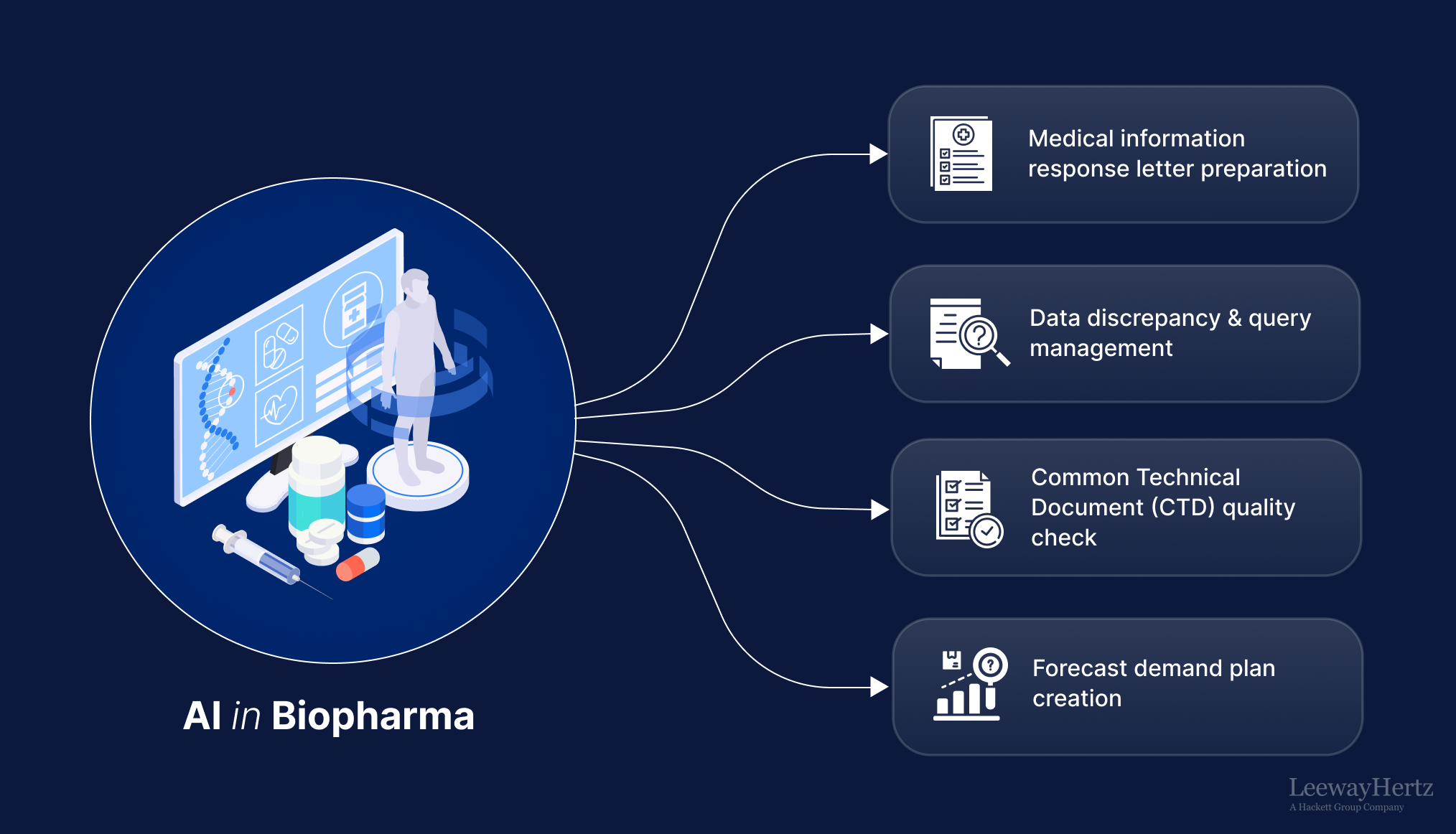
Biopharma is well-suited to AI because much of its work already depends on structured data, regulated documents, expert decisions, and repeatable workflows. From early research and clinical development to regulatory submission, manufacturing, safety monitoring and market access, each stage generates information that must be reviewed, interpreted, validated and acted upon. This makes biopharma a strong environment for AI systems that can connect data, summarize complex evidence, support decision-making and improve workflow efficiency while maintaining oversight and compliance.
As the market grows, slow handoffs become more costly across each stage. Global medicine spending was projected to reach US$1.6 trillion by 2025 [1], and estimates suggest strategic AI use in life sciences could unlock $5 billion to $7 billion in value [2]. That opportunity is not limited to drafting text. Predictive models provide clinical teams with earlier enrollment signals, while anomaly detection helps quality reviewers focus on the deviations that most need attention, thereby shortening review queues and improving decision quality.
The value, however, does not come from putting a generic chatbot beside regulated work and hoping teams adapt. It comes from embedding AI inside the workflow where a role already makes a documented judgment. In clinical operations, a study startup manager can view enrollment risk scores and site-priority recommendations during trial planning, so the study lead reviews a focused set of choices rather than rebuilding the analysis manually. In regulatory affairs, an AI assistant can prepare a first-pass response narrative from approved source documents, but the regulatory reviewer confirms the language before it is entered into a submission. In quality, anomaly detection can rank deviation reports for review, which gives a quality assurance reviewer a clearer way to prioritize follow-up without weakening control accountability.
Because the useful work sits inside existing steps, AI opportunities should be mapped at the function, process, and sub-process level before platforms or model features are selected. A function view shows where work belongs, but the sub-process view is where the build becomes real: the team can see which system holds the record, which artifact is being updated, who owns the review, and which control must be satisfied. This matters in biopharma because a recommendation that looks attractive in isolation may be hard to implement if the source data is incomplete, the audit trail is weak, or the reviewer is outside the normal approval path. Mapping at that level provides technology teams and business process owners with a practical way to prioritize use cases based on buildability, risk, and business value.
This article uses the biopharma operating model to break work into functions. Each function is then divided into processes and sub-processes. For each area, it shows where AI enablement opportunities can fit in to get the maximum business value.
- How AI is transforming biopharma operations
- Why biopharma AI use cases must be mapped at the sub-process level
- Biopharma operating model and AI opportunity mapping across biopharma processes
- High-value AI use cases in biopharma
- How agentic AI works in biopharma workflows
- How to prioritize AI use cases in biopharma
- Governance, risk, and responsible AI in biopharma
- How ZBrain operationalizes AI use cases in biopharma
- Future of AI in biopharma
How AI is transforming biopharma operations
AI is transforming biopharma operations by moving work beyond task routing and prediction toward contextual decision support. Its value becomes clearer in everyday operational moments where teams must connect structured data, regulated documents, historical decisions, and expert judgment before work can move forward.
For example, a protocol amendment review often starts with a clinical operations manager comparing a revised protocol with site feasibility comments and prior regulatory correspondence across different systems. Rules can send the amendment to the next queue, and predictive AI can estimate which sites are most likely to miss a startup milestone, which helps when inputs are structured, and past patterns still apply. The gap appears when the team needs a reasoned view of what the amendment changes, because those tools do not assemble the rationale from scattered text or make the tradeoffs clear enough for review. AI changes the work at that boundary by turning the scattered record into a reviewable impact summary, so manual reconciliation falls, and the clinical operations manager can seek regulatory or quality input before the change moves forward.
That same boundary appears across biopharma operations wherever regulated evidence, expert judgment, and repeatable handoffs meet:
- Document-heavy work: regulatory submission modules, trial master file artifacts, batch records, and quality standard operating procedures can be checked for missing context and version conflicts before a reviewer spends time on them.
- Narrative-heavy work: clinical study report summaries, safety case narratives, medical information responses, and inspection readiness briefings become faster to assemble because AI can shape an initial draft from approved source material while showing where evidence is thin.
- Exception-heavy work: batch deviations, protocol deviations, adverse event triage, and supply allocation exceptions can be classified and prioritized so that quality, clinical, and safety teams focus first on the cases with higher operational or patient-risk implications.
- Knowledge-heavy work: regulatory requirement interpretation, chemistry, manufacturing, and controls (CMC) precedent searches, medical affairs evidence review, and quality risk assessment improve when AI retrieves relevant prior decisions and flags conflicting guidance for expert review.
- Workflow-heavy work: study startup, change control, pharmacovigilance case processing, and demand planning benefit when AI forecasts the likely bottleneck and assembles the next work packet, which reduces avoidable rework between functions.
The practical design rule is to keep AI narrow and controlled. AI prepares the case by retrieving relevant evidence, shaping the draft output and routing the package to the appropriate regulatory or quality assurance reviewer before any production change, customer-facing message or risk-bearing action proceeds. That keeps accountability visible while reducing manual effort, because people spend less time assembling records and more time testing the recommendation against science, regulation, and patient impact.
Why biopharma AI use cases must be mapped at the sub-process level
Broad AI ideas become useful only when they are tied to a specific workflow, input, output and review point. For example, a discovery program review might include two requests under the same “AI for biopharma” label: One group may want support for target-biology evidence mapping, while another may need high-throughput screen result triage before committing follow-up chemistry time The evidence work draws on research informatics and electronic lab notebook records, while the screen triage step depends on assay output and quality flags, so the approver and review questions are not the same. At that altitude, the high-level label is too loose to build, govern, or measure, since no one has named the artifact being prepared or the point where scientific judgment enters.
A better approach is to map AI use cases to the biopharma operating model:
Function: the major business, scientific, or operational area, such as discovery research, translational science, clinical development, regulatory affairs, pharmacovigilance, manufacturing, quality, medical affairs, or commercial access.
Process: the workflow area within that function, such as target nomination, assay development, lead optimization, clinical study planning, regulatory submission preparation, adverse event case processing, batch release, quality event management, or market access evidence generation.
Sub-process: the specific work activity, such as mapping target-biology evidence, registering critical reagents and samples, preparing a design of experiments plan, drafting a clinical protocol synopsis, assembling a submission module, summarizing safety narratives, reviewing batch records, or preparing payer evidence summaries.
AI-enabled opportunity: the specific way AI can support that sub-process, such as classifying evidence strength, detecting missing metadata, recommending experimental ranges, drafting a first-pass narrative, extracting information from regulated documents, summarizing deviations, or assembling reviewer-ready evidence.
This level of detail matters because biopharma workflows are tied to specific scientific artifacts, regulated records, quality systems, data sources, review checkpoints, and accountable decision-makers. An AI workflow for target-biology evidence mapping is different from one for adverse event narrative drafting. A sample registration workflow is different from a design of experiments planning workflow. A regulatory submission assistant is different from a laboratory operations copilot or a quality review assistant.
Sub-process mapping makes each AI opportunity concrete because it has to define what AI is allowed to do, which artifact it touches, and who accepts or rejects the proposed output. For example, in target-biology evidence mapping, AI may classify evidence strength and draft supporting rationale in a target nomination package, but the target biology lead confirms whether it is ready for nomination review. In critical reagent and sample registration, AI may detect missing metadata in a laboratory information management system record, but the laboratory operations manager approves corrections before the record is accepted. In the design of experiments for lead optimization, AI may recommend test ranges in an experimental plan, but the lead optimization scientist confirms the plan before work proceeds.
By mapping AI opportunities at the sub-process level, biopharma organizations can move from broad innovation ideas to executable workflows with clear business or scientific value, data requirements, system integration needs, governance controls, and review accountability.
Transform biopharma workflows
Apply AI across research, development and regulated operations to improve efficiency, compliance, evidence quality and speed to decision.
Biopharma operating model and AI opportunity mapping across biopharma processes
The biopharma operating model below is organized into key industry-native functions that practitioners recognize. Each function is decomposed into its major processes and their sub-processes, and each sub-process carries the AI-enabled opportunity that applies to it. The focus is on software-only AI opportunities that support human review at key workflow and decision points.
Function 1. Discovery research, target biology, and translational biomarkers
This function owns disease biology, target nomination, assay strategy, candidate evidence, and early biomarker hypotheses from exploratory research through translational handoff. Discovery biologists, pharmacologists, bioinformatics scientists, translational scientists, and lab operations teams work across electronic lab notebooks, laboratory information management systems, and research analytics platforms.
AI is most useful when evidence is fragmented across literature, omics data, assay results, lab records, and biomarker plans. It helps teams reduce manual curation, sharpen prioritization, and create clearer review trails, while scientists remain accountable for target rationale, experimental interpretation, and candidate nomination.
| Process | Sub-process | Key AI-enabled opportunities |
|---|---|---|
| Target biology and disease hypothesis management | Target biology evidence mapping | Extract target-disease links from publications and omics datasets, calculate genetic support scores, and map evidence into a target evidence matrix, surface conflicting findings for the discovery biology lead review. |
| Disease pathway and mechanism of action review | Map pathway nodes from literature and transcriptomics, compare mechanism claims with enrichment results, summarize causal plausibility and route uncertain links to the translational scientist for review | |
| Research informatics and electronic lab notebook experiment capture | Extract protocol steps and reagent lots from electronic lab notebook records, validate completeness against ALCOA+ data integrity expectations, and classify missing metadata, send exceptions for the lab operations manager | |
| Target nomination package preparation | Draft target nomination package sections from lab and omics evidence, aggregate support through Bayesian evidence synthesis, and identify gaps that affect nomination quality. | |
| Assay development and screening operations | Assay design requirements and feasibility review | Classify assay requirements from the user requirements specification, compare controls and sample constraints with quality by design criteria, and surface feasibility risks for assay development lead review. |
| Critical reagent and sample registration in the laboratory information management system | Extract reagent lot and chain-of-custody fields from certificates of analysis and sample manifests, validate registration records, reduce reconciliation effort, and send incomplete entries to the laboratory information management system data steward. | |
| High-throughput screen result triage | Detect plate effects and outlier wells, calculate activity thresholds using robust Z-score analysis, and classify compounds as active, inactive, or borderline, escalate borderline hits to the screening scientist. | |
| Hit confirmation and counter-screen documentation | Compare primary hit profiles with counter-screen results, classify likely assay artifacts, and draft a traceable hit confirmation report, flag discordant compounds for pharmacology lead review. | |
| Lead optimization and candidate selection | Structure-activity relationship data curation | Extract compound structures and assay endpoints from structure-activity relationship tables, validate potency units, and detect duplicate records that add modeling noise,route data issues to the medicinal chemistry lead. |
| Design of experiments for lead optimization | Propose the design of experiments, factor ranges from structure-activity relationship data and assay variance estimates, then calculate balanced experiment matrices, flag infeasible combinations for medicinal chemistry lead review. | |
| Candidate selection criteria review | Compare candidate profiles against potency, selectivity, absorption, distribution, metabolism, and excretion (ADME), safety, and developability thresholds. | |
| Investigator’s brochure nonclinical evidence inputs | Draft investigator’s brochure nonclinical evidence inputs from pharmacology and toxicology summaries, then compare claims with common technical document quality conventions, and route unsupported safety statements to the nonclinical safety lead. | |
| Translational biomarker strategy | Biomarker hypothesis and context of use definition | Map omics and disease-stage evidence to a biomarker context-of-use statement, classify hypotheses using the BEST biomarker taxonomy, and surface gaps for translational science lead review. |
| Pharmacodynamic and patient selection biomarker plan | Propose pharmacodynamic endpoints and sampling windows for the statistical analysis plan, compare evidence using receiver operating characteristic analysis, and flag weak cutoffs for the translational biomarker lead. | |
| Sample collection schedule alignment with clinical study protocol | Compare biomarker timing and storage needs with the clinical study protocol schedule of assessments, validate visit-level risks through risk-based quality management, and flag conflicts for clinical operations lead review. | |
| Biomarker data transfer to clinical data management | Validate biomarker transfer files against electronic case report form and laboratory transfer specifications, including CDISC Study Data Tabulation Model (SDTM) and Analysis Data Model (ADaM) mapping. |
Highest-value opportunities: Target biology evidence mapping, high-throughput screen result triage, and biomarker data transfer to clinical data management should receive priority because they combine high-volume evidence review with clear scientific review boundaries. In these workflows, AI can reduce manual curation, strengthen target and hit-selection decisions, and lower the volume of downstream queries by preparing evidence in a more structured and review-ready form. Final accountability remains with the discovery biology lead, screening scientist and clinical data management lead.
Example agentic workflow: One example of an agentic workflow is target nomination evidence assembly. The agent plans the evidence checklist, retrieves approved lab and omics records, drafts rationale and gap sections, routes uncertain claims to the discovery biology lead, and records confirmation before advancement.
Function 2. Preclinical development and toxicology
This function manages a nonclinical development strategy, toxicology, toxicokinetics, safety pharmacology, nonclinical reporting, and evidence packages that support first-in-human and later regulatory milestones. Toxicologists, pathologists, pharmacokinetic scientists, study directors, and regulatory writing partners work across research informatics, laboratory information management, and analytics platforms.
AI creates value where teams must reconcile observations, pathology findings, toxicokinetic data, and submission datasets across regulated evidence packages. It helps shorten quality control cycles and improve safety interpretation, while study directors, toxicologists, and governance forums retain scientific and regulatory accountability.
| Process | Sub-process | Key AI-enabled opportunities |
|---|---|---|
| Nonclinical development strategy | Investigational New Drug-enabling study plan development | Draft Investigational New Drug (IND)-enabling toxicology and toxicokinetic study plan options from the target product profile and prior summaries, flag milestone-critical gaps for study director review. |
| Species selection and dose range finding review | Compare species pharmacology and exposure data against the design of experiments criteria, then rank candidate species and dose levels, surface data gaps in the toxicology protocol for toxicologist review. | |
| Nonclinical risk assessment for IND application | Aggregate organ-system findings and exposure multiples into the IND nonclinical risk assessment, classify hazards using ICH Q9(R1) quality risk management, and flag weak narratives for governance committee review. | |
| Investigator’s brochure nonclinical section inputs | Summarize repeat-dose toxicology and safety pharmacology findings from finalized study reports, map conclusions to good clinical practice expectations, and draft traceable inputs for toxicologist review. | |
| Toxicology study conduct and reporting | Toxicology protocol and amendment management | Compare toxicology protocol amendments with the approved standard operating procedure, classify substantive changes under good laboratory practice rules, and flag execution risks for study director review. |
| Laboratory information management system sample tracking | Detect sample chain-of-custody anomalies across sample manifests, retrieve accession records for ALCOA+ review, and reduce manual reconciliation. | |
| Toxicology observation and pathology finding reconciliation | Map necropsy observations and histopathology terms to INHAND pathology nomenclature, compare them with study report tables, and flag severity or target-organ discordance for study pathologist review. | |
| Nonclinical study report quality control | Validate nonclinical study report tables and appendices against laboratory exports and electronic lab notebook entries, apply ALCOA+ checks, and flag traceability defects for study director review. | |
| Nonclinical data standards and submission datasets | Standard for Exchange of Nonclinical Data domain mapping | Map raw toxicology domains to Standard for Exchange of Nonclinical Data (SEND) trial design, findings, and exposure domains, flag ambiguous variables for the nonclinical data standards lead. |
| Controlled terminology and unit harmonization | Classify test names and units against SEND controlled terminology, normalize values into the harmonization log, and flag sponsor-specific terms that raise validation risk for the data standards lead. | |
| Nonclinical data validation issue resolution | Retrieve validation findings from the SEND issue log, classify root causes against validation rules, and propose resolution actions that reduce rework before electronic common technical document (eCTD) publishing. | |
| Submission-ready nonclinical dataset package review | Validate the submission-ready SEND package against define.xml and the study data reviewer guide, summarize residual issues by impact, and flag blockers for regulatory operations lead review. | |
| Safety pharmacology and toxicokinetics | Safety pharmacology endpoint review | Screen telemetry and neurological endpoint outputs with anomaly detection, compare findings with ICH S7A and S7B expectations, and flag clinically relevant patterns for safety pharmacologist review. |
| Toxicokinetic sample analysis oversight | Detect bioanalytical run outliers and missed samples in the toxicokinetic analysis report, retrieve supporting laboratory records, and flag assay-impacting exceptions for toxicokinetic scientist review. | |
| Exposure margin and no-observed-adverse-effect-level assessment | Aggregate exposure and target-organ toxicity findings into the exposure margin and no-observed-adverse-effect-level (NOAEL) assessment table, route weak NOAEL justifications to the toxicologist. | |
| Preclinical safety package handoff to clinical development | Summarize finalized toxicology and toxicokinetic evidence for the IND application, map residual risks to common technical document expectations, and draft handoff notes for clinical development lead review. |
Highest-value opportunities: Toxicology observation and pathology finding reconciliation, SEND domain mapping, and nonclinical study report quality control offer the strongest near-term value because they are high-volume, artifact-rich, and bounded by clear review decisions. AI reduces manual cross-checking across study reports and laboratory records, shortens quality control cycles, improves decision quality, and preserves accountability with the study pathologist, nonclinical data standards lead, and study director.
Example agentic workflow: An example agentic workflow is nonclinical study report quality control: it plans the quality control run, retrieves approved protocol and laboratory evidence, drafts a discrepancy summary, routes interpretation issues to the study director, and records approval before final disposition.
Function 3. Clinical development and protocol design
This function manages clinical development strategy, study design, protocol authoring, endpoint selection, informed consent alignment, and cross-functional study design handoffs. Clinical scientists, medical directors, biostatisticians, regulatory partners, patient engagement leads, and protocol authors work across clinical trial management, electronic data capture, trial master file, and regulatory platforms.
AI addresses the manual cross-checking burden that slows protocol development and amendment governance. It helps identify inconsistent endpoints, downstream document impacts, and ambiguous data collection requirements. Clinical and statistical owners remain accountable for medical judgment, patient protection, and good clinical practice compliance.
| Process | Sub-process | Key AI-enabled opportunities |
|---|---|---|
| Clinical development plan and indication strategy | Target product profile and indication rationale alignment | Compare target product profile claims with the IND application and eCTD Module 2.5 clinical overview, classify common technical document gaps, and flag inconsistencies for medical director review. |
| Clinical endpoint and estimand strategy review | Map protocol endpoints to estimands in the statistical analysis plan, classify variables against SDTM and ADaM expectations, and flag ambiguous intercurrent-event handling for biostatistician review. | |
| Patient population and inclusion/exclusion criteria design | Screen inclusion and exclusion criteria against prior clinical study report outputs and risk-based quality management patterns, send criteria that may constrain recruitment or patient protection to the clinical scientist. | |
| Investigator’s brochure clinical evidence alignment | Compare efficacy and safety narratives in the investigator’s brochure with clinical study report outputs, classify common technical document discrepancies, and flag outdated evidence for clinical scientist review. | |
| Protocol authoring and amendment governance | Clinical study protocol authoring | Draft protocol sections covering objectives, endpoints, eligibility, and safety monitoring, based on approved source inputs, flag missing cross-references to shorten authoring cycles for the protocol author. |
| Protocol amendment impact assessment | Compare proposed protocol amendments with the case report form and informed consent form, classify downstream updates through change control impact assessment, and flag patient-facing impacts for the clinical study lead. | |
| Informed consent form alignment | Compare procedure and risk language in the informed consent form with the protocol and investigator’s brochure, and route consent gaps that could delay approval to the clinical study lead. | |
| Case report form and electronic case report form impact review | Map case report form and electronic case report form fields to endpoints and analysis variables, classify gaps using SDTM and ADaM mapping, and flag missing logic for the data management lead. | |
| Study design feasibility and risk planning | Risk-based quality management critical-to-quality factor identification | Extract critical procedures and safety controls from the protocol, rank candidate critical-to-quality factors through risk-based quality management, and flag monitoring priorities for clinical quality lead review. |
| Trial feasibility packet preparation | Aggregate epidemiology and eligibility constraints from approved study evidence, score enrollment risk, and draft feasibility packet summaries. | |
| Visit schedule and procedure burden assessment | Extract visit frequency and procedure burden from the protocol, compare it with consent language, and flag schedules that may weaken recruitment or retention for patient engagement lead review. | |
| Safety management plan alignment | Compare adverse-event reporting and stopping rules in the safety management plan with the protocol and investigator’s brochure, flag unresolved safety inconsistencies for medical monitor review. | |
| Decentralized and hybrid trial design (ePRO/eCOA, sensors) | Map assessments to decentralized modalities, and flag data-capture, validation, or equivalence risks for clinical scientist review. | |
| Cross-functional protocol handoff | Statistical analysis plan input review | Compare endpoint definitions and visit windows in the statistical analysis plan with the protocol, classify variable traceability, and flag ambiguous assumptions for biostatistician review. |
| Electronic data capture build requirements handoff | Map protocol procedures and edit-check needs to electronic data capture (EDC) specifications, classify required fields against SDTM and ADaM expectations, and flag unclear build logic for the EDC build lead. | |
| Trial master file expected document planning | Map required study documents from the protocol to trial master file placeholders, classify artifacts using trial master file reference model indexing, and flag missing expected documents for the trial master file lead. | |
| Site training material requirements review | Extract protocol-specific procedures and safety escalation steps from approved study documents, classify training topics by risk, and flag role-specific gaps for clinical training lead review. |
Highest-value opportunities: Clinical study protocol authoring, protocol amendment impact assessment, and electronic data capture build requirements handoff offer the strongest near-term value because they are document-heavy worksteps with clean review boundaries. AI reduces manual cross-checking across the protocol, informed consent form, data capture specifications, statistical analysis plan, and trial master file. It can shorten the amendment and build cycles while preserving medical, statistical, and good clinical practice accountability.
Example agentic workflow: An example agentic workflow is protocol amendment impact triage: it plans the amendment review, retrieves current protocol and data capture evidence, drafts impact notes, routes patient-facing and submission impacts to the clinical study lead, and records the final disposition.
Function 4. Clinical operations and site management
This function manages study startup, site identification, feasibility, site activation, investigator site management, monitoring, vendor oversight, and trial master file readiness. Clinical operations leads, study managers, clinical research associates, site activation specialists, and trial master file owners use clinical trial management, electronic data capture, and electronic trial master file platforms.
AI is valuable because startup, monitoring, and inspection readiness depend on coordinated documents, milestone data, and site-level decisions. It helps reduce manual follow-up, focus monitoring on higher-risk sites, and improve readiness accountability, while clinical operations and quality roles retain final judgment.
| Process | Sub-process | Key AI-enabled opportunities |
|---|---|---|
| Study startup and site activation | Site identification and feasibility questionnaire management | Classify feasibility questionnaire responses against protocol eligibility and enrollment-risk factors, compare historical startup performance, and flag low-confidence site recommendations for clinical operations lead review. |
| Site qualification visit documentation | Draft site qualification visit report sections from clinical research associate notes and facility evidence, validate observations against critical-to-quality factors, and flag unresolved capability gaps for study manager review. | |
| Budget negotiation and contract review handoff | Compare proposed fees and invoice triggers with fair market value benchmarks and the protocol schedule, summarize negotiation deltas, and flag nonstandard payment terms for contracts manager review. | |
| Site activation checklist completion | Validate activation checklist entries against investigator site file essentials and approved consent versions, flag missing approvals, and route exceptions for site activation specialist review. | |
| Patient recruitment and retention execution | Aggregate enrollment-funnel and retention signals, and flag at-risk sites or cohorts for study manager review. | |
| Investigator site management | Investigator site file setup and maintenance | Classify investigator site file documents by section, extract effective dates from consent forms and delegation logs, and route metadata quality gaps to the clinical research associate. |
| Site initiation visit planning and training | Map protocol procedures and electronic case report form workflows to a site initiation agenda, propose role-specific training priorities, and flag gaps for study manager review. | |
| Site issue escalation and resolution tracking | Classify site issue log entries against deviation categories and corrective action and preventive action (CAPA) commitments, and summarize aging and recurrence patterns for clinical operations lead review. | |
| Site closeout readiness review | Aggregate investigator site file, trial master file, and electronic case report form status, validate unresolved items against completeness criteria, and flag closeout blockers for clinical research associate review. | |
| Monitoring and risk-based quality management | Risk-based monitoring plan execution | Calculate site risk scores from query rates, enrollment pace, and deviation trends, compare triggers with the monitoring plan, and flag priority sites for clinical operations lead review. |
| Central statistical monitoring signal review | Detect outlier patterns in electronic case report form values and visit timing through central statistical monitoring, and summarize prioritized concerns for data management lead review. | |
| Protocol deviation review and follow-up | Classify deviation narratives against protocol requirements, summarize subject-safety and data-integrity implications, and draft site action requests for medical monitor review. | |
| Monitoring visit report quality control | Compare monitoring visit report findings with query status and trial master file actions, flag inconsistent dates or unresolved findings, and propose correction requests for the clinical research associate manager review. | |
| CRO and vendor selection and sponsor oversight | Classify vendor performance and oversight signals against the oversight plan, and flag KQI/KRI breaches for clinical operations review. | |
| Trial master file operations | Trial master file completeness review | Aggregate expected-document lists, milestone dates, and document status, validate gaps using completeness criteria, and flag overdue artifacts by country and site for trial master file owner review. |
| Trial master file Reference Model indexing | Classify trial master file documents, such as consent forms and protocols, against reference model zones, extract dates and countries, and flag uncertain placements for the specialist. | |
| Essential document upload and metadata quality control | Extract upload metadata from essential documents, validate signatures and effective dates against ALCOA+ expectations, and detect duplicates for trial master file quality control lead review. | |
| Inspection readiness and reconciliation with the investigator’s site file | Compare trial master file artifacts with investigator site file inventories, summarize missing or expired essentials, and draft reconciliation action lists for clinical operations lead review. |
Highest-value opportunities: Site identification and feasibility questionnaire management, risk-based monitoring plan execution, and trial master file completeness review offer the strongest near-term value because they are high-volume workflows with clear review boundaries. AI combines structured data from clinical trial management, electronic data capture, and electronic trial master file platforms, helping teams shorten startup timelines, focus monitoring efforts, and reduce remediation costs before inspection readiness reviews.
Example agentic workflow: An example agentic workflow is the site activation readiness workflow: it plans the readiness check, retrieves protocol, consent, training, and trial master file status, drafts a gap summary, routes missing items, and records confirmation after the site activation specialist approves.
Function 5. Clinical data management, biostatistics, and statistical programming
This function manages clinical data standards, electronic data capture design, data cleaning, medical coding, statistical analysis planning, statistical programming, submission datasets, and clinical study report outputs. Clinical data managers, medical coders, biostatisticians, statistical programmers, and standards leads work across electronic data capture, analytics, and safety case management integrations.
AI helps where high-volume data issues, coding decisions, and traceability checks slow down database lock and submission preparation. It supports query detection, coding assistance, standards mapping, and programming review, while human reviewers remain responsible for data integrity, statistical validity, and submission-ready outputs.
| Process | Sub-process | Key AI-enabled opportunities |
|---|---|---|
| Clinical data standards and electronic data capture design | Case report form and electronic case report form design | Draft field proposals from the clinical study protocol, classify critical data under risk-based quality management, and flag omitted endpoint or safety fields for data standards lead review. |
| Electronic data capture edit check specification | Propose electronic case report form edit checks, compare range and dependency rules against ALCOA+ expectations, and flag checks likely to create avoidable site queries. | |
| Clinical data standards metadata library management | Map case report form variables to reusable metadata, compare controlled terminology with SDTM and ADaM conventions, and flag duplicate or study-specific deviations for the standards lead. | |
| Protocol amendment impact on the electronic case report form and database build | Extract amendment changes from the protocol, compare impacted fields and edit checks, and flag downstream build tasks for the lead data manager. | |
| Data cleaning and medical coding | Data discrepancy and query management | Detect discrepant electronic case report form entries, classify likely entry or protocol inconsistencies, and draft focused query text for clinical data manager review. |
| MedDRA coding and WHO Drug coding | Classify verbatim adverse event and medication terms against MedDRA and WHO Drug coding, compare historical decisions, and flag low-confidence matches for medical coder review. | |
| Serious adverse event reconciliation with safety case management | Compare serious adverse event data in the electronic case report form with individual case safety report fields, classify mismatches, and flag follow-up actions for safety data manager review. | |
| Database lock readiness review | Aggregate open queries, outstanding coding items, and reconciliation exceptions, validate readiness indicators, and flag lock blockers for the database lock owner. | |
| Biostatistics and analysis planning | Statistical analysis plan development | Draft statistical analysis plan shells from the protocol, map endpoints and populations to SDTM and ADaM expectations, and flag ambiguous estimands for the lead biostatistician. |
| Randomization and stratification specification | Validate randomization and stratification specifications, compare proposed strata with critical risk factors, and flag imbalance scenarios for biostatistician review. | |
| Interim analysis and data monitoring committee package support | Aggregate interim safety and efficacy outputs against the statistical analysis plan, detect outlier site patterns, and summarize findings for data monitoring committee (DMC) statistician review. | |
| Estimand and endpoint derivation review | Map estimand attributes and endpoint derivations from the protocol to the statistical analysis plan, compare variable lineage, and flag inconsistencies for the lead biostatistician. | |
| Statistical programming and submission datasets | CDISC SDTM and ADaM mapping | Map electronic case report form and external data elements to submission dataset specifications, compare controlled terminology and derivation rules, and flag nonconformant variables for programming lead review. |
| Tables, listings, and figures programming | Draft tables, listings, and figures programming shells from the statistical analysis plan, retrieve ADaM variable lineage, and flag denominator or population mismatches for programming lead review. | |
| Analysis, dataset validation and traceability review | Validate analysis datasets against the statistical analysis plan, compare ADaM derivations back to source fields, and flag broken lineage for programming lead review. | |
| Clinical study report data package quality control | Compare clinical study report tables and narratives with final analysis outputs, validate clinical summaries under common technical document checks, and flag discrepancies for report lead review. |
Highest-value opportunities: Data discrepancy and query management, MedDRA and World Health Organization (WHO) Drug coding, and Clinical Data Interchange Standards Consortium (CDISC) SDTM and ADaM mapping offer the strongest AI return. These areas combine high transaction volumes with structured artifacts and clear reviewer handoffs. Prioritizing these areas reduces manual cleaning and recoding effort, shortens database lock and submission dataset cycles, and improves decision quality without moving accountability away from qualified reviewers.
Example agentic workflow: An example agentic workflow is daily electronic data capture query triage: it plans discrepancy triage, retrieves case report data and protocol references, drafts prioritized query text, routes cases to the clinical data manager, and records each approved or rejected query.
Function 6. Regulatory affairs, labeling, and submissions
This function manages regulatory strategy, agency interaction planning, submission content planning, labeling coordination, lifecycle submissions, and eCTD publishing. Regulatory strategists, regulatory operations, labeling leads, medical writers, chemistry, manufacturing, and controls (CMC) regulatory leads, and submission publishers work across regulatory information management and submission platforms.
AI helps when regulatory teams must reuse content, reconcile cross-module claims, evaluate labeling impacts, and confirm publishing readiness under time pressure. It reduces manual comparison effort and strengthens review accountability, while regulatory professionals retain interpretation, sign-off, and compliant submission dispatch responsibilities.
| Process | Sub-process | Key AI-enabled opportunities |
|---|---|---|
| Regulatory strategy and agency interaction management | IND application strategy | Map protocol endpoints and investigator’s brochure nonclinical content to IND dependencies, compare precedent issues, and flag unresolved risks for regulatory strategist review. |
| New Drug Application and Biologics License Application pathway planning | Compare clinical study report and CMC readiness with New Drug Application and Biologics License Application pathway options, classify evidence gaps, and propose issue log entries for regulatory lead review. | |
| Health authority meeting briefing package coordination | Retrieve protocol and investigator’s brochure excerpts, summarize proposed questions under medical, legal, and regulatory review, and draft briefing package gap notes for regulatory meeting lead review. | |
| Regulatory commitment tracking in regulatory information management | Extract commitments from application correspondence and change control links, classify due dates and ownership, and flag at-risk commitments for regulatory operations manager review. | |
| Submission content planning and publishing | FDA Form 1571 and FDA Form 356h preparation | Validate sponsor, application, protocol, and cross-reference fields on FDA Form 1571 and FDA Form 356h against the protocol, route exceptions to the regulatory operations lead review. |
| ECTD publishing and submission readiness review | Validate eCTD sequence metadata, bookmarks, and lifecycle operators against FDA Form 356h, detect broken links, and flag exceptions for submission publisher review. | |
| Common technical document quality check | Compare cross-module claims across clinical overview, clinical summaries, and CMC content, then flag inconsistencies or stale references for regulatory quality control lead review. | |
| Regional submission sequence and lifecycle management | Map application sequence history and regional lifecycle operators in the regulatory information management platform, compare pending variations, and flag out-of-sequence actions for regulatory operations lead review. | |
| Promotional/advertising regulatory submission (e.g., FDA Form 2253) | Validate promotional submission completeness and metadata, and flag exceptions for regulatory review. | |
| Clinical and nonclinical regulatory writing | ECTD Module 2.5 clinical overview drafting coordination | Aggregate efficacy, safety, and benefit-risk statements from clinical study reports and statistical analysis plans, summarize source traceability, and flag unsupported claims for medical writer review. |
| ECTD Module 2.7 clinical summaries authoring oversight | Compare efficacy and safety tables in clinical summaries with the statistical analysis plan and clinical study report, then flag table-text discrepancies for clinical regulatory writing lead review. | |
| Clinical study report submission readiness review | Validate clinical study report narratives and appendices against the protocol and trial master file, detect missing source evidence, and flag issues for regulatory writing lead review. | |
| Investigator’s brochure regulatory alignment | Compare the investigator’s brochure safety sections with the development safety update report conclusions and protocol language, summarize risk-language discrepancies, and flag updates for regulatory safety lead review. | |
| Labeling and lifecycle change control | Labeling change impact assessment | Classify proposed labeling text changes against the risk management plan and benefit-risk evidence, map affected label assets, and flag conflicting safety language for labeling lead review. |
| Product lifecycle management regulatory review | Map change control, annual product review, and continued process verification findings to CMC regulatory content, classify reporting categories, and propose filing options for CMC regulatory lead review. | |
| CMC supplement planning | Compare change control, master batch record, and certificate of analysis evidence against CMC supplement requirements, classify supplement scope, and flag missing stability support for CMC regulatory lead review. | |
| Response to information request and deficiency letter coordination | Retrieve deficiency letter questions and source references, summarize response dependencies, and draft response table entries for regulatory response lead review. | |
| REMS design and submission (may co-locate with Function 7) | Draft REMS and ETASU elements and the assessment plan, and flag unsupported risk-mitigation rationale for regulatory safety lead review. | |
| Regional submission sequence and lifecycle management | Post-approval variation, renewal, and lifecycle maintenance | Classify post-approval changes and renewals by region, and flag filing obligations for regulatory operations review. |
Highest-value opportunities: eCTD publishing and submission readiness review, common technical document quality check, and labeling change impact assessment offer the strongest near-term AI value because they are artifact-rich worksteps with traceable sources and clean review boundaries. Applying AI here reduces manual reconciliation, shortens submission cycle time, strengthens compliance, and improves review accountability without shifting regulatory sign-off.
Example agentic workflow: An example agentic workflow is the submission readiness exception workflow: it plans the eCTD readiness checklist, retrieves submission metadata and source evidence, drafts an exception log, routes publishing tasks, and records confirmation when regulatory operations approve dispatch readiness.
Function 7. Pharmacovigilance and patient safety
This function manages adverse event intake, case processing, medical review, expedited reporting, signal detection, aggregate safety reporting, risk management, and benefit-risk governance. Safety operations, safety physicians, safety scientists, medical reviewers, case processors, and pharmacovigilance quality teams work in safety case management platforms connected to clinical, regulatory, medical information, and analytics systems.
AI helps most where case volume, coding variation, duplicate review, and aggregate evidence preparation create bottlenecks. It supports intake triage, narrative drafting, signal detection, and benefit-risk review, while safety physicians and pharmacovigilance governance retain good pharmacovigilance practice and reportability accountability.
| Process | Sub-process | Key AI-enabled opportunities |
|---|---|---|
| Safety case intake and triage | Adverse event intake from medical information and field sources | Extract patient, reporter, suspect product, and adverse event entities from field call notes and medical information letters, classify minimum case criteria, and flag missing validity elements for case processor review. |
| Duplicate detection and case validity assessment | Detect probable duplicate individual case safety report records through entity resolution and similarity scoring, route uncertain matches or invalid cases to pharmacovigilance quality review. | |
| Individual case safety report creation | Draft individual case safety report sections from validated intake notes, map product and event attributes using MedDRA and WHO Drug coding, and flag incomplete mandatory fields for case processor review. | |
| CIOMS I form generation and quality control | Validate CIOMS I form entries against the individual case safety report, compare mandatory fields with ALCOA+ expectations, and flag conflicting dates or seriousness criteria for pharmacovigilance quality review. | |
| Literature screening and monitoring (ICSR and signal) | Screen scientific literature for individual case reports and emerging signals, and flag relevant articles for safety review. | |
| Medical coding, narrative, and case processing | MedDRA coding and drug dictionary coding | Classify verbatim adverse event and medication terms using MedDRA and WHO Drug coding, propose candidate codes with confidence scores, and flag low-confidence matches for medical coder review. |
| Seriousness, expectedness, and causality assessment | Compare event terms and listedness language against the investigator’s brochure, map coded events to reportability criteria, and flag causality ambiguities for safety physician review. | |
| Safety narrative drafting and medical review | Draft a chronology-based safety narrative from intake, coding, and follow-up data, summarize conflicting clinical facts, and flag unresolved medical questions for medical reviewer confirmation. | |
| Individual case safety report electronic transmission readiness | Validate individual case safety report E2B(R3) data fields and mandatory attachments, reduce rejected submissions, and flag transmission-blocking errors for pharmacovigilance quality review. | |
| Signal detection and benefit-risk management | CIOMS VIII signal detection workflow | Aggregate case trends, detect emerging product-event combinations using CIOMS VIII signal detection, summarize supporting clusters, and flag candidate signals for safety scientist review. |
| Disproportionality analysis using PRR, ROR, and EBGM | Calculate proportional reporting ratio (PRR), reporting odds ratio (ROR), and empirical Bayes geometric mean (EBGM), detect outlier product-event pairs, and flag threshold breaches for safety scientist review. | |
| Signal validation and prioritization meeting support | Retrieve case line listings and risk management controls, summarize validation evidence under signal detection criteria, and propose priority tiers for signal management committee review. | |
| Risk management plan update assessment | Compare validated signal outcomes and labeling implications against the current risk management plan, map evidence gaps, and propose update options for pharmacovigilance governance review. | |
| Aggregate safety reporting | PBRER and PSUR aggregate safety review | Aggregate case trends, clinical exposure, and literature findings into periodic benefit-risk evaluation report (PBRER) and periodic safety update report (PSUR) evidence tables. Inconsistencies go to the safety physician. |
| Development safety update report preparation | Retrieve clinical trial adverse event listings and exposure data, draft development safety update report sections, and flag unaligned study conclusions for safety physician review. | |
| Periodic benefit-risk evaluation report authoring coordination | Map required PBRER sections to source owners and evidence artifacts, retrieve overdue inputs, and flag missing benefit-risk justifications for aggregate report lead review. | |
| Safety management plan effectiveness review | Compare risk minimization activities with case trends and PSUR outcomes, detect residual risk patterns, and propose follow-up actions for pharmacovigilance governance review. | |
| Risk management and benefit-risk | REMS operations and ETASU monitoring | Monitor ETASU compliance and program enrollment, and flag breaches for safety governance review. |
Highest-value opportunities: Adverse event intake from medical information and field sources, MedDRA and WHO Drug coding, and PBRER and PSUR aggregate safety review offer the strongest near-term AI value. These are high-volume workflows with repeatable source documents and clean review boundaries. AI helps safety operations reduce intake and coding cycle time, gives safety physicians better-organized evidence, and keeps accountability with case processors, medical coders, and safety physicians before reporting decisions are made.
Example agentic workflow. An example agentic workflow is the individual case safety report intake triage workflow: it plans validity and duplicate checks, retrieves field notes and prior cases, drafts the triaged report and Council for International Organizations of Medical Sciences (CIOMS) I form, routes exceptions, and records case processor approval.
Function 8. CMC development and pharmaceutical sciences
This function manages formulation development, process development, analytical development, specifications, stability, comparability, control strategy, and CMC regulatory content. Process scientists, formulation scientists, analytical scientists, stability leads, CMC regulatory leads, and technical operations teams use electronic lab notebooks, laboratory information management systems, quality systems, and regulatory platforms.
AI is most useful when experimental evidence, stability trends, quality records, and submission content must be linked into a defensible control strategy. It reduces collation effort and sharpens exception prioritization, while CMC experts remain accountable for scientific rationale, control strategy, and regulated lifecycle decisions.
| Process | Sub-process | Key AI-enabled opportunities |
|---|---|---|
| Product and process development | Quality by design target profile and design space planning | Map target product attributes from the IND application, retrieve prior formulation ranges from electronic lab notebook records, and propose design space hypotheses for formulation scientist review. |
| Critical quality attribute, critical process parameter, and critical material attribute mapping | Map critical quality attributes, process parameters, and material attributes from batch records and lab results, classify linkage strength, and flag weak rationales for process scientist review. | |
| Design of experiments, execution and result review | Aggregate response data from the design of experiments matrix and lab results, detect outliers and interaction effects, and summarize parameter settings for process scientist review. | |
| Control strategy development | Compare critical quality attribute maps with deviation reports and batch steps, map controls to failure modes, and flag unsupported monitoring choices for technical operations lead review. | |
| Combination product and device design controls / human factors | Map device design inputs/outputs and human-factors evidence (21 CFR Part 4, 21 CFR 820/QMSR and ISO 13485, IEC 62366), and flag design-control or use-error gaps for device lead review. | |
| Analytical development and specifications | Analytical method development and qualification | Compare chromatogram features and system suitability results with standard operating procedure drafts, propose method refinements, and flag qualification gaps for analytical scientist review. |
| Specification setting and justification package | Aggregate batch results, stability trends, and certificate of analysis data, propose acceptance criteria using quality by design rationale, and draft justification text for CMC lead review. | |
| Laboratory information management system method and result capture | Validate method fields, result units, and audit-trail entries against the approved standard operating procedure, classify exceptions, and flag certificate of analysis risks for laboratory quality assurance review. | |
| Certificate of analysis format and specification alignment | Compare certificate of analysis templates with approved specifications, validate test names and units, and flag misalignments that slow lot release for quality assurance release review. | |
| Stability and comparability | Stability protocol and pull schedule management | Retrieve approved stability commitments from CMC regulatory content, map pulls to testing windows using risk prioritization, and flag schedule conflicts for stability lead review. |
| Stability data trending and shelf-life assessment | Detect assay and impurity trend shifts in stability data, compare results with out-of-trend thresholds, and summarize shelf-life implications for stability lead review. | |
| Comparability package planning for process or site changes | Compare pre-change and post-change batch results with process descriptions, map evidence gaps to the change control record, and propose comparability content for CMC comparability lead review. | |
| Product lifecycle management regulatory assessment | Classify proposed manufacturing changes from the change control record, compare regional filing commitments, and flag reporting category ambiguity for CMC regulatory lead review. | |
| CMC regulatory package | ECTD Module 3 CMC section authoring | Draft eCTD Module 3 CMC text from approved specifications and validation reports, retrieve source citations, and flag missing cross-references for CMC regulatory lead review. |
| Manufacturing process description and control strategy narrative | Summarize unit operations from master batch and electronic batch records, map critical controls to process parameters, and draft the process narrative for process development lead review. | |
| Analytical procedure and validation summary preparation | Extract method steps and validation outcomes from approved procedures and laboratory records, validate traceability, and draft analytical procedure summaries for analytical quality assurance review. | |
| CMC response to regulatory information request | Retrieve question-specific evidence from the application and CMC source content, draft response language, and flag commitments or data gaps for CMC regulatory lead review. | |
| Technology transfer (R&D to commercial and site to site) | Compare process and analytical transfer packages against receiving-site capability, and flag transfer-readiness gaps for technical operations review. |
Highest-value opportunities: Design of experiments execution and result review, stability data trending and shelf-life assessment, and eCTD Module 3 CMC section authoring are the strongest opportunities. They combine experiment results, stability pulls, and submission updates with artifact-rich inputs. AI reduces manual collation and first-pass review time, sharpens exception prioritization, and preserves clean review boundaries with process scientists, stability leads, and CMC regulatory leads.
Example agentic workflow: One example of an agentic workflow is the CMC information request response. The agent plans the response scope, retrieves approved lab, quality, manufacturing and regulatory evidence, drafts cited response text, routes the package, and prompts the CMC regulatory lead to confirm readiness.
Function 9. Manufacturing operations and batch release
This function manages current good manufacturing practice production execution, master batch records, electronic batch records, in-process controls, deviations, continued process verification data capture, batch record review, and batch disposition handoffs. Manufacturing supervisors, operators, process engineers, manufacturing science and technology teams, quality assurance, quality control, and release roles use manufacturing execution, laboratory, quality, planning, and enterprise resource planning platforms.
AI helps where production teams face high-volume record review, process exception triage, deviation initiation, and release package reconciliation. It supports review by exception and anomaly detection on existing digital records, while the quality unit and Qualified Person roles remain accountable for batch disposition and patient safety.
| Process | Sub-process | Key AI-enabled opportunities |
|---|---|---|
| Production planning and shop-floor execution | Master batch record creation and revision control | Compare proposed master batch record revisions with approved change control records, map impacted instructions, and flag inconsistent critical process parameters for manufacturing science and technology review. |
| Electronic batch record execution | Validate electronic batch record entries against expected step sequence, detect missing contemporaneous entries, and flag execution exceptions for manufacturing supervisor review. | |
| Material staging and line clearance verification | Validate material lots and line clearance images already stored in batch systems against electronic batch record requirements, classify discrepancies, and flag wrong-material risks for manufacturing supervisor review. | |
| Equipment status and cleaning readiness check | Retrieve equipment status, cleaning verification results, and hold-time history into the electronic batch record, classify readiness risk, and flag overdue equipment for manufacturing supervisor review. | |
| In-process control and process monitoring | Critical process parameter monitoring | Detect multivariate drift in critical process parameter records against master batch record ranges, map deviations to quality attributes, and flag likely quality impacts for process engineer review. |
| Process analytical technology data review | Aggregate process analytical technology spectra from existing production records, classify latent patterns against the design of experiments model space, and flag out-of-trend signals for manufacturing science and technology review. | |
| In-process sample submission to the laboratory information management system | Extract sampling requirements from the electronic batch record, validate sample metadata against ALCOA+ expectations, and flag missing chain-of-custody fields for quality control review. | |
| Continued process verification data capture | Aggregate batch parameters and in-process results into the continued process verification report, validate completeness, and flag missing contextual variables for manufacturing science and technology review. | |
| Process validation and process performance qualification (PPQ) | Aggregate PPQ run data against acceptance criteria, detect excess variability, and flag qualification risk for manufacturing science and technology review. | |
| Environmental monitoring and contamination control (sterile/aseptic) | Detect environmental monitoring excursions and adverse trends, and flag contamination risk for quality control microbiology review. | |
| Deviation management during manufacturing | Deviation report initiation and classification | Classify shop-floor event text and electronic batch record exceptions into deviation categories, summarize severity drivers, and flag ambiguous cases for quality assurance review. |
| Deviation classification and impact assessment | Map deviation facts to affected batch record steps, compare similar historical events, and propose impact hypotheses for quality assurance review. | |
| Immediate corrective action and batch impact review | Retrieve affected batch record data, compare corrective actions with deviation facts, and flag unresolved product-quality questions for quality unit review. | |
| Deviation closure handoff to quality assurance | Validate deviation closure fields, summarize linked CAPA commitments, and flag missing evidence or overdue owners for quality assurance review. | |
| Batch release and disposition | Batch production record review by exception | Screen batch production records and electronic batch record audit trails with anomaly detection, classify exceptions against ALCOA+ expectations, and summarize release-relevant anomalies for quality assurance review. |
| Certificate of analysis review | Compare certificate of analysis results with approved specifications and prior batch trends, detect out-of-specification or out-of-trend patterns, and flag release blockers for quality control review. | |
| Quality unit batch disposition | Summarize batch record exceptions, certificate of analysis status, open deviations, and CAPA commitments. Residual risk questions are proposed for quality unit review. | |
| Qualified Person release package support | Retrieve batch record, certificate of analysis, deviation, and change control evidence, validate completeness against the release checklist, and flag market-release gaps for Qualified Person review. |
Highest-value opportunities: Batch production record review by exception, critical process parameter monitoring, and deviation report initiation and classification are the strongest fits because they are high-volume, artifact-rich workflows with clear review boundaries. Applying AI to these steps reduces manual record review effort, shortens deviation triage cycle time, and improves decision quality while preserving accountability for batch disposition and patient safety.
Example agentic workflow: An example agentic workflow is the batch release readiness workflow: it plans the release-readiness sequence, retrieves batch, laboratory, quality, and inventory evidence, drafts an exception checklist, routes it to quality assurance, and records the quality unit disposition.
Accelerate AI Solutions Development
Build fully functional solutions from your high-value use cases, based on specific operational needs and enterprise context.
Function 10. Quality assurance and quality control
This function owns the pharmaceutical quality system, quality control testing, deviations, CAPA, change control, out-of-specification investigations, audit readiness, product quality review, validation oversight, and data integrity. Quality assurance, quality control laboratories, validation, compliance, data integrity, and quality systems teams use quality management, laboratory, manufacturing execution, batch record, and analytics platforms.
AI helps when quality teams must collect evidence across investigations, detect recurrence, review audit trails, and prepare inspection-ready packages. It can reduce manual evidence gathering and closure delays, while quality personnel retain accountability for good practice (GxP) decisions, investigation conclusions, and inspection commitments.
| Process | Sub-process | Key AI-enabled opportunities |
|---|---|---|
| Deviation, CAPA, and change control | Deviation report triage and classification | Classify deviation narratives against impact assessment rules, extract affected batch and process signals, and flag patient-impact or recurrence patterns for quality assurance manager review. |
| CAPA record creation and ownership assignment | Draft CAPA problem statements and proposed owners from approved deviation conclusions, classify actions against effectiveness criteria, and flag ownership gaps for quality systems lead review. | |
| Corrective action and preventive action effectiveness check | Compare CAPA completion evidence with predefined effectiveness criteria, detect recurring deviation themes after implementation, and summarize residual risk for quality assurance manager review. | |
| Change control impact assessment | Map proposed changes to impacted procedures, master batch records, and validation plans, retrieve related deviations, and flag validation or regulatory gaps for change control board review. | |
| Supplier and vendor quality management and audit | Aggregate supplier quality and audit signals, and flag qualification or recurrence risks for supplier quality review. | |
| Laboratory quality control and investigations | Out-of-specification investigation | Extract method, analyst, instrument, and batch context from the investigation record, compare results with certificate of analysis limits, and flag assignable-cause evidence for quality control laboratory manager review. |
| Out-of-trend investigation | Detect statistical trend breaks, compare assay and impurity series with annual product review ranges, and summarize probable contributors for quality control manager review. | |
| Laboratory information management system result review | Screen laboratory result entries against approved specifications and ALCOA+ expectations, validate certificate of analysis mappings, and flag atypical overrides for quality control supervisor review. | |
| Certificate of analysis approval workflow | Compare certificate of analysis values with release specifications, retrieve unresolved investigation links, and flag disposition gaps for quality unit manager review. | |
| Product quality complaint handling and investigation | Classify complaints, link to affected lots and deviations, and flag potential product-quality or safety signals for quality assurance review. | |
| Pharmaceutical quality system and risk management | ICH Q9(R1) quality risk management facilitation | Aggregate deviation, change control, and CAPA histories, classify severity, occurrence, and detectability, and propose risk-ranking updates for quality risk management lead review. |
| Failure mode and effects analysis | Map failure modes from qualification protocols and deviation history, propose severity and detection score ranges, and flag high-risk controls for validation lead review. | |
| Hazard analysis and critical control points | Map master batch record steps to hazards and critical control points, retrieve continued process verification trends, and flag monitoring-control gaps for manufacturing quality manager review. | |
| Quality management system metrics review | Aggregate CAPA, deviation, and change control cycle-time data, detect adverse trends, and summarize overdue themes for quality council review. | |
| Inspection readiness and data integrity | ALCOA+ data integrity review | Screen audit trails linked to electronic batch records and certificates of analysis, detect backdated entries or unusual privilege use, and flag evidence packages for data integrity lead review. |
| Annual product review and product quality review | Aggregate deviation, CAPA, investigation, and continued process verification inputs into the annual product review, compare them with expected content, and flag missing rationales for the product quality lead review. | |
| FDA Form 483 response coordination | Retrieve cited observations, supporting deviation evidence, and CAPA commitments for the FDA Form 483 response, classify themes, and draft response sections for regulatory compliance lead review. | |
| Warning letter response CAPA tracking | Compare warning letter commitments with CAPA milestones, detect overdue evidence or repeated deviation themes, and summarize escalation risks for the head of quality review. | |
| Internal audit and GxP inspection management | Plan and track internal audits and inspection commitments, and flag overdue CAPA or readiness gaps for quality management review. |
Highest-value opportunities: Deviation report triage and classification, CAPA effectiveness checks, and Attributable, Legible, Contemporaneous, Original, Accurate (ALCOA)+ data integrity review carry the strongest AI value. These are high-volume workflows with clear handoffs to quality assurance, quality systems, and data integrity reviewers. AI reduces manual evidence gathering, highlights recurrence and audit-trail risks earlier, and shortens closure or inspection-readiness cycles. Qualified quality roles still confirm the final decisions.
Example agentic workflow. An example agentic workflow is the deviation-to-CAPA closure workflow: it plans the closure worklist, retrieves deviation, batch, CAPA, and lab evidence, drafts a recurrence summary, routes ownership actions, and records the quality systems lead decision.
Function 11. Supply chain planning, trade, and serialization
This function owns demand planning, supply planning, materials availability, distribution readiness, trade operations, returns, recall logistics, serialization, and product traceability. Supply planners, demand planners, procurement, logistics, trade operations, serialization leads, quality assurance, and manufacturing planning teams work across enterprise resource planning, supply chain planning, manufacturing, quality, and analytics platforms.
AI helps when planning and traceability decisions require rapid reconciliation across forecasts, batch status, inventory, shipment records, and serialization events. It improves demand forecasting, constraint triage, inventory decisions, and exception investigation, while supply chain and quality roles remain accountable for regulated distribution, patient supply, and traceability.
| Process | Sub-process | Key AI-enabled opportunities |
|---|---|---|
| Demand and supply planning | Forecast demand plan creation | Aggregate order history and epidemiology inputs with probabilistic time-series forecasting, compare assumptions in the forecast demand plan, and flag material deviations for demand planner review. |
| Sales and operations planning scenario review | Compare capacity, inventory, and launch-demand scenarios using stochastic simulation and optimization, summarize forecast changes, and flag service-risk or working-capital tradeoffs for sales and operations planning owner review. | |
| Inventory target and safety stock setting | Calculate demand variability and lead-time uncertainty through probabilistic inventory optimization, compare proposed targets with service levels, and flag excess or stockout-risk positions for supply planning lead review. | |
| Supply constraint and allocation planning | Map batch, capacity, and component constraints using optimization, classify allocation options against forecast demand, and propose prioritized scenarios for supply chain owner review. | |
| Materials management and procurement | Critical material availability review | Retrieve material requirements from the master batch record, score shortage risk with predictive lead-time models, and flag high-risk gaps for procurement planner review. |
| Supplier qualification status check with quality management system | Validate approved supplier list status and qualification records, retrieve open deviation and CAPA signals, and flag qualification gaps for supplier quality manager review. | |
| Purchase order and batch reservation alignment in enterprise resource planning | Compare purchase order lines with batch reservations and material requirements, validate timing against material requirements planning rules, and flag misalignments for manufacturing planner review. | |
| Critical material attribute traceability | Extract critical material attributes from certificates of analysis, map them to electronic batch record usage, and flag traceability gaps for quality assurance review. | |
| External manufacturing / CDMO supply oversight | Reconcile CDMO supply and quality signals against agreements, and flag supply-continuity risk for external manufacturing review. | |
| Distribution, trade, and cold-chain execution | Shipment release and temperature excursion triage | Detect temperature excursion patterns in shipment records, retrieve certificate of analysis and release data, classify potential quality impact, and draft deviation triage for quality assurance review. |
| Trade compliance documentation review | Extract product and consignee data from commercial invoices and packing lists, classify items under Harmonized Tariff Schedule methodology, and flag documentation inconsistencies for trade compliance manager review. | |
| Product returns and recall logistics coordination | Aggregate return authorizations and lot genealogy with graph analytics, map affected lots to deviation records, and propose recall pickup priorities for recall coordinator review. | |
| Distribution complaint handoff to quality assurance | Classify distribution complaint narratives, extract lot and carrier facts into the deviation record, and flag potential product-quality signals for quality assurance review. | |
| Cold chain qualification and lane/route validation | Validate lane qualification and packaging performance data, and flag unqualified lanes or routes for cold-chain quality review. | |
| Serialization and traceability | Drug Supply Chain Security Act serialization event management | Detect missing commission, pack, ship, and receive events, map gaps into the serialization exception report, and flag traceability breaks for serialization lead review. |
| Serialization exception report investigation | Classify exception patterns with graph-based anomaly clustering, retrieve related batch and aggregation events, and propose likely root-cause categories for serialization lead review. | |
| Product identifier and aggregation data reconciliation | Compare product identifier hierarchies and aggregation files with entity-resolution matching, validate parent-child links against packaging steps, and flag reconciliation breaks for packaging operations manager review. | |
| Authorized trading partner verification support | Screen trading partner master data and license records with entity resolution and rules-based verification, compare status with shipment records, and flag mismatches for trade operations manager review. |
Highest-value opportunities: Forecast demand plan creation, supply constraint and allocation planning, and serialization exception report investigation are the strongest opportunities because they are high-volume, artifact-rich, and have clear review boundaries. AI reduces manual reconciliation across forecast, enterprise resource planning, batch, and serialization data, shortens planning and investigation cycles, and improves decision quality without moving accountability away from regulated supply chain and quality roles.
Example agentic workflow: An example agentic workflow is cold-chain shipment exception triage: it plans the release-risk review, retrieves shipment, temperature, batch, and quality status, drafts deviation triage, routes the case, and records quality assurance release manager approval.
Function 12. Medical affairs and medical information
This function manages scientific exchange, medical information, field medical engagement, external expert planning, evidence gap assessment, publications support, medical insights, and medical input to promotional review. Medical information specialists, medical directors, medical science liaisons, publications teams, evidence generation leads, and medical reviewers use customer relationship management, medical information workflow, and analytics platforms.
AI helps where teams must retrieve approved content, triage inquiries, summarize field insights, and check promotional claims against evidence. It reduces retrieval and drafting effort, improves prioritization, and strengthens compliance, while medical affairs professionals remain accountable for scientific accuracy, nonpromotional standards, and patient safety escalation.
| Process | Sub-process | Key AI-enabled opportunities |
|---|---|---|
| Medical information operations | Medical information inquiry, intake and triage | Classify inquiry text by product, topic, urgency, and safety cue, map relevant entities with MedDRA and WHO Drug coding, and retrieve the approved response for specialist review. |
| Medical information response letter preparation | Draft response letter sections from approved content, retrieve cited source references, validate indication and fair-balance language, and flag unsupported statements for medical information specialist review. | |
| Standard response document content review | Compare the standard response letter with the latest investigator’s brochure and clinical study report, validate citations, and flag outdated safety or efficacy language for medical director review. | |
| Escalation to patient safety for adverse event intake | Detect adverse event indicators in inquiry narratives, extract case validity details into an individual case safety report draft, and route suspected cases to the pharmacovigilance intake lead. | |
| Field medical and scientific engagement | External expert mapping and engagement planning | Map publication authorship and congress participation with bibliometric network analysis, rank external experts by scientific relevance, and propose engagement priorities for the medical science liaison director review. |
| Health care professional field call note capture | Extract unsolicited questions and evidence requests from field call notes, classify entries against approved medical topics, and flag incomplete or promotional-language risks for medical science liaison manager review. | |
| Medical insight categorization and escalation | Aggregate recurring themes from field call notes with topic modeling, classify clinical and safety insights, and flag high-frequency evidence gaps for medical affairs lead review. | |
| Scientific exchange material governance | Validate scientific exchange decks against the investigator’s brochure and clinical study report, compare wording with review criteria, and flag off-label or imbalanced statements for medical director review. | |
| Congress and scientific meeting planning and insights | Aggregate congress activity and field insights, and flag high-value engagement or evidence-gap priorities for medical affairs review. | |
| Evidence generation and publications support | Investigator-sponsored study review support | Screen the investigator-sponsored protocol using protocol risk scoring, compare endpoints and safety monitoring with the investigator’s brochure, and flag feasibility or patient-safety issues for medical governance review. |
| Real-world evidence question intake | Classify real-world evidence questions by population, intervention, comparator, and outcome (PICO), retrieve relevant clinical endpoints, and propose analytic priorities for evidence generation lead review. | |
| Abstract, poster, and manuscript review coordination | Map drafts to the clinical study report and statistical analysis plan, validate disclosures and data consistency, and flag endpoint discrepancies for publications lead review. | |
| Medical affairs evidence gap assessment | Aggregate unmet questions from response letter usage and field call themes, compare them with clinical evidence using PICO, and propose ranked gaps for medical affairs governance review. | |
| Medical, legal, and regulatory review support | Medical, legal, and regulatory review routing | Classify promotional review package content by claim type, audience, channel, and risk, map required medical, legal, and regulatory (MLR) reviewers, and flag missing substantiation for operations manager review. |
| Promotional claims substantiation medical check | Extract clinical claims from promotional review packages, retrieve matching evidence from clinical study reports and the investigator’s brochure, and flag unsupported comparisons for medical affairs reviewer assessment. | |
| Reference linking and fair balance review | Retrieve cited references for each promotional claim, compare risk and efficacy language with approved clinical summaries, and flag missing links or fair-balance gaps for medical reviewer assessment. | |
| Promotional review package, medical approval | Summarize unresolved medical comments, validate claim support and risk language, and flag approval-blocking issues for medical affairs approver review. |
Highest-value opportunities: Medical information response letter preparation, medical insight categorization and escalation, and promotional claims substantiation medical checks create the strongest AI value. These workflows combine high inquiry or review volume with structured artifacts and clean review boundaries. AI reduces retrieval and drafting effort, sharpens prioritization, strengthens compliance, and preserves human accountability with medical information specialists, medical affairs leads, and medical reviewers.
Example agentic workflow: An example agentic workflow is the medical information response workflow: it plans the response path, retrieves approved content and safety context, drafts a citation-linked package, routes adverse event cues to patient safety, and presents the response for specialist confirmation.
Function 13. Commercial operations, market access, contracting, and Gross-to-Net revenue management
This function oversees brand execution, launch readiness, field operations, promotional content governance, market access, payer dossiers, contracting, gross-to-net, chargebacks, and revenue leakage management. Brand teams, market access, field operations, contracting, pricing, finance, revenue management, and review committee roles use commercial customer relationship management, revenue management, enterprise planning, and analytics platforms.
AI helps where commercial teams must segment accounts, forecast demand, govern compliant engagement, monitor access changes, analyze contracts, and detect revenue exceptions. It improves prioritization and control quality, while commercial, medical, finance, and review roles remain accountable for compliant promotion, payer commitments, and financial controls.
| Process | Sub-process | Key AI-enabled opportunities |
|---|---|---|
| Brand strategy and omnichannel field operations | Brand plan and launch readiness workstream tracking | Aggregate launch milestone data from the forecast demand plan and readiness tracker, compare gaps against stage-gate criteria, and flag overdue decisions for launch governance committee review. |
| Health care professional segmentation and targeting | Classify health care professionals using prescribing, claims, access, and field call note signals, score targets through decile segmentation, and flag boundary accounts for brand analytics lead review. | |
| Field call plan and content alignment | Map approved messages in the promotional review package to specialty and access status, compare the plan with next-best-action governance, and propose content sequences for field operations manager review. | |
| Commercial customer relationship management data stewardship | Detect duplicate accounts, stale affiliations, and missing consent fields across customer records, validate changes against data integrity expectations, and route high-risk edits to the data steward. | |
| Promotional content and claims governance | Promotional review package assembly | Extract required claims, references, prescribing information excerpts, and metadata into the promotional review package, validate completeness, and flag missing substantiation for promotional review coordinator review. |
| Medical, legal, and regulatory review workflow | Classify promotional review comments by medical, legal, and regulatory risk, summarize unresolved objections, and route conflicting edits for review committee chair confirmation. | |
| Promotional claims substantiation | Retrieve source evidence for efficacy and safety statements in the promotional review package, compare wording against substantiation standards, and flag unsupported claims for medical affairs lead review. | |
| Local market adaptation and fair balance review | Compare localized copy and safety language with approved core claims, validate adaptations against fair balance criteria, and flag deviations for local regulatory lead review. | |
| Market access and payer operations | Market access dossier development | Summarize clinical, economic, and budget impact evidence into the market access dossier, compare gaps against payer value framework expectations, and propose updates for market access director review. |
| Managed care formulary dossier preparation | Draft dossier sections for clinical evidence and economic modeling from approved sources, validate structure against formulary submission expectations, and flag missing payer exhibits for payer strategy lead review. | |
| Formulary status and restriction monitoring | Detect formulary tier, prior authorization, and step-edit changes from payer bulletins, map them to dossier assumptions, and flag access shifts for market access operations review. | |
| Payer value message approval | Compare proposed payer value statements with dossier evidence tables, classify claims under substantiation methodology, and flag unsupported economic or comparative messages for market access medical lead review. | |
| Contracting, gross-to-net, and revenue leakage | Contract request and bid approval support | Extract rebate terms and price protection clauses from payer bid requests, compare bid economics with contract governance thresholds, and flag nonstandard approvals for contracting committee review. |
| Gross-to-net accrual and chargeback reconciliation | Aggregate chargeback debit memos, rebate invoices, sales orders, and accrual workbooks, detect variances, and flag material exceptions for the revenue accounting manager review. | |
| 340B eligibility and duplicate discount review | Validate 340B covered entity eligibility records against chargeback debit memos and rebate claims, detect duplicate discount patterns, and route ambiguous matches for 340B operations lead review. | |
| Revenue management and gross-to-net exception investigation | Detect outlier deductions, lagged chargebacks, and rebate accrual breaks, retrieve supporting contract and invoice artifacts, and summarize drivers for revenue management analyst review. |
Highest-value opportunities: Health care professional segmentation and targeting, promotional claims substantiation, and gross-to-net accrual and chargeback reconciliation offer the strongest near-term value. These workflows combine high transaction volume, artifact-rich inputs, and clear review boundaries. AI reduces manual effort, accelerates approvals, improves prioritization, and strengthens financial control quality while brand analytics, medical affairs, and revenue accounting roles retain accountability.
Example agentic workflow: An example agentic workflow is gross-to-net exception triage: it plans the close-period review, retrieves chargeback, rebate, contract, and sales evidence, drafts a variance package, routes it to the analyst, and records confirmation in the case log.
Function 14. Enterprise data, AI platforms, and GxP digital validation governance
This function manages enterprise data architecture, data governance, integration, analytics enablement, AI platforms, model operations, Good practice (GxP) validation, cybersecurity alignment, privacy controls, and controlled digital change management. Data engineering, data science, AI engineering, platform operations, information security, privacy, quality assurance, validation, and business data owners govern platforms integrated with regulated business systems.
AI value depends on governed data, workflow integration, validation evidence, audit trails, human oversight, explainability, privacy, security, and controlled model change management. This function provides the operating model anchor for scaling AI safely across regulated workflows without weakening review accountability.
| Process | Sub-process | Key AI-enabled opportunities |
|---|---|---|
| Enterprise data architecture and integration | GxP data domain ownership and data product cataloging | Classify GxP data products against the validation master plan and standard operating procedure, map ownership and reuse constraints, and flag undocumented stewards for data domain owner review. |
| Master data management for product, site, study, and health care professional domains | Compare product, site, study, and health care professional master records with regulatory and clinical source documents, detect duplicate identifiers, and propose stewardship actions for master data owner review. | |
| Integration with regulatory information management and submissions platforms | Map regulatory metadata from FDA Form 356h and submission content, validate sequence completeness, and flag interface gaps for regulatory operations lead review. | |
| Integration with clinical trial management, electronic data capture, and electronic trial master file platforms | Extract study, site, subject, and milestone metadata from the protocol, electronic case report form, and trial master file, then flag integration breaks for clinical systems owner review. | |
| Analytics, AI platform, and model operations | Data, analytics, and AI platform workspace provisioning | Classify workspace requests against user requirements and operating procedures, screen data sensitivity and GxP use, and propose access patterns for platform owner review. |
| Model registry, prompt library, and agent workflow inventory | Aggregate model registry, prompt library, and workflow inventory entries with change control records, classify intended use and GxP impact, and flag approval gaps for AI governance lead review. | |
| Human-in-the-loop review queue design | Classify AI output exceptions against risk management plans and operating procedures, forecast review queue volume, and propose risk-based routing rules for business process owner review. | |
| Production monitoring for model drift and hallucination risk | Detect feature drift, response inconsistency, and unsupported citations in generated medical information outputs, compare thresholds with procedures, and flag material exceptions for model risk owner review. | |
| GxP computer system validation and software assurance | Good Automated Manufacturing Practice 5 validation strategy | Classify system intended use and GxP impact in the validation master plan, map risk scenarios, and propose validation scope options for quality assurance validation lead review. |
| Computer software assurance assessment | Screen user requirements and change control records for patient safety, product quality, and data integrity impact, classify assurance activities, and flag low-value scripted testing for software assurance lead review. | |
| CSV V-model validation evidence package | Aggregate user requirements, qualification protocols, and test evidence for the computer system validation (CSV) V-model package, map requirement-to-test coverage, and flag missing approvals for validation lead review. | |
| User requirements specification traceability | Map each user requirements clause to qualification protocol and change control evidence, detect orphan requirements, and propose traceability fixes for system owner review. | |
| Installation qualification, operational qualification, and performance qualification protocol execution | Extract execution results, screenshots, and exception notes from qualification protocols, classify deviations, and draft variance summaries for quality assurance validation lead review. | |
| AI risk, security, privacy, and compliance governance | AI risk management framework control mapping | Map AI use-case controls from risk management plans, operating procedures, and change control records, classify unmanaged risks, and propose remediation owners for AI governance committee review. |
| Artificial Intelligence Act impact assessment | Classify AI use cases associated with protocols, medical information letters, and promotional packages against applicable risk categories, screen high-risk attributes, and flag evidence gaps for privacy counsel review. | |
| Information security and service control alignment | Compare platform access, logging, and change controls with security and service control criteria, detect evidence gaps, and propose remediation tasks for information security control owner review. | |
| Electronic records and electronic signatures audit trail review | Detect missing signatures, backdated changes, and anomalous audit-trail sequences in batch and change control records, classify severity, and route high-risk events for quality assurance lead review. |
Highest-value opportunities: CSV V-model validation evidence package, user requirements specification traceability, and production monitoring for model drift and hallucination risk offer the strongest near-term value. These workflows are high-volume and artifact-rich, with clear review boundaries. AI reduces evidence assembly effort, shortens audit and release cycles, and improves model-change decision quality while final acceptance stays with the quality assurance validation lead and model risk owner.
Example agentic workflow. An example agentic workflow is the CSV evidence readiness workflow: it plans the validation evidence checklist, retrieves requirements, qualification, change, and test metadata, drafts a traceability summary, routes gaps, and records quality assurance validation lead confirmation.
Function 15. Clinical supply chain and investigational product (IMP) management
This function manages clinical trial supply strategy, IMP manufacturing, labeling and booklet/translation management, comparator and ancillary sourcing, randomization and trial supply management (RTSM/IRT), depot and site distribution, drug accountability, expiry and relabeling, and IMP returns and destruction. Clinical supply leads, packaging and labeling specialists, RTSM/IRT managers, clinical supply planners, depot and logistics partners, and Qualified Person (QP) release roles work across interactive response technology (IRT/RTSM), clinical supply planning, manufacturing, and trial master file platforms.
AI is valuable because trial supply decisions require constant reconciliation across enrollment projections, randomization design, batch and expiry status, depot inventory, and dispensing events, where overage wastes costly drug and shortage stops patient dosing. It improves forecasting, accountability, and exception triage, while clinical supply, regulatory labeling, and QP roles retain accountability for patient supply continuity and regulated release.
| Process | Sub-process | Key AI-enabled opportunities |
|---|---|---|
| Clinical supply planning and forecasting | Trial demand forecasting and supply simulation | Forecast patient demand from enrollment projections and randomization design, run Monte Carlo supply simulations, and flag shortage or overage risk for clinical supply lead review. |
| Comparator and ancillary sourcing | Extract comparator and ancillary requirements from the protocol, score sourcing lead-time and shortage risk, and flag scarce items for supply planner review. | |
| Drug pooling and resupply strategy | Model pooled supply and resupply triggers across sites and depots, classify imbalance risk, and flag resupply gaps for clinical supply lead review. | |
| IMP manufacturing, labeling, and packaging | Label and booklet design and translation management | Validate multilingual label and booklet content against country requirements and protocol, and flag translation or version mismatches for labeling specialist review. |
| Clinical label regulatory compliance check | Compare label text against regional clinical labeling rules (e.g., EU Annex 13 equivalents), and flag noncompliant fields for regulatory labeling review. | |
| IMP batch documentation and QP release readiness | Validate IMP batch record and certificate evidence against the release checklist, and flag completeness gaps for QP review. | |
| Randomization and trial supply management (RTSM/IRT) | IRT/RTSM configuration and user acceptance testing | Classify IRT specifications against protocol visit and dispensing logic, and flag dispensing or resupply rule gaps for RTSM manager review. |
| Randomization and stratification execution validation | Compare IRT randomization configuration with the protocol and statistical analysis plan, and flag configuration mismatches for RTSM manager review. | |
| Drug accountability and reconciliation | Reconcile IRT dispensing, site inventory, and returns, detect discrepancies, and flag missing units for clinical research associate review. | |
| Distribution, expiry, and returns | Depot and site distribution planning (cold chain) | Optimize depot-to-site distribution and expiry coverage, and flag excursion or expiry-window risk for logistics lead review. |
| Expiry extension and relabeling management | Track lot expiry against stability updates, and flag relabeling or expiry-extension needs for clinical supply quality review. | |
| IMP returns, reconciliation, and destruction | Reconcile returned and unused IMP against dispensing and accountability logs, and flag unreconciled units for quality assurance review. |
Highest-value opportunities. Trial demand forecasting and supply simulation, IRT/RTSM configuration and accountability reconciliation, and expiry and relabeling management are the strongest fits because they are simulation-friendly, high-volume, and bounded by clear review decisions. AI reduces overage and stockout risk, shortens reconciliation cycles, and preserves accountability with the clinical supply lead, RTSM manager, and QP.
Example agentic workflow. Clinical resupply exception triage: it plans the resupply review, retrieves enrollment, IRT dispensing, depot inventory, and expiry status, drafts a shortage-risk exception list, routes constrained sites, and records clinical supply lead confirmation before resupply release.
Function 16. Translational medicine, clinical pharmacology, and model-informed drug development
This function manages clinical pharmacology strategy, PK/PD and exposure-response analysis, population PK, dose selection and optimization, drug-drug interaction and special-population assessment, cardiac safety, bioanalytical strategy, immunogenicity, and model-informed drug development (MIDD) evidence. Clinical pharmacologists, pharmacometricians, PK/PD modelers, bioanalytical leads, and translational scientists work across modeling and simulation, bioanalytical, and clinical data platforms.
AI helps where dose and exposure decisions depend on assembling and modeling large, heterogeneous datasets and translating them into defensible regulatory positions. It accelerates dataset assembly, model diagnostics, and summary drafting, while clinical pharmacology and pharmacometrics owners retain accountability for dose rationale and model-based conclusions.
| Process | Sub-process | Key AI-enabled opportunities |
|---|---|---|
| Clinical pharmacology strategy and dose selection | First-in-human and starting-dose justification | Aggregate NOAEL/MABEL and exposure data, draft starting-dose rationale, and flag safety-margin gaps for clinical pharmacology lead review. |
| Dose selection and optimization (Project Optimus alignment) | Compare exposure-response across dose arms, propose optimized dose ranges, and flag insufficient dose-finding evidence for clinical pharmacology review. | |
| Special population and organ-impairment strategy | Map renal, hepatic, pediatric, and geriatric study needs against guidance, and flag missing studies for clinical pharmacology review. | |
| PK/PD modeling and pharmacometrics | Population PK model development and qualification | Assemble population PK datasets, run diagnostic checks, and flag covariate or model-misspecification issues for pharmacometrician review. |
| Exposure-response (efficacy and safety) analysis | Map exposure metrics to efficacy and safety endpoints, and flag weak or inconsistent exposure-response relationships for review. | |
| PBPK modeling and DDI prediction | Assemble physiologically based PK inputs, predict drug-drug interaction risk, and flag high-risk interactions for clinical pharmacology review. | |
| Cardiac safety and bioanalytical oversight | Concentration-QTc analysis (ICH E14/S7B) | Screen ECG and concentration data, detect QT-prolongation signals, and flag clinically relevant patterns for cardiac safety review. |
| Bioanalytical method validation oversight (ICH M10) | Validate bioanalytical method and run data against ICH M10 expectations, and flag failed or atypical runs for bioanalytical lead review. | |
| Immunogenicity and anti-drug antibody assessment | Aggregate anti-drug and neutralizing antibody data, classify immunogenicity-PK impact, and flag signals for clinical pharmacology review. | |
| MIDD evidence and regulatory interaction | Model-informed dossier and briefing inputs | Assemble MIDD evidence for regulatory interactions, compare claims with model outputs, and flag unsupported model conclusions for clinical pharmacology lead review. |
| Clinical pharmacology summary (eCTD Module 2.7.2) authoring support | Draft clinical pharmacology summary sections from modeling outputs, and flag table-to-text inconsistencies for review. |
Highest-value opportunities. Population PK model development, exposure-response analysis, and concentration-QTc analysis offer the strongest near-term value because they are data-intensive, diagnostics-driven, and bounded by clear modeler sign-off. AI shortens dataset assembly and first-pass diagnostics while keeping dose and exposure conclusions with the clinical pharmacologist and pharmacometrician.
Example agentic workflow. Dose-optimization evidence assembly: it plans the exposure-response review, retrieves PK, PD, and endpoint data, drafts dose-range options with diagnostics, routes weak relationships to the clinical pharmacology lead, and records confirmation before dose recommendation.
Function 17. Real-world evidence, epidemiology, and health economics and outcomes research (HEOR)
This function manages real-world data (RWD) strategy and partnerships, epidemiology and natural-history studies, observational and RWE study design and execution, registries, HEOR economic modeling, indirect treatment comparisons, patient-reported and value evidence, and evidence for health technology assessment (HTA) and payers. Epidemiologists, RWE scientists, HEOR researchers, data scientists, biostatisticians, and outcomes liaisons work across RWD, analytics, and HTA platforms.
AI helps where evidence questions require assessing data fitness, designing bias-resistant studies, and synthesizing dispersed clinical and economic evidence. It accelerates feasibility, design drafting, and synthesis, while epidemiology, HEOR, and biostatistics owners retain accountability for study validity and value conclusions.
| Process | Sub-process | Key AI-enabled opportunities |
|---|---|---|
| RWD strategy and data governance | RWD source assessment and fit-for-purpose evaluation | Classify data sources (claims, EHR, registry) for fitness, compare against the research question, and flag quality or coverage gaps for RWE lead review. |
| Data partnership and feasibility scoping | Assess feasibility against research questions, and flag access, linkage, or sample-size constraints for review. | |
| Epidemiology and RWE study execution | Epidemiology and natural-history study design | Draft study design and PICO/PECO framing, and flag confounding and selection-bias risks for epidemiologist review. |
| Observational protocol and analysis plan (target trial emulation) | Draft observational protocol and analysis plan, and flag design-validity and immortal-time-bias issues for review. | |
| Registry design and data-quality oversight | Validate registry data completeness and consistency, and flag quality issues for registry lead review. | |
| HEOR and economic modeling | Cost-effectiveness and budget-impact modeling | Assemble model inputs, validate assumptions, and flag structural or parameter issues for HEOR lead review. |
| Indirect treatment comparison and network meta-analysis | Screen the evidence base, and flag heterogeneity or network-connectivity issues for biostatistician review. | |
| Patient-reported outcome and COA evidence synthesis | Map PRO and clinical outcome assessment evidence to value claims, and flag psychometric or validation gaps for review. | |
| Value and HTA evidence | HTA submission evidence package | Assemble HTA dossier evidence, compare against agency value frameworks, and flag gaps for value lead review. |
| Real-world safety and effectiveness signal support | Aggregate RWE for label and value statements, and flag inconsistencies for medical or value review. |
Highest-value opportunities. RWD fit-for-purpose evaluation, cost-effectiveness and budget-impact modeling, and indirect treatment comparison are the strongest fits because they combine large dispersed evidence with clear methodological review boundaries. AI reduces feasibility and synthesis effort while keeping validity decisions with epidemiology, HEOR, and biostatistics roles.
Example agentic workflow. RWE feasibility and design package: it plans the feasibility assessment, retrieves candidate data sources and prior evidence, drafts a fit-for-purpose summary and study design options, routes bias risks to the epidemiologist, and records RWE lead confirmation.
Function 18. Patient services, access, and adherence (hub and patient support programs)
Suggested placement: alongside Function 13 (Commercial), commercial/launch stage.
This function manages patient onboarding and hub services, benefits verification and prior authorization support, copay and financial assistance, free and bridge drug programs, specialty pharmacy and dispensing coordination, adherence and nursing support, and patient program compliance. Hub operations, reimbursement specialists, case managers, nurse educators, specialty pharmacy liaisons, and program compliance teams work across patient services CRM, hub, and specialty distribution platforms.
AI helps where high patient and case volume requires rapid coverage determination, documentation drafting, and adherence triage. It accelerates intake, coverage, and outreach prioritization, while case managers, reimbursement specialists, and compliance roles retain accountability for patient eligibility, privacy, and program integrity. Adverse-event cues detected in any patient interaction are routed to pharmacovigilance intake.
| Process | Sub-process | Key AI-enabled opportunities |
|---|---|---|
| Patient onboarding and benefits | Enrollment intake and consent processing | Extract enrollment and consent data, validate completeness against program requirements, and flag missing authorizations for case manager review. |
| Benefits verification and coverage determination | Classify coverage and eligibility from payer data, and flag coverage gaps for reimbursement specialist review. | |
| Prior authorization and appeals support | Draft prior authorization and appeal documentation from clinical criteria, and flag denial-risk cases for reimbursement specialist review. | |
| Financial assistance and affordability | Copay program eligibility and adjudication | Validate eligibility against program rules including government-payer exclusion, and flag ineligible or at-risk claims for review. |
| Patient assistance (free drug) program eligibility | Assess financial eligibility against criteria, and flag documentation gaps for case manager review. | |
| Bridge and quick-start program management | Track bridge therapy status, and flag conversion-to-paid or continuity gaps for review. | |
| Adherence and nursing support | Adherence monitoring and refill coordination | Detect non-adherence and refill-lapse risk, and flag patients for nurse educator outreach. |
| Nurse educator engagement documentation | Classify engagement notes, and flag adverse-event cues for pharmacovigilance intake escalation. | |
| Specialty pharmacy and program compliance | Specialty pharmacy data and referral triage | Reconcile specialty pharmacy dispensing and status data, and flag stalled or aging referrals for hub operations review. |
| Patient program compliance and privacy review | Screen program activity against compliance and privacy rules (HIPAA, free-drug program rules), and flag risks for compliance review. |
Highest-value opportunities. Benefits verification and coverage determination, prior authorization and appeals support, and adherence monitoring are the strongest fits because they are high-volume, document-heavy, and bounded by clear specialist review. AI shortens time-to-therapy and improves adherence outreach while keeping eligibility and privacy accountability with case managers, reimbursement specialists, and compliance.
Example agentic workflow. Patient onboarding and coverage triage: it plans the onboarding path, retrieves enrollment, consent, and payer data, drafts benefits and prior authorization documentation, routes adverse-event cues to pharmacovigilance, and presents the case for reimbursement specialist confirmation.
Function 19. Healthcare compliance, ethics, and transparency
This function manages the healthcare compliance program, HCP/HCO engagement compliance, fair market value (FMV), transparency and aggregate spend reporting (US Open Payments / Sunshine Act and ex-US equivalents), anti-bribery and anti-kickback monitoring, speaker and event compliance, monitoring and auditing, and investigations. Compliance officers, transparency reporting teams, monitoring and auditing analysts, and legal partners work across spend, CRM, expense, and compliance platforms.
AI helps where compliance teams must reconcile spend and engagement data across systems, detect anomalous activity, and validate reportable transfers of value before filing. It improves monitoring coverage and reporting accuracy, while compliance officers and legal retain accountability for compliance determinations and disclosures.
| Process | Sub-process | Key AI-enabled opportunities |
|---|---|---|
| HCP/HCO engagement compliance | HCP engagement and fair market value review | Classify engagement requests, validate FMV against approved rate schedules, and flag outliers for compliance review. |
| Speaker program and event compliance monitoring | Screen event, attendance, and meal data for compliance red flags, and flag anomalous events for monitoring review. | |
| Consulting and advisory board need validation | Validate documented business need and selection rationale, and flag justification gaps for review. | |
| Transparency and aggregate spend | Aggregate spend data capture and validation | Aggregate transfer-of-value data across sources, validate completeness, and flag reconciliation gaps for transparency lead review. |
| Open Payments / Sunshine Act reporting (and ex-US) | Map transfers of value to reportable categories and recipients, and flag misclassification or matching errors before submission. | |
| State and price-transparency disclosure reporting | Classify disclosure obligations by jurisdiction, and flag missing or late disclosures for review. | |
| Monitoring, auditing, and investigations | Compliance risk assessment and monitoring plan | Aggregate risk signals, rank monitoring priorities, and propose a monitoring plan for compliance officer review. |
| Field activity and expense monitoring | Detect anomalous travel, expense, or field-activity patterns, and flag exceptions for monitoring review. | |
| Allegation intake and investigation support | Classify allegations, summarize supporting evidence, and route to the investigation owner. | |
| Policy, training, and third party | Policy and SOP compliance mapping | Map activities to applicable policy requirements, and flag coverage gaps for review. |
| Third-party and distributor anti-bribery due diligence | Screen third parties against anti-bribery and anti-corruption risk, and flag high-risk relationships for review. |
Highest-value opportunities. Aggregate spend data validation, Open Payments / Sunshine Act reporting, and field activity and expense monitoring are the strongest fits because they are high-volume, reconciliation-heavy, and bounded by clear compliance review. AI improves reporting accuracy and monitoring coverage while keeping compliance determinations and disclosures with compliance and legal roles.
Example agentic workflow. Aggregate spend reporting reconciliation: it plans the reporting cycle, retrieves spend, CRM, and expense data, drafts a categorized transfer-of-value file with exceptions, routes misclassifications, and records transparency lead confirmation before submission.
Accelerate AI Solutions Development
Build fully functional solutions from your high-value use cases, based on specific operational needs and enterprise context.
High-value AI use cases in biopharma
High-value AI opportunities in biopharma usually emerge where there is enough workflow volume, a clear artifact to prepare, and a defined review point for an accountable role. These opportunities use AI to classify work or draft evidence-backed outputs, while the final decision stays with the function that owns the risk.
| Use case | Function | How AI creates high-value impact |
|---|---|---|
| Target biology evidence mapping | Discovery research, target biology, and translational biomarkers | The evidence corpus spans many papers and experiment summaries, and AI can rank support for a disease hypothesis for translational science lead approval. |
| Protocol amendment impact assessment | Clinical development and protocol design | Protocol amendments trigger repeated downstream checks, and AI can compare changes with the electronic case report form (eCRF) so the clinical protocol owner accepts the impact list. |
| Site identification and feasibility questionnaire management | Clinical operations and site management | Feasibility questionnaires arrive from many sites, and AI can score responses against enrollment and startup criteria for clinical operations feasibility manager review. |
| Data discrepancy and query management | Clinical data management, biostatistics, and statistical programming | Query queues are high volume, and AI can classify discrepancies or suggest site query text that the clinical data manager approves. |
| Adverse event intake from medical information and field sources | Pharmacovigilance and patient safety | Case intake is continuous, and AI can detect likely duplicates and validity gaps for the pharmacovigilance case processor to confirm. |
| Common Technical Document (CTD) quality check | Regulatory affairs, labeling, and submissions | Submission packages contain many cross-reference checks, and AI can flag unsupported claims in the CTD for regulatory submission lead clearance. |
| Stability data trending and shelf-life assessment | CMC development and pharmaceutical sciences | Stability pulls create recurring trend reviews, and AI can forecast shelf-life risk or flag out-of-trend patterns for stability scientist sign-off. |
| Deviation report triage and classification | Quality assurance and quality control | Deviation queues can expand quickly, and AI can classify recurrence and potential batch impact for the quality assurance reviewer to set the investigation path. |
| Forecast demand plan creation | Supply chain planning, trade, and serialization | Demand planning cycles process large signal sets, and AI can forecast baseline and constraint scenarios that the supply planning manager confirms. |
| Medical information response letter preparation | Medical affairs and medical information | Inquiry queues are repetitive and evidence-bound, and AI can draft response letters from approved content for the medical information reviewer to send or reject. |
A use case earns ‘high-value’ when its business impact is obvious, and its review boundary is well-defined. In practice, that means a visible backlog and a repeatable artifact set. It also means a named role can confirm the output before it affects a submission or a safety case.
How agentic AI works in biopharma workflows
In biopharma, delays often come from evidence that is valid but scattered across lab, clinical, and regulatory repositories, so an agentic workflow is useful only when it is tightly governed. The pattern is a governed sequence: plan the work, retrieve approved evidence, draft a reviewable output, route exceptions, and confirm the result, with tool access limited to approved systems.
Here are some examples:
Target nomination evidence assembly
- Agent role: builds the evidence checklist from the approved target nomination template.
- Retrieves electronic lab notebook (ELN) experiments and assay records from discovery systems.
- Drafts disease rationale and tractability sections, then flags evidence gaps.
- Routes low-confidence claims to the discovery biology lead, who confirms before advancing.
Nonclinical study report QC workflow
- Agent role: plans the quality control (QC) run from the approved protocol and checklist.
- Retrieves protocol versions and laboratory information management system (LIMS) exports.
- Uses ELN entries and draft report tables to draft a linked discrepancy summary.
- Routes integrity or interpretation issues to the study director, who confirms the final disposition.
Protocol amendment impact triage
- Agent role: plans the amendment review sequence against current clinical records.
- Retrieves the clinical study protocol and informed consent form from approved repositories.
- Checks case report forms, the analysis plan, and trial master file records for impact.
- Routes impacts to the clinical study lead, who confirms the amendment disposition.
Site activation readiness workflow
- Agent role: plans the readiness check from the study startup milestone.
- Retrieves the clinical study protocol and approved informed consent form.
- Drafts a gap summary and activation-risk note from the training and trial master file status.
- Routes missing-item requests to the study team; the site activation specialist confirms readiness.
The review boundary is the safety property: the agent prepares evidence and drafts, but the accountable process owner confirms before any production change.
How to prioritize AI use cases in biopharma
In biopharma, AI prioritization is a sequencing exercise, not a catalog of potential use cases. Each opportunity should be scored on value and feasibility, with initial efforts focused on workflows where AI can reduce review bottlenecks, shorten cycle times and improve decision quality while keeping scientific, medical, regulatory and quality accountability clear.
| Criterion | What to ask |
|---|---|
| Volume and frequency | Does this sub-process recur often enough across studies, safety cases, or deviations for AI support to reduce manual effort at scale? |
| Artifact availability | Are the needed source artifacts, such as clinical study reports or batch records, available in usable systems with sufficient quality for AI analysis? |
| Review boundary | Can a defined role, such as the medical reviewer or quality assurance reviewer, confirm the AI output before it affects a submission or quality action? |
| Blast radius | If the AI output is wrong, is the impact limited to a draft or triage queue rather than a patient safety decision or batch disposition? |
| Economic story | Can the function tie the use case to a credible biopharma outcome, such as faster study startup or lower pharmacovigilance handling effort? |
Biopharma AI roadmaps often stall in four classic patterns: misaligned scope, missing data, bypassed governance, and premature quantified savings. Avoid this by sizing work at the sub-process level, proving that the source artifacts are usable, and keeping the accountable reviewer in the workflow. In practice, the strongest first projects are the high-volume, artifact-rich, cleanly reviewed sub-processes flagged in the operating model above.
Governance, risk, and responsible AI in biopharma
In biopharma, AI governance must account for scientific judgment, regulated records, patient safety, data integrity, and accountable human review. Responsible AI practices help ensure that AI-enabled workflows improve speed and consistency without weakening compliance, quality, or decision ownership.
Human-in-the-loop (HITL) oversight: In biopharma, AI may draft a target nomination package section, summarize nonclinical evidence for an investigator’s brochure, or classify high-throughput screen results, but it should not finalize regulated or risk-bearing work on its own. A translational medicine reviewer, toxicology study director, clinical protocol owner, or regulatory submission lead confirms the output before a candidate selection decision, protocol amendment, submission update, or external medical communication moves forward.
Regulatory and standards alignment: AI governance in biopharma should not sit apart from the regulatory and quality systems that already guide the industry. A practical starting point is to use the NIST AI Risk Management Framework and NIST AI 600-1 to structure AI risk controls, then map those controls to FDA requirements such as 21 CFR Part 11 for electronic records and 21 CFR Part 312 for investigational drug applications.
For development, clinical, safety and quality workflows, ICH guidance such as ICH Q9(R1), ICH E6(R3) and ICH E2E can help anchor expectations for risk management, evidence review and accountable oversight. The EU AI Act remains relevant for global operating models, especially when AI systems may be deployed across regions with different compliance obligations.
Bias mitigation and evidence retention: Bias can enter when historical target biology evidence overweights well-studied pathways, when biomarker hypotheses are anchored to prior trial assumptions, or when screening models rank compounds based on uneven training data. Reviewers should retain named source artifacts such as electronic lab notebook entries, assay feasibility reviews, toxicology study reports, and clinical study protocol versions so that the basis for each AI-assisted recommendation remains inspectable.
Key governance requirements: Biopharma teams need a use-case inventory that distinguishes low-risk summarization from higher-risk scoring, ranking, or recommendation in target nomination, lead optimization, protocol authoring, and biomarker context of use definition. Risk tiering should define approval gates, monitoring frequency, and escalation paths, because an AI error in a candidate selection criteria review can affect development spend and patient-facing study design more directly than an internal literature digest.
Design principles: AI responses should be grounded in approved biopharma sources, such as validated research informatics records, laboratory information management system data, controlled protocol templates, and authorized regulatory submission content. Least privilege and role-based access control reduce the chance that a discovery user sees clinical data they do not need, while scoped tool access prevents an agent from changing a study schedule or submission dataset without confirmation from the clinical operations owner or regulatory data standards lead.
Traceability and data security: Each AI-assisted workflow should keep an audit trail of prompts, retrieved sources, model version, reviewer disposition, approvals, rejected suggestions, and downstream system updates, so records remain reviewable under controls such as 21 CFR Part 11, NIST Cybersecurity Framework (CSF 2.0), International Organization for Standardization / International Electrotechnical Commission (ISO/IEC) 27001:2022, and SOC 2 Trust Services Criteria. Data protection also has to cover confidential compound structures, nonclinical findings, biomarker data transfers, and protocol drafts, because stronger security and clearer review accountability are what allow AI to shorten cycle time without weakening compliance.
How ZBrain operationalizes AI use cases in biopharma
Identifying use cases is only the first step. Biopharma organizations need a controlled way to design, build, validate, deploy, govern, and scale AI workflows across drug discovery, translational research, clinical development, regulatory affairs, pharmacovigilance, quality management, manufacturing, supply chain, medical affairs, commercial operations, market access, and enterprise reporting.
This is where ZBrain helps.
ZBrain is an end-to-end AI enablement platform that supports this lifecycle through four connected stages: ZBrain Analyzer, ZBrain Design, ZBrain Solution Builder, and ZBrain Governance. The platform provides a governed path from use-case analysis to deployed agentic workflows while maintaining policies, permissions, approval points, monitoring, and runtime evidence.
ZBrain Analyzer
ZBrain Analyzer helps teams examine selected biopharma processes, identify AI opportunities, and document the business context, systems, data, artifacts, roles, controls, and review requirements needed to evaluate each use case.
ZBrain Design
ZBrain Design creates a build-ready technical design for the selected use case. It generates the business requirements document, functional requirements, user journeys, architecture, workflow logic, data specifications, integration context, and governance considerations needed before development begins.
ZBrain Solution Builder
ZBrain Solution Builder enables teams to create, configure, and validate governed AI workflows for biopharma processes based on the technical design developed in ZBrain Design. It supports testing across routine, exception, regulated, quality, and control scenarios before deployment.
ZBrain Governance
ZBrain Governance applies policies, access controls, human approval requirements, monitoring, and traceability throughout workflow execution. It provides guardrails, approval gates, escalation controls, kill switches, and audit trails to help organizations maintain oversight of AI outputs, reviewer actions, exceptions, and authorized system updates.
Future of AI in biopharma
In the coming years, AI in biopharma is likely to move away from isolated pilots toward federated platforms that let research and development (R&D), clinical operations, regulatory affairs, and safety functions use shared orchestration with common governance, observability, and integration layers. That matters because many AI use cases now fail at the handoff: a model may classify a protocol deviation correctly, but the evidence trail, system update, and review record still sit in separate workflows. A federated platform gives each function room to tailor AI to its process while keeping approved data access, monitoring, audit logs, and system connections consistent, so a regulatory affairs reviewer or clinical quality reviewer can confirm the proposed action before it changes a submission record or trial file. Global medicine use is projected to approach four trillion defined daily doses by 2030 (IQVIA Institute – Global Medicine Use Trends 2026 – YouTube [3].
Once that shared operating layer is in place, the next trajectory is the rise of long-horizon agentic workflows that can stay oriented around a multi-step biopharma goal rather than answering one prompt at a time. In clinical development, for example, an AI workflow could maintain the thread across site feasibility scoring and enrollment forecasting, then surface the risks that need attention before a country start-up plan is revised. In pharmacovigilance, it could carry context from case intake through signal prioritization, while a safety physician confirms each risk-bearing judgment before any safety position or external response advances. The value is not that AI acts alone, but that it reduces the coordination burden between handoffs and gives accountable reviewers a clearer queue of decisions.
As those agentic patterns mature, the main source of advantage will shift from picking one frontier model to designing the workflow around the decision that biopharma actually needs to make. When high-performing models converge, differences in outcomes will depend more on whether the process has clean source data, evidence-linked outputs, escalation rules, and review checkpoints that match regulated work. A well-designed workflow for chemistry, manufacturing, and controls (CMC) response preparation, for instance, can combine retrieval, anomaly detection, and drafting in a controlled sequence so that the CMC lead reviews the evidence before a response is finalized.
The future of AI in biopharma will depend not only on better models, but on better workflow design. The impact will come from embedding AI into processes in ways that accelerate work, improve decision quality and maintain clear scientific, medical, regulatory and quality accountability.
Endnote
This article treated AI as part of the biopharma operating model, not as a general productivity layer added after the fact. It followed work from function to process to sub-process, then placed AI where it could relieve a real bottleneck, such as slow evidence review or inconsistent handoffs. Text models were only one part of that map, while predictive models, optimization, computer vision, anomaly detection, and analytics mattered when they supported a specific reviewable decision.
Value showed up where teams already work through real artifacts and governed systems. AI can draft a first-pass evidence rationale, which the scientific lead confirms before it supports target nomination package preparation.
The first projects should therefore come from the high-volume, artifact-rich, cleanly reviewed sub-processes identified across the model. They are the places where inputs are available, review roles are already defined, and value can be scored against feasibility without redesigning the whole workflow. Target biology evidence mapping is a practical example, because AI can compare external literature with internal summaries against a defined review rubric, while the disease biology lead confirms the mapped evidence before it shapes the next scientific decision.
The governance posture is just as important as the use case. AI needs to sit inside the US regulatory and assurance framework, including the National Institute of Standards and Technology AI Risk Management Framework (NIST AI RMF), US Food and Drug Administration expectations, and the industry’s own quality standards. Traceability across inputs and outputs, together with documented reviewer approval, makes it clear why a suggestion was accepted, changed, or rejected, which supports compliance and human accountability.
The forward view moves from single drafts to agentic workflows that prepare governed sequences of work. An agentic workflow might gather evidence, check consistency, and prepare an exception note, but each step still remains bounded by workflow rules and human confirmation. The durable advantage goes to teams that map AI to specific sub-processes, keep humans accountable by role, and scale only what proves value under control.
Turn biopharma AI opportunities into scalable solutions with ZBrain. Identify high-value workflows, map sub-processes, validate fit, and scale AI across discovery, clinical development, regulatory, safety, quality, manufacturing, medical, and commercial operations. Contact the ZBrain team today!
Author’s Bio


Akash's ability to build enterprise-grade technology solutions has garnered the trust of over 30 Fortune 500 companies, including Siemens, 3M, P&G, and Hershey's. Akash is an early adopter of new technology, a passionate technology enthusiast, and an investor in AI and IoT startups.

Transform Enterprise Processes with AI
Whether you have a defined use case or a process you want to improve, we design and build AI solutions that address operational gaps, enhance existing capabilities, and integrate with your enterprise data, systems, and workflows.
Start a conversation by filling the form
Once you let us know your requirement, our technical expert will schedule a call and discuss your idea in detail post sign of an NDA.
All information will be kept confidential.
FAQs
Why should biopharma evaluate AI at the sub-process level?
Biopharma AI programs often stall when broad goals are not tied to a specific review queue, system, or accountable function. Sub-process targeting turns a broad objective into a controlled workflow step, such as site feasibility scoring or batch deviation clustering. This matters because clinical trials on average take about six months to move from site identification to study startup [4], so removing one planning bottleneck can shorten evidence-generation timelines.
Which biopharma functions benefit most from AI first?
In biopharma, the strongest early benefits appear in functions with large regulated review queues and mature scientific data. Discovery informatics and translational science use AI to rank targets and prioritize compounds, reducing low-value experimental work. Clinical operations and regulatory affairs use AI to forecast site feasibility and check submission gaps, shortening planning cycles and improving filing readiness. Manufacturing quality and pharmacovigilance use AI to triage deviations and classify safety cases, lowering manual review effort while preserving compliance and ownership.
Which AI use cases are most vital in biopharma?
The most vital AI use cases in biopharma are those that support high-value scientific, clinical, regulatory, safety, quality, and commercial decisions while preserving human accountability. These use cases are especially important when workflows depend on large evidence sets, regulated records, complex documentation, and time-sensitive review cycles.
- Discovery research and target selection: AI can help map target-biology evidence, summarize literature, classify evidence strength, and support target nomination packages. These use cases are vital because early research decisions influence downstream investment, program prioritization, and experimental direction.
- Clinical development and trial design: AI can assist with protocol synopsis drafting, endpoint consistency checks, informed consent alignment, data capture specification review, and amendment impact analysis. These use cases can reduce manual cross-checking while keeping medical and statistical judgment with accountable clinical owners.
- Regulatory submission preparation: AI can support submission content assembly, document consistency review, response drafting, and traceability across modules, study reports, and source documents. These workflows are vital because submission quality, completeness, and review readiness directly affect regulatory timelines.
- Pharmacovigilance and safety operations: AI can summarize adverse event narratives, classify case information, detect duplicate cases, and prepare reviewer-ready safety summaries. These use cases are important because safety workflows are high-volume, time-sensitive, and tied to patient protection.
- Manufacturing and quality operations: AI can summarize batch records, deviations, CAPA records, change controls, and quality event documentation. These use cases can reduce review effort, improve issue triage, and support faster quality decisions without changing release authority.
- Medical affairs and evidence generation: AI can summarize medical literature, prepare medical information response drafts, support publication planning, and synthesize real-world evidence inputs. These use cases help medical teams respond faster while maintaining scientific accuracy and review control.
- Commercial access and market access: AI can support payer dossier preparation, contracting analysis, gross-to-net variance review, chargeback analysis, and field insight summarization. These use cases are valuable because they connect evidence, pricing, access, and revenue decisions across commercial operations.
- Governance, compliance, and responsible AI: AI can assist with policy mapping, audit preparation, prompt library governance, model-use documentation, and review trail generation. These use cases are vital because biopharma AI must operate within strong controls for data integrity, patient safety, quality, and regulatory compliance.
How should biopharma keep AI safe with human review?
Biopharma should keep AI safe by designing it as a support layer within governed workflows, not as an unchecked decision-maker. AI can retrieve evidence, summarize records, draft content, classify cases or flag exceptions, but accountable experts should review and confirm outputs before they affect safety decisions, regulatory submissions, quality records, production changes or external communications.
For example, in pharmacovigilance, AI may prioritize case intake or draft an ICSR narrative, but a pharmacovigilance case processor or drug safety physician confirms the medical assessment and reportability before submission. In manufacturing quality, AI may prepare deviation summaries or compare records, but the quality unit approver remains responsible for deviation closure, batch disposition or release decisions.
How should biopharma teams prioritize AI use cases?
In biopharma, prioritization should start with a named bottleneck in a regulated workflow, not with a model choice. Good first candidates have controlled source data and a clear review role, which reduces validation ambiguity and rework. Site feasibility scoring and deviation triage are useful tests because the output supports an existing decision rather than replacing it. Use cases should move later if data lineage is weak or the workflow lacks an accountable safety reviewer or quality unit approver.
What does ZBrain provide for biopharma AI programs?
ZBrain provides an end-to-end AI enablement platform for biopharma organizations to identify, design, validate, deploy, govern, and scale AI workflows across drug discovery, translational research, clinical development, regulatory affairs, pharmacovigilance, quality management, manufacturing, supply chain, medical affairs, commercial operations, market access, and enterprise reporting.
- ZBrain Analyzer: Helps teams examine selected biopharma processes, identify AI opportunities, and document the business context, systems, data, artifacts, roles, controls, KPIs, and review requirements needed to evaluate each use case.
- ZBrain Design: Converts selected use cases into build-ready technical designs, including business requirements, functional requirements, user journeys, architecture, workflow logic, data specifications, integration context, approval points, and governance considerations.
- ZBrain Solution Builder: Enables teams to create, configure, and validate governed AI workflows based on the design developed in ZBrain Design. It supports testing across routine, exception, regulated, quality, and control scenarios before deployment.
- ZBrain Governance: Applies policies, access controls, human approval requirements, monitoring, traceability, escalation controls, kill switches, and audit trails throughout workflow execution.
ZBrain’s role is enablement rather than autonomous decision-making. It helps define where AI assists, augments, or acts within biopharma workflows, while regulated decisions and final approvals remain with accountable roles across research, clinical, regulatory, quality, safety, manufacturing, medical, commercial, market access, and enterprise operations.
How can biopharma start with AI without over-investing?
Biopharma teams can avoid over-investing by selecting one constrained workflow with a known backlog and an existing review owner. A practical pilot might use AI to classify safety case intake or summarize protocol deviations, using current systems and documented procedures. Teams should measure cycle time and review rework before expanding the workflow. Scale only after data lineage is documented and validation evidence is accepted by quality assurance.
Related Services/Solutions
ChatGPT Developers
Our ChatGPT developers are proficient in building custom OpenAI model-powered solutions designed to improve conversational experiences, streamline data access, and boost customer engagement for enhanced business outcomes.

Enterprise AI Development
Maximize your business potential with our enterprise AI development services. We build custom solutions tailored to your unique needs for optimized operations and streamlined workflows.
Generative AI Development
Leverage our generative AI development services to streamline workflows, boost productivity and drive innovation, while ensuring seamless integration with your existing systems.
Related Insights
AI in Contact Center Operations: Use Cases & Agentic Workflows
Explore how AI supports contact center operations across routing, workforce management, quality assurance, coaching, compliance, escalation, and performance governance.
AI in Customer Relationship Management: Processes, Use Cases, and Enterprise Operating Model
AI opportunities in CRM become clearer when the operating model is decomposed across functions, processes, and sub-processes.

Agentic AI in customer service: Integration approaches, implementation frameworks and measurable business impact
Agentic AI transforms customer service by enabling autonomous agents to handle specific operational functions and coordinate to deliver seamless customer experiences

Customer service automation: Enhancing efficiency and customer satisfaction
Customer service automation transforms how businesses handle customer interactions by leveraging advanced technologies such as AI-driven chatbots, machine learning, and integrated software systems.

Adopting AI for customer success: Shaping a new era of user assistance
Customer success is a strategic approach where businesses proactively guide customers through a product journey to ensure they achieve their desired outcomes, thereby enhancing customer satisfaction, loyalty, and advocacy.

Generative AI in travel: Navigating the future of tailored tourism
Generative AI allows travel companies to provide real-time updates and personalized recommendations to travelers, guiding them through the complex world of travel information.

AI in fleet management: Use cases, benefits, architecture, technologies and solution
AI-driven fleet management systems use real-time data on traffic and road conditions to calculate the most efficient vehicle routes.

Conversational AI: Use cases, types and solution
Conversational AI is a subset of artificial intelligence that enables human-like interactions between computers and humans using natural language.

AI in LTV model: Applications and ML techniques
AI and ML have reshaped the way businesses estimate and leverage LTV, offering unprecedented accuracy, insights, and personalized strategies.