Generative AI use cases in banking: Enhancing workflows and operational efficiency


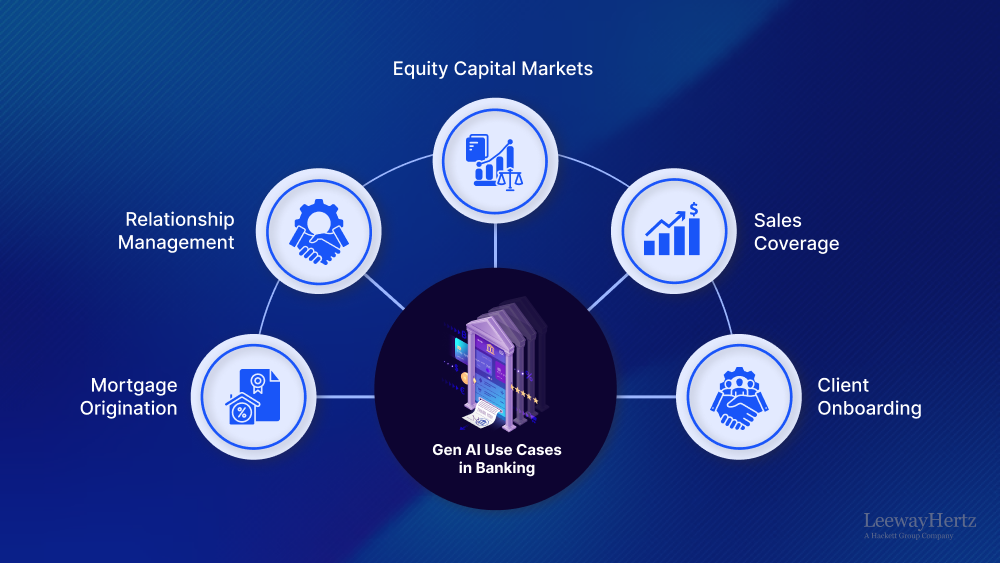
Generative AI in banking refers to AI systems that can read, summarize, draft, classify, retrieve, and explain information across banking workflows such as KYC, lending, payments, compliance, customer service, and reporting. It supports employees by preparing evidence, drafting narratives, answering policy-grounded questions, and coordinating workflow steps for review.
Banking is well-suited to generative AI because it operates at the intersection of data, documents, regulations, customer interactions, risk management, and operations. Beyond processing deposits, loans, payments, trades, and investments, bank employees verify identities, review contracts, interpret policies, investigate exceptions, prepare credit narratives, monitor risk, respond to regulators, service customers, reconcile accounts, and document decisions.
These activities create the ideal environment for generative AI and agentic AI. Traditional AI has already helped banks predict fraud, score credit risk, detect anomalies, and classify transactions. Generative AI expands the opportunity by creating and summarizing content, interpreting documents, drafting narratives, retrieving policy guidance, explaining exceptions, and supporting human decision-making. Agentic AI goes further by coordinating multi-step workflows across systems, documents, teams, and approvals.
The value of generative AI in banking does not come from generic chatbots—it comes from embedding AI into real workflows. Whether it’s a relationship manager preparing for a client meeting, an analyst drafting a credit memo, an investigator assembling a suspicious activity case, a servicing agent responding to a complaint, a treasury team resolving a payment exception, or a controller explaining a regulatory variance, AI must understand the workflow, data, policy context, and required output.
This is why AI use cases should be mapped at the operating-model level. Instead of asking, “Where can banks use AI?”, leaders should ask, “Which function, process, and sub-process can AI improve, and what governed workflow should support it?” Mapping AI this way identifies high-value opportunities across functions and ensures that AI delivers practical, workflow-specific value while maintaining human accountability.
This article demonstrates how generative and agentic AI can be applied at the operating-model level in banking. It breaks down the bank’s operations into major functions, core processes, and sub-processes, and shows where AI can add practical, workflow-specific value. The focus is on helping organizations identify high-impact AI opportunities, integrate them into existing workflows, and maintain human accountability, rather than replacing employees.
- How generative AI is transforming banking operations
- Why banking AI use cases must be mapped at the sub-process level
- Banking operating model and generative AI opportunity mapping across banking processes
- High-value generative AI use cases in banking
- How agentic AI works in banking workflows
- How to prioritize generative AI use cases in banking
- Governance, risk, and responsible AI in banking
- How ZBrain operationalizes generative AI use cases in banking
- Future of generative AI in banking
How generative AI is transforming banking operations
Banks have used analytics, rules engines, workflow automation, robotic process automation, and machine learning for years. These technologies remain important, but generative AI introduces a different type of capability.
Traditional automation follows predefined rules. Machine learning predicts, scores, detects, or classifies based on historical patterns. Generative AI can read, summarize, draft, compare, explain, and transform information. Agentic AI can plan and execute a sequence of workflow steps, such as retrieving information, classifying a case, drafting a response, routing an exception, and updating a system after approval.
In banking, this changes how teams handle work that is:
-
Document-heavy, such as KYC files, loan packages, leases, invoices, contracts, trade documents, tax forms, and audit evidence.
-
Narrative-heavy, such as credit memos, SAR narratives, complaint responses, regulatory commentary, committee packs, and board updates.
-
Exception-heavy, such as sanctions hits, payment breaks, trade settlement fails, reconciliation breaks, chargebacks, covenant breaches, and servicing escalations.
-
Knowledge-heavy, such as policy interpretation, regulatory guidance, product rules, servicing procedures, and advisor support.
-
Workflow-heavy, such as onboarding, underwriting, dispute resolution, KYC refresh, annual review, regulatory reporting, and complaint handling.
The best banking AI use cases usually do not remove the human from the process. Instead, they prepare the case, retrieve evidence, draft the output, highlight risks, and route the work to the right reviewer.
Transform Banking Workflows
Build AI-powered banking workflows that accelerate lending, KYC, payments, compliance, and reporting while strengthening oversight across critical operations.
What to look for in a generative AI banking solution
When evaluating generative AI solutions for banking, leaders should look beyond model capability and assess whether the platform can operate within banking workflows, governance controls, and accountability structures. A useful solution should support secure data access, source-grounded outputs, human review, system integration, monitoring, and audit-ready evidence across regulated processes.
A practical evaluation should test the solution against the workflows, systems, controls, and reviewer responsibilities that already govern banking operations. The table below outlines the key areas banks should assess before selecting or scaling a generative AI platform.
| Evaluation area | What it should address |
|---|---|
| Banking workflow fit | Can the solution support real banking workflows such as KYC, lending, payments, compliance, reporting, servicing, and risk operations? |
| Secure data access | Does it enforce role-based access, least privilege, encryption, audit logs, and controlled retrieval from approved systems? |
| Governance and human review | Can banks define approval checkpoints, escalation paths, reviewer roles, and decision ownership? |
| Source-grounded outputs | Does the system cite policies, documents, customer records, transaction data, and evidence used in the output? |
| Integration readiness | Can it connect with core banking, CRM, LOS, KYC/AML, case management, data warehouse, and reporting systems? |
| Monitoring and auditability | Does it track prompts, outputs, model versions, reviewer actions, exceptions, and downstream updates? |
| Scalability | Can reusable agents or workflow components be adapted across products, business lines, regions, and control functions? |
Why banking AI use cases must be mapped at the sub-process level
“AI in banking” is too broad to be useful. So is “AI in lending,” “AI in compliance,” or “AI in customer service.” These categories are too high-level to define data requirements, controls, approval paths, success metrics, and implementation scope.
A better approach is to map use cases to the banking operating model:
-
Function: the major business or control area, such as retail banking, commercial banking, financial crimes, treasury services, or regulatory reporting.
-
Process: the workflow area within that function, such as account opening, credit origination, transaction monitoring, or Call Report preparation.
-
Sub-process: the specific work activity, such as customer identification, credit memo drafting, alert disposition, or schedule-level variance commentary.
-
AI-enabled opportunity: the specific way AI can support that sub-process, such as extracting data, drafting a narrative, classifying an exception, or assembling evidence.
This level of detail matters because banking workflows are tied to specific regulations, documents, systems, risk owners, and decision rights. A generative AI workflow for SAR narrative drafting is different from one for credit memo drafting. A customer complaint response workflow is different from a payment exception workflow. A wealth advisor copilot is different from a contact-center agent-assist solution.
By mapping AI opportunities at the sub-process level, banks can move from broad innovation ideas to executable workflows with clear business value, data requirements, governance, and implementation paths.
Banking operating model and generative AI opportunity mapping across banking processes
The following sections map generative AI opportunities across the operating model of a modern bank. Each function includes a short overview, a process and sub-process table, and a summary of the highest-value AI opportunities in that function.
Function 1. Retail and small business banking
Retail and small business banking encompasses the bank’s core business unit, including deposit accounts, debit and credit cards, mortgages, consumer loans, auto loans, small-business lending, branch operations, and digital servicing. These workflows involve high volumes, strict regulatory requirements, large document sets, customer communication, fraud controls, and service expectations.
Generative AI can support retail banking by improving onboarding, reducing servicing effort, helping employees follow policy, accelerating dispute handling, and making customer communication clearer and more consistent.
| Process | Sub-process | Key AI-enabled opportunities |
|---|---|---|
| Deposit account origination | Customer identification and document validation | Extract identity data, validate documents, flag mismatches, and prepare a reviewer-ready customer identification record. |
| Customer due diligence profile creation | Assemble customer profile information, summarize the source of funds, and draft a risk-rating narrative for review. | |
| Beneficial ownership identification | Read formation documents, identify ownership structures, and prepare a beneficial ownership summary. | |
| Screening and adverse media review | Summarize screening hits, resolve likely false positives, and draft first-pass disposition notes. | |
| Disclosure and account setup | Select applicable disclosures, summarize key terms in plain language, and prepare account setup tasks. | |
| Card servicing | Dispute intake and classification | Classify dispute reasons, map them to applicable rules, and draft customer acknowledgment messages. |
| Provisional credit review | Summarize case facts, calculate regulatory timelines, and draft a reviewer-ready provisional credit memo. | |
| Chargeback and representment | Assemble evidence, summarize transaction history, and draft a network-aligned representment package. | |
| Friendly fraud review | Identify repeat dispute patterns and prepare a case summary for fraud operations review. | |
| Mortgage origination | Application and document intake | Extract borrower, income, asset, and property data from uploaded documents and populate the loan file. |
| Disclosure and timing review | Check disclosure timing, fee changes, and required borrower notices before submission. | |
| Income and asset verification | Normalize paystubs, tax forms, bank statements, and asset documents into an underwriter-ready worksheet. | |
| Conditions and clear-to-close | Match borrower uploads to outstanding conditions and draft borrower-friendly condition requests. | |
| Auto and consumer lending | Application review | Extract applicant data, identify missing information, and prepare a structured loan review summary. |
| Dealer and contract validation | Compare contract terms, fees, add-ons, and disclosures with policy and state-level requirements. | |
| Small business lending | Tax return and cash-flow analysis | Extract financial data from tax returns and statements and draft a cash-flow analysis summary. |
| SBA and product eligibility support | Compare borrower profile, use of proceeds, and ownership structure with program requirements. | |
| Branch and digital servicing | Service request handling | Classify customer intent, retrieve the relevant procedure, and draft after-call notes or service tickets. |
| Authentication and risk-based step-up | Assess interaction risk and recommend authentication steps based on customer profile and behavior. | |
| Staff support and procedure guidance | Provide bankers with policy-grounded guidance during customer interactions. |
The highest-value opportunities in retail and small-business banking are onboarding support, dispute intake, document validation, mortgage condition clearing, small-business cash-flow analysis, and service request automation. These workflows are repetitive, document-heavy, and well-suited to human-in-the-loop AI.
An example agentic workflow is deposit account onboarding. An AI agent can read submitted documents, extract customer details, compare them against the application, flag any mismatches, summarize screening results, draft missing-document requests, and route the case to the appropriate operations queue for review.
Function 2. Commercial and corporate banking
Commercial and corporate banking supports mid-market companies, large corporates, financial sponsors, institutional borrowers, and treasury clients. The function depends on relationship management, credit analysis, financial statement review, KYC, deal structuring, covenant monitoring, annual reviews, and portfolio management.
Generative AI is highly relevant because commercial banking workflows combine structured financial data, borrower documents, industry research, credit policy, relationship context, and committee-ready narratives.
| Process | Sub-process | Key AI-enabled opportunities |
|---|---|---|
| Entity onboarding | Entity type and document review | Classify entity type, extract registration details, summarize required onboarding documents, and flag potential regulatory or compliance concerns. |
| Beneficial ownership and control review | Map ownership chains, identify controlling parties, prepare a reviewer-ready ownership summary, and flag complex or high-risk ownership structures. | |
| KYC and enhanced due diligence | Assemble KYC evidence, summarize the source of wealth or funds, draft an EDD case pack, and support sanctions, PEP, and adverse media review. | |
| Relationship management | Client meeting preparation | Summarize account activity, credit exposure, service issues, opportunities, recent news, and ongoing risk or compliance indicators for RM preparation. |
| Ongoing client monitoring | Monitor sanctions, PEP, adverse media, ownership changes, transaction activity, and credit signals to surface relationship-level risk changes. | |
| Pipeline and opportunity management | Extract opportunity details from CRM notes and emails, update structured pipeline records, and support predictive deal prioritization. | |
| Credit origination | Financial statement spreading | Extract data from financial statements, tax returns, and notes into standardized spreading templates, while detecting unusual trends, ratio movements, anomalies, and red flags. |
| Industry and borrower analysis | Retrieve market context, peer information, borrower risk drivers, sector trends, and NLP-driven insights for analyst review. | |
| Credit approval memo drafting | Draft structured memo sections, including business overview, financial analysis, risk factors, mitigants, structure, and recommendation, supported by financial and borrower context. | |
| Risk rating and pricing support | Summarize financial and qualitative factors supporting the proposed risk rating and pricing, and provide scenario analysis or predictive risk indicators where available. | |
| Committee preparation | Generate executive summaries, likely committee questions, supporting answer notes, sensitivity highlights, and Q&A support for decision meetings. | |
| Asset-based lending | Borrowing base certificate ingestion | Normalize borrower-submitted collateral data, identify eligible and ineligible assets, flag data inconsistencies, and highlight potential collateral or compliance concerns. |
| Receivables and inventory review | Apply eligibility rules, identify concentration issues, analyze collateral trends, and draft availability movement commentary with potential default or borrowing-base risk alerts. | |
| Commercial real estate | Rent roll and lease review | Extract rent roll and lease terms, identify critical clauses using NLP, and summarize rollover, occupancy, tenant concentration, and cash-flow risks. |
| Property financial analysis | Normalize operating statements and draft DSCR, LTV, debt yield, stress scenario, anomaly, and cash-flow sensitivity commentary. | |
| Covenant monitoring | Covenant inventory and calculation | Extract covenant terms, calculate headroom, flag current or potential breaches, and generate predictive breach alerts based on financial trends. |
| Compliance certificate review | Compare borrower-reported figures with bank calculations, prepare exception notes, and suggest potential remediation or follow-up actions. | |
| Annual review | Review pack assembly | Compile exposure, financials, covenant history, collateral, risk rating, relationship context, trend analysis, and predictive risk indicators. |
| Portfolio monitoring | Watch-list triggers | Detect early-warning indicators and draft watch-list or downgrade-recommendation summaries based on borrower, sector, covenant, and repayment trends. |
| Exposure and repayment trend analysis | Analyze loan exposures, covenant performance, repayment behavior, utilization patterns, and portfolio concentration to surface emerging risk themes. | |
| Workout and special assets | Modification and forbearance support | Summarize borrower condition, collateral, guarantor position, proposed restructuring options, fraud indicators, and potential regulatory reporting considerations. |
| Charge-off and recovery support | Draft charge-off memos and recovery action summaries using case history, exposure data, recovery likelihood, default risk indicators, and compliance considerations. |
The strongest commercial banking use cases include credit memo drafting, financial spreading, KYC pack assembly, covenant monitoring, annual review preparation, and watch-list memo drafting. These workflows require judgment, but they also involve substantial repeatable documentation work that AI can accelerate.
An example agentic workflow is commercial credit memo assembly. The agent can retrieve borrower documents, spread financials, summarize industry context, identify risk drivers, draft memo sections, prepare committee Q&A, and route the draft to the analyst and credit officer for review.
Function 3. Investment banking and capital markets
Investment banking and capital markets include M&A advisory, equity capital markets, debt capital markets, leveraged finance, syndications, rating agency materials, investor presentations, and sell-side research. These workflows are fast-moving, information-intensive, and document-heavy.
Generative AI can help bankers and analysts accelerate research, prepare first-draft materials, synthesize diligence questions, summarize market context, and produce tailored client or investor content.
| Process | Sub-process | Key AI-enabled opportunities |
|---|---|---|
| M&A advisory | Pitchbook preparation | Draft company overview, market context, strategic alternatives, and valuation pages from approved sources. |
| Comparable company and transaction screening | Identify relevant comps and precedents and prepare summary tables with rationale. | |
| Strategic alternatives analysis | Summarize potential transaction paths, pros and cons, and valuation implications. | |
| Diligence Q&A management | Cluster questions, route them to owners, and draft source-grounded first responses. | |
| Fairness opinion support | Assemble supporting analysis and prepare committee-ready documentation summaries. | |
| Equity capital markets | Registration statement support | Draft first-pass business, risk factor, use of proceeds, and MD&A sections from approved materials. |
| Roadshow material preparation | Tailor investor presentation content and Q&A preparation for target investor groups. | |
| Pricing memo support | Summarize order book development, demand quality, and pricing rationale. | |
| Debt capital markets | Structure and mandate support | Draft structure memos using market precedents, issuer profile, tenor, covenants, and pricing context. |
| Offering memorandum support | Generate first-draft issuer, risk, use-of-proceeds, and terms sections for legal and banker review. | |
| Investor presentation support | Draft fixed-income investor materials focused on cash flow, leverage, liquidity, and structural protection. | |
| Leveraged finance | Syndication strategy | Create lender target lists and syndication strategy summaries based on historical participation patterns, lenders’ appetite, sector exposure, pricing benchmarks, and predicted likelihood of participation. |
| Information memorandum drafting | Draft first-pass business, industry, financial, projections, and risk sections from management presentations, diligence materials, bank books, and approved deal materials. | |
| Lender Q&A | Generate draft responses to lender questions using the bank book, model, credit materials, diligence reports, and approved transaction documents, while flagging questions that require banker, legal, or sponsor review. | |
| Credit agreement review | Compare proposed terms against precedent agreements, summarize key covenants, baskets, pricing, and structural differences, and flag terms that may affect lender appetite, risk allocation, or syndication execution. | |
| Pricing and market scenario analysis | Analyze comparable leveraged loans, recent syndication outcomes, market tone, investor feedback, and borrower leverage profile to support pricing range, flex language, and scenario-based syndication strategy. | |
| Sell-side research | Earnings model update support | Ingest filings and earnings releases and identify model update items for analyst review. |
| Research note drafting | Draft results commentary, key takeaways, guidance analysis, and conference call summaries. | |
| Thematic research | Synthesize cross-company themes and draft an industry analysis across the coverage universe. |
The strongest opportunities in investment banking and capital markets are pitchbook drafting, diligence Q&A, offering document support, lender Q&A, research note preparation, and precedent analysis. AI can reduce time spent on first drafts and information retrieval, while bankers retain responsibility for judgment, advice, and client messaging.
An example agentic workflow is diligence Q&A management. An AI agent can ingest data-room documents, cluster incoming questions, identify the responsible workstream, retrieve supporting evidence, draft a response, and track unanswered items until banker or legal approval.
Function 4. Markets, trading, and securities operations
Markets, trading, and securities operations cover trading desks, sales teams, product control, trade capture, confirmations, allocations, settlement, reconciliation, price verification, and risk commentary. These workflows are time-sensitive and require strong controls because errors can affect clients, risk positions, P&L, and regulatory reporting.
Generative AI can support desk commentary, client preparation, trade exception investigation, break resolution, product control narratives, and new product documentation.
| Process | Sub-process | Key AI-enabled opportunities |
|---|---|---|
| Pre-trade research | Overnight news and market summary | Summarize relevant market news, price moves, and portfolio-specific implications for desks. |
| Desk morning notes | Draft desk-specific morning commentary aligned with house view and relevant exposures. | |
| Sales coverage | Client call preparation | Retrieve client history, recent trades, holdings, and relevant market talking points. |
| Trade capture | Booking validation | Identify booking anomalies, missing reference data, or off-market terms before downstream processing. |
| Trade confirmation | Confirmation discrepancy review | Compare trade terms across systems and counterparty confirmations and summarize discrepancies. |
| Trade allocation | Block allocation review | Reconcile allocations against instructions and flag policy deviations. |
| Trade support | Trade break investigation | Retrieve booking, confirmation, settlement, and counterparty messages to draft a break-resolution summary. |
| Settlement operations | Settlement fail analysis | Classify fail causes and draft escalation notes for operations and client service teams. |
| Reconciliation | Position and cash breaks | Classify reconciliation breaks, suggest root causes, and route cases to the right resolver. |
| Product control | Daily P&L attribution | Draft P&L commentary linking movements to positions, trades, and market drivers. |
| Independent price verification | Summarize price source variances, stale prices, and required review actions. | |
| Valuation reserve review | Draft reserve rationale and cross-period trend commentary for reviewer approval. | |
| New product approval | NPA documentation | Draft risk, legal, operations, finance, and control impact sections for new product review. |
| Best execution | Execution quality reporting | Draft best-execution commentary and identify outlier venues, products, or client segments. |
| Transaction cost analysis | TCA exception review | Explain slippage and execution outliers using order, market, and venue data. |
The highest-value use cases in markets and trading are P&L commentary, trade break investigation, settlement fail analysis, confirmation discrepancy review, price verification, and client call preparation. These are high-volume or time-sensitive workflows where AI can reduce investigation time and improve consistency in documentation.
An example agentic workflow is trade break resolution. The AI agent can collect the trade record, counterparty confirmation, settlement messages, reference data, and prior communication, identify the likely cause, draft a resolution note, and route it to operations for approval.
Function 5. Wealth management and private banking
Wealth management and private banking serve high-net-worth, ultra-high-net-worth, family office, and advisory clients. These workflows include onboarding, suitability, investment policy, portfolio review, tax-aware investing, trust administration, private banking lending, and supervisory review.
Generative AI can help advisors prepare for meetings, summarize household information, retrieve policy and product guidance, draft client communications, and support supervisory workflows.
| Process | Sub-process | Key AI-enabled opportunities |
|---|---|---|
| Client onboarding | Client profiling and suitability | Summarize client goals, risk tolerance, time horizon, and constraints into structured suitability fields. |
| KYC and source-of-wealth review | Assemble source-of-wealth evidence and draft a compliance-ready review summary. | |
| Account structuring | Account type and ownership review | Compare client goals with individual, joint, trust, entity, or retirement account structures. |
| Investment policy | IPS drafting | Draft an investment policy statement from client objectives, restrictions, allocation targets, and governance preferences. |
| Advisor support | Policy and product guidance | Provide advisors with grounded answers from approved policy, product, and planning materials. |
| Specialist escalation | Identify when to involve trust, tax, lending, estate, or alternative investment specialists. | |
| Portfolio management | Rebalancing support | Identify drift, propose trade lists, and summarize rationale for advisor review. |
| Tax-loss harvesting | Identify harvesting candidates while considering wash-sale rules and target allocation. | |
| Client reporting | Household reporting | Draft client-ready performance, allocation, attribution, and activity commentary. |
| Meeting preparation | Client meeting pack | Assemble performance data, prior action items, service issues, life events, and market talking points. |
| Meeting follow-up | Extract meeting actions and draft personalized follow-up notes. | |
| Trust services | Trust document review | Extract trustees, beneficiaries, powers, distribution standards, and administrative requirements. |
| Distribution request review | Draft distribution memos that connect the request to trust terms and prior decisions. | |
| Private banking lending | Securities-based lending | Monitor collateral coverage, identify margin risk, and draft advisor alerts. |
| Specialty lending support | Summarize complex income, collateral, ownership structure, and credit rationale. | |
| Supervision | Suitability exception review | Draft exception summaries that connect client context, product features, and policy requirements. |
| Trade surveillance review | Summarize alerts, account context, and disposition rationale for supervisory review. |
The strongest wealth management use cases are meeting preparation, household reporting, policy-grounded advisor support, suitability review, trust document extraction, and supervisory exception review. These workflows benefit from AI because they require personalization, policy grounding, and careful documentation.
An example agentic workflow is advisor meeting preparation. The agent can retrieve the client profile, performance data, recent transactions, prior meeting notes, service issues, life events, and market commentary, then draft a meeting pack and follow-up action list for advisor review.
Function 6. Payments, treasury services, and transaction banking
Payments, treasury services, and transaction banking support corporate clients’ operating cash, receivables, payables, liquidity, fraud prevention, trade services, and payment channels. These workflows are central to large-bank operations and deserve more attention than a generic servicing category can provide.
Generative AI can improve onboarding, implementation, exception investigation, payment inquiry handling, fraud prevention, lockbox processing, and trade document review.
| Process | Sub-process | Key AI-enabled opportunities |
|---|---|---|
| Treasury onboarding | Service setup and pricing | Assemble service schedules, pricing terms, and implementation requirements from client agreements. |
| Authorized user setup | Extract user roles, permissions, and approval limits from signed forms and validate segregation of duties. | |
| Implementation readiness | Summarize open tasks, test-file results, and go-live risks for implementation teams. | |
| Account analysis | Service activity capture | Map activity data to service codes and prepare account analysis inputs. |
| Fee and earnings credit review | Explain fee, balance, and earnings credit movements for the relationship manager review. | |
| Pricing exceptions | Draft exception memos with profitability impact, relationship context, and approval routing. | |
| Receivables | Lockbox and integrated receivables | Extract remittance data, match payments to open receivables, and summarize unmatched items. |
| Payables | ACH, wire, RTP, and FedNow support | Classify payment types, retrieve message details, and draft investigation summaries. |
| Payment operations | Payment exception investigation | Identify failed, delayed, returned, or misdirected payments and prepare resolution notes. |
| Fraud prevention | Positive Pay and ACH block review | Classify exceptions, compare payee information, and recommend approve or return actions for review. |
| Client servicing | Payment inquiry response | Draft client responses using payment history, message traffic, and bank policy. |
| Trade services | Letter of credit issuance | Extract application details and draft LC text aligned with standard field requirements. |
| Document examination | Compare the presented documents with the LC terms and draft discrepancy summaries. | |
| Standby LC draw review | Assess the draw documents against stated conditions and prepare an examiner summary. | |
| Documentary collections | Extract handling instructions and draft tracer or follow-up communications. |
The highest-value opportunities in transaction banking are treasury onboarding, payment exception investigation, lockbox matching, Positive Pay triage, and trade document examination. These workflows are high-volume, rules-driven, and documentation-heavy, making them strong candidates for controlled AI workflows.
An example agentic workflow is payment exception resolution. The agent can read payment messages, retrieve account and beneficiary details, identify the exception type, summarize the likely cause, draft a client response, and route the case to operations or compliance for approval.
Function 7. Custody, fund services, and securities services
Custody, fund services, and securities services support institutional clients through safekeeping, settlement, asset servicing, corporate actions, income processing, fund accounting, transfer agency, and investor reporting. These workflows are operationally complex and deadline-driven.
Generative AI can help teams interpret event notices, summarize exceptions, prepare client communications, review fund accounting breaks, and create documentation for controls and client service.
| Process | Sub-process | Key AI-enabled opportunities |
|---|---|---|
| Corporate actions | Event capture and classification | Extract event terms, classify event type, and route the event to the correct workflow. |
| Client notification | Draft client-specific notices based on event terms, deadlines, options, and instruction preferences. | |
| Election processing | Extract client instructions, track deadlines, and summarize missing or conflicting elections. | |
| Entitlement review | Compare calculated entitlements with depository records and draft variance explanations. | |
| Income processing | Dividend and interest accrual | Identify expected income exceptions and summarize reconciliation breaks. |
| Withholding tax treatment | Review the documentation status and draft treaty-rate or withholding-exception notes. | |
| Tax reclaim support | Assemble reclaim documentation and track claim status by market and client. | |
| Fund accounting | Daily NAV review | Identify NAV exceptions across pricing, accruals, trades, and expenses and draft review commentary. |
| Expense accrual review | Compare accruals against agreements and draft true-up commentary. | |
| Distribution processing | Classify distribution components and prepare shareholder communication support. | |
| Transfer agency | Shareholder record keeping | Summarize shareholder activity, record exceptions, and draft service communications. |
| Client reporting | Institutional reporting support | Draft client reporting commentary on activity, exceptions, corporate actions, and income events. |
| Controls | Operational exception review | Detect recurring exception patterns and prepare control review summaries. |
The strongest use cases in custody and fund services are corporate action event processing, client notification drafting, entitlement exception review, NAV exception commentary, and income reconciliation. AI can help reduce manual review effort while preserving operational controls and client-service quality.
An example agentic workflow is corporate action processing. The agent can read event notices, classify the event, extract key dates and options, draft client notifications, monitor elections, identify missing instructions, and prepare entitlement variance notes for review.
Function 8. Lending operations and loan servicing
Lending operations and loan servicing support loan boarding, servicing, document management, collateral tracking, payment processing, payoff, collections, modifications, escrow, insurance, and post-close quality control.
Generative AI can help reduce manual document review, improve borrower communication, identify exceptions, and strengthen servicing controls.
| Process | Sub-process | Key AI-enabled opportunities |
|---|---|---|
| Loan boarding | Boarding data validation | Compare approval terms, loan documents, and core system fields and flag mismatches. |
| Document completeness review | Identify missing, incomplete, or inconsistent loan documents before servicing begins. | |
| Payment servicing | Payment exception handling | Classify unapplied, misapplied, returned, or partial payments and draft resolution notes. |
| Escrow servicing | Escrow analysis | Summarize escrow shortages, payment changes, tax and insurance adjustments, and customer impact explanations. |
| Loss mitigation | Workout and hardship review | Summarize borrower hardship situations, required documents, and available workout options. |
| Payoff and release | Payoff quote and lien release | Validate payoff calculations, prepare quote explanations, and track lien release tasks. |
| Post-close QC | File review and defect classification | Compare loan file contents with policy and investor requirements and classify defects. |
| Investor reporting | Loan sale and servicing reporting | Summarize exceptions in investor files, remittance reports, and servicing transfers. |
The highest-value lending operations use cases are loan boarding validation, document completeness review, payment exception handling, covenant reporting intake, loss mitigation support, and post-close quality control. These workflows improve both operational efficiency and risk control.
An example agentic workflow is loan boarding validation. The agent can compare approval data, executed loan documents, collateral details, pricing, covenants, and servicing system fields, then generate a boarding exception report for operations review.
Function 9. Risk management
Risk management covers credit risk, market risk, liquidity risk, operational risk, model risk, enterprise risk, stress testing, and portfolio monitoring. Risk teams need accurate data, clear commentary, evidence-backed decisions, and strong governance.
Generative AI can support risk reporting, driver analysis, policy interpretation, model documentation, issue tracking, and committee material preparation.
| Process | Sub-process | Key AI-enabled opportunities |
|---|---|---|
| Credit risk | Portfolio trend reporting | Draft commentary on concentrations, migration, delinquency, and risk-rating changes. |
| Watch-list management | Identify trigger patterns and prepare watch-list summaries for risk committee review. | |
| Allowance and reserve support | Draft reserve rationale using portfolio trends, collateral data, recovery assumptions, and overlays. | |
| Market risk | VaR and stress loss commentary | Explain breaches or stress losses using position, market move, and scenario data. |
| Limit breach management | Draft breach memos with facts, drivers, history, and proposed remediation. | |
| Counterparty risk | Exposure aggregation | Summarize exposures across entities, products, netting sets, and collateral arrangements. |
| Liquidity risk | Liquidity ratio commentary | Draft LCR, NSFR, and internal liquidity metric explanations with key drivers. |
| Intraday liquidity monitoring | Summarize payment or settlement flows that caused intraday liquidity exceptions. | |
| Operational risk | Loss event capture | Extract incident details and classify loss events using the bank’s risk taxonomy. |
| RCSA support | Draft process risk and control statements from policies, incidents, and prior assessments. | |
| Enterprise risk | Scenario analysis | Draft scenario narratives, assumptions, drivers, and impact summaries for review. |
| Model risk | Model inventory and tiering | Extract model details and draft tiering rationale against the model risk policy. |
| Validation support | Assemble validation evidence and draft findings, limitations, and remediation notes. | |
| Ongoing monitoring | Explain performance threshold breaches and draft monitoring commentary. | |
| Issue management | Risk issue tracking | Summarize open issues, aging, dependencies, owners, and escalation needs. |
The strongest risk management use cases are portfolio commentary, watch-list memo drafting, operational loss event classification, model documentation, validation support, and liquidity or market risk commentary. These workflows depend on accurate evidence and clear narratives, making AI useful when paired with human review.
An example agentic workflow is model validation support. The agent can collect model documentation, validation results, monitoring data, prior findings, and remediation evidence, then draft a validation pack for independent model risk review.
Function 10. Financial crimes, fraud, and compliance
Financial crimes, fraud, and compliance are among the most important areas of opportunity for AI in banking. These functions are case-heavy, document-heavy, alert-heavy, and governed by strict policies and regulatory expectations. They also involve large volumes of false positives, repeated investigation steps, and narrative documentation.
Generative AI can help analysts triage alerts, assemble evidence, draft narratives, summarize policies, and improve consistency across investigations.
| Process | Sub-process | Key AI-enabled opportunities |
|---|---|---|
| KYC and CDD | Onboarding KYC pack assembly | Compile customer documents, screening outputs, ownership records, and risk inputs for analyst review. |
| Periodic refresh | Detect profile changes, pre-populate refresh packs, and summarize required updates. | |
| Enhanced due diligence | Assemble source-of-wealth, source-of-funds, ownership, adverse media, and OSINT evidence. | |
| Beneficial ownership | Ownership change monitoring | Identify changes from registries, documents, news, or customer submissions and draft update notes. |
| Transaction monitoring | Alert triage | Classify alerts by typology, summarize activity, and recommend routing for investigator review. |
| Case investigation | Assemble transaction history, counterparty data, KYC profile, and external evidence into a case pack. | |
| Network analysis | Identify linked accounts, counterparties, entities, and transaction flows for investigator review. | |
| SAR reporting | SAR narrative drafting | Draft a structured narrative covering who, what, when, where, why, and how using case evidence. |
| SAR quality assurance | Check narrative completeness, clarity, chronology, and evidence alignment before filing review. | |
| Sanctions screening | Name matching and false-positive review | Summarize match factors, resolve likely false positives, and draft disposition rationale. |
| Escalation review | Identify hits requiring enhanced review and prepare escalation summaries. | |
| Fraud operations | Fraud case investigation | Summarize transactions, device data, login patterns, customer behavior, and prior cases. |
| Fraud ring detection | Identify shared devices, addresses, beneficiaries, merchants, or counterparties across cases. | |
| Fraud recovery | Recovery action support | Draft recovery letters, demand notices, and follow-up summaries based on case facts. |
| Regulatory compliance | Regulatory change monitoring | Summarize regulatory updates, tag affected business lines, and draft impact assessments. |
| Policy and procedure updates | Draft policy redlines and procedure updates based on regulatory or control changes. | |
| Compliance testing | Testing script and results support |
The highest-value opportunities in financial crimes and compliance are KYC pack assembly, alert triage, case investigation, SAR narrative drafting, sanctions false-positive review, regulatory change impact assessment, and compliance testing support. These use cases are strong because they involve repeated evidence gathering and documentation, but final decisions must remain with qualified reviewers.
An example agentic workflow is SAR investigation support. The agent can review the alert, retrieve transaction activity, summarize customer profile information, map counterparties, identify typology indicators, draft the narrative, and route the case to the investigator for review and filing decision.
Function 11. Finance, capital, and regulatory reporting
Finance, capital, and regulatory reporting support the bank as an institution. This function includes close, consolidation, external reporting, management reporting, Call Reports, FR Y schedules, stress testing, CECL or IFRS 9 allowance, tax, capital reporting, and board-level financial commentary.
Generative AI can support reporting accuracy by drafting variance commentary, explaining exceptions, summarizing schedules, assembling evidence, and helping finance teams manage complex reporting cycles.
| Process | Sub-process | Key AI-enabled opportunities |
|---|---|---|
| Financial close | Close task monitoring | Summarize close status, identify delayed tasks, and draft controller-ready updates. |
| Journal and accrual support | Draft entries and supporting explanations from contracts, transactions, and historical patterns. | |
| Intercompany reconciliation | Identify mismatches, suggest clearing actions, and draft imbalance commentary. | |
| Financial reporting | Financial statement commentary | Draft period-over-period explanations for revenue, expense, balance sheet, and cash flow movements. |
| External disclosure support | Draft first-pass disclosure language from prior filings, current data, and reporting checklists. | |
| Regulatory reporting | Call report preparation | Map GL balances to schedules and draft exception explanations for reviewer approval. |
| FR Y and capital schedules | Prepare variance commentary and data-quality notes for regulatory reporting teams. | |
| Edit check management | Explain edit check failures, identify root causes, and draft resolution notes. | |
| Stress testing | Scenario assumption support | Draft assumption narratives and consistency checks across macroeconomic variables. |
| Model output commentary | Summarize projected losses, revenue, capital, and balance sheet impacts. | |
| Allowance | CECL or IFRS 9 narrative | Draft qualitative factor and overlay commentary linked to portfolio and economic evidence. |
| Capital management | Capital plan reporting | Summarize capital actions, ratios, stress impacts, and management buffers. |
| Tax | Provision-to-return reconciliation | Explain the differences between the booked provision and the filed return with supporting schedules. |
| FATCA, CRS, and withholding support | Validate account classifications, documentation status, and reporting exceptions. | |
| Transfer pricing documentation | Draft intercompany service, funding, and benchmarking narratives for tax review. |
The strongest use cases in finance and regulatory reporting are variance commentary, regulatory edit-check explanations, CECL narrative support, stress-testing commentary, close-status reporting, and tax-documentation support. These use cases improve speed and documentation quality while preserving review and sign-off by finance, risk, and regulatory reporting owners.
An example agentic workflow is regulatory reporting exception management. The agent can identify edit check failures, retrieve source balances, compare prior periods, identify likely drivers, draft exception commentary, and route the item to the reporting team for resolution.
Function 12. Customer servicing and complaints
Customer servicing and complaints cover the contact center, digital service channels, complaint intake, investigation, response drafting, regulator portal responses, quality assurance, and workforce management. This function is critical because it affects customer experience, operational cost, and regulatory risk.
Generative AI can assist both customers and employees by improving intent recognition, knowledge retrieval, after-call work, complaint analysis, response drafting, and QA coverage.
| Process | Sub-process | Key AI-enabled opportunities |
|---|---|---|
| Contact center | Voice and chat servicing | Provide policy-grounded guidance and recommended next actions during live service interactions. |
| Intent classification and routing | Classify the customer’s request and route it to the correct workflow or specialist. | |
| Agent assist | Surface relevant procedures, disclosures, and customer context in real time. | |
| Sentiment and escalation detection | Detect frustration, complaint indicators, or escalation risk during interactions. | |
| Authentication | Risk-based verification | Recommend authentication or step-up actions based on interaction risk and customer history. |
| After-call work | Call summary and ticket creation | Draft call notes, ticket categories, resolution summaries, and follow-up tasks. |
| Quality assurance | Interaction review | Score service interactions for policy adherence, tone, resolution, and compliance language. |
| Complaint intake | Complaint classification | Classify complaints by product, issue, channel, regulator taxonomy, severity, and root cause. |
| UDAAP risk detection | Identify language indicating potential unfair, deceptive, or abusive practices. | |
| Complaint investigation | Root-cause analysis | Summarize case history, prior contacts, transactions, policies, and operational errors. |
| Complaint response | Response letter drafting | Draft customer or regulator responses grounded in case facts, policy, and remediation decisions. |
| Complaint reporting | Trend analysis | Identify emerging complaint themes by product, geography, channel, root cause, and customer segment. |
| Workforce management | Volume forecasting | Forecast call and ticket volumes and summarize staffing implications. |
| Coaching | Agent performance insights | Identify coaching priorities using QA findings, repeat issues, and customer sentiment trends. |
The highest-value customer servicing use cases are agent assist, after-call work automation, complaint classification, root-cause analysis, response-letter drafting, and QA review. These workflows reduce manual work while improving consistency and compliance.
An example agentic workflow is complaint response support. The agent can classify the complaint, retrieve account history, summarize prior service interactions, identify policy requirements, draft a response letter, check tone and UDAAP risk, and route the draft for complaint handler approval.
Function 13. Technology, data, cybersecurity, and AI governance
Technology, data, cybersecurity, and AI governance are central to modern banking. Banks operate across complex legacy platforms, cloud environments, data warehouses, models, APIs, third-party systems, cybersecurity controls, and regulatory technology expectations. Generative AI can help these teams manage documentation, incident response, data quality, access controls, and AI governance.
This function is important because generative AI in banking cannot scale without strong technology foundations, secure data access, model oversight, and operational resilience.
| Process | Sub-process | Key AI-enabled opportunities |
|---|---|---|
| IT service management | Incident triage | Classify incidents, summarize impact, and recommend resolver groups based on prior cases. |
| IT service management | Root-cause documentation | Draft incident timelines, root-cause summaries, and remediation actions. |
| Application support | Production issue analysis | Retrieve logs, tickets, release notes, and system changes to summarize likely causes. |
| Change management | Change impact review | Summarize affected systems, controls, dependencies, and rollback requirements. |
| Data governance | Data lineage documentation | Draft lineage summaries across source systems, transformations, reports, and controls. |
| Data quality issue management | Classify data defects, identify affected reports or processes, and draft remediation notes. | |
| Master data | Reference data exception review | Identify inconsistent customer, product, counterparty, account, or instrument reference data. |
| Cybersecurity | Alert triage | Summarize alert context, affected assets, indicators, and recommended investigation steps. |
| Phishing and fraud investigation | Analyze reported emails, user context, links, and prior patterns for security review. | |
| Incident response reporting | Draft incident summaries, timelines, impact statements, and remediation updates. | |
| Third-party technology risk | Vendor risk review | Summarize vendor controls, incidents, SOC reports, and contractual obligations. |
| AI governance | AI use case inventory | Document AI use cases, owners, data sources, models, controls, and approval status. |
| Model and agent monitoring | Summarize output quality, drift signals, exceptions, human overrides, and usage patterns. | |
| Policy compliance review | Check AI workflows against internal AI, data, privacy, cybersecurity, and model-risk policies. |
The strongest use cases in technology and data are incident triage, root-cause documentation, data lineage drafting, data quality issue management, cyber alert triage, and AI governance documentation. These use cases are essential for scaling AI safely across the bank.
An example agentic workflow is AI governance intake. The agent can collect use case details, identify data sources, classify risk level, map required approvals, generate documentation, and route the use case through model risk, compliance, legal, cybersecurity, and data governance reviews.
Function 14. Enterprise operations and shared services
Enterprise operations and shared services support the bank’s internal operating infrastructure, including procurement, vendor management, legal operations, HR operations, finance operations, facilities, enterprise service management, and internal knowledge support. While these functions may not be banking products, they are essential to how large banks operate.
Generative AI can reduce internal service effort, improve policy consistency, summarize contracts, support vendor reviews, and help shared services teams resolve requests faster.
| Process | Sub-process | Key AI-enabled opportunities |
|---|---|---|
| Procurement | Purchase request review | Check requests against policy, budget, vendor status, and approval requirements. |
| Contract review support | Extract key commercial terms, renewal dates, obligations, and risk clauses for reviewer approval. | |
| Vendor management | Vendor onboarding | Summarize vendor documents, risk indicators, ownership details, and required approvals. |
| Third-party risk monitoring | Track issues, control gaps, incidents, and remediation status across vendors. | |
| Legal operations | Legal request triage | Classify legal requests and route them to the right specialist or playbook. |
| Contract obligation tracking | Extract obligations, deadlines, notice periods, and termination rights from agreements. | |
| HR operations | Employee query support | Provide policy-grounded responses to HR, benefits, leave, and payroll questions. |
| Workforce documentation | Draft role descriptions, internal mobility summaries, and onboarding support materials. | |
| Finance operations | Internal finance helpdesk | Classify finance tickets, retrieve policy answers, and draft resolution notes. |
| Enterprise service management | Ticket summarization | Summarize case history, blockers, actions taken, and next steps for service teams. |
| Knowledge management | SOP and policy search | Provide grounded answers from approved procedures, policies, and playbooks. |
| Facilities and real estate | Work order support | Classify requests, summarize maintenance history, and draft vendor follow-up notes. |
| Process improvement | Root-cause trend analysis | Identify recurring service issues and draft recommendations for improvement. |
The highest-value shared-services use cases are procurement request review, contract summarization, vendor risk documentation, policy-grounded employee support, finance helpdesk automation, and ticket summarization. These workflows often scale well because similar patterns apply across many internal functions.
An example agentic workflow is vendor onboarding support. The agent can collect vendor documents, extract ownership and risk information, summarize contract terms, check required approvals, and route the onboarding pack to procurement, legal, compliance, and third-party risk teams.
Accelerate AI Solutions Development
Build fully functional solutions from your high-value use cases, based on specific operational needs and enterprise context.
High-value generative AI use cases in banking
The banking use-case map is broad, but not every workflow should be automated first. The most attractive early opportunities are usually high-volume, document-heavy, exception-heavy, or narrative-heavy workflows where AI can produce a draft or recommendation for human review.
| High-value use case | Why it matters |
|---|---|
| KYC and CDD pack assembly | Reduces manual document collection, screening review, and profile summarization effort. |
| Commercial credit memo drafting | Accelerates analyst work across financial analysis, risk factors, structure, and recommendations. |
| SAR narrative drafting | Helps investigators assemble case evidence and draft complete, consistent narratives. |
| Sanctions false-positive review | Reduces time spent on common false positives while preserving escalation controls. |
| Complaint response drafting | Improves speed, consistency, tone, and documentation in regulated customer responses. |
| Contact-center agent assist | Helps agents retrieve the right policy, procedure, and next action during live interactions. |
| Payment exception investigation | Reduces operational effort in failed, delayed, returned, or misdirected payment cases. |
| Trade break and settlement fail resolution | Speeds up cross-system investigation and documentation for operations teams. |
| Regulatory reporting variance commentary | Helps reporting teams explain schedule-level movements and edit-check exceptions. |
| Product control P&L commentary | Supports daily explanation of P&L drivers, pricing issues, and reserve movements. |
| Wealth advisor meeting preparation | Personalizes client preparation using portfolio, service, life event, and market context. |
| Mortgage condition clearing | Matches borrower documents to outstanding conditions and drafts clear requests. |
| Treasury services onboarding | Organizes user permissions, pricing, implementation tasks, and go-live readiness. |
| Model risk documentation | Supports model inventory, validation, monitoring, findings, and remediation tracking. |
| Data quality issue management | Identifies affected reports, systems, and downstream processes from data defects. |
These use cases work well because they support human review rather than bypassing it. They also create measurable value through cycle-time reduction, productivity improvement, better documentation, fewer backlogs, stronger controls, and improved customer or employee experience.
How agentic AI works in banking workflows
Generative AI can draft, summarize, classify, and retrieve. Agentic AI can coordinate a workflow. In banking, this distinction matters because many valuable use cases require multiple steps across systems, teams, policies, and approvals.
For example, a commercial credit memo workflow is not just a writing task. It may require financial spread, borrower research, industry context, exposure review, covenant analysis, collateral review, risk-rating support, memo drafting, committee Q&A, and approval routing. An agentic AI workflow can coordinate these steps, while the analyst and credit officer remain accountable for the final recommendation.
Examples of agentic AI solutions in banking include:
- A KYC refresh agent that detects profile changes, retrieves documents, pre-populates refresh packs, summarizes screening results, and routes the case for analyst review.
- A credit memo agent that spreads financials, retrieves industry context, summarizes borrower risks, drafts memo sections, and prepares committee questions.
- A SAR investigation agent that assembles transaction evidence, maps counterparties, drafts the narrative, and flags missing investigative steps.
- A payment exception agent that reads payment messages, identifies the break type, retrieves customer context, drafts resolution notes, and routes the case.
- A complaint response agent that classifies the complaint, retrieves account history, summarizes root cause, drafts the response, and checks tone and policy alignment.
- A regulatory reporting agent that identifies edit-check failures, retrieves source data, drafts variance commentary, and tracks resolution.
- A product control agent that reviews P&L movements, market data, trade activity, and pricing exceptions to draft daily commentary.
Agentic workflows should be designed with approval gates. The AI can prepare, recommend, route, and update, but the bank should define where human review is mandatory, what evidence must be retained, and how exceptions are escalated.
How to prioritize generative AI use cases in banking
A bank should not select AI use cases only because they sound innovative. The best use cases combine business value, workflow fit, data readiness, control readiness, and scalability.
| Prioritization criterion | What banks should evaluate |
|---|---|
| Business value | Productivity, cost reduction, revenue impact, risk reduction, customer experience, and cycle-time improvement. |
| Workflow fit | Whether the work is document-heavy, knowledge-heavy, exception-heavy, narrative-heavy, or repeatable. |
| Data readiness | Whether the required data is available, accurate, permissioned, and connected to the workflow. |
| Human review model | Whether a qualified owner can review, approve, reject, or correct AI output. |
| Control impact | Whether the workflow improves documentation, auditability, policy adherence, and exception tracking. |
| Regulatory sensitivity | Whether the workflow touches credit decisions, consumer harm, AML, sanctions, privacy, fair lending, or disclosures. |
| Integration complexity | How many systems, data sources, approval paths, and downstream actions are involved. |
| Scalability | Whether the pattern can be reused across products, regions, business lines, or control functions. |
A practical first wave should focus on workflows with clear boundaries and strong human review. Examples include credit memo drafting, KYC pack assembly, complaint response drafting, payment exception investigation, regulatory reporting commentary, and contact-center agent assist.
More sensitive use cases, such as credit decisioning, fraud loss allocation, SAR filing decisions, customer treatment decisions, and external disclosures, require stronger governance and should keep final accountability with designated bank personnel.
Accelerate AI Solutions Development
Build fully functional solutions from your high-value use cases, based on specific operational needs and enterprise context.
Governance, risk, and responsible AI in banking
Generative AI in banking must operate inside the bank’s existing governance, risk, compliance, and control environment. The most important principle is clear accountability. AI can assist, but the responsible human owner must remain accountable for consequential decisions and regulated outputs.
Key governance requirements include:
-
Human review for credit decisions, SAR decisions, sanctions escalations, complaint outcomes, regulatory filings, customer remediation, external disclosures, and material risk judgments.
-
Source-grounded outputs that cite or link back to approved documents, systems, policies, and evidence.
-
Audit trails that capture inputs, outputs, prompts, model versions, reviewer actions, approvals, rejections, and downstream system updates.
-
Role-based access control so AI only retrieves information that the user and workflow are authorized to access.
-
Data protection controls for customer data, employee data, confidential bank information, trading data, financial information, and regulatory materials.
-
Model and agent monitoring for accuracy, completeness, drift, hallucination, bias, latency, user adoption, and exception rates.
-
Escalation procedures for low-confidence outputs, conflicting policy guidance, unusual customer impact, or regulatory sensitivity.
-
Third-party and vendor risk review for AI platforms, models, infrastructure, and integrations.
-
Alignment with model risk management, privacy, cybersecurity, operational resilience, records retention, fair lending, UDAAP, AML, sanctions, and internal audit requirements.
Governance should not be treated as a blocker. It is what makes AI usable in banking. A well-governed AI workflow gives the bank more transparency, better documentation, stronger consistency, and clearer accountability than unmanaged manual work.
How ZBrain operationalizes generative AI use cases in banking
Identifying use cases is only the first step. Banks also need a way to design, build, validate, deploy, govern, and scale AI workflows across functions. This is where ZBrain helps.
ZBrain is an end-to-end enterprise AI enablement platform that provides enterprises with a structured pathway from identifying where artificial intelligence can deliver value to deploying it as a governed, scalable capability. ZBrain supports this lifecycle through four connected stages: ZBrain Analyzer, ZBrain Design, ZBrain Solution Builder, and ZBrain Governance. The platform provides a governed path from use case analysis to deployed agentic workflows while maintaining policies, permissions, approval points, monitoring, and runtime evidence.
ZBrain Analyzer
ZBrain Analyzer helps teams examine selected credit management processes, identify AI opportunities, and document the business context, systems, data, roles, controls, and review requirements needed to evaluate each use case.
ZBrain Design
ZBrain Design creates a build-ready technical design for the selected use case. It generates the BRD, functional requirements, user journeys, architecture, workflow logic, data details, integration context and governance considerations needed before development begins.
ZBrain Solution Builder
ZBrain Solution Builder enables teams to create, configure, and validate governed AI workflows for banking processes based on the technical design provided by the ZBrain Design module. It supports testing across normal, exception, and control scenarios before deployment.
ZBrain Governance
ZBrain Governance applies policies, access controls, human approval requirements, monitoring, and traceability throughout workflow execution. It provides guardrails, approval gates, escalation controls, kill switches, and audit trails to help organizations maintain oversight of AI outputs, user actions, exceptions, and authorized system updates.
Accelerate AI Solutions Development
Build fully functional solutions from your high-value use cases, based on specific operational needs and enterprise context.
Future of generative AI in banking
Generative AI in banking will evolve from copilots to workflow agents. The first wave helps employees draft, summarize, search, and classify. The next wave will coordinate larger workflows across systems and teams, with humans entering at key review and decision points.
Several shifts are likely to define the next stage of banking AI:
-
From generic assistants to specialized agents built for specific workflows.
-
From standalone pilots to reusable AI components across business lines.
-
From manual review of every step to human approval at defined control points.
-
From centralized AI experimentation to federated adoption across functions under central governance.
-
From static knowledge search to active workflow orchestration.
-
From productivity-only measurement to broader measurement of quality, risk reduction, customer experience, and control effectiveness.
Banks that succeed will not be the ones with the longest list of AI ideas. They will be the ones that connect AI to the way the bank actually operates, at the function, process, and sub-process level.
Endnote
Generative AI has the potential to reshape banking work, but only if it is applied at the right level of detail. Broad statements such as “AI in banking” or “AI in compliance” are not enough. Real value comes from mapping AI to specific workflows, such as KYC pack assembly, commercial credit memo drafting, SAR narrative preparation, payment exception investigation, complaint response drafting, product control commentary, and regulatory reporting variance analysis.
The banking operating model is complex, spanning customer-facing businesses, lending, payments, markets, wealth, custody, risk, compliance, finance, technology, and shared services. Across all these functions, generative AI can extract information, summarize evidence, draft narratives, classify exceptions, retrieve policy guidance, and coordinate multi-step workflows. Agentic AI extends this value by connecting steps across systems and teams while keeping human review in place.
For enterprise banks, the path forward is clear. Build a sub-process-level opportunity map. Prioritize workflows with clear value and strong review models. Connect AI to approved data and policies. Run shadow tests. Deploy with governance. Scale through reusable agents and components.
The future of banking AI will not be defined by generic chatbots. It will be defined by governed, workflow-specific agents that help banks operate faster, serve customers better, strengthen controls, and give employees more time to apply judgment where it matters most.
Explore how generative AI can streamline complex banking workflows, strengthen decision-making, and improve operational performance. Partner with LeewayHertz® and ZBrain to turn high-value banking use cases into production-ready solutions.
Author’s Bio


Akash's ability to build enterprise-grade technology solutions has garnered the trust of over 30 Fortune 500 companies, including Siemens, 3M, P&G, and Hershey's. Akash is an early adopter of new technology, a passionate technology enthusiast, and an investor in AI and IoT startups.

Transform Enterprise Processes with AI
Whether you have a defined use case or a process you want to improve, we design and build AI solutions that address operational gaps, enhance existing capabilities, and integrate with your enterprise data, systems, and workflows.
Start a conversation by filling the form
Once you let us know your requirement, our technical expert will schedule a call and discuss your idea in detail post sign of an NDA.
All information will be kept confidential.
FAQs
What are the best generative AI use cases in banking?
High-value generative AI use cases are typically document-heavy, narrative-heavy, exception-prone, or repetitive, in which AI can draft or summarize information for human review. Examples include:
-
KYC and CDD pack assembly – Reduces manual document collection, verification, and compliance summarization.
-
Commercial credit memo drafting – Accelerates financial analysis, risk factor assessment, and memo preparation.
-
SAR narrative drafting – Helps investigators compile evidence and produce consistent, complete narratives.
-
Sanctions false-positive review – Reduces manual review time for common alerts while preserving escalation controls.
-
Complaint response drafting – Improves speed, consistency, and compliance in regulated customer communications.
-
Contact-center agent assist – Supports agents in retrieving relevant policy, procedure, and next steps during live interactions.
-
Payment exception investigation – Accelerates resolution of failed, delayed, returned, or misdirected payments.
-
Regulatory reporting commentary – Drafts variance explanations and highlights exceptions in reports.
-
Product control P&L commentary – Summarizes daily P&L movements, trade activity, and pricing anomalies.
-
Wealth advisor meeting preparation – Prepares client briefs using portfolio, service history, life events, and market context.
How is generative AI different from traditional AI in banking?
Traditional AI typically predicts, scores, classifies, or detects patterns based on historical data. Generative AI, in contrast, can read, summarize, draft, compare, explain, and retrieve information, producing outputs that mimic human reasoning. Agentic AI extends this by coordinating multi-step workflows across systems, documents, policies, and approval paths, ensuring that outputs are integrated and actionable within banking operations.
What is agentic AI in banking?
Agentic AI refers to AI systems that plan and execute sequences of workflow steps under defined controls. For example, an agent can:
-
Assemble a KYC refresh pack
-
Detect profile changes and missing documents
-
Draft requests for required documents
-
Route the case for human review
-
Update enterprise systems after approval
This ensures workflow continuity, accelerates repetitive tasks, and maintains human accountability.
Which banking functions benefit most from generative AI?
Generative AI can add value across most banking functions, particularly those involving high-volume documents, complex workflows, and regulatory oversight. Key areas include:
-
Retail and small business banking
-
Commercial banking and lending operations
-
Financial crimes, fraud detection, and compliance
-
Payments and treasury services
-
Risk management and regulatory reporting
-
Markets operations and product control
-
Wealth management and advisory
-
Technology governance and enterprise operations
Can generative AI be used in regulated banking workflows?
Yes, when implemented with appropriate controls and governance. AI should be:
-
Grounded in approved and validated data
-
Monitored for quality, consistency, and compliance
-
Integrated with audit trails and human review checkpoints
-
Used as a support tool, with final decision-making retained by qualified personnel
Should AI make credit, fraud, or compliance decisions?
AI can support these processes by assembling evidence, drafting narratives, and highlighting key risk factors. However, final decisions regarding credit approvals, fraud disposition, SAR filings, sanctions escalations, customer remediation, and regulatory reporting must remain with qualified human owners to ensure accountability and regulatory compliance.
How should banks prioritize AI use cases?
Banks should evaluate AI opportunities based on:
-
Business value: Productivity, cost reduction, revenue impact, risk mitigation, and cycle-time improvements
-
Workflow fit: Document-heavy, knowledge-intensive, exception-prone, narrative-heavy, or repeatable tasks
-
Data readiness: Availability, accuracy, permissions, and integration
-
Human review model: Qualified owners can review, approve, reject, or correct AI outputs
-
Control and regulatory impact: Improvements in auditability, policy adherence, and regulatory sensitivity
-
Integration complexity: Number of systems, data sources, and approval paths involved
-
Scalability: Reusability across business lines, regions, and functions
High-value early use cases are typically well-bounded workflows with clear review points, such as credit memo drafting, KYC pack assembly, complaint response drafting, payment exception investigation, and regulatory reporting commentary.
How can community banks and credit unions use generative AI?
Smaller institutions can focus on bounded, high-impact workflows that require minimal infrastructure investment. Examples include:
-
Policy and procedure search
-
Customer service support and complaint response drafting
-
Loan document review
-
KYC refresh assistance
-
Regulatory reporting commentary
-
Internal knowledge management
These workflows provide measurable efficiency and compliance benefits without requiring a full-scale AI transformation.
What governance is required for AI agents in banking?
Effective AI governance ensures reliability, compliance, and accountability. Key requirements include:
-
Role-based access to control data and workflow access
-
Audit trails capturing inputs, outputs, prompts, model versions, and reviewer actions
-
Human review for critical decisions
-
Output monitoring for accuracy, bias, and anomalies
-
Data protection for customer, employee, and financial information
-
Model and agent documentation for validation and compliance
-
Escalation procedures for exceptions, low-confidence outputs, or regulatory sensitivity
-
Alignment with model risk, privacy, cybersecurity, operational resilience, and internal audit frameworks
How does ZBrain support generative AI use cases in banking?
ZBrain is an end-to-end enterprise AI enablement platform that provides banks with a structured pathway from identifying where generative AI can deliver value to deploying it as a governed, scalable capability. It supports this lifecycle through four connected stages: ZBrain Analyzer, ZBrain Design, ZBrain Solution Builder, and ZBrain Governance.
- ZBrain Analyzer helps teams examine selected banking processes, identify generative AI opportunities, assess source artifacts, and define review boundaries.
- ZBrain Design converts those opportunities into workflow designs with steps, roles, systems, controls, and exception paths.
- ZBrain Solution Builder enables teams to create, configure, and validate governed AI workflows based on the technical design.
- ZBrain Governance applies policies, permissions, approval points, monitoring, and runtime evidence throughout workflow execution.
Together, these capabilities help banks operationalize generative AI across customer service, onboarding, lending, KYC, fraud operations, risk management, compliance, finance, and internal operations while preserving human accountability for customer, credit, regulatory, financial, and operational decisions.
Related Services/Solutions
Generative AI Development
Leverage our generative AI development services to streamline workflows, boost productivity and drive innovation, while ensuring seamless integration with your existing systems.

Generative AI Consulting
Optimize your business potential with our comprehensive generative AI consulting services, designed to guide you in leveraging GenAI for operational excellence and product innovation, while also upholding ethical AI principles.
ZBrain: Generative AI Platform for Finance
Streamline your finance operations with our generative AI platform, ZBrain, that enables the development of LLM-powered apps for optimizing workflows, enhancing customer interactions and more.
Related Posts


- How generative AI is transforming banking operations
- Why banking AI use cases must be mapped at the sub-process level
- Banking operating model and generative AI opportunity mapping across banking processes
- High-value generative AI use cases in banking
- How agentic AI works in banking workflows
- How to prioritize generative AI use cases in banking
- Governance, risk, and responsible AI in banking
- How ZBrain operationalizes generative AI use cases in banking
- Future of generative AI in banking
- Contact us