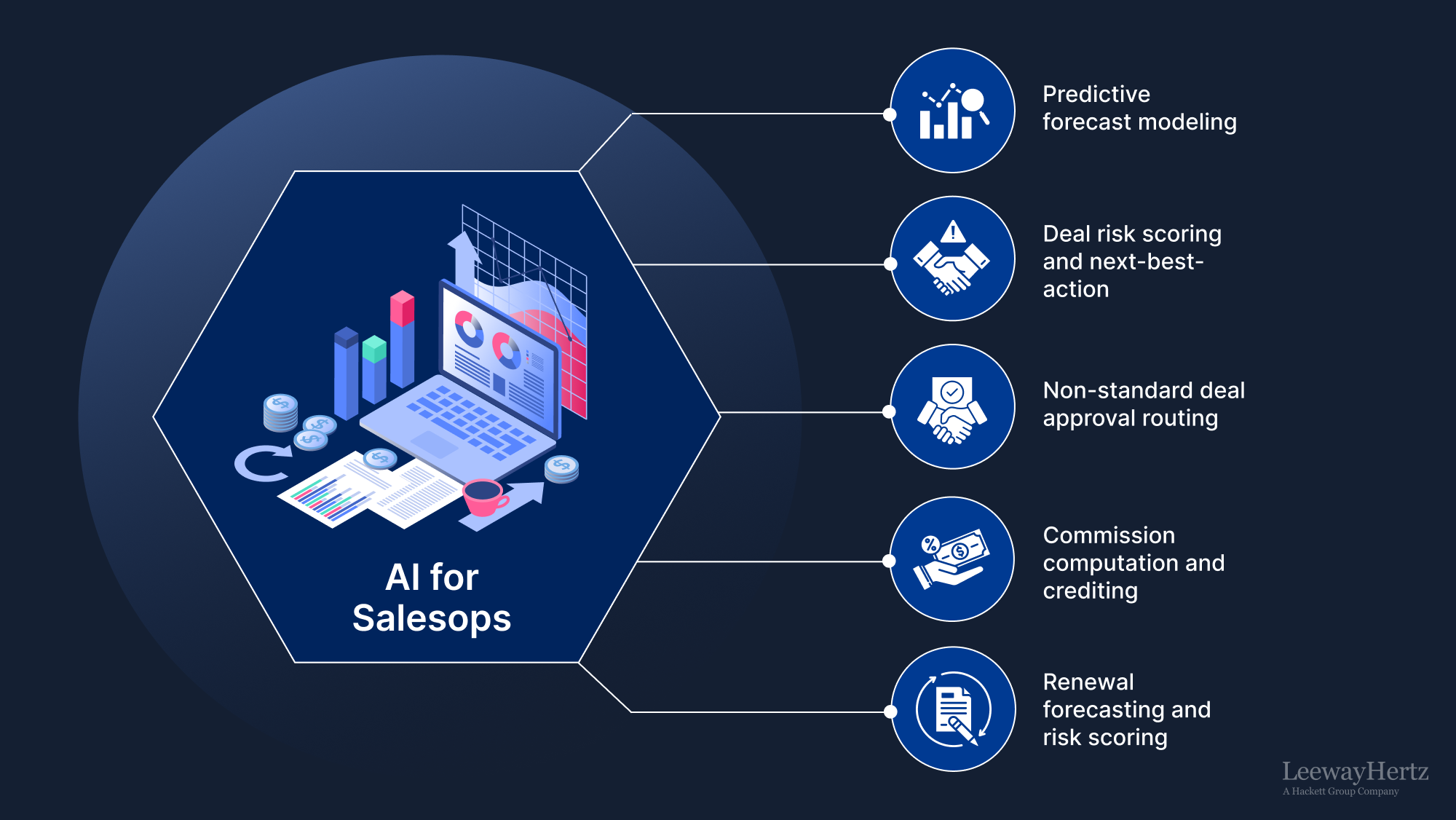
Sales operations is the operating system of the revenue engine. It sets the coverage model, keeps the pipeline honest, supports the forecast that leadership plans against, configures the quotes that become contracts, calculates the commissions that shape sales behavior, protects the renewal base, and helps prove that revenue activity stayed within policy. When sales operations work well, revenue becomes more predictable, and the field spends more time selling. When it does not, demand is wasted, forecasts miss, approvals slow down, pay disputes increase, and compliance gaps follow.
That operating burden is becoming harder to manage manually. Sales teams now work across larger account books, more complex territories, expanding product lines, usage-based pricing, multi-step approvals, partner channels, renewal motions, and increasingly fragmented customer data. SalesOps sits at the center of that complexity. It has to reconcile what the CRM says, what the forecast assumes, what the quote allows, what the contract reflects, what the compensation plan rewards, and what the business expects. This is exactly the kind of structured, rules-heavy, exception-driven work where AI can create value, if it is applied with the right controls.
The market is investing accordingly. Analysts project the AI for sales and marketing market to reach roughly USD 240 billion by 2030, growing at a compound annual rate above 30 percent [1], while the narrower AI-in-sales segment is forecast to expand from single-digit billions in 2025 to tens of billions within the decade [2]. Independent market research also identifies sales and marketing as one of the fastest-growing functions for AI adoption [3]. The figures vary by source and should be confirmed before publication, but the direction is consistent: AI is moving from experiment to operating infrastructure across the revenue function.
The value, though, does not come from a generic chatbot bolted onto the CRM. It comes from AI embedded in specific work owned by specific roles. A revenue operations analyst does not need another chat window; they need stale and slipping deals surfaced before the pipeline review. A deal desk analyst needs quotes checked against pricing policy, with non-standard terms routed to the right approver. A sales compensation analyst needs out-of-range credits flagged before the payout run is approved. In SalesOps, the unit of value is the sub-process, not the tool.
That is why AI use cases in sales operations have to be mapped at the sub-process level. A function such as forecasting is too broad to build against, and a benefit such as improved efficiency is too vague to govern. Break the function into processes, break those processes into atomic sub-processes, and each one reveals a concrete artifact, an accountable reviewer, and a specific AI capability that can change the work without weakening control.
This article uses the sales operations operating model to break work into functions, processes, and sub-processes, and to map a specific, governed AI opportunity to each one.
- How AI is transforming sales operations
- Why sales operations AI use cases must be mapped at the sub-process level
- Sales operations operating model and AI opportunity mapping across sales operations processes
- High-value AI use cases in sales operations
- How agentic AI works in sales operations workflows
- How to prioritize AI use cases in sales operations
- Governance, risk, and responsible AI in sales operations
- How ZBrain operationalizes AI use cases in sales operations
- Future of AI in sales operations
How AI is transforming sales operations
AI is changing sales operations by taking on the preparation, checking, and drafting that sit in front of every human decision, and by doing it consistently across systems that rarely talk to each other. The work does not become autonomous. It becomes faster to start, cleaner to review, and easier to trust, because the reviewer opens a prepared, checked artifact instead of a blank record.
Consider a single deal moving through the engine. A lead is enriched and scored on the way in, matched to the right account, and routed to the correct owner. As it becomes an opportunity, its stage data is validated, and its slip risk is scored from real activity signals. When it is ready to quote, the configuration is checked against the pricing policy and the non-standard terms are routed to an approver. On close, the order is validated against the contract, the revenue treatment is mapped for finance, and the commission is computed and checked before the payout run. Together, they remove the manual stitching between CRM, CPQ, contract, billing, and compensation systems that consumes sales operations time and introduces errors.
Across the function, AI is best suited to five types of work:
- Document-heavy work: the contracts, order forms, quotes, and RFP responses that can be checked for missing context and inconsistencies before a reviewer opens them.
- Narrative-heavy work: the deal-review notes, forecast commentary, proposals, and business-review briefings that AI can draft from approved source material while showing where evidence is thin.
- Exception-heavy work: the non-standard discounts, commission disputes, order holds, and stalled deals that can be classified and prioritized so specialists take the highest-impact ones first.
- Knowledge-heavy work: the pricing policy, compensation-plan rules, and contract-clause interpretation that improve when AI retrieves the relevant rule and prior decisions and flags conflicts.
- Workflow-heavy work: the multi-step quote-to-cash and renewal processes that benefit when AI forecasts the bottleneck and assembles the next work packet, reducing rework between functions.
The practical design rule that follows is simple: let AI prepare, check, and draft the artifact, and let a person make the decision that carries risk. Every durable sales operations use case that keeps that boundary, because the value is in a faster, cleaner path to a human judgment, not in removing the judgment.
Why sales operations AI use cases must be mapped at the sub-process level
A team that sets out to add AI to forecasting quickly discovers that forecasting is not a single activity. It includes rollup consolidation, predictive modeling, variance analysis, scenario planning, and leadership review, each with its own data inputs, decision points, accountable reviewer, and risk profile. When AI is aimed at the function level, the use case becomes too broad to design, measure, or govern. When it is aimed at the sub-process level, the work has clear boundaries: the artifact is known, the data is identifiable, the reviewer is defined, and the control point is visible. That is what makes the use case buildable.
A better approach is to map AI use cases to the sales operations operating model:
Function: a governed operational domain with its own accountability, such as forecasting, incentive compensation, or contract lifecycle management. A large revenue organization runs a dozen or more.
Process: a workflow area inside a function, such as forecast construction inside forecasting, or commission calculation inside incentive compensation.
Sub-process: the atomic work activity that carries the real AI opportunity, such as predictive forecast modeling, commission crediting, or redline deviation analysis. It has a specific input artifact, a source system, a governing rule, an accountable reviewer, and an output artifact.
AI-enabled opportunity: a specific AI capability applied to a specific sub-process artifact, framed by what it changes, such as anomaly detection flagging out-of-range commission credits before the payout run.
At the sub-process level, the components of a real use case become visible. The input artifact tells you what the AI reads. The source system tells you where it reads it. The governing rule, whether a pricing policy, a compensation plan, or an accounting standard, tells you the constraints. The accountable reviewer tells you where the human decision sits. The output artifact tells you what the AI produces for that person to confirm. Without this, the work drifts back to generic benefits that cannot be built or governed.
Mapped this way, the opportunities become concrete. In pipeline management, classification tests each opportunity against stage exit criteria and flags deals that have not earned their stage. In the deal desk, classification routes non-standard terms to the correct approver under the approval matrix. In contract management, document intelligence compares customer redlines against the playbook and tiers each deviation by risk. Each names a capability, an artifact, and the change it makes.
The rest of this article works at this level. The following section walks through the full sales operations operating model, function by function, and maps a specific AI opportunity to each process and sub-process, always with the reviewer and the artifact named.
Transform Investment & Brokerage Operations With GenAI
Leverage ZBrain Builder to design and deploy governed generative and agentic AI workflows across investment, advisory, and compliance operations, improving efficiency, traceability, and decision accuracy.
Sales operations operating model and AI opportunity mapping across sales operations processes
The sales operations operating model below spans the full revenue lifecycle plus its cross-cutting governance, analytics, data, technology, enablement, and compliance functions. Each function is rendered as a self-contained block: what it does, who runs it, what AI helps with, what humans keep, the process and sub-process opportunity map, the highest-value opportunities, and one governed agentic workflow. The regulatory framework of record is that of the United States. It covers revenue recognition and contract-cost accounting standards, internal controls over financial reporting, data privacy and outbound-contact regulations, and recognized security standards. The model is designed to apply across B2B industries.
Function 1: Sales planning and strategy
Turns market data, revenue targets, and capacity assumptions into the coverage model, territory plan, quota structure, and sales priorities that guide revenue execution.
Sales planning and strategy converts market data, historical performance, account potential, capacity assumptions, and annual revenue targets into the operating plan for the sales organization. It defines which segments to pursue, how accounts should be prioritized, how territories should be structured, where headcount should be placed, and how quotas should be assigned. It sits at the front of the SalesOps operating model and sets the constraints that downstream functions inherit. When planning is wrong, forecasting accuracy, pipeline coverage, quota fairness, compensation outcomes, and sales execution all inherit the error.
Teams involved: Revenue operations planners, sales strategy and analytics teams, finance business partners, sales operations leaders, and the sales leadership team that owns segment, territory, capacity, and quota decisions.
What AI helps with: Predictive analytics can project account potential, sales representative productivity, and ramp curves from historical attainment data. Optimization can propose balanced territory models that reduce disruption and improve coverage fairness. Simulation can test quota, capacity, and hiring scenarios against pipeline history before a plan is locked. Multi-source aggregation can combine firmographic, technographic, intent, CRM, and historical win/loss data into a more evidence-based segmentation view. Natural-language generation can draft plan narratives, assumption logs, and review summaries for leadership approval.
What humans continue to own: Sales leaders decide which segments to fund, approve territory assignments, set final quota numbers, and own the capacity commitments made to finance. These are strategic, compensation-sensitive, and morale-sensitive decisions with business and legal implications. AI can score, model, simulate, flag, and draft, but accountable leaders approve the plan and remain responsible for the outcome.
| Process | Sub-process | Key AI-enabled opportunities |
|---|---|---|
| Go-to-market and segment planning | Market segmentation and ICP definition | Multi-source aggregation consolidates firmographic, technographic, CRM win/loss, and historical performance data into a scored ideal customer profile, so segment boundaries rest on evidence rather than intuition. Classification tags the total addressable account list against the ICP definition, surfacing high-fit accounts that current coverage may miss. |
| Account prioritization and coverage strategy | Predictive analytics scores account for potential and buying propensity, helping planners identify which accounts merit enterprise coverage, inside sales coverage, partner coverage, or lower-touch motions. Classification groups accounts by coverage need, so sales leadership can review whether the planned model matches account value and complexity. | |
| Capacity and headcount planning | Capacity modeling and hiring-plan validation | Predictive analytics uses historical attainment curves to estimate fully ramped sales representative productivity, turning a headcount plan into a defensible capacity model. Simulation tests hiring-cadence scenarios against the revenue target so leaders can see coverage gaps before the plan is committed. |
| Territory design | Territory modeling and account assignment | Optimization proposes territory splits that balance account potential across reps, reducing the manual planning effort that consumes sales-planning cycles. Anomaly detection flags overloaded, underweight, or unusually concentrated territories in the draft plan before assignments are published. |
| Territory balancing and disruption analysis | Simulation models the revenue disruption of a proposed re-carve against the current book of business, giving leaders a change-impact view before approval. Predictive analytics estimates attainment risk for sales representatives whose books change materially, informing transition support. | |
| Quota and target setting | Quota allocation and modeling | Predictive analytics allocates the top-down target across territories using account potential, capacity, and historical attainment, producing a first-pass quota table for review. Anomaly detection flags quota assignments that fall far outside historical attainment bands, catching setting errors early. |
| Ramp and attainment modeling | Predictive analytics builds ramp curves for new hires from cohort history, so quota credit and productivity expectations align with realistic selling capacity. Simulation stress-tests attainment scenarios against the plan, quantifying the coverage buffer leaders may need to hold. | |
| Planning governance | Assumption log and plan-change control | Natural-language generation drafts the planning rationale, assumptions log, and change summary from approved planning inputs. Anomaly detection flags material changes to territories, quotas, or capacity assumptions so reviewers can confirm that the final plan remains aligned with governance rules. |
Highest-value opportunities:
- Quota allocation and modeling is one of the highest-value opportunities because a defensible first-pass quota table has a wide downstream effect on forecasting, compensation, sales representative trust, and sales execution.
- Territory modeling and account assignment are also high value because it is a complex optimization problems where balanced account distribution directly affects attainable revenue and sales productivity.
- Capacity modeling and hiring-plan validation matters because tying headcount to modeled selling capacity reduces the risk of an under-resourced plan or an over-committed revenue target.
Example agentic workflow
- The workflow starts with the draft territory list, account potential data, CRM history, and historical attainment dataset, which serve as the input artifacts for the annual sales plan.
- Optimization proposes a balanced territory model, and predictive analytics attaches a projected attainment band to each territory.
- Anomaly detection flags territories whose projected attainment, account concentration, or quota assignment falls outside historical norms, then assembles the exceptions into a review packet.
- A sales operations planner and sales leader review the packet at a defined checkpoint and confirm, reject, or adjust each flagged territory.
- After approval, the agent writes the confirmed assignments back to the planning system of record under existing plan-governance controls and notifies affected managers.
Function 2: Lead and demand management
Converts inbound and sourced demand into clean, enriched, scored, and correctly routed records that sales teams can act on.
Lead and demand management takes inbound inquiries, campaign responses, event leads, partner referrals, and sourced prospects and turns them into usable sales records. It sits between marketing and pipeline creation, making sure demand is captured accurately, matched to the right account, scored against agreed criteria, and routed to the right owner. Weak scoring, poor matching, or delayed routing can waste the demand the business has already paid to generate.
Teams involved: Marketing operations, sales development leadership, revenue operations lead-management analysts, SDR managers, and sales operations teams are responsible for routing rules, qualification standards, and follow-up governance.
What AI helps with: Data extraction, enrichment, and multi-source aggregation can complete thin lead records using public, licensed, CRM, campaign, and intent data. Classification can match leads to the right account, identify duplicates, and check whether a lead meets qualification criteria. Predictive analytics can score leads and accounts based on conversion probability, while optimization can assign records to the right owner under territory, segment, capacity, and round-robin rules. Anomaly detection can catch broken routing, duplicate spikes, missing fields, or aging leads before demand sits unworked.
What humans continue to own: Sales development representatives decide how to engage qualified leads, managers own follow-up standards and routing policy, and marketing owns lead-source governance. Legal, privacy, and operations teams define the consent and contactability rules that determine whether a record can be used. AI can enrich, score, classify, and route, but people remain accountable for engagement judgment, policy approval, and compliant use of lead data.
| Process | Sub-process | Key AI-enabled opportunities |
|---|---|---|
| Lead intake and enrichment | Lead capture and data enrichment | Data extraction and normalization populate missing fields from inbound forms, event lists, partner files, and uploaded lead sources before a rep opens the record. Multi-source aggregation appends verified company, role, industry, and account data to thin records, increasing the share of leads that are actionable on first touch. |
| Lead deduplication and account matching | Classification matches each new lead to an existing account or contact, preventing duplicate records that fragment the account view. Anomaly detection flags conflicting, incomplete, or suspicious lead attributes for review before the record enters the routing queue. | |
| Lead governance | Source validation and consent checks | Classification checks whether each record has an approved source, required consent basis, and contactability status before routing. Anomaly detection flags records with missing source fields, unusual source patterns, or consent conflicts for lead-management review. |
| Lead scoring and qualification | Predictive lead and account scoring | Predictive analytics scores each lead and account on conversion probability using behavioral, firmographic, technographic, and historical conversion signals, helping sales representatives prioritize the highest-probability records first. Multi-source aggregation blends intent and engagement signals into the score, surfacing ready-to-buy segments that static rules may miss. |
| MQL-to-SQL qualification and handoff | Classification checks each lead against agreed qualification criteria and flags handoffs that do not meet the definition. Natural-language generation drafts a qualification summary from captured activity, giving the receiving rep context without requiring manual review of every interaction. | |
| Lead routing and assignment | Routing rules and owner assignment | Optimization assigns each qualified lead to the correct owner under territory, segment, capacity, and round-robin rules, reducing misrouted records that stall. Anomaly detection monitors the routing engine and flags leads that fall through assignment gaps. |
| Speed-to-lead and SLA monitoring | Anomaly detection watches time-to-first-touch against the service-level standard and flags leads at risk of breaching it. Natural-language generation drafts escalation notes for aging leads, prompting the owner or manager to act. | |
| Lead disposition and recycle | Disqualification, nurture, and recycle routing | Classification identifies leads that should be disqualified, routed to nurture, or recycled for later follow-up based on qualification status and engagement history. Predictive analytics estimates when recycled leads are likely to re-engage, helping marketing and SDR teams time the next action. |
Highest-value opportunities:
- Predictive lead and account scoring is high value because it runs at high volume and directly concentrates sales representatives’ efforts on the leads and accounts most likely to convert.
- Lead deduplication and account matching are high value because clean matching protects every downstream workflow that depends on the account view, including scoring, routing, attribution, forecasting, and reporting.
- Speed-to-lead and SLA monitoring are high value because faster, monitored follow-up helps recover demand that the business has already funded.
Example agentic workflow
- The workflow starts with a newly captured lead record from an intake form, campaign response, event list, partner file, or sourced lead upload.
- Data extraction and enrichment complete the record, classification matches it to the right account, and predictive analytics attaches a conversion score.
- The agent checks source, consent, and qualification rules. If the record fails a qualification or contactability check, it is held for review by a lead-management analyst.
- For approved records, optimization proposes the correct owner under routing rules, and natural-language generation drafts a qualification summary for the receiving rep.
- After confirmation or rule-based approval, the agent assigns the lead in the CRM, logs the enrichment sources and routing rationale, and monitors the record against the speed-to-lead SLA.
Function 3: Pipeline and opportunity management
Keeps the pipeline honest so every downstream number rests on real deal data.
Pipeline and opportunity management keeps opportunity records accurate and the pipeline healthy: stages validated, close dates realistic, next steps present, stale deals confronted, and coverage assessed against target. It sits between lead management and forecasting, and the forecast is only as reliable as the opportunity data behind it. Inconsistent stage data, stale deals, inflated amounts, and untested rep assumptions are among the most common reasons forecasts lose accuracy.
Teams involved: Revenue operations pipeline analysts, sales operations teams, first-line sales managers who run deal reviews, and sellers who own each opportunity record.
What AI helps with: Classification and anomaly detection can validate stage data, identify missing fields, and surface stale or slipping deals. Predictive analytics can score deal risk, slip risk, and win probability from activity, engagement, stage progression, and historical conversion signals. Multi-source aggregation can reconcile CRM data with email, meeting, call, and engagement signals to test whether rep-entered deal data reflects actual deal activity. Retrieval-grounded answering can assemble stakeholder, competitor, and whitespace context from CRM notes, engagement history, and approved playbooks. Natural-language generation can draft deal-review notes, risk summaries, and manager review packets.
What humans continue to own: Sellers own the truth of each deal and the customer context behind it. First-line managers decide which deals to recommit, rescore, move out, or escalate. Sales leaders own the coverage calls and the operating response when the pipeline is insufficient. Judgment about a specific customer relationship stays with the rep and manager. AI can score, flag, summarize, and recommend, but the manager decides how the deal is treated, and the rep confirms the deal state.
| Process | Sub-process | Key AI-enabled opportunities |
|---|---|---|
| Pipeline hygiene | Stage validation and data completeness checks | Classification tests each opportunity against stage exit criteria and flags deals that appear to sit in a stage they have not earned, tightening pipeline discipline. Anomaly detection surfaces records with missing next steps, close dates, amounts, contacts, or required fields before the deal review, so reviews focus on decisions rather than basic data cleanup. |
| Close-date and amount accuracy checks | Anomaly detection flags opportunities with repeatedly pushed close dates, unusual amount changes, or close dates that do not match stage history. Predictive analytics estimates close-date realism and the amount of risk from historical deal progression patterns, helping managers challenge inflated or poorly supported records. | |
| Stale and slipped deal detection | Anomaly detection flags deals with no recent activity, stalled stage movement, or repeatedly pushed close dates, assembling a stale-deal queue for manager review. Predictive analytics estimates slip risk from activity recency, stakeholder engagement, deal age, and stage history, prioritizing which deals need a recovery plan. | |
| Deal inspection and review support | Deal risk scoring and recommended next action | Predictive analytics scores win probability and deal risk from measurable deal signals rather than rep sentiment alone, giving managers an objective input for deal review. Context-aware recommendation suggests the next action for each at-risk deal using approved sales playbooks, stage criteria, and patterns from similar won deals. |
| Stakeholder and whitespace mapping | Multi-source aggregation builds a stakeholder map from CRM, meeting, email, and engagement data, exposing single-threaded deals or missing buying-committee coverage. Classification identifies relevant whitespace products or expansion paths within the account, drafting a shortlist for the rep to qualify during deal review. | |
| Pipeline coverage management | Coverage gap analysis | Predictive analytics compares weighted and unweighted pipeline against target by segment, territory, product, and period, flagging coverage gaps early enough for leaders to act. Simulation tests how coverage changes under different win-rate, deal-size, and slip assumptions, informing pipeline-generation targets. |
| Pipeline generation targeting | Classification ranks target accounts by fit, timing, and engagement signals so pipeline-generation effort concentrates where demand is most likely to form. Natural-language generation drafts territory-specific pipeline-generation briefs from the ranked account list, giving managers a sharper basis for inspection and coaching. |
Highest-value opportunities:
- Stage validation and data completeness checks are high value because clean stage data is one of the widest-reaching inputs to forecast accuracy, coverage analysis, manager inspection, and sales execution.
- Deal risk scoring and recommended next action are high value because objective deal signals help counter sales representatives’ optimism and give managers a clearer basis for coaching and forecast judgment.
- Stale and slipped deal detection is of high value because confronting stale deals early is one of the highest-volume and highest-leverage hygiene activities in pipeline management.
Example agentic workflow
- The workflow starts with the open-opportunity set for a team, which serves as the input artifact for the weekly pipeline review.
- Classification checks stage criteria and required fields, anomaly detection flags stale or incomplete deals, and predictive analytics scores slip risk and win probability.
- Natural-language generation drafts a deal-review packet that groups opportunities by risk level, missing data, stage concern, and suggested manager action.
- The first-line manager reviews the packet during the deal review and decides which deals to recommit, rescore, move out, escalate, or leave unchanged.
- After the manager’s decision, the agent updates the approved fields in the CRM under existing pipeline-governance rules and logs the changes for the forecast trail.
Function 4: Sales forecasting
Turns pipeline data, field judgment, and historical performance into a forecast that leaders and finance can plan against.
Sales forecasting consolidates sales representatives, and the manager calls with pipeline data to produce a forecast range or committed number, then reviews variance and tests scenarios before the number is submitted. It sits downstream of pipeline management and feeds finance planning, hiring decisions, inventory or delivery planning, and board reporting. Forecast credibility depends on consistent inputs, disciplined category management, and regular variance review.
Teams involved: Revenue operations forecasting analysts, sales managers who submit team rollups, sales leaders who commit to the number, and finance partners who use the forecast for planning.
What AI helps with: Predictive analytics can produce a data-driven forecast from pipeline, activity, engagement, stage progression, and historical conversion signals to sit alongside the rep-submitted call. Multi-source aggregation can consolidate rollups across teams and reconcile them against the weighted pipeline. Anomaly detection can flag forecast calls that diverge from historical patterns, deal signals, or coverage levels. Simulation can run scenarios and what-if analysis around best case, commit, and downside risk. Natural-language generation can draft forecast commentary, variance explanations, and leadership-ready forecast narratives.
What humans continue to own: Managers submit their team calls, sales leaders commit the number, and finance decides how the forecast is used in business planning. Accountability for the number and judgment about specific large or strategic deals stays with people. AI can predict, consolidate, compare, flag, and draft, but the manager submits the call, and the leader approves the committed forecast.
| Process | Sub-process | Key AI-enabled opportunities |
|---|---|---|
| Forecast construction | Bottoms-up rollup consolidation | Multi-source aggregation consolidates team rollups into a single forecast view and reconciles them against the weighted pipeline, reducing manual spreadsheet stitching. Anomaly detection flags rollups that diverge sharply from pipeline coverage or historical conversion patterns, surfacing under-commitment or over-commitment for review. |
| Forecast category hygiene | Classification checks whether opportunities are assigned to the right forecast category based on stage, activity, close date, deal age, and required evidence. Anomaly detection flags deals sitting in commit or, in the best case, without supporting engagement signals, helping managers clean the forecast before submission. | |
| Predictive forecast modeling | Predictive analytics generates a model-based forecast from pipeline, activity, engagement, and historical conversion signals, giving leaders a consistent comparison point against the submitted field call. Anomaly detection highlights where the model and submitted call disagree most, focusing the forecast conversation on the deals and teams that move the number. | |
| Forecast review and commit | Forecast variance and accuracy analysis | Predictive analytics tracks forecast-versus-actual variance by team, segment, stage, product, and forecast category, turning misses into diagnosable patterns. Natural-language generation drafts the variance narrative from the scorecard, explaining where the forecast changed and where the call broke down. |
| Scenario and what-if planning | Simulation tests best-case, commit, and worst-case scenarios against pipeline assumptions, win-rate sensitivity, slip risk, and large-deal movement. Predictive analytics estimates the probability of hitting target under each scenario, informing the coverage and recovery plan. |
Highest-value opportunities:
- Predictive forecast modeling is high value because it gives leaders a consistent, data-driven comparison point against the field call and helps challenge unsupported optimism or conservatism.
- Forecast variance and accuracy analysis is high value because tracking variance turns a recurring miss into a diagnosable process problem that leaders can improve over time.
- Bottoms-up rollup consolidation is high value because reconciling team calls against the pipeline removes a high-volume manual step and exposes forecast submissions that need review.
Example agentic workflow
- The workflow starts with submitted team rollups, current weighted pipeline, forecast categories, and recent opportunity activity, which serve as the input artifacts for the forecast call.
- Multi-source aggregation consolidates the rollups, predictive analytics produces a model-based forecast, and anomaly detection flags the largest divergences between the model, pipeline, and submitted calls.
- Natural-language generation drafts a forecast packet that pairs the model forecast with the submitted field call and highlights the deals, teams, and assumptions driving the gap.
- The sales leader reviews the packet during the forecast call and decides the committed number, forecast range, and any required adjustments.
- After approval, the agent records the committed forecast in the system of record under existing forecast-governance rules and shares the forecast packet with finance.
Function 5: Deal desk, pricing, and CPQ
Configures compliant quotes and routes non-standard deals through approval before they reach the customer.
Deal desk, pricing, and CPQ manage the commercial control point between opportunity management and contracting. This function configures quotes, applies product and pricing rules, checks discount and margin policy, and routes non-standard terms through the right approval path before a proposal reaches the customer. It protects price discipline, margin, and deal quality while helping sales teams move complex opportunities forward without unnecessary delay. When this work is slow or inconsistent, revenue is delayed, approval paths become unclear, and pricing exceptions can leak into contracts, billing, or margin performance.
Teams involved: Deal desk analysts, pricing and revenue operations teams, CPQ administrators, sales managers who sponsor exceptions, finance approvers for margin and commercial terms, and legal or contracting teams where non-standard language or terms require review.
What AI helps with: Policy-grounded quote guidance can assemble quote guidance from approved product catalogs, pricing rules, discount policies, and packaging documentation. Anomaly detection can check draft quotes against pricing guardrails and flag out-of-policy line items before approval. Predictive analytics can benchmark proposed discounts and margin levels against similar won and lost deals. Classification can identify non-standard terms and route each exception to the right approver under the approval matrix. Natural-language generation can draft approval summaries, proposal language, and commercial package content from approved templates.
What humans continue to own: Pricing owners set the policies that the deal desk enforces, and approvers decide whether a non-standard discount, margin exception, payment term, or commercial condition is acceptable. Legal and contracting teams remain accountable for legal language where required. The approval decision on price, margin, and terms is a risk-bearing judgment that stays with people. AI can configure, check, benchmark, route, and draft, but accountable approvers decide whether the non-standard deal can proceed.
| Process | Sub-process | Key AI-enabled opportunities |
|---|---|---|
| Quote configuration and pricing | Quote configuration and CPQ validation | Retrieval-grounded answering assembles a compliant quote using approved product catalog, packaging, pricing, and eligibility rules, reducing configuration errors that cause rework downstream. Anomaly detection checks the draft quote against pricing policy, product compatibility, discount guardrails, and required fields before it moves to approval. |
| Discount and margin analysis | Predictive analytics benchmarks the proposed discount against similar won and lost deals, giving approvers an evidence-based reference point. Classification tags each quote by margin tier, discount level, and exception type so low-margin or unusual deals are surfaced for closer review. | |
| Deal desk approvals | Non-standard deal review and approval routing | Classification identifies non-standard discounts, payment terms, product exceptions, or commercial conditions and routes each to the correct approver under the approval matrix. Natural-language generation drafts an approval summary that states the exception, business rationale, customer context, margin impact, and relevant policy reference. |
| Deal documentation | Proposal and commercial package drafting | Natural-language generation drafts proposal language, order-form summaries, and commercial package content from approved templates and the configured quote, so drafts start from a compliant boilerplate. Document intelligence checks the draft against the approved quote and scope, flagging inconsistencies before the package is sent for review. |
| Quote-to-contract handoff | Quote and approval trail validation | Document intelligence compares the approved quote, commercial terms, and approval record against the contracting handoff package. Anomaly detection flags mismatches between approved pricing, proposed contract terms, billing fields, or scope language before the deal moves into contracting. |
Highest-value opportunities:
- Non-standard deal review and approval routing is high value because correct routing under the approval matrix is a hard control requirement with direct impact on margin, deal cycle time, and governance.
- Quote configuration and CPQ validation are high-value because it is a high-volume steps where policy-checked quotes prevent errors that can ripple into contracting, billing, revenue recognition, and customer experience.
- Discount and margin analysis is high value because benchmarked discounting gives approvers better evidence and helps protect price discipline across every non-standard deal.
Example agentic workflow
- The workflow starts with a rep-requested quote for a non-standard deal, using the opportunity record, product selections, proposed discount, customer context, and pricing policy as input artifacts.
- Approved-rule quote assembly prepares the draft quote from approved catalog and pricing rules, while anomaly detection checks it against pricing guardrails and predictive analytics benchmarks the proposed discount and margin against comparable deals.
- Classification identifies the non-standard terms and routes each exception to the correct approver under the approval matrix.
- Natural-language generation drafts an approval summary with the exception, rationale, margin impact, customer context, and policy references.
- The designated approver reviews the summary and approves, rejects, or amends the non-standard terms at the approval gate.
- After approval, the agent releases the quote, prepares the commercial package, and attaches the approval trail in the system of record under existing deal-desk governance.
Function 6: Contract lifecycle management
Draft agreements from approved templates, surface risky redlines, and capture executed obligations for downstream teams.
Contract lifecycle management turns approved deal terms into executable agreements, supports negotiation and redlining, and captures the final terms, obligations, renewal dates, and risk attributes in the contract repository. It sits between the deal desk and order management, where approved commercial terms become enforceable obligations. Missed deviations, unreviewed clauses, or poorly captured obligations can create downstream exposure across billing, revenue recognition, renewals, compliance, and customer delivery.
Teams involved: Legal, contracts operations, deal desk, revenue operations, finance reviewers, commercial approvers, and authorized signers who approve or execute non-standard terms.
What AI helps with: Natural-language generation can draft agreements from approved templates and approved deal terms. Document intelligence can compare customer redlines against the clause playbook and surface deviations by risk tier. Retrieval-grounded answering can explain a clause, show the approved fallback position, and identify escalation requirements. Multi-source aggregation can extract obligations, renewal dates, payment terms, usage rights, service commitments, and other key fields into the contract repository. Classification can flag clauses, terms, or contract types that require specialist review.
What humans continue to own: Legal counsel decides which deviations are acceptable, owns the final contract language, and determines when specialist review or escalation is required. Finance and commercial approvers remain accountable for accepted margin, payment, or revenue-impacting terms. Authorized signers execute the agreement. AI can draft, compare, extract, classify, and summarize, but legal and business approvers decide which contract terms can be accepted.
| Process | Sub-process | Key AI-enabled opportunities |
|---|---|---|
| Contract generation and negotiation support | Contract drafting from approved templates | Natural-language generation drafts the agreement from approved templates and approved deal terms, so first drafts start from compliant and consistent language. Classification checks the draft for required clauses, contract type, jurisdictional requirements, and missing fields before it is sent to the customer. |
| Quote-to-contract validation | Document intelligence compares the draft contract against the approved quote, pricing, discounts, products, payment terms, and approval record. Anomaly detection flags mismatches between approved commercial terms and contract language before the agreement moves into negotiation or signature. | |
| Redline and clause deviation analysis | Document intelligence compares customer redlines against the standard clause playbook and flags each deviation with its risk tier, focusing counsel on the changes that matter most. Playbook-based clause guidance surfaces approved fallback language, escalation rules, and negotiation guidance for each flagged clause. | |
| Contract execution and repository | Obligation and renewal-term extraction | Multi-source aggregation extracts obligations, renewal dates, payment terms, service commitments, usage rights, and key commercial terms from the executed contract into the repository, so commitments are tracked. Classification tags each contract by risk, renewal type, product, geography, and obligation category, populating the fields renewals, billing, compliance, and customer success depend on. |
| Signature workflow and audit trail | Natural-language generation drafts execution-ready packets, signer instructions, and status notes to keep the signature workflow moving. Anomaly detection flags contracts stalled in signature, missing required approvals, or lacking a complete execution record for follow-up. |
Highest-value opportunities:
- Redline and clause deviation analysis is of high value because surfacing risky deviations against the approved playbook is a hard legal-risk control on every negotiated deal.
- Obligation and renewal-term extraction is of high value because captured obligations, renewal dates, payment terms, and service commitments affect renewals, billing, compliance, delivery, and customer success.
- Quote-to-contract validation is high value because it prevents approved commercial terms from being altered, omitted, or misrepresented as the deal moves from quote to contract.
Example agentic workflow
- The workflow starts with approved deal terms, the approved quote, the contract template, and the returned customer redline, which serve as the input artifacts for contract review.
- Document intelligence compares the redline against the clause playbook and checks the draft contract against the approved quote and approval record.
- Classification tiers each deviation by risk level, while retrieval-grounded answering pulls the approved fallback language and escalation guidance for each flagged clause.
- Natural-language generation drafts a deviation summary and proposed response for legal counsel.
- Legal counsel reviews the summary and decides which deviations to accept, counter, revise, or escalate before any language is sent to the customer.
- After counsel approval and signature, the agent updates the contract repository under existing contract-governance rules and extracts obligations, renewal dates, and key commercial terms for downstream tracking.
Function 7: Order management and quote-to-cash operations
Validates the booked order and hands clean data to billing, revenue accounting, and fulfillment.
Order management and quote-to-cash operations validate the booked order, reconcile it against the executed contract, prepare clean data for billing and revenue accounting, and assemble the fulfillment or provisioning handoff. This function sits between contracting, finance, billing, and delivery systems, where approved commercial terms become bookable orders, billable records, revenue schedules, and fulfillment instructions. Errors at this stage can create billing disputes, revenue-recognition issues, delayed provisioning, and downstream rework.
Teams involved: Order management, revenue operations, billing operations, revenue accounting, finance controllers, and fulfillment or provisioning teams that receive the approved handoff.
What AI helps with: Document intelligence can validate order data against the executed contract, approved quote, and commercial terms. Anomaly detection can catch mismatched pricing, quantities, dates, payment terms, products, or customer details before booking or invoicing. Classification can suggest order-line treatment, billing setup, fulfillment routing, and exception categories for human review. Multi-source aggregation can reconcile order, contract, quote, billing, and provisioning records to catch discrepancies early. Natural-language generation can assemble validation summaries, billing handoff notes, and fulfillment requests from approved records.
What humans continue to own: Revenue accountants decide the revenue-recognition treatment, finance owns accounting controls, billing teams confirm invoicing setup, and order managers resolve booking exceptions and holds. Fulfillment or provisioning teams remain accountable for delivery activation. Revenue-recognition judgment under the applicable accounting standard stays with finance. AI can validate, classify, reconcile, and assemble, but finance and operations teams approve the booking, billing, revenue treatment, and release of the order.
| Process | Sub-process | Key AI-enabled opportunities |
|---|---|---|
| Order booking and validation | Order entry validation and completeness | Document intelligence validates the order against the executed contract, approved quote, pricing, products, quantities, dates, payment terms, and customer details, flagging missing or mismatched fields before booking. Anomaly detection compares the order to standard patterns and surfaces unusual configurations for review. |
| Quote-contract-order reconciliation | Multi-source aggregation reconciles the approved quote, executed contract, and order record to confirm that commercial terms have carried through correctly. Anomaly detection flags discrepancies between approved pricing, discounting, billing terms, start dates, or product entitlements before the order is released downstream. | |
| Revenue recognition and billing handoff | Billing setup and revenue-accounting review | Classification suggests billing setup, order-line categorization, and revenue-accounting review requirements based on product, term, pricing model, delivery obligation, and contract attributes. Multi-source aggregation reconciles order, contract, billing, and revenue records and flags discrepancies before invoicing or revenue scheduling. |
| Provisioning and fulfillment handoff | Entitlement and provisioning validation | Classification maps order lines to the correct entitlement, license, service, or fulfillment queue based on product and contract terms. Anomaly detection flags mismatches between sold products, entitlements, start dates, quantities, or provisioning requirements before fulfillment begins. |
| Fulfillment and provisioning ticket assembly | Natural-language generation assembles a complete provisioning request from the order, contract, and approved commercial terms, reducing back-and-forth with delivery teams. Classification routes each request to the correct fulfillment queue based on product, geography, customer type, and entitlement. | |
| Order exception and hold resolution | Order hold triage and exception resolution | Anomaly detection identifies orders on hold and classifies the likely cause, prioritizing exceptions that block billing, revenue scheduling, or provisioning. Exception-resolution guidance proposes a resolution path from policy guidance and similar prior exceptions for the order manager to review and apply. |
Highest-value opportunities:
- Quote-contract-order reconciliation is high value because it prevents approved commercial terms from being lost or altered as the deal moves from contract to order, billing, and fulfillment.
- Billing setup and revenue-accounting review are high value because correct billing and revenue treatment are accounting-control requirements with direct financial-reporting impact.
- Order entry validation and completeness are high value because catching order errors before release prevents high-volume billing disputes, provisioning delays, and downstream rework.
Example agentic workflow
- The workflow starts with a newly submitted order, approved quote, and executed contract, which serve as the input artifacts for order validation.
- Document intelligence validates the order against the contract and quote, while multi-source aggregation reconciles commercial terms across the order, contract, billing, and provisioning records.
- Anomaly detection flags mismatches, missing fields, or unusual configurations, and classification suggests billing setup, fulfillment routing, and revenue-accounting review requirements.
- Natural-language generation drafts a validation summary and, for clean orders, prepares the billing and provisioning handoff packet.
- A revenue accountant confirms the accounting treatment, the billing team confirms invoicing setup, and an order manager clears any exceptions before the order is released.
- After approval, the agent updates the order record and releases the approved billing and provisioning handoff to the systems of record under existing quote-to-cash governance, with the validation trail attached.
Accelerate AI Solutions Development
Build fully functional solutions from your high-value use cases, based on specific operational needs and enterprise context.
Function 8: Incentive compensation management
Calculates commissions accurately, models plan changes, and resolves disputes with a clear audit trail.
Incentive compensation management calculates commissions from approved crediting rules, validates quota and attainment data, models plan changes, and manages disputes, clawbacks, and adjustments. It sits alongside forecasting, reporting, finance, and payroll, and depends on clean order, quota, territory, and crediting data. Errors here directly affect pay, rep trust, commission expense, accruals, and reporting controls, so accuracy, explainability, and auditability are paramount.
Teams involved: Sales compensation analysts, revenue operations, finance, payroll, sales leadership, HR or total rewards teams involved in plan design and managers who validate business context for disputes and adjustments.
What AI helps with: Multi-source aggregation can assemble order, crediting, quota, attainment, territory, and plan-assignment data for payout review. Anomaly detection can flag credits, splits, accelerators, clawbacks, and payouts that fall outside expected ranges. Simulation can model proposed plan changes against historical attainment and payout data before plans are finalized. Retrieval-grounded answering can answer plan questions from approved plan documents, policy language, and crediting rules. Natural-language generation can draft payout explanations, dispute responses, adjustment notes, and analyst review summaries.
What humans continue to own: Compensation leaders own plan design, finance approves the payout run and related accounting controls, and payroll executes approved payments. Managers validate business context for disputes, while compensation and finance teams determine whether an adjustment is permitted under the plan. Payout approval and dispute resolution remain controlled decisions because they affect pay, accounting, and employee trust. AI can reconcile, flag, model, explain, and draft, but accountable teams approve payouts and final dispute outcomes.
| Process | Sub-process | Key AI-enabled opportunities |
|---|---|---|
| Commission calculation | Commission computation and crediting | Multi-source aggregation assembles order, crediting, quota, attainment, plan-assignment, and territory data for payout review, reducing manual spreadsheet stitching. Anomaly detection flags credits, splits, accelerators, and payouts that fall outside expected ranges, catching calculation and crediting issues before the run is approved. |
| Quota, plan, and eligibility validation | Classification checks whether each seller is assigned to the correct compensation plan, quota, role, territory, and eligibility rule before payout calculation. Anomaly detection flags missing quotas, unusual plan assignments, inactive sellers with credits, or payout records that do not match role eligibility. | |
| Compensation planning | Compensation plan modeling and design support | Simulation models proposed plan changes against historical attainment and payout data, showing cost, attainment distribution, and potential behavior impact before the plan is set. Predictive analytics estimates payout exposure under the new plan across teams and segments, helping finance assess accrual and budget implications. |
| Dispute and adjustment management | Commission dispute intake and triage | Classification categorizes each dispute by type, root cause, pay period, deal, and value, helping analysts prioritize the highest-impact cases. Plan-based response drafting prepares a response using the approved plan document, crediting rules, and underlying order data for the analyst to confirm. |
| Clawback and adjustment processing | Anomaly detection identifies clawback, cancellation, refund, split-credit, and true-up conditions from order, cancellation, and payment data, then assembles the adjustment for review. Natural-language generation drafts the adjustment explanation and updated statement for the affected seller. | |
| Payout governance | Payout reconciliation and audit trail | Multi-source aggregation reconciles approved payouts against payroll, finance accruals, and commission statements, flagging discrepancies before release. Natural-language generation drafts payout-run summaries, exception logs, and audit notes so finance and compensation leaders can review the run with a clear calculation trail. |
Highest-value opportunities:
- Commission computation and crediting are high-value because accurate payouts are a high-volume, pay-affecting activity where errors carry direct financial, operational, and trust costs.
- Commission dispute intake and triage is high value because grounded, prioritized dispute handling protects seller trust and reduces analyst workload during payout cycles.
- Comp plan modeling and design support is high value because modeling plan changes before they are finalized helps prevent costly design errors, unexpected payout exposure, and misaligned sales behavior.
Example agentic workflow
- The workflow starts with the closed-order dataset, approved compensation plan, quota file, crediting rules, territory assignments, and seller eligibility data, which serve as the input artifacts for the pay period.
- Multi-source aggregation assembles the payout dataset, classification checks plan and eligibility rules, and anomaly detection flags out-of-range credits, unusual splits, missing quotas, and potential clawbacks.
- Natural-language generation drafts an exception list, payout explanations, and analyst review notes for the compensation team.
- A compensation analyst reviews the flagged items, validates the calculation trail, and corrects any crediting or eligibility errors.
- Finance reviews the reconciled payout run at the approval gate and approves it before any statement is released or payroll file is sent.
- After approval, the agent publishes commission statements and posts the approved run to the systems of record under existing compensation-governance rules, with the calculation trail retained for audit and dispute review.
Function 9: Renewals, retention, and expansion operations
Protects the recurring base and surfaces expansion opportunities before renewal risk becomes revenue loss.
Renewals, retention, and expansion operations manage the renewal cycle, score churn risk, identify retention actions, and surface upsell and cross-sell opportunities across the installed base. This function sits after order management and customer onboarding, and it feeds renewal forecasting, account planning, and the expansion pipeline. For recurring-revenue businesses, renewals and expansion often represent the most durable source of growth and one of the largest controllable levers for revenue protection.
Teams involved: Renewals operations, customer success operations, revenue operations, account managers, customer success managers, support operations, finance or pricing teams that approve concessions, and sales leaders who own renewal and expansion performance.
What AI helps with: Predictive analytics can score renewal, churn, and expansion propensity using usage, support, engagement, contract, billing, and CRM signals. Anomaly detection can surface early warning signs such as declining usage, rising support severity, delayed executive engagement, or missed renewal milestones. Classification can identify expansion whitespace from entitlement, product usage and account-fit data. Multi-source aggregation can assemble renewal health views from product, support, CRM, contract, and billing systems. Natural-language generation can draft renewal notices, account health summaries, retention briefs, and expansion talking points from approved inputs.
What humans continue to own: Account managers and customer success managers own the renewal and expansion conversation, decide the retention play, and manage the customer relationship. Finance, pricing, legal, or leadership teams approve concessions that affect margin, discounting, payment terms, or contractual commitments. Judgment about a specific customer relationship stays with the account team. AI can score, surface, summarize, and draft, but the account owner decides the play, and accountable approvers confirm any commercial exception.
| Process | Sub-process | Key AI-enabled opportunities |
|---|---|---|
| Renewal management | Renewal forecasting and risk scoring | Predictive analytics scores each renewal on risk using product usage, support history, engagement signals, payment behavior, contract profile, and prior renewal patterns, helping teams prioritize at-risk accounts early. Multi-source aggregation assembles a renewal health summary from product, support, CRM, billing, and contract data for the account manager or customer success manager. |
| Renewal term and entitlement validation | Document intelligence validates renewal terms against the executed contract, current entitlements, pricing rules, renewal dates, notice windows, and uplift provisions. Anomaly detection flags renewals with missing terms, incorrect quantities, expired entitlements, missed notice windows, or pricing discrepancies before a renewal quote is sent. | |
| Renewal quote and notice preparation | Natural-language generation drafts renewal notices, quote summaries, and customer-facing renewal language from contract terms and approved pricing rules. Anomaly detection flags renewals missing required notice windows, price uplifts, approval requirements, or account-owner actions for review. | |
| Retention operations | Churn signal detection and routing | Anomaly detection surfaces churn signals from declining usage, reduced engagement, unresolved support issues, delayed onboarding milestones, payment issues, or negative customer sentiment. Classification routes at-risk accounts to the correct retention play, owner, or escalation path based on risk type, value, and renewal timing. |
| Retention brief and save-play preparation | Natural-language generation drafts a retention brief that summarizes risk drivers, account history, stakeholder context, support issues, and recommended next steps for the account team. Retention-play guidance suggests approved save-play actions from customer success playbooks and similar prior retention cases. | |
| Expansion operations | Upsell and cross-sell opportunity identification | Classification identifies expansion whitespace from product usage, entitlement gaps, account profile, contract scope, and similar customer adoption patterns. Predictive analytics ranks expansion candidates by propensity, helping account teams concentrate effort on accounts most ready to grow. |
| Expansion qualification and handoff | Multi-source aggregation assembles an expansion context packet from usage, support, CRM, renewal, and entitlement data. Natural-language generation drafts account-specific expansion talking points or opportunity notes for the account manager to qualify before an expansion opportunity is created. |
Highest-value opportunities:
- Renewal forecasting and risk scoring are high value because early, scored renewal risk helps protect the recurring-revenue base and improves the reliability of renewal forecasts.
- Churn signal detection and routing is high value because catching churn indicators early gives account teams more time to intervene before risk becomes revenue loss.
- Upsell and cross-sell opportunity identification is high value because surfaced whitespace turns the installed base into a high-volume, lower-cost source of a qualified expansion pipeline.
Example agentic workflow
- The workflow starts with the upcoming renewal cohort, executed contracts, entitlement records, product-usage signals, support history, and CRM engagement data, which serve as the input artifacts for the renewal cycle.
- Predictive analytics scores renewal and churn risk, classification identifies expansion whitespace, and multi-source aggregation builds a renewal health summary for each account.
- Anomaly detection flags accounts with missed notice windows, declining usage, support escalations, pricing discrepancies, or entitlement issues.
- Natural-language generation drafts renewal notices for on-track accounts, retention briefs for at-risk accounts, and expansion notes for accounts showing growth potential.
- The account manager or customer success manager reviews the scored cohort and decides the renewal, retention, or expansion play before any notice, concession, or offer is sent.
- After approval, the agent issues approved notices, creates or updates renewal and expansion records, and logs the selected plays in the CRM under existing renewal-governance rules.
Function 10: Sales analytics, reporting, and insights
Turns CRM, activity, pipeline, customer, and finance data into trusted insights leaders can act on.
Sales analytics, reporting, and insights convert revenue operating data into standard dashboards, leadership answers, diagnostic analysis, and decision-ready narratives. This function is cross-cutting across the SalesOps operating model and feeds planning, pipeline inspection, forecasting, compensation, renewals, and coaching. Its value depends on clean data, consistent metric definitions, governed sources, and clear business questions. Without those foundations, faster reporting only produces faster confusion.
Teams involved: Revenue operations analysts, sales strategy and analytics teams, business intelligence teams, data owners, sales operations leaders, and executives who consume reports and set the questions.
What AI helps with: Natural-language generation and retrieval-grounded answering can turn plain-language questions into governed queries, sourced answers, and narrated results. Predictive analytics can identify drivers behind win rates, conversion rates, pipeline movement, sales productivity, and retention outcomes. Multi-source aggregation can join CRM, activity, marketing, customer, billing, and finance data into a more complete analytical view. Anomaly detection can flag unusual metric movements, data-quality issues, and performance deviations that warrant review.
What humans continue to own: Analysts validate query logic, metric definitions, data sources, and interpretation. Data owners confirm metrics used for financial, board, or operating decisions. Leaders decide what action to take from the insight. AI can query, aggregate, detect, explain, and draft, but analysts validate the answer, and leaders remain accountable for the decision.
| Process | Sub-process | Key AI-enabled opportunities |
|---|---|---|
| Metric governance and data quality | Metric definition and source-of-truth validation | Metric-definition guidance surfaces approved metric definitions, calculation logic, and source-system rules when analysts or leaders ask how a number is derived. Classification checks whether a report uses the correct metric definition, owner, time period, and approved data source before publication. |
| Data-quality monitoring and exception detection | Anomaly detection flags missing fields, unusual value changes, duplicate records, stale records, and metric breaks that could distort reporting. Multi-source aggregation reconciles CRM, activity, pipeline, order, billing, and finance data to identify inconsistencies before they appear in leadership reporting. | |
| Performance reporting | KPI dashboard and report generation | Natural-language generation drafts the narrative and commentary for standard performance reports from governed data, reducing manual reporting time. Anomaly detection flags metric movements that break from trend, so commentary focuses on what changed and why it may matter. |
| Ad hoc analytical query answering | Governed query assistance translates a plain-language leadership question into a governed query and returns a sourced answer with the logic, filters, and caveats shown. Multi-source aggregation joins the datasets a question spans, so the answer reflects the full operating context rather than a single-system view. | |
| Win-loss and diagnostic analysis | Win-loss analysis and driver identification | Predictive analytics identifies the factors most associated with won and lost deals, turning anecdotal feedback into a more evidence-based view for leadership. Natural-language generation synthesizes win-loss notes, call summaries, CRM fields, and deal outcomes into themes the team can review and act on. |
| Funnel conversion and cohort analysis | Predictive analytics analyzes conversion by stage, source, cohort, segment, seller, product, and time period, flagging where the funnel leaks. Multi-source aggregation aligns marketing, SDR, sales, and opportunity data into a single funnel view for consistent diagnosis. |
Highest-value opportunities:
- Ad hoc analytical query answering is high value because a fast, sourced path from question to insight is a high-demand capability across sales leadership, revenue operations, finance, and strategy teams.
- Win-loss analysis and driver identification are high value because evidence-based drivers can improve targeting, messaging, qualification, coaching, and deal inspection across the revenue engine.
- Funnel conversion and cohort analysis are high value because finding the leak point directs improvement efforts toward the stage, segment, source, or motion with the widest operating effect.
Example agentic workflow
- The workflow starts with a leadership question and the governed analytical dataset, which serve as the input artifacts for the analysis.
- Retrieval-grounded answering translates the question into a governed query, multi-source aggregation joins the required datasets, and predictive analytics surfaces the drivers behind the result.
- Anomaly detection checks for data-quality issues, unusual metric movements, or source mismatches that could affect the answer.
- Natural-language generation drafts a sourced answer with the query logic, metric definitions, caveats, and business interpretation shown.
- An analyst reviews the query logic, metric definitions, sources, and interpretation before the result is shared as a decision input.
- After confirmation, the agent publishes the validated answer or report to the reporting system under existing data-governance rules, with sources and assumptions retained.
Function 11: CRM data governance and hygiene
Keeps the CRM data that every score, forecast, route, and report depends on accurate, complete, current, and governed.
CRM data governance and hygiene keep accounts, contacts, leads, opportunities, activities, and related revenue records accurate, deduplicated, complete, standardized, and current. It is a cross-cutting foundation that every other SalesOps function depends on because scoring, forecasting, routing, compensation, renewal planning, and reporting are only as reliable as the data beneath them. Poor data quality is one of the fastest ways to weaken AI outcomes in sales because models inherit the gaps, duplicates, stale fields, and inconsistent definitions in the systems they use.
Teams involved: Revenue operations data stewards, CRM administrators, sales operations teams, data-governance owners, business intelligence teams, IT or data teams where applicable, and record owners who confirm changes that affect their accounts or opportunities.
What AI helps with: Classification and anomaly detection can identify duplicates, incomplete records, invalid values, inconsistent taxonomy usage, and unusual field changes. Multi-source aggregation can enrich and normalize accounts, contacts, and firmographic attributes from approved sources. Predictive analytics can identify records likely to have decayed, helping teams prioritize re-verification. Natural-language generation can draft data-quality summaries, steward review notes, and exception reports.
What humans continue to own: Data stewards approve merges, enrichment policies, survivorship rules, and correction standards. CRM and governance owners define required fields, approved values, object ownership, and change-control rules. Record owners confirm corrections that materially affect their accounts, opportunities, or customer relationships. AI can detect, propose, enrich, and summarize, but accountable owners approve changes to governed data.
| Process | Sub-process | Key AI-enabled opportunities |
|---|---|---|
| Data governance and stewardship | Data standards and ownership management | Data governance guidance surfaces approved data definitions, required-field rules, ownership standards, and taxonomy guidance when stewards or admins review records. Classification checks whether records follow the governed taxonomy, required-field standards, and object ownership rules before they are used in scoring, routing, or reporting. |
| Data-quality monitoring and stewardship queues | Anomaly detection identifies records that breach data-quality thresholds and assembles review queues by severity, object type, owner, and downstream impact. Natural-language generation drafts steward summaries that explain the issue, proposed correction, source evidence, and affected workflows. | |
| Data quality management | Duplicate detection and merge | Classification identifies duplicate accounts, contacts, and leads, then proposes merge candidates with a survivorship recommendation for steward approval. Anomaly detection flags likely duplicates created by new lead intake, imports, or integrations before they fragment the account view. |
| Field completeness and validation | Anomaly detection finds missing, malformed, stale, or out-of-range field values and assembles a correction queue, raising the share of records fit for scoring, routing, forecasting, and reporting. Classification checks records against required-field standards by object type, segment, stage, or process and flags gaps for review. | |
| Master data and enrichment | Account and contact enrichment and normalization | Multi-source aggregation appends and normalizes firmographic, technographic, contact, hierarchy, and ownership attributes from approved sources, so segmentation and routing rest on consistent data. Classification standardizes inconsistent values such as industry, segment, region, company size, and account type against the governed taxonomy. |
| Data decay monitoring and re-verification | Predictive analytics estimates which records are most likely to have decayed and prioritizes them for re-verification, focusing hygiene effort on the records and fields with the highest downstream impact. Anomaly detection flags contacts whose activity, bounce, title, company, or engagement signals suggest a role or company change. |
Highest-value opportunities:
- Duplicate detection and merge is high value because a clean account and contact view has the widest downstream effect on scoring, routing, reporting, attribution, forecasting, and account planning.
- Data decay monitoring and re-verification are high value because targeted re-verification keeps the highest-impact fields current without requiring broad manual cleanup.
- Field completeness and validation is high value because complete and standardized records are the precondition for reliable AI across every other SalesOps function.
Example agentic workflow
- The workflow starts with the current account, contact, lead, and opportunity dataset, which serves as the input artifact for the hygiene cycle.
- Classification proposes duplicate merges and taxonomy corrections, anomaly detection builds a completeness and validation queue, and predictive analytics ranks records most likely to require re-verification.
- Multi-source aggregation adds approved enrichment evidence, and natural-language generation drafts a data-quality summary with proposed merges, corrections, sources, and downstream impact.
- A data steward reviews the proposals and approves, rejects, or amends each merge, enrichment, and correction before any governed field is changed.
- After approval, the agent applies the confirmed changes in the CRM under existing data-governance controls and logs the survivorship rule, evidence source, approver, and affected records.
Function 12: Sales technology and systems administration
Keeps the revenue technology stack configured, integrated, secure, and running as designed.
Sales technology and systems administration configure the CRM and connected revenue tools, maintain workflows and integrations, administer access and licenses, support users, and govern system changes. It is a cross-cutting function that keeps the system’s foundation of the revenue operating model working as designed. Broken automations, misconfigured permissions, silent integration failures, and poorly tested changes can degrade every dependent function, from lead routing and forecasting to compensation and reporting.
Teams involved: Revenue operations systems administrators, CRM administrators, sales technology owners, platform owners, IT, security, integration or data engineering teams and business process owners who approve workflow changes.
What AI helps with: Natural-language generation can draft proposed automation logic, validation-rule descriptions, release notes, and configuration documentation from a plain-language request. Platform guidance can answer configuration, troubleshooting, and how-to questions using approved platform documentation. Anomaly detection can monitor integrations, automations, data flows, and system jobs for failures or unusual drops. Classification can map access requests to role profiles, route support tickets, and analyze license usage by role. Predictive analytics can project license demand from hiring and territory plans.
What humans continue to own: Administrators approve configuration changes, business process owners confirm workflow logic, and security approves access decisions. IT or platform owners govern production releases, integration changes, and system-of-record updates. Changes that affect data flow, security, approvals, reporting, or core revenue systems remain under human approval and testing. AI can draft, monitor, classify, and document, but administrators approve changes and security approves access.
| Process | Sub-process | Key AI-enabled opportunities |
|---|---|---|
| System configuration and workflow automation | Workflow and automation configuration | Natural-language generation drafts proposed automation logic, validation-rule descriptions, and change documentation from a plain-language request for administrator review, reducing configuration effort. Retrieval-grounded answering answers configuration questions from approved platform documentation, helping administrators make safer changes. |
| Configuration testing and change impact analysis | Anomaly detection checks proposed configuration changes for conflicts with existing workflows, routing rules, required fields, approvals, and downstream reporting dependencies. Natural-language generation drafts a change-impact summary that explains affected objects, fields, integrations, roles, and processes before release. | |
| Integration and system health management | Integration and data-flow monitoring | Anomaly detection monitors integration jobs, sync volumes, API errors, automation runs, and data flows, flagging failures or unusual drops before they corrupt downstream data. Natural-language generation drafts an incident summary with likely cause, affected systems, business impact, and triage steps for the administrator. |
| Release documentation and change log management | Natural-language generation drafts release notes, admin documentation, rollback notes, and user-facing change summaries from approved change records. Classification tags each change by system, object, workflow, risk level, and affected function, making the change log easier to search and audit. | |
| Access and license administration | Role and access provisioning support | Classification maps each access request to the correct role profile under least-privilege standards and drafts the access change for security or administrator approval. Anomaly detection flags access levels that are unusual for a user’s role, region, team, or employment status. |
| License utilization and tool rationalization | Classification analyzes license usage by role, team, and activity level, flagging unused, underused, or duplicated tools for review. Predictive analytics projects license demand from headcount, territory, and onboarding plans so provisioning stays ahead of business need. | |
| User support and issue resolution | Ticket triage and support response drafting | Classification categorizes user-reported issues by system, object, workflow, severity, and likely owner, routing tickets to the right queue. Documentation-based support suggests troubleshooting steps from approved documentation, while natural-language generation drafts a response for the administrator to confirm. |
Highest-value opportunities:
- Integration and data-flow monitoring are high value because catching silent integration failures protects the data that routing, forecasting, reporting, compensation, and AI workflows depend on.
- Role and access provisioning support is high value because least-privilege provisioning is a hard security-control requirement across the revenue technology stack.
- Configuration testing and change impact analysis is high value because reviewed, documented, and tested changes reduce the risk of high-blast-radius errors in CRM workflows, routing, approvals, reporting, and downstream systems.
Example agentic workflow
- The workflow starts with a configuration, integration, support, or access request, which serves as the input artifact from the requesting team.
- Retrieval-grounded answering checks the request against approved platform documentation, while classification maps it to the correct object, workflow, role, or support category.
- Anomaly detection checks for conflicts with existing automations, access policies, routing rules, integrations, and downstream reporting dependencies.
- Natural-language generation drafts the proposed change, impact summary, test notes, and release documentation in a sandbox or review environment.
- The administrator, business process owner, and security team where applicable review and approve the change before it is promoted.
- After approval, the agent prepares or promotes the tested change under existing change-management governance and records the release, approver, impact summary, and rollback notes in the change log.
Function 13: Sales enablement and readiness operations
Gets the right content, playbooks, and coaching at the moment of need.
Sales enablement and readiness operations manage the content library, playbooks, battlecards, onboarding programs, coaching assets, and readiness certification that help sellers execute the revenue motion. It is a cross-cutting function that supports every stage of the operating model, from prospecting and qualification to deal review, negotiation, renewal, and expansion. Its value depends on giving each sales representative current, approved, role-specific, and context-relevant guidance when it can influence the customer conversation.
Teams involved: Sales enablement, revenue operations, product marketing, sales leadership, learning operations, frontline managers, and legal or compliance reviewers where external-facing claims, regulated messaging, or contractual language require approval.
What AI helps with: Contextual content guidance can surface the right approved content for a specific deal stage, industry, persona, product, competitor, or objection. Classification can tag content, identify stale assets, and flag content gaps across the buyer journey. Natural-language generation can draft playbooks, battlecards, onboarding guides, coaching notes, and manager-ready summaries from approved source material. Predictive analytics can identify readiness gaps from assessment, activity, performance, and call data. Anomaly detection can flag reps, teams, or cohorts falling behind onboarding or certification expectations.
What humans continue to own: Enablement owners approve published content, product marketing confirms positioning and claims, and legal or compliance teams approve regulated or external-facing language where required. Frontline managers own coaching and readiness certification decisions. Judgments about a rep’s readiness and approval of customer-facing content stay with people. AI can retrieve, draft, classify, and flag, but enablement owners approve content, and managers certify readiness.
| Process | Sub-process | Key AI-enabled opportunities |
|---|---|---|
| Content operations | Content tagging, retrieval, and gap analysis | Retrieval-grounded answering surfaces the right approved asset for a given deal stage, persona, industry, product, or competitor, so sales representatives use current content instead of stale versions. Classification tags the library and flags coverage gaps across the buyer journey, sales stage, segment, and product portfolio for the enablement team to fill. |
| Content governance and version control | Classification identifies stale, duplicated, unsupported, or off-brand content and routes it for review, retirement, or update. Anomaly detection flags unusual usage of outdated assets or unapproved versions, helping enablement teams protect content quality and consistency. | |
| Playbook and battlecard drafting | Natural-language generation drafts playbooks, competitive battlecards, objection-handling guides, and talk tracks from approved product, positioning, win-loss, and customer evidence for enablement review. Source-backed drafting ties each draft to approved sources and flags claims that lack support. | |
| Onboarding and readiness | Onboarding plan assembly and ramp tracking | Natural-language generation assembles role-specific onboarding plans from approved curricula, role expectations, product modules, and sales-process requirements. Anomaly detection flags new hires or cohorts falling behind the ramp plan, helping managers intervene earlier. |
| Knowledge assessment and coaching support | Predictive analytics identifies knowledge, skill, and behavior gaps from assessments, call reviews, activity data, and performance outcomes. Natural-language generation drafts focused on coaching plans, practice prompts, and manager review notes for the frontline manager to confirm and run. | |
| Certification and readiness validation | Classification checks whether reps have completed required training, assessments, role plays, and certification steps before they are cleared for a motion, product, or segment. Anomaly detection flags certification gaps or inconsistent readiness results for manager and enablement review. | |
| In-flow selling support | Moment-of-need guidance | In-flow sales guidance answers rep questions from approved enablement content during prospecting, deal preparation, objection handling, renewal planning, or expansion motions. Natural-language generation drafts deal with context summaries, call-prep notes, and follow-up guidance for the rep or manager to review. |
Highest-value opportunities:
- Content tagging, retrieval, and gap analysis are high value because getting current, approved content to reps has a broad, high-volume impact across every selling motion.
- Knowledge assessment and coaching support is high value because targeted coaching from observed gaps helps managers focus development where it is most likely to improve performance.
- Playbook and battlecard drafting are high value because grounded drafts accelerate a content-heavy task while keeping product claims, competitive positioning, and customer-facing guidance supportable.
Example agentic workflow
- The workflow starts with a content request, deal context, onboarding signal, or readiness gap, which serves as the input artifact for the enablement task.
- Retrieval-grounded answering gathers approved source material, classification checks for content gaps or version issues, and predictive analytics identify the relevant readiness or skill gap.
- Natural-language generation drafts the playbook, battlecard, coaching plan, onboarding module, or moment-of-need guidance using approved sources.
- The enablement owner, product marketing reviewer, manager, or legal/compliance reviewer, where required, reviews the draft and approves, edits, or rejects it before publication or use.
- After approval, the agent publishes the content to the enablement system, updates the content record, logs the source material, and routes any readiness actions to the manager under existing enablement-governance controls.
Function 14: Sales compliance, controls, and revenue assurance
Proves the revenue engine ran within policy and catches leakage before it affects billing, revenue, or financial reporting.
Sales compliance, controls, and revenue assurance monitor adherence to pricing, discount, approval, contracting, booking, billing, and revenue policies. This function assembles evidence for financial and operational controls, detects revenue leakage, and surfaces exceptions that require review. It is a cross-cutting governance function that sits across the revenue operating model and protects the integrity of reported revenue. It is where the operating model proves it ran within policy.
Teams involved: Revenue operations control owners, finance controllers, revenue accounting, billing operations, internal audit, legal and compliance, deal desk or approval owners, and the business approvers who certify or remediate control exceptions.
What AI helps with: Anomaly detection can find policy breaches, missing approvals, unusual discounting, billing gaps, order mismatches, and leakage patterns across deals, contracts, orders, invoices, and revenue records. Multi-source aggregation can assemble control evidence from systems of record, including approvals, timestamps, quote records, contract terms, billing data, and system logs. Classification can tier issues by risk, policy type, financial impact, and remediation owner. Natural-language generation can draft control narratives, exception summaries, reconciliation notes, and audit-response drafts for reviewer confirmation.
What humans continue to own: Controllers and designated owners evaluate effectiveness, approve remediation, and remain accountable for the final assessment. Internal audit independently reviews and challenges the supporting evidence. Legal and compliance teams interpret policy requirements where judgment is needed. Attestation, policy interpretation, and conclusions about control effectiveness stay with accountable people. AI can detect, reconcile, assemble, classify, and draft, but control owners decide, approve, and attest.
| Process | Sub-process | Key AI-enabled opportunities |
|---|---|---|
| Policy and control compliance | Discount and approval policy compliance monitoring | Anomaly detection scans deals, quotes, and orders for discounts, margin exceptions, payment terms, or approvals that breach policy, turning spot checks into continuous monitoring. Classification tiers each exception by risk, financial impact, policy type, and required reviewer so compliance teams focus on the highest-exposure cases. |
| Approval-trail and exception validation | Multi-source aggregation compares the quote, approval matrix, approver identity, approval timestamp, customer-facing document, and final contract to confirm that required approvals were obtained before release. Anomaly detection flags missing, late, incomplete, or wrong-level approvals for control-owner review. | |
| Control evidence assembly | Multi-source aggregation gathers approvals, records, timestamps, system logs, reconciliations, and supporting documents that evidence a control operated as designed. Natural-language generation drafts the control narrative and evidence summary for reviewer confirmation, while anomaly detection flags controls with missing or incomplete evidence before audit review. | |
| Revenue assurance and audit | Revenue leakage detection | Anomaly detection reconciles contracted, ordered, billed, entitled, and recognized amounts, flagging leakage such as unbilled entitlements, underbilled usage, missed uplifts, incorrect discounts, or delayed billing. Classification categorizes each leakage finding by cause and remediation owner, focusing recovery efforts. |
| Billing and revenue reconciliation support | Multi-source aggregation reconciles order, contract, billing, entitlement, and revenue records for a period and drafts a reconciliation summary with exceptions for the accountant or control owner. Anomaly detection flags mismatches between billed amounts, contract terms, recognized revenue, and active entitlements before they affect reporting. | |
| Audit query and remediation support | Audit evidence guidance pulls supporting records, control definitions, policy references, and prior dispositions to support audit queries. Natural-language generation drafts audit responses, remediation notes, and management explanations grounded in the underlying records for reviewer confirmation. |
Highest-value opportunities:
- Control evidence assembly is of high value because assembling evidence for recurring financial and operational controls is a hard compliance requirement with direct reporting and audit impact.
- Revenue leakage detection is of high value because reconciling contracted, ordered, billed, entitled, and recognized amounts helps protect revenue before leakage becomes a persistent loss.
- Monitoring compliance with discount and approval policies is high-value because continuous monitoring catches high-volume policy breaches, missing approvals, and margin exceptions that spot checks may miss.
Example agentic workflow
- The workflow starts with the period’s deal, quote, approval, contract, order, billing, entitlement, and revenue records, which serve as the input artifacts for the controls review.
- Anomaly detection scans for policy breaches, missing approvals, reconciliation gaps, and leakage patterns, while multi-source aggregation assembles the supporting evidence for each finding.
- Classification tiers each issue by risk, financial impact, policy type, and remediation owner.
- Natural-language generation drafts a controls-and-leakage summary with evidence, exceptions, proposed remediation notes, and open questions attached.
- A controller, control owner, or auditor reviews the summary and decides the disposition of each finding before anything is attested, remediated, or closed.
- After approval, the agent files the evidence packet, logs dispositions, and routes remediation tasks in the system of record under existing controls and governance rules.
Accelerate AI Solutions Development
Build fully functional solutions from your high-value use cases, based on specific operational needs and enterprise context.
High-value AI use cases in sales operations
Every sub-process in the previous section carries an AI opportunity, but not all of them are equally worth building first. The use cases below are the flagship opportunities by function: high volume, artifact-rich, cleanly reviewed, and tied to a credible outcome. Each names the capability and the artifact, and each keeps the human review boundary.
| Use case | Function | How AI creates high-value impact |
|---|---|---|
| Predictive forecast modeling | Sales forecasting | Predictive analytics produces a consistent, data-driven forecast from pipeline and activity signals to sit alongside the rep call, correcting the largest recurring source of forecast error while the leader still commits the number. |
| Deal risk scoring and next-best-action | Pipeline and opportunity management | Predictive analytics scores win probability from measurable deal signals rather than sentiment, giving managers an objective input to weight the call and confront stale deals earlier. |
| Predictive lead and account scoring | Lead and demand management | Predictive analytics ranks leads by conversion probability so reps work the highest-probability records first, recovering demand the business already funded. |
| Non-standard deal approval routing | Deal desk, pricing, and CPQ | Classification identifies non-standard terms and routes each to the correct approver under the approval matrix, enforcing a hard pricing control without slowing the desk. |
| Redline deviation analysis | Contract lifecycle management | Document intelligence compares customer redlines against the playbook and tiers each deviation by risk, focusing counsel on the clauses that carry legal exposure. |
| Revenue recognition and billing handoff | Order management and quote-to-cash | Classification maps each order line to its revenue treatment and prepares a schedule for the accountant, reducing manual analysis on hard accounting controls. |
| Commission computation and crediting | Incentive compensation management | Multi-source aggregation computes each payout and anomaly detection flags out-of-range credits before the run, protecting pay accuracy and trust. |
| Renewal forecasting and risk scoring | Renewals, retention, and expansion | Predictive analytics scores renewal and churn risk early from usage and engagement signals, protecting the largest recurring-revenue base. |
| Ad hoc analytical query answering | Sales analytics and reporting | Retrieval-grounded answering turns a leadership question into a sourced answer against governed data, shortening the path from question to decision. |
| Duplicate detection and merge | CRM data governance and hygiene | Classification proposes duplicate merges with survivorship for steward approval, cleaning the account view that every score and report depends on. |
| Integration and data-flow monitoring | Sales technology and systems administration | Anomaly detection flags integration failures before they corrupt downstream data, protecting the platform layer and the whole model runs. |
| Content retrieval and gap analysis | Sales enablement and readiness | Contextual content guidance surfaces the right approved asset for a deal context, so reps use current, compliant content instead of stale versions. |
| Discount and approval policy monitoring | Sales compliance and revenue assurance | Anomaly detection turns periodic spot checks into continuous monitoring for policy breaches, tiering exceptions by risk for compliance review. |
| Quota allocation and modeling | Sales planning and strategy | Predictive analytics allocates the top-down target across territories from potential and attainment history, producing a defensible first-pass quota table for leaders to set. |
Novelty alone does not make an opportunity high value. It is the combination of a recurring, high-volume sub-process, artifacts available in usable systems, a defined reviewer who can confirm the output, and a contained blast radius if the output is wrong. Use cases that clear all four are the ones to build first.
How agentic AI works in sales operations workflows
An agentic workflow in sales operations is a governed sequence of coordinated actions, not an independent and autonomous actor. The agent gathers the artifacts, applies the relevant capabilities, prepares an output, and then pauses at a defined checkpoint for a person to confirm before anything touches a system of record or reaches a customer. The value is the assembled, checked work packet; the safety is the review boundary.
Here are some examples:
Pipeline review preparation agent
- Agent role: assemble a decision-ready deal-review packet for a team’s weekly pipeline review.
- Reads the open-opportunity set and recent activity from the CRM.
- Classification tests stage criteria, anomaly detection flags stale and incomplete deals, and predictive analytics scores slip risk.
- Natural-language generation drafts a packet that groups deals by risk with a suggested action for each.
- The first-line manager reviews the packet and decides which deals to recommit, rescore, or move out before any record changes.
- On the manager’s decision, the agent updates the flagged records under existing pipeline governance and logs the changes.
Deal desk quote-to-approval agent
- Agent role: prepare and route a non-standard quote so an approver can decide quickly.
- Reads the sales representative-requested quote and the product and pricing catalog.
- Guided quote configuration assembles a compliant quote, anomaly detection checks it against guardrails, and predictive analytics benchmarks the discount.
- Classification identifies the non-standard terms and natural-language generation drafts an approval summary with the policy references.
- The designated approver reviews the summary and approves, rejects, or amends the terms at the approval gate.
- On approval, the agent releases the quote and drafts the proposal under existing deal-desk governance, with the approval trail attached.
Renewal risk and notice agent
- Agent role: prepare the upcoming renewal cohort so account managers can act early.
- Reads the renewal cohort and the usage, support, and engagement signals.
- Predictive analytics scores renewal and churn risk, classification identifies expansion whitespace, and multi-source aggregation builds a health summary per account.
- Natural-language generation drafts renewal notices for on-track accounts and retention briefs for at-risk ones.
- The account manager reviews the scored cohort and decides the play for each account before any notice or offer is sent.
- On the account manager’s decision, the agent issues approved notices and logs the plays under existing renewal governance.
Commission-run exception agent
- Agent role: prepare a clean, checked commission run for finance approval.
- Reads the closed-order dataset and the approved compensation plan.
- Multi-source aggregation computes each payout, anomaly detection flags out-of-range credits, and natural-language generation drafts the exception list.
- A compensation analyst reviews the flagged items and corrects any crediting errors.
- Finance reviews the reconciled run and approves the payout before any statement is released.
- On approval, the agent publishes statements and posts the run under existing compensation governance, with the calculation trail retained.
In every case, the review checkpoint before execution is the safety property: the agent can prepare and check the work, but a named person confirms before the pipeline changes, the quote goes out, the notice is sent, or the payout is made.
How to prioritize AI use cases in sales operations
With an opportunity mapped to nearly every sub-process, the question is where to start. The five criteria below separate the use cases worth building now from the ones that look attractive but will stall. They favor sub-processes that recur often, have clean artifacts, sit behind a clear reviewer, and carry a contained blast radius.
| Criterion | What to ask |
|---|---|
| Volume and frequency | Does this sub-process recur often enough that AI support meaningfully reduces manual effort at scale, such as lead scoring, quote configuration, or commission crediting? |
| Artifact availability | Are the needed source artifacts, such as the CRM opportunity, the contract, or the order, available in usable systems with sufficient quality for AI analysis? |
| Review boundary | Can a defined role, such as a deal desk approver, a controller, or a sales manager, confirm the AI output before it affects a regulated or risk-bearing decision? |
| Blast radius | If the output is wrong, is the impact limited to a draft or a triage queue rather than a live risk-bearing action such as a payment, a booking, or a signed contract? |
| Business impact | Can the function tie the use case to a credible outcome, such as higher forecast accuracy, faster deal-desk cycle time, protected renewal revenue, or reduced compliance risk? |
The classic failure patterns are predictable: misaligned scope that aims at a whole function instead of a sub-process, missing or low-quality data that starves the model, bypassed governance that removes the reviewer, and premature quantified savings promised before a pilot has run. Avoid them by starting where the operating model already points: the high-volume, artifact-rich, cleanly reviewed sub-processes flagged as highest-value in previous sections, such as deal risk scoring, commission crediting, duplicate merge, and non-standard deal routing.
Governance, risk, and responsible AI in sales operations
AI in sales operations touches pay, pricing, contracts, and reported revenue, so governance is not an add-on. The following principles define how to deploy these use cases responsibly, keeping the human review boundary and an inspectable trail behind every recommendation.
Human-in-the-loop oversight: Define, for each use case, what AI may draft or score and which named role confirms before a regulated or risk-bearing action proceeds. A manager confirms pipeline changes, an approver confirms non-standard terms, a controller confirms revenue treatment, and finance approves the payout run.
Regulatory and standards alignment. Adopt a recognized AI risk framework, such as the NIST AI Risk Management Framework, and map its controls to the laws and standards the revenue function already lives under: revenue-recognition and cost-of-contract accounting standards, controls over financial reporting, and data-privacy and outbound-contact rules. The AI governance layer should reinforce the controls that finance and legal already require.
Bias mitigation and evidence retention. Identify where bias can enter, such as lead and account scoring, deal risk scoring, and territory or quota modeling, and retain the source artifacts behind each recommendation so it stays inspectable and testable. A score that a sales representative or reviewer cannot interrogate should not drive a resource or pay decision.
Key governance requirements. Maintain a use-case inventory that separates low-risk summarization, such as drafting report commentary, from higher-risk scoring and recommendation, such as commission crediting or revenue mapping. Apply risk tiering, approval gates, and escalation paths so higher-risk use cases carry stronger review before they affect a decision.
Design principles. Ground every output in approved sources, such as the pricing policy, the compensation plan, or the contract playbook, apply least privilege and role-based access to CRM and finance data, and scope tool access so an agent cannot take a risk-bearing action, such as booking an order or issuing a payment, without confirmation.
Traceability and data security. Keep an audit trail of prompts, sources, model version, reviewer disposition, approvals, and system updates for each use case, under recognized security controls, with protection of sensitive customer, contract, and compensation data. The trail is what lets audit and finance trust an AI-assisted process.
How ZBrain operationalizes AI use cases in sales operations
Identifying use cases is only the first step. Sales operations teams need a controlled way to design, build, validate, deploy, govern, and scale AI workflows across territory planning, account and lead assignment, pipeline inspection, forecast support, opportunity management, quote and pricing review, sales process compliance, CRM data quality, sales performance analysis, incentive support, renewal coordination, customer handoff, and enterprise reporting.
This is where ZBrain helps.
ZBrain is an end-to-end AI enablement platform that supports this lifecycle through four connected stages: ZBrain Analyzer, ZBrain Design, ZBrain Solution Builder, and ZBrain Governance. The platform provides a governed path from use-case analysis to deployed agentic workflows while maintaining policies, permissions, approval points, monitoring, and runtime evidence.
ZBrain Analyzer
ZBrain Analyzer helps teams examine selected sales operations processes, identify AI opportunities, and document the business context, systems, data, artifacts, roles, controls, and review requirements needed to evaluate each use case.
ZBrain Design
ZBrain Design creates a build-ready technical design for the selected use case. It generates the business requirements document, functional requirements, user journeys, architecture, workflow logic, data specifications, integration context, and governance considerations needed before development begins.
ZBrain Solution Builder
ZBrain Solution Builder enables teams to create, configure, and validate governed AI workflows for sales operations processes based on the technical design developed in ZBrain Design. It supports testing across routine, exception, commercial, forecasting, data-quality, and control scenarios before deployment.
ZBrain Governance
ZBrain Governance applies policies, access controls, human approval requirements, monitoring, and traceability throughout workflow execution. It provides guardrails, approval gates, escalation controls, kill switches, and audit trails to help organizations maintain oversight of AI outputs, reviewer actions, exceptions, and authorized system updates.
Future of AI in sales operations
The near-term future of AI in sales operations is federated, not fragmented. Today, the revenue function runs on a stack of tools that rarely share context, and the handoffs between them, from lead to opportunity to quote to contract to order to renewal, are where data breaks and rework accumulate. The next step is a shared orchestration, governance, and observability layer across those tools, so a use case can read from and write to the systems of record under one set of controls, and so the handoff problem is solved by design rather than by manual stitching.
On top of that layer, agentic workflows will hold longer horizons. Instead of preparing a single artifact, an agent will carry a multi-step goal, such as running a renewal cohort from risk scoring through notice preparation, or moving a non-standard deal from quote through approval to booking, while pausing for a reviewer to confirm each risk-bearing judgment along the way. Analysts already anticipate a large share of routine sales tasks becoming automated over the next several years, but the automation that lasts is the kind that keeps a person in the decisions that carry risk.
As this matures, the competitive advantage shifts. It stops being about picking one frontier model and starts being about designing the workflow around the decision: which artifacts the agent reads, which capabilities it applies, where the reviewer sits, and what the audit trail captures. Two organizations with access to the same models will get very different results depending on how well they have mapped their operating model and placed their review boundaries. The model is a component; the workflow is the system.
That is the durable point. The future of AI in sales operations depends less on the next model and more on how the work is designed around it, sub-process by sub-process, with the human decision kept where the risk is.
Endnote
AI is reshaping sales operations, but not by replacing the people who run it. It is reshaping it by taking on the preparation, checking, and drafting that sit in front of every human decision, and by doing it consistently across systems that were never designed to work together. The result is a revenue function that starts its work faster, reviews cleaner artifacts, and can prove how it reached each outcome.
The way to capture that value is to map it. A function such as forecasting or incentive compensation is too coarse to build against. Broken into processes and sub-processes, each one reveals a concrete artifact, a named reviewer, and a specific capability that changes the work. That mapping is what turns a vague ambition to add AI into a portfolio of use cases that are buildable, governable, and worth funding.
The strongest first projects are not the most visible ones. They are the high-volume, artifact-rich, cleanly reviewed sub-processes the operating model already points to: deal risk scoring, lead scoring, commission crediting, duplicate merge, non-standard deal routing, and renewal risk scoring. Each recurs constantly, reads from systems the business already runs, sits behind a clear reviewer, and carries a contained blast radius if it is wrong.
Governance is what makes the whole thing safe to scale. Because these use cases touch pay, pricing, contracts, and reported revenue, the human review boundary, the grounding in approved sources, and the audit trail are not optional. They are the reason finance, legal, and the field can trust an AI-assisted process, and they are what let an organization extend a workflow from one team to the whole revenue function without losing control.
The organizations that win with AI in sales operations will be the ones that treat it as workflow design, not model selection: mapping their operating model to the sub-process level, placing a reviewer at every risk-bearing decision, and scaling the patterns that hold. That is a discipline, and it is one any revenue organization can build.
To explore how AI can be operationalized across your sales operations use cases, while keeping critical decisions under human review, contact the ZBrain team today.
Author’s Bio


Akash's ability to build enterprise-grade technology solutions has garnered the trust of over 30 Fortune 500 companies, including Siemens, 3M, P&G, and Hershey's. Akash is an early adopter of new technology, a passionate technology enthusiast, and an investor in AI and IoT startups.

Transform Enterprise Processes with AI
Whether you have a defined use case or a process you want to improve, we design and build AI solutions that address operational gaps, enhance existing capabilities, and integrate with your enterprise data, systems, and workflows.
Start a conversation by filling the form
Once you let us know your requirement, our technical expert will schedule a call and discuss your idea in detail post sign of an NDA.
All information will be kept confidential.
FAQs
What is AI for sales operations?
AI for sales operations is the application of AI capabilities, such as predictive analytics, classification, anomaly detection, contextual guidance, and natural-language generation, to the specific work SalesOps owns across the revenue lifecycle. Rather than functioning as a single assistant, it consists of use cases mapped to functions such as forecasting, deal desk, incentive compensation, and renewals. Each use case is applied to a specific artifact, governed by defined rules, and kept under human review where the decision carries operational, financial, legal, or customer risk.
Why map AI use cases at the sub-process level instead of the function level?
A function such as forecasting is too broad to build or govern as one AI use case. Its sub-processes use different data, systems, outputs, and reviewers.
Sub-process mapping defines the exact input, AI task, control requirements, accountable reviewer, and expected output. It turns “use AI for forecasting” into a specific, testable workflow.
It also makes governance and performance measurement clearer by showing where human review occurs and what operational result the use case is expected to improve
Which AI use cases are most vital in sales operations?
The most vital use cases cluster by function area:
-
Forecasting and pipeline: predictive forecast modeling, deal risk scoring, and stale and slipped deal detection, which correct the largest sources of forecast error.
-
Lead and demand: predictive lead and account scoring and lead deduplication, which concentrate rep effort and protect the account view.
-
Deal desk and contracts: non-standard deal approval routing and redline deviation analysis, which enforce pricing and legal controls.
-
Order and compensation: revenue recognition and billing handoff and commission crediting, which protect reported revenue and pay accuracy.
-
Renewals and data: renewal risk scoring, duplicate detection and merge, which protect the recurring base and the data on which everything depends.
Does AI replace sales operations roles?
No. In a well-designed workflow, AI prepares, checks, and drafts, and a person decides. Sales managers still commit deals and forecasts, deal desk approvers still decide non-standard terms, controllers still attest to revenue treatment, and finance still approves the payout run. The role of the analyst and the reviewer shifts toward validating AI output and handling exceptions, not toward being replaced by it.
How should an organization govern AI in sales operations?
Start with a use-case inventory that separates low-risk summarization from higher-risk scoring and recommendation, apply risk tiering and approval gates, and keep a named reviewer on every risk-bearing decision. Adopt a recognized AI risk framework and map its controls to the accounting, financial-reporting, and data-privacy rules the revenue function already lives under, ground outputs in approved sources, apply least-privilege access, and retain an audit trail of prompts, sources, model version, and reviewer disposition.
How does ZBrain operationalize AI use cases in sales operations?
ZBrain provides an end-to-end AI enablement platform for sales operations teams to identify, design, validate, deploy, govern, and scale AI workflows across territory planning, account and lead assignment, pipeline inspection, forecast support, opportunity management, quote and pricing review, sales process compliance, CRM data quality, sales performance analysis, incentive support, renewal coordination, customer handoff, and enterprise reporting.
- ZBrain Analyzer: Helps teams examine selected sales operations processes, identify AI opportunities, and document the business context, systems, data, artifacts, roles, controls, KPIs, and review requirements needed to evaluate each use case.
- ZBrain Design: Converts selected use cases into build-ready technical designs, including business requirements, functional requirements, user journeys, architecture, workflow logic, data specifications, integration context, approval points, and governance considerations.
- ZBrain Solution Builder: Enables teams to create, configure, and validate governed AI workflows based on the design developed in ZBrain Design. It supports testing across routine, exception, commercial, forecasting, data-quality, and control scenarios before deployment.
- ZBrain Governance: Applies policies, access controls, human approval requirements, monitoring, traceability, escalation controls, kill switches, and audit trails throughout workflow execution.
ZBrain’s role is enablement rather than autonomous decision-making. It helps define where AI assists, augments, or acts within sales operations workflows, while final approvals and risk-bearing decisions remain with accountable roles across sales operations, revenue operations, sales leadership, finance, pricing, customer success, and enterprise controls.
Insights
AI in consumer packaged goods: Use cases mapped across the consumer packaged goods operating model
By mapping AI opportunities at the sub-process level, CPG companies can move from broad innovation ideas to executable workflows with clear business value, data requirements, review points, governance, and implementation paths.

What is LLMOps? Exploring the fundamentals and significance of large language model operations
LLMOps, or Large Language Model Operations, encompass the practices, techniques, and tools used to deploy, monitor, and maintain LLMs effectively.

AI in media and entertainment: A function-by-function exploration of AI use cases
The impact of AI in media and entertainment industry has been significant, with many companies utilizing AI to improve their operations, enhance the consumer experience, and create more personalized content.