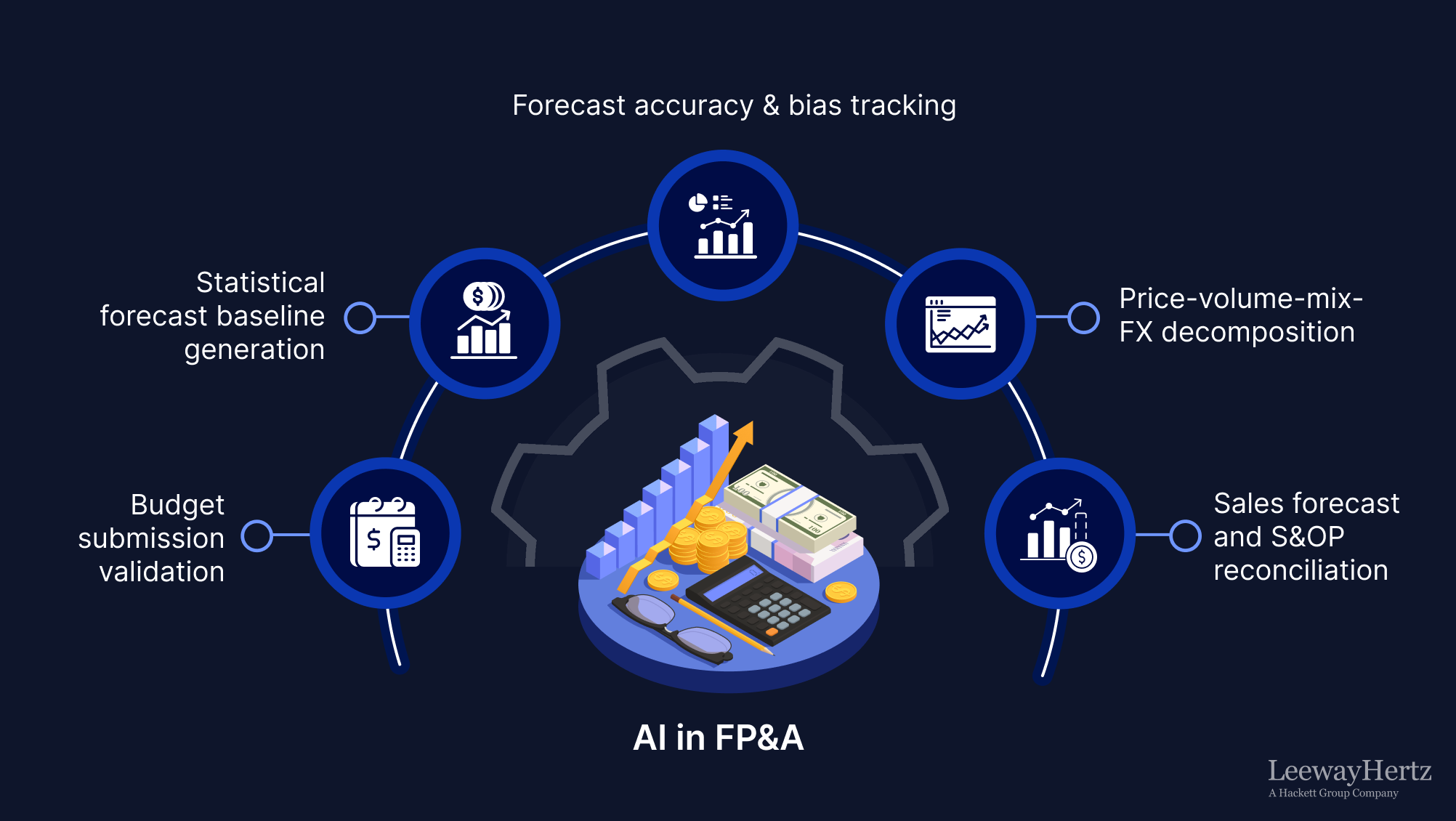
Financial planning and analysis, or FP&A, connects enterprise strategy with financial plans, operating assumptions, performance interpretation, and management decisions. Its work spans the annual operating plan, rolling forecast, long-range plan, scenario book, variance bridge, management reporting pack, workforce and capital plans, revenue alignment, profitability views, and business-partnering analysis.
The FP&A technology landscape is rarely simple. FP&A teams work across enterprise performance management platforms, ERP and general ledger data, HRIS, CRM, sales forecasting, S&OP, billing, data warehouses, BI tools, and controlled spreadsheets. AI complements—not replaces—these enterprise systems and governed financial models. Instead, it connects data and workflows across the technology landscape, automates analysis and reporting, surfaces risks and insights, and augments decision-making while preserving financial controls and human approval. It can work across platforms such as Anaplan, Pigment, Workday Adaptive Planning, and Cube by reading approved model metadata, accessing authorized data connections, distinguishing between working, scenario, and official versions, and writing back changes only after the required finance review and approval.
Current practice shows why this function is well suited to carefully governed AI. FP&A technology challenges are driven not only by tool availability, but also by fragmented and unreliable data. AFPʼs 2025 survey [1] of 362 FP&A and finance practitioners found that 61 percent identified data reliability as a technology challenge, while 60 percent cited limited data accessibility. More than half of respondents also reported using at least eight categories of planning tools and 10 types of reporting tools each quarter. Separately, 49 percent of finance leaders surveyed by Workday [2] identified planning, forecasting, and analysis as the leading potential application of generative AI in finance. These findings suggest that AI can create value by helping FP&A teams reconcile data, prepare planning inputs, analyze performance, and support governed decisions across existing finance systems. The opportunity is therefore not to replace finance judgment. It is to reduce the preparation, reconciliation, validation, and evidence-gathering work that still sits between enterprise systems and management decisions.
The relevant solution is not a generic chatbot. An FP&A manager needs a forecast baseline compared with accountable judgment overlays. A finance business partner needs a price-volume-mix-FX bridge and evidence-backed commentary for a budget owner. A director of FP&A needs the board reporting pack checked for narrative and KPI consistency. A planning-platform owner needs a controlled workflow that records source versions, model logic, approvals, exceptions, and permitted write-back. For the VP finance or CFO, the value is a faster route from changed business conditions to an explainable, reconciled outlook, with earlier risk visibility and more consistent management messages.
For this reason, AI use cases should be mapped to the FP&A operating model at the sub-process level. The useful unit is not “AI for forecasting” or “AI for reporting.” It is a bounded activity such as statistical baseline generation for the rolling 18-month forecast with finance business partner review, or management commentary drafting from an approved variance bridge with Director of FP&A approval. This article uses the FP&A operating model to break work into functions, processes, sub-processes, artifacts, systems, controls, accountable roles, and governed AI opportunities.
- How AI is transforming FP&A operations
- Why AI use cases in FP&A must be mapped at the sub-process level
- FP&A operating model and AI opportunity mapping across processes and sub-processes
- High-value AI use cases in FP&A
- How agentic AI works in FP&A workflows
- How to prioritize AI use cases in FP&A
- Governance, risk, and responsible AI in FP&A
- How ZBrain operationalizes AI use cases in FP&A
- Future of AI in FP&A
How AI is transforming FP&A operations
AI changes FP&A work by analyzing structured and unstructured planning artifacts before a finance professional opens them, connecting information across systems, and preparing the evidence required for review. The strongest opportunities occur where work is repetitive or cross-system but still requires accountable judgment about assumptions, materiality, causality, and management action.
Consider the monthly reporting cycle. Final actuals arrive from the ERP, workforce actuals come from the HRIS, revenue detail comes from billing, the official budget and forecast sit in the planning platform, and commentary may be distributed through documents and presentation tools. AI can reconcile the records, apply approved materiality thresholds, decompose variances, retrieve the prior narrative, draft updated commentary, and flag conflicts before the finance business partner and FP&A director review the pack. For the planning-platform owner, the workflow must preserve model ownership: it should read certified actuals and approved model metadata, keep statistical baselines, scenarios, working forecasts, and official versions separate, prevent unapproved write-back, and retain version history.
FP&A work can be understood through six recurring work types, each presenting opportunities for governed AI to automate analysis, augment decisions, and accelerate planning and reporting.
- Data- and model-heavy work: AI reconciles actuals, planning dimensions, driver models, templates, and forecast versions across systems, identifying inconsistencies before analysis.
- Narrative-heavy work: AI generates variance commentary, management summaries, board narratives, and decision memos grounded in approved financial data and supporting evidence.
- Exception-heavy work: AI detects, classifies, and prioritizes missing submissions, invalid assumptions, unexplained variances, stale versions, and cross-system inconsistencies.
- Knowledge- and policy-heavy work: AI retrieves and applies planning instructions, allocation policies, KPI definitions, accounting guidance, and prior decisions to provide context-aware recommendations.
- Workflow-heavy work: AI monitors budget, forecast, and reporting cycles, tracking submissions, revisions, approvals, version changes, and publication readiness while preserving governance and human approval.
- Scenario- and decision-heavy work: AI accelerates sensitivity analysis, what-if modeling, and scenario evaluation, generating explainable insights and recommendations while keeping financial decisions under human control.
The practical design rule is to connect a specific AI capability to a defined FP&A artifact and place the resulting output within a clear human review boundary. For example, applying time-series forecasting to a rolling forecast model is a concrete use case because the capability, input, output, and reviewer can all be defined. Describing the same solution as “an AI forecasting assistant” only explains how it is packaged, not what work it performs. Similarly, applying narrative consistency checking to an MBR deck and board pack creates a governable use case with identifiable source data, validation rules, and accountable reviewers.
Why AI use cases in FP&A must be mapped at the sub-process level
FP&A is not one workflow. “AI for budgeting” could refer to template validation, target allocation, submission anomaly detection, review-question drafting, or version promotion. Each activity requires different artifacts, integrations, controls, error tolerances, and reviewers. The same is true for forecasting, scenario analysis, management reporting, workforce planning, and business partnering.
A better approach is to map AI use cases to the FP&A operating model:
- Function: A major area of FP&A accountability, such as rolling forecasting, management reporting, or capital planning. A function contains multiple processes and is too broad to implement as one AI workflow.
- Process: A recurring workflow area within a function, such as planning assumption governance, forecast submission, variance decomposition, or board pack assembly.
- Sub-process: An atomic activity with a defined starting artifact, planning grain, calculation logic, exception set, output, and accountable reviewer.
- AI-enabled opportunity: A specific capability applied to a specific FP&A artifact to change how the sub-process is performed, while keeping approval with the accountable role.
Sub-process mapping exposes implementation dependencies. A forecast baseline requires actuals history, a driver tree, horizon definitions, outlier handling, model evaluation, and an approved comparison method. A variance commentary workflow requires final actuals, named budget and forecast versions, materiality thresholds, decomposition rules, evidence sources, a style guide, and finance business partner review. A board pack workflow also needs confidentiality classification, controlled distribution, narrative consistency, and CFO approval.
For example, “AI for forecasting” does not identify whether the model forecasts revenue, headcount, operating expense, cash, or capacity; whether the forecast uses a statistical model, a business-driver-based calculation, or a combination of both; whether the horizon is one month or eighteen months; or who owns the override.
The same precision prevents scope overlap. The financial close function owns accounting flux, journal entries, reconciliation, and final actuals. FP&A variance analysis begins with approved actuals and interprets management performance. Sales forecasting owns pipeline prediction; FP&A revenue planning consumes the approved commercial view and reconciles it with bookings, delivery, billing, and financial timing. S&OP owns demand and supply consensus; FP&A links that consensus to revenue, margin, capacity, cash, and the enterprise outlook.
Operationalize governed AI across financial planning and analysis workflows
Use governed AI to connect planning systems, accelerate forecasting and reporting, and deliver traceable insights into assumptions, risks, and outlook changes.
FP&A operating model and AI opportunity mapping across processes and sub-processes
The following operating model covers eleven FP&A functions across four domains. Each function is decomposed into atomic sub-processes and its possible AI implementation opportunities and mapped to artifacts, systems, controls, accountable roles, highest-value opportunities, and an example governed agentic workflow.
The role map used throughout the operating model includes the FP&A analyst, senior FP&A analyst, FP&A manager, finance business partner, director of FP&A, budget owner or cost center manager, VP finance, corporate controller as the actuals interface, CHRO delegate for the headcount plan, and CFO. Planning-platform owners are implementation and control stakeholders rather than financial approvers. They govern platform configuration, model metadata, integrations, access, workflow routing, environment promotion, and controlled write-back, while accountable finance and business roles continue to approve assumptions, official versions, narratives, and decisions.
The core artifact inventory includes the annual operating plan, budget submission template, driver tree, rolling forecast model, forecast submission workbook, variance bridge or waterfall, board reporting pack, flash report, KPI scorecard, headcount roster and position plan, capex request form and business case, scenario book with assumption log, allocation model, monthly business review deck, and forecast accuracy report.
Domain: Planning and forecasting
Function 1: Annual budgeting and AOP (Annual budgeting and annual operating plan) construction
Converting enterprise targets, operating assumptions, and departmental submissions into an approved annual operating plan.
Annual budgeting establishes the financial and operating baseline for the year ahead. It begins with the budget calendar, planning instructions, target envelopes, templates, and approved planning dimensions, then moves through departmental submissions, validation, challenge, reconciliation, and final version approval.
The function feeds workforce, capital, revenue, and profitability planning and establishes the reference version used in budget-versus-actual analysis. AI is most useful in the preparation and review layers, where teams repeatedly compare submissions with targets, historical patterns, policies, and cross-functional dependencies.
Teams involved: Corporate FP&A, business unit FP&A, FP&A analysts, senior FP&A analysts, FP&A managers, finance business partners, budget owners and cost center managers, the corporate controller as the actuals interface, VP finance, and the CFO.
What AI helps with: Document intelligence and structured validation can compare budget submission templates with planning instructions, required dimensions, target envelopes, and prior-year baselines. Anomaly detection can flag unsupported step changes, missing drivers, duplicate requests, and inconsistent cost center assumptions. Natural-language generation can prepare review questions and change summaries tied to the submitted cells and source evidence.
What humans continue to own: Finance leaders set target envelopes, decide acceptable tradeoffs, challenge business assumptions, approve exceptions, and promote the official AOP version. Budget owners remain accountable for operational commitments, and finance business partners remain accountable for the interpretation presented to leadership. AI analyzes, reconciles, flags, and drafts, but does not approve the plan, accept a target exception, or attest to the annual operating plan.
| Process | Sub-process | Key AI-enabled opportunities |
|---|---|---|
| Annual budgeting and AOP cycle administration | Budget calendar administration |
|
| Planning instruction and template administration |
|
|
| Target setting and reconciliation | Top-down target allocation |
|
| Top-down and bottom-up reconciliation |
|
|
| Submission management | Cost center and department submission validation |
|
| Cross-plan dependency validation |
|
|
| Review and approval | Budget review packet preparation |
|
| Review cycle and change tracking |
|
|
| Official version promotion |
|
Key artifacts
- Annual operating plan
- Budget calendar
- Budget submission template
- Planning instructions
- Target letter or target envelope
- Department and cost center submissions
- Budget review packet
- Budget change log
- Approved AOP version
Systems and data sources involved
- EPM or planning platform
- ERP and general ledger
- HRIS and workforce planning platform
- CRM and sales planning sources
- S&OP or operations planning source
- Data warehouse
- Controlled spreadsheet repository
- Collaboration and workflow platform
Control and governance considerations: The official AOP must have an identified version, approved planning hierarchy, controlled formulas, documented target ownership, and traceable exception approval. Submission access should follow cost center and role boundaries, and promoted versions should be reconciled to approved actuals and accounting definitions. For public companies, management reporting that later informs disclosures may sit near SOX-related control environments even though FP&A itself is not a statutory reporting function.
Accountable roles
- Director of FP&A
- FP&A manager
- Finance business partner
- Budget owner or cost center manager
- VP finance
- CFO
Highest-value opportunities
- Submission validation: High leverage because it covers every budget owner and can prevent data-quality and dimensional errors from propagating into the consolidated AOP.
- Top-down and bottom-up reconciliation: High value because leadership decisions depend on understanding whether a gap comes from policy, operating drivers, timing, or unsupported judgment.
- Review cycle and version control: High value because annual planning often creates many revisions, comments, and offline files that must resolve to one approved version.
- Cross-plan dependency validation: High leverage because incompatible workforce, revenue, capital, and expense assumptions can make a mathematically balanced plan operationally impossible.
Example agentic workflow: Cost center budget submission validation and approval
- Starting sub-process: Cost center and department submission validation begins when a budget owner submits the current budget submission template.
- Starting artifacts: Budget submission template, planning instructions, target envelope, prior-year actuals, current forecast, workforce plan, capital requests, and submission history.
- Authorized systems and datasets: The workflow reads approved data from the EPM platform, ERP, HRIS, capital planning source, data warehouse, and controlled submission repository.
- AI analysis and preparation: It validates dimensions and formulas, compares the submission with targets and historical drivers, identifies cross-plan conflicts, and prepares a review packet with evidence-linked questions.
- Exceptions and confidence limits: Missing drivers, unsupported step changes, formula alterations, policy exceptions, and low-confidence mappings remain unresolved and are routed for review.
- Human review checkpoint: The finance business partner reviews the packet with the budget owner; the FP&A manager approves or returns changes; material target exceptions escalate to the director of FP&A or VP finance.
- Approved system hand-off: Only after approval does the EPM workflow record the disposition and promote the authorized budget version.
- Evidence and version history retained: The submission, source versions, checks, comments, revisions, reviewers, approvals, and promoted version are retained under the planning governance policy.
Function 2: Rolling forecasting and business-driver modeling
Converting current actuals, operational drivers, and accountable judgment into an approved forward-looking financial outlook.
Rolling forecasting keeps the official outlook current as actuals replace forecast periods and operating conditions change. Driver-based forecasting links a controlled set of business drivers to financial outputs, while statistical baselines provide an independent starting point that submitters can accept, revise, or override.
The Association for Financial Professionals (AFP) describes driver-based models as relationships between operational drivers, external factors, and anticipated financial outcomes, using a relatively small number of inputs to forecast multiple outputs [3]. The practical design challenge is therefore not simply choosing a model. It is governing the driver tree, submission process, judgment overlays, forecast horizon, accuracy measures, and official version.
Teams involved: Corporate and business unit FP&A, FP&A analysts, senior FP&A analysts, FP&A managers, finance business partners, budget owners, revenue and operations planners, finance, the director of FP&A, VP finance, and the CFO.
What AI helps with: Time-series forecasting and business driver-based prediction can generate a statistical baseline by account, entity, product, or cost center. Multi-source reconciliation can refresh actuals and operational drivers, while anomaly detection identifies stale inputs, broken relationships, and outlier judgment overlays. Forecast accuracy analysis can calculate MAPE, mean error, directional bias, and error by horizon or submitter, but accuracy should be evaluated on genuine forecasts rather than fitted values.
What humans continue to own: Finance leaders select the official drivers, approve model changes, interpret structural breaks, own judgment overlays, and approve the published forecast. Finance business partners validate whether local information warrants a change from the baseline, and the director of FP&A decides which version becomes the enterprise outlook. AI generates baselines, compares submissions, scores errors, and drafts explanations, but does not select the official forecast or approve a judgment overlay.
| Process | Sub-process | Key AI-enabled opportunities |
|---|---|---|
| Forecast input and relationship management | Forecast relationship maintenance |
|
| Forecast input validation |
|
|
| Baseline generation and assembly | Actuals refresh and forecast horizon update |
|
| Statistical baseline generation |
|
|
| Rolling forecast consolidation |
|
|
| Forecast submission and judgment | Forecast submission collection and validation |
|
| Judgment overlay review |
|
|
| Accuracy and learning | Forecast accuracy tracking |
|
| Forecast accuracy, bias, and methodology review |
|
Key artifacts
- Forecast input and financial relationship map
- Rolling forecast model
- Forecast submission workbook
- Statistical baseline
- Judgment overlay log
- Forecast assumption register
- Approved forecast version
- Forecast accuracy report
- Bias-by-submitter report
Systems and data sources involved
- EPM or planning platform
- ERP and general ledger
- CRM and sales forecast source
- HRIS
- S&OP and operations planning systems
- Billing and revenue systems
- Data warehouse
- Forecasting service or analytics environment
- Controlled spreadsheet repository
Control and governance considerations: Every official forecast requires an identified version, locked actual periods, approved driver definitions, traceable source data, and an owner for each judgment overlay. Model changes should be tested outside production and promoted through controlled approval. Accuracy reports should distinguish true out-of-sample forecast errors from fitted residuals, and submitter-level bias analysis should be used for process learning rather than unsupported personnel conclusions.
Accountable roles
- Director of FP&A
- FP&A manager
- Finance business partner
- Forecast submitter or budget owner
- VP finance
- CFO
Highest-value opportunities
- Statistical baseline generation: High leverage because it creates a consistent challenge point for every submission while leaving business judgment with accountable reviewers.
- Judgment overlay review: High value because overlays often contain the most material assumptions and the least structured evidence.
- Forecast accuracy and bias tracking: High value because it connects process improvement to measurable error patterns by horizon, driver, and submitter.
- Forecast input and relationship management: High leverage because one inaccurate driver relationship can distort multiple lines and scenarios downstream.
Example agentic workflow: Rolling forecast refresh, consolidation, and approval
- Starting sub-process: The rolling forecast cycle begins after final actuals are loaded and the next forecast horizon is opened.
- Starting artifacts: Current forecast version, driver tree, closed actuals, statistical baseline configuration, forecast submission workbook, prior overlays, and accuracy history.
- Authorized systems and datasets: The workflow reads approved actuals from the ERP and planning platform plus operational drivers from CRM, HRIS, S&OP, billing, and the data warehouse.
- AI analysis and preparation: It refreshes actuals, generates the baseline, validates drivers, compares submitter changes with the baseline and evidence, and prepares a consolidated forecast review packet.
- Exceptions and confidence limits: Structural breaks, missing drivers, large overlays, inconsistent cross-functional assumptions, and low-confidence models are flagged rather than auto-resolved.
- Human review checkpoint: Finance business partners validate overlays with submitters; the FP&A manager approves routine updates; material changes and contested assumptions escalate to the director of FP&A or VP Finance.
- Approved system hand-off: After approval, the authorized forecast version is promoted and made available for reporting and scenario comparison.
- Evidence and version history retained: The workflow retains actuals and driver versions, model configuration, baseline outputs, overlays, rationales, approvals, final forecast, and later accuracy results.
Function 3: Long-range and strategic planning
Converting strategic choices, market assumptions, and investment initiatives into a multi-year financial model.
Long-range planning connects enterprise strategy with multi-year revenue, margin, capital, workforce, cash, and return expectations. Unlike the rolling forecast, it is not primarily an update of the near-term official outlook. It evaluates strategic trajectories, capability investments, portfolio choices, and the timing of value creation over a longer horizon. The function must preserve a controlled bridge between strategic assumptions and financial outcomes. Governed AI supports model maintenance, scenario evaluation, assumption traceability, and alternative analysis, while executives retain ownership of strategic intent, investment appetite, and risk tolerance.
Teams involved: Corporate strategy, corporate FP&A, business unit FP&A, finance business partners, treasury and tax interfaces, strategy and investment teams, the director of FP&A, VP finance, CFO, and executive leadership.
What AI helps with: Multi-source aggregation can refresh market, operational, and internal planning inputs. Relationship and sensitivity analysis can identify which assumptions most strongly influence revenue, margin, cash, return, or capital requirements. Natural-language generation can prepare initiative cases and strategic bridge narratives from the controlled model, while anomaly detection can flag broken formulas, inconsistent time horizons, and incompatible initiative assumptions.
What humans continue to own: Executives own strategic choices, risk appetite, investment priorities, terminal assumptions, and the approved long-range path. Finance teams determine whether the model is internally coherent and whether initiative cases use comparable assumptions. AI simulates, compares, reconciles, and drafts, but does not choose the strategy, approve an investment, or attest that a modeled outcome will occur.
| Process | Sub-process | Key AI-enabled opportunities |
|---|---|---|
| Strategic assumptions | Strategic assumption register maintenance |
|
| Strategic baseline alignment |
|
|
| Long-range financial planning model development and maintenance | Financial model maintenance and validation |
|
| Multi-year plan assembly |
|
|
| Strategic initiative and investment case development | Initiative case intake and normalization |
|
| Investment case modeling |
|
|
| Financial assumption sensitivity and elasticity analysis | Financial assumption elasticity analysis |
|
| Strategic option comparison |
|
Key artifacts
- Long-range plan
- Strategic assumption register
- Multi-year financial model
- Initiative intake form
- Investment business case
- Strategic option comparison
- Sensitivity matrix
- Driver elasticity report
- Strategic bridge to current forecast
Systems and data sources involved
- EPM or strategic planning platform
- ERP
- CRM and market data sources
- HRIS
- Capital planning system
- Data warehouse
- Treasury and tax models as approved interfaces
- Controlled spreadsheet and document repositories
Control and governance considerations: Long-range financial planning models require controlled opening balances, approved assumption owners, comparable initiative methodologies, model-change approval, and traceability from strategic narrative to financial effect. Strategic and acquisition scenarios may contain highly confidential information and require restricted access. When long-range measures enter external communications, their definitions and reconciliation to GAAP or IFRS views require separate disclosure review.
Accountable roles
- CFO
- VP finance
- Director of FP&A
- Corporate strategy leader
- Business unit CFO
- Investment committee or executive leadership
Highest-value opportunities
- Strategic assumption register: High leverage because a change in one macro, pricing, workforce, or capacity assumption can affect many years and multiple decision cases.
- Initiative case normalization: High value because inconsistent methods make portfolio choices difficult even when each individual model is mathematically correct.
- Financial assumption sensitivity and elasticity analysis: High value because it identifies the assumptions that actually control downside and upside outcomes.
- Strategic bridge to the official forecast: High leverage because it prevents the long-range model from becoming a disconnected view with a different starting point.
Example agentic workflow: Strategic initiative and investment case evaluation and approval
- Starting sub-process: Initiative and investment case modeling begins when a strategic initiative submission enters the long-range planning cycle.
- Starting artifacts: Initiative proposal, approved strategic assumptions, current long-range model, current forecast, capital and workforce requirements, and evaluation methodology.
- Authorized systems and datasets: The workflow reads approved planning, market, workforce, capital, and financial data from authorized sources.
- AI analysis and preparation: It structures the case, maps dependencies, applies approved assumptions, calculates financial effects, runs sensitivities, and prepares a comparable decision packet.
- Exceptions and confidence limits: Unsupported benefits, missing dependencies, inconsistent horizons, nonstandard discount rates, and low-confidence external assumptions are flagged.
- Human review checkpoint: The finance business partner and initiative owner validate inputs; the director of FP&A confirms model integrity; investment and strategy decisions remain with the CFO and authorized committee.
- Approved system hand-off: The approved case is added to the strategic option set or returned for revision; no investment commitment is executed by the workflow.
- Evidence and version history retained: The source proposal, assumptions, formulas, scenarios, reviewer changes, approvals, and selected strategic model version are retained.
Function 4: Scenario modeling and what-if analysis
Converting named assumption sets and trigger events into comparable downside, base, and upside financial outcomes.
Scenario modeling maintains alternative views of the future without replacing the official forecast. A controlled scenario library allows FP&A to test downside, base, upside, and event-specific cases using named assumption sets, documented triggers, and consistent calculation logic.
Scenario planning is most useful when it is continuous, tied to measurable business drivers, and governed through ownership, versioning, alerts, and refinement. AI can accelerate scenario construction and comparison, but leadership retains responsibility for selecting which scenario informs an action or communication.
Teams involved: Corporate FP&A, business unit FP&A, finance business partners, risk and strategy teams, revenue, workforce, and operations planners, the director of FP&A, VP finance, CFO, and executive decision-makers.
What AI helps with: Scenario simulation can propagate coordinated changes in demand, price, headcount, capacity, cost, FX, and capital through the financial model. Natural-language processing can structure assumptions from approved scenario briefs. Event detection can prepare a rapid reforecast packet when approved trigger thresholds are reached.
What humans continue to own: Finance leaders define the scenario question, approve assumption ranges, determine whether a trigger has management significance, and decide which response to pursue. The CFO and executive leaders own any change to guidance, resource allocation, or strategic action. AI builds and compares scenarios, but does not declare the official outlook, select a response, or issue guidance.
| Process | Sub-process | Key AI-enabled opportunities |
|---|---|---|
| Scenario library administration | Scenario taxonomy and library maintenance |
|
| Scenario template maintenance |
|
|
| Assumption governance | Assumption logging |
|
| Version comparison |
|
|
| Scenario execution and comparison | Scenario run and model propagation |
|
| Scenario comparison and decision packet assembling |
|
|
| Trigger-based reforecasting | Trigger monitoring |
|
| Rapid reforecast preparation |
|
Key artifacts
- Scenario book with assumption log
- Scenario library
- Downside, base, and upside assumption sets
- Trigger register
- Scenario comparison
- Rapid reforecast packet
- Scenario version history
- Decision brief
Systems and data sources involved
- EPM or planning platform
- Scenario modeling environment
- ERP
- CRM
- HRIS
- S&OP and operations planning systems
- Market and external data sources
- Data warehouse
- Collaboration and approval platform
Control and governance considerations: Every scenario should have a name, purpose, owner, assumption set, source hierarchy, version, applicable horizon, and decision boundary. Scenario outputs must remain distinguishable from the official forecast. For public companies, scenarios that influence public guidance require controlled escalation because Regulation FD addresses selective disclosure of material nonpublic information,and forward-looking communications may require legal review of cautionary statements and safe-harbor conditions.COSO ERM provides a useful linkage between risk, strategy, and performance.
Accountable roles
- CFO
- VP finance
- Director of FP&A
- Enterprise risk or strategy leader
- Finance business partner
- Scenario owner
Highest-value opportunities
- Assumption logging and version comparison: High leverage because leadership must know whether changed outcomes come from changed facts, changed assumptions, or changed model logic.
- Scenario propagation across connected plans: High value because demand, workforce, capacity, capital, and cash effects must remain mutually consistent.
- Trigger-based rapid reforecasting: High value because it compresses response time while preserving a governed boundary between an alert, a scenario, and the official forecast.
- Scenario decision packet: High leverage because it presents ranges, dependencies, and uncertainty without disguising modeled output as certainty.
Example agentic workflow: Trigger-based scenario reforecasting and forecast decision review
- Starting sub-process: Rapid reforecasting begins when an approved business trigger crosses its defined threshold.
- Starting artifacts: Trigger register, official forecast version, scenario book with assumption log, approved scenario template, and latest operational evidence.
- Authorized systems and datasets: The workflow reads the trigger source plus approved finance, revenue, workforce, capital, and operations planning data.
- AI analysis and preparation: It validates the trigger, clones the official baseline, applies the named assumption set, propagates effects, compares outcomes, and prepares a review packet.
- Exceptions and confidence limits: Conflicting assumptions, missing source evidence, model breaks, and outputs outside validated ranges are highlighted and block automatic promotion.
- Human review checkpoint: Finance business partners validate affected assumptions; the director of FP&A approves the scenario run; the VP finance and CFO decide whether to revise the official forecast or take action.
- Approved system hand-off: An approved scenario remains in the scenario library or is used as the controlled input to a separate forecast revision workflow.
- Evidence and version history retained: The trigger evidence, baseline version, assumption set, model version, outputs, reviewer decisions, and resulting forecast action are retained.
Domain: Performance management and reporting
Function 5: Variance and performance analysis
Converting approved actuals and plan versions into reconciled performance explanations, outlook bridges, and management actions.
Variance analysis explains performance against the annual budget and current forecast. It is management-oriented: FP&A decomposes budget-versus-actual and forecast-versus-actual differences into business drivers such as price, volume, mix, FX, timing, rate, productivity, and one-time effects. The financial close and accounting-flux process owns ledger integrity, account reconciliation, and close explanations; this function begins with approved actuals and interprets performance for management.
The outputs feed monthly business reviews, forecast updates, risk and opportunity tracking, and decision support. AI can accelerate decomposition and commentary preparation, but materiality judgments, causal interpretation, and management messaging remain with finance and business leaders.
Teams involved: Corporate and business unit FP&A, FP&A analysts, senior FP&A analysts, FP&A managers, finance business partners, budget owners, the corporate controller, revenue and operations analysts, the director of FP&A, VP finance, and CFO.
What AI helps with: Multi-source reconciliation can align actuals with the correct budget and forecast versions. Driver-based decomposition can calculate price, volume, mix, FX, rate, headcount, timing, and one-time effects using approved bridge logic. Anomaly detection can identify unexplained residuals and inconsistent commentary, while natural-language generation can draft line-item commentary that cites the values and drivers used.
What humans continue to own: The corporate controller owns the integrity and finality of actuals provided to FP&A. Finance business partners validate operational causes with budget owners; FP&A leadership sets materiality thresholds, approves bridge methodology, and determines the outlook implications. AI calculates, flags, and drafts, but does not certify actuals, determine causality without review, or approve management commentary.
| Process | Sub-process | Key AI-enabled opportunities |
|---|---|---|
| Actuals and comparison preparation | Actuals intake and reconciliation |
|
| Budget-versus-actual and forecast-versus-actual comparison |
|
|
| Variance decomposition | Price, volume, mix, and FX decomposition |
|
| Cost and workforce variance decomposition |
|
|
| Root-cause evidence assembly |
|
|
| Commentary and bridge preparation | Driver-based commentary drafting |
|
| Bridge and waterfall construction |
|
|
| Risk and opportunity extraction |
|
|
| Performance review and learning | Business validation and disposition tracking |
|
| Variance-pattern analysis |
|
Key artifacts
- Final actuals dataset
- Approved budget version
- Approved forecast version
- Variance cube
- Variance bridge or waterfall
- Driver-based commentary file
- Risk and opportunity register
- Full-year outlook bridge
- Performance review packet
Systems and data sources involved
- ERP and general ledger
- EPM or planning platform
- HRIS
- Billing and revenue systems
- CRM
- Operational data systems
- Data warehouse
- BI and reporting platform
- Controlled commentary repository
Control and governance considerations: Analysis must use final approved actuals, named budget and forecast versions, documented materiality thresholds, controlled bridge logic, and traceable evidence. Every variance bridge must reconcile to the reported difference. Commentary should distinguish fact, management interpretation, timing, one-time items, and outlook impact. Where measures or narratives may later enter public materials, consistency with GAAP or IFRS and non-GAAP disclosure controls requires separate review.
Accountable roles
- Finance business partner
- FP&A manager
- Director of FP&A
- Corporate controller for the actuals interface
- Budget owner or cost center manager
- VP finance
- CFO
Highest-value opportunities
- Driver-based variance decomposition: High leverage because it converts a raw numerical difference into the business drivers management can challenge and act on.
- Commentary drafting with evidence links: High value because it reduces repetitive preparation while preserving reviewer responsibility for the explanation.
- Bridge reconciliation: High value because an unreconciled waterfall can undermine confidence in the entire management narrative.
- Recurring variance-pattern analysis: High leverage because it turns monthly explanation into improvements in models, controls, and operating actions.
Example agentic workflow: Monthly variance analysis, commentary, and MBR pack approval
- Starting sub-process: Monthly variance commentary and MBR assembly begins when the close completes and final actuals post to the planning system, opening the monthly reporting task.
- Starting artifacts: Final actuals, current forecast and budget versions, headcount roster and position plan, revenue detail, last month commentary, variance materiality thresholds, commentary style guide, and MBR template.
- Authorized systems and datasets: The workflow aggregates actuals by cost center from the ERP and planning system, headcount actuals from the HRIS, revenue detail from billing, and approved historical commentary.
- AI analysis and preparation: It prepares variance decomposition by volume, rate, mix, FX, and one-time items; drafts commentary for each P&L line above threshold; updates the full-year outlook bridge; and flags risks.
- Exceptions and confidence limits: Unreconciled bridge items, contested causes, material source differences, missing operational evidence, and forecast changes outside delegated thresholds are held for review.
- Human review checkpoint: Finance business partners validate commentary with their budget owners, the director of FP&A approves the pack, and contested outlook changes escalate to the VP finance before CFO review.
- Approved system hand-off: The approved pack publishes to the MBR audience, and approved outlook changes write back to the forecast version with an assumption log entry.
- Evidence and version history retained: The full lineage is retained, including source versions, decomposition logic, evidence, draft changes, reviewer dispositions, approvals, published pack, and forecast write-back.
Function 6: Management reporting
Converting approved financial and operational information into consistent flash reports, KPI scorecards, monthly business reviews, and board reporting packs.
Management reporting organizes performance information for recurring executive decisions. It covers flash reporting, KPI curation, monthly business review and board pack assembly, narrative review, and controlled publication. It consumes approved actuals, forecasts, bridges, and business commentary rather than owning the accounting close or the underlying plan.
The central AI opportunity is not autonomous reporting. It is evidence assembly, consistency checking, controlled drafting, and faster review across multiple packs that often reuse the same facts with different levels of detail.
Teams involved: Corporate FP&A, management reporting teams, FP&A analysts, senior FP&A analysts, FP&A managers, finance business partners, data and BI teams, investor relations and legal interfaces where applicable, the director of FP&A, VP finance, CFO, and executive leadership.
What AI helps with: Multi-source aggregation can assemble approved numbers, charts, commentary, and risks into the correct template. Natural-language generation can draft flash and MBR narratives from evidence-linked values. Consistency checking can compare KPIs, definitions, periods, units, outlook statements, and causal explanations across the flash report, monthly business review deck, board reporting pack, and related executive materials.
What humans continue to own: Finance leaders define the message, decide materiality, resolve contested interpretations, approve board-facing narratives, and determine whether information can be shared. Investor relations and legal teams retain authority over external communications. AI assembles, compares, and drafts, but does not approve a pack, determine disclosure materiality, or communicate guidance.
| Process | Sub-process | Key AI-enabled opportunities |
|---|---|---|
| Reporting data preparation | Source-data refresh and certification status |
|
| KPI definition and scorecard curation |
|
|
| Flash reporting | Flash estimate preparation |
|
| Flash report assembly and review |
|
|
| MBR and board pack assembly | Monthly business review deck assembly |
|
| Board reporting pack assembly |
|
|
| Executive summary drafting |
|
|
| Management report consistency review and publication | Narrative consistency checking across packs |
|
| Publication review and distribution |
|
Key artifacts
- Board reporting pack
- Monthly business review deck
- Flash report
- KPI scorecard
- Executive summary
- Approved variance commentary
- Risk and opportunity register
- Reporting calendar
- KPI dictionary
- Publication approval record
Systems and data sources involved
- EPM and planning platform
- ERP and general ledger
- BI and reporting platform
- Data warehouse
- HRIS
- CRM and billing sources
- Board portal
- Document management and collaboration platform
- Controlled presentation repository
Control and governance considerations: Management reporting packs require source and version lineage, approved KPI definitions, controlled templates, confidentiality classification, reviewer sign-off, and consistent statements across artifacts. For public companies, forecasts and other material information that feed external guidance require Regulation FD and legal-review controls, and forward-looking statements may require safe-harbor analysis.Non-GAAP measures require consistent labels, comparable GAAP measures, and appropriate reconciliation when used externally.IFRS 18 introduces disclosure requirements for management-defined performance measures used in public communications for annual periods beginning on or after January 1, 2027.
Accountable roles
- Management reporting owner
- Director of FP&A
- VP finance
- CFO
- Investor relations or legal reviewer where applicable
- Board or executive secretariat
Highest-value opportunities
- Narrative consistency checking: High leverage because the same financial fact often appears in multiple packs and inconsistencies create avoidable governance and credibility risk.
- MBR assembly: High value because it brings together scorecards, bridges, commentary, risks, and decisions on a recurring monthly deadline.
- Board pack assembly with access controls: High value because the material is highly sensitive and requires strong lineage, restricted access, and executive approval.
- KPI curation: High leverage because a definition change can alter trend interpretation across every management audience.
Example agentic workflow: Monthly business review and board pack assembly, validation, and approval
- Starting sub-process: Monthly business review deck assembly begins when approved variance commentary, outlook, KPI, and risk artifacts are available.
- Starting artifacts: Approved actuals, forecast, budget, variance bridge, commentary, KPI scorecard, flash report, prior MBR, board reporting template, and reporting calendar.
- Authorized systems and datasets: The workflow reads approved planning, reporting, workforce, revenue, and risk sources and the controlled template repository.
- AI analysis and preparation: It populates the MBR template, updates charts, drafts the executive summary, compares narratives across packs, and prepares a list of inconsistencies and missing evidence.
- Exceptions and confidence limits: Unapproved data, unreconciled KPIs, contradictory narratives, missing reviewer attestations, and disclosure-sensitive content remain blocked.
- Human review checkpoint: Finance business partners approve their sections, the management reporting owner resolves formatting and source issues, the director of FP&A approves the full pack, and the CFO approves board-facing messages.
- Approved system hand-off: The final pack is published to the approved MBR or board audience through the controlled distribution channel.
- Evidence and version history retained: The workflow retains input versions, generated content, reviewer changes, source links, approvals, final pack, audience, and correction history.
Accelerate AI Solutions Development
Build fully functional solutions from your high-value use cases, based on specific operational needs and enterprise context.
Domain: Integrated resource and financial planning
Function 7: Headcount and workforce planning
Converting position-level workforce data, hiring assumptions, and compensation policies into a reconciled workforce and labor-cost plan.
Workforce planning connects organization design and hiring decisions with the financial plan. It maintains position-level plans against HRIS actuals, reconciles hiring plans with approved budget capacity, and models compensation, merit, bonus, attrition, vacancy, and timing assumptions.
FP&A owns the financial integration and plan reconciliation, while HR and management retain authority over roles, hiring, compensation decisions, employee data, and organization changes. xP&A extends finance planning into HR and other functions using connected data and shared goals.
Teams involved: FP&A, HR finance, workforce planning, HRIS teams, finance business partners, budget owners, cost center managers, talent acquisition interfaces, compensation teams, the CHRO delegate, the director of FP&A, VP finance, and CFO.
What AI helps with: Entity matching can reconcile the headcount roster and position plan with HRIS actuals at position, employee, cost center, location, grade, and status level. Anomaly detection can identify duplicate positions, unbudgeted hires, stale vacancies, inconsistent start dates, and compensation assumptions outside policy. Scenario simulation can model hiring pace, attrition, merit cycles, bonus rates, contractor conversion, and workforce mix.
What humans continue to own: HR and business leaders decide organization design, candidate selection, compensation actions, and hiring approvals. Finance team approves the financial treatment and confirms consistency with the official plan. AI reconciles, flags, and models, but does not approve a hire, set compensation, make an employment decision, or infer protected characteristics for planning decisions.
| Process | Sub-process | Key AI-enabled opportunities |
|---|---|---|
| Position plan maintenance | Position master and roster reconciliation |
|
| Position-level plan update |
|
|
| Hiring plan reconciliation | Hiring plan versus budget validation |
|
| Vacancy and start-date analysis |
|
|
| Compensation planning | Merit and promotion cycle modeling |
|
| Bonus, commission, and benefits modeling |
|
|
| Workforce scenario and reporting | Attrition and workforce-mix scenario |
|
| Headcount plan reporting |
|
Key artifacts
- Headcount roster and position plan
- HRIS actuals extract
- Hiring plan
- Approved requisition list
- Compensation and merit cycle model
- Bonus and benefits assumptions
- Vacancy report
- Workforce scenario book
- Labor-cost forecast
Systems and data sources involved
- HRIS
- Workforce planning platform
- Applicant tracking system as an approved interface
- Compensation platform
- EPM or planning platform
- ERP and payroll summary source
- Data warehouse
- Controlled spreadsheet repository
Control and governance considerations: Position and compensation data is highly sensitive and requires least-privilege access, field-level controls, segregation between planning and employment decisions, and retention limits. Every planned position should have an owner, status, cost center, effective dates, and plan version. Bias testing should focus on whether planning rules or model outputs create unsupported disparities, while avoiding use of protected data beyond authorized governance purposes.
Accountable roles
- CHRO delegate
- Head of workforce planning or HR finance
- Director of FP&A
- Finance business partner
- Budget owner or cost center manager
- VP finance
- CFO
Highest-value opportunities
- Position-to-HRIS reconciliation: High leverage because position-level mismatches propagate directly into labor-cost forecasts and capacity decisions.
- Hiring plan versus budget reconciliation: High value because it identifies unfunded or mistimed roles before they become embedded in the outlook.
- Merit and compensation modeling: High value because low rate and timing changes can have broad P&L effects and require restricted data handling.
- Workforce scenario analysis: High leverage because it connects staffing choices with financial and operational capacity outcomes.
Example agentic workflow: Position-level workforce plan reconciliation and approval
- Starting sub-process: Position-level plan maintenance begins when the latest HRIS actuals and approved hiring changes are available.
- Starting artifacts: Headcount roster and position plan, HRIS actuals, approved requisitions, compensation assumptions, budget version, and prior workforce forecast.
- Authorized systems and datasets: The workflow reads permitted HRIS, workforce planning, EPM, and payroll-summary fields under role-based access.
- AI analysis and preparation: It matches positions and employees, identifies vacancies and exceptions, reconciles hiring to budget, calculates labor-cost effects, and prepares a review packet.
- Exceptions and confidence limits: Ambiguous matches, unapproved requisitions, compensation values outside policy, protected-data restrictions, and inconsistent effective dates are held.
- Human review checkpoint: HR finance and the CHRO delegate validate workforce and compensation inputs; finance business partners and budget owners confirm business needs; FP&A approves the financial plan.
- Approved system hand-off: Approved position and cost assumptions update the controlled workforce plan and financial forecast, without executing an HR transaction.
- Evidence and version history retained: The workflow retains permitted source references, match decisions, plan changes, approvals, and the resulting workforce and forecast versions.
Function 8: Capital planning
Converting capital requests, approved projects, spend forecasts, and depreciation assumptions into a controlled capex and P&L plan.
Capital planning evaluates proposed investments, tracks approved spend, and incorporates project timing and depreciation into the financial plan. FP&A provides financial analysis and plan integration, while business sponsors, accounting, procurement, and authorized capital committees retain their respective approval and execution responsibilities.
AI can standardize intake, compare business cases, monitor spend and schedule evidence, and prepare forecast updates. It should not authorize a project, classify an expenditure for accounting purposes, or release funds.
Teams involved: Corporate and business unit FP&A, capital planning teams, finance business partners, project sponsors, engineering or finance operations, procurement and project-system interfaces, fixed asset accounting, corporate controller, capital committee, VP finance, and CFO.
What AI helps with: Document intelligence can extract project scope, timing, cost, benefit, dependencies, and risks from a capex request form and business case. Validation can compare submissions with required fields and approved evaluation methods. Multi-source reconciliation can track project spend against approval, while scenario simulation can model timing changes and depreciation flow-through to the P&L plan.
What humans continue to own: Project sponsors own the business need and delivery assumptions. Capital committees and executives approve investments; accounting determines capitalization policy and useful life; procurement and project teams execute purchases and projects. AI validates, compares, and forecasts, but does not approve capex, classify accounting treatment, or commit funds.
| Process | Sub-process | Key AI-enabled opportunities |
|---|---|---|
| Request intake and screening | Capex request intake |
|
| Business case validation |
|
|
| Evaluation and approval support | Financial case modeling |
|
| Portfolio comparison and review packet |
|
|
| Approved project tracking | Project spend versus approval |
|
| Project schedule and benefit tracking |
|
|
| Financial plan integration | Capex reforecasting |
|
| Depreciation flow-through |
|
Key artifacts
- Capex request form and business case
- Capital portfolio
- Approval record
- Project spend report
- Commitment and forecast-to-complete data
- Project milestone record
- Capex forecast
- Depreciation schedule
- P&L and cash-flow bridge
Systems and data sources involved
- Capital planning platform
- Project portfolio management system
- ERP and fixed asset system
- Procurement and commitment systems
- EPM or planning platform
- Data warehouse
- Document management repository
- Controlled spreadsheet model
Control and governance considerations: Investment requests require standardized assumptions, approval thresholds, segregation between analysis and authorization, controlled project IDs, and traceability from approval to spend. Capitalization, useful life, impairment, and depreciation treatment remain accounting judgments governed by applicable GAAP or IFRS policies. The planning model must use approved accounting inputs and preserve a clear interface with the Controller and fixed asset accounting.
Accountable roles
- Capital committee
- CFO
- VP finance
- Director of FP&A
- Finance business partner
- Project sponsor
- Corporate controller or fixed asset accounting
Highest-value opportunities
- Business case validation: High leverage because weak or inconsistent submissions create review effort and can obscure the true economics of a request.
- Project spend versus approval: High value because it provides recurring visibility into overrun, timing, and funding risk.
- Depreciation flow-through: High value because capital timing changes must consistently affect the P&L, balance sheet, and cash plan.
- Portfolio comparison: High leverage because leadership must compare projects using common assumptions without automating the investment decision.
Example agentic workflow: Capital expenditure request and business case evaluation and approval
- Starting sub-process: Capex request intake and business case validation begins when a sponsor submits a capex request form and supporting business case.
- Starting artifacts: Capex request, business case, project schedule, approved evaluation methodology, strategic priorities, and available capital envelope.
- Authorized systems and datasets: The workflow reads the document repository, capital planning platform, ERP history, project system, and approved planning assumptions.
- AI analysis and preparation: It extracts case data, validates completeness and methodology, calculates financial effects, runs sensitivities, and prepares a comparable committee packet.
- Exceptions and confidence limits: Unsupported benefits, missing dependencies, nonstandard accounting assumptions, threshold breaches, and low-confidence document extraction are flagged.
- Human review checkpoint: The finance business partner and project sponsor confirm inputs; FP&A validates the financial case; accounting validates relevant treatment; the capital committee approves, rejects, or returns the request.
- Approved system hand-off: An approved project is recorded in the capital plan and tracking system, while procurement and project execution remain outside the agent workflow.
- Evidence and version history retained: The request, source evidence, model version, sensitivities, reviewer changes, decision, approval, project ID, and subsequent forecast changes are retained.
Function 9: Revenue planning and xP&A alignment
Converting sales forecasts, S&OP outputs, bookings, backlog, billing schedules, and accounting constraints into a reconciled revenue plan.
Revenue planning connects commercial and operational expectations with the financial outlook. The sales forecasting function owns pipeline-based revenue prediction and commercial judgment; S&OP owns the demand and supply consensus; FP&A consumes those approved outputs, reconciles them with bookings, backlog, billing, delivery, and revenue timing, and translates them into the financial plan.
xP&A extends finance planning across sales, HR, operations, and other functions using shared data and connected models. Anaplan distinguishes supply-chain-centered IBP and S&OP from finance-driven xP&A, while emphasizing that they can work together[4]. The FP&A task is therefore alignment and financial translation, not replacement of specialist planning ownership.
Teams involved: Revenue FP&A, sales finance, corporate FP&A, finance business partners, sales operations, revenue operations, S&OP and demand planning interfaces, billing and revenue accounting interfaces, product finance, the director of FP&A, VP finance, and CFO.
What AI helps with: Multi-source reconciliation can compare the finance revenue plan with the approved sales forecast, S&OP demand consensus, bookings, backlog, contracts, billing schedules, and prior forecast versions. Revenue projection translates bookings into revenue using approved timing and revenue recognition assumptions, while anomaly detection flags timing gaps, double counting, capacity conflicts, and inconsistent definitions. Scenario simulation can show the revenue, margin, cash, and resource effects of changed demand, price, conversion, churn, or delivery assumptions.
What humans continue to own: Sales leaders own the commercial forecast and pipeline judgment. S&OP leaders own the demand and supply consensus. The accounting team owns revenue recognition policy and actual recognition. FP&A owns the financial plan, reconciliation, and management outlook. AI matches, models, and flags, but does not change a sales forecast, override S&OP consensus, determine revenue recognition, or approve external guidance.
| Process | Sub-process | Key AI-enabled opportunities |
|---|---|---|
| Cross-functional revenue input reconciliation | Sales forecast to finance plan reconciliation |
|
| S&OP output to financial plan reconciliation |
|
|
| Bookings, backlog, and conversion | Bookings-to-revenue waterfall alignment |
|
| Backlog quality and timing review |
|
|
| Revenue timing and deferred revenue planning | Billing schedule and revenue timing analysis |
|
| Deferred revenue modeling |
|
|
| Revenue scenario development and reporting | Revenue assumption scenario analysis |
|
| Revenue plan consolidation and review preparation |
|
Key artifacts
- Sales forecast output
- S&OP demand and supply consensus
- Revenue plan
- Bookings-to-revenue waterfall
- Backlog report
- Billing schedule
- Deferred revenue model
- Revenue assumption log
- Revenue reconciliation packet
- Revenue outlook bridge
Systems and data sources involved
- CRM and sales forecasting platform
- S&OP and demand planning system
- Order management system
- Billing platform
- ERP and general ledger
- Revenue subledger or accounting system as an interface
- EPM or planning platform
- Data warehouse
- BI platform
Control and governance considerations: The revenue plan requires controlled definitions for bookings, backlog, pipeline, demand, billings, revenue, churn, and conversion. Every reconciliation should identify source version, owner, currency, period, grain, and timing rules. Revenue recognition remains an accounting judgment under applicable GAAP or IFRS and is not delegated to FP&A. Any planned outlook used in public guidance requires disclosure, Regulation FD, and legal controls.
Accountable roles
- Sales finance leader
- Director of FP&A
- Revenue operations leader
- S&OP or demand planning owner
- Corporate controller or revenue accounting interface
- VP finance
- CFO
Highest-value opportunities
- Sales forecast and finance plan reconciliation: High leverage because commercial and finance views often differ in grain, timing, probability, and definitions.
- Bookings-to-revenue waterfall: High value because it makes the timing bridge from commercial activity to the financial outlook explicit.
- S&OP alignment: High value because the revenue plan should not assume demand or delivery that conflicts with the approved operating consensus.
- Deferred revenue modeling: High leverage because timing differences between billing and revenue can materially affect reported growth and cash interpretation.
Example agentic workflow: Cross-functional revenue plan reconciliation and approval
- Starting sub-process: Revenue plan reconciliation begins when the latest approved sales forecast and S&OP outputs become available.
- Starting artifacts: Sales forecast, S&OP demand and supply consensus, opening backlog, bookings, cancellations, billing schedules, deferred revenue balance, current forecast, and revenue definitions.
- Authorized systems and datasets: The workflow reads approved CRM, S&OP, order, billing, ERP, revenue-accounting interface, and planning data.
- AI analysis and preparation: It aligns dimensions, compares versions and timing, updates the bookings-to-revenue waterfall, models deferred revenue, and prepares a reconciliation packet.
- Exceptions and confidence limits: Unmatched customers or products, unsupported conversion assumptions, capacity conflicts, ambiguous contract timing, and accounting-policy questions are held.
- Human review checkpoint: Sales finance team validates the commercial view; S&OP owners validate demand and capacity; revenue accounting validates policy interfaces; FP&A approves the financial plan and escalates material gaps.
- Approved system hand-off: The approved reconciled revenue plan updates the official forecast, while source forecasts and accounting judgments remain in their owning systems.
- Evidence and version history retained: The workflow retains source versions, mappings, waterfall logic, assumptions, exceptions, reviewer dispositions, and the approved revenue-plan version.
Function 10: Allocations and profitability analysis
Converting shared costs, allocation drivers, transaction economics, and revenue data into controlled product, customer, channel, and cost-to-serve views.
Allocations distribute shared services, technology, facilities, corporate, and other indirect costs to the entities, products, customers, channels, or activities that management uses for performance analysis. Profitability analysis then combines revenue, direct costs, allocated costs, and service demands to support portfolio and operating decisions.
Because allocation choices can materially change reported management profitability without changing enterprise economics, model transparency and governance are central. AI can maintain mappings, detect anomalies, and prepare decision views, but it cannot decide the policy or use a profitability score as the sole basis for consequential customer or workforce action.
Teams involved: Corporate FP&A, cost accounting and management accounting interfaces, shared services finance, IT finance, product finance, commercial finance, finance business partners, data teams, budget owners, the director of FP&A, VP finance, and CFO.
What AI helps with: Entity and dimensional matching can maintain allocation mappings across cost pools, service recipients, products, customers, and channels. Anomaly detection can identify missing recipients, unstable drivers, outlier chargebacks, and unreconciled totals. Multi-dimensional modeling can calculate product, customer, and channel profitability and cost-to-serve, while explainability methods can show which direct and allocated cost components drive the result.
What humans continue to own: Finance leaders approve allocation policy, materiality, driver choice, treatment of shared costs, and management-use boundaries. Business leaders decide pricing, portfolio, service, and channel actions after considering broader strategic and customer evidence. AI calculates and explains profitability, but does not approve allocation policy, terminate a customer relationship, or make a pricing decision.
| Process | Sub-process | Key AI-enabled opportunities |
|---|---|---|
| Allocation model maintenance | Cost pool and hierarchy maintenance |
|
| Allocation driver maintenance |
|
|
| Allocation execution and reconciliation | Shared services and IT chargeback calculation |
|
| Allocation exception resolution Allocation model reconciliation |
|
|
| Profitability views | Product profitability checking |
|
| Customer and channel profitability analysis |
|
|
| Cost-to-serve and decision support | Cost-to-serve analysis |
|
| Profitability variance bridge and scenario analysis |
|
Key artifacts
- Allocation model
- Allocation rulebook
- Cost pool register
- Driver file
- Shared services chargeback
- IT chargeback
- Allocation reconciliation
- Product profitability view
- Customer and channel profitability view
- Cost-to-serve analysis
- Profitability bridge
Systems and data sources involved
- ERP and general ledger
- EPM or profitability platform
- CRM
- Order and billing systems
- Service and support platforms
- IT service management and usage sources
- Data warehouse
- BI platform
- Controlled spreadsheet model
Control and governance considerations: Allocation models require approved policy, transparent cost pools, stable driver definitions, complete reconciliation, version control, and disclosure of material methodology changes to management users. Profitability views should identify whether a result is based on direct economics, allocated policy, estimates, or incomplete data. Bias and fairness review is relevant where customer, product, channel, or location classifications could drive consequential decisions.
Accountable roles
- CFO
- VP finance
- Director of FP&A
- Allocation policy owner
- Product or commercial finance leader
- Finance business partner
- Shared services or IT finance leader
Highest-value opportunities
- Allocation reconciliation: High leverage because every downstream profitability view depends on complete, non-duplicative allocation of the source pools.
- Driver governance: High value because driver changes can materially alter business-unit or product economics without any operational change.
- Customer and product profitability: High value because it combines fragmented revenue and cost evidence for portfolio, pricing, and service decisions.
- Cost-to-serve analysis: High leverage because it surfaces operational effort that is often invisible in gross-margin views.
Example agentic workflow: Monthly cost allocation, reconciliation, and profitability reporting
- Starting sub-process: The monthly allocation cycle begins when approved shared cost pools and driver data are available.
- Starting artifacts: Allocation model, allocation rulebook, source cost pools, driver files, recipient hierarchy, prior exceptions, and current profitability model.
- Authorized systems and datasets: The workflow reads approved ERP, EPM, service usage, CRM, order, billing, and data-warehouse sources.
- AI analysis and preparation: It validates pools and drivers, applies approved allocation logic, reconciles outputs, updates profitability views, and prepares exception packets.
- Exceptions and confidence limits: Missing recipients, stale drivers, policy ambiguities, unreconciled residuals, and incomplete customer or product mappings are held.
- Human review checkpoint: The allocation policy owner and FP&A validate methodology and exceptions; affected finance business partners review disputed charges; leadership approves material policy changes.
- Approved system hand-off: Approved allocations and profitability views publish to management reporting without posting accounting entries unless a separate authorized process exists.
- Evidence and version history retained: The workflow retains source pools, driver versions, rules, calculations, exceptions, reviewer dispositions, approvals, and published profitability version.
Domain: Business partnering and decision support
Function 11: Business partnering and decision support
Converting business questions, financial evidence, and alternative choices into prioritized analyses, decision memos, and governed self-service insight.
Business partnering is where FP&A applies the operating model to management decisions. It covers intake and triage of ad hoc analysis, analytical framing, evidence assembly, decision memo preparation, and enablement of budget owners through approved self-service analytics.
The purpose is not to automate executive judgment. It is to give finance business partners a faster and more consistent way to frame the question, retrieve trusted evidence, compare alternatives, document assumptions, and show unresolved risks.
Teams involved: Finance business partners, FP&A analysts, senior FP&A analysts, FP&A managers, budget owners and cost center managers, business unit leaders, pricing, operations, procurement, strategy, data and BI teams, the director of FP&A, VP finance, and CFO.
What AI helps with: Classification can triage requests by decision type, materiality, deadline, required data, and accountable owner. Retrieval and multi-source aggregation can assemble financial, operational, contractual, market, and prior-decision evidence. Scenario simulation can compare pricing, make-versus-buy, investment, capacity, and resource choices, while natural-language generation can draft a decision memo that clearly separates facts, assumptions, modeled outcomes, and recommendations for human review.
What humans continue to own: Business leaders own operational and strategic decisions. Finance teams own analytical integrity, financial framing, challenge, and the recommendation it chooses to present. Data owners control access to sensitive information. AI prepares analysis and drafts options, but does not approve pricing, make-versus-buy, investment, workforce, supplier, or customer decisions.
| Process | Sub-process | Key AI-enabled opportunities |
|---|---|---|
| Request intake and triage | Ad hoc analysis request intake |
|
| Request prioritization and analyst assignment |
|
|
| Financial analysis planning and evidence preparation | Analytical frame and hypothesis definition |
|
| Evidence assembly and validation |
|
|
| Decision modeling and recommendation development | Pricing decision analysis |
|
| Make-versus-buy analysis |
|
|
| Investment case evaluation and recommendation development |
|
|
| Self-service analytics enablement | Budget-owner self-service query |
|
| Self-service model and dashboard governance |
|
Key artifacts
- Ad hoc analysis request
- Analysis backlog
- Decision criteria and hypothesis sheet
- Evidence packet
- Pricing model
- Make-versus-buy model
- Investment model
- Decision memo
- Self-service dashboard
- Certified metric definition
- Request disposition record
Systems and data sources involved
- EPM and planning platform
- ERP
- CRM
- HRIS
- Procurement and contract systems as approved interfaces
- Operations systems
- Data warehouse
- BI and semantic layer
- Document management platform
- Knowledge repository
Control and governance considerations: Decision support requires clear request ownership, permitted data access, approved definitions, disclosed assumptions, reproducible calculations, and separation between analysis and approval. Self-service tools should enforce row-level and role-based access, show source and refresh status, and avoid presenting draft forecasts as official. High-impact recommendations require accountable finance business partner review and the existing business approval process.
Accountable roles
- Finance business partner
- FP&A manager
- Director of FP&A
- Budget owner or cost center manager
- Business decision owner
- VP finance
- CFO
Highest-value opportunities
- Request triage: High leverage because it directs scarce FP&A capacity toward decisions with the highest materiality and time sensitivity.
- Evidence assembly: High value because ad hoc analysis often loses time locating and reconciling data rather than evaluating the decision.
- Decision memo drafting: High value because a controlled structure improves transparency around facts, assumptions, alternatives, and unresolved risks.
- Governed self-service analytics: High leverage because it expands access to trusted insight while preserving definitions, permissions, and escalation boundaries.
Example agentic workflow: Ad hoc financial analysis, recommendation, and decision approval
- Starting sub-process: An ad hoc decision-support workflow begins when a business leader submits a pricing, make-versus-buy, investment, or other analysis request.
- Starting artifacts: Analysis request, decision deadline, sponsor, approved plan and actuals, relevant operational and contractual evidence, prior decisions, and financial methods.
- Authorized systems and datasets: The workflow retrieves only the approved data sources and knowledge artifacts available to the assigned finance business partner.
- AI analysis and preparation: It structures the question, assembles evidence, builds or refreshes the approved model, runs sensitivities, and drafts a decision memo.
- Exceptions and confidence limits: Missing alternatives, insufficient data, inconsistent definitions, legal or policy questions, and low-confidence assumptions are explicitly shown.
- Human review checkpoint: The finance business partner validates the model and narrative with subject-matter owners; the director of FP&A reviews material cases; the authorized business leader, VP finance, CFO, or committee makes the decision.
- Approved system hand-off: The final memo and decision record are stored in the approved repository; any operational action proceeds through the owning business workflow.
- Evidence and version history retained: The workflow retains the original request, sources, assumptions, model version, scenarios, reviewer edits, final recommendation, decision, and follow-up commitments.
Accelerate AI Solutions Development
Build fully functional solutions from your high-value use cases, based on specific operational needs and enterprise context.
High-value AI use cases in FP&A
High-value FP&A use cases combine operational leverage with decision materiality. Some recur across hundreds of submissions or thousands of account-driver combinations. Others occur monthly, quarterly, or annually but influence a material forecast, investment, workforce plan, or executive message. For FP&A managers and finance business partners, the strongest opportunities reduce preparation and exception-review effort. For planning-platform owners, they improve integration reliability, model transparency, version control, and governed write-back. For the VP finance and CFO, they shorten the path to a reconciled outlook and make material changes easier to trace and challenge. The table below highlights practical candidates across the operating model. A use case earns a high-value designation when the source artifacts are available, the calculation or classification can be tested, the output supports a material planning or management decision, and an accountable reviewer can confirm it before it changes an official version or communication. Frequency matters, but it is not the only factor. A board pack may be produced only quarterly, yet narrative inconsistency or an unsupported outlook statement can have a much larger consequence than a high-volume low-materiality task. For platform owners, measurable value also includes fewer manual model interventions, failed integrations, version ambiguities, and unauthorized write-backs. For executives, it includes earlier visibility into material changes and greater confidence that the management view can be traced to approved evidence.
| Use case | Function | How AI creates high-value impact |
|---|---|---|
| Budget submission validation | Annual budgeting and AOP construction | Checks dimensions, formulas, targets, drivers, and cross-plan dependencies before FP&A review, reducing rework across every cost center. |
| Top-down and bottom-up target reconciliation | Annual budgeting and AOP construction | Explains target gaps by account, entity, driver, and assumption so finance team can focus challenge on discussions on material differences. |
| Statistical forecast baseline generation | Rolling and driver-based forecasting | Creates a consistent independent baseline and prediction range against which accountable submitters can apply and explain judgment. |
| Judgment overlay analysis | Rolling and driver-based forecasting | Quantifies each override against the baseline, prior forecast, actual trend, and source evidence, making forecast judgment more transparent. |
| Forecast accuracy and bias tracking | Rolling and driver-based forecasting | Measures MAPE, other error metrics, and directional bias by horizon, line, and submitter to improve models and review behavior. |
| Strategic initiative and driver sensitivity analysis | Long-range and strategic planning | Normalizes unlike investment cases, tests driver elasticity, and shows which assumptions most strongly affect multi-year revenue, margin, cash, and capital outcomes. |
| Planning model, integration, and version-control monitoring | Long-range and strategic planning | Maps formulas, drivers, dimensions, source connections, and version dependencies so planning-platform owners can detect stale references, unauthorized changes, and broken write-backs before official promotion. |
| Trigger-based rapid reforecasting | Scenario modeling and what-if analysis | Applies a governed assumption set to the approved baseline when a defined event occurs, while keeping official forecast promotion behind approval. |
| Price-volume-mix-FX decomposition | Variance and performance analysis | Transforms raw revenue and margin differences into approved business drivers and a reconciled performance explanation. |
| Driver-based commentary drafting | Variance and performance analysis | Drafts line-item commentary from approved decompositions and evidence, allowing finance business partners to focus on causality and outlook implications. |
| MBR and board pack consistency checking | Management reporting | Finds conflicting KPI values, definitions, time periods, outlook statements, and narratives across management artifacts before publication. |
| Position plan to HRIS reconciliation | Headcount and workforce planning | Matches planned positions to employees, vacancies, requisitions, and transfers to improve labor-cost and capacity planning. |
| Capex business case validation | Capital planning | Checks completeness, approved methods, benefit assumptions, dependencies, and sensitivities before committee review. |
| Project spend and depreciation flow-through | Capital planning | Connects approval, actual spend, forecast-to-complete, in-service timing, and depreciation effects across the financial plan. |
| Sales forecast and S&OP reconciliation | Revenue planning and xP&A alignment | Aligns commercial, demand, supply, capacity, bookings, billing, and finance views without replacing the owning planning functions. |
| Bookings-to-revenue waterfall | Revenue planning and xP&A alignment | Makes the conversion from backlog and bookings to planned revenue explicit by period, product, customer, and delivery timing. |
| Allocation model and profitability validation | Allocations and profitability analysis | Checks cost pools, drivers, recipients, and reconciliation before publishing product, customer, channel, and cost-to-serve views. |
| Decision memo evidence assembly | Business partnering and decision support | Combines the decision question, alternatives, financial model, operational evidence, sensitivities, and unresolved risks into a reviewable memo. |
How agentic AI works in FP&A workflows
Agentic AI can coordinate a governed sequence across FP&A systems and artifacts. It may retrieve approved records, refresh models, apply calculation logic, compare versions, prepare narratives, monitor deadlines, and route exceptions. The workflow should pause before an official budget or forecast is promoted, a board-facing pack is published, a material scenario informs guidance, or a pricing, investment, workforce, or capital decision is approved.
Here are some examples:
Example 1: Annual budget submission review
- Agent role: Prepare a budget-review packet for a cost center submission.
- Starting artifacts: Budget submission template, target envelope, planning instructions, prior actuals, current forecast, workforce plan, and capex requests.
- Workflow: Validate dimensions and formulas, compare targets and drivers, identify cross-plan conflicts, and draft review questions with cell-level evidence.
- Human checkpoint: The finance business partner reviews the packet with the budget owner; the FP&A Manager approves revisions or escalates a material target exception.
- Approved hand-off: The accepted submission is recorded in the controlled AOP version with the rationale and approval history.
Example 2: Monthly variance commentary and MBR assembly
- Agent role: Prepare the monthly variance commentary, full-year outlook bridge, risk list, and MBR packet after close.
- Starting artifacts: Final actuals by cost center, current forecast and budget versions, HRIS headcount actuals, billing detail, last month commentary, materiality thresholds, style guide, and MBR template.
- Workflow: Decompose variances by volume, rate, mix, FX, and one-time items; draft commentary for P&L lines above threshold; update the outlook bridge; and flag risks, including two departments trending 8 percent over on contractor spend.
- Human checkpoint: Finance business partners validate commentary with budget owners, the director of FP&A approves the pack, and contested outlook changes escalate to the VP finance before CFO review.
- Approved hand-off: The approved pack publishes to the MBR audience, forecast changes write back with an assumption-log entry, and complete lineage is retained.
Example 3: Revenue plan and xP&A reconciliation
- Agent role: Prepare the reconciled revenue outlook across sales, S&OP, bookings, billing, and finance.
- Starting artifacts: Approved sales forecast, S&OP demand and supply consensus, backlog, bookings, cancellations, delivery schedules, billing plans, deferred revenue, and current finance forecast.
- Workflow: Align dimensions and versions, update the bookings-to-revenue waterfall, identify demand-capacity and timing conflicts, and prepare a reconciliation bridge.
- Human checkpoint: Sales finance validates commercial assumptions, S&OP owners validate operational consensus, revenue accounting reviews recognition interfaces, and FP&A approves the financial outlook.
- Approved hand-off: The reconciled revenue plan updates the official forecast without changing the source sales forecast, S&OP plan, or accounting policy.
Example 4: Pricing or investment decision memo
- Agent role: Prepare an evidence-backed decision memo comparing approved alternatives.
- Starting artifacts: Decision request, current actuals and plan, operational data, customer or supplier evidence, relevant policy, prior decisions, and approved financial model.
- Workflow: Structure the question, calculate alternatives, run sensitivities, identify break-even points and constraints, and draft a memo separating facts, assumptions, outcomes, and unresolved risks.
- Human checkpoint: The finance business partner validates the analysis with subject-matter owners; the Director of FP&A reviews material cases; the authorized executive or committee makes the decision.
- Approved hand-off: The final memo and decision record are stored, while operational execution remains in the owning business process.
The review boundary is the safety property. It allows a coordinated workflow to prepare the next action without allowing the model to become the budget approver, forecast owner, disclosure authority, capital committee, pricing authority, or executive decision-maker.
How to prioritize AI use cases in FP&A
FP&A leaders should prioritize use cases at the sub-process level, not by broad function label. A high-value first project has a clear starting artifact, accessible data, stable calculation or classification logic, bounded consequences, measurable performance, and an accountable finance reviewer. Planning-platform owners should also verify API or connector access, model metadata availability, environment separation, write-back permissions, release controls, and rollback paths before the workflow can affect a planning model or official version. Four failure patterns should be avoided. The first is misaligned scope, where “AI for FP&A” or “AI for forecasting” is treated as a single workflow. The second is missing or unreliable data, a challenge identified by FP&A practitioners in AFPʼs benchmarking research as mentioned in the introduction. The third is bypassed governance, especially when an AI output can promote a version, publish a pack, or influence a material decision. The fourth is premature savings claims before baseline cycle time, accuracy, reviewer effort, and exception behavior have been measured. Strong first projects are usually artifact-rich, cleanly reviewed, and measurable, such as submission validation, forecast baseline generation, variance decomposition, pack consistency checking, or position-plan reconciliation.
| Criterion | What to ask |
|---|---|
| Frequency and recurring effort | Does the sub-process recur often enough, or consume enough effort during a critical planning cycle, to justify AI support? |
| Decision materiality | Does the output affect a financially material plan, forecast, investment, or executive decision? |
| Cycle-time sensitivity | Would faster preparation meaningfully improve a budget, forecast, reporting, or decision deadline? |
| Data and artifact availability | Are the actuals, assumptions, drivers, versions, and source artifacts accessible through governed connections with sufficient quality, lineage, metadata, version identity, and write-back controls? |
| Model and driver stability | Are the calculation logic, driver relationships, planning dimensions, integration mappings, model dependencies, and exception rules sufficiently defined and testable? |
| Human review boundary | Can an accountable finance role validate the output before it becomes an official plan, forecast, or management communication? |
| Blast radius and measurable value | Can errors be contained through environment separation, permissions, review gates, and rollback, and can impact be measured through cycle time, forecast accuracy, bias, reviewer effort, exception rates, integration failures, or consistency? |
Governance, risk, and responsible AI in FP&A
FP&A has a lighter direct regulatory stack than functions such as financial reporting, tax, or regulated transaction processing. Its governance burden comes from internal control, model integrity, confidential information, management accountability, and the possibility that plans, forecasts, KPIs, or narratives may feed public disclosures. The correct framing is therefore governance-first rather than compliance-light.
Human accountability and approval: Define who owns every assumption, judgment overlay, official plan version, scenario, investment recommendation, KPI, executive narrative, and publication decision. The budget owner owns the business submission; the finance business partner owns analytical challenge; the director of FP&A owns the consolidated planning and reporting process; the VP finance and CFO approve material outlook and executive communications. AI never becomes the attesting role.
Data lineage and reconciliation: Retain the source system, extraction time, actuals status, planning version, dimensional mapping, transformation logic, reconciliation result, and downstream artifact for each output. The system should show whether a value came from final actuals, an official forecast, a scenario, a preliminary flash estimate, or a user overlay.
Model, driver, and assumption governance: Maintain approved driver definitions, formulas, model versions, owner assignments, ranges, effective dates, override reasons, and change approvals. Statistical forecasts should be evaluated using genuine forecast errors and suitable holdout or cross-validation methods rather than only fitted residuals. Every official forecast should be distinguishable from a baseline or scenario. Planning-platform owners should control changes to model structures, formulas, dimensional mappings, integration jobs, and promotion paths, with tested rollback and release evidence.
Access control and confidentiality: Apply least-privilege and role-based access to compensation plans, workforce data, acquisition scenarios, pricing analysis, customer profitability, strategic assumptions, and board materials. An agent should retrieve only the fields and entities required for the task, and sensitive artifacts should remain inside approved repositories and distribution groups. Service identities and AI workflows should follow the same separation between development, test, and production environments as other planning integrations, and write-back access should be narrower than read access.
Validation, traceability, and evidence retention: Test formulas, mappings, decomposition logic, forecast models, scenarios, exception handling, and generated narratives against expected, edge, and failure cases. Retain prompts or workflow versions, source artifacts, model version, generated output, reviewer edits, approvals, exceptions, and the resulting system update. For management reports that support disclosure processes, the evidence should align with the organizationʼs internal-control framework.
Narrative consistency and reporting boundaries: Check commentary agrees with underlying values and drivers and remains consistent across the flash report, MBR, board pack, earnings materials, and related communications. Regulation FD addresses selective disclosure of material nonpublic information, and forward-looking statements may require legal review of applicable safe-harbor conditions.COSO ERM links risk with strategy and performance [5], while GAAP or IFRS consistency matters when management views are compared with statutory results. SEC guidance also addresses misleading or inconsistently presented non-GAAP measures [6], and IFRS 18 requires disclosures about management-defined performance measures used in public communications for annual periods beginning on or after January 1, 2027. [7]
Accelerate AI Solutions Development
Build fully functional solutions from your high-value use cases, based on specific operational needs and enterprise context.
How ZBrain operationalizes AI use cases in FP&A
Identifying use cases is only the first step. FP&A teams need a controlled way to design, build, validate, deploy, govern, and scale AI workflows across budgeting, forecasting, variance analysis, management reporting, scenario planning, driver-based planning, headcount and workforce planning, revenue planning, expense planning, capital planning, business performance review, forecast consolidation, close-to-forecast handoff, and enterprise reporting.
This is where ZBrain helps.
ZBrain is an end-to-end AI enablement platform that supports this lifecycle through four connected stages: ZBrain Analyzer, ZBrain Design, ZBrain Solution Builder, and ZBrain Governance. The platform provides a governed path from use-case analysis to deployed agentic workflows while maintaining policies, permissions, approval points, monitoring, and runtime evidence.
ZBrain Analyzer
ZBrain Analyzer helps teams examine selected FP&A processes, identify AI opportunities, and document the business context, systems, data, artifacts, roles, controls, and review requirements needed to evaluate each use case.
ZBrain Design
ZBrain Design creates a build-ready technical design for the selected use case. It generates the business requirements document, functional requirements, user journeys, architecture, workflow logic, data specifications, integration context, and governance considerations needed before development begins.
ZBrain Solution Builder
ZBrain Solution Builder enables teams to create, configure, and validate governed AI workflows for FP&A processes based on the technical design developed in ZBrain Design. It supports testing across routine, exception, financial, planning, reporting, and control scenarios before deployment.
ZBrain Governance
ZBrain Governance applies policies, access controls, human approval requirements, monitoring, and traceability throughout workflow execution. It provides guardrails, approval gates, escalation controls, kill switches, and audit trails to help organizations maintain oversight of AI outputs, reviewer actions, exceptions, and authorized system updates.
Future of AI in FP&A
The next stage of AI in FP&A will move beyond isolated forecasting, commentary, and reporting tools toward federated planning environments that share identity, orchestration, governance, definitions, and observability across EPM, ERP, HRIS, CRM, S&OP, billing, BI, and collaboration systems. This will address a persistent handoff problem: a change in demand, hiring, capacity, pricing, project timing, or customer behavior may appear in one functional plan long before it is reflected in the financial outlook. Planning-platform owners will increasingly act as architects of these governed connections, managing model metadata, API policies, environment promotion, write-back boundaries, and observability across platforms.
Longer-horizon agentic workflows will maintain a planning goal across multiple stages. A workflow may monitor final actuals, update the statistical baseline, compare driver changes, assemble judgment overlays, test downside scenarios, prepare the variance bridge, refresh the MBR pack, and route material changes for approval. It can retain context and prepare each next step, but the accountable FP&A and executive roles must confirm assumptions, official versions, and management judgments.
The advantage will not come only from selecting a frontier model. It will come from designing the workflow around the decision: choosing authoritative artifacts, separating actuals from forecasts and scenarios, governing driver and model changes, setting permissions, defining reviewer accountability, testing failure paths, and retaining evidence for every consequential step. The continued coexistence of spreadsheets and EPM platforms in FP&A makes this workflow and governance layer particularly important.
The future of AI in FP&A therefore depends on connected planning design, trustworthy enterprise context, and enforceable review boundaries, not only on better models. The finance organizations that can move rapidly from changed operating evidence to a reconciled, explainable, and approved management view will be better positioned to support decisions under uncertainty.
Endnote
FP&A is not a single budgeting process. It is a connected operating model spanning annual planning, rolling forecasting, strategic modeling, scenario analysis, performance interpretation, management reporting, workforce, capital, revenue, profitability, and business decision support.
AI can support this model where work involves repeated data preparation, version comparison, driver analysis, model validation, exception classification, evidence assembly, scenario simulation, bridge construction, and narrative drafting. For FP&A managers and finance business partners, these capabilities reduce preparation effort and create more time for challenge and decision support. For planning-platform owners, they reduce brittle handoffs, uncontrolled model changes, and version ambiguity. For the VP finance and CFO, they shorten the path from changed operating evidence to a decision-ready outlook while preserving traceability and accountability.
The implementation challenge is precision. Broad ambitions such as “automate FP&A” or “use AI for forecasting” do not define the source systems, artifacts, planning grain, model logic, assumption owners, exception categories, version controls, or accountable reviewers required for implementation.
The strongest operating model keeps responsibility with the role that already owns the judgment. The corporate controller owns final actuals. Budget owners own operating submissions. Finance business partners own analytical challenge. FP&A leadership owns the official planning and reporting process. The VP finance and CFO own material outlook, resource, and executive communication decisions.
Organizations should begin with a bounded sub-process, establish a measurable baseline, validate the workflow against real exceptions, and expand only after data lineage, accuracy, reviewer effort, access control, integration reliability, and governance have been demonstrated. Each implementation should pair the accountable FP&A process owner with the planning-platform owner so business logic, system controls, approval boundaries, and write-back behavior are designed together.
Ready to connect financial planning systems, improve forecast responsiveness, strengthen management visibility, and operationalize governed AI across FP&A? Contact the ZBrain team today.
Author’s Bio


Akash's ability to build enterprise-grade technology solutions has garnered the trust of over 30 Fortune 500 companies, including Siemens, 3M, P&G, and Hershey's. Akash is an early adopter of new technology, a passionate technology enthusiast, and an investor in AI and IoT startups.
Related Products

AI Agent
Discover the right AI agent for your use case! Explore our extensive range of AI agents tailored to tackle specific challenges.
Start a conversation by filling the form
Once you let us know your requirement, our technical expert will schedule a call and discuss your idea in detail post sign of an NDA.
All information will be kept confidential.
FAQs
What is AI in FP&A?
AI in FP&A is the AI application of forecasting, anomaly detection, multi-source reconciliation, scenario simulation, natural-language generation, classification, and related capabilities to defined planning and performance-management sub-processes. It can analyze budget submissions, driver trees, forecast versions, actuals, variance bridges, workforce and capital plans, revenue waterfalls, allocation models, and management packs. Accountable finance and business roles continue to approve assumptions, official versions, narratives, and decisions.
Which AI use cases are most vital in FP&A?
- Planning and forecasting: Budget submission validation, target reconciliation, statistical baselines, driver-tree governance, judgment-overlay review, forecast accuracy, strategic initiative modeling, and trigger-based reforecasting.
- Performance management and reporting: Price-volume-mix-FX decomposition, driver-based commentary, bridge construction, KPI validation, MBR assembly, and narrative consistency checking.
- Integrated resource and financial planning: Position-plan reconciliation, hiring-plan validation, capex business-case review, project spend tracking, bookings-to-revenue alignment, deferred-revenue modeling, allocation reconciliation, and cost-to-serve analysis.
- Business partnering and decision support: Request triage, evidence assembly, pricing and make-versus-buy scenarios, investment memos, and governed self-service analytics.
The right starting point depends on data availability, decision materiality, cycle-time pressure, model stability, review boundaries, and measurable current performance.
How should FP&A teams measure forecast accuracy?
FP&A teams should use metrics appropriate to the series and decision, such as MAPE, MAE, RMSE, mean error, directional bias, and error by forecast horizon. MAPE is easy to interpret but can be unstable when actual values are zero or very small, so it should not be the only measure. Accuracy should be evaluated using genuine forecasts or time-series cross-validation rather than only fitted residuals. Results should be segmented by line, horizon, driver, business unit, and submitter, with process review focused on learning and correction.
What governance controls are most important for AI in FP&A?
The most important controls are named source and plan versions, approved driver and model definitions, assumption ownership, judgment-overlay logging, reconciliation, materiality thresholds, restricted access, explicit human approval, validation against expected and exception cases, and evidence retention. Where plans or management measures feed public communications, organizations should also align FP&A workflows with disclosure, non-GAAP or IFRS, Regulation FD, safe-harbor, and legal-review requirements as applicable. For integrations with Anaplan, Pigment, Workday Adaptive Planning, Cube, or another planning platform, controls should also cover service identity, model metadata, environment separation, permitted read and write scopes, version promotion, failed integration handling, and rollback.
Can AI approve budgets, forecasts, scenarios, or management reports?
No. AI can prepare baselines, validate submissions, calculate variances, compare scenarios, draft commentary, assemble packs, and route exceptions. Budget owners, finance business partners, FP&A managers and directors, VP finance, CFO, the corporate controller, the CHRO delegate, capital committees, and other authorized roles continue to make and approve the relevant judgments. Official plan promotion, forecast approval, board publication, pricing, investment, workforce, and capital decisions remain under human review.
How does ZBrain operationalize AI use cases in FP&A?
ZBrain provides an end-to-end AI enablement platform for FP&A teams to identify, design, validate, deploy, govern, and scale AI workflows across budgeting, forecasting, variance analysis, management reporting, scenario planning, driver-based planning, headcount and workforce planning, revenue planning, expense planning, capital planning, business performance review, forecast consolidation, close-to-forecast handoff, and enterprise reporting.
- ZBrain Analyzer: Helps teams examine selected FP&A processes, identify AI opportunities, and document the business context, systems, data, artifacts, roles, controls, KPIs, and review requirements needed to evaluate each use case.
- ZBrain Design: Converts selected use cases into build-ready technical designs, including business requirements, functional requirements, user journeys, architecture, workflow logic, data specifications, integration context, approval points, and governance considerations.
- ZBrain Solution Builder: Enables teams to create, configure, and validate governed AI workflows based on the design developed in ZBrain Design. It supports testing across routine, exception, financial, planning, reporting, and control scenarios before deployment.
- ZBrain Governance: Applies policies, access controls, human approval requirements, monitoring, traceability, escalation controls, kill switches, and audit trails throughout workflow execution.
ZBrain’s role is enablement rather than autonomous decision-making. It helps define where AI assists, augments, or acts within FP&A workflows, while final approvals and risk-bearing decisions remain with accountable roles across FP&A, business finance, accounting, treasury, business operations, executive leadership, and enterprise controls.
Insights

AI in architecture: Use cases, technologies, Implementations and development
AI in architecture is not merely a buzzword; it represents a profound shift in how we design, plan, and build the structures that shape our world.
AI in Regulatory Affairs: Use Cases Across Operating Model
AI in regulatory affairs should be treated as an evidence and orchestration layer around controlled regulatory work, not as a replacement for regulatory judgment or health authority accountability.
AI in Order Management: Processes, Use Cases, and Operating Model
The most valuable AI opportunities emerge when order management is mapped beyond broad process labels and into the specific activities that make up the work.