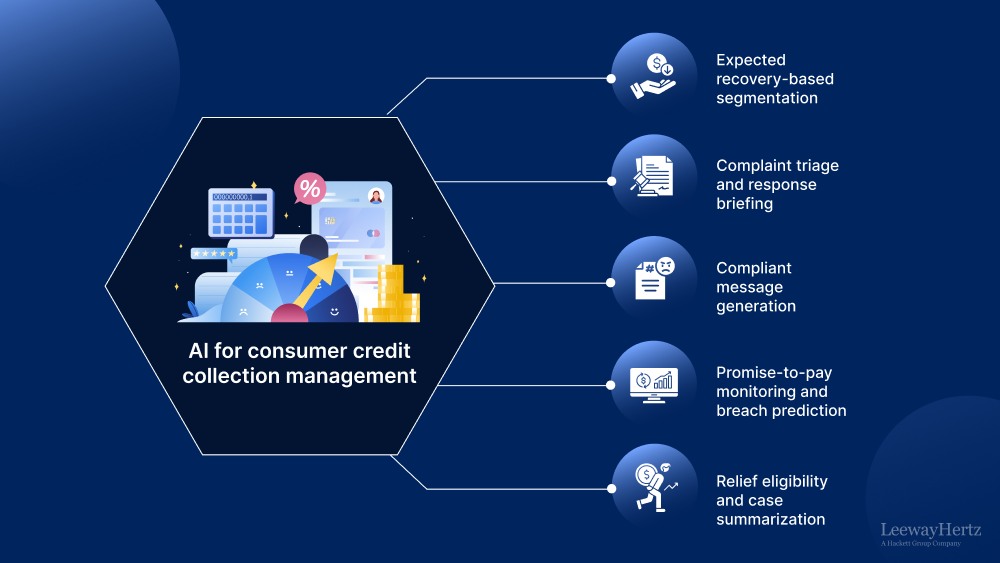
Consumer credit collections is well-suited to AI because the work already runs on structured borrower data, account histories, regulated communications, expert judgment, and repeatable workflows. Across the collections lifecycle, teams segment delinquent accounts, prioritize treatments, manage outreach, negotiate payment arrangements, resolve disputes, coordinate recoveries, and maintain compliance evidence. Each step produces information that must be reviewed, interpreted, validated, and acted on within clear policy, regulatory, and customer-treatment boundaries. This makes collections a strong environment for AI systems that can connect data, summarize complex evidence, support decision-making, and improve workflow efficiency while maintaining oversight and compliance.
As the volume and value of delinquent accounts increase, slow or non-compliant handoffs become more costly and harder to control across the collections lifecycle. US consumer credit outstanding runs to trillions of dollars [1], and delinquencies across cards and other consumer credit remain a persistent share of the book [2]. That opportunity is not limited to drafting messages. Predictive models give collections teams earlier cure and roll-rate signals, while anomaly detection helps compliance reviewers focus on the interactions that most need attention, shortening review queues and improving decision quality.
The value does not come from adding a generic chatbot beside regulated work and hoping teams adapt. It comes from embedding AI inside the workflow where a role already makes a documented judgment. In segmentation, a strategy owner can review cure and roll-rate scores and a suppression-filtered worklist rather than rebuilding the analysis manually. In disputes, AI can prepare a first-pass investigation finding from the account record, but the analyst confirms the FCRA determination before any account data is updated with a consumer reporting agency. In compliance, anomaly detection can rank interactions for review, giving a compliance analyst a clearer way to prioritize follow-up without weakening accountability.
Because the value-driving work sits inside existing steps, AI opportunities should be mapped at the function, process, and sub-process level before platforms or model features are selected. A function view shows where work belongs, but the sub-process view is where the build becomes real: the team can see which system holds the record, which artifact is being updated, who owns the review, and which regulatory control must be satisfied.
This article maps AI opportunities across the credit collections operating model by breaking work into functions, processes, and sub-processes. For each area, it shows where AI enablement opportunities can fit in to get the maximum business value while staying within regulated boundaries.
- How AI is transforming collections operations
- Why AI use cases in credit collections must be mapped at the sub-process level
- Collection management operating model and AI opportunity mapping across collection processes
- High-value AI use cases in collections management
- How agentic AI works in collections workflows
- How to prioritize AI use cases in collections management
- Governance, risk, and responsible AI in collections management
- How ZBrain operationalizes AI use cases in collections management
- Future of AI in collections management
How AI is transforming collections operations
AI is transforming collections operations by moving work beyond traditional dialing strategies and static scoring toward contextual decision support. Its value becomes clearer in the everyday operational moments where teams must connect structured account data, prior interactions, regulated communications, and expert judgment before the case can move forward.
For example, a dispute or hardship review often starts with a specialist comparing the account history, prior communications, and bureau or payment records across different systems. Rules can route the case to the next queue, and predictive models can estimate cure or recovery likelihood, which helps when inputs are structured and past patterns still apply. The gap appears when the team needs a reasoned view of what the account actually shows, because those tools do not assemble a clear rationale from scattered records or make tradeoffs transparent for review. AI changes the work at that boundary by turning the scattered record into a reviewable summary, so manual reconciliation falls, and the specialist can bring compliance or legal input before the case advances. That same boundary appears across collections wherever regulated evidence, expert judgment, and repeatable handoffs meet:
-
Document-heavy work: account histories, dispute and complaint files, credit-bureau records, hardship applications, and regulated letters can be checked for missing context and inconsistencies before a reviewer spends time on them.
-
Narrative-heavy work: dispute investigation findings, complaint responses, hardship case summaries, and QA and compliance briefings become faster to assemble because AI can shape an initial draft from the account record while showing where evidence is thin.
-
Exception-heavy work: disputes, broken promises, misapplied payments, bankruptcy filings, and suppression conflicts can be classified and prioritized so specialists focus first on the cases with higher recovery or compliance implications.
-
Knowledge-heavy work: FDCPA, Regulation F, FCRA, and TCPA interpretation, hardship and settlement policy lookups, and suppression-rule checks improve when AI retrieves the relevant rule and prior decisions and flags conflicts for expert review.
-
Workflow-heavy work: segmentation, outreach, arrangement setup, dispute investigation, and recoveries benefit when AI forecasts the likely bottleneck and assembles the next work packet, which reduces avoidable rework between functions.
The key design principle is to keep AI narrow, controlled, and embedded within existing workflows. AI prepares the case by retrieving the relevant record, shaping the draft output, and routing the package to the appropriate compliance, legal, or specialist reviewer. The reviewer confirms the result before any customer-facing message, furnishing update, settlement, or payment action proceeds. It keeps accountability visible while reducing manual effort, because teams spend less time assembling records and more time testing the recommendation against policy, regulation, and customer impact.
Transform consumer credit collections workflows
Apply AI across segmentation, outreach, arrangements, disputes, recoveries, and compliance to improve recovery, compliance, evidence quality, and speed to decision.
Why AI use cases in credit collections must be mapped at the sub-process level
Broad AI ideas become useful only when they are tied to a specific workflow, input, output, and review point. For example, a collections review might include two requests under the same ‘AI for collections’ label: one team may want support for dispute investigation drafting, while another may need hardship case triage before a specialist engages. The dispute workflow draws on the account record and furnishing history, while the hardship workflow depends on interaction signals and affordability inputs. Because the source evidence, reviewer role, and decision criteria differ, the high-level label is too broad to build, govern, or measure effectively.
A better approach is to map AI use cases to the collections operating model:
Function: the major operational domain, such as segmentation, outreach, arrangements, hardship, disputes, credit-bureau furnishing, recoveries, or compliance.
Process: the workflow area within that function, such as account scoring, contact orchestration, arrangement setup, dispute investigation, furnishing validation, or interaction monitoring.
Sub-process: the specific work activity, such as cure and roll-rate scoring, right-party-contact optimization, affordability assessment, dispute classification, Metro 2 validation, or QA scoring.
AI-enabled opportunity: the specific way AI can support that sub-process, such as scoring cure likelihood, classifying a dispute into FCRA categories, drafting a compliant arrangement confirmation, validating a furnishing file, or ranking interactions for compliance review.
This level of detail matters because collections workflows are tied to specific account records, regulated communications, source systems, review checkpoints, and accountable decision-makers. An AI workflow for dispute investigation is different from one for hardship triage. A suppression-filtering workflow is different from a settlement-drafting workflow. A furnishing validation assistant is different from an outreach optimizer or a compliance monitor.
Sub-process mapping makes each opportunity concrete because it has to define what AI is allowed to do, which artifact it touches, and who accepts or rejects the output. In dispute investigation, AI may classify the dispute and draft a finding, but the analyst confirms the FCRA reasonable-investigation determination before anything is furnished. In the arrangement setup, AI may estimate affordability and draft a plan, but the agent confirms it, and the authorization desk approves any settlement above the threshold. In hardship, AI may detect a vulnerability signal and summarize the case, but a specialist makes the vulnerability determination.
By mapping AI opportunities at the sub-process level, collections teams can move from broad ideas to executable workflows with clear business value, data requirements, system integration needs, governance controls, and review accountability.
Collection management operating model and AI opportunity mapping across collection processes
The collections operating model is organized into core interconnected functions, each a governed operational domain with clear human accountability. Each function is rendered as a self-contained block: a short overview, the teams involved, what AI helps with, what humans continue to own, a process and sub-process opportunity table, the highest-value opportunities, and one example agentic workflow.
Function 1: Collections strategy, segmentation, and prioritization
Turning a broad delinquent portfolio into prioritized treatment paths, ranked queues, and compliant outreach decisions.
This function determines how past-due accounts are segmented, prioritized, and assigned to collections treatment paths. It scores accounts by cure probability, roll-rate risk, contactability, and expected recovery value, then converts those signals into daily worklists that reflect operational capacity and compliance constraints. Positioned at the front of the collections operating model, it influences downstream outreach, payment arrangement, hardship, dispute, and recovery workflows.
Teams involved
Collections analytics, decision science, portfolio risk, strategy operations, and model validation team.
What AI helps with
Predictive analytics estimates cure probability, roll-rate risk, and expected recovery value so accounts can be prioritized by likely outcome rather than balance or days past due alone. Pattern detection groups accounts into treatment cohorts, classification applies suppression rules, and recommendation models propose the next-best action, channel, and timing. Anomaly detection identifies accounts whose repayment or contact behavior no longer fits their assigned segment, prompting re-scoring or review.
What humans continue to own
Collections strategy owners define the segmentation logic, treatment strategy, and operating thresholds. Compliance team reviews fair treatment and disparate-impact considerations, while model-risk governance validates scoring models under SR 11-7 before they influence production queues. Human reviewers approve suppression logic, treatment-policy changes, and any strategy adjustment that could materially alter customer treatment. AI scores, classifies, and recommends; people set the strategy and approve its use.
| Process | Sub-process | Key AI-enabled opportunities |
| Account scoring and segmentation | Cure probability estimation |
|
| Roll-rate forecasting (30/60/90+ DPD) |
|
|
| Treatment cohort assignment (self-cure, assisted, high-risk loss) |
|
|
| Queue and capacity optimization | Worklist prioritization under capacity constraints |
|
| Contact frequency compliance validation (Reg F) |
|
|
| Dynamic re-scoring based on behavior drift |
|
|
| Strategy monitoring | Performance drift detection |
|
| Segment-level outcome tracking |
|
Highest-value opportunities
-
Expected recovery value-based segmentation: Prioritizes accounts based on the likelihood and value of successful treatment, helping collections teams focus limited capacity where intervention is most likely to change the outcome.
-
Contact eligibility and suppression-rule automation: Screens accounts for SCRA, bankruptcy, deceased, cease-communication, opt-out, and other suppression conditions before outreach, reducing compliance risk at the top of the workflow.
-
Capacity-aware queue optimization: Converts account-level scores into a daily production queue that reflects agent capacity, channel availability, permissible contact windows, and regulation F requirements.
Example agentic workflow
- Trigger: the nightly delinquency file is ingested with each account’s scoring features.
- Retrieval: the workflow grounds each account in repayment history, prior promises, and current suppression flags from the servicing knowledge base.
- Scoring and segmentation: predictive models return cure, roll-rate, and expected-recovery estimates and assign treatment cohorts.
- Suppression filtering: accounts are screened against SCRA, bankruptcy, deceased, and opt-out rules.
- Validation: the draft worklist is checked against Regulation F frequency limits and the approved treatment mapping.
- Human-in-the-loop checkpoint: the strategy owner reviews the queue and approves the day’s plan.
- Release: the approved worklist is passed to outreach under existing governance and logged for the strategy review.
Function 2: Early-stage and pre-delinquency treatment
Reducing delinquency through timely, low-friction intervention before accounts progress into later-stage collections.
This function covers the period from pre-due-date risk signals through the early delinquency buckets, where many accounts can still self-cure with timely reminders, payment support, or self-service options. Its goal is to resolve preventable delinquency early, reduce avoidable assisted handling, and identify hardship or dispute signals before the account moves deeper into the collections lifecycle. It sits after segmentation and before full-scale outreach, using approved treatment rules to determine when an account should receive a reminder, self-service option, specialist referral, or no contact.
Teams involved
Early-stage collections, digital collections, self-service operations, customer experience, payments operations, collections strategy, and compliance.
What AI helps with
Predictive analytics identifies accounts at risk of missing an upcoming payment based on prior payment behavior, account activity, and delinquency patterns. Natural-language generation drafts compliant payment reminders, payment-method update prompts, and self-cure messages within the customer’s consent state and approved communication rules. Recommendation models match eligible self-service options, such as autopay, due-date changes, or short repayment plans, to the account’s segment. Classification reads inbound responses and early repayment interactions to route accounts to payment, promise-to-pay, dispute, or hardship paths.
What humans continue to own
Collections strategy owners and compliance reviewers approve the pre-delinquency outreach policy, eligibility thresholds, cadence, and message standards. Compliance reviewers confirm that early-contact strategies remain aligned with consent, frequency, and fair-treatment requirements. Hardship, vulnerability, or dispute signals are routed to the appropriate specialist workflow rather than resolved through an automated self-cure path. AI identifies, drafts, and recommends; people define the policy and own the treatment boundaries.
| Process | Sub-process | Key AI-enabled opportunities |
| Pre-delinquency engagement and risk detection | Pre-delinquency risk identification |
|
| Digital nudging orchestration |
|
|
| Early delinquency cure and self-service resolution | Early-bucket cure resolution |
|
| Promise-to-pay capture and monitoring |
|
Highest-value opportunities
-
Pre-delinquency risk detection and nudging: Identifies accounts likely to miss an upcoming payment and supports timely, compliant intervention before delinquency progresses.
-
Self-service option recommendation: Directs curable accounts to eligible digital options such as autopay, due-date changes, or short repayment plans, reducing assisted-channel workload.
-
First-contact intent classification: Interprets early customer responses and routes accounts to the correct path on the first interaction, reducing repeat handling and improving escalation accuracy.
Example agentic workflow
- Trigger: an at-risk score crosses the pre-delinquency threshold before the due date.
- Retrieval: the workflow grounds balance, due date, consent state, and eligible self-serve options from the servicing knowledge base.
- Drafting: natural-language generation composes a channel-appropriate nudge with a self-serve link.
- Validation: the draft is checked against the pre-delinquency contact policy and Regulation F content and frequency limits.
- Human-in-the-loop checkpoint: a supervisor approves the nudge template and cadence for sensitive cohorts; standard cohorts run under a pre-approved policy.
- Execution: the nudge is sent, and any self-serve enrollment or promise is written back.
- Hand-off: hardship or dispute signals a route out of the self-cure path under existing governance.
Function 3: Omnichannel outreach and contact management
Executing compliant customer engagement across voice, SMS, email, and digital channels.
This function turns the prioritized collections worklist into compliant customer contact, captured dispositions, and repayment commitments. It determines who can be contacted, when contact is permitted, which channel should be used, and what message or disclosure is required. Operating within Regulation F, TCPA, consent, quiet-hour, and opt-out requirements, it connects segmentation decisions to downstream payment arrangements, dispute handling, and hardship workflows.
Teams involved
Collections contact center, dialer and campaign operations, digital and SMS channel team, telephony compliance, and workforce management.
What AI helps with
Optimization recommends channel mix and contact timing within approved frequency, consent, and quiet-hour rules. Predictive analytics ranks phone numbers, channels, and contact windows by right-party-contact likelihood. Classification assigns a disposition to each interaction, such as right-party contact, no answer, wrong number, promise, dispute, hardship signal, or opt-out. Retrieval-grounded answering supports agents during live calls by surfacing account status, permissible options, and required disclosures, while natural-language generation drafts compliant messages, post-call summaries, and next-step communications.
What humans continue to own
Collections agents own live conversations, identity confirmation, required disclosures, and any commitment captured during the interaction. Compliance and operations leaders define the contact frequency, consent, script, and disclosure rules that AI operates within. Human reviewers approve script and disclosure updates, and compliance remains accountable for cease-communication requests, consent revocations, and opt-out handling. AI recommends channel, timing, and message content; people own the communication policy and customer-facing judgment.
| Process | Sub-process | Key AI-enabled opportunities |
| Contact strategy execution | Channel, cadence, and consent orchestration |
|
| Right-party contact and contactability optimization |
|
|
| Live conversation and digital message management | Live agent assist and disclosure support |
|
| Digital message generation and suppression handling |
|
Highest-value opportunities
-
Channel, cadence, and consent optimization: Improves contact effectiveness by selecting the right channel and timing while validating outreach against Regulation F, TCPA, consent, quiet-hour, and opt-out requirements.
-
Right-party contact and contactability ranking: Prioritizes the phone numbers, channels, and contact windows most likely to reach the customer, improving connect rates and reducing wasted contact attempts.
-
Live agent assist and disclosure support: Surfaces account context, permissible options, required disclosures, and next-step guidance during the interaction, helping agents reduce handle time while maintaining compliance discipline.
Example agentic workflow
- Trigger: an approved worklist account becomes eligible for contact.
- Retrieval: the workflow grounds consent state, prior attempt count within the Regulation F window, and best-channel signal.
- Recommendation: it proposes the next channel, number, and window and drafts the message or call-open script.
- Validation: the attempt is validated against Regulation F frequency, quiet hours, and TCPA consent before it is allowed.
- Human-in-the-loop checkpoint: on connect, a live agent conducts the conversation, delivers disclosures, and captures any commitment.
- Execution: the disposition and any promise are written back, and opt-outs trigger immediate suppression.
- Hand-off: promises route to arrangements and disputes to the dispute function under existing governance.
Accelerate AI Solutions Development
Build fully functional solutions from your high-value use cases, based on specific operational needs and enterprise context.
Function 4: Payment arrangement and promise-to-pay management
Structuring repayment commitments into enforceable, affordable, and trackable arrangements
This function converts a customer’s willingness to pay into a structured repayment outcome, such as a promise-to-pay, short-term payment plan, long-term arrangement, or settlement offer. It assesses sustainable payment capacity, formalizes the agreed terms, generates required confirmations and disclosures, and monitors adherence over time. It sits after outreach and handles hardship when affordability concerns emerge, or recoveries when arrangements fail.
Teams involved
Collections operations, loss mitigation and workout, settlement authorization desk, payments operations, and collections analytics.
What AI helps with
Predictive analytics estimates sustainable payment capacity and scores promise-kept likelihood based on account history, prior repayment behavior, and available affordability inputs. Recommendation models propose eligible repayment structures, reminder timing, and settlement bands based on product policy, recovery likelihood, and authorization limits. Natural-language generation drafts arrangement confirmations, settlement communications, and required disclosures, while anomaly detection flags missed, partial, or late payments against the agreed plan for timely follow-up.
What humans continue to own
Collections agents, workout specialists, and supervisors confirm the customer’s circumstances before finalizing any arrangement. Settlement authority above defined thresholds remains with the authorization desk, and hardship-linked affordability decisions remain human-owned. A settlement approver or authorized operations reviewer validates final terms, balance waivers, and settlement-in-full communications. AI estimates, recommends, drafts, and monitors; people approve the arrangement and remain accountable for customer-impacting decisions.
| Process | Sub-process | Key AI-enabled opportunities |
| Arrangement design and approval | Sustainable payment capacity assessment |
|
| Repayment plan and settlement option generation |
|
|
| Arrangement confirmation and disclosure drafting |
|
|
| Arrangement servicing and adherence monitoring | Promise-to-pay monitoring and breach escalation |
|
Highest-value opportunities
-
Affordability-based plan sizing: Improves arrangement durability by matching repayment terms to sustainable payment capacity, reducing repeat breakage and unnecessary escalation.
-
Promise-kept scoring with pre-break reminders: Identifies at-risk commitments before they fail and supports timely, compliant follow-up with limited additional handling effort.
-
Settlement band recommendation: Standardizes settlement options based on recovery likelihood, account balance, product policy, and authority limits, while keeping final approval with the settlement authorization desk.
Example agentic workflow
- Trigger: an agent or self-service session reaches the arrangement step.
- Retrieval: the workflow grounds income, obligations, prior payment behavior, and product policy.
- Recommendation: predictive models estimate capacity and propose affordable plans, with disclosures drafted by natural-language generation.
- Validation: proposed terms are checked against policy, fee and interest rules, and state limits.
- Human-in-the-loop checkpoint: the agent confirms circumstances and selects a plan; settlements above the threshold route to the authorization desk.
- Execution: the accepted plan and confirmation are written to the account, and the schedule is set.
- Monitoring hand-off: promise-kept scoring watches the plan, and breaches route to hardship or recoveries under existing governance.
Function 5: Hardship, forbearance, and vulnerable-customer management
Managing financial distress cases that require protected treatment pathways.
This function manages customers who cannot resolve delinquency through standard repayment paths because of hardship, affordability constraints, or vulnerability indicators. It identifies distress signals, prepares cases for specialist review, assesses eligibility for relief programs, and administers forbearance, hardship plans, or other approved accommodations. Because these workflows carry significant fair-treatment and conduct-risk obligations, AI support is limited to detection, retrieval, summarization, and drafting, while approval decisions remain with trained specialists.
Teams involved
Loss mitigation and hardship team, vulnerable-customer specialists, complaints, fair treatment, compliance and conduct risk.
What AI helps with
Classification detects hardship, vulnerability, affordability, and distress indicators from call transcripts, digital messages, servicing notes, and account behavior held by the institution. Summarization compiles account history, recent interactions, detected signals, and affordability inputs into a case brief for specialist review. Retrieval-grounded answering surfaces applicable program rules, eligibility criteria, document requirements, and contact-handling guidance. Natural-language generation drafts plain-language option explanations, document request lists, and hardship or forbearance confirmations after a specialist has engaged.
What humans continue to own
Trained hardship specialists own the customer conversation, vulnerability assessment, affordability review, and hardship or forbearance approval decision. Compliance and conduct-risk reviewers remain accountable for fair-treatment standards, escalation criteria, and the evidentiary record. Any relief that changes contractual terms, applies contract suppression, or alters account treatment requires human confirmation. AI can identify signals, prepare the case, and draft communications; it does not determine vulnerability, approve relief, or replace specialist judgment.
| Process | Sub-process | Key AI-enabled opportunities |
| Hardship and vulnerability identification | Hardship and vulnerability signal detection |
|
| Specialist case triage and prioritization |
|
|
| Relief eligibility and program administration | Relief eligibility and program matching |
|
| Hardship plan and forbearance servicing |
|
Highest-value opportunities
-
Hardship and vulnerability signal classification: Identifies customers who may need specialist support earlier in the lifecycle, helping prevent unsuitable treatment and improving fair-treatment oversight.
-
Specialist case triage and summarization: Gives the hardship or vulnerable-customer specialist a structured case brief upfront, reducing manual review effort while keeping the decision with the trained reviewer.
-
Relief eligibility retrieval and document drafting: Surfaces applicable program rules, required documents, and next-step communications, reducing back-and-forth and helping customers move through the relief process more efficiently.
Example agentic workflow
- Trigger: the classifier flags a hardship or vulnerability signal on a live or recent interaction.
- Retrieval: the workflow grounds the account, contact history, and program rules from the servicing and policy knowledge base.
- Summarization: it drafts a triage brief with the detected signals, affordability inputs, and candidate programs.
- Validation: candidate programs are checked against eligibility rules and conduct policy.
- Human-in-the-loop checkpoint: a trained specialist confirms circumstances, makes the vulnerability and eligibility determination, and approves any relief.
- Execution: on approval, confirmations and disclosures are drafted, the plan is set, and appropriate contact suppression is applied.
- Hand-off: the fair-treatment record is logged, and the case is monitored under existing governance.
Function 6A : Dispute and complaint management
Resolving account disputes and complaints accurately and within regulatory timelines.
This function manages customer disputes and complaints arising from collections activity, payment application, account treatment, credit reporting concerns, fees, communications, hardship handling, or servicing outcomes. It classifies inbound disputes, assembles the evidence needed for investigation, drafts findings and responses, and tracks resolution against FCRA, UDAAP, CFPB complaint-handling, and internal conduct-risk requirements. Separating this function from credit bureau furnishing creates a clearer control boundary between investigation decisions and bureau reporting execution.
Teams involved
Disputes operations, complaint handling, FCRA compliance, quality assurance, and legal for escalations.
What AI helps with
Document intelligence extracts dispute reasons, complaint details, supporting documents, customer assertions, and e-OSCAR Automated Consumer Dispute Verification (ACDV) fields from inbound records. Classification routes disputes and complaints into relevant categories, themes, severity levels, and regulatory timelines. Retrieval-grounded answering assembles account records, payment history, interaction history, prior furnishing data, correspondence, and policy references needed for investigation. Summarization prepares complaint briefs, while natural-language generation drafts investigation findings, response letters, and internal case notes for analyst review.
What humans continue to own
Trained dispute analysts own the FCRA reasonable-investigation determination and the final dispute outcome. Complaint managers and compliance reviewers remain accountable for the substance, fairness, and accuracy of complaint responses, especially for CFPB, executive, legal, or conduct-risk escalations. Legal reviews matters with litigation, regulatory, or systemic-risk implications. AI extracts, classifies, assembles, summarizes, and drafts; people decide the outcome and attest to the response.
| Process | Sub-process | Key AI-enabled opportunities |
| Dispute intake and investigation | Dispute intake, extraction, and classification |
|
| Reasonable-investigation evidence assembly |
|
|
| Complaint triage and response management | Complaint triage, severity assessment, and response drafting |
|
Highest-value opportunities
-
Dispute intake, extraction, and classification: Extracts the dispute reason, supporting details, and e-OSCAR ACDV information, then routes the case to the correct investigation path and timeline.
-
Reasonable-investigation evidence assembly: Retrieves the account record, payment history, interaction history, prior furnishing data, and relevant policy references so the dispute analyst starts with a complete investigation package.
-
Complaint triage and response briefing: Classifies complaint themes and severity, summarizes the customer narrative and account context, and prepares a response-ready brief while keeping the final response human-attested.
Example agentic workflow
- Trigger: an inbound dispute or e-OSCAR ACDV arrives.
- Extraction and classification: document intelligence pulls the dispute reason and classifies the type.
- Retrieval: the workflow assembles account records, payment history, and prior furnishing.
- Drafting: natural-language generation drafts an investigation finding and consumer response.
- Validation: the draft and timeline are checked against the FCRA reasonable-investigation and response-window rules.
- Human-in-the-loop checkpoint: a dispute analyst makes the reasonable-investigation determination and confirms the outcome.
- Execution: the response is sent, and the outcome is recorded under existing governance.
Function 6B: Credit bureau furnishing operations
Governing credit-bureau furnishing and corrections, so reported data is accurate and consistent.
This function governs what is reported to the credit reporting agencies and how furnishing corrections are reviewed, approved, and executed. It validates Metro 2 reporting files, verifies tradeline updates against servicing records, checks account status and payment history fields, and detects furnishing anomalies before submission. Separating this function from dispute handling creates a clearer accountability boundary between investigation outcomes and bureau reporting execution.
Teams involved
Credit bureau furnishing operations, FCRA and furnishing compliance, data quality, and dispute operations.
What AI helps with
Validation checks Metro 2 fields, account status codes, balances, payment history, delinquency buckets, charge-off indicators, and correction records for completeness and consistency before submission. Anomaly detection flags furnishing inconsistencies, unexpected status changes, missing updates, duplicate tradelines, or misaligned payment history. Pattern detection surfaces recurring reporting issues across products, portfolios, accounts, and furnishing cycles. These checks help identify potential errors before they reach the credit reporting agencies rather than after a consumer dispute or bureau rejection.
What humans continue to own
Furnishing analysts and furnishing operations managers own the approval of reporting files, correction actions, and deletion decisions. FCRA compliance team remains accountable for furnishing policy, accuracy standards, and escalation criteria. Dispute outcomes may trigger downstream furnishing changes, but the authorization to furnish, update, suppress, correct, or delete a tradeline remains with trained furnishing personnel. AI validates, compares, and flags; people authorize what is reported.
| Process | Sub-process | Key AI-enabled opportunities |
| Furnishing operations | Metro 2 reporting validation |
|
| Tradeline update verification |
|
|
| Furnishing accuracy | Furnishing anomaly detection |
|
| Reporting consistency checks |
|
Highest-value opportunities
-
Metro 2 file validation: Checks required furnishing fields, account status codes, payment history, balances, and delinquency indicators before submission, reducing downstream reporting errors and bureau rejections.
-
Tradeline update verification: Confirms that reported changes reflect the underlying servicing record, payment activity, dispute outcome, or account status change before the update reaches the credit reporting agencies.
-
Furnishing anomaly detection: Identifies unexpected status changes, stale balances, duplicate tradelines, missing updates, and payment history inconsistencies before they create consumer disputes or FCRA exposure.
Example agentic workflow
- Trigger: a furnishing cycle prepares a Metro 2 file.
- Retrieval: the workflow grounds each tradeline update against the account record.
- Validation and anomaly detection: it checks Metro 2 fields, verifies updates, and flags inconsistencies.
- Drafting: it drafts a furnishing exception summary for the analyst.
- Human-in-the-loop checkpoint: a furnishing analyst approves the file and authorizes any corrections.
- Execution: the approved file is furnished, and exceptions are logged under existing governance.
Function 7: Skip tracing and contactability intelligence
Improving right-party contact through governed identity and contact enrichment.
This function improves the likelihood of reaching the right party by validating, prioritizing, and enriching contact data within approved data-use boundaries. It assesses phone, address, and digital contact quality, identifies stale or conflicting records, scores contactability, and flags reassigned-number or wrong-party-contact risk before outreach. It supports early outreach, late-stage collections, recoveries, and agency placement, but operates under strict controls for permissible purpose, consent, source approval, data minimization, and auditability.
Teams involved
Skip tracing operations, contact strategy, data governance, and compliance.
What AI helps with
Validation checks contact records for completeness, recency, consistency, and conflict across approved servicing and enrichment sources. Multi-source aggregation compiles phone, address, and contactability signals from permitted internal and third-party sources. Predictive analytics scores the likelihood of right-party contact by channel, number, address, and time window. Pattern detection flags reassigned-number, wrong-number, stale-address, or low-confidence contact signals before the account is worked, helping reduce ineffective outreach and TCPA exposure.
What humans continue to own
Data governance, compliance, and vendor-management owners approve which enrichment sources may be used, under what permissible purpose, and with what retention and audit requirements. The telephony compliance team defines consent, suppression, reassigned numbers and contact validation rules. Collections or recoveries leaders decide how contactability scores influence treatment strategy or placement. AI validates source data, compares account attributes, enriches approved records, and scores contactability, response likelihood, or treatment fit only within approved source, consent, and permissible-use boundaries. People own the data-use policy and contact-governance decisions.
| Process | Sub-process | Key AI-enabled opportunities |
| Contact data validation and enrichment | Approved source address, phone, and digital contact enrichment |
|
| Contact quality validation and confidence scoring |
|
|
| Contactability and right party contact intelligence | Right party contact likelihood scoring |
|
| Reassigned the number and the wrong party contact risk detection |
|
Highest-value opportunities
-
Contact quality validation and confidence scoring: Identifies stale, conflicting, or low-confidence phone and address records before outreach, reducing wasted contact attempts and improving right party contact efficiency.
-
Reassigned number and wrong party contact risk detection: Flags numbers that may no longer belong to the customer or may create wrong party contact exposure, helping reduce TCPA and conduct-risk concerns before dialing.
-
Governed contact enrichment: Uses approved internal and third-party sources to improve contactability while preserving permissible-purpose, consent, vendor, retention, and audit controls.
Example agentic workflow
- Trigger: an account needs a better contact path before outreach or placement (contact validation and scoring sub-process).
- Retrieval: the workflow grounds the current contact data and permitted enrichment sources.
- Enrichment and scoring: it enriches address and phone data and scores contactability and reassignment risk.
- Validation: enrichment is checked against permissible purpose and consent rules.
- Human-in-the-loop checkpoint: data governance confirms source use for any non-standard enrichment.
- Hand-off: validated contact data and scores pass to outreach or recoveries under existing governance.
Function 8: Payment posting, cash application, and reconciliation
Ensuring payment accuracy across customer accounts, repayment arrangements, and ledger systems.
This function protects the financial integrity of collections by ensuring that customer payments are correctly matched, allocated, reconciled, and reflected in account balances. It supports payment posting, cash application, allocation across principal, interest, fees, and arrangements, misapplied payment detection, refund identification, and reconciliation between servicing records, collections subledgers, and the general ledger. It sits alongside payment arrangements, disputes, furnishing, and recoveries because posting errors can affect delinquency status, customer communications, credit reporting, and downstream collection treatment.
Teams involved
Payments operations, cash application, servicing operations, collections accounting, reconciliation, controllers, finance operations, and data quality.
What AI helps with
Pattern detection proposes matches between incoming payments, customer accounts, repayment arrangements, and open balances. Classification identifies payment types, allocation scenarios, overpayments, partial payments, unapplied cash, and refund-eligible situations. Anomaly detection flags misapplied payments, duplicate postings, stale unapplied cash, mismatched arrangement payments, and ledger breaks. Summarization supports reconciliation by drafting exception narratives and assembling reviewer-ready evidence packs for accounting and cash application teams.
What humans continue to own
Cash application, accounting, reconciliation, and controller teams approve final allocations, adjustments, write-offs, refunds, and ledger corrections. Finance reviewers remain accountable for reconciliation sign-off, exception resolution, and month-end close controls. AI proposes matches, flags anomalies, classifies exceptions, and drafts support; people authorize postings, corrections, refunds, and financial adjustments.
| Process | Sub-process | Key AI-enabled opportunities |
| Payment posting | Payment matching and allocation | Pattern detection matches incoming payments to accounts and arrangements across principal, interest, and fees. |
| Partial payment and unapplied cash handling | Classification identifies partial payments, unapplied cash, unmatched payments, and arrangement-related shortfalls for review. | |
| Misapplied payment detection | Anomaly detection flags payments applied to the wrong account or bucket for correction. | |
| Reconciliation and controls | Ledger reconciliation summarization | Summarization drafts reconciliation support between the collections subledger and the general ledger, highlighting breaks. |
| Refund identification | Classification identifies overpayment and refund-eligible situations and drafts the support for review. | |
| Refund and adjustment review | Refund identification and adjustment support | Classification identifies overpayments, duplicate payments, refund-eligible cases, and adjustment candidates for accounting review. |
Highest-value opportunities
-
Payment matching and allocation: Reduces manual cash application effort by proposing matches between incoming payments, customer accounts, repayment arrangements, and open balances for accounting review.
-
Misapplied payment detection: Protects account balance accuracy by flagging payments applied to the wrong account, arrangement, balance bucket, or ledger position before they create disputes or reporting errors.
-
Reconciliation support drafting: Compresses a manual close and control task by preparing reviewer-ready reconciliation summaries, exception lists, and source evidence across servicing and ledger systems.
Example agentic workflow
- Trigger: a payment file lands for posting.
- Retrieval:the workflow pulls the relevant accounts, arrangements, and balances tied to each payment.
- Matching and detection: it matches and allocates payments and flags misapplications and refund-eligible items.
- Drafting: it drafts reconciliation support and an exception list.
- Human-in-the-loop checkpoint: accounting approves the reconciliation and authorizes exception corrections and refunds.
- Update: approved postings and corrections are applied and logged under existing governance.
Function 9: Bankruptcy, insolvency, and legal protection management
Managing accounts under legal protection frameworks accurately and compliantly.
This function manages accounts that are subject to bankruptcy, insolvency, or other legal protection requirements. It identifies bankruptcy events, matches filings to affected accounts, determines the required stay or suppression treatment, supports proof-of-claim preparation, manages trustee communications, and monitors repayment plans where applicable. Because errors in this workflow can create legal, regulatory, and conduct-risk exposure, it operates with strict human oversight and close coordination between bankruptcy operations, compliance, legal, and recoveries teams.
Teams involved
Bankruptcy operations, legal operations, recovery operations, compliance teams, servicing operations, outside-counsel coordination, and portfolio or account management teams.
What AI helps with
Classification identifies bankruptcy filings, applicable chapters, case status, and account matches from court data, bureau signals, servicing records, and legal notices. Document intelligence extracts key information from petitions, trustee notices, court filings, repayment plans, discharge notices, and proof-of-claim materials. Retrieval-grounded answering surfaces account history, balance details, prior payments, collateral information, and applicable servicing rules for review. Natural-language generation drafts trustee correspondence, proof-of-claim support, internal case summaries, and status updates for legal review. Pattern detection monitors Chapter 13 plan performance and flags deviations, missed trustee payments, or case-status changes.
What humans continue to own
Bankruptcy specialists, legal operations teams, compliance reviewers, and counsel confirm the legal status, automatic-stay treatment, suppression requirements, proof-of-claim strategy, and any litigation or recovery action. Legal or authorized bankruptcy operations teams approve proof-of-claim submissions, trustee communications, reaffirmation-related actions where applicable, and post-discharge servicing treatment. AI identifies, extracts, classifies, monitors, and drafts; people validate legal treatment and authorize any filing, communication, or account action.
| Process | Sub-process | Key AI-enabled opportunities |
| Case identification and account matching | Bankruptcy filing detection and account matching |
|
| Automatic stay and suppression treatment |
|
|
| Case administration | Trustee communication drafting |
|
| Chapter 13 plan tracking |
|
Highest-value opportunities
-
Bankruptcy filing detection and account matching: Identifies bankruptcy events quickly and matches them to affected accounts, enabling timely stay treatment and reducing the risk of prohibited collection activity.
-
Automatic stay and suppression treatment: Applies the correct account-handling path after legal review, helping ensure outreach, recoveries, furnishing, and servicing actions align with bankruptcy restrictions.
-
Proof-of-claim support preparation: Assembles account history, balance details, payment records, collateral information, and supporting documents into a review-ready package. This accelerates a deadline-driven legal workflow while keeping submission approval with authorized legal or bankruptcy teams.
-
Chapter 13 plan tracking: Monitors trustee payment activity, plan deviations, missed payments, and case-status changes so recoveries and servicing teams can respond within the legal framework.
Example agentic workflow
- Trigger: a bankruptcy filing is detected for an account.
- Retrieval: the workflow grounds the filing details, chapter, and account state.
- Classification: it determines the automatic-stay treatment and suppresses collection activity.
- Drafting: natural-language generation drafts, trustee communication and proof-of-claim support.
- Validation: the treatment is checked against legal and compliance rules.
- Human-in-the-loop checkpoint: legal team validates compliance and approves any proof-of-claim submission.
- Execution: approved actions proceed, and plan tracking continues under existing governance.
Function 10: Late-stage recoveries, agency placement, and legal referral
Optimizing recovery on late-stage and charged-off accounts within legal, conduct, and vendor-governance boundaries.
This function manages late-stage delinquent and charged-off accounts through in-house recovery, third-party agency placement, settlement, portfolio treatment, and legal referral. It scores recovery likelihood, estimates expected recovery value, supports recovery channel selection, recommends settlement bands, and checks whether an account is ready for agency placement or litigation referral. As the final stage of the collections lifecycle, it carries heightened obligations around statute-of-limitations review, documentation completeness, litigation conduct, settlement authority, and third-party agency oversight.
Teams involved
Recovery operations, agency and vendor management, legal recovery, litigation referral, settlement authorization, recovery analytics, compliance teams, and outside-counsel coordination.
What AI helps with
Predictive analytics estimates recovery likelihood and expected recovery value to support channel recommendations across in-house recovery, agency placement, settlement, or legal referral. Recommendation models propose settlement bands based on balance, recovery probability, prior payment behavior, and authority limits. Pattern detection matches account cohorts to agency performance profiles and flags agency conduct or recovery outliers. Document intelligence checks affidavit, account history, payment record, and supporting documentation completeness before legal referral, while retrieval-grounded answering surfaces statute-of-limitations context and required referral evidence for legal review.
What humans continue to own
Recovery managers, settlement approvers, vendor-management owners, legal recovery teams, and counsel remain accountable for placement, settlement, and litigation decisions. Legal recovery or counsel confirms statute-of-limitations status before any legal action and attests to affidavit-of-debt readiness. Settlement authorization remains with the approved authority structure, and portfolio placement or recall decisions remain human-owned. AI scores, compares, recommends, and checks documentation; people approve placement, settlement, referral, and legal action.
| Process | Sub-process | Key AI-enabled opportunities |
| Recovery strategy and channel selection | Recovery likelihood and expected value scoring |
|
| Settlement band and offer strategy recommendation |
|
|
| Agency placement and legal referral governance | Agency placement and performance optimization |
|
| Litigation referral and affidavit readiness review |
|
Highest-value opportunities
-
Recovery likelihood and expected value scoring: Helps recovery teams prioritize late-stage and charged-off accounts by expected recovery value, supporting more consistent channel selection across in-house recovery, agency placement, settlement, and legal referral.
-
Settlement band recommendation: Standardizes settlement options using recovery likelihood, balance, prior payment behavior, and authority limits, improving offer consistency while keeping final approval with the settlement authorization desk.
-
Legal referral and affidavit readiness review: Checks documentation completeness, statute-of-limitations context, and affidavit support before referral, reducing defective litigation packages and strengthening conduct-risk controls.
-
Agency placement and performance monitoring: Matches account cohorts to agency performance patterns and flags recovery, compliance, or conduct outliers for vendor-management review.
Example agentic workflow
- Trigger: an account reaches charge-off, or a recovery refresh runs.
- Retrieval: the workflow grounds balance, payment history, prior contact, and skip-trace signals.
- Scoring: predictive models return recovery likelihood, expected value, and a recommended channel and settlement band.
- Validation: the recommendation is checked against statute-of-limitations status, suppression flags, and placement policy.
- Human-in-the-loop checkpoint: a recovery manager approves the channel; litigation referrals route to legal, which confirms SOL status and attests to the affidavit of debt.
- Execution: the account is placed, settled, or referred, and the decision is logged.
- Oversight hand-off: agency performance is monitored, with outliers flagged for vendor-management review under existing governance.
Function 11: Collections compliance, quality assurance, and performance analytics
Providing cross-functional governance, quality oversight, and performance measurement across collections operations.
This function governs, monitors, and measures the collections operating model. It reviews customer interactions for regulatory and conduct-risk adherence, runs quality assurance across agents and digital channels, and produces the management information that informs strategy, staffing, treatment design, and remediation. It operates across every collection function as the control and feedback layer, maintaining the evidence that compliance teams, auditors, model-risk reviewers, and regulators expect.
Teams involved
Collections compliance, quality assurance, conduct risk, complaints oversight, management information and analytics, operations leadership, internal audit liaison, and model-risk validation.
What AI helps with
Classification evaluates calls, messages, and digital interactions for required disclosures, prohibited statements, consent handling, opt-out treatment, cease-communication requests, and Regulation F frequency adherence. Anomaly detection flags potential UDAAP, disclosure, contact-frequency, or conduct-risk exceptions for review. Multi-source aggregation compiles roll-rate, cure-rate, kept-promise, recovery-yield, complaint, QA, and agent-performance metrics into management information. Natural-language generation drafts QA findings, coaching notes, remediation summaries, and reporting narratives for human review.
What humans continue to own
Compliance analysts and compliance officers confirm potential breaches, determine remediation, and attest to compliance reporting. QA leaders own scorecard calibration, coaching standards, and final judgment-based quality outcomes. Model-risk validation teams approve scoring, prioritization, and treatment models before they influence production activity. Operations leaders remain accountable for acting on performance findings. AI monitors, scores, flags, aggregates, and drafts; people confirm findings, approve remediation, calibrate quality judgment, and attest to regulatory evidence.
Process, sub-process, and key AI-enabled opportunities
| Process | Sub-process | Key AI-enabled opportunities |
| Compliance monitoring | Compliance surveillance and conduct monitoring |
|
| Regulatory and conduct-risk exception detection |
|
|
| Quality and performance | QA scorecard support and exception routing |
|
| Collections performance and management information aggregation |
|
Highest-value opportunities
-
Full-population interaction surveillance: Expands compliance assurance beyond sample-based review by analyzing calls, messages, and digital interactions for disclosure, consent, opt-out, prohibited-content, and frequency-rule adherence.
-
QA scorecard support with human exception review: Increases quality review coverage by scoring interactions against defined criteria and routing judgment-based exceptions to QA reviewers for calibration and coaching.
-
Regulatory and conduct-risk exception detection: Surfaces potential UDAAP, disclosure, cease-communication, consent, or contact-frequency issues earlier, reducing remediation effort and strengthening evidence for compliance oversight.
-
Performance and management information aggregation: Brings together roll-rate, cure-rate, kept-promise, complaint, recovery-yield, QA, and agent-performance metrics to support strategy review and operational improvement.
Example agentic workflow
- Trigger: completed interactions (transcripts and messages the institution holds) land for review.
- Retrieval: the workflow grounds each interaction against required disclosures, prohibited statements, and the account’s Reg F frequency state.
- Classification: analytics score each interaction across the full population.
- Validation: flagged interactions are checked against the applicable rule and prior guidance.
- Human-in-the-loop checkpoint: a compliance analyst confirms breaches and decides remediation, and the compliance officer attests.
- Feedback hand-off: findings and performance MI return to strategy and segmentation to tune treatment under existing governance.
Function 12: Collections strategy and policy governance
Defining segmentation logic, treatment strategy, and operating policy across the collections lifecycle.
This function defines the strategic and policy framework for the collections operating model. It sets segmentation logic, treatment strategies, contact policies, escalation rules, settlement boundaries, agency placement criteria, and performance thresholds. It also evaluates treatment effectiveness, runs controlled champion–challenger tests, assesses policy impact, and governs changes before deployment. Acting as the design and governance layer, it connects portfolio objectives, regulatory expectations, operational capacity, and fair-treatment obligations.
Teams involved
Collections strategy, decision science, portfolio risk, policy and governance, compliance, conduct risk, collections leadership, operations leadership, and model-risk validation.
What AI helps with
Simulation models propose segmentation, treatment, contact, or recovery strategies against portfolio data before rollout. Pattern detection analyzes treatment effectiveness across segments, delinquency buckets, channels, and customer outcomes. Evaluation compares champion and challenger strategies using cure rate, roll rate, kept-promise rate, contact effectiveness, complaint rate, and recovery yield. Summarization drafts policy-impact assessments that explain expected operational, financial, fairness, and compliance implications for governance review.
What humans continue to own
Collections leadership, compliance teams, and governance committees approve strategy, policy, and treatment changes. Model-risk validation teams review any model that influences prioritization, treatment assignment, or customer contact before production use. Policy owners remain accountable for fair-treatment implications, customer-impacting thresholds, and exception handling. AI simulates, compares, analyzes, and drafts; people approve strategy and policy.
| Process | Sub-process | Key AI-enabled opportunities |
| Strategy design and treatment governance | Segmentation and treatment strategy simulation |
|
| Champion-challenger test evaluation |
|
|
| Policy impact and change governance | Treatment effectiveness and outcome analysis |
|
| Policy impact, fairness, and compliance assessment |
|
Highest-value opportunities
-
Segmentation and treatment strategy simulation: Tests proposed strategies against portfolio data before production rollout, helping governance teams understand expected recovery, operational, fairness, and compliance impacts.
-
Treatment effectiveness and outcome analysis: Identifies which treatments improve cure, roll-rate, kept-promise, contact, and recovery outcomes by segment, enabling strategy teams to focus effort where it changes results.
-
Champion-challenger test evaluation: Compares controlled strategy tests against the current champion using financial, operational, compliance, and customer-treatment metrics before broader deployment.
-
Policy impact, fairness, and compliance assessment: Converts proposed policy changes into reviewable governance inputs, including expected outcome shifts, customer-treatment implications, operational readiness, and compliance considerations.
Example agentic workflow
- Trigger: a strategy or policy change is proposed.
- Retrieval: the workflow grounds the current book, segment outcomes, and prior experiments.
- Simulation and evaluation: it models the proposed strategy and compares it against the champion.
- Drafting: summarization drafts a strategy and policy-impact assessment, including fairness and compliance effects.
- Human-in-the-loop checkpoint: strategy and governance owners review the assessment and approve or reject the change.
- Hand-off: approved strategy and policy flow to segmentation and the operating model under existing governance.
Accelerate AI Solutions Development
Build fully functional solutions from your high-value use cases, based on specific operational needs and enterprise context.
High-value AI use cases in collections management
High-value AI opportunities in collections usually emerge where there is sufficient workflow volume, a clear artifact to prepare, and a defined review point for an accountable role. These opportunities use AI to classify work, retrieve evidence, score risk, draft outputs, or monitor exceptions, while the final decision remains with the function that owns the risk.
| Use case | Function | How AI creates high-value impact |
|---|---|---|
| Expected recovery-based segmentation | Collections strategy, segmentation, and prioritization | AI improves portfolio prioritization by estimating cure probability, roll-rate risk, and expected recovery value at the account level. This helps strategy teams direct limited agent capacity toward accounts where contact is most likely to change the outcome, reducing low-value effort and improving recovery productivity. |
| Suppression rule automation | Collections strategy, segmentation, and prioritization | AI reduces compliance exposure by screening accounts for SCRA, bankruptcy, deceased, cease-communication, opt-out, and other suppression conditions before outreach. This prevents ineligible accounts from entering contact queues and gives compliance reviewers a traceable exception list before work is released. |
| Right party contact optimization | Omnichannel outreach and contact management | AI improves contact effectiveness by ranking phone numbers, channels, and contact windows using prior interaction outcomes and contactability signals. It reduces wasted attempts, improves right party contact rates, and validates proposed outreach against Regulation F, TCPA, consent, quiet-hour, and suppression requirements before execution. |
| Compliant message generation | Omnichannel outreach and contact management | AI reduces drafting effort and message inconsistency by generating SMS, email, letter, and agent-script content from approved templates, account context, consent state, and regulatory rules. This accelerates outreach preparation while keeping final message approval with agents, supervisors, or compliance reviewers. |
| Affordability-based plan sizing | Payment arrangement and promise-to-pay management | AI improves arrangement durability by estimating sustainable payment capacity and recommending plan structures aligned to account history, affordability inputs, product policy, and authority limits. This reduces repeat breakage, improves kept-promise rates, and gives agents or workout specialists a clearer basis for customer-confirmed repayment terms. |
| Promise-to-pay monitoring and breach prediction | Payment arrangement and promise-to-pay management | AI identifies commitments at risk of breaking by monitoring payment timing, prior promise behavior, partial payments, and account activity. This enables timely, compliant reminders or specialist follow-up before a plan fails, reducing avoidable escalation into hardship or recoveries. |
| Vulnerability and hardship signal detection | Hardship, forbearance, and vulnerable-customer management | AI helps specialists identify customers who may need protected treatment by detecting hardship, vulnerability, affordability, or distress indicators in calls, messages, servicing notes, and payment behavior. This reduces the risk of unsuitable treatment and gives specialists a structured case brief for human confirmation. |
| Relief eligibility and case summarization | Hardship, forbearance, and vulnerable customer management | AI reduces specialist preparation time by retrieving program rules, required documents, account context, prior interactions, and affordability inputs, then summarizing them into a review-ready case package. This speeds relief assessment while keeping eligibility and approval decisions with trained hardship specialists. |
| Dispute classification and investigation drafting | Dispute and complaint management | AI accelerates time-bound dispute handling by extracting dispute reasons, classifying cases into FCRA-relevant categories, retrieving accounts and furnishing evidences, and drafting investigation findings. This reduces manual triage and evidence-gathering effort while leaving the reasonable-investigation determination with the dispute analyst. |
| Complaint triage and response briefing | Dispute and complaint management | AI improves complaint-handling consistency by classifying complaint themes, severity, regulatory sensitivity, and escalation needs, then summarizing the customer narrative, account history, and interaction record. This helps complaints teams prepare accurate responses faster while maintaining human attestation. |
| Metro 2 furnishing validation | Credit bureau furnishing operations | AI reduces credit reporting risk by validating Metro 2 fields, account status codes, balances, payment history, delinquency buckets, and charge-off indicators before furnishing files are submitted. This catches inconsistencies before they reach credit reporting agencies and reduces downstream disputes and FCRA exposure. |
| Tradeline update verification | Credit bureau furnishing operations | AI protects reporting integrity by comparing tradeline updates against servicing records, payment activity, dispute outcomes, and prior furnishing history.This helps furnishing analysts confirm whether reported changes are complete, accurate, and consistent before approval. |
| Contactability scoring | Skip tracing and contactability intelligence | AI improves outreach yield by scoring the quality, recency, and reliability of phone, address, and digital contact signals from approved sources. This helps teams focus outreach or placement activity on higher-confidence contact paths while reducing wasted effort on stale or unreliable records. |
| Reassigned number and wrong party contact risk detection | Skip tracing and contactability intelligence | AI reduces TCPA and conduct-risk exposure by flagging numbers that may be reassigned, ported, stale, or linked to wrong party contact risk before dialing or digital outreach. This improves contact governance while preserving permissible-purpose and consent controls. |
| Payment matching and allocation | Payment posting, cash application, and reconciliation | AI reduces manual cash application effort by proposing matches between incoming payments, customer accounts, repayment arrangements, and open balances. It improves posting accuracy, shortens payment exception queues, and gives accounting teams a clearer review package before approval. |
| Misapplied payment and reconciliation exception detection | Payment posting, cash application, and reconciliation | AI protects account balance integrity by flagging payments applied to the wrong account, arrangement, balance bucket, or ledger position. This prevents downstream disputes, inaccurate delinquency treatment, furnishing errors, and month-end reconciliation delays. |
| Bankruptcy detection and stay classification | Bankruptcy, insolvency, and legal protection management | AI reduces legal-compliance risk by identifying bankruptcy filings, matching them to affected accounts, and classifying required stay or suppression treatment for legal validation. This helps prevent prohibited collection activity and ensures accounts are routed into the correct protected workflow quickly. |
| Proof-of-claim support preparation | Bankruptcy, insolvency, and legal protection management | AI accelerates deadline-driven legal operations by assembling balance history, payment records, collateral details, filing information, and supporting documents into a proof-of-claim review package. Legal or bankruptcy specialists remain responsible for submission approval. |
| Recovery scoring and channel selection | Late-stage recoveries, agency placement, and legal referral | AI improves recovery strategy by estimating recovery likelihood and expected recovery value for late-stage and charged-off accounts. This helps recovery managers decide whether to retain an account in-house, place it with an agency, offer settlement, or consider legal referral. |
| Legal referral and affidavit readiness review | Late-stage recoveries, agency placement, and legal referral | AI reduces defective referral risk by checking documentation completeness, account history, payment evidence, affidavit support, and statute-of-limitations context before legal review. This strengthens litigation-readiness controls while keeping referral decisions with legal or recovery leadership. |
| Full-population interaction monitoring | Collections compliance, quality assurance, and performance analytics | AI expands compliance assurance beyond sample-based reviews by analyzing calls, messages, and digital interactions for disclosures, prohibited statements, opt-out handling, cease-communication treatment, and adherence to frequency limits. This helps compliance teams identify issues earlier and focus human review on higher-risk exceptions. |
| QA scorecard support and coaching-note drafting | Collections compliance, quality assurance, and performance analytics | AI increases quality review coverage by scoring interactions against defined QA criteria, routing exceptions for reviewer calibration, and drafting coaching notes from flagged interactions. This improves supervisory throughput while keeping judgment-based QA decisions with human reviewers. |
| Strategy simulation and policy impact assessment | Collections strategy and policy governance | AI helps governance teams evaluate proposed segmentation, contact, settlement, or placement policy changes before rollout by modeling expected effects on cure rate, roll rate, complaints, recovery yield, fairness, and operational capacity. This turns policy changes into evidence-backed governance decisions rather than intuition-led adjustments. |
A use case earns ‘high-value’ when its business impact is obvious, and its review boundary is well-defined. In practice, that means a visible backlog and a repeatable artifact set, and a named role that can confirm the output before it affects a customer’s credit, a settlement, or a payment.
How agentic AI works in collections workflows
Here are some examples:
Dispute investigation workflow
-
Agent role: builds the investigation checklist from the approved FCRA dispute template.
-
Retrieves the account record, payment history, and prior furnishing from servicing and bureau systems.
-
Drafts an investigation finding and consumer response, then flags evidence gaps.
-
Routes the finding to the dispute analyst, who confirms the reasonable investigation determination before anything is furnished.
Segmentation and worklist workflow
-
Agent role: plans the nightly segmentation run from the approved strategy.
-
Retrieves delinquency, repayment, and suppression data from servicing systems.
-
Scores cure and roll rate, assigns treatment cohorts, and drafts the worklist.
-
Routes the queue to the strategy owner, who approves it against Regulation F limits before release.
Payment arrangement workflow
-
Agent role: plans the arrangement based on the account’s affordability inputs.
-
Retrieves income, obligations, and payment history from servicing systems.
-
Drafts affordable plan options and disclosures, then validates terms against policy and state limits.
-
Routes the plan to the agent, escalating settlements above the threshold to the authorization desk for confirmation.
Furnishing validation workflow
-
Agent role: plans the furnishing check from the Metro 2 file and the account records.
-
Retrieves the tradeline updates for the furnishing cycle.
-
Drafts a furnishing exception summary and flags anomalies.
-
Routes the file to the furnishing analyst, who approves it before submission.
The review boundary is the safety property: the agent prepares evidence and drafts, but the accountable owner confirms before any furnishing update, settlement, payment, or customer-facing message proceeds.
Accelerate AI Solutions Development
Build fully functional solutions from your high-value use cases, based on specific operational needs and enterprise context.
How to prioritize AI use cases in collections management
In collections, AI prioritization is a sequencing exercise, not a catalog of potential use cases. Each opportunity should be scored on value and feasibility, with initial efforts focused on workflows where AI can reduce review bottlenecks, shorten cycle times, and improve decision quality while keeping compliance, legal, and specialist accountability clear.
| Criterion | What to ask |
| Volume and frequency | Does this sub-process recur often enough across accounts, disputes, arrangements, or interactions for AI support to reduce manual effort at scale? |
| Artifact availability | Are the needed source artefacts, such as account records, dispute files, or furnishing data, available in usable systems with sufficient quality for AI analysis? |
| Review boundary | Can a defined role, such as the dispute analyst or compliance reviewer, confirm the AI output before it affects a customer’s credit or a payment? |
| Blast radius | If the AI output is wrong, is the impact limited to a draft or triage queue rather than a furnishing decision, a settlement, or a payment release? |
| Economic story | Can the function tie the use case to a credible collections outcome, such as higher recovery, lower manual effort, or reduced compliance risk? |
Collections AI roadmaps often stall in four classic patterns: misaligned scope, missing data, bypassed governance, and premature quantified savings. These risks can be mitigated by sizing initiatives at the sub-process level, validating that source artifacts are usable, and ensuring that accountable reviewers remain embedded in the workflow. In practice, the strongest first projects are the high-volume, artifact-rich, cleanly reviewed sub-processes flagged in the operating model above, such as segmentation scoring, dispute classification, arrangement drafting, furnishing validation, and outreach optimization.
Governance, risk, and responsible AI in collections management
In collections management, AI governance must account for regulated communications, credit-reporting accuracy, fair treatment of customers in distress, data integrity, and accountable human review. Responsible AI practices help ensure that AI-enabled workflows improve speed and consistency without weakening compliance, fairness, or decision ownership.
Human-in-the-loop (HITL) oversight: AI may draft a dispute finding, summarize a hardship case, or score an account for treatment, but it should not finalize regulated or risk bearing work on its own. A dispute analyst, hardship specialist, strategy owner, or compliance reviewer confirms the output before a furnishing update, settlement, treatment change, or customer-facing message moves forward.
Regulatory and standards alignment: AI governance in collections should not sit apart from the rules that already govern the work. A practical starting point is to use the NIST AI Risk Management Framework to structure AI risk controls, then map those controls to FDCPA and Regulation F contact rules, FCRA furnishing and dispute standards, TCPA consent requirements, UDAAP fairness expectations, and SR 11-7 model governance for scoring models.
Bias mitigation and evidence retention: Bias can enter when historical treatment data overweights certain segments or when scoring models are trained on uneven outcomes. Reviewers should retain the named source artifacts behind each AI-assisted recommendation, such as the account record, interaction history, and scoring inputs, so the basis remains inspectable and disparate-impact testing can be performed.
Key governance requirements: Collections teams need a use-case inventory that distinguishes low-risk summarization from higher-risk scoring, ranking, or recommendation in segmentation, settlement, and furnishing. Risk tiering should define approval gates, monitoring frequency, and escalation paths, because an AI error in a furnishing or settlement decision affects a customer’s credit and money more directly than an internal summary.
Design principles: AI responses should be grounded in approved collections sources, such as the servicing record, policy library, and bureau data. Least privilege and role-based access control reduce the chance that a user sees account or payment data they do not need, while scoped tool access prevents an agent from furnishing a tradeline, releasing a payment, or changing an account without confirmation from the accountable owner.
Traceability and data security: Each AI-assisted workflow should keep an audit trail of prompts, retrieved sources, model version, reviewer disposition, approvals, rejected suggestions, and downstream system updates, so records remain reviewable under controls such as SOC 2, ISO/IEC 27001, and the NIST Cybersecurity Framework. Data protection has to cover consumer financial data and personally identifiable information, because stronger security and clearer review accountability are what allow AI to shorten cycle time without weakening compliance.
How ZBrain operationalizes AI use cases in collections management
Identifying use cases is only the first step. Consumer credit collection teams need a controlled way to design, build, validate, deploy, govern, and scale AI workflows across delinquency segmentation, collections prioritization, contact strategy, hardship assessment support, payment-plan review, dispute handling, promise-to-pay tracking, skip tracing support, settlement review, repossession or legal handoff, complaint handling, compliance monitoring, quality assurance, and collections reporting.
This is where ZBrain helps.
ZBrain is an end-to-end AI enablement platform that supports this lifecycle through four connected stages: ZBrain Analyzer, ZBrain Design, ZBrain Solution Builder, and ZBrain Governance. The platform provides a governed path from use-case analysis to deployed agentic workflows while maintaining policies, permissions, approval points, monitoring, and runtime evidence.
ZBrain Analyzer
ZBrain Analyzer helps teams examine selected consumer credit collection processes, identify AI opportunities, and document the business context, systems, data, artifacts, roles, controls, and review requirements needed to evaluate each use case.
ZBrain Design
ZBrain Design creates a build-ready technical design for the selected use case. It generates the business requirements document, functional requirements, user journeys, architecture, workflow logic, data specifications, integration context, and governance considerations needed before development begins.
ZBrain Solution Builder
ZBrain Solution Builder enables teams to create, configure, and validate governed AI workflows for consumer credit collection processes based on the technical design developed in ZBrain Design. It supports testing across routine, exception, customer, financial, compliance, hardship, and control scenarios before deployment.
ZBrain Governance
ZBrain Governance applies policies, access controls, human approval requirements, monitoring, and traceability throughout workflow execution. It provides guardrails, approval gates, escalation controls, kill switches, and audit trails to help organizations maintain oversight of AI outputs, reviewer actions, exceptions, and authorized system updates.
Future of AI in collections management
In the coming years, AI in collections is likely to move away from isolated pilots toward federated platforms that let strategy, operations, disputes, compliance, and recoveries use shared orchestration with common governance, observability, and integration layers. That shift matters because many AI use cases now fail at the handoff: a model may classify a dispute correctly, but the evidence trail, system update, and review record still sit in separate workflows. A federated platform gives each function room to tailor AI to its process while keeping approved data access, monitoring, audit logs, and system connections consistent, so a compliance or furnishing reviewer can confirm the proposed action before it changes a credit report or releases a payment.
Once that shared layer is in place, the next trajectory is the rise of long-horizon agentic workflows that stay oriented around a multi-step collections goal rather than answering one prompt at a time. In arrangements, an AI workflow could maintain the thread across affordability assessment, plan setup, and promise monitoring, then surface the accounts that need attention before a breach hardens. In disputes, it could carry context from intake through investigation, while an analyst confirms each FCRA determination before anything is furnished. The value is not autonomous decision-making, but reduced coordination effort and clearer, more actionable review queues.
As those patterns mature, the main source of advantage will shift from picking one frontier model to designing the workflow around the decision collections actually need to make. When high-performing models converge, differences in outcomes will depend more on whether the process has clean source data, evidence-linked outputs, escalation rules, and review checkpoints that match regulated work. Real-time, full-population compliance monitoring will increasingly replace sampling as the norm.
The future of AI in collections will depend not only on better models, but on better workflow design. The organizations that benefit most will be those that embed AI into operational processes in ways that accelerate execution, improve decision quality, and maintain clear compliance, legal, and specialist accountability.
Endnote
This article positioned AI as part of the collections operating model, not as a general productivity layer added after the fact. It mapped work from function to process to sub-process, then placed AI where it could relieve a real bottleneck, such as slow dispute investigation or inconsistent handoffs. Text based models were only one part of that map, while predictive scoring, optimization, anomaly detection, and analytics mattered when they supported a specific reviewable decision.
Value emerges where teams already work through real artifacts and governed systems. AI can draft a first-pass dispute finding, which the analyst confirms before anything is furnished, or score an account for treatment, which the strategy owner approves before the worklist is released.
The first projects should therefore come from the high-volume, artifact-rich, cleanly reviewed sub-processes identified across the model. They are the places where inputs are available, review roles are already defined, and value can be scored against feasibility without redesigning the whole workflow. Segmentation scoring and dispute classification are practical examples because the output supports an existing decision rather than replacing it.
The governance posture is just as important as the use case. AI needs to sit inside the collections regulatory and assurance framework, including FDCPA and Regulation F, FCRA, TCPA, UDAAP, and SR 11-7 model governance, supported by the NIST AI Risk Management Framework. Traceability across inputs and outputs, together with documented reviewer approval, clarifies why a suggestion was accepted, changed, or rejected, thereby supporting compliance and human accountability.
The forward view moves from single drafts to agentic workflows that prepare governed sequences of work. An agentic workflow might gather evidence, check consistency, and prepare an exception note, but each step remains bounded by workflow rules and human confirmation. The durable advantage goes to teams that map AI to specific sub-processes, keep humans accountable by role, and scale only what proves value under control.
Turn collections AI opportunities into scalable solutions with ZBrain. Identify high-value workflows, map sub-processes, validate fit, and scale AI across segmentation, outreach, arrangements, hardship, disputes, furnishing, recoveries, and compliance. Contact the ZBrain team today.
Author’s Bio


Akash's ability to build enterprise-grade technology solutions has garnered the trust of over 30 Fortune 500 companies, including Siemens, 3M, P&G, and Hershey's. Akash is an early adopter of new technology, a passionate technology enthusiast, and an investor in AI and IoT startups.

Transform Enterprise Processes with AI
Whether you have a defined use case or a process you want to improve, we design and build AI solutions that address operational gaps, enhance existing capabilities, and integrate with your enterprise data, systems, and workflows.
Start a conversation by filling the form
Once you let us know your requirement, our technical expert will schedule a call and discuss your idea in detail post sign of an NDA.
All information will be kept confidential.
FAQs
Why must AI use cases in collections be defined at the sub-process level?
Collections AI programs often stall when broad goals are not tied to a specific review queue, system, or accountable role. Sub-process targeting turns a broad objective into a controlled workflow step, such as dispute classification or promise-kept scoring. This matters because contact, dispute, and furnishing work are governed by different rules, so removing one bottleneck at the sub-process level improves recovery and compliance without loosening control.
Which collection functions benefit most from AI first?
The strongest early benefits appear in functions with large regulated queues and structured data. Segmentation uses AI to score cure and roll rate and rank the worklist. Outreach uses AI to optimize channel and cadence and to rank right-party contact under Regulation F and the TCPA. Disputes and furnishing use AI to classify disputes and validate Metro 2 reporting, protecting FCRA timelines and accuracy. Compliance uses AI to monitor the full interaction population, lowering manual review while preserving accountability.
Which AI use cases are most vital in collections?
The most vital use cases support high-value recovery, compliance, and fair-treatment decisions while preserving human accountability, especially where workflows depend on large evidence sets, regulated records, and time-sensitive review.
-
Segmentation and prioritization: scoring cure and roll rate, assigning treatment cohorts, and applying suppression rules to rank the worklist by expected recovery, which sets where all downstream effort goes.
-
Outreach and contact management: optimizing channel and cadence inside Regulation F and TCPA, ranking right-party contact, and drafting compliant messages while agents own the conversation.
-
Payment arrangements: estimating affordability, drafting plans and disclosures, and scoring promise-kept likelihood while settlement authority stays with people.
-
Disputes and credit-bureau furnishing: classifying disputes, assembling evidence, drafting findings, and validating Metro 2 furnishing while the analyst decides.
-
Hardship and vulnerable customers: detecting distress signals, triaging and summarizing cases, and retrieving eligibility while specialists make the determinations.
-
Recoveries and legal referral: scoring recovery likelihood, recommending settlement bands, and checking referral readiness while litigation and settlement authority stay with people.
-
Compliance, QA, and analytics: monitoring the full interaction population, detecting breaches, and scoring QA while compliance attests.
How should collections operations keep AI safe with human review?
Collections should design AI as a support layer within governed workflows, not as an unchecked decision-maker. AI can retrieve records, summarize accounts, draft communications, classify disputes, or flag exceptions, but accountable roles should review and confirm outputs before they affect a customer’s credit, a settlement, a payment, or an external communication. For example, in disputes, AI may draft an investigation finding, but the analyst confirms the FCRA determination before anything is furnished. In arrangements, AI may draft a plan, but the authorization desk approves any settlement above the threshold.
How should collections teams prioritize AI use cases?
Prioritization should start with a named bottleneck in a regulated workflow, not with a model choice. Good first candidates have controlled source data and a clear review role, which reduces validation ambiguity and rework. Segmentation scoring and dispute classification are useful tests because the output supports an existing decision rather than replacing it. Use cases should move later if data lineage is weak or the workflow lacks an accountable compliance or specialist reviewer.
What does ZBrain provide for collections operations AI programs?
ZBrain provides an end-to-end AI enablement platform for consumer credit collection teams to identify, design, validate, deploy, govern, and scale AI workflows across delinquency segmentation, collections prioritization, contact strategy, hardship assessment support, payment-plan review, dispute handling, promise-to-pay tracking, skip tracing support, settlement review, repossession or legal handoff, complaint handling, compliance monitoring, quality assurance, and collections reporting.
- ZBrain Analyzer: Helps teams examine selected consumer credit collection processes, identify AI opportunities, and document the business context, systems, data, artifacts, roles, controls, KPIs, and review requirements needed to evaluate each use case.
- ZBrain Design: Converts selected use cases into build-ready technical designs, including business requirements, functional requirements, user journeys, architecture, workflow logic, data specifications, integration context, approval points, and governance considerations.
- ZBrain Solution Builder: Enables teams to create, configure, and validate governed AI workflows based on the design developed in ZBrain Design. It supports testing across routine, exception, customer, financial, compliance, hardship, and control scenarios before deployment.
- ZBrain Governance: Applies policies, access controls, human approval requirements, monitoring, traceability, escalation controls, kill switches, and audit trails throughout workflow execution.
ZBrain’s role is enablement rather than autonomous decision-making. It helps define where AI assists, augments, or acts within consumer credit collection workflows, while final approvals and risk-bearing decisions remain with accountable roles across collections, credit risk, customer support, compliance, legal, finance, quality assurance, and enterprise controls.
How can collections start with AI without over-investing?
Collections teams can avoid over-investing by selecting one constrained workflow with a known backlog and an existing review owner. A practical pilot might use AI to classify disputes or draft arrangement confirmations, using current systems and documented procedures. Teams should measure cycle time and review rework before expanding the workflow, and scale only after data lineage is documented and validation evidence is accepted by compliance.
Insights
AI in Payroll Operations: Use Cases Across Operating Model
AI in payroll operations is about improving payroll accuracy, accelerating exception handling and strengthening compliance through governed, evidence-based workflows with human oversight.
AI in Pharmaceuticals: Enhancing Workflows and Operational Efficiency
Pharmaceuticals is one of the strongest candidates for AI adoption because the industry operates at the intersection of science, data, documentation, regulation, patient safety, manufacturing quality, and globally distributed operations.

AI Use Cases in Manufacturing: Enhancing Workflows and Operational Efficiency
Manufacturing is one of the most complex industries for AI because manufacturing work sits at the intersection of data, documents, regulations, human expertise, operational execution, and supply chain coordination