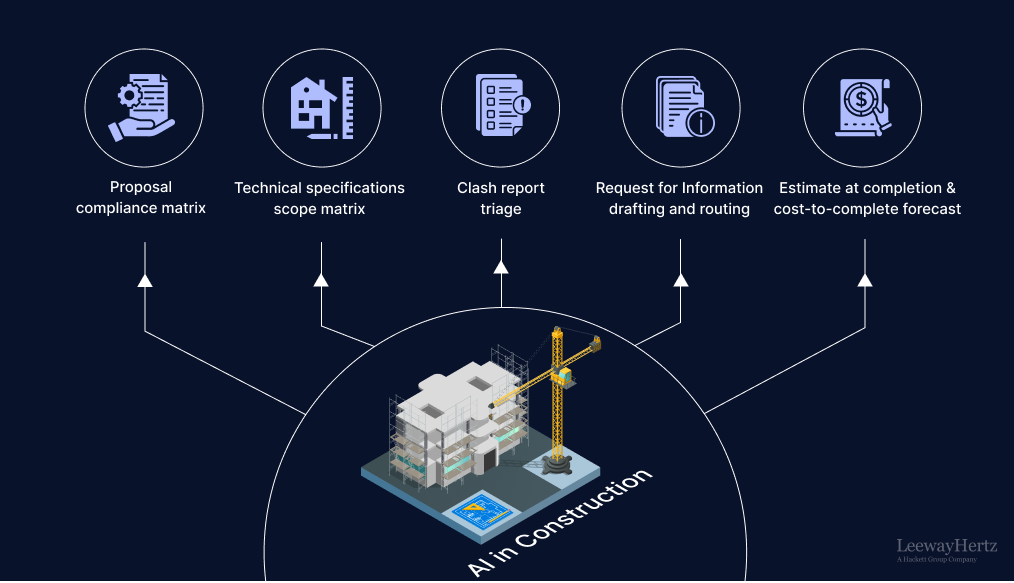
Construction projects rarely run on perfectly organized records. A bid package may sit in document control, pricing assumptions may live in estimate backups, and field updates may be captured across schedules, RFIs, submittals, drawings, change logs, and daily reports. The real work often lies in connecting what each record says with what the next project decision requires.
This makes construction a strong fit for AI. The industry already depends on document-heavy, data-driven, decision-intensive workflows. With the right oversight, AI can help summarize project records, flag risks, compare inputs, and support faster review across bidding, planning, execution, cost control, safety, and compliance.
The scale of the opportunity is substantial. Global construction activity is forecast to fall 4.5% over 2025 to US$9.3tn and then grow 3.8% in 2026 to US$9.6tn, all in constant 2023 prices [1]. These figures point to an industry facing both near-term market pressure and a long-running productivity gap. In that context, faster review cycles and clearer cost visibility are not abstract technology benefits; they are practical ways to protect margin and reduce avoidable rework across the project portfolio.
Because the work is so tied to project records, value usually comes from embedding AI into the workflow rather than placing a generic chatbot beside it. When an estimator reviews a request for proposal, AI can draft a concise scope note and assign a risk score tied to the basis of estimate, but the chief estimator decides whether that assumption belongs in the bid. In cost management, anomaly detection can flag a pay application that does not match recent cost patterns, which lets the project controller verify the exception before payment approval. Where a change order request needs support from cost and schedule records, agentic AI can assemble the review packet and route it to the contract administrator, who determines whether it is ready to advance.
Those workflow examples also show why a process-centric view should come before any technology label. AI should be mapped at the function, process, and sub-process level because that is where work ties to specific systems, artifacts, owners, and controls, which makes the opportunity buildable and easier to prioritize. In project controls, for example, the useful approach is not to ask whether AI can help with schedules; it is to determine whether a schedule update review can surface variance narrative issues early enough for the project manager to choose a recovery path. In estimating, the same approach turns a broad idea like bid support into a defined review activity: comparing an invitation to bid against estimate backup, surfacing scope gaps, exclusions, quantities, or assumption mismatches, and giving the bid manager a focused exception set to review.
This level of mapping also keeps implementation realistic, because construction data is often uneven across drawing revisions and cost records, and governance cannot be added after the workflow is already live. High-potential sub-processes are those with repeated judgment, visible source records, and an approval role already in place. These conditions make it easier to test AI accuracy, define review accountability, and determine where AI support should end and human approval should begin. That means a model might recommend which request for information response needs escalation, while the project manager confirms the action before the response leaves the project record. With this foundation, AI can reduce manual effort without blurring ownership, which is the operating discipline needed before use cases are scaled across functions.
This article uses a construction operating model to break work into functions, processes, and sub-processes. For each area, it shows where AI can support repeatable work by extracting information, comparing records, flagging risks, drafting outputs, summarizing project context, and preparing evidence for review. A named human reviewer confirms production changes before release and approves customer-facing messages or risk-bearing actions before they occur.
- How AI is transforming construction operations
- Why AI use cases in construction must be mapped at the sub-process level
- Construction operating model and AI opportunity mapping across construction processes
- High-value AI use cases in construction
- How agentic AI works in construction workflows
- How to prioritize AI use cases in construction
- Governance, risk, and responsible AI in construction
- How ZBrain operationalizes AI use cases in construction
- Future of AI in construction
How AI is transforming construction operations
AI is transforming construction operations by helping teams connect fragmented project information with the decisions that depend on it. Construction work often requires teams to reconcile drawings, RFIs, submittals, schedules, cost records, contracts, correspondence, safety logs, and field updates before a decision can move forward. Traditional automation can route forms, update statuses, or trigger predefined actions, but it is less effective when the reason for a delay, variance, or claim is spread across multiple records.
AI adds value in these situations by extracting relevant information, comparing records, identifying inconsistencies, summarizing project context, and preparing evidence for review. Instead of replacing commercial, technical, or contractual judgment, it reduces the time teams spend searching for information and assembling support material. This is especially useful in construction operations, where scattered records can slow coordination, delay approvals, and make accountability harder to trace.
The strongest opportunities appear in areas where teams repeatedly review documents, explain exceptions, and move work through approval cycles:
-
Document-heavy work: submittal packages, RFIs, change order backup, pay application support.
-
Narrative-heavy work: daily report narratives, owner progress updates, delay notices, safety observation summaries.
-
Exception-heavy work: payment application anomalies, schedule variance explanations, progress photo comparisons, nonconformance follow-up.
-
Knowledge-heavy work: specification interpretation, code clause lookups, contract requirement questions, and lessons learned retrieval.
-
Workflow-heavy work: submittal review routing, change order approval, bid package prioritization and closeout package completion.
The operating principle is straightforward: AI prepares the case, retrieves the evidence, drafts the output, and routes the packet to the right reviewer. The accountable role, such as the project manager, contract administrator, superintendent, or safety lead, confirms the result before any production change, client communication, or risk-bearing action moves forward. Used this way, AI improves cycle time, review quality, and decision clarity while keeping professional judgment at the center of construction operations.
Turn Data Into Decisions With AI Agents
Deploy autonomous agents that streamline data analysis, surface actionable insights, and accelerate informed decision-making across the organization.
Why AI use cases in construction must be mapped at the sub-process level
AI use cases in construction become actionable only when they are mapped below the broad function level. A function such as preconstruction contains multiple processes, and each process contains sub-processes with different artifacts, systems, decision points, and review owners. Treating all of this as “AI for construction” makes the opportunity too broad to design, test, govern, or measure.
A more useful structure is:
Function: Preconstruction and estimating
Process: Bid and proposal management
Sub-process: Invitation to bid intake and qualification
AI can classify a new invitation to bid by project type, geography, scope, client, and fit with current backlog. The preconstruction manager confirms whether the opportunity should move into pursuit review.
Function: Preconstruction and estimating
Process: Proposal development
Sub-process: Proposal compliance matrix preparation
AI can extract submission requirements from the request for proposal, identify required forms, map responsibilities, and draft a compliance matrix. The proposal manager verifies the obligations before assignments are sent to contributors.
Function: Preconstruction and estimating
Process: Bid review and pricing validation
Sub-process: Bid tabulation review
AI can compare subcontractor bids, flag unusual pricing spreads, identify missing scope items, and highlight clarification needs. The chief estimator reviews the findings before scope clarification or pricing follow-up begins.
This level of mapping clarifies what the AI is doing, which construction artifact it touches, which system or record it depends on, and who confirms the result before the business acts. It also creates a practical basis for accuracy testing, workflow design, control definition, and performance measurement.
Mapped this way, AI becomes an operating-model decision rather than a general technology initiative. Each use case can be tied to a specific sub-process, a defined review point, and an accountable role, making it easier to scale AI across construction operations without weakening governance or professional judgment.
Construction operating model and AI opportunity mapping across construction processes
The construction operating model below is organized into key industry-native functions that practitioners recognize. Each function is decomposed into its major processes and their sub-processes, and each sub-process carries the AI-enabled opportunity that applies to it. These opportunities are designed at the workflow level and keep a human reviewer in the loop.
Function 1. Business development, market intelligence, and bid management
When an invitation to bid arrives, the first bottleneck is rarely one document. It is the fast comparison of scope, schedule, owner fit, capacity, and commercial risk before the pursuit team commits scarce estimating time. This function covers market sensing, pursuit governance, proposal production, bid leveling, and turnover to estimating and project delivery teams.
AI helps pursuit teams screen opportunities, compare requirements, organize prior pursuit knowledge, and prepare reviewer-ready bid packages.
| Process | Sub-process | Key AI-enabled opportunities |
| Market intelligence and opportunity pipeline | Target sector and geography scanning | Classify request for proposal notices by sector, geography, delivery model, and contract type, compare them with win-rate history under design-bid-build delivery, then rank qualified pursuits to shorten pipeline triage for business development director review. |
| Owner capital plan and project pipeline tracking | Retrieve owner capital plan updates and announced request for proposal dates, then map them to target accounts and likely design-build packages, flag timing shifts that improve backlog planning and enable earlier sponsor coverage for business development director review. | |
| Backlog capacity and labor availability review | Aggregate baseline schedule, schedule file, and labor roster data, forecast trade capacity against Critical Path Method scheduling windows, then flag pursuit conflicts that reduce overcommitment risk for operations director review. | |
| Interest rate, tariff, and demand risk monitoring | Detect commodity, tariff, interest rate, and demand signals, compare them with the basis of estimate escalation assumptions under cost engineering recommended practices, then flag margin exposures that sharpen go/no-go timing for chief estimator review. | |
| Bid/no-bid and pursuit governance | Invitation to bid intake and qualification | Extract owner, scope, due date, bonding, and delivery requirements from the invitation to bid, classify fit against design-bid-build qualification criteria, then route incomplete or off-strategy pursuits to the pursuit manager for review. |
| Request for proposal screening | Compare the request for proposal instructions, contract drawings, technical specifications, and addenda against the design-build risk criteria, summarize compliance gaps and ambiguous obligations to reduce late-cycle rework for proposal manager review. | |
| Bid/no-bid scorecard and risk review | Aggregate invitation to bid requirements, basis of estimate allowances, and resource constraints, score pursuit attractiveness under cost engineering recommended practices, then flag margin, bonding, or labor risks for project sponsor review. | |
| Executive pursuit of gate approval | Summarize request for proposal obligations, basis of estimate sensitivities, assumptions and exclusions, and register risks, draft gate-decision options that clarify approval accountability for pursuit sponsor review. | |
| Proposal development and submission | Proposal compliance matrix development | Extract submission instructions, evaluation criteria, and forms from the request for proposal, technical specifications, and addenda, map them into a proposal compliance matrix, then flag missing responses for proposal manager review. |
| Technical approach narrative assembly | Draft technical approach sections from contract drawings, technical specifications, building information model content, and the baseline schedule, retrieve comparable methods aligned to virtual design and construction, then flag unsupported claims for technical lead review. | |
| Project experience and staffing package | Retrieve past project records, substantial completion certificate dates, safety metrics, and staffing resumes, classify relevance to the request for proposal requirements, then draft experience matrices for proposal manager review. | |
| Final submission checklist and addenda acknowledgment | Validate final proposal files against the request for proposal instructions and addenda acknowledgment requirements, compare filenames, signatures, and forms under submission controls, then flag omissions for proposal manager review. | |
| Bid leveling and handoff | Bid tabulation review | Compare subcontractor bid tabulation lines with quantity takeoff quantities and estimate backup, detect outliers under cost engineering recommended practices, then flag scope, unit-rate, or coverage anomalies for chief estimator review. |
| Scope sheet alignment | Map scope sheet inclusions and exclusions to contract drawings, technical specifications, and addenda, classify gaps under Work Breakdown Structure and Cost Breakdown Structure governance, then flag trade overlaps or omissions for estimator review. | |
| Alternates log and pricing strategy | Compare alternates log pricing, addenda changes, and bid tabulation coverage with basis of estimate allowances, rank margin and owner-value scenarios under Target Value Delivery, then propose pricing options for chief estimator review. | |
| Assumptions and exclusions register handoff | Summarize assumptions and exclusions register items against the basis of estimate, estimate backup, and scope sheet coverage, classify commercial and schedule exposure under change order management, then flag turnover risks for project manager review. |
The highest-value near-term opportunities are concentrated in request for proposal screening, proposal compliance matrix preparation, and bid tabulation review, where the work is high-volume, artifact-rich, and governed by clear review boundaries. AI can reduce manual page-turning across bid packages and estimate backup, while giving proposal managers and chief estimators structured exceptions that shorten cycle time, improve bid quality, and preserve clear accountability.
Example agentic workflow: An example agentic workflow is the invitation to the bid qualification workflow. The agent plans the qualification checklist and retrieves the invitation to bid from the document control system. It also gathers recent request for proposal history from the sourcing platform, backlog data from the scheduling platform, and cost benchmarks from the estimating system. AI then drafts a bid/no-bid summary with risks and missing items and routes it through the project management information system. The pursuit manager confirms the output, helping shorten the qualification cycle time while preserving review accountability.
Function 2. Preconstruction and estimating
At the start of preconstruction, estimators need to turn drawings, specifications, model content, and market pricing into a defendable estimate before bid deadlines close. This function owns scope definition, takeoff, pricing, constructability input, value options, and estimate turnover before contract award.
AI helps by comparing drawings and specifications, accelerating quantity review, finding scope gaps, and structuring estimate backup for estimator validation. It supports disciplined estimate governance, but estimator judgment remains essential for productivity, means and methods, contingency, and market pricing.
| Process | Sub-process | Key AI-enabled opportunities |
| Drawing, specification, and scope review | Contract drawings review | Compare contract drawings across disciplines with computer vision sheet recognition, detect inconsistent notes using semantic comparison under Building Information Modeling (BIM) coordination, then summarize high-risk discrepancies for preconstruction manager review. |
| Technical specifications scope review | Extract section requirements from technical specifications with clause extraction, classify responsibilities against the scope sheet using cost engineering recommended practices, then flag unpriced materials, submittals, and testing obligations for discipline estimator review. | |
| Addenda tracking and reconciliation | Compare addenda against contract drawings and technical specifications with semantic change detection, map revisions to affected quantity takeoff items, then flag scope or pricing deltas for chief estimator review. | |
| Scope gap, allowance, and contingency review | Detect gaps between the scope sheet, assumptions, and exclusions register, and bid tabulation using anomaly detection, classify exposures under cost engineering recommended practices, then propose allowance or contingency review points for project sponsor review. | |
| Quantity takeoff and model-based measurement | Quantity takeoff setup | Map contract drawings and technical specifications to takeoff zones with computer vision sheet indexing, classify assemblies under 5D BIM cost integration, then draft the quantity takeoff setup checklist for the quantity surveyor review. |
| Model-based quantity validation | Validate building information model quantities against the quantity takeoff with model geometry extraction, detect outlier measurements under 5D BIM cost integration, then summarize variances for quantity surveyor review. | |
| Assembly and line-item takeoff | Extract counts, areas, and lengths from contract drawings using computer vision, map assemblies to quantity takeoff line items, then flag low-confidence measurements for discipline estimator review. | |
| Takeoff version control | Compare quantity takeoff versions with semantic and geometry differencing, retrieve linked addenda and contract drawings under 5D BIM cost integration, then flag changed quantities or orphaned line items for chief estimator review. | |
| Estimate development and backup | Work Breakdown Structure and Cost Breakdown Structure alignment | Map estimate backup line items to the Work Breakdown Structure and Cost Breakdown Structure with classification models, validate coding against governance rules, then flag unmapped costs for cost engineer review. |
| Basis of estimate preparation | Draft basis of estimate sections from the scope sheet, assumptions and exclusions register, and quantity takeoff using retrieval-augmented summarization, flag unsupported assumptions to accelerate approval readiness for chief estimator review. | |
| Estimate backup assembly | Aggregate estimate backup references from the bid tabulation, quantity takeoff, and contract drawings with entity matching, validate source links, then flag missing backup to reduce turnover friction for preconstruction manager review. | |
| Labor, equipment, material, and subcontractor rate build-up | Compare rates in the bid tabulation with enterprise resource planning (ERP) job cost history using predictive benchmarking, classify outliers, then propose rate review priorities for chief estimator review. | |
| Preconstruction value and delivery planning | Target Value Delivery workshops | Summarize inputs from the alternates log, scope sheet, and building information model with clustering under Target Value Delivery, rank value options by cost and scope impact, then draft decision prompts for project sponsor review. |
| Constructability review | Detect constructability conflicts in contract drawings, clash reports, and the baseline schedule with computer vision and schedule-logic analysis, and summarize sequencing and access risks for preconstruction manager review. | |
| Guaranteed maximum price reconciliation | Compare the basis of estimate, schedule of values, and assumptions and exclusions register with variance detection, classify unresolved scope movement, then flag open commercial positions for project sponsor review. | |
| Alternates log and value option pricing | Propose value option price ranges from the alternates log, quantity takeoff, and bid tabulation using predictive cost benchmarking. Compare scope tradeoffs, then flag margin or performance risks for chief estimator review. |
Highest-value opportunities are Contract drawings review, model-based quantity validation, and estimate backup assembly, which offer the strongest AI leverage because they are high-volume, artifact-rich workflows with clear estimator or preconstruction manager review boundaries. AI helps reduce manual comparison effort, shorten bid-cycle reconciliation, and improve decision quality by tying drawing changes, model quantities, and backup evidence to named estimate exceptions for chief estimator confirmation.
Example agentic workflow: An example agentic workflow is the estimate backup turnover workflow. The agent plans the turnover checklist and retrieves contract drawings and addenda from the document control system. It also gathers quantity takeoff from the takeoff platform, building information model data from the model authoring system, and job cost history from the ERP job cost platform. AI then drafts the basis of estimate and estimate backup and routes unresolved assumptions through the project management information system. The chief estimator confirms the scope, pricing support, and handoff readiness.
Function 3. Design management and BIM/VDC coordination
During design coordination, a single unresolved clash or superseded sheet can create field rework weeks later. This function owns design deliverable control, model federation, coordination, clash resolution, constructability input, and the bridge between design intent and field execution.
AI helps organize design comments, identify document inconsistencies, prioritize coordination issues, and support model, schedule, and cost alignment for human-led design decisions. It is especially useful when drawings, specifications, requests for information, submittals, and coordination logs sit in separate systems.
| Process | Sub-process | Key AI-enabled opportunities |
| Design coordination and deliverable control | Design schedule and milestone alignment review | Map design submittal dates from the baseline schedule and schedule file, compare them with contract drawings deliverable gates under the critical path method scheduling, then flag milestone slippage for design manager review. |
| Contract drawings version control | Compare contract drawings across revision sets, extract sheet-level deltas and superseded details, and classify conflicts against document-control rules, flag unresolved discrepancies to reduce wrong-version field use for architect of record review. | |
| Technical specifications alignment | Compare technical specifications with contract drawings, then extract product, performance, and code-reference mismatches. Classify conflicts within the submittal review workflow and route exceptions for discipline lead review. | |
| Addenda and bulletin tracking | Extract scope changes from addenda and supplemental instruction records, map affected contract drawings and technical specifications, then flag late impacts against change order controls for project engineer review. | |
| BIM/VDC model management | BIM execution plan administration | Validate building information model naming, file exchange cadence, and role assignments against the BIM execution plan under Virtual Design and Construction (VDC), flag nonconforming discipline submissions for VDC manager review. |
| Level of development matrix management | Compare model element attributes with the level of development matrix, classify gaps by discipline under VDC handoff rules, then flag underdeveloped assemblies for BIM coordinator review. | |
| Building information model federation | Aggregate discipline model files into the building information model, detect coordinate, workset, and shared-parameter inconsistencies under BIM coordination, then flag federation blockers for VDC manager review. | |
| Model quality review and issue assignment | Screen the building information model for missing parameters, duplicate elements, and classification errors, map defects to the coordination issue log, then flag prioritized issues by discipline for BIM coordinator review. | |
| Clash detection and issue resolution | BIM coordination and clash detection | Detect hard, soft, and clearance clashes in the federated building information model, classify them by system criticality, then flag high-impact conflicts that threaten install sequencing for trade coordinator review. |
| Clash report triage | Classify clash report items by discipline, proximity, and constructability risk, aggregate duplicates to reduce meeting noise, then propose priority dispositions for VDC manager review. | |
| Coordination issue log updates | Extract status changes from meeting notes, clash report comments, and model snapshots, validate them against the coordination issue log, then flag overdue actions for BIM coordinator review. | |
| Trade clash sign-off | Compare resolved clash viewpoints with updated model geometry, validate closure evidence against the coordination issue log, then flag unsigned or reappearing clashes for trade lead review. | |
| 4D, 5D, and constructability integration | 4D BIM schedule simulation | Map building information model elements to activities in the schedule file, compare planned sequence states under 4D BIM schedule simulation, then flag workface congestion or logic gaps for scheduler review. |
| 5D BIM cost integration | Map building information model quantities to the schedule of values and basis of estimate, compare cost-code alignment under 5D BIM cost integration, then flag quantity or scope mismatches for cost manager review. | |
| Constructability review | Screen contract drawings, technical specifications, and the building information model for access, tolerance, and sequencing constraints, classify findings using A3 problem solving, then propose mitigation options for superintendent review. | |
| Design RFI candidate log | Extract ambiguities from contract drawings, technical specifications, coordination issue log, and submittal log, classify them through the request for information workflow, then draft concise candidates for project engineer review. |
BIM coordination and clash detection, clash report triage, and design RFI identification offer the strongest near-term value. These sub-processes rely on multiple connected records, including the building information model, clash reports, coordination issue logs, contract drawings, and technical specifications. Each has a clean review boundary that helps VDC managers and project engineers reduce meeting time, prioritize field-critical decisions, and confirm exceptions.
Example agentic workflow: An example agentic workflow is the clash triage and RFI candidate workflow. The agent plans the coordination review around the current design milestone. It retrieves the federated building information model from the model authoring system, the clash report from the coordination system, contract drawings and technical specifications from the document control system, and open issues from the project management information system. AI then drafts prioritized coordination issue log updates and potential requests for information. These are routed to the VDC manager, who confirms the dispositions before the workflow records the confirmation.
Function 4. Contract administration, legal operations, and dispute support
When a field issue becomes a formal notice or change, the risk is not only the wording. The risk is whether drawings, schedules, cost records, and correspondence support the position. This function owns prime contract administration, contract notices, requests for information, submittals, change governance, legal support, and dispute records.
AI helps read contract documents, route administrative workflows, organize evidence, and prepare concise packages for approval. It reduces friction where requests for information, submittals, changes, correspondence, schedules, and cost reports need to be connected quickly and defensibly.
| Process | Sub-process | Key AI-enabled opportunities |
| Contract formation and delivery model alignment | Delivery model contract alignment | Compare the request for proposal requirements with the contract drawings and technical specifications, classify clauses by delivery-model accountability, then flag misaligned design responsibility, contingency, or approval provisions for construction sponsor review. |
| EPC delivery requirements review | Extract engineering, procurement, and construction obligations from the request for proposal, technical specifications, and baseline schedule, map them to phase gates, then flag missing vendor data, long-lead, or commissioning responsibilities for project director review. | |
| Pricing and commercial terms review | Classify pricing terms in the scope sheet, schedule of values, and assumptions and exclusions register. Compare allowances and contingency language against guaranteed maximum price reconciliation, then flag billing or audit ambiguities for commercial manager review. | |
| Prime contract risk and flow-down matrix preparation | Extract notice, indemnity, insurance, schedule, and change clauses from addenda, technical specifications, and the scope sheet, map obligations to trade packages, then flag non-flowed risks for legal counsel review. | |
| Request for Information workflow administration | Request for Information log setup | Extract discipline, drawing sheet, specification section, responsible designer, and contractual due dates from contract drawings and technical specifications, map required fields into the request for information log, then flag incomplete metadata for project engineer review. |
| Request for Information drafting and routing | Retrieve related contract drawings, technical specifications, clash report items, and coordination issue log notes, summarize the ambiguity, draft a concise question, and flag incomplete context for the project manager review. | |
| Response due date tracking | Flag request for information log items approaching contractual response dates, compare unanswered questions with the baseline schedule and two-week lookahead, then propose escalation sequencing for project manager review. | |
| Cost and schedule impact tagging | Classify request for information responses for cost, schedule, or scope impact, map affected activities to the schedule file, then flag likely change-order triggers for project controls manager review. | |
| Submittal review workflow administration | Submittal log setup | Extract submittal requirements, specification sections, responsible trades, and required dates from technical specifications and contract drawings, map required fields into the submittal log, then flag missing lead-time assumptions for document controller review. |
| Shop drawings routing | Classify shop drawings by discipline, specification section, and affected model area, compare entries with the submittal log, then propose architect, engineer, and contractor routing for project engineer review. | |
| Product data sheets review package | Extract model numbers, ratings, materials, warranties, and substitutions from product data sheets, compare them with technical specifications and addenda, then flag exceptions or missing certifications for architect review. | |
| Material samples tracking | Detect label, color, and finish mismatches in material sample images against shop drawings and submittal log metadata, flag procurement or finish-selection risks for construction manager review. | |
| Change and dispute record control | Change order request intake | Extract scope, cost, schedule, and entitlement details from each change order request, compare supporting daily report, request for information log, and schedule of values references, then flag incomplete substantiation for project manager review. |
| G701 change order package | Draft G701 change order package fields from approved change order request records, validate the schedule of values and G702 payment application impacts, then flag inconsistencies in scope, amount, or effective date for owner representative review. | |
| Construction change directive and architect supplemental instruction tracking | Classify construction change directives and supplemental instruction entries by scope, pricing status, and field execution evidence, map references to the daily report and baseline schedule records, then flag directives awaiting conversion for commercial manager review. | |
| Request for equitable adjustment and notice file | Aggregate notice letters, daily report entries, schedule update narrative excerpts, and schedule file changes, summarize event chronology, then flag entitlement, causation, or quantum gaps for legal counsel review. |
Highest-value opportunities are request for information drafting and routing, product data sheets review package, and request for equitable adjustment and notice file offer the strongest AI fit because they are high-volume or high-stakes workflows with structured artifacts and clear handoffs. AI can reduce manual document assembly, shorten response and review cycles, improve claim evidence completeness, and preserve reviewer accountability where contract administrators need defensible packages rather than autonomous decisions.
Example agentic workflow: An example agentic workflow is the notice file evidence workflow. The agent uses the project management information system, document control system, scheduling platform, and ERP job cost platform to plan the notice-file evidence checklist. It retrieves daily report entries, requests for information records, change order requests, schedule narratives, schedule files, and cost records. AI then drafts a chronology and evidence-gap package and routes it to legal operations. Legal counsel confirms the package before release, and the workflow records the confirmation.
Function 5. Project controls and scheduling
At each schedule data date, project controls teams need to know which progress inputs are complete and which logic changes affect the critical path. This function owns the baseline schedule, schedule updates, lookahead planning, recovery planning, and delay analysis support.
AI helps reconcile field progress inputs, flag logic or float changes, prepare schedule narratives, and forecast slippage for scheduler review. It supports faster decisions while keeping critical path, recovery actions, and delay positions under project controls governance.
| Process | Sub-process | Key AI-enabled opportunities |
| Baseline schedule development | Critical Path Method schedule development | Extract milestone constraints and trade sequencing cues from contract drawings, technical specifications, and addenda, map proposed dependencies under Critical Path Method scheduling, then flag missing predecessors for scheduler review. |
| Work Breakdown Structure activity coding and logic ties | Classify baseline schedule activities with activity-code models against Work Breakdown Structure and Cost Breakdown Structure governance, detect orphan, duplicate, or out-of-sequence activities for the project controls manager review. | |
| Baseline schedule review and approval | Validate the baseline schedule with logic anomaly detection against the Critical Path Method scheduling, compare contractual milestones to the request for proposal and contract drawings, then summarize approval exceptions for the project manager review. | |
| XER schedule file import and version control | Compare schedule file imports with version-difference analysis, extract calendar, code, and relationship changes, then detect unauthorized baseline shifts for project controls manager review. | |
| Schedule updating and narrative control | Progress data cutoff collection | Extract actual starts, finishes, and percent complete from daily report and work in progress report submissions, aggregate by data date under S-curve progress tracking, then flag missing cutoff evidence for scheduler review. |
| Critical path and total float review | Detect critical path swaps and abnormal total float movements with schedule-change anomaly detection, compare drivers under Critical Path Method scheduling, then prioritize decision-impacting exceptions for scheduler review. | |
| Schedule update narrative preparation | Draft schedule update narrative sections from the updated schedule file, daily report entries, and milestone changes, summarize critical path drivers and classify variance causes for the project controls manager review. | |
| Schedule variance and milestone slip log | Aggregate baseline versus current milestone dates with variance detection from the baseline schedule and schedule update narrative, classify slip drivers under Earned Value Management, then flag threshold breaches for project manager review. | |
| Lookahead and constraint planning | Last Planner System facilitation | Classify two-week lookahead commitments and daily report status under the Last Planner System, aggregate variance reasons into Percent Plan Complete themes, then propose focused huddle topics for superintendent review. |
| Phase pull planning | Map trade handoffs with sequence mining from the building information model and baseline schedule, compare milestone handbacks under phase pull planning, then flag infeasible predecessor assumptions for discipline lead review. | |
| Three-week lookahead constraint screening | Screen three-week lookahead activities with constraint-risk scoring against the request for information log, submittal log, and clash report, flag ownerless constraints to shorten make-ready cycles for superintendent review. | |
| Two-week lookahead commitment planning | Propose two-week lookahead commitments with feasibility scoring from the three-week lookahead, daily report productivity trends, and baseline schedule dates, flag overcommitted crews for superintendent review. | |
| Time impact and recovery planning | Time impact analysis preparation | Extract delay event facts from the request for information log, supplemental instruction records, construction change directives, and daily report entries, map fragnet insertion points, then draft impact issues for scheduler review. |
| Schedule compression scenario review | Compare schedule compression scenarios with optimization and risk scoring in the schedule file, detect critical path tradeoffs, then flag recovery options that preserve float visibility for project manager review. | |
| Recovery schedule development | Propose recovery activity resequencing with predictive slippage scoring from the baseline schedule, daily report trends, and two-week lookahead, flag high-risk recovery commitments for the project controls manager review. | |
| Forensic delay analysis support | Retrieve contemporaneous daily report, request for information log, schedule update narrative, and schedule file records with semantic search, classify delay events, then draft chronology packets for claims manager review. |
The highest-value opportunities sit in progress data cutoff collection, critical path and total float review, and three-week lookahead constraint screening, where artifact-rich control points connect directly to daily report entries, schedule files, request for information records, submittals, and lookahead records. Applying AI here helps reduce manual reconciliation, shorten schedule update cycles, improve recovery decision quality, and keep critical path accountability within project controls governance.
Example agentic workflow: An example agentic workflow is schedule update narrative control. The agent plans the data-date cutoff checklist. It retrieves daily report entries from the project management information system, updated schedule data from the scheduling platform, document status from the document control system, and milestone history from the project controls system. AI then drafts the schedule update narrative and variance log. Critical path and missing-evidence exceptions are routed to the project controls manager, who confirms the final narrative before the workflow records the confirmation.
Function 6. Cost management, earned value, and WIP controls
At month-end, margin confidence depends on whether budgets, commitments, installed quantities, change exposure, and cost-to-complete inputs reconcile. This function owns budget setup, cost coding, earned value rules, progress measurement, forecasts, change cost control, and work in progress (WIP) reporting alignment.
AI helps reconcile budgets, commitments, installed quantities, change records, and cost-to-complete inputs for review. It is valuable in margin protection because cost and productivity signals often sit across separate estimating, scheduling, job cost, and field reporting tools.
| Process | Sub-process | Key AI-enabled opportunities |
| Cost code and budget setup | Work Breakdown Structure and Cost Breakdown Structure governance | Map the basis of estimate line items and quantity takeoff assemblies to the Work Breakdown Structure and Cost Breakdown Structure model, compare gaps against scope sheet requirements, then flag budget misalignment for cost manager review. |
| Cost code and control account setup | Classify, estimate and backup line items and scope sheet inclusions under Work Breakdown Structure and Cost Breakdown Structure governance, propose cost codes and control accounts, then flag duplicate or orphan accounts for project controls analyst review. | |
| Schedule of values cost control mapping | Map the schedule of values line items to control accounts, compare payment application groupings under the schedule of values cost control, then flag unmapped revenue-cost splits for project accountant review. | |
| Original budget and approved change budget upload | Validate original budget uploads against the basis of estimate, compare approved G701 change order amounts under change order management, then flag coding or version mismatches for project accountant review. | |
| Earned value and progress measurement | Earned Value Management measurement rules setup | Classify baseline schedule activities and schedule of values accounts against the Earned Value Management measurement rules, propose weighted milestones, then flag ambiguous earning methods for the project controls manager review. |
| Percent complete and installed quantity validation | Validate installed quantities from daily report entries against quantity takeoff and model quantities under Earned Value Management, detect percent-complete outliers, then flag variances for superintendent and cost manager review. | |
| S-curve progress tracking | Aggregate progress quantities from the schedule file and daily report, forecast S-curve variance under S-curve progress tracking, then flag cost or schedule divergence for the project controls director review. | |
| Labor productivity and unit rate review | Compare labor hours from certified payroll report and daily report records with installed quantities from the quantity takeoff, and apply measured mile analysis to detect unit-rate drift for project manager review. | |
| Forecasting and cost reporting | Work in progress report preparation | Aggregate job cost, commitment, and billing data into the work in progress report, compare margin movement against cost engineering recommended practices, then flag underbillings or fade risks for project accountant review. |
| Estimate at completion and cost-to-complete forecast | Calculate the estimate at completion from work in progress trends, baseline schedule progress, and open change order exposure, and compare forecast drivers to Earned Value Management indices for the project controls manager review. | |
| Allowance and contingency drawdown log | Validate allowance draws against the assumptions and exclusions register and approved change order request records, classify usage under guaranteed maximum price reconciliation, then flag unsupported contingency transfers for cost manager review. | |
| Cost engineering recommended practice checks | Screen the basis of estimate, work in progress report, and schedule update narrative against cost engineering recommended practices, retrieve missing support items, then flag nonconforming cost assumptions for cost engineering lead review. | |
| Change cost control | Change order request pricing | Extract scope, labor, material, and equipment drivers from the change order request and estimate backup, compare pricing to quantity takeoff quantities, then flag unsupported markups or exclusions for project manager review. |
| Construction change directive cost capture | Retrieve construction change directive instructions and match related daily report labor and equipment entries, classify costs under change order management, then flag uncaptured reimbursable work for cost manager review. | |
| Time and materials ticket reconciliation | Compare time and materials ticket quantities with the daily report, certified payroll report, and equipment logs, detect duplicate charges or missing signatures, then flag exceptions for project accountant review. | |
| Change cost backup and audit trail | Aggregate change order request, supplemental instruction, daily report, and G701 change order backup, map evidence to equitable adjustment support, then flag audit trail gaps for commercial manager review. |
The strongest candidates are estimated-at-completion and cost-to-complete forecasting, percent-complete and installed-quantity validation, and time-and-materials ticket reconciliation, where high transaction volume, rich supporting artifacts, and clear reviewer decisions make AI support practical and governable. AI can compare work in progress data, daily report quantities, quantity takeoff records, baseline schedule status, certified payroll report entries, and change documentation against earned value and change controls, helping teams reduce reconciliation effort, shorten monthly close and pay review cycles, improve margin decision quality, and route exceptions to the project controls manager, cost manager, or project accountant for confirmation.
Example agentic workflow: An example agentic workflow is Cost-to-complete forecast refresh. The agent plans the month-end cost-to-complete refresh. It retrieves job cost actuals from the ERP job cost platform, schedule status from the scheduling platform, change records and daily report data from the project management information system and estimate backup from the estimating system. AI then drafts variance explanations and forecast assumption updates in the project controls platform. Margin-risk exceptions are routed to the project controls manager, who confirms the forecast basis before the workflow records the final WIP update.
Function 7. Procurement and supply chain management
When a long-lead package slips, the delay often appears first in submittal status, vendor dates, or a procurement log rather than the master schedule. This function owns procurement planning, sourcing, commercial leveling, award recommendations, purchase orders, expediting, logistics, and long-lead risk management.
AI helps compare supplier responses, link procurement status to submittal approvals and schedule logic, and surface long-lead risks for buyer review. It improves visibility when vendor commitments, fabrication dates, delivery records, and field need dates are distributed across different systems.
| Process | Sub-process | Key AI-enabled opportunities |
| Procurement planning and package strategy | Procurement package breakdown | Map quantity takeoff lines, contract drawings, and technical specifications to Work Breakdown Structure and Cost Breakdown Structure governance, cluster scope gaps, then propose package boundaries for procurement manager review. |
| Long-lead item identification and tracking | Extract equipment lead times from technical specifications and product data sheets, compare them with the schedule file under Critical Path Method scheduling, then flag procurement date gaps for procurement manager review. | |
| Buyout schedule alignment with baseline schedule | Compare the scope sheet milestones and planned award dates with the baseline schedule, calculate float impacts from late buyout, then propose sequencing adjustments for the project manager review. | |
| Submittal approval dependency mapping | Map submittal log entries, shop drawings, and product data sheets to procurement packages, detect missing approval predecessors, and then flag blocked release dates for project engineer review. | |
| Sourcing and bid leveling | Bidder list and trade coverage analysis | Classify trade scopes from the scope sheet and invitation to bid against Work Breakdown Structure and Cost Breakdown Structure governance, and compare bidder responses with prior bid tabulation participation for procurement manager review. |
| Request for proposal package assembly | Retrieve contract drawings, technical specifications, addenda, and scope sheet requirements, validate version completeness, then draft a request for proposal package checklist for buyer review. | |
| Bid tabulation and leveling | Extract unit prices, alternates, assumptions, and exclusions from bidder proposals, populate the bid tabulation, classify deviations against the scope sheet, then flag noncomparable bids for procurement manager review. | |
| Scope sheet commercial exceptions review | Classify payment terms, exclusions, alternates, and clarifications in each scope sheet, summarize commercial exposure, then flag off-standard terms for contract administrator review. | |
| Purchasing and award administration | Purchase order and subcontract award recommendation | Compare bid tabulation results, scope sheet commitments, and basis of estimate allowances, summarize award basis and budget variance, then draft purchase order and subcontract award recommendation sections for procurement manager review. |
| Certificate of insurance and bond documentation | Extract policy limits, endorsements, additional insured language, and bond amounts from insurance and bond documentation, validate them against solicitation and scope requirements, then flag coverage gaps for contract administrator review. | |
| Procurement package handoff to project controls | Aggregate awarded scope sheet values, schedule of values cost codes, and baseline schedule activities, map buyout commitments to control accounts, then flag coding gaps for project controls manager review. | |
| Contract drawings and technical specifications attachment control | Compare contract drawings, technical specifications, and addenda attached to each award package against the drawing index, validate revision completeness, then flag superseded sheets for contract administrator review. | |
| Expediting, delivery, and logistics | Vendor commitment and fabrication status tracking | Extract vendor promise dates from fabrication updates and approved shop drawings, compare them with the baseline schedule, then flag slipping fabrication milestones for buyer review. |
| Delivery, receiving, and storage inspection | Detect damage patterns with computer vision from receiving photos, delivery tickets, daily report entries, and product data sheets, validate inspection hold points, then flag storage nonconformance for superintendent review. | |
| Procurement log update and schedule risk escalation | Aggregate vendor status updates, receiving records, and submittal approvals into the procurement log, compare need dates with the schedule file, then flag critical-path delivery risks for project manager review. | |
| Substitution and alternate material routing | Classify substitution requests and alternate product data sheets against technical specifications and addenda, retrieve affected contract drawings, then flag code, warranty, or schedule impacts for project engineer review. |
Highest-value opportunities are bid tabulation and leveling, long-lead item identification and tracking, and procurement log update with schedule risk escalation. These offer the strongest AI lift because they are high-volume, artifact-rich workflows anchored in bid tabulations, submittal records, the baseline schedule, schedule files, and vendor commitment data. These opportunities help reduce manual comparison effort, shorten risk escalation cycles, and improve award and delivery decision quality without moving approval ownership away from project leadership roles.
Example agentic workflow: An example agentic workflow is the long-lead risk escalation workflow. The agent plans weekly checks for long-lead packages. It retrieves submittal approvals from the project management information system, schedules activities from the scheduling platform, award and supplier status data from the procurement and ERP platforms, and drawing revisions from the document control system. AI then drafts a procurement log update with flagged float and fabrication-date gaps. The update is routed to the project manager, and the workflow records the project manager’s confirmation.
Function 8. Subcontractor and trade partner management
Once a trade partner is selected, scope clarity, commitments, compliance documents, and pay readiness drive day-to-day project control. This function owns trade partner prequalification, onboarding, scope alignment, performance monitoring, compliance documentation, and payment readiness.
AI helps organize qualification packages, compare scope sheets, track commitments, and summarize performance exceptions for human follow-up. It supports better trade coordination where labor availability, quality issues, safety observations, and pay documentation affect project outcomes.
| Process | Sub-process | Key AI-enabled opportunities |
| Prequalification and onboarding | Certificate of insurance collection | Extract coverage limits, endorsements, expiration dates, and project references from the certificate of insurance, validate them against subcontract requirements, then flag missing additional-insured or waiver terms for risk manager review. |
| Safety and financial prequalification review | Classify incident history, experience modification indicators, bonding capacity, and financial ratios from the safety plan and prequalification package, and score exceptions against trade-selection criteria for subcontract manager review. | |
| Trade partner master data setup | Validate legal names, tax identifiers, remit-to addresses, cost codes, and trade categories from the onboarding form, and detect duplicate vendor records to reduce rework for project accountant review. | |
| Scope alignment and buyout | Scope sheet review | Compare scope sheet line items, quantity takeoff details, and technical specifications, classify variances against cost engineering recommended practices, then summarize pricing and responsibility exceptions for subcontract manager review. |
| Scope gap and exclusion resolution | Map exclusions in the assumptions and exclusions register to contract drawings, addenda, and the request for information log, detect unresolved scope gaps, then propose clarification paths for project manager review. | |
| Subcontract exhibit and alternates alignment | Validate subcontract exhibit language against the scope sheet, alternates log, addenda, and schedule of values, compare accepted alternates, then flag mismatched inclusions for subcontract manager review. | |
| Performance management | Daily report labor count review | Extract trade labor counts and crew notes from the daily report, compare them with two-week lookahead commitments, then detect staffing shortfalls for superintendent review. |
| Schedule commitment tracking | Aggregate trade commitments from the three-week lookahead, baseline schedule, and schedule file, classify missed promises using the Last Planner System, then flag recurring blockers for project manager review. | |
| Quality and safety scorecard review | Summarize nonconformance report trends, punch list aging, and job hazard analysis observations, classify repeat issues, then flag trades needing focused coaching for quality manager and safety manager review. | |
| Compliance and payment readiness | Subcontractor pay application intake | Extract billed amounts, retainage, stored materials, and percent complete from G702 and G703 payment documents, validate against the schedule of values cost control, then flag overbilling for project accountant review. |
| Lien waiver collection | Retrieve executed lien waiver files linked to each payment application, classify conditional versus unconditional waiver status, then flag missing or mismatched amounts for project accountant review. | |
| Certified payroll report tracking | Extract worker classifications, hours, fringe benefits, and payroll periods from the certified payroll report, compare labor records to the daily report, then flag prevailing wage exceptions for compliance manager review. |
Highest-value opportunities are scope gap and exclusion resolution, schedule commitment tracking, and subcontractor pay application intake, which offer the strongest near-term value because they combine repeatable high-volume reviews, artifact-rich inputs, and clean exception routing. They reduce manual reconciliation, shorten buyout and payment cycle times, improve schedule decision quality, and leave final confirmation with the subcontract manager, project manager, and project accountant.
Example agentic workflow: An example agentic workflow is the scope gap resolution workflow. The agent plans a scope-gap check by trade and cost code. It retrieves the scope sheet, assumptions, and exclusions register from the sourcing platform. It also gathers contract drawings, technical specifications, addenda, and request for information records from the project management and document control systems. AI then drafts a scope variance log with proposed clarifications and commercial impacts. Unresolved items are routed to the subcontract manager, and the workflow records the subcontract manager’s confirmation.
Accelerate AI Solutions Development
Build fully functional solutions from your high-value use cases, based on specific operational needs and enterprise context.
Function 9. Field production planning and site operations
In the field, the key question each morning is whether crews have the drawings, approvals, access, materials, and safety controls needed to work productively. This function owns daily execution, trade sequencing, lean planning, resource coordination, constraint removal, installed quantity tracking, and recovery actions.
AI helps turn field notes, daily reports, lookahead commitments, and production quantities into clearer actions for field supervisors.
| Process | Sub-process | Key AI-enabled opportunities |
| Lean planning and commitments | Last Planner System setup | Map trade commitments and classify milestone handoffs in the two-week lookahead against the Last Planner System, flag missing owners or unclear make-ready criteria for superintendent review. |
| Phase pull planning sessions | Map trade handoffs from the schedule file and retrieve dependencies from contract drawings, propose pull-plan sequence options to shorten session time and surface sequencing risks for superintendent and trade foreman review. | |
| Weekly Work Planning and Percent Plan Complete review | Aggregate committed tasks from the three-week lookahead and classify variance reasons against weekly work planning and Percent Plan Complete, and summarize repeat promise failures for superintendent review. | |
| Daily field coordination | Daily coordination meeting management | Summarize open constraints from the daily report and two-week lookahead, retrieve job hazard analysis tasks, then flag same-day sequencing conflicts for superintendent review. |
| Daily report completion | Extract weather, manpower, equipment, quantity, and delay notes from foreman entries, classify entries against daily huddle assignments, then draft a complete daily report for project engineer review. | |
| Manpower, crew, and equipment allocation | Propose crew and equipment allocation options from the two-week lookahead and daily report, compare capacity against lookahead commitments, then flag under-crewed activities for superintendent review. | |
| Workface planning and constraint removal | Constraint log maintenance | Extract unresolved access, material, drawing, inspection, and safety blockers from the coordination issue log and two-week lookahead, flag aging items to improve make-ready discipline for field engineer review. |
| RFI and submittal constraint clearance | Retrieve open items from the request for information log, submittal log, and shop drawings, compare required dates against the two-week lookahead, then flag critical blockers for project manager review. | |
| Work package release and access readiness | Validate work package prerequisites against contract drawings, inspection hold points, and job hazard analysis requirements, flag unresolved gate criteria to reduce false starts for superintendent review. | |
| Production tracking and recovery | Installed quantity tracking | Extract installed quantities with computer vision from daily report entries and progress photos, compare them with the quantity takeoff and building information model, then flag measurement gaps for field engineer review. |
| Productivity variance review | Detect productivity variance patterns from daily report hours, installed quantities, and the work in progress report, compare trends under Earned Value Management, then flag outlier crews or work areas for project manager review. | |
| Recovery action and rework tracking | Classify recovery actions and rework causes from the nonconformance report, punch list, and daily report, map repeat failure patterns under A3 problem solving, then propose follow-ups for superintendent review. |
Highest-value opportunities are weekly work planning, and Percent Plan Complete review, constraint log maintenance, and installed quantity tracking offer the strongest near-term value because they are high-volume, artifact-rich workflows anchored in lookaheads, logs, daily reports, quantity takeoffs, and progress records. Clean superintendent, field engineer, and project manager review boundaries help reduce meeting preparation, shorten constraint clearance, and improve production decision quality.
Example agentic workflow: An example agentic workflow is weekly constraint clearance. For weekly constraint clearance, the workflow plans the make-ready check from the three-week lookahead. It retrieves open requests for information, submittals, coordination issues, drawings, and schedule activities from the project management, coordination, document control, and scheduling systems. AI then drafts a prioritized constraint clearance packet to shorten release-cycle time. The packet is routed to the field engineering queue, and the update is recorded only after the superintendent confirms the release decision.
Function 10. Quality assurance and quality control
During inspection, quality teams need fast evidence that installed work matches specifications, approved submittals, and test requirements. This function owns the quality plan, inspection requirements, specification compliance, test records, submittal quality checks, nonconformance control, corrective actions, and reinspection.
AI helps connect inspections, test records, drawings, specifications, submittals, photos, and nonconformance reports so quality teams can act sooner. It supports human review of compliance and corrective action evidence before rework, delayed inspections, or closeout gaps expand.
| Process | Sub-process | Key AI-enabled opportunities |
| Quality planning and specification compliance | Project quality plan and Inspection and Test Plan setup | Extract acceptance criteria from technical specifications and contract drawings, map them into the inspection and test plan, then flag missing trade, frequency, or hold-point fields for quality manager review. |
| Technical specification compliance mapping | Classify requirement clauses in technical specifications and compare them with shop drawings and product data sheets, and draft a compliance exception table for project engineer review. | |
| Jurisdictional Inspection Readiness Review | Map building code inspection triggers from contract drawings and technical specifications to inspection and test plan milestones, retrieve jurisdictional prerequisites, then flag missing notices for quality manager review. | |
| Inspection execution and test records | Inspection and test plan execution | Detect incomplete inspection fields and classify daily report photos against inspection and test plan acceptance criteria, rank overdue checks to reduce inspection lag for field inspector review. |
| Test record and material sample verification | Validate material samples against product data sheets and technical specifications, extract missing batch and test-result fields from daily report attachments, then flag out-of-tolerance records for quality control manager review. | |
| Hold point, witness point, and reinspection sign-off | Aggregate hold-point, witness-point, and reinspection status from inspection and test plan, daily report, and punch list records, flag sign-off blockers for quality manager review. | |
| Submittal and shop drawing quality reviews | Shop drawings quality review | Compare shop drawings with contract drawings and the building information model, detect dimensional or scope inconsistencies, then summarize exceptions for project engineer review. |
| Product data sheets compliance checking | Extract performance criteria from product data sheets and technical specifications, classify deviations against the submittal review workflow, then draft an exception list for project engineer review. | |
| Approved submittal distribution control | Retrieve approved shop drawings and product data sheets from the submittal log, compare distribution recipients with current work packages, then flag superseded files for document control manager review. | |
| Nonconformance and corrective action | Nonconformance report creation | Extract defect observations from daily report notes and site photos, classify affected scope against technical specifications, then draft the nonconformance report for quality manager review. |
| Lean Construction A3 problem solving | Aggregate recurring defect patterns from nonconformance report, daily report, and punch list records, summarize likely contributing factors, then propose containment and countermeasure options for trade quality lead review. | |
| Corrective action closure and verification | Validate corrective action evidence against the nonconformance report, technical specifications, and punch list items, detect missing reinspection proof, then flag closure risks for quality control manager review. |
Highest-value opportunities are the strongest near-term AI value sits in technical specifications compliance matrix, inspection and test plan execution, and corrective action closure and verification because they are high-volume, artifact-rich workflows with clean review boundaries. Prioritizing these sub-processes helps reduce manual cross-checking, shorten inspection and closeout cycle time, improve decision quality on exceptions, and strengthen compliance without removing human sign-off.
Example agentic workflow: An example agentic workflow is the ITP exception-to-closure workflow. The agent plans an inspection-ready case by identifying due inspection and test plan activities. It retrieves technical specifications, inspection and test plan records, daily reports, nonconformance reports, punch list items, and approved shop drawings from quality, project management, document control, and coordination systems. AI then drafts an exception summary and corrective-action evidence checklist. The package is routed to the quality manager for review, and the workflow records the quality manager’s confirmation in the quality system.
Function 11. Safety, health, and environmental compliance
On a busy site, the safety and environmental issue that matters most may be buried in a daily report note, a photo, or an incomplete inspection record. This function covers safety planning, site-specific controls, hazard analysis, training records, observations, incident management, environmental compliance, and corrective actions.
AI helps organize plans, observations, incident details, training evidence, and environmental inspection records for faster review. It supports earlier detection of recurring hazards, incomplete controls, and documentation gaps while keeping decisions with qualified site roles.
| Process | Sub-process | Key AI-enabled opportunities |
| Safety planning and training | Safety plan development | Draft safety plan sections from contract drawings, technical specifications, and subcontractor scope sheets using semantic retrieval, map phase hazards to lookahead activities, then flag missing controls for safety manager review. |
| Site-specific safety plan approval | Compare site-specific safety plan controls with the approved safety plan, contract drawings, and two-week lookahead, classify deviations against the approval checklist, then flag unresolved scope hazards for superintendent review. | |
| Training matrix and toolbox talk records | Extract worker names, trade assignments, and topic attendance from toolbox talk records and daily report attachments, compare coverage to the training matrix, then flag expiring certifications for safety coordinator review. | |
| Hazard analysis and field observations | Job hazard analysis | Draft job hazard analysis entries from contract drawings, technical specifications, and model work locations, classify activity hazards against weekly work planning tasks, then flag missing controls for foreman review. |
| Pre-task plan review | Validate pre-task plan entries against the job hazard analysis, two-week lookahead, and current daily report, compare crew assignments to Last Planner System commitments, then flag control gaps for superintendent review. | |
| Safety observation and near-miss capture | Classify safety observation photos, near-miss notes, and daily report entries using computer vision and text classification, detect recurring deviations from the job hazard analysis, then summarize priority trends for safety manager review. | |
| Incident management and regulatory reporting | Incident report intake | Extract injury details, location, witness statements, and photos from the incident report and daily report using multimodal extraction, flag missing evidence to reduce intake rework for safety manager review. |
| Recordable case classification | Classify incident report facts against construction safety and health regulations using rules-based language processing and retrieval, flag ambiguous recordability cases to strengthen compliance for safety director review. | |
| Corrective action and emergency response follow-up | Aggregate corrective action owners, due dates, and emergency response commitments from the nonconformance report, safety plan, and daily report, and detect overdue or repeated actions for the project manager review. | |
| Environmental and stormwater compliance | Stormwater pollution prevention plan maintenance | Retrieve contract drawings, addenda, and current erosion-control details using semantic search, compare changes with the stormwater pollution prevention plan and construction stormwater permit rules, then draft revision notes for environmental lead review. |
| Construction stormwater inspection log | Extract rainfall entries, discharge-point photos, and inspector notes from the construction stormwater inspection log, classify findings against the stormwater pollution prevention plan, then flag missing inspections for environmental lead review. | |
| Erosion control and environmental noncompliance correction | Detect erosion-control failures in inspection photos and daily report notes using computer vision and anomaly detection, map each finding to corrective action workflows, then propose prioritized fixes for environmental manager review. |
Highest-value opportunities are safety observation and near-miss capture, incident report intake, and construction stormwater inspection log, which offer the strongest return because they are high-volume, artifact-rich workflows with photos, notes, daily report links, incident reports, and stormwater plan evidence. AI sorting and gap detection reduce manual effort, shorten response cycle time, and strengthen compliance documentation for confirmation by the safety manager or environmental lead.
Example agentic workflow: An example agentic workflow is daily safety and environmental exception review. The agent plans the daily safety and environmental exception review. It retrieves safety plan controls, job hazard analysis records, daily report entries, stormwater inspection log items, and open nonconformance actions from safety, project management, and document control systems. AI then drafts prioritized hazard and compliance exceptions. These are routed to the project review queue, and the workflow records confirmation by the safety manager to shorten daily triage and establish clearer accountability.
Function 12. Finance, billing, and pay applications
During billing, finance teams need every amount to tie back to the schedule of values, approved changes, progress evidence, lien waivers, and compliance records. This function owns billing setup, schedule of values administration, owner payment applications, subcontractor payments, retainage, lien waivers, payroll compliance support, WIP reporting, cash forecasting, and audit evidence.
AI helps match payment applications, continuation sheets, lien waivers, certified payroll reports, cost reports, and contract terms for finance review. It reduces repetitive project accounting work while supporting stronger controls over retainage, revenue timing, and payment documentation.
| Process | Sub-process | Key AI-enabled opportunities |
| Project billing setup | Schedule of values setup | Extract cost-code and scope descriptions from the schedule of values and estimate backup, map them to Work Breakdown Structure and Cost Breakdown Structure governance, then flag gaps against contract drawings for project accountant review. |
| Retainage terms configuration | Extract retainage percentages and release triggers from the schedule of values and G702 payment application template, compare them with cost control rules, then flag off-template settings for controller review. | |
| Billing calendar and contract billing rule review | Aggregate billing milestones from the baseline schedule and payment application history, compare them with Critical Path Method scheduling constraints, then flag late cutoffs or unsupported billing triggers for billing specialist review. | |
| Owner pay applications | G702 application and certificate for payment | Draft G702 payment application fields from current job cost, approved change order request records, and the schedule of values, validate retainage, then flag revenue timing exceptions for project accountant review. |
| G703 continuation sheet preparation | Extract progress evidence from daily report quantities, approved change order values, and job cost postings, calculate line-item amounts for the G703 continuation sheet, then flag overbillings for project manager review. | |
| Pay application backup and approval routing | Retrieve approved change order request files, daily report quantities, lien waiver status, and payment application attachments, classify missing backup, then route exception packages for billing specialist review. | |
| Subcontractor payments and compliance | Subcontractor pay application review | Compare each subcontractor payment application with the schedule of values, lien waiver, and certified payroll report, detect duplicate or above-earned billing, then flag payment holds for project accountant review. |
| Lien waiver validation | Extract claimant, period, conditionality, and amount from each lien waiver, compare it with the payment application and G703 continuation sheet, then flag mismatched or stale waivers for contract administrator review. | |
| Certified payroll report collection | Classify certified payroll report submissions against prevailing wage worker classification, wage, and fringe-benefit requirements, compare worker counts with daily report crew logs, then flag late or incomplete reports for compliance analyst review. | |
| WIP, cash, and controls | Work in progress report close | Aggregate cost-to-complete, committed cost, and payment application data into the work in progress report, compare earned revenue with Earned Value Management measures, then flag fade, gain, or underbilling drivers for controller review. |
| Cash forecast and collections review | Calculate probability-weighted collections using predictive scoring from payment application aging, G702 payment status, and baseline schedule milestones, and flag cash shortfalls to improve working capital planning for controller review. | |
| Internal control evidence and audit support | Retrieve approved payment application, lien waiver, certified payroll report, and work in progress report evidence, classify control attributes against internal control requirements, then flag missing approvals or segregation-of-duties gaps for controller review. |
Highest-value opportunities are G703 continuation sheet preparation, subcontractor pay application review, and work in progress report close, which are the top opportunities because they are high-volume, artifact-rich workflows with repeatable comparisons across payment applications, lien waivers, certified payroll reports, schedule of values, and WIP records. These sub-processes give finance a clean review boundary, helping project accountants, compliance analysts, and controllers reduce manual reconciliation, improve decision quality on revenue and payment holds, strengthen compliance evidence, and shorten the billing and close cycle.
Example agentic workflow: An example agentic workflow is the owner pay application package. The agent plans the billing cycle from the contract billing calendar in the ERP job cost system. It retrieves the schedule of values, G702 payment application, G703 continuation sheet, approved change order request records, daily report quantities, and lien waiver status from the project management and document control systems. AI then drafts a reviewer-ready payment application package with exception notes. The package is routed through the approval workflow, and the workflow records confirmation by the project accountant.
Function 13. Closeout, commissioning, and handover
Closeout slows when punch items, commissioning evidence, as-builts, manuals, warranties, and final approvals are scattered across project systems. This function owns closeout planning, punch list governance, commissioning evidence, turnover documentation, as-built records, operation and maintenance (O&M) manuals, final approvals, final completion, and owner handover.
AI helps find missing closeout items, organize turnover packages, compare requirements to collected evidence, and prepare handover summaries for review. It reduces delays caused by scattered as-builts, manuals, warranties, commissioning checklists, punch list items, and final approval records.
| Process | Sub-process | Key AI-enabled opportunities |
| Closeout planning and requirements control | Closeout requirements register | Extract closeout obligations from technical specifications, addenda, and the request for information log, map each obligation to the closeout requirements register, then flag missing owners or due dates for closeout manager review. |
| Punch list closeout planning | Classify punch list items with trade and severity scoring, aggregate recurring blockers against the closeout method and three-week lookahead, then propose a prioritized closeout plan for superintendent review. | |
| Substantial completion certificate readiness | Validate prerequisites for the substantial completion certificate with document matching across the punch list, inspection and test plan, and commissioning checklist, and flag unresolved acceptance risks for the project manager review. | |
| Commissioning and turnover execution | Commissioning checklist execution | Retrieve open tasks from the commissioning checklist using semantic search, classify status patterns across equipment, rooms, and responsible trades, then flag overdue or inconsistent entries for commissioning lead review. |
| Functional performance testing evidence | Compare functional performance trend data to the commissioning checklist and technical specifications using anomaly detection, and summarize deviations by system and acceptance criterion for commissioning lead review. | |
| Commissioning deficiency log closure | Detect duplicate or aging deficiencies with similarity matching across nonconformance reports, punch list items, and commissioning checklist exceptions, and route unresolved patterns to the quality manager. | |
| As-built and O&M documentation | As-built drawings review | Compare as-built drawings against contract drawings and the building information model using computer vision and model-based change detection, flag undocumented deviations for project engineer review. |
| Operation and maintenance manuals compilation | Extract equipment tags, maintenance intervals, and spare parts references from O&M manuals, product data sheets, and submittal log entries, and draft a compilation index for facility handover team review. | |
| Warranties and attic stock records | Extract warranty terms, serial numbers, and attic-stock quantities from O&M manuals, product data sheets, and submittal log entries, validate coverage dates, then flag missing turnover evidence for closeout manager review. | |
| Final acceptance and handover | Final completion package assembly | Aggregate punch list closures, as-built drawings, O&M manuals, lien waiver records, and the substantial completion certificate with completeness scoring, flag missing approvals for owner representative review. |
| Final lien waiver and retainage release support | Validate lien waiver completeness against the G702 payment application, G703 continuation sheet, and schedule of values, flag retainage-release exceptions for project accountant review. | |
| Owner training, keys, and access turnover | Map owner training attendance, key handoff records, and access credentials to equipment sections in O&M manuals and commissioning checklist sign-offs, flag incomplete turnover responsibilities for facility manager review. |
Highest-value opportunities are final completion package assembly, as-built drawing review, and O&M manual compilation because they are artifact-rich workflows with evidence spread across punch lists, as-builts, manuals, commissioning checklists, lien waivers, and approvals. Prioritizing these areas helps project teams reduce manual document chasing, shorten final acceptance cycle time, improve decision quality on unresolved deviations, and create clearer accountability before owner handover.
Example agentic workflow: An example agentic workflow is final completion package readiness. The agent plans a final acceptance readiness check. It retrieves punch list closures, as-built drawings, O&M manuals, commissioning checklist records, lien waiver documents, and the substantial completion certificate from project management, document control, quality, and turnover systems. AI then drafts the final completion package gap summary. Exceptions are routed to the closeout manager, and the workflow records confirmation when the closeout manager approves the release to the owner.
Function 14. Technology, data, AI platform, and governance
Across a project portfolio, technology teams are often asked the same question in different forms: which source is trusted, who can access it, and which AI output can be used. This function owns construction systems, data architecture, integrations, analytics, AI enablement, cybersecurity controls, permissions, and governance across project and enterprise functions.
AI helps provide governed access to project knowledge, reusable models, retrieval workflows, analytics, monitoring, and human approval points.
| Process | Sub-process | Key AI-enabled opportunities |
| Construction systems portfolio and integration | Project management information systems administration | Extract workflow volume and exception patterns from the request for information log and submittal log, classify configuration gaps against workflow rules, then flag form or permission changes for PMIS administrator review. |
| Enterprise resource planning and job cost integration | Map payment application, G703 continuation sheet, and change order request fields to ERP job cost structures, validate coding against the schedule of values cost control, then flag integration variances for controller review. | |
| Scheduling and project controls integration | Compare the schedule file, schedule update narrative, and work in progress report, classify milestone and cost-to-schedule mismatches against Critical Path Method scheduling and Earned Value Management for the project controls manager review. | |
| BIM and document control integration | Extract model element, sheet, and revision references from the building information model, contract drawings, and clash report, map them against BIM coordination identifiers, then flag broken links for BIM manager review. | |
| Data architecture and master data governance | Project, job, and cost code master data management | Classify new project, job, and cost code requests using attributes from the schedule of values and work in progress report, flag duplicates or invalid hierarchies for the project controls director review. |
| Work Breakdown Structure and Cost Breakdown Structure data model governance | Map cost codes, schedule activities, and procurement packages from the basis of estimate, baseline schedule, and schedule of values to the approved governance model, flag unmapped scope for project controls manager review. | |
| Document naming, metadata, and classification standards | Classify contract drawings, technical specifications, addenda, and shop drawings using metadata extraction and similarity matching, validate file names against the submittal taxonomy, then flag ambiguous records for document control manager review. | |
| Role-based permissions and project data access | Screen access requests against role, company, and project attributes in payment application, certified payroll, and drawing repositories, flag excessive access to strengthen compliance for information security manager review. | |
| Analytics and AI platform enablement | Analytics, data platform, and AI governance workspace management | Classify analytics workspace requests by data domain, sensitivity, and intended use, drawn from work in progress and G702 payment data, and flag high-risk use cases for data governance board review. |
| Drawing, specification, RFI, and submittal indexing | Extract drawing numbers, specification sections, response status, and submittal package links from contract drawings, technical specifications, request for information records, and submittal logs, and flag missing cross-references for document control manager review. | |
| Model, prompt, and retrieval lifecycle management | Retrieve benchmark answers from technical specifications, request for information records, product data sheets, and shop drawings, compare prompt and retrieval outputs against evaluation criteria, then flag unsupported citations for AI product owner review. | |
| Human review queue and approval workflow design | Detect aging, routing loops, and reviewer overload in change order requests, nonconformance reports, and punch list queues, and propose queue rules that shorten cycle time for operations governance board review. | |
| Cybersecurity, privacy, and AI governance | AI risk management framework control mapping | Map AI use cases that retrieve from contract drawings, technical specifications, and request for information records to AI risk management controls, classify risk tiers, then flag missing human approval controls for AI governance board review. |
| Cybersecurity framework and information security control evidence | Aggregate audit logs, permission changes, and data access evidence tied to payment applications, certified payroll reports, and contract drawings, flag evidence gaps for information security manager review. | |
| Artificial intelligence management system procedures | Draft AI management procedure updates for retrieval over technical specifications, submittal log entries, and nonconformance reports, validate procedure steps, then flag unclear approval points for AI governance board review. | |
| Audit logging, model monitoring, and incident response | Detect anomalous retrieval, model output drift, and access patterns involving contract drawings, request for information records, and certified payroll reports, and flag prioritized incidents for information security manager review. |
Highest-value opportunities are drawing, specification, RFI, and submittal indexing; BIM and document control integration; and AI risk management framework control mapping. They create the strongest return because they are high-volume, artifact-rich workflows with repeated evidence across contract drawings, technical specifications, RFI records, submittal logs, BIM content, and control-mapping documentation. Document control managers, BIM managers, and AI governance boards confirm outputs, reducing retrieval time, integration rework, and compliance ambiguity.
Example agentic workflow: An example agentic workflow is drawing and submittal index governance. The agent plans an indexing run for new project content. It retrieves contract drawings and technical specifications from the document control system, request for information and submittal records from the project management information system, building information model links from the model authoring system, and metadata from the data platform. AI then drafts a cross-reference and exception package. The package is routed through the document review queue, and the document control manager confirms the approved index before publication. This ensures field teams receive a governed source for faster retrieval.
Accelerate AI Solutions Development
Build fully functional solutions from your high-value use cases, based on specific operational needs and enterprise context.
High-value AI use cases in construction
In a construction project, high-value AI use cases usually follow the same pattern: they start at high-volume entry points, run over existing project artifacts, and end with fast human confirmation. This makes the work practical because AI reduces review effort while a defined role keeps control of the production decision.
| Use case | Function | Why it is high-value |
|---|---|---|
| Invitation to bid intake and qualification | Business development, market intelligence, and bid management | High volume of inbound invitations and standardized bid packages requires repetitive qualification decisions. AI accelerates pursuit screening by extracting scope, constraints, and fit signals, while the bid manager retains control over go/no-go decisions. |
| Proposal compliance matrix | Business development, market intelligence, and bid management | Request for proposal packages contain repeated compliance requirements across sections and forms. AI reduces manual cross-checking effort by identifying missing obligations early, while the proposal manager validates final compliance positioning. |
| Technical specifications scope matrix | Preconstruction and estimating | Large specification sets create manual effort in mapping scope across trades and packages. AI structures and classifies requirements for faster estimating, while the chief estimator confirms scope interpretation and coverage. |
| Addenda tracking and reconciliation | Preconstruction and estimating | Frequent addenda introduce version drift between assumptions and contract requirements. AI compares updates against estimate baselines to surface impacted items, while the estimating manager approves required revisions. |
| Clash report triage | Design management and BIM/VDC coordination | Coordination cycles generate high volumes of clash issues across disciplines. AI groups, prioritizes, and categorizes clashes by trade and severity, while the BIM/VDC manager assigns resolution ownership. |
| Request for Information drafting and routing | Contract administration, legal operations, and dispute support | RFIs are repetitive, structured contractual clarifications across field conditions and design intent. AI drafts consistent RFI narratives and routes them faster, while the project manager approves submission. |
| Three-week lookahead constraint screening | Project controls and scheduling | Lookahead schedules surface recurring constraints across trades and dependencies. AI identifies and prioritizes blockers from multiple inputs, while the superintendent confirms the final constraint removal plan. |
| Estimate at completion and cost-to-complete forecast | Cost management, earned value, and WIP controls | Cost reporting cycles depend on multiple fragmented inputs across schedule, cost, and production data. AI accelerates variance detection and forecast updates, while the project controls manager approves revised assumptions. |
| Bid tabulation and leveling | Procurement and supply chain management | Multiple subcontractor bids introduce inconsistent scope, exclusions, and pricing structures. AI normalizes and compares bid components to highlight deviations, while the procurement manager validates award recommendations. |
| Pay application backup and approval routing | Finance, billing, and pay applications | Monthly billing cycles involve repetitive validation of quantities, progress, and lien documentation. AI checks completeness and flags exceptions, while the project accountant authorizes release. |
A use case earns ‘high-value’ when its business impact is obvious, and its review boundary is clean. In construction, that means AI shortens a recurring project workflow, reduces manual reconciliation, or improves decision quality, while a clearly accountable role confirms the output before it affects cost, schedule, contract position, or payment.
How agentic AI works in construction workflows
On construction projects, delays often occur not because information is missing, but because it is distributed across systems such as project management, scheduling, document control, and cost platforms. Agentic AI addresses this fragmentation by executing a governed sequence of steps -plan, retrieve, synthesize, route, and confirm, while operating strictly within approved enterprise systems. This ensures that every output remains traceable to project records and reviewable by the accountable role.
The same execution pattern applies across core construction workflows, with each use case representing a different point in the project lifecycle.
Here are some examples:
Invitation to bid qualification workflow
This workflow begins at the front end of project selection, where decisions must be made quickly but with incomplete signals.
-
The agent plans the bid qualification checklist based on pursuit criteria.
-
It retrieves the invitation to bid along with historical request for proposal data.
-
It enriches the evaluation using backlog position and cost benchmarks to contextualize capacity and fit.
-
It drafts a structured bid/no-bid summary for review.
-
The pursuit manager confirms the decision, improving speed and consistency in qualification cycles.
Estimate backup and turnover workflow
Once a bid is won, the focus shifts from selection to structured handover into execution planning.
-
The agent plans the estimate turnover checklist aligned to the project kickoff requirements.
-
It retrieves contract drawings, addenda, quantity takeoff data, and building model references.
-
It validates alignment using job cost history to ensure estimating assumptions are traceable.
-
It generates the basis of estimate and the estimate backup package.
-
The chief estimator confirms assumptions, reducing ambiguity during project mobilization.
Clash triage and RFI candidate workflow
As design coordination progresses, the system shifts from planning to resolving conflicts across disciplines.
-
The agent plans milestone-based coordination triage using the federated building information model.
-
It retrieves clash reports and correlates them with open issues, drawings, and technical specifications.
-
It identifies unresolved coordination gaps and prepares coordination issue log updates.
-
It also drafts potential requests for information (RFI) where clarification is required.
-
The VDC manager confirms dispositions, ensuring accountability before design updates proceed.
Notice-file evidence workflow
This workflow operates closer to commercial and legal accountability, where traceability becomes critical.
-
The agent plans the notice-file evidence checklist based on contractual requirements.
-
It retrieves daily reports and aligns them with RFI logs and change order records.
-
It integrates schedule narratives, schedule files, and cost records into a single evidentiary timeline.
-
It drafts a structured notice-file evidence package highlighting gaps or inconsistencies.
-
Legal operations review and counsel confirm the package before any external release.
Across all workflows, the structure remains consistent: the agent assembles context from governed systems, structures it into a decision-ready package, and routes it to a defined owner for confirmation. The agent prepares the work; the accountable role finalizes it.
How to prioritize AI use cases in construction
For a construction project, the priority question is not which AI idea sounds most advanced. It is the sequence for using AI in controlled construction workflows, scored on value and feasibility. Use the same screen whether AI forecasts delay risk or drafts a field report summary, and keep a project manager or project controls manager in the review path.
| Criterion | What to ask |
| Volume and frequency | How often does the project team repeat this task across estimates and pay applications? |
| Artifact availability | Does the workflow already produce usable requests for information (RFIs) and submittals for AI to analyze? |
| Review boundary | Can a project engineer or superintendent verify the AI output before it changes a schedule baseline or subcontractor instruction? |
| Blast radius | If AI misclassifies a change order risk, can the impact stay contained within one bid package or work area? |
| Business impact | Does the use case shorten pay application review or improve change order prioritization enough to justify integration and oversight? |
Construction AI prioritization often stalls in four classic patterns: misaligned level of abstraction, missing data, bypassed governance, and premature quantified savings. Prioritize accordingly: the strongest first projects are the high-volume, artifact-rich, cleanly reviewed sub-processes flagged in the operating model above.
Accelerate AI Solutions Development
Build fully functional solutions from your high-value use cases, based on specific operational needs and enterprise context.
Governance, risk, and responsible AI in construction
Construction AI delivers value only when its outputs remain traceable, reviewable, and aligned with contractual and safety obligations. As decisions in construction affect cost, schedule, safety, and legal exposure, AI-generated outputs must be tied to approved project data and routed through defined human approval points before any action is taken.
Governance in this context is not an afterthought; it is embedded in how AI interacts with project systems, ensures consistency of evidence, and preserves accountability across planning, execution, and closeout workflows.
Human-in-the-loop (HITL) oversight: In bid/no-bid review, proposal development, scope review, quantity takeoff, estimate backup, and Building Information Modeling (BIM) coordination, AI may draft, summarize, score, forecast, classify, or recommend, but it should not make the final call. The preconstruction manager, estimating lead, proposal manager, design manager, or virtual design and construction manager confirms outputs before any production change, customer-facing message, bid submission, pricing decision, or risk-bearing commitment.
Regulatory and standards alignment: Governance for construction AI should be grounded in established risk, security, and industry standards that already guide how projects are designed, executed, and audited. At the core, frameworks such as NIST AI RMF 1.0 help structure AI risk identification and management, while NIST AI 600-1 becomes relevant where AI generates content that could introduce accuracy risks or unsupported assumptions.
This is typically reinforced through broader enterprise and project controls, including NIST CSF 2.0, ISO/IEC 27001:2022, ISO/IEC 42001:2023, and SOC 2 Trust Services Criteria, along with financial and reporting obligations such as SOX Section 404, where cost and revenue processes are involved.
On the construction delivery side, AI-supported workflows must remain consistent with applicable project and safety regulations, including 29 CFR Part 1926, the 2024 International Building Code, ASCE/SEI 7-22, NFPA 70, and federal contract and environmental requirements such as 48 CFR Chapter 1, 40 U.S.C. 3141–3148, and 40 CFR Part 122. For contractors operating in or serving Europe, EU Regulation 2024/1689 is also a relevant reference, particularly where AI influences safety, workforce, or compliance-related decisions.
Together, these standards ensure that AI in construction remains aligned with existing governance expectations across safety, financial integrity, cybersecurity, and regulatory compliance.
Bias mitigation and evidence retention: Bias can enter when an AI scorecard overweights past relationships in invitation to bid intake, when labor availability forecasts anchor too heavily on recent backlog, or when bid leveling patterns favor familiar subcontractor profiles without enough current evidence. Reviewers should retain the request for proposal, addenda log, bid tabulation, scope sheet, assumptions and exclusions register, and estimate backup so that the estimating lead or pursuit sponsor can see why the recommendation was accepted, changed, or rejected.
Key governance requirements: A use-case inventory should separate low-risk drafting support from higher-risk workflows such as bid/no-bid scorecards, alternate pricing strategy, model-based measurement, and final submission checks. Risk tiering then determines whether the approval gate sits with a proposal manager, preconstruction director, design manager, or finance controller, while monitoring tracks exceptions, reviewer overrides, source gaps, and recurring estimate variances so that weak controls are visible before they affect margin or compliance.
Design principles: AI answers should be grounded in approved construction sources, such as contract requirements, drawings, specifications, addenda, historical estimate backup, and controlled BIM files, rather than open-ended memory or unsupported assumptions. Least privilege and role-based access control should limit what each workflow can retrieve, while scoped tool access prevents an AI assistant from changing a proposal checklist, cost code, model element, or bid package without confirmation from the responsible reviewer.
Traceability and data security: Each governed workflow should keep an audit trail of prompts, retrieved sources, model version, reviewer disposition, approvals, and downstream updates, so internal audit, project controls, or compliance teams can reconstruct how a bid, estimate, coordination issue, or scope decision was handled. Data protection should cover confidential owner information, subcontractor pricing, design files, project financials, employee records, and controlled contract documents under NIST CSF 2.0, ISO/IEC 27001:2022, ISO/IEC 42001:2023, AICPA SOC 2 Trust Services Criteria, and applicable records retention requirements.
How ZBrain operationalizes AI use cases in construction
Identifying use cases is only the first step. Construction organizations need a controlled way to design, build, validate, deploy, govern, and scale AI workflows across preconstruction, estimating, bid management, project planning, scheduling, procurement, contract administration, document control, field execution, safety, quality, cost control, change management, risk management, equipment management, and enterprise reporting.
This is where ZBrain helps.
ZBrain is an end-to-end AI enablement platform that supports this lifecycle through four connected stages: ZBrain Analyzer, ZBrain Design, ZBrain Solution Builder, and ZBrain Governance. The platform provides a governed path from use-case analysis to deployed agentic workflows while maintaining policies, permissions, approval points, monitoring, and runtime evidence.
ZBrain Analyzer
ZBrain Analyzer helps teams examine selected construction processes, identify AI opportunities, and document the business context, systems, data, artifacts, roles, controls, and review requirements needed to evaluate each use case.
ZBrain Design
ZBrain Design creates a build-ready technical design for the selected use case. It generates the business requirements document, functional requirements, user journeys, architecture, workflow logic, data specifications, integration context, and governance considerations needed before development begins.
ZBrain Solution Builder
ZBrain Solution Builder enables teams to create, configure, and validate governed AI workflows for construction processes based on the technical design developed in ZBrain Design. It supports testing across routine, exception, project, safety, quality, commercial, and control scenarios before deployment.
ZBrain Governance
ZBrain Governance applies policies, access controls, human approval requirements, monitoring, and traceability throughout workflow execution. It provides guardrails, approval gates, escalation controls, kill switches, and audit trails to help organizations maintain oversight of AI outputs, reviewer actions, exceptions, and authorized system updates.
Future of AI in construction
Project teams need timely alignment between schedule movement, cost forecasts, and document-control activity. When the schedule changes but the forecast is not updated, and an RFI remains unresolved, project controls lose the shared view needed to manage cost, risk, and execution decisions. In the coming years, the first trajectory will be a shift to federated platforms with shared orchestration, governance, observability, and integration, so AI can work across planning and cost systems without forcing every contractor into a single replacement stack. In construction, that shared layer matters because predictive AI can flag a cost-code inconsistency while AI prepares the supporting context for review, which reduces manual reconciliation and gives the project controls manager a clearer basis for confirming the next update. Observability is important here, not as a technical extra, but because the contracts manager needs to see why an RFI was classified a certain way before a response or notice moves into the project record.
Once that shared control layer is in place, AI will increasingly stay with a construction issue beyond a single prompt. The second trajectory is the rise of long-horizon agentic workflows sustained across multi-step goals, always with human confirmation at decision points. A delay-risk workflow, for example, might keep a design clarification active while a scheduling model forecasts float erosion and AI drafts a notice package, but the scheduler confirms the time impact and the contracts manager approves the notice before anything is issued. For payment applications, anomaly scoring can raise an unusual billing pattern to the cost manager, which lowers review effort and improves compliance without approving payment on its own. The effect is not fewer controls; it is fewer handoffs lost between systems, which helps construction teams shorten cycle time while preserving accountability.
Because those workflows will stretch across more steps, the third trajectory becomes more important: as frontier models converge, workflow design will matter more than model selection. In the next few years, the practical advantage will come less from choosing among comparable general models and more from defining which project data AI can use, where an exception pauses, and which role signs off. A stronger model will not repair a poorly defined change order workflow if scope basis and approval rights are unclear, but a well-designed workflow can let AI recommend a contingency adjustment while the project manager or cost manager confirms the risk-bearing decision. For construction firms and owners, the future is therefore less about isolated assistants and more about governed work patterns that use AI to improve decision quality, reduce manual effort, and make review accountability visible at each project control point.
Endnote
Construction work rarely breaks at the abstract level of a function. It slows down inside a specific handoff, review, or document-heavy step, so this article mapped the operating model from function to process to sub-process and placed AI where the work actually happens. That framing keeps AI tied to a clear input, a measurable workflow problem, and an accountable reviewer instead of treating it as a generic tool.
In pursuit and preconstruction, the value shows up in familiar artifacts and systems. AI can draft a technical approach narrative for review, while it summarizes a request for proposal so the proposal manager can spot obligations sooner. It can also extract requirement language from addenda and classify risks in a bid/no-bid scorecard, which reduces manual checking and gives the risk reviewer a clearer basis for escalation. When AI compares project experience against an owner requirement, the operations reviewer still confirms the match before any production change, customer-facing message, or risk-bearing action moves forward.
The best first projects are the high-volume, artifact-rich sub-processes that already have clean review paths. They should be scored on value and feasibility, because a useful AI workflow needs enough repeatable material to learn from and a clear role to approve the result. A practical next step is an invitation to bid intake and qualification, where AI can summarize the invitation and compare the required scope with the pursuit criteria, giving the preconstruction manager a faster screen while leaving qualification approval with the pursuit sponsor.
Governance is part of that operating model, not a separate afterthought. AI should sit inside the National Institute of Standards and Technology AI Risk Management Framework (NIST AI RMF) and the construction industry’s own assurance standards, with traceability from each output back to the source document, version, and reviewer decision. That record strengthens compliance and makes accountability visible when a recommendation is accepted, changed, or rejected.
As agentic workflows mature, the model extends from single drafts to governed multi-step workflows that can route, check, and prepare work across connected sub-processes. Human confirmation remains the final control point. The advantage goes to construction teams that map AI to specific sub-processes, keep reviewers accountable by role, and scale only the workflows that prove value under control.
Turn construction AI opportunities into scalable workflows with ZBrain. Identify high-value sub-processes, validate operational fit, and deploy governed AI across project delivery to improve coordination, reduce rework, and accelerate decisions. Contact the ZBrain team today!
Author’s Bio


Akash's ability to build enterprise-grade technology solutions has garnered the trust of over 30 Fortune 500 companies, including Siemens, 3M, P&G, and Hershey's. Akash is an early adopter of new technology, a passionate technology enthusiast, and an investor in AI and IoT startups.

Transform Enterprise Processes with AI
Whether you have a defined use case or a process you want to improve, we design and build AI solutions that address operational gaps, enhance existing capabilities, and integrate with your enterprise data, systems, and workflows.
Start a conversation by filling the form
Once you let us know your requirement, our technical expert will schedule a call and discuss your idea in detail post sign of an NDA.
All information will be kept confidential.
FAQs
What is the difference between generative AI and agentic AI in construction?
Generative AI and agentic AI differ primarily in what they produce and how far they operate in the workflow.
Generative AI supports documentation-heavy tasks within construction workflows. For example, when a project engineer reviews submittals or requests for information, generative AI can draft comparison notes, summaries, or response language for human review. Its role is primarily content generation, not decision execution.
Agentic AI goes a step further by coordinating multi-step workflows across systems. It can check a submittal package, retrieve supporting project records, and create a structured review task. However, final approval actions—such as updating records or releasing decisions—remain with the project engineer or project manager.
In short, generative AI creates content, and agentic AI orchestrates governed workflow steps while preserving human accountability.
Why should construction teams evaluate AI at the sub-process level instead of the project level?
Project-level AI evaluation is often too broad to identify where delays, rework, or inefficiencies actually occur within construction delivery. A “project-wide AI improvement” does not clearly map to specific decisions, documents, or handoffs that drive time loss between estimating, coordination, and field execution.
Evaluating AI at the sub-process level makes the opportunity measurable and actionable. It isolates specific workflows—such as submittal triage, change order pricing review, or request for information handling—so teams can see exactly where effort is reduced and where review quality improves. This also allows project managers to test outcomes like cycle time reduction, exception handling accuracy, and approval consistency in a controlled way.
Once validated at this level, AI can be safely scaled across similar processes, ensuring improvements are tied to real operational steps rather than abstract project outcomes.
Which construction functions benefit most from AI first?
-
Preconstruction: Takeoff validation, bid leveling, and repetitive comparison of estimates and scope documents before award decisions.
-
Project controls: Schedule risk visibility, cost variance detection, and early identification of deviations across planning and execution data.
-
Document control & design coordination: Submittal classification, specification search, and faster routing of RFIs and design clarifications to reduce review bottlenecks.
-
Safety & quality: Prioritization of inspection records, nonconformance items, and site photo reviews to surface exceptions earlier in the workflow.
-
Procurement & finance: Identification and routing of subcontractor risk signals, pay application exceptions, and compliance gaps to the appropriate approver for resolution.
How does human-in-the-loop oversight work for AI in construction safety and project controls?
When AI flags a high-risk lift activity in a lookahead schedule or drafts a safety observation from a daily report, it is producing a recommendation, not field direction. The safety manager or site superintendent confirms any corrective action before work sequencing or hazard controls change. For design and quality decisions, the licensed design professional or quality manager approves submittal disposition or nonconformance response. For cost and contract impact, the project manager or contract administrator signs off before a change order recommendation or pay application exception affects the project record.
How should a construction organization prioritize AI opportunities?
When a contractor has many AI ideas, the best candidates are the queues already delaying the job, such as submittal review or change order analysis. Rank each use case by cycle-time impact and manual effort avoided, then test whether approved project data is available. A practical pilot also needs system integration and a reviewer with time to approve or reject outputs. Workflows with clear acceptance rules, such as cost variance explanation, should rank ahead of broad assistants that lack a production control point.
What does ZBrain provide for construction AI initiatives?
ZBrain provides an end-to-end AI enablement platform for construction organizations to identify, design, validate, deploy, govern, and scale AI workflows across preconstruction, estimating, bid management, project planning, scheduling, procurement, contract administration, document control, field execution, safety, quality, cost control, change management, risk management, equipment management, and enterprise reporting.
- ZBrain Analyzer: Helps teams examine selected construction processes, identify AI opportunities, and document the business context, systems, data, artifacts, roles, controls, KPIs, and review requirements needed to evaluate each use case.
- ZBrain Design: Converts selected use cases into build-ready technical designs, including business requirements, functional requirements, user journeys, architecture, workflow logic, data specifications, integration context, approval points, and governance considerations.
- ZBrain Solution Builder: Enables teams to create, configure, and validate governed AI workflows based on the design developed in ZBrain Design. It supports testing across routine, exception, project, safety, quality, commercial, and control scenarios before deployment.
- ZBrain Governance: Applies policies, access controls, human approval requirements, monitoring, traceability, escalation controls, kill switches, and audit trails throughout workflow execution.
ZBrain’s role is enablement rather than autonomous decision-making. It helps define where AI assists, augments, or acts within construction workflows, while final approvals and risk-bearing decisions remain with accountable roles across project management, engineering, estimating, procurement, contracts, field operations, safety, quality, cost control, risk management, equipment management, and enterprise operations.
How can a construction organization start with AI without over-investing?
When a contractor is early in AI adoption, the safest start is a narrow workflow that already has clean documents and a clear approval step. Use existing project management data or scheduling data before buying new data infrastructure. Compare AI suggestions with current human review and log errors, while the project engineer or cost manager stays in control of final acceptance. If the pilot reduces rework in that workflow, expand to an adjacent process with the same data and governance pattern.
Insights

AI-based fraud detection: The future of safeguarding digital transactions
The importance of anomaly detection in fortifying fraud prevention lies in its multifaceted approach to early identification, adaptability, precision, real-time monitoring, and compliance.

Adopting AI for customer success: Shaping a new era of user assistance
Customer success is a strategic approach where businesses proactively guide customers through a product journey to ensure they achieve their desired outcomes, thereby enhancing customer satisfaction, loyalty, and advocacy.

AI for financial compliance: Applications, benefits, technologies and solution
AI applications are redefining financial regulatory compliance by offering unparalleled precision, efficiency, and adaptability.