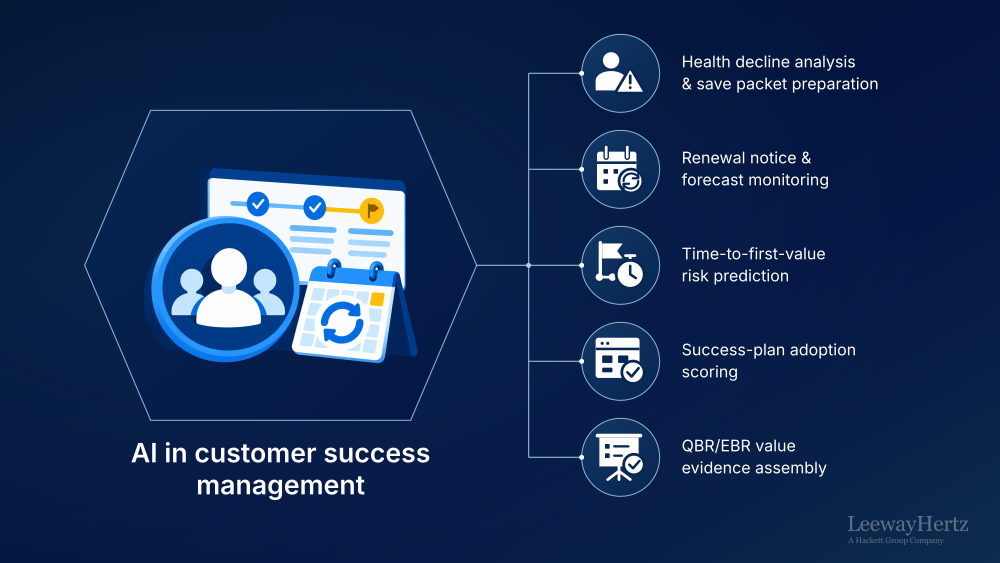
Customer success management (CSM) is the post-sale operating discipline that helps customers achieve agreed outcomes, adopt the product, realize value, renew with confidence, and identify expansion or advocacy opportunities when they are appropriate. In a SaaS or recurring-revenue business, it connects the customer’s desired outcomes with the vendor’s onboarding, adoption, support liaison, value realization, renewal, and retention operating model.
The function faces growing pressure. Customer success managers are expected to manage larger books of business, support more digitally led engagement, navigate complex stakeholder relationships, interpret fragmented product and customer data, and assume greater revenue accountability. Research and Markets valued the global customer success management market at US$1.7 billion in 2024 and projected it to reach US$4.9 billion by 2030 at an 18.8 percent CAGR. [1]
The operating challenge is not only scale. CS teams work across CRM records, CS platforms, product analytics, support tickets, billing systems, survey verbatims, QBR decks, renewal forecasts, and executive relationship notes. Gainsight’s 2024 Customer Success Index reported that 84 percent of B2B technology companies were maintaining or increasing CS budgets, and that CS teams increasingly use digital CS and AI tools to scale without relying only on headcount. [2]
AI in customer success management is the governed use of predictive analytics, classification, anomaly detection, natural-language generation, document intelligence, sentiment analysis, optimization, and retrieval-grounded answering across the post-sale lifecycle. It is not a generic chatbot beside a CS platform. A CSM needs a health-score decline explained with source evidence. A renewal manager needs notice windows, value evidence, and risk signals assembled before forecast changes. A CS operations manager needs playbook performance, coverage, and scorecard data quality analyzed before administrators change the system.
The practical value is strongest where CS work is artifact-rich, signal-heavy and reviewable. AI can classify churn drivers, detect adoption gaps, predict TTFV delays, draft QBR narratives, prepare save plans, monitor auto-renewal obligations, identify expansion signals and recalibrate early-warning models. It does not become the authority for customer commitments, renewal terms, executive outreach, pricing decisions, or public reference use.
A governed approach therefore begins with the operating model. Each AI opportunity should be connected to a defined lifecycle activity, source artifact, system of record, accountable reviewer, and decision boundary. Without this foundation, broad concepts such as “AI for churn prediction” or “AI for renewals” are too vague to design, validate, or govern effectively.
This article maps the customer success operating model across its functions, processes, sub-processes, artifacts, systems, controls, and accountable roles. It then identifies AI-enabled opportunities, agentic workflow patterns, governance requirements, ZBrain enablement, and practical priorities for implementation.
- How AI is transforming customer success management operations
- Why AI use cases in customer success management must be mapped at the sub-process level
- Customer success management operating model and AI opportunity mapping across customer success processes
- High-value AI use cases in customer success management
- How agentic AI works in customer success management workflows
- How to prioritize AI use cases in customer success management
- Governance, risk, and responsible AI in customer success management
- How ZBrain operationalizes AI use cases in customer success management
- Future of AI in customer success management
How AI is transforming customer success management operations
Customer success management is shifting from relationship coverage to outcome orchestration. CSMs still need judgment, empathy, and commercial context, but they increasingly need to work from a connected operating model where handoff context, success plans, telemetry, support history, sentiment, billing status, renewal timing, and executive engagement can be interpreted together.
Consider a strategic customer whose usage drops after a champion leaves, while an integration milestone remains incomplete and procurement starts asking about renewal terms. In many organizations, those signals sit in different tools and reach different owners. AI can aggregate the signals, classify the likely risk drivers, retrieve the relevant save play, draft an executive outreach packet, and route the work to the CSM, renewal manager, and VP of customer success for review.
The transformation is therefore not about replacing CSMs. It is about improving how customer-facing teams sense change, assemble evidence, and prepare timely action across the lifecycle. This shift becomes clearer when the day-to-day work of customer success is viewed by the type of work AI can support:
- Document-heavy work: handoff packets, mutual success plans, QBR decks, value realization reports, renewal records and save plans can be checked for gaps, inconsistencies and unsupported claims before a reviewer opens them.
- Narrative-heavy work: executive summaries, outreach emails, QBR commentary, incident updates and churn post-mortems can be drafted from approved source material with evidence gaps called out.
- Exception-heavy work: health-score drops, delayed onboarding milestones, NPS detractors, critical tickets, missed notice windows and forecast changes can be classified and prioritized.
- Knowledge-heavy work: renewal notice rules, support escalation policies, save playbooks, security response history and product adoption guidance can be retrieved in context.
- Workflow-heavy work: handoff, onboarding, adoption, save, renewal and retention analytics processes can move through governed packets, approvals and system updates.
The governing principle is straightforward: each AI application should be tied to a defined Customer Success sub-process, approved data sources, a system of record, an accountable owner, and a human review point. Without this structure, AI remains a generic productivity tool rather than an operational capability that can be validated, governed, and improved.
Why AI use cases in customer success management must be mapped at the sub-process level
Customer success teams often describe AI opportunities in broad terms such as churn prediction, renewal automation, or AI for QBRs. Those labels are directionally useful but operationally incomplete. A churn prediction idea can mean scoring health records, classifying risk drivers, drafting save plans, adjusting forecast probability, routing executive escalation, or recalibrating health-score weights. Each of those has different data, controls and reviewers.
A better approach is to map AI use cases to the customer success management operating model:
- Function: a governed operational domain such as onboarding, adoption, customer health monitoring, renewal management or retention analytics.
- Process: a workflow area inside the function, such as milestone tracking, health-score maintenance, auto-renewal notice monitoring or churn post-mortem analysis.
- Sub-process: the atomic work activity where AI can be designed, tested and governed, such as extracting renewal clauses, classifying detractor comments or detecting champion change.
- AI-enabled opportunity: a specific AI capability applied to a specific artifact or signal, with a clear change to the work and a human review boundary.
This matters because AI touches CSM customer data, contractual terms, commercial forecasts and relationship-sensitive outreach. A model can help score risk, but the CSM still owns the customer interpretation. A workflow can monitor notice windows, but renewals and legal teams still own contractual action. A draft QBR can assemble value evidence, but the CSM and customer executive still agree on what value has been realized.
Sub-process mapping also improves prioritization. Strong initial use cases are typically frequent, evidence-rich, measurable, and reviewable. Examples include adoption-gap detection, health-score driver analysis, renewal-readiness packet preparation, playbook performance analysis, and churn-theme classification. These opportunities are sufficiently specific to design, validate, govern, and improve over time.
Build governed AI workflows for customer success management
Connect onboarding, adoption, health scoring, renewals and retention analytics while keeping customer relationships and commercial decisions human-led.
Customer success management operating model and AI opportunity mapping across customer success processes
The following operating model treats customer success as the post-sale outcome and retention function. Support signals contribute to customer health assessments and escalation decisions, while reactive support operations are managed separately. For expansion, customer success identifies signals and coordinates handoffs, and sales owns opportunity execution.
Function 1: Sales-to-CS handoff and segmentation
Converts closed-won context into an actionable post-sale ownership model.
This function begins the post-sale lifecycle by converting customer signals and source artifacts into governed work that can be reviewed, routed and measured. It feeds downstream CS activities so the organization can drive product adoption, support customer value realization, prepare for contract renewals, and improve customer retention with clearer evidence.
Teams involved: Sales teams, CS operations teams, the assigned customer success manager, implementation leadership, and the account executive coordinate the handoff.
Key artifacts: Sales-to-CS handoff document, stakeholder map, contract summary, promised outcomes, mutual success plan starter, tiering record, and book-of-business assignment.
Systems involved: CRM, CS platform,contract repository, customer data platform, BI coverage model, and collaboration workspace.
Regulatory and control considerations: SOC 2 and ISO 27001 data handling controls apply to customer information; GDPR and CCPA obligations apply when contact roles, telemetry consent, and profiling fields are transferred.
Accountable roles: CS operations manager validates segmentation logic; the customer success manager accepts account ownership; the VP of customer success approves enterprise-tier exceptions.
What AI helps with: Document intelligence extracts promised outcomes and risk terms from the handoff packet; classification assigns segment and service model; optimization balances CSM capacity; retrieval-grounded answering surfaces deal history for kickoff preparation.
What humans continue to own: Sales and CS leaders remain accountable for account ownership, tiering exceptions, promised-outcome interpretation, and staffing tradeoffs. AI prepares the handoff view and assignment recommendations but does not decide, approve, or attest.
| Process | Sub-process | Key AI-enabled opportunities |
|---|---|---|
| Handoff packet review | Deal context extraction | Document intelligence extracts promised outcomes, commercial constraints, stakeholder roles, and implementation dependencies from the sales-to-CS handoff document. |
| Commitment and risk validation | Semantic comparison checks the handoff packet against contract terms, security addenda, and success criteria to flag unsupported commitments. | |
| Customer tiering | Service-model classification | Classification maps the customer to high-touch, tech-touch, or digital-led coverage using ARR (Annual Recurring Revenue), segment, complexity, strategic value, and product footprint. |
| CSM assignment | Book-of-business balancing | Constraint-based resource allocation recommends CSM assignment scenarios based on account tier, ARR, geography, language, capacity, renewal timing, and implementation load. |
Highest-value opportunities: Deal context extraction, commitment and risk validation, and service-model classification create the strongest value because they shape the quality of the entire post-sale motion, from customer health and account coverage to renewal readiness and retention analysis.
Example agentic workflow: Closed-won account to CSM assignment workflow
- The trigger is a closed-won opportunity with a completed sales-to-CS handoff document.
- The agent extracts promised outcomes, stakeholder roles, implementation dependencies, renewal terms, and known risks from CRM, CPQ, and contract records.
- The agent classifies the customer tier and prepares CSM assignment options with capacity and specialization rationale.
- Human checkpoint: the CS operations manager validates tiering and the VP of customer success approves any enterprise-tier exception.
- The agent writes the approved assignment to the CS platform, creates kickoff preparation tasks, and retains the handoff packet for onboarding audit evidence.
Function 2: Onboarding and implementation
Turns the sale into a measurable path toward first value and production readiness.
This function converts the sales handoff, success plan, implementation milestones, data migration tasks, integration requirements and readiness checks into a structured onboarding program. It establishes the customer’s time-to-first-value baseline, confirms whether go-live conditions are met and creates the adoption evidence that later feeds customer health, value realization and renewal readiness.
Teams involved: Onboarding or implementation managers, professional services teams, the CSM, technical integration teams, customer administrators, and executive sponsors participate.
Key artifacts: Mutual success plan, onboarding project plan, implementation Gantt or milestone tracker, data migration checklist, integration tracker, TTFV baseline, and go-live readiness checklist.
Systems involved: CS platform, project management tool, professional services automation system, implementation workspace, product telemetry and CRM.
Regulatory and control considerations: Data migration and integration work must follow SOC 2, ISO 27001, privacy-by-design, least-privilege access, and HIPAA business associate controls where PHI-adjacent telemetry is present.
Accountable roles: Onboarding/implementation manager owns milestone acceptance; the professional services engagement manager owns scoped services; the CSM confirms success-plan alignment.
What AI helps with: Natural-language generation drafts kickoff materials and success plans; anomaly detection flags stalled milestones; predictive analytics estimates TTFV risk; retrieval-grounded answering surfaces implementation precedent.
What humans continue to own: Implementation leaders decide readiness, scope changes, customer commitments, and go-live approval. AI drafts, monitors, and flags but does not decide readiness or approve go-live.
| Process | Sub-process | Key AI-enabled opportunities |
|---|---|---|
| Kickoff and success planning | Kickoff narrative drafting | Natural-language generation drafts kickoff agendas, stakeholder-specific talking points, and mutual success plan sections from approved deal context. |
| Implementation tracking | Milestone risk detection | Anomaly detection identifies slipping milestones, unresolved integration blockers, and missing data-migration prerequisites. |
| TTFV measurement | Time-to-first-value prediction | Predictive analytics estimates TTFV risk using historical onboarding duration, product modules, integration complexity, and customer responsiveness. |
| Go-live readiness assessment | Readiness checklist validation | Document intelligence checks the go-live readiness checklist for missing approvals, unresolved security steps, incomplete admin setup, and unverified value milestones. |
Highest-value opportunities: Kickoff narrative drafting, milestone risk detection, and time-to-first-value prediction are especially valuable because they shape whether the customer reaches early value on time, which directly affects adoption quality, customer health, renewal readiness, and later retention analysis.
Example agentic workflow: Kickoff to first-value readiness assessment
- The trigger is a scheduled kickoff with an accepted mutual success plan template.
- The agent aggregates implementation tasks, migration dependencies, integration status, stakeholder attendance, and target value milestones.
- The agent drafts the kickoff agenda, creates a milestone risk view, and predicts time-to-first-value exposure.
- Human checkpoint: the onboarding manager approves the project plan and the CSM confirms that milestones match the customer’s promised outcomes.
- Approved readiness evidence updates the CS platform and feeds adoption baselines after go-live.
Function 3: Adoption management
Connects product usage, enablement, and success-plan goals so adoption can be managed before renewal pressure appears.
This function turns usage telemetry, license utilization, feature adoption data, training activity and success-plan milestones into targeted adoption actions. It helps CSMs identify where customers are underusing the product, where enablement is needed and whether adoption is strong enough to support customer health, value realization and renewal readiness.
Teams involved: CSMs, digital CS managers, enablement teams, CS operations, product analytics teams, and customer administrators coordinate adoption programs.
Key artifacts: Usage telemetry dashboard extract, license utilization report, feature adoption score, enablement campaign record, CTA/playbook record, and success plan progress notes.
Systems involved: Product analytics platform, CS platform, CRM, learning management system, marketing automation tool, in-app guidance platform, and BI dashboard.
Regulatory and control considerations: GDPR and CCPA apply to telemetry, profiling, and preference management; CAN-SPAM and CASL apply to lifecycle campaigns; automated health scoring should be governed with transparency, explainability, privacy, bias review, and human oversight controls, especially when customer profiling affects escalation, renewal, or account-treatment decisions.
Accountable roles: The customer success manager owns adoption intervention choices; CS operations governs playbook triggers and data definitions.
What AI helps with: Predictive analytics scores adoption risk; clustering identifies usage cohorts; classification maps accounts to digital adoption plays; natural-language generation drafts enablement outreach tied to success-plan goals.
What humans continue to own: CSMs decide which intervention to run, how to frame customer outreach, and whether usage indicates value realization. AI scores, drafts, and recommends but does not decide, approve, or attest.
| Process | Sub-process | Key AI-enabled opportunities |
|---|---|---|
| Telemetry and utilization | Usage signal normalization | Data classification and entity resolution align product events, seats, modules, and account hierarchies to create a reliable license utilization view. |
| Feature adoption | Success-plan adoption scoring | Predictive analytics scores adoption progress by comparing feature usage, license utilization and training activity against the mutual success plan and historical success patterns, then highlights the factors driving the score. |
| Enablement orchestration | Training campaign targeting | Segmentation and natural-language generation prepare role-specific enablement campaigns for admins, champions, and end users. |
| Digital adoption playbook management | In-app intervention triggering | Classification triggers digital adoption CTAs when telemetry shows non-use, repeated friction events, or incomplete setup steps. |
Highest-value opportunities: Usage signal normalization, success-plan adoption scoring, and training campaign targeting are high-value because they turn raw product activity into actionable adoption insight, helping CSMs improve customer health, target enablement more precisely, and strengthen renewal readiness before risk appears.
Example agentic workflow: Low utilization to adoption intervention
- The trigger is a license utilization drop below the threshold defined for the customer tier.
- The agent reviews usage telemetry, success-plan goals, training attendance, prior CTAs, and open support friction.
- The agent identifies the adoption gap, selects an eligible digital playbook, and drafts customer-specific enablement messaging.
- Human checkpoint: the CSM approves the intervention and CS operations confirms that the playbook trigger is valid.
- The approved CTA launches through the CS platform and the adoption result feeds the customer health score.
Function 4: Customer health monitoring
Maintains a governed view of customer health using usage, support, sentiment, engagement, billing, and relationship signals.
This function turns product usage, support history, survey sentiment, stakeholder engagement, billing status and relationship changes into a structured customer health score. It helps CSMs understand why an account’s health is improving or declining, identify early churn indicators and decide when to trigger adoption, save, renewal or executive engagement actions.
Teams involved: CSMs, CS operations, support escalation managers, renewals teams, finance operations, product analytics, and executive sponsors contribute signals.
Key artifacts: Customer health score record, usage telemetry dashboard extract, support summary, NPS/CSAT response file, billing status, engagement notes, and override log.
Systems involved: CS platform, product analytics platform, support/helpdesk platform, CRM, ERP or billing system, survey tool, email/calendar platform, and BI layer.
Regulatory and control considerations: Privacy controls govern telemetry and profiling; SOC 2 and ISO 27001 govern data access; score override governance should retain source evidence, reviewer rationale, and model version.
Accountable roles: The CSM reviews account-specific health; CS operations owns scorecard rules; the VP of customer success approves override policy and executive account exceptions.
What AI helps with: Multi-source aggregation refreshes account health; sentiment analysis interprets survey verbatims; anomaly detection identifies unusual patterns, not every change in a score.; predictive analytics evaluates churn correlation and health-score validity.
What humans continue to own: CS leaders continue to own score definitions, overrides, escalation thresholds, and customer-facing interpretation. AI maintains and explains the score but does not decide, approve, or attest.
| Process | Sub-process | Key AI-enabled opportunities |
|---|---|---|
| Health score maintenance | Signal aggregation | Multi-source aggregation combines usage, support, sentiment, engagement, billing, and renewal data into the customer health score record. |
| Relationship monitoring | Stakeholder relationship risk detection | Entity resolution links contacts across CRM, calendar, and engagement records, while anomaly detection flags unusual relationship changes such as champion departure, declining executive attendance, reduced email engagement, or title changes that may indicate sponsor risk. |
| Score governance | Override justification review | Retrieval-grounded answering presents source evidence and prior override precedent before a CSM submits a health-score override. |
| Predictive validity | Churn-correlation testing | Predictive analytics evaluates how changes in customer health scores relate to churn, contraction, renewal delays, and expansion outcomes. |
Highest-value opportunities: Signal aggregation, champion-change detection, and override justification review are especially valuable because they make customer health scores more explainable and reliable, helping CSMs identify relationship risk earlier, govern score changes properly, and prepare stronger renewal or save actions.
Example agentic workflow: Health score movement to executive review
- The trigger is a two-band customer health score decline for an enterprise-tier account.
- The agent aggregates score components, recent usage, unresolved support tickets, sentiment records, billing status, and engagement changes.
- The agent explains the drivers, identifies whether a champion-change signal exists, and recommends whether risk escalation criteria are met.
- Human checkpoint: the CSM confirms the interpretation and the VP of customer success approves any override or executive escalation.
- The reviewed health record updates the CS platform and, when warranted, opens a risk management CTA.
Function 5: Risk and save management
Turns early-warning signals into governed churn-risk, remediation, and escalation work.
This function converts health score declines, champion changes, adoption gaps, detractor feedback, critical support issues and renewal proximity signals into structured churn-risk and save actions. It helps CSMs document the likely cause of risk, prepare remediation plans, coordinate executive or cross-functional escalation, and update renewal forecasts before the account moves closer to churn or contraction.
Teams involved: CSMs, VP of customer success, chief customer officer, renewal manager, support escalation manager, professional services teams, product manager, and account executive coordinate save actions.
Key artifacts: Churn risk register, save plan document, CTA/playbook record, customer health score record, NPS/CSAT survey response file, executive sponsor letter, renewal opportunity record, and success plan.
Systems involved: CS platform, CRM, product analytics platforms, support platform, ERP billing system, survey tool, project management system, and executive reporting dashboard.
Regulatory and control considerations: Privacy and security controls govern signal aggregation; renewal proximity rules determine renewals co-ownership; save offers must respect commercial approval, auto-renewal, and revenue-recognition boundaries.
Accountable roles: The CSM owns save-plan execution; the VP of customer success approves resource commitments; the chief customer officer handles executive escalation; the renewal manager co-owns risks inside the renewal window.
What AI helps with: Predictive analytics recalculates churn likelihood; root-cause classification groups risk drivers; retrieval-grounded answering checks save play policy; natural-language generation drafts executive outreach and remediation plans.
What humans continue to own: CS leaders decide whether an account is at risk, whether to commit resources, how to contact executives, and how to change renewal forecasts. AI prepares the save packet but does not decide, approve, or attest.
| Process | Sub-process | Key AI-enabled opportunities |
|---|---|---|
| Churn-risk register | Risk record creation | Classification categorizes churn-risk signals by severity, likely driver and required save play, while workflow automation prepares the corresponding churn-risk register entry for CSM review. |
| Save play execution | Root-cause hypothesis | Root-cause classification and retrieval-grounded analysis compare usage decline, stalled milestones, support friction, billing status, and original commitments. |
| Detractor follow-up | Survey verbatim triage | Sentiment analysis and topic classification analyze NPS and CSAT comments, identify detractor feedback, and categorize the underlying issues as product, support, onboarding, or value-related gaps. |
| Leadership escalation | Executive save packet preparation | Natural-language generation prepares an executive sponsor letter, remediation plan, owner assignments, and revised renewal risk rating from approved source evidence. |
Highest-value opportunities: Risk record creation, root-cause hypothesis generation, and survey verbatim triage are high-value because they help teams identify churn risk earlier, understand the likely drivers behind the risk, and turn customer feedback into a structured save plan before renewal pressure increases.
Example agentic workflow: Customer health decline to save planning
- The trigger is a material health score decline after a champion departure signal and a significant drop in monthly active usage.
- The agent aggregates usage telemetry trends, open and recent support tickets, NPS verbatims, CRM contact and opportunity history, billing status from the ERP, and original success plan commitments.
- The agent retrieves the save play policy for the account tier and the renewal date proximity rule that requires renewal manager co-ownership within a specific timeline.
- The agent prepares a save packet with a root-cause hypothesis, unrealized value gaps, a draft executive outreach email, a proposed remediation plan with owner assignments, and a revised renewal risk rating.
- Human checkpoint: the CSM edits and approves the outreach, while the VP of customer success approves the remediation resource commitment or escalates to the chief customer officer for an executive sponsor call.
- The approved save plan writes to the churn risk register and CTA record, the renewal forecast updates, and the packet with approvals is retained for churn post-mortem and retention analytics.
Function 6: Business reviews and value realization
Translates adoption and outcomes evidence into executive conversations about realized value, gaps, and next goals.
This function turns adoption data, success-plan progress, baseline metrics, support history, stakeholder feedback and milestone evidence into QBR/EBR narratives and value realization reports. It helps CSMs show whether the customer is achieving the outcomes agreed in the success plan, identify unrealized value gaps, refresh goals and create stronger evidence for renewal readiness or expansion handoff.
Teams involved: CSMs, executive sponsors, CS operations, product analytics teams, finance or value engineering teams, professional services teams, and account executives contribute evidence and planning inputs.
Key artifacts: QBR/EBR deck, value realization report, mutual success plan, adoption score, ROI baseline, milestone tracker, and executive action log.
Systems involved: CS platform, BI dashboards, product analytics, CRM, data warehouse, survey platform, and presentation repository.
Regulatory and control considerations: Value claims need traceable baselines and approved calculation logic; ASC 606 adjacency matters when bookings, revenue, ARR, and realized value appear in the same executive narrative.
Accountable roles: The CSM owns the business review narrative; the VP of customer success reviews strategic accounts; FP&A validates retention forecast implications where required.
What AI helps with: Document intelligence assembles evidence; natural-language generation drafts QBR commentary; retrieval-grounded answering traces value claims to source data; simulation models goal re-baselining scenarios.
What humans continue to own: CSMs and executives own value interpretation, goal reset, commercial commitments, and executive messaging. AI prepares analysis and drafts but does not decide, approve, or attest.
| Process | Sub-process | Key AI-enabled opportunities |
|---|---|---|
| QBR/EBR preparation | Evidence assembly | Document intelligence assembles adoption, support, milestone, value, and stakeholder evidence into a QBR or EBR preparation packet. |
| Value realization | Baseline-to-outcome analysis | Retrieval-grounded analytics compare current metrics with success-plan baselines and quantify realized and unrealized value gaps. |
| Success plan refresh | Goal re-baselining | Simulation models new adoption, expansion, and remediation scenarios so the CSM can refresh goals with the customer. |
| Executive business review narrative preparation | Board-ready account story preparation | Natural-language generation drafts executive-level value commentary with linked source evidence. |
Highest-value opportunities: Evidence assembly, baseline-to-outcome analysis, and goal re-baselining are high-value because they help CSMs show whether the customer is realizing the outcomes promised in the success plan, identify remaining value gaps, and reset priorities before renewal or expansion discussions begin.
Example agentic workflow: Usage evidence to executive business review
- The trigger is an upcoming EBR for a strategic account.
- The agent gathers the mutual success plan, telemetry trends, support history, training completion, milestone status, and baseline metrics.
- The agent drafts the value realization report and highlights where outcomes are achieved, delayed, or unsupported by evidence.
- Human checkpoint: the CSM validates the narrative and the executive sponsor approves any new commitments or re-baselined goals.
- The approved review deck updates the success plan and feeds renewal readiness and expansion signal review.
Accelerate AI Solutions Development
Build fully functional solutions from your high-value use cases, based on specific operational needs and enterprise context.
Function 7: Renewal management
Connects customer health, value evidence, commercial records, and renewal obligations before the decision window closes.
This function turns renewal dates, contract terms, customer health, value realization evidence, procurement status, security review requirements and billing signals into a structured renewal plan. It helps renewal teams and CSMs assess renewal risk, prepare forecast updates, track notice obligations, support procurement or security reviews and keep commercial actions aligned with customer outcomes and compliance requirements.
Teams involved: Renewal managers, CSMs, account executives, legal, procurement, security review teams, FP&A, CS operations, and revenue operations coordinate renewal readiness.
Key artifacts: Renewal opportunity record, renewal forecast waterfall workbook, auto-renewal notice tracker, procurement checklist, security review packet, value realization report, and risk register.
Systems involved: CRM, CS platform, contract lifecycle management system, ERP or billing system, revenue forecasting tool, security questionnaire platform, and document repository.
Regulatory and control considerations: State auto-renewal laws, FTC negative-option requirements, ASC 606 adjacency, privacy controls, and approval limits govern notices, commercial terms, revenue treatment, and customer communications.
Accountable roles: The renewal manager owns renewal execution; the CSM provides customer health and value context; FP&A reconciles forecast changes; legal or revenue operations team reviews compliance-sensitive terms.
What AI helps with: Predictive analytics forecasts renewal risk; document intelligence extracts renewal clauses; anomaly detection flags missed notice windows; retrieval-grounded answering supports procurement and security response preparation.
What humans continue to own: Renewal specialists and authorized commercial leaders own renewal terms, discounts, notices, forecast commitments, and contract execution. AI prepares and monitors but does not decide, approve, or attest.
| Process | Sub-process | Key AI-enabled opportunities |
|---|---|---|
| Opportunity creation | Renewal record generation | Document intelligence extracts renewal date, ARR, co-term constraints, auto-renewal language, and ownership fields into the renewal opportunity record. |
| Forecasting of renewal | Renewal probability update | Renewal propensity modeling estimates and updates each account’s renewal probability using customer health, product adoption, support burden, stakeholder engagement, documented risks, and procurement progress. |
| Auto-renewal notice compliance tracking | Auto-renewal window monitoring | Rules-based compliance validation checks applicable to California, New York, and FTC negative-option notice requirements against contract terms, customer location, and communication records to identify missing or overdue notices. |
| Procurement support | Security response assembly | Retrieval-grounded answering assembles prior security responses, SOC 2 evidence, ISO 27001 documentation, and product commitments for review. |
Highest-value opportunities: Renewal record generation, renewal probability updates, and auto-renewal window monitoring are high-value because they help renewal teams keep contract timing, customer health, value evidence, compliance obligations, and forecast movement aligned before the renewal decision point.
Example agentic workflow: Renewal window to forecast update
- The trigger is a renewal entering the defined renewal planning window.
- The agent reviews the renewal opportunity, health score, value report, open security reviews, procurement status, billing exceptions, and auto-renewal notice obligations.
- The agent drafts a renewal readiness packet and recommends forecast movement with supporting evidence.
- Human checkpoint: the renewal manager approves the forecast update and legal or revenue operations validates compliance-sensitive notice and contract items.
- The approved record updates CRM, the forecast waterfall, and the CS platform renewal CTA.
Function 8: Expansion and advocacy
Identifies growth and advocacy signals while keeping sales execution and testimonial approval under the right owners.
This function turns adoption strength, value realization evidence, stakeholder engagement, product-fit signals, NPS promoters and customer advocacy eligibility into structured expansion and advocacy handoffs. It helps CSMs identify where a customer may be ready for upsell, cross-sell, reference participation, case-study recruitment or advisory board involvement, while keeping opportunity ownership with sales and public advocacy approval with the appropriate marketing, legal or executive reviewers.
Teams involved: CSMs, account executives, marketing, customer advocacy managers, product marketing team, legal team, CS operations teams, and executive sponsors collaborate.
Key artifacts: Expansion signal record, reference agreement, case study intake form, G2 review request record, customer advisory board nomination, success plan, and value realization report.
Systems involved: CS platform, CRM, marketing automation, advocacy platform, review management tool, product analytics, and contract repository.
Regulatory and control considerations: Privacy, testimonial consent, reference approval, CAN-SPAM/CASL, and customer communication preferences govern advocacy outreach.
Accountable roles: The CSM validates fit; the account executive owns sales handoff; marketing or advocacy teams own reference and case-study programs; the legal team approves reference terms where required.
What AI helps with: Whitespace detection identifies expansion signals; classification routes opportunities to sales; sentiment analysis identifies promoters; natural-language generation drafts advocacy outreach and case-study briefs.
What humans continue to own: Sales and advocacy leaders own commercial pursuit, reference consent, public claims, and customer-facing commitments. AI identifies and drafts but does not decide, approve, or attest.
| Process | Sub-process | Key AI-enabled opportunities |
|---|---|---|
| Whitespace detection | Whitespace opportunity assessment | Predictive analytics detects product, seat, region, or use-case expansion fit from adoption depth, unresolved goals, and account hierarchy data. |
| Sales handoff | CSQL preparation | Classification categorizes the expansion signal, document intelligence extracts supporting evidence from success plans, usage records and value reports, and natural-language generation drafts a customer success qualified lead packet for the account executive’s review. |
| Reference recruitment | Promoter identification | Sentiment analysis identifies NPS promoters and value-realization evidence suitable for reference or case-study outreach. |
| Advocacy management | Consent-aware outreach | Natural-language generation drafts G2 review, advisory board, or case-study invitations using consent status, preference data, and approved messaging. |
Highest-value opportunities: Whitespace opportunity assessment, CSQL preparation, and promoter identification are high-value because they help CS teams recognize where a customer may be ready for expansion or advocacy, package the evidence for the right owner, and strengthen growth conversations without turning CS into the sales execution function.
Example agentic workflow: Promoter signal to advocacy handoff
- The trigger is a high NPS response paired with verified value realization and strong executive engagement.
- The agent checks reference history, communication preferences, legal restrictions, and advocacy program eligibility.
- The agent drafts a reference invitation and prepares a case-study evidence packet.
- Human checkpoint: the CSM confirms relationship readiness, marketing team approves messaging, and legal validates the reference agreement when required.
- Approved advocacy tasks update the CS platform and advocacy system without converting into a sales opportunity unless the account executive accepts a separate handoff.
Function 9: Support and escalation liaison
Uses support signals to protect customer outcomes without turning CS into the support desk.
This function turns critical tickets, incident updates, support trends, escalation history and customer impact signals into coordinated CS follow-up. It helps CSMs understand how support issues affect adoption, customer health, value realization and renewal risk, while keeping ticket resolution, incident ownership and technical remediation with the support and product teams responsible for those actions.
Teams involved: CSMs, support escalation managers, support leadership, product managers, incident communications teams, professional services teams, and customer executives coordinate escalations.
Key artifacts: Critical ticket summary, escalation record, incident communication draft, customer health score input, product feedback intake, and remediation action log.
Systems involved: Support/helpdesk platform, incident management tool, CS platform, CRM, product roadmap intake, status page or communications tool, and knowledge base system.
Regulatory and control considerations: SOC 2 and ISO 27001 govern customer data in support records; incident communications require approved facts; product feedback must preserve privacy and customer-confidential context.
Accountable roles: The support escalation manager owns incident and ticket resolution; the CSM owns customer relationship context; the product manager owns roadmap intake decisions.
What AI helps with: Ticket classification identifies severity and themes; summarization prepares escalation context; retrieval-grounded answering finds known fixes; topic modeling routes product feedback to roadmap intake.
What humans continue to own: Support, product, and CS leaders own resolution commitments, incident communications, roadmap decisions, and customer escalation strategy. AI summarizes and routes but does not decide, approve, or attest.
| Process | Sub-process | Key AI-enabled opportunities |
|---|---|---|
| Critical ticket monitoring | Severity and account-impact triage | Classification ranks open tickets by severity, ARR exposure, renewal proximity, account tier, and customer health effect. |
| Escalation coordination | Cross-functional packet preparation | Summarization generates a concise escalation packet with issue history, customer impact, owner status, and next action gaps. |
| Incident communication | Approved-fact drafting | Natural-language generation drafts customer incident updates from approved incident facts, timelines, and communication templates. |
| Product feedback intake management | Roadmap intake routing | Topic modeling clusters support themes and workflow orchestration routes customer feedback to product roadmap intake with account and revenue context. |
Highest-value opportunities: Severity and account-impact triage, cross-functional escalation packet preparation, and approved-fact communication drafting are high-value because they help CS teams understand how support issues affect customer outcomes, coordinate the right internal owners, and communicate with customers using accurate, approved information.
Example agentic workflow: Critical ticket to customer escalation packet preparation
- The trigger is a high-severity ticket for an enterprise account with renewal proximity.
- The agent summarizes ticket history, incident status, customer impact, promised timelines, health score movement, and related product feedback.
- The agent prepares a customer escalation packet and a draft incident communication using approved source facts.
- Human checkpoint: the support escalation manager confirms technical accuracy and the CSM approves customer-facing language.
- The approved update is logged in the CS platform and the product feedback item is routed to roadmap intake.
Function 10: CS operations and playbook governance
Maintains the operating system of customer success: playbooks, CTAs, coverage, capacity, incentives, and data quality.
This function turns playbook performance data, CTA completion patterns, customer segmentation rules, CSM capacity metrics, health score configuration, coverage models and renewal target inputs into governed CS operating decisions. It helps CS leaders standardize how teams act on customer signals, balance books of business, maintain reliable workflows and keep customer success programs consistent across segments, regions and lifecycle stages.
Teams involved: CS operations, VP of customer success, CS platform administrators, revenue operations, finance, enablement teams, CSM leadership, and compensation administration.
Key artifacts: CTA/playbook record, playbook library, capacity model, coverage analytics, compensation and renewal target file, health score configuration, and workflow audit log.
Systems involved: CS platform, CRM, BI warehouse, HRIS or planning system, compensation tool, data quality monitoring system, and workflow orchestration layer.
Regulatory and control considerations: SOC 2, ISO 27001, role-based access, change control, model governance, and compensation administration controls apply to playbooks, score definitions, and target calculations.
Accountable roles: The CS operations manager owns system configuration and playbook governance; VP of customer success approves capacity and coverage changes; finance validates target logic.
What AI helps with: Process mining finds playbook bottlenecks; optimization models capacity and coverage; anomaly detection flags data quality breaks; retrieval-grounded answering supports administrator changes.
What humans continue to own: CS operations and leadership own playbook policy, target setting, compensation decisions, and platform configuration approval. AI analyzes and recommends but does not decide, approve, or attest.
| Process | Sub-process | Key AI-enabled opportunities |
|---|---|---|
| Playbook administration | CTA performance review | Process mining evaluates CTA completion, cycle time, outcome rate, and stale task patterns across the playbook library. |
| Capacity analytics | Coverage model optimization | Optimization recommends coverage scenarios by ARR, account tier, lifecycle stage, renewal timing, and CSM workload. |
| Data governance | Scorecard data-quality monitoring | Anomaly detection flags missing telemetry, duplicate accounts, stale contacts, unsupported overrides, and broken source-system mappings. |
| Target administration | Compensation and renewal target checks | Document intelligence and rules validation compare target files with territory, book-of-business, and renewal ownership data. |
Highest-value opportunities: CTA performance review, coverage model optimization and scorecard data-quality monitoring are high-value because they improve how the organization operates at scale, helping leaders refine playbooks, balance CSM capacity, maintain reliable health scores and support more consistent adoption, renewal and retention outcomes.
Example agentic workflow: Playbook performance to governance update
- The trigger is a monthly playbook effectiveness review.
- The agent analyzes CTA completion rates, cycle times, customer outcomes, CSM workload, and data quality exceptions.
- The agent recommends playbook changes, retired triggers, new thresholds, and capacity adjustments.
- Human checkpoint: the CS operations manager approves configuration changes and the VP of customer success approves coverage or target implications.
- Approved updates are versioned in the CS platform and retained for governance review.
Function 11: Retention analytics
Closes the loop between churn outcomes, forecast accuracy, health scoring, and the next generation of early-warning models.
This function turns churn events, contraction patterns, renewal outcomes, cohort performance, NRR/GRR movements, health score history and save-plan results into structured retention insight. It helps CS leaders and FP&A understand why customers leave, where revenue is expanding or contracting, which early-warning signals were reliable, and how health scores, playbooks and renewal forecasts should be recalibrated for the next cycle.
Teams involved:CS operations, CSM leadership, VP of customer success, FP&A, revenue operations, product analytics or data teams, and executive reporting teams contribute to retention analytics.
Key artifacts: Churn post-mortem, contraction analysis, NRR/GRR waterfall workbook, closed churn risk register, health-score validation report, model recalibration record, and executive retention dashboard.
Systems involved: BI warehouse, CS platform, CRM, ERP or billing system, product analytics, forecasting tool, data science workspace, and executive reporting dashboard.
Regulatory and control considerations: Revenue metrics need consistent definitions; privacy and model governance apply to predictive features; forecast reconciliation must distinguish bookings, ARR, revenue, churn, contraction, and expansion.
Accountable roles: The VP of customer success owns retention interpretation; FP&A reconciles NRR and GRR; CS operations manages scorecard and model updates.
What AI helps with: Causal analysis supports post-mortems; predictive analytics tests early-warning models; anomaly detection identifies cohort movements; simulation evaluates intervention timing and retention scenarios.
What humans continue to own: Executives and finance leaders own retention conclusions, forecast adjustments, public metrics, and model approval. AI analyzes and recalibrates recommendations but does not decide, approve, or attest.
| Process | Sub-process | Key AI-enabled opportunities |
|---|---|---|
| Churn post-mortem analysis | Root-cause clustering | Topic modeling and causal analysis classify churn and contraction events by value gap, adoption failure, product fit, support friction, champion loss, or commercial reason. |
| NRR/GRR analysis | Cohort waterfall explanation | Variance decomposition explains NRR and GRR movements across churn, contraction, expansion, downgrade, segment, cohort, and product line. |
| Health score and churn model validation | Health-score predictive validity test | Predictive analytics compares prior score movements with realized churn, renewal, contraction, and expansion outcomes to test signal quality. |
| Health score and churn model recalibration | Early-warning threshold refresh | Simulation and optimization recommend threshold changes, signal weights, and review cadences for the next retention cycle. |
Highest-value opportunities: Root-cause clustering, cohort waterfall explanation and health-score predictive validity testing are high-value because they help CS leaders understand why churn or contraction occurred, explain NRR and GRR movements more clearly, and improve the early-warning signals used to guide future customer health, renewal and save actions.
Example agentic workflow: Churn event to early-warning recalibration
- The trigger is a closed churn or contraction event at quarter-end.
- The agent aggregates the churn risk register, health-score history, usage telemetry, support history, renewal forecast changes, and final commercial outcome.
- The agent prepares a post-mortem with root-cause classification and tests whether the early-warning model detected the risk in time.
- Human checkpoint: the VP of customer success approves the post-mortem interpretation and FP&A validates NRR and GRR waterfall treatment.
- Approved findings update health-score logic, playbook thresholds, and executive retention analytics.
Accelerate AI Solutions Development
Build fully functional solutions from your high-value use cases, based on specific operational needs and enterprise context.
High-value AI use cases in customer success management
High-value CSM AI use cases are not simply the most visible ones. They are the use cases where the artifact is available, the signal quality is sufficient, the human reviewer is clear and the downstream business impact connects to retention, renewal confidence, customer health, time-to-first-value or net revenue retention.
| Use case | Function | How AI creates high-value impact |
|---|---|---|
| Customer health decline analysis and save packet preparation | Risk and save management | AI reduces the time between risk detection and action by connecting health-score movement with usage decline, champion change, support history, sentiment, billing status and success-plan commitments. This gives the CSM a faster, evidence-backed save packet to review before renewal risk becomes harder to reverse. |
| Renewal notice and forecast monitoring | Renewal management | AI helps renewal teams avoid missed deadlines and weak forecast assumptions by checking renewal clauses, notice windows, customer health, procurement status and value evidence together. This keeps compliance obligations, renewal readiness and forecast movement aligned before the renewal decision point. |
| TTFV risk prediction | Onboarding and implementation | AI helps teams intervene earlier by detecting patterns in delayed milestones, integration blockers, data migration readiness and customer engagement. This improves the chance that customers reach first value on time and enter adoption with fewer unresolved issues. |
| Success-plan adoption scoring | Adoption management | AI makes adoption management more outcome-based by comparing actual feature usage, license utilization and training activity against the goals defined in the success plan. This helps CSMs focus enablement on the gaps most likely to affect value realization and renewal readiness. |
| QBR/EBR value evidence assembly | Business reviews and value realization | AI strengthens executive reviews by tracing value claims back to usage data, baseline metrics, milestone progress, support history and customer feedback. This helps CSMs prepare more credible QBR/EBR narratives and identify value gaps before commercial conversations begin. |
| Capacity and coverage optimization | CS operations and playbook governance | AI helps customer success leaders determine how CSM capacity should be distributed across accounts by considering account tier, annual recurring revenue, lifecycle stage, renewal timing, and risk. This enables teams to align each account with an appropriate high-touch, technology-assisted, or digitally led engagement model. |
| Churn post-mortem clustering | Retention analytics | AI improves retention learning by grouping churn and contraction events by recurring drivers such as adoption failure, value gaps, support friction, champion loss or product-fit issues. This helps CS operations refine health scores, playbooks and early-warning models for future accounts. |
These use cases earn priority because they combine measurable business stakes with reviewable evidence. They improve the timing and quality of human work without asking AI to make commercial, legal or relationship decisions.
How agentic AI works in customer success management workflows
Agentic AI is useful in CSM when it operates as a governed sequence across systems, not as an autonomous actor making customer decisions. A well-designed workflow starts with a trigger artifact, retrieves only the relevant records, prepares a bounded work packet, pauses at a designated human checkpoint and writes approved outcomes back to the systems of record.
Here are some examples:
Example 1: Customer health decline to save plan workflow
- Agent role: The agent brings together the customer’s health score movement, usage telemetry, support history, survey sentiment, CRM activity, billing status and success-plan commitments. It then analyzes the likely churn drivers, checks the tier-specific save play and prepares a save packet for the CSM and VP of customer success to review.
- Human checkpoint: The accountable CSM, renewal manager, CS operations manager, VP of customer success or FP&A reviewer confirms before customer-facing action, system update or forecast movement.
- Output and evidence: Approved recommendations update the relevant CS platform, CRM, renewal forecast, playbook record or analytics loop with source artifacts retained.
Example 2: Renewal window compliance workflow
- Agent role: The agent tracks renewal dates, auto-renewal notice obligations, contract clauses, billing status and value evidence in one view. It then identifies timing gaps or compliance risks and prepares a renewal readiness packet for the renewal manager to review.
- Human checkpoint: The renewal manager reviews the renewal readiness packet, confirms the forecast recommendation and routes any compliance-sensitive notice or contract issue to legal or revenue operations before customer communication.
- Output and evidence: Approved updates are recorded in the renewal opportunity, renewal forecast waterfall and CS platform CTA, with the contract clause, notice-window check, value evidence and reviewer approval retained.
Example 3: First-value readiness workflow
- Agent role: The agent monitors onboarding milestones, integration status, data migration tasks, enablement completion and early product telemetry. It then identifies risks to time-to-first-value and prepares a go-live readiness review with the open blockers, affected success-plan goals and recommended next actions.
- Human checkpoint: The onboarding/implementation manager reviews the readiness packet, confirms whether go-live criteria have been met and coordinates with the CSM or professional services engagement manager on any unresolved implementation risks.
- Output and evidence: Approved readiness updates are recorded in the onboarding project plan, go-live readiness checklist and CS platform, with milestone status, integration evidence, migration notes, enablement records and reviewer approval retained.
Example 4: Retention analytics recalibration workflow
- Agent role: The agent reviews churn post-mortems, contraction patterns, NRR and GRR waterfall movements, health-score histories and prior intervention outcomes. It then identifies which signals were predictive, where the early-warning model missed risk and which playbook or scoring rules may need recalibration.
- Human checkpoint: The CS operations manager reviews the proposed health score and playbook changes, while FP&A validates any NRR, GRR or forecast implications before the changes are approved for use.
- Output and evidence: Approved updates are recorded in the health score configuration, playbook library, retention analytics dashboard and model recalibration record, with churn evidence, cohort analysis, intervention history and reviewer approval retained.
The review boundary is the safety property. AI can hold the workflow together across tools, but customer commitments, commercial terms, resource allocations, forecast assertions and public advocacy remain human-owned.
How to prioritize AI use cases in customer success management
Prioritization should start from the operating model rather than from technology enthusiasm. CSM leaders should prioritize sub-processes with repeated evidence-gathering, meaningful ARR or NRR impact from missed signals, accessible source artifacts and a clear reviewer who can approve, edit, reject or escalate the AI output.
| Criterion | What to ask |
|---|---|
| Volume and frequency | Does the sub-process recur often enough across accounts, segments or renewal windows to justify automation support? |
| Artifact availability | Are handoff records, success plans, telemetry, health scores, survey responses, support signals and renewal records available with adequate quality? |
| Review boundary | Can a named CSM, CS operations manager, renewal manager, VP of CS or FP&A reviewer confirm the output before it affects a customer or forecast? |
| Blast radius | If the output is wrong, is the impact limited to a draft, triage queue or internal recommendation rather than an unapproved customer commitment? |
| Business impact | Can the use case connect credibly to TTFV, adoption, renewal confidence, GRR, NRR, churn reduction, CSM capacity or lower rework? |
The classic failure patterns are misaligned scope, missing data, bypassed governance and premature quantified savings. The best starting points are high-volume, artifact-rich, cleanly reviewed sub-processes such as adoption gap detection, save packet preparation, renewal readiness monitoring, playbook performance review and churn post-mortem clustering.
Governance, risk and responsible AI in customer success management
Governance for AI in CSM needs to reflect the sensitivity of customer relationships. The same workflow may touch usage telemetry, survey sentiment, executive contacts, support tickets, billing status, renewal terms and forecast records. That makes access control, transparency, auditability and human review core design requirements.
Human-in-the-loop oversight: AI may draft, score, summarize and recommend, but named roles must confirm before customer outreach, renewal notices, forecast updates, commercial commitments, save offers, public references or product roadmap promises proceed.
Regulatory and standards alignment: CSM workflows should align AI controls with GDPR, CCPA, SOC 2, ISO 27001, CAN-SPAM, CASL, auto-renewal obligations, HIPAA business associate obligations where applicable and recognized AI governance frameworks such as the NIST AI RMF.
Bias mitigation and evidence retention: Customer health scores, churn prediction and segmentation can encode bias through incomplete telemetry, account-tier assumptions, region, language, relationship coverage or product-access differences. Source artifacts, feature inputs, model version and reviewer disposition should be retained.
Key governance requirements: A use-case inventory should separate low-risk summarization from higher-risk scoring, recommendation and customer-routing workflows. Higher-risk CSM use cases need risk tiering, approval gates, override workflows, monitoring and escalation paths.
Design principles: Workflows should use approved sources, least-privilege access, role-based permissions, scoped tool actions and clear refusal rules when data is missing, stale, contradictory or outside the customer success scope.
Traceability and data security: Each workflow should retain prompts, source records, model version, generated output, reviewer edits, approvals and system updates under security controls appropriate for customer data and commercial records.
Accelerate AI Solutions Development
Build fully functional solutions from your high-value use cases, based on specific operational needs and enterprise context.
How ZBrain operationalizes AI use cases in customer success management
Identifying high-value AI use cases in customer success management is only the first step. Organizations need a controlled way to analyze, design, build, validate, deploy, govern and scale AI workflows across sales-to-CS handoff, onboarding, adoption management, customer health monitoring, churn-risk management, save planning, business reviews, renewal readiness, expansion signal handoff, advocacy, CS operations and retention analytics. The challenge is to connect these workflows without weakening the approval boundaries, data protections and evidence requirements that govern customer communication, renewal decisions, health scoring, forecast updates and commercial actions.
This is where ZBrain helps.
ZBrain is an end-to-end AI enablement platform that supports this lifecycle through four connected stages: ZBrain Analyzer, ZBrain Design, ZBrain Solution Builder and ZBrain Governance. The platform provides a governed path from use-case analysis to deployed agentic workflows while maintaining policies, permissions, approval points, monitoring and runtime evidence.
ZBrain Analyzer
ZBrain Analyzer helps customer success teams examine selected post-sale processes, identify AI opportunities and document the business context, systems, data, artifacts, roles, playbooks, customer segments, regulatory considerations, control requirements, decision boundaries and review requirements needed to evaluate each use case.
ZBrain Design
ZBrain Design creates a build-ready technical design for the selected customer success use case. It generates the business requirements document, functional requirements, user journeys, architecture, workflow logic, data specifications, integration context, approval points and governance considerations needed before development begins. For CSM workflows, this design can define how handoff records, success plans, telemetry, health scores, support signals, renewal records and retention analytics are used, which outputs require human review and what evidence must be retained.
ZBrain Solution Builder
ZBrain Solution Builder enables teams to create, configure and validate governed AI workflows for customer success management based on the technical design developed in ZBrain Design. It supports testing across onboarding, adoption, health-score monitoring, churn-risk detection, save planning, renewal readiness, expansion signal handoff, playbook governance and retention analytics scenarios before deployment.
ZBrain Governance
ZBrain Governance applies policies, access controls, human approval requirements, monitoring and traceability throughout workflow execution. It provides guardrails, approval gates, escalation controls, kill switches and audit trails to help organizations maintain oversight of AI-generated recommendations, customer health scores, save plans, renewal forecast changes, customer communications, reviewer actions and authorized updates to systems of record.
Future of AI in customer success management
The future of AI in customer success management will be shaped by federated post-sale platforms that connect CRM, CS, product analytics, support, billing, survey, learning and forecasting systems through shared orchestration and observability. The advantage will come from reducing handoff loss between functions rather than adding another disconnected assistant.
Longer-horizon agentic workflows will support customer success teams across multiple stages. A workflow may monitor adoption, detect a champion change, update the health-score explanation, prepare a save packet, alert renewals, draft executive outreach and retain evidence for a post-mortem. It can maintain context and coordinate tasks over time, but accountable employees must approve all relationship-sensitive or commercial decisions.
The competitive question will shift from which model is being used to how the workflow is designed. CSM teams will need clean telemetry, usable success plans, trusted score definitions, clear renewal ownership, well-governed playbooks and feedback loops that prove whether interventions improve outcomes.
The future therefore depends less on better generic automation and more on disciplined operating-model design. Customer success leaders who map AI to specific sub-processes, artifacts and human checkpoints will be better positioned to improve customer health, reduce surprise churn, strengthen renewal management and protect net revenue retention.
Endnote
Customer success management is well suited to AI because the work is signal-rich, document-heavy, time-sensitive and deeply cross-functional. The CSM does not need another place to ask generic questions. The function needs governed workflows that connect success plans, telemetry, support signals, sentiment, health scores, renewal records and retention analytics into review-ready action.
Retention economics explain why this matters. Bain has long reported that a 5 percent increase in customer retention can increase profits by 25 percent to 95 percent, depending on business context. [3]. In CSM, however, the useful unit is not a broad claim such as AI for churn prediction or AI for renewals. It is a bounded sub-process with known source artifacts, system ownership, accountable reviewers, exception paths and approval boundaries.
The strongest opportunities begin where CSM work already has evidence: health-score movement, onboarding milestones, adoption telemetry, detractor responses, renewal windows, QBR preparation, save plans and churn post-mortems. These are the places where AI can reduce manual assembly and improve timing while preserving human judgment.
For enterprise buyers, the goal is not to automate away the customer relationship. The goal is to make the relationship more informed, timely and accountable by giving CSMs, renewal teams and CS operations stronger evidence at the point of decision.
To build governed AI workflows for customer success management across onboarding, adoption, risk, renewal and retention analytics, contact the ZBrain team today.
Author’s Bio


Akash's ability to build enterprise-grade technology solutions has garnered the trust of over 30 Fortune 500 companies, including Siemens, 3M, P&G, and Hershey's. Akash is an early adopter of new technology, a passionate technology enthusiast, and an investor in AI and IoT startups.
Related Products

AI Agent
Discover the right AI agent for your use case! Explore our extensive range of AI agents tailored to tackle specific challenges.
Start a conversation by filling the form
Once you let us know your requirement, our technical expert will schedule a call and discuss your idea in detail post sign of an NDA.
All information will be kept confidential.
FAQs
What is AI in customer success management?
AI in customer success management is the governed use of AI capabilities across the post-sale customer lifecycle. It helps teams analyze handoff records, success plans, product telemetry, health scores, support signals, survey sentiment, billing status, renewal records and retention outcomes. The purpose is to prepare better human action, not to replace the CSM’s ownership of customer relationships or commercial decisions.
Which AI use cases are most vital in customer success management?
The most vital use cases are the ones connected to customer outcomes and retention: onboarding risk prediction, time-to-first-value monitoring, adoption-gap detection, customer health score explanation, churn-risk classification, save packet preparation, QBR evidence assembly, renewal readiness monitoring, auto-renewal notice tracking, expansion signal handoff, playbook performance analytics and churn post-mortem clustering.
How does AI improve the customer health score?
AI improves the customer health score by connecting more signals and explaining why the score moved. Instead of relying only on manual CSM judgment or narrow usage thresholds, AI can aggregate usage telemetry, license utilization, support severity, NPS or CSAT sentiment, executive engagement, billing status, milestone progress and renewal timing. The score still needs governance: CS operations owns definitions, CSMs review account context, and leadership approves override rules.
Can AI make churn prediction more reliable?
Yes, AI can make churn prediction more reliable when it is built on high-quality customer data, validated against actual retention outcomes and reviewed by customer success teams. Predictive analytics can identify risk patterns across usage decline, champion loss, support friction, stalled implementation, detractor sentiment, billing issues and low engagement. However, reliability depends on clean signals, sound cohort design, regular model validation and human review of false positives and false negatives.
Can AI handle renewal management?
AI can support renewal management, but it should not own renewal decisions. It can extract renewal clauses, monitor notice windows, prepare renewal readiness packets, flag procurement or security delays, summarize value evidence and recommend forecast movements. Renewal managers, legal, revenue operations and commercial leaders remain responsible for customer notices, pricing, discounts, contract terms, forecast commitments and execution.
What systems and data are needed for AI in CSM?
A practical AI-driven CSM workflow usually needs access to the CS platform, CRM, product analytics, support platform, ERP or billing system, survey tool, contract repository, project management system and BI layer. The exact requirements depend on the sub-process. A save workflow needs health, usage, support, sentiment, billing and success-plan records; a renewal workflow needs contract, opportunity, forecast, notice and value evidence.
How does ZBrain support AI in customer success management?
ZBrain provides an end-to-end AI enablement platform for customer success teams to identify, design, validate, deploy, govern and scale AI workflows across the post-sale lifecycle.
It supports workflows across sales-to-CS handoff, onboarding, adoption management, customer health monitoring, churn-risk management, save planning, business reviews, renewal readiness, expansion signal handoff, advocacy, CS operations and retention analytics.
- ZBrain Analyzer: Helps teams examine selected customer success processes, identify AI opportunities and document the business context, systems, data, artifacts, roles, playbooks, customer segments, decision boundaries and review requirements needed to evaluate each use case.
- ZBrain Design: Converts selected use cases into build-ready technical designs, including business requirements, functional requirements, user journeys, architecture, workflow logic, data specifications, integration context, approval points and governance considerations.
- ZBrain Solution Builder: Enables teams to create, configure and validate governed AI workflows based on the design developed in ZBrain Design. It supports solutions across onboarding, adoption, health-score monitoring, churn-risk detection, save planning, renewal readiness, expansion signal handoff, playbook governance and retention analytics before deployment.
- ZBrain Governance: Applies policies, access controls, human approval requirements, monitoring, traceability, escalation controls, kill switches and audit trails throughout workflow execution.
ZBrain’s role is enablement rather than autonomous decision-making. It helps define where AI assists, augments or acts within customer success workflows, while customer communication, save-plan approval, renewal decisions, forecast updates, commercial actions and public advocacy commitments remain with accountable business roles.
Insights
AI in Account Management: RevOps Use Cases, Workflows, and Operating Model
AI creates the most value in account management when it is applied to workflows that require repeated analysis, information consolidation, structured decision preparation, and coordination across revenue teams.

AI in investment analysis: Optimizing investment decisions with AI-driven analytics
AI in investment analysis transforms traditional approaches with its ability to process vast amounts of data, identify patterns, and make predictions.
AI in Pharmaceuticals: Enhancing Workflows and Operational Efficiency
Pharmaceuticals is one of the strongest candidates for AI adoption because the industry operates at the intersection of science, data, documentation, regulation, patient safety, manufacturing quality, and globally distributed operations.