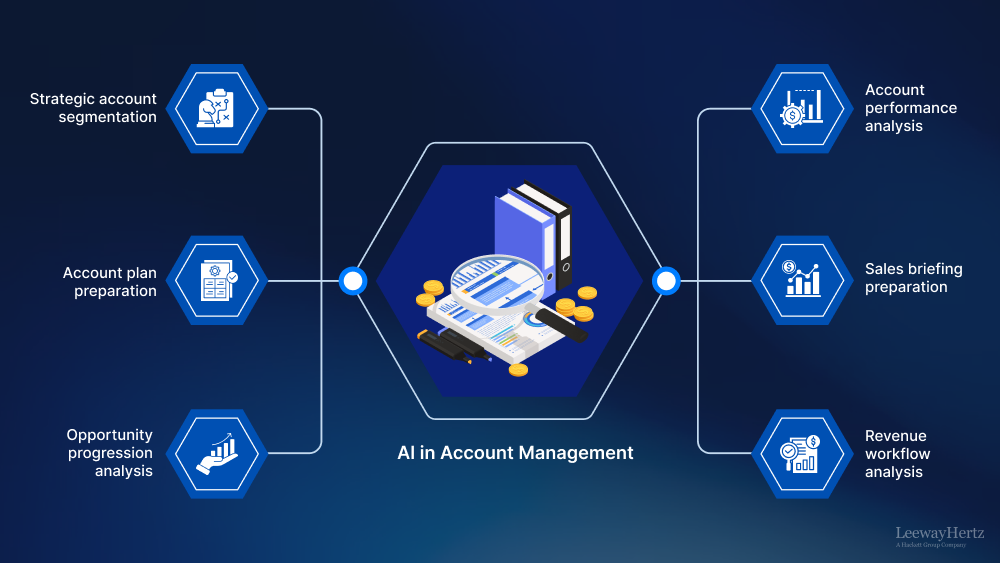
Account management has evolved from a client relationship-focused activity into a revenue operations function responsible for maximizing account value, improving customer retention, supporting expansion, and aligning customer-facing teams around revenue objectives. Modern account teams operate at the intersection of sales, customer success, marketing, finance, and operations, managing account strategies, pipeline activity, customer engagement, renewals, and growth opportunities.
The challenge is that account intelligence is distributed across the systems that support the revenue lifecycle. CRM platforms contain account records, opportunity data, sales activity, and ownership information. Customer success platforms contain adoption signals and engagement history. Contract repositories contain commercial commitments. Support platforms contain service interactions. Marketing platforms contain engagement data. Finance systems contain revenue information. Bringing these sources together into a complete account view often requires significant manual effort.
Revenue teams spend substantial time preparing account reviews, validating CRM data, analyzing pipeline movement, tracking expansion opportunities, preparing forecasts, and coordinating information across functions. These activities are necessary for revenue visibility, but fragmented systems and inconsistent processes can make it difficult for account teams to identify priorities and act with confidence.
AI addresses this gap by helping revenue teams convert fragmented account information into structured intelligence. Capabilities such as multi-source aggregation can combine account records across systems, document intelligence can extract commercial information from agreements and account documents, classification can organize account activity and opportunity information, predictive analytics can identify patterns requiring review, and natural-language generation can prepare account summaries, forecasts, and executive narratives.
The opportunity for AI in account management is closely connected to the maturity of revenue operations platforms. Organizations continue to invest in customer relationship management systems to centralize customer information, manage interactions, and support revenue processes. The global CRM software market continues to grow as businesses adopt platforms that connect customer data with sales and customer-facing operations. [1]
However, AI in account management is not about adding another conversational interface on top of CRM data. High-value AI opportunities require mapping capabilities to specific revenue workflows. For example, AI can prepare account planning documents from CRM and customer records, identify pipeline risks from opportunity activity, extract renewal obligations from contracts, or generate forecast commentary from approved revenue data. Humans continue to own account strategy, customer relationships, commercial decisions, and revenue commitments.
A governed AI approach begins by understanding account management as an operating model with defined functions, processes, sub-processes, systems, artifacts, and decision owners. This article uses the account management operating model to break revenue operations into functions and sub-processes, showing where AI can support execution while maintaining governance and human accountability.
- How AI is transforming account management operations
- Why AI use cases in account management must be mapped at the sub-process level
- Account management operating model and AI opportunity mapping across revenue operations processes
- High-value AI use cases in account management operations
- How agentic AI works in account management workflows
- How to prioritize AI use cases in account management
- Governance, risk, and responsible AI in account management
- How ZBrain operationalizes AI use cases in account management
- Future of AI in account management
How AI is transforming account management operations
Revenue operations depend on accurate account intelligence, consistent processes, and coordinated execution across customer-facing teams. Account management sits at the center of this operating model because it connects customer relationships with revenue outcomes, including pipeline growth, retention, expansion, forecasting, and account performance.
AI creates value when applied to the operational patterns that define account management:
-
analyzing large volumes of account and revenue information,
-
preparing recurring business reviews,
-
identifying account changes and revenue signals,
-
maintaining CRM quality,
-
retrieving relevant commercial context,
-
coordinating workflows across sales, customer success, finance, and operations.
Account management workflows commonly involve five categories of work:
Document-heavy work: Revenue teams manage contracts, account plans, proposals, renewal documents, customer agreements, opportunity records, and business review materials. AI can apply document intelligence to extract relevant information, identify missing context, compare records, and prepare structured summaries before human review.
Narrative-heavy work: RevOps teams regularly create forecast commentary, account reviews, pipeline summaries, executive briefings, and revenue reports. Natural-language generation can draft these materials from approved accounts and revenue data while maintaining evidence references.
Exception-heavy work: Revenue processes frequently contain stalled opportunities, incomplete CRM records, delayed renewals, inconsistent account information, and pipeline exceptions. Classification and anomaly detection can identify and organize these issues, enabling teams to prioritize review.
Knowledge-heavy work: Account teams need access to pricing information, contracts, customer history, sales methodologies, product information, and internal processes. Retrieval-grounded answering can surface relevant information from approved sources during account planning and decision-making.
Workflow-heavy work: Account management requires coordination between sales, customer success, marketing, finance, and operations. AI can help assemble account review packages, prepare handoff information, identify missing inputs, and coordinate workflow steps while keeping approvals with responsible teams.
The practical design rule is that AI should be connected to revenue workflows rather than deployed as a standalone productivity tool. The strongest implementations start with defined account processes, reliable revenue data, clear ownership, and review boundaries for decisions that affect customers or revenue outcomes.
Build governed AI workflows for account management
Design, validate, and deploy AI solutions across account management workflows with governance embedded from strategy through execution.
Why AI use cases in account management must be mapped at the sub-process level
AI in account management initiatives often begins with broad objectives such as “improve account intelligence,” “optimize renewals,” or “increase sales productivity.” These goals describe business outcomes, but they do not provide enough detail to design governed AI workflows.
Revenue operations contain multiple activities with different systems, artifacts, ownership models, and risk levels. Preparing an account plan, reviewing pipeline health, enriching CRM records, analyzing renewal readiness, and generating forecast commentary are distinct workflows that require different AI capabilities.
A better approach is to map AI use cases to the account management operating model:
-
Function: A governed revenue operations domain with defined accountability, such as account planning, pipeline management, forecasting, CRM governance, or revenue analytics.
-
Process: A workflow area within a function, such as account segmentation, opportunity review, renewal preparation, or performance reporting.
-
Sub-process: A specific operational activity that starts with defined inputs and produces a reviewable output, such as extracting contract obligations, preparing account intelligence, identifying pipeline changes, or validating CRM records.
-
AI-enabled opportunity: A specific application of AI capability to a sub-process where the system analyzes, retrieves, classifies, generates, or prepares information while a responsible human retains decision authority.
For example, “AI for account growth” is too broad to implement directly. A sub-process-level view identifies specific opportunities, such as classifying account activity to identify expansion signals, using predictive analytics to identify pipeline patterns requiring review, or using natural-language generation to prepare account growth summaries.
This approach makes AI implementation practical because each opportunity can be linked to specific revenue artifacts, such as CRM records, contracts, opportunity histories, account plans, and forecast documents. It also defines who reviews outputs and where governance controls must apply.
Mapping AI at the sub-process level prevents over-automation. AI can prepare account intelligence, summarize revenue information, identify patterns, and support workflows. Revenue leaders, account owners, and business stakeholders continue to decide account strategy, approve commercial actions, and manage customer relationships.
The next section maps the complete revenue operations account management operating model, covering the functions, processes, sub-processes, and AI opportunities across the account lifecycle.
Account management operating model and AI opportunity mapping across revenue operations processes
Account management within revenue operations connects account intelligence, sales execution, customer lifecycle management, revenue planning, and operational governance. The operating model below decomposes account management into functions, processes, and sub-processes to identify where AI capabilities can support analysis, preparation, prioritization, and workflow coordination while preserving human ownership of revenue decisions.
Function 1: Account segmentation and strategic account planning
Transforms market information, customer attributes, revenue potential, and business priorities into structured account strategies that guide coverage and investment decisions.
Account segmentation and strategic account planning establish how organizations prioritize accounts, allocate resources, and define engagement strategies. This function helps revenue teams determine which accounts require strategic attention, how accounts should be covered, and where growth opportunities may exist.
It feeds account planning, sales coverage decisions, opportunity management, customer engagement, and revenue forecasting activities.
Teams involved
Revenue operations teams, sales operations teams, account executives, sales leadership, marketing teams, customer success teams, finance teams, and business strategy teams manage account segmentation and planning.
What AI helps with
AI can apply classification to organize accounts based on attributes such as industry, revenue contribution, customer profile, engagement history, and strategic importance. Multi-source aggregation can combine CRM data, financial information, customer engagement records, and market information into account intelligence views. Predictive analytics can identify account patterns that support prioritization decisions. Natural-language generation can prepare account planning summaries from approved information.
What humans continue to own
Sales leaders and revenue operations teams define segmentation criteria, coverage models, and strategic priorities. Account owners decide relationship strategies, resource allocation, and engagement approaches. AI analyzes account information, identifies patterns, and prepares planning materials, but does not decide account priority, assign strategic value, or approve coverage decisions.
| Process | Sub-process | Key AI-enabled opportunities |
|---|---|---|
| Account segmentation | Account classification |
|
| Strategic account identification |
|
|
| Coverage planning | Territory and account ownership analysis |
|
| Account prioritization | Account investment prioritization |
|
Highest-value opportunities
-
Account classification: Segmentation drives downstream sales coverage, prioritization, and resource allocation.
-
Strategic account identification: Strategic accounts require coordinated planning across revenue teams.
-
Territory and ownership analysis: Accurate ownership improves accountability and reduces coverage gaps.
Example agentic workflow
- Account classification begins with CRM account records, revenue information, customer attributes, engagement history, and approved business criteria.
- The AI workflow aggregates account data from connected systems and classifies accounts according to defined segmentation rules.
- The workflow generates a segmentation report containing account categories, supporting evidence, and identified data gaps.
- Human-in-the-loop checkpoint: Revenue operations leaders review the segmentation output, validate business relevance, and approve the final account classification approach.
- The approved segmentation information is updated within existing revenue operations systems under established governance controls.
Function 2: Account intelligence and revenue data foundation
Transforms fragmented customer, commercial, and operational records into reliable account intelligence that supports revenue workflows.
Account intelligence and data foundation provide the information layer required for effective account management. Revenue teams depend on accurate account records, complete CRM information, account hierarchies, customer history, and commercial context to manage opportunities and customer relationships.
This function supports account planning, pipeline management, forecasting, reporting, and cross-functional revenue alignment.
Teams involved
Revenue operations teams, CRM administrators, sales operations teams, data governance teams, IT teams, account teams, marketing operations teams, and business system owners manage account intelligence.
What AI helps with
AI can apply anomaly detection to identify duplicate records, incomplete account information, and inconsistencies across revenue systems. Document intelligence can extract missing account details from customer documents, agreements, and business records. Classification can organize account data quality issues by type and priority. Retrieval-grounded answering can help teams access approved account knowledge across repositories.
What humans continue to own
Revenue operations and data owners define CRM standards, approve data corrections, and establish account information governance policies. Stakeholders validate account accuracy and determine the operational impact of data changes. AI identifies inconsistencies, prepares recommendations, and supports retrieval but does not modify governed records, approve data standards, or attest to data accuracy.
| Process | Sub-process | Key AI-enabled opportunities |
|---|---|---|
| Account data management | Account profile enrichment |
|
| CRM governance | Account data quality management |
|
| Account hierarchy management | Account relationship mapping |
|
| Knowledge management | Account knowledge consolidation |
|
Highest-value opportunities
-
CRM data quality management: High-value because downstream revenue processes depend on accurate account information.
-
Account profile enrichment: Valuable because account teams often require information from multiple systems.
-
Account knowledge consolidation: Important because revenue decisions require historical context.
Example agentic workflow
- Account profile enrichment begins with CRM records, customer documents, contracts, and approved revenue data sources.
- The AI workflow extracts relevant account information, compares existing records, and identifies missing or inconsistent attributes.
- The workflow prepares an enrichment package containing proposed updates and supporting source references.
- Human-in-the-loop checkpoint: The CRM owner or revenue operations analyst reviews the proposed changes and approves updates before records are modified.
- Approved account information is processed through existing CRM governance workflows.
Function 3: Account planning and execution management
Transforms account objectives, stakeholder information, commercial priorities, and engagement activities into structured plans for revenue execution.
Account planning and execution management connect strategic account objectives with day-to-day revenue activities. It helps teams coordinate account goals, stakeholder engagement, opportunity development, and internal actions required to achieve account outcomes.
This function feeds sales execution, expansion planning, customer engagement, and executive account reviews.
Teams involved
Account executives, account managers, sales operations teams, revenue operations teams, customer success managers, sales leaders, marketing teams, and executive sponsors manage account planning activities.
What AI helps with
AI can apply retrieval-grounded answering to surface historical account information, previous interactions, contracts, and customer objectives. Natural-language generation can prepare account plans, stakeholder summaries, and executive briefs from approved information. Classification can organize account objectives, activities, and stakeholders. Multi-source aggregation can combine account data across revenue systems.
What humans continue to own
Account owners determine customer strategy, relationship approach, business objectives, and engagement priorities. Sales leaders approve account plans and resource commitments. AI prepares account intelligence, organizes information, and drafts planning artefacts but does not define strategy, negotiate priorities, or approve account actions.
| Process | Sub-process | Key AI-enabled opportunities |
|---|---|---|
| Account planning | Account plan creation |
|
| Stakeholder management | Stakeholder mapping |
|
| Account execution | Objective tracking |
|
| Account reviews | Executive account briefing |
|
Highest-value opportunities
-
Account plan creation: High-value because account plans require inputs from multiple systems and stakeholders.
-
Stakeholder mapping: Valuable because relationship intelligence directly affects account execution.
-
Executive account briefing: Important because leadership decisions require concise, evidence-backed context.
Example agentic workflow
- Account plan creation begins with CRM account records, opportunity information, customer history, contracts, and strategic objectives.
- The AI workflow retrieves approved account information, aggregates relevant records, and prepares an account plan draft.
- The workflow organizes account objectives, stakeholders, opportunities, risks, and planned activities.
- Human-in-the-loop checkpoint: The account owner and sales leader review the account plan, validate strategic direction, and approve the final version.
- The approved account plan is stored within the existing CRM and revenue operations systems.
Function 4: Opportunity and pipeline management
Transforms account signals, sales activities, customer interactions, and opportunity records into structured pipeline intelligence for revenue teams.
Opportunity and pipeline management is a core revenue operations function responsible for maintaining pipeline visibility, improving opportunity quality, supporting deal progression, and aligning account activities with revenue objectives. It connects account intelligence to sales execution by ensuring that opportunities are accurately captured, reviewed, and managed throughout the revenue lifecycle.
This function feeds forecasting, sales leadership reviews, account planning, expansion activities, and revenue performance management.
Teams involved
Sales operations teams, revenue operations teams, account executives, sales leaders, marketing teams, customer success teams, finance teams, and business analysts manage opportunity and pipeline activities.
What AI helps with
AI can apply classification to categorize opportunities based on stage, account priority, activity patterns, and qualification criteria. Predictive analytics can analyze historical opportunity information, engagement signals, and pipeline movement patterns to identify opportunities requiring review. Multi-source aggregation can combine CRM records, customer interactions, activity history, and account information into opportunity intelligence views. Natural-language generation can prepare pipeline summaries and opportunity review materials.
What humans continue to own
Sales leaders and account owners determine opportunity strategy, customer engagement approach, qualification decisions, and commercial actions. Revenue operations teams define pipeline standards and reporting requirements. AI analyzes opportunity information, identifies patterns, and prepares review materials, but does not qualify opportunities, commit revenue, negotiate deals, or approve pipeline decisions.
| Process | Sub-process | Key AI-enabled opportunities |
|---|---|---|
| Pipeline management | Opportunity data validation |
|
| Opportunity management | Opportunity qualification support |
|
| Pipeline management | Opportunity progression analysis |
|
| Sales inspection | Pipeline review preparation |
|
Highest-value opportunities
-
Opportunity data validation: High-value because pipeline quality directly affects revenue visibility and reporting accuracy.
-
Opportunity progression analysis: Valuable because sales teams need visibility into stalled or changing opportunities.
-
Pipeline review preparation: Important because leadership reviews require consistent information across opportunities.
Example agentic workflow
- Pipeline review preparation begins with CRM opportunity records, account information, sales activity history, and customer interaction records.
- The AI workflow aggregates approved opportunity data, classifies pipeline information, and prepares a review summary.
- The workflow organizes opportunity status, activity history, account context, and review considerations.
- Human-in-the-loop checkpoint: Sales leaders and account owners validate the pipeline analysis, add business context, and confirm the review priorities.
- The approved pipeline review package is stored within existing revenue operations workflows.
Function 5: Revenue forecasting and account performance management
Transforms account activity, opportunity information, commercial records, and performance data into structured revenue insights for planning and decision support.
Revenue forecasting and account performance management help organizations understand revenue trends, evaluate account contribution, support leadership reviews, and improve planning accuracy. It connects account-level information with broader revenue operations processes.
This function supports executive reporting, sales planning, pipeline reviews, account prioritization, and revenue strategy.
Teams involved
Revenue operations teams, sales operations teams, finance teams, sales leadership, account executives, business intelligence teams, and executive stakeholders manage forecasting and performance activities.
What AI helps with
AI can apply predictive analytics to identify patterns in historical revenue information, opportunity activity, account engagement, and commercial signals for review. Multi-source aggregation can combine CRM data, financial records, opportunity information, and account activity into performance views. Natural-language generation can prepare forecast commentary, revenue summaries, and executive reports. Anomaly detection can highlight unusual changes in account performance indicators.
What humans continue to own
Finance teams and revenue leaders determine forecasting assumptions, revenue expectations, and business decisions. Account owners provide customer context and validate account-level conditions. AI analyzes patterns, prepares commentary, and highlights areas for review, but does not commit forecasts, approve revenue plans, or determine financial outcomes.
| Process | Sub-process | Key AI-enabled opportunities |
|---|---|---|
| Forecast management | Forecast commentary preparation |
|
| Performance management | Account performance analysis |
|
| Revenue reporting | Executive revenue reviews |
|
| Performance monitoring | Revenue anomaly analysis |
|
Highest-value opportunities
-
Forecast commentary preparation: High-value because leaders require context behind revenue numbers.
-
Account performance analysis: Valuable because account-level insights support strategic decisions.
-
Revenue anomaly analysis: Important because unexpected changes require timely human review.
Example agentic workflow
- Forecast commentary preparation begins with opportunity records, account information, revenue data, and approved performance metrics.
- The AI workflow aggregates revenue information, retrieves supporting account context, and prepares forecast commentary.
- The workflow organizes revenue movements, account-level drivers, pipeline changes, and supporting evidence.
- Human-in-the-loop checkpoint: Revenue leaders and finance reviewers validate the commentary before it is used in forecasting discussions.
- The approved forecast narrative is stored within existing revenue reporting workflows.
Accelerate AI Solutions Development
Build fully functional solutions from your high-value use cases, based on specific operational needs and enterprise context.
Function 6: Customer lifecycle and retention operations
Transforms customer lifecycle information, account activity, service data, and commercial commitments into structured retention and lifecycle management workflows.
Customer lifecycle and retention operations connect account management with customer success, sales, and operational teams to maintain account continuity, improve customer outcomes, and support renewal readiness. While customer success owns many customer engagement activities, RevOps ensures the processes, systems, and data supporting those activities operate consistently.
This function supports onboarding coordination, adoption tracking, renewal preparation, and retention planning.
Teams involved
Revenue operations teams, customer success teams, account managers, sales operations teams, finance teams, support teams, and business operations teams manage lifecycle operations.
What AI helps with
AI can apply document intelligence to extract customer commitments, service terms, and renewal information from agreements. Classification can organize lifecycle activities, customer signals, and retention indicators. Predictive analytics can analyze account activity patterns for review to flag risks, surface opportunities, and support account reviews. Retrieval-grounded answering can surface customer history, commitments, and previous decisions.
What humans continue to own
Account owners and customer success leaders decide customer engagement strategies, retention approaches, and relationship actions. Legal and finance teams review contractual and commercial implications. AI prepares lifecycle intelligence, identifies patterns, and supports workflow coordination, but does not determine retention decisions, approve renewals, or manage customer relationships.
| Process | Sub-process | Key AI-enabled opportunities |
|---|---|---|
| Customer onboarding operations | Onboarding readiness review |
|
| Adoption operations | Adoption signal analysis |
|
| Renewal operations | Renewal readiness analysis |
|
| Retention operations | Retention review preparation |
|
Highest-value opportunities
-
Renewal readiness analysis: High-value because renewal decisions require information from contracts, customer history, and operational records.
-
Adoption signal analysis: Valuable because account engagement patterns influence retention planning.
-
Retention review preparation: Important because proactive review depends on consolidated account intelligence.
Example agentic workflow
- Renewal readiness analysis begins with customer agreements, amendments, CRM records, customer success plans, and engagement history.
- The AI workflow extracts renewal information, retrieves account context, and prepares a renewal readiness summary.
- The workflow organizes renewal timelines, contractual commitments, customer activity, and review considerations.
- Human-in-the-loop checkpoint: The account owner and relevant business reviewers validate the renewal analysis before customer or commercial discussions.
- The approved renewal package is stored within the existing CRM and revenue operations systems.
Function 7: Expansion and growth management
Transforms account intelligence, customer signals, commercial context, and market information into structured growth opportunities.
Expansion and growth management help revenue teams identify additional revenue opportunities within existing accounts. It connects account strategy, customer needs, product alignment, and sales execution to support cross-sell and upsell motions.
This function supports account growth planning, opportunity creation, pipeline development, and revenue strategy.
Teams involved
Account executives, sales operations teams, revenue operations teams, customer success teams, product teams, marketing teams, and sales leadership manage expansion activities.
What AI helps with
AI can apply classification to identify account growth signals from customer interactions, product adoption data, opportunity history, and engagement records. Predictive analytics analyzes account activity patterns to surface expansion signals and growth opportunities. Retrieval-grounded answering can surface customer objectives, product information, contracts, and previous discussions. Natural-language generation can prepare expansion briefs.
What humans continue to own
Account owners determine whether expansion opportunities align with customer needs, engage customers, negotiate commercial terms, and approve sales actions. Product and business leaders determine the offering strategy. AI identifies signals, prepares analysis, and supports opportunity reviews but does not create commercial commitments or approve growth decisions.
| Process | Sub-process | Key AI-enabled opportunities |
|---|---|---|
| Growth management | Expansion signal identification |
|
| Opportunity development | Expansion opportunity qualification |
|
| Growth planning | Cross-sell and upsell analysis |
|
| Account review | Expansion review preparation |
|
Highest-value opportunities
-
Expansion signal identification: High-value because growth opportunities often appear across fragmented account interactions.
-
Expansion qualification: Valuable because consistent evaluation improves opportunity review quality.
-
Growth review preparation: Important because expansion decisions require cross-functional context.
Example agentic workflow
- Expansion signal identification begins with CRM activity, account records, customer interactions, product usage information, and approved market data.
- The AI workflow classifies account signals, retrieves relevant customer context, and identifies potential growth themes.
- The workflow prepares an expansion signal report containing evidence, customer context, and related opportunities.
- Human-in-the-loop checkpoint: The account owner reviews the identified signals, validates customer relevance, and decides whether further exploration is appropriate.
- Approved growth opportunities are transferred into existing CRM and revenue workflows.
Function 8: Sales productivity and enablement
Transforms account intelligence, sales knowledge, and revenue processes into structured resources that help customer-facing teams prepare, execute, and improve account activities.
Sales productivity and enablement ensure that account teams have access to the information, processes, and resources required to manage accounts effectively. It connects revenue intelligence with sales execution by supporting account preparation, seller workflows, knowledge access, and consistent adoption of revenue practices.
This function supports account planning, opportunity management, customer engagement, sales execution, and onboarding of revenue teams.
Teams involved
Sales enablement teams, revenue operations teams, sales operations teams, account executives, sales leadership, marketing teams, product marketing teams, and customer success teams manage sales productivity and enablement activities.
What AI helps with
AI can apply retrieval-grounded answering to provide account teams with relevant product information, customer history, sales playbooks, pricing information, and internal knowledge. Natural-language generation can prepare account briefs, opportunity summaries, and sales preparation materials. Classification can organize sales content and knowledge assets. Multi-source aggregation can combine account records, opportunity information, and customer intelligence into seller-ready views.
What humans continue to own
Sales leaders define sales methodologies, enablement strategies, and execution standards. Account teams determine customer approaches, messaging, and engagement decisions. AI retrieves information, prepares materials, and supports productivity, but does not define sales strategy, communicate independently with customers, or approve commercial decisions.
| Process | Sub-process | Key AI-enabled opportunities |
|---|---|---|
| Sales enablement | Account briefing preparation |
|
| Sales knowledge management | Sales content retrieval |
|
| Seller productivity | Sales preparation support |
|
| Sales enablement operations | Training and adoption support |
|
Highest-value opportunities
-
Account briefing preparation: High-value because sellers often spend significant time gathering customer context before interactions.
-
Sales knowledge retrieval: Valuable because critical information is frequently distributed across repositories.
-
Sales preparation support: Important because consistent preparation improves execution quality.
Example agentic workflow
- Account briefing preparation begins with CRM records, opportunity information, customer history, sales content, and approved knowledge sources.
- The AI workflow retrieves relevant information, aggregates account context, and prepares a structured briefing document.
- The workflow organizes customer objectives, opportunity history, previous interactions, and relevant sales resources.
- Human-in-the-loop checkpoint: The account executive reviews the briefing, validates relevance, and adjusts priorities before customer engagement.
- The approved briefing is stored or accessed through existing sales enablement workflows.
Function 9: Revenue process management and workflow orchestration
Transforms revenue workflows, cross-functional dependencies, and operating procedures into coordinated execution processes across customer-facing teams.
Revenue process management ensures that account-related activities follow consistent workflows across sales, marketing, customer success, finance, and operations. It focuses on improving handoffs, reducing process gaps, maintaining execution standards, and ensuring teams operate from common processes.
This function supports opportunity management, customer lifecycle processes, forecasting, account reviews, and revenue governance.
Teams involved
Revenue operations teams, sales operations teams, customer success operations teams, marketing operations teams, finance teams, business systems teams, and functional leaders manage revenue workflows.
What AI helps with
AI can apply classification to categorize workflow activities, ownership gaps, and process exceptions. Multi-source aggregation can combine workflow records, CRM activities, approval histories, and operational data. Anomaly detection can identify process deviations such as incomplete handoffs or stalled activities. Natural-language generation can prepare process reviews and operational summaries.
What humans continue to own
Revenue operations leaders define operating processes, ownership models, and workflow standards. Functional leaders approve process changes and determine corrective actions. AI identifies workflow patterns, prepares analysis, and supports coordination but does not redesign processes independently, approve operational changes, or assign accountability.
| Process | Sub-process | Key AI-enabled opportunities |
|---|---|---|
| Revenue workflow management | Cross-functional handoff analysis |
|
| Process governance | Workflow compliance review |
|
| Workflow optimization | Process bottleneck analysis |
|
| Revenue coordination | Activity tracking |
|
Highest-value opportunities
-
Cross-functional handoff analysis: High-value because revenue execution depends on coordination between multiple teams.
-
Workflow compliance review: Valuable because consistent processes improve revenue visibility.
-
Process bottleneck analysis: Important because operational delays can affect customer and revenue outcomes.
Example agentic workflow
- Cross-functional handoff analysis begins with CRM records, workflow histories, ownership information, and related revenue process documents.
- The AI workflow aggregates workflow data, classifies handoff issues, and identifies incomplete information.
- The workflow prepares a handoff analysis report containing affected processes and supporting evidence.
- Human-in-the-loop checkpoint: Revenue operations leaders review the findings, validate process issues, and determine improvement actions.
- Approved workflow changes are managed through existing revenue operations governance processes.
Function 10: Revenue data governance and CRM operations
Transforms revenue data standards, CRM records, and system controls into reliable foundations for account execution and decision-making.
Revenue data governance ensures that account, opportunity, customer, and commercial information remains accurate, complete, secure, and usable across revenue workflows. Since CRM systems are central to revenue operations, data quality directly influences forecasting, reporting, pipeline management, and account decisions.
Teams involved
Revenue operations teams, CRM administrators, sales operations teams, data governance teams, IT teams, security teams, business system owners, and account teams manage revenue data governance.
What AI helps with
AI can apply anomaly detection to identify duplicate records, incomplete fields, inconsistent account hierarchies, and data quality issues. Classification can categorize CRM issues by type, ownership, and priority. Document intelligence can extract missing information from approved business documents. Retrieval-grounded answering can help teams access governed revenue knowledge.
What humans continue to own
Data owners define CRM standards, approve record corrections, and establish governance policies. Security teams manage access requirements and data protection controls. Business teams validate information accuracy. AI identifies issues, prepares recommendations, and supports analysis but does not modify governed records, approve data policies, or attest to data quality.
| Process | Sub-process | Key AI-enabled opportunities |
|---|---|---|
| CRM operations | CRM data quality management |
|
| Account data management | Account record enrichment |
|
| CRM governance | Account hierarchy management |
|
| Access governance | Revenue information controls |
|
Highest-value opportunities
-
CRM data quality management: High-value because revenue decisions depend on reliable CRM information.
-
Account record enrichment: Valuable because complete account data improves downstream workflows.
-
Account hierarchy management: Important because complex organizations require accurate relationship structures.
Example agentic workflow
- CRM data quality management begins with account records, opportunity data, customer information, and CRM governance rules.
- The AI workflow analyzes records, identifies inconsistencies, and classifies data quality issues.
- The workflow prepares a CRM quality review package with affected records and supporting evidence.
- Human-in-the-loop checkpoint: The CRM administrator or revenue operations analyst reviews identified issues and approves corrections.
- Approved changes are processed through existing CRM governance workflows.
Function 11: Revenue analytics and insights
Transforms revenue data, account performance indicators, pipeline activity, and operational metrics into structured intelligence for revenue decision-making.
Revenue analytics and insights provide the measurement layer for revenue operations. This function connects account-level activity with broader revenue performance by analyzing account contribution, pipeline movement, customer engagement, sales execution, and operational effectiveness.
It supports executive reporting, sales planning, account reviews, performance management, and continuous improvement initiatives.
Teams involved
Revenue operations teams, sales operations teams, business intelligence teams, finance teams, sales leadership, account teams, customer success teams, and executive stakeholders manage revenue analytics activities.
What AI helps with
AI can apply multi-source aggregation to combine CRM records, opportunity data, revenue information, customer activity, and operational metrics into structured analysis. Predictive analytics can identify historical patterns and emerging trends requiring review. Anomaly detection can highlight unusual changes in account performance, pipeline activity, or operational metrics. Natural-language generation can prepare revenue narratives, executive summaries, and performance reports from approved data.
What humans continue to own
Revenue leaders and business stakeholders interpret analytical findings, define strategic actions, and make operational decisions. Finance teams validate financial information and reporting requirements. Account owners provide customer and market context. AI identifies patterns, prepares analysis, and supports reporting, but does not determine revenue strategy, approve business decisions, or attest to financial outcomes.
| Process | Sub-process | Key AI-enabled opportunities |
|---|---|---|
| Revenue analytics | Account performance analysis |
|
| Pipeline analytics |
|
|
| Revenue reporting | Executive revenue reporting |
|
| Revenue intelligence | Trend and pattern analysis |
|
Highest-value opportunities
-
Account performance analysis: High-value because revenue teams need visibility into account contribution and execution.
-
Executive revenue reporting: Valuable because leaders require consistent, evidence-backed summaries.
-
Pipeline analytics: Important because pipeline quality directly affects revenue planning.
Example agentic workflow
- Executive revenue reporting begins with CRM records, opportunity information, revenue data, account performance metrics, and approved reporting definitions.
- The AI workflow aggregates revenue information, retrieves supporting context, and prepares an executive revenue summary.
- The workflow organizes account performance, pipeline movements, revenue trends, and supporting evidence.
- Human-in-the-loop checkpoint: Revenue leaders and finance stakeholders review the generated report, validate the interpretation, and approve the final reporting narrative.
- The approved revenue report is stored within existing business intelligence and revenue reporting systems.
Function 12: Revenue strategy and continuous improvement
Transforms operational insights, revenue performance data, and business priorities into improvements across account management processes and go-to-market execution.
Revenue strategy and continuous improvement ensure that revenue operations continually evaluate how account management processes perform and identify opportunities to improve effectiveness. It connects analytics, feedback, process reviews, and business priorities to refine revenue operating models.
This function supports go-to-market planning, process optimization, sales effectiveness, and operational maturity.
Teams involved
Revenue operations leaders, sales operations teams, business strategy teams, sales leadership, customer success leadership, finance teams, marketing operations teams, and executive stakeholders manage continuous improvement activities.
What AI helps with
AI can apply classification to identify recurring process themes, operational challenges, and improvement opportunities from revenue records. Multi-source aggregation can combine performance metrics, workflow data, feedback records, and operational reviews. Retrieval-grounded answering can surface previous process decisions, playbooks, and internal knowledge. Natural-language generation can prepare strategy review documents and improvement recommendations.
What humans continue to own
Revenue leaders determine strategic priorities, approve changes to the operating model, and allocate resources. Business stakeholders decide which improvements should be implemented. AI identifies patterns, prepares analysis, and supports planning, but does not define revenue strategy, approve investments, or determine organizational priorities.
| Process | Sub-process | Key AI-enabled opportunities |
|---|---|---|
| Revenue strategy | Operating model review |
|
| Process improvement | Revenue workflow optimization |
|
| Sales effectiveness | Revenue practice analysis |
|
| Strategic planning | Go-to-market improvement support |
|
Highest-value opportunities
-
Revenue workflow optimization: High-value because process improvements affect multiple revenue teams.
-
Operating model review: Valuable because strategic decisions require consolidated operational evidence.
-
Revenue practice analysis: Important because identifying effective patterns supports repeatable execution.
Example agentic workflow
- Operating model review begins with revenue metrics, workflow records, account performance data, process documentation, and business feedback.
- The AI workflow aggregates approved information, identifies recurring patterns, and prepares an operating review summary.
- The workflow organizes process observations, supporting evidence, and potential improvement areas.
- Human-in-the-loop checkpoint: Revenue leadership reviews the analysis, validates business priorities, and decides which improvements should move forward.
- Approved improvements are incorporated into existing revenue operations planning processes.
Function 13: Revenue governance, compliance, and controls
Transforms revenue policies, approval requirements, data controls, and operating standards into governed account management practices.
Revenue governance ensures that account management activities operate within defined policies, approval structures, data standards, and business controls. It provides oversight across CRM usage, pipeline management, forecasting processes, customer information handling, and revenue reporting.
This function ensures revenue operations remain consistent, auditable, and aligned with organizational requirements.
Teams involved
Revenue operations teams, sales operations teams, compliance teams, finance teams, security teams, CRM administrators, legal teams, and business leaders manage revenue governance activities.
What AI helps with
AI can apply document intelligence to review revenue process documentation, account records, and governance artifacts for completeness. Classification can organize policy exceptions, approval requirements, and process deviations. Retrieval-grounded answering can surface relevant policies, procedures, and governance standards. Anomaly detection can identify unusual activity patterns requiring review.
What humans continue to own
Business owners define governance requirements, approve exceptions, and attest to process compliance. Finance and compliance teams review reporting controls and policy alignment. Security teams manage data protection requirements. AI identifies patterns, prepares documentation, and supports reviews but does not approve exceptions, certify compliance, or attest to control effectiveness.
| Process | Sub-process | Key AI-enabled opportunities |
|---|---|---|
| Revenue governance | Process compliance review |
|
| Approval management | Revenue approval tracking |
|
| Data governance | Revenue control monitoring |
|
| Audit readiness | Evidence preparation |
|
Highest-value opportunities
-
Process compliance review: High-value because consistent execution improves revenue process reliability.
-
Evidence preparation: Valuable because governance reviews require structured supporting records.
-
Revenue control monitoring: Important because data and process controls protect revenue operations’ integrity.
Example agentic workflow
- Evidence preparation begins with CRM records, approval histories, revenue process documents, and governance requirements.
- The AI workflow retrieves relevant records, extracts supporting evidence, and organizes governance documentation.
- The workflow prepares an evidence package containing source records, approvals, and process documentation.
- Human-in-the-loop checkpoint: Revenue operations and compliance reviewers validate the evidence package before it is used for governance reporting.
- The approved evidence package is stored within existing governance and documentation systems.
Accelerate AI Solutions Development
Build fully functional solutions from your high-value use cases, based on specific operational needs and enterprise context.
High-value AI use cases in account management operations
AI creates the most value in account management when it is applied to workflows that require repeated analysis, information consolidation, structured decision preparation, and coordination across revenue teams. The highest-value AI opportunities are not defined by the presence of AI technology alone, but by whether the workflow has reliable revenue artifacts, clear ownership, measurable business impact, and a defined human review boundary.
Account management workflows generate large volumes of CRM records, opportunity data, account plans, contracts, customer interactions, performance reports, and operational records. AI capabilities such as predictive analytics, document intelligence, classification, retrieval-grounded answering, multi-source aggregation, anomaly detection, and natural-language generation can help revenue teams convert these inputs into structured intelligence.
| Use case | Function | How AI creates high-value impact |
|---|---|---|
| Strategic account segmentation | Account segmentation and strategic account planning |
|
| Account intelligence generation | Account intelligence and revenue data foundation |
|
| Account plan preparation | Account planning and execution management |
|
| Pipeline quality analysis | Opportunity and pipeline management |
|
| Opportunity progression analysis | Opportunity and pipeline management |
|
| Forecast commentary preparation | Revenue forecasting and account performance management |
|
| Account performance analysis | Revenue analytics and insights |
|
| Renewal readiness analysis | Customer lifecycle and retention operations |
|
| Expansion signal identification | Expansion and growth management |
|
| Sales briefing preparation | Sales productivity and enablement |
|
| Revenue workflow analysis | Revenue process management and workflow orchestration |
|
| CRM data quality management | Revenue data governance and CRM operations |
|
| Revenue performance reporting | Revenue analytics and insights |
|
| Revenue operating model improvement | Revenue strategy and continuous improvement |
|
| Revenue governance evidence preparation | Revenue governance, compliance, and controls |
|
High-value AI adoption in account management comes from improving how revenue teams work with information and workflows. The strongest opportunities are typically those where AI can reduce manual preparation, improve visibility across fragmented systems, and create consistent decision support while keeping revenue strategy, customer relationships, and commercial approvals with accountable teams.
How agentic AI works in account management workflows
Agentic AI in revenue operations account management should be designed as a governed sequence of actions that can retrieve approved information, analyze revenue records, prepare outputs, and coordinate workflow steps. The purpose is not to replace account owners or revenue leaders, but to reduce the manual effort involved in gathering context, preparing analysis, and coordinating cross-functional processes.
A governed account management agent operates within defined permissions, approved data sources, workflow rules, and human review checkpoints. It can analyze CRM activity, prepare account intelligence, summarize pipeline information, identify data quality issues, and generate review materials. However, account strategy, customer decisions, commercial approvals, and revenue commitments remain with responsible teams.
Here are some examples:
Account intelligence preparation agent
-
Agent role: Prepare a unified account intelligence brief from approved revenue data sources.
-
Retrieves CRM account records, opportunity history, customer engagement records, revenue information, and approved account documents.
-
Applies multi-source aggregation to combine account information and classification to organize account attributes, activities, and relationship context.
-
Generates an account intelligence package containing account overview, opportunity context, engagement history, and identified information gaps.
-
Human checkpoint: The account owner reviews the intelligence package, validates the account context, and confirms whether it can be used for planning or customer engagement activities.
Pipeline review agent
-
Agent role: Prepare pipeline review materials from opportunity records and account information.
-
Retrieves opportunity records, CRM activity history, account information, and pipeline review criteria.
-
Applies classification to organize opportunities by stage, activity status, and review category.
-
Uses anomaly detection to identify stalled opportunities, incomplete records, or unusual pipeline patterns requiring review.
-
Generates a pipeline review summary with supporting opportunity information.
-
Human checkpoint: Sales leaders and account owners validate the pipeline analysis and determine required follow-up actions.
Renewal readiness agent
-
Agent role: Prepare renewal insights from commercial records and account history.
-
Retrieves contracts, amendments, CRM records, customer engagement information, and renewal timelines.
-
Applies document intelligence to extract renewal dates, contractual obligations, and relevant terms.
-
Uses retrieval-grounded answering to surface previous renewal discussions, customer commitments, and account history.
-
Generates a renewal readiness brief.
-
Human checkpoint: Account owners and business reviewers validate renewal information before customer discussions or commercial decisions.
CRM data quality agent
-
Agent role: Identify and prepare CRM data quality issues for revenue operations review.
-
Retrieves account records, opportunity information, CRM standards, and approved data governance rules.
-
Applies anomaly detection to identify duplicates, missing fields, inconsistent records, and potential data quality issues.
-
Generates a CRM quality review package containing affected records and supporting evidence.
-
Human checkpoint: CRM administrators or revenue operations analysts review proposed corrections before any records are updated.
The safety property of agentic AI in account management is the review boundary: AI agents can retrieve, analyze, classify, and prepare, while revenue owners confirm decisions before outputs affect customer relationships, commercial actions, or revenue reporting.
How to prioritize AI use cases in account management
Not every revenue operations workflow is ready for AI adoption. The strongest candidates are processes where revenue artifacts are available, ownership is clear, workflow outcomes are measurable, and human review points can be established.
A structured prioritization approach helps organizations identify workflows where AI can create value while avoiding poorly scoped automation initiatives.
| Criterion | What to ask |
|---|---|
| Volume and frequency | Does this sub-process recur often enough for AI support to reduce manual effort at scale? |
| Artifact availability | Are the needed source artifacts available in usable systems with sufficient quality for AI analysis? |
| Review boundary | Can a defined role confirm the AI output before it affects a regulated or risk-bearing decision? |
| Blast radius | If the output is wrong, is the impact limited to a draft or triage queue rather than a live risk-bearing action? |
| Business impact | Can the function tie the use case to a credible outcome such as higher yield, lower effort, or reduced compliance risk? |
Revenue operations AI initiatives commonly fail because of four patterns:
Misaligned scope:
Organizations begin with broad goals such as “AI for sales productivity” or “AI for account management” without identifying the specific workflow, artifacts, and ownership model.
Missing data:
AI workflows become unreliable when CRM records are incomplete, account information is fragmented, or critical revenue data exists outside accessible systems.
Bypassed governance:
Deployments become risky when AI outputs are used without defined approval steps, access controls, monitoring, and accountability models.
Premature quantified savings:
Organizations estimate efficiency gains before understanding workflow complexity, data readiness, review requirements, and implementation constraints.
The strongest first projects are typically the high-volume, artifact-rich, cleanly reviewed sub-processes identified in the operating model, such as account intelligence preparation, CRM data quality management, pipeline review preparation, renewal readiness analysis, forecast commentary generation, and revenue reporting support.
Accelerate AI Solutions Development
Build fully functional solutions from your high-value use cases, based on specific operational needs and enterprise context.
Governance, risk, and responsible AI in account management
AI-enabled revenue operations workflows for account management operate on customer information, commercial records, opportunity data, account strategies, and revenue performance information. Governance ensures that AI outputs remain secure, traceable, explainable, and aligned with business responsibilities.
Organizations should align AI controls with recognized frameworks such as the NIST AI Risk Management Framework (AI RMF), while mapping these controls to revenue data governance, customer information policies, and operational requirements.
Human-in-the-loop (HITL) oversight:
AI can prepare account intelligence, summarize pipeline activity, identify CRM issues, and draft revenue reports. Named roles such as account owners, revenue leaders, finance teams, and operations teams must validate outputs before they influence customer decisions, revenue reporting, commercial actions, or operational changes.
Regulatory and standards alignment:
Organizations should define acceptable AI usage across revenue workflows and align controls with applicable privacy requirements, customer data policies, contractual obligations, and internal governance standards. Each AI workflow should have defined ownership, access requirements, review procedures, and escalation paths.
Bias mitigation and evidence retention:
AI outputs may be influenced by incomplete CRM data, historical sales patterns, or inconsistent account records. Organizations should retain source artifacts such as CRM records, retrieved documents, generated outputs, reviewer decisions, and approval histories so AI-supported recommendations remain inspectable.
Key governance requirements:
Revenue AI programs should maintain a use-case inventory that separates low-risk activities, such as summarization and retrieval, from higher-risk activities, such as account prioritization, scoring, or recommendation workflows. Each use case should have defined risk levels, approval gates, ownership roles, and escalation processes.
Design principles:
AI workflows should use approved revenue sources, least-privilege access, role-based controls, and scoped tool permissions. Agents should operate within defined boundaries and should not execute revenue-impacting actions without human confirmation.
Traceability and data security:
Organizations should maintain records of prompts, retrieved sources, model versions, reviewer decisions, approvals, and workflow updates. Revenue information should be protected through established security controls, access governance, and data protection practices.
How ZBrain operationalizes AI use cases in account management
Identifying use cases is only the first step. Account management teams need a controlled way to design, build, validate, deploy, govern, and scale AI workflows across account planning, customer research, relationship mapping, opportunity identification, renewal preparation, expansion planning, QBR preparation, customer health review, issue escalation, contract and pricing coordination, customer communication support, handoff management, and enterprise reporting.
This is where ZBrain helps.
ZBrain is an end-to-end AI enablement platform that supports this lifecycle through four connected stages: ZBrain Analyzer, ZBrain Design, ZBrain Solution Builder, and ZBrain Governance. The platform provides a governed path from use-case analysis to deployed agentic workflows while maintaining policies, permissions, approval points, monitoring, and runtime evidence.
ZBrain Analyzer
ZBrain Analyzer helps teams examine selected account management processes, identify AI opportunities, and document the business context, systems, data, artifacts, roles, controls, and review requirements needed to evaluate each use case.
ZBrain Design
ZBrain Design creates a build-ready technical design for the selected use case. It generates the business requirements document, functional requirements, user journeys, architecture, workflow logic, data specifications, integration context, and governance considerations needed before development begins.
ZBrain Solution Builder
ZBrain Solution Builder enables teams to create, configure, and validate governed AI workflows for account management processes based on the technical design developed in ZBrain Design. It supports testing across routine, exception, customer, commercial, renewal, and control scenarios before deployment.
ZBrain Governance
ZBrain Governance applies policies, access controls, human approval requirements, monitoring, and traceability throughout workflow execution. It provides guardrails, approval gates, escalation controls, kill switches, and audit trails to help organizations maintain oversight of AI outputs, reviewer actions, exceptions, and authorized system updates.
Future of AI in account management
The future of AI in account management will move from isolated productivity improvements toward connected revenue intelligence systems that coordinate workflows across the entire go-to-market organization. Revenue teams currently manage account information across CRM platforms, sales tools, customer success systems, finance platforms, communication channels, and knowledge repositories. Future AI operating models will focus on shared orchestration layers that connect these systems while maintaining governance, observability, and accountability.
Agentic AI will enable longer-horizon revenue workflows where systems can maintain context across multiple steps, prepare account intelligence, analyze pipeline movement, support forecasting processes, and coordinate information gathering across functions. However, the value of these workflows will depend on maintaining clear boundaries between software execution and human judgment. AI may prepare account plans, identify revenue signals, or assemble executive reports, but revenue leaders will continue to own account strategy, customer relationships, commercial decisions, and revenue commitments.
The advantage will increasingly shift from selecting a single AI model to designing workflows around specific revenue decisions. Organizations will combine models, data sources, tools, and governance controls based on the requirements of each account management process. A pipeline review workflow, for example, may require different data, controls, and evaluation methods than a CRM governance workflow or an account intelligence workflow.
As revenue operations matures, AI will become embedded into the operating model itself, helping teams improve visibility, coordinate execution, and manage revenue processes with greater consistency. The future of account management will depend on workflow design, governed data access, and operational discipline, not only on more capable AI models.
Endnote
Account management has become a critical component of revenue operations because it connects customer relationships with revenue outcomes. As organizations manage increasingly complex customer portfolios, distributed systems, and cross-functional responsibilities, revenue teams need better ways to transform fragmented information into actionable intelligence.
AI provides an opportunity to improve account management by supporting the workflows that consume significant operational effort: preparing account plans, analyzing pipeline activity, maintaining CRM quality, supporting forecasting, identifying expansion signals, and preparing revenue reviews.
However, successful AI adoption requires more than adding AI capabilities to existing revenue tools. Organizations need to understand their operating model, identify specific sub-processes, define data requirements, establish governance controls, and maintain human ownership over revenue decisions.
A workflow-level approach enables revenue operations teams to apply AI where it creates practical value: aggregating account intelligence, retrieving relevant knowledge, preparing decision materials, identifying patterns, and improving process consistency.
The organizations that benefit most from AI in account management will be those that combine technology with disciplined revenue processes, governed data practices, and clear accountability models.
Build governed AI workflows across your revenue operations processes for account management with ZBrain. Contact the ZBrain team today!
Author’s Bio


Akash's ability to build enterprise-grade technology solutions has garnered the trust of over 30 Fortune 500 companies, including Siemens, 3M, P&G, and Hershey's. Akash is an early adopter of new technology, a passionate technology enthusiast, and an investor in AI and IoT startups.
Related Products

AI Agent
Discover the right AI agent for your use case! Explore our extensive range of AI agents tailored to tackle specific challenges.
Start a conversation by filling the form
Once you let us know your requirement, our technical expert will schedule a call and discuss your idea in detail post sign of an NDA.
All information will be kept confidential.
FAQs
What is AI in account management?
AI in account management refers to applying artificial intelligence capabilities such as predictive analytics, classification, document intelligence, retrieval-grounded answering, anomaly detection, multi-source aggregation, and natural-language generation across revenue operations workflows.
It helps revenue teams analyze account information, prepare sales intelligence, improve CRM quality, support forecasting, and coordinate account processes while keeping revenue decisions with responsible teams.
Why is account management important in revenue operations?
Account management connects customer relationships with revenue execution. Within revenue operations, it supports account planning, pipeline visibility, expansion activities, renewals, forecasting, CRM governance, and alignment between sales, customer success, finance, and operations.
A strong account management operating model helps organizations manage customer value while improving revenue predictability and operational consistency.
How does AI improve account management workflows?
AI improves account management workflows by helping revenue teams:
- consolidate account information across systems,
- prepare account plans and executive summaries,
- analyze pipeline activity,
- identify CRM data issues,
- support renewal preparation,
- generate revenue commentary,
- retrieve relevant sales and customer knowledge.
AI supports preparation and analysis, while account owners and revenue leaders continue to make strategic and commercial decisions.
Which AI use cases are most vital in account management?
Key AI opportunities across revenue operations in account management include:
- Account strategy and planning: Account segmentation, strategic account identification, and account plan preparation.
- Revenue intelligence: Account performance analysis, revenue reporting, and trend analysis.
- Pipeline management: Opportunity qualification support, pipeline review preparation, and opportunity progression analysis.
- Customer lifecycle operations: Renewal readiness analysis, onboarding coordination, and retention review preparation.
- Expansion management: Growth signal identification, cross-sell analysis, and expansion opportunity preparation.
- Revenue governance: CRM data quality management, workflow compliance review, and evidence preparation.
How does agentic AI work in account management?
Agentic AI in account management follows a governed sequence of software actions. It retrieves approved revenue information, analyzes account records, prepares outputs, and coordinates workflow steps based on defined permissions.
For example, an account intelligence agent can gather CRM records, opportunity history, customer information, and revenue data to prepare an account brief. A human account owner then reviews and validates the information before it is used for account planning.
What governance controls are required for AI in account management?
Organizations should establish:
- human review checkpoints,
- approved data sources,
- role-based access controls,
- audit trails,
- workflow ownership,
- AI risk classification,
- monitoring processes.
AI outputs should remain traceable to source information, and accountable teams should validate outputs before they influence revenue decisions or customer-facing activities.
How does ZBrain operationalize AI use cases in account management?
ZBrain provides an end-to-end AI enablement platform for account management teams to identify, design, validate, deploy, govern, and scale AI workflows across account planning, customer research, relationship mapping, opportunity identification, renewal preparation, expansion planning, QBR preparation, customer health review, issue escalation, contract and pricing coordination, customer communication support, handoff management, and enterprise reporting.
- ZBrain Analyzer: Helps teams examine selected account management processes, identify AI opportunities, and document the business context, systems, data, artifacts, roles, controls, KPIs, and review requirements needed to evaluate each use case.
- ZBrain Design: Converts selected use cases into build-ready technical designs, including business requirements, functional requirements, user journeys, architecture, workflow logic, data specifications, integration context, approval points, and governance considerations.
- ZBrain Solution Builder: Enables teams to create, configure, and validate governed AI workflows based on the design developed in ZBrain Design. It supports testing across routine, exception, customer, commercial, renewal, and control scenarios before deployment.
- ZBrain Governance: Applies policies, access controls, human approval requirements, monitoring, traceability, escalation controls, kill switches, and audit trails throughout workflow execution.
ZBrain’s role is enablement rather than autonomous decision-making. It helps define where AI assists, augments, or acts within account management workflows, while final approvals and risk-bearing decisions remain with accountable roles across account management, sales, customer success, revenue operations, finance, legal, pricing, and enterprise controls.
How should organizations prioritize account management AI initiatives?
Organizations should begin with high-volume, artifact-rich workflows where data is available and review boundaries are clear.
Strong initial candidates include account intelligence preparation, pipeline review support, CRM data quality management, revenue reporting, renewal readiness analysis, and forecast commentary generation because these workflows combine recurring operational effort with defined human decision points.
Insights

ModelOps: An overview, use cases and benefits
ModelOps, short for Model Operations, is a set of practices and processes focusing on operationalizing and managing AI and ML models throughout their lifecycle.

AI in debt collection: Scaling efficiency and customer experience
AI is a transformative solution for the debt collection process, enhancing the entire ecosystem by driving efficiencies, reducing risks, and fostering better relationships between creditors and debtors.
AI Use Cases in Investment: Mapping High-value Opportunities Across the Operating Model
Investment is particularly well-suited to AI because core workflows already run on structured data, documents, and repeatable decision cycles.