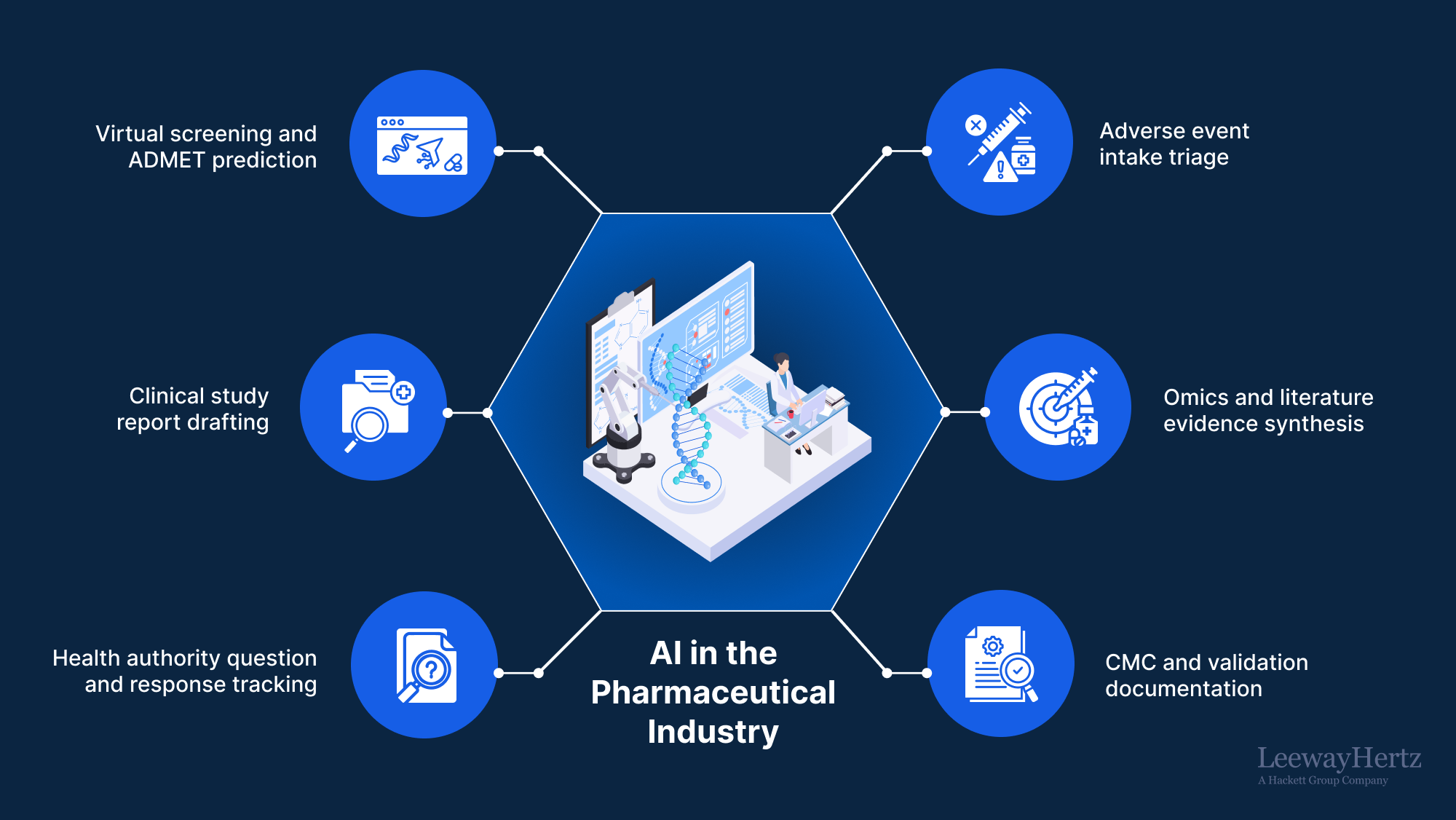
Pharmaceuticals is one of the strongest candidates for AI adoption because the industry operates at the intersection of science, data, documentation, regulation, patient safety, manufacturing quality, and globally distributed operations. Every function, from discovery and clinical development to regulatory affairs, pharmacovigilance, quality, manufacturing, supply chain, medical affairs, and commercial operations, depends on the accurate interpretation of scientific evidence, operational records, regulatory requirements, and approved content.
The need for this capability is growing as pharmaceutical work becomes more complex and higher in volume. According to IQVIA [1], global use of medicines grew by 14% over the past five years and is expected to reach 3.7 trillion defined daily doses by 2029, underscoring the need for pharmaceutical companies to enhance efficiency as growth moderates across developed and developing economies. As medicine use expands globally, pharmaceutical teams must manage more trial records, safety cases, quality events, regulatory documents, supply chain data, and customer-facing materials without compromising accuracy, compliance, or patient safety.
AI creates value when it is embedded in specific operational steps, not when it sits alongside teams as a generic chatbot. In clinical operations, AI can flag missing site documents, summarize trial updates, and draft follow-up notes for review. In pharmacovigilance, it can prioritize case queues, extract relevant safety details, and prepare case narratives for medical assessment. In quality operations, it can classify deviations, identify similar historical events, and suggest investigation pathways before a qualified reviewer makes the final decision.
This is why AI opportunities in pharmaceuticals should be mapped at the operating-model level. Each function should be broken down into processes, sub-processes, tasks, systems, artifacts, owners, and controls. At that level, organizations can distinguish predictive use cases from content generation use cases, identify where human review is mandatory, and prioritize AI initiatives based on value, risk, feasibility, and operational readiness.
The economic potential is substantial. McKinsey [2] estimates that generative AI could create $60 billion to $110 billion in annual economic value for the pharmaceutical and medical products industries, with impact across discovery, development, regulatory approval, marketing, and customer engagement. But realizing that value requires more than selecting tools. It requires designing AI around governed pharmaceutical workflows, where AI can draft, summarize, retrieve, classify, recommend, or coordinate work while designated human reviewers remain accountable for decisions that affect patients, product quality, regulatory submissions, or customer-facing communication.
This article applies the operating-model lens to AI in pharmaceuticals. It breaks pharmaceutical work into major functions, processes, and sub-processes, and shows where AI can create practical, workflow-specific value. The focus is on helping pharmaceutical organizations identify high-impact AI opportunities, integrate them into existing workflows, and maintain human accountability across every critical decision point.
- How AI is reshaping pharmaceutical operations
- Why pharmaceutical AI use cases must be mapped at the sub-process level
- Pharmaceutical operating model and AI opportunity mapping across pharma processes
- High-value AI use cases in pharmaceuticals
- How agentic AI works in pharmaceutical workflows
- How to prioritize AI use cases in pharmaceuticals
- Governance, risk, and responsible AI in pharmaceuticals
- How ZBrain operationalizes AI use cases in pharmaceuticals
- Future of AI in pharmaceuticals
How AI is reshaping pharmaceutical operations
Pharmaceutical companies have long relied on computational chemistry, statistical modeling, laboratory information management systems (LIMS), electronic data capture (EDC), quality management systems (QMS), enterprise resource planning (ERP), and machine learning to improve research, development, manufacturing, quality, and commercial operations. These technologies remain essential, but AI introduces a broader capability: it can help teams interpret information, generate controlled outputs, identify exceptions, and coordinate work across regulated processes.
Traditional automation follows predefined rules. Machine learning predicts, scores, detects, forecasts, and classifies from historical patterns, which is why molecular property prediction, demand forecasting, anomaly detection, and safety-signal scoring became some of pharma’s earliest durable AI use cases. Generative AI expands the opportunity by reading, summarizing, drafting, comparing, explaining, and transforming scientific and operational information. Agentic AI goes further by coordinating multi-step workflows across systems, documents, teams, approvals, and operational handoffs.
This impact is especially visible in areas where pharmaceutical work depends on regulated content, scientific judgment, and cross-functional review.
- Document-heavy work: Pharmaceutical teams manage clinical study protocols and reports, electronic Common Technical Document (eCTD) modules, investigator brochures, executed batch records, SOPs, validation protocols, safety case narratives, contracts, and supplier qualification files. AI can extract relevant information, compare sections of documents, identify missing evidence, summarize source materials, and prepare drafts for review.
- Narrative-heavy work: Clinical study reports, Module 2 summaries, periodic safety update reports, deviation investigations, CAPA records, medical information responses, publication drafts, and regulatory response letters require consistent, evidence-backed narratives. AI can draft structured text, check chronology, highlight source discrepancies, and align outputs with approved templates and controlled terminology.
- Exception-heavy work: Protocol deviations, manufacturing deviations, out-of-specification results, batch failures, safety signals, health-authority queries, serialization exceptions, temperature excursions, and supply disruptions all require timely assessment. AI can classify cases, score urgency, detect unusual patterns, retrieve similar historical events, and recommend the next step for a qualified reviewer.
- Knowledge-heavy work: Pharmaceutical decisions often depend on ICH and GxP guidelines, labeling standards, country-specific filing requirements, PhRMA and EFPIA codes, MedDRA coding conventions, SOPs, regulatory commitments, and therapeutic-area evidence. AI can retrieve controlled guidance, cite source clauses, compare requirements, and surface relevant context at the point of work.
- Workflow-heavy work: Processes such as target-to-lead progression, study start-up to database lock, dossier authoring to submission, case intake to E2B submission, deviation to batch release, change control routing, and demand planning to distribution involve many systems, owners, artifacts, and approvals. AI can sequence tasks, forecast bottlenecks, prepare handoffs, trigger follow-ups, and route work to the right reviewer.
Typical pharmaceutical AI use cases do not remove the human from the process. Instead, they prepare the case, retrieve context, draft the output, identify exceptions, recommend the next step, and route the work to the right qualified reviewer. Scientists, clinicians, biostatisticians, regulatory writers, safety physicians, QA reviewers, manufacturing leads, and commercial owners retain accountability for scientific judgment, patient safety, product quality, and regulatory decisions.
Why pharmaceutical AI use cases must be mapped at the sub-process level
AI can create meaningful value across pharmaceuticals only when it is tied to specific workflows. High-level labels such as “AI in pharma,” “AI in R&D,” “AI in quality,” or “AI in commercial” may be useful for strategy discussions, but they are too broad to guide implementation. They do not define the data required, the controls involved, the validation expectations, the approval path, the success metrics, the system of record, or the accountable decision owner.
A more practical approach maps AI opportunities to the pharmaceutical operating model:
- Function: the major scientific, operational, or control area, such as drug discovery, clinical development, regulatory affairs, pharmacovigilance, quality, manufacturing, supply chain, medical affairs, or commercial.
- Process: the workflow area within that function, such as lead optimization, study start-up, dossier assembly, case processing, deviation management, batch release, or demand planning.
- Sub-process: the specific activity inside the workflow, such as ADMET prediction, site feasibility scoring, Module 2 summary drafting, MedDRA coding, root-cause analysis, batch-record review, or signal validation.
- AI-enabled opportunity: the way AI supports that activity, such as predicting a molecular property, classifying an exception, drafting a narrative, extracting structured data, retrieving guideline context, or routing a case for approval.
This level of detail matters because pharmaceutical workflows are tied to specific regulations, validated systems, documents, scientific standards, and decision rights. Drafting a clinical study report is different from coding an adverse event. Responding to a health authority query is different from dispositioning a manufacturing deviation. Predicting compound toxicity requires a different scientific context, evidence base, and validation approach than reconciling a serialized shipment or matching a supplier invoice.
The sub-process layer is where AI becomes buildable, governable, and measurable. For example, “use AI in research” is too vague to implement or validate. By contrast, “rank literature and omics evidence for a target biology decision package” clearly defines the artifact, the input sources, the AI-supported activity, and the reviewer. The translational biology lead can then assess the evidence, approve or reject the recommendation, and remain accountable for the decision on target advancement.
The same principle applies across pharmaceutical operations. In regulatory affairs, AI may draft a Module 2 summary from approved source documents, while regulatory writers and subject-matter experts verify its accuracy before submission. In pharmacovigilance, AI may support MedDRA coding or safety case narrative drafting, while the safety physician or qualified reviewer confirms the final assessment.
Sub-process mapping turns AI from a broad technology concept into an executable, governable workflow. It clarifies what AI reads and what it predicts, drafts, extracts, classifies, or recommends, and then pinpoints where human review is mandatory, which controls apply, what evidence is required, and which validated system of record must be updated. The result is a way to group opportunities by function without losing accountability at the point where the work happens.
Accelerate Pharmaceutical Operations With Governed AI Solutions
Use ZBrain Builder to design and deploy AI workflows across discovery, clinical, regulatory, safety, quality, manufacturing, supply chain, medical, and commercial operations—improving speed, accuracy, compliance, and overall impact across the value chain
Pharmaceutical operating model and AI opportunity mapping across pharma processes
The following sections map AI opportunities across the operating model of a modern pharmaceutical organization, from discovery and development to manufacturing, commercialization, and enterprise functions. Each section includes a brief overview, a process and sub-process table, and high-value AI opportunities.
Function 1. Drug discovery and target biology
Drug discovery owns the path from target biology through hit discovery, lead optimization, and candidate nomination. These workflows are data-rich and scientifically complex, combining genomics, chemistry, structural biology, high-throughput screening, and large volumes of internal and published literature.
AI is highly relevant because discovery pairs pattern-rich biological and chemical data with repetitive predictions, prioritizations, and literature syntheses. AI can analyze omics and literature, predict molecular properties, rank candidates, and orchestrate multi-step workflows such as target evidence assembly, virtual screening triage, and lead-optimization cycles, while scientists retain accountability for which targets, hits, and molecules advance.
| Process | Sub-process | Key AI-enabled opportunities |
|---|---|---|
| Target identification and validation | Target discovery and prioritization | Aggregate human genetics, CRISPR-screen, expression, and pathway evidence, score target tractability, and flag conflicting biology signals for disease-biology lead review |
| Omics and literature evidence synthesis | Extract gene, variant, and phenotype findings from RNA-seq and biomedical literature, classify study quality, and summarize convergent evidence for bioinformatics review | |
| Target safety and off-target assessment | Aggregate tissue-expression, essentiality, and known-target-class liability evidence, screen for on-target safety risks, and flag high-concern targets for safety and disease-biology lead review. | |
| Target-disease association and indication mapping | Compare genetic, pathway, and clinical-association evidence across candidate indications, rank target-indication pairs by strength of evidence, and summarize repurposing or expansion options for portfolio-science review. | |
| Hit identification | Virtual screening and library design | Screen compound libraries in silico, predict binding and activity, prioritize hits, and propose focused library designs for computational-chemistry review |
| High-throughput screening data review | Classify plate results as active, inactive, cytotoxic, or artifact, detect plate effects, and rank primary hits by potency and data quality for screening-scientist review | |
| Hit confirmation and SAR triage | Compare dose-response, orthogonal, and counter-screen results, flag promiscuous or assay-interference compounds, and map activity cliffs into an SAR matrix for medicinal-chemistry review | |
| Assay development and screening cascade design | Compare candidate assay formats and readouts against the target mechanism, summarize sensitivity, robustness, and interference risks, and draft a screening-cascade proposal for assay-development scientist review. | |
| Structure-based design and docking triage | Retrieve target structures and binding-site features, rank docking and pose-quality results, flag implausible binding modes, and summarize structure-activity hypotheses for structural-biology and computational-chemistry review. | |
| Lead optimization and candidate selection | De novo and analog design | Generate novel small-molecule and biologic candidates against multi-parameter objectives, propose synthesizable analogs, and rank compounds for medicinal-chemistry review |
| ADMET and DMPK property profiling | Predict absorption, distribution, metabolism, excretion, toxicity, solubility, and permeability, and summarize property trade-offs for DMPK-scientist review | |
| Safety-liability triage | Screen structures for toxicophores and hERG risk, summarize off-target liabilities, and flag concerns for safety-pharmacology review | |
| Candidate nomination package | Assemble target rationale, SAR progression, ADME-DMPK profile, and safety margins into a nomination summary, and flag IND-readiness gaps for program-leadership review | |
| Retrosynthesis and synthetic feasibility | Propose synthetic routes for prioritized analogs, score step count, building-block availability, and predicted yield, and flag low-feasibility designs for synthetic-chemistry review. | |
| Free-energy and binding-affinity prediction | Aggregate free-energy perturbation and related affinity predictions, compare predicted potency against assay results to flag model drift, and summarize confidence for computational-chemistry review. | |
| Research data and lab operations | ELN capture and ALCOA+ integrity review | Validate experiment metadata and sample chain of custody, detect missing signatures and audit-trail anomalies, and flag data-integrity exceptions for research-QA review |
| Biologics and large-molecule discovery | Antibody and protein sequence design | Generate and optimize candidate sequences against affinity, specificity, stability, and format objectives, propose variants, and rank designs for protein-engineering review. |
| Developability and sequence-liability screening | Screen sequences for aggregation, deamidation, glycosylation, oxidation, viscosity, and stability liabilities, summarize developability risks, and flag high-liability candidates for biologics-developability review. | |
| Immunogenicity risk prediction | Predict T-cell epitope and immunogenicity risk from sequence data, compare findings against known liabilities, and flag high-risk regions for immunogenicity-assessment review. | |
| Discovery knowledge and IP | Patent and freedom-to-operate landscaping | Retrieve and cluster patent and literature records around a chemotype, target, or modality, summarize prior-art and white-space themes, and flag potential freedom-to-operate concerns for patent-counsel review. |
| Competitive pipeline and prior-art monitoring | Aggregate competitor disclosures, congress abstracts, publications, and trial registries for the target or modality, summarize emerging activity, and flag relevant developments for discovery-strategy review. |
The highest-value AI opportunities are high-throughput screening data review, the medicinal-chemistry design cycle, de novo molecular design, ADMET prediction, and omics-and-literature synthesis, because they produce structured assay, chemical, and literature data that AI can classify, predict, and rank while scientists’ own advancement decisions.
An example agentic workflow is lead-optimization support. The agent retrieves the active series and assay history, predicts ADMET and potency for proposed analogs, ranks candidates against the target product profile, drafts SAR commentary, and and routes a prioritized synthesis list to the medicinal chemistry team for review.
Function 2. Translational medicine and biomarker strategy
Translational medicine connects discovery biology to clinical proof of mechanism through biomarker strategy, patient segmentation, companion-diagnostic feasibility, and translational evidence planning. These workflows integrate biomarker data, clinical endpoints, omics, assay metadata, and real-world evidence (RWE).
AI is highly relevant because translational work integrates biomarker, endpoint, omics, and assay data that must be linked and reconciled. AI can summarize mechanism-of-action evidence, standardize assay data, support subgroup discovery and endpoint linkage, and assemble translational packages, while scientific reviewers retain control over translational conclusions.
| Process | Sub-process | Key AI-enabled opportunities |
|---|---|---|
| Translational science planning | Mechanism-of-action translation | Map pathway evidence and pharmacodynamic signals from omics datasets, compare against the investigator’s brochure (IB) mechanism claims, and flag unsupported proof-of-mechanism assumptions for translational-medicine lead review |
| Biomarker hypothesis and endpoint linkage | Map biomarker hypotheses to clinical and pharmacodynamic endpoints, rank evidence strength, and propose endpoint-biomarker traceability notes for clinical-development lead review | |
| Exposure-response and dose-translation modeling | Aggregate preclinical PK/PD, exposure, and target-engagement data, summarize exposure-response relationships and human-dose rationale, and flag assumptions inconsistent with safety margins for clinical-pharmacology review. | |
| Responder subgroup definition | Detect responder subgroups with clustering and treatment-interaction models, compare definitions against case report form (CRF) variables and RWE cohorts, and flag underpowered segments for biostatistics review | |
| Biomarker assay development | Assay selection and qualification | Compare candidate platforms, extract sensitivity, specificity, and stability evidence, and draft the biomarker assay rationale for biomarker-science review |
| LIMS biomarker data transfer | Map assay result fields to CRF and SDTM domains and detect unit, timestamp, and subject-visit mismatches for clinical-data-management review | |
| Biomarker data transfer and reconciliation | Map assay result fields to CRF and SDTM domains, and detect unit, timestamp, and subject-visit mismatches for clinical-data-management review. | |
| Translational data integration | Clinical, omics, and RWE data linkage | Retrieve matched clinical, omics, and RWE records, map subject, visit, and consent identifiers, and flag linkage conflicts for bioinformatics review |
| Biomarker standardization for SDTM/ADaM | Map biomarker fields, detect code-list and unit anomalies, and draft SDTM and ADaM derivation specifications for statistical-programming review | |
| Biomarker data quality and batch-effect review | Detect batch effects, missingness, and outliers across multi-omics and assay datasets, summarize data-quality impact on downstream analyses, and flag confounded comparisons for bioinformatics review | |
| Precision medicine and diagnostics | Companion diagnostic feasibility | Screen candidate assays, compare tissue availability, platform concordance, and regulatory pathway against protocol requirements, and flag constraints for precision-medicine review |
| Biomarker cutoff and performance review | Calculate candidate cutoffs with ROC and survival-linkage analyses, compare performance and prevalence against the analysis plan, and flag unstable thresholds for biomarker-governance review | |
| IB and informed-consent biomarker language | Draft IB biomarker rationale updates and classify informed-consent biomarker language by specimen use, genetic testing, and data sharing, flagging consent-risk mismatches for medical-writing and ethics review | |
| Specimen and biobank operations | Specimen inventory and chain-of-custody review | Reconcile specimen records across collection, shipment, and storage logs, detect missing or mismatched samples, and flag chain-of-custody gaps for biobank-operations review. |
| Consent-scope and specimen-use verification | Compare specimen intended use against the consented scope, including genetic testing, future use, and data sharing, classify usage exceptions, and flag consent mismatches for ethics and biobank-governance review. |
The highest-value opportunities are clinical-omics-RWE data linkage, biomarker standardization, responder subgroup definition, and companion-diagnostic feasibility, because they combine structured EDC, LIMS, omics, and RWE data with clear review points for bioinformatics, programming, and translational leads.
An example agentic workflow is translational evidence assembly. The agent retrieves assay results, clinical endpoints, omics records, and RWE, drafts a cited translational package with explicit evidence gaps, and routes it to the translational-medicine lead for confirmation.
Function 3. Preclinical development and toxicology
Preclinical development manages candidate entry, IND-enabling safety packages, Good Laboratory Practice (GLP) toxicology, safety pharmacology, toxicokinetics, and nonclinical submission content. These workflows combine in vitro and in vivo study data, modeling, and document-heavy reporting that feeds the investigational new drug (IND) application.
AI is highly relevant because preclinical work involves substantial data analysis, modeling, and structured scientific writing. AI can compare protocols, detect toxicology signals, summarize study findings, and assemble IND module content, while study directors, pathologists, and regulatory toxicology leads retain approval.
| Process | Sub-process | Key AI-enabled opportunities |
|---|---|---|
| Nonclinical development planning | IND-enabling study plan and species selection | Map pharmacology, DMPK, and prior toxicology results to the study plan, compare gaps against ICH M3(R2) timing and S6(R1) relevant-species criteria, and draft sequencing options for nonclinical-development lead review |
| GLP study protocol development | Draft protocol sections from SOP templates, classify endpoints and sampling against GLP requirements, and flag inconsistencies with toxicokinetic collections for study-director review | |
| In silico and computational toxicology assessment | Run (Q)SAR and read-across predictions for the candidate, metabolites, and impurities, compare structural alerts against ICH M7 and known toxicophores, and summarize predicted liabilities for toxicology-lead review. | |
| GLP study conduct | Study conduct and data integrity monitoring | Detect missing raw-data entries and audit-trail anomalies, compare milestones against the approved protocol, and flag ALCOA+ data-integrity risks for study-director and QA review |
| Test article and sample tracking | Extract lot identity, potency, and storage from the certificate of analysis (CoA), validate the chain of custody, and flag stability gaps for bioanalytical-QA review | |
| In-life and clinical-pathology review | Detect longitudinal body-weight, food-consumption, and clinical-pathology outliers, compare against historical control ranges, and summarize dose-related patterns for study-pathologist review | |
| Nonclinical safety assessment | Toxicokinetic and exposure-response assessment | Aggregate concentration-time data, detect anomalous exposure profiles, and compare exposure-response with lesion incidence for DMPK-scientist review |
| Safety pharmacology and genotoxicity | Aggregate telemetry, respiratory, and neurobehavioral endpoints against ICH S7A/S7B, classify Ames, micronucleus, and reproductive findings against S2(R1)/S5(R3), and draft integrated risk statements for toxicology-lead review | |
| NOAEL and safety-margin determination | Classify adverse findings by weight of evidence, aggregate dose-response and exposure data, and calculate proposed no-observed-adverse-effect-level (NOAEL) margins for study-director review | |
| Nonclinical submissions support | IND nonclinical module and eCTD assembly | Extract approved pharmacology, toxicology, and toxicokinetic summaries into the nonclinical module, map content to eCTD structure, validate cross-references, and flag missing source documents for regulatory-toxicology review |
| In vitro and secondary pharmacology | Secondary pharmacology and off-target profiling | Aggregate off-target panel and selectivity results, classify hit liabilities by potency and therapeutic-window risk, and flag safety concerns for safety-pharmacology review. |
| In vitro safety and cardiotoxicity screening | Summarize in vitro hERG, cardiomyocyte, and hepatotoxicity readouts, compare against risk thresholds, and flag candidates needing follow-up for safety-pharmacology review. |
The highest-value opportunities are GLP protocol development, in-life and toxicology study interpretation, toxicokinetic assessment, and IND nonclinical module assembly, because they reduce manual analysis and documentation effort while qualified specialists retain interpretive accountability.
An example agentic workflow is the IND nonclinical module assembly. The agent retrieves GLP protocols, final study reports, toxicokinetic tables, deviations, and certificates of analysis. It then drafts the nonclinical overview and study-report summaries, flags data inconsistencies, and routes the package to the regulatory toxicology lead for review.
Function 4. Clinical development strategy
Clinical development strategy supports the clinical development plan, indication strategy, trial design, protocol governance, endpoints, feasibility assumptions, and the benefit-risk evidence path. These workflows reconcile eligibility criteria, endpoints, amendments, and prior evidence across many documents.
AI is highly relevant because design work reconciles eligibility criteria, endpoints, amendments, and prior evidence across many documents. AI can summarize prior evidence, draft protocol synopses, check cross-document consistency, and support scenario analysis, amendment impact assessment, and design-review packaging, while clinical science, biostatistics, safety, and governance reviewers make final decisions.
| Process | Sub-process | Key AI-enabled opportunities |
|---|---|---|
| Asset and indication strategy | Indication prioritization and clinical rationale | Screen disease burden, prior trial outcomes, and treatment patterns, score candidate indications against target product profile (TPP) assumptions, and summarize the clinical rationale for clinical-development lead review |
| Endpoint strategy and estimand alignment | Map primary and secondary endpoints to estimands, classify intercurrent-event strategies under the ICH E9(R1) framework, and flag mismatches between endpoints, visit schedules, and statistical objectives for biostatistics review | |
| Benefit-risk hypothesis development | Aggregate efficacy signals and adverse-event trends, classify uncertainties using structured benefit-risk methods, and draft the benefit-risk hypothesis for clinical-development lead review | |
| Statistical design and sample-size planning | Compare design options (fixed, group-sequential, adaptive) against the endpoint and estimand, summarize sample-size and power assumptions and their sensitivity, and flag underpowered or optimistic scenarios for biostatistics review. | |
| Protocol design and governance | Protocol synopsis and eligibility definition | Draft the synopsis from the development plan and schedule of activities, extract and classify eligibility criteria by medical, operational, and safety rationale, and flag inconsistencies with CRF fields for clinical-science review |
| Informed consent form clinical content | Summarize procedures, risks, benefits, and data-use language from the protocol, compare against the informed consent form (ICF), and flag readability or content gaps for medical-monitor review | |
| Protocol amendment impact assessment | Compare proposed amendments against the current protocol, CRF, and trial master file milestones, predict downstream site, data, and safety impacts, and route flagged changes for protocol-governance committee review | |
| RWE and external-control feasibility | Screen real-world and historical datasets for fit-for-purpose external-control or synthetic-control feasibility, summarize population comparability and bias risks, and flag limitations for epidemiology and biostatistics review. | |
| Diversity and representation planning | Compare target enrollment demographics against disease epidemiology and regulatory diversity expectations, identify underrepresented populations and site-access gaps, and draft Diversity Action Plan inputs for the clinical development lead | |
| Feasibility and country strategy | Protocol feasibility and enrollment scenarios | Retrieve site performance, screen-failure, and query metrics, model enrollment and randomization scenarios against protocol complexity, and flag optimistic assumptions for feasibility-lead review |
| Competitor and standard-of-care landscape | Retrieve registry records, publications, and treatment patterns, compare competitor endpoints and eligibility against the protocol, and summarize standard-of-care implications for indication-strategy review | |
| Clinical governance and core documents | IB authoring and DSUR clinical inputs | Draft annual IB updates and development safety update report (DSUR) clinical inputs from new clinical, nonclinical, and safety findings, classify changes against the company core data sheet (CCDS), and flag sections for medical-writing and safety-physician review |
| Regulatory and access strategy | Health-authority interaction and scientific-advice planning | Retrieve relevant precedents, guidance, and prior commitments, draft briefing-book question sets and position summaries for End-of-Phase or scientific-advice meetings, and flag open issues for regulatory-strategy and clinical-development review |
| Pediatric, orphan, and expedited-pathway assessment | Map the program against pediatric, orphan, and expedited-pathway criteria, summarize obligations and opportunities, and flag eligibility or timing gaps for regulatory-strategy review |
The highest-value opportunities are protocol amendment impact assessment, eligibility and endpoint definition, and feasibility and enrollment-scenario modeling, because they connect protocol, CRF, CTMS, and trial master file artifacts with clear review points for governance, clinical science, and feasibility leads.
An example agentic workflow is protocol amendment impact assessment. The agent retrieves the current protocol, enrollment milestones, CRF fields, and trial master file evidence, drafts an impact summary across sites, data, and safety, and routes it to the protocol-governance committee for confirmation.
Function 5. Clinical operations and trial management
Clinical operations owns trial execution from startup through activation, monitoring, enrollment, vendor coordination, trial master file quality, milestones, and inspection readiness. These workflows are protocol-driven, document-heavy, and operationally complex across many studies and sites.
AI is highly relevant because clinical operations combine structured trial data, large document sets, and repetitive monitoring and coordination across many studies and sites. AI can classify start-up documents, summarize monitoring findings, and draft site communications. It can also orchestrate site selection, central monitoring, recruitment forecasting, and electronic trial master file (eTMF) completeness checks, while Good Clinical Practice (GCP) accountable roles retain oversight.
| Process | Sub-process | Key AI-enabled opportunities |
|---|---|---|
| Study startup and site activation | Site identification and investigator selection | Aggregate investigator enrollment history, score site capability against protocol criteria, and flag capacity, competing-trial, and diversity constraints for study-management review |
| Startup packet and essential-document collection | Classify startup documents, validate signatures and expiry dates, map missing essential documents to the trial master file, and flag incomplete delegation logs for site-activation specialist review | |
| ICF local adaptation tracking | Compare local ICF versions, validate required language against the protocol, and flag unresolved translations or version drift for clinical-operations lead review | |
| Clinical supplies and IMP management | IMP demand forecasting and depot planning | Forecast investigational-product demand from enrollment scenarios, compare against depot inventory and expiry, and flag supply or resupply risks for clinical-supply manager review. |
| IMP accountability and IRT reconciliation | Reconcile drug accountability records across sites, depots, and the interactive response technology (IRT) system, detect discrepancies and expiry exceptions, and flag issues for clinical-supply and QA review. | |
| Vendor and CRO oversight | CRO and vendor performance oversight | Aggregate vendor KPIs, deliverable status, and quality events against the contract and oversight plan, summarize performance gaps, and flag SLA or quality breaches for vendor-oversight lead review. |
| Vendor TMF and data reconciliation | Reconcile vendor-supplied documents and datasets against the trial master file and transfer agreements, detect missing or inconsistent deliverables, and flag gaps for clinical-operations lead review. | |
| GCP monitoring and RBQM | Monitoring plan and central monitoring | Draft monitoring-plan sections, detect anomalous CRF patterns and site risk signals under risk-based quality management (RBQM), prioritize visits, and flag data-quality or safety issues for central-monitor review |
| Monitoring visit report and follow-up | Summarize visit evidence, extract open action items, and draft follow-up letters linked to the trial master file, flagging unresolved critical findings and CAPA references for CRA-manager review | |
| Protocol deviation capture and trending | Classify protocol deviations by type, severity, and root cause, detect site-level recurrence patterns, and flag systemic or critical deviations for clinical-quality lead review. | |
| SAE reconciliation and SUSAR distribution | Reconcile serious-adverse-event records between EDC and the safety database, detect mismatches, and track SUSAR and safety-letter distribution to sites and ethics committees for clinical-safety operations review. | |
| Patient recruitment and enrollment | Patient identification and matching | Match protocol eligibility against electronic health records and registries, summarize candidate cohorts, and flag screening-log inconsistencies for clinical-research-associate review |
| Enrollment forecast and rescue planning | Compare forecasts with CTMS milestones, model site trajectories, and rank underperforming sites and backup geographies for study-management review | |
| Retention and visit-compliance tracking | Detect missed-visit risk from site and digital data, summarize visit history, and propose retention interventions for the site-engagement lead review | |
| CTMS and eTMF operations | CTMS milestone tracking | Aggregate milestone dates, detect schedule drift against activation, first-patient-in, and database-lock targets, and flag critical-path delays for clinical-operations lead review |
| eTMF completeness and inspection readiness | Classify eTMF documents, validate completeness and ALCOA+ integrity against the trial master file index, and route missing approvals or misfiled essential documents for eTMF-manager review |
The highest-value opportunities are site identification and selection, central monitoring signal review, patient identification and matching, and eTMF completeness review, because they combine high operational volume with artifact-rich CTMS, EDC, and eTMF evidence and clear review boundaries.
An example agentic workflow is site selection and startup. The agent scores candidate sites on historical enrollment and quality, models enrollment scenarios, drafts a feasibility and site-ranking summary, validates essential documents against trial master file requirements, and routes the recommendation to the clinical-operations lead for approval.
Function 6. Clinical data management and biostatistics
Biometrics owns clinical data capture, data standards, query management, medical coding, statistical programming, analysis datasets, database lock, and clinical reporting outputs. These workflows are precision-critical, deadline-driven, and central to regulatory submissions and publications.
AI is highly relevant because biometrics combines structured data review, repetitive query and coding tasks, and large-volume scientific writing. AI can suggest codes, draft query text, reconcile labs, support SDTM and ADaM mapping, and draft report sections, while data managers, coders, statisticians, and medical writers retain documented decisions before lock.
| Process | Sub-process | Key AI-enabled opportunities |
|---|---|---|
| EDC build and data standards | CRF design and EDC database build | Extract endpoint, visit, and safety requirements from the protocol, compare against standard CRF libraries, and flag missing, redundant, or inconsistent fields for clinical-data-standards lead review |
| Edit-check specification and UAT | Compare edit-check specifications with the protocol and annotated CRF, draft user-acceptance-testing scripts, and flag untested boundary conditions for data-management testing review | |
| SDTM and ADaM mapping | Map CRF variables and laboratory domains to SDTM and ADaM standards, propose controlled-terminology alignments, and flag ambiguous derivations for statistical-programming review | |
| Define.xml and submission-deliverable preparation | Draft define.xml, SDRG and ADRG reviewer guides, and dataset conformance summaries, run CDISC validation checks, and flag traceability or conformance gaps for statistical-programming lead review. | |
| Data cleaning and medical coding | Query management and lab reconciliation | Classify open queries by discrepancy type, compare central-laboratory feeds against CRF entries, and flag unit, reference-range, and visit-date mismatches for clinical-data-manager review |
| External data reconciliation | Reconcile ECG, PK, biomarker, ePRO/eCOA, and IRT external data against CRF and EDC records, detect subject, visit, and unit mismatches, and flag unresolved discrepancies for clinical-data-manager review. | |
| MedDRA and WHODrug coding | Suggest MedDRA event codes and WHODrug medication codes from verbatim terms, and flag low-confidence or medically inconsistent selections for medical-coder review | |
| Protocol deviation listing review | Screen deviation listings against eligibility, visit-window, and prohibited-medication criteria, classify severity, and flag potential reclassifications for clinical-scientist review | |
| Medical and clinical data review support | Aggregate cross-panel listings across adverse events, labs, concomitant medications, and eligibility, detect medically inconsistent or implausible patterns, and summarize review findings for medical-monitor review | |
| Statistical analysis and programming | SAP development and TLF production | Summarize endpoint, estimand, and population requirements into the statistical analysis plan (SAP), generate and validate table, listing, and figure (TLF) outputs, and flag cross-output inconsistencies for study-statistician review |
| ADaM programming and interim data cuts | Draft statistical derivation snippets from SDTM and CRF mappings, forecast data-cut completeness risks against interim criteria, and flag traceability gaps for statistical-programming lead review | |
| Independent double-programming and output QC | Compare primary and independent programming outputs, detect discrepancies in derivations and TLF values, and summarize QC findings for statistical-programming QC review. | |
| DMC and DSMB output preparation | Assemble closed and open data monitoring committee (DMC) and DSMB report outputs under unblinding controls, validate completeness against the DMC charter, and flag access or content exceptions for unblinded-statistician review. | |
| Database lock and clinical reporting | Database lock readiness | Validate lock-checklist items against EDC status, trial master file evidence, and the study SOP, and flag unresolved reconciliation tasks or missing approvals for data-management lead review |
| Clinical study report drafting | Draft CSR results, disposition, and safety-narrative sections from approved TLFs and source documents, check internal consistency and cross-references, and flag unsupported statements for medical-writer and biostatistician review |
The highest-value opportunities are EDC query management, MedDRA and WHODrug coding, SDTM and ADaM mapping, TLF production, and CSR drafting, because they are repetitive and documentation-heavy, while statistical and medical-writing accountability is preserved.
An example agentic workflow is CSR drafting. The agent ingests the locked dataset, statistical outputs, and source documents, drafts CSR sections aligned to the template and SAP, checks internal consistency and cross-references, and routes the draft to the medical writer and biostatistician for review.
Function 7. Regulatory affairs and submissions
Regulatory affairs owns regulatory strategy, registration planning, submission orchestration, electronic common technical document (eCTD) publishing, labeling governance, health-authority interactions, and lifecycle submissions. These workflows are document-intensive, deadline-driven, and governed by ICH standards and country-specific requirements.
AI is highly relevant because regulatory work combines structured authoring, cross-document consistency checking, eCTD assembly and validation, and global change management. AI can draft module summaries, compare labeling, draft query responses, and run dossier gap checks, commitment tracking, and variation planning, while regulatory professionals approve final positions and submissions.
| Process | Sub-process | Key AI-enabled opportunities |
|---|---|---|
| Global regulatory strategy | IND, NDA, BLA, and ANDA pathway planning | Compare indication, modality, and pediatric or accelerated-program evidence across the filing roadmap, classify filing and chemistry-manufacturing-controls risks, and propose sequence options for global-regulatory lead review |
| Regulatory intelligence and commitment tracking | Summarize FDA, EMA, and other health-authority updates, extract commitments from minutes and approval letters, tag affected products, and flag overdue obligations for regional-regulatory lead review | |
| Submission authoring and publishing | CTD module drafting | Draft Module 2 summaries and overviews from source content in Modules 3 through 5, and flag unresolved source gaps for regulatory-writer review |
| eCTD compilation and validation | Auto-tag, hyperlink, and format submission content, validate eCTD technical conformance and leaf titles, and flag formatting and cross-reference errors before transmission for publishing-lead review | |
| Document gap analysis | Compare dossier content against the CTD structure and requirements and flag missing or inconsistent sections for regulatory-operations review | |
| Labeling and lifecycle | CCDS, USPI, and SmPC harmonization | Compare adverse-reaction, contraindication, and dosing text across the company core data sheet (CCDS), US prescribing information (USPI), and summary of product characteristics (SmPC), classify differences, and draft harmonized change rationales for labeling-committee review |
| Structured product labeling (SPL/ePI) preparation | Map approved labeling content to structured labeling formats such as SPL and ePI, validate against PLR/PLLR and regional structure requirements, and flag conformance or version errors for labeling-operations review | |
| Variation and Q12 change classification | Classify post-approval changes across jurisdictions per ICH Q12, identify affected modules, and draft variation documentation for lifecycle-regulatory review | |
| RIM and IDMP data management | Detect inconsistent regulatory information management (RIM) and IDMP data, validate lifecycle status, and draft remediation summaries for regulatory-operations review | |
| Health-authority interactions | HA query response drafting | Retrieve source evidence, commitments, and CSR sections, draft first-pass responses to health-authority questions, and route unresolved issues for regulatory-response lead review |
| HA meeting and briefing-book management | Assemble briefing-book sections from approved evidence, draft meeting-request and question packages, summarize health-authority minutes into action items, and flag commitments for regulatory-lead review. | |
| Annual report and post-marketing commitment tracking | Aggregate post-marketing commitment and requirement (PMC/PMR), REMS, and annual-report obligations, compare progress against due dates, and draft reporting summaries for regulatory-lead review. |
The highest-value opportunities are CTD module drafting, eCTD compilation and validation, labeling harmonization, health-authority query response drafting, and variation classification, because they are repeatable and rules-bound, reducing cycle time and technical-rejection risk while regulatory professionals retain accountability for content.
An example agentic workflow is submission assembly. The agent drafts Module 2 summaries from source modules, runs an eCTD gap and validation check, flags formatting and hyperlink errors, drafts a cover letter with correct references, and routes the package to the regulatory lead and publisher for review.
Function 8. Pharmacovigilance and patient safety
Pharmacovigilance covers adverse-event intake, case processing, medical review, safety coding, expedited and aggregate reporting, signal management, risk management plans, and benefit-risk governance. These workflows are case- and alert-heavy, governed by strict reporting timelines under Good Pharmacovigilance Practices (GVP).
AI is highly relevant because safety operations process very large volumes of cases and signals through repetitive intake, coding, and narrative steps. AI can extract case data, suggest codes, draft narratives, and support intake-to-submission case processing, signal detection, and aggregate report drafting, while safety physicians and qualified reviewers retain accountability for causality, seriousness, and reporting decisions.
| Process | Sub-process | Key AI-enabled opportunities |
|---|---|---|
| Case intake and triage | ICSR intake and data extraction | Extract patient, reporter, product, and event data from multiple source formats, including CIOMS and MedWatch forms, into the individual case safety report (ICSR), pre-populate the safety database, and route incomplete or expedited items to the safety-operations reviewer |
| Literature surveillance and ICSR screening | Screen scientific and grey literature for case reports and safety information, classify articles for ICSR relevance under GVP Module VI, extract case details, and flag reportable findings for safety operations reviewer review. | |
| Case triage and duplicate detection | Classify cases by seriousness and expectedness, detect duplicate clusters with entity-resolution matching, and summarize proposed merge conflicts for case-processing lead review | |
| Follow-up question generation | Draft targeted follow-up questions from missing ICSR fields, prioritize outreach by response likelihood, and flag overdue requests for safety-operations manager review | |
| Case processing | MedDRA and drug-dictionary coding | Map verbatim event and concomitant-medication terms to MedDRA preferred terms and drug-dictionary entries, and flag low-confidence or ambiguous codes for medical-coder review |
| Narrative generation | Draft case narratives from validated structured data and map source attachments to required sections for medical review | |
| Causality and seriousness assessment support | Summarize chronology, dechallenge, rechallenge, and alternative etiologies, compare against the IB and CCDS, and propose a reviewer-ready causality rationale for safety-physician review | |
| Expedited and aggregate reporting | SUSAR preparation and E2B transmission | Draft suspected unexpected serious adverse reaction (SUSAR) reports, validate ICSR E2B(R3) fields & transmission acknowledgments, and flag clock-start, rejection, or late-submission concerns for pharmacovigilance-operations lead review |
| PSUR/PBRER and DSUR drafting | Aggregate interval cases, exposure estimates, and line listings into periodic safety report shells, compare benefit-risk statements against the CCDS, and flag cross-table inconsistencies for safety-physician review | |
| PV compliance and reconciliation | Reconcile case counts and submission status across the safety database, affiliates, and partners, detect late or missing submissions, and summarize compliance-metric and root-cause findings for pharmacovigilance-compliance review. | |
| Signal and risk management | Disproportionality signal detection | Mine internal and external databases(FAERS, VigiBase, EudraVigilance) for disproportionality using PRR, ROR, and Bayesian scores, and rank product-event pairs with supporting narratives for signal-management scientist review |
| RMP and benefit-risk maintenance | Compare new findings and risk-minimization effectiveness against the approved risk management plan (RMP), and propose targeted amendments for risk-management lead review | |
| Signal validation and lifecycle tracking | Compile supporting evidence for detected signals, draft validation and prioritization summaries, track signals to closure against the signal-management procedure, and flag overdue assessments for signal-management lead review. | |
| Risk-minimization effectiveness and SDEA tracking | Aggregate risk-minimization measure outcomes and safety-data-exchange-agreement (SDEA) obligations, compare performance against the RMP and partner agreements, and flag effectiveness or compliance gaps for risk-management lead review |
The highest-value opportunities are ICSR intake and extraction, case triage and duplicate detection, MedDRA coding, narrative generation, disproportionality signal detection, and aggregate report drafting, because they are high-volume and repetitive while qualified safety physicians retain accountability.
An example agentic workflow is ICSR processing. The agent ingests a case from intake, extracts and structures case data, suggests MedDRA coding, drafts the narrative, summarizes causality and seriousness evidence, and routes the case to the safety physician for medical review and reporting decision within regulatory timelines.
Function 9. Quality assurance and GxP compliance
Quality assurance oversees the pharmaceutical quality system, GxP compliance, SOP governance, deviations, out-of-specification (OOS) and out-of-trend (OOT) investigations, CAPA, change control, validation quality, supplier quality, audits, inspections, and data integrity. These workflows are document-intensive, control-critical, and inspection-sensitive.
AI is highly relevant because quality work centers on deviation investigations, CAPA, batch-record review, change control, and audit readiness. AI can draft investigations, summarize evidence, check SOP alignment, and support deviation-to-disposition, recurrence trending, change-impact assessment, and inspection response, while the quality unit retains disposition and GxP accountability.
| Process | Sub-process | Key AI-enabled opportunities |
|---|---|---|
| Quality system governance | Q10 quality system and SOP lifecycle | Aggregate CAPA, deviation, and product-review signals with anomaly detection, compare SOP revisions for clause-level changes, and summarize site-level quality-system risks for quality-unit and document-control review |
| GxP training and role qualification | Map roles to SOP assignments, classify overdue or missing qualifications, and flag competency gaps affecting batch-release tasks for training-coordinator review | |
| Quality risk management (ICH Q9) | Aggregate risk inputs across deviations, changes, and products, draft risk assessments and FMEA scoring, maintain the risk register, and flag high-residual-risk items for quality-risk-management review. | |
| Supplier and external quality | Supplier qualification and quality-agreement review | Extract supplier GxP credentials, certifications, and quality-agreement terms, compare against qualification requirements, and flag gaps or expired evidence for supplier-quality review. |
| Supplier SCAR and external manufacturer oversight | Aggregate supplier corrective-action requests (SCARs), CMO/CDMO quality events, and performance metrics summarize recurring issues and flag deteriorating suppliers for supplier-quality lead review. | |
| Deviation, OOS/OOT, and CAPA | Deviation classification and root-cause investigation | Classify deviations by type and risk (critical, major, minor), link batch and product context, cluster similar prior events, and propose root-cause hypotheses for QA-investigator review |
| OOS and OOT laboratory investigation | Detect assay, impurity, and stability anomalies against CoA specifications, retrieve related laboratory and batch evidence, and classify assignable-cause hypotheses for QC-laboratory manager review | |
| CAPA drafting and effectiveness review | Draft corrective and preventive action plans linked to root cause, score recurrence risk, and flag vague actions or weak effectiveness evidence for CAPA-approver review | |
| Change control and validation quality | Change-impact assessment | Map proposed changes to the master batch record, validation master plan, and registered commitments, classify scope, and flag affected validation, supplier, and regulatory deliverables for change-control board review |
| Computerized system validation and CSA | Retrieve requirements and IQ/OQ/PQ test evidence against the validation master plan, apply a computer software assurance (CSA) risk-based approach, and flag missing approvals or failed steps for validation-quality review | |
| Inspection readiness and data integrity | ALCOA+ data-integrity review | Detect backdated entries, audit-trail edits, and repeated overrides in electronic batch records and CoAs, classify severity against ALCOA+ criteria, and flag gaps for the data-integrity officer |
| Audit, inspection, and warning-letter response | Aggregate quality records, map inspection observations and warning-letter commitments to CAPA owners under ICH Q9(R1), summarize open findings, and draft response sections for inspection-response lead review | |
| Audit program and self-inspection management | Schedule internal and supplier audits by risk, draft audit agendas and checklists based on prior findings and the certification scope, classify open findings, and route follow-up for audit-program lead review. | |
| Product quality review (PQR/APR) authoring | Aggregate batch, deviation, OOS, change, and complaint data for the review period, draft the product quality review against the template, and flag adverse trends for quality-unit review. | |
| Complaint and recall support | Classify product complaints, summarize trends, and assemble recall-decision evidence for quality-unit review |
The highest-value AI opportunities are deviation classification and investigation, OOS/OOT investigation, CAPA drafting, batch-record review, change-impact assessment, and inspection readiness, because they are documentation-heavy and slow when manual, while the quality unit retains disposition authority.
An example agentic workflow is deviation-to-disposition support. The agent classifies a deviation, retrieves batch and prior-investigation context, drafts a root-cause investigation and CAPA, summarizes batch impact, and routes the disposition package to the quality unit for review, keeping draft and validated-record environments strictly separate.
Accelerate AI Solutions Development
Build fully functional solutions from your high-value use cases, based on specific operational needs and enterprise context.
Function 10. Manufacturing, CMC, and batch release
Manufacturing and CMC oversee process development, technology transfer, process validation, continued process verification, current Good Manufacturing Practice (CGMP) execution, the quality-control testing interface, batch-record review, CMC submission content, and final disposition. These workflows are process-intensive, data-rich, and tightly coupled to quality and regulatory commitments.
AI is highly relevant because manufacturing combines process and equipment data, batch documentation, and technical reporting. AI can draft validation and CMC documents, summarize process trends, and support review-by-exception, continued process verification trending, and release-packet assembly, while process owners and the quality unit retain control over validated operations and disposition.
| Process | Sub-process | Key AI-enabled opportunities |
|---|---|---|
| Process development and control strategy | QbD process development and CQA/CPP linkage | Model factor-response relationships under quality by design (QbD), map critical quality attributes (CQAs) to critical process parameters (CPPs), and propose candidate parameters and control limits for MSAT-scientist and QA review |
| Scale-up, tech transfer, and MBR | Summarize process knowledge, compare site parameters against the master batch record (MBR), and draft technology-transfer documentation for receiving-manufacturing review | |
| CMC comparability and change assessment | Compare pre- and post-change process and analytical data, draft compar ability assessments against the ICH Q5E and Q12 criteria, and flag attributes that require additional study for CMC-lead review | |
| Analytical and QC method lifecycle | Method development and validation (ICH Q2) | Draft method validation protocols and reports, compare accuracy, precision, linearity, and robustness results against acceptance criteria, and flag validation gaps for analytical-science review |
| Method transfer and specification management | Compare sending- and receiving-site method data, draft transfer reports, validate specifications against ICH Q6A and Q6B, and flag transfer or specification gaps for QC and analytical science review | |
| Process validation and CPV | Validation documentation and IQ/OQ/PQ | Draft validation protocols and reports, detect anomalous installation, operational, and performance qualification (IQ/OQ/PQ) results against acceptance criteria under GAMP 5, and summarize exceptions for validation-manager review |
| Continued process verification trending | Aggregate batch genealogy, CPP trends, and QC results into the continued process verification (CPV) report, detect multivariate drift, and flag emerging loss-of-control signals for process-owner review | |
| CGMP execution | Process monitoring and PAT analytics | Monitor in-line process analytical technology (PAT) and parameter data against the golden batch, detect drift and review-by-exception items, and flag excursions for manufacturing-supervisor review |
| Batch production record completion | Validate entries, timestamps, and operator sign-offs in the batch production record, classify GMP exceptions, and draft correction requests for production supervisor review | |
| Yield and OEE analysis | Summarize yield, throughput, and overall equipment effectiveness (OEE) trends and draft variance commentary for operations review | |
| Environmental and microbial monitoring review | Trend environmental, bioburden, and media-fill data against alert and action limits, detect contamination-control excursions, and flag adverse trends for microbiology and QA review | |
| QC and batch disposition | LIMS sample testing and CoA review | Detect out-of-trend assay and impurity results in LIMS against specifications, validate methods and release results in the CoA and flag inconsistent or missing values for the QA release reviewer |
| GMP batch-record review and disposition | Review electronic batch records line by line, classify exceptions and skipped steps, aggregate release-packet evidence, and propose hold, release, or reject options for QA-release manager review | |
| CMC submissions and maintenance | CMC Module 3 authoring | Draft Module 3 sections from development, characterization, and validation data, flag inconsistencies against specifications, and route to CMC and technical operations leads for review |
| Equipment and maintenance | Predictive maintenance support | Analyze equipment data to predict failures, summarize maintenance history, and draft work-order priorities for reliability-engineering review |
The highest-value AI opportunities are continued process verification trending, PAT and process monitoring, batch-record review, CMC Module 3 authoring, and batch-release disposition, because they are high-volume and artifact-rich while the quality unit retains final authority.
An example agentic workflow is batch-release exception triage. The agent retrieves batch exceptions, CoA status, deviation and CAPA records and drafts a disposition summary scored for readiness, and routes risks to the QA-release manager for decision.
Function 11. Supply chain planning and product lifecycle management
Supply chain owns demand and supply planning, materials planning, supplier coordination, distribution readiness, serialization, traceability, stability coordination, and lifecycle execution across a regulated, often cold-chain network. These workflows are calculation-intensive and exception-prone, with patient access and compliance implications.
AI is highly relevant because the supply chain combines structured planning data, serialization and traceability data, and recurring exception handling across many partners. AI can draft planning commentary, summarize exceptions, draft partner communications, and support demand forecasting, shortage detection, serialization exception handling, and cold-chain disposition, while supply, quality, and regulatory owners approve decisions.
| Process | Sub-process | Key AI-enabled opportunities |
|---|---|---|
| Demand and supply planning | Demand forecasting and sensing | Forecast demand from historical, market, and external signals, detect forecast deviations against the campaign calendar, and flag service-level gaps for supply-planner review |
| Inventory and safety-stock optimization | Calculate demand variability and lead-time risk, optimize safety-stock thresholds by stock-keeping unit, and flag stockout, expiry, or policy exceptions for inventory-planning review | |
| Sales and operations planning (S&OP) reconciliation | Reconcile demand, supply, and inventory plans across functions, summarize gaps and scenario trade-offs against financial and service targets, and flag unresolved imbalances for S&OP-review board review | |
| MRP and capacity planning | Classify ERP material requirements planning (MRP) exceptions by shortage severity, map shortages to affected batch records, and propose reschedule or expedite actions for manufacturing-planner review | |
| Shortage and disruption management | Detect supply disruptions early, model mitigation scenarios, and draft risk summaries for supply-risk council review | |
| Procurement and supplier-quality interface | Raw-material specification and lot genealogy | Extract raw-material attributes from supplier CoAs, map lot genealogy across ERP and batch records, validate specification alignment, and flag missing traceability links for quality-operations review |
| Serialization and traceability | DSCSA and EU FMD serialization | Validate serialized identifiers against packaging records under DSCSA and EU FMD (aligned to GS1 EPCIS), reconcile transaction statements, and flag duplicate or missing codes for serialization operations review |
| Recall readiness and traceability drill | Map finished goods and component lot genealogy across systems, retrieve release evidence, and flag traceability gaps in the recall drill package for quality operations review | |
| Distribution and logistics | Cold-chain excursion triage and disposition | Detect lane-level temperature excursions, compare duration and profile against the stability protocol and storage conditions under Good Distribution Practice (GDP), and draft disposition rationale for QA review |
| 3PL and distribution logistics oversight | Aggregate 3PL shipment, lane, and customs-clearance status, detect delivery and import-export exceptions, and draft resolution summaries for distribution operations review. | |
| Tender and country-allocation management | Compare tender commitments and country demand against constrained supply, model allocation scenarios, and flag fulfillment or compliance risks for market-supply lead review. | |
| Lot release to distribution | Retrieve CoA approvals, quality-release status, and ERP holds, compare each lot against open deviations, and propose release-to-distribution actions for quality-release review | |
| Lifecycle and stability | Q12 change management and APR/PQR | Map proposed manufacturing, supplier, or specification changes to application commitments per ICH Q12, aggregate annual product review (APR) and product quality review (PQR) metrics, and draft regulatory-supply impact scenarios for lifecycle-governance review |
| Stability protocol trend review | Detect out-of-trend assay, impurity, and dissolution results in LIMS, compare pulls and storage conditions against the stability protocol, and flag concerns for quality-control review |
The highest-value AI opportunities are demand forecasting and sensing, inventory optimization, serialization exception handling, cold-chain excursion monitoring, and Q12 post-approval change planning, because they are high-volume and rules-driven, while planners and quality teams retain decision authority.
An example agentic workflow is serialization exception handling. The agent ingests traceability data, classifies exception types, identifies likely root causes, drafts corrective tasks and partner outreach, and routes unresolved cases to the supply chain and quality teams, thereby preserving regulatory governance throughout.
Function 12. Medical affairs and scientific communications
Medical affairs owns medical strategy, scientific exchange, medical information, publications, evidence communication, field-medical enablement, non-promotional review, and insight capture. These workflows are scientific, compliance-sensitive, and document-heavy, governed by codes that separate medical from promotional activity.
AI is highly relevant because medical affairs combines literature synthesis, engagement data, medical information drafting, and publication management. AI can summarize literature, structure field notes, draft medical-information responses, and support inquiry triage, standard-response drafting, and insight clustering, while medical reviewers approve all external-facing materials and confirm consistency with approved labeling.
| Process | Sub-process | Key AI-enabled opportunities |
|---|---|---|
| Medical strategy and evidence | Medical plan and scientific narrative | Summarize product evidence from the CSR and IB, map narrative claims to the CCDS, and flag unsupported benefit-risk statements for medical-director review |
| Evidence-gap and RWE study concept | Compare the evidence portfolio against medical-plan objectives, screen licensed RWE cohorts for feasibility, and propose study concepts for RWE-lead review | |
| Publication planning and drafting | Aggregate CSR milestones and congress criteria, screen literature, recommend journal and congress strategy, and draft manuscript and abstract sections for publication-steering committee review | |
| Investigator-sponsored research intake | Extract objectives, endpoints, and investigator qualifications from submitted protocols, compare obligations against GCP, and flag gaps for the ISR committee | |
| RWE and observational study support | Draft observational study protocol and analysis-plan sections, summarize real-world data findings against study objectives, and flag confounding or data-quality limitations for RWE and biostatistics review | |
| Scientific engagement and events | Congress and scientific event planning | Aggregate congress timelines, abstract deadlines, and submission requirements, draft event scientific plans and logistics summaries, and flag conflicts or gaps for medical-affairs lead review |
| Advisory board planning and output synthesis | Draft advisory board objectives and discussion guides from the medical plan, synthesize anonymized board outputs into themed summaries, and flag actionable insights for medical-strategy review | |
| Medical information | MI request intake and AE handoff | Classify inquiries, detect adverse-event and product-complaint content with MedDRA coding, extract details into an ICSR intake record, and route reportable cases to the pharmacovigilance reviewer |
| Standard response document authoring | Retrieve approved language from the CCDS, USPI, and SOPs, summarize relevant CSR evidence, draft cited responses, and flag off-label gaps for medical-information lead review | |
| Field medical | KOL mapping and MSL support | Map key opinion leaders (KOLs) from publications, congress data, and trial leadership, and draft medical science liaison (MSL) pre-call briefs and structured post-call notes for field-medical lead review |
| Field insight capture and triage | Classify field insight notes by disease, product, and barrier theme, detect recurring signals against the CCDS, and route prioritized summaries to the medical-strategy lead | |
| Non-promotional review | Scientific content and slide-deck review | Compare slide claims, figures, and speaker notes against the USPI and CCDS, validate version metadata, and flag unsupported claims or stale references for scientific-communications lead review |
| Medical grants and IIS/ISR governance | Aggregate grant, fellowship, and investigator-sponsored study requests, compare against medical-governance criteria and budgets, and flag eligibility or compliance exceptions for the medical-grants committee review |
The highest-value AI opportunities are medical information intake and response authoring, KOL mapping and MSL support, evidence-gap analysis, publication drafting, and field-insight triage, because they reduce preparation and documentation effort while medical and compliance accountability stays with medical teams.
An example agentic workflow is medical-information support. The agent classifies an inbound inquiry, retrieves the relevant standard response document and approved evidence, drafts a cited response, flags adverse-event or product-complaint content for pharmacovigilance routing, and routes the draft to the medical-information team for review.
Function 13. Market access, pricing, HEOR, and commercial operations
This function covers value evidence, health economics, payer strategy, pricing governance, access planning, brand marketing, omnichannel content, healthcare-professional (HCP) engagement, and promotional review operations. These workflows are evidence, content, and compliance-intensive, with high commercial impact, and all promotional materials must pass medical, legal, and regulatory (MLR) review.
AI is highly relevant because this function combines evidence synthesis, economic modeling, large-volume content creation, and compliance review. AI can synthesize evidence, draft dossier sections and brand content, run pre-MLR checks, and support value-dossier assembly, pricing-scenario evaluation, content-to-MLR routing, and next-best-action recommendation, while access, HEOR, legal, medical, regulatory, and commercial reviewers make final decisions on value, claims, and price.
| Process | Sub-process | Key AI-enabled opportunities |
|---|---|---|
| Value evidence and HEOR | Value-dossier and evidence-table development | Extract trial outcomes, safety statements, and economic inputs from CSRs, labeling, and publications, validate citations against the formulary submission format, and draft value-dossier evidence tables for director review |
| Systematic literature review and burden-of-illness | Screen literature against inclusion criteria under PRISMA, summarize epidemiology, cost, and treatment-gap evidence, and flag citation gaps for HEOR-reviewer review | |
| Economic and budget-impact model support | Summarize model inputs and assumptions, draft cost-effectiveness and budget-impact narratives, and flag unsupported value claims for HEOR-lead review | |
| Pricing and payer strategy | Pricing scenario and gross-to-net governance | Calculate payer mix, uptake, and gross-to-net forecasts, compare list-price, rebate, and channel assumptions against reference-pricing scenarios, and flag threshold breaches for pricing-committee review |
| Government pricing and price-reporting compliance | Aggregate transaction and discount data, compare calculations against Medicaid best-price, 340B, and government price-reporting rules, and flag anomalies or threshold breaches for government-pricing compliance review | |
| Payer segmentation and access-barrier mapping | Classify payer accounts by coverage policy, prior-authorization behavior, and rebate sensitivity, map barriers into archetypes, and propose engagement priorities for market-access strategy review | |
| Formulary submission and rebate-contracting review | Draft formulary-dossier sections, compare contract term sheets and historical rebate invoices against ERP accruals, and flag unsupported concessions for contracting-director review | |
| Brand content and HCP engagement | Promotional and modular content drafting | Draft brand-aligned, claim-supported content from approved references, generate and tag modular components for omnichannel reuse, localize for markets, and flag missing references for brand-owner review |
| Commercial brand forecasting | Build patient-based or trend-based brand forecasts from market, claims, and uptake data, summarize scenario sensitivity, and flag assumption risks for commercial forecasting review | |
| HCP targeting and next-best-action | Prioritize and segment HCPs using engagement and propensity data grounded in consent rules, recommend next-best content, channel, and timing, and route recommendations for commercial operations approval | |
| Launch readiness and brand performance | Aggregate regulatory, supply, and access milestones into a launch-readiness tracker, summarize channel and brand KPIs, and draft optimization recommendations for launch-excellence lead review | |
| Promotional review and claims | Pre-MLR checks and MLR triage | Screen content for claim-reference linkage, fair balance, and off-label risk before submission, classify materials by review need, and route through medical, legal, and regulatory reviewers to reduce cycle time |
| Claims substantiation and reference-library control | Compare proposed claims against USPI indication and safety language for fair-balance and substantial-evidence standards, validate reference-library entries, and flag overstatement, expired, or superseded references for regulatory-advertising reviewer review | |
| Field force and sales operations | Territory alignment and call planning | Analyze territory potential, workload, and access data, propose alignment and call-plan adjustments, and flag coverage gaps for sales-operations review. |
| Incentive compensation analytics | Aggregate sales and goal-attainment data, draft incentive-compensation calculations and exception summaries and flag disputes or anomalies for sales-operations and compliance review. |
The highest-value AI opportunities are value-dossier development, pricing-scenario and gross-to-net governance, formulary submission development, promotional content drafting, pre-MLR checks and MLR triage, and HCP targeting with next-best-action, because they combine high-volume or high-stakes decisions with artifact-rich inputs while reviewers retain approval on value, claims, and price.
An example agentic workflow is content-to-MLR support. The agent drafts brand-aligned content from approved references, runs pre-MLR compliance checks for claims and fair balance, assembles the reference pack, and routes the content in parallel to medical, legal, and regulatory reviewers—keeping final approval with the reviewers.
Function 14. Patient services and patient support programs
Patient services owns patient support programs (PSPs), hub services, benefit verification, adherence support, and access assistance. These workflows are interaction-heavy and document-driven, and they are sensitive because they involve patient data and may surface adverse events.
AI is highly relevant because patient services combine high-volume inquiries, enrollment documentation, and benefit verification. AI can extract enrollment data, retrieve approved education content, draft policy-grounded responses, and support enrollment, benefit verification, inquiry handling, and adverse-event routing, while staff retain accountability for patient-impacting decisions and mandatory safety reporting.
| Process | Sub-process | Key AI-enabled opportunities |
|---|---|---|
| Program enrollment | Enrollment intake and verification | Extract and validate enrollment and consent data, flag incomplete records, and summarize eligibility for program-coordinator review |
| Benefit verification and prior-authorization support | Summarize coverage and copay-assistance eligibility, draft prior-authorization documentation, and flag exceptions for access-specialist review | |
| Financial assistance and copay program operations | Match patients to copay, foundation, and free-drug program criteria, draft enrollment and re-verification documentation, and flag eligibility or funding exceptions for access-specialist review. | |
| Patient engagement | Inquiry handling and education | Classify patient inquiries, retrieve approved education content, and draft policy-grounded responses for patient-services reviewer confirmation |
| Adherence support | Summarize adherence patterns and draft personalized reminders and follow-up within approved protocols, flagging at-risk patients for nurse-educator review | |
| Program operations and reporting | Program performance and outcomes reporting | Aggregate enrollment, time-to-therapy, adherence, and abandonment metrics summarize program performance against targets and draft reporting for program-leadership review. |
| Case management | Case documentation and routing | Draft case notes, route to specialists, and track resolution status for case-manager review |
| Reimbursement and appeals support | Track prior-authorization and claim status, classify denial reasons, draft appeal documentation from approved templates and clinical evidence, and flag complex cases for reimbursement-specialist review. | |
| Safety interface | Adverse-event detection and routing | Detect potential adverse events and product complaints in interactions and route them to pharmacovigilance per mandatory reporting requirements |
The highest-value AI opportunities are enrollment intake and verification, benefit verification support, inquiry handling, adherence support, and adverse-event detection and routing, because they reduce administrative effort and improve consistency while preserving human accountability and mandatory safety reporting.
An example agentic workflow is enrollment and inquiry support. The agent validates enrollment data, summarizes coverage and eligibility, drafts prior-authorization documentation, responds to routine inquiries from approved content, and routes any adverse-event mentions to pharmacovigilance and complex cases to case managers.
Function 15. Procurement and supplier management
Procurement sources materials, services, and contract partners (CMOs/CDMOs and CROs) and manages supplier qualification, contracts, and performance. These workflows are document-heavy and exception-prone, with quality and compliance dependencies that distinguish pharmaceutical procurement from generic spend management.
AI is highly relevant because procurement involves repetitive document handling, supplier-qualification review, invoice matching, and contract analysis across many vendors. AI can summarize spend, extract contract obligations, draft scorecards, and support supplier qualification, bid evaluation, invoice matching, and performance monitoring, while procurement and supplier-quality teams approve qualifications and awards.
| Process | Sub-process | Key AI-enabled opportunities |
|---|---|---|
| Sourcing | Spend and sourcing analysis | Summarize category and supplier spend, identify consolidation and savings opportunities, and draft sourcing summaries for category-manager review |
| RFQ and bid evaluation | Aggregate quotes, compare terms, and draft award recommendations for procurement review | |
| Category strategy and supply-market intelligence | Summarize category spend, supply-market conditions, and should-cost benchmarks, identify risk and consolidation options, and draft category strategy inputs for category-manager review. | |
| Outsourced operations management | CMO/CDMO and CRO operations management | Track statements of work, change orders, and deliverable milestones across outsourced partners, summarize perforance against contracts, and flag scope or schedule exceptions for outsourcing-management review. |
| Supplier qualification | Supplier onboarding and GxP qualification | Extract and validate supplier credentials, certifications, and quality documents, and flag gaps against GxP and quality-agreement requirements for supplier-quality review |
| Supplier risk and performance monitoring | Track supplier KPIs, quality events, single-source exposure, and risk indicators, and draft scorecards for supplier-quality and supply-risk review | |
| Third-party risk and compliance screening | Screen suppliers against sanctions, anti-bribery, conflict-of-interest, and ESG criteria, summarize third-party risk exposure, and flag findings for procurement-compliance review | |
| Contracting | Contract review and obligation extraction | Extract terms, obligations, and renewal dates from CMO/CDMO and CRO contracts, and flag non-standard clauses against playbooks for legal and procurement review |
| Contract lifecycle and renewal management | Draft contracts from templates, support redline and negotiation against playbooks, track renewals and expiries, and flag off-standard terms for legal and procurement review | |
| Procure-to-pay | Invoice and PO matching | Match invoices against purchase orders and receipts, classify delivery shortages and discrepancies, and draft exception notes for accounts-payable review |
The highest-value AI opportunities are spend analysis, supplier qualification review, contract obligation extraction, invoice and PO matching, and supplier performance monitoring, because they reduce manual reconciliation and strengthen supplier controls while procurement and supplier-quality teams retain approval.
An example agentic workflow is supplier qualification support. The agent extracts and validates supplier documents and certifications, summarizes ownership and risk indicators, flags gaps against GxP requirements, and routes the qualification package to the procurement and supplier-quality teams for approval.
Function 16. Business development, licensing, and alliance management
Business development pursues partnerships, in and out-licensing, mergers and acquisitions, and alliance management across a science- and deal-intensive landscape. These workflows are research, document, and coordination-heavy.
AI is highly relevant because business development combines scientific and commercial due diligence, document analysis, and ongoing alliance coordination. AI can summarize assets, cluster data-room documents, draft diligence responses, and support asset screening, diligence document analysis, and alliance obligation tracking, while dealmakers retain judgment on valuation and terms.
| Process | Sub-process | Key AI-enabled opportunities |
|---|---|---|
| Opportunity assessment | Asset and pipeline screening | Summarize scientific, clinical, and commercial profiles of candidate assets and partners for business-development lead review |
| Market and competitive analysis | Summarize the therapeutic-area landscape, competitors, and opportunity rationale for strategy-team review | |
| Deal sourcing and partnering-landscape monitoring | Scan pipelines, congress disclosures, and partnering signals for candidate assets and partners, summarize fit against strategy and therapeutic-area priorities, and flag opportunities for business-development lead review. | |
| Due diligence | Diligence document analysis | Cluster and summarize data-room documents by workstream, draft source-grounded responses to diligence questions, and flag risks for the deal team |
| Scientific and technical diligence assessment | Summarize clinical, regulatory, CMC, and IP evidence from the data room, compare against diligence criteria, and flag scientific or development risks for the diligence and subject-matter review teams. | |
| Deal support | Term and valuation support | Summarize comparable deals and structures and draft deal-summary documentation for transaction-committee review |
| Alliance management | Obligation and milestone tracking | Extract collaboration obligations and milestones and draft status and governance summaries for alliance-manager review |
The highest-value opportunities are asset and pipeline screening, market and competitive analysis, diligence document analysis, and alliance obligation tracking, because they reduce research and documentation effort while preserving deal judgment.
An example agentic workflow is diligence support. The agent ingests data-room documents, clusters and summarizes them by workstream, drafts source-grounded responses to diligence questions, flags risks, and routes the package to the deal team for review.
Function 17. Legal, compliance, ethics, and risk
This function manages contracts, healthcare-compliance obligations, anti-bribery and transparency requirements, privacy, and enterprise risk. These workflows are document-intensive and policy-driven, with significant regulatory exposure that is specific to the life-sciences environment.
AI is highly relevant because these functions involve contract analysis, policy interpretation, monitoring, and case documentation. AI can extract obligations, summarize spend against transparency rules, draft policy answers, and support contract obligation management, transparency monitoring, and investigation documentation, while legal and compliance owners retain accountability.
| Process | Sub-process | Key AI-enabled opportunities |
|---|---|---|
| Contract management | Contract review and obligation tracking | Extract terms, obligations, and renewals from agreements, flag non-standard clauses against playbooks, and track commitments for legal-counsel review |
| Legal request triage | Classify legal requests and route them to the right specialist or playbook for legal-operations review | |
| Intellectual property | Patent portfolio and lifecycle management | Summarize patent portfolio status, term, and extension opportunities, compare filings against product lifecycle, and flag deadlines or gaps for IP-counsel review. |
| IP litigation and opposition support | Cluster and summarize prior-art, opposition, and litigation documents, draft response outlines, and flag risks for IP-litigation counsel review. | |
| Healthcare compliance | Transparency and spend monitoring | Summarize HCP spend and transfers of value against Sunshine Act / Open Payments and equivalent transparency requirements, and flag exceptions for compliance review |
| Promotional and interaction compliance | Screen interactions and materials against the PhRMA and EFPIA codes and anti-kickback policy, and flag potential issues for compliance officer review | |
| Regulatory and legal change monitoring | Summarize new and pending laws and regulations across privacy, transparency, and AI, map changes to affected policies and obligations, and flag impacts for compliance and legal review. | |
| Privacy and data protection | Privacy and consent review | Summarize data-handling and consent against GDPR, HIPAA, and equivalent requirements, and flag exposures for the privacy officer |
| Risk and audit | Policy support and investigation documentation | Provide grounded answers from approved policies, summarize case history, and draft policy, SOP, and investigation documentation for compliance and audit review |
| Enterprise risk register management | Aggregate risk inputs across functions, draft risk register entries and mitigation status, and flag high-residual or overdue risks for enterprise risk committee review |
The highest-value opportunities are contract review and obligation tracking, legal request triage, transparency and spend monitoring, privacy and consent review, and policy support, because they improve responsiveness and consistency while preserving legal and compliance accountability.
An example agentic workflow is contract-obligation management. The agent extracts obligations and renewal dates, flags non-standard clauses against playbooks, summarizes compliance commitments, and routes contracts to the legal and compliance owners for review.
Function 18. Data, technology, cybersecurity, and AI governance
This function manages the validated and enterprise systems that connect pharmaceutical operations—LIMS, EDC, QMS, RIM, safety databases, ERP, and CRM—along with integration, data quality, cybersecurity, and AI governance. It is foundational because AI cannot scale without secure data access, validated integration, and model governance.
AI is highly relevant because technology operations involve large volumes of incidents, integrations, data-quality exceptions, and governance documentation across regulated systems. AI can draft release notes, summarize incidents, document AI use cases, and support incident triage, integration monitoring, data-quality remediation, and model-release evidence assembly, while platform owners, validation leads, and model-risk officers make release and escalation decisions.
| Process | Sub-process | Key AI-enabled opportunities |
|---|---|---|
| IT service management | Incident triage and change documentation | Classify incidents, summarize impact, recommend resolver groups from prior cases, and draft release notes for changes to validated systems for system-owner review |
| Application and integration support | System integration monitoring | Detect integration and synchronization failures across LIMS, EDC, QMS, RIM, safety, ERP, and CRM, and draft remediation notes for platform-owner review |
| Data governance | Data quality and lineage management | Detect inconsistent master and reference data, draft lineage and remediation summaries, and support data integrity (ALCOA+) for data-governance council review |
| Cloud ingestion and RWE provisioning | Detect schema drift, duplicate records, and de-identification anomalies in ingestion feeds, map analysis variables to SDTM and ADaM standards, and route questionable extracts for the epidemiology and data-steward reviewer | |
| Master data management and interoperability | Detect master-data conflicts across systems, map records to interoperability standards such as IDMP and FHIR, and draft remediation and stewardship summaries for data-governance council review. | |
| Cybersecurity and privacy | Alert triage and phishing review | Summarize alert context, classify protected-health-information data flows, detect excessive privileges and anomalous downloads, and recommend investigation priorities for the security and privacy officers |
| Identity and> access management review | Aggregate access entitlements across validated systems, detect excessive privilege and segregation-of-duties conflicts, and draft access-recertification packages for system-owner and security review. | |
| GxP computerized system validation | GAMP 5 risk-based validation lifecycle | Classify intended use and patient-safety impact, retrieve IQ/OQ/PQ traceability evidence against the validation master plan, and summarize missing approvals or failed steps for validation quality review |
| AI governance and model risk | AI use-case inventory and risk tiering | Document AI use cases, data sources, models, controls, and override rates, classify risk tier against an AI risk-management framework, and the AI Act, and flag high-impact uses for model-risk committee review |
| Model validation and performance monitoring | Validate training-data lineage and acceptance metrics in the model validation report, detect data drift, bias, and reviewer-override spikes in deployed models, and flag control failures and unapproved changes for the model-risk officer |
The highest-value AI opportunities are incident and integration triage, data quality and lineage management, cloud ingestion validation, GxP computerized system validation, and AI governance and model monitoring, because they are foundational to scaling AI safely across regulated pharmaceutical operations.
An example agentic workflow is AI model-release evidence assembly. The agent retrieves training lineage, test evidence, change approvals, and validation requirements, drafts a risk-based validation and credibility summary, routes exceptions to the validation lead, and records the model-risk officer’s confirmation.
Accelerate AI Solutions Development
Build fully functional solutions from your high-value use cases, based on specific operational needs and enterprise context.
High-value AI use cases in pharmaceuticals
The pharmaceutical AI use-case map is broad, but not every workflow should be prioritized first. The strongest early opportunities are usually high-volume, document-heavy, exception-heavy, scientifically repetitive, or narrative-heavy workflows where AI can prepare a draft, recommendation, summary, classification, or prediction for human review.
A use case becomes high-value when the business impact is clear, and the review boundary is well-defined. In pharmaceuticals, that usually means AI reduces backlogs, shortens cycles, improves documentation quality, strengthens oversight, or accelerates time-to-decision while a qualified reviewer remains accountable for the final outcome.
| Use case | Function | Why is it high-value |
|---|---|---|
| Omics and literature evidence synthesis | Drug discovery and target biology | Speeds evidence review by ranking and summarizing large scientific data flows, helping target biology teams focus on the most relevant signals for decision-making. |
| Virtual screening and ADMET prediction | Drug discovery and lead optimization | Reduces experimental cycles and attrition risk by prioritizing compounds against potency, toxicity, selectivity, and developability criteria before lab validation. |
| Clinical trial site feasibility and qualification review | Clinical operations and trial management | Shortens study start-up timelines by scoring sites against protocol requirements, enrollment potential, past performance, and operational readiness prior to activation decisions. |
| EDC query management | Clinical data management and biostatistics | Reduces data-cleaning backlogs by prioritizing field-level discrepancies, drafting query text, and helping clinical data managers resolve issues faster. |
| Clinical study report drafting | Clinical development and medical writing | Reduces medical writing effort and improves consistency by drafting structured Clinical Study Report (CSR) sections from approved results, tables, listings, figures, and source documents. |
| Health-authority question and response tracking | Regulatory affairs and submissions | Shortens response cycles by tracking regulatory questions, retrieving supporting evidence, drafting response language, and routing it to the accountable owner for review. |
| CTD module drafting and eCTD validation | Regulatory affairs and submissions | Reduces submission cycle time and the risk of technical rejection by drafting dossier summaries and verifying completeness, structure, and formatting before submission. |
| Adverse event intake triage | Pharmacovigilance and patient safety | Compresses intake timelines by classifying incoming cases, extracting key details, and supporting faster routing while safety teams confirm case creation decisions. |
| Duplicate detection and case merge review | Pharmacovigilance and patient safety | Improves the safety database’s quality by identifying potential duplicate reports and preparing merge recommendations for review before any database update. |
| Safety signal detection and validation | Pharmacovigilance and risk management | Improves signal coverage and response speed by mining safety data for emerging patterns and drafting validation summaries for qualified reviewers. |
| Deviation classification and root-cause analysis | Quality assurance and GxP compliance | Reduces investigation backlogs by classifying recurring deviations, retrieving similar historical events, and supporting root-cause analysis and CAPA drafting. |
| GMP batch-record review | Manufacturing operations and batch release | Speeds batch release by reviewing batch evidence, highlighting missing or inconsistent entries, and preparing release rationale for QA review. |
| CMC and validation documentation | CMC, manufacturing science, and validation | Reduces technical documentation effort by drafting CMC and validation content from approved process data, protocols, reports, and controlled templates. |
| Integrated demand forecasting and supply planning | Supply chain and product lifecycle management | Helps prevent supply shortages that interrupt patient treatment by generating demand forecasts, flagging supply constraints, and preparing replenishment or allocation options for review. |
| Medical information response drafting | Medical affairs and scientific communications | Improves response speed and consistency by matching inquiries to approved content, drafting grounded replies, and routing safety mentions or escalations for review. |
| MLR pre-review and promotional content checks | Commercial and medical, legal and regulatory review | Reduces MLR rework by checking claims, references, labeling alignment, and compliance risks before formal review, helping shorten approval cycles while maintaining control over customer-facing content. |
These use cases work well because they support human review rather than bypassing it. AI can prepare evidence, draft outputs, flag exceptions, and suggest next steps, while domain experts remain accountable for scientific, safety, quality, regulatory, and commercial decisions.
How agentic AI works in pharmaceutical workflows
Generative AI can draft, summarize, classify, predict, and retrieve. Agentic AI can coordinate a workflow. In pharmaceuticals, this distinction matters because many valuable use cases are not single tasks. They require multiple steps across validated systems, controlled documents, teams, regulations, and approvals.
When a new safety case, filing need, quality event, protocol change, or content request appears, an agentic workflow follows a governed sequence: planning the work, retrieving approved context, drafting or analyzing the required output required output, routing it to the right reviewer, and recording the decision. Its access should be limited to approved systems, and each step should be logged for review.
Individual case safety report processing
- Work plan: The agent defines the case-processing checklist and identifies missing information.
- Evidence retrieval: It gathers case intake data, source documents, prior reports, and relevant safety database records.
- Drafting and analysis: It extracts and structures case details, suggests MedDRA coding, checks for duplicates, and drafts the safety narrative.
- Final confirmation: The safety physician or qualified reviewer confirms the medical assessment and reporting decision.
Regulatory submission package assembly
- Submission plan: The agent defines the submission checklist and identifies required dossier sections.
- Source retrieval: It gathers approved source documents, study outputs, labeling references, and regulatory commitments.
- Drafting and validation: It drafts Module 2 summaries, checks cross-references, flags gaps, and prepares the package for publishing review.
- Final confirmation: The regulatory lead and publisher confirm the final package before submission.
Quality deviation and CAPA workflow
- Investigation plan: The agent defines the deviation investigation checklist and identifies required evidence.
- Evidence retrieval: It gathers batch records, deviation history, SOPs, test results, and similar prior events.
- Investigation support: It classifies the deviation, drafts root cause analysis and CAPA content, summarizes the batch impact, and routes the disposition package.
- Final confirmation: The quality unit confirms the investigation outcome, CAPA plan, and batch disposition decision.
Commercial content and MLR workflow
- Review plan: The agent defines the content review checklist against brand, labeling, claims, and compliance requirements.
- Reference retrieval: It gathers approved claims, references, prescribing information, brand guidance, and prior MLR comments.
- Content review support: It drafts or checks content, flags unsupported claims, assembles the reference pack, and routes the material for review.
- Final confirmation: Medical, legal, and regulatory reviewers confirm the final content before release.
How to prioritize AI use cases in pharmaceuticals
Pharmaceutical organizations should not select AI use cases only because they sound innovative. The strongest opportunities are those where the workflow is frequent, evidence is available, business value is clear, and review can remain with the accountable pharmaceutical role. In practice, prioritization should balance value, feasibility, risk, and control readiness.
| Prioritization criterion | What pharmaceutical organizations should evaluate |
|---|---|
| Business value | Whether the use case can reduce cycle time, improve productivity, accelerate R&D, reduce rework, improve quality, strengthen compliance, or support patient outcomes? |
| Workflow fit | Whether the work is document-heavy, knowledge-heavy, exception-heavy, narrative-heavy, scientifically repetitive, or coordination-intensive. |
| Volume and frequency | Whether the process repeats often enough to justify standardization, such as safety intake, deviation review, batch-record checks, MLR review, or regulatory documentation. |
| Artifact and data readiness | Whether source artifacts and data are accurate, accessible, current, permissioned, and traceable across systems such as LIMS, EDC, QMS, RIM, safety, ERP, CRM, or eTMF. |
| Review boundary | Which qualified role can review, approve, reject, or correct the AI output before it affects a submission, safety decision, batch disposition, or customer-facing communication? |
| Patient-safety and quality impact | Whether the workflow could affect patient safety, drug quality, study reliability, or product availability, and therefore requires stronger evidence of credibility and validation. |
| Regulatory sensitivity | Whether the use case supports regulatory decisions, safety reporting, promotional claims, GxP records, or controlled submissions. |
| Integration complexity | How many validated systems, data sources, approval paths, and downstream actions are involved. |
| Scalability | Whether the workflow or AI pattern can be reused across products, therapeutic areas, sites, functions, or regions. |
A practical first wave should focus on high-volume, artifact-rich, cleanly reviewed sub-processes. Examples include ICSR intake support, deviation and CAPA drafting, CSR and CTD module drafting, MLR pre-review, medical information response drafting, EDC query management, demand forecasting, and serialization-exception handling. These workflows are strong candidates because AI can prepare evidence, draft outputs, classify exceptions, or recommend next steps while a qualified reviewer remains in control.
More sensitive use cases require stronger governance from the beginning. AI outputs that directly influence regulatory decisions, causality assessments, final batch disposition, product-quality conclusions, promotional claims, or patient-facing actions should be subject to clear validation expectations, retained evidence, exception handling, and mandatory human approval.
This prioritization discipline prevents common AI roadmap failures: selecting use cases too broad to implement, starting without usable data, bypassing governance, or promising savings before proving the workflow. Leading pharmaceutical AI programs begin with bounded workflows where value is clear, evidence is available, and accountability is assigned.
Governance, risk, and responsible AI in pharmaceuticals
AI in pharmaceuticals must operate within the organization’s existing quality, regulatory, safety, compliance, cybersecurity, and computer system validation environment. The most important principle is clear accountability. AI can assist, recommend, draft, classify, predict, retrieve, and route work, but the responsible qualified human owner must remain accountable for consequential decisions, regulated outputs, and anything that affects patient safety, drug quality, study reliability, or customer-facing communication.
This is especially important because pharmaceutical AI increasingly produces information that supports regulated decisions across safety, quality, submissions, and other compliance-critical workflows. Key governance requirements include:
- Human review and accountability: AI outputs that support regulatory decisions, batch disposition and release, causality and seriousness assessment, safety reporting, promotional claims, or patient-impacting actions should be reviewed by qualified owners before they affect controlled records, submissions, production decisions, or customer-facing messages.
- Source-grounded outputs: AI responses should be grounded in approved pharmaceutical sources, including validated study records, protocols, SOPs, labeling, regulatory commitments, controlled research data repositories, safety databases, and other approved evidence sources.
- Traceability and audit trails: The audit trail should capture prompts, inputs, cited sources, outputs, model versions, reviewer actions, approvals, overrides, escalations, and downstream system updates. These controls should be reviewable under applicable electronic-record and electronic-signature expectations, including 21 CFR Part 11 and Annex 11.
- Validation and credibility assessment: AI systems should be assessed using risk-based validation and credibility principles, with evidence proportionate to the model’s context of use. This may include computer system validation, software assurance, GAMP 5 alignment, ICH Q9 quality-risk principles, and model-specific testing for accuracy, reliability, robustness, and intended-use performance.
- Role-based access and scoped tool use: AI systems should follow least-privilege access. A user or agent should retrieve only the scientific, clinical, safety, quality, commercial, or patient data permitted by the approved workflow. For agentic AI, access to tools should be tightly scoped, especially where the workflow connects to validated systems or controlled records.
- Data protection and data integrity: Controls should protect patient data, study data, and regulated records in line with applicable privacy, cybersecurity, and data integrity expectations, including GDPR, HIPAA (where relevant), ALCOA+ principles, and internal security policies.
- Bias, drift, and performance monitoring: AI systems should be monitored for accuracy, completeness, hallucination risk, bias, drift, latency, adoption, escalation frequency, reviewer overrides, unresolved low-confidence outputs, and exception rates. Monitoring should be stronger where the AI output influences safety, quality, regulatory, or clinical decisions.
- Escalation and exception handling: Workflows should define what happens when AI confidence is low, evidence conflicts, required data is missing, guidance is ambiguous, or the scenario has unusual patient safety, quality, regulatory, or privacy sensitivity.
- Third-party and vendor risk management: AI platforms, models, infrastructure, integrations, and service providers should be reviewed for security, validation support, auditability, data handling, model governance, and contractual controls before connection to regulated workflows.
- Regulatory and standards alignment: Responsible AI programs should align with applicable GxP expectations, ICH guidelines, pharmacovigilance and GVP requirements, records-retention rules, cybersecurity frameworks, the PhRMA and EFPIA codes for commercial activity, and broader AI risk-management frameworks such as NIST AI RMF 1.0 and NIST AI RMF 1.0 and its Generative AI Profile (NIST AI 600-1).
Governance should not be treated as a blocker to AI adoption. It is what makes AI usable in pharmaceuticals. A well-governed AI workflow can provide stronger documentation, clearer accountability, better auditability, more consistent execution, and greater transparency than unmanaged manual processes.
How ZBrain operationalizes AI use cases in pharmaceuticals
Identifying use cases is only the first step. Pharmaceutical organizations need a controlled way to design, build, validate, deploy, govern, and scale AI workflows across drug discovery, clinical development, regulatory affairs, pharmacovigilance, quality management, manufacturing, supply chain, medical affairs, commercial operations, market access, and enterprise reporting.
This is where ZBrain helps.
ZBrain is an end-to-end AI enablement platform that supports this lifecycle through four connected stages: ZBrain Analyzer, ZBrain Design, ZBrain Solution Builder, and ZBrain Governance. The platform provides a governed path from use-case analysis to deployed agentic workflows while maintaining policies, permissions, approval points, monitoring, and runtime evidence.
ZBrain Analyzer
ZBrain Analyzer helps teams examine selected pharmaceutical processes, identify AI opportunities, and document the business context, systems, data, artifacts, roles, controls, and review requirements needed to evaluate each use case.
ZBrain Design
ZBrain Design creates a build-ready technical design for the selected use case. It generates the business requirements document, functional requirements, user journeys, architecture, workflow logic, data specifications, integration context, and governance considerations needed before development begins.
ZBrain Solution Builder
ZBrain Solution Builder enables teams to create, configure, and validate governed AI workflows for pharmaceutical processes based on the technical design developed in ZBrain Design. It supports testing across routine, exception, regulated, and control scenarios before deployment.
ZBrain Governance
ZBrain Governance applies policies, access controls, human approval requirements, monitoring, and traceability throughout workflow execution. It provides guardrails, approval gates, escalation controls, kill switches, and audit trails to help organizations maintain oversight of AI outputs, reviewer actions, exceptions, and authorized system updates.
Future of AI in pharmaceuticals
AI in pharmaceuticals will evolve from copilots to workflow agents. The first wave of adoption helps teams draft, summarize, search, classify, predict, and retrieve information. The next wave will coordinate larger workflows across validated systems, functions, and teams, with people entering at defined points for review, approval, and scientific judgment.
This shift will not be defined only by more powerful models. In pharmaceuticals, the future of AI will depend on how well organizations connect AI to governed workflows, controlled data, validated systems, audit trails, and accountable human review. Three trajectories are likely to shape the next stage of adoption.
Trajectory 1: Federated AI platforms
Pharmaceutical organizations will move from isolated AI pilots to federated AI platforms with shared orchestration, governance, observability, and integration. Instead of each function building disconnected tools, clinical development, regulatory affairs, pharmacovigilance, quality, CMC, supply chain, medical affairs, and commercial teams will reuse approved AI services while preserving function-level ownership and review controls.
For example, a regulatory affairs team preparing a submission update may need the same evidence trail used by safety, quality, or CMC teams. A federated platform approach allows these groups to work from controlled sources, shared workflows, and consistent governance without losing accountability for their own decisions.
Trajectory 2: Long-horizon agentic workflows
AI will increasingly support multi-step workflows that extend across systems and teams. A protocol amendment, for instance, may trigger downstream updates in site readiness, safety review, regulatory tracking, and the electronic trial master file. Agentic workflows can help track status, retrieve evidence, classify gaps, draft updates, recommend next actions, and route work to the right owner.
Human confirmation will remain mandatory at risk-bearing decision points. A clinical operations lead, pharmacovigilance physician, regulatory reviewer, quality reviewer, or commercial approver must confirm any action that affects patient safety, drug quality, regulatory commitments, controlled records, or customer-facing communication.
Trajectory 3: Workflow design over model selection
As model capabilities continue to improve, competitive advantage will come less from selecting the newest model and more from designing the right workflow around it. A quality team reviewing deviations, for example, will gain more value from well-defined handoffs, controlled data access, validation evidence, reviewer placement, and audit trails than from switching among similar AI models.
In pharmaceuticals, successful AI adoption will depend on embedding AI into SOPs, validated systems, governed review loops, and measurable operating processes. The strongest organizations will not be those with the longest list of AI pilots. They will be those who connect AI to how discovery, development, manufacturing, safety, quality, regulatory, medical, and commercial work actually happens at the function, process, and sub-process level.
Endnote
AI has the potential to reshape pharmaceutical work, but only when it is applied at the right level of detail. Broad statements such as “AI in pharma,” “AI in R&D,” or “AI in quality” are not enough to guide implementation. Real value comes from applying AI to specific pharmaceutical workflows, from target prioritization and lead optimization to protocol design, site selection, regulatory authoring, safety processing, quality review, manufacturing documentation, demand forecasting, and medical-commercial review.
The pharmaceutical operating model is complex, spanning discovery, development, regulatory, safety, quality, manufacturing, supply chain, medical, commercial, and enterprise functions. Across these functions, GenAI can predict properties, classify exceptions, summarize evidence, draft documents, retrieve guideline context, reconcile records, and coordinate multi-step workflows. Agentic AI extends this value by connecting steps across validated systems, controlled documents, and cross-functional teams, while maintaining human review.
For pharmaceutical organizations, the path forward is clear. Pharma companies should map AI opportunities at the sub-process level, prioritize workflows with clear value and review models, connect AI to approved data and validated systems, and scale through governed pilots, context-specific validation, and reusable agents across functions, sites, and regions.
Generic chatbots or isolated pilots will not define the future of pharmaceutical AI. It will be defined by governed, workflow-specific AI systems that help pharmaceutical organizations accelerate research, strengthen quality and safety, improve compliance, and give scientists, clinicians, quality teams and regulatory experts more time to apply judgment where it matters most.
Bring AI into everyday pharmaceutical workflows with ZBrain. From discovery, clinical operations, and regulatory affairs to quality, manufacturing, supply chain, medical affairs, and commercial operations, ZBrain helps pharmaceutical organizations identify, build, and scale governed AI solutions that deliver measurable value. Contact the ZBrain team today!
Author’s Bio


Akash's ability to build enterprise-grade technology solutions has garnered the trust of over 30 Fortune 500 companies, including Siemens, 3M, P&G, and Hershey's. Akash is an early adopter of new technology, a passionate technology enthusiast, and an investor in AI and IoT startups.
Related Products

AI Agent
Discover the right AI agent for your use case! Explore our extensive range of AI agents tailored to tackle specific challenges.
Start a conversation by filling the form
Once you let us know your requirement, our technical expert will schedule a call and discuss your idea in detail post sign of an NDA.
All information will be kept confidential.
FAQs
How is generative AI different from traditional AI in pharmaceuticals?
Traditional AI and machine learning typically predict, score, forecast, or classify patterns from historical data—supporting use cases such as molecular property prediction, demand forecasting, and safety-signal scoring. Generative AI can read, summarize, draft, compare, explain, and retrieve information, producing outputs such as study report sections, regulatory summaries, safety narratives, deviation investigations, and medical information responses. Agentic AI extends this by coordinating multi-step workflows across validated systems, documents, teams, and approval paths so outputs become integrated and actionable within pharmaceutical operations.
What are the best AI use cases in pharmaceuticals?
High-value AI use cases in pharmaceuticals are typically document-heavy, narrative-heavy, exception-prone, scientifically repetitive, or evidence-intensive workflows where AI can draft, summarize, classify, predict, or route work for human review. Examples include:
- Target prioritization and virtual screening – Ranks targets and hits to focus experimental effort in early discovery.
- De novo molecular design and ADMET prediction – Generates and triages candidates against multi-parameter objectives.
- Protocol optimization and site feasibility – Right-sizes trial complexity and predicts site performance to reduce delays.
- Patient identification and matching – Matches eligibility criteria against health records to accelerate recruitment.
- Clinical study report drafting – Drafts CSR sections from results and source documents for medical-writing review.
- CTD module drafting and eCTD validation – Drafts summaries and validates dossiers before submission.
- ICSR processing and signal detection – Automates intake, coding, narrative drafting, and signal mining in pharmacovigilance.
- Deviation investigation and batch-record review – Accelerates quality investigations and supports batch disposition.
- Demand forecasting and serialization-exception handling – Improves forecast accuracy and resolves traceability exceptions.
- MLR pre-review and content drafting – Drafts compliant content and runs pre-review checks to reduce review cycles.
What is agentic AI in pharmaceuticals?
Agentic AI refers to AI systems that plan and execute sequences of workflow steps under defined controls. For example, a pharmacovigilance agent can:
- Ingest a case from intake and extract structured data
- Suggest MedDRA coding
- Draft the case narrative
- Summarize causality and seriousness evidence
- Route the case to a safety physician for medical review and reporting decision
This maintains workflow continuity, accelerates repetitive work, and keeps accountability with qualified pharmaceutical professionals.
Which pharmaceutical functions benefit most from AI?
AI can add value across most pharmaceutical functions, especially those involving large document sets, scientific data, regulatory obligations, safety cases, quality records, or evidence synthesis. Key areas include:
- Drug discovery and preclinical development
- Clinical development, clinical operations, and biometrics
- Regulatory affairs and regulatory operations
- Pharmacovigilance and drug safety
- Quality assurance, quality control, and GxP compliance
- Manufacturing, CMC, and supply chain
- Medical affairs and commercial operations
- Market access and HEOR
- Technology, data, and AI governance
Can AI be used safely in regulated pharmaceutical workflows?
Yes, when implemented with appropriate controls and governance. AI in regulated workflows should be grounded in approved and validated data, monitored for quality and accuracy, integrated with audit trails and human-review checkpoints, and validated with credibility evidence appropriate to its context of use. Final decisions affecting patient safety, drug quality, study reliability, and regulatory outcomes must remain with qualified personnel and be consistent with GxP, 21 CFR Part 11, Annex 11, and the FDA’s risk-based credibility framework.
How should pharmaceutical organizations prioritize AI use cases?
Pharmaceutical organizations should evaluate AI opportunities based on:
- Business value: Productivity, cycle-time reduction, R&D acceleration, cost reduction, quality and compliance improvement, and patient impact
- Workflow fit: Document-heavy, knowledge-heavy, exception-heavy, narrative-heavy, or scientifically repetitive workflows
- Data readiness: Availability, accuracy, permissions, integrity, and integration of validated-system data
- Human review model: Whether a qualified owner can review, approve, reject, or correct AI outputs
- Patient-safety, quality, and regulatory sensitivity: Whether the workflow affects safety, quality, study reliability, or regulatory decisions
- Integration complexity: Number of validated systems, data sources, and approval paths involved
- Scalability: Reusability across products, therapeutic areas, sites, functions, and regions
Strong early candidates include ICSR processing support, deviation and CAPA drafting, CSR and CTD module drafting, MLR pre-review, medical information responses and demand forecasting and serialization exception handling.
What governance is required for AI agents in pharmaceuticals?
Effective AI governance ensures reliability, safety, quality, and accountability. Key requirements include:
- Role-based access control for scientific, clinical, safety, quality, patient, and commercial data
- Audit trails capturing inputs, outputs, prompts, model versions, reviewer actions, and approvals, consistent with Part 11 and Annex 11
- Human review for regulatory, safety, quality, and patient-impacting decisions
- Output monitoring for accuracy, bias, hallucination, drift, and exception rates
- Data protection and integrity (ALCOA+) for patient, study, and regulated records
- Model and agent documentation for validation, monitoring, and compliance
- Escalation procedures for low-confidence outputs and sensitive cases
- Alignment with GxP, ICH, GVP, privacy, cybersecurity, the PhRMA/EFPIA codes, records retention, and internal audit requirements
Where does AI deliver the strongest ROI in pharmaceuticals?
AI delivers the strongest ROI when applied to workflow-specific challenges with measurable outcomes. High-value returns often come from reducing cycle time, lowering manual review effort, improving documentation consistency, accelerating R&D decisions, reducing safety and quality backlogs, improving forecast accuracy, and strengthening compliance. Common ROI-rich areas include ICSR processing, deviation and CAPA drafting, CSR and CTD authoring, MLR pre-review, medical information responses, batch-record review, and demand forecasting.
How does ZBrain support AI use cases in the pharmaceutical industry?
ZBrain provides an end-to-end AI enablement platform for pharmaceutical organizations to identify, design, validate, deploy, govern, and scale AI workflows across drug discovery, clinical development, regulatory affairs, pharmacovigilance, quality management, manufacturing, supply chain, medical affairs, commercial operations, market access, and enterprise reporting.
- ZBrain Analyzer: Helps teams examine selected pharmaceutical processes, identify AI opportunities, and document the business context, systems, data, artifacts, roles, controls, KPIs, and review requirements needed to evaluate each use case.
- ZBrain Design: Converts selected use cases into build-ready technical designs, including business requirements, functional requirements, user journeys, architecture, workflow logic, data specifications, integration context, approval points, and governance considerations.
- ZBrain Solution Builder: Enables teams to create, configure, and validate governed AI workflows based on the design developed in ZBrain Design. It supports testing across routine, exception, regulated, and control scenarios before deployment.
- ZBrain Governance: Applies policies, access controls, human approval requirements, monitoring, traceability, escalation controls, kill switches, and audit trails throughout workflow execution.
ZBrain’s role is enablement rather than autonomous decision-making. It helps define where AI assists, augments, or acts within pharmaceutical workflows, while regulated decisions and final approvals remain with accountable roles across clinical, regulatory, quality, safety, manufacturing, medical, commercial, and market access functions.
Related Services/Solutions
ChatGPT Developers
Our ChatGPT developers are proficient in building custom OpenAI model-powered solutions designed to improve conversational experiences, streamline data access, and boost customer engagement for enhanced business outcomes.

Enterprise AI Development
Maximize your business potential with our enterprise AI development services. We build custom solutions tailored to your unique needs for optimized operations and streamlined workflows.
Generative AI Development
Leverage our generative AI development services to streamline workflows, boost productivity and drive innovation, while ensuring seamless integration with your existing systems.
Related Insights
AI in Contact Center Operations: Use Cases & Agentic Workflows
Explore how AI supports contact center operations across routing, workforce management, quality assurance, coaching, compliance, escalation, and performance governance.
AI in Customer Relationship Management: Processes, Use Cases, and Enterprise Operating Model
AI opportunities in CRM become clearer when the operating model is decomposed across functions, processes, and sub-processes.

Agentic AI in customer service: Integration approaches, implementation frameworks and measurable business impact
Agentic AI transforms customer service by enabling autonomous agents to handle specific operational functions and coordinate to deliver seamless customer experiences

Customer service automation: Enhancing efficiency and customer satisfaction
Customer service automation transforms how businesses handle customer interactions by leveraging advanced technologies such as AI-driven chatbots, machine learning, and integrated software systems.

Adopting AI for customer success: Shaping a new era of user assistance
Customer success is a strategic approach where businesses proactively guide customers through a product journey to ensure they achieve their desired outcomes, thereby enhancing customer satisfaction, loyalty, and advocacy.

Generative AI in travel: Navigating the future of tailored tourism
Generative AI allows travel companies to provide real-time updates and personalized recommendations to travelers, guiding them through the complex world of travel information.

AI in fleet management: Use cases, benefits, architecture, technologies and solution
AI-driven fleet management systems use real-time data on traffic and road conditions to calculate the most efficient vehicle routes.

Conversational AI: Use cases, types and solution
Conversational AI is a subset of artificial intelligence that enables human-like interactions between computers and humans using natural language.

AI in LTV model: Applications and ML techniques
AI and ML have reshaped the way businesses estimate and leverage LTV, offering unprecedented accuracy, insights, and personalized strategies.