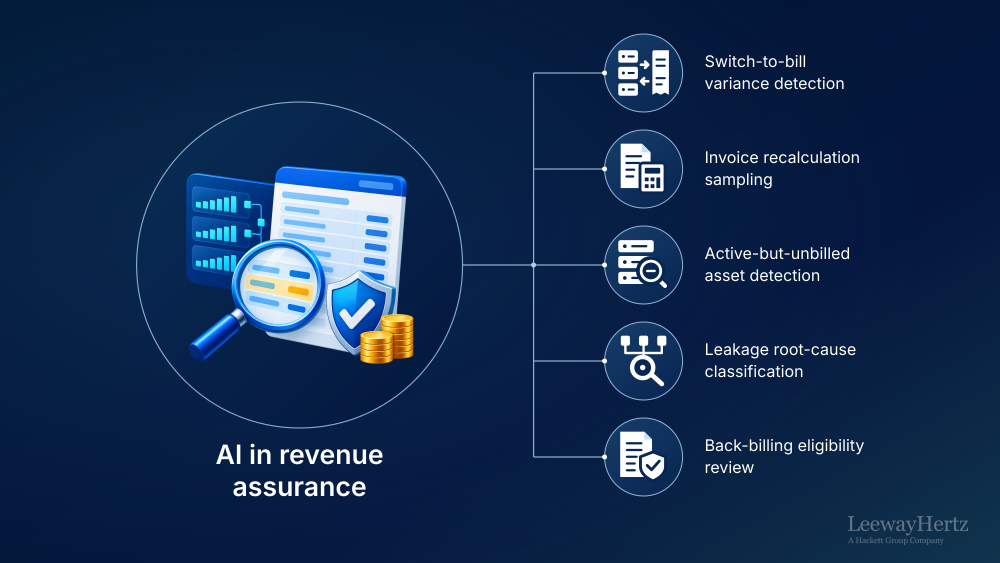
Revenue assurance (RA) is the operating discipline that checks whether delivered services are captured, rated, billed, settled, recognized and recovered accurately. In a telecom operator, it follows CDRs, EDRs, IPDRs, mediation files, rating outputs, bill runs, roaming files, interconnect statements and service inventory records. In a SaaS or usage-based billing business, it follows product telemetry, usage meters, entitlement records, pricing outputs, invoice previews, credits and cloud cost signals.
The operational challenge is that revenue assurance is spread across systems that were not designed as one clean control chain. Network teams own source events, mediation teams transform them, billing teams rate and invoice them, settlement teams exchange partner files, finance closes the books, and internal audit tests the evidence. A small break in sequence integrity, plan configuration, entitlement mapping, discount logic or partner settlement can move silently until it appears as leakage, overbilling, a customer dispute, a failed control, or a margin problem.
The scale of the problem keeps growing. GSMA reported that mobile technologies and services generated about $6.5 trillion in economic value in 2024, equal to 5.8 percent of global GDP, and projected the figure to reach almost $11 trillion by 2030 [1]. CFCA’s 2025 Global Fraud Loss Survey estimates that the telecom industry lost $41.82 billion to fraud, equal to 2.46% of revenues. The figure is higher than the 2023 estimate of $38.95 billion, even though fraud loss as a share of revenue declined slightly from 2.5%, which shows why assurance and fraud teams need stronger shared evidence, clearer triage, and better control coverage. [2]
AI in revenue assurance is the governed use of anomaly detection, classification, document intelligence, predictive analytics, simulation, optimization, retrieval-grounded answering, graph analytics, and natural-language generation across the revenue chain. It is not a generic chatbot next to a billing platform. In practice, AI must support the specific evidence needs of each reviewer: a revenue assurance manager needs variance decomposition with source evidence, a billing operations manager needs invoice recalculation before a bill run is released, and a revenue accounting manager needs materiality, accrual implications and recovery evidence before financial treatment is confirmed.
AI is relevant because revenue assurance work is artifact-rich, exception-heavy and reviewable. The data already exists in usage files, rating tables, invoice outputs, settlement statements, control catalogs and leakage registers, but it is often too fragmented for manual review at the speed of modern usage and billing cycles. The practical value comes when AI prepares the evidence, quantifies exposure, explains the variance, and routes the case to the right human owner before any billing, recovery, accounting or network action proceeds.
This is why the operating model matters. Revenue assurance is not one workflow; it is a chain of control points across usage capture, mediation, provisioning, rating, billing, settlement, leakage analysis, recovery, fraud coordination, margin assurance and governance. Mapping AI opportunities to that operating model makes each use case specific enough to design, test and govern, with the right artifacts, systems, regulatory considerations and accountable roles defined from the start.
This article uses the revenue assurance operating model to break work into functions, processes, sub-processes, artifacts, systems, regulatory and control considerations, accountable roles, AI-enabled opportunities and governed agentic workflows.
- How AI is transforming revenue assurance operations
- Why AI use cases in revenue assurance must be mapped at the sub-process level
- Revenue assurance operating model and AI opportunity mapping across revenue assurance processes
- High-value AI use cases in revenue assurance
- How agentic AI works in revenue assurance workflows
- How to prioritize AI use cases in revenue assurance
- Governance, risk, and responsible AI in revenue assurance
- How ZBrain operationalizes AI use cases in revenue assurance
- Future of AI in revenue assurance
How AI is transforming revenue assurance operations
Revenue assurance is moving from periodic sampling toward continuous control monitoring. Traditional RA still needs manual reconciliations, sample checks, analyst judgment and finance oversight, but the control environment now has to handle more event volume, more product variation, more partner relationships and more usage-based pricing. AI helps when it is pointed at a defined control question: what changed, where did the variance originate, which artifact proves it, who owns the decision, and what evidence must be retained.
Consider a data-usage variance in a telecom environment. The source network element reports one volume, mediation-in logs show another, mediation-out logs show a filtered event subtype, rating rejects show unratable usage, and invoice previews show lower-than-expected billed usage. In a SaaS environment, the same pattern may involve product telemetry, a usage-meter aggregation job, a monetization-platform price tier, and invoice-line generation. AI can connect those records into one exception packet, but billing operations, finance and RA leaders still decide whether a correction, rerating, back-billing or accrual action is appropriate.
The strongest AI opportunities usually fall into five kinds of work:
- Document-heavy work: tariffs, rating tables, bill run files, invoice samples, settlement statements and leakage case files that must be checked for missing context and inconsistencies.
- Narrative-heavy work: leakage case packets, recovery memos, SOX evidence summaries and root-cause reports that AI can draft from approved source material.
- Exception-heavy work: rejected events, unratable usage, billing variances, stranded assets and interconnect disputes that need classification before specialists review them.
- Knowledge-heavy work: tariff interpretation, back-billing limits, RA control catalog checks and regulatory billing rules that require grounded retrieval rather than memory.
- Workflow-heavy work: switch-to-bill reconciliation, rerating validation, recovery-to-cash tracking and settlement assurance where AI can assemble the next work packet.
The practical design rule is simple: start with a revenue assurance sub-process, not with an AI tool. A useful workflow names the starting artifact, the systems of record, the variance or exception type, the AI capability, the accountable reviewer and the evidence retained after review.
Why AI use cases in revenue assurance must be mapped at the sub process level
Broad labels such as AI for billing validation or AI for leakage detection sound useful, but they are too wide for implementation. Billing validation can mean invoice sampling, proration checks, discount testing, tax validation, bill-run readiness or post-cycle variance review. A workflow that recalculates invoice samples is not governed the same way as one that recommends back-billing or prepares an accrual-support packet. Each sub-process uses different artifacts, systems, risk boundaries and reviewers.
A better approach is to map AI use cases to the revenue assurance operating model:
- Function: a governed operational domain such as usage reconciliation, billing validation, settlement assurance, leakage analytics or RA governance.
- Process: a workflow area inside the function, such as mediation balancing, invoice sampling, TAP3 validation, leakage quantification or SOX evidence management.
- Sub-process: a defined activity with identifiable inputs, checks, outputs, and an owner, such as investigating rejected usage events or recalculating sampled invoices.
- AI-enabled opportunity: a specific AI capability applied to a specific artifact to change how work is prepared, reviewed, explained or controlled.
Sub-process mapping keeps AI implementation grounded by defining the exact activity, source artifacts, systems, controls, and accountable reviewers before a workflow is designed. It shows the revenue assurance manager which control is affected, the billing operations manager which system output must be trusted, the revenue accounting manager where financial treatment may be implicated, and internal audit teams what evidence should exist after the workflow runs.
For example, usage reconciliation is not one use case. Network-to-bill volume balancing uses anomaly detection on CDR counts, mediation logs and rated usage. Suspense workoff uses classification on rejected-event queues and reject-code reports. Bill-cycle readiness uses anomaly detection on late-arriving usage and incomplete mediation streams. Each can be valuable, but each needs its own source records, thresholds, human checkpoints and audit trail.
Build governed AI workflows for insurance underwriting operations
Connect submission intake, risk enrichment, quoting, binding, renewal and underwriting audit while preserving human accountability for underwriting decisions.
Revenue assurance operating model and AI opportunity mapping across revenue assurance processes
The operating model below follows the core functions of the revenue assurance chain from usage capture through governance. Each function names the teams, artifacts, systems, control considerations, accountable roles, AI opportunities to specific subprocesses, human ownership boundaries and one named agentic workflow.
Function 1: Usage capture and event integrity
Revenue assurance begins by verifying that service usage is captured accurately and completely before it enters mediation, rating, and billing.
Usage capture and event integrity turn raw service activity into reliable usage evidence. In telecom, this includes CDRs, EDRs, IPDRs, network-element counters, mediation input files, sequence logs, and clock records. In SaaS, the same discipline applies to product telemetry, usage meters, API events, entitlement logs, and ingestion pipelines. This function feeds every later control, because a missing, duplicated, late, or malformed event can become leakage long before the billing team sees a variance.
Teams involved: Revenue assurance, mediation engineering, network operations, product telemetry engineering, billing operations, and usage data engineering run this function together.
Key artifacts: CDRs, EDRs, IPDRs, telemetry events, mediation input files, mediation rule tables, dropped-event reports, gap logs, sequence logs, clock-synchronization reports, and usage-meter audit files.
Systems involved: Network elements, mediation platforms, streaming event pipelines, product telemetry platforms, data lake ingestion services, observability tools, service assurance systems, and RA control repositories.
Regulatory and control considerations: SOX 404 revenue completeness controls, ISO 27001 access and logging controls, GDPR and CCPA privacy controls for usage records, network-change controls, and TM Forum revenue assurance control points.
Accountable roles: Revenue assurance manager, RA analyst, mediation engineer, usage data engineer, CTO or network operations delegate, and internal audit manager.
What AI helps with: Anomaly detection can identify unusual patterns in CDR, EDR, IPDR, telemetry and mediation input volumes by comparing them with historical baselines and network counters. Classification can group dropped events by rule, format defect, subtype, source element, and deployment window. Retrieval-grounded answering can surface the mediation rule, change ticket, and RA control catalog entry relevant to a reported gap, with source references for analyst review. Natural-language generation can prepare the event-integrity exception summary for review.
What humans continue to own: Mediation engineers approve rule changes, network operations team confirms source-system behavior, and the revenue assurance manager decides whether an event gap becomes a leakage case. Internal audit remains responsible for control reliance and testing conclusions. AI detects, classifies, and prepares evidence but does not decide, approve, or attest.
| Process | Sub-process | Key AI-enabled opportunities |
|---|---|---|
| Event collection monitoring | CDR, EDR, and IPDR ingestion completeness |
|
| Product telemetry and usage-meter capture |
|
|
| Mediation rule management | Filtering, deduplication and enrichment checks |
|
| Data normalization | Format and unit normalization |
|
| Event sequence and timestamp integrity | Clock drift and sequence gap checks |
|
| Dropped-event control | Dropped event and gap investigation |
|
Highest-value opportunities: The highest-value opportunities are usage ingestion completeness, mediation rule validation, and event sequence integrity. These controls establish whether usage is complete before it reaches rating and billing. Filtering or enrichment errors can suppress billable events at scale, while timing defects can place usage in the wrong billing or settlement period.
Example agentic workflow: Dropped event integrity investigation
- The workflow starts when the dropped-event report shows a spike in rejected IPDRs from one broadband gateway after a firmware upgrade.
- The agent aggregates IPDR counts, mediation input files, rejected-event queues, sequence logs, timestamp drift reports, and the network change ticket.
- It uses anomaly detection to isolate the affected interval and classification to group rejects by missing field, malformed unit, and unsupported event subtype.
- It retrieves the mediation rule entry and RA control catalog item that govern the dropped-event threshold.
- The mediation engineer reviews the proposed mapping correction, and the revenue assurance manager decides whether the exposure requires a leakage case.
- After approval, the correction moves through existing change control, and the before-after event counts are stored with the control evidence.
Function 2: Order-to-provisioning reconciliation
This function checks whether sold and ordered services exist correctly in the network, product platform, service inventory, and billing catalog.
Order-to-provisioning reconciliation protects revenue completeness by connecting commercial intent with technical activation and billable inventory. It reconciles what was ordered with what was provisioned, activated, recorded in service inventory, and configured for billing.
Teams involved: Revenue assurance,billing operations, provisioning operations, network inventory, product operations, SaaS monetization, and internal audit teams support this function.
Key artifacts: Order records, service inventory dumps, HLR HSS extracts, provisioning database exports, billing catalog extracts, entitlement records, activation logs, deactivation logs, and stranded-asset reports.
Systems involved: CRM, order management, provisioning systems, service inventory, network inventory, HLR or HSS, billing platforms, entitlement services, and data warehouses.
Regulatory and control considerations: SOX 404 completeness and accuracy controls, ASC 606 and IFRS 15 revenue-recognition alignment, ISO 27001 access controls, GDPR and CCPA controls for subscriber records, and TM Forum eTOM-aligned order-to-bill controls.
Accountable roles: Revenue assurance manager, billing operations manager, RA analyst, CTO or network operations delegate, head of billing/monetization, and internal audit manager.
What AI helps with: Entity resolution can match customer, subscription, SIM, circuit, entitlement, and billing-account identifiers across fragmented systems. Anomaly detection can flag inventory states that do not match order status or billing status. Classification can group stranded assets by source cause, including failed disconnect, partial activation, catalog mismatch, or missing billing account. Natural-language generation can prepare audit-ready reconciliation summaries.
What humans continue to own: Provisioning and billing leaders decide whether to correct inventory, rerate charges, adjust billing status, or open remediation tickets. Revenue accounting team determines whether any material correction affects accruals or revenue recognition. AI compares, classifies, and prepares but does not decide, approve, or attest.
| Process | Sub-process | Key AI-enabled opportunities |
|---|---|---|
| Order provisioning match | Order entry vs provisioned service comparison |
|
| Service inventory audit | HLR HSS and provisioning database comparison |
|
| Billing catalog alignment | Provisioned service vs billing catalog comparison |
|
| Stranded asset identification | Active but unbilled asset detection |
|
| Service disconnect reconciliation | Ceased service and deactivation reconciliation |
|
| SaaS entitlement assurance | Subscription entitlement vs usage meter comparison |
|
Highest-value opportunities: The highest-value opportunities are active but unbilled asset detection, entitlement to usage meter comparison, and provisioned-service-to-billing-catalog reconciliation. These areas matter because they expose direct revenue leakage, protect usage-based SaaS revenue at the entitlement boundary, and prevent catalog gaps from affecting future bill runs.
Example agentic workflow: Active service unbilled asset review
- The workflow starts when the monthly service inventory dump identifies active fiber circuits with no matching recurring charge in the billing extract.
- The agent matches order records, provisioning status, circuit IDs, billing account records, price-plan configuration, and prior disconnect requests.
- It classifies each exception as delayed billing start, catalog mismatch, failed disconnect, test service, or approved no-charge service.
- It estimates exposure using the approved tariff and identifies accounts approaching back-billing limits.
- The billing operations manager and revenue assurance manager review the case list and approve which records move to correction, customer notification, or revenue-accounting review.
- Approved fixes enter billing and inventory change control, and the exception evidence is retained in the leakage register.
Function 3: Rating and tariff verification
Rating and tariff verification confirms that the prices configured in systems match approved tariffs, plan rules, discounts, units, and rounding logic.
Rating is where captured usage becomes billable value. For telecom, the control covers rating-engine configuration, published tariffs, roaming rates, interconnect tables, bundle rules, tax-sensitive charge codes, and test call generation results. For SaaS, it covers usage-meter pricing, tier thresholds, overage rates, minimum commitments, credits, and currency rules. A configuration error here can create systematic leakage or overbilling across every customer attached to the affected plan.
Teams involved: Revenue assurance, product pricing, billing operations, rating configuration, finance, legal or regulatory support, and SaaS monetization teams operate this function.
Key artifacts: Published tariffs, price plans, rating tables, billing catalog exports, unit-conversion tables, rounding rules, discount rules, TCG result logs, rerating outputs, and price-change approvals.
Systems involved: Rating engines, billing platforms, product catalogs, CPQ price repositories, tariff repositories, TCG platforms, monetization platforms, ERP, and finance data marts.
Regulatory and control considerations: FCC Truth-in-Billing rules, state PUC billing rules, ASC 606 and IFRS 15 revenue treatment, SOX 404 rating accuracy controls, PCI DSS where payment data is present, and change management controls.
Accountable roles: Product pricing manager, billing operations manager, revenue assurance manager, revenue accounting manager, RA analyst, and internal audit manager.
What AI helps with: Document intelligence can compare approved tariff documents with rating-table exports and billing catalog settings. Anomaly detection can flag rating outcomes that differ from expected call, session, or usage-meter charges. Simulation can generate test scenarios for bundles, proration, tier thresholds, roaming, currency, and rounding. Retrieval-grounded answering can explain which approved tariff clause supports a configuration decision.
What humans continue to own: Product pricing team approves tariff intent, billing operations team approves rating configuration changes, and revenue accounting team reviews material revenue effects. Regulatory and finance reviewers decide how customer-impacting corrections are handled. AI compares, simulates, and drafts but does not decide, approve, or attest.
| Process | Sub-process | Key AI-enabled opportunities |
|---|---|---|
| Tariff configuration audit | Published tariff vs rating table comparison |
|
| Price plan validation | Bundle allowance and overage rule checks |
|
| Test call generation | TCG campaign design and result validation |
|
| Rerating assurance | Post-change rerating validation |
|
| Rounding and unit-conversion validation | Unit currency and rounding checks |
|
| SaaS usage pricing | Usage-meter tier and commitment validation |
|
Highest-value opportunities: The highest-value opportunities are tariff-to-rating table comparison, TCG result validation, and usage-meter tier and commitment checks. These areas matter because they prevent systematic billing errors, test configured rating behavior before customer bills are issued, and protect usage-based SaaS billing from tier, commitment, and overage misconfiguration.
Example agentic workflow: Tariff change rerating assurance
- The workflow starts when a new enterprise data plan is approved and the rating-table export is ready for pre-production validation.
- The agent extracts rates, units, bundle thresholds, proration rules, and effective dates from the approved tariff and compares them with the rating engine configuration.
- It simulates usage scenarios across normal consumption, overage, roaming, discount, and mid-cycle change conditions.
- It prepares a variance report with expected charges, actual rated outputs, configuration differences, and affected rate plans.
- The product pricing manager confirms tariff intent, the billing operations manager approves configuration correction, and the revenue assurance manager approves the validation evidence.
- Approved corrections move into release control, and TCG results are stored with the rating validation record.
Function 4: Usage reconciliation
Usage reconciliation balances event volumes and values from source systems through mediation, rating, suspense, and bill-cycle inclusion.
Usage reconciliation is the operational center of revenue assurance. It proves that usage captured by the network or product platform reaches the billing process in the expected volume, format, and state. Telecom teams usually describe this as switch-to-bill or network-to-bill reconciliation. SaaS teams apply the same logic when product events move through metering, aggregation, pricing, invoice preview, and usage-rated billing.
Teams involved: Revenue assurance, billing operations, mediation engineering, network operations, usage data engineering, product monetization, and revenue accounting teams participate in this function.
Key artifacts: Switch-to-bill reconciliation reports, mediation-in logs, mediation-out logs, usage suspense files, reject-code reports, rated usage extracts, bill-cycle population files, and leakage case packets.
Systems involved: Network switches, mediation platforms, event pipelines, rating engines, billing systems, usage metering platforms, data warehouses, and RA case management tools.
Regulatory and control considerations: SOX 404 revenue completeness controls, TM Forum revenue assurance controls, ISO 27001 access controls, GDPR and CCPA protections for usage records, and approved back-billing policy limits.
Accountable roles: Revenue assurance manager, RA analyst, mediation engineer, billing operations manager, usage data engineer, revenue accounting manager, and internal audit manager.
What AI helps with: Anomaly detection can identify volume variances across source, mediation-in, mediation-out, rating, suspense, and bill-cycle stages. Classification can separate rejected events, unratable events, delayed files, duplicate suppression, and unsupported event subtypes. Predictive analytics can estimate leakage exposure by event population, rate plan, and customer cohort. Natural-language generation can prepare a leakage case packet that shows sources, calculations, and open decisions.
What humans continue to own: The revenue assurance manager validates leakage quantification, the billing operations team approves rerating or bill-cycle handling, and the revenue accounting team decides material accrual treatment. Network and mediation leaders approve source or rule corrections under normal change management. AI reconciles, classifies, and prepares but does not decide, approve, or attest.
| Process | Sub-process | Key AI-enabled opportunities |
|---|---|---|
| Switch to bill reconciliation | Network to bill volume balancing |
|
| Mediation balancing | Mediation-in vs. mediation-out reconciliation |
|
| Usage suspense management | Rejected and unratable event triage |
|
| Aging suspense workoff | Suspense aging and recovery prioritization |
|
| Bill-cycle readiness assessment | Usage inclusion cutoff checks |
|
| SaaS metering reconciliation | Telemetry to invoice preview reconciliation |
|
Highest-value opportunities: The highest-value opportunities are network-to-bill volume balancing, rejected and unratable event triage, and telemetry-to-invoice-preview reconciliation. These areas matter because they reveal usage leakage, surface recoverable revenue in suspense queues, and apply the same completeness discipline to SaaS usage billing that telecom teams apply to mediation.
Example agentic workflow: Investigating switch-to-bill variance and leakage
- The workflow starts when the nightly switch-to-bill reconciliation report shows a volume variance for data usage events on one mediation stream, breaching the defined control threshold.
- The agent aggregates raw CDR counts from the network element, mediation-in and mediation-out logs, the usage suspense file, rating-engine reject codes, and the affected bill-cycle population.
- It retrieves the RA control catalog entry for the breached control, the applicable tariff configuration, and back-billing policy limits.
- It prepares a leakage case packet with variance decomposition, revenue impact by rate plan, affected customer count, a proposed mediation rule fix, and a back-billing recommendation within the policy window.
- The revenue assurance manager validates quantification and approves the case, the billing operations manager approves the rerating run, and material disputes escalate to the revenue accounting manager for accrual treatment.
- The fix ticket routes to network change management, rerating, and back-billing jobs execute after approval, and case evidence is stored in the leakage register as SOX control evidence.
Function 5: Billing validation
Billing validation checks whether the bill run and invoice output reflect approved usage, recurring charges, discounts, taxes, surcharges, credits, and customer impacting changes.
Billing validation sits at the point where assurance moves from usage completeness into customer-facing accuracy. It examines pre-cycle readiness, post-cycle bill output, invoice samples, recalculated charges, proration, mid-cycle changes, promotions, taxes, and surcharges. The work protects the customer experience, revenue accuracy, and control evidence at the same time.
Teams involved: Billing operations, revenue assurance, product pricing, tax, revenue accounting, customer operations, SaaS monetization, and internal audit teams collaborate on this function.
Key artifacts: Bill run files, invoice image samples, invoice preview files, billing exception reports, recalculation worksheets, proration logs, discount application reports, tax and surcharge tables, credit memo records, and approval evidence.
Systems involved: Billing platforms, invoice rendering systems, rating engines, tax engines, CRM, ERP, product catalogs, monetization platforms, and document repositories.
Regulatory and control considerations: FCC Truth-in-Billing requirements, state PUC billing rules, SOX 404 billing accuracy controls, ASC 606 and IFRS 15 revenue treatment, PCI DSS where payment data is present, and customer-notification rules.
Accountable roles: Billing operations manager, revenue assurance manager, product pricing manager, revenue accounting manager, internal audit manager, CFO, and head of billing/monetization.
What AI helps with: Document intelligence extracts invoice fields from invoice images, while validation logic checks those fields against bill run files, catalog configuration, tariff records and tax tables. Anomaly detection can flag bills with unusual charge movement, missing usage, unexpected credits, or incorrect proration. Simulation can recalculate sample invoices using approved plan logic. Retrieval-grounded answering can connect a billing variance to the applicable tariff, tax rule, or promotion policy.
What humans continue to own: Billing operations teams approve bill-run release, product pricing team confirms promotion and discount interpretation, tax and finance teams approve tax or revenue treatment, and the CFO owns material financial reporting judgments. AI validates, recalculates, and prepares but does not decide, approve, or attest.
| Process | Sub-process | Key AI-enabled opportunities |
|---|---|---|
| Pre-cycle audit | Bill-run readiness validation |
|
| Post-cycle audit | Bill-run output variance review |
|
| Invoice sampling | Invoice recalculation and image validation |
|
| Mid-cycle billing change validation | Proration and mid-cycle change verification |
|
| Commercial term validation | Discount and promotion checks |
|
| Tax and surcharge validation | Tax surcharge and fee checks |
|
Highest-value opportunities: The highest-value opportunities are bill-run readiness validation, invoice recalculation, and discount and promotion checks. These areas matter because they catch preventable errors before invoices are produced, verify billing accuracy at the customer-facing level, and expose commercial leakage hidden in expired or misapplied concessions.
Example agentic workflow: Pre-cycle billing validation review
- The workflow starts when the pre-cycle audit file shows an unusual increase in invoice previews with zero-rated data usage.
- The agent aggregates invoice previews, rated usage extracts, discount reports, tariff records, tax tables, and recent catalog-change approvals.
- It uses anomaly detection to isolate affected plans and simulation to recalculate representative invoices.
- It prepares an exception packet with affected bills, expected charges, observed differences, customer impact, and required approvals.
- The billing operations manager decides whether the bill run can proceed, the product pricing manager confirms promotion logic, and the revenue accounting team reviews material exposure.
- Approved corrections follow billing release governance, and the final validation record is retained for audit support.
Function 6: Interconnect and partner settlement assurance
Settlement assurance validates charges and revenue shares exchanged with carriers, roaming partners, content providers, app stores, and other commercial partners.
Interconnect and partner settlement assurance extends revenue assurance beyond the customer invoice. Telecom operators must reconcile interconnect usage, roaming TAP3 or BCE exchange, RAP files, NRTRDE feeds, wholesale settlements, and partner statements. SaaS and digital businesses face a similar pattern when usage, revenue share, marketplace fees, and partner invoices must agree with contract terms and platform records.
Teams involved: Interconnect and wholesale settlements, revenue assurance, roaming operations, partner management, billing operations, finance, revenue accounting, and fraud management teams support this function.
Key artifacts: Interconnect settlement statements, TAP3 files, BCE files, RAP files, NRTRDE feeds, roaming rate tables, partner revenue share statements, content usage reports, app-store statements, and dispute case files.
Systems involved: Interconnect billing systems, roaming clearinghouse platforms, partner portals, mediation systems, wholesale billing platforms, ERP, data warehouses, and contract repositories.
Regulatory and control considerations: GSMA roaming standards, settlement contract terms, SOX 404 completeness and accuracy controls, ASC 606 and IFRS 15 principal-agent considerations, ISO 27001, GDPR, and dispute timeline rules.
Accountable roles: Interconnect/wholesale settlements manager, revenue assurance manager, fraud management lead, revenue accounting manager, billing operations manager, and internal audit manager.
What AI helps with: Multi-source aggregation can reconcile partner statements with mediated usage, rated wholesale records, TAP3 or BCE files, and ERP postings. Anomaly detection can flag abnormal roaming or interconnect volumes, missing RAP responses, and rate-table mismatches. Classification can group disputes by rating, volume, duplicate, fraud-suspected, tax, and contract-interpretation causes. Natural-language generation can prepare settlement dispute packets with evidence references.
What humans continue to own: Settlement managers approve disputes and partner communications, fraud leaders decide whether a pattern requires fraud investigation, and revenue accounting team determines gross-versus-net or accrual treatment. AI reconciles, classifies, and prepares but does not decide, approve, or attest.
| Process | Sub-process | Key AI-enabled opportunities |
|---|---|---|
| Interconnect reconciliation | Inbound and outbound interconnect billing comparison |
|
| Roaming settlement | TAP3 BCE and RAP validation |
|
| Roaming risk monitoring | NRTRDE feed monitoring |
|
| Partner revenue-share reconciliation | Content and app-store settlement reconciliation |
|
| Settlement dispute handling | Dispute evidence packet preparation |
|
| Revenue accounting handoff | Settlement accrual and true-up support |
|
Highest-value opportunities: The highest-value opportunities are TAP3, BCE and RAP validation, content and app-store settlement reconciliation, and settlement accrual support. These areas matter because roaming settlement depends on accurate structured file exchange, partner revenue shares can create leakage outside customer billing, and unresolved settlement issues can affect period close.
Example agentic workflow: Roaming settlement exception review
- The workflow starts when a TAP3 validation report shows a rejected file from a roaming partner with high-value data sessions.
- The agent aggregates TAP3 records, RAP responses, NRTRDE feeds, roaming rate tables, partner agreement terms, and clearinghouse acknowledgments.
- It classifies exceptions by file defect, rejected record, rate mismatch, late submission, and suspected abnormal traffic.
- It prepares a dispute packet with event-level evidence, financial exposure, contractual deadline, and proposed response.
- The interconnect/wholesale settlements manager approves the dispute position, and the fraud management lead reviews abnormal-traffic indicators before any fraud escalation.
- Approved dispute records and settlement adjustments are tracked through ERP and retained for revenue assurance evidence.
Accelerate AI Solutions Development
Build fully functional solutions from your high-value use cases, based on specific operational needs and enterprise context.
Function 7: Leakage detection and analytics
Leakage detection converts fragmented exceptions into quantified cases, root-cause patterns, control gaps, and management reporting.
Leakage detection and analytics is where revenue assurance turns reconciliation evidence into management action. It maps control points across the revenue chain, detects anomalies, quantifies exposure, classifies root causes, and maintains the leakage register. The function is valuable because isolated exceptions rarely tell executives what changed; they need to know the source, materiality, fix owner, and cash recovery path.
Teams involved: Revenue assurance, analytics, billing operations, network operations, finance, product pricing, internal audit, fraud management, and SaaS monetization teams contribute to this function.
Key artifacts: RA control catalog, eTOM control-point map, variance reports, anomaly alerts, leakage register, root-cause taxonomy, leakage case packets, revenue impact calculations, and executive dashboards.
Systems involved: RA analytics platforms, BI tools, data warehouses, billing systems, mediation systems, rating engines, CRM, service inventory, case-management tools, and audit repositories.
Regulatory and control considerations: SOX 404 control coverage, TM Forum eTOM and GB941-aligned leakage frameworks, GSMA RAFM maturity practices, ASC 606 and IFRS 15 revenue treatment, and internal materiality thresholds.
Accountable roles: Revenue assurance manager, RA analyst, revenue accounting manager, internal audit manager, CFO, billing operations manager, and fraud management lead.
What AI helps with: Anomaly detection can find unusual movements across event volumes, billed revenue, credits, suspense, settlement, COGS, and margins. Classification groups exceptions by likely source, such as mediation defect, rating configuration, catalog mismatch, delayed provisioning, or partner settlement. Predictive analytics can quantify likely revenue exposure and recovery probability. Natural-language generation can prepare leakage register entries and executive summaries with linked evidence.
What humans continue to own: Revenue assurance leaders decide case materiality, finance team decides accounting treatment, internal audit team determines control reliance, and executives approve major remediation priorities. AI detects, quantifies, and prepares but does not decide, approve, or attest.
| Process | Sub-process | Key AI-enabled opportunities |
|---|---|---|
| Control coverage mapping | eTOM aligned RA control point mapping |
|
| Revenue chain monitoring | Revenue chain anomaly monitoring |
|
| Revenue leakage quantification | Revenue impact calculation |
|
| Root cause analytics | Root-cause classification |
|
| Revenue leakage register | Leakage register maintenance |
|
| Executive reporting | Leakage KPI and trend reporting |
|
Highest-value opportunities: The highest-value opportunities are revenue impact calculation, root-cause classification, and leakage KPI reporting. These areas matter because they turn exceptions into financial priorities, reveal recurring defects that need system fixes, and give CFO and audit teams a governed view of exposure, recovery and control performance.
Example agentic workflow: Leakage register root cause review
- The workflow starts when weekly anomaly monitoring flags a recurring revenue variance for usage-rated IoT plans.
- The agent aggregates usage records, rating outputs, invoice lines, credit memos, service inventory, prior leakage cases, and control catalog entries.
- It classifies the pattern as a rating-table tier defect and quantifies estimated exposure by customer cohort and billing period.
- It drafts a leakage register entry with root cause, financial impact, responsible owner, recovery options, and required evidence.
- The revenue assurance manager validates the case, the revenue accounting team reviews materiality, and the product pricing manager confirms rate-plan interpretation.
- Approved actions move into billing change control and recovery tracking, with case evidence retained for SOX testing.
Function 8: Revenue recovery and remediation
Revenue recovery turns approved leakage cases into back-billing, credit recovery, adjustment correction, system fixes, and cash tracking.
Detection has little value unless the organization can recover appropriate revenue and prevent recurrence. Revenue recovery and remediation prepares back-billing cases within policy and regulatory limits, reverses improper credits or adjustments where allowed, creates IT and network fix tickets, and tracks recovery to cash. The function must be carefully governed because recovery actions can affect customers, revenue recognition, complaints, and regulatory compliance.
Teams involved: Revenue assurance, billing operations, revenue accounting, customer operations, legal or regulatory support, IT change management, network operations, and finance teams run this function.
Key artifacts: Back billing case files, recovery approval records, customer-impact lists, rerating job files, adjustment records, credit memo records, fix tickets, cash recovery trackers, and leakage register updates.
Systems involved: Billing platforms, ERP, CRM, case management tools, IT service management platforms, network change management systems, revenue subledgers, and payment systems.
Regulatory and control considerations: Ofcom back-billing limits as an international reference, FCC and state billing rules, SOX 404 controls, ASC 606 and IFRS 15 revenue recognition, customer-notification rules, and internal materiality thresholds.
Accountable roles: Revenue assurance manager, billing operations manager, revenue accounting manager, internal audit manager, CFO, customer operations lead, and CTO or network operations delegate.
What AI helps with: Retrieval-grounded answering can check approved back-billing limits, customer-notification rules, and recovery policies before a case moves forward. Predictive analytics can estimate collectability and recovery timing. Optimization can prioritize recovery actions by value, customer risk, policy window, and operational effort. Natural-language generation can prepare customer-impact summaries, case memos, and fix ticket descriptions for human review.
What humans continue to own: Billing, finance, legal, and customer leaders approve back-billing, credits, customer communication, and material financial treatment. IT and network leaders approve permanent fixes through change management. AI prepares, prioritizes, and drafts but does not decide, approve, or attest.
| Process | Sub-process | Key AI-enabled opportunities |
|---|---|---|
| Back-billing preparation | Back-billing eligibility and policy-window checking |
|
| Rerating and billing correction | Rerating case preparation |
|
| Credit recovery | Credit and adjustment recovery review |
|
| Root-cause remediation | IT network and billing fix ticketing |
|
| Recovery tracking | Recovery-to-cash monitoring |
|
| Audit evidence management | Recovery evidence retention |
|
Highest-value opportunities: The highest-value opportunities are back-billing eligibility checks, rerating case preparation, and recovery-to-cash monitoring. These areas matter because recovery must stay within customer and regulatory limits, approved leakage must be converted into a controlled billing correction, and CFOs need evidence that recovery progressed beyond case approval.
Example agentic workflow: Back billing recovery case preparation
- The workflow starts when an approved leakage register entry identifies three months of underbilled enterprise usage.
- The agent aggregates rated usage, original invoices, tariff rules, credit history, customer contract terms, back-billing limits, and revenue-accounting thresholds.
- It simulates corrected charges, separates eligible and time-barred amounts, and drafts a customer-impact summary.
- It prepares the rerating approval packet, recovery tracker entry, and system-fix ticket.
- The revenue assurance manager approves the case, billing operations teams approve rerating, revenue accounting teams review materiality, and customer operations teams approve any customer communication.
- Approved recovery proceeds through billing governance, and cash realization is tracked in the leakage register.
Function 9: Revenue assurance and fraud handoff management
This function helps revenue assurance teams distinguish operational leakage from suspected fraud and prepare the evidence fraud specialists need to investigate.
Revenue assurance and fraud handoff management often inspect similar signals, but they own different decisions. Revenue assurance asks whether delivered services were captured, rated, billed, settled, and recovered correctly. Fraud management investigates intentional abuse such as bypass, SIM-box, IRSF, account takeover, subscription fraud, or dealer commission abuse. The interface matters because a pattern can look like leakage until traffic behavior, account history, or partner routing suggests fraud.
Teams involved: Revenue assurance, fraud management, billing operations, network operations, dealer operations, partner settlements, security, and revenue accounting teams coordinate this function.
Key artifacts: Fraud alerts, bypass and SIM-box pattern reports, IRSF traffic summaries, dealer commission records, subscription fraud cases, leakage triage records, usage records, settlement records, and escalation packets.
Systems involved: Fraud management systems, mediation platforms, billing systems, CRM, dealer management platforms, interconnect systems, network analytics, and case-management tools.
Regulatory and control considerations: CFCA fraud benchmark context, GSMA RAFM practices, SOX 404 controls for revenue impact, privacy and security controls, lawful investigation procedures, and approved escalation thresholds.
Accountable roles: Fraud management lead, revenue assurance manager, billing operations manager, interconnect/wholesale settlements manager, revenue accounting manager, and CTO or network operations teams delegate.
What AI helps with: Anomaly detection can identify traffic, usage, settlement, or commission patterns that deviate from normal revenue behavior. Classification can triage cases as leakage, suspected fraud, commercial dispute, billing error, or legitimate behavior. Graph analytics can connect accounts, SIMs, devices, dealers, routes, and partner destinations. Natural-language generation can prepare an escalation packet with the evidence fraud teams need.
What humans continue to own: Fraud leaders decide whether a case becomes a fraud investigation, network leaders approve technical action, and revenue assurance leaders decide whether leakage recovery remains appropriate. Revenue accounting teams review material financial effects. AI triages, connects, and prepares but does not decide, approve, or attest.
| Process | Sub-process | Key AI-enabled opportunities |
|---|---|---|
| Bypass coordination | Bypass and SIM-box pattern triage |
|
| IRSF coordination | International revenue share fraud pattern review |
|
| Subscription fraud triage | Subscription fraud vs leakage triage |
|
| Dealer commission assurance | Dealer commission abuse detection |
|
| Case routing | RA fraud handoff packet preparation |
|
| Fraud and leakage impact reporting | Fraud loss and leakage reporting alignment |
|
Highest-value opportunities: The highest-value opportunities are bypass and SIM-box pattern triage, subscription-fraud-versus-leakage triage, and fraud-and-leakage impact reporting. These areas matter because traffic leakage can become material quickly, accurate classification sends cases to the right control owner, and finance teams need a clear separation between confirmed fraud loss and recoverable leakage.
Example agentic workflow: SIM box leakage fraud triage
- The workflow starts when interconnect revenue drops while outbound call volumes and destination patterns change sharply for a cluster of prepaid SIMs.
- The agent aggregates CDRs, mediated usage, rated revenue, SIM activation records, device identifiers, dealer records, and fraud alerts.
- It applies anomaly detection and graph analytics to connect suspicious traffic behavior with activation and dealer patterns.
- It prepares a triage packet that separates possible bypass fraud, rating leakage, and settlement variance.
- The fraud management lead decides whether to open a fraud investigation, and the revenue assurance manager decides whether any leakage case should remain open in parallel.
- Approved actions follow fraud, network, and RA governance, with finance impact tracked separately for fraud loss and recoverable leakage.
Function 10: Margin and cost assurance
Margin and cost assurance checks whether billed revenue covers attributable costs, including interconnect charges, partner fees, content costs, and cloud infrastructure, while meeting expected product margins.
Revenue assurance cannot stop at top-line completeness when variable costs move with usage. Telecom products carry interconnect, roaming, wholesale, content, device, and network costs. SaaS products carry cloud infrastructure, data processing, AI inference, third-party API, marketplace, and support costs. Margin and cost assurance identifies negative-margin traffic, unpriced usage, costly product behavior, and cost-of-sales errors.
Teams involved: Revenue assurance, finance, revenue accounting, product pricing, interconnect settlements, cloud operations, SaaS monetization, billing operations, and FP&A teams participate in this function.
Key artifacts: Cost-of-sales files, interconnect cost records, content and partner invoices, cloud COGS reports, usage-to-cost mappings, product-margin dashboards, negative-margin alerts, and pricing review packets.
Systems involved: ERP, billing platforms, cloud cost management tools, data warehouses, interconnect systems, partner portals, product analytics, pricing repositories, and FP&A planning systems.
Regulatory and control considerations: SOX 404 cost and revenue controls, ASC 606 and IFRS 15 alignment where principal-agent judgments matter, PCI DSS where payment data touches billing, contract controls, and cost-allocation policies.
Accountable roles: Revenue accounting manager, CFO, revenue assurance manager, product pricing manager, interconnect/wholesale settlements manager, head of billing/monetization, and usage data engineer.
What AI helps with: Anomaly detection can identify traffic, product, or customer segments with unexpected cost-to-revenue ratios. Multi-source aggregation can connect usage, invoice revenue, interconnect charges, partner fees, and cloud COGS. Predictive analytics can forecast margin erosion when usage behavior changes. Simulation can test pricing, allowance, rate, and cost allocation scenarios before product or finance teams approve changes.
What humans continue to own: Finance and product leaders decide whether to change pricing, cost allocation, partner terms, or commercial policy. Revenue accounting team owns financial statement treatment, and settlement managers approve partner disputes. AI analyzes, simulates, and prepares but does not decide, approve, or attest.
| Process | Sub-process | Key AI-enabled opportunities |
|---|---|---|
| Cost of sales validation | Interconnect content and cloud COGS validation |
|
| Product margin monitoring | Margin per product and plan monitoring |
|
| Negative margin traffic monitoring | Negative-margin traffic detection |
|
| SaaS usage margin monitoring | Cloud COGS and usage-based billing comparison |
|
| Partner cost assurance | Partner fee and revenue-share cost checks |
|
| Pricing feedback | Margin leakage pricing packet preparation |
|
Highest-value opportunities: The highest-value opportunities are negative-margin traffic detection, cloud COGS-to-usage-billing comparison, and margin leakage pricing packet preparation. These areas matter because losses can grow even when revenue appears stable, usage-based and AI products carry variable cost exposure, and product and finance teams need clear evidence before changing rates or packaging.
Example agentic workflow: Negative margin usage alert review
- The workflow starts when margin monitoring flags one API product with negative gross margin for high-volume customers.
- The agent aggregates product telemetry, invoice lines, usage-meter pricing, cloud COGS, third-party API fees, customer commitments, and prior pricing approvals.
- It uses anomaly detection to isolate the usage pattern and simulation to test whether current tiers cover variable costs.
- It drafts a margin leakage packet with affected customers, cost drivers, pricing scenarios, and revenue-recognition considerations.
- The CFO, product pricing manager, and head of billing/monetization review the packet and decide whether pricing, packaging, or contract treatment should change.
- Approved decisions move through pricing and billing governance, and the margin issue remains tracked until cost and revenue align with policy.
Function 11: RA governance and maturity management
RA governance keeps the control catalog, KPIs, maturity assessments, evidence, policies, and executive reporting coherent across the assurance chain.
Governance makes revenue assurance consistent by defining the controls, owners, evidence requirements, escalation paths and reporting standards that each team follows. It defines the RA control catalog, maps controls to business processes, maintains KPI definitions, prepares maturity assessments, preserves SOX evidence, and reports control coverage to finance and executive leaders. As AI enters the function, governance also decides which use cases are low-risk summarization, which are risk-bearing recommendations, and which require tighter approval, monitoring, and audit evidence.
Teams involved: Revenue assurance leadership, internal audit, finance, billing operations, network operations, product pricing, fraud management, data governance, security teams and executive sponsors run this function.
Key artifacts: RA control catalog, KPI reports, leakage as percent of revenue reports, recovery-rate reports, control-coverage dashboards, GSMA maturity assessment files, SOX evidence binders, audit requests, model-use inventory, and approval logs.
Systems involved: GRC systems, RA case-management tools, BI platforms, audit repositories, data catalogs, IAM systems, billing platforms, mediation platforms, and workflow orchestration platforms.
Regulatory and control considerations: SOX 404, NIST AI RMF, ISO 27001, GDPR, CCPA, GSMA RAFM maturity practices, TM Forum eTOM and GB941 lineage, ASC 606 and IFRS 15, PCI DSS where applicable, and internal model governance policies.
Accountable roles: Revenue assurance manager, internal audit manager, revenue accounting manager, CFO, CTO or network operations delegate, billing operations manager, security lead, and data governance lead.
What AI helps with: Retrieval-grounded answering surfaces relevant RA control catalog entries, policies, and evidence sources for an audit request, with citations. Classification can tier AI use cases by risk, process owner, approval boundary, and evidence requirement. Anomaly detection can identify stale controls, missing attestations, overdue remediation, and unusual KPI movements. Natural-language generation can prepare executive RA reports and audit response drafts from approved evidence.
What humans continue to own: Revenue assurance leaders own control design, internal audit teams own audit conclusions, finance team owns revenue-control reliance, and executives approve maturity priorities and risk acceptance. Security and data governance teams approve access and data-use boundaries. AI organizes, drafts, and monitors but does not decide, approve, or attest.
| Process | Sub-process | Key AI-enabled opportunities |
|---|---|---|
| RA control catalog management | RA control catalog administration |
|
| KPI reporting | Leakage recovery and control coverage KPIs |
|
| Maturity assessment | GSMA RAFM maturity assessment support |
|
| Audit evidence management | SOX and internal audit evidence management |
|
| AI governance | AI use-case inventory and risk tiering |
|
| Access and data governance | Usage data access and privacy controls |
|
Highest-value opportunities: The highest-value opportunities are RA control catalog management, SOX and internal audit evidence management, and AI use-case inventory and risk tiering. These areas matter because every AI workflow needs a defined control owner and evidence path, revenue assurance outputs often support revenue completeness and billing accuracy controls, and governance must distinguish low-risk drafting from risk-bearing recommendations.
Example agentic workflow: RA control evidence readiness review
- The workflow starts when internal audit requests evidence for the quarterly switch-to-bill completeness control.
- The agent retrieves the RA control catalog entry, reconciliation reports, leakage case records, approval logs, rerating evidence, and recovery-to-cash tracker.
- It checks whether source files, calculations, reviewer approvals, timestamps, and remediation outcomes are present.
- It drafts an audit response package with missing-evidence flags and links to approved records.
- The revenue assurance manager reviews the package, and the internal audit manager determines whether the evidence supports control testing.
- Approved evidence is retained in the audit repository, and gaps become remediation tasks under the RA governance calendar.
Accelerate AI Solutions Development
Build fully functional solutions from your high-value use cases, based on specific operational needs and enterprise context.
High value AI use cases in revenue assurance
High-value AI use cases in RA are the ones that connect frequent exceptions with financial exposure and a clear review boundary. The strongest candidates usually touch high-volume usage, repeated billing defects, recoverable leakage, partner settlement exposure, margin movement, or SOX evidence. The same criteria apply to SaaS businesses, where subscriptions, usage charges, and one-time fees create more points to reconcile and review.
| Use case | Function | How AI creates high-value impact |
|---|---|---|
| Switch-to-bill variance detection | Usage reconciliation | Anomaly detection flags unusual drops in usage volumes at the mediation, rating, or bill-cycle stage, prompting RA teams to investigate potential leakage before invoices are finalized. |
| Usage suspense classification | Usage reconciliation | Classification groups rejected and unratable events by recoverability, root cause, and policy window, helping analysts prioritize suspense items with the strongest recovery potential. |
| Tariff-to-rating comparison | Rating and tariff verification | Document intelligence extracts rates, units, effective dates, and rounding terms from approved tariffs, helping teams check rating configurations for errors that could cause widespread leakage or overbilling. |
| Invoice recalculation sampling | Billing validation | Simulation recalculates sampled invoices from rated usage, charges, discounts, taxes and credits, giving billing teams evidence that customer-facing charges are accurate before release. |
| Active but unbilled asset detection | Order-to-provisioning reconciliation | Entity resolution links provisioned services, entitlements, and circuits to billing records, while anomaly detection flags unusual increases in unmatched assets, helping teams find unbilled services and prevent revenue leakage from persisting. |
| TAP3 and partner statement reconciliation | Interconnect and partner settlement assurance | Multi-source aggregation reconciles roaming files, partner statements, rate tables and ERP postings, helping settlement teams investigate discrepancies and prepare evidence for disputes or accrual review. |
| Leakage root-cause classification | Leakage detection and analytics | Clustering groups leakage cases with similar reject codes, affected products, and change histories, helping leaders spot recurring patterns that warrant root-cause investigation and a system fix. |
| Back-billing eligibility review | Revenue recovery and remediation | Retrieval-grounded answering checks case facts against customer contracts, regulatory limits and recovery policies, helping teams pursue recoverable revenue without breaching approval or back-billing rules. |
| Fraud versus leakage triage | Fraud management interface | Graph analytics surfaces suspicious links among accounts, devices, and traffic, while classification groups flagged cases by likely fraud or operational leakage indicators, helping teams assign each case for investigation. |
| Negative-margin usage detection | Margin and cost assurance | Anomaly detection flags unusual margin declines after revenue and direct costs are reconciled, while predictive analytics projects future margin pressure by product and customer cohort, helping teams investigate current gaps and anticipate emerging ones. |
| SOX evidence readiness check | RA governance and maturity management | Document intelligence checks whether source files, calculations, approvals, and reviewer dispositions exist for audit testing, reducing evidence gaps in revenue completeness and billing accuracy controls. |
A use case earns the high-value label when it has a real economic story and a defensible control path. The economic story may be recovered revenue, prevented overbilling, lower settlement leakage, better margin visibility, or reduced audit rework. The control path must be just as clear: AI can prepare and explain the case, while accountable human roles approve action.
How agentic AI works in revenue assurance workflows
Agentic AI in revenue assurance should be designed as a governed sequence of evidence collection, analysis, preparation, review, approval and audit retention. The agent does not replace the RA analyst or billing owner. It holds a multi-step goal long enough to gather the right artifacts, apply the right analytical capability, prepare a case packet and route it to the accountable reviewer. That distinction matters because many RA actions affect customers, financial reporting, partner settlements, fraud escalation or system configuration.
Here are some examples:
Example 1: Switch to bill leakage investigation
The agent investigates a material usage reconciliation variance before billing validation and recovery activity begins.
- Agent role: aggregate raw CDR counts, mediation-in logs, mediation-out logs, usage suspense, rating reject codes, bill-cycle population, RA control catalog entries, tariff configuration, and back-billing policy limits.
- The agent decomposes the variance and identifies that most of the gap is tied to a mediation filter that dropped a new data-event subtype after a network software upgrade.
- It prepares a leakage case packet with affected customers, revenue exposure by rate plan, proposed rule correction, rerating requirement, and recovery options.
- The revenue assurance manager validates the case, billing operations teams approve rerating, and revenue accounting team reviews materiality before any bill correction or accrual treatment proceeds.
Example 2: Invoice proration validation
The agent validates mid-cycle changes before the bill run is released.
- Agent role: compare order-change records, activation dates, plan migration rules, rated usage, invoice previews, discount eligibility, tax tables, and customer account history.
- The agent simulates expected prorated charges for upgrades, downgrades, suspensions, reconnects, and partial-period usage.
- It classifies exceptions as missing date, incorrect plan rule, duplicate discount, tax mismatch, or legitimate edge case.
- The billing operations manager approves release readiness, while product pricing and revenue accounting teams review disputed commercial or financial-treatment questions.
Example 3: Roaming settlement dispute preparation
The agent prepares a roaming settlement dispute packet for the settlements team to review.
- Agent role: reconcile TAP3 files, RAP responses, NRTRDE feeds, roaming rate tables, clearinghouse acknowledgments, partner terms, mediated usage, and ERP settlement records.
- The agent groups exceptions by rejected file, rate mismatch, late exchange, duplicate event, and abnormal traffic indicator.
- It drafts a dispute packet with financial exposure, source evidence, contractual deadline, and recommended owner.
- The interconnect/wholesale settlements manager approves partner communication, and the fraud management lead reviews abnormal traffic before any fraud escalation.
Example 4: Negative margin usage review
The agent reviews usage economics where cost growth has outpaced billed revenue.
- Agent role: connect product telemetry, invoice line items, usage-meter configuration, cloud COGS, third-party API fees, customer commitments, and pricing approvals.
- The agent detects cohorts where cost exceeds billed revenue and simulates margin under revised tier, commitment, or allowance scenarios.
- It prepares a margin leakage packet for finance and product team review.
- The CFO, product pricing manager, and head of billing/monetization decide whether pricing, packaging, contract terms, or cost allocation should change.
The safety property is the review boundary: AI may assemble, reconcile, classify, quantify, draft, and recommend, but a named human role confirms the decision before any risk-bearing action is executed.
How to prioritize AI use cases in revenue assurance
Revenue assurance teams should prioritize AI use cases with the same discipline they apply to control design. High event volume alone is not enough if the source data is incomplete. Good data is also not enough without an accountable reviewer. Even a promising recovery opportunity will struggle in finance and audit review if the calculations cannot be traced to approved artifacts. Prioritization should therefore test operational value, evidence quality, and decision ownership together.
| Criterion | What to ask |
|---|---|
| Volume and frequency | Does this sub-process recur often enough for AI support to reduce manual effort at scale? |
| Artifact availability | Are the needed source artifacts available in usable systems with sufficient quality for AI analysis? |
| Review boundary | Can a defined role confirm the AI output before it affects a regulated or risk-bearing decision? |
| Blast radius | If the output is wrong, is the impact limited to a draft, triage queue or exception packet rather than a live billing, recovery, accounting or configuration action? |
| Business impact | Can the function tie the use case to credible outcomes such as recovered revenue, prevented leakage, better billing accuracy, lower settlement exposure, improved margin control or reduced audit effort? |
The classic failure patterns are misaligned scope, missing data, bypassed governance and premature quantified savings. The strongest first projects are high-volume, artifact-rich and cleanly reviewed sub-processes such as switch-to-bill variance detection, usage suspense classification, tariff-to-rating comparison, invoice recalculation sampling, active-but-unbilled asset detection and SOX evidence readiness checks.
Governance, risk and responsible AI in revenue assurance
Revenue assurance is a control discipline, so AI governance cannot be bolted on after the workflow is built. The governance model must define what the workflow can access, what it can prepare, which calculations it can perform, which decisions stay with people, and what evidence remains available for financial reporting review, internal audits, regulatory examinations, and customer inquiries.
Human-in-the-loop HITL oversight: AI may draft leakage packets, score suspense queues, classify billing exceptions, compare tariffs, and prepare recovery memos. The revenue assurance manager, billing operations manager, revenue accounting manager, product pricing manager, fraud management lead or internal audit manager must confirm decisions before billing changes, back-billing, credits, settlement disputes, fraud escalation, revenue treatment or control attestations proceed.
Regulatory and standards alignment: Revenue assurance AI should align with the NIST AI Risk Management Framework and applicable security and privacy standards, including ISO 27001, CCPA, and PCI DSS where payment data is involved. Workflow controls should also reflect relevant financial, billing, and industry requirements, including SOX 404, ASC 606, FCC Truth-in-Billing rules, state PUC rules, Ofcom back-billing limits, GSMA RAFM practices, and TM Forum eTOM and GB941 guidance.
Bias mitigation and evidence retention: Bias can enter through customer segmentation, recovery prioritization, fraud-adjacent triage, credit treatment or usage-based pricing analysis. The workflow should retain source artifacts such as CDRs, EDRs, IPDRs, invoice samples, rating tables, settlement statements, control catalog entries and reviewer dispositions so recommendations remain inspectable.
Key governance requirements: The use-case inventory should separate low-risk summarization from higher-risk scoring, quantification and recommendation. Workflows that affect billing validation, revenue recovery, partner disputes, fraud handoff, customer communication or SOX evidence need risk tiering, approval gates, override logs, monitoring, escalation paths and periodic validation.
Design principles: Workflows should ground analysis in approved source systems, use least-privilege access, apply role-based controls, limit tool permissions, and preserve the rule that an agent cannot execute a risk-bearing action without confirmation. The design should also explain how exceptions are handled when records are missing, contradictory or outside policy.
Traceability and data security: Each workflow should retain prompts or task instructions, source artifacts, model or system version, calculations, reviewer disposition, approvals and system updates. CDRs, EDRs, IPDRs and SaaS usage records can contain personal or commercially sensitive data, so access, retention, masking and audit logs should follow recognized security and privacy controls.
Accelerate AI Solutions Development
Build fully functional solutions from your high-value use cases, based on specific operational needs and enterprise context.
How ZBrain operationalizes AI use cases in revenue assurance
Identifying high-value use cases is only the first step in revenue assurance. RA teams need a controlled way to analyze, design, build, validate, deploy, govern and scale AI workflows across the revenue assurance lifecycle. This includes usage capture, mediation, reconciliation, rating validation, billing validation, partner settlement assurance, leakage detection, revenue recovery, fraud coordination, margin assurance and RA governance. The challenge is to connect these workflows without weakening the approval boundaries, data protections and evidence requirements that govern billing accuracy, revenue completeness, leakage quantification, recovery actions, settlement disputes, fraud handoffs and audit evidence.
This is where ZBrain helps.
ZBrain is an end-to-end AI enablement platform that supports this lifecycle through four connected stages: ZBrain Analyzer, ZBrain Design, ZBrain Solution Builder and ZBrain Governance. The platform provides a governed path from use-case analysis to deployed agentic workflows while maintaining policies, permissions, approval points, monitoring and runtime evidence.
ZBrain Analyzer
ZBrain Analyzer helps revenue assurance teams examine selected RA processes, identify AI opportunities and document the business context, systems, data, artifacts, roles, controls, thresholds, regulatory considerations, decision boundaries and review requirements needed to evaluate each use case.
ZBrain Design
ZBrain Design creates a build-ready technical design for the selected revenue assurance use case. It generates the business requirements document, functional requirements, user journeys, architecture, workflow logic, data specifications, integration context, approval points and governance considerations needed before development begins. For RA workflows, this design can define how usage records, mediation logs, rating tables, invoice files, settlement statements, service inventory extracts and leakage registers are used, which outputs require human review and what evidence must be retained.
ZBrain Solution Builder
ZBrain Solution Builder enables teams to create, configure and validate governed AI workflows for revenue assurance based on the technical design developed in ZBrain Design. It supports testing across usage capture, mediation integrity, switch-to-bill reconciliation, rating validation, invoice recalculation, settlement reconciliation, leakage detection, revenue recovery, fraud triage, margin monitoring and audit evidence scenarios before deployment.
ZBrain Governance
ZBrain Governance applies policies, access controls, human approval requirements, monitoring and traceability throughout workflow execution. It provides guardrails, approval gates, escalation controls, kill switches and audit trails to help organizations maintain oversight of AI-generated recommendations, leakage calculations, rerating packets, recovery cases, settlement dispute packets, fraud handoffs, reviewer actions and authorized updates to systems of record.
Future of AI in revenue assurance
The future of AI in revenue assurance will depend on federated control platforms that connect mediation, billing, rating, settlement, ERP, fraud, product telemetry and GRC systems without forcing every function into one monolithic application. The operational gain will come from shared orchestration, governance and observability across the chain. Revenue assurance teams will be able to see not only that a variance exists, but where the supporting artifacts sit, which control is affected and which owner must decide next.
Long-horizon agentic workflows will also become more useful as assurance work becomes more event-driven. A workflow may monitor nightly reconciliation, investigate a variance, retrieve tariff and control evidence, quantify exposure, prepare a rerating packet, route the case for approval, and track recovery to cash. The agent can hold the thread across steps, but human reviewers must continue to confirm risk-bearing judgments.
The model choice will matter less than the workflow design. Revenue assurance teams should assess AI workflows by the quality of their source evidence, the traceability of their outputs, how they handle exceptions, and whether they preserve required approval and audit records. That design requirement becomes sharper as SaaS businesses adopt more flexible and hybrid monetization models, and as telecom operators manage more 5G, IoT, roaming, partner, and enterprise usage complexity.
The future of AI in revenue assurance will therefore depend on control design, not only stronger models. The organizations that benefit most will be the ones that define sub-processes clearly, govern data access, keep humans accountable and make every recommendation traceable to source evidence.
Endnote
Revenue assurance is well suited to AI because its work already depends on evidence: usage records, mediation logs, rating tables, invoice files, settlement statements, service inventory extracts, leakage registers and audit records. The challenge is that the evidence is distributed across systems and owners. AI can reduce the time spent gathering and comparing records, but only if the workflow is designed around a specific control question.
The useful unit is a bounded sub-process. Switch-to-bill variance detection, invoice recalculation sampling, tariff-to-rating comparison, usage suspense classification, partner settlement reconciliation and SOX evidence readiness are specific enough to design, test and govern. Broad ideas such as AI for revenue assurance or AI for billing do not define the artifacts, thresholds, approvals or evidence required for implementation.
Revenue assurance leaders should also treat telecom and SaaS usage-billing examples as variations of the same control problem. Telecom teams reconcile CDRs, mediation, rating, invoices, interconnect and roaming files. SaaS teams reconcile telemetry, meters, entitlements, invoice previews, credits and cloud cost records. In both cases, delivered usage must connect to accurate billing, recognized revenue and recoverable cash.
The right governance model keeps AI valuable without making it risky. AI can detect leakage, classify exceptions, quantify exposure, simulate corrections, draft case packets and organize audit evidence. People remain responsible for billing release, back-billing approval, credit treatment, partner disputes, fraud escalation, revenue recognition and control attestation.
For CFOs, CTOs, billing leaders and revenue assurance teams, the opportunity is to make revenue completeness and billing accuracy more continuous, more explainable and more recoverable. That requires operating-model clarity first, workflow design second and technology selection third.
Strengthen revenue assurance with governed AI workflows. Explore how ZBrain can help your team move from leakage detection to controlled recovery with confidence.
Author’s Bio


Akash's ability to build enterprise-grade technology solutions has garnered the trust of over 30 Fortune 500 companies, including Siemens, 3M, P&G, and Hershey's. Akash is an early adopter of new technology, a passionate technology enthusiast, and an investor in AI and IoT startups.
Related Products

AI Agent
Discover the right AI agent for your use case! Explore our extensive range of AI agents tailored to tackle specific challenges.
Start a conversation by filling the form
Once you let us know your requirement, our technical expert will schedule a call and discuss your idea in detail post sign of an NDA.
All information will be kept confidential.
FAQs
What is AI in revenue assurance?
AI in revenue assurance is the governed use of analytical and generative capabilities across usage capture, mediation, rating, billing, settlement, leakage detection, recovery and control evidence. It helps teams reconcile usage records, classify exceptions, validate billing output, quantify leakage, and prepare evidence for review. The purpose is better human decision-making, not automated billing authority.
How does AI improve usage reconciliation?
AI improves usage reconciliation by comparing source usage counts, mediation-in logs, mediation-out logs, rating outputs, suspense records and bill-cycle inclusion files at a level of detail that manual sampling often cannot sustain. Anomaly detection flags volume or value differences, classification explains why records failed to move forward, and predictive analytics estimates revenue exposure. A revenue assurance manager still validates the case before correction or recovery starts.
How does AI support billing validation?
AI supports billing validation by recalculating invoice samples, checking invoice images against bill-run files, testing proration and mid-cycle changes, reviewing discount eligibility, and identifying unusual tax or surcharge movement. Simulation and document intelligence are especially useful because the work requires both calculation and artifact comparison. Billing operations remains responsible for bill-run release and customer-facing action.
What data and systems are needed for AI application in revenue assurance?
The required data depends on the sub-process, but common inputs include CDRs, EDRs, IPDRs, product telemetry, mediation files, usage suspense records, rating tables, tariff and price-plan exports, bill run files, invoice samples, service inventory extracts, settlement statements, TAP3 and RAP files, NRTRDE feeds, leakage registers and RA control catalogs.
Common systems include network elements, mediation platforms, rating engines, billing platforms, monetization systems, CRM, ERP, data warehouses, GRC tools and audit repositories.
What governance controls are required for AI in revenue assurance?
AI in revenue assurance needs role-based access, source grounding, data lineage, approval workflows, exception handling, model and prompt traceability, reviewer disposition, evidence retention and periodic validation. Controls should align with SOX 404, ASC 606, FCC and state billing rules where applicable, privacy and security requirements, TM Forum and GSMA RA practices, and internal policies. AI should never approve billing changes, back-billing, credit postings, revenue treatment, fraud enforcement or control attestations.
How does ZBrain support AI in revenue assurance?
ZBrain provides an end-to-end AI enablement platform for revenue assurance teams to identify, design, validate, deploy, govern and scale AI workflows across usage capture, mediation, order-to-provisioning reconciliation, rating validation, usage reconciliation, billing validation, partner settlement assurance, leakage detection, revenue recovery, fraud coordination, margin assurance and RA governance.
- ZBrain Analyzer: Helps teams examine selected revenue assurance processes, identify AI opportunities and document the business context, systems, data, artifacts, controls, thresholds, roles, decision boundaries and review requirements needed to evaluate each use case.
- ZBrain Design: Converts selected use cases into build-ready technical designs, including business requirements, functional requirements, user journeys, architecture, workflow logic, data specifications, integration context, approval points, exception paths and governance considerations.
- ZBrain Solution Builder: Enables teams to create, configure and validate governed AI workflows based on the design developed in ZBrain Design. It supports testing across usage capture, mediation integrity, switch-to-bill reconciliation, rating validation, invoice recalculation, settlement reconciliation, leakage quantification, recovery tracking, fraud triage, margin monitoring and audit evidence before deployment.
- ZBrain Governance: Applies policies, access controls, human approval requirements, monitoring, traceability, escalation controls, kill switches and audit trails throughout workflow execution.
ZBrain’s role is enablement rather than autonomous decision-making. It helps define where AI assists, augments or acts within revenue assurance workflows, while billing release, rerating approval, back-billing, credit treatment, settlement disputes, fraud escalation, revenue recognition and control attestation remain with accountable business roles.
Insights
AI for Sales Operations: High-Value Use Cases Mapped to the Revenue Operating Model
Investment and brokerage is a prime domain for generative and agentic AI because workflows intersect client records, research documents, portfolio data, regulatory requirements, exceptions, and operational handoffs.

AI in demand forecasting: Use cases, benefits, architecture, solution and implementation
AI-enabled demand forecasting uses machine learning, deep learning, and generative AI to predict future demand for products, services, or capacity, drawing on historical data plus a much wider set of signals than traditional methods can absorb.
AI in Third-Party Risk Management: Processes and Use Cases Across the Operating Model
AI is changing TPRM by helping teams convert scattered vendor records, questionnaires, evidence reports, monitoring feeds, contract clauses, and remediation updates into structured risk work products.