Biopharma is one of the strongest industries for AI because its work sits at the intersection of regulated documents, structured data, scientific judgment, exception management, and controlled handoffs. In biopharma, progress depends on how quickly teams can interpret evidence, prepare controlled records, and move documentation through the review process.
In many cases, delays come not from a lack of effort but from the volume of information teams must reconcile across studies, systems, submissions, and operational processes. Even modest reductions in document cycle time, manual review effort, and operational rework can create meaningful value. However, that value becomes practical only when AI is tied to the specific work that slows teams down.
This distinction matters because AI used as a generic chatbot often remains outside approved processes, making accountability difficult and business impact hard to measure. When embedded into controlled workflows, the same capability becomes more useful and governable. For example, a clinical study manager can review an AI-prepared site status summary before deciding which issue to escalate. A regulatory affairs reviewer can verify a draft response before it is submitted. A medical information specialist can check a proposed answer to a clinician’s inquiry before it is sent. In each case above, AI reduces preparation and review effort while the human expert retains control over the final decision. In clinical development alone, agentic AI has been estimated to deliver 35 to 45 percent productivity gains across all clinical functions [1], but realizing those gains depends on workflow integration, defined ownership, and clear human oversight.
To make these opportunities buildable, biopharma organizations need to start with how work is actually organized rather than with model capabilities alone. Mapping AI opportunities at the function, process, and sub-process level helps identify where work touches a system, depends on a document, or requires a controlled decision. It also clarifies who owns the review, approval, or release step. This level of detail is important because it connects AI use cases to specific artifacts, handoffs, and control points. Once opportunities are defined this way, teams can prioritize them by assessing where cycle time is slow, where manual effort is high, and where data, documentation, and governance controls are mature enough to support adoption.
This article uses a biopharma operating model to break work into functions, processes, and sub-processes. For each area, it highlights where GenAI can support routine work by helping teams create draft outputs, review information, summarize key inputs, and move work through defined process steps with appropriate human oversight.
- How generative AI is transforming biopharma operations
- Why biopharma AI use cases must be mapped at the sub-process level
- Biopharma operating model and generative AI opportunity mapping across biopharma processes
- High-value generative AI use cases in biopharma
- How agentic AI works in biopharma workflows
- How to prioritize generative AI use cases in biopharma
- Governance, risk, and responsible AI in biopharma
- How ZBrain operationalizes generative AI use cases in biopharma
- Future of generative AI in biopharma
How generative AI is transforming biopharma operations
Biopharma operations depend on coordinated work across documents, data, expert decisions, and controlled workflows. Clinical, regulatory, quality, manufacturing, safety, and medical affairs teams routinely handle structured records, narrative inputs, scientific evidence, operational exceptions, and approval requirements. Traditional automation can support predefined tasks such as field validation, checklist completion, and rules-based routing, while predictive models can identify patterns or flag potential risks. However, these approaches are less effective when work requires teams to interpret information spread across protocols, study reports, investigator notes, batch records, regulatory correspondence, standard operating procedures, and other controlled sources.
Generative AI expands what automation can support by helping teams assemble, summarize, compare, and draft content from approved source material. It can prepare review-ready outputs with references to the underlying evidence, reducing the time experts spend reconciling scattered inputs. Agentic AI adds another layer by coordinating steps across workflows, including record retrieval, handoff preparation, completeness checks, task routing, and reviewer prompts.
The impact is most visible in areas where expert time is spent aligning documents, narratives, exceptions, institutional knowledge, and handoffs across controlled systems.
- Document-heavy work includes clinical study reports, investigator brochures, Chemistry, Manufacturing, and Controls (CMC) submission sections, batch record reviews, validation reports, and quality documentation. These activities require teams to gather evidence from multiple systems and convert it into structured outputs. Generative AI can support source-backed draft assembly, compare records against required templates, identify missing inputs, and give reviewers a clearer evidence trail.
- Narrative-heavy work includes protocol deviation narratives, adverse event case narratives, regulatory response drafts, medical review comments, and scientific summaries. These activities often require judgment-based writing based on multiple inputs. Generative AI can prepare initial summaries, organize rationale, highlight inconsistencies, and reduce writing effort while leaving final interpretation and approval with the responsible expert.
- Exception-heavy work includes data query escalations, out-of-specification investigations, site activation delays, safety case triage, and quality deviations. These activities require teams to understand context quickly and prioritize the right response. Agentic workflows can package each issue with relevant background, supporting evidence, risk indicators, and recommended next steps so teams can focus on decisions that may affect timelines, compliance, or patient safety.
- Knowledge-heavy work includes SOP interpretation, labeling precedent lookup, therapeutic area literature review, protocol question support, and regulatory intelligence. These activities depend on accurate retrieval from trusted sources. Generative AI can summarize approved knowledge, compare precedents, surface relevant guidance, and reduce ambiguity in decision preparation.
- Workflow-heavy work includes trial start-up package assembly, change control routing, safety case processing, submission readiness checks, and inspection preparation. These activities involve repeated handoffs across systems and functions. Governed AI agents can prepare task packages, verify that required evidence is available, trigger the next workflow step, and reduce follow-up due to incomplete or inconsistent information.
The design principle is clear. AI should prepare the case, retrieve the evidence, draft the output, and route it to the accountable functional reviewer. Before any controlled record is changed, a site-facing message is sent, a customer-facing response is delivered, or a safety, quality, or regulatory position is taken, the named reviewer should confirm the evidence, rationale, and final wording. Built this way, generative and agentic AI can reduce manual effort, improve workflow speed, and strengthen review accountability by making the basis for each output visible and traceable.
Why biopharma AI use cases must be mapped at the sub-process level
Generative and agentic AI can improve speed, consistency, and decision readiness across biopharma operations, but only when applied to specific, well-defined workflows. Broad AI labels in biopharma may help frame strategic discussions, but they are not specific enough to guide execution. To become buildable and governable, each opportunity must be tied to a defined workflow, required data, expected output, connected system, accountable reviewer, and control point.
This is why biopharma organizations need to map AI opportunities at the function, process, and sub-process levels. A discovery or development initiative, for example, may include several distinct workflows. A translational science team may need an evidence summary for target-disease assessment. A pharmacology team may need a reviewed input package for a model. A clinical operations team may need a site-risk summary before escalation. A regulatory affairs team may need a draft response supported by approved records. Each workflow uses different sources, sits in a different operating context, and requires confirmation from a different owner.
Sub-process mapping makes these differences visible. In target product profile hypothesis alignment, GenAI can draft a gap summary from selected evidence, allowing the translational science lead to confirm whether the assumptions and evidence gaps are ready to inform the program plan. In high-throughput screening assay development, generative AI can summarize assay development notes into an assay readiness brief, allowing the screening lead to confirm that controls and unresolved issues are clear before screening resources are committed.
A practical operating-model map defines four layers.
- Function: The major business or control area, such as research and discovery, clinical development, pharmacovigilance, CMC, manufacturing operations, quality, regulatory affairs, or medical affairs.
- Process: The workflow within that function, such as target identification, assay development, protocol and study design, individual case safety report processing, CMC dossier management, batch disposition, deviation management, or medical information response handling.
- Sub-process: The specific activity where work actually changes, such as target-disease evidence assessment, assay readiness review, hit confirmation triage, clinical study protocol authoring, safety case narrative drafting, eCTD Module 3 quality dossier assembly, deviation summary drafting, or response letter preparation.
- AI-enabled opportunity: The way generative or agentic AI supports that sub-process, such as summarizing selected evidence, drafting a controlled narrative, comparing findings against defined criteria, classifying evidence gaps, preparing reviewer-ready summaries, assembling submission inputs, or routing an issue to the accountable reviewer.
This level of detail matters because biopharma workflows are tied to specific records, systems, scientific standards, regulatory expectations, and decision rights. Preparing a target rationale memo is different from summarizing assay readiness. Drafting a clinical protocol section is different from preparing a safety case narrative. Assembling a CMC dossier section is different from summarizing a deviation investigation. Each activity requires different source data, review criteria, audit evidence, and human accountability.
Sub-process mapping turns generative and agentic AI from a broad innovation theme into an executable workflow. It helps teams define the inputs, outputs, approval paths, risk controls, and success metrics for each use case. It also prevents risk-bearing decisions from being treated like simple drafting tasks. The goal is not to ask where AI can be applied in biopharma in general, but to identify which specific workflows can be improved, what evidence the AI must use, and who must confirm the results before scientific, operational, regulatory, quality, safety, or customer-facing actions proceed.
Transform Biopharma Operations With GenAI
Leverage GenAI to streamline clinical development, regulatory affairs, pharmacovigilance, quality, manufacturing, medical affairs, market access, and commercial review workflows while strengthening traceability, governance, and reviewer accountability.
Biopharma operating model and generative AI opportunity mapping across biopharma processes
The biopharma operating model described below is organized into essential industry-native functions that practitioners recognize. Each function is decomposed into its major processes and their sub-processes, and each sub-process carries the AI-enabled opportunity that applies to it. Opportunities are software-only and keep a human reviewer in the loop.
Function 1. Drug discovery and target identification
Discovery teams often struggle to connect target biology, assay results, medicinal chemistry choices, and developability evidence fast enough for program governance. This function owns the path from early disease hypotheses through the discovery data package, with drug metabolism and pharmacokinetics (DMPK), toxicology, assay biology, medicinal chemistry, and program teams working across electronic lab notebook systems and laboratory information management system (LIMS) environments.
Generative and agentic AI is most useful where scientists must retrieve, compare, and synthesize dense scientific records. It can draft target rationales, summarize structure-activity relationship (SAR) evidence, classify assay outcomes, and link source data for reviewer confirmation, which reduces manual evidence assembly and sharpens candidate progression decisions.
| Process | Sub-process | Key AI-enabled opportunities |
|---|---|---|
| Target identification and validation | Disease pathway and target-disease evidence assessment |
|
| Genetic association and biology rationale prioritization |
|
|
| Target engagement assay design |
|
|
| Target Product Profile (TPP) hypothesis alignment |
|
|
| Hit discovery and High-Throughput Screening (HTS) campaign management | HTS assay development |
|
| Hit confirmation and counter-screen triage |
|
|
| Hit-to-lead progression review |
|
|
| Lead optimization and SAR progression | DMTA cycle planning |
|
| SAR triage and lead optimization progression review |
|
|
| Potency, selectivity, and developability liability assessment |
|
|
| Small-molecule and biologic modality comparison |
|
|
| ADMET, DMPK, and candidate nomination | ADMET profiling |
|
| DMPK study interpretation |
|
|
| PK/PD model input data validation and traceability check |
|
|
| Candidate nomination dossier package |
|
Highest-value opportunities: SAR triage and lead optimization progression review, hit confirmation and counter-screen triage, and ADMET profiling offer the strongest AI lift because they combine high experiment volume, artifact-rich records, and clean review boundaries. Structuring SAR review packets, hit confirmation packets, and ADMET profile reports helps scientific reviewers reduce manual evidence assembly, shorten progression meetings, and improve decision quality.
Example agentic workflow: An example agentic workflow is the SAR progression review workflow. It plans the next SAR triage agenda and retrieves compound designs, assay results, ADMET liabilities, and prior DMTA decisions from approved discovery systems. It then drafts a SAR review packet with proposed compound tiers and unresolved questions, routes it to the medicinal chemistry lead, and records confirmation before circulation to program governance.
Function 2. Translational medicine and biomarker development
Translational workflows are often challenged by fragmented evidence across nonclinical studies, biomarker assays, early clinical observations, and dose rationale. This function connects discovery biology to patient selection, dose strategy, biomarker plans, and clinical pharmacology using electronic lab notebook, LIMS, electronic data capture (EDC), and clinical trial management system (CTMS) records.
Generative and agentic AI helps by extracting structured signals from lab records, drafting biomarker rationales, and reconciling PK/PD assumptions across teams. Its value depends on traceable source links, workflow integration, and confirmation by accountable scientific reviewers before protocol, IND, or trial decisions move forward.
| Process | Sub-process | Key AI-enabled opportunities |
|---|---|---|
| Translational strategy and TPP alignment | Target Product Profile (TPP) assumptions extraction |
|
| Mechanism-of-action evidence assessment |
|
|
| Translational risk assessment |
|
|
| Patient segmentation hypothesis |
|
|
| Biomarker assay development and validation | Fit-for-purpose biomarker assay validation |
|
| Exploratory biomarker analysis plan |
|
|
| Clinical sample management |
|
|
| Clinical sample handling SOP drafting and GCP alignment |
|
|
| Companion diagnostic (CDx) co-development plan |
|
|
| Clinical pharmacology and PK/PD modeling | First-in-human dose setting data extraction and validation |
|
| PK/PD modeling and simulation |
|
|
| Exposure-response analysis planning |
|
|
| Dose escalation and de-escalation rules support |
|
|
| Immunogenicity risk assessment |
|
|
| IND-enabling translational package | IND-enabling toxicology data synthesis and consistency review |
|
| Nonclinical pharmacology data aggregation and evidence mapping |
|
|
| Investigator’s Brochure safety update preparation and coding |
|
Highest-value opportunities: Fit-for-purpose biomarker assay validation, clinical sample management, and first-in-human dose rationale carry the strongest near-term value because they reuse evidence across lab, clinical, and regulatory artifacts. These workflows help reduce manual reconciliation, shorten protocol and IND drafting cycles, and improve decision quality while accountable scientists confirm outputs.
Example agentic workflow: An example agentic workflow is the biomarker assay validation readiness workflow. It plans the validation-readiness check, retrieves assay run data and acceptance criteria from electronic lab notebook and LIMS systems, adds protocol context from CTMS and EDC records. It then drafts a biomarker assay validation gap summary, routes the package through the controlled document workflow, and records confirmation by the bioanalytical lead.
Function 3. Clinical operations, phase I to phase III trial execution
Clinical operations teams often lose time translating approved protocols into site tasks, monitoring plans, enrollment follow-up, and deviation closure. This function owns study startup, site activation, monitoring, recruitment, vendor coordination, and closeout across CTMS, EDC, and electronic site binder environments.
Generative and agentic AI supports governed drafting and classification across trial documents, deviations, visit reports, and enrollment status. It is most useful when it reads approved protocol sources, assembles evidence, and routes exceptions for clinical research associate (CRA), trial manager, or quality assurance confirmation.
| Process | Sub-process | Key AI-enabled opportunities |
|---|---|---|
| Study startup and site activation | Site feasibility assessment and eligibility evaluation |
|
| Site qualification and GCP compliance verification |
|
|
| IRB/ethics submission review and completeness check |
|
|
| Site initiation visit readiness assessment |
|
|
| Protocol and amendment operations | Clinical study protocol authoring |
|
| Protocol amendment with tracked changes |
|
|
| Informed Consent Form (ICF) version control |
|
|
| Site monitoring and GCP oversight | Monitoring visit report drafting and QC |
|
| Source data verification planning |
|
|
| Protocol deviation narrative generation |
|
|
| Site CAPA follow-up |
|
|
| Centralized and risk-based monitoring review |
|
|
| Patient recruitment and retention | Recruitment plan and enrollment projections |
|
| Screening log and screen failure review |
|
|
| Randomization readiness tracking |
|
|
| Subject visit compliance tracking |
|
|
| Vendor oversight and study closeout | Trial Master File (TMF) completeness review |
|
| CRO and vendor oversight |
|
|
| Site closeout and reconciliation |
|
|
| Investigational product accountability reconciliation |
|
Highest-value opportunities: Monitoring visit report drafting and QC, protocol deviation narrative, and SIV readiness checks offer strong AI-enabled value because they are high-volume, artifact-rich handoffs. Prioritizing these workflows helps reduce evidence gathering, shorten activation and monitoring cycle time, strengthen GCP compliance, and give reviewers a structured basis for approval or escalation.
Example agentic workflow: An example agentic workflow is SIV readiness routing. It plans activation checks from CTMS milestones and retrieves the protocol, approved ICF, training evidence, delegation log, and IRB approvals from controlled trial repositories. It then drafts the SIV readiness checklist with gap explanations, routes incomplete items to the site activation queue, and records final confirmation by the clinical trial manager.
Function 4. Clinical data management and biostatistics
Clinical data teams often manage high query volumes, external reconciliation breaks, coding uncertainty, and tight database lock timelines. This function supports database design, data cleaning, medical coding, statistical planning, analysis, and reporting datasets across EDC, CTMS, and safety systems.
Generative and agentic AI fits this function because many decisions require traceable comparison across protocols, DMPs, edit checks, adverse event terms, and SAP documentation. AI can classify, draft, and summarize discrepancies, while data managers, coders, and biostatisticians retain final judgment.
| Process | Sub-process | Key AI-enabled opportunities |
|---|---|---|
| Data management planning and EDC build | DMP development and protocol-to-EDC translation |
|
| Clinical data validation rule definition and mapping |
|
|
| Edit check design and specification validation |
|
|
| EDC build validation and release readiness assessment |
|
|
| Data cleaning and query management | EDC query review and classification |
|
| External data reconciliation |
|
|
| Database lock readiness assessment |
|
|
| Medical coding and adverse event grading | MedDRA coding |
|
| CTCAE grading |
|
|
| Serious Adverse Event (SAE) reconciliation |
|
|
| Clinical database lock coding review |
|
|
| Biostatistics and statistical reporting | Statistical Analysis Plan (SAP) per ICH E9(R1) |
|
| SAP amendment management |
|
|
| Interim analysis specification |
|
|
| CDISC SDTM and ADaM dataset conformance |
|
|
| Tables, listings, and figures (TLF) generation |
|
Highest-value opportunities: Manual query review, SAE reconciliation, and SAP authoring offer strong near-term value because they depend on traceable comparison across EDC, safety, protocol, and statistical records. AI-supported classification, retrieval, and drafting help reduce manual effort, shorten the cleaning and reporting cycle time, and strengthen compliance without moving final judgment away from accountable reviewers.
Example agentic workflow: An example agentic workflow is the database lock readiness workflow. It plans the lock-readiness sequence from the DMP and retrieves open queries, edit check outputs, study milestones, and SAE case statuses from clinical and safety systems. It then drafts a database lock exception summary aligned to MedDRA coding and CTCAE grading requirements, routes the worklist to the clinical data manager, and records confirmation before database lock.
Function 5. Regulatory affairs, medical writing, and eCTD submissions
Regulatory teams often face delays in dossier preparation because source evidence is distributed across protocols, clinical study reports, quality documents, and prior authority commitments. This function manages regulatory strategy, medical writing, electronic common technical document (eCTD) publishing, lifecycle submissions, and cross-functional readiness across regulatory information management (RIM) and electronic quality management system (eQMS) workflows.
Generative and agentic AI can reduce reconciliation effort by grounding drafts in approved sources and checking document versions before submission tasks move forward. Medical writers, CMC leads, and regulatory operations reviewers confirm all generated content before regulated submissions or authority responses are released.
| Process | Sub-process | Key AI-enabled opportunities |
|---|---|---|
| Regulatory strategy and IND pathway management | IND application preparation |
|
| IMPD for EU clinical trial authorization |
|
|
| IND-to-NDA/BLA regulatory pathway planning |
|
|
| Breakthrough Therapy Designation (BTD) preparation |
|
|
| Health authority meeting briefing book |
|
|
| Clinical regulatory document authoring | Clinical study protocol authoring |
|
| Investigator’s brochure safety update management |
|
|
| CSR results narrative authoring |
|
|
| NDA/BLA dossier preparation and integrated summary authoring | NDA Module 1 and Module 2 cross-reference preparation |
|
| BLA summary and hyperlink preparation |
|
|
| Clinical efficacy summary preparation |
|
|
| ECTD Module 2.7.5 Clinical Summary preparation |
|
|
| Health authority inquiries management and response handling |
|
|
| Core labeling (USPI/SmPC) development |
|
|
| CMC Module 3 and lifecycle submissions | Module 3 quality dossier preparation |
|
| Quality Overall Summary (QOS) preparation |
|
|
| Post-approval variation impact assessment |
|
Highest-value opportunities: CSR authoring, eCTD Module 3 CMC dossier work, and post-approval variation management offer a strong AI fit. These activities repeatedly reuse locked data tables, batch records, CoAs, change controls, and approved eCTD text.
Retrieval-grounded drafting and comparison can reduce manual reconciliation effort. They can also shorten submission cycle time while preserving clear review boundaries for medical writers, CMC leads, and regulatory operations.
Example agentic workflow: An example agentic workflow is eCTD submission readiness. Starting from the submission milestone, the workflow plans an evidence map and retrieves approved protocols, CSRs, safety listings, Module 3 CMC documents, and prior authority commitments from regulated document systems. It then drafts eCTD gap summaries and module update tasks, routes exceptions to the regulatory operations lead, and waits for confirmation of required follow-up.
Function 6. Pharmacovigilance and drug safety
Drug safety teams often face high case volume, inconsistent narratives, and tight reporting timelines. This function owns safety case intake, individual case safety report (ICSR) processing, SAE reconciliation, signal detection, aggregate reporting, risk management, and pharmacovigilance (PV) quality system controls.
Generative and agentic AI helps extract facts from adverse event narratives, classify seriousness indicators, draft case narratives, and assemble periodic safety content. The value comes from faster processing and clearer evidence trails, with medical safety physicians and safety operations reviewers confirming risk-bearing judgments.
| Process | Sub-process | Key AI-enabled opportunities |
|---|---|---|
| ICSR intake and case processing | Adverse event narrative intake |
|
| Seriousness and expectedness assessment |
|
|
| MedDRA coding for ICSR |
|
|
| CIOMS I Form generation |
|
|
| Expedited ICSR reporting per E2B(R3) |
|
|
| SAE reconciliation and clinical safety review | SAE reconciliation with EDC |
|
| Causality assessment per ICH E2D |
|
|
| CTCAE grade review |
|
|
| Signal detection and aggregate safety assessment | Adverse event signal detection |
|
| Safety signal validation |
|
|
| Risk-benefit assessment |
|
|
| ICH E2C(R2) aggregate safety review |
|
|
| Scientific literature surveillance |
|
|
| Periodic reporting and risk management | Periodic safety update report preparation |
|
| Development safety update report summary preparation |
|
|
| REMS and EU risk management plan documentation |
|
|
| Company Core Data Sheet (CCDS) maintenance |
|
Highest-value opportunities: Adverse event narrative intake, SAE reconciliation with EDC, and PSUR authoring offer the strongest near-term value because they combine high case or report volume, artifact-rich inputs, and clean review boundaries. Focusing on these sub-processes helps reduce manual abstraction, shorten safety processing cycle time, improve decision quality, and preserve clear accountability.
Example agentic workflow: An example agentic workflow is the ICSR narrative to the Council for International Organizations of Medical Sciences (CIOMS) workflow. It plans the ICSR case-processing checklist and retrieves adverse event narratives, laboratory details, and current investigator’s brochure content from safety, EDC, and RIM systems. It then drafts the case narrative and CIOMS I form fields, routes exceptions with an audit trail, and waits for medical safety physician confirmation of seriousness, expectedness, relatedness, and submission readiness.
Function 7. Chemistry, manufacturing, and controls (CMC) and process development
CMC teams often need to reconcile experimental history, analytical results, process characterization, and submission text under tight development timelines. This function supports pharmaceutical development, formulation, analytical development, process characterization, scale-up, control strategy, and technology transfer across electronic lab notebook, LIMS, manufacturing execution system (MES), and eQMS workflows.
Generative and agentic AI helps by retrieving development evidence, comparing it with quality-by-design decisions, and drafting controlled CMC summaries. Its impact is strongest when source links are traceable and process development, analytical validation, and regulatory CMC reviewers confirm conclusions.
| Process | Sub-process | Key AI-enabled opportunities |
|---|---|---|
| Pharmaceutical development and QbD control strategy design | Quality Target Product Profile (QTPP) definition |
|
| Critical Quality Attribute (CQA) identification |
|
|
| Design space establishment (ICH Q8(R2)) |
|
|
| Formulation DoE for process parameter optimization |
|
|
| Drug substance and drug product process development | Critical Process Parameter (CPP) identification |
|
| Drug substance process characterization |
|
|
| Drug product unit operation development |
|
|
| ICH Q5E comparability assessment |
|
|
| Analytical development and stability program | Analytical method development |
|
| Analytical method validation protocol preparation |
|
|
| Stability protocol preparation |
|
|
| Certificate of analysis (CoA) specification setting |
|
|
| CMC dossier readiness and technology transfer | ECTD Module 3 content package assembly |
|
| Quality overall summary input preparation |
|
|
| Drug Master File (DMF) Type II data package preparation |
|
|
| Technology transfer protocol and report generation |
|
Highest-value opportunities: Design space establishment, method validation protocol drafting, and eCTD Module 3 content assembly carry the greatest AI leverage because they are artifact-rich handoffs across lab, manufacturing, quality, and regulatory sources. Retrieval, comparison, and controlled drafting help reduce manual evidence reconciliation, shorten dossier preparation cycle time, and improve review accountability without removing scientific or quality sign-off.
Example agentic workflow: An example agentic workflow is eCTD Module 3 evidence assembly. It plans a Module 3 evidence checklist, retrieves experiment records, analytical results, batch context, deviations, and submission structure from controlled development and quality systems, drafts source-linked CMC section updates, routes gaps and text to the regulatory CMC lead, and records that lead’s confirmation of submission readiness.
Accelerate AI Solutions Development
Build fully functional solutions from your high-value use cases, based on specific operational needs and enterprise context.
Function 8. GMP manufacturing and quality assurance
Manufacturing and quality teams often spend significant effort reviewing regulated batch records, investigating deviations, and compiling recurring quality evidence. This function owns current Good Manufacturing Practice (cGMP) production, batch execution, quality assurance (QA) oversight, quality control (QC) release, validation, change control, CAPA, and product quality review.
Generative and agentic AI is most useful where large regulated records must be extracted, compared, summarized, and routed with electronic record controls. AI can reduce manual review effort and shorten release or investigation cycles, but QA, QC, validation, and quality unit reviewers confirm all production and quality decisions.
| Process | Sub-process | Key AI-enabled opportunities |
|---|---|---|
| Batch production and electronic record review | Electronic Batch Record (EBR) execution |
|
| Batch Manufacturing Record (BMR) review |
|
|
| MES recipe management |
|
|
| Batch disposition review |
|
|
| Quality events and investigations | Deviation report generation with root cause analysis |
|
| OOS/OOT investigation review |
|
|
| ICH Q9 risk impact assessment |
|
|
| CAPA report with effectiveness check |
|
|
| Validation and qualification lifecycle | IQ/OQ/PQ validation lifecycle |
|
| Process validation protocol and report preparation |
|
|
| Continued Process Verification (CPV) monitoring |
|
|
| Cleaning validation lifecycle |
|
|
| Product quality review and change control | APR/PQR compilation |
|
| Complaint record trend review |
|
|
| ICH Q12 change control assessment |
|
|
| Audit and inspection management | Internal audit and self-inspection |
|
| GMP inspection readiness and response management |
|
Highest-value opportunities: Batch manufacturing record review, deviation report drafting, and APR/PQR compilation are strongest because they are high-volume, artifact-rich, and have clean review boundaries at QA operations, QA investigation, and the quality unit. Focusing AI extraction, comparison, and drafting on these steps helps reduce manual record review effort, shorten release and investigation cycle time, and improve decision quality.
Example agentic workflow: An example agentic workflow is batch disposition review. It plans the disposition checklist and retrieves EBR and BMR data, release CoA results, deviation records, and CAPA records from manufacturing, laboratory, and quality systems. It then drafts exception summaries and disposition memo sections, routes the package to the QA batch disposition reviewer, and records confirmation before release.
Function 9. Supply chain and distribution
Supply chain teams often need to reconcile batch release status, clinical demand, quality documentation, and distribution readiness across fragmented systems. This function supports clinical and commercial supply planning, contract manufacturing organization (CMO) and contract development and manufacturing organization (CDMO) coordination, release documentation, inventory control, distribution readiness, and lot traceability.
Generative and agentic AI helps retrieve quality evidence, compare supply records, summarize release status, and coordinate governed handoffs among manufacturing, QA, regulatory, and clinical operations. These workflows improve cycle time and visibility, while QA release, qualified person, and quality operations reviewers retain required sign-off.
| Process | Sub-process | Key AI-enabled opportunities |
|---|---|---|
| Clinical trial supply planning | Protocol-based investigational product demand forecasting |
|
| Kit planning by randomization schedule |
|
|
| IMPD supply documentation |
|
|
| Site supply readiness tracking |
|
|
| CMO, CDMO, and supplier management | CDMO technology transfer package preparation and readiness review |
|
| Supplier qualification audit |
|
|
| Quality agreement governance |
|
|
| Release, labeling, and distribution readiness | Certificate of Analysis (CoA) verification |
|
| Drug substance and drug product release documentation |
|
|
| Country-specific labeling check |
|
|
| Cold chain and temperature excursion management |
|
|
| Supply risk and inventory control | Drug substance inventory reconciliation |
|
| Expiry and stability window tracking |
|
|
| Lot traceability and recall readiness assessment |
|
|
| Serialization and track-and-trace compliance |
|
Highest-value opportunities: CoA verification, drug substance and drug product release documentation, and lot traceability offer the strongest AI lift because they are repeated across every lot and depend on artifact-rich quality records. Prioritizing these sub-processes helps reduce manual evidence chasing, shorten the disposition and recall-readiness cycle time, and improve review accountability without bypassing quality sign-off.
Example agentic workflow: An example agentic workflow is release status reconciliation. It plans the required evidence checklist from the batch disposition procedure, retrieves EBR steps, BMR steps, CoA results, deviations, CAPAs, and country-release commitments from manufacturing, laboratory, quality, and regulatory systems, drafts a release-status summary, routes the package to QA release, and records confirmation by the qualified person.
Function 10. Medical affairs and scientific communications
Medical affairs teams often need to answer scientific questions quickly while staying aligned to approved evidence, safety rules, and medical review controls. This function owns medical strategy, evidence communication, medical information, publication planning, field medical enablement, and scientific exchange governance.
Generative and agentic AI helps retrieve approved evidence, summarize clinical and safety data, draft response materials, and convert field insights into structured themes. Its value comes from reducing manual search and response time while preserving source traceability, labeling alignment, and medical reviewer accountability.
| Process | Sub-process | Key AI-enabled opportunities |
|---|---|---|
| Medical strategy and evidence generation | TPP-aligned medical plan development |
|
| Publication gap assessment |
|
|
| RWE study feasibility assessment and data source evaluation |
|
|
| Investigator-sponsored research review |
|
|
| Advisory board planning and output synthesis |
|
|
| Scientific communications and publications | Scientific platform development |
|
| Congress abstract development and scientific claims validation |
|
|
| Manuscript evidence table preparation |
|
|
| Medical inquiry management and inquiry response | Medical information response drafting |
|
| Product information retrieval |
|
|
| Adverse event intake handoff |
|
|
| Field medical engagement and insight management | Medical science liaison briefing |
|
| Field insight capture |
|
|
| Scientific exchange documentation |
|
|
| Key external expert (KOL) engagement planning |
|
Highest-value opportunities: Standard response letters, product information retrieval, and field insight capture offer strong near-term value because they are high-volume, artifact-rich workflows anchored in approved evidence and safety handoff controls. Focusing AI on retrieval, classification, drafting, and source-traceable summarization helps reduce manual search effort, shorten response cycle time, strengthen compliance, and clarify final review accountability.
Example agentic workflow: An example of the agentic workflow is the standard response letter workflow. For a medical inquiry, the workflow plans the response path from the inquiry category and retrieves approved content from regulatory, safety, and clinical data repositories. It then drafts a source-cited standard response letter, routes off-label or safety-sensitive items to the medical information manager, and records the final response and release decision.
Function 11. Business development and licensing
Business development teams often need to assess external assets quickly while preserving scientific, regulatory, safety, and manufacturing provenance. This function owns external innovation scouting, diligence, licensing transactions, and alliance governance across RIM, eCTD, safety, lab, and quality data sources.
Generative and agentic AI helps summarize diligence materials, compare asset profiles, extract obligations, and organize data room evidence into reviewer-ready packets. It reduces cross-document reconciliation effort while scientific, CMC, regulatory, legal, and alliance reviewers retain final deal and governance judgments.
| Process | Sub-process | Key AI-enabled opportunities |
|---|---|---|
| Opportunity scouting and target landscape review | Disease area search strategy |
|
| Target Product Profile fit assessment |
|
|
| Modality landscape review |
|
|
| Opportunity scouting and target landscape review | LOE and market timing assessment |
|
| Risk-adjusted valuation (rNPV) input assembly |
|
|
| Scientific and clinical due diligence | Mechanism-of-action evidence review |
|
| Clinical Study Protocol and CSR diligence |
|
|
| Safety signal review |
|
|
| Intellectual property and freedom-to-operate diligence |
|
|
| CMC, quality, and regulatory due diligence | ECTD Module 3 CMC diligence |
|
| Process validation history review |
|
|
| Deviation and CAPA trend review |
|
|
| Licensing and alliance management | Term sheet negotiation |
|
| License agreement review |
|
|
| Milestone and obligation tracking |
|
|
| Joint steering committee governance |
|
Highest-value opportunities: eCTD Module 3 CMC diligence, protocol and CSR diligence, and milestone and obligation tracking offer strong near-term value because they are artifact-rich worksteps with structured source documents and clear review boundaries. AI can reduce manual cross-document reconciliation across regulated, clinical, quality, and agreement repositories while accountable domain owners confirm final judgments.
Example agentic workflow: An example agentic workflow is CMC diligence evidence assembly. It plans the eCTD Module 3 evidence map and retrieves CMC sections, quality records, and lab data from controlled diligence repositories. It then drafts a provenance-linked summary, routes dossier gaps and unresolved risks to the CMC lead, and records confirmation only after the lead approves the reviewer-ready package.
Function 12. Market access, pricing, and HEOR
Market access teams often need to translate clinical, safety, health economics, and real-world evidence into payer-ready arguments under launch pressure. This function owns access strategy, pricing, reimbursement, payer evidence, health economics and outcomes research (HEOR), health technology assessment (HTA) submissions, and launch access readiness.
Generative and agentic AI supports structured extraction and draft assembly where claims must align to approved labeling, clinical summaries, safety evidence, and local requirements. It helps reduce dossier effort, shorten readiness cycles, and improve access decision quality when HTA, HEOR, pricing, and launch reviewers confirm outputs.
| Process | Sub-process | Key AI-enabled opportunities |
|---|---|---|
| Market access strategy and value proposition | Value story development |
|
| Payer evidence gap assessment |
|
|
| Indication sequencing assessment |
|
|
| PDUFA launch access readiness assessment |
|
|
| Patient access and affordability program design |
|
|
| Pricing and reimbursement planning | Price corridor analysis |
|
| Country-specific pricing submission |
|
|
| LOE impact assessment |
|
|
| Payer contracting and rebate strategy |
|
|
| HEOR and RWE generation | HEOR protocol synopsis |
|
| Real-World Evidence (RWE) study design |
|
|
| Budget impact model evidence preparation |
|
|
| Indirect treatment comparison and network meta-analysis |
|
|
| Health technology assessment dossier management | HTA evidence dossier preparation |
|
| Clinical efficacy summary alignment with Module 2.7.4 |
|
|
| Safety summary alignment with Module 2.7.5 |
|
Highest-value opportunities: HTA evidence dossier assembly, payer evidence gap assessment, and PDUFA launch access readiness stand out because they are artifact-rich workflows built on CSRs, eCTD modules, approved labeling, and safety records. Prioritizing extraction, classification, and draft assembly in these steps helps reduce manual dossier effort, shorten launch readiness cycle time, and improve access decision quality.
Example agentic workflow: An example agentic workflow is HTA evidence dossier assembly. For HTA dossier assembly, the workflow plans the target jurisdiction evidence checklist and retrieves approved labeling, CSRs, safety data, and RWE evidence tables from controlled repositories. It then drafts dossier sections with source citations, routes claim gaps and comparator mismatches through RIM tasks, and asks the HTA lead to confirm readiness before submission.
Function 13. Commercial operations and sales force effectiveness
Commercial operations teams often need to coordinate launch plans, field execution, and promotional content while staying aligned to approved labeling and safety reporting rules. This function owns launch planning, field force design, segmentation, targeting, promotional operations, sales force effectiveness, and performance governance.
Generative and agentic AI helps summarize market signals, assemble field-ready materials from approved sources, classify field insights, and route commercial content through review workflows. It improves cycle time and compliance visibility when medical, legal, regulatory, and safety reviewers confirm final materials and safety handoffs.
| Process | Sub-process | Key AI-enabled opportunities |
|---|---|---|
| Launch planning and brand operations | Launch readiness workplan execution |
|
| Indication and label scenario planning |
|
|
| PDUFA goal date launch countdown |
|
|
| Medical, legal, and regulatory review package |
|
|
| Sales force sizing and targeting | Territory alignment |
|
| HCP segmentation |
|
|
| Call plan design |
|
|
| Incentive compensation plan design |
|
|
| Field execution and performance analytics | Field coaching guide preparation |
|
| Call note quality review |
|
|
| Sales force effectiveness KPI review |
|
|
| Commercial content and compliance operations | Promotional claims matrix based on labeling |
|
| Adverse event reporting handoff |
|
|
| Approved material version control |
|
|
| Drug sample accountability per PDMA |
|
Highest-value opportunities: Promotional claims matrix development, MLR review package assembly, and adverse event reporting handoff offer strong near-term value because they are high-volume workflows anchored in approved labeling, eCTD evidence, and safety intake records. They help commercial and compliance teams reduce manual cross-checking, shorten review cycle time, and improve promotional and pharmacovigilance decision quality while preserving clean review boundaries.
Example agentic workflow: An example agentic workflow is label-to-claims MLR routing. It plans the claims update checklist, retrieves approved labeling and NDA or BLA eCTD excerpts from RIM records, checks safety context from pharmacovigilance systems, drafts the promotional claims matrix and MLR review package, routes the package through the content approval workflow, and records confirmation by the MLR reviewer.
Function 14. AI, data science, and digital health platform governance
Enterprise data and AI teams often face fragmented integrations, inconsistent metadata, validation evidence gaps, and unclear approval routes for regulated analytics. This function owns data architecture, integration, analytics enablement, AI platform operations, model governance, digital health workflows, privacy, validation, and AI risk management.
Generative and agentic AI acts as the governed enablement layer for the rest of the operating model. It can retrieve, extract, classify, draft, compare, and orchestrate controlled workflows, but the value depends on data lineage, security, privacy, validation, monitoring, and human approval.
| Process | Sub-process | Key AI-enabled opportunities |
|---|---|---|
| Data platform and integration governance | EDC, CTMS, and safety integration mapping |
|
| ELN, LIMS, and MES data standards review |
|
|
| Metadata and data lineage management |
|
|
| HIPAA Privacy and Security Rules data-use controls |
|
|
| Cross-border data transfer control review |
|
|
| GxP systems validation and electronic records compliance | Computerized system inventory management |
|
| 21 CFR Part 11 controls assessment |
|
|
| EU GMP Annex 11 assessment |
|
|
| AI platform enablement and model governance | AI use case intake and risk classification |
|
| NIST AI Risk Management Framework control mapping |
|
|
| Human-in-the-loop approval workflow |
|
|
| Production model monitoring and drift management |
|
|
| Digital health and analytics product operations | CTMS and EDC platform administration |
|
| RIM and eCTD publishing workflow integration |
|
|
| EQMS and MES workflow configuration |
|
|
| Software as a Medical Device (SaMD) and digital endpoint governance |
|
Highest-value opportunities: EDC, CTMS, and safety integration mapping, AI use case intake and risk classification, and RIM and eCTD publishing workflow integration offer the strongest returns because they are high-volume, artifact-rich control points with clean review boundaries. Focusing here helps reduce manual reconciliation, shorten risk-triage and publishing cycles, and improve compliance evidence without moving approval away from accountable reviewers.
Example agentic workflow: An example agentic workflow is AI use case risk intake and control mapping. It plans applicable AI risk framework checks and retrieves the intake form, data-flow diagram, system inventory entry, and validation evidence from controlled quality, regulatory, clinical, safety, and lab systems. It then drafts a risk classification and control-mapping packet, routes it to the AI governance lead, and records that lead’s disposition before status is updated.
Accelerate AI Solutions Development
Build fully functional solutions from your high-value use cases, based on specific operational needs and enterprise context.
High-value generative AI use cases in biopharma
High-value generative and agentic AI use cases in biopharma usually follow a clear operating pattern. Work enters through a high-volume queue or recurring workflow, draws on existing records and approved source material, produces a draft or review package, and then stops for manual confirmation before any action is taken. This bounded drafting-and-review loop is especially relevant in biopharma because many activities depend on repeatable artifacts, structured review steps, and accountable functional owners.
The value of this approach is most visible where expert time is spent assembling evidence, checking records, drafting controlled content, or reviewing repeated exceptions. Industry examples also show the scale of the opportunity. BCG has noted that AI-first biopharma leaders have demonstrated the ability to reduce early drug discovery and candidate identification timelines from four or five years to as little as eight months. [2]
While outcomes depend on data maturity, workflow design, and governance, the direction is clear. AI creates the most value when it is applied to specific workflows with high volume, repeatable source material, and a defined review boundary.
| Use case | Function | Why is it high-value |
|---|---|---|
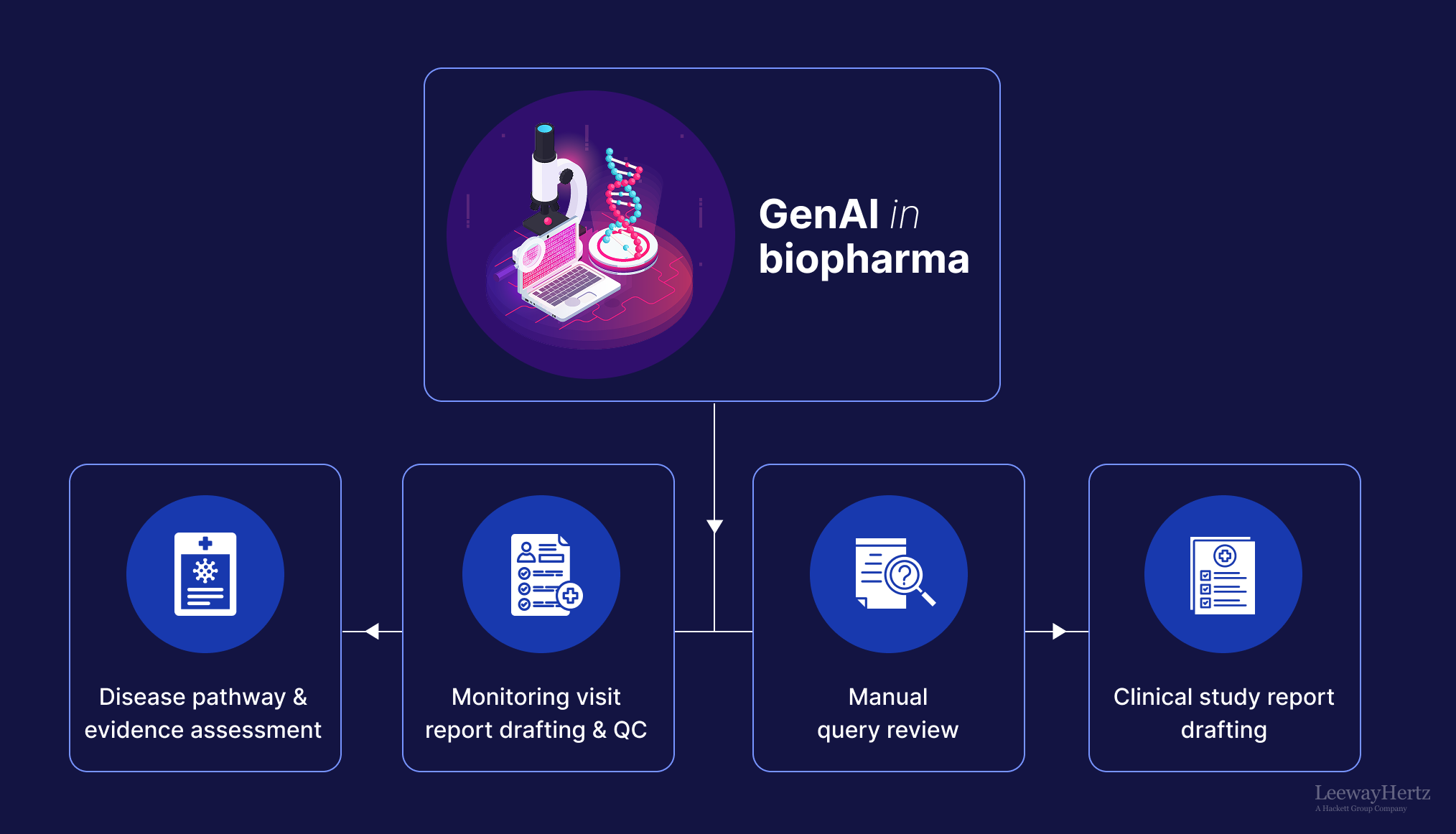
| Disease pathway and target-disease evidence assessment | Drug discovery and target identification | Large literature sets, internal findings, and repeated evidence templates allow AI to summarize target rationale and evidence gaps. This reduces scientist screening time, while the target review chair confirms prioritization before the output informs a program decision. |
| Mechanism-of-action evidence package | Translational medicine and biomarker development | Repeated assay readouts, biomarker findings, and study summaries allow AI to assemble evidence links and prepare a reviewer-ready package. This reduces translational rework, while the translational medicine reviewer confirms which evidence should be included. |
| Monitoring visit report drafting and QC | Clinical operations, Phase I to Phase III trial execution | Frequent visit notes, structured findings, and issue logs allow AI to draft monitoring visit reports and perform preliminary QC checks. This reduces reporting backlog, while the clinical operations quality reviewer confirms release. |
| Manual query review | Clinical data management and biostatistics | Large query backlogs and consistent data review rules allow AI to group likely resolutions, identify repeated issues, and prepare closure recommendations. This reduces data manager effort, while the clinical data manager confirms any closure action. |
| Clinical study report drafting aligned with ICH E3 | Regulatory affairs, medical writing, and eCTD submissions | Lengthy study outputs and stable CSR section structures allow AI to draft narrative sections from approved tables, listings, figures, and study records. This shortens writing cycles, while the responsible medical writer confirms the final CSR text. |
| Adverse event narrative intake | Pharmacovigilance and drug safety | High case volumes, standardized intake fields, and recurring narrative formats allow AI to prepare draft adverse event narratives. This reduces case processing effort, while the pharmacovigilance case reviewer confirms reportability, accuracy, and completeness. |
| eCTD Module 3 content package | CMC and process development | Recurring method descriptions, stability data, validation records, and manufacturing inputs allow AI to assemble Module 3 content packages. This reduces dossier rework, while the CMC regulatory reviewer confirms technical accuracy and submission readiness. |
| Batch manufacturing record review | GMP manufacturing and quality assurance | Frequent batch records and repeatable checklist criteria allow AI to flag missing entries, inconsistencies, and documentation gaps. This lowers review effort, while the quality assurance reviewer confirms the disposition. |
| Certificate of analysis verification | Supply chain and distribution | High volumes of lot-level documents and fixed specifications allow AI to compare certificate values against approved criteria. This reduces release delays while the quality release reviewer confirms acceptance. |
| Standard response letter drafting | Medical affairs and scientific communications | Recurring medical inquiries and approved content libraries allow AI to draft standard response letters. This reduces queue time while the medical information reviewer confirms wording before any external use. |
A use case qualifies as high-value when the economic rationale is clear and the review boundary is well defined. In practical terms, AI should reduce cycle time, queue volume, or rework on a known biopharma artifact, then route the draft or recommendation to the assigned reviewer before any submission, safety, quality, regulatory, production, or customer-facing action proceeds. This keeps AI close to the workflow while preserving the accountability required in controlled biopharma environments.
How agentic AI works in biopharma workflows
Generative AI can draft, summarize, classify, compare, and retrieve information. Agentic AI goes a step further by coordinating workflow steps across systems, records, roles, and approval points. In biopharma, this distinction matters because many high-value use cases are not single-step writing tasks. They require the AI system to gather evidence from controlled sources, compare records, prepare review materials, route exceptions, and pause for confirmation before any scientific, clinical, safety, quality, regulatory, production, or customer-facing action proceeds.
For example, a database lock readiness workflow is not just a summarization task. It may require checking open queries, edit check outputs, study milestones, serious adverse event reconciliation status, protocol deviations, and data review completion evidence. An agentic AI workflow can coordinate these steps, prepare an exception summary, and route it to the clinical data manager, while the accountable owner remains responsible for confirming readiness before database lock.
This shift is becoming more relevant as biopharma systems move from standalone copilots to task-specific agents embedded across clinical trial management, electronic data capture, safety, regulatory, quality, manufacturing, laboratory, and content management workflows. The practical value comes from using agents to assemble scattered evidence, prepare reviewable outputs, and support handoffs without removing human accountability from controlled decisions.
The core design principle is controlled coordination. A well-designed agentic workflow plans the task, retrieves approved evidence, compares records, drafts an output for review, routes exceptions to the right queue, and waits for confirmation from the assigned role. Its access remains limited to approved systems such as CTMS, EDC, eTMF, safety databases, RIM, QMS, LIMS, MES, ERP, validated document repositories, and approved knowledge bases. It should also retain source links, decision history, exception logs, and reviewer confirmations so the workflow can be audited later.
Examples of agentic AI workflows in biopharma include the following.
SAR progression review workflow
The agent plans the structure activity relationship review around the next compound decision. It retrieves compound designs, assay results, ADMET findings, and prior design-make-test-analyze decisions from approved discovery systems. It drafts a review packet with compound tiers, supporting evidence, and unresolved questions, then routes the package to the medicinal chemistry lead for confirmation before circulation to program leadership.
Biomarker assay validation readiness workflow
The agent plans the validation-readiness check for the assay package. It retrieves assay run data, acceptance criteria, protocol context, and relevant clinical data from approved laboratory and study systems. It drafts a validation gap summary, flags missing evidence or unresolved criteria, and routes the package to the bioanalytical lead for confirmation before readiness status is accepted.
Site initiation visit readiness workflow
The agent plans activation checks from CTMS milestones. It retrieves the study protocol, informed consent form, training evidence, ethics or IRB approvals, site documents, and activation prerequisites from approved clinical systems. It drafts a site initiation visit readiness checklist, highlights missing items, and routes the package to the site activation queue for clinical trial manager confirmation.
Database lock readiness workflow
The agent plans the lock-readiness sequence from the data management plan. It retrieves open queries, edit check outputs, study milestones, SAE reconciliation status, protocol deviations, and data review evidence from approved clinical data systems. It drafts a database lock exception summary, identifies unresolved blockers, and routes the package to the clinical data manager for confirmation before database lock.
Clinical study report drafting workflow
The agent retrieves the protocol, statistical analysis plan, tables, listings, figures, data review notes, protocol deviations, and safety summaries from approved study sources. It drafts selected CSR sections aligned with the agreed structure, maintains links to source evidence, and routes the draft to the responsible medical writer and clinical reviewer for confirmation before inclusion in the report package.
Adverse event narrative processing workflow
The agent retrieves intake forms, reporter statements, patient history, product exposure details, lab values, seriousness criteria, and prior case information from approved safety systems. It drafts an adverse event narrative, flags missing or inconsistent information, and routes the case to the pharmacovigilance reviewer for confirmation before reporting or case closure decisions are made.
CMC dossier assembly workflow
The agent retrieves method descriptions, validation records, stability data, specifications, manufacturing process information, and prior approved submission text from controlled CMC and regulatory repositories. It drafts a Module 3 content package with source references, flags content gaps, and routes the package to the CMC regulatory reviewer for confirmation before submission use.
Batch record review workflow
The agent retrieves batch manufacturing records, process parameters, deviation records, equipment logs, environmental monitoring results, and release specifications from MES, QMS, LIMS, and ERP systems. It checks completeness, flags documentation gaps or exceptions, drafts a review summary, and routes the package to the quality assurance reviewer for confirmation before disposition.
Medical information response workflow
The agent retrieves the healthcare professional inquiry, approved response documents, product labeling, medical literature summaries, and prior response precedents from approved medical affairs systems. It drafts a response letter with source references, identifies any off-label or escalation-sensitive content, and routes the draft to the medical information reviewer for confirmation before external use.
This structure makes agentic AI practical in biopharma. The agent prepares the evidence and drafts the output, while the accountable person confirms the decision before the workflow affects study conduct, data lock, safety reporting, regulatory submissions, batch disposition, quality records, medical communications, customer-facing responses, or other controlled actions.
How to prioritize generative AI use cases in biopharma
Biopharma organizations should not prioritize generative and agentic AI use cases only because they appear innovative or technically advanced. The more important question is which sub-processes should move first based on business value, workflow fit, artifact readiness, review clarity, risk exposure, and implementation feasibility. The strongest early candidates are high-volume, artifact-rich workflows where AI can draft, extract, compare, summarize, or route information while an accountable reviewer confirms the output before it affects a study decision, safety workflow, regulatory submission, quality record, batch disposition, or external communication.
A practical prioritization framework should score each use case against the following criteria:
| Criterion | What biopharma organizations should evaluate |
|---|---|
| Business value | Can the use case reduce review effort, shorten document cycles, improve case processing, lower rework, accelerate submission preparation, support better trial execution, or strengthen compliance readiness? |
| Volume and frequency | Does the sub-process recur often enough across studies, programs, sites, cases, batches, submissions, quality events, or medical inquiries to create meaningful operational value? |
| Workflow fit | Is the workflow document-heavy, narrative-heavy, exception-heavy, knowledge-heavy, review-heavy, or dependent on repeated manual coordination across systems and roles? |
| Artifact availability | Are the required source artifacts available, current, permissioned, and traceable, such as protocols, CSRs, investigator brochures, safety cases, SOPs, batch records, validation reports, study outputs, regulatory correspondence, or approved response documents? |
| Review boundary | Is there a clear, accountable role, such as a medical writer, pharmacovigilance reviewer, clinical data manager, quality approver, CMC reviewer, regulatory reviewer, clinical operations lead, or medical information reviewer, who can approve, reject, or correct the AI output? |
| Control and compliance impact | Does the workflow affect study conduct, patient safety, safety reporting, batch release, GMP records, validated systems, regulatory submissions, labeling, medical communications, or customer-facing commitments? |
| Blast radius | If the AI output is incomplete or incorrect, is the impact limited to a draft or internal review package, or could it affect a clinical decision, release decision, filing position, safety obligation, quality record, or external communication? |
| Integration complexity | How many systems, data owners, approval paths, and validation considerations are involved across CTMS, EDC, eTMF, safety databases, RIM, QMS, LIMS, MES, ERP, and controlled document repositories? |
| Exception frequency | Does the workflow frequently involve missing evidence, unresolved queries, deviations, safety case gaps, submission comments, audit observations, batch exceptions, or quality investigations that AI can help standardize? |
| Scalability | Can the workflow pattern be reused across studies, therapeutic areas, programs, sites, manufacturing lines, markets, product families, or business units after the first deployment? |
| Measurable impact | Can the team connect the use case to measurable outcomes such as shorter CSR drafting cycles, faster query resolution, reduced case narrative effort, fewer submission rework cycles, faster batch record review, or lower manual reconciliation effort? |
A practical first wave should focus on bounded workflows with strong evidence availability and clean human review. These may include safety case narrative drafting, CSR section preparation, submission response support, batch record review, deviation summary drafting, and medical information response preparation. Each of these workflows has repeatable inputs, measurable cycle times, clear approval owners, and a defined point where AI output can be confirmed before use.
More sensitive use cases should move later or require stronger governance. These include workflows that influence clinical trial design, database lock approval, safety reportability conclusions, batch release, regulatory filing positions, labeling, promotional claim review, or quality disposition. The same caution applies to any workflow that updates controlled records or could affect patient-facing, regulator-facing, production, or external communications. In these areas, AI can still prepare evidence, summarize options, and draft recommendations, but final accountability should remain with the designated functional owner.
The final scoring review should test for common stall patterns. A use case is too broad when it is framed as “AI for biopharma” rather than tied to a specific sub-process, such as adverse event narrative drafting, protocol deviation summary preparation, or CMC response package assembly. It may lack readiness if source artifacts are incomplete, outdated, unstructured, or disconnected. It may create governance risk if it bypasses owner approval, uses unapproved sources, or accesses controlled records without a review gate. It may also be overstated if expected savings are estimated before baseline cycle time, queue volume, rework effort, or review burden is measured.
The strongest first projects are the high-volume, artifact-rich, cleanly reviewed sub-processes identified in the operating model above. They allow biopharma teams to prove value in bounded workflows while building the data, integration, approval, audit, and governance foundations needed for more complex agentic AI workflows.
Governance, risk, and responsible AI in biopharma
Generative and agentic AI in biopharma must operate within the organization’s existing scientific, clinical, quality, regulatory, privacy, and risk control framework. The most important principle is accountability. AI can assist with drafting, summarization, classification, retrieval, evidence comparison, and workflow coordination. However, responsible personnel must remain accountable for scientific decisions, clinical trial decisions, safety conclusions, batch disposition, quality approvals, regulatory positions, medical communications, and any action that affects patients, regulators, production, or controlled records.
Human review at control points
Human review should be mandatory wherever an AI output can affect scientific direction, clinical trial execution, safety reporting, regulated documentation, quality records, batch release, medical communications, or external commitments. For example, AI may summarize a disease pathway assessment or draft a target product profile rationale, but the translational medicine lead should confirm the output before it shapes candidate nomination, protocol design, or any other risk-bearing action.
The same principle applies to database lock readiness, adverse event narrative review, CMC dossier preparation, deviation investigation summaries, batch record review, submission response drafting, medical information responses, and labeling or promotional claim support. AI may compare evidence, classify exceptions, or draft review materials, but the accountable reviewer confirms the decision before the workflow proceeds.
Regulatory, standards, and assurance alignment
Governance should align AI workflows with the standards, regulations, and controls already relevant to biopharma organizations. NIST AI RMF 1.0 can provide a foundation for AI risk management, while NIST AI 600-1 can guide controls specific to generative AI. These frameworks help teams map, measure, and manage AI risks before use cases are embedded into regulated workflows.
Biopharma governance also needs to connect AI workflows to applicable regulatory and quality expectations, including 21 CFR Part 11 for electronic records and signatures, 21 CFR Part 312 for investigational new drug applications, HIPAA for protected health information, ICH E6(R3) for good clinical practice, and ICH Q9(R1) for quality risk management. For cross-jurisdictional programs, EU AI Act readiness and EU GMP Annex 11 alignment should also be considered, especially where AI supports clinical, quality, manufacturing, safety, or regulated documentation workflows.
Evidence-based outputs and evidence retention
Generative AI outputs used in biopharma workflows should be grounded in approved sources. These sources may include protocols, investigator brochures, clinical study reports, statistical outputs, safety case records, and pharmacovigilance databases. They may also include CMC records, validation reports, batch records, deviation records, SOPs, regulatory correspondence, approved labeling, and medical information content. Uncontrolled retrieval can introduce outdated protocol assumptions into current work. It can also surface superseded regulatory text, obsolete SOPs, or incomplete safety evidence.
Each governed workflow should retain the source artifacts used to generate the AI output. For example, an AI-generated CSR section should retain links to the protocol, statistical analysis plan, tables, listings, figures, and approved study outputs. A CMC dossier workflow should retain the method descriptions, stability data, validation records, specifications, and prior approved submission text used to prepare the draft. This makes AI-assisted work traceable and allows clinical, quality, safety, regulatory, and audit teams to reconstruct the rationale behind a summary, recommendation, or controlled document update.
Bias and decision quality controls
In biopharma, bias can affect scientific and operational decision quality. A model may over-weight familiar target biology, repeat historical modality preferences, anchor too strongly on a prior SAR series, favor commonly cited literature, or underrepresent emerging evidence. In clinical, safety, regulatory, and quality workflows, the same issue can appear as over-reliance on past case patterns, prior submission language, or historical investigation outcomes when current evidence requires a different interpretation.
Governance should require the GenAI system to show the evidence it used, identify missing or conflicting inputs, and compare alternatives where appropriate. This is especially important in target rationale review, hit-to-lead progression, ADMET interpretation support, biomarker strategy, safety case assessment, protocol amendment rationale, CMC response preparation, and quality investigation review. The scientific reviewer, clinical pharmacology lead, pharmacovigilance reviewer, quality approver, or regulatory affairs reviewer should be able to challenge the evidence and confirm whether the GenAI-driven output is valid for the intended use.
Access control, tool limits, and data protection
AI agents should follow least privilege access. A workflow should retrieve only the records needed for the task and only from systems the user and workflow are authorized to access. Role-based access control should apply to clinical data, safety records, biomarker data, PK/PD materials, manufacturing records, quality documentation, regulatory submissions, medical information content, and protected health information.
Tool access should also be scoped. An agent may retrieve study records, compare safety evidence, draft a regulatory response, summarize a batch record, or route an exception, but it should not update controlled records, change study start-up status, approve protocol amendments, close safety cases, release a batch, submit regulatory content, or send medical communications without confirmation from the assigned owner. Data protection controls should prevent clinical, safety, manufacturing, quality, regulatory, and patient-related materials from being exposed to unauthorized models or external environments.
Monitoring, escalation, and auditability
Governed AI workflows should be monitored continuously to ensure that outputs remain accurate, complete, source-backed, and aligned with the intended workflow. Escalation should be triggered when the system produces low-confidence outputs, relies on incomplete evidence, routes work unexpectedly, or requires repeated reviewer correction. This keeps monitoring focused on decision quality, evidence reliability, and workflow behavior rather than treating AI oversight as a static checklist.
Each workflow should also preserve a complete audit trail. This includes the task instruction, source materials used, model version, generated output, workflow actions, reviewer disposition, approval outcome, escalation history, and any downstream system update. These records are especially important when AI supports controlled biopharma activities such as trial execution, safety reporting, CMC dossier preparation, batch disposition, quality investigations, regulatory submissions, labeling, or medical information responses.
Governance should not be treated as a barrier to biopharma AI adoption. It is what makes AI reliable, scalable, secure, and auditable. A well-governed AI workflow can improve documentation quality, strengthen evidence traceability, make exception handling more consistent, and give scientific, clinical, quality, safety, regulatory, and medical teams clearer accountability than unmanaged manual processes.
Accelerate AI Solutions Development
Build fully functional solutions from your high-value use cases, based on specific operational needs and enterprise context.
How ZBrain operationalizes generative AI use cases in biopharma
Identifying use cases is only the first step. Biopharma organizations need a controlled way to design, build, validate, deploy, govern, and scale generative AI workflows across drug discovery, translational research, clinical development, regulatory affairs, pharmacovigilance, quality management, manufacturing, supply chain, medical affairs, commercial operations, market access, and enterprise reporting.
This is where ZBrain helps.
ZBrain is an end-to-end AI enablement platform that supports this lifecycle through four connected stages: ZBrain Analyzer, ZBrain Design, ZBrain Solution Builder, and ZBrain Governance. The platform provides a governed path from use-case analysis to deployed agentic workflows while maintaining policies, permissions, approval points, monitoring, and runtime evidence.
ZBrain Analyzer
ZBrain Analyzer helps teams examine selected biopharma processes, identify generative AI opportunities, and document the business context, systems, data, artifacts, roles, controls, and review requirements needed to evaluate each use case.
ZBrain Design
ZBrain Design creates a build-ready technical design for the selected use case. It generates the business requirements document, functional requirements, user journeys, architecture, workflow logic, data specifications, integration context, and governance considerations needed before development begins.
ZBrain Solution Builder
ZBrain Solution Builder enables teams to create, configure, and validate governed generative AI workflows for biopharma processes based on the technical design developed in ZBrain Design. It supports testing across routine, exception, regulated, quality, and control scenarios before deployment.
ZBrain Governance
ZBrain Governance applies policies, access controls, human approval requirements, monitoring, and traceability throughout workflow execution. It provides guardrails, approval gates, escalation controls, kill switches, and audit trails to help organizations maintain oversight of AI outputs, reviewer actions, exceptions, and authorized system updates.
Future of generative AI in biopharma
The future of generative and agentic AI in biopharma will be shaped less by isolated model adoption and more by how well organizations connect AI to governed workflows, approved data, and accountable review. In the next few years, three shifts are likely to define how biopharma organizations scale AI across clinical, regulatory, safety, quality, manufacturing, medical, and research functions.
Federated AI platforms will replace fragmented pilots
Many biopharma organizations begin with function-specific pilots in areas such as clinical operations, regulatory affairs, pharmacovigilance, medical writing, and quality. These pilots can prove value quickly, but they become difficult to scale when each team connects to different document repositories, applies different review rules, manages prompts separately, and measures quality in inconsistent ways.
A federated approach can address this fragmentation by allowing each function to tailor AI support to its workflows while using common controls for approved content, access management, audit trails, prompt governance, system integration, and reviewer confirmation. This reduces duplicate build effort and gives biopharma organizations a more consistent foundation for compliance, monitoring, and reuse. In a regulatory submission workflow, for example, AI may prepare a response outline based on approved source documents, but the regulatory affairs reviewer confirms the wording before it is included in the submission package.
Agentic workflows will support longer, multi-step goals
As the platform foundation matures, biopharma organizations will move from single-task assistance to longer agentic workflows that coordinate work across systems and handoffs. Biopharma processes rarely end with one summary or draft. A protocol amendment may require checks against the study protocol, site communications, consent materials, and eTMF records. A quality investigation may require evidence from batch records, deviation history, equipment logs, and prior CAPA records. A safety case may require intake details, medical history, product exposure, lab values, and reportability criteria.
Agentic workflows can maintain context across these steps, prepare the next review packet, route exceptions, and reduce the need for teams to restart analysis at every handoff. The agent can suggest next actions, draft supporting rationale, and assemble evidence, but the accountable owner remains in control. A clinical operations manager, quality assurance reviewer, pharmacovigilance physician, regulatory reviewer, or medical writer should confirm any action that affects trial execution, product quality, patient safety, regulated records, or external communication.
Workflow design will matter more than model selection
As frontier models become more capable and widely available, the main source of advantage will shift from choosing a model to designing the workflow around it. In the near future, many biopharma organizations will have access to strong general-purpose models. The differentiator will be how effectively each organization decomposes work, connects approved data, defines review points, routes exceptions, measures quality, and preserves evidence.
For example, a medical writing team will gain more from a well-designed workflow that separates source retrieval, draft generation, citation checking, clinical review, and final approval than from changing models without improving the review path. Similarly, a pharmacovigilance team will benefit more from clear case intake, narrative drafting, evidence checks, reviewer disposition, and escalation rules than from treating AI as a generic drafting tool.
The durable advantage will come from operating discipline. Biopharma organizations that define the right workflows, connect the right approved sources, assign the right reviewer roles, and retain the right evidence records will be better positioned to use generative and agentic AI at scale. This is how AI can improve cycle time, consistency, and decision readiness without weakening the accountability required in regulated environments.
Endnote
Generative AI can create meaningful value in biopharma when it is applied to the workflows where research, clinical, regulatory, safety, quality and other teams already spend time reviewing evidence, preparing documents, resolving exceptions, and making controlled decisions. The opportunity is not simply to add GenAI to biopharma operations, but to apply it where complex records, approvals, and regulated handoffs shape how work gets done.
This is why the operating-model view matters. It shows where GenAI can extract evidence, summarize approved records, draft scientific and regulatory content, compare documentation, classify exceptions, and prepare reviewer-ready outputs without bypassing the people who own the decision. Agentic AI extends this value by coordinating multi-step workflows across approved systems while preserving review, approval, and control.
The strongest path starts with sub-processes that have clear inputs, repeated review effort, available source artifacts, and defined accountability. Use cases such as safety narrative drafting, clinical study report preparation, CMC content assembly, batch record review, deviation summary drafting, regulatory response support, and medical information response preparation are strong early candidates because they combine operational value with clear review boundaries.
The future of GenAI in biopharma will be shaped less by generic chatbots and more by governed, workflow-specific agents. Organizations that connect GenAI to real operating-model workflows, keep outputs grounded in approved sources, and retain human confirmation at risk-bearing moments will be better positioned to reduce manual effort, improve traceability, strengthen compliance, and give experts more time for scientific judgment, regulatory interpretation, quality oversight, and patient-focused decision-making.
Operationalize GenAI across biopharma workflows with ZBrain. ZBrain helps biopharma enterprises build governed AI workflows across key operations, reducing manual effort while strengthening traceability and review efficiency. Connect with the ZBrain team today!
Author’s Bio


Akash's ability to build enterprise-grade technology solutions has garnered the trust of over 30 Fortune 500 companies, including Siemens, 3M, P&G, and Hershey's. Akash is an early adopter of new technology, a passionate technology enthusiast, and an investor in AI and IoT startups.
Related Products

AI Agent
Discover the right AI agent for your use case! Explore our extensive range of AI agents tailored to tackle specific challenges.
Start a conversation by filling the form
Once you let us know your requirement, our technical expert will schedule a call and discuss your idea in detail post sign of an NDA.
All information will be kept confidential.
FAQs
What is the difference between generative AI and agentic AI in biopharma?
Generative AI helps biopharma teams retrieve, summarize, extract, compare, classify, and draft content from approved scientific, clinical, regulatory, quality, safety, and medical sources. Agentic AI extends this capability by coordinating multi-step workflows across systems, queues, and review points. For example, generative AI may draft a safety narrative or regulatory response section, while agentic AI can gather the required evidence, prepare the review packet, route it to the right owner, and pause for confirmation before the workflow proceeds.
Why should biopharma organizations evaluate AI at the sub-process level?
Sub-process mapping helps teams move from broad AI ideas to workflows that can be built, governed, and measured. In biopharma, value is often created in specific handoffs such as evidence review, document drafting, deviation summary preparation, safety narrative drafting, batch record review, or submission response support. Evaluating AI at this level makes it easier to define the source artifacts, expected output, review owner, control point, and success metric for each use case.
Which biopharma functions can benefit most from GenAI?
Early value often appears in functions with high document volume, repeated review effort, and clear approval boundaries. These include:
- Clinical development and clinical operations
- Regulatory affairs and medical writing
- Pharmacovigilance and drug safety
- CMC, manufacturing, and quality
- Medical affairs, market access, and commercial operations
Across these functions, GenAI can summarize evidence, draft narratives, compare records, classify exceptions, retrieve approved guidance, and prepare reviewer-ready outputs.
Where is agentic AI most useful in biopharma workflows?
Agentic AI is most useful where work spans multiple systems, documents, and approval steps. Examples include regulatory response preparation, clinical study report support, site activation readiness, database lock readiness, safety case follow-up, CMC dossier assembly, deviation investigation support, and batch record review. In these workflows, the agent can gather evidence, flag gaps, draft the next output, and route the work, while the accountable reviewer remains responsible for confirmation.
How should biopharma organizations prioritize GenAI use cases?
Biopharma teams should prioritize workflows that deliver clear business value, have available source artifacts, involve repeated manual effort, and have defined review ownership. Strong early candidates are high-volume, artifact-rich sub-processes where generative AI can reduce drafting time, evidence collation, review cycles, or rework without bypassing human accountability.
Use cases should be scored against:
- Cycle-time or effort reduction
- Source artifact readiness
- Workflow fit
- Review ownership
- Compliance impact
- Integration complexity
What governance is required for GenAI in biopharma?
Governance should ensure that GenAI outputs are source-backed, traceable, secure, and reviewable. AI should support evidence preparation and drafting, but it should not independently update controlled records, close safety cases, release batches, submit regulatory content, approve quality decisions, or send external communications.
Core controls include:
- Approved source grounding
- Role-based access
- Human review gates
- Audit trails
- Model monitoring
- Escalation rules
- Data protection controls
AI should not update controlled records, submit regulatory content, close safety cases, release batches, approve quality dispositions, or send external communications without confirmation from the assigned owner.
How does human oversight work in biopharma AI workflows?
Human oversight should be built into the workflow at defined control points. AI may prepare a draft, summarize evidence, classify an exception, or recommend a next step, but the accountable reviewer confirms the output before it affects a regulated or risk-bearing action. For example, a pharmacovigilance reviewer confirms safety case outputs, a medical writer confirms CSR content, a quality approver confirms deviation or batch record outputs, and a regulatory reviewer confirms submission-related content.
What risks should biopharma organizations manage when using GenAI?
Key risks include unsupported outputs, incomplete source retrieval, hallucinated claims, outdated evidence, weak audit trails, data leakage, unclear reviewer ownership, biased summaries, and overreliance on AI-generated text. These risks can be reduced by using approved repositories, retrieval-grounded outputs, source citations, access controls, validation checks, reviewer approval gates, and continuous monitoring for exceptions and reviewer overrides.
How should biopharma organizations measure ROI from GenAI?
ROI should be measured at the workflow level rather than at the model level. Useful measures include reduced drafting time, faster evidence collation, fewer review cycles, shorter query or case processing time, lower rework, improved documentation completeness, stronger inspection readiness, and faster handoffs across clinical, safety, quality, regulatory, manufacturing, and medical workflows. The strongest ROI cases connect a specific sub-process to a baseline metric, reviewer role, and measurable operational outcome.
How does ZBrain support generative AI use cases in the pharmaceutical industry?
ZBrain provides an end-to-end AI enablement platform for biopharma organizations to identify, design, validate, deploy, govern, and scale generative AI workflows across drug discovery, translational research, clinical development, regulatory affairs, pharmacovigilance, quality management, manufacturing, supply chain, medical affairs, commercial operations, market access, and enterprise reporting.
- ZBrain Analyzer: Helps teams examine selected biopharma processes, identify generative AI opportunities, and document the business context, systems, data, artifacts, roles, controls, KPIs, and review requirements needed to evaluate each use case.
- ZBrain Design: Converts selected use cases into build-ready technical designs, including business requirements, functional requirements, user journeys, architecture, workflow logic, data specifications, integration context, approval points, and governance considerations.
- ZBrain Solution Builder: Enables teams to create, configure, and validate governed generative AI workflows based on the design developed in ZBrain Design. It supports testing across routine, exception, regulated, quality, and control scenarios before deployment.
- ZBrain Governance: Applies policies, access controls, human approval requirements, monitoring, traceability, escalation controls, kill switches, and audit trails throughout workflow execution.
ZBrain’s role is enablement rather than autonomous decision-making. It helps define where generative AI assists, augments, or acts within biopharma workflows, while regulated decisions and final approvals remain with accountable roles across research, clinical, regulatory, quality, safety, manufacturing, medical, commercial, market access, and enterprise operations.
Insights
AI for Sales Operations: High-Value Use Cases Mapped to the Revenue Operating Model
Investment and brokerage is a prime domain for generative and agentic AI because workflows intersect client records, research documents, portfolio data, regulatory requirements, exceptions, and operational handoffs.
AI in Expense Management: Use Cases, Agentic Workflows and Governance
AI changes expense management work by analyzing receipts, transactions, policies, and supporting records before a traveler, approver, auditor, accountant, tax analyst, or compliance officer reviews them.
AI in Contract Management: Use Cases Mapped to the CLM Operating Model
AI in contract management is not a generic chatbot bolted onto a document store. The value shows up when a specific capability meets a specific artifact at a specific step of the lifecycle.