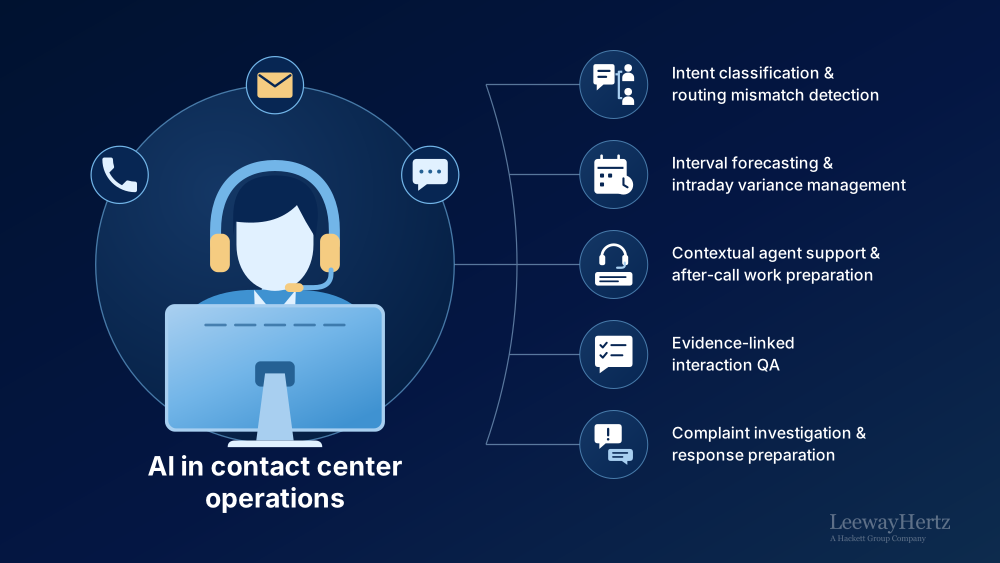
Contact center operations bring together the people, processes, systems, and controls required to manage customer interactions across voice and digital channels. Contact center leaders oversee demand, service levels, staffing, routing, quality, customer outcomes, complaints, compliance, agent performance, and BPO delivery. They rely on data from CCaaS platforms, WFM systems, CRM records, interaction recordings and transcripts, QA platforms, knowledge bases, survey tools, complaint systems, and vendor scorecards.
Managing these operations consistently requires teams to connect signals across functions. A change in contact volume can affect staffing and service levels, routing issues can increase transfers and handle time, QA findings can reveal knowledge or compliance gaps, and complaint trends can point to broader process failures. Yet these signals are often reviewed in different systems and workflows, making it difficult to build a timely and connected view of contact center performance.
The operating environment is also becoming more AI-intensive. Deloitte Digital’s 2026 Global Contact Center Survey found that 35% of surveyed contact centers were already using agentic AI in operations [1]. At the same time, 72% of surveyed leaders identified integration with existing technology, systems, and tools as a challenge, while 53% cited data security and compliance [2]. These findings reflect a broader shift from isolated automation toward AI operating across interactions, workforce processes, quality programs, and supporting systems.
For many contact center teams, that shift exposes the limits of fragmented operational processes. Intent and disposition taxonomies may drift from actual contact demand, routing problems may appear only after transfer rates rise, Workforce Management (WFM) forecasts may require repeated manual reconciliation with intraday conditions, QA programs may review only a fraction of interactions, and complaint investigations may require evidence from several systems. The issue is not only workload. It is the difficulty of turning high-volume operational evidence into timely, reviewable, and actionable decisions.
AI becomes relevant in contact center operations when it is applied to specific operational work rather than treated only as a customer-facing chatbot. A workforce management analyst needs to understand why actual interval demand differs from the forecast before recommending a staffing response. A QA analyst requires interaction evidence tied to each proposed score before accepting an evaluation. A compliance officer needs the recording, transcript, script, consent record, and system history behind a possible control exception. A contact center operations manager should know whether rising transfers are being driven by routing, knowledge gaps, contact mix, or another operational cause.
The practical value is strongest where contact center work is interaction-heavy, forecast-intensive, exception-driven, and reviewable. AI can classify contact intent, analyze routing, forecast demand, retrieve approved knowledge, and prepare after-call summaries. It can also support QA, flag compliance exceptions, assemble complaint evidence, identify recurring contact drivers, and prepare management analysis. It does not become the authority for employee discipline, regulatory complaint responses, material compliance findings, workforce policy, or significant operating changes.
Realizing this value requires organizations to map AI to the specific activities where it can assist without crossing established review and decision boundaries. Contact center value is not created at the level of broad labels such as “workforce management,” “quality assurance,” or “customer insights.” It is created inside specific activities where the interaction or trigger, source artifact, system, channel, operating rule, reviewer, output, and escalation path are known. Mapping work at this level makes it possible to distinguish where AI can prepare, classify, forecast, score, or recommend from where a human role must validate or decide.
This article uses the contact center operating model to examine work across functions, processes, and sub-processes. It maps the relevant artifacts, systems, channels, standards and control considerations, accountable roles, AI-enabled opportunities, agentic workflow patterns, governance requirements, and prioritization criteria.
- How AI is transforming contact center operations
- Why AI use cases in the contact center must be mapped at the sub-process level
- Contact center operations operating model and AI opportunity mapping across contact center functions
- High-value AI use cases in contact center operations
- How agentic AI works in contact center operations
- Governance, risk, and responsible AI in contact center operations
- How ZBrain operationalizes AI use cases in contact center operations
- Future of AI in contact center operations
How AI is transforming contact center operations
AI is transforming contact center operations by helping teams convert interaction, workforce, quality, complaint, and performance data into structured operational outputs that can be reviewed, acted on, escalated, or used to tune the operation. AI builds on the existing contact center operating model by helping teams analyze more data, identify issues earlier, and support faster operational decisions.
Consider an intraday operating problem. Voice demand has exceeded the WFM forecast for several intervals, AHT is rising in one queue, transfer rates have increased, and QA findings indicate that agents are repeatedly searching for the same missing knowledge. Before operations leaders respond, the team needs to determine whether the service-level deterioration is being driven by demand, staffing, routing, knowledge, interaction complexity, or a combination of factors. AI can help reconcile the WFM forecast with actual arrivals, classify the affected contact drivers, analyze transfer paths, retrieve related QA evidence, and prepare a review packet with possible contributing factors. The WFM analyst and contact center operations manager still determine the operational response.
Contact center work is suitable for governed AI because it is dense with interaction evidence, recurring calculations, defined rules, and review checkpoints. The work usually falls into a few recognizable types where AI can support preparation without taking over the decision:
- Interaction-heavy work: call recordings, screen recordings, transcripts, dispositions, transfers, authentication outcomes, and self-service interaction records can be classified and analyzed across volumes that are difficult to review manually.
- Forecast-heavy work: interval contact volume, AHT, shrinkage, schedules, adherence, occupancy, service levels, and queue conditions require recurring forecasting, variance analysis, and reforecasting.
- Exception-heavy work: routing failures, repeated transfers, authentication problems, missed disclosures, abnormal handling times, QA exceptions, complaint escalations, unredacted data, and unusual vendor performance can be detected and prioritized for specialist review.
- Knowledge-heavy work: agents, supervisors, QA teams, and complaints teams rely on knowledge articles, scripts, procedures, scorecards, routing rules, complaint guidance, and compliance requirements that need to be retrieved in the right operational context.
- Workflow-heavy work: intraday WFM management, QA evaluation, coaching preparation, complaint investigation, compliance review, vendor remediation, and operating reviews benefit when AI maintains context across systems and prepares the next review package.
In practice, AI should support operational work by preparing information, identifying patterns, forecasting demand, comparing evidence, detecting exceptions, and drafting outputs. Decisions on staffing interventions, employee performance, complaint disposition, material compliance issues, production configuration, and other consequential actions remain with the appropriate contact center operations, WFM, QA, compliance, complaints, technology, and leadership roles.
Build governed AI workflows for contact center operations
Connect interaction intake, routing, workforce management, compliance, QA, complaints, and performance analysis while keeping key decisions with accountable human roles.
Why AI use cases in the contact center must be mapped at the sub-process level
AI programs in contact center operations often start with broad labels such as intelligent routing, workforce management AI, automated QA, agent assist, complaint automation, or conversation intelligence. Those labels are useful for strategy, but they are too broad for implementation. For example, contact center QA can mean scorecard evaluation, compliance phrase monitoring, calibration sample selection, evaluator consistency analysis, coaching-priority identification, or agent score dispute handling. Each sub-process uses different artifacts, carries different consequences, and requires a different review boundary.
A better approach is to map AI use cases to the contact center operating model:
- Function: A defined operational domain in the contact center, such as interaction intake, triage and routing, workforce management, quality assurance, complaint handling, or performance governance.
- Process: A workflow area inside a function, such as IVR management, demand forecasting, interaction evaluation, complaint investigation, or BPO performance review.
- Sub-process: The specific work activity where an artifact or dataset is reviewed or produced, such as IVR containment analysis, interval volume forecasting, QA scorecard evaluation, recording disclosure monitoring, or complaint chronology preparation.
- AI-enabled opportunity: A specific AI capability applied to a specific contact center artifact or dataset to change how the work is classified, forecast, prepared, reviewed, routed, scored, or evidenced while a named role retains the appropriate decision authority.
This level of mapping matters because contact center decisions are not interchangeable. A proposed disposition code has a different review boundary from a QA score that could affect employee performance. An intraday staffing recommendation has different consequences from an estimated wait time forecast. A missing disclosure flag requires different evidence and escalation from a knowledge-gap recommendation. A regulatory complaint response requires substantially more review than an after-call summary.
Channel context also matters. A workforce use case for synchronous voice cannot automatically be designed the same way as one for concurrent chat or asynchronous messaging. Erlang C and Erlang A models can support voice staffing under defined assumptions, while digital channels may require concurrency, backlog, workload, and response-time models. Likewise, routing logic for a phone queue may use different signals and controls from email, messaging, or social work.
For example, AI in workforce management is not the same as AI in quality assurance. In WFM, time-series forecasting may estimate interval contact demand, while anomaly detection identifies changes in AHT, shrinkage, or adherence that explain an intraday staffing gap. In QA, speech and text analytics may detect defined interaction characteristics, while AI-based scoring compares transcripts with an approved QA scorecard and produces evidence for reviewer validation.
The same principle applies across the contact center operating model. AI can identify failing IVR paths, classify incoming demand, detect routing mismatches, and forecast staffing requirements. It can support agents by retrieving relevant knowledge and preparing wrap-up notes. AI can also evaluate interactions against defined criteria, assemble coaching evidence, and identify potential compliance exceptions.
Across broader operations, it can support complaint investigation, identify recurring contact drivers, and prepare analysis for operating reviews. The use case becomes buildable only when the trigger, artifact, system, channel, output, reviewer, and permitted action are known.
Contact center operations operating model and AI opportunity mapping across contact center functions
Contact center operations can be viewed as four connected operating layers.
- Demand and access operations determine how interactions enter the contact center, how customers move through channel and authentication flows, and how work reaches the appropriate queue or resource.
- Workforce and service operations align staffing with expected and actual demand, support agents during resolution, and manage the operational performance of self-service journeys.
- Quality, escalation, and control determine whether interactions meet service and compliance requirements, translate findings into coaching, manage complaints and escalations, and identify risk or control exceptions.
- Insights and performance governance convert interaction, survey, workforce, quality, and vendor data into management information that can drive changes across the operating model.
These layers provide a practical structure for identifying where AI can support contact center operations. Each layer generates different data, artifacts, decisions, exceptions, and review requirements, so AI use cases should be mapped to specific operational processes rather than applied broadly across the contact center. AI can help classify and route interactions, forecast demand, support agents, analyze quality and compliance signals, prepare complaint and escalation records, and synthesize performance insights. However, service decisions, material escalations, compliance judgments, workforce actions, and changes to operating policies should remain subject to the appropriate human review and approval.
These layers are interdependent. Intent and volume patterns identified during intake and routing affect workforce forecasts. QA findings can expose knowledge gaps, routing problems, coaching needs, or control failures. Complaint and compliance patterns can lead to script, process, or policy changes. Voice-of-customer findings and KPI trends can feed back into staffing assumptions, routing rules, QA scorecards, knowledge content, and self-service thresholds.
The following sections examine AI opportunities across core contact center operations functions.
A: Demand and access operations
This layer covers the controls and processes that determine how customer demand enters the contact center and reaches the appropriate handling resource. AI opportunities focus on understanding interaction demand, identifying journey failures, maintaining routing accuracy, and detecting when existing channel or routing configurations need review.
Function 1: Interaction intake and channel management
Interaction intake and channel management controls how customer interactions enter the contact center across voice, chat, email, messaging, social, and other supported channels.
The function includes IVR and IVA call-flow administration, authentication and identity-verification journeys, queue and hold experiences, estimated wait time announcements, callback offers, and ongoing analysis of how effectively entry paths move customers toward the appropriate service resource.
Teams involved: Contact center operations manager, IVR/CX platform administrator, workforce management analyst, team lead/supervisor, compliance officer, and director of contact center operations.
Key artifacts: IVR call-flow diagram, interaction transcript, call recording, authentication outcome record, queue-performance report, callback report, routing configuration export, and disposition taxonomy.
Systems involved: CCaaS platforms, IVR/IVA platforms, CRM, identity and authentication services, workforce management platforms, conversation-intelligence tools, and contact center reporting platforms.
Regulatory and control considerations: Recording and consent requirements apply where calls are recorded. Privacy requirements apply where recordings, transcripts, or authentication records contain personal information. Accessibility requirements should be considered for supported customer channels. Authentication workflows should follow the organization’s approved identity-verification and data-access controls.
Accountable roles: Contact center operations manager, IVR/CX platform administrator, director of contact center operations, and compliance officer for applicable consent, privacy, or regulated interaction requirements.
What AI helps with: Journey analytics can analyze IVR paths, repeated menu selections, transfers, abandonment, authentication failures, callbacks, and downstream contact outcomes. Intent classification can compare what customers are trying to accomplish with the path they actually take. Anomaly detection can surface IVR nodes or queues whose performance changes materially from established patterns. Predictive analytics can support estimated wait time and callback-performance analysis.
What humans continue to own: Operations and platform teams approve IVR structures, authentication requirements, queue policies, callback configurations, customer disclosures, and production changes. Compliance teams determine whether consent, recording, or other regulated requirements are satisfied. AI analyzes and recommends but does not independently approve channel or control changes.
| Process | Sub-process | AI-enabled opportunities |
|---|---|---|
| IVR/IVA flow management | Call-flow performance analysis |
|
| Containment tuning |
|
|
| Customer authentication and identity verification | Authentication failure analysis |
|
| Queue and wait management | Estimated wait time analysis |
|
| Callback offer analysis |
|
|
| Omnichannel entry management | Channel demand analysis |
|
Highest-value opportunities: IVR journey failure analysis and authentication failure detection are high leverage because poor intake configuration can create avoidable transfers, abandonment, repeat contacts, and downstream workload. Queue and callback analysis is also valuable because it connects the customer wait experience directly with staffing and service-level performance.
Example agentic workflow: IVR journey failure analysis
- Trigger: A daily IVR report shows rising abandonment and transfers within a specific call-flow branch.
- The agent aggregates IVR path data, transcripts, authentication outcomes, queue statistics, dispositions, transfers, and repeat-contact records.
- It retrieves the current call-flow configuration, disposition taxonomy, routing rules, and relevant operating guidance.
- It prepares a review packet showing the affected path, contact volume, likely intents, failure points, downstream transfers, and candidate areas for configuration review.
- The IVR/CX platform administrator and contact center operations manager validate the findings and approve any change through the established platform change process.
- Approved changes are implemented, and subsequent containment, transfer, abandonment, and repeat-contact measures are tracked against the previous baseline.
Function 2: Triage and routing
Triage and routing converts incoming demand into prioritized work directed to the appropriate queue, skill group, language capability, accessibility route, or specialized handling team.
It includes intent and disposition taxonomy management, skills-based and attribute-based routing, priority segmentation, language routing, and analysis of whether routing outcomes support efficient resolution.
Teams involved: Contact center operations manager, IVR/CX platform administrator, workforce management analyst, team lead/supervisor, director of contact center operations, and compliance officer where routing rules reflect regulated treatment requirements.
Key artifacts: Disposition code taxonomy, routing rule configuration export, interaction transcript, transfer record, queue report, agent skill profile, and contact outcome record.
Systems involved: CCaaS routing engine, CRM, IVR/IVA platform, workforce management system, conversation-intelligence platform, customer identity platform, and BI/reporting tools.
Regulatory and control considerations: Routing logic should preserve approved accessibility, privacy, language, consent, and regulated handling requirements where applicable. Priority or customer-segmentation rules should follow approved business policies and should not introduce prohibited discriminatory treatment.
Accountable roles: Contact center operations manager, IVR/CX platform administrator, director of contact center operations, and relevant compliance or business-policy owners.
What AI helps with: Classification can identify interaction intent and propose disposition categories. Semantic clustering can identify new demand patterns that do not fit the existing taxonomy. Routing analytics can examine transfers, resolution outcomes, agent attributes, and queue performance to identify potential routing mismatches. AI can also detect when routing rules no longer reflect changing demand.
What humans continue to own: Operations teams define routing policy, queue structures, skills, priority rules, accessibility requirements, and approved segmentation logic. AI can classify contacts and identify possible routing improvements, but humans approve material rule changes and exceptions.
| Process | Sub-process | AI-enabled opportunities |
|---|---|---|
| Intent and disposition management | Intent classification |
|
| Taxonomy maintenance |
|
|
| Skills-based routing | Skill requirement identification |
|
| Routing rule effectiveness assessment |
|
|
| Priority management | Priority and VIP routing review |
|
| Language and accessibility routing | Routing signal identification |
|
Highest-value opportunities: Intent classification and taxonomy maintenance have wide downstream impact because disposition quality affects routing, WFM forecasting, FCR analysis, VoC reporting, and performance governance. Routing effectiveness analysis is also high value because repeated transfers increase customer effort while consuming capacity across multiple queues.
Example agentic workflow: Routing mismatch review
- Trigger: Weekly analytics identify an increase in transfers from a general service queue to a specialized queue.
- The agent aggregates transcripts, routing records, dispositions, agent skill attributes, transfer reasons, queue performance, and final resolution outcomes.
- It retrieves the current intent taxonomy, routing configuration, and approved skill-routing rules.
- It prepares a review packet showing the recurring intent, current route, transfer path, affected volume, and candidate taxonomy or routing-rule changes.
- The contact center operations manager and IVR/CX platform administrator review and approve any configuration change.
- Approved changes are implemented and measured against transfer rate, AHT, FCR, and queue-performance outcomes.
B. Capacity and agent operations
This layer focuses on matching resources to demand and helping agents resolve interactions effectively. It covers workforce forecasting and scheduling, real-time operational support, knowledge access, after-call work, and operational management of existing self-service journeys.
Function 3: Workforce management
Workforce management converts expected contact demand into staffing requirements, schedules, and intraday actions while accounting for availability, shrinkage, adherence, workload, and service targets.
It includes interval-level forecasting, Erlang-based voice staffing where appropriate, scheduling and shift bids, adherence monitoring, reforecasting, overtime, voluntary time off, and intraday management.
Teams involved: Workforce management analyst, contact center operations manager, team lead/supervisor, director of contact center operations, BPO vendor manager, and workforce-policy stakeholders.
Key artifacts: WFM forecast workbook, interval volume and AHT data, agent schedule, adherence report, shrinkage report, overtime record, voluntary time off record, and service-level report.
Systems involved: WFM platform, CCaaS platform, HR/workforce system, scheduling tools, timekeeping systems, BI platforms, and BPO workforce systems.
Regulatory and control considerations: Workforce decisions should follow applicable employment policies, labor agreements, scheduling rules, and approved workforce controls. Staffing models should also reflect channel modality. Erlang C or A models may suit synchronous voice queues, while concurrent chat and asynchronous channels require different workload and response-time assumptions.
Accountable roles: Workforce management analyst, contact center operations manager, director of contact center operations, and designated workforce-policy owners.
What AI helps with: Forecasting models can estimate contact volumes and workloads from historical patterns, seasonality, events, campaigns, recent actuals, and channel behavior. Anomaly detection can identify unexpected changes in volume, AHT, shrinkage, or adherence. AI can compare staffing scenarios and prepare intraday intervention options for WFM review.
What humans continue to own: WFM and operations leaders approve forecast methodology, shrinkage assumptions, staffing policy, schedules, overtime, voluntary time off, and material workforce changes. AI can forecast and prepare scenarios but does not make consequential employment or staffing-policy decisions.
| Process | Sub-process | AI-enabled opportunities |
|---|---|---|
| Demand forecasting | Interval contact-volume forecasting |
|
| AHT and workload forecasting |
|
|
| Staffing requirement planning | Voice staffing analysis |
|
| Digital workload planning |
|
|
| Scheduling | Schedule scenario preparation |
|
| Intraday management | Forecast-to-actual variance analysis |
|
| Staffing intervention preparation |
|
Highest-value opportunities: Interval forecasting and intraday variance analysis are high leverage because small forecast or staffing errors can compound across service level, occupancy, abandonment, and labor cost. Channel-aware workload modeling is also important because contact centers increasingly manage a mix of synchronous and asynchronous work that cannot be planned using one staffing assumption.
Example agentic workflow: Intraday staffing variance analysis and intervention planning
- Trigger: Actual voice demand exceeds the forecast for several consecutive intervals.
- The agent aggregates the WFM forecast, actual arrivals, AHT, staffing, adherence, shrinkage, scheduled breaks, and current service-level results.
- It retrieves approved intraday management rules and workforce constraints.
- It prepares a variance analysis identifying likely demand, AHT, or availability drivers and compares approved intervention scenarios.
- The workforce management analyst reviews the scenarios and selects any staffing action permitted under workforce policy.
- The revised forecast, approved action, and resulting service performance are recorded for later forecast-accuracy analysis.
Function 4: Agent resolution support
Agent resolution support provides agents with relevant information, guidance, and administrative assistance during and after customer interactions.
It covers real-time guidance, next-best-action prompts, knowledge retrieval, knowledge-gap logging, after-call summaries, disposition coding, and analysis of drivers affecting first contact resolution.
Teams involved: Team lead/supervisor, knowledge manager, training and enablement manager, contact center operations manager, QA analyst/quality manager, compliance officer where required, and IVR/CX platform administrator.
Key artifacts: Interaction transcript, call recording, CRM case, knowledge article, disposition taxonomy, wrap-up note, escalation record, and knowledge-gap record.
Systems involved: CCaaS platform, CRM, knowledge management system, conversation-intelligence platform, agent-assist platform, workflow system, and QA platform.
Regulatory and control considerations: Guidance should be based on approved knowledge and procedures. Access to customer information should follow role and data-access controls. Regulated decisions, disclosures, commitments, exceptions, or approvals should remain within their established human authority boundaries.
Accountable roles: Team lead/supervisor, knowledge manager, contact center operations manager, and compliance officer for regulated guidance.
What AI helps with: Retrieval can surface relevant approved knowledge based on interaction context. Classification can propose dispositions. Generative AI can draft wrap-up notes. Recommendation models can surface permitted next steps. Analytics can identify knowledge gaps, repeated transfers, and other drivers associated with low FCR.
What humans continue to own: Agents remain responsible for the interaction and for validating records submitted under their name. Knowledge managers approve knowledge content. Designated specialists retain authority for exceptions, customer commitments, regulated decisions, and approvals.
| Process | Sub-process | AI-enabled opportunities |
|---|---|---|
| Real-time agent support | Contextual knowledge retrieval |
|
| Next-best-action support |
|
|
| After-call work | Wrap-up note preparation |
|
| Disposition coding |
|
|
| Knowledge operations | Knowledge-gap identification |
|
| FCR management | Repeat-contact driver analysis |
|
Highest-value opportunities: Knowledge retrieval, wrap-up preparation, and FCR driver analysis are strong opportunities because they occur at high volume and affect both agent effort and downstream operational data quality. Knowledge-gap analysis compounds the value by converting repeated agent difficulty into structured improvement work.
Example agentic workflow: After-call work and knowledge-gap capture
- Trigger: An interaction closes and enters after-call work.
- The agent aggregates the transcript, CRM case, disposition taxonomy, knowledge used during the interaction, and related previous contacts.
- It retrieves applicable approved knowledge and workflow guidance.
- It prepares the interaction summary, proposed disposition, follow-up items, and any evidence of a possible knowledge gap.
- The agent reviews and corrects the record before submission.
- Confirmed knowledge-gap signals are aggregated and routed to the Knowledge Manager for review and approved content changes.
Function 5: Self-service and deflection operations
Self-service and deflection operations manage the operational performance of existing chatbot, voicebot, IVR, and digital self-service journeys.
The emphasis is on containment tuning, escalation thresholds, failure analysis, and journey repair rather than conversational AI construction.
Teams involved: Contact center operations manager, IVR/CX platform administrator, knowledge manager, workforce management analyst, team lead/supervisor, and compliance officer where escalation requirements are policy-driven.
Key artifacts: Self-service interaction transcript, escalation event, intent taxonomy, knowledge article, authentication outcome, containment report, repeat-contact record, and assisted-contact transcript.
Systems involved: Chatbot/voicebot platform, CCaaS platform, IVR platform, knowledge management system, CRM, conversation-intelligence platform, and BI tools.
Regulatory and control considerations: Bot disclosure, accessibility, authentication, privacy, and escalation requirements apply according to channel, jurisdiction, and use case. High-risk or regulated customer needs should follow approved escalation paths.
Accountable roles: Contact center operations manager, IVR/CX platform administrator, knowledge manager, and relevant compliance officer.
What AI helps with: Classification can group failed self-service journeys by intent and failure type. Journey analytics can compare containment with repeat contact and downstream assisted interactions. Clustering can identify recurring fallback, authentication, knowledge, or routing problems. AI can prepare proposed threshold or journey changes for platform-owner review.
What humans continue to own: Operations and platform owners approve supported intents, containment policies, escalation thresholds, customer disclosures, and production configuration. AI can identify failures and recommend changes but does not independently restrict or force access to human assistance.
| Process | Sub-process | AI-enabled opportunities |
|---|---|---|
| Intent coverage management | Intent coverage analysis |
|
| Containment management | Containment quality analysis |
|
| Escalation-threshold review |
|
|
| Failure analysis | Failed-journey clustering |
|
| Journey repair | Remediation evidence preparation |
|
Highest-value opportunities: Failure-journey analysis and containment-quality review are high leverage because containment alone does not show whether a customer need was actually resolved. Connecting self-service outcomes with repeat and assisted contacts helps operations teams distinguish useful deflection from journeys that merely delay escalation.
Example agentic workflow: Self-service failure analysis
- Trigger: Weekly analytics show a significant decline in containment for an existing intent.
- The agent aggregates self-service transcripts, escalation events, authentication outcomes, assisted-contact transcripts, knowledge content, and repeat-contact records.
- It retrieves the current intent configuration, escalation threshold, and relevant operating rules.
- It groups failures into knowledge, recognition, authentication, routing, and policy-driven categories and prepares a remediation packet.
- The contact center operations manager and IVR/CX platform administrator decide whether content, routing, or thresholds should change.
- Approved changes are implemented and evaluated using containment, repeat-contact, transfer, and assisted-contact outcomes.
C. Quality, escalation, and control
This layer determines whether interactions were handled correctly, how validated findings translate into employee development, and how exceptions, complaints, and compliance issues are investigated and escalated. Human review boundaries are particularly important because outputs can affect employees, customers, and regulated obligations.
Function 6: Quality assurance
Quality assurance evaluates interactions against defined service, process, and compliance criteria.
It covers QA scorecards, interaction evaluation, broader automated QA coverage, manual review, calibration, compliance phrase monitoring, evaluator consistency, and agent score disputes or rebuttals.
Teams involved: QA analyst/quality manager, team lead/supervisor, compliance officer, contact center operations manager, training and enablement manager, director of contact center operations, and BPO vendor manager.
Key artifacts: Call recording, screen recording, interaction transcript, QA scorecard, calibration session worksheet, compliance script library, disposition record, QA dispute record, and agent performance history.
Systems involved: QA and conversation-intelligence platforms, CCaaS, CRM, screen-recording systems, coaching platforms, and compliance case-management systems.
Regulatory and control considerations: Applicable controls depend on the queue and interaction. Collections queues may require FDCPA/Reg F controls. Payment interactions may require PCI DSS controls. Recording-consent obligations may apply by jurisdiction. QA criteria affecting employment outcomes should have documented review and dispute processes.
Accountable roles: QA analyst/quality manager, team lead/supervisor, compliance officer, and contact center operations leadership.
What AI helps with: AI can evaluate eligible interactions against structured QA criteria, identify interaction-level evidence, detect defined required phrases or possible compliance misses, identify borderline evaluations for calibration, and detect unusual scoring differences across evaluators or teams.
What humans continue to own: QA leaders remain responsible for scorecard design, calibration, disputed evaluations, and decisions on significant findings. Compliance officers determine whether suspected compliance issues require escalation or formal action. Automated QA can evaluate all eligible interactions rather than relying only on sampled reviews. Borderline results, suspected compliance issues, disputed scores, and findings that could influence disciplinary or employment decisions should be reviewed by a human.
| Process | Sub-process | AI-enabled opportunities |
|---|---|---|
| Interaction evaluation | QA scorecard evaluation |
|
| Interaction coverage expansion |
|
|
| Compliance monitoring | Required phrase and script review |
|
| Calibration | Borderline-score selection |
|
| Evaluator consistency analysis |
|
|
| Agent score dispute management | Rebuttal evidence assembly |
|
Highest-value opportunities: Broader QA coverage, compliance phrase monitoring, and calibration support are high leverage because they improve visibility across the interaction population while preserving review where consequences are higher. Evidence-linked scoring is especially important because reviewers need to understand why a criterion was scored before accepting or correcting the result.
Example agentic workflow: Interaction QA evaluation and compliance review
- Trigger: A nightly batch of eligible interaction transcripts and recordings posts from the CCaaS platform, including a collections queue flagged for compliance phrase monitoring.
- The agent aggregates transcripts with speaker separation, screen recordings, CRM dispositions, agent tenure, prior QA history, and the disposition taxonomy.
- It retrieves the applicable QA scorecard, compliance script library, payment-handling procedure, and calibration guidance.
- It prepares proposed evaluations with criterion-level evidence, potential compliance misses, coaching-priority signals, and a calibration sample of borderline results.
- The QA analyst reviews flagged exceptions and borderline evaluations. The compliance officer determines the disposition of material compliance concerns. Agent disputes follow the established team lead or QA rebuttal process.
- Confirmed scores are published to approved dashboards and coaching records. Reviewer decisions, calibration changes, evidence, and incident records are retained for audit and program review.
Function 7: Coaching and performance management
Coaching and performance management turns validated performance evidence into structured development activity.
QA determines what happened and whether the interaction met the standard. Coaching uses those validated findings to determine where an agent may need additional knowledge, practice, feedback, or support.
Teams involved: Team lead/supervisor, training and enablement manager, QA analyst/quality manager, contact center operations manager, knowledge manager, and HR or employee-relations stakeholders where appropriate.
Key artifacts: QA scorecard, interaction transcript, call recording, coaching plan record, training record, knowledge article, performance dashboard, and prior coaching history.
Systems involved: QA platform, coaching and performance-management tools, LMS, conversation-intelligence platform, CCaaS, CRM, knowledge management system, and workforce reporting systems.
Regulatory and control considerations: Employee-monitoring and AI use should follow applicable labor, employment, privacy, and AI governance requirements. Observable measures such as silence duration, talk-over frequency, and interruption patterns should be distinguished from AI systems that infer an employee’s emotional state.
Accountable roles: Team lead/supervisor, training and enablement manager, contact center operations manager, and relevant HR or employee-relations roles for consequential actions.
What AI helps with: Analytics can identify recurring validated QA findings and behavior patterns across multiple interactions. Retrieval can assemble relevant examples and knowledge materials. Generative AI can draft coaching plans and micro-learning materials. Speech analytics can measure approved observable interaction characteristics.
What humans continue to own: Supervisors decide how coaching is delivered, assess context, conduct performance conversations, and determine follow-up. Employment or disciplinary decisions remain with authorized human roles. AI does not infer employee intent or psychological state and does not independently make consequential employment decisions.
| Process | Sub-process | AI-enabled opportunities |
|---|---|---|
| Coaching prioritization | Recurring performance pattern identification |
|
| Coaching preparation | Interaction evidence assembly |
|
| Coaching plan drafting |
|
|
| Behavior analysis | Observable interaction characteristic tracking |
|
| Coaching follow-up | Post-coaching progress analysis |
|
| Recognition support | Positive performance pattern identification |
|
Highest-value opportunities: Coaching evidence assembly and recurring-pattern analysis are high value because supervisors can spend less time locating examples and more time on the coaching interaction itself. Post-coaching analysis also helps determine whether an intervention is producing the intended change rather than treating coaching completion as the outcome.
Example agentic workflow: Targeted coaching preparation
- Trigger: Validated QA results show repeated knowledge-navigation and talk-over issues across several interactions.
- The agent aggregates scored interactions, transcript excerpts, prior coaching records, training history, and relevant knowledge content.
- It retrieves the applicable QA criteria and approved coaching guidance.
- It prepares a coaching packet with validated findings, representative examples, observable interaction measures, proposed objectives, and draft learning activities.
- The team lead reviews the evidence, adjusts the plan, and conducts the coaching conversation.
- The approved coaching record is retained, and subsequent validated interactions are compared against the coaching objective for follow-up.
Function 8: Escalation and complaint handling
Escalation and complaint handling manages interactions that require elevated authority, specialized investigation, executive visibility, regulatory response, or formal service recovery.
It covers supervisor escalations, executive complaints, regulatory complaint queues, Better Business Bureau (BBB) matters, incident-driven surges, acknowledgment and response tracking, investigation, resolution, and closure.
Teams involved: Escalations/complaints manager, team lead/supervisor, compliance officer, contact center operations manager, director of contact center operations, VP of customer experience, and legal or specialist reviewers where required.
Key artifacts: Escalation ticket, complaint case file, interaction transcript, call recording, CRM history, CFPB portal response where applicable, supporting correspondence, policy record, and resolution record.
Systems involved: CRM, complaint-management platform, CFPB portal where applicable, CCaaS, case-management system, email/document repository, compliance platform, and executive escalation workflow.
Regulatory and control considerations: Requirements depend on industry and complaint type. Financial-services complaints may involve CFPB/UDAAP expectations. Collections complaints may involve FDCPA/Reg F. Privacy, payment, healthcare, or other domain requirements may apply based on interaction content. Formal response deadlines should be derived from the applicable complaint process rather than one universal SLA.
Accountable roles: Escalations/complaints manager, compliance officer, director of contact center operations, VP of customer experience, and legal or regulatory reviewers where applicable.
What AI helps with: Classification can identify complaint type, severity, urgency, and handling route. Retrieval can assemble interaction history, CRM records, policies, prior commitments, and related cases. Generative AI can prepare chronologies, investigation summaries, and response drafts. Workflow agents can track review and response milestones.
What humans continue to own: Specific complaint owners determine disposition, approve material customer remedies, authorize regulatory responses, and close serious cases. Compliance or legal specialists interpret applicable obligations. AI can prepare evidence and drafts but does not autonomously approve regulatory responses or make legally significant representations.
| Process | Sub-process | AI-enabled opportunities |
|---|---|---|
| Escalation intake | Escalation classification |
|
| Complaint investigation | Case evidence assembly |
|
| Complaint chronology preparation |
|
|
| Response management | Response drafting |
|
| SLA and workflow management | Deadline monitoring |
|
| Complaint trend and root-cause analysis | Recurring complaint theme analysis |
|
Highest-value opportunities: Evidence assembly, chronology preparation, and deadline monitoring are high leverage because complaint investigations often cross several systems and involve strict review paths. Theme analysis adds value by turning individual complaint cases into evidence of broader operational or upstream problems.
Example agentic workflow: Regulatory complaint investigation
- Trigger: A complaint enters a designated regulatory or executive complaint queue.
- The agent aggregates the complaint record, CRM case, previous interactions, transcripts, recordings, correspondence, prior complaints, and relevant operational records.
- It retrieves applicable complaint procedures, service policies, response requirements, and prior approved case guidance.
- It prepares a chronology, investigation summary, evidence list, unresolved questions, and draft response.
- The escalations/complaints manager reviews the case, while compliance or legal reviews issues within its authority and approves applicable response language.
- The approved response and disposition are recorded in the complaint system, with reviewer actions and supporting evidence retained.
Function 9: Compliance and risk operations
Compliance and risk operations monitor contact center activities for adherence to applicable recording, outbound dialing, payment-handling, privacy, disclosure, and data-handling controls.
The applicable control set depends on queue, channel, jurisdiction, and industry. A collections queue, outbound telemarketing operation, healthcare line, and general inbound service queue do not operate under identical requirements.
Teams involved: Compliance officer, contact center operations manager, QA analyst/quality manager, IVR/CX platform administrator, escalations/complaints manager, director of contact center operations, and specialist privacy or legal teams where applicable.
Key artifacts: Call recording, interaction transcript, recording disclosure record, consent record, outbound dialing record, DNC record, payment-handling log, redaction record, compliance script library, and incident ticket.
Systems involved: CCaaS, dialer platform, CRM, consent-management system, QA/conversation-intelligence platform, payment platform, redaction tools, compliance case-management system, and audit repository.
Regulatory and control considerations: TCPA/FCC and telemarketing sales rule requirements apply to relevant outbound activity. PCI DSS applies where payment-card data is captured. State recording-consent laws apply based on jurisdiction and circumstances. HIPAA applies to covered healthcare contexts. FDCPA/Reg F applies to covered collections activity. Privacy requirements apply to recordings and transcripts containing personal information.
Accountable roles: Compliance officer, contact center operations manager, IVR/CX platform administrator, and designated privacy, legal, or security owners.
What AI helps with: Speech and text analytics can identify potentially missing required language. Pattern detection can surface possible card-data exposure or recording-control failures. Analytics can compare outbound activity with consent and DNC records. Sensitive-data detection can support transcript and recording redaction. Retrieval can assemble evidence for compliance investigation.
What humans continue to own: Compliance professionals interpret requirements, determine whether an event constitutes a violation or breach, approve escalation and remediation, and attest to compliance outcomes. Platform owners implement approved technical changes. AI identifies potential exceptions and prepares evidence but does not independently determine legal compliance or close material incidents.
| Process | Sub-process | AI-enabled opportunities |
|---|---|---|
| Recording and consent controls | Recording disclosure monitoring |
|
| Recording-control exception analysis |
|
|
| Payment handling controls | Payment-data exposure detection |
|
| Outbound compliance | Consent and DNC review |
|
| Dialing-pattern monitoring |
|
|
| Data protection | Transcript and recording redaction |
|
| Compliance investigation | Exception evidence assembly |
|
Highest-value opportunities: Required-language monitoring, payment-data exposure detection, and outbound consent review are strong opportunities because they involve large interaction volumes and clearly defined exception patterns. The value comes from finding potential issues earlier and assembling review evidence, not from allowing AI to determine legal compliance.
Example agentic workflow: Potential card-data incident review
- Trigger: Monitoring flags potential payment-card information in an interaction record where it should have been masked or excluded.
- The agent aggregates the transcript, recording metadata, screen recording where available, CRM notes, payment-handling logs, and redaction evidence.
- It retrieves the approved payment-handling procedure and incident-escalation rules.
- It prepares an evidence packet identifying the relevant interaction segment, systems involved, current redaction status, and required review steps.
- The compliance officer confirms the incident classification and approves the remediation or escalation path.
- Remediation records, redaction evidence, reviewer decisions, and closure evidence are retained in the approved compliance workflow.
D. Insights and performance governance
This layer converts operational evidence into management insight. It connects customer feedback, interaction themes, service performance, workforce data, quality results, cost, and vendor performance so leaders can determine where the operating model requires attention.
Function 10: Customer insights
Customer insights convert interaction and survey evidence into recurring themes, customer-effort signals, contact drivers, and root-cause hypotheses.
It includes CSAT, NPS, and CES programs, speech and text analytics, contact-driver analysis, repeat-contact analysis, theme mining, and preparation of fix requests for upstream teams.
Teams involved: VP of customer experience, director of contact center operations, contact center operations manager, QA analyst/quality manager, knowledge manager, escalations/complaints manager, and relevant business or product owners.
Key artifacts: CSAT/NPS/CES survey export, interaction transcript, disposition taxonomy, complaint case file, repeat-contact record, knowledge article, root-cause analysis record, and improvement request.
Systems involved: Survey platform, CCaaS, CRM, conversation-intelligence platform, BI tools, knowledge management system, complaint platform, and product or issue-management systems.
Regulatory and control considerations: Customer comments, transcripts, and survey records should be handled according to applicable privacy, retention, and access requirements. Automated theme or sentiment analysis should be used as analytical evidence rather than a substitute for validated customer or business context.
Accountable roles: VP of customer experience, director of contact center operations, contact center operations manager, and business owners responsible for identified upstream causes.
What AI helps with: NLP can identify recurring themes across surveys and interactions. Classification can map conversations to contact-driver taxonomies. Clustering can identify emerging issues. Journey analytics can link repeat contacts to prior interactions. Generative AI can prepare evidence-backed root-cause summaries and fix requests.
What humans continue to own: CX and operations leaders determine which findings are material, assign ownership, prioritize improvement work, and approve product, policy, or process changes. AI can identify correlations and prepare hypotheses but does not establish causality without human analysis.
| Process | Sub-process | AI-enabled opportunities |
|---|---|---|
| Survey analytics | Open-text survey analysis |
|
| Interaction analytics | Contact-driver classification |
|
| Emerging-theme detection |
|
|
| Repeat-contact analysis | Recurring journey identification |
|
| Root-cause analysis | Root-cause evidence preparation |
|
| Improvement management | Upstream fix request preparation |
|
Highest-value opportunities: Contact-driver classification, repeat-contact analysis, and emerging-theme detection are high leverage because they show why demand is entering the contact center rather than simply how the center handled it. Root-cause evidence can then feed upstream process, knowledge, policy, or product changes that reduce avoidable customer effort and operational demand.
Example agentic workflow: Contact-driver root-cause analysis
- Trigger: Interaction analytics identifies a sharp increase in contacts associated with a particular service issue.
- The agent aggregates transcripts, dispositions, repeat contacts, complaint cases, survey comments, routing outcomes, and related knowledge articles.
- It retrieves the approved contact-driver taxonomy and relevant process documentation.
- It prepares a root-cause packet showing affected volume, channels, customer impact, repeat-contact behavior, representative evidence, and unresolved causal questions.
- The contact center operations manager and relevant business owner review the findings and determine whether an upstream fix request should be created.
- Approved actions are routed to the accountable team, and subsequent contact volume and repeat-contact measures are tracked.
Function 11: Contact center performance governance
Contact center performance governance combines service, workforce, quality, customer, cost, and vendor information into an operating view for contact center leadership.
It covers KPI reporting, BPO and vendor scorecards, performance reviews, capacity analysis, and location or sourcing strategy. It also closes the feedback loop by turning performance findings into actions across routing, staffing, QA, coaching, self-service, compliance, and process improvement.
Teams involved: Director of contact center operations, VP of customer experience, contact center operations manager, workforce management analyst, QA analyst/quality manager, BPO vendor manager, compliance officer, and finance, sourcing, or technology stakeholders where relevant.
Key artifacts: Contact center KPI pack, BPO vendor scorecard, WFM forecast, adherence report, shrinkage report, QA scorecard, CSAT/NPS/CES export, complaint report, capacity plan, and operating-review action log.
Systems involved: CCaaS reporting, WFM, QA platform, CRM, BI platform, survey systems, BPO reporting systems, finance systems, and vendor-management tools.
Regulatory and control considerations: Performance reporting should preserve metric definitions, calculation consistency, data lineage, access controls, and appropriate separation between operational performance analysis and regulated or employment decisions. Vendor reporting should align with approved contractual measures and governance processes.
Accountable roles: Director of contact center operations, VP of customer experience, contact center operations manager, BPO vendor manager, and relevant finance, sourcing, compliance, and technology leaders.
What AI helps with: AI can reconcile KPI data across systems, identify unusual movement, analyze relationships between demand, staffing, routing, quality, customer outcomes, and cost, and prepare operating-review narratives. For BPO governance, it can compare vendor performance with QA findings, complaints, staffing results, and remediation commitments.
What humans continue to own: Contact center leaders set performance targets, interpret strategic tradeoffs, approve vendor actions, allocate capacity, and make location or sourcing decisions. Finance, sourcing, compliance, and workforce stakeholders retain their respective decision authority. AI prepares analysis but does not independently approve contractual, workforce, or strategic operating changes.
| Process | Sub-process | AI-enabled opportunities |
|---|---|---|
| KPI reporting | Contact center performance reconciliation |
|
| KPI variance analysis |
|
|
| Performance diagnosis | Cross-KPI driver analysis |
|
| BPO governance | Vendor scorecard analysis |
|
| Vendor remediation tracking |
|
|
| Capacity governance | Capacity scenario preparation |
|
| Operating review management | Management packet preparation |
|
Highest-value opportunities: Cross-KPI diagnosis and BPO scorecard analysis are high leverage because no single performance metric explains how the contact center is operating. Service-level deterioration may originate in demand, staffing, AHT, routing, knowledge, system conditions, or vendor performance. AI can help assemble that evidence into one reviewable view while leadership retains responsibility for the response.
Example agentic workflow: Weekly contact center operating review
- Trigger: The weekly operating-review cycle opens or a major KPI moves outside an approved operating threshold.
- The agent aggregates CCaaS demand and routing data, WFM forecasts, staffing and adherence records, shrinkage, QA findings, complaints, survey outcomes, and applicable BPO scorecards.
- It retrieves approved KPI definitions, operating targets, vendor commitments, and prior review actions.
- It prepares a management packet showing material KPI movements, cross-functional drivers, unresolved questions, open remediation items, and candidate areas requiring action.
- The director of contact center operations and relevant functional owners review the evidence, assign actions, and approve any operating changes.
- Resulting routing, staffing, QA, coaching, vendor, knowledge, or process actions are tracked against subsequent performance, creating a continuous operational tuning loop.
High-value AI use cases in contact center operations
High-value AI uses cases in contact center are not simply the ones that automate the most interactions. They are the ones that improve demand visibility, staffing accuracy, quality coverage, resolution support, compliance monitoring, complaint handling, and management decision-making while keeping consequential decisions with accountable human roles.
A strong use case usually combines high interaction volume, stable source artifacts, measurable operating outcomes, and a clear review boundary. The AI may classify, forecast, detect, retrieve, score, summarize, or prepare a recommended action, but an authorized contact center professional confirms decisions that affect customer treatment, employees, regulatory obligations, or material operating changes.
| Use case | Function | How AI creates high-value impact |
|---|---|---|
| IVR journey failure and containment analysis | Interaction intake and channel management | Journey analytics combines IVR paths, abandonment, transfers, authentication outcomes, and repeat contacts to identify entry-point failures. Anomaly detection highlights deteriorating nodes, while AI prepares evidence for platform owners to review flow or threshold changes. |
| Intent classification and routing mismatch detection | Triage and routing | Classification maps interactions to the approved intent taxonomy, while routing analytics compares intent, skill assignment, transfers, FCR, and final outcomes. This helps operations teams identify misrouted demand and taxonomy gaps before they propagate into workforce and performance reporting. |
| Interval forecasting and intraday variance management | Workforce management | Time-series forecasting estimates contact demand and workload by interval, while anomaly detection compares actual volume, AHT, adherence, shrinkage, and service performance with plan. AI can prepare staffing scenarios for WFM review when conditions change during the day. |
| Contextual agent support and after-call work preparation | Agent resolution support | Retrieval identifies approved knowledge and prior case context during the interaction. Generative AI prepares wrap-up notes and proposed dispositions, while analytics identifies recurring knowledge gaps and repeat-contact drivers for operations review. |
| Self-service failure-journey analysis | Self-service and deflection operations | Classification and clustering group chatbot, voicebot, or IVR journeys with repeated fallbacks, authentication failures, knowledge gaps, or routing issues. Journey analytics compares containment with repeat and assisted contacts so teams can identify where self-service needs operational repair rather than simply pursuing a higher containment rate. |
| Evidence-linked interaction QA | Quality assurance | AI evaluates eligible transcripts against defined QA scorecards, produces criterion-level evidence, detects possible required-language misses, and identifies borderline evaluations for review. This expands QA coverage while keeping disputed, compliance-related, and consequential scores within defined human review boundaries. |
| Targeted coaching preparation | Coaching and performance management | Analytics identifies recurring validated QA patterns across multiple interactions, while retrieval assembles representative evidence and knowledge content. Generative AI prepares coaching objectives and learning materials for team lead review, reducing preparation work without automating employee judgments. |
| Complaint investigation and response preparation | Escalation and complaint handling | Retrieval assembles complaint records, interaction histories, recordings, CRM cases, prior commitments, and applicable policies. AI builds a chronology, identifies unresolved issues, and drafts an evidence-backed response for the authorized complaint, compliance, or legal reviewer. |
| Compliance exception detection and evidence assembly | Compliance and risk operations | Speech and text analytics identify potential missing disclosures, sensitive-data exposure, outbound consent mismatches, or redaction failures. Retrieval then assembles the interaction, policy, script, consent, and system evidence needed for compliance officer investigation. |
| Contact-driver and repeat-contact root-cause analysis | Voice of the customer and insights | NLP and clustering identify themes across transcripts, complaints, and survey comments, while journey analytics links repeated contacts to earlier dispositions, routing, knowledge, or self-service outcomes. AI prepares an evidence-backed root-cause hypothesis for operations and business-owner review. |
| Cross-KPI performance diagnosis | Contact center performance governance | Multi-source analytics combines service level, AHT, occupancy, transfer rate, FCR, QA, staffing, complaints, customer outcomes, cost, and vendor results. AI identifies unusual movement and prepares a management narrative showing likely contributing factors and unresolved questions for leadership review. |
The common pattern is evidence before action. AI creates the most value when it helps contact center teams understand what changed, why it may have changed, what evidence supports the finding, and which approved response should be considered. The contact center operations manager, WFM analyst, QA manager, team lead, compliance officer, complaints manager, BPO vendor manager, and CX leadership continue to own the decisions within their respective areas.
How agentic AI works in contact center operations
Agentic AI in contact center operations is most useful when work crosses several systems, artifacts, and review points. Rather than performing one isolated task, an agent can maintain context across a governed sequence: detect a trigger, gather approved operational records, retrieve the applicable rules or scorecards, prepare an evidence package, route it to a designated reviewer, and complete approved downstream system handoffs.
The value comes from maintaining continuity across the workflow. It does not come from allowing the agent to bypass established operations, compliance, or employee-management authority.
Here are some examples.
Example 1: Quality assurance and compliance review workflow
- Agent role: Prepare review-ready QA evaluations and compliance exception evidence from approved interaction records.
- Trigger: Each night, a batch of eligible transcripts and recordings is sent from the CCaaS platform, including interactions from a collections queue that requires monitoring for defined compliance phrases.
- The agent aggregates: Transcripts with speaker separation, call and screen recordings where available, CRM case dispositions, agent tenure and prior QA history, and the approved disposition taxonomy.
- The agent retrieves: The applicable QA scorecard, compliance script library, recording-disclosure requirements, payment-handling procedure, and calibration guidance.
- The agent prepares: Proposed criterion-level scores with interaction evidence, potential disclosure or script misses, possible sensitive-data exceptions, coaching-priority signals, and a calibration sample of borderline evaluations.
- Human checkpoint: The QA analyst reviews borderline and flagged evaluations and confirms or corrects the proposed scores. The compliance officer determines whether potential compliance exceptions require formal escalation. Agent disputes follow the established team lead or QA rebuttal process.
- Handoff and evidence: Confirmed QA results are published to approved dashboards and coaching records. Compliance incidents are routed into the applicable remediation workflow, while scoring rationale, reviewer changes, calibration deltas, and supporting evidence are retained.
Example 2: Intraday workforce management workflow
- Agent role: Prepare an intraday staffing decision packet when actual operating conditions diverge from the WFM plan.
- Trigger: Actual voice demand, AHT, or available staffing moves materially away from the approved interval forecast across consecutive periods.
- The agent aggregates: The current WFM forecast, actual contact arrivals, AHT, staffing levels, adherence, shrinkage, scheduled breaks, service-level performance, queue backlog, and approved cross-skill information.
- The agent retrieves: Intraday management rules, scheduling constraints, workforce policies, and the approved staffing methodology for the affected channel.
- The agent prepares: A variance explanation showing whether demand, handling time, adherence, shrinkage, or another operational factor is contributing to the gap, along with permitted intervention scenarios and their expected coverage effects.
- Human checkpoint: The workforce management analyst validates the analysis and selects any intervention permitted under workforce policy. Operations leadership reviews material changes where required.
- Handoff and evidence: Approved schedule or staffing actions are recorded in the WFM environment. The revised forecast, intervention, and resulting service outcomes are retained for forecast-accuracy and intraday-management review.
Example 3: Complaint investigation and response workflow
- Agent role: Assemble a review-ready complaint case and draft response without determining the final complaint disposition.
- Trigger: An interaction enters an executive, regulatory, or designated formal complaint queue.
- The agent aggregates: The complaint record, related CRM case, interaction transcripts and recordings, prior contacts, correspondence, previous complaints, agent dispositions, customer commitments, and relevant escalation history.
- The agent retrieves: Applicable complaint-handling procedures, service policies, product or account rules, response requirements, and prior approved case guidance.
- The agent prepares: A chronological case history, key complaint issues, confirmed facts, unresolved questions, relevant interaction evidence, and a draft response grounded in the case record.
- Human checkpoint: The escalations/complaints manager validates the investigation and determines the complaint disposition. Compliance, legal, or other designated specialists review issues within their authority and approve applicable response language.
- Handoff and evidence: The approved response is issued through the authorized complaint process, the case disposition is recorded, and supporting evidence, reviewer changes, approvals, and response milestones are retained.
Example 4: Contact-driver root-cause and operational improvement workflow
- Agent role: Convert a significant change in contact demand into an evidence-backed improvement packet.
- Trigger: Contact-driver analytics identifies a sustained increase in interactions associated with a particular issue, product, policy, or service journey.
- The agent aggregates: Interaction transcripts, dispositions, routing outcomes, transfers, repeat contacts, self-service journeys, complaint cases, survey comments, knowledge usage, and relevant operational KPIs.
- The agent retrieves: The approved contact-driver taxonomy, relevant knowledge articles, process documentation, routing rules, and prior improvement actions.
- The agent prepares: A grouped view of the affected interactions, volume trend, repeat-contact behavior, likely failure points, representative evidence, and candidate root-cause hypotheses. It also identifies which upstream team may need to review the issue.
- Human checkpoint: The contact center operations manager and relevant business owner validate the evidence, determine whether the root-cause hypothesis is sufficiently supported, and decide whether a process, knowledge, policy, routing, or product change should proceed.
- Handoff and evidence: Approved improvement actions are assigned to accountable teams. Subsequent contact volume, repeat contacts, transfers, and customer outcomes are compared with the pre-change baseline.
Across these workflows, the review boundary is defined. An agent can collect evidence, maintain context, apply approved analytical methods, prepare a recommendation, and coordinate software handoffs. It should not become the authority that confirms a compliance violation, disciplines an employee, approves a regulatory complaint response, changes material workforce policy, or makes a significant contact center operating decision.
Accelerate AI Solutions Development
Build fully functional solutions from your high-value use cases, based on specific operational needs and enterprise context.
Function 5: Self-service and deflection operations
Self-service and deflection operations manage the operational performance of existing chatbot, voicebot, IVR, and digital self-service journeys.
The emphasis is on containment tuning, escalation thresholds, failure analysis, and journey repair rather than conversational AI construction.
Teams involved: Contact center operations manager, IVR/CX platform administrator, knowledge manager, workforce management analyst, team lead/supervisor, and compliance officer where escalation requirements are policy-driven.
Key artifacts: Self-service interaction transcript, escalation event, intent taxonomy, knowledge article, authentication outcome, containment report, repeat-contact record, and assisted-contact transcript.
Systems involved: Chatbot/voicebot platform, CCaaS platform, IVR platform, knowledge management system, CRM, conversation-intelligence platform, and BI tools.
Regulatory and control considerations: Bot disclosure, accessibility, authentication, privacy, and escalation requirements apply according to channel, jurisdiction, and use case. High-risk or regulated customer needs should follow approved escalation paths.
Accountable roles: Contact center operations manager, IVR/CX platform administrator, knowledge manager, and relevant compliance officer.
What AI helps with: Classification can group failed self-service journeys by intent and failure type. Journey analytics can compare containment with repeat contact and downstream assisted interactions. Clustering can identify recurring fallback, authentication, knowledge, or routing problems. AI can prepare proposed threshold or journey changes for platform-owner review.
What humans continue to own: Operations and platform owners approve supported intents, containment policies, escalation thresholds, customer disclosures, and production configuration. AI can identify failures and recommend changes but does not independently restrict or force access to human assistance.
| Process | Sub-process | AI-enabled opportunities |
|---|---|---|
| Intent coverage management | Intent coverage analysis |
|
| Containment management | Containment quality analysis |
|
| Escalation-threshold review |
|
|
| Failure analysis | Failed-journey clustering |
|
| Journey repair | Remediation evidence preparation |
|
Highest-value opportunities: Failure-journey analysis and containment-quality review are high leverage because containment alone does not show whether a customer need was actually resolved. Connecting self-service outcomes with repeat and assisted contacts helps operations teams distinguish useful deflection from journeys that merely delay escalation.
Example agentic workflow: Self-service failure analysis
- Trigger: Weekly analytics show a significant decline in containment for an existing intent.
- The agent aggregates self-service transcripts, escalation events, authentication outcomes, assisted-contact transcripts, knowledge content, and repeat-contact records.
- It retrieves the current intent configuration, escalation threshold, and relevant operating rules.
- It groups failures into knowledge, recognition, authentication, routing, and policy-driven categories and prepares a remediation packet.
- The contact center operations manager and IVR/CX platform administrator decide whether content, routing, or thresholds should change.
- Approved changes are implemented and evaluated using containment, repeat-contact, transfer, and assisted-contact outcomes.
C. Quality, escalation, and control
This layer determines whether interactions were handled correctly, how validated findings translate into employee development, and how exceptions, complaints, and compliance issues are investigated and escalated. Human review boundaries are particularly important because outputs can affect employees, customers, and regulated obligations.
Function 6: Quality assurance
Quality assurance evaluates interactions against defined service, process, and compliance criteria.
It covers QA scorecards, interaction evaluation, broader automated QA coverage, manual review, calibration, compliance phrase monitoring, evaluator consistency, and agent score disputes or rebuttals.
Teams involved: QA analyst/quality manager, team lead/supervisor, compliance officer, contact center operations manager, training and enablement manager, director of contact center operations, and BPO vendor manager.
Key artifacts: Call recording, screen recording, interaction transcript, QA scorecard, calibration session worksheet, compliance script library, disposition record, QA dispute record, and agent performance history.
Systems involved: QA and conversation-intelligence platforms, CCaaS, CRM, screen-recording systems, coaching platforms, and compliance case-management systems.
Regulatory and control considerations: Applicable controls depend on the queue and interaction. Collections queues may require FDCPA/Reg F controls. Payment interactions may require PCI DSS controls. Recording-consent obligations may apply by jurisdiction. QA criteria affecting employment outcomes should have documented review and dispute processes.
Accountable roles: QA analyst/quality manager, team lead/supervisor, compliance officer, and contact center operations leadership.
What AI helps with: AI can evaluate eligible interactions against structured QA criteria, identify interaction-level evidence, detect defined required phrases or possible compliance misses, identify borderline evaluations for calibration, and detect unusual scoring differences across evaluators or teams.
What humans continue to own: QA leaders remain responsible for scorecard design, calibration, disputed evaluations, and decisions on significant findings. Compliance officers determine whether suspected compliance issues require escalation or formal action. Automated QA can evaluate all eligible interactions rather than relying only on sampled reviews. Borderline results, suspected compliance issues, disputed scores, and findings that could influence disciplinary or employment decisions should be reviewed by a human.
| Process | Sub-process | AI-enabled opportunities |
|---|---|---|
| Interaction evaluation | QA scorecard evaluation |
|
| Interaction coverage expansion |
|
|
| Compliance monitoring | Required phrase and script review |
|
| Calibration | Borderline-score selection |
|
| Evaluator consistency analysis |
|
|
| Agent score dispute management | Rebuttal evidence assembly |
|
Highest-value opportunities: Broader QA coverage, compliance phrase monitoring, and calibration support are high leverage because they improve visibility across the interaction population while preserving review where consequences are higher. Evidence-linked scoring is especially important because reviewers need to understand why a criterion was scored before accepting or correcting the result.
Example agentic workflow: Interaction QA evaluation and compliance review
- Trigger: A nightly batch of eligible interaction transcripts and recordings posts from the CCaaS platform, including a collections queue flagged for compliance phrase monitoring.
- The agent aggregates transcripts with speaker separation, screen recordings, CRM dispositions, agent tenure, prior QA history, and the disposition taxonomy.
- It retrieves the applicable QA scorecard, compliance script library, payment-handling procedure, and calibration guidance.
- It prepares proposed evaluations with criterion-level evidence, potential compliance misses, coaching-priority signals, and a calibration sample of borderline results.
- The QA analyst reviews flagged exceptions and borderline evaluations. The compliance officer determines the disposition of material compliance concerns. Agent disputes follow the established team lead or QA rebuttal process.
- Confirmed scores are published to approved dashboards and coaching records. Reviewer decisions, calibration changes, evidence, and incident records are retained for audit and program review.
Function 7: Coaching and performance management
Coaching and performance management turns validated performance evidence into structured development activity.
QA determines what happened and whether the interaction met the standard. Coaching uses those validated findings to determine where an agent may need additional knowledge, practice, feedback, or support.
Teams involved: Team lead/supervisor, training and enablement manager, QA analyst/quality manager, contact center operations manager, knowledge manager, and HR or employee-relations stakeholders where appropriate.
Key artifacts: QA scorecard, interaction transcript, call recording, coaching plan record, training record, knowledge article, performance dashboard, and prior coaching history.
Systems involved: QA platform, coaching and performance-management tools, LMS, conversation-intelligence platform, CCaaS, CRM, knowledge management system, and workforce reporting systems.
Regulatory and control considerations: Employee-monitoring and AI use should follow applicable labor, employment, privacy, and AI governance requirements. Observable measures such as silence duration, talk-over frequency, and interruption patterns should be distinguished from AI systems that infer an employee’s emotional state.
Accountable roles: Team lead/supervisor, training and enablement manager, contact center operations manager, and relevant HR or employee-relations roles for consequential actions.
What AI helps with: Analytics can identify recurring validated QA findings and behavior patterns across multiple interactions. Retrieval can assemble relevant examples and knowledge materials. Generative AI can draft coaching plans and micro-learning materials. Speech analytics can measure approved observable interaction characteristics.
What humans continue to own: Supervisors decide how coaching is delivered, assess context, conduct performance conversations, and determine follow-up. Employment or disciplinary decisions remain with authorized human roles. AI does not infer employee intent or psychological state and does not independently make consequential employment decisions.
| Process | Sub-process | AI-enabled opportunities |
|---|---|---|
| Coaching prioritization | Recurring performance pattern identification |
|
| Coaching preparation | Interaction evidence assembly |
|
| Coaching plan drafting |
|
|
| Behavior analysis | Observable interaction characteristic tracking |
|
| Coaching follow-up | Post-coaching progress analysis |
|
| Recognition support | Positive performance pattern identification |
|
Highest-value opportunities: Coaching evidence assembly and recurring-pattern analysis are high value because supervisors can spend less time locating examples and more time on the coaching interaction itself. Post-coaching analysis also helps determine whether an intervention is producing the intended change rather than treating coaching completion as the outcome.
Example agentic workflow: Targeted coaching preparation
- Trigger: Validated QA results show repeated knowledge-navigation and talk-over issues across several interactions.
- The agent aggregates scored interactions, transcript excerpts, prior coaching records, training history, and relevant knowledge content.
- It retrieves the applicable QA criteria and approved coaching guidance.
- It prepares a coaching packet with validated findings, representative examples, observable interaction measures, proposed objectives, and draft learning activities.
- The team lead reviews the evidence, adjusts the plan, and conducts the coaching conversation.
- The approved coaching record is retained, and subsequent validated interactions are compared against the coaching objective for follow-up.
Function 8: Escalation and complaint handling
Escalation and complaint handling manages interactions that require elevated authority, specialized investigation, executive visibility, regulatory response, or formal service recovery.
It covers supervisor escalations, executive complaints, regulatory complaint queues, Better Business Bureau (BBB) matters, incident-driven surges, acknowledgment and response tracking, investigation, resolution, and closure.
Teams involved: Escalations/complaints manager, team lead/supervisor, compliance officer, contact center operations manager, director of contact center operations, VP of customer experience, and legal or specialist reviewers where required.
Key artifacts: Escalation ticket, complaint case file, interaction transcript, call recording, CRM history, CFPB portal response where applicable, supporting correspondence, policy record, and resolution record.
Systems involved: CRM, complaint-management platform, CFPB portal where applicable, CCaaS, case-management system, email/document repository, compliance platform, and executive escalation workflow.
Regulatory and control considerations: Requirements depend on industry and complaint type. Financial-services complaints may involve CFPB/UDAAP expectations. Collections complaints may involve FDCPA/Reg F. Privacy, payment, healthcare, or other domain requirements may apply based on interaction content. Formal response deadlines should be derived from the applicable complaint process rather than one universal SLA.
Accountable roles: Escalations/complaints manager, compliance officer, director of contact center operations, VP of customer experience, and legal or regulatory reviewers where applicable.
What AI helps with: Classification can identify complaint type, severity, urgency, and handling route. Retrieval can assemble interaction history, CRM records, policies, prior commitments, and related cases. Generative AI can prepare chronologies, investigation summaries, and response drafts. Workflow agents can track review and response milestones.
What humans continue to own: Specific complaint owners determine disposition, approve material customer remedies, authorize regulatory responses, and close serious cases. Compliance or legal specialists interpret applicable obligations. AI can prepare evidence and drafts but does not autonomously approve regulatory responses or make legally significant representations.
| Process | Sub-process | AI-enabled opportunities |
|---|---|---|
| Escalation intake | Escalation classification |
|
| Complaint investigation | Case evidence assembly |
|
| Complaint chronology preparation |
|
|
| Response management | Response drafting |
|
| SLA and workflow management | Deadline monitoring |
|
| Complaint trend and root-cause analysis | Recurring complaint theme analysis |
|
Highest-value opportunities: Evidence assembly, chronology preparation, and deadline monitoring are high leverage because complaint investigations often cross several systems and involve strict review paths. Theme analysis adds value by turning individual complaint cases into evidence of broader operational or upstream problems.
Example agentic workflow: Regulatory complaint investigation
- Trigger: A complaint enters a designated regulatory or executive complaint queue.
- The agent aggregates the complaint record, CRM case, previous interactions, transcripts, recordings, correspondence, prior complaints, and relevant operational records.
- It retrieves applicable complaint procedures, service policies, response requirements, and prior approved case guidance.
- It prepares a chronology, investigation summary, evidence list, unresolved questions, and draft response.
- The escalations/complaints manager reviews the case, while compliance or legal reviews issues within its authority and approves applicable response language.
- The approved response and disposition are recorded in the complaint system, with reviewer actions and supporting evidence retained.
Function 9: Compliance and risk operations
Compliance and risk operations monitor contact center activities for adherence to applicable recording, outbound dialing, payment-handling, privacy, disclosure, and data-handling controls.
The applicable control set depends on queue, channel, jurisdiction, and industry. A collections queue, outbound telemarketing operation, healthcare line, and general inbound service queue do not operate under identical requirements.
Teams involved: Compliance officer, contact center operations manager, QA analyst/quality manager, IVR/CX platform administrator, escalations/complaints manager, director of contact center operations, and specialist privacy or legal teams where applicable.
Key artifacts: Call recording, interaction transcript, recording disclosure record, consent record, outbound dialing record, DNC record, payment-handling log, redaction record, compliance script library, and incident ticket.
Systems involved: CCaaS, dialer platform, CRM, consent-management system, QA/conversation-intelligence platform, payment platform, redaction tools, compliance case-management system, and audit repository.
Regulatory and control considerations: TCPA/FCC and telemarketing sales rule requirements apply to relevant outbound activity. PCI DSS applies where payment-card data is captured. State recording-consent laws apply based on jurisdiction and circumstances. HIPAA applies to covered healthcare contexts. FDCPA/Reg F applies to covered collections activity. Privacy requirements apply to recordings and transcripts containing personal information.
Accountable roles: Compliance officer, contact center operations manager, IVR/CX platform administrator, and designated privacy, legal, or security owners.
What AI helps with: Speech and text analytics can identify potentially missing required language. Pattern detection can surface possible card-data exposure or recording-control failures. Analytics can compare outbound activity with consent and DNC records. Sensitive-data detection can support transcript and recording redaction. Retrieval can assemble evidence for compliance investigation.
What humans continue to own: Compliance professionals interpret requirements, determine whether an event constitutes a violation or breach, approve escalation and remediation, and attest to compliance outcomes. Platform owners implement approved technical changes. AI identifies potential exceptions and prepares evidence but does not independently determine legal compliance or close material incidents.
| Process | Sub-process | AI-enabled opportunities |
|---|---|---|
| Recording and consent controls | Recording disclosure monitoring |
|
| Recording-control exception analysis |
|
|
| Payment handling controls | Payment-data exposure detection |
|
| Outbound compliance | Consent and DNC review |
|
| Dialing-pattern monitoring |
|
|
| Data protection | Transcript and recording redaction |
|
| Compliance investigation | Exception evidence assembly |
|
Highest-value opportunities: Required-language monitoring, payment-data exposure detection, and outbound consent review are strong opportunities because they involve large interaction volumes and clearly defined exception patterns. The value comes from finding potential issues earlier and assembling review evidence, not from allowing AI to determine legal compliance.
Example agentic workflow: Potential card-data incident review
- Trigger: Monitoring flags potential payment-card information in an interaction record where it should have been masked or excluded.
- The agent aggregates the transcript, recording metadata, screen recording where available, CRM notes, payment-handling logs, and redaction evidence.
- It retrieves the approved payment-handling procedure and incident-escalation rules.
- It prepares an evidence packet identifying the relevant interaction segment, systems involved, current redaction status, and required review steps.
- The compliance officer confirms the incident classification and approves the remediation or escalation path.
- Remediation records, redaction evidence, reviewer decisions, and closure evidence are retained in the approved compliance workflow.
D. Insights and performance governance
This layer converts operational evidence into management insight. It connects customer feedback, interaction themes, service performance, workforce data, quality results, cost, and vendor performance so leaders can determine where the operating model requires attention.
Function 10: Customer insights
Customer insights convert interaction and survey evidence into recurring themes, customer-effort signals, contact drivers, and root-cause hypotheses.
It includes CSAT, NPS, and CES programs, speech and text analytics, contact-driver analysis, repeat-contact analysis, theme mining, and preparation of fix requests for upstream teams.
Teams involved: VP of customer experience, director of contact center operations, contact center operations manager, QA analyst/quality manager, knowledge manager, escalations/complaints manager, and relevant business or product owners.
Key artifacts: CSAT/NPS/CES survey export, interaction transcript, disposition taxonomy, complaint case file, repeat-contact record, knowledge article, root-cause analysis record, and improvement request.
Systems involved: Survey platform, CCaaS, CRM, conversation-intelligence platform, BI tools, knowledge management system, complaint platform, and product or issue-management systems.
Regulatory and control considerations: Customer comments, transcripts, and survey records should be handled according to applicable privacy, retention, and access requirements. Automated theme or sentiment analysis should be used as analytical evidence rather than a substitute for validated customer or business context.
Accountable roles: VP of customer experience, director of contact center operations, contact center operations manager, and business owners responsible for identified upstream causes.
What AI helps with: NLP can identify recurring themes across surveys and interactions. Classification can map conversations to contact-driver taxonomies. Clustering can identify emerging issues. Journey analytics can link repeat contacts to prior interactions. Generative AI can prepare evidence-backed root-cause summaries and fix requests.
What humans continue to own: CX and operations leaders determine which findings are material, assign ownership, prioritize improvement work, and approve product, policy, or process changes. AI can identify correlations and prepare hypotheses but does not establish causality without human analysis.
| Process | Sub-process | AI-enabled opportunities |
|---|---|---|
| Survey analytics | Open-text survey analysis |
|
| Interaction analytics | Contact-driver classification |
|
| Emerging-theme detection |
|
|
| Repeat-contact analysis | Recurring journey identification |
|
| Root-cause analysis | Root-cause evidence preparation |
|
| Improvement management | Upstream fix request preparation |
|
Highest-value opportunities: Contact-driver classification, repeat-contact analysis, and emerging-theme detection are high leverage because they show why demand is entering the contact center rather than simply how the center handled it. Root-cause evidence can then feed upstream process, knowledge, policy, or product changes that reduce avoidable customer effort and operational demand.
Example agentic workflow: Contact-driver root-cause analysis
- Trigger: Interaction analytics identifies a sharp increase in contacts associated with a particular service issue.
- The agent aggregates transcripts, dispositions, repeat contacts, complaint cases, survey comments, routing outcomes, and related knowledge articles.
- It retrieves the approved contact-driver taxonomy and relevant process documentation.
- It prepares a root-cause packet showing affected volume, channels, customer impact, repeat-contact behavior, representative evidence, and unresolved causal questions.
- The contact center operations manager and relevant business owner review the findings and determine whether an upstream fix request should be created.
- Approved actions are routed to the accountable team, and subsequent contact volume and repeat-contact measures are tracked.
Function 11: Contact center performance governance
Contact center performance governance combines service, workforce, quality, customer, cost, and vendor information into an operating view for contact center leadership.
It covers KPI reporting, BPO and vendor scorecards, performance reviews, capacity analysis, and location or sourcing strategy. It also closes the feedback loop by turning performance findings into actions across routing, staffing, QA, coaching, self-service, compliance, and process improvement.
Teams involved: Director of contact center operations, VP of customer experience, contact center operations manager, workforce management analyst, QA analyst/quality manager, BPO vendor manager, compliance officer, and finance, sourcing, or technology stakeholders where relevant.
Key artifacts: Contact center KPI pack, BPO vendor scorecard, WFM forecast, adherence report, shrinkage report, QA scorecard, CSAT/NPS/CES export, complaint report, capacity plan, and operating-review action log.
Systems involved: CCaaS reporting, WFM, QA platform, CRM, BI platform, survey systems, BPO reporting systems, finance systems, and vendor-management tools.
Regulatory and control considerations: Performance reporting should preserve metric definitions, calculation consistency, data lineage, access controls, and appropriate separation between operational performance analysis and regulated or employment decisions. Vendor reporting should align with approved contractual measures and governance processes.
Accountable roles: Director of contact center operations, VP of customer experience, contact center operations manager, BPO vendor manager, and relevant finance, sourcing, compliance, and technology leaders.
What AI helps with: AI can reconcile KPI data across systems, identify unusual movement, analyze relationships between demand, staffing, routing, quality, customer outcomes, and cost, and prepare operating-review narratives. For BPO governance, it can compare vendor performance with QA findings, complaints, staffing results, and remediation commitments.
What humans continue to own: Contact center leaders set performance targets, interpret strategic tradeoffs, approve vendor actions, allocate capacity, and make location or sourcing decisions. Finance, sourcing, compliance, and workforce stakeholders retain their respective decision authority. AI prepares analysis but does not independently approve contractual, workforce, or strategic operating changes.
| Process | Sub-process | AI-enabled opportunities |
|---|---|---|
| KPI reporting | Contact center performance reconciliation |
|
| KPI variance analysis |
|
|
| Performance diagnosis | Cross-KPI driver analysis |
|
| BPO governance | Vendor scorecard analysis |
|
| Vendor remediation tracking |
|
|
| Capacity governance | Capacity scenario preparation |
|
| Operating review management | Management packet preparation |
|
Highest-value opportunities: Cross-KPI diagnosis and BPO scorecard analysis are high leverage because no single performance metric explains how the contact center is operating. Service-level deterioration may originate in demand, staffing, AHT, routing, knowledge, system conditions, or vendor performance. AI can help assemble that evidence into one reviewable view while leadership retains responsibility for the response.
Example agentic workflow: Weekly contact center operating review
- Trigger: The weekly operating-review cycle opens or a major KPI moves outside an approved operating threshold.
- The agent aggregates CCaaS demand and routing data, WFM forecasts, staffing and adherence records, shrinkage, QA findings, complaints, survey outcomes, and applicable BPO scorecards.
- It retrieves approved KPI definitions, operating targets, vendor commitments, and prior review actions.
- It prepares a management packet showing material KPI movements, cross-functional drivers, unresolved questions, open remediation items, and candidate areas requiring action.
- The director of contact center operations and relevant functional owners review the evidence, assign actions, and approve any operating changes.
- Resulting routing, staffing, QA, coaching, vendor, knowledge, or process actions are tracked against subsequent performance, creating a continuous operational tuning loop.
Accelerate AI Solutions Development
Build fully functional solutions from your high-value use cases, based on specific operational needs and enterprise context.
High-value AI use cases in contact center operations
High-value AI uses cases in contact center are not simply the ones that automate the most interactions. They are the ones that improve demand visibility, staffing accuracy, quality coverage, resolution support, compliance monitoring, complaint handling, and management decision-making while keeping consequential decisions with accountable human roles.
A strong use case usually combines high interaction volume, stable source artifacts, measurable operating outcomes, and a clear review boundary. The AI may classify, forecast, detect, retrieve, score, summarize, or prepare a recommended action, but an authorized contact center professional confirms decisions that affect customer treatment, employees, regulatory obligations, or material operating changes.
| Use case | Function | How AI creates high-value impact |
|---|---|---|
| IVR journey failure and containment analysis | Interaction intake and channel management | Journey analytics combines IVR paths, abandonment, transfers, authentication outcomes, and repeat contacts to identify entry-point failures. Anomaly detection highlights deteriorating nodes, while AI prepares evidence for platform owners to review flow or threshold changes. |
| Intent classification and routing mismatch detection | Triage and routing | Classification maps interactions to the approved intent taxonomy, while routing analytics compares intent, skill assignment, transfers, FCR, and final outcomes. This helps operations teams identify misrouted demand and taxonomy gaps before they propagate into workforce and performance reporting. |
| Interval forecasting and intraday variance management | Workforce management | Time-series forecasting estimates contact demand and workload by interval, while anomaly detection compares actual volume, AHT, adherence, shrinkage, and service performance with plan. AI can prepare staffing scenarios for WFM review when conditions change during the day. |
| Contextual agent support and after-call work preparation | Agent resolution support | Retrieval identifies approved knowledge and prior case context during the interaction. Generative AI prepares wrap-up notes and proposed dispositions, while analytics identifies recurring knowledge gaps and repeat-contact drivers for operations review. |
| Self-service failure-journey analysis | Self-service and deflection operations | Classification and clustering group chatbot, voicebot, or IVR journeys with repeated fallbacks, authentication failures, knowledge gaps, or routing issues. Journey analytics compares containment with repeat and assisted contacts so teams can identify where self-service needs operational repair rather than simply pursuing a higher containment rate. |
| Evidence-linked interaction QA | Quality assurance | AI evaluates eligible transcripts against defined QA scorecards, produces criterion-level evidence, detects possible required-language misses, and identifies borderline evaluations for review. This expands QA coverage while keeping disputed, compliance-related, and consequential scores within defined human review boundaries. |
| Targeted coaching preparation | Coaching and performance management | Analytics identifies recurring validated QA patterns across multiple interactions, while retrieval assembles representative evidence and knowledge content. Generative AI prepares coaching objectives and learning materials for team lead review, reducing preparation work without automating employee judgments. |
| Complaint investigation and response preparation | Escalation and complaint handling | Retrieval assembles complaint records, interaction histories, recordings, CRM cases, prior commitments, and applicable policies. AI builds a chronology, identifies unresolved issues, and drafts an evidence-backed response for the authorized complaint, compliance, or legal reviewer. |
| Compliance exception detection and evidence assembly | Compliance and risk operations | Speech and text analytics identify potential missing disclosures, sensitive-data exposure, outbound consent mismatches, or redaction failures. Retrieval then assembles the interaction, policy, script, consent, and system evidence needed for compliance officer investigation. |
| Contact-driver and repeat-contact root-cause analysis | Voice of the customer and insights | NLP and clustering identify themes across transcripts, complaints, and survey comments, while journey analytics links repeated contacts to earlier dispositions, routing, knowledge, or self-service outcomes. AI prepares an evidence-backed root-cause hypothesis for operations and business-owner review. |
| Cross-KPI performance diagnosis | Contact center performance governance | Multi-source analytics combines service level, AHT, occupancy, transfer rate, FCR, QA, staffing, complaints, customer outcomes, cost, and vendor results. AI identifies unusual movement and prepares a management narrative showing likely contributing factors and unresolved questions for leadership review. |
The common pattern is evidence before action. AI creates the most value when it helps contact center teams understand what changed, why it may have changed, what evidence supports the finding, and which approved response should be considered. The contact center operations manager, WFM analyst, QA manager, team lead, compliance officer, complaints manager, BPO vendor manager, and CX leadership continue to own the decisions within their respective areas.
How agentic AI works in contact center operations
Agentic AI in contact center operations is most useful when work crosses several systems, artifacts, and review points. Rather than performing one isolated task, an agent can maintain context across a governed sequence: detect a trigger, gather approved operational records, retrieve the applicable rules or scorecards, prepare an evidence package, route it to a designated reviewer, and complete approved downstream system handoffs.
The value comes from maintaining continuity across the workflow. It does not come from allowing the agent to bypass established operations, compliance, or employee-management authority.
Here are some examples.
Example 1: Quality assurance and compliance review workflow
- Agent role: Prepare review-ready QA evaluations and compliance exception evidence from approved interaction records.
- Trigger: Each night, a batch of eligible transcripts and recordings is sent from the CCaaS platform, including interactions from a collections queue that requires monitoring for defined compliance phrases.
- The agent aggregates: Transcripts with speaker separation, call and screen recordings where available, CRM case dispositions, agent tenure and prior QA history, and the approved disposition taxonomy.
- The agent retrieves: The applicable QA scorecard, compliance script library, recording-disclosure requirements, payment-handling procedure, and calibration guidance.
- The agent prepares: Proposed criterion-level scores with interaction evidence, potential disclosure or script misses, possible sensitive-data exceptions, coaching-priority signals, and a calibration sample of borderline evaluations.
- Human checkpoint: The QA analyst reviews borderline and flagged evaluations and confirms or corrects the proposed scores. The compliance officer determines whether potential compliance exceptions require formal escalation. Agent disputes follow the established team lead or QA rebuttal process.
- Handoff and evidence: Confirmed QA results are published to approved dashboards and coaching records. Compliance incidents are routed into the applicable remediation workflow, while scoring rationale, reviewer changes, calibration deltas, and supporting evidence are retained.
Example 2: Intraday workforce management workflow
- Agent role: Prepare an intraday staffing decision packet when actual operating conditions diverge from the WFM plan.
- Trigger: Actual voice demand, AHT, or available staffing moves materially away from the approved interval forecast across consecutive periods.
- The agent aggregates: The current WFM forecast, actual contact arrivals, AHT, staffing levels, adherence, shrinkage, scheduled breaks, service-level performance, queue backlog, and approved cross-skill information.
- The agent retrieves: Intraday management rules, scheduling constraints, workforce policies, and the approved staffing methodology for the affected channel.
- The agent prepares: A variance explanation showing whether demand, handling time, adherence, shrinkage, or another operational factor is contributing to the gap, along with permitted intervention scenarios and their expected coverage effects.
- Human checkpoint: The workforce management analyst validates the analysis and selects any intervention permitted under workforce policy. Operations leadership reviews material changes where required.
- Handoff and evidence: Approved schedule or staffing actions are recorded in the WFM environment. The revised forecast, intervention, and resulting service outcomes are retained for forecast-accuracy and intraday-management review.
Example 3: Complaint investigation and response workflow
- Agent role: Assemble a review-ready complaint case and draft response without determining the final complaint disposition.
- Trigger: An interaction enters an executive, regulatory, or designated formal complaint queue.
- The agent aggregates: The complaint record, related CRM case, interaction transcripts and recordings, prior contacts, correspondence, previous complaints, agent dispositions, customer commitments, and relevant escalation history.
- The agent retrieves: Applicable complaint-handling procedures, service policies, product or account rules, response requirements, and prior approved case guidance.
- The agent prepares: A chronological case history, key complaint issues, confirmed facts, unresolved questions, relevant interaction evidence, and a draft response grounded in the case record.
- Human checkpoint: The escalations/complaints manager validates the investigation and determines the complaint disposition. Compliance, legal, or other designated specialists review issues within their authority and approve applicable response language.
- Handoff and evidence: The approved response is issued through the authorized complaint process, the case disposition is recorded, and supporting evidence, reviewer changes, approvals, and response milestones are retained.
Example 4: Contact-driver root-cause and operational improvement workflow
- Agent role: Convert a significant change in contact demand into an evidence-backed improvement packet.
- Trigger: Contact-driver analytics identifies a sustained increase in interactions associated with a particular issue, product, policy, or service journey.
- The agent aggregates: Interaction transcripts, dispositions, routing outcomes, transfers, repeat contacts, self-service journeys, complaint cases, survey comments, knowledge usage, and relevant operational KPIs.
- The agent retrieves: The approved contact-driver taxonomy, relevant knowledge articles, process documentation, routing rules, and prior improvement actions.
- The agent prepares: A grouped view of the affected interactions, volume trend, repeat-contact behavior, likely failure points, representative evidence, and candidate root-cause hypotheses. It also identifies which upstream team may need to review the issue.
- Human checkpoint: The contact center operations manager and relevant business owner validate the evidence, determine whether the root-cause hypothesis is sufficiently supported, and decide whether a process, knowledge, policy, routing, or product change should proceed.
- Handoff and evidence: Approved improvement actions are assigned to accountable teams. Subsequent contact volume, repeat contacts, transfers, and customer outcomes are compared with the pre-change baseline.
Across these workflows, the review boundary is defined. An agent can collect evidence, maintain context, apply approved analytical methods, prepare a recommendation, and coordinate software handoffs. It should not become the authority that confirms a compliance violation, disciplines an employee, approves a regulatory complaint response, changes material workforce policy, or makes a significant contact center operating decision.
Accelerate AI Solutions Development
Build fully functional solutions from your high-value use cases, based on specific operational needs and enterprise context.
Governance, risk, and responsible AI in contact center operations
AI in contact center operations requires strong governance because its outputs can influence customer routing, workforce decisions, QA scores, coaching, complaint handling, compliance investigations, and operational reporting. The underlying data can also include recordings, transcripts, authentication records, payment information, complaint evidence, and employee performance data. The control model should therefore distinguish lower-risk activities such as summarization and information retrieval from higher-impact activities such as scoring, recommendation, compliance classification, customer prioritization, and system updates.
Human-in-the-loop oversight: AI may classify interactions, forecast demand, propose QA scores, detect potential compliance exceptions, assemble complaint evidence, prepare coaching materials, or recommend operational actions. The contact center operations manager, WFM analyst, QA analyst or quality manager, team lead, compliance officer, escalations/complaints manager, or other designated role should confirm consequential outputs before action proceeds. This approach is consistent with the NIST AI Risk Management Framework, which structures AI risk management around four functions: govern, map, measure, and manage. It also emphasizes testing before deployment and ongoing evaluation during operation. [3]
Interaction data and access controls: Call recordings, screen recordings, transcripts, CRM records, survey comments, authentication evidence, and coaching records should be used only where they are relevant to the approved use case. Access should follow least-privilege principles, and sensitive information should be masked or redacted where required. A QA workflow, for example, may need recordings, transcripts, scorecards, and CRM dispositions but should not automatically receive permission to change routing configurations or workforce schedules.
AI interaction transparency: Contact centers should account for federal and state requirements when recording customer interactions. Federal law generally permits recording when one party to the communication consents, while state laws may impose stricter requirements. The FTC also notes that state laws vary on when telephone conversations may be recorded and what consent is required.[4] AI-enabled QA, speech analytics, and compliance monitoring should therefore operate only on recordings collected and retained under the applicable consent and privacy rules.
Employee analytics and QA governance: Expanded automated QA coverage should not be treated as expanded automated authority. AI can evaluate eligible interactions against an approved scorecard, identify supporting evidence, and surface borderline results, but disputed scores, potential compliance failures, and evaluations that may contribute to disciplinary or other consequential employment actions need human review. Organizations should also examine whether scoring performance remains consistent across interaction types, channels, languages, queues, and agent populations.
Speech analytics and emotion inference: Contact centers should distinguish observable interaction measures, such as silence, interruptions, talk-over, and speaking time, from AI-generated assessments of employee behavior or traits. US federal employment discrimination laws continue to apply when AI is used to monitor or evaluate workers, including systems that assess voice, facial expressions, or other behavior. [5] Contact centers should therefore review what employee-facing analytics measure and how those outputs are used in coaching, performance evaluation, or other employment decisions.
Outbound communication controls: AI-supported outbound operations must remain within applicable consent, do-not-call, calling-time, and abandonment rules. The FTC telemarketing sales rule generally limits outbound telemarketing calls to 8 a.m.–9 p.m. local time and sets conditions for an abandoned-call safe harbor, including a 3% limit. [6] FCC TCPA rules separately impose consent and Do Not Call requirements for covered calls. [7] AI can flag potential exceptions, but legal permissibility remains a human responsibility. AI can compare dialing activity with consent records and identify exceptions, but it should not be treated as the authority that determines whether a call is legally permitted.
Payment-data controls: Where payment-card information enters voice or digital interactions, the contact center should apply the applicable PCI DSS controls. PCI SSC states that sensitive authentication data, including card verification codes, cannot be stored after authorization in digital audio recordings and that technology capable of suppressing or redacting such data should be enabled where available. [8] AI can help detect possible exposed payment data, but the resulting alert should enter the established security or compliance investigation process.
Complaint handling and escalation: AI can classify complaints, retrieve interaction evidence, create case chronologies, identify unresolved questions, and draft responses. Formal disposition and regulatory responses remain with authorized roles. For complaints handled through the CFPB process, companies generally respond within 15 days and may indicate that a response is in progress and provide a final response within 60 days. [9] An agentic workflow can track these milestones without becoming the authority that approves the response or closes the complaint.
Regulatory and standards alignment: Requirements should be mapped to the workflow rather than applied as one universal contact center compliance stack. TCPA, FCC, and FTC requirements apply to relevant outbound activities; PCI DSS applies where payment-card data enters the environment; HIPAA applies to covered healthcare interactions; FDCPA and Regulation F apply to covered collections work; and privacy, recording-consent, accessibility, and AI requirements depend on jurisdiction and use case. ISO 18295-1 provides a broader service framework for customer contact centers across in-house and outsourced operations, sectors, channels, and inbound and outbound interactions. [10]
Bias mitigation and evidence retention: Bias or performance variation can enter through historical routing outcomes, QA samples, customer-language patterns, agent-performance data, complaint histories, or operational taxonomies. AI outputs with meaningful consequences should retain the source evidence, applicable configuration or scorecard version, confidence or exception indicators where appropriate, reviewer changes, and final disposition.
Key governance requirements: Organizations should maintain an AI use-case inventory that distinguishes forecasting, classification, retrieval, summarization, scoring, speech analytics, recommendation, and agentic workflows. Higher-impact workflows need stronger approval gates, testing, access boundaries, data-quality controls, escalation rules, and periodic performance review.
Design principles: Ground outputs in approved systems and artifacts, version scorecards and operational rules, maintain channel-specific assumptions, restrict system permissions to the workflow’s purpose, and design explicit escalation paths for low-confidence or high-impact cases. AI should be able to prepare a staffing scenario without approving a workforce-policy change, flag a QA exception without making an employee decision, and draft a complaint response without becoming the regulatory response authority.
Traceability and data security: Higher-impact workflows should retain enough evidence to reconstruct how an output was produced and acted upon. Depending on the use case, this can include the interaction record, source transcript segment, model output, QA scorecard or policy version, reviewer correction, approval, final disposition, and downstream system action. Recordings, customer data, employee information, complaint files, and compliance evidence should remain protected under the organization’s access, encryption, retention, and audit controls.
The governing principle is straightforward: AI can prepare, classify, forecast, score, detect, summarize, recommend, and coordinate approved software activities, but decision authority should remain aligned with the contact center’s existing accountability model.
How ZBrain operationalizes AI use cases in contact center operations
Identifying an AI opportunity in contact center operations is only the first step. Organizations need a controlled way to analyze the current workflow, define requirements, design integrations and review boundaries, build and validate the solution, deploy it, and govern it in operation.
ZBrain supports this lifecycle through four connected stages: ZBrain Analyzer, ZBrain Design, ZBrain Solution Builder, and ZBrain Governance. The platform provides a governed path from use-case analysis to deployed agentic workflows while maintaining policies, permissions, approval points, monitoring, and runtime evidence.
ZBrain Analyzer
ZBrain Analyzer helps teams examine selected contact center processes, identify AI opportunities, and document the business context, systems, interaction data, roles, controls, and review requirements needed to evaluate each use case.
ZBrain Design
ZBrain Design translates the analyzed use case into technical design for the selected use case. It generates the business requirements document, functional requirements, user journeys, architecture, workflow logic, data specifications, integration context, approval points, and governance considerations needed before development begins.
ZBrain Solution Builder
ZBrain Solution Builder enables teams to create, configure, and validate governed AI workflows for contact center operations based on the technical design provided by ZBrain Design. It supports testing across normal, exception, and control scenarios before deployment.
ZBrain Governance
ZBrain Governance applies policies, access controls, human approval requirements, monitoring, and traceability throughout workflow execution. It provides guardrails, approval gates, escalation controls, kill switches, and audit trails to help organizations maintain oversight of AI outputs, user actions, exceptions, and authorized system updates.
Future of AI in contact center operations
Contact center operations are moving toward a more continuous operating model in which demand, routing, workforce planning, quality, coaching, complaints, compliance, customer insights, and performance management reinforce one another rather than operating as separate data streams.
Agentic workflows will become more useful as they maintain context across these operational handoffs. A change in contact demand could trigger forecast analysis, queue review, routing investigation, knowledge-gap analysis, and an updated operating-review packet. A QA exception could lead to evidence retrieval, compliance review, coaching preparation, knowledge review, and trend analysis while each consequential decision remains assigned to the appropriate role.
Quality management is also likely to shift further from narrow sampling toward broader interaction analysis. The important change is not simply that more calls or messages can be scored. It is that organizations can use the resulting evidence to identify patterns across agents, queues, customer intents, knowledge gaps, complaints, and operational controls. COPC’s 2026 CX standard release 8.0 reflects this broader direction by introducing common management expectations across live agents, AI, chatbots, and self-service and incorporating AI governance and performance verification into the operating framework. [11]
Workforce management will also become more adaptive. Instead of relying only on periodic forecast refreshes, teams can use current interaction mix, AHT, queue conditions, adherence, shrinkage, and emerging contact drivers to identify where approved intraday plans may need review. The important distinction will remain channel context: synchronous voice, concurrent chat, asynchronous messaging, and email require different capacity assumptions.
Conversation intelligence will increasingly feed upstream improvement as well. Interaction data can expose routing problems, failed self-service journeys, recurring product or policy questions, knowledge gaps, complaint drivers, and processes that generate avoidable contacts. This moves contact center analytics beyond retrospective reporting toward continuous operational tuning.
Governance will become more important as these capabilities expand. Contact centers will therefore need to distinguish carefully between customer-facing automation, observable interaction analytics, employee evaluation, recommendation, and automated action.
The strongest future operating models will treat AI as part of the contact center management system rather than as a separate productivity layer. They will define which data each AI workflow can use, what it may prepare, where reviewers intervene, which decisions remain human, how outputs are evaluated, and how operational evidence feeds back into routing, staffing, quality, knowledge, compliance, and performance management.
Endnote
AI can materially improve contact center operations when work is mapped at the function, process, and sub-process level. Contact center operations cover a broad set of activities, from interaction intake and routing to workforce management, quality assurance, compliance, customer insights, and performance governance.
The highest-value opportunities are practical and evidence-heavy. AI can classify interaction demand, detect routing mismatches, forecast interval workloads, and prepare after-call records. It can also evaluate interactions against QA criteria, assemble coaching evidence, and surface potential compliance exceptions. Across broader operations, AI can support complaint investigation, identify repeat-contact drivers, and prepare analysis for management reviews.
These capabilities become more useful when they work together. Routing outcomes can inform WFM. QA findings can inform coaching and knowledge management. Complaint trends can identify process failures. Contact-driver analysis can feed self-service, routing, and capacity planning. Performance governance can then measure whether the resulting changes improve service, customer outcomes, risk, or cost.
The boundary remains important. AI can increase the amount of evidence a contact center can evaluate and reduce the manual work required to prepare decisions, but it should not blur ownership. Workforce leaders retain staffing authority, QA and supervisors retain responsibility for employee evaluation, compliance officers determine material compliance dispositions, complaint owners approve formal responses, and contact center leadership owns material operating decisions.
For contact center leaders, the design question is therefore not simply where AI can automate work. It is where AI can improve the quality, speed, consistency, and traceability of operational work while preserving the review boundaries required for customers, employees, regulators, and the business.
Build governed AI workflows across routing, workforce management, QA, coaching, compliance, complaint handling, and contact center performance. Talk to the ZBrain team to explore your use case.
Author’s Bio


Akash's ability to build enterprise-grade technology solutions has garnered the trust of over 30 Fortune 500 companies, including Siemens, 3M, P&G, and Hershey's. Akash is an early adopter of new technology, a passionate technology enthusiast, and an investor in AI and IoT startups.
Related Products

AI Agent
Discover the right AI agent for your use case! Explore our extensive range of AI agents tailored to tackle specific challenges.
Start a conversation by filling the form
Once you let us know your requirement, our technical expert will schedule a call and discuss your idea in detail post sign of an NDA.
All information will be kept confidential.
FAQs
What is AI in contact center operations?
AI in contact center operations is the use of forecasting, machine learning, language models, speech and text analytics, classification, anomaly detection, knowledge retrieval, recommendation systems, and agentic AI to support the operational work required to run a contact center.
It can help teams classify incoming interactions, analyze routing performance, forecast demand, prepare staffing scenarios, retrieve agent knowledge, summarize after-call work, evaluate interactions against QA scorecards, identify potential compliance exceptions, prepare coaching evidence, assemble complaint cases, analyze customer-contact drivers, and support performance reporting.
AI supports the operating work but does not automatically become the authority for staffing policy, employee discipline, material compliance findings, regulatory complaint responses, or major production changes.
What are the most valuable AI use cases in contact center operations?
High-value use cases include IVR journey analysis, intent classification, routing mismatch detection, interval contact forecasting, and intraday WFM variance analysis. AI can also support contextual knowledge retrieval, after-call work, QA evaluation, compliance monitoring, and coaching preparation. Other opportunities include complaint investigation, sensitive-data detection, contact-driver analysis, and cross-KPI performance analysis.
The strongest use cases usually combine significant operational volume, accessible source artifacts, measurable outcomes, and a clear human reviewer. A use case that produces a reviewable forecast, classification, exception, score proposal, or evidence packet is generally easier to govern than one that immediately executes a consequential decision.
How can AI improve contact center quality assurance?
AI can evaluate eligible transcripts and recordings against defined QA scorecards, identify supporting interaction evidence, detect required phrases or potential omissions, identify borderline evaluations, and prepare calibration samples.
This can enable broader interaction coverage than traditional manual sampling alone. However, automated coverage should not mean automated authority. QA leaders should retain responsibility for scorecard methodology and calibration, while disputed evaluations, potential compliance misses, and outputs that may contribute to employment actions require defined human review.
How does AI support contact center workforce management?
AI can support WFM through interval demand forecasting, AHT and workload forecasting, forecast-to-actual variance analysis, staffing-risk detection, and scenario preparation.
For example, when demand exceeds forecast, AI can analyze actual arrivals, AHT, adherence, shrinkage, available staffing, and service performance to determine what is contributing to the gap and prepare approved intervention scenarios for the WFM analyst.
The underlying staffing model should reflect the channel. Voice queues, concurrent chat, asynchronous messaging, and email do not have identical workload characteristics.
How does agentic AI work in contact center operations?
Agentic AI works across a governed sequence of software activities rather than performing only one isolated task. A workflow can start from an operational trigger, retrieve records from approved systems, apply the relevant scorecard or policy, prepare an evidence package, route exceptions to a designated reviewer, and complete approved downstream handoffs.
For example, a QA agent can retrieve an interaction transcript, recording, CRM disposition, QA scorecard, and compliance script, prepare an evidence-linked evaluation, route uncertain or high-risk findings to a QA analyst or compliance officer, and publish confirmed results to the approved QA or coaching system.
The value is continuity across steps, not autonomous decision-making.
Can AI automatically score every contact center interaction?
AI can be used to evaluate every eligible interaction where the required recording or transcript, scorecard, data quality, and technical conditions are available. However, 100% automated evaluation coverage should not be interpreted as 100% automated decision authority.
Organizations should define when scores can be accepted through routine review, when low-confidence or borderline results require QA validation, how disputes are handled, and which findings require compliance or management review. Scores that may contribute to disciplinary or other consequential employment decisions should remain subject to appropriate human oversight.
What governance controls are needed for AI in contact centers?
AI governance in the contact center should define the use case, data sources, permitted system access, applicable scorecards or policies, model or analytical capability, reviewer, approval conditions, escalation path, evaluation measures, and evidence-retention requirements.
Higher-impact workflows may also require access boundaries, data redaction, confidence thresholds, human approval gates, versioned policies, audit trails, performance monitoring, and controls that prevent the AI from executing actions outside its assigned purpose.
Regulatory requirements should be mapped conditionally. Outbound campaigns, collections queues, payment interactions, healthcare lines, employee analytics, and EU-facing AI interactions can each carry different requirements.
What systems and data are needed for AI-powered contact center operations?
A useful foundation can include the CCaaS platform, CRM, WFM system, QA or conversation-intelligence platform, knowledge management system, complaint or case-management system, survey platform, BI environment, identity services, consent records, and relevant compliance systems.
The artifact layer can include call and screen recordings, transcripts, dispositions, IVR call flows, routing configurations, interval forecasts, schedules, adherence and shrinkage reports, QA scorecards, calibration records, knowledge articles, complaint files, coaching records, CSAT/NPS/CES exports, and BPO scorecards.
The goal is not necessarily to move every record into one repository. The more important requirement is that the workflow can retrieve the right approved records with consistent identifiers, appropriate access controls, and sufficient data quality.
Where should an organization begin with AI in contact center operations?
Organizations should begin with a bounded sub-process where the operational problem, source artifact, reviewer, output, and success measure are clear.
Strong starting points can include disposition classification, IVR failure analysis, WFM forecast variance analysis, after-call summary preparation, QA evidence preparation, compliance phrase monitoring, complaint case assembly, or contact-driver classification.
The selected workflow should be tested against routine interactions, exceptions, poor-quality inputs, conflicting information, low-confidence cases, and situations requiring human escalation before it is expanded to additional queues, channels, or business units.
How does ZBrain support AI in contact center operations?
ZBrain supports a governed path from contact center use-case analysis through technical design, solution build, validation, deployment, and runtime governance. The platform currently positions this lifecycle through ZBrain Analyzer, ZBrain Design, ZBrain Solution Builder, and ZBrain Governance.
ZBrain Analyzer: Helps teams examine selected contact center processes and capture the business context, systems, interaction artifacts, roles, controls, KPIs, and review requirements required to evaluate the use case.
ZBrain Design: Converts the validated use case into a build-ready technical design defining workflows, architecture, integrations, data flows, approval points, permissions, exception paths, monitoring, and governance requirements.
ZBrain Solution Builder: Enables teams to create and validate agentic solutions based on the approved technical design, including agents, workflows, integrations, guardrails, approval points, and access boundaries.
ZBrain Governance: Applies enterprise, functional, and application-level controls to deployed solutions, including policies, runtime approvals, access controls, confidence thresholds, audit trails, and mechanisms for controlling agent execution.
For contact center operations, this approach can support governed AI workflows across routing analysis, WFM, QA, coaching, complaint investigation, compliance monitoring, customer insights, and performance management while keeping consequential decisions with the appropriate human roles.