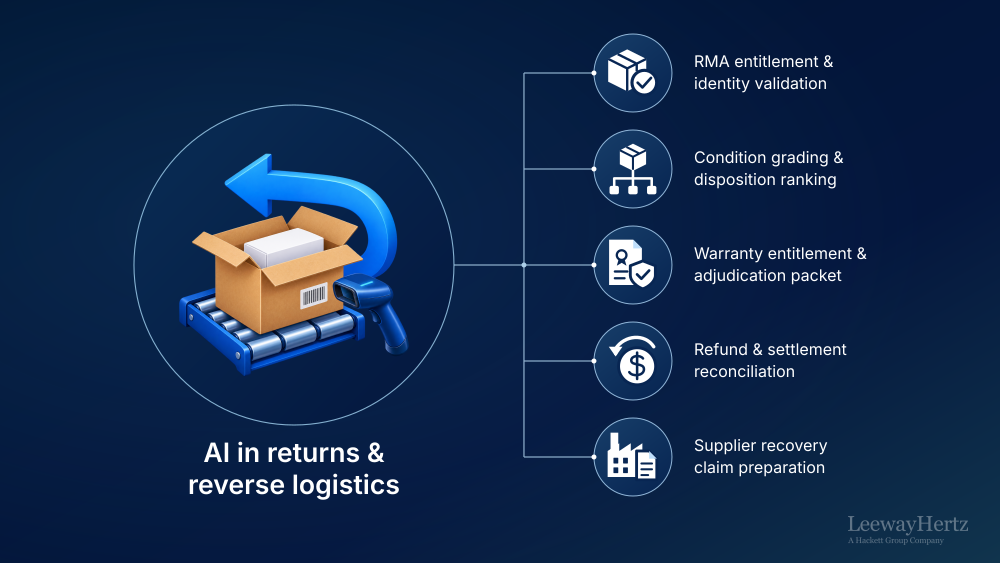
Returns and reverse logistics encompass the activities required to move a customer return, product failure, warranty claim, or field action from initial request through authorization, movement, inspection, disposition, settlement, recovery, and final closure. Across electronics, appliances, automotive aftermarket, and e-commerce, the operating model spans RMA authorization, return transportation, receiving and inspection, disposition decisioning, warranty adjudication, fraud review, credits and refunds, supplier recovery, refurbishment, recall execution, and reverse logistics analytics.
For returns managers, warranty managers, reverse logistics directors, and operations teams, this is far more than the forward supply chain operating in reverse. Every returned product creates a sequence of interdependent decisions. Is the return entitled under the applicable policy? Does the serial or IMEI match the original sale? What is the actual condition of the item? Is the failure covered by warranty? Should the customer receive a repair, replacement, refund, or goodwill remedy? Does the claim contain unusual patterns that warrant additional review? Can we recover value through restock, refurbishment, supplier recovery, liquidation, or another approved channel? Does the item require recall, quarantine, or regulated disposal?
Answering these questions usually requires evidence from multiple systems. A single case may move across CRM, order management, RMA platforms, WMS, ERP, warranty and claims systems, payment services, provider portals, supplier systems, quality applications, recall tools, and document repositories. The challenge is therefore not only processing the physical return. It is maintaining a consistent evidence trail as decisions move from one function to the next.
The economic stakes are significant. The National Retail Federation projected that U.S. retailers would receive $849.9 billion in returns in 2025, representing 15.8% of annual sales, while online returns were expected to reach 19.3% of online sales. The same research reported that 9% of returns were fraudulent [1]. These figures illustrate why small gaps in reverse-logistics execution can create substantial leakage. An incorrect entitlement decision can introduce an unsupported return into the network. A missed serial mismatch can result in settlement against the wrong product. An inconsistent inspection grade can reduce recovery value. A fragmented warranty process can delay valid claims, overlook unsupported charges, or miss supplier recovery opportunities.
This operating environment is well suited to AI because much of the work is evidence-intensive, exception-heavy, and distributed across systems. Teams repeatedly retrieve and compare return policies, orders, proof of purchase, serial histories, inspection records, digital images, warranty terms, provider estimates, failure codes, supplier agreements, refund records, and recall data. AI can help extract facts, reconcile records, retrieve applicable policies, classify exceptions, detect anomaly patterns, rank permitted options, prepare review packets, and coordinate approved system actions.
The opportunity, however, is not to automate every decision. AI should support the work surrounding judgment, not absorb the authority attached to it. It can prepare an entitlement recommendation, surface a serial discrepancy, identify an unusual provider pattern, or rank permitted disposition options. It should not independently deny a disputed return, conclude that a customer or provider committed fraud, approve a material goodwill exception, authorize regulated disposal, define recall scope, or determine an accounting reserve. Authorized professionals remain responsible for those outcomes.
For this reason, the most useful unit for AI transformation is the sub-process. Labels such as “AI for returns,” “AI for RMA,” or “AI for warranty” are too broad to implement, integrate, govern, or measure. A buildable use case needs to define the trigger, artifact, system context, applicable rule, exception condition, AI capability, expected output, permitted action, and accountable reviewer.
This article maps returns and reverse logistics at that level. It breaks the operating model into its core functions, processes, and sub-processes to show where AI can create practical value, how agentic workflows can connect evidence and handoffs across systems, and where human accountability must remain explicit.
- How AI is transforming returns and reverse logistics operations
- Why AI use cases in returns and reverse logistics must be mapped at the sub-process level
- Returns and reverse logistics operating model and AI opportunity mapping across processes
- High-value AI use cases in returns and reverse logistics
- How agentic AI works in returns and reverse logistics operations
- How to prioritize AI use cases in returns and reverse logistics
- Governance, risk and responsible AI in returns and reverse logistics
- How ZBrain operationalizes AI use cases in returns and reverse logistics
- Future of AI in returns and reverse logistics
How AI is transforming returns and reverse logistics operations
AI is changing returns and reverse logistics by improving the work that happens between a return request and the final financial, operational, or recovery outcome. That work is rarely contained in one system. A single case may require order history, return-policy rules, serial or IMEI records, warranty terms, inspection evidence, warehouse status, refund data, supplier agreements, repair information, and prior claim history before a team can decide what should happen next.
This fragmentation creates a natural role for AI as a connective decision-support layer across RMA, warehouse, warranty, refund, supplier recovery, and quality systems. It can assemble evidence, identify inconsistencies, classify exceptions, retrieve applicable policies, and prepare the next decision for review.
The strongest opportunities are not in simply automating returns. They are in making evidence-intensive and exception-heavy decisions faster, more consistent, and easier to audit while keeping customer, financial, product-safety, and regulatory decisions with the accountable business roles. The transformation is most visible across five types of return and reverse logistics work.
Document-heavy work
- Typical artifacts: RMA records, return requests, proof of purchase, warranty registrations, inspection and grading sheets, service-provider estimates, supplier recovery claims, credit memos, recall notices, disposition records, and refurbishment work orders.
- How AI helps: Document intelligence can extract product, customer, serial, date, coverage, condition, amount, and reason-code data from structured and unstructured records. It can compare related artifacts, identify missing or conflicting evidence, and assemble a case packet before a returns manager, warranty administrator, claims adjudicator, or recovery analyst begins review.
Image and evidence-heavy work
- Typical artifacts: Return condition photos, packaging damage images, inspection images, scanned service records, product label images, digital test results, and photographic evidence submitted with warranty claims.
- How AI helps: Computer vision and multimodal models can analyze digital evidence the organization has already captured and compare it with the RMA record, inspection sheet, stated return reason, or grading criteria. They can classify visible condition, identify inconsistencies, and surface cases that require closer human inspection.
Exception-heavy work
- Typical artifacts: Out-of-window return requests, serial or IMEI mismatches, empty-box cases, wrong-item returns, repeat refund activity, unusual warranty claims, provider billing anomalies, unresolved supplier recoveries, aged returns, and recall exceptions.
- How AI helps: Classification, anomaly detection, and pattern analysis can organize large exception queues by cause, value, age, recurrence, customer impact, recovery potential, or regulatory significance.
Knowledge-heavy work
- Typical artifacts: Return policies, warranty terms, goodwill authority matrices, failure-code taxonomies, supplier agreements, disposition matrices, service manuals, recycling requirements, recall procedures, customer-service guidance, and product-specific handling rules.
- How AI helps: Retrieval-grounded AI can locate the rule, policy, contractual term, or precedent that applies to a case and connect it with the evidence under review.
Workflow-heavy work
- Typical artifacts and records: RMA status, carrier events, receiving records, inspection results, warranty claim queues, refund approvals, exchange orders, supplier recovery cases, refurbishment work orders, recall remedy records, credit memos, and CAPA handoffs.
- How AI helps: Agentic workflows can coordinate multi-step work across the returns lifecycle. They can monitor defined triggers, retrieve authorized records, evaluate case status, prepare the next review packet, route exceptions to the appropriate role, and execute approved system actions.
Overall, AI adds value by preparing evidence, surfacing exceptions, and coordinating workflows while accountable professionals retain final decision authority.
Why AI use cases in returns and reverse logistics must be mapped at the sub-process level
Returns and reverse logistics span multiple interconnected activities: return initiation, transportation, receiving, inspection, disposition, warranty adjudication, fraud review, refunds and exchanges, supplier recovery, refurbishment, recalls, and analytics. Each activity depends on distinct systems, artifacts, business rules, and accountable roles.
Broad labels such as “AI for RMA,” “AI for returns fraud,” or “AI for warranty claims” identify an opportunity area, but they do not define what to build. They do not specify which records AI should analyze, which systems provide the data, what condition or exception it must identify, what output it should produce, or who is responsible for the resulting decision.
A practical implementation approach therefore decomposes reverselogistics work into four levels:
- Function: A major stage of the reverse logistics lifecycle, such as receiving, inspection, and disposition or warranty, fraud, and customer settlement.
- Process: A recurring workflow within that domain, such as warranty claim adjudication, disposition decisioning, or supplier recovery and RTV.
- Sub-process: A specific activity with defined inputs, outputs, artifacts, rules, exceptions, systems, and accountable roles, such as validating warranty entitlement or verifying a returned serial number against the original sale.
- AI-enabled opportunity: A specific AI capability applied to a named artifact or to improve how the sub-process is performed. For example, retrievalgrounded validation can compare proof of purchase, warranty registration, product terms, and serial history to produce a component-coverage recommendation for a claims adjudicator to review.
This level of decomposition exposes dependencies that broad usecase labels hide. A warranty adjudication subprocess may require proof of purchase, registration data, product-specific warranty terms, serial history, failure codes, provider estimates, prior claims, goodwill authority, and supplier recovery terms. A disposition decision may depend on condition grade, product age, serial status, recovery-channel rules, resale potential, and regulated-disposal requirements.
Defining these dependencies before solution design makes data access, integrations, exception logic, controls, and human review requirements visible. It also makes performance measurable at the workflow level, using outcomes such as adjudication time, evidence completeness, exception aging, supplier recovery conversion, disposition accuracy, recall-remedy completion, or recurrence of quality escapes. For this reason, the subprocess is the most practical unit for designing and governing AI in returns and reverse logistics. It turns broad automation ideas into specific workflows that can be implemented, reviewed, measured, and controlled.
Build governed AI-driven payroll workflows with ZBrain
Design, validate and govern AI workflows across payroll audit, gross-to-net review, tax filing support, garnishment administration and reconciliation.
Returns and reverse logistics operating model and AI opportunity mapping across processes
Returns and reverse logistics should be mapped as a connected operating model rather than as a single return workflow. A customer request can trigger authorization, transportation, receiving, inspection, disposition, warranty, fraud, financial settlement, supplier recovery, refurbishment, recall, and analytics activities. Each function has different evidence, systems, decision rules, exception conditions, and accountable roles. Treating them separately makes AI opportunities more implementable because the artifact, operational decision, output, and review boundary can be defined precisely.
The operating model covers 11 core functions. For each function, the table breaks work into processes, then sub-processes, and identifies AI-enabled opportunities tied to named artifacts, system context, exception conditions, and accountable review.
Function 1: Returns initiation and RMA authorization
Converting a return request into an authorized, policy-supported, and traceable RMA with the correct product identity, evidence requirements, risk treatment, and reverse-routing instructions.
The process begins when a customer, dealer, marketplace, service provider, or internal channel requests a return. The team validates the transaction, entitlement, product identity, required evidence, exceptions, and routing. A complete authorization record helps prevent downstream errors in transport, receiving, refunds, warranties, inventory, and recovery.
Teams involved: Returns managers, RMA coordinators, customer service leads, e-commerce and marketplace operations teams, fraud analysts, channel-support teams, and return-routing coordinators.
What AI helps with: AI can normalize intake across channels, fetch the correct return policy and transaction details, match orders and products, spot missing evidence, classify return reasons, flag unusual behavior, and assemble an RMA authorization packet. It can also draft approved customer instructions and trigger label or routing prep after logging the required review.
What humans continue to own: Returns personnel approve disputed entitlement, policy exceptions, high-value or out-of-policy RMAs, and cases with incomplete identity evidence. Fraud analysts determine whether unusual patterns require investigation.
| Process | Sub-process | AI-enabled opportunities |
|---|---|---|
| Return request intake | Return request intake across channels |
|
| Required-evidence completeness review |
|
|
| Return-reason coding and preliminary routing |
|
|
| Entitlement and identity validation | Order, policy, and return-window entitlement validation |
|
| Product identity and serial or IMEI pre-validation |
|
|
| Order and transaction verification |
|
|
| Risk screening and exception handling | Initiation-stage fraud and abuse screening |
|
| RMA issuance and routing-instruction creation |
|
|
| Policy exception assessment |
|
Key artifacts
- Return request and customer case
- Order record and proof of purchase
- Return policy and effective version
- Product master data
- Serial or IMEI history
- RMA record
- Exception-approval record
- Routing instructions
Systems involved
- CRM and customer service platforms
- E-commerce and marketplace platforms
- Order management systems
- RMA or returns management systems
- ERP and product master systems
- Serial or IMEI repositories
- Fraud analytics tools
- Document repositories
Regulatory and control considerations
Return entitlement must be evaluated against the policy and transaction context that actually apply to the case. Jurisdiction-sensitive consumer rights, marketplace rules, gift or transferred purchases, and exceptions should be routed rather than generalized. Identity and fraud signals should be linked to evidence and reviewable. The RMA record should retain the policy basis, source artifacts, exception reason, reviewer, and approval timestamp.
Accountable roles
- Returns manager
- RMA coordinator
- Customer service lead
- Fraud analyst
- Channel operations owner
Highest-value opportunities
- Return entitlement and policy-version validation: High leverage because an incorrect authorization creates downstream transport, inspection, settlement, and customer-service cost.
- Serial or IMEI pre-validation: Valuable because product-identity defects become harder to unwind after receipt. Early identity reconciliation protects refund, warranty, inventory, and fraud-review decisions.
- Evidence-completeness assessment: Reduces repeated customer contacts by identifying exactly which documents or identifiers are missing for the requested return path.
Example agentic workflow: Returns initiation and RMA authorization
- Return request arrives via approved channel. The workflow retrieves the order, customer case, product master, return policy, serial/IMEI history, prior RMAs, and channel rules.
- Document intelligence extracts facts, normalizes return reason, and verifies required evidence for that product and reason.
- Retrieval-based validation checks return window and policy. Identity validation compares submitted product ID with original sale and replacement history.
- Anomaly detection reviews first‑party returns, prior concessions, serial reuse, reason changes, and other signals, routing unusual cases to fraud analysts without deciding fraud.
- Human checkpoint: RMA coordinator or returns manager confirms entitlement, identity, exceptions, and return path; fraud analyst addresses elevated risks as needed.
- On approval, the workflow creates the RMA, prepares routing or a label, updates the case, and records the policy basis, evidence, approvals, and actions.
Function 2: Returns transportation and consolidation
Moving authorized returns through the reverse network using the correct carrier service, destination, consolidation path, documentation, and exception controls.
Transportation begins after return authorization but shapes downstream economics and control. The organization must select eligible services, route items to capable nodes, manage cross-border documentation, and reconcile physical shipments with authorization. The optimal route depends on restrictions, battery content, disposition, inspection capacity, backlog, geography, service commitments, and destination requirements. AI can compare these constraints and prepare exceptions, while carrier rates, contracts, and trade rules remain authoritative.
Teams involved: Transportation coordinators, returns managers, RMA coordinators, carrier-management teams, consolidation-center teams, cross-border logistics specialists, receiving-network planners, and customer-service teams.
What AI helps with: AI can classify eligible return services, compare approved carrier and node options, validate labels, recommend consolidation destinations, extract and check cross-border return documentation, interpret carrier events, and prepare manifests and transportation exception review packets.
What humans continue to own: Transportation and returns teams approve routing exceptions, service overrides, restricted-product handling, cross-border exceptions, and changes that materially affect customer commitment, cost, or compliance. AI should not invent customs determinations or bypass carrier and hazardous-material rules.
| Process | Sub-process | AI-enabled opportunities |
|---|---|---|
| Transportation planning and carrier management | Return label and carrier selection |
|
| Consolidation center and destination routing |
|
|
| Restricted-product transportation readiness assesment |
|
|
| Cross-border and exception management | Cross-border return documentation |
|
| In-transit exception handling |
|
|
| Cross-border exception review |
|
|
| Consolidation execution | Consolidation planning and manifest preparation |
|
| Consolidation load readiness and handoff |
|
Key artifacts
- Return label
- Carrier-service rules
- Routing instruction
- Carrier tracking events
- Cross-border return packet
- Consolidation manifest
- Carrier-claim record
- RMA and destination requirements
Systems involved
- Transportation-management systems
- Carrier platforms
- RMA systems
- Order-management platforms
- Warehouse and consolidation-center systems
- ERP and product-master systems
- Trade-document repositories
Regulatory and control considerations
Carrier eligibility, service commitments, rate calculations, dangerous-goods restrictions, customs documentation, destination capability, and chain-of-custody rules should remain explicit controls. AI recommendations should be constrained to permitted routes and should preserve the data used to justify a reroute or exception.
Accountable roles
- Transportation or carrier coordinator
- Returns manager
- RMA coordinator
- Cross-border logistics specialist
- Consolidation-center lead
Highest-value opportunities
- Carrier and service recommendation: Useful when several compliant return services exist and cost, transit time, product class, and destination capability need to be considered together.
- Destination and consolidation routing: Prevents products from being sent to nodes that cannot inspect, quarantine, refurbish, return to supplier, or recycle them correctly.
- Cross-border documentation validation: Reduces holds and broker rework by identifying missing or inconsistent fields before shipment.
Example agentic workflow: Returns transportation and consolidation
- An approved RMA triggers transportation planning and provides origin, product attributes, return reason, destination constraints, and required service timing.
- Using this information, the workflow identifies eligible carrier services and receiving nodes using approved carrier rules, product restrictions, node capabilities, and expected recovery path.
- Optimization ranks permitted options using rate data, service windows, capacity, and consolidation opportunities. Cross-border cases also trigger document extraction and completeness checks.
- Carrier events are monitored against expected milestones. The system classifies lost, damaged, delayed, or failed-delivery conditions and bundles them with the RMA, label, and tracking evidence.
- Human checkpoint: The transportation or cross-border owner reviews exceptions, route overrides, restricted-product issues, and material service or cost deviations.
- Approved labels, routes, manifests, and exception actions are written to the transportation and returns systems with the supporting decision trail.
Function 3: Returns receiving and inspection
Converting an arriving parcel into a verified receiving, product-identity, condition, failure-evidence, and discrepancy record that downstream teams can rely on.
Receiving and inspection verify that returned units match the authorized RMA, record quantity, SKU, serial or IMEI, packaging, condition, and failure evidence, and document discrepancies before refund, warranty, or disposition decisions. AI can link captured scans, photos, and test records, compare evidence with approved standards, and prepare a discrepancy and grading packet, while inspectors retain final physical assessment and grading authority.
Teams involved: Receiving teams, returns inspectors, returns managers, inventory-control teams, fraud analysts, warehouse supervisors, warranty interfaces, and refurbishment teams.
What AI helps with: AI can match receipts to RMAs, reconcile quantities and identifiers, analyze standardized digital package and product images, retrieve grading standards, classify failure symptoms, assemble discrepancy evidence, and prepare inspection records, highlighting unresolved gaps.
What humans continue to own: Returns inspectors confirm physical condition and final grade. Receiving and returns supervisors decide discrepancy disposition. Fraud analysts review suspicious identity or evidence patterns. AI does not physically inspect, weigh, open, test, or handle the product.
| Process | Sub-process | AI-enabled opportunities |
|---|---|---|
| Receiving control | Dock receipt and RMA matching |
|
| Package integrity and discrepancy evidence capture |
|
|
| Serial or IMEI verification against original sale |
|
|
| Expected quantity and SKU reconciliation |
|
|
| Inspection and failure assessment | Condition inspection and grading |
|
| Failure symptom and evidence capture |
|
|
| Inspection-evidence completeness validation |
|
|
| Receiving exception resolution | Receiving discrepancy resolution |
|
| No-fault-found and inconclusive-result triage |
|
Key artifacts
- Dock receipt record
- RMA record
- Package and product photos
- Carrier weight or scan record
- Serial or IMEI history
- Inspection and grading sheet
- Failure-code taxonomy
- Discrepancy case record
Systems involved
- WMS and receiving systems
- RMA systems
- ERP and order-management systems
- Serial or IMEI repositories
- Digital image repositories
- Warranty or claims systems
- Document repositories
Regulatory and control considerations
Receiving evidence should preserve chain of custody and distinguish expected data from observed physical evidence. Identity mismatches, empty-box or wrong-item cases, and tampering indicators should be documented as evidence conditions rather than automatically treated as fraud. Final grade and discrepancy disposition remain controlled human decisions.
Accountable roles
- Returns inspector
- Receiving supervisor
- Returns manager
- Inventory control lead
- Fraud analyst
Highest-value opportunities
- Dock-to-RMA matching: Reduces unidentified inventory and prevents receipts from entering inspection without a valid case context.
- Serial or IMEI reconciliation: Protects refund, warranty, and inventory decisions by confirming that the physical unit matches the transaction being resolved.
- Digital discrepancy evidence assembly: Makes empty-box, wrong-item, package-damage, and tampering reviews faster because the reviewer sees the relevant scans, photos, notes, and RMA facts together.
Example agentic workflow: Returns receiving and inspection
- A parcel is scanned at receiving. The workflow retrieves the RMA, expected SKU and quantity, serial or IMEI requirements, return reason, carrier events, and inspection standard.
- AI matches the receipt to the RMA, reconciles quantity and package identifiers, and assembles package photos, weight records, and receiving notes.
- The scanned serial or IMEI is compared with the original sale, registration, replacement history, and prior returns. Mismatches are classified for specialist review.
- Computer vision classifies visible condition from standardized digital images, while retrieval pulls the applicable grading and failure-code standards. AI prepares the inspection sheet and identifies evidence gaps.
- Human checkpoint: The returns inspector confirms the physical condition and final grade. The supervisor and fraud analyst resolve material discrepancies or suspicious patterns.
- The approved receipt, identity result, grade, failure evidence, and discrepancy disposition are written back to the returns and inventory systems and become inputs to disposition and settlement.
Function 4: Disposition decisioning
Determining the permitted destination that offers the best recovery outcome for a returned asset after its identity, condition, failure evidence, and restrictions are known.
Disposition decisioning uses the approved inspection grade, failure code, recall and quarantine status, data-bearing controls, supplier rights, channel restrictions, and recovery economics to determine eligible paths. AI can rank permitted options such as restock, refurbishment, RTV, liquidation, recycling, or scrap and prepare an explainable recommendation, while authorized operators approve the final disposition.
Teams involved: Returns managers, returns inspectors, inventory-control teams, refurbishment teams, secondary-market operations, supplier recovery teams, finance interfaces, and environmental or EHS specialists.
What AI helps with: AI can classify permitted disposition paths, retrieve the governing disposition rules, compare expected recovery value across allowed channels, detect contradictions between inspection evidence and proposed disposition, prepare inventory-release decisions, and assemble regulated-disposal evidence.
What humans continue to own: Authorized operations teams approve final disposition, inventory release, refurb or RTV routing, high-value liquidation or scrap, and regulated disposal. Environmental specialists control restricted disposal decisions. AI should not release recalled or hazardous material based only on a recommendation.
| Process | Sub-process | AI-enabled opportunities |
|---|---|---|
| Disposition eligibility and value recovery assessment | Disposition eligibility classification |
|
| Value-recovery channel recommendation |
|
|
| Recall, quarantine, and restriction status validation |
|
|
| Inventory and recovery routing | Restock eligibility and sellable inventory release |
|
| Refurbish, repair, or remanufacture routing |
|
|
| Liquidation, salvage, donation, or scrap routing |
|
|
| Disposition override and supervisor review |
|
|
| Regulated disposition | Regulated electronics and battery disposal |
|
| Data-bearing device disposition validation |
|
Key artifacts
- Inspection and grading sheet
- Failure code
- Disposition matrix
- Serial history
- Recall status
- Inventory demand and channel data
- Refurb or RTV eligibility record
- Salvage or liquidation manifest
- Regulated disposal packet
Systems involved
- RMA and returns systems
- ERP and inventory systems
- Disposition and recovery platforms
- Refurbishment systems
- Supplier recovery systems
- Secondary-market platforms
- Environmental compliance repositories
Regulatory and control considerations
Disposition recommendations must be constrained by recall status, hazardous-material rules, supplier-return rights, data-bearing-device controls, product safety, and approved recovery channels. Deterministic cost and inventory rules should remain deterministic where they already exist. High-value write-downs and regulated releases require explicit approval.
Accountable roles
- Returns manager
- Returns inspector
- Inventory control lead
- Refurbishment supervisor
- Supplier recovery analyst
- Environmental or EHS specialist
Highest-value opportunities
- Disposition eligibility classification: Prevents economically attractive but impermissible paths by resolving safety, recall, supplier, data, and channel constraints before optimization.
- Recovery-channel recommendation: Improves value capture where several allowed outcomes exist and recovery depends on age, grade, demand, handling cost, capacity, and time to market.
- Restock validation: Protects sellable inventory from products whose condition, return reason, serial status, or recall status conflicts with an immediate resale decision.
Example agentic workflow: Disposition decisioning
- Inspection completion triggers disposition review and provides the grade, failure code, serial status, recall status, product attributes, and discrepancy outcome.
- The workflow retrieves the disposition matrix, supplier eligibility, channel restrictions, environmental requirements, demand, recovery values, and processing capacity.
- AI first classifies the permitted paths and blocks options that conflict with mandatory restrictions. Optimization then ranks the remaining restock, refurbish, RTV, liquidation, donation, recycling, or scrap alternatives.
- The recommendation includes the expected recovery basis, handling cost, capacity assumptions, constraints, and evidence supporting or excluding each material option.
- Human checkpoint: The authorized operations owner approves final disposition. Inventory, supplier recovery, or environmental specialists approve sellable release, RTV, or regulated-disposal outcomes where required.
- The approved disposition is written to inventory and returns systems, and the corresponding refurb, supplier recovery, liquidation, or disposal workflow is opened with traceable evidence.
Function 5: Warranty claim intake and adjudication
Turning a customer or service-provider claim into a supported coverage, failure, estimate, remedy, and exception decision with a complete adjudication trail.
Warranty adjudication is a compound decision, not a single coverage check. Reviewers must verify purchase date, ownership, registration, model terms, component coverage, parts vs. labor entitlement, failure code, estimate validity, prior repairs, replacement availability, customer remedy rules, goodwill authority, and supplier recovery impacts. AI can cut preparation work by aggregating records and showing which evidence supports each conclusion. The output should be an adjudication packet, not an opaque score: show applicable terms, coverage basis, evidence gaps, failure classification, estimate exceptions, remedy options, and approval requirements to the claims adjudicator.
Teams involved: Warranty administrators, claims adjudicators, customer service leads, returns managers, service-provider administration teams, Fraud analysts, and supplier-recovery teams.
What AI helps with: Document intelligence can structure proof of purchase, service estimates, claim attachments, and technician notes. Retrieval-grounded AI can identify the applicable warranty terms and component coverage. Classification can propose failure codes. Validation can compare estimates with approved rates and prior authorization. Recommendation logic can prepare the policy-permitted remedy and goodwill exception packet.
What humans continue to own: Claims adjudicators determine coverage and approve repair, replacement, refund, or denial decisions. Warranty administrators review evidence and provider issues. Returns managers or delegated authorities approve goodwill beyond normal policy. AI can recommend and explain, but it should not make a disputed coverage denial or material customer remedy independently.
| Process | Sub-process | AI-enabled opportunities |
|---|---|---|
| Claim intake and coverage determination | Claim capture and evidence extraction |
|
| Warranty entitlement and component coverage |
|
|
| Purchase, registration, and duplicate-claim verification |
|
|
| Technical and financial claim validation | Failure-code assignment |
|
| Service-estimate and rate-table validation |
|
|
| Repair history and prior authorization validation |
|
|
| Remedy adjudication and closure | Repair-versus-replace-versus-refund adjudication |
|
| Goodwill exception handling review |
|
|
| Adjudication evidence review and decision recording |
|
|
| Replacement availability and repair-economics assessment |
|
|
| Settlement-readiness validation |
|
Key artifacts
- Warranty claim
- Proof of purchase
- Warranty registration
- Model-specific warranty terms
- Failure-code taxonomy
- Service-provider estimate
- Parts and labor rate tables
- Prior claim and repair history
- Goodwill authority matrix
- Adjudication packet
Systems involved
- Warranty and claims platforms
- CRM and customer-service systems
- ERP and order-management systems
- Provider portals
- Serial-history repositories
- Document repositories
- Finance and settlement systems
- Supplier recovery systems
Regulatory and control considerations
The workflow should use the correct warranty version and distinguish product, component, parts, labor, and extended coverage. Estimate validation should use approved deterministic rate and authorization data. Ambiguous evidence should route to adjudication rather than default to denial. Every material conclusion should retain its source artifact and reviewer.
Accountable roles
- Claims adjudicator
- Warranty administrator
- Returns manager
- Customer service lead
- Finance or settlement reviewer
Highest-value opportunities
- Coverage and component-entitlement validation: High value because warranty terms are often product-, component-, and time-specific. AI can reconstruct the applicable coverage basis before the adjudicator applies judgment.
- Service-estimate validation: Reduces leakage by comparing parts, labor hours, approved rates, standard times, and prior authorization before settlement.
- Repair-versus-replace-versus-refund packet: Improves remedy decisions by presenting coverage, failure, repair economics, replacement availability, prior repair history, and policy constraints in one reviewable case.
Example agentic workflow: Warranty claim intake and adjudication
- A warranty claim arrives with proof of purchase, a failure description, and a service-provider estimate. The workflow retrieves registration, model-specific terms, serial history, prior repairs and claims, rate tables, replacement availability, and goodwill rules.
- Document intelligence structures the claim and estimate. Retrieval-grounded validation determines which product or component terms appear applicable and identifies exclusions, expiration points, or evidence gaps.
- Classification proposes the failure code. Estimate validation compares parts, labor, standard times, and authorized work with the coverage result and approved rate data.
- The workflow assembles repair, replacement, refund, or other permitted remedies and highlights provider anomalies or supplier-recovery candidates without merging those signals into the customer coverage decision.
- Human checkpoint: The claims adjudicator approves coverage and remedy. Warranty or fraud specialists review anomalies, and goodwill above delegated authority routes to the appropriate manager.
- After approval, the adjudication packet is retained, and the approved settlement, exchange, provider, and supplier-recovery handoffs are opened in the relevant systems.
Function 6: Warranty fraud detection
Identifying claim, serial, claimant, dealer, provider, and advance-exchange patterns that warrant specialist review without converting anomaly signals into automated fraud conclusions.
Warranty fraud detection connects claims, RMAs, service events, serial history, and settlements to surface patterns such as serial cloning, repeated concessions, unusual provider labor, dealer concentration, and unreturned advance-exchange parts. AI should produce explainable review candidates by showing observed facts, unusual patterns, peer context, and prior outcomes, while investigators decide whether to clear, investigate, or escalate.
Teams involved: Fraud analysts, warranty administrators, claims adjudicators, service-provider audit teams, dealer-management teams, returns managers, and finance or recovery interfaces.
What AI helps with: AI can perform serial and graph analysis, compare claimant and provider behavior with relevant peer groups, identify repeated concessions or non-return patterns, rank claims for audit sampling, and assemble source-linked investigation packets.
What humans continue to own: Fraud analysts and authorized program owners decide whether to investigate, clear, restrict, charge back, audit, or escalate a case. AI should not label a customer, dealer, or provider fraudulent based solely on anomaly detection.
| Process | Sub-process | AI-enabled opportunities |
|---|---|---|
| Claim and identity pattern analysis | Serial cloning and repeat-claim pattern analysis |
|
| Repeat claimant and concession anomaly review |
|
|
| Narrative consistency analysis |
|
|
| Provider and dealer analytics | Dealer and service-provider claim anomaly analysis |
|
| Provider peer-group construction and baseline monitoring |
|
|
| Advance-exchange controls | Advance-exchange parts-return verification |
|
| Audit and investigation support | Risk-based audit sampling and evidence assembly |
|
| Fraud-review disposition feedback |
|
Key artifacts
- Warranty claims
- Serial and ownership history
- Prior RMAs and settlements
- Goodwill and concession history
- Provider estimates and claim statistics
- Advance-exchange records
- Returned-part evidence
- Fraud-review case
- Audit packet
Systems involved
- Warranty systems
- Fraud analytics platforms
- Serial repositories
- CRM and customer systems
- Provider or dealer portals
- Returns systems
- Payment and recovery systems
- Document repositories
Regulatory and control considerations
Risk indicators should be explainable and tied to authorized first-party data. Peer comparisons should use defensible populations. Separate confirmed outcomes from unadjudicated indicators. Financial penalties, claim denial, provider suspension, or fraud escalation require controlled human authority.
Accountable roles
- Fraud analyst
- Warranty administrator
- Claims adjudicator
- Provider audit lead
- Returns manager
Highest-value opportunities
- Serial-cloning and reuse analysis: Connect identifiers across claims, returns, repairs, owners, and replacements so implausible sequences can be reviewed before additional value is released.
- Repeat claimant and concession analysis: Distinguish high-frequency but policy-consistent customers from patterns involving repeated exceptions, inconsistent narratives, or unusual value concentration.
- Provider and dealer peer analytics: Surface abnormal labor, parts, failure-code, and repeat-repair patterns that are difficult to identify claim by claim.
Example agentic workflow: Warranty fraud detection
- A claim, provider review, or advance-exchange exception triggers fraud analysis. The workflow retrieves the relevant claim, serial, customer, provider, dealer, return, concession, and settlement history.
- Pattern and graph analysis identify serial reuse, linked claims, unusual claimant behavior, or provider and dealer relationships. Peer analytics compare labor, parts, failure-code mix, and repeat repairs with appropriate cohorts.
- Advance-exchange cases are reconciled against replacement shipment, failed-part return, serial, receipt event, and deadline. Audit sampling combines risk indicators with value and prior audit outcomes.
- The workflow prepares an investigation packet that separates source facts, historical outcomes, statistical indicators, confidence, and unanswered questions.
- Human checkpoint: The fraud analyst or authorized audit owner decides whether to clear, request evidence, investigate, sample, restrict, charge back, or escalate the case.
- The decision and evidence are retained, and confirmed outcomes can feed future pattern analysis without treating unresolved indicators as ground truth.
Pattern and graph analysis identify serial reuse, linked claims, unusual claimant behavior, or provider/dealer relationships. Peer analytics compare labor, parts, failure-code mix, and repeat repairs with appropriate cohorts.
Accelerate AI Solutions Development
Build fully functional solutions from your high-value use cases, based on specific operational needs and enterprise context.
Function 7: Credit, refund and exchange processing
Translating an approved return or warranty remedy into controlled refund, credit, exchange, and settlement transactions without weakening financial or payment controls.
After an approved return or warranty remedy, this process converts the decision into the correct refund, credit memo, fee adjustment, payment handoff, or exchange order. Finance and order-management systems remain authoritative for calculations, tax, accounting, payment execution, and order creation. AI can extract approved inputs, flag duplicates or mismatches, prepare transaction handoffs, and reconcile the RMA, case, order, and financial records before closure.
Teams involved: Returns and warranty teams, finance or accounts-receivable teams, payment operations, customer service leads, order management teams, and controllers or delegated financial reviewers.
What AI helps with: AI can extract approved settlement inputs, validate them against deterministic refund rules, prepare credit memos, check transaction references, identify duplicate or mismatched refunds, prepare exchange-order payloads, and reconcile the operational and financial case before closure.
What humans continue to own: Finance team retains control of refund and credit execution, tax and accounting treatment, material manual adjustments, and payment exceptions. Order management team owns forward fulfillment after an exchange order is created. Returns and warranty roles own the approved customer remedy.
| Process | Sub-process | AI-enabled opportunities |
|---|---|---|
| Settlement determination and credit processing | Refund basis and partial-credit validation |
|
| Credit memo preparation and approval |
|
|
| Restocking-fee and partial-credit basis review |
|
|
| Refund execution | Payment-rail refund handoff |
|
| Failed or rejected refund exception handling |
|
|
| Exchange processing | Exchange order orchestration |
|
| Return-of-original-item obligation tracking |
|
|
| Settlement closure | Settlement reconciliation and closure |
|
Key artifacts
- Approved return or warranty decision
- Refund calculation inputs
- Restocking-fee or partial-credit basis
- Credit memo
- Original payment reference
- Refund confirmation
- Exchange order
- Settlement reconciliation record
Systems involved
- ERP and finance systems
- Payment and refund platforms
- Order-management systems
- RMA and warranty systems
- CRM systems
- Tax and accounting engines
- Document repositories
Regulatory and control considerations
Deterministic refund, tax, fee, accounting, and payment rules should remain in authoritative systems. Payment-card data should stay within approved PCI DSS boundaries. AI should receive only the references and fields needed for orchestration and validation. Duplicate credits, manual overrides, and failed handoffs require explicit review.
Accountable roles
- Finance or payment operations reviewer
- Returns manager
- Warranty administrator
- Customer service lead
- Order-management owner
Highest-value opportunities
- Refund-basis validation: Prevents the executed refund from drifting away from the approved operational decision, especially where fees, partial credits, shipping, or concessions apply.
- Credit-memo completeness and duplicate checks: Reduces finance rework and duplicate value release by reconciling the memo to order, RMA, settlement, and posting data.
- Controlled payment-rail handoff: Creates a clean boundary between AI-assisted workflow orchestration and the payment system that actually executes the refund.
Example agentic workflow: Credit, refund and exchange processing
- An approved return or warranty remedy provides the refund, credit, or exchange basis, and the workflow retrieves the original order, payment reference, tax treatment from the finance system, and any applicable fee or concession rules.
- AI extracts the approved settlement inputs and compares them with deterministic refund logic, the original transaction, and the operational decision.
- For credits, the workflow prepares the credit memo and validates references and posting dimensions. For refunds, it prepares only the authorized transaction payload for the payment platform. For exchanges, it validates replacement eligibility and prepares the order handoff.
- Duplicate credits, mismatched payment references, failed refunds, inventory shortages, or inconsistent exchange terms are classified as exceptions rather than silently corrected.
- Human checkpoint: Finance reviews material credit or refund exceptions and payment overrides. Returns or warranty confirms remedy disputes. Order management controls forward-order execution.
- The workflow reconciles the credit, payment, exchange, and customer case back to the approved settlement and closes the return only when the required artifacts are complete.
Function 8: Supplier recovery and RTV
Converting validated defect and disposition evidence into return-to-vendor action, supplier debit, warranty recovery, dispute resolution, and realized cost recovery.
Supplier recovery begins once there’s enough evidence to hold a supplier, component maker, or factory liable for return costs. It includes defect attribution, contractual eligibility, RTV windows, debit support, claim packaging, negotiation, and credit or cash reconciliation. Losses often happen before negotiation due to incomplete evidence, missed supplier deadlines, weak traceability, or costs that don’t match the original return. AI can help by linking records early and preserving the chain from customer return to supplier claim to realized credit, while supplier quality, recovery, and finance retain final commercial authority.
Teams involved: Warranty recovery analysts, supplier quality engineers, returns managers, procurement or sourcing interfaces, finance teams, inventory control, and supplier-management teams.
What AI helps with: AI can detect defect clusters, retrieve supplier warranty and quality terms, validate RTV eligibility, prepare authorizations and debit memos, assemble supplier claim packets, summarize dispute correspondence, and reconcile claims to credits and write-offs.
What humans continue to own: Supplier quality and recovery teams determine defect attribution, contractual position, claim strategy, and dispute settlement. The finance team approves material debit and recovery treatment. AI should not independently bind the organization to a supplier claim or commercial settlement.
| Process | Sub-process | AI-enabled opportunities |
|---|---|---|
| Supplier liability assessment | Supplier and factory defect attribution analysis |
|
| RTV eligibility and authorization |
|
|
| Supplier contract applicability and evidence requirement review |
|
|
| Recovery claim processing | Supplier debit memo preparation |
|
| Supplier warranty recovery claim preparation and submission |
|
|
| Recovery deadline and claim-readiness monitoring |
|
|
| Dispute and recovery management | Recovery negotiation and dispute support |
|
| Recovery tracking and reconciliation |
|
|
| Short-pay and recovery-variance classification |
|
Key artifacts
- Inspection and failure evidence
- Serial or lot history
- Supplier agreement and quality terms
- RTV authorization
- Supplier debit memo
- Supplier warranty recovery claim
- Supplier correspondence
- Credit or cash recovery record
- Write-off decision
Systems involved
- Supplier quality systems
- ERP and procurement systems
- Warranty and returns systems
- Supplier portals
- Finance and recovery-reconciliation systems
- Document repositories
Regulatory and control considerations
Supplier attribution should distinguish observed defect evidence from proposed responsibility. Eligibility, claim windows, cost categories, and evidence requirements should come from the applicable supplier agreement. Material debit positions, disputes, concessions, and write-offs remain controlled commercial and finance decisions.
Accountable roles
- Warranty recovery analyst
- Supplier quality engineer
- Returns manager
- Procurement or sourcing owner
- Finance reviewer
Highest-value opportunities
- Defect-cluster and responsibility analysis: Helps identify when isolated returns form a supplier, component, model, lot, or factory pattern that merits structured recovery.
- RTV eligibility validation: Protects recovery by checking contractual windows, evidence requirements, product identity, and supplier responsibility before the opportunity expires.
- Supplier claim packet assembly: Reduces rejected or delayed claims by ensuring the required inspection, serial, failure, cost, and contractual evidence is complete.
Example agentic workflow: Supplier recovery and RTV management
- Inspection, warranty, or quality evidence identifies a potential supplier-recovery candidate. The workflow retrieves the originating return, failure evidence, serial or lot history, supplier mapping, agreement, cost data, and prior related claims.
- Pattern detection evaluates whether similar defects cluster by supplier, component, model, lot, or factory. Retrieval-grounded validation checks supplier responsibility, RTV eligibility, windows, and evidence requirements.
- For eligible cases, AI prepares the RTV authorization, debit support, and supplier warranty claim packet and identifies missing evidence before submission.
- AI summarizes supplier responses into accepted items, disputed costs, missing evidence, concessions, deadlines, and open actions. Draft proposed replies only from approved facts and commercial positions.
- Human checkpoint: Supplier quality and recovery teams approve attribution, claim submission, material debit positions, concessions, and dispute settlement. Finance teams review the recovery treatment.
- The workflow tracks the claim through supplier credit, cash, dispute, write-off, or returned-material outcome and reconciles the realized recovery back to the source return.
Function 9: Refurbishment and remanufacturing
Turning eligible returned units and components into controlled repair, recertification, harvested-parts, or refurbished-inventory outcomes with traceable work and evidence.
Refurbishment starts when disposition identifies recoverable value through repair, remanufacture, recertification, or parts harvesting. It requires a controlled work order, correct model/revision instructions, diagnostic context, parts traceability, post-repair evidence, final grade, and channel eligibility. AIcan improve preparation and evidence quality but cannot perform physical work; technicians and test equipment do repairs, diagnostics, and verification. AI can fetch controlled procedures, summarize historical evidence, check work-order completeness, help parts-harvesting decisions, and confirm required digital evidence for regrade and recertification.
Teams involved: Refurbishment supervisors, technicians, returns managers, inventory-control teams, supplier quality or engineering interfaces, parts planners, and secondary-channel operations.
What AI helps with: AI can create refurb work orders, retrieve model-specific controlled instructions, summarize prior repairs and test records, recommend eligible parts harvesting, validate traceability, support repair exceptions, compare post-repair evidence with recertification standards, and recommend refurbished inventory channels.
What humans continue to own: Technicians perform physical diagnosis, repair, component removal, testing, and recertification. Supervisors approve deviations and final release. Inventory teams approve channel assignment. AI should not control repair hardware or declare a product safe or recertified without the required human and test evidence.
| Process | Sub-process | AI-enabled opportunities |
|---|---|---|
| Refurbishment planning and diagnostic preparation | Refurb work order creation |
|
| Diagnostic triage from existing digital evidence |
|
|
| Work-order release readiness assessment |
|
|
| Component and repair execution support | Parts harvesting decision support |
|
| Repair instruction and exception support |
|
|
| Harvested-component provenance validation |
|
|
| Recertification and inventory release | Regrade and recertification |
|
| Refurbished channel inventory assignment |
|
|
| Post-repair test-evidence completeness review |
|
|
| Repeat-return hold review for refurbished units |
|
Key artifacts
- Disposition record
- Refurb work order
- Serial record
- Failure code and inspection evidence
- Service manual and repair instruction
- Parts-harvesting record
- Digital test evidence
- Regrade and recertification record
- Refurbished inventory record
Systems involved
- Refurbishment work-order systems
- RMA and returns systems
- Inventory and warehouse systems
- Technical document repositories
- Serial and component-traceability systems
- Secondary-channel inventory platforms
Regulatory and control considerations
Only current, approved technical instructions should be retrieved. Do not recommend safety-critical, recalled, restricted, or untraceable components for harvesting. Recertification requires the defined physical inspection and test evidence. Deviations from approved repair paths require supervisor authority.
Accountable roles
- Refurbishment supervisor
- Repair technician
- Inventory control lead
- Returns manager
- Quality or engineering interface
Highest-value opportunities
- Work-order and instruction readiness: Reduces technician setup time and prevents work from starting with the wrong serial, product revision, procedure, or missing evidence.
- Diagnostic context summarization: Combines return reason, inspection, prior repairs, service history, and existing test outputs into a usable context without attempting to control test equipment.
- Parts-harvesting recommendation and traceability: Improves component recovery while enforcing restrictions around safety, recall status, traceability, and downstream inventory linkage.
Example agentic workflow: Refurbishment and remanufacturing
- An approved refurb disposition opens a work candidate and retrieves the inspection record, failure code, serial and revision, prior repair history, approved service documents, parts availability, and recertification standard.
- AI generates the work-order draft, attaches the current controlled instructions, and summarizes return, inspection, service, and digital test evidence already available.
- During preparation, recommendation logic identifies potentially harvestable components and validates traceability and restriction rules. Repair-support retrieval surfaces relevant procedures and known exceptions.
- After the technician completes physical repair and testing, AI validates the post-repair evidence, proposed regrade, parts record, and recertification requirements and prepares the release packet.
- Human checkpoint: Technicians and the refurbishment supervisor verify repair and test results, approve deviations, confirm final grade, and authorize recertification. Inventory owners approve channel release.
- The completed work order, test evidence, parts traceability, recertification record, grade, and refurbished inventory status are written back to the relevant systems.
Function 10: Recall and field action management
Connecting product-safety scope, affected populations, customer notification, return or remedy orchestration, regulatory support, effectiveness tracking, and closure evidence.
Recall and field-action work is a high-governance reverse-logistics function: the organization must control which products and customers are in scope, what remedy applies, how returned units are quarantined or routed, what evidence supports regulatory decisions, and whether the action is effective. Serial, lot, shipment, complaint, service, warranty, and return records often must be linked across systems. AI can speed evidence assembly and reconciliation, but reportability, scope, remedy, regulatory submission, and closure remain product-safety, legal, and regulatory decisions. The workflow must keep that boundary explicit and prevent recall returns from silently entering resale or refurbishment paths when policy requires quarantine, destruction, or another controlled remedy.
Teams involved: Product-safety and compliance teams, legal or regulatory interfaces, returns managers, customer service leads, warranty teams, quality teams, serial or lot data owners, logistics teams, and recall-program coordinators.
What AI helps with: AI can identify candidate clusters, assemble affected serial or lot populations, retrieve reporting procedures, prepare reportability evidence, validate notification targets, orchestrate approved recall-specific RMAs, classify remedy exceptions, reconcile effectiveness metrics, and prepare closure evidence.
What humans continue to own: Product-safety, legal, and regulatory owners decide reportability, final scope, remedy, required reporting, and closure. Returns and logistics teams execute the approved field action. AI should not independently declare a recall, change legal wording, or release quarantined product.
| Process | Sub-process | AI-enabled opportunities |
|---|---|---|
| Scope and reportability assessment | Recall scope identification by lot, model, or serial |
|
| Reportability assessment and evidence review |
|
|
| Affected-population completeness and boundary testing |
|
|
| Notification and remedy orchestration | Customer notification and remedy eligibility checking |
|
| Notification and remedy orchestration | Recall return and remedy orchestration |
|
| Notice-delivery and customer-contact exception management |
|
|
| Quarantine and disposition-path validation |
|
|
| Recall effectiveness monitoring and closure management | Recall effectiveness and status tracking |
|
| Recall closure and evidence retention |
|
|
| Regulatory reporting data completeness review |
|
Key artifacts
- Recall scope file
- Serial or lot population list
- Complaint and failure evidence
- Reportability assessment packet
- Customer notification record
- Recall-specific RMA
- Remedy-status record
- Effectiveness report
- Closure evidence package
Systems involved
- Recall or product-safety systems
- RMA and returns platforms
- CRM and notification systems
- Warranty and claims systems
- Serial and lot repositories
- ERP and inventory systems
- Quality systems
- Document repositories
Regulatory and control considerations
AI may organize CPSC, NHTSA, or other applicable regulatory evidence, but legal reportability and regulatory submissions remain with authorized owners. Scope changes, notice language, remedy eligibility, quarantine, destruction, and closure should be versioned and approval-controlled. The approved recall population should remain the authoritative basis for orchestration.
Accountable roles
- Product-safety or compliance owner
- Legal or regulatory reviewer
- Recall program manager
- Returns manager
- Customer service lead
- Quality owner
Highest-value opportunities
- Recall population assembly: Connects serial, lot, production, shipment, service, complaint, warranty, and return records to reduce manual population reconstruction.
- Reportability evidence packet: Improves readiness for product-safety and counsel review by separating facts, applicable procedures, unresolved questions, and the human decision.
- Notification-target validation: Reduces missed and incorrectly targeted notices by reconciling customer or owner records against the approved scope.
Example agentic workflow: Recall and field action management
- A product-safety signal or approved investigation triggers population analysis and retrieves complaint, failure-code, serial, lot, supplier, shipment, service, warranty, and return histories together with the controlled product-safety procedure.
- Pattern detection identifies candidate clusters, and AI assembles the affected population evidence and reportability packet for specialist review.
- After scope and remedy are approved, the workflow validates customer or owner targets, prepares approved notice variants, creates recall-specific RMA or service tasks, and enforces quarantine or disposition rules.
- Effectiveness tracking reconciles notifications, returned units, repairs, replacements, refunds, open cases, unreachable customers, and quarantined inventory and identifies low-completion cohorts.
- Human checkpoint: Product-safety, legal, and regulatory owners approve reportability, scope, wording, remedy, reporting, and closure. Operations teams resolve execution exceptions.
- The workflow retains scope versions, notifications, remedy outcomes, regulatory evidence, effectiveness measures, and closure approvals as the controlled recall record.
Function 11: Reverse logistics analytics
Turning case-level return, warranty, fraud, recovery, supplier, and recall evidence into performance, financial, risk, quality, and upstream-prevention insight.
Reverse logistics analytics closes the feedback loop. Operational systems create many return records, reasons, inspections, failure codes, settlements, dispositions, supplier recoveries, provider behavior, serial histories, and recall evidence. If kept isolated, leaders only see aggregate return rates and costs. Linking case-level evidence lets organizations explain return shifts, find where value is lost or recovered, detect fraud or provider patterns, track supplier defects, align operational signals with financial assumptions, and route issues to quality, product, packaging, merchandising, or service teams. AI normalizes data, finds patterns, analyzes cohorts, and creates narratives; functional owners choose corrective actions.
Teams involved: Reverse logistics directors, returns managers, warranty teams, supplier quality engineers, warranty recovery analysts, controllers and finance analytics teams, product teams, quality and CAPA owners, and customer-experience teams.
What AI helps with: AI can normalize reason codes, connect case-level recovery economics, detect fraud and provider patterns, link failure evidence to suppliers and lots, surface divergence between operational signals and finance assumptions, prepare quality-escape packets, and prioritize upstream prevention opportunities.
What humans continue to own: Returns managers decide pricing, policy, product, packaging, supplier, fraud-program, reserve, and quality interventions. Controllers own accounting conclusions. QMS owns CAPA investigation and closure after the handoff. AI can identify patterns and prepare evidence but should not own those decisions.
| Process | Sub-process | AI-enabled opportunities |
|---|---|---|
| Performance and recovery analytics | Return rate and reason-code analytics |
|
| Recovery rate and net-loss-per-return analysis |
|
|
| Return-reason taxonomy drift and mapping quality |
|
|
| Product, channel, and cohort decomposition |
|
|
| Disposition-mix and value-leakage analysis |
|
|
| Risk and quality analytics | Fraud and abuse trend analytics |
|
| Risk and quality analytics | Warranty, provider, and supplier defect analytics |
|
| Financial and improvement feedback | Returns reserve and financial interface |
|
| Financial and improvement feedback | Quality escape and CAPA handoff |
|
| Upstream prevention feedback |
|
|
| Operational-to-reserve signal divergence review |
|
|
| Prevention action impact tracking |
|
Key artifacts
- Return-reason taxonomy
- Return-rate report
- Recovery and net-loss-per-return analysis
- Fraud trend report
- Warranty and provider analytics
- Supplier defect analysis report
- Returns-reserve support
- Quality-escape packet
- CAPA handoff record
- Prevention-opportunity backlog
Systems involved
- Business intelligence and analytics platforms
- RMA and returns systems
- Warranty and claims platforms
- ERP and finance systems
- Supplier quality systems
- Fraud analytics systems
- QMS platforms
- Product and customer-experience data repositories
Regulatory and control considerations
Taxonomies, cohorts, denominators, and confirmed outcomes should be governed to keep analytics comparable over time. AI in production may support finance with evidence but should not determine reserve recognition. Quality-escape detection can trigger a handoff, but QMS owns CAPA. Fraud analytics should separate confirmed outcomes from indicators.
Accountable roles
- Reverse logistics director
- Returns manager
- Fraud analyst
- Warranty recovery analyst
- Supplier quality engineer
- Controller
- Quality or CAPA owner
Highest-value opportunities
- Return-reason normalization and cohort analysis: Turns inconsistent free text into a governed view of why products come back and where rates are changing by SKU, model, channel, geography, or cohort.
- Recovery and net-loss-per-return analytics: Connects refund, transport, inspection, refurb, liquidation, supplier recovery, and disposition data so leaders can see the true economics of different return paths.
- Cross-process fraud and provider analytics: Identifies recurring risk patterns that are invisible when initiation, receiving, warranty, serial, provider, and settlement data are analyzed separately.
Example agentic workflow: Reverse logistics analytics
- On a scheduled analytics cycle, the workflow retrieves governed return, inspection, warranty, serial, disposition, settlement, supplier recovery, fraud outcome, and recall data with consistent product and channel dimensions.
- NLP normalizes return reasons and failure narratives into controlled taxonomies. Case-level aggregation calculates recovery and loss inputs and links them to the final disposition and supplier outcome.
- Pattern and anomaly analysis identify changing return cohorts, fraud or provider signals, supplier or component clusters, and divergence between operational signals and finance assumptions.
- For material patterns, AI prepares evidence-linked management commentary, supplier-quality analysis, quality-escape packets, or prevention opportunities with the underlying cohorts and records attached.
- Human checkpoint: Reverse logistics, finance, fraud, supplier quality, product, and QMS owners decide which findings require operational, accounting, investigative, supplier, or CAPA action.
- Approved actions and handoffs are tracked so later analytics can distinguish observed signals from confirmed outcomes and measure whether the intervention reduced returns, loss, or recurring defects.
Accelerate AI Solutions Development
Build fully functional solutions from your high-value use cases, based on specific operational needs and enterprise context.
High-value AI use cases in returns and reverse logistics
Not every reverse logistics activity is an equally strong candidate for AI enablement. The strongest use cases combine substantial evidence-review effort, recurring exceptions, measurable customer or economic impact, accessible digital artifacts, and a clear human approval boundary. They remove preparation and investigation work around a decision rather than replacing the person accountable for it.
| High-value AI use case | How AI supports the work | Why it is high value |
|---|---|---|
| RMA entitlement and identity validation | Reads the order, proof of purchase, effective return policy, product master, serial or IMEI history, prior RMAs, and channel rules to identify eligibility, missing evidence, and identity conflicts. | AI reduces evidence-gathering effort at initiation, helping teams make faster, better-supported entitlement and identity decisions. |
| Receiving discrepancy and serial verification | Connects dock receipt, RMA, quantity, SKU, serial, carrier events, package photos, and inspection evidence into a discrepancy packet. | AI brings receipt, package, and serial evidence together early, helping teams resolve discrepancies faster and protect inventory, settlement, and fraud-review decisions. |
| Condition grading and disposition recommendation | Uses standardized digital images, grading rules, condition attributes, recall status, supplier eligibility, demand, and recovery economics to propose grade and permitted recovery paths. | AI supports consistent grading and disposition recommendations, helping teams protect recovery value, inventory quality, and downstream processing decisions. |
| Warranty entitlement and adjudication packet | Retrieves proof of purchase, registration, effective warranty terms, serial history, failure evidence, provider estimate, rate tables, prior claims, replacement options, and goodwill rules. | AI assembles warranty evidence and applicable terms into a review-ready packet, helping adjudicators make informed decisions and coordinate customer, provider, finance, and supplier-recovery actions. |
| Provider and warranty anomaly review | Compares provider labor, parts, failure-code mix, serial reuse, repeat claimants, concessions, and advance-exchange history with peer and prior-case patterns. | AI surfaces evidence-linked provider and warranty patterns for specialist review, helping teams focus attention where anomalies may affect cost, quality, or recovery. |
| Refund and settlement reconciliation | Reconciles adjudication, credit memo, payment confirmation, exchange order, RMA status, and customer case before closure. | AI reconciles operational and financial records before closure, helping teams resolve hidden refund, credit, and exchange issues before they affect customers or reporting. |
| Supplier recovery claim preparation | Aggregates failure evidence, supplier terms, serial or lot history, inspection, claim values, debit support, and evidence checklists into an RTV or recovery packet. | AI strengthens supplier recovery by linking evidence, terms, and cost support into a complete claim, helping teams pursue eligible recovery more effectively. |
| Refurb recertification readiness | Connects work order, repair evidence, digital test results, parts traceability, final grade, serial history, and channel restrictions before release. | AI helps verify that repair, testing, and release evidence is complete and consistent, supporting safer recertification and more reliable refurbished inventory decisions. |
| Recall scope and effectiveness evidence assembly | Links complaint, failure, serial or lot, customer, remedy, return, inventory, and closure status into product-safety and effectiveness views. | AI connects scope, notification, remedy, return, inventory, and closure evidence, helping teams maintain traceability and identify gaps in recall execution and effectiveness. |
| Return economics and quality-escape analytics | Normalizes reasons, connects refunds and recovery, detects recurring defect patterns, and prepares supplier-quality or CAPA handoff evidence. | AI turns return and recovery data into actionable product, supplier, channel, fraud, and quality insights, helping teams reduce recurring loss and improve future decisions. |
The most practical starting points are preparation, validation, and exception-triage workflows where the artifacts are already digital and the decision authority is clear. RMA entitlement validation, receiving discrepancy assembly, warranty evidence validation, provider-estimate review, refund reconciliation, and supplier-claim completeness checks fall into this category. They create value without requiring the organization to delegate consequential authority to the model.
The next tier is cross-system decision support. Disposition ranking, provider anomaly analysis, supplier defect clustering, recall-effectiveness tracking, and quality-escape analytics require stronger identity resolution and integration because they connect several systems. These workflows can create broader value, but only after source records, product identifiers, and review ownership are stable.
The most sensitive tier is high-consequence orchestration. Fraud escalation, disputed claim denial, high-authority goodwill, regulated disposal, recall reportability, material supplier debit, and financial reserve conclusions should remain explicit human decisions. AI can prepare the evidence and recommendation, but the implementation should be designed around approval gates, traceability, and defined stop conditions.
How agentic AI works in returns and reverse logistics operations
Agentic AI supports returns and reverse logistics by coordinating a sequence of retrieval, analysis, exception handling, review, and controlled system interaction around a defined operational event. Unlike a standalone assistant that responds to one prompt, an agentic workflow can preserve case state, call several tools, retrieve authorized records from multiple systems, apply different AI capabilities, wait for a human decision, and then continue only with the approved action.
The goal is not to create an autonomous reverse-logistics function. It connects activities usually split across service queues, RMA systems, warehouse records, provider portals, spreadsheets, supplier systems, finance tools, and quality platforms while keeping decision rights visible.
| Responsibility | Primary role in the workflow | Typical artifacts | Output prepared for review |
|---|---|---|---|
| Intake and entitlement analysis | Normalizes requests, validates policy and product identity, and prepares RMA exceptions | Return request, order, policy, proof of purchase, serial history | Entitlement basis, evidence gap, RMA-ready case |
| Inspection and disposition analysis | Connects receipt, condition, serial, grade, restrictions, and recovery options | RMA, inspection sheet, images, serial record, disposition matrix | Discrepancy packet, grade proposal, permitted disposition ranking |
| Warranty adjudication analysis | Validates coverage, failure code, provider estimate, remedy options, and evidence | Warranty claim, warranty terms, registration, estimate, rate tables, prior claims | Adjudication packet and remedy recommendation |
| Fraud and anomaly analysis | Finds linked serial, claimant, provider, dealer, concession, and advance-exchange patterns | Serial history, claims, provider data, prior confirmed outcomes | Evidence-linked risk indicators and audit candidates |
| Supplier recovery analysis | Tests recovery eligibility and assembles attribution, RTV, debit, and claim evidence | Inspection, failure code, supplier terms, claim, debit support | Recovery packet and dispute-ready evidence |
| Recall and quality analysis | Connects product-safety scope, remedy status, return outcomes, and systemic defects | Recall scope, serial or lot data, complaints, claims, return reasons | Recall status, effectiveness view, quality-escape packet |
Example agentic workflow: Warranty claim adjudication with supplier recovery and provider anomaly review
- The workflow starts with a warranty claim for a compressor failure and service estimate.
- Document intelligence extracts failure, parts, labor, and charge details. Grounded validation confirms compressor coverage while identifying labor outside the full-coverage period. Failure classification maps the issue to the approved taxonomy with supporting evidence.
- The estimate is validated against approved references, with excessive provider labor hours flagged as an anomaly, not a fraud conclusion. Supplier terms are checked to identify potential recovery and required evidence.
- The adjudication packet summarizes coverage, uncovered labor, estimate validation, anomaly evidence, customer remedies, goodwill, supplier recovery, and open questions.
- Human checkpoints: The claims adjudicator approves the remedy; the warranty administrator reviews the provider anomaly; goodwill above authority routes to the returns manager; and supplier recovery approves the supplier claim.
- Approved outcomes are sent to finance/order systems, supplier recovery and provider-review tasks are initiated as applicable, and the full case trail remains linked to the claim.
How to prioritize AI use cases in returns and reverse logistics
A reverse-logistics AI portfolio should be prioritized at the sub-process level, not by broad labels such as “AI for returns” or “AI for warranty.” A defined use case can be evaluated for value, feasibility, risk, and readiness because its trigger, artifacts, exception conditions, systems, output, and reviewer are known.
| Prioritization criterion | Questions to evaluate | Why it matters |
|---|---|---|
| Customer and economic impact | Does the sub-process materially affect refund timing, customer remedy, inventory value, warranty cost, supplier recovery, or net loss per return? | Use cases with visible customer or economic impact are easier to justify and measure. |
| Manual evidence-review effort | How much time is spent collecting records, comparing documents, validating policy, or assembling review packets before judgment begins? | AI creates the greatest leverage when professionals repeatedly reconstruct evidence before making a decision. |
| Exception volume and complexity | How many mismatches, anomalies, aged cases, disputed claims, or recovery exceptions occur? Are they difficult to classify or route? | High-volume exception work provides repeatable opportunities for classification, retrieval, prioritization, and evidence assembly. |
| Decision and control risk | Could the outcome affect denial, fraud escalation, regulated disposal, recall scope, supplier debit, customer funds, or reserve treatment? | Higher-risk use cases may create significant value but need stronger guardrails, review, and logging. |
| Artifact and data readiness | Are the RMA, order, serial, inspection, warranty, supplier, recall, and financial records accessible, complete, versioned, and permission-controlled? | AI cannot produce reliable outputs when the evidence base is ambiguous or cannot be tied to the correct case. |
| Decision repeatability | Are the policy, taxonomy, thresholds, exception categories, and reviewer expectations stable enough to define expected behavior? | Repeatable work is easier to test and govern than undefined discretionary judgment. |
| Integration complexity | How many systems must be read or updated? Are stable APIs, governed interfaces, or export mechanisms available? | A valuable use case can still be a poor first implementation if basic identity and connectivity are unresolved. |
| Human ownership clarity | Is there a named role that can review the output, resolve exceptions, and approve the resulting action? | Clear ownership prevents AI from becoming the de facto decision authority. |
| Failure detectability | If the model is wrong, can you detect the error before a consequential action occurs? | Workflows are safer to automate when validation rules, confidence checks, or reconciliations can catch failure early. |
| Downstream propagation | Can one error affect several later processes, such as refund, inventory, warranty, recovery, recall, or QMS? | Fixing high-propagation upstream issues can create broader value than optimizing an isolated downstream task. |
A practical three-tier portfolio
Tier 1: Evidence preparation and validation. Start with use cases such as entitlement checks, claim intake extraction, serial matching, inspection packet preparation, estimate validation, refund reconciliation, supplier-claim completeness, and recall-status reconciliation. They have clear artifacts and human checkpoints, and you can often measure them through review time, exception rate, and rework.
Tier 2: Cross-system recommendation and prioritization. Move next to disposition ranking, provider anomaly analysis, supplier defect clustering, complex recovery prioritization, and quality-escape analytics. These use cases require stronger integration and identity resolution because recommendations depend on several systems.
Tier 3: Governed multi-step orchestration. Introduce long-running workflows that connect RMA, inspection, warranty, settlement, supplier recovery, recall, or quality handoffs. The workflow may execute low-risk steps but should stop at defined approval gates for consequential decisions.
The strongest measures tie to the sub-process rather than a vague “automation percentage.” Useful measures include time to assemble an adjudication packet, percentage of RMAs with complete evidence at first review, serial-mismatch resolution time, proportion of inspection discrepancies correctly categorized, aged supplier-recovery value, failed-refund rate, provider-audit yield, recall population reconciliation exceptions, refurb recertification rework, and percentage of quality-escape packets accepted by QMS without evidence rework.
The strongest implementation portfolio will not pursue the most use cases. It will select the workflows where AI removes repeated preparation, exposes risk earlier, strengthens recovery evidence, and gives accountable professionals better information for approval and exception resolution.
Governance, risk and responsible AI in returns and reverse logistics
Governance must be designed into the workflow because returns decisions can affect customers, payments, inventory, warranties, supplier relationships, regulated material, product safety, and financial reporting. A single governance policy for every use case is not sufficient. Controls should reflect the consequences of the sub-process, the sensitivity of the evidence, and the actions the workflow is allowed to perform.
Preserve decision rights before choosing the model
The first governance question is not which model to use. It is who owns the decision.
A workflow can be allowed to extract a serial number, classify a return reason, summarize a provider estimate, or prepare a supplier-claim packet with relatively limited risk. The same workflow should not silently expand its authority to deny a disputed return, label a customer as fraudulent, approve regulated disposal, determine recall reportability, accept a supplier settlement, or set a reserve.
Each use case should therefore define:
- The accountable business owner
- The artifacts the workflow may read
- The systems it may update
- The decisions it may assist or recommend
- The low-risk actions it may execute after validation
- The actions that always require human approval
- The conditions that force the workflow to stop and escalate
The result should be a decision-rights matrix, not a generic “human in the loop” statement.
Ground decisions in authoritative records and effective policy versions
Reverse-logistics decisions frequently fail because the right policy cannot be connected to the right transaction. A warranty may have changed between product revisions. A return policy may differ by channel. A supplier agreement may have different claim windows for different components. A recall population may be revised after new evidence is discovered.
A governed AI workflow should preserve the source record, effective date, document version, case identifier, and retrieval path used for each material conclusion. If two sources conflict, the workflow should show the conflict and route it for resolution. It should not choose the answer that sounds most plausible.
This is especially important for warranty. The FTC’s warranty guidance makes clear that written consumer warranties carry defined legal and disclosure obligations and that warranty treatment can interact with implied warranties and state law. The model should retrieve the organization’s approved legal and policy sources and preserve the exact version applied to the case.
Separate deterministic calculation from probabilistic reasoning
Many reverse-logistics workflows mix judgment with exact calculation. Refund amount, restocking fee, approved tax treatment, supplier debit arithmetic, carrier rate calculation, warranty-day count, inventory posting, and reserve accounting should not be recreated as free-form model reasoning when deterministic logic already exists.
AI is better used around those calculations to:
- Extract the required inputs
- Check whether the correct inputs were used
- Detect missing or contradictory data
- Retrieve the rule or policy governing the calculation
- Explain the exception to a reviewer
- Reconcile the result with the approved decision and system record
Keep the calculation itself in the appropriate finance, pricing, ERP, or rules engine. This separation reduces the risk that a fluent model output becomes a financial error.
Treat identity resolution as a control
Returns and warranty workflows are unusually sensitive to identity errors because the same physical item can be represented by order number, SKU, model, serial, IMEI, component ID, lot, RMA, service case, claim, provider case, and supplier-recovery reference.
A governed workflow should define which identifiers are authoritative at each stage and how records link. It should not infer that two records refer to the same product solely because the text looks similar. Low-confidence serial matches, missing original-sale links, conflicting product revisions, or unresolved ownership changes should create exceptions.
This is one reason serial and IMEI validation should be implemented as a distinct sub-process rather than buried inside a broad fraud model.
Use fraud signals for prioritization
Returns and warranty abuse controls require particular care because the output can affect customer access, refunds, provider relationships, and reputational risk. An anomaly is evidence that a case deserves review, not proof of intent.
A responsible fraud workflow should:
- Use authorized first-party data and approved provider or dealer records
- Show the features contributing to the risk signal
- Distinguish confirmed historical outcomes from unadjudicated indicators
- Compare providers or customers with appropriate peer groups rather than unrelated populations
- Preserve legitimate high-frequency behavior as a possible explanation
- Route material cases to a trained reviewer
- Record the reviewer’s final disposition so the program can learn where signals were useful or misleading
The language in the workflow and article should therefore use terms such as anomaly, risk indicator, review priority, and evidence pattern, not “fraudulent customer” unless a human process has actually reached that conclusion.
Keep product-safety and recall authority outside the model
Product-safety workflows carry a different risk profile from ordinary customer returns. CPSC guidance states that manufacturers, importers, distributors, and retailers may have a duty to report certain potential product hazards, and the agency expects companies to investigate reportability expeditiously. Automotive manufacturers and motor-vehicle equipment manufacturers have recall-related responsibilities under federal law and 49 CFR Part 573.
AI can help assemble the incident history, serial or lot population, complaints, warranty claims, service events, distribution records, proposed remedy, and effectiveness data. It can compare an approved scope with transaction records and identify missing or inconsistent units. It should not independently conclude that a legal reporting threshold has been met or define the recall population without the responsible product-safety, legal, or regulatory authority.
Protect payment data and sensitive customer information
A refund workflow may need the original transaction reference, approved amount, customer identity, and payment status, but it usually does not need to expose cardholder data to the model. PCI SSC lists PCI DSS v4.0.1 as the current PCI DSS standard.
The safer pattern is to keep payment credentials and sensitive payment processing inside the payment environment. The AI workflow should pass a validated refund instruction or tokenized transaction reference to the approved payment service and receive only the execution status required to reconcile the case.
The same minimization principle applies to customer PII, provider records, employee information, and supplier contracts. The workflow should retrieve only the fields needed for the sub-process and apply role-based access to the case.
Design explicit behavior for missing, stale, and conflicting evidence
A model can produce fluent output even when evidence is incomplete. Reverse-logistics workflows should therefore define failure behavior in advance.
Examples include:
- Missing proof of purchase: request evidence or route to an exception process rather than infer a purchase date.
- Conflicting serial records: stop product-identity validation and require manual resolution.
- Outdated warranty document: retrieve the version effective at purchase or escalate.
- Missing provider rate table: do not estimate an allowed labor rate from general knowledge.
- Supplier agreement not available: do not infer RTV eligibility.
- Recall scope conflict: block ordinary disposition and escalate to product safety.
- Low-confidence condition classification: require inspector confirmation and retain the image evidence.
This exception-first design is more important than maximizing straight-through automation.
Retain traceability at the case and action level
Each material workflow should preserve enough information to reconstruct what happened later. The audit record should include:
- Triggering event
- Case and product identifiers
- Source systems and record IDs
- Artifact versions and effective dates
- Rules or policies retrieved
- Model and workflow version where required by governance policy
- AI output and confidence or exception indicators
- Tool calls and system actions
- Human reviewer and decision
- Approval timestamp
- Final system state
- Rejected or returned recommendations when relevant
Traceability is particularly important when one decision affects another process. If a warranty adjustment changes a supplier recovery claim, or a recall scope change invalidates a disposition, the downstream record should show which upstream event caused the change.
Test the workflow against failure modes
Test a production workflow with representative edge cases before rollout. For returns and reverse logistics, useful scenarios include:
- Missing or altered proof of purchase
- Serial mismatch and service-swap history
- Duplicate RMA receipt
- Clean product photo with contradictory inspection notes
- Warranty term conflict across document versions
- Provider estimate with unsupported labor and valid component coverage
- High-frequency but legitimate claimant behavior
- Supplier claim submitted after the contractual window
- Recall status changed after a disposition recommendation
- Refund approval with a mismatched payment reference
- Refurb work order using the wrong product revision
- Low-confidence model output or unavailable source system
The test should verify not only accuracy but also whether the workflow stops, escalates, records evidence, and preserves authority correctly.
Monitor business behavior after deployment
Model accuracy alone is not enough. Teams should monitor the operational behavior of the solution, including:
- Exception volume and override rate
- False-positive fraud or anomaly signals
- Evidence-completeness rate
- Cases reopened after approval
- Reviewer disagreement patterns
- Policy-retrieval failures
- Supplier or provider population drift
- Invalid or blocked tool calls
- Refund or recovery reconciliation failures
- Latency and backlog impact
- Changes in downstream rework
A governed workflow should become easier to inspect as it becomes more agentic, not harder.
Accelerate AI Solutions Development
Build fully functional solutions from your high-value use cases, based on specific operational needs and enterprise context.
How ZBrain operationalizes AI use cases in returns and reverse logistics
Identifying AI use cases in returns and reverse logistics is only the first step. Returns, warranty, recovery, and supply chain teams also need a controlled way to define source foundations, prioritize workflows, establish review boundaries, build solutions, integrate systems, validate outputs, deploy at scale, and retain runtime evidence.
ZBrain is an end-to-end AI enablement platform that supports this lifecycle through four connected stages: ZBrain Analyzer, ZBrain Design, ZBrain Solution Builder, and ZBrain Governance. The platform provides a governed path from use case analysis to deployed agentic workflows while maintaining policies, permissions, approval points, monitoring, and runtime traceability.
ZBrain Analyzer
ZBrain Analyzer helps teams examine selected returns and reverse-logistics processes, identify AI opportunities, and document the business context, systems, data, artifacts, roles, controls, exceptions, and review requirements needed to evaluate each use case.
ZBrain Design
ZBrain Design produces a build-ready technical design for the selected use case. It generates the BRD, functional requirements, user journeys, architecture, workflow logic, data specifications, integration context, and governance considerations required before development begins.
ZBrain Solution Builder
ZBrain Solution Builder enables teams to create, configure, and validate governed AI workflows for returns and reverse logistics based on the technical design produced by ZBrain Design. It supports integration with existing systems and testing across normal, exception, and control scenarios before deployment.
ZBrain Governance
ZBrain Governance applies policies, access controls, human approval requirements, monitoring, and traceability throughout workflow execution. It provides guardrails, approval gates, escalation controls, kill switches, and audit trails to help organizations maintain oversight of AI recommendations, exceptions, user actions, and authorized system updates.
Future of AI in returns and reverse logistics
The future of AI in returns and reverse logistics is unlikely to be a fully autonomous operation in which software approves every return, grades every product, denies warranty claims, accuses customers of fraud, chooses regulated disposal, and declares recall scope. The more practical direction is a governed operating model in which AI continuously evaluates evidence, identifies exceptions, coordinates dependencies, and prepares decisions for accountable professionals.
From point solutions to connected return intelligence
Early AI deployments often focus on one activity, such as classifying a return reason, validating an RMA, reviewing an inspection image, or drafting warranty commentary. The next phase connects those activities and tracks how one event changes the rest of the case.
A serial mismatch identified at receiving, for example, will not remain only a warehouse exception. The workflow can identify the affected refund, warranty claim, fraud review, inventory status, supplier recovery, and customer communication and place each downstream activity into the appropriate state. The important shift is from isolated model outputs to case-level dependency management.
A shift from queue-driven to event-driven exception handling
Teams often open several queues and look for what changed. Agentic workflows will increasingly respond to defined events instead: a parcel received without a matching RMA, a provider estimate exceeding an approved threshold, a repeated serial appearing in another claim, a supplier recovery approaching its contractual deadline, or a recall population changing after new evidence. This does not eliminate queues; it makes them more selective. The queue becomes the set of cases that need human attention rather than the full population waiting to be manually inspected.
Richer multimodal inspection support
Digital return photos, packaging images, scanned documents, service notes, and test-result files can increasingly be analyzed together rather than separately. A condition model can compare a customer photo with receiving images, the inspection sheet, product family, and return reason, while retrieval supplies the grading standard used by the inspector.
The strongest implementations will still preserve the distinction between digital evidence analysis and physical test execution. AI can prepare the case, propose a grade, or identify inconsistency; it does not operate the repair bench or replace required safety testing.
More adaptive disposition and recovery decisions
Disposition will evolve from static decision trees toward constrained recommendations that combine condition, item age, demand, recovery-channel capacity, supplier terms, refurb cost, warranty state, recall status, and environmental restrictions.
The key word is constrained. The workflow first establishes what is allowed, then optimizes among the permitted choices. This approach suits regulated or safety-sensitive products better than a black-box recommendation that optimizes only recovery value.
Policy-grounded warranty and customer-remedy decisions
Warranty workflows will increasingly connect product-specific terms, component schedules, purchase history, serial events, service evidence, provider behavior, replacement availability, goodwill authority, and supplier recovery in one adjudication view.
That will make the claims adjudicator’s decision more informed, not less important. As evidence becomes easier to assemble, the value of human expertise shifts toward interpreting ambiguity, assessing material exceptions, and deciding cases where policy, customer circumstances, and commercial judgment intersect.
Continuous fraud, supplier, and quality feedback
The same evidence used to resolve a return can also improve upstream controls. Serial anomalies can inform fraud review. Failure-code clusters can inform supplier recovery. Repeated refurb failures can change disposition policy. Return reasons and inspection findings can reveal packaging, product-description, installation, or quality issues.
Reverse logistics will therefore become a more important post-sale intelligence source. The organization that can connect the evidence back to product, supplier, channel, and quality owners will gain more value than one that only processes each case faster.
Stronger governance as workflows become more agentic
Long-running workflows will have more tool access, more state, and more opportunity to affect several systems. Governance will need to become more explicit as capability increases.
Organizations will need clear permission scopes, policy gates, model evaluation, reviewer overrides, exception behavior, version control, kill-or-pause mechanisms, and auditable tool activity. ZBrain Builder’s reflect this broader shift by emphasizing governance, guardrails, evaluation, observability, and controlled multi-agent orchestration alongside model access.
The future state is governed and exception-driven
Routine, well-supported cases may move with limited intervention. High-value, unusual, conflicting, regulated, or low-confidence cases will receive greater human attention. Success will not be measured by how much of the returns is described as autonomous. It will be whether the organization identifies risk earlier, prepares stronger evidence, reduces avoidable rework, improves recovery, and makes better-supported decisions without weakening customer, financial, supplier, safety, or regulatory accountability.
Endnote
AI can materially reshape returns and reverse logistics when applied to defined workflows with clear triggers, artifacts, decisions, and review boundaries. The real opportunity lies in redesigning specific sub-processes around better evidence, faster exception handling, stronger decision support, and clearer handoffs. When AI is applied to a defined trigger, a known set of artifacts, an explicit business rule, and a named reviewer, it can find, compare, validate, and assemble information without taking over the judgment that belongs to accountable professionals.
That distinction is what turns AI from a productivity layer into an operating capability. A well-designed workflow can help prevent unsupported returns from progressing downstream, identify receiving and serial discrepancies earlier, make warranty adjudication more evidence-driven, improve disposition and recovery decisions, strengthen supplier claims, accelerate recall execution, and convert return data into upstream product and quality insight. The value compounds when these workflows are connected, because the evidence created in one function can improve decisions in the next rather than being reconstructed repeatedly across RMA, warehouse, warranty, finance, supplier, and quality systems.
The organizations that create the most value from AI in reverse logistics will not be those that automate the greatest number of decisions. They will be those that make every decision better supported, every exception easier to resolve, every recovery opportunity harder to lose, and every return more useful as a source of operational intelligence. The practical starting point is one high-friction sub-process with measurable business impact and a clear accountability boundary. From there, organizations can expand toward a governed, connected reverse-logistics operating model in which AI handles decision complexity while people retain authority over the outcomes that matter.
To explore how ZBrain can help analyze, design, build, and govern AI workflows across returns and reverse logistics, contact the ZBrain team today.
Author’s Bio


Akash's ability to build enterprise-grade technology solutions has garnered the trust of over 30 Fortune 500 companies, including Siemens, 3M, P&G, and Hershey's. Akash is an early adopter of new technology, a passionate technology enthusiast, and an investor in AI and IoT startups.
Related Products

AI Agent
Discover the right AI agent for your use case! Explore our extensive range of AI agents tailored to tackle specific challenges.
Start a conversation by filling the form
Once you let us know your requirement, our technical expert will schedule a call and discuss your idea in detail post sign of an NDA.
All information will be kept confidential.
FAQs
What is AI in returns and reverse logistics?
AI in returns and reverse logistics refers to the use of capabilities such as document intelligence, natural-language processing, retrieval-grounded reasoning, anomaly detection, computer vision on existing digital evidence, forecasting, and agentic workflow orchestration across the returns lifecycle.
These capabilities can support activities such as RMA intake, entitlement validation, receiving and inspection, disposition, warranty adjudication, risk review, refunds and exchanges, supplier recovery, refurbishment, recalls, and reverse-logistics analytics. The objective is not to transfer decision authority to AI. It is to reduce the effort required to gather evidence, identify exceptions, compare records, prepare recommendations, and coordinate approved actions while accountable business roles retain control over consequential decisions.
Which returns and reverse-logistics activities are best suited for AI?
The strongest candidates are sub-processes that combine high evidence-review effort, recurring exceptions, repeatable decision criteria, and accessible digital records.
Typical examples include return-window and policy validation, serial or IMEI reconciliation, receiving-discrepancy investigation, condition-grading support, warranty entitlement analysis, service-estimate validation, provider anomaly review, supplier recovery claim preparation, refund reconciliation, recall-effectiveness tracking, and return-reason normalization.
A use case becomes particularly attractive when employees repeatedly search several systems to reconstruct the same type of case, the expected output can be defined clearly, and a named reviewer already owns the resulting decision.
Why should AI use cases be mapped at the sub-process level instead of using broad labels such as “AI for returns”?
“AI for returns” describes a business area, not an implementable use case. A buildable AI workflow needs to specify what triggers the work, which records and artifacts are required, which systems are authoritative, what condition or exception must be identified, what output AI should prepare, what actions it is permitted to take, and who reviews the result.
For example, “AI for warranty claims” is too broad because claim intake, coverage validation, failure-code assignment, provider-estimate review, remedy adjudication, and goodwill handling each require different data, rules, controls, and reviewers. Mapping at the sub-process level makes integration requirements visible, defines human checkpoints, supports meaningful testing, and allows organizations to measure whether the workflow is actually improving the operation.
Can AI automatically approve or deny a return or warranty claim?
AI can support entitlement and adjudication by retrieving the applicable policy, comparing it with order and product records, validating evidence, identifying inconsistencies, and preparing a recommended outcome.
Routine, well-defined actions may be eligible for controlled execution where the organization has explicitly authorized them. However, disputed entitlement, warranty denial, ambiguous evidence, material goodwill exceptions, and other consequential customer outcomes should remain behind the appropriate human approval boundary.
The workflow should make the reasoning reviewable by showing the evidence, applicable policy, unresolved conflicts, and basis for the recommendation rather than converting uncertainty into an automatic decision.
How can AI support return and warranty fraud detection without unfairly labeling customers or providers?
AI is most useful here as a risk-prioritization and evidence-analysis tool, not as the final decision-maker.
It can identify patterns such as repeated serial reuse, unusually frequent high-value returns, inconsistent item identity, repeated concessions, advance-exchange non-returns, abnormal provider labor hours, unusual parts consumption, or dealer claim concentrations. The workflow should show which evidence patterns contributed to the signal and compare the case with an appropriate peer population.
These findings should be described as anomalies, risk indicators, or review priorities. A trained Fraud Analyst, Warranty Administrator, or other authorized reviewer evaluates the context and determines whether the activity is legitimate, requires additional evidence, warrants an audit, or should be escalated.
What data and artifacts are needed for AI in returns and reverse logistics?
The required evidence depends on the sub-process. Common inputs include RMA records, order and fulfillment history, proof of purchase, return policies, product-master data, serial or IMEI history, inspection and grading records, digital images, warranty terms, registration records, service-provider estimates, failure codes, credit memos, supplier agreements, RTV records, recovery claims, refurbishment work orders, recall scope files, remedy records, and return-performance data.
Data availability alone is not sufficient. Reliable workflows also need to know which source is authoritative, which document version applies, how the record is linked to the customer and physical product, whether the user is authorized to access it, and what should happen when evidence is incomplete or contradictory.
How should organizations choose their first AI use case in reverse logistics?
The best starting point is usually a bounded, high-friction sub-process rather than an end-to-end automation program.
Organizations should look for work that has accessible digital evidence, repeated manual review, reasonably stable rules, recurring exceptions, measurable business impact, and a clearly identified owner. Strong starting candidates can include RMA entitlement validation, warranty evidence completeness, receiving-discrepancy assembly, provider-estimate validation, supplier-claim completeness checking, or refund reconciliation.
The first implementation should also have a measurable baseline. Useful measures may include handling time, evidence completeness, exception aging, reviewer rework, recovery conversion, reconciliation failures, or the percentage of cases that require additional manual investigation. A successful first use case creates the data, governance, and integration foundation for broader workflows later.
How can ZBrain support returns and reverse-logistics workflows?
The best starting point is usually a bounded, high-friction sub-process rather than an end-to-end automation program.
Organizations should look for work that has accessible digital evidence, repeated manual review, reasonably stable rules, recurring exceptions, measurable business impact, and a clearly identified owner. Strong starting candidates can include RMA entitlement validation, warranty evidence completeness, receiving-discrepancy assembly, provider-estimate validation, supplier-claim completeness checking, or refund reconciliation.
The first implementation should also have a measurable baseline. Useful measures may include handling time, evidence completeness, exception aging, reviewer rework, recovery conversion, reconciliation failures, or the percentage of cases that require additional manual investigation. A successful first use case creates the data, governance, and integration foundation for broader workflows later.
Insights

AI in investment analysis: Optimizing investment decisions with AI-driven analytics
AI in investment analysis transforms traditional approaches with its ability to process vast amounts of data, identify patterns, and make predictions.
AI in Electronics: Mapping AI Opportunities Across the Operating Model
Electronics is a strong fit for generative and agentic AI because critical decisions often depend on reconciling complex product specifications, supplier records, compliance evidence, test results, and manufacturing data across multiple teams and systems.

AI for enterprises: Redefining industry standards
AI for enterprises strategically deploys AI technologies and methodologies within large-scale organizations to enhance various operational aspects.