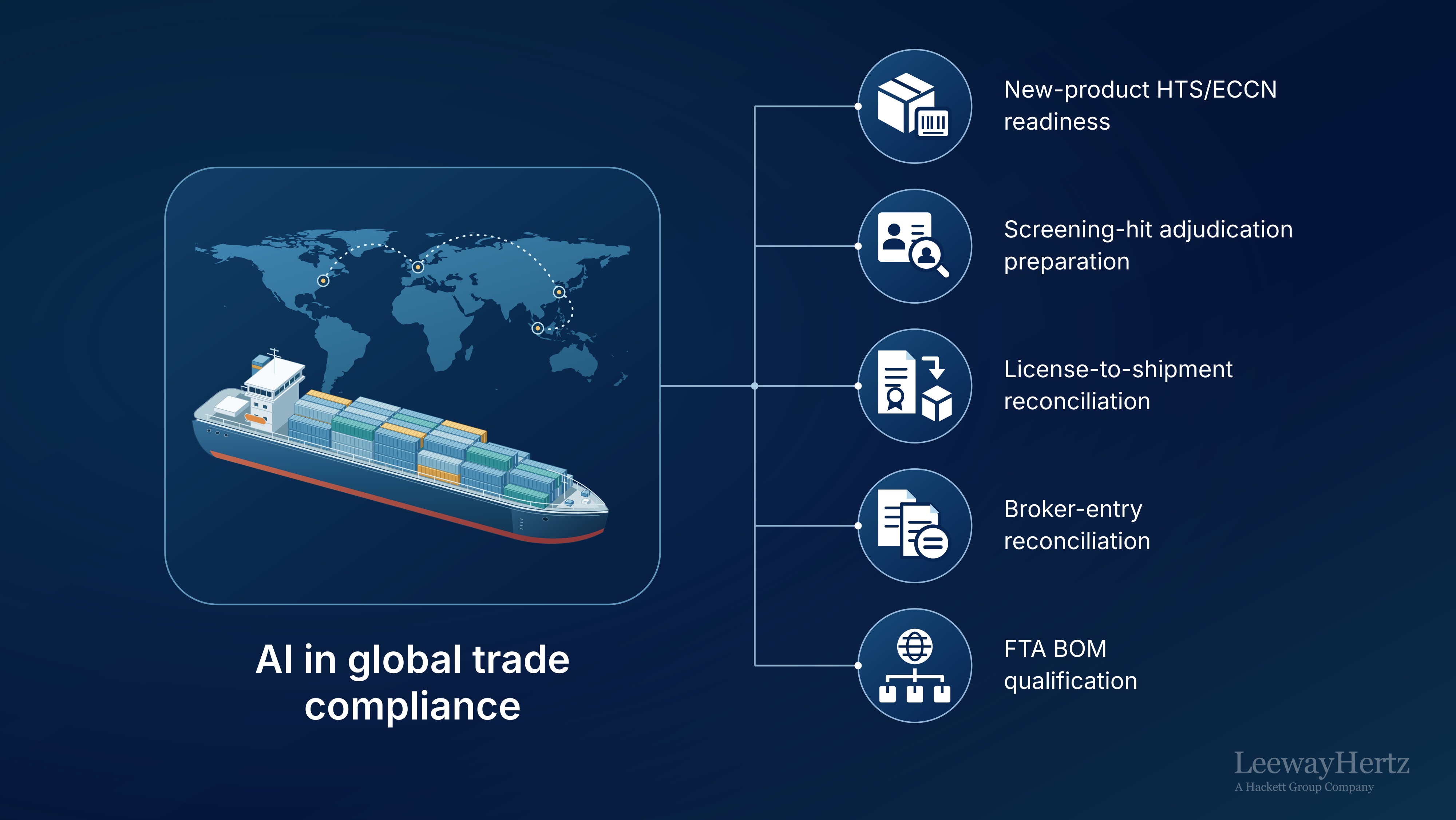
Global trade compliance, or GTC, is the regulatory control layer surrounding the cross-border movement of goods, software, technology, and technical data. It spans tariff and export-control classification, restricted-party and sanctions screening, export licensing, customs entry, valuation, country-of-origin determination, forced-labor due diligence, government inquiries, and enterprise trade governance.
The function operates across product lifecycle management (PLM), product information management (PIM), ERP, order management, supplier management, global trade management (GTM), transportation and warehouse systems, broker platforms, government filing environments, document repositories, and specialist regulatory databases. Platforms such as SAP GTS, e2open, and Descartes may hold important trade rules and transaction states, but authoritative decisions still depend on the applicable regulation, tariff schedule, sanctions program, license, ruling, origin rule, and transaction facts.
The scale of the underlying trade flows makes control quality consequential. The US Bureau of Economic Analysis reported $3.4384 trillion in US goods imports and $2.1975 trillion in goods exports in 2025 [1]. At the same time, the rules applied to those transactions continue to change. The US International Trade Commission had published 17 revisions of the 2026 Harmonized Tariff Schedule by August 24, 2026, reflecting changes ranging from statistical annotations to tariff measures and trade actions [2].
This volatility affects operational trade systems directly. Census has issued multiple 2026 updates to Schedule B and HTS classifications used in the Automated Export System (AES) [3], while USITC tariff revisions can change Chapter 99 treatment, additional duties, exclusions, or statistical reporting requirements. Restricted-party environments are similarly dynamic. The US Consolidated Screening List is refreshed automatically every day, and OFAC maintains current SDN and non-SDN sanctions data through its Sanctions List Service.
These conditions make global trade compliance well suited to governed AI. AI can help gather product attributes, interpret documents, compare transactions against changing rules, resolve entity identities, examine bills of materials, retrieve relevant rulings, assemble license evidence, classify exceptions, identify missing records, and prepare review packages for trade professionals.
The relevant solution, however, is not a generic trade chatbot. A Classification analyst needs product specifications mapped to the General Rules of Interpretation, legal notes, prior rulings, and the current tariff schedule, while an export control officer needs ECCN analysis connected to the Commerce Control List, destination, end user, end use, and license requirements. These regulatory domains must remain distinct: HTSUS supports US import classification, Schedule B primarily supports US export statistical classification, and ECCNs identify items on the Commerce Control List for export-control purposes. The same distinction applies across other areas. A sanctions-list match is not automatically a final sanctions determination, and preferential origin under an FTA is not interchangeable with non-preferential country-of-origin analysis.
For this reason, AI opportunities should be mapped to the global trade compliance operating model at the sub-process level. The useful unit is not “AI for customs” or “AI for export compliance.” It is a bounded activity such as HTSUS classification preparation from approved product specifications with Classification analyst confirmation, restricted-party hit adjudication preparation with trade compliance manager review, or USMCA qualification from an approved bill of materials and supplier origin evidence with FTA/origin analyst confirmation.
- How AI is transforming global trade compliance operations
- Why AI use cases in global trade compliance must be mapped at the sub-process level
- Global trade compliance operating model and AI opportunity mapping across trade processes
- High-value AI use cases in global trade compliance
- How agentic AI works in global trade compliance workflows
- How to prioritize AI use cases in global trade compliance
- Governance, risk, and responsible AI in global trade compliance
- How ZBrain operationalizes AI use cases in global trade compliance
- Future of AI in global trade compliance
How AI is transforming global trade compliance operations
AI changes global trade compliance work by examining product records, transaction parties, orders, licenses, customs entries, bills of materials, supplier declarations, invoices, screening results, tariff measures, government correspondence, and regulatory sources before a trade professional begins the review. The strongest opportunities occur where evidence is fragmented across systems or repeatedly compared against changing rules, but the resulting regulatory action still requires accountable professional judgment.
Consider a new industrial controller scheduled for sale into multiple markets. PLM contains the component specifications and technical parameters. ERP contains the commercial SKU and manufacturing site. The classification database contains similar products assigned to several HTSUS codes. Export compliance records contain ECCNs for related models. Supplier documents identify the origin of key components. The customer and intermediate consignee require sanctions screening. The US import model includes possible Section 301 treatment for one sourcing path. An FTA claim may depend on a tariff-shift rule that cannot be evaluated until the imported components are correctly classified.
AI can assemble this context, identify comparable classifications, retrieve current legal and explanatory material, flag conflicting product attributes, map candidate HTSUS and ECCN classifications, identify potentially restricted transaction parties, and prepare an origin analysis. It should not collapse these separate legal questions into one “compliant” or “not compliant” result.
Global trade compliance work can be understood through six recurring work types:
- Document- and evidence-heavy work: Product specifications, technical data sheets, bills of materials, commercial invoices, packing lists, certificates of origin, supplier declarations, licenses, broker packets, customs entries, screening evidence, rulings, drawback records, FTZ documents, UFLPA tracing records, and government requests can be checked for completeness and consistency.
- Knowledge- and rule-heavy work: HTSUS provisions, General Rules of Interpretation, section and chapter notes, CROSS rulings, EAR provisions, Commerce Control List entries, ITAR requirements, sanctions programs, 19 CFR requirements, trade-agreement rules of origin, USTR actions, CBP guidance, and customs procedures must be applied using the correct jurisdiction and effective version.
- Identity- and relationship-heavy work: Customers, suppliers, intermediaries, banks, freight forwarders, ultimate consignees, end users, beneficial owners, and entities appearing under multiple names must be resolved across screening lists and enterprise masters. OFAC’s 50 Percent Rule also makes ownership relevant even when an entity itself does not appear by name on the SDN List.
- Exception-heavy work: Ambiguous classifications, unresolved screening hits, missing end-use information, expired licenses, entry discrepancies, unsupported assists, missing certificates, supplier-origin gaps, tariff-action changes, AES errors, forced-labor tracing gaps, and government inquiries require differentiated routing.
- Data- and calculation-heavy work: Customs value, regional value content, tariff shift tests, duty calculations, drawback quantities, FTZ inventory balances, license quantities and values, duty exposure, tariff scenarios, and compliance KPIs require controlled calculations from defined source data.
- Workflow-heavy work: Product-to-classification, order-to-screening, license-to-shipment, broker-instruction-to-entry, supplier-to-origin-certification, import-to-drawback, detention-to-UFLPA-response, and audit-request-to-evidence-response workflows span several systems and accountable roles.
The practical design principle is to connect a specific AI capability to a defined trade artifact, rule source, expected output, and human decision point.
Why AI use cases in global trade compliance must be mapped at the sub-process level
Global trade compliance is not one workflow. “AI for export compliance” could refer to ECCN classification, denied-party screening, end-use review, license determination, deemed-export analysis, AES validation, license decrementation, or recordkeeping. These activities depend on different regulations, artifacts, transaction facts, systems, and decision owners.
A practical implementation model decomposes trade compliance into four levels:
- Function: A major area of trade accountability, such as product classification, sanctions screening, export licensing, customs entry, or origin management. A function contains multiple workflows and is too broad to implement as one AI solution.
- Process: A recurring workflow area within a function, such as HTS classification, screening-hit adjudication, customs valuation, FTA qualification, or prior-disclosure preparation.
- Sub-process: A specific activity with a defined trigger, artifact, jurisdiction, rule set, transaction state, output, exception category, reviewer, and evidence requirement.
- AI-enabled opportunity: A particular AI or analytical capability applied to that sub-process to improve preparation, comparison, exception handling, decision support, or evidence assembly while preserving the authorized regulatory decision.
Sub-process mapping exposes dependencies hidden by broad labels. An HTSUS classification may require physical composition, principal function, dimensions, operating method, manufacturing details, component relationships, competing headings, legal notes, current rulings, and transaction date. An ECCN determination may require technical performance parameters, encryption functionality, “specially designed” analysis, CCL Order of Review logic, and confirmation of whether the item is subject to the EAR.
This level of definition lets trade leaders identify what should be automated, what must be deterministic, what requires professional judgment, which government or enterprise system remains authoritative, and exactly where an AI-supported workflow must stop for review.
Operationalize governed workflows across global trade compliance operations
Connect product, party, customs, export-control, origin, forced-labor, and audit workflows with governed AI that prepares evidence, exceptions, and recommendations while preserving authorized trade and legal decision rights.
Global trade compliance operating model and AI opportunity mapping across trade processes
The global trade compliance operating model covers ten connected functions. The core role map includes the global trade director, trade compliance manager, Classification analyst, Export control officer, empowered official for ITAR-controlled activities, import manager, licensed customs broker, customs compliance analyst, FTA/origin analyst, drawback specialist, FTZ administrator, logistics manager, screening analyst, supplier-compliance personnel, legal counsel, and GTM platform owner. Engineering, product management, procurement, finance, tax, information security, HR, logistics, and supply-chain teams participate where the relevant trade decision requires their data or expertise.
The principal artifact inventory includes HTSUS and Schedule B classification records, ECCN determinations, CCATS records where applicable, binding ruling requests and rulings, restricted-party screening hit reports, ownership and end-use evidence, BIS license records, DSP-5 applications and authorizations, license provisos, CBP Form 7501 entry summaries, ISF records, commercial invoices, packing lists, USMCA and other origin certifications, supplier declarations, AES/EEI filing records and Internal Transaction Numbers (ITNs), drawback claims, Foreign-Trade Zone admission records, UFLPA tracing and detention-response packages, customs audit evidence, prior-disclosure and voluntary-self-disclosure records, broker scorecards, compliance manuals, SOPs, and trade KPI packs.
The regulatory and standards stack can include the US Harmonized Tariff Schedule, WCO Harmonized System, Export Administration Regulations (EAR), International Traffic in Arms Regulations (ITAR), OFAC sanctions programs, Foreign Trade Regulations, 19 CFR customs requirements, UFLPA, Section 232 and Section 301 trade actions, free trade agreements such as USMCA, Customs Trade Partnership Against Terrorism (CTPAT), and jurisdiction-specific recordkeeping requirements.
Function 1: Product classification
Converting technical product facts into controlled import, export statistical, and export control classifications with defensible rationale and maintained classification history.
Product classification supports downstream duty, admissibility, trade-remedy, export-license, FTA, AES, and reporting decisions. It includes HTSUS classification for US imports, Schedule B for US exports, and ECCN or EAR99 determination under the EAR. These classifications serve different regulatory purposes and should not be treated as interchangeable.
Teams involved: Classification analysts, trade compliance manager, export control officer, product engineering, product management, customs specialists, legal counsel for complex interpretations, licensed customs broker as an operational counterpart, and GTM master-data administrators.
What AI helps with: Document intelligence can structure specifications, material composition, function, dimensions, technical performance, software features, and bills of materials. Retrieval-augmented generation (RAG) can surface current HTS provisions, legal notes, CROSS rulings, Schedule B codes, commerce control list entries, and prior internal decisions. Similarity analysis can identify comparable products. Change detection can identify classifications affected by tariff-schedule revisions or engineering changes. AI can prepare a rationale and confidence assessment while keeping separate the HTSUS, Schedule B, and ECCN methodologies.
What humans continue to own: Classification analysts approve customs and Schedule B classifications under organizational policy. Export control officers approve ECCN or EAR99 determinations. Engineering teams confirm technical facts. Trade leadership determines when uncertainty warrants formal advice or a ruling. AI should not publish a new regulatory classification to production solely because it resembles a previously classified item.
| Process | Sub-process | Key AI-enabled opportunities |
|---|---|---|
| Product data readiness | Classification attribute preparation | Document intelligence extracts composition, function, dimensions, operating principle, technical performance, software, encryption, and manufacturing attributes from PLM, drawings, specifications, and supplier records. |
| HTSUS classification | Heading and subheading analysis | Retrieval-grounded analysis maps confirmed facts against the general rules of interpretation, section and chapter notes, heading text, relevant rulings, and internal precedent to prepare candidate classifications. |
| Ruling and precedent comparison | Similarity analysis identifies relevant CROSS rulings based on comparable product characteristics and highlights material factual differences that may affect classification. | |
| Export statistical classification | Schedule B assignment | Rules-grounded classification analysis compares the confirmed export commodity description with the current Schedule B, while change detection flags obsolete or revised codes before AES filing. |
| Export-control classification | ECCN and EAR99 determination preparation | Rules-grounded analysis follows the CCL Order of Review, tests technical parameters against candidate ECCNs, and documents why an item appears classified under an ECCN or EAR99 for export control officer review. |
| Formal classification support | CBP ruling or BIS classification request preparation | Document intelligence and evidence assembly organizes product facts, questions presented, competing provisions, technical exhibits, prior analysis, and supporting records into a review-ready package for an eRuling or SNAP-R classification request. |
| Classification maintenance | Schedule and product-change impact analysis | Change detection compares current classifications with new HTS, Schedule B, CCL, ruling, or product-revision information and creates a reclassification review queue. |
Key artifacts
- Product specification
- Engineering drawing
- Bill of materials
- Material declaration
- HTSUS classification record
- Schedule B classification record
- ECCN/EAR99 determination
- Classification rationale
- Internal classification precedent
- CROSS ruling
- CBP binding ruling request and ruling
- BIS commodity-classification request and resulting CCATS record where applicable
- Classification change log
Systems involved
- PLM/PIM
- ERP material master
- GTM platform
- Classification database
- Document repository
- CBP CROSS and eRulings
- BIS SNAP-R
- Engineering systems
Regulatory and control considerations: Classification must use the tariff or control list effective for the transaction and remain tied to supporting product facts. Frequent HTS, Schedule B, and control-list updates require version-aware classification. Formal CBP ruling and BIS classification requests must also follow the applicable submission requirements and retain the resulting regulatory decision.
Accountable roles and decision rights
- Classification analysts confirm HTSUS and Schedule B determinations.
- Export control officer confirms ECCN or EAR99 classification.
- Engineering teams confirm the technical characteristics used in the analysis.
- Trade compliance manager approves classification governance and escalation.
- Legal counsel advises on disputed or high-risk interpretations.
- Authorized company personnel submit formal ruling or classification requests.
Highest-value opportunities
- New-product classification readiness: High leverage because classification gaps can block sourcing, import, export, FTA, and launch activities downstream.
- Classification-change impact analysis: High value because tariff schedules and control lists change independently of product-master update cycles.
- Precedent and ruling retrieval: High leverage because classification quality depends on applying relevant precedent to materially comparable facts.
- Classification-master quality review: Valuable because duplicate SKUs, inconsistent descriptions, inherited codes, and stale classifications can propagate into large transaction populations.
Example agentic workflow: New-product classification readiness
- Trigger and starting artifact: A PLM release creates 240 new SKUs ahead of an international product launch.
- Systems and records aggregated: The workflow retrieves product specifications, bills of materials, material declarations, technical drawings, prior classifications of related products, and approved classification history.
- Rules and precedents retrieved: It retrieves the current HTSUS and Schedule B, relevant section and chapter notes, CROSS rulings, CCL entries, and ECCN decision logic, and current tariff-action data for the planned sourcing and destination markets.
- Analysis and work packet prepared: It prepares separate proposed HTSUS, Schedule B, and ECCN determinations with rationale and source references. Confidence tiers identify 18 SKUs whose chemistry or technical performance requires engineering clarification. Duty and origin dependencies are identified, and two product families are flagged as possible candidates for formal CBP ruling requests.
- Human checkpoint: The Classification analyst confirms or corrects customs classifications, the export control officer resolves ECCN edge cases, the engineering teams confirm ambiguous technical attributes, and the trade compliance manager approves the batch for controlled release.
- Approved handoff and retained evidence: Approved classifications are published to the ERP and GTM master. Screening, license-determination, origin, and customs workflows use only the approved records. Source versions, product facts, rationale, reviewer decisions, and subsequent changes remain linked to the classification record.
Function 2: Restricted-party and sanctions screening
Converting party identities, ownership, transaction roles, destinations, and end-use information into documented screening dispositions and controlled transaction-release decisions.
Screening goes beyond name matching. Parties may appear under aliases, transliterations, different addresses, vessel identifiers, or ownership structures, and a potential match may require further sanctions, licensing, ownership, or end-use review. The US Consolidated Screening List supports initial screening, but possible matches should be checked against official sources. OFAC rules also require ownership analysis because entities may be blocked through the 50 Percent Rule even when they are not separately listed on the SDN List.
Teams involved: Screening analysts, trade compliance manager, export control officer, sanctions/compliance personnel, customer and supplier master-data teams, sales operations, procurement, logistics, finance, legal counsel, and global trade director.
What AI helps with: Entity resolution can normalize names, aliases, scripts, addresses, countries, registration identifiers, vessel names, and related entities. Fuzzy matching can improve candidate retrieval, while graph analysis can connect ownership and control relationships. Classification can separate likely false positives, possible matches, ownership concerns, and end-use/end-user escalations. AI can prepare a source-linked adjudication packet, but should not silently suppress matches.
What humans continue to own: Authorized trade or sanctions reviewers determine whether a hit is a true match, whether ownership or control creates additional restrictions, whether a transaction may proceed, and whether a license or legal review is required. Sales or procurement personnel provide commercial facts but should not clear their own screening exceptions.
| Process | Sub-process | Key AI-enabled opportunities |
|---|---|---|
| Party-master readiness | Identity normalization | Entity resolution normalizes legal names, trade names, aliases, addresses, countries, company identifiers, vessel data, and transliterations before screening. |
| List screening | Restricted-party candidate matching | Fuzzy matching evaluates parties against OFAC SDN/non-SDN data, BIS and other US lists, and local lists while preserving the source-list result and match score. |
| Hit adjudication | Match evidence preparation | Entity resolution and evidence aggregation assemble name variants, addresses, identifiers, ownership data, source-list details, program information, transaction roles, and conflicting facts into a reviewer packet. |
| Ownership analysis | Blocked or restricted ownership mapping | Graph analysis traces direct and indirect ownership relationships and flags structures requiring sanctions-rule review rather than relying only on named entities. |
| End-user and end-use review | Red-flag classification | Risk classification and contextual analysis combine customer profile, consignee, destination, product, stated use, transaction patterns, and known red flags to identify cases requiring export-control due diligence. |
| Continuous party screening | List-change and rescreening management | Change detection identifies new, amended, or removed list records and creates controlled rescreening queues for open orders, active customers, suppliers, and other configured relationships. |
| Transaction release | Screening disposition readiness | Rules-based validation checks that all required party roles have current screening dispositions, while workflow routing directs unresolved hits, ownership concerns, or end-use issues to the appropriate reviewer before shipment release. |
Key artifacts
- Customer and supplier master records
- Restricted-party screening report
- Match score and hit rationale
- Official-list record
- Ownership evidence
- Beneficial-ownership structure
- End-user statement
- End-use statement
- Red-flag review record
- Transaction hold/release record
- Legal or compliance disposition
- Rescreening history
Systems involved
- GTM screening platform
- ERP
- CRM
- Supplier-management platform
- Order management
- OFAC Sanctions List Service
- US Consolidated Screening List
- BIS official lists
- EU sanctions data
- Corporate registry or approved ownership-data sources
- Case-management system
Regulatory and control considerations: Screening engines are aids to compliance, not substitutes for the controlling regulation. The consolidated screening list is refreshed daily and expressly advises users to investigate possible matches and verify restrictions against official sources. OFAC maintains current SDN and non-SDN data.
Accountable roles and decision rights
- Screening analyst adjudicates routine candidate matches under approved procedures.
- Trade compliance manager approves material screening dispositions and escalation.
- Export control officer evaluates export-control list and end-use/end-user restrictions.
- Legal counsel confirms complex sanctions or ownership interpretations.
- Sales, procurement, or logistics teams provide transaction facts but do not override compliance holds.
- Global trade director owns enterprise escalation policy.
Highest-value opportunities
- Hit adjudication packet preparation: High leverage because false positives consume significant reviewer time while true matches require complete evidence.
- Ownership-network analysis: High value because list-only screening can miss entities restricted through ownership rules.
- List-update rescreening: High leverage because a party’s status can change after onboarding but before shipment or payment.
- End-use/end-user red-flag aggregation: Valuable because risk indicators often sit across sales, shipping, product, and compliance records.
Example agentic workflow: Counterparty screening and ownership escalation
- Trigger and starting artifact: A distributor is added to an export order with an ultimate consignee and freight forwarder.
- Systems and records aggregated: The workflow retrieves the distributor, ultimate consignee, freight forwarder, existing customer due diligence records, transaction-party data, and relevant ownership information, then screens each party using current authorized lists.
- Screening result and related evidence identified: A fuzzy match is returned for the distributor’s parent-company name, while the distributor itself does not appear directly on the list.
- Analysis and work packet prepared: Entity resolution and ownership analysis assemble corporate-registry information, sanctioned-party references, ownership percentages, addresses, transaction roles, and other relevant evidence into a review packet.
- Human checkpoint: The screening analyst resolves identity questions. Any potential blocked-ownership or program-specific restriction is escalated to the trade compliance manager and legal counsel.
- Approved handoff and retained evidence: The order remains on hold until an authorized disposition is recorded. The list versions, match evidence, ownership analysis, reviewer decision, and release or continued hold are retained.
Function 3: Export licensing and authorization
Converting item classification, destination, parties, end use, and transaction facts into a controlled license determination, authorization package, shipment release, and retained export-control record.
Export licensing depends on jurisdiction, classification, destination, end user, end use, and applicable restrictions. EAR99 items may still require a license depending on the transaction. ITAR-controlled activities follow a separate authorization framework through DDTC, with empowered officials retaining defined responsibilities in the licensing process.
Teams involved: Export control officer, empowered official, Trade compliance manager, sales operations, engineering, program management, technology-control personnel, logistics, security, HR for deemed-export workflows, legal counsel, and global trade director.
What AI helps with: Rules-grounded analysis can combine ECCN, country, reasons for control, party restrictions, end use, and available authorization information. Document intelligence can assemble technical and transaction evidence. Document generation and evidence assemblycan prepare SNAP-R license application data, DSP-5 support, end-user statements, technology-control evidence, amendment packets, license-usage records, and exception queues. Deterministic controls should govern expiry, quantity, value, party, destination, and proviso restrictions.
What humans continue to own: Export control officers determine license requirements and approve routine export-control dispositions. Empowered officials perform the certifications and authorizations assigned to them under ITAR. Legal counsel handles complex jurisdictional or enforcement issues. AI does not sign an application, certify compliance, determine that a license exception applies without the required review, or release a shipment contrary to license conditions.
| Process | Sub-process | Key AI-enabled opportunities |
|---|---|---|
| Jurisdiction and control readiness | Subject-to-EAR and control-regime assessment | Document intelligence and evidence aggregation assembles product origin, content, technology, software, and prior jurisdiction records for export control officer review. |
| License determination | ECCN country control analysis | Deterministic rule evaluation maps confirmed ECCN reasons for control against the applicable destination, while rules-grounded analysis surfaces relevant license exceptions, qualifying conditions, and unresolved requirements for export control officer review. |
| End-user and end-use control review | Contextual risk analysis combines screening results, stated use, consignee roles, product capability, red flags, and restricted-end-use rules into an escalation packet. | |
| Application preparation | BIS license application package preparation | Document intelligence assembles SNAP-R application data, item descriptions, end users, ultimate consignee, values, quantities, technical exhibits, and supporting statements. |
| ITAR DSP-5 support | Document intelligence structures transaction and defense-article data and assembles supporting documents, while rules-based validation checks required fields, data consistency, and application completeness for Empowered Official review in DECCS. | |
| Authorization management | License condition and proviso control | Rules-based data structuring organizes approved parties, articles, ECCNs/USML categories, quantities, values, destinations, validity periods, provisos, and reporting requirements into a controlled authorization record. |
| Shipment control | License decrementation and release readiness | Rules-based validation compares shipment quantities, values, parties, destination, and dates with remaining authorization before export release. |
| Controlled technology access management | Deemed-export readiness | Multi-source aggregation maps foreign-person access, nationality or permanent-residency information available within the appropriate privacy boundary, controlled technology, project access, and authorization status to a review queue. |
Key artifacts
- ECCN determination
- EAR99 rationale
- End-use statement
- End-user statement
- License-determination record
- SNAP-R work item
- BIS application data and supporting documents
- BIS license
- DSP-5 application and authorization
- License provisos and conditions
- License-decrementation ledger
- Technology control plan
- Foreign-person access review
- Shipment release record
Systems involved
- GTM platform
- ERP/order management system
- PLM
- CRM
- BIS SNAP-R/STELA
- DDTC DECCS
- HR/identity system for controlled technology access
- Engineering/document management systems
- Shipping system
- License management repository
Regulatory and control considerations: BIS currently requires most export and reexport license applications and classification requests to be filed through SNAP-R, with paper BIS-748P submissions permitted only under specified circumstances. The EAR defines a deemed export to include release of controlled technology or source code to a foreign person in the United States. EAR-controlled records generally must be retained for five years from the applicable transaction event defined in Part 762.
Accountable roles and decision rights
- Export control officer confirms license requirements and EAR dispositions.
- Empowered official performs required ITAR certifications and authorization decisions.
- Engineering teams confirm technical parameters.
- Security or technology-control owners govern access to controlled technology.
- HR provides permitted foreign-person information for deemed-export analysis.
- Legal counsel handles complex jurisdiction, enforcement, and disclosure issues.
- Trade compliance manager owns license-management controls.
Highest-value opportunities
- License-determination packet preparation: High leverage because the decision depends on item, destination, party, and end-use context simultaneously.
- License-condition monitoring: High value because an approved license does not authorize activity outside its parties, quantities, values, validity, or provisos.
- Shipment-to-license validation: High leverage because operational shipment data can diverge from the authorization after order changes.
- Deemed-export access review: Valuable in engineering-intensive organizations where controlled technical data and workforce access change continuously.
Example agentic workflow: Export license readiness for controlled equipment
- Trigger and starting artifact: An international order is released for equipment with an approved ECCN.
- Systems and records aggregated: The workflow retrieves the ECCN record, destination, customer, intermediate consignee, ultimate consignee, end-use statement, screening dispositions, technical configuration, and existing licenses.
- Rules and risk analysis performed: Deterministic controls evaluate applicable country-based license requirements and current authorization scope, while rules-grounded retrieval and contextual risk analysis surface relevant end-use and end-user controls and flag unresolved red flags.
- Application and authorization readiness prepared: If a license is required, the workflow prepares a SNAP-R application packet with transaction and technical evidence. Existing licenses are checked for party, value, quantity, validity, and proviso coverage.
- Human checkpoint: The export control officer confirms the EAR determination and application data. ITAR-controlled cases are routed instead to the empowered official and the appropriate DECCS workflow.
- Approved handoff and retained evidence: Only an authorized transaction proceeds. License number, conditions, shipment usage, decrementation, reviewer decision, and export records are retained.
Function 4: Import and customs entry management
Converting purchase, shipment, product, value, origin, and trade-program data into accurate customs instructions, entry filings, duty calculations, post-entry corrections, and defensible importer records.
Import compliance connects commercial transactions with customs declarations, including classification, value, origin, trade remedies, preference programs, and supporting entry data. While brokers may transmit entries, importers remain responsible for the underlying data and instructions. AI can help detect entry-line inconsistencies, missing valuation inputs, stale classifications, unsupported origin claims, and broker discrepancies before or after filing.
Teams involved: Import manager, customs compliance analyst, Classification analyst, licensed customs broker, procurement, logistics, accounts payable, finance, FTA/origin analyst, legal counsel, and trade compliance manager.
What AI helps with: Multi-source reconciliation can compare purchase orders, invoices, shipment records, product masters, customs instructions, and broker entry data. Multi-source reconciliationcan identify differences in HTSUS, origin, entered value, quantity, Chapter 99 treatment, manufacturer, and trade-program indicators. It can assemble assists, royalties, proceeds, and related-party information for valuation review and prepare PSC, protest, or reconciliation evidence.
What humans continue to own: Import personnel determine customs instructions and approve corrections. Classification analysts and FTA/origin analysts own their respective determinations. Finance and Legal counsel support valuation issues where required. Licensed customs brokers prepare and transmit filings within their authority. AI does not determine customs value, satisfy the importer’s reasonable-care obligation, transmit a corrective filing, or decide a protest position without authorized review.
| Process | Sub-process | Key AI-enabled opportunities |
|---|---|---|
| Pre-entry readiness | Import transaction packet assembly | Multi-source aggregation assembles PO, commercial invoice, packing list, product classification, origin, manufacturer, shipment, Incoterms, and trade-program records before broker instruction. |
| Security filing | ISF 10+2 readiness | Validation checks required importer and shipment data, identifies missing or conflicting elements, and monitors the filing deadline for ocean cargo. |
| Customs entry preparation | Broker-instruction validation | Multi-source comparison checks HTSUS, Chapter 99 treatment, value, quantity, origin, manufacturer, preference claim, and PGA data against approved enterprise records. |
| Customs valuation | Transaction-value adjustment review | Document intelligence and rules-based classification identify potential assists, royalties or license fees, selling commissions, proceeds, packing, related-party factors, and other configured valuation elements requiring specialist review. |
| Entry-summary review | CBP Form 7501 line validation | Rules-based validation and record matching compare broker-returned entry data with approved classification, origin, entered value, duty, and program instructions before finalization or post-entry review. |
| Post-entry correction | PSC readiness | Change detection and rules-based validation identify accepted-entry data requiring correction before liquidation and assembles affected lines, reason codes, source evidence, and recalculated amounts for authorized filing. |
| Liquidation review | Protest readiness | Rules-grounded comparison and evidence retrieval compare liquidation and CBP decisions with the importer position and prepares issue-specific evidence for counsel or trade specialists to evaluate. |
| Customs reconciliation management | Reconciliation issue tracking | Rules-based tracking and data aggregation track eligible flagged issues such as value or FTA matters across underlying entries and prepares consolidated reconciliation support under the configured program. |
Key artifacts
- Purchase order
- Commercial invoice
- Packing list
- Broker instruction
- ISF filing
- Cargo-release data
- CBP Form 7501
- HTSUS and Chapter 99 classifications
- Customs-valuation worksheet
- Assist and royalty records
- Country-of-origin determination
- Entry packet
- PSC record
- Liquidation notice
- Protest packet
- Reconciliation record
Systems involved
- ERP
- GTM platform
- Broker platform
- ACE/ABI
- Procurement system
- Transportation system
- Warehouse system
- Classification and origin databases
- Document image system interfaces
- Analytics platform
Regulatory and control considerations: CBP’s current valuation guidance notes that declared value may require relevant selling commissions, assists, royalties, production costs, packing, and proceeds in addition to the price paid. The specific additions depend on the applicable valuation rules.
ISF, commonly known as 10+2, generally requires the relevant data before vessel loading for US-bound ocean cargo.ACE supports entry, entry summary, ISF, PSC, protests, reconciliations, drawback, and other distinct customs transactions. CBP entry records generally must be retained for five years.
Accountable roles and decision rights
- Import manager owns importer-side entry governance.
- Customs compliance analyst validates entry data and post-entry exceptions.
- Classification analyst confirms HTSUS treatment.
- FTA/origin analyst confirms origin and preference status.
- Licensed customs broker prepares and transmits authorized customs filings.
- Finance and customs specialists confirm valuation inputs.
- Legal counsel determines protest or material legal positions.
- Trade compliance manager approves material correction and escalation policy.
Highest-value opportunities
- Broker-entry reconciliation: High leverage because discrepancies can be detected before they propagate across repeated imports.
- Valuation-element detection: High value because assists, royalties, proceeds, and related-party facts often reside outside the broker packet.
- PSC readiness: Valuable because corrections require transaction-specific evidence and timing awareness.
- Chapter 99 and trade-remedy validation: High leverage in periods of frequent tariff changes.
Example agentic workflow: Customs entry validation before summary filing
- Trigger and starting artifact: A multi-line import arrives with products sourced from three manufacturing locations.
- Systems and records aggregated: The workflow retrieves the purchase order, invoice, packing list, approved HTSUS classifications, origin records, broker instruction, assist records, royalty agreements identified as relevant to valuation review, and current tariff treatment.
- Entry-line validation performed: Rules-based validation compares the broker’s entry-line data with approved master data and current HTS/Chapter 99 requirements.
- Exceptions identified and routed: Rules-based validation flags two classification mismatches, one manufacturer-origin conflict, and a valuation line requiring import manager review because an assist record is linked to the product.
- Human checkpoint: The classification analyst resolves the code mismatch, the FTA/origin analyst confirms origin, and the import manager approves the valuation instruction before the broker completes the authorized filing.
- Approved handoff and retained evidence: The final 7501 data, source documents, exception history, reviewer decisions, broker transmission, and subsequent liquidation state remain linked for post-entry review.
Function 5: Free trade agreement and origin management
Converting sourcing, production, component classification, supplier evidence, and agreement-specific rules into supportable preferential and non-preferential origin determinations.
Origin management requires more than assigning a manufacturing country. Preferential origin determines whether merchandise qualifies for a specific trade agreement and may involve tariff shifts, regional value content, specific production requirements, de minimis provisions, accumulation rules, or other agreement-specific tests. Non-preferential origin may determine marking, trade-remedy treatment, government procurement, or other requirements using a different legal framework.
For USMCA, CBP states that the certification of origin does not require a prescribed form, but it must contain the nine minimum data elements specified in Annex 5-A.
Teams involved: FTA/origin analysts, trade compliance manager, classification analysts, procurement, supplier management, manufacturing engineering, cost accounting, logistics, import/export teams, and legal counsel for complex origin positions.
What AI helps with: Graph analysis can connect finished products to component classifications, supplier origin declarations, production sites, and manufacturing steps. Rules-grounded analysis can apply tariff-shift and regional-value-content logic through controlled services. Document intelligence can review supplier certificates and identify missing or inconsistent fields. Change detection and impact analysis can also monitor changes to BOMs, sourcing, tariff classifications, or supplier evidence that invalidate an existing qualification.
What humans continue to own: FTA/origin analysts approve qualification and country-of-origin determinations. Classification analysts validate component classifications where required. Suppliers remain responsible for information they certify. Authorized importers or exporters determine whether to make a preferential claim or issue a certification. AI should not certify origin solely from an incomplete BOM or supplier assertion.
| Process | Sub-process | Key AI-enabled opportunities |
|---|---|---|
| Origin data management | Supplier-origin evidence collection | Document intelligence structures supplier declarations, producer information, component origin, validity periods, and covered part numbers. |
| Preferential origin qualification | Product-specific rule retrieval | Rules-grounded retrieval retrieves the applicable rule of origin based on agreement, finished-good classification, and transaction date. |
| Tariff-shift analysis | BOM graph analysis compares non-originating component classifications with the required product-specific tariff transformation. | |
| Regional value content analysis | Deterministic calculation applies the approved RVC method using controlled cost or transaction data to determine whether the product meets the applicable regional value content threshold. | |
| Origin certification management | Certification-of-origin preparation | Document intelligence and contextual retrieval assemble required data elements, product coverage, producer/exporter/importer context, and supporting qualification evidence for authorized certification. |
| Non-preferential origin determination | Manufacturing and substantial-transformation analysis | Evidence aggregation and rules-grounded retrieval organize processing steps, component origins, manufacturing locations, and relevant rulings into an analysis packet without treating the FTA rule as the non-preferential rule. |
| Origin qualification maintenance | Change-triggered requalification | Change detection identifies BOM, supplier, classification, cost, manufacturing-site, or regulatory changes that may invalidate a current origin result. |
Key artifacts
- Bill of materials
- Component HTS classifications
- Supplier declarations
- Producer certifications
- Costed BOM
- Manufacturing-process description
- FTA rule-of-origin record
- Tariff-shift worksheet
- RVC calculation
- USMCA certification
- Other FTA certificates or certifications
- Non-preferential origin analysis
- Origin ruling
- Qualification history
Systems involved
- ERP
- PLM
- Supplier management platform
- GTM origin module
- Procurement platform
- Costing system
- Classification database
- Document repository
- Customs systems
- Supplier portal
Regulatory and control considerations: Preferential rules must be applied using the relevant agreement and product-specific rule, not a generic substantial-transformation test. Non-preferential origin must likewise use the legal rule applicable to the purpose at issue. Current CBP rulings demonstrate that classification, marking origin, trade remedies, and USMCA eligibility may be considered as related but distinct questions.
Accountable roles and decision rights
- FTA/origin analyst approves preferential qualification and origin conclusions.
- Classification analyst confirms classifications used in tariff-shift testing.
- Supplier or producer provides and certifies supplier-origin evidence where applicable.
- Finance/cost accounting confirms controlled RVC inputs.
- Import manager approves preferential import claims under company policy.
- Trade compliance manager owns the qualification framework.
- Legal counsel advises on complex substantial-transformation or verification matters.
Highest-value opportunities
- BOM-based tariff-shift analysis: High leverage because large product populations require repeated component-level comparison.
- Supplier-certification reconciliation: High value because missing, expired, or inconsistent supplier evidence can invalidate otherwise favorable calculations.
- Change-triggered requalification: High leverage because sourcing and engineering changes can quietly invalidate previously approved origin.
- Preferential/non-preferential origin separation: Important because applying the wrong origin methodology can affect duty, marking, and trade-remedy outcomes.
Example agentic workflow: USMCA qualification after a sourcing change
- Trigger and starting artifact: A supplier change modifies three components in an assembly currently claimed as USMCA-originating.
- Systems and records aggregated: The workflow retrieves the current finished-good classification, approved BOM, new supplier components, component classifications, supplier certifications, cost data, and existing qualification record.
- Rules and qualification method retrieved: Rules-grounded retrieval identifies the current product-specific rule of origin and the approved qualification method.
- Qualification analysis performed: Graph analysis identifies the changed non-originating components, while rules-based validation and deterministic calculation rerun the applicable tariff-shift and RVC tests. The workflow then prepares a before-and-after qualification packet.
- Human checkpoint: The FTA/origin analyst validates classifications and supplier evidence and approves, rejects, or requests clarification.
- Approved handoff and retained evidence: The approved qualification state updates the GTM system and certification workflow. The superseded BOM, supplier evidence, calculations, reviewer decision, and effective date are retained.
Accelerate AI Solutions Development
Build fully functional solutions from your high-value use cases, based on specific operational needs and enterprise context.
Function 6: Duty optimization and special customs programs
Converting compliant sourcing and customs data into supportable opportunities for drawback, foreign-trade zones, first-sale valuation, tariff engineering, exclusions, and other lawful duty-management strategies.
Duty optimization sits inside the trade-compliance function because savings must remain tied to legally supportable customs treatment and complete evidence. The objective is not to minimize duty by changing declarations after the fact. It is to identify lawful programs or transaction structures, determine eligibility, quantify the effect, maintain the required records, and ensure the operational process can support the position.
Teams involved: Trade compliance manager, import manager, drawback specialist, FTZ administrator, classification analyst, FTA/origin analyst, customs specialists, finance, sourcing, product engineering, licensed customs broker, and legal counsel.
What AI helps with: Transaction matching can identify imports potentially linked to exports or destruction for drawback. Scenario analysis can compare FTZ, FTA, drawback, or sourcing options. Document intelligence can assemble first-sale evidence. Change monitoring can identify tariff exclusions or changes affecting known product classifications. Scenario analysis with rules-based calculation can quantify candidate savings using controlled duty-rate services, but cannot determine that a transaction is legally eligible solely from financial benefit.
What humans continue to own: Trade specialists approve program eligibility and claims. Customs valuation specialists and counsel determine first-sale positions. Product and sourcing leaders decide lawful design or sourcing changes. Authorized filers submit drawback, FTZ, or other customs transactions.
| Process | Sub-process | Key AI-enabled opportunities |
|---|---|---|
| Drawback claim management | Candidate transaction identification | Record linkage and rules-based matching identify candidate relationships between eligible import records and subsequent exports or destruction records using inventory movements, product relationships, and prior claims. |
| Claim evidence preparation | Document intelligence and evidence aggregation assemble import entry, export proof, bills of materials, inventory records, substitution logic where applicable, and claim calculations for drawback specialist review. | |
| FTZ admission and inventory management | Admission and status readiness | Validation checks FTZ admission data, merchandise identity, quantity, value, HTSUS, zone status, and source records before authorized admission. |
| Inventory and withdrawal reconciliation | Rules-based reconciliation and anomaly detection compare admissions, transformations, inventory movements, exports, and consumption entries to identify unexplained differences. | |
| First-sale valuation | Evidence-readiness assessment | Document intelligence assembles purchase orders, invoices, payment records, contracts, parties, shipment flow, and sale-for-export evidence for specialist analysis. |
| Tariff engineering | Pre-import product scenario assessment | Classification and scenario analysis compare bona fide prospective product configurations and their tariff consequences before importation, with engineering and legal review. |
| Tariff actions and exclusions | Applicability monitoring | Change detection maps Section 301, Section 232, exclusion, and Chapter 99 updates to approved HTSUS classifications and creates review queues. |
| Program portfolio creation | Duty-strategy comparison | Scenario analysis compares supported FTA, drawback, FTZ, sourcing, and other program outcomes without double-counting benefits or bypassing program restrictions. |
Key artifacts
- Import entry data
- Export shipment records
- Drawback claim
- Inventory records
- FTZ admission record
- CBP Form 214/e214 data
- Zone-status record
- First-sale transaction documents
- Tariff-engineering assessment
- HTSUS/Chapter 99 record
- Section 301/232 applicability record
- Exclusion record
- Duty-savings calculation
- Program audit file
Systems involved
- ERP
- GTM platform
- ACE/ABI
- FTZ inventory-control system
- Drawback platform
- Customs broker systems
- Warehouse management
- Transportation system
- Finance systems
- PLM
- Analytics platform
Regulatory and control considerations: CBP requires drawback claims to be transmitted electronically through ABI using the applicable claim process. Section 301 treatment is explicitly linked to HTS subheadings, and USTR provides product-search tools based on the product’s HTS classification. Current Section 301 actions and exclusions can change over time, so production systems should retain the effective measure and transaction date rather than a static “additional duty” flag.
Accountable roles and decision rights
- Drawback specialist validates and approves drawback claims.
- FTZ administrator owns zone admission and inventory controls.
- Import manager approves customs-program instructions.
- Classification analyst confirms classifications underlying program calculations.
- Finance validates financial data used in calculations.
- Product engineering owns actual product design.
- Legal counsel reviews first-sale, tariff-engineering, or other complex legal positions.
- Trade compliance manager approves program governance.
Highest-value opportunities
- Drawback candidate matching: High leverage where large import and export populations make manual linkage difficult.
- Tariff-action impact monitoring: High value when duty measures change faster than product-master review cycles.
- FTZ inventory exception analysis: Valuable because zone benefits depend on strong inventory and status controls.
- First-sale evidence readiness: High value where the organization already uses or is evaluating a supportable multi-tier transaction structure.
Example agentic workflow: Drawback candidate identification and claim preparation
- Trigger and starting artifact: A monthly trade-data refresh loads eligible import and export populations.
- Systems and records aggregated: The workflow retrieves import entries, export records, SKU relationships, inventory movements, BOM data, prior claims, and applicable program rules.
- Candidate transactions identified: Record linkage and rules-based matching identify candidate import-export relationships using product identity, inventory relationships, quantities, transaction dates, and configured drawback criteria, while excluding transactions already used in another claim.
- Eligibility and claim amounts calculated: Deterministic calculations apply the approved drawback methodology to quantify eligible amounts and prepare an evidence packet containing entry, export, inventory, and product relationships.
- Human checkpoint: The drawback specialist validates eligibility and claim methodology, while finance teams confirm required financial data.
- Approved handoff and retained evidence: Only approved claims move to the authorized ABI filing process. Claimed entries, calculations, proof of export, reviewer decisions, and resulting CBP status are retained.
Function 7: Trade documentation and logistics compliance
Converting approved product, order, shipping, customs, and export-control data into complete cross-border documentation and filing-ready shipment records.
Trade documentation connects compliance requirements with shipment execution. Commercial invoices, packing lists, EEI filings, licenses, origin documents, and shipping records often reuse the same data, so inconsistencies can create filing errors, holds, or audit gaps.
Dangerous-goods compliance remains a separate responsibility. Trade workflows can validate that approved dangerous-goods information is carried consistently into cross-border documents, while qualified personnel retain responsibility for classification, packaging, marking, labeling, and shipment execution.
Teams involved: Logistics manager, export documentation specialists, trade compliance manager, export control officer, customs teams, freight forwarders, dangerous-goods specialists, sales operations, warehouse/shipping teams, and GTM platform administrators.
What AI helps with: Document intelligence can compare invoice and packing-list fields with orders and product masters. Rules-based validation and cross-document comparisoncan validate AES/EEI data, detect mismatches between export licenses and shipping documents, confirm that current Schedule B/HTS data are used, assemble exception packets, and monitor whether required documents are complete before shipment release.
What humans continue to own: Export specialists approve EEI data, export control officers confirm control information, logistics personnel confirm shipment facts, dangerous-goods specialists approve modal compliance, and authorized parties submit filings. AI does not determine legal exporter/USPPI responsibility from Incoterms alone or invent missing shipping facts.
| Process | Sub-process | Key AI-enabled opportunities |
|---|---|---|
| Commercial documentation | Commercial invoice validation | Cross-document comparison and rules-based validation compare the seller, buyer, consignee, description, quantity, value, currency, origin, classification, Incoterms rule, and license references with approved transaction data. |
| Packing-list reconciliation | Entity and quantity matching checks package, weight, SKU, lot, serial, and shipment relationships against invoice and warehouse records. | |
| EEI/AES filing management | Filing-readiness review | Validation checks Schedule B/HTS, ECCN where required, license code, parties, value, quantity, destination, transportation, and other required EEI data. |
| Filing-response exception handling | Classification interprets AES response messages and routes data, classification, license, or technical errors to the correct owner. | |
| License-document consistency checking | Export-document control | Rules-based validation and cross-document comparison verify that invoice and shipping records carry required authorization and destination-control information based on approved export-control data. |
| Dangerous goods documentation alignment | Document-alignment review | Cross-document comparison compares the approved UN number, proper shipping name, hazard class, packing group, quantity, and product identity with trade documents, while leaving modal compliance to qualified DG personnel. |
| Incoterms governance | Commercial-term consistency | Cross-document comparison and consistency checking compare the agreed Incoterms rule and named place with contract, invoice, freight, insurance, and broker instructions and flags conflicts without treating Incoterms as a substitute for customs valuation or regulatory party definitions. |
Key artifacts
- Commercial invoice
- Packing list
- Sales order
- Shipping instruction
- Bill of lading or air waybill
- AES/EEI filing
- ITN
- Export license
- Destination control statement where required
- Certificate of origin
- Dangerous-goods declaration or approved DG data
- Incoterms matrix
- Freight-forwarder instruction
Systems involved
- ERP
- GTM platform
- AES/AESDirect interface
- Warehouse management
- Transportation management
- Freight-forwarder platform
- Order management
- Dangerous goods system
- Document repository
Regulatory and control considerations: When EEI is required, current EAR export-clearance rules specify data elements including the Schedule B or HTS number, description, quantity, value, parties, license authority, and ECCN where applicable. Census continues to update Schedule B/HTS classifications and AES interface requirements throughout 2026. Incoterms rules allocate commercial responsibilities between buyer and seller but do not, by themselves, establish regulatory importer, exporter, origin, valuation, or export-control status.
Accountable roles and decision rights
- Export documentation specialist confirms filing data.
- The export control officer confirms the ECCN, authorization, and control statements.
- Logistics manager confirms shipping facts and forwarder instructions.
- Dangerous-goods specialist approves modal DG compliance.
- Classification analyst resolves commodity-code questions.
- Authorized filer submits EEI.
- Trade compliance manager owns documentation-control policy.
Highest-value opportunities
- Invoice-to-master-data validation: High leverage because one incorrect product field can propagate into customs and export filings.
- AES filing readiness: Valuable because classification, license, and party errors can be identified before transmission.
- License-to-shipment reconciliation: High value because post-order changes can create authorization mismatches.
- Cross-document consistency: High leverage for high-volume exporters working across ERP, warehouse, forwarder, and GTM platforms.
Example agentic workflow: Export documentation readiness
- Trigger and starting artifact: A warehouse marks an international order ready for shipment.
- Systems and records aggregated: The workflow retrieves order, customer, consignee, screening, product classification, license, invoice, packing, and logistics records.
- Documentation readiness validated: Rules-based validation and cross-document comparison check required EEI data, license coverage, current Schedule B/HTS codes, invoice and packing-list consistency, and configured documentation requirements.
- Exceptions identified and routed: A mismatch between the approved license consignee and the current shipping record blocks release, while a packing-list quantity discrepancy is routed to logistics for resolution.
- Human checkpoint: The export control officer resolves the authorization issue, and the logistics manager confirms physical shipment data.
- Approved handoff and retained evidence: After approval, filing and shipment proceed through authorized systems. The ITN, final documents, reviewer decisions, and shipment status are retained.
Function 8: Forced-labor and supply-chain due diligence
Converting supplier, component, production, logistics, and transaction evidence into traceable forced-labor risk assessments and government-response packages.
Forced-labor compliance requires visibility beyond the immediate supplier. CBP may detain, exclude, or seize merchandise within the applicable enforcement framework.
The operational requirement is therefore supply-chain traceability, not merely supplier certification. Evidence may need to connect raw materials, processors, factories, intermediate suppliers, transport records, purchase and payment records, production data, and the imported shipment.
Teams involved: Trade compliance manager, forced-labor or responsible-sourcing specialists, procurement, supplier management, FTA/origin analysts, logistics, customs teams, legal counsel, sustainability personnel, and global trade director.
What AI helps with: Graph analysis can map upstream supplier and production relationships. Entity resolution can compare facilities and suppliers with approved risk sources. Document intelligence can structure purchase records, production documents, transport documents, and payment evidence. Chain-of-custody analysis and evidence-gap detection can identify breaks or missing support in the documented supply chain, while document intelligence and evidence aggregation can assemble detention-response packages.
What humans continue to own: Trade and legal personnel determine the company’s response to a detention and whether an applicability, exception, admissibility, export, or other path should be pursued. Procurement teams own supplier relationships and remediation.
| Process | Sub-process | Key AI-enabled opportunities |
|---|---|---|
| Supply-chain mapping | Multi-tier supplier and facility mapping | Graph analysis connects raw materials, processors, manufacturers, sub-tier suppliers, trading entities, and logistics nodes to the imported SKU. |
| Forced-labor supply-chain due diligence | UFLPA Entity List and forced-labor source matching | Entity resolution compares supplier and facility identities, aliases, addresses, and ownership relationships with approved risk sources. |
| Product traceability | BOM-to-input provenance analysis | Graph-based provenance analysis and evidence linkage map materials and components to production locations, suppliers, purchase records, and shipment evidence, while evidence-gap detection identifies unexplained gaps in provenance. |
| Supplier due diligence | Evidence completeness review | Document intelligence checks supplier questionnaires, attestations, production records, invoices, purchase orders, and supporting traceability evidence for consistency. |
| Pre-import readiness | High-risk shipment evidence packet | Document intelligence and evidence aggregation assemble supply-chain evidence before import for products, regions, entities, or sectors subject to enhanced review. |
| Detention response formulation | WRO response preparation | Multi-source aggregation organizes the detention notice, entry, supplier chain, transaction records, production evidence, logistics chain, and response narrative into a reviewable package. |
| Supplier traceability remediation management | Supplier traceability-gap management | Workflow coordination routes missing evidence and remediation requirements to procurement and supplier owners and tracks closure. |
Key artifacts
- Supplier master
- Bill of materials
- Multi-tier supply-chain map
- Supplier questionnaire
- Supplier attestation
- Production records
- Purchase orders and invoices
- Payment records
- Transport records
- Raw-material provenance evidence
- Detention notice
- WRO admissibility package
- Supplier corrective-action record
Systems involved
- Supplier-management platform
- Procurement system
- ERP
- PLM
- GTM platform
- Customs-entry records
- Logistics systems
- Forced labor portal
- Document repository
- Responsible-sourcing platform
- Case-management system
Regulatory and control considerations: CBP’s current forced labor portal supports information used for exception reviews and WRO admissibility reviews, among other forced-labor processes. CBP guidance also emphasizes that importers must understand where and how products are manufactured or produced and be able to provide sufficient supporting documentation. A response package should therefore preserve transaction-level and supply-chain evidence rather than treating a supplier statement as conclusive.
Accountable roles and decision rights
- Responsible-sourcing or supplier-risk specialists conduct supply-chain due diligence.
- Procurement teams own supplier engagement and remediation.
- Customs personnel connect evidence to the affected import transaction.
- Legal counsel determines formal government-response strategy.
- Global trade director approves material escalation.
Highest-value opportunities
- Multi-tier supply-chain mapping: High leverage because risk may arise several tiers upstream from the importing supplier.
- Entity-list and facility resolution: High value because names and addresses vary across commercial and government records.
- Detention-response evidence assembly: High leverage because responses can involve extensive records across procurement, production, payment, and logistics.
- Traceability-gap detection before import: Valuable because missing evidence is easier to resolve before cargo is detained.
Example agentic workflow: UFLPA evidence readiness for a high-risk component
- Trigger and starting artifact: A finished product scheduled for US import contains a component sourced through several upstream suppliers.
- Systems and records aggregated: The workflow traverses the BOM, supplier master, purchase orders, factory information, logistics records, and material declarations.
- Entity and risk-source comparison performed: Entity resolution compares suppliers and production facilities with the then-current UFLPA Entity List and other approved forced-labor risk sources, using the applicable source versions at the time of review.
- Traceability gaps identified: The workflow builds a chain-of-custody graph and flags one raw-material step for which production and payment evidence cannot be connected to the next processor.
- Human checkpoint: Trade compliance and supplier-risk personnel review the gap, while procurement obtains additional evidence or changes the sourcing disposition before the shipment proceeds.
- Approved handoff and retained evidence: The final supply-chain map, underlying records, risk-source versions used for the review, identified gaps, reviewer decisions, and resulting import disposition are retained.
Function 9: Trade audits, disclosures, and government inquiries
Converting government requests, self-identified errors, transaction populations, and retained records into controlled audit responses, disclosure packages, remediation, and defensible compliance evidence.
Trade audit work can begin externally through a CBP audit, request for information, notice of action, export-control inquiry, or other government communication. It can also begin internally when monitoring reveals classification, valuation, origin, licensing, filing, or recordkeeping errors. The available response mechanism depends on the regime. An import prior disclosure under 19 CFR 162.74 is not the same procedure as an EAR voluntary self-disclosure or an ITAR voluntary disclosure. AI-supported case management must keep the governing authority, scope, legal standard, lookback population, reviewer, and submission record distinct.
Teams involved: Global trade director, trade compliance manager, import manager, export control officer, empowered official, customs compliance analyst, classification analyst, internal audit, legal counsel, finance, brokers, and relevant business-process owners.
What AI helps with: Document intelligence and semantic indexing can collect and organize requested records. Record linkage can reconstruct transaction histories and identify affected populations, while classification can categorize exception causes. Rules-based validation can test records against approved controls, evidence aggregation can assemble sample support, and deterministic calculations can quantify potential exposure using approved methods. Natural-language generation can prepare chronologies and response drafts, while workflow coordination tracks corrective actions through closure.
What humans continue to own: Legal counsel determines disclosure strategy and legal positions. Trade leadership approves representations to government authorities. Authorized officers submit disclosures and responses. Internal audit maintains independent conclusions. AI should not characterize conduct, determine culpability, waive privilege, or submit a disclosure autonomously.
| Process | Sub-process | Key AI-enabled opportunities |
|---|---|---|
| Trade compliance record–keeping management | Required-record inventory and completeness checking | Rules-based records mapping and completeness validation map customs, export, license, classification, origin, and transaction records to retention requirements and identify missing evidence. |
| Customs inquiry response management | CF28 or equivalent response preparation | Document intelligence assembles the specific classification, value, origin, transaction, and supporting evidence requested by the government. |
| Customs notice and decision management | CF29 and decision-impact analysis | Record linkage and transaction impact analysis link the notice to affected entries, products, classifications, duties, and related open transactions for specialist review. |
| Customs audit | Focused Assessment evidence preparation | Data aggregation and rules-based analysis organize importer transaction populations, internal controls, policies, testing evidence, broker records, and identified exceptions. |
| Import disclosure | Prior-disclosure population analysis | Record linkage and exception-pattern analysis identify potentially affected entries and error patterns and prepare supporting facts and calculations for legal counsel and customs specialists. |
| Export disclosure | EAR or ITAR voluntary-disclosure preparation | Record linkage and evidence reconstruction connect affected exports, classifications, parties, licenses, documents, root causes, and remedial actions while keeping the relevant disclosure regime separate. |
| Trade compliance remediation management | Root-cause and remediation tracking | Pattern analysis links errors to master data, system, procedure, training, broker, supplier, or human-review causes and tracks approved remediation. |
Key artifacts
- Customs and export records
- Audit request
- CF28 Request for Information
- CF29 Notice of Action
- CBP Focused Assessment evidence
- Transaction population
- Sampling file
- Prior disclosure
- EAR voluntary self-disclosure
- ITAR disclosure record
- Exposure calculation
- Legal memorandum
- Corrective-action plan
- Government correspondence
- Response and submission evidence
Systems involved
- GTM platform
- ERP
- ACE
- AES
- SNAP-R/DECCS records
- Broker platform
- Case-management system
- Document repository
- Audit analytics environment
- Email/correspondence archive
- Compliance-management system
Regulatory and control considerations: CBP describes its focused assessment program as a comprehensive, risk-based audit that evaluates whether an importer represents an acceptable risk to the agency. US customs entry records generally require five-year retention under Part 163, while EAR records generally have a five-year retention period under Part 762. These retention requirements should be mapped to the underlying transaction rather than treated as one generic enterprise retention rule.
Accountable roles and decision rights
- Global trade director owns executive response and remediation.
- Trade compliance manager coordinates operational evidence.
- Import manager owns customs-fact validation.
- Export control officer owns EAR analysis.
- Empowered official owns applicable ITAR responsibilities.
- Legal counsel determines disclosure strategy, legal positions, privilege, and formal response.
- Internal audit maintains independent assurance conclusions.
- Business owners implement corrective actions.
Highest-value opportunities
- Audit evidence assembly: High leverage because supporting records often span many systems and years.
- Affected-population identification: High value because one master-data error can affect hundreds or thousands of transactions.
- Prior-disclosure preparation: Valuable because the response requires precise transaction facts, error scope, corrected information, and controlled calculations.
- Corrective-action recurrence analysis: High leverage because recurring errors often indicate a systemic control weakness rather than isolated filing mistakes.
Example agentic workflow: Customs classification issue and prior-disclosure readiness
- Trigger and starting artifact: Internal monitoring identifies that one product family may have been entered under an outdated classification after an engineering change.
- Systems and records aggregated: The workflow retrieves product revisions, classification history, import entries, broker instructions, duty records, applicable tariff versions, and prior internal reviews.
- Affected population identified: Record linkage and change-impact analysis identify potentially affected entries and segment them by classification version, transaction date, broker, origin, and tariff treatment.
- Exposure and evidence package prepared: Controlled calculations prepare corrected duty scenarios, while document intelligence and evidence aggregation assemble supporting technical and transaction evidence, and natural-language generation prepares a root-cause chronology for specialist review.
- Human checkpoint: Classification analysts confirm the corrected product treatment. The import manager validates the affected entry population. Legal counsel determines whether a prior disclosure or another corrective path is appropriate.
- Approved handoff and retained evidence: Any filing is executed only through the authorized process. The affected population, calculations, legal review, submission, government response, and corrective actions are retained.
Function 10: Trade compliance governance and analytics
Converting regulatory change, policy, trade-system configuration, broker performance, training, transaction metrics, and control evidence into an accountable enterprise trade-compliance program.
Governance connects the other nine functions by defining authoritative records, role-based decision rights, automated transaction controls, master-data ownership, third-party instructions, regulatory-change assessment, and program oversight.
It also clarifies operating boundaries. Transportation owns physical movement, procurement owns sourcing, and tax owns broader tax policy. Global trade compliance owns customs duties, trade controls, origin, sanctions, and the regulatory evidence supporting cross-border transactions.
Teams involved: Global trade director, trade compliance manager, regional trade leaders, import manager, export control officer, classification analyst, FTA/origin analyst, screening team, legal counsel, GTM platform owner, internal audit, logistics, procurement, security, training administrators, data/analytics teams, and executive stakeholders.
What AI helps with: Regulatory change intelligence can map new tariffs, export-control, sanctions, customs, and origin changes to affected policies, products, transactions, licenses, suppliers, and system rules. Process analytics can measure exception patterns and reviewer overrides. Record reconciliation and exception-pattern analysis can compare broker activity with company master data and identify recurring filing errors. Natural-language generation can prepare training updates, while evidence aggregation and summarization assemble management-review packs.
What humans continue to own: Trade leadership establishes policy, accepts compliance risk within authorized limits, approves regulatory interpretations, and determines corrective actions. Legal counsel owns legal advice. Internal audit owns independent assurance. GTM administrators implement approved system configuration but do not redefine regulatory policy through software settings.
| Process | Sub-process | Key AI-enabled opportunities |
|---|---|---|
| Policy governance | Trade manual and SOP maintenance | Change detection maps regulatory and operating-model changes to affected policies, SOPs, work instructions, and training content. |
| Regulatory change management | Requirement-to-impact mapping | Change detection and impact analysis link HTS, EAR, sanctions, USTR, CBP, FTA, and other approved changes to products, parties, countries, programs, and open transactions. |
| Master-data governance | Classification and origin quality monitoring | Rules-based data-quality monitoring identifies unclassified SKUs, stale classifications, conflicting origin records, expired certifications, and unauthorized master changes. |
| Broker governance | Broker entry-performance review | Rules-based reconciliation and exception analysis compare broker filings with approved company instructions and measure classification, value, origin, duty, PGA, and correction exceptions. |
| Forwarder governance | Export-filing performance review | Exception classification and pattern analysis identify AES rejects, late filings, incorrect license codes, missing ITNs, and recurring party or commodity-data problems. |
| Trade compliance training and competence management | Role-to-training mapping | Workflow monitoring maps trade responsibilities to required training and flags personnel performing controlled work without the current assigned training. |
| KPI and management review | Trade compliance scorecard preparation | Data aggregation and rules-based metric calculation compile classification accuracy, classification aging, screening cycle time, license utilization, entry-error rates, PSC volumes, FTA qualification, UFLPA readiness, audit findings, and corrective-action metrics. |
| GTM control governance | Rule and interface change review | Change analysis evaluates proposed GTM configuration, interface, workflow, and master-data changes for affected trade controls before production release. |
Key artifacts
- Trade compliance manual
- SOPs and work instructions
- Regulatory-change register
- Classification governance report
- Screening governance report
- License inventory
- Broker instruction
- Broker performance scorecard
- Forwarder scorecard
- Training matrix
- Control-testing evidence
- GTM configuration record
- Exception log
- Corrective-action register
- Trade KPI pack
- Management-review record
Systems involved
- SAP GTS, e2open, Descartes, or other GTM platform
- ERP
- PLM/PIM
- CRM
- Supplier management platform
- Broker and forwarder systems
- Regulatory content services
- Compliance case management
- LMS
- BI/analytics platform
- Identity and access management system
- Document repository
Regulatory and control considerations: A global program must distinguish legal jurisdictions while maintaining common governance. CBP currently refers to its supply-chain security partnership as Customs-Trade Partnership Against Terrorism (CTPAT). Global governance therefore requires jurisdiction-specific rule sets rather than a single worldwide “compliance status.”
Accountable roles and decision rights
- Global trade director owns enterprise trade-compliance governance.
- Trade compliance manager owns operating procedures and control execution.
- Regional trade specialists own jurisdiction-specific requirements.
- GTM platform owner governs approved configurations and integrations.
- Legal counsel owns legal interpretation and disclosure advice.
- Internal audit independently assesses control design and performance.
- Executive leadership approves material risk responses under established authority.
Highest-value opportunities
- Regulatory-change impact mapping: High leverage because one regulatory change may affect thousands of products or transactions.
- Broker and forwarder data-quality monitoring: High value because outsourced filing does not eliminate enterprise compliance risk.
- Master-data control monitoring: High leverage because classification, origin, party, and license errors propagate automatically through GTM and ERP transactions.
- Management-review intelligence: Valuable because leadership needs exception, root-cause, control, and exposure information rather than activity counts alone.
Example agentic workflow: Tariff-change impact and controlled implementation
- Trigger and starting artifact: A new HTS revision or trade action becomes effective.
- Systems and records aggregated: The workflow retrieves the authoritative change, affected tariff provisions, effective date, current product classifications, sourcing countries, open purchase orders, inventory, and upcoming imports.
- Affected products and transactions identified: Change detection and impact analysis map affected SKUs and transactions, identify Chapter 99 or rate implications, and distinguish products requiring classification review from those affected only by duty treatment.
- Impact and implementation packet prepared: Evidence aggregation and rules-grounded retrieval assemble affected products, applicable exclusions or special programs, affected brokers, and required GTM changes, while deterministic calculations estimate potential duty exposure.
- Human checkpoint: Classification and customs specialists validate the interpretation, the trade compliance manager approves system changes, and finance reviews the financial impact where relevant.
- Approved handoff and retained evidence: Approved rule changes are promoted through the controlled GTM release process, and affected brokers receive revised instructions. The source notice, mappings, tests, approvals, effective date, and post-release monitoring results are retained.
Accelerate AI Solutions Development
Build fully functional solutions from your high-value use cases, based on specific operational needs and enterprise context.
High-value AI use cases in global trade compliance
The operating model shows that many high-value AI opportunities sit immediately before regulatory decisions, where teams spend significant time assembling, comparing, validating, and tracing information across systems and records.
| AI use case | Function | Why it is high-value |
|---|---|---|
| New-product HTS/ECCN readiness | Product classification | Connects product launch data with customs classification, export controls, tariff treatment, origin requirements, and downstream filing needs before transactions begin. |
| Tariff and classification change impact analysis | Product classification | Identifies products and transactions affected by changes to HTS, Schedule B, Chapter 99, or export-control classifications. |
| Screening-hit adjudication preparation | Restricted-party and sanctions screening | Reduces repetitive false-positive investigation by assembling identity, match, transaction, and screening evidence for reviewer disposition. |
| Ownership and end-use risk analysis | Restricted-party and sanctions screening | Extends review beyond exact named-party matches by analyzing ownership relationships, end users, end uses, and related risk indicators. |
| Export license determination and application preparation | Export licensing and authorization management | Brings together classification, destination, end-user, end-use, transaction, and authorization evidence required for license analysis and application preparation. |
| License-to-shipment reconciliation | Export licensing and authorization management | Helps prevent shipment changes in parties, quantities, values, destinations, or validity periods from exceeding approved authorization scope. |
| Broker-entry reconciliation | Import and customs entry management | Detects classification, origin, value, duty, Chapter 99, program, and other entry discrepancies across large transaction populations. |
| Customs valuation evidence preparation | Import and customs entry management | Brings together assists, royalties, related-party information, proceeds, and other valuation inputs distributed across finance, procurement, and trade records. |
| FTA BOM qualification | Free trade agreement and origin management | Reduces manual effort in repeated component-level rule, tariff-shift, RVC, supplier-evidence, and qualification analysis. |
| Drawback candidate identification | Duty optimization and special customs programs | Identifies potential relationships across large import, export, inventory, product, and prior-claim populations for specialist review. |
| UFLPA supply-chain mapping | Supply-chain traceability and forced-labor compliance | Connects multi-tier supplier, facility, production, material, and shipment evidence to identify traceability gaps before import. |
| Audit and disclosure population analysis | Audit, inquiry, and disclosure management | Reconstructs affected transaction populations, supporting evidence, error patterns, and potential exposure when systemic compliance issues are identified. |
| Broker and forwarder performance intelligence | Global trade compliance governance | Converts recurring filing, documentation, and transaction exceptions into measurable provider-performance and remediation insights. |
| Regulatory-change-to-control mapping | Global trade compliance governance | Connects regulatory changes with affected policies, controls, systems, master data, products, parties, programs, and open transactions. |
The best early use cases generally share four characteristics: the source artifacts are available, the AI task can be clearly evaluated, the output is reviewable before a regulatory action occurs, and the final decision owner is known.
How agentic AI works in global trade compliance workflows
Traditional trade automation typically applies preconfigured rules to structured fields: block a sanctioned name match, calculate duty from a stored rate, require a license number for a specific code, or reject an incomplete shipment record. These rules-based transaction controls remain essential.
Agentic AI adds value where the work requires several coordinated steps across changing context. An agentic workflow can respond to a new product, order, supplier, regulatory update, screening hit, customs discrepancy, or government request; retrieve authorized records from several systems; call specialized classification, screening, calculation, or document-analysis tools; prepare an evidence-backed work packet; route the case to the correct reviewer; and continue only after the authorized decision.
A governed trade compliance workflow typically follows this pattern:
- Trigger: A trade event enters the workflow, such as a new SKU, sales order, supplier change, customs entry, license request, detention, regulatory update, or audit request.
- Context retrieval: The workflow retrieves only the approved records needed for the specific sub-process, preserving SKU, legal entity, transaction, jurisdiction, country, party role, and effective-date context.
- Authoritative-rule retrieval: Current tariff provisions, EAR requirements, sanctions data, origin rules, license conditions, customs procedures, or internal policy are retrieved from approved sources.
- Specialized analysis: Classification, entity resolution, graph analysis, document intelligence, anomaly detection, and deterministic calculations perform bounded tasks.
- Exception and confidence assessment: Missing facts, conflicting evidence, low-confidence classification, screening matches, unsupported origin data, and out-of-policy conditions are explicitly surfaced rather than silently resolved.
- Work-packet preparation: The workflow assembles the recommendation, source evidence, controlling rule, calculations, open questions, and required decision.
- Human checkpoint: The designated classification analyst, export control officer, empowered official, import manager, FTA/origin analyst, trade compliance manager, or legal counsel makes the decision within that role’s authority.
- Authorized system action: Only permitted actions occur after the required approval, such as updating a classification master, releasing a shipment hold, recording a screening disposition, sending approved broker instructions, or promoting an origin record.
- Evidence retention: The workflow retains source versions, rules, analysis, model, and tool activity, confidence indicators, reviewer decisions, approval, resulting system state, and later corrections.
The value of agentic AI is therefore not that an “agent” becomes the customs expert or export authority. It is that one governed workflow can hold the operational goal while coordinating the specialized work surrounding the accountable professional. For example, it can assemble product, transaction, and tariff evidence for a classification review, or coordinate screening, license, and shipment data before an export release decision.
How to prioritize AI use cases in global trade compliance
Organizations should not prioritize AI use cases according to model sophistication. The strongest candidates are typically those with high transaction volume, repeatable decision support, reliable data, clear human ownership, measurable outcomes, and controls that can be defined before deployment.
| Prioritization criterion | What to ask |
|---|---|
| Trade-flow impact | How many products, orders, entries, shipments, or suppliers pass through the sub-process? How often can issues delay release, create rework, or affect downstream transactions? |
| Regulatory consequence | Could an error affect admissibility, sanctions compliance, licensing, customs value, origin, duty treatment, forced-labor compliance, or a government filing? |
| Manual review effort | How much time do teams spend collecting and comparing product facts, documents, rulings, party data, BOMs, broker files, or historical evidence? |
| Exception volume and complexity | How many screening hits, classification ambiguities, entry discrepancies, license exceptions, or supplier-evidence gaps require investigation? Are the exception types sufficiently repeatable to support automated classification or routing? |
| Artifact and data readiness | Are authoritative product, party, transaction, BOM, entry, license, and supporting records accessible, consistently identified, and sufficiently complete for the use case? |
| Regulatory-source volatility | How frequently do applicable tariffs, sanctions lists, control lists, licensing requirements, or operating procedures change? Can source version and effective-date controls be maintained? |
| Decision repeatability | Can the analysis be expressed through stable rules, evidence requirements, comparison criteria, calculations, or exception categories that can be consistently tested? |
| Human-review clarity | Is the role authorized to review and approve the resulting classification, license, origin, screening, customs, or other trade decision clearly defined? |
| Measurable outcome | Can the organization measure outcomes such as review time, exception aging, hold duration, filing accuracy, duty leakage, evidence completeness, or correction rates? |
| Integration complexity | Which PLM, ERP, GTM, broker, government, supplier, logistics, or other systems must be connected? Can the required integrations be implemented without disproportionate complexity? |
| Reusability | Can the underlying product data, entity resolution, regulatory retrieval, document intelligence, or evidence framework support additional global trade compliance use cases? |
Start with high-value, bounded use cases
Strong initial candidates include product-attribute extraction, classification precedent retrieval, classification-master gap analysis, screening-hit packet preparation, broker-entry reconciliation, commercial-invoice validation, supplier-certificate completeness, license-to-shipment checks, regulatory-change mapping, and audit-evidence assembly.
These use cases have clear artifacts and reviewers and can operate primarily in read, analyze, and recommend modes before any regulated transaction changes.
Apply stricter controls to judgment-intensive use cases
More restrictive controls are required where the output can directly affect:
- Final HTSUS or ECCN classification
- True-match sanctions disposition
- End-use/end-user authorization
- License-exception determination
- Export or customs filing
- Customs valuation
- FTA qualification or origin certification
- First-sale or tariff-engineering position
- UFLPA admissibility response
- Prior disclosure or voluntary self-disclosure
- Government audit response
AI can prepare these decisions. It should not become the signatory, certifier, importer decision owner, empowered official, legal adviser, or government-response authority.
Sequence the portfolio by value and readiness
| Priority tier | Characteristics | Representative global trade compliance use cases |
|---|---|---|
| Tier 1: Preparation and validation | Defined artifacts, stable checks, accessible data, low-autonomy output, and clear reviewer | Product-attribute extraction, classification packet preparation, screening-hit evidence, document validation, broker-entry comparison, and supplier-certificate checks |
| Tier 2: Exception intelligence and coordination | Multiple sources, recurring exception types, downstream dependencies, and role-based routing | Classification-change impact, ownership screening, license readiness, entry exception management, origin requalification, and UFLPA traceability gaps |
| Tier 3: Higher-impact decision support | Material regulatory exposure, legal interpretation, government interaction, and significant professional judgment | Complex classification, license exceptions, customs valuation, first sale valuation, non-preferential origin, UFLPA detention response, disclosures, and audit-response strategy |
Measure value at the sub-process level
Depending on the use case, relevant measures can include classification-cycle time, the percentage of SKUs with approved classifications before the first transaction, and reclassification aging. Screening and licensing measures can include screening-hit review time, false-positive rate, license-application preparation time, and license-utilization exceptions.
Import and customs measures can include broker-entry error rate, PSC volume, customs-value exceptions, FTA qualification cycle time, supplier-certification response and completeness, and drawback candidate conversion. Other measures can include UFLPA traceability completeness, AES reject rate, government-response preparation time, audit-finding recurrence, and reviewer override rates for AI recommendations.
The goal is not to maximize the number of AI-enabled trade decisions. It is to create a sequenced portfolio in which AI reduces evidence-gathering effort, identifies regulatory risk earlier, improves filing and master-data quality, and gives accountable trade professionals better information before they act.
Governance, risk, and responsible AI in global trade compliance
Global trade compliance systems can influence whether goods are imported or exported, whether a transaction proceeds with a customer, what duty is paid, whether preferential treatment is claimed, whether controlled technology is released, and what an organization represents to a government authority. Governance must therefore cover the model, the underlying trade data, the regulatory source, and the action the workflow is permitted to take.
Maintain explicit human decision rights
Every consequential workflow should identify the authorized decision owner.
Classification analysts approve classifications. Export control officers make EAR determinations within company authority. Empowered officials perform applicable ITAR responsibilities. Screening and sanctions specialists resolve restricted-party cases. Import managers own importer-side customs decisions. FTA/origin analysts approve qualification. Drawback and FTZ specialists approve program activity. Legal counsel owns legal advice and disclosure strategy.
A generic “human in the loop” is insufficient if the workflow does not identify which human has the authority to make the particular trade decision.
Separate authoritative rules from probabilistic analysis
AI can retrieve, interpret, compare, classify, and explain. Exact controls should be implemented through approved deterministic logic where possible.
Examples include tariff-rate calculations, regional-value-content formulas, license expiry, quantity or value decrementation, configured screening thresholds, filing deadlines, retention periods, and required certification fields.
The regulatory source should remain identifiable. A model-generated explanation is not a substitute for the controlling HTS provision, EAR section, sanctions regulation, license condition, trade-agreement rule, CBP instruction, or government notice.
Preserve jurisdiction, effective date, and transaction date
A classification or regulatory treatment can be correct for one date and wrong for another. The 2026 HTS illustrates the issue directly: multiple revisions were published within the same year, reaching Revision 17 by August 24. Section 301 investigations and exclusions also continue to change.Every consequential output should therefore preserve:
- Jurisdiction
- Regulatory source
- Source version
- Effective date
- Transaction date
- Product and party state used
- Calculation method
- Reviewer
- Resulting system update
Governing entity resolution and screening confidence
A high fuzzy-match score does not establish that two legal entities are the same. A low score does not prove that a party is safe. Screening workflows should preserve names, aliases, addresses, identifiers, source-list data, ownership evidence, and reviewer rationale.
Ownership also requires explicit analysis because sanctions can apply to entities that are not directly listed. AI can traverse ownership information, but should distinguish sourced ownership facts from inferred relationships.
Restrict system actions
Trade agents should operate with least-privilege identities and explicit read, draft, recommend, approve, and write permissions. For example:
- A classification agent may prepare a proposed HTSUS code but cannot publish it before required review.
- A screening agent may identify a likely false positive but cannot release a material transaction without an authorized disposition.
- A license agent may prepare application data but cannot certify or submit an authorization outside its permitted workflow.
- A customs agent may identify a 7501 discrepancy but cannot file a PSC autonomously.
Protect export-controlled and sensitive data
Trade workflows may access controlled technology, technical data, customer and supplier identities, beneficial-ownership information, employee nationality or permanent-residency information used in authorized deemed-export review, pricing, customs value, contracts, and government correspondence.
Access must follow the applicable export-control, privacy, contractual, and enterprise-security requirements. A model should not receive technical data merely because the workflow has access to the product master.
Retain reconstructable evidence
A defensible trade-compliance workflow should retain the trigger, source artifacts, product and party versions, regulatory sources, rule versions, calculations, model and tool activity, generated recommendation, confidence or reason codes, exceptions, reviewer disposition, approval, system write, filing reference, and subsequent correction.
The goal is that an authorized reviewer can reconstruct why the organization classified, screened, licensed, declared, qualified, or corrected the transaction as it did.
Monitor model and workflow performance
Relevant controls include:
- Classification recommendation acceptance and correction rates
- Screening false-positive and false-negative testing
- Reviewer override rates
- Unsupported citation or source-retrieval errors
- Failed or stale regulatory updates
- Incorrect entity resolution
- Unexplained calculation differences
- Unauthorized tool-call attempts
- Cases completed without required evidence
- System writes outside approved workflow states
- Reopened cases after downstream corrections
Trade compliance maturity should not be measured by how many regulatory determinations an AI system can make without people. It should be measured by how reliably the organization can identify the applicable rule, assemble the right evidence, route uncertainty, preserve decision rights, and reconstruct consequential actions.
Accelerate AI Solutions Development
Build fully functional solutions from your high-value use cases, based on specific operational needs and enterprise context.
How ZBrain operationalizes AI use cases in global trade compliance
Identifying use cases is only the first step. Global trade compliance teams need a controlled way to design, build, validate, deploy, govern, and scale AI workflows across product classification, restricted-party screening, export licensing, customs entry, origin management, duty programs, trade documentation, supply-chain traceability, audit response, and compliance governance.
ZBrain is a governance-first agentic AI platform that supports this lifecycle through four connected stages: ZBrain Analyzer, ZBrain Design, ZBrain Solution Builder, and ZBrain Governance. The platform provides a governed path from use-case analysis to deployed agentic workflows while maintaining policies, permissions, approval points, monitoring, and runtime evidence.
ZBrain Analyzer
ZBrain Analyzer helps teams examine selected global trade compliance processes and document the business context, systems, regulatory sources, data, roles, controls, decision boundaries, and review requirements needed to evaluate each use case.
ZBrain Design
ZBrain Design creates a build-ready technical design for the selected use case. It generates the business requirements, functional requirements, user journeys, architecture, workflow logic, data specifications, integration context, approval points, exception paths, and governance considerations needed before development begins.
ZBrain Solution Builder
ZBrain Solution Builder enables teams to create, configure, and validate governed AI workflows for global trade compliance based on the technical design developed in ZBrain Design. It supports testing across routine, exception, regulatory, and control scenarios before deployment.
ZBrain Governance
ZBrain Governance applies policies, access controls, human approval requirements, monitoring, and traceability throughout workflow execution. It helps organizations maintain oversight of AI outputs, governed actions, exceptions, tool activity, and authorized system updates while ensuring that classification, licensing, screening, customs, origin, disclosure, and other regulated decisions remain with the responsible human roles.
Future of AI in global trade compliance
The next stage of AI in global trade compliance will move beyond isolated classification, screening, and document-automation tools toward connected trade-control environments that share product, party, transaction, origin, license, customs, regulatory, and evidence context.
From static classifications to continuous product-control intelligence
Today, HTSUS, Schedule B, ECCN, origin, trade-remedy, and FTA records may be maintained in separate workflows. Future systems will identify when a product change or regulatory update affects multiple compliance areas and initiate the required reviews.
An engineering change could trigger HTSUS review, ECCN reassessment, FTA requalification, license-impact analysis, and customs-master updates from one controlled product-change event.
This will become increasingly important as nomenclature changes accumulate.
More connected party, ownership, and end-use intelligence
Restricted-party screening will increasingly connect sanctioned-party data with enterprise customer and supplier masters, ownership structures, transaction roles, products, end uses, destinations, and historical review.
The useful future state is not a larger fuzzy-matching model. It is a better evidence graph that helps reviewers understand why a transaction may be restricted.
Earlier customs exception prevention
AI will increasingly compare approved product, valuation, origin, supplier, and tariff data with broker filings before errors become post-entry corrections.
Routine lines with complete evidence can require less manual preparation. Lines involving new classifications, assists, unusual royalties, Chapter 99 measures, origin changes, or broker discrepancies can receive more specialist attention.
More dynamic origin and supply-chain provenance
FTA qualification and forced-labor due diligence both require multi-tier product and supplier context, although they apply different legal rules.
Future trade environments will be better able to reuse verified supplier, component, production, and facility relationships while applying distinct FTA, non-preferential-origin, forced-labor, and trade-remedy analyses.
A broader global regulatory perimeter
US trade compliance is extending beyond conventional tariff classification and export licensing. Changes to Section 301 and Section 232 measures, sanctions programs, export controls, forced-labor enforcement, customs requirements, and supply-chain security obligations can affect products, suppliers, transactions, and filing processes.
Organizations will therefore need compliance systems that connect each regulatory change to the affected products, parties, countries, entries, licenses, policies, and controls. This requires separate, authoritative rule sets for each regulatory domain rather than a single generalized compliance determination.
More event-driven compliance
Regulatory and operational events will increasingly trigger targeted reassessment:
- New HTS revision
- New sanctions designation
- Supplier ownership change
- New customer or consignee
- Product engineering change
- Sourcing-country change
- License amendment
- New tariff action or exclusion
- UFLPA Entity List change
- Supplier certificate expiration
- Government inquiry
- Repeated broker error
The value will come from determining which products and transactions actually require review rather than asking trade teams to manually examine the entire population after every change.
A changing role for trade professionals
AI will reduce some of the time specialists spend locating documents, normalizing party records, comparing product descriptions, assembling broker packets, tracing prior classifications, and reconstructing transaction histories.
Their work will shift further toward regulatory interpretation, technical challenge, complex classification, sanctions analysis, origin reasoning, government engagement, program design, control testing, and exception governance.
That shift does not reduce the importance of trade expertise. It makes the quality of that expertise more visible because routine preparation no longer hides the decisions that actually require professional judgment.
The future state is governed, evidence-driven trade compliance
The future is not autonomous customs filing, autonomous export licensing, or a single model deciding whether a global transaction is “compliant.”
It is an increasingly connected operating model in which AI continuously prepares evidence, identifies changes, classifies exceptions, and coordinates review, while the roles that already carry legal and operational responsibility continue to make consequential trade decisions.
Endnote
Global trade compliance is not a collection of isolated tariff codes, denied-party screens, customs entries, origin certificates, and export licenses. It is a connected regulatory operating model spanning products, counterparties, transactions, suppliers, government systems, customs programs, export controls, sanctions, trade agreements, forced-labor requirements, audits, and governance.
AI can support this operating model where work requires repeated product-data analysis, regulatory retrieval, entity resolution, document checking, graph analysis, exact calculation, exception classification, evidence assembly, change detection, and cross-system coordination.
The implementation challenge is precision. Broad ambitions such as “AI for customs” or “AI for export compliance” do not identify the product facts, party role, jurisdiction, regulatory source, effective date, system state, transaction, output, reviewer, filing authority, or retained evidence needed to implement a compliant solution.
The strongest operating model keeps accountability with the role that already owns the decision. Classification analysts own product classification review. Export control officers and empowered officials own their respective control and authorization decisions. Screening specialists own party dispositions. Import managers and customs specialists own customs decisions. FTA/origin analysts own qualification and origin review. Legal counsel owns legal advice and disclosure strategy. Global trade leadership owns the enterprise program.
Organizations should begin with bounded sub-processes, establish measurable baselines, test routine and exception scenarios, validate professional review effort, preserve authoritative regulatory sources, and expand only after the required data, integration, security, accuracy, and governance controls have been demonstrated.
To explore how ZBrain can help analyze, design, build, validate, and govern AI workflows across global trade compliance, contact the ZBrain team.
Author’s Bio


Akash's ability to build enterprise-grade technology solutions has garnered the trust of over 30 Fortune 500 companies, including Siemens, 3M, P&G, and Hershey's. Akash is an early adopter of new technology, a passionate technology enthusiast, and an investor in AI and IoT startups.

Transform Enterprise Processes with AI
Whether you have a defined use case or a process you want to improve, we design and build AI solutions that address operational gaps, enhance existing capabilities, and integrate with your enterprise data, systems, and workflows.
Start a conversation by filling the form
Once you let us know your requirement, our technical expert will schedule a call and discuss your idea in detail post sign of an NDA.
All information will be kept confidential.
FAQs
What is AI in incentive compensation management?
AI in intercompany accounting is the use of artificial intelligence to support the preparation, validation and review of intercompany transactions across agreement management, transaction initiation, invoicing, matching, netting, reconciliation, elimination and transfer pricing true-ups. It can extract information from intercompany agreements, compare transactions across multiple systems, identify reconciliation exceptions, prepare calculation support, assemble review packets and preserve traceability to the supporting audit evidence. AI supports accounting teams by reducing manual effort and improving consistency, while authorized reviewers remain responsible for accounting judgments, approvals, journal entries, settlements, transfer pricing decisions, statutory disclosures and audit evidence.
Which global trade compliance activities are best suited for AI?
The strongest candidates are high-volume, evidence-intensive activities with a clearly defined reviewer. Examples include product-attribute extraction, classification-precedent retrieval, HTS/ECCN readiness, screening-hit evidence preparation, broker-entry reconciliation, customs-document validation, license-to-shipment checks, FTA BOM analysis, supplier-certification review, tariff-change impact mapping, UFLPA traceability-gap detection, and audit-evidence assembly.
Judgment-intensive activities such as complex classification, customs valuation, sanctions interpretation, first-sale analysis, non-preferential origin, license exceptions, disclosures, and government responses can also benefit from AI, but require stricter human-review boundaries.
Can AI autonomously determine an HTS code or ECCN?
No. AI can prepare candidate classifications by analyzing approved product attributes, retrieving relevant tariff or CCL provisions, comparing prior rulings and classifications, and identifying missing technical facts.
The final classification should remain with the accountable classification analyst or export control officer under the organization’s classification governance. This is especially important because HTSUS, Schedule B, and ECCN are separate regulatory classifications and because small differences in product facts can change the result.
How should AI be used for sanctions and restricted-party screening?
AI can normalize party identities, perform fuzzy matching, resolve aliases and addresses, map ownership, combine list results with transaction roles, and prepare screening-hit evidence. It should not equate “no exact list match” with an authorized transaction. Screening must also consider ownership, source-list restrictions, destination, end user, end use, sanctions-program requirements, and other applicable controls. Material dispositions should remain with authorized screening, export-control, sanctions, or legal personnel.
How can AI support customs-entry compliance without replacing the customs broker or importer?
AI can compare broker entry data with the importer’s approved product, classification, origin, valuation, tariff, FTA, and shipment records. It can identify discrepancies in classification, country of origin, entered value, duty treatment, FTA claims, quantities, and other entry data and assemble the evidence needed to correct them.
The licensed customs broker remains responsible for activities performed under the broker’s authority, while the importer retains its own compliance responsibilities. AI supports the evidence and control activities rather than becoming the declarant or broker.
Can AI calculate FTA eligibility?
AI can support FTA qualification by retrieving the correct product-specific rule, traversing a bill of materials, applying tariff-shift logic, calculating regional value content through controlled services, and identifying missing supplier evidence.
The FTA/origin analyst should validate the classification inputs, supplier records, agreement-specific requirements, and final qualification before preferential treatment is claimed or a certification is issued.
How does agentic AI differ from traditional Global Trade Management (GTM)automation?
Traditional GTM automation generally applies predefined rules to structured transactions, such as blocking a listed party, checking a license expiry date, or assigning a duty rate. Agentic AI can coordinate a longer sequence of permitted work. It can initiate a workflow when a product, order, shipment, screening result, regulatory change, or other defined trade event requires review, retrieve product and transaction context, consult approved regulatory sources, call classification or calculation tools, investigate exceptions, prepare a review packet, route the case, and continue after the required human decision. The agent’s tool access and system actions should remain limited by explicit governance controls.
What data do global trade compliance-based AI solutions need?
The required data depends on the use case. Relevant sources may include product specifications, bills of materials, ERP material masters, party records, ownership data, purchase and sales orders, customs entries, commercial invoices, supplier declarations, licenses, screening records, GTM rules, origin calculations, logistics documents, government correspondence, and historical classifications.
The most important requirement is not having every possible data source. It is knowing which records are authoritative for the specific decision and preserving their transaction, jurisdiction, and version context.
What are the primary risks of AI in global trade compliance?
Key risks include unsupported classifications, use of outdated tariff or control-list versions, false screening dispositions, incorrect entity resolution, overlooked ownership restrictions, unsupported license recommendations, incorrect customs values, invalid origin claims, unreliable supplier provenance, unauthorized filings, exposure of controlled technical data, and automation bias.
Controls should include approved regulatory sources, least-privilege access, deterministic rule enforcement, confidence and exception thresholds, named reviewers, action-level approval gates, source-linked outputs, system-write restrictions, testing, monitoring, and complete audit trails.
How should organizations measure ROI from AI in global trade compliance?
ROI should be measured at the sub-process level rather than through a broad claim such as “trade compliance automation.”
Useful measures include classification turnaround time, unclassified-SKU aging, screening review time, false-positive rate, license-preparation effort, shipment holds caused by data errors, broker-entry discrepancies, PSC volume, FTA qualification effort, supplier-evidence completeness, duty recovery, AES rejects, audit-response preparation time, and reviewer overrides.
Risk indicators should be measured alongside efficiency. A faster process is not an improvement if it produces weaker classification evidence, more screening errors, unsupported claims, or less traceable regulatory decisions.
How does ZBrain support AI use cases in global trade compliance?
ZBrain supports the AI solution lifecycle for global trade compliance, from use-case analysis and technical design to solution build, validation, deployment, and runtime governance, through ZBrain Analyzer, ZBrain Design, ZBrain Solution Builder, and ZBrain Governance. Analyzer helps teams capture and document process, system, data, regulatory, role, and control requirements relevant to the selected use case. ZBrain Design converts the selected use case into a build-ready technical design covering workflow logic, integrations, access requirements, human checkpoints, exception paths, and governance controls.
ZBrain Solution Builder enables teams to create and validate governed AI workflows across routine, exception, regulatory, and control scenarios. ZBrain Governance applies runtime policies, access controls, approvals, monitoring, traceability, and audit trails so AI can support classification, screening, licensing, customs, origin, traceability, and audit workflows while regulated decisions remain with the responsible trade professionals.
Insights

AI for master data management: Use cases and benefits
In the intricate world of data management, the alliance between AI and MDM has surfaced as a vital driver for transforming data into actionable insights and informed decision-making.

AI in Retail: Use Cases, Governance, and Implementation Strategies
Generative AI is poised to reshape the retail and e‑commerce landscape over the next decade, transforming both customer experiences and core operations.

AI in investment analysis: Optimizing investment decisions with AI-driven analytics
AI in investment analysis transforms traditional approaches with its ability to process vast amounts of data, identify patterns, and make predictions.