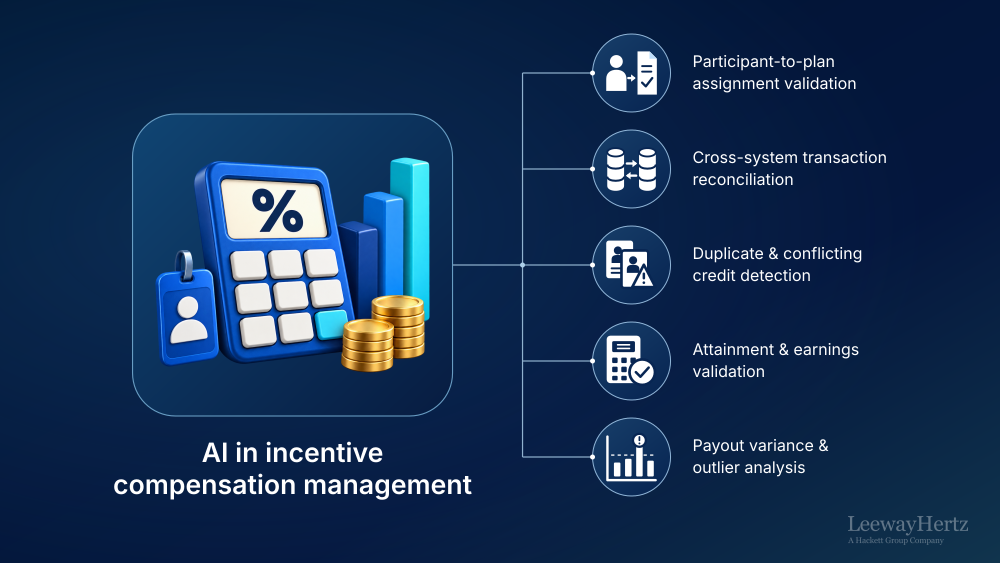
Sales incentive compensation management (ICM) sits within the broader sales performance management (SPM) discipline and covers the plan-to-pay lifecycle for sales commissions, bonuses, SPIFs, contests, draws, guarantees, and related variable incentive plans. The lifecycle spans plan design, participant and target setup, performance data and crediting, attainment and incentive calculation, adjustments and disputes, payout certification, payroll handoff, accruals, reconciliation, and plan-effectiveness review. Each stage produces or consumes specific artifacts, including plan documents, participant assignments, quota files, transaction feeds, credit ledgers, calculation records, commission statements, payout registers, payroll files, and accounting schedules.
Incentive plans themselves are changing frequently. Alexander Group’s 2026 Sales Compensation Trends Survey, reported by WorldatWork, found that 97% of respondents made changes to their sales compensation plans for 2026, while approximately 65% indicated a need to strengthen sales compensation governance and operations [1].
The operational difficulty is not limited to calculating a commission correctly. Organizations need continuity across plan design, approval, configuration, crediting, calculation, payment, and accrual. Breaks can occur anywhere in that chain. A participant may be assigned to the wrong effective-dated plan, CRM transactions may diverge from the certified performance feed, split credits may conflict with approved crediting rules, prior-period adjustments may alter attainment after statement issuance, or accruals may fall out of line with final certified payouts. These are cross-system and cross-role problems that require the underlying artifacts, rules, decisions, and changes to remain traceable.
This is why an operating-model view is important. ICM is not one workflow; it is a connected lifecycle of plan design, eligibility, crediting, transaction certification, calculation, dispute handling, payout, accrual, and reporting. Each step depends on different artifacts, systems, rules, exceptions, and accountable reviewers. When those elements are mapped clearly, organizations can see where AI is relevant: not as an independent decision-maker, but as a controlled way to reconcile data, validate rules, detect exceptions, prepare evidence, and support reviewer judgment.
AI in ICM is therefore not a generic chatbot layered over compensation data. It can support specific work performed by specific roles. For example, AI can help a sales compensation analyst compare CRM transactions with ERP or certified performance feeds to flag missing, duplicate, or unmatched records before calculation. It can help a sales compensation manager compile the plan version, transaction evidence, credit history, and prior decisions needed to review a disputed earning. It can also help a commission or revenue accountant compare certified payouts with accruals and deferred commission schedules before period-end support is prepared. In each case, AI prepares evidence and analysis while the responsible compensation, sales, HR, payroll, finance, or accounting role retains the decision.
The most useful opportunities therefore emerge below the functional level, where the input artifact, governing rule, system of record, exception condition, reviewer, and output can be identified precisely. This makes it possible to distinguish work that AI can safely prepare or validate from decisions that affect participant earnings, payment, employment obligations, or accounting treatment.
This article uses the incentive compensation management operating model to break work into functions, processes, sub-processes, artifacts, systems, controls, and accountable roles. It also maps key AI opportunities, agentic workflow patterns, governance requirements, and prioritization guidance.
- How AI is transforming incentive compensation management
- Why AI use cases in incentive compensation management must be mapped at the sub-process level
- Incentive compensation management operating model and AI opportunity mapping across ICM processes
- High-value AI use cases in incentive compensation management
- How agentic AI works in incentive compensation management workflows
- How to prioritize AI use cases in incentive compensation management
- Governance, risk, and responsible AI in incentive compensation management
- How ZBrain operationalizes AI use cases in incentive compensation management
- Future of AI in incentive compensation management
How AI is transforming incentive compensation management
ICM depends on a connected lifecycle: plans must align with participant assignments, performance data must support crediting and attainment, calculations must reflect approved adjustments, and certified payouts must tie to payroll, accounting, and plan review. Each stage depends on the accuracy of what came before it. A participant must be assigned to the correct effective-dated plan, eligible transactions must enter the compensation process completely, credits must follow approved rules, calculations must use the correct measures and payout parameters, and adjustments must remain traceable through statements, payouts, and accounting records.
AI can support this work by connecting information across the ICM lifecycle and preparing exceptions for review. It can reconcile transactions, validate participant assignments and credits, recalculate expected earnings, explain calculation lineage, classify disputes, flag unusual payouts, and reconcile compensation records with payroll and accounting. The payable earning itself should remain calculated using approved rules in the ICM system of record. AI can independently reproduce or test the calculation, but it should not become the source of the payable amount.
Consider a participant who receives credit for a customer booking in month one and whose customer subsequently cancels the transaction in month three. The cancellation may require the original credit to be reversed, attainment to be recalculated, and a prior-period adjustment to be prepared. The team may also need to review the applicable plan terms, issue a corrected commission statement, transmit an approved payroll adjustment, and update the compensation accrual. AI can compare the original transaction with the cancellation, identify the affected credit and calculation periods, retrieve the applicable effective-dated plan terms, independently calculate the expected adjustment for validation, and assemble the supporting evidence. The sales compensation team confirms the credit and earnings treatment, HR or employment counsel reviews legally sensitive recovery questions, payroll controls any payment adjustment, and the accounting team determines the resulting financial treatment.
Across this operating model, AI is particularly useful in five types of work:
- Document-heavy work: Plan documents, participant assignments, target files, transaction feeds, credit ledgers, calculation records, statements, dispute files, payout registers, payroll files, and accrual workbooks can be checked before detailed human review. AI can flag missing information, version mismatches, inconsistent values, and incomplete evidence across these records.
- Narrative-heavy work: Natural-language generation can prepare plan communications, statement explanations, dispute responses, payout variance commentary, governance memos, and plan retrospectives from approved source material. It can also identify where the available evidence does not support a proposed explanation.
- Exception-heavy work: Classification and anomaly detection can help compensation specialists prioritize the highest-impact exceptions. These may include missing, duplicate, late, or reversed transactions; conflicting credits; incorrect participant assignments; rate-table mismatches; unusual attainment changes; anomalous payouts; payroll rejections; and recurring disputes.
- Knowledge-heavy work: AI can retrieve effective-dated plan terms, crediting rules, adjustment policies, payout curves, approval requirements, and other governing records relevant to a calculation or dispute. It can compare those rules with the underlying transaction and calculation evidence while leaving binding interpretation of plan terms with the designated human role.
- Workflow-heavy work: AI can maintain context across the period-end sequence from transaction certification through crediting, calculation, exception resolution, payout certification, payroll handoff, and accrual reconciliation. It can identify incomplete predecessor activities, assemble the next review packet, route exceptions to the correct role, and monitor whether required approvals and evidence are present before the workflow progresses.
The practical design rule is to separate preparation and validation from authority. AI may extract, reconcile, compare, independently calculate for validation, classify, draft, recommend, monitor, and route. It should not interpret plan terms with binding effect, approve or release payouts, resolve commission disputes, approve overrides or clawbacks, determine accounting treatment, or change plan terms, crediting rules, payout curves, rate tables, or other compensation parameters. Those decisions remain with accountable sales compensation, sales operations, HR, payroll, finance, legal, and accounting roles and are executed through the appropriate systems of record.
Why AI use cases in incentive compensation must be mapped at the sub-process level
AI use cases in incentive compensation should be defined at the sub-process level because commission outcomes are shaped by many upstream and downstream control points. A broad label such as “AI for commission management” or “AI for commission disputes” does not explain what the AI should review, which evidence it should use, which rule it should apply, or which role should approve the outcome.
A missing earning is a useful example. The issue may come from a transaction that never entered the compensation feed, a record assigned to the wrong participant, a credit applied against the wrong plan version, a payout parameter configured incorrectly, a calculation excluded from the certified payout register, or a payroll rejection after certification. Each scenario points to a different sub-process, with different artifacts, systems, rules, reviewers, and corrective actions. This is why effective AI adoption starts by mapping the exact trigger, evidence set, AI action, expected output, and accountable reviewer for each bounded use case.
A better approach is to map AI use cases to the incentive compensation management operating model:
- Function: A major area of responsibility within the ICM lifecycle, such as participant administration, transaction data management, sales crediting, incentive calculation, adjustment management, payout certification, commission accounting, or plan governance.
- Process: A defined group of activities within a function that produces a recognizable business outcome. Within sales crediting, for example, processes can include transaction attribution, split crediting, overlay crediting, credit timing, account-transfer treatment, and credit exception handling.
- Sub-process: The specific unit of work where the input artifact, applicable rule, system of record, exception condition, accountable reviewer, and output can be identified. Examples include validating a participant-plan assignment, detecting a missing transaction, reviewing a split-credit exception, applying a retroactive adjustment, validating an accelerator calculation, or investigating an anomalous payout.
- AI-enabled opportunity: The use of a specific AI capability within a defined sub-process and artifact flow to improve how work is prepared, reviewed, prioritized, or evidenced. Anomaly detection can compare a payout register with attainment and prior-period results to identify unusual earnings. Entity resolution can compare participant, account, transaction, and credit records to identify conflicting attribution. Document intelligence can assemble the plan document, commission statement, transaction record, credit ledger, and adjustment history into a dispute review packet.
This level of mapping matters because ICM logic depends on the participant’s specific compensation context. Earnings can vary based on plan structure, crediting rules, effective dates, payout mechanics, and prior adjustments. AI therefore needs the correct plan context and rule version attached to each item of work rather than treating similar-looking transactions or exceptions as interchangeable.
Mapping AI at the sub-process level therefore converts a broad technology idea into a governed unit of work. For each opportunity, teams can identify the exact input artifact, applicable plan or policy version, source system, exception trigger, accountable reviewer, output artifact, and downstream dependency before deciding whether AI should extract, compare, calculate for validation, classify, draft, recommend, or route.
This framing also keeps the boundaries of incentive compensation management clear. Approved targets enter ICM as plan inputs; they are not created inside the compensation process. Payroll receives certified incentive earnings and owns gross-to-net processing and payment execution. Finance and accounting use compensation cost, accrual, reconciliation, and deferred commission inputs while retaining their planning and accounting responsibilities. CRM, ERP, billing, HRIS, and other enterprise systems may supply or receive records, but the ICM operating model remains focused on continuity across plan design, approval, configuration, crediting, calculation, payout, and accrual.
Build governed AI workflows for incentive compensation management
Streamline plan-to-pay operations while keeping plan interpretation, payout approval, and accounting decisions under human authority.
Incentive compensation management operating model and AI opportunity mapping across ICM processes
Incentive compensation management is not a single calculation process. It is a connected operating model in which plan design, participant setup, performance data, crediting, calculation, payout, and accounting depend on one another. Understanding these handoffs is essential for identifying where AI can support the work without disrupting control or accountability.
The operating model spans five connected lifecycle stages:
- Plan design and approval
- Participant and parameter setup
- Performance data, crediting, and calculation
- Adjustments, statements, and payout
- Accounting and governance
Each stage produces artifacts and decisions that feed the next, making continuity across plan terms, participant records, transactions, credits, calculations, payouts, and accounting essential.
Function 1: Incentive compensation strategy and plan design
Defining who participates in an incentive plan, what performance is rewarded, and how performance translates into incentive opportunity.
This function converts sales roles, commercial objectives, and compensation principles into the structural terms of the incentive plan. It establishes eligibility, target incentive, pay mix, measures, performance scales, payout mechanics, and special treatment for draws, guarantees, ramp periods, and new-hire plans. Its outputs become the design inputs for plan modeling, participant assignment, configuration, and calculation.
Key artifacts: Compensation philosophy and design principles, draft plan document, role and eligibility matrix, pay mix and target incentive table, measure and weighting matrix, payout curve table.
Systems involved: HRIS, CRM, and ICM platforms, compensation planning tools, document repository.
Regulatory and control considerations: Internal compensation philosophy, approval authority, applicable written commission agreement requirements, plan version control.
Accountable roles: Director/head of sales compensation, sales compensation manager, total rewards partner, VP of sales, CRO.
Teams involved: Sales compensation team, total rewards team, sales leadership, revenue operations team, finance team, and HR team contribute plan requirements, while the director/head of sales compensation and designated business leaders approve the final design.
What AI helps with: AI can compare prior plan documents, role definitions, payout data, and proposed design parameters to identify structural inconsistencies, unusually complex rules, and gaps between role responsibilities and measures. Simulation can test alternative pay mixes, thresholds, and payout curves before approval, while natural-language generation can prepare draft plan provisions and design rationales from approved inputs.
What humans continue to own: Compensation and sales leaders determine the commercial objectives, eligible roles, target incentive, measures, weightings, leverage, and payout philosophy. HR and legal reviewers determine employment and jurisdictional implications where applicable. AI analyzes, compares, simulates, and drafts but does not decide, approve, or attest.
| Process | Sub-process | Key AI-enabled opportunities |
|---|---|---|
| Plan architecture | Role and plan eligibility definition by job family, segment, and selling motion |
|
| Target incentive, on-target earnings, pay mix, and leverage design |
|
|
| Measure and performance scale design | Measure selection and weighting |
|
| Threshold, target, and maximum performance definition |
|
|
| Payout mechanics design | Payout curve design, including accelerators, decelerators, multipliers, caps, and floors |
|
| Draw, guarantee, ramp, and new-hire treatment |
|
Highest-value opportunities
- Payout curve simulation: Tests proposed accelerators, caps, and leverage before implementation because errors can affect the entire participant population.
- Measure feasibility analysis: Identifies whether reliable source data exists before a measure is embedded in a plan.
- Role and eligibility consistency review: Surfaces inconsistent treatment before plan documents and assignments are created.
Example agentic workflow: Annual plan design impact review
- The annual plan design cycle opens with the current plan document, role matrix, prior-year attainment distribution, and proposed commercial objectives.
- AI compares prior plan terms, role definitions, measures, pay mix, and payout mechanics with the proposed design inputs.
- Simulation models alternative weighting and payout curve scenarios against historical participant performance.
- AI prepares a design packet showing proposed changes, distribution effects, structural inconsistencies, and unresolved design questions.
- The sales compensation manager and total rewards partner review the packet, while the director/head of sales compensation, VP of sales, and CRO approve the final design within established governance.
- Approved design parameters flow to plan modeling and configuration, with the approved version and decision record retained.
Function 2: Plan modeling, costing and approval
Testing whether the proposed incentive plan behaves as intended before it becomes an approved compensation program.
This function converts the draft plan design into modeled payout, cost, and risk scenarios. It tests the effect of the plan against historical performance, evaluates compensation cost, identifies windfall or unintended outcomes, and manages formal approval and version control. Approved outputs feed participant assignment, parameter configuration, and plan communication.
Key artifacts: Plan model workbook, historical back-test output, payout distribution analysis, compensation cost analysis, approval record, plan version log.
Systems involved: ICM platform, compensation planning tools, FP&A system, HRIS, data warehouse, document repository.
Regulatory and control considerations: Approval authority, version control, effective dating, SOX-related change controls where compensation calculations are material.
Accountable roles: Sales compensation manager, FP&A manager, HR business partner, director/head of sales compensation, CRO.
Teams involved: Sales compensation team performs the modeling, FP&A team reviews financial implications, HR department reviews participant and employment considerations, and sales leadership approves the commercial design.
What AI helps with: AI can back-test proposed plans against prior-period performance, simulate payout distributions, compare compensation cost across scenarios, and identify participants or role groups producing extreme or unexpected outcomes. It can also compare plan versions and prepare approval packets showing which assumptions changed and why.
What humans continue to own: Compensation leaders decide whether modeled outcomes are acceptable, finance confirms cost assumptions, HR determines employment-related treatment, and the authorized governance body approves the plan. AI tests and prepares evidence but does not decide, approve, or attest.
| Process | Sub-process | Key AI-enabled opportunities |
|---|---|---|
| Compensation plan modeling | Historical back-testing against prior performance |
|
| Payout distribution modeling across attainment scenarios |
|
|
| Compensation cost-of-sales modeling |
|
|
| Plan risk testing | Windfall, outlier, and unintended-incentive testing |
|
| Cross-role and cross-region consistency assessment |
|
|
| Plan approval and version control | Finance, HR, sales leadership, and compensation governance approval |
|
| Plan versioning and effective-date control |
|
Highest-value opportunities
- Historical back-testing: Shows how a new plan would have behaved before participants are affected.
- Windfall and outlier testing: Finds design defects that can create disproportionate payout exposure.
- Plan version comparison: Reduces the risk of configuring or communicating an outdated design.
Example agentic workflow: Plan modeling and approval review
- A proposed plan version enters the formal modeling and approval stage.
- AI assembles prior-period participant performance, current plan results, proposed measures, payout curves, headcount, and approved targets.
- Simulation applies the proposed rules to historical and scenario-based performance.
- AI prepares payout distribution, compensation cost, outlier, and plan-version comparison reports.
- The sales compensation manager, FP&A manager, and HR business partner review the results, with the CRO and designated governance body approving or returning the plan for revision.
- The approved plan version, effective date, assumptions, and approval trail are retained and passed to participant and parameter setup.
Function 3: Participant eligibility, plan assignment and communication
Connecting each eligible participant to the correct effective-dated incentive plan and communicating the approved terms.
This function converts HR and sales hierarchy information into the participant population used by the ICM process. It determines eligibility, maps participants to plans, processes employment changes, applies proration or ramp treatment, maintains hierarchies, and records plan distribution and acknowledgment. Accurate assignment is necessary before transactions can be credited or earnings calculated.
Key artifacts: HRIS extract, participant-to-plan assignment roster, plan document, acknowledgment record, hierarchy file.
Systems involved: HRIS, ICM platform, CRM, identity management, document and e-signature systems.
Regulatory and control considerations: Effective dating, participant eligibility rules, written agreement requirements, access and privacy controls.
Accountable roles: Sales compensation analyst, HR business partner, sales operations manager, sales compensation manager, employment counsel for sensitive cases.
Teams involved: Sales compensation team maintains assignments, HR owns employment records and status changes, sales operations team maintains commercial hierarchies, and sales managers confirm role and organizational context.
What AI helps with: Entity resolution can reconcile employees across HRIS, CRM, and ICM records. Rule-based validation can identify inconsistent role-to-plan assignments, missing effective dates, or participants without required documents. Document intelligence can prepare participant-specific plan communications from approved plan terms.
What humans continue to own: HR confirms employment status, compensation leaders approve plan assignment exceptions, sales managers confirm role context, and employment counsel reviews legally sensitive leave or termination cases. AI identifies and prepares exceptions but does not decide, approve, or attest.
| Process | Sub-process | Key AI-enabled opportunities |
|---|---|---|
| Participant population and mapping | Eligible participant determination from HRIS and sales hierarchy records |
|
| Employee-to-sales-role and plan mapping |
|
|
| Lifecycle events management | New hire, promotion, transfer, leave, and termination processing |
|
| Proration and ramp-plan assignment |
|
|
| Effective-dated plan changes |
|
|
| Participant communication | Plan document generation and distribution |
|
| Acknowledgment and acceptance tracking |
|
|
| Manager and participant hierarchy maintenance |
|
Highest-value opportunities
- Participant-plan assignment validation: Prevents downstream calculation errors caused by the wrong plan or effective date.
- Employment-event detection: Ensures transfers, leave, and terminations enter the ICM process promptly.
- Hierarchy reconciliation: Reduces errors in team crediting and approval routing.
Example agentic workflow: Participant change and plan assignment review
- A weekly HRIS update records new hires, promotions, transfers, leave events, and terminations.
- AI matches each affected participant across HRIS, CRM, and ICM records.
- The workflow retrieves the applicable eligibility rules, plan assignment table, effective dates, and ramp provisions.
- AI prepares a change packet listing required assignment updates, proration treatment, document changes, and unresolved exceptions.
- The sales compensation analyst reviews routine changes, the HR business partner confirms employment status, and the sales compensation manager or employment counsel reviews sensitive exceptions.
- Approved changes are updated in the ICM platform, required plan documents are issued, and the assignment and approval trail are retained.
Function 4: Quota, target and plan parameter administration
Translating approved targets and plan design into the effective-dated parameters used for attainment and incentive calculation.
This function starts with approved targets and does not determine target-setting methodology. It assigns approved targets to participants and measures, configures performance periods and eligibility mappings, maintains currencies and payout parameters, and verifies that participant, plan, and target records align before the performance period begins.
Key artifacts: Approved target file, participant target assignment, measure configuration, rate table, payout curve, FX table, configuration validation report.
Systems involved: ICM platform, CRM, HRIS, planning system, ERP, master data repositories.
Regulatory and control considerations: Change control, effective dating configuration approval, SOX-related control where material.
Accountable roles: Sales operations manager, senior sales compensation analyst, sales compensation manager.
Teams involved: Sales operations provides approved targets and supporting commercial assignments, while sales compensation configures plan parameters and validates that the participant, target, and plan records align.
What AI helps with: AI can reconcile target files with participant assignments, identify configuration gaps, compare rate tables and payout curves with approved plan versions, and detect inconsistent currency, measure, period, or eligibility settings.
What humans continue to own: Authorized sales and compensation roles approve targets and plan parameters, while sales compensation controls production configuration changes. AI compares and validates configuration but does not create or approve targets, change plan rules, or attest.
| Process | Sub-process | Key AI-enabled opportunities |
|---|---|---|
| Target ingestion and assignment | Approved quota and target ingestion |
|
| Target assignment to participants and measures |
|
|
| Plan parameter configuration and deployment | Measure weighting and performance-period configuration |
|
| Product, account, geography, and customer eligibility mapping |
|
|
| Currency and FX treatment for global plans |
|
|
| Threshold, accelerator, multiplier, and rate-table deployment |
|
|
| Pre-period configuration validation | Pre-period validation of participant, plan, and target alignment |
|
Highest-value opportunities
- Pre-period configuration validation: Finds errors before participant performance begins accumulating against the wrong setup.
- Rate-table and payout-curve comparison: Protects calculation integrity.
- Participant-target alignment: Prevents missing or misapplied targets from flowing into attainment.
Example agentic workflow: Plan configuration readiness review
- The approved target file and final plan configuration become available before the new performance period.
- AI reconciles targets with participant assignments, measures, performance periods, currencies, and approved payout parameters.
- Independent test calculations compare sample attainment scenarios with the configured rate tables and payout curves.
- AI prepares a configuration exception report covering missing targets, duplicate assignments, incorrect effective dates, and parameter differences.
- The senior sales compensation analyst resolves data issues, and the sales compensation manager approves production configuration changes.
- Approved settings are released for the performance period with the validation report and approvals retained.
Function 5: Performance and transaction data management
Creating the certified performance population that feeds sales crediting, attainment, and incentive calculation.
This function brings eligible performance transactions into ICM from CRM, ERP, billing, subscription, and related systems. It validates completeness and eligibility, detects missing, duplicate, late, or reversed records, reconciles source populations, and certifies the period data before calculation.
Key artifacts: Sales transaction feed, booking and revenue records, reconciliation report, data exception queue, period-close certification record.
Systems involved: CRM, ERP, billing platform, subscription platform, data warehouse, ICM platform.
Regulatory and control considerations: Data completeness, lineage, period certification, system access, SOX-related controls where material.
Accountable roles: Revenue operations manager, sales compensation analyst, commission/revenue accountant, sales compensation manager.
Teams involved: Revenue operations and source-system owners provide performance records, sales compensation team validates ICM eligibility and completeness, and accounting team supports reconciliation where revenue or financial records are involved.
What AI helps with: Entity resolution can match participant, account, opportunity, order, invoice, and credit records across CRM, ERP, billing, and ICM systems. Anomaly detection can flag missing, duplicate, inconsistent, or unexpected records across those matched datasets.Classification can distinguish missing, duplicate, reversed, late, and ineligible transactions, while lineage mapping can show which source record produced each ICM transaction.
What humans continue to own: Source-system owners confirm corrections, sales compensation certifies the performance population, and accounting confirms financial source records where required. AI detects and explains differences but does not certify source data or approve earnings.
| Process | Sub-process | Key AI-enabled opportunities |
|---|---|---|
| Performance data ingestion | CRM opportunity, booking, and closed-won transaction ingestion |
|
| ERP order, shipment, invoice, revenue, and margin data ingestion |
|
|
| Subscription, renewal, usage, and consumption data ingestion |
|
|
| Transaction data validation and exception detection | Transaction completeness and eligibility validation |
|
| Duplicate, missing, late, and reversed transaction detection |
|
|
| Reconciliation and certification | CRM-to-ERP-to-ICM reconciliation |
|
| Period-close data certification before calculation |
|
Highest-value opportunities
- Cross-system transaction reconciliation: Prevents missing or duplicated performance from reaching calculation.
- Late and reversal detection: Identifies records likely to create retroactive adjustments.
- Period-close certification packet: Gives reviewers a complete view of unresolved data risk before calculation.
Example agentic workflow: Transaction feed certification review
- Period-end source feeds arrive from CRM, ERP, billing, and subscription systems.
- AI validates file structure, resolves identifiers, and reconciles transaction populations across systems.
- Missing, duplicate, late, reversed, and ineligible records are classified into an exception queue with source lineage.
- AI prepares the period data certification packet with unresolved exceptions and expected compensation impact.
- Source-system owners correct originating records, the sales compensation analyst validates resolution, and the sales compensation manager confirms readiness for calculation.
- The certified transaction population moves to crediting and calculation, with reconciliation evidence retained.
Function 6: Sales crediting and transaction attribution
Determining which participant receives compensation credit for each eligible transaction and how that credit is shared or timed.
This function converts certified performance transactions into participant-level credit records. It applies approved primary seller, overlay, specialist, split, team, manager, channel, and partner rules, handles effective-dated ownership changes, and resolves duplicate or conflicting credit assignments. It owns operational crediting once participant and coverage inputs are approved.
Key artifacts: Crediting rules matrix, participant crediting ledger, split-credit record, credit exception case.
Systems involved: ICM platform, CRM, HRIS, ERP, partner or channel systems.
Regulatory and control considerations: Effective-dated crediting rules, plan terms, approval controls, change traceability.
Accountable roles: Sales compensation analyst, sales operations manager, first-line sales manager, regional/segment sales leader, sales compensation manager.
Teams involved: Sales compensation administers credit rules, sales operations team maintains ownership and commercial data, and sales managers provide context for ambiguous assignments or split-credit disputes.
What AI helps with: Entity resolution can connect transactions with account ownership, opportunity teams, participant assignments, and partner records. Rule-based validation can identify unsupported or conflicting credits, while anomaly detection can surface unusual split patterns or duplicate attribution.
What humans continue to own: Sales managers and compensation leaders decide disputed ownership, approve exceptions, and interpret ambiguous crediting provisions. AI prepares attribution evidence and recommended exception classifications but does not decide, approve, or attest.
| Process | Sub-process | Key AI-enabled opportunities |
|---|---|---|
| Credit assignment | Account, opportunity, and transaction credit assignment |
|
| Primary seller, overlay, and specialist crediting |
|
|
| Split-credit calculation across multiple participants |
|
|
| Team and manager crediting |
|
|
| Channel and partner attribution |
|
|
| Credit timing and change handling | Account-transfer and ownership-change treatment |
|
| Crediting-date determination by booking, shipment, invoice, revenue, or collection event |
|
|
| Credit dispute and exception review | Duplicate-credit and conflicting-credit handling |
|
Highest-value opportunities
- Conflicting-credit detection: Directly reduces disputes and prevents incorrect attainment.
- Split-credit validation: Protects participant earnings where multiple roles share one transaction.
- Effective-date analysis: Reduces attribution errors caused by account or role changes.
Example agentic workflow: Credit ownership exception review
- A certified transaction enters the crediting process with multiple participants associated with the opportunity.
- AI assembles account ownership, opportunity team records, participant roles, effective dates, and the approved crediting rules.
- The workflow calculates the expected primary and overlay credits and compares them with the ICM credit ledger.
- A conflicting credit is detected and a review packet is prepared showing the competing assignments and applicable rule.
- The sales compensation analyst reviews the evidence, the first-line sales manager provides commercial context, and the sales compensation manager determines the final treatment where policy interpretation is required.
- Approved credits update the participant crediting ledger and flow to attainment calculation with the decision record retained.
Accelerate AI Solutions Development
Build fully functional solutions from your high-value use cases, based on specific operational needs and enterprise context.
Function 7: Attainment and incentive calculation
Converting approved participant credits into attainment and system-calculated incentive earnings.
This function applies performance measures, thresholds, payout curves, commission rates, accelerators, multipliers, modifiers, draws, guarantees, caps, and floors to the participant’s approved credits. The ICM system of record remains the origin of the payable calculation. AI supports independent recalculation, reconciliation, explanation, and exception detection.
Key artifacts: Attainment calculation record, incentive calculation output, payout worksheet, calculation exception report.
Systems involved: ICM platform, CRM, ERP, data warehouse, compensation rules repository.
Regulatory and control considerations: Calculation integrity, approved plan rules, effective dating, segregation of duties, change control.
Accountable roles: Senior sales compensation analyst, sales compensation manager, director/head of sales compensation.
Teams involved: Sales compensation team owns calculation administration and validation, while source-system teams and finance team support exceptions affecting performance inputs or financial measures.
What AI helps with: Independent calculation can reproduce expected attainment and earnings from approved credits and plan rules. Anomaly detection can identify unexpected changes in attainment or earnings, while lineage mapping can explain how each credit and rule contributed to the system-generated result.
What humans continue to own: Sales compensation team confirms calculation exceptions, approves permitted adjustments, and determines whether configuration or source data must be corrected. The ICM platform calculates the official earnings. AI recalculates and explains but does not decide, approve, or attest.
| Process | Sub-process | Key AI-enabled opportunities |
|---|---|---|
| Attainment calculation | Measure-level and overall quota attainment calculation |
|
| Period and year-to-date attainment tracking |
|
|
| Threshold and eligibility gate application |
|
|
| Incentive earnings calculation | Commission rate and payout curve execution |
|
| Accelerator, decelerator, and multiplier application |
|
|
| Bonus and commission calculation |
|
|
| Cross-measure modifier application |
|
|
| Payout limit and reconciliation review | Draw and guarantee reconciliation |
|
| Cap and floor enforcement |
|
|
| Participant-level earnings calculation and validation |
|
Highest-value opportunities
- Independent calculation validation: Protects the integrity of participant earnings without making AI the source of payment.
- Calculation lineage: Gives analysts a traceable explanation from transaction through earning.
- Modifier and breakpoint validation: Detects subtle rule-configuration errors that can affect many participants.
Example agentic workflow: Earnings calculation validation review
- The certified credit ledger closes for the compensation period.
- The ICM platform calculates attainment and earnings using the approved plan configuration.
- AI independently recalculates expected results from approved credits, targets, payout curves, accelerators, and limits.
- Differences are ranked by materiality and assembled with transaction-to-credit-to-attainment-to-rule-to-earning lineage.
- The senior sales compensation analyst reviews exceptions and the sales compensation manager approves any required source-data or configuration corrections.
- Validated system-calculated earnings proceed to adjustment review and payout certification, with calculation evidence retained.
Function 8A: Adjustments, retroactivity and clawbacks
Managing approved corrections and prior-period changes that alter previously calculated incentive results.
This function handles retroactive transaction and credit changes, cancellations, returns, prior-period true-ups, manual adjustments, approved overrides, participant-status changes, and potential clawbacks. Because some recovery actions can create wage-payment or employment-law exposure, legally sensitive cases require HR or employment counsel review.
Key artifacts: Adjustment register, override request, clawback record, prior-period true-up, revised calculation support.
Systems involved: ICM platform, CRM, ERP, HRIS, payroll system, case management system.
Regulatory and control considerations: Effective-dated plan terms, wage-payment requirements, approval authority, employment status, audit trail.
Accountable roles: Sales compensation manager, HR business partner, employment counsel, director/head of sales compensation.
Teams involved: Sales compensation team administers adjustments, HR confirms employment-related facts, finance team supports material financial impacts, and employment counsel reviews clawback and terminated-participant questions.
What AI helps with: AI can trace a correction back through the original transaction, credit, attainment, earning, statement, and payout records. It can identify affected periods, compare the proposed treatment with effective-dated plan terms, and prepare adjustment evidence for review.
What humans continue to own: Sales compensation team approves permitted adjustments within authority, HR determines employment treatment, and employment counsel determines legally sensitive recovery or clawback questions. AI traces, recalculates, and prepares but does not decide, approve, or attest.
| Process | Sub-process | Key AI-enabled opportunities |
|---|---|---|
| Retroactive corrections | Retroactive transaction and credit adjustments |
|
| Cancellation, return, and credit-memo reversals |
|
|
| Prior-period true-ups |
|
|
| Recovery and exception control | Clawback processing where permitted by plan and applicable law |
|
| Manual adjustment and override review |
|
|
| Quota-relief and leave-related adjustments |
|
|
| New-hire and termination prorations |
|
|
| Mid-period and mid-year plan-change treatment |
|
Highest-value opportunities
- Retroactive lineage analysis: Prevents a correction from stopping at one system while downstream records remain unchanged.
- Reversal matching: Connects cancellations and returns to the original compensated event.
- Override analytics: Highlights recurring manual interventions that may indicate configuration or policy problems.
Example agentic workflow: Prior-period cancellation adjustment review
- A cancellation enters the source system for a transaction credited and paid in a prior period.
- AI connects the cancellation to the original transaction, participant credit, attainment, earning, statement, payout, and accrual records.
- The applicable effective-dated plan terms and adjustment policy are retrieved.
- AI prepares a prior-period adjustment packet with expected recalculation, affected artifacts, and any potential recovery question.
- The sales compensation manager confirms the compensation treatment, while the HR business partner and employment counsel review any clawback or terminated-participant issue.
- Approved adjustments are executed through the ICM and payroll processes, and the full before-and-after lineage is retained.
Function 8B: SPIF, contest and one-time incentive administration
Administering short-term incentives that sit alongside the core incentive plan without losing eligibility, approval, and payment controls.
This function manages sales performance incentive funds (SPIFs), contests, one-time bonuses, and guarantees. It ensures that approved eligibility, measurement periods, award conditions, participant populations, and resulting earnings are documented and controlled before payment.
Key artifacts: SPIF record, contest terms, participant eligibility file, one-time bonus approval, guarantee record.
Systems involved: ICM platform, CRM, HRIS, approval workflow, payroll system.
Regulatory and control considerations: Approved terms, participant eligibility, regular-rate treatment for applicable non-exempt participants; approval authority.
Accountable roles: Sales compensation manager, FP&A manager, VP of sales, HR business partner.
Teams involved: Sales compensation team administers the incentive, sales leadership team sponsors commercial objectives, FP&A team reviews financial exposure, and HR supports employment and pay-treatment questions.
What AI helps with: AI can validate participant eligibility, compare performance records with SPIF terms, detect duplicate awards, and independently calculate expected one-time earnings for review. It can also monitor whether required approvals and supporting terms exist before payout.
What humans continue to own: Sales leadership team approves the incentive design, finance team approves budget implications, HR confirms applicable pay treatment, and sales compensation certifies participant awards. AI validates and prepares but does not decide, approve, or attest.
| Process | Sub-process | Key AI-enabled opportunities |
|---|---|---|
| Short-term incentive administration | SPIF and sales contest administration |
|
| One-time payment administration | One-time bonus and guarantee processing |
|
Highest-value opportunities
- Eligibility validation: Prevents short-term incentives from being applied to ineligible participants or transactions.
- Duplicate-award detection: Protects against overlapping SPIF or contest payments.
- Approval completeness checking: Keeps one-time awards inside normal compensation controls.
Example agentic workflow: SPIF award certification review
- An approved SPIF reaches the end of its measurement period.
- AI assembles the approved terms, participant eligibility list, qualifying performance records, and prior awards.
- The workflow validates eligibility and independently calculates expected award amounts.
- Duplicate or ambiguous awards are placed into an exception queue.
- The sales compensation manager reviews participant awards, FP&A confirms budget implications where required, and the VP of sales approves exceptions within authority.
- Certified awards enter the regular payout process with terms, calculations, and approvals retained.
Function 9: Incentive statements, inquiries and dispute management
Explaining participant earnings and resolving questions about transactions, credits, calculations, adjustments, and payment status.
This function produces participant statements and manages inquiries and disputes. It connects the statement to underlying transactions, credits, attainment, rules, adjustments, and payout records so reviewers can identify whether the issue originates in data, crediting, calculation, adjustment, or payment status.
Key artifacts: Participant commission statement, inquiry record, dispute case file, evidence packet, resolution record.
Systems involved: ICM platform, CRM, ERP, case management platform, document repository, payroll status interface.
Regulatory and control considerations: Plan terms, response and escalation procedures, confidential compensation data, evidence retention.
Accountable roles: Sales compensation analyst, first-line sales manager, sales compensation manager, HR business partner, employment counsel for sensitive cases.
Teams involved: Sales compensation team owns statement support and dispute administration, sales managers provide transaction and ownership context, and HR or employment counsel supports legally sensitive cases.
What AI helps with: Document intelligence can assemble the statement, plan version, transaction evidence, credit ledger, calculation lineage, adjustments, and prior correspondence. Classification can identify the likely dispute category and route the case to the appropriate reviewer.
What humans continue to own: Sales compensation decides compensation disputes within policy, managers confirm commercial facts, and HR or employment counsel handles legally sensitive issues. AI assembles evidence and drafts explanations but does not decide, approve, or attest.
| Process | Sub-process | Key AI-enabled opportunities |
|---|---|---|
| Statement generation and validation | Participant commission statement generation |
|
| Transaction-to-credit-to-earning explanation |
|
|
| Attainment and payout breakdown |
|
|
| Inquiry intake and evidence assembly | Missing-credit and incorrect-payment inquiry intake |
|
| Dispute classification and routing |
|
|
| Supporting evidence retrieval across CRM, ERP, and compensation systems |
|
|
| Inquiry and dispute resolution | Manager and sales compensation review |
|
| Appeal and escalation management |
|
|
| Disposition and resolution tracking |
|
Highest-value opportunities
- Calculation lineage for statements: Makes participant earnings explainable without reconstructing the calculation manually.
- Dispute evidence assembly: Reduces the time required to gather records across systems.
- Dispute classification: Routes cases to the correct owner before manual investigation begins.
Example agentic workflow: Missing credit dispute review
- A participant submits a missing-credit inquiry referencing a specific customer and period.
- AI identifies the relevant statement, transaction, credit ledger entry, plan version, calculation record, and prior adjustments.
- The case is classified as a crediting dispute rather than a calculation or payroll issue.
- AI prepares a neutral evidence packet showing transaction ownership, crediting rules, existing credit, and resulting earnings.
- The sales compensation analyst and first-line sales manager review the evidence, with the sales compensation manager determining the final disposition and HR or employment counsel reviewing legally sensitive issues.
- Any approved correction enters the adjustment workflow, and the dispute outcome and evidence are retained.
Function 10: Payout certification and payroll handoff
Converting validated incentive earnings into a certified payout population for payroll processing.
This function prepares the period payout register, reviews unusual or negative results, obtains required certifications, generates the payroll interface, manages corrections or off-cycle requests, and reconciles payment status back to ICM. ICM owns the certified incentive earnings. Payroll owns gross-to-net calculation, withholding, payroll taxes, wage-payment execution, and payroll filings.
Key artifacts: Period payout register, payout variance report, certification record, payroll interface file, rejection file, payment-status reconciliation.
Systems involved: ICM platform, payroll system, HRIS, case management system, finance systems.
Regulatory and control considerations: Payout approval, segregation of duties, wage-payment timing, interface controls, access restrictions.
Accountable roles: Sales compensation manager, payroll manager, director/head of sales compensation, FP&A manager where required.
Teams involved: Sales compensation team prepares and certifies the payout register, payroll team processes approved earnings through payroll controls and finance team reviews material payout variances where required.
What AI helps with: Anomaly detection can identify unusually large, negative, or out-of-pattern payouts. Reconciliation can compare certified earnings with payroll files and payment status, while workflow monitoring can identify missing approvals or rejected interface records.
What humans continue to own: Sales compensation team certifies the payout register, payroll team controls payment execution, and authorized finance personnel or compensation leaders approve material exceptions. AI analyzes and prepares but does not approve or release payouts, decide payroll treatment, or attest.
| Process | Sub-process | Key AI-enabled opportunities |
|---|---|---|
| Payout register | Period payout register preparation |
|
| Variance analysis against prior periods and expected ranges |
|
|
| Review of unusually large, negative, and anomalous payouts |
|
|
| Payout certification | Sales compensation operations certification |
|
| Manager, finance, and compensation leadership approval where required |
|
|
| Payroll handoff validation | Payroll interface file generation |
|
| Off-cycle payment request processing |
|
|
| Payroll rejection and correction handling |
|
|
| Payment-status reconciliation back to the ICM platform |
|
Highest-value opportunities
- Payout outlier detection: Focuses review on amounts most likely to require intervention.
- Payout-to-payroll reconciliation: Prevents certified earnings from disappearing or changing during handoff.
- Payroll rejection classification: Speeds correction without changing payroll authority.
Example agentic workflow: Payout certification and payroll handoff review
- Validated earnings and approved adjustments close for the compensation period.
- AI assembles the payout register and compares it with prior periods, attainment, and approved adjustments.
- Unusually large, negative, or inconsistent payouts are flagged with calculation lineage.
- The sales compensation manager resolves exceptions and certifies the payout register within authority.
- The payroll interface is validated against the certified register, then the payroll manager accepts it into payroll processing.
- Payment status is reconciled back to ICM, while the payout register, approvals, interface record, and reconciliation evidence are retained.
Function 11: Commission accounting, accrual and financial reconciliation
Connecting incentive compensation earnings and payouts with accounting records, accruals, liabilities, and applicable deferred commission schedules.
This function translates compensation activity into financial support for the accounting process. It calculates and reconciles compensation accruals, tracks outstanding liabilities, allocates expense, reconciles ICM with payroll and the GL, and prepares deferred commission support under ASC 340-40 where applicable. Financial close owns the broader close process. This function supplies the commission schedules and reconciliations that feed it.
Key artifacts: Incentive compensation accrual workbook, payout-to-accrual reconciliation, outstanding liability schedule, expense allocation, deferred commission schedule, journal-entry support.
Systems involved: ICM platform, payroll, ERP/GL, financial close platform, contract and revenue systems.
Regulatory and control considerations: ASC 340-40, US GAAP or IFRS as applicable, SOX controls, reconciliation and journal-entry approvals.
Accountable roles: Commission/revenue accountant, corporate controller, FP&A manager, internal audit manager as evidence consumer.
Teams involved: Commission or revenue accounting team prepares compensation accounting schedules, sales compensation team provides certified earnings and payout data, payroll team provides payment records, and the corporate controller approves accounting treatment and entries.
What AI helps with: Reconciliation can compare ICM earnings, certified payouts, payroll records, accruals, and GL balances. AI can identify unexplained differences, prepare deferred commission schedules, and assemble journal-entry support. For ASC 340-40, AI can organize and test supporting data, but accounting treatment remains with the controller.
What humans continue to own: The commission/revenue accountant validates schedules, the corporate controller determines accounting treatment and approves entries, and internal audit evaluates control evidence. AI prepares schedules and support but does not determine accounting treatment, approve journal entries, or attest.
| Process | Sub-process | Key AI-enabled opportunities |
|---|---|---|
| Commission accrual calculation | Incentive compensation accrual calculation |
|
| Actual payout versus accrual reconciliation |
|
|
| Outstanding commission liability tracking |
|
|
| Commission cost allocation and reconciliation | Compensation expense allocation by entity, department, product, and cost center |
|
| ICM-to-payroll-to-GL reconciliation |
|
|
| Deferred commission cost accounting | Deferred commission identification and schedule preparation |
|
| Capitalization and amortization support where applicable |
|
|
| Commission accounting close support | Period-end journal-entry support |
|
| Finance, SOX, and external audit evidence preparation |
|
Highest-value opportunities
- ICM-to-payroll-to-GL reconciliation: Addresses one of the most cross-system-intensive control points.
- Accrual-to-payout variance analysis: Gives accounting a traceable explanation of differences.
- Deferred commission schedule preparation: Reduces manual data assembly while preserving controller judgment under ASC 340-40.
Example agentic workflow: Commission accrual and reconciliation review
- The accounting period-end accrual cycle opens after the compensation period is certified.
- AI assembles ICM earnings, payout records, payroll payments, prior accruals, expense allocations, and applicable deferred commission schedules.
- Reconciliation identifies accrual-to-payout differences and ICM-to-payroll-to-GL mismatches.
- AI prepares the accrual reconciliation, variance explanations, deferred commission support, and draft journal-entry evidence.
- The commission/revenue accountant validates the schedules and the corporate controller determines accounting treatment and approves entries.
- Approved records feed financial close, while reconciliation lineage and review evidence are retained for SOX and audit support.
Function 12: Plan governance, performance analytics and effectiveness review
Monitoring whether incentive plans remain controlled, understandable, economically aligned, and operationally effective throughout the plan year.
This function provides the governance and analytical layer across the ICM lifecycle. It manages decision rights, plan and rule version control, access and segregation of duties, override monitoring, compensation cost analysis, payout and attainment distributions, dispute patterns, measure effectiveness, and periodic plan reviews. Its outputs feed the next design cycle.
Key artifacts: Governance calendar, decision-right matrix, plan and rule version log, override report, plan-effectiveness dashboard, annual retrospective.
Systems involved: ICM platform, HRIS, CRM, ERP, analytics platform, identity and access management, GRC platform.
Regulatory and control considerations: Segregation of duties, access controls, SOX where applicable, compensation data privacy, governance evidence retention.
Accountable roles: Director/head of sales compensation, sales compensation manager, total rewards partner, CRO, internal audit manager.
Teams involved: Sales compensation team owns plan governance and effectiveness analysis, sales leadership reviews commercial outcomes, total rewards and HR teams provide compensation oversight, finance team reviews cost implications, and internal audit team assesses applicable controls.
What AI helps with: AI can monitor overrides, rule changes, access patterns, dispute trends, payout distributions, and plan-performance relationships. Statistical analysis can identify unexpected payout concentration or measures associated with weak differentiation, while change tracking can show how plan rules evolved during the year.
What humans continue to own: Compensation leadership determines whether the plan remains appropriate, the CRO and other governance roles approve strategic changes, and internal audit evaluates control design and operation. AI monitors, analyzes, and prepares recommendations but does not decide, approve, or attest.
| Process | Sub-process | Key AI-enabled opportunities |
|---|---|---|
| Plan governance review | Compensation governance calendar and decision-right administration |
|
| Plan, rule, and policy version control |
|
|
| Segregation-of-duties and access monitoring |
|
|
| Manual override and exception analytics |
|
|
| Plan performance analytics | Compensation cost-of-sales analysis |
|
| Pay-versus-performance analysis |
|
|
| Attainment and payout distribution analysis |
|
|
| Dispute, adjustment, and exception-rate monitoring |
|
|
| Measure-effectiveness and unintended-behavior analysis |
|
|
| Plan effectiveness review | 30/60/90-day plan reviews |
|
| Annual plan retrospective and inputs to the next design cycle |
|
Highest-value opportunities
- Override and exception analytics: Reveals where manual intervention is becoming a structural problem.
- Attainment and payout distribution analysis: Helps compensation leaders assess whether the plan is behaving as intended.
- Plan-version and access monitoring: Protects governance across the full plan-to-pay chain.
- Annual retrospective preparation: Connects operational evidence from the current year to the next design cycle.
Example agentic workflow: Quarterly plan governance review
- The quarterly ICM governance review opens with current-period plan, payout, dispute, adjustment, override, and control data.
- AI assembles plan-version changes, access records, attainment distributions, payout distributions, dispute trends, override frequency, and compensation cost indicators.
- Pattern analysis identifies a rise in manual credit overrides and a cluster of disputes tied to one plan rule.
- AI prepares a governance packet with the affected rule, participant population, operational evidence, and recommended areas for investigation.
- The director/head of sales compensation, total rewards partner, sales compensation manager, and CRO review the findings, while internal audit assesses relevant control issues.
- Approved remediation actions are assigned through the governance process, and the findings become inputs to the next plan-design cycle.
Accelerate AI Solutions Development
Build fully functional solutions from your high-value use cases, based on specific operational needs and enterprise context.
High-value AI use cases in incentive compensation management
The highest-value AI opportunities in incentive compensation management are concentrated where teams handle large transaction populations, repeated rule checks, cross-system reconciliation, exception-heavy reviews, and evidence assembly. These use cases can reduce manual investigation and make plan-to-pay work easier to validate without shifting authority away from sales compensation, HR, payroll, finance, legal, or accounting. The most valuable opportunities are those with reliable source artifacts, clear review boundaries, and a direct connection to payout accuracy, cycle time, dispute reduction, or control evidence.
| Use case | Function | How AI creates high-value impact |
|---|---|---|
| Plan design consistency analysis | Incentive compensation strategy and plan design | Classification and document comparison evaluate role matrices, measures, pay mix, payout curves, and draft plan terms to identify inconsistent treatment, unsupported design differences, or missing provisions before approval. |
| Plan back-testing and payout distribution simulation | Plan modeling, costing and approval | Simulation applies proposed plan rules to prior performance and scenario data to show payout distributions, compensation cost, windfall exposure, and extreme outcomes before the plan is approved. |
| Participant-to-plan assignment validation | Participant eligibility, plan assignment and communication | Entity resolution compares HRIS records, sales roles, hierarchy data, effective dates, and ICM assignments to identify participants mapped to the wrong plan, missing a plan, or carrying overlapping assignments. |
| Pre-period plan configuration validation | Quota, target and plan parameter administration | Rule-based validation compares approved targets, measures, thresholds, payout curves, currencies, and effective dates with configured ICM parameters to surface differences before participant performance is calculated. |
| Cross-system transaction reconciliation | Performance and transaction data management | Entity resolution and anomaly detection compare CRM, ERP, billing, subscription, and ICM transaction populations to identify missing, duplicate, late, reversed, or ineligible transactions before period certification. |
| Duplicate and conflicting credit detection | Sales crediting and transaction attribution | Rule-based validation compares transaction records, participant assignments, opportunity involvement, split rules, and credit ledgers to identify unsupported, duplicated, or conflicting sales credits. |
| Independent attainment and earnings validation | Attainment and incentive calculation | Independent calculation reproduces expected attainment and earnings using approved credits and plan parameters, then compares the result with the ICM system calculation while preserving the ICM platform as the source of the payable amount. |
| Retroactive adjustment lineage analysis | Adjustments, retroactivity and clawbacks | Data lineage mapping traces cancellations, returns, credit corrections, and other changes from the original transaction through credit, attainment, earning, statement, payout, and accrual records so reviewers can identify all affected downstream artifacts. |
| SPIF and contest eligibility validation | SPIF, contest and one-time incentive administration | Rule-based validation compares approved short-term incentive terms with participant eligibility and qualifying performance to identify duplicate awards, ineligible participants, or unsupported one-time payments before certification. |
| Commission dispute evidence assembly | Incentive statements, inquiries and dispute management | Document intelligence retrieves the statement, effective-dated plan, transaction record, credit ledger, calculation lineage, adjustment history, and prior correspondence to prepare a structured evidence packet for review. |
| Payout variance and outlier analysis | Payout certification and payroll handoff | Anomaly detection compares the payout register with attainment, prior-period payouts, adjustments, and expected ranges to prioritize unusually large, negative, or otherwise out-of-pattern results before certification. |
| ICM-to-payroll-to-GL reconciliation | Commission accounting, accrual and financial reconciliation | Multi-source reconciliation compares calculated earnings, certified payouts, payroll results, accrual schedules, and GL records to identify timing differences, missing records, and unexplained balances before close. |
| Override, dispute, and plan-effectiveness analytics | Plan governance, performance analytics and effectiveness review | Pattern analysis connects manual overrides, disputes, payout distributions, attainment, and plan changes to identify recurring operational problems or plan features that require governance review. |
Some opportunities have greater enterprise value because an error at that point can propagate across the rest of the plan-to-pay chain. Transaction reconciliation affects every downstream credit and calculation. Participant and parameter validation can prevent entire populations from being processed under incorrect rules. Calculation validation and payout variance analysis protect earnings before certification, while reconciliation and dispute evidence assembly reduce the effort required to explain and correct issues after calculation.
A use case should therefore be considered high value when AI can work from reliable artifacts, identify or prepare a material exception, and hand that work to a clearly accountable reviewer before it affects what a participant is paid or what the organization records. The objective is not to remove review. It is to give the reviewer a more complete, traceable, and prioritized work product.
How agentic AI works in incentive compensation management workflows
Agentic AI can support incentive compensation management by carrying context across multiple software steps instead of treating each task as an isolated prompt. A governed workflow can detect a trigger, assemble the relevant plan and transaction records, retrieve the applicable effective-dated rules, perform reconciliation or analysis, prepare a review packet, and route the result to the responsible role. The agent can continue the workflow after approval, but risk-bearing actions such as payout release, dispute disposition, clawback execution, or accounting treatment remain under human authority.
Here are some examples:
Period-end incentive calculation and payout certification
- Agent role: Prepare the period-end calculation validation and payout certification packet while preserving the ICM system of record as the source of the official earning.
- Trigger: The monthly compensation period closes and final eligible transaction feeds are available.
- Context assembled: CRM and ERP transactions, participant and plan assignments, approved targets, credit splits, prior-period adjustments, cancellations and returns, approved SPIF records, FX rates, and the current calculation output from the ICM platform.
- Analysis performed: The agent reconciles the transaction population, validates credit completeness, independently recalculates expected attainment and earnings, compares the result with the ICM calculation, and identifies missing transactions, conflicting credits, rate-table differences, or unusual payout movements.
- Decision packet: A participant-level packet showing transaction → credit → attainment → rule → earning lineage, unresolved calculation differences, approved adjustments, payout variances, and the supporting plan version.
- Human checkpoint: The sales compensation analyst reviews source-data and calculation exceptions. The sales compensation manager approves material adjustments and certifies the payout register within authority. HR or employment counsel reviews legally sensitive plan or recovery questions, while finance reviews material compensation expense variances.
- Controlled handoff: Certified incentive earnings move to payroll for gross-to-net processing. Participant statements are published, accounting receives accrual and deferred commission support, and calculation lineage, approvals, and exceptions are retained for audit.
Commission dispute resolution
- Agent role: Assemble and explain the evidence behind a participant inquiry without deciding the dispute.
- Trigger: A participant submits a missing-credit, incorrect-calculation, or incorrect-payment inquiry.
- Context assembled: The participant’s commission statement, effective-dated plan document, source transaction, credit ledger, attainment record, calculation output, approved adjustments, payout status, and prior inquiries related to the same participant or transaction.
- Analysis performed: The agent classifies the issue as a data, crediting, calculation, adjustment, or payment-status dispute; traces the transaction through the compensation lifecycle; compares the applied treatment with the relevant plan rule; and identifies any break in the evidence chain.
- Decision packet: A neutral case summary containing the participant’s claim, source-system evidence, applicable rule, transaction-to-credit-to-earning lineage, prior adjustments, unresolved questions, and a draft response based only on verified records.
- Human checkpoint: The sales compensation analyst validates the evidence, the first-line sales manager confirms relevant commercial facts, and the sales compensation manager determines the disposition. HR or employment counsel reviews legally sensitive cases.
- Controlled handoff: Approved corrections enter the appropriate transaction, crediting, adjustment, or payroll workflow. The final disposition, supporting evidence, reviewer decision, and participant response are retained in the dispute record.
Plan modeling and back-testing before approval
- Agent role: Test a proposed incentive plan against historical and scenario-based performance so compensation leaders can evaluate payout behavior before approval.
- Trigger: A proposed plan version enters the annual design and approval cycle.
- Context assembled: Prior-period attainment and payout data, current and proposed plan documents, participant populations, proposed measures, payout curves, caps, thresholds, headcount assumptions, and approved target data.
- Analysis performed: The agent applies proposed plan mechanics to historical performance, models payout distributions and compensation costs, compares the proposed design with the current plan, and flags windfalls, sharp payout discontinuities, unusual role differences, or other unintended outcomes.
- Decision packet: A comparison of current and proposed payout distributions, cost implications, high-impact rule changes, outlier scenarios, affected participant groups, and questions requiring compensation, finance, or HR judgment.
- Human checkpoint: The sales compensation manager reviews the plan behavior, the FP&A manager confirms financial assumptions, and the HR business partner reviews participant and employment implications. The CRO and the designated compensation governance body approve the final plan.
- Controlled handoff: The approved plan version, effective date, design parameters, and decision record are passed to participant assignment and plan configuration. Superseded drafts remain outside production configuration.
Commission accrual and ASC 340-40 reconciliation
- Agent role: Prepare the period-end commission accounting reconciliation and supporting schedules without determining accounting treatment.
- Trigger: The accounting period-end accrual cycle opens after compensation results have been certified.
- Context assembled: ICM-calculated earnings, certified payout registers, payroll payment records, prior-period accruals, compensation expense allocations, contract-level commission data where applicable, deferred commission schedules, and relevant GL balances.
- Analysis performed: The agent reconciles calculated earnings with certified payouts, payroll, accruals, and posted accounting records; identifies timing differences and unexplained variances; and assembles contract and commission data relevant to the deferred commission schedule under ASC 340-40.
- Decision packet: An accrual-to-payout reconciliation, ICM-to-payroll-to-GL variance report, outstanding liability analysis, deferred commission support, and draft journal-entry evidence with source lineage.
- Human checkpoint: The commission/revenue accountant validates the schedules and investigates unresolved differences. The corporate controller determines the appropriate accounting treatment and approves journal entries or schedule changes.
- Controlled handoff: Approved schedules and entries feed the financial close process, while reconciliation evidence, source data, reviewer decisions, and accounting approvals are retained for SOX and audit support.
Across these workflows, the review boundary is the core safety property. AI can maintain context, retrieve rules, reconcile records, independently calculate for validation, identify exceptions, and prepare decision-ready evidence, but a named human role must confirm the output before it changes a participant’s earning or payout, resolves a dispute, executes a recovery, modifies a plan rule, or affects the organization’s accounting records.
How to prioritize AI use cases in incentive compensation management
Not every ICM sub-process is equally suitable for AI. The strongest starting points are usually high-volume, artifact-rich activities where AI can prepare, reconcile, classify, or validate work before a named reviewer makes the decision. Prioritization should therefore consider not only potential effort reduction, but also data quality, reviewability, downstream risk, and whether the business outcome can be measured credibly.
| Criterion | What to ask |
|---|---|
| Volume and frequency | Does this sub-process recur every period, across enough participants or transactions, for AI support to reduce manual effort at scale? |
| Artifact availability | Are the plan documents, transaction feeds, credit records, payout data, statements, adjustment records, and accounting schedules available in usable systems with sufficient quality for AI analysis? |
| Review boundary | Can a named sales compensation, finance, HR, legal, payroll, or accounting role confirm the AI output before it affects an earning, payout, dispute outcome, or accounting record? |
| Blast radius | If the AI output is wrong, is the impact limited to a draft, exception queue, reconciliation result, or review packet rather than a participant payment, released statement, approved clawback, changed plan parameter, or booked journal entry? |
| Business impact | Can the use case be tied to a credible outcome such as fewer payout errors, shorter compensation close cycles, fewer disputes, faster exception resolution, or stronger audit evidence? |
These criteria help distinguish promising demos from use cases that can actually improve the compensation operating model. For example, transaction reconciliation scores well when CRM, ERP, billing, and ICM records are available and a sales compensation analyst can review unresolved differences before calculation. Duplicate-credit detection also has a clear review boundary because AI can surface conflicting credits without determining the final attribution. Calculation validation is suitable when AI independently recalculates expected results and compares them with the ICM system without becoming the source of the payable amount.
Payout certification requires greater caution because the output sits directly on the money path. AI can identify unusual payouts, compare the register with attainment and approved adjustments, and prepare supporting lineage, but the sales compensation manager must still certify the payout. Similarly, clawback analysis may be useful for assembling the relevant plan terms, original earnings, participant status, and transaction history, but HR or employment counsel must determine legally sensitive recovery questions.
The same principle applies to commission accounting. AI can reconcile earnings, payroll payments, accrual schedules, deferred commission records, and GL postings, but the commission/revenue accountant and corporate controller retain responsibility for accounting conclusions and entries. The closer a use case gets to participant pay, plan interpretation, legal rights, or booked financial results, the stronger the review boundary and control requirements should be.
Common failure patterns include misaligned scope, missing or unreliable source data, workflows that bypass existing governance, and quantified savings claims made before a use case has been measured in production. The strongest first projects are therefore usually high-volume, artifact-rich, and cleanly reviewable sub-processes such as transaction reconciliation and data certification, duplicate and conflicting credit detection, calculation validation and lineage, payout variance analysis, dispute evidence assembly, and accrual reconciliation.
Governance, risk, and responsible AI in incentive compensation management
AI in incentive compensation management operates in a sensitive environment because its outputs can influence participant earnings, payment timing, employment-related disputes, compensation expense, and accounting records. Governance should therefore be embedded into the workflow from the beginning rather than added after deployment. The central principle is that AI may prepare evidence, detect exceptions, independently validate calculations, and recommend next steps, while named human roles retain authority over plan interpretation, participant pay, disputes, recoveries, and accounting decisions.
Human-in-the-loop oversight: AI can reconcile transactions, classify credit exceptions, independently recalculate expected earnings for validation, assemble dispute evidence, identify payout outliers, and prepare accounting reconciliations. The sales compensation analyst and sales compensation manager review compensation exceptions and calculations; HR and employment counsel review employment-sensitive and clawback questions; the payroll manager controls payroll processing; the commission/revenue accountant validates accounting schedules; and the corporate controller determines accounting treatment. The CRO and other designated governance roles approve material plan decisions. AI does not approve plan design, interpret plan terms with binding effect, approve or release payouts, grant overrides, execute clawbacks, resolve disputes, or determine accounting treatment.
Regulatory and standards alignment: Governance should map each AI-supported workflow to the requirements that already govern the underlying ICM process. Depending on the use case, these can include federal and state wage-payment requirements, written commission agreement requirements, Fair Labor Standards Act regular-rate considerations for applicable non-exempt employees, ASC 340-40 for qualifying incremental costs of obtaining customer contracts, SOX Sections 302 and 404, COSO internal control principles, and CCPA or other applicable US state privacy requirements for employee and compensation data. The NIST AI Risk Management Framework can provide an additional structure for identifying, measuring, managing, and monitoring AI-specific risks. State or jurisdiction specific conclusions should be confirmed by the responsible HR or legal role rather than inferred by AI.
Bias mitigation and evidence retention: Bias can enter ICM through participant assignments, account and credit allocation, split-credit treatment, exception histories, quota-relief decisions, manual overrides, and dispute outcomes. AI-supported analysis should therefore preserve the underlying evidence and avoid turning historical treatment into an unquestioned rule for future cases. Patterns that may raise pay-equity, disparate-impact, or employment concerns should be routed to HR and employment counsel. The relevant plan version, participant assignment, transaction record, credit ledger, calculation lineage, adjustment history, reviewer decision, and approval should remain available so every recommendation can be inspected.
Key governance requirements: Organizations should maintain a registered inventory of ICM AI use cases and distinguish lower-risk work, such as document summarization or statement explanation, from higher-risk work such as credit recommendations, payout variance conclusions, adjustment analysis, or clawback support. Each use case should have a defined risk tier, approval gate, escalation path, data boundary, accountable reviewer, and permitted system actions. Changes to crediting rules, payout curves, rate tables, participant eligibility logic, or other compensation parameters should be versioned, tested, approved, and deployed through controlled change processes rather than modified directly by an AI workflow.
Design principles: AI outputs should be grounded in effective-dated plan documents, approved rule versions, participant assignments, and certified transaction records. Payable amounts should continue to be calculated in the ICM system of record, while AI independently recalculates, reconciles, and explains the result. Access should follow least-privilege and role-based principles, with segregation of duties between preparation and approval. A workflow that prepares a payout register should not be able to certify or release it. An agent that validates a rate table should not be able to modify that rate table. Tool access should be scoped so AI cannot release payroll files, change participant plan assignments, approve overrides, or post journal entries without the required human-controlled system action.
Traceability and data security: Each AI-supported workflow should retain evidence of the source artifacts used, applicable plan and rule versions, model or workflow version, reviewer disposition, approvals, and any resulting system updates. For calculation-related work, traceability should extend from transaction to credit to attainment to rule to earning. For adjustments, it should show how the original earning changed and which downstream artifacts were updated. Individual compensation data should be treated as confidential and protected through appropriate access controls, encryption, retention rules, logging, and monitoring. CCPA, other applicable US state privacy laws, internal privacy policies, and enterprise security requirements should govern how participant information is accessed, processed, stored, and retained.
The strongest governance model is therefore not one that removes AI from sensitive ICM work, but one that constrains what it can do at each step. AI can make the plan-to-pay process easier to inspect, reconcile, explain, and monitor, while the responsible human roles continue to make and approve the decisions that affect participant earnings, legal obligations, payroll, and accounting.
Accelerate AI Solutions Development
Build fully functional solutions from your high-value use cases, based on specific operational needs and enterprise context.
How ZBrain operationalizes AI use cases in incentive compensation management
Identifying high-value AI use cases is only the first step in incentive compensation management. Organizations need a controlled way to analyze, design, build, validate, deploy, govern and scale AI workflows across the plan-to-pay lifecycle. This includes plan design, participant eligibility, plan assignment, target and parameter setup, transaction feed certification, sales crediting, attainment and earnings calculation, manual adjustments, incentive statements, dispute management, payout certification, payroll handoff, accrual reconciliation, deferred commission accounting, plan governance and performance review.
The challenge is to connect these workflows without weakening approval boundaries, plan governance, crediting rules, wage-payment controls, payroll ownership, accounting policies, SOX requirements, privacy obligations and audit evidence expectations. ICM workflows touch participant earnings, plan terms, transaction records, credit ledgers, payout files, payroll data and accounting support. That makes orchestration, permissions, evidence retention and human checkpoints as important as model capability.
This is where ZBrain helps.
ZBrain is an end-to-end AI enablement platform that supports this lifecycle through four connected stages: ZBrain Analyzer, ZBrain Design, ZBrain Solution Builder and ZBrain Governance. The platform provides a governed path from use-case analysis to deployed agentic workflows while maintaining policies, permissions, approval points, monitoring and runtime evidence throughout incentive compensation management.
ZBrain Analyzer
ZBrain Analyzer helps incentive compensation teams examine selected ICM processes, identify AI opportunities and document the business context, systems, data sources, artifacts, roles, plan rules, crediting policies, approval matrices, decision boundaries and review checkpoints needed to evaluate each use case.
ZBrain Design
ZBrain Design creates a build-ready technical design for the selected ICM use case. It generates the business requirements document, functional requirements, user journeys, architecture, workflow logic, data specifications, integration context, approval points, exception paths and governance considerations needed before development begins.
ZBrain Solution Builder
ZBrain Solution Builder enables teams to create, configure and validate governed AI workflows for incentive compensation management based on the technical design developed in ZBrain Design.
ZBrain Governance
ZBrain Governance applies policies, access controls, human approval requirements, monitoring and traceability throughout workflow execution. It provides guardrails, approval gates, escalation controls, kill switches and audit trails to help organizations maintain oversight of AI-generated reconciliation packets, crediting exception queues, calculation validation reports, dispute evidence packets, payout variance reviews, payroll handoff checks, accrual reconciliations, deferred commission support, governance review packets, reviewer actions and authorized updates to ICM systems of record.
Future of AI in incentive compensation management
The future of AI in incentive compensation management is likely to depend less on standalone tools and more on how well organizations connect the systems that already support the plan-to-pay lifecycle. CRM, ERP, HRIS, ICM, payroll, finance, and accounting platforms each hold part of the evidence required to explain an earning or resolve an exception. A shared orchestration and governance layer can help maintain continuity across those systems so plan terms, participant assignments, transactions, credits, calculations, payouts, and accounting records can be examined as one connected process rather than as isolated records.
AI workflows are also likely to operate across longer time horizons. Instead of supporting only a single period-end task, a governed workflow could maintain context from annual plan design through configuration, participant changes, period calculations, mid-year adjustments, disputes, payouts, and the year-end retrospective. A design assumption made at the beginning of the plan year could then be compared with actual attainment distributions, override patterns, dispute volumes, payout behavior, and compensation cost later in the year. Human reviewers would still confirm decisions that affect plan terms, participant earnings, recoveries, payment, or accounting.
This will make workflow design increasingly important. The advantage will not come simply from selecting a more capable model. It will come from defining which artifacts the AI can access, which effective-dated rules govern the task, how calculation lineage is preserved, what exceptions trigger escalation, which role reviews the output, and which system is permitted to execute the approved action. For ICM, that means keeping the continuity from plan terms as designed, as approved, as configured, as credited, as calculated, as paid, and as accrued visible throughout the workflow.
As these capabilities mature, AI can make incentive compensation operations more continuous rather than concentrating analysis around plan rollout and period-end processing. Data mismatches, credit conflicts, configuration differences, unusual payout patterns, unresolved disputes, and accounting variances can be surfaced closer to the point where they arise. The future of AI in incentive compensation management therefore depends not only on better models, but on better-designed workflows that connect data, rules, review boundaries, and accountability across the full plan-to-pay lifecycle.
Endnote
Incentive compensation management depends on more than getting the commission formula right. Plan terms must remain consistent as they move from design and approval into participant assignment, configuration, transaction processing, crediting, calculation, adjustment, payout, and accounting. When those stages are managed across multiple systems and teams, a problem introduced early in the process can appear later as a disputed credit, unexpected earning, payroll exception, or accounting variance.
AI can help organizations manage this complexity by working with the artifacts that already support the plan-to-pay lifecycle. It can reconcile transaction populations, identify conflicting credits, independently validate calculations, trace retroactive changes, assemble dispute evidence, identify payout outliers, and prepare accounting reconciliations. These capabilities are most useful when they make exceptions easier to identify and review rather than attempting to replace the systems and rules that determine participant earnings.
The operating model also provides a practical way to decide where AI belongs. Sales compensation managers and incentive compensation analysts can use it to identify high-volume and exception-heavy work. RevOps leaders and ICM platform owners can use it to map system and data dependencies. The CRO can examine whether compensation plans are producing the intended commercial behavior, while the CFO can evaluate compensation cost, accruals, and financial controls. The CHRO and Total Rewards teams can maintain oversight of participant treatment, plan governance, and employment-related considerations.
The strongest implementations preserve clear boundaries. AI can extract, compare, reconcile, independently calculate for validation, classify, draft, recommend, monitor, and route. It should not interpret plan terms with binding effect, approve participant payouts, determine dispute outcomes, execute clawbacks, change compensation rules, or determine accounting treatment. Those responsibilities remain with the designated sales compensation, sales leadership, HR, legal, payroll, finance, and accounting roles.
As ICM environments become more connected, the opportunity is to create continuity across plan terms as designed, as approved, as configured, as credited, as calculated, as paid, and as accrued. Organizations that establish that continuity can use AI to make the process more traceable, reviewable, and responsive while maintaining the controls required around participant pay and financial reporting.
To explore how governed AI workflows can support incentive compensation management across plan design, crediting, calculation, disputes, payouts, and accounting, contact the ZBrain team today.
Author’s Bio


Akash's ability to build enterprise-grade technology solutions has garnered the trust of over 30 Fortune 500 companies, including Siemens, 3M, P&G, and Hershey's. Akash is an early adopter of new technology, a passionate technology enthusiast, and an investor in AI and IoT startups.

Transform Enterprise Processes with AI
Whether you have a defined use case or a process you want to improve, we design and build AI solutions that address operational gaps, enhance existing capabilities, and integrate with your enterprise data, systems, and workflows.
Start a conversation by filling the form
Once you let us know your requirement, our technical expert will schedule a call and discuss your idea in detail post sign of an NDA.
All information will be kept confidential.
FAQs
What is AI in incentive compensation management?
AI in incentive compensation management is the use of AI capabilities such as anomaly detection, classification, entity resolution, document intelligence, natural-language generation, simulation, and multi-source reconciliation to support the plan-to-pay lifecycle. It can help teams analyze plan structures, validate participant assignments, reconcile transactions, review credits, independently test calculations, prepare dispute evidence, identify payout exceptions, and reconcile compensation records with payroll and accounting.
AI does not replace the approved compensation rules or the ICM system responsible for calculating the official earnings. It supports the people who review, administer, approve, and govern those processes.
Which AI use cases are most vital across the incentive compensation lifecycle?
The most important opportunities vary by lifecycle stage:
-
Plan design and approval: Plan consistency analysis, historical back-testing, payout distribution simulation, compensation cost analysis, and windfall detection.
-
Participant and parameter setup: Participant-to-plan assignment validation, effective-date checks, target and measure alignment, and payout parameter validation.
-
Performance data, crediting, and calculation: Transaction reconciliation, missing and duplicate transaction detection, conflicting-credit detection, split-credit validation, calculation lineage, and independent earnings validation.
-
Adjustments, statements, and payout: Retroactive adjustment tracing, reversal matching, dispute evidence assembly, statement explanation, payout variance analysis, and payroll interface validation.
-
Accounting and governance: Accrual reconciliation, ICM-to-payroll-to-GL reconciliation, deferred commission support, override monitoring, payout distribution analysis, and plan-effectiveness review.
The strongest initial use cases are usually those with high transaction volume, reliable artifacts, clear exception patterns, and a named reviewer who can confirm the AI output before it affects participant pay or accounting.
Can AI calculate sales commissions automatically?
No. AI can independently reproduce expected commission and attainment calculations for validation, but it should not be treated as the source of the payable amount. The official earnings should continue to be calculated using the approved rules and configuration in the ICM system of record.
AI can compare that result with the participant’s credits, targets, thresholds, payout curves, accelerators, multipliers, caps, draws, guarantees, and approved adjustments. When the results differ, it can provide the calculation lineage and supporting evidence to the sales compensation analyst or sales compensation manager for review.
How can AI help with commission disputes?
AI can reduce the manual work required to reconstruct what happened before a dispute reaches a reviewer. It can retrieve the participant’s statement, applicable plan version, underlying transaction, credit ledger, attainment record, calculation output, adjustments, and payment status and assemble them into a structured case packet.
It can also classify whether the issue originates in transaction data, crediting, calculation, adjustment, or payment status and draft an evidence-based explanation. The sales compensation analyst and sales compensation manager still determine the disposition, with HR or employment counsel involved when the issue raises employment or legally sensitive questions.
What systems and data are needed for AI-supported incentive compensation management?
The required systems depend on the use case, but ICM workflows commonly draw from the ICM platform, CRM, ERP, billing or subscription systems, HRIS, payroll, finance and GL systems, data warehouses, document repositories, and case management platforms.
Important artifacts include effective-dated plan documents, participant assignments, approved targets, rate tables, transaction feeds, and credit ledgers. They also include attainment records, calculation outputs, adjustment registers, commission statements, payout registers, payroll files, accrual workbooks, and deferred commission schedules. AI use cases are more reliable when these records have consistent identifiers, effective dates, version control, and traceable links between systems.
What decisions should remain with humans in AI-supported incentive compensation management?
Human roles should retain authority over decisions that affect plan terms, participant earnings, payment, legal rights, and financial reporting. This includes approving plan designs and changes, interpreting plan terms with binding effect, deciding disputed credits, approving overrides, determining whether a clawback may proceed, certifying payouts, controlling payroll execution, and determining accounting treatment.
AI can prepare evidence, identify exceptions, independently validate calculations, draft explanations, recommend next steps, and route work to the correct reviewer. The final risk-bearing decision should remain with the accountable sales compensation, sales leadership, HR, legal, payroll, finance, or accounting role.
How can ZBrain support AI use cases in incentive compensation management?
ZBrain can support ICM use cases across four connected stages. ZBrain Analyzer helps teams document the selected process, systems, artifacts, roles, controls, exceptions, and review requirements. ZBrain Design turns that context into a build-ready technical design covering workflow logic, integrations, data requirements, approval points, and governance.
ZBrain Solution Builder creates and validates governed workflows against representative scenarios such as transaction reconciliation, credit exceptions, calculation differences, disputes, payout certification, and accrual reconciliation. ZBrain Governance applies runtime policies, access controls, human approval requirements, escalation controls, monitoring, and audit trails so AI-supported workflows remain within defined operating boundaries.
Across these stages, ZBrain can help organizations operationalize AI without making it the authority over plan terms, participant payouts, dispute outcomes, clawbacks, payroll execution, or accounting treatment.
Insights

AI use cases and applications in private equity & principal investment
Investors use AI to analyze vast amounts of financial and non-financial data, identify patterns, and generate predictive models to help them make better investment decisions.

AI in market research: Use cases, applications, benefits and solution
AI in market research involves integrating Machine Learning (ML) algorithms into traditional methods, such as interviews, discussions, and surveys, to enhance the research process.

AI in banking and finance: Use cases, applications, AI agents, solutions and implementation
AI in banking and finance offers various opportunities for process optimization, risk management, and customer engagement. One of the key areas where AI demonstrates its potential is in data analysis.