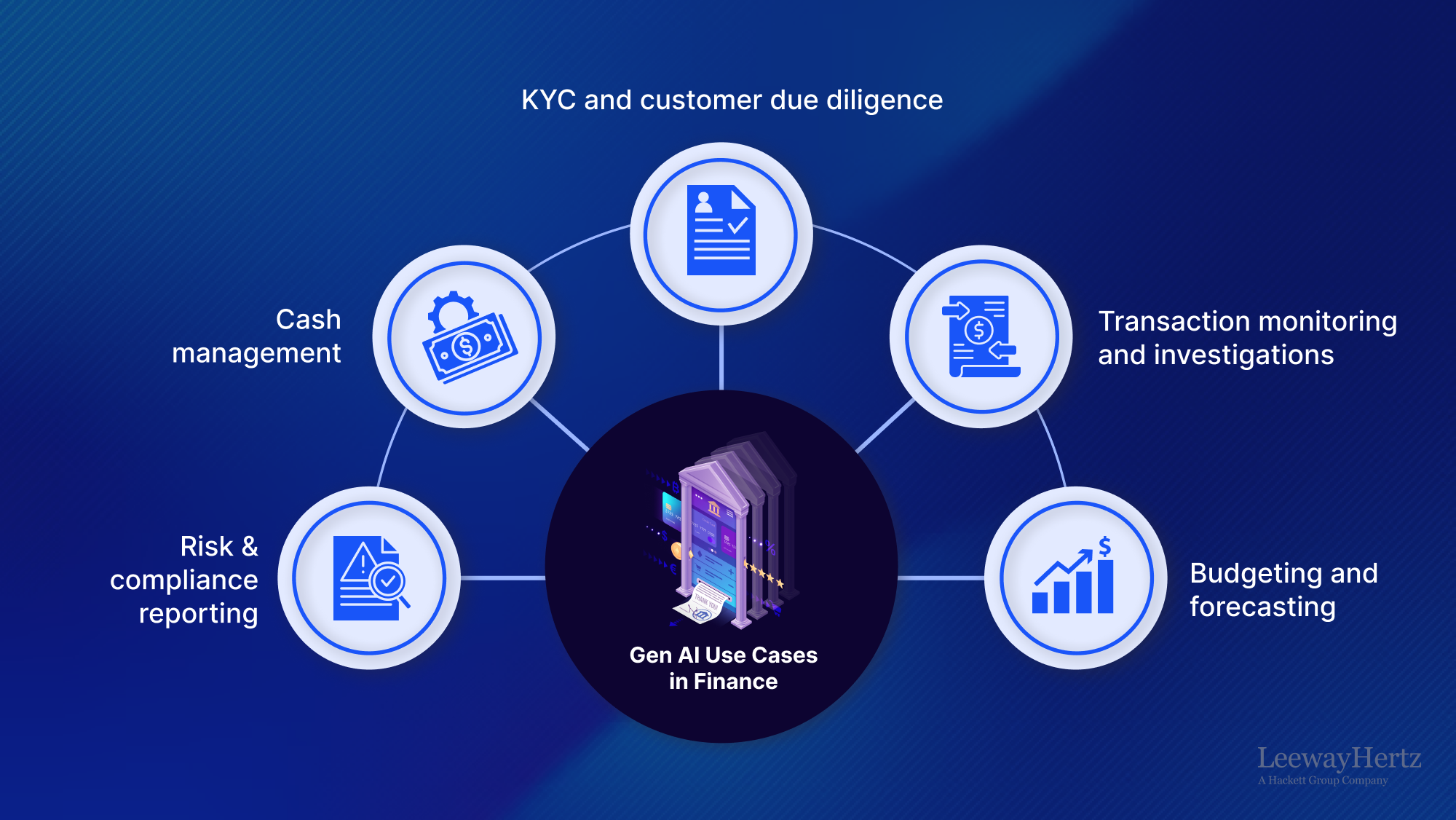
Finance operates at the intersection of data, documents, regulations, risk management, and operations. Beyond preparing financial statements, reconciling accounts, closing the period, analyzing portfolio exposures, drafting variance commentary, and reporting to regulators, finance teams aggregate, classify, interpret, and document the institution’s data every day.
These activities create the ideal environment for generative AI and agentic AI. Traditional AI has already helped finance teams predict risk, detect anomalies, automate reconciliations, and classify transactions. Generative AI expands this capability by summarizing content, interpreting documents, drafting narratives, retrieving policy guidance, explaining exceptions, and supporting human decision-making. Agentic AI goes further by coordinating multi-step workflows across systems, documents, teams, and approvals.
The value of generative AI in finance does not come from generic chatbots—it comes from embedding AI into real workflows. Whether it’s a credit analyst drafting a loan memo, a treasury team preparing cash-flow commentary, an FP&A analyst creating variance explanations, an internal auditor summarizing control testing, or a regulatory reporting analyst mapping schedules, AI must understand the workflow, the data, the policy context, and the required output.
This is why AI use cases should be mapped at the operating-model level. Instead of asking, “Where can finance use AI?”, leaders should ask, “Which function, process, and sub-process can AI improve, and what governed workflow should support it?” Mapping AI this way identifies high-value opportunities across functions and ensures that AI delivers workflow-specific value while maintaining human accountability.
Finance runs on text and numbers; it is a perfect fit for generative and agentic AI. The work that fills the day, analyzing financial statements, reviewing credit exposures, monitoring liquidity, preparing CECL narratives, reconciling accounts, or drafting variance commentary, is overwhelmingly reading, classifying, drafting, and reconciling structured documents that the institution already holds. The investment behind that work is large and growing: Gartner [1] forecasts enterprise IT spending in banking and investment services will rise to $857.5 billion in 2026, a 9.5% increase, on its way past $1.1 trillion by 2029.
The upside is well quantified. The McKinsey Global Institute [2] estimates that generative AI could add $200 billion to $340 billion annually across the global financial sector, or 2.8–4.7% of industry revenues, largely through productivity, with text-heavy areas such as regulatory reporting, risk management, FP&A, and internal controls among the strongest. The value is real, but it is realized one workflow at a time.
The frontier is agentic AI, systems that plan a task, retrieve the right context, draft an output, and route it for decision across multiple steps. Adoption is broad but still early: McKinsey’s 2025 State of AI reports[3] that agent use is most common in IT and knowledge management, with finance teams adopting steadily in risk, compliance, treasury, FP&A, and reporting workflows, while most firms remain in piloting rather than at-scale deployment. The constraint is rarely the model; it is workflow design and the controls around it.
This article demonstrates how generative and agentic AI can be applied at the operating-model level in finance. It breaks down the finance organizations’ operations into major functions, core processes, and sub-processes, and shows where generative AI can add practical, workflow-specific value. The focus is on helping organizations identify high-impact AI opportunities, integrate them into existing workflows, and maintain human accountability, rather than replacing employees.
- How generative AI is transforming financial services operations
- Why finance AI use cases must be mapped at the sub-process level
- Financial services operating model and generative AI opportunity mapping
- High-value generative AI use cases in finance
- How agentic AI works in financial services workflows
- How to prioritize generative AI use cases in finance
- Governance, risk, and responsible AI in finance
- How ZBrain operationalizes generative AI use cases in finance
- Future of generative AI in finance
How generative AI is transforming financial services operations
Financial institutions have long used analytics, rules engines, workflow automation, robotic process automation, and machine learning. These tools remain important, but generative AI introduces a new type of capability. Traditional automation follows predefined rules. Machine learning predicts, scores, detects, or classifies based on historical patterns. Generative AI can read, summarize, draft, compare, explain, and transform information, while agentic AI can plan and execute a sequence of workflow steps, such as retrieving information, classifying a case, drafting a response, routing an exception, and updating a system after human approval.
This changes how finance teams handle work that is:
- Document-heavy: financial statements, loan packages, leases, invoices, contracts, trade documents, tax forms, audit evidence.
- Narrative-heavy: credit memos, SAR narratives, regulatory commentary, variance commentary, committee packs, board updates.
- Exception-heavy: reconciliation breaks, covenant breaches, payment exceptions, chargebacks, trade settlement fails, regulatory escalations.
- Knowledge-heavy: policy interpretation, regulatory guidance, product rules, procedure manuals, FP&A assumptions, treasury guidance.
- Workflow-heavy: onboarding, underwriting, annual review, KYC refresh, regulatory reporting, dispute resolution, complaint handling.
The highest-value AI opportunities do not remove the human from the process. Instead, AI proposes, drafts, classifies, summarizes, and prepares the case, highlighting risks, evidence, and exceptions, before routing it to a named reviewer, an analyst, officer, or committee. Deterministic calculations, financial system outputs, and regulatory judgments remain with humans. The lift comes from AI accelerating document review, narrative drafting, and exception triage across finance workflows.
Generative AI has moved from novelty to default, especially in finance, where dense documents and standardized artifacts create a natural environment for AI. Agentic systems extend this capability by chaining retrieval, drafting, and routing across multi-step workflows, such as CECL commentary, variance analysis, exception reporting, or intercompany reconciliation. The operational realities now favor throughput on artifact-heavy work, turning hours of reading, summarizing, and drafting into reviewable outputs that humans can quickly validate, while preserving governance, control, and accountability.
Why finance AI use cases must be mapped at the sub-process level
In finance, generative AI can drive major improvements in efficiency and accuracy, but only when deployed within well-defined workflows. “AI in finance” is too broad to be useful. So is “AI in credit,” “AI in regulatory reporting,” or “AI in treasury.” These categories are too high-level to define data requirements, controls, approval paths, success metrics, and implementation scope.
A better approach is to map use cases to the finance operating model:
- Function: the major business or control area, such as corporate lending, commercial credit, risk management, FP&A, treasury, internal controls, or regulatory reporting.
- Process: the workflow area within that function, such as credit memo drafting, variance commentary, CECL Q-factor narrative, intercompany reconciliation, or Call Report preparation.
- Sub-process: the specific work activity, such as spreading financial statements, drafting allowance commentary, aggregating transaction evidence, preparing variance explanations, or mapping schedules.
- AI-enabled opportunity: the specific way AI can support that sub-process, such as extracting data, drafting a narrative, classifying an exception, summarizing evidence, or assembling supporting schedules.
This level of detail matters because finance workflows are tied to specific regulations, documents, systems, risk owners, and decision rights. A generative AI workflow for CECL narrative drafting is different from one for variance commentary. A credit memo drafting workflow is different from intercompany reconciliation. Treasury scenario commentary is different from audit documentation preparation.
By mapping AI opportunities at the sub-process level, finance teams can move from broad innovation ideas to executable workflows with clear business value, data requirements, governance, and implementation paths.
Transform finance workflows
Streamline investment analysis, risk management, regulatory reporting, and accounting operations with AI to boost efficiency, accuracy, and portfolio performance.
Financial services operating model and generative AI opportunity mapping
The following sections map generative AI opportunities across the operating model of a modern financial organization. Each function includes a short overview, a process and sub-process table, and a summary of the highest-value AI opportunities in that function.
Function 1: Consumer and commercial lending operations
This function serves retail and small business clients through lending and credit products. It owns credit origination, underwriting, risk assessment, and collections, and operates under consumer protection and lending regulations (Regulation E, Z, CECL). Teams include credit analysts, underwriters, portfolio managers, and collections officers.
Generative AI helps with work such as reading, drafting, classifying, and reconciling financial and customer data. Deterministic credit scoring, interest calculations, and payment posting remain with the system; AI lifts documentation drafting, portfolio monitoring, risk commentary, and exception handling, with a human reviewer confirming each outcome.
| Process | Sub-process | Key AI-enabled opportunities |
|---|---|---|
| Loan origination | Application data intake | Extract and validate borrower information, classify missing or inconsistent data, and flag exceptions for underwriter review. |
| Credit scoring support | Aggregate bureau and internal data, draft a scoring summary and propose an initial credit risk tier for analyst confirmation. | |
| Documentation generation | Draft credit memos, loan agreements, and underwriting rationale based on intake data and credit policy. | |
| Underwriting and risk assessment | Financial statement analysis | Extract key metrics from submitted statements and tax returns, flag anomalies, and draft review-ready summaries. |
| Covenant and collateral assessment | Extract and classify covenants, verify collateral documentation and draft risk commentary for officer review. | |
| Portfolio monitoring | Periodic portfolio review | Aggregate account activity, monitor credit exposures, classify potential covenant breaches and draft recommendations for portfolio manager approval. |
| Exception handling | Identify delinquent accounts or payment exceptions, classify them by severity and draft remedial action proposals. | |
| Collections | Hardship/workout assessment | Summarize borrower hardship requests, classify eligible workout options and draft a recommended treatment for the collections officer’s review. |
| Call and correspondence summarization | Summarize collections calls or correspondence, flag regulatory-sensitive issues, and draft account notes for agent review. |
Highest-value opportunities:
- Application data intake and credit scoring support, high-volume, repetitive, document-intensive tasks that can be drafted and classified for underwriter review.
- Hardship/workout assessment, high-leverage on risk management, turning intake documents into reviewable recommendations.
Example agentic workflow: An incoming loan application is processed by AI, which extracts borrower and financial data, drafts a credit memo with risk assessment, classifies potential covenant or documentation exceptions, and routes the package to the underwriter. The underwriter confirms the scoring, approves or modifies recommendations, and finalizes the decision. AI handles drafting and summarization; judgment remains with the human reviewer.
Function 2: Commercial lending operations
This function serves business clients through credit products. It owns commercial credit origination, underwriting, covenant monitoring, portfolio management, and annual reviews. Teams include credit analysts, relationship managers, and portfolio officers.
Generative AI helps with work that involves reading, drafting, classifying, and reconciling business financial data and documentation. Credit decisions remain with the officer; AI handles extraction, narrative drafting, and monitoring to enable faster review.
| Process | Sub-process | Key AI-enabled opportunities |
|---|---|---|
| Commercial credit origination | Financial statement spreading | Extract line items from borrower financial statements and tax returns, classify into the spreading template, and flag inconsistencies for analyst review. |
| Credit memo drafting | Draft a credit memo narrative from spread financials and relationship data, summarize risks and mitigants, and propose a borrower risk rating for the officer’s decision. | |
| Covenant identification | Extract financial and affirmative covenants from agreements, classify type/frequency, and draft a monitoring schedule for analyst confirmation. | |
| Portfolio monitoring and annual review | Annual review preparation | Aggregate updated financials, covenant compliance, and account activity into an annual-review draft, flag rating-migration triggers, and route for officer validation. |
| Covenant-breach analysis | Detect covenant breaches, summarize the breach and cure options, and draft a recommendation for review. | |
| Risk & exposure monitoring | Credit exposure analysis | Aggregate portfolio exposures, identify high-risk accounts, and draft a summary for risk officer review. |
| Exception reporting | Identify late payments, covenant deviations, or financial anomalies, classify severity, and draft recommendations for remediation. |
Highest-value opportunities:
- Financial statement spreading and credit memo drafting are document-intensive, repetitive, and directly support underwriting and risk assessment.
- Covenant identification and annual review preparation, ensure timely monitoring and compliance with lending covenants.
Example agentic workflow: AI processes a new commercial credit application, which spreads financial statements, drafts the credit memo, extracts covenant requirements, and flags exceptions. The credit officer reviews and approves recommendations, adjusts risk rating if necessary, and finalizes the decision. AI handles data extraction and narrative drafting, while humans make the judgment call.
Function 3: Corporate lending and credit operations
This function manages credit for corporate and institutional clients, focusing on internal credit assessment, risk evaluation, and documentation. Teams include corporate credit analysts, relationship managers, and portfolio officers.
Generative AI helps with work that involves reading, drafting, classifying, and reconciling financial and corporate data. Key decisions about approvals, credit limits, and portfolio exposure remain with the officer; AI lifts the burden of narrative drafting, financial analysis summaries, and exception reporting for faster review.
| Process | Sub-process | Key AI-enabled opportunities |
|---|---|---|
| Corporate credit origination | Financial statement analysis | Extract and classify line items from corporate financial statements and tax returns, flag inconsistencies, and draft review-ready summaries. |
| Credit memo drafting | Draft credit memo narrative summarizing risks, mitigants, and the proposed credit decision. | |
| Covenant assessment | Extract financial and affirmative covenants from agreements, classify type/frequency, and draft a monitoring schedule for analyst confirmation. | |
| Portfolio monitoring | Exposure aggregation | Aggregate corporate account exposures, identify high-risk clients, and draft a risk summary for portfolio review. |
| Exception reporting | Identify payment delays, covenant breaches, or financial anomalies, classify severity, and draft recommendations for remediation. | |
| Due diligence and documentation | Contract and agreement review | Summarize key terms and clauses from submitted agreements, classify risk points and draft exception or approval notes for review. |
| Financial-data synthesis | Summarize third-party or internal financial data relevant for ongoing credit risk analysis and reporting. |
Highest-value opportunities:
- Financial statement analysis and credit memo drafting, high-volume, repetitive, document-intensive, directly supporting corporate credit decisions.
- Covenant assessment and exposure aggregation ensure timely monitoring and compliance with credit agreements.
Example agentic workflow: A new corporate loan request is processed by AI, which extracts financial statements, drafts the credit memo with risk assessment, classifies covenant compliance, and flags any exceptions. The corporate credit officer reviews and approves recommendations, adjusts risk rating if necessary, and finalizes the decision. AI handles extraction, classification, and drafting; human judgment remains in all approval decisions.
Function 4: Market risk and finance operations
This function focuses on internal finance oversight of market risk, reconciliations, and reporting related to trading and investment activities. Teams include finance analysts, risk officers, and compliance reviewers.
Generative AI helps summarize market data, reconcile positions, and draft internal reports, while trading decisions remain with front-office staff. AI supports data extraction, reconciliation, exception reporting, and narrative drafting.
| Process | Sub-process | Key AI-enabled opportunities |
|---|---|---|
| Market research and intelligence | Research-note summarization | Summarize internal and external research for finance/risk reports, classify by sector/asset class, and draft desk-ready briefs for analyst review. |
| Earnings and filing extraction | Extract key figures from earnings releases and SEC filings, classify variances against expectations and draft internal summaries for finance reporting. | |
| Trade reconciliation and settlement review | Trade-break investigation | Reconcile trade and settlement records, classify break causes and draft resolution recommendations for finance review. |
| Confirmation/affirmation drafting | Review trade confirmations, flag discrepancies, and draft exception notes for finance or risk teams. | |
| Exception and claim reporting | Settlement failed, and the claim narrative | Summarize settlement fails and interest-claim details, classify by account or counterparty, and draft a narrative for internal reporting. |
| Market risk monitoring | Communications/alert review | Summarize flagged communications or market alerts, classify risk scenarios, and draft internal commentary for finance/risk compliance. |
| Market-abuse alert triage | Summarize market-abuse alerts with data context, classify likely impact and propose disposition for risk officer review. |
Highest-value opportunities:
- Trade-break investigation and market-abuse alert triage, high-volume, exception-heavy tasks suitable for AI draft and classification.
- Research-note summarization reduces repetitive data review and improves reporting speed for finance teams.
Example agentic workflow: AI aggregates internal and external research, extracts trade and settlement exceptions, drafts reconciliations and alert summaries, and presents these to finance/risk officers. The officers confirm recommendations, approve narratives, and escalate issues as needed. AI handles extraction, classification, and drafting while judgment and approvals remain human.
Function 5: Portfolio operations and reporting
This function manages internal finance activities related to portfolio management, reconciliation, performance reporting, and research synthesis. Teams include portfolio operations analysts, research analysts, and internal finance reviewers.
Generative AI helps with aggregating, summarizing, and drafting portfolio reports and reconciliations. Investment decisions remain with the portfolio manager; AI handles repetitive tasks, narrative drafting, and data aggregation for faster review.
| Process | Sub-process | Key AI-enabled opportunities |
|---|---|---|
| Portfolio operations | Performance commentary drafting | Draft client portfolio performance commentary from holdings and benchmark data, flag attribution drivers, and route narrative for internal review. |
| Reconciliation-exception handling | Reconcile custodian and book positions, classify breaks by type, and draft correction proposals for review. | |
| Meeting-preparation summary | Aggregate account activity, holdings, and prior notes into a review brief, flag key points, and present for internal validation. | |
| Corporate actions processing | Summarize corporate-action notices, classify mandatory vs. voluntary events and key dates, and draft an election summary for analyst decision. | |
| Valuation and pricing review | Identify stale or outlier prices against sources, classify pricing exceptions, and draft the valuation-exception narrative for review. | |
| Guideline and mandate compliance monitoring | Detect potential investment guidelines or limit breaches, classify by type and severity, and draft a breach narrative for the portfolio manager to confirm. | |
| Research support | Research-document synthesis | Summarize fund and security research, classify by mandate fit, and draft research brief for internal review. |
| Manager due diligence drafting | Extract terms and performance metrics from manager materials, classify against the checklist, and draft review notes for analysts. | |
| Reporting | Client and regulatory report production | Aggregate holdings and performance into client review packs and regulatory portfolio schedules, flag key points, and draft supporting narrative for analyst validation. |
Highest-value opportunities:
- Performance commentary drafting and meeting-preparation summaries, high-volume, repetitive, and data-intensive tasks that AI can draft for reviewer confirmation.
- Research-document synthesis reduces the time analysts spend compiling and summarizing research data.
Example agentic workflow: AI aggregates portfolio holdings, reconciles positions, drafts performance commentary and a review brief, and summarizes research documents. Portfolio operations analysts review the drafts, validate exceptions, and finalize the reporting. AI handles extraction, classification, and drafting and all approvals and judgments remain with humans.
Function 6: Treasury and internal cash management
This function focuses on internal finance oversight of cash, liquidity, and reconciliation for business and corporate clients. Teams include treasury analysts, finance operations staff, and internal risk reviewers.
Generative AI helps aggregate transaction data, reconcile accounts, and draft exception summaries. Deterministic payment posting is handled by systems; AI handles exception narrative, reconciliation summaries, and reporting for faster review.
| Process | Sub-process | Key AI-enabled opportunities |
|---|---|---|
| Cash management | Cash-flow monitoring | Aggregate internal account activity, classify unusual flows, and draft a summary for the finance officer review. |
| Reconciliation of inflows/outflows | Reconcile bank and ledger records, flag mismatches, and draft correction proposals for treasury review. | |
| Bank-statement intake and unreconciled-items aging | Ingest internal bank statements, classify and age unreconciled items, and draft an aging summary for the finance officer review. | |
| Nostro/correspondent reconciliation | Reconcile nostro balances against correspondent statements, classify breaks by cause, and draft correction proposals for treasury review. | |
| Exception handling | Payment investigation review | Summarize internal payment anomalies, classify exceptions by type/severity, and draft a recommended resolution for finance approval. |
| Recall/return summary | Draft internal recall and return summaries for review, and validate against accounting rules. | |
| Payment-fraud anomaly review | Summarize unusual, duplicate, or out-of-pattern internal transfers, classify by risk, and draft an escalation note for finance review. | |
| Risk & compliance reporting | Sanctions and regulatory screening | Summarize internal payment alerts, classify against risk or compliance criteria, and draft internal disposition notes. |
| Bank fee and charge verification | Extract charged bank and correspondent fees, classify against expected schedules, flag discrepancies, and draft a query note for review. |
Highest-value opportunities:
- Cash-flow monitoring and reconciliation of inflows/outflows, high-volume, repetitive, and data-intensive tasks suitable for AI drafting.
- Payment investigation review reduces analyst time in summarizing exceptions and reconciling records.
Example agentic workflow: AI aggregates internal transaction data, identifies and classifies cash-flow anomalies, drafts reconciliation reports, and summarizes exception investigations. Treasury or finance analysts review drafts, validate corrections, and approve reporting. AI handles drafting, summarization, and classification; human judgment remains for approvals.
Function 7. Risk management
This function measures and controls credit, market, liquidity, and operational risk across the institution. It owns credit risk and allowance, market and liquidity risk, and model risk management, under US supervisory frameworks such as SR 11-7 for model risk and CECL for credit-loss accounting. The teams here are risk analysts, ALCO support, and model-validation staff.
Generative AI helps with risk work that involves narrative drafting and document review over the institution’s own data and models: drafting allowance and scenario commentary, summarizing validation evidence, and aggregating loss data. The institution already runs the deterministic models and calculations; AI lifts the commentary, documentation, and exception narrative, not the computation.
| Process | Sub-process | Key AI-enabled opportunities |
|---|---|---|
| Credit risk and allowance | CECL Q-factor narrative drafting | Draft the CECL qualitative-factor (Q-factor) narrative from portfolio and macroeconomic inputs, summarize the drivers of the allowance change, and route it for the credit-risk committee to validate. |
| ALLL roll-forward commentary | Summarize the allowance roll-forward, classify movement drivers, and draft the commentary for risk-reporting review, leaving the deterministic roll-forward calculation unchanged. | |
| Market and liquidity risk | IRRBB EVE and NII commentary | Draft interest-rate-risk-in-the-banking-book commentary on economic value of equity (EVE) and net interest income (NII) movements from the risk engine output, flag limit exceptions, and route it for the ALCO review. |
| Limit-breach narrative | Summarize market and liquidity limit breaches, classify them by driver, and draft the breach memo for the risk officer to confirm. | |
| Model risk management | Model-documentation review | Summarize and check model documentation against SR 11-7 expectations, classify gaps, and draft a validation-finding list for the model-validation reviewer. |
| Validation-evidence summarization | Aggregate back-testing and benchmarking evidence, summarize results against thresholds, and draft the validation conclusion for the validator to decide. |
Highest-value opportunities:
- CECL Q-factor narrative drafting and IRRBB EVE and NII commentary, recurring, high-effort writing tasks built on outputs the risk engines already produce, where AI drafts the narrative and the committee retains the judgment.
- Model-documentation review, high-leverage for SR 11-7 compliance, structuring validation reading into a reviewable list of findings.
Example agentic workflow. An example agentic workflow is allowance reporting: when the period closes, the workflow ingests the deterministic CECL outputs, drafts the Q-factor narrative and roll-forward commentary, flags the drivers of change, and presents the package to the credit-risk committee, who adjust the qualitative judgments and approve before the allowance is finalized.
Function 8. Financial crime and compliance
This function protects the institution against money laundering, sanctions violations, and fraud, and it manages regulatory compliance. It owns KYC and customer due diligence, transaction monitoring and investigations, sanctions screening, and fraud operations, under the BSA/AML regime and FinCEN requirements. The teams here are KYC analysts, AML investigators, sanctions analysts, and fraud operations.
Generative AI supports tasks that involve reading, summarizing, and drafting existing case materials, such as due diligence files, alert evidence, and investigation narratives. These opportunities are strictly defensive: AI handles the data aggregation and narrative drafting, while all filing, regulatory decisions, and final judgment remain with the analyst.
| Process | Sub-process | Key AI-enabled opportunities |
|---|---|---|
| KYC and customer due diligence | CDD and EDD document review | Extract and verify ownership and source-of-funds evidence for customer and enhanced due diligence, classify risk indicators, and draft the due-diligence summary for the KYC analyst to decide. |
| Periodic-review refresh | Aggregate updated KYC data for a periodic review, classify changes against the risk rating, and draft the refresh recommendation for analyst confirmation. | |
| Negative-news adjudication support | Summarize adverse-media hits, classify relevance and severity to the customer, and draft an adjudication rationale for the KYC analyst to confirm. | |
| Transaction monitoring and investigations | AML alert triage | Summarize transaction-monitoring alerts with customer and activity context, classify likely typologies, and propose a close or escalate disposition for the AML investigator. |
| SAR Part V narrative drafting | Draft the FinCEN SAR Part V narrative from the investigation evidence, summarize the who, what, when, where, and why, and route it for the BSA officer to review before filing. | |
| Case-evidence aggregation | Aggregate transactions, KYC, and prior cases into a structured investigation file, classify the supporting evidence, and present it for investigator review. | |
| Sanctions screening | Name-screening disambiguation | Summarize screening hits with available identifiers for OFAC SDN disambiguation, classify true versus false match likelihood, and present the case for sanctions-analyst disposition before any block. |
| Sanctions-list change analysis | Summarize OFAC and sanctions-list updates, classify affected customers and payments, and draft an impact note for the sanctions team. | |
| Fraud operations | Fraud-case summarization | Summarize fraud-case signals and customer contact, classify the fraud type, and draft a recommended action for the fraud analyst to confirm. |
| Dispute-and-fraud correspondence | Draft customer and network correspondence for fraud cases from the case record, validate against procedure, and route the draft for analyst review. |
Highest-value opportunities:
- Targets high-volume, labor-intensive parts of the BSA/AML workflow, where AI structures evidence and drafts alerts while the BSA officer retains the filing decision.
- Automates narrative writing for suspicious activity reports, allowing the analyst to review and confirm before submission.
- High leverage for sanctions risk, turning OFAC match noise into structured, reviewable cases for analyst decision-making.
Example agentic workflow. An example agentic workflow is AML investigation: an alert fires, the workflow aggregates the customer, transaction, and prior-case evidence, classifies the likely typology, drafts a disposition and, where warranted, a SAR Part V narrative, and presents the file to the investigator and BSA officer, who decide whether to close or file before any submission.
Function 9. Finance and regulatory reporting
This function runs the institution’s books, closes the period, and produces regulatory and external reports. It owns the accounting close, regulatory reporting to supervisors, and treasury and capital reporting, under US GAAP, SEC requirements, and FFIEC and Federal Reserve report instructions. The teams here are controllers, regulatory reporting analysts and treasury reporting staff.
Generative AI supports reconciliation, mapping, and narrative drafting using financial data from ledgers, transaction records, and reporting schedules. While the system provides the source numbers, AI prepares reconciliation explanations, maps balances to reporting schedules, and drafts disclosure narratives, with the controller and reporting analyst retaining review and approval responsibility.
| Process | Sub-process | Key AI-enabled opportunities |
|---|---|---|
| Accounting close | Reconciliation-exception explanation | Reconcile account balances, classify and explain reconciling items, and draft the exception narrative for the controller to review. |
| Journal-entry support drafting | Draft supporting narratives for manual journal entries from the underlying evidence, classify them by type, and route the support for accounting review. | |
| Flux and variance commentary | Draft month-over-month flux and variance commentary from the trial balance, flag unusual movements, and present the commentary for controller confirmation. | |
| Multi-entity consolidation support | Reconcile intercompany eliminations, classify and explain consolidation adjustments and FX-translation differences, and draft the consolidation review note for the controller to confirm. | |
| Equity pickup and minority-interest commentary | Summarize equity-method and non-controlling-interest movements, classify drivers, and draft the supporting narrative for accounting review. | |
| Regulatory reporting | FFIEC Call Report schedule mapping | Map general-ledger balances to FFIEC Call Report schedules, classify and flag edit-check exceptions, and draft the variance explanation for the reporting analyst to validate. |
| FR Y-9C and Y-14 schedule support | Aggregate and map data to FR Y-9C and Y-14 schedules, classify discrepancies against prior periods, and draft the supporting commentary for regulatory-reporting review. | |
| Report-instruction interpretation | Summarize regulatory report-instruction updates, classify the affected schedules, and draft an impact note for the reporting team. | |
| Treasury and capital reporting | Capital and liquidity disclosure drafting | Draft capital adequacy and liquidity disclosure narratives from the deterministic ratio outputs, flag period-over-period drivers, and route the draft for treasury review. |
Highest-value opportunities:
- Automates ledger-to-report mapping and edit-check resolution, enabling fast, reviewable outputs for analyst sign-off.
- Drafts exception narratives from ledger discrepancies, streamlining the close process.
- Converts trial balance movements into structured, reviewable narratives for controllers and analysts.
Example agentic workflow. An example agentic workflow is regulatory report preparation: At the close of the accounting period, the workflow maps the ledger to the FFIEC Call Report schedules, runs edit checks, classifies exceptions, drafts variance explanations, and presents the schedule package to the reporting analyst, who resolves exceptions and validates it before filing.
Accelerate AI Solutions Development
Build fully functional solutions from your high-value use cases, based on specific operational needs and enterprise context.
Function 10: Corporate treasury and liquidity management
This function manages the institution’s internal cash, liquidity, funding, and short-term investments. Teams include treasury analysts, finance operations staff, and risk reviewers.
Generative AI helps aggregate, reconcile, and report cash and liquidity data. Deterministic processing remains with treasury systems; AI handles narrative drafting, exception summaries, and scenario commentary.
| Process | Sub-process | Key AI-enabled opportunities |
|---|---|---|
| Intercompany reconciliation | (Same as Process) | Reconcile intercompany balances, classify and summarize mismatches, and draft correction proposals for treasury confirmation. |
| Cash-flow management | Daily cash monitoring | Aggregate internal account activity, classify unusual flows and draft a summary for treasury review. |
| Forecasting and scenario planning | Draft rolling forecasts, model liquidity scenarios and summarize impacts for management review. | |
| Funding and investment management | Funding and debt summary | Aggregate funding positions and maturity ladders, draft issuance and rollover summaries, and flag concentration or rollover risk for treasury review. |
| Short-term investment review | Summarize the short-term investment portfolio, classify holdings against investment-policy limits, and draft a position summary for review. | |
| Reconciliation | Intercompany reconciliation | Reconcile intercompany balances, classify mismatches, and draft correction proposals for review. |
| Payment exceptions review | Summarize delayed or failed internal transfers, classify by severity, and draft remediation suggestions. | |
| Liquidity reporting | Liquidity commentary drafting | Draft narratives on liquidity positions, funding gaps, and stress-test results for internal reporting. |
| Collateral management | Collateral and margin review | Summarize collateral positions and margin calls, classify by counterparty, and draft a reconciliation or exception note for review. |
Highest-value opportunities:
- AI aggregates and classifies cash positions, highlighting variances for treasury review.
- Drafts reconciliation narratives for cross-entity balances, allowing finance officers to confirm exceptions.
- Summarizes liquidity positions and key drivers, providing structured insights while maintaining human approval authority.
Example agentic workflow: An example agentic workflow is cash-flow reporting: AI aggregates cash positions across accounts, reconciles intercompany transfers, flags unusual movements, drafts liquidity commentary and scenario summaries, and presents the package to the treasury analyst, who confirms and approves before final internal reporting.
Function 11: Financial planning & analysis (FP&A)
This function covers budgeting, forecasting, variance analysis, scenario planning, and management reporting. Teams include FP&A analysts and finance managers.
Generative AI helps summarize data, draft commentary, and prepare reports. Deterministic calculations remain with planning systems; AI lifts narrative drafting and report aggregation.
| Process | Sub-process | Key AI-enabled opportunities |
|---|---|---|
| Budgeting and forecasting | Rolling forecast drafting | Aggregate actuals and assumptions, classify deviations, and draft rolling forecast reports for management. |
| Scenario analysis | Summarize multiple planning scenarios, classify impact by KPI, and draft recommendations. | |
| Driver and assumption analysis | Summarize and compare key forecast drivers and assumptions, classify sensitivity, and draft an assumptions note for manager review. | |
| Variance analysis | Month-end variance commentary | Draft explanations for actual vs budget/forecast, classify unusual items, and route for manager review. |
| Profitability and cost analysis | Aggregate revenue and cost by segment or business line, classify margin drivers, and draft profitability commentary for review. | |
| Planning support | Capex and business-case review | Summarize investment business cases, classify against return thresholds, and draft a review note for finance leadership. |
| Budget consolidation | Aggregate multiple department budgets, reconcile totals, and draft summary notes for CFO review. | |
| Reporting | Management report preparation | Aggregate KPIs, financial metrics, and commentary, draft executive report ready for approval. |
| Board and executive narrative | Draft board-deck narrative and key-message summaries from the management pack, flag talking points, and route for finance-manager review. |
Highest-value opportunities:
- AI drafts period-over-period narratives on revenue, expenses, and balance-sheet movements, leaving final judgment to finance managers.
- Generates structured forward-looking financial narratives for review, enabling finance teams to focus on validation and decision-making.
Example agentic workflow. An example agentic workflow is month-end variance reporting: AI ingests actuals and budgets, identifies key variances, drafts narrative explanations and highlights trends, and presents the report to the FP&A manager, who reviews and approves before inclusion in the management pack.
Function 12: Tax and statutory reporting
This function handles corporate, indirect, and statutory tax reporting. Teams include tax analysts and compliance staff.
Generative AI helps with work that involves extracting tax data, reconciling schedules, and drafting commentary. Deterministic calculations remain system-driven; AI drafts explanations, reconciliations, and compliance notes.
| Process | Sub-process | Key AI-enabled opportunities |
|---|---|---|
| Corporate tax reporting | Tax schedule preparation | Extract tax data from ledgers, classify line items, and draft schedules for review. |
| Tax provision commentary drafting | Draft explanations for adjustments, classify variance drivers, and route for tax review. | |
| Provision and deferred-tax support | Aggregate book-tax differences, classify temporary vs. permanent items, and draft the deferred-tax and effective-tax-rate reconciliation for tax review. | |
| Indirect tax reporting | VAT/GST reconciliation | Aggregate transaction data, classify discrepancies, and draft reconciliation commentary. |
| Withholding and information reporting | Reconcile withholding on customer and investor payments, classify reportable items, and draft information-return support (e.g., 1099/1042-S, FATCA/CRS) for review. | |
| Statutory reporting | Statutory filing review | Summarize statutory accounts, classify deviations from local rules, and draft explanatory notes for approval. |
| Transfer-pricing documentation | Summarize intercompany transactions, classify them against the transfer-pricing policy, and draft a local-file documentation narrative for review. | |
| Compliance monitoring | Regulatory update impact assessment | Summarize new tax regulations, classify affected accounts and draft impact notes for finance/tax teams. |
| Tax-authority correspondence support | Summarize a tax-authority query, aggregate supporting evidence, and draft a response for tax-team review and approval. |
Highest-value opportunities:
- AI drafts tax schedules, summarizing period-specific amounts for review by tax analysts.
- Automates the reconciliation of indirect taxes, producing reviewable outputs while maintaining compliance oversight.
Example agentic workflow: An example agentic workflow is corporate tax preparation: AI extracts relevant ledger entries, maps them to schedules, drafts reconciliation and commentary notes, flags any anomalies, and presents the package to the tax analyst for review and approval before submission.
Function 13: Internal controls and audit support
This function ensures compliance with internal finance policies and supports internal/external audits. Teams include internal auditors and control analysts.
Generative AI helps with document review, control testing, and exception narrative drafting. AI assists in summarizing control results and preparing audit-ready commentary, while final judgment remains with auditors.
| Process | Sub-process | Key AI-enabled opportunities |
|---|---|---|
| Control monitoring | Control testing support | Summarize testing results, classify control failures, and draft exception narratives for review. |
| Policy compliance review | Review adherence to finance policies, flag deviations, and draft internal commentary. | |
| Audit preparation | Audit documentation drafting | Aggregate evidence, classify issues, and draft workpapers and audit summaries for internal/external auditors. |
| Issue management | Remediation tracking | Summarize open audit issues, track remediation progress, and draft status updates for management. |
| Exception reporting | Control exceptions reporting | Aggregate exception data, classify by severity, draft recommendation notes for finance leadership. |
Highest-value opportunities:
- AI structures and summarizes control-testing evidence, enabling auditors to focus on review and judgment.
- Drafts workpapers and audit summaries from collected evidence, leaving final sign-off to auditors.
Example agentic workflow: An example agentic workflow is audit-preparation support: AI aggregates control-testing evidence, summarizes exceptions, drafts workpapers and audit summaries, and presents them to the internal auditor, who confirms findings, validates conclusions, and approves documentation.
Function 14: Accounts payable and receivable operations
This function manages the institution’s own procure-to-pay and order-to-cash cycles, including invoice processing, payment preparation, customer billing, and collections of operational receivables. Teams include AP/AR analysts, finance operations staff, and controllers.
Generative AI helps with reading invoices and remittances, matching documents, classifying exceptions, and drafting correspondence. Deterministic payment execution and posting remain with the ERP/payment systems; AI lifts extraction, matching narrative, and exception drafting for analyst review.
| Process | Sub-process | Key AI-enabled opportunities |
|---|---|---|
| Accounts payable | Invoice intake and coding | Extract invoice header and line data, classify against GL codes and purchase orders, and flag missing or inconsistent fields for analyst review. |
| Three-way match and exception handling | Reconcile invoice, PO, and goods-receipt records, classify match breaks by type, and draft a resolution proposal for AP review. | |
| Accounts receivable | Billing and remittance reconciliation | Reconcile customer payments against open invoices, classify short-pays and unapplied cash, and draft correction proposals for review. |
| Collections correspondence drafting | Summarize aged receivables and prior contact, classify accounts by collection priority, and draft dunning correspondence for analyst review. |
Highest-value opportunities:
- AI extracts invoice header and line data, flags missing or inconsistent fields, and drafts structured records for analyst review.
- Reconciles invoice, purchase order, and goods-receipt records, classifies match breaks, and drafts resolution proposals.
- Summarizes aged receivables and prior contacts, classifies accounts by priority, and drafts dunning correspondence for finance analyst review.
Example agentic workflow: An example agentic workflow is AP/AR exception support: AI ingests invoices and remittance advices, extracts line-item and header data, reconciles invoices against POs and goods-receipt records, classifies match breaks or unapplied cash, drafts resolution proposals or dunning correspondence, and presents them to the AP/AR analyst, who confirms exceptions, approves corrections, and authorizes further action.
Function 15: Regulatory change management
This function provides horizon-scanning and impact assessment across the institution, tracking new and amended rules from supervisors and translating them into changes to obligations, controls, reports, and policies. Teams include regulatory change analysts, compliance officers, and policy owners.
Generative AI helps with reading regulatory text, summarizing changes, classifying which obligations and processes are affected, and drafting impact notes. Final interpretation and the decision to change a control or filing remain with compliance and the relevant process owner; AI lifts the burden of reading, mapping, and drafting.
| Process | Sub-process | Key AI-enabled opportunities |
|---|---|---|
| Regulatory horizon scanning | Rule-change identification | Summarize new and amended rules, guidance, and enforcement actions, classify by topic and business line, and draft an alert for the change team. |
| Obligation mapping | Map a regulatory change to affected internal obligations, controls, reports, and policies, classify the degree of impact, and draft a mapping note for review. | |
| Impact assessment | Change-impact drafting | Draft an impact assessment summarizing required actions, affected schedules or customers, and timelines, and route it for compliance validation. |
| Implementation tracking | Remediation and attestation tracking | Summarize open change items, track implementation progress against deadlines, and draft status updates for the compliance committee. |
Highest-value opportunities:
- AI summarizes new and amended rules, guidance, and enforcement actions for the change team, highlighting relevant business lines.
- Maps regulatory changes to internal obligations, controls, reports, and policies, classifying the degree of impact and drafting mapping notes for review.
- Drafts impact assessments summarizing required actions, affected schedules or customers, and timelines while compliance officers validate and approve.
Example agentic workflow: Regulatory change intake and mapping: AI ingests new and amended rules, guidance, and enforcement notices, summarizes the content, classifies affected obligations, controls, reports, and policies, drafts a regulatory mapping note, and prepares an initial impact assessment. The compliance officer or process owner then reviews the draft, confirms required actions, validates timelines, and approves any changes to controls, filings, or reports.
Function 16: Operational risk management
This function identifies, assesses, and monitors operational risk, losses from inadequate or failed processes, people, systems, or external events. Teams include operational risk analysts, control owners, and risk committee support.
Generative AI helps with drafting risk and control assessments, capturing loss-event narratives, and summarizing indicator movements over the institution’s own data. The risk appetite, ratings, and acceptance decisions remain with the risk owner; AI lifts the narrative and classification work.
| Process | Sub-process | Key AI-enabled opportunities |
|---|---|---|
| Risk and control assessment | RCSA drafting support | Aggregate process, risk, and control data, classify residual-risk drivers, and draft the risk-and-control self-assessment narrative for the control owner to confirm. |
| Loss data management | Loss-event narrative capture | Summarize an operational-loss event from source records, classify by Basel event type and cause, and draft the loss-data entry for review. |
| Risk monitoring | KRI commentary drafting | Summarize key-risk-indicator movements against thresholds, classify breach drivers, and draft commentary for the risk committee. |
| Issue and event management | Control-issue write-up | Aggregate control failures and near-misses, classify by severity and theme, and draft a remediation recommendation for the risk owner. |
Highest-value opportunities:
- AI aggregates process, risk, and control data, classifies residual-risk drivers, and drafts the risk-and-control self-assessment narrative for review by the control owner.
- Summarizes operational-loss events from source records, classifies by Basel event type and cause, and drafts loss-data entries for analyst review.
- Summarizes key-risk-indicator movements against thresholds, classifies breach drivers, and drafts commentary for the risk committee while retaining final judgment with the operational risk owner.
Example agentic workflow: An example agentic workflow is operational risk reporting support: AI aggregates process, risk, and control data, classifies residual-risk drivers, drafts the RCSA narrative, captures loss-event details from source records, and summarizes KRI movements. The control owner or risk committee then reviews the draft, confirms risk ratings, validates findings, and approves remediation recommendations.
Function 17: Complaints management
This function receives, investigates, and resolves customer complaints, and reports complaint data to management and regulators, with direct supervisory weight (e.g., CFPB expectations). Teams include complaints analysts, resolution officers, and compliance reviewers.
Generative AI helps summarize complaint intake, classify issues, identify root causes, and draft responses. The resolution, redress, and regulatory-reportability decisions remain with the analyst; AI lifts the reading, classification, and drafting.
| Process | Sub-process | Key AI-enabled opportunities |
|---|---|---|
| Intake and triage | Complaint classification | Summarize complaint intake across channels, classify by product, issue type, and severity, and route to the right queue for analyst confirmation. |
| Investigation | Root-cause summarization | Aggregate account, transaction, and prior-contact evidence, classify the likely root cause, and draft an investigation summary for review. |
| Resolution | Response drafting | Draft the customer response and any redress rationale from the case record, validate against procedure and regulatory expectations, and route for officer review. |
| Reporting and themes | Trend and theme analysis | Aggregate complaint data, classify emerging themes and systemic issues, and draft a thematic report for compliance and management. |
Highest-value opportunities:
- AI summarizes complaint intake across channels, classifies by product, issue type, and severity, and routes to the correct queue for analyst review.
- Aggregates account, transaction, and prior-contact evidence, classifies likely root causes, and drafts investigation summaries for review.
- Drafts customer responses and redress rationale from the case record, validating against procedures and regulatory expectations while the complaints analyst retains final decision-making authority.
Example agentic workflow: complaint intake and resolution support: AI ingests complaint submissions across channels, summarizes intake information, classifies complaints by product, issue type, and severity, and drafts an investigation summary. It also proposes a customer response with a rationale for redress. The complaints analyst or resolution officer then reviews the summaries, confirms root causes, validates any redress decisions, and approves the response before customer communication or regulatory filing.
High-value generative AI use cases in finance
Across the operating model, a recurring pattern marks the highest-value opportunities: they sit at high-volume entry points, they run over artifacts the institution already produces, and they end in a fast human confirmation rather than an unreviewed action that moves money or files with a regulator. The table below names the strongest use cases by function and why each earns priority.
A use case earns the label high-value when its economic story is obvious, and its review boundary is clean. The opposite pattern, broad automation with diffuse benefit and no clear owner, is where finance AI programs stall. The prioritization section below makes that selection explicit.
| Use case | Function | Why it matters (benefit-centric) |
|---|---|---|
| Credit memo drafting | Commercial lending operations | Speeds underwriting by compressing hours of document review into a concise draft for faster credit decisions. |
| Financial statement spreading | Commercial lending operations | Accelerates credit analysis by transforming manual data extraction into review-ready financial summaries. |
| Corporate credit exposure monitoring | Corporate lending and credit operations | Enhances risk oversight by highlighting high-risk accounts and exceptions efficiently. |
| CECL Q-factor and ALLL roll-forward commentary | Risk management | Reduces time on recurring narrative preparation, enabling faster and more accurate committee review. |
| IRRBB EVE and NII commentary | Risk management | Improves committee efficiency by summarizing high-volume interest-rate risk narratives while preserving judgment. |
| FFIEC Call Report schedule mapping | Finance and regulatory reporting | Shortens regulatory reporting cycles by providing review-ready, mapped schedules for analyst sign-off. |
| Flux and variance commentary | Finance and regulatory reporting | Saves analysts’ time by automatically converting ledger differences into clear narrative explanations. |
| Rolling forecast drafting | FP&A | Speeds planning cycles by consolidating data and producing draft forecasts for management review. |
| Month-end variance commentary | FP&A | Reduces repetitive reporting work while ensuring timely explanations of budget vs actual deviations. |
| Cash-flow monitoring | Treasury and liquidity management | Increases treasury efficiency by flagging anomalies and providing concise cash summaries. |
| Intercompany reconciliation | Treasury and liquidity management | Cuts manual reconciliation time and improves accuracy of intercompany reporting. |
| Liquidity commentary drafting | Treasury and liquidity management | Enables faster scenario reporting and informed decision-making through summarized liquidity narratives. |
| Tax schedule preparation | Tax and statutory reporting | Improves compliance and reduces errors by consolidating tax data and drafting reconciliations. |
| VAT/GST reconciliation | Tax and statutory reporting | Enhances accuracy and efficiency in tax compliance through automated transaction classification and commentary. |
| Control testing support | Internal controls and audit support | Speeds audit preparation and ensures consistent documentation of control testing results. |
| Audit documentation drafting | Internal controls and audit support | Reduces manual work and accelerates audit readiness with structured, reviewable summaries. |
operations safely and efficiently, without bypassing governance or accountability.
Accelerate AI Solutions Development
Build fully functional solutions from your high-value use cases, based on specific operational needs and enterprise context.
How agentic AI works in financial services workflows
An agentic workflow pursues a goal across multiple steps rather than responding to a single prompt. In finance, the pattern is consistent: plan the task, retrieve relevant context, draft the output, route it for decision, and update the system of record once a human confirms. The agent uses tools, internal systems, document repositories, and case-management platforms through governed integrations, operating within guardrails that define what it can read and do without human sign-off.
Worked examples:
AML/Financial Crime Investigation (Global Version):
The plan step identifies a transaction-monitoring alert and sets the goal of resolving it. The retrieve step aggregates the customer’s due-diligence documents, flagged transactions, and prior cases. The draft step classifies the likely typology, proposes a disposition, and drafts the investigation narrative when necessary. The route step presents the case to the investigator and compliance officer, and the update step records the outcome only after team confirmation. No filing occurs without that decision.
Corporate Credit Memo Workflow (Global Version):
The agent spreads borrower financials, retrieves relevant industry context, analyzes covenants and collateral, drafts memo sections, prepares committee questions, and routes the package for review. The credit officer or committee retains final approval and judgment.
Letter-of-Credit Examination (Global Version):
The agent extracts terms from the letter-of-credit message, classifies discrepancies against the applicable international rules, drafts a discrepancy notice, and routes it to the trade-operations specialist, who confirms before issuance.
Across all workflows, the agent handles evidence-gathering and drafting, while regulated decisions remain the responsibility of accountable teams. This plan → retrieve → draft → route → confirm pattern ensures agentic workflows can be safely adopted within regulated finance organizations.
Examples of agentic AI solutions in finance:
- KYC refresh agent: Detects profile changes, retrieves documents, pre-populates refresh packs, summarizes screening results, and routes for analyst review.
- Credit memo agent: Spreads financials, retrieves industry context, summarizes borrower risks, drafts memo sections, and prepares committee questions.
- SAR investigation agent: Assembles transaction evidence, maps counterparties, drafts narratives, and flags missing investigative steps.
- Payment exception agent: Reads payment messages, identifies break type, retrieves customer context, drafts resolution notes, and routes the case.
- Variance commentary agent: Summarizes trial balance deviations, drafts narrative explanations, and routes for FP&A review.
- Regulatory reporting agent: Identifies edit-check failures, retrieves source data, drafts variance commentary, and tracks resolution.
- Product control agent: Reviews P&L movements, market data, and trade exceptions to draft daily commentary.
Design principles: Agentic workflows must include approval gates. AI can prepare, recommend, route, and update, but the organization should define where human review is mandatory, what evidence must be retained, and how exceptions are escalated. This ensures that AI amplifies finance
How to prioritize generative AI use cases in finance
With a comprehensive set of AI opportunities in the operating model, the focus should be on prioritization rather than merely creating an inventory. A straightforward value-and-feasibility framework works well: evaluate each opportunity on business value (volume, cycle-time impact, risk reduction) and feasibility (data availability, integration effort, review burden, regulatory exposure). Opportunities that are high-value and high-feasibility, with a bounded scope and a clearly identified decision owner, should be implemented first. High-value but lower-feasibility opportunities are planned for the near roadmap, while low-value opportunities are deprioritized regardless of execution ease.
| Criterion | What to ask |
|---|---|
| Volume and frequency | How often does this sub-process run, and how much repetitive reading or drafting does each instance involve? |
| Artifact availability | Does the workflow run over documents and records the institution already holds (applications, alerts, ledgers, contracts), or does it need data that does not exist? |
| Review boundary | Is there a named human reviewer and a clean point at which AI proposes and a person confirms before money moves, a filing is made, or a customer is contacted? |
| Regulatory blast radius | If the AI output is wrong and slips through review, what is the regulatory or financial consequence, and is it bounded? |
| Economic story | Can the time or risk saved be described in one sentence without an invented savings number? |
A practical first wave of projects should focus on high-volume, artifact-rich, cleanly reviewed sub-processes identified in the operating model. Examples include AML alert triage, financial-statement spreading, and Reg E dispute intake—workflows with clear boundaries and strong human review.
More sensitive use cases, such as credit decisioning, fraud loss allocation, SAR filing decisions, customer treatment determinations, and external disclosures, require stronger governance and should retain final accountability with designated finance personnel.
Governance, risk, and responsible AI in finance
Generative AI in finance must operate within the institution’s existing governance, risk, compliance, and control framework. The most important principle is clear accountability: AI can assist, but the responsible human owner must remain accountable for consequential decisions and regulated outputs.
In the United States, the NIST AI Risk Management Framework provides a structure for governing, mapping, measuring, and managing AI risk. SR 11-7 guides model risk management, including validation and monitoring of AI models used in decisioning. OCC, Federal Reserve, FFIEC, SEC, and FinCEN expectations govern the regulated processes AI touches. For globally active institutions, the EU AI Act and other international frameworks are considered the adjacent context, not the primary guide.
Key governance requirements include:
- Human review: for credit decisions, SAR filings, sanctions escalations, complaint outcomes, regulatory filings, customer remediation, external disclosures, and material risk judgments.
- Source-grounded outputs: all AI outputs should cite or link to approved documents, systems, policies, and evidence.
- Audit trails: capture inputs, outputs, prompts, model versions, reviewer actions, approvals, rejections, and downstream system updates.
- Role-based access control: AI may only access information authorized for the user and workflow.
- Data protection controls: safeguard customer data, employee information, confidential finance records, trading data, and regulatory materials.
- Model and agent monitoring: track accuracy, completeness, drift, hallucinations, bias, latency, adoption, and exception rates.
- Escalation procedures: for low-confidence outputs, conflicting guidance, unusual customer impact, or regulatory sensitivity.
- Third-party and vendor risk review: assess AI platforms, models, infrastructure, and integrations.
- Regulatory alignment: integrate with model risk management, privacy, cybersecurity, operational resilience, records retention, fair lending, UDAAP, AML, sanctions, and internal audit requirements.
Design principles: Governance is not a blocker—it enables safe, effective AI deployment. A well-governed AI workflow provides greater transparency, stronger documentation, more consistent outputs, and clearer accountability than unmanaged manual work.
- Accountability and human oversight come first
Every AI-assisted opportunity is structured so that AI proposes, and a named human owner decides. Money movement, regulatory filings (such as SARs and Call Reports), credit decisions, and customer communications remain under human control.
- Bias mitigation and evidence retention are critical
AI outputs can anchor reviewers on plausible but incorrect conclusions. Workflows must surface the source artifacts for each draft, especially in fair-lending-sensitive areas such as consumer credit adjudication support.
- Traceability and data security close the loop
Every AI-assisted decision should leave a full audit trail, including context, sources retrieved, draft outputs, and human disposition, enabling examination against SR 11-7 expectations and audit readiness. Retrieval-grounded designs ensure that outputs are tied to governed sources, reducing the risk of fabrication in critical documents or regulatory filings. Access must adhere to least-privilege principles, and information barriers in markets and investment banking must be preserved within the workflow design.
How ZBrain operationalizes generative AI use cases in finance
Identifying use cases is only the first step. Financial organizations also need a way to design, build, validate, deploy, govern, and scale AI workflows across functions. This is where ZBrain helps.
ZBrain is an end-to-end AI enablement platform that provides enterprises with a structured pathway from identifying where artificial intelligence can deliver value to deploying it as a governed, scalable capability. ZBrain supports this lifecycle through four connected stages: ZBrain Analyzer, ZBrain Design, ZBrain Solution Builder, and ZBrain Governance. The platform provides a governed path from use-case analysis to deployed agentic workflows while maintaining policies, permissions, approval points, monitoring, and runtime evidence.
ZBrain Analyzer
ZBrain Analyzer helps teams examine selected finance processes, identify AI opportunities, and document the business context, systems, data, roles, controls, and review requirements needed to evaluate each use case.
ZBrain Design
ZBrain Design creates a build-ready technical design for the selected use case. It generates the BRD, functional requirements, user journeys, architecture, workflow logic, data details, integration context and governance considerations needed before development begins.
ZBrain Solution Builder
ZBrain Solution Builder enables teams to create, configure, and validate governed AI workflows for finance processes based on the technical design provided by the ZBrain Design module. It supports testing across normal, exception, and control scenarios before deployment.
ZBrain Governance
ZBrain Governance applies policies, access controls, human approval requirements, monitoring, and traceability throughout workflow execution. It provides guardrails, approval gates, escalation controls, kill switches, and audit trails to help organizations maintain oversight of AI outputs, user actions, exceptions, and authorized system updates.
Future of generative AI in finance
Three trajectories will define the future of finance AI between 2026 and 2030. The first is the shift to federated platforms: rather than a scatter of point tools, institutions will run a shared orchestration layer with common governance, observability, and integration, so that each new workflow inherits model risk and compliance controls rather than recreating them. This matters more in finance than in most industries because every workflow touches a regulated process.
The second is the rise of long-horizon agentic workflows. Today’s agents handle bounded tasks such as triaging one alert or spreading one statement. The trajectory is toward workflows that sustain a goal across many steps and longer time spans, an investigation managed from alert through filing recommendation, or a credit review run from intake through memo, always with human decision points preserved.
The third, and most important, is the primacy of workflow design over model selection. As frontier models converge in capability and become interchangeable at each step, the durable advantage shifts to how clearly the workflow is decomposed, how well it is grounded in governed sources, and how cleanly the human review boundary is drawn. Financial institutions that treat AI as a model-shopping exercise will plateau; those that treat it as operating-model design, under existing model-risk governance, will compound their gains.
Endnote
The value of generative and agentic AI in finance is realized at the workflow level, not the industry level. The operating model above shows where that value sits: at named sub-processes inside financial services functions, where AI reads, drafts, classifies, and summarizes the documents and records the institution already holds, and a named owner confirms before anything moves money, files with a regulator, or reaches a customer. The practical next step is narrow on purpose: pick one high-volume, artifact-rich sub-process, such as AML alert triage, statement spreading, or Reg E dispute intake, decompose it into plan, retrieve, draft, route, and confirm, and place AI where it removes time without removing judgment. Prove it in shadow mode under existing model risk and compliance governance, then extend. That is how a financial institution turns the banking sector’s large estimated AI opportunity into durable, reviewable results.
Turn finance AI ideas into actionable solutions with ZBrain. From selecting the use case and mapping processes to validating fit and scaling, ZBrain guides every step to build, extend, and operationalize AI effectively. Contact the ZBrain team today!
Author’s Bio


Akash's ability to build enterprise-grade technology solutions has garnered the trust of over 30 Fortune 500 companies, including Siemens, 3M, P&G, and Hershey's. Akash is an early adopter of new technology, a passionate technology enthusiast, and an investor in AI and IoT startups.
Related Products

AI Agent
Discover the right AI agent for your use case! Explore our extensive range of AI agents tailored to tackle specific challenges.
Start a conversation by filling the form
Once you let us know your requirement, our technical expert will schedule a call and discuss your idea in detail post sign of an NDA.
All information will be kept confidential.
FAQs
What is the difference between generative AI and agentic AI in finance?
Generative AI produces an output from a prompt, such as drafting a credit memo or summarizing a research note. Agentic AI pursues a goal across several steps: it plans, retrieves context from systems such as the case manager or core banking system, drafts an output, and routes it for a decision. In finance, safe deployments are agentic workflows with an explicit human confirmation step before money moves, a filing is made, or a customer is contacted.
How is generative AI different from traditional AI in hospitality?
Traditional AI and machine learning typically predict, score, forecast, detect, or classify patterns based on historical data. In hospitality, this supports use cases such as dynamic pricing, demand forecasting, no-show prediction, offer personalization, and anomaly detection. Generative AI can read, summarize, draft, compare, explain, and retrieve information, producing outputs such as guest responses, BEO drafts, review replies, variance commentary, and policy-grounded summaries. Agentic AI extends this by coordinating multi-step workflows across systems, documents, departments, and approval paths so outputs become integrated and actionable within hospitality operations.
Why map finance AI use cases at the sub-process level instead of the function level?
Function-level claims such as “AI for risk management” are too vague to implement—they name no capability, no finance artifact, and no decision owner. By mapping at the sub-process level, every AI opportunity is anchored to a specific capability, a tangible finance artifact (e.g., a SAR Part V narrative or FFIEC Call Report schedule), and a named reviewer. This specificity turns high-level slogans into actionable, measurable, and buildable opportunities, ensuring AI delivers real impact.
How does AI governance for finance work under the US regulatory framework?
Governance leads with the NIST AI Risk Management Framework for AI risk and SR 11-7 for model risk, with OCC, Federal Reserve, FFIEC, SEC, and FinCEN expectations covering the regulated processes AI touches. Every AI-assisted decision should leave a traceable record of context, sources, draft, and human disposition. The EU AI Act is treated as an adjacent context for globally active institutions.
How should an institution prioritize among a set of candidate use cases?
Score each candidate on business value (volume, cycle-time impact, risk reduction) and feasibility (artifact availability, integration effort, review burden, regulatory blast radius). Start with high-value, high-feasibility sub-processes that have a clean review boundary, such as AML triage or statement spreading, and avoid the four stall patterns: wrong altitude, missing data, bypassed governance, and premature quantified savings.
How does generative AI benefit finance operations?
Generative AI benefits finance operations by automating repetitive, document-heavy tasks across functions like accounts payable/receivable, regulatory reporting, risk management, and treasury. It can extract data, draft narratives, summarize reports, and classify exceptions, reducing manual effort, improving accuracy, and accelerating workflows. Human reviewers retain final judgment and approval, ensuring compliance and control while AI handles preparation and drafting.
What is agentic AI in finance?
Agentic AI is a type of AI that orchestrates multi-step workflows, such as drafting documents, extracting data, and routing tasks, while keeping humans in the decision loop. In finance, it helps with credit origination, regulatory compliance, risk reporting, and payment reconciliation by automating repetitive, document-heavy tasks and ensuring faster, more consistent outputs, while final decisions remain with analysts, managers, or officers.
What does ZBrain provide for operationalizing these workflows?
ZBrain is an end-to-end enterprise AI enablement platform that provides finance organizations with a structured pathway from identifying where AI can deliver value to deploying governed, scalable workflows. It supports this lifecycle through four connected stages: ZBrain Analyzer, ZBrain Design, ZBrain Solution Builder, and ZBrain Governance.
- ZBrain Analyzer helps teams examine selected processes, identify AI opportunities, assess source artifacts, and define review boundaries.
- ZBrain Design converts those opportunities into workflow designs with steps, roles, systems, controls, and exception paths.
- ZBrain Solution Builder enables teams to create, configure, and validate governed AI workflows based on the technical design.
- ZBrain Governance applies policies, permissions, approval points, monitoring, and runtime evidence throughout workflow execution.
Together, these capabilities help finance organizations operationalize AI workflows across accounts payable, accounts receivable, record-to-report, order-to-cash, procure-to-pay, treasury, tax, financial planning, compliance, and audit while preserving human accountability for financial, operational, regulatory, control, and policy decisions.
Related Services/Solutions
ChatGPT Developers
Our ChatGPT developers are proficient in building custom OpenAI model-powered solutions designed to improve conversational experiences, streamline data access, and boost customer engagement for enhanced business outcomes.

Enterprise AI Development
Maximize your business potential with our enterprise AI development services. We build custom solutions tailored to your unique needs for optimized operations and streamlined workflows.
Generative AI Development
Leverage our generative AI development services to streamline workflows, boost productivity and drive innovation, while ensuring seamless integration with your existing systems.
Related Insights
AI in Customer Relationship Management: Processes, Use Cases, and Enterprise Operating Model
AI opportunities in CRM become clearer when the operating model is decomposed across functions, processes, and sub-processes.

Agentic AI in customer service: Integration approaches, implementation frameworks and measurable business impact
Agentic AI transforms customer service by enabling autonomous agents to handle specific operational functions and coordinate to deliver seamless customer experiences

Customer service automation: Enhancing efficiency and customer satisfaction
Customer service automation transforms how businesses handle customer interactions by leveraging advanced technologies such as AI-driven chatbots, machine learning, and integrated software systems.

Adopting AI for customer success: Shaping a new era of user assistance
Customer success is a strategic approach where businesses proactively guide customers through a product journey to ensure they achieve their desired outcomes, thereby enhancing customer satisfaction, loyalty, and advocacy.

Generative AI in travel: Navigating the future of tailored tourism
Generative AI allows travel companies to provide real-time updates and personalized recommendations to travelers, guiding them through the complex world of travel information.

AI in fleet management: Use cases, benefits, architecture, technologies and solution
AI-driven fleet management systems use real-time data on traffic and road conditions to calculate the most efficient vehicle routes.

Conversational AI: Use cases, types and solution
Conversational AI is a subset of artificial intelligence that enables human-like interactions between computers and humans using natural language.

AI in LTV model: Applications and ML techniques
AI and ML have reshaped the way businesses estimate and leverage LTV, offering unprecedented accuracy, insights, and personalized strategies.

Redefining customer experience: The role of AI in customer support
The synergy between AI and customer service has opened new avenues for efficient communication, personalized service delivery, and valuable insights into customer behavior.