


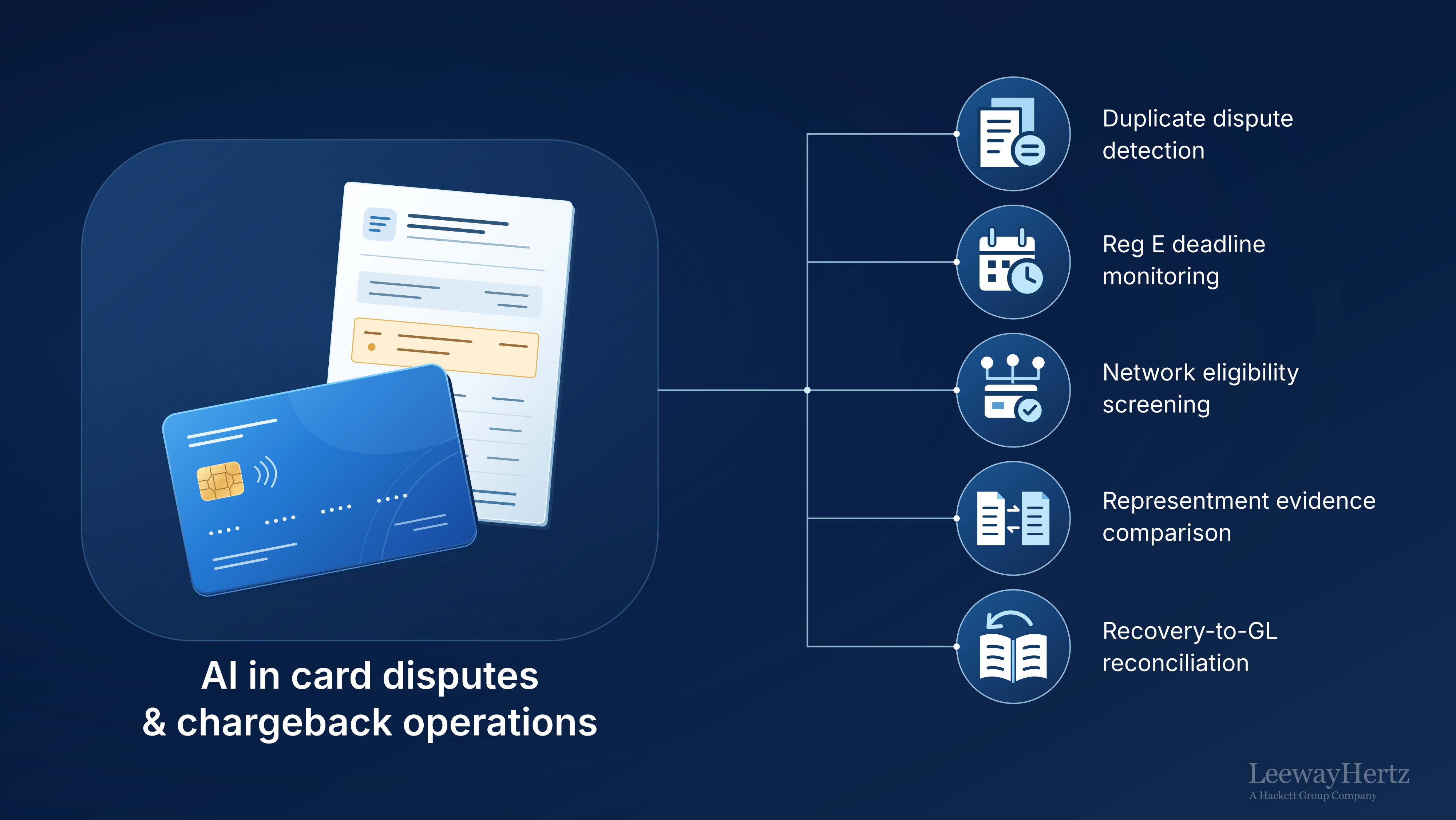
Card dispute and chargeback operations is the issuer-side discipline for handling transaction disputes from intake through resolution. It covers regulatory classification, investigation, provisional credit, network recovery, representment and arbitration, customer communication, accounting, and compliance evidence. For banks, credit unions, and fintech issuers, the work can involve debit cards, credit cards, ACH transfers, ATM transactions, and person-to-person payments, with different rules applying depending on the product, transaction type, and facts of the claim.
The operating challenge is that a dispute rarely exists in one system or under one rulebook. A customer may report an unauthorized transaction through a contact center or digital banking channel. The case record may sit in a dispute platform, while authorization and clearing data remain in the card processor. Login and device evidence may come from digital banking, fraud signals from a separate investigation system, and network recovery activity from Visa Resolve Online or Mastercard platforms. Provisional credit and recovery entries may then appear in the core ledger and general ledger. The team must assemble these records while tracking regulatory deadlines, network filing windows, correspondence obligations, approval limits, and downstream accounting.
The scale of fraud makes this work operationally important. The Federal Reserve’s 2026 report on 2025 household economic well-being found that 20% of US adults said they had experienced financial fraud or scams during the year, while 16% reported fraud involving a credit card [1]. The Federal Trade Commission separately reported nearly $16 billion in reported fraud losses for 2025, approximately 25% more than in 2024 [2]. These figures measure broader consumer fraud exposure, not issuer dispute-case volumes, but they illustrate the environment in which dispute teams operate.
Dispute operations also sit across several legal and network frameworks. Regulation E governs error resolution for covered electronic fund transfers and establishes investigation, provisional credit, notice, and liability requirements. Regulation Z establishes separate requirements for credit-card billing errors and unauthorized use. Nacha rules govern ACH return mechanics and Written Statements of Unauthorized Debit. Card-network rules establish separate recovery rights, dispute conditions, evidence standards, filing windows, representment procedures, and arbitration processes. These frameworks interact operationally, but one does not substitute for another.
AI is relevant because much of the workload sits between raw records and an authorized employee’s decision. Document intelligence can extract information from claim forms and merchant evidence. Classification can propose an appropriate dispute path. Entity resolution can connect a cardholder, account, transaction, merchant, and case. Temporal analysis can reconstruct a chronology and identify approaching deadlines. Retrieval-grounded analysis can bring the applicable policy or network rule into the review packet. Evidence completeness checks can identify missing records before a case reaches a filing or decision deadline. Reconciliation can connect provisional credit, network recovery, settlement, and general ledger activity. None of these capabilities removes the issuer’s obligation to investigate or transfers legal accountability to a model.
This distinction is fundamental. Consumer protection obligations, network recovery eligibility, and the institution’s ultimate financial loss are related but separately governed. A bank may have to protect or reimburse a consumer even when it cannot recover the transaction through a network. Similarly, an authentication result, a missed network deadline, or an unsuccessful chargeback does not by itself establish that a consumer’s claim should be denied.
For that reason, the right starting point is not a generic list of AI use cases. It is the dispute operating model. Teams first need to understand the functions that make up the lifecycle, the processes within each function, and the individual sub-processes where evidence, rules, decisions, and system actions can be clearly bounded. AI opportunities can then be placed at the level where inputs, outputs, approval boundaries, and retained evidence are explicit.
This article maps the issuer-side dispute operating model from intake through investigation, network recovery, accounting, customer communication, and compliance, and identifies where AI can prepare evidence and exceptions without removing human responsibility for regulated and financial decisions.
- How AI is transforming card disputes and chargeback operations
- Why AI use cases in card disputes and chargeback operations must be mapped at the sub-process level
- Card disputes and chargeback operating model and AI opportunity mapping across processes
- High-value AI use cases in issuer-side dispute operations
- How agentic AI works in card dispute workflows
- How to prioritize AI opportunities in dispute operations
- Governance, risk, and responsible AI in dispute operations
- How ZBrain supports governed dispute and chargeback workflows
- Future of AI in dispute and chargeback operations
How AI is transforming card disputes and chargeback operations
Traditional dispute operations rely heavily on employees assembling evidence from several systems before they can decide what to do next. The burden is not limited to reading documents. Analysts must reconstruct what happened to a transaction, identify the product and regulatory path, determine which deadlines are running, understand whether network recovery is still available, compare customer and merchant evidence, prepare notices, and ensure approved financial actions reach the correct system.
Consider an unauthorized debit-card transaction reported through a contact center. The dispute case may begin with a short customer statement. An analyst then needs the authorization record, clearing record, merchant descriptor, authentication indicators, digital banking login history, prior claim history, and any merchant-collaboration information. The analyst also needs the institution’s current Regulation E procedure and, if network recovery is contemplated, the applicable network dispute condition and effective rule version. The consumer-facing investigation and the network chargeback assessment may run at the same time, but they answer different questions.
AI can change how that work is prepared. Instead of an analyst manually opening each system and reconstructing the chronology, multi-source aggregation can assemble the records. Temporal analysis can order the events. Classification can suggest possible dispute categories. Retrieval-grounded analysis can place the relevant internal policy and current network rule beside the case facts. Evidence completeness checking can highlight what is missing. The analyst receives a review packet rather than a set of disconnected screens.
The strongest AI applications tend to fall into six kinds of work.
- Document-heavy work includes claim forms, written statements, merchant responses, affidavits, notices, and arbitration packages. AI improves this work by extracting relevant information, classifying documents, linking related records, and checking whether required evidence is present before review.
- Narrative-heavy work includes investigation summaries, denial letters, complaint responses, and arbitration submissions. AI can draft these materials from approved case facts, summarize long case histories, and check whether the narrative is consistent with the underlying evidence and determination.
- Exception-heavy work includes duplicate disputes, missing evidence, late cases, inconsistent authentication records, and settlement breaks. AI helps by detecting unusual patterns, identifying contradictions, and surfacing exceptions earlier so analysts can focus on cases that require closer review.
- Knowledge-heavy work includes Regulation E procedures, Regulation Z requirements, network rules, and institutional policies. Retrieval-grounded analysis can bring the relevant rule or policy into the case context, helping reviewers apply the correct guidance without searching across multiple repositories.
- Workflow-heavy work includes provisional credit approval, chargeback filing, representment review, and complaint escalation. AI can coordinate evidence gathering, route cases, prepare review packets, and trigger the next step once required approvals are completed, while consequential actions remain with authorized personnel.
- Deadline- and reconciliation-heavy work includes regulatory clocks, network windows, ACH returns, processor settlements, and general ledger reconciliation. Temporal analysis, deadline-aware routing, and multi-source reconciliation help teams track approaching obligations, identify mismatched records, and resolve outstanding items before they become overdue or remain unreconciled.
The practical design rule is therefore simple: start with the dispute sub-process, not with the AI tool. A production workflow should identify the initiating event, required evidence, applicable policy or rule, authoritative calculation method, exceptions, accountable reviewer, permitted system action, and evidence retained after execution.
Build governed AI workflows for card dispute and chargeback operations
Streamline dispute investigations, improve evidence management, monitor critical deadlines, and accelerate chargeback processing with secure, governed AI workflows.
Why AI use cases in card disputes and chargeback operations must be mapped at the sub-process level
AI opportunities in card disputes and chargeback operations need to be defined at the sub-process level because the dispute lifecycle is not a single, uniform workflow. A case can move through intake, regulatory classification, investigation, provisional credit, fraud review, network recovery, representment, accounting, customer communication, and compliance review. Each stage relies on different evidence, systems, rules, deadlines, and accountable roles.
Broad labels such as “dispute automation” or “AI for chargebacks” therefore provide too little precision for implementation. They do not show what information AI should use, which task it should support, where human review is required, or which system action is permitted after approval. Mapping AI at the sub-process level makes those boundaries explicit and helps institutions identify opportunities that are operationally useful, technically feasible, and compatible with regulatory and control requirements.
A useful operating model separates four levels.
Function: A major operational responsibility, such as dispute intake, investigation, network recovery, or quality assurance.
Process: A recognizable workflow within the function, such as claim registration, reason-code assessment, representment review, or Reg E testing.
Sub-process: A bounded work activity with clear inputs and outputs, such as duplicate claim detection, business-day determination, VROL case preparation, R10 versus R11 classification, or provisional credit notice review.
AI-enabled opportunity: A specific AI capability applied to a specific artifact or evidence set to improve preparation, comparison, reconciliation, drafting, or exception identification before an authorized employee acts.
This decomposition matters because neighboring activities can have very different automation boundaries. For example, AI can extract claim details, suggest regulatory pathways, and prepare chargeback documentation, while authorized personnel remain responsible for legal determinations and filing approvals. Regulatory deadlines should be calculated using approved rules-based systems, with AI supporting data preparation and exception identification.
Scope also becomes clearer. Dispute workflows can draw on transaction records, fraud indicators, merchant evidence, and settlement data without taking over responsibilities such as transaction authorization, fraud-model development, or regulatory reporting decisions.
With those boundaries established, the operating model becomes the basis for identifying practical AI opportunities.
Card disputes and chargeback operating model and AI opportunity mapping across processes
Card dispute and chargeback operations involve three interconnected areas: consumer error resolution, network recovery, and financial loss management. The first is consumer error resolution, which determines what the institution owes the consumer under applicable law and policy. The second is network or payment-system recovery, which determines whether the institution can recover funds from another participant. The third is internal financial loss management, which determines how credits, recoveries, suspense balances, and unrecovered losses are recorded and approved.
Although these activities are closely related, each involves different processes, regulatory requirements, and decision-making responsibilities. Understanding how they fit together helps institutions identify where AI can improve efficiency, reduce manual effort, and strengthen operational controls.
The following section breaks down ten key functions across the dispute lifecycle, mapping their processes and sub-processes to practical AI opportunities.
Function 1. Dispute intake and classification
Dispute intake converts a customer’s report into a complete case with the correct transaction, product, preliminary dispute type, regulatory path, and operating owner.
The quality of the initial case affects every downstream activity. Errors at this stage, such as incorrect transaction matching, duplicate claims, or incomplete information, can lead to investigation delays, unnecessary rework, and financial exposure. Accurate intake and classification help ensure that cases follow the appropriate procedures and timelines from the outset.
The current example explains the consequences of incorrect intake well, but the examples are too fragmented. Combine them into a concise explanation
Teams involved: Contact center agents, branch staff, digital banking operations, dispute analysts, fraud operations, deposit operations teams, and the dispute operations manager.
Key artifacts: Dispute claim form, customer statement, intake record, transaction record, case classification, regulatory pathway record, duplicate case result, missing-information request, and case timeline tracker.
Systems involved: Dispute case management systems such as Fiserv Dispute Expert, FIS dispute-management solutions, Quavo QFD, Pega Smart Dispute, or similar platforms, contact-center applications, digital banking and secure messaging platforms, core banking platform, card processors, and customer master records. Product names are examples, and actual integrations depend on the institution’s architecture and permissions.
Regulatory and control considerations: The intake workflow must identify whether the claim involves a consumer electronic fund transfer potentially governed by Regulation E, a credit-card billing error governed by Regulation Z, an ACH transaction with a separate Nacha return path, or a network-only recovery issue. Under Regulation E, a consumer’s notice generally must enable the institution to identify the consumer and account and indicate why the consumer believes an error exists. Institutions should not turn a 60-day statement-notice provision into a blanket claim-eligibility rule or use it to infer consumer liability automatically.
Accountable roles:
- Preparer: Contact center agent or dispute analyst.
- Reviewer: Dispute operations manager for reclassification or intake exceptions.
- Escalation: Reg E compliance officer or other designated compliance reviewer when the regulatory path is unclear.
What AI helps with: Document intelligence can extract claim details from forms and secure messages. Entity resolution can match the consumer, account, card, merchant, and transaction. Classification can propose dispute categories. Duplicate detection can compare the new claim with open and closed cases. Retrieval-grounded analysis can surface the institution’s intake criteria. Rule evaluation can check intake requirements and flag missing information or unmet criteria for review before the case is routed for investigation.
What humans continue to own: Authorized staff confirm the case classification where it affects legal treatment, resolve ambiguity between dispute pathways, determine whether additional customer information is needed, and approve exceptions. AI prepares and connects evidence, but authorized issuer roles decide, approve, and attest.
| Process | Sub-process | Key AI-enabled opportunities |
|---|---|---|
| Claim intake | Contact center dispute claim intake | Document intelligence extracts the customer’s stated transaction, amount, date, merchant, and allegation from the dispute claim form. |
| Digital banking submission | Classification maps structured and free-text claim information to possible dispute categories while preserving the original customer statement for review. | |
| Branch or secure-message intake | Document intelligence converts notes and attachments into a structured intake record and flags absent transaction identifiers before routing. | |
| Case registration | Transaction matching | Entity resolution links the claim to the account, card, authorization, and posted transaction and flags ambiguous matches for analyst review. |
| Duplicate dispute detection | Duplicate detection compares transaction identifiers, amounts, prior claims, and case status to identify possible duplicate cases before any financial action occurs. | |
| Missing information review | Evidence completeness checking compares the intake record with the institution’s required claim fields and prepares a missing information queue. | |
| Dispute classification | Unauthorized versus merchant dispute | Classification uses the customer’s allegation together with transaction and merchant facts to identify a potentially applicable dispute category, without determining authorization or liability. |
| ATM, ACH, card, or P2P classification | Rule evaluation maps the transaction rail and product to the applicable operating pathway and identifies cases that require specialist review. | |
| Eligibility assessment | Product and account identification | Entity resolution confirms whether the instrument is a consumer debit card, credit card, deposit account transfer, or other product before the regulatory path is selected. |
| Regulatory pathway review | Retrieval-grounded analysis brings the applicable Reg E or Reg Z procedure into the case packet with source references. | |
| Network recovery screening | Rule evaluation identifies whether a card-network recovery path may exist based on transaction type and current rule prerequisites. | |
| Case assignment | Ownership routing | Classification routes the case to card dispute, deposit operations, fraud, or specialist queues based on approved ownership rules. |
| Priority and escalation | Intelligent case prioritization identifies urgent disputes based on regulatory deadlines, case status, and missing evidence to support timely resolution. |
Highest-value opportunities: Regulatory pathway classification is especially important at intake, since an incorrect route can affect downstream deadlines, investigation requirements, and case documentation. Duplicate dispute detection helps avoid unnecessary parallel processing and reduces the risk of duplicate credits or recoveries. Missing information review addresses another common source of delay by identifying incomplete claims early, before evidence gaps create additional rework or put time-sensitive obligations under pressure.
Example agentic workflow: Dispute intake and regulatory classification review
- Trigger: A consumer reports a disputed transaction through an approved intake channel.
- Starting artifact: The dispute claim form or recorded customer statement.
- Systems queried: Read access is granted to case management, core banking, processor records, customer master data, and prior disputes.
- Evidence aggregated: The workflow assembles transaction identifiers, product type, merchant data, claim narrative, prior cases, and available account facts.
- Policy or rule retrieved: Current institutional intake policy and the applicable Reg E, Reg Z, ACH, or network routing criteria are retrieved.
- Analytical treatment: Document intelligence structures the claim, entity resolution links the transaction, classification proposes the pathway, and duplicate detection compares prior cases.
- Exceptions surfaced: Possible duplicate, ambiguous product type, missing transaction, inconsistent customer narrative, or unclear regulatory coverage.
- Decision packet: The analyst receives the linked transaction, proposed case type, regulatory-path suggestion, missing evidence, and proposed ownership queue.
- Human checkpoint: A dispute analyst confirms routine routing. Ambiguous regulatory treatment is escalated to compliance teams.
- Approved system handoff: The authorized case classification and owner are written to case management. No credit or network filing occurs from the intake workflow.
- Audit evidence retained: Original claim, extracted fields, source links, classification output, reviewer action, policy version, and case-creation log remain attached.
Function 2. Provisional credit and consumer timelines
This function keeps the institution’s investigation, provisional credit, notification, and consumer-liability obligations aligned to the correct regulatory clock.
Deadline management is one of the most control-sensitive parts of dispute operations because the relevant dates depend on product, transaction type, notice timing, and specific regulatory provisions. Regulation E generally requires a financial institution to investigate promptly and determine whether an error occurred within 10 business days. When the institution cannot complete the investigation within that period, the regulation permits a longer investigation period if applicable provisional-credit requirements are met. Certain qualifying new-account transactions use a 20-business-day initial period, and specified categories may receive an extended investigation period of up to 90 days rather than the usual 45 days.
Those rules should be implemented through controlled date logic rather than model-generated arithmetic. AI is useful for identifying the dates and conditions that feed the calculation, monitoring the resulting deadlines, assembling the evidence required for a credit decision, and checking notices for completeness.
Teams involved: Dispute analysts, dispute operations managers, Reg E compliance officers, deposit operations, customer communications, finance, and ledger operations.
Key artifacts: Reg E timeline tracker, provisional credit decision record, credit instruction, approval record, posting confirmation, provisional credit notice, investigation result notice, reversal notice, and liability assessment packet.
Systems involved: Dispute case management system, an approved rules service or calendar service, core banking platform, card or deposit ledger, correspondence management system, workflow management system, and general ledger.
Regulatory and control considerations: Regulation E distinguishes the initial investigation period, permissible extensions, provisional credit, notification requirements, and consumer liability. Consumer liability for unauthorized EFTs is governed separately under section 1005.6 and can depend on when the consumer reports a lost or stolen access device or unauthorized activity. The familiar $50, $500, and potentially higher liability outcomes are conditional and should not be treated as automatic tiers applied to every case.
Accountable roles:
- Preparer: Dispute analyst.
- Reviewer or approver: Dispute operations manager or another authorized role under institutional policy.
- Escalation: Reg E compliance officer.
What AI helps with: Temporal analysis identifies the relevant dates and sequence. Deadline-aware routing flags approaching obligations. Rule evaluation identifies which controlled calculation path applies. Document intelligence reads customer statements and prior notices. Exception classification surfaces cases that do not fit normal timelines. Calculation validation compares system-calculated dates and amounts with configured rules.
What humans continue to own: Authorized employees approve credit actions, resolve legal or factual exceptions, determine consumer liability, approve adverse determinations, and authorize any reversal. AI prepares and connects evidence, but authorized issuer roles decide, approve, and attest.
| Process | Sub-process | Key AI-enabled opportunities |
|---|---|---|
| Timeline setup | Notice receipt identification | Temporal analysis identifies the recorded notice event and compares channel timestamps to the case record. |
| Regulatory clock selection | Rule evaluation maps product, transaction type, and case conditions to the applicable controlled deadline logic. | |
| Business-day determination | Rule evaluation identifies the applicable business-day rules and calendar exceptions, enabling accurate deadline calculations through an approved calendar service. | |
| Exception handling | Exception classification identifies new-account, point-of-sale debit, foreign-initiation, or other conditions requiring a different investigation path. | |
| Provisional credit assessment | Provisional credit applicability review | Rule evaluation determines whether the extended-investigation pathway invokes provisional-credit requirements, with exceptions surfaced for review. |
| Credit amount preparation | Financial calculation validation checks provisional credit amounts against approved financial rules, including disputed amounts and applicable interest. | |
| Written confirmation review | Document intelligence identifies and validates written confirmations, while case matching links them to the relevant dispute records. | |
| Credit execution | Credit instruction preparation | Natural-language generation prepares a structured credit instruction from the approved decision. |
| Approval and posting confirmation | Multi-source reconciliation compares the approved instruction with the core posting and flags missing or mismatched amounts. | |
| Investigation timeline management | Initial-period tracking | Deadline monitoring tracks the controlled initial investigation deadline, while deadline-aware routing escalates cases with unresolved dependencies as the deadline approaches. |
| Extended-period tracking | Temporal analysis tracks the approved extended investigation period separately from any card-network filing deadline. | |
| Consumer notification management | Provisional credit notification | Evidence completeness checking verifies that the notice contains the required case and credit information before authorized release. |
| Investigation result notification | Natural-language generation drafts the result notice from the approved determination and cited case facts. | |
| Provisional credit reversal notification | Change detection compares the final determination with provisional credit activity and NLG prepares the required communication for review. | |
| Liability assessment | Unauthorized EFT liability review | Retrieval-grounded analysis identifies applicable Regulation E requirements and evaluates transaction evidence and reporting timelines to support consumer liability review. |
Highest-value opportunities: Deadline-aware routing helps keep time-sensitive cases visible by surfacing approaching obligations before they become overdue. Provisional credit packet preparation brings together the case facts, controlled calculation results, approval evidence, and posting support needed for review. Notice completeness checking adds another control by identifying missing or inconsistent information before customer communications are issued.
Example agentic workflow: Reg E provisional credit and deadline compliance review
- Trigger: A Reg E case approaches the institution’s controlled initial investigation deadline without a completed determination.
- Starting artifact: The Reg E timeline tracker and current investigation record.
- Systems queried: Read access to case management, approved calendar service, core ledger, correspondence history, and investigation evidence.
- Evidence aggregated: Notice date, product type, transaction type, customer statement, investigation status, prior credit activity, and correspondence.
- Policy or rule retrieved: The current Regulation E procedure and institution-specific business-day policy.
- Analytical treatment: Temporal analysis identifies dates, rule evaluation selects the correct controlled path, and calculation orchestration invokes approved logic for any provisional-credit amount.
- Exceptions surfaced: Missing written confirmation where applicable, unusual product condition, incomplete investigation, conflicting receipt date, or existing credit.
- Decision packet: The manager receives the calculated deadline, credit recommendation, amount support, notice draft, and unresolved exceptions.
- Human checkpoint: An authorized manager approves the provisional credit action. Compliance team reviews unusual or adverse cases.
- Approved system handoff: The credit posts only after authorization, and the approved notice is released through correspondence management as a separate action.
- Audit evidence retained: Calendar inputs, controlled calculation output, approval, posting confirmation, notice version, policy version, and timestamps remain with the case.
Function 3. Investigation and evidence gathering
Investigation reconstructs what happened to the transaction and organizes the evidence that an authorized reviewer needs to reach a consumer and recovery decision.
A dispute investigation is often an evidence-integration problem before it becomes a judgment problem. Authorization, clearing, settlement, device activity, 3-D Secure results, tokenization records, customer statements, merchant information, and prior claims may all describe different parts of the event. The investigator needs to determine which records are relevant and how much weight to give them.
Authentication evidence is particularly important but must be interpreted carefully. A successful 3-D Secure authentication, device match, or tokenized credential can affect network liability or provide relevant evidence, but it does not independently establish that the consumer authorized a transaction for purposes of Regulation E. Consumer rights and network recovery remain separate assessments.
Teams involved: Dispute analysts, fraud investigators, dispute operations managers, card operations, digital banking operations teams, and Reg E compliance officers where legally sensitive conclusions arise.
Key artifacts: Authorization record, clearing record, settlement record, transaction chronology, 3-D Secure result, tokenization record, device and login history, cardholder written statement, merchant evidence, prior claim history, and investigation determination packet.
Systems involved: Card processor, authentication platform, digital banking platform, fraud investigation platform, dispute case management system, and merchant collaboration platform.
Regulatory and control considerations: Regulation E requires a reasonable investigation of covered errors. Authentication indicators may contribute evidence, but the institution must consider the full facts. Regulation Z separately requires a reasonable investigation before a card issuer seeks to impose liability for unauthorized credit card use where applicable.
Accountable roles:
- Preparer: Dispute analyst or fraud investigator.
- Reviewer: Dispute operations manager.
- Escalation: Reg E compliance officer or designated legal/compliance reviewer for adverse or legally sensitive determinations.
What AI helps with: Multi-source aggregation creates a single evidence view. Entity resolution connects transaction records across systems. Temporal analysis reconstructs the transaction and account-access chronology. Anomaly detection identifies inconsistent or unusual patterns. Evidence completeness checking identifies missing records. Retrieval-grounded analysis retrieves relevant investigation procedures and regulatory requirements to support evidence-based dispute assessments.
What humans continue to own: Investigators determine the significance of contradictory evidence, assess credibility, approve the case conclusion, and decide whether evidence supports an adverse consumer determination. AI prepares and connects evidence, but authorized issuer roles decide, approve, and attest.
| Process | Sub-process | Key AI-enabled opportunities |
|---|---|---|
| Transaction reconstruction | Authorization review | Multi-source aggregation connects authorization message fields, response codes, merchant data, and card credentials into the investigation chronology. |
| Clearing and settlement review | Entity resolution links the posted item to authorization and settlement records and flags amount, date, or merchant discrepancies. | |
| Reversal and refund review | Change detection identifies reversals, merchant credits, partial refunds, or duplicate postings that may alter the claimed error. | |
| Authentication review | EMV evidence review | Retrieval-grounded analysis explains relevant EMV indicators from approved internal guidance. |
| 3-D secure review | Multi-source aggregation attaches authentication result, liability-shift information, and network evidence to the packet for separate recovery review. | |
| Tokenization review | Entity resolution links the network token, device, wallet, and underlying card where authorized records are available. | |
| Digital activity review | Login activity review | Temporal analysis reconstructs the sequence of account logins, credential changes, device enrollments, and the disputed transaction for investigator review. |
| Device evidence comparison | Anomaly detection highlights new devices, unusual access patterns, or conflicts with prior activity. | |
| Customer statement review | Written statement review | Document intelligence extracts the customer’s allegation, possession of the card, merchant familiarity, and timeline while retaining the original statement. |
| Customer communication review | Temporal analysis combines contact-center notes, secure messages, and prior notifications into a case chronology. | |
| Merchant evidence review | Descriptor and merchant identity review | Entity resolution maps descriptors, merchant IDs, locations, and known merchant names to reduce false mismatches. |
| Order fulfillment review | Document intelligence structures shipment, delivery, cancellation, subscription, or service records for reviewer comparison. | |
| Related case review | Related claim analysis | Pattern detection identifies related disputes and transaction patterns that may require further investigation |
| Investigation assessment | Contradiction analysis | Evidence comparison identifies inconsistencies between the customer statement, authentication evidence, merchant information, and transaction chronology. |
| Determination packet preparation | Natural-language generation prepares an evidence-linked investigation summary with unresolved questions clearly separated from established facts. |
Highest-value opportunities: Transaction reconstruction reduces the effort required to piece together authorization, clearing, settlement, authentication, and account-access events into a usable case chronology. Contradiction detection helps investigators focus on discrepancies between customer statements, merchant records, and system evidence before reaching a determination. Evidence completeness checking adds a final control by identifying missing records or unresolved gaps before the case moves to denial, recovery, or network filing.
Example agentic workflow: Unauthorized card transaction investigation review
- Trigger: An unauthorized card claim has passed intake and requires investigation.
- Starting artifact: The dispute case and cardholder statement.
- Systems queried: Read access to processor, authentication records, digital banking, fraud platform, merchant evidence, and prior disputes.
- Evidence aggregated: Authorization, clearing, settlement, authentication, device, login, customer, merchant, and prior-case records.
- Policy or rule retrieved: Current Reg E or Reg Z procedure, applicable internal investigation standards, and relevant network evidence guidance.
- Analytical treatment: Multi-source aggregation builds the packet, temporal analysis reconstructs events, entity resolution links records, and evidence comparison identifies contradictions.
- Exceptions surfaced: Conflicting device evidence, successful authentication, unmatched merchant descriptor, missing statement, prior related claims, or incomplete settlement data.
- Decision packet: The reviewer receives a chronology, evidence matrix, unresolved contradictions, applicable procedures, and draft investigation summary.
- Human checkpoint: The dispute analyst or fraud investigator evaluates the evidence. Adverse or unusual determinations receive the required management or compliance review.
- Approved system handoff: The approved determination is recorded in case management. Any credit, denial notice, or network filing is handled through its separate authorized workflow.
- Audit evidence retained: Source records, evidence links, chronology, AI analysis, investigator notes, approvals, and policy versions remain attached.
Function 4. Chargeback initiation and network recovery
Chargeback initiation evaluates whether the issuer has a current network recovery right and prepares the required case for authorized submission.
A chargeback is not the same as a consumer reimbursement. It is a recovery process governed by card-network rules. The issuer may have a consumer obligation even when network recovery is unavailable, and it may have network recovery rights in circumstances that require additional evidence or timing analysis.
Network rules also change. Visa’s April 2026 public rules, for example, show that some dispute conditions use different time limits. Visa dispute condition 10.4 for certain card-absent fraud claims generally uses a 120-calendar-day filing period from the transaction processing date, while condition 11.3 uses a different 75-calendar-day period. That is why an issuer should not encode “120 days” as a universal chargeback rule.
Mastercard’s current chargeback documentation likewise requires teams to work from the effective guide rather than a static legacy reason-code list. Current procedures continue to use message reason codes such as 4808 for authorization-related disputes, while historical codes and procedures have changed or been consolidated over time.
Teams involved: Chargeback analysts, network dispute specialists, dispute operations managers, fraud operations, and recovery specialists.
Key artifacts: Network eligibility assessment, Visa VROL case, Mastercard dispute case, reason-code or dispute-condition record, evidence package, compelling-evidence package where applicable, filing confirmation, and response tracker.
Systems involved: Visa Resolve Online (VROL), Mastercard Mastercom, dispute case management system, card processor, Ethoca, Verifi, merchant collaboration platform, and document management system.
Regulatory and control considerations: Network recovery rules must be version controlled. Each filing should use the effective rule, relevant geography and program, transaction type, dispute condition, required evidence, filing window, authentication or liability-shift treatment, and permitted next stage. Visa Compelling Evidence 3.0 or Mastercard First-Party Trust evidence should be applied only where the relevant rule and transaction meet current requirements.
Accountable roles:
- Preparer: Chargeback analyst.
- Reviewer: Network dispute specialist or dispute operations manager.
- Escalation: Head of dispute operations or designated network relationship owner for exceptions.
What AI helps with: Classification proposes potential dispute conditions. Rule evaluation checks current filing prerequisites. Retrieval-grounded analysis brings the effective network rule into the packet. Deadline monitoring tracks filing and response windows. Document intelligence structures customer and merchant evidence. Evidence validation identifies missing prerequisites before submission.
What humans continue to own: Authorized network specialists select and approve the filing path, resolve ambiguous rule interpretation, decide whether to proceed, and authorize the network submission. AI prepares and connects evidence, but authorized issuer roles decide, approve, and attest.
| Process | Sub-process | Key AI-enabled opportunities |
|---|---|---|
| Network identification | Card brand identification | Entity resolution confirms network, product, transaction type, processing date, and relevant identifiers before rule evaluation. |
| Rule-version selection | Retrieval-grounded analysis identifies applicable network rules and their effective versions to support accurate chargeback eligibility assessments. | |
| Reason code assessment | Visa dispute-condition mapping | Classification identifies potentially applicable Visa fraud, authorization, processing-error, or consumer-dispute categories based on the case facts and routes them for analyst review. |
| Mastercard reason-code mapping | Classification identifies the potentially applicable current Mastercard dispute category from the case evidence, while change detection flags legacy reason-code references that may need to be reconciled with the current network rules.. | |
| Amex or discover routing | Rule evaluation uses institution-accessible current operating rules to identify the appropriate network path. | |
| Chargeback eligibility assessment | Filing-window review | Deadline monitoring checks transaction and case events against the applicable rule-specific filing window and flags cases approaching or exceeding the deadline. |
| Authentication and liability-shift review | Multi-source aggregation brings 3-D Secure and other authentication indicators into the network assessment, while retrieval-grounded analysis provides the applicable network rules for interpreting their effect on recovery eligibility. | |
| Prior credit review | Multi-source reconciliation identifies merchant refunds, prior chargebacks, or issuer credits that affect the recoverable amount. | |
| Recovery preparation | Evidence package assembly | Document intelligence compiles required statements, transaction records, correspondence, and merchant evidence into a review-ready package. |
| Compelling evidence review | Evidence completeness checking compares the available evidence with the applicable current network criteria and flags gaps. | |
| Case submission | VROL case preparation | Natural-language generation and structured data mapping prepare the VROL case fields and supporting narrative for authorized filing. |
| Mastercard case preparation | Document intelligence extracts relevant case evidence, populates required Mastercard dispute fields, and flags missing information before submission. | |
| Chargeback filing and response tracking | Network response monitoring | Deadline monitoring tracks network responses, flags pending actions, and identifies approaching deadlines to prevent delays in chargeback processing. |
| Settlement-status review | Multi-source reconciliation compares the network case status with processor and settlement records. |
Highest-value opportunities: Reason-code eligibility screening helps analysts identify the appropriate network path early, reducing the risk of losing time to incorrect routing. Filing-window monitoring keeps cases aligned with condition-specific and version-specific network deadlines. Evidence-package completeness checking strengthens recovery preparation by surfacing missing documentation before an otherwise supportable case is submitted.
Example agentic workflow: Network chargeback eligibility and filing review
- Trigger: An investigated card dispute is ready for network recovery assessment.
- Starting artifact: The approved investigation packet and transaction record.
- Systems queried: Read access to case management, processor data, current network rule repository, authentication records, collaboration data, and prior credits.
- Evidence aggregated: Transaction fields, customer statement, authentication, merchant evidence, refunds, prior case actions, and processing dates.
- Policy or rule retrieved: The effective network rule, applicable dispute condition, filing requirements, and institutional filing authority.
- Analytical treatment: Classification proposes potential dispute conditions, rule evaluation screens eligibility, deadline monitoring calculates against approved rule data, and evidence validation checks required support.
- Exceptions surfaced: Expired or uncertain filing window, prior credit, authentication related defense, missing evidence, amount discrepancy, or ambiguous dispute category.
- Decision packet: The chargeback analyst receives candidate condition, rule citation, filing deadline, recoverable amount support, evidence checklist, and exceptions.
- Human checkpoint: The analyst confirms the filing basis. A network specialist or manager approves exceptions or materially sensitive filings.
- Approved system handoff: Only after authorization is the network case submitted through VROL, Mastercom, or the applicable interface.
- Audit evidence retained: Effective rule version, eligibility output, evidence package, reviewer approval, submitted case, response confirmation, and timestamps remain linked.
Accelerate AI Solutions Development
Build fully functional solutions from your high-value use cases, based on specific operational needs and enterprise context.
Function 5. Representment, pre-arbitration and arbitration
This function evaluates the merchant or acquirer response to a chargeback and determines whether the issuer should accept the response, continue the dispute, or escalate under network procedures.
Representment changes the evidence set. The original issuer case must now be compared with the merchant’s response, new documentation, authentication evidence, delivery information, refund records, or other rebuttal. The question is no longer only whether the initial chargeback was supportable. The issuer must determine whether the new evidence changes the case and whether the next network stage is justified.
Escalation also introduces economic judgment. Pre-arbitration and arbitration can involve additional fees, exposure, and narrower evidentiary questions. An issuer therefore needs both a rules assessment and a business assessment before proceeding.
Teams involved: Chargeback analysts, arbitration specialists, dispute operations managers, recovery specialists, network relationship teams, and finance reviewers where fee exposure is material.
Key artifacts: Representment package, evidence comparison matrix, pre-arbitration filing, arbitration submission, network ruling, fee schedule, amount-at-risk assessment, and closure record.
Systems involved: Network dispute platform, dispute case management system, document management system, card processing platform, finance or accounting system, and reporting platform.
Regulatory and control considerations: Representment and arbitration follow network-specific rules, not Regulation E decision rules. Consumer obligations continue to be governed separately. Current response windows, evidence standards, fees, escalation paths, and post-ruling options must be taken from the effective network documentation.
Accountable roles:
- Preparer: Chargeback analyst.
- Reviewer: Arbitration specialist.
- Approver: Designated management for fee-bearing escalation.
- Escalation: Head of dispute operations or network relationship manager.
What AI helps with: Document intelligence structures the merchant package. Evidence comparison identifies discrepancies between the original dispute and new evidence. Retrieval-grounded analysis presents the applicable current rule. Rule evaluation checks escalation eligibility. Scenario comparison organizes potential financial outcomes. NLG prepares a pre-arbitration or arbitration submission from approved evidence.
What humans continue to own: Authorized specialists decide whether new evidence changes the issuer’s position, whether escalation is justified, whether fees and financial exposure are acceptable, and whether a case should be closed. AI prepares and connects evidence, but authorized issuer roles decide, approve, and attest.
| Process | Sub-process | Key AI-enabled opportunities |
|---|---|---|
| Representment intake | Representment intake review | Document intelligence extracts and organizes information from the incoming representment package, while entity resolution links the documents and evidence to the corresponding network dispute case. |
| Response deadline identification | Deadline monitoring reads the network event and current rule to create the next-action deadline from approved rule data. | |
| Evidence assessment | Merchant evidence extraction | Document intelligence extracts relevant details from shipment records, authentication data, refunds, and customer communications to support structured merchant evidence review. |
| Original-versus-new evidence comparison | Evidence comparison highlights evidence that is new, contradictory, duplicative, or unsupported. | |
| Case-strength reassessment | Scenario comparison organizes how the new evidence affects available recovery paths. | |
| Pre-arbitration | Eligibility review | Rule evaluation checks current prerequisites for pre-arbitration and identifies rule-specific deficiencies. |
| Response preparation | NLG produces an evidence-linked response for specialist review. | |
| Amount-at-risk analysis | Calculation validation confirms disputed amount, prior credits, potential fees, and settlement exposure from authoritative systems. | |
| Arbitration | Filing readiness assessment | Evidence completeness checking compares the proposed arbitration package with current network requirements. |
| Arbitration submission preparation | Natural-language generation prepares a concise case chronology and evidence references from approved records. | |
| Fee and exposure review | Scenario analysis evaluates potential financial outcomes, network fees, and escalation costs to support informed arbitration decisions. | |
| Arbitration outcome management | Ruling analysis | Document intelligence extracts arbitration outcomes, ruling details, and financial amounts, while rule evaluation identifies the required follow-up actions for review. |
| Case closure | Multi-source reconciliation verifies that the network outcome, case status, and recovery accounting agree before closure. |
Highest-value opportunities: Representment evidence comparison helps reviewers quickly see how the merchant’s response differs from the issuer’s original case and which new facts may affect the next step. Arbitration readiness checking ensures the case meets current evidentiary and procedural requirements before escalation. Amount-at-risk comparison gives approvers a clearer view of disputed value, fees, and potential exposure when deciding whether further escalation is justified.
Example agentic workflow: Representment evidence and arbitration readiness review
- Trigger: A merchant or acquirer submits representment on an open network dispute.
- Starting artifact: The representment package and original chargeback case.
- Systems queried: Read access to network case history, original evidence, merchant response, processor records, and approved fee schedule.
- Evidence aggregated: Original allegation, issuer evidence, merchant evidence, transaction history, prior network actions, amounts, and dates.
- Policy or rule retrieved: Current network representment, pre-arbitration, and arbitration provisions.
- Analytical treatment: Document intelligence structures the response, evidence comparison identifies changes, rule evaluation checks next-stage eligibility, and scenario comparison presents exposure.
- Exceptions surfaced: New merchant evidence, missing original evidence, response-window issue, conflicting refund, authentication defense, or fee exposure.
- Decision packet: The arbitration specialist receives a comparison matrix, rule citations, available next actions, exposure analysis, and draft response.
- Human checkpoint: The specialist recommends acceptance, pre-arbitration, or arbitration. Required management approves fee-bearing escalation.
- Approved system handoff: The authorized response is submitted to the network, or the case is closed. Financial postings remain a separate approved process.
- Audit evidence retained: Both evidence sets, comparison output, rule version, approval, network submission or closure, ruling, and fee records are retained.
Function 6. Fraud claims and card lifecycle coordination
Fraud-claim coordination supports dispute investigations by connecting fraud assessment, account protection, card replacement, and regulatory reporting activities while ensuring that consumer dispute decisions follow applicable requirements.
An unauthorized transaction may reveal a broader account-security event. A lost or stolen physical card can require blocking and reissue. A card-not-present claim may coincide with credential compromise. Account takeover may involve changes to contact information, passwords, trusted devices, or digital-wallet enrollment. The dispute team therefore needs controlled handoffs to fraud and card operations.
Fraud reporting adds another boundary. Visa TC40 and Mastercard SAFE reporting serve network fraud-management purposes. A potential BSA issue may also need referral to authorized BSA/AML personnel. These actions are related to the dispute but are not the same as determining the consumer’s claim.
Teams involved: Fraud investigators, dispute analysts, card operations teams, digital banking security teams, BSA/AML personnel, compliance teams, and the dispute operations manager.
Key artifacts: Fraud affidavit or statement, fraud investigation record, card block request, reissue request, account-takeover referral, TC40 record, SAFE record, BSA referral record, and case handoff notes.
Systems involved: Fraud investigation platform, card management system, digital banking platform, authentication platform, network fraud reporting platform, dispute case management system, and customer information system.
Regulatory and control considerations: Fraud classification and account controls should follow documented authority. BSA/AML escalation should remain separate from the dispute determination. For banks subject to OCC SAR rules, filing thresholds vary depending on the type of suspected criminal activity and whether a suspect can be identified. SAR filing decisions belong to authorized BSA/AML personnel, not to the dispute analyst or an AI workflow.
Accountable roles:
- Preparer: Fraud investigator for the fraud assessment.
- Reviewer: Card operations manager for card-control actions.
- Escalation and SAR determination: authorized BSA/AML personnel. Dispute operations remains accountable for the consumer dispute process.
What AI helps with: Pattern analysis links related events. Anomaly detection identifies unusual account-access or claim patterns. Entity resolution connects devices, credentials, cards, accounts, and transactions. Classification organizes fraud-type evidence. Multi-source aggregation assembles a cross-team packet. Document intelligence checks fraud-reporting fields for completeness.
What humans continue to own: Fraud investigators determine the significance of patterns, Card operations team authorizes restrictions and reissue actions, and BSA/AML personnel determine whether a SAR is required. Repeat disputes or unusual behavior alone do not prove first-party fraud. AI prepares and connects evidence, but authorized issuer roles decide, approve, and attest.
| Process | Sub-process | Key AI-enabled opportunities |
|---|---|---|
| Fraud claim classification | Lost or stolen card review | Classification analyzes customer statements and card-status records to identify potential lost or stolen card claims for investigator review. |
| Card-not-present review | Multi-source aggregation combines transaction, authentication, wallet, and device evidence for investigation. | |
| Account takeover review | Temporal analysis reconstructs credential changes, login events, profile changes, and disputed transactions. | |
| Suspected first-party misuse review | Pattern detection identifies repeat or inconsistent claim patterns for specialist review. | |
| Account protection | Card-block recommendation | Rule evaluation determines whether case facts meet internal criteria for card restriction. |
| Reissue coordination | Entity resolution identifies affected card credentials and prepares the replacement request after authorized approval. | |
| Digital credential referral | Anomaly detection identifies unusual credential changes and device activity, flagging potential security risks for specialist review. | |
| Fraud investigation review | Related-event linkage | Entity resolution connects multiple disputed transactions, devices, merchants, cards, or accounts where authorized data supports the relationship. |
| Network reporting | TC40 preparation | Document intelligence checks required fraud reporting fields and source evidence before authorized reporting. |
| SAFE preparation | Evidence completeness checking identifies absent transaction or classification fields before submission. | |
| BSA referral | Fraud escalation packet preparation | Multi-source aggregation creates a factual referral packet. |
| Supporting evidence retention | Evidence completeness checking verifies that source records and investigation notes remain available to authorized BSA/AML reviewers. | |
| Cross-team coordination | Dispute-to-fraud handoff | Natural-language generation prepares an evidence-linked handoff summary with unresolved questions. |
| Fraud-to-dispute feedback | Change detection highlights new fraud findings that may require the dispute analyst to reassess the investigation. |
Highest-value opportunities: Account-takeover chronology brings login activity, credential changes, device events, and disputed transactions into a single sequence so investigators can assess the incident in context. Network fraud-report completeness checking helps ensure required fields and supporting records are present before an authorized report is submitted. Cross-team packet assembly reduces repeated evidence collection by giving dispute, fraud, card operations, and compliance teams a shared evidence base while keeping their decision responsibilities separate.
Example agentic workflow: Fraud claim and card lifecycle coordination review
- Trigger: A dispute investigation identifies indicators of card compromise or account takeover.
- Starting artifact: The dispute investigation packet and fraud referral.
- Systems queried: Read access to fraud systems, card management records, authentication logs, digital banking activity, and network-reporting records.
- Evidence aggregated: Disputed transactions, login history, credential changes, card status, prior fraud events, and customer statement.
- Policy or rule retrieved: Current fraud escalation, card control, network reporting, and BSA referral policies.
- Analytical treatment: Temporal analysis builds the event sequence, entity resolution links related events, and anomaly detection identifies patterns requiring investigator attention.
- Exceptions surfaced: New device, simultaneous credential change, multiple related transactions, conflicting customer history, or prior related claims.
- Decision packet: Fraud team receives a chronology, linked events, proposed card-control actions, reporting completeness check, and unresolved questions.
- Human checkpoint: Fraud team determines the investigative response. Card operations teams authorize blocks or reissues. BSA/AML team determines whether further regulatory reporting is required.
- Approved system handoff: Authorized card controls, replacement actions, or network fraud reports are executed through separate controlled interfaces.
- Audit evidence retained: Referral, evidence, analysis, approvals, card actions, reporting records, and case feedback are retained.
Function 7. ACH, ATM and P2P disputes
ACH, ATM, and P2P dispute handling involves distinct investigation procedures, evidence requirements, and recovery mechanisms that differ from traditional card-network chargebacks.
A debit-card dispute and an ACH return may both involve Regulation E, but the recovery path is different. ACH unauthorized entries can involve Nacha return codes and a Written Statement of Unauthorized Debit. ATM disputes may depend on terminal journals, switch records, and cash balancing. P2P cases may require careful distinction between a transfer initiated by an unauthorized actor and a transfer the consumer personally initiated after being deceived.
Nacha distinguishes R10, used for certain consumer entries involving an unknown or unauthorized originator, from R11, used when a debit is not in accordance with the terms of an existing authorization. These are not general goods-and-services dispute codes. A consumer WSUD supports applicable unauthorized-return processing.
Teams involved: Deposit operations specialists, dispute analysts, ATM operations, fraud investigators, Reg E compliance officers, and P2P operations teams.
Key artifacts: ACH entry record, WSUD, R10 or R11 return record, originator information, ATM terminal journal, switch record, cash balancing record, P2P transaction record, customer statement, and determination packet.
Systems involved: ACH processing platform, core banking system, ATM switch, P2P payment platform, digital banking platform, fraud investigation platform, and dispute case management system.
Regulatory and control considerations: Regulation E error-resolution obligations and Nacha return rights operate separately. For P2P, institutions must distinguish unauthorized electronic fund transfers from transactions the consumer authorized but initiated because of deception. CFPB guidance confirms that unauthorized EFT analysis can include situations in which a fraudster obtained account-access information, so institutions should not classify every scam-related P2P loss outside Regulation E without reviewing the facts.
Accountable roles:
- Preparer: Deposit operations specialist or dispute analyst.
- Reviewer: Dispute operations manager.
- Escalation: Reg E compliance officer for difficult P2P or ACH coverage questions.
What AI helps with: Document intelligence structures WSUDs and customer statements. Classification proposes R10 versus R11 or other appropriate pathways. Temporal analysis tracks ACH, ATM, P2P, and Reg E events separately. Reconciliation compares ATM switch and cash records. Anomaly detection highlights transaction inconsistencies. Retrieval-grounded analysis brings the applicable procedure into the case.
What humans continue to own: Deposit operations teams confirm return action, investigators resolve factual disputes, and compliance team interprets difficult regulatory classifications. AI prepares and connects evidence, but authorized issuer roles decide, approve, and attest.
| Process | Sub-process | Key AI-enabled opportunities |
|---|---|---|
| ACH dispute intake | ACH transaction identification | Entity resolution links company name, company ID, trace number, amount, and account to the claimed entry. |
| Originator review | Multi-source aggregation assembles originator information, prior entries, and customer statement for review. | |
| ACH return processing | R10 versus R11 screening | Classification identifies potential R10 or R11 return categories based on authorization details, while rule evaluation checks their applicability against current Nacha requirements. |
| WSUD preparation | Document intelligence extracts required facts from the consumer statement and checks the WSUD for completeness before signature or acceptance. | |
| Return-window tracking | Deadline monitoring tracks Nacha return deadlines and Regulation E investigation timelines separately, flagging cases that require timely action. | |
| ATM claims | Non-dispense review | Multi-source reconciliation compares the posted withdrawal, switch record, terminal journal, and balancing results. |
| Partial-dispense review | Calculation validation compares requested, posted, dispensed, and balanced amounts and flags inconsistent records. | |
| ATM cash balancing | Anomaly detection identifies terminal cash differences relevant to the claim. | |
| P2P claims | Initiation-evidence review | Temporal analysis tracks the sequence of login activity, device changes, beneficiary setup, and payment events to support P2P dispute investigations. |
| Credential compromise review | Anomaly detection and entity resolution identify account-access events relevant to an unauthorized-transfer assessment. | |
| Scam-related classification | Retrieval-grounded analysis organizes facts relevant to whether the consumer or another person initiated the transfer. | |
| Dispute resolution and recovery | Consumer error determination | Evidence aggregation prepares the record for human determination under the applicable consumer-protection procedure. |
| Recovery path assessment | Rule evaluation identifies ACH, P2P provider, ATM, or internal recovery options. | |
| Case closure | Evidence completeness checking confirms that determination, credit activity, notices, and recovery records are present before closure. |
Highest-value opportunities: R10/R11 classification support helps deposit operations teams distinguish between materially different ACH authorization scenarios and prepare the appropriate return path for review. WSUD readiness checking reduces avoidable processing delays by identifying missing or incomplete documentation before the return is initiated. P2P chronology brings account access, device activity, payment initiation, and beneficiary events into sequence so reviewers can better assess whether the transfer was initiated by an unauthorized actor or by the consumer.
Example agentic workflow: ACH unauthorized debit and WSUD readiness review
- Trigger: A consumer reports an ACH debit as unauthorized.
- Starting artifact: The dispute claim and ACH transaction record.
- Systems queried: Read access to ACH processing, core banking, customer history, prior ACH entries, case management, and approved rules repository.
- Evidence aggregated: Trace number, originator, amount, posting date, prior authorization history, consumer statement, and prior related entries.
- Policy or rule retrieved: Current Regulation E procedure and applicable current Nacha unauthorized-return and WSUD requirements.
- Analytical treatment: Entity resolution links the entry, classification proposes the return reason, document intelligence prepares the WSUD fields, and deadline monitoring tracks regulatory and Nacha timelines separately.
- Exceptions surfaced: Existing authorization with disputed terms, incomplete consumer statement, prior related debits, ambiguous originator, or approaching return deadline.
- Decision packet: Deposit operations teams receive the proposed R10/R11 treatment, WSUD readiness status, Reg E timeline, source evidence, and unresolved questions.
- Human checkpoint: The deposit operations specialist confirms the return action. Compliance teams review ambiguous authorization or Reg E treatment.
- Approved system handoff: The authorized ACH return and any consumer credit action execute through their respective systems as separate controlled actions.
- Audit evidence retained: Claim, WSUD, return record, rule version, Reg E determination support, approval, credit records, and timestamps remain linked.
Function 8. Recovery, write-off and accounting
Recovery, write-off, and accounting processes manage consumer credits, network recoveries, outstanding balances, and financial losses to ensure accurate reconciliation and financial reporting.
A dispute does not end when a consumer receives a credit or when a network case closes. Finance and recovery teams must determine where the transaction sits in suspense, whether a recovery was received, whether a merchant refund duplicated a network recovery, whether an amount remains outstanding, and when an unrecoverable balance should be written off under institutional policy.
This function is especially suitable for AI-assisted reconciliation because the underlying accounting remains controlled and deterministic. AI does not need to invent an accounting result. It can instead identify records that should agree, surface differences, explain the likely source of a break, and prepare support for an authorized posting.
Teams involved: Recovery specialists, dispute operations, card settlement teams, authorized finance personnel, controller organization, and internal audit teams as a consumer of evidence.
Key artifacts: Provisional credit posting, suspense entry, network settlement record, chargeback recovery record, processor settlement file, reconciliation report, write-off request, approval log, and aged-recovery report.
Systems involved: Core banking or ledger system, general ledger system, reconciliation platform, dispute case management system, settlement processing platform, and data warehouse.
Regulatory and control considerations: Financial actions should follow the institution’s approval structure and internal control framework. Material write-offs should preserve segregation between preparation and approval. Consumer-protection decisions should not be reversed merely because network recovery failed.
Accountable roles:
- Preparer: Recovery specialist.
- Reviewer: Authorized finance reviewer.
- Escalation: Controller or designated finance approver for material write-offs or unresolved reconciliation breaks.
What AI helps with: Multi-source reconciliation matches case, credit, recovery, processor, network, and GL activity. Entity matching connects settlement items to cases. Anomaly detection finds aged or unusual balances. Variance analysis explains differences. Rule evaluation checks approval requirements. Calculation validation confirms amounts from authoritative systems.
What humans continue to own: Finance team approves journal entries, suspense releases, loss recognition, and write-offs. Dispute operations teams retain ownership of the case outcome. AI prepares and connects evidence, but authorized issuer roles decide, approve, and attest.
| Process | Sub-process | Key AI-enabled opportunities |
|---|---|---|
| Provisional credit accounting | Credit-to-case matching | Entity matching connects the posted consumer credit to the approved dispute case and amount. |
| Suspense mapping | Rule evaluation checks whether the transaction was routed to the configured suspense treatment and flags exceptions. | |
| GL reconciliation | Multi-source reconciliation identifies discrepancies across dispute cases, core banking, suspense accounts, and general ledger records to support accurate financial reporting. | |
| Network recovery | Chargeback settlement matching | Entity resolution links network settlement entries to dispute cases and submitted recovery amounts. |
| Recovery shortfall identification | Variance analysis identifies differences between expected and received recovery and groups likely causes. | |
| Duplicate recovery review | Anomaly detection flags potential duplicate recoveries, including cases involving both merchant refunds and network settlements, to prevent financial discrepancies. | |
| Loss recognition | Unrecoverable balance assessment | Multi-source aggregation assembles case outcome, network recovery, consumer credit, and remaining exposure. |
| Write-off support | Natural-language generation prepares the write-off support packet from approved figures. | |
| Approval-limit check | Rule evaluation checks institutional approval requirements and routes the packet to the appropriate finance role. | |
| On-us recovery | Merchant and issuer matching | Entity resolution links on-us merchant records and issuer dispute records to identify internal recovery opportunities. |
| Period-end reconciliation | Processor settlement reconciliation | Multi-source reconciliation matches processor settlement, network activity, case records, and ledger totals. |
| Aged suspense review | Anomaly detection identifies balances beyond institutional aging thresholds and prepares an exception queue. | |
| Financial reporting | Recovery-rate calculation support | Calculation validation checks source populations and approved reporting logic before the metric is published. |
| Loss and exposure commentary | Variance analysis prepares evidence-backed explanations for period changes for finance teams review. |
Highest-value opportunities: Recovery-to-GL reconciliation brings dispute, settlement, recovery, and accounting records together so finance teams can identify mismatches before period-end review. Aged suspense detection surfaces balances that remain unresolved after the related dispute activity has progressed or closed, helping teams focus follow-up on lingering exceptions. Write-off support assembles the consumer credit, recovery history, approvals, and remaining exposure into a traceable packet for authorized finance team review.
Example agentic workflow: Chargeback recovery and GL reconciliation review
- Trigger: A network settlement file is received or a dispute period closes.
- Starting artifact: The settlement file and open dispute-recovery ledger.
- Systems queried: Read access to network settlement, processor settlement, dispute cases, core ledger, suspense accounts, and GL.
- Evidence aggregated: Credits, recoveries, refunds, settlement entries, write-offs, case status, and prior reconciliation results.
- Policy or rule retrieved: Current reconciliation, suspense-aging, journal approval, and write-off policies.
- Analytical treatment: Entity matching links records, multi-source reconciliation identifies breaks, and variance analysis organizes differences by likely cause.
- Exceptions surfaced: Missing recovery, duplicate credit, unmatched settlement, incorrect amount, aged suspense, or case closed without accounting completion.
- Decision packet: Recovery and finance teams receive matched items, unresolved breaks, exposure, proposed corrective entry support, and source lineage.
- Human checkpoint: Recovery resolves case-level issues. Authorized finance teams review and approve any journal, suspense release, or write-off.
- Approved system handoff: Approved financial entries execute through the normal accounting system, not through the analytical workflow itself.
- Audit evidence retained: Settlement files, match logic, reconciliation results, approvals, posted entries, and exception disposition are retained.
Function 9. Customer communication and complaints
Customer communication converts the approved case status and determination into accurate notices, explanations, and complaint responses that can be traced back to the investigation record.
Dispute correspondence is not simply a writing task. A letter may need to communicate provisional credit, explain an investigation result, describe documentation rights, confirm a correction, or explain a reversal. If the communication does not match the approved determination or omits required information, the institution can create a separate compliance issue even when the underlying investigation was sound.
Regulation E requires a written explanation when an institution determines that no error or a different error occurred and requires the institution to tell the consumer that documents relied on are available upon request. The regulation also establishes additional requirements when previously provisionally credited funds are debited after the investigation.
Complaints can reopen the operational history. Complaint teams may need the original claim, timeline, investigator reasoning, notices, credit records, network recovery status, and prior customer contacts. AI is particularly useful here when it assembles and checks evidence rather than generating a persuasive narrative unsupported by the record.
Teams involved: Complaint management specialists, dispute analysts, contact center teams, compliance reviewers, Reg E compliance officer, and legal teams where required.
Key artifacts: Intake acknowledgment, missing information request, provisional credit notice, determination letter, denial letter, documentation rights notice, reversal notice, complaint record, CFPB response packet, regulator inquiry response, and communication approval.
Systems involved: Correspondence management system, dispute case management system, complaint management system, contact center platform, secure messaging platform, core banking or ledger system, and document management system.
Regulatory and control considerations: Correspondence must reflect Reg E or Reg Z requirements where applicable, institutional UDAAP controls, approved findings, and documented review. The Consumer Financial Protection Bureau’s complaint system is also an important operational interface for supervised institutions, although overall CFPB complaint volumes should not be interpreted as card-dispute volumes.
Accountable roles:
- Preparer: Complaint management specialist or dispute analyst.
- Reviewer: Designated compliance reviewer.
- Escalation: Reg E compliance officer or legal for adverse, regulator-facing, or legally sensitive communication.
What AI helps with: Natural language generation drafts from approved facts. Summarization prepares a chronology. Retrieval-grounded analysis identifies applicable policies and regulatory requirements to support accurate, compliant customer communications. Change detection identifies inconsistencies between case versions. Evidence completeness checking verifies that required content and supporting records are present.
What humans continue to own: Authorized staff approve customer-facing conclusions and regulator responses and determine whether the communication fairly reflects the investigation. AI prepares and connects evidence, but authorized issuer roles decide, approve, and attest.
| Process | Sub-process | Key AI-enabled opportunities |
|---|---|---|
| Case correspondence | Intake acknowledgment | Natural-language generation prepares a case-specific acknowledgment from verified intake data for approved release. |
| Missing information request | Evidence completeness checking identifies genuinely missing records and drafts a targeted request. | |
| Status communication | Temporal analysis summarizes current milestones and outstanding dependencies from case records. | |
| Regulatory notification management | Provisional credit notification | Evidence completeness checking validates case amount, posting status, applicable dates, and required notice fields before release. |
| Determination notice preparation | Natural language generation drafts the result from the approved determination and cited evidence. | |
| Documentation rights notification | Rule evaluation identifies applicable documentation-rights requirements and flags missing mandatory language in customer notices. | |
| Reversal communication | Multi-source reconciliation checks the approved determination, provisional credit, debit date, and correspondence before drafting. | |
| Complaint intake | Complaint classification | Classification maps the complaint to the underlying dispute case, service issue, delay, notice concern, or other category. |
| Linked case identification | Entity resolution connects complaint, account, dispute, communications, and prior case records. | |
| Escalation screening | Rule evaluation flags allegations involving foreclosure, discrimination, legal action, systemic errors, or other institution-defined high-risk conditions where applicable. | |
| CFPB response preparation | Complaint history review | Temporal analysis creates an evidence-linked timeline of claim, investigation, credits, notices, and customer contacts. |
| Supporting evidence assembly | Multi-source aggregation assembles the documents supporting the institution’s approved response. | |
| Consumer communication review | Policy compliance review | Retrieval-grounded analysis identifies relevant regulatory requirements and approved policies to support compliance review of draft customer communications. |
| Unsupported statement check | Evidence validation identifies unsupported statements and inconsistencies between draft customer communications and the underlying dispute evidence. | |
| Regulatory inquiry management | CFPB complaint response drafting | Natural-language generation prepares an evidence-linked draft, while authorized compliance or legal personnel approve the final response. |
Highest-value opportunities: Determination letter consistency checking helps ensure the customer communication reflects the approved case outcome and the evidence supporting it. Complaint history reconstruction brings prior contacts, investigation steps, credits, notices, and case actions into a single view for reviewers. Notice completeness checking provides a final control by identifying missing required information before the communication is released to the customer.
Example agentic workflow: Dispute determination letter and complaint response review
- Trigger: A dispute determination is approved or a complaint is received about an existing case.
- Starting artifact: The approved determination or complaint record.
- Systems queried: Read access to case management, correspondence history, core credit activity, complaint system, and investigation evidence.
- Evidence aggregated: Claim, chronology, investigation conclusion, credit actions, prior notices, customer contacts, and supporting documents.
- Policy or rule retrieved: Applicable Reg E or Reg Z communication requirements, internal complaint policy, and approved communication standards.
- Analytical treatment: Summarization creates the chronology, evidence validation checks factual support, and natural-language generation drafts the communication.
- Exceptions surfaced: Draft inconsistent with approved determination, absent supporting document, missing required notice language, unresolved credit status, or complaint alleging broader compliance harm.
- Decision packet: The reviewer receives the draft, evidence links, required-content checklist, unresolved discrepancies, and escalation flags.
- Human checkpoint: The designated reviewer approves routine communication. Compliance or legal teams handle sensitive or regulator-facing responses.
- Approved system handoff: Only the approved version is sent through correspondence or complaint management systems.
- Audit evidence retained: Draft, evidence references, reviewer edits, approval, final communication, delivery record, and policy version are retained.
Function 10. Quality, compliance and management reporting
Quality and compliance monitoring tests whether dispute decisions, timelines, notices, recovery actions, and retained evidence are working as designed across the case population.
A single case can appear well controlled while population-level patterns reveal a deeper problem. Late provisional credits may cluster in one queue. Denial letters may repeatedly omit documentation-rights language. A network rule update may not have reached every workflow. Recovery breaks may concentrate in one processor feed. QA and compliance teams therefore need both case-level review and portfolio-level analysis.
AI can expand analytical coverage by screening larger populations for configured indicators and preparing candidate exceptions. It should not replace independent compliance testing or internal audit judgment. The value lies in helping reviewers locate the cases that deserve attention and reconstruct the evidence more quickly.
Teams involved: QA analysts, QA management, compliance testing team, dispute operations management teams, card operations team, internal audit team, and management reporting teams.
Key artifacts: QA scorecard, sampled case file, regulatory testing workbook, exception log, network performance report, management dashboard, corrective-action plan, remediation evidence, audit request, examination packet, and issue closure record.
Systems involved: Case management, GRC and QA tools, data warehouse, reporting and BI, complaint management, ledger records, network case data, and audit repositories.
Regulatory and control considerations: Banks and credit unions should align dispute controls with applicable supervisory expectations and internal risk-management frameworks. Current US guidance also requires care when applying traditional model-risk concepts to generative or agentic systems. In April 2026, the Federal Reserve issued SR 26-2, which superseded SR 11-7 for covered banking organizations and expressly noted that generative and agentic AI systems fall outside that guidance’s model definition. That does not remove the need for governance, validation, access control, monitoring, and risk assessment.
Accountable roles:
- Preparer: QA analyst or compliance tester.
- Reviewer: QA or compliance management.
- Independent assurance: Internal audit manager and audit team.
- Management owns remediation, while internal audit retains independence over assurance conclusions.
What AI helps with: Population screening identifies candidate control exceptions. Temporal analysis tests event sequences. Anomaly detection identifies unusual patterns. Classification organizes defects. Variance analysis tracks changes in metrics. Narrative generation drafts evidence-backed management commentary. Evidence assembly supports audits and examinations.
What humans continue to own: Compliance staff determine testing exceptions and conclusions. Management determines remediation. Internal audit team independently assesses control design and effectiveness. AI prepares and connects evidence, but authorized issuer roles decide, approve, and attest.
| Process | Sub-process | Key AI-enabled opportunities |
|---|---|---|
| Case quality assurance | Sampling support | Classification creates risk-based candidate populations for QA while preserving the approved sampling methodology. |
| Decision review | Evidence completeness checking compares the final determination with required investigation records and approvals. | |
| Notice accuracy checking | Evidence validation checks customer notices against approved dispute decisions and credit records, flagging inconsistencies for review. | |
| Regulatory compliance testing | Reg E timeline testing | Temporal analysis screens case timestamps against authoritative configured deadlines and identifies candidate exceptions for compliance teams review. |
| Reg Z testing | Rule evaluation screens applicable credit-card dispute cases for required acknowledgment and resolution milestones. | |
| Liability review | Retrieval-grounded analysis assembles evidence relevant to the institution’s consumer-liability determination for tester review. | |
| Exception remediation | Change detection compares remediated cases or controls with the original defect and supporting corrective-action plan. | |
| Network dispute performance monitoring | Filing timeliness review | Deadline analysis identifies cases filed or responded to near or beyond current network deadlines. |
| Recovery analysis | Variance analysis explains changes in recovery results by dispute family, channel, processor, or case type using approved metric definitions. | |
| Arbitration exposure | Scenario analysis evaluates arbitration fees, dispute outcomes, and potential financial exposure to support management decision-making. | |
| Operational reporting | Case volume monitoring | Classification and temporal analysis segment active cases by queue, age, claim type, and regulatory deadline. |
| Cycle-time analysis | Temporal analysis measures processing time across dispute stages, from intake and investigation to filing and recovery, to identify delays and bottlenecks. | |
| Control remediation | Root-cause analysis | Clustering identifies recurring patterns across defects, systems, queues, or processes for management investigation. |
| Corrective action verification | Evidence completeness checking confirms that required remediation artifacts and approvals are present. | |
| Audit and examination support | Case reconstruction | Multi-source aggregation consolidates case evidence, applicable rule versions, approvals, and execution logs to support audit reviews. |
| Evidence request fulfillment | Retrieval-grounded analysis identifies and retrieves relevant audit evidence from authorized sources, reducing manual effort in responding to examination requests. |
Highest-value opportunities: Reg E population screening helps compliance teams surface potential timing and process exceptions across a broader case population for targeted review. QA evidence assembly brings recurring case records, notices, approvals, and supporting documentation into a consistent review package, reducing repeated retrieval work. Audit case reconstruction gives auditors a traceable view of the original evidence, applicable policy versions, reviewer actions, and system outcomes when examining historical decisions.
Example agentic workflow: Reg E case quality and compliance testing review
- Trigger: A scheduled QA or compliance test begins for a defined dispute population.
- Starting artifact: The approved population definition and testing procedure.
- Systems queried: Read access to case data, regulatory timeline records, credit postings, notices, approvals, and policy repository.
- Evidence aggregated: Claim dates, investigation milestones, credit actions, notices, case outcomes, reviewer approvals, and policy versions.
- Policy or rule retrieved: Current testing procedure, applicable Reg E requirements, and institution-specific controls.
- Analytical treatment: Temporal analysis screens deadlines, evidence completeness checks required artifacts, and anomaly detection identifies unusual patterns.
- Exceptions surfaced: Potential late credit, missing notice, unsupported determination, incomplete approval, inconsistent timeline, or missing evidence.
- Decision packet: QA teams receive candidate exceptions, source records, control criteria, and case chronology.
- Human checkpoint: QA or compliance teams determine whether each candidate is a true exception. Internal audit independently evaluates issues within its scope.
- Approved system handoff: Confirmed findings are recorded in the GRC or issue-management system under authorized workflows.
- Audit evidence retained: Population, test logic, source records, exception disposition, reviewer evidence, remediation linkage, and final results are retained.
Accelerate AI Solutions Development
Build fully functional solutions from your high-value use cases, based on specific operational needs and enterprise context.
High-value AI use cases in issuer-side dispute operations
The strongest AI opportunities in issuer-side dispute operations are usually found where teams spend substantial effort preparing a decision rather than making the decision itself. These are the points in the lifecycle where evidence must be gathered from multiple systems, regulatory or network deadlines must be tracked, records must be compared, and exceptions must be identified before an authorized reviewer can act.
Focusing on these activities helps institutions improve both operational efficiency and control. AI can reduce repetitive evidence assembly, surface time-sensitive issues earlier, and prepare more consistent review packets, while dispute analysts, compliance officers, fraud investigators, network specialists, and finance teams retain responsibility for regulated, customer-impacting, and financial decisions.
| Use case | Function | How AI creates high-value impact |
|---|---|---|
| Regulatory-pathway classification | Dispute intake and classification | Classification and retrieval-grounded analysis help route cases to the correct operating path earlier, reducing downstream reclassification and helping teams apply the right timelines, evidence requirements, and review controls from the start. |
| Duplicate dispute detection | Dispute intake and classification | Entity resolution and duplicate detection identify repeated claims before separate credits or investigations are created, helping prevent unnecessary processing and duplicate financial exposure. |
| Reg E deadline monitoring | Provisional credit and consumer timelines | Temporal analysis and deadline-aware routing surface approaching obligations early, helping teams address at-risk cases before regulatory timelines are missed. |
| Provisional credit packet preparation | Provisional credit and consumer timelines | Rule evaluation and calculation orchestration bring together case facts, controlled calculations, approval evidence, and notice support, reducing manual preparation while preserving human approval over the financial action. |
| Transaction chronology reconstruction | Investigation and evidence gathering | Multi-source aggregation and temporal analysis convert fragmented processor, digital banking, fraud, and customer records into a coherent sequence, reducing investigation effort and helping reviewers assess the case with fuller context. |
| Evidence contradiction detection | Investigation and evidence gathering | Evidence comparison surfaces conflicts across customer statements, merchant records, and system data before determination, helping investigators focus attention on issues that could materially affect the outcome. |
| Network eligibility screening | Chargeback initiation and network recovery | Classification, rule evaluation, and current-rule retrieval identify potentially applicable dispute conditions and filing-window exceptions earlier, helping analysts avoid incorrect routing and preserve available recovery options. |
| Representment comparison | Representment and arbitration | Document intelligence and evidence comparison show what has changed between the original issuer case and the merchant response, helping specialists assess whether further escalation is justified. |
| Account-takeover chronology | Fraud claims and card lifecycle coordination | Entity resolution and temporal analysis connect authentication, credential, device, and transaction events into one chronology, giving fraud investigators a clearer basis for reviewing possible account takeover. |
| WSUD and ACH-return readiness | ACH, ATM and P2P disputes | Document intelligence and classification help prepare complete ACH documentation and surface return-window issues, reducing avoidable delays before authorized return processing. |
| Recovery-to-GL reconciliation | Recovery, write-off and accounting | Multi-source reconciliation connects credits, recoveries, settlements, suspense, and GL activity, helping finance teams identify unmatched items and unresolved balances before period-end review. |
| Determination-letter validation | Customer communication and complaints | Natural-language generation drafts from approved case facts, while evidence validation identifies unsupported or inconsistent statements, helping reduce communication errors before customer release. |
| Reg E population screening | Quality, compliance and management reporting | Temporal analysis screens larger case populations for candidate timing exceptions, allowing compliance teams to focus testing on cases with higher potential control risk. |
| Audit evidence reconstruction | Quality, compliance and management reporting | Multi-source aggregation reconstructs historical evidence, policy versions, approvals, and system actions, reducing the effort required to support audit or examination requests. |
The common feature is not autonomous decision-making. It is operational leverage combined with control leverage. The workflow becomes faster because evidence is prepared earlier, but it also becomes more reviewable because the same process preserves sources, rules, exceptions, approvals, and execution records.
How agentic AI works in card dispute workflows
Agentic AI can support card dispute workflows by coordinating a sequence of tasks across evidence gathering, rule checks, case preparation, review, and approved system actions. Rather than treating each step as an isolated interaction, the workflow carries the relevant case context forward so that transaction records, customer evidence, policy requirements, deadlines, and prior decisions remain connected as the case progresses.
Its value does not come from removing human oversight. It comes from organizing work across multiple systems and stages while preserving clear decision boundaries. AI can assemble evidence, apply configured logic, identify exceptions, and prepare the next action, but regulated determinations, customer-impacting decisions, network submissions, and financial actions remain with authorized issuer personnel.
A well-designed dispute workflow separates four stages. Evidence preparation gathers and connects records. Assessment preparation applies approved policies and deterministic services to organize a recommendation. Human decision places legally or financially material judgment with the authorized role. Controlled execution carries out only the action that was approved and preserves an audit trail.
Read access and action authority should also be separate. A workflow may read an authorization record without changing it, draft a credit instruction without posting the credit, or prepare a VROL case without submitting it.
Here are some agentic examples:
Unauthorized debit-card dispute from intake through network recovery
Consider an illustrative $1,246 card-not-present transaction reported as unauthorized on a consumer debit card linked to a deposit account.
- Trigger: A customer reports the transaction as unauthorized through the contact center.
- Starting artifact: The dispute claim record and customer statement.
- Systems queried: Read access to dispute case management, card processor records, digital banking platform, authentication platform, fraud investigation platform, prior dispute history, and merchant collaboration platform.
- Evidence aggregated: Authorization and clearing data, 3-D Secure indicators, device and login activity, customer statement, prior claims, and available merchant information are brought into one case view.
- Policy or rule retrieved: The current Regulation E procedure, applicable institutional policy, and current Visa dispute rules are retrieved separately.
- Analytical treatment: Temporal analysis reconstructs the transaction and claim chronology. Rule evaluation identifies the applicable Reg E path, while an approved rules or calendar service calculates authoritative deadlines. Network eligibility is assessed separately using the current Visa rules.
- Exceptions surfaced: Successful 3-D Secure authentication, missing evidence, conflicting account access information, approaching deadlines, or repeat claim patterns are flagged for review. None of these findings independently determines consumer liability.
- Decision packet: The analyst receives the evidence chronology, applicable deadlines, missing information, potential network recovery path, and draft customer correspondence.
- Human checkpoint: The dispute analyst reviews the case. Material or adverse decisions follow the institution’s required management and compliance review. Repeat-claim patterns are referred to the fraud investigation team under documented criteria rather than treated as proof of first-party fraud.
- Approved system handoff: Any approved provisional credit, customer notification, and VROL submission are executed as separate actions through authorized systems and permissions.
- Audit evidence retained: Source evidence, policy and rule versions, AI-generated analysis, reviewer decisions, posting confirmations, network filing records, and correspondence are retained with the case.
Unauthorized ACH debit from customer report through return and resolution
This workflow illustrates how a consumer ACH dispute can move through Regulation E investigation and Nacha return processing without treating the two as the same process.
- Trigger: A customer reports an ACH debit from an unfamiliar or disputed originator.
- Starting artifact: The dispute claim, customer statement, and ACH transaction record.
- Systems queried: Read access to the ACH processing platform, core banking system, dispute case management system, digital banking platform, prior ACH history, and approved policy repository.
- Evidence aggregated: Trace number, company name and ID, amount, posting date, prior entries from the same originator, customer statement, and available authorization records are assembled.
- Policy or rule retrieved: The current Regulation E procedure and applicable Nacha rules for unauthorized or improperly authorized consumer debits are retrieved.
- Analytical treatment: Entity resolution links the disputed transaction and related entries. Classification identifies potentially applicable R10 or R11 treatment based on the authorization facts. Document intelligence checks the written statement of unauthorized debit for completeness. Deadline monitoring tracks the Nacha return window separately from the Regulation E investigation timeline.
- Exceptions surfaced: Existing authorization, disputed authorization terms, incomplete customer statement, approaching return deadline, ambiguous originator information, or conflicting prior transaction history are flagged.
- Decision packet: Deposit operations teams receives the proposed return treatment, WSUD readiness status, Reg E timeline, supporting transaction history, and unresolved issues.
- Human checkpoint: The deposit operations specialist confirms the ACH return path. Compliance reviews uncertain authorization or Regulation E treatment.
- Approved system handoff: The authorized ACH return and any approved consumer credit are executed separately through the appropriate ACH and core banking systems.
- Audit evidence retained: Claim records, WSUD, return code, policy and rule versions, approval evidence, consumer credit activity, return confirmation, and case chronology are retained.
Representment through arbitration decision and financial closure
This workflow shows how an issuer can evaluate a merchant’s representment, decide whether further network escalation is justified, and connect the final outcome to recovery accounting.
- Trigger: The issuer receives representment on a previously submitted chargeback.
- Starting artifact: The representment package and original chargeback case.
- Systems queried: Read access to the network dispute platform, dispute case management system, card processing platform, document management system, finance or accounting system, and recovery reporting platform.
- Evidence aggregated: The original customer claim, issuer evidence, merchant response, authentication records, refund information, prior network actions, disputed amount, and applicable deadlines are assembled.
- Policy or rule retrieved: Current network representment, pre-arbitration, arbitration, filing-window, and fee provisions are retrieved with their effective versions.
- Analytical treatment: Document intelligence structures the merchant response. Evidence comparison identifies what changed from the original case. Rule evaluation checks eligibility for the next network stage, while scenario comparison organizes disputed value, potential fees, and financial exposure.
- Exceptions surfaced: New merchant evidence, conflicting refund information, missing original documentation, expired or uncertain response windows, authentication-related defenses, or material arbitration exposure are highlighted.
- Decision packet: The arbitration specialist receives an evidence comparison, applicable network provisions, available next actions, amount-at-risk analysis, and a draft submission where appropriate.
- Human checkpoint: The specialist decides whether to accept the representment, pursue pre-arbitration, or recommend arbitration. Required management approves any fee-bearing escalation.
- Approved system handoff: The authorized network response is submitted through the network platform. After the network outcome, approved recovery and accounting actions are processed separately through the appropriate financial systems.
- Audit evidence retained: Original and merchant evidence, rule version, comparison output, reviewer decision, approval, network submission, ruling, fee information, recovery record, and accounting confirmation are retained.
Complaint escalation after a dispute determination
This workflow illustrates how a completed dispute can be reconstructed when a customer later challenges the handling or outcome through a complaint.
- Trigger: A customer submits a complaint about a completed or ongoing dispute.
- Starting artifact: The complaint record and linked dispute case.
- Systems queried: Read access to the complaint management system, dispute case management system, correspondence management system, contact center platform, core banking or ledger system, and document management system.
- Evidence aggregated: The original claim, investigation chronology, provisional or final credit activity, determination, prior notices, customer contacts, supporting documents, and relevant complaint history are assembled.
- Policy or rule retrieved: The applicable Regulation E or Regulation Z procedure, complaint handling policy, communication standards, and any relevant escalation requirements are retrieved.
- Analytical treatment: Entity resolution links the complaint to the correct dispute case. Temporal analysis reconstructs the sequence of claim, investigation, financial actions, and communications. Evidence validation compares the earlier determination and customer correspondence with the supporting case record.
- Exceptions surfaced: Missing notices, inconsistent explanations, unsupported denial rationale, unresolved credit activity, missed timeline, contradictory case notes, or allegations requiring compliance or legal escalation are identified.
- Decision packet: The complaint management specialist receives the reconstructed chronology, evidence links, identified inconsistencies, applicable policy references, and a draft response.
- Human checkpoint: The specialist reviews routine complaints. Compliance or legal teams review complaints involving potential regulatory breaches, unsupported adverse determinations, or regulator-facing issues.
- Approved system handoff: Only the approved response is released through the complaint or correspondence system. Any resulting case correction, remediation, or financial action follows its own authorized workflow.
- Audit evidence retained: Complaint record, reconstructed case history, source documents, applicable policies, AI-generated analysis, reviewer edits, approval, final response, and remediation evidence are retained.
Across all four examples, the operating principle is the same: AI can move evidence preparation, rule retrieval, exception identification, and workflow coordination forward, but the process stops at regulated, consumer-impacting, network, and financial decisions until the designated role reviews and approves the action.
Accelerate AI Solutions Development
Build fully functional solutions from your high-value use cases, based on specific operational needs and enterprise context.
How to prioritize AI opportunities in dispute operations
AI opportunities in dispute operations should be prioritized based on where they can improve preparation, consistency, and control without introducing unnecessary risk. The strongest candidates are usually sub-processes with repeatable work, reliable source data, clearly defined outputs, and an established human review point before anything affects a customer, network filing, or financial record.
This means institutions should evaluate more than potential efficiency. They also need to consider the quality and availability of evidence, regulatory complexity, deadline sensitivity, the consequences of an incorrect output, and whether the workflow can be introduced within existing approval and control structures. These factors help distinguish practical first implementations from use cases that are better addressed after the underlying data, rules, and governance are more mature.
| Criterion | What to ask |
|---|---|
| Volume and frequency | Does the sub-process recur often enough that better evidence preparation or exception triage would materially reduce repeated work? |
| Artifact availability | Are claim records, transaction data, notices, network cases, and accounting entries available with reliable identifiers and lineage? |
| Review boundary | Is there a named analyst, manager, compliance reviewer, or finance approver who confirms the output before it affects a consumer or system of record? |
| Blast radius | If the AI output is wrong, does the error remain a draft or exception rather than becoming an unapproved denial, credit, filing, or write-off? |
| Regulatory determinacy | Is the activity governed by a clear, approved procedure, or does it regularly require novel legal interpretation? |
| Rule stability | Can current rule versions be maintained and tested without embedding stale logic in prompts or documents? |
| Deadline exposure | Would a missed Reg E, Reg Z, Nacha, or network deadline create consumer harm, financial loss, or compliance exposure? |
| Business impact | Can the institution connect the workflow to earlier exception detection, reduced evidence reconstruction, or better recovery control without inventing a savings percentage? |
Strong early projects often include duplicate dispute detection, deadline-aware routing, evidence completeness checking, reason-code eligibility screening, representment comparison, recovery reconciliation, and audit evidence assembly. These applications reduce preparation effort while leaving material decisions in familiar control structures.
Organizations should avoid attempting to automate the entire dispute lifecycle at once. Starting with clearly defined sub-processes, reliable data, measurable performance goals, and established approval controls can help reduce implementation risks. Use cases involving complex legal judgments or consequential financial decisions may require more extensive validation and oversight.
A phased implementation approach is recommended. Organizations can begin by testing AI outputs against actual dispute cases without affecting live operations. This allows teams to assess accuracy, identify errors, validate supporting evidence, and refine workflows before deployment. AI capabilities can then be introduced gradually, with appropriate human approvals, exception handling, and monitoring in place.
Governance, risk, and responsible AI in dispute operations
Governance must be embedded into dispute workflows from the outset, as these processes involve sensitive customer information, regulatory obligations, financial transactions, and fraud investigations. Clear policies, access controls, approval mechanisms, and audit trails are essential to managing operational and compliance risks.
Consumer protection, network recovery, and financial loss management must also maintain distinct decision and approval processes. For example, an unsuccessful chargeback should not automatically result in a consumer claim denial, while financial postings and fraud-related regulatory reporting must follow their respective authorization procedures.
Regulatory compliance
Reg E and Reg Z requirements should be represented as approved procedures with legal ownership. Network and Nacha rules should be versioned separately. Workflows should display the rule or policy used so reviewers can understand the basis for a recommendation.
Deadline integrity
Regulatory and network deadlines must be calculated using approved rules-based systems rather than AI-generated estimates. Workflows should maintain accurate records of triggering events, applicable rules, calculated deadlines, and any exceptions to ensure compliance and auditability.
Evidence provenance
Every material field should be traceable to its source. A reviewer should be able to distinguish the original customer statement, processor record, network evidence, AI-generated summary, analyst conclusion, and final approved system record.
Access control
Dispute workflows should enforce role-based access controls and clearly separate data access from action permissions. AI systems may retrieve transaction records and case information, but sensitive actions such as posting credits, blocking cards, submitting arbitration cases, or sending customer communications must require appropriate authorization.
Privacy and data security
Dispute workflows can process nonpublic personal information and cardholder data. Institutions therefore need to align access, retention, encryption, logging, and data minimization with GLBA safeguards and applicable PCI DSS requirements. PCI DSS 4.0.1 remains the current PCI DSS version as of 2026.
Decision accountability
Consumer liability, adverse dispute determinations, arbitration escalation, card restrictions, SAR decisions, write-offs, and audit findings should have named accountable roles. The workflow should show who prepared the evidence, who reviewed it, who approved the action, and what was executed.
Model and workflow risk
AI workflows should be evaluated based on their specific functions and associated risks. Testing should cover dispute classification accuracy, document extraction quality, deadline calculation exceptions, and unsupported statements in generated communications. Regular monitoring and validation are essential to maintaining reliability and identifying errors.
Institutions should also apply appropriate risk governance to generative and agentic AI systems. The Federal Reserve’s 2026 SR 26-2 guidance excludes these systems from its model definition, but they still require suitable controls, testing, monitoring, and oversight based on their operational and regulatory risks.
Operational resilience
The workflow needs a defined behavior when a processor feed is unavailable, a rule repository cannot be reached, a network response is delayed, or required evidence is missing. High-risk actions should fail safely to human review rather than proceed on incomplete information.
Auditability
The retained record should show which evidence was read, which policy and rule versions were used, what AI produced, what exceptions were raised, who reviewed them, what action was approved, and whether that action actually executed.
Quality assurance
Quality assurance should evaluate both the accuracy of AI outputs and compliance with established dispute procedures. Testing should identify issues such as missed deadlines, unsupported claim denials, incomplete customer notices, incorrect network filings, and financial reconciliation errors.
The NIST AI Risk Management Framework provides a voluntary foundation for assessing AI reliability, transparency, privacy, accountability, and ongoing monitoring, helping institutions maintain effective governance throughout the AI lifecycle.
How ZBrain supports governed dispute and chargeback workflows
Identifying high-value AI opportunities is only the first step in card dispute and chargeback operations. Banks, credit unions, and fintech issuers also need a controlled way to analyze, design, build, validate, deploy, govern, and scale AI workflows across the dispute lifecycle, from intake and provisional credit through investigation, network recovery, representment, accounting, customer communication, and compliance.
The challenge is to introduce AI without weakening consumer-protection obligations, network rules, dispute policies, approval boundaries, financial controls, or the evidence needed for compliance review, audit, and regulatory examination.
This is where ZBrain helps.
ZBrain is an end-to-end AI enablement platform that supports this lifecycle through four connected stages: ZBrain Analyzer, ZBrain Design, ZBrain Solution Builder, and ZBrain Governance. The platform provides a governed path from use-case analysis to deployed agentic workflows while maintaining policies, permissions, approval boundaries, monitoring, exception handling, and runtime evidence.
ZBrain Analyzer
ZBrain Analyzer helps dispute operations teams examine selected processes and document the business context needed to assess AI opportunities. This can include dispute case flows, source systems, transaction and customer data, investigation artifacts, Regulation E and Regulation Z requirements, network rules, internal policies, responsible roles, control activities, decision boundaries, review requirements, exception scenarios, escalation paths, and audit evidence.
For example, teams can use Analyzer to examine processes such as dispute intake, provisional credit review, transaction investigation, chargeback eligibility assessment, representment review, ACH dispute handling, recovery reconciliation, or complaint management before deciding where AI should be introduced.
ZBrain Design
ZBrain Design converts an approved dispute use case into a build-ready technical design. It produces business requirements, functional requirements, user journeys, architecture, workflow logic, data specifications, integration context, roles and permissions, approval points, exception paths, validation requirements, monitoring requirements, and governance considerations needed before development begins.
For card dispute workflows, this stage can also define where read access ends and action authority begins, which regulatory or network rules must be retrieved, which calculations rely on controlled services, and where human review is required before a consumer-impacting, network, or financial action can proceed.
ZBrain Solution Builder
ZBrain Solution Builder enables teams to create, configure, and validate governed AI workflows based on the technical design developed in ZBrain Design. Teams can test workflow behavior across routine and exception scenarios before deployment, including evidence retrieval, transaction matching, rule application, deadline monitoring, case routing, integration behavior, approval boundaries, and authorized system actions.
A workflow, for example, could gather transaction and case evidence, retrieve the applicable dispute policy, identify missing information, prepare an investigation packet, and route it to a Dispute Analyst for review. Any approved credit, network filing, customer communication, or accounting action can remain behind a separate authorization step.
ZBrain Governance
ZBrain Governance applies policies, access controls, human approval requirements, monitoring, and traceability throughout workflow execution. It provides guardrails, approval gates, escalation controls, kill switches, and audit trails to help organizations maintain oversight of AI-generated case summaries, timeline assessments, evidence comparisons, chargeback recommendations, representment reviews, reconciliation outputs, customer communication drafts, reviewer decisions, and authorized updates to systems of record.
AI can prepare evidence, identify discrepancies, apply defined rules, surface exceptions, and organize information for review. Authorized issuer personnel continue to own consumer-protection determinations, provisional credit approvals, adverse decisions, network submissions, arbitration escalation, fraud actions, financial postings, write-offs, compliance conclusions, and other consequential actions.
Future of AI in dispute and chargeback operations
The next stage of AI adoption in card dispute and chargeback operations is likely to focus less on standalone AI assistants and more on connecting existing operational systems through governed workflows. Case management, processor data, authentication records, network dispute tools, customer communication, and accounting systems will remain authoritative systems. AI will increasingly sit between them to prepare evidence, maintain context, and identify the next required review.
Card networks are already moving toward richer post-purchase data and evidence exchange. Visa continues to expand VROL and post-purchase tools such as order insight and compelling evidence capabilities, while Mastercard’s First-Party Trust approach uses additional transaction, identity, device, and delivery information to support dispute assessment. These developments point toward evidence-rich dispute handling rather than a future in which a single model simply decides whether a customer is right or wrong.
Longer workflows will also become more practical. A single governed workflow may follow a case from intake to investigation, provisional credit, network recovery, merchant response, customer communication, and financial reconciliation. The workflow can preserve context across those stages, but it should still stop at the points where consumer rights, network escalation, fraud actions, or financial approvals require an accountable employee.
As systems become more capable, workflow design will matter more than model selection. Institutions that clearly define evidence sources, authoritative calculations, decision boundaries, exception paths, permissions, and retained records will be better positioned to expand AI across dispute operations than institutions that begin with a model and search for places to use it.
Conclusion
AI in card disputes and chargeback operations is most useful when it is applied to the work surrounding a decision rather than treated as a replacement for the decision itself. Dispute teams deal with fragmented evidence, multiple regulatory and network frameworks, strict deadlines, customer communications, recovery actions, and financial reconciliation. Those are precisely the conditions where better evidence preparation and exception management can improve the operating model.
The appropriate unit of implementation is the bounded sub-process. Duplicate detection, deadline tracking, investigation packet assembly, reason-code screening, representment comparison, WSUD readiness, reconciliation, and QA population screening each have identifiable inputs, outputs, decision owners, and controls.
Consumer protection remains separate from network recovery, and network recovery remains separate from financial loss allocation. Maintaining those boundaries allows AI to support operational speed without turning authentication evidence, recovery outcomes, or statistical patterns into unsupported consumer decisions.
A practical starting point is to select one high-volume sub-process, map the evidence and rule path, define the reviewer and permitted system actions, test the workflow against real exceptions in shadow mode, and expand only after the institution can demonstrate reliable lineage, controlled execution, and clear accountability.
Build governed AI solutions for card dispute and chargeback operations with LeewayHertz. Contact our team to discuss your requirements and explore the right implementation approach for your dispute operations.
Author’s Bio


Akash's ability to build enterprise-grade technology solutions has garnered the trust of over 30 Fortune 500 companies, including Siemens, 3M, P&G, and Hershey's. Akash is an early adopter of new technology, a passionate technology enthusiast, and an investor in AI and IoT startups.

Transform Enterprise Processes with AI
Whether you have a defined use case or a process you want to improve, we design and build AI solutions that address operational gaps, enhance existing capabilities, and integrate with your enterprise data, systems, and workflows.
Start a conversation by filling the form
Once you let us know your requirement, our technical expert will schedule a call and discuss your idea in detail post sign of an NDA.
All information will be kept confidential.
FAQs
How is AI used in card dispute and chargeback operations?
AI can support card dispute operations by preparing the evidence and workflow that analysts need to make decisions. Common applications include extracting information from claim forms and merchant documents, matching claims to the correct transactions, and classifying potential dispute types. AI can also reconstruct transaction timelines, identify missing evidence, retrieve applicable policies, monitor deadlines, prepare chargeback packages, compare representment evidence, draft customer correspondence, and reconcile recoveries with ledger records.
The important boundary is that these capabilities support rather than replace regulated decisions. An AI workflow can propose a dispute category or prepare a denial letter draft, but authorized issuer personnel remain responsible for legal determinations, consumer liability, credit decisions, network filings, arbitration escalation, write-offs, and compliance conclusions.
How can AI support Regulation E dispute investigations and deadline management?
AI can help Reg E teams organize the evidence and dates that feed the institution’s approved error-resolution process. Temporal analysis can identify the customer-notice date, transaction date, investigation milestones, provisional-credit activity, and customer communications. Deadline-aware routing can compare those events with dates calculated by an approved rules or calendar service and escalate cases before obligations are missed.
AI can also retrieve relevant policies, prepare provisional credit review documentation, and identify incomplete notices. However, regulatory deadline calculations and consumer liability determinations must follow approved rules and established human review procedures.
Can AI automate provisional credit processing?
AI can automate parts of provisional-credit preparation, but the financial action should remain governed. A workflow can determine which case facts are relevant, invoke an approved rules service, prepare the proposed credit amount, identify exceptions, create a draft posting instruction, and prepare the required customer notice.
The authoritative deadline and amount should come from controlled calculation logic, not an LLM. An authorized employee should review and approve the credit where required by institutional controls. The actual posting should then occur through a separately permissioned core or ledger workflow, with confirmation returned to the dispute case. This separation allows the institution to gain efficiency without giving an analytical component uncontrolled authority over customer funds.
What is the difference between Regulation E dispute resolution and card-network chargeback processing?
Regulation E determines an institution’s obligations to a consumer for covered electronic fund transfer errors. Card-network chargeback rules determine whether the issuer can recover an amount through a network such as Visa or Mastercard. They may operate in the same case, but they answer different questions.
Consumer protection obligations remain applicable even when network recovery is unavailable or unsuccessful. Similarly, authentication records and merchant evidence may influence chargeback outcomes but do not independently determine consumer liability. Institutions must therefore manage regulatory investigations and network recovery as separate but coordinated processes, with distinct deadlines, evidence requirements, and approval controls.
How can AI support chargeback reason-code selection and evidence preparation?
Classification can compare the transaction and cardholder allegation with current network dispute categories and propose potentially applicable conditions for a chargeback analyst. Retrieval-grounded analysis can then bring the effective network rule into the case, while rule evaluation checks filing prerequisites, deadlines, authentication indicators, prior credits, and required evidence.
Document intelligence and evidence completeness checking can build a review-ready VROL, Mastercard, or other network package and flag absent documentation before filing. The analyst still confirms the rule interpretation and authorizes submission. Institutions should also avoid relying on static historical code lists because network rules and message reason codes change over time. The workflow should reference the current effective guide and preserve the version used for each case.
How can AI assist with representment, pre-arbitration, and arbitration?
When a merchant or acquirer responds to a chargeback, AI can structure the new evidence and compare it with the issuer’s original case. Evidence comparison can show what changed, what conflicts with earlier records, and what remains unsupported. Retrieval-grounded analysis can surface the current network rules for the next stage, while deadline monitoring identifies the response window.
For potential pre-arbitration or arbitration, scenario analysis evaluates the disputed amount, network fees, likely exposure, and available next actions. Natural-language generation can draft an evidence-linked submission. An arbitration specialist should decide whether escalation is justified, and management should approve fee-bearing actions where required. AI should not autonomously commit the institution to arbitration.
How does AI support ACH, ATM, and P2P dispute investigations?
For ACH disputes, AI can identify the entry, connect originator information, structure the customer statement, compare authorization facts, and prepare a WSUD completeness review. Classification can propose whether R10, R11, or another current Nacha return path may apply, while Deposit operations team confirms the action.
For ATM claims, reconciliation can compare the posted withdrawal with switch records, terminal journals, and cash balancing. For P2P disputes, temporal analysis can reconstruct account access, device changes, payment initiation, beneficiary setup, and customer communications. This helps reviewers distinguish a transfer initiated by an unauthorized actor from a payment the consumer personally initiated after deception. These distinctions matter because Reg E analysis and payment-system recovery mechanisms are not identical.
Can AI help detect first-party misuse without compromising consumer dispute rights?
AI can identify patterns that justify further review, such as repeated claims, inconsistent narratives, recurring devices, unusual merchant relationships, or connections across disputed transactions. Those patterns can help fraud investigators prioritize cases or request additional evidence.
However, these indicators do not establish fraud or justify automatic claim denial. Financial institutions must assess supporting evidence, follow applicable consumer protection requirements, and ensure authorized investigators review cases before making adverse decisions.
What controls are needed to implement AI in bank and credit union dispute operations?
The core controls are evidence provenance, role-based access, authoritative deadline logic, human approval, version-controlled regulatory and network rules, segregation of duties, privacy safeguards, monitoring, quality testing, operational fallback, and a complete audit trail.
The workflow should distinguish read access from action authority. It should also preserve the original evidence separately from AI-generated analysis and the final approved system record. Before production, institutions should test classification accuracy, extraction quality, deadline edge cases, unsupported drafting, system failures, and exception routing in shadow mode. The governance approach should reflect the institution’s broader risk framework, NIST AI RMF principles, applicable banking supervision, GLBA requirements, and PCI DSS controls where card data is involved.
How does ZBrain support governed AI workflows across card disputes and chargeback operations?
ZBrain provides an end-to-end AI enablement platform for card dispute and chargeback teams to identify, design, validate, deploy, govern, and scale AI workflows across the issuer dispute lifecycle, from intake and regulatory classification to provisional credit, investigation, chargeback initiation, representment, arbitration, fraud coordination, ACH and P2P dispute handling, recovery, customer communication, quality assurance, and compliance.
- ZBrain Analyzer: Helps teams examine selected dispute processes and document the business context, systems, data sources, case artifacts, regulatory requirements, network rules, internal policies, responsible roles, decision boundaries, control activities, exception scenarios, escalation paths, and review requirements needed to evaluate each use case.
- ZBrain Design: Converts selected use cases into build-ready technical designs, including business requirements, functional requirements, user journeys, architecture, workflow logic, data specifications, integration context, roles and permissions, approval points, exception paths, validation requirements, monitoring requirements, and governance considerations.
- ZBrain Solution Builder: Enables teams to create, configure, and validate governed AI workflows based on the design developed in ZBrain Design. It supports testing across routine and exception scenarios before deployment, including evidence retrieval, case routing, rule application, deadline monitoring, integration behavior, approval boundaries, and authorized system actions.
- ZBrain Governance: Applies policies, access controls, human approval requirements, monitoring, traceability, escalation controls, kill switches, and audit trails throughout workflow execution.
ZBrain’s role is enablement rather than autonomous dispute decision-making. It helps define where AI prepares evidence, applies approved rules, identifies exceptions, and supports case progression, while consumer-protection determinations, provisional credit approvals, adverse decisions, network submissions, arbitration escalation, fraud actions, financial postings, write-offs, compliance conclusions, and other consequential actions remain the responsibility of authorized issuer personnel.
Insights

How attention mechanism’s selective focus fuels breakthroughs in AI
The attention mechanism significantly enhances the model’s capability to understand, process, and predict from sequence data, especially when dealing with long, complex sequences.
AI in Customer Success Management: Processes and Use Cases Across the Customer Lifecycle
AI in customer success management is the governed use of predictive analytics, classification, anomaly detection, natural-language generation, document intelligence, sentiment analysis, optimization, and retrieval-grounded answering across the post-sale lifecycle.

AI in market research: Use cases, applications, benefits and solution
AI in market research involves integrating Machine Learning (ML) algorithms into traditional methods, such as interviews, discussions, and surveys, to enhance the research process.


