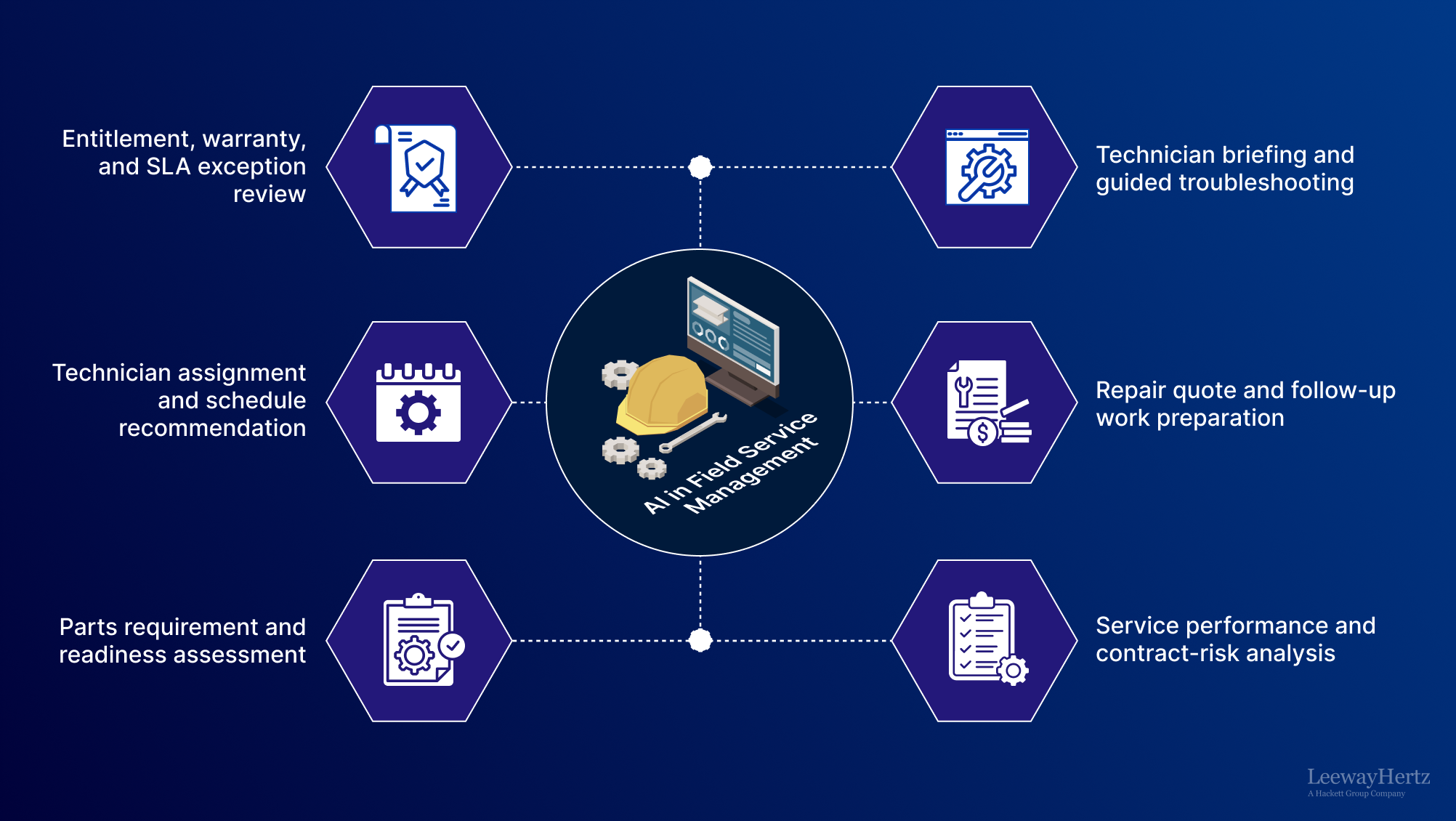
Field service management sits at the intersection of customer commitments, asset performance, workforce capacity, and service economics. A service request may begin as a call, portal submission, contract trigger, or connected-asset alert, but fulfilling it requires a coordinated sequence of activities across work-order creation, entitlement, scheduling, parts readiness, technician preparation, field execution, follow-up work, billing handoff, and performance review.
AI is increasingly relevant to this environment because much of field service work depends on interpreting records, assembling context from multiple systems, resolving exceptions, and coordinating decisions across teams. Document intelligence can extract and validate service information, retrieval-grounded systems can surface relevant technical knowledge and asset history, predictive models can identify likely parts or service risks, optimization methods can support scheduling and routing, and agentic AI can coordinate multi-step workflows across service systems.
The opportunity, however, is not simply to add AI on top of a field service platform. Each service event is shaped by operational dependencies. A dispatcher needs the work order, SLA, technician skills, geography, availability, and parts status before confirming an assignment. A technician needs asset history, prior field service reports, manuals, known-issue bulletins, and safety requirements before beginning work. Contract administrators, parts coordinators, remote support engineers, subcontractor managers, and billing analysts may all contribute to the same service event before it is operationally and financially complete.
This makes field service a connected operating model, not a collection of isolated workflows. Service request intake influences entitlement and dispatch. Dispatch depends on technician capacity and parts readiness. Field execution creates the evidence required for follow-up work, customer sign-off, warranty handling, billing, and service-performance analysis. A delay or data issue at one stage can therefore create downstream exceptions across the rest of the service lifecycle.
The information supporting this operating model is equally distributed. Work orders, service contracts, entitlement records, SLA matrices, dispatch schedules, route plans, and parts requisitions may reside across different systems and teams. Asset histories, diagnostic records, technical manuals, field service reports, JSA checklists, T&M sheets, and customer sign-offs may also be distributed across those systems and teams. Much of the operational burden comes from bringing this information together at the right time, determining what matters, and preparing a reliable basis for action.
This is where AI becomes most useful when it is applied at the right level of the operating model. Broad concepts such as “AI for dispatch,” “AI for technician productivity,” or “AI for service operations” are too general to define what to build. A practical AI opportunity is tied to a specific process or sub-process, with clear source artifacts, system dependencies, decision rules, exception types, outputs, and accountable reviewers.
Human accountability remains central. Dispatchers, technicians, service contract administrators, parts teams, billing analysts, and service managers continue to own consequential operational, safety, contractual, and financial decisions. AI supports the preparation, analysis, prioritization, and coordination around those decisions without replacing the controls and judgment required to execute them responsibly.
This article maps the field service management operating model from service request intake through resolution, follow-up, billing handoff, and performance governance. It examines the functions, processes, and sub-processes that make up the service lifecycle and identifies where generative AI, predictive analytics, and agentic AI can support specific activities, integrate with existing systems, and preserve human oversight.
- How AI is transforming field service operations
- Why AI use cases must be mapped at the sub-process level
- Field service management operating model and AI opportunity mapping across service processes
- High-value AI use cases in field service management
- How agentic AI works in field service workflows
- How to prioritize AI use cases in field service management
- Governance, risk, and responsible AI in field service management
- How ZBrain operationalizes AI use cases in field service management
- Future of AI in field service management
How AI is transforming field service operations
AI is changing field service by helping teams interpret service information faster, connect context across multiple systems, and prepare the evidence needed to act more consistently. The strongest opportunities lie in complementing and augmenting the work of dispatchers, technicians, contract administrators, and billing teams, especially in areas that are repetitive, information-intensive, exception-driven, or dependent on coordination across several functions.
It can help determine whether a work order is complete, bring the right service history and technical guidance into a technician’s workflow, and surface entitlement or SLA exceptions before dispatch. It can also identify likely parts requirements and prepare the documentation needed for follow-up work or billing.
- Document-heavy work: Field service depends on a large number of operational records, including work orders, service contracts, entitlement records, field service reports (FSRs), JSA checklists, T&M sheets, service quotes, subcontractor invoices, parts records, and customer sign-offs. Document intelligence can extract structured information from these records, compare fields across documents, identify missing values, and surface inconsistencies before they create downstream delays. For example, an FSR can be checked against the work order, parts usage, and customer sign-off to identify incomplete debrief information before the case moves to billing.
- Knowledge-heavy work: Technicians and support teams often need to work across asset service history, technical manuals, known-issue bulletins, prior FSRs, safety procedures, troubleshooting guides, and remote-resolution protocols. Retrieval-grounded AI can assemble the most relevant information for the current asset, fault, and work order, reducing the time spent searching through repositories. The retrieval system can also summarize prior service events, highlight recurring issues, and present applicable procedures while keeping the technician responsible for diagnosis and execution.
- Exception-heavy work: A significant share of field-service effort is spent resolving cases that do not follow the standard path. These may include ambiguous warranty or contract coverage, SLA risk, unavailable parts, missing technician credentials, incomplete service records, overdue core returns, subcontractor discrepancies, or billing mismatches. AI can classify these exceptions, identify missing evidence, prioritize them by urgency or operational impact, and route them to the appropriate reviewer. This helps teams focus attention on the cases that genuinely require judgment rather than manually sorting every transaction.
- Planning and prediction-heavy work: Field service planning requires teams to consider technician skills, availability, geography, SLA commitments, parts readiness, travel time, and existing workload. Predictive models can estimate likely parts requirements, repeat-visit risk, service duration, or the probability that remote resolution will succeed. AI-assisted scheduling can then help planners evaluate feasible technician assignments and schedule changes when conditions shift, while established scheduling and routing logic continues to enforce hard operational constraints.
- Communication and narrative-heavy work: Many field-service workflows require written outputs such as customer appointment updates, technician briefing notes, service summaries, quote narratives, escalation notes, and billing-support explanations. Generative AI can draft these from approved work-order, contract, parts, and service-history data, reducing preparation effort while keeping communications grounded in the underlying records. Human review remains important where the communication affects contractual commitments, pricing, safety, or customer expectations.
- Workflow-heavy work: Field service often crosses multiple systems and teams before a service event is complete. Agentic AI can coordinate these steps across FSM platforms, contract systems, inventory applications, knowledge repositories, scheduling tools, and communication channels. For example, a workflow triggered by a fault-code record can assemble asset history, check entitlement and SLA requirements, confirm parts availability, retrieve relevant technical guidance, prepare a technician briefing pack, and draft a customer notification before pausing for dispatcher or contract-administrator approval.
AI can support a broad range of field-service activities, from structuring and validating service records to identifying exceptions, retrieving technical knowledge, predicting likely service needs, supporting scheduling decisions, generating operational communications, and coordinating multi-step workflows.
Its value becomes clearer when applied to specific points in the service lifecycle. Rather than treating “AI for field service” as a single use case, organizations should map each capability to a defined sub-process, the artifacts and systems it depends on, the decision or exception it supports, the output it produces, and the person who remains accountable. This makes AI initiatives more practical to design, integrate, govern, and scale.
Why AI use cases must be mapped at the sub-process level
Field service management is not a single workflow. It is a connected operating model made up of service functions, recurring processes, and smaller operational activities spanning request intake, entitlement, dispatch, parts planning, technician preparation, field execution, follow-up work, billing, subcontractor coordination, and performance management.
This matters because broad ideas such as “AI for dispatch,” “AI for technician productivity,” or “AI for service billing” are too high-level to define what should actually be built. They do not specify the records involved, the systems that need to connect, the decision being supported, the exception being handled, or the person who remains accountable. To turn an AI idea into a practical workflow, field-service work needs to be decomposed into four levels:
- Function: A major area of operational accountability, such as scheduling and dispatch, parts planning and logistics, technician enablement, or service billing. A function contains multiple processes and is usually too broad to treat as a single AI use case.
- Process: A recurring workflow within a function, such as technician assignment, parts reservation, service debrief, quote preparation, or billing review. Processes show how work moves through the function but may still contain several decisions, exceptions, and handoffs.
- Sub-process: A specific activity with a defined input, output, system context, business rule, exception type, and accountable role. Examples include validating technician skill eligibility, checking parts readiness before dispatch, reviewing an FSR for missing evidence, or comparing a T&M sheet with contract coverage before billing.
- AI-enabled opportunity: A specific AI capability applied to a defined service artifact or decision point to change how that sub-process is performed. For example, classification can route an entitlement exception, retrieval-grounded analysis can bring the relevant service bulletin into a technician briefing, or anomaly detection can flag inconsistencies between an FSR, parts usage, and a T&M sheet.
Mapping AI at this level also exposes the dependencies that determine whether a workflow is actually feasible. A technician-assignment workflow may depend on entitlement status, SLA targets, technician skills and licenses, parts availability, geography, travel time, schedule capacity, and customer appointment windows. A billing-review workflow may depend on the completed FSR, T&M sheet, parts usage, contract and entitlement evidence, customer sign-off, and approved rates.
These dependencies are important because AI rarely operates on a single document or inside a single system. A useful workflow often needs context from several systems of record before it can prepare a recommendation, identify an exception, or assemble the next work packet. Mapping those inputs and handoffs upfront helps teams understand integration requirements, data availability, review boundaries, and potential failure points before development begins.
It also makes governance more concrete. Instead of asking whether an entire function can be automated, teams can decide exactly where AI may assist, recommend, or coordinate, and where a dispatcher, technician, contract administrator, billing analyst, or service manager must remain in control. This makes sub-process mapping the practical foundation for identifying AI use cases that are both buildable and governable.
Build governed AI workflows across field service operations
Scale AI across work-order, dispatch, technician, parts, and billing workflows while maintaining human accountability for safety, coverage, customer commitments, and financial decisions.
Field service management operating model and AI opportunity mapping across service processes
Field service management spans interconnected workflows that begin when a service need enters the field-service organization and continue through service execution, follow-up work, billing handoff, external-provider management, and performance governance. Each function depends on upstream information, downstream decisions, and multiple systems of record, so AI opportunities are difficult to prioritize without understanding the full operating model.
The following operating model maps customer-asset field service across five operating areas and eleven core functions. Each function is decomposed into processes and sub-processes, then paired with specific AI-enabled opportunities, artifacts, systems, control considerations, accountable roles, and a representative agentic workflow.
For each function, the analysis identifies:
- The teams responsible for the work.
- Where AI capabilities such as document intelligence, retrieval-grounded answering, predictive analysis, optimization, anomaly detection, and natural-language generation can support specific activities.
- Which decisions, approvals, and physical actions remain with field-service professionals.
- The artifacts, systems, safety or regulatory requirements, and commercial controls that shape implementation.
It is to identify practical, governed AI opportunities that improve how teams prepare work, retrieve knowledge, resolve exceptions, coordinate resources, and make decisions. It does so while maintaining accountability for physical service, safety, contract, customer, and financial outcomes.
A. Service initiation and commercial readiness
Function 1: Service request intake and work order creation
Converts an incoming service need into a complete, classified, and traceable work order.
Service request intake and work order creation establish the operational record that all downstream field-service activities rely on. The function begins after an approved intake channel captures a customer need and ends when the request is linked to the correct customer, site, and asset; classified into the proper service category; checked for duplicate or related work; and converted into a work order that can enter entitlement and planning. Weak intake data propagates rapidly: an incorrect serial number can point to the wrong contract, a vague symptom can distort parts planning, and an unsupported priority can consume scarce dispatch capacity.
Teams involved
Field service coordinators, dispatchers, service desk or contact-center handoff teams, installed-base administrators, service contract administrators, regional service operations teams, customer service representatives, and field service managers.
What AI helps with
Document intelligence can structure requests from portal submissions, call transcripts, email, and existing digital alert records into work-order fields. Entity resolution can match customers, sites, serial numbers, installed base, and prior-service records. Classification can propose work-order type, service queue, severity, and required specialty, while similarity analysis can surface likely duplicate or related open orders. Retrieval-grounded checks can bring forward site-access notes, prior unresolved issues, and known asset history before the request is released to entitlement and planning.
What humans continue to own
Service coordinators and dispatchers resolve ambiguous customer descriptions, confirm the correct asset when identifiers conflict, validate business impact, and approve priority or routing exceptions. Safety-related or emergency requests continue through established escalation procedures. AI can prepare and classify the work order, but it should not invent customer impact, automatically close suspected duplicates, override emergency response rules, or infer an asset match when the evidence remains uncertain.
| Process | Sub-process | AI-enabled opportunities |
|---|---|---|
| Service request capture and normalization | Request capture and field extraction |
|
| Customer and asset identification |
|
|
| Work order creation and classification | Work order type, priority, and severity classification |
|
| Duplicate and related-order detection |
|
|
| Pre-routing and readiness checks | Preliminary entitlement reference match |
|
| Initial routing and ownership assignment |
|
|
| Service request capture and normalization | Source provenance and attachment validation |
|
| Symptom normalization and service-history linkage |
|
|
| Work order creation and classification | Required-field completeness and exception identification |
|
| Pre-routing and readiness checks | Site access and service-window verification |
|
Key artifacts
- Service request and work order.
- Customer and site record.
- Installed-base or asset record and asset service history.
- Service contract reference.
- Customer communication record.
- Intake transcript or portal submission.
- Site access instruction record.
- Related or duplicate work-order link.
- Priority or escalation note.
Systems involved
- FSM platform.
- CRM or customer service platform.
- Installed-base or asset registry.
- Customer portal.
- Contact-center platform.
- Integration or workflow layer.
- Email or case ingestionsystem.
- Document repository or attachment store.
- Master data or customer-data service.
Regulatory and control considerations
- Customer and asset data should follow organizational access, privacy, retention, and audit requirements.
- Emergency or safety-related requests must continue through existing escalation procedures.
- Contract and SLA references used at intake remain subject to the authoritative entitlement review.
- The source request and any AI-normalized version should remain linked so reviewers can compare structured fields with the original customer evidence.
- Priority, severity, and emergency classification should use an approved taxonomy with explicit override authority.
- Low-confidence customer or asset matches should remain unresolved until a coordinator confirms the correct record.
Accountable roles
- Field service manager
- Dispatcher
- Service coordinator
- Service contract administrator
- Regional service operations lead
- Installed-base administrator
- Customer service representative
Highest-value opportunities
- Request completeness review: Missing asset, site, symptom, or contact data creates avoidable downstream exceptions.
- Customer and asset matching: Incorrect installed-base linkage can propagate into the wrong contract, parts, technician skill, and service history.
- Duplicate work-order detection: Identifying repeated requests can prevent fragmented service history and unnecessary dispatch activity.
Example agentic workflow: Service request intake to work-order readiness
- The workflow begins when a field-service request is captured from an approved channel such as a portal, call record, email, or existing digital alert. Document intelligence extracts customer, site, asset, symptom, contact, and requested-service information into a draft work-order record.
- Entity resolution matches the request to the installed asset and customer site, while similarity analysis checks open orders for likely duplicates and links related prior work.
- Classification proposes the work-order type, service queue, and priority using approved triage rules and available contract context. The workflow also checks site-access instructions, required attachments, and unresolved prior work so readiness issues are visible before entitlement review.
- A service coordinator or dispatcher reviews uncertain asset matches, suspected duplicates, priority exceptions, and other unresolved readiness issues before confirming the request.
- After confirmation, the work order is created and handed to entitlement and planning, with the source request and review evidence retained. Every generated field preserves provenance to the original request or source record, allowing reviewers to distinguish customer-provided facts from AI-normalized structure.
Function 2: Entitlement and contract management
Determines which commercial and service commitments apply to the work order.
Entitlement and contract management translates commercial agreements into service-operating constraints. The function links the work order to the applicable contract, warranty, service plan, or customer-specific commitment; identifies covered assets and service scope; establishes response and resolution targets; and separates covered work from potentially billable work. As entitlement decisions influence dispatch priority, parts treatment, customer communication, and billing, the function needs traceable evidence rather than a model-generated conclusion without source support.
Teams involved
Service contract administrators, warranty administrators, customer service coordinators, dispatch and planning teams, service billing analysts, account or commercial teams, installed-base administrators, and service operations managers.
What AI helps with
Document intelligence can extract covered assets, contract dates, service windows, included labor and parts, exclusions, consumables treatment, travel terms, and special conditions from service contracts and warranty records. Retrieval-grounded analysis can surface the exact clause relevant to the work-order condition, while anomaly detection can identify overlapping contracts, expired coverage, inconsistent installed-base dates, or conflicting warranty records. Multi-source aggregation can assemble the work order, asset history, entitlement record, and prior replacement history into one review packet for the contract administrator.
What humans continue to own
Service contract administrators remain accountable for ambiguous coverage, precedence between overlapping agreements, edge-of-warranty cases, and nonstandard exceptions. Authorized commercial owners approve concessions, goodwill treatment, or deviations from standard terms. AI can extract, compare, and recommend a disposition, but explicit contract, warranty, SLA, pricing, and authority rules remain authoritative and must be preserved as deterministic controls where they are defined.
| Process | Sub-process | AI-enabled opportunities |
|---|---|---|
| Contract and warranty verification | Contract identification and term extraction |
|
| Warranty coverage validation |
|
|
| Asset-to-contract and overlapping-coverage resolution |
|
|
| Coverage exclusions, consumables, and travel-term review |
|
|
| SLA determination and tracking setup | Response and resolution target determination |
|
| SLA exception and escalation review |
|
|
| Service calendar and escalation-clock setup |
|
|
| Covered versus billable determination | Labor and parts coverage assessment |
|
| Renewal and coverage-gap signal capture |
|
|
| Non-covered work and concession-routing review |
|
Key artifacts
- Service contract
- Warranty record
- Entitlement record
- SLA matrix
- Work order
- Asset installation record
- Coverage-review note
- Contract amendment or addendum
- Rate or coverage schedule
- Warranty replacement history
- Commercial exception approval
Systems involved
- Contract management system
- FSM platform
- ERP
- Installed-base registry
- Warranty system
- CRM
- Pricing or rate reference system
- Document repository
- Approval workflow system
Regulatory and control considerations
- Service contracts, warranties, and SLA commitments form the commercial control frame.
- AI should not override explicit coverage, pricing, or service-level rules.
- Records supporting coverage decisions should remain traceable to the applicable contract, warranty, and work-order evidence.
- Contract precedence and authority limits should be represented as deterministic policy where possible rather than inferred from model output.
- Customer-facing coverage explanations should cite the underlying contract, entitlement, or warranty evidence used for the conclusion.
- Approved concessions should be stored separately from standard contract entitlement so future reviews do not mistake an exception for a standing term.
Accountable roles
- Service contract administrator
- Field service manager
- Dispatcher
- Service billing analyst
- Account or commercial owner
- Warranty administrator
- Commercial approval owner
Highest-value opportunities
- Contract and term extraction: Coverage evidence is often distributed across contract documents, entitlement records, and installed-base data.
- Warranty edge-case review: Ambiguous dates, exclusions, and prior replacements can materially change who pays for labor or parts.
- SLA target setup: Response and resolution commitments influence dispatch priority, escalation, and customer communication.
Example agentic workflow: Ambiguous warranty and entitlement review
- The workflow starts when a work order is linked to one or more possible contracts or warranty records.
- Document intelligence extracts the covered asset, dates, labor and parts terms, exclusions, and applicable service level, then compares them with the work-order scope and asset history.
- Conflicting or edge-of-warranty evidence is assembled into a review packet with relevant clauses, effective dates, and timestamps.
- The service contract administrator confirms coverage or records the approved exception; commercial concessions follow existing authority limits.
- The confirmed entitlement and SLA evidence is written back to the work order for scheduling, parts, billing, and audit review, with any concession stored as an explicit exception record.
B. Planning and resource readiness
Function 3: Scheduling and dispatch optimization
Turns a ready work order into an executable field plan by combining skills, geography, SLA commitments, parts readiness, and appointment constraints.
Scheduling and dispatch optimization turns a service-ready work order into an executable field plan. The function must reconcile technician skills and credentials, geography, shift availability, estimated duration, customer appointment windows, parts readiness, travel time, SLA commitments, and urgent work that changes throughout the day. It is therefore both a planning optimization problem and an exception-management problem. The optimizer should solve the constrained assignment problem, while generative and agentic AI help interpret context, explain trade-offs, coordinate approvals, and update surrounding workflows.
Teams involved: Dispatchers, service planners and schedulers, regional field service managers, workforce coordinators, parts coordinators, technical support teams, customer service teams, and field technicians.
What AI helps with: Optimization methods can solve assignment, sequencing, and re-planning against skills, geography, shift calendars, appointment windows, parts readiness, and SLA targets. Predictive models can estimate likely job duration or late-arrival risk from historical work patterns. AI can summarize job context, identify missing readiness conditions, explain why a recommended plan satisfies or violates constraints, and prepare customer communication when an approved re-dispatch affects an appointment. Agentic workflows can coordinate schedule changes across the dispatch board, parts status, technician mobile app, and notification channels after human approval.
What humans continue to own: Dispatchers and planners confirm assignments, overtime, emergency insertions, customer-impacting changes, and overrides to the optimizer. Managers remain accountable for workforce policy, local operating conditions, and exceptions that cannot be represented safely as solver constraints. Generative AI should not be described as performing the mathematical optimization itself, and schedule changes with contractual, safety, or workforce implications should not bypass the designated dispatcher or manager.
| Process | Sub-process | AI-enabled opportunities |
|---|---|---|
| Work readiness and technician eligibility | Job-readiness validation |
|
| Skill and credential eligibility checking |
|
|
| Customer appointment and access feasibility check |
|
|
| Estimated job duration and lateness-risk assessment |
|
|
| Technician assignment optimization |
|
|
| Skill and credential eligibility checking |
|
|
| Assignment and route planning | Route sequencing and appointment-window planning |
|
| Dynamic dispatch management | Technician overrun and route-deviation monitoring |
|
| Customer notification and appointment-change coordination |
|
|
| Emergency work insertion and re-dispatch |
|
|
| Schedule conflict and delay management |
|
Key artifacts
- Dispatch board
- Work order
- Technician skill and credential record
- Route plan
- SLA matrix
- Parts readiness record
- Appointment record
- Technician shift calendar
- Credential or license status record
- Job duration estimate
- Re-dispatch approval record
Systems involved
- FSM scheduling and dispatch module
- Workforce management system
- Mapping and routing service
- Parts or inventory system
- CRM or customer-notification platform
- Technician mobile platform
- Time or attendance system
- Customer messaging platform
Regulatory and control considerations
- Required trade licenses, certifications, and safety qualifications must remain hard eligibility constraints where applicable.
- DOT or fleet policies apply where vehicle operations are material.
- Customer appointment and SLA commitments should remain traceable through approved dispatch changes.
- Hard eligibility constraints such as required certification, product authorization, license, and safety qualification should not be softened by model confidence.
- Optimization objectives should be explicit, for example, SLA compliance, travel minimization, or workload balance, so dispatchers understand the trade-offs in the proposed plan.
- Customer-impacting re-dispatch decisions should retain the approved plan, override reason, and notification history.
Accountable roles
- Dispatcher
- Service planner/scheduler
- Field service manager
- Parts coordinator
- Field technician
- Workforce coordinator
- Customer service coordinator
Highest-value opportunities
- Job-readiness validation: High leverage because dispatching a technician before entitlement, parts, access, or safety prerequisites are ready creates avoidable failed visits.
- Skill and credential matching: Critical where asset type, regulated trade, or service procedure requires specific qualifications.
- SLA-aware assignment optimization: Valuable because it balances service urgency with technician, geography, duration, and parts constraints that cannot be resolved reliably through narrative generation alone.
Example agentic workflow: Emergency work insertion and re-dispatch
- An emergency work order enters the dispatch queue with a confirmed service priority and SLA target. The workflow checks readiness, required skills, credentials, parts availability, technician locations, current assignments, and appointment commitments.
- The scheduling optimizer proposes feasible insertion and reassignment options and identifies the customer appointments that would be affected. AI prepares a dispatcher-facing explanation of the trade-offs and drafts the required customer notifications for each option.
- The dispatcher confirms or overrides the proposed plan according to operational priorities and local constraints.
- After approval, the dispatch board and route plan are updated, and customer communications are released through approved channels. The workflow records which hard constraints were satisfied, which optimization objective changed, and which appointments would move under each feasible option.
- After the approved plan is released, the prior schedule, override reason, customer notifications, and updated SLA timestamps remain linked for later performance review.
Function 4: Parts planning and logistics
Ensures the technician has the required service parts in the right place at the right time.
Parts planning and logistics converts an expected service need into material readiness at the technician, forward stocking location, depot, or other approved supply point. The function covers likely-part identification, compatibility and supersession checks, reservation, constrained allocation, transfer, shipment visibility, technician van inventory, and returning removed or defective components. The operational objective is not simply to predict a part. It is to make the required part available in a traceable way that fits the asset configuration, service timing, inventory policy, and return obligations.
Teams involved: Parts coordinators, service planners, warehouse and depot teams, field technicians, logistics coordinators, inventory analysts, depot repair managers, procurement teams where replenishment is involved, and field service managers.
What AI helps with: Predictive analytics can estimate likely part needs from the work-order symptom, asset model, fault-code record, prior FSRs, repair history, and known-issue patterns. Validation helps compare part numbers, revisions, supersession rules, and approved substitutes against the installed configuration. Multi-source aggregation can reconcile van stock, forward stocking locations, depots, shipments, and reservations, while anomaly detection can surface shortages, serial mismatches, overdue cores, or return records that do not reconcile with the completed work order.
What humans continue to own: Parts coordinators approve substitutions, constrained allocation, expedites, cannibalization if permitted, and exceptions involving obsolete, restricted, serialized, or safety-critical parts. Technicians confirm the parts actually installed and removed. AI can recommend material movements and prepare transfer or return records, but inventory policy, chain-of-custody controls, hazardous-material rules, and physical handling remain authoritative.
| Process | Sub-process | AI-enabled opportunities |
|---|---|---|
| Parts requirement planning | Likely parts identification |
|
| Part compatibility and substitution review |
|
|
| Service-parts demand and replenishment signal review |
|
|
| Availability, reservation, and transfer | Van stock and forward-stock availability check |
|
| Parts reservation and transfer orchestration |
|
|
| Shipment ETA and parts-readiness risk assessment |
|
|
| Defective-part return management | Advance exchange and core return initiation |
|
| Return exception and reconciliation review |
|
|
| Serial, lot, and removed-part traceability |
|
|
| Removed-part disposition and depot handoff |
|
Key artifacts
- Parts requisition
- Van stock list
- Forward stocking location inventory
- Work order
- Asset configuration record
- FSR
- Return or core record
- Part supersession record
- Shipment or transfer status
- Serial or lot trace record
- Depot receipt or disposition record
Systems involved
- ERP or inventory system
- FSM platform
- Warehouse management system
- Depot or repair system
- Parts catalog
- Logistics or shipment platform
- Transportation management or carrier tracking
- Master parts catalog
- Procurement or replenishment system
Regulatory and control considerations
- Serial, lot, or chain-of-custody requirements should be preserved where the asset or component requires traceability.
- Environmental, hazardous material, or regulated return rules apply only where relevant to the part involved.
- Advance exchange and core-return deadlines remain governed by approved material-control rules.
- Serialized, regulated, hazardous, or safety-critical components should preserve required traceability and physical handling controls.
- Part substitution should use approved interchangeability or supersession rules and should not be inferred solely from semantic similarity.
- Inventory reservations and transfers should remain subject to allocation rules when stock is constrained across customers or regions.
Accountable roles
- Parts coordinator
- Depot repair manager
- Field technician
- Service planner/scheduler
- Field service manager
- Inventory planner
- Warehouse or logistics coordinator
Highest-value opportunities
- Likely-parts prediction: High value because sending the right part with the first visit supports service readiness without requiring the model to control the physical asset.
- Compatibility and substitution review: Valuable because incorrect revisions or substitutions can create failed visits, safety issues, or additional rework.
- Multi-location availability view: High leverage because field parts are distributed across van stock, forward locations, depots, and existing reservations.
Example agentic workflow: Parts readiness and transfer workflow
- The workflow begins after the work order has a sufficiently defined symptom, asset model, and planned service window. Predictive analysis proposes likely part requirements using asset history, fault evidence, known issues, and prior FSRs.
- The workflow validates part compatibility and checks van stock, forward stocking locations, depots, and existing reservations.
- If the required part is not locally ready, an optimization step proposes a feasible source and transfer path against the SLA and technician route.
- The parts coordinator confirms substitutions, constrained allocation, or expedite decisions before release. The system creates the approved requisition or transfer and updates the work order with parts-readiness status and return requirements.
- The workflow monitors the approved transfer or shipment and flags the work order if the part is no longer expected to arrive before the service window. When a replacement creates a core or defective-part return obligation, the workflow attaches the return requirement to the work order before technician dispatch.
C. Technician enablement and field execution
Function 5: Technician enablement and knowledge management
Prepares technicians with the service history, known issues, procedures, safety context, and remote support needed before and during a visit.
Technician enablement and knowledge management turns distributed service information into a job-specific briefing and support environment. Before a visit, technicians may need the asset configuration, recent FSRs, known issues, open follow-up work, safety notes, site restrictions, warranty context, and likely diagnostic procedures. During troubleshooting, they need approved knowledge that matches the exact product, revision, symptom, and operating context. The value of AI is therefore in retrieval, synthesis, evidence organization, and escalation support rather than replacing technician diagnosis or physical judgment.
Teams involved: Field technicians, technical support engineers, remote-assist specialists, service engineering, knowledge-management teams, product support, field service managers, safety specialists, and service trainers.
What AI helps with: Retrieval-grounded answering can locate the correct manual section, service bulletin, known-issue note, troubleshooting tree, and prior repair evidence for the current work order. Summarization can convert long asset histories into a concise briefing that highlights repeat failures, replaced components, unresolved recommendations, and recent readings. Classification can route symptoms to the right knowledge domain, while agentic workflows can prepare a remote-assist packet, collect supporting evidence, and route the case to a technical specialist when the approved self-service path is exhausted.
What humans continue to own: The technician remains responsible for diagnosis, safety-sensitive execution, deciding whether the observed condition matches the documented procedure, and stopping work when conditions are unsafe or outside the scope. Technical support engineers own expert escalation decisions. AI should not fabricate procedures, instruct a technician to bypass lockout, electrical, site, or product safety controls, or treat a retrieved knowledge article as proof that a physical condition has been verified.
| Process | Sub-process | AI-enabled opportunities |
|---|---|---|
| Pre-work briefing | Asset and service-history briefing |
|
| Safety and site-context briefing |
|
|
| Open issue, repeat-failure, and prior-repair effectiveness review |
|
|
| Guided troubleshooting and knowledge retrieval | Procedure and manual retrieval |
|
| Symptom-to-diagnostic-path support |
|
|
| Asset-version and configuration-specific knowledge matching |
|
|
| Remote assist and knowledge capture | Remote-resolution eligibility assessment |
|
| Field knowledge capture and review |
|
|
| Remote-assist escalation packet preparation |
|
|
| Field learning and knowledge-gap identification |
|
Key artifacts
- Asset service history
- Field service reports
- Technical manuals
- Known-issue bulletins
- Safety procedures
- Work order
- Remote-assist record
- Service manual
- Technical service bulletin
- Known-issue article
- Remote-assist case record
- Knowledge feedback or article-review record
Systems involved
- Knowledge management system
- FSM mobile application
- Document repository
- Remote support platform
- Asset history database
- Training or learning platform
- Enterprise search or knowledge retrieval layer
- Remote-assist platform
- Product documentation repository
Regulatory and control considerations
- OSHA/JSA controls apply to relevant field-safety preparation.
- NFPA 70E applies where electrical work is within scope.
- Approved technical and safety documentation remains authoritative over generated guidance.
- Knowledge retrieval should be constrained to approved content and the applicable asset model, configuration, revision, and region where those distinctions matter.
- Generated troubleshooting summaries should preserve source citations so technicians can open the authoritative procedure before acting.
- Technician-contributed knowledge should pass service engineering or knowledge-management review before becoming approved guidance.
Accountable roles
- Field technician
- Technical support engineer
- Field service manager
- Knowledge manager
- Product specialist
- Service engineering
- Service trainer
Highest-value opportunities
- Pre-work briefing pack: High leverage because technicians often need context from multiple service records before arriving at the site.
- Procedure and manual retrieval: Valuable because the correct service instruction may be buried in long manuals, bulletins, and historical reports.
- Remote-resolution eligibility: High value because qualifying issues for remote support can avoid unnecessary travel while preserving the technician or support-engineer decision boundary.
Example agentic workflow: Technician briefing and remote-assist workflow
- The workflow begins when a ready work order is assigned to a technician or enters a remote-assist queue. It assembles recent FSRs, asset history, known issues, contract context, parts status, site notes, and relevant safety information.
- Retrieval-grounded answering identifies the approved manual sections, service bulletins, and remote-fix protocol most relevant to the symptom. If remote resolution is permitted, the workflow prepares the evidence and recommended troubleshooting path for the technical support engineer.
- The technician or support engineer confirms the steps and performs the physical or remote service activity under existing procedures.
- The workflow verifies that retrieved knowledge matches the specific asset revision or configuration, warning when the source is not configuration-specific. The outcome and supporting evidence are recorded in the work order.
- Any new field learning is proposed as a candidate knowledge update and routed to service engineering or knowledge management for review rather than being published automatically as approved guidance.
Function 6: Service execution and field data capture
Captures the evidence generated during the visit, from safety checks and labor to parts, readings, photos, signatures, and field debrief.
Service execution and field data capture turns planned work into the official record of what occurred at the customer site. It includes arrival and work-start controls, JSA completion, labor and travel capture, parts installed and removed, readings, failure and resolution codes, photos, service notes, customer sign-off, first-time-fix status, and the decision to close or create follow-up work. The quality of this record affects warranty analysis, parts returns, service billing, repeat-visit analysis, compliance, and future troubleshooting.
Teams involved: Field technicians, field service managers, safety or EHS reviewers where required, technical support engineers, parts coordinators, service administrators, billing analysts, and customer-site representatives responsible for sign-off.
What AI helps with: Speech-to-structure and document intelligence can convert technician debriefs into structured labor, parts, readings, failure codes, and resolution fields. Computer vision can classify existing digital service photos for evidence organization, while validation can compare parts used with parts issued, check units and plausible ranges for entered readings, and identify missing required fields before closure. Natural-language generation can draft the FSR narrative from approved structured evidence, and anomaly detection can surface inconsistencies that need technician or supervisor review.
What humans continue to own: Technicians own the factual accuracy of what they observed, the safety assessment, the repair performed, readings taken, parts installed or removed, and completion status. Customer representatives provide required acknowledgment or sign-off where applicable. Supervisors handle disputed evidence or exceptions. AI can structure and draft the record, but it cannot attest that physical work occurred, certify a safety condition, or close a work order when mandatory evidence is missing.
| Process | Sub-process | AI-enabled opportunities |
|---|---|---|
| Arrival, safety, and work-start controls | Job safety analysis and pre-work checklist |
|
| Site arrival and work-start evidence |
|
|
| Site access and authorization confirmation |
|
|
| Field service evidence capture | Labor, parts, failure-code, and reading capture |
|
| Photo and service evidence classification |
|
|
| Reading, unit, and value plausibility validation |
|
|
| Installed-versus-removed parts reconciliation |
|
|
| Completion, debrief, and customer sign-off | FSR drafting and completeness review |
|
| First-time-fix and sign-off determination |
|
|
| Follow-up work and revisit requirement identification |
|
Key artifacts
- JSA checklist
- Work order
- FSR
- T&M sheet
- Parts usage record
- Digital service photos
- Measurement or reading record
- Customer sign-off
- Technician check-in record
- Measurement or reading record
- Parts-installed and parts-removed record
- Completion or revisit code
- Follow-up recommendation
Systems involved
- FSM mobile application
- Safety or compliance system
- ERP or parts system
- Document repository
- Customer signature application
- Quality system where applicable
- Field technician mobile app
- Digital forms or inspection platform
- Photo or attachment repository
Regulatory and control considerations
- OSHA/JSA requirements apply to relevant field work.
- NFPA 70E applies where electrical safety is material; EPA Section 608 applies where refrigerant handling is involved.
- FDA servicing and installation records apply only to relevant medical-device workflows, not field service generally.
- AI-generated FSR text should be traceable to technician-confirmed structured evidence and should never create measurements, parts usage, or actions that were not recorded.
- Mandatory safety, regulatory, customer-signoff, and service-evidence fields should block closure when policy requires them.
- Digital photos may support evidence review, but the model should not infer an unsafe physical condition or regulatory compliance beyond what the approved inspection process establishes.
Accountable roles
- Field technician
- Field service manager
- Safety or compliance reviewer
- Technical support engineer
- Parts coordinator
- Safety or EHS reviewer
- Field service administrator
- Customer site representative
Highest-value opportunities
- JSA completeness and safety evidence review: Critical because AI can check evidence completeness but must not replace the technician or authorized safety reviewer.
- Field debrief structuring: High leverage because labor, parts, failure codes, readings, and free-text notes feed billing, analytics, warranty, and future service history.
- FSR drafting and completeness review: Valuable because the FSR is a central operational artifact that often requires reconciliation across multiple field inputs.
Example agentic workflow: Field debrief to completed FSR
- The technician starts from the assigned work order and completes the required JSA and site-entry controls before physical work begins.
- During the visit, approved systems capture labor, parts installed and removed, failure codes, measurements, digital photos, technician notes, and other required service evidence.
- AI structures the debrief and compares parts usage, readings, notes, and other evidence with the work order and parts requisition, while validation checks units, required photos, completion codes, and follow-up recommendations.
- Natural-language generation prepares an FSR draft and flags missing evidence, contradictory fields, or likely follow-up work for technician review and resolution.
- The technician confirms the narrative and physical outcome and obtains customer sign-off where required; only then is the service record completed and handed downstream to billing, returns, warranty, knowledge, and performance reporting.
Accelerate AI Solutions Development
Build fully functional solutions from your high-value use cases, based on specific operational needs and enterprise context.
D. Proactive service and follow-up work
Function 7: Preventive and predictive service programs
Administers contracted preventive maintenance and turns existing connected-asset records into triaged service actions.
Preventive and predictive service programs move field service beyond isolated break-fix events. The function administers contract-based PM schedules, prepares preventive work, reviews missed or overdue maintenance, interprets existing connected-asset alerts, screens for remote resolution, identifies recurring service patterns, and communicates asset-health observations to customers. The software boundary matters: existing monitoring infrastructure produces the alert or telemetry record, while AI interprets the digital evidence and coordinates the service response.
Teams involved: Service planners, preventive-maintenance coordinators, field service managers, technical support engineers, reliability or service engineering teams, remote-support teams, contract administrators, parts coordinators, and customer success or account teams where health reporting is part of the service relationship.
What AI helps with: Extraction can translate contract or maintenance-plan requirements into PM work-order scope, task lists, and timing windows. Predictive analysis can rank assets or accounts by repeat-service risk using approved historical service data. Classification can normalize fault codes and alerts into service-relevance categories, while retrieval-grounded analysis can compare the signal with known issues and remote-fix protocols. Agentic workflows can coordinate remote triage, parts readiness, technician planning, and customer communication after the underlying monitoring system has produced the digital signal.
What humans continue to own: Service planners and managers approve schedule exceptions, maintenance deferrals, or changes to approved service programs. Technical specialists decide whether evidence supports remote resolution or field dispatch when the rule is not deterministic. Technicians remain responsible for physical inspection and maintenance. AI should not be described as sensing the equipment, predicting failure without an approved predictive model, or altering maintenance intervals outside authorized engineering or contract processes.
| Process | Sub-process | AI-enabled opportunities |
|---|---|---|
| Preventive maintenance administration | PM schedule creation and compliance review |
|
| PM work-order preparation |
|
|
| Overdue PM and service-window exception management |
|
|
| Connected-asset alert triage | Alert normalization and service relevance classification |
|
| Remote-resolution and dispatch screening |
|
|
| Duplicate, correlated, and non-service alert screening |
|
|
| Remote-resolution evidence and closure support |
|
|
| Asset health and proactive service reporting | Service-history risk pattern analysis |
|
| Customer asset-health reporting |
|
|
| Recurring service-pattern and fleet-level risk review |
|
Key artifacts
- PM schedule
- PM work order
- Asset service history
- Connected-asset alert or fault-code record
- Remote-assist record
- Asset-health report
- Service contract
- PM plan or maintenance task list
- PM compliance record
- Remote resolution record
- Asset health summary
- Alert triage disposition
Systems involved
- FSM platform
- Monitoring or diagnostic platform
- Asset history database
- Knowledge system
- Remote support platform
- Customer portal
- Connected-asset monitoring platform
- Preventive maintenance scheduler
- Remote support platform
- Analytics or reliability platform
Regulatory and control considerations
- Existing monitoring data may trigger software workflows, but physical sensing and device control remain outside the generative/agentic AI layer.
- FDA servicing requirements apply only to relevant medical-device service contexts.
- PM and service obligations remain governed by the contract, approved maintenance program, and applicable safety requirements.
- The monitoring or diagnostic system remains the source of the digital alert; the AI workflow begins after the signal exists.
- Maintenance interval changes, engineering campaigns, and product-service recommendations require the appropriate engineering, contract, or management approval.
- Alert suppression or no-dispatch treatment should use approved triage rules and should preserve low-confidence cases for human review.
Accountable roles
- Service program manager
- Technical support engineer
- Dispatcher
- Field service manager
- Field technician
- Preventive maintenance coordinator
- Reliability or service engineer
- Remote support lead
Highest-value opportunities
- PM compliance review: High leverage because contractual preventive service schedules can be checked systematically for missed, upcoming, or conflicting work.
- Alert triage: Valuable because large alert volumes require classification into service-relevant, informational, duplicate, or already-known conditions.
- Remote resolution screening: High value because it can avoid unnecessary truck rolls when the approved remote-fix path is suitable and verified.
- Asset health reporting: Useful because customers can receive evidence-grounded summaries of service patterns without presenting AI-generated predictions as guaranteed failure forecasts.
- Overdue-PM exception management: High value because missed service windows can create contract, reliability, and customer-experience consequences that require different remedies.
- Alert correlation and triage: Valuable because connected assets can generate repeated or related signals that should be reviewed as one service context rather than multiple isolated requests.
Example agentic workflow: Connected-asset alert to dispatched work order
- A connected-asset monitoring system generates an existing digital fault-code record for a customer imaging system indicating a cooling anomaly. If the alert appears to be a duplicate or part of an already-open incident, the workflow links it to the existing service context instead of creating an independent dispatch request.
- The workflow aggregates the asset service history, known-issue content, customer contract and SLA terms, likely-part availability, and regional technician skills and schedules.
- It retrieves the approved remote-fix protocol and records that the permitted firmware-reset attempt was unsuccessful, preserving the remote-resolution evidence.
- The workflow prepares a dispatch packet with a recommended technician and appointment window, parts reservation, recent FSRs, known-issue bulletin, and draft customer notification.
- The dispatcher confirms or overrides the assignment for schedule conflicts, while the service contract administrator reviews ambiguous warranty coverage. After approval, the work order dispatches, the customer notification is released, the parts transfer begins, and the alert disposition, approvals, parts decision, SLA timestamps, and triage evidence remain available for reporting and governance analysis.
Function 8: Quoting and follow-up work
Converts field-identified repair needs or uncovered work into an approved service quote and, once accepted, a follow-up work order.
Quoting and follow-up work turns field findings outside the current work order into a controlled commercial and operational next step. The function captures additional repair scope, separates covered work from billable work, assembles parts and labor assumptions, prepares the service quote, routes it through approval thresholds, communicates the approved quote, and converts accepted work into a follow-up work order. The key control is preserving the boundary between technician observations, commercial approval, and customer authorization.
Teams involved: Field technicians, service coordinators, service contract administrators, service estimators, parts coordinators, account or commercial teams, field service managers, customer service representatives, and authorized pricing or approval owners.
What AI helps with: Extraction can convert technician notes, FSR findings, photos, readings, and failure codes into a structured candidate repair scope. Multi-source aggregation can assemble approved labor categories, parts, travel assumptions, entitlement evidence, and rate references. Natural-language generation can draft the quote narrative and customer explanation from approved inputs, while workflow coordination can route the quote through the correct authority limits and track expiry, customer response, and follow-up work-order readiness.
What humans continue to own: Technicians confirm the observed condition and recommended technical scope. Contract administrators confirm coverage boundaries. Authorized commercial roles approve price, discounts, concessions, or nonstandard terms, and the customer authorizes billable follow-up work. AI can prepare the quote and supporting evidence, but it should not create unapproved pricing, invent repair scope, or convert a recommendation into committed work without the required approvals.
| Process | Sub-process | AI-enabled opportunities |
|---|---|---|
| Field-identified opportunity capture | Additional repair scope identification |
|
| Parts and labor requirement assembly |
|
|
| Covered-versus-billable scope separation |
|
|
| Service quote preparation and approval | Quote line and narrative preparation |
|
| Quote approval and customer communication |
|
|
| Approved price, rate, and assumption retrieval |
|
|
| Approval-threshold and exception routing |
|
|
| Follow-up work-order generation | Accepted-quote conversion |
|
| Follow-up readiness and handoff |
|
|
| Accepted-quote change and scope validation |
|
Key artifacts
- Field debrief
- FSR
- Service quote
- Parts list
- Labor estimate
- Service contract
- Customer approval record
- Follow-up work order
- Approved rate card
- Quote approval record
- Customer acceptance record
- Repair-scope change record
Systems involved
- FSM platform
- CPQ or quoting system
- ERP
- CRM
- Parts catalog
- Customer communication platform
- CPQ or quoting system
- Commercial approval workflow
- Customer communication or e-signature platform
Regulatory and control considerations
- Approved pricing, discount, tax, and commercial authority rules remain authoritative.
- Customer acceptance must be captured through approved channels.
- Regulated repair scope or licensing requirements remain applicable to the follow-up work itself.
- Pricing, discounts, margins, and approval thresholds remain governed by approved commercial logic and authority limits.
- The quote should retain links to the FSR, entitlement review, parts assumptions, and any exception approval that supports the proposed scope.
- Changes after customer acceptance should trigger revalidation and, where required, revised customer approval rather than silent scope expansion.
Accountable roles
- Field technician
- Field service manager
- Service contract administrator
- Parts coordinator
- Authorized quote approver
- Service estimator
- Pricing or commercial approver
- Account manager
Highest-value opportunities
- Additional-scope capture: High leverage because technicians often identify work that should not be lost in free-text debrief notes.
- Parts and labor assembly: Valuable because quote readiness depends on reconciling technical scope with approved parts, labor categories, and entitlement context.
- Quote narrative preparation: Useful because customer-facing explanations can be drafted from approved technical and commercial inputs while retaining quote approval controls.
Example agentic workflow: Field-identified repair to approved follow-up work
- The technician records an additional repair need in the field debrief and links the finding to service evidence.
- AI structures the scope, identifies likely parts and labor categories, and retrieves the applicable service contract and approved rate context.
- The workflow prepares a draft service quote with line items, assumptions, exclusions, and a customer-facing explanation.
- An authorized service or commercial reviewer confirms the technical scope, pricing, and any discount or exception, after which the customer approves or declines through the approved channel; AI does not infer acceptance from conversation alone.
- For accepted work, the workflow validates any later scope change, surfaces differences requiring renewed customer approval, and converts the approved scope into a follow-up work order carrying forward the originating FSR, entitlement decision, quote approval, customer acceptance, planned parts, scheduling, and contract references.
E. Service monetization, partner delivery, and governance
Function 9: Service billing and service-to-cash
Assembles billable service evidence, validates it against entitlement and approved rating logic, and hands an invoice-ready package to downstream receivables processes.
Service billing and service-to-cash converts completed service evidence into an invoice-ready package and hands it to the receivables process. The function assembles time and materials, validates rating inputs, reconciles covered and billable items against entitlement, checks required documentation, prepares invoice-support evidence, and supports disputes after handoff. It stops before the broader accounts receivable lifecycle, collections, and cash application processes.
Teams involved: Service billing analysts, service contract administrators, field service administrators, field technicians, parts coordinators, finance or order-to-cash teams at handoff, customer service teams, and field service managers responsible for operational exceptions.
What AI helps with: Multi-source aggregation can assemble the FSR, T&M sheet, technician labor, travel, parts usage, entitlement record, quote, customer sign-off, and rate references into one billing packet. Validation can compare quantities, labor categories, covered versus billable scope, and required evidence, while anomaly detection can surface duplicate charges, unexpected labor or travel, missing sign-off, or mismatch between parts issued and parts billed. Natural-language generation can prepare invoice-support explanations and dispute evidence from approved source records.
What humans continue to own: Billing analysts approve invoice readiness and resolve exceptions. Contract administrators handle coverage ambiguity, while finance controls tax, posting, credit, and receivables rules downstream. AI can reconcile and explain the evidence, but deterministic rating, tax, pricing, and posting rules remain authoritative. The workflow should not release a disputed or unsupported invoice merely because a model confidence score is high.
| Process | Sub-process | AI-enabled opportunities |
|---|---|---|
| Time-and-materials assembly and rating support | Billable evidence assembly |
|
| Rating-input validation |
|
|
| Technician time and travel variance review |
|
|
| Parts charge and issue-to-use reconciliation |
|
|
| Billing review against entitlement | Covered and billable reconciliation |
|
| Invoice-package completeness review |
|
|
| Customer sign-off and mandatory-evidence validation |
|
|
| Invoice handoff and dispute support | Invoice handoff to receivables |
|
| Billing dispute evidence support |
|
|
| Dispute reason classification and response-packet assembly |
|
Key artifacts
- T&M sheet
- FSR
- Work order
- Parts usage record
- Entitlement record
- Rate table
- Customer sign-off
- Invoice-support package
- Invoice support packet
- Rate or pricing reference
- Billing exception record
- Customer dispute record
- Credit or adjustment request at handoff
Systems involved
- FSM platform
- ERP or billing system
- Contract system
- Time capture system
- Parts system
- Document repository
- Billing or invoicing platform
- Tax or pricing service where applicable
- Accounts-receivable system at handoff
Regulatory and control considerations
- Contract, rate, tax, and billing rules remain deterministic or controlled by authorized finance processes.
- Supporting service evidence should remain traceable to the invoice package.
- The operating boundary ends at approved invoice handoff and dispute-support preparation, not full AR or collections.
- AI should not determine tax, posting, credit, or accounting treatment when deterministic finance rules or authorized reviewers own the decision.
- Billing support should preserve the chain from completed work, entitlement, approved commercial terms, and customer evidence to each invoice line.
- Dispute summaries should distinguish factual service evidence from proposed commercial resolution.
Accountable roles
- Service billing analyst
- Service contract administrator
- Field technician
- Field service manager
- Finance or revenue operations reviewer
- Order-to-cash handoff owner
- Finance reviewer
Highest-value opportunities
- Billable evidence assembly: High leverage because billing often depends on reconciling technician time, parts, FSR content, entitlement, and customer acknowledgment.
- Rating-input validation: Valuable because AI can detect missing or inconsistent inputs without replacing authoritative rate, tax, or contract calculations.
- Covered-versus-billable reconciliation: Critical because entitlement exceptions can create leakage, customer disputes, or incorrect invoices if not resolved before handoff.
Example agentic workflow: T&M evidence to invoice-ready package
- The workflow begins when a completed work order reaches billing readiness, then assembles the T&M sheet, labor entries, parts usage, FSR, customer sign-off, contract or entitlement record, and approved rates.
- Validation checks for missing evidence, inconsistent quantities, uncovered items, customer sign-off, parts issue-to-use discrepancies, travel treatment, and mismatches between field usage and the billing record before the packet is marked invoice-ready.
- Coverage or rating exceptions are routed to the service billing analyst and, where needed, the service contract administrator for review and resolution.
- After authorization, the workflow prepares the invoice-support package and audit trail, then hands the approved package to the billing or receivables system; cash application and collections remain outside this article’s scope.
- If a customer later disputes a line, the same evidence graph is reused to assemble the dispute packet without automatically altering the accounting treatment.
Function 10: Subcontractor management
Extends field-service execution to approved third parties while preserving credential, quality, service-level, and commercial controls.
Subcontractor management extends field-service capacity through external service providers while preserving customer, safety, quality, and commercial controls. The function covers provider qualification, territory and capability matching, credential validation, assignment, work evidence, quality review, SLA monitoring, and invoice reconciliation. The operational challenge is that work is executed outside the direct workforce but must still conform to the service organization’s customer commitments and evidence standards.
Teams involved: Subcontractor managers, dispatchers, service planners, field service managers, procurement or vendor-management teams, safety or compliance reviewers, service billing analysts, parts coordinators, and customer-site contacts where access authorization is required.
What AI helps with: Entity resolution can match work-order requirements to approved subcontractor capabilities, service territory, product coverage, and customer eligibility. Extraction can read insurance certificates, licenses, training records, and credential documents, while status monitoring can flag expirations before assignment. Validation can compare subcontractor FSRs, labor, parts, photos, readings, SLA timestamps, and customer sign-off against work-order requirements, and invoice reconciliation can identify unsupported lines before payment approval.
What humans continue to own: Subcontractor managers approve provider assignment, credential exceptions, and quality remediation. Safety or compliance teams own regulated qualification requirements. Service managers decide whether work quality is acceptable when evidence is ambiguous, and billing or procurement teams approve invoices. AI can organize evidence and identify discrepancies, but it cannot waive required credentials, approve unsafe work, or authorize payment outside existing controls.
| Process | Sub-process | AI-enabled opportunities |
|---|---|---|
| Subcontractor qualification and assignment | Capability and territory matching |
|
| Credential and license verification |
|
|
| Availability, workload, and service-window matching |
|
|
| Credential expiry and renewal monitoring |
|
|
| Subcontractor work quality validation | Service evidence completeness review |
|
| SLA and quality exception review |
|
|
| Rework, repeat-visit, and service-quality pattern review |
|
|
| Subcontractor invoice reconciliation | Invoice-to-work-order reconciliation |
|
| Exception resolution and approval support |
|
|
| Approved-rate and commercial-term validation |
|
Key artifacts
- Subcontractor profile
- Credential and license record
- Work order
- FSR
- SLA record
- Subcontractor invoice
- Approved rate or contract record
- Subcontractor master record
- Insurance certificate
- Training or certification record
- Rate card or purchase order
- Quality remediation record
Systems involved
- Vendor management system
- FSM platform
- Credential repository
- ERP or AP system
- Contract system
- Quality management system
- Vendor management system
- Procurement or purchase-order system
- Credential repository
Regulatory and control considerations
- State or trade licensing requirements apply where the subcontracted work requires them.
- Insurance, credential, data-security, and customer-site requirements remain hard qualification controls where applicable.
- Invoice approval follows the organization’s procurement and financial authority model.
- Credential and insurance expiry should be treated as hard eligibility data when policy requires current documentation.
- Subcontractor work should follow the same customer, safety, evidence, and quality controls required for internal service delivery unless an approved exception exists.
- Invoice approval should remain separate from work-quality review when organizational segregation-of-duties rules require it.
Accountable roles
- Subcontractor manager
- Dispatcher
- Field service manager
- Quality reviewer
- Service billing or AP analyst
- Procurement or vendor manager
- Safety or compliance reviewer
Highest-value opportunities
- Capability and territory matching: High value because subcontractor assignment must reflect the asset, geography, service level, and contractual eligibility.
- Credential verification: Critical where licenses, insurance, customer authorizations, or technical certifications are prerequisites to dispatch.
- Service evidence validation: Valuable because external delivery still needs the same FSR, sign-off, parts, and SLA evidence expected from internal service teams.
Example agentic workflow: Subcontractor assignment and invoice reconciliation
- A work order requiring external coverage is routed to the subcontractor-management process, where the workflow compares the job requirements with approved providers, territory, skills, credentials, insurance, and availability.
- Credential status is rechecked at assignment time so an otherwise qualified provider with an expired license, insurance certificate, or product authorization is not treated as eligible. The subcontractor manager confirms the assignment and any exception before dispatch.
- After service, the workflow validates the FSR, customer sign-off, parts usage, and SLA evidence submitted by the subcontractor.
- The subcontractor invoice is reconciled with the completed work order, approved rates, and accepted service evidence, with discrepancies routed to the designated reviewer for resolution.
- Only after exceptions are resolved is the invoice released to the appropriate financial process. Quality exceptions, rework, and invoice discrepancies remain linked to the subcontractor record so recurring patterns can inform future provider review and assignment decisions.
Function 11: Service performance governance
Turns operational service records into a governed view of SLA attainment, first-time-fix, service economics, warranty cost, parts consumption, and customer follow-through.
Service performance governance turns operational records into a managed view of service outcomes, cost, customer experience, and control effectiveness. The function brings together SLA performance, first-time-fix, repeat visits, remote resolution, schedule adherence, parts consumption, warranty cost, subcontractor performance, contract profitability, and customer feedback. It identifies recurring exceptions and cost drivers that should feed back into contract design, planning, parts strategy, knowledge management, technician enablement, and service-program decisions.
Teams involved: Service operations directors, field service managers, service performance analysts, finance and FP&A partners, contract and warranty teams, parts and logistics leaders, customer experience teams, technical support, quality teams, and the VP service or chief service officer.
What AI helps with: Multi-source aggregation can combine FSM, contract, parts, warranty, billing, subcontractor, and customer-feedback records into consistent service views. Pattern detection can identify repeat failures, recurring SLA misses, high-cost asset families, warranty leakage patterns, or routes with persistent delay. Classification can normalize reason codes, while natural-language generation can prepare evidence-linked operating commentary that explains the drivers behind a metric instead of only restating the number.
What humans continue to own: Service leadership validates business interpretation, decides corrective actions, approves changes to policy or service design, and determines when a trend warrants engineering, commercial, workforce, or customer action. Finance team remains accountable for financial measures and contract-profitability definitions. AI can surface patterns and draft commentary, but it should not redefine KPIs, attribute causality without evidence, or trigger material policy changes without accountable review.
| Process | Sub-process | AI-enabled opportunities |
|---|---|---|
| Service-level and operational performance reporting | SLA and first-time-fix reporting |
|
| Remote-resolution and truck-roll analysis |
|
|
| At-risk backlog and SLA breach forecasting |
|
|
| Regional, technician, and asset-family performance segmentation |
|
|
| Contract profitability and warranty-cost analysis | Contract service-cost analysis |
|
| Warranty leakage and repeat-cost review |
|
|
| Warranty cost-driver and leakage classification |
|
|
| Parts and service-experience governance | Parts consumption and return analytics |
|
| Customer satisfaction follow-through |
|
|
| Customer feedback and service-experience theme analysis |
|
Key artifacts
- SLA performance report
- First-time-fix report
- Service cost record
- Warranty cost record
- Parts consumption report
- Contract profitability analysis
- Customer satisfaction record
- Corrective-action record
- Service KPI definition or data dictionary
- Performance dashboard
- Contract profitability view
- Warranty cost report
- Customer feedback record
- Corrective-action or service-improvement plan
Systems involved
- FSM analytics
- BI platform
- ERP or finance system
- Contract system
- CRM or feedback platform
- BI or analytics platform
- Data warehouse or lakehouse
- Customer experience platform
- Financial planning or profitability system
Regulatory and control considerations
- KPI definitions and contract measures should remain consistent with approved policies and customer agreements.
- Safety, licensing, warranty, and regulated-service evidence should remain traceable when performance analysis uses those records.
- Any quantified claim presented to management should preserve source lineage and calculation logic.
- KPI definitions, populations, exclusions, and ownership should be fixed before using AI to explain movement in the metric.
- Generated performance commentary should link back to supporting work-order populations and should distinguish correlation from confirmed root cause.
- Sensitive workforce comparisons should follow approved HR, labor, privacy, and fairness controls where individual technician data is used.
Accountable roles
- Field service manager
- Service operations director
- VP service or chief service officer
- Service contract administrator
- Finance partner
- Service performance analyst
- FP&A partner
- Customer experience lead
- Chief service officer
Highest-value opportunities
- SLA and first-time-fix exception analysis: High leverage because it moves performance review from static reporting toward evidence-backed diagnosis of the work orders driving misses.
- Remote-resolution and truck-roll analysis: Valuable because it shows where remote support is actually preventing or merely delaying field visits.
- Contract profitability review: High value because service cost, entitlement, parts, labor, and repeat work need to be understood together before commercial action is taken.
Example agentic workflow: SLA exception to service-performance review
- The workflow starts with the approved SLA, first-time-fix, repeat-visit, parts, and service-cost measures from systems of record. It distinguishes the official SLA result from predictive risk signals, preserving the contractual metric while still surfacing at-risk work for intervention.
- Pattern detection identifies the work orders, asset families, regions, parts, or exception categories contributing most to the change in performance, and the workflow retrieves supporting work orders, FSRs, dispatch events, entitlement records, and parts records for the selected exceptions.
- Natural-language generation prepares a performance narrative that separates observed evidence from hypotheses requiring management review. Any generated root-cause commentary links to the supporting work-order population and service leadership reviews it before using it in corrective-action or contract decisions.
- Service operations and finance or contract owners validate the interpretation and decide whether corrective action, policy change, or commercial follow-up is warranted.
- Approved actions are recorded with owners and evidence so the next performance cycle can distinguish activity from actual improvement.
Accelerate AI Solutions Development
Build fully functional solutions from your high-value use cases, based on specific operational needs and enterprise context.
High-value AI use cases in field service management
A high-value AI use case in field service is not defined by how sophisticated the model is. It combines a recurring operational problem, reliable service artifacts, a clearly bounded AI capability, a measurable service or commercial outcome, and an accountable reviewer. The opportunities below span the complete field service operating model, from request intake and entitlement through dispatch, field execution, billing, subcontractor management, and service-performance governance.
| Use case | Function | How AI creates value |
|---|---|---|
| Service request classification and duplicate work-order detection | Service request intake and work order creation | AI structures incoming service requests, matches them to the correct customer, site, and asset, proposes service type and routing, and identifies likely duplicate or related work orders. This can improve work-order quality and reduce avoidable downstream corrections or unnecessary dispatches. |
| Entitlement, warranty, and SLA exception review | Entitlement and contract management | AI extracts contract and warranty terms, links them to the work order and asset, retrieves applicable clauses, and flags conflicting, expired, overlapping, or ambiguous coverage. This gives contract administrators a clearer evidence base for resolving exceptions without allowing AI to override contractual rules. |
| Technician assignment and schedule recommendation | Scheduling and dispatch | AI brings together job readiness, technician skills and credentials, geography, availability, appointment windows, SLA commitments, and parts status to support feasible assignment and schedule decisions. Dispatchers retain control over assignments, emergency insertions, overtime, and customer-impacting changes. |
| Parts requirement and readiness assessment | Parts planning and logistics | Predictive analysis can identify likely service parts from the asset, symptom, fault evidence, prior FSRs, and repair history. AI can then check compatibility, availability across stocking locations, reservation status, and shipment timing to surface parts-readiness risks before dispatch. |
| Technician briefing and guided troubleshooting | Technician enablement and knowledge management | AI assembles asset history, recent FSRs, known issues, manuals, service bulletins, safety information, and site context into a job-specific briefing. Retrieval-grounded support can surface relevant troubleshooting procedures during service while leaving diagnosis and physical execution with the technician. |
| FSR and field-debrief completeness review | Service execution and field data capture | AI structures technician debriefs and checks FSRs against labor, parts, readings, photos, JSA requirements, completion status, and customer sign-off. Missing or inconsistent evidence can be surfaced before closure, improving the quality of records used by billing, warranty, parts returns, and future service work. |
| Connected-asset alert triage and remote-resolution screening | Preventive and predictive service programs | AI interprets existing alerts, fault codes, or diagnostic records, compares them with service history and known issues, and determines whether the event requires technical review, remote support, or preparation for field service. This can reduce duplicate alerts and unnecessary truck rolls while keeping the underlying monitoring system and service decision controls authoritative. |
| Repair quote and follow-up work preparation | Quoting and follow-up work | AI structures additional repair scope from field findings, assembles relevant parts, labor, entitlement, and approved commercial information, and prepares a review-ready quote narrative. Once the quote is approved and accepted, the workflow can prepare the follow-up work order while preserving the approved scope and customer authorization. |
| Billing exception detection and invoice-readiness review | Service billing and service-to-cash | AI reconciles the FSR, T&M sheet, labor, travel, parts usage, entitlement, quote, customer sign-off, and rate references to identify missing or inconsistent billing evidence. This can reduce billing rework and disputes while keeping rate, tax, pricing, and accounting rules under established finance controls. |
| Subcontractor qualification and service-evidence validation | Subcontractor management | AI can match work requirements to approved provider capabilities and territories, check licenses, insurance, certifications, and other credentials, and validate submitted FSRs and service evidence after the job. This supports more consistent external-service delivery without removing assignment, qualification, quality, or payment approval controls. |
| Service performance and contract-risk analysis | Service performance governance | AI can connect SLA performance, first-time-fix, repeat visits, remote resolution, parts usage, warranty cost, service cost, subcontractor performance, and customer feedback to the underlying work-order population. This helps service leaders identify recurring performance and cost drivers while retaining human review for root-cause, commercial, and corrective-action decisions. |
The strongest starting points are typically use cases with high transaction volume, stable source records, recurring exceptions, clear ownership, and a limited operational blast radius. Service-request classification, entitlement exception review, technician briefing, FSR completeness checks, parts-readiness assessment, and billing exception detection fit this profile because AI can improve preparation, triage, and evidence quality without making safety-sensitive, contractual, or financial decisions independently. More complex opportunities, such as technician assignment and cross-system service orchestration, can deliver greater value but require stronger integration across FSM, contract, inventory, scheduling, asset-history, and communication systems, along with clear escalation paths for SLA, safety, coverage, and customer-impacting exceptions.
Organizations should therefore evaluate field-service AI opportunities using both operational performance and control measures. Relevant indicators may include work-order creation time, duplicate-order rate, entitlement exception rate, dispatch preparation time, schedule adherence, parts readiness, remote resolution, first-time-fix performance, repeat visits, FSR completeness, quote cycle time, billing exceptions, SLA misses, and reviewer acceptance. The best starting point is not necessarily the most sophisticated use case, but the one with a clearly defined problem, reliable artifacts, understood workflow boundaries, measurable outcomes, and a named role accountable for the final decision or action.
How agentic AI works in field service workflows
Agentic AI is most useful when the service task requires several bounded steps across different systems rather than one prediction or one generated answer. A field-service agentic workflow can retrieve records, call approved tools, apply routing logic, prepare work packets, and pause at human checkpoints before consequential actions are released.
A useful design separates four layers:
- Trigger and context: A work order, fault-code record, SLA risk, parts exception, technician debrief, quote request, or billing mismatch starts the workflow.
- Evidence and reasoning: The workflow retrieves the relevant service contract, asset history, FSRs, parts records, schedules, manuals, safety procedures, or rate evidence and uses the appropriate AI mechanism for each step.
- Human checkpoint: The workflow pauses when a dispatcher, technician, contract administrator, parts coordinator, subcontractor manager, billing analyst, or service manager must confirm the recommendation or exception.
- Controlled handoff: Only after the checkpoint does the workflow update the FSM record, release a notification, initiate a transfer, prepare an invoice package, or move the case to the next approved queue.
A useful field-service agentic pattern separates orchestration from authority. The workflow can move context across systems, invoke approved tools, and prepare the next action, but control points remain explicit when the action affects safety, commercial commitments, physical work, customer communication, inventory, or billing.
The operating pattern has seven layers:
- Trigger and scope: A work order, approved digital alert, schedule exception, parts event, or billing exception starts a bounded workflow with a defined objective.
- Context assembly: The workflow gathers only the records needed for the task, such as the work order, asset history, entitlement, SLA, parts, technician, and customer data.
- Grounded analysis: Retrieval, classification, prediction, or optimization is applied to the correct artifact, with source evidence retained for review.
- Deterministic checks: Explicit rules for eligibility, SLA clocks, credentials, pricing, safety, and other hard controls remain outside model discretion.
- Tool action preparation: The workflow prepares an update, transfer, message, reservation, or work packet through approved APIs without releasing it prematurely.
- Human checkpoint: The accountable role reviews consequential recommendations, low-confidence cases, or policy exceptions before the next action occurs.
- Writeback and audit: Approved outputs are written to the system of record with the source evidence, decision, override, and timestamp retained.
Example: Connected-asset alert to dispatched work order
- A connected-asset monitoring system generates an existing digital fault-code record for a customer imaging system indicating a cooling anomaly.
- The workflow aggregates the asset service history, known-issue content, customer contract and SLA terms, likely-part availability, and regional technician skills and schedules.
- It retrieves the approved remote-fix protocol and records that the permitted firmware-reset attempt was unsuccessful.
- The workflow prepares a dispatch packet with a recommended technician and appointment window, parts reservation, recent FSRs, known-issue bulletin, and draft customer notification.
- The dispatcher confirms the assignment or overrides it for schedule conflicts, while the service contract administrator reviews ambiguous warranty coverage.
- After the checkpoints pass, the work order dispatches, the customer notification is released, the parts transfer begins, and SLA and triage evidence is retained for reporting.
This pattern is deliberately narrower than “autonomous predictive maintenance.” The monitoring system has already produced the fault-code record; the AI layer interprets that digital input and coordinates the software-side response across service history, contract terms, technician availability, parts, and dispatch controls. This reflects the broader shift toward proactive field service and agentic automation, while keeping deployment dependent on reliable contextual data and defined operational controls.
How to prioritize AI use cases in field service management
Field service teams should prioritize AI investments according to operational value, implementation readiness, and governance, not according to the apparent sophistication of the model. A strong use case connects a measurable service outcome with a specific sub-process and a reviewer who can validate the output before it becomes consequential.
| Criterion | What to ask |
|---|---|
| Volume and frequency | How often does the sub-process occur, and how much preparation, review, or exception handling does it create? |
| Artifact availability | Are the work order, contract, SLA, FSR, parts, knowledge, schedule, quote, or billing records available, current, and sufficiently complete? |
| System integration readiness | Can the AI workflow read the necessary systems and write back only through approved interfaces and permissions? |
| Review boundary | Can a named dispatcher, technician, contract administrator, parts coordinator, billing analyst, or service manager validate the output before action? |
| Blast radius | Could an error affect safety, dispatch, customer commitments, coverage, parts, billing, or regulated service activity? |
| Business impact | Can the workflow influence cycle time, SLA attainment, first-time-fix, remote resolution, technician preparation, parts readiness, billing accuracy, or service cost? |
| Deterministic-rule boundary | Is AI supporting evidence and exceptions around a rule, or is the proposal incorrectly trying to replace explicit contract, safety, rating, or licensing logic? |
A useful prioritization exercise begins with one sub-process and its current population, cycle time, exception rate, rework, reviewer effort, decision quality, and downstream effects. Establish the baseline before claiming savings or service improvement.
Use a staged portfolio rather than one automation score
Field-service use cases should not be ranked on business value alone. A high-value workflow may still be a poor first deployment if asset identity is unreliable, required contract evidence is inaccessible, integrations are not available, or the human review point is unclear.
A practical portfolio separates near-term assistive use cases from recommendation workflows and from controlled execution workflows that require stronger integration and governance.
- Tier 1 — Assist and prepare: Document extraction, knowledge retrieval, work-order summarization, evidence assembly, and draft communications. These use cases usually keep the human fully in the action path and are useful for proving data access and workflow fit.
- Tier 2 — Recommend and prioritize: Likely-part prediction, assignment options, SLA-risk ranking, billing anomaly detection, and repeat-failure pattern detection. These workflows require evaluation against historical outcomes and clearly named reviewers.
- Tier 3 — Controlled execution: Approved notifications, parts-transfer initiation, work-order routing, or follow-up creation after policy checks and human gates. These use cases require reliable APIs, permission boundaries, audit trails, and rollback or exception handling.
For each candidate use case, establish a clear pre-deployment baseline, including transaction volume, cycle time, exception rates, manual touchpoints, rework, reviewer effort, downstream defects, and the service KPI the workflow is expected to influence. Success should be measured by whether the redesigned workflow improves operational performance and control outcomes, not simply by whether the model can generate a credible response.
Governance, risk, and responsible AI in field service management
Field service has a wider blast radius than many office-only workflows because software recommendations can eventually influence physical work, customer commitments, safety, material movement, and billing. Governance therefore needs to be designed at the workflow level, with the AI boundary made explicit before deployment.
| Risk area | Governance boundary | Accountable role |
|---|---|---|
| Safety-sensitive service | AI may retrieve procedures, check JSA completeness, and flag missing evidence. The technician or authorized safety reviewer owns the physical task and safety decision. OSHA/JSA and NFPA 70E apply where relevant. | Field technician/safety reviewer |
| Entitlement and warranty | AI may extract terms, retrieve clauses, and detect conflicts. Explicit contract rules and the Service Contract Administrator remain authoritative. | Service contract administrator |
| Scheduling and dispatch | Optimization may recommend a feasible plan. Dispatchers approve overrides, emergency insertion, overtime, or customer-impacting re-dispatch. | Dispatcher/scheduler |
| Parts and material movement | AI may predict need and prepare transfers. Parts policy, compatibility rules, and constrained allocation remain controlled. | Parts coordinator |
| Billing and commercial terms | AI may reconcile evidence and surface exceptions. Approved rate, tax, contract, and finance logic remains authoritative. | Service billing analyst/finance reviewer |
| Connected-asset inputs | AI may consume an existing alert or fault-code record. It should not be described as performing sensing, deploying sensors, or controlling the asset. | Technical support/service operations |
| Medical-device servicing | FDA servicing and installation requirements apply only to relevant medical-device service contexts; the workflow must preserve service records and escalation boundaries. | Authorized medical-device service/quality role |
For US field-service operations, OSHA Job Hazard Analysis guidance is a useful baseline for hazard review; NFPA 70E applies where electrical work is in scope; EPA Section 608 technician certification applies where servicing equipment could release regulated refrigerants; and FDA servicing requirements apply to relevant medical-device service contexts. These regimes are conditional rather than universal across field service.
Governance design principles for AI in field service management
Governance should be attached to the workflow rather than treated as a separate policy document. Each workflow should declare what data it can access, which tools it can use, which outputs are advisory, which actions are deterministic, which actions require approval, what happens when evidence conflicts, and what information is retained for audit.
- Safety boundary: AI may retrieve procedures, prepare JSA context, and identify missing evidence, but technicians or authorized safety reviewers own physical safety decisions and stop-work authority.
- Commercial boundary: Contract, warranty, SLA, price, discount, and approval rules remain authoritative. Model output can assemble evidence and explain exceptions but should not create a commercial commitment.
- Operational boundary: Dispatch, emergency insertion, constrained parts allocation, and subcontractor assignment retain named approval roles where local context or customer impact matters.
- Data boundary: Customer, asset, technician, and service records should be accessed according to role, purpose, retention, and privacy controls, with the workflow restricted to the minimum data needed for the task.
- Integration boundary: Agents should write back through approved interfaces and permissions. Direct database mutation, undocumented scripts, or broad system credentials increase blast radius and weaken auditability.
- Model boundary: Confidence thresholds should not substitute for hard business rules. Low confidence, conflicting evidence, missing source material, or out-of-scope conditions should route to review rather than trigger autonomous action.
- Audit boundary: The organization should be able to reconstruct what source records were used, what recommendation was produced, which policy or rule applied, who approved or overrode it, and what system action followed.
This becomes particularly important in regulated service environments such as medical devices, electrical systems, and HVAC. Regulatory requirements should be applied at the workflow level, based on the asset, service activity, technician role, and operating context, rather than treated as universal field-service controls. For example, FDA servicing requirements apply to relevant medical-device workflows, NFPA 70E governs covered electrical work, and EPA Section 608 requirements apply where technicians handle regulated refrigerants. This workflow-specific approach keeps compliance requirements precise, actionable, and aligned with the work actually being performed.
Accelerate AI Solutions Development
Build fully functional solutions from your high-value use cases, based on specific operational needs and enterprise context.
How ZBrain operationalizes AI use cases in field service management
Identifying a promising AI use case in field service is only the starting point. Organizations also need a structured way to analyze the existing service workflow, define the systems and artifacts involved, establish human review boundaries, design the required integrations, validate the solution against real operational scenarios, deploy it, and govern it in production.
ZBrain supports this lifecycle through four connected stages: ZBrain Analyzer, ZBrain Design, ZBrain Solution Builder, and ZBrain Governance. Together, they provide a governed path from identifying a field-service opportunity to deploying agentic workflows across work-order, contract, parts, scheduling, knowledge, technician, and billing systems while preserving permissions, approval points, exception handling, monitoring, and auditability.
ZBrain Analyzer
ZBrain Analyzer helps teams examine selected field service management processes, identify AI opportunities, and document the business context, systems, data, roles, controls, and review requirements needed to evaluate each use case.
ZBrain Design
ZBrain Design creates a build-ready technical design for the selected use case. It generates the business requirements document, functional requirements, user journeys, architecture, workflow logic, data specifications, integration context, and governance considerations needed before development begins.
ZBrain Solution Builder
ZBrain Solution Builder enables teams to create, configure, and validate governed AI workflows for field service management processes based on the technical design developed in ZBrain Design. It supports testing across routine, exception, and control scenarios before deployment.
ZBrain Governance
ZBrain Governance applies policies, access controls, human approval requirements, monitoring, and traceability throughout workflow execution. It provides guardrails, approval gates, escalation controls, kill switches, and audit trails to help organizations maintain oversight of AI outputs, user actions, exceptions, and authorized system updates.
Future of AI in field service management
The future of AI in field service will be shaped less by a single model or application and more by how effectively intelligence is distributed across the service lifecycle. As organizations connect service data, operational rules, workforce knowledge, and system actions, AI will become increasingly embedded in the way service work is prepared, coordinated, reviewed, and improved.
- From reactive to more proactive service: Predictive analytics and existing connected-asset records will help teams identify likely service needs earlier. The greater challenge will be turning those signals into controlled service workflows that validate the alert, assess entitlement and service priority, check parts and technician readiness, and determine whether remote resolution or field intervention is appropriate.
- AI-augmented technician work: AI support will become more deeply embedded in technician workflows through job-specific briefing packs, retrieval-grounded troubleshooting, prior-service summaries, safety guidance, evidence capture, and remote-assist support. This will be especially valuable as organizations manage knowledge transfer, technician onboarding, and uneven experience levels across the workforce.
- Longer, cross-system agentic workflows: Agentic AI will increasingly coordinate activities across FSM, contract, inventory, scheduling, knowledge, communication, and billing systems. Human checkpoints will need to be designed into these workflows from the outset so that consequential decisions, such as dispatch changes, coverage interpretation, customer commitments, safety actions, and billing approvals, remain controlled.
- Smarter scheduling and service planning: Technician assignment, routing, and schedule recovery will continue to rely on established planning and constraint-based logic. AI will increasingly complement these systems by interpreting operational context, surfacing trade-offs, preparing feasible options, explaining why a schedule is at risk, and coordinating approved changes across the wider service workflow.
- Workflow design will become the differentiator: As AI capabilities become more accessible, the quality of the underlying workflow design will matter more than the choice of model. Organizations that clearly define the relevant artifacts, system dependencies, decision rules, approval points, exception paths, and accountability boundaries will be better positioned to move from isolated pilots to reliable operational use.
The near-term opportunity is therefore practical, not speculative. Organizations can begin with a bounded sub-process, establish its current baseline, make the required evidence and control boundaries explicit, and apply AI where it reduces search, preparation, reconciliation, or coordination effort. The objective is not to automate field service indiscriminately, but to improve how work moves through the operating model while preserving the expertise, controls, and accountability that dependable service delivery requires.
What the next operating model is likely to look like
The field-service organization of the next several years is likely to combine several forms of intelligence rather than converge on one autonomous agent. Predictive models will estimate risk, optimization will continue to solve constrained planning problems, retrieval systems will ground technician support, and agentic orchestration will connect the steps. The differentiator will be whether these mechanisms share a governed workflow and common evidence model.
- Service context becomes persistent: Instead of rebuilding the asset, customer, contract, parts, and work history for every task, service workflows will increasingly maintain reusable context that can be passed safely from intake to dispatch, technician support, billing, and governance.
- Human review becomes role-specific: Generic approval queues will give way to explicit checkpoints for dispatch, contract, safety, parts, billing, subcontractor, and service-management decisions, with each reviewer’s required evidence assembled automatically.
- Operational evaluation becomes continuous: Teams will measure retrieval accuracy, exception precision, recommendation acceptance, override reasons, writeback quality, and downstream service outcomes rather than evaluate the model only on offline language metrics.
- Proactive service becomes an orchestration problem: Connected-asset and predictive signals will create value only when they are converted into entitlement, triage, parts, scheduling, and customer workflows with the right controls.
- Technician knowledge becomes more contextual: Search will increasingly combine product documentation with asset configuration, recent FSRs, known issues, site context, and the current symptom so technicians receive evidence that fits the exact job rather than generic knowledge results.
- Service economics become more explainable: AI-supported commentary will connect SLA, first-time-fix, repeat visits, parts use, warranty cost, and subcontractor performance back to the work-order populations that drive them, allowing leaders to investigate operational causes more quickly.
The practical implication is that field-service AI programs should be designed as workflow portfolios. Teams can start with assistive use cases that improve information quality, then introduce recommendation and orchestration patterns where the data, controls, integrations, and reviewer roles are mature enough to support them.
Endnote
AI is poised to become an increasingly important part of field service, but its impact will depend less on isolated model capabilities and more on how well organizations redesign the workflows around them. Field service is a connected operating model, where intake, entitlement, scheduling, parts, technician knowledge, field execution, billing, and performance management continuously influence one another. The strongest AI applications will therefore be those embedded at specific points in this lifecycle, using trusted service records, established business rules, and clearly defined human review boundaries to improve how work is prepared, prioritized, coordinated, and completed.
For service leaders, the priority should be to move deliberately from assistive use cases toward more integrated recommendation and agentic workflows as data quality, system connectivity, and governance mature. Success will come from choosing the right sub-processes, establishing measurable baselines, preserving accountability for safety, customer commitments, commercial decisions, and physical service work, and continuously evaluating whether AI is improving real service outcomes. As these foundations strengthen, AI can help field service organizations become more proactive, connected, and responsive without weakening the operational controls that reliable service delivery depends on.
To explore how ZBrain can help analyze, design, build, and govern AI workflows across field service management, contact the ZBrain team today.
Author’s Bio


Akash's ability to build enterprise-grade technology solutions has garnered the trust of over 30 Fortune 500 companies, including Siemens, 3M, P&G, and Hershey's. Akash is an early adopter of new technology, a passionate technology enthusiast, and an investor in AI and IoT startups.
Related Products

AI Agent
Discover the right AI agent for your use case! Explore our extensive range of AI agents tailored to tackle specific challenges.
Start a conversation by filling the form
Once you let us know your requirement, our technical expert will schedule a call and discuss your idea in detail post sign of an NDA.
All information will be kept confidential.
FAQs
What is AI in field service management?
AI in field service management applies capabilities such as document intelligence, entity resolution, predictive analysis, anomaly detection, knowledge retrieval, natural-language generation, scheduling support, and agentic orchestration to specific service workflows. The key is to match the capability to the task: for example, predictive models can estimate likely parts needs, retrieval-grounded AI can surface relevant service knowledge, and agentic AI can coordinate work across systems while keeping human reviewers in control of consequential decisions.
How is agentic AI different from traditional field-service automation?
Traditional field-service automation typically follows predefined rules, triggers, and workflows inside an FSM or adjacent system. Agentic AI can work across multiple systems, retrieve changing context, use approved tools, assemble evidence, and coordinate the next allowed step toward a defined goal. It does not remove the need for deterministic rules or human review; actions involving safety, entitlement, customer commitments, billing, or other consequential outcomes should still pass through established controls.
Does AI replace an FSM platform?
No. AI is most useful when it extends the capabilities of existing FSM and enterprise systems rather than replacing them. The FSM remains the system of record for work orders, assignments, service status, completion records, and other transactional data, while AI can help interpret service artifacts, retrieve knowledge, identify exceptions, prepare recommendations, and coordinate approved actions across surrounding contract, inventory, scheduling, knowledge, and billing systems.
Where should human approval remain in AI-enabled field service workflows?
Human approval should remain wherever an error could materially affect safety, contractual coverage, SLA commitments, technician assignment, scarce-parts allocation, customer communications, billing, subcontractor approval, or regulated service activity. Workflows should also escalate cases where evidence is incomplete, conflicting, or below an established confidence threshold. The goal is to automate preparation and coordination where appropriate while keeping accountable roles in control of consequential decisions.
How can AI support field service operations?
AI can support field service across planning, dispatch, technician enablement, parts coordination, service execution, documentation, and follow-up. It can help assemble service context, prioritize and route work, recommend technicians and parts, surface relevant technical information, prepare customer communications, validate service records, and identify exceptions that require review. Human roles remain responsible for safety-critical decisions, physical service execution, contractual judgments, and final approvals.
How should teams prioritize AI in field service use cases?
Teams should start with a clearly bounded sub-process that occurs frequently, has reliable source artifacts, involves recurring manual effort or exceptions, has manageable integration requirements, and has a designated reviewer. Before deployment, establish a baseline for measures such as transaction volume, cycle time, exception rate, rework, manual touches, reviewer effort, and the service KPI the workflow is expected to influence. The best starting point is usually the workflow where AI can improve preparation, triage, or coordination without creating unnecessary operational risk.
How does ZBrain fit field service AI implementation?
ZBrain can support the field-service AI lifecycle from use-case analysis through design, development, deployment, and governance. ZBrain Analyzer helps document the workflow, systems, artifacts, roles, controls, and AI opportunity; ZBrain Design turns that context into a build-ready blueprint with integrations, decision logic, exception paths, and approval points; ZBrain Solution Builder supports development and validation of the workflow against existing FSM and enterprise systems; and ZBrain Governance provides runtime policies, approval gates, monitoring, escalation controls, and audit trails. This allows field-service AI initiatives to be implemented as governed workflows around existing systems rather than as isolated AI tools.
Insights

AI for claims processing: Use cases, benefits and development
AI plays a significant role in resolving challenges in claims processing by introducing automation, data analysis, and advanced decision-making capabilities.

AI in production planning: Pioneering innovation in the heart of industry 4.0
The adoption of AI in production planning and scheduling brings numerous benefits to manufacturing companies, helping them enhance efficiency, reduce costs, and improve overall operational performance.
AI in Accounts Receivable Management: Function-Deep Use Cases, Operating Model, and Agentic Workflow Opportunities
AI is transforming accounts receivable by changing how teams read documents, classify exceptions, prioritize risk, match payments, prepare customer communications, assemble evidence, and support financial reporting.