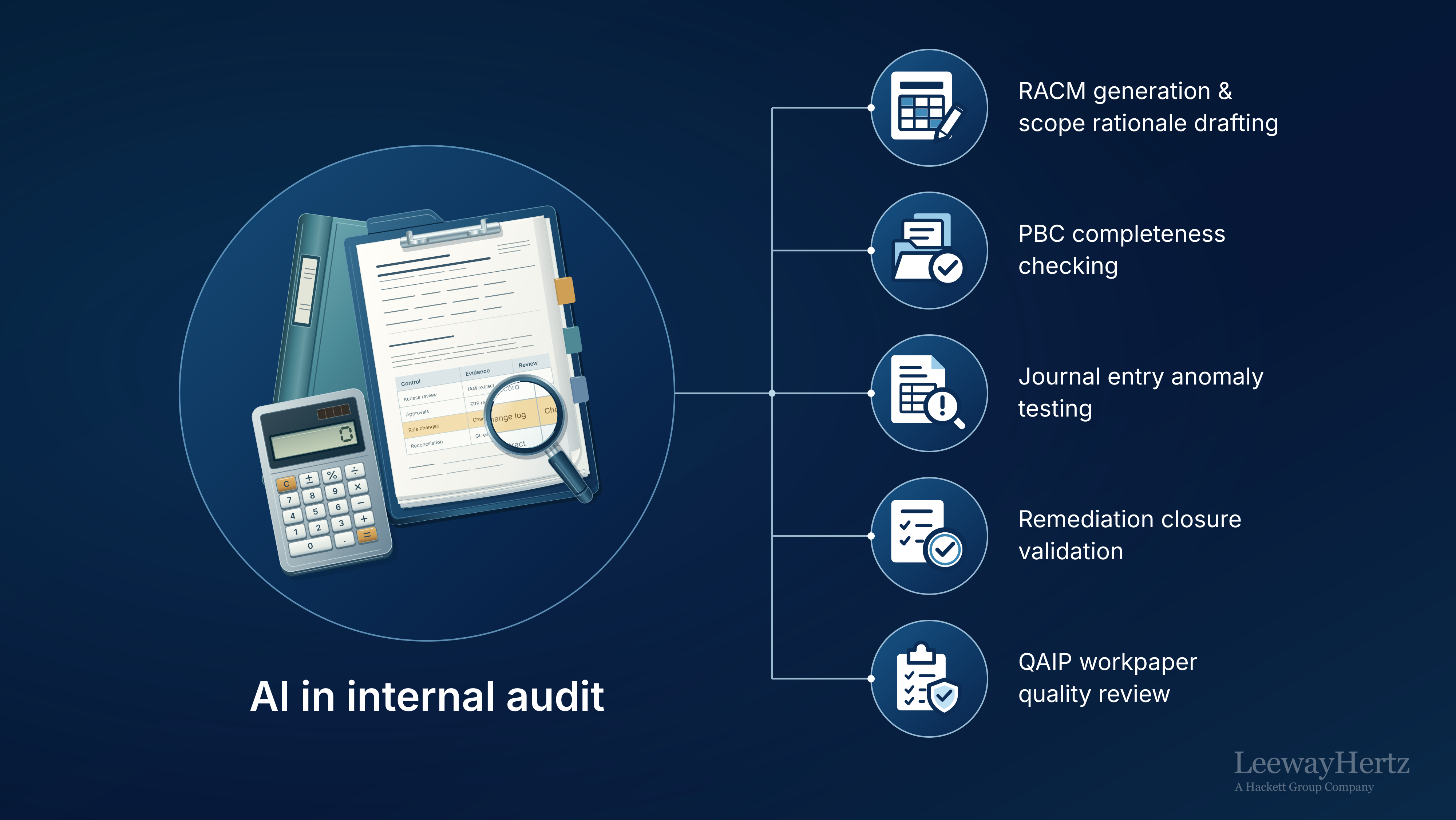
Internal audit provides independent assurance and advisory support to help organizations evaluate and improve the effectiveness of governance, risk management and internal controls. Its work spans risk assessment, audit planning, engagement scoping, fieldwork, testing, issue validation, reporting, remediation follow-up, and communication with the audit committee.
Audit teams face growing expectations to cover emerging risks, maintain rigorous documentation and provide timely insights with limited specialist capacity. Technology adoption is accelerating in response. The risk landscape is evolving at the same time. The IIA’s Risk in Focus 2026 reports identify cybersecurity as the top global risk and digital disruption, including AI, as the second-fastest-growing risk and No. 2 in the global ranking [1]. A separate 2026 IIA and audit board survey found that fewer than 40% of internal audit leaders believe their functions are adequately prepared to detect AI-enabled fraud, even though AI-powered phishing, fabricated invoices, automated social engineering and deepfake impersonation are already visible fraud concerns [2]. Together, these findings highlight the need to strengthen audit capabilities while evaluating the risks introduced by AI itself.
These numbers explain why AI in internal audit is not a side discussion about productivity tools. The operating burden is structural. Audit teams have to refresh the audit universe, build a risk-based plan, scope engagements, collect PBC evidence, prepare workpapers, test controls, analyze full populations, draft findings, validate management responses, report to the audit committee and verify remediation. Each step depends on fragmented evidence across audit management systems, GRC platforms, ERP, GL, IAM, SOX tools, CCM platforms, document repositories and spreadsheets.
Manual audit operations struggle when evidence arrives late, PBC files are incomplete, RACMs are rebuilt from scratch, testing populations are sampled even when full-population analytics are possible, issue ratings vary by reviewer, and audit committee reporting depends on last-minute compilation. AI becomes necessary when it is designed as a governed analytical layer over the audit lifecycle: it retrieves approved methodology, classifies risks and controls, detects anomalies, compares evidence, drafts review-ready artifacts and preserves the trail of how the output was prepared.
This article focuses on internal audit’s operating model. Enterprise risk management and management monitoring provide inputs to audit work, while ownership of risk management, continuous control monitoring and remediation remains with the relevant management functions. Internal audit’s involvement in SOX and internal control over financial reporting follows its mandate and established independence safeguards.
This article takes an operating-model view of internal audit, showing how AI can support the work at the function, process, and sub-process level. It connects each opportunity to the artifacts, systems, standards, controls, accountable roles, workflow patterns, governance requirements, ZBrain enablement approach, and prioritization criteria needed to make AI practical and auditable.
- How AI is transforming internal audit operations
- Why AI use cases in internal audit must be mapped at the sub-process level
- Internal audit operating model and AI opportunity mapping across internal audit functions
- High-value AI use cases in internal audit
- How agentic AI works in internal audit workflows
- How to prioritize AI use cases in internal audit
- Governance, risk, and responsible AI in internal audit
- How ZBrain operationalizes AI use cases in internal audit
- Future of AI in internal audit
How AI is transforming internal audit operations
AI is transforming internal audit by helping teams convert fragmented risk, control, transaction and evidence records into structured workpapers, exception analyses and reporting drafts that can be reviewed, challenged, signed off and retained. By linking outputs to source records and approved methodology, AI helps auditors manage the growing volume and variety of evidence, reduce preparation effort, strengthen traceability and identify gaps earlier in an engagement.
Consider a procure-to-pay audit. The audit team needs prior findings, the SOX RACM, PBC responses, vendor master changes, PO and invoice populations, access records, CCM exceptions, policy documents and interview notes. In a manual process, each workstream is checked separately. In an AI-assisted workflow, retrieval-grounded answering can pull the approved criteria, document intelligence can inspect PBC completeness, anomaly detection can rank duplicate payment and split-PO exceptions, and natural-language generation can draft the workpaper narrative for auditor review.
Internal audit work is suitable for governed AI because it is dense with records, checkpoints, and recurring reviews. Each audit cycle requires complete documentation, evidence-based narratives, risk-prioritized exceptions, consistent application of relevant standards and clear handoffs that preserve evidence and review context across teams.That makes the function a strong fit for AI support across five recurring work types:
- Document-heavy work: audit plans, engagement planning memos, RACMs, PBC lists, process walkthroughs, workpapers, reports and QAIP files can be checked for missing context before formal review.
- Narrative-heavy work: scope rationales, finding narratives, executive summaries, closing meeting materials and audit committee updates can be drafted from approved source material while showing where evidence is thin.
- Exception-heavy work: overdue PBC items, failed controls, anomalous journal entries, SoD conflicts, aged issues and repeat findings can be classified and prioritized so auditors focus on the highest-risk items first.
- Knowledge-heavy work: AI strengthens reviews against IIA Standards, COSO Internal Control, SOX 302/404, PCAOB evidence expectations, COBIT, ISO/IEC 27001, NIST CSF, and fraud criteria by retrieving the relevant rule, comparing it with source documents, and flagging conflicts, gaps, or inconsistencies for reviewer attention.
- Workflow-heavy work: engagement planning, fieldwork, testing, issue validation, reporting, remediation follow-up, continuous auditing and QAIP benefit when AI preserves context across steps and assembles the next review packet.
The practical design rule is simple: AI prepares, compares, classifies, retrieves, tests, reconciles and drafts. Auditors, audit leaders, management and the audit committee decide, approve, sign off, issue, rely, certify or close.
Why AI use cases in internal audit must be mapped at the sub-process level
Internal audit programs often start with broad labels such as audit planning automation, AI-powered fieldwork, continuous auditing, audit analytics or AI report drafting. These labels describe areas of opportunity but do not define the work to be implemented. Audit planning can refer to several distinct activities, from maintaining the auditable-entity inventory and assessing risk across audit areas to developing the annual plan, allocating resources, and preparing audit committee approval materials. Fieldwork can mean PBC tracking, interview summaries, evidence indexing or workpaper preparation. Each activity has distinct inputs, systems, reviewers and approval requirements.
A better approach is to map AI use cases to the internal audit operating model:
- Function: A governed operational domain in the audit lifecycle, such as engagement planning, control testing, reporting or QAIP.
- Process: A workflow area inside a function, such as RACM build, PBC management, journal entry testing or remediation closure validation.
- Sub-process: The atomic work activity where a specific artifact is reviewed or produced, such as scope memo drafting, PBC completeness checking, JE anomaly ranking or rating calibration.
- AI-enabled opportunity: A specific AI capability applied to a specific audit artifact or dataset to change how work is prepared, reviewed, tested, routed or evidenced while a named role retains the decision.
This level of mapping matters because internal audit conclusions are not interchangeable. A PBC completeness check has a different reviewer boundary from a control operating-effectiveness conclusion. A rating calibration output has a different escalation path from an audit committee deck. A SOX deficiency aggregation summary has a different evidentiary standard from a thematic trend report.
For example, AI in control testing is not one use case. Anomaly detection may rank journal entries by fraud-risk indicators. Graph analytics may detect SoD conflicts across ERP roles. Calculation re-performance may recalculate a sample or population. Retrieval-grounded answering may draft test procedures from a RACM. The implementation becomes reliable only when the artifact, system, standard, reviewer and output are named.
A practical sub-process map therefore identifies the trigger, source artifacts, systems, applicable methodology, permitted actions, output, reviewer and retained evidence. These details provide a concrete basis for implementation, validation and governance, helping teams assess where AI can improve audit work and what controls each workflow requires.
Build governed AI workflows for internal audit
Build governed AI workflows across audit risk assessment, planning, fieldwork, testing, reporting, and remediation follow-up while preserving human accountability for assurance decisions.
Internal audit operating model and AI opportunity mapping across internal audit functions
The operating model below treats internal audit as an independent assurance and advisory function spanning audit risk assessment, planning, fieldwork, testing, reporting, remediation follow-up, continuous auditing, SOX coordination, and QAIP. It connects to ERM, compliance, SOX, cybersecurity and continuous controls, but it does not absorb those domains. Each function lists the teams, artifacts, systems, standards, accountable roles, AI-enabled opportunities and human ownership boundary needed to turn AI from a broad idea into a controlled workflow.
Function 1: Audit universe and internal audit risk assessment
This function establishes and refreshes the population of auditable entities, then scores risk so internal audit coverage follows enterprise exposure rather than habit or calendar rotation alone. It sits at the beginning of the lifecycle because annual planning, staffing, engagement selection and audit committee coverage all depend on a trusted universe and a defensible risk assessment.
Teams involved: Chief audit executive, internal audit director, audit data analytics lead, senior auditor, ERM liaison, finance, compliance, cyber risk teams, and business-unit management.
Key artifacts: Auditable-entity inventory, audit area register, risk assessment questionnaire, risk factor scoring worksheet, prior audit coverage history, ERM risk register extracts, KRI feeds, incident logs, fraud indicator reports, and rotation policy.
Systems involved: AuditBoard, TeamMate+, GRC or ERM platform, ERP or GL, HRIS, legal-entity management system, CCM platform, incident management system and BI dashboards.
Regulatory and control considerations: IIA global internal audit standards for strategic planning and risk-based coverage, the three lines model for role clarity, COSO internal control where controls are part of the risk basis, and ACFE guidance where fraud indicators affect risk scoring.
Accountable roles: Chief audit executive, internal audit director, audit manager, and audit data analytics lead.
What AI helps with: Entity resolution links legal-entity, ERP and organization-chart records to detect new, merged or retired auditable entities. Classification can map entity attributes to risk categories. Predictive analytics can compute composite risk scores from materiality, change velocity, prior findings and fraud indicators. Multi-source aggregation can ingest ERM, incident and KRI feeds to identify entities whose risk profile shifted between formal planning cycles.
What humans continue to own: The CAE and internal audit director own the audit universe, risk-scoring methodology, factor weights, coverage priorities and final interpretation of emerging risks. Audit leaders decide whether a risk score changes plan coverage or committee messaging. AI calculates, compares and flags but does not approve the universe or decide the audit plan.
| Process | Sub-process | AI-enabled opportunities |
|---|---|---|
| Audit universe maintenance | Auditable entity inventory refresh | Entity resolution links ERP, HRIS, legal-entity and org-structure records to detect new, merged, renamed or retired auditable entities. |
| Business process inventory mapping | Classification maps business processes to the audit universe using process taxonomy, owner, system and policy metadata. | |
| System and application inventory alignment | Graph analytics links auditable entities to critical applications, ERP modules, data repositories and access-control points. | |
| Risk assessment design | Risk factor model maintenance | Retrieval-grounded analysis retrieves approved internal audit methodology, ERM risk definitions and documented audit committee expectations, then flags gaps or inconsistencies in the risk-scoring methodology for audit leadership review. |
| Risk factor weighting review | Predictive analytics tests whether weighting factors such as materiality, change velocity, prior findings and incidents align with historical issue outcomes. | |
| Entity-level risk assessment | Financial materiality scoring | Data extraction captures revenue, expenditure, asset balances and transaction values from source systems, while analytics applies approved materiality criteria to quantify each auditable entity’s financial exposure and support risk scoring. |
| Change velocity scoring | Change detection identifies restructuring, system migration, process redesign, M&A, leadership change and regulatory-change indicators. | |
| Prior finding and repeat issue scoring | Similarity detection links prior findings, repeat issues and overdue action plans to the same entity, control or process. | |
| Fraud indicator scoring | Anomaly detection analyzes whistleblower reports, JE exceptions, vendor master changes and unusual transaction patterns for fraud-risk indicators. | |
| Continuous risk assessment | ERM feed ingestion | Multi-source aggregation ingests ERM risk register changes and maps them to auditable entities based on defined taxonomy, ownership, process, system, and control relationships.. |
| Incident and loss-event feed ingestion | Classification maps incident records, root causes and severity to auditable entities and process areas. | |
| KRI and KPI feed monitoring | Time-series anomaly detection flags risk-score movement based on KRI breaches, KPI deterioration or control-monitoring exceptions. | |
| Coverage governance | Coverage and rotation analysis | Rules-based analytics evaluates audit coverage history against approved rotation requirements, identifying overdue entities and coverage gaps for audit leadership review. |
| Assurance gap identification | Graph analytics links high-risk entities and risk areas to assurance scope and coverage dates, flagging potential gaps across internal audit, SOX, compliance, cybersecurity and third-party reviews. | |
| Audit committee coverage view preparation | Natural-language generation drafts a coverage rationale explaining high-risk inclusions, deferrals and rotation exceptions. |
Highest-value opportunities: Continuous risk assessment and coverage-gap detection are highest leverage because they determine where audit capacity is spent before individual engagements begin. Risk factor scoring is also high value because weak scoring logic can distort the annual plan.
Example agentic workflow: Auditable entity risk assessment refresh
- Trigger: the quarterly audit universe refresh cycle opens.
- Agent role: the agent aggregates ERP entity lists, HRIS organization changes, legal-entity records, ERM risk register extracts, incident logs, KRI breaches and prior audit coverage.
- Agent role: entity resolution identifies new, merged, renamed or retired auditable entities, while risk-scoring analytics recalculates composite scores using approved factors and weights, and rules-based checks flag entities overdue under the audit rotation policy.
- Human checkpoint: the internal audit director reviews the proposed entity changes, factor-weighting exceptions and coverage gaps, then approves the refreshed audit universe before it feeds annual planning.
- Handoff and evidence: approved changes update the audit management system, rejected changes are retained with rationale, and the refresh packet is retained for QAIP review.
Function 2: Annual and dynamic audit plan management
Annual and dynamic audit plan management converts the risk-ranked universe into a resourced, committee-approved plan and keeps that plan current as the organization changes. It connects strategy, risk assessment, talent capacity and stakeholder expectations into one governed plan of work.
Teams involved: Chief audit executive, internal audit director, audit manager, audit committee chair, finance, HR or workforce planning teams, ERM, and business-unit leadership.
Key artifacts: Risk-scored audit universe, prior-year plan, draft annual audit plan, staff skills matrix, capacity calendar, plan amendment proposal, audit committee approval memo and mid-year amendment memo.
Systems involved: AuditBoard, TeamMate+, workforce management tools, GRC platform, board portal, news and regulatory feeds, ERP and BI reporting layers.
Regulatory and control considerations: IIA global internal audit standards for strategic planning, resource management, communication with the board and risk-based plan updates.
Accountable roles: Chief audit executive, internal audit director, audit manager, and audit committee chair.
What AI helps with: Constraint-based optimization proposes audit-hour allocations and engagement schedules within approved coverage priorities and staffing limits. Semantic matching identifies auditors whose documented certifications, technical skills and sector experience fit engagement requirements, while capacity checks confirm availability. Document intelligence and event classification identify relevant developments in approved filings, regulatory notices and incident records for audit leadership to assess. Natural-language generation drafts plan approval and amendment memos using reviewed scenarios and approved rationale.
What humans continue to own: The CAE owns the final plan recommendation, resourcing trade-offs, committee communication and mid-year amendment decisions. The audit committee approves or challenges the plan. AI proposes scenarios and drafts rationale but does not approve plan coverage, move audit resources or commit the function to a revised plan.
| Process | Sub-process | AI-enabled opportunities |
|---|---|---|
| Annual plan construction | Risk-based engagement selection | Constraint-based optimization recommends engagement priorities that balance risk scores, prior findings and stakeholder needs while meeting mandatory coverage requirements within available audit hours. |
| Plan scenario modeling | Simulation compares alternative annual plan scenarios by risk coverage, staffing demand, timing constraints and committee priorities. | |
| Mandatory audit coverage inclusion | Rules-based classification flags audits required by regulation, policy, audit committee request, SOX reliance or prior commitment. | |
| Plan rationale drafting | Natural-language generation drafts the annual audit plan rationale from risk assessment results, coverage history and resource constraints. | |
| Resource planning | Auditor capacity modeling | Capacity analysis identifies staffing shortfalls and reviewer bottlenecks by evaluating planned engagement hours against staff availability, leave schedules and required review effort. |
| Skills and certification matching | Semantic matching links engagement requirements to documented auditor certifications, IT skills, sector knowledge and prior experience, while rules-based checks verify language and geographic requirements. | |
| Guest auditor and SME need identification | Classification identifies engagements requiring cyber, legal, tax, operational, ESG or fraud subject matter expertise. | |
| Co-source and outsource planning | Predictive analytics estimates external support needs for IT, cybersecurity, SOX, fraud or specialized technical audits. | |
| Dynamic planning | Trigger-event monitoring | Event detection monitors M&A, restatements, regulatory actions, incidents, leadership changes and major system implementations. |
| Plan reprioritization assessment | Predictive analytics estimates how trigger events may change engagement risk, priority, or timing and proposes additions, deferrals, or scope changes for auditor review. | |
| Audit plan amendment drafting | Natural-language generation drafts mid-year amendment memos with risk rationale, resource impact and displaced coverage. | |
| Committee approval | Audit committee plan pack assembly | Multi-source aggregation compiles plan, resource, coverage, risk and rationale data into the audit committee approval packet. |
| Committee challenge response preparation | Retrieval-grounded answering prepares responses to likely committee questions using risk scores, prior coverage and plan assumptions. | |
| Approved plan version control | Document intelligence checks plan version, approval date, committee minutes and final plan record for consistency. |
Highest-value opportunities: Dynamic reprioritization is highest value because it keeps audit attention aligned to current risk instead of a static annual calendar. Resource and skills scheduling is also high leverage because it protects plan feasibility.
Example agentic workflow: Dynamic audit plan amendment
- Trigger: a business unit files a material restatement and a related incident is recorded in the GRC platform.
- Agent role: the agent aggregates the restatement filing, prior findings, entity risk score, open issues and planned engagement calendar.
- Agent role: optimization models whether the current plan can absorb a new engagement and drafts a reprioritization memo with displaced work, staffing gaps and audit committee rationale.
- Human checkpoint: the CAE reviews the proposed amendment and approves the plan-change recommendation before it is presented to the audit committee.
- Handoff and evidence: the approved amendment updates the audit plan, and the decision memo is retained with committee materials.
Function 3: Engagement planning
Engagement planning translates an approved plan item into a scoped audit with objectives, risks, controls, PBC requests and planned procedures. It is the point where broad audit coverage becomes a specific engagement boundary and weak planning here usually creates rework during fieldwork, reporting and QAIP review.
Teams involved: Audit manager, senior auditor, staff auditor, IT auditor, audit data analytics lead, control owner, SOX PMO manager, and relevant subject matter experts.
Key artifacts: Engagement record, prior audit report, open issue log, ERM extracts, KRIs, SOX RACM, process documentation, walkthrough notes, scope memo, engagement planning memo, RACM, analytics plan, announcement letter and PBC request list.
Systems involved: AuditBoard, TeamMate+, GRC or ERM platform, SOX tool, ERP, CCM platform, policy repository, document management system and collaboration tools.
Regulatory and control considerations: IIA global internal audit standards for planning engagements, COSO internal control for risk and control mapping, SOX 404 and PCAOB AS 2201 where ICFR controls are in scope.
Accountable roles: Audit manager, internal audit director, senior auditor, and chief audit executive for escalation.
What AI helps with: Retrieval-grounded answering can pull prior audit, policy, ERM and SOX evidence to support scope design. Document intelligence can extract process steps from SOPs and walkthrough notes. Graph analytics can map risks to controls, applications, owners and prior findings. Natural-language generation can draft the planning memo, RACM narratives, announcement letter and PBC list.
What humans continue to own: The audit manager owns scope definition, the RACM structure and PBC appropriateness. The internal audit director approves the planning memo. The CAE resolves material scope disputes with the business. AI prepares risk and control artifacts but does not approve scope, sign off the RACM or issue the engagement plan.
| Process | Sub-process | AI-enabled opportunities |
|---|---|---|
| Engagement initiation | Engagement record creation | Document intelligence extracts the auditable entity, scope category and planned timing from approved audit planning documents to support draft engagement record creation for auditor review. |
| Announcement letter drafting | Natural-language generation drafts the announcement letter using engagement objective, scope, timing, sponsor and audit team details. | |
| Kickoff agenda preparation | Retrieval-grounded answering drafts the kickoff agenda from IA methodology, prior audit themes and stakeholder roles. | |
| Engagement risk assessment | Prior audit and issue review | Similarity detection identifies relevant prior findings, repeat issues and management action plans linked to the engagement area. |
| ERM and KRI input review | Multi-source aggregation assembles ERM risks, KRIs, incidents and CCM exceptions, while semantic matching links relevant records to engagement objectives for auditor review. | |
| Inherent risk and control-risk assessment | Classification maps risks to likelihood, impact, velocity, control maturity and audit relevance for manager review. | |
| Scope design | Scope memo drafting | Natural-language generation drafts the scope memo with objectives, in-scope areas, exclusions, timing and rationale. |
| In-scope and out-of-scope rationale validation | Retrieval-grounded analysis uses risk assessments, prior findings and documented mandatory coverage requirements to flag unsupported scope exclusions or gaps in the proposed scope rationale. | |
| Scope duplication and overlap check | Graph analytics traces shared entities, risks, controls and review periods across the proposed engagement, SOX testing, compliance reviews, ERM assessments and recent audits. | |
| Process understanding | Walkthrough document review | Document intelligence extracts process steps, approvals, system touchpoints, handoffs and control points from SOPs and narratives. |
| Interview note summarization | Summarization converts walkthrough interviews into process narratives, open questions and control-owner confirmations. | |
| Flowchart preparation support | Process mining reconstructs activity sequences from system event logs, while document intelligence extracts activities, handoffs and decision points from SOPs and interview notes to prepare draft process flows for auditor review. | |
| RACM build | Risk identification for the engagement | Classification maps process steps and prior issues to draft risk statements. |
| Control identification and mapping | Graph analytics maps risks to preventive, detective, manual, automated, IT-dependent and compensating controls. | |
| Control attribute completion | Document intelligence extracts documented control owners, frequencies, evidence requirements and supporting systems, while classification suggests control types and relevant assertions for auditor validation, flagging missing or ambiguous attributes. | |
| RACM consistency review | Consistency checking flags unmapped risks, duplicate controls, missing owners, weak evidence descriptions and unsupported assertions. | |
| PBC preparation | Tailored PBC list generation | Retrieval-grounded answering generates PBC requests from the approved scope, RACM, test plan and prior engagement requests. |
| PBC due-date and owner assignment | Workflow optimization assigns due dates and owners based on fieldwork milestones, control ownership and evidence dependencies. |
Highest-value opportunities: RACM build is the highest-leverage planning step because it structures objectives, procedures, testing and evidence. Scope rationale drafting is also high value because it makes exclusions and inclusions reviewable.
Example agentic workflow: Engagement planning and RACM preparation
- Trigger artifact: the approved annual audit plan releases the Q3 procure-to-pay audit, generating an engagement record in AuditBoard.
- Agent role: the agent aggregates prior P2P audit reports and open issues, the SOX RACM for related key controls, ERM risk register entries and KRIs for procurement, twelve months of PO, invoice and payment data from the ERP, continuous monitoring exceptions from the CCM platform and relevant policy documents.
- Agent role: retrieval-grounded answering retrieves the IA methodology, engagement planning standard, ratings matrix and sampling guidance from the methodology library.
- Agent role: document intelligence extracts process and control attributes, while graph analytics links risks to controls, systems and prior findings. Retrieval-grounded generation uses these inputs and approved audit methodology to draft a planning packet containing the engagement risk assessment, proposed scope with inclusion and exclusion rationale, RACM, analytics plan, tailored PBC list and announcement letter for auditor review.
- Human checkpoint: the audit manager edits scope and the RACM, the internal audit director approves the planning memo, and scope disputes with the business are escalated to the CAE.
- Handoff and audit evidence: approved planning documents are filed as signed workpapers with reviewer sign-off dates, the PBC list is issued to control owners with due dates, analytics jobs are scheduled, and the agent’s data sources and prompts are logged in the binder for QAIP and EQA scrutiny.
Function 4: Fieldwork, evidence collection and workpaper preparation
Fieldwork gathers and evaluates the evidence needed to carry out planned audit procedures and support engagement conclusions. It requires auditors to establish that evidence is relevant, reliable and sufficient for the period under review, with clear links to the risks, controls, test procedures and workpapers it supports.
Teams involved: Audit manager, senior auditor, staff auditor, IT auditor, control owner, records owners, and guest subject matter experts.
Key artifacts: PBC request list, PBC tracker, evidence files, interview notes, transcripts, walkthrough narratives, electronic workpapers, evidence index and cross-reference matrix.
Systems involved: AuditBoard, TeamMate+, Wolters Kluwer TeamMate, SharePoint or document repositories, email, calendar tools, transcription tools, ERP and collaboration systems.
Regulatory and control considerations: IIA global internal audit standards for sufficient information, due professional care, supervision, workpaper documentation and engagement evidence.
Accountable roles: Staff auditor, senior auditor, audit manager, and control owner.
What AI helps with: Document intelligence extracts period, population and approval details from submitted PBC files, while rules-based checks flag missing or inconsistent attributes against request requirements. Classification groups overdue requests by status and fieldwork impact, approved priority rules determine follow-up order, and natural-language generation drafts reminders. Speech-to-text transcribes interviews, while summarization organizes the content into process steps, control observations and open questions. Semantic matching suggests links between evidence files, RACM risks, controls and test procedures for auditor validation.
What humans continue to own: Auditors own evidence sufficiency, interpretation of interview content, workpaper judgment and sign-off. Control owners own the completeness and accuracy of documents they provide. AI tracks, extracts and cross-references but does not conclude that evidence is sufficient or sign off a workpaper.
| Process | Sub-process | AI-enabled opportunities |
|---|---|---|
| PBC management | PBC request issuance | Natural-language generation drafts PBC request messages using approved request details, including the responsible owner, due date, required evidence attributes and submission channel. |
| PBC status tracking | Workflow classification tracks submitted, overdue, incomplete, rejected and pending PBC items. | |
| PBC completeness checking | Document intelligence checks submitted evidence against requested period, population, approval, format and completeness requirements. | |
| PBC exception escalation | Natural-language generation drafts escalation notes for overdue or incomplete requests using the approved escalation protocol. | |
| Interview management | Interview scheduling | Constraint-based scheduling proposes interview slots using auditor and control-owner availability, time zones and fieldwork dependencies. |
| Interview transcription | Speech-to-text processing converts interviews into searchable transcripts for auditor validation. | |
| Interview summarization | Summarization creates structured notes covering process steps, control points, exceptions, open questions and owner confirmations. | |
| Walkthrough evidence linkage | Semantic matching links interview statements to policies, process documents, screenshots and RACM control descriptions. | |
| Evidence management | Evidence intake classification | Classification tags submitted evidence by control, test step, period, population, owner and document type. |
| Evidence indexing | Semantic indexing links evidence files to RACM risks, PBC requests, test procedures and workpaper references. | |
| Cross-reference validation | Consistency checking flags broken references, missing workpaper links and evidence cited in conclusions. | |
| Workpaper preparation | Workpaper template population | Template population fills standard workpaper sections with objective, population, sample, evidence, procedure and preparer fields. |
| Workpaper narrative drafting | Natural-language generation drafts workpaper narratives from approved evidence, test results and auditor notes. | |
| Open item tracking | Workflow analytics identifies unresolved review notes, missing evidence, incomplete testing and unassigned follow-ups. | |
| Reviewer-ready package assembly | Multi-source aggregation packages workpaper, evidence, exceptions, reviewer questions and source links for senior auditor review. |
Highest-value opportunities: PBC completeness checking and evidence indexing are highest value because they reduce fieldwork delays and prevent late-stage documentation gaps. Interview summarization is useful when it produces structured notes that auditors validate.
Example agentic workflow: PBC evidence completeness and workpaper preparation
- Trigger: a PBC due date passes with several open items.
- Agent role: the agent classifies outstanding requests by control, owner, age and fieldwork impact, then drafts a reminder with the evidence attributes still missing.
- Agent role: document intelligence checks newly submitted files against the PBC request and flags wrong period, missing approval or incomplete population issues.
- Human checkpoint: the senior auditor reviews the follow-up message, accepts or edits the completeness assessment and decides whether escalation is needed.
- Handoff and evidence: the PBC tracker, reviewer disposition and final evidence index are retained in the engagement binder.
Function 5: Control testing, substantive testing and audit analytics
Control testing and audit analytics gather and evaluate the evidence needed to assess control design, operating effectiveness and potential transaction exceptions. This work requires defined test procedures, reliable populations and documented results, with clear links between the evidence, identified exceptions and audit conclusions.
Teams involved: Senior auditor, staff auditor, IT auditor, audit data analytics lead, audit manager, SOX PMO manager, and process control owners.
Key artifacts: RACM, sampling plan, test scripts, population extracts, journal entry population, PO/invoice/payment data, access-role data, recertification evidence, analytics output and re-performance workpapers.
Systems involved: AuditBoard, TeamMate+, ERP, GL, IAM system, audit analytics platform, SOX tool, spreadsheets and data warehouse.
Regulatory and control considerations: IIA global internal audit standards, COSO internal control 2013, PCAOB AS 2201 for ICFR testing, PCAOB AS 1105 for evidence, COBIT 2019 and ISO/IEC 27001 for IT controls, and ACFE or COSO fraud guidance for fraud indicators.
Accountable roles: Audit data analytics lead, IT auditor, senior auditor, staff auditor, and audit manager.
What AI helps with: Sampling analytics can recommend sample size or full-population testing based on population characteristics. Anomaly detection can rank journal entries, three-way match failures and access conflicts. Rules-based classification can test SoD conflicts and recertification gaps against approved matrices. Re-performance logic can recalculate source data and flag variances for auditor disposition.
What humans continue to own: Auditors own test design, sample approval, exception investigation, control deficiency conclusions and operating-effectiveness conclusions. The audit manager signs off the completed workpaper. AI runs analytics and prepares exception packets but does not conclude on control design, operating effectiveness or deficiency severity.
| Process | Sub-process | AI-enabled opportunities |
|---|---|---|
| Test planning | Test of design procedure drafting | Retrieval-grounded answering drafts test-of-design procedures from RACM control descriptions, COSO criteria and prior test scripts. |
| Operating effectiveness test script drafting | Natural-language generation drafts operating-effectiveness steps based on control frequency, evidence type, population and assertion. | |
| Control dependency mapping | Graph analytics links controls to systems, reports, interfaces, spreadsheets, ITGCs and upstream data sources. | |
| Sampling and coverage | Population completeness validation | Data reconciliation checks extracted counts and amounts against source-system totals, while completeness checks flag gaps in period coverage and expected control occurrences based on documented control frequency. |
| Attribute sampling plan design | Sampling analytics recommends sample size and selection method based on frequency, population size, risk and prior exceptions. | |
| Full-population analytics selection | Classification groups controls by execution type, evidence structure and data availability, flagging potential candidates for full-population testing for auditor assessment. | |
| Journal entry testing | Round amount testing | Anomaly detection identifies round-dollar and repeating-pattern journal entries for auditor review. |
| Weekend and holiday posting analysis | Time-series analytics flags entries posted outside normal business patterns. | |
| Suspicious user ID analysis |
|
|
| Threshold-adjacent JE analysis | Anomaly detection identifies entries just below approval, review or materiality thresholds. | |
| Procure-to-pay testing | Three-way match exception analysis | Rules-based analytics compares PO, invoice and goods-receipt records to detect match exceptions and unsupported payments. |
| Duplicate payment testing | Similarity matching identifies duplicate invoices, duplicate suppliers, duplicate bank accounts and repeated payment attributes. | |
| Access and SoD testing | SoD conflict analysis | Graph analytics maps users, roles, permissions and incompatible duties to identify SoD conflicts. |
| Access recertification testing | Document intelligence checks recertification evidence for owner approval, completeness, date validity and exception handling. | |
| Automated control testing | IT-dependent report validation | Data lineage analysis traces report data to source systems and documents the transformations and dependencies that auditors review when assessing its reliability as audit evidence. |
| Substantive validation | Recalculation testing | Re-performance logic recalculates formulas, rates, tolerances, accruals or control calculations and flags variances. |
| Exception disposition | Exception ranking and triage | Classification groups exceptions by risk indicator, monetary value, control relevance and prior issue history. |
| Exception workpaper drafting | Natural-language generation drafts exception narratives with population, test result, evidence and proposed disposition for auditor review. |
Highest-value opportunities: Full-population journal entry testing is highest value because it materially expands coverage and prioritizes exceptions by fraud-risk indicator. SoD and access recertification testing is also high value because manual review across large role populations is slow and error-prone.
Example agentic workflow: Journal entry analytics and exception workpaper
- Trigger artifact: the engagement’s approved test plan schedules full-population journal entry testing as part of fieldwork.
- Agent role: the agent pulls twelve months of journal entry data from the GL, chart of accounts, SOX key-control list for the entity and prior-year JE testing exceptions.
- Agent role: anomaly detection runs the JE testing script against round amounts, weekend and holiday postings, postings by unusual or terminated user IDs, and entries just under approval thresholds, then ranks the output by composite fraud-risk score.
- Agent role: natural-language generation drafts a workpaper summarizing the population, analytics logic, ranked exception list and proposed high-risk sample for detailed review.
- Human checkpoint: The staff auditor investigates the proposed sample and documents disposition, the senior auditor reviews analytics logic and disposition for reasonableness, and the audit manager signs off on the completed workpaper.
- Handoff and audit evidence: the finalized workpaper, analytics script version and full exception population are filed in the binder with reviewer sign-off dates for QAIP and EQA review.
Function 6: Issue development, rating and management response validation
Issue development evaluates confirmed test exceptions and supporting evidence to determine whether they warrant reportable findings. It requires clear criteria, documented conditions, supported cause and impact assessments, consistent severity ratings and actionable recommendations for management.
Teams involved: Senior auditor, audit manager, internal audit director, control owner, legal or compliance specialists where needed, and the CAE for significant issues.
Key artifacts: Test exceptions, evidence files, RACM, control criteria, ratings matrix, finding record, root cause analysis, draft management response and management action plan.
Systems involved: AuditBoard, TeamMate+, GRC platform, issue tracking system, policy repository and document management system.
Regulatory and control considerations: IIA global internal audit standards for communicating results, monitoring action plans and maintaining sufficient evidence, internal ratings matrix, COSO internal control and applicable policy or regulatory criteria.
Accountable roles: Senior auditor, audit manager, internal audit director, and control owner.
What AI helps with: Natural-language generation can draft condition, criteria, cause and effect finding language from approved exceptions. Retrieval-grounded answering can cite policy, control, standard or regulatory criteria. Pattern analysis identifies recurring conditions and previously documented causes across historical findings, suggesting potential root causes. Classification can map issue attributes to the ratings matrix and flag inconsistent severity assignments. Evidence comparison can check management responses against underlying support.
What humans continue to own: The senior auditor edits the finding, the audit manager reviews root cause and actionability, and the internal audit director approves the final rating and finding disposition. Management owns the response and remediation commitment. AI drafts, compares and proposes but does not approve findings, assign final ratings or accept management responses.
| Process | Sub-process | AI-enabled opportunities |
|---|---|---|
| Exception evaluation | Exception-to-issue assessment | Classification groups test exceptions by control, risk, root cause, frequency and severity to identify issue candidates. |
| Isolated vs systemic pattern review | Pattern analysis identifies recurring exceptions across transactions, controls, entities and audit periods, highlighting potential systemic weaknesses for auditor assessment. | |
| Audit finding development | Condition statement drafting | Natural-language generation drafts condition language from confirmed exceptions and supporting evidence. |
| Criteria citation retrieval | Retrieval-grounded answering cites the relevant policy, control, COSO principle, SOX requirement or internal standard. | |
| Cause analysis drafting | Pattern analysis proposes candidate causes based on process data, interviews, prior findings and control-owner explanations. | |
| Effect and impact articulation | Natural-language generation drafts operational, financial, compliance, fraud or reporting impact language from evidence. | |
| Rating calibration | Ratings-matrix mapping | Classification maps issue attributes to severity criteria such as likelihood, impact, pervasiveness, control significance and recurrence. |
| Cross-audit rating consistency check | Similarity detection compares proposed ratings with prior issues of similar severity and context. | |
| Escalation threshold identification | Rules-based classification flags issues meeting escalation, committee reporting or significant-deficiency thresholds. | |
| Management response and action plan coordination | Response request drafting | Natural-language generation drafts management response requests with finding context, due date and required action-plan attributes. |
| Factual accuracy validation | Evidence comparison checks management response language against workpapers, test results and finding records. | |
| Action plan quality check | Document intelligence extracts the action owner, due date, proposed actions and closure evidence requirements | |
| Issue record finalization | Issue log population | AI -assisted template population creates issue records with CCCE fields, rating, owner, due date, action plan and source workpaper links. |
| Approval trail validation | Consistency checking confirms reviewer approvals, rating rationale and management response are retained before reporting. |
Highest-value opportunities: Rating calibration is highest value because inconsistent severity judgments weaken audit credibility and create QAIP exposure. CCCE finding drafting is also high leverage because it standardizes the finding structure before review.
Example agentic workflow: Audit finding development and rating calibration
- Trigger artifact: fieldwork testing closes with a confirmed control operating-effectiveness exception.
- Agent role: the agent pulls the test workpaper, relevant RACM risk and control pairing, control-owner process documentation and prior findings against the same control or entity.
- Agent role: natural-language generation drafts a CCCE-structured finding, while pattern analysis proposes candidate root causes from similar findings and process data.
- Agent role: classification maps finding attributes to the ratings matrix and proposes a draft severity rating with the criteria it matched against.
- Human checkpoint: the senior auditor edits the finding narrative and root cause, the audit manager reviews the proposed rating, and the internal audit director makes the final rating decision and approves the finding for reporting.
- Handoff and audit evidence: the approved finding, rating rationale and validated management response are filed in the binder and logged for issue follow-up.
Accelerate AI Solutions Development
Build fully functional solutions from your high-value use cases, based on specific operational needs and enterprise context.
Function 7: Audit reporting and results communication
Audit reporting and results communication turns completed fieldwork, rated findings and management responses into a formal audit report with an overall opinion or rating. The report has to be concise enough for executives, detailed enough for management action and traceable enough for QAIP scrutiny.
Teams involved: Audit manager, internal audit director, chief audit executive, senior auditor, control owner, and executive stakeholders.
Key artifacts: Approved findings, engagement scope, draft report, executive summary, closing meeting materials, management responses, final audit report and thematic trend report.
Systems involved: AuditBoard, TeamMate+, document management system, issue tracking system, board or executive reporting portals and BI tools.
Regulatory and control considerations: IIA global internal audit standards for communicating engagement results, final communication, supervision and monitoring action plans.
Accountable roles: Audit manager, internal audit director, and chief audit executive.
What AI helps with: Natural-language generation can assemble draft reports and executive summaries from approved findings and scope. Summarization can prepare closing-meeting materials and anticipated discussion points. Topic modeling can detect recurring themes and root causes across completed reports. Consistency checking flags discrepancies between report narratives, approved ratings, management responses and supporting workpapers.
What humans continue to own: Audit leadership team owns the overall audit opinion, final rating, closing-meeting discussion, management negotiation and final report issuance. AI assembles and drafts report content but does not issue reports, assign the final opinion or negotiate findings with management.
| Process | Sub-process | AI-enabled opportunities |
|---|---|---|
| Draft report preparation | Approved finding aggregation | Multi-source aggregation pulls approved findings, ratings, management responses and scope details into the draft report shell. |
| Executive summary drafting | Natural-language generation drafts executive summary language from approved findings, risk themes and overall engagement context. | |
| Scope and objective section drafting | AI- enabled template population drafts scope, objective, period covered, limitations and audit approach sections from planning documents. | |
| Finding language consistency review | Consistency checking flags discrepancies in finding descriptions, severity ratings and management responses, including statements unsupported by linked workpapers. | |
| Closing meeting | Closing deck preparation | Natural-language generation drafts closing-meeting materials from findings, ratings, themes and unresolved management responses. |
| Anticipated question preparation | Retrieval-grounded answering prepares responses to likely management questions using workpapers, criteria and test results. | |
| Management comment tracking | Summarization captures closing-meeting comments, disputed facts, agreed edits and open follow-ups. | |
| Final report issuance | Closing outcome incorporation | Document intelligence compares meeting outcomes with final report changes and flags unapproved modifications. |
| Final report quality check | Consistency checking validates rating, issue count, management action plans, due dates and report-version completeness. | |
| Distribution list validation | Rules-based classification checks report recipients against confidentiality, governance and audit committee protocols. | |
| Thematic reporting | Cross-audit theme detection | Topic modeling identifies recurring themes, root causes and control weaknesses across completed reports. |
| Repeat issue narrative preparation | Similarity detection links recurring issues across entities, processes and audit cycles for thematic reporting. | |
| Trend report drafting | Natural-language generation drafts enterprise-level trend commentary from final reports and issue metadata. |
Highest-value opportunities: Thematic and cross-audit trend reporting is highest value because it surfaces systemic issues that individual reports miss. Draft report assembly is also valuable because it reduces rework when all findings are already approved.
Example agentic workflow: Draft audit report assembly and closing meeting preparation
- Trigger: all engagement findings are rated and management responses are validated.
- Agent role: the agent assembles the draft report from approved findings, scope, executive summary points and management action plans.
- Agent role: consistency checking compares report ratings, issue language and management responses against the underlying workpapers.
- Human checkpoint: the audit manager and internal audit director review the draft before the closing meeting, and the CAE issues the final report after outcomes are incorporated.
- Handoff and evidence: the final report, closing-meeting notes and report-version history are retained in the audit management system.
Function 8: Audit committee and stakeholder reporting
Audit committee and stakeholder reporting presents audit plan progress, risk coverage, issue aging, emerging themes and assurance coordination matters for board and executive oversight. It requires timely reporting, verified metrics and evidence-based commentary, with clear links to source records and matters requiring escalation.
Teams involved: Chief audit executive, internal audit director, audit committee chair, CFO, external auditor, SOX PMO manager, and executive stakeholders.
Key artifacts: Quarterly audit committee deck, plan status report, coverage report, open issue aging summary, external auditor reliance briefing, final reports and completed workpapers.
Systems involved: AuditBoard, TeamMate+, board portal, GRC platform, SOX tool, BI dashboard, issue tracker and document repository.
Regulatory and control considerations: IIA global internal audit standards for board communication, independence and oversight; PCAOB AS 1105 where external auditor reliance on internal audit work is considered.
Accountable roles: Chief audit executive, internal audit director, audit committee chair, and external auditor liaison.
What AI helps with: Multi-source aggregation can compile plan status, coverage, completed engagements and issue aging from audit systems. Natural-language generation can draft committee narrative, open issue commentary and executive summaries. Data lineage checking can trace deck numbers back to source records. Retrieval-grounded answering can prepare external-auditor reliance briefing materials from completed workpapers and final reports.
What humans continue to own: The CAE owns committee communication, escalation judgment, reliance discussions and final deck content. The audit committee chair guides committee priorities. AI compiles and drafts but does not present to the committee, make escalation decisions or agree to external auditor reliance.
| Process | Sub-process | AI-enabled opportunities |
|---|---|---|
| Committee deck preparation | Quarterly audit committee deck assembly | Multi-source aggregation compiles plan status, completed audits, issue aging, open risks and coverage metrics into the committee deck. |
| Executive narrative drafting | Natural-language generation drafts CAE commentary on plan progress, risk coverage, overdue issues and emerging themes. | |
| Data lineage validation | Data reconciliation traces deck metrics back to audit plan, issue log, workpaper and reporting-system records. | |
| Plan oversight | Plan-vs-actual reporting | Analytics compares approved plan, completed engagements, deferred audits, added audits and resource usage. |
| Risk category coverage analysis | Classification maps completed and planned audits to risk categories, business units, geographies and strategic priorities. | |
| Mid-year plan change reporting | Natural-language generation drafts committee-ready explanation of plan changes, added audits and deferred coverage. | |
| Issue oversight | Open issue aging analysis | Aging analytics calculates open and overdue durations, while rules-based prioritization flags issues for review using severity, due dates and extension history. |
| Repeat and overdue issue escalation | Similarity detection and rules-based classification identify repeat findings and overdue issues requiring committee visibility. | |
| Management action trend reporting | Pattern analysis identifies repeated remediation delays, overdue issue clusters and recurring documented root causes. | |
| External auditor coordination | Reliance briefing preparation | Retrieval-grounded answering drafts reliance briefing materials from completed IA workpapers, testing scope and final reports. |
| Evidence package indexing | Document intelligence extracts workpaper references, control identifiers and relevant test-result or report sections to support an indexed evidence package for external auditor review. | |
| Reliance gap identification | Data reconciliation compares external auditor reliance requests with IA scope, timing, testing approach and evidence availability. |
Highest-value opportunities: Audit committee deck preparation is high value because it is recurring, deadline-driven and dependent on consistent numbers. Open issue aging is also high value because committees scrutinize overdue remediation and repeat findings closely.
Example agentic workflow: Audit committee reporting and issue aging summary preparation
- Trigger: the quarterly audit committee reporting cycle opens.
- Agent role: the agent aggregates plan status, completed engagements, coverage by risk category, open issue aging, overdue items and external auditor reliance requests.
- Agent role: data lineage checking validates that deck metrics reconcile to audit management records and issue logs.
- Human checkpoint: the CAE reviews the draft deck, confirms escalation messages and finalizes the pack before sharing it with the audit committee chair.
- Handoff and evidence: the final deck, source extracts and reviewer changes are retained with committee materials.
Function 9: Issue follow-up and remediation validation
Issue follow-up tracks management’s action plans to closure and validates that remediation actually addressed the original condition. This is where internal audit protects its credibility after reporting, because closing an issue too early can be more damaging than identifying it late.
Teams involved: Senior auditor, audit manager, control owner, internal audit director, issue owner, business management, and audit committee stakeholders for overdue matters.
Key artifacts: Management action plan, issue log, closure evidence, original finding, original test script, closure validation workpaper, escalation notice and repeat-finding analysis.
Systems involved: AuditBoard, TeamMate+, issue tracking system, GRC platform, ERP, IAM system, document repository and email or workflow tools.
Regulatory and control considerations: IIA global internal audit standards for monitoring action plans, follow-up, communication and evidence retention.
Accountable roles: Senior auditor, audit manager, internal audit director, and control owner.
What AI helps with: Workflow analytics can track action plan commitments, due dates and overdue risk. Document intelligence extracts remediation details from submitted closure evidence, and retrieval-grounded analysis identifies gaps against the original finding and agreed action plan. Agentic orchestration invokes approved test scripts or analytics queries against current-state data and assembles results for auditor review. Similarity detection can identify repeat findings against the same control, entity or root cause.
What humans continue to own: The audit manager owns the closure decision and escalation judgment. The senior auditor reviews re-test evidence. Management owns execution of the action plan. AI assembles and re-tests evidence but does not close issues, accept partial remediation or reopen findings without human approval.
| Process | Sub-process | AI-enabled opportunities |
|---|---|---|
| Action plan tracking | Management action plan intake | Document intelligence checks action plans for owner, due date, root-cause alignment, action detail and closure evidence requirement. |
| Action plan status monitoring | Workflow analytics tracks due dates, owner updates, completion status, extensions and overdue risk. | |
| Commitment change detection | Change detection flags revised due dates, changed owners, modified action descriptions and downgraded commitments. | |
| Remediation evidence | Closure evidence intake | Document intelligence classifies submitted closure evidence by control, period, owner, system and remediation attribute. |
| Closure evidence completeness check | Evidence comparison checks submitted evidence against the agreed action plan and original finding condition. | |
| Current-state control re-test | Re-performance logic re-executes the relevant test script or analytics query against current-state evidence. | |
| Closure validation | Closure recommendation drafting | Natural-language generation drafts closure validation workpapers comparing original condition, action taken, re-test result and residual gap. |
| Partial remediation identification | Classification identifies whether evidence supports full closure, partial remediation, no remediation or further testing. | |
| Closure approval trail validation | Consistency checking confirms reviewer sign-off, evidence linkage and final disposition before issue closure. | |
| Remediation escalation management | Overdue escalation | Rules-based classification flags overdue action plans by severity, owner, age and escalation protocol. |
| Executive escalation notice drafting | Natural-language generation drafts escalation notices for management, CAE or audit committee review. | |
| Repeat finding analysis | Repeat issue detection | Similarity detection compares current and historical findings by entity, control, root cause, condition and owner. |
| Root-cause recurrence analysis | Pattern analysis identifies recurring remediation failures and prepares root-cause escalation rationale. |
Highest-value opportunities: Evidence-based closure validation is highest value because it reduces premature closure risk. Repeat-finding analysis is also high leverage because repeated issues often signal weak root cause remediation.
Example agentic workflow: Remediation evidence review and closure validation
- Trigger artifact: management submits closure evidence against an action plan due date in AuditBoard.
- Agent role: the agent pulls the original finding and CCCE narrative, agreed management action plan, submitted closure evidence and original test script used to identify the exception.
- Agent role: re-performance logic re-runs the relevant test procedure against current-state evidence to check whether the underlying condition has been resolved.
- Agent role: document intelligence drafts a closure validation workpaper comparing the original condition with the current-state test result, with a recommendation such as validated closure, partial remediation or not remediated.
- Human checkpoint: the senior auditor reviews the re-test evidence and rationale, and the audit manager makes the closure decision or escalates inadequate remediation.
- Handoff and audit evidence: the closure decision and workpaper are filed in the binder, the issue log is updated, and a repeat-finding check is logged for future cycles.
Function 10: Continuous auditing
Continuous auditing runs scheduled indicators against high-risk processes between formal engagements and triggers focused audit attention when exception thresholds are crossed. It should be distinguished from management’s continuous control monitoring, which remains a first-line or second-line activity that internal audit may evaluate or rely on.
Teams involved: Audit data analytics lead, IT auditor, senior auditor, audit manager, control owner, and second-line risk or compliance monitoring teams.
Key artifacts: Continuous auditing indicator scripts, exception output, threshold logic, mini-engagement scope proposal, CCM output, reliance assessment and exception disposition log.
Systems involved: ERP, GL, audit analytics platform, CCM platform, GRC platform, data warehouse, IAM system and AuditBoard or TeamMate+.
Regulatory and control considerations: IIA GTAG guidance on continuous auditing, IIA global internal audit standards, the Three Lines Model and relevant process-control criteria such as COSO, COBIT or ISO/IEC 27001.
Accountable roles: Audit data analytics lead, audit manager, and internal audit director.
What AI helps with: Agentic orchestration invokes approved indicator scripts on a defined schedule and assembles exception evidence from high-risk transaction populations. Anomaly detection can flag threshold breaches and unusual patterns. Classification categorizes exceptions using approved triage criteria, suggesting focused audit review, management follow-up or further assessment of CCM reliance for audit manager decision.Data reconciliation can compare IA outputs with management’s CCM results.
What humans continue to own: Internal audit leaders decide whether to open a mini-engagement, rely on management’s CCM output, escalate an exception or adjust the indicator logic. AI detects and packages exceptions but does not open audit engagements or make reliance decisions.
| Process | Sub-process | AI-enabled opportunities |
|---|---|---|
| Continuous auditing indicator design | High-risk process selection | Classification identifies processes suitable for continuous auditing based on risk score, transaction volume, prior findings and control criticality. |
| Indicator and threshold definition | Retrieval-grounded generation drafts proposed indicator conditions and thresholds using documented control objectives, prior findings, KRI definitions and approved policy limits. | |
| Data-source mapping | Data lineage analysis maps required fields to ERP, GL, IAM, CCM, GRC and data warehouse sources. | |
| Script execution | Automated indicator script execution | Scheduled analytics runs approved indicator scripts against high-risk transaction populations. |
| Population completeness validation | Data reconciliation checks source extracts against control population totals, reporting period and expected transaction counts. | |
| Exception generation | Anomaly detection identifies transactions or events outside expected thresholds, patterns or control rules. | |
| Exception triage | Exception classification | Classification separates false positives, management-monitoring items, mini-engagement candidates and urgent escalation items. |
| Mini-engagement proposal drafting | Natural-language generation drafts a scoped mini-engagement proposal when exceptions exceed predefined thresholds. | |
| Continuous auditing workpaper creation | Template population creates workpapers with script version, population, exception logic, results and reviewer disposition. | |
| CCM reliance | Management CCM output reconciliation | Data reconciliation compares IA continuous auditing results with management’s CCM output for the same control area. |
| Reliance assessment drafting | Retrieval-grounded answering drafts reliance assessment language using CCM design, operating evidence, exception handling and IA testing results. | |
| Reliance exception escalation | Rules-based classification flags inconsistencies between IA and CCM outputs that require audit manager or IA director review. |
Highest-value opportunities: Automated indicator scripts are the foundation because they create the signal that supports mini-engagements and CCM reliance decisions. Exception triage is high value where the audit team cannot manually monitor all process data.
Example agentic workflow: Continuous auditing exception triage
- Trigger: a scheduled continuous auditing script detects a threshold breach in procure-to-pay.
- Agent role: anomaly detection packages the breach details, related transaction population and prior exceptions.
- Agent role: data reconciliation compares the IA indicator output with management’s CCM output for the same control area.
- Human checkpoint: the audit manager decides whether to open a mini-engagement or route the matter to management as a CCM reliance item.
- Handoff and evidence: the breach packet, reliance assessment and disposition are retained for the next planning refresh.
Function 11: SOX and ICFR assurance coordination
SOX and ICFR assurance coordination defines how internal audit supports, aligns with or independently tests controls that matter to management’s 302 and 404 certification process. The boundary matters: SOX PMO may own program coordination, while internal audit contributes assurance according to its mandate and independence model.
Teams involved: SOX PMO manager, IT auditor, audit manager, chief audit executive, finance control owners, external auditor, and process owners.
Key artifacts: SOX scoping document, key control list, ITGC control list, IA test plan, scoping reconciliation memo, ITGC test workpaper, deficiency log and deficiency aggregation summary.
Systems involved: SOX tool, AuditBoard SOX module, TeamMate+, ERP, IAM system, ITSM platform, GRC platform and document repository.
Regulatory and control considerations: SOX sections 302 and 404, COSO Internal Control 2013, SEC Management Guidance 33-8810, PCAOB AS 2201, PCAOB AS 1105, COBIT 2019 and relevant ITGC criteria.
Accountable roles: SOX PMO manager, IT auditor, audit manager, chief audit executive, and external auditor liaison.
What AI helps with: Data reconciliation can compare IA testing scope with SOX PMO key-control scoping and flag gaps or overlaps. Retrieval-grounded answering can draft ITGC test scripts from control descriptions, COBIT criteria and prior workpapers. Classification can aggregate deficiencies by control objective, financial statement assertion, severity and compensating-control evidence. Natural-language generation can draft 302/404 support summaries for review.
What humans continue to own: Management and the SOX PMO own certification support processes where applicable, and the CAE owns internal audit’s assurance position. External auditors make their own reliance decisions. AI reconciles, drafts and aggregates but does not certify controls, conclude on material weakness severity or make external auditor reliance decisions.
| Process | Sub-process | AI-enabled opportunities |
|---|---|---|
| SOX scoping alignment | SOX scope comparison | Data reconciliation compares IA audit scope with SOX PMO scoping by entity, account, assertion, process and key control. |
| Gap and overlap identification | Graph analytics links controls, testing activities, systems and assurance providers to flag potential duplicate testing, coverage gaps and untested dependencies. | |
| Scoping reconciliation memo drafting | Natural-language generation drafts a scoping reconciliation memo with gaps, overlaps and recommended coordination actions. | |
| ICFR control mapping and dependency analysis | Key control mapping to audit objectives | Graph analytics links SOX key controls to IA engagement objectives, risks, assertions and financial reporting areas. |
| ITGC dependency mapping | Graph analytics links automated controls and reports to applications, ITGCs, interfaces and access-control dependencies. | |
| Control attribute consistency check | Consistency checking validates control owner, frequency, evidence, system, assertion and control type across SOX and IA records. | |
| ITGC testing support | ITGC test script drafting | Retrieval-grounded answering drafts ITGC test procedures from COBIT criteria, control descriptions and prior workpapers. |
| Access and change-management evidence review | Document intelligence checks user access, change tickets, approvals, migrations and exception evidence for completeness. | |
| ITGC exception classification | Classification groups ITGC exceptions by control objective, system, severity, compensating control and remediation status. | |
| Key control testing support | Key control test evidence review | Document intelligence checks SOX control evidence for period, preparer, reviewer, completeness and control-performance attributes. |
| Management review control support testing | Evidence comparison validates report parameters, review sign-off, variance thresholds and follow-up evidence. | |
| Deficiency evaluation | Deficiency aggregation | Classification aggregates deficiencies by assertion, account, process, likelihood, magnitude and compensating-control evidence. |
| 302/404 support summary drafting | Natural-language generation drafts deficiency evaluation summaries for management and CAE review. | |
| External auditor coordination | Reliance package preparation | Retrieval-grounded answering prepares reliance packets using IA testing scope, workpapers, evidence, review dates and conclusions. |
Highest-value opportunities: Deficiency evaluation and aggregation is highest value because year-end conclusions require cross-referencing many issues, controls and compensating factors. Scope reconciliation is also high value because gaps and duplicate testing can create cost and assurance risk.
Example agentic workflow: SOX scoping reconciliation and deficiency aggregation
- Trigger: the quarter-end SOX testing cycle closes.
- Agent role: the agent aggregates ITGC and key-control test results, deficiency records, compensating controls and prior-quarter open issues.
- Agent role: classification groups deficiencies by control objective, assertion, severity and aggregation theme, then drafts a deficiency aggregation summary.
- Human checkpoint: the CAE and SOX PMO manager review the summary before it supports management’s 302/404 certification process.
- Handoff and evidence: the final summary, review notes and supporting records are retained in the SOX and audit repositories.
Function 12: IA quality assurance and improvement program
The quality assurance and improvement program evaluates the internal audit function itself: methodology, supervision, workpaper quality, reporting discipline and conformance with standards. It is a cross-cutting function because every engagement, report and follow-up record can become evidence in an internal quality assessment or external quality assessment.
Teams involved: IA quality assurance manager, internal audit director, chief audit executive, audit managers, external quality assessor, and methodology owners.
Key artifacts: Electronic workpapers, reviewer sign-off logs, methodology library, QAIP scorecard, internal quality assessment report, sampled engagement binders, EQA evidence package and methodology gap analysis.
Systems involved: AuditBoard, TeamMate+, methodology library, document repository, learning management system, issue tracker and workflow tools.
Regulatory and control considerations: IIA global internal audit standards, including quality-related principles and external quality assessment requirements, plus internal IA methodology and review hierarchy.
Accountable roles: IA quality assurance manager, internal audit director, chief audit executive, and external quality assessor.
What AI helps with: Retrieval-grounded analysis flags potential gaps in planning, testing, supervision and evidence documentation against approved methodology. Rules-based checks identify missing sign-offs, unresolved review comments and broken references, while semantic matching flags potentially unsupported evidence links. Risk-based selection applies approved criteria to propose engagements for internal quality assessment. Document intelligence extracts and organizes records for EQA evidence packages, while retrieval-grounded analysis identifies potential methodology gaps against applicable IIA Standards for quality assurance review.
What humans continue to own: The IA quality assurance manager owns quality assessment conclusions, the CAE owns methodology and EQA readiness, and audit managers retain workpaper sign-off authority. AI pre-checks and packages evidence but does not conclude on conformance, approve methodology changes or sign off workpapers.
| Process | Sub-process | AI-enabled opportunities |
|---|---|---|
| Workpaper quality review | Planning documentation completeness check | Retrieval-grounded analysis uses approved methodology requirements to flag missing engagement risk assessments, scope documents, RACMs and planning approval records in the engagement file for auditor review. |
| Testing documentation completeness check | Consistency checking flags missing population evidence, sample rationale, test procedure, exception disposition and reviewer sign-off. | |
| Evidence cross-reference review | Semantic matching identifies conclusions without evidence links, evidence without test-step linkage and broken workpaper references. | |
| Sign-off hierarchy validation | Rules-based validation checks preparer, reviewer, manager and director sign-offs against IA methodology. | |
| Internal quality assessment | Engagement sample selection | Sampling analytics selects completed engagements for QA review by risk, audit type, team, geography and prior quality results. |
| Methodology conformance testing | Retrieval-grounded analysis assesses sampled engagement documentation against applicable internal audit methodology and IIA Standards requirements. | |
| QAIP finding drafting | Natural-language generation drafts internal QA observations with criteria, condition, cause, effect and improvement action. | |
| QAIP trend analysis | Topic modeling identifies recurring quality themes across workpapers, review notes, findings and engagement files. | |
| External quality assessment | EQA readiness assessment | Classification organizes QAIP evidence by external quality assessment category, supporting a coverage check that flags categories with missing record. |
| EQA evidence package assembly | Document intelligence assembles methodology, sampled binders, QAIP scorecards, committee materials and prior assessment records. | |
| External assessor request tracking | Workflow analytics tracks EQA request status, owner, due date, evidence completeness and unresolved questions. | |
| Methodology maintenance | IIA Standards update monitoring | Retrieval-grounded analysis identifies changes in applicable IIA Standards or GTAG guidance, links them to relevant internal audit methodology sections and drafts proposed revisions with source citations. |
| Methodology gap analysis | Document intelligence extracts template fields, checklist items and sign-off requirements, while retrieval-grounded analysis flags gaps against approved methodology | |
| Template and checklist update drafting | Natural-language generation drafts revised planning, testing, reporting and QAIP templates for IA quality assurance manager review. | |
| Continuous improvement | Reviewer correction analysis | Pattern analysis identifies recurring reviewer edits, documentation gaps and training needs across engagements. |
| Training need identification | Classification groups QAIP observations and reviewer corrections by competency area, highlighting potential training needs for audit leadership assessment. |
Highest-value opportunities: Workpaper pre-checking is highest value because it is frequent and directly tied to engagement quality. Methodology gap analysis is high value when standards change or the function is preparing for external quality assessment.
Example agentic workflow: QAIP workpaper quality review
- Trigger: a workpaper is submitted for reviewer sign-off.
- Agent role: methodology retrieval checks the workpaper against required planning, evidence, testing, cross-reference and review attributes.
- Agent role: consistency checking flags missing sign-offs, open review notes, unsupported conclusions and broken evidence links.
- Human checkpoint: the audit manager resolves flagged gaps and signs off the workpaper, while the IA quality assurance manager uses results to inform internal QA sampling.
- Handoff and evidence: reviewer changes and pre-check results are retained for QAIP trend analysis and future EQA preparation.
Accelerate AI Solutions Development
Build fully functional solutions from your high-value use cases, based on specific operational needs and enterprise context.
High-value AI use cases in internal audit
The highest-value internal audit use cases are not necessarily the most visually impressive. They are the ones that improve coverage, reduce fieldwork friction, strengthen evidence traceability, standardize reviewer judgment and shorten the time between issue identification and remediation validation. They also have a clear reviewer boundary, so the output can influence preparation without becoming an unapproved audit conclusion.
| Use case | Function | How AI creates high-value impact |
|---|---|---|
| Audit universe refresh and coverage gap analysis | Audit universe and internal audit risk assessment | Entity resolution links records for the same auditable entity across systems, change detection flags additions and organizational changes, and classification assigns entities to approved audit categories to support a current, structured audit universe. |
| Dynamic audit plan reprioritization | Annual and dynamic audit plan management | Predictive analytics and multi-source aggregation compare trigger events with the risk-ranked universe, helping the CAE decide whether plan changes are justified. |
| RACM generation and scope rationale drafting | Engagement planning | Retrieval-grounded answering and document intelligence convert prior audits, SOX RACMs, walkthrough notes and policies into a draft risk and control matrix for manager review. |
| PBC completeness checking | Fieldwork, evidence collection and workpaper preparation | Document intelligence and workflow classification detect missing, stale or incomplete PBC items and prepare reviewer-approved follow-up requests. |
| Journal entry anomaly testing | Control testing, substantive testing and audit analytics | Full-population analytics, anomaly detection and fraud-risk scoring rank round amounts, weekend postings, unusual users and threshold-adjacent entries for auditor investigation. |
| SoD and access recertification testing | Control testing, substantive testing and audit analytics | Graph analytics and rules-based classification compare ERP roles, access paths and recertification evidence against segregation-of-duties rules. |
| CCCE finding drafting | Issue development, rating and management response validation | Natural-language generation and retrieval-grounded answering draft condition, criteria, cause and effect language from approved exceptions and cited criteria. |
| Rating calibration | Issue development, rating and management response validation | Classification and consistency checking map issue attributes to the ratings matrix and flag rating mismatches before director review. |
| Audit committee deck preparation | Audit committee and stakeholder reporting | Multi-source aggregation and natural-language generation compile plan status, coverage, open issues and trend narratives into a board-ready draft. |
| Remediation closure validation | Issue follow-up and remediation validation | Re-performance logic, document intelligence and evidence comparison test submitted closure evidence against the original condition before closure is recommended. |
| Continuous auditing exception triage | Continuous auditing | Scheduled analytics, anomaly detection and threshold classification surface control breaks between formal audit cycles and prepare mini-engagement proposals. |
| QAIP workpaper quality review | IA quality assurance and improvement program | Methodology retrieval and consistency checking pre-check workpapers for sign-off completeness, evidence linkage and required review attributes. |
What earns high-value status is a combination of audit impact and governability. The strongest first projects are high-volume, artifact-rich and cleanly reviewed sub-processes: PBC completeness checking, RACM preparation, journal entry analytics, rating calibration, audit committee deck preparation, remediation closure validation and QAIP workpaper pre-checking.
How agentic AI works in internal audit workflows
Agentic AI in internal audit should be designed as a governed sequence, not as an autonomous auditor. The agent starts from a trigger artifact, retrieves approved methodology and source records, applies defined analytics or document checks, prepares a packet, routes it to a named reviewer and retains the evidence trail. The value is continuity across steps, especially when the work crosses audit planning, fieldwork, testing, reporting and follow-up.
Here are some examples:
Example 1: Engagement planning through RACM workflow
- Trigger artifact: the approved annual audit plan releases the Q3 procure-to-pay audit, generating an engagement record in Auditboard.
- Agent role: the agent aggregates prior P2P audit reports and open issues, the SOX RACM for related key controls, ERM risk register entries and KRIs for procurement, twelve months of PO, invoice and payment data from the ERP, continuous monitoring exceptions from the CCM platform and relevant policy documents.
- Agent role: retrieval-grounded answering retrieves the IA methodology, engagement planning standard, ratings matrix and sampling guidance from the methodology library.
- Agent role: document intelligence and graph analytics prepare a planning packet with a draft engagement risk assessment, proposed scope with in/out rationale, draft RACM with 22 risks and mapped controls, full-population analytics plan, tailored PBC list and draft announcement letter.
- Human checkpoint: the audit manager edits scope and the RACM, the Internal Audit Director approves the planning memo, and scope disputes with the business are escalated to the CAE.
- Handoff and audit evidence: approved planning documents are filed as signed workpapers with reviewer sign-off dates, the PBC list is issued to Control Owners with due dates, analytics jobs are scheduled, and the agent’s data sources and prompts are logged in the binder for QAIP and EQA scrutiny.
Example 2: Journal entry testing exception-to-workpaper workflow
- Trigger artifact: the engagement’s approved test plan schedules full-population journal entry testing as part of fieldwork.
- Agent role: the agent pulls twelve months of journal entry data from the GL, chart of accounts, SOX key-control list for the entity and prior-year JE testing exceptions.
- Agent role: anomaly detection runs the JE testing script against round amounts, weekend and holiday postings, postings by unusual or terminated user IDs, and entries just under approval thresholds, then ranks the output by composite fraud-risk score.
- Agent role: natural-language generation drafts a workpaper summarizing the population, analytics logic, ranked exception list and proposed high-risk sample for detailed review.
- Human checkpoint: the staff auditor investigates the proposed sample and documents disposition, the senior auditor reviews analytics logic and disposition for reasonableness, and the Audit Manager signs off the completed workpaper.
- Handoff and audit evidence: the finalized workpaper, analytics script version and full exception population are filed in the binder with reviewer sign-off dates for QAIP and EQA review.
Example 3: Finding development and rating calibration workflow
- Trigger artifact: fieldwork testing closes with a confirmed control operating-effectiveness exception.
- Agent role: the agent pulls the test workpaper, relevant RACM risk and control pairing, control-owner process documentation and prior findings against the same control or entity.
- Agent role: natural-language generation drafts a CCCE-structured finding, while pattern analysis proposes candidate root causes from similar findings and process data.
- Agent role: classification maps finding attributes to the ratings matrix and proposes a draft severity rating with the criteria it matched against.
- Human checkpoint: the senior auditor edits the finding narrative and root cause, the audit manager reviews the proposed rating, and the internal audit director makes the final rating decision and approves the finding for reporting.
- Handoff and audit evidence: the approved finding, rating rationale and validated management response are filed in the binder and logged for issue follow-up.
Example 4: Remediation evidence-to-closure validation workflow
- Trigger artifact: management submits closure evidence against an action plan due date in auditboard.
- Agent role: the agent pulls the original finding and CCCE narrative, agreed management action plan, submitted closure evidence and original test script used to identify the exception.
- Agent role: re-performance logic re-runs the relevant test procedure against current-state evidence to check whether the underlying condition has been resolved.
- Agent role: document intelligence drafts a closure validation workpaper comparing the original condition with the current-state test result, with a recommendation such as validated closure, partial remediation or not remediated.
- Human checkpoint: the senior auditor reviews the re-test evidence and rationale, and the Audit Manager makes the closure decision or escalates inadequate remediation.
- Handoff and audit evidence: the closure decision and workpaper are filed in the binder, the issue log is updated, and a repeat-finding check is logged for future cycles.
The review boundary is the safety property. The agent may connect systems and prepare evidence, but an accountable auditor edits, approves, signs off or escalates before the work affects an assurance conclusion.
How to prioritize AI use cases in internal audit
Internal audit teams should begin with bounded sub-processes where the trigger, source artifacts, reviewer, output and retention requirement are already known. A good starting point should improve preparation, triage, evidence completeness, analytics coverage or draft quality without allowing AI to issue conclusions or update risk-bearing records without review.
| Criterion | What to ask |
|---|---|
| Volume and frequency | Does this sub-process recur often enough for AI support to reduce manual effort at scale? |
| Artifact availability | Are the needed source artifacts available in usable systems with sufficient quality for AI analysis? |
| Review boundary | Can a defined audit role confirm the AI output before it affects an assurance or risk-bearing decision? |
| Blast radius | If the output is wrong, is the impact limited to a draft, exception queue or reviewer prompt rather than a live audit conclusion? |
| Business impact | Can the function tie the use case to credible outcomes such as better coverage, lower fieldwork effort, faster reporting or reduced remediation risk? |
The classic failure patterns are misaligned scope, missing data, bypassed governance and premature quantified savings. Strong first projects are high-volume, artifact-rich, cleanly reviewed sub-processes such as PBC completeness review, RACM drafting, JE exception ranking, issue rating calibration, remediation closure validation and QAIP workpaper pre-checking.
Governance, risk, and responsible AI in internal audit
AI in internal audit needs strong governance because outputs can influence assurance planning, testing scope, evidence interpretation, issue ratings, committee reporting and remediation closure. The control model should separate low-risk summarization from higher-risk scoring, testing, recommendation, rating and reporting support.
Human-in-the-loop oversight: AI may draft planning packets, propose risk scores, rank exceptions, draft findings, or assemble closure evidence, but the CAE, internal audit director, audit manager, senior auditor, IT auditor, SOX PMO manager, or IA quality assurance manager confirms the relevant decision before any assurance conclusion proceeds.
Regulatory and standards alignment: AI-assisted workflows should map to the IIA global internal audit standards, COSO internal control, SOX 302/404, PCAOB AS 2201 and AS 1105, SEC management guidance 33-8810, COBIT, ISO/IEC 27001, NIST CSF and ACFE or COSO fraud guidance only where those standards govern the workflow.
Bias mitigation and evidence retention: Bias can enter through historical audit coverage, prior finding patterns, entity risk scores, rating history, investigation data and inconsistent control owner evidence. Each AI output should retain the source artifacts, prompt or workflow version, model version, confidence notes, reviewer changes and final disposition.
Key governance requirements: Maintain an inventory of AI use cases that records each workflow’s purpose, capabilities, data access, accountable owner and potential impact on audit decisions. Apply controls proportionate to that impact, including methodology validation, source-data checks, defined approval gates, escalation paths and periodic evaluation of output quality and reviewer corrections.
Design principles: Ground outputs in approved methodology and source records, use least-privilege access for sensitive audit, fraud and employee data, and version scoring and analytics logic. Separate management ownership from internal audit assurance, and prevent agents from issuing reports, closing issues or updating risk-bearing records without authorized human approval.
Traceability and data security: Each workflow should retain prompts, sources, model version, methodology version, analytics script version, reviewer disposition, approvals and system updates. Sensitive financial, fraud, cyber, employee and legal data should be protected under role-based access, encryption, retention and audit controls.
Accelerate AI Solutions Development
Build fully functional solutions from your high-value use cases, based on specific operational needs and enterprise context.
How ZBrain operationalizes AI use cases in internal audit
Identifying use cases in internal audit is only the first step. Internal audit teams need a controlled way to design, build, validate, deploy, govern, and scale AI workflows across the audit and ERM operating model.
This includes risk governance, risk taxonomy management, risk identification, assessment methodology, risk register maintenance, risk aggregation, risk appetite and tolerance monitoring, KRI management, control and mitigation tracking, issue and action-plan follow-up, incident and loss event analysis, scenario planning, stress testing support, business initiative risk review, board reporting, audit support, and ERM program governance.
This is where ZBrain helps.
ZBrain is an end-to-end AI enablement platform that supports this lifecycle through four connected stages: ZBrain Analyzer, ZBrain Design, ZBrain Solution Builder, and ZBrain Governance. The platform provides a governed path from use-case analysis to deployed agentic workflows while maintaining policies, permissions, approval points, monitoring, and runtime evidence.
ZBrain Analyzer
ZBrain Analyzer helps teams examine selected internal audit processes, identify AI opportunities, and document the business context, systems, data, artifacts, roles, controls, risk categories, KPIs, and review requirements needed to evaluate each use case.
ZBrain Design
ZBrain Design creates a build-ready technical design for the selected use case. It generates the business requirements document, functional requirements, user journeys, architecture, workflow logic, data specifications, integration context, approval points, and governance considerations needed before development begins.
ZBrain Solution Builder
ZBrain Solution Builder enables teams to create, configure, and validate governed AI workflows for internal audit processes based on the technical design developed in ZBrain Design. It supports testing across routine, exception, risk, control, financial, operational, strategic, compliance, reporting, and governance scenarios before deployment.
ZBrain Governance
ZBrain Governance applies policies, access controls, human approval requirements, monitoring, and traceability throughout workflow execution. It provides guardrails, approval gates, escalation controls, kill switches, and audit trails to help organizations maintain oversight of AI outputs, reviewer actions, risk ratings, control evidence, mitigation actions, exceptions, and authorized system updates.
Future of AI in internal audit
Internal audit is moving toward a more connected operating layer: one where audit universe data, risk assessments, audit plans, RACMs, PBC trackers, workpapers, analytics outputs, findings, action plans and QAIP records reinforce each other. The future depends less on isolated tools and more on governed orchestration that reduces handoff loss between planning, fieldwork, testing, reporting and follow-up.
Agentic workflows will become more useful as they hold context across longer audit cycles. A dynamic risk trigger can refresh the universe, propose a plan change, prepare an engagement scope, draft a RACM, issue a PBC list, schedule analytics, rank exceptions, draft findings, prepare reporting and monitor remediation. The control design must keep every risk-bearing decision with a named reviewer.
Audit analytics could also provide broader coverage through full-population screening, graph-based access analysis and approved recalculation tools. Realizing that value requires complete populations, validated analytical logic and documented exception investigation. Auditors must determine whether the procedures and supporting evidence justify a control-effectiveness conclusion.
The most effective internal audit functions will treat AI as part of the audit operating model, not as a separate productivity layer. They will define what AI may prepare, which conclusions humans own, what evidence must be retained and how outputs are tested against the function’s own methodology.
Endnote
AI can materially improve internal audit when the work is mapped at the function, process, and sub-process level. Internal audit is not a single automation problem. It is a governed assurance lifecycle that spans auditable-entity management, risk assessment, annual and dynamic planning, engagement planning, evidence collection, control testing, issue development, audit reporting, stakeholder communication, SOX and ICFR coordination, and QAIP.
The strongest use cases are practical, evidence-heavy, and reviewable. AI can help prepare RACMs, check PBC completeness, index evidence, rank journal entry exceptions, detect SoD conflicts, draft CCCE-structured findings, support rating calibration, prepare audit committee materials, validate closure evidence, and pre-check workpapers against methodology requirements. These outputs improve consistency, coverage, and traceability, but they do not replace auditor judgment.
For CAEs, audit directors, and audit analytics leads, the design question is where AI can strengthen the quality and defensibility of audit work without weakening independence or accountability. A bounded use case with a clear starting artifact, known source system, named reviewer, and retained evidence trail is a stronger starting point than a broad automation program.
Design governed AI workflows that connect internal audit risk assessment, planning, fieldwork, testing, reporting, remediation follow-up, continuous auditing, SOX coordination, and QAIP.
Turn internal audit use cases into governed AI workflows with LeewayHertz AI consulting and development, from evidence review and testing support to reporting and remediation validation. Contact the LeewayHertz team to get started.
Author’s Bio


Akash's ability to build enterprise-grade technology solutions has garnered the trust of over 30 Fortune 500 companies, including Siemens, 3M, P&G, and Hershey's. Akash is an early adopter of new technology, a passionate technology enthusiast, and an investor in AI and IoT startups.

Transform Enterprise Processes with AI
Whether you have a defined use case or a process you want to improve, we design and build AI solutions that address operational gaps, enhance existing capabilities, and integrate with your enterprise data, systems, and workflows.
Start a conversation by filling the form
Once you let us know your requirement, our technical expert will schedule a call and discuss your idea in detail post sign of an NDA.
All information will be kept confidential.
FAQs
What is AI in internal audit?
AI in internal audit is the use of machine learning, language models, document intelligence, retrieval-grounded answering, anomaly detection, graph analytics, classification, recalculation logic, and agentic workflow orchestration to support assurance work across the internal audit lifecycle.
It helps audit teams analyze risk inputs, prepare planning materials, review evidence, support testing, identify exceptions, draft findings, prepare reports, and track remediation evidence for human review. Scope decisions, control-effectiveness conclusions, issue ratings, report issuance, reliance decisions, and closure approvals remain with accountable human roles.
Which AI use cases are most vital in internal audit?
The most vital use cases improve coverage, evidence quality, testing depth, reporting consistency and remediation discipline. High-value examples include audit universe refresh, dynamic audit plan reprioritization, RACM generation, PBC completeness checking, journal entry anomaly testing, SoD and access recertification analytics, CCCE finding drafting, rating calibration, audit committee deck preparation, remediation closure validation, continuous auditing exception triage and QAIP workpaper quality review.
How does agentic AI work in internal audit workflows?
Agentic AI works as a governed sequence. It starts from a trigger artifact, such as an approved plan item, PBC due date, JE testing schedule, confirmed exception or submitted closure evidence. The agent aggregates approved records, retrieves the applicable IA methodology, applies defined analytics or document checks, prepares a packet, routes it to a named reviewer and retains the sources, prompts, model version, reviewer changes and final disposition in the audit binder.
Can AI approve audit findings or close remediation actions?
No. AI should not approve findings, assign final ratings, sign off workpapers, issue reports, conclude on operating effectiveness or close remediation actions. It can draft finding language, propose candidate root causes, map issue attributes to a ratings matrix, compare closure evidence with the original condition and prepare reviewer-ready workpapers. The relevant audit role remains accountable for the conclusion.
What systems and data are needed for AI in internal audit?
A useful foundation includes the audit management system, audit universe, risk-scoring model, annual plan, RACMs, PBC trackers, workpapers, findings, issue logs, management action plans, QAIP records, methodology library, GRC or ERM platform, SOX tool, ERP, GL, IAM system, CCM platform, incident system, policy repository and BI layer. Reliable workflows need complete source records, consistent identifiers for entities, controls, periods and evidence, and traceable links between outputs and supporting records. Data can remain in existing systems, with access governed by role, confidentiality and retention requirements.
Where should an organization begin with AI in internal audit?
An organization should begin with one bounded sub-process where the trigger, artifact, system, reviewer and output are clear. Strong starting points include PBC completeness review, RACM drafting, JE exception ranking, SoD/access recertification analysis, finding draft preparation, rating calibration, remediation closure validation or QAIP workpaper pre-checking. The workflow should be tested against routine cases, exception cases and edge cases before scaling to more audit domains.
How does ZBrain support AI in internal audit?
ZBrain provides an end-to-end AI enablement platform for internal audit teams to identify, design, validate, deploy, govern, and scale AI workflows across the audit lifecycle. It supports use cases such as audit planning, risk assessment, control testing, evidence review, issue validation, remediation tracking, audit reporting, continuous monitoring, regulatory alignment, and audit committee reporting.
- ZBrain Analyzer: Helps internal audit teams assess selected audit processes, identify AI opportunities, and document the business context, systems, data sources, control artifacts, risk categories, audit objectives, testing procedures, roles, dependencies, exceptions, and review requirements needed to evaluate each use case.
- ZBrain Design: Converts selected audit use cases into build-ready technical designs, including business requirements, functional requirements, user journeys, architecture, workflow logic, data specifications, integration context, control dependencies, approval points, exception paths, validation criteria, and governance considerations.
- ZBrain Solution Builder: Enables teams to create, configure, and validate governed AI workflows based on the design developed in ZBrain Design. It supports testing across routine and exception scenarios, including control failures, missing evidence, inconsistent process narratives, policy deviations, remediation delays, reporting gaps, and audit trail requirements before deployment.
- ZBrain Governance: Applies policies, access controls, human approval requirements, monitoring, traceability, escalation controls, kill switches, and audit trails throughout workflow execution.
ZBrain’s role is enablement rather than autonomous audit judgment. It helps define where AI assists, augments or acts within internal audit workflows. Final audit conclusions, issue ratings, management responses, remediation acceptance and governance decisions remain with accountable audit leaders, process owners, risk and compliance teams, executive leadership and audit committees.
Insights

AI in debt collection: Scaling efficiency and customer experience
AI is a transformative solution for the debt collection process, enhancing the entire ecosystem by driving efficiencies, reducing risks, and fostering better relationships between creditors and debtors.

AI in telemedicine: Use cases, technologies, implementation and development
AI in telemedicine has a broad impact, encompassing improved diagnosis accuracy, remote monitoring, streamlined patient interactions, and enhanced care quality.

AI in sales: Transforming customer engagement and conversion
AI offers substantial assistance at various stages of the sales process, changing the way sales teams operate and enhancing overall efficiency.