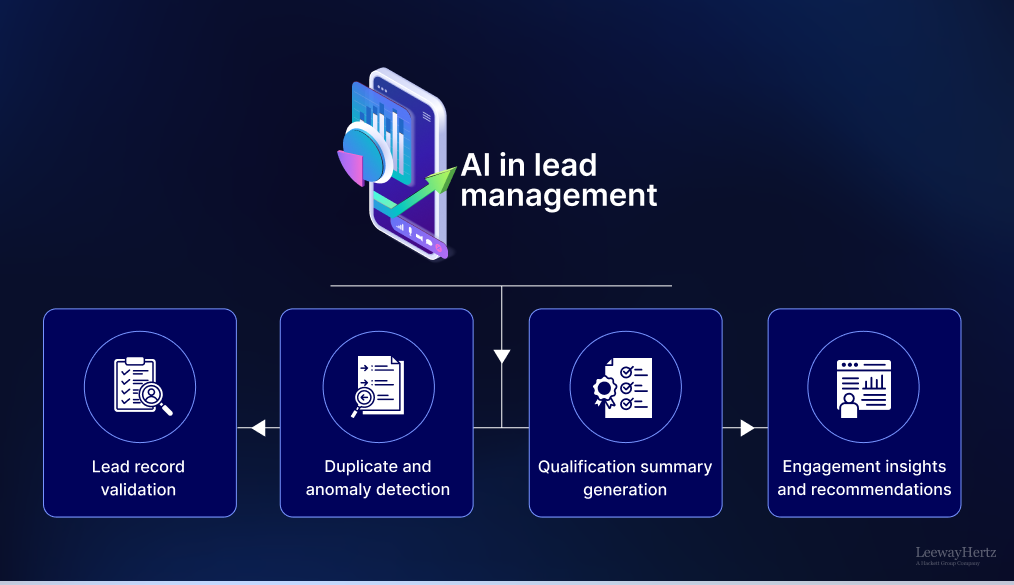
Lead management has evolved from a simple process of collecting prospect information into a complex operating discipline that connects marketing execution, sales development, customer data, and revenue operations. Every lead data carries signals about customer interest, business fit, engagement behavior, and buying intent, but those signals are often captured across disconnected systems, including websites, campaign platforms, event tools, partner channels, CRM platforms, and customer interaction records.
The challenge for organizations is no longer only generating more leads. It is ensuring that every lead moves through a consistent, data-driven lifecycle: captured accurately, enriched with relevant context, evaluated against qualification criteria, routed to the right owner, and managed through the appropriate engagement workflow. As lead volumes increase and buying journeys become more complex, revenue teams must coordinate decisions across multiple functions while maintaining data quality, process consistency, and governance.
Organizations continue to invest in CRM and revenue technology platforms to support customer engagement and sales operations. Salesforce research highlights the growing role of technology in helping sales teams manage customer relationships, automate workflows, and improve revenue operations [1]. Gartner identifies CRM as one of the largest enterprise application software markets, with continued investment as organizations seek stronger customer engagement and operational capabilities [2].
However, the difficulty in lead management is rarely due to a lack of information. The challenge is turning fragmented records into actionable context at the right point in the workflow. Lead profiles may exist in CRM systems, campaign responses may sit in marketing platforms, engagement history may be distributed across communication tools, and qualification decisions may depend on sales methodologies and business rules. A marketing operations analyst may need to validate incoming campaign leads, a sales development representative may need to determine whether a prospect meets qualification criteria, and a sales operations manager may need to investigate routing exceptions or conversion patterns.
Within this operating environment, AI should be understood as a way to strengthen specific points in the lead lifecycle where teams already depend on data, rules, and repeatable review steps. Its value comes from helping revenue teams interpret fragmented lead signals, prepare cleaner records, surface exceptions, and support timely handoffs across marketing, sales, and operations. AI creates value in lead management when it is applied to these specific operational activities rather than positioned as a general-purpose sales assistant. Classification can analyze lead records against approved qualification criteria to categorize readiness for sales review. Multi-source aggregation can combine CRM records, engagement history, and account information to prepare prospect context for account executives. Anomaly detection can identify routing inconsistencies by comparing lead assignments against territory rules and ownership frameworks for sales operations review.
To identify meaningful AI opportunities, organizations need to understand lead management as an operating model rather than a collection of isolated tasks. The lifecycle includes multiple functions, processes, and sub-processes, from lead capture and data management to qualification, routing, engagement, conversion, analytics, and governance. This article uses the lead management operating model to break lead management into functions, processes, and sub-processes, identifying where AI capabilities can support revenue workflows while keeping qualification decisions, customer interactions, and business approvals with accountable teams.
- How AI is transforming lead management workflows
- Why AI use cases in lead management must be mapped at the sub-process level
- Lead management operating model and AI opportunity mapping across lead management processes
- High-value AI use cases in lead management workflows
- How agentic AI works in lead management workflows
- How to prioritize AI use cases in lead management workflows
- Governance, risk and responsible AI in lead management workflows
- How ZBrain operationalizes AI use cases in lead management
- Future of AI in lead management workflows
How AI is transforming lead management workflows
Lead management involves a continuous flow of information across marketing platforms, CRM systems, sales engagement tools, enrichment platforms, customer data sources, and analytics environments. Teams must capture prospect information, validate lead records, assess sales readiness, assign ownership, manage engagement activities, and analyze conversion outcomes. AI supports these workflows through traditional capabilities such as classification, predictive analytics, anomaly detection, and multi-source aggregation; generative capabilities that create summaries, communications, and synthesized insights; and agentic capabilities that coordinate multi-step workflows under governance. Across these applications, AI prepares information and surfaces recommendations while sales, marketing, and revenue teams retain ownership of qualification decisions, customer interactions, and business approvals.
Consider a lead generated through a website form, enriched with company data, evaluated against qualification criteria, and assigned to a sales development representative. The workflow may include marketing automation records, CRM fields, engagement history, enrichment data, territory rules, qualification frameworks, and sales activity records. AI can integrate information from these sources, classify lead characteristics, identify missing or inconsistent data, and prepare review materials for sales teams. Existing revenue governance decides whether the lead advances, requires further qualification, or stays in a nurturing workflow.
AI opportunities in lead management typically emerge across five categories of work:
Document-heavy work
- Artifacts involved: Lead forms, customer information records, qualification notes, campaign response files, enrichment records, and engagement histories.
- AI role: Document intelligence can extract and organize information from lead-related documents and records, while classification can identify missing fields, inconsistent information, or incomplete qualification details before review. This helps teams prepare cleaner lead records without replacing validation decisions.
Narrative-heavy work
- Artifacts involved: Lead qualification summaries, prospect briefs, sales notes, follow-up records, engagement summaries, and conversion explanations.
- AI role: Generative AI can draft sales summaries, follow-up notes, and engagement updates using approved CRM records and interaction histories. Retrieval-grounded answering can connect these outputs to supporting records and sales guidance while highlighting where evidence is limited.
Exception-heavy work
- Artifacts involved: Duplicate lead queues, incomplete profiles, routing exceptions, lead qualification gaps, and SLA breach records.
- AI role: Classification and anomaly detection can identify and categorize lead management exceptions by comparing records against defined business rules. Prioritization models help rank exception queues by urgency, ownership, and downstream impact, enabling teams to focus reviews where they are most needed.
Knowledge-heavy work
- Artifacts involved: Lead qualification frameworks, sales playbooks, routing policies, segmentation rules, and internal operating guidelines.
- AI role: Retrieval-grounded answering can locate relevant sales policies and qualification guidance from approved sources. AI can compare lead information against defined criteria and surface relevant context to support consistent evaluation across teams.
Workflow-heavy work
- Artifacts involved: Lead lifecycle records, routing rules, ownership matrices, workflow configurations, and activity histories.
- AI role: Agentic AI can coordinate multi-step lead workflows by gathering relevant records, applying approved rules, preparing work packets, and triggering defined handoffs. Prioritization models and predictive analytics identify workflow bottlenecks, while human reviewers control qualification decisions, customer engagement, and process changes.
A practical design rule for lead management AI is to begin with governed sub-processes where required artifacts exist, accountable owners are defined, and AI outputs can be reviewed before influencing revenue decisions. The highest-value opportunities are not determined by automation potential alone, but by how effectively AI capabilities align with existing lead workflows, business rules, data availability, and human decision boundaries.
Scale lead management with governance-first AI
Unlock smarter, faster, and more compliant lead management with ZBrain. Design and orchestrate governed, human-in-the-loop AI workflows across the lead lifecycle.
Why AI use cases in lead management must be mapped at the sub-process level
At a high level, lead management might seem straightforward: capture a lead, qualify it, assign ownership, and convert it into an opportunity. However, each of these stages contains numerous operational activities, decision points, supporting artifacts, systems, and human review steps. Applying AI at a broad functional level often yields vague objectives because the real work occurs in granular activities such as validating lead information, classifying readiness, identifying duplicates, preparing qualification summaries, or managing engagement histories. Without this granularity, AI initiatives risk being disconnected from the actual workflows that drive business outcomes.
A more effective approach is to map AI opportunities to the lead management operating model using a structured hierarchy:
- Function: A governed operational domain with clearly defined accountability. Examples include lead qualification, lead routing, or lead data management. Functions represent major work areas managed by specific teams and supported by well-defined processes.
- Process: A workflow area within a function that groups related operational activities. For example, within the lead qualification function, a process could involve evaluating lead readiness, reviewing engagement history, and confirming compliance with qualification criteria.
- Sub-process: A discrete operational activity that begins with a well-defined artifact, follows specified rules, and produces a concrete output. For instance, qualification evidence preparation uses lead records, engagement histories, and approved qualification frameworks to generate a review package for a sales representative.
- AI-enabled opportunity: The targeted application of an AI capability to a sub-process, artifact, and workflow outcome. For example, classification can analyze lead records against approved qualification criteria and sales playbooks to categorize lead readiness and surface missing information for human review.
Mapping at the sub-process level ensures a clear and actionable link between AI capabilities and operational requirements. It identifies where data resides, which systems support the work, which controls apply, and which roles remain accountable for decisions. This prevents organizations from treating AI as a standalone layer or “bolt-on” technology disconnected from the day-to-day sales and marketing processes.
Consider practical examples:
- “AI for lead management” is too broad to define a buildable workflow.
- A precise, actionable opportunity is: “Anomaly detection applied to CRM lead records to identify duplicates or incomplete entries before sales teams act.”
- Similarly, “AI for sales qualification” becomes actionable when specified as: “Natural-language generation that prepares qualification summaries from approved lead notes and engagement histories for sales representative review.”
A sub-process approach also strengthens governance. Organizations can clearly define where AI prepares information, which steps require human validation, which artifacts support outputs, and how decisions remain traceable across the lead lifecycle. This structure ensures AI adds measurable value while keeping accountability with the teams responsible for revenue outcomes.
By grounding AI opportunities in sub-process-level workflows, organizations can design buildable, governed, and high-impact AI implementations that improve operational efficiency, support consistent decision-making, and maintain compliance with internal policies and regulatory standards.
Lead management operating model and AI opportunity mapping across lead management processes
The lead management operating model maps the core functions practitioners use to manage leads across the enterprise. Each function is decomposed into its major processes and sub-processes, with each sub-process mapped to a clearly defined AI-enabled opportunity, illustrating how AI can support lead capture, qualification, routing, engagement, conversion, and analytics while preserving human oversight.
Function 1: Lead management strategy, policy and governance
This function aligns lead management strategy, policies, ownership, and AI priorities with revenue objectives, operational risks, and compliance requirements. It governs the full lead management lifecycle by defining lead stages, decision rights, exception handling, and sub-processes where AI can support work without replacing human decision-making.
Teams involved:
Revenue operations leaders, marketing operations, sales leadership, legal, compliance, risk management, IT/CRM administrators, data governance, finance, and enterprise architecture teams.
Systems involved:
CRM, Marketing Automation Platform (MAP), Customer Data Platform (CDP), Governance/Risk/Compliance (GRC) systems, policy repositories, workflow/orchestration tools, data warehouse/BI platforms, identity & access management systems.
Inputs:
Business strategy, risk register, lead quality standards, routing and ownership rules, CRM stage definitions, audit findings, campaign intake records, organizational charts, and regulatory guidance.
Outputs:
Lead management strategy, policy framework, ownership matrix, decision rights, AI opportunity roadmap, exception register, governance performance dashboards, and compliance evidence packs.
What AI helps with:
Multi-source aggregation combines strategy, risk, audit, and CRM data for baseline assessment. Retrieval-grounded answering compares draft policies with regulatory and internal requirements. Classification identifies gaps or inconsistencies, while prioritization scoring ranks AI initiatives by impact, readiness, and reviewer capacity.
What humans continue to own:
Executives define strategic priorities and risk appetite. Governance committees approve policies, ownership assignments, and exception handling. Legal, compliance, and security teams approve controls. AI only prepares analysis and drafts; humans approve all final decisions.
| Process | Sub-process | Key AI-enabled opportunities |
|---|---|---|
| Strategy formulation | Enterprise lead baseline assessment | Multi-source aggregation combines CRM, MAP, CDP, and intake data to identify coverage gaps; anomaly detection flags unassigned stages or missing rules. |
| Lead risk and maturity assessment | AI classification groups risks by lifecycle, ownership, and compliance domains; retrieval-grounded answering compares current practices with approved governance standards. | |
| Target-state objective definition | Natural language generation prepares measurable objectives; retrieval-grounded answering maps objectives to strategy, risk, and operating model requirements. | |
| Operating-model design | Lead lifecycle design | Process analysis maps the movement of leads through capture, qualification, routing, engagement, and conversion; anomaly detection identifies missing handoffs or duplicate responsibilities. |
| Domain and service model definition | AI classification groups lead types, sources, and owners; graph analysis maps dependencies across domains and owners. | |
| Policy management | Policy drafting and revision | Retrieval-grounded answering compares draft policy with standards; natural language generation drafts clauses with source references. |
| Lead governance roles and decision rights | Ownership and stewardship assignment | AI classification maps lead domains to owners and custodians; anomaly detection identifies missing or conflicting ownership. |
| Decision-right and escalation design | Multi-source aggregation combines risk, approval requirements, and policy scope; natural language generation prepares escalation paths. | |
| Portfolio planning | Lead initiative prioritization | Prioritization scoring ranks AI initiatives by business impact, readiness, dependencies, and reviewer capacity; scenario analysis compares roadmap options under different constraints. |
| Governance oversight | Exception and waiver review | Document intelligence extracts affected leads, control deviations, and compensating measures; risk scoring prioritizes exceptions by sensitivity and impact. |
| Governance performance review | Multi-source aggregation combines ownership gaps, exception data, and audit findings; natural language generation prepares commentary for leadership review. |
Highest-value opportunities:
- Policy consistency checking: ensures all downstream controls align with approved governance.
- Ownership-gap detection: prevents unowned lead stages from creating operational risk.
- Evidence-based AI roadmap preparation: aligns limited investment, staffing, and capacity with high-impact opportunities.
Example agentic workflow:
- AI agent retrieves current lead policies, governance rules, routing matrices, and audit logs.
- Compares draft policy updates with internal standards and regulatory requirements.
- Generates a redlined draft with flagged gaps and recommendations.
- Governance committee, legal, and compliance teams review and approve changes.
- Approved policies are versioned, published, and integrated into CRM and workflow systems.
Function 2: Lead capture & intake
This function ensures that all incoming leads, from web forms, campaigns, events, partners, and manual entry, are accurately captured, validated, normalized, and enriched to create complete and actionable lead records ready for scoring, routing, and engagement. AI supports high-volume, artifact-rich sub-processes, while human reviewers retain control over exceptions, verification, and ambiguous cases.
Teams involved:
Marketing operations, sales operations, demand generation, event management, partner/channel managers, IT/CRM administrators, and data governance teams.
Systems involved:
CRM, Marketing Automation Platform (MAP), Customer Data Platform (CDP), enrichment tools, iPaaS/BPM orchestration, event management systems, call/chat platforms, spreadsheets for manual entries.
Inputs:
Website and landing page submissions, campaign response files, event attendee lists, partner leads, manual intake forms, chat transcripts, call logs, enrichment datasets.
Outputs:
Validated and normalized lead records, intake logs, attribution metadata, exceptions flagged, and source-verified lead packets ready for scoring and routing.
What AI helps with: Document intelligence parses structured and semi-structured submissions from multiple channels; classification detects source type, spam, low-quality, or invalid leads; multi-source aggregation resolves duplicates and merges data from multiple systems; and anomaly detection flags missing fields, inconsistent data, or suspicious submissions.
What humans continue to own: Operations/CRM admins review flagged exceptions and low-confidence leads to ensure data quality before CRM entry. Sales operations managers address ambiguous records, such as unclear campaign attribution or incomplete submissions. Marketing operations analysts verify source attribution, validate lead metadata, and reconcile data across MAP, CDP, and CRM. Data governance team confirms cross-system matches, deduplication, normalization, and proper escalation of exceptions.
| Process | Sub-process | Key AI-enabled opportunities |
|---|---|---|
| Web and chat lead intake | Form submission parsing | Document intelligence extracts field-level data from landing pages, chat logs, and embedded forms. |
| Spam and invalid lead detection | Classification identifies duplicate or invalid submissions, suspicious IPs, or automated bots. | |
| Missing data flagging | Anomaly detection highlights incomplete fields for human review. | |
| Campaign lead intake | Response file ingestion | AI parses CSV, Excel, or JSON campaign response exports and standardizes field names. |
| Source attribution | Classification maps campaign IDs, UTM parameters, and channel metadata to lead records. | |
| Duplicate detection | Multi-source aggregation checks for existing records in CRM/CDP to prevent duplicates. | |
| Event and webinar lead intake | Attendee list ingestion | Document intelligence parses event platform exports and normalizes attendee information. |
| Attendance verification | AI cross-checks registrations with check-in data and identifies inconsistencies. | |
| Engagement enrichment | Multi-source aggregation appends engagement activity, session participation, and content interactions. | |
| Partner & third-party lead intake | Lead file normalization | AI standardizes partner-provided files into a canonical schema compatible with CRM. |
| Quality assessment | Classification scores leads based on completeness, industry fit, and historical partner reliability. | |
| Exception identification | Anomaly detection flags out-of-bound values, missing data, or unrecognized fields. | |
| Lead entry management | Internal intake form validation | Document intelligence checks required fields, verifies field formatting, and validates whether email addresses and phone numbers follow the expected format. |
| Data consistency check | Anomaly detection compares new lead data with existing CRM records and flags conflicting contact, account, ownership, or source information for human reconciliation. | |
| Escalation queue creation | Low-confidence entries or ambiguous inputs are routed to operations or sales teams for review. | |
| Cross-system intake validation | CRM and MAP reconciliation | Multi-source aggregation matches lead submissions across systems, identifying duplicates and mismatches. |
| Flagged lead prioritization | Predictive analytics ranks flagged entries by urgency, likelihood to convert, and downstream impact. | |
| Human-in-the-loop review | AI prepares suggested corrections and routes exceptions to human reviewers for approval. |
Highest-value opportunities:
- Duplicate detection across channels: Prevents multiple records for the same lead.
- Missing-field validation: Ensures complete data for downstream scoring and routing.
- Partner/third-party feed normalization: Reduces errors and manual reconciliation.
Example agentic workflow:
- AI agent aggregates all leads from web forms, campaigns, events, and partners.
- Parses and standardizes fields using document intelligence.
- Flags duplicates, missing fields, or invalid entries.
- Generates exception queues for human review.
- Approved records are normalized and pushed to CRM for scoring, segmentation, and routing.
Function 3: Lead data management
This function ensures all captured leads are stored, standardized, enriched, and maintained with high data quality across CRM and supporting systems. It governs the integrity, completeness, and usability of lead records, forming the foundation for scoring, routing, engagement, and analytics. AI supports data validation, enrichment, deduplication, and quality monitoring, while humans retain oversight for exceptions, compliance, and final approvals.
Teams involved:
CRM administrators, revenue operations analysts, marketing operations analysts, sales operations, data governance team, IT/data engineering, and enrichment platform specialists.
Systems involved:
CRM, Marketing Automation Platform (MAP), Customer Data Platform (CDP), enrichment tools, data warehouse, iPaaS/BPM orchestration, reporting platforms, workflow automation tools.
Inputs:
Validated lead records from intake, campaign and event data, partner feeds, manual entries, enrichment datasets, CRM history, and engagement logs.
Outputs:
Normalized and enriched lead records, deduplication reports, data quality dashboards, exception queues, and metadata for scoring, routing, and analytics.
What AI helps with:
Document intelligence parses structured and semi-structured lead records; classification detects duplicates, inconsistent fields, or low-quality entries; multi-source aggregation consolidates data from multiple systems; anomaly detection flags missing or conflicting data; generative AI summarizes enrichment data for human review.
What humans continue to own: The CRM administrator reviews flagged exceptions, duplicates, and low-confidence records; the revenue operations analyst validates enriched lead data and ensures cross-system consistency; the marketing operations analyst confirms partner and third-party feed integration and quality; and the data governance team approves normalization, oversees exception resolution, and monitors adherence to data standards.
| Process | Sub-process | Key AI-enabled opportunities |
|---|---|---|
| Lead record creation | Field level validation | Document intelligence checks required fields, enforces formatting standards, validates email and phone syntax, and flags missing entries. |
| Duplicate detection | Classification identifies potential duplicates across CRM, MAP, and CDP; multi-source aggregation consolidates records and prevents duplicate records for the same lead. | |
| Source consistency check | Source-attribution anomaly detection compares incoming lead source fields, including campaign ID, partner ID, landing page URL, and UTM parameters, with CRM lead records, MAP campaign records, and partner submission files to flag attribution mismatches. | |
| Data normalization | Standardize field formats | Data-standardization rules and entity resolution compare incoming lead fields, name, email, phone, company name, postal address, job title, and account domain, with CRM lead and contact records, MAP profile fields, CDP identity records, and enrichment-provider records to standardize formats and flag mismatches. |
| Standardize source attributes | Maps campaign, event, and partner fields into a canonical schema compatible with CRM and enrichment systems. | |
| Data enrichment | Append firmographics | Multi-source aggregation integrates company size, industry, geographic location, and intent data. |
| Behavioral and engagement enrichment | Summarizes engagement activity, event participation, downloads, and interactions for inclusion in the lead profile. | |
| Consent and preference management | Validate opt-in / consent status | Retrieval-grounded answering verifies consent, communication preferences, and regulatory compliance (including GDPR, CAN-SPAM, TCPA, and CCPA). |
| Exception flagging | Anomaly detection highlights missing or conflicting consent or opt-in fields for human review. | |
| CRM data quality monitoring | Lead quality scoring | Classification assigns a quality score to each lead based on completeness, accuracy, and consistency. |
| Exception queue creation | Classification routes low-quality or incomplete records to human reviewers for resolution. | |
| Quality trend analysis | Predictive analytics identifies trends in data quality over time and suggests areas for process improvement. |
Highest-value opportunities:
- Duplicate detection and consolidation: Prevents multiple records for the same lead.
- Data normalization and standardization: Ensures consistent records for downstream scoring, routing, and engagement.
- Enrichment validation: Adds context for segmentation and prioritization.
- Consent and compliance validation: Reduces operational and regulatory risk.
Example agentic workflow:
- AI agent collects all new lead records from CRM, MAP, enrichment tools, and partner feeds.
- Applies classification and document intelligence to detect duplicates, missing fields, and inconsistencies.
- Enriches records using multi-source aggregation and generates review-ready summaries.
- Flags exceptions and routes them to the CRM administrator, revenue operations analyst, and marketing operations analyst for human validation.
- Approved, normalized, and enriched records are stored in CRM for scoring, routing, segmentation, and engagement workflows.
Function 4: Lead classification & segmentation
This function organizes leads into meaningful categories and prioritizes them based on firmographics, behavior, and intent. It enables sales and marketing teams to focus on high-value prospects, personalize engagement, and prepare leads for qualification and routing. AI enhances classification, scoring, segmentation, and pattern recognition, while human reviewers maintain oversight for exceptions, rule validation, and model governance.
Teams involved:
Marketing operations, revenue operations, sales operations, account-based marketing (ABM) teams, CRM administrators, data governance, and business analysts.
Systems involved:
CRM, Marketing Automation Platform (MAP), Customer Data Platform (CDP), enrichment tools, predictive analytics engines, ABM platforms, workflow automation systems, reporting and BI tools.
Inputs:
Normalized lead records, enrichment data, engagement history, campaign responses, web interactions, intent data and firmographic and demographic information.
Outputs:
Lead classification labels, segmentation buckets, scoring metrics, prioritization recommendations, and metadata for downstream routing and engagement workflows.
What AI helps with: Classification categorizes leads by firmographics, behavior, buying stage, and intent signals; predictive analytics assigns lead scores based on propensity to convert; multi-source aggregation combines data from CRM, MAP, CDP, and enrichment platforms to create complete lead profiles; anomaly detection flags leads with inconsistent or unusual behavior patterns; and generative AI summarizes engagement insights for review-ready profiles.
What humans continue to own: Sales operations managers validate scoring thresholds and final classifications, marketing operations analysts confirm segmentation accuracy, intent signal definitions, and rule alignment with campaigns, revenue operations analysts approve scoring and classification models before production, and the data governance team monitors adherence to classification rules, model fairness, and regulatory compliance.
| Process | Sub-process | Key AI-enabled opportunities |
|---|---|---|
| Lead scoring | Behavioral scoring | Predictive analytics evaluates engagement patterns, clicks, downloads, and email opens to calculate propensity scores. |
| Fit scoring | Classification assesses alignment with target firmographics (industry, size, region). | |
| Intent scoring | Multi-source aggregation identifies early-stage buying signals, comparing web behavior, intent data, and content consumption. | |
| Lead segmentation | Demographic segmentation | Classifies leads by job role, seniority, and region using enrichment data. |
| Firmographic segmentation | Classification and enrichment combine company size, industry, and vertical to bucket leads. | |
| Behavioral segmentation | Anomaly detection and clustering identify lead engagement patterns across campaigns and channels. | |
| Buying-stage classification | Retrieval-grounded answering maps lead to defined funnel stages using historical conversion patterns. | |
| Intent signal analysis | Identifies leads showing purchase intent through multi-channel engagement signals; flags high-priority leads for human review. | |
| Model validation & exception handling | Score threshold verification | Score validation identifies leads that are near the qualification threshold or have attributes that conflict with the assigned score, and flags them for human review. |
| Segmentation gap detection | Anomaly detection identifies unclassified or misclassified leads; it generates exceptions for revenue ops or marketing ops review. | |
| Reporting & insights | Lead classification dashboards | Summarizes segmented leads and highlights insights for sales and marketing leadership. |
Highest-value opportunities:
- Behavioral and intent scoring: Improves prioritization of high-value prospects.
- Multi-source segmentation: Combines CRM, MAP, and enrichment data to improve accuracy.
- Exception handling for outliers: Prevents misclassification of critical leads.
- Funnel stage mapping: Ensures alignment between marketing nurture and sales engagement.
Example agentic workflow:
- AI agent aggregates lead profiles from CRM, MAP, and enrichment tools.
- Applies classification and predictive analytics to assign firmographic, behavioral, and intent scores.
- Detects leads with conflicting or borderline attributes and flags them for human review.
- Generates segmentation dashboards and summarizes insights using generative AI.
- The revenue operations and marketing operations teams validate classifications before routing to sales representatives.
- Approved classifications and segments feed directly into scoring, routing, and engagement workflows.
Function 5: Lead qualification
This function determines whether captured leads meet defined readiness criteria before being passed to sales teams. It validates lead data, engagement signals, and firmographic fit, ensuring that only qualified leads proceed to routing, engagement, and conversion. AI supports analysis, summarization, scoring, and exception detection, while humans retain control over qualification decisions and approval of borderline or high-impact leads.
Teams involved:
Sales development representatives (SDRs), marketing operations, revenue operations, CRM administrators, account executives, data governance, and sales leadership.
Systems involved:
CRM, Marketing Automation Platform (MAP), Customer Data Platform (CDP), enrichment tools, predictive scoring engines, workflow orchestration tools, ABM platforms, reporting/BI dashboards.
Inputs:
Normalized and enriched lead records, engagement history, campaign activity, web interactions, partner and event data, firmographic and demographic information, prior conversion data, and qualification frameworks (e.g., BANT, MEDDICC).
Outputs:
Qualification decisions, lead readiness scores, exception flags, review-ready summaries, and metadata for routing, handoff, and reporting.
What AI helps with: Classification and predictive analytics score lead readiness; retrieval-grounded answering compares lead information against approved qualification frameworks; document intelligence summarizes engagement history, call notes, and interaction data; generative AI drafts review-ready qualification summaries; and anomaly detection flags inconsistent, missing, or ambiguous information.
What humans continue to own: The sales development representatives (SDRs) review AI-prepared summaries and make final qualification decisions; sales operations managers approve scoring thresholds and oversee consistency in qualification across territories; marketing operations analysts validate framework alignment, engagement signals, and campaign context; and the data governance team ensures AI models comply with rules, flag edge cases, and monitor fairness.
| Process | Sub-process | Key AI-enabled opportunities |
|---|---|---|
| Qualification assessment | Data completeness validation | Document intelligence ensures all required fields and engagement history are present; anomaly detection flags missing or inconsistent entries. |
| Fit and firmographic evaluation | Classification compares leads against target firmographics, industry, region, and account size. | |
| Engagement and behavioral scoring | Predictive analytics evaluates email opens, downloads, web interactions, event participation, and engagement recency to assign readiness scores. | |
| Intent signal analysis | Multi-source aggregation combines behavioral signals, content interactions, and campaign responses to assess the likelihood to convert. | |
| Qualification framework mapping | Retrieval-grounded answering maps lead data to frameworks such as BANT or MEDDICC; generative AI drafts summaries for human review. | |
| Exception handling | Qualification exception review | Anomaly detection flags leads requiring SDR or Sales Ops review; workflow intelligence routes exceptions for approval. |
| Discrepancy detection | AI identifies conflicts between enrichment data, engagement signals, and source information for human intervention. | |
| Reporting & insights | Qualification report preparation | Generative AI creates structured, evidence-backed summaries for SDRs and account executives. |
Highest-value opportunities:
- Qualification scoring: Prioritizes high-potential leads for faster sales engagement.
- Framework mapping and evidence-backed summaries: Improves decision consistency and auditability.
- Exception detection: Prevents unqualified or misaligned leads from entering active workflows.
Example agentic workflow:
- AI agent aggregates normalized lead records, engagement history, and enrichment data.
- Applies classification and predictive scoring to evaluate fit, behavior, and intent.
- Generates review-ready qualification summaries using generative AI.
- Flags borderline or low-confidence leads for human review (SDR or Sales Ops).
- Humans validate and approve qualified leads, which are then routed to sales representatives for engagement.
- Approved summaries and decisions are stored in CRM for reporting and analytics.
Accelerate AI Solutions Development
Build fully functional solutions from your high-value use cases, based on specific operational needs and enterprise context.
Function 6: Lead assignment & routing
This function ensures that qualified leads are distributed to the correct sales representatives based on territory, account ownership, capacity, and SLA requirements. It governs the assignment logic, manages exceptions, and ensures equitable workload distribution. AI supports routing recommendations, conflict detection, and prioritization, while humans retain control over final assignments, escalation decisions, and exception handling.
Teams involved:
Sales operations, revenue operations, account managers, CRM administrators, marketing operations, partner channel managers, and data governance teams.
Systems involved:
CRM, MAP, Customer Data Platform (CDP), workflow orchestration tools, ABM platforms, reporting dashboards, iPaaS/BPM connectors, and assignment matrices.
Inputs:
Qualified lead records, lead scoring, territory and account ownership rules, SLA policies, sales capacity data, campaign attribution, engagement history, and partner assignment rules.
Outputs:
Routed and assigned leads, exception queues, assignment reports, workload balancing dashboards, and handoff logs.
What AI helps with: Predictive routing recommends assignments based on historical conversion, rep capacity, and territory alignment; classification detects conflicts, overlaps, or assignment anomalies; multi-source aggregation consolidates account ownership, engagement history, and SLA data; workflow intelligence prioritizes leads based on score, urgency, and rep availability; and anomaly detection flags routing exceptions for human review.
What humans continue to own: The sales operations manager approves final lead assignments, resolves conflicts, and monitors SLA adherence; account managers validate assignments for strategic accounts or partner-driven leads; the revenue operations analyst reviews high-volume lead assignments, escalates exceptions, and audits routing compliance; and the CRM administrator ensures routing rules are correctly implemented in the CRM and resolves technical exceptions.
| Process | Sub-process | Key AI-enabled opportunities |
|---|---|---|
| Territory-based routing | Map leads to assigned territories | Multi-source aggregation combines CRM, MAP, and account ownership data to match leads to the correct territory; predictive analytics ranks leads by representatives’ capacity and expected responsiveness. |
| SLA compliance check | SLA-breach prediction compares lead response-time targets, assigned representative capacity, current queue age, and SLA rules to flag leads at risk of missing follow-up deadlines. | |
| Account ownership matching | Match leads to account owners | Classification identifies conflicts or duplicate ownership; workflow intelligence ensures equitable distribution across representatives. |
| Partner and channel alignment | Multi-source aggregation aligns partner-sourced leads with designated account owners; anomaly detection flags misaligned leads. | |
| Capacity-based lead assignment | Representative workload balancing | Predictive analytics evaluates representatives’ capacity, current assignments, and workload distribution; Decision-support analysis compares seller capacity, current workload, territory rules and pipeline distribution to recommend lead assignments for manager review. |
| Escalation handling | Anomaly detection identifies overloaded representatives or high-value leads requiring escalation to managers. | |
| SLA-based routing | Prioritize leads by urgency | Priority scoring ranks leads according to score, engagement, and SLA deadlines; generative AI prepares exception reports for human review. |
| Exception queue management | AI routes exceptions (conflicting accounts, low-confidence routing, incomplete data) to human reviewers; anomaly detection flags unusual patterns. | |
| Routing validation & monitoring | Assignment verification | Multi-source aggregation cross-checks CRM, MAP, and CDP to confirm routing correctness. |
| Assignment performance monitoring | Predictive analytics tracks representatives’ responsiveness and conversion metrics; anomalies are flagged for review. |
Highest-value opportunities:
- Predictive routing based on historical conversion and rep performance: Improves lead engagement and conversion rates.
- Conflict detection for account ownership: Prevents duplication and ensures clear accountability.
- SLA adherence monitoring: Reduces lead response time and ensures equitable distribution.
- Exception handling for high-value or strategic leads: Maintains human oversight on critical accounts.
Example agentic workflow:
- AI agent aggregates qualified lead records, rep capacity, account ownership, and territory rules.
- Applies predictive analytics and classification to recommend assignments.
- Detects conflicts or anomalies and routes them to Sales Operations or Account Managers.
- Generates a prioritized assignment queue and an SLA compliance summary.
- Humans validate assignments, approve exceptions, and confirm routing in CRM.
- Assigned leads are delivered to representatives with a logged handoff, and all exceptions are stored for review.
Function 7: Lead nurturing & engagement
This function manages personalized, multi-channel engagement with leads to maximize conversion potential. It governs campaign sequencing, content delivery, follow-up prioritization, and engagement analytics. AI assists with prioritization, personalization, and analysis, while humans retain oversight of exceptions, messaging approvals, and strategy alignment.
Teams involved:
Marketing operations, demand generation, sales development representatives (SDRs), account-based marketing (ABM) teams, revenue operations, CRM administrators, content operations, and data governance teams.
Systems involved:
CRM, Marketing Automation Platform (MAP), Customer Data Platform (CDP), email marketing tools, ABM platforms, enrichment tools, event management systems, workflow orchestration systems, and BI/reporting dashboards.
Inputs:
Qualified and scored lead records, engagement history, campaign participation data, multi-channel interaction logs, content libraries, segmentation metadata, intent signals, and partner engagement data.
Outputs:
Lead engagement scores, personalized campaign recommendations, next-best-action lists, content recommendations, follow-up sequences, prioritized lead queues, and exception flags.
What AI helps with:
Multi-source aggregation combines engagement and behavioral signals across channels; predictive analytics identifies leads most likely to respond or convert; classification segments leads by engagement patterns, content preferences, or channel responsiveness; generative AI drafts personalized messaging, nurture emails, and engagement summaries; and anomaly detection flags unresponsive leads, conflicting signals, or unusual behavior.
What humans continue to own: Marketing operations analysts approve campaigns, content, and sequences and validate AI-generated messaging; sales development representatives (SDRs) validate next-best-action recommendations and prioritize outreach; revenue operations analysts monitor workflow performance, review flagged exceptions, and ensure alignment with sales targets; and content operations teams approve AI-suggested content personalization and ensure messaging consistency.
| Process | Sub-process | Key AI-enabled opportunities |
|---|---|---|
| Campaign sequencing | Lead enrollment into campaigns | Multi-source aggregation identifies eligible leads and maps them to the appropriate sequence based on segmentation and scoring. |
| Scheduling & timing optimization | Predictive analytics determines optimal delivery times; workflow intelligence ensures adherence to sequence and SLA compliance. | |
| Personalization rule configuration | Drafts personalized subject lines and initial content snippets based on lead attributes. | |
| Email engagement analysis | Open and click tracking | Classification analyzes opens, clicks, and responses to identify engagement patterns. |
| Engagement scoring | Predictive analytics ranks leads by activity intensity, content interaction, and channel responsiveness. | |
| Response anomaly detection | Anomaly detection flags unusual or conflicting engagement behaviors for human review. | |
| Content recommendation | Personalized content selection | Multi-source aggregation recommends content (whitepapers, webinars, articles) based on lead behavior and interest. |
| Channel alignment | AI ensures content is delivered via the appropriate channel (email, social, events) based on lead profile. | |
| Follow-up prioritization | Next-best-action identification | Predictive analytics identifies which leads require immediate outreach based on engagement scores, intent signals, and readiness. |
| Engagement anomaly review | Anomaly detection flags lead with incomplete engagement history or unusual patterns for SDR review. | |
| Queue prioritization | Workflow intelligence ranks follow-up sequences according to SLA, lead value, and responsiveness. | |
| Engagement history analysis | Activity summarization | Generative AI prepares a digest of past interactions, campaign participation, and content engagement for SDRs and Account Executives. |
| Pattern recognition | Classification identifies engagement trends, inactive periods, and signals of potential churn. | |
| Strategic insight development | Predictive analytics surfaces segments or channels underperforming for campaign optimization. |
Highest-value opportunities:
- Next-best-action prioritization: Focuses SDRs on the leads most likely to convert.
- Multi-channel personalization: Increases engagement and response rates by aligning content and timing to lead behavior.
- Exception handling for anomalous engagement: Ensures unusual patterns are reviewed before downstream actions.
- Engagement pattern detection: Provides insights for campaign optimization and strategic adjustments.
Example agentic workflow:
- AI agent aggregates engagement and interaction data from CRM, MAP, CDP, enrichment tools, and event platforms.
- Applies classification and predictive analytics to assign engagement scores and priority levels.
- Generates next-best-action recommendations and personalized follow-up drafts using generative AI.
- Detects anomalies in engagement patterns and routes exceptions to SDRs or Marketing Operations for review.
- Humans approve messaging, execute outreach, and confirm prioritization.
- Outcomes and follow-up results are logged in CRM and fed back into AI models for continuous improvement.
Function 8: Sales development operations
This function enables SDRs and account executives to engage leads effectively by preparing outreach materials, discovery insights, meeting summaries, and follow-up recommendations. It ensures that lead interactions are data-informed, prioritized, and governed. AI supports summarization, multi-source data aggregation, predictive prioritization, anomaly detection, and content generation, while humans retain control over messaging, engagement decisions, and exceptions.
Teams involved:
SDRs, account executives, sales operations, revenue operations, marketing operations, CRM administrators, data governance, and content operations teams.
Systems involved:
CRM, Marketing Automation Platform (MAP), Customer Data Platform (CDP), enrichment tools, workflow orchestration, ABM platforms, call and meeting logging systems, and BI/reporting dashboards.
Inputs:
Qualified lead records, engagement history, campaign participation, enrichment data, firmographics, intent signals, previous outreach records, and assignment data.
Outputs:
Lead dossiers, next-best-action recommendations, meeting preparation summaries, follow-up sequences, outreach scripts, and exception logs.
What AI helps with:
Multi-source aggregation consolidates lead history, enrichment, and engagement data; generative AI drafts meeting summaries, follow-up emails, and outreach scripts; predictive analytics scores leads for prioritization; classification identifies lead behavior patterns, engagement anomalies, and conversion likelihood; anomaly detection flags incomplete or conflicting data; and workflow intelligence sequences tasks and escalates exceptions.
What humans continue to own:
Sales development representatives (SDRs) validate AI-prepared lead summaries, approve next steps, and conduct outreach; account executives review lead dossiers and prepare for high-value meetings; sales operations managers approve prioritization rules, monitor workloads, and resolve exceptions; revenue operations and data governance teams monitor scoring, review flagged anomalies, and approve workflow exceptions; and content operations teams review AI-generated messaging and ensure compliance with approved templates.
| Process | Sub-process | Key AI-enabled opportunities |
|---|---|---|
| Outreach preparation | Lead dossier aggregation | Multi-source aggregation collects CRM, MAP, CDP, enrichment, and engagement history to produce a complete profile. |
| Lead prioritization | Predictive analytics ranks leads based on fit, engagement, intent, and readiness for outreach. | |
| Content and messaging preparation | Generative AI drafts personalized emails, scripts, and outreach messages based on lead context. | |
| Discovery preparation | Lead research | AI retrieves company information, past interactions, and enrichment insights. |
| Qualification checklist mapping | Retrieval-grounded answering maps lead attributes to BANT/MEDDICC frameworks or internal qualification criteria. | |
| Conversation summaries | Meeting note generation | Generative AI summarizes prior emails, calls, and engagement history into concise notes. |
| Interaction pattern analysis | Classification identifies common objections, customer pain points, and behavioral patterns for next steps. | |
| Follow-up preparation | Next-best-action recommendations | Predictive analytics ranks leads by engagement, lead score, and urgency, then recommends the next outreach tasks for sales teams to complete in the right order. |
| Follow-up exception review | Anomaly detection flags low-confidence leads, missing data, or unusual engagement patterns for human review. | |
| Sales handoff documentation | Handoff packet creation | AI aggregates dossiers, scores, engagement history, and follow-up recommendations into structured packets. |
| Validation & exception routing | Classification identifies incomplete or conflicting data and routes for human validation before handoff. |
Highest-value opportunities:
- Lead dossier aggregation and enrichment: Reduces preparation time for SDRs and AEs.
- Predictive lead prioritization: Ensures the highest-potential leads are contacted first.
- Generative AI summaries: Provides consistent, evidence-based preparation materials.
- Exception and anomaly handling: Maintains data quality and compliance for outreach.
Example agentic workflow:
- AI agent aggregates qualified leads, engagement history, enrichment data, and prior communications.
- Applies predictive scoring and classification to rank leads for outreach.
- Generates AI-prepared meeting summaries, follow-up sequences, and outreach scripts.
- Flags anomalous or low-confidence leads for human review.
- SDRs validate AI outputs, approve prioritization, and execute outreach.
- Handoff packets for Account Executives are prepared, reviewed, and stored in CRM for continuous tracking and follow-up.
Function 9: Lead conversion management
This function ensures that qualified leads are accurately converted into opportunities in CRM while maintaining data integrity, compliance, and alignment with sales strategy. AI supports verification, anomaly detection, scoring, and summarization, while humans retain control over final conversion decisions and exception management.
Teams involved:
Account executives, sales operations, revenue operations, SDRs, CRM administrators, data governance, and finance (for revenue reporting).
Systems involved:
CRM, MAP, CDP, enrichment platforms, workflow orchestration systems, ABM platforms, reporting dashboards, and opportunity management tools.
Inputs:
Qualified lead records, scoring and engagement history, enrichment datasets, campaign participation data, prior communications, account assignments, and SLA rules.
Outputs:
Converted opportunity records, validated conversion logs, exception reports, opportunity briefs, handoff documentation, and conversion metrics.
What AI helps with:
Document intelligence validates required fields and conversion criteria; classification detects duplicate, incomplete, or inconsistent records; multi-source aggregation consolidates lead and account information; anomaly detection flags exceptions for human review; generative AI drafts structured opportunity summaries; and predictive analytics evaluates readiness and revenue potential.
What humans continue to own:
Account executives confirm conversion readiness and approve opportunity creation; sales operations managers validate conversion criteria, resolve exceptions, and monitor SLAs; revenue operations analysts review AI-generated summaries, confirm data consistency, and validate scoring; and CRM administrators ensure technical accuracy of opportunity creation and integration.
| Process | Sub-process | Key AI-enabled opportunities |
|---|---|---|
| Lead-to-opportunity validation | Conversion criteria verification | Classification evaluates whether the lead meets the approved scoring thresholds and engagement criteria, while document intelligence checks that the required conversion fields and supporting records are complete. |
| Duplicate opportunity detection | Multi-source aggregation identifies duplicates across CRM, MAP, and CDP and suggests merges. | |
| Opportunity creation | Field mapping and enrichment | AI maps lead to opportunity fields (account, owner, stage, product) and appends enrichment data (firmographics, intent, engagement summary). |
| Handoff packet generation | Generative AI creates structured opportunity packets with key notes, scoring, and engagement highlights. | |
| Exception handling | Data discrepancy review | Anomaly detection flags missing or inconsistent information and routes to human reviewers. |
| SLA breach and high-value lead escalation | Predictive analytics identifies high-value leads requiring priority conversion, and routes them to account executives or sales operations for approval. | |
| Conversion reporting | Revenue and pipeline reporting | Multi-source aggregation combines opportunity data, conversion logs, and scoring for predictive insights. |
Highest-value opportunities:
- Duplicate detection: Prevents redundant opportunities.
- AI-prepared opportunity packets: Speeds up account executive preparation.
- Conversion readiness validation: Ensures only qualified leads are converted.
- SLA and high-value escalation: Prioritizes critical leads for faster revenue impact.
Example agentic workflow:
- AI agent aggregates qualified leads, ready for conversion, along with engagement history and enrichment data.
- Applies classification and document intelligence to validate criteria and detect inconsistencies.
- Generates structured opportunity handoff packets using generative AI.
- Flags exceptions for review by sales operations or account executives.
- Humans approve or adjust conversions; the CRM Administrator confirms technical implementation.
- Converted opportunities are logged for reporting, analytics, and AI feedback.
Function 10: Lead analytics & performance management
This function measures the performance of leads, campaigns, engagement, and sales productivity. It identifies trends, bottlenecks, and high-value opportunities to optimize revenue operations. AI assists with predictive analytics, anomaly detection, multi-source aggregation, and automated reporting, while humans interpret insights, validate anomalies, and make operational decisions.
Teams involved:
Revenue operations, sales operations, marketing operations, data analytics, CRM administrators, business analysts, and account managers.
Systems involved:
CRM, MAP, CDP, data warehouse, BI/reporting platforms, workflow orchestration systems, enrichment tools, and dashboards.
Inputs:
Qualified and converted lead records, engagement history, routing and assignment data, campaign participation logs, scoring, segmentation, and sales productivity metrics.
Outputs:
Funnel metrics, conversion analysis, source performance dashboards, SDR/AE productivity reports, campaign effectiveness insights, and flagged anomalies.
What AI helps with:
Multi-source aggregation consolidates data from CRM, MAP, CDP, and enrichment sources; predictive analytics forecasts conversion likelihood and funnel trends; anomaly detection flags unusual engagement or performance patterns; classification organizes leads, campaigns, and segments for detailed analysis; and generative AI drafts executive summaries and dashboard commentary.
What humans continue to own:
Revenue operations analysts validate insights, review flagged anomalies, and interpret results for decision-making; marketing operations analysts confirm campaign performance and approve AI-generated summaries; sales operations managers monitor productivity metrics and funnel performance and act on flagged trends; and the data governance team ensures AI scoring, aggregation, and reporting comply with quality standards and regulations.
| Process | Sub-process | Key AI-enabled opportunities |
|---|---|---|
| Funnel analysis | Stage conversion tracking | Multi-source aggregation consolidates stage data; predictive analytics forecasts the likelihood to progress between stages. |
| Bottleneck identification | Anomaly detection flags stages with delayed conversions or unusual drop-offs. | |
| Conversion analysis | Campaign-to-conversion mapping | AI maps leads from campaigns to actual opportunities; generative AI summarizes conversion patterns. |
| Representative performance evaluation | Classification evaluates SDR/AE conversion effectiveness across territories, segments, and lead types. | |
| Source performance analysis | Lead source comparison | Predictive analytics identifies the highest-performing acquisition channels. |
| ROI estimation | Generative AI prepares cost-impact summaries for marketing and sales leadership. | |
| Sales productivity | Activity aggregation | Multi-source aggregation consolidates calls, emails, and outreach activity. |
| Exception identification | Anomaly detection flags underperforming representatives, inactive leads, or unusual activity patterns. | |
| Campaign effectiveness reporting | Engagement & conversion trend analysis | Classification identifies high-performing campaigns; predictive analytics forecasts potential improvements. |
| Funnel and pipeline trend forecasting | AI predicts future pipeline behavior under different lead volumes and conversion rates. |
Highest-value opportunities:
- Stage conversion tracking: Identifies bottlenecks and informs interventions.
- Source performance analysis: Optimizes marketing spend and lead acquisition strategies.
- Predictive productivity scoring: Flags underperforming representatives or segments.
- Campaign trend analysis: Supports data-driven campaign and sales strategy adjustments.
Example agentic workflow:
- AI agent aggregates leads, engagement history, and conversion data across CRM, MAP, CDP, and enrichment systems.
- Applies classification and predictive analytics to identify bottlenecks, performance anomalies, and high-value leads.
- Generates dashboards and executive summaries using generative AI.
- Flags anomalous data and exceptions for human review by Revenue Operations and Marketing Operations.
- Humans validate insights, approve actions, and adjust campaigns or workflows.
- Insights feed back into lead scoring, routing, and prioritization for continuous improvement.
Function 11: Lead compliance & risk management
This function ensures that all leads are processed in compliance with regulatory, privacy, and corporate standards. It monitors consent, communication preferences, data retention policies, and audit requirements. AI supports the detection of non-compliance, the validation of consent, the identification of anomalies, and the preparation of evidence, while humans retain ultimate responsibility for approvals, exception handling, and regulatory accountability.
Teams involved:
Compliance teams, legal, marketing operations, sales operations, data governance, CRM administrators, revenue operations, and privacy officers.
Systems involved:
CRM, MAP, CDP, consent management systems, GRC platforms, workflow orchestration, iPaaS integrations, and reporting/BI dashboards.
Inputs:
Lead records, consent and preference data, campaign logs, engagement history, regulatory requirements, data retention policies, and exception reports.
Outputs:
Compliance-validated leads, consent verification logs, exception reports, audit evidence packs, and regulatory reporting dashboards.
What AI helps with:
Retrieval-grounded answering checks lead data against regulatory and corporate policies; document intelligence extracts consent and communication preference information from multiple sources; anomaly detection flags potential non-compliance or inconsistent consent; classification organizes leads by compliance risk category; and generative AI prepares audit-ready reports and exception summaries.
What humans continue to own:
Compliance officers approve final consent validation and exception resolution; the legal team confirms regulatory adherence and approves escalation decisions; marketing operations analysts verify consent alignment with campaigns before engagement; the data governance team ensures that AI recommendations comply with internal data policies and privacy standards; and sales operations managers monitor exceptions and approve high-risk leads for engagement.
| Process | Sub-process | Key AI-enabled opportunities |
|---|---|---|
| Consent validation | Opt-in verification | Retrieval-grounded answering compares lead consent records against GDPR, CAN-SPAM, TCPA, and CCPA requirements. |
| Document intelligence extracts channel preferences and flags conflicts for review. | ||
| Communication compliance | Campaign compliance review | AI checks lead inclusion against approved communication lists and restrictions. |
| Multi-channel exception detection | Anomaly detection flags lead incorrectly targeted across email, SMS, or calls. | |
| Data retention & privacy | Retention schedule monitoring | Classification identifies leads exceeding retention periods; workflow intelligence generates exception alerts. |
| Privacy request handling | Retrieval-grounded answering detects and prepares records for opt-out, deletion, or modification requests. | |
| Audit & reporting | Evidence assembly | Generative AI prepares audit-ready packs summarizing lead compliance, consent status, and exceptions. |
| Regulatory reporting | Multi-source aggregation consolidates compliance data for executive dashboards and statutory filings. | |
| Exception management | Escalation routing | Anomaly detection prioritizes high-risk leads for review; workflow intelligence routes consent conflicts, prohibited-contact cases, and privacy-request exceptions to compliance officers or legal because these issues require regulatory interpretation and formal approval before any outreach or record change. |
| Resolution tracking | AI tracks exception resolution timelines and prepares human-review summaries. |
Highest-value opportunities:
- Automated consent validation: Ensures only compliant leads are contacted, reducing regulatory risk.
- Exception detection and prioritization: Flags high-risk leads for human review before engagement.
- Audit-ready evidence preparation: Reduces manual effort and improves traceability for regulatory review.
- Multi-channel compliance monitoring: Prevents accidental violations across campaigns.
Example agentic workflow:
- AI agent aggregates lead records from CRM, MAP, CDP, and consent management systems.
- Applies retrieval-grounded answering and document intelligence to validate consent, preferences, and communication eligibility.
- Detects anomalies or conflicts and routes exceptions to compliance officers or legal.
- Generates audit-ready summaries and exception reports using generative AI.
- Human reviewers approve or correct flagged leads before engagement.
- Approved records are logged in CRM with compliance metadata, and dashboards are updated for executive review.
Function 12: Lead data, CRM, MAP and CDP platform governance
This function ensures that the CRM, marketing automation, and supporting platforms are configured, maintained, and governed to support lead management operations. It establishes data quality standards, workflow rules, access permissions, and integration governance. AI assists in monitoring, anomaly detection, and configuration validation, while humans retain oversight for approvals, exceptions, and system changes.
Teams involved:
CRM administrators, marketing operations, revenue operations, IT/platform governance, data governance, sales operations, and security and compliance teams.
Systems involved:
CRM, Marketing Automation Platform (MAP), Customer Data Platform (CDP), enrichment tools, iPaaS/BPM orchestration, workflow engines, access control systems, and reporting dashboards.
Inputs:
Platform configuration records, workflow definitions, integration documentation, access and permission logs, lead records, exception reports, and data quality metrics.
Outputs:
Validated platform configurations, access and permissions logs, workflow compliance reports, integration health dashboards, and exception resolution logs.
What AI helps with:
Multi-source aggregation monitors configuration, workflow, and data integrity across platforms; anomaly detection identifies misconfigurations, broken integrations, or workflow exceptions; classification maps access rights, system roles, and data artifacts to compliance categories; generative AI drafts configuration and integration reports for review; and predictive analytics recommends adjustments to workflow or integration bottlenecks.
What humans continue to own:
The CRM administrator approves and implements platform configuration changes; IT/platform governance reviews AI-flagged anomalies and approves workflow and integration adjustments; revenue and marketing operations analysts validate workflow and automation compliance; the data governance team monitors adherence to data quality, privacy, and access policies; and security and compliance teams approve role-based access changes and audit logs.
| Process | Sub-process | Key AI-enabled opportunities |
|---|---|---|
| CRM, marketing automation platform (MAP), and customer data platform (CDP) configuration | Configuration monitoring | Multi-source aggregation checks CRM, MAP, and CDP settings for consistency with standards. |
| Lead lifecycle workflow validation | AI analyzes workflow definitions to ensure correct stage sequencing, routing, and SLA compliance. | |
| Lead data access governance | Role assignment verification | Classification maps users, roles, and permissions against access policies. |
| Access anomaly review | Detects unauthorized access, inconsistent permissions, or inactive accounts. | |
| Data model governance | Schema and field checking | AI checks CRM and MAP data model consistency and identifies missing or unused fields. |
| Field-level validation | Document intelligence flags fields with inconsistent formatting, duplicate entries, or missing values. | |
| Integration governance | Integration health monitoring | Anomaly detection flags failed or delayed data transfers between systems. |
| Mapping and reconciliation | Multi-source aggregation ensures data consistency across CRM, MAP, CDP, and enrichment platforms. | |
| Workflow rule management | Rule validation | AI checks routing, scoring, and automation rules to confirm they follow approved lead management standards and flags any rule that may cause errors or compliance issues. |
| Exception monitoring | AI flags rules causing unexpected behavior or conflicts for human review. | |
| Platform performance & reporting | Platform performance monitoring | Generative AI summarizes system health, integration performance, and workflow exceptions for leadership review. |
| Predictive recommendations | Predictive analytics suggests adjustments to improve workflow efficiency and data consistency. |
Highest-value opportunities:
- Workflow rule validation: Ensures lead processing is consistent and error-free.
- Integration monitoring and anomaly detection: Reduces system downtime and prevents data inconsistencies.
- Access and permission verification: Ensures proper data governance and compliance.
- Field-level data validation: Improves overall lead data quality for downstream operations.
Example agentic workflow:
- AI agent monitors CRM, MAP, and CDP configurations, workflows, and integration logs.
- Detects anomalies such as misconfigured workflows, missing fields, or inconsistent access rights.
- Generates exception reports and predictive recommendations for workflow adjustments using generative AI.
- Human reviewers in IT Governance, CRM Administration, and Data Governance validate and approve proposed changes.
- Approved configurations and workflows are deployed, logged, and monitored continuously for compliance.
Function 13: Lead operations strategy & optimization
This function ensures continuous improvement of lead management operations through process refinement, scoring model adjustments, routing enhancements, technology evaluation, and operating model reviews. AI supports analysis, optimization, scenario evaluation, and recommendation generation, while humans retain final authority over process changes, model updates, and strategic decisions.
Teams involved:
Revenue operations, sales operations, marketing operations, data science/analytics teams, CRM administrators, IT/platform governance, and business strategy teams.
Systems involved:
CRM, MAP, CDP, predictive analytics engines, workflow orchestration systems, BI/reporting dashboards, enrichment tools, iPaaS/BPM platforms, and model management systems.
Inputs:
Lead conversion data, scoring and segmentation results, routing and workload records, engagement and campaign performance data, process metrics, and system logs.
Outputs:
Optimized routing rules, refined scoring models, updated workflow configurations, strategic improvement recommendations, and scenario analysis reports.
What AI helps with:
Predictive analytics simulates alternative scoring models and routing configurations; multi-source aggregation consolidates operational, engagement, and performance data for analysis; optimization algorithms propose workload-balancing and routing adjustments; generative AI drafts strategy and scenario-analysis reports; and anomaly detection flags inefficiencies or unusual patterns in workflows.
What humans continue to own:
Revenue operations analysts approve routing and scoring model adjustments and review optimization suggestions; sales operations managers validate workload balancing, SLA adherence, and workflow recommendations; marketing operations analysts confirm alignment of scoring models with campaign objectives; CRM administrators and IT governance implement approved workflow or system changes; and business strategy teams decide on the prioritization of operational improvements and technology adoption.
| Process | Sub-process | Key AI-enabled opportunities |
|---|---|---|
| Lead process performance improvement | Bottleneck identification | Anomaly detection identifies workflow inefficiencies, delays, and manual intervention points. |
| Workflow optimization | Predictive analytics and optimization algorithms recommend changes to routing, handoffs, and task sequences. | |
| Scoring model refinement | Model performance analysis | AI evaluates lead scoring effectiveness using conversion data and engagement metrics. |
| Scenario simulation | Predictive analytics simulates different scoring thresholds and weightings to show how changes may affect lead prioritization, qualification volumes, and conversion outcomes; generative AI prepares scenario reports that summarize the expected impact, key trade-offs, and recommended options for human review. | |
| Routing optimization | Capacity-based lead distribution | AI recommends balanced lead distribution by comparing each representative’s current workload, available capacity, territory rules, and SLA requirements. |
| Exception pattern detection | Anomaly detection flags repeated routing conflicts or high-volume exception trends. | |
| Lead technology performance management | Platform and integration performance monitoring | Multi-source aggregation combines platform usage, response-time, error, and integration data to identify performance issues and support technology-owner review. |
| Recommendation reporting | Generative AI drafts recommendations for new tools or platform enhancements. | |
| Operating model review | Process alignment analysis | AI compares operational metrics against best practices and internal standards. |
| Continuous improvement prioritization | Prioritization scoring ranks potential improvements based on impact, risk, and implementation effort. |
Highest-value opportunities:
- Routing optimization and load balancing: Maximizes efficiency and SLA adherence.
- Scoring model refinement: Improves lead prioritization and conversion rates.
- Bottleneck detection and workflow optimization: Reduces operational friction.
- Technology and platform evaluation: Guides tool adoption and improvement.
Example agentic workflow:
- AI agent aggregates operational, engagement, and conversion data across CRM, MAP, and CDP.
- Predictive analytics identifies workflow bottlenecks and scoring model inefficiencies.
- Optimization algorithms propose adjusted lead routing and workload distribution.
- Generative AI drafts scenario analysis and improvement recommendations for leadership review.
- Revenue operations, sales operations, and marketing operations validate suggestions.
- Approved changes are implemented in CRM/workflow systems, and dashboards are updated to reflect improved efficiency.
Accelerate AI Solutions Development
Build fully functional solutions from your high-value use cases, based on specific operational needs and enterprise context.
High-value AI use cases in lead management workflows
High-value AI use cases in lead management arise where data scale, process repetition, and decision dependency intersect with clear governance boundaries. These opportunities are not defined by novelty, but by their ability to systematically improve data quality, decision readiness, and revenue execution across the lead lifecycle.
The most impactful applications share four characteristics:
- Operate at high volume (large numbers of leads or interactions)
- Leverage structured and semi-structured artifacts (CRM records, engagement logs, campaign data)
- Influence multiple downstream workflows (qualification, routing, conversion)
- Maintain clear human review checkpoints before any customer-facing action
Rather than replacing human decision-making, AI strengthens the lead management preparation layer, ensuring that decisions are based on complete, consistent, and context-rich information.
Core high-value use cases
| Use case | Function | How AI creates high-value impact |
|---|---|---|
| Lead record validation | Lead data management | AI extracts and standardizes data from forms, emails, and enrichment sources. It flags missing fields, inconsistent values, and formatting issues before records enter downstream workflows, improving overall CRM integrity. |
| Duplicate and anomaly detection | Lead data management | Machine learning models detect duplicate records across systems and identify anomalous entries (e.g., invalid domains, unusual patterns), reducing data fragmentation and preventing redundant outreach. |
| Lead scoring and prioritization | Lead segmentation & scoring | Predictive models analyze engagement behavior, firmographics, and historical conversion patterns to assign dynamic scores, enabling focused sales efforts on high-probability leads. |
| Qualification summary generation | Lead qualification | Retrieval-grounded generation synthesizes CRM notes, interaction history, and qualification frameworks into structured summaries, improving sales readiness and reducing manual preparation time. |
| Lead routing and assignment | Lead assignment & routing | AI evaluates territory rules, ownership structures, account hierarchies, and rep capacity to recommend optimal routing decisions and surface exceptions for human validation. |
| Engagement insights and recommendations | Lead nurturing & engagement | Multi-channel data aggregation and predictive analytics identify behavioral patterns, intent signals, and optimal engagement timing, enabling personalized outreach strategies. |
| Workflow bottleneck detection | Lead operations | Process mining and lifecycle analytics identify delays, inefficiencies, and breakdowns across lead stages, supporting continuous optimization of revenue workflows. |
| Compliance and consent monitoring | Lead compliance & risk | AI validates communication eligibility against consent records, preferences, and regulatory frameworks, ensuring compliant outreach while preserving auditability. |
Why are these use cases high-value?
These use cases deliver disproportionate impact because they:
- Improve data quality at the source, affecting all downstream processes
- Reduce manual effort in high-frequency operations
- Enhance conversion efficiency through better prioritization
- Strengthen compliance and audit readiness
- Operate within clear, governable boundaries
They represent foundational improvements to how leads are prepared, evaluated, and acted upon, rather than isolated automation tasks.
How agentic AI works in lead management workflows
Agentic AI goes beyond single-task automation by orchestrating multi-step lead management workflows across systems, integrating data retrieval, reasoning, prediction, and generation into coordinated sequences. It functions as a workflow coordinator, not a decision-maker, ensuring human oversight for any action that carries revenue, regulatory, or customer risk.
Core capabilities of agentic AI
- Data aggregation: Collects and unifies lead information from CRM, marketing automation, and enrichment platforms.
- Reasoning and classification: Detects patterns, inconsistencies, and decision-relevant signals across datasets.
- Content generation: Produces summaries, structured insights, and review-ready outputs using GenAI and natural-language generation.
- Workflow coordination: Sequences tasks, routes outputs, and triggers sub-processes to appropriate roles.
- Exception handling: Flags edge cases and anomalies that require human review.
Example agentic AI workflows
1. Lead record preparation
Objective: Ensure lead data is complete, accurate, and ready for downstream processing.
Workflow:
- Aggregate lead submissions, enrichment data, and engagement histories.
- Validate completeness and consistency of lead information.
- Identify missing, conflicting, or anomalous fields.
- Generate a structured lead dossier summarizing relevant context.
- Route dossier to operations or sales reviewers for human validation.
- Approved records proceed to scoring and routing workflows.
Impact: Improves data quality, reduces manual rework, and accelerates lead readiness.
2. Qualification summary generation
Objective: Standardize and accelerate lead qualification.
Workflow:
- Retrieve CRM notes, call transcripts, and engagement history.
- Apply approved qualification frameworks (e.g., BANT, MEDDICC).
- Generate structured, evidence-backed summaries.
- Highlight gaps or weak signals for review.
- Sales representatives validate, refine, and approve summaries.
- Store approved summaries in CRM for traceability.
Impact: Reduces manual effort while improving consistency and decision quality.
3. Lead routing and assignment
Objective: Ensure fair, efficient, and accurate lead distribution across sales teams.
Workflow:
- Evaluate lead score, geography, account ownership, and rep capacity.
- Identify routing conflicts or exceptions.
- Generate assignment recommendations with a rationale.
- Present recommendations to sales operations for approval.
- Execute approved assignments within CRM workflows.
Impact: Improves speed, fairness, and operational efficiency in lead assignment.
4. Engagement analysis and prioritization
Objective: Identify leads ready for outreach and recommend actionable next steps.
Workflow:
- Aggregate multi-channel engagement and activity data.
- Detect behavioral and intent signals.
- Generate prioritized lead lists and actionable insights.
- Recommend next-best actions for human review.
- Human reviewers validate recommendations before execution.
- Log outcomes for continuous learning and feedback.
Impact: Enhances timing, personalization, and effectiveness of sales and marketing outreach.
Agentic AI prepares, coordinates, and recommends but does not execute actions that carry revenue, regulatory, or customer risk without human approval. This approach enables scalability, consistency, and efficiency while maintaining full control and accountability over critical business decisions.
Accelerate AI Solutions Development
Build fully functional solutions from your high-value use cases, based on specific operational needs and enterprise context.
How to prioritize AI use cases in lead management workflows
Prioritization should focus on lead management use cases where AI can improve the quality, completeness, speed, and governance of lead data and workflows. The table below outlines practical criteria for assessing which opportunities are ready for AI support and which require stronger data foundations, ownership, or controls before implementation.
Evaluation criteria for lead management AI use cases
| Criterion | What to ask |
|---|---|
| Volume and frequency | Does the sub-process occur often enough (e.g., high lead volumes, frequent updates, repeated qualification tasks) that AI support can significantly reduce manual effort and improve throughput? |
| Artifact availability | Are the required lead records, CRM fields, engagement histories, campaign data, routing rules, and enrichment data available in usable systems with sufficient quality and structure? |
| Review boundary | Can a defined role, such as sales development representative (SDR), sales representative, or revenue operations, validate AI outputs before they influence lead qualification, routing, or customer engagement? |
| Blast radius | If the AI output is incorrect, is the impact limited to internal preparation (e.g., draft summaries, suggested scores, routing recommendations) rather than direct customer interaction or revenue-impacting decisions? |
| Business impact | Can the organization link the use case to measurable outcomes such as improved conversion rates, faster response times, reduced manual effort, better lead prioritization, or improved data quality and compliance? |
Practical guidance
Focus first on high-volume, artifact-rich, and reviewable sub-processes across the lead lifecycle, such as lead validation, scoring, qualification preparation, and engagement analysis.
Avoid starting with:
- Low-frequency or poorly defined workflows
- Processes with fragmented or unreliable CRM data
- Use cases where AI outputs directly trigger customer-facing actions without review
Use early pilots to validate:
- Data quality across CRM and marketing systems
- AI performance in classification, summarization, and prediction
- Effectiveness of human-in-the-loop validation checkpoints
Classic failure patterns
Common issues in lead management AI initiatives include:
- Misaligned scope: Attempting to automate entire lead workflows instead of well-defined sub-processes
- Missing or low-quality data: Incomplete CRM records, inconsistent lead fields, or a lack of engagement tracking
- Bypassed governance: AI outputs directly influencing routing, scoring, or outreach without human validation
- Premature quantified savings: Overestimating efficiency gains without validated baselines or adoption metrics
The strongest initial use cases are typically high-volume, structured, and easily reviewable, including lead data validation and enrichment, duplicate lead detection and anomaly identification, qualification summary generation, lead scoring and prioritization support, lead routing recommendations, and engagement signal classification and prioritization.
The most effective prioritization approach is to begin with assistive, traceable, and reviewable AI applications that support lead preparation and decision-making, rather than automating final actions. This ensures that AI improves efficiency and insight generation while maintaining control, accountability, and trust across revenue operations.
Governance, risk and responsible AI in lead management workflows
Lead management systems directly influence pipeline creation, customer engagement, and revenue outcomes, so governance must address both AI behavior and the integrity of underlying lead data and workflows. Even a well-prepared AI output can create risk if lead data is incomplete, outdated, incorrectly attributed, lacks valid consent, or is used outside defined territories or ownership rules. The points below outline the governance controls required to ensure AI-supported lead management remains accurate, compliant, traceable, and accountable.
Human-in-the-loop oversight
AI can validate lead records, enrich data, score leads, generate lead qualification summaries, recommend routing, and surface engagement insights. Sales development representatives (SDRs) must validate qualification outputs and engagement recommendations. Sales representatives confirm lead readiness and opportunity relevance. Revenue operations approve scoring models, routing logic, and workflow rules. Marketing operations ensure campaign attribution and engagement data accuracy. Legal and compliance teams validate consent, communication preferences, and regulatory adherence. Workflows must block lead progression, routing, or outreach until the required human approval is recorded, especially for higher-risk outputs such as scoring changes, assignment decisions, or customer-facing actions.
Regulatory and standards alignment
AI in lead management must align with data privacy, communication, and customer protection regulations, including GDPR and CCPA/CPRA for personal data handling and rights; CAN-SPAM and TCPA for marketing communication compliance; and sector-specific regulations, where applicable. AI governance can be mapped to frameworks such as the NIST AI Risk Management Framework (AI RMF) for managing AI risk and ensuring trustworthy systems, as well as to internal data governance and CRM standards for lead lifecycle management. Each AI use case should be mapped to applicable obligations across data privacy and consent, marketing communications, customer profiling and targeting, and record retention and audit requirements.
Bias mitigation and evidence retention
Bias in AI-driven lead management stems from historical conversion patterns, industry or geography prioritization, data quality gaps, and scoring models trained on incomplete or skewed data. To reduce bias, lead scoring and prioritization must use observable engagement signals and firmographic data, avoiding inferred or sensitive attributes. Routing and prioritization logic should be transparent and explainable. Organizations should keep source lead records, engagement history, scoring inputs and outputs, routing decisions and rationale, AI-generated summaries and recommendations, and reviewer decisions and approvals. This ensures every recommendation can be audited, tested, and explained.
Key governance requirements
The lead management AI use-case inventory should classify risk levels: low-risk use cases include lead summarization, data validation, and engagement insight generation; moderate-risk use cases include lead scoring recommendations and routing suggestions; high-risk use cases include automated outreach, autonomous lead assignment, and CRM updates affecting the pipeline. Each use case must define a risk tier, an accountable owner such as RevOps or an SDR leader, approved data sources and systems like CRM and marketing platforms, a human review checkpoint before execution, an escalation path for exceptions or low-confidence outputs, and defined behavior for incomplete or conflicting data.
Design principles
AI in lead management should adhere to strict operational design controls, and its outputs must be grounded in approved CRM data, engagement records, and enrichment sources. Consent and communication preferences must be enforced in all recommendations. Territory, ownership, and access rules must carry through all workflows. Systems should enforce least-privilege access, ensuring AI cannot access unauthorized lead data, modify CRM records without approval, or trigger outreach or routing autonomously. Low-confidence outputs, conflicting signals, or missing data should result in flagging and escalation, not automated action.
Traceability and data security
Every AI-supported lead management workflow should maintain a complete audit trail. This includes lead inputs and source systems, engagement data and enrichment sources, model version and configuration, prompts, instructions, and tool interactions, generated outputs such as scores, summaries, and recommendations, confidence indicators and validation flags, human reviewer decisions and approvals, and final CRM updates and workflow outcomes. Data security must ensure protection of personally identifiable information (PII), role-based access controls across sales and marketing teams, encryption of sensitive lead data, logging and monitoring of all AI interactions, and compliance with retention and deletion policies. Frameworks such as ISO/IEC 27001 can guide secure handling of lead data and continuous improvement of information security practices.
AI in lead management must support decision-making without bypassing control. It should prepare, recommend, and coordinate actions across workflows, while humans retain authority over lead qualification, routing and ownership, customer engagement, and all pipeline-impacting decisions. This approach ensures that AI enhances efficiency, consistency, and insight generation while maintaining compliance, accountability, and trust across revenue operations.
How ZBrain operationalizes AI use cases in lead management
Identifying use cases is only the first step. Lead management teams need a controlled way to design, build, validate, deploy, govern, and scale AI workflows across lead capture, enrichment, deduplication, segmentation, qualification, scoring, routing, nurture orchestration, follow-up prioritization, campaign attribution, sales handoff, SLA monitoring, conversion analysis, and enterprise reporting.
This is where ZBrain helps.
ZBrain is an end-to-end AI enablement platform that supports this lifecycle through four connected stages: ZBrain Analyzer, ZBrain Design, ZBrain Solution Builder, and ZBrain Governance. The platform provides a governed path from use-case analysis to deployed agentic workflows while maintaining policies, permissions, approval points, monitoring, and runtime evidence.
ZBrain Analyzer
ZBrain Analyzer helps teams examine selected lead management processes, identify AI opportunities, and document the business context, systems, data, artifacts, roles, controls, and review requirements needed to evaluate each use case.
ZBrain Design
ZBrain Design creates a build-ready technical design for the selected use case. It generates the business requirements document, functional requirements, user journeys, architecture, workflow logic, data specifications, integration context, and governance considerations needed before development begins.
ZBrain Solution Builder
ZBrain Solution Builder enables teams to create, configure, and validate governed AI workflows for lead management processes based on the technical design developed in ZBrain Design. It supports testing across routine, exception, data-quality, campaign, sales-handoff, and control scenarios before deployment.
ZBrain Governance
ZBrain Governance applies policies, access controls, human approval requirements, monitoring, and traceability throughout workflow execution. It provides guardrails, approval gates, escalation controls, kill switches, and audit trails to help organizations maintain oversight of AI outputs, reviewer actions, exceptions, and authorized system updates.
Future of AI in lead management workflows
The future of AI in lead management is rapidly evolving from automation of tactical tasks toward real‑time intelligence, deeper personalization, and autonomous workflow coordination. Advances in machine learning, generative capabilities, and agentic AI are reshaping how revenue teams capture, qualify, engage, and convert leads, with the broader landscape pointing toward increasingly proactive, context‑aware systems.
1. Integrated AI‑driven systems and CRM evolution
AI is becoming an integral layer within customer relationship management (CRM) platforms rather than a separate add‑on. Leading CRM providers are embedding predictive, generative, and agentic AI directly into workflows, enabling systems to analyze data, generate insights, recommend actions, and coordinate multi‑step processes in real time.
This shift means CRM systems will increasingly serve as intelligent engines that automatically clean and enrich lead data, validate records in real time, standardize artifacts, and enrich profiles with external context (company size, industry signals, intent data).
2. Real‑time analytics and proactive decision support
AI will shift from periodic batch scoring and reporting to continuous, real-time analytics. This lets sales and marketing teams react instantly to new behaviors, shifts in engagement, or emerging patterns. Real-time processing boosts responsiveness and enables systems to recommend next steps as leads interact across digital channels.
Predictive models score leads and forecast behaviors such as conversion likelihood and churn propensity over time, supporting proactive engagement.
3. Emotional and semantic intelligence
Emerging AI trends indicate that lead management will increasingly incorporate emotional and semantic processing of communications, analyzing sentiment in emails, phone calls, and chat interactions to assess urgency, sentiment, and tone. This adds a new dimension to lead scoring and prioritization, helping teams tailor outreach based on both engagement frequency and the strength of emotional signals.
4. Omni‑channel coordination and personalization
Future AI lead systems will coordinate across multiple channels, including websites, social media, messaging apps, SMS, and voice interactions, to build unified engagement histories and context. Automated segmentation and personalized content delivery will be driven by enriched customer profiles and dynamic signals, enabling tailored messaging that adjusts to changing behavior.
5. From automation to agentic and autonomous workflows
As AI matures, lead management will transition from rule‑based automation to agentic and autonomous workflows capable of reasoning and executing multi‑step processes. This includes capabilities to coordinate scoring, routing, summarization, prioritization, and next‑best actions within a guided human‑in‑the‑loop framework. Emergent CRM architectures are already moving toward agentic models where workflows adapt dynamically to customer signals rather than following static if/then logic.
6. Human and AI collaboration remains central
Despite advances in automation and autonomy, the future will emphasize human-AI collaboration over AI-only decision-making. Industry analysis highlights that AI’s greatest impact comes from augmenting human judgment, preserving accountability and ethics while automating repetitive tasks.
7. Strategic implications for organizations
Organizations that develop domain-specific AI, train models on proprietary data, and integrate AI into lead workflows will gain stronger competitive advantages. Leasing generic intelligence without operational integration limits long-term value and control.
Across the next five years, AI in lead management will likely shift the revenue function from reactive execution to predictive orchestration, enabling teams to anticipate demand, personalize engagement at scale, and optimize conversion journeys with both speed and human oversight.
Endnote
AI has moved beyond being a supporting tool in lead management; it is now the strategic engine that transforms fragmented, manual workflows into coordinated, data-driven, and revenue-focused operations. By integrating AI into every sub-process, from lead capture, validation, and enrichment to scoring, routing, engagement, conversion, and analytics, organizations gain unmatched efficiency, accuracy, and actionable insight, all while preserving human oversight for critical decisions.
Agentic AI amplifies this impact by orchestrating multi-step workflows, generating concise, evidence-backed summaries, detecting anomalies in real time, and recommending next-best actions. This ensures that revenue teams can focus on high-value judgment calls while AI manages the complexity and volume of operational tasks.
When applied at the sub-process level, AI outputs are auditable, traceable, and aligned with governance requirements, converting operational data into a sustainable competitive advantage. For forward-looking organizations, the future of lead management is human-AI collaboration at scale: adaptive workflows that respond to real-time signals, prioritize high-value prospects, personalize engagement across channels, and continuously refine processes based on outcomes.
The result is a smarter, faster, and more compliant revenue engine that accelerates pipeline velocity, increases lead-to-opportunity conversions, improves customer engagement, and helps enterprises succeed in a highly competitive, data-driven market.
Turn lead data into more effective sales action with AI. Contact LeewayHertz to build custom AI solutions that identify high-potential leads, accelerate routing and support timely, personalized engagement, with your teams in control.
Author’s Bio


Akash's ability to build enterprise-grade technology solutions has garnered the trust of over 30 Fortune 500 companies, including Siemens, 3M, P&G, and Hershey's. Akash is an early adopter of new technology, a passionate technology enthusiast, and an investor in AI and IoT startups.
Transform Enterprise Processes with AI

Whether you have a defined use case or a process you want to improve, we design and build AI solutions that address operational gaps, enhance existing capabilities, and integrate with your enterprise data, systems, and workflows.
Start a conversation by filling the form
Once you let us know your requirement, our technical expert will schedule a call and discuss your idea in detail post sign of an NDA.
All information will be kept confidential.
FAQs
What is AI in lead management?
AI in lead management leverages advanced capabilities, including classification, predictive analytics, document intelligence, generative AI, retrieval-grounded answering, anomaly detection, and agentic AI orchestration, to optimize the full lead lifecycle. These capabilities support lead capture, validation, enrichment, scoring, routing, engagement, conversion, and analytics. AI enables teams to manage high-volume operations efficiently while preserving human oversight, ensuring that critical decisions about lead qualification, prioritization, and customer engagement remain under human accountability.
How does AI improve lead quality and data consistency?
AI improves lead quality by validating data, detecting duplicates, identifying missing or inconsistent fields, and enriching lead records with external and internal data sources. Multi-source aggregation allows AI to consolidate information across CRM, MAP, CDP, and enrichment platforms, producing complete, standardized, and actionable lead profiles. Anomaly detection identifies unusual patterns, inconsistencies, or conflicts in data, which are then escalated to human reviewers, reducing errors and ensuring that downstream processes like scoring, routing, and engagement are based on high-confidence, reliable information.
What is agentic AI, and how is it applied in lead management?
Agentic AI orchestrates multi-step workflows by combining reasoning, predictive analytics, and generative outputs to manage complex lead operations. It sequences tasks across systems, generates actionable summaries, recommends next-best actions, and escalates exceptions that require human attention. For example, agentic AI can coordinate lead validation, scoring, enrichment, and routing within a single workflow, automatically preparing dossiers and highlighting anomalies, while leaving final decisions about lead progression, assignment, or outreach in human hands. This approach increases efficiency, reduces operational risk, and ensures auditability and traceability across the lead lifecycle.
How should organizations prioritize AI use cases in lead management?
Organizations should prioritize AI initiatives based on volume, artifact availability, governance requirements, and operational impact. High-value sub-processes include:
- Duplicate detection to prevent multiple records for the same lead.
- Lead validation to ensure completeness and accuracy.
- Qualification summary generation for evidence-backed review by SDRs and Account Executives.
- Routing recommendations that optimize territory alignment, rep capacity, and SLAs.
- Engagement prioritization to focus resources on the most responsive or high-value leads.
The first projects should be bounded, measurable, and reviewable, ensuring human-in-the-loop checkpoints and validation of AI outputs before scaling across the enterprise.
How does AI support compliance and risk management in lead workflows?
AI supports compliance by validating consent, communication preferences, and adherence to regulations such as GDPR, CCPA, CAN-SPAM, and TCPA. Retrieval-grounded answering checks lead data against approved policies, anomaly detection flags exceptions or inconsistencies, and generative AI can prepare audit-ready documentation for compliance reporting. Humans remain accountable for reviewing flagged items, approving high-risk outreach, and confirming that AI-generated recommendations comply with organizational and regulatory requirements.
How do AI-enabled insights improve lead-to-opportunity conversion?
AI enhances conversion by verifying lead readiness, checking scoring thresholds, identifying duplicates, and preparing structured handoff packets for account executives. Predictive analytics forecasts the likelihood of conversion, prioritizes high-value leads, and surfaces potential risks. Generative AI drafts comprehensive opportunity summaries. Human reviewers validate AI-prepared outputs to ensure accuracy, completeness, and compliance, resulting in faster, higher-quality lead-to-opportunity handoffs and improved pipeline efficiency.
How can organizations ensure human accountability in AI-driven lead management?
Human oversight is maintained through human-in-the-loop (HITL) checkpoints at critical decision points. Humans approve lead qualification decisions, review exceptions, validate routing and scoring recommendations, and confirm engagement actions. AI serves as an augmenting tool, providing evidence-backed analysis and operational efficiency, but all revenue-impacting or customer-facing decisions remain accountable to designated teams, ensuring compliance, governance, and ethical decision-making.
What is ZBrain, and how does it support AI-driven lead management?
ZBrain provides an end-to-end AI enablement platform for lead management teams to identify, design, validate, deploy, govern, and scale AI workflows across lead capture, enrichment, deduplication, segmentation, qualification, scoring, routing, nurture orchestration, follow-up prioritization, campaign attribution, sales handoff, SLA monitoring, conversion analysis, and enterprise reporting.
- ZBrain Analyzer: Helps teams examine selected lead management processes, identify AI opportunities, and document the business context, systems, data, artifacts, roles, controls, KPIs, and review requirements needed to evaluate each use case.
- ZBrain Design: Converts selected use cases into build-ready technical designs, including business requirements, functional requirements, user journeys, architecture, workflow logic, data specifications, integration context, approval points, and governance considerations.
- ZBrain Solution Builder: Enables teams to create, configure, and validate governed AI workflows based on the design developed in ZBrain Design. It supports testing across routine, exception, data-quality, campaign, sales-handoff, and control scenarios before deployment.
- ZBrain Governance: Applies policies, access controls, human approval requirements, monitoring, traceability, escalation controls, kill switches, and audit trails throughout workflow execution.
ZBrain’s role is enablement rather than autonomous decision-making. It helps define where AI assists, augments, or acts within lead management workflows, while final approvals and risk-bearing decisions remain with accountable roles across marketing operations, sales development, sales operations, revenue operations, campaign management, compliance, and enterprise controls.
Insights

Predictive ML models for manufacturing: Use cases, benefits, development and implementation
In today’s modern manufacturing landscape, predictive machine learning models have emerged as powerful tools that transform decision-making, optimize processes, and drive efficiency.

AI agent for customer service: Key capabilities, use cases, benefits and implementation
AI agents enhance customer service by understanding inquiries, analyzing data, and generating accurate responses.
AI in Account Management: RevOps Use Cases, Workflows, and Operating Model
AI creates the most value in account management when it is applied to workflows that require repeated analysis, information consolidation, structured decision preparation, and coordination across revenue teams.