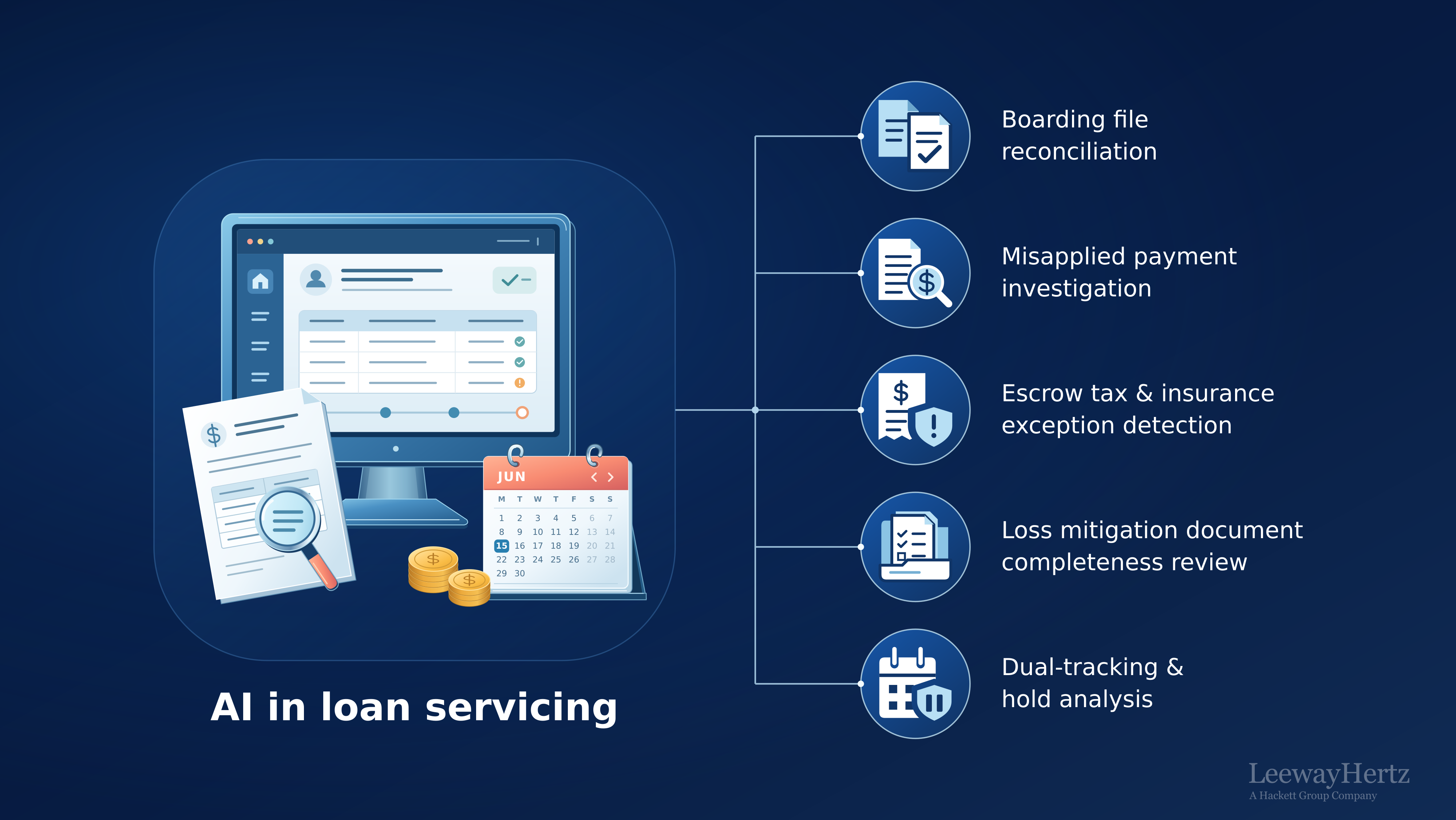
Loan servicing covers the administration of a loan after origination or servicing transfer, including loan setup, payment processing, escrow administration, borrower support, delinquency management, loss mitigation, default servicing, payoff, lien release, and final account closure. For mortgage servicers, these activities must remain aligned with loan terms, federal and state servicing requirements, investor or insurer guidance, bankruptcy restrictions, and internal servicing controls.
AI is well-suited to this operating model because much of the work involves high volumes of account records, borrower documents, transactions, changing rules, deadlines, and exceptions. It can reconcile boarding data, classify payments, analyze escrow activity, prepare borrower correspondence, assemble loss mitigation files, retrieve applicable servicing requirements, monitor foreclosure constraints, and prepare servicing QC evidence.
The relevant opportunity is not autonomous loan servicing. Payment amounts, escrow calculations, payoff balances, delinquency dates, investor remittances, and regulatory timelines require controlled calculations, while borrower-impacting, financial, legal, and compliance decisions remain with authorized servicing professionals.
For this reason, AI opportunities should be mapped at the sub-process level. A broad objective such as “AI for loss mitigation” does not define the borrower documents, investor rules, foreclosure timeline, calculation requirements, reviewer, or resulting action. A bounded use case such as loss mitigation document completeness review with loss mitigation underwriter confirmation does.
This article examines loan servicing as an operating model, focusing on the functions, processes, sub-processes, artifacts, systems, controls, and accountable roles that shape how servicing work is performed and governed.
- How AI is transforming loan servicing operations
- Why AI use cases in loan servicing must be mapped at the sub-process level
- Loan servicing operating model and AI opportunity mapping across servicing processes
- High-value AI use cases in loan servicing
- How agentic AI works in loan servicing workflows
- How to prioritize AI use cases in loan servicing
- Governance, risk, and responsible AI in loan servicing
- How ZBrain operationalizes AI use cases in loan servicing
- Future of AI in loan servicing
How AI is transforming loan servicing operations
AI changes loan servicing by preparing the evidence, reconciliation, timeline analysis, and correspondence that servicing professionals need before making a decision or taking an account action.
Consider a borrower who becomes delinquent while an escrow shortage is outstanding and a loss mitigation application is under review. The servicing record may contain a payment history, unapplied funds, escrow projections, property-tax disbursements, insurance records, borrower communications, hardship documentation, investor requirements, foreclosure milestones, and prior workout activity. Reviewing each item independently creates the risk that one process advances without seeing a constraint created elsewhere.
AI can connect these records before the account reaches the reviewer. It can identify unapplied funds, reconcile the delinquency calculation, classify submitted loss mitigation documents, retrieve the applicable investor waterfall, calculate regulatory dates through controlled logic, flag a scheduled foreclosure event, and prepare a single review packet showing what has occurred, what remains unresolved, and which decisions require human confirmation.
Across servicing, AI is particularly relevant to five recurring types of loan servicing work:
- Document-heavy work: Boarding files, mortgage documents, tax bills, insurance records, loss mitigation applications, bankruptcy filings, foreclosure documents, payoff requests, lien releases, and complaint evidence can be checked for missing or inconsistent information before review.
- Transaction-heavy work: Payments, reversals, suspense balances, escrow disbursements, custodial activity, corporate advances, and payoff funds can be reconciled against expected account activity.
- Exception-heavy work: Misapplied payments, escrow shortages, insurance lapses, investor reporting rejects, delinquency exceptions, incomplete borrower packages, foreclosure holds, and bankruptcy conflicts can be classified and prioritized.
- Knowledge-heavy work: Regulation X, Regulation Z, state foreclosure requirements, investor and insurer servicing guides, bankruptcy requirements, SCRA protections, and internal servicing procedures must be retrieved using the version applicable to the loan and event.
- Workflow-heavy work: Servicing transfers, payment correction, escrow administration, early intervention, loss mitigation, foreclosure, bankruptcy, payoff, and complaints require coordinated actions across teams while preserving deadlines and approval boundaries.
Loan servicing is a hybrid-control domain because servicing teams must balance operational execution with regulated borrower obligations, investor requirements, internal policies, system controls, and human approval. AI can support tasks such as organizing evidence, identifying exceptions, preparing review packets, and monitoring workflow signals, but accountable teams continue to own decisions, approvals, borrower-impacting actions, regulatory compliance, and final system updates.
The design principle is therefore straightforward: use AI to assemble, compare, classify, explain, and prepare; use controlled rules and calculations for authoritative amounts and dates; and keep borrower-impacting, legal, compliance, and financial decisions with the roles already accountable for them.
Why AI use cases in loan servicing must be mapped at the sub-process level
“AI for mortgage servicing” is too broad to define an implementable solution. Even “AI for loss mitigation” can mean document classification, document completeness review, income preparation, investor waterfall retrieval, workout comparison, foreclosure-timeline monitoring, decision-letter drafting, appeal packet preparation, or trial-plan monitoring. These activities use different artifacts, carry different regulatory consequences, and require different reviewers.
A practical way to evaluate loan servicing is to separate the operating model into four levels:
- Function: A major servicing area with defined accountability, such as cashiering, escrow administration, loss mitigation, or default management.
- Process: A recurring workflow within the function, such as payment application, escrow analysis, workout evaluation, or foreclosure referral.
- Sub-process: A specific activity with a known trigger, source records, rules, calculations, output, exception path, and accountable reviewer, such as suspense and unapplied funds management or document completeness review.
- AI-enabled opportunity: A specific AI capability applied to the sub-process. For example, entity resolution can associate an unidentified payment with the correct borrower account, while document intelligence can classify documents submitted with a loss mitigation application.
At this level, implementation dependencies become visible.
A payment exception may require the transaction amount, effective date, payment channel, borrower account, contractual posting requirements, unapplied balance, prior reversals, and bankruptcy status.
An escrow exception may require the tax parcel, tax authority record, insurance policy, disbursement schedule, escrow balance, prior analysis, shortage or deficiency, and loan-specific requirements.
Sub-process mapping therefore turns AI from an abstract automation initiative into a portfolio of defined servicing workflows with known artifacts, systems, controls, reviewers, and measurable outcomes.
Build governed AI workflows across loan servicing
Apply AI across loan servicing, from payment processing and escrow administration to loss mitigation and default management, with human oversight and governance.
Loan servicing operating model and AI opportunity mapping across servicing processes
The loan servicing operating model below follows the servicing lifecycle from loan boarding and payment administration to escrow management, investor reporting, borrower support, delinquency management, loss mitigation, default servicing, payoff, lien release, and servicing quality control.
Function 1: Loan boarding and servicing transfers
Turns acquired or transferred loan data, documents, balances, servicing history, and borrower obligations into an accurate servicing record ready for ongoing administration.
Loan boarding is one of the highest-leverage servicing control points because errors introduced during conversion can propagate into payment application, escrow, statements, delinquency status, loss mitigation, investor reporting, and payoff.
Teams involved: Loan boarding specialists, servicing transfer analysts, loan servicing specialists, escrow analysts, investor reporting analysts, default servicing teams, loss mitigation teams, servicing compliance officers, data quality teams, and the vice president of servicing.
What AI helps with: Document intelligence can compare boarding files with source mortgage documents. Entity resolution can reconcile borrower, property, loan, investor, escrow, and servicing identifiers. Anomaly detection can identify balance or status differences. AI can also assemble transfer exception packets showing missing documents, open servicing activity, or conflicting loan attributes.
What humans continue to own: Boarding and transfer specialists approve mapping exceptions and determine the correct source record. Escrow, loss mitigation, default, bankruptcy, and compliance teams confirm specialized account status before release. AI identifies discrepancies and prepares evidence but does not independently establish a borrower’s contractual balance, delinquency status, foreclosure status, or loss mitigation disposition.
| Process | Sub-process | Key AI-enabled opportunities |
|---|---|---|
| Boarding intake | Boarding file validation |
|
| Boarding exception classification |
|
|
| Boarding control-total validation |
|
|
| Data reconciliation | Source-to-servicing field comparison |
|
| Payment history and delinquency reconciliation |
|
|
| Escrow and advance balance reconciliation |
|
|
| Document boarding | Collateral and servicing document inventory completeness review |
|
| Document-to-data validation | Validation compares contractual fields extracted from documents with boarded servicing data. It also flags inconsistent rates, payment terms, ARM characteristics, maturity dates, or modification terms. | |
| Modification and special-term capture |
|
|
| Servicing transfer management | Open-item transfer review |
|
| Pending loss mitigation transfer |
|
|
| Transfer of complaints, error resolutions, and information requests |
|
|
| Bankruptcy and foreclosure transfer |
|
|
| Borrower communication | Transfer notice preparation |
|
| Transfer contact-data validation |
|
|
| Transfer-related payment communication support |
|
|
| Post-transfer reconciliation | First-cycle boarding validation |
|
| First-statement validation |
|
|
| Post-transfer payment and escrow exception review |
|
Key artifacts
- Loan boarding file
- Note and security instrument
- Modification agreements
- Payment history
- Escrow balance and analysis history
- Tax and insurance records
- Investor and insurer attributes
- Servicing transfer data
- Goodbye and hello transfer letters
- Active loss mitigation records
- Bankruptcy and foreclosure status
- Open correspondence and complaint records
- Boarding exception report
Systems involved
- Core loan servicing system
- Document repository
- Payment processing system
- Escrow administration system
- Investor reporting environment
- Default and loss mitigation work queues
- Customer correspondence system
- Compliance and case management system
Regulatory and control considerations: Regulation X governs mortgage servicing transfers, including transfer notices and treatment of payments sent to the prior servicer. During the 60-day period beginning on the effective transfer date, a timely payment received by the transferor cannot be treated as late or assessed a late fee solely because it went to the prior servicer [1]. Transfer controls should also preserve pending loss mitigation information and other servicing activity so a borrower does not lose protections because servicing changed.
Accountable roles and decision rights
- The servicing transfer manager approves transfer readiness.
- The loan boarding specialist confirms source-to-target mapping.
- The escrow analyst confirms transferred escrow balances and disbursement status.
- The loss mitigation underwriter confirms pending workout status.
- The default/foreclosure specialist confirms foreclosure milestones and holds.
- The servicing compliance officer approves treatment of regulatory exceptions.
Highest-value opportunities
- Source-to-servicing field comparison: High value because an incorrect balance, due date, escrow status, or delinquency attribute can affect nearly every downstream servicing process.
Open-item transfer review: High value because unresolved loss mitigation, bankruptcy, complaint, and foreclosure items can carry significant borrower and regulatory consequences.
Collateral and servicing document inventory: High value because missing source documents often become operational problems only when an exception, payoff, foreclosure, or audit occurs.
Example agentic workflow: Servicing transfer readiness review
- The workflow begins when a transfer file and associated servicing documents are received.
- It reconciles loan balances, payment status, escrow information, investor attributes, document inventory, and open servicing activity.
- It retrieves applicable transfer rules and internal conversion requirements.
- It creates an exception packet showing missing data, conflicting balances, pending borrower requests, active loss mitigation, bankruptcy, and foreclosure constraints.
- The appropriate servicing specialists resolve and approve each exception.
- Only approved data is released into production, with the source values, corrections, reviewers, and post-transfer validation retained as evidence.
Function 2: Payment processing and cashiering
Turns borrower payments, reversals, returned items, and unapplied funds into an accurate account-level payment history.
Cashiering is more complex than receiving money and reducing principal. Servicers must determine the payment date, amount, source, account, contractual application treatment, escrow component, fees or advances, unapplied amount, and whether bankruptcy, loss mitigation, or another servicing condition changes the expected treatment.
Teams involved: Loan servicing specialists, cashiering specialists, the cashiering supervisor, payment operations teams, reconciliation analysts, bankruptcy specialists, servicing compliance officers, and servicing accounting teams.
What AI helps with: Entity resolution can associate payments with the correct borrower account. Anomaly detection can identify duplicate payments, unexpected reversals, unusual posting sequences, stale suspense balances, or inconsistencies between payment history and account status. Classification can separate normal payments from partial, misapplied, returned, unidentified, or exception items.
What humans continue to own: Cashiering staff confirm payment corrections, reapplications, reversals, and account adjustments. Bankruptcy specialists confirm treatment where a court case affects posting. Servicing accounting teams approve financial reconciliation. AI can identify and prepare exceptions but does not alter a borrower’s payment history without controlled authorization.
| Process | Sub-process | Key AI-enabled opportunities |
|---|---|---|
| Payment intake | Payment identification and account matching |
|
| Payment receipt-date and channel validation |
|
|
| Unidentified payment routing |
|
|
| Payment application | Payment posting validation |
|
| Payment effective-date validation |
|
|
| Payment allocation exception review |
|
|
| Partial payment handling | Suspense and unapplied funds management |
|
| Suspense aging review |
|
|
| Accumulated-funds threshold review |
|
|
| Payment application exception management | Misapplied payment investigation |
|
| Payment-history reconstruction | Multi-source aggregation creates a chronological ledger of expected payments, actual payments, partial payments, reversals, suspense transfers, and adjustments. | |
| Payment-related fee consequence review |
|
|
| Returned payments | NSF and reversal processing |
|
| Returned-item chronology review | Multi-source aggregation traces original receipt, posting, settlement, return, reversal, and any subsequent replacement payment. | |
| Reversal exception detection |
|
|
| Reconciliation | Cash-to-loan reconciliation |
|
| Settlement-to-servicing reconciliation | Reconciliation compares settlement batches with transactions accepted into the servicing ledger. | |
| Payment control-total monitoring |
|
Key artifacts
- Borrower payment history
- Payment transaction file
- Suspense and unapplied funds report
- Returned-item report
- Reversal record
- Account adjustment request
- Periodic statement
- Cash reconciliation report
- Borrower payment correspondence
Systems involved
- Core loan servicing system
- Payment processing systems
- Banking and settlement interfaces
- General ledger
- Customer service system
- Document repository
Regulatory and control considerations: For applicable closed-end consumer credit transactions secured by a consumer’s principal dwelling, Regulation Z generally requires a periodic payment to be credited as of the date of receipt, except where a delay does not result in a charge to the consumer or negative credit reporting [2]. If a servicer holds a partial payment in a suspense or unapplied funds account, the amount must be reflected on applicable periodic statements and, once sufficient funds accumulate to cover a periodic payment, treated as a periodic payment.
Accountable roles and decision rights
- The cashiering specialist investigates payment exceptions.
- The cashiering supervisor approves material payment corrections and reapplications.
- The bankruptcy specialist confirms bankruptcy-specific treatment.
- The servicing accounting team approves financial reconciliation.
- The servicing compliance officer reviews regulatory payment-processing exceptions.
Highest-value opportunities
- Suspense account workoff: High value because aged unapplied funds can distort delinquency, statements, loss mitigation, and foreclosure treatment.
- Misapplied payment investigation: High value because AI can assemble the full transaction path before specialist review.
- Contractual posting validation: High value because high-volume payment activity provides a strong baseline against which unusual treatments can be identified.
Example agentic workflow: Suspense and unapplied funds resolution
-
- The workflow begins when a partial borrower payment is received for an account with an existing suspense or unapplied funds balance.
- The agent retrieves the borrower payment history, payment transaction records, suspense balance, contractual periodic payment amount, prior reversals, account adjustments, and relevant servicing status.
- It retrieves applicable Regulation Z payment-crediting requirements, the loan’s contractual payment terms, and internal payment application procedures.
- The agent reconciles received payments and accumulated suspense balances. Controlled calculation logic identifies cases where sufficient funds have accumulated to cover a periodic payment, while anomaly detection flags posting discrepancies, incorrect allocations, and unresolved transactions. It prepares a payment reconciliation packet for review.
- The cashiering specialist reviews the payment history and proposed treatment. The cashiering supervisor approves required reapplications or corrections, with bankruptcy or compliance review where applicable.
- Approved corrections are processed through the core servicing system. The workflow retains payment records, reconciliation results, identified exceptions, reviewer approvals, and correction evidence.
Function 3: Escrow administration
Turns tax, insurance, assessment, and account-balance information into accurate escrow collections, disbursements, analyses, and borrower disclosures.
Escrow administration requires servicers to project future disbursements, maintain account balances, pay taxes and insurance at the correct time, manage changes in required amounts, and explain resulting shortages, surpluses, or deficiencies to borrowers.
Teams involved: Escrow analysts, tax specialists, insurance specialists, loan servicing specialists, customer service representatives, servicing accounting teams, servicing compliance officers, and the escrow operations manager.
What AI helps with: Document intelligence can extract parcel, due-date, premium, policy, coverage, and billing information. Entity resolution can link tax parcels and insurance policies to the correct loan. Anomaly detection can surface missed disbursements, payment increases, duplicate bills, unusual shortages, coverage gaps, or conflicts between third-party records and servicing data.
What humans continue to own: Escrow analysts approve account analyses and corrections. Tax and insurance specialists determine exception treatment. Servicing compliance personnel confirm borrower-impacting or regulatory exceptions. AI may prepare calculations through controlled services but does not independently alter escrow obligations or impose insurance charges.
| Process | Sub-process | Key AI-enabled opportunities |
|---|---|---|
| Escrow analysis | Annual and short-year analysis preparation |
|
| Projected disbursement validation |
|
|
| Escrow payment-change review |
|
|
| Tax administration | Tax bill matching and disbursement readiness assessment |
|
| Tax amount and due-date validation |
|
|
| Tax delinquency and exception review |
|
|
| Insurance administration | Policy and premium validation |
|
| Renewal and coverage-period reconciliation | Document comparison compares expiring and replacement policies to identify gaps, overlaps, cancellations, or duplicate coverage. | |
| Premium disbursement readiness assessment |
|
|
| Escrow exception management | Shortage, surplus, and deficiency review |
|
| Escrow balance variance investigation |
|
|
| Escrow adjustment and correction preparation |
|
|
| Coverage management | Hazard insurance lapse workflow management |
|
| Borrower coverage evidence review |
|
|
| Coverage-status reconciliation | Multi-source aggregation compares insurance tracking records, escrow disbursements, borrower documents, and carrier information. | |
| Force-placed insurance administration | Notice-cycle and evidence monitoring |
|
| Force-placed coverage period and charge validation |
|
|
| Cancellation and refund review | Anomaly detection detects evidence showing that borrower coverage overlapped with force-placed coverage. |
Key artifacts
- Escrow analysis statement
- Tax bills and parcel records
- Insurance declarations
- Premium notices
- Escrow transaction history
- Shortage, surplus, and deficiency calculations
- Force-placed insurance notice cycle
- Coverage evidence
- Disbursement exception report
Systems involved
- Core loan servicing system
- Escrow administration system
- Tax information services
- Insurance tracking environment
- Payment system
- Document repository
- Customer correspondence system
Regulatory and control considerations: For applicable federally related mortgage loans, Regulation X addresses escrow calculations, annual statements, short-year statements, and timely disbursement. Where a borrower is not more than 30 days overdue, required escrow disbursements generally must be made by the deadline necessary to avoid a penalty. Flood insurance requirements and loan- or program-specific insurance rules must also be applied where relevant.
Highest-value opportunities
- Tax delinquency and exception review: High value because a single missed disbursement can create borrower harm and downstream correction work.
- Annual and short-year analysis preparation: High value because the workflow joins deterministic calculations with large volumes of changing tax and insurance data.
- Borrower coverage evidence review: High value because false or stale coverage exceptions can lead to inappropriate force-placed insurance activity.
Example agentic workflow: Escrow analysis and payment-change review
- The workflow begins when an annual escrow analysis is scheduled for a loan.
- The agent retrieves the current escrow balance, transaction history, prior escrow analysis, property-tax bills, insurance premium notices, projected disbursements, and applicable loan-level escrow requirements.
- It retrieves applicable Regulation X escrow analysis requirements, approved cushion parameters, loan-specific requirements, and internal escrow analysis procedures.
- The workflow uses approved calculation logic to prepare the escrow analysis, applying the applicable aggregate accounting method, cushion limitations, and shortage, surplus, or deficiency treatment. The agent compares the results with prior analyses, flags unusual tax or insurance increases, duplicate projected disbursements, and balance discrepancies, and drafts an explanation of the proposed escrow payment change.
- The escrow analyst validates the source information and calculation results. Tax or insurance specialists investigate relevant exceptions, and the authorized reviewer approves the analysis before borrower communication.
- Approved results proceed to escrow statement preparation and applicable account updates. The workflow retains source records, calculations, variance explanations, reviewer decisions, and approved disclosure evidence.
Function 4: Investor reporting and remittance
Turns loan-level servicing activity into the financial, delinquency, custodial, and status reporting required by the owner, guarantor, or insurer of the loan.
Servicers often administer loans they do not own and for which the credit risk or beneficial interest is held by an investor, guarantor, or other party. As a result, borrower accounting and investor accounting have to remain synchronized across scheduled payments, actual collections, principal reductions, interest, advances, recoveries, delinquency status, workouts, payoffs, and liquidation activity.
Teams involved: Investor reporting analysts, remittance analysts, P&I and T&I account reconciliation teams, servicing accounting teams, loan servicing specialists, default servicing teams, loss mitigation teams, treasury personnel, and the investor reporting manager.
What AI helps with: Reconciliation can compare servicing activity with investor reporting records and custodial movements. Classification can separate rejected transactions by root cause. Anomaly detection can identify unusual principal balances, delinquency mismatches, remittance variances, missing advances, or status conflicts before submission deadlines.
What humans continue to own: Investor reporting teams validate and submit required data and resolve reporting or contractual exceptions. Servicing accounting approves reconciliations and internal adjustments. Authorized servicing leaders approve material internal corrections and route investor or insurer exceptions for the required external approval.
| Process | Sub-process | Key AI-enabled opportunities |
|---|---|---|
| Investor accounting | Loan-level activity reconciliation |
|
| Unpaid principal balance validation |
|
|
| Workout and liquidation event mapping |
|
|
| Remittance | Cutoff and remittance preparation |
|
| Remittance-to-loan activity validation |
|
|
| Remittance exception forecasting | Pattern analysis identifies accounts likely to generate late-cycle exceptions based on unresolved reporting, corrections, or unusual activity. | |
| Investor reporting exception resolution | Reject and variance resolution |
|
| Investor edit root-cause classification |
|
|
| Correction packet preparation | Multi-source aggregation assembles original reporting, corrected servicing data, related transaction history, and applicable reporting requirements. | |
| Custodial accounting | P&I and T&I account reconciliation |
|
| Advance and reimbursement reconciliation | Reconciliation compares servicing advances, recoveries, reimbursements, and related loan events to identify discrepancies. | |
| Clearing and aged-item review |
|
|
| Delinquency reporting | Delinquency and workout status validation |
|
| Delinquency status-transition validation | Change detection reviews changes between current, delinquent, forbearance, workout, foreclosure, bankruptcy, and resolved statuses. | |
| Default milestone reporting review |
|
Key artifacts
- Investor remittance report
- Loan-level activity file
- Delinquency status report
- P&I and T&I account reconciliation
- Advance records
- Exception and reject files
- Investor adjustment records
- Workout reporting records
Systems involved
- Core loan servicing system
- Investor reporting environment
- Custodial accounting system
- General ledger
- Treasury interfaces
- Reporting repository
Regulatory and control considerations: Requirements vary significantly by owner, guarantor, insurer, security structure, remittance method, and servicing agreement. The workflow should therefore use version-controlled investor, guarantor, and insurer requirements rather than rely on a single universal servicing rule.
Highest-value opportunities
- Reject and variance resolution: High value because rejected or inconsistent reporting can affect remittance, advances, delinquency reporting, and contractual performance.
- P&I and T&I account reconciliation: High value because transaction-level evidence can be assembled before accounting review.
- Delinquency and workout status validation: High value because loss mitigation, bankruptcy, foreclosure, and liquidation events must remain consistent across operational and investor records.
Example agentic workflow: Investor reporting exception resolution
- The workflow begins when an investor reporting cycle generates a reject or variance file identifying discrepancies in reported loan activity.
- The agent retrieves the investor reject file, loan-level activity records, borrower payment history, unpaid principal balance movements, prior investor submissions, remittance records, and relevant servicing status changes.
- It retrieves the reporting specifications, servicing agreement requirements, reporting deadlines, and approved correction procedures applicable to the specific investor, guarantor, insurer, or reporting program.
- The agent classifies rejected records by transaction, balance, status, timing, or reporting-rule issue. It reconciles reported values with source servicing activity, identifies potential causes, and prepares a correction packet showing the original submission, supporting transactions, discrepancies, and proposed reporting changes.
- The investor reporting analyst validates the discrepancy and proposed correction. Material exceptions receive the required internal approvals, while cases outside delegated authority are referred for investor or insurer approval where applicable. Servicing accounting reviews related financial reconciliation differences.
- Approved corrections are submitted through the authorized investor reporting process. The workflow retains the original rejection, source transactions, reporting requirements, reviewer approvals, resubmission evidence, and resulting acceptance or rejection status.
Function 5: Customer service and borrower servicing correspondence
Turns borrower questions, requests, complaints, and account events into accurate, traceable responses based on the borrower’s complete servicing history.
Borrower servicing inquiries frequently span multiple functions. A borrower may question a payment while also disputing an escrow increase, requesting a payoff, or asking about loss mitigation. A useful servicing response therefore requires more than generating text. It requires identifying the correct account, understanding the request, reconstructing the relevant servicing history, locating the applicable rule, and routing the request where formal handling is required.
Teams involved: Customer service representatives, loan servicing specialists, correspondence specialists, research and resolution teams, escrow analysts, cashiering specialists, loss mitigation teams, complaint specialists, and servicing compliance officers.
What AI helps with: Classification can distinguish routine inquiries from complaints, notices of error, requests for information, payoff requests, loss mitigation requests, and escalations. Multi-source aggregation can prepare account histories. Natural-language generation can draft responses using approved evidence and templates.
What humans continue to own: Customer service representatives confirm borrower identity and routine responses. Specialized servicing teams investigate formal disputes. Servicing compliance personnel approve responses where regulatory determinations are required. AI does not independently reject a notice of error, determine that servicing was correct, or make a legal interpretation on behalf of the servicer.
| Process | Sub-process | Key AI-enabled opportunities |
|---|---|---|
| Inquiry intake | Intent and account-event classification |
|
| Priority and servicing-risk routing |
|
|
| Borrower or authorized-party context preparation |
|
|
| Borrower account research | Servicing history reconstruction | Multi-source aggregation creates a chronological history of payments, escrow changes, notices, calls, correspondence, loss mitigation activity, and system adjustments. |
| Cross-process evidence linking | Entity resolution connects payment, escrow, transfer, default, bankruptcy, and loss mitigation records that relate to the same borrower issue. | |
| Account discrepancy detection |
|
|
| Error investigation and resolution | Notice-of-error evidence preparation |
|
| Notice-of-error deadline monitoring |
|
|
| Investigation and response drafting |
|
|
| Borrower information requests | Request-for-information preparation |
|
| Responsive-record search and assembly |
|
|
| Request scope and exception review | AI classification identifies overly broad, duplicative, unavailable, or otherwise exceptional requests for specialist review. | |
| Payoff support processing | Payoff request intake |
|
| Payoff request authorization validation | Validation compares borrower or third-party authority with account records and submitted authorization documents. | |
| Payoff request status monitoring | Workflow monitoring tracks calculation, review, delivery, and any subsequent revision. | |
| ARM servicing | Rate-change notice validation | Validation compares the generated notice with loan terms, index, margin, adjustment limits, effective dates, and approved calculation results. |
| Index and margin validation |
|
|
| ARM notice timing and content review |
|
Key artifacts
- Borrower correspondence
- Call notes
- Payment history
- Periodic statement
- Notice of error
- Request for information
- Qualified written request
- Payoff request and payoff quote
- ARM rate-change notice
- Complaint record
- Research packet
Systems involved
- Core loan servicing system
- Contact center platform
- Correspondence management system
- Document repository
- Complaint case management
Regulatory and control considerations: A qualified written request that asserts a servicing error is treated as a notice of error under Regulation X. Borrower information requests also have acknowledgment and response requirements under §1024.36. This makes accurate classification important: the same incoming correspondence may contain an inquiry, an error assertion, a request for information, or multiple issues requiring separate handling.
For adjustable-rate mortgages, Regulation Z includes specific adjustment-notice requirements. For applicable first adjustments, the notice is generally provided 210 to 240 days before the first payment at the adjusted level is due.
Highest-value opportunities
- Correspondence classification: High value because misclassifying formal borrower correspondence can put regulated response workflows at risk.
- Servicing history reconstruction: High value because servicing questions frequently cross payment, escrow, transfer, default, and correspondence records.
- Investigation and response drafting: Valuable when the draft remains grounded in verified account evidence and receives authorized review.
Example agentic workflow: Notice-of-error investigation and response preparation
- The workflow begins when a borrower submits correspondence disputing a payment application or associated servicing charge.
- The agent retrieves the borrower correspondence, payment history, transaction records, reversals, account adjustments, periodic statements, previous borrower communications, and related servicing cases.
- It retrieves applicable Regulation X notice-of-error requirements, acknowledgment and response timelines, internal investigation procedures, and approved borrower-response templates.
- The agent classifies the correspondence and flags whether it may qualify as a notice of error under applicable requirements. For qualifying notices, controlled deadline logic determines the relevant acknowledgment, investigation, and response milestones. The agent reconstructs the disputed servicing activity, identifies potential discrepancies, and prepares an investigation packet. Once the specialist confirms the findings, it drafts a response using verified evidence and approved templates.
- The servicing research or resolution specialist investigates the asserted error and confirms the findings. The servicing compliance officer reviews regulatory treatment and approves responses requiring compliance determination.
- The approved response is issued through the correspondence system within the applicable deadline. Any authorized account correction is routed to the responsible servicing team. The workflow retains the original notice, investigation records, supporting evidence, deadline calculations, response approval, and delivery confirmation.
Function 6: Collections and early-stage delinquency
Turns missed or insufficient payments into a controlled early-intervention process that identifies the borrower’s account status, communication requirements, and available servicing path.
This function covers the mortgage-specific servicing layer rather than general collections strategy. It focuses on delinquency calculation, early intervention, borrower contact, continuity of contact, promise tracking, and handoff to loss mitigation or default workflows.
Teams involved: Early-stage collections specialists, customer service representatives, single points of contact, loan servicing specialists, loss mitigation teams, default servicing teams, servicing compliance officers, and collections operations managers.
What AI helps with: AI can classify observable delinquency triggers, documented hardship indicators, and contact outcomes, prioritize accounts requiring servicing intervention, summarize prior communications, identify broken promises, and prepare the borrower context needed by continuity-of-contact personnel.
What humans continue to own: Servicing personnel determine the appropriate borrower communication and escalation under approved procedures. Single points of contact explain available assistance and coordinate servicing information. Loss mitigation teams evaluate workout eligibility. AI does not make representations about guaranteed outcomes or accelerate default activity.
| Process | Sub-process | Key AI-enabled opportunities |
|---|---|---|
| Delinquency detection | Delinquency and payment-status validation | Reconciliation compares due dates, payment history, suspense balances, reversals, and contractual periodic payment amounts to identify discrepancies |
| Delinquency trigger and root-cause classification |
|
|
| Pre-contact account-status review | Classification and anomaly detection identify active bankruptcy, loss mitigation, disputes, military service indicators, communication restrictions, and other account conditions relevant to borrower outreach. | |
| Early intervention | Contact timing and outreach preparation |
|
| Written early-intervention notice preparation |
|
|
| Continuity-of-contact assignment support |
|
|
| Borrower engagement | Contact outcome classification | Classification converts call notes and correspondence into standardized outcomes such as promise to pay, hardship reported, dispute raised, assistance requested, or unable to contact. |
| Hardship and assistance-signal extraction | Classification identifies borrower statements indicating unemployment, income reduction, illness, disaster, divorce, death, increased expenses, or other hardship context. | |
| Borrower communication consistency review | Validation compares current outreach with prior commitments, open complaints, assistance status, and account conditions. | |
| Promise-to-pay management | Promise-to-pay tracking |
|
| Promise condition and payment matching |
|
|
| Post-promise next-action preparation | Workflow orchestration prepares the next servicing step based on confirmed payment status and approved workflow rules. | |
| Loss mitigation referral | Loss mitigation referral preparation | Multi-source aggregation assembles delinquency history, hardship information, prior contact, payment status, and previous workout activity. |
| Assistance-request classification |
|
|
| Collections-to-loss-mitigation handoff validation | Validation checks that borrower documents, contact notes, promises, and current account status are accessible to the receiving team. |
Key artifacts
- Delinquency report
- Payment history
- Contact attempts
- Call notes
- Early-intervention letter
- Promise-to-pay record
- Hardship indicator
- Assistance referral
- Prior workout history
Regulatory and control considerations: Regulation X generally requires a servicer to establish or make good-faith efforts to establish live contact no later than the 36th day of delinquency and to provide the required written early-intervention notice no later than the 45th day, subject to applicable exceptions and repeat-notice requirements.
Highest-value opportunities
- Delinquency and payment-status validation: High value because payment and suspense errors should not propagate into inappropriate collection treatment.
- Contact timing and outreach preparation: High value because account age and contact history drive required servicing actions.
- Continuity-of-contact assignment support: High value because continuity-of-contact personnel needs a coherent account history rather than fragmented notes.
Example agentic workflow: Early-intervention outreach readiness assessment
- The workflow begins when delinquency monitoring identifies a mortgage account approaching an applicable early-intervention milestone.
- The agent retrieves the delinquency report, payment history, suspense balances, recent reversals, prior contact attempts, borrower correspondence, promise-to-pay records, loss mitigation activity, and relevant bankruptcy or communication restrictions.
- It retrieves applicable Regulation X early-intervention and continuity-of-contact requirements, relevant exceptions, and approved borrower outreach procedures.
- Controlled timeline logic identifies the applicable outreach milestones. The agent reviews payment status, prior communications, pending assistance requests, previously issued notices, and documented communication restrictions. It prepares an outreach-readiness packet identifying required follow-up, unresolved account issues, potential regulatory exceptions, and the applicable communication pathway.
- The early-stage collections specialist validates the delinquency status and proposed outreach. The assigned borrower-assistance representative reviews open assistance needs, while the servicing compliance officer evaluates regulatory exceptions or communication restrictions requiring specialized review.
- Authorized outreach or assistance referrals proceed through the servicing workflow. The system retains the verified delinquency timeline, outreach preparation, prior contact history, reviewer decisions, communication records, and escalation evidence.
Accelerate AI Solutions Development
Build fully functional solutions from your high-value use cases, based on specific operational needs and enterprise context.
Function 7: Loss mitigation
Turns borrower hardship information, financial documentation, loan status, investor requirements, and foreclosure timing into an evaluated set of available home-retention or disposition options.
Loss mitigation is one of the most knowledge-intensive and control-sensitive areas of mortgage servicing. The servicer must manage solicitation, document intake, application completeness, reasonable diligence, income and expense information, investor or insurer requirements, foreclosure protections, evaluation, borrower decisions, trial plans, appeals, and permanent workout execution.
Teams involved: Loss mitigation specialists, single points of contact, document intake specialists, loss mitigation underwriters, default/foreclosure specialists, property valuation teams, servicing compliance officers, investor relations personnel, and loss mitigation managers.
What AI helps with: Document intelligence can classify borrower-submitted documents as income, asset, hardship, occupancy, or expense documentation. Document intelligence and data extraction can structure the borrower and account inputs required for controlled income and arrearage calculations. Policy retrieval can identify the applicable investor or insurer waterfall. Timeline logic can identify Regulation X protections and foreclosure constraints. AI can prepare an evaluation packet showing evidence, calculation results, potential resolution paths, missing documentation, and exceptions.
What humans continue to own: The loss mitigation underwriter validates financial information and makes the authorized evaluation under applicable servicing requirements. The servicing compliance officer confirms regulatory treatment. Investor or insurer approval remains required where an exception or delegation limit applies. AI supports evaluation but does not independently approve or deny a borrower for a workout.
| Process | Sub-process | Key AI-enabled opportunities |
|---|---|---|
| Loss mitigation intake | Assistance request and package intake |
|
| Loss mitigation document ingestion and association |
|
|
| Foreclosure and application context capture |
|
|
| Complete application determination | Document completeness review | Coverage validation compares received artifacts with the documentation required for the applicable evaluation path. |
| Stale and invalid document review | Validation and anomaly detection checks document periods, expiration, account ownership, signature requirements, and other validity attributes. It identifies documents that were received but may no longer satisfy current evaluation requirements. | |
| Completeness acknowledgment preparation |
|
|
| Financial preparation | Income and expense calculation support |
|
| Income source normalization | Classification groups wages, self-employment income, benefits, rental income, support payments, and other documented sources. | |
| Financial-data consistency review | Validation compares application declarations with bank statements, pay stubs, tax documents, and servicing records. | |
| Workout evaluation | Investor or insurer waterfall preparation | Policy retrieval identifies the applicable investor or insurer hierarchy and version.AI prepares the sequence of potentially relevant options without issuing the final servicing determination. |
| Workout option comparison packet preparation | Calculation orchestration calculations prepare payment, term, arrearage, deferral, partial claim, or other approved option attributes where applicable. | |
| Investor exception and delegation review |
|
|
| Foreclosure coordination | Dual-tracking and hold analysis |
|
| Foreclosure milestone suppression monitoring |
|
|
| Application-to-sale timeline calculation |
|
|
| Decision communication | Offer and denial packet preparation |
|
| Denial-reason validation | Validation compares the proposed denial reason with the completed evaluation and supporting calculations. | |
| Borrower response-window monitoring |
|
|
| Trial modification management | Trial-plan monitoring |
|
| Trial-payment matching and reconciliation |
|
|
| Permanent-conversion readiness review | Validation checks completed trial requirements, required documents, updated escrow information, and unresolved account exceptions. | |
| Appeal management | Modification denial appeal preparation | Multi-source aggregation assembles the original evaluation, denial reason, borrower appeal, supporting documents, and governing rule set. |
| Independent-reviewer routing |
|
|
| Appeal deadline and disposition monitoring |
|
Key artifacts
- Mortgage assistance application or equivalent
- Hardship documentation
- Income and asset documents
- Bank statements
- Borrower response package
- Completeness acknowledgment
- Missing-document notice
- Income calculation worksheet
- Property valuation
- Investor or insurer waterfall requirements
- Loss mitigation evaluation
- Trial modification agreement
- Forbearance plan
- Repayment plan
- Modification agreement
- Denial notice
- Appeal package
- Foreclosure hold record
Accountable roles and decision rights
- The document intake specialist confirms document association.
- The loss mitigation underwriter validates income and evaluates available options.
- The single point of contact communicates account and assistance status.
- The servicing compliance officer confirms regulatory deadlines and foreclosure protections.
- The default/foreclosure specialist implements approved holds and releases.
- Authorized investor or insurer personnel approve exceptions where required.
Regulatory and control considerations: Regulation X creates several critical date boundaries. If a loss mitigation application arrives 45 days or more before a scheduled foreclosure sale, the servicer generally must review it promptly and provide written acknowledgment of whether it is complete or incomplete within five business days. A complete application received more than 37 days before sale generally must be evaluated within 30 days for available loss mitigation options. Regulation X also generally prohibits the first foreclosure notice or filing until a borrower is more than 120 days delinquent and creates foreclosure-sale protections when qualifying complete applications are pending.
For loan modification denials covered by §1024.41(h), a servicer must permit an appeal when it receives a complete loss mitigation application 90 days or more before a foreclosure sale or during the applicable pre-foreclosure period under §1024.41(f). The borrower must be permitted to appeal within 14 days after the servicer provides the applicable evaluation notice, and the appeal must be reviewed by personnel different from those who performed the initial evaluation.
Highest-value opportunities
- Document completeness review: High value because missing or misclassified documents affect both evaluation cycle time and regulatory handling.
- Investor or insurer waterfall preparation: High value because investor and insurer requirements are complex, versioned, and dependent on validated loan and borrower data.
- Dual-tracking and hold analysis: High value because application status and foreclosure timing must remain synchronized.
- Trial-plan monitoring: High value because an approved workout still requires accurate payment and condition tracking before permanent resolution.
Example agentic workflow: Loss mitigation application processing
- A borrower submits a loss mitigation package 52 days before a scheduled foreclosure sale.
- The workflow retrieves the loan’s delinquency status and arrearage, payment history, submitted pay stubs, hardship documentation and bank statements, previous workout history, investor or insurer identity, applicable workout hierarchy, property information, and current foreclosure milestones.
- It retrieves the Regulation X application-completeness and foreclosure-protection requirements, the versioned investor or insurer waterfall, relevant internal servicing procedures, and the requirements applicable to the scheduled foreclosure event.
- Document intelligence identifies that one required bank statement is missing. Controlled date logic calculates the applicable regulatory timeline and the reasonable date by which the borrower should submit the missing information. The workflow drafts the acknowledgment notice, prepares the income calculation from available evidence, identifies the potential foreclosure hold condition, and creates a preliminary waterfall packet showing the options that should be evaluated if the application becomes complete. Any proposed trial-plan terms remain draft until the authorized evaluation is completed.
- The loss mitigation underwriter confirms application status, validates income, completes the authorized workout evaluation, and approves the borrower-facing decision. The servicing compliance officer confirms the regulatory timeline and applicable foreclosure protection. Any exception outside delegated investor authority is routed for investor or insurer approval.
- Approved acknowledgment and decision correspondence is issued within the applicable timeline. Any required foreclosure hold is recorded and communicated to the default workflow. If a trial plan is approved, payment monitoring begins. The application, policy version, calculations, retrieved rules, reviewer decisions, correspondence, foreclosure status, and resulting system changes are retained as servicing evidence.
Function 8: Default management, foreclosure and bankruptcy
Turns unresolved delinquency and legal events into controlled foreclosure or bankruptcy servicing activity while preserving borrower protections, court requirements, investor rules, and state-specific timelines.
Default management sits downstream of collections and loss mitigation but must remain connected to both. A loan cannot be treated as a simple linear progression from delinquency to foreclosure because a loss mitigation application, bankruptcy filing, military-service protection, payment correction, state mediation requirement, or court order may change what can happen next.
Teams involved: Default servicing specialists, foreclosure specialists, bankruptcy specialists, loss mitigation teams, servicing compliance officers, foreclosure counsel, litigation teams, investor reporting analysts, property teams, and the default servicing director.
What AI helps with: Timeline monitoring can compare account events with state and federal checkpoints. Document intelligence can extract and organize information from breach letters, foreclosure referrals, bankruptcy notices, proofs of claim, plans, court orders, and attorney invoices. AI can identify conflicts, missing approvals, status mismatches, or actions scheduled while a hold is active.
What humans continue to own: Default and foreclosure specialists authorize referrals and milestone changes under approved procedures. Bankruptcy specialists determine case treatment. Legal counsel provides legal interpretation and controls legal filings or court submissions made on behalf of the servicer or investor, as applicable. Servicing compliance confirms regulatory restrictions. AI does not independently commence foreclosure, seek relief from stay, file a proof of claim, or determine that a statutory protection does not apply.
| Process | Sub-process | Key AI-enabled opportunities |
|---|---|---|
| Pre-foreclosure | Breach and acceleration readiness review | Rule evaluation checks delinquency, notices, payment history, loss mitigation, bankruptcy, SCRA indicators, investor requirements, and state prerequisites. |
| Foreclosure eligibility checkpoint review |
|
|
| Cure and reinstatement status review |
|
|
| Foreclosure referral | Referral packet preparation |
|
| Counsel instruction validation | Validation compares the proposed referral instruction with current account status and approved default action. | |
| Referral exception resolution | Classification groups missing-document, title, notice, balance, military-service, bankruptcy, and loss mitigation exceptions. | |
| Foreclosure monitoring | Milestone and hold synchronization | Validation compares counsel-reported milestones with servicing-system events and active holds. |
| Sale-date and legal-event monitoring |
|
|
| Foreclosure fee and expense review |
|
|
| Bankruptcy intake | Case and chapter classification |
|
| Automatic-stay status preparation |
|
|
| Bankruptcy docket and servicing-event matching |
|
|
| Bankruptcy claims | Proof-of-claim preparation | Multisource-aggregation assembles principal, interest, escrow, arrearage, fees, advances, payment history, and loan documents. |
| Claim balance and arrearage reconciliation |
|
|
| Claim amendment monitoring |
|
|
| Chapter 13 servicing | Plan payment and payment-change monitoring | Monitoring tracks trustee and borrower payments against the confirmed plan and ongoing mortgage obligations. |
| Trustee and borrower payment reconciliation |
|
|
| Post-petition delinquency monitoring | Reconciliation compares ongoing payment requirements with received payments after the filing date. | |
| Stay management | Relief-from-stay packet preparation |
|
| Stay-status synchronization | Validation compares servicing, foreclosure counsel, bankruptcy, and court records for consistent stay status. | |
| Motion and order monitoring |
|
Key artifacts
- Breach or demand letter
- Acceleration notice
- Foreclosure referral package
- State-required notices
- Foreclosure chronology
- Bankruptcy petition
- Proof of claim
- Chapter 13 plan
- Payment-change notice
- Post-petition fee records
- Relief-from-stay package
- Court orders
- SCRA search and review evidence
Regulatory and control considerations: Under Regulation X, foreclosure initiation is generally restricted until the mortgage is more than 120 days delinquent, subject to specified exceptions, and pending complete loss mitigation applications can create additional foreclosure restrictions.
Bankruptcy servicing also has its own procedural requirements. Federal Rule of Bankruptcy Procedure 3002.1, amended effective December 1, 2025, applies in Chapter 13 cases to specified claims secured by the debtor’s principal residence and addresses payment-change notices, post-petition fees, expenses and charges, and procedures for determining the status and cure of the mortgage claim.
The SCRA creates a separate protection boundary. For qualifying pre-service mortgage obligations, nonjudicial foreclosure during military service and for one year afterward generally requires a court order.
Highest-value opportunities
- Foreclosure eligibility checkpoint review: High value because it brings federal, state, investor, loss mitigation, bankruptcy, and military-service constraints together before a consequential action.
- Trustee and borrower payment reconciliation: High value because pre-petition, post-petition, trustee, borrower, escrow, and fee activity can diverge.
- Milestone and hold synchronization: High value because foreclosure counsel and servicing operations must act from the same current account status.
Example agentic workflow: Foreclosure referral readiness assessment
- The workflow begins when a delinquent mortgage account enters the foreclosure referral review queue after meeting the servicer’s internal referral criteria.
- The agent retrieves the payment and delinquency history, suspense records, prior default notices, loss mitigation activity, bankruptcy records, military-service indicators, investor requirements, and relevant foreclosure-related exceptions.
- It retrieves applicable Regulation X foreclosure restrictions, state-specific foreclosure prerequisites, investor or insurer servicing requirements, bankruptcy-related restrictions, SCRA considerations, and internal foreclosure referral procedures.
- Controlled rules and timeline calculations identify potentially unmet foreclosure prerequisites, unresolved loss mitigation protections, bankruptcy restrictions, military-service concerns, account discrepancies, or active holds. The agent prepares a referral-readiness packet showing completed requirements, outstanding exceptions, applicable restrictions, and supporting evidence.
- The foreclosure specialist verifies operational readiness, while loss mitigation and bankruptcy specialists confirm relevant account restrictions. Servicing compliance and legal counsel review applicable regulatory and legal requirements before an authorized referral decision.
- Only approved referrals proceed to foreclosure counsel through controlled channels. The workflow retains the referral-readiness packet, account chronology, applicable requirements, specialist dispositions, approvals, referral instructions, and resulting status confirmation.
Function 9: Property preservation and REO handoff
Turns property condition and occupancy information into controlled preservation activity andfollowing completed foreclosure or other acquisition, an orderly transition to real estate owned (REO) management.
Property activity can begin before foreclosure is complete, but servicers must distinguish legitimate collateral-preservation actions from possession or disposition activity that is not yet authorized.
Teams involved: Property preservation specialists, default servicing specialists, foreclosure specialists, field service coordinators, insurance specialists, investor reporting teams, servicing compliance officers, and REO transition teams.
What AI helps with: Computer vision and document intelligence can classify inspection evidence and work-order documentation. Anomaly detection can identify duplicate inspections, unusual charges, repeated work, inconsistent occupancy status, or property conditions requiring escalation. Policy retrieval can compare proposed work with applicable investor or insurer allowables and approval requirements.
What humans continue to own: Servicing personnel confirm occupancy treatment, approve preservation work, determine escalation, and authorize REO handoff. Legal and compliance personnel address disputed occupancy, eviction, redemption, or possession issues.
| Process | Sub-process | Key AI-enabled opportunities |
|---|---|---|
| Occupancy monitoring | Inspection review |
|
| Occupancy evidence reconciliation | Multi-source aggregation combines inspection findings, returned mail, borrower communications, utility indicators where permitted, and prior property activity. | |
| Inspection frequency and exception monitoring |
|
|
| Property preservation | Work-order classification |
|
| Work-scope and allowable comparison | Validation compares requested work, property condition, approved scope, and applicable investor or insurer requirements. | |
| Property preservation completion review |
|
|
| Expense control | Invoice and allowable review |
|
| Duplicate and excessive charge detection |
|
|
| Reimbursement evidence preparation | Multi-source aggregation assembles invoices, work orders, inspection evidence, approvals, and payment records required for investor or insurer reimbursement. | |
| Property risk assessment | Damage and hazard triage |
|
| Emergency-condition routing |
|
|
| Insurance-claim evidence preparation | Multi-source aggregation links damage evidence with insurance coverage, inspection dates, repair estimates, and prior claims activity. | |
| REO transition | Foreclosure-to-REO handoff |
|
| Title and possession status validation | Validation compares foreclosure completion records, title information, occupancy status, redemption considerations, and legal documentation. | |
| Open property-item inventory | Classification identifies unresolved preservation orders, invoices, insurance claims, code matters, utilities, and vendor activity. |
Key artifacts
- Occupancy inspection report
- Property condition report
- Preservation work order
- Inspection photographs
- Vendor invoice
- Insurance claim information
- Foreclosure completion record
- REO transfer package
Highest-value opportunities
- Invoice and allowable review: High value because preservation expenses can involve large vendor populations, repeated work orders, and investor- or insurer-specific reimbursement limits, making unsupported or duplicate charges difficult to identify manually.
- Occupancy evidence reconciliation: High value because conflicting inspection, borrower-contact, and property evidence can lead to inappropriate preservation or possession activity if not resolved before action.
- Foreclosure-to-REO handoff: High value because unresolved title, occupancy, preservation, insurance, expense, or possession issues can delay the transfer of the property into REO management.
Example agentic workflow: Property preservation exception review
- The workflow begins when a property inspection report identifies potential vacancy, damage, or an unresolved preservation issue on a delinquent mortgage loan.
- The agent retrieves the inspection report, occupancy history, property condition records, existing preservation work orders, prior vendor activity, insurance information, foreclosure status, and relevant servicing restrictions.
- It retrieves applicable investor or insurer property preservation requirements, approved inspection and vendor management procedures, authorization limits, and relevant legal restrictions.
- Document intelligence extracts property condition findings, while data comparison identifies changes from previous inspections. The agent flags potential preservation needs, incomplete work orders, duplicate expenses, and conflicting occupancy information. It prepares an exception packet with inspection evidence, outstanding actions, and items requiring authorization.
- The property preservation specialist validates the inspection findings and proposed actions. The responsible servicing manager reviews work orders requiring additional authorization, while legal or compliance personnel assess applicable occupancy, access, or foreclosure-related restrictions.
- Approved work orders proceed through the property preservation system. The workflow retains inspection records, vendor evidence, expense details, reviewer authorizations, work-order status, and completion evidence.
Function 10: Payoff, lien release, and servicing retention
Turns a borrower or authorized-party payoff request into an accurate payoff amount, final account reconciliation, release of the security interest, and controlled account closure.
A payoff is not simply unpaid principal. Depending on the account, it may include accrued interest through the payoff date, recoverable advances, allowable fees, escrow treatment, unapplied funds, pending payments, and other contractual components. The calculation must also account for activity occurring between quote generation and receipt of payoff funds.
Teams involved: Payoff specialists, loan servicing specialists, cashiering teams, escrow analysts, servicing accounting teams, lien release specialists, customer service representatives, servicing compliance officers, and retention teams.
What AI helps with: AI can validate payoff requests, assemble balance components, identify pending transactions, compare payoff funds with the quoted amount, and prepare lien-release packets after controlled confirmation that the obligation has been satisfied.
What humans continue to own: Authorized servicing personnel approve payoff calculations and final reconciliation. Lien release specialists confirm release readiness and jurisdictional requirements. Any retention or recapture conversation that constitutes new credit or loan origination must remain within the appropriate licensed and controlled process.
| Process | Sub-process | Key AI-enabled opportunities |
|---|---|---|
| Payoff intake | Request validation |
|
| Authorized-party verification |
|
|
| Payoff request normalization | Document intelligence standardizes free-form requests into required servicing fields. | |
| Payoff calculation | Balance-component preparation |
|
| Per diem and good-through-date validation |
|
|
| Fee, advance, and credit review | Multi-source aggregation identifies charges, advances, credits, and unapplied amounts affecting the payoff. | |
| Payoff receipt and validation | Quote-to-funds reconciliation | AI reconciliation compares received funds with the applicable payoff quote and good-through date. |
| In-transit activity reconciliation | AI reconciliation identifies payments, reversals, advances, fees, escrow disbursements, or adjustments occurring after quote generation. | |
| Payoff shortage and overage review |
|
|
| Account closure | Escrow and unapplied balance resolution |
|
| Pending-transaction closure review | Anomaly detection flags unresolved ACH activity, reversals, insurance payments, tax transactions, advances, or corrections requiring review before loan closure. | |
| Final account reconciliation |
|
|
| Lien release | Satisfaction or reconveyance readiness | Validation verifies the completeness and consistency of payoff completion, lien information, property details, jurisdiction, and required release documentation. |
| Lien-release deadline monitoring | Workflow monitoring tracks jurisdiction-specific preparation, execution, and recording milestones configured in the servicing process. | |
| Recording-status reconciliation | Reconciliation matches submitted release documents with recorder confirmations or returned filings. | |
| Retention | Servicing-retention handoff | Classification identifies borrower inquiries potentially appropriate for an authorized retention or origination function. |
| Borrower intent classification | Classification distinguishes payoff-only inquiries from refinance, recapture, sale, assumption, or general retention conversations. | |
| Retention referral evidence and consent tracking | Multi-source aggregation records the servicing event that triggered the referral and any required borrower permission or communication status. |
Key artifacts
- Payoff request
- Payoff quote
- Per-diem interest calculation
- Payment and advance history
- Escrow balance
- Payoff funds record
- Final account reconciliation
- Lien release, satisfaction, or reconveyance document
- Recording confirmation
Regulatory and control considerations: Regulation Z generally requires an accurate payoff statement no later than seven business days after receiving a written request from the consumer or a person acting on the consumer’s behalf. If the statement cannot be provided within seven business days because the loan is in bankruptcy or foreclosure, is a reverse mortgage or shared appreciation mortgage, or because of a natural disaster or similar circumstance, it must be provided within a reasonable time.
Highest-value opportunities
- In-transit activity reconciliation: High value because pending payments or advances can change the final amount.
- Final account reconciliation: High value because payoff must resolve escrow, suspense, and servicing balances cleanly.
- Lien-release deadline monitoring: High value because release requirements are jurisdiction-specific and operationally time-sensitive.
Example agentic workflow: Payoff reconciliation and lien-release readiness review
- The workflow begins when payoff funds are received and recorded for a loan with an outstanding payoff quote.
- The agent retrieves the approved payoff quote, funds receipt records, payment and advance history, per-diem interest calculations, escrow balance, suspense or unapplied funds, pending transactions, and applicable lien documentation.
- It retrieves the loan’s contractual payoff terms, applicable interest and fee treatment, jurisdiction-specific lien-release requirements, and approved account closure and reconciliation procedures.
- Controlled reconciliation compares confirmed payoff funds, applicable payoff-date interest, authorized charges, outstanding advances, escrow balances, and pending transactions against the final payoff obligation. The agent flags shortfalls, overpayments, and unresolved account activity, and prepares a payoff reconciliation packet. Once full satisfaction is confirmed, it assembles the documentation required for lien-release review.
- The payoff specialist validates the reconciliation, while servicing accounting confirms the final account balance. The lien release specialist verifies applicable documentation, authorization, and recording requirements before approval.
- Approved account closure and lien-release instructions proceed through the relevant servicing systems. The workflow retains the payoff quote, confirmed funds receipt, final account reconciliation, adjustment approvals, release documentation, and recording confirmation.
Function 11: Servicing quality control, compliance testing and complaints
Provides assurance that loan-level servicing actions were accurate, timely, supported, and consistent with regulatory, investor, insurer, contractual, and internal requirements.
Quality control is cross-functional. A meaningful servicing review does more than test whether a field was populated. It evaluates whether the chronology of decisions and system actions is complete, consistent, and supported by the servicing evidence.
Teams involved: Servicing QC auditors, servicing compliance officers, complaint specialists, internal audit teams, risk teams, loan servicing operations managers, default servicing managers, loss mitigation managers, legal counsel, and the vice president of servicing.
What AI helps with: AI can screen larger loan populations, reconstruct account chronologies, identify unusual patterns, compare servicing activity with defined controls, classify complaints, prepare testing evidence, and identify recurring root causes across teams or transfer populations.
What humans continue to own: QC auditors determine findings. Compliance personnel interpret regulatory issues and corrective action. Operations leadership owns remediation. Legal counsel provides legal interpretation. AI can identify possible failures but does not issue a compliance conclusion or close an audit finding independently.
| Process | Sub-process | Key AI-enabled opportunities |
|---|---|---|
| Servicing quality review | Loan-level file reconstruction | Multi-source aggregation creates a dated chronology across payments, escrow, correspondence, delinquency, loss mitigation, foreclosure, bankruptcy, and servicing adjustments. |
| QC evidence completeness review | Coverage validation compares the selected test with the documents, transactions, notices, approvals, and system evidence required to perform it. | |
| Risk-based sample preparation | Analytics can identify populations with unusual exceptions, repeated corrections, complaints, transfer events, foreclosure activity, or other indicators for enhanced QC consideration. | |
| Compliance testing | Control-population screening | Anomaly detection screens complete populations for configured indicators such as timing exceptions, unexplained fees, stale suspense balances, foreclosure conflicts, and missing servicing events. |
| Servicing timeline testing | Rule evaluation compares account events with configured regulatory or internal timing requirements. | |
| Rule-to-event comparison |
|
|
| Complaint intake | Issue and root-cause classification |
|
| Complaint severity and regulatory-sensitivity triage | Classification identifies complaints involving foreclosure, bankruptcy, military service, active loss mitigation, threatened legal action, systemic servicing errors, or other elevated-risk conditions. | |
| Related-complaint and account-history linking |
|
|
| Complaint response management | Evidence packet preparation | Multi-source aggregation assembles payment history, escrow activity, notices, calls, correspondence, loss mitigation, default events, and prior corrections relevant to the complaint. |
| Response drafting from confirmed findings | Natural-language generation converts approved investigation findings into clear borrower-facing language. | |
| Response and commitment tracking |
|
|
| Transfer due diligence | Portfolio exception analysis | Multi-source aggregation aggregates boarding data, payment history, escrow activity, delinquency, complaints, loss mitigation, foreclosure, and bankruptcy indicators for portfolio-level analysis. |
| Open-item stratification | Classification groups pending borrower requests, complaints, payment corrections, loss mitigation cases, bankruptcies, and foreclosure actions by status and urgency. | |
| Data and document quality pattern analysis | Pattern detection identifies repeated missing fields, missing documents, unusual balances, inconsistent statuses, or source-system patterns across the portfolio. | |
| Corrective action | Root-cause and recurrence analysis |
|
| Remediation action tracking |
|
|
| Post-remediation effectiveness monitoring |
|
Key artifacts
- QC sample
- Loan servicing chronology
- Control test report
- Exception report
- Regulatory exam request
- Complaint record
- CFPB complaint response
- Root-cause analysis
- Corrective action plan
- Servicing transfer due diligence report
- Audit evidence package
Systems involved
- Core loan servicing system
- Quality-control system
- Compliance case management
- Complaint management system
- Document repository
- Payment and escrow systems
- Reporting and analytics system
Regulatory and control considerations: For complaints routed through the CFPB’s company process, companies generally provide a response within 15 calendar days; when the response is not final, the company may have up to 60 calendar days for the final response.
Highest-value opportunities
- Loan-level file reconstruction: High value because many servicing issues become visible only when payment, escrow, correspondence, loss mitigation, default, and other account events are reconstructed chronologically.
- Control-population screening: High value because AI can identify candidates for review beyond traditional samples.
- Issue and root-cause classification: High value because repeated borrower issues may reveal systemic defects that individual case resolution does not expose.
- Portfolio exception analysis: High value because portfolios can carry inherited data and process exceptions into the receiving environment.
Example agentic workflow: Loan-level servicing quality control review
- The workflow begins when a scheduled servicing QC cycle selects a sample of loans according to the approved testing methodology.
- The agent retrieves servicing transaction histories, payment and escrow records, borrower correspondence, loss mitigation activity, default milestones, applicable complaint records, prior QC findings, and supporting approval evidence.
- It retrieves the regulatory requirements, investor or insurer servicing guidelines, internal control procedures, and approved QC testing criteria applicable to the selected loans and review periods.
- The agent reconstructs account-level event chronologies and compares servicing activity with defined control checkpoints. It identifies potential exceptions involving payment treatment, escrow activity, borrower correspondence, loss mitigation timelines, default milestones, or missing approvals. It prepares a loan-level QC testing packet containing supporting evidence, control references, exception classifications, and potential root causes.
- The servicing QC auditor validates the evidence and determines whether identified exceptions constitute confirmed findings. The servicing compliance officer evaluates regulatory implications, while responsible operations teams investigate root causes and corrective action requirements.
- Confirmed findings are recorded in the approved QC or compliance tracking system and assigned for remediation. The workflow retains the testing population, account histories, supporting evidence, reviewer dispositions, corrective action records, remediation status, and subsequent validation results.
Accelerate AI Solutions Development
Build fully functional solutions from your high-value use cases, based on specific operational needs and enterprise context.
High-value AI use cases in loan servicing
Loan servicing contains many potential AI opportunities, but the strongest candidates combine recurring operational volume, reliable source evidence, measurable outcomes, and a clear human review boundary.
| AI use case | Function and operational scope | Why it is high value |
|---|---|---|
| Boarding file reconciliation | Loan boarding and transfers | Prevents source-data differences from propagating into payment, escrow, delinquency, investor, and default processes. |
| Open-item transfer review | Servicing transfers | Protects pending loss mitigation, bankruptcy, complaints, disputes, and foreclosure holds during portfolio transfers. |
| Misapplied payment investigation | Payment processing | Reconstructs complex payment histories before cashiering corrections. |
| Suspense account workoff | Payment processing | Identifies aged or actionable unapplied balances that can distort delinquency and borrower treatment. |
| Escrow tax and insurance exception detection | Escrow administration | Surfaces missed, duplicate, stale, or inconsistent disbursement information before borrower harm occurs. |
| Notice-cycle and evidence monitoring | Escrow and insurance | Reduces false coverage-gap escalation and organizes evidence behind the required notice process. |
| Loan-level activity reconciliation | Investor reporting | Detects balance, status, remittance, advance, and accounting inconsistencies before reporting cutoffs. |
| Notice-of-error evidence preparation | Customer service and correspondence | Brings transaction history, account changes, communications, and relevant servicing rules into one review artifact. |
| Early-intervention timeline monitoring | Delinquency servicing | Keeps borrower contact and servicing actions aligned with the account’s current delinquency state. |
| Document completeness review | Loss mitigation | Reduces manual document sorting and helps specialists identify missing or stale evidence quickly. |
| Investor or insurer waterfall preparation | Loss mitigation | Applies versioned investor and insurer rules to validated account data while preserving underwriter approval. |
| Dual-tracking and hold analysis | Loss mitigation/default | Prevents default activity from advancing without visibility into active borrower protections. |
| Bankruptcy payment reconciliation | Default servicing | Connects pre-petition, post-petition, trustee, borrower, escrow, fee, and plan activity. |
| Foreclosure eligibility checkpoint review | Default servicing | Provides a consolidated control checkpoint across federal, state, investor, bankruptcy, SCRA, and loss mitigation requirements. |
| Invoice and allowable review | Property management | Reduces duplicate, unsupported, or out-of-policy field-service charges. |
| Final account reconciliation | Payoff servicing | Identifies unresolved payments, advances, escrow balances, and quote-to-funds differences before account closure. |
| Loan-level file reconstruction | Servicing QC | Allows auditors to review the sequence of account events rather than isolated fields. |
| Issue and root-cause classification | Complaints and compliance | Identifies recurring servicing defects across larger borrower populations. |
How agentic AI works in loan servicing workflows
Traditional servicing automation is generally deterministic. A scheduled job produces a statement. A rule calculates a late charge. A workflow assigns an account after a status change. These automations remain important because many servicing calculations and legal controls must be exact.
Agentic AI becomes useful when the work crosses records, systems, policies, and teams and the next step depends on the account context.
A governed servicing agent can:
- Receive a trigger such as a borrower submission, payment exception, insurance lapse, foreclosure milestone, complaint, or servicing transfer.
- Retrieve permitted account records and supporting artifacts.
- Retrieve the approved regulatory, investor, insurer, state, contractual, and internal sources configured for the loan and event, and flag applicability conflicts or missing guidance for reviewer confirmation.
- Use specialized capabilities such as document extraction, classification, reconciliation, policy retrieval, anomaly detection, and controlled calculations.
- Prepare a review packet, proposed next action, correspondence draft, or exception queue.
- Pause at the designated human decision point before a borrower-impacting, financial, legal, or system-changing action proceeds.
- Execute only the action authorized by that decision and retain evidence of what occurred.
The distinction between analysis authority and decision authority is critical.
A loss mitigation agent may invoke controlled date calculations and prepare a waterfall comparison, but the loss mitigation underwriter owns the evaluation. A default agent may detect that a foreclosure milestone conflicts with an active hold, but the default specialist and servicing compliance officer determine the disposition. A cashiering agent may reconstruct a suspected misapplication, but an authorized servicing employee approves the correction.
The workflow should also distinguish between probabilistic AI and deterministic controls.
Use AI for:
- Document classification
- Account-history summarization
- Exception identification
- Policy retrieval
- Evidence matching
- Anomaly detection
- Narrative drafting
- Root-cause analysis
Use controlled deterministic services for:
- Payment calculations
- Interest calculations
- Escrow analysis
- Payoff amounts
- Delinquency aging
- Regulatory deadlines
- Trial-plan payment calculations
- Investor remittance calculations
- State-specific deadline calculations
- Authorized system updates
Agentic AI is most valuable when it coordinates these capabilities rather than attempting to replace them with one model.
How to prioritize AI use cases in loan servicing
Servicing executives should prioritize AI opportunities based on the operational problem, source evidence, review boundary, regulatory exposure, and implementation readiness.
| Criterion | What to ask |
|---|---|
| Volume and frequency | Does the sub-process occur often enough for AI-assisted preparation or exception handling to materially reduce servicing effort? |
| Artifact availability | Are the payment histories, escrow records, loan documents, borrower submissions, investor requirements, correspondence, or legal records available and sufficiently reliable? |
| Rule stability and versioning | Can the workflow reliably determine which federal, state, investor, insurer, contractual, and internal requirements were effective for the event being reviewed? |
| Deterministic control needs | Which amounts, dates, thresholds, or status changes require authoritative calculation rather than generative interpretation? |
| Review boundary | Is there a named cashiering supervisor, escrow analyst, loss mitigation underwriter, default specialist, bankruptcy specialist, QC auditor, or compliance officer who can validate the output? |
| Blast radius | If AI is incorrect, does the error remain in a draft or review queue rather than changing a borrower balance, denying assistance, advancing foreclosure, issuing a charge, or releasing a lien? |
| Exception complexity | Does the use case involve enough cross-system evidence or policy interpretation that AI provides an advantage over simple rules? |
| Business impact | Can the servicer measure reduced exception aging, faster document review, fewer posting defects, lower complaint recurrence, improved transfer quality, better QC coverage, or shorter servicing cycle time? |
| Regulatory sensitivity | Could an incorrect output affect borrower rights, foreclosure, bankruptcy, military protections, credit reporting, loss mitigation, or another regulated activity? |
A strong first project should be narrow enough to validate but important enough to matter.
Good starting points include:
- Source-to-servicing field comparison
- Collateral and servicing document inventory
- Suspense and unapplied funds classification
- Escrow tax and insurance exception detection
- Investor reporting reject analysis
- Intent and account-event classification
- Loss mitigation document completeness preparation
- Dual-tracking and hold analysis
- In-transit activity reconciliation
- Evidence packet preparation
- Loan-level file reconstruction generation
Four failure patterns should be avoided.
The first is function-wide scope, such as attempting to “automate loss mitigation” rather than selecting a bounded sub-process.
The second is uncontrolled policy retrieval, where the system uses the wrong investor guide, state requirement, or regulatory version.
The third is mixing recommendations with authority, allowing a probabilistic output to change a balance, deny assistance, advance foreclosure, or communicate a legal conclusion.
The fourth is premature ROI claims before the organization has established baseline volume, handling time, exception rates, rework, reviewer effort, accuracy, and downstream impact.
Governance, risk, and responsible AI in loan servicing
AI in loan servicing works across borrower accounts, financial transactions, property interests, hardship information, legal proceedings, and regulated servicing obligations. Governance therefore has to be designed into the workflow from the beginning.
Human-in-the-loop oversight: Every use case should specify what AI may extract, classify, reconcile, score, retrieve, or draft, which controlled calculations the workflow may invoke, and which servicing role must approve the resulting action. An escrow analyst approves escrow adjustments. A loss mitigation underwriter owns workout evaluation. A default specialist and appropriate compliance or legal personnel authorize foreclosure progression. A bankruptcy specialist and counsel manage court-driven activity. A lien release specialist confirms release readiness.
Regulatory and investor grounding: Federal rules are only one part of the decision context. Servicers must also apply applicable state requirements, investor or insurer guidance, servicing agreements, court orders, and internal procedures. Each source should be versioned so the workflow can establish what was effective on the date of the account event.
Separation of AI and authoritative calculations: Payment-allocation and effective-date logic, escrow and payoff calculations, delinquency aging, regulatory deadline calculations, investor remittance amounts, and other authoritative financial or timing outputs should use controlled calculation services or be independently validated. Generative AI can explain the result but should not be the sole authority producing it.
Foreclosure and loss mitigation controls: AI should never be able to move an account into foreclosure, remove a hold, deny a workout, or schedule a sale merely because a model predicts an outcome. Foreclosure state changes should require deterministic eligibility checks and the required servicing, compliance, and legal approvals.
Borrower communication controls: Generated correspondence should use approved templates, verified account data, and applicable rule sources. Higher-risk communications such as loss mitigation denials, notices of error, bankruptcy communications, foreclosure notices, and adverse servicing determinations require authorized review.
Bias and disparate-impact monitoring: Predictive models used for prioritization, borrower outreach, loss mitigation support, or complaint routing should be tested for inappropriate differential outcomes. Protected or sensitive attributes should not be used as decision inputs unless their use is legally permissible and necessary for the defined purpose; where appropriate and permitted, such attributes may be used in controlled fairness testing to detect disparate outcomes. Historical outcomes should not automatically be treated as neutral training labels.
Least-privilege access: A workflow preparing an escrow exception should not automatically receive bankruptcy, hardship, complaint, or unrelated borrower data. Permissions should be scoped according to the servicing purpose and role.
Use-case risk tiers: Document extraction and summarization should not be governed the same way as workout recommendations, borrower risk scoring, foreclosure routing, financial adjustments, or external correspondence. Higher-impact use cases should carry stronger evaluation requirements, approval gates, monitoring, and escalation paths.
Traceability: The servicing record should capture the initiating event, account data used, retrieved rule sources and versions, calculation outputs, workflow version, model version, generated recommendation, confidence or exception indicators, human reviewer, decision, approved communication, system update, and resulting downstream event.
For mortgage servicing, this evidence is especially important because a disputed outcome may need to be reconstructed months or years after the original event.
Accelerate AI Solutions Development
Build fully functional solutions from your high-value use cases, based on specific operational needs and enterprise context.
How ZBrain operationalizes AI use cases in loan servicing
Identifying an AI opportunity in loan servicing is only the first step. Organizations need a controlled way to analyze the workflow, define requirements and review boundaries, build and validate the solution, and govern it in operation.
ZBrain is a governance-first enterprise agentic AI platform that helps organizations analyze, design, build, deploy, and govern AI solutions across business functions. Through its four connected modules, ZBrain Analyzer, ZBrain Design, ZBrain Solution Builder, and ZBrain Governance, it supports the end-to-end AI solution lifecycle, from use-case assessment and technical design to solution development, validation, and runtime governance.
ZBrain Analyzer
ZBrain Analyzer helps teams examine a selected loan servicing use case and capture the business, process, system, data, performance, ownership, and governance context required for technical design. For loan servicing, this can include current workflows, servicing systems and data sources, accountable roles, approval requirements, process metrics, integration dependencies, and initial risk and compliance considerations, based on inputs from functional team members.
ZBrain Design
ZBrain Design translates the analyzed use case into a build-ready technical design covering business requirements, workflow logic, data specifications, integrations, approval points, and governance considerations. For loan servicing, the design can define how payment, escrow, borrower, investor, loss mitigation, default, and servicing records are used, which outputs require human review, and what evidence must be retained.
ZBrain Solution Builder
ZBrain Solution Builder enables teams to create, configure, and validate governed AI workflows based on the approved technical design. It supports testing across loan boarding, payment processing, escrow administration, borrower servicing, loss mitigation, default management, payoff, complaints, and servicing quality control scenarios before deployment.
ZBrain Governance
ZBrain Governance applies policies, access controls, human approval requirements, monitoring, and traceability throughout workflow execution. It helps organizations maintain oversight of AI-generated outputs, servicing exceptions, reviewer actions, borrower-impacting workflows, and authorized updates to systems of record.
Future of AI in loan servicing
The next stage of AI in loan servicing will move beyond isolated document extraction, call summarization, and payment analytics toward connected workflows that retain context across the servicing lifecycle.
Today, an issue identified in one area can surface again elsewhere. A boarding defect can lead to an escrow complaint. A suspense issue can affect delinquency status. A delinquency error can affect loss mitigation. A servicing transfer can disrupt a pending borrower package. A loss mitigation status may fail to reach foreclosure counsel, or a bankruptcy event may conflict with routine servicing correspondence. Longer-horizon agentic workflows can help maintain continuity across these events.
A workflow could follow an account from the first missed payment through early intervention, loss mitigation intake, document completion, workout evaluation, trial-plan performance, permanent modification, payment posting, and return to performing status. At each stage, it could retain the prior evidence, check that the next action is consistent with the current account state, and prepare the next servicing packet.
The same principle applies to transfers. Rather than boarding a static data file and discovering issues afterward, an AI-supported transfer workflow can trace active payments, escrow events, loss mitigation packages, complaints, bankruptcy cases, foreclosure milestones, investor status, and correspondence across the transfer boundary.
The advantage will not come from giving an AI model unrestricted control of the servicing system. It will come from designing the servicing workflow around explicit state, evidence, rules, calculations, permissions, review boundaries, and retained proof.
Two servicers with access to similar models can therefore produce very different outcomes. The stronger operating model will be the one that has cleaner source data, better rule versioning, deterministic financial controls, clearer decision ownership, stronger transfer continuity, more realistic exception testing, and better traceability.
The future of AI in loan servicing is therefore less about autonomous servicing and more about continuous, context-aware servicing preparation under enforceable human and system controls.
Endnote
Loan servicing is not a single payment collection process. It is an interconnected operating model spanning loan boarding, servicing transfers, cashiering, escrow, investor accounting, borrower communication, delinquency, loss mitigation, foreclosure, bankruptcy, property preservation, payoff, lien release, complaints, quality control, and compliance.
AI is relevant because much of this work requires people to reconstruct account history, compare records, retrieve changing rules, classify exceptions, monitor deadlines, and assemble evidence before a servicing decision can be made.
The implementation challenge is precision.
“AI for loss mitigation” does not identify the borrower package, application status, investor, waterfall version, foreclosure date, income calculation, missing evidence, appeal rights, reviewer, or required system update.
“AI for payment processing” does not identify whether the issue involves receipt date, posting treatment, suspense, reversals, bankruptcy, modification terms, or an actual account error.
Mapping servicing to the sub-process level exposes these dependencies and makes the use cases buildable.
The strongest first projects are typically artifact-rich, high-volume servicing activities where the output can be reviewed before it changes a borrower account or legal status. Boarding reconciliation, suspense workoff, escrow exception detection, investor reporting reconciliation, loss mitigation package preparation, dual-tracking and hold analysis, final account reconciliation, complaint evidence assembly, and QC chronology generation fit this pattern.
Most importantly, the role that owns the servicing decision should continue to own it. AI can prepare the case. The cashiering supervisor determines the payment correction. The escrow analyst confirms the escrow treatment. The loss mitigation underwriter completes and approves the workout evaluation. Default and bankruptcy specialists manage operational servicing activity within approved legal and compliance boundaries, while legal counsel retains responsibility for legal interpretation and court filings. The servicing compliance officer confirms regulatory treatment. The servicing QC auditor determines the control finding.
Design governed AI workflows across loan servicing, from boarding and payment processing to escrow, loss mitigation, default management, and servicing quality control. Contact LeewayHertz to discuss AI implementation opportunities.
Author’s Bio


Akash's ability to build enterprise-grade technology solutions has garnered the trust of over 30 Fortune 500 companies, including Siemens, 3M, P&G, and Hershey's. Akash is an early adopter of new technology, a passionate technology enthusiast, and an investor in AI and IoT startups.

Transform Enterprise Processes with AI
Whether you have a defined use case or a process you want to improve, we design and build AI solutions that address operational gaps, enhance existing capabilities, and integrate with your enterprise data, systems, and workflows.
Start a conversation by filling the form
Once you let us know your requirement, our technical expert will schedule a call and discuss your idea in detail post sign of an NDA.
All information will be kept confidential.
FAQs
What is AI in loan servicing?
AI in loan servicing is the application of AI capabilities such as document intelligence, classification, entity resolution, anomaly detection, predictive analytics, policy retrieval, natural-language generation, and workflow coordination to specific loan servicing sub-processes.
It can support activities such as boarding validation, payment exception investigation, escrow review, borrower correspondence preparation, loss mitigation document processing, foreclosure timeline monitoring, bankruptcy reconciliation, payoff review, complaint analysis, and servicing QC.
AI should support servicing professionals rather than independently make borrower-impacting, financial, regulatory, or legal decisions.
Where is AI most useful in mortgage servicing?
The strongest opportunities generally occur where servicing teams must bring together large amounts of account evidence before review. Examples include:
- Boarding file reconciliation
- Suspense and unapplied funds management
- Tax and insurance exception detection
- Investor reporting reconciliation
- Notice-of-error evidence preparation
- Early-intervention monitoring
- Loss mitigation document completeness preparation
- Investor or insurer waterfall preparation
- Dual-tracking and hold analysis
- Bankruptcy payment reconciliation
- Final account reconciliation
- Servicing QC chronology preparation
Can AI determine whether a borrower qualifies for a loan modification?
AI can prepare the information used in a modification evaluation. It can structure borrower documents, calculate inputs through controlled services, retrieve the applicable investor or insurer waterfall, identify missing information, and prepare the comparison of potential workout paths.
The authorized loss mitigation underwriter should validate the financial information and make or approve the servicing determination under the applicable investor, insurer, regulatory, and internal requirements. AI should not independently approve or deny a modification.
How can AI support loss mitigation application processing?
AI can classify submitted documents, identify missing information, organize borrower income and hardship evidence, retrieve the relevant investor or insurer requirements, prepare controlled income calculations, monitor application and foreclosure dates, assemble an evaluation packet, and draft borrower correspondence after the authorized evaluation.
For applications received 45 days or more before a scheduled foreclosure sale, Regulation X generally requires prompt completeness review and written acknowledgment. A complete application received more than 37 days before a scheduled sale generally triggers evaluation requirements and certain foreclosure protections. These timing requirements should be built directly into the workflow.
How can AI support escrow administration?
AI can match tax parcels and insurance policies to the correct loan, extract due dates and premiums, identify changes in projected disbursements, detect unusual shortages, flag missing tax or insurance payments, and prepare annual or short-year escrow analyses using controlled calculation logic.
The escrow analyst should validate borrower-impacting adjustments and exceptions before they are applied.
How should organizations govern AI in loan servicing?
Organizations should start with a registered inventory of loan servicing AI use cases and define the risk level, permitted data, AI capabilities, deterministic calculations, human reviewers, write permissions, monitoring, and evidence requirements for each one.
Outputs should be grounded in version-controlled regulatory, investor, insurer, state, contractual, and internal sources. Access should follow least privilege, and borrower-impacting actions such as account corrections, loss mitigation decisions, foreclosure progression, charges, external notices, and lien releases should require the appropriate authorized approval.
How does ZBrain support AI use cases in loan servicing?
ZBrain supports the loan servicing lifecycle through ZBrain Analyzer, ZBrain Design, ZBrain Solution Builder, and ZBrain Governance.
- ZBrain Analyzer examines selected loan servicing use cases and captures process, system, data, performance, ownership, and governance context using inputs from functional team members.
- ZBrain Design converts the selected use case into a build-ready technical design covering workflow logic, architecture, data requirements, integrations, calculations, permissions, human checkpoints, validation, and governance.
- ZBrain Solution Builder enables teams to build, configure, and validate governed AI workflows based on the approved technical design.
- ZBrain Governance applies access controls, policies, human approval requirements, monitoring, traceability, and runtime evidence as the workflow operates.
This enables loan servicing organizations to introduce AI while keeping consequential servicing, financial, compliance, and legal decisions with the responsible human roles.
Insights
AI in consumer packaged goods: Use cases mapped across the consumer packaged goods operating model
By mapping AI opportunities at the sub-process level, CPG companies can move from broad innovation ideas to executable workflows with clear business value, data requirements, review points, governance, and implementation paths.

AI in store replenishment: Navigating the future of retail operations
The integration of AI in store replenishment processes brings forth numerous benefits that significantly enhance operational efficiency, customer satisfaction, and overall business performance

How to build enterprise AI solutions for manufacturing?
AI in manufacturing leverages technologies like machine learning and deep learning neural networks to analyze vast data from various sources and facilitates improved decision-making by enhancing data analysis capabilities.