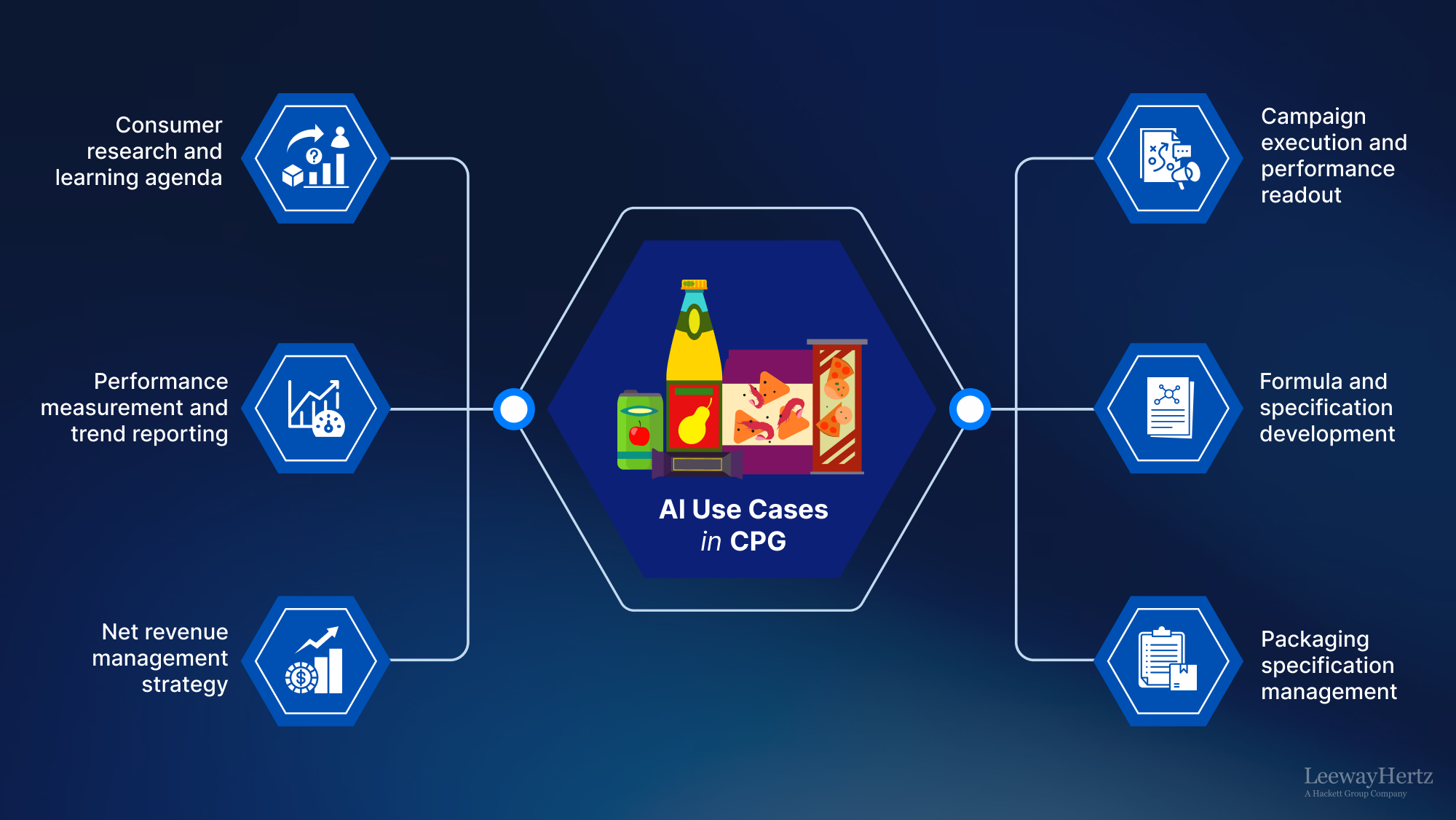
That value does not come from dropping a generic chatbot on top of the business. It comes when AI sits inside the work people already perform, so a demand planner can review a suggested adjustment to a baseline forecast before it affects the consensus demand plan, while a category manager can inspect ranked promotion opportunities before a trade calendar is changed. In packaging and quality workflows, image-based AI can flag differences between an artwork proof and a packaging specification, but a packaging QA reviewer confirms any discrepancy before release. Used this way, forecasting models help teams focus on the exceptions that matter, LLMs can prepare reviewable narratives, and agentic AI can assemble the next review packet across approved software workflows without removing role-based accountability.
At that point, the main question is no longer whether AI can help; it is where the work is specific enough to govern. Before any operating model is named, CPG firms should map AI at the function, process, and sub-process level because that is where a system record, an artifact, an owner, and a control point come together. Without that context, an idea such as “improve forecasting” stays too broad to build or prioritize, while a narrower opportunity, such as classifying forecast exceptions for demand planner review, has a clear input, a measurable decision, and an approval step.
This article uses a consumer packaged goods operating model to break work into functions. Each function is then divided into processes and sub-processes. For each area, it shows where AI can extract information, compare records, draft outputs, classify exceptions, identify gaps, prepare review packets, and support governed decision-making across CPG workflows.
- How AI is transforming consumer packaged goods operations
- Why AI use cases for consumer packaged goods must be mapped at the sub-process level
- Consumer packaged goods operating model and AI opportunity mapping across consumer packaged goods processes
- High-value AI use cases in consumer packaged goods
- How agentic AI works in consumer packaged goods workflows
- How to prioritize AI use cases in consumer packaged goods
- Governance, risk, and responsible AI in consumer packaged goods
- How ZBrain operationalizes AI use cases in consumer packaged goods
- Future of AI in consumer packaged goods
How AI is transforming consumer packaged goods operations
A demand planner opens a Monday promotion review with a retailer spreadsheet on one screen, a trade calendar in another system, and an email thread explaining why a seasonal pack arrived late to two distribution centers. In a consumer packaged goods (CPG) business, this scattered operating context is routine, so delays often come from reconciling evidence rather than making the decision itself. Rule-based automation can move a promotion through known approval steps, and a standalone forecast can estimate expected lift. However, both approaches run out of room when a buyer comment conflicts with item setup data or when a prior deduction changes the margin picture.
AI begins to help by converting unstructured notes, spreadsheets, and system records into a reviewable exception summary. It can rank the stock keeping units (SKUs) where service risk or margin exposure needs attention first, giving the planner a clearer starting point without bypassing commercial judgment.
The same pattern appears across CPG functions. AI is most useful where teams have to interpret scattered inputs, compare evidence, prepare a recommendation, and pass work to an accountable reviewer. That makes the first wave of value especially visible in five types of recurring work:
- Document-heavy work:
- Artifacts: Product specifications, ingredient statements, supplier certificates, and retailer setup forms.
- AI role: Identify missing fields, inconsistent values, and evidence gaps so regulatory affairs and quality teams spend less time searching for basic documentation.
- Narrative-heavy work:
- Artifacts: Consumer complaint narratives, brand claim briefs, launch rationales, and retailer line review notes.
- AI role: Create first-pass summaries, structure key reasoning, and prepare draft narratives so marketing, sales, and consumer care teams can reduce drafting time while preserving the basis for each recommendation.
- Exception-heavy work:
- Artifacts: Forecast outliers, order allocation disputes, trade promotion deductions, and artwork approval gaps.
- AI role: Classify exceptions, detect anomalies, and prioritize issues so teams can separate routine cleanup from risks that may affect service levels, working capital, or compliance.
- Knowledge-heavy work:
- Artifacts: Allergen rules, labeling requirements, packaging claim guidance, and customer-specific assortment rules.
- AI role: Retrieve relevant policy, regulatory, and customer-specific guidance with traceable source references so specialists can review decisions without repeatedly searching across policy folders.
- Workflow-heavy work:
- Artifacts: Innovation stage-gate approvals, artwork routing records, demand planning sign-offs, and promotion settlement workflows.
- AI role: Prepare next-step task packages, route work based on status and ownership, and surface blockers so teams can reduce handoff delays while preserving review accountability.
The design rule is simple: AI prepares the case, retrieves the evidence, drafts the output, and routes the work to the right reviewer so that judgment stays attached to a role. The assigned reviewer, such as the supply planning manager, quality manager, category manager, or regulatory affairs reviewer, confirms any production change, customer-facing message, or risk-bearing action before it moves forward. With that boundary, CPG functions can use AI to shorten cycle time and reduce manual effort while making review accountability clearer.
Why AI use cases for consumer packaged goods must be mapped at the sub-process level
A category team preparing for a retailer review may hear “AI for consumer packaged goods” used for two very different jobs: checking whether scanner data is loaded correctly, while another team tests whether a front-of-pack claim will make sense to shoppers. The first task depends on syndicated sales feeds and product hierarchies, while the second depends on consumer language and regulatory review, so the same broad label hides different systems, data, and approvers. A high-level label at that altitude cannot be built, governed, or measured with confidence. The same work becomes executable when it is named at the sub-process level, tied to a specific artifact, routed through a defined review point, and owned by an accountable role.
A better approach is to map use cases to the consumer packaged goods operating model:
- Function: The major business or control area, such as demand planning, brand management, trade promotion management, product development, packaging, quality, regulatory affairs, supply chain, manufacturing, procurement, or finance.
- Process: The workflow area within that function, such as promotion planning, assortment review, new product launch, artwork approval, supplier documentation review, demand forecasting, production scheduling, order allocation, quality inspection, or deduction management.
- Sub-process: The specific work activity, such as promotion performance analysis, claim substantiation review, packaging copy comparison, forecast exception classification, supplier certificate review, retailer setup form validation, production variance analysis, shelf-image inspection, or deduction evidence assembly.
- AI-enabled opportunity: The specific way AI can support that sub-process, such as extracting data, classifying an exception, detecting anomalies, comparing documents or images, forecasting demand, recommending next actions, drafting a review narrative, or assembling evidence for human review.
This level of detail matters because CPG workflows are tied to specific product data, retailer requirements, consumer-facing claims, packaging artifacts, supplier documents, quality records, production constraints, approval owners, and decision rights. An AI workflow for demand forecast exception classification is different from one for packaging artwork comparison. A supplier documentation review workflow is different from a trade deduction analysis workflow. A brand manager’s decision-support tool is different from a demand planner assistant, a quality inspection model, or a regulatory review support workflow.
By mapping AI opportunities at the sub-process level, CPG companies can move from broad innovation ideas to executable workflows with clear business value, data requirements, review points, governance, and implementation paths.
Operationalize AI Across the CPG Value Chain
Turn high-value CPG workflows into governed AI solutions that improve demand decisions, strengthen trade and margin performance, accelerate product and label reviews, and reduce supply and customer-service exceptions.
Consumer packaged goods operating model and AI opportunity mapping across consumer packaged goods processes
The consumer packaged goods operating model below is organized into key industry-native functions that practitioners recognize. Each function is decomposed into its major processes and their sub-processes, and each sub-process carries the AI-enabled opportunity that applies to it. Opportunities are software-only and keep a human reviewer in the loop.
Function 1. Consumer and market insights
This function owns the end-to-end insight agenda across consumers, shoppers, retailers, channels, and markets. Consumer insights managers, shopper insights analysts, category analysts, market research operations, and commercial data scientists work with retail measurement data, syndicated data, household panel data, retailer point-of-sale (POS) feeds, marketing content operations systems, and the data, analytics, and AI platform.
AI helps where teams must connect unstructured consumer signals with scanner, panel, POS, and complaint data to explain shifts in base demand, velocity, and shopper behavior. It also supports faster synthesis for research, category readouts, and demand reviews, while insight owners approve final conclusions.
| Process | Sub-process | Key AI-enabled opportunities |
|---|---|---|
| Consumer research and learning agenda | Consumer and market insights learning agenda | Aggregate syndicated scanner, household panel, retailer POS, and complaint themes, rank unanswered demand-driver questions against the annual operating plan, and propose a sequenced learning agenda to reduce duplicate studies for the consumer insights director review. |
| Household panel data study design | Map target shopper cohorts from the consensus demand plan and household panel universe, detect sample-size gaps and bias risks under demand sensing, and draft study cell definitions to improve readout reliability for market research operations manager review. | |
| Consumer complaint file insight feedback loop | Extract complaint narratives and lot attributes from the consumer complaint file, classify themes under complaint trending and corrective and preventive action(CAPA), and detect recurring quality or usage signals for consumer insights manager review. | |
| Label claim consumer language testing | Compare tested claim phrases, verbatim responses, and comprehension scores against the label claims substantiation file, classify misleading interpretations, and draft wording options that strengthen compliance for the regulatory affairs manager review. | |
| Market and category data management | Syndicated scanner data ingestion and validation | Validate syndicated scanner feeds against the universal product code (UPC) record and item master record, detect hierarchy, unit, and duplicate anomalies, and flag exceptions to reduce cleansing cycle time for category analytics manager review. |
| Retailer POS data and EDI 852 mapping | Map retailer electronic data interchange (EDI) 852 POS fields to the global trade item number (GTIN) record and item master record, classify unmapped stores and stock keeping units (SKUs), and flag data-quality breaks for commercial data science lead review. | |
| Household panel data normalization | Classify household panel trips, buyer cohorts, and channel banners against consensus demand plan segmentation, detect weighting and duplication outliers, and summarize normalization exceptions to reduce reconciliation effort for shopper insights analyst review. | |
| ACV distribution, TDP, and velocity reporting | Aggregate all commodity volume (ACV) distribution, total distribution points (TDP), and velocity measures into the retailer scorecard, detect outlet-level distribution gaps, and summarize sales velocity drivers for category manager review. | |
| Insight activation for brand and category teams | Category review deck insight inputs | Draft category review deck insight sections from scanner, household panel, and complaint-theme extracts, classify drivers against category growth levers, and flag unsupported claims to reduce preparation effort for category insights lead review. |
| Retailer joint business plan shopper insights | Aggregate shopper penetration, trip, basket, and loyalty indicators into the retailer joint business plan, compare opportunities with the retailer scorecard, and propose prioritized retailer actions for the customer development director review. | |
| Assortment reset and planogram insight readouts | Compare planogram facings and assortment matrix roles with SKU rationalization candidates, detect duplication and incrementality gaps, and propose reset readout points to improve space-allocation decisions for category manager review. | |
| Price pack architecture consumer value diagnostics | Compare pack-size, price-tier, and household panel value perceptions against the price pack architecture, detect elasticity and trade-down risks, and summarize diagnostics for revenue growth manager review. | |
| Performance measurement and trend reporting | Base demand and incremental volume trend tracking | Detect base demand breaks and incremental volume shifts by comparing scanner trends with the baseline forecast and promotion-adjusted forecast, then flag unexplained variance for demand planning manager review. |
| Promo lift, cannibalization, and halo effect readouts | Compare promotional item, base SKU, and adjacent-category velocities against the trade promotion event plan, detect lift and cannibalization patterns, and draft post-event analysis report notes for trade marketing manager review. | |
| On-shelf availability and out-of-stock signal reporting | Detect out-of-stock risk by combining retailer POS, EDI 852, and order exceptions from the order-to-cash exception report, then flag service-impact signals for customer service manager review. | |
| Demand review deck market signal inputs | Retrieve market-share, velocity, distribution, panel, and complaint signals for the demand review deck, summarize material deviations from the consensus demand plan, and flag decision points for the demand planning director review. |
Highest-value opportunities. The strongest opportunities are syndicated scanner data ingestion and validation, category review deck insight inputs, and demand review deck market signal inputs. These areas repeatedly combine scanner, POS, household panel, and complaint signals into governed artifacts. AI helps reduce manual wrangling and deck assembly, improves driver attribution for brand and demand decisions, and keeps final readouts with the category insights lead or demand planning director.
Example agentic workflow. An example agentic workflow is the category review signal-to-slide workflow: The agent plans the category review question set, retrieves governed scanner, household panel, POS, and complaint data, drafts cited category review deck inputs, routes exceptions through the content workflow, and records confirmation from the category insights lead.
Function 2. Category management and shopper marketing
This function manages category strategy, shopper activation, assortment, shelf, planogram, and retailer category storytelling. Category managers, shopper marketing managers, space planners, category captains, retail insights analysts, and field execution teams use retail measurement data, trade promotion management systems, marketing content operations systems, and the data, analytics, and AI platform.
AI helps turn shopper, shelf, assortment, POS, and promotion signals into category review decks, planogram actions, and retailer-specific recommendations. It can accelerate assortment and shelf-scenario work, while category leads validate the retailer context and commercial implications.
| Process | Sub-process | Key AI-enabled opportunities |
|---|---|---|
| Category strategy and category review | Category management framework setup | Map retailer roles, shopper missions, and decision trees into the category review deck, classify objectives against category management workstreams, and flag unclear ownership to shorten setup cycles for category director review. |
| Category review deck development | Draft category review deck narratives from the retailer scorecard, POS, and shopper-panel extracts, compare trend claims, and flag unsupported retailer recommendations to reduce slide-building effort for category manager review. | |
| Retailer scorecard category diagnostics | Aggregate retailer scorecard measures across sales, share, distribution, and promotion key performance indicators (KPIs), detect variance drivers, and summarize priority gaps to improve decisions for retail insights analyst review. | |
| ACV distribution, TDP, and velocity benchmarking | Calculate ACV distribution, TDP, and velocity benchmarks from syndicated data, detect peer-set outliers against the retailer scorecard, and flag underdistributed high-velocity items for category manager review. | |
| Assortment optimization and SKU rationalization | Assortment matrix maintenance | Validate assortment matrix entries against the item master record and UPC record, classify missing pack-size or retailer authorization fields, and flag exceptions to reduce maintenance rework for category operations manager review. |
| Assortment optimization scenario building | Propose assortment scenarios using demand-transfer modeling and space constraints from the assortment matrix, compare financial and shopper impacts, and summarize trade-offs to shorten scenario cycles for category manager review. | |
| SKU rationalization list preparation | Screen low-velocity and duplicative items using contribution, incrementality, and substitution signals, draft the SKU rationalization list, and flag strategic exceptions to improve decisions for category director review. | |
| Item master record and UPC availability checks | Validate item master record, UPC record, and GTIN record completeness, detect conflicting dimensions or pack attributes, and flag launch-blocking gaps to reduce setup delays for master data steward review. | |
| Planogram and shelf execution | Planogram review and compliance checks | Compare store shelf images and retailer execution files against the approved planogram, detect facings, placement, and adjacency variances, and flag high-sales-risk compliance gaps for space planner review. |
| Case pack and shelf capacity review | Calculate shelf capacity and forecast days of supply from planogram facings, case-pack dimensions, and velocity signals, then flag capacity shortfalls that raise out-of-stock risk for space planner review. | |
| Assortment reset execution tracking | Aggregate reset task status, store photos, and shipment milestones against the assortment matrix and planogram, detect late stores, and summarize intervention priorities for field execution manager review. | |
| On-shelf availability and out-of-stock issue logging | Detect out-of-stock patterns from POS, inventory feeds, and shelf images, map likely causes to the order-to-cash exception report, and flag recurring availability losses for field execution manager review. | |
| Shopper marketing and retailer activation | Retailer joint business plan shopper programs | Propose shopper program themes from loyalty, panel, and promotion response segments, draft retailer joint business plan activation options, and flag funding or claim gaps for the shopper marketing manager review. |
| Trade calendar shopper activation alignment | Map shopper activation dates to the trade calendar and trade promotion event plan, detect channel conflicts, and flag misaligned media, display, or funding windows for the shopper marketing manager review. | |
| Slotting allowance and display placement tracking | Validate slotting allowance and display placement commitments against the trade promotion event plan and trade accrual reconciliation, detect missing proof of performance, and flag accrual gaps for trade marketing manager review. | |
| Post-event analysis report shopper readout | Summarize lift, return on investment (ROI), household penetration, and repeat-rate drivers into the post-event analysis report, compare results with benchmarks, and flag unclear causality for the shopper marketing manager review. |
Highest-value opportunities. The strongest AI opportunities are category review deck development, assortment optimization scenario building, and planogram review and compliance checks because they are high-volume workflows with clean review boundaries. Each draws on the retailer scorecard, assortment matrix, planogram, POS, syndicated, and shelf-execution data, so AI helps reduce manual synthesis and shorten scenario turnaround for category manager and space planner review.
Example agentic workflow. An example agentic workflow is retailer category review preparation: The agent plans the category review workback, retrieves retailer scorecard, POS, assortment, item, and approved shopper content, drafts category review deck sections, routes planogram recommendations, and records confirmation from the category manager.
Function 3. Brand marketing and content operations
This function manages brand planning, campaign execution, creative operations, brand voice, content workflows, and approval evidence for claims and endorsements. Brand managers, content operations leads, creative operations teams, agency coordinators, legal reviewers, regulatory reviewers, and digital marketing teams use marketing content operations systems, product lifecycle management (PLM) systems, specification systems, retail measurement data, and the data, analytics, and AI platform.
AI helps accelerate content variation, campaign briefs, performance readouts, and claim-aware content review without bypassing brand, legal, and regulatory approval. It is useful where teams must preserve approved language, artwork, brief intent, label claims substantiation, and endorsement disclosures across many formats and channels.
| Process | Sub-process | Key AI-enabled opportunities |
|---|---|---|
| Brand planning and annual operating plan inputs | Annual operating plan brand objectives | Draft annual operating plan brand objective options from the consensus demand plan and syndicated share trends, compare them against planning assumptions, and flag goal conflicts to shorten planning cycles for brand director review. |
| Consumer and market insights brief translation | Summarize consumer research and movement data, map insight themes to category review deck and annual operating plan initiatives, and propose prioritized brief implications for brand manager review. | |
| Category review deck brand implications | Extract share, distribution, and assortment signals from the category review deck, compare them with the assortment matrix, and draft brand implications for category manager review. | |
| Price pack architecture brand guardrails | Compare proposed pack, price, and channel moves in the price pack architecture with net revenue management guardrails, calculate elasticity risk indicators, and flag shopper confusion risks for revenue growth manager review. | |
| Content production and asset management | Artwork brief intake and routing | Extract required claims, pack format, SKU, and channel details from the artwork brief, classify missing inputs against stage-gate criteria, and flag incomplete briefs for creative operations lead review. |
| Marketing content operations asset taxonomy | Classify marketing assets against the item master record, GTIN record, and packaging specification, map metadata to the specification taxonomy, and flag orphaned assets for content operations lead review. | |
| Brand voice and label claim language review | Compare draft copy with approved claim phrases in the label claims substantiation file and artwork brief, classify deviations, and flag unsupported wording for legal and regulatory reviewer confirmation. | |
| Content versioning for channels and regions | Draft channel and region variants from the artwork brief and approved packaging specification, validate claims and disclosures, and flag version conflicts for content QA reviewer confirmation. | |
| Advertising compliance and endorsement governance | Label claims substantiation file handoff | Extract supporting evidence from the product specification, formula record, and certificate of analysis, map it to the label claims substantiation file, and flag evidence gaps for regulatory reviewer confirmation. |
| Endorsement and testimonial disclosure checklist | Classify influencer posts, testimonial copy, and media placements linked to the artwork brief, compare disclosure language with US endorsement disclosure guidance, and flag missing material-connection disclosures for advertising compliance reviewer confirmation. | |
| Environmental marketing claim review | Retrieve sustainability assertions from the artwork brief and packaging specification, compare them with the label claims substantiation file and US environmental marketing claim guidance, and flag unsupported claims for regulatory reviewer confirmation. | |
| Unfair or deceptive acts or practices claim screen | Screen promotional headlines, offer terms, and comparative claims in the artwork brief, compare them with substantiation evidence and US deceptive-practices requirements, and flag high-risk language for legal reviewer confirmation. | |
| Campaign execution and performance readout | Trade calendar and media calendar alignment | Compare trade calendar events with media flight dates and the trade promotion event plan, detect mismatched retailer windows, and propose timing adjustments for the shopper marketing manager review. |
| Retailer POS data campaign readout | Aggregate retailer POS feeds into the retailer scorecard, calculate baseline lift against the baseline forecast, and summarize outlier stores and incrementality drivers for trade marketing manager review. | |
| Household panel data campaign analysis | Classify household panel buyers by trial, repeat, switching, and basket behavior, compare segments with the category review deck, and summarize audience shifts for the consumer insights manager review. | |
| Post-event analysis report marketing inputs | Draft marketing input sections for the post-event analysis report from the trade promotion event plan and media results, compare performance with benchmarks, and flag learnings for brand manager review. |
Highest-value opportunities. Brand voice and label claim language review, content versioning for channels and regions, and retailer POS data campaign readout offer strong value because they combine high content or data volume with clear approval points. Prioritizing these sub-processes helps reduce manual copy checking, shorten readout cycles, strengthen compliance, and preserve final confirmation with legal, regulatory, content QA, and trade marketing owners.
Example agentic workflow. An example agentic workflow is claim-aware content versioning: The AI agent plans channel and region checks, retrieves approved artwork and substantiation records, drafts compliant variants with exception notes, routes unsupported wording to the regulatory reviewer, and records confirmation in the content workflow.
Function 4. Innovation and product development
This function oversees the new product development path from consumer need, concept, formula, specification, packaging handoff, commercialization, and launch readiness. Research and development (R&D) scientists, product developers, packaging engineers, commercialization managers, regulatory affairs, quality, procurement, and demand planning teams use PLM systems, enterprise resource planning (ERP), laboratory information management systems (LIMS), and supply chain planning and integrated business planning (IBP) systems.
AI helps coordinate handoffs between insights, formula and specification development, packaging, claims, supplier inputs, and launch gates. It can speed comparison, summarization, risk surfacing, and launch readiness checks while R&D, quality, and regulatory owners retain gate approval authority.
| Process | Sub-process | Key AI-enabled opportunities |
|---|---|---|
| Stage-gate new product development | Stage-gate new product development charter | Extract innovation objectives from the annual operating plan and retailer joint business plan, compare the stage-gate charter against entry criteria, and flag missing volume, claim, or supply assumptions for innovation steering committee review. |
| Consumer and market insights concept input | Aggregate consumer feedback and syndicated share data into the category review deck, classify unmet needs using occasion and segment logic, and summarize concept implications for product development lead review. | |
| Retailer joint business plan launch input | Extract launch commitments from the retailer’s joint business plan, map distribution, promotion, and planogram inputs to the assortment matrix, and flag gaps for the customer development manager review. | |
| Annual operating plan innovation pipeline alignment | Compare proposed innovation milestones with the annual operating plan, calculate pipeline volume exposure from the consensus demand plan, and flag capacity or margin misalignment for innovation portfolio lead review. | |
| Regulatory and claims feasibility screen | Retrieve intended claims and ingredient choices from the concept brief, compare against labeling, allergen, and ingredient-restriction rules, and flag infeasible claims or non-compliant ingredients early for regulatory affairs review. | |
| Formula and specification development | Formula record creation | Extract ingredient attributes and lab results from the supplier questionnaire and LIMS test data, draft the formula record under specification rules, and flag allergen or nutrition inconsistencies for R&D scientist review. |
| Product specification drafting and approval | Draft product specification sections from the approved formula record and certificate of analysis, validate fields against specification rules, and flag approval gaps for quality assurance manager review. | |
| Bill of materials setup | Extract component quantities from the formula record and packaging specification, map them to the bill of materials, and flag missing supplier or unit-of-measure fields for procurement master data manager review. | |
| Specification management change control | Compare revised formula record, product specification, and packaging specification versions, classify changes under change-control categories, and summarize labeling, supplier, and manufacturing impacts for change control board review. | |
| Commercialization and design for manufacturability | Design for manufacturability assessment | Compare the product specification and preliminary master batch record with line capability data, detect manufacturability risks, and propose tolerance or process changes for the commercialization manager review. |
| Critical quality attribute definition | Classify lab measurements and sensory results against quality by design critical quality attribute definitions, detect variance patterns, and propose control ranges for quality assurance scientist review. | |
| Co-manufacturer and co-packer trial planning | Retrieve co-manufacturer capability and allergen-control data from the supplier questionnaire and supplier approval file, map trial requirements to the master batch record, and flag readiness gaps for commercialization lead review. | |
| Master batch record readiness review | Validate the master batch record against the approved formula record, product specification, and hazard analysis and critical control points (HACCP) plan, then summarize exceptions for quality operations manager review. | |
| Launch readiness and SKU setup | Item master record creation | Extract SKU attributes from the product specification, packaging specification, and bill of materials, classify required fields against data standards, and flag incomplete dimensions, allergens, or costing inputs for master data manager review. |
| GTIN record and UPC record setup | Validate the GTIN record and UPC record against the item master record and packaging specification attributes, detect duplicate identifiers, and flag setup exceptions for master data manager review. | |
| Packaging specification handoff | Compare the packaging specification, artwork brief, and label claims substantiation file, extract packaging dimensions and claim dependencies, and flag mismatches for packaging engineer review. | |
| Demand review deck launch volume assumptions | Compare baseline forecast, promotion-adjusted forecast, and trade promotion event plan assumptions in the demand review deck, score launch-volume risk, and flag outliers for demand planning manager review. |
Highest-value opportunities. Product specification drafting and approval, bill of materials setup, and demand review deck launch volume assumptions offer strong AI upside because they are artifact-rich handoffs across PLM, ERP, LIMS, and IBP. AI can reduce reconciliation effort, shorten SKU setup and gate-cycle time, improve launch-volume decisions, and leave approvals with accountable reviewers.
Example agentic workflow. An example agentic workflow is the launch specification readiness workflow: The agent plans the launch-readiness checklist, retrieves formula, specification, bill of materials, item, and demand records, drafts a gap summary, routes it through the PLM approval queue, and captures confirmation from the commercialization manager.
Function 5. Packaging, labeling, and regulatory compliance
This function manages packaging specifications, artwork review, ingredient statements, allergen declarations, nutrition panels, claim substantiation, and regulatory readiness for launches and changes. Regulatory affairs, labeling specialists, packaging engineers, legal reviewers, quality assurance, and artwork coordinators use PLM systems, specification systems, marketing content operations systems, quality management systems, and LIMS.
AI helps where document-heavy reviews must compare formulas, specifications, artwork, label panels, claims, substantiation files, and allergen records. It can reduce review cycle time and surface inconsistencies, but regulatory and quality reviewers remain accountable for final label and claim approvals.
| Process | Sub-process | Key AI-enabled opportunities |
|---|---|---|
| Packaging specification management | Packaging specification creation and approval | Extract packaging attributes from the product specification and formula record, compare them with the draft packaging specification, and classify gaps against specification controls for packaging engineer review. |
| Case pack configuration review | Compare case dimensions, pallet patterns, and unit counts in the packaging specification with the bill of materials, detect outliers, and flag cost or fulfillment risks for packaging engineer review. | |
| Packaging BOM reconciliation | Map packaging components in the bill of materials to the packaging specification and item master record, detect obsolete component links, and flag mismatches for master data steward review. | |
| Packaging specification change review | Compare packaging specification versions against the product specification and approval history, summarize material deltas, and flag unauthorized edits for regulatory affairs manager review. | |
| Labeling and artwork review | Artwork brief intake and label routing | Classify artwork requests in the artwork brief, extract SKU, market, claim, and allergen indicators, and route high-risk labels for artwork coordinator review. |
| Nutrition Facts panel verification | Validate nutrient values in the nutrition facts panel against the formula record and laboratory results, compare rounding and format exceptions, and flag discrepancies for labeling specialist review. | |
| Ingredient statement review | Extract ingredient listings from the formula record, compare sequence, sub-ingredients, and naming to the ingredient statement, and flag mismatches for regulatory affairs manager review. | |
| Allergen declaration review | Map allergen attributes from the formula record and supplier questionnaire to the allergen declaration, detect undeclared or over-declared allergens, and flag high-severity gaps for quality assurance manager review. | |
| Claims substantiation and advertising compliance | Label claims substantiation file maintenance | Retrieve claim evidence from the product specification, formula record, and label claims substantiation file, classify evidence strength, and flag expiring or missing support for legal counsel review. |
| Environmental marketing claim substantiation | Screen recyclable, compostable, and reduced-plastic claims against the packaging specification and US environmental marketing claim guidance, then flag unsupported wording for legal counsel review. | |
| Endorsement and testimonial disclosure review | Classify endorsement language in the artwork brief and label claims substantiation file, detect missing material-connection disclosures, and flag higher-risk placements for legal counsel review. | |
| Unfair or deceptive acts or practices claim screen | Detect absolute, comparative, or implied claims in the artwork brief, compare them with substantiation evidence and deceptive-practices requirements, and flag unsupported language for legal counsel review. | |
| Regulatory change and launch compliance | Food labeling change impact assessment | Compare food labeling rule changes with affected nutrition facts panel, ingredient statement, and allergen declaration records, map SKU impacts, and summarize priority changes for regulatory affairs manager review. |
| Allergen risk assessment review | Aggregate allergen inputs from the formula record, supplier questionnaire, and environmental monitoring record, detect cross-contact or declaration gaps, and flag high-risk SKUs for quality assurance manager review. | |
| Product specification and label match check | Compare the product specification and formula record with the nutrition facts panel, ingredient statement, and allergen declaration, detect mismatches, and flag launch-blocking discrepancies for regulatory affairs manager review. | |
| Packaging specification launch release | Validate release readiness by comparing the packaging specification, bill of materials, and artwork brief against stage-gate exit criteria, then flag blockers for packaging engineer review. |
Highest-value opportunities. Nutrition facts panel verification, allergen declaration review, and product specification and label match checks offer the strongest AI lift. These activities compare formula, product specification, nutrition, ingredient, and allergen data across controlled systems. These steps let labeling specialists and regulatory affairs reviewers confirm AI-flagged discrepancies while reducing manual reconciliation, shortening artwork approval cycles, and strengthening compliance before launch.
Example agentic workflow. An example agentic workflow is Label match readiness review: AI plans the prelaunch label match check, retrieves specification, formula, nutrition, ingredient, allergen, and artwork records, drafts a discrepancy summary with recommended holds, and records confirmation by the regulatory affairs reviewer.
Function 6. Revenue growth management, pricing, and trade promotion
This function owns net revenue management, price pack architecture, list and promoted pricing, trade calendar governance, promotion planning, trade spend, and post-event analytics. Revenue growth management (RGM) leads, pricing analysts, trade marketing managers, sales finance, account teams, and deduction partners use RGM and pricing systems, trade promotion management systems, ERP, retail measurement data, and the data, analytics, and AI platform.
AI helps evaluate price, pack, mix, trade spend, promo lift, cannibalization, halo effects, and settlement evidence across retailers and SKUs. It can support faster scenario modeling and exception review, while commercial owners approve guardrails, assumptions, and customer-facing actions.
| Process | Sub-process | Key AI-enabled opportunities |
|---|---|---|
| Net revenue management strategy | Revenue growth management opportunity sizing | Aggregate market share, elasticity, and SKU margin data, score whitespace and mix opportunities using RGM logic, and rank actions in the annual operating plan for RGM lead review. |
| Net revenue management margin bridge | Aggregate invoice, trade spend, mix, and cost-to-serve data, detect anomalous variance drivers, and summarize the margin bridge in the integrated reconciliation pack for sales finance manager review. | |
| EDLP and hi-lo pricing architecture | Compare everyday low price (EDLP) and hi-lo price histories, model elasticity and retailer response patterns, and propose guardrails for the price pack architecture for pricing director review. | |
| Trade spend and slotting allowance budget review | Classify slotting, off-invoice, and scan-back commitments, forecast budget consumption against the trade calendar, and flag overspend or underfunded events for trade marketing manager review. | |
| Price pack architecture and pricing execution | Price pack architecture design | Map pack sizes, price points, velocities, and margins, simulate consumer trade-offs, and propose ladder options in the price pack architecture for RGM lead review. |
| SKU and case pack price ladder maintenance | Detect gaps, inversions, and outdated case-pack conversions across the item master record and price pack architecture, classify exceptions, and flag list-price updates for pricing analyst review. | |
| Price change impact review in the annual operating plan | Compare proposed list-price changes with volume, trade rate, and elasticity assumptions, forecast net sales and margin impacts, and summarize sensitivities for finance director review. | |
| Retailer scorecard price compliance monitoring | Retrieve retailer shelf and syndicated price feeds, detect deviations from agreed price bands, and flag variance evidence in the retailer scorecard for account manager review. | |
| Trade promotion planning and optimization | Trade calendar governance | Validate overlapping events, blackout dates, feature conflicts, and funding caps in the trade calendar, classify issues, and flag exceptions for trade marketing manager review. |
| Trade promotion event plan creation | Draft event objectives, mechanics, guardrails, and funding assumptions in the trade promotion event plan, retrieve prior-event lift benchmarks, and flag missing assumptions for customer marketing manager review. | |
| Trade promotion optimization scenario planning | Compare base, feature, display, discount-depth, and retailer funding scenarios, predict lift, cannibalization, and halo effects, and rank trade promotion event plan options for RGM lead review. | |
| Promotion-adjusted forecast handoff | Aggregate approved event volumes, uplift assumptions, and timing, compare them with the baseline forecast, and summarize deltas in the promotion-adjusted forecast for the demand planning manager review. | |
| Post-event and trade settlement support | Post-event promotion analysis | Compare actual sales, baseline lift, retailer execution, cannibalization, and trade spend, model causal drivers, and flag learnings in the post-event analysis report for trade marketing manager review. |
| Post-event analysis report publication | Summarize lift, ROI, cannibalization, halo, and execution findings, classify lessons learned, and draft the post-event analysis report for RGM lead review. | |
| Trade accrual reconciliation inputs | Retrieve approved trade promotion event plans, customer deduction claims, and shipment records, classify timing and funding mismatches, and flag accrual variances for sales finance manager review. | |
| Scan-back, off-invoice allowance, and bill-back validation | Validate scan-back, off-invoice, and bill-back evidence against the trade promotion event plan, detect duplicate or out-of-window claim patterns, and flag support gaps for deduction analyst review. |
Highest-value opportunities. Trade promotion optimization scenario planning, post-event promotion analysis, and allowance validation offer strong near-term value. These are high-volume workflows tied to event plans, scorecards, claims, and post-event reports. AI can shorten scenario cycles, reduce evidence matching, improve trade ROI decisions, and create clear review boundaries for RGM leads, trade marketing managers, and deduction analysts.
Example agentic workflow. An example agentic workflow is promotion event settlement review: The AI agent plans the event assessment, retrieves event, invoice, deduction, sales, and lift evidence, drafts post-event and accrual exception summaries, routes open items, and prompts trade marketing and deduction reviewers to confirm final disposition.
Function 7. Sales and key account management
This function manages retailer and distributor relationships, account plans, joint business plans, sell-in, distribution goals, scorecards, broker coordination, and account-level issue resolution. Key account managers, national account managers, sales operations, broker managers, field sales teams, category partners, and sales finance use ERP, trade promotion management systems, retail measurement data, and the data, analytics, and AI platform.
AI helps prepare account-specific narratives, surface scorecard issues, prioritize out-of-stock and service exceptions, and connect trade plans to retailer performance. It supports better account preparation and follow-up, while sales teams remain responsible for negotiation and customer commitments.
| Process | Sub-process | Key AI-enabled opportunities |
|---|---|---|
| Account planning and joint business planning | Retailer joint business plan development | Draft account objective, distribution, promotion, and service-risk sections of the retailer joint business plan from prior scorecards and syndicated data, then flag negotiation trade-offs for national account manager review. |
| Annual operating plan account targets | Aggregate retailer shipment, POS, margin, and promotion history into account-level target scenarios, classify variance drivers against planning guardrails, and propose target adjustments for sales finance director review. | |
| Category review deck account story | Summarize category growth, share, shopper, and SKU productivity evidence into category review deck storylines, map claims to category objectives, and flag unsupported recommendations for category manager review. | |
| Retailer scorecard action planning | Detect service, fill-rate, deduction, and promotion performance outliers in the retailer scorecard, map recurring gaps to Lean Six Sigma define, measure, analyze, improve, and control (DMAIC) problem statements, and propose corrective actions for key account manager review. | |
| Customer P&L and profitability review | Aggregate net revenue, trade spend, mix, and cost-to-serve by account from ERP and trade systems, detect margin and trade-efficiency variance against the annual operating plan target, and summarize profitability drivers for key account manager review. | |
| Distribution, assortment, and shelf execution | ACV distribution and TDP tracking | Aggregate retailer ACV distribution and TDP movement into the retailer scorecard, compare coverage gaps with assortment priorities, and flag high-velocity voids for sales operations manager review. |
| Assortment matrix account alignment | Compare retailer-authorized items, item master record attributes, and shelf performance against the assortment matrix, classify misalignments, and propose add-delete changes for category manager review. | |
| Planogram compliance follow-up | Detect shelf placement, facings, and void discrepancies from store images against the planogram, classify exceptions by thresholds, and draft follow-up notes for field sales manager review. | |
| Out-of-stock and on-shelf availability escalation | Detect store-level out-of-stock risk by combining POS velocity, inventory signals, and the order-to-cash exception report, rank escalations, and propose recovery actions for the sales operations manager review. | |
| Order and promotion collaboration | Trade calendar customer alignment | Compare retailer planning windows, seasonal events, and internal shipment constraints against the trade calendar, map conflicts, and propose timing changes for trade marketing manager review. |
| Trade promotion event plan sell-in | Draft sell-in narratives for the trade promotion event plan from the baseline forecast, post-event analysis report, and retailer objectives, then flag weak events for customer team lead review. | |
| Promotion-adjusted forecast account review | Compare promotion-adjusted forecast changes with the baseline forecast, trade calendar, and retailer POS trends, classify variance drivers, and flag demand risks for the demand planning manager review. | |
| Slotting allowance and display compliance tracking | Extract slotting and display commitments from the trade promotion event plan and retailer proof-of-performance files, classify compliance gaps, and flag potential leakage for sales finance manager review. | |
| Broker and field sales management | Broker commission statement review | Validate broker-reported sales, commission rates, and account assignments in the broker commission statement against ERP invoices, compare exceptions with account coverage assumptions, and flag disputed payments for sales finance manager review. |
| Retailer scorecard field execution updates | Aggregate field visit notes, store photos, and issue statuses into the retailer scorecard, classify execution gaps by sales and operations execution priorities, and summarize actions for field sales manager review. | |
| Customer deduction claim broker support | Retrieve broker correspondence, proof-of-performance attachments, and invoice history for each customer deduction claim, classify claim reasons, and draft dispute-support summaries for deductions analyst review. | |
| Chargeback file escalation with brokers | Classify shortage, pricing, compliance, and delivery issues in the chargeback file, map recurring causes to Lean Six Sigma DMAIC categories, and propose broker escalation actions for the customer operations manager review. |
Highest-value opportunities. Retailer scorecard action planning, out-of-stock and on-shelf availability escalation, and promotion-adjusted forecast account review provide strong near-term AI value. These workflows integrate exception data with scorecards, trade calendars, and forecasts. AI helps teams reduce manual preparation, prioritize retailer-facing issues faster, and improve decision quality without shifting ownership of account commitments away from sales.
Example agentic workflow. An example agentic workflow is retailer scorecard action workflow: AI plans the scorecard refresh, retrieves shipment, deduction, promotion, POS, and account metrics, drafts prioritized action notes, routes the retailer scorecard to the key account manager, and captures confirmation before customer follow-up.
Accelerate AI Solutions Development
Build fully functional solutions from your high-value use cases, based on specific operational needs and enterprise context.
Function 8. Demand planning and integrated business planning
This function owns the forecast, consensus demand plan, demand reviews, sales and operations planning (S&OP), IBP, integrated reconciliation, and annual operating planning demand handoffs. Demand planners, demand planning managers, IBP leads, sales, marketing, finance, and supply planning teams use supply chain planning and IBP systems, ERP, trade promotion management systems, retail measurement data, and the data, analytics, and AI platform.
AI helps improve baseline forecasting, demand sensing, promotion-adjusted forecasting, exception explanations, and scenario narratives. It can reduce manual forecast review effort and make forecast value-added analysis more actionable, while planners and business owners approve the consensus demand plan.
| Process | Sub-process | Key AI-enabled opportunities |
|---|---|---|
| Baseline and statistical forecasting | Baseline forecast generation | Propose baseline forecast updates from machine learning time-series models, compare them with prior-cycle shipments and orders, and flag high-variance SKU-retailer combinations for demand planning manager review. |
| Forecast value-added analysis | Aggregate forecast error, bias, and override history from the baseline forecast, classify value-diluting changes with anomaly detection, and summarize root-cause patterns for demand planning manager review. | |
| Base demand history cleansing | Detect outliers, stockout distortions, and one-time order spikes with anomaly detection in baseline forecast history, map adjustments to reason codes, and flag material changes for demand planner review. | |
| SKU, retailer, channel, and region forecast hierarchy | Map SKU, retailer, channel, and region nodes with entity resolution across item master record, GTIN record, and baseline forecast metadata, then flag rollup mismatches for demand planning manager review. | |
| Promotion-adjusted and market-sensed demand planning | Promotion-adjusted forecast development | Propose promotion-adjusted forecast changes with causal uplift modeling, compare planned display, feature, and price tactics with post-event lift patterns, and flag unsupported assumptions for demand planning manager review. |
| Demand sensing with retailer POS data | Detect near-term demand shifts with machine learning demand-sensing models from retailer POS feeds, compare them with baseline forecast and scorecard trends, and propose short-horizon exceptions for demand planner review. | |
| Trade calendar event overlay | Map trade calendar events to SKU-retailer forecast weeks with entity matching, classify event mechanics from the trade promotion event plan, and flag missing overlays for demand planner review. | |
| Promo lift, cannibalization, and halo effect assumptions | Compare promo lift, cannibalization, and halo patterns with causal modeling from post-event data, propose assumption ranges, and flag outliers for revenue growth management lead review. | |
| Consensus demand planning and demand review | Consensus demand planning cycle management | Retrieve open forecast exceptions with workflow mining from consensus demand plan tasks, summarize cycle status against demand review deck milestones, and flag late inputs for demand planning manager review. |
| Consensus demand plan publication | Validate consensus demand plan version changes with anomaly checks, compare approved SKU-channel volumes with prior demand review decisions, and flag publication discrepancies for IBP lead review. | |
| Demand review deck preparation | Draft demand review deck narratives with grounded language generation, summarize drivers from forecast and retailer scorecard variances, and flag unsupported assumptions for demand planning manager review. | |
| Sales and marketing forecast exception resolution | Classify sales and marketing forecast exceptions with driver attribution models, retrieve supporting trade calendar and category evidence, and propose resolution options for the demand planning manager review. | |
| Integrated Business Planning and S&OP governance | Integrated Business Planning cadence management | Retrieve milestone status with workflow analytics for demand review deck, supply review deck, and integrated reconciliation pack inputs, summarize gaps, and flag overdue decisions for IBP lead review. |
| Sales and operations planning review | Summarize demand, supply, finance, and risk exceptions from the integrated reconciliation pack, compare scenarios against the annual operating plan, and flag trade-offs for senior S&OP review team review. | |
| Integrated reconciliation pack creation | Aggregate demand review deck, supply review deck, finance bridge, and constraint inputs with semantic data matching, validate cross-functional assumptions, and draft exception narratives for IBP lead review. | |
| S&OP minutes and action tracking | Extract decisions and action items from approved meeting transcripts, classify owners and due dates in S&OP minutes, and flag overdue actions for IBP lead review. |
Highest-value opportunities. Baseline forecast generation, promotion-adjusted forecast development, and sales and marketing forecast exception resolution offer a strong AI lift because they combine high SKU-retailer-channel volume with clear approval boundaries. Prioritizing these areas helps reduce manual forecast review effort, shorten demand review cycle time, and improve decisions in consensus demand planning and IBP.
Example agentic workflow. An example agentic workflow is promotion-adjusted demand review: AI plans the weekly demand review, retrieves baseline forecasts, trade events, POS, and syndicated signals, drafts exception explanations and demand review deck updates, routes plan changes, and records demand planning manager confirmation.
Function 9. Supply planning and inventory optimization
This function manages the constrained supply plan, capacity balancing, inventory policies, safety stock, allocation, shortage response, sales and operations execution (S&OE), and material readiness. Supply planners, master schedulers, inventory analysts, production planners, customer service partners, and co-manufacturer coordinators use supply chain planning and IBP systems, ERP, PLM systems, specification systems, and the data, analytics, and AI platform.
AI helps enhance service, inventory, shelf life, minimum order quantity (MOQ), lead time, capacity, and promotion-driven demand spikes. It can speed exception triage, sharpen inventory optimization, and accelerate supply scenario evaluation, while planners approve commitments to customers and manufacturing partners.
| Process | Sub-process | Key AI-enabled opportunities |
|---|---|---|
| Supply planning and capacity balancing | Supply review deck preparation | Summarize capacity gaps, aggregate projected inventory, compare the consensus demand plan with the supply review deck, and flag service-risk SKUs for supply planning manager review. |
| Constrained supply plan creation | Propose feasible supply scenarios, optimize capacity allocation, compare the consensus demand plan with available inventory, and flag service and inventory trade-offs for master scheduler review. | |
| MOQ and lead time validation | Validate MOQ and lead-time fields in the item master record, compare supplier changes against the supplier approval file, and flag order-cycle constraints for supply planner review. | |
| Co-manufacturer and co-packer capacity confirmation | Retrieve co-manufacturer capacity responses, compare committed volume against the consensus demand plan and supply review deck, and flag unresolved gaps for co-manufacturer coordinator review. | |
| Distribution requirements planning and deployment | Propose replenishment and deployment quantities by comparing the constrained supply plan, node-level inventory, and in-transit stock against safety stock targets and lead times, detect imbalances across distribution centers, and flag rebalancing or expedite options for supply planner review. | |
| Inventory policy and safety stock optimization | Safety stock policy review | Calculate demand and lead-time variability, classify SKU service tiers against the item master record, and propose safety stock changes for inventory analyst review. |
| Shelf life and use-by date inventory rules | Detect lots approaching use-by constraints, compare the lot traceability report with the product specification, and flag redeployment or runout options for inventory analyst review. | |
| SKU-level inventory segmentation | Classify SKUs by velocity, margin, volatility, and shelf-life risk, map results to the SKU rationalization list, and propose inventory tiers for inventory analyst review. | |
| Out-of-stock and excess inventory root cause review | Aggregate stockout, excess, forecast, and order history, detect recurring patterns in the order-to-cash exception report, and summarize likely drivers for supply planner review. | |
| Sales and operations execution | Sales and operations execution exception management | Classify supply exceptions by service risk, customer priority, and days to stockout, retrieve supporting order-to-cash exceptions, and propose escalation queues for S&OE leader review. |
| Allocation and shortage decision log | Draft shortage decision log entries from the consensus demand plan, retailer scorecard, and open orders, classify allocation rationale, and flag exceptions for customer service lead review. | |
| Fill rate and OTIF recovery actions | Detect fill-rate and on-time in-full (OTIF) misses, compare the retailer scorecard with the order-to-cash exception report, and propose recovery actions for customer service lead review. | |
| Promotion-adjusted forecast supply commits | Compare the promotion-adjusted forecast with available supply in the supply review deck, detect promotion-driven capacity shortfalls, and propose commit scenarios for the supply planning manager review. | |
| Materials and master data readiness | Bill of materials availability check | Extract component requirements from the bill of materials, compare them with the item master record, and flag missing or inactive materials for production planner review. |
| Item master record supply attributes | Validate sourcing, MOQ, lead-time, shelf-life, and replenishment fields in the item master record, classify gaps, and flag attributes that create planning errors for master data steward review. | |
| GTIN record and UPC record distribution readiness | Validate case, each, and pallet identifiers across the GTIN record and UPC record, compare retailer requirements, and flag distribution-readiness gaps for master data steward review. | |
| Case pack and MOQ master data validation | Compare case pack, pallet, and MOQ fields in the item master record with the packaging specification, detect mismatches, and flag order quantity errors for supply planner review. |
Highest-value opportunities. The strongest opportunities are constrained supply plan creation, safety stock policy review, and S&OE exception management because they draw from the consensus demand plan, promotion-adjusted forecast, supply review deck, and item master record. AI can reduce scenario preparation effort, sharpen service-inventory trade-offs, protect working capital, and shorten exception cycles while leaving final commitments with accountable planners.
Example agentic workflow. An example agentic workflow is the constrained supply plan exception workflow: AI plans the weekly constrained supply scenario, retrieves demand, forecast, inventory, item, and exception history, drafts trade-off options, routes the recommendation, and captures confirmation from the supply planning manager.
Function 10. Procurement and supplier quality
This function is responsible for sourcing, supplier onboarding, supplier approval, supplier scorecarding, material specification alignment, certificates, and supplier quality follow-up. Procurement category managers, supplier quality engineers, quality assurance, regulatory affairs, food safety, legal, and finance teams use ERP, PLM systems, specification systems, quality management systems, LIMS, and the data, analytics, and AI platform.
AI helps review supplier questionnaires, approval files, certificates, specifications, scorecards, and quality documents at scale. It can surface missing evidence, supplier risk patterns, and certificate of analysis exceptions, while procurement and supplier quality teams retain sourcing and release decisions.
| Process | Sub-process | Key AI-enabled opportunities |
|---|---|---|
| Strategic sourcing and supplier onboarding | Supplier questionnaire collection | Extract facility, food safety, allergen, and financial responses from the supplier questionnaire, classify missing or inconsistent evidence, and flag incomplete sections for procurement category manager review. |
| Supplier approval file creation | Aggregate supplier questionnaire responses, certificate of insurance status, and quality history into the supplier approval file, summarize approval gaps, and draft a structured decision pack for supplier quality engineer review. | |
| Certificate of Insurance review | Extract policy limits, expiration dates, insured entities, and coverage exclusions from the certificate of insurance, compare them with supplier approval requirements, and flag coverage gaps for legal review. | |
| MOQ, lead time, and cost quotation validation | Compare quoted MOQ, lead time, and unit cost terms with historical purchase orders linked to the supplier approval file, detect outliers, and flag negotiation variances for procurement category manager review. | |
| Supplier approval and scorecarding | Supplier approval evidence consolidation and risk tiering | Aggregate certificate of analysis exceptions, nonconformance report counts, service misses, and audit findings into the supplier approval file, classify risk tiers, and flag suppliers needing closer governance for the supplier quality manager review. |
| Supplier approval file periodic review | Retrieve expiring certificates, outdated supplier questionnaire responses, and unresolved CAPA record items from the supplier approval file, summarize renewal gaps, and flag priority updates for supplier quality engineer review. | |
| Supplier scorecard quality and service metrics | Aggregate nonconformance report trends, certificate of analysis pass rates, and on-time delivery events, detect supplier performance drift, and summarize metric drivers for procurement category manager review. | |
| Co-manufacturer and co-packer qualification review | Screen food safety plan, HACCP plan, preventive controls plan, and supplier approval file evidence, classify readiness against preventive control requirements, and flag qualification risks for preventive controls qualified individual review. | |
| Ingredient, material, and specification control | Product specification supplier alignment | Compare supplier-proposed ingredient attributes with the product specification and formula record, extract allergen- and claims-relevant differences, and flag any misalignment for quality assurance review. |
| Packaging specification supplier alignment | Compare supplier dielines, substrates, and tolerance data with the packaging specification and artwork brief, detect print or material conflicts, and flag exceptions for packaging engineer review. | |
| Bill of materials supplier linkage | Map approved suppliers from the supplier approval file to each bill of materials component and item master record, detect unapproved linkages, and flag release blockers for procurement category manager review. | |
| Specification management supplier change notices | Screen supplier change notices against the product specification, packaging specification, and bill of materials, classify regulatory, food safety, and cost impact, and flag changes for regulatory affairs reviewer review. | |
| Certificate and incoming quality documentation | Certificate of Analysis review | Extract lot results, methods, limits, and units from the certificate of analysis, compare values with product specification tolerances, and flag out-of-spec or missing tests for the quality assurance reviewer review. |
| Laboratory information management sample linkage | Map LIMS sample identifiers to the certificate of analysis and lot traceability report, detect mismatched lots, and flag linkage gaps for laboratory quality manager review. | |
| Nonconformance report supplier disposition | Summarize defect descriptions, affected lots, and containment actions in the nonconformance report, classify probable supplier causes, and propose disposition options for supplier quality engineer review. | |
| CAPA record supplier follow-up | Retrieve committed actions, due dates, and effectiveness evidence from the CAPA record, detect overdue or weak responses, and draft supplier follow-up language for supplier quality manager review. |
Highest-value opportunities. Supplier questionnaire collection, certificate of analysis review, and supplier scorecard quality and service metrics offer strong value because they are high-volume workflows with repeatable evidence patterns and clear review boundaries. Applying AI here helps reduce manual intake, shorten onboarding and incoming release cycle time, and focus reviewers on missing evidence, out-of-spec results, and deteriorating supplier trends.
Example agentic workflow. An example agentic workflow is the supplier approval file readiness workflow: AI plans the evidence checklist, retrieves the supplier questionnaire, insurance, nonconformance, and CAPA history, drafts a readiness summary, routes exceptions to the supplier quality engineer, and updates the status only after confirmation.
Function 11. Manufacturing quality and batch release
This function manages shop-floor quality execution, food safety records, batch documentation, laboratory results, deviations, nonconformances, CAPA, batch release, and continuous improvement. Production supervisors, quality assurance, quality control laboratories, food safety leads, Preventive Controls Qualified Individual reviewers, maintenance partners, and continuous improvement teams use ERP, quality management systems, LIMS, PLM systems, specification systems, and the data, analytics, and AI platform.
AI helps reduce the manual burden of batch record review, deviation triage, nonconformance analysis, CAPA drafting support, overall equipment effectiveness (OEE) loss review, and food safety record checks. It can identify recurring patterns and documentation gaps, while quality and food safety personnel make release and disposition decisions.
| Process | Sub-process | Key AI-enabled opportunities |
|---|---|---|
| Production execution and master batch control | Master batch record maintenance | Compare revision-controlled master batch record steps against product specification and bill of materials using semantic change detection, classify GMP-impacting edits, and flag approval gaps for quality assurance reviewer review. |
| Batch production record execution | Extract timestamps, electronic signatures, and entered process readings from the batch production record using optical character recognition (OCR) and anomaly detection, then flag missing entries for production supervisor review. | |
| Formula record and bill of materials verification | Compare formula record quantities, bill of materials components, and product specification tolerances using semantic matching and unit normalization, then flag release-blocking mismatches for quality assurance review. | |
| Lot code and shelf life capture | Extract lot code and shelf-life fields from batch production record entries and packaging-line images using computer vision, validate them against the product specification, and flag gaps for quality assurance reviewer review. | |
| Batch record review and release | Batch record review and release | Validate completed batch production record entries against the master batch record using rule checks and anomaly detection, summarize exceptions, and flag release-blocking gaps for quality assurance reviewer review. |
| Certificate of Analysis review | Extract analyte results from the certificate of analysis using document extraction, compare them with product specification limits and historical outlier patterns, and flag missing tests for quality control manager review. | |
| Laboratory information management result verification | Compare LIMS result entries with the certificate of analysis and product specification using anomaly detection, classify out-of-trend results, and flag retest or hold candidates for quality control manager review. | |
| Batch release decision documentation | Draft release rationale from the batch production record, certificate of analysis, deviation report, and nonconformance report, classify open issues, and flag unsupported dispositions for quality assurance manager review. | |
| Deviation, nonconformance, and CAPA management | Deviation report triage | Classify deviation report narratives by severity, product impact, and recurrence using natural language processing (NLP) similarity scoring, retrieve related CAPA history, and flag high-risk events for quality assurance review. |
| Nonconformance report disposition | Compare nonconformance report details against product specification and batch production record data, classify disposition options, and flag product-impacting decisions for material review board review. | |
| Root cause analysis with Five Whys | Retrieve related deviation report, nonconformance report, CAPA record, and maintenance history, classify recurring failure modes, and propose Five Whys cause paths for quality engineer review. | |
| 8D corrective action and CAPA record closure | Validate CAPA record closure evidence against 8D corrective action steps, summarize overdue actions and effectiveness checks, and flag weak verification evidence for quality assurance manager review. | |
| Food safety and environmental monitoring | Food safety plan verification | Compare food safety plan hazards, preventive controls, and product families against product specification and formula record changes, classify review impacts, and flag missed updates for food safety lead review. |
| HACCP plan critical control point monitoring | Detect time-series outliers in HACCP critical control point records, compare readings with critical limits, and flag hold or escalation candidates for food safety lead review. | |
| Preventive controls plan records review | Extract monitoring, corrective action, and verification entries from the preventive controls plan, classify missing signatures or late checks, and flag record gaps for Preventive Controls Qualified Individual review. | |
| Environmental monitoring record review | Detect pathogen or indicator organism trends across environmental monitoring records using anomaly detection and zone-based clustering, and flag sanitation follow-up priorities for sanitation manager review. | |
| Preventive Controls Qualified Individual review documentation | Summarize the food safety plan, the preventive controls plan, the environmental monitoring record, the deviation report, and the CAPA evidence, classify unresolved items, and draft documentation for the preventive controls qualified individual review. | |
| Continuous improvement and OEE loss review | Overall equipment effectiveness loss review | Aggregate downtime, speed loss, and quality loss entries from the batch production record, classify recurring constraints, and flag controllable losses for operations manager review. |
| Lean Six Sigma DMAIC project selection | Screen CAPA record, nonconformance report, and batch production record trends using impact scoring, calculate effort and benefit ranges, and propose high-value projects for continuous improvement manager review. | |
| OEE loss Pareto and yield review | Calculate OEE loss, Pareto and yield variance from batch production record data, detect recurring SKU-line patterns and flag losses with working-capital impact for plant manager review. | |
| CAPA record effectiveness verification | Compare post-implementation deviation report, nonconformance report, and consumer complaint file trends with CAPA success criteria, classify sustained versus recurring issues, and flag ineffective actions for quality assurance manager review. |
Highest-value opportunities. Batch record review and release, deviation report triage, and preventive controls plan records review offer strong near-term value because they are high-volume workflows with clear handoffs to quality, engineering, and food safety reviewers. Focusing there helps reduce manual review effort, shorten release and containment cycle times, strengthen compliance evidence, and preserve clear accountability for final disposition.
Example agentic workflow. An example agentic workflow is batch release exception review: AI plans the review sequence, retrieves batch, laboratory, deviation, and CAPA evidence, drafts a release exception summary with links, routes the case, and records quality assurance manager confirmation of release disposition.
Function 12. Logistics, customer service, and Order-to-Cash
This function owns customer orders, allocation, shortages, substitutions, shipping coordination, fill rate, OTIF, retailer compliance, deductions intake, chargeback support, recall logistics, and traceability. Customer service representatives, order management, logistics planners, distribution teams, deduction analysts, account operations, and recall coordinators use ERP, supply chain planning and IBP systems, trade promotion management systems, and the data, analytics, and AI platform.
AI helps triage order-to-cash exceptions, match customer deduction evidence, identify shortage causes, and prioritize service risks by customer and SKU. It can streamline document review across orders, proof of delivery, trade plans, chargebacks, and customer portals, while service and finance teams approve resolutions.
| Process | Sub-process | Key AI-enabled opportunities |
|---|---|---|
| Customer order management | Customer order intake and exception triage | Extract order lines and ship-to requirements from the customer order and item master records, classify discrepancies against allocation rules, and flag pricing, quantity, or lead-time exceptions for the customer service manager review. |
| Order-to-cash exception report triage | Summarize aging, root-cause signals, and customer impact in the order-to-cash exception report, classify items by priority rules, and flag revenue, service, or compliance risks for order management lead review. | |
| Allocation, shortage, and substitution resolution | Propose substitution options by comparing the item master record, assortment matrix, and current shortage position, rank customer-SKU impact, and flag margin or compliance trade-offs for logistics planner review. | |
| Fill rate and OTIF service review | Aggregate shipment, backorder, and deduction signals into the retailer scorecard, detect fill rate and OTIF variance drivers, and summarize recovery actions for customer service director review. | |
| Logistics execution and retailer compliance | Case pack and shipment configuration checks | Validate case-pack quantities and pallet attributes from the packaging specification and item master record, compare them with retailer routing requirements, and flag configuration mismatches for logistics’ review. |
| Use-by date and shelf life return disposition | Classify returned lots by use-by date, remaining shelf life, and condition evidence from the product specification and certificate of analysis, then flag food safety risks for quality manager review. |
Highest-value opportunities. Customer order intake and exception triage, invoice, proof of delivery, trade plan matching and allocation, shortage, and substitution resolution stand out because they combine high transaction volume with clear review boundaries. Applying AI to these worksteps helps reduce manual triage and reconciliation effort, shorten exception cycles, improve fill and deduction decisions, and preserve accountability before customer-facing or financial commitments are confirmed.
Example agentic workflow. An example agentic workflow is order-to-cash exception triage: AI plans the review sequence, retrieves order, allocation, shipment, trade, and deduction evidence, drafts a prioritized exception report, routes disputed items, and records confirmation from the order management lead.
Function 13. Finance controls and performance management
This function owns annual operating planning, finance, commercial performance management, trade accruals, deduction reserves, chargeback accounting, broker commissions, close controls, and internal control evidence. Financial planning and analysis (FP&A), commercial finance, sales finance, controllers, revenue accounting, deduction analysts, and IT controls partners use ERP, RGM and pricing systems, trade promotion management systems, supply chain planning and IBP systems, and the data, analytics, and AI platform.
AI helps reconcile trade spend, deductions, chargebacks, broker commissions, and performance narratives across fragmented evidence. It can accelerate exception review and control evidence preparation, while finance owners retain approval over reserves, settlements, forecasts, and control conclusions.
| Process | Sub-process | Key AI-enabled opportunities |
|---|---|---|
| Annual operating planning and performance management | Annual operating planning calendar | Map milestone dependencies from the annual operating plan, compare owner inputs against the planning calendar, and flag late handoffs for FP&A director review. |
| Annual operating plan financial model | Compare volume, price, mix, and trade spend scenarios in the annual operating plan against forecast inputs, detect margin sensitivity patterns, and summarize budget risks for FP&A director review. | |
| Integrated reconciliation pack finance inputs | Validate finance inputs in the integrated reconciliation pack against the consensus demand plan, baseline forecast, and annual operating plan, and summarize impacts for FP&A manager review. | |
| Demand review deck and supply review deck financial alignment | Compare financial assumptions in the demand review deck and supply review deck against the integrated reconciliation pack, detect margin variances, and draft alignment questions for the commercial finance lead review. | |
| Trade spend accounting and accruals | Trade accrual reconciliation | Extract promotion liabilities from the trade accrual reconciliation and trade calendar, match them to trade promotion event plan terms, and flag unexplained accrual variances for trade finance manager review. |
| Trade promotion event plan accrual setup | Validate accrual rates and funding mechanics in the trade promotion event plan against retailer joint business plan terms, classify event types, and propose setup adjustments for trade finance manager review. | |
| Finance validation of post-event analysis reports | Compare shipment, spend, and lift measures in the post-event analysis report against the trade promotion event plan, detect ROI outliers, and summarize settlement impacts for the commercial finance manager review. | |
| Scan-back, off-invoice allowance, and bill-back settlement | Aggregate scan-back, off-invoice allowance, and bill-back claims from customer deduction records, compare them with event funding rules, and flag duplicate or unsupported settlements for trade finance manager review. | |
| Deductions, chargebacks, and broker commissions | Customer deduction claim reserve review | Classify customer deduction claim records by reason code, match claim evidence to trade promotion event plan terms, and propose reserve ranges for deduction reserve manager review. |
| Chargeback file accounting disposition | Extract debit details from the chargeback file, classify disposition reasons against deduction and trade event evidence, and flag recoverable or incorrectly booked items for revenue accounting manager review. | |
| Broker commission statement reconciliation | Compare broker commission statement lines with invoiced sales and retailer joint business plan rates, detect duplicate or off-rate commissions, and summarize payment holds for sales finance manager review. | |
| Retailer scorecard deduction trend reporting | Aggregate deduction patterns in the retailer scorecard and customer deduction claim history, segment trends by customer, reason code, and promotion, and flag recurring root causes for sales finance director review. | |
| Controls, close, and compliance | Sarbanes-Oxley internal control requirements mapping | Map Sarbanes-Oxley (SOX) control objectives to the order-to-cash exception report and trade accrual reconciliation, classify evidence gaps, and flag unresolved ownership issues for controller review. |
| SOX IT general controls review | Retrieve user-access listings and change tickets supporting the trade accrual reconciliation, compare evidence to SOX IT general controls requirements, and flag missing approvals for IT controls manager review. | |
| Order-to-cash exception report control review | Classify exceptions in the order-to-cash exception report by revenue-impact pattern, compare aging and resolution evidence against internal control requirements, and flag unapproved overrides for revenue accounting manager review. | |
| Trade accrual reconciliation control evidence | Validate control evidence in the trade accrual reconciliation against trade promotion support and customer deduction activity, detect unexplained roll-forwards, and summarize exceptions for controller review. |
Highest-value opportunities. Trade accrual reconciliation, customer deduction claim reserve review, and chargeback file accounting disposition offer a strong AI lift because they are high-volume workflows governed by trade promotion, net revenue management, and SOX control requirements. Prioritizing them helps reduce manual matching, shorten close and reserve cycles, lower leakage from unsupported settlements, and give finance managers clearer exception queues for approval.
Example agentic workflow. An example agentic workflow is trade accrual exception review: AI plans the close-period reconciliation scope, retrieves accrual, event, pricing, and claim history, drafts an exception summary with proposed adjustments, and routes unresolved variances for trade finance manager confirmation.
Function 14. Data, AI platform, and model governance
This function owns the data and AI foundation that enables scalable, governed AI adoption across the enterprise. It covers enterprise data architecture, system integration, master data governance, analytics enablement, AI platform operations, access controls, model inventory, evaluation evidence, and AI governance.
Data engineering, analytics engineering, AI platform, cybersecurity, IT controls, and business product teams work with model owners and data stewards to connect critical enterprise systems, including ERP, supply chain planning, IBP, trade promotion, RGM, retail measurement, PLM, quality, laboratory, marketing content, and AI platforms.
AI helps when governed data, approved uses, model evaluation, human review checkpoints, and access controls are built into reusable platforms instead of isolated pilots. This function enables the rest of the operating model to use AI safely across forecasting, pricing, content, quality, service, finance, and compliance workflows.
| Process | Sub-process | Key AI-enabled opportunities |
|---|---|---|
| Enterprise data integration and data products | Enterprise resource planning integration patterns | Map ERP interface metadata with semantic schema matching, validate item master record and order-to-cash exception report lineage against IT control criteria, and flag brittle integration patterns for enterprise data architect review. |
| Supply chain planning and IBP data integration | Aggregate baseline forecast, promotion-adjusted forecast, and consensus demand plan feeds from planning systems, detect latency or granularity anomalies, and flag reconciliation issues for planning data owner review. | |
| Trade promotion management and optimization data integration | Extract trade calendar and trade promotion event plan fields from trade systems with entity resolution, map them to post-event measures, and flag missing sell-in or spend attributes for trade promotion manager review. | |
| Retail measurement and syndicated data ingestion | Classify product-market feeds with product hierarchy matching, map them to category review deck and assortment matrix dimensions, and detect outlet or hierarchy breaks for category insights manager review. | |
| Quality management and laboratory information management integration | Retrieve certificate of analysis results and environmental monitoring record data from quality and laboratory systems, compare them with HACCP limits, and flag lot-release exceptions for quality manager review. | |
| Master data and product data governance | Item master record stewardship | Validate item master record attributes with duplicate detection, classify category, case-pack, and status fields against specification rules, and flag incomplete SKU setups for data steward review. |
| GTIN record and UPC record governance | Compare GTIN record and UPC record attributes with entity resolution, detect duplicate or retired codes against specification rules, and flag retailer-ready corrections for master data steward review. | |
| Bill of materials and formula record lineage | Map bill of materials and formula record relationships with graph lineage inference, detect ingredient, allergen, and plant-specific lineage breaks, and flag release-impacting gaps for product data steward review. | |
| Product specification and packaging specification lineage | Extract product specification and packaging specification revisions with change-summary generation, compare claim, allergen, and artwork dependencies, and flag obsolete links for specification owner review. | |
| AI platform enablement and model operations | Data, analytics, and AI platform workspace provisioning | Screen workspace requests with policy classification, classify data sensitivity from the approved-use record, and compare requested permissions with IT control criteria for platform owner review. |
| Approved-use record and model inventory maintenance | Extract model metadata, classify the business purpose and data categories in the approved-use record, and flag stale ownership or missing evaluation links for the AI governance lead’s’s review. | |
| Model evaluation, evidence and human review checkpoints | Aggregate validation results with drift detection, summarize bias, performance, and robustness findings in the model evaluation evidence pack, and map unresolved issues for model owner review. | |
| Access controls and audit logging for AI tools | Detect anomalous AI workspace access, retrieve audit log entries for the approved-use record, and map exceptions to IT control criteria for cybersecurity analyst review. | |
| AI risk, cybersecurity, and compliance controls | AI risk management framework alignment | Compare model inventory entries, classify intended uses against the AI risk management framework, and flag missing mitigations in the approved-use record for model risk manager review. |
| Cybersecurity framework control mapping | Map AI platform controls with semantic control matching, compare audit logs with the cybersecurity control mapping register, and flag coverage gaps for cybersecurity control owner review. | |
| Information security management controls | Classify AI workspace assets by data sensitivity, retrieve access-control evidence for the information security statement of applicability, and flag mismatches for information security manager review. | |
| Service organization control evidence management | Aggregate audit logs and ticket evidence, summarize control exceptions in the evidence request tracker, and map evidence to service organization control criteria for IT controls manager review. | |
| Artificial intelligence act impact assessment | Classify approved uses by prohibited, high-risk, or limited-risk indicators, compare model purpose and user impact in the AI act impact assessment file, and flag scoping gaps for AI governance committee review. |
Highest-value opportunities. Approved-use record and model inventory maintenance, model evaluation evidence, human review checkpoints and item master record stewardship should be prioritized because they are high-volume control points with clean review boundaries. Focusing AI on metadata extraction, evidence summarization, duplicate detection, and exception routing helps reduce governance effort, shorten platform release cycles, improve decision quality, and strengthen compliance without moving approval authority away from model risk managers, data stewards, and platform owners.
Example agentic workflow. An example agentic workflow is quarterly model inventory refresh: AI plans the inventory refresh, retrieves workspace metadata, approval tickets, and access records, drafts approved-use updates and evaluation gaps, routes exceptions to model owners, and asks the model risk manager to confirm final updates.
Accelerate AI Solutions Development
Build fully functional solutions from your high-value use cases, based on specific operational needs and enterprise context.
High-value AI use cases in consumer packaged goods
In consumer packaged goods, high-value AI use cases tend to sit at high-volume entry points, run over existing artifacts, and finish with fast confirmation by a clear role. The pattern works because AI can rank, forecast, detect, or draft within familiar workflows, while the category manager, demand planner, quality reviewer, or finance controller decides what moves forward.
| Use case | Function | Why is it high-value |
|---|---|---|
| Syndicated scanner data ingestion and validation | Consumer and market insights | Scanner data feeds shape category reporting, market share analysis, and retailer-facing decisions. Improving validation using AI reduces reporting errors, prevents misread market signals, and gives insights teams more confidence in the data used for commercial planning. |
| Assortment optimization scenario building | Category management and shopper marketing | Assortment decisions influence shelf presence, retailer negotiations, category growth, and SKU productivity. AI-supported scenario building helps teams evaluate more options faster while keeping the final recommendation tied to category manager review. |
| Content versioning for channels and regions | Brand marketing and content operations | CPG brands need many content variants across retailers, regions, channels, and campaigns. This use case is high-value because it reduces repetitive adaptation work while helping teams maintain brand consistency and approval control before content reaches shoppers. |
| Product specification drafting and approval | Innovation and product development | Product specifications affect downstream packaging, manufacturing, quality, procurement, and regulatory workflows. Improving specification drafting using AI reduces rework, accelerates new product development, and lowers the risk of misalignment between formula, packaging, and commercialization teams. |
| Allergen declaration review | Packaging, labeling, and regulatory compliance | Allergen declarations are directly tied to consumer safety, label accuracy, and regulatory exposure. An AI-supported review is high-value because it helps teams catch inconsistencies earlier while preserving regulatory affairs approval for every label decision. |
| Trade promotion optimization scenario planning | Revenue growth management, pricing, and trade promotion | Trade promotions consume significant spend and directly affect volume, margin, and retailer relationships. AI-supported scenario planning helps teams compare promotion options more effectively before committing funds to customer plans. |
| Promotion-adjusted forecast development | Demand planning and integrated business planning | Promotion-adjusted forecasts influence production, inventory, allocation, and service levels. Improving this workflow with AI helps reduce forecast misses, avoid stockouts or excess inventory, and create a stronger consensus demand plan. |
| Safety stock policy review | Supply planning and inventory optimization | Safety stock settings affect service levels, working capital, and inventory availability. An AI-supported review is high-value because it helps planners identify when inventory buffers should change in response to demand variability, supply risk, and service history. |
| Certificate of analysis review | Procurement and supplier quality | Certificate of analysis review determines whether supplier lots meet agreed specifications before release. Improving this workflow using AI helps reduce manual inspection effort, accelerate supplier lot decisions, and lower the risk of accepting nonconforming materials. |
| Customer deduction claim dispute evidence file | Logistics, customer service, and order-to-cash | Customer deductions can tie up cash and create margin leakage when evidence is scattered across invoices, delivery records, claims, and contracts. AI-supported evidence assembly helps teams respond faster, improve dispute quality, and protect recoverable revenue. |
A use case earns high-value status when its business value is obvious, and its review boundary is clean. It should reduce repeated manual work, shorten a known cycle time, improve decision quality, or strengthen compliance, with a specific human role accountable for the final action.
How agentic AI works in consumer packaged goods workflows
An agentic workflow in consumer packaged goods is a governed sequence: plan, retrieve, draft, route, and confirm. The agent works only within approved systems, coordinating across data, content, product, and workflow tools, but the final decision stays with a named business role.
Here are some examples:
Category review signal-to-slide workflow
- Role: prepares category review evidence for category management.
- Retrieves scanner data, household panel cuts, and retailer point-of-sale (POS) feeds.
- Classifies consumer complaint themes, then drafts category review deck inputs.
- Routes exception notes and slides for the category insights lead to confirm.
Retailer category review preparation
- Role: manages the category review workback for a retailer meeting.
- Retrieves retailer scorecard data and assortment records from approved systems.
- Drafts category review deck sections and planogram action recommendations.
- Routes the package through workflow queues for the category manager to confirm.
Claim-aware content versioning
- Role: checks content variants against channel and regional claim rules.
- Retrieves the artwork brief and approved assets from content systems.
- Compares label claims support, then drafts compliant variants with exception notes.
- Routes unsupported wording for the regulatory reviewer to confirm.
Launch specification readiness workflow
- Role: assembles the launch-readiness view for a new SKU.
- Retrieves the formula record, packaging specification, and item master record.
- Drafts a gap summary for setup, claim, and launch-volume exceptions.
- Routes the package through the product lifecycle management (PLM) queue for the commercialization manager to confirm.
The review boundary is the safety property: the agent prepares evidence and drafts, but the accountable owner confirms before any production change, customer-facing message, or risk-bearing action.
How to prioritize AI use cases in consumer packaged goods
Prioritization is a sequencing question, not an inventory exercise. Score each AI candidate on business value and feasibility, then start where a reviewer can confirm the output before any production change, customer-facing message, or risk-bearing action.
| Criterion | What to ask |
|---|---|
| Volume and frequency | Does the workflow recur often enough across SKUs, retailers, plants, or promotions to justify AI-assisted forecasting, scoring, classification, or drafting? |
| Artifact availability | Are the input and review artifacts, such as promotion calendars or product content briefs, structured enough for AI to use and for a reviewer to trace? |
| Review boundary | Which role, such as a demand planner or regulatory reviewer, can confirm the AI output before a production change, customer message, or compliance action? |
| Blast radius | If the AI recommendation is wrong, is the impact limited to a controllable consumer packaged goods sub-process, such as item setup review or deduction triage? |
| Business impact | Can the team connect the use case to faster cycle time, reduced manual effort, better working capital, stronger compliance, or lower operating cost in a named workflow? |
Four stall patterns often appear: incorrect scope definition, missing data, bypassed governance, and premature quantification of savings. An incorrect scope definition frames the work too broadly to execute, while missing data prevents repeatable review. Bypassed governance leaves no role accountable for confirming the output, and premature quantified savings attach benefits to a workflow before baselines are defined. The strongest first projects are the high-volume, artifact-rich, cleanly reviewed sub-processes flagged in the operating model above.
Governance, risk, and responsible AI in consumer packaged goods
AI needs accountable controls before it scales across consumer packaged goods workflows. Outputs that influence labeling, claims, quality decisions, supplier risk, demand planning, pricing, or customer communication must be grounded in approved data, reviewed by accountable owners, and traceable to source evidence. Responsible AI governance helps CPG teams move faster while protecting compliance, brand trust, product quality, and commercial decision-making.
Human-in-the-loop (HITL) oversight: AI can draft a category review narrative, summarize consumer complaint themes, or classify shopper comments, but it should not push a production change or customer-facing message on its own. A category manager, regulatory affairs reviewer, content QA reviewer, or shopper marketing lead confirms the output before a label claim, assortment reset, planogram change, or retailer activation moves forward.
Regulatory and standards alignment: Governance should start with the National Institute of Standards and Technology (NIST) AI RMF 1.0 and NIST AI 600-1, because they give consumer packaged goods teams a practical structure for mapping, measuring, and managing AI risk. The control model should also align to US Food and Drug Administration (FDA) requirements such as 21 Code of Federal Regulations (CFR) Part 101 for food labeling, 21 CFR Part 117 for preventive controls, and 21 CFR Part 7, Subpart C for recalls, while Federal Trade Commission (FTC) rules such as 16 CFR Part 260 and 16 CFR Part 255 matter for environmental claims, endorsements, and shopper marketing. For companies operating in or serving the EU, the EU AI Act, Regulation (EU) 2024/1689, should be treated as an adjacent governance reference so that cross-market practices do not diverge unnecessarily.
Bias mitigation and evidence retention: Bias can enter when AI overweights a single retailer point-of-sale (POS) feed, treats a household panel segment as representative of all shoppers, or anchors too strongly on last year’s promo lift during price pack architecture diagnostics. Reviewers should retain the source artifacts that shaped the conclusion, such as syndicated scanner data validation notes or label claim consumer language testing results, so that brand, category, and regulatory teams can challenge the recommendation instead of debating an unexplained answer.
Key governance requirements: Each AI use case should sit in a use-case inventory with risk tiering, approval gates, and monitoring that reflect the business consequences of the workflow. Higher-risk sub-processes include label claim consumer language testing, consumer complaint file insight feedback loops, assortment optimization, SKU rationalization, and demand review deck market signal inputs, because errors in those areas can affect compliance, retailer commitments, working capital, or public messaging. Monitoring should track accuracy, drift, exception rates, and reviewer overrides so that the operating team can see when a model is improving decision quality and when it is creating rework.
Design principles: AI responses should be grounded in approved consumer packaged goods sources, not open-ended memory or unsupported web content, so that a shopper marketing draft or category review insight can be traced back to the data that supports it. Least privilege and role-based access control should limit what each user can retrieve, while scoped tool access prevents an assistant from changing a planogram, content asset, or retailer activation calendar without human confirmation. This keeps the workflow useful for faster cycle time while preserving clear ownership of risk-bearing actions.
Traceability and data security: A complete audit trail should capture prompts, sources, model version, reviewer disposition, approvals, rejections, and downstream updates, with records reviewable under controls such as NIST Cybersecurity Framework (CSF) 2.0, International Organization for Standardization / International Electrotechnical Commission (ISO/IEC) 27001:2022, System and Organization Controls (SOC) 2 Trust Services Criteria, and SOX Section 404 where relevant. Data protection also needs to cover retailer data, household panel data, consumer complaints, confidential launch plans, and content assets, because governance is only credible when sensitive commercial and consumer information is protected alongside the AI output itself. When third parties supply models, assess their controls, data handling, and evaluation evidence within the same governance framework rather than assuming compliance.
How ZBrain operationalizes AI use cases in consumer packaged goods
Identifying use cases is only the first step. Consumer packaged goods organizations need a controlled way to design, build, validate, deploy, govern, and scale AI workflows across product portfolio management, demand planning, supply planning, manufacturing, inventory management, trade promotion, distribution, quality management, and performance reporting.
This is where ZBrain helps.
ZBrain is an end-to-end AI enablement platform that supports this lifecycle through four connected stages: ZBrain Analyzer, ZBrain Design, ZBrain Solution Builder, and ZBrain Governance. The platform provides a governed path from use-case analysis to deployed agentic workflows while maintaining policies, permissions, approval points, monitoring, and runtime evidence.
ZBrain Analyzer
ZBrain Analyzer helps teams examine selected CPG processes, identify AI opportunities, and document the business context, systems, data, roles, controls, and review requirements needed to evaluate each use case.
ZBrain Design
ZBrain Design creates a build-ready technical design for the selected use case. It generates the BRD, functional requirements, user journeys, architecture, workflow logic, data details, integration context and governance considerations needed before development begins.
ZBrain Solution Builder
ZBrain Solution Builder enables teams to create, configure, and validate governed AI workflows for CPG processes based on the technical design provided by the ZBrain Design module. It supports testing across normal, exception, and control scenarios before deployment.
ZBrain Governance
ZBrain Governance applies policies, access controls, human approval requirements, monitoring, and traceability throughout workflow execution. It provides guardrails, approval gates, escalation controls, kill switches, and audit trails to help organizations maintain oversight of AI outputs, user actions, exceptions, and authorized system updates.
Future of AI in consumer packaged goods
In the coming years, the first trajectory for consumer packaged goods (CPG) is the shift from isolated pilots to federated AI platforms with shared orchestration and governance, supported by common observability and integration. That matters because demand planning, revenue growth management, and category teams often solve related problems with separate tools, which creates duplicate work and uneven controls. A federated platform lets functions keep ownership of their workflows while using common rails for data access, model monitoring, and approval logging. When AI scores a forecast exception or flags a trade promotion variance, the demand planning manager or trade promotion owner confirms the action before it changes the planning system, which gives the business faster review without weakening accountability.
Once those platform rails are in place, the second trajectory is the rise of long-horizon agentic workflows that can stay focused on multi-step goals over days or weeks. In CPG, that could mean supporting a new product launch from concept handoff through retailer sell-in, where the workflow keeps approved product claims and customer submission dates in view so that fewer issues get lost between teams. Predictive models can forecast likely launch risks, while language models can draft an exception note for review, but a brand manager or regulatory affairs reviewer confirms each customer-facing message or packaging-related decision before it moves forward. The value is not that AI acts alone, but that it reduces manual coordination effort while making decision points more visible.
As these workflows stretch across functions, the third trajectory is that workflow design becomes more important than model selection as frontier models converge in core reasoning and language capability. Model choice will still matter, but CPG teams will get more durable value from defining the right inputs, review steps, and escalation paths for processes such as forecast overrides or customer deduction disputes. If AI recommends an override, the demand planning manager needs a concise review package with supporting evidence, not just model output. This is why the next phase of AI in CPG will be shaped less by standalone assistants and more by well-designed, governed workflows that help teams make faster, clearer, and better-controlled operating decisions.
Endnote
This article has framed consumer packaged goods work as an operating model, moving from function to process to sub-process, so AI can be applied where work actually happens. That decomposition matters because value does not come from placing a generic assistant beside the business. It comes from applying AI to defined work steps, such as retailer point-of-sale (POS) data and Electronic Data Interchange (EDI) 852 mapping, where teams already manage recurring inputs, structured reviews, and time-sensitive decisions.
Across those sub-processes, AI adds value by working on the industry’s real artifacts and within its systems. It can summarize consumer complaint files, compare syndicated scanner data against expected structures, or classify label claim language for review, which reduces manual effort and improves decision quality. Before any production change, customer-facing message, or risk-bearing action, the category manager, regulatory reviewer, or content QA reviewer confirms the output and owns the final decision.
The best first projects are the high-volume, artifact-rich sub-processes that have clear review paths and measurable business value. Scoring them on value and feasibility keeps the work practical because it separates attractive ideas from workflows with usable data, defined ownership, and a real control point. One concrete starting point is syndicated scanner data ingestion and validation, where AI can flag inconsistent records for a data quality analyst before those inputs affect reporting.
The governance posture is equally important. AI should operate within the NIST AI RMF and the industry’s own assurance expectations, so outputs carry traceability, version history, and named human accountability. As agentic workflows mature, the model moves from single drafts to governed multi-step workflows, but the operating principle stays the same: teams gain advantage by mapping AI to specific sub-processes, keeping accountable reviewers in the loop, and scaling only what proves value under control.
Build targeted AI solutions for CPG with ZBrain. Identify high-value workflows, validate data and governance fit, and scale AI across insight operations, marketing, product, quality, supply chain, trade promotion, and finance operations. Contact the ZBrain team today!
Author’s Bio


Akash's ability to build enterprise-grade technology solutions has garnered the trust of over 30 Fortune 500 companies, including Siemens, 3M, P&G, and Hershey's. Akash is an early adopter of new technology, a passionate technology enthusiast, and an investor in AI and IoT startups.
Related Products

AI Agent
Discover the right AI agent for your use case! Explore our extensive range of AI agents tailored to tackle specific challenges.
Start a conversation by filling the form
Once you let us know your requirement, our technical expert will schedule a call and discuss your idea in detail post sign of an NDA.
All information will be kept confidential.
FAQs
What is the difference between generative AI and agentic AI in consumer packaged goods?
In consumer packaged goods, generative AI helps teams interpret, transform, and produce work outputs from complex business records. It can extract requirements from retailer setup forms, compare label claims with approved substantiation, summarize consumer complaints, draft launch rationales, classify quality exceptions, and prepare review-ready content for regulatory, quality, marketing, sales, and supply chain teams.
Predictive AI and optimization models play a different role. Predictive AI can forecast baseline demand, estimate service risk, or score trade promotion exposure, while optimization and recommendation models can suggest assortment changes, allocation scenarios, price guardrails, or promotion adjustments.
Agentic AI coordinates multi-step workflows across systems, documents, and owners. For example, it can assemble a label review packet, retrieve approved claims and artwork evidence, flag missing substantiation, route the packet to regulatory affairs or quality reviewers, and pause for human approval before any customer-facing or compliance-sensitive action moves forward.
Why should CPG companies evaluate AI at the sub-process level?
CPG workflows often break down inside specific handoffs, such as forecast exception review or label claim substantiation. Evaluating AI at that level shows whether the model reduces rework, shortens approval cycles, or improves decision quality at a real control point. It also makes accountability visible because the demand planner or regulatory affairs reviewer can accept, correct, or reject the output before the workflow advances.
Which CPG functions benefit most from AI?
CPG teams usually see early AI value where high SKU complexity, retailer requirements, and volatile demand create recurring review bottlenecks. Demand planning and integrated business planning (IBP) use AI to improve forecast exception triage, which helps planners focus on material variances. Revenue growth management and trade promotion management (TPM) use AI to score promotion risk, estimate lift, and improve trade spend decisions. Marketing content operations and regulatory affairs use AI to compare claims against approved language, which reduces late-stage packaging rework.
Which CPG use cases are most important for AI?
The most important AI use cases in consumer packaged goods are the ones tied to high-volume, repeatable, and review-heavy workflows. These include the following:
- Demand forecasting and promotion-adjusted forecast development: Helps teams account for baseline demand, promotion lift, seasonality, and market signals before publishing the consensus demand plan.
- Syndicated scanner data ingestion and validation: Improves confidence in category reporting, market share analysis, and retailer-facing decisions by flagging recurring data quality issues.
- Assortment optimization scenario building: Supports better SKU and retailer scenario evaluation before category recommendations are shared with retail partners.
- Trade promotion scenario planning and post-event analysis: Helps teams compare promotion options, assess lift, review spend effectiveness, and improve future event planning.
- Product specification drafting and approval: Reduces manual drafting and rework by aligning formula records, product briefs, packaging inputs, and commercialization requirements.
- Allergen declaration and label review: Supports consumer safety and regulatory accuracy by checking ingredient, allergen, nutrition, and label data across controlled sources.
- Certificate of analysis review: Helps supplier quality teams compare supplier lot results against product specifications before acceptance or release.
- Safety stock policy review: Supports service-level and inventory decisions by analyzing demand variability, supply risk, and service history.
- Customer deduction evidence assembly: Helps order-to-cash teams gather invoices, proof of delivery, claims, and contract records to improve dispute response and reduce margin leakage.
- Content versioning for channels and regions: Speeds up high-volume content adaptation while helping teams maintain brand consistency and approval control.
How does human oversight work for AI in CPG safety and compliance workflows?
CPG AI safety is practical because outputs can affect package labels or product safety communications. For a proposed label claim, a regulatory affairs reviewer checks the approved ingredient statement and substantiation file before release. For recall language, the product safety lead or quality assurance manager reviews the AI draft before any public or retailer communication is issued. For a formula or specification change, the product development manager and quality assurance manager approve the controlled record before manufacturing uses it.
How should CPG companies prioritize AI opportunities?
CPG teams should start where fragmented data slows recurring decisions, not where an AI demo looks most advanced. First, compare the expected margin or working-capital effect with the manual effort required to review exceptions. Then test whether the needed data is reliable and connected to the planning, pricing, or product lifecycle management workflow. Prioritize bounded steps such as demand forecast exception triage or trade promotion post-audit commentary, because the demand planner or revenue growth manager can verify outputs.
What does ZBrain provide for CPG AI workflows?
ZBrain provides an end-to-end AI enablement platform for CPG organizations to identify, design, validate, deploy, govern, and scale AI workflows across commercial, supply chain, quality, regulatory, finance, and customer operations. It helps teams move from broad AI opportunities to structured, build-ready solutions by mapping use cases to business processes, technology systems, data sources, KPIs, review checkpoints, and accountable roles.
For CPG AI programs, ZBrain supports the full lifecycle from preparation and use case prioritization to solution design, technical design, proof of concept, and scaled deployment. This can include workflows such as syndicated scanner data validation, promotion exception analysis, label claim comparison, product specification drafting, allergen declaration review, certificate of analysis review, demand forecast exception classification, safety stock policy review, or customer deduction evidence assembly. ZBrain helps connect approved data sources, prompts, model outputs, workflow logic, and reviewer actions so AI-enabled processes can be evaluated, monitored, and governed more consistently.
Its role is enablement rather than autonomous decision-making. ZBrain can help define where AI assists, augments, or acts within a workflow, but final approvals and risk-bearing decisions remain with accountable roles such as regulatory affairs reviewers, quality managers, demand planners, revenue growth managers, supply planning managers, finance analysts, or other authorized business approvers.
What does ZBrain provide for CPG AI workflows?
ZBrain is an end-to-end AI enablement platform that helps consumer packaged goods organizations operationalize AI through four connected stages:
- ZBrain Analyzer evaluates CPG processes, identifies AI opportunities, and documents the systems, data, KPIs, roles, controls, and review requirements for each use case.
- ZBrain Design converts selected use cases into build-ready technical designs covering business and functional requirements, user journeys, architecture, workflow logic, integrations, data, and governance.
- ZBrain Solution Builder enables teams to build, configure, and validate governed AI workflows across routine, exception, and control scenarios.
- ZBrain Governance applies policies, permissions, human approval gates, monitoring, escalation controls, kill switches, traceability, and audit trails throughout workflow execution.
Together, these capabilities help CPG organizations deploy scalable and auditable AI workflows across product portfolio management, demand and supply planning, manufacturing, inventory, trade promotion, quality, regulatory, finance, distribution, and customer operations. ZBrain preserves human accountability for regulatory, quality, commercial, operational, financial, and policy decisions.
How can CPG companies start with AI without over-investing?
CPG companies can start with a narrow workflow that already has clean data, clear approval rules, and a named reviewer. A practical first step is to use existing product lifecycle management (PLM) or TPM data for draft analysis, then route outputs to the category manager or regulatory affairs reviewer. This approach limits integration cost, proves whether cycle time improves, and avoids using AI for production changes before governance is ready.
Related Services/Solutions
ChatGPT Developers
Our ChatGPT developers are proficient in building custom OpenAI model-powered solutions designed to improve conversational experiences, streamline data access, and boost customer engagement for enhanced business outcomes.

Enterprise AI Development
Maximize your business potential with our enterprise AI development services. We build custom solutions tailored to your unique needs for optimized operations and streamlined workflows.
Generative AI Development
Leverage our generative AI development services to streamline workflows, boost productivity and drive innovation, while ensuring seamless integration with your existing systems.
Related Insights
AI in Customer Relationship Management: Processes, Use Cases, and Enterprise Operating Model
AI opportunities in CRM become clearer when the operating model is decomposed across functions, processes, and sub-processes.

Agentic AI in customer service: Integration approaches, implementation frameworks and measurable business impact
Agentic AI transforms customer service by enabling autonomous agents to handle specific operational functions and coordinate to deliver seamless customer experiences

Customer service automation: Enhancing efficiency and customer satisfaction
Customer service automation transforms how businesses handle customer interactions by leveraging advanced technologies such as AI-driven chatbots, machine learning, and integrated software systems.

Adopting AI for customer success: Shaping a new era of user assistance
Customer success is a strategic approach where businesses proactively guide customers through a product journey to ensure they achieve their desired outcomes, thereby enhancing customer satisfaction, loyalty, and advocacy.

Generative AI in travel: Navigating the future of tailored tourism
Generative AI allows travel companies to provide real-time updates and personalized recommendations to travelers, guiding them through the complex world of travel information.

AI in fleet management: Use cases, benefits, architecture, technologies and solution
AI-driven fleet management systems use real-time data on traffic and road conditions to calculate the most efficient vehicle routes.

Conversational AI: Use cases, types and solution
Conversational AI is a subset of artificial intelligence that enables human-like interactions between computers and humans using natural language.

AI in LTV model: Applications and ML techniques
AI and ML have reshaped the way businesses estimate and leverage LTV, offering unprecedented accuracy, insights, and personalized strategies.

Redefining customer experience: The role of AI in customer support
The synergy between AI and customer service has opened new avenues for efficient communication, personalized service delivery, and valuable insights into customer behavior.